S’Africa Leads Foreign Participation as Designers for ARISE Fashion Week are Unveiled Ozwald Boateng, Deola Sagoe, Ituen Basi, Lanre da Silva among shortlist Funke Babs-Kufeji Africa’s premier fashion show, ARISE Fashion Week (AFW), is set to deliver one of its most exciting line-ups to date,
when it returns to Lagos on March 30 to April 2 at the Lagos Continental Hotel (formerly Intercontinental Hotel). The most prominent fashion
show in Africa, famed for handpicked curation of exclusive style, fresh and renowned talent, as well as acclaimed international names in fashion, is once again
attracting a host of original African or African-inspired brands. Over the course of three days, the ARISE Fashion Week 2018 runway event in Lagos
will feature 50 designers from 15 countries including South Africa with seven designers, the largest after Nigeria, Cote d’Ivoire, Canada, Tanzania, the United States, United
Kingdom, Germany, Morocco, Botswana, and many more. To kick off the three-day event on the morning of Continued on page 12
CBN Asks Court Not to Slam First Bank With N122bn Judgment Debt… Page 10 Monday 12 March, 2018 Vol 22. No 8362. Price: N250
www.thisdaylive.com TR
UT H
& RE A S O
N
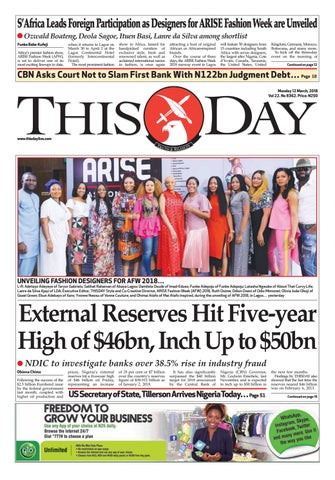
UNVEILING FASHION DESIGNERS FOR AFW 2018…
L-R: Adetayo Adeyeye of Taryor Gabriels; Salihat Rahaman of Abaya Lagos; Damilola Osude of Imad-Eduso; Funke Adepoju of Funke Adepoju; Latasha Ngwube of About That Curvy Life; Lanre da Silva Ajayi of LDA; Executive Editor, THISDAY Style and Co-Creative Director, ARISE Fashion Week (AFW) 2018, Ruth Osime; Odion Oseni of Odio Mimonet; Olivia Jude-Okoji of Gozel Green; Ebun Adebayo of Ilare; Yvonne Nwosu of Vonne Couture; and Ohimai Atafo of Mai Atafo Inspired, during the unveiling of AFW 2018, in Lagos… yesterday
External Reserves Hit Five-year High of $46bn, Inch Up to $50bn NDIC to investigate banks over 38.5% rise in industry fraud Obinna Chima Following the success of the $2.5 billion Eurobond issue by the federal government last month, coupled with higher oil production and
prices, Nigeria’s external reserves hit a five-year high of $46 billion on Friday, representing an increase
of 18 per cent or $7 billion over the country’s reserves figure of $38.912 billion as of January 2, 2018.
It has also significantly surpassed the $40 billion target for 2018 announced by the Central Bank of
Nigeria (CBN) Governor, Mr. Godwin Emefiele, last November, and is expected to inch up to $50 billion in
US Secretary of State, Tillerson Arrives Nigeria Today… Page 51
the next few months. Findings by THISDAY also showed that the last time the reserves neared $46 billion was on February 6, 2013. Continued on page 10
2
T H I S D AY ˾ ͯͰ˜ ͰͮͯͶ
T H I S D AY ˾ MONDAY MARCH 12, 2018
3
4
T H I S D AY ˾ ͯͰ˜ ͰͮͯͶ
T H I S D AY ˾ MONDAY MARCH 12, 2018
5
6
T H I S D AY ˾ ͯͰ˜ ͰͮͯͶ
T H I S D AY ˾ MONDAY MARCH 12, 2018
7
8
T H I S D AY ˾ ͯͰ˜ ͰͮͯͶ
T H I S D AY ˾ MONDAY MARCH 12, 2018
9
10
MONDAY, MARCH 12, 2018 ˾ T H I S D AY
PAGE TEN
CBN Asks Court Not to Slam First Bank With N122bn Judgment Debt FBN: We are law abiding with the capacity to meet our obligations Davidson Iriekpen The Central Bank of Nigeria (CBN) has asked a Federal High Court in Owerri not to make absolute the temporary garnishee order it granted six chiefs representing the Ogoni community, compelling it to pay the sum of N122.53 billion on behalf of First Bank of Nigeria Limited (FirstBank). CBN’s lead counsel, Professor Fabian Ajogwu (SAN) while responding to a new suit filed by the judgment creditors (Ogoni chiefs) seeking to commit FirstBank, its chairman, Mrs. Ibukun Awosika, and managing director, Dr. Sola Adeduntan, to prison for alleged contempt for not paying them the sum of over N122.53 billion, stated that making the order absolute and compelling the CBN to pay out the huge sum would be against the interest of justice because the matter was still pending at the Supreme Court. There are concerns that compelling the CBN to pay the N122.53 billion from FirstBank’s funds domiciled with the central bank could have far-reaching consequences for Nigeria’s oldest and biggest lender by assets and deposits, and a systemic impact on the rest of the financial system and wider economy. But in a statement yesterday, the bank said it was a responsible and law abiding corporate citizen with the capacity and character to, on a consistent basis, meet its obligations as and when due. The case, which started in 1991, was originally instituted at the Rivers State High Court, Nchia
Division, by six indigenes of Ogoniland against the Royal Dutch Shell Plc, Netherlands, Royal Dutch Shell Plc, United Kingdom, and Shell Petroleum Development Company (SPDC) of Nigeria Limited over alleged oil spills that occurred when Shell operated in the community. The plaintiffs alleged that it was the same case that led to the Ogoni struggle championed by the late Mr. Ken Saro Wiwa. Judgment was eventually entered in their favour against Shell by the state High Court, whereupon the defendant appealed against the said judgment. However, in 2001, a fresh suit was commenced by some representatives of the Ogoni people before the Federal High Court in Port Harcourt presided over by Justice Ibrahim Buba claiming N17 billion and interests on the said sum for the losses allegedly caused by the oil spills. Justice Buba, after listening to the submissions of the parties in the suit, in his judgment in 2010, awarded N17 billion to the representatives of the Ogoni people. The court equally granted the Ogoni chiefs 25 per cent interest charge on the principal sum of about N17 billion. SPDC then appealed against the judgment and applied for a stay of execution of the judgment pending the appeal. As a condition for granting the stay of execution, the court required Shell’s bankers, FirstBank, to provide a guarantee of the judgment sum. This condition was complied with. But Shell’s
appeal failed at the Court of Appeal on technical grounds, ostensibly because it filed its processes out of time and without regularising them. When the oil giant proceeded to the Supreme Court, it also failed as the court upheld the decision of the Court of Appeal. Accordingly, last December, the judgment creditors (Ogoni representatives) commenced garnishee proceedings at the Federal High Court in Owerri presided over by Justice Lewis Allagoa. They urged the CBN to pay them N122.53 billion out of FirstBank’s account in its custody. THISDAY gathered that they calculated the principal sum of N17 billion and the accrued 25 per cent interest charge per annum to arrive at the sum of N122,533,403,392. In January, Justice Allagoa granted them a temporary order (garnishee nisi) ordering the CBN to pay them the sum from FirstBank’s account with it. The judgment creditors, Chief Isaac Osaro Agbara and five others (representing the Ogoni community) are represented by Mr. Lucius Nwosu (SAN) as the lead counsel, while FirstBank is represented by Chief Wole Olanipekun (SAN) as lead counsel. Shell, against whom the judgment was made and who wants to be joined in the garnishee proceedings, having filed a motion for joinder, is represented by Mr. Wale Akoni (SAN), while the garnishee, CBN, which is allegedly in custody of the N122.53 billion is represented by Ajogwu. When the suit came up
for hearing before Justice Lewis-Allagoa of the Federal High Court in Owerri last Friday, Ajogwu, filed a motion before the court to set aside the temporary garnishee order on the grounds that the CBN was not indebted to and does not have the private funds of FirstBank in its custody. However, Akoni’s motion for Shell to be joined in the garnishee proceedings could not be taken. Ajogwu contended that the consent of the Attorney General of the Federation was not obtained to attach the money alleged to be in the custody of a public officer, contrary to the Sheriffs and Civil Process Act. He also argued that the funds alleged to be in the custody of the CBN could only be statutory funds, which cannot be attached for payment of judgment sums. He further averred that in view of the several suits and appeals in the matter, the proceedings were an abuse of the court’s process and amounted to forum shopping. In his motion, counsel to FirstBank, Olanipekun, also asked the court to set aside the temporary garnishee order. He argued that the court lacks the jurisdiction to hear the case, and therefore asked the court to transfer the case to Abuja or Lagos. But in his response, Nwosu stated that the Ogoni judgment creditors were entitled to the benefit of their judgment and opposed all motions by the CBN, Shell and FirstBank. After hearing all the parties in the case, Justice
Allagoa adjourned the matter to April 11, 2018, for the continuation of hearing. But in a statement sent to THISDAY yesterday, FirstBank’s Head of Marketing and Corporate Communications, Mrs. Folake Ani-Mumuney, said her organisation was a responsible law abiding citizen with the capacity and character to meet its obligations as and when due. She said the events culminating in the issuance of the bank guarantee at the request of Shell and all the lawsuits arising from the case were before the courts. She expressed confidence that the courts would dispense justice in the cases in line with constitutional obligations. According to her, “FirstBank is a responsible and law abiding corporate citizen with the capacity and character to, on a consistent basis, meet its obligations as and when due. “The events culminating in FirstBank’s issuance of the said bank guarantee at the request of Shell Petroleum Development Company Limited as well as all matters arising therefrom and associated therewith are subject matters of different lawsuits including Suit Nos. FHC/OW/CS/C4/2017, FHC/L/NJR/1/2018 and Appeal Nos. SC/511/2017 and SC/731/2017 which are ongoing. “We are confident that the various courts will dispense justice in the cases in line with their constitutional obligations.” Also, a source conversant with the case explained that FirstBank’s appeal was still at the Supreme Court and hearing on the case will
come up on October 16, 2018. He said irrespective of the fact that the Supreme Court had not ruled on the case, the counsel to the Ogoni chiefs, Nwosu, has been pushing for FirstBank to honour the guarantee. He said FirstBank, however, has maintained that the parties have the right to exhaust their rights in law and that includes going to the Supreme Court. According to the source, this was another attempt by Nwosu to stampede the bank into paying the N122.53 billion. Opening up on other tactics employed by the counsel to the Ogoni chiefs to compel FirstBank to cough up the sum despite the fact that the matter is still being adjudicated, he said Nwosu had also petitioned the two legislative chambers of the National Assembly. “Not stopping at that, he has petitioned the central banks of other countries where FirstBank has operations; he has initiated winding up proceedings against the bank in Lagos and Abuja which he discontinued; he took an action against FirstBank at the Federal High Court in Port Harcourt which he abandoned; he obtained the garnishee at the Federal High Court in Owerri seeking to attach FirstBank’s funds at the CBN; then last week he filed contempt proceedings against the chairman and managing director of the bank. “All these he has done irrespective of the case at the Supreme Court. But FirstBank from what I can tell is confident in the judiciary to do the right thing,” he said.
merchant banks rendered 286 returns on dismissed/ terminated staff as a result of fraud and forgeries during the year under review. Of the 26,182 fraud cases reported by the 26 licensed banks, 320 cases were attributable to internal collaboration by bank staff, leading to the sack or the termination of appointments or dismissal of the same number of employees in 2017. The losses arising from the reported cases decreased from N760 million in 2016 to N682 million or about 11.43 per cent in 2017. The corporation attributed this improvement to “additional internal control measures adopted by the banks in the wake of the proactive corrective measures taken to ensure their compliance with good corporate governance principles”. “However, despite the Fidelity Insurance Cover taken by banks to address fraud perpetrated by staff,
there is still need for the banks to further enhance their internal control and security measures, as the rising trend of E-Channels (online banking & card-related) fraud and forgeries in the industry remains a serious cause for concern to the corporation,” it added.
EXTERNAL RESERVES HIT FIVE-YEAR HIGH OF $46BN, INCH UP TO $50BN The federal government last month had raised $2.5 billion through the sale of Eurobonds under its Global Medium Term Notes Programme. The dual notes comprised a $1.25 billion 12-year series and a $1.25 billion 20-year series. The federal government said proceeds from the Eurobond issue would be used for refinancing maturing domestic debt. Confirming the latest reserves figures, CBN spokesman, Isaac Okorafor, in a statement yesterday, said the accretion of the country’s reserves was a result of the central bank’s continuous effort at vigorously discouraging unnecessary imports and reducing the nation’s import bill, inflows from oil and non-oil exports, as well as the huge inflows through the investors’ and exporters’ window of the foreign exchange market, which, he said, had attracted over $33 billion since April 2017, when it was created. According to him, the
CBN’s interventions in the forex window also helped to moderate the pressure on the forex reserves by sustaining liquidity in the market and boosting production and trade. Okorafor also noted that the CBN policy restricting access to forex from Nigeria’s foreign exchange market to importers of some 41 items had made a huge impact on the status of Nigeria’s reserves and boosted the supply of local substitutes for imported goods, created jobs at home, and enhanced the incomes of farmers and local manufacturers. Meanwhile, the Nigeria Deposit Insurance Corporation (NDIC) has said it will investigate some banks for inadequate rendition of returns to the corporation on instances of fraud, forgeries, and cases involving their employees who were either dismissed or had their appointments terminated on the grounds of fraudulent activities.
The NDIC said it made the decision in the light of the recent report from its off-site supervision of deposit money banks (DMBs) in the country, which revealed that the number of fraud cases attributed to internal abuse by staff of banks increased from 231 in 2016 to 320 in 2017, representing an increase by 38.53 per cent. Also, it showed that the amount involved in the fraud documented increased also by 38 per cent or by N3.33 billion, from the N8.68 billion reported in 2016 to N12.01 billion in 2017. Section 35 and 36 of the NDIC Act requires all DMBs to submit monthly information/returns on fraud and forgeries to the corporation. Although the NDIC report signed by its Head, Communications and Public Affairs, Mohammed Kudu Ibrahim, did not disclose the names of the affected lenders, the report relied on 286 responses received from
26 banks during the period. The 286 responses received from banks in 2017 cited 26,182 cases of fraud and forgeries, 56.30 per cent higher compared with the 16,751 cases reported in 2016. However, the expected/ actual losses slightly decreased by N24.42 million or 1.03 per cent, from N2.39 billion in 2016 to N2.37 billion in 2017. Also, internet/onlinebanking and ATM/cardrelated fraud-types reported constituted 24,266 or 92.68 per cent of all the reported cases as they made up N1.51 billion or 63.66 per cent of losses in the industry in 2017. The report also documented other miscellaneous crimes such as fraudulent transfers/withdrawals, cash suppression, unauthorised credits, fraudulent conversion of cheques, diversion of customer deposits, diversion of bank charges, and presentation of forged or stolen-cheques, among others. In all, the 22 licensed commercial banks and four
TOP GAINERS NGN NGN LASACO 0.04 0.44 CADBURY 1.60 18.40 JAPAULOIL 0.08 0.97 MULTIVERSE 0.02 0.26 ABCTRANS 0.03 0.42 TOP LOSERS NGN NGN FTNCOCOA 0.02 0.32 UNITYKAP 0.02 0.33 REGENCY 0.02 0.35 ETERNA 0.31 6.07 WAPIC 0.03 0.60 HPE Nestle Nig Plc ₦1,375 Volume: 1.536 million shares Value: N 17.707 billion Deals: 4,599 As at 2/3/18 See details on Page 35
% 10.0 9.5 8.9 8.3 7.6 % 5.8 5.7 5.4 5.4 4.7
T H I S D AY ˾ MONDAY MARCH 12, 2018
11
12
Ëœ ÍšÍşËœ ͺ͸͚͜ Ëž T H I S D AY
STARTERS
Should Africa be Worried About Chinese Loans? Solomon Elusoji in Beijing Last week Tuesday, just before he jetted out to what Joseph Conrad in his 1899 novel, ‘Heart of Darkness,’ described as the dark continent, United States Secretary of State, Rex Tillerson, was at the George Mason University in Fairfax, Virginia. There, bespectacled and huddled in a dark suit, he gave a speech in which he described China’s approach to solving Africa’s infrastructure gap as one that endangers the continent’s resources and its long-term economic and political stability. Although Mr. Tillerson admitted that Chinese investments do have the potential to address Africa’s infrastructure gap, he pointed out that such investments have done very little to improve Africa’s job fortunes while increasing its debt burden. Mr. Tillerson, in his stoic, bland manner, would repeat similar warnings two days later, while addressing journalists at Addis Ababa, the Ethiopian capital city. “We are not in any way attempting to keep Chinese dollars from Africa,� Mr. Tillerson assured. But “it is important that African countries carefully consider the terms of those agreements and not forfeit their sovereignty.� In response, the Chinese government, which was in the middle of a constitutional amendment, reiterated its commitment to Africa’s growth and prosperity. “Be assured, no matter how the world may change or what others might say, the profound friendship between China and Africa will remain unbreakable,� Chinese Foreign Minister, Wang Yi, told a press conference on Thursday. “Africa’s concerns are China’s concerns, Africa’s priorities are China’s priorities.� The rhetoric from Beijing, however, did not address the issues raised by Mr. Tillerson’s warning. While the United States remains the leading aid donor to Africa, China surpassed it as the continent’s biggest trading partner in 2009. Although China’s development assistance to Africa in the form of infrastructure boasts a long history, dating back to the Tanzam railway completed and handed over to the Zambian government in 1976. But since the turn of the century, Chinese companies, which mostly have connections to Beijing, have ramped up infrastructure investments across the continent. These investments have been executed, in part, through a kind of barter system where states pay for new railroads, highways, and airports while Chinese companies are guaranteed long-term supply of hydrocarbons or minerals. It is difficult to estimate the ‘fairness’ of
Chinese President Xi Jinping
N E W S A N A LY S I S the barter system because the specific details for most of these deals are kept under wraps by the governments involved. But one of its characteristics, according to critics, is the insistence of Chinese contractors to bring their own workers to carry out their projects. In a continent ravaged by unemployment, many are quick to point out the ridiculousness of such practices. But maybe it is not so ridiculous if the success rate of Chinese companies, in terms of delivering infrastructure projects in a timely fashion and at much lower prices than their competitors, is factored into the argument. And a reason for this success rate is that Chinese companies have an integrated system for sourcing finance, engineering talent and raw materials. If it is cheaper to import an engineer from China to work on a project in Monrovia, why raise costs by hiring a local one? The answer to this question, whatever it might me be, undoubtedly, raises the question of skills transfer. In his pivotal book, ‘China’s Second Continent,’ American journalist, Howard French travelled around Africa, meeting with Chinese immigrants and local policymakers. One of his most profound observations, in the book, bordered on the notion of the continent’s fast depleting natural resources. “At current rates, in the next forty years, most African states will have twice the number of people they count now,� French wrote. “By that same time, their presently known reserves of minerals like iron, bauxite, copper, cobalt, uranium, gold and more, will be largely depleted.� This is why French observed, it is important for African states to invest in their citizens
now, particularly in education and health. But the relationship between Africa and China appears not to be conducted on a ‘human capital investment’ basis. The Chinese talk about trade and infrastructure and connectivity and shared growth, but do they also prioritise the training of African engineers, doctors and scientists? “The Chinese come and they want your iron, your bauxite, your petroleum,� a Guinean academic, Amadou Barry told French on one of his many travels. “In return, they’ll deliver you turnkey projects, where they supply the materials, the technology and the labour, with salaries that are mostly not paid in the country and do not contribute to the economy.� The real problem, however, Barry stressed, was that with the skills gap that wasn’t been closed – decades back, China built a National Assembly building for Guinea. Barry noted that they never taught the locals how to maintain it. “Even now, when the light bulbs are burned out, we have to call the Chinese to change them,� he said. Still, China’s impact in Africa – even as it relates to adding jobs to the economy – must not be underestimated. Chinese apologist and engagement manager at McKinsey and Co., Irene Yuan Sun, was part of a team that did some research on a swathe of Chinese firms operating in Africa. “It turns out that they (Chinese firms) collectively employ more than 300,000 people, and 90 per cent of the employees are Africans,� she said, last Wednesday, during an Engagement Dialogue in Washington. In the same vein, yesterday, during a press conference, officials from the Chinese Ministry of Commerce touted China’s increasing humanitarian and human capital aid to Africa, the latter through the creation of special economic zones. However, a possible objective answer to whether Africa should be worried about Chinese loans is an emphatic “no�. The continent needs capital as it enters a period that will determine its future and China is willing to give it. Closing the infrastructure gap will also open up the economies of several countries, enhance trade on the continent and create job opportunities. Nonetheless, its governments must understand the crucial importance of diversifying from minerals-based economies into human capital-based economies: focused on skills and technology, not the soil. It is only this kind of priority shift that can help Africa take advantage of its current unique place in the world.
S’AFRICA LEADS FOREIGN PARTICIPATION AS DESIGNERS FOR ARISE FASHION WEEK ARE UNVEILED Saturday, March 31, the fashion extravanganza will have the distinction of showcashing the first Supermodel Masterclass ever to be held in the country, an ARISE Fashion Mentoring and Bootcamp, United Nations Special event, representatives of the federal government meeting with key designers, and The Showcase that will be anchored by Banke Kuku. Later in the day will feature some of the best internationally acclaimed designers: LaurenceAirlines from Cote d’Ivoire and Paris, known for establishing a new space for contemporary African fashion across the globe as well as young South African designer, Thebe Magugu, who’s craftsmanship and attention to design have garnered worldwide recognition. Day one will also feature styles from Canadian designer, Aurora James, the UK’s very own singer and performer, Nigerian-born Tinnie Tempah, celebrated Tanzanian designer, Mustafa Hassanali, Orapeleng Modutle and KLÝK CGDT, both from South Africa. KLÝK CGDT has participated in every ARISE show. From Nigeria are Funke Adepoju, Clan, Vonne Couture, About That Curvy Life Collective, Andrea Iyamah, Style Temple, Okunoren Twins, Ituen Basi and Lanre Da Silva Ajayi. Day two is to set to highlight designers offering luxurious and unique styles. From Germany, Sarah Duah will be featured on the catwalk, along with Koki Kamala from Botswana, Amine Bendriouich from Morocco,
and South African-born designer and ARISE original, Gavin Rajah who regularly shows at the Paris Fashion Week will grace the runway with his glamorous, yet refined designs. Again from Nigeria will be Grey, Abaya Lagos, Taryor Gabriel, Ilare, House of Divas, Lagos, Ziva, Lagos, Tzar, Kimono Kollection, Mai Atafo, Tsemaye Binitie, Jewel by Lisa and Tiffany Amber. To round off the show, day three of AFW 2018 will boast leading designers from both the UK and U.S. Self-taught, successful designer, known for dressing Cardi B., Rihanna and Beyonce, Laquan Smith, will be making his way back to Lagos from the U.S., to showcase his custom made, bare-to-there fashion. He will be joined by Ghanaian-British fashion designer, Ozwald Boateng, most known for the transformational impact he’s had on menswear fashion for almost three decades. The day will also display designs from South African designers Maxhosa by Laduma, Rich Mnisi and Lakhanyo Midingi, while Nigerian icons will include Moofa, Dzyn, House of Nwocha, Maxivive, Sunny Rose, Tokyo James, Maki Oh, Gozel Green, Bridget Awosika, Ere Dappa, Odion Mimonet and Deola Sagoe. As is the custom, the best of these will be selected to showcase their designs during the New York Fashion Week (NYFW) in September this year. “We are excited to bring world-class
fashion back to Lagos in the real sense of it. The bar will definitely be raised once more with strong collaborations, innovation, and creativity,� she had said last week. Eleven years ago, Africa’s fashion industry became truly global with the birth of ARISE, the synonym for “Africa Rising�. AFW helped to put Nigeria firmly on the global fashion map, showcasing and promoting African designers on the runways of the world, from London’s famous Royal Albert Hall, to Washington DC’s powerful J.F. Kennedy Center, to the legendary triple appearance during the iconic NYFW, to vivacious Lagos and Abuja, to magnetic Johannesburg and Cape Town, and to fabulous Paris. The AFW runway has seen global fashion icons and leading models such as Naomi Campbell, Alek Wek, Liya Kedebe, Oluchi Orlandi, and others showcase the best of Africa. From March 30 to April 2 at the Lagos Continental Hotel, AFW 2018 will once again showcase the best and brightest fashion designers from around the world. Still the most prominent fashion show in Africa, AFW continues to hold its prestige as the premier event where the global fashion elite will once again converge: the intersection of the international and the African; where a global audience of buyers, financiers, retailers, the fashionista and the media gather; where authenticity and originality meet innovation and style; where fashion truly matters.
Two-Minute BrieďŹ ng NEWS FG Reviews Excise Duty on
Tobacco, Alcoholic Drinks, Products to Cost More President Muhammadu Buhari has approved an amendment to the excise duty on alcoholic beverages and tobacco with effect from June 4, 2018. Page 50
EDITORIAL The NLC AT 40
The Nigeria Labour Congress (NLC) last week concluded a number of activitiesmarking its 40 years as the largest workers' institution in Africa with over seven million members from 43 industrial unions drawn from both the private and public sectors. Page 15
POLITICS Lagos APC Crisis
Deconstructed While the National Leader of the All Progressives Congress, BolaTinubu is busy reconciling aggrieved members of the party across the country, a protracted crisis, threatening to tear the party apart, is brewing in his backyard‌ Page 18
FEATURES Partnering for Security
Last week, the military and the Bayelsa Government came together in a rare collaborative effort to tackle insecurity in the state and around its axis. Emmanuel Addeh reports Page 20
BUSINESS FG Urged to Address Rising
Uncertainties in the Economy The federal government has been advised to urgently deploy policy tools to tackle looming crisis in the country’s economy. Page 23
NEWSXTRA Ambode Unveils Strategic
Intervention to End Apapa Gridlock Amid an annual revenue loss of N1.825 trillion and unprecedented infrastructure decay, Akinwunmi Ambode, has unveiled strategic interventions to end hydra-headed gridlock‌ Page 52
INTERNATIONAL Nigerians, Other Migrants Picked Up between Libya and Italy Nigerians constituted more than half of sev- eral hundred migrants picked up on Saturday by international charity ships and‌ Page 43
SPORTS Ezenwa Makes ‘Suicidal’ Boast
One of the three likely goalkeepers to make Nigeria’sWorld Cup 2018 squad to Russia, Ikechukwu Ezenwa, has assured football fans in the country to worry less about the threat that Lionel Messi, may pose to the Super Eagles‌ Page 55
T H I S D AY ˾ MONDAY MARCH 12, 2018
13
14
T H I S D AY Ëž Ëœ ÍŻÍ°Ëœ Í°ÍŽÍŻÍś
COMMENT
Editor, Editorial Page PETER ISHAKA Email peter.ishaka@thisdaylive.com
LAGOS AND LAND USE CHARGE A raise on money charged on property has become inevitable, argues Ayo Baje
“Somebody needs to tell us the bitter truth, for us to sacriďŹ ce together and that is what we needâ€? -Gov. Akinwunmi Ambode of Lagos State
T
he public outrage that has so far trailed the much misunderstood Land Use Act (LUC) is understandable. Firstly, it came like a bolt out of the blues, jolting not a few house owners in Lagos State, who erroneously believed that they have to cough out millions of their hard-earned money to pay for it. And secondly, they were much unaware that those who live in their own houses, without renting them out do not have much to part with. Unknown to them too, they stand to benefit from it all in the long run. Truth be told, the era of state governors going cap-in-hand to Abuja for the so-called monthly federal allocation is gradually on its way out. Given the intense clamour for political restructuring and the attendant fiscal federalism, the time to think and act outside the box is now, not tomorrow. He has to be futuristic in his approach to issues. Indeed, he is. That explains why he is taking policies with short time pains for the long term gains. Incidentally, Governor Akinwunmi Ambode, the award-winning technocrat-cum- politician, would not intentionally go out of his way to add to the pains of the good people of Lagos State. As a true leader he does not only have deep insight into the most pressing challenges his people have to contend with in their daily struggles, but has been articulating the mechanisms for sustainable solutions. That is vision. Interestingly, Henry Ford and Walt Disney had that rare attribute. So has Jeff Bezos, recently declared as the world’s richest man by Forbes Magazine. Within the matrix of what leadership entails he cannot do it alone. In fact, he should be able to identify the critical stakeholders in the determined search for such succour, involve them and be able to explain, in the simplest of terms to the eventual beneficiaries. They ought to know, for instance, the sacrifices they have to make for now. That, precisely is what Governor Ambode of Lagos State has done while taking a hard and holistic look at the LUC. In a rather unique but impact making format, he recently held a stakeholders meeting with the organised private sector, aptly tagged, “Lagos Means Businessâ€?. In full attendance were the likes of Aliko Dangote (Africa’s richest man), Donald Duke (former governor of Akwa Ibom), Mr. Jim Ovia (Zenith Bank) and Mr. Tony Elumelu(UBA and Heir Holding). Others included Otunba Subomi Balogun (FCMB), Chief Nike Akande (former Minister of Industry), Chief Razaq Okoya (Eleganza group) and Chief Kessington Adebutu (Premier Lotto). Before them he laid bare the facts and figures on what the law states on the Land Use Charge and what has transpired between 2001, when it was enacted and 2017. Although, it expressly states that it should be reviewed every five years, nothing of such was done for 16 odd years! For the rich owners of commercial properties, it would be a lie told to claim that their rental values vis-Ă -vis the market values of their buildings
THE PRESSURE IS PUT OFF THOSE WHO BUILD-TO-OWN AS THE MAXIMUM CHARGE THEY HAVE TO PAY IS N5,000. BETTER STILL, RETIREES/PENSIONERS, OWNERS OF UNDEVELOPED PLOTS, MOSQUES, CHURCHES AND PALACES ARE EXEMPTED FROM THE PAYMENT
and estates had remained the same over such a long period. Yet, Lagos State keeps expanding at an exponential rate in both population and the attendant infrastructural demands. For instance, it has been projected that by 2030 Lagos will become the third largest consumer market in the world with a population of 35.8 million, followed by Tokyo and Delhi. In specific terms, for a population of 24 million and taxable adults of eight million people only two million submitted their tax returns in 2017. And wait for this - only 700, 000 of this figure actually paid their tax in the past year! Though it posted an Internally Generated Revenue (IGR) of N284 billion in 2017 this cannot be compared to that of New York, Tokyo and London that boast of trillions as their contribution to the national GDP. Yet, on a comparative analysis, according to the United Nations Population Fund (UNFPA), Lagos attracts an average of 89 people entering the city every blessed day pitched with 67 for Mumbai, 12 for New York and seven for London. If the 2018 budget figure is spent on building the required infrastructure, the deficit will stand at a whopping N14.47 billion. So, how would a state that requires $50 billion to bridge the infrastructural deficit cope with such intimidating challenge? That is the million-naira question. One option before the governor is to go a borrowing. But who will pay off the huge debts when they accumulate for years? The people will bear the brunt. Sad about this development Governor Ambode has considered this as not economically healthy, or wise. In his words: “There is no need to come to you, if I continue to borrow to punish you. It is not what we want�. The best way forward, in this prevailing circumstance, is for the upward review of the land use charge in accordance with the law. It means therefore, that owners of hotels, high-rise buildings and estates have to pay the LUC. The pressure is put off those who build-to-own as the maximum charge they have to pay is N5,000. Better still, retirees/pensioners, owners of undeveloped plots, mosques, churches and palaces are exempted from the payment. All these explanations he made should be clear to any literate citizen. But not waiting for such clarification, some people, out of mischief have gone to town crying wolf where there is none. How, for instance, does an increase of 0.076% of the 60% of the value of a property, with regard to the LUC 2018 Act and as independently analysed by the Coalition of Real Estate Investors and Surveyors amount to 400 %? It does not add up. On his part, looking at the larger picture, the governor knows that if Lagos has to keep pace with its dream of becoming the third largest economy on the African continent, cope with dwindling resources from oil and enjoy relative peace as it beefs up security, increased taxation of those in the upper class, is the best way forward. That explains the commendation he received from the likes of Dangote and Ovia. Said the former:“I think people should voluntarily be paying their taxes in Lagos�. As the latter reiterated, many entrepreneurs feel safe conducting their businesses in the city.
EXCESSES OF THE HATE SPEECH BILL Adebayo Raphael argues that the bill is an extreme measure which will fuel more hateful speech
N
igeria is speedily sliding into a democratic dictatorship. All indices right now are working against the sustenance of democratic principles in the country. In a democratic dictatorship, public opinion is irrelevant. The democratically elected leader calls the shots at all times, regardless of whether the people are in support or not. Unfortunately, this is the situation in Nigeria, and those who are engineering this barbaric, out-of-fashion style of governance are in control of the aces – they are the anchors of the ship, hence, dictate where the ship goes, albeit in favour of their egoistic individualism. In any thriving democracy, public opinion is sacrosanct. Even from time immemorial, political leaders, coup plotters, and anyone who is desirous of power are always on the lookout for when the pendulum of public opinion would swing in their favour, and the smart ones are always quick to seize the opportunity. But, a democratic society where little or no consideration is given to public opinion is unfit for the appellation. For it is often true that any society without a functioning social capital is susceptible to being impugned by a bunch of shallow, confused mortals. Recently, a legislative bill seeking to hang purveyors of hate speech upon conviction was sponsored on the floor of the Senate. The bill, which was sponsored by Senator Aliyu Sabi (APC, Niger State), says: Any person found guilty of any form of hate speech that results in the death of another person shall die by hanging upon conviction. Surely, this begs some serious questions: One, what is hate speech? Two, should purveyors of hate speech be put to death? Three, who decides if a particular expression is hate speech? These questions certainly cannot be answered absentmindedly.
Firstly, hate speech is any derogatory speech from one person or a group of persons, to another person or group of persons, on the basis of their race, religion, ethnic background, sexual orientation, disability, or gender. Equally, it is important to understand the meaning of dangerous speech, which is often confused with hate speech. Dangerous speech is any speech that incites a person or group of persons to condone or participate in violence against another person or group of persons. Secondly, we cannot yank off the head merely to cure a headache. Death by hanging is certainly not going to end hate speech in Nigeria. If history has taught us anything, it is the fact that this extreme measure will only fuel hate speech the more, which could ultimately metamorphose into dangerous speech. Thirdly, I ask, who decides if an expression is hate speech? Nigerians in positions of authority and politicians generally have demonstrated, again and again, that power is nothing to them if they cannot abuse it. We have constantly seen how people in these positions unfeelingly embark on a mission of vendetta, to settle old grudges with their political rivals, or people who supposedly bruised their ego. Further, we have seen how continuous disregard for details by Nigerian leaders has repeatedly and increasingly created problems, rather than solutions in the country. Between June and December 2016, Center for Information Technology and Development (CITAD), a research-based institution in Nigeria, captured 6258 items of hate and dangerous speech. CITAD noted, that while over 82% of the hate and dangerous speech items were in response to statements made by others, religious and ethnicity constitute more than 80% of the data captured. Rightly so, the problems of national identity and religion have been perennial in our national history
because some viciously egoistic mortals have dedicated their life, resources, and patrimony to polarising Nigerians with those primitive narratives, simply to perpetuate evil and individually or esoterically aggregate our commonwealth. In addition to religious-based and ethnic-based hate speech, there are other causes of hate speech like poverty, lamentable economy, highhandedness and opacity in government, perceived marginalisation, politically discontent persons (PDPs), injustice, political vendetta, wrong approach by government to resolving communal crises such as the Shia conflict, herdsmen/farmers crisis, etc. All of these are reasons for the articulation and spread of hate-filled messages. It is, therefore, myopic, lazy, incompetent, insensitive, and grossly offensive for any lawmaker to think that proffering a superficial, extreme, and most likely diversionary ‘solution’ of hanging people for hate speech would solve the deep-rooted crisis of vitriolic and incendiary speeches in the country. It is unfortunate, that our lawmakers do not even know, or perhaps care less, about drawing the lines between muzzling freedom of speech and curbing hate speech. Even more unfortunate is the fact that leaders in Nigeria are too lazy to do great work. Instead, they think lazily and work shoddily. On this perspective, the masses, the church, and the press stand at a great disadvantage if this lethal piece of legislation becomes law. Important to note, however, that this is not the first time the Eighth National Assembly, President Buhari’s administration, and members of the APC would come up with something ludicrous. As a matter of fact, there had been many attempts, but let’s look at a few together. In 2015, Senator Bala Ibn Na’Allah (APC, Kebbi South), sponsored the Frivolous petitions (Prohibition, etc) bill, otherwise known as the anti-social media bill. But for public
outcry and denunciation, the bill was thrown into the bin. Similarly, in July 2017, Minister of Information and Culture, Mr. Lai Mohammed, openly declared his anti-fake news army to counter any perceived fake news on the social media. The ruse behind the move was uncovered and the fake news army literally crashed. Again, in 2017, the federal government declared hate speech as terrorism. However, Nigerians did not take it lightly. Even so, towards the end of 2017, the military warned that it would start monitoring the social media - another move allegedly to curb hate speech which did not succeed because the people resisted it. It is therefore unsurprising that this ignominious bill was proposed on the floor of the Red Chamber. As a matter of fact, anyone who has been following the consistent display of dictatorship tendencies in the Buhari-led administration would have predicted this insalubrious bill. What baffles me, however, is how the same people - members of the ruling political party (APC), who campaigned virally using largely hate speech, are now hell-bent on shushing the people. You may cast your mind back to seven years ago when someone made a vitriolic comment about the dog and the baboon being soaked in blood. In his words, he said; “They either conduct a free and fair election or they go a very disgraceful way. If what happened in 2011 should happen again in 2015, by the grace of God, the dog, and the baboon would all be soaked in blood.� He was never condemned to death, instead, he got all kinds of ridiculous rationalisation from people who share the same IQ with him. The same person is now in the saddle and suddenly, they want to hang people to death. Surely, the law of boomerang respects no one. The consequence of unhealthy politics is lethal to our society and democracy.
15
T H I S D AY Ëž Ëœ ÍŻÍ°Ëœ Í°ÍŽÍŻÍś
EDITORIAL THE NLC AT 40
The Congress must uphold democratic principles and operate by the spirit and content of its constitution
T
he Nigeria Labour Congress (NLC) last week concluded a number of activities marking its 40 years as the largest workers’ institution in Africa with over seven million members from 43 industrial unions drawn from both the private and public sectors. The anniversary activities featured thanksgivings and public lectures, including “The Future of the World of Workâ€? - a topic which aptly coincides with the theme of the centenary celebration of the International Labour Organisation which turns 100 years next year - delivered by Mr. Guy Ryder, the Director-General of the ILO and “Labour, Politics and Governanceâ€? delivered by former Independent National Electoral Commission (INEC) chairman, Professor Attahiru Jega. We salute the NLC and its afďŹ liate unions on the occasion of the historic celebrations. Notwithstanding numerous challenges that the Nigerian workers still grapple with, several gains have been made in the past 40 years. Without any doubt, the NLC, as a non-state actor, has come of age in defence of the interests of its working and retired members in NLC LEADERSHIP MUST line with the objectives REVISIT THE UGLY of its constitution. EVENTS OF THE LAST 11TH For sure, the history DELEGATES’ CONFERENCE of organised labour in IN 2015 WHICH MADE Nigeria is a long one. SOME FEW AFFILIATE The ďŹ rst ofďŹ cially recUNIONS TO PULL OUT ognised labour moveAND EVEN DARED TO ment, the Civil Service FORM ANOTHER LABOUR Union, was formed CENTRE in 1912, followed by Nigerian Union of Teachers (NUT) and Nigerian Union of Railwaymen (NUR). Since the nation was still under British colonialism, the ďŹ rst generation of unionists also had to confront exploitation and oppressions. Meanwhile, the NLC was formed in 1950. But 30 years after, thanks to ideological differences of the Cold War era, the ďŹ rst NLC split into four centres namely, United Labour Congress (ULC), Nigeria
Letters to the Editor
Trade Union Congress (NTUC), Nigeria Workers’ Council (NWC) and Labour Unity Front (LUF). The second and present NLC was formed on the ashes of the old labour centres. The independent efforts at one indivisible labour centre were propelled by great veteran unionists like H.P. Adebola, late Wahab Goodluck, S.U. Bassey, J.O. James, N.F. Pepple, A.I. Okwese, Chief E.A.O Odeyemi, M.A. Imoudu, J.U. Akpan, R.A. Ramos, Okon Esshiett and Vincent Igwe Jack. The intervention by the late General Murtala Muhammad regime led to a wholesale restructuring of the then house unions into national industrial union in 1978.
T T H I S DAY EDITOR DEPUTY EDITORS ˜ MANAGING DIRECTOR DEPUTY MANAGING DIRECTOR CHAIRMAN EDITORIAL BOARD
EDITOR NATION’S CAPITAL
T H I S DAY N E W S PA P E R S L I M I T E D EDITOR-IN-CHIEF/CHAIRMAN GROUP EXECUTIVE DIRECTORS ˜ ˜
˜ ˜
DIVISIONAL DIRECTORS ˜ DEPUTY DIVISIONAL DIRECTOR
SNR. ASSOCIATE DIRECTOR ASSOCIATE DIRECTORS ˜ CONTROLLERS ˜ ˜
DIRECTOR, PRINTING PRODUCTION TO SEND EMAIL: ďŹ rst name.surname@thisdaylive.com
TO OUR READERS Letters in response to speciďŹ c publications in THISDAY should be brief (150-200 words) and straight to the point. Interested readers may send such letters along with their contact details to opinion@thisdaylive.com. We also welcome comments and opinions on topical local, national and international issues provided they are well-written and should also not be longer than (9501000 words). They should be sent to opinion@thisdaylive.com along with the email address and phone numbers of the writer.
WE CAN BRING VISION TO EVERYONE
E
ighty million people across the Commonwealth are blind or have very poor vision. Many millions more – from children to the elderly - have less than perfect eyesight. But we have the means to change that. Today, thanks to developments in science and technology, four out of five people who are blind do not need to be: simple, tried and tested solutions exist to prevent or treat many types of blindness. And for the many people with impaired vision, often all that is needed is an eye test and a pair of glasses. Good eyesight transforms lives, releasing potential to learn, to work, and to live life to the full. It boosts productivity and reduces social care costs. Vision is in many ways the golden thread running through the Sustainable Development Goals. It can help reduce poverty, and deliver quality education, decent work and gender equality. Right across the Commonwealth, bold and imaginative steps are being taken to preserve, correct and restore eyesight. Here in Nigeria, it is estimated that over two million people aged 40 years and above are blind. It is also a common finding that there is gender imbalance in visual impairment in children; alongside a lack of skilled
o the extent that anniversary periods are good for organisational self-criticisms and reections, the NLC must reect on the past 40 years. The ďŹ rst challenge is to consolidate the gain of unity in the years to come. NLC leadership must revisit the ugly events of the last 11th delegates’ conference in 2015 which made some few afďŹ liate unions to pull out and even dared to form another labour centre. The NLC in the years to come must therefore uphold its democratic principles and operate by the spirit and content of its constitution if it must maintain its moral authority in pushing for good and accountable governance in the country. The high point of NLC in the 1980s was when it stood counted in the struggle against military dictatorships for which some notable trade unionists were thrown into detention by the late General Sani Abacha dictatorship. But that could only happen because there was a unity of purpose. We therefore support the call by the Minister of Labour, Dr Chris Ngige that the labour veterans must continue the reconciliation work to reunite all their comrades. They must also avoid the pitfalls of exclusion which often undermine unity and cohesion. As the NLC reects on the past and plans for the future, we salute their founding presidents such as Comrades Hassan Sunmonu (1979-1984), Ali Chiroma (1984-1988), late Paschal Bafyau (1988-1994) and Adams Oshiomhole (1999-2007) for their determination and courage to improve the working and living conditions of Nigerian workers
workforce, referral or linkages between health and education services. Various organisations are working with government partners to blindness prevention initiative one of which is the child eye health services including policy on screening children at school entry. Other areas of support include working with relevant institutions to develop and strengthen the Human Resource for eye Health (HReH). This is to bridge the gap in equality of access and ensure “No one is left behind� in the efforts to eliminate the avoidable causes of blindness in Nigeria. Thanks to the initiatives taken in recent years, much progress has been made. But as the population of the Commonwealth grows and ages, much more is needed. Without action now, the number of people affected is set to triple by 2050. Every country is affected. Commonwealth Heads of Government will meet in the United Kingdom in April 2018. They can commit to eye health for all, within universal health coverage, and to each taking one significant action towards it before they meet again in 2020. Nigeria can help the Commonwealth lead the world in bringing vision to everyone, everywhere. Visit www.visionforthecommonwealth.com for more information. Dr. Sunday Isiyaku, Kaduna
SENATE: BETWEEN SERVING AND FLEECING THE PUBLIC
T
he information disclosed by Senator Shehu Sani representing Kaduna central that each senator receives N13.5 million monthly as running cost has stirred mixed reactions among Nigerians. Although this is not the first time the lawmakers are accused of cornering the national resources at the detriment of economic development, the latest disclosure from an insider has reaffirmed the belief that the red chamber is a money-spinning machine. Prior to this shocking revelation, the former CBN governor Sanusi Lamido Sanusi advised the federal government to cut recurrent expenditure amidst the economic crisis. He frowned on how federal government could be spending billions of naira servicing lawmakers while majority of Nigerians live in abject poverty. Joining the list of those who lashed out at our senators and described them as those who feed fat from the lean pulse of government is Ibrahim Babangida. The former military ruler once advocated for part time lawmakers to reduce the cost of government. Why is our democracy costly to run compared to the advanced democratic countries of the world? This plain truth of our money guzzling Senate makes me to do
a simple arithmetic to arrive at how many billions these 109 members gulp in a calendar year. Each senator receives monthly salary of N700,000, N13.5m monthly running cost and N200m constituency allowance. It costs the country N371 million to service a senator and cumulatively N40.44 billion annually to maintain 109 senators. This huge amount is outrageous in a country like Nigeria where per-capita income is low and people are languishing in penury. What pains many Nigerians is that these senators consumed the funds without commensurate results. It may interest you to know that most of our senators are seat warmers. They hardly sponsor bills that will translate or enhance the lives of their constituents. In fact, many of them hardly visit their constituency let alone know the problems of the electorate that voted them. Annoyingly, some senators only drive to their communities when election is slated or around the corner. They would come up with funny poverty alleviation programme distributing motorcycles, sewing machines and peanuts capital for selected loyalists. This is intended to win the heart of beneficiaries in anticipation of vote in return. Ibrahim Mustapha Pambegua, Kaduna State
16
T H I S D AY ˾ ͯͰ˜ ͰͮͯͶ
T H I S D AY ˾ MONDAY MARCH 12, 2018
17
T H I S D AY ˾ MONDAY, MARCH 12, 2018
18
Group Politics Editor Tobi Soniyi Email tobi.soniyi@thisdaylive.com 07054786260 SMS ONLY
POLITICS
M O N D AY D I S C O U R S E
Lagos APC Crisis Deconstructed While the National Leader of the All Progressives Congress, Bola Tinubu is busy reconciling aggrieved members of the party across the country, a protracted crisis, threatening to tear the party apart, is brewing in his backyard, writes Segun James
Henry Ajomale, Lagos APC Chairman
I
It is easy to be cynical about political test results, particularly when you are grading the performance of a government in a complex country as Nigeria. But every four years, the media, nongovernmental organisations (NGOs) and others severally, individually and sometimes, jointly come together to grade the performance of individuals and governments in the country and assess if they deserve another chance in the political system. However, since 1999, Lagos state has been an exception to the rule. It has been blessed by exceptionally brilliant governors. People die for flag and country, but in the Lagos state chapter of the All Progressives Congress (APC), they do so because of the enigmatic Bola Ahmed Tinubu, the national leader of the party. He is the man who has changed the face of governance in the state, and indeed, the country; making the people to truly believe that their state is really a shining example in a nation which is barely crawling, almost 60 years after independence. Tinubu has been in firm control of the politics of the state. Until now, it has been widely assumed that the politics of the state can be controlled from the Lion’s Den at Bourdillion Road, Ikoyi, but now the reality suggests otherwise. There, surprisingly, is a challenge to the powers of the lion. Today, there is a rumbling in the centre of excellence, the appellation by which the state is known. There is a challenge to the hegemony of the leader and a big threat to the possibility of Governor Akinwunmi Ambode having a second term in office. The crisis started long time ago. Insiders traced the genesis of the crisis to the time when Ambode, a complete outsider to the political family of Tinubu was anointed by the leader as the governorship candidate of Lagos APC;
if the people were annoyed at the choice, they never said it since they worked assiduously to ensure he became the governor. After he became the governor it was left for Ambode to unite the party by bringing into the folds those who opposed his emergence as governor. He did not do this. After waiting in vain for Ambode to wave the olive branch, many were shocked to see the governor carrying along without them. This was where the honeymoon between them and the governor ended. Those who helped him win the governorship were sidelined. This action by the governor triggered the crisis that is today threatening his second coming as governor. Although the crisis in Lagos would have been considered local, but the truth is that the state is the most strategic in the federation; and the enemies of Tinubu are bent on wrestling the state from him at all cost. Like Tinubu himself, his opponents are formidable and hell bent on cutting him to size. This was the situation at the time the national leader was appointed the chairman of the party’s reconciliation committee. The coming out of the cold by the opposition to the continued leadership of Tinubu in Lagos state, but more especially, the second
One thing that is clear from the crisis in Lagos APC is that the leadership has no respect for the party’s constitution
term bid of Ambode has surprisingly pitted the members of the party in the state, for the first time, against their leader. The crisis in the state chapter of the party has been simmering for some time. The politicians who engineered the ascension of Ambode to power feel left out when the governor upon taking control started giving out the dividend of office to people who were not part of the process that brought him to power. Barely a few days after Tinubu resumed his assignment as head of the reconciliation committee of the party, the Lagos state chapter split as a new organisation called the Broom United Movement (BUM) emerged to challenge the leadership of the party in the state. The split in Lagos may have made the work of the national leader difficult as those involved in the ‘rebellion’ are known followers of Tinubu. The splinter group accused the leadership of the party in the state of engaging in “illegalities, manipulation and marginalisation” against members, warning that unless genuine reconciliation is allowed to take place, the party might be heading for a crisis and a disaster in an election year. According to Mr. Fouad Oki, a former director general of Bola Tinubu, Tunde Fashola and Akinwunmi Ambode’s campaign organisations and convener of BUM, “our party suffers from low organisational capacity and lack of internal democracy. The resultant effect of this has been its incapacity to support our democracy as expected.” He sid that “today, our party in Lagos state is fading into insignificance. Massive membership exclusion is becoming the order of the day with members withdrawing from the political space and constituting themselves into internal opposition. It is in the light of all these, that the Broom United Movement will
involve committed party members who will bring moral authority, character and wisdom in handling the delicate issue of reconciliation, unity and accord.” He assured party members that from now on, their “votes will count and will be allowed to freely choose their leaders in a healthy competitive atmosphere,” saying that the APC in Lagos state “has never been this divided and disunited. The current graveyard silence that permeates our political landscape with a ‘siddon look’ syndrome is very dangerous,” adding that political parties are vital organisations in a democracy, and democracy is stronger when citizens become active members of political parties.” Oki said that this unfortunately was what was lacking in party management in the state. “Unfortunately, the democratic culture in our state is characterized by factors such as illegalities, rigging, oppression, manipulation, marginalisation and violence.” Warning that “democracy and political participation are related to good governance; this relationship is complementary but appear to be antithetical in our political system. When democracy is abused, good governance becomes elusive and evasive.” This triggerred an atmosphere of desperation at the state chapter given the position of Oki as a vice chairman of the party and the strategic roles he had played in the past to promptly suspend him. Instead of listening to the voice of reason, the leadership of the party led by Chief Henry Ajomale wielded the big stick. Without hearing the other party, he ordered Oki suspended. He also set up a disciplinary committee to try Oki for antiparty activities. CONT’D ON PAGE 19
19
T H I S D AY ˾ MONDAY, MARCH 12, 2018
POLITICS
MONDAY DISCOURSE LAGOS APC CRISIS DECONSTRUCTED
Fouad Oki , Vice Chairman APC Lagos
The party, in a statement said that as fallout to launching of a pressure group in the APC, the State Chairman directed the immediate suspension of Mr. Fouad Oki, a Vice Chairman of the party, representing Lagos Central Senatorial District and Convener of Broom United. Ajomale also summoned the Surulere Local Government Party Chairman, Alhaji Shakiru Ajao and Party Secretary, Mr. Ganiyu Akanni respectively to his office with strict instruction to empanel an investigative committee on Mr. Fouad Oki for convening the BUM and thereafter suspend him indefinitely from the party. According to Ajomale, this is necessary in order to stop others from doing the same thing. He further stated that he was acting on the instruction from above. He claimed that, the only agenda which is acceptable to the party in the state at this time is the second term endorsement of the governor, Mr. Akinwunmi Ambode, anything outside that is not needed and would be resisted by all means possible. Ajomale appeared to have forgotten that when Ambode’s campaign was wobbling and fumbling in 2015, Oki was hurriedly drafted to lead the campaign three months before the election. He eventually led the party to success in an election that could have been won by the Peoples Democratic Party’s candidate, Jimi Agbaje. But when contacted on this development, Oki confirmed the receipt of the said invitation letter written to him to appear before an investigative committee on BUM. He stated further that, the letter did not state his offence or any article of the party constitution which he has breached or purportedly breached contrary to Article 21(B) of the party’s constitution. “I have humbly accepted the invitation and will appear before the panel. I have no cause to worry. I am not seeking for any office. I am here to serve and bring unity to our party. I call on all aggrieved party men and women to give BUM a chance to rebuild our party to give hope to party members of all shades and creed.” He reiterated the philosophy of BUM that “We are united in reaffirming the ideals that made our party in 2013 to break the yoke of ethnicity and divisive politics to unite under an amalgamated legacy parties to elect a PanNigerian President. Our members are growing by the day. As of today, we have over 25 LGA party chairmen and executives as well as over 150 ward executives aside other members at the grassroots, our members are looking forward to a party of inclusion, the party of economic opportunities, the party of freedom and a united party that will rise from the ashes of intimidation, imposition and god-fatherism to the mountain of hope. “Our people are looking with nostalgia to the
Muiz Banire, APC National Legal Adviser
freedom of association without being coerced into a force second term agenda, the respect for our members and the sense of belonging that pervade our party under leaders that are weak, self centred and lack capacity to institutionalise internal democracy. We the stakeholders are resolved to rebuild, renew and rebrand our great party to anchor the dreams of our founding fathers and give wings to the hopes of our members who live in uncertainty,” He said that BUM would lead to a new party with responding ideals, adding that the decision to go ahead with the reconciliation of members which he said, was the only objective “we are striving to achieve”, he added. He added that the action of the state chairman of the party in directing the LGA chapter to suspend him at all cost was in gross violation of established procedure and disciplinary process. He further stated: “Our founding fathers are very resolute in the kind of party that we are building; a party that would ensure that everybody is cared for and carried along, a party that will not tolerate anything that will take away members rights to choose their leaders and representatives without force or intimidation. BUM will ensure that our party’s constitution is abide with and implemented to the letter, where every member will have a sense of belonging and can actualise his aspiration in an atmosphere devoid of imposition or intimidation.” “People like Ajomale still believe that you can build a party by suspending anyone who does not agree with them. Let them continue with the suspension. We will see who will remain to make Ambode’s re-election possible”, a member of the party told THISDAY Politics. Before the emergence of the Broom United Movement and the suspension of its convener, the party had earlier shown its intolerance for opposition within the party when it purportedly suspended the National Legal Adviser of the party, Dr Muiz Banire, SAN. What was Banire’s offence? He asked the party to jettison imposition of candidates during last year’s local government election. For insisting that
What the leadership of the party does not seem to realise is that there are many members that are as aggrieved as Banire and Oki. The only difference is that they are not as bold as the duo
the right thing be done, Banire was castigated and threatened. The state government even threatened to demolish his house. “The PDP was not this intolerant when it was in power,” said another member of the party who spoke on the condition of anonymity out of fear he will be molested if his name is mentioned. One thing that is clear from the crisis is Lagos APC is that the leadership has no respect for the party’s constitution. Many are at a loss trying to understand this when the state chairman is himself a lawyer. Like Oki, Banire had warned that many members of the party in Lagos had become frustrated and were ready to leave in droves if the party failed to amend its way. Nobody listened to Banire. He said: “The level of frustration is so much within the system. Most of the people that I have come across that have struggled within the party seem to be frustrated already. In fact, it has taken my intervention to arrest largely the drift of people to the opposition party. And I believe that if you are giving them assurance you must be able to secure that assurance to the last, because if you fail, then you may not be able to control anybody. It could happen, more so that the PDP is advancing seriously against us in the state. So I do not believe that we should play to their hands at all.” > Then Oki came on board to add his own voice. If suspension is the solution as argued by Ajomale, Oki would not have spoken out after the purported suspension of Banire. In a letter to the chairman, he said: “”I honestly cannot fold my arms and make as if nothing is wrong in this regard. “Our party members are not happy with us, they have lost trust and confidence in our ability and capacity to manage the party. Our party and government lack cohesion and synergy. “Our weak leadership style cannot drive the party to any victory due to our acts of indiscretion, which could prevent our party from achieving its set goals and subject it to public ridicule.” What the leadership of the party does not seem to realise is that there are many members that are as aggrieved as Banire and Oki. The only difference is that they are not as bold as the duo. The fact that many are keeping quiet does not mean they agree with the way the party is being run. > In February 2019, Nigeria will be holding a general election. It will not be completely free and fair; but it will certainly be competitive given the undemocratic way the national leader is known for selecting who takes what position. But for the first time, there will be challenge to his decision Tinubu will also have to tread cautiously. At
the party’s national level his authority is being challenged. In Lagos, people are questioning his judgment. He may think that the opposition in his backyard is too feeble to threaten his hegemony, there is however a way the two can mix and produce an undesirable effect. In Ondo, his candidate was denied the opportunity to fly the party’s flag. The opposition to his job as chairman of the reconciliatory committee of the party should also be instructive to him. Tinubu must have seen the position as an avenue to rid himself of the irritants that are threatening his powers in Lagos and a way to get rid of others who had constituted themselves into opposition nationally. But unfortunately, he wasn’t prepared for the political dexterity of the opposition led by Chief John Odigie-Oyegun, the man Tinubu imposed on the party to the chagrin of others when he was the power that be at the party before the 2015 general election which the party later won. But the recent crisis began when just ahead of the National Executive Council (NEC), meeting of the party, a fierce battle began for the control of the soul of the ruling party between its National Leader, Asiwaju Bola Ahmed Tinubu and the National Working Committee, NWC, led by Chief John Odigie-Oyegun. It is an open secret that Tinubu is determined to ensure that Oyegun is removed as the national chairman of the party following the shift of loyalty by the latter, but the attempt by the party leader to achieve the feat failed woefully. The last of such moves was during the February 27 NEC meeting. Rather than being ousted at the gathering, Oyegun, like a cat with nine lives secured a year extension of tenure for himself and the entire party structure from the local to national level at the expiration of their tenure by the end of June. This was achieved through an overwhelming 104 to 4 votes at the NEC meeting attended by President Muhammadu Buhari; his deputy, Prof Yemi Osinbajo; state governors and Tinubu among other party leaders. For that feat, hell was let loose, with supporters and proxies of the national leader threatening court action to block the tenure elongation for the party chairman and his NWC, which they claim is against the party’s and the 1999 constitution. o beat the fresh onslaught against his continued stay as the party’s chairman, It was gathered that Oyegun and his executive committee prepared a new strategy document to foil any court action and get the next NEC meeting to ratify the committee’s one-year extension. For Tinubu, it may be high time to restrategise.
20
T H I S D AY Ëž Ëœ ÍŻÍ°Ëœ Í°ÍŽÍŻÍś
FEATURES
Acting Features Editor Charles Ajunwa Email charles.ajunwa@thisdaylive.com
Partnering for Security Last week, the military and the Bayelsa Government came together in a rare collaborative effort to tackle insecurity in the state and around its axis. Emmanuel Addeh reports
Commander of the new 16 Brigade, Brig. Gen Kevin Aligbe (2nd left), Governor Seriake Dickson and Chief of Army Sta, Lt. Gen. Tukur Buratai, at the foundation laying of 16 Brigade Barracks, Camp Buratai in Yenagoa, Bayelsa State‌recently
F
or several reasons, the army remains one of the most revered, if not the most feared security-related institutions among the Nigerian Armed Forces.
But all the long-standing presuppositions and misconceptions literally melted away last week when the leadership of the Nigerian Army, dropped the entire toga that induces trepidation among the civilians when it freely mixed and related with residents and civilians in Elebele, Yenagoa, last week. The event was the groundbreaking ceremony of the construction of 16 Brigade Barracks, Camp Buratai in Yenagoa, in a partnership that spans the army, the Seriake Dickson-led administration and the private sector. To be sure, the issue of insecurity has been a major headache for Niger Delta leaders, against the background of years of crisis, which sometimes snowballs into violence in the oil-rich region. Many innovative ideas, some of them novel, had been introduced in the past to tackle the various security issues of kidnapping, sea robbery, vandalism of pipelines and other oil facilities in the area, illegal oil bunkering and outright militancy. However, none seemed to have effectively stopped the hoodlums. The idea of creating a new brigade in the state, may, however, help the security agencies to have a firmer grip of the security situation in the area, with a view to reducing, if not totally eradicating the feeling of insecurity among the people. A day before the event the Chief of Army Staff (COAS), Lt. Gen. Tukur Buratai, who flew into the state, savoured the usual hospitality of the people of Bayelsa when he was literally transformed into an Ijaw man by Governor Dickson, who will undertake to
build a Command Children's School, Officers Mess, as well as a Soldiers Canteen with immediate effect. With their usual unique dressing, Buratai was quickly worn a big flowing long-sleeved dress usually worn by the Ijaw people, with a walking stick to match before stating his mission in the state to his host, the governor at the Government House. The next day was the actual event and aside the governor and the high command of the Nigerian Military, private sector businessman were also on hand to support the military in their bid to end criminalities in the Niger Delta. Delivering his remarks, an elated Buratai, described the event as a historical milestone,
The establishment of 6 Brigade in Port Harcourt, 6 Division in Port Harcourt and the 16 Brigade in Yenagoa forms an important part of Mr. President’s desire to have a balanced and widespread footprints of the Nigerian Army to deal with the myriads of security challenges facing the country in conjunction with other security agencies
stating that about a year earlier, he was in Bayelsa State for the operationalisation of the brigade and was pleased to be associated with the developmental strides that had taken place since then. He lauded all those who made the day possible, including the President, Muhammadu Buhari, the state government and commended the Brigade Commander for interpreting his vision "To have a professionally responsive Nigerian Army in the discharge of its constitutional roles." He added that the flag-off of the construction work was in line with President Buhari's commitment to the welfare of troops, stressing that the President places a premium on the welfare of personnel. Defying the intensity of the heat that afternoon, and standing to address his audience, Buratai said the Army was spreading its tentacles to have firm grips of all parts of the country to enable it deal with rising security challenges in conjunction with other security agencies. According to him, following the various challenges, President Buhari desired a balanced and widespread footprints of the Nigerian Army to confront the threats in partnership with other sister security agencies. He said the 6 Division and 6 Brigade of the Nigerian Army in Port-Harcourt, Rivers State were part of the expansion the army was embarking upon to rid the country of crimes. During the event also attended by almost the entire state cabinet members as well as the Founder/President, Belema Oil Producing Ltd, Mr. Jack-Rich Pein (Jnr) and the Chief Executive Officer (CEO) Azikel Refinery, Dr. Azibapu Eruani, the Army Chief said he believed the project would lead to the construction of even more massive infrastructure in the area. Aside the private sector, the General Officer
Commanding (GOC) 6 Division of the Nigerian Army, Maj.-Gen. M.S. Yusuf; Commander 16 Brigade, Brig.-Gen. Kelvin Aligbe and other security commanders; traditional rulers and host communities attended the ceremony. Buratai explained: “The establishment of 6 Brigade in Port Harcourt, 6 Division in Port Harcourt and the 16 Brigade in Yenagoa forms an important part of Mr. President’s desire to have a balanced and widespread footprints of the Nigerian Army to deal with the myriads of security challenges facing the country in conjunction with other security agencies. “Our current national security realities have compelled the armed forces and other government security agencies to act together in operations in many parts of the country to stem the tides of criminalities and other untoward behaviour that hurts us as a nation. “To achieve this, we leaders and instruments of fate must, therefore, put in place necessary measures to look after the well-being of officers of soldiers saddled with the responsibility of keeping Nigeria safe.� While harping on the President’s desire to have a truly happy fighting force, he added: “It is for this reason that the government continues to provide decent living and working environment for troops, their families and dependents while they are away in far-flung and isolated locations at the mercies of adverse weather conditions and sometimes enemies of the state. “Thus, this barracks that we are about to commence its construction underscores the importance the government under the leadership of President Muhammadu Buhari places on troops’ welfare.� Specifically, he said the groundbreaking was made possible, following Governor Dickson’s fulfilment of his promise to allocate and approve the parcel of land acquired by the
21
T H I S D AY Ëž Ëœ ÍŻÍ°Ëœ Í°ÍŽÍŻÍś
FEATURES
Army and his pledge to see the successful completion of the project. “The Army has acquired the property and today Governor Dickson has kept his promise. From what we have observed, of the preparation of this new site, so much efforts and resources have been efficiently deployed. Today’s ceremony is a testimony that with determination and sincerity of officers and soldiers, we can build institutions and regenerate society. “The brigade has demonstrated and achieved so much in infrastructural development and enhancement of troops’ well-being within one year of its establishment as well as meeting its trainings, operational and regimental responsibility. “I commend the Commander, Officers and Men of the 16 Brigade for their innovation, determination and professionalism as well as the clear interpretation of my vision for the Nigerian Army which is to have a professionally responsive Nigerian Army in the discharge of its constitutional roles.� He also applauded the GOC, 16 Brigade for providing the guidance and galvanising resources to keep the Niger Delta region safe and peaceful in collaboration with other stakeholders in each state. He further thanked the founder of the Belema Oil for donating a block of 30 mini flats for the accommodation of soldiers’ families. According to him, “The project will go a long way in addressing part of the immediate accommodation needs for the brigade. “From the headquarters we shall continue to look the way of this brigade to ensure it is set up properly given the very difficult nature of the terrain in this part of the country. “The construction parity of the brigade has been noted and will receive deserved attention immediately the 2018 Budget is passed with cash backing for implementation,� he assured. Earlier, while receiving Buratai at the Government House, Dickson commended him for the establishment of 16 Brigade as well as the collaborative efforts of the Nigerian Engineering Corps at the Agge Deep Sea Port, which he noted, would enhance security and investments. “I am pleased with what the Nigerian Army is doing in terms of security in the state and its development efforts at the Agge Deep sea port, which we are building to enhance our economic and tourist potentials. “Going forward, we will like to work with the Nigerian Army to undertake the building of low cost houses, bridges and other developmental projects,� he said. The governor said his government’s heavy investments in education had helped to drastically reduce militancy and insecurity in Bayelsa State. Noting that his government has so far invested N70 billion on education in the last six years, the governor said education would continue to assume a top priority because according to him, the investments have paid off with the state becoming one of the most peaceful as well as one of the top in education index in the country. The governor added: “We fight insecurity in vain if we don't first educate our people, particularly our youths to be empowered enough to reason beyond their nose, to property
L-R: Senator Foster Ogola, Bayelsa State deputy governor, Rear Admiral John Jonah (rtd), Governor Seriake Dickson, Chief of Army Sta, Lt. Gen. Tukur Buratai and Commander of the new 16 Brigade, Brig. Gen Kevin Aligbe, at the event
L-R: Bayelsa State governor, Chief Seriake Dickson and Chief of Army Sta, Lt. Gen. Tukur Buratai, when the latter visited Bayelsa State‌recently
L-R: Chief of Army Sta, Lt. Gen. Tukur Buratai and Bayelsa State governor, Chief Seriake Dickson, when the former visited Bayelsa State‌recently
The Chief of Army Staff, Lt. Gen. Tukur Buratai, said the groundbreaking was made possible, following Governor Dickson’s fulďŹ lment of his promise to allocate and approve the parcel of land acquired by the Army and his pledge to see the successful completion of the project
know and situate the evil of crime, criminality and insecurity in the society. “That is why in Bayelsa, we deliberately democratise knowledge by sponsoring many Bayelsans and Ijaws outside the state, by building world class educational infrastructure, more and more schools across the state. “And making education free and compulsory with boarding facilities because we know, our efforts at tackling insurgency, militancy and other security challenges in the country will not make much impact without addressing illiteracy which we believe is their root cause." In his remarks, Brig. Gen. Aligbe, Commander of the new 16 Brigade, thanked the COAS for supporting the activities of the brigade, adding that the last one year of the brigade witnessed the beginning of the
construction of Forward Operating Base (FOB) at Agge Deep Seaport site. He said the past year also witnessed the construction of the 16th Field Engineer Regiment Base at Toru-Orua and the establishment of a command secondary school at Bedebiri. “More resources will be invested in the future by the federal government to build this permanent site of the brigade and affiliated units across the state. We are determined to justify the huge investment in this fighting formation as a catalyst against criminality in region,� he said. But in what could be described as a pleasant surprise, an oil magnate, Chief Tein jr. who is the founder of Belema Oil stressed that the Nigerian Army had done so much for the unity of the great nation.
He maintained that the officers and men who laid their lives in defence of the nation must be appreciated, stressing that in demonstration of his love for the Nigerian Army he was awarding a scholarship to 300 children of soldiers who died or were incapacitated in the line of duty. According to him, this new commitment will cost about N45 million per annum. He also undertook to construct one-block of 30 family-unit Quarters at the camp, which he said would commence immediately. As the event wound up later in the afternoon, many of those who attended the ceremony, including civilians, looked forward to the new security infrastructure being able to reduce crime in Bayelsa in particular and the Niger Delta in general.
22
T H I S D AY ˾ ͯͰ˜ ͰͮͯͶ
23
T H I S D AY Ëž Ëœ ÍŻÍ°Ëœ Í°ÍŽÍŻÍś
BUSINESSWORLD
Group Business Editor Chika Amanze-Nwachuku
Email chika.amanzenwachukwu@thisdaylive.com 08033294157
Í° Ëœ Í° ÍŽ ÍŻ Íś MONEY MARKET OBB OVERNIGHT
REPO 9.75 % ʹ˛ͳ͜ Ϲ
CALL 1-MONTH 3-MONTH
ͯͯϹ ͯͯ˛ʹ͹ Ϲ ͯͰ˛͹͜Ϲ
S & P INDEX INDEX LEVEL 1-DAY MONTH-TO-DATE
͹ͲͰ˛ͰͲ Ϲ ͎̋˛ͯͯ Ϲ ͎̋˛ͯͯϹ
S & P INDEX 1/4 TO DATE YEAR TO DATE
͹˛͜͜ Ϲ ͹˛͜͜ Ϲ
EXCHANGE RATE ͹͎ͳ˛͜ͳ˚ͯ ̊ ̊
THUMBS UP Audit of Dana Airline Ă’Ă? Ă?Ă?ĂŽĂ?ĂœĂ‹Ă– ÑÙà Ă?ĂœĂ˜Ă—Ă?Ă˜Ăž Ă–Ă‹Ă?Ăž ĂĄĂ?Ă?Ă• Ă™ĂœĂŽĂ?ĂœĂ?ĂŽ Ă?Ù×ÚÖĂ?ĂžĂ? Ă‹Ă&#x;ĂŽĂ“Ăž Ă™Ă? Ă‹Ă˜Ă‹
BUSINESS HANDSHAKE
L-R: Marketing Manager, Kia Motors Nigeria, Jimoh Olawale; Head of Business Optimisation, Cars45, John Egwu; Vice President, Business Development, Kia Motors Nigeria, Olu Tikolo; CEO, Cars45, Etop Ikpe; Marketing Manager, Cars45, Carol Ofem and Abuja Branch Manager, Kia Motors Nigeria, Yogesh Kulkarni, at the extension of partnership between Kia Motors and Cars45 to Abuja....recently
FG Urged to Address Rising Uncertainties in the Economy Obinna Chima The federal government has been advised to urgently deploy policy tools to tackle looming crisis in the country’s economy. According to FSDH Merchant Bank’s monthly economic report for March, Nigeria’s economy faces the possibility of capital flight resulting from monetary policy normalisation in the advanced countries; possible drop in the crude oil price at the international market; and increase in food prices due to rising unrest
ECONOMY in the food producing states with attendant unfavourable impacts on inflation rate. According to the report titled: ‘Growth Prospects with Rising Uncertainties,’ Nigeria’s GDP growth is still fragile and therefore requires additional policies to achieve sustainable growth particularly in the non-oil sector. It however, identified two sectors – agriculture, and mining and quarrying as the major drivers of the economic growth, pointing out that trade, in-
formation and communication, manufacturing and real estate contracted. The firm observed the slowdown in the Purchasing Managers’ Index (PMI) for the second consecutive month as contained in the latest PMI report published by the Central Bank of Nigeria (CBN) for the month of February 2018. It revealed that some businesses have expressed concerns over the rising social unrest in some parts of the country and delays in fiscal and monetary policies announcement.
The report however, noted that policymakers and economic managers in the country need to pay urgent attention to the declining trend in the PMI in order to nip it in the bud. Also, the report noted the increase in foreign capital inflows into the economy in 2017, which it stressed was positive for the economy. It however, advised that government to encourage more foreign direct investments (FDIs) in the economy in order to accelerate the growth Continued on page 24
THISDAY Model Portfolios Sustain Growth, Rise to 44% Goddy Egene The THISDAY Model Portfolio (TMP) maintained its strong performance last week, rising further to 44.2 per cent as four of the constituents portfolios trended northwards. Although the equities market sustained its previous week growth to gain 0.68 per cent last week, the TMP outperformed the Nigerian Stock Exchange (NSE) All-Share Index (ASI) last week. The TMP appreciated from 41.8 per cent to 44.2 per cent, TMP improved from 41.8 per cent to a new high of 42.88 per cent. Apart from Portfolio E that declined, the remaining four recorded significant growth
CAPITAL MARKET that contributed to the jump witnessed by the TMP. The TMP is an initiative of THISDAY Economic and Financial Intelligence Unit (TEFIU), designed to enable leading stockbrokers and investment houses in the country share their trading skills and methodologies with ordinary investors. The investment houses involved in the project are Afrinvest Limited, FSDH Securities Limited, Capital Assets Limited, Meristem Limited and Lead Advisory Limited . It comprises five different portfolio types constructed
individually in conjunction with five leading stockbroking firms in the country with different investment objectives. Each of the partner stock broking houses constructed a portfolio of 10 stocks selected according to their individual best judgement and using their best and well tested stock selection and investment strategies. Each of them then deployed an imaginary fund of N10 million to invest on the 10 stocks in whatever proportions they considered best. Looking at the TMP as at the close of trading last Friday, it has grown by 44.2 per cent. This implies that the value of the N50 million
imaginary fund deployed by the five firms has appreciated to N72.089 million. However, a further breakdown of the performance of individual portfolio, showed that Portfolio C remained the highest gainer. It advanced to 67 per cent from 64.1 per cent the previous week. It means that the N10 million deployed by the portfolio has improved to N16.697 million as at last week. Similarly, Portfolio D maintained its second position, having gained 65.1 per cent, up from 63.5 per cent two weeks ago. This implies that the N10 million deployed by the Continued on page 24
Ă‹Ă“ĂœĂ–Ă“Ă˜Ă?Ëœ Ă?Ă™Ă–Ă–Ă™ĂĄĂ“Ă˜Ă‘ Ă“ĂžĂ? ĂœĂ?Ă?Ă?Ă˜Ăž Ă“Ă˜Ă Ă™Ă–Ă Ă?Ă—Ă?Ă˜Ăž Ă“Ă˜ Ă˜Ă™Ă˜Ě‹Ă?ËÞËÖ Ă‹Ă?Ă?Ă“ĂŽĂ?Ă˜ĂžĂ?Ë› Ă?Ă˜Ă“Ă™Ăœ ĂšĂ?Ă?Ă“Ă‹Ă– Ă?Ă?Ă“Ă?ĂžĂ‹Ă˜Ăž Ă™Ă˜ Ă?ĂŽĂ“Ă‹ Ă‹Ă˜ĂŽ ĂšĂ&#x;ĂŒĂ–Ă“Ă?Ă“ĂžĂŁËœ ÞÙ ĂœĂ?Ă?Ă“ĂŽĂ?Ă˜Ăž Ă&#x;Ă’Ă‹Ă—Ă—Ă‹ĂŽĂ&#x; Ă&#x;Ă’Ă‹ĂœĂ“Ëœ Ă‹ĂœĂŒĂ‹ Ă’Ă?Ă’Ă&#x;Ëœ Ă?Ă‹Ă“ĂŽ ÞÒĂ? Ă‹Ă&#x;ĂŽĂ“Ăž ĂĄĂ“Ă–Ă– Ă?Ùà Ă?Ăœ ÞÒĂ? ĂšĂ?ĂœĂ?Ă™Ă˜Ă˜Ă?Ă– Ă‹Ă˜ĂŽ Ă‹Ă?Ă?Ă?ĂžĂ? Ă™Ă? ÞÒĂ? Ă‹Ă“ĂœĂ–Ă“Ă˜Ă?Ë› ĂŒĂ™Ă&#x;Ăž Ă‹ Ă?Ă™ĂœĂžĂ˜Ă“Ă‘Ă’Ăž Ă‹Ă‘Ă™Ëœ Ă‹ Ă‹Ă˜Ă‹ Ă‹Ă“ĂœĂšĂ–Ă‹Ă˜Ă? Ùà Ă?ĂœĂ?ÒÙÞ ÞÒĂ? ĂœĂ&#x;Ă˜ĂĄĂ‹ĂŁ Ă“Ă˜ Ă™ĂœĂž Ă‹ĂœĂ?Ă™Ă&#x;ĂœĂžËœ Ă?Ă•Ă“ĂŽĂŽĂ“Ă˜Ă‘ Ă“Ă˜ĂžĂ™ ÞÒĂ? ĂŒĂ&#x;Ă?Ă’Ë› Ă’Ă? Ă™ĂœĂž Ă‹ĂœĂ?Ă™Ă&#x;ĂœĂž Ă“Ă˜Ă?Ă“ĂŽĂ?Ă˜Ăž ÒËÚÚĂ?Ă˜Ă?ĂŽ ĂŽĂ‹ĂŁĂ? Ă‹Ă?ĂžĂ?Ăœ Ă™Ă˜Ă? Ă™Ă? ÞÒĂ? Ă?Ă—Ă?ĂœĂ‘Ă?Ă˜Ă?ĂŁ ĂŽĂ™Ă™ĂœĂ? Ă™Ă? ÞÒĂ? Ă‹Ă“ĂœĂ–Ă“Ă˜Ă?ËŞĂ? Ă‹Ă“ĂœĂ?ĂœĂ‹Ă?Ăž ÞÒËÞ ĂĄĂ‹Ă? Ă?Ă™Ă˜Ă Ă?ĂŁĂ“Ă˜Ă‘ ÚËĂ?Ă?Ă?Ă˜Ă‘Ă?ĂœĂ? ÞÙ ĂŒĂ&#x;Ă”Ă‹Ëœ Ă?Ă?Ă–Ă– Ă™Ă?Ă? ĂŽĂ&#x;ĂœĂ“Ă˜Ă‘ Ă–Ă‹Ă˜ĂŽĂ“Ă˜Ă‘ Ă‹Ăž ÞÒĂ? Ă˜Ă‹Ă—ĂŽĂ“ äÓÕÓåĂ? Ă˜ĂžĂ?ĂœĂ˜Ă‹ĂžĂ“Ă™Ă˜Ă‹Ă– Ă“ĂœĂšĂ™ĂœĂžËœ ĂŒĂ&#x;Ô˲ ÖÞÒÙĂ&#x;Ă‘Ă’ ÞÒĂ? Ă‹Ă“ĂœĂ–Ă“Ă˜Ă? Ă?Ă–Ă‹Ă“Ă—Ă?ĂŽ ÞÒËÞ ˍÞÒĂ? ĂŽĂ™Ă™Ăœ Ă?Ă™Ă&#x;Ă–ĂŽ Ă˜Ă™Ăž Ă’Ă‹Ă Ă? Ă?Ă‹Ă–Ă–Ă?Ă˜ Ă™Ă?Ă? åÓÞÒÙĂ&#x;Ăž Ă‹ Ă?Ă™Ă˜Ă?Ă?Ă“Ă™Ă&#x;Ă? Ă?Ă?Ă?Ă™ĂœĂž ĂŒĂŁ Ă‹ ÚËĂ?Ă?Ă?Ă˜Ă‘Ă?Ăœ ÞÙ ÙÚĂ?Ă˜ Ă“ĂžËŹËœ Ă?Ă?Ă‹Ă?Ă™Ă˜Ă?ĂŽ ÚÓÖÙÞĂ? ÞÒËÞ Ă?Ù××Ă?Ă˜ĂžĂ?ĂŽ Ă™Ă˜ ÞÒĂ? Ă“Ă˜Ă?Ă“ĂŽĂ?Ă˜ĂžËœ Ă?Ă‹Ă“ĂŽ ÞÒËÞ ÞÒĂ? ĂŽĂ™Ă™Ăœ Ă?Ă™Ă&#x;Ă–ĂŽ ÙÚĂ?Ă˜ åÓÞÒÙĂ&#x;Ăž Ă‹Ă˜ĂŁĂŒĂ™ĂŽĂŁ Ă?Ă“ĂŽĂŽĂ–Ă“Ă˜Ă‘ åÓÞÒ ÓÞ˛ Ă˜Ă? ÚÓÖÙÞ ĂŒĂ–Ă‹Ă—Ă?ĂŽ Ă“Ăž Ă™Ă˜ ËŠĂ?Ă™Ă—ĂšĂ™Ă˜Ă?Ă˜Ăž Ă?Ă‹Ă“Ă–Ă&#x;ĂœĂ? ĂŽĂ&#x;Ă? ÞÙ Ă‹ Ă’Ă‹ĂœĂŽ Ă–Ă‹Ă˜ĂŽĂ“Ă˜Ă‘ËŞË› Ă–Ă– ÞÒĂ? ÚËĂ?Ă?Ă?Ă˜Ă‘Ă?ĂœĂ? Ă™Ă˜ ĂŒĂ™Ă‹ĂœĂŽ Ă’Ă‹ĂŽ ĂŽĂ?Ă˜Ă“Ă?ĂŽ Ă’Ă‹Ă Ă“Ă˜Ă‘ ÞË×ÚĂ?ĂœĂ?ĂŽ åÓÞÒ ÞÒĂ? ĂŽĂ™Ă™ĂœËœ Ă‹Ă?Ă?Ă™ĂœĂŽĂ“Ă˜Ă‘ ÞÙ Ă?ĂĄĂ?Ë› Ă’Ă? Ă‹Ă–Ă?Ă™ Ă›Ă&#x;ÙÞĂ?ĂŽ Ă‹ ÚËĂ?Ă?Ă?Ă˜Ă‘Ă?Ăœ ÞÙ Ă’Ă‹Ă Ă? Ă?Ă‹Ă“ĂŽ ÞÒĂ? Ă?âÓÞ ĂŽĂ™Ă™Ăœ Ă’Ă‹ĂŽ ĂŒĂ?Ă?Ă˜ ËŠĂ&#x;Ă˜Ă?ĂžĂ‹ĂŒĂ–Ă? ĂžĂ’ĂœĂ™Ă&#x;Ă‘Ă’Ă™Ă&#x;Ăž ÞÒĂ? Ă?ÖÓÑÒÞ˪ Ă‹Ă˜ĂŽ Ă?Ă‹Ă–Ă–Ă?Ă˜ Ă™Ă?Ă? Ă‹Ă? ÞÒĂ? ĂšĂ–Ă‹Ă˜Ă? ÞÙĂ&#x;Ă?Ă’Ă?ĂŽ ĂŽĂ™ĂĄĂ˜Ëœ Ă–Ă?Ă‹Ă Ă“Ă˜Ă‘ Ă‹ Ă‘Ă‹ĂšĂ“Ă˜Ă‘ ÒÙÖĂ? Ă“Ă˜ ÞÒĂ? Ă?Ă‹ĂŒĂ“Ă˜Ë› Ă˜Ă™ĂžĂ’Ă?Ăœ ĂšĂ?ĂœĂ?Ă™Ă˜ Ă™Ă˜ ÞÒĂ? Ă?Ă–Ă“Ă‘Ă’Ăž ĂĄĂ‹Ă? Ă›Ă&#x;ÙÞĂ?ĂŽ Ă‹Ă? Ă?Ă‹ĂŁĂ“Ă˜Ă‘ ÞÒËÞ ÞÒĂ? Ă?Ă—Ă?ĂœĂ‘Ă?Ă˜Ă?ĂŁ Ă?âÓÞ ĂĄĂ‹Ă? Ă˜Ă™Ăž ĂšĂœĂ™ĂšĂ?ĂœĂ–ĂŁ Ă?Ă’Ă&#x;Ăž ĂŒĂ?Ă?Ă™ĂœĂ? ÞÒĂ? ĂšĂ–Ă‹Ă˜Ă? Ă–Ă?Ă?Ăž Ă‹Ă‘Ă™Ă?Ë› Ă&#x;Ăž Ă‹Ă˜Ă™ĂžĂ’Ă?Ăœ Ă‹Ă Ă“Ă‹ĂžĂ“Ă™Ă˜ Ă?âÚĂ?ĂœĂž Ă’Ă‹ĂŽ Ă?ÞËÞĂ?ĂŽ ÞÒËÞ Ă˜Ă™ ÚËĂ?Ă?Ă?Ă˜Ă‘Ă?Ăœ ĂĄĂ™Ă&#x;Ă–ĂŽ Ă?Ă Ă?Ăœ ĂŒĂ? Ă?ĂžĂœĂ™Ă˜Ă‘ Ă?Ă˜Ă™Ă&#x;Ă‘Ă’ ÞÙ ÚÒãĂ?Ă“Ă?Ă‹Ă–Ă–ĂŁ ÙÚĂ?Ă˜ Ă‹ ĂšĂ–Ă‹Ă˜Ă?ËŞĂ? Ă?Ă—Ă?ĂœĂ‘Ă?Ă˜Ă?ĂŁ ĂŽĂ™Ă™Ăœ Ă“Ă˜ ÞÒĂ? Ă‹Ă“ĂœË› Ă’Ă“Ă?Ëœ Ă’Ă? Ă?Ă˘ĂšĂ–Ă‹Ă“Ă˜Ă?ĂŽ Ă“Ă? ĂŒĂ?Ă?Ă‹Ă&#x;Ă?Ă? ÞÒĂ? ĂŽĂ™Ă™ĂœĂ? ÙÚĂ?Ă˜ Ă“Ă˜ĂĄĂ‹ĂœĂŽËœ ËŤĂ?Ă™ ÞÒĂ? ĂšĂœĂ?Ă?Ă?Ă&#x;ĂœĂ? ĂšĂ&#x;Ă?Ă’Ă“Ă˜Ă‘ Ă™Ă˜ ÞÒĂ? Ă?Ă&#x;ĂœĂ?Ă‹Ă?Ă? Ă?ĂœĂ™Ă— ÞÒĂ? ĂšĂœĂ?Ă?Ă?Ă&#x;ĂœĂ“Ă?Ă?ĂŽ ĂšĂ–Ă‹Ă˜Ă? Ă?Ă‹ĂŒĂ“Ă˜ Ă“Ă? Ă?Ă‹Ăœ ÞÙÙ Ă‘ĂœĂ?ËÞ˛ˏ Ă? Ă‹ĂŽĂŽĂ?ĂŽË? ËŤ Ă’Ă?Ă˜ Ă‹Ăž Ă?ĂœĂ&#x;Ă“Ă?Ă“Ă˜Ă‘ ËÖÞÓÞĂ&#x;ĂŽĂ?Ëœ ÞÒĂ? ĂšĂœĂ?Ă?Ă?Ă&#x;ĂœĂ? ĂŽĂ“Ă?Ă?Ă?ĂœĂ?Ă˜Ă?Ă? ĂŒĂ?ÞåĂ?Ă?Ă˜ ÞÒĂ? Ă™Ă&#x;ĂžĂ?Ă“ĂŽĂ? Ă™Ă? ÞÒĂ? ĂšĂ–Ă‹Ă˜Ă? Ă‹Ă˜ĂŽ ÞÒĂ? Ă“Ă˜Ă?Ă“ĂŽĂ? Ă™Ă? ÞÒĂ? ĂšĂ–Ă‹Ă˜Ă?Ëœ ĂĄĂ’Ă“Ă?Ă’ Ă“Ă? ĂšĂœĂ?Ă?Ă?Ă&#x;ĂœĂ“Ă?Ă?ĂŽËœ Ă?ĂœĂ?Ă‹ĂžĂ?Ă? Ă‹ Ă?Ă“ĂžĂ&#x;Ă‹ĂžĂ“Ă™Ă˜ ĂĄĂ’Ă?ĂœĂ? ÞÒĂ? ĂŽĂ™Ă™Ăœ Ă?Ă‹Ă˜Ă˜Ă™Ăž ÙÚĂ?Ă˜Ë› Ă™ Ă“Ăž Ă“Ă? ÚÒãĂ?Ă“Ă?Ă‹Ă–Ă–ĂŁ Ó×ÚÙĂ?Ă?Ă“ĂŒĂ–Ă?˛ˏ ÙåĂ?Ă Ă?Ăœ Ă’Ă? Ă?Ă‹Ă“ĂŽ Ă“Ă? ÞÒĂ? ĂšĂ–Ă‹Ă˜Ă?ËŞĂ? ĂŽĂ™Ă™Ăœ ĂŽĂ“ĂŽ Ă?Ù×Ă?ÒÙå ÙÚĂ?Ă˜ Ă—Ă“ĂŽĚ‹Ă?Ă–Ă“Ă‘Ă’ĂžËœ ÞÒĂ? ĂœĂ?Ă?Ă&#x;Ă–ĂžĂ“Ă˜Ă‘ Ă?ËÞËĂ?ĂžĂœĂ™ĂšĂ’Ă? ĂĄĂ™Ă&#x;Ă–ĂŽ Ă“Ă˜Ă Ă™Ă–Ă Ă? ËŤĂ?âÚÖÙĂ?Ă“Ă Ă? ĂŽĂ?Ă?Ă™Ă—ĂšĂœĂ?Ă?Ă?Ă“Ă™Ă˜ËŹË› Ă’Ă? ĂšĂœĂ?Ă?Ă“ĂŽĂ?Ă˜ĂžËŞĂ? Ă—Ă?ĂŽĂ“Ă‹ Ă‹Ă“ĂŽĂ? Ă?ÞËÞĂ?ĂŽ ÞÒËÞ ÞÒĂ? ÑÙà Ă?ĂœĂ˜Ă—Ă?Ă˜Ăž Ă™Ă? Ă“Ă‘Ă?ĂœĂ“Ă‹ Ă“Ă? Ă Ă?ĂœĂŁ Ă—Ă&#x;Ă?Ă’ Ă?Ă™Ă˜Ă?Ă?ĂœĂ˜Ă?ĂŽ Ă‹ĂŒĂ™Ă&#x;Ăž Ă?Ă‹Ă?Ă?Þã Ă‹Ă˜ĂŽ ÞÒĂ? Ă–Ă“Ă?Ă? Ă™Ă? Ă“Ă‘Ă?ĂœĂ“Ă‹Ă˜Ă?Ëœ ÞÒĂ&#x;Ă? Ă“ĂžĂ? ĂŽĂ?Ă?Ă“Ă?Ă“Ă™Ă˜ ÞÙ ĂŽĂ“ĂœĂ?Ă?Ăž ÞÒĂ? ĂšĂœĂ™ĂŒĂ?Ë› Ă? Ă?Ă‹Ă“ĂŽË? ËŤ Ă“Ă˜Ă™Ăœ Ă‹Ă? ÞÒĂ?ĂŁ ĂĄĂ?ĂœĂ? ĂŒĂ?Ă?Ă‹Ă&#x;Ă?Ă? ÞÒĂ?ĂœĂ? ĂĄĂ?ĂœĂ? Ă˜Ă™ Ă?ËÞËÖÓÞÓĂ?Ă?Ëœ ÞÒĂ? ÑÙà Ă?ĂœĂ˜Ă—Ă?Ă˜Ăž ĂŽĂ“ĂŽ Ă?Ă?Ă?Ă– Ă?Ă™Ă˜Ă?Ă?ĂœĂ˜ Ă‹Ă˜ĂŽ ÞÒĂ? Ă“Ă˜Ă“Ă?ĂžĂ?Ăœ ĂŽĂ“ĂŽ ÞÒĂ? ĂœĂ?ĂšĂ™ĂœĂž ÞÙ ÞÒĂ? Ă™Ă&#x;Ă˜Ă?Ă“Ă– Ă™Ă˜ Ă?ĂžĂ?ĂšĂ? ÞÒËÞ ĂĄĂ?ĂœĂ? ÞËÕĂ?Ă˜ Ă?Ă™Ă–Ă–Ă™ĂĄĂ“Ă˜Ă‘ ÞÒĂ? Ă–Ă‹Ă?Ăž Ă“Ă˜Ă?Ă“ĂŽĂ?Ă˜Ăž Ă“Ă˜ Ă™ĂœĂž Ă‹ĂœĂ?Ă™Ă&#x;ĂœĂžËœ Ă‹Ă˜Ă‹ Ă‹Ă“ĂœĂ?ĂœĂ‹Ă?Ăž Ùà Ă?ĂœĂ?Ă’Ă™Ă™ĂžĂ“Ă˜Ă‘ ÞÒĂ? ĂœĂ&#x;Ă˜Ă‹ĂĄĂ‹ĂŁË› Ă? Ă?Ă™Ă™Ă˜ Ă‹Ă? ÞÒËÞ ÒËÚÚĂ?Ă˜Ă?ĂŽËœ Ă‹ Ă?Ă?ĂĄ Ă?Ă?Ă?Ă™Ă˜ĂŽĂ?Ëœ Ă‹ ĂœĂ?Ă?Ă?Ă&#x;Ă? ĂžĂ?Ă‹Ă— ĂĄĂ‹Ă? ÞÒĂ?ĂœĂ? Ă™Ă˜ ÞÒĂ? Ă‘ĂœĂ™Ă&#x;Ă˜ĂŽ Ă‹Ă˜ĂŽ Ă?Ă?ĂĄ ×Ù×Ă?Ă˜ĂžĂ? ÞÒĂ?ĂœĂ?Ă‹Ă?ĂžĂ?Ăœ Ă?Ă Ă?ĂœĂŁ ÚËĂ?Ă?Ă?Ă˜Ă‘Ă?Ăœ Ă™Ă˜ ĂŒĂ™Ă‹ĂœĂŽ ĂĄĂ‹Ă? Ă?Ă Ă‹Ă?Ă&#x;Ă‹ĂžĂ?ĂŽË› Ă’Ă?ĂœĂ? ĂĄĂ‹Ă? Ă˜Ă™ Ă’Ă‹ĂœĂ— ÞÙ ĂšĂ?ĂœĂ?Ă™Ă˜Ă? Ă‹Ă˜ĂŽ ÞÒÓĂ? Ă“Ă? Ă?Ù×Ă?ĂžĂ’Ă“Ă˜Ă‘ ÞÒËÞ Ă?Ă’Ă™Ă&#x;Ă–ĂŽ ĂŒĂ? Ă?Ă?Ă–Ă?ĂŒĂœĂ‹ĂžĂ?ĂŽË› ËŤ Ă“ĂžĂ’Ă“Ă˜ ͰͲ Ă’Ă™Ă&#x;ĂœĂ? Ă‹Ă˜ Ă™Ă?Ă?Ă“Ă?Ă“Ă‹Ă– Ă“Ă˜Ă Ă?Ă?ĂžĂ“Ă‘Ă‹ĂžĂ“Ă™Ă˜ Ă’Ă‹ĂŽ Ă?Ù××Ă?Ă˜Ă?Ă?ĂŽ ĂŒĂ?Ă?Ă‹Ă&#x;Ă?Ă? Ă“Ă˜Ă Ă?Ă?ĂžĂ“Ă‘Ă‹ĂžĂ™ĂœĂ? Ă‹ĂœĂœĂ“Ă Ă?ĂŽ Ă“Ă˜ Ă™ĂœĂž Ă‹ĂœĂ?Ă™Ă&#x;ĂœĂž Ă‹Ă˜ĂŽ ĂŒĂ?Ă‘Ă‹Ă˜ ĂĄĂ™ĂœĂ•Ë› Ă˜Ă? ĂĄĂ?Ă?Ă• Ă‹Ă?ĂžĂ?Ăœ ÞÒËÞ Ă‹ ĂšĂœĂ?Ă–Ă“Ă—Ă“Ă˜Ă‹ĂœĂŁ ĂœĂ?ĂšĂ™ĂœĂž ĂĄĂ‹Ă? ĂšĂœĂ?ĂšĂ‹ĂœĂ?ĂŽ Ă‹Ă˜ĂŽ Ă“Ăž ĂĄĂ‹Ă? Ă‹ĂŒĂ™Ă&#x;Ăž ÞÒÓĂ? ÞÒËÞ ÞÒĂ? Ă™Ă&#x;Ă˜Ă?Ă“Ă– ĂĄĂ‹Ă? ĂŒĂœĂ“Ă?Ă?Ă?ĂŽË› ËŤ Ă™Ă˜Ă?Ă?Ă›Ă&#x;Ă?Ă˜ĂžĂ–ĂŁ Ă‹Ă? Ă‹Ă˜Ă˜Ă™Ă&#x;Ă˜Ă?Ă?ĂŽ ĂŒĂŁ ÞÒĂ? Ă‹Ă Ă“Ă‹ĂžĂ“Ă™Ă˜ Ă‹Ă&#x;ĂžĂ’Ă™ĂœĂ“ĂžĂ“Ă?Ă?Ëœ ÞÒĂ? Ă?Ă˜Ă‘Ă“Ă˜Ă?Ă?Ăœ Ă‹Ă˜ĂŽ ÚÓÖÙÞ Ă™Ă? ÞÒËÞ ĂšĂ‹ĂœĂžĂ“Ă?Ă&#x;Ă–Ă‹Ăœ Ă‹Ă“ĂœĂ?ĂœĂ‹Ă?Ăž ÑÙÞ ÞÒĂ?Ă“Ăœ Ă–Ă“Ă?Ă?Ă˜Ă?Ă?Ă? Ă?Ă&#x;Ă?ĂšĂ?Ă˜ĂŽĂ?ĂŽ Ă‹Ă˜ĂŽ ĂŒĂ?ĂŁĂ™Ă˜ĂŽ ÞÒËÞ ÞÒĂ? ÑÙà Ă?ĂœĂ˜Ă—Ă?Ă˜Ăž Ă’Ă‹Ă? Ă™ĂœĂŽĂ?ĂœĂ?ĂŽ Ă‹ Ă?Ù×ÚÖĂ?ĂžĂ? Ă‹Ă&#x;ĂŽĂ“Ăž Ă™Ă? Ă‹Ă˜Ă‹ Ă‹Ă“ĂœĂ–Ă“Ă˜Ă?Ă? Ă“Ă˜ ĂžĂ?ĂœĂ—Ă? Ă™Ă? ĂšĂ?ĂœĂ?Ă™Ă˜Ă˜Ă?Ă–Ëœ ÙÚĂ?ĂœĂ‹ĂžĂ“Ă™Ă˜Ă?Ëœ Ă‹Ă˜ĂŽ ĂžĂ?Ă?Ă’Ă˜Ă“Ă?Ă‹Ă– Ă?ËÚËĂ?Ă“ĂžĂŁËœËŹ Ă’Ă? Ă?Ă‹Ă“ĂŽË›
Ă˜ Í°ÍŽÍŻÍ°Ëœ ͯͳ͹ ÚËĂ?Ă?Ă?Ă˜Ă‘Ă?ĂœĂ? ĂŽĂ“Ă?ĂŽ Ă“Ă˜ Ă‹Ă˜Ă‹ Ă‹Ă“Ăœ Ă?ĂœĂ‹Ă?Ă’ Ă“Ă˜ Ă‹Ă‘Ă™Ă?Ë› Ă?Ă™ĂœĂ?Ă? Ă™Ă? ÙÞÒĂ?ĂœĂ? ĂĄĂ?ĂœĂ? Ă•Ă“Ă–Ă–Ă?ĂŽ Ă™Ă˜ Ă‘ĂœĂ™Ă&#x;Ă˜ĂŽË› Ă’Ă? Ă?Ă?Ă“ĂŽĂ?Ă˜Ăž Ă˜Ă Ă?Ă?ĂžĂ“Ă‘Ă‹ĂžĂ“Ă™Ă˜ Ă&#x;ĂœĂ?Ă‹Ă&#x;Ëœ Ëœ Ă“Ă˜ Ă“ĂžĂ? ĂœĂ?ĂšĂ™ĂœĂžËœ Ă’Ă‹ĂŽ Ă?Ă‹Ă“ĂŽ Ă—Ă?Ă?Ă’Ă‹Ă˜Ă“Ă?Ă‹Ă– Ă?Ă‹Ă“Ă–Ă&#x;ĂœĂ? Ă‹Ă˜ĂŽ ÚÓÖÙÞ Ă?ĂœĂœĂ™Ăœ Ă?Ă‹Ă&#x;Ă?Ă?ĂŽ ÞÒĂ? Ă‹Ă“Ăœ Ă?ĂœĂ‹Ă?Ă’Ë› Ă?Ă?Ă™ĂœĂŽĂ“Ă˜Ă‘ ÞÙ ÞÒĂ? Ëœ ÞåÙ Ă?Ă˜Ă‘Ă“Ă˜Ă?Ă? Ă™Ă˜ ÞÒĂ? Ă‹Ă˜Ă‹ Ă“Ăœ Ă?Ă–Ă“Ă‘Ă’Ăž Ă?Ă‹Ă“Ă–Ă?ĂŽ Ă—Ă“ĂŽĚ‹Ă‹Ă“Ăœ ĂŒĂ?Ă?Ă™ĂœĂ? Ă“Ăž Ă?ĂœĂ‹Ă?Ă’Ă?ĂŽ Ă™Ă˜ Ă‹ĂšĂšĂœĂ™Ă‹Ă?Ă’Ă“Ă˜Ă‘ ÞÒĂ? Ă‹Ă‘Ă™Ă? Ă‹Ă“ĂœĂšĂ™ĂœĂžË› ËŤ Ă˜Ă‘Ă“Ă˜Ă? Ă˜Ă&#x;Ă—ĂŒĂ?Ăœ Ă™Ă˜Ă? Ă–Ă™Ă?Ăž ÚÙåĂ?Ăœ ÍŻÍľ Ă—Ă“Ă˜Ă&#x;ĂžĂ?Ă? Ă“Ă˜ĂžĂ™ ÞÒĂ? Ă?Ă–Ă“Ă‘Ă’ĂžËœ Ă‹Ă˜ĂŽ ÞÒĂ?ĂœĂ?Ă‹Ă?ĂžĂ?Ăœ Ă™Ă˜ Ă?Ă“Ă˜Ă‹Ă– Ă‹ĂšĂšĂœĂ™Ă‹Ă?Ă’Ëœ Ă?Ă˜Ă‘Ă“Ă˜Ă? Ă˜Ă&#x;Ă—ĂŒĂ?Ăœ ÞåÙ Ă–Ă™Ă?Ăž ÚÙåĂ?Ăœ Ă‹Ă˜ĂŽ Ă?Ă‹Ă“Ă–Ă?ĂŽ ÞÙ ĂœĂ?Ă?ĂšĂ™Ă˜ĂŽ ÞÙ ĂžĂ’ĂœĂ™ĂžĂžĂ–Ă? ×Ùà Ă?Ă—Ă?Ă˜Ăž Ă™Ă˜ ĂŽĂ?Ă—Ă‹Ă˜ĂŽ Ă?Ă™Ăœ Ă“Ă˜Ă?ĂœĂ?Ă‹Ă?Ă?ĂŽ ÚÙåĂ?Ăœ ÞÙ Ă?Ă&#x;Ă?ĂžĂ‹Ă“Ă˜ ÞÒĂ? Ă‹Ă“ĂœĂ?ĂœĂ‹Ă?Ăž Ă“Ă˜ Ă“ĂžĂ? Ă?Ă–Ă“Ă‘Ă’Ăž Ă?Ă™Ă˜Ă?Ă“Ă‘Ă&#x;ĂœĂ‹ĂžĂ“Ă™Ă˜ËœËŹ ÞÒĂ? ĂœĂ?ĂšĂ™ĂœĂž Ă?ÞËÞĂ?ĂŽË› Ă’Ă? Ă?Ă&#x;ĂœĂžĂ’Ă?Ăœ Ă˜Ă™ĂžĂ?ĂŽ ÞÒËÞ ÞÒĂ? Ă“Ă˜Ă‹ĂšĂšĂœĂ™ĂšĂœĂ“Ă‹ĂžĂ? Ù×ÓĂ?Ă?Ă“Ă™Ă˜ Ă™Ă? ÞÒĂ? Ă&#x;Ă?Ă? Ă™Ă? ÞÒĂ? Ă?Ă’Ă?Ă?Ă•Ă–Ă“Ă?ĂžËœ ÞÒĂ? Ă?ĂœĂ?ĂĄËŞĂ? Ă“Ă˜Ă‹ĂŒĂ“Ă–Ă“ĂžĂŁ ÞÙ Ă‹ĂšĂšĂœĂ?Ă?Ă“Ă‹ĂžĂ? ÞÒĂ? Ă?Ă?Ă Ă?ĂœĂ“ĂžĂŁ Ă™Ă? ÞÒĂ? ÚÙåĂ?ĂœĚ‹ĂœĂ?Ă–Ă‹ĂžĂ?ĂŽ ĂšĂœĂ™ĂŒĂ–Ă?Ă—Ëœ Ă‹Ă˜ĂŽ ÞÒĂ?Ă“Ăœ Ă?Ă&#x;ĂŒĂ?Ă?Ă›Ă&#x;Ă?Ă˜Ăž Ă?Ă‹Ă“Ă–Ă&#x;ĂœĂ? ÞÙ Ă–Ă‹Ă˜ĂŽ Ă‹Ăž ÞÒĂ? Ă˜Ă?Ă‹ĂœĂ?Ă?Ăž Ă?Ă&#x;Ă“ĂžĂ‹ĂŒĂ–Ă? Ă‹Ă“ĂœĂ?Ă“Ă?Ă–ĂŽ Ă?Ă™Ă˜ĂžĂœĂ“ĂŒĂ&#x;ĂžĂ?ĂŽ ÞÙ ÞÒĂ? Ă?ĂœĂ‹Ă?Ă’Ë›
T H I S D AY Ëž Ëœ ÍŻÍ°Ëœ Í°ÍŽÍŻÍś
24
BUSINESSWORLD FG URGED TO ADDRESS RISING UNCERTAINTIES IN THE ECONOMY
of the real economy and to avoid the negative impact on the foreign exchange market, usually associated with the unexpected withdrawals of the FPIs. Highlighting more findings of the research at a press briefing in Lagos, Head, Research Unit, FSDH, Mr. Ayo Akinwunmi, said the balance of trade was positive but remained volatile. “Favourable price of crude oil in the international market, improved crude oil production in Nigeria, and the positive outlook for the global economy improved the Nigeria’s external sector position in Q4 2017. The latest Q4 data on foreign trade confirms this trend,� Akinwunmi said. He further explained: “The fact that the crude oil exports dominate total exports at 81 per cent further reveals the fragility of the Nigerian exports to the movements in the crude oil markets. “Deliberate polices are required to develop the export oriented sectors of the Nigerian economy. He added: “We believe the inflation rate is on course to drop to single digit rate around mid-year provided there is stability in the global crude oil price, there is no adjustment to the price of premium motor spirit (PMS) and, electricity tariff, and government resolve the rising crisis in some parts of the country quickly.� According to him, the declining inflation may lead to a drop in the yields on fixed income securities, particularly at the short-end of the yield curve. He predicted that a total inflow of about N1.68 trillion was expected to hit the money market from the various maturing government securities and Federation Account Allocation Committee (FAAC) in the month of March 2018, anticipating a total outflow of about N700 billion from the various sources such as government securities and statutory withdrawals, that would lead to a net inflow of about N980 billion.
NEWS
THISDAY MODEL PORTFOLIOS SUSTAIN GROWTH, RISE TO 44% portfolio has increased from N16.359 million the previous week to N16.505 million last week. Portfolio B rose from
51.8 per cent the previous week to 55.16 per cent last week, indicating that the N10 million deployed has grown
to N15.516 million. In same vein, Portfolio A appreciated from 33.6 per cent to 34.0 per cent last week. This implies
that the N10 million deployed has grown to N13.399 million. On the negative side, Portfolio E fell from 1.3 per
cent to positive to 0.29 per cent negative. This means that the N10 million deployed has reduced to N9.971 million.
FIRS Halts Implementation of Controversial Insurers Tax Law Ebere Nwoji The Federal Inland Revenue Service (FIRS), has mandated its staff to halt the implementation of the sections of the controversial tax law that has brought untold hardship to insurers. The Partner & Head, Tax, Regulatory & People Services, Wole Obayomi, disclosed this at the recent Voluntary Assets Declaration (VAID) Scheme awareness Public Lecture organised by the Chartered Insurance Institute of Nigeria (CIIN) in Lagos. Obayomi disclosed that the Chairman, FIRS, Babatunde Fowler, had mandated staff of FIRS to halt the implementation of the sections of the controversial law, which the insurance industry operators over the years, have been lobbying the authorities to amend as it placed huge tax burden on insurance companies. To the insurers, this was cheering news as some underwriters had often complained about the huge taxes imposed on insurers by both federal and state
governments, make firms to shy away from paying their taxes. In her speech, President, CIIN, Mrs. Funmi Babington-Ashaye, said that essence of the lecture was to create awareness amongst CIIN’s stakeholders such that they can leverage the opportunity to make it up to government by paying their tax obligations. She added that penalties for not taking advantage of this window for those that will be caught will be very severe, further adding that it is important we spread the word to encourage more tax compliance. “What the government has done with the VAID Scheme, therefore, is to provide a window for all tax defaulters or evaders to voluntarily declare their hidden or previously undeclared assets and income over which they have not paid taxes so that they can be appropriately taxed. “In taking this decision, the government wants to forgive their previous sins of not paying taxes as well as waive the associated sanctions. It is more like a tax amnesty. The window which was opened on July 1, 2017 for 9 months will close on March
31, 2018. The message is very simple, declare previously undeclared assets and income, pay appropriate taxes on them and you are good to go,� she said. Some sections the controversial law compelled insurance companies to pay out their capital in the form of a minimum tax because they are almost always in a never-ending refund cycle with the tax authorities. Originally, the CITA was meant to amend and simplify controversial aspects in its policy, instead it has made it more obscure particularly for the insurance sector. Section 16(2)(a) of the CITA stipulates that the profits of a life business insurance company are calculated by taking management expenses, including commission, subject to subsection (8)(b) of the Act from gross income (investment income and revaluation surplus). For non-life businesses, section 16 (1)(b) states that profits will be calculated for tax purposes by deducting the reinsurance cost and a reserve for unexpired risk (the premium corresponding to the time period remaining on an insurance policy), subject
to subsection (8)(a) of the Act from a gross premium, interest and other income receivable in Nigeria. The relevant subsections of CITA are listed that “an insurance company, other than a life insurance company, shall be allowed as deductions from its premium, the following reserves for tax purposes: (a) for unexpired risks, 45per cent of the total premium in case of general insurance business other than marine insurance business and 25per cent of the total premium in case of marine cargo insurance; (b) for other reserves, claims and outgoings of the company an amount equal to 25per cent of the total premium, so that, after allowance under the Second Schedule to this Act as may be restricted, has been allowed for in any year of assessment, not less than amount equal to 15 percent of the total profit of the company for tax purposes. The law also provides that an insurance company, in respect of its life insurance business shall be allowed the following deductions from its
investment incomes and other incomes: (a) an amount which makes a general reserve and fund equal to the net liabilities on policies in force at the time of an actuarial valuation; (b) an amount which is equal to 1 percent of the gross premium or 10 percent of profits (whichever is greater) to a special reserve fund and accommodation until it becomes the amount of the statutory minimum paid-up capital; (c) all normal allowable business outgoing, except that after allowing for all the outgoing and allowance under the Second Schedule to this Act as may be restricted under the provisions of this Act for any year of assessment, not less than an amount equal to 20 percent of the gross incomes shall be available as ‘total profit’ of the company for tax purposes.� For both life and non-life insurance businesses, the basis for computing minimum tax seems punitive at 20% of gross income and 15% of total profit, correspondingly. To compound the tax burden little solace was given to the industry when they suffer losses.
Dogara: Science & Tech Critical for Economic Development James Emejo in Abuja Group Business Editor
Chika Amanze-Nwachuku AgriBusiness/Industry Editor
Jonathan Eze
Comms/e-Business Editor
Emma Okonji
Capital Market Editor
Goddy Egene
Senior Correspondent
Raheem Akingbolu (Advertising) Correspondents
Chinedu Eze (Aviation) Linda Eroke (Labour) Eromosele Abiodun (Maritime) Ejiofor Alike (Energy) James Emejo (Nation’s Capital) Obinna Chima (Money Mkt) Chineme Okafor (Energy) Reporters
Nume Ekeghe (Money Market) Nosa Alekhuogie (AgriBusiness)
The Speaker of the House of Representatives, Hon. Yakubu Dogara has said Nigeria cannot excel as a nation if the authorities do not match words with action in science and technology development. While pledging the commitment of the House to supporting the growth of science in the country, he said that innovation often dictates the country that leads, and is the key to ending youth unemployment. Speaking at the Technology and Innovation Expo 2018 in Abuja over the weekend, the Speaker further highlighted the importance of scientific development, pointing out that
it provides an avenue to tackle youth unemployment, which has been a perennial challenge to successive administrations in Nigeria. According to him, “If we think that we can continue to pay lip service to innovation and still excel as a nation, we will be deceiving ourselves or we will be expecting something that was never the case never has been and never will be. “There is no way in the contemporary world that the destinies of nations can be secured without the needed advances in science and technology. As a matter of fact, this should be the most important national focus because whatever it is that you have as a nation, whether it is the wealth that is buried beneath the surface
of our land, you need science and technology to bring it out.� Dogara urged young people to be innovative, as it remains one of the most effective ways of attaining global recognition and effectively managing resources. He said: “When we talk about science and technology, we are talking about innovation. Thankfully, innovation involves nothing new because all that we need to innovate with is already here with us. Innovation involves arranging old things in new ways and I guess some of the participants today can attest to that. It’s thinking about things that are not working and even things that are working, and how to improve on them. “Any nation that out innovates you can out-competes you in
the modern global space so as a nation, we have every reason to devote attention to events like this. I can tell you there’s no better way that we can rein in resources in terms of money than to innovate. When you innovate, it’s like a light that attracts the entire world to you.� Furthermore, he said: “I’m particularly impressed, for instance, if you take the area of agriculture, in the nation of Israel. Even the United Nations said that Israel, though a desert nation, is the most agriculturally efficient nation on earth. Just because of innovation, so many people go to that desert nation to learn how to farm. “Even in the area of warfare, it is innovation that dictates the country that leads, and if we think that we can continue to pay lip
service to innovation and still excel as a nation, we will be deceiving ourselves or we will be expecting something that was never the case, never has been and never will be. “I want to commend this initiative and say that as members of the National Assembly, we pledge totally our support. We will continue to put the funds there for our teeming young people to innovate. The crisis of unemployment facing us in this nation will be brought to an end. That is what we expect of those who are innovating on our behalf. “It is only in the field of science and technology and innovation that even if you steal, your nation will be proud of you and you’ll be celebrated.�
25
T H I S D AY Ëž Ëœ ÍŻÍ°Ëœ Í°ÍŽÍŻÍś
Equities Market Extends Gains on Corporate Earnings Expectations is expected to boost market activity and investor sentiment in coming sessions,� some market operators said. In terms of sectoral performance all indices trended southwards save for the NSE Insurance Index that gained 0.4 per cent following price appreciation in Consolidated Hallmark Insurance Plc (+6.1 per cent), NEM Insurance Plc (+5.0 per cent) and Linkage Assurance Plc (+3.5 per cent). On the negative side, the NSE Industrial Goods Index led laggards with decline of 1.8 per cent. The NSE Banking Index shed 0.9 per cent , while the NSE Consumer Goods Index shed 0.7 per cent. The NSE Oil & Gas Index closed 0.5 per cent lower. The market rebounded on Thursday after a day decline with the NSE ASI appreciating by 0.32 per cent to close at 43,090.55. Gains recorded by FBN Holdings, Transcorp, Unilever , GTBank and Nigerian Breweries Plc were the major booster of the positive performance. The market rose further on the fifth day, appreciating by 0.18 per cent, bringing the week-on-week growth to 0.68 per cent.
Goddy Egene and Nosa Alekhuogie The positive performance recorded by the Nigerian bourse the previous week was sustained last week on the back of positive macroeconomic fundamentals and high expectations of improved corporate results. Having appreciated by 0.72 per cent the previous week, the Nigerian Stock Exchange (NSE) All-Share Index (ASI) extended the growth, advancing by 0.68 per cent to close at 43,167.86 last week. Similarly, market capitalisation added N104 billion to close higher at N15.508 trillion. All other indices finished higher during the week with the exception of the NSE Premium, NSE ASeM, NSE Banking and NSE Insurance Indices that depreciated by 0.25 per cent, 1.76 per cent, 1.08 per cent and 0.74 per cent respectively. According to analysts at Cordros Capital Limited, “As investor sentiment remains buoyed by optimism around positive macroeconomic fundamentals, and expected positive fourth quarter 2017 corporate releases, our outlook for the equities market remains positive.�
Market Turnover
Daily Performance The market opened for the week on a positive note following gains recorded by Dangote Cement Plc and other bellwether stocks. As a result, the NSE ASI rose 1.49 per cent to close at 43,513.93, while market capitalisation added N229 billion to close higher at N15.6 trillion. A total of 32 stocks appreciated compared with 25 stocks that depreciated. Although the top gainers’ were mainly low capitalised stocks, gains by Dangote Cement Plc, Seplat Petroleum Development Company Plc, Unilever Nigeria Plc, Total Nigeria Plc among others boosted the performance. Caverton Offshore Support Group Plc led the price gainers with 9.9 per cent, trailed by Japaul Oil and Maritime Plc with 9.5 per cent. First Alumium Nigeria Plc chalked up 8.8 per cent, while Seplat garnered 8.5 per cent. Other top price gainers included: Presco Plc (7.2 per cent); Consolidated Hallmark Insurance Plc (6.9 per cent); Fidelity Bank Plc (5.0 per cent); Beta Glass Plc, Unilever Nigeria Plc and Vitafoam Nigeria Plc (4.9 per cent apiece). Conversely, Regency Alliance Insurance Plc led the price losers with 4.5 per cent, trailed by Learn Africa Plc with 4.9 per cent, just as UNIC Diversified Holdings Plc shed 4.4 per cent. Eterna Plc and Wema Bank Plc went down by 3.9 per cent and 3.5 per cent apiece. A look at the sectoral performance of the market showed all the sectors closed bullish. The NSE Oil & Gas Index led with 4.8 per cent, followed by the NSE Industrial Goods Index that chalked up 2.2 per cent. The NSE Insurance Index went up 0.8 per cent, just as the NSE Banking Index and NSE Consumer Goods Index closed 0.4 per cent and 0.02 per cent higher. The market rose further on Tuesday as investors’ positive sentiments sustained the bullish trading. The index appreciated 0.22 per cent to close at 43,609.77. According to analysts at SCM Capital, they expect a mixed market mood at tomorrow’s (today) session, while earnings scorecard expectation still remains the dominant theme in shaping investors’ sentiment.� Tuesday’s appreciation has lifted the year-to-date growth to 14 per cent. A look at the gainers’ table showed that Unilever Nigeria Plc
led with 10.1 per cent, trailed by Caverton Offshore Support Plc with 9.8 per ent. Japaul Oil and Maritime Services Plc chalked up 8.7 per cent, while A.G Leventis Nigeria Plc went up by 7.0 per cent. Consolidated Hallmark Insurance Plc maintained recent gaining streak, garnering 6.4 per cent. After suffering significant depreciation last month, CHI shares rebounded recently as investors reacted to assurance of more returns on their investments. Meanwhile, Regency Insurance Plc led the price losers, shedding 9.1 per cent, trailed by Multiverse Plc with 7.4 per cent. Wema Bank Plc
went down by 5.0 per cent, followed by UNIC Diversified Holdings Plc with 4.7 per cent decline. Vitafoam Nigeria Plc and Sterling Bank Plc lost 4.6 per cent and 4.5 per cent in that order. The NSE Banking Index was the only loser yesterday following losses posted by GTBank Plc (-1.7 per cent), Access Bank (-2.2 per cent ) and Sterling Bank Plc. However, the NSE Oil & Gas Index led with 1.4 per cent gain. The NSE Consumer Goods Index rose by 0.9 per cent, just as the NSE Insurance Index improved 0.1 per cent. The Industrial Goods Index
recorded a marginal increase of 0.01 per cent. The bullish trend was halted on Wednesday as the NSE ASI depreciated by 1.51 per cent to close at 42,952.70. The depreciation recorded in the share prices of Dangote Cement, Transcorp, Access Bank, GTBank, and Nigerian Breweries were mainly responsible for the loss recorded in the index. “Market performance across sectors was broadly bearish with renewed sell pressure amidst weakening investors’ sentiment. The bearish sentiment is likely to remain till company results are released. This
Top 10 Brokers by Volume Rank
Broker
Description
&25'
&25'526 6(&85,7,(6 /,0,7(' %5'
Quantity
% of Volume
,21(
,19(670(17 21( 672&.%52.(56 ,17/ /7' %5'
6,6%
67$1%,& ,%7& 672&.%52.(56 /,0,7('
&6/
&6/ 672&.%52.(56 /,0,7('
&$0
&$6+&5$)7 6(&85,7,(6 /,0,7(' %5'
561/
5(1&$3 6(&85,7,(6 1,* /,0,7('
0&6(
025*$1 &$3,7$/ 6(&85,7,(6 /,0,7('
0(5,
0(5,67(0 672&.%52.(56 /,0,7('
&66/
&$5',1$/6721( 6(&85,7,(6 /,0,7('
$3(/
$3(/ $66(7 /,0,7(' %5'
Top 10 Total Volume
4,454,056,606
72.32
127( 7KH WRS 6WRFNEURNHUV DUH UHVSRQVLEOH IRU RI WKH WRWDO YROXPH EHWZHHQ DQG
Top 10 Brokers by Value Rank
Broker
Description
Value
% Value
&25'
&25'526 6(&85,7,(6 /,0,7(' %5'
6,6%
67$1%,& ,%7& 672&.%52.(56 /,0,7('
&6/
&6/ 672&.%52.(56 /,0,7('
561/
5(1&$3 6(&85,7,(6 1,* /,0,7('
)%16
)%148(67 6(&85,7,(6 /,0,7('
9(79
9(7,9$ &$3,7$/ 0$1$*(0(17 /7'
),0$
),10$/ ),1$1&( &203$1< /,0,7('
()&3
()&3 /,0,7('
3927
3,927 &$3,7$/ /,0,7('
1,6/
1,*(5,$1 ,17(51$7,21$/ 6(&85,7,(6 /7'
62,728,193,626.32
78.43
Top 10 Total Value 127( 7K W
6W
NE N
LEO I
I WK W W O
O
E W
G
Meanwhile, investors traded a total turnover of 3.079 billion shares worth N39.990 billion in 23,086 in contrast to a total of 2.170 billion shares valued at N39.087 billion that exchanged hands in 24,657 deals the previous week. The Financial Services Industry led the activity chart with 2.288 billion shares valued at N29.585 billion traded in 13,188 deals; thus contributing 74.30 per cent and 73.98 per cent to the total equity turnover volume and value respectively. The Oil and Gas Industry followed with 386.811 million shares worth N1.273 billion in 1,573 deals, while the third place was occupied by Consumer Goods Industry with a turnover of 205.245 million shares worth N5.803 million in 4,959 deals. Trading in the top three equities namely – Access Bank Plc, Capital Oil Plc and Zenith Bank Plc accounted for 1.677 billion shares worth N20.413 billion in 2,476 deals, contributing 54.48 per cent and 51.05 per cent to the total equity turnover volume and value respectively.
Price Gainers and Losers A look at the price gainers chart showed that 45 equities appreciated in price last week, higher than the 38 of the previous week, while 40 equities depreciated in price, lower than 45 equities of the previous week. Japaul Oil & Maritime Services Plc led the price gainers with 53.9 per cent, trailed by Consolidated Hallmark Insurance Plc that rose 34.4 per cent. LASACO Assurance Plc chalked up 25.7 per cent, while Unilever Nigeria Plc went up by 20.6 per cent. Other top price gainers included: Caverton Offshore Support Group Plc(19.9 per cent); Cadbury Nigeria Plc (18.7 per cent); ABC Transport Plc (13.5 per cent); First Aluminium Plc (13.3 per cent); Royal Exchange Plc (12.9 per cent) and A.G Leventis Nigeria Plc (12.2 per cent). Conversely, Regency Alliance Insurance Plc led the price losers with 27.1 per cent, trailed by African Alliance Insurance Plc (13.8 per cent) and FTN Cocoa Processors Plc (13.5 per cent). Other top price losers included: Sovereign Trust Insurance Plc (13.1 per cent); C & I Leasing Plc (9.7 per cent); United Capital Plc (9.3 per cent); Capital Oil Plc (8.3 per cent); WAPIC Insurance Plc (7.6 per cent);Multiverse Mining and Exploration Plc (7.1 per cent) and Livestock Feeds Plc (6.3 per cent).
26
T H I S D AY Ëž Ëœ ÍŻÍ°Ëœ Í°ÍŽÍŻÍś
A view of Lagos ďŹ nancial district
AKINWUNMI IBRAHIM
CBN Liquidity Mop Up to Persist as N262bn Hits Interbank Market Obinna Chima As part of its liquidity management system, the Central Bank of Nigeria (CBN) is expected to mop up excess liquidity from the banking sector as open market operations (OMO) bill worth N261.9 billion hit the system this week. The central bank has been issuing secondary market treasury bills also known as OMO bills, to mop-up excess liquidity in the banking system and control inflation. Nevertheless, in the treasury bills market, performance was mixed as rates across benchmark tenors trended lower on two of the five trading days. The trading week started on a relatively quiet note with average rate across benchmark tenors staying flat at 13.9 per cent as the CBN continued its OMO mop ups. By Tuesday however, buying interest was recorded at the shorter end of the curve and this pulled average rate five basis points lower to 13.9 per cent. The bullish sentiment was extended till Wednesday as rates further declined nine basis points on average on account of the decision by the CBN to withhold OMO auctions on the day which spurred buying interest in short tenored instruments. This positive trend was reversed on Thursday as sell-offs were recorded across shorter tenored instruments which drove average rate 10basis points higher. But average rate closed the week at 13.9 per cent, indicating a three basis points week-on-week decline. Despite the anticipated liquidity mop up by the banking sector regulator, analysts anticipate that rates would remain at similar levels they were last week. Meanwhile, in the money market last week, rates trended lower on three of the five trading days despite sustained OMO mop-ups by the CBN (held on all days save for Wednesday) to maintain system liquidity. According to analysts at Afrinvest Securities Limited, at the start of the week,the open buy back (OBB) and overnight (OVN) rates inched 1.9 percentage pointsand 2.7 percentage points higher to close at 11.7 per cent and 12.7 per cent respectively consequent on tighter system liquidity (which settled at N298.1 billion, from N919.0 billion the preceding Friday) as the CBN carried out an OMO auction in which the 94-day (offered: N50billion Sold: N0.69bn) and 277-day instruments (offered:N150bn, Sold:N89. 2bn) were offered. Also, by Tuesday, OBB and OVN rates trended higher, closing at 12.6 per centand 13.4 per cent respectively as the CBN continued its OMO mop-up, offering N50billion for the 114-day instrument (No sale) and N100 billion for the 219-day (sale of N67.7bn) bills. In the same vein, mid-week, OBB and OVN
MARKET INDICATOR rates trended lower to 11.3 per cent and 12.5 per cent respectively as there was no OMO mop-up conducted by the CBN. But on Thursday, OMO maturity of N113.6billion partially offset the impact of an OMO auction sale of N150 billion of the 259day instrument; hence, system liquidity remained robust at N412.4 billion while the OBB and OVN rates declined to 9.5 per cent and 10.2 per cent respectively before closing the week at 8.5 per cent and 9.2per cent on Friday - indicative of a 1.3percentage points and 0.8 percentage points week-on-week decline.
Forex Market Last week, the CBN continued with its weekly forex intervention sales by offeringa total of US$545.43 million into the forex market. A breakdown of this showed that while in offered $210 million on Tuesday an additional injection of N335.43 million. For the $210 million, while $100 million was earmarked for the wholesale market, $55million for small businesses and individuals, and $55 million for school fees and medical bills. On the other hand, the $355.43 million was injected into the market through Retail Secondary Market Intervention Sales (SMIS). Figures obtained from the CBN revealed that the intervention was to meet requests in the agricultural, airlines, petroleum products and raw materials and machinery sectors. The Bank’s acting Director, Corporate Communications Department, Mr. Isaac Okorafor confirmed the development. He reiterated that the CBN’s interventions in the market were aimed at sustaining liquidity in the market as well as boosting production and trade. He explained that with increasing accretion to the country’s reserve, the Bank was in a much better position to ensure liquidity in the inter-bank sector of the market and as such would continue to intervene in order to drive growth in the economy and guarantee stability in the market, particularly now that the economy had gained steam due to an upsurge in the non-oil sector. The CBN Spot rate, which opened the week at N305.85/US$1.00, appreciated by five kobo to N305.80/US$1.00 on Tuesday and maintained this level till the end of the week. Similarly, the naira remained flat at the parallel market, trading at N362.00/US$1.00 throughout the week. At the Investors’ & Exporters’ (I&E) FX Window, the NAFEX rate opened the week flat at N360.14/US$1.00 and subsequently traded within a tight band of N360.10-N360.45/US$1.00. The NAFEX rate closed at N360.08/US$1.00 on Friday, indicating asix kobo appreciation week-on-week.
Total turnover on I & E window during the week stood at $801.11 million. In the FMDQ OTC futures market, the total value of open contracts of the Naira settled OTC futures increased by US$105 million to US$3.3 billion relative to the US$3.2billion recorded the preceding Friday,which implied a 3.3 per cent increase in market size. The APR 2018 instrument (contract price: N360.59) was the most subscribed with a total value of US$659.9million while JAN 2019 instrument (contract price: N361.94), was the least subscribed with a total value of US$45.5million. “In line with trend, we expect the CBN to maintain its weekly interventions in theforex market, thus keeping rates at similar levels across segments,� analysts at Afrinvest stated.
Bond Market Performance of the local bond market was largely flattish last week with marginal movements in yield. Average yield stood at 13.8 per cent on Monday (the same level recorded the preceding Friday). However, it was observed that buying interest across longer tenored bonds with APR 2037 experienced the most buying interest (down 5 basis points to 13.0%). However, on Tuesday sentiment was mildly bearish as yield on 10 of 16 instruments rose, driving average yield by three basis points higher. Analysts observed renewed investor interest at the shorter end of the curve midweek as yields on MAY 2018, JUNE 2019 and OCT 2019 bonds fell 32 basis points, 10 basis points and four basis points to 15 per cent, 14 per cent and 13.9per cent respectively. Average yield remained at the same level till the end of the week, closing at 13.8 per cent. This implied a flat performance week-on-week. According to Afrinvest, near term outlook for bond yields remained broadly anchored on forex market stability and inflation development. Meanwhile, the National Bureau of Statistics is expected to release itsFebruary 2018 inflation report this week, just as analysts anticipates further moderation of inflation to 14.8 per cent in February, from 15.1 per cent in January. “In the absence of negative inflation surprises in coming months, our yield expectation remains bullish as external sector balance stabilises further on the back of stable oil prices and robust foreign portfolio inflows,� Afrinvest added. But performance of African sovereign Eurobonds last week was largely bearish as yield on 14 of 22 instruments advancedweek-on-week. Despite the negative performance of the market, average yield across Senegalese instruments fell three basis points week-on-week in line with the increased appetite shown at the Eurobond issuance
in the week. On Tuesday, Senegal joined other African countries – Nigeria, Egypt and Kenya – which have already issued Eurobonds in 2018. The West African country issued US$2.2 billion in two tranches - US$1.2 billion at 4.75% for a 9-year tenor and US$1 billion at 6.75% for a 29-year tenor. A total of US$10.3 billionwas received as bids signalling sustained investor interest in high yield emerging and frontier foreign currency debts as well as improving domestic macroeconomic fundamentals and remarkable stable political environment in the country. Sentiment towards Nigerian Corporate Eurobonds remained upbeat, as yield onnine of the 12 instruments declined week-on-week.
IMF’s Article IV The Director of the International Monetary Fund (IMF) last week urged the Nigerian Senate to confirm the Monetary Policy Committee (MPC) members of the CBN as well as the Bank’s deputy governors and non-executive directors who were nominated for the positions by President Muhammadu Buhari since last year. The fund’s directors have also emphasised the need for the Nigeria government to pursue growth friendly fiscal adjustment, saying it would help frontload non-oil revenue mobilisation and rationalise current expenditure in the country. According to them, this was necessary in order to reduce Nigeria’s ratio of interest payments to revenue to a more sustainable level and create space for priority social and infrastructure spending. The fund’s directors proffered the advice in the IMF Article IV Consultation with Nigeria, released by the executive board. The IMF, in the Article IV Consultation, also noted ongoing efforts to improve tax administration in the country, just as they underlined the need for more ambitious tax policy measures, including the reform of value added tax, increased excise, and rationalising tax incentives. “The implementation of an automatic fuel price setting mechanism, sound cash and debt management, improved transparency in the oil sector, increased monitoring of the fiscal position of state and local governments, and substantially scaled-up social safety nets should support the adjustment,� the IMF added. The IMF directors welcomed Nigeria’s exit from recession and the strong recovery in foreign exchange reserves, helped by rising oil prices and new foreign exchange measures. They commended the progress in implementing the Economic Recovery and Growth Plan (ERGP), including the start of a convergence in forex windows, tight monetary policy, improvements in tax administration, and significant strides in improving the business environment.
T H I S D AY ˾ MONDAY MARCH 12, 2018
27
28
T H I S D AY Ëž Ëœ ÍŻÍ°Ëœ Í°ÍŽÍŻÍś
BUSINESSWORLD
NEWS
Directors Urged to Invest in Agricultural Value Chain Ugo Aliogo The Chairman, Best Foods Group, Mr. Emmanuel Ijewere, has called on Directors of Companies to invest actively in the agricultural value chain, stating that the industry is capable of ensuring a fair distribution of the country’s wealth. Ijewere who spoke in Lagos over the weekend at the Institute of Directors (IoD) February 2018 induction ceremony for new members’ with the theme:
‘A Director in An Uncommon Industry’, said in the past 20 years, agriculture has become 90 per cent science and 10 per cent energy. He further added that an individual who desires to investor in the industry, needs staying power, confidence in the industry, and must work to support the growth of the industry to achieve success. Ijewere also stated that as an industry, which has 75per cent of the population actively
involved in it, it guarantees the interests of not only the farmers, but also their children’s future, noting that if the country is committed in making progress in the industry, there is need for educated Nigerians to play a key role in reviving the sector. Ijewere explained that if the huge potential of the sector are harnessed, it would create more jobs, even as he called on the banking sector to find a way to be proactive in their responsibilities.
Researchers Call for Improvement in Quality of Aviation Fuel Chinedu Eze In order to ensure that high quality aviation fuel, known as Jet A1 is sold to airlines in Nigeria, a team of researchers has called on oil marketers to eliminate the microbial contamination in the product. The team said that the contamination of aviation fuel takes place during the handling of aviation fuel and urged for quality control and intensified monitoring to enhance the quality of the product, warning that negligence may have dire consequences. The study, which was carried out by a team of researchers from University of Ilorin, Kwara State was led by Prof. Albert Olayemi, a lecturer at the Department of Microbiology of the university. The team recommended among others the incorporation
of microbiological standards into the specification requirements of aviation fuel and allied products. The team of researchers in examining products sold by the marketers commended the management of CITA Petroleum Nigeria Limited for compliance with the numerous industry and company’s Proprietary Policies, Standards and Procedure (PSP) covering the entire supply storage and distribution. This was after it drew samples from CITA tank farms at various locations in the country and came to the conclusion that microbial contamination has been contained within the International Air Transport Association (IATA) guidelines, which ensure that fuel is on-specification at point of delivery to aircraft. Industry operatives had at different for a, lamented the infiltration of contaminants to
aviation fuel distributed in the country because of the cumbersome process through which it is moved to the airports: the gridlocks at Apapa road, the unclean tankers that convey the products and possible delays during importation, all these they say contaminate the quality of the product. THISDAY learnt that this was the first of such study in Nigeria and it was aimed at assessing microbial contamination of aviation fuel and fuel handling system at CITA Petroleum Tank Farms located in Lagos, Port-Harcourt and Abuja. The team said the six points on the storage facilities selected for sampling included the bulk fuel, the oil-water surface, the bottom water, the inlet and discharge filters as well as sludge from the separation tanks and environmental surfaces.
Earlier, in his remarks, the President and Chairman of Council, Institute of Directors, Alhaji Rufai Mohammed, said it is instructive to observe that laws, policies and regulations that shape a country’s business environment is the outcome of the interplay between the public and private sectors. He explained that as a Business Membership Organisation (BMO), the institute also plays an active intermediary and ensures cohesive interplay
between these two sectors of the economy. Mohammed added that they identify pressing constraints in the business environment, give technical and advisory services in formulating evidence-based policies, adding, “we also advocate for business-friendly laws and regulations and engage with government in both substantive and constructive dialogue.� Ijewere added: “In the past 20 years, agriculture has become 90 percent science and 10 percent
energy. The notion we had about agriculture in the past was that it just farming. If we need to achieve some of the benefits in the industry, we need to have enlightened individuals come into the sector and in so doing, we will be creating a better country for Nigerian. Directors should learn to think about the society and what should be done to improve its standards. In cassava production, we don’t have people who are paying attention it.
ANLCA to Float Bank to Aid Customs Agents Automation Process Eromosele Abiodun A Presidential hopeful of the Association of Nigerian Licensed Customs Agents (ANLCA), Iju Tony Nwabunike has pledged to float a bank that will enable customs agents automate their processes and assist with soft loans if elected. He also pledged to resolve the feud between the association and the Council for the Regulation of Freight Forwarding Practice in Nigeria (CRFFN), over the introduction of the Practitioners Operating Fees (POF). He stated this during an interview with journalists alongside his Vice Presidential Candidate, Dr. Kayode Farinto on the sideline of the grand finale of his campaign programme in Lagos. Nwabuinke, who was the pioneer chairman of CRFFN, said he would take urgent steps to
resolve the debacle, assuring that he would seek legal advice from the legal department of the association as well as from independent sources with a view to urgently resolving the crisis when elected. He also pledged that the current rampant cases of imposition of arbitrary levies and charges by terminal operators and shipping companies would soon be a thing of the past, as the association will join forces with the Nigerian Shippers Council to check the menace. Also, he promised that when elected president of the association, he will focus attention on the welfare of members, professionalism and enhancing operational efficiency. He said the current situation whereby shipping companies, terminal operators and other service providers in the nation’s port industry wake up suddenly one morning and begin to impose
charges and levies that have no service functions on port users would no longer acceptable and must stop forthwith. According to him, “In all fairness, the outgoing administration led by Olayiwola Shittu has done its very best in refocusing the association, especially in terms of administration, having to acquire a modern secretariat and putting in place a governance machinery. But we will focus more in the area of operations, making sure that our members do their job with more ease, look at the access roads and other operational challenges. “You will also agree with me that our jobs are being taken away by foreign customs brokerage agents, Customs officers and even members of the Nigerian Plant Quarantine Service today do clearing jobs at the ports.
T H I S D AY Ëž Ëœ ÍŻÍ°Ëœ Í°ÍŽÍŻÍś
BUSINESSWORLD
29
NEWS
Nigerians Airlines Urged to Key into Single African Airspace Chinedu Eze Airline operator and CEO of IRS Airlines, Alhaji Isiyaku Rabiu has called on Nigerian airlines to take advantage of the full implementation of the Single African Air Transport Market (SAATM), saying that despite the initial hiccups, the policy would become profitable for the domestic carriers. Rabiu however said that for Nigeria to take advantage of the treaty, the federal government would have to review the taxes and charges leveled on Nigerian airlines so that they would compete fairly with other airlines in the region, adding that at present Nigerian carriers are over taxed. The IRS boss, who spoke recently in Kano said, “Nigerian airlines are very over-taxed, we have so many taxes and so many overheads, fuel has not been consistent, there is VAT, there is charges paid to the Nigerian Civil Aviation Authority (NCAA), the Nigerian Airspace Management Agency (NAMA), the
Federal Airports Authority of Nigeria (FAAN) and others. “We will save a lot of foreign exchange that we are paying to the foreign airlines if we encourage our airlines to take advantage of SAATM. We’ll build capacity, provide employment for the Nigerians in the aviation sector and our economy will thrive and grow even more.� On the single African transport market, he said: “The Airline Operators of Nigeria has been complaining but this is something that has been done a long time ago since the Yamoussoukro agreement, the only thing I would say is for us to try to work harder, to try to make sure we infiltrate the market and for our government to give us the support we need.� Rabiu who commented on the introduction of LagosKano flight by Air Peace said anything that enhances competition and choice for customers and passenger is a welcome development. He remarked that aviation is a very difficult business
but Air Peace has been consistent in terms of reliability, in terms of keeping time, in terms of connecting different destinations in the country and that is what air travellers need in the country “because it unites our people, it gives them a sense of purpose and a sense of belonging and therefore, it is a welcome development.� “You know for passenger and for everybody, the first thing is safety and Air Peace has a very good record on that and that is important. And secondly, it is reliability when you sell a ticket to a passenger on a certain day, make sure you’re there, and make sure you keep that time. Thirdly, courtesy and in-flight service and Air Peace has been known to do that too. It is a very difficult environment but customers want safety, reliability and quality service and Kano is a big station and we need more airlines because it gives passengers the choices in terms of fairs and time to their destination,� Rabiu said.
Heineken Extends Champions League Viewing Experience Raheem Akingbolu Heineken has extended its exclusive premium match viewing experience to Abuja, with the broadcast of the recently broadcast of PSG vs Real Madrid, and Liverpool vs Porto games. Previously, the brand has held successful screenings of the 2018 UEFA Champions League matches in Lagos and Port Harcourt. At the Heineken premium experience venues Tak Klub House, in Abuja, and Ember Creek, Victoria Island, Lagos, supporters and neutral fans of PSG and Real Madrid, engaged in the biggest clash of the night, were on the edge of their seats throughout the 90-plus minutes that the game lasted, as they watched the action-packed
contest between Europe’s best teams on a night full of drama. With a powerful header from a Lucas Vazquez cross, current Ballon D’or Winner, Cristiano Ronaldo was able to score for the ninth straight game in this season’s Champions League. The Real Madrid star opened scoring in the 51st minute of the round of 16 second leg clash. The Parisians equalised through Edinson Cavani after going one man down, but Madrid’s holding midfielder, Casemiro scored a second goal in the 80th minute. The game ended 5-2 on aggregate, with the Spanish team proceeding to the Quarter Finals. Fans at
the premium match viewing centres were treated to a supply of cold beer, snacks and leisure games to play, in an atmosphere of fun, celebration and much delight. Many of the guests were also rewarded with gifts and prizes after participating in football quizzes. The elegant crowd also engaged in football banter and conversations, whilst cheering on their favourite teams and players who were in action on the night. UEFA Champions League fans in Lagos, Abuja and PortHarcourt will continue to have the chance to enjoy Heineken match viewing experiences in Lagos, Port Harcourt and Abuja for the rest of the 2017/2018 Champions League season.
Brand Loyalty: MTN Sponsors Seven Customers to London Raheem Akingbolu As part of its CSR initiative, MTN Nigeria has sponsored seven Y’ello family to join other Arsenal fans at the Emirates Stadium in London to watch the much anticipated Premier league clash between Arsenal and Manchester City. Speaking on the exciting opportunity to watch his favourite team, Ademola Sulaiman, said: “I’ve been on cloud nine since I heard‌ I’ll be going to London to watch my Arsenal play live! It has always been a dream of mine and it’s even on my bucket list. “MTN is now bringing the dream to reality and I’m beyond excited about it. I
can’t thank MTN enough for this�. These lucky Arsenal fans embarked on an epic 4-day experience, which included a tour of the magnificent Emirates Stadium getting a feel of the perfect and lush green playing surface, visiting the popular Armoury housing the club’s merchandise and many opportunities. The high point of the tour came on March 1st, when the seven Gunners joined other teeming fans to watch Arsenal and Manchester City lock horns. General Manager, Brands and Communication, MTN, Richard Iweanoge commenting on the trip,
said “We are delighted to be a part of our customers’ dream come true. “This opportunity to watch their favourite team play live at the stadium is our way of giving them the total footballing experience they deserve and expressing our appreciation to them for choosing to be a part of our Y’ello family.� These MTN customers, who are also ‘Gunners for life were Ademola Sulaiman, Asemota Ivie, Coker Olabisi, Orimoloye Olateju, Arthur Chuks, Chief Kingsley Chinedu and Aniekpeno Mkpanang, were recently introduced to the press at a ‘Meet and Greet’ session at the MTN headquarters in Ikoyi, Lagos.
30
T H I S D AY Ëž Ëœ ÍŻÍ°Ëœ Í°ÍŽÍŻÍś
Fowler: FG is Targeting 20% Tax to GDP Ratio The Executive Chairman, Federal Inland Revenue Service, Mr. Babatunde Fowler, spoke to select journalists recently on the Voluntary Assets and Income Declaration Scheme, the federal government’s tax amnesty initiative, as well as its drive to broaden its tax base. Obinna Chima presents the excerpts: You set a deadline of March ending for a window of pardon for all tax defaulters; the deadline is almost around the corner. What follows the deadline? What follows the deadline is that we shall follow the laws that deal with tax administration and for those that are not complaint, we shall investigate them and if need be we prosecute them. We shall take all actions in line with the law, which includes the stoppage of their business activities and if need be, the sale of assets. Talking about prosecution, are you looking at prosecuting the high net worth individuals and big corporate or all tax defaulters? Also, is there a possibility of extending the deadline? Let me first answer the issue of extension. The issue of extension does not depend on me. It was a decision and approval by all the tiers of government, meaning that the presidency was aware of it and approved it, the governors approved it, it was taken to the Federal Executive Council (FEC), the Senate approved it, the House of Representatives approved it. So, I don’t have the capacity to change that approval. I think the only person that can, for whatever reason decide to give an extension would be the President or the Vice President who oversees the economy, through the Minister of Finance. Now to the second part of the question, every tax defaulters would be prosecuted. People say we should use the 80-20 principle, meaning that we focus that give you 80 per cent of your tax revenue. But when it comes to tax, just like the lady that gave the widow’s might and Jesus said she gave more than the rich men because she gave all that she had. It was not subject to the amount. That is how tax is. You can say you are a big tax payer and that you have paid N1 billion and because you have paid N1 billion, we should leave the N500 million you are owing. Meanwhile, somebody who paid N100,000, paid 100 per cent of his tax liabilities, meaning he was 100 per cent compliant. The organisation that paid N1billion and still had N500 million left, was only 50 per cent compliant. So, you can’t compare them. Tax is based on profit and income. So, what we look at as tax administrators is the level of complaint. That is, we should use same law for those who are paying N100,000 and those who are paying N1 billion. What was the target amount for VAIDS and how much have you gotten so far? The target amount we are looking at is $1 billion, which is equivalent to N305 billion and this include both corporates and individuals. Now, what has come in so far from the corporate angle is about N20 billion. Now, what people would say is that it seems small. But from our own experience and the experience of those who have had similar programmes, whether it be Turkey, India or South Africa, is that everybody waits till the last moment. So, we have received a lot of enquiries. We have received a lot of proposals, but in terms of payment, they have not paid yet. So, we believe by mid-March, there would be a better appreciation of the value we are looking at. But for us, N305 billion is doable. There is this believe some people who have political connections cannot be punished by the FIRS. How is the agency prepared to go after them? Let me put it this way and in few words: I am a nominee of the president and I was approved by the Senate, under the supervision of the Vice President and the Minister of Finance. All of them have
Fowler assured the FIRS 100 per cent support and none of them have said we should take political considerations into account. None of them have said we should take the status of persons or corporate organisations into account. So, that tells me that we would do our job the way it was supposed to be done. So, there are no sacred cows.
The target amount we are looking at is $1 billion, which is equivalent to N305 billion and this include both corporates and individuals. Now, what has come in so far from the corporate angle is about N20 billion. Now, what people would say is that it seems small. But from our own experience and the experience of those who have had similar programmes, whether it be Turkey, India or South Africa, is that everybody waits till the last moment. So, we have received a lot of enquiries. We have received a lot of proposals, but in terms of payment, they have not paid yet
Can you shed more light on the information that the FIRS has compiled a list of Nigerians with property abroad? We did that even before VAIDS started. We looked at the number of tax payers that were paying under direct assessment, those who pay N10 million as tax per year and those figures were made public. We found out that in the whole of Nigeria, only 943 individuals paid over N10 million tax. And out of those 943, 941, was from Lagos and two were from Ogun State. That tells me that in all the other states of the federation, including the Federal Capital Territory, that there is no billionaire, there is no multi-millionaire. But, when you look at the assets and the vehicles that are on our roads, that tells me that there is something wrong. If you look at the average house at Ikoyi or the average house in the high net worth neighbourhood in Kaduna, Rivers, Onitsha, and other cities, you find houses that are worth over N500 million. So, if an individual has a house worth over N500 million and he did not pay N10 million in tax, where did he get his money from? Now, we are carrying out an exercise on corporate Nigeria and we are doing it nationwide, we started in Abuja. We looked at all corporate organisations that own property. We got a valuation of those assets. We found out that over 2,000 property are owned by corporate organisations that do not pay tax. Now, what the law says is that if you don’t file your returns, we can use an estimated turnover and based on that turnover, we assume you make a profit of 30 per cent and we charge you at 30 per cent. For example, if your turnover is N100 million, we assume that you make N20 million profit and we charge that N20 million at 30 per cent, then you pay about N6.6 million in tax. We found out that we had properties more than N2
trillion in Abuja alone, under corporate names that did not pay tax. We have sent out assessment and we are in court to get a judgement that would let us cease those houses and sell them. We have concluded Lagos and we are nearly completing Kaduna. I believe without doubt that by the time we complete other states, you will find out that corporate Nigerians with property of such would be in multiple of trillion. The same goes for individuals. The whole idea is that all of us must come together and put our little contribution to make Nigeria work. I was in the United Nations recently and the experts came up with a formula and said if any country’s tax to Gross Domestic Product (GDP) ratio is below 15 per cent, it is highly unlikely that they can expect economic or social development in that country. In 2016, we were about six per cent. In 2017, through the support of the media, the FIRS was able to cross N4 trillion, Nigeria Customs for the first time in history crossed N1 trillion. We are looking at the collection of all the states revenue agencies. From the information we have gotten so far, they equally have crossed N1 trillion. That tells us that in 2017, the IGR from tax would be in excess of N6 trillion. Hopefully, by the end of March when we get the actual figure of per cent of Tax to GDP. But we believe that for government at all tiers to be able to provide services, we must hit at least 20 per cent, so that we can start feeling the impact of government. See, any time we have a good road, it opens up more avenues for residents, for business, we have good healthcare and it improves the level of life expectancy. I don’t see why life expectancy in Nigeria should still be under 50, when other countries have a problem of CONTINUED ON PAGE 31
31
T H I S D AY Ëž Ëœ ÍŻÍ°Ëœ Í°ÍŽÍŻÍś
FOWLER: FG IS TARGETING 20% TAX TO GDP RATIO people over 80 years not passing on. They have too many people that one might have expected to give way. But here, we are just trying to improve the life expectancy. Even the bible says it should be three score and 10, which is 70. What kind of support and corporation do you have from the 36 states? We have a very good support. Under the Joint Tax Board (JTB), in 2016, we signed a memorandum of understanding (MoU) with all the states’ Internal Revenue Services, to exchange tax information. This meant that all tax companies that were registered by the state were given to us. We equally gave to them the names of all our own tax payers. Some states were able to add on close to 100,000 new corporate accounts that were paying tax to the FIRS, but were not paying to them. Likewise, we got over 200,000 companies that were paying to various states but were not paying to us. So, we were able to expand our tax net just by that single move. We also agreed that we would do what is called joint audit. For example, for a big corporate organisation that has representative in almost all the states of the federation, we said that instead of every state chairman coming to audit these companies for tax, why don’t we do a national audit and then we tell every state how much they are owed by the company. A lot of them have not taken up that offer and to our mind, not taking that offer means they want to deal with it individually with each revenue agency. It shows me that a lot of them are not willing to declare freely. To us, that will save them money and it will be more efficient. Beyond the shores of Nigeria, how do you share data? Are there organisations you collaborate with? There are quite many countries and we have also signed certain agreements with the OECD to exchange information. That means that they can ask us for information about individuals or corporate entities that transact with us, likewise we can also ask for information. A number of countries have offered to give us information of corporate organisations and individuals who own properties also. For those who don’t keep their monies in the bank and use fictitious names in buying assets, how are you going to trace them? There was law that was passed in Britain called the Unexplained Wealth Order. For now, they are dealing with property. It means that if you are a British or a foreigner, you have a house and you can’t show evidence of tax payment based on the income you used in buying that house or you cannot substantiate the source of your income, that property would be taken away. So, some countries have taken this a step further than Nigeria. But a lot of Nigerians have now seen that even if they have property or investments in other countries, those countries are not going to allow them to continue to invest without doing the right thing. I will give you an example, I was speaking at an anti-corruption forum that took place after Evans, the alleged kidnapper was captured. He (Evans) had bought property in one of the most wealthy neighbourhoods in Ghana. He took money there and the Ghanaian authorities did not investigate who he was. They didn’t ask for evidence of his tax. But he was living among the high and mighty. He might have even gone there to open a new branch of his business and they wouldn’t have known. So, countries can say they welcome foreign investors, but they need to probe where the funds are coming from, the line of business such persons do and that they pay their tax. When do we expect the Common Reporting Standards to take off? It has taken off. But what we should talk about is what it means. It means that you should disclose all your transactions, so that if anyone is looking at your financial statements and reads the note, he or she will understand fully where your money
Fowler came from, how you made the money and where the money is going. Now, let me take a step further to the area we call Transfer Pricing. A lot of companies used to just lump large expenditure together and that would reduce profit in one country and they would charge the income to another country where there is a lower tax rate. So, the issue is that countries found out that it was not in their interest. I will give a typical example. In Ireland, Apple had over a billion dollars in tax that ought to be paid to the country and maybe based on investment, the government wanted to give them some benefits, but the EU said no, that they can’t attract further investments at the expense of others by the company not paying the required tax. I think that is what the US President is now saying, that for countries who are taking businesses from America by giving them certain brakes when it comes to tax, that he would bring them back by reducing the tax rate in America. So, every government is promoting its own business and its own business men. That is why this issue of information sharing is very critical.
If you look at what are looking at getting from VAIDS, it is N305 billion. If you look at the increase in collections between 2016 and 2017, it was over N700 billion. So, if you look at a tax type that we are pursuing vigorously, it is VAT.VAT increased by over N200 billion in one year and it is continuous. What VAIDS will do is that it will bring individuals into the tax net and once they are in, they will continue to pay yearly thereafter. So, it is just one aspect that we are focusing on and we are giving it publicity and letting everybody know that it is an opportunity where we will not ask too many questions, we will not prosecute you. Just come in and do the right thing
A category of Nigerians believe VAIDS is not about them and that VAIDS is exclusively for the high net worth individuals and firms. What is your take on that? Before I go to the direct answer, if your state governor gets additional N10 billion, whether he is good governor, a bad governor or an average governor, he must spend that N10 billion. Assuming he spends half of it on unproductive ventures, the other half is spent on productive ventures. Whether it is by buying medicine, constructing a road, making a park, will it not affect the young people? So, VAIDS may not call for the young people to pay money because the young people don’t have investments, but the result of VAIDS will affect them. So, VAIDS affects all of us – old and young. There are some individuals who are based in Nigeria, but work for multinationals and are paid from abroad, how are they expected to pay their tax? You pay tax where you reside regardless of your nationality. Foreigners who are posted here for example, are paid. If they earn an allowance for even coming into Nigeria, they are supposed to declare that income and they are expected to pay their taxes here. How will you deal with issues of corporate organisations that are underpaying their taxes even after deducting same from their workers? We are addressing it. That is why part of the MoU we signed with the states internal revenue agencies. After they pay the corporate tax and they pay their workers salary, every individual worker must have a tax clearance. And what we are doing on the JTB is that we are consolidating the tax data base. That means that if I am in Lagos, I can hit a button and it will give me your name if you are in Sokoto and your tax profile. So, we are insisting that every worker should request for a tax clearance certificate from their employer. If the employer does not give them, we come in and take up that employer. Some organisations would deduct your tax from your salary, but they will not remit it, some organisations would charge VAT, but they will not remit it. So, in working with some consultants, we are designing VAT forms and certificates that we would display in every business premises, so that when a customer goes in, the VAT certificate would be displayed to show they are a registered tax payer. So, once they collect the VAT, they must remit it to government. For the FIRS, what are those things the agency is looking at beyond VAIDS? If you look at what are looking at getting from VAIDS, it is N305 billion. If you look at the increase in collections between 2016
and 2017, it was over N700 billion. So, if you look at a tax type that we are pursuing vigorously, it is VAT. VAT increased by over N200 billion in one year and it is continuous. What VAIDS will do is that it will bring individuals into the tax net and once they are in, they will continue to pay yearly thereafter. So, it is just one aspect that we are focusing on and we are giving it publicity and letting everybody know that it is an opportunity where we will not ask too many questions, we will not prosecute you. Just come in and do the right thing. After the expiration of the deadline, for those that you may wish to prosecute, are you foreseeing an avalanche of court cases? If it takes that, we increase the budget for legal fees in our 2018 budget. Why do you think Nigerians should pay tax when government is not adhering to the social contract because today, Nigerians provide their own water, security and in some cases, repair the road that lead to their houses? If you look at it in terms of the social contract, I read in the newspaper that Governor Ambode just signed a contract for the construction of 284 roads in Lagos state. If people had been paying tax, you will not have to fix 284 roads at once. The roads would have been there before. Now, the roads that were not there before that he is trying to fix from taxpayers’ money, may not be the road in front of your house today, but tomorrow, when he does another 284, maybe it will get to your turn. But in a situation whereby, for so many years, people were not paying taxes, how do you expect the government to fix the roads. I was in Lagos for 10 years. When we started, the average IGR was N3.6 billion a month. By the time we left, it was N23 billion a month. So, you can imagine all those period of time when government didn’t have money, they couldn’t provide services. In 1999, we had 200,000 individual tax payers in Lagos state. When we left, they had 4.5 million and they still have not captured everybody. So, for those 200,000 that used to pay, they can feel bad, but what can you do with 200,000 people paying tax? How many roads can you build? Post -VAIDS, how do you see taxation in Nigeria? You see, once everybody comes in and we build a credible tax database and the economy starts to boom, every individual, every corporate organisation would be paying their taxes. So, next time you want to go on holiday, you will not say you want to go to Dubai or South Africa, you will go to Ibadan where there will be good roads, trains, and other good things.
32
T H I S D AY ˾ ͯͰ˜ ͰͮͯͶ
T H I S D AY ˾ MONDAY MARCH 12, 2018
33
34
T H I S D AY ˞ ˜ MARCH 12, 2018
BUSINESS/MONEYGUIDE
Poor Asset Valuation Worries AMCON Obinna Chima The Asset Management Corporation of Nigeria (AMCON) has expressed concern about the poor valuation of assets under its management. Therefore, in order to dispose several billions of naira worth of these assets that are tied down in its book due to inappropriate valuation, strange market forces among other vices, the corporation has called for the creation of ‘AMCON Market,’ which it said would involve key players in valuation, insurance, legal among other strategic stakeholders. AMCON has a stockpile of assets, which it is finding difficult to dispose in the regular open market. The assets cut across critical sectors of the economy such as real estate, energy, transportation and aviation, maritime, agriculture and manufacturing just to mention a few. An Executive Director with AMCON, Dr. Eberechukwu Uneze, made the call while declaring open a one-day sensitisation forum for AMCON’s Valuers & Receiver Managers in Lagos. The conference was part of AMCON’s renewed strategy to continually engage
different professionals whose practice directly impact on its recovery activities. The conference was entitled: “Valuation of AMCON assets: The Imperatives of Competence, diligence and commitment.� Uneze, who represented the Managing Director/Chief Executive Officer of AMCON, Mr. Ahmed Kuru, said that the creation of the proposed AMCON market would help address a lot of irregularities that affect the outcome of valuation in the country. He said: “We are using this opportunity to appeal to the conscience of valuers to the realities and the negative implication of wrong valuation to the recovery effort of AMCON. When you carry out this assignment as valuers especially when it relates to AMCON assets, please make use of the appropriate methodology. “When you are appointed as valuers for AMCON please don’t just look at it as a business; kindly consider it as a national assignment because we owe it a duty to Nigerians to recover these debts as quickly as possible because AMCON is not here in perpetuity. Your contribution would help strengthen the
hands of AMCON to enable the corporation realise its mandate.� The AMCON boss said the call became necessary because of the feedback the corporation gets from key stakeholders. He said there were allegations of unprofessional behaviour by some valuers who unnecessarily overvalue some assets, which in turn makes it impossible for AMCON to dispose such assets. He added: “The feedback we get from some of our key stakeholders is not palatable. Some of them have come to us with the allegation that some obligors go to the extent of trying to influence the decision of some valuers. That is very wrong. Such sharp practice would not help our recovery mandate. It is also not good because the money AMCON is recovering belongs to Nigeria. That is why we are calling for the creation of an AMCON market because the implication of the outcome of your valuation has very huge impact on our mandate.� He informed the participants that the assets that are with AMCON belong mostly to companies and organisations whose loans were taken over by AMCON.
Kuru
MARKET INDICATORS MONEY AND CREDIT STATISTICS
(MILLION NAIRA)
AUGUST 2017
‘Credit Bureaux Positively Impacting Nigerian Economy’ Peace Obi The introduction of credit bureaux in the management of risks associated with lending in the country has positively impacted the Nigerian economy, the Chairman, Credit Bureau Association of Nigeria (CBAN), Mr.Tunde Popoola, has said. Speaking at a media briefing in Lagos at the weekend, Popoola, who is also the MD/ CEO of CRC Credit Bureau said the positive activities of credit bureaux reflected on the country’s improved ranking on Ease of Doing Business, decline in the rate of non-performing loans, increased access to credit facilities, shift in loan concentration, among others. According to the chairman, being a central repository of credit information and as mandated by the law to keep information on borrowers for a period of 10 years, has been of great help to lenders as the burden of storing large data had been taken off them. He stated that: “Credit bureaux
perform key functions in any economy. They help reduce information asymmetry between lenders and borrowers thus helping lenders make informed lending decisions. “Credit bureaux are also social institutions that shape behaviour that engender honouring business agreements and obligations. “It makes possible the processing of tons of loan applications every day and in an automated manner. They maintain a database of borrowers for lenders. In this way lenders have a valid way of identifying borrowers. “Credit bureaux usually keep information regarding the contact address of individuals and companies including a history of loans that have been received, if they were paid on time and how many days late they were paid if they were overdue. There is also information on bankruptcy if any has been filed. “Credit bureaux increase access to credit in any economy. Individuals have greater access to loans based on their good credit history. “This is particu-
larly important to micro,small and medium scale enterprises (MSMEs) who may not be able to meet the collateral and security demands of banks but have a good credit history. These MSMEs would still have access to credit based on the strength of their good credit history and it is the credit bureaus that enable this,� the Chairman said. He stated that credit bureau services are not limited to banks but to other sectors such as insurance, telecommunications, real estate firms, among others. The CBAN chairman explained that, “every firm that grants credits or transacts on a pay-later basis can use the services of a credit bureau to know the credit status of its customers and their repayment ability before doing business with them. Employers can also use credit bureaus to check the credit history of potential employees. “This is of relevance to firms considering individuals for finance, senior management and other strategic positions.� he said.
Ecobank Supports Entertainment Sector Ecobank Nigeria has entered into partnership with Kada Cinemas, a leading Movie destination in Benin City, Edo State to offer Masterpass QR customers access to exclusive movie ticket discounts offers. This is targeted by the bank to boost the entertainment industry in the ancient City. Under the arrangement, customers, who purchase movie tickets using Ecobank Masterpass QR every day of the week get a 20 per cent discount off their ticket. According to a statement, the offer which is open to all bank customers runs between March 1st and April 15th. Speaking on the partnership, the Group Head, Transaction Services Group, Mr. Emile Sagna
said it was one of the several initiatives by the bank to boost the entertainment and tourism industry. He stressed that that the partnership would re-ignite and engender peoples’ interest in watching movies. Sagna added that apart from enhanced products and service delivery, the bank recently invested massively in digital and mobile banking, noting that it was targeted at creating ease of transaction for all types of customers. In his words Sagna said: “This partnership with Kada Cinemas is part of our ongoing commitment to giving our MasterCard customers benefits based on their lifestyles and needs. With Ecobank Masterpass, Merchants
can now receive payments from their customers using the QR Scan and Pay, receive real-time notifications for sales report to help with their daily reconciliation. He reiterated that the bank had taken significant steps which include the launch of Ecobank Mobile App in 2017. The Mobile app allows citizens the ease to open an Ecobank Xpress account within minutes on the go. Also, it enables customers do instant payments. To address the needs of businesses, Ecobank has released its Dynamic QR codes Application Program Interface (APIs) for integration into merchant’s Enterprise Resource Planning (ERP) system.
Broad Money (M2)
21,851,454.31
-- Narrow Money (M1)
9,890,813.10
---- Currency Outside Banks
1,523,239.91
---- Demand Deposits
8,367,573.19
-- Quasi Money
11,960,641.22
Net Foreign Assets (NFA)
9,732,990.89
Net Domestic Assets(NDA)
12,118,463.42
-- Net Domestic Credit (NDC)
26,821,446.81
---- Credit to Government (Net)
4,824,226.22
---- Memo: Credit to Govt. (Net) less FMA
7,834,536.74
---- Memo: Fed. and Mirror Accounts (FMA)
--3,010,310.52
---- Credit to Private Sector (CPS)
21,997,220.59
--Other Assets Net
--14,702,983.39
Reserve Money (Base Money)
5,486,804.65
--Currency in Circulation
1,868,735.07
--Banks Reserves
3,268,266.17 Ëž Ă™Ă&#x;ĂœĂ?Ă? Ě‹
Money Market Indicators (in Percentage) Month
August 2017
Inter-Bank Call Rate
22.63
Minimum Rediscount Rate (MRR) Monetary Policy Rate (MPR)
14.00
Treasury Bill Rate
13.35
Savings Deposit Rate
4.08
1 Month Deposit Rate
8.86
3 Months Deposit Rate
10.14
6 Months Deposit Rate
11.51
12 Months Deposit Rate
11.40
Prime Lending rate
17.69
Maximum Lending Rate
31.20
Ëž Ă™Ă˜Ă?ĂžĂ‹ĂœĂŁ ÙÖÓĂ?ĂŁ Ă‹ĂžĂ? Ě‹ ͯ͹Ϲ
OPEC DAILY BASKET PRICE AS AT THURSDAY MARCH 8, 2018
The price of OPEC basket of fourteen crudes stood at $61.85 a barrel on Thursday, compared with $62.68 the previous day, according to OPEC Secretariat calculations. The OPEC Reference Basket of Crudes (ORB) is made up of the following: Saharan Blend (Algeria), Girassol (Angola), Oriente (Ecuador), ZaďŹ ro (Equatorial Guinea), Rabi Light (Gabon), Iran Heavy (Islamic Republic of Iran), Basra Light (Iraq), Kuwait Export (Kuwait), Es Sider (Libya), Bonny Light (Nigeria), Qatar Marine (Qatar), Arab Light (Saudi Arabia), Murban (UAE) and Merey (Venezuela) SOURCE: OPEC headquarters, Vienna
35
T H I S D AY Ëž Ëœ ÍŻÍ°Ëœ Í°ÍŽÍŻÍś
MARKET NEWS
Med-View Airline Records 62% ProďŹ t Growth, to Pay Second Dividend Goddy Egene and Eromosele Abiodun Med-View Airline Plc, the only airline listed on the Nigerian Stock Exchange (NSE), is set to pay shareholders second dividend since becoming quoted on the exchange. This follows the company’s improved performance for the year ended December 31, 2017. According to the audited
results of the company released last week, revenue grew by 41 per cent from N26.039 billion in 2016 to N36.962 billion in 2017. Operating cost rose from N21.895 billion to N30.949 billion, while gross profit stood at N6.012 billion, showing an increase of 45 per cent above N4.144 billion in 2016. Administrative expenses moved up to N4.179 billion, from N3.321 billion, while finance
P R I C E S MAIN BOARD
F O R DEALS
cost was driven by high charges on overdraft to N227 million, from N193 million. Med-View Airline ended the year with a profit before tax of N1.506 billion, up 79 per cent from N840 million. However, higher tax of N252 million in 2017, which was an increase of 276 per cent compared with N67 million in 2016, made the profit after tax (PAT) to grow slower. Specifically, PAT rose by
S E C U R I T I E S MARKET PRICE
QUANTITY TRADED
VALUE TRADED ( N )
62 per cent from N772 million to N1.253 billion in 2017. Based on the performance, the directors have recommended a dividend of three kobo per share. This is the second dividend the airline would be paying, having paid the first dividend last year. The Managing Director/Chief Executive Officer of Med-View Airline Plc, Alhaji Muneer Bankole had assured the capital market community that
T R A D E D MAIN BOARD
A S
unlike other airlines that listed on the exchange and did not pay dividend before they went under, the Med-View would create wealth for shareholders. According to him, MedView is a company that has been known for excellent services delivery, stressing that the service excellence would be replicated in the company dealing with investors and other market stakeholders.
O F
He had said that the future of the aviation industry was very bright and Med-View Airline was positioning to be a leader, hence the decision to list on the NSE. Prospects of recording more earnings and giving higher returns to shareholders brightened last December when Med-View commenced schedule flights to Jeddah .
0 9 / 0 3 / 2 0 1 8 DEALS
MARKET PRICE
QUANTITY TRADED
VALUE TRADED ( N)
36
T H I S D AY ˾ ͯͰ˜ ͰͮͯͶ
37
˾ MONDAY, MARCH 12, 2018
MARKET NEWS
NASCON Raises Dividend to 150kobo as Profit Rises 121% to N5.3bn NASCON Allied Industries Plc has recorded a jump of 121 per cent in profit after tax (PAT) for the year ended December 31, 2017, despite the challenging operating environment. The member of Dangote Group announced a revenue of N27.064 billion in 2017, showing an increase of 47 per cent from N18.292 billion in 2016. Cost of sales rose from N12.374 billion to N17.070 billion, while gross profit improved by 68 per cent to N9.994
billion compared with 5.917 billion in 2016. Administrative expenses rose from N1.479 billion to N1.774 billion, just as operating expenses rose from N3.818 billion in 2016 to N7.626 billion in 2017. However finance cost fell from N357 million to N72 million. Consequently, profit before tax jumped by 124 per cent to N7.909 billion, from N3.516 billion in 2016. PAT grew slower by 121 per cent from N2.415 billion to N5.343 billion, due to a
A Mutual fund (Unit Trust) is an investment vehicle managed by a SEC (Securities and Exchange Commission) registered Fund Manager. Investors with similar objectives buy units of the Fund so that the Fund Manager can buy securities that willl generate their desired return. An ETF (Exchange Traded Fund) is a type of fund which owns the assets (shares of stock, bonds, oil futures, gold bars, foreign currency, etc.) and divides ownership of those assets into shares. Investors can buy these ‘shares’ on the
high tax that rose to N2.564 billion, from N1.101 billion in 2016. The jump in bottomline made the directors to recommended a higher dividend of 150 kobo per share, up from 70 kobo paid the previous year. NASCON Allied Industries Plc had last year assured shareholders of higher returns on their investment, saying it would roll out more products during the year. According to the
floor of the Nigerian Stock Exchange. A REIT (Real Estate Investment Trust) is an investment vehicle that allows both small and large investors to part-own real estate ventures (eg. Offices, Houses, Hospitals) in proportion to their investments. The assets are divided into shares that are traded on the Nigerian Stock Exchange. GUIDE TO DATA: Date: All fund prices are quoted in Naira as at 8-Mar-2018, unless otherwise stated.
Chairman of NASCON Allied Industries Plc, Yemisi Ayeni, when introduced, the new products would enhance the company’s turnover, profitability and ultimately rub-off positively on the shareholders. Ayeni revealed that the company would also be investing in salt packaging and seasoning cubing lines to increase market share and improve efficiency. Also speaking to the shareholders last year, Executive Director,
Commercial, NASCON Allied Industries, Fatima Aliko Dangote said the company was doing so much to enhance their stakes on a consistent basis. “We are expanding, we are investing on new refinery for our salt and we are also looking at innovations, we are bringing other products that are going to be launched this year. So, hopefully, 2017 will be a better year for the company and also importantly
for the shareholders. We placed shareholders interest so high because they have actually trusted us, they have invested in our business and as you can see, regardless of our challenges, we are still able to push really hard and declare profits. We have to take our shareholders very seriously so that they can keep trusting us, and by so doing, more people will keep buying our shares and hold us in high regards,” she said.
Offer price: The price at which units of a trust or ETF are bought by investors. Bid Price: The price at which Investors redeem (sell) units of a trust or ETF. Yield/Total Return: Denotes the total return an investor would have earned on his investment. Money Market Funds report Yield while others report Year- to-date Total Return. NAV: Is value per share of the real estate assets held by a REIT on a specific date.
DAILY PRICE LIST FOR MUTUAL FUNDS, REITS and ETFS MUTUAL FUNDS / UNIT TRUSTS AFRINVEST ASSET MANAGEMENT LTD aaml@afrinvest.com Web: www.afrinvest.com; Tel: +234 1 270 1680 Fund Name Bid Price Offer Price Yield / T-Rtn Afrinvest Equity Fund 195.06 195.64 9.33% Nigeria International Debt Fund 245.62 246.21 5.97% ALTERNATIVE CAPITAL PARTNERS LTD info@acapng.com Web: www.acapng.com, Tel: +234 1 291 2406, +234 1 291 2868 Fund Name Bid Price Offer Price Yield / T-Rtn ACAP Canary Growth Fund 0.86 0.87 5.03% ACAP Income Funds 0.63 0.63 4.26% AIICO CAPITAL LTD ammf@aiicocapital.com Web: www.aiicocapital.com, Tel: +234-1-2792974 Fund Name Bid Price Offer Price Yield / T-Rtn AIICO Money Market Fund 100.00 100.00 15.85% ARM INVESTMENT MANAGERS LTD enquiries@arminvestmentcenter.com Web: www.arm.com.ng; Tel: 0700 CALLARM (0700 225 5276) Fund Name Bid Price Offer Price Yield / T-Rtn ARM Aggressive Growth Fund N/A N/A N/A ARM Discovery Fund N/A N/A N/A ARM Ethical Fund N/A N/A N/A ARM Money Market Fund N/A N/A N/A AXA MANSARD INVESTMENTS LIMITED investmentcare@axamansard.com Web: www.axamansard.com; Tel: +2341-4488482 Fund Name Bid Price Offer Price Yield / T-Rtn AXA Mansard Equity Income Fund 166.28 167.45 9.62% AXA Mansard Money Market Fund 1.00 1.00 15.69% CHAPELHILL DENHAM MANAGEMENT LTD investmentmanagement@chapelhilldenham.com Web: www.chapelhilldenham.com, Tel: +234 461 0691 Fund Name Bid Price Offer Price Yield / T-Rtn Chapelhill Denham Money Market Fund 100.00 100.00 14.95% Paramount Equity Fund 12.95 13.29 4.79% Women's Investment Fund 103.08 105.73 2.44% CORDROS ASSET MANAGEMENT LIMITED assetmgtteam@cordros.com Web: www.cordros.com, Tel: 019036947 Fund Name Bid Price Offer Price Yield / T-Rtn Cordros Money Market Fund N/A N/A N/A CORONATION ASSEST MANAGEMENT investment@coronationam.com Web:www.coronationam.com , Tel: 012366215 Fund Name Bid Price Offer Price Yield / T-Rtn Coronation Money Market Fund 1.00 1.00 15.32% Coronation Balanced Fund 1.11 1.13 5.71% Coronation Fixed Income Fund 1.09 1.12 5.51% FBNQUEST ASSET MANAGEMENT LTD invest@fbnquest.com Web: www.fbnquest.com/asset-management; Tel: +234-81 0082 0082 Fund Name Bid Price Offer Price Yield / T-Rtn FBN Fixed Income Fund 1,183.65 1,184.81 3.12% FBN Heritage Fund 150.34 151.75 7.87% FBN Money Market Fund 100.00 100.00 15.10% FBN Nigeria Eurobond (USD) Fund - Institutional $114.71 $115.31 1.62% FBN Nigeria Eurobond (USD) Fund - Retail $114.69 1.69% FBN Nigeria Smart Beta Equity Fund 186.53 189.56 9.30% FIRST CITY ASSET MANAGEMENT LTD fcamhelpdesk@fcmb.com Web: www.fcamltd.com; Tel: +234 1 462 2596 Fund Name Bid Price Offer Price Yield / T-Rtn Legacy Equity Fund 1.42 1.45 8.74% Legacy Debt Fund 2.95 2.95 2.50% FSDH ASSET MANAGEMENT LTD coralfunds@fsdhgroup.com Web: www.fsdhaml.com; Tel: 01-270 4884-5; 01-280 9740-1 Fund Name Bid Price Offer Price Yield / T-Rtn Coral Growth Fund 3,165.92 3,207.29 6.19% Coral Income Fund 2,535.98 2,535.98 3.66% GREENWICH ASSET MANAGEMENT LIMITED assetmanagement@gtlgroup.com Web: www.gtlgroup.com ; Tel: +234 1 4619261-2 Fund Name Bid Price Offer Price Yield / T-Rtn Greenwich Plus Money Market Fund 100.00 100.00 15.85% INVESTMENT ONE FUNDS MANAGEMENT LTD enquiries@investment-one.com Web: www.investment-one.com; Tel: +234 812 992 1045,+234 1 448 8888 Fund Name Bid Price Offer Price Yield / T-Rtn Abacus Money Market Fund 1.00 1.00 14.94% Vantage Balanced Fund 2.20 2.23 4.60% Vantage Guaranteed Income Fund 1.00 1.00 17.93% Kedari Investment Fund (KIF) 117.66 118.01 2.29%
LOTUS CAPITAL LTD fincon@lotuscapitallimited.com Web: www.lotuscapitallimited.com; Tel: +234 1-291 4626 / +234 1-291 4624 Fund Name Bid Price Offer Price Yield / T-Rtn Lotus Halal Investment Fund 1.16 1.18 1.20% Lotus Halal Fixed Income Fund 1,056.00 1,056.00 2.42% MERISTEM WEALTH MANAGEMENT LTD info@meristemwealth.com Web: http://www.meristemwealth.com/funds/ ; Tel: +234 1-4488260 Fund Name Bid Price Offer Price Yield / T-Rtn Meristem Equity Market Fund 16.98 17.14 20.48% Meristem Money Market Fund 10.00 10.00 14.24% PAC ASSET MANAGEMENT LTD info@pacassetmanagement.com Web: www.pacassetmanagement.com/mutualfunds; Tel: +234 1 271 8632 Fund Name Bid Price Offer Price Yield / T-Rtn PACAM Balanced Fund 1.30 1.32 9.11% PACAM Fixed Income Fund 11.37 11.47 3.21% PACAM Money Market Fund 10.00 10.00 13.14% SCM CAPITAL LIMITED info@scmcapitalng.com Web: www.scmcapitalng.com; Tel: +234 1-280 2226,+234 1- 280 2227 Fund Name Bid Price Offer Price Yield / T-Rtn SCM Capital Frontier Fund 143.33 145.57 11.18% SFS CAPITAL NIGERIA LTD investments@sfsnigeria.com Web: www.sfsnigeria.com, Tel: +234 (01) 2801400 Fund Name Bid Price Offer Price Yield / T-Rtn SFS Fixed Income Fund 1.53 1.53 2.92% STANBIC IBTC ASSET MANAGEMENT LTD assetmanagement@stanbicibtc.com Web: www.stanbicibtcassetmanagement.com; Tel: +234 1 280 1266; 0700 MUTUALFUNDS Fund Name Bid Price Offer Price Yield / T-Rtn Stanbic IBTC Balanced Fund 2,400.90 2,420.41 7.03% Stanbic IBTC Bond Fund 178.66 178.66 1.25% Stanbic IBTC Ethical Fund 1.11 1.13 10.89% Stanbic IBTC Guaranteed Investment Fund 228.17 228.27 3.62% Stanbic IBTC Iman Fund 194.59 196.82 8.66% Stanbic IBTC Money Market Fund 100.00 100.00 14.87% Stanbic IBTC Nigerian Equity Fund 10,580.41 10,726.13 9.43% Stanbic IBTC Dollar Fund (USD) 1.08 1.08 1.89% UNITED CAPITAL ASSET MANAGEMENT LTD unitedcapitalplcgroup.com Web: www.unitedcapitalplcgroup.com; Tel: +234 803 306 2887 Fund Name Bid Price Offer Price Yield / T-Rtn United Capital Balanced Fund 1.34 1.36 0.80% United Capital Bond Fund 1.60 1.60 2.35% United Capital Equity Fund 1.01 1.03 9.93% United Capital Money Market Fund 1.00 1.00 13.87% United Capital Eurobond Fund 104.05 104.05 1.11% United Capital Wealth for Women Fund 1.13 1.13 3.45% ZENITH ASSETS MANAGEMENT LTD info@zenith-funds.com Web: www.zenith-funds.com; Tel: +234 1-2784219 Fund Name Bid Price Offer Price Yield / T-Rtn Zenith Equity Fund 13.42 13.62 7.35% Zenith Ethical Fund 14.07 14.24 6.72% Zenith Income Fund 19.56 19.56 3.40% Zenith Money Market Fund 1.00 1.00 13.40%
REITS NAV Per Share
Yield / T-Rtn
10.00 133.97
-11.35% 1.14%
Bid Price
Offer Price
Yield / T-Rtn
12.70 167.04 123.22
12.79 170.64 125.52
4.72% 16.97% 12.79%
Fund Name FSDH UPDC Real Estate Investment Fund SFS Skye Shelter Fund
EXCHANGE TRADED FUNDS Fund Name Lotus Halal Equity Exchange Traded Fund SIAML Pension ETF 40 Stanbic IBTC ETF 30 Fund
VETIVA FUND MANAGERS LTD Web: www.vetiva.com; Tel: +234 1 453 0697 Fund Name Vetiva Banking Exchange Traded Fund Vetiva Consumer Goods Exchange Traded Fund Vetiva Griffin 30 Exchange Traded Fund Vetiva Industrial Goods Exchange Traded Fund Vetiva S&P Nigeria Sovereign Bond Exchange Traded Fund
funds@vetiva.com Bid Price
Offer Price
Yield / T-Rtn
5.70 9.89 19.79 23.02 154.06
5.74 9.97 19.89 23.22 155.78
20.24% 3.37% 11.42% 16.92% 3.58%
The value of investments and the income from them may fall as well as rise. Past performance is a guide and not an indication of future returns. Fund prices published in this edition are also available on each fund manager’s website and FMAN’s website at www.fman.com.ng. Fund prices are supplied by the operator of the relevant fund and are published for information purposes only.
38
T H I S D AY ˾ ͯͰ˜ ͰͮͯͶ
T H I S D AY ˾ MONDAY MARCH 12, 2018
39
40
T H I S D AY ˾ ͯͰ˜ ͰͮͯͶ
T H I S D AY ˾ MONDAY MARCH 12, 2018
41
42
T H I S D AY ˾ ͯͰ˜ ͰͮͯͶ
43
MONDAY, MARCH 12, 2018˾ T H I S D AY
INTERNATIONAL
email:foreigndesk@thisdaylive.com
Nigerians, Other Migrants Picked Up between Libya and Italy Nigerians constituted more than half of several hundred migrants picked up on Saturday by
international charity ships and Libya’s coastguard, as smugglers trying to take advantage of calm seas
Sierra Leone Poll Looks Set for Second Round with 75 Percent Results In Sierra Leone’s presidential election results were too close to call after three quarters of the votes had been counted on Sunday, with the two frontrunners neck-and-neck, making a second round highly likely, Reuters reported. The main opposition leader Julius Maada Bio, candidate of the Sierra Leone People’s Party, took a slight lead with 43.3 percent of the vote, against ruling All People’s Congress candidate and ex-foreign minister Samura Kamara’s 42.6 percent. Bio, a former junta leader, was about 15,000 votes ahead. The other two main candidates - Kandeh Yumkella, a former United Nations Under-Secretary, and Samuel Sam-Sumana - were on 7 percent and 3.4 percent, respectively. There are 12 other minor candidates. President Ernest Bai Koroma is stepping aside after his maximum two terms in office and the vote to replace him has largely been peaceful, a triumph for a country that lived through a brutal, diamond-fueled civil war in the 1990s. But the winner faces a huge
Rwanda Seventh-Day Adventist Churchgoers Killed by Lightning A lightning strike killed at least 16 people and injured dozens more at a Seventh-Day Adventist church in Rwanda on Saturday, BBC reported an official as saying. Most of the victims died instantly when lightning hit the church in the southern district of Nyaruguru, local mayor Habitegeko Francois told AFP. Two people died from their injuries, and 140 people were rushed to hospital and health centres. Lightning also killed a student in the area on Friday, the mayor said. The weather accident in the mountainous region near the border with Burundi took place around midday on Saturday while parishioners of the town of Gihemvu were at a church service. “Doctors say that only three [more churchgoers] are in critical condition but they are getting better,” Mr Francois told AFP on Sunday. He said that in Friday’s incident, lightning struck a group of 18 students in the area, killing one. Three of the students remain in hospital while the rest have been able to return home, reports say. The deadly church incident comes less than two weeks after the closure of more than 700 Rwandan churches for failing to comply with building regulations and for noise pollution.
task trying to kick start the West African country’s economy, which after recovering from the war has been ravaged by low prices for iron ore, its main export, and an Ebola epidemic.
launched a flurry of boats towards Italy, according to a Reuters report on Sunday. A Libyan coastguard spokesman, Ayoub Qassem said vessels intercepted three migrant boats, the first an inflatable dinghy that had broken down with 125 people on board off Zawiya, just west of the capital, Tripoli. The second boat was turned back off Garabulli, east of Tripoli, and had 112 people on board, while a third boat with
98 migrants on board was intercepted off Abu Kamash, near Libya’s border with Tunisia. One boat with more than 100 migrants on board made it as far as the Aquarius rescue ship about 21 miles from the coast to the west of Tripoli. The ship was preparing to transfer the migrants to Italy. Rescuers on board the Aquarius said the migrant boat was on the verge of completely sinking when it reached them. More
than half the migrants on it were Nigerians, with the rest from other subSaharan African countries as well as two Palestinians. “All but one of the five balloons holding the boat up was either completely deflated or deflating and there were still about 120 people inside the boat, so a very, very precarious condition,” said one of the rescuers, Max Avis. One of the Palestinians was thrown into the water by other migrants after trying to convince
them that they would be better off being saved by a nearby Libyan coastguard boat than drowning, rescuers said. Libya is the main departure point for migrants attempting to reach Europe by sea. More than 600,000 migrants have crossed the central Mediterranean to Italy over the past four years as people s m u g glers took advantage of a security vacuum in Libya. Thousands more perished at s e a .
44
T H I S D AY ˾ ͯͰ˜ ͰͮͯͶ
T H I S D AY ˾ MONDAY MARCH 12, 2018
45
46
T H I S D AY ˾ ͯͰ˜ ͰͮͯͶ
T H I S D AY ˾ MONDAY MARCH 12, 2018
47
48
T H I S D AY ˾ ͯͰ˜ ͰͮͯͶ
T H I S D AY ˾ MONDAY MARCH 12, 2018
49
MONDAY, MARCH 12, 2018Ëž T H I S D AY
50
NEWS
Ă?ĂĄĂ? ĂŽĂ“ĂžĂ™Ăœ Davidson Iriekpen Ă—Ă‹Ă“Ă– davidson.iriekpen@thisdaylive.com, 08111813081
FG Reviews Excise Duty on Tobacco, Alcoholic Drinks, Products to Cost More President Muhammadu Buhari has approved an amendment to the excise duty on alcoholic beverages and tobacco with effect from June 4, 2018. In a statement issued in Abuja yesterday, the Minister of Finance, Kemi Adeosun, said the new excise duty rates were spread over a three-year period from 2018 to 2020 in order to moderate the impact on prices of the products. The minister said the new excise duty regime followed an all-inclusive stakeholder engagement by the Tariff Technical Committee of the Federal Ministry of Finance with key industry stakeholders. According to her, the upward review of the excise duty rates for alcoholic beverages and tobacco was to achieve a dual benefit of raising the government’s fiscal revenues and reducing the health hazards associated with tobacco-related diseases and alcohol abuse. “The Tariff Technical Committee (TCC) recommended the slight adjustment in the excise duty charges after cautious considerations of the government’s Fiscal Policy Measures for 2018 and the reports of the World Bank and the International Monetary Fund Technical Assistance Mission on Nigeria’s fiscal policy. “The effect of the excise duty rates adjustment on trade and investment was also assessed by the Federal Ministry of Trade and Investment and it adopted the
recommendations of the TTC. “Furthermore, peer country comparisons were also carried out showing Nigeria as being behind the curve in the review of excise duty rates on alcoholic beverages and tobacco,� she said. Following the president’s approval, Adeosun said the new excise duty rate on tobacco was now a combination of the existing ad-valorem base rate and specific rate while the ad-valorem rate was replaced with a specific rate for alcoholic beverages. According to the minister, “For alcoholic beverages, the current ad-valorem rate will be replaced with specific rates and spread over three years to moderate the impact on prices.� “This will curb the discretion in the Unit Cost Analysis (UCA) for determining the ad-valorem rate and prevent revenue leakages. “For tobacco, the government will maintain the current advalorem rate of 20 per cent and introduce additional specific rates with the implementation to be spread over a three-year period to also reasonably reduce the impact on prices.� Under the newly approved excise duty rates for tobacco in addition to the 20 per cent ad-valorem rate, each stick of cigarette will attract a N1 specific rate per stick (N20 per pack of 20 sticks) in 2018; N2 specific rate per stick (N40 per pack of 20 sticks) in 2019; and N2.90k specific rate per stick (N58 per pack of 20 sticks) in 2020.
The minister explained that Nigeria’s cumulative specific excise duty rate for tobacco was 23.2 per cent of the price of the most sold brand, as against 38.14 per cent in Algeria, 36.52 per cent in South Africa and 30 per cent in The Gambia. The new specific excise duty rate for alcoholic beverages cuts across beer and stout, Wines and Spirits for the three years-2018
to 2020. Under the new regime, beer and stout would attract N0.30k per centiliter (Cl) in 2018 and N0.35k per Cl each in 2019 and 2020. Wines would attract N1.25k per Cl in 2018 and N1.50k per Cl each in 2019 and 2020, while N1.50k per Cl was approved for spirits in 2018, N1.75k per Cl in 2019 and N2.00k per Cl
in 2020. The minister added that the new excise duty regimes are in line with the Economic Community of West African States (ECOWAS) directive on the harmonisation of member-states’ legislations on excise duties. The ECOWAS Council of Ministers had at its 62nd and 79th Ordinary Sessions in Abuja
in May 2009 and December 2017, respectively, issued directives on the harmonisation of the ECOWAS member states’ legislations on excise duties. The directives seek to harmonise member-states’ legislations on excise duties of non-oil products and also stipulate the scope of application, rate of taxation, taxable event and amount.
HURRAY, DADDY IS 84
L-R: Founder of FCMB Group Plc, Chief Olasubomi Balogun; and his wife, Abimbola, during the celebration of Balogun’s 84th birthday anniversary in Lagos...Friday. With them are their children, from left - Chairman of Lafarge Africa Plc, Mr. Bolaji Balogun; Chairman, Primrose Properties Development Company, Mr. Jide Balogun; Managing Director of CSL Stockbrokers Limited, Mr. Gboyega Balogun; and Group Chief Executive, FCMB Group Plc,Mr. Ladi Balogun
I Have Forgiven My Persecutors, Says Ibori
Finally, Stock Exchange Settles Employment Dispute With Ex-DG, Okereke-Onyiuke, Others
Ex-governor cannot be ignored in Nigeria, Secondus insists
After years of back and forth, the Nigerian Stock Exchange (NSE) has finally settled the lingering employment dispute with its former Director General, Professor Ndi Okereke-Onyiuke, Mr. Lance Elakama and other executive staff. The amicable settlement was reached following adoption of the terms of settlement between parties which has become a judgement of a Federal High Court in Lagos, and same had since been fully implemented. The NSE is an independent, non-governmental and self-regulatory organisation (SRO) which has been at the vanguard of providing the platform for raising long term capital by companies, banks, government for industrial and economic development as well as funding federal and state government projects through issuing of securities such as development bonds, while its members include the licensed stock-broking firms, issuing houses/ underwriters, investment advisers, quoted banks and registrars of quoted companies. Since incorporation in the 60s, the operation of NSE is largely peaceful until August 4, 2010 when the Director General of the Securities and Exchange Commission (SEC) Ms. Arunma Otteh, sacked the former Director-General, Okereke-Onyiuke, and the
Omon-Julius Onabu Ă“Ă˜ Ă?Ă‹ĂŒĂ‹ Former Governor of Delta State, Chief James Onanefe Ibori, has said he no longer nurses bitterness against anyone involved in his political persecution and eventual incarceration in a foreign land. Ibori stated this at a grand reception organised for him at Ovwor-Olomu in Ughelli South Local Government Area of the state by one of his Urhobo kinsmen and political associate, Chief John Oguma, at the weekend.  The ex-governor, who returned to the country in April last year after serving a jail term in a London prison for money laundering while he was a governor, said in the spirit of national reconciliation and oneness under one God, he would not resent anyone for the part they played in the events culminating in his incarceration. Specifically, Ibori while responding to a stream of accolades from numerous dignitaries at the event, including the Peoples Democratic Party (PDP) National Chairman, Uche Secondus; Delta State Governor, Dr. Ifeanyi Okowa, and his immediate predecessor, Dr. Emmanuel Uduaghan, said: “I have forgiven all those who played one role or the other in my incarceration.â€?
He noted that power ultimately belongs to God and He only can give power, and advised the Nigerian political class, especially those seeking various political offices, not to heat up the polity in a bid to actualise their ambition. “It has been a year since I returned from my sabbatical leave. I thank God and the entire Urhobo class for their support. In the days ahead, my actions will express my gratitude to you all,� Ibori observed. Those who spoke earlier eulogised the exceptional leadership qualities of the two-term governor of Delta State, describing him as a bridge-builder and unifying factor particularly in the Niger-Delta.  At the event, the PDP National Chairman, Secondus extolled the sterling leadership prowess of Ibori, and harped on his outstanding contributions to the development of the entire Niger Delta region and Delta State in particular.  Secondus, who asserted that only the PDP can rescue Nigeria from the inept and rudderless leaders of the All Progressive Congress (APC), said the former governor deserved all the accolades and honours he’s been receiving from individuals and groups “because he is a man of the people who had built a solid national political structure.�
executive management staff; despite the fact that the Director General had in her letter of June 16, 2010 notified the Council of NSE of her voluntary retirement, effective December 15, 2010. However, it emerged last Thursday that all disputes relating to the case of the former Director General and other senior executives, including former Assistant DirectorGeneral, Musa Elakama, have been amicably settled. The SEC had, by a purported forensic audit report (where neither the Director General nor the staff were queried) accused Okereke-Onyiuke and the executive management staff of NSE of financial impropriety which culminated in SEC purportedly sacking OkerekeOnyiuke and others in 2010. Okereke-Onyiuke successfully challenged her removal as well as the said forensic audit report respectively in Suit No. FHC/L/ CS/963/2010 and FHC/L/ CS/1430/2010 before the Federal High Court where the forensic report and her purported removal were set aside and declared null and void. The court awarded her N500 million as damages. Both SEC and NSE appealed against the judgements but the Court of Appeal again ruled in her favour. The parties sheathed their swords and adopted Alternative
Dispute Resolution (ADR) mechanisms to resolve the lingering disputes, the new thinking in the Administration of Justice in Lagos State. The landmark settlement was eventually reached in the said Federal High Court suit filed by the law firm of Chief Bolaji Ayorinde & Co who led consortium of lawyers including Aluko & Oyebode and SimmonsCoopers Partners in Suit No. FHC/L/CS/405/2015, while the former NSE DG and others were represented by Messrs Shola Lamid and Co, with the terms of settlement filed and signed by parties and their counsel adopted it and it became judgement of the court. In a statement, counsel to Okereke-Onyiuke and Elakhama, Mr. Shola Lamid of Fortune Chambers, confirmed that the disputes had been amicably resolved and implemented in line with the said judgment of court. Notable among the terms of settlement is that OkerekeOnyiuke was not sacked by the NSE but “shall retire from her former position as Director General and from other associate subsidiary companies of the NSE, such as Central Securities Clearing System (CSCS) where she was the Chairman. “ It was also gathered that the pension of the former NSE boss has been paid by
the NSE via Nigerian Life and Pension Company (NLPC) and she is being paid monthly although forfeited her gratuity and damages awarded to her in the said suit for wrongful dismissal and damage to her name, because she ‘does not want to destroy the Exchange and the Stock Market she nurtured (as a ‘Mother’ for 27 years). The said terms of settlement also recognised and confirmed Okereke-Onyiuke’s title to the land on which she built her residence at Ikoyi Lagos, while same had since been fully implemented in compliance with the enrolled order of court. “It is believed that with the landmark settlement reached on the court cases causing distractions in the running of the Exchange, the NSE can face the future, conclude its Demutualisation Plan (which Okereke-Onyiuke Initiated) and settle down to perform its financial role as platform for raising long-term capital for economic and industrial development of Nigeria. “As provided in the said terms of settlement, the NSE is also free to consult, when necessary, its former DG, Okereke-Onyiuke, on any issue involving the capital market in order to benefit from her wealth of experience, legacy and knowledge of worldwide stock markets,� Lamid said.
MONDAY, MARCH 12, 2018˾ T H I S D AY
51
NEWSXTRA
Senate: N13.5m Running Costs Included in Publicised N’Assembly Budget Falana: Sani’s revelation shows Nigerian legislators are highest paid in the world Damilola Oyedele ÓØ ÌßÔË áÓÞÒ ËÑÏØÍã ÜÏÚÙÜÞ Following fresh criticisms which have trailed the revelation that every senator receives about N13.5 million on a monthly basis, as running costs, the Senate has said there is nothing new about the disclosure as the figures have already been made public in the budget of the National Assembly. Senator Shehu Sani (Kaduna APC) in an interview with a magazine, was quoted as saying that the figure is in addition to the over N700,000 monthly consolidated salaries and allowances accruing to each senator. But Senate spokesman, Senator Aliyu Sabi Abdullahi, in a statement issued last night, said the figures are contained in the various line items and expenditure heads of the National Assembly 2017 N125 billion budget. Abdullahi dismissed reports that the senators are angry with Sani over the revelation. “If people had looked critically at the budget of the National Assembly which has since been made public, they would have seen that various line items like travelling, medicals, consultancy and the rest were captured in the budget and they were the funds divided for each senator’s use,” “Almost all holders of elective and appointive offices have running costs allocated to their offices and that cannot be said to be part of their salaries,” Abdullahi stated. The National Assembly’s 2017 N125 billion budget has a breakdown of N31.4 billion for the 109 members in the Senate and N49 billion for the 360 member of the House of Representatives. N14.9 billion was appropriated for the management of the National Assembly, N2.4 billion for the National Assembly Service Commission and N9.6 billion for legislative aides. The budget includes N261.7
million for the Public Accounts Committees of both chambers, N12.6 billion for general services, N4.3 billion for National Assembly Legislative Institute and N391 million for service wide vote. Meanwhile, human rights lawyer, Femi Falana, has said Sani’s revelation has proved that Nigerian legislators are the highest paid in the world. The Senior Advocate of Nigeria (SAN) said Sani’s disclosure validates a statement made to the effect by Itse Sagay, Chairman, Presidential Advisory Committee Against Corruption (PACAC). He commended the senator representing Kaduna central for “blowing the whistle on a matter of crucial national importance.” Falana, according to Premium Times, called on the presidency to ensure that the Revenue Mobilisation, Allocation and Fiscal Commission (RMAFC) takes action on the matter. “For the first time since May 1999, the senator disclosed the jumbo emoluments of the members of the upper chamber of of the National Assembly. According to the senator, the running cost of each Senator is N13.1 million in addition to a consolidated salary of N750,000 per month,” he said in a statement released yesterday day. “Apart from the monthly package of N13.8 million each senator is given the opportunity to execute constituency projects to the tune of N200 million per annum. However, the disclosure made by Sani does not cover the allowances for cars, housing, wardrobe, furniture etc running to several millions of naira approved for each senator. “While we commend Sani for exposing the secrecy which had enveloped the salaries and allowances of federal legislators in Nigeria before
Politician, Adeyanju Remanded for Defiling Five-year-old Girl An Ikeja Chief Magistrates’ Court on Friday ordered the remand of 58-year-old man, Franklin Adeyanju, in Kirikiri Prisons for allegedly defiling his neighbour’s five-year-old daughter. Chief Magistrate, Taiwo Akanni, did not take the accused plea, but ordered his remand and adjourned the case until April 30, for mention. The accused, a politician, who resides at 24, Tijani Street, Dopemu, a suburb of Lagos, is being tried for defilement. Earlier, the prosecutor, Clifford Ogu, had told the court that the offence was committed on February 28,
at the accused residence. Ogu said the accused resides in the same compound with the girl’s parents. He said: “The accused called the girl, a five-year-old, to his apartment and was fingering her private part when another neighbour, who heard the screaming of the girl, entered the apartment.” “The accused was caught in the act and the woman, who saw him, shouted in order to attract the attention of other neighbours.” Ogu said the accused was brought to the police station, while the offence violated Section 137 of the Criminal Law of Lagos, 2015.
now, it is crystal clear that the statement credited to Sagay, not too long ago to the effect that Nigerian legislators are the highest paid in the world cannot be faulted. “However, the federal legislators cannot be blamed alone for paying themselves skyrocketing salaries and allowances outside the ambit of the wages approved for all political office holders in the country.
“The members of the RMAFC empowered by section 70 of the Constitution to approve the salaries and allowances of the legislators have always washed off their hands like Pontius Pilate while the Budget Office has never questioned the payment of unauthorised salaries and allowances to federal legislators. “The revelations by Senator Sani should therefore provide
an opportunity for the Nigerian people to review the entire costs of governance under the rickety democratic dispensation. The Buhari administration owes the country a duty to ensure that no political officer is paid salaries and allowances that have not been approved by the RMAFC. The federal government should, as a matter of urgency, halt the payment of double salary
and allowances to a number of legislators and ministers.” Falana said Sani must not be punished by the red chamber for “spilling the beans on the payment of the illegal salaries and allowances to federal legislators.” He called on “all lovers of democracy and public accountability in Nigeria” to rally round the senator “by ensuring that he is not harassed.”
ROYAL MAJESTIES
Ooni of Ife, Oba Adeyeye Enitan Ogunwusi (middle); Timi of Ede, Oba Munirudeen Adesola Lawal Timi (second right); Jagunmolu of Ikaleland, General Olu Bajowa (rtd); with his wife and newly installed Yeye Oge of Edeland, Princess Oluyemi (left); and Mrs. Jadesola Esho Taofik, Iyalaje of Ede, during the installation of Princess Bajowa as Yeye Oge of Ede to mark the 10th year coronation anniversary of Oba Lawal in Ede, Osun State...weekend
US Secretary of State, Tillerson Arrives Nigeria Today Alex Enumah ÓØ ÌßÔË The United States Secretary of State, Rex Tillerson, will arrive Nigeria today as part of his one week tour of some African countries. He would be received on arrival by the Permanent Secretary, Ministry of Foreign Affairs, Ambassador, Olukunle Bamgbose, at the Nnamdi Azikiwe International Airport, Abuja. His visit will make him the highest ranking official in the Donald Trump’s administration to visit Nigeria. According to a Press Advisory from the US Embassy, the Secretary would hold talks with President Muhammadu Buhari on Tuesday. It is believed that the talks would centre around economic development, humanitarian assistance as well as insecurity. According to the US Acting Assistant Secretary of State for African Affairs, Ambassador Don Yamamoto, Africa’s propensity for growth in the next century presents both a huge challenge as well as
opportunities that must be well harnessed for the betterment of Africa and the world at large. Speaking in a telephonic press briefing last week, Yamamoto said: “... We ask a lot of good questions about what is Africa going to look like in the year 2100 and beyond? If Africa is going to have a population of about 40 per cent of the world’s population, over 30 per cent of the world’s labour force, but more important is that it’s going to be really hugely youthful. Over 70 per cent, probably, under the age of 25. “But more important is the potential for high rates of unemployment if we don’t position ourselves now to look at how we can develop Africa and be a part of that development and really the opportunity. “You know, we call Africa the “final frontier” for freedom and opportunity, and really that is the answer. If you look at Africa today, you see so many other countries in the Congo and other places, looking at the rare earth
minerals and metals “The US looks at that, but more important, it looks at how can we help the African states and countries benefit from their own resources? How can the African states and populations continue to grow and develop? And really that’s our main focal point. Though countries scheduled in Tillerson’s first round of visit include Ethiopia, Kenya, Djibouti, Chad, and Nigeria, however Nigeria, Ethiopia and Kenya are considered crucial to the US. “Some of the scenes - let me just tell you - the scenes in these countries are three of the countries that we will be going to house three of the four largest American embassies in Africa. So they are cornerstone, pillar countries, as Ethiopia, Kenya, and Nigeria. “The other issue, too, is we’re looking at how these countries can play a really predominant role in growth, because they all have about 8-9 per cent economic growth rates. Other areas of interest to the
US that may likely form part of discussion borders around institution building. “We can’t have really robust economic development and addressing the ingenuity, the creativity of the people of Africa, unless we have strong institutions, governance, strong economic institutions that will really ignite and stimulate growth. And of course, human rights is also another important issue,” he said. Tillerson has been on a week-long tour of Africa. He has visited the horn of Africa just days after he announced a new $533 million aid package for Africa. He has also raised issues for international debate when last Thursday he advised Africans to be wary of loans received from China, so that they don’t forfeit their sovereignty as a nation. Tillerson also said that Chinese investments “do not bring significant job creation locally” and criticised how Beijing structured loans to African government.
MONDAY, MARCH 12, 2018˾ T H I S D AY
52
NEWSXTRA
Ambode Unveils Strategic Intervention to End Apapa Gridlock Explains necessity of Land Use Charge Law We’ll renew governor’s mandate, says Jim Ovia Gboyega Akinsanmi Amid an annual revenue loss of N1.825 trillion and unprecedented infrastructure decay, Lagos State Governor, Mr. Akinwunmi Ambode, has unveiled strategic interventions to end hydra-headed gridlock that has almost paralysed economic activities in Apapa Central Business District and its environs. Ambode has equally explained the imperative of reviewing the State Land Use Charge, 2018 upward, which according to him, has become necessary due “to an infrastructure gap of N14.47 trillion the state is facing in almost sectors i.e. transport, water, waste management, roads and drainages.” He disclosed this intervention at a recent stakeholders’ forum with captains of industry and business executives at the Eko Hotels and Suites, Victoria Island where he said the state government alongside other stakeholders had worked out strategic intervention to Apapa gridlock to rest. At the forum, the governor disclosed that the state government “has already started this intervention with rehabilitation of Apapa’s inner-city roads. We will continue with our road rehabilitation programmes in Apapa to provide viable alternative roads for other road users in the entire area.” While the state government would be committed to
road rehabilitation in Apapa, the governor noted that his administration would allow the federal government “to continue with the projects in Apapa. We are in support of these federal projects.” He, however, noted that the state government had already developed strategic intervention “to manage gridlock in Apapa and its environs. Already, all the stakeholders are meeting to address traffic congestion in Apapa once and for all.” Ambode explained that Apapa’s traffic congestion “keeps recurring because there is no parking lot in Lagos ports again. We are working on how to address this traffic challenge so that trailers, tankers and trucks can have a place to park rather than parking on the roads for weeks. “We have identified a trailer park in Ijora. This park can take over 350 trailers at a time. We have started reconstructing up to standard. We will complete reconstruction very soon. Obviously, this park can be enough given the number of articulated vehicles coming to Lagos every day,” he noted. Besides the 350-capacity park, the governor noted that the state government “has identified another parcel of land that takes at least 1,300 trailers. We are already working on how to construct it to enable us take the trucks off the roads.” On this project, Ambode said the state government “has initiated
meeting with all stakeholders including the Nigerian Ports Authority (NPA). We are already perfecting how to construct the two trailer’s parks to take tankers, trailers and trucks off all the roads that connect Apapa and its environs.” Justifying the upward review of land use charge, Ambode told the stakeholders that his administration “has given more value than the money we have received in the last 34 months, though our challenges are indeed huge and enormous. Honestly, our balance sheet cannot effectively address infrastructure deficit monthly.” Aside the infrastructure deficit of N14.47 trillion, Ambode disclosed that the state “has staff strength of over 103,000.
Besides regular civil servants, our staff members include health officers, teachers and judicial officers among others.” With this staff strength, he disclosed that the state “has a wage bill of over N10 billion every month. This bill does not include what we pay our retirees monthly. After we settle all these commitments every month, we are only left with a little above N10 billion to address our infrastructure deficit.” He noted that the state “has acute infrastructure challenges associated with every megacity globally. If we must solve these challenges, we need more money. With the present economic realities, what can N10 billion really do compared with a infrastructure deficit of N14.47
trillion? Definitely, the money must come from somewhere. We want to do more than what we have done in the previous years. If we approach the multilateral financial institutions, we will still use tax payers’ monies to pay back with interest. “So, rather than borrowing, is it not better we task and get things done once and for all? With what we have done in the last 34 months, Lagos residents should trust with their money. So, the review of land use charge is for our progress?” After listening to Ambode’s presentation at the forum, Chairman of Zenith Bank Plc, Mr. Jim Ovia acknowledged the challenge of governing a
megacity like Lagos, which he said, required sacrifice and commitment. He observed that like chairman of a corporate organisation, the governor “has rendered us account. We are your shareholders. In actual sense, you have done well by my own assessment. We will renew your mandate in 2019. “I am a member of Lagos State Security Trust Fund (LSSTF) Board of Trustees. This fund is one of the best initiatives I have ever seen. Other states are coming to copy it because it has helped fight crime in the city of Lagos. So, we need to support this initiative. On behalf of my company, we are increasing our contribution by 150 per cent,” Jim Ovia noted.
Plateau Killings: Lalong Orders Immediate Arrest, Prosecution of Criminals Seriki Adinoyi ÓØ ÙÝ The Plateau State Government has ordered the immediate arrest and prosecution of the criminal elements involved in the killings of innocent people in Bassa and Bokkos Local Government Areas of the state, warning that it would not condone the activities of hoodlums who take advantage of conflicts among citizens to perpetrate killings and destruction of property in the name of ethnic crisis. In a statement signed by the state Commissioner for Information and Communication, Mr. Yakubu Dati, the state Governor, Simon Lalong, gave a marching order to all security agents to spare no efforts at ensuring that all the culprits are brought to book to serve as deterrent to other criminals. The governor, who also spoke on NTA network programme on Saturday night, reiterated that he was not going to rest until the state is made safe and secured for every life in the state. He warned that the state would not fold its arms and
watch the enemies of Plateau take it back to the dark old days when citizens distrusted one another, adding that “we must emphasise on the great values that unite us as a people.” Dati added: “Governor Lalong believes that our differences are better resolved by sitting together to address them rather than taking arms against one another.” He promised that aside from other logistic supports from the state, 40 patrol vehicles had been purchased to support the police and other security agents carry out their duties, and would be launched by the Inspector General of Police (IG) soon. While condoling with the families who lost their loved ones in the attacks, the governor promised that urgent steps are being taken in collaboration with the security agents to get to the roots of the problem, and to avoid a repeat of the ugly incident. The statement also urged citizens not to take the laws in their hands but to be vigilant and report the activities of the criminals to the security agents for proactive actions.
SCHOLARS
Nobel Laureate, Prof. Wole Soyinka (left), and former Deputy Governor of the Central Bank of Nigeria (CBN), Professor George Moghalu, during a meeting in Lagos.....weekend
APC Politically Immature, Lacks Capacity to Govern, Says SDP Oghenevwede Ohwovoriole ÓØ Abuja The Social Democratic Party (SDP) has described the federal government-led All Progressives Congress (APC) as politically immature and lacks the capacity to govern Nigeria. The party stated this after its meeting at its national secretariat in Abuja over the weekend. The party also promised to lead the way on the conversation towards the yearnings of Nigerians on the structure and welfare of Nigerians. According to the party in a statement by its media unit, “Arising from its maiden National Communications Strategy briefing, the Social Democratic Party (SDP) has resolved to set the agenda for the next round of elections and stir the conversation towards
the yearnings of Nigerians for a better governed country. “It identified these to be primarily on a restructured, balanced, equitable and truly functional Nigerian federation; a humane, free, self-reliant and democratic society; an inclusive, productive, pro-growth and sustainable economy; a just, fair, egalitarian and peaceful nation; a land of opportunities for all Nigerians; and a national culture of raising effective leaders through mentoring of young people” The statement added that the party had resolved to be issue based in all its media engagements and in its bid to firmly reposition the party, which is the only ideology driven political party in Nigeria. The SDP further stated: “The meeting also unanimously resolved to be issue based in all
its media and communications engagements, in its bid to firmly re-position the SDP, which is the only ideology driven political party in Nigeria. “On the nation-wide roll-out, after the Non-Elective Convention in April 2018, it was also unanimously agreed that the youth, women and emerging leaders would drive the process, as the internal political space with the party has been deliberately designed to accommodate these very important demography.” The party also agreed on the need to promote the party’s manifesto in a way that it would be clear and easy to understand with emphasis on a new governance model. The party continued, “The need to promote the party’s manifesto in a clear and easy to comprehend format was agreed,
with strategic emphasis placed on the party’s stands on a new governance model for Nigeria that will make welfare, citizen’s rights and rule of law the epicenter of its programs. “However, it also observed that the gross lack of capacity in managing the economy and the political immaturity in governance by the APC-led federal government has brought untold hardship, increased sectarian violence and polarised the nation into ethnic and religious camps, in fact the last three years has been tales of disillusionment, despair and disenchantment.” The party through the statement also said that all hope is not yet lost and that it will guide the country back on the part of prosperity, progress and unity and that the party is ready to govern at all levels.
MONDAY, MARCH 12, 2018˾ T H I S D AY
53
NEWSXTRA
Ekweremadu: I Never Called for Military Takeover Emmanuel Addeh ÓØ ÏØËÑÙË The Deputy Senate President, Ike Ekweremadu, at the weekend in Yenagoa, Bayelsa State, dissociated himself from an alleged statement insinuating that he was calling for a military coup in the country. The senator, who spoke at the Diepreye Alaimeyeseigha Memorial Banquet Hall, Onopa, when the state Governor, Seriake Dickson, hosted him and other parliamentarians from African countries to a dinner, maintained that his comments on the floor of the red chambers were misconstrued. He insisted that he would never make derogatory statements against the Nigerian military which he said remains one of the best fighting forces on the continent, stressing that statements made by lawmakers in the course of their duty should be situated within the proper context before any form of reaction. However, the military, through a statement by the Director of Defence Information, Brig Gen John Agim, had argued that Ekweremadu’s comments “in the true sense, has the capacity to denigrate the Nigerian military in every ramification, including its loyalty to the president, commander in-chief of the armed forces and the confidence of the public to defend Nigeria’s democracy.” But the deputy Senate president
noted that parliamentarians have a duty to continue to defend democracy in the country, arguing that the difference between a democracy and a dictatorship is the parliament which should ordinarily provide direction for the sustenance of democracy. He added that his remarks on the floor of the Senate chambers were to caution his colleague politicians to avoid the mistakes of the past which inevitably led to the abrupt end of the first republic. “Before I close, let me just tell you one unfortunate incident that happened last week. We had one of our colleagues from Kogi State who was hosting a constituency briefing and empowerment. He alleged that the state government sponsored thugs to come and chase away people and destroy the programme and equipment he bought for his people. “We condemned such acts, especially where in a particular case, the property of a parliamentarian was destroyed. We condemned a case whereby parliamentarians were stopped from holding meetings and where a parliamentarian was stopped from coming to a state where he was governor for eight years. “We warned that it was this kind of reckless abuse of power and impunity that scuttled our democracy earlier, especially in the first republic and I cautioned that politicians should not take
things for granted. “Of course, some people took it out of context and said I was calling for a military coup. I never called for a military coup. I never said the military was planning any coup. If you read some parts of the military statement, they admitted that my statement and contribution were only cautionary and that we were sincere, but they went as far as saying the international community should ignore me,” Ekweremadu said. According to him, the Nigerian military is currently passing through one of its toughest phases, fighting to keep the peace, which he said was the more reason they should be supported, rather than denigrated. He added: “I am not asking for an apology, I am only asking for understanding. I hold the Nigerian army and the armed forces in high regard. They are some of the best in Africa. They have defended our democracy, and have acquitted themselves in every assignment. “So, I am indeed very proud of them. I am one of those people who believe that even our NYSC should be restructured to include some form of military training because they can bring the necessary discipline that can help advance the values of our system.”
MONDAY, MARCH 12, 2018˾ T H I S D AY
54
NEWSXTRA
10 Feared Killed in C’River Communal Clash
Bassey Inyang ÓØ ËÖËÌËÜ
About 10 people have been killed as a result of a communal clash between
Okwabang and Beebo Communities in Boki Local Government Area of Cross River State. Sources from the affected
Air Raid: Adamawa Communities Vow to Drag Air Force to ICC for Alleged Killings Six Bachama ethnic communities in Adamawa State have vowed to drag the Nigerian Air Force (NAF) to the International Criminal Court (ICC) over alleged bombings of their communities. The people of Lawaru, Dong, Nzoruwe, Pulum, Kodomti and Shaforon allege that NAF on December 4, 2017 bombed their communities during clashes between herdsmen and farmers. They alleged that NAF personnel were involved in human rights abuse, genocide and conspiracy with herdsmen to kill several people, destroy properties and displace many including women and children from their ancestral homes. The Bachama communities in a statement in Yola alleged that NAF engaged in “gross violation of human rights and genocide against their communities.” The statement was signed by six representatives of the affected communities and read to journalists in Yola at the Nigerian Union of Journalists (NUJ) secretariat by their spokesperson, Lawrence Jonathan. The communities, according to Premium Times, said they had decided to seek justice by dragging the NAF to the ICC since the Nigerian government allegedly appeared reluctant to act on their allegations. “The December 4, 2017 attacks has shown clear manifestation of complicity by government and security agencies. The Numan attacks have thus become the first time in the history of Nigeria that Nigeria Air Force used drones, helicopters and fighter jets to provide aerial cover for Fulani terrorists (herdsmen) to kill many people and destroy property on behalf of a terror group. “The hidden narrative in this case is that the herders were avenging the killings of their kith and kin and so they should be “assisted” with such unlawful excessive use of force for the Bwatiye communities to learn a bloody lesson,” they said. According to the communities “it was a clear human rights abuse and genocide committed by the Nigerian Air Force over air raids on communities around Numan during clashes between farmers and herdsmen on December 4, 2017.” However, NAF’s Director of Public Relations, Air Vice Marshal Olatokunbo Adesanya, had earlier denied
any damage resulted from NAF air raids on the five communities which are around Numan. Contrary to claims by Amnesty International and the communities that the EC 135 attack helicopter and an Alfa jet deployed to Numan in response to attacks by “hoodlums” on the area caused significant destruction against fleeing villagers, NAF said it was not true that its aircraft set any village on fire or caused the deaths of any villager. But the communities’ spokesperson, Jonathan, faulted the response of NAF, saying it was fabricated to cover up the truth. He said the communities agreed with the reports of Amnesty International onJanuary 30, that the air raids of December 4, 2017 on Lawaru, Dong, Kodomti, Nzuruwei and Shaforon caused “significant destructions.” “Although Amnesty International reported that ‘it was not possible to establish how much of the deaths and destruction was caused by the direct result of the air attacks or attributable to the attack by herdsmen, eyewitnesses accounts and rockets remnants found in Lawaru, Dong, Nzoruwe, Pulum, Shaforon, Kodomti and others after the raids clearly established the facts.” Jonathan said the communities will go to any length to ensure justice over the killings of hapless citizens being attacked by herdsmen. “We would spare no efforts to bring justice to those killed by the genocidal attacks against our people by the Nigeria Air force, even if that means going to the International criminal court to cause further investigations into the human rights abuse and for the whole world to know the truth of what happened. “That our situation is beyond farmer /herdsmen clashes because NAF cannot come into the situation and bomb people being attacked, killing maiming and destroying their buildings. Our problem is different, there’s a general plan of genocide against our people (Bwatiye) and that is why we want Nigerians and the world to know.” The communities also demanded that an international investigation be conducted into the attacks to unveil the mystery behind the involvement of the NAF.
communities, about 300 kilometres from the state capital, Calabar, indicated that the clash which occurred at the weekend, followed a dispute over the ownership of a parcel of land between both communities. One of the sources from the area disclosed that both communities have been at logger-heads over the ownership of the parcel of land for ages. The source stated that open hostilities between both communities began
last week when Beebo community allegedly harvested farm produce from the parcel of land claimed by a man from Okwabang. The source said following the dispute that ensued because of the alleged harvest from the farm, the situation degenerated and resulted to violent confrontation between both communities. The source said as at yesterday morning, about 10 people had been killed from the fierce fighting between
both communities. However, the police in the state put the number of those who lost their lives from the communal clash at three. “The information we have is that only three have been killed. We have only been able to confirm two,” the state Commissioner of Police, Hafiz Inuwa, said while reacting to enquire about the incident. The commissioner said the police command had deployed regular and riot policemen from Calabar,
and the neighbouring local government areas to Boki to quell the conflict. Inuwa said soldiers have also joined in the troubleshooting mission to restore calm in the area. He disclosed that representatives of both communities had a peace meeting yesterday, and another meeting which he described as a “grand peace meeting”, where he would be represented by the Deputy Commissioner of Operations would hold today.
EXECUTIVE PLEASANTRIES
L-R: Kano State Governor, Alhaji Umaru Ganduje; Kwara State Governor, Dr. Abdulfatah Ahmed; Vice President, Prof. Yemi Osinbajo, and National, Leader, All Progressives Congress, Senator Bola Ahmed Tinubu, during wedding reception of the children of Governors Ganduje and Abiola Ajimobi of Oyo State, at Agodi Garden, Ibadan....weekend
Another Ex-governor, Michika is Dead Atiku, Saraki mourn Few days after the death of former Nasarawa State Governor, Mr. Aliyu AkweDoma, the first civilian Governor of Adamawa State, Alhaji Saleh Michika, has been reported dead. Michika died last Saturday night at the Federal Medical Centre in Yola where he was receiving treatment. Mr. Macaulay Hunohashi, the Special Adviser on Media to Governor Muhammadu Bindow, said the governor who visited Michika at the hospital on Saturday was later in the night informed of Michika’s death. Born in 1941, Michika became the first elected governor of Adamawa, State created out of defunct Gongola State from 1992 to 1993 under the defunct National Republican Convention (NRC). Michika left behind wives, 38 children and 99 grandchildren. The deceased was buried yesterday by 2p.m. in his hometown, Michika.
The social media is already agog with the news of the death as Governor Muhammad Jibrilla, tweeted: “I join the family and the entire people of Adamawa State in mourning the death of our father and former Governor of Adamawa State, Alhaji Saleh Michika. May Allah grant him Al-jannatulFirdausi.” Ibrahim Babangida @ IBabangidau, said “Funeral arrangements for the late Alhaji Abubakar Abdallah Saleh Michika, Salatul janaza:at Modibbo Adama central mosque Yola, immediately after Zuhr prayer. Good night. Have a memorable night.” Danjuma Maduwa @ Danjuma_maduwa tweeted: `Inna lillahi wa inna illahi raji’un. We’re mourning the departure of former Governor of Adamawa State, Alhaji Saleh Michika, who departed today due to a brief illness in his home state Adamawa. Meanwhile, former Vice
President, Atiku Abubakar and Senate President, Dr. Bukola Saraki, have expressed their condolences over the death of Michika. Atiku in a statement released by his media office in Abuja yesterday, recalled that the late Michika had the honour of pioneering Adamawa State into its democratic journey in 1992 as its first civilian governor under the then governing National Republican Convention (NRC) in the state. He noted that the former governor was a banker with the British Bank of West Africa, and later worked with John Holt company before venturing into politics. The former vice president condoled with the Michika family, people of Michika and the government and people of Adamawa State over the loss. He prays to Allah to grant him Jannatul Firdaus and fortitude to the family to
bear the loss. On his part, Saraki expressed sadness over the death of Michika. In a statement by his Special Adviser (Media and Publicity), Yusuph Olaniyonu, in Abuja, the senate president described the late governor as a hardworking and patriotic Nigerian who served his country both in the public and private sectors with merit during his lifetime. “Michika’s contribution to democratic governance and national development remains legendary. He will be sorely missed,” Saraki said. He commiserated with the immediate family of the deceased, the people and Government of Adamawa State over the irreparable loss. Saraki also prayed God to count the soul of the departed among the righteous ones in Aljannah Firdaus and grant his loved ones the fortitude to bear the loss.
55
T H I S D AY ˾ MONDAY, MARCH 12, 2018
MONDAYSPORTS Ezenwa Makes ‘Suicidal’ Boast Says Messi’s free kicks won’t beat eat
Group Sports Editor Duro Ikhazuagbe Email duro.ikhazuagbe@thisdaylive.com g y
AHEAD WORLD CUP 2018
him in Russia Femi Solaja One of the three likely goalkeepers to make Nigeria’s World Cup 2018 squad to Russia, Ikechukwu Ezenwa, has assured football fans in the country to worry less about the threat that Argentina’s mercurial forward and Captain, Lionel Messi, may pose to the Super Eagles with his free-kicks. On record, Messi has a total of 39 direct free kick goals in his professional career, with 33 for his club FC Barcelona and 24 of them coming in La Liga. The Argentine super star has scored five free kicks with three coming from his last three games including his decisive lone goal winner against Atletico penultimate Sunday. But Ezenwa who led Nigeria’s Home-based Eagles to runners-up finish at the last African Nations Championship insisted he has antidote to Messi’s dead balls. “If I were to be between the sticks in the final group match against Argentina, I want to assure our teeming fans that I have the antidote to stop Messi in dead ball situations and to some extent other contending goal keepers can stop him as well,” the former FC Ifeanyiubah safe hands now Enyimba player noted. Without any doubt, Messi is in incredible form this season and is angling to add the World Cup title-
the missing link- to his profile. He has scored six for Argentina including the free kick he scored against Vincent Enyeama in the final group match at the last World Cup in Brazil where the South American nation defeated Super Eagles 3-2 to top the group. “Forget about his intimidating record as a dead ball specialist. We all know that Messi is a great player but as for me, I can tell you categorically that I have been working on him with the help from Eagles technical crew and the defence set up. “I will make sure I stop him and don’t also forget that I’m yet to concede any goal via free kick and Messi, whom the whole world knows that he is a specialist in that area will never get me napping. “If I am between the sticks and with God on my side, Messi’s magic will not work against me even during open play. Football speaks with one voice which is determination and it is a collective responsibility of us all of us to remain focus to banish the ghost of always losing to Argentina
Messi taking one of his trademark free kicks
Lobi Stars Shoot to Top of NPFL Rangers, Enyimba share points in ‘Oriental Derby’ draw
Idowu Raises the Alarm on Decline of Grassroots Football Following the non-qualification of Nigerian teams for the agegrade competitions within and outside Africa, Chairman of Nath Boys FC, Yemi Idowu, has urged the leadership of state Football Associations (FAs) to revive grassroots soccer to aid the development of the game at that level. Idowu, a director on the board of the Lagos Junior League believes there must be conscious efforts by those in charge of football to give adequate attention to youth football to ensure that quality players graduate to the senior national teams in future. He admitted that the Nigeria Football Federation (NFF) has done a good job so far with the senior national teams but that the states need to meet up with their obligations at that grassroots level. “After we won the 2013 FIFA U-17 World Cup, we had players from the tournament coming through to the senior national teams and we were all excited about the team’s qualification for the World Cup. But we must
every time. “Forget about the 4-2 win at the last international friendly, the real opportunity to beat them will come up in Russia and with good coverage from my colleagues I don’t see myself picking the ball(s) in the net if I happen to get the chance to be between the sticks for Super Eagles,” Ezenwa insisted. The goalkeeper also recalled his first time on a big match day against the Indomitable Lions of Cameroon at the last African World Cup qualifying series at the Akpabio International Stadium in Uyo where Super Eagles won 4-0 and drew 1-1 in Yaounde and go clear of other contenders for the group ticket. “I am a guy for a big match day and this was what happened in Uyo where I kept a clean slate while my colleagues scored four goals against the current African champions, Cameroon. It was a game I will never forget,” Ezenwa recalled with relish.
not relax and believing that all is well,” he stressed. Idowu, a former chairman of the National Academicals Sports Committee (NASCOM) charged the football body to start building junior teams despite the country’s inability to make it to age grade CAF and FIFA competitions this year. “We don’t have to be relaxed hoping that we will assemble teams when we have competitions but we must start building now so that some of these players can make the senior national teams in three to five years time. If we don’t do this, this is another disaster waiting to happen,” he warned. For the Lagos Junior League, Idowu lamented the delay in commencing the competition, adding that the league has become a good platform to discover quality players for the national teams. With likes of Kelechi Iheanacho, Dele Alampasu and Wilfred Ndidi coming through the league, Idowu believes when the Lagos Junior League kicks off, more players would be unearthed for the country.
Lobi Stars are the new leaders of the NPFL on a day promoted Yobe Desert Stars halted the eight-game unbeaten run of erstwhile leaders Kano Pillars. Lobi Stars shot to the top of the standings following a 1-0 win over visiting Katsina United, while Yobe Desert Stars were truly at home on their return to Damaturu as they stopped Pillars 2-0.
Lobi Stars match winner was veteran striker David Tyavkase on 69 minutes. Rangers shaded the ‘Oriental Derby’ against regional rivals Enyimba and they were big home wins for MFM FC and Wikki Tourists. Bright Silas’ header off a Felix Ogbuke’s free kick after five minutes proved to be the difference between Rangers and
Enyimba in Enugu. Niger Tornadoes pipped champions Plateau United after a penalty put away by Hussain Isah in the first half. Kwara United forced El Kanemi Warriors to a 1-1 draw at home to further worsen coach John Obuh’s future at ‘The Afonja Warriors’, who remain rooted at the bottom of the standings.
MATCH DAY 12 Wikki 3-0 Rivers Utd MFM 3-0 Heartland Rangers 1-0 Enyimba FCIU 1-1 Abia Warriors Lobi 1-0 Katsina Utd Tornadoes 1-0 Plateau Utd Yobe Stars 2-0 Kano Pillars Kwara Utd 1-1 El Kanemi Go Round 1-0 Sunshine
Standard Chartered Names Drogba as Digital Bank Ambassador Standard Chartered Bank has announced that football legend and Ivorian icon, Didier Drogba, will be endorsing the Bank’s first digital bank in Africa as its ‘Digital Bank Ambassador’. As part of this role, the former Chelsea star will be promoting the digital bank in Côte d’Ivoire, set to disrupt the traditional banking sector in the nation. Drogba will lend his voice and image rights through a series of marketing and community engagement activities over the next 12 months as part of the campaign. He also becomes the first person in Côte d’Ivoire to open a fully digital account at Standard Chartered Bank. Set to launch in Abidjan, Côte d’Ivoire on March 14, 2018, Standard Chartered’s first and fully digital retail bank in West Africa marks an important
milestone in the bank’s path towards innovation and has been designed with continuous feedback from its clients. Commenting on the new collaboration, Regional CEO, Africa & Middle East, Sunil Kaushal, said: “We are thrilled to be working with Didier Drogba to launch our first digital bank. Drogba is an inspiration, not only due to his athletic excellence, but also for his generosity and commitment to giving back to his fellow Ivorians. Drogba’s priorities and ideals are very much in line with the bank, making him an ideal partner for this momentous new offering. The launch of our digital bank in Côte d’Ivoire is an important chapter in our developing turnaround story for the region. Going digital also means progression, not just for
our business, but also for our clients, and we look forward to revealing details of our first-ever digital bank very soon”. Regional Head of Corporate Affairs and Brand and Marketing, Africa and Middle East, Olga Arara Kimani, said: “Didier Drogba was the natural choice for us to launch this exciting, truly digital bank. He is a hero and a role model in Côte d’Ivoire and has always demonstrated his strong emotional ties to his home country. This partnership opens up a great opportunity to contribute to the social and economic wellbeing of the country where we have been operating since 2001. The campaign which Drogba will spearhead aims at not only raising awareness for our innovative digital offering but also at further
enhancing financial literacy across the country, and this is an exceptionally important undertaking for the future of Côte d’Ivoire.” Speaking on his new endorsement, Drogba said: “I am excited to be working with Standard Chartered Bank and honoured to be chosen to support their efforts to enhance accessibility to banking services for the people of my country. “This is an initiative which I am truly proud to be a part of, as the cause is close to my heart. I am also looking forward to spending more quality time in Côte d’Ivoire and getting involved in a cause that is of high importance to the local community. I am truly grateful for this opportunity and can’t wait to engage with my fans on social media to spread the word.”
Kane Injury Concern for Spurs, England England striker Harry Kane had to be substituted half an hour into Tottenham’s game at Bournemouth yesterday after injuring his right ankle. Kane, 24, was injured in a collision with home keeper Asmir Begovic, poking the ball into the net for a
goal that was ruled out for offside. He immediately left the field and went straight down the tunnel. Spurs meet Swansea on Saturday in the FA Cup, with England playing two friendly matches in the following week. Gareth Southgate’s men travel
to the Netherlands on Friday, 23 March before hosting Italy on 27 March with the squad being named on Thursday. Son Heung-Min however ensured Hotspur did not pay a heavy price for the ankle injury suffered by Kane as he scored twice in a win
4-1 at Bournemouth. Spurs moved above Liverpool into third in the Premier League, Elsewhere, Arsenal also secured a comfortable 3-0 winners over Watford at the Emirates Stadium to snap a run of three straight Premier League defeats.
Monday March 12, 2018
TR
UT H
& RE A S O
N
Price: N250
MISSILE Adamu to Traducers “I am not in anyway after Saraki. He is like a son to me. I had every right to contest for the Senate President seat three years ago when the 8th Senate was inaugurated, but I never did because I wasn’t interested.” – Senator Abdullahi Adamu of Nasarawa State dismissing allegations by Senator Obinna Ogba accusing him of plotting to oust Senate President Bukola Saraki.
ALEXOTTI OUTSIDE THE BOX
alex.otti@thisdaylive.com
If You Travel You’ll Die, If You Don’t You’ll Die
“F
ellow Nigerians, finally, we have dutifully intervened to save this nation from imminent collapse. We therefore expect all Nigerians, including those who participated directly or indirectly in bringing the nation to this present predicament, to cooperate with us. This generation of Nigerians, and indeed future generations, have no country other than Nigeria. We shall remain here and salvage it together.” Those who are old enough would remember these words. They were the concluding statements made by the then Major General Muhammadu Buhari on his acceptance of the role of the Head of State and Commander in Chief of the Nigerian Armed Forces on January 1, 1984 following the overthrow of the Shehu Shagari civilian administration. It was in continuation of the campaign for Nigerians to stay home and salvage the country together that the NTA created an “Andrew” who threatened in his American accent, to “check out” because there was no water, no electricity and no roads. In response to Andrew, a songstress, Veno produced a track in 1985 where she pleaded with “Andrew” not to check out because in her own words, “Nigeria go survive”. Please note that all this was long before the Trans-Saharan migration phenomenon which has in its own since developed into a global scandal If Buhari could cast his mind back to those days and compare them with these days, he would only conclude that he was being clairvoyant as what he was talking about then was a child’s play to the Nigeria of today. If people were “checking out” in the 80’s for greener pastures, today, they are checking out in droves out of hunger, insecurity and lack of hope. And today, they are doing so, despite the grave dangers that lay wait on their routes which they are very much aware of. In fact one of the repatriated ladies from Benin who narrowly escaped death was so defiant when journalists confronted her. She insisted that if she had another opportunity, she would travel again through the same route in spite of the near miss she had. Her point was that it was no use remaining in here given that she also stood the risk of dying out of hunger or in the hands of robbers, kidnappers or herdsmen. It has become stale news to hear that Nigerian, and indeed African migrants heading to Europe and Asia by land or sea were killed in their numbers or consigned to forced labour by fellow Africans in North Africa, often with the active connivance of their countrymen. Those who choose to travel by land via the desert either die of hunger and exhaustion or are attacked, dispossessed of their belongings and killed by border criminals, human traffickers or fake travel agents, hence the endless sad stories of how human corpses and skeletons of dead migrants litter the Sahara Desert. Those who choose to travel by sea either drown or are attacked and thrown into the sea, as a result of over crowded ships and boats. Stowaways on regular ships are often on a suicide mission as they are most certainly thrown into the sea if detected. Most of these migrants who choose North African countries like Morocco and Libya as their traveling routes, hoping to get to Spain, Greece, Italy and other European countries, end up as corpses along the precarious routes while majority of those who survive the horrific experience end up in crowded refugee camps. Some of these desperate migrants chose these illegal routes mainly because they lack the resources, the necessary travel documents and above all the proper information and knowledge needed to understand the hidden dangers that accompany such risky journeys. Stories have been told of how sea border security guards intentionally carried out attacks on desperate African migrants forcing their boats to capsize, while others have been accused of standing by to watch endangered immigrants drown without offering any form of assistance.
President Muhammadu Buhari As at mid 2015, the United Nations Refugee Agency (UNHER) reported that out of over 350,000 people who journeyed across the Mediterranean, 3,075 died or disappeared. The report went ahead to disclose that six out of the ten largest countries of origin of refugees were Africans which included Somali, South Sudan, Gambia, Senegal, Central African Republic and of course, Nigeria. In February 2013, Spanish police opened fire on a ship carrying hundreds of African migrants who were asking for help after their ship developed a problem while trying to enter Spain. Not less than 40 migrants, many of them Nigerians, were killed. The shooting incident attracted serious protests from the Nigerian community in Spain and widespread condemnation from Human Rights groups. According to the International Organization for Migrants (IOM), about 50,000 people crossed the Mediterranean within January 2016, out of which 2,200 persons lost their lives while a dozen other migrants also died after crossing over to Europe. The report disclosed that this alarming number more than doubled the number of migrants and deaths recorded during the same period in 2014 and 2015 respectively. Dozens of other tragedies that are not captured here have obviously occurred, with many human fatalities and injuries. The alarming figure of 2016 gave a serious warning that huge danger lay ahead, unfortunately we have proved repeatedly that we are a continent that attaches little regard to the lives of our citizens. In November, 2017 more than 30 migrants died and 200 were rescued after their boats had a problem off Libya’s western coast, according to that country’s naval authorities. According to Agency France Press, migrants from Somalia, Ghana, Ethiopia, Pakistan, and equally Nigeria were among those rescued. On the 17th of the same November, 2017, 26 corpses of young Nigerian girls lay in state in the winter sunshine in a cemetery in southern Italy. According to reports, out of the 26 women, only two of the women Marian Shake and Osato Osaro were identified. In May, 2017, online media platform Premium Times reported the death of 44 African migrants including Nigerians, who died after their truck broke down at Sahara Desert in Northern Nigeria as they attempted to enter Europe. The incident which was also reported by the BBC, involved three babies, two minor children and seventeen women amongst other victims. While Nigerians and other peoples of the world were yet to come to terms with the alarming number of recorded deaths of Nigerians and other African migrants at the Sahara Desert and at the Mediterranean, then came the newest and very dangerous dimension of slave trade. Slave trade, which is believed to have started in the 16th Century, is the business or process of procuring, transporting and selling human beings, especially black Africans to the New World. The fact that anti-human scourge like slave
trade which ravaged humanity centuries ago could rear its ugly head and reappear once again not for the purpose of deliberation aimed at ending every trace of it, or for the purpose of payment of compensation to families of past victims, shows how Nigeria and Africa have failed as a nation and as a continent in the 21st century. As usual, and very unfortunately, Nigerians top the list of the victims of this modern day slavery, even though revelations by victims have exposed the active involvement of Nigerian citizens, meaning that Nigerians are indeed, both the slaves and the slave masters. Listening to horrifying stories from victims of the Libyan slave trade, especially those eloquently captured by one Mr. Imasuen from Edo State whose interview with the CNN broke the hearts of millions of viewers and Osaze Aghimie, one would easily appreciate the enormity of the tragedy that has befallen Nigeria as a nation and Africa as a continent. Both men got stranded in Libya, were tortured, sold and resold into slavery, extorted, detained, and finally rescued and deported through the help of IOM Speaking on the ongoing slave trade in Libya, former Nigerian President, Chief Olusegun Obasanjo, said that slave trade in the 21st century should be condemned in the strongest terms possible. “What can we do and what must we do?” We must ensure that a conducive atmosphere is created for the genuine exchange of goods. This is what will ensure development within our country, sub-region, continent and the world which we live. “But then today, migration has a very nasty connotation particularly when you watch the television and you hear the story of thousands of our youths daring to go through the desert. “Then after they have embarked on such perilous journeys, some of them are sold as slaves. Slaves in the 21st century, Africans being sold by Africans and maybe to Africans. “All of us as leaders must feel a sense of regret for what we have done or what we have not done to bring this to our own people’’ Obasanjo concludes. Leaders and citizens of different countries of the world have continuously raised their voices in condemnation of the Libyan slave trade, yet there is very urgent and pressing need for leaders, especially those of African countries to go beyond the usual rhetoric of condemnation and ensure they sit down and make critical assessment of the issues responsible for this humiliating development which has subjected Africa to the worst forms of ridicule in the comity of continents. It has been decades since the illegal migration of Nigerians to Europe began. Yet, past and present governments have failed to consider the issue a national crisis that must be resolutely and critically tackled with both political and economic will. On the contrary, Nigeria has behaved and has continued to behave as if the lives of her citizens do not matter. Unfortunately, the more the news of the deaths of African migrants at sea are reported, especially by International news agencies, and reactions heard from countries whose borders are affected, the more African leaders and media institutions play dumb. Reacting angrily to the silence of African leaders in the face of the numerous tragedies which led to the death of thousands of African migrants in 2015, a Ghanaian Journalist, Elizabeth Ohene said “The AU wastes no time in vocalizing its thoughts even on matters they are not well informed about, However, their silence on this salient issue may hinder the world from taking their commentary on other issues seriously. I have heard African Governments make statements on issues that do not concern them in any way; I have heard them on issues when their opinions are not sought and I have heard brave statements on issues about which we obviously are not well informed. But the drama unfolding on the North African coast demands some noise of some kind from Africa. Otherwise we shall forfeit forever the right to comment on any other world event”.
The frustration expressed by this Ghanaian journalist is the same some of us feel concerning the unjustifiable, if not suspicious, silence of several African leaders while their citizens perish at sea or suffer and die as slaves in a bid to seek greener pastures. If Europe whose citizens are not the real victims of these illegal migrations could be speaking out and coming up with measures to prevent illegal African migrants entering their countries, why then have African leaders considered the issue inconsequential by their actions of collective silence and inaction. Speaking on the issue in 2016, the sacked Gambian President, Yahaya Jameh, whose citizens were among the highest number of migrants embarking on the risky journey, called on the United Nations General Assembly to investigate what he described as “this man-made sinking”. He condemned what he called “the dangerous, racist and inhuman behavior of deliberately causing boats carrying black Africans to sink” and alleged that there was a deadly mysterious force causing boats carrying Africans to disintegrate. From the above Statement, Jameh who had ruled Gambia for 22 years as at that time, left no one in doubt about his incompetence and unwillingness to rise to the challenges of his office. He chose to ignore the home made factors caused by poor governance which gave rise to the desperation of his citizens to illegally migrate to Europe, but chose to apportion blame on those who didn’t cause the illegal migration ‘ab initio’ while at the same time sounding unnecessarily superstitious. Mr. Jameh’s statement bore the same disdainful resemblance to that of the former South African President Jacob Zuma, who, while reacting to criticisms in the wake of the xenophobic attacks in his country in 2015 said, “Why are their citizens not in their countries? Why are they in South Africa? The statements from the two African leaders spoke volumes of the insensitivity and level of disrespect African leaders generally have for their people. It showed gross disrespect for human dignity. It also imposed huge moral burden on Africans who would want to criticize the West for alleged marginalization and racism, because the internal marginalization and racism we carry out against our people and fellow African countries cannot measure with the ones we accuse Europe, America and even Asia of committing against us. There is a simple answer to this conspiracy of silence by the leadership in our continent. African leaders have failed to make their countries attractive enough to keep its people at home. They have failed to provide the enabling environment for their people to prefer being in their own countries to elsewhere. People who have come up with suggestions about reorientation and educational solution may be right, but they tend to forget that those do not change the situations at home. Our governments, at all levels, must come up with sound economic policies that would not only create the enabling environment for the youth and take them off the streets, but also guarantee hope of a secure economic future for them. To the extent that they do not see a future within their countries, the youth would continue to take the risk of migrating given that they believe that if they remained in their countries, they faced the certainty of death by poverty and pestilence, while there remained a chance of survival if they made it alive to Europe. Some people argue that there could be some justifications for citizens of some poor and warring African countries to illegally migrate, however, others that are neither poor nor at war like Nigeria are fighting a different kind of war. The economic war is the most potent war unleashed by failed governments against its people. As long as that war persists, people would continue to vote with their feet irrespective of the dangers that may exist out there. And they would tell you that if they stay here they would die, if they travel they may die, so let them travel and die, apologies to the “Ajekun iya n’ioje” maestro, Senator Dino Melaye.
Printed and Published in Lagos by Leaders & Company Limited . Lagos: 35 Creek Road, Apapa, Lagos. Abuja: Plot 1, Sector Centre B, Jabi Business District, Solomon Lar Way, Jabi North East, Abuja . All Correspondence to POBox 54749, Ikoyi, Lagos. EMAIL: editor@thisdaylive.com, info@thisdaylive.com. TELEPHONE Lagos: 0802 2924721-2, 08022924485. Abuja: Tel: 08155555292, 08155555929 24/7 ADVERTISING HOT LINES: 0811 181 3086, 0811 181 3087, 0811 181 3088, 0811 181 3089, 0811 181 3090. ENQUIRIES & BOOKING: adsbooking@thisdaylive.com