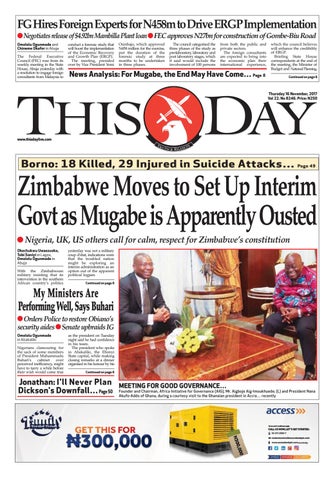
FG Hires Foreign Experts for N458m to Drive ERGP Implementation Negotiates release of $4.92bn Mambilla Plant loan FEC approves N27bn for construction of Gombe-Biu Road Omololu Ogunmade and Chineme Okafor in Abuja The Federal Executive Council (FEC) rose from its weekly meeting in the State House, Abuja yesterday with a resolution to engage foreign consultants from Malaysia to
conduct a forensic study that will boost the implementation of the Economic Recovery and Growth Plan (ERGP). The meeting, presided over by Vice President Yemi
Osinbajo, which approved N458 million for the exercise, put the duration of the forensic study at three months to be undertaken in three phases.
The council categorised the three phases of the study as pre-laboratory, laboratory and post laboratory stages, which it said would include the involvement of 100 persons
from both the public and private sectors. The foreign consultants are expected to bring into the economic plan their international experience,
News Analysis: For Mugabe, the End May Have Come… Page 8
which the council believes will enhance the credibility of ERGP. Briefing State House correspondents at the end of the meeting, the Minister of Budget and National Planning, Continued on page 6
Thursday 16 November, 2017 Vol 22. No 8246. Price: N250
www.thisdaylive.com TR
UT H
& RE A S O
N
Borno: 18 Killed, 29 Injured in Suicide Attacks… Page 49
Zimbabwe Moves to Set Up Interim Govt as Mugabe is Apparently Ousted Nigeria, UK, US others call for calm, respect for Zimbabwe’s constitution Okechukwu Uwaezuoke, Tobi Soniyi in Lagos, Omololu Ogunmade in Abuja With the Zimbabwean military insisting that its intervention in the southern African country’s politics
yesterday was not a military coup d’état, indications were that the troubled nation might be exploring an interim administration as an option out of the apparent political logjam. Continued on page 6
My Ministers Are Performing Well, Says Buhari Orders Police to restore Obiano’s security aides Senate upbraids IG Omololu Ogunmade in Abakaliki Nigerians clamouring for the sack of some members of President Muhammadu Buhari's cabinet over perceived inefficiency, might have to tarry a while before their wish would come true
as the president on Tuesday night said he had confidence in his team. The president who spoke in Abakaliki, the Ebonyi State capital, while making closing remarks at a dinner organised in his honour by his Continued on page 6
Jonathan: I'll Never Plan Dickson's Downfall… Page 50
MEETING FOR GOOD GOVERNANCE…
Founder and Chairman, Africa Initiative for Governance (AIG), Mr. Aigboje Aig-Imoukhuede; (L) and President Nana Akufo-Addo of Ghana, during a courtesy visit to the Ghanaian president in Accra… recently
2
T H I S D AY THURSDAY NOVEMBER 16, 2017
T H I S D AY THURSDAY NOVEMBER 16, 2017
3
4
T H I S D AY THURSDAY NOVEMBER 16, 2017
7KH : $FDGHP\ DQG (QWHUSULVH 'HYHORSPHQW &HQWHU 3UHVHQW
20(135(1(85 $ 2QH 'D\ 2SHQ 6HPLQDU IRU :RPHQ (QWUHSUHQHXUV
6+( :+2 '$5(6 72 68&&((' &RPH OHDUQ DQG Å‚QG RXW VLPSOH VHFUHWV WR VXFFHHGLQJ EH\RQG \RXU H[SHFWDWLRQV LQ EXVLQHVV
6HPLQDU 0RGXOHV 'LJLWDOL]LQJ D 0DUNHWLQJ 3ODQ 0DNLQJ RSHUDWLRQV FKHDSHU IDVWHU DQG EHWWHU ,QWURGXFWLRQ WR 60( 7RRONLW *HWWLQJ WKH EHVW IRU IUHH )LQDQFLDO 5HFRUGV DQG $FFRXQWLQJ 6LPSOLÅ‚HG /RFDWLRQ 3RUW +DUFRXUW 'DWH 7KXUVGD\ 1RYHPEHU WK 7LPH DP SP )HH 1 : FRPPXQLW\ PHPEHUV DQG $FFRXQW KROGHUV
1 5HJXODU IHH
$FFRXQW QDPH $FFHVV %DQN : (YHQWV $FFRXQW QXPEHU
9LVLW ZZZ WKHZFRPPXQLW\ FRP WR UHJLVWHU 12:
T H I S D AY THURSDAY NOVEMBER 16, 2017
5
6
Ëœ ͚͞˜ ͺ͸͚; Ëž T H I S D AY
PAGE SIX FG HIRES FOREIGN EXPERTS FOR N458M TO DRIVE ERGP IMPLEMENTATION Senator Udoma Udo Udoma, said the consultants would conduct the forensic tests on power, transportation, gas, manufacturing and processing. According to Udoma, the move will involve the evaluation of the growth plan in accordance with set targets and progress with detailed account of implementation including performance indicators. "Today, the Federal Executive Council approved a memorandum that was
brought by the Ministry of Budget and National Planning to retain some consultants to help us to conduct some pilot laboratories. This is part of our implementation strategy for the Economic Recovery and Growth Plan (ERGP) and so, we intend to conduct three labs - one in agriculture and transportation, one in power and gas and one in manufacturing and processing. "The key objectives of the labs are as follows: one is to identify all relevant key stakeholders
from the public and private sectors that are crucial in the delivery and implementation of the ERGP initiative so as to create ownership early in the development process. We will review and re-evaluate the ERGP and sectoral plans against set targets and progress and will include identifying gaps in the current economic system and the key success factors. "It will further deliver detailed a three-phase implementation programme line by line. We will
resources for the labs. "So, what council has approved today (yesterday) is that we bring in some consultants who did a similar thing in Malaysia to try to help us build our own capacity. They will just help us at the beginning and after that, we will take over and do it ourselves," he said. In his own briefing, the Minister of Power, Works and Housing, Mr. Babatunde Fashola, said he presented two memoranda to the council
which he said had relations with economic issues. According to him, one of the memoranda sought FEC approval for N27.23 billion contract for the construction of 117 kilometre Gombe - Biu Road while the other had to do with the revised national building code which he said was eight years behind its scheduled date. He said the first code came into existence in 2006 and was
of caution. Its Foreign Secretary, Mr. Boris Johnson, said it was crucial for Zimbabweans to refrain from violence. According to him: "At the moment it's very fluid and it's hard to say exactly how this will turn out. I think the most important point to make is that everybody wants to see a stable and successful Zimbabwe. I think we're really appealing for everybody to refrain from violence. That's the crucial thing." The United States advised its citizens living in the country to "shelter in place" until further notice and urged its embassy's staff to remain in their homes until the situation improves. China, said to be Zimbabwe's biggest trading partner, said it was closely watching the situation and expressed the hope that the relevant parties could properly handle their internal affairs. The UK government also asked its citizens living in Harare to remain safely at home or in their accommodation until the situation becomes clearer. It said: "Due to the uncertain political situation in Harare, including reports of unusual military activity, we recommend British nationals currently in Harare to remain safely at home or in their accommodation until the situation becomes clearer. " The European Union toed a similar line, calling for a peaceful resolution to the crisis in Zimbabwe. "The recent political developments in Zimbabwe, and their spillover, including in relation to the country's security forces, are a matter of
concern,� an EU spokesperson said, adding: “We call on all the relevant players to move from confrontation to dialogue with the aim to a peaceful resolution." While the United Nations Secretary-General Antonio Guterres appealed for calm, non-violence and restraint, Sky News quoted an unnamed African Union (AU) spokesman as saying that the take-over in Zimbabwe had all the elements of a coup. More specifically, however, African Union leader Alpha Conde, who is also Guinea's president, said the AU condemned the actions of military chiefs in the southern African country, adding that they were "clearly soldiers trying to take power by force". "The African Union expresses its serious concern regarding the situation unfolding in Zimbabwe," he said, before demanding "constitutional order... be restored immediately" as he called "on all stakeholders to show responsibility and restraint". The insurrection in Zimbabwe, which the military’s supporters called a “bloodless correction�, had effectively ended Mugabe's 37-year long rule. The roads leading to the main government offices, parliament and the courts in central Harare were blocked by armoured vehicles and the country’s radio station seized even as taxis ferried commuters to work nearby. The calm atmosphere in the capital belied the tense political climate even as there was a cloud of uncertainty around the whereabouts of
the 93-year-old Mugabe and his wife, although one of the coupists, Major General Sibusiso Moyo, according to AP, said they were being held by the military. But BBC had reported South African President Jacob Zuma as saying the nonagenarian had been placed under house arrest in Harare. A statement from the South African leader’s office, according to BBC, also said that Mugabe had told Zuma in a phone call that he was fine. There were also speculations that the military intervention might be a bid to replace Mugabe with his sacked deputy, Emmerson Mnangagwa, as troops, who said they were targeting "criminals" were seen patrolling the streets of Harare. On Monday, Chiwenga had stated his preparedness to “step in� to end a purge of Mnangagwa’s supporters. “We must remind those behind the current treacherous shenanigans that, when it comes to matters of protecting our revolution, the military will not hesitate to step in,� he was quoted by Reuters quoted as saying. Coming on the heels of his threat on Tuesday, four armoured tanks were seen heading towards Harare. Touted as Mugabe's likely successor before he was fired on November 6, the ousted Mnangagwa was a long-serving veteran of the southern African country’s liberation wars of the 1970s. His ouster was seen as a ploy to pave the way for Mugabe’s eventual succession of her husband.
Also deliberating on the matter, the Senate yesterday condemned the police boss’ action, saying that it was improper and must be reversed immediately. It directed its Chairman, Committee on Police Affairs, Senator Abu Ibrahim to liaise with Idris and ensure that its resolution was respected by today. The Senate acted upon a motion moved by Senator Emmanuel Bwacha under Order 41, faulting the reasons given by the Idris for his action. He said: “I woke up to my shock to listen to an explanation offered by the Inspector General of Police in respect of the withdrawal of security aides of the Governor of Anambra State. “Mr. President, this matter is bi-partisan. The explanation offered went
to the extent to mean that because there is a need for a level playground for all the aspirants in the Anambra governorship election, so, the governor who is a sitting governor should lose his security aides. Mr. President, I was in a state of shock when I received this explanation. “The governor has lost his immunity on an election that everybody is allowed to participate. If a precedent is being set, we want clarification. That in 2019, if the president will contest, the president will lose all his security aides because we want a level playground. I am not a member of APGA but I know that injustice anywhere is injustice everywhere.� Bwacha was backed by Senator Biodun Olujimi, who warned that Nigeria could become a “Banana
nation� if the excesses of the police were not checked. The Senate subsequently resolved to ask the police chief to restore the governor’s aides immediately.
identify entry point projects. We will identify key performance indicators, breaking down silos and encouraging key players. Now, the focus of the labs is to mobilise private sector investment to finance specific capital projects as you know public resources are limited. So, these labs will bring in private sector players. We will look at the various areas including: infrastructure, manufacturing and bring them in and mobilise private sector financing and
Continued on page 8
ZIMBABWE MOVES TO SET UP INTERIM GOVT AS MUGABE IS APPARENTLY OUSTED The military had rolled out the tanks in the early hours of yesterday, placing President Robert Mugabe and his wife, Grace, under house arrest in an apparent forceful take-over of government that was greeted by muted reactions from the globe’s leaders and international organisations. President Muhammadu Buhari led the pack in urging caution, calling for calm, peace and respect for the constitution of Zimbabwe. The governments of the United Kingdom, United States, China and South Africa were similarly inclined with the United Nations, European Union and African Union urging an amicable resolution of the impasse. Perhaps aware of the substantive objection of the world order to unconstitutional take-over of government and the abiding commitment to democratic rule, Zimbabwean military leaders have been strident in their claim that their action was not a coup. "We assure the world that this is not a military takeover of government," an army spokesman said in a televised statement on state television network, adding: "We are only targeting criminals around him (President Mugabe) who are committing crimes that are causing social and economic suffering in the country in order to bring them to justice. As soon as we have accomplish our mission we expect that the situation will return to normalcy." Addressing Mugabe as the president and commander-
in-chief of the Armed Forces, the military spokesman gave assurances that the president and his wife were safe and sound and that their security were guaranteed. Although the military spokesman did not give details of how the soldiers would carry out their mission, informed analysts warned yesterday that the military itself might have been sharply divided, leaving the country with no other option than an interim arrangement that would be based on a power sharing arrangement between the emerging contending forces. Zimbabwe slipped into the current impasse, following the sacking of Vice President Emmerson Mnangagwa by Mugabe in what many opposition politicians see as concealed move by the president to position his wife to take over power in 2018. The sack immediately attracted a threat by the head of the Armed Forces of Zimbabwe, General Constantino Chiwenga, warning that the military would not hesitate to step in if the issue had to do with protecting the revolution. Mnangagwa, a veteran of the liberation wars that won independence for Zimbabwe, is reportedly widely respected in the older cadre of the military while Mugabe’s wife, Grace, too is said to be popular among the youths of the ruling ZANU-PF with strong influence among younger elements in the military. The military, therefore, would appear not unanimous, a situation that is said to be heading the nation towards an interim arrangement if
the country is not to descend into chaos. Nigeria’s President Buhari in a statement by his media adviser, Mr. Femi Adesina, urged all political and military stakeholders in Zimbabwe to avoid any action that might plunge the country into unnecessary conflict and impact negatively on the entire region. According to Buhari: “Every attempt must be made to resolve all contentious issues by constitutional means in Zimbabwe to save the country from avoidable political instability.� South African President Zuma also called for caution, asking Zimbabwe's defence forces to show restraint. He expressed hope that the military would not move and do more damage. He said: "I am hoping that the situation is going to be controlled so peace and stability comes back to Zimbabwe." Zuma's office said the South African's president would send special envoys to Zimbabwe and Angola in the light of the unfolding situation in the Republic of Zimbabwe. Zuma is the chairman of the Southern African Development Community (SADC) which includes Zimbabwe and 14 others. "The President is sending the Minister of Defence and Military Veterans, Ms. Nosiviwe MapisaNqakula, and the Minister of State Security, Adv Bongani Bongo, to Zimbabwe to meet with President Robert Mugabe and the Zimbabwean Defence Force," Zuma's office said. From Britain also came words
MY MINISTERS ARE PERFORMING WELL, SAYS BUHARI host, Governor Dave Umahi, in the Banquet Hall of the Government House, said he had a good team. According to the president, a number of his appointees were unknown to him before their appointments, pointing out that the appointments were based on merit and proven track records. A statement by the president's media adviser, Mr. Femi Adesina, yesterday said Buhari also emphasised that he had always put the best interest of Nigeria into consideration before making decisions. He said: ‘‘Some of the people holding high positions in the government, like my ministers, will tell you that I didn’t know them from Adam. ‘‘I just came across their names from the records and I worked with the records. I thank God that I have a very good team.’’
According to the statement, the president commended the governor for his development strides in the state, saying: ‘‘The absolute commitment of the governor to his position is very remarkable and I am very impressed.’’ While expressing gratitude to God and the people of Ebonyi State for recognising his modest contribution to the country, Buhari described Nigeria as a great country with incredible resources and highly talented people. ‘‘We should continue to pray to God that the elites that will be in-charge of the country in the future fear God,’’ he said.
Orders Police to Restore Obiano’s Security Aides Meanwhile, Buhari has directed the reinstatement of the security aides of
Governor Willie Obiano of Anambra State. While welcoming the president to Awka yesterday for the grand finale of the All Progressives Congress governorship rally, the governor had complained about the withdrawal of his security aides. The Inspector General of Police, Mr. Ibrahim Idris, had withdrawn the security aides of the governor at the weekend, claiming that he did that to provide a level playing field for all the gubernatorial contestants in the state. But Adesina in a terse statement on his Facebook page yesterday said Buhari while departing Awka directed the Deputy Inspector General of Police (Operations), Mr. Joshak Habila, to ensure the return of the governor’s security personnel.
TOP GAINERS NGN NGN A.GLEVENTIS 0.05 0.64 REDSTAR 0.24 5.04 LEARNAFRICA 0.04 0.98 FIRSTALUM 0.02 0.52 UNITYBANK 0.02 0.53 TOP LOSERS NGN NGN C & I LEASING 0.13 1.32 PZ CUSSON 2.00 20.40 UNILEVER 1.90 36.10 NASCON 0.77 14.63 FIDELITY 0.08 1.56 HPE Nestle Nig Plc â‚Ś 1,250.00 Volume: 184.247 million shares Value: N3.324 billion Deals: 3,590 As at yesterday 15/11/17 See details on Page 41
% 8.4 5.0 4.0 4.0 3.9 % 8.9 8.9 5.0 5.0 4.8
7
T H I S D AY THURSDAY NOVEMBER 16, 2017
8
Ëœ ͚͞˜ ͺ͸͚; Ëž T H I S D AY
PAGE EIGHT
For Mugabe, the End May Have Come Okechukwu Uwaezuoke with agency reports Many in the West must be having a feeling of schadenfreude now that Zimbabwe's President Robert Mugabe's 37-year rule may have effectively ended with yesterday's military intervention in the politics of the southern African country. BBC reported that the 93-year old leader was placed under house arrest in the capital Harare by Zimbabwe's military and had told South African President Jacob Zuma he was fine. BBC correspondents said the military intervention, which the leaders refrained from calling a "coup", may be a bid to replace Mugabe with his sacked deputy, Emmerson Mnangagwa. This was as troops, who said they were targeting "criminals", were seen patrolling the streets of Harare. Only on Tuesday, four
N E W S A N A LY S I S armoured tanks were seen heading towards Harare. And this was a day after the head of the armed forces Constantino Chiwenga had stated his preparedness to “step in� to end a purge of Mnangagwa’s supporters. The ousted vice-president, 75, was a long-serving veteran of the southern African country’s liberation wars of the 1970s and had been touted as Mugabe's likely successor before he was fired on November 6. His ouster seemed to pave the way for Mugabe’s wife Grace, 52, to succeed her 93-year-old husband, who had ruled the country since it became independent. This explains Chiwenga’s open threat to intervene on Monday if the purge of war veterans did not stop. “We must remind those behind the current treacherous shenanigans that,
when it comes to matters of protecting our revolution, the military will not hesitate to step in,� Reuters quoted Chiwenga as saying in a statement read to reporters at a news conference packed with top brass on Monday. But Chiwenga’s threat was challenged by the youth wing of Zimbabwe’s ruling party, who accused the military chief of subverting the constitution for threatening to intervene in the political impasse. Grace Mugabe has a strong following within the ranks and files of the powerful youth wing of the ruling ZANU-PF party. Hence, her rise to reckoning has pitched her against the war veterans, who once enjoyed a privileged role in the ruling party under Mugabe, but who have increasingly been relegated from senior government and party roles
in recent years. A cloud of uncertainties hovers still over this military audacious intervention in Zimbabwean politics. The best case scenario presents a possibility of Mugabe being given a soft landing and allowed to quietly retire from office. Yet, the future looks anything but promising for the embattled country, which could witness a protracted period of power-struggle between the contenders, who are already waiting in the side-lines. Zimbabwe’s political landscape has chiefly been polarised between Mugabe and MDC-T leader Morgan Tsvangirai. The replacement of white minority rule by a cobbling together of ZANU-PF and ZAPU -PF paved the way for the fierce rivalry between the two political strongmen. Hence, Zimbabweans were left with a choice between what
Mugabe Patson Dzamara, writing for Zimbabwe’s News Day called “Mugabe’s entitlement and Tsvangirai’s victimhood�. “The departure of these political nemeses from Zimbabwe’s political scene will usher in new and interesting dynamics,� Dzamara said. “They have undoubtedly inscribed
an indelible mark on Zimbabwean politics.� Mugabe’s ouster by the military sets the stage for the forthcoming election in 2018, which is fraught with uncertainties. Whatever its outcome, it will definitely put an end to an era in the southern African country’s political landscape.
How I Survived Open Heart Surgery in London, Says Anenih Donates wheelchair ambulances to Geriatric Centre at UCH Senator Iroegbu in Abuja Former Chairman of the Board of Trustees of the Peoples Democratic Party (PDP), Chief Tony Anenih, said yesterday that his recovery, two years ago, after an open heart surgery in the United Kingdom was a miracle. Anenih said that the surgeons who performed the operation on him described his recovery as the first miracle ever witnessed in that hospital. He disclosed this in a speech read on his behalf on the occasion of the Benefactor’s Lunch meeting of the Tony Anenih Geriatric Centre at the University College Hospital (UCH), Ibadan, during which he was conferred with the Benefactor Award. In the speech delivered by
his representative, Mr Giwa Aigbomiorele, he said: “On a personal note, I have faced several challenges in life but God has always showed up to grant me victory. But for His grace, I would not have been here today receiving this award.� According to him, “About two years ago, I went to London for a routine medical check-up and for some strange reasons, a situation arose that led to my undergoing an emergency open heart surgery that lasted for seven hours and I was unconscious for over 48 hours.� Anenih, who called on well-meaning Nigerians to always see themselves as their brother’s keeper by extending a helping hand to the less privileged in our society,
commended the Chief Medical Director, Professor Temitope Alonge; the Management of the UCH and the Chief Tony Anenih Geriatric Centre, UCH, for considering him worthy of the great honour. He said the prudent management of funds by the Alonge-led team was remarkable. “While it is true, that through our humble efforts, this Centre has been blessed with financial assistance, I must state that the Management of University College Hospital under the able leadership of Prof. Temitope Alonge has demonstrated a rare ability to be consistently prudent and accountable for every financial assistance received,� he stated. According to him, “This
is most commendable and in contrast to the peculiar challenge in our society, where little regard is given to the avowed duty of care and due diligence required of Trustees. “Therefore, when recently there was a request by the Management for Wheelchair Transport Ambulances for the Geriatric Centre, I ensured without hesitation, that provision was made for the purchase of 2 Wheelchair Ambulances.� He said his decision to accept to endow the Geriatric Centre five years ago was not misplaced, stressing that it remains one of the best decisions he had ever made in life because “only few things have brought me so much joy as the successes
recorded by the Centre in just 5 years.� Anenih pointed out that during the inauguration, he had acknowledged that the concept of the Geriatric Centre was an idea whose time had come “This, in my view was, due to the established facts that with improved standard of living, the world geriatric population has been expanding. “I stated that there was the need for concerted efforts to be made to provide relevant facilities to cater to the needs of the elderly in Nigeria in particular and the West Africa sub-region in general,� he added. Anenih said it was gratifying to know that, besides the care of the elderly,
the Centre also provides training opportunities in Geriatric Medicine to Resident Doctors, Medical students, Nurses, Dietetic students, and Masters students of the University of Ibadan (who are studying Medical Social Works) and also Physiotherapy students. He said it was also gratifying to know that “the Centre now has an Elders’ Forum, which is an independent voluntary body run by its members for the benefit of its members.� On the award, Anenih said it was with the mindset of giving his best support for the Centre and its Management, that he found the occasion most auspicious and the award (Benefactor Award) a great honour.
$4.92 billion representing 85 per cent of the project’s cost while the federal government will put forward $868.87 million which represents the 15 per cent it ought to bring to the table to build the power plant. Also, the scope of work for the project include four large dams - Nya, Sumsum, Nghu and Api Weir, two underground power house of 12 units of 250MW each, two numbers of 330kV of 700 kilometres transmission lines to Markudi and Jalingo, 120 kilometres of access roads connecting the project site and nearby communities and resettlement of an estimated 100,000 impacted persons. Already, the Federal Executive Council (FEC) approved on August 30, the total sum of $5,792,497,062.00 for the project which has reportedly been in the making for over 40 years. That approval thus paved the way for the signing of the contract document with the China Gezhouba Group
Corporation (CGGC), Sinohydro Corporation Limited (SHC) and CGCOC Group Co. Limited, all considered a joint venture. It also now allowed the federal government to seek finance to meet its counterpart funding obligation to the project. Similarly, the Mambilla hydro project which is located in Sarduana Local Government Area of Taraba State had its first preliminary feasibility study reportedly carried out by Moto Columbus in 1972. Between 1981-1985, Diyam Consultants with Binnie and Partners UK also carried out another preliminary study and recommended a 3960MW capacity plant. In 2011 however, the FEC awarded another consultancy services for detailed engineering design and project management and supervision to Messrs Coyne et Bellier/Decrwon/ WADSCO JV Consultants to further review the two previous studies based on new hydrology and geology investigation.
FG HIRES FOREIGN EXPERTS FOR N458M TO DRIVE ERGP IMPLEMENTATION revised in 2009. "The strategic importance of the road is undeniable. It supports agriculture, access to our power plants - Dadin Kowa hydro power plants. It also helps security logistics to move personnel and troops to respond to distress calls. It is also going to be critical in the resettlement of internally displaced persons (IDPS). It's part of the Northeast development plan. So, it ticks all the boxes in terms of development and so on and also as far as budget implementation is concerned, this is one further step in that direction. "The other matter which speaks to investment in our people, security of lives and property is the revised Nigeria national building code and this code is eight years behind its scheduled date and the first code was delivered in 2006 and it was revised in 2009 and since then, it was stalled," he said. Fashola said the content of the code would improve fire protection systems in buildings
and enhance energy efficiency and green building methods in the national standards. FG Negotiates Release of $4.92bn Mambilla Plant Loan The federal government also said yesterday that it has begun negotiating modalities for the release of the $4.92 billion loan it is expecting from the China Exim Bank as part of funding for the 3,050 megawatts (MW) capacity Mambilla hydro power plant. The Minister of Power, Works and Housing, Mr. Babatunde Fashola, stated this at a workshop on the Power Sector Recovery Program (PSRP) in Abuja. Fashola noted that having signed the contract for the construction of the hydro plant last Friday with three Chinese firms - China Gezhouba Group Corporation (CGGC), Sinohydro Corporation Limited (SHC) and CGCOC Group Co. Limited, the ministry of finance had taken over the process and was in negotiation with the China Exim
Bank to determine the terms in the loan. He said until this was concluded and Nigeria guaranteed of the loan, it was difficult to state exactly when work on the project would commence. He, however, noted that preliminary works such as mapping out of travel routes for ease of movement of heavy machineries had started amongst others. Falola said: “The signing of the contract for the construction had taken place last Friday. It is supposed to be funded by the China Exim Bank. The negotiations for the loan will now start. “For this period, I am waiting because it is now the ministry of finance that has taken over. They are the ones who do treasury works, and raise loans for Nigeria.� He added: “So, we do the negotiations and when we secure the loan, then we are able to tell you that this is the
start date. “There is a lot of preparatory works going on and we should have signed a MoU with the Taraba State government. We have already got a liaison office in the state, the governor did that. We also constituted the project team, the contractors have already started route estimation and analysis; how they are going to move heavy equipment and all of that; and there will be a lot more of that to come. It is a big contract,� the minister further explained. Last Friday, the government signed the agreement for the construction of Mambilla within six years with the Chinese companies. The project which is expected to cost $5.79 billion, would have its funding come from the Nigerian government and Chinese lenders through the China Exim Bank, on the ratio of 15 to 85 per cent respectively. Within the deal, the Chinese Exim Bank and other Chinese lenders are expected to provide
9
T H I S D AY THURSDAY NOVEMBER 16, 2017
Ha y 57 Bir day
HIS EXCELLENCY
PETER AYO FAYOSE
GOVERNOR OF EKITI STATE
Your Excellency, As you celebrate another year of God's favour and blessing, it is my prayer that you continue to grow from strength to strength.
I wish you many more years of God's goodness and great exploits in the political arena.
Senator, Dr. Ifeanyi Okowa Governor, Delta State
10
T H I S D AY THURSDAY NOVEMBER 16, 2017
Nextier Power is a consulting firm that provides policy advisory, investment advisory, and support services to the electricity supply industry. The firm aims to use this weekly publication to educate Nigerians on the intricacies of the Nigeria electricity supply industry on the assumption that a more informed public would advocate for the right policies and programmes which, in turn, would lead to a robust market that delivers the electricity needs of Nigerians. This column will cover everything from the basics of the industry to the more intricate, sometimes, complex policies and programmes.
Addressing Key Issues in the Value Chain: Coal to Power Generation However, associated environmental and health hazards also have their costs and need to be properly addressed.
Introduction Nigeria’s history of coal mining began with the development of the Oji River Thermal Power Station with a capacity of 25 Megawatts in 1896. It marked the beginning of grid electricity system in the country. Thereafter, coal was discovered on a much larger scale in 1909 at Udi Ridge in Enugu.
Despite attempts by the Federal Government to boost Nigeria’s coal prospects, ETA Zuma Power and Geometric Power remain the only companies that have demonstrated genuine commitment to the use of coal as fuel for power generation. ETA Zuma announced early this year that it required about $6 billion to construct its planned coal fired power plant in Kogi State. The company which is already undertaking large scale coal mining in Itobe, Kogi State is expected to generate up to 1,200 Megawatts of power from the plant, beginning with a 300 Megawatts plant, with room for expansion.
Besides the Oji River Thermal Power Station which was built to take advantage of the abundant nearby deposits of highgrade coal from the Ogbete mine, no other major coal power plant was built in the 20th century in Nigeria. Oji at its peak generated 10 Megawatts of power from five coal-fired boilers and four steam turbines originally installed in 1956. This capacity was upgraded to 30 Megawatts after the Nigerian civil war. However, the plant last generated power in 2004. Despite the critical role coal, as a fossil fuel, had played in powering electricity plants in industrialised nations, an organized, documented effort for coal to power in Nigeria never really took-off. Availability Coal deposit in Nigeria is estimated at 2.8 billion metric tonnes in 17 identified fields with 600 million metric tonnes proven. The coal belt spreads across several states including Anambra, Enugu, Kogi, Benue, Gombe and Plateau states. The Anambra coal basin contains the largest and most economically viable coal resources and covers an area of approximately 1.5 million hectares. It is bound by the Niger River on the west, the Benue River on the north and the Enugu Escarpment on the east. Past Glory Rather than being deployed as a source of energy to power Nigeria’s development, coal was largely mined for exportation. The wealth generated from coal was so strategic that Enugu became the capital of the Eastern Region in 1938. Its widespread influence also led to the establishment of a thriving port in the area now known as Port Harcourt, to ship coal out of Enugu to Europe. Coal mining quickly spurred the growth of the population of Enugu with the influx of miners. With the discovery of hydrocarbons in the late 1950s, Nigerian Railway Corporation switched its attention from coal to diesel powered energy. The Electric Company of Nigeria also switched from coal electric generation to diesel powered electricity generation. The loss of these two major clients played a major role in the decline of coal production as the government drastically withdrew its investment in the sector.
Global Boom and Bust The Industrial Revolution which began in the 18th century hinged on the availability of coal to power steam engines. As demand for coal soared, the technology to move the coal improved. This led to coal experiencing a massive escalation in many parts of the developing world. This continued until the discovery, exploration and development of hydrocarbon, as energy, in the nineteenth and twentieth century. By late 20th century, coal was displaced as the primary energy source for domestic, industrial and transportation purposes. Oil, natural gas, nuclear power or renewable energy sources became the main source of energy. By 2013, power generation from coal had fallen worldwide and has continued to decline drastically; by nearly 50 percent in a single year. Global Production and Competition Trends The biggest coal consumers are the United States of America, Russia, China and India. World coal consumption was 3,840 million tons of oil equivalent in 2015, accounting for 29 percent of the world energy consumption and 41 of global power generation In 2015, world coal production was 7,861 million tons. China is the global leader accounting for 48 percent of the world’s coal production. The United States is the second largest coal producer, accounting for 12 percent of global coal production. India is third with about 7 percent of the world coal production. Challenges While the benefits of the coal mines were largely economical and immediate, it also had interim and long term negative effects, especially on humans and the environment. These effects are particularly compounded by the failure of the government to reclaim most of these
mines – especially those abandoned during the oil boom. Environmental degradation Coal is generally classed as a dirty fuel, unclean and hazardous with huge health and environmental challenges. Coal power plants have been identified as major sources of greenhouse gas emissions which is linked to the rapid global depletion of the ozone layer. It is the least efficient of the fossil fuels in terms of the amount of energy gained in proportion to CO2 released. Health Coal combustion releases nitrogen oxides, sulfur dioxide, particulate matter, mercury, and dozens of other substances known to be hazardous to human health. Coal-fired power plants produce more hazardous air pollution than any other sources of industrial pollution. Burning coal also releases toxic chemicals and particulates that can affect a country's population in terms of reduced life expectancy and increased health complications. Technological availability As Nigeria works towards increasing grid generation capacity through coal to power, it is critical to consider the potential lack of adequate coal to power technology given that most devices need to be imported. It is likely that equipment manufacturers may phase out coal specific designs since most countries are gradually phasing out of coal to power. This may constitute a major challenge in replacement availability and maintenance of coal to power plants. Nigeria’s Prospects With Nigeria barely generating 4,000 Megawatts for its 180 million population, coal for power holds maximum potential for its energy mix.
The other company which has shown strong inclination towards coal to power is Geometric Power. The company is currently planning the development of 1000 Megawatts coal-fired power plant; 500 Megawatts in the first phase expandable to 1,000 Megawatts in the second phase. Speaking on the potential of coal to power in Nigeria at the World Bank/ International Monetary Fund General Meetings in Washington DC on October 15, 2017, the current Minister of Finance, Mrs. Kemi Adeosun declared that due to the unique combination of abundance of coal and lack of adequate power in Nigeria, it is imperative to build more coal power plants. This, in essence sums up Nigeria’s determination to add coal to its energy mix as efforts to boost power generation intensify in the coming years. Conclusion While there is obvious need to diversify Nigeria’s energy mix with inclusion of coal, tackling the environmental and health challenges remains a big concern. However, globally, coal still dominates the energy landscape by contributing 40 percent of world energy. This represents a major opportunity for Nigeria if the right technologies can be found. The addition of 1,200 Megawatts and 1,000 Megawatts from Zuma and Geometric Power respectively could be potential game changers for the sector. Author Obas Eseidesa is a power sector journalist. Editor Chinazo Ifeanyi-Nwaoha is a power sector analyst.
Next Topics Nov. 22
Understanding Generation Infrastructure
Nov. 29
Off-grid Generation
Dec. 06
The Future of TCN
www.nextierpower.com empower@nextierpower.com
T H I S D AY THURSDAY NOVEMBER 16, 2017
11
12
T H I S D AY THURSDAY NOVEMBER 16, 2017
T H I S D AY THURSDAY NOVEMBER 16, 2017
13
14
T H I S D AY Ëž Ëœ ÍŻÍ´Ëœ Í°ÍŽÍŻÍľ
COMMENT
Editor, Editorial Page PETER ISHAKA Email peter.ishaka@thisdaylive.com
POLICING LOOTED FUNDS WITH THE WHISTLE Oludayo Tade argues the need to vary policies and approaches in line with the innovative strategies of looters
A
major straw that broke the Camel’s back of the 16-year rule of the Peoples Democratic Party (PDP) in the 2015 General Elections in Nigeria is corruption. Nigerians voiced their frustrations with a vote for the All Progressives Congress Presidential Candidate, Muhammadu Buhari who promised to fight corruption, defeat terrorism and fix the economy. Notwithstanding his ascendancy to the power, corruption remains a major setback to provision of democratic goods for the masses. Nuhu Ribadu in 2007 stated that corruption gulped $140billion yearly in Nigeria. By now this figure has tripled and if one adds the revelation by Prof. Itse Sagay that 55 top officials and their collaborators diverted the sum of N1.3trillion between 2006 and 2013 from government coffers for personal uses. Between 2010 through to 2016, Nigeria’s best ranking on global public perception on corruption has been 136 out of the 176 countries evaluated. This ‘snoring giant’ has struggled with or at best treated public sector corruption cosmetically. While there have been superficial efforts to check the menace, corruption as an edifice is yet to crumble. While former President Olusegun Obasanjo kickstarted a battle against corruption with the creation of anti-corruption agencies specifically the EFCC and ICPC, the Buhari administration in 2015 would later show a more ‘committed’ fight against public sector corruption with the compulsory Biometric Verification Number (BVN) for all bank account holders, consolidation of accounts of government agencies into one single account (Treasury Single Account (TSA) and in 2016 they capped it with the Whistle Blowing Policy (WBP). Democratic governance has suffered in Africa owing to the daring and largely successful pro-corruption structure. This structure has tentacles society-wide such that there are more actors-for than actors-against corruption. Corruption is at the heart of the dearth of good roads, potable water, power, unemployment, comatose education, sickly health institutions, and dead industrial sector. In terms of scale, it may not be out of place to reckon that corruption has killed, albeit indirectly, more persons than Boko Haram. While the cost of preventing crisis is much smaller, our leadership waits for corruption to blossom before taking steps. This line of action makes the associated costs more punitive. Worried by this development, the Council for the Development of Social Science Research in Africa (CODESRIA) in partnership with the United Nations Office of West Africa and the Sahel (UNOWAS) funded the convergence of African researchers, policy actors and practitioners in Mali in October 2017 to discuss the intersection between “Money, security and Democratic Governance in Africa� where yours sincerely presented a full version of this piece. The conference agreed that cosmetic treatment of corruption creates security crises which impact negatively on democratic governance on the continent. However, while corruption tactics are changing, the policies to tame it on the continent have been static and relatively less innovative including the whistle blowing policy (WBP). The symbolism of the whistle in a football match is to ensure that the match is under the control of a just referee who deploys the whistle
NO WAR AGAINST CORRUPTION CAN BE WON IF BOTH THE CITIZENS AND THE PRESIDENT ARE COMPLACENT. WE NEED TO VARY OUR POLICIES AND APPROACHES IN LINE WITH THE INNOVATIVE STRATEGIES OF LOOTERS
to signal the beginning and the end of a match; issues warning to erring players; and administers the red card in the event of grievous infractions. However, the referee can also be biased against a team he does not like; even when it is obvious that there is an infraction, the chief referee may ignore calls from the spectators and tell them to ‘play on’. I see the ‘mainarism’ of the ‘Lion King’ as that of a Chief Referee’s complacency which is denting the anti-corruption crusade. It implies that the ‘Lion king’ only issues verbal warning to inner caucus corruption as against red card to ‘outsiders’. My analysis of newspaper coverage of the President Mohammadu Buhari’s (PMB) anti-corruption war shows that many recoveries were made in the first four months of the introduction of the WBP. This was made possible with the receipt of 2,351 tips. Recall the case of a $131million, $15million, N7billion and another N1billion found in some fictitious accounts in banks and later forfeited by the looters when they could not provide tangible explanation of the source of the monies. You could not have forgotten the N49 million abandoned at an airport, the huge cash in Ikoyi; and the $37.5million from Lagos mansion of Alison Maduekwe. The EFCC boss, Ibrahim Magu, reportedly said the agency recovered N17 billion to from whistle blowing policy alone. What is crucial is the innovative strategies of keeping looted funds. Looters are shunning formal banking, using fictitious accounts and evolving new strategies by informalising money-keeping. These include, keeping monies at home, in septic tanks, abandoned market stalls, abandoned houses, and cemeteries, among others. These are done to keep their looted funds from being traced through formal mechanisms such as the BVN. But with the introduction of incentives of between 2.5 per cent to 5 per cent on recovered looted funds, people did not only turn referees but looked out to report large loots in order to get larger incentives. I argue that people whistle-blow not because they want the country changed but because of the incentives attached to it. These ‘incentivised-patriots’ had previously looked away but saw opportunities in the new policy and keyed into it. The problem now is that looters are now shutting out ‘insiders’ who supplied information to the state. The majority of those who contributed to recovered monies were bankers, gatemen, housemaids, business partners, relatives, among others. In other words, insiders are crucial to winning the anticorruption war. The insiders are at both ends: within law enforcement agencies and within inner caucus of looters. No war against corruption can be won if both the citizens and the president are complacent. We need to vary our policies and approaches in line with the innovative strategies of looters. As it is, only informal strategies can be used to get looters since they are shunning formal banking or using fictitious identities. Consequently, there is reduced public notification of recoveries. While this is not an implication that illicit acquisition has stopped or that people are no longer blowing the whistle, it underscores adaptation on the part of looters through innovative strategies to beat the current WBP. Dr Tade, a sociologist, wrote via dotad2003@yahoo.com
A FATHER’S LOVE
Nigeria has to create a society that cares, writes Olusegun Adeniyi
S
ometimes in 1997, in my capacity as deputy editor of the defunct Sunday Concord newspaper (then edited by Mr Tunji Bello, current Secretary to the Lagos State Government), I sent a student-reporter undergoing internship to interview Reverend Father George Ehusani. He was then the Deputy Secretary-General at the Catholic Secretariat in Lagos with the current Bishop of Sokoto, Matthew Hassan Kukah, as his direct boss. The young lady got the interview alright but upon return, she waited around in my ofďŹ ce for a while; then muttered almost to herself (but I heard her loud and clear): “How can such a brilliant and handsome young man be a Reverend Father? That means he will never get married and have children. What a waste!â€? Embedded in that statement, which I have never had the courage to tell Father Ehusani, is the notion that a successful life is constructed around getting married, having own biological children, living in comfort while they grow up, and then dying. But life consists much more than that. It is not the children we call our “ownâ€? that really matters but those whose lives we impact. Yet the tragedy really is that beyond supplying the cash, many do not even have any impact on their children. In that respect, Father Ehusani indeed has many children for whom he cares, kids who love and cherish him in return, because without him, they have no future. Now let me put the issue in context. In the course of our stay in the United States between 2010 and 2011, my wife came home one day to pledge that once we got back to Nigeria, she would go and teach in any public primary school that caters for the children of the poor. She said the inspiration came from a ďŹ lm she had just watched titled “Born into Brothels: Calcutta’s Red Light Kidsâ€?, a documentary about the children of prostitutes in the Indian community of Sonagachi, which in 2004 won the American Academy Award for Best Documentary Feature.
Considering that she had then just enrolled for a programme at Harvard, a community of people with so many crazy ideas, I paid little attention to what I thought was no more than a passing fancy. I turned out to be wrong as my wife got her wish upon our return to Nigeria, following a chance meeting with Father Ehusani, currently the Parish Priest at the Catholic Church of Assumption, Asokoro, Abuja. So, my wife is now a part-time teacher at the school domiciled within Annunciation Catholic Church, Kpaduma village, one of the slums that overshadow the highbrow Asokoro district where 500 pupils are being taught by some auxiliary teachers. Kpaduma residents basically are the poor, the displaced and the dislocated of our society. The shanties have for long been marked out for demolition and the plots probably already shared-- so the Abuja authorities quite naturally have no plan for the inhabitants and their children. Kpaduma has no water, no road, no school and no basic social amenities. The situation is so deplorable that the Rotary Club of Asokoro, Abuja in January this year pledged to commission a six-unit latrine and a borehole for the people by next month. According to the president of the Club, Nze Kanayo Chukwumezie, the projects are “being done in collaboration with the Rotary Club Malcolm, United States of America. With the toilets and a functional borehole, they will defecate and ush. They will also have the water for domestic use. We shall also provide them with a generator for powering the borehole. The toilet is six units, three for men and three for women.â€? That is Kpaduma for you. Even though most of the residents provide the labour force for menial jobs at Asokoro, it was a Father Innocent Jooji who in 2003 decided to use the Catholic Church in the village as school for the children. On arrival in Abuja in 2008, Father Ehusani took interest in the school and decided to pay more attention to the welfare of the pupils and their future. I have visited the school twice and as I
interacted with the pupils, I asked what they would like to become in future. Some said doctors, some lawyers, some engineers. They all looked happy and indeed believed they could achieve their dreams yet, they face a very uncertain future. The school is not registered because it is really not a school; it is just an arrangement to give the children education. Class four and ďŹ ve pupils share the same makeshift building with each class facing opposite directions. Classes one to three use the church auditorium. The school has 10 teachers, two cleaners and one security man with each pupil paying N2000 (pre-school) and N2,500 (primary one to ďŹ ve) tuition fee per term. The worry for Father Ehusani now is how to get some of the pupils registered into an approved school where they can do common entrance examination into secondary schools by the next academic session. But the greater challenge is that the structures, which make up Kpaduma village, have been marked for demolition. So those innocent souls whose imaginations are already ďŹ red could soon be scattered with their future thrown into jeopardy. I must stress here that this piece is not about the deplorable condition of the shanties that are springing up in many highbrow areas of Abuja. Nor is it about whether or not the residents of Kpaduma should be allowed to stay. In any case, a 126-page 2006 report titled,“Pushing out the poor: Forced Eviction under the Abuja Master-Planâ€? by the Social and Economic Rights Action Centre (SERAC) has already dealt with the issues surrounding Abuja slums where “...almost all residents live in mud, frail houses, though some are coated with cement and paint in the bid to give their homes a modern look...Most houses have pit latrines that are shared by a large number of people. Most households depend upon the adult female to provide the water needs of the family, while some others opt to buy from Mairuwas...â€? My concern here is about those children of Kpaduma who have been brought up under
circumstances for which they have no control. This is where I believe our society is failing and where I commend the Catholic Church which the efforts of Father Ehusani exemplify. All over the country, especially in remote places, the Catholic Church is building schools funded through the sacriďŹ ces of their members. I am a Pentecostal Christian, with all the hypocritical arrogance associated with that appellation, yet we profess our charity with our mouths with our schools basically established to cater for children of the rich. But that is not an issue for today. What is important is that we need to create a society that cares. It is a shame that Kpaduma and other such villages exist around Asokoro and there is no thought for the children who live there. And here I am not even talking about the government. How many of the home owners in Asokoro bother about whether or not the children of their driver, gardener, security man and cook go to school? I have had opportunity to interact with Father Ehusani who evidently sees the Kpaduma school children as his own. And they love him as their father because I once saw the way they mobbed him on one visit. He is of the strong opinion that the Church is called to serve the poor,“those who have no social and economic or political rights, those who have lost their human dignity due to the material circumstances they ďŹ nd themselves in.â€? He argues passionately that “the common good, the good of society as a whole requires that the powerless be specially protected and defended. That is why the degree of development or civilisation of a society is measured and evaluated not by how much material wealth that society has, but by how that society treats the weak and the powerless in its midst.â€? I agree completely with Father Ehusani. Those who are relatively comfortable in our society must begin to inculcate the culture of giving back. And their charity must begin from their immediate environment. This piece was ďŹ rst published on 15th March, 2012
15
T H I S D AY Ëž Ëœ ÍŻÍ´Ëœ Í°ÍŽÍŻÍľ
EDITORIAL ANAMBRA ELECTION MUST BE FREE The people must be allowed to elect the governor of their choice
T
he excuse given yesterday by the Inspector General of Police, Mr Ibrahim Idris, for the sudden withdrawal of security details of the Anambra State Governor Willie Obiano was not only an affront to constitutional order, it conďŹ rmed the politicisation of the state security services. By saying that the police personnel of the sitting governor would be returned only after the election on Saturday, Idris was being very reckless and acting above the law. And it will be tragic if, as it is being speculated, police authorities are acting on behalf of the ruling All Progressives Congress (APC) to tamper with the election. For sure, the stakes are high in this election. The incumbent, Mr Obiano of the All Progressives Grand Alliance (APGA), is battling with his estranged godfather and former Governor, Mr Peter Obi who is not on the ballot but leading the campaign for Mr Oseloka Obaze, candidate of the Peoples Democratic Party (PDP). In the mix also is Mr Osita Chidoka, who is ying the banner of United Progressives Party (UPP) as well as Mr Tony WE ENJOIN THE PEOPLE Nwoye, running on OF ANAMBRA STATE TO the platform of APC. COME OUT TO VOTE AND With no fewer than BE VIGILANT TO ENSURE 37 political parties ďŹ elding candidates, THAT THE PROCESS IS there are of course TRANSPARENT AND other important CREDIBLE personalities in the race. But it is safe to predict that a winner will emerge from among the aforementioned. On Sunday night, the principal contenders participated in a live television debate on Channels Television where each laid out his plans and vision for the state. The exercise was refreshing as it highlighted the temperament of candidates as well as their ideas for repositioning the state. The debate may not make much difference in the outcome of the poll on Saturday
Letters to the Editor
but it has helped to begin a new culture by which candidates would be subjected to public scrutiny beyond the glossy pamphlets containing promises they neither believe in nor have any intention to fulďŹ ll.
M T H I S DAY EDITOR DEPUTY EDITORS ˜ MANAGING DIRECTOR DEPUTY MANAGING DIRECTOR CHAIRMAN EDITORIAL BOARD
EDITOR NATION’S CAPITAL
T H I S DAY N E W S PA P E R S L I M I T E D EDITOR-IN-CHIEF/CHAIRMAN GROUP EXECUTIVE DIRECTORS ˜ ˜
˜ GROUP FINANCE DIRECTOR DIVISIONAL DIRECTORS ˜ ˜ DEPUTY DIVISIONAL DIRECTOR
SNR. ASSOCIATE DIRECTOR ASSOCIATE DIRECTORS ˜ CONTROLLERS ˜ ˜
GENERAL MANAGER
GROUP HEAD DIRECTOR, PRINTING PRODUCTION TO SEND EMAIL: ďŹ rst name.surname@thisdaylive.com
eanwhile, in expressing the preparedness of the Independent National Electoral Commission (INEC), the commission Chairman, Prof. Mahmood Yakubu recently highlighted a positive development in the build-up to the election. For a very long time, according to Yakubu, Anambra elections were always fraught with endless intra-party litigations by politicians squabbling over tickets but “so far, we have not been served any court injunction or any party bringing two candidates to us. This is very unusual in Anambra state.â€? We hope the commission will take advantage of that to provide a level-playing ďŹ eld for all the candidates. For INEC, some of the things it must prepare for include ensuring voting and other sensitive election materials are in adequate supply and that they arrive the polling booths on time while ofďŹ cials must be deployed in sufďŹ cient numbers. The commission cannot afford to repeat the display of incompetence that marred the conduct of some gubernatorial elections in the past. Indeed, coming less than two years to the 2019 general elections, INEC should use the exercise to test its preparedness as Nigerians continue to yearn for transparent elections where the votes of the electorate will not only be counted but would count. We enjoin the people of Anambra State to come out to vote and be vigilant to ensure that the process is transparent and credible. Aside containing whatever may be the antics of the Indigenous People of Biafra (IPOB) that advocates a boycott of the election, the police and other security agencies must be impartial in their conduct before, during and after the election. Nothing should be done to suggest any form of partisanship. At the end of the day, the people of Anambra State must be able to elect their governor for the next four years without any intimidation.
TO OUR READERS Letters in response to speciďŹ c publications in THISDAY should be brief (150-200 words) and straight to the point. Interested readers may send such letters along with their contact details to opinion@thisdaylive.com. We also welcome comments and opinions on topical local, national and international issues provided they are well-written and should also not be longer than (9501000 words). They should be sent to opinion@thisdaylive.com along with the email address and phone numbers of the writer.
WHY APGA REMAINS THE PARTY TO BEAT
W
ith the election day just around the corner in Anambra State, the governorship candidates of some 37 political parties, who have thrown their hats in the ring, are campaigning hard to entice voters with all manner of promises. As expected in every election circle, this is a season of promises and politicians are working hard to outdo one another. But if the national experience is anything to go by, some of the promises may be kept, while most will be observed in the breach. Politicians can be very desperate to take power from an incumbent even when they have no superior ideas or programmes to offer. This is because everyone wants to win over the people to get elected. Apart from incumbents who are expected to campaign on their records of achievements, opposition candidates depend largely on promises. In every election it is the duty of the voters to weigh carefully such promises in order to make wise and objective choices at the polls. While politicians’ promises define the content of issues in every election campaign, it is the duty of the electorate to go beyond promises to evaluate every candidate and political party to ensure the right choices are made at the polls. For instance it is often advised that the pedigree of every candidate be carefully examined to help assess the probability of keeping promises made during campaigns. Voters need to ask relevant questions before casting their votes: What has each candidate done in the past? What is the credibility and personality profile of each of the candidates? Does anyone have a history of failure, of questionable conduct that could play up once
in power to the detriment of public order and the good of society? Did they hold positions of public trust in the past? What was their record of performance if they did? Were there serious issues around them that could seriously affect their handling of the position they seek to occupy in the said election? The foregoing and many questions must be asked and answers sought to guide the preferences of voters. Although leadership is beyond the acquisition of technocratic skills, the experience of a leader in managing scarce human and material resources must be considered in these difficult times. The three leading candidates in Anambra: Gov Willie Obiano, Chief Nwoye and Chief Oseloka Obaze all have appreciable records of public office at different levels. However when put on the scale, Governor Obiano does have the advantage of hands-on experience on the job. Ordinarily, incumbency has its own drawbacks if the incumbent has weak records of achievements or results behind him. But in the case of Governor Obiano, there is a consensus within and outside Anambra State that he has done a great job in his first tenure as governor of the state. His vast experience in the banking sector and his frugal personality combine to give just the right skills and mindset needed to steer the Anambra economy in these tough times. The results have been evident. A ready example is that Anambra State was one of only a few states that didn’t request for bailout from the federal government to pay salaries and pensions of its workers and senior citizens. Yet none is being owed a dime. Specifically, the fact that Obiano has grown the Anambra economy in these troubled times marked by the worse economic recession Nigeria has seen in 25 years makes him the candidate of choice on November 18. Independent analysts place Anambra ahead of other South
Eastern states in terms of progress made towards economic growth and development and sustainability. This year Anambra emerged as the only state in the South East and one of only four Nigerian states with sufficient security and economic progress to catch the eye of the UK’s Foreign and Commonwealth Office (FCO) which commissioned a study by PWC into opportunities available for UK businesses in those states. From NBS data, Anambra is one of only 12 Nigerian states that have consistently grown Internally Generated Revenue (IGR) from 2014 to 2016. In fact, Anambra has grown its IGR year-on -year since 2012. Interestingly, Anambra achieved this IGR growth in the last year despite Governor Obiano’s creative decision to cut taxes to ease the pressure of the recession on the local economy. To further stimulate Anambra communities to sustain growth despite the recession, Governor Obiano introduced the innovative ‘Choose Your Project Initiative’ where N20m is allocated twice a year to each of Anambra’s 179 communities to fund a priority project of their choice. Transparency and accountability are at the heart of good governance. The typical Nigerian State keeps opaque accounting practices. But Governor Obiano in perhaps the clearest evidence of his transparency and commitment to good governance, was quick to give the go ahead to state authorities to adopt and comply with the ambitious International Public Sector Accounting Standard (IPSAS). Anambra ranks first in the South East and fourth nationally in transparency and accountability in governance. This has attracted development partners and investors who are now more confident to invest in the state. David Ejiofor, Onitsha
16
T H I S D AY THURSDAY NOVEMBER 16, 2017
T H I S D AY THURSDAY NOVEMBER 16, 2017
17
18
T H I S D AY ˾ THURSDAY, NOVEMBER 16, 2017
POLITICS
Group Politics Editor Tobi Soniyi Email tobi.soniyi@thisdaylive.com 08033146139 SMS ONLY
PERSONALITY INTERVIEW
Kaka: APC Must Convince Itself, Buhari is Its Best Candidate A former deputy governor of Ogun State who is now aspiring to be governor, Adegbenga Kaka has warned leaders of the All Progressives Congress that voters will punish the party if they field the wrong candidate for presidency in 2019. He spoke to Tobi Soniyi and Femi Ogbonnikan. Excerpts:
W
are having their cases. It is indisputable that the Yewa/Awori has never had opportunity to govern the state but the question is, should Papa Obafemi Awolowo had been subjected to zoning, whereby the present Edo and Delta voluntarily allowed the Yorubas to go and produce the then, premier of the Western Region, it may never be the turn of Ikenne. If the entire Yoruba land then conceded it to the present Ogun State, before it gets to Ikenne based on zoning, may take eternity. And if limited to the present Remo alone, about eight to nine different towns that are bigger than Ikenne would have had it before Ikenne. The implication of it, is that, we would have lost the valuable services of Papa Obafemi Awolowo that remain the reference point, over 60 years after, not only for the western region but the entire Nigerian space. So, we would have done that on the altar of zoning, sacrificing the best on the altar of turn by turn. It is now left for us to decide in Ogun State, whether we want the best or we want turnby-turn Plc. So, whatever the decision, it is the common man on the street that will decide.
hat are your assessments of the situation in Ogun State right now? That is a very challenging question to start with. First, I am a member of the same ruling party, APC. Secondly, I have been a critic of the present administration in many respects. So, without being partisan and without falling into sycophantic trap, I would say that the people on the streets who are supposed to be the beneficiaries of our administration are in a better position to judge. What are those things you may want to correct if you become the governor of Ogun State in 2019? Definitely, there are so many things that we can improve upon or out rightly correct. For example, we will need to get back to the basics rather than palliative measures. We need to get back to the basics in so many sectors. I would start from education. Many of us are products of the worthy educational legacies, by a lot of respected elders of this state ably led by late Papa Obafemi Awolowo, and the likes of Ransome Kuti, the likes of Tai Solarin, Oluwole Awokoya and many others. The legacies they left behind, we are seeing them crumbling right, in front of our noses, in terms of personnel, in terms of infrastructure, in terms of instructional materials and even, game activities. In those days, we used to fight for the academicals cup competition that blinded the entire region. We had dual games competition between neighbouring schools. We had the Ionian games and many more, that were geared towards training the soul, the mind, the brain and the body. But now, hardly do we have any game ongoing in our schools. Ordinary football, leather football, we can’t provide it in many schools, right from primary to secondary schools. Without recreation activities then, the alternative is we find our children engaging in cult activities. Thus, making their future to be very, very bleak. When we leave education, you will go to agriculture. Yes, we have propaganda here and there across the country, but we are not doing the right things for the desired results. If agriculture must develop, then, the paradox within the system must be removed. The paradox of having large expanse of arable lands throughout the length and breadth of the country, including Ogun State, yet, nobody to assist the common man who wants to farm, to clear the forest because they can’t afford to get money to do it. Mechanisation is part of the ways but we continue to use the hoes and cutlasses. There is no way within the comity of nations that we can get to our destination, except something is done to marry technology with management. Our youths are in the urban centres because the governments failed woefully to develop the rural areas. The rural areas, once developed with motorable road networks, access roads that can facilitate the ease of movement of inputs and evacuating the outputs to the markets. The provisions of basic necessities of life that will make the youths to want to stay within the rural-farming communities, such as to replace the ageing hands in our various farms. So, if we must remain truly independent then, we must be self-sufficient in food production. Not only that, for us to generate employment opportunities, the only main hope for us, is to use our agricultural produce in cottage industries that will give us value addition that can provide ready employment opportunities for our young graduates who are better placed for ease of technological adoption than our illiterate old hands. That is, as far as, agro-industrial sector is concerned. When we now move to the area of electricity and energy, if we have adequate electricity supply
Kaka
we can be rest assured that the multiplier effects will be such that will drastically reduce the unemployment situation to below ten percent, because both the artisans, the cottage industries operators and even the large industries would no longer need to depend mainly on diesel and petrol that is polluting the environment and at the same time, adding to the cost of production, such that makes profitability to get to near zero. There is this insinuation that the 2019 governorship ticket has been zoned to Ogun West and if that is the position, do you stand a chance as a candidate from Ogun East? There is nothing sacrosanct about it. There is nothing of such since 1976 to date. Nothing of such within any political setting to the best of my knowledge. If there is a semblance of it, then it must be an unwritten understanding. Or not even an understanding, probably concession or an accidental event that the people have been misconstruing. When I say that, and when you look at 1976, we had the military government up to 1979. By 1979, we had virtually all the zones contesting for the governorship. And as at that time, we had Pa Olabisi Onabanjo from Ijebu, we had Chief Soji Odunjo from Egba, we had Dr.Tunji Otegbeye and Chief Jonathan Odebiyi from Yewa, and they were from the UPN. From all the zones as well NPN had their candidates, so, were GNPP, PRP and NPP. And you can see, it was a direct contest and the best candidate, so to say, emerged or the candidate with the best followership emerged. That was in 1979 up till 1983. The next attempt again was in 1992 and by that time, from Egba, we had Chief Olusegun Osoba. We had Chiefs Femi Aderupoko Coker, Titi Ajabaku and others . We had Dr Tunji Otegbeye again, Dr Dele Ogunsiji and another Dele from Igan Alade and we had Prof Afolabi Olabimtan. We had Dr Shonowo from Remo (aka Remo l’okan) and so many others
like that. And again, the person with the largest followership emerged and it was truncated by the military. And after the military, we came to 1999. In 1999, the whole thing was thrown open. When attempt was made at Aiyepe for possible zoning, the fall out of that resulted in broken heads and damaged vehicles. I happened to be the state’s vice chairman’s and Acting Chairman of the Alliance for Democracy (AD) then. I was Acting Chairman for two months and within that period I convened a meeting in Aiyepe, in Odogbolu Local Government Area.. Dr Tunji Otegbeye then, in a motion specifically requested for zoning to his side (Ogun West) and nobody seconded it. The next thing we saw, were chairs flying from right, left and centre. I presided over the meeting. But eventually so many people from Yewa contested, so also from Egba, Remo and Ijebu. So that, at no time was there any zoning arrangement within the parties. What appeared to be close was when PDP and I repeat, PDP led by the then, incumbent President Olusegun Obasanjo and the then, Governor, Otunba Gbenga Daniel, insisted PDP should pick their candidate from the minority area. And that led to zeroing in on Remo because it was Chief Olusegun Osoba from the Egba/Yewa Province that was going for a second term in the office, hence they decided to pick from Remo, that was what led to the emergence of Otunba Gbenga Daniel. After Otunba Gbenga Daniel’s two terms, it was expected to go to Yewa/Awori, that is Ogun West and Chief Olusegun Obasanjo felt, Gen Olurin should be the governorship candidate, while Otunba Gbenga Daniel felt, it should be GNI. The opportunity came and the present governor, Sen. Ibikunle Amosun emerged from the same Egba-Yewa/Awori axis. May be, it was against the run of play, but it happened. Now, the Ijebus are now saying, it should revert to their own Province of Ijebu-Remo axis. Based on that, they are saying, it is their turn. So, when you look at it, the two sides
Before election, every candidate demonstrates adequate understanding of the problems facing the state as you just did. However, they all fail to implement all these things when they get to the office. Why? I think, it is the insincerity of purpose and due to lack of fear of God and the feelings for their fellow human beings. If I may go a step further, what you don’t have you can’t give it. That is why people use rhetorics to hoodwink people, making sweet talks that they know little or nothing about. When they now get into power, they keep on taking one step forward and three steps backward. If they have the fear of God, they would first of all examine themselves. Do I have what it takes to occupy so and so, position? If not, why not allow the best material to get in there? Then, secondly, we now have a situation in the country where our best are actually running away from politics because of the dirty ways we have been playing it. Thus, leaving the charlatans to take over and only for the so-called decent ones lamenting for life or conveniently becoming agents of siphoning the spoil of office as ‘so-called’ technocrats after successive elections. It is rather unfortunate and it is sad. I have said it times without number, that we are not lacking in ideas in policy formulation. But our problems have been the implementation and it is due to the fact, that there is lack of sincerity of purpose and the fear of God. You are in APC and there have been several calls on President Muhammadu Buhari to run in 2019. What is you position on this? Again, it is not a question I would have loved to answer, in the sense that, number one, President Muhammadu Buhari would need to satisfy himself that he is interested and capable of running for the second term, notwithstanding his constitutional right to do so. Secondly, the national executives of the party would need to convince themselves that he is the best material, because the space is not going to be for APC alone. APC is going to contest against other parties. And when you are going to farm, you must go with the best working implements, if you want to achieve success. So, I don’t know, because it is the party hierarchy, starting from the president himself, as well as the executives and the generality of members that must weigh the available options. But if we miss it, as in the final choice, I am sure the electorates would not probably miss it along with us. Ample time is still available for better performance, objective assessment of the political space before final decisions.
19
T H I S D AY ˾ THURSDAY, NOVEMBER 16, 2017
POLITICS
China’s Money isn’t Free, Says Hopgood The fact that flChina does not attach the same conditions that the West gives before extending facilities to Africa does not make Chinese loans free, a professor international relations at SOAS University of London, Stephen Hopgood has warned. He spoke with Tobi Soniyi and Shola Oyeyipo in Lagos. Excerpts:
A
mnesty International has been very critical of the Nigerian Army in the way it is prosecuting the war against Boko Haram in the north eastern part of Nigeria. The army does not quite like the idea, what is the place of human rights in such a conflict situation as we have in the Northeast of Nigeria? Well, there are several to say about that. One would be, if these people; military, government agencies who are trying to deal with the Boko Haram threat can make mass human rights abuses in doing what they do, so then in effect you don’t have a difference between the atrocities the Boko Haram are committing and the military is committing. The ideal is, you hold yourself to a higher legal and moral standards than the people you are targeting. So, Amnesty International’s view has always been that everything be subjected to these human rights requirements and it is particularly because that government formally signed up to various human rights instruments to make sure that their military abide by those human right obligations. This standard is moral than the legal question or the justification of moral question. To what extent is it legitimate to use violence in trying to prevent some kinda of threat? Whether it is the population, whether it is territory? This is of course one of the very difficult questions around human right. To what extent is it legitimate to do that? If everybody is just committing gross human rights abuses in the same situation you just have more people being killed and more people dying and you that have a level of accountability for the military in relation to what they are doing. The Nigerian population, presumably, want to be protected by the government, by the Nigerian military but they also want the military to be accountable to them because it is done in the name of the people of Nigeria. You made reference to African embracing China and yet, China is not committed to human rights but go to Zambia, go to Kenya, they ate handling projects. Sometimes it appears the African governments are doing it to spite the West, which always insists on certain levels of commitment to human rights. Don’t you think Africa needs to be cautious in dealing with China? I think that is absolutely right! Governments don’t often like human rights.. They use human rights sometimes strategically as a way to condemn their opponents but they don’t often like human rights when it applies to them and through period of American and European influence in the international system they have often used human rights languages to criticise the governments, so when China turns and says don’t worry, you are not going to meet any human rights conditionality - we are not going to say you have to meet some human rights targets to receive our money, it is very attractive to governments because this is a source of cheap finance, it improves their relationship with a government that is going to be as influential as the United States in the international system and it doesn’t make embarrassing revelations of you at the international level and China can control it’s human right, so, you don’t have Amnesty or Human Rights Watch embarrassing your government by publishing things about the government; violence, imprisonment, military powers, so that’s why Chinese money is attractive but it is not necessarily good for the populations in those countries and human rights is not just about foreign governments complaining or criticising the way the government behaves, there are some domestic people and organisations who are unhappy about how their human rights are
Hopgood
trampled upon. So, the fact that China turns up and say we will give you the money, there is no question to ask, isn’t very good for a very large segment of the population because they want to change the governments, they want their rights as women, they want their rights
Governments don’t often like human rights. They use human rights sometimes strategically as a way to condemn their opponents but they don’t often like human rights when it applies to them
as minority - they want their minority right recognised. So, it is not good from their perspective and in the long-run, it is not clear how free this China money is. You reached an agreement with China but China may well impose different kinds of conditinalities in the long-run. So, it is probably not the case that any major power comes, gives you money for nothing. There is an explanation, it may not be your expectation but there will be a bill to pay at some point and that will be potentially a difficult bill, if you put yourself entirely on the other side from a whole collection of wealthy democracies. Immigration is a very touchy issue now in Europe generally, not just in the UK. There are different kinds of statistics. Some people say immigration is beneficial to the host country, the government in the UK presently will probably argue differently, but I do concede that immigration can be an irritant sometimes but where do you stand, how do we balance this, do we still take immigrants or do we limit the number of people that can come to our country? A country like Britain can only survive by having reasonably open borders; people coming and going. There is a lot of things said, for example, the number of international students who come and study in the UK, but a tiny percentage, like three percent, if not fewer stay in the UK, you get shortages of labour in key industries because people are coming to do those jobs. So, there is just a
natural in flow and out flow of immigrants. It is used in racist way to make people feel their ways of life are under threat. Somehow, foreign immigrants are coming to take their jobs and turn Britain to a Sharia state. It is just nonsense. It is political scaremongering in order to try get votes from right wing or conservative politicians. A country like Britain has to have people coming in and out all the time and London is a perfect example of that. The city where people come, they go, they move through but it stays very open cosmopolitan - inviting place and that is the reality rather than some great immigration threat to the condition of life. Despite our best efforts here, our governments still don’t respect human rights, what else should we be doing? To get the government to respect human rights in the end, has to come from citizens’ pressure. It got to be people within Nigeria - Nigerian citizens who would insist on the government meeting its human rights obligations. How they organise is through campaigns, through litigation, through putting pressure on members of the parliament, through human forum. There are a variety of ways you put pressure on the government but ultimately, if there is a strong social push for whatever the policy, you will find that the government will move in this direction because there is political support, so it is popular pressure - public pressure and to be outspoken. You have to stand up for your human rights.
20
THURSDAY, NOVEMBER 16, 2017 ˾ T H I S D AY
FEATURES
Acting Features Editor Charles Ajunwa Email charles.ajunwa@thisdaylive.com
Ortom’s New Benue In spite of the huge security and financial challenges, Governor Samuel Ortom of Benue State appears to be pushing ahead to deliver on his electoral promises to the people. Iyobosa Uwugiaren who was in the state recently, writes
I
n spite of the deadly activities of the bloodthirsty Fulani herdsmen, which attempted to redefine the people and their culture in the past few years, Benue State is a place to be for holidaymakers. Occupying a land mass of about 32,518sqkm, and lies within the lower River Benue in the Middle Belt region of the country, you start seeing the attractiveness of Markudi, the state capital, from the top of the River Benue Bridge, if you are a first-time visitor entering the city from Nasarawa State. With a growing population of 4,780,389 going by the 2006 census, the state is made of several accommodating ethnic groups: Tiv, Idoma, Igede, Etulo, Abakpa, Jukun, Hausa, Akweya and Nyifon. But the Tiv always boast and rightly so, that they are the dominant ethnic group, occupying 14 local government areas, while the Idoma and Igede occupy the remaining nine local government areas. Branded as ‘Food Basket of the Nation’, majority of the people are farmers, while the inhabitants of the riverine areas engage in fishing as their primary occupation. As many visitors and holidaymakers had attested to, the people, especially their girls, are famous for their “cheerful and hospitable” disposition as well as rich cultural heritage. Have you been to Enemabia Warm Spring in the state? It is one of the famous attractions in Benue State, which is particularly prized for its warm water; it is available for both night and day for tourists who cherish swimming. It is these attractive features that the murderous Fulani herdsmen have deviously worked very hard to change in the past few years. And coupled with the insecurity created by the Fulani cattle breeders and the challenges of salary payment in the state, Governor Samuel Ortom, until recently, was regularly criticised for failure to act. An indigene of the state, former Senate President David Mark while inaugurating some projects in Port Harcourt, Rivers State few months ago mocked Ortom for “distributing wheelbarrows while Governor Wike was commissioning roads and bridges.” But the state said that Mark’s statements were smacked of a man, who had obviously been disconnected with the very people who voted him; and his utterances exude envy against “Governor Ortom who is succeeding where Mark has failed.” However, for those who are in a hurry to evaluate the performance of Ortom in the past two years and score him, the governor’s advice has always been: “check the situation of the state before I took over in 2015.”
We have come into our half time on the side of victory. We have peace and tranquility, which we never had; we now have security in the land, which we lacked at the time we took over
Ortom presenting vehicles to security agenices
Ortom...a promise keeping governor
Before he took over office, the governor said that there was poor security of lives and property in Benue State; government business was sluggish, corruption; brazen embezzlement of funds was so obvious that it could be “seen and touched”, while “lying was the language of governance.” He added, “Wild parties, orgies, ungodliness, witchcraft, and idol worshipping was common, and Benue Government House was desecrated with all forms of ungodliness. Government of Benue literarily became a sea of political appointees with over 500 Special/Senior Special Assistants, 30 Advisers, 17 Commissioners together with a litany of praise singers.” The governor admitted that the biggest challenge he inherited was insecurity, where citizens were attacked by hoodlums day and night, saying the big markets in Tivland like Ihugh, Adikpo, Zaki Biam, Tor-Donga and Aliade were closing down because hoodlums used to snatch money from traders who sold their wares at such markets. Apart from the fatal activities of some hoodlums, Ortom said primary school teachers were on strike for about one year; quality of education nose-dived because teachers were on strike at all levels of the
state’s educational system; and there was general labour unrest. “Our Schools of Nursing and Midwifery as well as College of Health Technology, Agasha were closed. Benue State University (BSU) was closed. Our children who elected to study Medicine were stuck for 12 years because government never provided funds to facilitate the accreditation of BSU Medical School,” the governor added. “Civil Servants were depressed. Benue State was in a state of anomie and hopelessness. Institutions in the state were collapsing, family was abused, traditional rulers became politicised and acted like members of a political party. “Selection and appointment of chiefs was arbitrary and was for the highest bidder. Youths were in disarray and able bodied sons of Benue were becoming an army of beggars and some graduating into area boys. Cultism ruled the streets.” For its fat yams, its plentiful harvests of cassava, groundnuts, rice and melon, among other crops, Benue State is called the ‘Food Basket of the Nation’. But the governor said that agricultural production in Benue was stunted as the quality and quantity of agriculture inputs, including fertiliser was compromised through corrupt practices before he came on board. While Farmers deserted their farms into refugee camps as a result of herdsmen/farmers crisis and both government and the traditional institutions had no clue as to what to do. As he put it, “Farmers were hungry, angry and frustrated as there was no policy in place to address the crises. Most of the International Development Agencies had left Benue because they could not enjoy the co-operation of government. “UNDP, UNICEF, IFAD, DFID, USAID, JICA and even those that remained were packing their computers to leave town when we arrived on the seat of governance. Contract awards were inflated, and not completed and businessmen were owed billions of naira. “Government had questionable bank loans, over drafts, bonds and unclean relationship with some financial and security institutions. Stocks owned by government were sold
and proceeds put into private use by top government officials.” And expectedly, like a lizard that fell from Iroko tree, with full of self-praise, Ortom is pleased after over two years of his administration: “We have come into our half time on the side of victory. We have peace and tranquility, which we never had; we now have security in the land, which we lacked at the time we took over.” Assessing the present state of the state, in an exclusive interview with THISDAY, he was of the view that there is now enough food to eat and sell, while most of those who were “crying are beginning to laugh.” From his different presentations in the last few weeks in different Town Hall meetings, repositioning the state were cautiously captured in his blueprint entitled ‘Our Collective Vision for a New Benue’ - his compass for effectively dealing with the challenges of governance in the state. Collaborating his boss’ view, the Special Adviser (Media and Publicity), Mr. Terver Akase, said the state work had been guided by the five strategic areas: provision of good governance, anchored on the fear of God; agriculture driven industrialisation with a passion; provision of critical infrastructure to facilitate development; STEAM based Education/Health Services; and promotion of gender equality, women, children, youth and people with disability. Pointing out specific “Change” that has taken place in Benue State in the past two years, he said Benue citizens are now more secured in their homes, on the highways and on their farms than two years ago. “That is change! We have passed laws like Prohibition of Open Grazing of Livestocks, Prohibition of Abduction, Kidnapping, Hostage-taking, and Secret Cults Law, 2017. We have submitted over 12 Executive bills and five have already been passed by the State House of Assembly to strengthen security of citizens,” the spokesman to the governor told THISDAY. “We have mobilised armed forces, police, State Security Services and civil defence to all flash points in the state to maintain peace and security. Benue is now one of the most peaceful states in our country as
21
Ëž T H I S D AY THURSDAYËœ ÍŻÍ´Ëœ Í°ÍŽÍŻÍľ
FEATURES and structures in the school collapsed with many dilapidated buildings. If there is an issue that is clearly giving the governor a sleepless night, it is the backlog - about seven-month unpaid salaries for civil servants in the state. “It is unfortunate that we have found ourselves where we are today due to the numerous challenges but this situation is not limited to Benue State, it affects the entire country,� Ortom told THISDAY. “Nigeria went through a recession and just came out of it, though it is still very fragile but we are trusting and believing God that things will work and the economy will blossom and grow and things will be better. We took over power at a time that the main source of revenue to the states went down as a result of the drastic fall in oil prices.� The governor said he inherited N69 billion arrears of salaries, pensions and gratuity, adding that since government is a continuous he had decided to work with it. He added, “The wage bill then was around N8.2 billion without teachers’ minimum wage. When we came we said teachers should ideally be treated better than any other worker because of the strategic roles they play in the society, especially in the area of moulding the character of our children. “And so, we said there shouldn’t be salary disparity, they should also enjoy minimum wage with the hope that things will improve and we went ahead and implemented it, only to discover that what was coming in was not enough to cater for just payment of salaries right from the onset.�
Skills Development Centre, Makurdi
Renovated blocks at Government College, Markudi
citizens go about freely without molestations. “Government business is now done in an orderly way and with the fear of God. Benue as a state has been dedicated to God, and Benue citizens have become conscious of God as a Supreme Father and prayer as a way out to solve problems.� With a small and seemingly effective government composed of a cream of Benue people with a good blend of young and older experienced people, he added that institutions of government that were too weak and corrupt are being reformed. While hope is restored to the youth through opportunities for skills acquisition and income generation activities facilitated by agencies of government like Sustainable Development Initiatives that has skills on the wheel programme in addition to three Entrepreneurship Development Centres in Ado, Guma and Makurdi. Apparently celebrating the outcome of the on-going enforcement of the anti-open grazing Act, Ortom told THISDAY that his administration had refused to be “helpless� concerning the farmers/herdsmen crisis, saying he pioneered the debate and promoted ranching as the lasting solution to crises. He said, “Nigerians know and deeply appreciate our contribution on the debate of finding solution to the incessant crisis between herdsmen and farmers in our
country. “In leading this debate, we never looked back, but do so locally, nationally, and internationally calling on Nigeria to adopt
In the health sector, the governor said more than 40 Primary Healthcare Centres had been built; with procurement and supply of ambulances and essential drugs to Agatu, Gboko, Ohimini, Oju, Ushongo and Tarka LGAs; over 500 water projects executed across the state and sanitation in 31 communities
ranching as an international best practice in cattle rearing in Africa and other continents.� Clearing the misconception about Prohibition of Open Grazing Law 2017, the governor said that the intention of the state was not to send herdsmen away, adding that herdsmen can freely live in the state provided their livestock are ranched. He added that prohibition of open grazing is not only for Fulanis, saying all persons including Benue citizens who have livestock must have them ranched or they would most certainly face a five year jail term or N1million fine as provided in the Law. Ortom is also proud of his achievements in the education sector: “Schools have resumed and quality is improving; over 740 Primary School projects are being executed. Colleges have regained accreditation. “We now have graduated 152 doctors in four sets from BSU, Medical School of Nursing and Midwifery has been renovated and accredited with resumption of academic activities after admission of students.� He is particularly proud of the on-going massive renovation in the Benue Government College, Markudi, where many prominent people from the North, including former Governor Gabriel Suswan of Benue State and the Group Managing Director of the Nigerian National Petroleum Corporation (NNPC), Dr. Maikanti Baru, schooled. Until the renovation started, the entire facilities
With the various interventions of the federal government and the borrowing, Ortom thought he could redeem the situation to a level, but he could not redeem the whole situation. He was paying a wage bill of N8.2 billion monthly including the additional responsibilities that came on the state’s finances from the minimum wage of teachers, which was close to N300 million. He said through various screenings, the state government had been able to save up to N700 million, and today having around N7.8 billion as the wage bill of the state, which includes pensions and overheads every month. Investigation shows that what comes in initially every month from the Federation Account was an average of N5 billion for both local governments and state. But things started improving and today the state receives an average of N6 billion. As for the IGR, the state currently collects an average of N500 million monthly. So, take it that the state has an average of N6 billion and settling salaries alone in the state, it means it will be recording a deficit of N2.8 billion every month. For the governor, this is a real challenge for the state. In the health sector, the governor said more than 40 Primary Healthcare Centres had been built; with procurement and supply of ambulances and essential drugs to Agatu, Gboko, Ohimini, Oju, Ushongo and Tarka LGAs; over 500 water projects executed across the state and sanitation in 31 communities. Others include, roads built across the three senatorial zones; facelift of many government institutions like House of Assembly Complex, Commissioners’ Quarters, Ministry of Justice, Government Girls Secondary School, The Tor Tiv’s Temporary Residence; and training of 2,691 Youth on Digital Marketing in collaboration with Google Nigeria. Additional units of Housing for workers at Owner Occupier Scheme in Makurdi. The governor also intervened in the accreditation aspiration of the NKST School of Nursing and Midwifery, Mkar, by making a donation of the sum of N10 million for the upgrading of the school to enable it meet the requirements. Following that intervention, the school has also been granted accreditation. For many political monitors in the state, the full accreditation granted to the College of Health Sciences, Benue State University, the Schools of Nursing and Midwifery, Makurdi and that in Mkar, is practical testimony of the Ortom administration’s commitment to the promotion of high standard in the quality of healthcare services rendered in the State.
22
T H I S D AY THURSDAY NOVEMBER 16, 2017
T H I S D AY Ëž Ëœ ÍŻÍ´Ëœ Í°ÍŽÍŻÍľ
23
BUSINESSWORLD R A T E S MONEY MARKET OBB OVERNIGHT
A S
A T
REPO CALL 1-MONTH 3-MONTH
;˛ͯ; ;˛;ͳ
Group Business Editor ChikaAmanze-Nwachuku Email: chika.amanzenwachukwu@thisdaylive.com 08033294157, 08057161321
N O V E M B E R S & P INDEX INDEX LEVEL 1-DAY MONTH-TO-DAY QUARTER-TO-DAY YEAR-TO-DAY
9 ͡˛ʹ; ͎ͯ˛͜͹
1 0 , ͹͎ͯ˛ͯ͡ ͎̋˛͎͜ ͎˛Ͱ͎ ͳ˛Ͱ͹ ͯ͜˛ͳ͡
2 0 1 7 EXCHANGE RATE ͹͎ͳ˛͡ͳ˚ͯ
Quick Takes Vodacom Business Nigeria Wins Awards ÙÎËĂ?Ù× Ă&#x;Ă?Ă“Ă˜Ă?Ă?Ă? Ă“Ă‘Ă?ĂœĂ“Ă‹ Ă’Ă‹Ă? ĂŒĂ?Ă?Ă˜ Ă˜Ă‹Ă—Ă?ĂŽ ÞÒĂ? Ă˜ĂžĂ?ĂœĂ˜Ă?Ăž Ă™Ă? Ă’Ă“Ă˜Ă‘Ă? ĂœĂ™Ă Ă“ĂŽĂ?Ăœ Ă™Ă? ÞÒĂ? Ă?Ă‹ĂœËœ ÞÒĂ? Ă?Ă–Ă?Ă?Ù× Ă&#x;Ă?Ă“Ă˜Ă?Ă?Ă? Ă™Ă? ÞÒĂ? ĂŁĂ?Ă‹Ăœ Ă‹Ă˜ĂŽ ÞÒĂ? Ă˜ĂžĂ?ĂœĂšĂœĂ“Ă?Ă? Ă?ĂœĂ Ă“Ă?Ă? ĂœĂ™Ă Ă“ĂŽĂ?Ăœ Ă™Ă? ÞÒĂ? Ă?Ă‹Ăœ Ă‹Ăž ÞÒĂ? Í°ÍŽÍŻÍľ Ă“Ă‘Ă?ĂœĂ“Ă‹ Ă?Ă?Ă’Ă˜Ă™Ă–Ă™Ă‘ĂŁ Ă˜Ă˜Ă™Ă Ă‹ĂžĂ“Ă™Ă˜ Ă‹Ă˜ĂŽ Ă?Ă–Ă?Ă?Ù×Ă? ĂĄĂ‹ĂœĂŽĂ? Ě™ ĂĄĂ‹ĂœĂŽĂ?̚˛ Ă’Ă? ĂĄĂ‹ĂœĂŽĂ? Ă“Ă? Ă‹Ă˜ Ă“Ă˜ĂŽĂ&#x;Ă?ĂžĂœĂŁ Ă?Ă?Ă–Ă?ĂŒĂœĂ‹ĂžĂ“Ă™Ă˜ Ă™ĂœĂ‘Ă‹Ă˜Ă“Ă?Ă?ĂŽ ĂŒĂŁ ÞÒĂ? Ă?Ă?Ă™Ă?Ă“Ă‹ĂžĂ“Ă™Ă˜ Ă™Ă? Ă?Ă–Ă?Ă?Ù××Ă&#x;Ă˜Ă“Ă?Ă‹ĂžĂ“Ă™Ă˜Ă? Ă™Ă—ĂšĂ‹Ă˜Ă“Ă?Ă? Ă™Ă? Ă“Ă‘Ă?ĂœĂ“Ă‹ Ě™ ĚšËœ Ă‹Ă“Ă—Ă?ĂŽ Ă‹Ăž ĂœĂ?Ă?Ă™Ă‘Ă˜Ă“Ă?Ă“Ă˜Ă‘ Ă™ĂœĂ‘Ă‹Ă˜Ă“Ă?Ă‹ĂžĂ“Ă™Ă˜Ă? Ă‹Ă˜ĂŽ Ă“Ă˜ĂŽĂ“Ă Ă“ĂŽĂ&#x;Ă‹Ă–Ă? Ă‹Ăž ÞÒĂ? Ă?Ă™ĂœĂ?Ă?ĂœĂ™Ă˜Ăž Ă™Ă? ĂžĂ?Ă?Ă’Ă˜Ă™Ă–Ă™Ă‘ĂŁ Ă‹Ă˜ĂŽ Ă“Ă˜Ă˜Ă™Ă Ă‹ĂžĂ“Ă™Ă˜ Ă“Ă˜ ÞÒĂ? Ă“Ă˜ĂŽĂ&#x;Ă?ĂžĂœĂŁË› Ă‹Ă˜Ă‹Ă‘Ă“Ă˜Ă‘ Ă“ĂœĂ?Ă?ĂžĂ™Ăœ Ă™Ă? ÙÎËĂ?Ù× Ă&#x;Ă?Ă“Ă˜Ă?Ă?Ă? Ă“Ă‘Ă?ĂœĂ“Ă‹Ëœ ĂœË› Ă‹Ă˜ĂœĂ? ÙÖËÎĂ?Ëœ ĂĄĂ‹Ă? Ă‹Ă–Ă?Ă™ ĂŽĂ?Ă?Ă™ĂœĂ‹ĂžĂ?ĂŽ åÓÞÒ ÞÒĂ? Ă˜ĂŽĂ&#x;Ă?ĂžĂœĂŁ Ă?ĂœĂ?Ă™Ă˜Ă‹Ă–Ă“ĂžĂŁ Ă™Ă? ÞÒĂ? ĂŁĂ?Ă‹Ăœ Ă‹ĂĄĂ‹ĂœĂŽËœ Ă—Ă‹Ă•Ă“Ă˜Ă‘ Ă“Ăž Ă?Ă™Ă&#x;Ăœ Ă‹ĂĄĂ‹ĂœĂŽĂ? ÞÒËÞ ÞÒĂ? Ă?Ă™Ă—ĂšĂ‹Ă˜ĂŁ Ă?Ă–Ă“Ă˜Ă?Ă’Ă?ĂŽ Ă?ĂœĂ™Ă— ÞÒĂ? Ă‹ĂĄĂ‹ĂœĂŽ Ă™ĂœĂ‘Ă‹Ă˜Ă“Ă?Ă?ĂœĂ?Ë› Ù××Ă?Ă˜ĂžĂ“Ă˜Ă‘ Ă™Ă˜ ÞÒĂ? ĂŽĂ?Ă Ă?ÖÙÚ×Ă?Ă˜Ăž ÙÖËÎĂ?Ëœ Ă?Ă‹Ă“ĂŽË? ËŤ Ă? Ă‹ĂœĂ? Ă’Ă™Ă˜Ă™Ă&#x;ĂœĂ?ĂŽ ÞÙ ĂœĂ?Ă?Ă?Ă“Ă Ă? ÞÒĂ?Ă?Ă? Ă‹ĂĄĂ‹ĂœĂŽĂ?Ë› Ă’Ă“Ă? Ă?Ă˜ĂŽĂ™ĂœĂ?Ă?Ă? Ă™Ă&#x;Ăœ Ă?Ù××ÓÞ×Ă?Ă˜Ăž ÞÙ ĂŽĂ?Ă–Ă“Ă Ă?ĂœĂ“Ă˜Ă‘ ĂĄĂ™ĂœĂ–ĂŽĚ‹Ă?Ă–Ă‹Ă?Ă? ÞÙÞËÖ Ă?Ù××Ă&#x;Ă˜Ă“Ă?Ă‹ĂžĂ“Ă™Ă˜Ă? Ă?ÙÖĂ&#x;ĂžĂ“Ă™Ă˜Ă? ÞÙ ĂŒĂ&#x;Ă?Ă“Ă˜Ă?Ă?Ă?Ă?Ă? Ă“Ă˜ Ă“Ă‘Ă?ĂœĂ“Ă‹Ë› Ă&#x;Ăœ Ă‘ĂœĂ‹ĂžĂ“ĂžĂ&#x;ĂŽĂ? Ă‘Ă™Ă?Ă? ÞÙ Ă™Ă&#x;Ăœ Ă?Ă&#x;Ă?ÞÙ×Ă?ĂœĂ? ĂĄĂ’Ă™Ă?Ă? ĂŒĂ&#x;Ă?Ă“Ă˜Ă?Ă?Ă?Ă?Ă? Ă‹ĂœĂ? ĂŽĂœĂ“Ă Ă“Ă˜Ă‘ ÞÒĂ? Ă“Ă‘Ă?ĂœĂ“Ă‹Ă˜ Ă?Ă?Ă™Ă˜Ă™Ă—ĂŁ Ă‹Ă˜ĂŽ ÞÒĂ? Ă—Ă?Ă˜ Ă‹Ă˜ĂŽ åÙ×Ă?Ă˜ Ă‹Ăž ÙÎËĂ?Ù× ĂĄĂ’Ă™ ĂĄĂ™ĂœĂ• ĂœĂ™Ă&#x;Ă˜ĂŽ ÞÒĂ? Ă?Ă–Ă™Ă?Ă• ÞÙ Ă?Ă&#x;ĂšĂšĂ™ĂœĂž ÞÒĂ?Ă?Ă? ĂŒĂ&#x;Ă?Ă“Ă˜Ă?Ă?Ă?Ă?Ă?˛ˏ ÙÎËĂ?Ù× Ă&#x;Ă?Ă“Ă˜Ă?Ă?Ă? Ă“Ă‘Ă?ĂœĂ“Ă‹ Ă“Ă? ĂžĂ‹Ă•Ă“Ă˜Ă‘ ÞÒĂ? Ă–Ă?Ă‹ĂŽ Ă“Ă˜ ÞÒĂ? Ă—Ă‹ĂœĂ•Ă?Ăž åÓÞÒ
Ă˜ĂžĂ?ĂœĂ˜Ă?Ăž Ă™Ă? Ă’Ă“Ă˜Ă‘Ă? Ě™ Ă™ ĚšËœ Ă&#x;Ă?Ă“Ă˜Ă‘ ÞÒÓĂ? ĂžĂ?Ă?Ă’Ă˜Ă™Ă–Ă™Ă‘ĂŁ ÞÙ Ă?×ÚÙåĂ?Ăœ Ă’Ă?ËÖÞÒĂ?Ă‹ĂœĂ? ĂŽĂ?Ă–Ă“Ă Ă?ĂœĂŁËœ Ă?ĂŽĂ&#x;Ă?Ă‹ĂžĂ“Ă™Ă˜ Ă—Ă‹Ă˜Ă‹Ă‘Ă?Ă—Ă?Ă˜Ăž Ă‹Ă˜ĂŽ Ă?Ă˜ĂžĂ?ĂœĂšĂœĂ“Ă?Ă?Ă? ÞÙ ĂŒĂ? Ă—Ă™ĂœĂ? Ă?ĘŠĂ?Ă“Ă?Ă˜ĂžË›
Nokia 2 Smartphone Launched
DINING WITH OUR STAKEHOLDERS
L-R: Director, Africa Prudential Plc, Hajia Ammuna Lawan; Managing Director/CEO, Africa Prudential Plc, Mr. Peter Ashade; President, Lagos State Co-operative Federation, Dr. (Mrs.) Silfa Chiyoge; Chairman, Africa Prudential Plc , Chief (Mrs.) Eniola Fadayomi and Director, Africa Prudential Plc Mr. Peter Elumelu, at the dinner hosted by Africa Prudential Plc for Co-operative Stakeholders in Africa, in Abuja ‌ recently
Telecom Operators Environment Stories by Emma Okonji Telecommunications operators (Telcos) have raised the alarm that the harsh business environment is adversely affecting their operations, pointing out that several of them may soon go out of business except urgent steps are taken to remedy the situation. They have therefore urged the federal government and the telecoms regulatory body, the Nigerian Communications Commission (NCC) to quickly come to their rescue. Chairman of the Association of Licensed Telecoms Operators of Nigeria (ALTON), Gbenga Adebayo, who raised
Bemoan
TELECOMS the alarm, said: “The operators are currently operating on a very slim revenue margin and are running at huge losses that are gradually threatening business continuity in the telecoms sector, owing to the harsh business environment, which has made the ease of doing telecoms business a lot more difficult.� He listed some of the challenges to include willful destruction of telecoms facilities, especially in the North-east; theft of batteries at telecoms base stations; extortion and intimidation of telecoms site engineers by social miscreants;
Tough
destruction of underground optic fibre cables during road construction, leading to disconnection of telecoms services and resulting in poor telecoms services; difficulties in obtaining right of ways (RoWs), which has slowed down network expansion; and multiple taxation, as well as incessant closure of telecoms base stations by government officials, among others. According to Adebayo, all these put together, have created harsh business environment for the operators and have cut down on their revenue generation, thus compelling them to operate at huge losses.
Business
A management staff of one of the telecoms operators, who spoke on condition of anonymity, told THISDAY that the willful destruction of telecoms facilities in the North-east and other parts of the country has affected the financial strength of all telecoms operators. According to him, no telecoms operator currently has good financial standing as a result of the tough business environment they are facing, except for MTN that is still managing to survive as result of its massive network and huge subscriber number, even Continued on page 24
Afreximbank to Begin Inspection, Certification Operations in Nigeria Next Year Following the January 2017 launch of its fifth strategic plan called the IMPACT 2021 for Africa, Afreximbank has announced fresh plans to promote and facilitate the emergence of internationally accredited Inspection and Certification Centres (ICCs) in Nigeria by 2018. IMPACT 2021 for Africa, seeks to transform the African market from 2017 to 2021 and expand its lending activities into new African markets and also increase the size of its loan portfolio. President and Chairman, Board of Directors, Afreximbank, Dr. Benedict Oramah, who made the disclosure in
ECONOMY Abuja recently said: “The Bank identified Nigeria as a pilot country to establish the first internationally accredited Inspection and Certification Centre to analyse and certify products, such as agricultural and agro-processed products, as well as light manufactures for exports. “The Bank’s intervention is aimed at improving market access and increasing exports of Nigerian agricultural and agro-processed products as well as light manufactures to international markets like EU, USA, Japan, China, among others,� Oramah explained.
He said the ICC centre would be established along the LagosIbadan Express way in Ogun State, having received a formal letter from the state government in February this year, advising that it has allocated five hectares of land along the Lagos – Ibadan Expressway for the development of the project. “The Bank is now conducting a feasibility study/business plan for the initiative and expect to begin construction in 2018,� Oramah said. Oramah said the bank was established following the the need for African governments to supplement trade finance in Africa, and begin the process of diversifying African trade,
away from commodities up. It was also set to encourage inter-African trade, following the withdrawal of international banks from financing developing countries because of the envisaged financial risk that was triggered by the action of Mexico, Brazil and Argentina, that defaulted in their financial roles in the 1980s, which he said, crated global economic and financial crisis that led to commodity crisis in Africa. Oramah said the withdrawal weakened the economic growth of the African continent, because then Africans were largely commodity dependent. Continued on page 24
Ă–Ă™ĂŒĂ‹Ă–Ëœ ÞÒĂ? ÒÙ×Ă? Ă™Ă? ÙÕÓË ĂšĂ’Ă™Ă˜Ă?Ă?Ëœ Ă’Ă‹Ă? Ă‹Ă˜Ă˜Ă™Ă&#x;Ă˜Ă?Ă?ĂŽ ÞÒĂ? Ă–Ă‹Ă&#x;Ă˜Ă?Ă’ Ă™Ă? ÞÒĂ? ÙÕÓË Í° Ă?Ă—Ă‹ĂœĂžĂšĂ’Ă™Ă˜Ă?Ă?Ë› ÖÞÒÙĂ&#x;Ă‘Ă’ ÙÕÓË ĂšĂ’Ă™Ă˜Ă?Ă? Ă‹ĂœĂ? Ă‹Ă?Ă?Ă™Ă?Ă“Ă‹ĂžĂ?ĂŽ åÓÞÒ Ă‘ĂœĂ?Ă‹Ăž ĂŒĂ‹ĘľĂ?ĂœĂŁ Ă–Ă“Ă?Ă?Ëœ ĂŒĂ&#x;Ăž ÞÒĂ? ÙÕÓË Í°Ëœ ĂĄĂ’Ă“Ă?Ă’ Ă?Ù×Ă?Ă? åÓÞÒ ÞåÙ̋ÎËã ĂŒĂ‹ĘľĂ?ĂœĂŁ Ă–Ă“Ă?Ă?Ëœ Ă“Ă? ĂŒĂ&#x;Ă“Ă–Ăž ÞÙ Ă•Ă?Ă?Ăš Ă‘Ă™Ă“Ă˜Ă‘ Ă–Ă™Ă˜Ă‘ Ă‹Ę°Ă?Ăœ ÙÞÒĂ?Ăœ Ă?Ă—Ă‹ĂœĂžĂšĂ’Ă™Ă˜Ă?Ă? Ă˜Ă?Ă?ĂŽ ĂœĂ?Ă?Ă’Ă‹ĂœĂ‘Ă“Ă˜Ă‘Ë›
ĂžĂ? Ă“Ă—ĂšĂœĂ?Ă?Ă?Ă“Ă Ă? ÞåÙ̋ÎËã ĂŒĂ‹ĘľĂ?ĂœĂŁ Ă–Ă“Ă?Ă? ĂŽĂ™Ă?Ă? Ă˜Ă™Ăž Ă?Ù×Ă? Ă‹Ăž ÞÒĂ? Ă?âÚĂ?Ă˜Ă?Ă? Ă™Ă? ĂšĂ?ĂœĂ?Ă™ĂœĂ—Ă‹Ă˜Ă?Ă?Ë› Ă™Ă—ĂŒĂ“Ă˜Ă“Ă˜Ă‘ Ă‹ Ă&#x;Ă‹Ă–Ă?Ù×× Ă˜Ă‹ĂšĂŽĂœĂ‹Ă‘Ă™Ă˜ Ă™ĂŒĂ“Ă–Ă? ÚÖËÞĂ?Ă™ĂœĂ— Ă‹Ă˜ĂŽ Ă‹ Íł Ă“Ă˜Ă?Ă’Ëœ Ă’Ă“Ă‘Ă’ Ă›Ă&#x;ËÖÓÞã ĂŽĂ“Ă?ÚÖËã åÓÞÒ ÞÒĂ? ĂšĂ&#x;ĂœĂ?Ëœ Ă?Ă?Ă?Ă&#x;ĂœĂ? Ă‹Ă˜ĂŽ Ă&#x;Ăš ÞÙ ĂŽĂ‹ĂžĂ? Ă˜ĂŽĂœĂ™Ă“ĂŽ Ă?âÚĂ?ĂœĂ“Ă?Ă˜Ă?Ă?Ëœ ÞÒĂ? ÙÕÓË Í° ÙʼĂ?ĂœĂ? ĂžĂ?Ă?Ă’Ă˜Ă™Ă–Ă™Ă‘ĂŁ ÞÒËÞ Ă&#x;Ă?Ă?ĂœĂ? Ă?Ă‹Ă˜ ĂŽĂ?ĂšĂ?Ă˜ĂŽ Ă™Ă˜Ëœ Ă‹Ă–Ă– ĂŽĂ‹ĂŁ Ă?Ă Ă?ĂœĂŁ ĂŽĂ‹ĂŁËœ ÞÒĂ? Ă?Ă—Ă‹ĂœĂžĂšĂ’Ă™Ă˜Ă? Ă?Ă™Ă—ĂšĂ‹Ă˜ĂŁ Ă?Ă‹Ă“ĂŽË› Ă?Ă˜Ă?ĂœĂ‹Ă– Ă‹Ă˜Ă‹Ă‘Ă?ĂœËœ Ă?Ă?ĂžËœ Ă‹Ă?Ăž Ă‹Ă˜ĂŽ Ă?Ă˜ĂžĂœĂ‹Ă– Ă?ĂœĂ“Ă?Ă‹Ëœ Ă–Ă™ĂŒĂ‹Ă–Ëœ Ă™Ă?Ă?ÚÒ Ă—Ă&#x;Ă˜Ă‹Ă•ĂĄĂ?Ëœ Ă?Ă‹Ă“ĂŽË? ËŤ Ă?ÙÚÖĂ? ĂœĂ?Ă–ĂŁ Ă™Ă˜ ÞÒĂ?Ă“Ăœ ĂšĂ’Ă™Ă˜Ă?Ă? Ă?Ă™ Ă—Ă&#x;Ă?Ă’ ÞÒĂ?Ă?Ă? ĂŽĂ‹ĂŁĂ? åÓÞÒ Ă—Ă‹Ă˜ĂŁ ĂšĂ?ÙÚÖĂ? Ă?Ă&#x;ĂŒĂ?Ă™Ă˜Ă?Ă?Ă“Ă™Ă&#x;Ă?Ă–ĂŁ ĂœĂ‹ĂžĂ“Ă™Ă˜Ă“Ă˜Ă‘ ÞÒĂ?Ă“Ăœ ĂŒĂ‹ĘľĂ?ĂœĂŁ Ă–Ă“Ă?Ă? ĂĄĂ’Ă?Ă˜ Ă™Ă&#x;Ăž Ă‹Ă˜ĂŽ Ă‹ĂŒĂ™Ă&#x;Ăž Ă?Ă™ ÞÒĂ?ĂŁ Ă?Ă‹Ă˜ Ă–Ă‹Ă?Ăž ÞÒĂ? ĂŽĂ‹ĂŁË› Ă? ĂŽĂ™Ă˜ËŞĂž ĂžĂ’Ă“Ă˜Ă• ĂŁĂ™Ă&#x; Ă?Ă’Ă™Ă&#x;Ă–ĂŽ Ă’Ă‹Ă Ă? ÞÙ ĂŽĂ™ Ă–Ă?Ă?Ă? åÓÞÒ ĂŁĂ™Ă&#x;Ăœ ĂšĂ’Ă™Ă˜Ă? ĂĄĂ’Ă“Ă?Ă’ Ă“Ă? ĂĄĂ’ĂŁ ĂĄĂ? Ă?ĂœĂ?Ă‹ĂžĂ?ĂŽ Ă‹ Ă?Ă—Ă‹ĂœĂžĂšĂ’Ă™Ă˜Ă? ÞÒËÞ Ă?Ă‹Ă˜ ÚÙåĂ?Ăœ ĂžĂ’ĂœĂ™Ă&#x;Ă‘Ă’ ĂĄĂ’Ă?Ă˜ ÙÞÒĂ?Ăœ ĂŽĂ?Ă Ă“Ă?Ă?Ă? Ă˜Ă?Ă?ĂŽ Ă‹ ÚÓÞ Ă?ĂžĂ™ĂšËœËŹ Ă’Ă? Ă?Ă‹Ă“ĂŽË› Ă’Ă? ÙÕÓË Í° ĂŽĂ?Ă–Ă“Ă Ă?ĂœĂ? Ă&#x;Ă˜ĂœĂ“Ă Ă‹Ă–Ă–Ă?ĂŽ ĂŽĂ&#x;ĂœĂ‹ĂŒĂ“Ă–Ă“ĂžĂŁ Ă“Ă˜ ĂŽĂ?Ă?Ă“Ă‘Ă˜Ëœ ĂŽĂœĂ‹ĂĄĂ“Ă˜Ă‘ Ă™Ă˜ Ă‹Ă–Ă– ÞÒĂ? Ă’Ă‹Ă–Ă–Ă—Ă‹ĂœĂ•Ă? Ă™Ă? ÞÒĂ? ÙÕÓË ĂšĂ’Ă™Ă˜Ă? Ă’Ă?ĂœĂ“ĂžĂ‹Ă‘Ă? Ă™Ă? Ă›Ă&#x;Ă‹Ă–Ă“ĂžĂŁËœ Ă?Ó×ÚÖÓĂ?ÓÞã Ă‹Ă˜ĂŽ ĂœĂ?Ă–Ă“Ă‹ĂŒĂ“Ă–Ă“ĂžĂŁË› ĂžĂ? Ă?Ă–Ă?Ă?Ă• Ă?ĂœĂ‹Ă—Ă? Ă“Ă? ĂšĂœĂ?Ă?Ă“Ă?Ă“Ă™Ă˜Ě‹Ă—Ă‹Ă?Ă’Ă“Ă˜Ă?ĂŽ Ă?ĂœĂ™Ă— Ă‹ Ă?Ă“Ă˜Ă‘Ă–Ă? ĂŒĂ–Ă™Ă?Ă• Ă™Ă? Ă‹Ă–Ă&#x;Ă—Ă“Ă˜Ă“Ă&#x;Ă— ĂĄĂ’Ă“Ă–Ă? Ă™ĂœĂ˜Ă“Ă˜Ă‘ Ă™ĂœĂ“Ă–Ă–Ă‹ Ă–Ă‹Ă?Ă? Ă“Ă? Ă?Ù×ÚÖĂ?Ă—Ă?Ă˜ĂžĂ?ĂŽ ĂŒĂŁ Ă?Ă?Ă&#x;ÖÚÞĂ?ĂŽ ÚÙÖãĂ?Ă‹ĂœĂŒĂ™Ă˜Ă‹ĂžĂ? Ă™Ă˜ ÞÒĂ? ĂŒĂ‹Ă?Ă• ĂŽĂ?Ă–Ă“Ă Ă?ĂœĂ“Ă˜Ă‘ ĂŒĂ™ĂžĂ’ Ă‹ Ă‘ĂœĂ?Ă‹Ăž Ă?Ă?Ă?Ă– Ă‹Ă˜ĂŽ ÞÒĂ? ĂŒĂ&#x;Ă“Ă–ĂŽĚ‹Ă›Ă&#x;ËÖÓÞã ÞÒËÞ Ă?Ă&#x;Ă?ÞÙ×Ă?ĂœĂ? Ă?âÚĂ?Ă?Ăž Ă?ĂœĂ™Ă— Ă‹ ÙÕÓË Ă?Ă—Ă‹ĂœĂžĂšĂ’Ă™Ă˜Ă?Ë›
Airtel Bags Three Awards Ă“ĂœĂžĂ?Ă– Ă“Ă‘Ă?ĂœĂ“Ă‹ Ă?Ă–Ă“Ă˜Ă?Ă’Ă?ĂŽ ĂžĂ’ĂœĂ?Ă? Ă‹ĂĄĂ‹ĂœĂŽĂ? Ă‹Ăž ÞÒĂ? Ă“Ă‘Ă?ĂœĂ“Ă‹ Ă?Ă?Ă’Ă˜Ă™Ă–Ă™Ă‘ĂŁ
Ă˜Ă˜Ă™Ă Ă‹ĂžĂ“Ă™Ă˜ Ă‹Ă˜ĂŽ Ă?Ă–Ă?Ă?Ù× ĂĄĂ‹ĂœĂŽĂ? Ě™ Ěš Í°ÍŽÍŻÍľ Ă™ĂœĂ‘Ă‹Ă˜Ă“Ă?Ă?ĂŽ ĂŒĂŁ ÞÒĂ? Ă?Ă?Ă™Ă?Ă“Ă‹ĂžĂ“Ă™Ă˜ Ă™Ă? Ă?Ă–Ă?Ă?Ù××Ă&#x;Ă˜Ă“Ă?Ă‹ĂžĂ“Ă™Ă˜Ă? Ă™Ă—ĂšĂ‹Ă˜Ă“Ă?Ă? Ă™Ă? Ă“Ă‘Ă?ĂœĂ“Ă‹ Ě™ Ěš Ă“Ă˜ Ă‹Ă‘Ă™Ă?Ë› Ă’Ă? Ă?Ă Ă?Ă˜ĂžËœ ĂĄĂ’Ă“Ă?Ă’ ĂĄĂ‹Ă? ĂĄĂ?Ă–Ă– Ă‹ĘľĂ?Ă˜ĂŽĂ?ĂŽ ĂŒĂŁ ĂžĂ?Ă–Ă?Ă?Ù× Ă“Ă˜ĂŽĂ&#x;Ă?ĂžĂœĂŁ Ă?Ă‹ĂšĂžĂ‹Ă“Ă˜Ă?Ëœ Ă?Ă‹ĂĄ Ă“ĂœĂžĂ?Ă–ËŞĂ? Ă™Ă&#x;Ă?Ă’Ă“Ă˜Ă‘ Ă“Ă Ă?Ă? ĂšĂœĂ™Ă”Ă?Ă?Ăž Ă‹ĂŽĂ”Ă&#x;ĂŽĂ‘Ă?ĂŽ Ă‹Ă? ÞÒĂ? Ă˜Ă“ĂžĂ“Ă‹ĂžĂ“Ă Ă? Ă™Ă? ÞÒĂ? Ă?Ă‹ĂœË› Ă’Ă? ĂžĂ?Ă–Ă?Ă™ Ă‹Ă–Ă?Ă™ ĂŒĂ‹Ă‘Ă‘Ă?ĂŽ ÞÒĂ? Ă?Ă–Ă?Ă?Ù× Ă‹ĂœĂ•Ă?ĂžĂ“Ă˜Ă‘ Ă‹Ă—ĂšĂ‹Ă“Ă‘Ă˜ Ă™Ă? ÞÒĂ? Ă?Ă‹Ăœ ĂĄĂ‹ĂœĂŽ ĂĄĂ’Ă“Ă–Ă? ÞÒĂ? Ă‹Ă˜Ă‹Ă‘Ă“Ă˜Ă‘ Ă“ĂœĂ?Ă?ĂžĂ™Ăœ Ă‹Ă˜ĂŽ Ă’Ă“Ă?Ă? âĂ?Ă?Ă&#x;ÞÓà Ă? ĘŠĂ?Ă?Ăœ Ă™Ă? ÞÒĂ? Ă?Ă™Ă—ĂšĂ‹Ă˜ĂŁËœ ĂœË› Ă?Ă‘Ă&#x;Ă˜ Ă‘Ă&#x;Ă˜Ă?Ă‹Ă˜ĂŁĂ‹ ĂĄĂ™Ă˜ ÞÒĂ? Ă?Ă–Ă?Ă?Ù× Ă™Ă? ÞÒĂ? Ă?Ă‹Ăœ ĂĄĂ‹ĂœĂŽË› ĂœĂ?Ă?Ă“ĂŽĂ?Ă˜Ăž Ă™Ă? Ëœ ĂœË› Ă–Ă&#x;Ă?ÙÖË Ă?Ă˜Ă“Ă™Ă–Ă‹Ëœ Ă“Ă˜ Ă’Ă“Ă? Ă?Ă“ĂžĂ‹ĂžĂ“Ă™Ă˜ ĂŽĂ&#x;ĂœĂ“Ă˜Ă‘ ÞÒĂ? ĂšĂœĂ?Ă?Ă?Ă˜ĂžĂ‹ĂžĂ“Ă™Ă˜ Ă™Ă? ÞÒĂ? Ă?Ă–Ă?Ă?Ù× Ă™Ă? ÞÒĂ? Ă?Ă‹Ăœ ĂĄĂ‹ĂœĂŽ ÞÙ ĂœË› Ă‘Ă&#x;Ă˜Ă?Ă‹Ă˜ĂŁĂ‹Ëœ Ă?Ă‹Ă“ĂŽ ÞÒĂ? Ă?Ă™Ă—ĂšĂ‹Ă˜ĂŁ Ă’Ă‹Ă? Ă?Ă™Ă˜ĂžĂ“Ă˜Ă&#x;Ă?ĂŽ ÞÙ Ă‘ĂœĂ™ĂĄ ĂŒĂ“Ă‘Ă‘Ă?Ăœ Ă‹Ă˜ĂŽ ĂŒĂ?ĘľĂ?Ăœ Ă&#x;Ă˜ĂŽĂ?Ăœ ÞÒĂ? Ă“ĂœĂžĂ?Ă– ĂŒĂ™Ă?Ă? Ă–Ă?Ă‹ĂŽĂ?ĂœĂ?ÒÓÚ˛ Ă? Ă?ÞËÞĂ?ĂŽ ÞÒËÞ ÞÒĂ? Ă‹ĂĄĂ‹ĂœĂŽ Ă“Ă? Ă‹ ĂœĂ?Ă?Ă™Ă‘Ă˜Ă“ĂžĂ“Ă™Ă˜ Ă™Ă? Ă’Ă“Ă? Ă™Ă&#x;ĂžĂ?ĂžĂ‹Ă˜ĂŽĂ“Ă˜Ă‘ ĂšĂ?ĂœĂ?Ă™ĂœĂ—Ă‹Ă˜Ă?Ă?Ë›
“We are conďŹ dent that Taxify can effectively contribute to healthy competition by improving the quality of service and lowering prices for the end customersâ€? Operations Manager, Taxify, Uche Okafor
24
T H I S D AY Ëž Ëœ ÍŻÍ´Ëœ Í°ÍŽÍŻÍľ
OPERATORS TELECOM BEMOANTOUGHBUSINESS ENVIRONMENT
CPC to Producers: Prioritise Consumer Satisfaction, Product Quality
though it is still feeling the pains of the ugly situation. Adebayo called on the federal government to quickly declare telecoms facilities as critical national infrastructure in order to save the remaining facilities from being vandalised. He expressed dissatisfaction over the slow legislation on the bill before the National Assembly members seeking the declaration of telecoms infrastructure as national critical infrastructure and urged President Muhammadu Buhari to view the bill as an executive order and make executive pronouncement on it before the lawmakers will legislate on it, to avoid further delay.
Senator Iroegbu in Abuja
AFREXIMBANK TO BEGIN INSPECTION, CERTIFICATION OPERATIONS IN NIGERIA NEXT YEAR He added: “As a result of the situation, Asia overtook Africa because they toed the line of manufacturing, which attracted heavy Foreign Direct Investments (FDI) into the Asian continent. “Before the 1980s financial crisis, Africa was accounting for about 5 per cent of global trade, but the withdrawal of international banks from developing countries, following the financial crises, wreaked the trade investment in Africa, and its global trade dropped to 2.5 per cen.� According to him, in the midst of the financial crisis, African governments, through their Ministers of Finance, had several meetings in Cairo, Egypt, and mandated the African Development Bank to look at ways of addressing the African situation. The outcome of the meeting, was the creation of Afreximbank, which is African Trade Finance Bank that will manage the African financial risk and attract international financing, back to Africa. Afreximbank was established in Abuja in 1993, to oversee countries in the West African Anglophone and Lusophone region, he said.
Group Business Editor
Ă’Ă“Ă•Ă‹ Ă—Ă‹Ă˜Ă¤Ă?Ě‹ ĂĄĂ‹Ă?Ă’Ă&#x;Ă•Ă&#x; AgriBusiness/Industry Editor
Ă™Ă˜Ă‹ĂžĂ’Ă‹Ă˜ äĂ? Comms/e-Business Editor
Ă—Ă—Ă‹ Ă•Ă™Ă˜Ă”Ă“ Capital Market Editor
ÙÎÎã Ă‘Ă?Ă˜Ă? Senior Correspondent
Ă‹Ă’Ă?Ă?Ă— Ă•Ă“Ă˜Ă‘ĂŒĂ™Ă–Ă&#x; (Advertising) Correspondents
Ă’Ă“Ă˜Ă?ĂŽĂ&#x; äĂ? (Aviation) Ă“Ă˜ĂŽĂ‹ ĂœĂ™Ă•Ă? (Labour) ĂœĂ™Ă—Ă™Ă?Ă?Ă–Ă? ĂŒĂ“Ă™ĂŽĂ&#x;Ă˜ (Maritime) ÔÓÙĂ?Ă™Ăœ Ă–Ă“Ă•Ă? (Energy) Ă‹Ă—Ă?Ă? Ă—Ă?ÔÙ (Nation’s Capital) ĂŒĂ“Ă˜Ă˜Ă‹ Ă’Ă“Ă—Ă‹ (Money Mkt) Ă’Ă“Ă˜Ă?Ă—Ă? Ă•Ă‹Ă?Ă™Ăœ (Energy) Reporters
Ă&#x;Ă—Ă? Ă•Ă?Ă‘Ă’Ă? (Money Market) Ă™Ă?Ă‹ Ă–Ă?Ă•Ă’Ă&#x;ÙÑÓĂ? (Cap Mkt)
The Director General of the Consumer Protection Council (CPC), Babatunde Irukera has charged businesses to understand the signs of times and embrace the new order of prioritising consumer protection. This he said is the preeminent factor in protecting brand, businesses, managing crisis, building confidence and corporate growth, emphasising that customer satisfaction is the most vital pillar to loyalty and trust. Irukera was quoted in a statement by the Deputy Director of Public Relations, CPC, Mr. Abiodun Obimuyiwa to have said this at a meeting with Chief Executive Officers (CEOs) of food and beverage companies who are members of the Association of Food, Beverage and Tobacco Employers (AFTBE). He noted that customer service cannot be ancillary to business, especially in the food and beverage industry rather it must be the core of business and operations. He stressed that his invitation to a meeting of CEOs demonstrated their companies’ resolve to ensure consumer protection, admitting that producers and business owners are vital to customer satisfaction and economic growth. According to him, “President Muhammadu’s Buhari’s administration recognises the role of business and their CEOs in economic expansion and as such is always listening to credible, transparent, genuine, fair-minded, well-meaning
and societally committed businesses�. The CPC boss argued that consumer protection was more important than Corporate Social Responsibility (CSR), noting that CSR is sometimes viewed with “suspicion and characterised as self-serving in part because the companies have not truly satisfied their customers�. Irukera maintained that
“nothing repairs or maintains reputation and eliminates distrust better than fairness to customers and satisfaction in the products they purchase or consume�. He emphasised the uniformity of CPC’s objective with companies in the association which is to please consumers and this, he said, made the case for industry and CPC col-
laboration, noting that, “when customer service is at its best, consumers are truly happy, spending is up, economic indicators are encouraging, my job is done, your performance is assured, and your brands endure�. Earlier, the Group Managing Director of Flour Mills Nigeria Plc, Mr. Paul Gbededo, described AFBTE as a group
of industries that have daily encounters with Nigerian consumers. Gbededo said members of the association are eager to collaborate with the Council and happy to be regulated by the government agency, noting that “we are conscious that if consumers are not happy with us, our businesses will not go well�.
BRAINSTORMING ON TRANSPORT SECTOR
R-L: The Secretary General, Abuja MoU on Port State Control for West and Central Africa Regions, Mrs. Mfon Usoro; Minister of Transportation, Rotimi Amaechi; and the Chairperson, Ship Owners Forum, Mrs. Margret Orakwusi, at a breakfast meeting organised by the Nigerian Shippers Council (NSC) in Lagos... recently
Stanbic IBTC Pension Managers Pays N279bn to Retirees Ebere Nwoji Stanbic IBTC Pension Managers Limited, said it has paid over N279 billion to retirees since its inception in 2006. It also urged employers of labour to be committed to playing their role in Contributory Pension Scheme (CPS) through regular remittances of employees’ funds. The leading Pension Fund Administrator made the statement during its half year operational review and employers’ forum it organised in Lagos recently. During the review, IBTC Pensions Chief Executive officer, Mr. Eric Fajemisin said between January and June this year, the company paid a total of N16.6 billion to over 1.5million Retirement Savings Account (RSA) holders under its custody. “Five thousand new retirees also received their benefits from the PFA, increasing the number of individual retirement savings account (RSA) holders nationwide with it to over 1,500,000. A total of N16.6 billion was paid to retirees from January to June this year�, Fajemisin said. He said the half year review enables the company retool itself for higher performance in the years ahead. According to him, aside the half yearly review, the company has continued its national awareness and engagement campaigns across the country, adding that the 2017 employ-
ers’ forum was organised in six key cities namely Benin, Port Harcourt, Ibadan, Enugu, Lagos and Abuja. Fajemisin, stated that the IBTC Pension Managers has more than N1.7 trillion in assets under management, a feat that reinforces a strong evidence of its proficiency at ensuring safety and return of value on investment to RSA holders through higher standards of service delivery. “The performance also demonstrates the potential of the pension industry to pool the requisite funding to support Nigeria’s economic development�, he said. At the Lagos Employers’ forum organised by the company recently, Head Business Development of the company, Nike Fajemo, emphasised the need for all hands to be on the deck to ensure the success of the contributory Pension Scheme. She said the employers, the employees, the Pension Fund Managers and the National Pension Commission have got their various roles to play to ensure the success of the scheme. She sad IBTC Pensions has taken the responsibility of organising the employers’ forum to motivate non complying employers wake up and play their part to ensure efficient service delivery to the contributors. According to her, one of the greatest challenges of the
scheme is non-compliance to the law by some employers observing that these category of employers oftentimes deduct
their employees’ money without remitting same to their RSA, adding that this is against the stipulations of the law which is
that employers should ensure remittance of employees’ fund latest seven days after payment of salary.
Report: LTE Subscriptions to Hit 310m in subSaharan Africa By 2023 Emma Okonji with agency report Following the growth of technology evolution and the global acceptance of Long Term Evolution (LTE) technology that is currently driving the adoption of 4G and 5G technologies, Ericsson, a global technology company has predicted that LTE subscriptions will expand by 47 per cent from 30million in 2017 to 310 million by 2023 in sub-Saharan Africa. The latest Ericsson Mobility Report also forecasts that mobile subscriptions in sub-Saharan Africa are expected to grow by six per cent, between 2017 and 2023, from 700 million mobile subscriptions in 2017 to 990 million subscriptions by 2023. Moreover, mobile traffic in the Middle East and Africa (MEA) will increase at a compound annual growth rate (CAGR) of 49 per cent, while mobile subscriptions for the total MEA region are expected to grow at four per cent CAGR between 2017 and 2023, from 1.59 billion in 2017 to 2.03 billion by 2023, the report added.
It however explained that margin equates to three per cent growth in the Middle East and North Africa, from 890 million mobile subscriptions to 1.04 billion subscriptions between 2017 and 2023. On the other hand, mobile broadband subscriptions are forecast to grow by 15 per cent for the MEA region from 820 million in 2017 to 1.85 billion by 2023. This is broken down into a 13 per cent increase for the Middle East and North Africa from 460 million mobile broadband subscriptions in 2017 to 980 million by 2023. Similarly, sub-Saharan Africa mobile broadband subscriptions are forecasted to grow by 16 per cent from 350 million in 2017 to 880 million by 2023, the report indicated. When it comes to LTE subscriptions, the MEA region is expected to grow by 29 per cent from 190 million to 860 million by 2023. This means that LTE subscriptions in the Middle East and North Africa will grow by 23 per cent from 160 million in 2017 to 570 million by 2023. Analysing the report further, Head of Ericsson Middle East
and Africa, Rafiah Ibrahim, said: “Total mobile traffic for the region is forecasted to grow by around 49 per cent annually between 2017 and 2023. This rapid growth is seeing operators increasingly exploring methods of optimising their networks with more capacity and coverage. We are supporting operators across the region throughout the different phases of the network evolution, enabling best performing networks and differentiated customer experience.� The report also mentioned that in the Middle East and North Africa, strong growth is forecasted for both Wideband Code Division Multiple Access/ High Speed Packet Access (WCDMA/HSPA) and LTE during the period. Combined, these technologies will see a rise from 50 per cent to over 90 per cent of total subscriptions by the end of the period, Ibrahim said. According to the report, the first 5G subscriptions in the Middle East and North Africa were expected from 2020, reaching around 17 million subscriptions by the end of 2023.
25
T H I S D AY Ëž Ëœ ÍŻÍ´Ëœ Í°ÍŽÍŻÍľ
BUSINESSWORLD
E-BUSINESS
SON DG Calls for More Patronage of Nigerian Products, Services Chinazor Megbolu The Director General / CEO of Standard Organisation of Nigeria (SON) Mr. Aboloma Osita has urged Nigerians to patronise products produced in the country, saying that some made in Nigerian products are world-class. Aboloma stated this at the second annual conference of the Consumer Rights Awareness Advancement and Advocacy Initiative (CRAAAI) in Lagos on Tuesday. The SON DG, who was represented by Victoria Yoriyo, stressed that for instance, Nigerian cable products are the best globally. He therefore urged Nigerians to patronise Nigerian products that have MANCAP certification, even as he urged consumers to obtain original receipt when making purchases as it would enable them to make legal complaints if the products they bought turned
out to be counterfeited or of low quality. Speaking in the same, Director General of Consumer Protection Council (CPC), Babatunde Irukera called on consumer advocacy groups, manufacturers and others to act as effective whistle-blowers in the war against counterfeit food and beverage products. Irukera, who was represented by Mr. Tam Tamono, noted that such a role for consumer advocacy groups and other stakeholders would enable the government agencies to be more effective and efficient in their drive to ensure enforcement of the rules and regulations of the federal government bothering on sub-standard goods and services. According to him product counterfeiters are criminals, and only effective collaboration among agencies, consumers and NGOS can ameliorate or eradicate their evil activities
across the country. He said the counterfeiting of products are evil in several ways, adding that experiences show that counterfeiters use child labour, cheap materials, support terrorism, criminal economy, hurt legitimate businesses among others. Earlier in his welcome address, Chairman of CRAAAI, Moses Igbrude commended SON, CPC and NAFDAC for their unrelenting efforts in the battle against sub-standard goods and services. According to him, it is constant and continuous cooperation and collaboration of all stakeholders that can checkmate the counterfeiters. Meanwhile, awards were given to Guinness’s Malta Guinness Herbs Lite, Cadbury Hot chocolate 3 in 1, Trophy lager beer, Goldberg lager Beer, Ciprotab, Lupail Forte, and Honeywell Whole Wheat for innovation, creative and quality sustainability.
Dana Airlifts 2.7m Passengers in Nine Years Chinedu Eze Dana Air has said it airlifted about 2.7 million passengers in the past nine years since it started scheduled commercial service in Nigeria. The airline which started operation on November 10, 2008 is celebrating its nine years of operation, adding it has consistently rendered good service to its customers. “Since commencing flight operations on November 10, 2008, we are proud to have come this far, creating an exemplary model and setting the standards for a sustainable and efficient airline operation in Nigeria. “We are also proud to have flown over 2.7 million passengers in the last nine years of our operation and the fact that our on-time performance, world-class in-flight service and customer-centric innovations are still unrivaled. This
is testament to our obvious passion to keep flying high and offering the best of air transport in the industry,� spokesman of the airline, Kingsley Ezenwa. The airline said it has a commitment to create job for Nigerians while still encouraging professionalism and growth in the country’s aviation industry, has led to “our recruitment and constant training of Nigerian pilots. We are proud of our contribution to the industry and we thank the regulators for being supportive of our efforts in this regard.� It also said it has has improved its safety standards and gone a notch higher with its membership of the International Air Transport Association (IATA) and in terms of customer satisfaction, it has raised the bar of its customer service with its newly introduced unit– The
Special Service Unit, made up of highly trained staffs to attend to urgent needs of the airline’s guests on ground Lagos, Abuja and Uyo airports. “And for our digital guests who love to avoid the queues, our self check-in kioks at MMA2, the first of its kind at the terminal is serving their purpose. We are also taking our guests the ‘cashless way’ with our ‘pay with Dana Miles’ initiative and we have created multiple channels for our guests to be able to reach and interact with us daily,� Ezenwa said. The airline noted that in January this year, after a rigorous audit; Dana Air was selected for an airline partnership with the Imo state government to provide jobs for the people of the state boost commercial activities and diversify the economy of the state.
FG Urged to Encourage Cybersecurity Awareness At All Levels Emma Okonji The Director of Centre for Cyber Awareness and Development, Dr. Bayero Agabi has called on the federal government and the National Assembly to increase cybersecurity awareness at all levels of government. Speaking at the recently held First Legislative Conference on ICT and Cybersecurity in Abuja, organised by the Senate Committee on ICT and Cybersecurity as part of events marking the 2017 Cybersecurity week, Agabi stressed the need for government to encourage cyber responsibilities by internet users through advocacy and public education. According to him, “There is need to adopt effective communication as a weapon of choice in order to change people’s actions and behaviours in the cyberspace. We need to
encourage cyber responsibility by internet users at the local, regional, national and international levels. This can be done through advocacy and public education. This will also reflect positively in the government’s attempt at modifying ‘cyber behaviour’ of internet users on sundry platforms. “We must adopt effective communication in the form of constructed messages, as the weapon of choice in order to change people’s actions and behaviours in the cyberspace.� Agabi said the mandate to dissuade people from misuse of the internet should be another focus of both the federal government and the National Assembly members. Other speakers at the conference also called on the government to establish policies on patronage of Madein-Nigeria ICT content as well ensure policy consistency in
cybersecurity and other ICT issues. Stakeholders at the conference also called for a review of the Cybercrime Act 2015 to fill the identified gaps and create an agency for the regulation and enforcement of the Cybercrime Act. They canvassed for the establishment of a Commission to coordinate policy and training in digital literacy as put together by the National Digital Literacy Council. They called for women participation in digital literacy programmes and cyber security issues through relevant agencies and institutions. Participants also raised the need for the establishment of an ICT Fund of 5 per cent of the national budget by 2019 to fund ICT infrastructure, cybersecurity issues and Digital Literacy Commission for training and certification of Nigerians.
CAPACITY DEVELOPMENT OLODU KEONYEDI
Joseph Economy Strategy Vs the Nigeria Economy What is the biggest thing you do to plan for a ďŹ nancial crisis? How do you handle your income during the time of plenty? Ă’Ă“Ă? Ă?ĂžĂ™ĂœĂŁ Ă™Ă? Ă™Ă?Ă?ÚÒ Ă?Ă?Ă™Ă˜Ă™Ă—ĂŁ Ă?ĂžĂœĂ‹ĂžĂ?Ă‘ĂŁ Ă“Ă? Ă‹Ă? ÙÖÎ Ă‹Ă? ÞÒĂ? Ă‘ĂŁĂšĂžĂ“Ă‹Ă˜ Ă?Ă“Ă Ă“Ă–Ă“Ă?Ă‹ĂžĂ“Ă™Ă˜ ĂŒĂ&#x;Ăž ÞÒĂ? ĂšĂœĂ“Ă˜Ă?ÓÚÖĂ?Ă? Ă‹ĂœĂ? Ă?ÞÓÖÖ Ă Ă?ĂœĂŁ ĂœĂ?Ă–Ă?Ă Ă‹Ă˜Ăž Ă“Ă˜ ÞÒÓĂ? Í“Í’Ă?Ăž Ă?Ă?Ă˜ĂžĂ&#x;ĂœĂŁË› Ă’Ă‹ĂœĂ‹Ă™Ă’ Ă’Ă‹ĂŽ Ă‹ ĂŽĂœĂ?Ă‹Ă—Ëœ ĂĄĂ’Ă“Ă?Ă’ Ă“Ă˜ĂžĂ?ĂœĂšĂœĂ?ĂžĂ‹ĂžĂ“Ă™Ă˜ Ă“Ă? ÞÒËÞ ÞÒĂ?ĂœĂ? ĂĄĂ“Ă–Ă– ĂŒĂ? Ă?Ă?Ă Ă?Ă˜ ĂŁĂ?Ă‹ĂœĂ? Ă™Ă? ĂšĂœĂ™Ă?ĂšĂ?ĂœĂ“ĂžĂŁ Ă‹Ă˜ĂŽ Ă?Ă?Ă Ă?Ă˜ ĂŁĂ?Ă‹ĂœĂ? Ă™Ă? Ă?Ă?Ă‹ĂœĂ?ÓÞã˛ Ă Ă?ĂœĂŁ Ă?Ă?Ă™Ă˜Ă™Ă—ĂŁËœ ĂŒĂ? Ă“Ăž ĂšĂ?ĂœĂ?Ă™Ă˜Ă‹Ă– Ă™Ăœ Ă˜Ă‹ĂžĂ“Ă™Ă˜Ă‹Ă– Ă—Ă&#x;Ă?Ăž Ă‘Ă™ ĂžĂ’ĂœĂ™Ă&#x;Ă‘Ă’ ÞÒÓĂ? ÞåÙ ÚÒËĂ?Ă?Ă? Ă™Ă? Ă–Ă“Ă?Ă?Ë› Ă’Ă‹Ăž ĂŁĂ™Ă&#x; ĂŽĂ™ ĂĄĂ’Ă?Ă˜ ĂŁĂ™Ă&#x; Ă‹ĂœĂ? Ă“Ă˜ ĂŁĂ™Ă&#x;Ăœ ĂŁĂ?Ă‹ĂœĂ? Ă™Ă? ĂšĂœĂ™Ă?ĂšĂ?ĂœĂ“ĂžĂŁ ĂĄĂ“Ă–Ă– ĂŽĂ?ĂžĂ?ĂœĂ—Ă“Ă˜Ă? ÒÙå ĂĄĂ?Ă–Ă– ĂŁĂ™Ă&#x; ĂĄĂ“Ă–Ă– Ă–Ă“Ă Ă? ĂŽĂ&#x;ĂœĂ“Ă˜Ă‘ ĂŁĂ™Ă&#x;Ăœ ĂŁĂ?Ă‹ĂœĂ? Ă™Ă? Ă?Ă?Ă‹ĂœĂ?ÓÞã˛ Ă?ËŞĂ Ă? Ă?Ă?Ă?Ă˜ ÞÒÓĂ? Ă’Ă?ĂœĂ? Ă“Ă˜ Ă“Ă‘Ă?ĂœĂ“Ă‹Ë› Ă˜ ÞÒĂ? ÚËĂ?Ăž ͖͘ ĂŁĂ?Ă‹ĂœĂ?Ëœ ĂĄĂ? Ă’Ă‹Ă Ă? Ă’Ă‹ĂŽ Ă™Ă&#x;Ăœ Ă™ĂĄĂ˜ Ă?Ă’Ă‹ĂœĂ? Ă™Ă? Ă?Ă?Ă Ă?Ă˜ ĂŁĂ?Ă‹ĂœĂ? Ă™Ă? ĂšĂœĂ™Ă?ĂšĂ?ĂœĂ“ĂžĂŁ Ă‹Ă˜ĂŽ Ă?Ă?Ă Ă?Ă˜ ĂŁĂ?Ă‹ĂœĂ? Ă™Ă? Ă?Ă?Ă‹ĂœĂ?ÓÞã˛ Ă“Ă‘Ă?ĂœĂ“Ă‹ Ă’Ă‹Ă? Ă?Ă˜Ă”Ă™ĂŁĂ?ĂŽ Ă‹ ĂšĂ?ĂœĂ“Ă™ĂŽ Ă™Ă? ÙÓÖ ĂŒĂ™Ă™Ă— Ě™Í’ÍšÍ˜Í’Ě‹Í’ÍšÍ˜Í˜Ěš Ă‹Ă˜ĂŽ Ă?Ă˜ĂŽĂ&#x;ĂœĂ?ĂŽ Ùà Ă?Ăœ Ă?Ă?Ă Ă?Ă˜ Ă?ĂœĂ‹Ă? Ă™Ă? ĂœĂ?Ă?Ă?Ă?Ă?Ă“Ă™Ă˜Ă? Ă‹Ă Ă?ĂœĂ‹Ă‘Ă“Ă˜Ă‘ Ă‹ĂŒĂ™Ă&#x;Ăž Í’Í‘ Ă—Ă™Ă˜ĂžĂ’Ă? Ă?Ă‹Ă?Ă’Ë› Ă’Ă? Ă?Ă™Ă&#x;Ă˜ĂžĂœĂŁ ĂœĂ?Ă?Ă™ĂœĂŽĂ?ĂŽ ĂœĂ?Ă?Ă?Ă?Ă?Ă“Ă™Ă˜Ă? Ă“Ă˜ ͚͒͗͘˜ ͚͙͒͘˜ ͚͚͒͒˜ ͚͚͖͒˜ Í“Í‘Í’Í–Ëœ Í“Í‘Í’Í— Ă‹Ă˜ĂŽ ͓͑͒͘˛ Ù×Ă? Ă?âË×ÚÖĂ?Ă? Ă™Ă? ĂšĂ?ÙÚÖĂ? Ă“Ă˜ ÞÒĂ?Ă“Ăœ ĂŁĂ?Ă‹ĂœĂ? Ă™Ă? ĂšĂœĂ™Ă?ĂšĂ?ĂœĂ“ĂžĂŁËž Ă‹Ă˜ ËÚÚÖÓĂ?Ă‹Ă˜Ăž ĂĄĂ’Ă™ Ă”Ă&#x;Ă?Ăž ÑÙÞ Ă‹ Ă Ă?ĂœĂŁ ÑÙÙÎ ĂšĂ‹ĂŁĂ“Ă˜Ă‘ Ă”Ă™ĂŒËœ Ă‹ Ă?Ă™Ă˜ĂžĂœĂ‹Ă?ĂžĂ™Ăœ ĂĄĂ’Ă™ Ă”Ă&#x;Ă?Ăž ĂĄĂ™Ă˜ Ă‹ Ă Ă?ĂœĂŁ Ă–Ă&#x;Ă?ĂœĂ‹ĂžĂ“Ă Ă? Ă?Ă™Ă˜ĂžĂœĂ‹Ă?ĂžËœ Ă‹ ĂŒĂ&#x;Ă?Ă“Ă˜Ă?Ă?Ă?Ă—Ă‹Ă˜ ĂĄĂ’Ă™Ă?Ă? ĂŒĂ&#x;Ă?Ă“Ă˜Ă?Ă?Ă? Ă“Ă? ĂŽĂ™Ă“Ă˜Ă‘ Ă Ă?ĂœĂŁ ĂĄĂ?Ă–Ă–Ëœ ÞÒĂ? Ă–Ă“Ă?Ăž Ă‘Ă™Ă?Ă? Ă™Ă˜ Ă?Ă™Ăœ ĂŽĂ“ĘĽĂ?ĂœĂ?Ă˜Ăž Ă“Ă˜ĂŽĂ“Ă Ă“ĂŽĂ&#x;Ă‹Ă–Ă?Ë› Ă’Ă‹Ăž ĂĄĂ? ĂŽĂ™ åÓÞÒ ÞÒĂ?Ă?Ă? ĂŁĂ?Ă‹ĂœĂ? Ă™Ă? ĂšĂœĂ™Ă?ĂšĂ?ĂœĂ“ĂžĂŁËœ Ă‹Ă? Ă“Ă˜ĂŽĂ“Ă Ă“ĂŽĂ&#x;Ă‹Ă– Ă™Ăœ Ă‹Ă? Ă‹ Ă˜Ă‹ĂžĂ“Ă™Ă˜ ĂĄĂ“Ă–Ă– ĂŽĂ?ĂžĂ?ĂœĂ—Ă“Ă˜Ă? ÒÙå ĂĄĂ?Ă–Ă– ĂĄĂ? Ă?Ă‹Ă˜ Ă’Ă‹Ă˜ĂŽĂ–Ă? ÞÒĂ? ĂŁĂ?Ă‹ĂœĂ? Ă™Ă? Ă?Ă?Ă‹ĂœĂ?ÓÞã˛ THE PRINCIPLES OF JOSEPH ECONOMY Joseph created 20 percent savings policy on all harvest Ă’Ă? Ă—Ă‹Ă”Ă™Ăœ ĂšĂœĂ“Ă˜Ă?ÓÚÖĂ? ĂŒĂ?Ă’Ă“Ă˜ĂŽ ÞÒĂ? Ă?Ă&#x;Ă?Ă?Ă?Ă?Ă? Ă™Ă? ÞÒĂ? Ă™Ă?Ă?ÚÒ Ă?Ă?Ă™Ă˜Ă™Ă—ĂŁ Ă“Ă? Ă?Ă‹Ă Ă“Ă˜Ă‘ Ă™Ă˜Ă? ʨʰÒ ̙͓͑ϯ̚ Ă™Ă? Ă‹Ă–Ă– ÞÒĂ? Ă?ĂœĂ™ĂšĂ? ĂŽĂ&#x;ĂœĂ“Ă˜Ă‘ ÞÒĂ? Ă?Ă?Ă Ă?Ă˜ ĂŁĂ?Ă‹ĂœĂ? Ă™Ă? ĂšĂœĂ™Ă?ĂšĂ?ĂœĂ“ĂžĂŁË› Ă™Ă?Ă?ÚÒ Ă“Ă˜Ă?ĂžĂœĂ&#x;Ă?ĂžĂ?ĂŽ ÞÒĂ? Ă‘ĂŁĂšĂžĂ“Ă‹Ă˜Ă? ÞÙ Ă?Ă‹Ă Ă? Ă™Ă˜Ă? ʨʰÒ Ă™Ă? ÞÒĂ? ĂšĂœĂ™ĂŽĂ&#x;Ă?Ă? Ă?ĂœĂ™Ă— ÞÒĂ? Ă–Ă‹Ă˜ĂŽ Ă?Ă‹Ă?Ă’ ĂŁĂ?Ă‹ĂœË› Ă’Ă?ĂŁ ÞÙÙÕ ÞÙ ÞÒËÞ ÞËĂ?Ă• Ă?Ă™Ăœ Ă?Ă?Ă Ă?Ă˜ ĂŁĂ?Ă‹ĂœĂ?Ëœ ĂšĂ&#x;ĘľĂ“Ă˜Ă‘ ÞÒĂ? Ă‘ĂœĂ‹Ă“Ă˜ Ă“Ă˜ Ă?ĂžĂ™ĂœĂ‹Ă‘Ă? ĂŒĂ“Ă˜Ă?Ë›
Ă? Ă™Ă?Ă?ÚÒ Ă‹Ă˜ĂŽ ÞÒĂ? ĂœĂ?Ă?Ăž Ă™Ă? ÑãÚÞ Ă’Ă‹ĂŽ Ă?ÙÖÖÙåĂ?ĂŽ ÞÒĂ? ËŤĂ–Ă“Ă Ă?̋ÓÞ̋Ă&#x;Úˏ ĂšĂ‹ĂžĂ’Ëœ ÞÒĂ?ĂŁ ĂĄĂ™Ă&#x;Ă–ĂŽ Ă’Ă‹Ă Ă? ĂšĂ?ĂœĂ“Ă?Ă’Ă?ĂŽ ĂĄĂ’Ă?Ă˜ ÞÒĂ? Ă?Ă‹Ă—Ă“Ă˜Ă? ÒÓÞ˛ Ă˜Ă?ĂžĂ?Ă‹ĂŽËœ ÞÒĂ?ĂŁ Ă?Ă‹Ă?ĂœĂ“Ę¨Ă?Ă?ĂŽ ĂŽĂ&#x;ĂœĂ“Ă˜Ă‘ ÞÒĂ? ÞÓ×Ă? Ă™Ă? ÚÖĂ?Ă˜ĂžĂŁ ÞÙ Ă?Ă‹Ă Ă? ÞÒĂ?Ă—Ă?Ă?Ă–Ă Ă?Ă? Ă?ĂœĂ™Ă— ÞÒĂ? Ă?Ă&#x;ĂžĂ&#x;ĂœĂ? Ę¨Ă˜Ă‹Ă˜Ă?Ă“Ă‹Ă– Ă?ĂœĂ“Ă?Ă“Ă? Ă–Ă?Ă?Ă?Ă™Ă˜ ÞÙ Ă–Ă?Ă‹ĂœĂ˜ Ă‹Ă? Ă‹ Ă˜Ă‹ĂžĂ“Ă™Ă˜ Ă™Ăœ Ă‹Ă˜ Ă“Ă˜ĂŽĂ“Ă Ă“ĂŽĂ&#x;Ă‹Ă– Ă“Ă? ÞÙ Ă?Ă‹Ă Ă? Ă‹Ăž Ă–Ă?Ă‹Ă?Ăž Í“Í‘ĎŻ Ă™Ă? Ă™Ă&#x;Ăœ Ă“Ă˜Ă?Ù×Ă? ĂŽĂ&#x;ĂœĂ“Ă˜Ă‘ Ă™Ă&#x;Ăœ ĂŁĂ?Ă‹ĂœĂ? Ă™Ă? ÚÖĂ?Ă˜ĂžĂŁË› Ă? Ă‹ Ă˜Ă‹ĂžĂ“Ă™Ă˜Ëœ Ă“Ă‘Ă?ĂœĂ“Ă‹ Ă?Ă’Ă™Ă&#x;Ă–ĂŽ Ă’Ă‹Ă Ă? Ă‹ ÚÙÖÓĂ?ĂŁ ĂĄĂ’Ă?ĂœĂ? ÞÒĂ? Ă–Ă™Ă?Ă‹Ă–Ëœ Ă?ÞËÞĂ? Ă‹Ă˜ĂŽ Ă?Ă?ĂŽĂ?ĂœĂ‹Ă– ÑÙà Ă?ĂœĂ˜Ă—Ă?Ă˜Ăž Ă?Ă’Ă™Ă&#x;Ă–ĂŽ ĂŒĂ? Ă‹ĂŒĂ–Ă? ÞÙ Ă?Ă‹Ă Ă? Ă‹Ăž Ă–Ă?Ă‹Ă?Ăž Í“Í‘ĎŻ Ă™Ă? Ă‹Ă–Ă– Ă—Ă™Ă˜ĂžĂ’Ă–ĂŁ Ă‹Ă–Ă–Ă™Ă?Ă‹ĂžĂ“Ă™Ă˜ Ă?Ă™Ă—Ă“Ă˜Ă‘ ÞÙ ÞÒĂ?Ă— åÓÞÒ ĂšĂœĂ™ĂšĂ?Ăœ Ă‹Ă?Ă?Ă™Ă&#x;Ă˜ĂžĂ‹ĂŒĂ“Ă–Ă“ĂžĂŁ Ă™Ă? ÒÙå Ă—Ă&#x;Ă?Ă’ Ă’Ă‹Ă Ă? ĂŒĂ?Ă?Ă˜ Ă?Ă‹Ă Ă?ĂŽË› Joseph understood/understudied his market Ă? Ă’Ă“Ă? Ę¨ĂœĂ?Ăž Ă‹Ă?ĂžËœ Ă™Ă?Ă?ÚÒ ĂĄĂ?Ă˜Ăž ĂžĂ’ĂœĂ™Ă&#x;Ă‘Ă’ Ă‹Ă–Ă– ÞÒĂ? Ă–Ă‹Ă˜ĂŽ Ă™Ă? ÑãÚÞ Ă™Ă˜ Ă‹Ă˜ Ă“Ă˜Ă?ĂšĂ?Ă?ĂžĂ“Ă™Ă˜ ÞÙĂ&#x;ĂœË› Ă? ĂĄĂ™Ă&#x;Ă–ĂŽ Ă’Ă‹Ă Ă? ÞÙ ĂŒĂ?Ă?Ù×Ă? Ă?Ă‹Ă—Ă“Ă–Ă“Ă‹Ăœ åÓÞÒ ÞÒĂ? ĂšĂ?ÙÚÖĂ? ĂĄĂ’Ă™ Ă—Ă‹Ă˜Ă‹Ă‘Ă?ĂŽ Ă‹Ă‘ĂœĂ“Ă?Ă&#x;Ă–ĂžĂ&#x;ĂœĂ?Ëœ ÞÒĂ? Ă–Ă™Ă?Ă‹ĂžĂ“Ă™Ă˜Ă? Ă‹Ă˜ĂŽ Ă?Ă™Ă˜ĂŽĂ“ĂžĂ“Ă™Ă˜Ă? Ă™Ă? ÞÒĂ? ʨĂ?Ă–ĂŽĂ?Ëœ ÞÒĂ? Ă?ĂœĂ™ĂšĂ?Ëœ ÞÒĂ? ĂœĂ™Ă‹ĂŽĂ?Ëœ Ă‹Ă˜ĂŽ Ă—Ă?Ă‹Ă˜Ă? Ă™Ă? ĂžĂœĂ‹Ă˜Ă?ĂšĂ™ĂœĂžĂ‹ĂžĂ“Ă™Ă˜Ë›
Ăž Ă“Ă? Ă“Ă˜Ă?Ă™Ă˜Ă?Ă?Ă“Ă Ă‹ĂŒĂ–Ă? ÞÒËÞ Ă™Ă?Ă?ÚÒ Ă?Ă™Ă&#x;Ă–ĂŽ Ă’Ă‹Ă Ă? Ă‹Ă?Ă?Ù×ÚÖÓĂ?Ă’Ă?ĂŽ Ă‹Ă–Ă– Ă™Ă? ÞÒÓĂ? Ă™Ă˜ Ă‹ ĂšĂ?ĂœĂ?Ă™Ă˜Ă‹Ă– Ă–Ă?Ă Ă?Ă–Ë› Ă? ĂĄĂ™Ă&#x;Ă–ĂŽ Ă’Ă‹Ă Ă? Ă’Ă‹ĂŽ ÞÙ Ă?Ă?ĂžĂ‹ĂŒĂ–Ă“Ă?Ă’ Ă‹Ă˜ĂŽ Ùà Ă?ĂœĂ?Ă?Ă? ÞÒĂ? ĂžĂœĂ‹Ă“Ă˜Ă“Ă˜Ă‘ Ă™Ă? ĂĄĂ’Ă‹Ăž Ă‹Ă—Ă™Ă&#x;Ă˜ĂžĂ?ĂŽ ÞÙ Ă‹ Ă?ĂšĂ‹ĂœĂžĂ—Ă?Ă˜Ăž Ă™Ă? Ă‘ĂœĂ“Ă?Ă&#x;Ă–ĂžĂ&#x;ĂœĂ? Ă‹Ă˜ĂŽ Ă?Ă Ă?Ă˜Ă&#x;Ă?Ë› Ă˜Ă? Ă?Ă“Ă‘Ă˜Ă“Ę¨Ă?Ă‹Ă˜Ăž ĂšĂ™Ă“Ă˜Ăž ÞÒËÞ Ă™Ă?Ă?ÚÒ ĂŽĂ“ĂŽ ĂĄĂ‹Ă? ÞÒĂ? ĂœĂ?Ă‘Ă“Ă™Ă˜Ă‹Ă– Ă?ĂžĂœĂ‹ĂžĂ?Ă‘ĂŁ Ă&#x;Ă?Ă?ĂŽ Ă“Ă˜ ÞÒĂ? Ă‘ĂœĂ‹Ă“Ă˜ Ă?ÙÖÖĂ?Ă?ĂžĂ“Ă™Ă˜ Ă‹Ă˜ĂŽ Ă?ĂžĂ™ĂœĂ‹Ă‘Ă?Ë? Ă’Ă? ĂšĂ&#x;Ăž Ă“Ă˜ Ă?Ă‹Ă?Ă’ Ă?ÓÞã ÞÒĂ? Ă?ÙÙÎ
ĂšĂœĂ™ĂŽĂ&#x;Ă?Ă?ĂŽ ĂŒĂŁ ÞÒĂ? Ă–Ă™Ă?Ă‹Ă– ʨĂ?Ă–ĂŽĂ?Ë› Ă’ĂŁ Ă“Ă? ÞÒĂ? Ă–Ă™Ă?Ă‹ĂžĂ“Ă™Ă˜ Ă™Ă? ÞÒĂ? Ă?ÙÙÎ Ă?ĂžĂ™ĂœĂ?Ă? Ă‹Ă˜ Ă“Ă—ĂšĂ™ĂœĂžĂ‹Ă˜Ăž ĂŽĂ?ÞËÓÖ ĂĄĂ™ĂœĂžĂ’ Ă—Ă?Ă˜ĂžĂ“Ă™Ă˜Ă“Ă˜Ă‘ËŁ Ă?Ă?Ă™ĂœĂŽĂ“Ă˜Ă‘ ÞÙ Ă?Ù×Ă?Ëœ ÞÒĂ? Ă“Ă—ĂšĂ™ĂœĂžĂ‹Ă˜Ă?Ă? Ă™Ă? Ă?ĂžĂ™ĂœĂ“Ă˜Ă‘ ÞÒĂ? Ă‘ĂœĂ‹Ă“Ă˜ Ă–Ă™Ă?Ă‹Ă–Ă–ĂŁ ĂĄĂ‹Ă? ÞÙ Ă?Ă˜Ă?Ă&#x;ĂœĂ? ÞÒËÞ ĂšĂ?ÙÚÖĂ? ĂĄĂ™Ă&#x;Ă–ĂŽ Ă˜Ă™Ăž Ă’Ă‹Ă Ă? ÞÙ ĂžĂœĂ‹Ă Ă?Ă– Ă‘ĂœĂ?Ă‹Ăž ĂŽĂ“Ă?ĂžĂ‹Ă˜Ă?Ă?Ă? Ă?Ă™Ăœ Ă?ÙÙÎ Ă™Ă˜Ă?Ă? ÞÒĂ? Ă?Ă‹Ă—Ă“Ă˜Ă? Ă‹ĂœĂœĂ“Ă Ă?ĂŽË› Ă’Ă? Ă‘ĂœĂ‹Ă“Ă˜Ă? ĂĄĂ?ĂœĂ? Ă˜Ă™Ăž Ă?ĂžĂ™ĂœĂ?ĂŽ Ă“Ă˜ Ă™Ă˜Ă? ÚÖËĂ?Ă?Ëœ Ă‘ĂœĂ‹Ă“Ă˜Ă? ĂĄĂ?ĂœĂ? Ă?ĂžĂ™ĂœĂ?ĂŽ Ă“Ă˜ ĂŽĂ“ĘĽĂ?ĂœĂ?Ă˜Ăž Ă?ÓÞÓĂ?Ă?Ëž Ă“Ăž ĂĄĂ‹Ă? ĂŽĂ?Ă?Ă?Ă˜ĂžĂœĂ‹Ă–Ă“Ă?Ă?ĂŽË› Ă?Ă?Ă?Ă™Ă˜ ÞÙ Ă–Ă?Ă‹ĂœĂ˜Ë? Ă? Ă‹Ă˜ Ă“Ă˜ĂŽĂ“Ă Ă“ĂŽĂ&#x;Ă‹Ă– Ă™Ăœ Ă‹Ă? Ă‹ Ă˜Ă‹ĂžĂ“Ă™Ă˜Ëœ ĂĄĂ? Ă’Ă‹Ă Ă? ÞÙ ĂŽĂ“Ă Ă?ĂœĂ?Ă“Ă?ĂŁ Ă™Ă&#x;Ăœ Ă—Ă?Ă‹Ă˜Ă? Ă™Ă? Ă?Ă‹Ă Ă“Ă˜Ă‘Ă?Ë› Joseph placed a great value on his resources Ę°Ă?Ăœ ÞÒĂ? ĂšĂ?ÙÚÖĂ? ĂœĂ‹Ă˜ Ă™Ă&#x;Ăž Ă™Ă? Ă—Ă™Ă˜Ă?ĂŁËœ Ă™Ă?Ă?ÚÒ ËÖÖÙåĂ?ĂŽ ÞÒĂ?Ă— ÞÙ ĂŒĂ‹ĂœĂžĂ?Ăœ ÞÒĂ?Ă“Ăœ Ă–Ă“Ă Ă?Ă?ÞÙĂ?Ă• Ă?Ă™Ăœ Ă?ÙÙβ Ă’Ă“Ă? ĂšĂ–Ă‹Ă˜ Ă–Ă‹Ă?ĂžĂ?ĂŽ Ă?Ă™Ăœ Ă™Ă˜Ă? ĂŁĂ?Ă‹Ăœ ĂŽĂ&#x;ĂœĂ“Ă˜Ă‘ ĂĄĂ’Ă“Ă?Ă’ Ă™Ă?Ă?ÚÒ Ă?ÙÖÖĂ?Ă?ĂžĂ?ĂŽ Ă’Ă™ĂœĂ?Ă?Ă?Ëœ Ă?Ă’Ă?Ă?ĂšËœ ÑÙËÞĂ?Ëœ Ă?ËʾÖĂ? Ă‹Ă˜ĂŽ ĂŽĂ™Ă˜Ă•Ă?ĂŁĂ?Ë› Ă? ĂĄĂ™Ă&#x;Ă–ĂŽ Ă’Ă‹Ă Ă? Ă’Ă‹ĂŽ ÞÙ ĂŽĂ?ĂžĂ?ĂœĂ—Ă“Ă˜Ă? ÞÒĂ? Ă Ă‹Ă–Ă&#x;Ă? Ă™Ă? ÞÒĂ?Ă?Ă? Ă‹Ă˜Ă“Ă—Ă‹Ă–Ă? Ă‹Ă˜ĂŽ Ă?Ă?ĂžĂ‹ĂŒĂ–Ă“Ă?Ă’ Ă‹Ă˜ Ă?Ă›Ă&#x;Ă“ĂžĂ‹ĂŒĂ–Ă? Ă?ĂŁĂ?ĂžĂ?Ă— Ă?Ă™Ăœ Ă?âĂ?Ă’Ă‹Ă˜Ă‘Ă?Ë› ĂœĂ™Ă Ă“ĂŽĂ“Ă˜Ă‘ Ă‹Ă?Ă?Ă?Ă?Ă? ÞÙ ĂšĂ™Ă“Ă˜ĂžĂ? Ă™Ă? Ă?ÙÙÎ ĂŽĂ“Ă?ĂžĂœĂ“ĂŒĂ&#x;ĂžĂ“Ă™Ă˜ Ă‹Ă˜ĂŽ ĂžĂœĂ?Ă‹ĂžĂ“Ă˜Ă‘ ĂšĂ?ÙÚÖĂ? Ă?Ă Ă?Ă˜Ě‹ Ă’Ă‹Ă˜ĂŽĂ?ĂŽĂ–ĂŁ ĂŒĂ?Ă?Ù×Ă? Ă‹Ă?Ă&#x;ĂžĂ?Ă–ĂŁ Ă“Ă—ĂšĂ™ĂœĂžĂ‹Ă˜Ăž Ă‹ĂŽĂ—Ă“Ă˜Ă“Ă?ĂžĂœĂ‹ĂžĂ“Ă Ă? Ă—Ă‹ĘľĂ?ĂœĂ?Ë› Ă?Ă“Ă‘Ă˜Ă“Ę¨Ă?Ă‹Ă˜Ăž ĂšĂ™Ă“Ă˜Ăž ÞÙ Ă˜Ă™ĂžĂ?Ëœ Ă™Ă?Ă?ÚÒ Ă˜Ă?Ă Ă?Ăœ Ă‘Ă‹Ă Ă? Ă™Ă&#x;Ăž Ă‹Ă˜ĂŁ Ă‘ĂœĂ‹Ă“Ă˜ Ă?Ă™Ăœ Ă?ĂœĂ?Ă?Ëœ Ă˜Ă™Ăž Ă?Ă Ă?Ă˜ ÞÙ ÞÒĂ? ÑÙà Ă?ĂœĂ˜Ă—Ă?Ă˜Ăž ÙʊĂ?Ă“Ă‹Ă–Ă?Ë› Ă?Ă?Ă?Ă™Ă˜ ÞÙ Ă–Ă?Ă‹ĂœĂ˜Ë? Ă™Ă&#x; Ă’Ă‹Ă Ă? ĂĄĂ’Ă‹Ăž ÙÞÒĂ?Ăœ ĂšĂ?ÙÚÖĂ? Ă‹ĂœĂ? Ă–Ă™Ă™Ă•Ă“Ă˜Ă‘ Ă?Ă™ĂœËž ĂšĂ&#x;Ăž Ă‹ Ă Ă‹Ă–Ă&#x;Ă? Ă™Ă˜ ĂŁĂ™Ă&#x;Ăœ Ă?Ă•Ă“Ă–Ă–Ă?Ëœ ÞËÖĂ?Ă˜ĂžĂ? Ă‹Ă˜ĂŽ Ă‘Ă“Ę°Ă?Ëœ Ă˜Ă?Ă Ă?Ăœ Ă‘Ă“Ă Ă? Ă“Ăž Ă™Ă&#x;Ăž Ă?Ă™Ăœ Ă?ĂœĂ?Ă?Ë› Ă˜ĂŽ Ă‹Ă? Ă‹ Ă˜Ă‹ĂžĂ“Ă™Ă˜ ĂĄĂ? Ă?Ă’Ă™Ă&#x;Ă–ĂŽ ĂšĂ&#x;Ăž Ă‹ Ă?ÞÙÚ Ă™Ă˜ ĂĄĂ‹Ă?ĂžĂ?Ă?Ă&#x;Ă– Ă?ĂšĂ?Ă˜ĂŽĂ“Ă˜Ă‘Ëœ ĂžĂ’Ă“Ă˜Ă‘Ă? Ă?Ă’Ă™Ă&#x;Ă–ĂŽ Ă˜Ă™Ăž ĂŒĂ? Ă‘Ă“Ă Ă“Ă˜Ă‘ Ă™Ă&#x;Ăž Ă?Ă™Ăœ Ă?ĂœĂ?Ă?Ëœ Ă˜Ă™Ăž Ă?Ă Ă?Ă˜ ÞÙ ÞÒĂ? ÑÙà Ă?ĂœĂ˜Ă—Ă?Ă˜Ăž ÙʊĂ?Ă“Ă‹Ă–Ë› Joseph created a relief programme Ă™Ă?Ă?ĂšĂ’Ëœ ÒÙåĂ?Ă Ă?ĂœËœ ËÖÖÙåĂ?ĂŽ ÞÒĂ? ĂšĂ?ÙÚÖĂ? ÞÙ Ă?Ă?Ă–Ă– ÞÒĂ?Ă“Ăœ Ă–Ă‹Ă˜ĂŽ Ă‹Ă˜ĂŽ ÞÙ Ă?Ă˜ĂžĂ?Ăœ Ă“Ă˜ĂžĂ™ Ă?Ă?ĂœĂ Ă“ĂžĂ&#x;ĂŽĂ?Ëœ ĂŒĂ&#x;Ăž Ă’Ă? ĂŽĂ“ĂŽ Ă˜Ă™Ăž ÞËÕĂ? Ă‹ĂŽĂ Ă‹Ă˜ĂžĂ‹Ă‘Ă? Ă™Ă? ÞÒĂ?Ă— Ă“Ă˜ ÞÒĂ?Ă“Ăœ ÚÙåĂ?ĂœĂ–Ă?Ă?Ă?Ă˜Ă?Ă?Ă?Ë› Ă™Ă?Ă?ÚÒ ĂĄĂ™Ă&#x;Ă–ĂŽ Ă’Ă‹Ă Ă? Ă’Ă‹ĂŽ ÞÙ Ă?Ă?Ă? ÞÒËÞ ÞÒĂ?Ă?Ă? ĂšĂœĂ™ĂšĂ?ĂœĂžĂ“Ă?Ă? ĂĄĂ?ĂœĂ? Ă Ă‹Ă–Ă&#x;Ă?ĂŽ Ă?Ă™ĂœĂœĂ?Ă?ÞÖã Ă“Ă˜ Ă?âĂ?Ă’Ă‹Ă˜Ă‘Ă? Ă?Ă™Ăœ Ă?Ă?Ă?ĂŽ Ă?Ă™Ăœ ĂšĂ–Ă‹Ă˜ĂžĂ“Ă˜Ă‘Ë› Ă?Ă?Ă?Ă™Ă˜ ÞÙ Ă–Ă?Ă‹ĂœĂ˜Ë? ÞÒĂ? ÑÙà Ă?ĂœĂ˜Ă—Ă?Ă˜Ăž Ă?Ă’Ă™Ă&#x;Ă–ĂŽ ĂžĂ?Ă‹Ă?Ă’ Ă’Ă?Ăœ Ă?ÓÞÓäĂ?Ă˜ ÒÙå ÞÙ ʨĂ?Ă’ ĂœĂ‹ĂžĂ’Ă?Ăœ ĂžĂ’Ă‹Ă˜ Ă”Ă&#x;Ă?Ăž Ă‘Ă“Ă Ă“Ă˜Ă‘ ÞÒĂ?Ă— ʨĂ?Ă’ ÞÙ Ă?Ă‹ĂžËœ ĂĄĂ? Ă?Ă’Ă™Ă&#x;Ă–ĂŽ ×Ùà Ă? Ă?ĂœĂ™Ă— Ă‹ Ă?Ă™Ă˜Ă?Ă&#x;Ă—Ă“Ă˜Ă‘ Ă˜Ă‹ĂžĂ“Ă™Ă˜ ÞÙ Ă‹ ĂšĂœĂ™ĂŽĂ&#x;Ă?Ă“Ă˜Ă‘ Ă˜Ă‹ĂžĂ“Ă™Ă˜Ë› Joseph created a long term agricultural policy and infrastructure Ă™Ă?Ă?ÚÒ˪Ă? ĂĄĂ™ĂœĂ• ÞÙĂ&#x;Ă?Ă’Ă?ĂŽ Ă™Ă˜ Ă˜Ă?Ă‹ĂœĂ–ĂŁ Ă?Ă Ă?ĂœĂŁ ĂšĂœĂ‹Ă?ÞÓĂ?Ă‹Ă– Ă‹ĂœĂ?Ă‹ Ă™Ă? ÞÒĂ? Ă˜Ă‹ĂžĂ“Ă™Ă˜ËŞĂ? Ă–Ă“Ă?Ă?Ë› Ă“Ă? ÙʊĂ?Ă? ĂĄĂ™Ă&#x;Ă–ĂŽ Ă’Ă‹Ă Ă? ĂœĂ?Ă›Ă&#x;Ă“ĂœĂ?ĂŽ ÞÒËÞ Ă’Ă? Ă–Ă?Ă‹ĂœĂ˜ Ă—Ă&#x;Ă?Ă’ Ă‹ĂŒĂ™Ă&#x;Ăž Ă–Ă?Ă‘Ă“Ă?Ă–Ă‹ĂžĂ“Ă™Ă˜Ëœ Ă?Ù××Ă&#x;Ă˜Ă“Ă?Ă‹ĂžĂ“Ă™Ă˜Ëœ Ă˜Ă?Ă‘Ă™ĂžĂ“Ă‹ĂžĂ“Ă™Ă˜Ëœ ĂžĂœĂ‹Ă˜Ă?ĂšĂ™ĂœĂžĂ‹ĂžĂ“Ă™Ă˜Ëœ Ă?Ă‹Ă?Ă? Ă‹Ă˜ĂŽ Ă?ĘŠĂ?Ă“Ă?Ă˜Ăž Ă—Ă?ÞÒÙÎĂ? Ă™Ă? Ă?ÙÙÎ Ă?ĂžĂ™ĂœĂ‹Ă‘Ă?Ëœ ĂŒĂ&#x;Ă“Ă–ĂŽĂ“Ă˜Ă‘Ëœ Ă?Ă?Ă™Ă˜Ă™Ă—Ă“Ă? Ă?ĂžĂœĂ‹ĂžĂ?Ă‘Ă“Ă¤Ă“Ă˜Ă‘ Ă‹Ă˜ĂŽ Ă?Ă™ĂœĂ?Ă?Ă‹Ă?ĂžĂ“Ă˜Ă‘Ëœ ĂœĂ?Ă?Ă™ĂœĂŽĚ‹Ă•Ă?Ă?ĂšĂ“Ă˜Ă‘Ëœ ĂšĂ‹ĂŁĂœĂ™Ă–Ă–Ëœ ÞÒĂ? Ă’Ă‹Ă˜ĂŽĂ–Ă“Ă˜Ă‘ Ă™Ă? ĂžĂœĂ‹Ă˜Ă?Ă‹Ă?ĂžĂ“Ă™Ă˜Ă? ĂŒĂ™ĂžĂ’ ĂŒĂŁ Ă—Ă?Ă‹Ă˜Ă? Ă™Ă? Ă?Ă&#x;ĂœĂœĂ?Ă˜Ă?ĂŁ Ă‹Ă˜ĂŽ ĂžĂ’ĂœĂ™Ă&#x;Ă‘Ă’ ĂŒĂ‹ĂœĂžĂ?ĂœĂ“Ă˜Ă‘Ëœ Ă’Ă&#x;Ă—Ă‹Ă˜ ĂœĂ?Ă?Ă™Ă&#x;ĂœĂ?Ă?Ă?Ëœ Ă‹Ă˜ĂŽ ÞÒĂ? Ă‹Ă?Ă›Ă&#x;Ă“Ă?Ă“ĂžĂ“Ă™Ă˜ Ă™Ă? ĂœĂ?Ă‹Ă– Ă?Ă?ÞËÞĂ?Ë› Ă™Ă?Ă?ÚÒ ÞÒĂ?Ă˜ Ă—Ă‹ĂŽĂ? Ă“Ăž Ă‹ Ă–Ă‹ĂĄ ĂžĂ’ĂœĂ™Ă&#x;Ă‘Ă’Ă™Ă&#x;Ăž ÞÒĂ? Ă–Ă‹Ă˜ĂŽ Ă™Ă? ÑãÚÞ ÞÒËÞ ĂšĂ’Ă‹ĂœĂ‹Ă™Ă’ Ă?Ă’Ă™Ă&#x;Ă–ĂŽ ĂœĂ?Ă?Ă?Ă“Ă Ă? Ă™Ă˜Ă?̋ʨʰÒ ̙͓͑ ĂšĂ?ĂœĂ?Ă?Ă˜ĂžĚš Ă™Ă? Ă‹Ă–Ă– ÞÒĂ? Ă?ĂœĂ™ĂšĂ? Ă‘ĂœĂ™ĂĄĂ˜ Ă™Ă˜ Ă’Ă“Ă? Ă–Ă‹Ă˜ĂŽË› Ă?Ă?Ă?Ă™Ă˜ ÞÙ Ă–Ă?Ă‹ĂœĂ˜Ë? Ă™ ĂŒĂ? Ă?Ă&#x;Ă?Ă?Ă?Ă?Ă?Ă?Ă&#x;Ă– Ă“Ă˜ Ă‹Ă˜ĂŁ Ă‹ĂœĂ?Ă‹ Ă™Ă? ĂŒĂ&#x;Ă?Ă“Ă˜Ă?Ă?Ă?Ëœ Ă?ĂœĂ?Ă‹ĂžĂ? Ă‹ Ă?ĂŁĂ?ĂžĂ?Ă— Ă™Ăœ Ă?ĂžĂœĂ&#x;Ă?ĂžĂ&#x;ĂœĂ? ÞÒËÞ ĂĄĂ“Ă–Ă– Ă’Ă?Ă–Ăš Ă—Ă‹Ă“Ă˜ĂžĂ‹Ă“Ă˜ ÞÒĂ? Ă?ĂžĂ?Ă‹ĂŽĂŁ ʎÙå Ă™Ă? Ă“Ă˜Ă?Ù×Ă?Ë› Ă–Ă?Ă™ Ă‹Ă–ĂĄĂ‹ĂŁĂ? ĂžĂ’Ă“Ă˜Ă• Ă“Ă˜ ĂžĂ?ĂœĂ— Ă™Ă? Ă?Ă™Ă˜ĂžĂ“Ă˜Ă&#x;ÓÞã˚ Ă–Ă™Ă˜Ă‘Ă?à ÓÞã˛ Ă“Ă‘Ă?ĂœĂ“Ă‹ Ă‹Ă˜ĂŽ Ă“Ă‘Ă?ĂœĂ“Ă‹Ă˜Ă? Ă’Ă‹Ă? ÞÒĂ? Ă?ËÚËĂ?ÓÞã Ă?Ă™Ăœ Ă‘ĂœĂ?Ă‹ĂžĂ˜Ă?Ă?Ă? Ă“Ă? ĂĄĂ? Ă?Ă‹Ă˜ Ă?ĂžĂ‹ĂœĂž Ă‹ĂšĂšĂ–ĂŁĂ“Ă˜Ă‘ ÞÒĂ? ĂšĂœĂ“Ă˜Ă?ÓÚÖĂ?Ă? Ă™Ă? Ă‘ĂœĂ?Ă‹ĂžĂ˜Ă?Ă?Ă? ÞÙÎËã˛ Ă–Ă– Ă?ĂžĂ™ĂœĂ“Ă?Ă? ĂĄĂ?ĂœĂ? Ă?Ă™Ă&#x;ĂœĂ?Ă?ĂŽ Ă?ĂœĂ™Ă— Ă?Ă˜Ă?Ă?Ă“Ă? Í•Í’Ě‹Í•Í˜ Ě™ Ă’Ă? ÙÖã Ă“ĂŒĂ–Ă?̚˛
- Olodu keonyedi – is a trained engineer and by passion and personal development a public/motivational speaker, a business coach and human capacity developer, he has a B.Eng degree in Civil Engineering from the University of Nigeria Nsukka, he is a member of Nigeria Society of Engineer and a certified COREN registered Engineer Email: olodukeonyedi@gmail.com. Tel: 0803748970
26
T H I S D AY Ëž ÍŻÍ´Ëœ Í°ÍŽÍŻÍľ
Adeeko’s Record Breaking Stint at CSCS Chika Amanze-Nwachuku highlights Bola Adeeko’s record-breaking achievements during his 11 months stint as interim CEO of the Central Securities Clearing System In today’s highly competitive landscape, companies need to stay one step ahead to win the trust and confidence of their numerous stakeholders. A simple way to achieve this is to hire creative persons who can think outside the box and deliver better outcomes; people who are not there to write nice reports, but are there to take actions and to leave things in far better shape than they met them. By hiring creative people, companies can find solutions to difficult problems and in case of emergencies or unplanned leaves; if the CEO dies, quits suddenly, it becomes easy to get a good fit for the position from inside the organisation. So when Mr. Kyari Bukar, the then CEO of CSCS resigned ahead of the scheduled date for his exit, the board and management of Central Securities Clearing System (CSCS), in their wisdom, selected Bola Adeeko, as the right person with the knowledge, skills and ability to perform the job. In January this year, Adeeko was appointed as the Interim CEO of the CSCS, pending when a substantive CEO would be appointed. The CSCS is a subsidiary of the Nigerian Stock Exchange (NSE), licensed by the Securities and Exchange Commission in 1997 as a capital market agent to handle central depository, clearing and settlement services for transactions in the Nigerian stock market. Prior to his appointment as Interim CEO, Adeeko was a General Manager and Head of Corporate Services Division at the NSE. He was responsible for Human Resources, Administration, Corporate Communication and Security as well as being the Executive Management liaison for the National Council’s (Board) Governance and Remuneration Committee. The confidence reposed on him by the board of CSCS, chaired by Mr. Oscar Onyema, the Chief Executive Officer of the NSE, prompted
When Mr. Kyari Bukar, the then CEO of CSCS resigned ahead of the scheduled date for his exit, the board and management of Central Securities Clearing System (CSCS), in their wisdom, selected Bola Adeeko, as the right person with the knowledge, skills and ability to perform the job
Adeeko
his choice as the interim helmsman. His strong leadership skills with over 26-year career in reputable global firm, high level of integrity in his transactions; hard work, ability to build consensus, firmness, and track record as a goal getter were factors that made him suitable for the position. His boss, Onyema spoke glowingly of him upon his appointment: “Mr. Adeeko is deeply familiar with the company’s strategy and leadership team, which consists of highly accomplished capital market thought leaders with long-tenure in the business. We believe CSCS is in strong hands during this transition period. The Board is confident that Mr. Adeeko will serve CSCS and its stakeholders well during this interim period.� At the time Adeeko joined the NSE, things were very rough, but he went above and
beyond what was required of him to deliver his task. A star performer, he explored potential areas of growth to ensure that nothing fell through the cracks. A market analyst commented: “As interim CEO of CSCS, his core mandate was to provide the business, its staff and operational components with clear strategic direction and focus whilst ensuring that the activities critical to the business’ success, both transformational and ‘business as usual’ were executed with excellence and consistency. The records are there to show that he surpassed those targets and left the CSCS better than he met it.� Another analyst added: “Given his track record of delivering results, Adeeko can be trusted with higher responsibilities.� Some of the specific projects successfully delivered in a relatively short period he served as Interim CEO of CSCS, included
the launch of a new (Clearing, Settlement & Depository (CSD) platform and the development of several internal processes aimed at significantly boosting CSCS’ operational efficiency. Adeeko and his team also exited some unprofitable businesses, reduced the company’s foreign exchange exposure and significantly improved its disaster recovery, data security and technology protocols by working with a Tier III data centre that offers significant cost efficiencies and scalability. These decisions, analysts posit, will pave the way for more innovation and enhanced service delivery by the CSCS. Indeed, the new CEO, Mr. Haruna JaloWaziri will find a plan already in action and a direction set. Done well, Adeeko, who led the CSCS as Interim CEO for 11 months, has returned to his former role at the NSE.
BIO DATA Mr. Bola Adeeko has 24 years of broad professional experience spanning various functions such as Finance, Programme Management, Product Development and Sales-Relationship Management, working for large global firms such as JPMorgan Chase, First Data Corporation and Sara Lee. Prior to joining the Nigerian bourse, he was a Vice President, Global Trade
Finance at JPMorgan Chase, where he most recently was responsible for developing new trade finance business and managing a client portfolio of Fortune 1000 companies in the Oil and Gas, Mining and Power sectors. During his 11 year stint with the bank, he also managed strategic large scale projects and attained a Six-Sigma Black Belt certification from leading one
of such efforts. Bola is a member of the Executive Committee of The Exchange and the Management Liaison to the Governance & Remuneration Committee of the National Council of The NSE. He is a director on NSE Consult (subsidiary of NSE) Board, a lifetime member of the Institute of Directors Nigeria and a board member of the IoD Centre for
Corporate Governance. Adeeko holds a Master in Business Administration (MBA), majoring in Finance & Marketing from Hood College, Maryland (USA) and a Bachelor of Science (B.Sc.) degree, majoring in Accounting from Ogun State University, Nigeria. He is also an alumnus of Harvard Business School at the executive education level.
T H I S D AY Ëž Ëœ ÍŻÍ´Ëœ Í°ÍŽÍŻÍľ
27
Ě“
Addressing Africa’s Challenges in Digital Switch Over Emma Okonji posits that the recently released white paper on Africa’s digital migration by Eutelsat, could be the best option in addressing Nigeria’s challenges in achieving full coverage in the digital switch over regime Since 2006 when the International Telecommunication Union (ITU), a United Nation agency, issued the Geneva 2006 agreement, signalling the development of ‘all-digital’ terrestrial television services, African countries, including Nigeria, have been battling to complete the migration process from analogue television broadcasting to digital television broadcasting. So far only six African countries have completed the migration exercise, otherwise known as Digital Switch Over (DSO). The idea to adopt DSO is a global initiative, based on technology evolution, where digital contents for television viewing are fast becoming the order of the day. The motivation behind the transition was to stimulate Information and Communications Technology (ICT) applications and make more efficient use of spectrum through the digital dividend that comes with the phasing out analogue television. Like Nigeria, other African countries that are yet to complete the DSO process, are faced majorly with infrastructure and funding challenges, because of the huge cost in digital migration. With a good intention to join the rest of the world in the entire process of digital migration, Nigeria, in agreement with ITU, initially chose June 17, 2012 as its deadline to complete the DSO, but failed to meet up with the deadline for lack of adequate preparation on the part of government. June 17, 2015, was again chosen, but Nigeria still could not meet up with the deadline. Having missed the deadline twice, Nigeria, again, chose June 17, 2017 for the completion of the DSO process, but still could not cover 95 per cent digital access across the country, as at June 17, 2017, even though the National Broadcasting Commission (NBC), the government agency responsible for driving DSO in Nigeria, is insisting that so much have been achieved in the entire process of DSO since 2016. In order to address the challenges limiting several African countries from achieving complete digital migration, Eutelsat, which has gained a leading position in digital transition, with over 10 years of pan-regional experience, last week, released a white paper that seeks to address Africa’s challenges in achieving DSO migration. African challenges Since the ITU declaration in Geneva 2006 on DSO, Nigeria and several African countries have been faced with infrastructure and funding challenges in meeting their obligations on DSO. Although the transition from analogue to digital television broadcasting in Africa has so far been a slow and laborious process, even in the most developed countries, but the digital revolution is nevertheless underway in a number of countries, including Algeria, Equatorial Guinea, Gabon, Ghana, Kenya, Nigeria, Rwanda, South Africa and Zimbabwe. Most African countries have pushed the responsibility of completing the DSO migration to their various ministries, but inadequate funding on the part of government, coupled with poor broadcasting infrastructure, has stalled the entire process, which Africans and the rest of the world are looking up to. Nigeria’s limitation Since 2012, Nigeria has thrice failed to meet the deadline it had set for itself in achieving the digital switchover initiative of ITU. The journey towards the preparation for digital switchover actually started in Nigeria in June 17, 2006, after Nigeria signed international and regional agreement to conclude digital migration by June 17, 2012. In a bid to achieve the 2012 migration date, the federal government, in 2007, approved the process of migration, and in 2008, inaugurated a Presidential Advisory Committee (PAC) on transition from analogue to digital broadcasting. The committee was mandated to come up with a recommended policy, regulatory framework and a broadcasting model for the process, and in 2009, the committee submitted its
Kawu
report with several recommendations. Government, however, kept the recommendations for three years and did not release the white paper for digital migration, a situation that caused Nigeria to miss out on the June 17, 2012 initial date for migration. Having missed the initial date in 2012, government was forced to shift migration date to June 17, 2015. Although the NBC was ready to conclude the migration in 2015, but it was faced with cash constraints, as the federal government did not release the necessary funds for the migration. June 17, 2017, was, however, chosen for the third time to complete the process, but as at that date, less than 95 per cent coverage was achieved. Consequently, Nigeria is said not to have officially competed the process, even though NBC said so much have been achieved since 2016, prompting neighbouring African countries to seek to understudy the success that Nigeria has recorded in the DSO process. Contrary to the fears of Nigerians that the country have missed out for the third time in completing the entire process of digital migration, the Director General, NBC, Ishaq Modibbo Kawu, said the June 17, 2017 date fixed by Nigeria in collaboration with ITU, was a mere benchmark date to guide Nigeria in the entire digital switchover process. Kawu, who gave the clarification in Lagos, while briefing the media on the readiness of Nigeria to switch over to digital broadcasting, insisted that the previous dates that were not met had nothing to do with the entire switchover process, since Nigeria has achieved huge success since 2016 in the digital migration process. He said Jos, in Plateau State and Abuja have already been switched on but with little gaps to be filled by signal distributors who are working hard to ensure full coverage of the two cities. He also said six other states, from each of the six geopolitical zones have been penciled down for the next phase launch of DSO. “On completion of the six states in which work has commenced, NBC will select another six states for the digital switchover launch before the end of this year,� Kawu said. Addressing the African challenges Following the delay in transiting from analogue to digital broadcasting among African countries, Eutelsat last week, released a white paper on
Limmer
Africa DSO, suggesting that a combination of satellite, mobile and terrestrial infrastructure, will help African countries achieve faster DSO at significantly reduced cost. Citing the main challenges to digital transition in the released white paper, the Vice President, Global Sales and Commercial Development for Video Business at Eutelsat, Christoph Limmer, said: “The main challenge to deploying nationwide Digital Terrestrial Television (DTT) is to manage timely and equitable switchover for everyone in order not to create a digital divide that separates the homes with digital from the homes left only with analogue. The challenge is particularly steep for countries with a large landmass, mountain ranges or islands that typically remain beyond range of terrestrial networks, or with interference issues in border regions.� According to him, most terrestrial operators deploy fibre networks and DTT towers on the basis of return on investment, meaning they concentrate on areas with a certain population density and they neglect users in more rural or semi-rural areas. This means there is a real risk that exclusive use of terrestrial technologies can permanently leave too many consumers beyond range of the benefits of digital, he said, insisting that digital homes will grow to 75 million by 2021, if there is a smooth rollout of digital transition. Citing funding as another challenge, Limmer said the cost of a nationwide DTT network is often underestimated and can put the break on switchover. The lack of attractive local content to fill up the channels that have been made available by DTT projects and funding for a public awareness campaign are also major setbacks that need to be overcome. The white paper, however, suggested costeffective and time-efficient solutions that can resolve the challenges, notably hybrid networks that use terrestrial as the basic platform and satellites to deliver channels to terrestrial towers and directly to homes beyond range of digital reception. Analysing the benefits of digital broadcasting, the white paper noted that the transition from analogue to digital TV is a logical development for the broadcasting industry, bringing significant advantages for all players across the value chain, such as the opportunity to transform the diversity, signal quality and reach of channels into viewer homes; opportunity to generate infrastructure upgrades and stimulate
Africa’s vibrant content creation industry; and release of analogue frequencies for other applications such as mobile services. According to the white paper, whereas terrestrial is historically a dominant broadcasting platform, satellite is uniquely positioned to complement terrestrial infrastructure, by extending digital TV to homes in more remote or less populated areas. Satellite broadcasting calls for no additional massive civil engineering investment, since vast regions, including rural areas, islands and border areas are automatically and ubiquitously covered. The white paper explained that most governments that have embarked on DTT have quickly understood that, as content and signal quality progress and the number of towers grow, the efficiency of satellites for content distribution comes into play. There is in fact a crossing point where the cost of bringing content from a central hub to more than a dozen towers is less expensive and more reliable via satellite than by fibre. The Eutelsat solution According to the white paper, once the case for a satellite distribution network becomes compelling, the choice of frequency band comes next. In many regions C-band is the preferred choice for distributing content to terrestrial towers thanks to its resistance to rain fade. Ku-band has the advantage of enabling smaller dishes and is frequently used to complement terrestrial networks by Direct-to-Home (DTH) platform operators. The white paper suggested that two solutions are possible in combining DTT and DTH: hybrid solutions with C and Ku-band, using C-band for feeding towers and a DTH complement in Ku-band for homes in rural areas. Alternatively, a single band solution, adopted notably in Zimbabwe, uses a single Ku-band transmission to feed towers as well as homes equipped with a Direct-to-Home dish. Compared to the coverage and capabilities of terrestrial networks, the white paper concluded that Eutelsat’s satellites provide cost-effective and immediate access to TV customers anywhere, with consistent signal quality across the coverage, be it directly with DTH or indirectly by distributing content to other networks, including cable, DTT and Internet Protocol Television (IPTV).
28
T H I S D AY THURSDAY NOVEMBER 16, 2017
T H I S D AY THURSDAY NOVEMBER 16, 2017
29
30
T H I S D AY Ëž Ëœ ÍŻÍ´Ëœ Í°ÍŽÍŻÍľ
10 Reasons Your Business is Not Growing Sobowale Temiloluwa, in this article, provides insight into why some businesses are not growing despite the best strategies innovation, solution innovation and interaction innovation etc. From the beginning of your innovation for growth you have to be clear about the innovation area you want to focus on and do just that. Not understanding and having a framework will lead to moving from one innovation area to another and not winning in any if these areas. You need to also overcome many innovation myths like the need for an innovation room before any innovation can take place, thinking innovation just happens on its own, thinking innovation is about design and creativity. You need to have disciplined process to define, explore, solve, optimise, prioritise, develop, prepare and eventually launch your innovative product to fit and meet an identified revenue growth gap in your organisation.
The end of year is approaching and businesses are putting together end of year results, profit and loss statements are being released. Many growth targets were not met; many organisations are already planning new Retreats and strategy sessions to look at What Happened but most of the time we overlook why it happened. These 10 reasons below will serve as a yardstick for measuring your business growth successes and failures in 2017, while it also serves as a guide/framework for your organisation as you make your projections and growth plans for 2018, so you can clearly see the blind spots in your organisation, holding you back from growing like you should. Over-reliance on strategy alone “No Battle Plan Survives Contact with the Enemy� Helmuth von Moltke When your plan/strategy meets the real world, the real world wins. Nothing goes as planned. Errors pile up. Mistaken suppositions come back to bite you. The most brilliant plan loses touch with reality. It is of note that strategy is only 10% of the success equation, the remaining 90% is execution. So why do you have to spend all the time getting the fine details of strategy alone right(10%) and be left with no time to execute which is 90% of the success equation. Don’t get me wrong, if you fail to plan you plan to fail, not having a plan at all is planning to fail, but over –reliance on the strategic plan you have not adapting it to fit real life challenges faced while you go along, will hinder the success/growth of your business and on the long run-you will not achieve your desired growth target and goal. Simple, define your end goal, put a good enough plan together, move into execution, measure success, adapt your plan based on success performance metrics, scale what is working, drop what is not working. Lack of needed skills Many organisation suffer from what I can call Over-experience syndrome. Many have so many experienced people in the system and very little skillful people to complement the experienced resources.in strategy execution, human resource is the most important ingredient, followed by time and money. It is of note that experience can only help you for today based on insights gathered from Yesterday, the right skills can help you predict tomorrow and plan for it, while you are still here today. A good blend of fresh skills in area that you want to dominate or areas where your strategy is tilted is needed to help your brand achieve your desired growth goal. You need to employ the right mix of experience and skill, and empower the teams with the support to make them succeed including the freedom to make certain key decision that affects the growth of your business,even if it means giving them strategic roles in your organization. Brands like Kraft food understand this mix and recently appointed 29 years old David Knopf as Chief Financial officer. Financial resources Under-funding a strategy is a Major Killer for success and growth. Most strategic plan executions are cut down and made in-effective due to lack of proper financing, because there is too much focus on cost management. Truth is If you under-fund a strategy and the growth results are not achieved, the initial funding was a waste. Will it not be better to fund the execution appropriately and get the desired result? I know you will ask about return on investment from the beginning of the project, Yes ,you need to use industry benchmarks and range of possibilities to come up with Return on your spend for your brand. Agree upfront what success means to you (financial and non-financial metrics), and find ways to map non-financial results to financial goals, and from there calculate your return on investment. Truth is return on investment on any financial investment in strategy/ executions should be accounted in financial terms. While
Temiloluwa non-financial terms can help see progress, all this must at the end be calculated and reported in financial Terms. Focusing more on research than analytics In Nigeria, we love research; we can research about everything and anything. Research case studies pop up every week and we scramble to look at the trends in the new research and position our business for the next big thing that will help us grow. We forget that our uniqueness and greatest strength and opportunity to grow, lie in the existing interaction data we have of our customers. What customers say is important and we get that from research, but what customers do is what makes it possible to increase our “Share of wallet� from a single customer increasing revenues for the brand. Customers tell us what they need by interacting with our various touch points but turning the data from the touch points into intelligence via analytics, and applying them back into our business processes, is a major differentiating factor between successful and rapidly growing organization and those that see their growth decline over time. Data gathering and use of analytics should be a major strategic focus for brands that want to grow rapidly in a highly competitive market. Lack of specific product job description Have you answered the very simple question, what need is my product meeting in the market? You cannot be the low cost middle and premium cost service provider at the same time, you cannot be the best in technology innovation, customer service, and still be most trusted and efficient brand in the market? You have to choose what you want to be known for based on the need of the market your product needs to meet, deploy resources towards that, to make sure you have the largest share in the market segment you target. Look at this scenario, you have 10% share of market in 8 segments and you make N10 margin per segment because you work at the bottom of the pyramid in your segment using low price strategy, your total result is N80 margins across all the segment. Your competition has 80% of 1 market and controls price. The competition makes over N150 margin in your industry due to premium pricing and positioning. On the long run competition is more profitable, even though in one industry, makes more money than you do across all the segment you operate in. Lesson here is go into industries or segments you are sure to win and win big, don’t do a me-too strategy as this might
limit your growth potential and also drain you scarce resource. Arrogance due to past success So now you are a leader in your Market and you start to coast, good for you, but watch out, arrogance might set in and you gradually slip away from your position without you noticing it. It is a constant battle in the market and the competition is looking for gaps which they can be positioned to take market share away from you. Never get too comfortable in a market leadership position, always scan your environment for next trends and opportunity in your area of dominance. In Your arrogance don’t expand into new market’s you are not sure off, or via off into product categories that is not in your core area. If you do this, you will notice that your resources will be spread across the new lines and you lose focus on your core business area. Over time you lose your market leadership and not win in the new markets or product lines you’ve extended into. This is one way to cut short your growth due to lack of focus and expansion into areas where you have the list opportunity of winning. This just means “STAY ON YOUR LANE� The boss knows it all Many bosses in Nigeria, have a know it all attitude, this is a major impediment to growth for many business. The roles of bosses should be to nurture and empower team members to deliver on results not force down their own ideas and ideology in the team member’s always. The team members most of the time have more information on specifics of situations than the bosses because this team members interact directly with the customers and know their pain points. This insights most of the bosses don’t have, most of the time, the reports that get to the bosses have been filtered so much that everything looks good on the surface and then the bosses make decisions on the filtered info. Unfortunately if the opinion of the team members are not considered, there is a guarantee that the organisation will head in the wrong direction and growth hindered, so please bosses keep mute a little more and see growth walk into your businesses without doing anything extra. Lack of innovation framework If you want to innovative, you need to have a pre-planned innovation frame work. Innovation does not just happen is has to be planned and worked on. Are you engaged in platform innovation, eco system innovation, channel
Focusing on success alone Failure is a major ingredient for success. You need to learn from failures, and even celebrate it. It is easier to build a business that will grow. Team members know that even if they make mistakes trying they will not be punished for trying. This builds a culture of risk taking in the organisation and makes way for speedy growth as the best ideas will come out during brainstorming session, due to the atmosphere and culture of openness, transparency and freedom existing in the organisation. In fact many quotes have been written on this subject matter and it has been established than organisations will learn more from failures that successes. So failure is not such a bad thing, it just tells you one more way how not to grow or succeed. So, think big, start small, fail fast, learn from it and scale fast. No external support in strategy development and executions. You will always need an external organization,/ individual to support what you are doing internally and so give you a better world view of what you intend doing or are doing. Most of the time, being in an organization long enough tend to make everyone in the organization think the same way, see the same things and say the same things. If what you all are seeing, thinking and saying is right then this is good, but if you all are making a mistake then you might be heading for nowhere in your strategic growth plan. An external body will help you validate your facts without any bias what so ever, and tell you in candid terms where you are heading using data and analytics as proof. It is also not a good thing to be the player and the referee, you either be the player (work on the strategic plan yourself) and get a referee to help you execute and measure success. You also decide to have one team develop your document, another team execute for you while you measure results and outcomes yourself. However you think about it, you have to get external teams to provide a holistic view on what you are doing and you can both agree on directions on your growth strategy. Remember to always test, measure, agree and scale up fast. Always be willing and open to adapt your growth strategies to real live issues encountered during your execution processes. All the best in your growth plans! - Sobowale Temiloluwa is the CEO of insightful business analytics limited, a data and analytics company focused on strategic brand marketing and business analytics. He is a graduate of History and International Relations from Lagos State University. He later went for further education at the Kellogg school of Management USA where he bagged certificates in delivering business growth and strategic data driven marketing. He is also certified from San Francisco, USA, where he was trained and bagged certificates in Interactive Marketing & Measurement, Advanced Social Media and advanced Mobile marketing . Email: www.entrepreneurship.ng
31
T H I S D AY THURSDAY NOVEMBER 16, 2017
OPEN LETTER TO PRESIDENT MUHAMMADU BUHARI His Excellency, President Muhammadu Buhari GCFR President, Commander-in-Chief of the Armed Forces, Federal Republic of Nigeria State House, Asokoro Abuja Your Excellency,
BEFORE ANAMBRA STATE BOILS
THE EVIL PLAN BY AN APC GROUP TO RIG THE NOVEMBER 18th, 2017 ANAMBRA STATE GOVERNORSHIP ELECTION USING THE POLICE, ARMY, DSS AND CIVIL DEFENCE We the undersigned hereby draw the attention of the President and Commander in Chief of the Armed Forces, Muhammadu Buhari GCFR, to the evil plan by some APC stalwarts both at the state, zonal and federal levels to rig the forthcoming Anambra governorship election in favour of the APC. Information at our disposal show that the group has perfected plans to use the security agencies like the police, DSS, Army and Civil Defence to submit double results sheets in place of the original and authentic result sheets collated from the polling booths at the ward levels to the INEC, which in turn will accept them, and discredit the duly certified copies from their officers in the field. We have been informed that INEC has been directed from above to comply with this evil plan of APC, and to work in cahoots with the security agencies in actualising this evil plot. The ultimate plan is for INEC to receive and accept the forged results as the authentic ones, even as the main election results are being collated. Your Excellency, we deem it necessary to raise alarm on this evil plan by the APC Group as it is contrary to your avowed commitment to ensure a free and fair election in the forthcoming Anambra State Governorship poll. This nefarious plan is being hatched in the same style and manner the last senatorial election in Imo State was rigged to favour a particular candidate. The negative implication of this evil plan is that it will not only dent your integrity, but has the potential to lead to bloodbath and wanton destruction of lives and properties. Obviously this is not your intention for our dear state and by extension the whole country. It has also come to our notice that a high ranking Army officer with base in Imo State has been put on stand-by to coordinate the evil plot, which is the pattern used to rig in an APC Senatorial candidate in Imo state. Signed:
Akunwafor Ezeobi Nwafor
For: C O N C E R N E D A N A M B R A S TAT E L E A D E R S CC:
His Excellency, President of the Senate His Excellency, Speaker, House of Representatives Chief Justice of Nigeria Chairman, Independent National Electoral Commission
32
T H I S D AY Ëž Ëœ ÍŻÍ´Ëœ Í°ÍŽÍŻÍľ
BUSINESSWORLD
DEVELOPMENT
Building Cooperation, Partnerships on Asset Recovery The Africa Network for Environment and Economic Justice, in partnership with the Socio Economic Rights and Accountability Project, the Office of the Attorney General and Ministry of Justice and the Open Government Partnership (OGP) Nigeria Secretariat, recently organised a consultative meeting in Abuja ahead of the Global Forum on Asset Recovery (GFAR), taking place in Washington D.C. in early December. Abimbola Akosile captures the deliberations and outcomes from the high-level meeting
Participants at the pre-Global Forum on Asset Recovery consultative meeting held in Abuja...recently
C
rucial Consultation
Anti-corruption stakeholders in Nigeria recently convened for a preparatory consultative meeting ahead of the Global Forum on Asset Recovery (GFAR) scheduled to hold in Washington DC. The Pre-GFAR Consultative Meeting, held at Reiz Continental Hotel, Abuja on October 26, was organised by the Africa Network for Environment and Economic Justice (ANEEJ) in partnership with Socio-Economic Rights and Accountability Project (SERAP), the Office of the Attorney General and Ministry of Justice and the Open Government Partnership (OGP) Nigeria Secretariat. The event was supported by the Macarthur Foundation and UKAid. The forum attracted high level participation from government, the legislature, civil society, the private sector, international development partners and the diplomatic community. Goodwill messages were presented by the Attorney General and Minister of Justice, Mr. Abubakar Malami (SAN), the Coordinator of Nigeria’s OGP Secretariat, Mrs. Juliet IbekakuNwagwu, the EFCC/NFIU, ICPC, the Swiss Ambassador to Nigeria, HE Eric Mayooraz, and the representative of the UK Embassy. There was also a strong civil society delegation from across Nigeria including the Centre LSD, the Centre for Social Justice, CSJ, the OGP Secretariat, Gender Awareness Trust, Policy Alert, HEDA Resource Centre, Youth Accountability Forum, SERDEC, Civil Society Legislative Advocacy Centre (CISLAC), Nigerian Institute of Estate Surveyors and Valuers, BudgIT/Open Alliance, and the UK Department for International Development (DfID). The aim was to engender frank discussions among participants at the Anti-corruption stakeholders in Nigeria ahead of the Global Forum on Asset Recovery (GFAR) in Washington. Among those billed to make remarks at the meeting were the Attorney General of the Federation and Minister of Justice, Mr. Abubakar Malami, SAN; British High Commissioner/ Ambassador to Nigeria, US Ambassador to Nigeria, Swiss Ambassador, the MacArthur Foundation, UNODC, and SERAP executive Director, Adetokunbo Mumuni. There were also two sessions for key stakeholders to discuss issues related to the Nigerian position prior to the Washington GFAR meeting in December. Global Forum The Global Forum on Asset Recovery (GFAR) was established as an outcome of the London
2016 Anti-Corruption Summit hosted by former British Prime Minister, David Cameron. The US government committed to hosting GFAR and the inaugural forum will be held in Washington, DC from December 4 to 6. The core objective of GFAR is to convene practitioner experts to provide an effective opportunity for States to cooperate on asset recovery cases, highlighting the importance of strong political commitment, multijurisdictional coordination, and practitioner interaction. GFAR will bring together the Group of Seven (G-7), financial centres, and countries in transition seeking to recoup assets stolen through corruption. The inaugural GFAR will focus on the asset tracing and asset recovery efforts of four focus countries: Nigeria, Sri Lanka, Tunisia, and Ukraine. In addition to providing a venue for case specific meetings, GFAR seeks to provide a forum for training and discussion of best practices on cases, and identifies country-specific capacity building needs. Useful Presentations There were four presentations at the forum, which included ‘Nigerian government guidelines for Asset Recovery’ by the incoming chairman of the Presidential Advisory Committee Against
Corruption, Prof. Bolaji Owasanoye; ‘Ongoing effort at tackling corruption and recovery of looted assets’ by the Acting chairman of the Economic and Financial Crimes Commission, Mr. Ibrahim Magu; ‘Nigeria government priority for GFAR’ by Ladidi Mohammed of the Federal Ministry of Justice, and a formal presentation of the CSO country report and the proposed Charter on Accountable Asset Return, by the Executive Director of ANEEJ, Rev David Ugolor. There was also a panel discussion on the topic: Setting agenda for an enduring asset recovery regime in Nigeria: focusing on priority for GFAR and beyond, with the following panelists: EFCC/NFIU representative; Soji Apampa of the Integrity organisation; Mrs. Juliet Ibekaku Nwagwu; Adetokunbo Mumuni of SERAP, and Eze Onyekpere of the Centre for Social Justice. Strategic Meeting A strategy meeting took place at the Reiz Hotel, and there were 20 participants including BoltonAkpan Tijah of Policy Alert; Ralph Ndigwe of CIRDDOC; Mohammed Attah of PRADIN; Dr. Igbinedion Simeon of the University of Lagos; Charles Osagie of Save the Future Initiative; Onyekpere Eze of Centre for Social Justice;
Uche Igwe of OGP Support Unit; and Tijani Abdulkareem of the Social-Economic Research and Development Centre. The strategy meeting resolved to present a new paradigm in favour of what work Nongovernmental organisations (NGOs) can carry out in the areas of prosecution, investigation and policy in the areas of asset recovery. A key observation during this meeting was that technology, apart from the lawyers and accountants, has often helped to get the monies out of Nigeria, and therefore there is need to set up a committee to train NGOs and create a website for updating the knowledge base of stakeholders. Setting the Tone In an address of welcome, Ugolor said, apart from needing a new national asset recovery architecture to deal with the multiple challenges facing Nigeria, the country’s anti-corruption agencies need to explore more creative strategies to respond to the new-large scale incidences of corruption in both the public and private sectors. NOTE: Interested readers should continue in the online edition on www.thisdaylive.com
RANDOM THOTS Negative Vibes ĂžĂœĂ‹Ă˜Ă‘Ă? ĂžĂ’Ă“Ă˜Ă‘Ă? ÒËÚÚĂ?Ă˜ Ă“Ă˜ Ă“Ă‘Ă?ĂœĂ“Ă‹Ëœ Ă–Ă“Ă•Ă? Ă?Ù×Ă?Ă™Ă˜Ă? Ă–Ă™Ă?Ă•Ă“Ă˜Ă‘ Ă&#x;Ăš Ă—Ă“Ă–Ă–Ă“Ă™Ă˜Ă? Ă™Ă? ĂŽĂ™Ă–Ă–Ă‹ĂœĂ? Ă“Ă˜ Ă‹ Ă?Ă‹Ă?Ă? Ă“Ă˜ Ă‹Ă˜ Ă‹Ă“ĂœĚ‹Ă?Ă™Ă˜ĂŽĂ“ĂžĂ“Ă™Ă˜Ă?ĂŽ Ă?×ÚÞã ĂœĂ™Ă™Ă— Ă“Ă˜ Ă‹ĂŽĂ&#x;Ă˜Ă‹Ëž Ă‹Ă˜ĂŽ Ă–Ă“Ă•Ă? ĂŽĂ“Ă?Ă?Ùà Ă?ĂœĂ“Ă˜Ă‘ Ă‹Ă˜Ă™ĂžĂ’Ă?Ăœ ĂœĂ™Ă™Ă— åÓÞÒ Ę¨Ă–Ă“Ă˜Ă‘ Ă?Ă‹ĂŒĂ“Ă˜Ă?ĂžĂ? Ă?Ă™Ă˜Ě‹ ĂžĂ‹Ă“Ă˜Ă“Ă˜Ă‘ ͕͔̿ Ă—Ă“Ă–Ă–Ă“Ă™Ă˜ Ă?Ă‹Ă?Ă’ Ă“Ă˜ Ă‹ Ă–Ă&#x;âĂ&#x;ĂœĂ“Ă™Ă&#x;Ă? Ă‹ĂšĂ‹ĂœĂžĂ—Ă?Ă˜Ăž ĂŒĂ–Ă™Ă?Ă• Ă“Ă˜ Ă‹Ă‘Ă™Ă?Ë› Ă&#x;Ăž ÞÒËÞ Ă“Ă? Ă˜Ă™Ăž ÞÒĂ? Ă?ĂžĂœĂ‹Ă˜Ă‘Ă?Ă?Ăž ĂžĂ’Ă“Ă˜Ă‘Ë› ĂœĂ‹ĂŁ ĂžĂ?Ă–Ă– ÞÒÓĂ? ĂœĂ?ĂšĂ™ĂœĂžĂ?Ăœ ĂĄĂ’ĂŁ Ă‹ ĂŁĂ™Ă&#x;Ă˜Ă‘ Ă‹Ă Ă?ĂœĚ‹ Ă‹Ă‘Ă? Ă?ÓÞÓäĂ?Ă˜ Ă“Ă? Ă˜Ă™ĂĄ ĂŒĂ?Ă“Ă˜Ă‘ ĂŒĂœĂ‹Ă˜ĂŽĂ?ĂŽ Ă‹ ĂšĂ‹ĂœĂ“Ě‹ Ă‹Ă’ Ă‹Ă˜ĂŽ Ă‹ Ă–Ă&#x;Ă˜Ă‹ĂžĂ“Ă?Ëœ Ă‹Ę°Ă?Ăœ ÞÒĂ? Ă?Ă‹Ă—Ă? Ă‘Ă&#x;ĂŁËœ Ă“Ă˜ Ă‹ ʨÞ Ă™Ă? ĂšĂ‹ĂžĂœĂ“Ă™ĂžĂ“Ă? Ă?Ă?ĂœĂ Ă™Ă&#x;ĂœËœ ĂŒĂ–Ă?ĂĄ ÞÒĂ? ĂĄĂ’Ă“Ă?ÞÖĂ? ÞÙ ÞÒĂ? Ă?Ă?ĂŽĂ?ĂœĂ‹Ă– ÑÙà Ă?ĂœĂ˜Ă—Ă?Ă˜Ăž Ă™Ă˜ ÞÒĂ? ͕͔̿ Ă—Ă“Ă–Ă–Ă“Ă™Ă˜ ÖÙÙÞ ĂœĂ?Ă?Ùà Ă?ĂœĂ?ĂŽ Ă“Ă˜ Ă‹Ă‘Ă™Ă? Ă?Ă‹ĂœĂ–Ă“Ă?Ăœ ÞÒÓĂ? ĂŁĂ?Ă‹ĂœË›
Ă˜Ă?ĂžĂ?Ă‹ĂŽ Ă™Ă? ÞÒĂ? Ă?Ă™Ă˜Ă?Ă?ĂœĂ˜Ă?ĂŽ Ă‹Ă&#x;ĂžĂ’Ă™ĂœĂ“ĂžĂ“Ă?Ă? ÞÙ Ă?Ă?ʾÖĂ? ÞÒĂ? ĂĄĂ’Ă“Ă?ÞÖĂ?ĂŒĂ–Ă™ĂĄĂ?Ăœ Ă’Ă“Ă? ʨà Ă? ĂšĂ?Ăœ
Ă?Ă?Ă˜Ăž Ă™Ă? ÞÒĂ? ĂœĂ?Ă?Ùà Ă?ĂœĂ?ĂŽ ÕÙãÓ Ă–Ă™Ă™ĂžËœ ĂĄĂ’Ă“Ă?Ă’ ĂœĂ&#x;Ă˜Ă? Ă“Ă˜ĂžĂ™ Ă’Ă&#x;Ă˜ĂŽĂœĂ?ĂŽĂ? Ă™Ă? Ă—Ă“Ă–Ă–Ă“Ă™Ă˜Ă? Ă™Ă? Ă˜Ă‹Ă“ĂœĂ‹Ëœ Ă’Ă? Ă“Ă? ĂœĂ?ĂšĂ™ĂœĂžĂ?ĂŽĂ–ĂŁ ĂŒĂ?Ă“Ă˜Ă‘ ĂŽĂ?ĂœĂ“ĂŽĂ?ĂŽ ĂŒĂŁ ÞÒĂ? Ă?Ă?Ă?Ă&#x;ĂœĂ“ĂžĂŁ Ă‹Ă˜ĂŽ Ă‹Ă˜ĂžĂ“Ě‹Ă?Ă™ĂœĂœĂ&#x;ĂšĂžĂ“Ă™Ă˜ Ă‹Ă‘Ă?Ă˜Ă?Ă“Ă?Ă?Ëœ Ă‹Ăž ÞÒĂ? ĂœĂ“Ă?Ă• Ă™Ă? Ă?âÚÙĂ?Ă“Ă˜Ă‘ Ă’Ă“Ă? Ă“ĂŽĂ?Ă˜ĂžĂ“ĂžĂŁ ÞÙ ÞÒÙĂ?Ă? Ă’Ă? Ă?âÚÙĂ?Ă?ĂŽËœ ĂĄĂ’Ă™ Ă?Ă&#x;ĂœĂ?Ă–ĂŁ ĂĄĂ‹Ă˜Ăž ÞÙ Ă‘Ă?Ăž ĂŒĂ‹Ă?Ă• Ă‹Ăž Ă’Ă“Ă— Ă?Ă™Ăœ Ă—Ă‹Ă•Ă“Ă˜Ă‘ ÞÒĂ?Ă— Ă–Ă™Ă?Ă? Ă?Ă&#x;Ă?Ă’ Ă‹ ĂšĂœĂ“Ă˜Ă?Ă?Ă–ĂŁ Ă?Ă&#x;Ă—Ë› Ă™ĂœĂžĂ&#x;Ă˜Ă‹ĂžĂ?Ă–ĂŁ Ă?Ă˜Ă™Ă&#x;Ă‘Ă’Ëœ Ă“Ă? Ă—Ă?ĂŽĂ“Ă‹ ĂœĂ?ĂšĂ™ĂœĂžĂ? Ă‹ĂœĂ? ÞÙ ĂŒĂ? ĂŒĂ?Ă–Ă“Ă?Ă Ă?ĂŽËœ ÞÒĂ? Ę¨Ă˜Ă‹Ă˜Ă?Ă? Ă—Ă“Ă˜Ă“Ă?ĂžĂœĂŁ Ă“Ă? Ă?Ă?Ăž ÞÙ ÚËã ÞÒĂ? ËŠĂŽĂ?ĂœĂ‹Ă˜Ă‘Ă?ĂŽËŞ ĂĄĂ’Ă“Ă?ÞÖĂ?Ě‹ ĂŒĂ–Ă™ĂĄĂ?Ăœ Ă’Ă“Ă? Ă?Ă&#x;Ăž ÞÒÓĂ? ĂĄĂ?Ă?Ă•Ë› Ă&#x;Ăž ÞÒĂ? ĂŽĂ‹Ă—Ă‹Ă‘Ă? Ă’Ă‹Ă? ĂŒĂ?Ă?Ă˜ ĂŽĂ™Ă˜Ă? Ă‹Ă–Ě‹ ĂœĂ?Ă‹ĂŽĂŁËœ Ă‹Ă˜ĂŽ ÞÒĂ? ÑÙà Ă?ĂœĂ˜Ă—Ă?Ă˜ĂžËœ ĂĄĂ’Ă“Ă?Ă’ Ă“Ă˜Ă“Ě‹ ÞÓËÞĂ?ĂŽ ÞÒĂ? ĂœĂ?ĂĄĂ‹ĂœĂŽ Ă?ĂŁĂ?ĂžĂ?Ă— Ă&#x;Ă˜ĂŽĂ?Ăœ ÞÒĂ? ĂĄĂ’Ă“Ă?ÞÖĂ?ĂŒĂ–Ă™ĂĄĂ“Ă˜Ă‘ ÚÙÖÓĂ?ĂŁËœ Ă?Ă‹Ă˜ Ă™Ă˜Ă–ĂŁ ĂŒĂ–Ă‹Ă—Ă? Ă“ĂžĂ?Ă?Ă–Ă?Ë›
Ă™Ăœ ÞÒÙĂ?Ă? ÚÙÞĂ?Ă˜ĂžĂ“Ă‹Ă– ĂĄĂ’Ă“Ă?ÞÖĂ?ĂŒĂ–Ă™ĂĄĂ?ĂœĂ?Ëœ Ă?ÓÞÒĂ?Ăœ ×ÙÞÓà ËÞĂ?ĂŽ ĂŒĂŁ ÞÒĂ? Ă˜Ă?Ă?ĂŽ ÞÙ Ă—Ă‹Ă•Ă? Ă?Ă™ĂœĂœĂ&#x;ĂšĂžĂ“Ă™Ă˜ Ă’Ă“Ă?ĂžĂ™ĂœĂŁ Ă™Ăœ ÞÒĂ? Ă–Ă&#x;ĂœĂ? Ă™Ă? ÞÒĂ? Ă”Ă&#x;Ă“Ă?ĂŁ ĂœĂ?ĂĄĂ‹ĂœĂŽËœ ÞÒĂ? Ă?Ă™Ă˜Ă?Ă?ĂœĂ˜Ă?ĂŽ Ă‹Ă&#x;ĂžĂ’Ă™ĂœĂ“Ě‹ ÞÓĂ?Ă? Ă’Ă‹Ă Ă? Ă‹Ă–ĂœĂ?Ă‹ĂŽĂŁ Ă?Ă?Ă˜Ăž Ă™Ă&#x;Ăž Ă‹ Ă Ă?ĂœĂŁ Ă˜Ă?Ă‘Ă‹Ě‹ ÞÓà Ă? Ă?Ă“Ă‘Ă˜Ă‹Ă–Ëœ Ă‹Ă˜ĂŽ Ă—Ă‹Ă˜ĂŁ ĂĄĂ™Ă&#x;Ă–ĂŽ ĂžĂ’Ă“Ă˜Ă• ÞåÓĂ?Ă? ĂŒĂ?Ă?Ă™ĂœĂ? ĂœĂ‹ĘľĂ“Ă˜Ă‘ Ă™Ă&#x;Ăž Ă™Ă˜ ÚÙåĂ?ĂœĂ?Ă&#x;Ă– ÖÙÙÞĂ?ĂœĂ? Ă‹Ă˜ĂŽ Ă“Ă˜ĂžĂ?ĂœĂ?Ă?ĂžĂ?Ë› Ă’Ă? Ă?Ă“Ă˜Ă?Ă?ĂœĂ? ÒÙÚĂ? Ă“Ă? ÞÒËÞ ÞÒÓĂ? ÕÙãÓ ĂĄĂ’Ă“Ă?ÞÖĂ?ĂŒĂ–Ă™ĂĄĂ?Ăœ ĂĄĂ™Ă&#x;Ă–ĂŽ ĂŒĂ? ĂšĂœĂ™Ă—ĂšĂžĂ–ĂŁ ÚËÓÎ Ă’Ă“Ă? ĂŽĂ&#x;Ă? Ă?Ă&#x;Ăž Ă‹Ă˜ĂŽ Ă‹Ă–Ă?Ă™ Ă?Ă?ĂœĂžĂ“Ę¨Ă?ĂŽ ʨÞ ÞÙ Ă?ĂšĂ?Ă˜ĂŽ Ă’Ă“Ă? Ă—Ă“Ă–Ă–Ă“Ă™Ă˜Ă? Ă“Ă˜ ĂšĂ?Ă‹Ă?Ă? Ă‹Ă˜ĂŽ Ă?Ă‹Ă?Ă?Þã˛ Ă˜ĂŁĂžĂ’Ă“Ă˜Ă‘ Ă–Ă?Ă?Ă? ĂžĂ’Ă‹Ă˜ ÞÒËÞ ĂĄĂ“Ă–Ă– Ă?Ă&#x;ĂœĂ?Ă–ĂŁ ĂŽĂ?Ě‹ ĂœĂ‹Ă“Ă– ÞÒĂ? ĂĄĂ’Ă“Ă?ÞÖĂ?ĂŒĂ–Ă™ĂĄĂ“Ă˜Ă‘ ĂžĂœĂ‹Ă“Ă˜ ĂŒĂ?Ă?Ă™ĂœĂ? Ă“Ăž Ă?Ă&#x;Ă–Ă–ĂŁ ÞËÕĂ?Ă? Ùʼ˛˛˛Ă?Ó×ÚÖĂ? ĂžĂœĂ&#x;ÞÒ Ě‹Abimbola Akosile
33
T H I S D AY Ëž Ëœ ÍŻÍ´Ëœ Í°ÍŽÍŻÍľ
Ëš
Nigerian youths have potential power to lead this nation
Can Youths Truly Ensure Better Leadership? Many citizens feel the current administration is full of elderly officials who are bereft of new ideas on governance and out of tune with contemporary global practices in governments. While France was identified as a positive example of what young, dynamic leadership can achieve, the leader of a Middle Belt State in Nigeria was also highlighted as a negative example of a brash, young and inexperienced leader in action. To you, is experience better than dynamism; and can youths truly ensure better leadership in Nigeria? THE FEEDBACK
Abimbola Akosile * Leadership is not about being youthful, but what is inside you. After all, some youth leaders have messed up themselves because of the get-rich-quick-syndrome. - Mr. Gordon Chika Nnorom, Public Commentator, Umukabia, Abia State
Yes, they can:
5
No, they cannot:
1
Others:
6
Radical tip:
Not current youths!
* No, youths cannot truly ensure better leadership as they are often naive, brash, too young, inexperienced e.t.c for quality leadership. Ireland - Varadkar; Bhutan - Jigme; New Zealand Jacinder; Qatar - Hamad; North Korea - Jong; Australia - Kurz e.t.c are young but have little leadership prowess. Kim is carelessly drawing a world war now. Older leaders will act with caution. Which new tricks are you going to teach an old horse? We must avoid stepping blindly into canyons of leadership, sorrow, tears and blood. To be forewarned is to be fore-armed. - Miss Apeji Patience Eneyeme, Badagry, Lagos State
Total no of respondents:
12
Male:
10
Female:
2
Highest location:
Lagos (4)
* Yes please, because maturity today starts from 15 to 50 ad they are the majority; be it in numbers, knowledge e.t.c. Why can’t they unite and vote themselves into power? The old quacks will not give up power unless voted out. So let the youths unite to take over. - Hon. Babale Maiungwa, U/Romi, Kaduna * The Nigerian elderly officials have long hijacked the political terrain and locked it against the youths, but the youths are still told they are the leaders of tomorrow. Therefore dynamism is the best; for instance the military actors in subsequent governance of Nigeria were even of younger age brackets. Major Chukwuma Kaduna Nzeogwu who led the first coup in 1966 was just 29, Theophilus Danjuma 28, Gen. Murtala Muhammed 28, Gen. Ibrahim Badamasi Babangida 25, Joseph Haven Garba 23, Musa Yar’Adua 23, Maj. Gen. Muhammadu Buhari 24, Gen. Olusegun Obasanjo 29, Emeka Odumegwu Ojukwu 33; while Yakubu Gowon became Military head of state following the military counter coup at the age of 32. French President Emmanuel Macron age 39, Luxembourg Prime Minister Xavier Bettel age 44 (became Prime Minister at age 40 since 4th December 2013), and Kim
Jong-Un is 35 years old according to North Korean records and the Supreme Leader of North Korea since 2011. Last week in Kenya, a 23-year-old undergraduate (300 Level) student, Mohammed Mhairi Black won to become the youngest Member of Parliament in Kenya. Therefore the youth can truly ensure better leadership in Nigeria because they are very energetic. The present government should not jettison the critical roles played by the youths, as they are the engine room and forces behind most social, economic or political developments. - Mr. Michael Adedotun Oke, Founder Michael Adedotun Oke Foundation, Abuja * Yes, the youths can ensure better leadership in Nigeria by virtue of their fresh and contemporary ideas about governance, which they can easily learn from other nations being successfully governed by young leaders. However, they must first purge themselves of all the negative traits they learnt from the present crop of old leaders in the country. There must be a vacuum to allow the fresh initiatives take root. - Mr. Olumuyiwa Olorunsomo, Lagos State * Yes, but maybe another generation of youths... not these present ones already experienced in corruption and malpractices. A visit to Nigerian campuses will convince you, when you see those “to be leaders� throwing punches and bottles over few thousands and millions. Take a look at their parliamentary sittings and you will see
a replica of what goes on at the elders table... if not worse. What we need is an all-round reform... for both young and old. - Mr. Adewumi Temitope Michael, Co-founder, Agroshowroom, Osun State * There are Nigerian youths home and abroad with the right mix of experience and dynamism required to move us forward as a nation. Our existing leaders were in their youth when the opportunity to lead the nation presented itself. So why not give progressive young bloods the chance to turn things around for all? - Ms Nkeiruka Abanna, Lagos * Must dynamism be the exclusive preserve of the youth? Can’t the elderly be dynamic as well? In the affairs of Nigeria, it’s neither here nor there actually. There’s a state in north-central Nigeria that has a ‘young’ governor; however, this governor owes salaries and doesn’t seem to be governing aright! The fact that he’s young does not seem to help matters. I believe the solution is to do away with stereotypic thinking and judge people personally based on antecedents. - Mr. E. Iheanyi Chukwudi, B.A.R., Apo, Abuja * That is only when they (the youths) have been mentored by good leaders. - Mr. Feyisetan Akeeb Kareem, Ogwashi-Ukwu, Delta State * It is true the youths will try their best, but will find sabotage in achieving better leadership, as long as our laws are not review to meet the contemporary challenges. The Senate house former governors, ministers, special advisers who have ruined this country financially, and will always use the Senate to sabotage every effort that will be contrary to what will affect them. It is high time this administration moves to restructure the country; else they will meet sabotage, because the military made our constitution to suit their system of administration. - Mr. Dogo Stephen, Kaduna * Yes, vibrant and dynamic youth very much will and can ensure better leadership. The world is tilting towards the youth now in terms of genuinely democratic governance globally, devoid of any sentiment. Elderly officials are
bereft of new ideas on governance and out of tune with contemporary global practices in government. The younger the mind and muscles the better in today’s world of positively exciting competition. A stitch in time saves nine. - Mr. Apeji Onesi. Lagos State * You have given examples of both old and young leaders who have led poorly. The individual, regardless of his age is a product of the society that produces him. The only reason we do not have patriotic leaders has nothing to do with age but everything to do with the fact that the laws of the land are not enforced and justice is never done. The result is a society that begins to unravel, freely producing the types of leaders we’ve had over the years. We will get it right, when we begin to enforce our laws and justice is frequently served. - Mr. Buga Dunj, Jos, Plateau State
Next Week: What is Nigeria’s Current Biggest Devt Challenge? Ă“Ă‘Ă?ĂœĂ“Ă‹ Ă“Ă? Ă?Ă&#x;ĂœĂœĂ?Ă˜ĂžĂ–ĂŁ Ă?Ă‹Ă?Ă?ĂŽ åÓÞÒ Ă—ĂŁĂœĂ“Ă‹ĂŽ Ă?Ă’Ă‹Ă–Ă–Ă?Ă˜Ă‘Ă?Ă? Ă‹ĘĽĂ?Ă?ĂžĂ“Ă˜Ă‘ Ă’Ă?Ăœ ĂŽĂ?Ă Ă?ÖÙÚ×Ă?Ă˜Ăž ĂžĂœĂ‹Ă”Ă?Ă?ĂžĂ™ĂœĂŁ Ă‹Ă˜ĂŽ Ă‘ĂœĂ™ĂĄĂžĂ’Ëœ Ă—Ă‹Ă˜ĂŁ Ă‹Ă˜Ă‹Ă–ĂŁĂ?ĂžĂ? Ă’Ă‹Ă Ă? Ă˜Ă™ĂžĂ?ĂŽË› ÙåĂ?Ă Ă?ĂœËœ Ă?Ù×Ă? Ă™Ă? ÞÒĂ?Ă?Ă? Ă?Ă’Ă‹Ă–Ă–Ă?Ă˜Ă‘Ă?Ă? Ă Ă‹ĂœĂŁ Ă™Ăœ Ă—Ă&#x;ÞËÞĂ? Ă?ĂœĂ™Ă— ÞÓ×Ă? ÞÙ ÞÓ×Ă?Ëœ ĂĄĂ’Ă“Ă–Ă? Ă?Ù×Ă? Ă‹ĂœĂ? Ă?Ă›Ă&#x;Ă‹Ă–Ă–ĂŁ Ă?Ă™Ă˜Ă?Ă“Ă?ĂžĂ?Ă˜ĂžË› Ă™ĂœĂœĂ&#x;ĂšĂžĂ“Ă™Ă˜Ëœ Ă&#x;Ă˜Ă?×ÚÖÙã×Ă?Ă˜ĂžËœ Ă‹Ă˜ĂŽ Ă“Ă˜Ă?Ă“Ă˜Ă?Ă?ĂœĂ? Ă–Ă?Ă‹ĂŽĂ?ĂœĂ?Ă’Ă“Ăš Ă’Ă‹Ă Ă? Ă‹Ă–Ă?Ă™ ĂŒĂ?Ă?Ă˜ Ă“ĂŽĂ?Ă˜ĂžĂ“Ę¨Ă?ĂŽ ĂŒĂŁ Ă?Ù×Ă? Ă‹Ă? ÞÙÚ Ă?Ă’Ă‹Ă–Ă–Ă?Ă˜Ă‘Ă?Ă?Ë› Ă™ ĂŁĂ™Ă&#x;Ëœ ĂĄĂ’Ă‹Ăž Ă“Ă? Ă“Ă‘Ă?ĂœĂ“Ă‹ËŞĂ? Ă?Ă&#x;ĂœĂœĂ?Ă˜Ăž ĂŒĂ“Ă‘Ă‘Ă?Ă?Ăž ĂŽĂ?Ă Ă?ÖÙÚ×Ă?Ă˜Ăž Ă?Ă’Ă‹Ă–Ă–Ă?Ă˜Ă‘Ă? Ă‹Ă˜ĂŽ ÒÙå Ă?Ă‹Ă˜ Ă“Ăž ĂŒĂ? Ă?Ă&#x;Ă?Ă?Ă?Ă?Ă?Ă?Ă&#x;Ă–Ă–ĂŁ ÞËĂ?Ă•Ă–Ă?ĂŽËŁ Ă–Ă?Ă‹Ă?Ă? Ă—Ă‹Ă•Ă? ĂŁĂ™Ă&#x;Ăœ ĂœĂ?Ă?ĂšĂ™Ă˜Ă?Ă? ĂŽĂ“ĂœĂ?Ă?ĂžËœ Ă?Ă’Ă™ĂœĂž Ă‹Ă˜ĂŽ Ă?Ó×ÚÖĂ?Ëœ Ă‹Ă˜ĂŽ Ă?ÞËÞĂ? ĂŁĂ™Ă&#x;Ăœ Ă?Ă&#x;Ă–Ă– Ă˜Ă‹Ă—Ă?Ëœ ÞÓÞÖĂ?Ëœ Ă™ĂœĂ‘Ă‹Ă˜Ă“Ă?Ă‹ĂžĂ“Ă™Ă˜Ëœ Ă‹Ă˜ĂŽ Ă–Ă™Ă?Ă‹ĂžĂ“Ă™Ă˜Ë› Ă?Ă?ĂšĂ™Ă˜Ă?Ă?Ă? Ă?Ă’Ă™Ă&#x;Ă–ĂŽ ĂŒĂ? Ă?Ă?Ă˜Ăž ĂŒĂ?ÞåĂ?Ă?Ă˜ ÞÙÎËã Ě™ Ùà Ă?Ă—ĂŒĂ?Ăœ Í’Í— Ęś Ă™Ă˜ĂŽĂ‹ĂŁËœ Ùà Ă?Ă—ĂŒĂ?Ăœ Í“Í‘Ěš ÞÙ abimbolayi@yahoo.comËœ greatbimbo@gmail. com, Ă‹bimbola.akosile@thisdaylive.comË› Ă?Ă?ĂšĂ™Ă˜ĂŽĂ?Ă˜ĂžĂ? Ă?Ă‹Ă˜ Ă‹Ă–Ă?Ă™ Ă?Ă?Ă˜ĂŽ Ă‹ Ă?Ă’Ă™ĂœĂž ĂžĂ?âÞ Ă—Ă?Ă?Ă?Ă‹Ă‘Ă? ÞÙ 08023117639 Ă‹Ă˜ĂŽËš Ă™Ăœ 08188361766 Ă‹Ă˜ĂŽËšĂ™Ăœ 08114495306Ë› ÙÖÖËÞĂ?ĂŽ ĂœĂ?Ă?ĂšĂ™Ă˜Ă?Ă?Ă? ĂĄĂ“Ă–Ă– ĂŒĂ? ĂšĂ&#x;ĂŒĂ–Ă“Ă?Ă’Ă?ĂŽ Ă™Ă˜ Ă’Ă&#x;ĂœĂ?ĂŽĂ‹ĂŁËœ Ùà Ă?Ă—ĂŒĂ?Ăœ Í“Í”
34
T H I S D AY Ëž Ëœ ÍŻÍ´Ëœ Í°ÍŽÍŻÍľ
BUSINESSWORLD
DEVELOPMENT
Fixing Lagos roads with direct labour; a continuous process
ABIMBOLA AKOSILE
NIRSAL Partners NASENI, MECA to Fix 50,000 Grounded Tractors To provide 75% risk guarantees Ndubuisi Francis in Abuja The Nigeria Incentive-Based Risk Sharing System for Agricultural Lending (NIRSAL) has signed an agricultural mechanisation management contract with the National Agency for Science and Engineering Infrastructure (NASENI) and Machine and Equipment Consortium Africa (MECA) to fix an estimated 50,000 tractors grounded across the country. The initiative will cover the entire 36 states of the federation and Abuja, with the states expected to indicate interest to benefit from the scheme at no cost to them, THISDAY has learnt.
The deal will also see NIRSAL provide 75 per cent credit guarantee to enable NASENI and MECA repair 10,000 grounded tractors across the country annually, in a bid to boost the agriculture value chain nationwide. NIRSAL’s Managing Director, Aliyu Abbati Abdulhameed, who spoke at a stakeholders’ concept forum and press conference in Abuja, said the deal was a tractorisation project in which 10,000 abandoned tractors would be repaired annually. Abdulhameed said the partnership would guarantee maintenance for the tractors and other agricultural equip-
ment for states and local governments with about N120 billion. Describing the project as one that would lift the nation’s agricultural sector from the 19th to the 21st century, he stated that it represents a giant leap for the mechanisation of the agricultural value chain in Nigeria. Giving an insight into the project, he said, “It speaks for the primary production mechanisation particularly tractorisation and the density of tractor services in Nigeria agricultural primary production space.� “For an average price of (let’s say) N12 million (the cost of
a tractor), that will amount to about N120 billion worth of equipment that needs to be serviced,� he said. “The project represents a giant leap for the mechanisation of agriculture in Nigeria, to improve tractorisation and density of tractor services in Nigeria’s agricultural primary production space,� he added. NIRSAL is providing 75 per cent guarantee to the total amount that is required to be able to service 10,000 units of tractors a year for the next 10 years. According to him, “if Nigeria requires 10,000 tractors every year for the next 10 years in order to meet the global
average for doing an average of three hectares per tractor a day, we will end up doing 3.6 million hectares.� He added, “And that will translate to 1.2 million metric tonnes of grains which translates to N3.2 trillion worth of grains to be produced within a year.� A key objective of the new scheme is to end the colossal waste of billions of naira which was invested in acquiring agricultural equipment that are gathering dust all over the country, and deploy them to boost agricultural production. It is estimated that there are about 50,000 disused tractors and other equipment in dif-
ferent parts of the country. According to the terms of the partnership, NIRSAL will provide credit risk guarantee and technical advisory support services while NASENI and MECA will be responsible for financing, refurbishing and managing the equipment. The Chief Executive of MECA, Illiya Gashinbaki, said his company, as coanchor of the project, would work with states and other partners identified in about 11 co-locations. He said the various workshops are being retooled and upgraded to ensure that tractors that have broken down are repaired without delay.
Embark on Public Awareness on Dangers of Water Pollution, Hydrogeologists Advise Govt Hammed Shittu in Ilorin The Federal Government has been advised to save the country from the calamity that may emerge from pollution of the water sources across the nation by urgently taking necessary actions that discourage pollution. The Nigerian Association of Hydrogeologists (NAH), which gave the advice in Ilorin, Kwara
state capital recently, asked the government to create public awareness to make people appreciate issues of climate change, environmental and socio-economic impacts on the management of water resources. The NAH in a communiquĂŠ signed by its National President, Ehidiamhen Olumese and made available to journalists also enjoined the National
Assembly to act fast on the passage of the water bill before it becomes an Act, saying the Act is urgently needed to strengthen the governance structure in the water sector. The communiquĂŠ was issued at the end of the 29th conference of the association held in Ilorin recently, with the theme: ‘Strategies to Achieve Sustainable Development Goals
(SDGs) in water’. The hydrogeologists, in the document, observed with concern, the effects of environmental contamination and pollution of surface and underground water resources. They were of the view that there is the need for the government to recognise the effects of climate change on water resources, and the incorporation
of such knowledge into various developmental efforts aimed at achieving the SDGs in the water sector. The association advised the government to institutionalise good governance and best practices in the administration of the several projects in the sector. It also asked for involvement of civil society organisation as monitoring
agents in the transparent execution of water resources projects in the country. The NAH further called for training and retraining of hydogeologists and other relevant professionals to acquire appropriate skills in groundwater modelling, saying this had become the current trend in sustainable water resource management globally.
35
T H I S D AY Ëž Ëœ ÍŻÍ´Ëœ Í°ÍŽÍŻÍľ
BUSINESSWORLD
DEVELOPMENT QUOTE OF THE WEEK
“ThemostimportantthinginNigeriarightnow,eventhoughwearepracticingdemocracy,itisnotthe institutionofthepresidency,itisnotthelegislature,itisnoteventhejudiciary.Butitislawandorder andnationalsecurityinthesensethatwhenthereisnopeaceandorder,therecan’tbeanationandwe musthaveNigeriafirstbeforewecantalkaboutaNigerianpresident,aNigerianlegislatureandeven thejudiciary� - SPEAKER OF THE HOUSE OF REPRESENTATIVES, HON. YAKUBU DOGARA SPEAKING IN ABUJA RECENTLY
Sterling Bank Partners Lagos to Finance SMEs, Artisans Temitope Omabegho
New Initiatives in Energy, Water, Agric Sectors Announced at UN Climate Conference in Bonn As local, regional leaders sign commitment for faster climate action Abimbola Akosile New commitments and initiatives in energy, water and agriculture sectors have been announced at the United Nations Climate Conference (COP23) in Bonn, Germany, under the auspices of the Marrakech Partnership for Global Climate Action to help implement the Paris Agreement. The Marrakech Partnership aims at catalysing greater climate action by public and private stakeholders as the Paris Agreement, adopted in 2015, calls on countries to combat climate change by limiting the rise of global temperature below 2 degrees Celsius and strive not to exceed 1.5 degrees Celsius. In Bonn, new initiatives were announced to push forward the transition to renewable energy and to show that more ambitious clean energy development can quickly become a bigger part of national climate plans submitted under the Paris Agreement, according to a UN release. “With the price of renewable and storage technologies tumbling, and greater understanding on how to set the policy table for a cleaner energy mix and more integrated energy planning, the question before decision makers is, why wait?� said Special Representative of the UN SecretaryGeneral and CEO, Sustainable Energy for All (SE4All), Rachel Kyte. Among key announcements, the International Renewable Energy Agency (IRENA) released a new report, Untapped Potential for Climate Action: Renewable Energy in Nationally Determined Contributions, which suggests there is substantial scope for countries to cost-effectively increase renewable energy. The Climate Group also announced new members to its recently launched EV100 campaign, a major new global electric transport initiative designed to make electric vehicles “the new normal.� And 13 countries with the International Energy Agency (IEA) announced recently the launch of a new multi-year, Euros 30
Renewable energy sources; vital for Nigeria’s power supply million plan to support clean energy transitions around the world. Regarding agriculture, leaders and experts said investing faster and further in agricultural climate action and to support the sustainable livelihoods of small-scale farmers will unlock much greater potential to curb emissions and protect people against climate change. “Countries now have the opportunity to transform their agricultural sectors to achieve food security for all through sustainable agriculture and strategies that boost resource-use efficiency, conserve and restore biodiversity and natural resources, and combat the impacts of climate change,â€? said the Assistant-Director General of the UN Food and Agriculture Organisation (FAO), RenĂŠ Castro. In the livestock sector, for example, FAO estimates that emissions could be readily reduced
by about 30 per cent with the adoption of best practices. FAO released a new Sourcebook on ClimateSmart Agriculture. It recommends scaling up public and private climate finance flows to agriculture; spurring public-private partnerships; strengthening a multi-sector and multistakeholder dialogue; investing in knowledge and information; and building capacity to address barriers to implement climate action. In the water sector, the majority of national climate plans with an adaptation component prioritise action on water, yet financing would need to triple to $295 billion per year to meet such targets, said experts last week. NOTE: Interested readers should continue in the online edition on www.thisdaylive.com
Sterling Bank Plc is partnering the Lagos State Ministry of Wealth Creation and Employment to finance Small and Medium Scale Enterprises (SMEs) and artisans in the state. Business Manager, Sterling Bank, Mr. Adesina Adeleke, disclosed this at the graduation ceremony and 8th Tradesmen and Artisans Day held at in Ikeja, Lagos recently. He said Sterling Bank is one of the three lenders selected to disburse funds to SMEs and artisans in Lagos state by the Lagos State Trust Fund (LSTF). According to Adeleke, the Bank has successfully disbursed funds to SMEs in the state with the next phase focused on artisans, which has a different dynamics because of their large size and high mobility. He added that Lagos State Ministry of Wealth Creation and Employment had been able to develop a database of the artisans into a compendium in a bid to put them in a virtual market so that anybody that needed the services of an artisan could go online and search for an artisan offering such services in its area. This would enhance transparency and also access to finance by the artisans as well as make people to know genuine artisans in the state because they have phone and registration numbers. In a keynote address, Lagos State Governor, Mr. Akinwunmi Ambode, said the role of artisans and traders in the pyramid of socio-economic development of the nation was very critical in achieving sustainable growth and overall prosperity of the people. He said it was in recognition of this fact that his administration had shown commitment towards ensuring that the event was not only sustained eight years after but also designed to be more rewarding. Ambode gave assurance to traders and artisans in the state that the state government would continue to implement strategies and programmes to promote their businesses and create conducive environment for their operations. The governor said given the strategic role of the informal sector in the economic development of the state, his administration has opened an online portal designed to facilitate interaction among artisans, customers/end-users, and relevant stakeholders with a view to making them meet up with current realities. Ambode also presented certificates to 1,000 artisans and traders who were retrained on modular employability programme as part of efforts to scale up the informal sector in the state. The beneficiaries were drawn from various associations under the auspices of the Lagos State Council of Tradesmen and Artisans (LACOSTA) from 24 trades, which include entrepreneurship, computer appreciation and writing business proposals among others. Earlier in his address of welcome, Commissioner for Wealth Creation and Employment, Mr. Babatunde Durosinmi- Etti, said since the last edition of the event, Governor Ambode, as requested by LACOSTA, had already approved N12 million annual subvention to the association and increased the number of beneficiaries in 2017 to 1,500 from the 500 that were trained in 2016. Job creation and employment has been described as one of the crucial factors that can help Nigeria truly exit the economic situation that the country was plunged into, barely two years after the same economy was rebased to emerge the largest in the whole of Africa. Millions of unemployed youths are roaming the streets especially in the urban areas, which can trigger criminal activities and civil unrest, which is why the Bank’s initiative is a laudable example for other banks to follow suit and help lift Nigeria out of the doldrums of unemployment, poverty and stagnation.
36
T H I S D AY THURSDAY, NOVEMBER 16, 2017
HEALTH & LIFESTYLE
Acting Features Editor Charles Ajunwa Email: charles.ajunwa@thisdaylive.com
Addressing Low Life Expectancy in Nigeria Despite Nigeria priding itself as one of the fastest growing economies in the world, life expectancy for its citizens remains one of the lowest globally. Martins Ifijeh writes on need to tackle the top health causes of deaths for life expectancy to improve in the country
W
hen in May last year, the World Health Organisation (WHO) published its Global Life Expectancy rate, one would think that of Nigeria must have improved considering its renewed status as the biggest economy in Africa and one of the fastest growing in the world. But its economic wealth and the health indices continue to be at variance with each other. The data published by WHO showed that in Nigeria, life expectancy ratio for females is at 55 years and 54 years for males, thereby standing at 177th position, just above eight other countries of the world. On the average, the life expectancy ratio is 54.5 for the country. The report showed that even war-torn countries like South Sudan, Rwanda, Haiti, Yemen, Afghanistan, and poorer nations like Mozambique and Democratic Republic of Congo (DRC) all have higher life expectancy rate than Africa’s giant, Nigeria. Meaning citizens of these countries will, on the average, live longer than Nigerians. For instance, in Yemen, an average person will live for 65 years, DRC citizens will, on the average, live up to 59 years, while those in Mozambique have a life expectancy of 57 years. In Japan, an average person will live to as high as 83.7 years, those in United Kingdom will live up to 81 years, others in United States will live up to 79 years, while in Algeria, which is an African country, the life expectancy rate is 75 years. Also, global life expectancy is at 71.4 years, which has therefore made Nigeria’s indices a far cry compared to the human and natural resources at the country’s disposal that could be used to tackle factors collaborating against positive life expectancy rate. According to the health body, the report shows that newborns in 29 countries – all of them high income — have an average life expectancy of 80 years or more, while newborns in 22 others – all of them in sub-Saharan Africa — have life expectancy of less than 60 years. It also shows that Japanese women have the longest life span and are expected to live to 86.8 years, while Switzerland men would live the longest at 81.3 years. The report therefore attributed the abysmally poor life expectancy indices on various health related issues, including heart diseases, diabetes, pneumonia, kidney problems, cancers, malaria, among others. Majority of these factors, according to the body, could be prevented, managed or treated effectively with the right policies, facilities and expertise. According to experts, life expectancy refers to the average measurement of time a human is expected to live, based on their birth, current age, level of physical condition, sex, place of residence, among others. The WHO report also provides a guide on the various factors responsible for the high death incidents and the lowered life expectancy ratio in various countries, adding that each country has its peculiar factors, which they noted can be tackled, such that humans will on the average live longer. In Nigeria for instance, available information suggests that health related issues represent the major factor involved in the low life expectancy, while road accidents, economic hardship, terrorism, among others also play some roles. Influenza and Pneumonia According to the WHO, pneumonia infection and the various forms of influenza play a major role in shortening the lifespan of Nigerians. The body revealed that 290,238 deaths occur in the country annually due to influenza and pneumonia, representing annually, 15.22 per cent of all deaths recorded in the country.
Nigeria’s life expectancy rate is one of the lowest globally
In an earlier report, a Doctor of Medicine, University of Ibadan, Dr. Dorothy Esangbedo, explained that a 2008 estimate showed that every hour, 20 children across Nigeria die due to pneumonia, adding that this figure was the highest in Africa and the second highest in the world. She therefore called for pneumonia vaccines to be available, as this would save many lives in the country. Experts have suggested that with exclusive breastfeeding during the first six months of life, children can be protected from pneumonia and many other diseases. Also, they believe with pneumococcal vaccines the prevalence of death rates from the scourge will greatly reduce. Malaria According to Malaria Consortium Nigeria, nearly 250,000 people die every year due to malaria, adding that this amounts to more than 11 per cent of the entire deaths recorded in the country every year, making it a major public health problem in the country if the life expectancy of Nigerians must go up. To put it aptly, the Lagos State Ministry of Health, in its website, said malaria accounts for over 60 per cent outpatient visits and 30 per cent hospital admissions in Nigeria, and it therefore unfortunately kills hundreds of thousands of Nigerians yearly. The ministry also stated that the disease has impacted negatively on the economy with about 132 billion Naira lost to the disease as cost of treatment and loss in man-hours. Inasmuch as scientists are studying malaria vaccines to see whether they are effectively preventing malaria infection with non yet to be approved to prevent malaria, the disease can be prevented through any approach that prevents mosquito bite, such as use of long lasting insecticide treated nets, clearing of water logs in the environment, use of insecticide chemicals, among others. HIV/AIDS According to the United Nations AIDS Gap 2014, approximately 210,000 people died from AIDS-related illnesses in Nigeria in 2013, which
is 14 per cent of the global total. Since 2005, there has been no reduction in the number of annual deaths, indicative of the fact that only 20 per cent of people living with HIV in Nigeria are accessing antiretroviral treatment (ART), according to the report, which added that, “unprotected heterosexual sex accounts for about 80 per cent of new HIV infections in Nigeria, with the majority of remaining HIV infections among key affected populations.” The WHO also reports that over 11 per cent of deaths in the country are due to HIV/AIDS. Earlier in the week, an official of the United Nations Children’s Emergency Fund (UNICEF), Anthony Lake, disclosed that half of the new HIV/AIDs infections among under-14s in the world occurred in only six countries: India, Kenya, Mozambique, South Africa and Tanzania and Nigeria, adding that this was becoming the leading cause of death among Africans, aged between 10 and 19 years of age. “AIDS is still the number two cause of death for those aged 10-19 years globally — and number one in Africa,” added the head of the UN children’s agency. According to UNICEF, AIDS-related deaths among people aged between 15 and 19 have more than doubled since 2000, with 29 new infections within this age group taking place across the world every hour. “Girls are particularly vulnerable, making up about 65 per cent of new adolescent infections worldwide,” the UN official explained. Experts believed if the high mortality rate occasioned by HIV/AIDS is stopped, it will resultantly increase the life expectancy rate in the country. Non communicable diseases Recently, the Minister of Health, Prof. Isaac Adewole, noted that non communicable diseases were responsible for about 67 per cent of deaths globally, with Nigeria having its share of the burden. Records show that the most prevalent NCDs in Nigeria are cardiovascular diseases, which account for 12-15 per cent of total deaths across all age groups. Cancers, non-communicable variants of respiratory diseases and diabetes
contribute significantly to total mortality in the country every year. Experts believed unhealthy lifestyle, unbalanced diet, tobacco use, harmful alcohol intake, and physical inactivity are the major clustering risk factors for the development of cardiovascular diseases and other NCDs, hence the need to live a healthy life as it would greatly reduce the prevalence of the diseases, which in turn will reduce deaths in the country. Malnutrition Just recently, UNICEF raised the alarm that Nigeria stands to lose a total number of 300,000 children within the ages of 0-5 years to acute malnutrition yearly if drastic measures were not swiftly put in place to tackle the menace. World Health Ranking (WHR) also showed that Nigeria rates high among countries with malnutrition issue in the world. It is only second to India globally. In a survey conducted in 2013, almost 30 per cent of Nigerian children were underweight, while the ratio of those who were wasted or too thin for their height has risen from 11 per cent in 2003 to 18 per cent in 2013. The survey also showed that up to one million Nigerian children under age five suffer from Severe Acute Malnutrition (SAM), while four out of five do not meet the WHO’s recommendation for exclusive breastfeeding in the first six months of life. Maternal and child deaths The high maternal and child deaths in Nigeria have in no small measure added to the low life expectancy in the country. According to UNICEF, every single day, Nigeria loses about 2,300 children under five and 145 women of childbearing age. This makes the country the second largest contributor to the under–five and maternal mortality rate in the world. However, due to the fundamental role a mother plays in the life of a child, Nigeria’s current statistics of very high deaths per year during childbirth is indicative of inherent lapses in the critical aspects of the healthcare delivery system of the country.
37
T H I S D AY THURSDAY, NOVEMBER 16, 2017
NEWS Chevron Supports Nigeria with $5M to Reduce HIV, Malaria, Tuberculosis Martins Ifijeh Chevron Nigeria Limited, (CNL), an affiliate of Chevron Corporation, has announced the disbursement of $2.5 million donated to the Global Fund to fight AIDS, Tuberculosis and Malaria, for the implementation of the Chevron-Global Fund Anti-Retroviral Treatment Service Maintenance Programme in Delta, Bayelsa, Ondo and Lagos States. Stating this during the presentation in Lagos recently, the General Manager, Policy, Government and Public Affairs, CNL, Esimaje Brikinn, said in 2018, a final installment of $2.5 million will be disbursed to support these HIV programmes, amounting to a total contribution of $5 million by Chevron. These funds according to him are in addition to the $6.7 million earlier donated by Chevron to the Prevention of Mother-To-Child Transmission of HIV (PMTCT) in Bayelsa State of Nigeria. “The ART Programme will help bridge a critical national health gap and continue Chevron’s work in achieving an AIDS-free generation. The programme will help reduce new HIV infections and improve the quality of life for people living with HIV and other affected people in the communities of the targeted states. Additionally, it will provide Nigerians with universal access to high-quality, patient-centered prevention, diagnosis and treatment services for tuberculosis, HIV
and drug-resistant tuberculosis by 2020,” said Brikinn. He said the disbursements are part of a nine-year, $60 million commitment from Chevron to the Global Fund. Adding that GF raises and invests nearly US$4 billion a year to support programmes run by local experts to fight the three diseases in countries and communities most in need. The Global Fund is one of the world’s largest international financiers of healthcare programmes fighting these three diseases. According to Brikinn, “Chevron has learned through decades of experience that our success is tied to the health and prosperity of the communities where we operate. Chevron’s social investments are developed through a participatory process and through partnerships not only with the communities who are living in proximity to our operations, but also with other stakeholders who share interests in common with our business (e.g., government, non-governmental organisations, non-profits, development agencies, and others).” “CNL has also committed substantial resources over the years in implementing initiatives aimed at combating several diseases in communities close to its operations and beyond. The initiatives include River Boat Clinic, building of community health centres, donation of medical supplies and sponsorship of health campaigns,” Brikinn further explained.
Biofem Offers Free Diabetes Screening to 20,000 Lagosians Calls for healthy lifestyle against the silent killer Martins Ifijeh As part of efforts to reduce the burden of diabetes in Nigeria, Biofem Pharmaceuticals has embarked on free blood glucose screening and awareness exercise for 20,000 residents of Lagos State. The campaign, which started last Tuesday in four designated centres across the state, including Computer Village Ikeja; Trade Fair Aspamda; Ikotun; and Victoria Island, is one of Biofem’s activities to commemorate this year’s World Diabetes Day marked every November 14. Incidentally, November 14th is the Managing Director, Biofem, Femi Soremekun’s birthday. Stating this in a press briefing recently to announce the screening and awareness campaign, the Head of Marketing, Biofem, Usifo Augustine said the organisation decided to raise awareness on the disease because many Nigerians were dying from the silent killer, while several others who are living with it are not aware they are. He said: ‘’That is why we have, in conjunction with our partners in South Korea, SD Biosensor, secured a very
unique and smart blood glucose machine called Codefree Blood Glucose Monitor, which we uses for our screening exercises.’’ He lamented that more than half of those living with diabetes in the country were not aware hence the high number of deaths occasioned by the disease. According to him, ‘’we have been championing campaigns on diabetes because we realised government’s body language seems to favour causes on communicable diseases like HIV/AIDS, tuberculosis. And we feel that because diabetes is a very insidious disease, it is actually killing us more than these communicable diseases. ‘’We are encouraging people to come out and get screened because that is the only way to know their status whether they are normal, pre-diabetic, or diabetic. Those pre-diabetic can actually reverse themselves back and become normal again me. For those who do not bother to check, once they move from pre-diabetic stage to diabetic stage, it means they have signed a lifetime marriage with the disease condition, and that is part of what we hope to avoid through our various interventions,” he stated.
Pneumonia: More Investment Needed as Nigeria Fails to Meet Target for Prevention, Treatment Kuni Tyessi in Abuja As Nigeria joins the world to commemorate 2017 Pneumonia Day , more investments are being encouraged towards addressing the disease in order to improve child health, after records have indicated that Nigeria failed to attain a pass mark in its prevention and treatment. Addressing newsmen to mark the day, with the 2017 theme being ‘Stop Pneumonia: Invest in child health’, Community Health and Research Initiative (CHR), in collaboration with Vaccine Network, which
are both non-governmental organisations, have called for more action, noting that it is curable and preventable. The Acting Director and Deputy Director (Operations), CHR, Mr. Salisu Musa said the disease affects nearly 155 million children under the age of five and kills 1.6 million children every year globally with Nigeria making its contributions in terms of percentage in the number of children affected globally. He said this year’s theme which was apt reflects the need for investment to address pneumonia to improve child
health and therefore called on donors and other stakeholders to invest time and resources in addressing the illness. Musa further said Pneumonia Day was established in order to create and promote methods to protect against, prevent and treat the disease as well as to generate action including continued donor investment among others. He said: “Pneumonia is a curable and preventable disease that affects nearly 155 million children under the age of five and kills 1.6 million kids every year globally. It makes it the number one killer of children
under the age of five, claiming more young lives than malaria, AIDS and measles. “This year’s theme, which is ‘Stop Pneumonia: Invest in child health’ reflects the need for investment to address pneumonia and improve child health. It is up to donors, the public, governments, and other organisations to invest time and resources in addressing this illness. “Prevention is better than cure and immunisation is the best strategy to get rid of pneumonia instead of waiting to treat our children when they fall sick,” he added
L-R: Director, Hospital Services, Federal Ministry of Health, Dr. Wapada Balami; Permanent Secretary, FMOH, Mr, Clement Uwaifo; and Commissioner, Ministry of Health, Ogun State, Dr. Babatunde Ipaye, during the 60th National Council of Health meeting held in Ogun State recently
5m People Die of Diabetes IG’s Wife Charges Officers’Wives Annually, Says Expert on Environmental Hygiene Segun Awofadeji in Bauchi Diabetes has been described as one of the most deadly diseases in the world claiming lives frequently more than other epidemics like HIV, Malaria, Tuberculosis, as about five million patients in the world die of the disease annually. A guest speaker at the National Diabetes Workshop organised by the Diabetes Association of Nigeria (DAN) in collaboration with the Olusegun Obasanjo Foundation (OOF) as part of events marking this year’s World Diabetes Day Professor Bakari Adamu Girei disclosed this Monday during the opening ceremony of the programme held in Abuja. Girei who lamented that diabetes in Nigeria was an unrecognised national epidemic despite the increase in its prevalence said poor control of the disease could lead to acute complication, eye complication, foot amputation, kidney disease, heart attack and stroke among other problems. According to him, diabetes is categorised into four types 1, 2, 3 and 4 that affect children, adults, pregnant women and the one which is being caused by other diseases respectively pointing out that there was
no better treatment for the disease than frequent taking of medication according to prescription and eating the right foods. He however decried the use of herbal remedies by some diabetics claiming that many of such medicines have not undergone careful scientific assessment. Earlier in his address, the National President of the Diabetes Association of Nigeria, Dr. Mohammed Alkali who doubles as the Chief Medical Director of the Abubakar Tafawa Balewa University Teaching Hospital Bauchi, said diabetes has assumed a global epidemic position and was the major non communicable disease that constituted health challenge especially in developing countries like Nigeria, “hence the need for the federal government to give priority attention to the disease control with a view to stopping the increase in its prevalence. “There were about 415 million people living with diabetes which is projected to reach 642 million by 2040. More than 14 million people in the sub-Saharan Africa had diabetes in 2015 and are projected to double by 2040, he noted.
Rebecca Ejifoma Wife of Inspector General of Police and National President of Police Wives Association (POWA), Barrister Asmau Ndayako Ibrahim Idris, has cautioned all wives of Police officers in Lagos State to maintain a hygienic lifestyle with constant environmental sanitation as efforts to rid off illnesses caused by such diseases. She said this during the routine Tour to Lagos State for flag-off of Environmental Sanitation and Barracks Inspection, Inauguration of the Water Project and Economic Empowerment of Police Wives Association (PWA) members in Lagos at Oduduwa Ikeja GRA, Lagos. “You should maintain a healthy environment at all times. It is said that cleanliness is next to godliness. We are aware that 50 per cent of diseases in African can be eradicated by cleanliness. Diseases like malaria, diarrhea and vomiting, skin rashes among others are linked to dirty environment. Idris, therefore, said that it was imperative for them all to ensure the health of their husbands and families
is in good shape by keeping a clean environment. “So, as I flag off this environmental sanitation today, I implore the Lagos State POWA members to make it a duty to keep their environment clean. This must be followed by regular routine barracks inspection.” On the inauguration of the water project at the Highway Police Barracks, she said: “Water is life. We need water to keep a clean environment. Communities without good water supply are more afflicted with communicable diseases.” As the national president, she commended the Lagos Commissioner of Police’s wife, Mrs. Mary Edgal, for her laudable programmes in such a short period she came in. “I encourage other chairpersons to emulate her. I have no doubt from what I have seen that she will take POWA in Lagos to enviable heights.” Meanwhile, wife of CP Lagos, Mrs. Edgal, described POWA as a platform that tries to make life easier by providing adequate tools for financial and social development, adding that cleanliness of their environment and the barracks lies in their hands.
T H I S D AY THURSDAY, NOVEMBER 16, 2017
38
HEALTH NEWS USAID Donates 2.9m Insecticidal The HealthZone Programme, Isa Wali Initiative Take Bold Steps Nets to Sokoto to Combat Malnutrition Mohammed Aminu in Sokoto United States Agency for International Development (USAID) has donated 2.9 million long lasting insecticidal nets (LLIN) to Sokoto State in a bid to tackle malaria disease. Its Team Leader, LLIN Campaign Process in the state, Mr. Godwin Aidenagbon, made the remark at a one-day workshop for journalists held in Sokoto Monday. He said the donation was funded under the United States President’s Malaria Initiative. Aidenagbon said the move was aimed at supporting the state towards eradicating the malaria disease. He emphasised that the donation was meant for onward distribution to households, adding that it was targeted at five million people in the state. According to him, the insecticidal net would be distributed to two persons in each household. The Team Leader stated that this was in line with the United States of America’s target to see to the elimination of malaria in the country by 2020. Aidenagbon commended Governor Aminu Tambuwal for establishing the State Malaria Elimination Agency in order to tackle the disease. “Sokoto is the only state in Nigeria that has an agency to fight the malaria disease and also the second state to have
a replacement campaign. “This is an indication of the present administration’s commitment to eliminate malaria. So, the United States is happy with the level of implementation of the programme in the state,” he said In a remark, the Special Adviser to the Governor on Malaria Elimination Control, Alhaji Cika Abubakar, said the aim of the workshop was to see how the media could be engaged in information dissemination throughout the campaign which is expected to last for a period of nine weeks. He underscored the role of the media in disseminating information to the people at the grassroots. “We need the media to know what we are doing and see how they can be involved in disseminating information to rural communities. “I believe this will go a long way in changing the wrong perception about our activities, “he stated. The Director General of the State Malaria Elimination Agency, Aminu Umar, said the success of the campaign depends on the media and solicited the support from journalists in the state during the exercise. Also speaking, Malam Usman Usman of the USAID, said the flag off of the malaria elimination campaign would commence on December 14, 2017 in the state.
UNICEF Donates Home Appliances to Lagos Police Command for Children Rebecca Ejifoma In line with its commitment to achieve Sustainable Development Goal three for all children, the United Nations Children’s Fund (UNICEF) has donated electrical appliances and other home equipment to the Lagos Police Command Gender Office for the welfare of children in custody across the state. During the donation exercise held at the Lagos State Command Headquarters in Ikeja, Child Protection Specialist, UNICEF Abuja, Mrs. Rocio Aznar, said Lagos State police was in the front line campaign on violence against children in the country. Appliances donated include: 12 pieces of Panasonic indoor air-conditioner, 12 pieces of Panasonic outdoor airconditioner, three pieces of ceiling fan with blades and 12 pieces of standing airconditioner among the several others still being delivered. “This comes from the highest order. The President, Muhammadu Buhari in 2015 committed to end violence against children in Nigeria. He launched a national campaign to that effect. All states in Nigeria should follow suit to end violence against children in the country,” she added. According to Aznar, a
national survey on violence against children showed that there were high levels of prevalence of violence against children. “Six out of 10 children in Nigeria suffer various forms of violence before they turn 18. One in four girls suffer sexual violence and one in six boys suffer sexual violence.” The specialist, who further commended the commitment of the Lagos police and their support for the victims of violence, told journalists it was as a result of their efforts that UNICEF was supporting the command with some equipment. “These items are for those children who are in custody as victims of violence.” Speaking, the Commissioner of Police, Edgal Imohinmi, who was represented by DCP Bolaji Salami of the State Criminal Intelligence Investigation Department (SCIID), appealed to UNICEF Child Protection Centre for more supports for Gender Juvenile welfare. The CP further appreciated the gesture by UNICEF and assured the representatives that the equipment would be adequately utilised for the benefit of the children. He further requested that to better care for the vulnerable the state command needed some emergency shelter that could accommodate the children before taking them to the proper homes.
Toju Chike-Obi HealthCore Ltd., producers of The HealthZone television programmein a strategic partnership with the Isa Wali Empowerment Initiative (IWEI) is taking bold steps to tackle the problem of malnutrition in women and children in Northern Nigeria. IWEI is a Kano-based NGO established with the aim of transforming the lives of the most vulnerable groups in the North through access to improved healthcare, education, and economic empowerment programmes. The two organisations jointly hosted a Mother and Child Health Malnutrition Initiative in Kano on November 8 and 9, 2017 to mark the National Maternal, Newborn, and Child Health (MNCH) Week commemorated November 6 – 10, 2017. Two Primary Healthcare Centres in Garun Malam and Rano LGAs in Kano State were the settings for the impactful two-day event made possible by the generous sponsorship of MRS Holdings, a leading distributor of petroleum products. The goals of the two-day event were to educate women on the impact of inadequate nutrition on pregnancy outcomes and child development as well as to highlight the benefits of proper nutrition and how to prepare nutritious food from locally sourced ingredients. The Emir of Kano, Muhammadu Sanusi II, championed the event and commended The HealthZone for its efforts to promote health literacy and drive improved health outcomes. The Primary Healthcare Board represented by Dr. Aisha Ahmed, Director of Family Health was present on both days to support the effort. Several community health workers played vital roles in delivering service to the women and children in attendance. The target audience of more
Cross section of mothers at the Mother and Child Health Malnutrition Initiative workshop organised by HealthCore Limited and Isa Wali Empowerment Initiative in Kano State recently
than 750 women and children participated enthusiastically in all the activities. During her welcome address Dr. Toju Chike-Obi Host of The HealthZone television programme said that there is a critical 1,000-day period for every child – from the moment the mother conceives until the child’s second birthday. She added that every year, poor nutrition during this crucial time causes the death or disability of millions of children in Sub-Saharan Africa. The United Nations has described malnutrition as the silent crisis in Nigeria. An estimated 2.4 million children are malnourished in Northern Nigeria alone, and 30 – 50 per cent of all pregnant women are under-nourished. Undernourished women give birth to malnourished babies. Speaking also at the event, Executive Director of IWEI, Mrs. Amina Hanga stated that ignorance and poverty play significant roles in fostering malnutrition in Kano State. Many children from poor families just don’t get enough food. Even when they have food, it’s not the right kind of food that supports healthy
growth and development. Malnourished children are often short for their age and have diminished cognitive and mental ability, severely limiting their capacity to learn and future productivity as adults. They also have a less robust immune system making them more prone to severe, life-threatening infections. In a short class for the women, Mallam Yusuf Kura, Nutritionist, discussed the need for healthy nutrition before, during and after pregnancy. Speaking in Hausa, he reviewed local resources for preparing nutritious food for families. Hadja Maryam Nashi, Primary Healthcare Coordinator, also teaching in Hausa shared simple, insightful take-home points on malaria prevention with the participants. Nuture All Foods, makers of Soykunu, a highly nutritious millet-peanut-soya bean cereal, provided a demonstration of how to prepare the food supplement. Watching short videos in the Hausa language produced by Medical Aid Films, the women in attendance learned about the proper care of a newborn and warning signs of complications in pregnancy.
More than 500 women were screened for high blood pressure, malaria, and diabetes during the two-day event. Society for Family Health provided counselors to test the women present for HIV, give counseling, screen, and treat for sexually transmitted infections. 175 children age 6 months – 59 months were screened for malnutrition and given the micronutrient Vitamin A and Deworming medication. Children found to be malnourished will be provided with nutritional supplements and monitored for one year. Several local and international agencies partnered with The HealthZone and IWEI on the malnutrition initiative. They include Society for Family Health, Gongoni Foundation, InStrat Global Health Solutions, Nuture All Foods, Vitamin Angels, Medical Aid Films and the Romeo and Zainab Boudib Foundation. Dr. Chike-Obi, host of The HealthZone television programme, writes from Abuja
Hospital Marks First Successful Open Heart Surgery Martins Ifijeh While Nigeria’s healthcare system is often described by many citizens as gloomy and discouraging, there seems to be a ray of hope as First Cardiology Consultant, a private clinic in Lagos successfully performed its first open heart surgery. Speaking during an event to mark the success, a surgeon at the clinic, Dr. Kofo Ogunyankin said the clinic was now well
equipped with medical facilities and experienced personnel to serve Nigerians better in terms of heart surgery and treatments, adding that this will curb medical tourism in the country. He said Nigerians with heart-related issues should go to hospitals that have the capacity and competence to treat them. “Heart failure means the heart has become very weak and could not carry out its functions properly. So avoid-
ing smoking and excessive alcoholic intake will help the heart. “The major causes of heart blockage are high blood pressure, diabetes, smoking, too much cholesterol, eating unhealthy foods, as well as hereditary. Nigerians should be sensitive to these risk factors.” Ogunkakin said government can help in tackling the scourge by setting standard for hospitals who claim to provide certain levels of service that
are not measuring well. On his part, a Consultant Cardiothoracic Surgeon, Dr. Onyekwelu Nzewi called on Nigerians above 45 years to regularly go for health check as prevention is better than cure. “We often encourage people to do investigations to know if their heart is going through struggles. Heart attack and cardiac arrest are becoming epidemic in Nigeria because of various unhealthy lifestyles,” he said.
SOEPHON Tasks Workers on Occupational Safety Martins Ifijeh As part of efforts to ensure healthy life among Nigerians in the workplace, the National President, Society of Occupation Health Physicians of Nigeria (SOEPHON), Okon Akiba, has called on workers to get trainings on occupational safety. Stating this during SOEPHON’s Annual Convention
in Lagos recently, Akiba said workers have the right to know the potential hazards and risks associated with their work and workplace. According to him, ‘’SOEHPHON is desirous to work with the Association of General and Private Medical Practitioners of Nigeria (AGPMPN), and the Guild of Medical Doctors to ensure the technical empowerment
of doctors in private practice with basic occupational health knowledge and skills in order to ensure that most workers that encounter them outside the workplace or designated workplace clinics are evaluated for possible occupational impact on their health.’’ On his part the key note speaker and Country Representative, International Labour
Organisation, Dennis Zulu stated that safety at work should be adapted by using available tools like research, government legislation, training and education to improve occupational health. Zulu further added that young people doing jobs not fit for them could be exposing themselves to danger, adding that certain jobs be given to professional to handle .
39
T H I S D AY THURSDAY, NOVEMBER 16, 2017
NEWS DorcasFoundation:Childrenwith Malaria, Malnutrition, Others Account for 267,000 Cancer Dying Daily in Nigeria Martins Ifijeh The Founder, The Dorcas Cancer Foundation, Dr. Joseph Adedayo, has lamented that many Nigerian children were dying daily in the country due to inability to meet up with cost of treatment. Adedayo made the remark during a fund raising concert organised by the Gospel of Compassion 3 (The Christ Brethren Church) in honour of The Dorcas Cancer Foundation for the treatment of children with cancer. According to him, despite the inadequate facilities and machines for the treatment of cancer, there was need for people to sponsor the treatment of children with cancer, as the death of one could lead to great loss for the country. Commending the Gospel of Compassion for their funding assistance in the treatment of children with cancer, Joseph stressed that government should create an enabling environment for private investment in the health sector, adding that the government cannot do it alone.
Kuni Tyessi in Abuja Joseph, who is also a consultant clinical and Radiation Oncologist at the Lagos University Teaching Hospital (LUTH), said, “Private investment is very important to drive health forward, if you go to countries with good health system, virtually all of them is are privately manned. The government should create an enabling environment where it will be easy for private investors to bring in the machines and equipment into the country, they should also be provision of sufficient power supply to run the machines and also infrastructure for the private investors to set up radiation centres in Nigeria.” On his part, the Associate Pastor of the church, Andrew Morgridge called on the federal government to partner with private investors to improve Nigeria’s health system for the treatment of cancer patients. He said the healthcare system of Nigeria was not favourable to the under privileged, with majority of the health facilities becoming obsolete.
It has been disclosed that a total number of 267,000 infant mortality occur annually in Nigeria as a result of malaria, malnutrition and diarrhoea which have been classified as childhood killer diseases and conditions which must be thoroughly addressed if Nigeria hopes to attain the Sustainable Development Goals (SDGs). This was revealed by a representative of the Federal Ministry of Health, Dr. Omokore Oluseyi in Kano during
the United Nations Children’s Fund (UNICEF) training with the theme “For every Nigerian child, early years matter.” He said the huge number accounts for more than a third of all under-five mortality in which 65 per cent of the deaths, after research, were attributed to malaria, malnutrition, which he said begins at conception, diarrhoea, and other childhood diseases. With such an alarming figure, he said most children who have been severely attacked by the aforementioned
diseases, will find it difficult to attain their full developmental potentials in later years and as such, he called on all the tiers of government as well as other stakeholders which includes parents and care givers to do the needful by investing in Early Child Development (ECD). He said: “Nigeria’s population accounts for 17 per cent of under-five children. Out of this percentage, 267,000 die in their first month of life, accounting for more than a third of all under-five deaths.
“65 per cent of such deaths are attributed to malaria, diarrhoea and malnutrition and that in turn affects the child’s development which is an interaction between the child and the environment in which he finds himself. “About 250 million children are at the risk of not reaching their full development potential globally and Nigeria is among the 10 countries with a high percentage. This means that more losses will be incurred if investment is not made in early childhood,” he added.
Eye Bank Raises Hope for the Blind Adebisi Tijani “Beauty,” goes a popular saying, “is in the eye of the beholder.” But then, what happens when one has no eyes to behold it, whether a winsome woman or a wonderful work of nature or fine art? Such humanitarian challenge has been tasking the collective conscience and consciousness of members of the Eye Bank for Restoring Sight Nigeria (EBRSN) for the past nine years. EBRSN is a not-for-profit non-governmental organisation totally committed to helping to restore sight to the teeming hundreds of thousands of blind people in the country. It is being sustained wholly by the Nigerian Society for the Blind and the Ophthalmological Society of Nigeria (OSN) and donations from philanthropic citizens. Donations help defray the cost of the NGO’s essential services and research as well as help carry out operations involving sight restoration. At the public unveiling of the ‘Eye Bank I See Now’ poster campaign in Ikeja recently, the organisation took time out to sensitise the general public on the need to offer the blind the opportunity to behold, once more, the diverse beauties of our wonderful world. The occasion brought together key members of the body, including Dr. Olaseinde Akinsete, the Chairman, Board of Trustees; Dr. Bode Ogundipe, Chairman, Board of Governors; Mrs. Fola Akande of Cardbury who is a member of the Board of Governors; and Dr. Faderin Omotosho, the Medical Director of Eye Bank for Restoring Sight Nigeria. In her presentation, Mrs. Omotosho noted that 30 per cent of around 1.5 million cases of visually impaired Nigerians fall within the category of cornea blindness. “The cornea,” she explained, “is the delicate transparent tissue covering the front of the eye.
It is responsible for the control and focus of light into the eyes. “The cornea could be damaged as a result of disease, injury, trauma, poor nutrition or infection. In such cases, vision is either drastically reduced or lost completely. ¨The idea behind establishing an eye bank is to create a storage facility where corneas removed from dead donors, immediately after death, get processed and kept until needed by a surgeon for a sight restoration operation through cornea transplant, ´´ she said. Dr. Ogundipe said: “Like the windscreen of a car, the cornea is the transparent front covering of the eye. When it gets damaged, this results in the loss of sight. Such a case is known as cornea blindness. “And just as it is possible for you to replace your car’s damaged windscreen, cornea blindness is also a reversible visual impairment. But then, that is where the challenge of the Eye Bank for Restoring Sight Nigeria stems from. For you need a donor to get a cornea replacement. This is only possible if a donor, before death, had pledged to donate his or her cornea to the Eye Bank. Prior to this, the next of kin or an intimate relative should have been informed about such a philanthropic decision or commitment.” Getting Nigerians to pledge donating their corneas to the Eye Bank, upon the incident of death, has remained a problematic issue for decades on end. And the worry to the EBRSN is that, without a donor, purchasing a cornea bears a price tag that ranges between $1,000 and $2,000 (N360,000 – N720,000). That does not include the cost of the ophthalmic surgery required to carry out the cornea transplant for sight restoration. Such an expensive operation drags the purse toward the million naira mark.
L-R: Member, Board of Governors, Eye Bank for Restoring Sight Nigeria, Mr. Yomi Badejo-Okusayya; Brand Ambassador, Eye Bank for Restoring Sight, Mrs Dakore Egbuson Akande; Chairman, Board of Governors, Eye Bankfor Restoring Sight, Dr. Bade Ogundipe; Medical Director, Eye Bank for Sight, Nigeria, Dr. Mosunmade Faderin; and Chairman, Board of Trustees, Eye Bank for Restoring Sight, Dr. Seinde Akinsete, during the unveiling of the “Now l See” Poster Campaign at the Eye Bank for Restoring Sight Nigeria Launch in Lagos recently ABIODUN AJALA
Roche Pioneers Study on Foundation Donates Healthcare Hurdles of Breast Cancer Care Centre to Community out. We saw that there was in Nigeria, Other Countries Adedayo Akinwale in Abuja Martins Ifijeh Global pharmaceutical and diagnostics company, Roche, has presented the study design for the first-ever breast cancer patient journey study in sub-Saharan Africa (SSA) at the African Organisation for Research and Training in Cancer (AORTIC) congress in Kigali, Rwanda. The study aims to describe the typical breast cancer patient journey, as well as to assess resource use, cost, and other hurdles influencing patient care in public and private hospitals in Nigeria, Kenya, and Ghana. Despite advances in management over the years, breast cancer remains the leading cause of cancer death among women worldwide. The burden of breast cancer disproportionately affects African countries with 5-year survival rates as low as 12 per cent in parts of Africa, compared with almost 90 per cent in the United States, Australia and Canada. In addition, as many as 80 per cent of patients in sub-Sahara Africa are diagnosed with lateto-end stage disease when very little can be achieved in terms
of curative treatment. The limited availability of resources also adversely impacts access to care, resulting in sub-optimal management, high morbidity and mortality, thus placing breast cancer patients and their families at risk of financial hardship. According to Roche, Lack of financial burden data is a major obstacle to developing policies for cancer care in lower middle-income countries. The study data will address this and also provide insight into the challenges of addressing the full spectrum of breast cancer patient care in SSA. With this study Roche aims to help identify what solutions are needed at multiple points in the patient journey. The Full study data will be available in 2018.
Cancer cell
A non-governmental organisation, Dunes Foundation, has donated a primary healthcare centre to Piyanko Community in Nasarawa State in order to help the residents get access to medical care. Its founder, Hajia Zainab Zeitou, while speaking at the opening and handing-over of the Centre said the initiative was borne out of her obligations to ensure that the needy are catered for in the society. She added that the Foundation would not relent in its oars, but rather ensure that the need of the people are well taken care of. Zeitou however commended the community chief for making the land available for the construction of the clinic. Meanwhile, the Project Officer, Mr. Godwin Shuki said it was resolved by the management of the foundation to build a clinic after a need assessment had been carried out by both the community leaders and the foundation. He said there was no healthcare facility in the community adding that the people usually traveled outside the community to seek medical attention. According to him, “this project started two months ago after a need assessment was carried
a need for the community to have a healthcare. This is because the nearest clinic to the community is about 45 minutes away from a community with no road network.” He noted that the foundation focused on different areas including education, water, women empowerment and healthcare. Also, the Sarkin of Piyanko, Alhaji Abubakar Gado, commended the foundation while calling for more support from meaningful Nigerians to develop the community. He called on the federal government to begin to look at the plight of the citizenry by bringing relief to the people to avoid any form social vices capable of destroying the country. “This community has been in existence for over 67 years and there has been no any development as far as I am concerned. Our politicians come here and campaign with promises that were never fulfilled. Our women deliver at home, no school and no meaningful life in the community. “We are calling on the government to come in and help us develop our community so that our children can live a fulfilled life,” he pleaded.
40
T H I S D AY ˞ ˜ NOVEMEBER 16, 2017
BUSINESS/MONEYGUIDE
Moghalu Calls for ‘Partial Privatisation’ of NNPC Obinna Chima A former Deputy Governor of the Central Bank of Nigeria (CBN), Prof. Kingsley Moghalu yesterday called for a ‘partial privatisation’ of the Nigerian National Petroleum Corporation (NNPC) with its shares listed on the Nigerian Stock Exchange (NSE). This, according to him would help improve governance in the corporation. This formed part of the recommendations by Moghalu in a presentation titled: “The Challenge of Economic Growth in Nigeria,� which he delivered at the fifth Goddy Jidenma Foundation public lectures in Lagos. However, he pointed out that in partially privatising the NNPC, the government must ensure that the interests of the local communities in oilproducing regions are protected. He also advised that from 2019, the federal government should establish a concrete economic diversification plan with a concrete path to a post-oil future for Nigeria, based on emerging global trends. “This plan, akin to the Saudi Arabian government’s economic diversification plan, should include a clear strategy with interlinked policies – trade, industrial, fiscal – and far-reaching structural and governance reforms of the Nigerian National Petroleum Corporation that could include partial privatisation,� he said. Furthermore, Moghalu, who is the Founder & President, Institute for Governance and Economic Transformation said: “To create millions of jobs within a four to five-year
period, Nigeria should establish a public-private partnership private equity and venture capital fund to support jobcreation through access to entrepreneurship capital. “This fund should be established with not less than N500 billion, with contributions from the federal government and private sector funders, and be run on a for-profit basis as a private company by private sector managers. “Mutual accountabilities must be established between the government and private sector partners, and for the operating entity.� In addition, he recommended that governments at all levels should reduce unemployment in a strategic and systemic manner, stressing the need for a fundamental overhaul of Nigeria’s educational system in order to cut the system’s propensity to produce graduates who would join the long lines of the unemployed. “A two-track educational system should be established at secondary school level, one track going into vocational skills training, the other going into tertiary institutions reconfigured to produce graduates in applied technology and entrepreneurship subjects in a ratio of 70:30 to non-technology or entrepreneurship subjects,� he said. Commenting on ways to shore-up Nigeria’s non-oil revenue in the 38-page paper, Moghalu also advised Nigeria’s tax authorities to follow the ownership trail of the country’s estimated 140 million mobile telephone lines to bring operators in the informal economy in the tax net and the formal
economy. “This approach will generate dramatically increased internal revenue and reduce the need for external indebtedness. In return, the government must enter into, and deliver on, a solemn social contract with the Nigerian people to provide our citizens with the most basic goods of security, access to education and quality healthcare, and infrastructure,� he said. He cautioned the federal government against further foreign borrowing, saying considering the government’s declining revenue profile, further indebtedness was not sustainable and would likely lead to a debt crisis. “The federal government needs to establish a “hedging� arrangement to manage the risks of oil price volatility. The federal government should institute “smart protectionism� using tariffs to protect infant industries in Nigeria for a seven-year period, under the auspices of the Special and Differentiated (S&D) provisions of the World Trade Organisation treaty. “The government should subsidise manufacturing, but with incentives and accountabilities from manufacturing companies in terms of their exports to the ECOWAS, African and broader global markets. No export orders, no subsidies. “The Constitution of Nigeria should be amended to make the Development Bank of Nigeria a first-line charge to the Consolidated Revenue Fund of the Federation. This will enable the Bank to provide funding for big-ticket infrastructure items at single-digit interest rates.�
Fitch Rates Nigeria’s Planned Dollar Notes ‘B+(EXP)’ Fitch Ratings has assigned Nigeria’s upcoming senior unsecured USD-denominated notes an expected rating of ‘B+(EXP)’. The assignment of the final ratings was contingent on the receipt of final documents materially conforming to information already reviewed. The rating agency explained in a statement yesterday that the expected rating was in line with Nigeria’s long-term foreigncurrency issuer default rating
(IDR) of ‘B+’ with a negative outlook. The rating would be sensitive to any changes in Nigeria’s long-term foreigncurrency IDR. On 31 August 2017, Fitch affirmed Nigeria’s Long-Term Foreign-Currency IDR at ‘B+’ with a Negative Outlook. The Long-Term Local-Currency IDR is also ‘B+’ with a Negative Outlook. The Senate Tuesday approved the request by the executive to raise $3billion from the international
capital market (ICM) through a Eurobond or Diaspora Bond issue or a combination of both to refinance maturing domestic debts, and raise another $2.5 billion from multilateral donor institutions to fund the capital component of the 2017 budget. The approval by the Senate followed the adoption of the recommendations of its Committee on Local and Foreign Debts chaired by Senator Shehu Sani (Kaduna, APC).
FMBN to Support Borno in Housing Reconstruction Ndubuisi Francis Ă“Ă˜ ĂŒĂ&#x;ÔË The Federal Mortgage Bank of Nigeria (FMBN) has expressed its resolve to support the government and people of Borno State in the reconstruction and rehabilitation of the state, which has been ravaged by insurgency. The Managing Director/ Chief Executive, Federal Mortgage Bank of Nigeria (FMBN), Arc. Ahmed Musa Dangiwa made the statement during a cheque presentation to beneficiaries of the FMBN Home Renovation Loan in
Maiduguri, Borno State. He called on the people of the state to take advantage of this privilege most especially the Home Renovation Loan for the reconstruction of their houses destroyed by the menace of Boko Haram. Dangiwa further said Borno is one of the states that urgently need the Home Renovation Loan to enable the people affected by the insurgency return to their homes. He assured the government of Borno State of the bank’s continued support in tackling its housing problems and also
expressed satisfaction with the achievements recorded by the state despite the daunting challenge of insecurity. Responding, the Governor of Borno State, Alhaji Kashim Shettima expressed appreciation for the bank’s readiness to support the state towards the rehabilitation of houses destroyed by insurgents. He said the State has already embarked on rehabilitation and rebuilding of houses destroyed by Boko Haram in an effort to bringing back displaced persons to their houses.
Moghalu
MARKET INDICATORS MONEY AND CREDIT STATISTICS
(MILLION NAIRA)
AUGUST 2017 Broad Money (M2)
21,851,454.31
-- Narrow Money (M1)
9,890,813.10
---- Currency Outside Banks
1,523,239.91
---- Demand Deposits
8,367,573.19
-- Quasi Money
11,960,641.22
Net Foreign Assets (NFA)
9,732,990.89
Net Domestic Assets(NDA)
12,118,463.42
-- Net Domestic Credit (NDC)
26,821,446.81
---- Credit to Government (Net)
4,824,226.22
---- Memo: Credit to Govt. (Net) less FMA
7,834,536.74
---- Memo: Fed. and Mirror Accounts (FMA)
--3,010,310.52
---- Credit to Private Sector (CPS)
21,997,220.59
--Other Assets Net
--14,702,983.39
Reserve Money (Base Money)
5,486,804.65
--Currency in Circulation
1,868,735.07
--Banks Reserves
3,268,266.17 Ëž Ă™Ă&#x;ĂœĂ?Ă? Ě‹
Money Market Indicators (in Percentage) Month
August 2017
Inter-Bank Call Rate
22.63
Minimum Rediscount Rate (MRR) Monetary Policy Rate (MPR)
14.00
Treasury Bill Rate
13.35
Savings Deposit Rate
4.08
1 Month Deposit Rate
8.86
3 Months Deposit Rate
10.14
6 Months Deposit Rate
11.51
12 Months Deposit Rate
11.40
Prime Lending rate
17.69
Maximum Lending Rate
31.20 Ëž Ă™Ă˜Ă?ĂžĂ‹ĂœĂŁ ÙÖÓĂ?ĂŁ Ă‹ĂžĂ? Ě‹ ͯ͹Ϲ
OPEC DAILY BASKET PRICE AS AT TUSDAY NOVEMBER 14, 2017
The price of OPEC basket of fourteen crudes stood at $60.52 a barrel on Tuesday, compared with $61.27 the previous day, according to OPEC Secretariat calculations. The OPEC Reference Basket of Crudes (ORB) is made up of the following: Saharan Blend (Algeria), Girassol (Angola), Oriente (Ecuador), ZaďŹ ro (Equatorial Guinea), Rabi Light (Gabon), Iran Heavy (Islamic Republic of Iran), Basra Light (Iraq), Kuwait Export (Kuwait), Es Sider (Libya), Bonny Light (Nigeria), Qatar Marine (Qatar), Arab Light (Saudi Arabia), Murban (UAE) and Merey (Venezuela). SOURCE: OPEC headquarters, Vienna
41
T H I S D AY Ëž Ëœ ÍŻÍ´Ëœ Í°ÍŽÍŻÍľ
MARKET NEWS
Stanbic IBTC Grows Nine Months Gross Profit by 78% to N46 Billion Goddy Egene and Nosa Alekhuogie Stanbic IBTC Holdings Plc, a member of Standard Bank Group, has recorded a growth of 77.7 per cent growth in profit before tax (PBT) for the nine months ended September 30, 2017. The PBT stood at N45.65 billion up from N25.688 billion in the corresponding period of
2016, while profit after tax (PAT) grew faster by 86.9 per cent to N37.672 billion, compared with N20.152 billion in 2016. The profit was recorded from gross earnings of N154.22 billion, which is higher than the N114.622 billion in 2016. Net interest income grew by 61 per cent to N62.947 billion compared to N39.089 billion last year, while non-interest revenue went rose to N64.280
billion, a 22 per cent increase from N52.895 billion in 2016. Total assets rose to N1.417 trillion from N1.053 trillion in December 2016. The nine months performance follows a similar path recorded during the first half of the year ended 30 June 2017, as gross earnings increased by 36.28 percent to N97.198 billion, from the N71.320 billion recorded in the corresponding period of 2016.
Profit before tax increased by 86 percent to N29.169 billion, from N15.682 billion last year, while profit after tax at N24.112 billion was a growth of 113 percent compared to N11.317 billion in the corresponding period of 2016. Total assets went up by 21 percent to N1.273 trillion from N1.053 trillion in December 2016. Commenting on the six months results, Chief Execu-
tive, Stanbic IBTC Holdings Plc, Mr. Yinka Sanni, had noted , “Stanbic IBTC’s progress over the first half year was impressive in many areas and in particular, we are delighted with our ranking following the latest release of KPMG Banking Industry Customer Satisfaction Survey, which showed our retail banking business improving in ranking from the 4th position to the 3rd position and our corporate
banking business improving from the 10th position to the 4th position. This is well-aligned with our strategy to drive customer centricity.� He added, “The group will continue to explore opportunities to grow our business and market share responsibly through the adoption of an appropriate risk appetite and excellent service delivery.�
PRICES FOR SECURITIES TRADED AS OF 15/11/2017
˜ ;˜ ͺ͵ ˾ T H I S D AY
42
Nigeria Daily Stock Market Report: dŚŝƐ ĂLJ ĨƌŝŶǀĞƐƚ ϰϬ /ŶĚĞdž 'ĂŝŶƐ ϲďƉƐ
Thursday, November 16, 2017
THISDAY AFRINVEST 40 INDEX
dŚŝƐ ĂLJ ĨƌŝŶǀĞƐƚ ϰϬ /ŶĚĞdž ŐĂŝŶĞĚ ϲďƉƐ ŽŶ tĞĚŶĞƐĚĂLJ ƚŽ ĐůŽƐĞ Ăƚ ϭ͕ϰϲϵ͘ϵϮƉƚƐ͘ dŚŝƐ ƉŽƐŝƟǀĞ ƉĞƌĨŽƌŵĂŶĐĞ ǁĂƐ ŽŶ ĂĐĐŽƵŶƚ ŽĨ ƵƉƟĐŬƐ ŝŶ 'h Z Edz ;нϮ͘ϯйͿ͕ E/d, ;нϭ͘ϭйͿ ĂŶĚ h ;нϬ͘ϯйͿ ǁŚŝĐŚ ĐƵŵƵůĂƟǀĞůLJ ĂĐĐŽƵŶƚ ĨŽƌ ϰϭ͘ϴй ŽĨ ƚŚĞ ŝŶĚĞdž͘ dŚŝƐ ĂLJ ĨƌŝŶǀĞƐƚ /ŶĚĞdž zd ƌĞƚƵƌŶ ĞdžƉĂŶĚĞĚ ƚŽ ϰϳ͘Ϭй͘
Fundamental Performance Metrics for THISDAY AFRINVEST 40 Index
Ticker
Current Price
DĂƌŬĞƚ džƚĞŶĚƐ >ŽƐƐĞƐ ͙ E^ ^/ ĚŽǁŶ ϵϭďƉƐ
dŚĞ EŝŐĞƌŝĂŶ ƋƵŝƟĞƐ ŵĂƌŬĞƚ ĞdžƚĞŶĚĞĚ ůŽƐƐĞƐ Ăƚ ƚŚĞ ĐůŽƐĞ ŽĨ ƚƌĂĚĞ ĂƐ ƚŚĞ DŽƌŐĂŶ ^ƚĂŶůĞLJ ĂƉŝƚĂů /ŶƚĞƌŶĂƟŽŶĂů ;D^ /Ϳ ƌĞůĞĂƐĞĚ ƚŚĞ ƌĞƐƵůƚƐ ŽĨ ŝƚƐ ƐĞŵŝͲĂŶŶƵĂů ŝŶĚĞdž ƌĞǀŝĞǁ ŝŶ ǁŚŝĐŚ &KZd ;Ϭ͘ϬйͿ͕ & E, ;ͲϮ͘ϱйͿ͕ 'h/EE ^^ ;нϭ͘ϬйͿ ĂŶĚ W ;Ͳϴ͘ϵйͿ ǁĞƌĞ ƌĞŵŽǀĞĚ ĨƌŽŵ ŝƚƐ DĂŝŶ &ƌŽŶƟĞƌ DĂƌŬĞƚƐ /ŶĚĞdž ǁŚŝĐŚ ƚƌĂĐŬƐ ůĂƌŐĞͲ ĂŶĚ ŵŝĚͲĐĂƉ ƐƚŽĐŬƐ ŝŶ ƚŚĞ ĨƌŽŶƟĞƌ ƵŶŝǀĞƌƐĞ͘ ůů͕ ďĂƌ &KZd ;Ϭ͘ϬйͿ͕ ǁĞƌĞ ƌĞĐůĂƐƐŝĮĞĚ ŝŶƚŽ ŝƚƐ D^ / &ƌŽŶƟĞƌ ^ŵĂůů ĂƉ /ŶĚĞdž͘ ĚĚŝƟŽŶĂůůLJ͕ hZz ;Ϭ͘ϬйͿ͕ / DKE ;Ͳϭ͘ϴйͿ͕ & D ;Ͳϭ͘ϴйͿ͕ '> yK^D/d, ;Ϭ͘ϬйͿ͕ ^<z ;Ϭ͘ϬйͿ ĂŶĚ ^d Z>/E' ;ͲϮ͘ϬйͿ ŚĂǀĞ ďĞĞŶ ĚĞůĞƚĞĚ ĨƌŽŵ ƚŚĞ D^ / &ƌŽŶƟĞƌ DĂƌŬĞƚƐ ^ŵĂůů ĂƉ /ŶĚĞdž͘ ůů ĐŚĂŶŐĞƐ ǁŝůů ďĞ ŝŵƉůĞŵĞŶƚĞĚ ĂƐ ŽĨ ƚŚĞ ĐůŽƐĞ ŽĨ ŵĂƌŬĞƚ ŽŶ EŽǀĞŵďĞƌ ϯϬ͕ ϮϬϭϳ͘ ZĞůĂƚĞĚůLJ͕ ƚŚĞ ůŽĐĂů ŽƵƌƐĞ ĐŽŶƟŶƵĞĚ ŝƚƐ ĚĞƐĐĞŶƚ ĂƐ ƚŚĞ ůů ^ŚĂƌĞ /ŶĚĞdž ĨĞůů ϵϭďƉƐ ƚŽ ƐĞƩůĞ Ăƚ ϯϲ͕ϲϭϳ͘ϰϱ ƉŽŝŶƚƐ ǁŚŝůĞ ŵĂƌŬĞƚ ĐĂƉŝƚĂůŝnjĂƟŽŶ ƉĂƌĞĚ Eϭϭϲ͘ϯďŶ ƚŽ EϭϮ͘ϳƚŶ͘ ĐĐŽƌĚŝŶŐůLJ͕ zd ƌĞƚƵƌŶ ŵŽĚĞƌĂƚĞĚ ƚŽ ϯϲ͘ϯй͘ dŚĞ ĚĂLJ͛Ɛ ŶĞŐĂƟǀĞ ĐůŽƐĞ ǁĂƐ ƉƌŝŵĂƌŝůLJ ĚƵĞ ƚŽ ƉƌŝĐĞ ĚĞƉƌĞĐŝĂƟŽŶ ŝŶ E' D ;ͲϮ͘ϴйͿ͘ ^ŝŵŝůĂƌůLJ͕ ĂĐƟǀŝƚLJ ůĞǀĞů ƐŽŌĞŶĞĚ ǁŝƚŚ ǀĂůƵĞ ĂŶĚ ǀŽůƵŵĞ ƚƌĂĚĞĚ ĚĞĐůŝŶŝŶŐ Ϯ͘ϳй ĂŶĚ ϮϮ͘ϳй ƚŽ Eϯ͘ϯďŶ ĂŶĚ ϭϴϰ͘Ϯŵ ƵŶŝƚƐ ƌĞƐƉĞĐƟǀĞůLJ͘
THISDAY AFRINVEST 40
47.0%
47.0%
20.3%
6.5%
6.7x
0.7x
4.2%
11.8%
72.1%
72.1%
26.0%
4.3%
8.8x
2.2x
4.8%
11.3%
2
Nigerian Brew eries PLC
139.00
-0.5%
10.0%
-6.1%
-6.1%
18.9%
8.6%
34.2x
6.2x
2.6%
2.9%
3
Zenith Bank PLC
23.95
1.1%
12.8%
62.4%
62.4%
21.7%
3.2%
4.7x
1.0x
8.4%
21.1%
4
Dangote Cement PLC
6.5%
32.2%
32.2%
30.4%
15.7%
15.9x
4.5x
3.8%
6.3%
230.00
-2.8% 0.0%
6.8%
54.3%
54.3%
78.4%
19.0%
32.6x
21.5x
0.8%
3.1%
-1.0%
4.4%
67.1%
67.1%
15.1%
2.0%
3.9x
0.6x
6.6%
25.4% 23.8%
5
Nestle Nigeria PLC
1,250.00
6
Access Bank PLC
9.81
7
United Bank for Africa PLC
9.58
0.3%
5.5%
112.9%
112.9%
17.2%
2.2%
4.2x
0.7x
7.8%
8
FBN Holdings Plc
6.90
-2.5%
4.5%
106.0%
106.0%
2.6%
0.3%
11.2x
0.4x
2.9%
8.9%
9
Ecobank Transnational Inc
17.00
0.0%
3.0%
65.4%
65.4%
-14.6%
-1.3%
0.6x
3.6%
-20.4%
10
Lafarge Africa PLC
7.6x
2.0%
22.4%
50.00
0.0%
1.9%
29.0%
29.0%
47.1%
9.8%
495.00
0.0%
4.5x
11
SEPLAT Petroleum Development C
1.9%
30.3%
30.3%
-12.4%
-6.7%
12
Unilever Nigeria PLC
36.10
-5.0%
1.4%
13.4%
13.4%
50.3%
8.4%
22.2x
8.5x
0.3%
4.5%
13
Stanbic IBTC Holdings PLC
42.50
0.0%
3.1%
183.3%
183.3%
28.7%
3.4%
9.8x
2.6x
1.4%
10.2%
101.00
1.0%
1.4%
28.5%
28.5%
4.5%
1.4%
71.1x
3.5x
0.6%
5.99
0.0%
1.3%
27.4%
27.4%
40.7%
4.2%
2.7x
0.6x
Forte Oil PLC
0.6x
48.62
0.0%
0.6%
-42.4%
-42.4%
44.3%
3.7%
12.3x
5.4x
0.0%
0.4%
-40.9%
-40.9%
32.6%
12.0%
8.8x
2.4x
-21.1%
1.4% 37.0% 8.1%
17
11 PLC
165.00
18
Total Nigeria PLC
230.00
0.0%
0.6%
-23.1%
-23.1%
37.3%
7.4%
8.6x
3.0x
2.6%
11.7%
Okomu Oil Palm PLC
68.20
0.0%
1.2%
69.8%
69.8%
37.4%
25.9%
9.1x
3.0x
2.2%
11.0%
19
4.8%
11.4%
20
UAC of Nigeria PLC
18.99
-0.6%
0.7%
15.1%
15.1%
6.3%
2.2%
12.2x
0.8x
5.2%
8.2%
21
Conoil PLC
28.00
0.0%
0.4%
-25.3%
-25.3%
12.8%
3.5%
8.1x
1.1x
11.1%
12.3%
22
Fidelity Bank PLC
1.56
-4.9%
0.8%
85.7%
85.7%
8.0%
1.1%
1.4x
0.2x
9.0%
73.5%
-3.0%
1.0%
138.1%
138.1%
23.8%
10.3%
5.7x
2.5x
3.4%
17.6% 11.4%
23
Dangote Sugar Refinery PLC
14.55
24
Flour Mills of Nigeria PLC
34.89
0.0%
0.8%
88.7%
88.7%
10.4%
2.6%
8.8x
0.9x
2.9%
25
Custodian and Allied Insurance
3.75
0.8%
0.4%
-3.6%
-3.6%
18.9%
7.6%
3.9x
0.7x
7.5%
26
7 UP Bottling Co PLC
86.00
-2.3%
0.3%
-33.3%
-33.3%
-56.7%
-13.9%
27
Julius Berger Nigeria PLC
29.33
0.0%
0.3%
-24.0%
-24.0%
-12.2%
-1.2%
-1.8%
0.4%
1.8%
1.8%
0.9%
0.1%
13.1x
0.1x
0.6%
52.9%
52.9%
19.6%
4.1%
5.3x
0.9x
4.2x
25.5% -19.6%
1.5x
-7.8%
28
FCMB Group Plc
1.12
29
Transnational Corp of Nigeria
1.33
-2.9%
30
Diamond Bank PLC
1.10
-1.8%
0.4%
25.0%
25.0%
2.5%
0.3%
4.4x
0.1x
31
Presco PLC
66.00
0.0%
0.5%
64.6%
64.6%
53.3%
31.5%
3.3x
1.1x
2.3%
30.7%
32
PZ Cussons Nigeria PLC
20.40
-8.9%
0.4%
40.7%
40.7%
11.5%
5.8%
17.5x
1.9x
2.5%
5.7%
33
International Brew eries PLC
50.00
0.9%
0.8%
170.3%
170.3%
24.6%
7.4%
52.4x
11.9x
34
Cadbury Nigeria PLC
11.78
0.0%
0.3%
14.5%
14.5%
4.5%
1.6%
33.6x
2.0x
3.0%
35
Union Bank of Nigeria PLC
6.11
1.2%
0.3%
28.0%
28.1%
5.6%
1.2%
7.8x
0.4x
12.8%
36
Chemical and Allied Products P
37
Sterling Bank PLC
38
GlaxoSmithKline Consumer Niger
34.00
0.0%
0.2%
6.3%
6.3%
84.3%
38.5%
14.8x
10.4x
1.00
-2.0%
0.2%
31.6%
31.6%
6.1%
0.6%
5.3x
0.3x
22.5%
1.9%
6.5%
0.3%
60.3%
60.3%
61.2%
23.6%
5.2x
1.9x
1.2%
0.1%
22.8%
22.8%
11.9%
3.9%
10.2x
1.2x
2.4%
0.0%
0.1%
39.4%
39.4%
9.6%
4.4%
8.1x
0.7x
40
Continental Reinsurance PLC
1.38
T o p 10 G a i n e r s
T ic k er
A GLEVEN T
0.64
8.5%
FB NH
27.1
R ED ST A R EX
5.04
5.0%
Z EN IT H B A N K
24.7
1.1%
LEA R N A F R C A
1.02
4.1%
F ID ELIT YB K
18.0
-4.9%
Vo lum e
P ric e C hg % -2.5%
F IR ST A LUM
0.52
4.0%
D IA M ON D B N K
14.9
-1.8%
UN IT YB N K
0.53
3.9%
UB A
14.5
0.3%
0.55
3.8%
A IIC O
12.5
3.8%
42.50
2.3%
CHA M S
10.0
0.0%
6.11
1.2%
NB
8.9
-0.5%
Z EN IT H B A N K
23.95
1.1%
T R A N SC OR P
8.5
-2.9%
GUIN N ESS
101.00
1.0%
FCM B
6.2
-1.8%
UB N
9.8%
T o p 10 T r a d e s b y V o l u m e
P ric e C hg %
GUA R A N T Y
19.1%
12.4%
P ric e
A IIC O
6.7% 19.0%
0.0%
AXA Mansard Insurance PLC
7.6% 18.8%
-2.4%
39
T ic k er
8.9%
25.25 2.05
T o p 10 T r a d e s b y V a l u e
T o p 10 L o s e r s P ric e
P ric e C hg %
T ic k er
Value
P ric e C hg %
1.32
-9.0%
NB
1238.4
-0.5%
PZ
20.40
-8.9%
Z EN IT H B A N K
594.1
1.1%
UN ILEVER
36.10
-5.0%
7UP
316.9
-2.3%
N A SC ON
T ic k er C ILEA SIN G
14.63
-5.0%
GUA R A N T Y
241.9
2.3%
F ID ELIT YB K
1.56
-4.9%
FB NH
183.4
-2.5%
LIN KA SSUR E
0.59
-4.8%
UB A
138.5
0.3%
-4.8%
N EST LE
82.3
0.0%
53.8
-0.6%
N EM
1.40
M A YB A KER
2.69
-3.9%
UA C N
D A N GSUGA R
14.55
-3.0%
GUIN N ESS
53.5
1.0%
-2.9%
D A N GC EM
52.6
-2.8%
T R A N SC OR P
(A Dealing Member of the Nigerian Stock Exchange)
Divinden Earnings d Yield Yield
23.5%
16
Afrinvest Securities Limited (RC 603 315)
P/BV
2.3%
^ĞĐƚŽƌ WĞƌĨŽƌŵĂŶĐĞ ǁĂƐ ůĂƌŐĞůLJ ŶĞŐĂƟǀĞ ĂƐ ϯ ŽĨ ϱ ŝŶĚŝĐĞƐ ĐůŽƐĞĚ ƚŚĞ ƚƌĂĚŝŶŐ ƐĞƐƐŝŽŶ ŝŶ ƚŚĞ ƌĞĚ ǁŝůĞ ϭ ĐůŽƐĞĚ ŇĂƚ ĂŶĚ ƚŚĞ ŽƚŚĞƌ ŐĂŝŶĞĚ ŽŶ ƉƌĞǀŝŽƵƐ ĐůŽƐĞ͘ dŚĞ /ŶĚƵƐƚƌŝĂů 'ŽŽĚƐ ŝŶĚĞdž ůŽƐƚ ƚŚĞ ŵŽƐƚ͕ ĚŽǁŶ ϭ͘ϱй ŽŶ ĂĐĐŽƵŶƚ ŽĨ ƐĞůůŝŶŐ ƉƌĞƐƐƵƌĞƐ ŝŶ E' D ;ͲϮ͘ϴйͿ͘ ^ŝŵŝůĂƌůLJ͕ ƚŚĞ /ŶƐƵƌĂŶĐĞ ŝŶĚĞdž ƐŚĞĚ ϭ͘Ϭй͕ ĚƌĂŐŐĞĚ ďLJ ůŽƐƐĞƐ ŝŶ D E^ Z ;ͲϮ͘ϰйͿ͕ E D ;Ͳϰ͘ϴйͿ ĂŶĚ >/E< ^^hZ ;Ͳϰ͘ϴйͿ͕ ǁŚŝůĞ ƚŚĞ ŽŶƐƵŵĞƌ 'ŽŽĚƐ ŝŶĚĞdž ůŽƐƚ Ϭ͘ϵй ĨŽůůŽǁŝŶŐ ƉƌŝĐĞ ĚĞƉƌĞĐŝĂƟŽŶƐ ŝŶ W ;Ͳϴ͘ϵйͿ͕ hE/> s Z ;Ͳϱ͘ϬйͿ ĂŶĚ E/' Z/ E Z t Z/ ^ ;ͲϬ͘ϱйͿ͘ KŶ ƚŚĞ ŇŝƉƐŝĚĞ͕ ƚŚĞ ĂŶŬŝŶŐ /ŶĚĞdž͕ ƵƉ ϭ͘Ϭй͕ ǁĂƐ ƚŚĞ ĚĂLJ͛Ɛ ůŽŶĞ ŐĂŝŶĞƌ ĚƵĞ ƚŽ ďĂƌŐĂŝŶ ŚƵŶƟŶŐ ŝŶ 'h Z Edz ;нϮ͘ϯйͿ ĂŶĚ E/d, ;нϭ͘ϭйͿ ǁŚĞƌĞĂƐ ƚŚĞ Kŝů Θ 'ĂƐ ŝŶĚĞdž ĐůŽƐĞĚ ŇĂƚ͘
KŶ Ă ƐƚĂŶĚĂůŽŶĞ ďĂƐŝƐ͕ ƚŚĞ ŽŵƉĂŶLJ͛Ɛ Yϯ ƉĞƌĨŽƌŵĂŶĐĞ ǁĂƐ ƌĞůĂƟǀĞůLJ ǁĞĂŬĞƌ͘ 'ƌŽƐƐ ƌĞǀĞŶƵĞ ĨĞůů Ϯϱ͘Ϭй YͲŽͲY ƚŽ Eϰϰ͘ϰďŶ ŝŶ Yϯ͗ϮϬϭϳ Ͳ ǁŚŝĐŚ ĐĂŶ ůĂƌŐĞůLJ ďĞ ĂƩƌŝďƵƚĞĚ ƚŽ ůŽǁĞƌ ƉƌŽĚƵĐƟŽŶ ǀŽůƵŵĞƐ ŝŶ ƚŚĞ ƋƵĂƌƚĞƌ͘ /Ŷ ƚŚĞ ƐĂŵĞ ǀĞŝŶ͕ W d ĂŶĚ W d ĚĞĐůŝŶĞĚ Ϯϯ͘ϲй ĂŶĚ Ϯϯ͘ϭй ƚŽ Eϭϰ͘ϬďŶ ĂŶĚ Eϵ͘ϰďŶ ƌĞƐƉĞĐƟǀĞůLJ͘ ^ŝŶĐĞ ƚŚĞ ƌĞůĞĂƐĞ ŽĨ ŝƚƐ ƌĞƐƵůƚ͕ ŝŶǀĞƐƚŽƌ ƐĞŶƟŵĞŶƚ ŚĂƐ ďĞĞŶ ŶĞƵƚƌĂů ŽŶ ƚŚĞ ƐƚŽĐŬ ; ƵƌƌĞŶƚ WƌŝĐĞ͗ Eϭϰ͘ϱϱͿ͕ ǁŚŝĐŚ ǁĞ ĂƩƌŝďƵƚĞ ƚŽ ƚŚĞ ůŽŌLJ ǀĂůƵĂƟŽŶ ŵƵůƟƉůĞƐ ŝƚ ŝƐ ĐƵƌƌĞŶƚůLJ ďĞŝŶŐ ƉƌŝĐĞĚ͘ ůƚŚŽƵŐŚ ǁĞ ŚĂǀĞ Ă ƉŽƐŝƟǀĞ ĞĂƌŶŝŶŐƐ ŽƵƚůŽŽŬ ŽŶ ƚŚĞ ĐŽŵƉĂŶLJ ʹ ƐƵƉƉŽƌƚĞĚ ďLJ ĐĂƉĂĐŝƚLJ ĞdžƉĂŶƐŝŽŶ ƉůĂŶƐ ĂŶĚ ŚƵŐĞ ůŽĐĂů ĚĞŵĂŶĚ ĨŽƌ ƐƵŐĂƌ ʹ ǁĞ ŶŽƚĞ ƚŚĞ ĨŽƌǁĂƌĚ ĞĂƌŶŝŶŐƐ ĂƌĞ ĂůƌĞĂĚLJ ƉƌŝĐĞĚ ŝŶƚŽ ĐƵƌƌĞŶƚ ǀĂůƵĂƟŽŶ͕ ŚĞŶĐĞ ŽƵƌ ,K> ƌĞĐŽŵŵĞŶĚĂƟŽŶ͘
P/E
0.06%
Oando PLC
ZĞĐĞŶƚůLJ͕ E'^h' Z ƌĞůĞĂƐĞĚ ŝƚƐ ϵD͗ϮϬϭϳ ƌĞƐƵůƚ ǁŚŝĐŚ ǁĂƐ ůĂƌŐĞůLJ ƉŽƐŝƟǀĞ ŽŶ Ă ƚƌĂŝůŝŶŐ ŶŝŶĞ ŵŽŶƚŚƐ ďĂƐŝƐ͘ 'ƌŽƐƐ ƌĞǀĞŶƵĞ ŝŵƉƌŽǀĞĚ ϰϭ͘ϱй zͲŽͲz ƚŽ Eϭϲϯ͘ϬďŶ ŝŶ ϵD͗ϮϬϭϳ ĨƌŽŵ Eϭϭϱ͘ϯďŶ ϵD͗ϮϬϭϲ ŽŶ ƚŚĞ ďĂĐŬ ŽĨ ŚŝŐŚĞƌ ƐƵŐĂƌ ƉƌŝĐĞƐ͘ ŽŶƐĞƋƵĞŶƚ ŽŶ ƚŚŝƐ ŝŵƉƌŽǀĞŵĞŶƚ͕ ŐƌŽƐƐ ƉƌŽĮƚ ƐƵƌŐĞĚ ϭϭϴ͘ϯйzͲŽͲz ƚŽ Eϰϭ͘ϱďŶ ĂƐ ŽƐƚ ŽĨ ^ĂůĞƐ ƌĂƟŽ ŵŽĚĞƌĂƚĞĚ ϵ͘ϬƉƉƚ ƚŽ ϳϰ͘ϲй͘ /ŵƉĂĐƚ ŽĨ ƚŚĞ ƐƵďƚůĞ KW y ƉƌĞƐƐƵƌĞ ŽďƐĞƌǀĞĚ ŝŶ ƚŚĞ ƉĞƌŝŽĚ ;ƵƉ ϭϰ͘Ϭй zͲŽͲz ƚŽ ϱ͘ϯďŶ ϵD͗ϮϬϭϳͿ ǁĂƐ ŽīƐĞƚ ďLJ ŚŝŐŚ /ŶǀĞƐƚŵĞŶƚ /ŶĐŽŵĞ ;ƵƉ ϲϲϲ͘ϳй zͲŽͲzͿ ŽŶ ĂŶŬ ĚĞƉŽƐŝƚƐ͘ ĐĐŽƌĚŝŶŐůLJ͕ W d ĂŶĚ W d ũƵŵƉĞĚ ϭϱϲ͘Ϯй ĂŶĚ ϭϲϮ͘ϭй zͲŽͲz ƚŽ Eϯϵ͘ϯďŶ ĂŶĚ EϮϲ͘ϱďŶ ƌĞƐƉĞĐƟǀĞůLJ ŝŶ ϵD͗ϮϬϭϳ͘
ROA
42.50
Guinness Nigeria PLC
ĂŶŐŽƚĞ ^ƵŐĂƌ ZĞĮŶĞƌLJ WůĐ ;͞ E'^h' Z͟ Žƌ ͞ƚŚĞ ŽŵƉĂŶLJ͟Ϳ ŝƐ ƚŚĞ ƐƵŐĂƌ ĚŝǀŝƐŝŽŶ ŽĨ ƚŚĞ ůĂƌŐĞƌ ĂŶŐŽƚĞ /ŶĚƵƐƚƌŝĞƐ >ŝŵŝƚĞĚ͘ E'^h' Z ĐŽŵŵĞŶĐĞĚ ŽƉĞƌĂƟŽŶƐ ŝŶ ϮϬϬϬ ĂŶĚ ŝŶ ϮϬϬϭ͕ Ă ƐƵŐĂƌ ƌĞĮŶĞƌLJ ĨĂĐƚŽƌLJ ǁŝƚŚ ŝŶŝƟĂů ĐĂƉĂĐŝƚLJ ƚŽ ƉƌŽĐĞƐƐ ϲϬϬ͕ϬϬϬ Dd ŽĨ ƌĂǁ ƐƵŐĂƌ ƉĞƌ ĂŶŶƵŵ ǁĂƐ ŝŶƐƚĂůůĞĚ ĨŽƌ ƚŚĞ ŽŵƉĂŶLJ͘ WƌĞƐĞŶƚůLJ͕ ƚŚĞ ƌĞĮŶĞƌLJ ŚĂƐ ĂŶ ŝŶƐƚĂůůĞĚ ƉƌŽĚƵĐƟŽŶ ĐĂƉĂĐŝƚLJ ŽĨ ϭ͘ϰϰ ŵŝůůŝŽŶ Dd ƉĞƌ ĂŶŶƵŵ ǁŚŝĐŚ ŵĂŬĞƐ ŝƚ ƚŚĞ ůĂƌŐĞƐƚ ƐƵŐĂƌ ƌĞĮŶĞƌLJ ŝŶ ^Ƶď ^ĂŚĂƌĂŶ ĨƌŝĐĂ ĂŶĚ ƚŚĞ ƐĞĐŽŶĚ ůĂƌŐĞƐƚ ŝŶ ƚŚĞ ǁŽƌůĚ͘ E'^h' Z ŝƐ ƚŚĞ ϮϯƌĚ ŵŽƐƚ ĐĂƉŝƚĂůŝnjĞĚ ƐƚŽĐŬ ŽŶ ƚŚĞ dŚŝƐĚĂLJ ĨƌŝŶǀĞƐƚ ϰϬ ŝŶĚĞdž ǁŝƚŚ Ă ĨƌĞĞ ŇŽĂƚ ŵĂƌŬĞƚ ĐĂƉ ŽĨ EϭϴϬ͘ϬďŶ ĂƐ ŽĨ ϭϱƚŚ EŽǀĞŵďĞƌ ϮϬϭϳ͘
ROE
1,469.92
15
ŽŵƉĂŶLJ /Ŷ &ŽĐƵƐ͗ ĂŶŐŽƚĞ ^ƵŐĂƌ ZĞĮŶĞƌLJ WůĐ ;͞ E'^h' Z͟ Žƌ ͞ƚŚĞ ŽŵƉĂŶLJ͟Ϳ
Price Change Index to Date
Guaranty Trust Bank PLC
14
/ŶǀĞƐƚŽƌ ƐĞŶƟŵĞŶƚ ŝŵƉƌŽǀĞĚ ĂƐ ŵĂƌŬĞƚ ďƌĞĂĚƚŚ͕ ĂůďĞŝƚ ƐƟůů ŶĞŐĂƟǀĞ͕ ŝŶĐƌĞĂƐĞĚ ĨƌŽŵ Ϭ͘ϯdž Ăƚ ƉƌĞǀŝŽƵƐ ĐůŽƐĞ ƚŽ Ϭ͘ϲdž ;ϭϱ ĂĚǀĂŶĐĞƌƐͬ Ϯϱ ĚĞĐůŝŶĞƌƐͿ LJĞƐƚĞƌĚĂLJ͘ dŚĞ ĚĂLJ͛Ɛ ƚŽƉ ŐĂŝŶĞƌƐ ǁĞƌĞ '> s Ed ;нϴ͘ϱйͿ͕ Z ^d Z y ;нϱ͘ϬйͿ ĂŶĚ > ZE &Z ;нϰ͘ϭйͿ ǁŚŝůĞ /> ^/E' ;Ͳ ϵ͘ϬйͿ͕ W ;Ͳϴ͘ϵйͿ ĂŶĚ hE/> s Z ;Ͳϱ͘ϬйͿ ůĞĚ ůĂŐŐĂƌĚƐ͘ ůƚŚŽƵŐŚ ǁĞ ĞdžƉĞĐƚ ƚŚĞ D^ / ŝŶĚĞdž ƌĞǀŝĞǁ ŽƵƚĐŽŵĞ ƚŽ ǁĞŝŐŚ ŽŶ ƐƚŽĐŬƐ ǁŚŝĐŚ ĂƌĞ ďĞŝŶŐ ĚĞůĞƚĞĚ Žƌ ƌĞĐůĂƐƐŝĮĞĚ͕ ǁĞ ĚŽ ŶŽƚ ƌƵůĞ ŽƵƚ ƚŚĞ ƉŽƚĞŶƟĂů ĨŽƌ ďĂƌŐĂŝŶ ŚƵŶƟŶŐ ŽŶ ƐŽŵĞ ůĂƌŐĞ ĐĂƉ ƐƚŽĐŬƐ ǁŚŝĐŚ ŚĂǀĞ ĚƌĂŐŐĞĚ ŵĂƌŬĞƚ ƉĞƌĨŽƌŵĂŶĐĞ ŝŶ ƉƌŝŽƌ ƚƌĂĚŝŶŐ ƐĞƐƐŝŽŶƐ͘
Price Change YTD
1
/ŶĚƵƐƚƌŝĂů 'ŽŽĚƐ /ŶĚĞdž >ĞĂĚƐ >ŽƐĞƌƐ
/ŶǀĞƐƚŽƌ ^ĞŶƟŵĞŶƚ /ŵƉƌŽǀĞƐ
Previous Current Price Weighting Change
1.33
Investment Research
Brokerage Ayodeji Ebo | aebo@afrinvest.com
Robert Omotunde | romotunde@afrinvest.com
Bolaji Fajenyo | bfajenyo@afrinvest.com
Omotola Abimbola | oabimbola@afrinvest.com
43
˾ THURSDAY, NOVEMBER 16, 2017
MARKET NEWS
Operators Move to Revive Securities Lending, Market Making Goddy Egene The Capital Market Committee (CMC) is making fresh moves to ensure that securities lending and market making initiatives introduced by the Nigerian Stock Exchange (NSE) in 2012 are working. Securities lending is the practice of temporarily transferring securities, for a fee, from the holder (the lender) to another party (the borrower), with the borrower agreeing to return the securities to the
lender either on demand or at the end of the agreed loan term. Securities lending plays an important role in capital markets by providing liquidity, which in turn reduces the cost of trading and promotes price discovery. On the other hand, market making is the act of entering bid and offer prices in the automated trading system for a specified security. The primary role of a market maker is to maintain a
A Mutual fund (Unit Trust) is an investment vehicle managed by a SEC (Securities and Exchange Commission) registered Fund Manager. Investors with similar objectives buy units of the Fund so that the Fund Manager can buy securities that willl generate their desired return. An ETF (Exchange Traded Fund) is a type of fund which owns the assets (shares of stock, bonds, oil futures, gold bars, foreign currency, etc.) and divides ownership of those assets into shares. Investors can buy these ‘shares’ on the
fair and orderly market in its particular securities of responsibility and, in general, to contribute positively to the operation of the overall market. Although the two initiatives have the capacity to improve the market performance, they have not been effective as expected. The Director General of the Securities and Exchange Commission (SEC), Mounir Gwarzo had on Monday attributed the
floor of the Nigerian Stock Exchange. A REIT (Real Estate Investment Trust) is an investment vehicle that allows both small and large investors to part-own real estate ventures (eg. Offices, Houses, Hospitals) in proportion to their investments. The assets are divided into shares that are traded on the Nigerian Stock Exchange. GUIDE TO DATA: Date: All fund prices are quoted in Naira as at 14-Nov-2017, unless otherwise stated.
failure of the initiatives to liquidity challenges facing the capital market. According to Gwarzo, the CMC has inaugurated a committee that would commence a study on how to address liquidity issues on the entire gamut of the market. Gwarzo said that the committee had agreed to submit the report in the next four weeks, after which a team would be set up to kick start the implementation
process. He stated that the securities lending and other initiatives introduced initially in the market to improve liquidity did not yield reasonable results because market operators could not access the liquidity needed to execute the deals. “We received a report from the committee looking at the liquidity system in the market. One of the things that are challenging this market is the issue of liquidity. Some
of the initiatives we come up with like the securities lending, and some other initiatives is because those operators do not have access to liquidity and that is why it has not been very effective,” he said. He explained that the committee will look at the entire spectrum of liquidity in the market, what will be done to address some of these challenges and how the outcome their findings will be implemented.
Offer price: The price at which units of a trust or ETF are bought by investors. Bid Price: The price at which Investors redeem (sell) units of a trust or ETF. Yield/Total Return: Denotes the total return an investor would have earned on his investment. Money Market Funds report Yield while others report Year- to-date Total Return. NAV: Is value per share of the real estate assets held by a REIT on a specific date.
DAILY PRICE LIST FOR MUTUAL FUNDS, REITS and ETFS MUTUAL FUNDS / UNIT TRUSTS AFRINVEST ASSET MANAGEMENT LTD aaml@afrinvest.com Web: www.afrinvest.com; Tel: +234 1 270 1680 Fund Name Bid Price Offer Price Yield / T-Rtn Afrinvest Equity Fund 176.02 177.18 38.78% Nigeria International Debt Fund 234.28 235.55 10.87% ALTERNATIVE CAPITAL PARTNERS LTD info@acapng.com Web: www.acapng.com, Tel: +234 1 291 2406, +234 1 291 2868 Fund Name Bid Price Offer Price Yield / T-Rtn ACAP Canary Growth Fund 0.81 0.82 16.25% ACAP Income Funds 0.63 0.63 78.96% AIICO CAPITAL LTD ammf@aiicocapital.com Web: www.aiicocapital.com, Tel: +234-1-2792974 Fund Name Bid Price Offer Price Yield / T-Rtn AIICO Money Market Fund 100.00 100.00 17.89% enquiries@arminvestmentcenter.com ARM INVESTMENT MANAGERS LTD Web: www.arm.com.ng; Tel: 0700 CALLARM (0700 225 5276) Fund Name Bid Price Offer Price Yield / T-Rtn ARM Aggressive Growth Fund 17.84 18.38 44.54% ARM Discovery Fund 373.29 384.54 29.99% ARM Ethical Fund 26.35 27.14 17.93% ARM Money Market Fund 1.00 1.00 17.69% AXA MANSARD INVESTMENTS LIMITED investmentcare@axamansard.com Web: www.axamansard.com; Tel: +2341-4488482 Fund Name Bid Price Offer Price Yield / T-Rtn AXA Mansard Equity Income Fund 147.49 148.53 40.23% AXA Mansard Money Market Fund 1.00 1.00 18.03% CHAPELHILL DENHAM MANAGEMENT LTD investmentmanagement@chapelhilldenham.com Web: www.chapelhilldenham.com, Tel: +234 461 0691 Fund Name Bid Price Offer Price Yield / T-Rtn Chapelhill Denham Money Market Fund 100.00 100.00 19.04% Paramount Equity Fund 11.57 11.87 23.63% Women's Investment Fund 94.94 97.47 12.28% CORDROS ASSET MANAGEMENT LIMITED assetmgtteam@cordros.com Web: www.cordros.com, Tel: 019036947 Fund Name Bid Price Offer Price Yield / T-Rtn Cordros Money Market Fund 100.00 100.00 18.30% CORONATION ASSEST MANAGEMENT investment@coronation.com Web:www.coronationam.com , Tel: 012366215 Fund Name Bid Price Offer Price Yield / T-Rtn Coronation Money Market Fund 1.00 1.00 17.70% Coronation Balanced Fund 1.00 1.01 0.47% Coronation Fixed Income Fund 1.00 1.03 1.56% FBN CAPITAL ASSET MANAGEMENT LTD invest@fbnquest.com Web: www.fbnquest.com; Tel: +234-81 0082 0082 Fund Name Bid Price Offer Price Yield / T-Rtn FBN Fixed Income Fund 1,112.37 1,113.50 9.79% FBN Heritage Fund 146.49 147.73 31.40% FBN Money Market Fund 100.00 100.00 17.94% FBN Nigeria Eurobond (USD) Fund - Institutional $110.63 $111.83 7.67% FBN Nigeria Eurobond (USD) Fund - Retail $110.03 $111.23 7.83% FBN Nigeria Smart Beta Equity Fund 156.78 159.07 39.25% FIRST CITY ASSET MANAGEMENT LTD fcamhelpdesk@fcmb.com Web: www.fcamltd.com; Tel: +234 1 462 2596 Fund Name Bid Price Offer Price Yield / T-Rtn Legacy Equity Fund 1.38 1.40 47.87% Legacy Short Maturity (NGN) Fund 2.94 2.94 14.22% FSDH ASSET MANAGEMENT LTD coralfunds@fsdhgroup.com Web: www.fsdhaml.com; Tel: 01-270 4884-5; 01-280 9740-1 Fund Name Bid Price Offer Price Yield / T-Rtn Coral Growth Fund 2,925.59 2,966.32 33.05% Coral Income Fund 2,418.54 2,418.54 16.04% GREENWICH ASSET MANAGEMENT LIMITED assetmanagement@gtlgroup.com Web: www.gtlgroup.com ; Tel: +234 1 4619261-2 Fund Name Bid Price Offer Price Yield / T-Rtn Greenwich Plus Money Market Fund 100.00 100.00 17.70% INVESTMENT ONE FUNDS MANAGEMENT LTD enquiries@investment-one.com Web: www.investment-one.com; Tel: +234 812 992 1045,+234 1 448 8888 Fund Name Bid Price Offer Price Yield / T-Rtn Abacus Money Market Fund 1.00 1.00 17.65% Vantage Balanced Fund 2.06 2.09 22.72%
Vantage Guaranteed Income Fund 1.00 1.00 18.52% Kedari Investment Fund (KIF) 113.15 113.15 16.62% LOTUS CAPITAL LTD fincon@lotuscapitallimited.com Web: www.lotuscapitallimited.com; Tel: +234 1-291 4626 / +234 1-291 4624 Fund Name Bid Price Offer Price Yield / T-Rtn Lotus Halal Investment Fund 1.16 1.19 17.67% Lotus Halal Fixed Income Fund 1,038.99 1,038.99 10.28% MERISTEM WEALTH MANAGEMENT LTD info@meristemwealth.com Web: http://www.meristemwealth.com/funds/ ; Tel: +234 1-4488260 Fund Name Bid Price Offer Price Yield / T-Rtn Meristem Equity Market Fund 13.28 13.39 37.44% Meristem Money Market Fund 10.00 10.00 18.82% PAC ASSET MANAGEMENT LTD info@pacassetmanagement.com Web: www.pacassetmanagement.com/mutualfunds; Tel: +234 1 271 8632 Fund Name Bid Price Offer Price Yield / T-Rtn PACAM Balanced Fund 1.21 1.23 21.70% PACAM Fixed Income Fund 10.88 10.93 4.63% PACAM Money Market Fund 10.00 10.00 14.03% SCM CAPITAL LIMITED info@scmcapitalng.com Web: www.scmcapitalng.com; Tel: +234 1-280 2226,+234 1- 280 2227 Fund Name Bid Price Offer Price Yield / T-Rtn SCM Capital Frontier Fund 126.51 128.52 24.73% SFS CAPITAL NIGERIA LTD investments@sfsnigeria.com Web: www.sfsnigeria.com, Tel: +234 (01) 2801400 Fund Name Bid Price Offer Price Yield / T-Rtn SFS Fixed Income Fund 1.41 1.41 13.27% STANBIC IBTC ASSET MANAGEMENT LTD assetmanagement@stanbicibtc.com Web: www.stanbicibtcassetmanagement.com; Tel: +234 1 280 1266; 0700 MUTUALFUNDS Fund Name Bid Price Offer Price Yield / T-Rtn Stanbic IBTC Balanced Fund 2,204.68 2,217.97 20.42% Stanbic IBTC Bond Fund 173.41 173.41 12.63% Stanbic IBTC Ethical Fund 0.98 0.99 27.92% Stanbic IBTC Guaranteed Investment Fund 215.72 215.72 15.43% Stanbic IBTC Iman Fund 171.81 174.04 32.34% Stanbic IBTC Money Market Fund 100.00 100.00 17.83% Stanbic IBTC Nigerian Equity Fund 9,497.09 9,608.57 25.24% Stanbic IBTC Dollar Fund (USD) 1.05 1.05 5.00% UNITED CAPITAL ASSET MANAGEMENT LTD unitedcapitalplcgroup.com Web: www.unitedcapitalplcgroup.com; Tel: +234 803 306 2887 Fund Name Bid Price Offer Price Yield / T-Rtn United Capital Balanced Fund 1.33 1.32 18.01% United Capital Bond Fund 1.51 1.51 23.32% United Capital Equity Fund 0.93 0.91 35.65% United Capital Money Market Fund 1.00 1.00 18.80% ZENITH ASSETS MANAGEMENT LTD info@zenith-funds.com Web: www.zenith-funds.com; Tel: +234 1-2784219 Fund Name Bid Price Offer Price Yield / T-Rtn Zenith Equity Fund 12.63 12.81 30.61% Zenith Ethical Fund 13.34 13.49 22.03% Zenith Income Fund 18.81 18.81 13.70%
REITS NAV Per Share
Yield / T-Rtn
11.41 131.62
1.01% 6.17%
Bid Price
Offer Price
Yield / T-Rtn
11.04 137.22 105.99
11.14 140.19 107.99
27.86% 38.71% 39.87%
Fund Name FSDH UPDC Real Estate Investment Fund SFS Skye Shelter Fund
EXCHANGE TRADED FUNDS Fund Name Lotus Halal Equity Exchange Traded Fund SIAML Pension ETF 40 Stanbic IBTC ETF 30 Fund
VETIVA FUND MANAGERS LTD Web: www.vetiva.com; Tel: +234 1 453 0697 Fund Name Vetiva Banking Exchange Traded Fund Vetiva Consumer Goods Exchange Traded Fund Vetiva Griffin 30 Exchange Traded Fund Vetiva Industrial Goods Exchange Traded Fund Vetiva S&P Nigeria Sovereign Bond Exchange Traded Fund
funds@vetiva.com Bid Price
Offer Price
Yield / T-Rtn
4.52 8.73 17.24 20.48 141.10
4.56 8.81 17.34 20.68 143.10
63.21% 24.05% 45.61% 28.22% 11.25%
The value of investments and the income from them may fall as well as rise. Past performance is a guide and not an indication of future returns. Fund prices published in this edition are also available on each fund manager’s website and FMAN’s website at www.fman.com.ng. Fund prices are supplied by the operator of the relevant fund and are published for information purposes only.
44
T H I S D AY THURSDAY NOVEMBER 16, 2017
Children: Uchendu Ngeh & Mindy Kalu Elezuo & Nena Agwu Ebere Oko UK & Uganze Eke Edwin & Eresi Eke Odim & Chetachi Uwah Ogburu & Mandy Eke Nwokeocha & Ngozi Ejindu Numerous Grandchildren Numerous relations, represented by: Madam Ihudiya Iro Okpan (Mma Aba) Onwuka Agbai Utah Amb Prince Elijah E. Mang Otems Otaka Eme
T H I S D AY THURSDAY NOVEMBER 16, 2017
45
46
T H I S D AY THURSDAY NOVEMBER 16, 2017
T H I S D AY THURSDAY NOVEMBER 16, 2017
47
48
THURSDAY, NOVEMBER 16, 2017 ˾ T H I S D AY
INTERNATIONAL
email:foreigndesk@thisdaylive.com
California Shooting: Schoolteachers ‘Saved’ Children from Gunman A gunman who killed four people on Tuesday in rural California fired into an elementary school but was stopped from entering by teachers, BBC reported police as saying. Staff at Rancho Tehama Reserve School went into lockdown, securing school doors after hearing nearby gunshots.
Authorities praised the teachers’ actions as “monumental” in saving “countless” lives. Police confirmed one child was shot at the school after the gunman fired into it. Others were hurt by broken glass. Police later confronted the gunman in a stolen vehicle, shooting and killing him. He was named locally as 43-year-
Saad Hariri: Saudis Detaining Lebanon PM Says Michel Aoun Lebanon’s President Michel Aoun has for the first time publicly accused Saudi Arabia of detaining its prime minister, who resigned unexpectedly during a visit to Riyadh on November 4, according to BBC. Mr Aoun said“nothing justified” Saad Hariri’s continued absence, and that it was a breach of his human rights. He added that he considered it an“act of aggression”against Lebanon. For his part, Mr Hariri once again insisted on Twitter that he would soon return to Lebanon and that he was fine.
On Sunday night, he said in a television interview that he was free to leave Saudi Arabia and that he had left Lebanon in order to protect himself. The Saudi government has denied holding him against his will or putting pressure on him to resign in an attempt to curb the influence of its regional rival, Iran. The Shia Islamist Hezbollah movement, an Iranian proxy that Riyadh considers a terrorist group, is part of the unity government that Mr Hariri formed last year.
old Kevin Neal. It is believed the shooting
spree began after a domestic row with the gunman’s neigh-
bours in Rancho Tehama, a rural community about 120 miles
(195km) from Sacramento, on Tuesday morning.
Russia Rubbishes Catalonia Meddling Claims ‘Hysteria’ Russia on Wednesday dismissed allegations from Spain that it had meddled in the Catalan independence crisis by spreading “disinformation”, according to AFP. “The Spanish authorities, NATO and the newspapers did not bring up a single worthwhile argument to back these claims,” Kremlin spokesman Dmitry Peskov told journalists. “We consider these claims to be groundless and more likely a deliberate or inadvertent
continuation of the same hysteria that is now happening in the United States and a number of other countries.” Russia faces a barrage of accusations of interfering in a string of seismic political events, including the British vote to leave the European Union and the US election of President Donald Trump. Spain on Monday raised the issue of “disinformation and manipulation” emanating from Russia during the Catalan
independence crisis, at a meeting of European Union foreign and defence ministers. “I will raise the question of how disinformation and manipulation around the referendum and subsequent events in Catalonia have developed,” Spanish Foreign Minister Alfonso Dastis said. Spain’s Defence Minister Dolores de Cospedal said it was clear that a lot of the messaging on social media around the Catalan crisis came from Russian territory, though a definitive link
to the government has yet to be proved. Russian Foreign Minister Sergei Lavrov meanwhile suggested that Madrid was trying to divert attention from Spain’s worst political crisis in decades. “Probably they are arranging this kind of scandalous, sensational hysteria in order to distract the attention of their electorate from their inability to resolve their problems at home,” Lavrov said at a news conference in Moscow.
Venezuela in ‘Selective Default’, Signs Debt Deal with Russia Venezuela signed a debt restructuring deal with major creditor Russia on Wednesday, as ratings agencies declared Caracas in partial default., AFP reported. The country is seeking to restructure its foreign debts, estimated at around $150 billion, after it was hit hard by tumbling oil prices and American sanctions. A Venezuelan delegation led by finance minister Simon Zerpa signed the deal restructuring $3.15 billion of debt taken out
in 2011 to finance the purchase of Russian arms. Under the agreement, Caracas will pay back its debts over ten years, with “minimal” reimbursements for the first six years, Russia’s foreign ministry said in a statement. “The reduction of the burden of debt... will allow the utilisation of funds to develop the country’s economy, improve the debtor’s solvency and increase the chances of all creditors recovering loans already made,” according to the
statement on the ministry’s website. “These are very favourable terms that Venezuela can honour. This deal strengthens the relations between our two countries,” Venezuelan vice president for the economy Wilmar Castro Soteldo said at a press conference in Moscow. But the goal of solvency seemed a distant one Wednesday after S&P Global Ratings said it had placed Venezuela’s state-owned oil company
PDVSA in “selective default” for failing to make its interest payments on some of its debt. The ratings agency this week declared the country itself in selective default after it failed to make $200 million in payments on two global bond issues. Fitch also downgraded PDVSA and cash-strapped Venezuela over delayed payments, but Caracas insisted it was in the process of paying up.
THURSDAY, NOVEMBER 16, 2017Ëž T H I S D AY
49
NEWS
Ă?ĂĄĂ? ĂŽĂ“ĂžĂ™Ăœ Davidson Iriekpen Ă—Ă‹Ă“Ă– davidson.iriekpen@thisdaylive.com, 08111813081
Borno: 18 Killed, 29 Injured in Suicide Attacks Michael OlugbodeËœ Ă“Ă˜ Ă‹Ă“ĂŽĂ&#x;Ă‘Ă&#x;ĂœĂ“ Eighteen persons were yesterday killed in Borno State as suicide bombers launched audacious
attacks on the troubled town. Twenty-nine persons were injured in the attacks that threw the state capital into panic. It was learnt that four suicide bombers, two males and two
Ojukwu Defects to APC as Buhari Endorses Nwoye for Anambra Governor The scion of the late Igbo leader, Dim Chukwuemeka Odumegwu Ojukwu, Mr Ojukwu Jnr yesterday dumped the All Progressives Grand Alliance (APGA) party founded by his father, for the All Progressives Congress (APC) same day as Awka, the Anambra State capital was shut down for over six hours, as a result of the visit of President Muhammadu Buhari, who was in the state to drum support for the candidate of the all progressives Congress, APC, Dr Tony Nwoye, in Saturday’s governorship poll. The younger Ojukwu told President Buhari that his actions were to ensure that Igboland was moved into mainstream national politics. He berated APGA for always dragging his late father out at every election, when in the true sense of it, he was sure his father would have loved to play in mainstream politics if he were alive.
Chief Victor Oye, national chairman of APGA who reacted to the defection said his defection had no force. He described Ojukwu Jnr. as a prodigal son. As the hours ticked towards the president’s arrival, the state started experiencing traffic gridlock as early as 10am, when party supporters from all over the state started arriving in buses for the campaign. Buhari who touched down in a presidential chopper at about 1:40pm at the Alex Ekwueme square was welcomed by Governor Willie Obiano, before he proceeded to the rally ground at the main bowl of the square. The president while addressing party faithful called on the people of Anambra State to massively vote Dr. Tony Nwoye, the governorship candidate of the All Progressives Congress (APC) on. He said Anambra stands to benefit much by voting for the APC.
females, targeted a community in the outskirts of Maiduguri, the birthplace of Boko Haram. The attacks were believed to be sponsored by Boko Haram, as they had all the terrorist group’s handwriting on them. Confirming the attacks in a statement, the spokesman of Police in the troubled state, Victor Isuku, a Deputy
Superintendent of Police, said: “Today 15/11/2017, at about 1813hrs, four suicide bombers, two males and two females, infiltrated Muna Gari community in konduga local government area, and detonated IED strapped to their bodies at different locations. “The first explosion
occurred at a prayer ground, while the other explosions occurred thereafter, all within the community.� He said: “A total of eighteen persons including the four suicide bombers, died in the multiple explosions. While twenty nine others sustained various degrees of injuries and were rushed to University of
Maiduguri Teaching Hospital and State Specialist Hospital for medical attention.� Isuku added that: “Police patrol /EOD teams promptly mobilized to the scene to sanitize and render the area safe.� He said: “Normalcy has been restored to the community.�
PRESIDENTIAL ENDORSEMENT
R-L; President Buhari with Anambra APC gubernatorial candidate Mr Tony Nwoye and his wife, Tony Nwoye’s running mate Mr Dozie Ikedife during the Grand Finale of the APC Anambra Gubernatorial campaign in Awka Anambra state ˛
Lagos Unveils Fresh In Ebonyi, Buhari Promises to Address Devt Issues Joint Task Force to End Benjamin Nworie Ă“Ă˜ ĂŒĂ‹Ă•Ă‹Ă–Ă“Ă•Ă“ South east region as a whole. I are laudable. I am also grateful from where he was airlifted in a want to express my gratitude to to the traditional rulers of Ebonyi chopper to Abakaliki,the Ebonyi Apapa Gridlock President Muhammadu the people of Ebonyi state for their state for the honour bestowed state capital. Buhari yesterday reiterated his hospitality and warm reception on me with the traditional title Buhari was received on
Gboyega Akinsanmi
The Lagos State Government yesterday unveiled fresh Joint Security Task Force to end traffic congestion and security threat in Apapa Central Business District arising from the uncontrollable activities of tankers, trailers and trucks. The state government also disclosed its plan to fully enforce the 2012 Lagos Road Traffic Law, thereby directing officers of the state Police Command and other security agencies in the state to enforce the law. These were part of the decisions reached at the Security Council meeting held at the State House, Ikeja, yesterday under the chairmanship of the state Governor, Mr. Akinwunmi Ambode. The council meeting was attended by the state Commissioner of Police, Mr. Imohimi Edgal: Commander of Ikeja Cantonment, Brig Gen. Elias Attu; Commander of NNS Beecroft, Commodore Murrice Ansa Eno, and Executive Secretary of the state Security Trust fund (LSSTF), Dr. Abdulrazaq Balogun, among others. Edgal, who addressed journalists after the meeting, said the new task force comprising officials of the Nigeria Police, Nigeria Armed Forces, Lagos State Traffic Management Authority (LASTMA) and Federal Road Safety Commission (FRSC) would immediately be
deployed to the axis to ensure sanity and contain any potential security threat. Edgal said while the issues that gave rise to the gridlock were being addressed, the task force would ensure that the roads in the axis were not totally locked down, and also prevent criminal elements from taking advantage of the gridlock to perpetrate their nefarious activities. He said: “We deliberated extensively on the Apapa gridlock. With immediate effect, the governor has approved the reconstitution of a joint task force to ensure that while the major problems that gave rise to that situation in the first instance are being tackled, we will ensure that we have a good semblance of decency on our roads. “We will ensure that we create a corridor for smaller vehicles and ensure that there is no complete blockade to free flow of traffic. We will also have plain cloth and uniformed security agencies ensuring that there is no crime in the axis due to the traffic gridlock.� The commissioner assured residents that every necessary arrangement had been made to ensure peaceful yuletide season, noting that the council also approved increased visibility and patrol in all parts of the state, especially in areas there are traffic gridlock as a result of construction activities.
commitment to deliver on his promises, including addressing issues of agriculture, power and social services in the South-east zone. The President noted that the 2018 budget also captured many projects in the zone, stressing that his visit to the state signalled the unity of the country. He, therefore, commended the state governor, Chief David Umahi for his warm reception and his commitment to the development of the state. The President said “ I am delighted to be here in Abakaliki to interact with the good people of Ebonyi state and indeed the
since I arrived the state. “My presence here today is a demonstration of my strong belief in the unity of Nigeria. As the most populous country in Africa with over 300 ethnic groups, our diversity is almost unique. When I met with the leaders of the South-east in Abuja last month, they raised several issues of concern including the state of the roads and infrastructure in the region�. “I will like to commend His Excellency Governor David Umahi for his vision and commitment to the development of this state. Some of the projects I commissioned since my arrival
of Enyi Oha 1. I thank you for this honour and warm reception. “I want to assure you that we will deliver on our promises. Our 2018 budget included many projects for the region in the area of power, agriculture and Social services�. Buhari landed at the training field of the Nkwagu Military Cantonment at about 11:15 am in a Nigeria Air Force Helicopter with the registration number NAF-540. He was earlier received at the Akanu Ibiam International Airport ,Enugu by governors of the South East led by Ebonyi State governor, Engr.David Umahi
arrival in Ebonyi by the deputy governor of the state ,Dr. Kelechi Igwe; Minister of Science and Technology, Dr.Ogbonnaya Onu; former governors of Ebonyi state, Senator Sam Egwu and Chief Martin Elechi; former Senate President, Anyim Pius Anyim ; former Minister of Culture and Tourism,Amb.Frank Ogbuewu; ex Minister of Health(State), Engr. Fidelis Nwankwo; former Deputy governor of the state, Prof.Chigozie Ogbu and Zonal Vice Chairman of PDP,Chief Austine Umahi; CEO Orient Global Ltd, Chief Chukwuma Odi among other top political leaders from the state.
Adeniran Urges Fayose to Drop Presidential Ambition Makarfi cautions against breach of peace accord
Onyebuchi Ezigbo Ă“Ă˜ ĂŒĂ&#x;ÔË Former Minister of Education and a chairmanship aspirant of the Peoples Democratic Party (PDP), Prof. Tunde Adeniran has asked the Ekiti State Governor, Ayodele Fayose to reconsider his ambition to vie for president in 2019. Adeniran’s position came just as the chairman of the PDP National Caretaker Committee, Senator Ahmed Makarfi cautioned supporters of aspirants against certain actions that are clearly in breach of the peace accord they signed on to. While speaking on the possible clash of interest between
him and his state governor, Fayose, the former minister said that going by the zoning arrangement by the party, which zoned the presidency to the north and national chairman to south, there will be nothing of such. He said that he has no doubt that Governor Fayose would respect the party’s decision on zoning of the presidency and subsequently back his chairmanship aspiration. “My governor that you referred to was interested in contesting to be president of this country and I believe that he thought that well it will be impossible for us to have the president and national chairman from the same place.
Now, the more he realizes that the party has taken a decision that our president by the grace of God as for 2019 will come from the North, the more he will see the reason to stand by the method decided by the party and that he will support his brother Adeniran for the chairman,� he said. Adeniran who spoke to journalists on his chances shortly after submitting his nomination form at the PDP’s headquarters yesterday, said that he is very confident that Fayose will lead the Ekiti state delegation to support him at the convention.  Adeniran said he would among other things strive to restore full internal democracy
to the party, correct some of the mistakes of the past, restore the vision of the founding fathers of the PDP, and consolidate democracy. He listed some of the problems afflicting PDP to include lack of unity and cohesion among members. The aspirant said Nigerians are yearning to change the present administration because many things have gone wrong in the affairs of the country. “We will strive to ensure fairness, equity and Justice.  We have to reach out to talent and professionals which are in abundance in the country use them to develop the country,’ he said.
THURSDAY, NOVEMBER 16, 2017˾ T H I S D AY
50
NEWSXTRA
Jonathan: I’ll Never Plan Dickson’s Downfall Emmanuel Addeh ÓØ ÏØËÑÙË Former President Goodluck Jonathan yesterday dispelled speculations over his rumoured rift with Governor Seriake Dickson of Bayelsa State. Jonathan, who spoke when the governor paid him a
condolence visit in his Otuoke home on the passing of the Paramount Ruler of Otuoke Community, HRH King Lot Justin Ogiasa, said he would never plan Dickson’s downfall. While describing politics as a “useless game”, the former president said some people
Ajaokuta Belongs to FG, Fayemi Reminds Global Steel Holding Limited Kasim Sumaina ÓØ ÌßÔË The federal government yesterday reminded Global Steel Holding Limited (GSHL) that it doesn’t need any mediation to determine the ownership of Ajaokuta Steel Complex even as it noted that the Integrated steel complex has always been its property. The Ministry’s position, as stated by the Minister of Mines and Steel Development, Dr. Kayode Fayemi is that, Ajaokuta Steel Complex belongs to the Federal Government of Nigeria, and there is no contention about this fact. This was contained in a statement by the Special Assistant to the Minister of Mines and Steel Development, Olayinka Oyebode and signed by the Permanent Secretary, Mohammed Abbas, in Abuja According to the statement, “the attention of the Ministry of Mines and Steel Development has been drawn to recent media reports, where Dr S.O. Nwanbuokei, a director of Global Steel Holdings Limited (GSHL), was quoted as saying that the
protracted litigation surrounding the ownership of the Ajaokuta Steel Complex had not been resolved. “His claims contradict the position of the Honourable Minister of Mines and Steel Development, Dr Kayode Fayemi, who reaffirmed the Federal Government’s ownership of the Ajaokuta Steel Complex, during the just concluded Nigerian Mining Week, as he has done in similar fora.” The statement further said, “The Federal Government does not need any mediation to determine its ownership of Ajaokuta Steel Complex as the integrated steel complex has always been the property of FGN. “It must be stated clearly that the concessioning of an asset does not make one lose the ownership of the asset. “In the case of Ajaokuta Steel Complex, the Federal Government remained the actual owner of the asset, while the concessioning arrangement was in place. This situation has not changed after the entire concessioning arrangement crumbled.
States, FCT to Benefit from NIRSAL’s Tractor Initiative Ndubuisi Francis ÓØ ÌßÔË The Nigeria Incentive-Based Risk Sharing System for Agricultural Lending (NIRSAL) has signed an agricultural mechanisation management contract with the National Agency for Science and Engineering Infrastructure (NASENI) and Machine and Equipment Consortium Africa (MECA) to fix an estimated 50,000 tractors grounded across the country. The initiative will cover the entire 36 states of the federation and Abuja, with the states expected to indicate interest to benefit from the scheme at no cost to them. The deal will see NIRSAL provide 75 per cent credit guarantee to enable NASENI and MECA repair 10,000 grounded tractors across the country annually, in a bid to boost agriculture value chain nationwide. NIRSAL’s Managing Director, Aliyu Abbati Abdulhameed, who spoke at a stakeholders concept forum and press conference in Abuja, said the deal is a tractorisation project in which 10,000 abandoned tractors would be repaired annually. Abdulhameed said the partnership would guarantee maintenance for and other agricultural equipment for states and local governments
with about N120 billion. Describing the project as one that would leapfrog the nation’s agricultural sector from the 19th to the 21st century, he stated that it represents a giant leap for the mechanisation of agricultural value chain in Nigeria. Giving an insight into the project, he said, “it speaks for the primary production mechanisation particularly tractorisation and the density of tractor services in Nigeria agricultural primary production space.” “For an average price of (let’s say) N12 million naira (the cost of a tractor), that will amount to about N120 billion worth of equipment that needs to be serviced,” he said. The project represents a giant leap for the mechanisation of agriculture in Nigeria, to improve tractorisation and density of tractor services in Nigeria’s agricultural primary production space,” he said. NIRSAL is providing 75 per cent guarantee to the total amount that is required to be able to service 10,000 units of tractors a year for the next 10 years. “At an average price of N12 million per tractor, that would be equivalent to N120 billion worth of equipment that needs to be serviced,” he said
were using politics to create crisis where none exists. “There is no way I can sit anywhere and plan evil against Bayelsa or the Governor. When I was dreaming of becoming a governor, Dickson was amongst the very few in the meetings we were holding, although he was not in PDP he opted to help. “He said he didn’t want to be in the PDP but I virtually forced him to join PDP. When I became Governor, I appointed Dickson Commissioner for Justice and Attorney General. “That was how he (Dickson)
became a PDP member and later became a member of House of Representatives and so on. There is no way I will break my relationship with the Governor”, the ex-president said. On his part, the Governor who led a high-powered state delegation for the condolence said he remains a part of the Ogiasa family and by extension, the Otuoke Community of Ogbia Local Government. He also dispelled any rumour of a rift with the former president in and out of office and said Jonathan
would continue to remain his leader, having come a long way with the former president. Dickson called on those who want to cause ‘imaginary’ differences between him and Jonathan to sink their plans. He said : “Both of us have come a long way. My personal political story cannot be complete without talking about my elder brother, Jonathan. He also knows that I made a little contribution that is recorded in the political chapter of his life’’ , Dickson said. The Governor noted that both he and Jonathan are not running
for any office and wondered why ‘political jobbers’ were bent on destroying their good relationship. He commiserated with the entire Otuoke community and said he embarked upon the visit because of his respect for the bereaved family and the former President. ‘’We are here in full force as we have always done to commiserate with you, my elder brother, leader and the Ogiasa family in this hour of bereavement. We pray God to grant the Ogiasa eternal repose,’’ Dickson said.
DONE DEAL
L-R: Viathan Engineering Ltd CEO Ladi Sanni, Rami Hatem Power Systems Sales Manager, Balbir Sagoo International Sales Executive both of UNATRAC|CAT UK and Viathan Engineering CFO Kunle Falola recently in London at the signing of a Technical Partnership Agreement between Viathan and UNATRAC
N’Delta Stakeholders Propose Action Plan for Regional Devt Stakeholders at the sixth edition of the Niger Delta Development Forum have collectively proposed a regional action plan for the oil rich Niger Delta region. This was the consensus of participants at the opening session of this year’s forum which held in Uyo, the Akwa Ibom State Capital, recently. Speaker after speaker at the annual event which is put together by the Foundation for Partnership Initiatives in the Niger Delta (PIND) in collaboration with Market Development in the Niger Delta (MADE) emphasized that the future of the Niger Delta region can only be secured through development planning that is designed at state-level and endorsed by its citizens. Declaring the event open, the Governor of Akwa Ibom State, Mr. Udom Emmanuel called for increased
participation of the region’s citizens and state governments in planning for future economic development just as he urged for the implementation of “what has already been put on paper.” Represented by the Commissioner for Science and Technology, Dr. Nse Udo Essien, Governor Emmanuel said there was an urgent need for an integrated plan that would address the plight of the people in the light of fresh threats by Niger DeltaAvengers. Speaking in a similar vein, Executive Director of PIND, Dr. Dara Akala lamented the abandonment of the Niger Delta Master Plan that was put together in 2006 and urged stakeholders to take ownership of the document to ensure the development of the region. “I am sure that it will not be contentious to say that the Niger Delta Regional Development Master
Plan adopted in 2006 has suffered from a lack of ownership by key stakeholders at the State level,” Dr. Dara Akala, said. The Senior Special Adviser to Cross River State Government on Sustainable Development Goals, SDG, Ambassador Nkoyo Toyo, said “We need to allow the people take ownership of the process.” A professor of Agricultural Economics, who gave the first keynote address at the Forum, Adegboyega Oguntade, also averred that in any development plan, consultation with stakeholders - the citizens - is “very important and must be a continuous one.” Addressing the importance of implementation, Technical Assistant on SDG’s, Office of the Vice President of Nigeria, Hadiza Aminu, said, “Beyond having effective policies, we need to be able to implement.
We need action plans.”. The Forum, which is themed “The Future in Our Hands: A State-led Framework for Planning and Development in the Niger Delta”, kicked off withawelcomeaddressfrom PIND’sED,Dr.Akala,whoreflectedon the fruits of past NDDF editions. “BRACED Commission, for example, moved forward on some of the agriculture and investment policy recommendations from a previous NDDF to work directly with the Commissioners of the six states they are mandated to work in,” he said. “Following a recommendation from NDDF, USAID’s MARKETS II project supplied equipment grants to women and youth for farming in Cross Rivers and Delta States as part of work to address the constraint of access to finance for women and youth.”
Oando, JV Partners Boost Agriculture in Host Communities Sunday Okobi In its efforts to take advantage of the potential in the Nigerian agriculture sector, Oando and its JV partners as well as USAID have invested in improving agricultural practices in the country. This was made known at the annual Framers Day celebration in Igbogene, Bayelsa State which was in commemoration of the 2017 GRP, JV Partners-Oando Plc, Nigerian National Petroleum Corporation (NNPC) and NAOC. Speaking at the event recently, the Chief Executive Officer of Oando Energy Resources, Mr. Pade Durotoye, said: “We have taken it upon ourselves to re-orientate members of our host communities
particularly the unemployed youths to embrace agriculture as a viable future for the Niger Delta and Nigeria at large. The hard truth is that beyond the oil and gas sector, greater opportunities abound in other sectors of the economy and we must take advantage of this.” Oando acknowledges the untiring efforts shown by farmers in providing sustenance for the country’s ever-growing population, providing raw materials to the Nigerian’s industries, and contributing substantially to the country’s foreign exchange earnings through its corporate social responsibility initiatives. According to Durotoye, “Today, through our GRPprogramme, the joint venture partners-NAPIMS/NAOC/ OANDO-have set the pace for our
peers to follow. We have successfully sensitised our community-based farmers on the importance of agriculture through the introduction of high yielding planting materials, fisheries activities, and formation of Cooperative Societies to access our micro-credit scheme.” Durotoye stated that event is geared towards creating the much needed awareness on the importance of agriculture in spearheading the socio-economic development and economic diversification across the country, particularly in the Niger Delta. He noted that the JV partners continued to enhance farming activities in these communities such fisheries activities, Home Economics training for women, and other
vocational training for youths in areas such as Woodwork, Fashion Designing, Computer Training, Hair Dressing, Boat Engine Repairs, Electrical Installations (Domestic), Catering/Event Management, Welding/Pipe fitting among others as well as introduction of multifunctional kits, and formation of cooperative societies to access the micro-credit scheme. “To date, the Joint Venture has trained over 5,000 youths and women in various vocations, distributed millions of material, improved seedling to assist farmers in their agricultural production, in the quest to increase food security, provide livelihood for people, and steer the communities towards economic independence.
THURSDAY, NOVEMBER 16, 2017˾ T H I S D AY
51
NEWSXTRA
JAMB Guidelines, Dates for 2018 UTME Released Saves N2bn annually from renegotiated service cost Senator Iroegbu ÓØ ÌßÔË The Joint Admission and Matriculation Board (JAMB) has released guidelines for the 2018 Unified Tertiary Matriculation Examination (UTME) as well as fixing dates for registration of candidates and the examination. This is coming as JAMB disclosed the reduction of production cost to the tune of N2 billion per annum. Addressing critical stakeholders on the plans and programmes for 2018 UTME and Direct
Entry (DE) examinations at a meeting in Abuja yesterday, JAMB Registrar, Professor Ishaq Oloyede, said the board has fixed a two-month registration duration from November 22, 2017, to January 22, 2018, as against the one month duration for the 2017 examination. Giving this wide duration, he said the board does not have the intention of extending the registration period. He however, expressed concern at the ongoing delay experienced at the hands of
Bauchi To Conduct Promotion Exam for 1,527 Civil Servants Segun Awofadeji ÓØ ËßÍÒÓ capacity and reading as well as The Bauchi State Government is set to conduct the 2017 promotion examination for civil servants, with 1,527 persons expected to participate. This was disclosed by the state Head of Service (HOS), Alhaji Liman Bello, during the opening ceremony of a twodays sensitisation workshop organised by state government in collaboration with Dugge Management Service Limited for the civil servants in preparation for the 2017 promotion examination in the state. The HOS said: “The workshop is part of the strategy to strengthen the civil service for effective service delivery, and the administration has embarked on promotion examination for civil servant in the state to help discover those who are qualified and have the required knowledge in the service. “The main thrust of the examination apart from paving way for promotion, it acquaints civil servants with regulatory professional and general knowledge which contribute immensely in boosting their
increase effective performance of their duties for efficient service delivery.” Bello said the state government attached high premium to the reform agenda by training and re-training of civil servants on different aspects of the civil service to enable them appreciate and contribute effectively to the betterment of the lives of the good people of the state. In his remarks, the state Permanent Secretary Establishment and Servicom Matters Bureau, Alhaji Sani Ahmed, represented by a Director, Alhaji Tijjani Ishiyaka, explained that civil service promotion examination introduced in the state civil service has the main merit of keeping public officers abreast with the civil service regulations, adding that procedures and general knowledge are vital for ensuring an effective and productive public service. He urged the participants to listen attentively till the end and get acquainted with the civil service rules and also get promoted.
Ohanaeze: Any Attempt to Rig, Manipulate Anambra Election Will Be Resisted Christopher Isiguzo ÓØ ØßÑß Ahead of next Saturday’s gubernatorial election in Anambra State, the apex Igbo socio-cultural organisation, Ohanaeze Ndigbo, has warned that any attempt to rig, manipulate, falsify or impose results on the people of the state will be seriously resisted. The President General of Ohanaeze Ndigbo, Chief John Nnia Nwodo, who gave the warning while speaking with journalists in Enugu said though he has already made representations to President Muhammadu Buhari who assured him that the election would be free and fair, the organisation was not ready to leave anything to chance. While describing as “nonsensical and ultra vires” the withdrawal of security detail from Governor of Anambra State, Chief Willy Obiano, when other candidates in the election retained their security details, Nwodo said such action was a clear indication that a negative plan was in the offing. He said the governor by the constitution, remained the Chief
Security Officer of the state, wondering why the Inspector General of Police (IG) could endorse such an order. “On November 18, the people of Anambra State will go to the polls to elect their next governor. Ohanaeze notes with satisfaction the resolve of the people of the state and all the political parties in the state to turn out for the election. Not to do so would be a disservice to Anambra State and Ndigbo. “Ohanaeze Ndigbo is insistent that the votes of ndi Anambra must be respected in the Saturday’s election,” he said. Nwodo further noted that the organisation applied to the Independent National Electoral Commission (INEC) to be granted an observer status and accordingly had recruited lecturers from universities and polytechnics to help them in the exercise. On calls for the boycott of the election by the proscribed Indigenous People of Biafra (IPOB), Nwodo such calls were made out of ignorance, and would culminate in an anarchy and declaration of a state of emergency if heeded.
publishers of the reading texts, which he promised would be handled. Oloyede said the examination proper has been fixed between March 9 and 17, 2018 for the UTME, while the Mock examination which is optional will take place between 21 and 23 January, 2018. He said: “It is proposed that the sale of application documents would commence on November 22 and end on January 22, 2018, spanning a period of two months as against one month of the 2017 exercise. The only concern is the publisher of the reading text that appears to have taken the board’s gentle approach as helplessness. “Having examined that all logistics put in places for a smooth exercise, the management would strictly adhere to the sale
period. Therefore, all critical stakeholders are advised to cooperate, collaborate, support and assist the board in this direction. “It is proposed that the Mock examination would take place on January 22 to 24, 2018. The number of days for the examination varies from one to three and this would depend on the number of candidates who show interest in the Mock examination and the number of Computer Based Test centres in the examination towns/state of candidates who express interest.. “It is proposed that the 2018 UTME will take place between March 9 and 17, 2018,” he added. To prevent extortion of candidates, Oloyode said the application fee remains N5,000 which include N300 bank charges
while candidates are to pay N700 for registration at the Computer Based Centres (CBT) accredited by the board. According to him, “The application fees remains N5,000 just as the Reading Test is still N500. The application fee is inclusive of the commission of N300 paid on each application to the selling point.” The JAMB, however, noted that foreign candidates have their fees slashed from between $120 and $100 paid last year to just $20. He said that “in order to streamline the application fee in tandem with application fee for other public examinations in other countries, management has approved $20 per candidate as application fee for all foreign based candidates in any country. The Nigerian embassies in each of
the countries shall assist the board in collating and forwarding the application forms to the board”. To ensure the successful conduct of the examination, the registrar said the board has put in place measure to checkmate malpractices and fraud, to further give credibility to the examination. Such measures, he said, included introduction of Electronic Jammers at all CBT centres to ensure that the integrity of the test is maintained. Other measure is the prohibition of items such as cell telephones and other materials prohibited in examination sessions like wrist watches, any electronic gadgets or device, any form of pen, while eye glasses are to be scrutinized.
MARKET DEVELOPERS
L-R: Dr. Dara Akala, Executive Director, Partnership Initiatives in the Niger Delta; Akinwunmi Oke, Country Programme Manager, CORDAID; Mrs. Olachi Chuks-Ronnie, Regional Coordinator, South East/South South States at DFID; Tunji Idowu, Deputy Executive Director, Partnership Initiatives in the Niger Delta; Filippo Ghezzi, Deputy Team Leader; Market Development in the Niger Delta at the 2017 Niger Delta Development Forum in Uyo ....recently
WAEC Unveils 2018 WASSCE Additional Diet for Private Candidates Funmi Ogundare The West Africa Examinations Council (WAEC) yesterday, unveiled the conduct of one additional diet of West African Senior Secondary School Certicate Examination (WASSCE) for private candidates in 2018. The Head of National Office of the council, Mr. Olu Adenipekun who briefed Journalists in Lagos, said the conduct of an additional diet of the WASSCE for private candidates became necessary because the examination is written first every year and the results are released before the conduct of examination for private candidates, adding that
school candidates who wish to retake the examination can have the opportunity of doing so with the private candidates.. According to him, “with growing concern among stakeholders over what they perceive as discrimination or denial of equal opportunity against private candidates, there has been a deluge of agitation, criticism and appeal across the West African sub-region for council to find a way of reducing the agony of long waiting experienced by the private candidates who desire another shot at WASSCE.” This situation, he noted is often cited as being responsible for the level of desperation displayed by
the perpetrators of examination malpractice at the private candidates examination centres, adding , “the council have also observed with chagrin the penchant by external candidates to register for the WASSCE for school candidates which has led to an astronomical increase in examination cheats being caught during the conduct of the examination.” He expressed delight that preparations for the conduct of the WASSCE for private candidates, 2018 first series are in full gear and all hands are on deck to ensure that a remarkable success is recorded during the conduct of the examination. The flagging-off of this diet is starting with Nigeria, however,
the remaining member countries of WAEC have indicated their readiness to follow suit.”Adenipekun said, adding that online registration would commence on October 9 and close by December 29 , 2017. This first series of the WASSCE for private candidates, 2018, the HNO added, will be an urban based examination and candidates will be examined in 19 subjects. “Intending candidates for the examination are, therefore, strongly advised to visit the council’s corporate website –www. waecnigeria.org- to confirm available examination towns and subjects before obtaining the registration PIN,” he said.
‘Increased Investment in STEM to Drive Growth in Technology’ Sunday Okobi ËØÎ Ugo Aliogo The Director, Design and Technology Innovation Company, Stanley Agwu, has called on the federal government to increase investment in Science Technology Engineering Mathematics (STEM) especially with a focus at entrenching the initiative at the primary school level in the country. Agwu who disclosed at the recently in Lagos at the Interactive
Presentation and Exclusive Networking Reception with HME Technology, said investment in the technology space would help drive growth, and increase Nigeria’s competitive in technology and manufacturing with the Western World. He also stated that as a group they are focused at introducing design technology an initiative under STEM in primary schools,
stressing that it is the foundational level where the mind of the child is formed and developed. The technologist explained that the product they have developed is between N9, 500 and N10, 000 per child, adding that it would assist a child for one year period because it is curriculum based; and there are three kits stages (kit stage one, Kit stage two and kit stage three). Agwu added that one of the kits
would serve a child from primary one to two, while the second kit would serve from primary three to four, and the third kit would serve from five to six. He further stressed that in each of these kits, they also have the teachers’ kits, stating that the teachers’ has their own lesson plan and the children have theirs, therefore he said they work together.
THURSDAY, NOVEMBER 16, 2017˾ T H I S D AY
52
NEWSXTRA
Rivers Govt Condemns Police Report on Convoy Attack Ernest Chinwo ÓØ ÙÜÞ ËÜÍÙßÜÞ The Rivers State Government has rejected the Nigeria Police report on the clash of the convoys of the state Governor, Nyesom Wike, and the Minister of Transportation, Chibuike Amaechi, saying the “biased report is a sad development for the police force that have chosen to disgrace themselves.” The State Commissioner for Information and Communications, Mr. Emma Okah, in a statement issued in Port Harcourt yesterday noted that the state Commissioner of Police, Zaki Ahmed, had in a statement issued two days ago, said the convoy incident was a minor accident and that investigations did not show how the outrider and his bike were knocked down, even though the man is alive and in his custody. He also noted that the police commissioner said the governor was 400 metres away from the crime scene but admitted that the governor’s CSO queried a lot of SARS officers who were
around the scene. “This is turning logic upside down,” Okah said, adding that the police did not investigate the matter but acted a script written for it by the Commander of the Special Anti-Robbery Squad (SARS), Mr Akin Fakorede, whom he described as a “bosom friend and hatchet man of the Minister of Transportation and the APC. “From the totality of the statement of the state Police, it is very obvious that plans and strategies have reached advanced stages to eliminate the state Governor, Nyesom Ezenwo Wike, and the incident of last Saturday is a manifestation of the plans of the police,” Okah said. According to the commissioner, “It is wicked and wrong for the police to treat a state governor like a subordinate of a minister, more so when the police have been receiving tremendous logistics and financial support from the Rivers State Government. Not to recognise the priority of the governor’s convoy over any other convoy in the state except
those allowed by law is a national embarrassment. Could this be the reason why the Nigerian police were recently voted as the worst in the world? “It is deliberate falsehood for the police to say that at the time the outrider got to Nkpogu Junction and intercepted the minister’s black Lexus 750 SUV, the convoy of the governor was 400 metres away. It is even more satanic for the same police to say that they did not know how the outrider fell from his bike when everybody, including the Minister of Transportation, said that he was the one who intentionally knocked down the bike and the rider.” Okah explained: “The governor’s convoy was a short one on that day and the outrider who is the first part of the convoy was certainly not up to 60 metres away from the governor. If the police was in doubt as to who knocked down the outrider, why did they not ask the rider who they have since detained and are planning to dismiss from service for doing his job?
Anambra Guber Election: Delta Police to Restrict Movement Across Onitsha Bridge Sylvester Idowu ÓØ ËÜÜÓ Against the backdrop of next Saturday governorship elections in neighbouring Anambra State, the Delta State Police Command yesterday said movement would be restricted around the Niger bridge popularly known as Onitsha bridge with effect from midnight of Friday. The state Commissioner of Police, Mr. Zanna Ibrahim, said in a statement that the decision was to prevent any security breach around bridge linking Asaba, Delta
State to Onitsha, Anambra State. With this development, travellers from the South-western part of the country would have a hectic time linking all the South-eastern states through the only connecting bridge to the Igbo land. According to the statement, “The Commissioner of Police, Delta State Command, Zanna M. Ibrahim, has ordered the restriction of vehicular movements through the Niger bridge with effect from 12 mid-night on November 17, 2017, till after the elections.
“The CP notes that only those on official and emergency duties with genuine means of identification will be allowed passage during the period of the restriction order.” While regretting the inconvenience the restriction will cause commuters, especially those traveling to the South-east and South-south states, the police boss enjoined travellers to take alternative routes or make do with other contingency plans, noting that the restriction order was in the overall interest of public wellbeing and safety.
Infant Mortality Drops as Malnutrition Increases in Children SenatorIroegbu ÓØ ÌßÔË The recent data released by National BureauofStatistics(NBS),UNICEFand other key partners in the fifth Multiple Indicators Cluster Survey (MICS5), conducted in 2016 and 2017 have indicated a reduction in child mortality ratebutanincreasingchildmalnutrition across the country. The statement yesterday by Communication Specialist, CommunicationandExternalRelations ofUNICEFNigeria,Mr.GeoffreyNjoku, noted that survey results showed that Nigeriamadesignificantimprovements in some areas while others remain
unchangedorhaveworsenedsince2011 by not keeping pace with population growth when the last survey was conducted. Forexample,accordingtotheresults, the infant mortality rate has dropped to 70 per 1,000 live births from 97 in 2011. Equally, deaths among children under age five have dropped to 120 per 1000 live births from 158 in 2011. Njoku, however, stated that malnutrition among children under age five has worsened nationwide with the highest concerns in northern states. Child wasting (children who are too thin for their age) increased from 24.2 percent to 31.5 percent, while child
stunting (children who are too short for their age) increased from 34.8 percent to 43.6 percent. He said MICS5 is a recognised and definitive source of information for assessing the situation of children and women in the areas of Health; Nutrition;Water,SanitationandHygiene (WASH);Education,ProtectionandHIV andAIDS among others-in Nigeria as well as in other countries where it is carried out. The findings of the survey are used for planning, monitoring and decision making on programmes and policies to address issues related to the well-being of children and women in Nigeria.
Hostel with Internet Facilities for Law Students Opens in Abuja Kasim Sumaina ÓØ ÌßÔË To make learning easier for students of the Nigeria Law School Abuja, an entrepreneur has opened a private hostel equipped with internet facilities for the students. The brain behind it and owner of Williams Courtyard Apartment, Mrs. Efe EgbariDavis, while inaugurating the hostel said the aim was simply to meet a demand, provide service and make learning easier. Davis while speaking to journalists at the sidelines of the
inauguration of the facilities in Bwari Area Council of Abuja, disclosed that the facilities was done specifically for law school students. According to her, “Williams Courtyard is a hostel and it’s private and that is why we have services that will help students do better. “We are going to provide accommodation and services and a few people have expressed interest in certain things that they will like.” She added that, “here, we have free Wifi internet service, CCTV
and security. Other services that we would have are the gym, restaurants and these will be open to the public. The restaurant is mostly Nigerian food and some continental as well.”
53
T H I S D AY ˾ THURSDAY, NOVEMBER 16, 2017
THURSDAYSPORTS
Group Sports Editor Duro Ikhazuagbe Email duro.ikhazuagbe@thisdaylive.com
A F T E R M AT H O F L O S S T O N I G E R I A
Angry Maradona Seeks Argentina Job Femi Solaja Aftermath of the crushing 4-2 defeat Albiceleste suffered against the Super Eagles on Tuesday evening in an International friendly in Russia, Argentine football legend, Diego Maradona, yesterday criticised the faltering team. Now, Maradona wants another chance to lead the team to the World Cup next year as head coach. Maradona, who last managed Argentina at the 2010 World Cup in South Africa, dismissed the current set up led by Coach Jorge Sampaoli in an Instagram message moments after the team succumb to the defeat to Nigeria. “I am angry because they have thrown away our prestige, but it’s not the fault of the lads,” he said. “I want to come back!!!” The former player who single handedly gave Argentina the 1986 World Cup title is currently the coach of United Arab Emirates side Al Fujairah. He posted statistics of 11 recent Argentina managers that showed his success rate was 75 per cent, greater even than that of Cesar Luis Menotti, who won the
World Cup in 1978, and Carlos Bilardo, who lifted the trophy in 1986 when Maradona was at his brilliant playing best. “Who won most??” Maradona wrote. “We draw our own conclusions.” The former Boca Juniors and Napoli striker led Argentina to the quarterfinals in South Africa, where they were knocked out by Germany. Current coach, Sampaoli, has had a bad start in his tenure since taking charge in June, winning four of his first eight games, but only one of four competitive fixtures. The Argentines relied on Messi’s brilliance to beat host Ecuador to qualify for the Russia 2018 on the last day of the South American series. In a related development, FC Barcelona defender and Captain of the losing Argentina side on Tuesday, Javier Mascherano, has commended the brilliant display of the Super Eagles and singled out Alex Iwobi as the man that tormented his side most. Although the defender consoled himself that it’s better to lose in now than at the World Cup,
Italy Sacks Coach after Failing to Qualify for World Cup 2018 Italy has sacked coach Giampiero Ventura after the four-time champions failed to reach the World Cup for the first time since 1958. The Azzurri lost a play-off with Sweden 1-0 on aggregate to spell the end of 69-year-old Ventura’s 17-month tenure. Ventura said his record was “one of the best of the last 40 years”. “I lost only two games in two years,” he told Italian television show Le Iene before the Italian Football Federation fired him yesterday. Ventura replaced Antonio Conte in June 2016, and was described as a “master of football” by Italian Football Federation President Carlo
Tavecchio. However, Italy took one point out of a possible six against Spain in qualifying and also drew at home to Macedonia. “I can only apologise to the Italians, not for the will or effort but for the result, which as I know is the main thing,” said former Napoli and Sampdoria boss Ventura after Italy’s World Cup hopes were ended. When he was appointed he was given a two-year deal which would have taken him to the end of the 2018 World Cup finals in Russia. At the time, Tavecchio called Ventura an “innovative” coach with “limitless experience” who had helped many players reach the national side.
Nelson Wins Lagos City Criterium Determined Bassey Nelson proved pundit right as he dominated from start to finish to claim N200,000 star prize at the Lagos City Criterium 2017. Nelson who races for the Sharks Racing Club from Port Harcourt was ahead of Sadiq Ajibade and Precious Godwin of United Pro Team and Cyclotron team respectively. “I’ve been working hard for this and as Nigerian champion I came into this knowing there’s a chance I was going to win this,” said a confident Nelson to pressmen after the race last Saturday. Nelson continued: “I’ve still got two competitions to compete in before the end of the year and I’m going to keep working hard to finish the season very strong.” In the women’s professional race, Ese Ukpeseraye of the Cyclotron team finished first
with Tombrakpa Grikpa and Joan Okoro finished in second and third respectively. The juniors who raced earlier in the year were also rewarded by the organisers, Sustainable Cycling Foundation (SCF) for their efforts with Odebiyi Azeez and Awuri Oveh taking top honours for the boys and girl’s categories respectively. SCF chairman Faiz Imam was impressed with the level of the competition and said: “Our plans are to make sure these kids are exposed to more events. We are proud of their efforts here and will keep encouraging them to attain their dreams.” Over N1.5m was awarded in prize money monies and plans are already underway to move the Criterium to other parts of Nigeria soon.
he however admitted that the Nigerian team is the most physical side the country had met in the recent time. “Nigerians are very strong both on and off the ball and may be we
should have defended better but their second goal was well taken by Arsenal lad (Alex Iwobi) then the fourth goal by same player killed the game off,” remarked the defender who was nutmegged
by the Arsenal player before the final goal. According to www.barcelonalive. com, aside Sergio Kun Aguero who did nor finish the match due to exhaustion at interval,
Mascherano too is in doubt to be available for the Spanish giants this weekend in the La Liga as he suffered hamstring injury and likely to be out for four weeks.
Bryan Idowu (left) and Alex Iwobi celebrating the former’s debut goal for Nigeria during the 4-2 defeat of Argentina in an international friendly in Russia on Tuesday night
Kwara Open Win to Boost Olapade for Mongomo Test Olawale Ajimotokan in Abuja Sunday Olapade climbed to the apex of the Nigerian Order of Merit following his Kwara State Open Championship triumph at Ilorin Golf Club. The Ada, Osun State-born professional, pegged Ghanaian legend, Emos Koblah by five shots to win at 11 under par 277. His victory, his third official win since turning pro in 2011, is a morale booster ahead of the star- studded 3e Actuaries Equatorial Guinea Open that holds next month in Mongomo, Equatorial Guinea. Olapade grossed a final round 67 having earlier carded 69, 73 and 68 in the preceding 54 holes. Oche Odoh and Chidi Tobias shared the third position at five under, while Ayuba Izang placed fifth at three under par. After chasing the lead in the first two days, Olapade finally pounced on the third day to lead Korblah by one shot. The ageless Korblah momentarily led at – 8 under par in the final round through hole 6, but after he bogeyed the seventh to make scores all square, Olapade rallied with three birdies on back nine and had the outright lead at 10 under par at hole 15.
Governor of Kwara State, Abdulfatah Ahmed (left), presenting an award to the winner of the Senior Tour of the PGA of Nigeria, Eric Ozuzu… recently He drained 16 birdies and six bogeys over 72 holes to reinforce his sizzling control of the situation at Ilorin. “Course condition was okay, the tee boxes, the greens and fairways-everything was excellent and permitted great golf and suited my game. In the final round, something in my mind just told me I would win. And it happened,’’ Olapade
told THISDAY yesterday. Olapade will head to Mongomo hoping to secure his first 3e Actuaries Equatorial Guinea Open win from December 14-17 in only his fourth appearance. He is one of the seven Nigerian professionals that will constitute the international field of 60 players aiming for a slice of the $150,000 prize fee. He said he had been working
on his game and hoping to excel at Equatorial Guinea. “It is one tournament I crave to win and I hope to go for it. I have been training with Tunde Badmus and he has improved my game. I am set for Mongomo. I work hard whenever I go to Mongomo my dream is to win,” said the player who featured at the event in the 2014, 2015 and 2016 editions.
Ambode, Udom, for Nigerian Sports Award The Lagos State Governor, Akinwunmi Ambode and the Akwa Ibom State Governor, Emmanuel Udom are among dignitaries that have been confirmed to grace the 2017 edition of the Nigerian Sports Award slated to hold on Friday, November 17, 2017. The spokesman for the award who is also the Executive Director, Unmissable Incentives Limited, Mr. Kayode Idowu, disclosed this immediately after the final meeting of the panel held on
Tuesday in Lagos. “I am very excited to announce that two of our sports loving governors, Governor Akinwunmi Ambode and Governor Emmanuel Udom have confirmed to be at the eventon Friday,” Idowu said. Mr. Idowu stated that the organisers and the award panel are very excited that the two governors will be available to grace the occasion. He also revealed that
several other dignitaries have also given their words to grace the prestigious awards ceremony including the Minister for Youths and Sports, Solomon Dalung, captains of industries, past and present athletes who were also present at the last edition. The 2017 edition of the Nigerian Sports Award ceremony is scheduled to hold at the Banquet Hall, Eko Hotel & Suites, Victoria Island, Lagos. This year, a total of 16 categories
of the award are to be won and these include the Sportsman of the Year Award, Sportswoman of the Year Award, Footballer of the Year Award (Male & Female), Ball Sports Person of the Year Award, Coach of the Year, Team of the Year, Discovery of the Year, Wrestler of the Year, Special Sports Person of the Year, Sports Administrator of the Year, Photo-Journalist of the Year, Journalist of the Year (Radio, TV & Print) and Sports Governor of the Year.
54
T H I S D AY THURSDAY NOVEMBER 16, 2017
T H I S D AY THURSDAY NOVEMBER 16, 2017
55
Thursday, November 16, 2017
TR
UT H
& RE A S O
N
Price: N250
MISSILE Goodluck Jonathan to Farida Waziri If Farida is not telling lies she should mention the person or company she was investigating and she was stopped and let the EFCC investigate. Crime has no statute bar. If she can’t , then she was simply hired to attack me – Former President Jonathan reacting to claims by the former EFCC Chair, Mrs Farida Waziri, that she was sacked for refusing to back down on a suspect during the oil subsidy scandal
OLUSEGUNADENIYI THE VERDICT
olusegun.adeniyi@thisdaylive.com
The Method in el-Rufai’s Madness A
t an “Education for all is responsibility of all” summit on 14th February 2013, the then Kaduna State Commissioner for Education, Alhaji Usman Mohammed shocked his audience by disclosing that of a total of 1,599 teachers selected from across the state who were given primary four tests in Mathematics and Basic literacy; only one of them scored 75 percent, 251 scored between 50 to 75 percent and 1,300 scored below 25 percent. When the same examination was conducted for 1,800 primary school pupils, according to Mohammed, most of them failed woefully. “We are not surprised about the performance of the pupils because how can they know it, when their teachers don’t,” he said. The implication of only 251 out of 1,599 teachers scoring above 50 percent means that a mere 15.7 percent of those tested passed. That 1,300 out of 1,599 teachers scored below 25 percent also implies that 81.3 percent of the teachers tested performed woefully in an examination meant for Primary Four pupils. Unfortunately, while the then governor, Alhaji Mukhtar Ramalan Yero, may have properly diagnosed the problem, there is no evidence that his administration took any action against the teachers who were certified illiterates. Incidentally, just three months earlier, on 10th November 2012, Yero’s immediate predecessor, the late Governor Patrick Yakowa had disclosed that a verification exercise carried out in the state revealed that no fewer than 2,000 teachers secured their appointments with fake certificates. While he did not disclose what happened to those teachers, Yakowa said memorably: “Teacher quality dictates the success of any educational pursuits… and no nation rises above the quality of its teachers.” I have highlighted the foregoing to show that the problem of illiterate teachers in Kaduna State predates the era of Governor Nasir el-Rufai and he is not even the first to have conducted a test of their suitability. The difference is that el-Rufai has decided to confront the illiterate teachers who, aside the support of a powerful union, may also be taking advantage of the complicated politics of Kaduna State to fight back. However, before we go to the kernel of the issue, it is important to reiterate that this is not a problem peculiar only to Kaduna. On 26th May 2012, the then Executive Secretary of the Universal Basic Education Commission (UBEC), Mr Mohammed Modibbo lamented about the quality of teachers in most of our public schools, after which he zeroed in on Sokoto State when members of the Senate Education Committee visited his office: “More than 50 per cent of the entire teachers in Sokoto State cannot read because they are unqualified. So how can they read the UBE books we sent to them? How would they be able to teach the children how to read?” While I am well aware of the efforts Governor Aminu Tambuwal has been making in the last two and a half years to change that sordid narrative and the dramatic
el-Rufai improvement he has recorded as a result, the point remains that we cannot continue to live in denial about a systemic problem that is national. When my friend, Bolaji Abdullahi, as Education Commissioner in Kwara State, conducted the same primary four test for 19,125 teachers in 2008, not only did majority fail, 259 actually scored zero. But, as I said earlier, the problem is not restricted to any state or zone, it is national. On 15th November 2012, the then Education and Technology Commissioner in Ogun State, Mr Segun Odubela said that following a verification exercise conducted by a team of consultants, about 6,000, representing 31 percent of 19,146 teachers in the state, were found to be unqualified while another 800 entered the service with forged certificates; including the case of a teacher “who would have commenced primary school four years before his birth”. In 2009, Oyo State conducted an oral assessment exercise for teachers in the state public schools where it was discovered that accounts teachers couldn’t define Payee and social studies teachers didn’t know the meaning of UNESCO. Personally, I came face to face with this problem in the course of my two-year stint as a member of the panel of assessors for the Nigerian Brewery Plc in their annual Teacher of the Year Award. My 15th October 2015 piece titled “Teaching Computer on Chalkboard” tells a compelling story of the tragedy of our education sector and the challenge of the teaching profession in Nigeria today. Unfortunately, those who have attempted a radical approach to deal with the problem have been subdued by labour unions. A classic example was what happened in Ekiti State in June 2012 when both the Nigeria Union of Teachers (NUT) and the Academic Staff Union of Secondary Schools (ASUSS) directed their members to stay away from the Teachers Development Needs Assessment (TDNA) test organised by the administration of then Governor, Dr Kayode Fayemi. In the end, those illiterate teachers were able to morph into the opposition that eventually
terminated Fayemi’s second term ambition. It must be said, however, that part of the problem in the Kaduna imbroglio is the temperament of El-Rufai who has not learnt to build consensus around public policies. The leakage of selected scripts of the teachers was an act of desperation that stands condemned. But what is more worrisome is the growing culture in which organized labour believes it must, acting like a mafia, oppose any attempt that hints at sanitizing the system; especially if it means that a few bad eggs among them would be weeded out. It is not a productive stance and I hope labour leaders will sit down to reappraise their position. The question is: Will those union leaders put their own children in schools where teachers peddle ignorance rather than knowledge? Whatever one may say about el-Rufai, he has demonstrated again and again that to make a difference in a society like ours, a public official should act like someone conducting an orchestra: you just have to back the crowd. Therefore, the decision he has elected to take regarding illiterate Kaduna teachers may not be popular, and one can query or deplore his methods, but we cannot blame him for attempting a solution. In practically all the research findings on learning, the broad conclusion is that the quality of teacher is the single most important school variable influencing pupil/student achievement. And since you cannot give what you do not have, it stands to reason that an illiterate teacher can only produce illiterate pupils/students. And if, as President Muhammadu Buhari said on Monday, “an estimated 13.2 million children are out of school” in Nigeria due to no fault of theirs, should we continue to deny the several millions of others who are in school the benefit of quality education? That we are all aware of the problem can be glimpsed from the fact that hardly any Nigerian with modest means now put their children in public schools. Only children in the villages and those from the urban poor attend public schools in our country these days. Yet, nothing demonstrates the fact that there are gems among many of these children that are being denied opportunities as succinctly as the story of Mabel Igbokwe, one of the scholarship beneficiaries of Father George Ehusani. By dint of hard work and self-discipline, Mabel has been on top of her class since she was, by the grace of God and the support of generous friends of Father Ehusani, “transmuted” from the Kpaduma slum primary “school” to an elite Catholic secondary school in Asokoro, Abuja. To better appreciate where Mabel is coming from, I enjoin readers to go back to my column of 15th March, 2012 titled ‘A Father’s Love’. It is a testimony to the power of quality education that a girl that was practically left to waste, like hundreds of others, has not only maintained an impeccable academic and discipline records, she recently emerged the Head Girl of Divine Mercy Secondary School in Asokoro, Abuja. In fact, all the three SSS3
students (from the six) who come from the Kpaduma slum, through the intervention of Father Ehusani, are all prefects in the school. The message from that is simple: If we give many of our children roaming the streets the opportunity for quality education, they will excel. All said, while people may disagree with el-Rufai’s politics, on this issue of illiterate teachers, the governor did not just wake up to start conducting test, he interrogated the problem. On Sunday, el-Rufai posted on a small online platform, a May 2015 report he got from the Education Sector Programme in Nigeria (ASSPIN) in concert with the United Kingdom Department for International Development (DFID) which dissected the problems in the Kaduna education sector and offered possible solutions. That, he argued, explained why upon assuming office in 2015, he contracted the National Open University of Nigeria (NOUN) to conduct a preliminary test on all primary school teachers in Kaduna, an exercise he repeated in 2016 with “a notice to sharpen their skills for a final test at the expiration of the five-year deadline given to them in 2012 (by a previous administration) to upgrade their knowledge in pedagogic and content skills.” However, the copycat governors who may want to adopt the ‘Kaduna formula’ should reflect more. One needs only to look at the education budget of most states to realise that many of the governors are part of the problem. Aside the fact that the votes for education are usually small, a high percentage of the money goes into procurement which then accounts for why teachers are not paid their meagre salaries while illiterate political office holders live large at their expense and that of other ordinary citizens. Therefore, scapegoating teachers will be most unkind and unhelpful in the circumstance. Whatever may be the problem, teaching is still a thankless job in our country and one in which many professionals are making enormous sacrifices, even in public schools. Despite the fact that the work environment is poor and the remuneration even poorer, Nigeria is still blessed with excellent teachers who are diligent at their work and eminently qualified for what they do. Besides, it will take more than sacking illiterate teachers to resolve the crisis of our education; we must return to the same communal spirit by which most of us were brought up as captured in the Yoruba adage, ‘Enikan lon bi omo, gbogbo aiye lon ba wo’ (it takes an entire community to nurture a child) which other societies have since adopted and adapted for the advancement of their people. As President Buhari, who admitted being raised as an orphan, pointed out on Monday, if we must develop our society, education remains the only “launch-pad to a more successful, more productive and more prosperous future”.
NOTE: Interested readers will find the 2012 piece, ‘A Father’s Love’ on page 14.
Printed and Published in Lagos by THISDAY Newspapers Limited. Lagos: 35 Creek Road, Apapa, Lagos. Abuja: Plot 1, Sector Centre B, Jabi Business District, Solomon Lar Way, Jabi North East, Abuja . All Correspondence to POBox 54749, Ikoyi, Lagos. EMAIL: editor@thisdaylive.com, info@thisdaylive.com. TELEPHONE Lagos: 0802 2924721-2, 08022924485. Abuja: Tel: 08155555292, 08155555929 24/7 ADVERTISING HOT LINES: 0811 181 3086, 0811 181 3087, 0811 181 3088, 0811 181 3089, 0811 181 3090. ENQUIRIES & BOOKING: adsbooking@thisdaylive.com