President Taps Aishah Ahmad as CBN Deputy Governor Nominee Nominates Adenikinju, Sanusi, Asogwa and Maidugu as MPC members Omololu Ogunmade in Abuja and Obinna Chima in Lagos Signalling a shift towards youths and women in federal appointments, President Muhammadu Buhari yesterday appointed 40-year-old Mrs. Aishah Ahmad, currently
Executive Director, Diamond Bank, as the next Deputy Governor of the Central Bank of Nigeria (CBN). Ahmad whose appointment is subject to Senate confirmation, will replace Dr. Sarah Alade who retired in March this year.
A statement by the president’s chief spokesman, Mr. Femi Adesina, said the appointment was made in accordance with Section 8(1) (2) of the CBN (Establishment) Act. Adesina also said Buhari, who had sent the nominee’s
name to the Senate President, Dr. Bukola Saraki for the Senate’s confirmation, urged the parliament to expeditiously confirm Ahmad’s appointment to enable her resume work immediately. Adesina said the president equally sought the Senate’s
confirmation of newly appointed members of the Monetary Policy Committee (MPC) of the CBN. According to him, the new appointees will replace four members of MPC whose Continued on page 8
Ahmad
Friday 6 October, 2017 Vol 22. No 8205. Price: N250
www.thisdaylive.com TR
UT H
& RE A S O
N
Senate: No Pending Foreign Loan Request Damilola Oyedele in Abuja
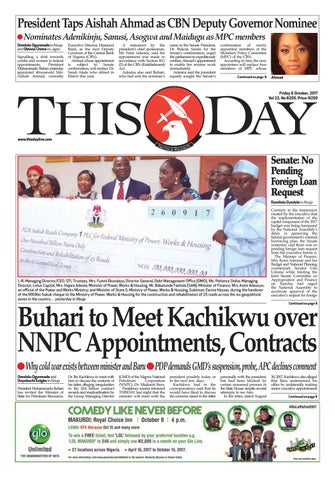
L-R: Managing Director/CEO, STL Trustees, Mrs. Funmi Ekundayo; Director General, Debt Management Office (DMO), Ms. Patience Oniha; Managing Director, Lotus Capital, Mrs. Hajara Adeola; Minister of Power, Works & Housing, Mr. Babatunde Fashola (SAN); Minister of Finance, Mrs. Kemi Adeosun; an official of the Power and Works Ministry; and Minister of State II, Ministry of Power, Works & Housing, Suleiman Zarma Hassan, during the handover of the N100bn Sukuk cheque to the Ministry of Power, Works & Housing for the construction and rehabilitation of 25 roads across the six geopolitical zones in the country… yesterday in Abuja
Contrary to the impression created by the executive that the implementation of the capital component of the 2017 budget was being hampered by the National Assembly’s delay in approving the federal government’s external borrowing plan, the Senate yesterday said there was no pending foreign loan request from the executive before it. The Minister of Finance, Mrs. Kemi Adeosun and her Budget and National Planning counterpart, Senator Udo Udoma while briefing the Joint Senate Committee on Appropriation and Finance on Tuesday had urged the National Assembly to accelerate approval of the executive’s request for foreign Continued on page 8
Buhari to Meet Kachikwu over NNPC Appointments, Contracts Why cold war exists between minister and Baru PDP demands GMD’s suspension, probe, APC declines comment Omololu Ogunmade and Onyebuchi Ezigbo in Abuja President Muhammadu Buhari has invited the Minister of State for Petroleum Resources,
Dr. Ibe Kachikwu to meet with him to discuss the contents of his letter, alleging irregularities in the $24 billion contract awards and insubordination by the Group Managing Director
(GMD) of the Nigeria National Petroleum Corporation (NNPC), Dr. Maikanti Baru. Presidency sources informed THISDAY last night that the minister will meet with the
president possibly today or in the next few days. Kachikwu had in the correspondence said that he would have liked to discuss the concerns raised in the letter
personally with the president, but had been blocked by certain unnamed persons in the State House despite several attempts to see him. In the letter, dated August
30, 2017, Kachikwu also alleged that Baru undermined his office by unilaterally making senior executive appointments Continued on page 8
2
T H I S D AY FRIDAY OCTOBER 6, 2017
T H I S D AY FRIDAY OCTOBER 6, 2017
3
4
T H I S D AY FRIDAY OCTOBER 6, 2017
T H I S D AY FRIDAY OCTOBER 6, 2017
5
6
T H I S D AY FRIDAY OCTOBER 6, 2017
T H I S D AY FRIDAY OCTOBER 6, 2017
7
FRIDAY, ;˜ ͺͿ ˾ T H I S D AY
8
PAGE EIGHT BUHARI TO MEET KACHIKWU OVER NNPC APPOINTMENTS, CONTRACTS without recourse to the board of NNPC which he chairs, and as stipulated in the law governing the operations of NNPC. The minister had pleaded with Buhari to suspend the appointments until due process had been complied with. Meanwhile, more facts have come to light on what led to the breakdown of relations between Kachikwu and Baru, with sources revealing to THISDAY that the cold war started when Kachikwu, in his capacity as GMD of NNPC, restructured the organisation in March 2016. Kachikwu for almost a year had held the dual post of Minister of State for Petroleum and GMD of NNPC before he was removed and replaced by Baru in July 2016. During the restructuring, which led to the creation of five divisions and 20 Autonomous Business Units (ABUs), Baru who had been appointed Group Executive Director, Exploration and Production of the corporation eight months earlier, was moved out of the post to the ministry as Kachikwu’s technical adviser. Baru, a source in NNPC confided, did not take kindly to the redeployment and immediately started moving mountains to supplant Kachikwu as the GMD of the state-run oil firm. With the assistance of his friends in the presidency, Baru eventually got his desire when Buhari announced Kachikwu’s removal and made Baru the new head of NNPC. However, the source explained that when Buhari appointed Baru the new GMD, he was unaware that he had approved his redeployment to the ministry as Kachikwu’s adviser three months earlier. The source explained that the president did not know Baru personally at the time and simply approved the redeployments that came with the restructuring, but Kachikwu’s letter has now helped to shed more light on what led to the division between his minister and the NNPC GMD. However, ever since the letter became public, it has elicited strong reactions from Nigerians
who have expressed divergent views over the propriety or otherwise of the issues raised by Kachikwu. Joining the fray yesterday, the Peoples Democratic Party (PDP) called on the president to immediately suspend and investigate Baru over the award of multi-billion dollar contracts without the approval of the NNPC board. The main opposition party equally alleged that the $24 billion contract scam at NNPC might have been fuelled by the need to oil Buhari’s second term bid. PDP said the sum involved in the NNPC scandal was $24 billion, pointing out that less than 10 per cent percent of the amount ($2 billion) was involved in the arms funds scandal allegedly diverted by the former National Security Adviser (NSA) Col. Sambo Dasuki, over which hundreds of Nigerians had been arrested and hounded. It expressed great shock at the “loud silence” of the president over what it termed the “humongous corruption scandal and other illegalities” currently being exposed at the nation’s cash cow, the NNPC in which two of his henchmen – Kachikwu and Baru – are the dramatis personae. PDP also used the opportunity to warn that it would take legal measures to remove any of its members in the House of Representatives who justify their defection to the ruling All Progressives Congress (APC) on grounds that the PDP is divided. Addressing a press conference in Abuja, the spokesman of the PDP, Dayo Adeyeye said its suspicion on the matter was reinforced by the unfolding events that seem to indicate that powerful people in the corridors of power are tacitly involved in the NNPC contract scandal. “We suspect and our suspicion is reinforced by the unfolding events that powerful people in the corridors of power are tacitly involved in this. “If the president’s powerful Chief of Staff, Abba Kyari could sit on the NNPC board and such a calamity is taking place without
an eyelid being blinked, we are forced to believe that the stealing is being done to the advantage of the president who has shown by his body language that the only thing that matters most to him for now is his second term ambition,” he said. The PDP spokesman maintained that the opposition party was demanding both the suspension of Baru and immediate probe of the issues raised by Kachikwu. When converted to naira, according to him, the sum of $24 billion said to be the subject of the latest controversy, is about N9 trillion, a sum that is bigger than the nation’s annual budget. “Will it be considered ‘hate speech’ if we say the money being stolen by President Buhari’s men is being kept aside into a special pool for the prosecution of his second term ambition? “We challenge the president to prove us wrong by allowing his allies being caught in acts of brazen stealing of our commonwealth get punished in accordance with the laws of the land. Anything aside this, we will take as confirmation of our suspicion that the rot is from the very top,” he said. PDP also challenged the president to do the needful and order a thorough investigation into the matter. “We demand as bona fide Nigerians, an express order from President Muhammadu Buhari to the NNPC GMD asking him to go on compulsory leave so that an investigation into the matter at stake can be conducted without interference. “We also demand an order from the president to the Economic and Financial Crimes Commission (EFCC) and other anti-graft agencies to immediately commence investigations into all issues of corruption levelled against Baru as well as other persons who might have overtly or covertly participated in the illegal act. “As a political party, we expect that the president, who prides himself as an indefatigable corruption fighter, would for once try to live above board by genuinely allowing one of
“Even at that, the report of the Vice-President Yemi Osinbajo-led committee is gathering dust on the shelf of the president because he probably cannot bear to see one of his closest allies punished by the laws of the land, even when all the facts show that blatant and unbridled theft was perpetrated by the president’s man. “The sum involved in the NNPC scandal is $24 billion; less than 10 per cent percent of that ($2 billion) was involved in the so-called arms scandal allegedly diverted by the former NSA over which hundreds of Nigerians have been arrested and hounded. “Nigerians can now see the hypocrisy in the so-called anti-corruption fight. We might as well say that the privileged class of APC members enjoy total immunity from the anticorruption campaign. “We have been saying this for months that the looting of the nation’s resources under this administration is record-setting in the history of this nation and we are being proven right on a daily basis by the little revelations that are being made by even those working under the administration. “We wonder what the stench will be when the real and hidden atrocities being perpetrated under the watch of President Buhari are finally exposed when Nigerians throw the APC government out of power in 2019. “This we find is one of the very many reasons the nation’s economy has nosedived under the inept administration of the APC. “The allegations raised by the Minister of State for Petroleum Resources is a confirmation of our earlier stance that the APC administration is in tatters, an administration without coordination, one planted firmly in the hands of a cabal that is sucking the nation dry while the president continues to feign ignorance of the sickening stench. “If not, how on earth can President Muhammadu Buhari justify a situation where a minister he appointed to serve under him, presiding over an important sector like the oil sector,
be turned to a mere house-help who must get clearance from some ‘outsiders’ before accessing the president? “How on earth will a mere MD of a corporation have the temerity to sideline a minister under whom he works and take decisions without consultation with the appropriate authority. How on earth could the NNPC GMD have been bold enough to sideline the entire board of NNPC and take such far-reaching decisions that have grave implications for the nation’s economy alone? “Much as we commend the National Assembly for indicating interest in probing the allegations against the NNPC GMD as approved in the adoption of the motion moved by Senator Samuel Anyanwu at the Senate plenary on Wednesday, we wish to appeal to the leadership of the Senate to prevail on the ad hoc committee set up for the purpose of the investigation to make their sitting open to all Nigerians so that nothing will be surreptitiously swept under the carpet. “The Peoples Democratic Party (PDP) reiterates our support for the drive to eliminate corruption from the workings of the Nigerian government, but we hold firmly to our stance that the APC government under President Buhari must lead and live by example. “We say no to soft landing to corruption and corrupt members of the APC government. We say no to double standards in the fight against corruption,” the party said. When contacted yesterday on the Kachikwu’s letter and the issues raised by the PDP, surprisingly, the ruling APC declined to comment. The APC National Publicity Secretary, Mallam Bolaji Abdullahi, who spoke on behalf of the party on the allegations erupting in NNPC, said: “We cannot comment on that now. In fact, we have no comment on it.” The APC National Vice Chairman, South West Dr. Pius Akinyelure is a board member of NNPC.
Villages Nigeria. She is also a Steering Committee Member of the Cherie Blair Foundation’s Road to Growth Project for women in conjunction with Enterprise Development Centre (EDC) at the Lagos Business School. MPC nominee, Adenikinju, holds a PhD Degree in Economics from the University of Ibadan and is currently a Professor of Economics in the same department. He is also a research professor at the Centre for Econometrics and Allied Research, as well as Senior Research Fellow, Macroeconomic Study Group, University of Ibadan. Adeola has consulted for such organisations as the European Union, United Nations, the Nigeria Liquefied Natural Gas (NLNG) Company, African Economic Research Consortium, OECD, UNIDO, ECOWAS, UNECA, the World Bank, and National Data Bank, among others. He was one of the consultants
that prepared the First Perspective Plan for Nigeria. He is also involved in the United Nations Project Link that makes economic projections on the Nigerian economy. Adenikinju was also a visiting scholar at the International Monetary Fund (IMF) in 1996 and 2005. Another MPC nominee, Sanusi, is an Associate Professor of Economics, Department of Economics, Ahmadu Bello University, Zaria. He took time off to study for a Masters Degree in International Business at the Lancaster University Management School, UK, where he also obtained his PhD in Economics. Sanusi has attended local and international conferences and workshops, and his published articles have appeared in academic journals such as the West African Journal of Monetary and Economic Integration, the Nigerian Journal of Economic and Social Studies, and Central Bank of Nigeria’s Economic and Financial Review, among others.
Asogwa, the third MPC nominee, is the Team Leader of Inclusive Growth at the UN Development Programme (UNDP), while Maidugu is a Director with the Federal Inland Revenue Service (FIRS) and had previously worked with the Debt Management Office and Economics Department, University of Maiduguri.
recess last July. “Let me clarify this, because I was informed by the Chairman of Appropriation (Senator Danjuma Goje) that when the Minister of Finance came, she suggested that
there were some requests before us on external borrowing. “I just want to make it clear that there is no request on external
his own, accused of corruption, get properly investigated and prosecuted as a show of his impartiality in the war against corruption,” PDP added. The party further challenged Buhari to correct the impression Nigerians have about his “socalled anti-corruption war” that it is not just a tool for the persecution of perceived enemies. According to PDP, the president should not give the impression that he is trying to shield Baru as he did with Babachir Lawal, the Secretary to the Government of the Federation (SGF). “We view the allegations levelled against Baru by Kachikwu as too grave to be swept under the carpet and we insist that the NNPC GMD must be treated like an accused who should not have the opportunity to influence investigations into his alleged misdeeds. “In this light, we demand the immediate suspension of the NNPC GMD so that a proper investigation can be carried out by the relevant anti-corruption agencies. “Ordinarily, if there was sincerity in the anti-corruption war, President Muhammadu Buhari should not wait for any prompting before he takes decisive action on this matter, but as customary with his administration, we suspect that he’s trying to shield Baru as he did Babachir Lawal, the Secretary to the Government of the Federation (SGF), whom he merely suspended to allow the hullabaloo generated by the fraud perpetrated in the management of the emergency funds for the IDPs, die down. “Also, up till now, we have never heard anything again about the millions of dollars and naira discovered in an Ikoyi apartment. “Nigerians have not forgotten the acts of illegality and double standards perpetrated by the president in refusing to hand over Babachir Lawal to the EFCC for proper investigation and possible prosecution for graft, but rather preferring to give the task of investigation of the open sleaze to the vice-president, in a move not known to any law of this nation.
PRESIDENT TAPS AISHAH AHMAD AS CBN DEPUTY GOVERNOR NOMINEE tenure will expire at the end of the year. The nominees are Professor Adeola Festus Adenikinju, Dr. Aliyu Rafindadi Sanusi, Dr. Robert Chikwendu Asogwa and Dr. Asheikh A. Maidugu. He added that the new MPC nominees, if confirmed by the Senate, would resume duty next January. Ahmad, the deputy governor nominee, boasts an impressive resume, spanning 20 years in banking and finance in Nigeria and the United Kingdom. To take up the post, she will be leaving Diamond Bank Plc where she is currently the Executive Director, Retail Banking. Prior to her current position with the bank, Ahmad was the Head, Consumer and Privilege Banking at Diamond Bank and was previously the Head, Retail Banking Directorate of the bank. She joined Diamond Bank in June 2014 as a Deputy General Manager as the Head of Retail Financial Services Division, overseeing Privilege Banking,
Consumer Banking Group, Retail Assets, Cards and Customer Engagement & Insight. Prior to joining Diamond Bank, Aishah worked with Stanbic IBTC Holdings where she served in various capacities as Head, High Net Worth Individuals, Head, Private Client Services and Deputy Head, Private Client Services between 2009 - 2014. She had also worked with other companies such as Zenith Capital Limited as the Head, Business Development, Bank of New York Mellon (UK), Synesix Financial Limited (UK), Zenith Bank Plc as Head of the Retail Banking Unit, and NAL Bank Plc as Head of Private Banking. She started her banking career with First Interstate Bank Plc as Executive Assistant, Treasury Group, before which she had stints with Manstructs Group Nigeria Limited as Group Accountant and Z. O. Ososanya & Co. She holds a Bachelor of Science degree in Accounting from the University of Abuja, an MBA
(Finance) from the University of Lagos and an M.Sc. Finance and Management from the Cranfield School of Management, UK. She is a Chartered Alternative Investment Analyst (CAIA) and she holds the Chartered Financial Analyst (CFA) designation. She is described as a creative, versatile professional with strong educational grounding in finance and broad banking and capital markets experience. Ahmad has demonstrated proven success at enhancing the value of institutions by driving exceptional business performance. She leverages a multi-ethnic background, cross-sectoral industry network, predisposition for analytical problem solving and ability to inspire diverse teams to aspire and exceed expectations. A strong advocate for female empowerment, Ahmad is the current Chairperson of Women in Management, Business & Public Service (WIMBIZ), a leading women-focused NGO in sub-Saharan Africa, and serves on the board of SOS Children’s
SENATE: NO PENDING FOREIGN LOAN REQUEST loans. This they had said was necessary to ensure that the N2.1 trillion capital budget was adequately funded at a time the government is trying
to sustain the momentum as the economy attempts to shrug off the recession. But the President of the Senate Dr. Bukola Saraki, speaking at plenary yesterday, said there
was no loan request from the executive that had not been treated by the lawmakers, adding that any pending request was concluded before the National Assembly embarked on its annual
Continued on page 10
TOP GAINERS LINKASSURANCE PRESCO DANGFLOUR NPFMFB CAVERTON TOP LOSERS CADBURY MRSOIL CONTINENTAL
NGN NGN 0.06 0.75 2.95 61.95 0.30 6.64 0.05 1.16 0.05 1.19 NGN NGN 0.54 10.26 1.51 28.88 0.07 1.36 MOBIL 8.28 161.72 LAWUNION 0.04 0.89 HPE Nestle Nig Plc ₦1,223.01 Volume: 317.44 million shares Value: N2.853 billion Deals: 3,327 As at yesterday 5/10/17 See details on Page 44
% 8.7 5.0 4.7 4.5 4.3 % 5.0 4.9 4.9 4.8 4.3
T H I S D AY FRIDAY OCTOBER 6, 2017
9
FRIDAY, ;˜ ͺͿ ˾ T H I S D AY
10
STARTERS
British Writer, Ishiguro Named Nobel Literature Laureate
British-Japanese novelist, Kazuo Ishiguro has been named the 2017 Nobel Literature winner. Ishiguro, who in novels of great emotional force, uncovered the abyss beneath people’s illusory sense of connection with the world was named by the Nobel Prize Committee in Stockholm yesterday The 2017 Literature Laureate Kazuo Ishiguro was born on November 8, 1954 (age 62) in Japan. His family moved to the United Kingdom when he was five years old. The themes he is most associated with are: memory, time, and selfdelusion. Kazuo Ishiguro’s most renowned novel, “The Remains of the Day” (1989), was turned into film with Anthony Hopkins as the butler Stevens.
Calm over Suspected Monkey Pox Outbreak The Minister of Health, Prof. Isaac Adewole, has called for calm on the reported suspected cases of monkey pox disease in Bayelsa State. Page 48
"I have received with great concern reports of the flooding in Benue State, displacing, from early estimates, more than 100,000 people,” President Muham- madu Buhari wrote onTwitter on August 28: “We will surmount this disaster, and, working with the state government we will bring succour and relief to all affected persons and communities.” Page 15
Ishiguro
loans, adding that of the N17.5 billion in NPLs, N14.2 billion representing 80 per cent was borrowed by a few individuals and firms. He said the ratio of NPLs was high because many of the loans were not collateralised. A staff of the institution who preferred anonymity told NAN that all workers of the oraganisation had been officially informed about the winding up. “We have been given the choice to either resign or be sacked. The managing director told us that management is working with the permanent secretary of the federal ministry of finance. “They have promised that at the end of the day, we will not be jobless. They will place us somewhere else, so we are expectant,” the person said. NERFUND was established by Decree No. 2 of 1989 to act as a catalyst for the rapid rise of productive enterprises in the country with a seed capital of N300 million.. In 2002, the federal government merged Nigerian Industrial Development Bank (NIDB) and Nigerian Bank of Commerce
steps be taken to ensure that the executive does not embark on selective implementation under the guise of completing priority projects because it will offend the spirit of the Appropriation Act”. The lawmakers also urged the government to explore the use of operating surpluses from agencies such as the Central Bank of Nigeria, Nigerian Maritime Administration and Safety Agency (NIMASA) and the Nigeria Ports Authority (NPA) to fund the budget. But the resolution on the report prompted a query to the Ad Hoc Committee on Alleged Misuse, Under Remittances of IGR by Ministries, Departments and Agencies (MDAs) of Government. Addressing the chairman of the committee, Senator Adeola Olamilekan, Saraki asked for the report of the committee. “We had a committee under Senator Adeola Olamilekan on this revenue (matter), I don’t know what happened to the report. The committee we set up for internally generated revenue (probe), I have not gotten its report yet. “This matter is now urgent and important because based on the recommendations we have agreed here, it is going to affect 2018 budget and 2017 budget implementation. “Whatever it takes, you need to dedicate time and let us have a report, at least on these three agencies within the next one week or two weeks maximum,” he said. Responding, Olamilekan said the committee had requested that the MDAs submit their audited financial reports. “On the issue of agencies of government to explore using their operating surpluses for financing the budget, I want to bring to the notice of the Senate that just eight of these agencies constitute 80 per cent of the operational surpluses. “However, most of these agencies hide under frivolous expenditure items to take out these operational surpluses and pay
POLITICS Enugu and Utilisation of Paris Club
and Industry (NBCI) to form Bank of Industry (BOI). The government excluded NERFUND from the fusion of all development finance institutions (DFIs). However, the agency’s capital had grown to billions of naira, but due to poor management, the organisation has been comatose since late 2013, losing its capacity to carry out its mandate. In June 2016, the staff of NERFUND took to the streets to protest the mismanagement of the agency’s funds. In order to forestall a breakdown of law and order, the government through the Minister of Finance, Kemi Adeosun intervened by first shutting down the agency, following the failure to reconcile the differences between the executive management and staff. Two weeks after the closure, Adeosun instructed staff to return to work and appointed the Dr. Ezekiel Oseni in August of the same year to act as managing director. Just one year into his appointment the federal government has finally approved the winding up of the institution.
Refund When the finance ministry released a full list of how much each of the 36 states had received so far from the federal government, as their share of the refund of Paris/London Club debt repayments between 1995 and 2002, Enugu’s share of the repayment was about N10.723 billion from the entire N516.38 billion that has been released so far. Page 17
peanuts to the government. “You will not find the Central Bank of Nigeria carrying out the functions of the federal government – like a government within a government. We asked them yesterday to furnish us with more documents so that we can have a full-fledged report on the CBN, NIMASA and NPA. “On the issue of NPA, we have an agency that is operating in isolation. This is one agency that has taken me aback. How can an agency generate over N170 billion in a year and come to you to say that over N140 billion has been expended the same year. Where is the money they are going to pay into government coffers?” Olamilekan asked. He however assured the Senate that an interim report would be submitted next week. Meanwhile, the Senate referred the N135 billion virement request of the executive to the Committee on Appropriation. The executive, in July 2017, had requested for virement of the amount within the 2017 budget. The request was however almost rejected as several lawmakers argued against it. While the Deputy Senate President Ike Ekweremadu said virement is not contained in the constitution and was therefore unconstitutional, Senator Dino Melaye argued that it was too early in the life of the 2017 budget to request for virement. Saraki however appealed to the lawmakers to allow the request to be sent to the committee. “Before virement can be considered, the Senate should have seen a more significant level of implementation. But this is in line with the Senate’s commitment to give support to the executive as much as possible within the law,” Saraki argued. On the basis of his position, the virement request was referred to the Appropriation Committee for consideration and approval.
Federal Government Coffers The Nigerian Maritime Administration and Safety Agency (NIMASA) has within one year and one month, remitted a total of N21.805 billion to the Consolidated Revenue Fund (CRF) of the federal government. Page 19
SENATE: NO PENDING FOREIGN LOAN REQUEST borrowing that has not been acted upon. “It must be that the letters have not left the executive to come to us. I think it is important that we don’t delay such an important issue. “If you remember, at the end of last session, on the last day we treated requests from the states and those on the railways. There are no pending requests from Mr. President, or when he was away, from the acting president on external loan,” Saraki said. His pronouncement was prompted by the consideration of the report of the Joint Committee on Appropriation and Finance on the implementation of the 2017 budget. “The executive claimed it is awaiting the resolution of the National Assembly on external borrowings to enable them borrow to finance part of the capital component of the budget. This is because external debts have longer tenures and lower interest rate,” the report read. However, in adopting the recommendations of the report, the Senate noted that the fiscal year could be restored to the January-December cycle for the 2018 budget without rolling over up to 60 percent of the projects contained in the 2017 budget. Udoma had told the joint committee on Tuesday that his ministry had already informed government agencies to roll over between 50-60 percent of 2017 capital projects into the 2018 budget. “Much as there is need to work with the executive to return to a predictable JanuaryDecember budget cycle, this should be done without sacrificing up to 60 per cent of a full year’s capital budget in one full-swoop,” the report added. Saraki further cautioned that with the plan to roll over the projects to next year, the 2018 budget might be as high as N10 trillion. Other recommendations of the committee which were adopted included “that necessary
NEWS Adewole, Bayelsa Commissioner Call for
EDITORIAL Tackling The Flood Problem
FG to Shut Down NERFUND over N17.5bn Bad Loans
The federal government has initiated plans to shut down the National Economic Reconstruction Fund (NERFUND) over non-performance and non-performing loans (NPLs) of over N17.5 billion. A source at the Ministry of Finance informed the News Agency of Nigeria (NAN) yesterday in Abuja that a committee had already been set up to oversee the smooth liquidation of the company by the end of October. The source said the committee was expected to come up with recommendations to cater to the welfare of the NERFUND workers and advise on what to do with the fixed assets of the financial institution. The committee is also expected to recommend an agency that would handle the numerous pending court cases initiated by NERFUND to recover billions of naira in bad loans. According to the source, about 1,143 projects in the small and medium enterprises sector were financed by NERFUND between 2010 and 2013. The source said NERFUND had encountered problems recovering the
Two-Minute Briefing
WEEKENDFILE Projecting Nigeria’s Culture in the Diaspora ATaste of Nigeria which debuted almost 10 years ago in the United States of America, the initiator, Mrs. Kpegekie Simmons, a young promising Nigerian based in the USA, said emanated from her desire to showcase Nigeria’s rich heritage in the Diaspora. Page 27
BUSINESS NIMASA Remits N21.805bn to
CITYSTRINGS Upgrades for Social Workers
The event was a seven-month training programme and presentation of certificates to 55 auxiliary social workers drawn from Benue, Kaduna and the Federal CapitalTerritory(FCT) which closing section climaxed with a thorough review on the need for a social development workforce to help stem the tide of the increasing spate of anti-social behaviours including domestic violence leading to wife-battery and breeding of disconsolate vulnerable children... Page 40
SPORTS Akwa Ibom Gov Redeems Pledge to
Eagles Akwa Ibom State Governor, Mr. Udom Emmanuel onWednesday redeemed his pledge of $10,000 per goal for the matches against Cameroon to the Super Eagles, while calling on the three-time African champions to go all out for a win against Zambia on Saturday and expect ‘a handsome reward’ from him. Page 54
T H I S D AY FRIDAY OCTOBER 6, 2017
11
12
T H I S D AY FRIDAY OCTOBER 6, 2017
T H I S D AY FRIDAY OCTOBER 6, 2017
13
14
T H I S D AY ˾ ˜ ʹ˜ 2017
COMMENT
Editor, Editorial Page PETER ISHAKA Email peter.ishaka@thisdaylive.com
THOUGHTS ON PATH TO GREATNESS Ogbeni Rauf Aregbesola urges Nigerians to engage in productive activities
T
he occasion of the 57th anniversary of national independence should give us a cause for deep reflection and critical thinking without necessarily taking anything away from the celebration. I use this occasion to congratulate Nigerians, the good people of Osun in particular. It is a thing of great joy, irrespective of our collective or individual circumstances, to be alive to celebrate the anniversary of our nation’s independence. For some of us who were born before independence, it was a momentous event for us. Though I was a child at independence in 1960, the ferments of the struggle against colonialism still remained with us in my growing up years while the substitution and replacement of white colonialists with our people that followed was dramatic enough to give us a deeper appreciation of independence. With the benefit of hindsight, some of the hopes and aspirations of the pre and immediate post-independence era have been betrayed and this is regrettable. We dreamt then of Nigeria becoming a superpower in one or two decades after independence. This dream was even shared by some of the great powers of the era who saw us as potential competitors, first for regional hegemony and also on a global scale in economic, social, political, sporting and diplomatic contests. Many of them have since relaxed, feeling their fears then were unfounded. However, the dream of greatness is an undying one. Nigeria can and will still be great. Though this issue has been over flogged, it still needs reiterating – that our bane since military interregnum has been overt reliance on rent from crude oil. Let us be clear on this, oil is a blessing, not a curse. The problem is what you make of it. Oil has been a blessing in the Scandinavian countries, Libya, Saudi Arabia, Kuwait, Angola, United States, Britain, Norway, Venezuela, Canada, Russia and several other places where it has been well utilised as a catalyst for development and wealth creation. Our own problem, like several oil rich nations, is that we live on its rent and do not build any productive activity around it. That is why, beyond exportation, oil is practically useless for us. We cannot even refine for local consumption until current efforts by the administration of President Muhammadu Buhari. Even then, the Minister of State for Petroleum Resources told us recently that 92 per cent of local consumption is still being imported at the cost of $28 billion in 2016. We then import every other thing, including food, clothing and most of our building materials. Now, the price of oil has fallen and the portents are still bad. This is in the wake of a tectonic shift in technology from internal combustion engines to electrical engines in automobiles. Nevertheless, a lot of people still believe we are rich with crude oil, only if there is equitable distribution of the resources. Now, corruption has made the scarcity to be worse. Corruption is evil, it disrupts the development process and should be stamped out. However, without corruption, we are still a poor nation, even with oil. Let us do this simple calculation. Nigeria’s daily production quota from OPEC is put at 2.1 million barrels per day. Let us note that we have never met this production and sales quota in the last 10 years. Nevertheless, if we multiply this imaginary production quota with 365 days, which make a year, we have 766.5 million barrels of crude oil as our total foreign exchange oil earning resource. This is assuming there is no production disruption from militants’ activities in the Niger Delta and unsold inventory which could be up to half a million barrels sometimes.
THOUGH THIS ISSUE HAS BEEN OVER FLOGGED, IT STILL NEEDS REITERATING – THAT OUR BANE SINCE MILITARY INTERREGNUM HAS BEEN OVERT RELIANCE ON RENT FROM CRUDE OIL
Since oil sells for an average of $50 now, this will give us $38.325 billion in total sales per annum. Remember we have not deducted production and associated expenditures; this is the gross income, joint venture partners are assumed volunteers. If we divide this amount by 170 million, which is our conservative population estimate, it goes round to roughly $225.44 per head per annum. This is further reducible to $18.786 in a month. At an exchange rate of N370, it amounts to N7,000. This calculation simply means that every Nigerian is entitled to N7,000 monthly from oil wealth at best! How about income from other sources? Since oil accounts for 70 per cent of total national revenue, this figure will only rise to N10,000. Let’s say someone wants to experiment with this calculation and give to every Nigerian N10,000 unearned income, it means there will be no government; bureaucracy and associated wages, paying salaries, no executive, legislature and the judiciary, no police, military, public education, roads, airport, international relations, etc. This without a doubt means anarchy. I have gone to this length to demonstrate that we are not rich at all, even with the oil wealth. The per capita income from oil would probably have been better if we have just one tenth of our population. This makes the issue of diversification of our economy and productivity imperative. Productivity is the ability to alter any state of matter or service, alone or in combinations into a more desirable form – product or service. The process of bringing about that alteration, or the effort we put into achieving this, is called work. The initial condition or base material for these processes is often as freely set by nature, while the derived output or product is as contrived by man in his imagination. Thus, sound notes put together productively equals music, otherwise it is noise. Rubbles put together constructively is a house, otherwise it is just a dump of rubbles. The challenge before us as a nation is therefore to earn income from productivity, not from rent. On this note, I will like to posit that we should get 50 million of our compatriots to be working i.e. engaged in productive activities that will bring them at least N25,000 a month. From this, N1.25 trillion will be generated in the economy every month from real productive engagement. These jobs can be created and paid for by ways and means in diverse areas of the economy like agriculture and food production, clothing and footwear, housing, environment, critical public infrastructure like roads, bridges, airports, railways, water resources development, etc., that will provide basic needs for the people and cut our imports by 90 per cent, reducing foreign goods to critical machineries and raw materials we do not have at home. This will catapult Nigeria into a superpower within two decades. In Osun we are already working on this. We are striving to put at least one million of our over four million population to work. If they earn a minimum of N25,000 a month, a 10 per cent tax from this will give us revenue of N2.5billion every month. This amount will be sufficient to run the government, pay workers, develop our state and bring prosperity to all. If this is replicated in all the states of the federation, Nigeria will be prosperous without oil money. This is my dream for our country and it is my sincere hope that at this occasion of our independence celebration, leaders in the public and private sectors will critically engage this idea. Ogbeni Aregbesola is Osun Governor
WIND OF CHANGE
The Standards Organisation of Nigeria is redefining the war on fake and substandard products, writes Reuben Ojim
O
ne federal government agency where the change agenda of President Muhammadu Buhari has been in top gear is the Standards Organisation of Nigeria (SON). The SON is redefining the war on fake and substandard products. The verve and steam of the organisation that seemed threatened some years ago due to a combination of factors are being gradually re-invigorated under the Director-General, Mr. Osita Aboloma. Beneath the veneer of Aboloma’s legal background is the toughness of a battlehardened reformer. His coming on stage has left no room for chattering and vacillating in the topflight regulatory organisation. Chivalrous yet genteel, Aboloma’s sprightly and self-confident approach to the battle against substandard and adulterated products have been yielding huge dividends. He goes about his duty with uncommon gusto. His gravitas in sifting and analysing the labyrinth of products within the country and those coming in, while getting the companies and organisations to comply with the rules and regulations, is uncommon. Leveraging on his productive will power coupled with his strong aversion to quackery, Aboloma has been disarming many violators of set standards thereby warming himself and the organisation into the hearts of many Nigerians.
Through the unprecedented passing of its amended act by the National Assembly in 2015, the SON has now acquired new powers not only to arrest, prosecute and jail purveyors of fake and sub-standard products across the country, but prevent importers of such products into the country. With this upgraded status, the war against fake and sub-standard products has gained additional impetus. In view of the danger the criminal activities of those dealing in substandard and counterfeit products poses to the lives and wellbeing of Nigerians, the SON has deployed modern electronic platforms to tackle the menace. The platforms include the Mandatory Conformity Assessment Programme (MANCAP) for locally manufactured products; the off-shore Conformity Assessment Programme (SONCAP) for certification of imported products from source; product registration for documentation and traceability of all products in the market and library services for access to relevant standards for local production import and export with ease among others. Determined to provide guidance on how businesses and organisations can operate in a socially responsible way, the SON has launched the ISO 26000. ISO 26000 is guidance standard on social responsibility. Under this change dispensation, the SON has worked relentlessly to make a positive mark in the war against fake and
substandard products. Worthy of note is the evident reduction in the rate of production of substandard goods in Nigeria. Considering the propensity of some Nigerians to cut corners in their insatiable quest to acquire wealth by all means, especially in the area of faking products, what the SON has achieved so far is worthy of commendation. This is not to say that the war against substandard and counterfeit products has been fought and won. No, the battle is a continuous one. A checklist of SON’s recent triumphs include its arrest of two Pakistani nationals and importers of consumables by the organisation’s eagle-eyed enforcement team while changing manufacturing and expiry dates of already expired imported fruit juice at a warehouse in Lagos. The discovery was another in the series of the SON’s concerted efforts to protect Nigerians from the consumption of lifeendangering products being distributed by unscrupulous persons. Earlier this year, the SON had recorded the seizure of N5billion worth of substandard tyres and the arrest of two Chinese nationals in connection with the importation. Fired by Aboloma’s redemptive disposition, the organisation has also sealed off several shops in Jos for selling substandard foreign electric cables worth millions of naira; prosecution of 40 suspected producers of substandard goods in Ondo State; seizure of substandard
telephones worth millions of naira in ICT market, Ikeja. Others are: confiscation of N200 million worth of substandard handsets; impoundment of three containers of substandard gas cylinders in Lagos and the sealing off of four warehouses with substandard products worth N400 million and the seizure of over N200 million fabrics in three different markets in Lagos. Equally worthy of note here is the seizure of about N2 billion worth of expired household products in a three-storey building in Lagos. The goods were being clandestinely sold to supermarkets and open markets as wholesome products within the city and other parts of the country. Similarly, in a bid to ensure that offenders are severely punished for infringing on the laws of the land either through production, importation or selling of substandard products, the organisation has imposed a fine of N1 million or life imprisonment on offenders. The arrest and diligent prosecution of the Chinese nationals who imported a whopping N5 billion worth of fake tyres, for instance, clearly demonstrates that it’s no longer business as usual for purveyors of substandard products in the country. With such sure-footedness and solid attainments in barely a year, the SON under the leadership of Aboloma appears primed to go places. Ojim wrote from Abuja
15
T H I S D AY ˞ ˜ ʹ˜ 2017
EDITORIAL TACKLING THE FLOOD PROBLEM Government must pay more attention to the environment
“
I have received with great concern reports of the ooding in Benue State, displacing, from early estimates, more than 100,000 people,â€? President Muhammadu Buhari wrote on Twitter on August 28: “We will surmount this disaster, and, working with the state government we will bring succour and relief to all affected persons and communities.â€? While the hundreds of thousands affected by the ood in Benue have since been left to their own devices, nature is wreaking havoc on communities in several other states across the country. Within the past one month, villages, schools and farmlands were ooded or submerged as more and more Nigerians have joined the growing population of internally displaced persons. Instructively, while Nigeria has many challenges, the environment is not often listed as one of them. That only shows our lackadaisical disposition to serious issues. It is therefore time Nigeria became part of the global trend of putting issues of the environment on the front burner THERE IS THE NEED FOR while the relevant NIGERIANS TO BEGIN TO authorities should IMBIBE THE CORRECT be more proactive, ATTITUDE TO WASTE especially in the prevention of natural DISPOSAL AS FLOODING disasters. And when IN SOME OF OUR MAJOR CITIES CANNOT BE SOLELY they inevitably occur, EXPLAINED BY FORCE OF governments at all tiers, complemented NATURE by private organisations and well-endowed individuals, should come to the aid of the victims as we see in other parts of the world. Meanwhile, elementary science teaches that as global temperatures rise, oceans get warmer and when water heats up, it expands and sea levels rise as we have been witnessing in several countries in recent times. It is therefore no surprise that in several coastal cities across the world today, climate change
Letters to the Editor
is creating a situation where too much water comes at an unexpected time, or in unexpected places causing serious problem. It is then little wonder that the densely populated, low-lying cities and towns in our country have also become an environmental nightmare for most of the inhabitants on account of ooding. However, beyond the intervention of the government at all levels is the need for Nigerians to begin to imbibe the correct attitude to waste disposal as ooding in some of our major cities cannot be solely explained by force of nature. The habit of the people indeed plays a crucial role in what has been happening over the years anytime it rains. Most of the drains are blocked due to the indiscriminate throwing on the roads and drainages disposable cans and pure water sachets, among others.
T T H I S DAY
EDITOR DEPUTY EDITORS ˜ MANAGING DIRECTOR DEPUTY MANAGING DIRECTOR CHAIRMAN EDITORIAL BOARD
EDITOR NATION’S CAPITAL
T H I S DAY N E W S PA P E R S L I M I T E D
EDITOR-IN-CHIEF/CHAIRMAN GROUP EXECUTIVE DIRECTORS ˜ ˜
˜ GROUP FINANCE DIRECTOR DIVISIONAL DIRECTORS ˜ ˜ DEPUTY DIVISIONAL DIRECTOR
SNR. ASSOCIATE DIRECTOR ASSOCIATE DIRECTORS ˜ CONTROLLERS ˜ ˜
GENERAL MANAGER
GROUP HEAD DIRECTOR, PRINTING PRODUCTION TO SEND EMAIL: ďŹ rst name.surname@thisdaylive.com
hese dirty attitudes quite naturally lead to blockages of canals and manholes resulting in the type of oods that have been witnessed in recent weeks. For instance, Lagos presents a clear example in this regard as most ood-prone areas are replete with buildings erected on water channels. This ugly trend must stop while the state government should ensure that all those buildings are pulled down to ensure the free ow of water into the canals. However, it is not enough for the government to just ask citizens to leave their houses built on ood path without providing compensations or any measures for their relocation, especially if those buildings have all the requite permits. Also, there is need for the authorities to resettle those living in ood-prone areas. A town like Lokoja, in Kogi State, is an example of where a massive intervention is needed. Naturally, there will be resistance from people who would not like to move from their present habitat. But they must be made to realise the consequences of whatever choice they make between accepting to be resettled or risk their lives and livelihoods.
TO OUR READERS Letters in response to speciďŹ c publications in THISDAY should be brief (150-200 words) and straight to the point. Interested readers may send such letters along with their contact details to opinion@thisdaylive.com. We also welcome comments and opinions on topical local, national and international issues provided they are well-written and should also not be longer than (9501000 words). They should be sent to opinion@thisdaylive.com along with the email address and phone numbers of the writer.
LAGOS CMC AND ACCESS TO JUSTICE
D
ispute is an integral part of every society and it arises at all levels of interaction. Various crises that occur in society are partly traceable to inability of parties involved to amicably settle their disputes. All through human history, kingdoms and nations have had to engage in needless wars due to unresolved disputes. Thus, the extent to which disputes are cordially settled ultimately determines the degree of peace that is enjoyed in the society. It could, therefore, be affirmed that dispute resolution is crucial to the peaceful coexistence of human society. In contemporary time, three main methods have been evolved for dispute settlement through the intervention of third parties. These are judicial settlement or adjudication by courts of law, conciliation, mediation and arbitration. Of the three, adjudication or litigation by courts of law is a famous conventional method that disputes have generally been resolved for quite some time. But it has been discovered overtime that court proceedings are usually delayed, substantially expensive and enormously demanding. Aside this, whichever way a litigation process ends, it always leaves behind heightened animosity and eventually results in broken relationships with further consequences on societal fragile peace. It is, thus, in recognition of the several shortcomings of litigation that stakeholders in the justice sector have been promoting and encouraging parties involved in disputes to seek other informal or not too cumbersome options in settling disputes. It is the search
for such probable options that brought to fore the now popular alternative dispute resolution (ADR) which involves compromise and making of concessions, here and there. In deciding for this option, feuding parties may achieve the objectives themselves or may decide to involve dispassionate parties as mediators. The main objective of ADR is to encourage and promote the resolution of disagreements in a way that is devoid of legal action. It is on this principle that the Lagos State Government anchors the creation of the Citizens’ Mediation Centre, (CMC) in 1999. As earlier explained, legal process is often protracted and expensive and the realisation of this usually makes some people, especially the indigent to resort to self-help, which sometimes could lead to anarchy. It is, therefore, in a bid to ensure that law and order isn’t in any way threatened in the country’s ‘Centre of Excellence’ that the Lagos State Government through the Ministry of Justice under the then leadership of Professor Yemi Osinbajo (SAN), now the Vice-President of the Federal Republic of Nigeria, established the CMC as a unit under the Directorate for Citizens’ Rights (DCR) of the State’s Ministry of Justice. The establishment of CMC is a creative response to the yearnings of several Lagos residents, particularly the indigents, the illiterates and the helpless who find the traditional method of resolving disputes through litigation too costly, technical and rather awkward. Under the law that established the centre, its services are to be provided only to indigent residents of the state especially women, children and the physically challenged. Also, for CMC to mediate
in any dispute, the cause of action must have occurred within the jurisdiction of Lagos State. This implies that, the centre wouldn’t take up cases that took place outside the state. One other vital point is that the complaint must come straight from the affected persons or other referrals. However, the centre can sometime refer matters brought before it to other suitable agencies, non-governmental organisations, the courts or other relevant organisations. Over the years, CMC has evolved in diverse ways. Today it is a full-fledged agency with 18 centres at 7up by old Toll -Gate, Yaba, Lagos Island, Iba, Ikorodu, Amukoko, Agege, Alimosho, Badagry, Ojo, Ojokoro, Ikotun, Bariga, Oshodi, Ibeju-Lekki, Epe, Eredo and Ikosin-Ejirin. The intent in creating more centres across the state is to bring the service of the CMC closer to all residents of Lagos State. The new focus of the centre appropriately echoes the notion of “Justice for All� which is premised on the perspective that government’s objective of giving access to justice is similar to the goals of providing other vital services in other equally critical sectors such as education, the environment, public health, among others. The insight here is that just as government makes provision for infrastructure development, education, health care delivery, public security and others, provisions should also be made for justice that is swift, affordable and perceptible. It is based on this premise that the cost of handling all cases at the centre is fully borne by the government. Tayo Ogunbiyi, Lagos State Ministry of Information and Strategy, Alausa, Lagos
16
T H I S D AY FRIDAY OCTOBER 6, 2017
T H I S D AY ˾ FRIDAY, OCTOBER 6, 2017
17
Group Politics Editor Tobi Soniyi Email tobi.soniyi@thisdaylive.com 08033146139 SMS ONLY
POLITICS A N A LY S I S
Enugu and Utilisation of Paris Club Refund Chineme Okafor investigates the allegation that Enugu State did not utilise the Paris Club refund for the purpose for which the funds were released and found the allegation to be untrue
W
hen the finance ministry released a full list of how much each of the 36 states had received so far from the federal government, as their share of the refund of Paris/London Club debt repayments between 1995 and 2002, Enugu’s share of the repayment was about N10.723 billion from the entire N516.38 billion that has been released so far. Beyond the receipt of the refund which the federal government said was specifically targeted at offsetting the salaries, pensions, and other entitlements of workers in the states, most states reportedly used the funds other than the purpose for which they were meant for. Many are still owing their workers salaries, thus prompting lots of condemnation from both civil society groups and labour unions in the country. But as was disclosed by the commissioner for information in Enugu state, Mr. Ogbuagu Anikwe, that practice was alien to the state which he said had made it a convention to pay its workers’ salaries in good time. Speaking recently on the controversy that surrounded the state’s receipt and disbursement of its share of the Paris/London refund, Anikwe, explained that the state had always fulfilled its monthly obligations to its staff and never relied on the refund to pay its wages. He said long before the refund came, Enugu paid its workers’ salaries before the 25th of each months, but eventually moved the payday forward to the 23rd day of each month. Anikwe said that within the Nigerian body polity, Enugu was the first state in Nigeria to pay its salaries regularly despite its quite disadvantageous financial ranking as compared to other states that are way ahead of her in the leader-board. Faulting claims that the state was indebted to its workers despite claiming over N10 billion from the Paris/London refund, Anikwe, said: “This claim was based on a News Agency of Nigeria (NAN) survey which listed Enugu as one of the states in Nigeria yet to utilise their share of the second tranche of the Paris/ London Clubs refunds.” He however noted that the report appeared to have concluded that since the state was yet to utilise its second tranche and since the federal government had asked that a lion share of the refund be used to offset salary and pension arrears, Enugu state must therefore be owing salary and pension arrears. “We regret this unfortunate conclusion which could have been avoided with a little fact-checking. For the avoidance of doubt, no civil servant in Enugu state is being owed a kobo as salaries or arrears of salaries since the assumption of office of Governor Ifeanyi Ugwuanyi,” said Anikwe. Clarifying the status of the state’s salaries obligation to its workers, Anikwe explained: “Enugu state public workers’ salaries used to be paid promptly on the 25th day of each month. However, beginning from three months ago, the governor ordered the accountant general to move forward the payday for civil servants and they are now being paid on the 23rd of the month.” He further noted: “By this executive stroke, Enugu state has become the first state in Nigeria to pay its workers, with effect from three months ago. It must be pointed out that Enugu state sits fifth from the bottom of the table on share of monthly federal allocations. “However, through prudent management of its resources and an aggressive internally generated revenue drive, the Ugwuanyi ad-
Ugwuanyi...proved critics wrong
ministration has been able to fully discharge its obligations to workers and still embark on massive projects to promote its agenda of employment generation, development of the rural areas, provision and maintenance of social services, and management of security and peace.” How the Paris/London refund was used Providing an insight into how the state managed its share of the refund so far gotten from the federal government, Anikwe said with a creative consultative mechanism, the governor had been able to carry everybody along on the disbursement of the refund. Anikwe said that so far, Enugu had not utilised the second tranche of the refund because it had no need to use any part of
Even before the refund came, Enugu had always paid its workers’ salaries before the 25th of each months, but eventually moved the payday forward to the 23rd day of each month.
it now. “Enugu has yet to utilise its share of the second tranche of the refunds because the state does not have a pressing need to immediately utilise the funds, since it is not indebted in any way to her workers and pensioners,” said Anikwe. He gave details of the fund’s management mechanism, saying: “What the state does each time it receives her share of the refunds is to immediately call for a meeting of the stakeholders – the two labour unions (NLC and TUC), representatives of pensioners, leaders of traditional institutions and community based associations, and development experts – to decide how best to utilise the refund. “It is also at this meeting that a sharing formula is established between the states and local councils. The portion reserved for salary and pensions payments is kept aside and used to pay workers and pensioners as and when due.” Anikwe said the governor’s approach to the fund’s disbursement has worked very well for the state and ought to be commended. The Economic and Financial Crimes Commission had claimed it was investigating some states governors for allegedly diverting the Paris Club debt refunds. But the governors denied the allegation and challenged the commission to come out with its report to prove the allegation that funds were diverted. The Nigerian Governors’ Forum (NGF), said the states would await the report of the EFCC investigation. Speculation had been rife that some states
allegedly diverted the refunds made to them from the Paris Club debt deductions, prompting the investigation by the EFCC. Some states were also alleged to have used fictitious consultants to divert some of the money from the Paris Club refunds. Worried by the development, the presidency reportedly ordered a full-scale investigation into the disbursement of the funds. But the chairman of the NGF and Zamfara State governor, Abdulaziz Yari, while defending his colleagues said the governors were ready for the probe. He expressed the governors’ support for the present administration’s war against corruption, but said that they would wait for the outcome of the EFCC investigation. The presidency reportedly ordered the investigation because it was disappointed that what was meant to be a goodwill gesture was compromised by selfish interests. A presidency source said that the federal government was worried that its efforts to ensure the settlement of pension and salaries owed to workers in the states were being sabotaged through the likely diversion of the funds earmarked for the purpose. It expressed its determination to get to the bottom of the matter and consequently ordered the relevant agencies to carry out a full-scale probe to unravel any abuse of the funds. Since the directive, the governors have reportedly been spoiling for war with the acting chairman of the EFCC, Ibrahim Magu, over the investigation of the alleged diversion of the funds.
T H I S D AY ˾ FRIDAY, OCTOBER 6, 2017
18
POLITICS
PERSPECTIVE
In Defence of South-East Leaders Ethelbert Okere argues that the visit to Rivers and some South-east states by a delegation of northern states governors, was undermined by Governor Kashim Shettima of Borno State’s scathing remarks against Igbo leaders
D
uring the recent so called truce visit to Rivers and some South-east states by a delegation of governors from the northern states, following the recent the Indigenous People of Biafra (IPOB) saga, Governor Kashim Shettima of Borno state made some scathing remarks about Igbo leaders. While giving his views on why there is agitation for Biafra, Shettima reportedly said that contrary to the claim by the people of the zone, the problems in the South-east are not as a result of marginalization but the failure of leaders from the zone who had held top public offices at the federal level to use the opportunity to work for the well-being of their people. The governor also reportedly accused South-east leaders of “pocketing the resources that would have been used in developing the zone at the detriment of the people”. With Shettima were four other governors namely; Atiku Bagudu (Kebbi), Aminu Tambuwal (Sokoto), Simon Lalong (Pleateau), and Bello Masari (Katsina). Shettima reportedly further said as follows: “you can take for instance the case of Nnamdi Kanu who is an ordinary criminal. When he was arrested, senators from the South-east were falling heads over to bail him for what they could gain at the detriment of national unity and peaceful co-existence”. Before arriving Owerri, the team had been to Port Harcourt in Rivers State and Umuahia in Abia State where Shettima had reportedly said that he left pressing matters concerning Boko Haram in his Borno state to come to the South-east because, according to him, IPOB poses more danger to the country than Boko Haram. From the foregoing, we have three issues to look at: one, that South-east leaders, and not marginalization should be blamed for the problems of the zones; two, that senators from the South-east decided to ensure that the leader of IPOB, Nnamdi Kanu, met his bail conditions for selfish reasons and three, that IPOB poses more danger to the country than Boko Haram. Let’s take the first. In my opinion, Shettima does not have the moral credentials to level that accusation on South-east political leaders. Agreed, the people of the zone have issues with some of their political leaders, especially the governors. But apart from that the governor’s claim that the zone is not being marginalized is incorrect, the timing of that statement was most inappropriate. Shettima’s statement was in bad faith and was a mere mockery of his colleagues in the South-east. The governor knows that he was not being sincere in his claim that there is no marginalization even though personally, I resent that excuse for reasons I need not go into here. But that some of us chose to play down the marginalization argument does not mean that it does not exist. Similarly, it is sheer blackmail to always reel out the names of Southeasterners who had occupied federal public offices. The truth is that there are still issues between the people of the zone and the federal government despite those appointments. In any case, we now know that there is a certain paranoia over the matter of appointing people from the South-east to offices at the federal level. How? Those, like Shettima, who take it upon themselves to always reel out the names are so ignorant that they include Dr. Ibe Kachukwu, Minister of State for Petroleum Resources and the governor of the Central Bank of Nigeria, Mr. Godwin
Shettima, a member of the delegation
Emefiele, as natives of Southeast, simply because they bear Igbo names or come from Igbo–speaking part of an entirely different geo-political zone. So, in search of a ready-made answer to queries by the South-east and its people, they prefer to muddle up things. If we were to rationalize the pervasive perfidy in the country, whether in the south or north, then Shettima and other members of the northern political elite are the worst culprits. It is not a hidden matter that even though the north provided the political leadership of the country for most of the period between independence and now, its people do not have much to show for it. It was only recently that some radical elements from the area (north) began to draw the attention of its elite to its failure in uplifting the people of that area despite dominating federal power for years. Shettima’s statement was uncalled for and as far as I am concerned, what the delegation went to do in the South-east was not a ‘truce’ visit. It was to match through a territory now ‘occupied’ by their military collaborators. Then take the matter of the South-east senators going for Kalu’s bail. In my
It is not a hidden matter that even though the north provided the political leadership of the country for most of the period between independence and now, its people do not have much to show for it.
view, what Shettima said amounts to ‘hate speech’ even though I personally hate to employ that phrase because, as far as I am concern, there is nothing like hate speech. Did the governor expect the same South-east leaders he is castigating to have sat by and watch Kanu, their own son and brother, rot away in the cell? Finally to the issue of IPOB being more deadly than Boko Haram. Really? Did such a statement come from a governor who may tomorrow jump into the ring to contest for the president of the entire country? I am sure that Shettima has seen the reactions from Nigerians to that statement credited to him. So, I leave it to him to re-examine his conscience to see whether he was fair to the totality of Nigerians, not just people of the Southeast, in making that statement. Unfortunately, Shettima went away completely unchallenged by the Igbo leaders present at the occasion there in Owerri, including his colleague and host, Governor Rochas Okorocha. Interestingly, Shettima, after that talkdown on the people of the South-east, turned round and showered praises on Okorocha, calling him a ‘detrabalised’ Nigerian. I am sure that it was at the mentioned of the word “detrabalised” that Okorocha was swept off his feet. That is the type of thing he likes to hear. Shettima could go away with murder simply for addressing Okorocha as a detrabalised Nigeria. And that is the tragedy of our people. Let me call a spade a spade, many so called Igbo leaders get carried away by being referred to as detrabalised. Although leaders from other areas also wallow in such vain glory, the Igbo are the worse culprits. I call such people the Igbo of Liberia because if you are not proud of where you come from, then you get
banished to a place where you can live anonymously forever. It is a grand illusion to see oneself as detrabalised. Unknown to many, the “I am detrabalised” refrain is one of the major causes of instability in the country. As a country, we live in a lie. We have refused to acknowledge the fact that we are, first and foremost, different peoples. It has even gotten to a stage where it is a crime to say that you are Igbo or Yoruba or Hausa. But the tragedy really is that there exists at the same time, both an unconscious and deliberate attempt to make other ethnic groups subsume their identities into one. What a fallacy. What a lie. What a grand deceit! While I was gathering materials for my new book that will soon be unveiled, I came across scholarly proofs that what made India (which like Nigeria is a multicultural and multiethnic society) successful in her practice of federalism is that Indians always remind themselves that they are different people, but who chose to live in one country on some terms which every constituent works hard to meet in order to keep the union going. But not so in Nigeria. To be a Nigerian, you must not say you are Igbo or Yoruba or Ijaw; but from Liberia. Were the Igbo leaders who gathered in Owerri that fateful day not from Liberia, they would have challenged Shettima on the things he said. I, like Okorocha, was never enamored by Kanu and his IPOB, especially of their modus operandi. But perhaps if I had had an inkling that Shettima will say the type of things attributed to him as we have seen in this article, I would have been a supporter of IPOB since it would not have mattered: Shettima and his ilk had already made up their minds about the people of the South-east, IPOB or no IPOB.
19
T H I S D AY ˾ ˜ ʹ˜ 2017
BUSINESSWORLD R A T E S NIBOR OVERNIGHT 1-MONTH
A S
A T
NIBOR 15.3333% 17.0332%
3-MONTH 6-MONTH
20.1621% 23.1621%
M A R C H 9 , NITTY 1-MONTH 2-MONTH
Group Business Editor Chika Amanze-Nwachuku Email chika.amanzenwachukwu@thisdaylive.com 08033294157
2 0 1 7
13.0970% 14.0684%
3-MONTH 6-MONTH
15.7898% 19.6644%
EXCHANGE RATE N305.50//1US DOLLAR* ̩
Quick Takes Air Freight Demand Grows by 12.1%
RECOGNITION AWARD
L-R: Secretary General, International Telecommunication Union (ITU), Mr. Houlin Zhao, presenting the award of recognition to the Director Spectrum Admin Nigerian Communications Commission (NCC), Austin Nwaulune, on behalf of NCC that won the award at ITU Telecom World 2017 in Busan, South Korea...recently
The International AirTransport Association (IATA) released data for global air freight markets showing that demand, measured in freight tonne kilometers (FTKs), increased by 12.1percent in August 2017, compared to the same period a year ago. This was the fifth time in six months of double-digit gains on the previous year’s performance. Demand is growing at exceptional speed when compared to the five-year average growth rate of 4.4 percent. Freight capacity, measured in available freight tonne kilometers (AFTKs), grew by 4.7 percent year-on-year in August 2017. Demand growth continues to significantly outstrip capacity growth, which is positive for industry load factors, yields, and financial performance. The strong performance of air freight demand corresponds with the pick-up in global trade. World trade volumes grew 4.2 percent in the first seven months of 2017 compared to 2016, their strongest performance since 2011.This is consistent with rising export orders, which are currently around their highest levels since March 2011, and upbeat business confidence indicators. Signs that the peak of the cyclical growth period may be near also continue. The global inventory-to-sales ratio in the US, for example, has stopped falling. This usually means that re-stocking to meet demand (which gives air freight a boost), is ending. The outlook for air freight remains strong. With several months of double-digit growth in 2017, the current IATA forecast of 7.5 percent growth in air freight demand for 2017 appears to have significant upside potential even if we are approaching a cyclical peak.
Turkish Airlines Extends Stopover Services
NIMASA Remits N21.805bn to Federal Government Coffers Eromosele Abiodun The Nigerian Maritime Administration and Safety Agency (NIMASA) has within one year and one month, remitted a total of N21.805 billion to the Consolidated Revenue Fund (CRF) of the federal government. A breakdown of the payments obtained by THISDAY showed that the agency paid N9.975 billion $38.272 million (N11.826) to the CRF within the period under review. Also, on June 1, last year, the agency remitted N5 billion into the CRF. Similarly, it paid N4.975 billion on June 2; $7 million on November 22, 2016 and $15 million on April 19, 2017. In the same vein, the agency on July 18, 2017, remitted $16.272
MARITIME
million to the CRF. THISDAY checks revealed that in 2015, NIMASA’s contributions to the CRF was just N2billion and $15 million respectively. Another payment of $24.025 million described as “direct debit” by the Central Bank of Nigeria (CBN) was received from NIMASA accounts. Notably, close to half of 2015 was under the Dr. Goodluck Jonathan administration as President Muhammadu Buhari appointed Dr. Dakuku Peterside as director-general of the agency on March 10, 2016. At a workshop in Abuja earlier last month, Minister of Finance Mrs. Kemi Adeosun had said the management of
NIMASA was able to generate more money by half year than it did in the two preceding years. According to her, “Unlike NIMASA and the Joint Admission Matriculation Board (JAMB), some agencies and departments are operating in such a manner that returned minimal funds to government. To this effect, a circular has been issued restricting allowable expenses in line with reforms occurring across government businesses, as compliance checks would be undertaken regularly to ensure that all Agencies and Departments adhere to the new requirements.” Meanwhile, the Director General of NIMASA, Dr. Dakuku Peterside has stressed the need for stakeholders to
actively participate in the Nigerian maritime sector in order to support the growth of the country’s blue economy. Peterside, who made this known while addressing stakeholders at the Harmonised NIMASA Stakeholders Interactive Forum with the theme “Synergy: An Instrument for Sustainable Development of the Blue Economy,” said that amount of littoral states in Nigeria and the length of the nation’s maritime domain makes the development of Nigeria blue economy a necessity for the country’s benefit. Speaking further, Peterside said that the agency is currently on a mission of changing the Continued on page 20
Operatives Lament Extortion of Passengers by NDLEA Officials Chinedu Eze Officials of the Federal Airports Authority of Nigeria (FAAN) and other security operatives have expressed concern about the extortion of passengers by the officers of the National Drug Law Enforcement Agency (NDLEA) at the Murtala Muhammed International Airport (MMIA), Lagos. THISDAY investigations revealed that the NDLEA officials have become a menace at the airport, and damaging the image of the country at a time the federal government is championing the ease of doing business. Source at the airport told THISDAY that NDLEA officials usually stop passengers during
AVIATION check-in process and force them to part with various amount of money, failing which they would threaten to prevent them from travelling. In some cases, the officials, according the sources, sometimes delayed passengers that refused to give them money to the extent that some of them missed their flights. Inside sources also confirmed that the illicit activities of the NDLEA officials have become a menace to air travellers and other airport users, noting that the anti-narcotic officials have become so unscrupulous that they do not border about any recrimination or punishment for their actions. “There are extortions going
on at the airport but the major culprits are the officials of the National Drug Law Enforcement Agency. They are the worst of the uniform personnel at the airport. They will stop some passengers who have met all the conditions to travel and request for $500. Not many of the passengers know their rights and due to fear they will start negotiating with the NDLEA officials. Some will price $200. This thing has been going on for a long time. “What is very bad about their illicit activities is that sometimes they continue to delay the passengers who refused to give them money until they miss their flights. This is very sad. No passenger should be stopped by officials of NDLEA, unless
that passenger is suspected to be carrying drugs. So NDLEA officials do not have the right to stop any passenger who has met all the conditions to travel,” the official said. Some of the airport officials told THISDAY that while other security operatives cannot be exonerated, the activities were not as menacing and callous like that of NDLEA officials who did not have any scruples forcing travellers to miss their flights. THISDAY contacted the spokesman of NDLEA, Jonah Achema who said that he was not in a position to talk about the issues. He directed this reporter to the NDLEA Commander of the airport, who he Continued on page 20
Turkish Airlines has extended its stopover service to include transfer of passengers departing from Nigeria, Kazakhstan, Australia, Algeria and South Africa travelling to selected destinations across the USA, Europe, South America, the UK, Ireland, the Far East, Middle East, North Africa and Asia. Passengers travelling from Algeria, South Africa and Nigeria who have more than 20 hours of connection time in Istanbul can avail this service which was previously offered to passengers departing from Pakistan, Kazakhstan, and Australia. ‘Stopover’servicesofferpassengerscomplimentaryaccommodation and a great opportunity to discover the unique beauty of Istanbul during their transit. The airline said passengers would receive an accommodation voucher fromTurkish Airlines’ authorised staff after booking their flight. Using the voucher, economy class passengers would receive a one night stay at a 4-star hotel; and business class passengers a-two night stay at a 5-star hotel in Sultanahmet and Taksim;popular neighbourhoods widely regarded as the central points of Istanbul. Turkish Airlines’ Chief Marketing Officer, Mr Ahmet Olmuştur said: “After receiving a positive response from our passengers we are excited to extend our ‘Stopover’ programme to more countries.We want to provide our passengers an opportunity to experienceTurkish hospitality and other attractions that the beautiful city of Istanbul has to offer. We are confident that our passengers will benefit from our service and will make the most out of it.”
Dana Supports Nigerian Economic Summit
Dana Air has announced that it would give support to the Nigeria Economic Summit scheduled to hold in Abuja. The summit, which is titled, Opportunities, Productivity, and Employment: Actualising the Economy Recovery and Growth Plan,’’ is jointly organised by the Nigerian Economic Summit Group and the Federal Ministry of Budget and National Planning. The summit remains the largest and most prestigious forum for policy makers and captains of industry from both private and public sectors of the Nigerian economy to interact and share thoughts on Key issues and challenges facing the Nigerian economy. Commenting on the partnership, the Communications Manager of Dana Air, Mr. Kingsley Ezenwa said, for over five years, we have been supporting the Nigerian Economic Summit as a brand that is committed to the economic recovery plan of the Federal Government. “We are a proudly Nigerian brand and we are committed to everything that concerns Nigeria and the well-being of our people,’’ Ezenwa said. He noted that Nigeria is gradually coming out of recession and “we commend the enduring efforts of the Federal Government and the economic team.
“We promised the nation that we would get these airports certified. By the grace of God we have achieved that milestone”
Minister of State, Aviation,
Senator Hadi Sirika
20
T H I S D AY ˞ ˜ ʹ˜ 2017
BUSINESSWORLD NIMASA REMITS N21.805BN TO FEDERAL GOVERNMENT COFFERS landscape of the nation’s maritime domain by putting a policy framework in place to allow maritime business to thrive. According to him, “Maritime provides a veritable opportunity for us to grow our economy. We will ensure we play our role by providing necessary policies for industry players to reap the benefits of participating in the sector in order to develop our blue economy for Nigeria’s benefit.� He however charged industry stakeholders to collaborate and cooperate with the agency as it strives to create an enabling environment for them to operate adding that the agency has created various platforms through which stakeholders can communicate with the agency on various issues. OPERATIVES LAMENT EXTORTION OF PASSENGERS BY NDLEA OFFICIALS said, was in the best position to talk on the issue. “I am in Abuja. I cannot comment on the issue but you can talk to the Commander in charge of the airport,� Achema said. THISDAY spoke with the Commander of NDLEA at the airport, Ahmadu Garba who said that he would not comment on the issue but added that he would be interested to get to the bottom of the allegation. Garba also insisted that he would not speak on phone about the issue. THISDAY also spoke to senior official of FAAN who confirmed the extortion by NDLEA officials at the airport but said that as the managers of the airport, the agency cannot do anything until a victim of their excesses make official report to FAAN, describing the action of the NDLEA officials as nefarious. The source also said that after the recent reorganisation of security apparatus at the airport in which manual screening was removed and digital screening introduced, that NDLEA was not supposed to be at the airport, “but we don’t know why they came back.�
Group Business Editor
Ă’Ă“Ă•Ă‹ Ă—Ă‹Ă˜Ă¤Ă?Ě‹ ĂĄĂ‹Ă?Ă’Ă&#x;Ă•Ă&#x; AgriBusiness/Industry Editor
ĂœĂ&#x;Ă?Ă™Ă? Ă?Ă‹Ă‘Ă“Ă? Comms/e-Business Editor
Ă—Ă—Ă‹ Ă•Ă™Ă˜Ă”Ă“ Capital Market Editor
ÙÎÎã Ă‘Ă?Ă˜Ă? Senior Correspondent
Ă‹Ă’Ă?Ă?Ă— Ă•Ă“Ă˜Ă‘ĂŒĂ™Ă–Ă&#x; (Advertising) Correspondents
Ă’Ă“Ă˜Ă?ĂŽĂ&#x; äĂ? (Aviation) Ă“Ă˜ĂŽĂ‹ ĂœĂ™Ă•Ă? (Labour) ĂœĂ™Ă—Ă™Ă?Ă?Ă–Ă? ĂŒĂ“Ă™ĂŽĂ&#x;Ă˜ (Maritime) ÔÓÙĂ?Ă™Ăœ Ă–Ă“Ă•Ă? (Energy) Ă‹Ă—Ă?Ă? Ă—Ă?ÔÙ (Nation’s Capital) ĂŒĂ“Ă˜Ă˜Ă‹ Ă’Ă“Ă—Ă‹ (Money Mkt) Reporters
Ă&#x;Ă—Ă? Ă•Ă?Ă‘Ă’Ă? Ě™ Ă™Ă˜Ă?ĂŁ Ă‹ĂœĂ•Ă?Þ̚ Ă™Ă?Ă‹ Ă–Ă?Ă•Ă’Ă&#x;ÙÑÓĂ? Ě™ ËÚÓÞËÖ Ă‹ĂœĂ•Ă?Þ̚
NEWS
Customs Busts Smuggling Cartel at Seme Boarder Stories by Eromosele Abiodun The Seme Area Command of the Nigeria Customs Service (NCS), in its relentless fight against smuggling activities, has uncovered the desperate antics deployed by smugglers in order to beat its operatives. The strategy used by smugglers was unraveled by mobile patrol teams along the Lagos-Badagry express way. In the operation, a smuggled L450 Jeep that was disguised with posters of a deceased person (supposedly going for burial) was intercepted so also was a waste disposal truck. In a statement, the command said the operation, which was intelligence-driven also examined the vehicle and found 534pieces of used tyres concealed in the truck disguised to be conveying waste for disposal. Commenting on the seizures, the Customs Area Controller, Mohammed Aliyu disclosed that no antics devised by smugglers will go undetected by the officers and men whose eagle eyes are always beaming on every nook and crannies of the border. He further restated that implementing the policy of the federal government on ban of new and fairly used vehicles through the land border without compromise is a task that must be done by officers of the command. He reiterated that as an institution that enforces the federal government policies,
the compliance level of the ban on importation of new and fairly used vehicles through the land border that commenced on the 1st of January, 2017 is still in force and will be sustained. Aliyu warned that no amount of misrepresentation of this policy will deter the command in ensuring that no new or used vehicle comes through the land border except through the sea ports. He said that the dare-devil smugglers, who will not desist from using Seme route, will continue to count their losses behind bars when arrested and
prosecuted to serve as deterrent to others. The comptroller also re-emphasized the need to beef up security along the border considering the security threat of illegal importation of arms through the nation’s sea ports. He added that the command’s zero tolerance to the nation’s security threat (via illegal importation of arms) through meticulous screening of imported goods using the scanning machine will be sustained. The command’s helmsman further noted that the border
command is strategising and deploying high level of intelligence and professional competence, fortifying the entire land border in order to foil all attempts of arm smuggling and other trans-border crimes into the country. The comptroller therefore enjoined stakeholders and community leaders to help the Nigeria Customs Service (NCS) through credible information sharing in order to perform her functions effectively. He cautioned youths to be careful not to allow their quest
for money during the festive season jeopardize their future or drag them into illicit activities that will affect their wellbeing negatively. Commenting on the last quarter of the year, the comptroller charged all patrol officers to be more proactive in enforcing the service’s laws more than ever before. However, he cautioned officers to be professional in the handling and usage of fire arms while on duty, saying the unprofessional handling or usage of firearms may be detrimental to the life of both the officers and the public.
MERITORIOUS AWARD
L-R: Support Analyst, Strategy and Business Development, Zainab Abubakar; MD/Chief Strategist, Israel Jaiye Opayemi and Consultant, Data & Digital, Henry Eguridu all of Chain Reactions Nigeria, Winner, Best Reputation Management Consulting Firm in West Africa Gold Award at the 7th Nigeria Brand Awards held at Sheraton Hotel, Ikeja‌recently
‌ Records N395.6m Seizure of Illegally Imported Items The Federal Operations Unit, Zone ‘A’ of the Nigeria Customs Service has promised to intensify its war against rice smugglers especially as the yuletide season approaches. Area Controller of the Unit, Comptroller Muhammed Uba, who disclosed this at a press briefing in Lagos, disclosed that the FOU impounded 3,000 bags of smuggled rice from 10 houses along the waterside of Ado Odo village in Ogun State. This, he added, was in addition to a total of 128 various seizures of illegally imported items with a duty paid value
of N356.2million intercepted between August 29th and October 3rd2017. Uba said the unit also recovered N39.4million from underpayments making a cumulative of N395.6million within the review period. Recounting how some of the bags of rice were intercepted, Uba said the officers, acting on a tip-off trailed the smugglers and were able to evacuate 3000 bags of rice from 10 houses with the support of the military from nine Brigade of the Nigerian Army. He said it was surprising that each of the houses where the rice was stored had three
exit doors to aid the smugglers nefarious activities. According to him, “Just last week Friday, based on information, we trailed and evacuated 3000 of smuggled rice from 10 houses along waterside in Ado-Odo local government area of the State. Each of the houses has three exit doors for their nefarious activities. As we are evacuating the rice from another, the villagers were also busy packing the rice to the bush through other exit. This is to tell you the extent some people take risk while indulging in smuggling. They
see smuggling as a way of life and an inherited business. “As the year is coming to an end, a lot of activities come up. For this reason, we have put in place measures and other guidelines to making sure that these economy saboteurs do not go unchecked. It is along this line, we have been able to showcase these seizures and we will continue to do more.� Giving a breakdown of the seizures, Uba said they include 11 assorted used vehicles with a DPV of N125million, 4, 227 bags of rice worth N52million, frozen poultry products, vegetable oil
and Indian hemp. In addition, he said a total of fourteen containers were also seized for false declaration and breech of Customs law with a Duty Paid Value of N104.6million. “While seven of the 14 containers carried unprocessed wood, one container was carrying scrap metals and another one carrying wet blue for exports which all fall under export prohibition list. Also three of the seized containers were medicaments without appropriate import documents and certification.
SIFAX Boss Asks FG to Install Scanners at Ports Following the recurrent cases of illegal arm importation into the country through the seaport, the Group Executive Vice Chairman, SIFAX Group, Dr. Taiwo Afolabi, has challenged the federal government to expedite action on the provision of scanners at various seaports in the country. As at the last count, 2,671 firearms have been seized by the Nigeria Customs Service (NCS) on four separate occasions at the Tin Can Island Port, Apapa this year alone. Turkey has been identified as the country of origin of these illegal importations. While expressing displeasure at the slow pace of government
in addressing the problem of faulty scanners at the port that has compelled men of the Nigeria Customs Service to resort to 100 per cent physical examination of cargo, Afolabi said this situation has the potential of compromising the national security. Specifically, he said: “Within eight months, the number of illegal arms that have been imported into the country through the port is staggering and distressing. I am convinced that the absence of needed facilities like the scanner at the ports is what has emboldened these unpatriotic criminals to keep importing these arms. There is little that the customs can
do to prevent this when they are not well equipped. “I am worried that the federal government has not shown the kind of swift response and decisiveness that this illegal importation demands. The way to go is to urgently provide scanners at the port.� Aside national security compromise, Afolabi also said lack of facilities will hinder the economic direction of the government as captured in the Ease of Doing Business executive order signed months ago by the then acting President, Prof. Yemi Osinbajo. The cargo clearing process under the present condition, according to Afolabi, would
remain cumbersome and make the port unattractive and without any competitive edge. To address the provision of the scanners, Afolabi urged the government to take advantage of private sector financing, in view of the current dwindling financial capability of government. “I have been an advocate of concession of the port scanning services in the country. The country is just exiting recession and the government does not have the financial muscle to undertake this kind of huge capital investment. Just like the government concessioned the seaports in 2006, which has yielded great results and
turned the maritime sector around, the concession of the port scanning services will also help in improving efficiency at the port and curb the dangers associated with 100 per cent physical examination currently being embarked upon by men of the Nigeria Customs Service. “I want to urge the government to expedite action in the concession of scanning services at the ports. The terminal operators are capable of investing in the scanning services to create more revenue for the country, curb the importation of arms and other dangerous cargoes into the country and also make the Ease of Doing Business Executive Order successful,�
T H I S D AY ˞ ˜ ʹ˜ 2017
21
BUSINESSWORLD
NEWS
Jos Disco Targets over 1m Customers by End of 2018 Seriki Adinoyi in Jos The Jos Electricity Distribution (JED) Plc has revealed that it will soon relaunch vigorous metering programme in Plateau, Bauchi, Benue, and Gombe states, warning that it will not entertain any deliberate attempt to interrupt the programme. It also said that it is targeting about one million customer data base in the states by the end of 2018 from the current 472,000. Managing Director of JED, Alhaji Mohammed Gidado, disclosed this at Customers’ Consultative Forum in Jos, on Wednesday, noting that the company has received a go-ahead from regulator to immediately disconnect any customer that refuses to be metered. Gidado, who was represented by the Director, Marketing and Investment, Mr. Boniface Verr Jibbo further warned that “any customer found stealing electricity
by bypassing the meters installed by our staff will be prosecuted in accordance with the Law. Electricity theft is a criminal offence which will no longer be tolerated by JED Plc.� According to the MD, one major challenge experienced by JED in its meter roll out programme was the incidences of meter rejection by some of customers on the belief that the meters being deployed were not properly calibrated and we’re not certified by Nigerian Electricity Management Services Agency (NEMSA). “I am glad to report here and now that this issue has been laid to rest some weeks ago as the meters were taken to NEMSA certification centre in Kaduna where it was confirmed that the meters were properly calibrated and functioning properly.� Meanwhile, the Commissioner for Water Resources and Energy, Mr. Ja’afaam Wuyep, who represented
Governor Simon Lalong, who commended JED for taking feedback from customers, added that “we are a responsible government; we will not sit back watch our people suffer.� He appealed to JED to pay listening years to customers and respond to their complaints appropriately. Some members of the state House of Assembly, who spoke on behalf of their constituents, and other customers gave myriads of complaints regarding hiked billing, estimated billing, requests for customers to pay for transformers, electricity poles, and meters by JED In response, Jibbo promised to look into the customers’ complaints, but noted that the customers always try to bypass metering, describing the act as energy theft. He also expressed concern about vandalism of electricity cables and transformers by the communities.
Erisco Foods Says Sales up by 20% on Tomato Policy Nume Ekeghe Erisco Foods has said that its sales have risen by 15 to 20 percent due to the Tomato Policy that was recently approved by the federal government. Speaking to journalists in Lagos on Wednesday, CEO of Erisco Foods, Eric Umeofia said the policy has also attracted a consortium of Asian investors who now want to partner him to set up the biggest tomato paste plant in Nigeria. Umeofia said: “The capacity of the plant will be 750,000 metric tonnes per annum and can employ up to 10,000 to 15,000 factory workers and 50,000 farmers in full phase.� “This project is scheduled to commence in the first quarter of 2018 and will be completed in two years’ time provided that CBN and other
regulatory agencies ensure the full implementation of the tomato paste ban.� He said the economy will experience a turn over soon due to the collaboration and will increase the country’s GDP, while bringing importation to a stand-still. According to him, the project can only come to fruition if the CBN will provide more foreign exchange to indigenous manufacturers, while NAFDAC stops registering foreign brands of tomato paste dealers in retail packs. He also canvassed support for made-in-Nigeria products, urging Nigerians to take the campaign as a personal project for the benefit of the future generation. Umeofia commended the president for his countless efforts to promote industrialisation and the support given
to indigenous manufacturers, saying that Nigeria’s exit from recession was based on his strong determination, incorruptible nature and economic policy in terms of your insistence that Nigeria should eat what we have and produce what we need. “We believe in industrialising Nigeria and we need to support and create innovation in support of our country as done in China, USA, India and other countries who closed their borders when they were in need and later emerged stronger to the amazement of the world.� “Worthy of mention is the ban on all brands of tomato paste in retail packs in Nigeria including the poisonous and substandard products to stop hunger, [poverty and other related problems,� he stated.
A Colourful Celebration As Compatriots Rise to Sing National Anthem at MTN The Independence Day celebrations continued as people across Nigeria and the world came together to sing the national anthem in response to an invitation from MTN. At 9am on Tuesday, October 3, a global virtual choir was organised over social media. Using the hashtag #YelloCompatriots, calls were made for everyone, wherever they may be to raise their voices in unity to sing the anthem alongside MTNers - who gathered at commemorative events nationwide. Dressed
in national attire, they stood with pride waving flags together with MTN ambassadors, Falz, Praiz, Saka and Nedu at MTN offices nationwide. Speaking at the Lagos event, Muhammad Siddiqui, Chief Operating Officer MTN said “As demonstrated today, there is beauty and strength in unity, especially in a nation as rich in diversity as Nigeria – my adopted home. The brilliance, enthusiasm, energy and can-do spirit of our countrymen is accentuated by the opulent
multicultural heritage of this country. “Serving Nigerians is a source of pride and honour for all of us at MTN. We wish peace, progress and prosperity for Nigeria, and pray that God blesses Nigeria and all our countrymen, indigenous and adopted.� In addition to the colourful spectacle, the company also seized the opportunity to reward some visitors at walk-in centres, and digital natives who sent in videos of themselves singing the anthem on social media platforms.
RISK MANAGEMENT WATCH Robert Mbonu
Taming The Unknown re you afraid of anything? Perhaps if you can’t name something you fear Ă™Ăœ ĂŽĂœĂ?Ă‹ĂŽËœ ĂŁĂ™Ă&#x; Ă?Ă‹Ă˜ ĂžĂ’Ă“Ă˜Ă• Ă™Ă? Ă?Ù×Ă?Ă™Ă˜Ă? ĂĄĂ’Ă™ Ă’Ă‹Ă? Ă?Ă&#x;Ă?Ă’ Ă‹Ă˜ Ă‹Ă˜Ă˘Ă“Ă?Þã˛ Ă™Ăœ Ă?âË×ÚÖĂ?Ëœ ÞÒĂ?ĂœĂ? Ă‹ĂœĂ? Ă—Ă‹Ă˜ĂŁ ĂšĂ?ÙÚÖĂ? ĂĄĂ’Ă™ Ă‹ĂœĂ? Ă‹Ă?ĂœĂ‹Ă“ĂŽ Ă™Ă? Ă?Ă–ĂŁĂ“Ă˜Ă‘ Ă‹Ă˜ĂŽ ĂĄĂ’Ă™ Ă‘Ă™ ÞÙ Ă‘ĂœĂ?Ă‹Ăž Ă–Ă?Ă˜Ă‘ĂžĂ’Ă? ÞÙ Ëà ÙÓÎ Ă‹Ă?ĂœĂ™ĂšĂ–Ă‹Ă˜Ă? ÔÙĂ&#x;ĂœĂ˜Ă?ĂŁĂ?Ë› ÓÞÒ ÞÒĂ? Ă?ÞËÞĂ? Ă™Ă? Ă™Ă&#x;Ăœ Ă˜Ă‹ĂžĂ“Ă™Ă˜Ă‹Ă– Ă?Ă?Ă?Ă&#x;ĂœĂ“ĂžĂŁËœ ÞÒĂ?ĂœĂ? Ă“Ă? Ă“Ă˜Ă?ĂœĂ?Ă‹Ă?Ă?ĂŽ Ă?Ă?Ă‹Ăœ Ă™Ă? Ă•Ă“ĂŽĂ˜Ă‹ĂšĂšĂ“Ă˜Ă‘Ă? Ă‹Ă˜ĂŽ ÚÒãĂ?Ă“Ă?Ă‹Ă– ËÞÞËĂ?Ă•Ă?Ë› Ă’Ă? Ă“ĂœĂœĂ‹ĂžĂ“Ă™Ă˜Ă‹Ă– Ă?Ă?Ă‹ĂœĂ? ÞÒËÞ ĂšĂ?ÙÚÖĂ? Ă’Ă‹Ă Ă? Ă‹ĂœĂ? Ă—Ă‹Ă˜ĂŁ Ă‹Ă˜ĂŽ Ă Ă‹ĂœĂ“Ă?ĂŽËž Ă?Ă?Ă‹Ăœ Ă™Ă? Ă’Ă?Ă“Ă‘Ă’ĂžĂ?Ëœ Ă?Ă?Ă‹Ăœ Ă™Ă? ĂŽĂ‹ĂœĂ• Ă–Ă™Ă˜Ă?Ă–ĂŁ ĂœĂ™Ă‹ĂŽĂ?Ëœ Ă?Ă?Ă‹Ăœ Ă™Ă? ÙÚĂ?Ă˜ Ă™Ăœ Ă?Ă˜Ă?Ă–Ă™Ă?Ă?ĂŽ Ă?ÚËĂ?Ă?Ă?Ëœ ĂœĂ?ÚÞÓÖĂ?Ă?Ëœ ĂŽĂ&#x;Ă‘ ĂĄĂ?Ă–Ă–Ă?Ëœ Ă&#x;Ă˜ĂŽĂ?ĂœĂ‘ĂœĂ™Ă&#x;Ă˜ĂŽ ĂžĂ&#x;Ă˜Ă˜Ă?Ă–Ă?Ëœ Ă?Ă™ĂœĂ?Ă?ĂžĂ? Ě™Ă˜Ă™ ĂžĂ’Ă‹Ă˜Ă•Ă? ÞÙ Sambisa!), Ă—Ă‹Ă˜Ă’Ă™Ă–Ă?Ă?Ëœ ĂŒĂ“ĂœĂŽĂ?Ëœ Ă?Ă–Ă?Ă Ă‹ĂžĂ™ĂœĂ?Ëœ Ă?Ă?Ă?Ă‹Ă–Ă‹ĂžĂ™ĂœĂ?Ëœ ĂŽĂ?Ă˜ĂžĂ“Ă?ĂžĂ?Ëœ ĂŒĂ–Ă™Ă™ĂŽËœ ĂŽĂ™Ă?ĂžĂ™ĂœĂ?Ëœ ĂœĂ‹ĂžĂ?Ëœ ÎÙÑĂ?Ëœ Ă?Ă‹ĂžĂ?Ë&#x; Ă‹Ă˜ĂŽ ÞÒĂ? Ă–Ă“Ă?Ăž Ă‘Ă™Ă?Ă? Ă™Ă˜Ë›
ĂœĂœĂ‹ĂžĂ“Ă™Ă˜Ă‹Ă– Ă?Ă?Ă‹ĂœĂ? Ă‹ĂœĂ? Ă‹ĂŒĂ™Ă&#x;Ăž ĂšĂ?ĂœĂ?Ă?ĂšĂžĂ“Ă™Ă˜Ă? Ă™Ă? ĂœĂ“Ă?Ă•Ë› Ă’Ă? Ă’Ă?Ă“Ă‘Ă’Ăž ĂœĂ?ĂšĂœĂ?Ă?Ă?Ă˜ĂžĂ? Ă‹ Ă?Ă‹Ă–Ă–Ëœ Ă–Ă™Ă˜Ă?Ă–ĂŁ ĂœĂ™Ă‹ĂŽĂ? Ă‹ĂœĂ? Ă’Ă“ĂŽĂ?Ă™Ă&#x;ĂžĂ? Ă?Ă™Ăœ ĂœĂ™ĂŒĂŒĂ?ĂœĂ?Ëœ ÙÚĂ?Ă˜ Ă?ÚËĂ?Ă?Ă? Ă?âÚÙĂ?Ă? ĂŁĂ™Ă&#x;Ëœ Ă?Ă–Ă™Ă?Ă?ĂŽ Ă?ÚËĂ?Ă?Ă? Ă?Ă™Ă—ĂšĂœĂ?Ă?Ă? ĂŁĂ™Ă&#x;Ëœ ĂœĂ?ÚÞÓÖĂ?Ă? Ă?Ă‹Ă˜ Ă•Ă“Ă–Ă–Ëœ ĂŁĂ™Ă&#x; Ă?Ă‹Ă˜ Ă?Ă‹Ă–Ă– ĂŽĂ™ĂĄĂ˜ Ă‹ ĂŽĂ&#x;Ă‘ ĂĄĂ?Ă–Ă–Ëœ Ă‘Ă?Ăž Ă–Ă™Ă?Ăž Ă“Ă˜ Ă‹ ĂžĂ&#x;Ă˜Ă˜Ă?Ă– Ă™Ăœ Ă?Ă™ĂœĂ?Ă?Ăž Ă‹Ă˜ĂŽ Ă˜Ă?Ă Ă?Ăœ ĂŒĂ? Ă?Ă™Ă&#x;Ă˜ĂŽËœ Ă?Ă‹Ă–Ă– ĂŽĂ™ĂĄĂ˜ Ă‹ Ă—Ă‹Ă˜Ě‹Ă’Ă™Ă–Ă? ĚŽ ĂžĂ’Ă“Ă˜Ă• ĂŁĂ™Ă&#x; Ă’Ă‹Ă Ă? ÑÙÞ ÞÒĂ? ÚÓĂ?ĂžĂ&#x;ĂœĂ?Ë› Ă?Ă‹Ăœ Ă“Ă? Ă™Ă?ĂžĂ?Ă˜ ĂšĂ?ĂœĂ?Ă?Ă“Ă Ă?ĂŽ Ă‹Ă? ĂœĂ“Ă?Ă•Ëœ åÓÞÒ ÞÒĂ? Ă˜Ă™ĂžĂ“Ă™Ă˜ ÞÒËÞ ĂœĂ“Ă?Ă• ĂœĂ?ĂšĂœĂ?Ă?Ă?Ă˜ĂžĂ? Ă‹ ĂœĂ?Ă‹Ă– Ă‹Ă˜ĂŽ ĂšĂœĂ?Ă?Ă?Ă˜Ăž ĂŽĂ‹Ă˜Ă‘Ă?ĂœË› Ă&#x;Ăœ Ă—Ă“Ă˜ĂŽĂ? Ă’Ă‹Ă Ă? ĂŒĂ&#x;Ă“Ă–Ăž Ă&#x;Ăš Ă‹Ă?Ă?Ă™Ă?Ă“Ă‹ĂžĂ“Ă™Ă˜Ă? ĂŒĂ‹Ă?Ă?ĂŽ Ă™Ă˜ Ă?ĂžĂ™ĂœĂ“Ă?Ă? Ă™Ăœ Ă?Ă“Ă–Ă—Ă? Ă™Ăœ ĂšĂœĂ?Ă Ă“Ă™Ă&#x;Ă? Ă‹ĂŽĂ Ă?ĂœĂ?Ă? Ă?âÚĂ?ĂœĂ“Ă?Ă˜Ă?Ă?Ă? åÓÞÒ Ă‹ Ă?Ă•Ă?ĂĄĂ?ĂŽ ĂšĂ?ĂœĂ?Ă?ĂšĂžĂ“Ă™Ă˜ Ă™Ă? ĂœĂ“Ă?Ă• Ă‹Ă? Ă’Ă‹ĂœĂ—Ë› Ă™ĂœĂ? ĂžĂ’Ă‹Ă˜ ĂžĂ’Ă‹ĂžËœ ÞÒĂ? Ă?Ă?Ă˜Ă?Ă? ÞÒËÞ ĂŁĂ™Ă&#x;Ăœ Ă?Ă‹Ă?Ă?Þã Ă“Ă? Ă“Ă˜ ÙÞÒĂ?Ăœ ĂšĂ?ÙÚÖĂ?ËŞĂ? Ă’Ă‹Ă˜ĂŽĂ?Ëœ ÞÒËÞ ÓÞ˪Ă? Ă™Ă&#x;Ăž Ă™Ă? ĂŁĂ™Ă&#x;Ăœ Ă?Ă™Ă˜ĂžĂœĂ™Ă–Ëœ Ă“Ă? Ă™Ă?ĂžĂ?Ă˜ ĂŒĂ?Ă’Ă“Ă˜ĂŽ Ă“ĂœĂœĂ‹ĂžĂ“Ă™Ă˜Ă‹Ă– Ă?Ă?Ă‹ĂœĂ? Ă–Ă“Ă•Ă? Ă?Ă?Ă‹Ăœ Ă™Ă? Ă?Ă–ĂŁĂ“Ă˜Ă‘Ë› Ă™Ăœ Ă“Ă˜Ă?ĂžĂ‹Ă˜Ă?Ă?Ëœ Ă“Ă˜ ÞÒĂ? ĂĄĂ‹Ă•Ă? Ă™Ă? Ă‹Ă˜ Ă‹Ă“Ăœ ĂžĂœĂ‹Ă‘Ă?ĂŽĂŁËœ Ă?Ù×Ă? ĂžĂœĂ‹Ă Ă?Ă–Ă?ĂœĂ? Ă’Ă‹Ă Ă? ĂŒĂ?Ă?Ă˜ Ă•Ă˜Ă™ĂĄĂ˜ ÞÙ Ă?ĂĄĂ“ĂžĂ?Ă’ Ă?ĂœĂ™Ă— Ă?Ă–ĂŁĂ“Ă˜Ă‘ ÞÙ ĂŽĂœĂ“Ă Ă“Ă˜Ă‘ ĚŽ Ă–Ă?Ă‹ĂŽĂ“Ă˜Ă‘ ÞÙ Ă‹ ĂŽĂœĂ™Ăš Ă“Ă˜ Ă‹Ă“Ăœ ÚËĂ?Ă?Ă?Ă˜Ă‘Ă?Ăœ ĂžĂœĂ‹Ă?Ă?Ă“Ă? ĂĄĂ’Ă“Ă–Ă? ĂœĂ™Ă‹ĂŽ Ă&#x;Ă?Ă? Ă?Ă&#x;ĂœĂ‘Ă?ĂŽË› Ă&#x;Ăž Ă‹Ă?ĂžĂ?Ăœ Ă’Ă‹Ă Ă“Ă˜Ă‘ ÞÙ ĂŽĂ?Ă‹Ă– åÓÞÒ ĂœĂ™Ă‹ĂŽ Ă?Ă’Ă?Ă?Ă•Ě‹ ĂšĂ™Ă“Ă˜ĂžĂ?Ëœ Ă‹Ă?Ă?Ă“ĂŽĂ?Ă˜ĂžĂ? Ă‹Ă˜ĂŽ Ă–Ă™Ă˜Ă‘ ĂžĂœĂ‹Ă?Ă?Ă“Ă? ĂŽĂ?Ă–Ă‹ĂŁĂ? Ă™Ă˜ ÞÒĂ? Ă?Ă˘ĂšĂœĂ?Ă?Ă?ĂĄĂ‹ĂŁĂ? Ă—Ă™Ă?Ăž ĂšĂ?ÙÚÖĂ? ĂœĂ?ĂžĂ&#x;ĂœĂ˜ ÞÙ ÞÒĂ? Ă?Ă•Ă“Ă?Ă?Ë› Ă Ă‹Ă“Ă–Ă‹ĂŒĂ–Ă? Ă?ÞËÞÓĂ?ÞÓĂ?Ă? Ă“Ă˜ĂŽĂ“Ă?Ă‹ĂžĂ? ÞÒËÞ Ă?Ă–ĂŁĂ“Ă˜Ă‘ Ă“Ă? Ă?Ă‹Ă?ĂžĂ?Ăœ Ă‹Ă˜ĂŽ Ă?Ă‹Ă?Ă?Ăœ ĂžĂ’Ă‹Ă˜ ĂŽĂœĂ“Ă Ă“Ă˜Ă‘ Ă–Ă™Ă˜Ă‘ ĂŽĂ“Ă?ĂžĂ‹Ă˜Ă?Ă?Ă?Ë› Ă™ ĂœĂ“Ă?Ă• Ă—Ă‹Ă˜Ă‹Ă‘Ă?Ă—Ă?Ă˜Ăž Ă?Ă˜Ă‹ĂŒĂ–Ă?Ă? Ă&#x;Ă? ÞÙ ĂšĂ&#x;Ăž Ă‹ Ă?ĂžĂœĂ&#x;Ă?ĂžĂ&#x;ĂœĂ? Ă‹Ă˜ĂŽ Ă?ĂœĂ‹Ă—Ă?ĂĄĂ™ĂœĂ• Ă‹ĂœĂ™Ă&#x;Ă˜ĂŽ ÞÒĂ? Ă&#x;Ă˜Ă•Ă˜Ă™ĂĄĂ˜ Ă™Ăœ ĂĄĂ’Ă‹Ăž ĂĄĂ? Ă?Ă?Ă‹ĂœËœ ĂŒĂœĂ“Ă˜Ă‘Ă“Ă˜Ă‘ Ă“Ăž ĂĄĂ“ĂžĂ’Ă“Ă˜ Ă?Ă™Ă˜ĂžĂœĂ™Ă–Ë› Ă™ Ă&#x;Ă˜ĂŽĂ?ĂœĂ?ĂžĂ‹Ă˜ĂŽ Ă“Ă? ÞÒĂ?ĂœĂ? Ă“Ă? Ă‹ ĂœĂ‹ĂžĂ“Ă™Ă˜Ă‹Ă– Ă‹ĂšĂšĂœĂ™Ă‹Ă?Ă’ ĂžĂ™ĂĄĂ‹ĂœĂŽĂ? ĂœĂ“Ă?Ă•Ëœ ĂĄĂ? ĂĄĂ“Ă–Ă– Ă?Ă˘Ă‹Ă—Ă“Ă˜Ă? Ă™Ă˜Ă? Ă™Ă? ÞÒĂ? Ă?Ă–Ă‹Ă?Ă?Ă“Ă? ĂŽĂ?Ă?Ă“Ă˜Ă“ĂžĂ“Ă™Ă˜Ă? Ă™Ă? ĂœĂ“Ă?Ă•Ëž Effect of uncertainty on objectives. Note that an effect may be positive, negative, or a deviation from the expected. Also, risk is often described by an event, a change in circumstances or a consequence (ISO Guide 73 ISO 31000; 2009) Ă’Ă“Ă? ĂŽĂ?Ă?Ă“Ă˜Ă“ĂžĂ“Ă™Ă˜ Ă’Ă?Ă–ĂšĂ? Ă&#x;Ă? ÞÙ ĂžĂ’Ă“Ă˜Ă• Ă?Ă&#x;ĂœĂžĂ’Ă?Ăœ Ă‹ĂŒĂ™Ă&#x;Ăž ĂœĂ“Ă?Ă• ĂžĂ’Ă‹Ă˜ ĂĄĂ? Ă’Ă‹Ă Ă? Ă‹ĂŽĂŽĂœĂ?Ă?Ă?Ă?ĂŽ Ă“Ăž ÞÒĂ&#x;Ă? Ă?Ă‹ĂœËž ĂĄĂ? Ă•Ă˜Ă™ĂĄ ÞÒËÞ ĂœĂ“Ă?Ă• Ă?Ă‹Ă˜ ĂŒĂ? Ă‹ Ă?Ă™Ă—ĂŒĂ“Ă˜Ă‹ĂžĂ“Ă™Ă˜ Ă™Ă? Ă–Ă“Ă•Ă?ÖÓÒÙÙÎ Ă‹Ă˜ĂŽ Ó×ÚËĂ?ĂžËœ Ă‹Ă˜ĂŽ ÞÒËÞ Ă“Ăž Ă?Ă‹Ă˜ ĂŒĂ? ÚÙĂ?ÓÞÓà Ă? Ă™Ăœ Ă˜Ă?ÑËÞÓà Ă?Ëœ ĂŒĂ&#x;Ăž ĂĄĂ? Ă‹ĂœĂ? Ă˜Ă™ĂĄ Ă–Ă™Ă™Ă•Ă“Ă˜Ă‘ Ă‹Ăž ÞÒĂ? Ă?Ă?Ă?Ă?Ă?Ăž Ă™Ă? ĂœĂ“Ă?Ă• Ă™Ă˜ Ă™ĂŒĂ”Ă?Ă?ÞÓà Ă?Ă?Ëž Ă‹Ă˜ĂŽ ÞÒĂ? Ă?Ă?Ă‹Ăœ ÞÒËÞ Ă–Ă&#x;ĂœĂ•Ă? Ă“Ă˜ ÞÒĂ? Ă?ÒËÎÙåĂ?Ë› Ă’Ă?Ă˜ ĂĄĂ? Ă‹ĂœĂ? Ă–Ă™Ă™Ă•Ă“Ă˜Ă‘ Ă‹Ăž ÞÒĂ? Ă—Ă‹Ă˜Ă‹Ă‘Ă?Ă—Ă?Ă˜Ăž Ă™Ă? ĂœĂ“Ă?Ă• Ă™Ăœ ĂĄĂ’Ă‹Ăž ĂĄĂ? Ă?Ă‹Ă–Ă– ĂœĂ“Ă?Ă• Ă—Ă‹Ă˜Ă‹Ă‘Ă?Ă—Ă?Ă˜ĂžËœ ĂĄĂ? Ă‹ĂœĂ? Ă–Ă™Ă™Ă•Ă“Ă˜Ă‘ Ă‹ĂŒĂ™Ă&#x;Ăž Ă“ĂŽĂ?Ă˜ĂžĂ“Ă?ĂŁĂ“Ă˜Ă‘Ëœ Ă‹Ă˜Ă‹Ă–ĂŁĂ?Ă“Ă˜Ă‘ Ă‹Ă˜ĂŽ ĂœĂ?Ă?ĂšĂ™Ă˜ĂŽĂ“Ă˜Ă‘ ÞÙ ĂœĂ“Ă?Ă• Ă“Ă˜ ÞÒĂ? Ă?Ă™Ă˜ĂžĂ?âÞ Ă™Ă? ÞÒÙĂ?Ă? Ă™ĂŒĂ”Ă?Ă?ÞÓà Ă?Ă?Ë› Ă’Ă? Ă?ĂžĂ‹Ă˜ĂŽĂ‹ĂœĂŽ ĂŽĂ?Ă?Ă“Ă˜Ă“ĂžĂ“Ă™Ă˜Ă? Ă™Ă? ĂœĂ“Ă?Ă• Ă—Ă‹Ă˜Ă‹Ă‘Ă?Ă—Ă?Ă˜Ăž Ă‹ĂœĂ? Ă˜Ă™Ăž Ă?Ă™ Ă&#x;Ă˜Ă“Ă?Ă™ĂœĂ— Ă‹Ă? ÞÒÙĂ?Ă? Ă?Ă™Ăœ ĂœĂ“Ă?Ă•Ëœ ĂŒĂ&#x;Ăž Ă“Ă˜ ÞÒĂ? main there are references to the ‘processes’ Ă™Ăœ Ă‹Ă?ÞÓà ÓÞÓĂ?Ă? ĂŒĂ?Ă’Ă“Ă˜ĂŽ Ă“ĂŽĂ?Ă˜ĂžĂ“Ă?ĂŁĂ“Ă˜Ă‘Ëœ Ă‹Ă˜Ă‹Ă–ĂŁĂ?Ă“Ă˜Ă‘ Ă‹Ă˜ĂŽ ĂœĂ?Ă?ĂšĂ™Ă˜ĂŽĂ“Ă˜Ă‘ ÞÙ ĂœĂ“Ă?Ă•Ëž Coordinated activities to direct and control an organisation with regard to risk (ISO Guide 73 ISO 31000). Ă’Ă“Ă? Ă?Ă’Ă™ĂœĂž ĂžĂœĂ?ËÞÓĂ?Ă? Ă–Ă?Ă‹ĂŽĂ? Ă&#x;Ă? ÞÙ ÞÒĂ? Ă?Ă™Ă˜Ă?Ă?ÚÞ Ă™Ă? ËŠĂ?Ă˜ĂžĂ?ĂœĂšĂœĂ“Ă?Ă?ËŞ ĂœĂ“Ă?Ă• Ă—Ă‹Ă˜Ă‹Ă‘Ă?Ă—Ă?Ă˜ĂžË› Ă? ĂĄĂ“Ă–Ă– ÞËĂ?Ă•Ă–Ă? ÞÒÓĂ? Ă“Ă˜ ĂŽĂ?ÚÞÒ Ă“Ă˜ Ă‹ Ă–Ă‹ĂžĂ?Ăœ Ă‹ĂœĂžĂ“Ă?Ă–Ă?Ëœ ĂŒĂ&#x;Ăž ÓÞ˪Ă? ĂĄĂ™ĂœĂžĂ’ Ă?Ă‹ĂŁĂ“Ă˜Ă‘ ÞÒËÞ Ă?Ă˜ĂžĂ?ĂœĂšĂœĂ“Ă?Ă? ĂœĂ“Ă?Ă• Ă—Ă‹Ă˜Ă‹Ă‘Ă?Ă—Ă?Ă˜Ăž Ă™Ăœ Ă“Ă? ĂœĂ“Ă?Ă• Ă—Ă‹Ă˜Ă‹Ă‘Ă?Ă—Ă?Ă˜Ăž Ă?Ă™Ăœ ÞÒĂ? åÒÙÖĂ? Ă™ĂœĂ‘Ă‹Ă˜Ă“Ă?Ă‹ĂžĂ“Ă™Ă˜ ĚŽ Ă“Ë›Ă?Ë› enterprise wide; Imagine that you go to the doctor with a bad neck, your back hurts and you are getting
headaches. The doctor gives you some “Panadolâ€? and tells you to come back if you don’t get better. At a visit to your mother at the weekend, she looks at you and asks how long you are spending at the computer each day. She can see you squinting in bright light and she observes the heavy bags under your eyes and tells you to do 10,000 steps outdoors each day for one month – and she’s going to check that you do it. You do as you are told, because you always obey your mother, and like a miracle, by the end of the month not only have you no aches and pains, but you are sleeping better and being more successful at work. Both your mother and the doctor exercised the same process of analysis, but the doctor couldn’t make the connection between the ailments and other non-verbalised issues so he treats the particular issues. Your mother made the connections and she treats the whole body. Enterprise risk management is the treatment of the whole body, whereas risk management deals with the particular risk area. Ă’Ă“Ă? Ă“Ă? ĂĄĂ’ĂŁ Ă?Ù×Ă?ÞÓ×Ă?Ă? ĂœĂ“Ă?Ă• Ă—Ă‹Ă˜Ă‹Ă‘Ă?Ă—Ă?Ă˜Ăž Ă“Ă? Ă—Ă“Ă?Ă&#x;Ă˜ĂŽĂ?ĂœĂ?ÞÙÙÎ˞ Ă?Ù×Ă? ĂšĂ?ÙÚÖĂ? ĂžĂ’Ă“Ă˜Ă• ÓÞ˪Ă? Ă”Ă&#x;Ă?Ăž Ă‹ĂŒĂ™Ă&#x;Ăž Ă’Ă?ËÖÞÒ Ă‹Ă˜ĂŽ Ă?Ă‹Ă?Ă?ĂžĂŁËœ Ă™Ăœ Ă?Ă“ĂœĂ? ĂšĂœĂ?Ă Ă?Ă˜ĂžĂ“Ă™Ă˜Ë› ÞÒĂ?ĂœĂ? ĂžĂ’Ă“Ă˜Ă• ÞÒËÞ ÓÞ˪Ă? Ă‹ĂŒĂ™Ă&#x;Ăž ĂšĂœĂ™ĂžĂ?Ă?ĂžĂ“Ă˜Ă‘ ÞÒĂ? Ă?Ù×ÚĂ&#x;ĂžĂ?ĂœĂ? Ă™Ăœ ÎËÞ˲ Ă? ĂŁĂ™Ă&#x; Ă‹Ă?Ă• Ă?Ù×Ă?Ă™Ă˜Ă? Ă“Ă˜ Ă?Ă“Ă˜Ă‹Ă˜Ă?Ă? ĂĄĂ’Ă‹Ăž ĂœĂ“Ă?Ă• Ă—Ă‹Ă˜Ă‹Ă‘Ă?Ă—Ă?Ă˜Ăž Ă“Ă? ÞÙ ÞÒĂ?Ă—Ëœ ÞÒĂ?ĂŁ ĂĄĂ™Ă&#x;Ă–ĂŽ ĂœĂ?Ă?ĂšĂ™Ă˜ĂŽ Ă“Ă˜ ĂžĂ?ĂœĂ—Ă? Ă™Ă? ĂŽĂ?Ă–Ă?Ă‘Ă‹ĂžĂ?ĂŽ Ă‹Ă&#x;ĂžĂ’Ă™ĂœĂ“ĂžĂŁ Ă–Ă?Ă Ă?Ă–Ă? Ă‹Ă˜ĂŽ Ă?Ă?Ă‘ĂœĂ?Ă‘Ă‹ĂžĂ“Ă™Ă˜ Ă™Ă? ĂŽĂ&#x;ÞÓĂ?Ă?Ëœ Ă?Ù×Ă?Ă™Ă˜Ă? Ă“Ă˜ Ă&#x;Ă—Ă‹Ă˜ Ă?Ă?Ă™Ă&#x;ĂœĂ?Ă?Ă? ĂĄĂ™Ă&#x;Ă–ĂŽ Ă‹ĂœĂ‘Ă&#x;Ă? ÞÒËÞ ÓÞ˪Ă? Ă‹ĂŒĂ™Ă&#x;Ăž ĂžĂ‹Ă•Ă“Ă˜Ă‘ Ă&#x;Ăš ĂœĂ?Ă?Ă?ĂœĂ?Ă˜Ă?Ă?Ă? Ă‹Ă˜ĂŽ Ă?Ă’Ă?Ă?Ă•Ă“Ă˜Ă‘ ĂšĂ?ÙÚÖĂ?ËŞĂ? ĂŒĂ‹Ă?Ă•Ă‘ĂœĂ™Ă&#x;Ă˜ĂŽĂ?Ë› Ă“Ă?Ă• Ă—Ă‹Ă˜Ă‹Ă‘Ă?Ă—Ă?Ă˜Ăž Ă“Ă? Ă‹Ă–Ă– Ă™Ă? ÞÒÙĂ?Ă? Ë&#x;Ë&#x; Ă‹Ă˜ĂŽ Ă—Ă™ĂœĂ?Ë› Ă˜ĂžĂ?ĂœĂšĂœĂ“Ă?Ă? ĂĄĂ“ĂŽĂ?Ëœ Ă“Ăž Ă“Ă? Ă‹ĂŒĂ™Ă&#x;Ăž ĂžĂœĂ?Ă‹ĂžĂ“Ă˜Ă‘ ÞÒĂ? Ă?Ă˜ĂžĂ“ĂœĂ? Ă™ĂœĂ‘Ă‹Ă˜Ă“Ă?Ă‹ĂžĂ“Ă™Ă˜Ëœ Ă—Ă‹ĂšĂšĂ“Ă˜Ă‘ ÞÒĂ? ĂœĂ“Ă?Ă•Ă?Ëœ ÞÒĂ?Ă“Ăœ Ă“Ă˜ĂžĂ?ĂœĂ?Ă™Ă˜Ă˜Ă?Ă?ĂžĂ?ĂŽĂ˜Ă?Ă?Ă?Ëœ Ă‹Ă˜ĂŽ Ă?Ă“Ă˜ĂŽĂ“Ă˜Ă‘ ÞÒÙĂ?Ă? ĂœĂ“Ă?Ă• ĂœĂ?Ă?ĂšĂ™Ă˜Ă?Ă?Ă? ÞÒËÞ Ă‹Ă?Ă?Ă?Ă?Ăž Ă?Ă‹Ă?Ă’ ĂšĂ‹ĂœĂž Ă™Ă? ÞÒĂ? ĂŒĂ&#x;Ă?Ă“Ă˜Ă?Ă?Ă?Ë› Þ˪Ă? Ă‹ĂŒĂ™Ă&#x;Ăž Ă—Ă‹Ă˜Ă‹Ă‘Ă“Ă˜Ă‘ ÞÒĂ? Ă&#x;Ă˜Ă•Ă˜Ă™ĂĄĂ˜Ëœ Ă‹Ă˜ĂŽ Ùà Ă?ĂœĂ?Ă™Ă—Ă“Ă˜Ă‘ Ă?Ă?Ă‹Ăœ ĂŒĂŁ Ă?Ă™Ă˜ĂžĂœĂ™Ă–Ă–Ă“Ă˜Ă‘ ÓÞ˛ How do we overcome the fear of the present Ă?Ă?Ă™Ă˜Ă™Ă—Ă“Ă? ĂœĂ?Ă?Ă?Ă?Ă?Ă“Ă™Ă˜ ĂŽĂ“Ă‘Ă‘Ă“Ă˜Ă‘ ĂŽĂ?Ă?ĂšĂ?Ăœ Ă‹Ă˜ĂŽ Ă—Ă‹Ă•Ă“Ă˜Ă‘ ĂŽĂ‹Ă“Ă–ĂŁ Ă–Ă“Ă?Ă? Ă—Ă™ĂœĂ? ĂŽĂ“Ă?Ă?Ă“Ă?Ă&#x;ÖÞˣ Ă? Ă˜Ă?Ă?ĂŽ ÞÙ ÞËĂ?Ă•Ă–Ă? ÞÒĂ? ĂœĂ™Ă™Ăž Ă?Ă‹Ă&#x;Ă?Ă? Ă™Ă? ĂĄĂ’Ă‹Ăž Ă–Ă?ĂŽ Ă&#x;Ă? ÞÙ ÞÒÓĂ? Ă?Ă‹ĂŽ Ă?ÞËÞĂ? Ă™Ă? Ă‹Ă?Ă?Ă‹Ă“ĂœĂ?Ë› Ă&#x;Ăœ ĂŽĂ?ĂšĂ?Ă˜ĂŽĂ?Ă˜Ă?Ă? Ă™Ă˜ ÙÓÖ Ă‹Ă? Ă‹ Ă—Ă‹Ă“Ă˜ Ă?Ă™Ă&#x;ĂœĂ?Ă? Ă™Ă? ĂœĂ?Ă Ă?Ă˜Ă&#x;Ă? Ă“Ă? Ă˜Ă™Ăž Ă?Ă˜ĂžĂ“ĂœĂ?Ă–ĂŁ ĂŒĂ‹ĂŽË› Ă’Ă? ĂšĂœĂ™ĂŒĂ–Ă?Ă— Ă“Ă? ÞÒËÞ ĂĄĂ? ĂŽĂ“ĂŽ Ă˜Ă™Ăž ĂœĂ?Ă‹Ă?Ăž Ă›Ă&#x;Ă“Ă?Ă•Ă–ĂŁ ÞÙ ÞÒĂ? ÙÓÖ ĂšĂœĂ“Ă?Ă? Ă?Ă’Ă™Ă?Ă•Ë› Ă’Ă?ĂœĂ? ĂĄĂ‹Ă? Ă˜Ă™ Ă?ĂœĂ‹Ă—Ă?ĂĄĂ™ĂœĂ• ÞÙ Ă?Ă™ĂœĂ?Ă?Ă?Ă? ÞÒÓĂ? ĂŽĂ‹Ă˜Ă‘Ă?ĂœËœ Ă‹Ă˜ĂŽ ÞÒĂ?ĂœĂ?Ă?Ă™ĂœĂ? ÞÒĂ?ĂœĂ? ĂĄĂ?ĂœĂ? Ă˜Ă™ Ă›Ă&#x;Ă“Ă?Ă• ĂœĂ?Ă?ĂšĂ™Ă˜Ă?Ă?Ă?Ë› Ă“Ă–Ă– Ă“Ă‘Ă?ĂœĂ“Ă‹ ĂŒĂ? ĂŒĂ?ÞÞĂ?Ăœ Ă“Ă˜ ÞÒĂ? Ă–Ă™Ă˜Ă‘ ĂœĂ&#x;Ă˜ËŁ Ă’Ă? Ă‹Ă˜Ă?ĂĄĂ?Ăœ Ă“Ă? Ă‹Ă˜ Ă™Ă&#x;ĂžĂ?ĂžĂ‹Ă˜ĂŽĂ“Ă˜Ă‘ Ëœ Ă“Ă? ĂĄĂ? Ă–Ă?Ă‹ĂœĂ˜ Ă?ĂœĂ™Ă— ÞÒÓĂ? Ă‹Ă˜ĂŽ ĂšĂ&#x;Ăž ÞÒĂ? ĂœĂ“Ă‘Ă’Ăž Ă—Ă?Ă‹Ă?Ă&#x;ĂœĂ?Ă? Ă“Ă˜ ÚÖËĂ?Ă? Ă˜Ă™ĂĄË› Ă™ Ă?Ă?Ă‹Ăœ Ă“Ă? Ă‹Ă–Ă– ÞÙÑĂ?ÞÒĂ?Ăœ Ă˜Ă™Ăž ĂŒĂ‹ĂŽË› Ăž Ă?Ă™Ă&#x;Ă–ĂŽ ĂŒĂ? Ă‹ ĂšĂ™Ă“Ă˜ĂžĂ?Ăœ ÞÙ ĂœĂ“Ă?Ă•Ă?Ë› Ă? Ă—Ă&#x;Ă?Ăž Ă?Ă—ĂŒĂœĂ‹Ă?Ă? ĂœĂ“Ă?Ă•Ëœ Ă‹Ă˜ĂŽ do the uncommon if the opportunity presents Ă“ĂžĂ?Ă?Ă–Ă?Ë› Ă‹Ă“Ă–Ă&#x;ĂœĂ? Ă“Ă? Ă‹ Ă‘ĂœĂ?Ă‹Ăž Ă–Ă?Ă‹ĂœĂ˜Ă“Ă˜Ă‘ Ă™ĂšĂšĂ™ĂœĂžĂ&#x;Ă˜Ă“ĂžĂŁË› Ă’Ă? ĂœĂ“Ă?Ă• Ă—Ă‹Ă˜Ă‹Ă‘Ă?Ă—Ă?Ă˜Ăž Ă‹ĂšĂšĂœĂ™Ă‹Ă?Ă’ ÞÙ Ă?Ă™Ă˜ĂžĂœĂ™Ă–Ă–Ă“Ă˜Ă‘ Ă?Ă?Ă‹Ăœ Ă™Ă? ÞÒĂ? Ă&#x;Ă˜Ă•Ă˜Ă™ĂĄĂ˜ Ă“Ă? ÞÙ Ă?ĂžĂœĂ“Ăš Ă‹ĂĄĂ‹ĂŁ ÞÒĂ? Ă?Ă?Ă‹Ăœ Ă‹Ă˜ĂŽ Ă?ĂžĂ‹ĂœĂž åÓÞÒ ÞÒĂ? ĂœĂ‹ĂžĂ“Ă™Ă˜Ă‹Ă– ĂŒĂ‹Ă?Ă“Ă?Ă?Ëœ Ă‹Ă˜ĂŽ ÞÒĂ?Ă˜ ĂĄĂ? Ă?Ă‹Ă˜ Ă‘Ă?Ăž ÞÙ ÞÒĂ? ĂœĂ™Ă™Ăž Ă?Ă‹Ă&#x;Ă?Ă? Ă™Ă? ĂĄĂ’Ă‹Ăž ÞÒĂ? ĂšĂœĂ™ĂŒĂ–Ă?Ă— Ă“Ă?Ëœ Ă?ĂžĂœĂ“Ăš Ă“Ăž Ă‹ĂĄĂ‹ĂŁ Ă™Ăœ ĂŽĂ?Ă‹Ă– åÓÞÒ Ă“ĂžËœ Ă™Ăœ Ă“Ă?ÙÖËÞĂ? Ă“Ăž Ă™Ăœ Ă?Ă’Ă‹Ă˜Ă‘Ă? Ă“Ăž Ă™Ăœ Ă?Ă–Ă“Ăš Ă“Ăž Ă“Ă˜ĂžĂ™ Ă‹Ă˜ Ă™ĂšĂšĂ™ĂœĂžĂ&#x;Ă˜Ă“ĂžĂŁË› ÓÞÒ ÞÒĂ?Ă?Ă? Ă?ĂžĂ?ĂšĂ?Ëœ ĂĄĂ? Ă?Ă‹Ă˜ ĂœĂ“Ă?Ă? Ă?ĂœĂ™Ă— Ă?Ă?Ă‹Ăœ Ă™Ă? ÞÒĂ? Ă&#x;Ă˜Ă•Ă˜Ă™ĂĄĂ˜ Ă‹Ă˜ĂŽ ÞÒĂ?Ă˜ ĂŒĂ?Ă‘Ă“Ă˜ ÞÙ ĂŒĂ&#x;Ă“Ă–ĂŽ Ă?Ă&#x;Ă?Ă?Ă?Ă?Ă?Ë› Ëž ĂŒĂ™Ă˜Ă&#x;Ëœ Ëœ Ě™ ĚšËœ Ëœ Ă? Ě™ ĂžĂ?ĂœĂ˜ĚšËœ Ă?ĂžĂ&#x;ĂŽĂ“Ă?ĂŽ Ă˜Ă‘Ă“Ă˜Ă?Ă?ĂœĂ“Ă˜Ă‘Ëœ Ă“Ă? Ă‹Ă˜ Ă?âÚĂ?ĂœĂ“Ă?Ă˜Ă?Ă?ĂŽ Ă‹Ă˜Ă•Ă?Ăœ Ëž ĂŒĂ™Ă˜Ă&#x;Ëœ Ëœ Ě™ ĚšËœ Ëœ Ă? Ě™ ĂžĂ?ĂœĂ˜ĚšËœ Ă?ĂžĂ&#x;ĂŽĂ“Ă?ĂŽ Ă˜Ă‘Ă“Ă˜Ă?Ă?ĂœĂ“Ă˜Ă‘Ëœ Ă“Ă? Ă‹Ă˜ Ă?âÚĂ?ĂœĂ“Ă?Ă˜Ă?Ă?ĂŽ Ă‹Ă˜Ă•Ă?Ăœ Ă‹Ă˜ĂŽ Ă˜ĂžĂ?ĂœĂšĂœĂ“Ă?Ă? Ă“Ă?Ă• Ă‹Ă˜Ă‹Ă‘Ă?Ă—Ă?Ă˜Ăž ĂšĂœĂ™Ă?Ă?Ă?Ă?Ă“Ă™Ă˜Ă‹Ă–Ë› Ă‹ĂœĂ˜Ă?ĂŽ Ă‹ ÚÙĂ?Ăž Ă‘ĂœĂ‹ĂŽĂ&#x;Ă‹ĂžĂ? ĂŽĂ?Ă‘ĂœĂ?Ă? Ă“Ă˜ Ă“Ă?Ă• Ă‹Ă˜Ă‹Ă‘Ă?Ă—Ă?Ă˜Ăž Ă?ĂœĂ™Ă— Ă?ĂĄ Ă™ĂœĂ• Ă˜Ă“Ă Ă?ĂœĂ?ÓÞã ĂžĂ?ĂœĂ˜ Ă?ÒÙÙÖ Ă™Ă? Ă&#x;Ă?Ă“Ă˜Ă?Ă?Ă?Ëœ Ă‹Ă˜ĂŽ Ă“Ă? Ă‹ Ă—Ă?Ă—ĂŒĂ?Ăœ Ă™Ă? ÞÒĂ? Ă˜Ă?ÞÓÞĂ&#x;ĂžĂ? Ă™Ă? Ă“Ă?Ă• Ă‹Ă˜Ă‹Ă‘Ă?Ă—Ă?Ă˜Ăž Ě‹ Ë› Ă‹Ă˜ ĂŒĂ? ĂœĂ?Ă‹Ă?Ă’Ă?ĂŽ Ă™Ă˜ ͸Π͸Πͺ͸Πͺ͸͟͞ Ě™ Ă˜Ă–ĂŁĚšËž Ă?Ă—Ă‹Ă“Ă–Ë? ĂœĂ—ÍźĂœĂ“Ă?Õ×ÑÞ̜Ñ×ËÓÖ˛Ă?Ù×
22
T H I S D AY ˾ ˜ ʹ˜ Ͱͮͯ͵
BUSINESSWORLD
AVIATION
NAMA Reviews Automated Accounting Procedure Chinedu Eze The Nigerian Airspace Management Agency (NAMA) said it has taken steps towards entrenching a more effective digital accounting system that would meet the growing demands of the agency. Speaking at a two-day NAMA Accountants Retreat which held in Lagos, the Managing Director of NAMA, Capt. Fola Akinkuotu said the programme was borne out of “the agency’s commitment towards promoting transparency, accountability and fiscal discipline in the system, stressing that it had become imperative to reposition NAMA and its business transactions to comply with the dynamic world of technology especially as it affects the aviation sector. Akinkuotu therefore charged staff of the agency to embrace technology and noted that the recently introduced Federal
Government Executive Orders on the ease of doing business in the country demands that “we carry out our business transactions on an e-basis”, adding that management would support the finance department in its quest for the best available technology that would meet industry best practices and also enhance efficiency in service delivery. While allaying the fears that automation of business transactions would lead to job losses, the NAMA boss expressed confidence that the interactive nature of the retreat would give staff the opportunity to use their professional expertise to brainstorm on possible challenges in the system and also devise new initiatives of finding solutions targeted at improving the agency’s procedures, using the benefit of e-business. Earlier in a remark, the Director of Finance and Ac-
counts, Mr. Aniefiok Umoh called for the cooperation of staff as the agency transits from the “manual system of preparing financial and management information reports to automated processes” granted that “everything in our environment is going electronic. If it is not e-learning, it is ecommerce. If not e-business, then it is e-transaction and NAMA cannot afford to be left behind,” Aniefiok said. Also in his remarks, the General Manager, Finance, Mr. David Akpan said accounting just like any other profession is passing through a dynamic phase and that the role of accountants will continue to undergo a series of changes. Akpan who tasked accountants to strive to remain relevant in the emerging e-accounting system, noted however that those who continue to play by the old rules may lose out in the automation equation.
MMIA Sets Up Taskforce to End Miscreants Access Following the recent certification of Murtala Mohammed Airport Ikeja (MMIA) , the management of the airport plans to inaugurate a task force to stop the access to the airport by miscreants whose unscrupulous activities injure the image of the airport. The manager of the MMIA, Mrs. Victoria Shin-Aba who disclosed this in an interview in her office in Lagos, said the setting up of the committee became necessary in order to improve the status of the airport. According to Shin- Aba, sanity would be restored as soon as the multi storey car park was commissioned adding that all vehicles will be moved in to the newly constructed car park to ensure that nobody would violate the law. She explained that accredited car hire operators would also
be moved to a conducive area where they would conduct their business in a manner that befits the airport, remarking that the canvassing of passengers by cab operators at the front of the terminal would be eliminated. Shin-Aba said all accredited airport car hire would be fitted with communication gadgets to be coordinated by their officials on picking and dropping off passengers at the airport. On the activities of Bureau de change operators, the airport manager said they will also be moved to well organised area to ensure that their activities were regulated. She said the management of the airport was determined to rid the airport of unwanted visitors and loitering, stating that Close Circuit Television Cameras (CCTV) would be mounted at strategic positions to adequately monitor the
airport especially, activities of unwanted visitors to the airport. She called on various state governments across the country to see airports in their domains as their own and support them to grow instead of constructing new airports. The MMA airport manager expressed happiness over the elimination of search table processing, which has saved 45 minutes of processing time, making it possible for airline’s turn around to be faster. According to her, the Executive Order has positively affected the operations of the airport adding that the airport can now boast of functional scanning machines. She assured air passengers of better days ahead while remaining committed to defend the certification of the airport.
Presidency Commends FAAN on Improved Facilities at MMIA Chinedu Eze The Presidency has commended the management of the Federal Airports Authority of Nigeria (FAAN) for recent upgrade of facilities at the international wing of the Lagos Airport. In its commendation the Presidency also said it wants the agency to consolidate on the good work done in the improvement of facilities at the Lagos and Abuja airports. National coordinator/CEO SERVICOM in the Presidency, Mrs. Nnenna Akajemeli said there is significant improvement in the cooling and toilet facilities as well as passenger facilitation in and out of the airport. Speaking during the celebration of the customer service
week in Lagos, Mrs. Akajemeli noted that adequate provision and effective facilities at airports would earn passengers trust and give them good experience. She urged FAAN staff to be willing to listen to passengers, understand the situation of the customers and to make sure they know the services and products that they are offering. The SERVICOM coordinator harped on the need to earn the trust of passengers by putting them at the centre of every decision and to ensure that their services are touching the lives of all stakeholders which include airlines, passengers, and concessionaires among others, adding value must be given for money. Akajemeli noted that the executive order aimed at
ease of doing business by government had contributed to FAAN’s success which is geared toward making government business easy for the customers to have the customers at the centre of government business by providing timely and quality service to citizens. “You have to be sincere with your personal touch, give customers seamless experience, ask for customers feedback, be consistent, eliminate barriers and saveing customers’ time is critical to building trust,” she said. In his keynote address, the Managing Director, FAAN, Saleh Dunoma said the customer service week “is a clarion call to the staff that we can only succeed in business if the customer is satisfied.”
AIR WATCH NAMA’s Manpower Development Challenge The Nigerian Airspace Management Agency (NAMA) over the years has faced the challenge of inadequate staff, especially in the technical area. For example, there have always been complaints about the paucity of Air Traffic Controllers (ATC), engineers, radio and communication personnel and other technical personnel. ATC has warned severally that as the seasoned hands are retiring, there may not be enough personnel to take over because adequate training was not being given to the young staff recruited by the agency. Besides, there is no other area where inventions and innovations are taking place faster in the whole gamut of the aviation sector than in airspace management. There have been efforts to improve communication in the airspace, landing and take-off of flights and en-route radio communication, adopting the latest technology and progressing on the achievement already made. All these are Akinkuotu aimed at improving safety in the airspace. The staff has to be kept abreast of this new we have provided opportunities for people to progress. They must have to dovetail to be trained and we are going to make sure that the advances being made in that area so we continue to enhance training. We are going that they could effectively manage the to send people in the short term to Singapore for airspace. So training is a sin qua non to training; we have sent some people to Kenya airspace management. for training. Essentially, what we are saying is In the last few years, NAMA has been able to that we must improve training for our people develop systems to make it easier and safer so that they can be abreast of new technology to fly in Nigeria. The Total Radar Coverage and improve the quality of their work,” the of Nigeria (TRACON), the Performance Managing Director said. Based Navigation (PBN), the improvement A NAMA official acknowledged on Monday in radio communication at both Kano and that the current management of the agency Lagos Flight Information Region (FIR) and has streamlined a comprehensive training the spirited work on the Aeronautical In- programme for all staff of the agency. formation Service (AIS) automation, which He told THISDAY that the first group of workers is almost completed are aiding flight safety that benefitted from the raining was those on and reducing flight time for airlines, which levels 15 and above; that is the management save thousands of litres of aviation fuel. staff. That next week another batch of the It is expected that the agency personnel administrative staff from levels 10-14 would are trained to be able to effectively man embark on training at ASCON. For the technical these advances being made in the agency, so staff, there is scheduled training department there is need for a comprehensive training by department so each department chooses programme for all cadre of staff. when it would go for the training and schedule THISDAY learnt that in the past, there was the sequences of the training for its personnel. no defined training programme, so workers “The Managing Director is training everybody. were made to scheme and employ all kinds Those who have benefitted from training at of intrigue in order to be shortlisted for ASCON are levels 15 and above. Next week training. Until recently, there have been levels 10-14 will go to ASCON. After that workers in the technical areas of the agency levels 4-9; the management is making sure who have spent five years without any kind that everybody is trained. of training. In the administrative areas, “Also department training is on-going. Each training is said to be at best, luxury. department will now schedule for training; so Informed source told THISDAY that training the general training for administrative staff is was sporadic and spontaneous in the past at ASCON, so the department training is done years. It was used to appease groups of both in Nigeria and overseas,” the NAMA staff who rise against the management or staff told THISDAY. THISDAY also learnt that agitate for improved welfare or threaten many of the NAMA personnel in the technical to embark on industrial action. But NAMA departments are already receiving training at staff recently told THISDAY that things the Nigerian College of Aviation Technology are really changing. Managing Director of (NCAT), Zaria and while some of the training the agency, Captain Fola Akinkuotu, told would last as much as three months; others THISDAY recently that the agency has ad- would last longer. opted comprehensive training programme Industry insider told THISDAY that one of geared towards ensuring that all segment the challenges faced by aviation agencies is of the workforce benefit from continuous the relegation of training of personnel, noting training in the agency. that without training the workers would not “We have done increased training for be efficient in their jobs. our staff on search and rescue. We have “In NAMA the work of Air Traffic Controllers completed training for a lot of our manage- and engineers is critical. We can look at the ment staff in ASCON (Administrative Staff accidents that happened in the past; some were College of Nigeria). We invited US Federal attributed to weather, one or two were due to Aviation Administration (FAA) to come miscalculation by air traffic control and some and do a training here for our staff and also are pilot error; all these are put together as from those of the West African sub region human error. Training is necessary to sharpen on accident and incident investigation and the minds and impart the latest knowledge interpretation based on air traffic manage- in those whose jobs are critical to ensure the ment situations. safety of the lives of thousands of air travellers,” “So we have improved in a lot of training and the source said.
T H I S D AY ˾ ˜ ʹ˜ Ͱͮͯ͵
23
BUSINESSWORLD
AVIATION
57 Years of Air Transport in Nigeria Chinedu Eze takes a critical look at how the aviation sector has fared in the past 57 years of Nigeria’s independence and how the country can take the advantage of its high population to boost the sector’s contribution to the nation’s GDP The first aircraft that landed in Nigeria might not have been as a result of strategy to have regular flights to Nigeria but from a sudden decision to scour the plains of a section of the “dark continent” to satisfy curiosity and experiment on technology’s new invention; the aircraft. That was how 92 years ago, a flight trip led by Flight Lieutenant (later) Air Marshal Air Arthur Coningham landed in Kano on November 1, 1925 from Helwan, a town in Egypt via Sudan and N’Djamena (then known as Fort Lamy). The British Empire administration wanted “the possibilities of opening up the African to civil aviation” and the Empire wanted a long-haul flight “for the purpose of gaining experience in long distance flights over tropical countries,” Cuningham explained in his biography. The crew was welcomed by the Emir of Zazzau. But 15 years later, Nigeria had started getting regular flights from the British Overseas Airways Corporation (BOAC), which later run partnership with the Nigeria Airways Limited (NAL) after its establishment in 1958. NAL held sway until it was liquidated in 2003 but before then, the industry was deregulated which opened the market for private investors to establish commercial airlines. Okada Air, ADC, Triax and many others joined the market. What was certain and it is still the prevalent situation in Nigeria, is that the country has a blossoming market for air transport and over the years, foreign airlines have been making a kill in Nigeria, as they record high load factor with relatively high fares, airlifting thousands of Nigerians to various international destinations. Airports Today the Federal Airports Authority of Nigeria (FAAN) manages the 22 airports owned by the federal government and this is in addition to about six airports owned by states. There are also numerous air strips because there is high number of flight operations in Nigeria, from scheduled flights to charter services, oil and gas services and so many others. From the colonial days, Nigeria had built airports in strategic cities but what is referred to as the most ambitious airport infrastructure progamme took place in 1975-1980 when most of the regional airports were built. Unfortunately after these airports were built, they were not regularly maintained and even the ones that needed expansion due to increase in flight activities and passenger movement were not expanded and this protracted neglect left the country with decayed airport infrastructure that cannot meet the current demands of airline operation. Deregulation It has to be noted that the deregulation of the airline sub-sector helped the growth of the aviation industry because other players joined the market and these created more jobs for aviators, brought in competition and provided alternative choices for travellers. That put to an end the jostling for seats in Nigeria Airways flights, as more airlines provided more seats for passengers. But then, the flip side of it was that because regulation was lax, many of these airlines brought in very old aircraft and were not efficient in their maintenance and that led to air crashes. In fact, an industry source said that the privately owned commercial airlines recorded the most tragic accidents in Nigeria. While some of these accidents were attributed to weather; majority was attributed to human error, which ranged from poorly maintained aircraft, to pilot decision and air controllers’ conflicting directives. Manpower Development The Nigerian College of Aviation Technology (NCAT), Zaria was established in 1964 and since then, it has been providing the country with training for engineers, pilots, marshallers, communications personnel, cabin crew and others.
Although NCAT was neglected for almost 20 years when the school became unable to effectively carry out the training of students but under the Chief Olusegun Obasanjo administration, the college was revived and since then it has been providing training for aviators. However, the school never rose to provide all the training needs for pilots and engineers. For several years, the college was providing Private Pilot License (PPL), while similar schools established at the same time with NCAT had expanded and upgraded their training. For example, the school was established at the same time with one in Ethiopia by the United Nations, but today the training college in Ethiopia has capacity to train 4000 students and it has all the facilities for training of cabin crew, engineers and with simulator training for small and large body aircraft. The school attracts students from the whole of Africa and Middle East. So the major challenge of NCAT was that it was not providing training for commercial pilot licence until recently and the school in relative terms could be described as a laggard. But many aviators, from pilots, engineers, air traffic controllers, cabin crew and others had their first training experience at the college. Regulation Until the 2006 Civil Aviation Act was passed into law, which gave the Director General of the Nigerian Civil Aviation Authority (NCAA) autonomy, civil aviation regulation was poor. The Minister arbitrarily abused safety regulations because when the regulatory authority grounds an aircraft because of unworthiness, the Minister (and other senior government officials) could rescind the decision of grounding the aircraft and would direct the director of air worthiness to allow the aircraft to fly. Lack of effective regulation gave rise to many accidents that took place in the industry. According to industry consultant and CEO of Belujane Konsult, the Federal Civil Aviation Authority (FCAA), which was later spilt into the Directorate of Economic Regulation and Directorate of Safety Regulation, there was no effective regulation o the industry. These were the years of tremendous decadence in the industry, which gave rise to the rot that culminated to the tragic accidents of 2005 and 2006. It was a situation whereby an official could stay in a hotel room and approve an aircraft to fly,” Aligbe said.
That laxity gave rise to one of the most tragic accidents where a flight that was conveying pilgrims to the Holy Land exploded and burnt up while airborne. Huge Industry The Nigerian aviation industry is said to hold the key to major economic growth of the country if government could harness the opportunities offered by the sector. According to the International Air Transport Association (IATA), the aviation sector currently contributes NGN 119 billion (0.4 percent) to Nigerian GDP. This total comprises: N 59 billion directly contributed through the output of the aviation sector (airlines, airports and ground services); N 34 billion indirectly contributed through the aviation sector’s supply chain; and N 27 billion contributed through the spending by the employees of the aviation sector and its supply chain. In addition, there are N78 billion in “catalytic benefits through tourism, which raises the overall contribution to N 198 billion or 0.6 percent of GDP. As major employer, the aviation sector supports 159,000 jobs in Nigeria. This total comprises: 44,000 jobs directly supported by the aviation sector; 64,000 jobs indirectly supported through the aviation sector’s supply chain; and 51,000 jobs supported through the spending by the employees of the aviation sector and its supply chain. In addition, there are about 130,000 people employed through the catalytic (tourism) effects of aviation. “The average air transport services employee generates N 3.5 million in Gross Value Added (GVA) annually, which is nearly seven times more productive than the average in Nigeria. The aviation sector pays over N8.5 billion in tax including income tax receipts from employees, social security contributions and corporation tax levied on profits, with a further N17.0 billion of revenue coming from VAT on domestic and international flights originating in Nigeria. It is estimated that an additional NGN 8.9 billion of government revenue is raised via the aviation sector’s supply chain and another N7.1 billion through taxation of the activities supported by the spending of employees of both the aviation sector and its supply chain,” IATA said. IATA also said that from visiting family and friends to shipping high value products, 8.3 million passengers and 181,000 tonnes of freight
travelled to, from and within Nigeria. More than 15,200 scheduled international flights depart Nigeria annually, destined for 32 airports in 30 countries. Domestically, more than 66,800 flights make over 7.5 million seats available to passengers, destined to 18 airports. “Air passengers resident in Nigeria comprise approximately 4.2 million of the passenger total. For the 8.3 million passenger flights in total, passengers pay N866 billion (inclusive of tax), with Nigerian residents paying around N 438 billion. Calculations by Oxford Economics suggest the value of the benefit to travellers from flying, in excess of their expenditure, is worth N785 billion a year N397 billion for Nigerian residents”, IATA said. Challenges Many industry experts believe that government is responsible for the retrogression of the aviation industry and accused government of issuing self-serving policies that are not meant to move the sector forward. Aligbe told THISDAY that the snag in the development of the aviation industry is lack of political leadership over the years in both military and civilian governments. “The Ministers who have been appointed in the industry should give account of their stewardship. Some of them destroyed the regulatory authority, while others destroyed the airline sub-sector. When they want to do their evil they start shouting corruption. “Government pays lip service to the aviation industry, but I do not know what this government will do. I don’t know whether they will implement what they promised. They have shown a lot of commitment in Private, Public Partnership (PPP), which will open up the sector. They have mentioned good policies, but will they live up to that promise?” Aligbe asked. What is very sad is that since the deregulation of the commercial airline sub-sector is that airlines exist average of 10 years and they go under. This is caused by myriads of problems, including scarcity and high cost of aviation fuel, shortage of forex for airline operators, poor facilities at the nation’s airports, multiple taxations and absence of Maintenance Repair and Overhaul (MRO) facility, which forced airlines to expend huge funds in overseas maintenance of their aircraft. It is believed that government can solve all these problems if there is political will and commitment to the aviation industry.
T H I S D AY Ëž Ëœ Í´Ëœ Í°ÍŽÍŻÍľ
24
57 Years of Policy Inconsistencies in Maritime Sector Eromosele Abiodun posits that the Nigerian maritime sector has been held back by corruption and policy inconsistencies despite the gains of port concessions Five days ago, Nigeria celebrated its 57th independence anniversary, a yearly ritual to mark years of self rule. And like many sectors of the economy, the maritime sector is as old as the country itself. Just like the country is facing many problems, the maritime sector is also bedeviled by many challenges that look impossible to resolve. Oil was discovered in commercial quantities in Nigeria in 1956, four years before independence. Before then, maritime activities in Nigeria had largely been stimulated and sustained by export of agricultural products and solid minerals for earning of foreign exchange. The leading agricultural exports then were groundnuts, cocoa, palm produce and rubber. With the discovery of oil in 1956 at Oloibiri by Anglo-Dutch consortium, Shell D’Arcy, the oil and gas sector become the main driver of the economy and of maritime activities in Nigeria. The state of the ports is a critical factor for efficient maritime operations. Hence the establishment of the Nigerian Ports Authority (NPA) by Ports Acts (Cap 155 LFN 1954) was to create a structural framework for the management and regulation of port operations. The authority executed its first wharf extension project between 1956 and 1961 in Lagos and Port Harcourt ports. Further expansions of Lagos Ports were done between 1970 and 1975, while in 1977, the Tin-Can Island Port Complex was inaugurated to ease the pressure of heavy imports (mostly government cargoes) on Apapa Port. In 1979, the new Warri and new Calabar ports were commissioned. Port construction and expansion continued between 1981 and 1985; the new Sapele port was constructed in 1982. In 1996, Federal Ocean Terminal Onne Phase 1 was constructed. Financing was done through agreement with the International Bank of Reconstruction and Development and the World Bank. Reliable statistics in the mid-1980s showed that the public ports operated at 47 per cent of their capacity at the best and cargo throughput dropped down to 28.7 per cent of previous years. To increase efficiency, enhance capacity and introduce healthy competition in government enterprise. Government in 1988 promulgated the Privatization and Commercialization Decree. In 1993, the implementation of the commercialization programme of the NPA was partially carried out and it became Nigerian Ports Plc. This was reversed in 1996 as a result of inherent weakness of the policy and government, through the National Council on Privatisation (NCP), upgraded the state of NPA from full commercialisation to partial privatisation called concession, to make room for private sector involvement in port operations. Following the calamitous multi-year port congestion that gripped the nation’s ports and arrested Nigeria’s development for much of the oil boom years of the 70s, the federal government made efforts to reform the system. The efforts never yielded any reasonable fruits as corruption and inefficiency reigned, denying government the needed revenue from the sector. As a result of the painful experiences of congestion in the 70’s, the federal government made again made efforts to reform the Nigerian Ports Authority (NPA) in the 1980s. Consequently, the NPA Management was restructured into 4 zones: Western, Central, Eastern and Headquarters, The government also created Nigerian Ports Plc. However, the policy failed abysmally due to rear-guard action from the diehard culture of centralisation. Government interference was rife and patronage and self-enrichment by some government officials overseeing chunks of the maritime sector went to a new level. Foreign exchange earnings from Nigerian Ports Plc disappeared into private pockets and port infrastructure were allowed to rot. In a bid to arrest the situation, the federal government in 2001 came up with the idea of concessioning the ports to qualified private operators. Dutch firm Royal Haskoning BV was com-
STATE OF NIGERIAN PORTS
Poor Ranking on Trading Across Boarders (Ports): 182 out of I85 Countries in World Bank Ease of Doing Business Ranking.
No. of Government Agencies in the Ports: 14 instead of 6
Employment l Potential: 800,000 industrial and 10,000 maritime new jobs.
Average timeline for clearing TEUs: 14 days instead of 2 days.
Revenue Losses: Over N1 trillion attributed to port ineďŹƒciencies.
Costs Attributed to Illegal Payments: About 50% import and 61% export processing costs.
Economic Competitiveness Index: 124th out of 140 countries in 2016 –World Economic Forum.
Delays: 71% of the time spent to import and 64% of the time spent to export are linked to delays.
Large GDP Size $478 billion, now 2nd largest in Africa
missioned to study Nigerian ports preparatory to the reform. The resulting report, called Haskoning Study was submitted to the federal government and was accepted as a cogent x-ray of the Nigerian seaport system. The report criticised the overcentralisation of administration that saw NPA function as both regulator and operator, the overlap of authority in the system and the duplication of efforts. It recommended a “Landlord� port administration model where government’s role would be restricted to policy formulation while private operators undertake the day to day running of terminal operations, stevedoring, warehousing; and investments in port equipment and infrastructure, among other activities. The report called for NPA to be unbundled into three zones and for concessions by open bidding. After examining the report, the National Council on Privatisation (NCP), endorsed the “landlord� model, and under a new transport policy, NPA was given the role technical regulator to manage the ports for which there were no bids. The National Transport Commission (NTC) was to become commercial regulator while National Ports Commission would become overall coordinating agency for the ports sector. Five landlord port authorities were slated for Lagos; the Niger Delta; Port Harcourt; Calabar; and the inland ports. A total of 25 concessions were identified in 11 ports and there were bids from 110 companies to manage eight ports: Bonny, Calabar, Koko, Port Harcourt, Sapele, Apapa, Tin Can & RORO. With bids submitted by March 2005, concession commenced in 2006 with 20 concessions concluded. In March 2006 the concessionaires commenced operations. The flagship concession, Apapa Container Terminal was signed in March 2006 with APM Terminals, which had taken over P&O Nedlloyd earlier in the year. The Danish shipping firm, A.P. Moller (APM Terminals’ parent company beat 25 other bidders to the 25-year concession.
Doing Business in the Ports Prior to the concession of ports to private operators in 2006, doing business in the nation’s ports was a hellish experience laced with a myriad of problems. One of such major problem was the turnaround time for ships which took too long making businesses to brace themselves for weeks if not months of endless waiting before their cargo could be loaded or discharged. Most of the few cargo-handling facilities owned by the NPA were moribund, so ship-
ping companies had to hire such facilities from private sector sources, leading to extra costs. Dwell time for goods in port was so long that overtime cargo filled the most active seaports and led to massive port congestion. Labour for ship work was controlled by a mafia that controlled dockworker unions and had no scruples supplying less than the manpower paid for. Many port premises that could have been put to good use were abandoned, giving maritime businesses less options.
Decaying infrastructure In recent years however, essential infrastructure has been left to rot leading to the loss of life and properties. For instance, in the last few months, two tragic incidents have occurred that indicate the situation in Apapa is reaching implosion point, and these are the stoning to death of a LASTMA officer and the burning of banks. Both incidents are directly related to the traffic gridlock in Apapa and are the products of the frustrations and stresses being borne by truck and tanker drivers. The first was the murder of the LASTMA officer, allegedly by some tanker drivers protesting the death of one of their motor boys they blamed on LASTMA officers trying to seize a tanker for wrong parking. The second and most disturbing was the burning of two banks and destruction of other business premises by some truck drivers protesting the killing of a truck driver by a policeman for wrong parking. With numerous petroleum tank farms in Apapa, no one knows what will trigger the next altercation over the traffic gridlock that can cause massive destruction in Apapa. Regarding how to resolve the ongoing traffic gridlock in Apapa, Lagos State, we may have started on a wrong premise and will end up with a wrong conclusion or solution going forward. Apapa is home to Nigeria’s key ports (Apapa and Tin Can), numerous petroleum tank farms, national dailies (THISDAY Newspaper and BusinessDay), numerous manufacturing concerns, businesses and residents. For the last few years (critically last two months), Apapa has been a no-go for visitors, hellish for those who reside and work there, and traumatic for business owners and those exporting or importing cargo. The primary reason for the traffic gridlock, experts said, has been the complete collapse
of the 2km Wharf Road which leads from the base of Ijora Bridge entering into Apapa to the entrance of Apapa Port. This, the experts believe, has resulted in a backlog of trucks and tankers on the Ijora Bridge, sometimes all the way to Western Avenue, making it difficult for other road users going in and out of Apapa. “Likewise, the only other access road out of Apapa through the Liverpool Overhead Bridge and Apapa-Mile 2 Expressway is similarly in a state of complete disrepair and blocked by trucks and tankers,� said a leading operator who do not want his name in print.
Wrong Premise He added: “The wrong premise that we have started with is that fixing these roads, Wharf Road and the Apapa – Mile 2 Expressway, will resolve the traffic gridlock in Apapa. But that approach fails to answer the question of why these roads are deteriorating at alarming rates because many readily blame the prevalence of petroleum tank farms in Apapa for this. “Yes, there are many petroleum tank farms in Apapa resulting in the deluge of tankers coming from many parts of Nigeria to lift petroleum products in Apapa. When you add these tankers to the trucks coming to the ports in Apapa, the trucks coming to the manufacturing concerns and other vehicles that have cause to be in Apapa, you will say Eureka. But again, this does not fully tell the story why the roads in Apapa are deteriorating at an alarming rate especially the access roads in and out of Apapa. “The right premise for tackling the traffic gridlock in Apapa is in realising that the trucks and tankers that flood Apapa on a daily basis are forced to pack and queue on the roads.�
Holding Bay Palaver He stated that with no holding bay in Apapa for trucks and tankers, their drivers are forced to park and queue on not only the access roads into Apapa but the main roads inside Apapa. “So, roads and bridges that were not meant to be parking spaces for heavy duty vehicles but to serve only as thoroughfares, now carry the additional burden leading to their regular and speedy deterioration. This makes life hellish for both occupants of trucks and vehicles and has turned Apapa into a nightmare for all but the government which continues to collect trillions of Naira from taxes, duties and charges. CONTINUED ON PAGE 25
T H I S D AY Ëž Ëœ Í´Ëœ Í°ÍŽÍŻÍľ
25
57 YEARS OF POLICY INCONSISTENCIES IN MARITIME SECTOR “Before the port concession exercise undertaken by the Obasanjo administration, trucks coming to Apapa and Tin Can Ports had holding bays inside of these ports for parking and queuing. During the port concession exercise, the Bureau of Public Enterprise (BPE) and the Nigeria Ports Authority (NPA) went on to concession every available space inside these ports to private concessionaires. “With the concession of their holding bays inside Apapa Port and Tin Can Port, the NPA designated the Lilypond Terminal in Ijora which is outside the ports, as the new holding bay for trucks,� he said.
Dominance of Foreign Companies It is important to point out that after years of going back and forth, the dominance of Nigerian maritime sector by foreigners does not look like abating soon. Although some stakeholders are happy with the various reforms in the sector, they, however, want the implementing agencies to enforce the provisions of the law. Recently, the Indigenous Ship owners Association of Nigeria (ISAN) decried the dominance of their foreign counterpart, stating that while their foreign counterparts are in business, their members are going through difficult times. The Chairman of ISAN, Chief Isaac Jolapamo, said that while indigenous ship owners could only move cargoes within the nation’s waters
once in a month, the foreign ship owners could move cargoes up to three times in a week. According to Jolapamo, indigenous vessels are idle and huge costs are being incurred as the engines keep running. Besides, he said that foreign ships were entering the nation’s waters at will despite the Cabotage law, while the relevant agencies watch the ships helplessly. However, recently, ISAN had obtained court orders and arrested six foreign ships alleged to be trading in Nigerian waters in defiance of the Coastal and Inland Shipping Act, otherwise known as the Cabotage Act, which was enacted in 2003. Jolapamo blamed the development on the inability of the implementing agency to enforce the provisions of the law. According to the ship owner, six years after the Cabotage law came into effect, the law has not achieved its intended objectives. The former President of the Nigerian Association of Master Mariners (NAMM), Capt Adewale Ishola, said that the nation’s indigenous ship owners should be able to transport more of Nigeria’s crude oil than the foreign ship owners, but the reverse had been the case. A member of ISAN, Capt. Olaniyi Labinjo, urged the federal government to reverse this trend because in some oil producing countries, the indigenous ship owners dominate the trade. Labinjo said that this was the only way to build a good future for all Nigerians and generations yet unborn.
On his part, the Deputy National President of the National Association of Government Approved Freight Forwarders (NAGAFF), Mr Eugene Nweke, said that it was unfortunate that 57 years after independence, Nigeria was yet to be ranked among the big maritime nations. Nweke faulted the concession exercise, adding that the Nigerian Ports Authority Act 1990 ought to have been amended before the concession and not after. He said that it was a shame that the Customs and Excise Management Act (CEMA); the NPA Act; Nigerian Shippers’ Council Act; were undergoing review now 57 years after the country gained independence.
Bad Govt Policies Another major setback for the maritime sector, according to top players in the sector, has been policy inconsistencies of the federal government. Chairman of Seaports Terminal Operators Association of Nigeria (STOAN), Vicky Haastrup believes inconsistent government policies have held the maritime industry down. ‘‘Government needs to ensure that consistency in policy is applied to the economy because there are lot of inconsistencies in policies that they keep changing from time to time and these does not augur well for business owners. The maritime industry has a huge potential if right policies are made. “The port industry doesn’t need inconsistent policies. We don’t need policy summersault.
The manufacturers are bleeding right now because they cannot plan, it may be N400 to a dollar today and in another one week, it is N450. That makes it very difficult for business owners to plan. That is quite scary and that is why investors are moving out of the country, investors do not have confidence in injecting finances into business in Nigeria and the reason was due to inconsistent government policies,� she said. Haastrup, who is also the Executive Vice Chairman of ENL Consortium, operator of terminal C&D, Apapa Port, Lagos further stated that private investors need government’s confidence which can only be achieved through consistent policies. According to her, the maritime industry is second to oil with huge potentials only if the right policies are made. She said: “Businesses owners need consistent government policies before they can open letter of credit or source for foreign exchange from the black market to bring goods into the country. For instance, Customs tariff keeps changing from time to time and before it changes for instance an importer of goods will have shipped his cargo from wherever it is and before the cargo lands, Customs has increased the tariff on such cargo then that business owner is already messed up and got into trouble financially so this are all the fortunes we need to sync. The port industry has a huge potential but like i said only if the right policies are applied.�
Seven Ogun Communities Get N21m as Compensation Ogun State Government has made good its promise to compensate the seven communities in Ewekoro Local Government Area whose lands were acquired for agricultural purposes. The Commissioner for Agriculture, Mrs. Adepeju Adebajo, who presented N21million cheques to the beneficiaries, said it was the first phase of payment for the 200 hectares Cassava Demonstration Farm at Owowo. Adebajo said government was mindful of its responsibilities and commitment to the people so as to continually get their support in its bid to boost agricultural production in the state. “Key to agricultural
development is support and cooperation from everyone, Ogun is peaceful and has fertile environment for agricultural practices. We assure you that communities whose lands were acquired will be fully compensated, “she said. One of the beneficiaries, Mr. Ambali Amosun, a representative of Olowo Papa Community, commended the state government for fulfilling its promise, adding that they are in full support of agricultural production programme of the State Government. Other communities that benefitted included Kuta, Gbomolese, Ika Ogunolu, Olowo Ikija, Kurere and Latoyo.
Nigeria’s Real Estate Set for Global Investment Standard The quest for diversification of the Nigerian economy and attraction of foreign investment is set for a boost with promoters of the Oceanna unveiling investment options for part-ownership, similar to what earned the Dubai real estate sector global appeal. The Group Managing Director, Palton Morgan Holdings, Adeyinka Adesope, revealed that the hotel segment of the iconic project is open to part-ownership with flexible payment options, secure and high returns on investments. “We are opening up the real estate sector to investors both in Nigeria and the Diaspora. Having embarked on a project that has clearly redefined the real estate sector in Nigeria by setting the standard for luxury and working with globally acclaimed professionals/ consultants, we now invite investors to participate,� he
said. Information available on its website indicates that Grenadines Homes, a member of Palton Morgan Holdings, is trying to match the Nigerian real estate sector with Dubai where luxury, safety of investments, flexible financing and high returns, among other things have combined to increase global appeal to that market. According to Head, Marketing Services, Palton Morgan Holdings, Kikelomo Williams, the company desires to open up a plethora of opportunities and experiences to discerning investors with the project. “The Oceanna Hotel is more than just a location. It is carefully set out as a plethora of opportunities and experiences, but the first step is to be an investor. It guarantees a lifetime stream of income,� she said.
ENHANCING RESELLERS’ EXPERIENCES
L-R: Executive Director, I-Life, Technology Distribution, Igho-Orere Adesuwa; Manager, CNC-Cash N Carry, Yashaswini Naveen; Business Development Manager, Philips Consumer Lifestyle, Jones Mgbolu; General Manager Personal Health, Philips West Africa, Chioma Iwuchukwu-Nweke and Philips Marketing Manager, Personal Health, Nneka Agbata, at the Philips Resellers event in Lagos... recently
Cornerstone Insurance, Hepstar Partner on Travel Insurance Sales Ebere Nwoji South African based global insurance aggregator Hepstar,has entered into partnership with Cornerstone Insurance plc for sale of its travel insurance policy through Amadeus travel channels. Amadeus is a provider of advanced technology solutions for the global travel industry. Its customer groups include travel providers Such as airlines, hotels, rail and ferry operators, travel sellers such as travel agencies and websites as well as travel buyers like corporations and travel management companies. With this arrangement,Hepstar, said travel agents booking through Amadeus channels will have a variety of travel insurance products they can offer their travelers from a single booking page.
Hepstar’s Chief Operating Officer,Cluudia Snyman, speaking on the partnership said, “travel agents can now add an insurance policy to a flight booking in one fell swoop and never leave the booking flow. Trip and traveller details are automatically pre-populated so no data needs to be entered twice. This saves time and effort for the agent. Insurance bookings are fully integrated into the Passenger Name Record (PNR) and back office systems, allowing for easy reporting and after-sales servicing�, he said. According to him, traveling is a wonderful experience, you get to explore new places, meet new people, and taste great cuisine. But traveling also comes with its share of risks. He added that travelers,should know to protect themselves against travel related risks with adequate travel insurance coverage.
Speaking further on his company’s motive in the partnership, he said, we’re making it easier for travel agents in Nigeria to book insurance products smoothly through the GDS. This will be hugely beneficial for travel agents and travellers alike�, Also speaking, Head,Cornerstone Insurance plc E-Business and Alternative Markets, Kolawole Ladejobi, said his company’s aim in the deal is to revolutionise penetration and distribution of insurance through cutting edge technology. He said with the partnerships, the two firms have made travel insurance more accessible for Nigerians and seamless for travel agents. The General Manager Amadeus Nigeria, Yann Gilbert, said his company will continue to add new value to the travel ecosystem by ensuring that
customers have everything they need to offer their travellers the best service. “By integrating insurance content into our channels, travel agents can now save time by booking all the elements of a trip within their existing booking flow and with only a few key strokes, he stated.� Donald Ullah from Rewards Travel, one of the pilot customers selling insurance through Amadeus in Nigeria, said by taking out travel insurance travellers are essentially covering themselves against travel risks such as lost or stolen luggage, cancellation cover and most importantly, unexpected medical costs abroad. He said selling Cornerstone products through Amadeus takes no time and is extremely easy. “It is allowing our travel consultants to offer a complete and very competitive travel service to our customers.’’
26
T H I S D AY FRIDAY OCTOBER 6, 2017
WEEKLY PULLOUT
WEEKEND Acting Features Editor: Charles Ajunwa Email: charles.ajunwa@thisdaylive.com
LIVING | P31
COLLAGE | P36
THISLIFE | P37
FILE
PROJECTING NIGERIA’S CULTURE IN THE DIASPORA
ACTING EDITOR CHARLES AJUNWA / charles.ajunwa@thisdaylive.com
28/COVER
06.10.2017
Projecting Nigeria’s Culture in the Diaspora Tomorrow in faraway Texas, a US-based Nigerian, Mrs. Kpegekie Simmons, popularly called Peggy Lemon, an indigene of Gokana LGA in Rivers State and Founder, Arispop, an event services business in Texas, will host the 2017 edition of her annual cultural event tagged, 'A Taste of Nigeria Festival'. The event projects not only the nation’s rich culture, products and artworks but also projects the positive lifestyle of Nigerians in the Diaspora, writes Mary Ekah A Taste of Nigeria which debuted almost 10 years ago in the United States of America, the initiator, Mrs. Kpegekie Simmons, a young promising Nigerian based in the USA, said emanated from her desire to showcase Nigeria’s rich heritage in the Diaspora. The programme, which depicts the richness of Nigerian culture, will this year, feature a range of Nigerian food, culture and artistes like Kelly Handsome, Isaac and Nneka Moses, presenters of Goge Africa, a popular tourism programme on TV, amongst others. “Nigeria is rich in culture and my goal back in 2008 was to showcase Nigeria to the Dallas-Fort Worth area of Texas and eventually to the world at large,” the initiator, fondly called, Peggy Lemon, recalled how it all started. Although her first outing, nine years ago, was not very impressive, she was not completely discouraged. She just took off a few years to strategise. Having backed off for about six years after her first outing, she decided to make a comeback in 2014. And then it was a bomb! And since then she has consistently made it a yearly event. “The first one did not go so well and so we took a few years off to make changes and restarted it in October of 2014,” she said, adding, “The festival was a hit and hence we have continued annually till date and this year’s edition billed for October 7, 2017 at Air Hogs Stadium, Texas, USA, would be our 4th edition.” Speaking on Nigerian artistes expected to feature at the 2017 edition of A Taste of Nigeria and her target, Simmons said, “This is the fourth edition and it is growing every year as we have added one thing or the other making each year different from the previous years.” For this year, she revealed that poetry and drama have been added to other features. “We have Nollywood and we are going to actually have people watch Nigerian movies. It is always a unique experience for those who attend the programme. So, every year, we add a little extra in a creative way. So, we keep having more people and the turnout has been impressive,” she noted. Simmons’ expectation for this year’s event is high even though the turnout for the event at the very recent has been so encouraging. “We have more people showing interest and people participating from different areas. Usually, it was a Dallas thing but now, we have people coming from different cities. We showcase everything that has to do with Nigeria; music, drama, fashion, poetry, comedy. It is everything about Nigeria,” she added. Simmons, who at birth was christened Kpegekie Popsira Lemon by her parents, along the line, reversed her native name, Popsira, to Arispop, which later became her business name. “My company, Arispop, is an event services business in Texas and our goal this year is for our guests to experience A Taste of Nigeria via the food, music, dances, poetry, football game, Nollywood Cinema and much more. “We showcase everything that has to do with Nigeria; music, drama, fashion, poetry, comedy. It is everything about Nigeria, she noted further. And for this year’s event, Arispop is partnering with Goge Africa who would broadcast it live to several countries to create more awareness. “We want people to learn more about Nigeria’s uniqueness and perhaps intrigue them enough to pay a visit to our motherland.” Interestingly, apart from reaching out to Nigerians in Diaspora, the show has also caught the attention of non-Nigerian, especially those of African descent. “The show actually targets Nigerians who haven’t been in Nigeria for a long time. We also have a lot of people who have not been to
Simmons
Simmons
Nigeria, a lot of Caucasians, a lot of white people and African Americans who come because it is a way of experiencing Nigeria. Interestingly, half of my audience are not Nigerians. When they come to experience the events, then they get amazed about the potential here and want to come to Nigeria,” she added. Before coming up A Taste of Nigeria, Simmons had tried her creative hands on a number of things like event planning, weddings and other creative ventures, which she still does as business presently. Having graduated as an Accountant from
the University, young Peggy Lemon, as she is popularly called, while still in Nigeria, was inspired to go into creative world by her mother’s creativity. “Interestingly, my mother, Mrs. Abigail Lemon, studied fashion design and when I finished my junior secondary school examinations, I wanted to get a teaching job but my mother encouraged me to come join her in her business.” Young Peggy Lemon then, got in and with amazing dexterity, managed her mother’s shop and within a short while, she had produced a lot of undergarments which she took back to school to sell to her friends and that was how
she hatched the entrepreneurial skill in her. “I started my business about 15 years ago, while I was in school and so this had always been there. It is something that I am passionate about. My field of study and what I do as a business complement each other and every experience is useful for the other things that I do,” she said, particularly referring to how it was easy to switch from Accounting to being a culture ambassador. In the next five years, Simmons hopes to see A Taste of Nigeria get to an enviable height. “My goal for the event is for it to have massive audience and eventually to become more than a one-day event, say something for two or three days. Then eventually take it to other countries because other people have asked if it could be done in their countries. However, I want to get a very good base here first and then move on to other places and new areas,” she said optimistically. She added that “We have the cities that we are hosting it and they are very supportive. The Mayor and officials have all been supportive. But for the Nigerian Government, I have contacted them but there hasn’t been any response. So we are waiting for them to give us feedback.” Asked if there were plans to hold A taste of Nigeria in Nigeria soon, she retorted, “I don’t mind but I think it would be redundant. However, I am partnering with Goje Africa this year and I believe that the partnership would make things different and unique this year. It would be great because they are coming to televise the event and they will be broadcasting on the existing channels and I guess that would give more exposure to the event in Nigeria.” She recounted some of the memorable moments and what makes the passion very interesting for her. “I have a passion for different things because I want to reach a variety of people. Funding for the project is something we get from sponsorships, vendors and the tickets that are sold for the show. I am positive that the show would go a long way in recreating the country image abroad. We actually do a lot of things that Nigerians may not think of in Nigeria. We give them the different things that we see on a different basis but some are not Nigerians or have not been to Nigeria. So, they get to see our culture live and it has been very interesting for me. At our event we try to showcase the positives, we don’t show anything negative about Nigeria. So when foreigners come to see our show, they leave with a positive outlook about Nigeria.” Simmons strongly believes that Nigeria is very vibrant, very positive and has very dominating people. “We are always very caring without chasing shadows. We treat our culture as very important and it is reflected in the things we do, the way we live and relate with others. I would say that Nigeria is a country that deserves to be known because we are unique and we have countries that are like us. There is so much to showcase about our country.” Wondering why the tourism sector is not reaping from the potential in the industry. She noted, “We are trying to do something about this from our end called Nigeria tomorrow. It is a four-hour talk and we hope to get stakeholders to have a great discussion on how to bring about the change that we need to make this happen.” Recalling her early life in Nigeria, she said, “I am from Gokana LGA in Rivers State but grew up in Lagos. I would call those days some of the best days of my life. It was a great experience from Central Bank Primary School, Satellite Town, to the Federal Government College at Ijanikin, Lagos before I eventually travelled abroad for further studies and then business.”
29/XTRA
06.10.2017
Okwuosa: This is the Appropriate Time to Retool Nigeria’s Critical Sectors The Chairman, Oilserve Limited, Engr. Emeka Okwuosa, in this interview with Peace Obi, speaks on the private sector’s role in Nigeria’s economic recovery, his company’s contribution to the country’s oil and gas sector, among other issues
Okwuosa
What hope can come from the private sector towards Nigeria’s economic recovery? What I can say is that government is in position to do better than what we see today. But again, let me point out clearly that the failure we see today is a foundational problem. It is not restricted to the current government. In fact, the current government inherited what I can call a mess according to the Americans. For us to have gone through a regime of very high oil price averaging 100 Dollars per a barrel, which is unprecedented in the history of oil and gas industry in the world. And for five years and thereafter, we had the oil price dropping to the 20s, 30s and 40 Dollars per barrel and we are shouting that we have a problem, it shows that we were never prepared for it. What did we do with the entire money that came our way all these years? Why did we not deviate and build up agriculture? Every day we shout agriculture; agriculture cannot build up itself. Someone has to diligently set up a strategy that will drive agriculture over years like 20 to 30 years. You don’t wake up and say in four years you will build up agricultural-based economy, it doesn’t work that way. It involves investment and change of culture. Now, coming back to the oil industry, oil industry for me is not the problem of Nigeria. The country’s problem is beyond that. Whatever we call recession today has nothing to do with oil industry in my own opinion because in our GDP today, oil industry does not contribute more than 30 to 40 per cent of that. The fact that we are down economically shows that we have not managed our affairs properly. Oil is an asset that is degrading everyday because you use it on a daily basis. If you are smart, you use whatever you get out of oil to develop other sectors of the economy. So, the bottom line is that the government system today still reflects
what has been going on. My worry is that even the current government system has not really been where Nigerians expected them to be. Yes, we have difficulty, but difficulties bring innovation, innovation creates productivity, productivity grows a system. So, this is a very good opportunity for Nigeria to retool the way we think, the way we act, the way we live our lives. Like the National Chairman of APC mentioned, we have been wasting our time all these years living in squandermania. People live beyond their means; people try to do things the wrong way. You have to build before you can live in that building. Let us go back and know that the reality is there, agriculture and even oil industry have to be retooled to create values. And the value you create is from services, from the ownership of the oil assets but in the proper way, not ownership that is more like rent-seeking. If you have rent-seeking economy, you will never build capacity. What is Oilserv’s contribution in Nigeria’s oil and gas sector like? My contribution is diverse, but my biggest contribution is the contribution that I diligently decided to do. Let me give you a bit of my background. I left university many years ago, precisely in 1982 as an Electrical/ Electronics Engineer and I went on to work for Schlumberger, the biggest oil service company in the world. I worked in 12 different countries of the world. I had the chance of remaining outside Nigeria, but I chose to come back to Nigeria in 1993 because I believe so much in Nigeria. At the height of the problems occasioned by June 12 issues of our late MKO Abiola. Nigeria was boiling, but I still left overseas and came back to Nigeria to set up my businesses. And what I did was to slowly set up Oilserv. From oil well logging to becoming the biggest oil and gas pipeline and facility, EPC company – Engineering,
Procurement and Construction. And today, we build the largest gas pipelines in Nigeria. As a private sector operator, how has Oilserv operations affected the lives of the common people of this country? Oilserv is the company distributing gas all over Nigeria. When you have gas, you are able to build your industry, you are able also to power your systems, you have power; when you have power you can develop. Now, another thing we have done also is that we are in mining. We are employing a lot of people. Oilserv today has more than 500 direct employees and over 2,000 indirect employees. And then you have multitude of suppliers, sub-contractors. So, we are growing the families all around, providing jobs and affecting lives in different ways. Also, we have developed a primary training that has been recognised by Nigerian universities which is what we call Graduate Training Programme. This is a situation where we take fresh graduates and make them productive. We take them and train them in key facets of oil and gas industry for one year, after which we give them certificates that would enable them become employable. And we graduate between 20 and 25 trainees every year. We also have skills acquisition system for the artisans, for the welders among others. The skills acquisition training also graduates about 30 trainees as well, every year. So, we build skills. How would you assess the usefulness of the Local Content Act to Nigerians? We, in Oilserv and not more than eight other oil companies started the setting up of local content in oil and gas industry in 1991 to 1992. That is what ended up being made into a law. We were there lobbying and pushed to have what we call the NOGIC Act of Nigeria Oil and Gas Industry Act. And what we have achieved is to nationalise a few
activities and make it possible for Nigerians to be given opportunity to participate effectively and build capacity. That is exactly what I am doing now in countries where we are operating in outside Nigeria, like Uganda, Ghana, Benin Republic. What we have done in these places is to help them not go through the mistakes Nigeria made but also help them build capacity quickly. We are setting up a system in Uganda now that will enable the local industry to be able to grow very quickly in terms capacity, in terms of knowledge because the most important thing in oil gas industry is actually not that you are producing crude oil but the services that make you produce the oil. The services will make you employ people, develop skills and grow the economy of the country. So, when is Oilserv starting full production in these other countries? We have been there for the past two years and we have offices there and we are working there. In Benin Republic, for the past two years we have had ownership of Blocks One and Three offshore and we are developing those fields now. What is your expected capacity? Capacity is a question of opportunity. We are about to start building both an oil pipeline and an oil product pipeline over there. And we are also looking at building the gas pipeline that will interlink Uganda to Tanzania. But at the height of the project, we probably may be employing more than a thousand people. What will be the impact of these investments on Africa? The impact is to develop Africa. The impact is for us to understand that Africa has a very strong stake in the world and we shouldn’t take ourselves as the backyard of the world and what it takes is to work hard, learn, develop and build local capacity.
30/ NEWS
06.10.2017
HOW Takes Prostate Cancer Awareness to Football Pitch Mary Ekah In commemoration of the Cancer Awareness Month this year, the Honesty, Open-mindedness, and Willingness (H0W) Foundation recently embarked on a ‘Prostate Cancer Awareness match’ in order to create more consciousness on people’s minds about what prostate cancer is all about and its danger. To this end, the HOW Foundation’s first 'Blue-State' Charity Match for Prostate Cancer Awareness Month took place on Saturday, September 23, during which four teams and their supporters were hosted at Road 14 Football Pitch, Lekki, Lagos. The football match started with a kick off by the founder of The How Foundation, Dr. Herbert Wigwe. The competition was between Atletico Sports Club, Soccer Nation, FSG and Access Warriors. Fans of the various football teams were around to cheer and support their favourite. After a series of faceoff on the pitch, Soccer Nation emerged the winner of the tournament and Melody was also announced as the highest goal scorer of the day. The winning team went home with a trophy. In her welcome address, the Chief Executive Officer (CEO) of the Foundation, Ms. Antonia Ally, spoke on the essence of the football match. The match she explained was to create awareness for prostate cancer amongst men and the threat prostate cancer poses to families in Nigeria. “Prostate cancer is one of the leading causes of cancer-related death in Nigerian men. Yet you go to villages and you find out that the average Nigerian man does not know what is prostate cancer. The HOW Foundation has visited villages and local communities and we have
Chiemelie Ezeobi
HOW Prostate Cancer Awareness Match winning team
found that men above the age of 50 do not even know what the prostate is. Doctors who treat prostate cancer in Nigeria often complain that the patients come to the hospital when the cancer is already showing symptoms which is at the final stages. Some men would slowly die a painful death from the disease while some can manage it but would still be a painful existence, it is clear that early detection is key while awareness and education is first. So we just thought that this would be an opportunity for us to kick off something that is interesting for us to be able to help raise awareness on the disease,” she noted. She explained why the Foundation chose to create awareness through a football match. “Football is in our culture and we all love football in Nigeria, so this is a great opportunity to attract people and let them know what prostate cancer is all about. So this is solely just to raise awareness on prostate cancer,” she noted. Ally emphasised that early detection is key to curbing the disease, stressing that men from the age of 40 should get checked
regularly. Speaking further, Ally said, “Statistics in Nigeria are very hard to find so we have done our own surveys, we have found that with a population as high as Nigeria, there is little or no public funding for the disease. This is the first edition and being the first, there is room for improvement and also, we are using this as a learning process so we would now know what we can do to make it bigger so as to impact a wider audience.” Ally who said the awareness football match was a test run to see how effective it would help spread the knowledge about prostate cancer in Nigeria, opined that because prostate cancer is mostly found amongst the elderly it was not necessary to conduct screening along with the maiden edition of the awareness match, adding,, “For now we are not doing any screening reason being that everybody here is really young. If we had done any screening here now, there is the possibility that if we do 200 person, only one person would positive for prostate cancer, which doesn’t make so much sense.
Group Advocates Non-violent Communication in Nigeria Following its belief that too much of the language deployed in the ongoing conversations about the future of Nigeria is laden with so much diktat, violence and reinforcement of perceived injustice, a trend that has only caused degeneration in the country, the Coalition of Nigeria Apostolic Leader (CNAL), a group of Christian leaders, recently came together in Lagos to proffer lasting solutions to such trend. Consequently, the group advocated Non-Violence Communication (NVC) for a peaceful and progressive Nigeria. Therefore, in response to what it described as “the harvest of despairs and division being delivered to the nation in torrent of violent and near-violent language,” CNAL is of the opinion that the more unrestrained our language, the more likely we are to travel from violent language to violence itself. It described non-violent communications as, “a process of communication designed to improve compassionate connection to others.” NVC, the group explained, seeks to promote resolutions without using “guilt, humiliation, shame, blame, coercion or threats,” adding, “In this way, we can excise violence from our national discourse.” Speaking at a recent gathering in Lagos, amongst other members of the group, the
As part of their Corporate Social Responsibility (CSR) and the need to nurture its relationship with its key stakeholders, the Nigerian Breweries PLC (NB) recently extended an arm of fellowship to the Nigerian Immigration Service (NIS) Passport Office in Ikoyi, Lagos. The Managing Director of Nigerian Breweries (NB) Plc, Mr. Johan Doyer, made this disclosure at the inauguration of the newly constructed modern clinic, which they also equipped fully to taste at the passport office. The donation by the brewery also came with a 100KVA generator to boost power supply for the clinic. The MD said the support they get from NIS as gatekeepers in the involvement of transfer of different NB personnel in and out of the country, is a critical part of their overall success, thus necessitating the need to support the agency. "This initiative was executed in line with our policy of winning with Nigeria and to confirm, our company identifies with the vision and mission of key stakeholders in the Nigerian project”, Doyer said. "In the last 10 years, we have shared the vision of safer roads in Nigeria with the Federal Road Safety Corps through our 'don't drink and drive campaign. We will continue to work with the Nigerian Customs Service in its drive to improve government earnings with our contribution to overall GDP by way of excise payments. "Our philosophy of winning with Nigeria has also seen us contribute security patrol vehicles to the Nigeria Police Force and diverse support to the Nigerian Army by way of annual sports sponsorships, among others. Our vision in NB is to be world class in every aspect of our operations and this we have also translated to our interactions with the operating environment, aiding it to develop to meet the developmental aspiration of the government and people of Nigeria." The Assistant Comptroller General of Immigration, Zone A, Mr. IY Hamed, who was represented by the Lagos State Command Comptroller, Mrs. Clara Okojie, commended the initiative by the NB, saying that it would be put to good use.
HMO Restates Commitment to Promoting Healthy Living among Nigerians Martins Ifijeh
Member CNAL, Rev. Oladimeji Thompson; Convener, CNAL, Apostle Wale Adefarasin; Deputy Convener, Bishop Abraham Olaleye during the press briefing on Non-Violent Communication
Convener, CNAL and General Overseer of the Guiding Light Assembly Worldwide, Apostle Wale Adefarasin, who has a great a passion to see the transformation of Nigeria to the country that God has blessed her to be, noted, “Over the years, there has been significant deepening in the number and nature our divisions – real, imagined and manufactured and at times they threaten to spill over into fractional violence.” Adefrasin said that it was at the interface of our fault lines that we know-
ingly and unknowingly hasten the descent into violence. He however wondered that though in a democratic setting, everyone is entitled to express him/herself, but how has such exercise of democratic right was never without boundaries? He explained that violent communications, ranging from generalised to specific threats, raises the ante in disputes, intensifying pre-existing fault lines and closing the door to peaceful resolution. Adefarasin explained that, “Our country
Nigerian Youth Wins ‘Attorney of the Year’ at African Legal Award 2017 A young Nigerian attorney, Adaku Ufere, has won the ‘Attorney of the Year’ in this year’s edition of the African Legal Awards. The African Legal Awards recognises exceptional achievements from within Africa’s legal community, and is hosted by Legal Week (organisers of the British Legal Awards), in association with the Corporate Counsel Association of South Africa (CCASA). Ufere was selected from thousands of entries across the African continent. She is the youngest ever, and first Nigerian winner of the Attorney of the Year award. Ufere is a graduate of Law from the University of Nigeria. She also bagged a Second Class Honours Upper Division
Nigerian Breweries CSR Train Touches Ikoyi Immigration Office
Nigerian Youth, Ufere, who won the ‘Attorney of the Year’ award
grade from the Nigeria Law School, Abuja,
before proceeding to the University of Aberdeen in Scotland for her Master’s Degree in Law, where she specialised in Oil and Gas Law. Born into the largely academic family of Chief and Chief Mrs. Kingsley Ufere, from Arondizuogu in Ideato North Local Government Area of Imo State, Ufere is an international oil and gas lawyer and is Head of the Energy Practice at the Pan African Law firm, the Centurion Law Group with its Headquarters in Johannesburg, South Africa. Only last year she received an award as one of the 40 under 40 Leading Lawyers in Nigeria at the Nigerian Legal Awards 2016, which held at the Civic Centre in Victoria Island, Lagos.
The Managing Director, Avon HMO, Adesimbo Ukiri, has reiterated her organisation’s commitment to promoting healthy living amongst Nigerians while announcing the commencement of the second season of its radio programme, ‘Practical Tips for Healthy Living’. The show which airs at 5.15pm every Thursday on Smooth 98.1 FM, Lagos, was conceived as a platform to demystify the various health issues that Nigerians often contend with in their everyday lives. During the first season, topics demystified include depression, infertility, hypertension, addictions and diabetes. Ukiri said, “The nature of our business demands that we remain at the forefront of promoting awareness and understanding about simple lifestyle choices people can make to improve their overall health and quality of life." “We introduced ‘Practical Tips For Healthy Living’ to bridge the knowledge gap of the average Nigerian when it comes to keeping healthy and managing most common health conditions that if, untreated shorten lifespan and limit the ability to live well. We are extremely pleased that people have responded to the programme so positively. “We took a break after season one to listen to feedback provided by our listening audience via our social media handles and in season two, we will be featuring the topics that have been most requested for. We are excited to present the second season of the programme to our radio audience who have told us that they eager to have us back on air." She added that various experts and specialists from the medical profession will be featured on air to discuss these identified health topics. Ukiri emphasised that Avon HMO’s value goes beyond the usual HMO model of offering curative healthcare services in exchange for premiums; rather, the company operates a managed health model which empowers people with a holistic healthcare approach so that they are enabled to live healthier and fuller lives. Since its inception, Avon HMO has been in the forefront of driving innovative initiatives in the Nigerian health management sub-sector. It was the first HMO in Nigeria to enter into the retail market segment as well as the first to offer Nigerians the opportunity to subscribe and pay for health plans online via their mobile phones. It is also the HMO with the largest following on social media, where its platforms are used as active tools for audience engagement and feedback.
31/LIVING
06.10.2017
Betterhalf Show to Tackle Societal ills with Better Relationships Peter Uzoho writes on the recently launched lifestyle television series Betterhalf talk show by Godman Akinlabi, popularly known as PeeGee
Akinlabi
At 57, Nigeria is still in the grip of extreme poverty and unemployment. The National Bureau of Statistics (NBS) put the Q4 2016 unemployment figure at 14.2 per cent, at which time a record 29 million Nigerians were unemployed. Naturally, this situation has spawned all manner of social vices which have cost many their lives, property and human dignity. While some feel this dire situation can only be turned around for the better if people are actively and profitably engaged, others like renowned relationship counsellor Godman Akinlabi blame dysfunctional families for this development. His argument is that troubled homes and failed relationships can only produce troubled minds with little or no scruples to prevent them from venting their frustrations on society however they deem fit. In recent times, domestic violence and marital breakups have been making headlines. In 2009, the National Population Commission (NPC) disclosed that Nigeria has one of the highest rates of domestic violence in Africa. It said as many as two thirds of Nigerian women experience physical and emotional abuse at the hands of their husbands. As if to buttress this, a recent small-scale study conducted in Oyo and Lagos States indicated that 65 per cent of educated and 56 per cent of blue-collar or market women are abused on a regular basis, but keep mum on their travails due to shame and a frantic attempt to maintain their households. As an author, public speaker and convener of Vantage Forum, Akinlabi has always been primed to make an impact on society and empower individuals to achieve the highest levels of distinction in their businesses through seminars, workshops and mentorship programmes. He is taking relationships equally seriously, and argues that official statistics vastly understate the rate of failed relationships in Nigeria because separated couples often do not publicise their status. “As a longstanding relationship counsellor, I
can categorically state that only a few marriages last. As such, we are collectively tasked as a nation to break whatever myths and undefined notions people have about relationships while also educating and counselling partners on best practices in a relationship. The idea is to have experienced couples, newlyweds and partners share life secrets and challenges to grooming a successful relationship,” he says. Akinlabi is bent on walking his talk. Last month, he launched his lifestyle television series Betterhalf talk show to plug the knowledge gap in successful relationship building across Africa. Betterhalf Show is a non-religious and nonethnic platform which seeks to critically analyse and address issues affecting married people and those in relationships leading to marriage. Its uniqueness lies in active participation by renowned relationship experts, discussants and a diverse audience mix setting the stage for robust exchange of ideas to build sustainable relationships. Akinlabi, who doubles as host of the Betterhalf Series says: “Relationships are driven by fundamental principles that are universal and timeless, The BetterHalf Show opens a window on the practical responsibilities partners need to adopt to excel in various types and stages of relationships. While challenging the naive optimism that relationships can be based on mere emotions, the show provides the insights required to excel by leveraging the experiences of others. “Transcending religious, cultural and ethnic biases, The BetterHalf Show seeks to break whatever myths and undefined notions people have about relationships while also educating and counselling partners and singles on what it takes to build and sustain successful relationships.” Akinlabi holds a special Twitter event every Friday with the hashtag #MrMrsBetterHalf. The conversation shares practical tips on building successful relationships, and has featured on
the top 100 British "trending topics" on Twitter. Betterhalf show is an offshoot of the digital conversation. He says: “The Betterhalf series is not exactly new because it has run on Twitter for four years. However, positive feedback has necessitated the live show to accommodate more viewers and encourage participation by a cross section of our target audience not necessarily active in the digital space. We have launched the talk show in Nigeria and look forward to going global in the future.” Akinlabi wants couples and lovebirds to look out for Betterhalf, not just for its entertainment value, but also to strengthen their relationships and share positive experiences they have leveraged to make their relationships work with viewers. He says: “If you watch the show, people talk about their lives in real time. I throw in probing questions and share words of wisdom that the audience can learn from. But most importantis the ability to instil wisdom and principles that will make any marriage work and last. Certain principles govern marriage and relationships generally. That’s why some people who have mastered those principles do a lot better and can manage relationships a lot better than others.” His viewership is a mix of young and old because for him, knowledge is a lifelong experience that infuses dynamism into relationships and is ultimately responsible for their success. “Young people are more impressionable, so they align faster. But the show is really for everybody; even those who have been married for a number of years. The basic understanding is that knowledgeis relevant at any age,so Betterhalf is a show that everybody should watch,” he adds. As far as Akinlabi is concerned, couples and their counterparts in relationships should look out for honesty, openness and trustworthiness and not place so much premium on physical appearance as most currently do. “When I’m teaching at singles’ gatherings, I tell them that
what they should look out for in potential life partners is honesty, openness and trustworthiness. Every relationship- whether in business, marriage or familyhas to be rooted in trust. When trust is taken out of a relationship, it becomes transactional and cannot be long-term because relationships can only be built with mutual trust. Everybody loves peace, but there’s only one way you can have peace if you are in a relationship with anyone, and that is trust.” Betterhalf currently features on Youtube and already has an audience base numbering thousands across Africa.The BetterHalf series will be released twice a week (Tuesdays and Sundays). Season One of the show (comprising 13 episodes) has been completed and Season Two is anticipated to commence this quarter. Akinlabi says in the not-too-distant future, the show will air on national television and attract corporate support as a collective Corporate Social Responsibility (CSR) initiative. Meka Olowola, Managing Partner, Zenera Consulting, one of Nigeria’s leading branding and reputation management firms and sponsors of the launch, says: “Zenera Consulting has invested in supporting the scourge of drug abuse, rehabilitating sexually abused children and helping vulnerable and displaced children over the past few years as part of our social investment drive. However, we’ve realised that social vices have their roots in dysfunctional families. So the most proactive strategy is to lay the foundation for sustainable relationships that will breed individuals responsible to themselves and society; hence our sponsorship of the talk show.” In the next five years, Akinlabi anticipates that Betterhalf will shape national life and consciousness. He says viewership is already gaining a lot of traction in the digital space both locally and internationally, and he anticipates the show will soon be a reference point in building sustainable relationships and spawn other value propositions that will benefit society at large.
32 / BOOK REVIEW
06.10.2017
Lagos Corps Member Flies Nigeria’s Flag at United Nations General Assembly Caleb Adebayo writes on the many achievements of a young Nigerian Olaoluwa Abagun, a young lawyer and corps member serving in Lagos State recently represented Nigeria at the 72nd session of the United Nations General Assembly (UNGA) in New York where she spoke on a panel at the H6 event alongside the Belgian Deputy Prime Minister and UN Women Deputy Executive Director. The H6 is an event that brings together the UNAIDS, UNFPA, UNICEF, UN WOMEN, WHO and The World Bank for synergised actions on Sexual Reproductive Maternal Newborn Child and Adolescent Health (SRMNCAH). For her, it was a lifelong dream come true. She was selected and sponsored to attend, alongside two young women from Cameroon and India by Women Deliver, an organisation that works to advance the rights of women. Olaoluwa’s story is multifaceted, one of hope and sheer determination. She is the founder of Girl Pride Circle, a non-profit that is committed to ensuring adolescent girls are empowered to advocate for their rights and well-being. She is a Women Deliver Young Fellow, a British Council Future Leader,a Learner of the World Innovation Summit for Education (WISE) and a Carrington Youth Fellow of the United States Consulate, Lagos. From her days as a member of the Nigerian children’s parliament to leading her class of almost 400 students as the class representative during her undergraduate days at Obafemi Awolowo University, she has continued to make giant strides, excel at leadership and show more women that there are no barriers. Olaoluwa’s journey started at the tender age of 13 when she was nominated to join the Nigerian Children's Parliament by her Government teacher at Queens' College – Mrs. Ezeozue. This early experience exposed her to the social realities of children in Nigeria, particularly the peculiar challenges of the girl-child. It was a matter of time and chance colluding with the universe to define her path, and in her words ‘Once I got a taste of advocacy and social change, I couldn't look back.’ She was inspired to start Girl Pride Circle in 2014 as an undergraduate by Jonah Obajeun, curator of a one week residential bootcamp, Tolerance Academy, who posed to her the fundamental question ‘What is your problem?’ After a lot of reflection, she admitted that her ‘problem’ was the fact that adolescent girls were not being empowered enough to take charge of the future. In narrating her story of growth over the years, Olaoluwa recounts how she started Girl Pride Circle alone without proper structure, a team, funding or any other form of support and now it has grown to become a registered NGO with a committed team of six young people and 40 project-based volunteers and has till date reached over 1,500 adolescent girls across South-west Nigeria through their education clubs and grassroots workshops. In her words “Early this year, we mobilised 270 adolescent girls to draft a Community Action Plan for the Prevention of Sexual Violence for Alimosho Local Government in Lagos which was adopted by the Local Government authorities and is currently in the hands of over 1,500 community stakeholders. We also keep over 200 adolescent girls by providing them with termly supplies of sanitary towels, with the support of our generous donors.” She believes her growth process is ongoing and has been aided by being open to learning, collaborating with others and putting impact first. Ola, as she is fondly called, believes in the strength of numbers and as such, is glad that there are so many organisations and individuals working in the same sphere as Girl Pride Circle to empower adolescent girls. She enthused “For decades, girls have been spoken for. The headlines show us what people ‘think’ girls need and the solutions they ‘think’ works for girls. We are championing a new wave of civic empowerment and education of adolescent girls that equips them to speak for themselves and create innovative solutions that serve them best.” On the issue of women’s access to opportunities and platforms, she believes that the voice of women and girls is important to
Olaoluwa Abagun (right), speaking at the H6 panel at the 72nd UN General Assembly
Olaoluwa Abagun at the 72nd UNGA
every conversation and decision process that affects female lives and development. She quips, “There should be nothing about us without us because no one can better capture our unique challenges and perspective.” She advocates for more women to make their voices by being intentional about speaking out and taking advantage of various digital platforms. “As young women, we should not always wait to be invited to the table. Let us seize all available opportunities to drag our chairs there and even be prepared to sit on the floor if that is what it takes to contribute our strong voices. Women need to act with the consciousness that when we are not at the table, we are most likely on the menu!” Olaoluwa also believes, and is an example of the fact that, even though the world’s systems are poised against women, amazing women across the world have shattered glass ceilings. She encourages women to amplify these often stifled success stories and better still, work towards replicating them. She admits that these
Olaoluwa Abagun
stories are what keep her going. “I thrive by making excellence my non-negotiable value. In a world where women have to work twice as hard to access opportunities, mediocrity only takes you several steps backwards.” Olaoluwa’s social media profile reads ‘unapologetic feminist’ and true to it, she believes strongly in the ideology. For her, feminism is simply equal socioeconomic and political opportunities for all, regardless of gender. She cleared the air on the concept “It is not a battle of the sexes as projected by many who have misunderstood the noble movement. I stand by Chimamanda Adichie's proposition that ‘we should all be feminists’.” She further spoke on an important issue of neglect for upbringing of male children while emphasising on ‘right behaviour’ for girls and highlighted it as a major failing of society that has created societal imbalance and has bred young men that are unprepared for society. “As a society, we need to ensure that we level up the behavioural standards for both boys and
girls. Whether male or female, children will grow up to shape the world we live in and every child should be adequately prepared for this role.” As a corps member, she bared her mind on the NYSC programme and the need for it to be revamped. “More efforts should be made to ensure that the year of service is spent doing meaningful work that actually resonates with each individual. Places of Primary Assignment (PPAs) should provide experiences that advance every individual's career and personal development goals. Also, improving the welfare of corps members is a great way to inspire commitment.” When asked to give a word of inspiration for young girls trying to make a difference, she encouraged them to learn to derive fulfilment from the impact their work creates and not from accolades, awards or pats on the back. She continued “When you are fixated on the applause, you stifle your creativity and trade the opportunity to shake your world.”
33/XTRA
06.10.2017
Promoting Service Delivery Eromosele Abiodun posits that the British American Tobacco Nigeria Foundation has exemplified quality management system and service delivery The 20th Century witnessed an increased desire for quality management and standards in the production of goods and services. The growth in the quantum of production during this period prompted a steep rise in quality management systems. The ISO 9000 quality management system standard is widely implemented worldwide and deals with quality and sustainability as well as their integration into organisations. The standards have been upgraded over the years with the ISO 9001:2015 being the most recent. One particular feature that distinguishes a quality management system from many other forms of audit regime and certification is that it is a continuous process that places an obligation on an organisation to improve its effectiveness and efficiency. It also encourages organisations to keep pace with industry standards, as its operations come under periodic reviews by the regulatory body. This was emphasised by the Standards Organisation of Nigeria (SON) recently when it presented certificates of conformity to the NIS ISO 9001:2015 Quality Management System standards to a number of companies and organisations in the country. The British American Tobacco Nigeria Foundation (BATNF) was one of the recipients of the certificate. The certificate award was in recognition of the culture of excellence that guides the Foundation’s programmes and implementation of activities geared towards empowering rural Nigeria for a sustainable future. At the presentation ceremony held at the company’s office in Ikoyi, Lagos, SON’s Director and representative of the Director-General, Engineer Obayi Bede, gave commendation to BATNF for its developmental strides in rural agriculture and communities nationwide. In his address, Bede congratulated the company on the achievement and its unwavering efforts. “It is heartwarming to recognise today the steps your organisation is taking. Your
SON Director, Obayi Bede (left), handing over the NIS 90012015 Quality Management System certificate to Director, British American Tobacco, Nigeria, Abimbola Okoya
service offering in strengthening the capacity of community-based farmers, cooperative and agro-enterprise associations is very important to Nigeria, especially in the face of the prevailing economic challenges in the country and dwindling resources from the oil sector,” he stated. Speaking on the importance of the certification, Bede said that, “The NIS ISO 9001:2015 reporting management system approach now provides you robust, globally recognised and acceptable solutions to address the challenges associated with managing internal and external issues and the risks associated with the business and harnessing the opportunities at your disposal.
Achieving this certification is a demonstration of your management system’s conformity to internationally accepted standard requirements and the ability of BATNF to get it right at the first time and always.” The adoption of NIS ISO 9001:2015 Quality Management System frameworks, Bede added, “reflects your prudent strategy for sustainable rural agriculture and community development. I'm confident that your focus on service delivery and agriculture development will also strengthen your relationship with government.” Since its inception in 2002, the Foundation has implemented projects spanning water
supply, environmental protection, vocational skills acquisition and agricultural development, thereby contributing to Nigeria’s sustainable development. In 2013, the Foundation focused on sustainable agriculture, implementing over 150 projects across the federation and improving the quality of life of Nigerians living in rural areas. Mr. Ageni Yusuf, a BATNF Board member, expressed gratitude to SON for the certification. “It is one of the firsts presented to any national/private development organisation and we are proud of it,” he said. He pledged the Foundation’s continued partnership with and support for government as well as the private sector and NGOs in finding practical solutions to end poverty in the country. In a similar remark, the Executive Director, BATNF, Abimbola Okoya, expressed delight in the recognition given the Foundation by SON, stressing the resolve of the Foundation to do more. “This is not just a certificate for today. We are going to uphold the standard. We will also ensure we test the pulse to ascertain how the Foundation has been impacting the lives of smallholder farmers and other stakeholders,” she said. On the objectives of the BATN Foundation, she noted that, “We do not underestimate the importance of agribusiness in wealth creation or the value of smallholder farmers in ensuring that a nation can feed itself and export to other nations. Our development efforts as a Foundation are geared towards ensuring the fulfillment of this vision. In a bid to make long-standing impact on rural farmers, we have partnered with international organisations, including USAID MARKET II, the International Institute of Tropical Agriculture (IITA), amongst others.” No doubt, the BATN Foundation ISO certification represents a giant stride in the organisation’s pursuit of excellence and it is expected to further spur it to greater accomplishments.
AWIEF 2017 Conference Commences in Cape Town The third annual Africa Women Innovation and Entrepreneurship Conference which commenced yesterday at the Century City Conference Centre, Cape Town, South Africa, is expected to end today. The conference, according to the organisers, promises to ignite fundamental changes in Africa’s socio-economic landscape. The theme of the conference is ‘Equity, impact and inclusive growth towards Agenda 2030 and a sustainable African future’. AWIEF has its sights firmly set on the economic empowerment of women, who have historically been side-lined and disregarded in predominantly patriarchal and tribal societies. “It is naive to think that we can transform Africa leaving the women behind,” states Irene Ochem, AWIEF Founder and Director. “You cannot ignore over 50 per cent of the population of a continent and hope to harness and exploit its full potential. It is imperative that we overturn traditional mindsets and customs to promote inclusivity in business and industry, tapping into the immense untapped resources offered by women. We need to turn women from being job-seekers into job creators, becoming entrepreneurs and businesswomen.” The AWIEF conference will bring together the entire entrepreneurship ecosystem, including business experts, stakeholders and policy makers. The programme covers the whole business and industry spectrum, from education to innovation and technology, from e-commerce to agriculture and food security, and from infrastructure to finance, procurement and the “creative economy”, which embraces such sectors as fashion and design. Ochem explains that the programme has been designedmainly on an interactive, panel discussion model, so that the expertise and creativity of participants can be given maximum free rein.
President Women in Mining, Hon. Janet Adeyemi
“We have over 40 extremely high-powered speakers and presenters who come from vastly different backgrounds and countries, and who have achieved notable success by overcoming challenges that would daunt the less determined,” she says. “They have immeasurable expertise to bring to the fore to devise solutions for the challenges we
face.” Confirmed ministers and dignitaries participating in the event include: Esperance Nyirasafari, Minister of Gender and Family Promotion of Rwanda; Jean A. N. Kalilani, Minister of Gender, Children, Disability and Social Welfare of Malawi;Nyasha Chikwinya, Minister of Women Affairs,
Gender and Community Development of Zimbabwe; Elizabeth Thabethe, Deputy Minister, Department of Tourism of South Africa; Patricia De Lille, Executive Mayor of Cape Town; Cecilia Julin, Ambassador of Sweden to South Africa, Botswana, Lesotho and Namibia, Embassy of Sweden in Pretoria; Trine Skymoen, Ambassador, Royal Norwegian Embassy in Pretoria – Republic of South Africa and Botswana, Madagascar and Namibia;Archbishop Emeritus Desmond Tutu and Mrs Leah Tutu of Desmond and Leah Tutu Legacy Foundation;Mathabo Gail Makenete, Deputy Governor, Central Bank of Lesotho, and Vanessa Moungar, Director, Gender, Women and Civil Society of the African Development Bank,Côte d’Ivoire. As a build-up to the conference, the AWIEF launched a Growth Accelerator Programme in August, sponsored by Mazars, to assist 15 female entrepreneurs from South Africa with business modelling and growth strategy required to scale and to get their businesses “investment ready”. The 2017 AWIEF edition will feature the AWIEF Awards on 6 October to honour and celebrate excellence and outstanding women entrepreneurs in seven different categories. The Awards will feature Norwegian Ambassador Trine Skymoen as Keynote Speaker, popular TV and Radio Personality ShadoTwala as MC, and multi award-winning musician LoyisoBala in entertainment. Partners and sponsors for AWIEF 2017 include: theAfrican Development Bank, Shell South Africa, City of Cape Town, Old Mutual, South African Tourism, Industrial Development Corporation (IDC), WESGRO, Mbekani Group, Shimansky, Ethiopian Airlines, Embassy of Sweden in Pretoria, Mazars and UN Women. Channel Africa is AWIEF 2017 Broadcasting Partner.
34/XTRA
06.10.2017
Saharan Distillers Brings Dominio Del Rey Wine to Nigerians Peter Uzoho Manufacturers of premium quality drinks, Saharan Distillers, has brought into the Nigerian market, Dominio Del Rey Wine, a world-class wine to meet the taste of Nigerians. The wine which originated from Spain, a country with the largest wine acreage in the world comes with variety – Red Wine, White Wine and Rose, as well as Dominio Del Rey Sparkling Wines – Brut and Rose. According to the makers, Dominio Del Rey represents an unbroken tradition in wine making dating back as far as 1621, perfected by royal vintners who served King Felipe IV during the Royal Banquet. It symbolises an exquisite taste such that the King approved its quality and superb bouquet for his banquet. The company said though foreign made, Dominio Del Rey Wines are made specifically with the Nigerian drinker in mind as they are made to withstand the tropics and also to pair excellently with the consumer’s favorite spicy dishes. To ensure it really meets the standard for good quality wine, Saharan Distillers explained that certain criteria were looked into which include consideration of the organic ingredients, acidity, food pairing, affordability, packaging and preservation, among others. “Good and healthy wine should be made from organic fruits through an organic process and is preserved organically. The acidity refers to the fresh, tart and sour attributes of the wine which are evaluated in relation to how well the acidity balances out the sweetness and bitter components of the wine. “In this part of the world where our foods
Dominio Del Rey Red Wine
are predominantly spicy, you would want a wine that complements spicy food and appetisers while adding a refreshing and thirst quenching taste. In your quest for wine you need to ensure you don’t burn a hole in your pockets. You need a wine that provides the best value for money. “Your choice wine has to be specifically designed to withstand humidity and high temperatures while remaining fresh and tasty. It has to be a wine that is well sealed to avoid oxidation and air dilution, with a Long shelf Life.” According to them, Red Dominio Del Rey wine contains a rich and fruity tasting wine with a sweet tinge that comes with the full
ripened grapes in the warm autumnal sunshine of the Spanish plateau. As the name implies, Dominio stands for dominion and royalty, and the brand symbolises exquisiteness. “Dominio Del Rey White is a dry straw coloured wine with a gentle scent of honey and herbs; it is light yet pleasantly tart, enchanting, exotically-fruited and exuberant. The white wine comes with an impressive elegance for all the life’s great moments, and redefines elegance with a subtle fresh taste. “Dominio Del Rey Rose is a delicate rose wine, with a subtle sweetness that pairs nicely with your favorite meals. The aroma of this beautiful wine adequately prepares you for its
delicious taste; it’s a royal wine with a distinct taste, exclusively made for royalty. Saharan also explained that Dominio Del Rey Sparkling Brut is an elegant sparkling wine, with a refreshingly luxurious bubbly taste, best served chilled and blends perfectly with spicy food and appetisers. “The ultimate every day luxury, this wine makes a statement of class and elegance and freshness. It leaves no bitter after taste and is gentle on the senses. “Dominio Del Rey Sparkling Rose is a delicious Rosé, a perfect food companion, blending perfectly with your meals and satisfying with its bubbly refreshing taste. Whether you’re hosting a party of friends or whipping up a sparkling cocktail, the Dominio Del Rey Sparkling Cocktail never disappoints. You are just a twist and a pop from luxurious refreshment.” The company stressed that there is an increasing demand for wine as many Nigerians, both men and women, adopt wine as their favorite drink, especially at public functions and indoor celebrations of all kinds. It said the wine is now seen to be an ideal alternative to lager for many consumers, particularly female consumers, who they believe do not prefer beer but see wine as a much healthier alternative as it does not cause bloating. “Therefore, as the number of women living in Nigeria’s urban areas who are in professional work increases, demand for wine is growing on the one hand. For men on the other hand, the social status that wine confers on drinkers, who consider it to be more sophisticated than other drinks such as beer and gin, has also made it popular. “Health wise for instance, red wine that is high in tannin contains procyanidins which protect against heart disease,” Saharan added.
UNIBEN to Host Maiden Commonwealth Conference, Calls for Papers Solomon Elusoji The maiden international conference of the West African Association for Commonwealth Literature and Language Studies (WAACLALS) will hold its maiden international conference at the University of Benin from February 19 to 22, 2018. The theme for the conference will revolve around issues of ‘Slavery and Postcolonial Disengagements’. “Slavery might tend to represent notions of a past that Africans and particularly West Africans wish to forget,” a statement from WAACLALS, announcing the conference, said. “The reality, however, is that a memorialisation of this past creates, in the present, imageries of shifting political geographies as well as contestations of changing identities. Slavery also conjures tales of trauma and magnifies a subtle annihilation of the West African might. In a way, the continued migrations of West Africans and the mediatisation of the reasons have gradually opened a floodgate of debates which, in various manners, question a variety of tropes on commonwealth/postcolonial literature and at times, offer a polemical rationalisation of a seeming phenomenal
reality that might be argued to require a round of academic inquiry.” Also, the Association called for papers from interested scholars, who are to send proposals of a maximum 250 words as attachment for presentations lasting no more than 20 minutes to waaclals@gmail.com. Some confirmed speakers for the conference include: Professor Emeritus and Playwright, Femi Osofisan; Professor Oga Steve Abah of Ahmadu Bello University, Zaira; Professor Hyginus Ekwuazi of the University of Ibadan; Professor John Egwugwu Illah of the University of Jos; Professor Ehimika Ifidon of the University of Benin; renowned literary critic from India, Professor Ganesh Devy; and Yaw McApreko from Takoradu Technical University, Ghana. WAACLALS, which was founded in 2015, is the regional branch of the Association for Commonwealth Literature and Language Studies (ACLALS). The sub-continental association encourages research and scholarship across disciplines in commonwealth, transatlantic and post-colonial studies. It also seeks to stimulate and advance the interaction of researchers, scholars, writers, artists and critics. University of Benin
Ninth Nigerian Breweries Golden Pen Awards Holds Today Nigerian Breweries Plc has concluded plans to hold the ninth edition of its Golden Pen Awards aimed at rewarding media excellence today at the Zinnia Hall of Eko Hotel and Suites, Victoria Island, Lagos. The company announced that over 250 entries were received when submission closed for this year’s award which focuses on published reports on Agriculture, Local Sourcing and Industrial Development in 2016. At the ceremony, journalists who distinguished themselves in those subject areas will be rewarded in three categories. “The Nigerian Breweries Golden Pen Reporter of the Year” will be rewarded with a special statuette and N2, 000, 000 (Two Million Naira), the First Runner Up in the same category will get a special statuette and N1, 000, 000 (One Million Naira) while the Second Runner Up will receive a special statuette and N750, 000 (Seven Hundred and Fifty Thousand Naira). In the “Nigerian Breweries Golden Pen Photojournalist of the Year” Category, the winner will be honoured with a special statuette and
Ninth Nigerian Breweries Golden Pen Awards Holds Today
N1, 000, 000 (One Million Naira), the First Runner Up will receive a special statuette and N750, 000 (Seven Hundred and Fifty Thousand
Naira) while the Second Runner Up will get N500, 000 (Five Hundred Thousand Naira. For the “Nigerian Breweries Golden Pen Report of the Year”, the category reserved for reports on Nigerian Breweries and its brands throughout the preceding year, the winner will receive a special statuette and N1, 000, 000 (One Million) Naira. The three top place winners will each also receive a high-end work tool part of their prizes. Commenting on the awards, the Corporate Affairs Adviser, Nigerian Breweries Plc, Kufre Ekanem, said the company chose Agriculture, Local Sourcing and Industrial Development, as the theme for this year’s edition to help direct attention towards the potential of the country to become a self-reliant and prosperous nation. “As the agenda setters, we believe that the media has a vital role to play in directing the attention of key stakeholders to the role that agriculture, local sourcing and industrial development can play towards the nation’s economic recovery. We are of the opinion that
given the huge natural resource potential of our country, it is vital to drive backward integration with a focus on these areas to make our country prosperous.” The company added that the award criteria of quality, professionalism and objectivity will remain the filters upon which entries will be shortlisted for the awards. An independent judging panel scored the reports and photographs for their originality, news value, use of resources, credibility and factuality. Other areas of interest for the panel included info-graphics, lay out/headline, clarity and social impact. Nigerian Breweries Plc inaugurated the Golden Pen Awards to promote professional and objective reportage of events in Nigeria. Since its inception, it has produced eight grand prize winners in the ‘Nigerian Breweries Golden Pen Reporter of the Year’ category seven winners in the ‘Nigeria Breweries Golden Pen Photo Journalist of the Year’ category, three in the ‘Nigerian Breweries Report of the Year’ category as well as several runners up.
35/XTRA
06.10.2017
Nestle Introduces Milo Ready to Drink Nutrition Beverage Peter Uzoho Nestle Nigeria has innovated once more by introducing MILO energy food drink in a ready to drink format to meet the nutrition needs of active children in a convenient packaging. Milo is made from natural products like cocoa, malt, and milk and contains no preservatives. It provides essential nutrients such as proteins as well as Nestlé’s blend of vitamins, ACTIV-GO (vitamins B3, B2, B6, B12, vitamin C, and vitamin D) and minerals including calcium and Iron. A pack of 180 ml MILO® RTD gives children nutritious energy that keeps them performing at their best throughout the day. According to Mr. Mauricio Alarcon, Managing Director and CEO of Nestlé Nigeria, MILO Ready to Drink combines the great MILO taste and high nutritional value into a format that meets the needs of parents who want to ensure that their children are getting the right nourishment daily. “Milo in the ready to drink format, is now readily available to families across Nigeria,” He said: “Now parents can include Milo RTD in children’s lunch boxes and be reassured that their children have the appropriate, healthy snack time option when out of their homes. The new RTD format is inspired by Nestlé’s desire to help meet the needs of growing children whilst
adhering to Nestlé’s high-quality standards.” John Miller, Nestle’s Senior Vice President for Asia, Oceania, and sub-Saharan Africa (AOA) who unveiled MILO Ready to Drink at a ceremony held in Lagos, “Investing in Nigeria’s economy forms part of our global business strategy to drive innovation with nutrition based solutions that enable healthier and happier lives.” Seun, a young mother of three children who was present at the unveiling said: “Now, with Milo Ready to Drink, I am relieved to know that I will be giving her the right nutrition for her daily activities especially in school.” Nestle Milo has built a rich heritage in Nigeria as the food drink of champions, inspiring early participation in grassroots sports by encouraging sports development for over 19 years. In 2017 alone, 100,000 students from the 36 states of the federation participated in the Milo Basketball Championships. The brand is committed to continue to inspire the youth to participate in sports as it believes that this is a platform for them to learn valuable life lessons such as respect, teamwork, perseverance and resilience for their success, not only on the field but also in other areas of their life. Nestle pursues its purpose to enhance quality of life and contribute to a healthier future for individuals and families by investing in the
John Miller, Nestlé’s Senior Vice President for Asia, Oceania, and sub-Saharan Africa (AOA) making the first sale of the MILO RTD drink
development and improvement of the nutritional profile of all its products. The focus on continuous
innovation helps to meet and exceed expectations of individuals and families.
Breast Cancer: Ondo Governor's Wife Launches N200m Treatment Fund James Sowole in Akure The wife of the Ondo State Governor, Mrs. Betty Anyanwun- Akeredolu, has launched the N200 million Crowd Funding to support women in the state with breast cancer at a news conference she addressed with other stakeholders. The First Lady, who is the founder of Breast Cancer Association of Nigeria (BRECAN), noted that a number of women die in silence due to ignorance and lack of money to procure treatment. The First Lady, who is a breast cancer survivor, said from experience, an average Nigerian woman cannot afford treatment of breast cancer. She therefore called on people to contribute to the course of raising money to support
Ondo State people with breast cancer. "Every human being should rise against cancer because when you save a woman suffering from cancer, you save a nation," she said. Speaking at conference, a Consultant Surgeon with the Federal Medical Centre, Owo, Dr. Katung Aba, said the cost of treating breast cancer is enormous. Aba said due to the high cost of procuring treatment, over 90 per cent of patients do not complete their treatment but pretend they did. The surgeon however, declared that cancer is not a death sentence saying there is treatment for cancer. "We always have problems in treating cancer patients because many people do not have hope that they can be healed. "Another problem we encounter is finances
and social factor which make people to seek alternative treatment and sometimes go to churches for spiritual healing," he said. Aba, who lamented that the National Health Insurance Scheme (NHIS) does not cover cancer treatment, advocated a governmental policy on cancer treatment. The doctor, who highlighted various stages of breast cancer, said women should go to hospital immediately they noticed any strange sign on their breasts. He said the chances of survival is higher when cancer case is reported early. Aba therefore urged people to contribute generously to the fund put in place by Mrs. Akeredolu in her efforts to help cancer patients Anyanwu-Akeredolu
Warri Stands Still as Olivia Agbajoh Bags Itsekiri's Chieftaincy Title Sylvester Idowu in Warri "The height great men reached and kept were not attained by sudden flight, for a while their companion slept, they were toiling upwards through the night." The above quote played out penultimate Saturday as Prominent Itsekiri leaders and citizens turned out en mass to witness the conferment of chieftaincy title of Oyewumi of Warri kingdom on an illustrious daughter of the land, Barrister Olivia Agbajoh, a one time member of the Federal House of Representatives, that represented Warri North Federal Constituency in appreciation of her toiling for the development of Iwereland over the years. Ayirimi Emami, Eyeiritomi Thomas, both Itsekiri High Chiefs and Chief Tunde Smooth as well as Hon. George Ekpemukpolo, Chairman of Warri South West Local Government Area and younger brother of ex-militant leader, Chief Government Ekpemukpolo alias "Tompolo" were among dignitaries that witnessed the conferment of the chieftaincy title on the former Commissioner in Delta State by revered Olu of Warri, Ogiame Ikenwoli 11, at his palace. The monarch, who was marvelled by the calibre of dignitaries that witnessed the ceremony,
His Majesty, Ogiame Ikenwoli, Olu of Warri and new chiefs
particularly from the Ijaw ethnic nation, explained that misunderstanding and ethnic rivalry gave room for 'outsider' to appropriate the wealth of the region and notably in Delta State. He attributed the development, with emphasis on acquisition and control of oil blocks by 'outsiders' to lack of unity among the various ethnic groups
inhabiting the region which emboldened them to take over their resources. The monarch said inter ethnic rivalry was the reason the region could not attain its full potentials thereby creating a corridor for outsiders to implement 'a divide and rule' diplomacy and take control of the resources of the region.
Ikenwoli, who warned that personal interest was not allowing dividends of democracy to get to the grassroots therefore charged the ethnic groups to work collectively together for the development of the state and region stressed that until there is comprehensive unity, the much sought after development in the region may be a mirage. "The Ijaw man should fight the cause of Itsekiri and the Urhobo and likewise the Itaekiri man or Urhobo man should fight the cause of Ijaw. If we are united, outsiders will be afraid to divide us because we created loopholes for outsiders to exploit us. Today, no Itsekiri man, Ijaw man or Urhobo man has oil well or oil block, yet the oil is on our land," he lamented. The monarch told the Ijaw guests, "we are very happy seeing you here. We are peaceful people, we are accommodating people, if you have anything to do, please don’t hesitate to invite us so when they say we are fighting, we will say no we are not." The Oyewumi of Warri kingdom, Chief Olivia Agbajoh, who spoke to journalists on behalf of others, Otsoro of Warri kingdom, Chief Atiwa Amanoritsewor and Egogo-Iwere of Warri kingdom, Chief Robinson Ariyo, thanked the monarch for recognising their contributions to the development of Iwereland.
Rotary Club of Ikoyi Metro Organises Family Health Days to Improve Health Delivery Ugo Aliogo, Omotayo Ajayi and Afolabi Lawal The Rotary Club of Ikoyi Metro District 9110 in conjunction with the United States Agency for International Development (USAID) organised a three-day family health event as part of efforts to improve healthcare delivery in Obalende, Eti-Osa Local Government Area of Lagos State. Speaking at the event, the President Rotary Club of Ikoyi Metro District 9110, Laurine Ubanozie, said the programme afforded the club opportunity
to reach out to their communities and carry out health tests, while campaigning about self-health and personal hygiene. “As a club we create awareness for people to live healthy through regular medical checkup.” She also stated that in the course of carrying out medical exercise, if people are diagnosed with illness, they are treated, while cases that cannot be handled are referred to the appropriate medical facilities for the right care. Ubanozie further stated that as part of activities for the exercise, tests were carried out on diabetics, glucose, hypertension and
malaria. There was also the distribution of free mosquito nets, drugs, condoms and the distribution of sanitary towels. The importance of sex education was also emphasised during the activities. She remarked that the event was organised yearly as a tradition in the club n collaboration with Rotary International Districts over the years. Ubanozie further noted that the club has made remarkable progress with the initiative, stressing that the turnout has been wonderful. “It was a three-day event which was planned to have more 2,000 participants.”
According to Ubanozie, the nooks and crannies of Obalende were combed including under the bridge to ensure people got free medical tests and relevant drugs. She added: “There was a counseling session conducted for participants by the health workers present. They were advised on what to do and given referral forms and encouraged to do a follow-up. We usually collect the data to track the follow-up exercises. In terms of performance it has been wonderful. For instance, in 2016, we saved six persons whose blood sugars were very high. They were taken to the Hospital.
36
T H I S D AY FRIDAY OCTOBER 6, 2017
37/THISLIFE
06.10.2017
A Royal Visit to Nestoil Early September, His Royal Majesty, Ooni of Ife, Oba Adeyeye Enitan Ogunwusi, demonstrated his bridge builder status when he honoured the President/Chief Executive Officer of Nestoil Limited, Dr Ernest Azudialu Obiejesi, during his visit at the company’s Corporate Headquarters in Lagos, writes Peter Uzoho It was around 3: 50p.m., early September, when corporate workers were winding down for the day’s work. Blaring of horns and sirens were heard from a distance at the popular Akin Adesola Street, in Victoria Island, Lagos. Without surprise, it turned out to be the signal of the arrival of a not common king who was being waited for by the entire Nestoil family. Anxiety overtook the atmosphere from the ground floor to the 15th, at the high rising Nestoil building. Jittery rent the air; the elevator got busier than normal; descending and ascending as everyone struggled to make his or her way down the stairs to be on grown to behold and bid the king the warmest welcome. The security men were at their best as they ensured there was no hitch and no security breach. The routine pre-entrance search at the company’s gate was intensified but with no intent to embarrass anyone. The garage was made ready. The red carpet had been smoothly spread on the floor for His Majesty to walk through. The white colour had it so well. Appearing in a white jeep; accompanied with no less a dozen of entourage decked in white native outfits, His Royal Highness, the Ooni of Ife, Oba Adeyeye Enitan Ogunwusi, finally made his way into the large corporate headquarters of Nestoil Lmited, a member of Obijackson Group. Chants of adulation and glory went wide; every other human on sight expectedly decreased his or her height as the tradition demanded. Instantly, his entourage created a human wall on both sides of the carpet. With a customised white traditional umbrella set towards the car door, he lowered himself into and disembarked. The revered king was clad in spotless, magnificent white agbada attire; his neck and wrist decorated with befitting royal beads even as a perfect royal crown sat on his head. The expectant host and President/Chief Executive Officer, Nestoil Limited, Dr. Ernest Azudialu Obiejesi, in company of members of the organisation’s senior management team were all out to receive the king. As the king alighted, Obiejesi full of excitement welcomed the king in a warm handshake and both exchanged brief pleasantries before proceeding to his executive office. During the over two hours visit, the king had ample time to chat with his friend and they discussed issues ranging from family, business, culture and politics. He was taken round the building to get him familiarised with what obtains in the company. Owing to his love for Obiejesi and his family, Oba Ogunwusi did not want to leave without leaving an indelible mark in the life and family of his host. The unity of Nigeria irrespective of cultural differences was uppermost in his heart. This he showcased by presenting golden art painting containing traditional musical instruments to him. According to him, the ‘Talking drum’ and the ‘Ichaka’, both used by the Yorubas and the Igbos respectively, contained in the painting, showed the commonality that exists between the two tribes. He said the two cultures have meeting points in what they do. The king explained that apart from the cultural meaning of the gift, it has spiritual meaning. “The gift has cultural, physical and spiritual meaning,” Ogunwusi said. “You can see the talking drum used by the Yorubas as a musical instrument. You can see the Ichaka which you the Igbos use to create some meaningful musical sounds. This means that the two cultures have some similarities. It is also spiritual - it can be a form of protection as it came from a traditional ruler like me,” he explained. He also said the gift took cognisance of Obiejesi’s wife, Nnenna, as woman, saying part of the painting that has smooth lines drawn on it symbolised women’s hair plaiting. He blessed her and wished her well in her marriage as she knelt before him receiving the royal blessing. The honoured host, Obiejesi, after spending such quality time with the revered king, could not hide his feeling. “I consider it a very great honour particularly
Ooni of Ife, Oba Adeyeye Enitan Ogunwusi (left), presenting a piece of art work to Dr. Ernest Obiejesi and his wife, Nnenna, during the king's visit at Nestoil Limited in Lagos...recently
His Majesty, Oba Ogunwusi showering royal blessings on Mrs. Nnenna Obiejesi, during the visit
for an individual like me that believes in one Nigeria,” Obiejesi said. “It’s actually a great honour for his imperial Majesty, Oba Adeyeye Enitan Ogunwusi, who is a very prominent king from another culture to be kind enough to pay a courtesy call on me and to my office. So it’s really a very great honour. “His gift too symbolises something really significant. It’s a great blessing to me that I got a gift from him and I appreciate the gift. In his explanation of the meaning of the gift I found immense wisdom because according to
him and from what I saw, musical instruments have similarities between Igbo and Yoruba culture. So, from the painting you could see that musical instruments were drawn there and that shows similarities between the cultures. So, as an individual who believes in one Nigeria, and being an agent of cultural integration, I truly appreciate the visit,” he said. Obiejesi added: “Most importantly, for me as an Igbo man and a title holder as Osuofia 1 of Okija, I appreciate and I know the importance of kingdoms and the presence and value of royal fathers. You can see how happy and
excited I am. I consider the visit a very great honour and, again, I commend the humility of his Royal Highness and I know all that he has been doing. “I love the fact that he is going around to make Nigeria one. We are not divided along cultures, we are not divided along religion, we are a nation, we are together and you can see that you find elements of one culture in the other and that should speak to the fact that we are one as a people. So, I thank him very much. I thank the Ooni of Ife, I thank Kabiyesi. I’m excited,” he said.
38/OPINION
06.10.2017
ADEOLAAKINREMI HOME TRUTHS
Email: adeola.akinremi@thisdaylive.com
Tel 08116759785(sms only)
Uber’s Bad Sign Requires Government Action Uber is a beautiful business with ugly stories. The ride-sharing business is fast, cheap and smart, but its global record contains sexual assault, murder and theft. In June, Los Angeles Times reported a bizarre story of a 46-year-old Uber driver who was arrested on suspicion of sexual assault and kidnapping after an intoxicated passenger was taken to a hotel and attacked. The Uber driver was seen on a camera carrying the passenger into the hotel. Instead of taking the passenger home according to Los Angeles Police the Uber driver took advantage of the drunken passenger and allegedly took her to a motel for sexual assault. In a related story, another woman claimed she was raped after a sip from a water bottle she got from an Uber driver while in the passenger seat of his car. The woman sued Uber Technologies after a rape treatment centre confirmed her story with positive DNA result. The Uber driver did not contest the claim when he was charged for criminal sexual battery in court. Honestly, the story of Uber is riddled with crisis and controversies from its boardroom to road trips. In London, United Kingdom, Transport for London and Uber Technologies are locked in epic battle of disrespect for transportation rules and lack of transparency in the latter’s business activities in the City of London. The whole idea is to get Uber out of London. The City of London is well prepared for it. With a suspended license, Uber is making overtures and appealing the suspension. The TFL has said Uber's "approach to reporting serious criminal offenses," its "approach
Ebi Atawodi implemented Uber plan for Nigeria
to how medical certificates are obtained," its "approach to how Enhanced Disclosure and Barring Service checks are obtained," needs a rework. Another piece of the pie is Greyball, a programme used by Uber to track government regulators' use of the ride-hailing app (in order to hide activity) in the U.S. Greyball and other criminal acts so far reported by Uber passengers from one city to the other across the United States have forced legislators into action compelling Uber drivers to have their fingerprints captured and many other stringent measures that have created no love lost relationship between Uber and governments everywhere in the United Sates. There are plenty of reasons for Nigeria to act now before it’s too late. Nigeria does not have sophisticated security system and crime detection parameters like the United States
and the United Kingdom, where men behind the steering in Uber cars and those managing its apps are beating security measures. Yes, one other reason is that Nigeria is a country, where crime rate is like a bubble wrap with popping noise. The surge in crime rate is one reason the government must act on regulations not only around Uber drivers, but the passengers. And if anyone thinks I am going too far, I’ll show you in a moment why there must be regulation asking Uber not only to have a solid way of conducting background checks on its drivers, but knowing who the passengers are. The two major stories of crime I have heard around Uber service in Nigeria have been about armed robbers posing as passengers in order to use Uber drivers as means of escape, make them active participants or rob the unsuspecting drivers. It is like a reincarnation of Okada riders For a timeline, I’ll bring back the stories: In April 2017, two armed robbers posing as passengers allegedly strangled an Uber driver to death in Lagos before stealing and escaping with his car to Edo State. Second, in September, former winner of Gulder Ultimate Search, Hector Jobarteh, was murdered in the night in his bedroom after assailants pretending to be passengers used an Uber vehicle to arrive at his residence in New Oko-Oba, Agege, Lagos State. Also, two Uber drivers who specialised in robbing women around Lekki area of their jewelry and expensive phones at gunpoint were arrested in Lagos last week. I can’t help thinking that Uber model is not fit for Nigeria at this time, because criminals
will take advantage of this ride-sharing to increase kidnapping, murder and theft. For sure, it is already happening, and that should prick the hearts of regulators to throw Uber and other ride-sharing model out until such a time when our security system is strong enough to accommodate them. One more thing, Uber Technologies is milking the cow that breeds the milk dry. The drivers are complaining after driving in traffic, buy gasoline, and pay their partner (car owner) with Uber deducting 25 per cent of their earnings. They say they are left with nothing for their toils. And this is the big deal, the government is a looser. The government will not only have to increase funding for security to check crime rates, but many Uber drivers may not be paying tax since the company does not make direct tax deduction from the drivers and partners for remittance to the government. This is how it works: “As an independent contractor running your own business, taxes from your earnings are not withheld by the federal or state government. This means that it is your responsibility to file taxes at the end of each year,” Uber says in its frequently asked questions on its website. Now, there must be something in the law to help victims of robbery inside Uber cars get compensation directly from Uber Technologies. The law should prey on negligence and false claims of the company. It has happened elsewhere, and since 2009 Uber has had to deal with over $160 million payouts. Seriously, the signs from Uber and other ridesharing companies are not good for Nigeria now.
LEKANFATODU HEADS-UP
Email lekantodun@yahoo.com
Tel 07058069255
Ayotunde Phillips: Making a Case for Women Leaders All over the world there are policies and practices that limit women from performing certain roles in the society and hinder them from aspiring for some positions in life. In the largely patriarchal African societies, the representation of women in many strategic professions and services remains as uninspiring as ever. This might explain why gender equality is one of the United Nations' newly adopted 17 Sustainable Development Goals (SDGs). It is obviously a bid to scale up efforts towards achieving gender equality and empowerment of all women and girls. Similar calls for gender diversity in leadership in the African corporate sector have been made as one of the pragmatic steps towards extracting the benefits of gender balanced teams for accelerated growth in many organisations. Similarly, the advocacy by supporters of the 35 per cent affirmative action is one that is focused on the greater value women can bring to governance if given as many opportunities as men get in government appointments to public offices. Meanwhile, like the philosophies of the great thinkers of the ancient Greek and other famous civilisations that have impacted on the progress of modern life, there is a woman whose philosophy is an existing and vibrant viewpoint poised to challenge African women to see possibilities and fire up their personal convictions to occupy bigger spaces. Former Chief Judge of Lagos State, Mrs. Ayotunde Phillips, is the epitome and the leading light of this compelling experience. From the respectable retired jurist’s outlook,
Phillips
while it is desirable that corporate entities are persuaded on the necessity of gender diversity and there are demands from the governments to create policies that are more women-friendly, women themselves are expected to let their talents and capability shine more brightly above the darkness of stereotypes and the proverbial glass-ceiling. As observed, Phillips, through astonishing brilliance, steely conviction, lofty ideals and rooted aversion for gender-based biases has succeeded and continues to excel in undertakings deeply dreaded by many women. Hers is evidently a captivating living intervention which African women can easily connect with and adopt.
Phillips, by the description of one of her mentees, a London-based charity organisation founder, Ms. Titilayomi Shonubi, “Mummy”, as she fondly calls the retired judge, “is a practicable symbol of leadership by example.” “She will always encourage people particularly women to pursue greatness through their talents without giving a thought to any perceived or real barriers on their paths. And whenever a situation becomes more daunting than imagined, she is also available to support and be a guide through her own beautiful journey of life," said Titilayomi. In reality, more of such highly experienced mentors and guides are needed on a continent, especially in a country like Nigeria, where both young women and men are falling short of huge expectations due to meaningless institutional obstacles and the absence of exemplary figures around. As such a perspective of an outstanding Phillips will help to bridge a gap and raise a generation of achievers through her long, committed and fascinating walk to a higher ground. It is therefore instructive to mention that Phillips didn’t just suddenly stumble on success; she toiled for it and even, as they say, paid her dues. Early in life she made a career choice in law. She therefore pursued it rigorously by enrolling and graduating with a law degree from the University of Lagos. Phillips’ available profile has it that after being called to the bar, she worked briefly at a private law firm before she joined the services of the Lagos State Development and
Property Corporation and later moved to the Ministry of Justice where she later became a High Court Judge in 1994. By 2012, her talent, as noted earlier, had illuminated well and her brilliance so profoundly felt such that her appointment as the chief judge of Lagos State, in a profession that parades many mighty men, was popularly applauded. Interestingly, her younger sister, Mrs. Oluwafunmilayo Atilade, also an embodiment of the viable and noble philosophy was named the Chief Judge of Lagos State when Phillips attained her retirement age in 2014. Being a woman not known to be afraid of new challenges, Phillips was appointed Chairman of the Lagos State Independent Electoral Commission (LASIEC) in 2016 and she creditably coordinated the just concluded elections in all the local governments in Lagos state. Clearly, anyone with the knowledge of the level of tension from local government elections in Lagos State would admit that there is more to Phillips' personality. Especially on her excellent management and delivery on such a herculean assignment that would make some men tremble. Just some months ago the distinguished jurist was appointed by the Federation International Football Association (FIFA) into the highly respected FIFA Ethics Committee. Consistently Phillips has been using her high ideals to accentuate the excellent roles women can play in improving our world. And she is in many ways a massive image of success worthy of emulation by both women and men.
T H I S D AY FRIDAY OCTOBER 6, 2017
39
T H I S D AY ˾ FRIDAY, OCTOBER 6, 2017
40
CITYSTRINGS
Acting Features Editor Charles Ajunwa Email charles.ajunwa@thisdaylive.com
A cross section of social workers at the eventwatches
Upgrades for Social Workers George Okoh writes on the seven months training and presentation of certificates to 55 auxiliary social workers to help bridge the gap in social welfare service in Nigeria
T
he event was a seven-month training programme and presentation of certificates to 55 auxiliary social workers drawn from Benue, Kaduna and the Federal Capital Territory(FCT) which closing section climaxed with a thorough review on the need for a social development workforce to help stem the tide of the increasing spate of anti-social behaviours including domestic violence leading to wife-battery and breeding of disconsolate vulnerable children as well as the countless mentally unstable persons who flood the streets. In recent times, quite a number of anti-social behaviours mostly exhibited by young people who indulge in cult activities have started to take their toll on the society necessitating the need for quick intervention by major stakeholders. Thus experts were drawn from the Ministry of women Affairs, Ministry of Health, nongovernmental organisations (NGOs), Central for Disease Control and Prevention (CDC), the Benue State University and the organisers, Twinning for Health Support Initiative Nigeria(THSI-N) Meanwhile, social work as a profession is designed to ameliorate problems facing individuals in the society. It is generally understood as a helping profession that utilises qualified personnel who use their knowledge to help people tackle their social problems.
Understanding the work of the social worker as the one with capacity to mould the society along the path of honour, the government through the Federal Ministry of Women Affairs and Social Development has reaffirmed its resolve to take the project to the expected end.
A strong social welfare workforce is critical to meeting the needs of children and the vulnerable. Everyone, from government policy makers, local administrators, researchers and social workers, to educators, community volunteers, workers, care providers and social service actors have a key role to play in ensuring the well-being of orphans and vulnerable children
Speaking at the event at the Halliday Hotel Makurdi, the Minister of Women Affairs and Social Development, Senator Aisha Alhassan, represented by the Assistant Director in the ministry, Mr. Ben Okwuosa, said the need arose for the training following a survey conducted by the ministry on the number of social workers in the country and the services they provided. He said the survey revealed that the number of trained social workers in Nigeria was highly insufficient to cater for the number of vulnerable Nigerians they are expected to serve. She noted that currently her ministry was collaborating with the National Association of Social Workers (NASOW), the United Nations Children’s Fund (UNICEF), the National Assembly and other stakeholders to ensure that the bill on professionalisation of Social Work in Nigeria which had been passed into law received presidential assent. The legal backing, she said would enable practitioners to promote professional standards to improve effectiveness and efficiency and also regulate the practice in the country. “The need for auxiliary social workers is therefore a welcome and good response to this challenge. Within the current vulnerable children workforce, there are limitations in terms of skills, competency levels and expertise which are the gaps this programme is aimed at filling,” she said. She urged benefiting states to not only ensure that the beneficiaries of the programme
were utilised at the various communities in carrying out social services to the vulnerable children and families but to also start training others in their respective states. The Executive Director of Twinning for Health Support Initiative, Nigeria, Mr. Justice Ulunta, said the organisation which was registered in 2014 was established by the American International Health Alliance/ Twinning Centre (AIHA) as its local Nigerian partner to among others increase the number and improve the quality of community-level social workers. With funds from the Centre for Disease Control and Prevention through sub-grant from Centre for Clinical Care and Clinical Research Nigeria (CCCRN), Ulunta said his organisation had received mandate to collaborate with the Federal Ministry of Women Affairs and Social Development to institutionalise Auxiliary Social Work training in tertiary institutions in Nigeria as a certificate programme that would ensure a steady pool of trained auxiliary social workers to help bridge the gap in social welfare service in Nigeria. According to Ulunta, already five focal areas namely Benue, Cross River, Enugu, Kaduna, and FCT had been selected in the first phase to host the training programmes so as to effectively introduce ASWs to the basic tools, concepts, processes and helping skills that underline all interventions with children, families, and communities,
T H I S D AY ˾ FRIDAY, OCTOBER 6, 2017
41
CITYSTRINGS
Participants at the event
L-R: Mr. Victor Atuchukwu of Centre for Disease Control,representative of Kaduna State Ministry of Women Affairs, Mr. Hafsat Baba,Mr Ben Okwuosa, and Executive Director Twinning for Health, Justice Ulunta, at the event
“thus providing a foundation for effective intervention with this population.” The Executive Director further disclosed that his organisation is currently working with relevant stakeholders including the Nigerian Universities Commission (NUC), NASOW, Nigerian Association of Social Work Educators and recipients of social work services to harmonise the training curriculum for Bachelor of Science Degree in Social Work in order to ensure that the products of Social Work Departments in the universities were equipped to deal with the challenging issues of our present society in accordance with international best practices. He said 55 active men and women have undergone six months programme through active, practical skills development and experiential learning. He commended the Benue State University for allowing the programme to be domiciled with its sociology department. Also speaking, the representative of the Country Director, Centre for Disease Control, Nigeria, Mr. Victor Atuchukwu, said the 2008 situation assessment and analysis of vulnerable children in Nigeria revealed that there are 17.5 million orphans and vulnerable children. He therefore lamented that with regards to the available workforce for vulnerable children, there were limitations in terms of skills, competency levels and expertise hence the need to not only increase the workforce but also to ensure all-round competence of social welfare workers especially at the community level where interventions matter most. “A strong social welfare workforce is critical to meeting the needs of children and the
vulnerable. Everyone, from government policy makers, local administrators, researchers and social workers, to educators, community volunteers, workers, care providers and social service actors have a key role to play in ensuring the well-being of orphans and vulnerable children,” he said. He said the training programme was part of efforts towards strengthening the government social welfare workforce and improving the competencies and skills of personnel required for excellent social welfare service delivery to vulnerable populations especially orphans, vulnerable children and those in dire need of moulding. On her part, the Benue State Commissioner for Women Affairs and Social Development, Mrs. Isegbe Ajene Ladi, represented by Mr. Joseph Imande disclosed that the ministry championed the domestication and passing into law of the Child Right Bill by the Benue State House of Assembly in 2008. She said the importance of the law was to provide a comprehensive legal tool for the protection of children of all brackets living in Benue State irrespective of their gender, status, socioeconomic and religious background. She said the state is facing various social and natural issues, ranging from flood disasters, early child marriage, rape, trafficking and criminality among the youthful age. “This is why we need professional social workers who will provide prompt social interventions for persons faced with this challenge.” She called on the organisers to spread their tentacles by looking into both the federal and state social legislations that will help
Executive Director of Twinning for Health Support Initiative, Nigeria, Mr. Justice Ulunta (1st left) presenting his address
for the care for vulnerable people. While her counterpart in Kaduna Mrs. Hafsat Baba said social welfare was an immeasurable discourse which concerns all humans and require all God giving wisdom, strength and resource to manage. She said the provision of the right safety net need much more than a government effort. She said the training of social workers was timely as the acute shortage of social workers is affecting the progress of delivering government policies. “Absolute lack of intellectual capacity and weakness constantly characterise the pool of our workforce thereby leading to flagrant dereliction of responsibilities and denigrating waste of lofty effort and resources, and this has become a constant source of worry for the administration of Mallam Nasir el-Rufai and we have been in search of lasting solution.” She said in Kaduna, the state government was combating proliferation of baby factories through a carefully articulated Orphanage revalidation exercise. Adding that essential family practice values are been taking to communities through direct contact mechanism. Also speaking, the FCT Acting Director of Social Welfare and Development said the society was endemic with social disorder and social dysfunction adding that the society is in need of professional social workers. “For us in the FCT the harvest is truly plentiful but the labourers are few.” He said the training will help to fill in the vacuum created by the scarcity of social workers. Some of the participants expressed joy with the new status while also promising to impact their knowledge on the society.
The Benue State Commissioner for Women Affairs and Social Development, Mrs. Isegbe Ajene Ladi, represented by Mr. Joseph Imande disclosed that the ministry championed the domestication and passing into law of the Child Right Bill by the Benue State House of Assembly in 2008. She said the importance of the law was to provide a comprehensive legal tool for the protection of children of all brackets living in Benue State irrespective of their gender, status, socioeconomic and religious background
T H I S D AY Ëž , ÍłËœ 2017
42
BUSINESS/MONEYGUIDE
CBN to Blacklist Exporters over Non-repatriation of Forex Proceeds Obinna Chima In line with its drive to ramp up the country’s foreign exchange (forex) earnings, the Central Bank of Nigeria (CBN) disclosed that henceforth, exporters that fail to repatriate their forex earnings within the stipulated time would be blacklisted from the banking system. The acting Director, Corporate Communications, CBN, Mr. Isaac Okorafor, who said this while briefing journalists at the end of a Bankers’ Committee meeting in Lagos yesterday, stressed that any exporter that fails to abide by the rules would be sanctioned and would not have the opportunity to transact business with any bank. Earlier, the Chief Executive Officer of Unity Bank Plc, Mrs.
Oluwatomi Somefu, revealed that disbursement for the N26 billion special fund that was set up by the Bankers’ Committee to provide equity contribution to SMEs particularly in the agric sector, would commence this quarter. She said the framework for the fund would soon be developed before the end of the year. “The Bankers committee can confirmed that this is being finalised and disbursement will commence by the end of this quarter 2017,� she explained. According to Somefu, to further support growth of the non-oil sector, the CBN has created a special export intervention scheme, which is expected to generate additional foreign exchange to the country. “This will be closely monitored
and we expect a lot of our SMEs to benefit from this scheme. The issue we have in the past is the failure of some exporters to repatriate the foreign exchange generated, and the CBN has agreed with the Bankers Committee to sanction defaulting exporters,� she stressed. Shedding more light on the export scheme, the CBN Director, Banking Supervision, Ahmed Abdullahi, said: “This export scheme is different from the Export Expansion Grant of the federal government. This one is a CBN initiative to boost exports, so that exporters can access the fund just like the Commercial Agricutural scheme or the Anchor Borrowers Programme. This one is that exporters can access the fund in order to boost their business.
BOI, SMEDAN, NEXIM Appoint Ratings Agency for MSMEs Senator Iroegbu Ă“Ă˜ ĂŒĂ&#x;ÔË The Bank of Industry ( BOI), the Small and Medium Enterprises Development Agency of Nigeria (SMEDAN) and Nigeria Export - Import Bank (NEXIM) have hired the services of a ratings agency, Dun & Bradstreet Nigeria Limited to conduct ratings on micro, small and medium scale enterprises (MSMEs) in the country. To this end, a memorandum of understanding (MoU), authorising the ratings firm to conduct due diligence analyses on all existing SMEs in Nigeria, was signed yesterday in Abuja by the three agencies with Dun & Bradstreet Limited. The Minister of State for Industry, Trade and Investment,
Hajiya Aisha Abubakar, who presided over the signing of MoU, said: “Currently Nigeria has over 37 million SMEs with most of them, adjudged unviable due to challenges which include, lack of access to finance , poor infrastructure, which make SMEs susceptible to early moribund.� Abubakar lamented that SME sector is beset with numerous challenges, especially access to finance. She however expressed confidence that the coming of the ratings agency is a good development that would spur SMEs’ growth in Nigeria. She added: “Access to finance has been an age long challenge to MSMEs and despite the various interventions put in place to facilitate funding for this sector, little impact is
made on the expansion of these enterprises. “The proposed credit rating agency will compliment this effort by providing an objective opinion on the potentialities and credit worthiness of MSMEs. A rating agency typically should design scoring solutions for SMEs, typically A, B,C,D, E etc.� “Financial institutions will use this rating to decide the kind of relationship they will develop with the SMEs in granting loans such as the amount to be granted, the price ( rate of interest) it will agree upon and the level of security/ collateral required, if any. We strongly hope that this will not incur additional costs and bureaucracy to accessing finance by MSMEs,� she added.
TEF to Host Third Annual Entrepreneurship Forum Peter Uzoho The Tony Elumelu Foundation (TEF) yesterday announced that the third annual TEF Entrepreneurship Forum will take place from October 13-14 in Lagos. This would be the first year the invitation to the forum will be open to non-TEF entrepreneurs and would allow SMEs from across Africa to attend and form networks, share knowledge, connect with investors, link with corporate supply chains and influence policy makers and business leaders in attendance. “Since launching the TEF Entrepreneurship Programme – and committing $100 million to empowering 10,000 African
entrepreneurs in a decade – we have unleashed our continent’s most potent development force – its entrepreneurs,� TEF Founder, Tony Elumelu, said at a media briefing in Lagos yesterday. “In just three years, our 3,000 entrepreneurs have created tens of thousands of jobs and generated considerable wealth. On October 13 and 14, we invite the global entrepreneurship community to Lagos toward the realisation of a New Africa, a thriving, self-reliant continent capable of replicating the results we have seen in our ground-breaking programme.� The two-day event features plenary panels, masterclasses,
and sector specific networking opportunities as well as policyled talks focused on improving the enabling environment for African businesses. Also, TEF Chief Executive Officer Parminder Vir OBE said: “This is the first year we have opened the Forum up to include not just the 1,000 Tony Elumelu Entrepreneurs from the 2017 cycle of our Programme, but the full pan-African entrepreneurship ecosystem. In doing so, we are allowing disparate SME communities to come together and expand the possibilities for intra-African partnerships. I urge policymakers and investors to join us at the Forum as we empower the next generation of African business titans.�
Unity Bank Partners Foundation Unity Bank has charged organisations and governments to pay greater attention to Employee Assistance Programmes to minimise depression, anxiety, excessive stress, worry and addictions in the workspace in order to impact positively on job performance, mental and physical health and emotional wellbeing of their workforce. The bank, in a statement on its recent partnership with Chosen Vessels Empowerment Foundation (CVEF), explained
that “the need to increase mental health awareness through a platform that is able to engender greater societal engagement and reach to relevant stakeholders in both public and private sectors informed the Bank’s commitment to promote seminar on Mental Health as part of its Corporate Social Responsibility�. Mental Health consultants at the seminar focused discussions on pre-emptive actions that can be adopted to stem the rising
cases of mental disorder. One of the facilitators; Chief Consultant Psychiatrist with Federal Neuropsychiatric Hospital, Lagos, Dr. Olufumilayo Akinola, identified the ‘main common mental disorders’ as ‘depression, anxiety and substance abuse’. “There are effective and affordable treatments for most emotional disorders. Appropriate treatment can help improve the quality of life for most people experiencing mental disorders and their families�, she advised.
MARKET INDICATORS MONEY AND CREDIT STATISTICS
Ě™ Ěš
DECEMBER 2016 Broad Money (M2)
23,840,392.42
Ě‹Ě‹ Ă‹ĂœĂœĂ™ĂĄ Ă™Ă˜Ă?ĂŁ Ě™ ÍŻĚš
11,520,166.67
---- Currency Outside Banks
ÍŻËœÍśÍ°ÍŽËœÍ˛ÍŻÍłË›ÍˇÍŽ
---- Demand Deposits
ÍˇËœÍ´ÍˇÍˇËœÍľÍłÍŽË›ÍľÍ´
-- Quasi Money
12,320,225.75
Net Foreign Assets (NFA)
9,353,504.03
Net Domestic Assets(NDA)
ÍŻÍ˛ËœÍ˛ÍśÍ´ËœÍśÍśÍśË›ÍąÍˇ
Ě‹Ě‹ Ă?Ăž Ù×Ă?Ă?ÞÓĂ? ĂœĂ?ĂŽĂ“Ăž Ě™ Ěš
26,970,297.97
Ě‹Ě‹Ě‹Ě‹ ĂœĂ?ĂŽĂ“Ăž ÞÙ Ùà Ă?ĂœĂ˜Ă—Ă?Ă˜Ăž Ě™ Ă?Þ̚
4,595,579.89
Ě‹Ě‹Ě‹Ě‹ Ă?Ă—Ă™Ë? ĂœĂ?ĂŽĂ“Ăž ÞÙ Ùà Þ˛ Ě™ Ă?Þ̚ Ă–Ă?Ă?Ă?
ÍľËœÍ˛ÍąÍ´ËœÍˇÍŻÍľË›ÍľÍˇ
Ě‹Ě‹Ě‹Ě‹ Ă?Ă—Ă™Ë? Ă?ĂŽË› Ă‹Ă˜ĂŽ Ă“ĂœĂœĂ™Ăœ Ă?Ă?Ă™Ă&#x;Ă˜ĂžĂ? Ě™ Ěš
-2,841,337.90
Ě‹Ě‹Ě‹Ě‹ ĂœĂ?ĂŽĂ“Ăž ÞÙ ĂœĂ“Ă Ă‹ĂžĂ? Ă?Ă?ĂžĂ™Ăœ Ě™ Ěš
22,374,718.08
--Other Assets Net
-12,483,409.58
Reserve Money (Base Money)
ÍłËœÍśÍąÍľËœÍąÍ°Í°Ë›Í˛ÍŻ
Ě‹Ě‹ Ă&#x;ĂœĂœĂ?Ă˜Ă?ĂŁ Ă“Ă˜ Ă“ĂœĂ?Ă&#x;Ă–Ă‹ĂžĂ“Ă™Ă˜
Í°ËœÍŻÍľÍˇËœÍŻÍľÍ˛Ë›Í°Íś
Ě‹Ě‹ Ă‹Ă˜Ă•Ă? Ă?Ă?Ă?ĂœĂ Ă?Ă?
3,318,344.71 Ëž Ă™Ă&#x;ĂœĂ?Ă? Ě‹
MANAGED FUNDS Month
December 2016
Inter-Bank Call Rate
͎ͯ˛͹͡
Minimum Rediscount Rate (MRR) Monetary Policy Rate (MPR)
ͯͲ˛͎͎
Treasury Bill Rate
ͯ͹˛͡ʹ
Savings Deposit Rate
Ͳ˛ͯ͜
1 Month Deposit Rate
͜˛ͳ͹
3 Months Deposit Rate
͜˛͎͜
6 Months Deposit Rate
͎ͯ˛Ͱ͹
12 Months Deposit Rate
͎ͯ˛;ʹ
Prime Lending rate
ͯ;˛͎͡
Maximum Lending Rate
Ͱ͜˛ͳͳ Ëž Ă™Ă˜Ă?ĂžĂ‹ĂœĂŁ ÙÖÓĂ?ĂŁ Ă‹ĂžĂ? Ě‹ ͯ͹Ϲ
OPEC DAILY BASKET PRICE AS AT, WED, 4 OCT 2017 The price of OPEC basket of fourteen crudes stood at $53.93 a barrel on Wednesday, compared with $54.29 the previous day, according to OPEC Secretariat calculations. The OPEC Reference Basket of Crudes (ORB) is made up of the following: Saharan Blend (Algeria), Girassol (Angola), Oriente (Ecuador), ZaďŹ ro (Equatorial Guinea), Rabi Light (Gabon), Iran Heavy (Islamic Republic of Iran), Basra Light (Iraq), Kuwait Export (Kuwait), Es Sider (Libya), Bonny Light (Nigeria), Qatar Marine (Qatar), Arab Light (Saudi Arabia), Murban (UAE) and Merey (Venezuela). SOURCE: OPEC headquarters, Vienna
43
˾ FRIDAY, OCTOBER 6, 2017
Nigeria’s top 50 stocks based on market fundamentals
5-Oct-17
4-Oct-17
% Change
Capitalisation
EPS
P/E
P/S
Div. Yld Price/ Book Value
Table 1 Market Statistics Mkt Indicators
Open 4-Oct-17
NSE All Share Index NSE Market Cap (N'Trillion)
35,358.57 12.17
35,773.98 12.31
1.17 1.17
148.82 11.59
150.73 11.74
1.29 1.29
01 Dangote Cement Plc
215.00
210.00
2.38%
3,663,709,092,075.00
13.34
15.95
4.93
3.76%
4.40
02 Nigerian Breweries Plc
163.60
161.60
1.24%
1,297,200,905,276.80
3.58
51.23
4.64
1.96%
8.77
03 Guaranty Trust Bank Plc
40.25
40.00
0.63%
1,184,604,963,766.00
4.49
8.79
2.78
4.48%
2.16
1,223.01
1,220.02
0.25%
969,426,522,758.52
10.00
122.02
5.32
2.38%
31.32
05 Zenith Bank Plc
24.68
24.40
1.15%
774,865,466,638.48
4.13
5.52
1.41
7.89%
1.02
Table 3 Top 5 Gainers
06 Stanbic IBTC Holdings Plc
41.00
40.50
1.23%
410,000,000,000.00
2.85
14.20
2.59
0.25%
2.88
Stock
07 United Bank for Africa Plc
9.20
9.00
2.22%
333,771,642,162.40
1.99
4.81
0.91
6.26%
0.78
16.75
17.10
-2.05%
307,354,982,851.25
0.68
26.61
0.56
3.44%
0.53
9.80
9.63
1.77%
283,494,121,983.80
13.18
0.76
0.76
5.50%
0.64
450.00
450.00
0.00%
248,989,640,850.00 -82.02
-5.88
4.21
3.30%
0.71
11 Lafarge Africa Plc
54.10
52.02
4.00%
246,420,187,921.00
3.71
15.36
1.18
5.26%
1.04
12 Presco Plc
61.95
59.00
5.00%
245,971,052,937.75
0.03 2,338.93
3.81
1.90%
6.49
5.70
5.61
1.60%
204,603,168,914.40
0.16
35.99
0.35
2.55%
0.35
14 Unilever Nigeria Plc
43.43
43.61
-0.41%
164,308,556,137.50
0.81
49.26
2.17
0.13%
12.95
15 Dangote Sugar Refinery Plc
13.55
13.47
0.59%
162,600,000,000.00
2.01
6.92
0.77
3.60%
2.19
16 Guinness Nig Plc
98.50
98.50
0.00%
148,329,986,518.00
-3.06
-25.17
1.12
4.16%
2.94
17 International Breweries Plc
38.00
38.00
0.00%
125,181,472,640.00
0.02 1,642.11
4.58
0.68%
11.11
241.00
239.50
0.63%
81,824,762,717.00
43.58
5.43
0.28
5.92%
3.41
5.94
5.90
0.68%
71,485,636,230.36
0.29
23.59
0.18
10.95%
0.43
20 Flour Mills Nig. Plc
26.55
26.55
0.00%
69,673,497,314.85
3.71
7.82
0.14
6.90%
0.72
21 Forte Oil Plc.
48.10
48.10
0.00%
62,649,341,054.30
3.66
13.66
0.50
6.90%
1.38
22 Okomu Oil Palm Plc
63.21
63.21
0.00%
60,296,651,100.00
5.15
12.75
4.36
0.15%
3.68
161.72
170.00
-4.87%
58,315,465,770.64
22.61
7.69
0.67
4.14%
2.92
90.02
90.02
0.00%
57,665,944,477.26 -21.86
-4.21
0.52
2.39%
5.47
25 Transnational Corporation Of Nigeria Plc
1.33
1.38
-3.62%
51,498,926,575.25
-0.03
-43.98
0.83
0.00%
0.57
26 Fidelity Bank Plc
1.35
1.33
1.50%
39,099,490,684.20
0.39
3.54
0.26
11.68%
0.21
27 Julius Berger Nig. Plc
29.33
29.33
0.00%
38,715,600,000.00
-2.89
-11.83
0.32
4.39%
0.64
28 National Salt Co. Nig. Plc
12.62
12.62
0.00%
33,435,912,330.36
0.91
14.26
1.88
4.23%
4.28
29 U A C N Plc
15.01
15.00
0.07%
28,832,174,448.87
3.37
4.44
0.38
6.68%
0.38
30 Sterling Bank Plc
1.00
1.00
0.00%
28,790,418,126.00
0.18
5.86
0.27
8.57%
0.35
31 Diamond Bank Plc
1.09
1.08
0.93%
25,244,823,975.12
-0.29
-4.02
0.13
0.00%
0.12
32 Glaxo Smithkline Consumer Nig. Plc
21.00
21.00
0.00%
25,113,406,248.00
3.02
6.95
1.67
1.43%
1.50
33 PZ Cussons Nigeria Plc
23.55
24.23
-2.81%
23,550,000,000.00
5.69
4.73
1.87
0.37%
0.72
34 Cap Plc
32.50
32.50
0.00%
22,750,000,000.00
2.17
15.89
3.54
3.33%
16.77
35 Mansard Insurance Plc
2.00
2.00
0.00%
21,000,000,000.00
0.25
7.57
0.96
2.63%
0.99
36 Custodian And Allied Insurance Plc
3.50
3.50
0.00%
20,586,524,682.50
1.06
3.35
0.51
3.93%
0.64
37 FCMB Group Plc
1.03
1.07
-3.74%
20,396,792,104.43
0.09
13.13
0.13
8.93%
0.12
38 Wema Bank Plc
0.50
0.50
0.00%
19,287,233,040.50
0.07
7.59
0.37
0.00%
0.41
10.26
10.80
-5.00%
19,270,352,930.40
-0.64
-18.74
0.70
10.77%
2.15
40 Honeywell Flour Mill Plc
2.05
2.05
0.00%
16,256,905,198.90
-0.40
-5.19
0.35
7.62%
0.50
41 Continental Reinsurance Plc
1.36
1.43
-4.90%
14,106,932,264.32
0.30
4.51
0.54
8.96%
0.69
42 Cement Co. Of North.Nig. Plc
8.36
8.36
0.00%
10,505,826,123.76
1.29
6.96
0.70
1.11%
0.90
43 Skye Bank Plc
0.53
0.52
1.92%
7,356,559,747.30
-2.93
-0.21
0.05
49.18%
0.08
44 Wapic Insurance Plc
0.50
0.50
0.00%
6,691,369,126.00
0.18
2.78
0.85
6.00%
0.41
45 Unity Bank Plc
0.57
0.55
3.64%
6,662,922,626.94
0.19
3.16
0.08
0.00%
0.08
46 Resort Savings & Loans Plc
0.50
0.50
0.00%
5,664,866,202.00
0.03
17.71
3.72
0.00%
1.94
47 Fidson Healthcare Plc
3.50
3.49
0.29%
5,250,000,000.00
0.50
6.46
0.41
1.56%
0.69
48 Nigerian Aviation Handling Company Plc
3.11
3.10
0.32%
5,051,320,312.50
0.36
9.51
0.69
5.88%
0.85
49 UACN Property Development Co. Limited
2.85
2.85
0.00%
4,898,437,485.75
-0.90
-3.23
0.79
24.05%
0.15
50 AIICO Insurance Plc
0.53
0.53
0.00%
3,673,008,374.40
1.48
0.38
0.14
8.93%
0.45
04 Nestle Nigeria Plc
08 Ecobank Transnational Incorporated 09 Access Bank Plc 10 Seplat Petroleum Dev. Co. Ltd
13 FBN Holdings Plc
18 Total Nigeria Plc 19 Oando Plc
23 Mobil Oil Nig Plc 24 7-Up Bottling Comp. Plc
39 Cadbury Nigeria Plc
TOTAL
11,736,432,864,702.80
TOTAL MARKET CAP
12,314,001,988,494.60
% OF MARKET CAP Annotation - MA* = Simple Moving Average
95.31%
Thisday BGL 50 Index Thisday BGL 50 Market Cap (N'Trillion)
Open 4-Oct-17
Presco Plc Lafarge Africa Plc Unity Bank Plc Dangote Cement Plc United Bank for Africa Plc
59.00 52.02 0.55 210.00 9.00
Close 5-Oct-17
Change %
Close Change % 5-Oct-17 61.95 54.10 0.57 215.00 9.20
5.00 4.00 3.64 2.38 2.22
Table 4 Top 5 Losers Stock
Open 4-Oct-17
Cadbury Nigeria Plc Continental Reinsurance Plc Mobil Oil Nig Plc FCMB Group Plc Transnational Corporation Of Nigeria Plc
10.80 1.43 170.00 1.07 1.38
Close Change % 5-Oct-17 10.26 1.36 161.72 1.03 1.33
-5.00 -4.90 -4.87 -3.74 -3.62
NSE All Share Index appreciates by 1.17% Market pulse on the Nigerian Stock Exchange (NSE) today - Tuesday, October 5th, 2017 ended positive as the market closed green. This was further highlighted by positive performance from the NSE Subsectors: Banking and Consumer Goods (Save Insurance and Oil & Gas). Also, trading activities increased in volume as 317.44 million shares worth N2.85 billion in 3,327 deals exchanged hands today. This is an increase from the 174.07 million shares worth N2.72 billion in 3,599 trades were carried out on Wednesday. Topping in volume terms are: Skye Bank Plc, United Bank for Africa Plc and Transnational Corporation Of Nigeria Plc; while Guaranty Trust Bank Plc and Guinness Nig. Plc ended trading as the most active stocks in value terms. The All Share Index (NSEASI) closed positive with 1.17% (+415.41) increase to close at 35,773.98 from 35,358.57 the previous trading day. Market capitalization appreciated in tandem to N12.17 trillion from N12.17 trillion of prior trading day. Similarly, the Thisday BGL 50 Index closes with a increase of 1.29% to 150.73 from 148.82 recorded at the end of the previous trading day, while its market capitalization stood at N11.74 trillion from N11.59 trillion of the previous trading day. A total number of 31 stocks gained on the bourse today while 14 stocks declined, leaving 59 stocks unchanged. Leading the pack again was Linkage Assurance Plc led with a gain of 8.70% to close at N0.75 per share. It was followed by Presco Plc with a gain of 5.00% to close at N61.95 per share. Others on the gainers’ list include: Dangote Flour Mills Plc, NPF Microfinance Bank Plc and Caverton Offshore Support Grp Plc. On the decliners’ list, Cadbury Nigeria Plc led with a loss of 5.00% to close at N10.26 per share. It was followed by MRS Oil Nig. Plc with a loss of 4.97% to close at N28.88 per share. Others on the decliners list include: Continental Reinsurance Plc, Mobil Oil Nig. Plc and Law Union And Rock Ins. Plc. Presco Plc emerged the toast of investors as it topped the Thisday BGL 50 Index gainers’ list with a gain of 5.00% to close at N61.95 per share. It was followed by Lafarge Africa Plc with a gain of 4.00% to close at N54.10 per share. Others on the gainers chart include: Unity Bank Plc, Dangote Cement Plc and United Bank for Africa Plc. On the decliners’ list, Cadbury Nigeria Plc led with a loss of 5.00% to close at N10.26 per share. It was followed by Continental Reinsurance Plc with a loss of 4.90% to close at N1.36 per share. Others on the decliners’ list are: Mobil Oil Nig. Plc, FCMB Group Plc and Transnational Corporation Of Nigeria Plc. REQUIRED DISCLOSURE This report has been prepared by BGL Plc. BGL Plc does and seeks to do business with companies covered in its research reports. As a result, the firm may have a conflict of interest that could affect the objectivity of this report. Investors should use this report as one of many other factors in making their investment decisions.
For more details go to www.thisdaylive.com
T H I S D AY ˾ , OCTOBER 5, 2017
44
MARKET NEWS
Equities Market Gains N143bn as Bulls Extend Control Goddy Egene and Nosa Alekhuogie The Nigerian equities market extended its gains to the second day as bargain hunting in value stocks by investors continued. The market had rebounded on Wednesday, rising by 0.15 per cent as 18 stocks appreciated. However, the positive
performance was sustained yesterday as more stocks appreciated. Thirty-one stocks added value compared with 14 others that shed value. Market analysts said the positive sentiments are being propelled by investors’ moves to position themselves ahead of the third quarter earnings season. Companies are expected to begin to
T H E MAIN BOARD
DEALS
MARKET PRICE
announce their results for the Q3 ended September 30, 2017. The renewed demand for by investors, ahead of the Q3 earnings season further lifted the Nigerian Stock Exchange (NSE) All-Share Index (ASI) by 1.17 per cent to close at 35,773.98. Similarly, the market capitalisation added N142.9 billion to close at N12.3 trillion. Also, volume of trading rose
N I G E R I A N QUANTITY TRADED
STO C K
VALUE TRADED ( N )
Daily Summary as of 22/02/2016 Printed 22/02/2016 14:36:10.010
Daily Summary (Bonds) No Debt Trading Activity Daily Summary (Equities) Activity Summary on Board EQTY AGRICULTURE Crop Production OKOMU OIL PALM PLC. PRESCO PLC Crop Production Totals Livestock/Animal Specialties LIVESTOCK FEEDS PLC. Livestock/Animal Specialties Totals AGRICULTURE Totals CONGLOMERATES Diversified Industries A.G. LEVENTIS NIGERIA PLC. TRANSNATIONAL CORPORATION OF NIGERIA PLC U A C N PLC. Diversified Industries Totals CONGLOMERATES Totals CONSTRUCTION/REAL ESTATE Infrastructure/Heavy Construction JULIUS BERGER NIG. PLC. Infrastructure/Heavy Construction Totals Real Estate Development UACN PROPERTY DEVELOPMENT CO. LIMITED Real Estate Development Totals CONSTRUCTION/REAL ESTATE Totals CONSUMER GOODS Beverages--Brewers/Distillers CHAMPION BREW. PLC. GUINNESS NIG PLC INTERNATIONAL BREWERIES PLC. NIGERIAN BREW. PLC. Beverages--Brewers/Distillers Totals Beverages--Non-Alcoholic 7-UP BOTTLING COMP. PLC. Beverages--Non-Alcoholic Totals Food Products DANGOTE SUGAR REFINERY PLC FLOUR MILLS NIG. PLC. HONEYWELL FLOUR MILL PLC NASCON ALLIED INDUSTRIES PLC N NIG. FLOUR MILLS PLC. TIGER BRANDED CONSUMER GOODS PLC Food Products Totals Food Products--Diversified CADBURY NIGERIA PLC. NESTLE NIGERIA PLC. Food Products--Diversified Totals Household Durables VITAFOAM NIG PLC. Household Durables Totals Personal/Household Products P Z CUSSONS NIGERIA PLC. UNILEVER NIGERIA PLC. Personal/Household Products Totals CONSUMER GOODS Totals FINANCIAL SERVICES Banking ACCESS BANK PLC. DIAMOND BANK PLC ECOBANK TRANSNATIONAL INCORPORATED FIDELITY BANK PLC GUARANTY TRUST BANK PLC. SKYE BANK PLC STERLING BANK PLC. UNITED BANK FOR AFRICA PLC UNION BANK NIG.PLC. UNITY BANK PLC WEMA BANK PLC. Banking Totals Insurance Carriers, Brokers and Services AIICO INSURANCE PLC. CONTINENTAL REINSURANCE PLC CONSOLIDATED HALLMARK INSURANCE PLC LASACO ASSURANCE PLC. AXAMANSARD INSURANCE PLC N.E.M INSURANCE CO (NIG) PLC. UNITY KAPITAL ASSURANCE PLC WAPIC INSURANCE PLC Insurance Carriers, Brokers and Services Totals Micro-Finance Banks NPF MICROFINANCE BANK PLC Micro-Finance Banks Totals Other Financial Institutions AFRICA PRUDENTIAL REGISTRARS PLC CUSTODIAN AND ALLIED PLC FCMB GROUP PLC. STANBIC IBTC HOLDINGS PLC UNITED CAPITAL PLC Other Financial Institutions Totals FINANCIAL SERVICES Totals HEALTHCARE Pharmaceuticals FIDSON HEALTHCARE PLC
6 6 12
30.00 34.00
19 19 31
by 82.4 per cent as investors exchanged N317.4 million shares worth N2.9 billion. The price gainers comprise many bellwether stocks. But Linkage Assurance Plc led the price gainers with 8.7 per cent, trailed by Presco Plc with 5.0 per cent, while Dangote Flour Nigeria Plc followed with 4.7 per cent. NPF Microfinance Bank Plc garnered 4.5 per cent,
12,629 11,640 24,269
374,530.15 421,345.20 795,875.35
1.25
1,078,511 1,078,511 1,102,780
1,358,964.30 1,358,964.30 2,154,839.65
5 68 13 86 86
0.77 1.13 20.47
33,500 6,740,423 65,995 6,839,918 6,839,918
25,070.00 7,635,453.96 1,344,425.15 9,004,949.11 9,004,949.11
13 13
41.50
31,970 31,970
1,409,214.78 1,409,214.78
5 5 18
5.20
28,901 28,901 60,871
154,716.48 154,716.48 1,563,931.26
6 24 7 98 135
2.85 118.85 20.00 99.00
190,900 53,000 15,200 429,541 688,641
528,079.00 6,201,924.95 293,757.00 42,728,789.84 49,752,550.79
9 9
168.50
166,476 166,476
28,285,937.95 28,285,937.95
54 38 6 12 1 29 140
5.61 19.00 1.37 6.86 6.65 1.27
2,120,306 314,421 40,000 119,863 433 3,285,739,119 3,288,334,142
11,610,520.13 5,953,792.96 55,716.00 842,442.48 2,736.56 4,074,348,894.07 4,092,814,102.20
11 54 65
17.86 700.00
18,825 98,360 117,185
329,518.50 68,567,962.00 68,897,480.50
11 11
4.46
99,050 99,050
420,455.00 420,455.00
13 21 34 394
21.90 28.00
36,887 133,117 170,004 3,289,575,498
820,034.75 3,737,067.92 4,557,102.67 4,244,727,629.11
82 51 21 25 200 41 16 147 11 15 67 676
4.10 1.49 15.60 1.21 16.70 1.07 1.76 2.95 5.30 0.63 0.98
3,962,506 2,163,396 278,470 790,900 4,847,312 1,969,858 1,204,932 8,586,418 39,752 501,617 5,920,564 30,265,725
16,210,255.82 3,314,106.88 4,136,459.40 958,864.34 80,963,793.44 2,115,552.11 2,087,767.85 25,302,954.71 205,645.40 316,018.71 5,813,502.17 141,424,920.83
14 8 2 3 7 10 1 1 46
0.80 0.90 0.50 0.50 2.06 0.76 0.50 0.50
200,107 276,500 5,004,000 1,000,000 351,540 327,285 37,708,135 10 44,867,577
160,838.67 251,350.00 2,502,000.00 500,000.00 720,728.80 245,325.31 18,854,067.50 5.00 23,234,315.28
1 1
1.08
4,760 4,760
4,950.40 4,950.40
31 7 105 7 20 170 893
2.46 4.00 0.85 14.15 1.31
1,149,464 27,041 31,257,120 38,035 708,255 33,179,915 108,317,977
2,830,722.84 104,002.06 26,613,309.20 537,985.34 931,556.31 31,017,575.75 195,681,762.26
27
2.69
614,065
1,572,223.05
just as Caverton chalked up 4.3 per cent. Other top price gainers included: Lafarge Africa Plc (4.0 per cent); Unity Bank Plc (3.6 per cent);Dangote Cement Plc(2.3 per cent); Vitafoam Nigeria Plc(2.2 per cent); United Bank for Africa Plc (2.2 per cent) and Skye Bank Plc (1.9 per cent). Conversely, Cadbury Nigeria
Plc led the price loses with 5.0 per cent, trailed by MRS Oil Nigeria Plc and Continental Reinsurance Plc with 4.9 per cent respectively. Mobil Oil Nigeria Plc shed 4.8 per cent, just as Law Union & Rock Insurance Plc went down by 4.3 per cent. FCMB Bank Group Plc and Transcorp Plc depreciated by 3.7 per cent and 3.6 per cent in that order.
E XC H A N G E
MAIN BOARD GLAXO SMITHKLINE CONSUMER NIG. PLC. MAY & BAKER NIGERIA PLC. NEIMETH INTERNATIONAL PHARMACEUTICALS PLC Pharmaceuticals Totals HEALTHCARE Totals ICT IT Services TRIPPLE GEE AND COMPANY PLC. IT Services Totals ICT Totals INDUSTRIAL GOODS Building Materials ASHAKA CEM PLC BERGER PAINTS PLC CAP PLC CEMENT CO. OF NORTH.NIG. PLC PORTLAND PAINTS & PRODUCTS NIGERIA PLC LAFARGE AFRICA PLC. Building Materials Totals Electronic and Electrical Products CUTIX PLC. Electronic and Electrical Products Totals Packaging/Containers BETA GLASS CO PLC. Packaging/Containers Totals INDUSTRIAL GOODS Totals OIL AND GAS Energy Equipment and Services JAPAUL OIL & MARITIME SERVICES PLC Energy Equipment and Services Totals Integrated Oil and Gas Services OANDO PLC Integrated Oil and Gas Services Totals Petroleum and Petroleum Products Distributors CONOIL PLC ETERNA PLC. FORTE OIL PLC. MOBIL OIL NIG PLC. TOTAL NIGERIA PLC. Petroleum and Petroleum Products Distributors Totals Exploration and Production SEPLAT PETROLEUM DEVELOPMENT COMPANY LTD Exploration and Production Totals OIL AND GAS Totals SERVICES Automobile/Auto Part Retailers R T BRISCOE PLC. Automobile/Auto Part Retailers Totals Courier/Freight/Delivery RED STAR EXPRESS PLC Courier/Freight/Delivery Totals Printing/Publishing LEARN AFRICA PLC Printing/Publishing Totals Transport-Related Services AIRLINE SERVICES AND LOGISTICS PLC NIGERIAN AVIATION HANDLING COMPANY PLC Transport-Related Services Totals Support and Logistics CAVERTON OFFSHORE SUPPORT GRP PLC Support and Logistics Totals SERVICES Totals EQTY Board Totals Daily Summary (Equities) Activity Summary on Board ASeM CONSUMER GOODS Food Products MCNICHOLS PLC Food Products Totals CONSUMER GOODS Totals ASeM Board Totals Daily Summary (Equities) Activity Summary on Board PREMIUM FINANCIAL SERVICES Banking ZENITH INTERNATIONAL BANK PLC Banking Totals Other Financial Institutions FBN HOLDINGS PLC Other Financial Institutions Totals FINANCIAL SERVICES Totals INDUSTRIAL GOODS Building Materials DANGOTE CEMENT PLC Building Materials Totals INDUSTRIAL GOODS Totals PREMIUM Board Totals Equity Activity Totals
DEALS
MARKET PRICE
QUANTITY TRADED
VALUE TRADED ( N)
32 4 6 69 69
25.33 0.94 0.69
551,998 16,020 597,000 1,779,083 1,779,083
13,903,164.18 15,299.40 412,110.00 15,902,796.63 15,902,796.63
1 1 1
1.69
500 500 500
805.00 805.00 805.00
16 9 4 6 10 31 76
24.00 9.30 35.78 8.62 3.36 80.50
110,727 40,229 26,700 142,300 299,900 14,373,223 14,993,079
2,707,053.97 362,501.29 992,680.00 1,227,076.00 966,480.00 1,157,057,077.16 1,163,312,868.42
6 6
1.51
134,500 134,500
204,240.00 204,240.00
5 5 87
50.00
24,529 24,529 15,152,108
1,165,135.50 1,165,135.50 1,164,682,243.92
2 2
0.50
24,262 24,262
12,131.00 12,131.00
90 90
3.47
3,827,573 3,827,573
13,288,632.05 13,288,632.05
21 7 8 21 7 64
18.34 1.84 342.00 150.00 145.00
81,125 100,300 20,300 16,295 13,699 231,719
1,505,034.50 182,832.00 6,595,470.00 2,396,080.60 1,959,692.96 12,639,110.06
33 33 189
318.00
389,934 389,934 4,473,488
124,037,602.56 124,037,602.56 149,977,475.67
1 1
0.50
941 941
470.50 470.50
5 5
3.80
32,870 32,870
127,756.40 127,756.40
13 13
0.89
624,500 624,500
538,430.00 538,430.00
1 22 23
2.29 4.00
4,588 251,094 255,682
10,001.84 1,001,583.80 1,011,585.64
1 1 43 1,811
1.68
10,000 10,000 923,993 3,428,226,216
16,000.00 16,000.00 1,694,242.54 5,785,390,675.15
2 2 2 2
1.21
270,464 270,464 270,464 270,464
327,261.44 327,261.44 327,261.44 327,261.44
306 306
11.45
13,929,679 13,929,679
159,605,439.23 159,605,439.23
278 278 584
3.74
10,438,552 10,438,552 24,368,231
39,515,087.18 39,515,087.18 199,120,526.41
35 35 35 619 2,432
139.83
38,770 38,770 38,770 24,407,001 3,452,903,681
5,304,666.00 5,304,666.00 5,304,666.00 204,425,192.41 5,990,143,129.00
2 2 2 2 2 10 10 10
2,330.00 2.33 6.02 11.09 18.07
3,000 20 20 20 15 3,075 3,075 3,075
6,986,000.00 46.70 120.20 221.80 270.65 6,986,659.35 6,986,659.35 6,986,659.35
Daily Summary (ETP) Exchange Traded Fund Name NEWGOLD EXCHANGE TRADED FUND (ETF) VETIVA BANKING ETF VETIVA CONSUMER GOODS ETF VETIVA GRIFFIN 30 ETF VETIVA INDUSTRIAL ETF Exchange Traded Fund Totals ETF Board Totals ETP Activity Totals
45
˾ FRIDAY, OCTOBER 6, 2017
MARKET NEWS
Capital Market Key to Infrastructure Financing, Says Balogun Goddy Egene The Group Chief Executive Officer of Chapelhill Denham Group, an investment banking group, Mr. Bolaji Balogun, has said that the capital market has an integral role to play in the area of bridging infrastructure deficit in housing, education, roads and power among others. Bolaji stated this at the roundtable session of the Sustainable Finance Subcommittee (SFS) set up by the FMDQ OTC Securities Exchange
under its Debt Capital Market Development (DCMD) project in Lagos. The SFS, which is the fifth lever of the overall DCM Transformation Structure, will focus on entrenching sustainable finance principles and concepts into the Nigerian capital market. To achieve this, the sub-committee will examine key issues which have been globally recognised as critical elements of sustainable finance such as impact investing, green bonds, microfinance, credits
A Mutual fund (Unit Trust) is an investment vehicle managed by a SEC (Securities and Exchange Commission) registered Fund Manager. Investors with similar objectives buy units of the Fund so that the Fund Manager can buy securities that willl generate their desired return. An ETF (Exchange Traded Fund) is a type of fund which owns the assets (shares of stock, bonds, oil futures, gold bars, foreign currency, etc.) and divides ownership of those assets into shares. Investors can buy these ‘shares’ on the
for sustainable projects, active ownership, financial inclusion among others. After the launch of the SFS, an investors/issuers roundtable session, was organised in collaboration with the Climate Bonds Initiative (CBI). Speaking at the session, Bolaji said that at the very minimum, Nigeria should be aiming to build over about 20,000MW of power, which requires huge financing commitment. According him, over the
floor of the Nigerian Stock Exchange. A REIT (Real Estate Investment Trust) is an investment vehicle that allows both small and large investors to part-own real estate ventures (eg. Offices, Houses, Hospitals) in proportion to their investments. The assets are divided into shares that are traded on the Nigerian Stock Exchange. GUIDE TO DATA: Date: All fund prices are quoted in Naira as at 04Oct-2017, unless otherwise stated.
next decade, the country will need to invest over $200 billion in power alone, which therefore creates a significant opportunity for renewables. He stated that everywhere across Nigeria’s National Infrastructure Masterplan is an opportunity to use sustainable finance, and significant amongst these is the social infrastructure, with one of the projects being developed by the Presidency- “the energising education project”- a central project that Nigeria’s green bond will be used to finance,
which seeks to provide solar power to universities across Nigeria. “To consolidate all these efforts, we need to get the debut sovereign green bonds concluded very quickly, get a sub-national to debut corporate green issuances and subsequently a number of repeat issuances in the market, a process which requires three key elements- engagement with key regulators, buy-side education, engagement with potential subnationals and corporate issuers
to encourage frequent issues,” Balogun said. In her, presentation titled: ‘Green Bonds- an opportunity for Nigeria’, the Director for Business Development, Climate Bonds Initiative, Ms. Justine Leigh-Bell pointed out that with green bonds, 100 per cent of the proceeds are used to finance eligible projects and assets with environmental, social and governance benefits. She stated further that the global green bonds market is a global market that is growing exponentially.
Offer price: The price at which units of a trust or ETF are bought by investors. Bid Price: The price at which Investors redeem (sell) units of a trust or ETF. Yield/Total Return: Denotes the total return an investor would have earned on his investment. Money Market Funds report Yield while others report Year- to-date Total Return. NAV: Is value per share of the real estate assets held by a REIT on a specific date.
DAILY PRICE LIST FOR MUTUAL FUNDS, REITS and ETFS MUTUAL FUNDS / UNIT TRUSTS AFRINVEST ASSET MANAGEMENT LTD aaml@afrinvest.com Web: www.afrinvest.com; Tel: +234 1 270 1680 Fund Name Bid Price Offer Price Yield / T-Rtn Afrinvest Equity Fund 173.02 173.84 36.29% Nigeria International Debt Fund 232.99 233.94 10.20% ALTERNATIVE CAPITAL PARTNERS LTD info@acapng.com Web: www.acapng.com, Tel: +234 1 291 2406, +234 1 291 2868 Fund Name Bid Price Offer Price Yield / T-Rtn ACAP Canary Growth Fund 0.80 0.81 14.28% ACAP Income Funds 0.63 0.63 79.62% AIICO CAPITAL LTD ammf@aiicocapital.com Web: www.aiicocapital.com, Tel: +234-1-2792974 Fund Name Bid Price Offer Price Yield / T-Rtn AIICO Money Market Fund 100.00 100.00 18.58% ARM INVESTMENT MANAGERS LTD enquiries@arminvestmentcenter.com Web: www.arm.com.ng; Tel: 0700 CALLARM (0700 225 5276) Fund Name Bid Price Offer Price Yield / T-Rtn ARM Aggressive Growth Fund 16.74 17.25 35.62% ARM Discovery Fund 356.61 367.36 24.18% ARM Ethical Fund 25.28 26.04 13.15% ARM Money Market Fund 1.00 1.00 18.45% AXA MANSARD INVESTMENTS LIMITED investmentcare@axamansard.com Web: www.axamansard.com; Tel: +2341-4488482 Fund Name Bid Price Offer Price Yield / T-Rtn AXA Mansard Equity Income Fund 140.72 141.71 33.79% AXA Mansard Money Market Fund 1.00 1.00 18.55% CHAPELHILL DENHAM MANAGEMENT LTD investmentmanagement@chapelhilldenham.com Web: www.chapelhilldenham.com, Tel: +234 461 0691 Fund Name Bid Price Offer Price Yield / T-Rtn Chapelhill Denham Money Market Fund 100.00 100.00 19.04% Paramount Equity Fund 11.57 11.87 23.63% Women's Investment Fund 94.94 97.47 12.28% CORDROS ASSET MANAGEMENT LIMITED assetmgtteam@cordros.com Web: www.cordros.com, Tel: 019036947 Fund Name Bid Price Offer Price Yield / T-Rtn Cordros Money Market Fund 100.00 100.00 19.70% FBN CAPITAL ASSET MANAGEMENT LTD invest@fbnquest.com Web: www.fbnquest.com; Tel: +234-81 0082 0082 Fund Name Bid Price Offer Price Yield / T-Rtn FBN Fixed Income Fund 1,155.12 1,156.31 13.71% FBN Heritage Fund 142.53 143.80 27.87% FBN Money Market Fund 100.00 100.00 17.77% FBN Nigeria Eurobond (USD) Fund - Institutional $111.84 $112.90 8.77% FBN Nigeria Eurobond (USD) Fund - Retail $111.34 $112.39 9.02% FBN Nigeria Smart Beta Equity Fund 150.02 152.20 33.24% FIRST CITY ASSET MANAGEMENT LTD fcamhelpdesk@fcmb.com Web: www.fcamltd.com; Tel: +234 1 462 2596 Fund Name Bid Price Offer Price Yield / T-Rtn Legacy Equity Fund 1.33 1.36 43.09% Legacy Short Maturity (NGN) Fund 2.90 2.90 12.79% FSDH ASSET MANAGEMENT LTD coralfunds@fsdhgroup.com Web: www.fsdhaml.com; Tel: 01-270 4884-5; 01-280 9740-1 Fund Name Bid Price Offer Price Yield / T-Rtn Coral Growth Fund 2,828.77 2,870.53 28.72% Coral Income Fund 2,370.05 2,370.05 13.74% GREENWICH ASSET MANAGEMENT LIMITED assetmanagement@gtlgroup.com Web: www.gtlgroup.com ; Tel: +234 1 4619261-2 Fund Name Bid Price Offer Price Yield / T-Rtn Greenwich Plus Money Market Fund 100.00 100.00 17.98% INVESTMENT ONE FUNDS MANAGEMENT LTD enquiries@investment-one.com Web: www.investment-one.com; Tel: +234 812 992 1045,+234 1 448 8888 Fund Name Bid Price Offer Price Yield / T-Rtn Abacus Money Market Fund 1.00 1.00 18.28% Vantage Balanced Fund 2.05 2.08 22.17% Vantage Guaranteed Income Fund 1.00 1.00 18.44% Kedari Investment Fund (KIF) 110.89 110.89 14.28%
LOTUS CAPITAL LTD fincon@lotuscapitallimited.com Web: www.lotuscapitallimited.com; Tel: +234 1-291 4626 / +234 1-291 4624 Fund Name Bid Price Offer Price Yield / T-Rtn Lotus Halal Investment Fund 1.13 1.15 14.27% Lotus Halal Fixed Income Fund 1,045.94 1,045.94 8.76% MERISTEM WEALTH MANAGEMENT LTD info@meristemwealth.com Web: http://www.meristemwealth.com/funds/ ; Tel: +234 1-4488260 Fund Name Bid Price Offer Price Yield / T-Rtn Meristem Equity Market Fund 12.63 12.74 30.74% Meristem Money Market Fund 10.00 10.00 18.96% PAC ASSET MANAGEMENT LTD info@pacassetmanagement.com Web: www.pacassetmanagement.com/mutualfunds; Tel: +234 1 271 8632 Fund Name Bid Price Offer Price Yield / T-Rtn PACAM Balanced Fund 1.18 1.20 18.97% PACAM Fixed Income Fund 10.79 10.86 3.83% PACAM Money Market Fund 10.00 10.00 13.95% SCM CAPITAL LIMITED info@scmcapitalng.com Web: www.scmcapitalng.com; Tel: +234 1-280 2226,+234 1- 280 2227 Fund Name Bid Price Offer Price Yield / T-Rtn SCM Capital Frontier Fund 120.97 123.09 19.37% SFS CAPITAL NIGERIA LTD investments@sfsnigeria.com Web: www.sfsnigeria.com, Tel: +234 (01) 2801400 Fund Name Bid Price Offer Price Yield / T-Rtn SFS Fixed Income Fund 1.38 1.38 10.96% STANBIC IBTC ASSET MANAGEMENT LTD assetmanagement@stanbicibtc.com Web: www.stanbicibtcassetmanagement.com; Tel: +234 1 280 1266; 0700 MUTUALFUNDS Fund Name Bid Price Offer Price Yield / T-Rtn Stanbic IBTC Balanced Fund 2,151.65 2,163.95 17.51% Stanbic IBTC Bond Fund 166.99 166.99 8.46% Stanbic IBTC Ethical Fund 0.94 0.95 22.73% Stanbic IBTC Guaranteed Investment Fund 211.35 211.35 13.09% Stanbic IBTC Iman Fund 165.86 167.97 27.74% Stanbic IBTC Money Market Fund 100.00 100.00 18.31% Stanbic IBTC Nigerian Equity Fund 9,195.53 9,295.69 21.22% Stanbic IBTC Dollar Fund (USD) 1.04 1.04 4.00% UNITED CAPITAL ASSET MANAGEMENT LTD unitedcapitalplcgroup.com Web: www.unitedcapitalplcgroup.com; Tel: +234 803 306 2887 Fund Name Bid Price Offer Price Yield / T-Rtn United Capital Balanced Fund 1.31 1.32 16.99% United Capital Bond Fund 1.42 1.42 16.46% United Capital Equity Fund 0.84 0.86 24.69% United Capital Money Market Fund 1.00 1.00 18.50% ZENITH ASSETS MANAGEMENT LTD info@zenith-funds.com Web: www.zenith-funds.com; Tel: +234 1-2784219 Fund Name Bid Price Offer Price Yield / T-Rtn Zenith Equity Fund 12.35 12.54 26.97% Zenith Ethical Fund 12.97 13.10 18.42% Zenith Income Fund 18.56 18.56 12.20%
REITS NAV Per Share
Yield / T-Rtn
11.41 131.02
1.01% 5.69%
Bid Price
Offer Price
Yield / T-Rtn
10.49 132.30 102.68
10.59 135.17 104.61
21.63% 33.74% 35.50%
Fund Name FSDH UPDC Real Estate Investment Fund SFS Skye Shelter Fund
EXCHANGE TRADED FUNDS Fund Name Lotus Halal Equity Exchange Traded Fund SIAML Pension ETF 40 Stanbic IBTC ETF 30 Fund
VETIVA FUND MANAGERS LTD Web: www.vetiva.com; Tel: +234 1 453 0697 Fund Name Vetiva Banking Exchange Traded Fund Vetiva Consumer Goods Exchange Traded Fund Vetiva Griffin 30 Exchange Traded Fund Vetiva Industrial Goods Exchange Traded Fund Vetiva S&P Nigeria Sovereign Bond Exchange Traded Fund
funds@vetiva.com Bid Price
Offer Price
Yield / T-Rtn
4.37 8.88 16.52 19.45 136.74
4.41 8.96 16.62 19.65 138.74
57.86% 26.17% 39.71% 21.81% 7.92%
The value of investments and the income from them may fall as well as rise. Past performance is a guide and not an indication of future returns. Fund prices published in this edition are also available on each fund manager’s website and FMAN’s website at www.fman.com.ng. Fund prices are supplied by the operator of the relevant fund and are published for information purposes only.
FRIDAY OCTOBER 6, 2017 ˾ T H I S D AY
46
INTERNATIONAL
email:foreigndesk@thisdaylive.com
Catalan Crisis: Spanish Court Bars MPs’ Independence Move Spain’s Constitutional Court has suspended next Monday’s session of the Catalan parliament, in a bid to pre-empt a possible push for independence. The court said such a move would be “a breach of the constitution”. Earlier Prime Minister Mariano Rajoy warned Catalonia’s regional government against declaring independence after a disputed vote last Sunday. Catalan leader Carles Puigdemont had indicated that he could make such a declaration at next week’s session.
The court’s ruling on Thursday upheld a challenge not from the government in Madrid, but by the Socialists’ Party of Catalonia, which opposes secession from Spain. Allowing the regional parliament to meet and declare independence, the court said, would violate the rights of the party’s Mps. An earlier ruling by the court aimed at stopping Sunday’s vote was ignored by Catalonia’s leaders. That challenge to the court had come from Spain’s government, which condemned
the referendum as illegal. The socialists won almost 13% of the vote in the 2015 election, and has 13 MPs in the 135-seat regional parliament. Organisers of Sunday’s vote put the turnout at 42%, with 2.2 million people taking part. They say 90% voted for independence, however they have not published final results. There have been several claims of irregularities. There was violence at polling stations as police, trying to enforce a Spanish court decision to ban the vote, attempted to seize ballot boxes and disperse voters.
LasVegas Shooting: Paddock May Have Planned to Escape The gunman behind Sunday night’s mass shooting in Las Vegas planned to flee, and he may have had help with planning the massacre, officials
CHANGE OF NAME I, formerly known and addressed as IDRIS USMAN now wish to be known and addressed as IDRIS USMAN SHEHU. All former documents remain valid. The general public should please take note. I, formerly known and addressed as OGBOJI GRACE ONYECHE now wish to be known and addressed as OLOFU GRACE ONYECHE. All former documents remain valid. The general public
should please take note.
I, formerly known and addressed as MISS TEMITOPE FRANCESS AJIBOYE, now wish to be known and addressed as MRS TEMITOPE FRANCESS EPUM. All former documents remain valid. The general public should please take note. I, formerly known and addressed as OPEYEMI BLESSING, now wish to be known and addressed as OMOSAN BLESSING. All former documents remain valid. The general public should please take note. I, formerly known and addressed OMELUEBELE as MISS PATIENCE ONYEKWERE, now wish to be known and addressed as MRS NZELU EBERE NDIDI. All former documents remain valid. The general public should please take note. I, formerly known and addressed as MISS CHIDINMA DORIS ELEKO, now wish to be known and addressed as MRS CHIDINMA DORIS ANOKWURU. All former documents remain valid. The general public should please take note. I, formerly known and addressed as IBUKUN JOY ALABI, now wish to be known and addressed as IBUKUN JOY LAWAL. All former documents remain valid. The general public should please take note. I, formerly known and addressed as EDEMA LUCIUS EMIKO, now wish to be known and addressed as IGBO EMEKA LUCIUS. All former documents remain valid. The general public should please take note. I, formerly known and addressed as MONYE MARJORIE, now wish to be known and addressed as OBUSEH MARJORIE OLUCHI. All former documents remain valid. The general public should please take note.
suspect. Stephen Paddock was “living a secret life, much of which would never be fully understood”, Sheriff Joe Lombardo told reporters. The gunman’s girlfriend said she had no idea what he was plotting. Paddock’s motive for killing 58 people in the largest mass shooting in modern US history remains a mystery.
CHANGE OF NAME I, formerly known and addressed as AGBOINWAN MARY .E., now wish to be known and addressed as AGBOINWAN MARY EGHONGHON. All former documents remain valid. The general public should please take note. I, formerly known and addressed as JUMMAI HARUNA, now wish to be known and addressed as JUMMAI RAMMATU KABIRU. All former documents remain valid. The general public should please take note.
Police found the 64-year-old former accountant dead in a room on the 32nd floor of a hotel after he sprayed bullets on concert-goers below, injuring hundreds. He apparently turned one of his many guns on himself as police closed in. In a press conference on Wednesday, Clark County Sheriff Lombardo was asked if he saw evidence that Paddock had planned to escape after the attack.
I, formerly known and addressed as ABISOLA OYEWOLE , now wish to be known and addressed as ABISOLA OYEWOLE BADA. All former documents remain valid. The general public should please take note.
I, formerly known and addressed as ANI HYCIENTH OLISEEMEKA. now wish to be known and addressed as ANI EMEKA. All former documents remain valid.The general public
should please take note.
I, formerly known and addressed as ONYEBUCHI GODDAY, now wish to be known and addressed as EGWUANUKU CHUKWUDI GODDAY. All former documents remain valid. The general public should please take note.
I, formerly known and addressed as JAMES DAVID, now wish to be known and addressed as MICHEAL JAMES ETIM. All former documents remain valid. The general public should please take note. I, formerly known and addressed as SAMUEL OKAFOR now wish to be known and addressed as CHIKAODINAKA SAMUEL JUNIOR. All former documents remain valid. The general public should please take note. I, formerly known and addressed as MRS MARYROSE IFEOMA MBACHU, now wish to be known and addressed as MISS MARYROSE IFEOMA UZUEGBU. All former documents remain valid. The general public should please take note.
I, formerly known and addressed as MISS UGWO RITA OBIAGERI, now wish to be known and addressed as MRS OKWU RITA OBIAGERI. All former documents remain valid. The general public should please take note. I, formerly known and addressed as ABDULRAHMAN SADAAT UMORU, now wish to be known and addressed as LUKMAN SAADAT. All former documents remain valid. The general public should please take note. I, formerly known and addressed as MISS. OGHOJAFOR OGHENERO FRANCES, now wish to be known and addressed as MRS. EKEINDE OGHENERO FRANCES . All former documents remain valid. The general public should please take note.
T H I S D AY FRIDAY OCTOBER 6, 2017
47
48
FRIDAY OCTOBER 6, 2017 ˾ T H I S D AY
NEWS
News Editor Davidson Iriekpen Email davidson.iriekpen@thisdaylive.com, 08111813081
Adewole, Bayelsa Commissioner Call for Calm over Suspected Monkey Pox Outbreak NCDC deploys response team to state, places 32 under watch Senator Irogwu in Abuja and Martins Ifijeh in Lagos The Minister of Health, Prof. Isaac Adewole, has called for calm on the reported suspected cases of monkey pox disease in Bayelsa State. Speaking in his office yesterday, Adewole said the health facilities in the state had been placed on alert, the patients suspected of having monkey pox quarantined, while supportive treatments were being offered to the victims. He informed the public that monkey pox was a viral illness by a group of viruses that included chicken pox and small pox. “Investigation is still ongoing and our partners are working with us on this reported outbreak while the NCDC team in Bayelsa State would give support,” the minister assured. Adewole said although monkey pox could not be confirmed until laboratory investigations by the World Health Organisation (WHO) referral laboratory in Dakar, Senegal says so, he promised that monkey pox was milder and had no record of mortality. The symptoms include headache, fever, back pains and in advanced cases, rashes bigger than those caused by chicken pox. Anyone with symptoms of monkey pox should immediately report to the nearest health facility, while health workers are advised to maintain a high index of suspicion and observe safety percussion. He said the virus was mild and
there was no known treatment and no preventive vaccines hence the public should be at alert and avoid crowded places as much as possible The minister advised the public to avoid eating dead animals, bush meat and particularly bush monkeys. Also, the Bayelsa State Government said there is no cause for alarm following the recent outbreak of a new viral disease known as ‘monkey pox’ which has affected a medical doctor and ten others. The state Commissioner for Information and Orientation, Daniel Iworiso-Markson, who stated this in a statement said the government is on top of the situation as it is working with medical and other health experts to contain the disease. The statement explained that through the proactive efforts of the government two out of the ten people infected with the disease are now responding well to medical care. The commissioner disclosed that the affected persons are been quarantined in an isolation centre created at the Niger Delta University Teaching Hospital (NDUTH) Okolobiri, Yenagoa local government area of the state. Iworiso-Markson maintained that the epidemiological team of the state’s Ministry of Health are working round the clock to stop the spread of the disease and ensure it is brought under full control. The commissioner who reiterated that samples of the virus, had been
Again, Patience Jonathan Drags EFCC to Court, Seeks N2bn Damages Alex Enumah in Abuja Former First Lady, Patience Jonathan, has again dragged the Economic and Financial Crimes Commission (EFCC) before the Abuja division of the Federal High Court over alleged violation of her fundamental human rights. In the suit which was brought pursuant to Order 2 Rule 1 of the Fundamental Rights Enforcement Procedure Rules 2009 and Sections 34(1), 36(1), 37, 42 and 44 of 1999 Constitution as amended, the former first lady is seeking the sum of N2billion as damages against the EFCC jointly and severally for the violation of her fundamental rights. The suit filed yesterday on her behalf by I. A. Adedipe, the former first lady, among other things, wants the court to declare that her incessant harassment by the EFCC through negative media publications, denigrating and degrading her person as corrupt, without any invitation by EFCC, trial or conviction by a court is a violation of her rights under Section 37 of the 1999 Constitution. Mrs. Jonathan further wants a declaration that the indiscriminate freezing of her bank accounts and those of her relatives by the EFCC under the guise of investigation of proceeds of crime, without any invitation or interrogation by the
respondent is a violation of her rights to own property and to fair hearing guaranteed under Sections 44 and 36(1) of the 1999 Constitution. Other relief being sought by the former first lady in the suit include: “A declaration that the invasion, breaking into and ransacking of the applicant’s family property by the agents of the respondent in the absence of the applicant or any member of her family, while purporting to be executing a search warrant is a violation of the applicant’s fundamental human rights to private and family life guaranteed under the provisions of Section 37 of the Constitution of the Federal Republic of Nigeria 1999 (as amended). “A declaration that the incessant harassment of the applicant by the respondent on the ground of her political views expressed by reason of her being a member of the opposition party in Nigeria, is a violation of the applicant’s fundamental human right to freedom from discrimination, guaranteed under Section 42 of the Constitution of the Federal Republic of Nigeria 1999 (as amended). “An order of court restraining the respondent, whether by itself, its agents, privies or any person acting on its behalf from further violating the applicant’s fundamental rights adumbrated above.
sent to the WHO laboratory in Dakar, Senegal, for confirmation urged residents to report any suspected case to health authorities, noting that the virus is milder and has no records of mortality. He described as sad the way and manner the incident has been blown out of proportion especially on the social media which he stressed does not in any way reflect the true situation. Meanwhile, Nigeria Centre
for Disease Control (NCDC) has deployed a Rapid Response Team to Bayelsa State to help investigate and manage the outbreak of monkey pox that has currently infected 12 persons in the state. It has also placed 32 close contacts of the cases under watch, while 12 persons, including an 11-year-old boy are currently receiving treatment in the Niger Delta University Teaching Hospital (NDUTH), Yenagoa, Bayelsa State.
Stating this in a statement by the Centre yesterday, and obtained by THISDAY, the Chief Executive Officer, NCDC, Dr. Chikwe Ihekweazu, said the response team would support the state Department of Public Health and the state epidemiologists to respond to the outbreak. He said as the outbreak investigation and response continue, Bayelsa State Government has started
an aggressive public enlightenment campaign to advise clinicians and the public on the symptoms of the disease and the steps required to manage the cases and to prevent further spread, adding that NCDC has also collected appropriate clinical samples from the cases and they were being analysed through the National Reference Laboratory in Abuja.
PARTNERSHIP IN BUSINESS
L-R: Chairman, FWE Western Energy Limited, Mr. Henry Ojinere; Managing Director/CEO, African Discovery Group, Mr. Alan Kessler representing Monitor Power Solutions LLC; and Managing Director, FWE Western Energy, Mr. Osita Oparaugo, after the signing of working agreement between African Discovery Group, New York and FWE Western Energy Limited on a pan-African investment bridge to provide 750MW of floating power generation plant in Cross River State in Lagos....yesterday
FG Shares N100bn Sukuk Equally to Six Zones for 25 Economic Roads Contractors to access funds immediately Ndubuisi Francis and Chineme Okafor in Abuja The federal fovernment has released the proceeds of the N100 billion Sukuk bond to 25 key economic road projects across the country under the purview of the Federal Ministry of Power, Works and Housing. Minister of Finance, Mrs. Kemi Adeosun, handed over the funds via a cheque to the Minister of Power, Works and Housing, Mr. Babatunde Raji Fashola. The federal government had issued the debut Sovereign Sukuk of N100 billion in September 2017, which was successfully completed last week. The Sukuk bond has a tenor of seven years. According to a statement issued by Mr. Oluyinka Akintundethe, the Special Adviser, Media and Communications to the Minister of Finance, Adeosun, who disclosed that the offer was oversubscribed to the tune of N105.87 billion, said the milestone was a sign of confidence on the Nigerian economy and the administration of President Muhammadu Buhari. She added that the Sukuk proceeds would unlock the potential of Nigeria. Adeosun said, “This is the first Sukuk bond issuance for Nigeria.
It is about financial inclusion and deepening of our financial markets. “The proceeds will be used to further support government capital spending for 2017 - the construction and rehabilitation of 25 key economic roads across the six geo-political zones of the country. “The roads will ease commuting, spur economic activities across the country and further close our infrastructural gap,” the minister stated. Each of the geo-political zones of the country is expected to receive the sum of N16.67 billion for road projects in their respective zones. The North-central and South-south zones accounted for five each of the 25 key economic road projects, while the North-east, North-west and South-east have four road projects each. Three projects are to receive funding from the Sovereign Sukuk proceeds in the South-west zone. Part of the projects selected included the Loko Oweto Bridge and Abuja-Lokoja Road, the EnuguOnitsha and Enugu-Portharcourt expressway, the Kano-Maiduguri Road, the Kano-Katsina Road, Benin-Ore-Shagamu and IbadanIlorin Road, as well as the YenegweKolo-Otuoke-Bayelsa Palm Road. “We are proud to be here. As you know, Nigeria is not the only
country in Africa to have Sukuk, South Africa already has, the U.K has, and many other countries. It is all about inclusions, getting people who would ordinarily not want to invest because of the interest elements, to fill this part of the investment community. “The money is not staying with us, it is going straight out to the contractors, and it is a sign of confidence because we are using this money on roads that are going to unlock the economy,” she added, while disclosing that parts of the subscribers in the Sukuk were the country’s pension funds which is now in trillions of naira. Earlier, the Minister of Power, Works and Housing, Fashola, commended the Finance Minister, the Director-General of Debt Management Office, Ms. Patience Oniha, and the financial advisers for the bond issuance for their painstaking efforts realising the milestone. Fashola assured the ministry’s contractors that the federal government was committed to the funding of its infrastructural projects across the country. Fashola, in his remarks, explained that financial challenges of the road contractors were being sorted out by the government through the Sukuk fund.
He said: “We met on the 19th and you all alluded to what the problems were. First of all, I think the problems you identified were broadly two - finance and the weather. I promised you that we will solve the finance problem and nature will take care of the weather. “The finance problem would be solved and you will hear from the minister of finance. I want to thank her and her ministry, the DMO, and all the team who led the Sukuk. There is still a lot of promise in this economy, not only by the full subscription of the Sukuk but by its over subscription. For me, I will only ask that you respond to the kind gestures.” Also, Oniha explained in her remarks that: “The money is available, it is kept in a dedicated account and so it goes into the projects. But beyond that, the government has thought of putting a check by making sure there is trustee that ensures the funds are disbursed purely for the projects and we get the value that we want.” “We believe that this is a first stage and a clear demonstration of a product that has appetite in the market, and we intend to use more of such products to finance infrastructure and support the objectives of government in investing in infrastructure,” Oniha added.
FRIDAY OCTOBER 6, 2017 ˾ T H I S D AY
49
NEWSEXTRA
SERAP Asks Buhari to Suspend Baru over Kachikwu’s Letter A civil society organisation, Socio-Economic Rights and Accountability Project, (SERAP), has sent an open letter to President Muhammadu Buhari requesting him to use his leadership position to
urgently refer the allegations of corruption and abuse of office against the Group Managing Director Nigerian National Petroleum Corporation (NNPC), Mr. Maikanti Baru, to the Economic and Financial
Army: We’ll Know Truth about Kanu’s Whereabouts on Oct 17 Paul Obi in Abuja The Nigerian Army yesterday said Nigerians would know the truth about the whereabouts of the Leader of the Indigenous People of Biafra (IPOB) when the case comes up on October 17, 2017. The Director of Army Public Relations, Brigadier General Sani Usman, stated this while giving a closing remark at the just concluded two-day media workshop for the Directorate of Army Public Relations in Abuja. He explained that Kanu was already waiting to face the wrath of the country’s law over his crimes against Nigeria. “The man is a certified 419ner, and that is why those of them following him have entered into one-chance vehicle, “he said, adding:” I try as much as possible not to say anything in the media because I know it would be subject to so many misinterpretations. “This is somebody standing trial in a criminal case, whether we like it or not, we want to stand against the truth, no matter how long, the truth will come to pass on the 17th of this month, he said, referring to the October 17 date the IPOB leader has with an Abuja high court. “This is an individual without means of livelihood.
If I speak, and so what? I can speak eloquently and I can speak like him and also have my own group, that’s exactly what is happening. “So what is the essence of our education as a people and as humans? You know that somebody is a no body and you believe in him,” he fumed. Usman lampooned those seeking to know the whereabouts of the IPOB leader from the army, demanding that such questions should be directed at Kanu’s lawyer. “There was an allegation that somebody went to hide. Initially they said 20 people died, then they said five people died, and this and that. And I have addressed the issue of the video. “Now, I can’t remember the day, but anybody who watched the Channels TV interview, Kanu’s younger brother said that he was in hiding and he knows where they are. “And one lawyer came up that he has taken the Chief of Army Staff to court. Now, who gave you the brief? You said you do not know where he(Kanu) is. Now, who gave you the brief? And the media is asking us where is Kanu, why not ask the man who gave him the brief to take people to court when he does not know where the man is?” He asked.
Synagogue Building Collapse: Defendants File No case Submission Akinwale Akintunde The Registered Trustees of Synagogue Church of All Nations (SCOAN) and other defendants in the ongoing trial of the collapsed six-storey guest house belonging to the church yesterday filed a no-case application before the trial court. The trustees of the church and the two engineers who built the collapsed building - Akinbela Fatiregun and Oladele Ogundeji - are facing trial alongside their companies - Hardrock Construction and Engineering Company, Jandy Trust Limited before Justice Lateef Lawal-Akapo of an Ikeja High Court. They are facing a 111-count charge of gross negligence and criminal manslaughter preferred against them by Lagos State Government over the collapse of a six-storey guest house to which they plead not guilty. The September 12, 2014, building collapse led to the death of 116 persons, 85 of who were South Africans.
The defendants, who were supposed to open their defence following the prosecution closing its case, told the court that having gone through the evidence submitted by the prosecution, it was clear that they did not have any case to answer. The prosecution led by Ms P.K. Shitta-Bey, the Lagos State Director of Public Prosecution (DPP), had in July closed its case and told the court that the defence team had finished the cross-examination of the eight witnesses in the case. “We will like to inform the court that this is the end of the prosecution’s case,” Shitta-Bey had told the court after the defence team finished crossexamining the eight and last prosecution witness. It was based on the development that the trial judge adjourned the case until October 5, 6, 19, 20 and 27 for the opening of defence. Justice Lawal-Akapo, however, adjourned the matter till November 3, 2017 for the adoption of written addresses by the defence counsel.
Crimes Commission (EFCC) and the Independent Corrupt Practices and Other Related Offences Commission (ICPC) for investigation, and if there is relevant and sufficient admissible evidence, for him to face prosecution. The organisation also urged Buhari to suspend Baru pending the referral to the EFCC and ICPC, and the outcome of any investigation by the anti-corruption agencies in order not to create the impression that his government is treating Baru as a sacred cow. “We urge you not to allow the allegations against Baru go the way of past inconclusive investigations of allegations of massive corruption within the NNPC.” In the letter dated October 5, 2017 and signed by SERAP Executive Director, Adetokunbo Mumuni the organisation said the allegations by Kachikwu constitute grave breaches of the Corrupt Practices and Other Related Act of 2000; and the UN Convention against Corruption (UNAC) which Nigeria recently ratified.
“In particular, the UN Convention against Corruption imposes clear obligations on Nigeria to investigate allegations of corruption such as the present one; prosecute suspected perpetrators and ensure return and repatriation of proceeds of corruption.” The letter read in part: “SERAP is concerned that years of systemic corruption within the NNPC and looting of Nigeria’s natural resources have had uneven consequences against the vulnerable groups of the society, including the poor, women and children, perpetrating and institutionalising discrimination, and jeopardising the needs and well-being of future generations. If left unaddressed, the allegations by Dr Emmanuel Ibe Kachikwu, Minister of State of Petroleum and Chairman NNPC Board. have the potential of undermining your government’s expressed commitment to returning Nigeria to the path of transparency and accountability. “SERAP believes that Baru’s case presents your
administration with yet another rare opportunity to reassure a lot of Nigerians who may be worried about the direction of travel of your anti-corruption agenda. Rather than keeping silent on the matter, we advise you to use this case to show to Nigerians that no form of corruption will be tolerated in the NNPC under your watch. “SERAP also believes the recommended approach would help to address the growing public suspicion and pessimism about your government’s ability to fight high-level official corruption to a standstill, and to avoid any collateral consequences. It is absolutely important that the public should have complete confidence and trust in your administration’s oft-repeated commitment to fight corruption and the impunity of perpetrators. “SERAP notes the recent allegations of corruption against Baru by Kachikwu. In the letter to you Kachikwu alleged among others appointments and postings in NNPC without due process; award of contracts above $20million
without following the legal and procedural requirements for such contracts including the Crude Term contracts- value at over $10 billion; the DSDP contracts- value over $5 billion; the AKK pipeline contract- value approximately $3 billion; various financing allocation funding contracts with the NOCs – value over $3 billion; and various NPDC production service contracts – value at over $3 billion to $4billion.” To assist the government to achieve this public confidence and trust, effectively spread the gospel of anticorruption, and be on the right side of history, SERAP asked Buhari to implement the following recommendations: “Urgently refer the allegations against Baru to both the EFCC and ICPC for further investigations, and if there is relevant and sufficient admissible evidence, for him to face prosecution. “Pending the referral to the EFCC and ICPC, to suspend Baru from his position as Group Managing Director NNPC, pending the outcome of any investigation by the EFCC and ICPC.”
REUNION
R-L: President, University of Jos (UNIJOS) Alumni Association, Mallam Idris Yakubu; Chairman, UNIJOS Governing Council, Prince Tony Momoh; Speaker, House of Representatives, Hon. Yakubu Dogara; Vice Chancellor, UNIJOS, Prof. Seddi Maimako; Deputy Governor, Nasarawa State, Silas Agara; and Minister for Youths and Sports Development, Solomon Dalung, at UNIJOS re-union dinner in Abuja... recently
Ekiti, Osun Guber Election to Hold July 14, Sept 22 Onyebuchi Ezigbo and Cynthia Ndukwu in Abuja The Independent National Electoral Commission (INEC) has scheduled July 14, and September 22, 2018, as dates for the conduct of Ekiti and Osun States governorship election respectively. The dates for the two elections were contained in a separate timetable and schedule of activities released yesterday in Abuja by the commission and signed by its Secretary, Mrs. Augusta Ogakwu. While the tenure of the Governor of Ekiti State, Mr. Ayodele Fayose, would expire on October 15, 2018, that of his Osun State counterpart, Rauf Aregbesola, expires on November 26, 2018. Addressing journalists yesterday at the INEC
headquarters in Abuja, the National Commissioner in charge of Publicity, Adedeji Shoyebi, said the commencement of public campaign by political parties in Ekiti State has been scheduled for April 4 next year, while collection of forms for the election by parties at the INEC headquarters is slated for April 16, next year. According to the timetable, conduct of party primaries including resolution of disputes arising from the primaries will take place between April 15 and May 14, 2018, while May 15 has been listed as the last day for the submission of forms CF001 and CF002 at the INEC headquarters. Publication of personal particulars of candidates (CF001) and list of candidates is on May 22, while the last day for withdrawal by candidate(s)/
replacement of withdrawn candidate(s) by political parties is May 30, 2018. The last day for the submission of nomination forms by political parties participating in the Ekiti State election is on June 13, with the publication of official register of voters for the election slated for June 14, 2018. In the case of Osun State governorship election, notice of election, according to the timetable and schedule of activities, is on June 23, 2018, while the commencement of campaign by political parties in public is fixed for June 24, 2018. Collection of forms for the election by parties at INEC headquarters is scheduled for June 25, 2018, while conduct of party primaries including resolution of disputes arising from same would take place
between June 24 and July 23, 2018. The last day for submission of forms CF 001 and CF002 at INEC headquarters is on July 24, 2018, while publication of personal particulars of candidates (CF001) and list of candidates is on July 31, 2018. The last day for the withdrawal by candidate(s)/ replacement of withdrawn candidate(s) by political parties is on August 8, 2018. According to the time table and schedule of activities for the two elections. “Run off election to the office of the governor of a state (if any) will be held within seven days after the announcement of the result of the election in accordance with section 179 of the Constitution of the Federal Republic of Nigeria, 1999 (as amended).”
50
FRIDAY OCTOBER 6, 2017 ˾ T H I S D AY
NEWSEXTRA
NBS: In 47 Years, Nigeria Produced 32.70bn Barrels of Oil Valued at N118.49tn Total gross oil revenue for July 2017 stood at N362.43bn, gross non-oil N338.85bn NNPC reports oil receipts of $471.90m in July Ndubuisi Francis and Chineme Okafor in Abuja The National Bureau of Statistics (NBS) has disclosed that petroleum statistics on crude oil production and refining reflected that a total of 32.70 billion barrels of crude oil valued at N118.49 trillion were produced between 1961 and 2014, a period of 47 years. The highest barrels of crude production was recorded in 2005 with 918.66 million barrels valued at N6.14 billion, while the lowest was recorded in 1961 with 16.80 million barrels valued at N18.73 million. The NBS in its “Petroleum Statistics: Crude Oil Production (Volume and Value) and Oil Refining (1961-2014),” stated that the yearly domestic crude oil refining data from 1997 to 2014 also reflected that 844.19 million barrels of crude oil had been received and 835.58 million
processed within the period under review. An analysis of the data showed that with a crude oil production of 16,801,896.00 barrels in 1961, average price was $1.57 per barrel, exchange rate of N0.71 and average price of N1.11 while the production value was N18,729,073.47. In 1962, crude oil production was 24,623,691.00 barrels, average price was $1.52, exchange rate of N1.08, production value N26,573,887.33, while year-on-year growth in crude oil production was 46.55 per cent, just as year-on-year growth in crude oil production value was 41.89 per cent. In 1970, crude oil production was 395,835,825.00 barrels, average price was $1.21 per barrel, exchange rate was N0.71, average price was N0.86, value of production was N340,062,557.26, year-on-year growth in crude
oil production was 100.72 per cent, and year-on year growth in crude oil production value was 91.24 per cent. The NBS also disclosed in its fiscal statistics (revenue and rxpenditure) that the fiscal statistics on government revenue and expenditure for July 2017 reflected a total gross oil revenue of N362.43 billion as against N254.02 billion in June 2017. Crude oil sales accounted for the larger chunk of the oil revenue as N188.15 billion was generated from crude oil sales while gas sales generated N29.69 billion. The least oil revenue came from rent and gas flared penalties with N0.044 billion and N0.184 billion generated respectively. Non-oil revenue came from excise and fees, import duty and other customs and companies income tax; and other taxes with
N54.00 billion and N284.85 billion generated respectively. Gross non-oil revenue amounted to N338.85 billion. The gross revenue generated was put at N701.85 billion while Net Federation Account Revenue after all deductions distributable was put at N521.82 billion for July 2017. In related development, the Nigerian National Petroleum Corporation (NNPC) has said it recorded a total export receipt of $471.90 million from its sale of crude oil in the month of July 2017. It also said the figure was $252.56 million different from the $219.34 million figure it posted in June 2017 from the sale of crude oil. A statement from the Group General Manager, Public Affairs of the corporation, Mr. Ndu
Ughamadu, yesterday in Abuja explained that the July edition of its monthly financial and operations report contains this. The report was however not available on the website of the corporation as at the time of filing this report, but Ughamadu, said in the statement that the contributions of crude oil in the receipts for the period was $392.20 million while that of gas and other miscellaneous receipts were $64.72 million and $14.98 million respectively. It indicated that of the export receipt, $108.09 million was remitted to the Federation Account while $363.81 million was remitted to fund the Joint Venture (JV) cash call for the month of July to guarantee current and future production. Providing a broader perspective, the statement also
noted that the total export of crude oil and gas receipt for the period of July 2016 to July 2017 stood at $2.77 billion, out of which the sum of $2.31 billion was transferred to JV cash call in line with the budget and the balance of $0.46 billion was paid to the Federation Account. It further that observed that the domestic crude oil and gas receipt during the month amounted to N145.83 billion, consisting of N5.56 billion from domestic gas and the sum of N140.27 billion from domestic crude oil. NNPC also explained that out of the naira receipt, the sum of N56.30 billion was transferred to Joint Venture Cash Call (JVCC) being a first line charge and to guarantee continuous flow of revenue stream to the Federation Account.
DSO: FG Commissions West Africa’s Largest Set Top Box Plant in Calabar Olawale Ajimotokan in Calabar Nigeria’s transition towards Digital Switch Over (DSO) received a major boost yesterday when the federal government inaugurated the country and West Africa’s largest Set Top Box (STB) plant in Calabar. Minister of Information and Culture, Lai Mohammed, inaugurated the ultra-modern plant cited inside the Calabar Free Trade Zone yesterday, at an elaborate ceremony that had in attendance several dignitaries, including Cross River State Governor Prof Ben Ayade and the Director General of the National Broadcasting Commission (NBC), Isqah Kawu. The Surface Mount Techonogy (SMT) plant developed by Gospell Digital Technology has the capacity of placing 250,000 components of auto chip placement lines and pneumatic assembly lines per hour. It is can also produce 200,000 STB’s (decoders) and 100,000 printed grant braids per month. The Managing Director of Gospell Digital, Geoffrey Ohuabunwa, said apart from TV decoders, the plant, employing indigenous materials, is capable of manufacturing pre- paid electricity meters, digital television antenna, smart phones, TV main board, tablets, computer and all forms of electronic devices. Mohammed applauded the financiers of the assembly plant for exhibiting absolute confidence in the future and economic prosperity of the country, and towards the DSO programme. He said the inauguration of the STB making plant was one of federal government’s most important digitalisation initiatives. “It is quite impressive that the facility we are commissioning
here today has the capacity to produce 2.4 million set top boxes annually. The facility has already created 500 jobs, meeting a cardinal objective of the DSO programme,” Mohammed said. He said going by its achievements in so short a time, the company’s vision of becoming the leading manufacturer of household electronic video, home entertainment and electrical appliances in Africa was very much within its reach. Apart from fast-tracking the transition from analogue to digital in a simple technical sense, the minister said government was committed to improving Nigerians’ viewing experience and offering them increased variety of channels and services. According to Mohammed, under the next phase of the DSO, government planned to launch a number of initiatives geared at effective development of the digital economy and making Nigeria the largest supplier of digital equipment to the whole of West Africa. Others include creating an Electronic Programme Guide would also be a platform for Application (App) developers to create products that would make life easier for the consumers, growing the TV advertising market by $400million per annum through audience measurement and creating a N100 billion per annum FreeTV distribution for Nollywood. Ayade, who described Calabar as Nigeria’s safest city, said that Cross River as boundary state, would enable the effective marketing of the entertainment products to the young people. He subsequently ordered for the purchase of 5,000 decoders as support to the manufacturers.
EXECUTIVE RECONCILIATION
Governor of Bayelsa State, Hon. Seriake Dickson (right), exchanging pleasantries with his River State counterpart, Nyesom Wike, during a visit at Government House Yenagoa....yesterday
Mild Drama as Two PDP House Members Defect to APC James Emejo in Abuja
For the umpteenth time, two members of the Peoples Democratic Party (PDP) in the House of Representatives yesterday defected to the ruling All Progressives Congress (APC). The member representing AMAC/Bwari Federal Constituency Development of the Federal Capital Territory (FCT), Hon. Zaphaniah Jisalo and his counterpart from Okene/Ogori-Magongo Federal Constituency in Kogi State, Hon. Ahmed-Tijani Damisa, had their respective letters of defection read on the House floor by the Speaker, Hon. Yakubu Dogara. Both defectors among other things cited divisions, occasioned by the leadership crisis which rocked the main opposition party as reasons for abandoning the PDP. However, a mild drama ensued when the House Minority Whip, Hon. Umar Barde (PDP, Kaduna) swiftly raised a point
of order, arguing that the seats of the defectors ought to be declared vacant according to Section 68 (1g) of the constitution (as amended). The section stipulates that a “member of the Senate or of the House of Representatives shall vacate his seat if being a person whose election to the House was sponsored by a political party, he becomes a member of another political party before the expiration of the period for which that House was elected; provided that his membership of the latter political party is not as a result of a division in the political party of which he was previously a member or of a merger of two or more political parties or factions by one of which he was previously sponsored.” His argument was supported by the Chairman, House Committee on Ethics and Privileges, Hon. Osai Nicholas Ossai (PDP, Delta) who urged the Speaker to give life to the spirit of section 68, by declaring
the seats of the defectors vacant. The PDP members further argued that there is currently no divisions within the party as claimed by the defectors as the Supreme Court had recently resolved its internal crisis. However, House Deputy Majority Whip, Hon. Pally Iriase, apparently stirred the hornet’s nest when he attempted to counter Ossai’s remarks, and in the process referred to him as a fake lawyer. This angered members of the PDP who demanded prompt apology from Iriase. The ensuing contention created a sort of temporary disorder at plenary before Dogara waded in to explain that Ossai was never a lawyer in the first instance and that any reference to him as fake lawyer doesn’t hold water. Nonetheless, the speaker argued that the reference to Section 68 (1g) of the 1999 constitution by PDP members for
vacation of seats was insufficient to warrant declaring them vacant, especially as the constitution did not define what constitutes a division in a political party. He added that the division in a party, is not pronounced in the constitution and so lawmakers cannot be prohibited from defecting. According to him, “Division in the political is not defined by the constitution, the constitution does not state whether it should be at the national, state or local government level. So we should allow the judiciary to do their job.” He urged the PDP to seek redress in court if not satisfied with the development. The latest round of defection brings to six, the number of PDP members who have defected to the APC in the 8th Assembly. They included Hon. Tony Nwoye from Anambra, Edward Pwajok from Plateau, Hassan Saleh from Benue and Adamu Kamale, Adamawa.
FRIDAY OCTOBER 6, 2017 ˾ T H I S D AY
51
NEWSEXTRA
Osinbajo: Nigerians Haven’t Shown Enough Outrage Against Corruption Says Nigeria to partner neighbouring countries to curb smuggling Onyebuchi Ezigbo and Omololu Ogunmade in Abuja The Vice President, Prof. Yemi Osinbajo, has said more support and encouragement are needed to shore up the fight against the systemic corruption in the country and to nail perpetrators of such acts. Osinbajo who fielded questions from members of the civil society organisations under the aegis of the Civil Society Situation Room in Abuja yesterday, also highlighted the efforts of government to stabilise the economy saying that the administration has resolved to reorder the national budget cycle to run from January to December every year. Against the background of criticism that the All Progressives Congress (APC)-led administration had not secured tangible convictions on corruption cases in the last two years, Osinbajo said prosecution of cases was suffering delays due to institutional constraints. According to him, beyond the legal challenges, the federal government’s war against graft has not got the needed support from Nigerians, especially from members of the organised civil society groups. Regarding the magnitude of corruption in the country and the need to check it, the VP said: “I don’t think that the people, especially the civil society have shown enough outrage that one expects in order to consistently beam searchlight on the perpetrators. “People come and ask where are the convictions but I say where are the campaigns, we should be able to point out these persons so that they will not be able to spend these monies. If we are sufficiently outraged about the delays being orchestrated by defence lawyers intentionally to frustrate such corruption cases, everyone will hail the move by the Chief Justice of Nigeria,” he said Speaking on the economic challenges facing the country, Osinbajo said the genesis of the problem is traceable to the inefficient management of accruing proceeds from oil by the previous administration which put the entire
country into crisis. He said situation was so bad that when the APC assumed power in 2015, two thirds of the states were owning workers salaries. “This is how bad the situation was, hence the decision to offer states bailout to see if they can offset the salty arrears. You can’t point to a single major infrastructural project at a time that oil was selling at $100per a barrel,” he said. On the issue of agitations by various groups and the threat to national unity, the Osinbajo said that most of the clamour about marginalisation are not factual, not backed up with reason. He said he has analysed the agitations and found out that almost every section of the country is feeling marginalised rightly or wrongly. For instance, he said at a time when many APC states in the North-west of the country are complaining that all they have are junior ministers in this administration, most of the states in the South-east can boast of having senior ministers with the exception of one. In the same vein, he said whereas the South-east have been complaining about the composition of the military service chiefs, the same zone enjoyed such dominance during the immediate past administration of the Peoples Democratic Party (PDP). He said beyond seeking for ethnic balance, Nigerians should begin to consider the issue of merit. “What I am saying is that we must drop this tendency of becoming ethnic warlords and forge a national consensus on the use of merit in deciding appointments in the country,” he said. On what the federal government has been doing with the recovered funds from treasury looters, the vice president said that the monies have been built into the current budget. He also said that there is a dedicated account in central bank designated to house these recovered funds. He further said government would soon make public how much more looted funds has been
recovered in terms of amounts in local and foreign currencies as well as in real estates properties.” As a means of dousing growing suspicions over the application of the recovered funds, Osinbajo said the government is considering deploying the money to some designated key road projects which would be made public. He said the government was considering beaming searchlight on states regarding the allegations that some states operate an open budget was an issue worth considering. On power he said one of the major problems is distribution and not generation, adding that presently generation capacity was about 7,000 MW. He said the government was introducing a policy where independent persons can supply meters to electricity users and meter same which is a departure from when it used to be the exclusive preserve of the Discos. Osinbajo also spoke on the problem of insecurity caused by
herdsmen attacks, saying that there is need to deal with violent clashes between herdsmen and farmers in a more wholistic manners with the states and other stakeholders. “I think several herdsmen have been found with arms , arrested and are facing trial. President Buhari has given orders to security agencies to apprehend any herdsman found with arms or dangerous weapons and the same goes with anyone with illegal arms,” he said. Also, Osinbajo said the federal government would partner neighbouring countries to ensure that the country’s porous borders are better policed to tackle smuggling and the influx of counterfeit products into the country, Vice President Yemi Osinbajo disclosed yesterday Osinbajo, according to a statement by his spokesman, Mr. Laolu Akande, last night, said the move would further promote the patronage of Made-in-Nigeria products and boost the country’s manufacturing sector.
Akande said the vice-president made the remark when he received a delegation of the Manufacturers Association of Nigeria (MAN) in the Presidential Villa, Abuja. He said MAN, which was led by its President, Dr. Frank Udemba Jacobs, presented to the vice-president a report on its advocacy campaign for patronage of Made-in-Nigeria products. He said Osinbajo suggested that certain sections of the laws should be amended to attract stringent monetary penalties for defaulters to serve as a deterrent to others and also protect the quality of goods in the country. “More importantly, the whole issue is that we are able to police the borders. Last week we had discussions with all the agencies connected; including the Customs, the Minister of Internal Affairs, NPA, and we were looking at how we can work with our neighbours, especially the Benin Republic, and our neighbours also in the North, to police our borders as much as
we can,” he was quoted as saying. The statement also said Osinbajo reiterated that the major focus of the Buhari administration’s Ease of Doing Business reforms was to increase patronage for locally manufactured goods and also create an enabling environment for the private sector and businesses in the country to thrive. “The whole point of the Executive Order on promoting “Made-in-Nigeria” products was to set the ball rolling, to create an environment for this sort of initiative, and I am extremely grateful to MAN for the work that it has done in bringing this to the fore,” he added. The statement said earlier, MAN’s president said the association’s advocacy campaign was not only aimed at improving the patronage of locally manufactured products by Nigerians, but to also help create more jobs for Nigerians in the local manufacturing sector by reducing imports.
PRODUCT LAUNCH
L-R: Head, Human Capital, Stanbic IBTC, Mrs. Olufunke Amobi; Chief Executive, Stanbic IBTC Bank, Dr. Demola Sogunle; Head, Personal Markets, African Regions, Standard Bank Group, Mr. Craig Bouwer; and Head, Personal Banking, Stanbic IBTC Bank, Nkolika Okoli, at the launch of Stanbic IBTC Silver Banking/Workplace banking event, in Lagos....yesterday
House Asks CBN to Halt Surcharge on Mutilated Banknotes
UNICEF Commends Military for Release of 752 Children and Women
Nigeria at 57: ANN Calls for Sober Reflection
James Emejo in Abuja
Senator Iroegbu in Abuja
Alliance for New Nigeria (ANN), a new political group geared towards galvanising professionals to be involved in the political process, has called on Nigerians to use the occasion of the nation’s 57th Independence anniversary to reflect on the past and plan for the future. In a statement signed by the national coordinator of the group and international health development expert, Dr. Jay Osi Samuels, the group said it was quite instructive that virtually all Nigerians admit that the nation has not been where it was supposed to be after close 60 years of nationhood. “One thing we find very instructive is that virtually every Nigerian adult admits that the nation is nowhere near where it was supposed to be after 57 years. And as a result of this, while we expect the nation to celebrate this
The House of Representatives yesterday passed a motion urging the Central Bank of Nigeria (CBN) to stop the imposition of surcharge on commercial banks which return dirty, worn-out and mutilated currency notes for destruction and re-issuance. It further mandated its Committee on Banking and Currency to liaise with the apex bank to harness modalities for handling, returning and destroying damaged and mutilated notes and report back within eight weeks for further legislative action. The resolution was based on a motion sponsored by Hon. Sergious Ose Ogun (PDP, Edo) on the removal of surcharge by the CBN on mutilated notes. He noted widespread circulation of dirty, mutilated and worn out notes contrary to the requirement that they be replaced by commercial
banks when they are worn out or defaced as long as the central bank’s and Treasury’s serial number can still be seen on the notes. He expressed concern that though in the past, such notes were replaced by commercial banks, banks now routinely reject torn, defaced and mutilated notes which customers bring for deposits. He said despite the regulatory position of the CBN, it is apparently encouraging the outrageous and appalling practice of the commercial banks in rejecting the notes. He argued that the continued circulation of defective notes called for concern and also raises the need for close investigation and constant monitoring of the process of destruction of the notes, as continued printing of new currency notes without destroying mutilated notes contributes to the inflationary trend in the economy.
The UNICEF has welcomed the release of 752 women, children and elderly men from Giwa military barracks in Maiduguri, Borno State on Wednesday. UNICEF Nigeria Representative, Ms. Pernille Ironside, in a statement yesterday, said the children are victims of Boko Haram terrorism instead of being held as suspects. Ironside said this is the first important step on a long road to recovery and normalcy for these children and women who will require ongoing support to reintegrate with their families and communities.” He said: “They had been held for screening after previously having been under the control of Boko Haram militants. The release is
a demonstration of the Nigerian authorities’ commitment to better protecting children and helping families to rebuild their lives. “These 527 children are first and foremost victims of this horrific conflict. “UNICEF is working closely with the Borno State Ministry of Women’s Affairs and Social Development and other partners to support the children in their recovery and return to their communities.” She said medical personnel are assessing the condition of the women and children. “Counselling services are on hand and social workers are helping to trace parents or guardians, so that they can reunite children who have been separated from their families. Children will also have an opportunity to start learning and playing again,” she stated.
milestone, it should also be a period for us to reflect on the past and know where we failed as a nation,” the group said in the statement. ANN said the Nigerians need to reflect on the quality or otherwise of leadership the nation has been saddled with since independence in 1960; adding that questions needed to be asked if it was the kind of leadership that could have taken the country to great heights in the last 57 years. “Nigerians are hard working people. What has been our bane is bad leadership. Instead of clinking glasses and backslapping, let us reflect on the past and plan for the future. 2019 is around the corner. It is time for us to decide if we want the kind of leadership that will take us to the next level of one that will further push us down the valley of despondency and hopelessness,” the group said.
52
FRIDAY OCTOBER 6, 2017 ˾ T H I S D AY
NEWSEXTRA
FG Needs $16bn to Fix Transport Sector, Says Apapa Gridlock Disappears December To take delivery of more rail coaches year end Omololu Ogunmade in Abuja The federal government needs a whopping $16 billion to boost
operations in the transport sector, The Minister of Transport, Rotimi Amaechi, disclosed yesterday. He also said with the current plans to move cargoes between
House Ad-hoc C’ttee on Political Agitations Unveils Work Plan James Emejo in Abuja The House of Representatives Special Ad-hoc Committee on Political Agitations in Nigeria yesterday unveiled a work plan on how it intended to go about the national assignment. The Deputy Speaker of the House, Hon. Sulaimon Lasun Yussuff, who chairs the 16-member committee said relatively peaceful zones would first be visited while useful submissions would be made within the first two weeks of the assignment. He said the committee would soon call for memoranda from the general public through electronic and print media to be received at the zones. Going by the work plan drawn by the secretariat of the committee, there’ll be direct consultation with state government, local government, ethnic interest groups, registered political parties, Civil societies, youth, women and the handicapped, Nigeria Labour Congress (NLC),
traditional/religious institutions and other interest groups. According to a statement by the Chief Press Secretary to the Deputy Speaker, Mr. Wole Oladimeji, the lawmakers would be expected to visit the six geopolitical zones across the country to ensure a wide consultation with opinion leaders and other various interest group with a view to collating their inputs. The House had passed a resolution to immediately revisit the issue of devolution of powers in the interest of the unity of the country in the wake of recent agitations. It also resolved to set up a strong committee to liaise with all stakeholders across the six geopolitical zones for practical solutions to rebuild the country’s fragile unity. House Majority Leader, Hon. Femi Gbajabiamila (APC, Lagos), who is the deputy chairman of the special committee moved the motion under matters of urgent national importance.
Apapa seaport and Lagos Island, the acute traffic gridlock on Apapa roads would ease off come December. Amaechi made this disclosure while answering questions from journalists in the State House after briefing President Muhammadu Buhari on the state of events in the sector. He said despite appropriations for the sector, the ministry has to look for alternative ways of sourcing funds to enhance operations in the transport sector. According to him, the ministry is considering private public partnership (PPP) to realise its plans for the sector as he disclosed the necessity to construct two deep seaports in Bonny, Rivers State and Warri in Delta State. He also said PPP initiative was being considered for Port
Harcourt Railway Industrial Park but expressed doubts if that goal could be achieved as a result of the huge cost involved. “There are approvals for our sector but we have to look for the money because the money is not just there. We need about $16 billion dollars and we can’t just pluck that from the sky. “We will try and see if we can get PPP especially as it pertains to the seaports. There are two deep seaports that were approved - the Bonny and Warri deep seaports. “As for the Port Harcourt Railway Industrial Park, we should also be able to get that done through PPP even though I doubt if we will be able to get railway as PPP because it is quite expensive,” he said.. Amaechi also said with the ongoing plans to commence
movement of cargoes between Apapa seaport and Lagos Island, the traffic gridlock on Apapa road would disappear before December. “In terms of the narrow gauge, if not for a hitch, we would have commenced trucking of cargo from Apapa seaport - EbuteMetta - Lagos and take away the challenges we are having with Apapa gridlock and bad road. That will happen before December,” he said. He also said the federal government would bring more coaches and locomotives into the country before the year ends to boost rail transport across the country. On his meeting with Buhari, Amaechi said the president was very pleased with developments in the transport sector, pointing out that the president has vested
interest in rail transport and hence, needs to be frequently updated on developments in that segment. “The president sleeps and wakes up thinking about our railways; therefore I must always see him and tell him how far we have gone. Once he hears the progress that is being made, he feels happy. “He is also very pleased with what we have done in terms of the narrow gauge. Between now and December; we are bringing in more locomotives, coaches and wagons to ensure efficiency in the narrow gauge. “We are expecting 10 for Kaduna-Abuja axis and another seven, which will hopefully go to Itakpe-Warri because we believe that by June, that axis should also come alive,” he added.
Air Peace Workers Resist Unionisation as Labour Pickets Airline Chinedu Eze The efforts of the National Union of Air Transport Employees (NUATE) to disrupt the operations of rising Nigeria’s airline, Air Peace yesterday failed when it became clear that the workers of the company was not willing to join the labour unions. General Secretary of NUATE, Olayinka Abioye, however said the intention of the union was not to stop the operations of the airline, contrary to earlier threat the union made, saying that it would picket Air Peace, Medview Airline and Overland Airways. NUATE also alleged that these airlines are involved in the casualisation of workers, which Air Peace denied. Yesterday morning, members of the union drove their vehicle to the General Aviation Terminal (GAT) of the Lagos airport and stationed it a distance away from the terminal gate, where Air Peace operates from, singing in high voices and honking the horns of their vehicles. In an earlier statement, the spokesman of Air Peace, Chris Iwarah, said the workers of the airline had resolved that they would not join labour unions and that the unions should recognise that the workers have the legal right to decide whether to join the unions or not. But the presence of riot police and other security operatives made it obvious that passenger movement would not be hindered by the activities of the union members.
“Without a doubt, we recognise the inalienable right of our staff to decide whether or not they wish to be members of any of the unions in the industry. It is the responsibility of the unions to sell themselves to our members of staff and not our obligation to compel them to join any group the law has not mandated them to belong. It is high time trade unions in the country knew that unionism is a matter of free choice; it can never be compelled. “Rather than embarking on this ill-advised and disruptive plot to worsen the crisis in the nation’s aviation sector, we expect the unionists to challenge themselves to come up with outstanding ideas to advance the growth of the aviation industry in concert with efforts by the federal government to address the challenges of the sector. Iwarah therefore called on the federal government and security agencies to call the unions to order to avoid a breach of the public peace, noting “we recognise the right of trade unions to peacefully embark on picketing where there is a trade dispute, such right does not extend to disrupting other people’s legitimate engagements, especially in this case where there is no trade dispute. The tool of picketing should not be used just for the fun of it.” But Abioye said their intention was not to shut down the operations of any airline but had come peacefully to join in the ILO Day to sensitise workers on the need to be part and parcel of the union.
TAX MATTERS
R-L: Tax Leader, Deloitte, West Africa, Yomi Olugbenro; Executive Chairman, Federal Inland Revenue Service (FIRS), Babatunde Fowler; and Coordinating Director, Domestic Tax Group & SA to the Chairman, FIRS, Biodun Aina, during a breakfast session on the Voluntary Assets and Income Declaration Scheme (VAIDS) in Abuja....yesterday Julius Atoi
Ohanaeze: We Demand for Restructuring, Not Biafra Emmanuel Ugwu in Umuahia The President-General of Ohanaeze Ndigbo, Chief John Nnia Nwodo, yesterday said the restoration of Biafra was not an Igbo agenda, insisting that restructuring of the polity remains the position of Ndigbo in the ongoing debate about the future of Nigeria. He made this known in Umuahia in his address at the third inauguration of the state and local government executives of the Abia State chapter of Ohanaeze Ndigbo. The position of Ohanaeze as expressed by Nwodo is at variance with the Indigenous People of Biafra (IPOB) which is campaigning for the restoration of Biafra through a referendum for self determination. But the Ohanaeze leader said restoration of Biafra was a tall order given the constitutional roadblocks and would not be in the overall interest of the Igbo in their socio- economic and political relationships with
other Nigerians. “We should forget Biafra and insist on restructuring,” he said, adding that there is no Igbo that is happy with the situation of things in Nigeria but “we must seek for peaceful ways of resolving the issues.” He said while the youths were justified in expressing their anger at the way Ndigbo were being marginalised in national affairs they should moderate their actions and words, adding that hate speeches would not resolve any problem. The Ohanaeze leader stated that in their engagement with the leader of IPOB, Nnamdi Kanu, it was impressed on him that he and his members should tone down their words and desist from denigrating people and groups. He also said Kanu was told that his insistence on Biafra restoration and boycott of the November 18 election in Anambra State were not acceptable to Ndigbo hence he should abandon his rigid position and join in the quest for restructuring.
Nwodo justified the proscription of IPOB activities by the South-east Governors’ Forum, explaining that what the state chief executives did was stop IPOB from engaging in its public activities that were fatal clashes with security agencies. According to him, without the action taken by the governors of the Southeast the zone would still be engulfed in bloodshed, adding that he would not sit by and allow the youths of Igbo land to be cut down prematurely. Abia State Governor, Dr Okezie Ikpeazu, said Nigeria and the world at large was passing through perilous times hence the need to seek for amicable ways to resolve crises. “We believe in justice, equity and fairness. I believe in live and let live,” he said, adding that nobody delights in being oppressed. He advised Igbo youths to learn to respect leaders and listen to advice of elders instead of embarking on agitations to express their frustrations.
Ikpeazu said henceforth youths and any Igbo person or group that has grievances should complain to Ohanaeze which is in a position to take the matter up with the appropriate authorities. Earlier in his address, the Abia State President of Ohanaeze, Mr. Chimaobim Ajuzieogu, said the apex Igbo socio-cultural organisation would “no longer sit on the fence; neither shall we continue to observe as spectators in the affairs that affect us.” He pledged the new leadership of Ohanaeze in Abia State would strive hard to restore the value system of Ndigbo through massive media campaigns, adding that Nwodo should be commended for the “revivalist strategy” he has adopted. Elder statesman, Emmanuel Adaelu, who was the chairman of the occasion, called for unity among Ndigbo, saying that the leadership of Ohanaeze Ndigbo should be recognised as the voice of the Igbo and no group should try to usurp that authority.
FRIDAY OCTOBER 6, 2017 ˾ T H I S D AY
53
WORLD TEACHERS’ DAY...
WORLD TEACHERS’ DAY...
NUT Calls for More Recruitment of Teachers Our Correspondents As teachers yesterday marked the World Teachers’ Day across the country, the Nigeria Union of Teachers (NUT) in Kwara, Ondo and Enugu State has called on governors to recruit more teachers into the state teaching service to address the issue of scarcity of teachers. For instance, the Chairman in Kwara State, Alhaji Musa Abubakar, while speaking in Ilorin, stated that the recruitment of more teachers in both the primary and secondary schools would improve the teaching and learning of the students, adding that this would go a long way of improving the academic excellence of the state. He also called on the government to look for alternative way of paying primary school teachers full salary and other entitlements. The chairman explained that many schools in the state do not have enough teachers and this had impacted negatively on the quality of instructions in the state’s schools. While advising the government to do the recruitment in a transparent manner that would devoid of politics and sentiments, Abubakar said this would go a long way of recruiting professional teachers that would boost the quality and standard of education of the state. The chairman, who also decried the non- payment of primary school teachers in the past three months in the state, said: “This abysmal situation has raised a lot of fundamental questions as to the state of education in this country.” Abubakar therefore called for the institutionalisation of first line charge approach through the instrumentality of the law so as to ensure prompt payment of salary of primary school teachers as at when due. In Ondo State, the Academic Staff Union of Secondary Schools (ASUSS) led by Mr. Dayo Adebiyi, lamented insufficient teachers in secondary schools in the state. He tasked the state government to resolve the challenges facing the education sector in the state. Adebiyi said education sector in the state needed much attention of the government. ASUSS Chairman appealed to the current administration in the state to find solution to the problem of insufficient teachers in the secondary schools across the state, noting that the security of lives of teachers and students should also be important to the government. “The level of vacancies in the public secondary schools in the state is too acute and calls for urgent attention of the government to take immediate remedial action,” he said. Adebiyi also said there was need for the government to try as much as possible to adequately fund education sector in order to meet the United Nations Educational Scientific and Cultural Organisation recommendation of financing education by 26 per cent of its annual budgetary allocation. In his remarks, a renowned educationist and author, Chief Sehinde Arogbofa, urged teachers to contribute to the development of the country. Arogbofa, who is also the Secretary General of the pan-Yoruba sociocultural organisation, Afenifere, also called on the state governments in the country to emulate the Ekiti State Governor, Mr. Ayo Fayose, in celebrating teachers. Speaking at the occasion, the state Governor, Mr. Rotimi Akeredolu, said his administration would address the challenges facing the education sector in the state. In Enugu, the state chapter of NUT equally asked the state Governor, Ifeanyi Ugwuanyi, to recruit more teachers for the primary and secondary schools in the state in order to breach the gap created by the inadequate number of teachers in the state. The union said since teachers were retiring yearly, there was need for more hands to be employed to ensure adequate teaching and learning. Chairman of the NUT, Ozor Paul Nnaji, who raised the teachers’ concerns, also called on the governor to embark on massive renovation of school buildings most of which are in dilapidated state. He commended the state government for the cordial relationship that exists between the government, the teachers union and the teachers, especially in the area of prompt payment of salaries and other entitlements, pointing out that there is need for government to make haste to ensure that more teachers are recruited as well as renovate the dilapidated schools blocks for a better learning and teaching environment. Nnaji further stated that in order for the education system not to collapse, “we need about 6,000 teachers to ensure quality teaching and learning. The attendant effect of acute shortage of teachers in the school system cannot be over-emphasised.”
Union Demands Abrogated Allowance
The Chairman, Nigerian Union of Teachers (NUT), Lagos State branch, Chief Segun Raheem, yesterday stressed the need for the government to reinstate the abrogated allowances of the teachers, noting that it would go a long way in boosting their morale. The allowances, he said, included duty-posts, science, riverine, rural, boarding house, among others. Raheem, who made this known at the 2017 World Teachers’ Day celebration with theme: ‘Teaching in Freedom Empowering Teaching’, expressed concern that teachers who are posted to rural or riverine areas for instance, often had challenges getting to such locations thereby allowing children to miss key subject teachers. According to him, “Employers have a way of boosting the morale of their staff to appreciate their input in the progress of the corporate organisation. A sudden cut in these morale boosters will dampen the spirit of concerned staff.” He emphasised the need for more teachers’ recruitment and retention in the education sector to cope with the constant increase in enrolment at different levels, just as he expressed regret that a lot of teachers are retiring on a daily basis without a replacement for their positions. “There is no over-emphasising the fact that teachers are very vital in any educational system as they are the professionals who interpret the aims, goals and plans of education and ensure that children are educated in the direction of those aims and goals. It therefore means that these very important should be available insufficient numbers,”
Ogun State Governor, Senator Ibikunle Amosun (middle); Head of Service, Mr. Abayomi Sobande (right), Commissioner for Education, Science and Technology, Mrs. Modupe Mujota (third left), state Chairman, Nigeria Union of Teachers (NUT), Titi Adebanjo (second left), Chairman of the Academic Staff Union of Senior Secondary Schools in Ogun State, Akeem Lasisi (third right) and Chairman, Trade Union Congress (TUC), Bunmi Fajobi (second right), during the celebration of the 2017 World Teachers’ Day in Abeokuta...yesterday he added. The National President of the union, Michael Alogba, expressed concern that a lot of teachers have been sent to their early graves as a result of neglect from their employers, saying they are made to work under poor conditions and remunerations with little or no professional freedom. “The teachers must be appreciated in their chosen career even in their culpable neglect. The Nigerian teachers will continue to contribute to nation building as none can grow above its education system,” he said Lagos State Governor, Mr. Akinwunmi Ambode, who disclosed that his administration would constitute a committee to implement all the promises made to teachers in the state so that they can get their rewards, added that primary school teachers who had attained the hitherto grade level 15 could now be upgraded to level 17 which is the highest grade level for public servants.
Amosun Promises Promotion
Ogun State Governor, Senator Ibikunle Amosun, yesterday promised to approve pending teachers’ promotion just as he has approved the payment of outstanding leave bonuses for public servants in the state. While speaking in Abeokuta, Ogun State capital during the 2017 World Teachers’ Day celebration with the theme ‘Teaching in freedom and Empowering Teachers’, Amosun said :”Teachers as well as civil servants will begin to receive their leave bonuses any moment from now’’. He added that: “Public servants are important in the present administration that is why we must look after their well-being”. He noted that the importance of teachers in reshaping and developing the society could not be quantified, saying the celebration of the teachers’ day was an opportunity for the professionals to take stock of their roles in nation building. Amosun emphasised that education remained the bedrock of the nation, as “teachers play key role in transforming the lives of our children. “We’ll continue to provide conducive learning environment that will aid the process of teaching and learning. I also want to assure that your promotion and other entitlements will be duly attended to’’. While appreciating teachers for being key players in transmitting values and morals to children, Amosun charged them to always adopt modest approach in making their requests known to government. Earlier in her welcome address, the Commissioner for Education, Science and Technology, Mrs. Modupe Mujota noted that the occasion provided the opportunity to appreciate the invaluable contributions of teachers to national development. Mujota underscored the partnership that existed between stakeholders in the education sector and government towards actualising its agenda on education, urging the teachers to work for the overall development of the noble profession through self- development. However, on her part, Chairman, Ogun State Teaching Service Commission, (TESCOM), Mrs. Olabosipo Ogunsan advised teachers in the state to work harder at raising the educational standard as this would justify the huge investment of government in the sector.
JAMB 120 Cut-off Mark Ridiculous, Says NUT
The Nigeria Union of Teachers (NUT) yesterday declared as ridiculous the recently announced cut-off mark for admission into Nigerian Universities by the Joint Admission and Matriculation Board JAMB . NUT National President, Michael Olukoya Alogba, who made the remarks in an address to mark this year’s World Teachers Day, said the policy was capable of further lowering the standard of education in the country. “ We are not unaware of the public debate concerning the reduction of the cut-off marks of the UTME for admission into universities to a ridiculous 120 instead of the 180 minimum standard earlier used. The
120 cut-off mark implies 30%, a percentage that is not in conformity with merit pass in any examination”. In the speech read by the Senior Assistant Secretary General, Mr. Tenense Gilbert Titus, Olukoya, said “We are not equally unaware of the age long cry over falling standard of education in Nigeria, of which the blame is always contemptuously put at the door steps of the teacher “Against this backdrop, the NUT wishes to express its reservations to this policy of admission into Nigerian universities and urge the federal ministry of education and other relevant agencies to review the policy for the improvement of the standard of education in Nigeria”. Alogba said the union was opposed to the recruitment of non- teachers under the N-power scheme adding that “recruitment of non- graduates constitutes a “ huge contradiction to the laudable efforts being made by the federal government through the Teachers Registration Council in ensuring professionalism in teaching to rid the school system of non- professionals and quack teachers” In his address, the acting governor of Niger State, Alhaji Mohammed Ahmed Ketso, said the government would soon begin the implementation of a pre- retirement training for civil servants. The training, he said would make civil servants to be self- employed after their service and know how to properly invest their retirement benefits. Chairperson of the NUT End Well Micro Finance Bank, Hajia Dije Bala, urged teachers to increase their savings in the bank as a way to improving their financial standing after retirement.
Three Suspects in Police Net over Murder of UNIBEN Professor Adibe Emenyonu in Benin City Police have confirmed the arrest of three suspects in connection with the killing Professor Paul Otasowie of the Department of Electrical/ Electrical Engineering, University of Benin. Professor Otasowie was murdered last Wednesday night, 24 hours after a popular musician in Edo State, Ambassador Osayomore Joseph, was abducted by gunmen. This two incidents, including the abduction of Mr. Andy Ehanire, younger brother to Minister of State Works, Dr. Osagie Ehanire; the killing of three policemen during the abduction as well the kidnap of a Catholic priest, have heightened fears among residents in the state in the past two weeks. According to a source, late Otasowie was killed after the gunmen failed to kidnap him at his residence located along Siluko Road, Benin City. However, another source said Otasowie was shot dead by the armed men in front of his residence while coming down from his house. Until his death, the deceased
was a former director of University of Benin Industrial Training and Student Industrial Work Experience Scheme. Spokesman for the university, Mr. Michael Osasuyi, who confirmed the killing, said the institution was yet to get full details of the killing. He said: “We lost him (Otasowie) yesterday (on Wednesday). We are trying to gather the right information now (because) we are getting different versions. “The first version said it was an assassination, while the second version said it was armed robbery attack, and that he was inside a car and they shot him.” “For now, the university cannot ascertain what transpired. But we are sending a delegation now to his house to meet with his family. “We commiserate with the family and it is a big blow to the university. He was one of the persons who have ensured that work is done and done well. “The vice-chancellor, Prof. Orunmwense is saddened by this development. We just wish that this insecurity in Edo State is looked into. Just recently, (Joseph) Osayomore was kidnapped.”
T H I S D AY ˾ FRIDAY, OCTOBER 6, 2017
54
FRIDAYSPORTS
Group Sports Editor Duro Ikhazuagbe Email duro.ikhazuagbe@thisdaylive.com
WORLD CUP QUALIFIER
Akwa Ibom Gov Redeems Pledge to Eagles Promises more largesse if Zambia falls on Saturday in Uyo Okon Bassey in Uyo Akwa Ibom State Governor, Mr. Udom Emmanuel on Wednesday redeemed his pledge of $10,000 per goal for the matches against Cameroon to the Super Eagles, while calling on the three-time African champions to go all out for a win against Zambia on Saturday and expect ‘a handsome reward’ from him. Governor Emmanuel had promised the players the sum of $10,000 for every goal, two days before their clash with the African champions, whom
the Eagles walloped 4-0 in Uyo on the first day of September, before earning a 1-1 draw with the Lions in Yaounde three days later. Yesterday, the football-loving governor and great host of the Super Eagles in this qualifying campaign, said there is more where the money came from, if the team earns a sixth FIFA World Cup appearance by winning tomorrow. “I know you have the quality to overcome in this important match, but I don’t want you to under-rate your opponents. I love the
NIGERIA & ZAMBIA AT SENIOR LEVEL 15 July 1973: Zambia 5 Nigeria 1 – Lusaka (AFCON Qualifier) 29 July 1973: Nigeria 3 Zambia 2 – Lagos (AFCON Qualifier) 14 Feb 1976: Zambia 1 Nigeria 3 – Lusaka (Friendly) 10 Mar 1978: Zambia 0 Nigeria 0 – Accra (AFCON) 25 July 1981: Zambia 3 Nigeria 0 – Lusaka (Friendly) 13 Mar 1982: Zambia 3 Nigeria 0 – Benghazi (AFCON) 10 Aug 1985: Nigeria 0 Zambia 0 – Lagos (AFCON Qualifier) 18 Aug 1985: Zambia 1 Nigeria 0 – Lusaka (AFCON Qualifier) 12 Mar 1990: Zambia 0 Nigeria 2 – Annaba (AFCON S-F) 10 Apr 1994: Zambia 1 Nigeria 2 – Tunis (AFCON Final) 15 Dec 1997: Zambia 2 Nigeria 0 – Lusaka (Friendly) 18 Dec 1997: Zambia 0 Nigeria 0 – Kitwe (Friendly) 13 Jan 2001: Nigeria 1 Zambia 0 – Lagos (AFCON Qualifier) 24 Mar 2001: Zambia 1 Nigeria 1 – Chingola (AFCON Qualifier) 6 Jan 2010: Zambia 0 Nigeria 0 – Durban (Friendly) 25 Jan 2010: Zambia 0 Nigeria 0 (4-5 penalties) – Lubango (AFCON) 25 Jan 2013: Nigeria 1 Zambia 1 – Nelspruit (AFCON) 9 Oct 2016: Zambia 1 Nigeria 2 – Ndola (World Cup Qualifier)
NSA Announces Shortlist for 2017 Awards Organisers of the Nigerian Sports Award (NSA) have announced shortlist of nominees for the sixth anniversary edition of the prestigious sports awards ceremony. At a press briefing held in Lagos yesterday, the Chairman of the newly constituted panel, Dr. Kweku Tandoh, however announced nominees for five different categories that include Ball sports Personality of the year, Sportsman of the Year, Sportswoman of the Year, Sports Governor of the Year and Team of the Year. Tandoh who was highly excited about the response of the public to the forthcoming awards ceremony said it was a delight that the award was moving a notch higher considering the attraction it was getting year in year out. According to him, nominees for this year’s award would be in 16 categories that include Discovery of the Year. Some of the nominees include Akuh Purity, Kennedy Boboye and Sam Vincent. The trio will be competing for the Coach of the Year. While the likes of Aruna Quadri, Ike Diogu and Evelyn Akhator make up the three finalists for Ball Sports of the Year, the trio of Victor Moses, Anthony Okpotu, Stephen Odeh are expected to slug it out for the Male Footballer of
the Year honour. The list of categories to be competed for include; Coach of the year, Wrestler of the Year, Ball Sports of the Year, Female Footballer of the Year, Sportsman of the Year, Sportswoman of the Year, Sports Administrator of the Year, Sports Governor of the Year, Sportswriter of the Year (Radio), Male Footballer of the Year, Sports Journalist of the Year (TV), TV Sports Journalist, Print Sports Journalist of the Year and Team of the Year, Discovery of the Year. Besides, Tandoh noted that special recognition award would also be given to five deserving sport individuals and companies who have done tremendously to advance sports in the last 12 months. He said” We have taken time to look at the nominees for the different categories. We did justice to arrive at the nominees for the different categories. The process was transparent and fair. We can proudly say that the nominees selected for the 15 categories deserve to be winners by all standard.” Another member of the panel, Mr. Kayode Idowu who spoke on the final selection for the award said the exercise was quite rigorous as members took time to analyse the choices before arriving at the list.
professionalism and dedication to the cause that you have shown since the beginning of this qualifying campaign. Those efforts have put Nigeria at the top of the table. “I want to commend the NFF, your coaches and the support staff for the great job they have all done in support of your efforts to get to this position. You are just one win away from achieving your goal. The Zambians are taking this game as a do-or-die affair, so we need to be totally focused and play like soldiers.” Responding on behalf of
the team, Captain John Mikel Obi thanked the governor and pledged to him and indeed Nigerians everywhere that the Super Eagles will not disappoint on Saturday. “We very much appreciate the role Your Excellency, the Government and good people of Akwa Ibom State, the NFF and Nigerians from all walks of life have played to get us to this position in this campaign. We know how much this match means and we will go out there and do the job.” Table-toppers Nigeria will qualify for a sixth FIFA World
Cup appearance with the minimum victory on Saturday. The match kicks off at 5pm. Meanwhile, President of the Nigeria Football Federation, Mr. Amaju Melvin Pinnick, has asked the Super Eagles to be calm but clinical in Saturday’s showdown with the Zambians. “The tendency is for teams to get uptight and tensed for this kind of match. I have spoken to them and the approach should be to take full control from the beginning and take the chances that come without being too anxious.
“We defeated the African champions, Cameroon, by maintaining focus and with the team imposing its game and taking the chances that came their way. That should be the approach for Saturday.” Zambia last tasted victory against Nigeria in a competitive football match at senior level 32 years ago. There have been 18 matches in all, with the Eagles winning seven, Zambia winning five and six draws. But this is only the second FIFA World Cup qualifying match between the two teams, the first won by the Eagles in Ndola last year.
L-R: Ola Aina, Alex Iwobi, John Mikel Obi, Technical Adviser, Gernot Rohr, Odion Ighalo and Ikechukwu Ezenwa at Super Eagles briefing in Uyo yesterday ahead Saturday’s World Cup qualifier against Zambia
… Egypt,Tunisia Eye World Cup Places Pharaohs of Egypt can end 28 years in the World Cup wilderness with a home victory over Congo Brazzaville this weekend if Uganda fails to collect maximum points against visiting Ghana. There are five places reserved for Africa at the 2018 World Cup in Russia and Egypt, Tunisia, and Nigeria could fill three of them this weekend. Tunisia is away to Guinea and must better the result of second-place Democratic Republic of Congo, who face Libya, to clinch qualification from Group A. Nigeria will secure a sixth appearance at the global football showpiece by winning in Uyo against Zambia, the only other Group B contenders. The other mini-leagues,
topped by the Ivory Coast and Burkina Faso, cannot be decided after the penultimate series of matches, whatever the results. Having won 2-1 in Zambia last year, Nigeria are understandably optimistic, especially after impressive home and away performances against African champions Cameroon last month. Inspired by current and former Chelsea midfielders Victor Moses and John Mikel Obi, the “Super Eagles” triumphed 4-0 in Uyo and drew 1-1 in Yaounde to end the Cameroon challenge. Germany-born Nigeria coach Gernot Rohr does not expect another multigoal romp against Zambia, who would draw level with Nigeria on 10 points by winning.
“I do not believe another four-goal victory is a realistic expectation – winning by one or two goals will do fine,” Rohr told reporters. “Zambia are now a much better team than when we beat them last year. Watching videos of their wins over Algeria, I was struck by the speed of the strikers. “I believe Algeria underestimated them and we dare not make the same mistake. Zambia have introduced some of the African youth championship-winning team with good effect. “It is nice that we have control of our destiny – a win takes us to Russia. The players, my technical staff and I are totally focused on that objective.” Tunisia travels to Guinea with a three-point advantage
over DR Congo having taken four points in back-to-back matches between the countries last month. But the “Carthage Eagles” have a woeful record in Conakry, losing four previous World Cup qualifiers in the west African coastal city. Libya host DR Congo in Tunisia for security reasons and the Congolese hope Cedric Bakambu can transfer his Spanish club form to north Africa. The striker scored a hat-trick for Villarreal last weekend – his first in La Liga – and is overdue some World Cup goals. Egypt have nine points in Group E, two ahead of Uganda and four in front of Ghana as they hope to end a long-running World Cup nightmare.
Benin Agog as Edo State Hosts NWPL Super 4 Adibe Emenyonu in Benin City As the much awaited female soccer fiesta, The Nigerian Women Professional Football League (NWPL) Super Four begins on Monday in Benin City, several partners and participants of the tournament have expressed enthusiasm with the coming of the competition to the ancient city. The interest in partnering with the Edo State government
on the 2017 NWPL Super Four championship, According to sources conversant with developments around the league, the involvement of Edo State government in the 2017 NWPL Super Four championship, is as a result of the high premium the Godwin Obaseki-led administration places on sports, which has made the state the preferred destination for sporting events. For participants to have a
hitch-free event, the Samuel Osaigbovo Ogbemudia Stadium is wearing a new look, while hotel reservations for players and officials of the tournament have been finalised. Coaches of the participating teams; Bayelsa Queens, Delta Queens, Rivers Angels and Nasarawa Amazons who spoke with journalists on arrival in Benin City yesterday, expressed their excitements about playing in the Edo State capital.
They pointed at the reception that was given to the national Under-20 female team, the Falconets and the excellent result they got against the Tanzanites. Chairperson of the Women’s League in Nigeria, Aisha Falode, said she is excited with the support of the Edo State governor and promised that in future, if given any challenge by the Edo State government, she will not relent but deliver.
T H I S D AY FRIDAY OCTOBER 6, 2017
55
Friday, October 6, 2017
TR
UT H
& RE A S O
N
Price: N250
MISSILE Yusuf to NNPC “NNPC for the past 10 to 15 years has lived above everybody in this country. They think they are a government to themselves and we have to take the bull by the horn. Since we want to fight corruption, we must fight corruption in its totality. And I suggest we include comprehensive investigation of the NNPC” – Senator Yusuf Abubakar Yusuf lambasting management of the state run Nigeria National Petroleum Corporation (NNPC) for running the corporation without recourse to laid down rules.
AKINOSUNTOKUN DIALOGUE WITH NIGERIA
akin.osuntokun@thisdaylive.com
Memo to El Rufai: A Prologue L et me begin with the acknowledgement that the ruling political party, the All Progressives Congress, APC, has finally picked up the gauntlet of a commitment it made in its manifesto to the restoration of true federalism in Nigeria. In tandem, I equally seize this opportunity to commend my brother, the governor of Kaduna state, for his tour de force encapsulation of virtually all the ramifications to the restructuring of Nigeria debate at his outing at the Chatham house, London ( in his capacity as the chair of the APC committee on restructuring). In making this commendation, I have dutifully cautioned myself against the perils of premature applause. As with many things Nigerian there is the ever present probability of a promising beginning maturing into the anti-climax of an elephant giving birth to a mouse. Nigeria has endured so long on the philosophical undercurrent of the “muddling through” logic supplemented with the defiance of the Praetorian Guard defenders of the post-civil war definition of Nigerian nationalism. The most visible personification of this category of defenders is the duo of former President Olusegun Obasanjo and incumbent President Mohammadu Buhari. In a recent polemical outburst, the former recently upped his defiance to the level of questioning the validity of ‘true federalism’. The open secret is the father-son relationship I enjoyed with him and it is a tribute to his patriarchal accommodation that he values my company notwithstanding our opposing ideological polarity on the utility of restructuring. The disposition is reciprocal. I have an almost elastic understanding and tolerance of his idiosyncrasies often at the expense of the exasperation and consternation of intimates who view him from a more detached standpoint. I am imposing this personal jive because the Obasanjo personality is crucial to the understanding of the complexity of Nigerian politics and the restructuring debate in particular; remember he took the surrender of Biafra in 1970. Another crucial figure who similarly looms large is the late Chief Obafemi Awolowo. Relatively speaking, the pre 1966 Nigerian military was a professionally inclined nationalist institution. And this virtue was substantially attributable to the fact that the independence constitution virtually rendered the military of no consequence to the political fortunes of any political party or region. Indeed, the military amounted to so little in political calculations that the Western region was completely oblivious to its minimal representation in the Nigerian army. It was a rude awakening for the region when it was caught flat footed in the post 1966 ‘power flows from the barrel of gun’ politics-so much so that it became hostage to the prospect of choosing between the devil and the deep blue sea, between the protective custody of either
El Rufai
the Northern or Eastern region. And the Yoruba in me would not allow me to go further without making the observation that the supreme irony of the civil war was that the subsequent crash course creation of a Yoruba segment of the Nigerian army, the Third marine commando, proved to be the most potent fighting force unit of the federal army. After 1966, the Nigerian army effectively transformed into the political instrument of enforcing the Nigerian vision of the victorious party in the balance of terror contest between the opposing coup makers of January and July 1966. In the fluidity and volatility of the antecedence to the civil war, Chief Obafemi Awolowo had to make a close call and the choice he ultimately made had the unintended consequence of legitimatizing the Nigerian vision and ideology that crystallized from the civil war. Central to this vision was the acceptance of the outcome of the civil war as the unyielding definition of the unity of Nigeria to which all else must be subordinated and sacrificed, including, especially, federalism. Extrapolating from the lessons of January 1966, it would be asking too much of the North (the dominant conservative Islamic wing of the Northern political establishment), for it not to adopt the strategy of aiming for a position of permanent political advantage in Nigeria going forward. To the extent that this position is not consistent with relatively egalitarian begetting federalism, is the extent to which the North cannot be realistically expected to readily support fulsome reparation to federalism. Thus, emerging from the civil war, it was only the Northern region fraction of the Nigerian political elite that had a clear vision of its Nigerian agenda (Vis a Vis the other regions). Mainly on account of a puzzling mystical belief in his manifest destiny
to rule Nigeria, Awolowo was prone to remarkable political naivety that does no credit to his otherwise formidable intellect and strength of character. And it will require a generous suspension of critical judgment to absolve him of putting the cart of his Presidential ambition before the horse of commitment to federalism guaranteed political equality and parity in post-civil war Nigeria. After the war, If Awolowo had made the objective of sustaining federalism and political parity the core issue, the probability is that we will not be here 47 years later begging to be rescued from the underdevelopment conundrum of the extant mockery of federalism. Under similar duress, the Yoruba power elite reenacted the same mistake in 1998/99. In fairness, Awolowo might have projected that the fulfillment of his anticipated ascendance to the Nigerian presidency would afford him the best opportunity to redirect Nigeria back to federalism. Very much the same logic won the day in the Afenifere caucus 28 years later-of aiming to reform Nigeria through participation in a skewed and suspect arrangement rather than insist on restructuring as condition precedent. In swaying a decisive Yoruba collaboration in levying the civil war, it was correct political permutation to expect that the Northern dominated federal government would feel indebted to Awolowo and hence support his political aspiration to govern Nigeria. Where Awolowo got it wrong was the failure to recognize the realpolitik that such a support would be conditional on his willingness to serve as proxy for Northern hegemony (or what is often dressed up as political flexibility) which unfortunately he was not disposed to do. In this regard, the political failure of Awolowo is the symbolic representation of the near insurmountable political challenge of any egalitarian struggle to redress the political imbalance inherent in the constitutional status quo. To the consternation of many compatriots, I will reiterate that the problem with Nigeria is not so much the proprietary Northern hegemony, it is the gross abuse and mismanagement of such to the existential detriment of us all that has become desperately intolerable (refer for instance to the present Ibe Kachikwu lamentation at the NNPC). Northern hegemony does not have to be inconsistent nor at odds with the growth and development of Nigeria. After all, the hegemony was implicit in the British supervised independence constitution-in consonance with the bias of the departing colonialists. The material and consequential mitigation was the constitutional safe guard of federalism-with the practical purpose of minimizing the latitude of the federal government to constitute a cog in the wheel of progress of the component regions. If Nigeria is not rapidly regressing towards a failed state, the hegemony may not even be recognizable to any but the skeptical discernment of vocational and professional
investigator of Nigerian politics. To preempt any terminological ambiguity I need to clarify that Northern hegemony does not equate a President of Northern origin, it only implies that the political pace of Nigeria, for good and bad is dictated by the region. As a matter of fact, the most successful manager and prosecutor of this phenomenon is not a Northerner, it is Olusegun Obasanjo, who manages to disguise and deploy it as a nationalist ideology that, at an irreducible minimum level, can demonstrably foster the political stability and development of Nigeria. So far, it seems as if this skill is unique to himsuggesting that without a leadership of his description, Nigeria is bound to failure. The question then arise, will Nigeria’s salvation now be predicated on the replication of Obasanjo or any other individual? Since many Nigerians will be offended by a thesis of Obasanjo’s messianism, let me quickly suggest that he can be substituted with any other figure that captures the fancy but the argument remains that you do not predicate the viability of a nation on the expectation of the tailor to fit leadership. Unlucky is the land without a hero and unhappy is the society that is in need of one, says Berthold Brecht. The genius of the German muse is his acknowledgement of heroic leadership as only a providential good fortune and not a necessity and it is thereby a fundamental non-starter to tie the prospects of a nation to the hope of a steady flow of good leadership-which brings us back to the argument that the problem of Nigeria is structural not elusive good leadership. And as I have severally argued, this is also the position of sciencewhich anticipates the worst not the best case scenario-that while we hope for the best we should anticipate the worst. In medical science, prevention, immunization, inoculation and vaccination are all prioritized over cure. I will conclude by drawing attention to the recently published position paper of Pastor Tunde Bakare. It is unique in the respect that it goes beyond making an eloquent case for restructuring to respond to the realpolitik fears and anxieties of those who, in the drive towards equity, may, potentially, experience a short term material shortfall. “The ten-year window being proposed is meant to cater for the concerns of parts of the country where the notion of restructuring is opposed due to perceived economic disadvantages. Within the ten-year period, the six zones would have been aided to develop areas of comparative advantage. Therefore, in the interest of sustainable economic development over the next ten years, we propose a zonal economicmaster plan, and coordinate federal and state efforts towards transitioning into zonal economies within ten years, thereby harnessing the comparative resources of each zone to achieve globally competitive economies of scale and scope”.
Printed and Published in Lagos by THISDAY Newspapers Limited. Lagos: 35 Creek Road, Apapa, Lagos. Abuja: Plot 1, Sector Centre B, Jabi Business District, Solomon Lar Way, Jabi North East, Abuja . All Correspondence to POBox 54749, Ikoyi, Lagos. EMAIL: editor@thisdaylive.com, info@thisdaylive.com. TELEPHONE Lagos: 0802 2924721-2, 08022924485. Abuja: Tel: 08155555292, 08155555929 24/7 ADVERTISING HOT LINES: 0811 181 3086, 0811 181 3087, 0811 181 3088, 0811 181 3089, 0811 181 3090. ENQUIRIES & BOOKING: adsbooking@thisdaylive.com