WINTER 2012 25th Anniversary
CONSERVANCY WINS GRANT FOR LOCAL SCHOOLS Part of the mission of the Conservancy is to “promote awareness and appreciation of Whittier’s historic, aesthetic, and natural resources.” This year, as we were addressing the needs in the community, we came up with an idea of helping local schools promote Whittier’s history. Our annual grant application process resulted in $20,000 from Southern California Edison, which will fund stipends to three Whittier educators to develop a Whittier history toolkit for use in all third grade classrooms.
The California Department of Education mandates that students in Grade Three “learn more about our connections to the past and the ways in which particularly local traditions have
developed and left their marks on current society.” Specifically, students should “draw from historical and community resources to organize that sequence of local historical events....” Currently, each third grade teacher addresses this mandate individually, with Whittier’s history being taught differently in each class. Our grant, Bringing Whittier’s History into the Classroom: A Curricular Development Project, will ensure that third-grade teachers citywide have the materials necessary to incorporate Whittier’s rich history into their required social studies lessons. Each toolkit will contain: a hard copy of the lesson plan; a CD-ROM of the lesson plan and additional materials;
and three relevant books, written by local historians, that will serve as primary source documents for the lessons. We will also be providing the teachers with their own copy of Virginia Mathony’s Pioneer Families of Whittier as a supplement for their own use.
A team of Whittier teachers and administrators and Southern California Edison Regional Public Affairs Manager Sylvia Southerland will work with Conservancy Advisory Board members and grant author Maria Claver on this partnership. Project completion is scheduled for June 2013 so that materials can be introduced into Whittier classrooms by next fall. (continued on page 7)
Dorothea Boyd 1923 - 2012
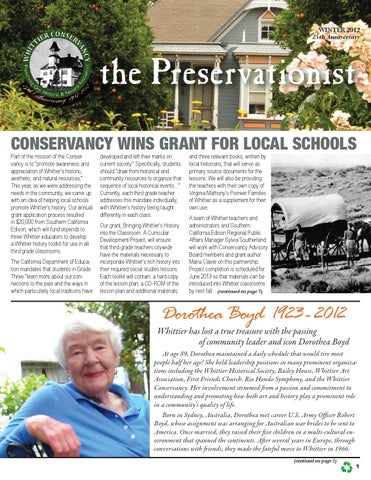
Whittier has lost a true treasure with the passing of community leader and icon Dorothea Boyd At age 89, Dorothea maintained a daily schedule that would tire most people half her age! She held leadership positions in many prominent organizations including the Whittier Historical Society, Bailey House, Whittier Art Association, First Friends Church, Rio Hondo Symphony, and the Whittier Conservancy. Her involvement stemmed from a passion and commitment to understanding and promoting how both art and history play a prominent role in a community’s quality of life. Born in Sydney, Australia, Dorothea met career U.S. Army Officer Robert Boyd, whose assignment was arranging for Australian war brides to be sent to America. Once married, they raised their five children in a multi-cultural environment that spanned the continents. After several years in Europe, through conversations with friends, they made the fateful move to Whittier in 1966. (continud on page 2)
1
THE PRESERVATIONIST
Dorothea Boyd 1923 - 2012
(continued from page 1)
Settled in to her first permanent home in Uptown, Dorothea immersed herself in the life of the town that would grow to love her and benefit from her energy, enthusiasm, and hard work. She became secretary for the First Friends Church and curator at the local art gallery. But that was only the beginning. Dorothea appreciated all of the efforts of the Conservancy to preserve and protect her neighborhood after the 1987 earthquake. She supported our mission and joined the Board of Directors in 1999, becoming the face and voice of the organization. As President from 2004-2009, she led the group during some critical times for both the Conservancy and the City of Whittier, spearheading Uptown residents’ opposition to a high density, multi-level condominium project that was out-of-scale with the character of historic Uptown Whittier. Then Mayor Greg Nordbak, jokingly on bent-knee, asked her to reconsider her opposition to the project; she politely held her ground and declined. Dorothea was also president when the Whittier Conservancy took the controversial position of challenging the city to stop the illegal demolition of the historic California Domestic Water Buildings in east Whittier. It was a dramatic time for the Conservancy, as we had to exhaust all available funds and ask for donations for legal counsel. Dorothea thought the cause was important enough that she contributed monetarily to what has become the Conservancy’s “ legal defense fund.” She was able to make the case for the preservation of this local and state resource and was instrumental in the settlement of the dispute. The beautifully restored historic Cal Domestic office building stands today as a local landmark on Whittier Boulevard and a testament to Dorothea and the Conservancy’s commitment to preserving Whittier’s heritage while adaptively reusing an existing part of the city’s historic architecture. In 2008 and 2009, Dorothea brokered meetings with Whittier College to preserve historic Guilford Hall, origin of her beloved Rio Hondo Symphony, and Earlham Hall, home of the first president of Whittier College. Both were slated for demolition and Dorothea helped with the research necessary for the Historic Resources Commission to find that both buildings deserved local landmark status. In typical Dorothea fashion, she reached out to President Sharon Herzberger, the colleges’ Board of Trustees, and city officials and invited them to her home for tea. She always felt that while people could hold strong opposing positions, civility and the fostering of personal relationships could lead to a win-win for the community. Both houses stand today as a testament to her fortitude and forthrightness. 2
Dorothea was not just a talker; she was a doer. Her soft-spoken influence could make things happen. Two years ago when the city did not have the funds to sponsor Founders’ Day, Dorothea simply said that this was unacceptable. She took the matter into her own hands, calling on friends, organizations, service clubs, churches, and vintage car collectors and headed up an all-volunteer effort to keep Founders’ Day an annual community event. It’s no surprise that last May in Central Park was the most successful Founders’ Day in memory, all because Dorothea felt that Whittier’s culture and history were both worth saving and celebrating. Whittier was important
to Dorothea and there is no question that we have a better community because of her. She is now part of Whittier’s history and will always be remembered as one of its most endearing leaders. Many joked that Dorothea’s grace, and stately presence could persuade anyone to see her side of an issue. But it was her kindness passion, and commitment to Whittier that was the real reason for her influence—her accent just helped!
The Conservancy is establishing a Special Fund in Honor of Dorothea for a project to be done in her honor.
WINTER 2012
Twenty-five Years! This year the Conservancy will celebrate a quarter century of preserving and protecting Whittier. It was the 1987 earthquake and its aftermath that generated public outrage at the direction the city was taking by allowing inappropriate development to further damage the historic Uptown residential areas. I remember well living in a motorhome on the front yard as my house was repaired from foundation to roof. My first daughter was born just after we moved back into the house in early 1989. As houses lay in ruins, the neighborhood was besieged by out-of-town developers who were replacing hundred year old Craftsman bungalows with shoddy, two-story blocks of ten-unit apartment buildings. While Mother Nature had dealt us one blow, our beloved community was being hit by an aftershock that was clearly “man-made.” Neighbors gathered together to see what could be done to save Uptown. The first meeting of Save our Historic Buildings set out to save the historic Lindley building at the corner of Hadley and Greenleaf; next was the five-year battle for the Whittier Theater; and then there was the entire North of Hadley residential district. Scores of neighbors stood firm to protect Whittier’s character and history and from these coalitions, the Whittier Conservancy was born.
Incorporated as a non-profit corporation in 1988, the group moved forward at lightning speed to protect the historic North of Hadley residential area by forcing the city to adhere to the California Environmental Quality Act, its own General Plan, and updated zoning practices. The rest is history. Next came the down-zoning battle to save Central Park homes from being torn down and replaced by quickly and poorly constructed apartment buildings. During the 1990s we became a political reality in Whittier, successfully lobbying for a historic resources commission, an accompanying ordinance to validate and shore up the historic principles we worked so hard for, and moved on to other quality of life issues the community was facing. But we didn’t stop at historic preservation. Realizing that a house is only as stable as its block, the block is only as good as the neighborhood, and the neighborhood is dependent on good schools, a safe environment, and a respect for the physical surroundings, we re-defined our mission. In 1992, the Conservancy led the charge to stop Chevron from developing the Whittier/Puente Hills and was successful in passing Proposition A, which led to the purchase and permanent preservation of the hills that form the backdrop of our city. We have fought hard for a comprehensive tree protection policy and have helped other neighborhoods when challenges have arisen where our expertise can be a benefit. Among our accomplishments over the past twenty-
five years are, the saving of several historic homes and much more: • The Casey House, 1989 • The Dorland House, 1990 • Worsham Canyon, 1991 • Proposition “A” for Parks, 1992 • The Historic Resources Ordinance, 1993, which led to the enactment of the Mills Act, the creation of our historic districts and The Historic Neighborhood Association • Whittier Hills Preserve, 1994, 1998, 2001 • California Governor’s Award for Historic Preservation, 1995 • The Whittier Conservancy 110 Tree project, spearheaded by Damon Cofer, 1997 • Southern Pacific Railroad Depot, 1998 • Painter Avenue Ficus Trees, 1999 • The McGee House, 2004 • California Domestic Water, 2007 • The Greenway Trail, 2008 • Earlham Hall, Whittier College, 2008
The Conservancy works for the preservation and protection of Whittier’s unique landscapes as well as its significant historic structures. The work is endless and depends on the spirit and generosity of the 700 families that support the mission of the institution. I hope that you will agree with me that what we have done has made Whittier a far better place than it would have been had there not been a group of people willing to go to bat for the good of the entire town. Please join us as we celebrate our first 25 years of community action. We are guardians who have worked diligently on your behalf to preserve Whittier’s special character for generations to come. Thank you for your support throughout the years. Please join us in this valuable & fulfilling endeavor.
• Guilford Hall, Whittier College, 2009 • Greenway Trail Palm Trees, 2009 • National Trust Grant for Earlham Hall, 2010 • Palm Park Rest Station, 2011
Mary Gorman-Sullens, President
3
THE PRESERVATIONIST
WHIT TIER CONS
4
THE PRESERVATIONIST
WINTER 2012
E RVA N C Y 1987-2012
5
THE PRESERVATIONIST Whittier Area Map, circa 1940
WINTER 2012
Mission Statement
The Whittier Conservancy is committed to the preservation and enhancement of Whittier’s unique character and quality of life. The Conservancy promotes awareness and appreciation of Whittier’s historic, aesthetic, and natural resources. The Conservancy works for the preservation and sensitive use of Whittier’s significant residential structures, landmark commercial buildings, and notable landscapes, including its valuable cultivated trees, public parks, and the natural beauty of the Whittier Hills.
The Whittier Conservancy 2013 Membership Application
$40.00
Friend
Please consider making a tax deductible contribution. To become a member or renew your membership, kindly complete and send this form with your tax-deductible donation to:
$100.00
Patron
The Whittier Conservancy, P.O. Box 9114, Whittier, CA 90608-9114
$250.00
Preservationist
$500.00
Heritage Circle
$1000.00
Environmental Steward
_________
Other
New Member
Renewal Member
Contact me to volunteer
Yes, I want to be a part of the Whittier Conservancy! Name Address Phone Email
Image courtesy of the Whittier Historical Society & Museum
WHITTIEr CONSERVANCY BOARD OF DIRECTORS
2012
PRESIDENT
Mary Gorman-Sullens SECRETARY
MEL STURR TANIA CRUSE Deirdre Murdy GEORGE PRATHER TED SNYDER EXECUTIVE DIRECTOR
HELEN RAHDER
P. O. Box 9114 Whittier, CA 90608
www.whittierconservancy.org newsletter design: berkeley b stewart
(continued from page 1)
It is our belief that a child’s sense of self is both influenced by and enriched by his/her environment. This includes knowing the story of the town in which we live and understanding the hard work, social values, and community spirit that emerged from those that came before us. It also means having knowledge and respect for the built environment that surrounds us and reminds us of our past. This grant, which is a collaboration among So. California Edison, the Whittier Conservancy, and several Whittier school districts, will ensure that future generations have some sense of ownership and pride in their community as they learn about who led the path before them. 7
NONPROFIT ORG.
THE PRESERVATIONIST
U.S. POSTAGE
25th Anniversary Edition
PAID
The Whittier Conservancy P.O. Box 9114 Whittier, CA 90608-9114
WHITTIER, CA PERMIT NO. 177
Return Service Requested
The Whittier Conservancy
Celebrating 25 years of community service & involvement
Friday Dec 14, 6pm
PLEASE
rsvp
for Details
(562) 693-5853 info@whittierconservancy.org Contributions at the door will be gratefully accepted!