WINTER 2011
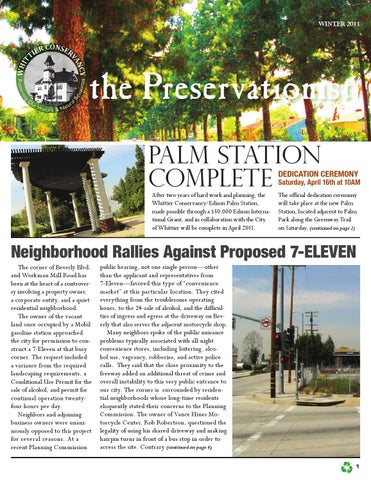
PALM STATION COMPLETE
Dedication Ceremony
Saturday, April 16th at 10AM
After two years of hard work and planning, the Whittier Conservancy/Edison Palm Station, made possible through a $50,000 Edison International Grant, and in collaboration with the City of Whittier will be complete in April 2011.
The official dedication ceremony will take place at the new Palm Station, located adjacent to Palm Park along the Greenway Trail on Saturday, (continued on page 2)
Neighborhood Rallies Against Proposed 7-ELEVEN The corner of Beverly Blvd. and Workman Mill Road has been at the heart of a controversy involving a property owner, a corporate entity, and a quiet residential neighborhood. The owner of the vacant land once occupied by a Mobil gasoline station approached the city for permission to construct a 7-Eleven at that busy corner. The request included a variance from the required landscaping requirements, a Conditional Use Permit for the sale of alcohol, and permit for continual operation twentyfour hours per day. Neighbors and adjoining business owners were unanimously opposed to this project for several reasons. At a recent Planning Commission
public hearing, not one single person—other than the applicant and representatives from 7-Eleven—favored this type of “convenience market” at this particular location. They cited everything from the troublesome operating hours, to the 24-sale of alcohol, and the difficulties of ingress and egress at the driveway on Beverly that also serves the adjacent motorcycle shop. Many neighbors spoke of the public nuisance problems typically associated with all-night convenience stores, including loitering, alcohol use, vagrancy, robberies, and active police calls. They said that the close proximity to the freeway added an additional threat of crime and overall instability to this very public entrance to our city. The corner is surrounded by residential neighborhoods whose long-time residents eloquently stated their concerns to the Planning Commission. The owner of Vance Hines Motorcycle Center, Rob Robertson, questioned the legality of using his shared driveway and making hairpin turns in front of a bus stop in order to access the site. Contrary (continued on page 6) 1
THE PRESERVATIONIST
Conservancy Responds to Oil Drilling Proposal In December, the Conservancy submitted an extensive response to the Environmental Impact Report prepared for the Maxtrix Oil Drilling proposal in the Whittier Hills Preserve. Our response focused on five sections of the EIR: 1) Safety, Risk of Upset, and Hazardous Materials; 2) Aesthetic and Visual Resources; 3) Hydrology and Water Resources; 4) Land Use and Policy Consistency Analysis; and 5)Environmental Justice. We asked many questions and raised many concerns with regard to the following: transportation of toxic chemicals to and from the proposed site; the loss of natural setting to (DEDICATION, continued from page 1)
April 16th at 10 a.m. Officials from the Whittier Conservancy, Edison, and the city of Whittier will be on hand to celebrate the successful collaboration that brings the newest station to the Whittier Greenway Trail system. Work on grant applications to fund a possible Phase II of the Palm Station, to be located across from the new Palm Station, is already underway. For more information about this event, please contact the Whittier Conservancy at (562) 693-5853. 2
adjoining properties, especially the closest residents and the users of the Arroyo Pescadero trails; the risk of upset to the water table during a catastrophic earthquake; the viability of flora and fauna with the Puente Hills Nature Preserve and the potential conflict with the both the new usage and the underlying zoning; and the potential threat to lower-income populations whose homes will be within the transport zone of utility vehicles using alternative routes to and from the proposed site. We were particularly concerned with the lack of attention that the EIR gave to the sites and transportation routes mentioned
as possible alternatives to the Catalina/Mar Vista/Colima routes. For this reason, we have asked that the Draft EIR be recirculated with additional attention paid to these alternatives. While efforts were put forth to mitigate and minimize risks and impacts to the community, some of the procedures necessary for the implementation of this project can not be mitigated at all. For example, according to the draft EIR, during the entire life of the project—estimated to be approximately 45 years— air quality emissions from the drilling site will exceed AQMD standards continually.
Our response, along with all others received, will be analyzed and further input will be discussed within the FINAL EIR, which should be published in late spring. Public hearings at both the Planning Commission and City Council will take place later in the year and will provide more opportunity for the public to voice their concerns. Review the Conservancy response at whittierconservancy.org
WHITTIEr CONSERVANCY BOARD OF DIRECTORS
2011
PRESIDENT ~
Mary Gorman-Sullens VICE PRESIDENT ~ CHARLES CLAVER TREASURER ~ CHUCK KOZELKA SECRETARY ~ MELL STURR DOROTHEA BOYD TANIA CRUSE LILYAN NEAL GEORGE PRATHER JOHANNES RITTERSHAUSEN TED SNYDER EXECUTIVE DIRECTOR ~
HELEN RAHDER P. O. Box 9114 Whittier, CA 90608 www.whittierconservancy.org
WINTER 2011
Our 117th FOUNDERS DAY
In 1894, some of Whittier’s leading citizens decided to honor the “old folk” –anyone over sixty being eligible–with a picnic. May 11th was chosen as an appropriate date commemorating the day in 1887 Jonathan and Rebecca Bailey moved into the “Old Ranch House” on Camilla Avenue, now known as the historic “Bailey House.” Jonathan Bailey was named president of the newly formed group and the first picnic in Central Park was attended by 700 people. The town at that time had only 1000 citizens. So successful was the picnic that the following year 900 attended of the now 2000 citizenry. In subsequent years, the Historical Association took responsibility for Founders Day, always held on the Saturday closest to May 11th. The celebration expanded to include marching bands, a parade and even floats. For whatever reason, the picnic was moved indoors and attendees brought sack lunches and listened to knowledgeable speakers. In celebrating Whittier’s centenary in 1987, the picnic and many attractions returned to Central Park where it continues to this day. Following the Historical Association’s decision to withdraw sponsorship in 1994, a small picnic and program was held in the park to celebrate the 100th Founders Day. The following year, the City took over this planning and has done so until 2011. Due to financial stress, it was decided to postpone Founders Day for five years. To keep the tradition alive, a small group of citizens led by Past Whittier Conservancy President Dorothea Boyd is planning the 2011 Founders Day. It will be on Saturday, May 14th in Central Park under the sponsorship of First Friends Church, the Bailey House, Whittier Museum and the Whittier Conservancy. (continued on page 4) Mission Statement The Whittier Conservancy is committed to the preservation and enhancement of Whittier’s unique character and quality of life. The Conservancy promotes awareness and appreciation of Whittier’s historic, aesthetic, and natural resources. The Conservancy works for the preservation and sensitive use of Whittier’s significant residential structures, landmark commercial buildings, and notable landscapes, including its valuable cultivated trees, public parks, and the natural beauty of the Whittier Hills.
The Whittier Conservancy 2011 Membership Application
$25.00
Friend
$40.00
Household
$100.00
Patron
$250.00
Preservationist
$500.00
Heritage Circle
$1000.00
Environmental Steward
_________
Other
New Member
Renewal Member
Contact me to volunteer
Please consider making a tax deductible contribution. To become a member or renew your membership, kindly complete and send this form with your tax-deductible donation to: The Whittier Conservancy, P.O. Box 9114, Whittier, CA 90608-9114
Yes, I want to be a part of the Whittier Conservancy! Name Address Phone Email
3
THE PRESERVATIONIST
WISE INVESTMENT IN OUR FUTURE
CONSERVANCY EDITORIAL
The news from Sacramento and the new governor is that cities are going to have to tighten their belts like the rest of us. One of the programs on the chopping block is urban redevelopment. While most cities have used redevelopment funds for the public good, there are others that have abused its intent. With funds in short supply and nothing new on the horizon, cities must “use it or lose it.” Any redevelopment funds not spoken for or in process will most likely be forfeited to the state by June 30th. The City of Whittier currently has about nine million dollars in unspent redevelopment money. Recently, some council members suggested allocating the entire sum into the library fund. Fortunately, further discussion prompted a decision to withhold making any rash decisions and to calculate carefully what other projects might be ready for a serious commitment of funds.
The Conservancy, along with hundreds of residents and business-owners, worked very hard a couple of years ago on the new Uptown Specific Plan. Many new restaurants have come on the scene and have been successful despite the economic woes of the past few years. This speaks volumes about the potential for a resurgence in activity that can flourish if appropriately nurtured. To this end, we are asking that the city utilize some of the available redevelopment money in an effort to stabilize the Uptown business district through a variety of options: façade improvement programs, parking solutions, and signage. Affordable owneroccupied housing, including the adaptive reuse of existing structures, is a sustainable project that the Conservancy has initiated and is hoping to see at the corner of Comstock and Penn. Time is of the essence and this would be money well-spent and well-received by the entire community.
Upcoming Workshops: Preservation Ordinances Napa ~ April 19, 2011 Click here for more information and online registration Adaptive Reuse Monterey ~ April 29, 2011 Identify and Assessing Historical Integrity Laguna Beach ~ June 2, 2011
Webinars: The Secretary of Interior’s Standards for the Treatment of Historic Properties April 12, 2011~ 12:00 PM Historic Preservation and the 50-Year Rule April 26, 2011~ 12:00 PM
Announcements: CPF is now accepting applications for the 2011 Preservation Design Awards The 2nd Annual CPF Youth Film Competition is now accepting Applications!! The winners will be announced at the California Preservation Conference ~ May 16, 2011 Preservation on the Edge, 36th Annual California Preservation Conference May 15-18, 2011 ~ Santa Monica, CA Study of Route 66 in California Get more information on this amazing project! California’s Only Statewide Non-Profit Organization Promoting Historic Preservation 5 Third St., Ste 424, San Francisco, CA 94103 415.495.0349 www.californiapreservation.org
(FOUNDERS DAY, continued from page 3)
Whittier’s famous Salt Box group, bands, dancing, May pole, cake walk, booths, artists, artisans and many children’s games will entertain picnickers from 10 a.m. till 1 p.m. on this, the 117th Founders Day. It is hoped that many families will bring children to enjoy the festivities followed by a visit to our new police station open house. This should be a day to celebrate Whittier, both past and present. The Conservancy is proud to support the perpetuation of this historic event as both sponsor and participant. For more information about this event, please contact Dorothea Boyd, 693-8956
4
WINTER 2011
MARY GORMAN-SULLENS
2011 Let ter from the President
Greetings, Everyone; Well, another year and another busy time for those of us who share the spirit of preservation, conservation, and pride in the way we support our community. Many, many important things are happening here in Whittier that the Conservancy has either sponsored , initiated, or responded to. While these projects seem to go on forever, we are finally seeing some solid results for our efforts. Last spring, the office building of California Domestic Water was moved a short distance to the east while its new foundation is being prepared. Later this year it will be moved back to front-and-center on Whittier Blvd., across from the Whittwood Mall, where it will be completely refurbished in accordance with historic preservation standards. In October we were notified that we had secured a grant from the National Trust for Historic Preservation for the architectural and structural assessment of Earlham Hall at Whittier College. This very competitive and very prestigious award is being coupled with an earlier grant from Southern California Edison to underwrite the entire project, which is currently underway. In December, we submitted a 16-page response to the Environmental Impact Report on the Whittier Main Oilfield proposal for the Whittier Hills. In it, we voiced our concerns about many different aspects of the proposed project and ultimately asked that the EIR be re-circulated to address the impacts of the alternative sites and access points. We were also concerned with the EIR’s lack of documentation with regard to hazardous materials being brought to and from the site as well as what toxins might be used in production. Finally, we addressed the ongoing potential problem of excessive air quality emissions, which the EIR states can not be
mitigated. The responses to our questions—as well as to those of others— will be published sometime this spring. Public hearings at both the Planning Commission and City Council will take place later in the year. Currently, we are in the process of establishing the fourth historic district with the inclusion of the Earlham neighborhood, south of Whittier College. At this time, the concept has been approved unanimously by the Historic Resources Commission, but barely squeaked through the Planning Commission on a 3/2 vote. Finally, on March 22nd., the City Council approved the concept and included all seven homes. This is something we have been working on for almost three years. Our signature accomplishment has been the recent completion of the Palm Station Rest Stop on the Greenway Trail. This beautiful addition to Whittier is our gift to the community, representing over 400 hours of volunteer hours by a handful of Conservancy members who worked tirelessly to finish it. Dedication ceremony will be held on April 16th. at 10 a.m. at Palm Park. Now we are setting our sites on finding a permanent home for Guilford Hall—aka the Kroener Home—another Whittier College structure that we saved from the wrecking ball. Also in the works is the renovation and refurbishing of the Five Points Car Wash; the city’s proposed tiering system for prioritizing historic priorities; and our ongoing efforts to secure grants for the completion of other important community projects. We are also working with FUN (Fix Uptown Now) to help in preserve and enhance both the residential and business identity of Uptown. Join us as we look to the future by respecting the past.
5
THE PRESERVATIONIST
Barney Verdugo:
A Master Craftsman Barney Verdugo has lived in Whittier for 45 years and Verdugo Construction has been a local Whittier business for 12 years. Verdugo Construction was awarded the Whittier Conservancy’s Christoph Rittershausen Work of a Master Craftsman Award in 2009 for his high quality work in restoring old and historic homes. In 2010, Verdugo Construction won the bid to create the Conservancy/Edison International Greenway Trail Palm Station. We sat down with Barney to learn more about his experience with restoring historic homes. What is your approach to restoring historic homes? I have learned to sit back and really observe the project prior to a hammer being lifted. Too many of these homes have been “personalized” by each of their prior owners. In order to restore a house, you need to get a sense for the original style and intent. This allows us to keep our focus and to advise the owner on how to proceed with the project. Most, if not all owners agree to keep their homes in their original design/style and opt for only minor creature comforts. This gives us great satisfaction knowing that we had a hand in maintaining the integrity of each of the designs. What advice do you have for people that live in historic homes?
First, enjoy your home. Each is a unique work of art; at least in my opinion. If there is work to be done, make sure you consult with a company familiar with your unique style and design. Keeping your particular home in excellent condition only serves to maintain value for you and your community. We are not building any more historic homes. What has been your favorite project/favorite type of project?
(7-ELEVEN, continued from page 1) to
the city’s staff report, the owner of the property did not have an easement to encroach on Mr. Robertson’s adjacent property; this would have precluded any entrance to the site anyway. The questions of the residents fell on deaf ears. After many hours of testimony, and only a short debate, the commission voted 3 to 2 to approve the plan despite the overwhelming objections of those testifying. Fortunately, the residents then mounted a very visible campaign, including street protests with signs, to draw attention to their plight. The decision was then appealed and heard before the City Council on March. 8th. After over seven hours of testimony and debate, the council narrowly upheld the appeal on a 3/2 vote, thus denying the project. The Conservancy supported the neighbors in their efforts to control inappropriate development in their area. It is clear that residents must take control of their immediate environment and concerns in an energetic and sustained way in order for the democratic process to flourish. 6
I don’t have any one favorite project. Each project has been as different as the house itself. Being that each is different allows for an opportunity to learn a bit about both the history and process by which each were designed and constructed. None of these homes are the same. This presents various challenges in attempting to capture the intent of the builder of the time as well as replicating the design elements. What is most challenging about working on older homes?
The most challenging aspect of older home restoration is first convincing the owner of the need to maintain those design elements that made their home unique and next procuring the materials manufactured to meet current codes. The last issue is to work with a supplier who has the ability to provide those materials that meet the design criteria. For example, much of the wood used to construct these homes is in non-standard sizes. The Whittier Conservancy, Edison International and the City of Whittier will host a “ribbon cutting ceremony” for the new Palm Station on Saturday, April 16th at 10AM. Verdugo Construction, Inc. (license# 750744) can be found at www.verdugoconstructioninc.com
WINTER 2011 topping doesn’t work
topping is ugly
once & for all
topping is dangerous
Why Topping Is Bad Topping is perhaps the most harmful tree pruning practice known. Yet, despite more than 25 years of literature and seminars explaining it’s harmful effects, topping remains a common practice. Read why topping is not an acceptable pruning technique.
What is Topping? Topping is the indiscriminate cutting of tree branches to stubs or lateral branches that are not large enough to assume the terminal role. Other names for topping include “heading,” “tipping,” “hat-racking,” and “rounding over.” The most common reason given for topping is to reduce the size of a tree. Home owners often feel that their trees have become too large for their property. People fear that tall trees may pose a hazard. Topping, however, is not a viable method of height reduction and certainly does not reduce the hazard. In fact, topping will make a tree more hazardous in the long term. Topping Stresses Trees Topping often removes 50 to 100 percent of the leaf-bearing crown of a tree. Because leaves are the food factories of a tree, removing them can temporarily starve a tree. The severity of the pruning triggers a sort of survival mechanism. The tree activates latent buds, forcing the rapid growth of multiple shoots below each cut. The tree needs to put out a new crop of leaves as soon as possible. If a tree does not have the stored energy reserves to do so, it will be seriously weakened and may die. A stressed tree is more vulnerable to insect and disease infestations. Large, open pruning wounds expose the sapwood and heartwood to attacks. The tree may lack sufficient energy to chemically defend the wounds against invasion, and some insects are actually attracted to the chemical signals trees release. Topping Causes Decay The preferred location to make a pruning cut is just beyond the branch collar at the branch’s point of attachment. The tree is biologically equipped to close such a wound, provided the tree is healthy enough and the wound is not too large. Cuts made along a limb between lateral branches create stubs with wounds that the tree may not be able to close. The exposed wood tissues begin to decay. Normally, a tree will “wall off,” or compartmentalize, the decaying tissues, but few trees can defend the multiple severe wounds caused by topping. The decay organisms are given a free path to move down through the branches. Topping Creates Hazards The survival mechanism that causes a tree to produce multiple shoots below each topping cut comes at great expense to the tree. These shoots develop from buds near the surface of the old branches. Unlike normal branches that develop in a socket of overlapping wood tissues, these new shoots are anchored only in the outermost layers of the parent branches. The new shoots grow quickly, as much as 20 feet in one year, in some species. Unfortunately, the shoots are prone to breaking, especially during windy conditions. The irony is that while the goal was to reduce the tree’s height to make it safer, it has been made more hazardous than before. Topping Makes Trees Ugly The natural branching structure of a tree is a biological wonder. Trees form a variety of shapes and growth habits, all with the same goal of presenting their leaves to the sun. Topping removes the ends of the branches, often leaving ugly stubs. Topping destroys the natural form of a tree. Without leaves (up to 6 months of the year in temperate climates), a topped tree appears disfigured and mutilated. With leaves, it is a dense ball of foliage, lacking its simple grace. A tree that has been topped can never fully regain its natural form.
Topping Is Expensive The cost of topping a tree is not limited to what the perpetrator is paid. If the tree survives, it will require pruning again within a few years. It will either need to be reduced again or storm damage will have to be cleaned up. If the tree dies, it will have to be removed. Topping is a high-maintenance pruning practice, with some hidden costs. One is the reduction in property value. Healthy, well-maintained trees can add 10 to 20 percent to the value of a property. Disfigured, topped trees are considered an impending expense. Another possible cost of topped trees is potential liability. Topped trees are prone to breaking and can be hazardous. Because topping is considered an unacceptable pruning practice, any damage caused by branch failure of a topped tree may lead to a finding of negligence in a court of law. Alternatives to Topping Sometimes a tree must be reduced in height or spread. Providing clearance for utility lines is an example. There are recommended techniques for doing so. If practical, branches should be removed back to their point of origin. If a branch must be shortened, it should be cut back to a lateral that is large enough to assume the terminal role. A rule of thumb is to cut back to a lateral that is at least one-third the diameter of the limb being removed. This method of branch reduction helps to preserve the natural form of the tree. However, if large cuts are involved, the tree may not be able to close over and compartmentalize the wounds. Sometimes the best solution is to remove the tree and replace it with a species that is more appropriate for the site. Excerpted from: Tree Care Information “Why Topping Hurts Trees” © 2007 International Society of Arboriculture. UPDATED SEPTEMBER 2005 www.treesaregood.com/treecare/topping.aspx
7
THE PRESERVATIONIST
COMMUNITY CALENDAR / EVENTS / NOTES The Greenway Trail Palm Station Dedication ~ April 16th at 10AM (see pg. 1) Officials from the Whittier Conservancy, Edison, and the city of Whittier will be on hand to celebrate this successful collaboration! For more information about the event, please contact the Whittier Conservancy at (562) 693-5853. 16th Annual Spring Antique Faire ~ Philadelphia St., Sat. April 23, 9AM - 4PM With an Apple Pie Baking Contest & a Vintage Dog Costume Contest! www.WHITTIERUPTOWN.org for details, applications & registrations The 117th Annual Whittier Founders Day ~ Sat. May 14th, 10AM - 2PM In Central Park in Uptown. Celebrated every year since 1894! A New, oldfashioned picnic! Marching, Jazz and Dancing bands! Cake Walk! Books! Children’s Games! Maypole! Crafts! Mustache Contest! & MORE! The Whittier Audubon Society meets at 7:30 p.m. on the 3rd Thursday of each month, September through June at the Whittier Community Center located at 7630 Washington Avenue, Whittier, California. Meetings start at 7:30pm The fabulous Whittier Public Library Website: www.cityofwhittier.org Check out the new books of the month, online Homework Help, renew your books, find out about reading programs and much, much more! The Theodore Payne Foundation Wildflower Hotline ~ 818-768-3533! Founded in 1903, the Theodore Payne Foundation promotes the understanding and preservation of California native flora. Visit the Native Plant Nursery, picnic, buy native plant seeds, take classes or plan wildflower observation outings! Check the Wildflower HOTLINE, by phone or online. 10459 Tuxford Street, Sun Valley, CA 91352 www.theodorepayne.org/hotline.html
The Whittier Conservancy P.O. Box 9114 Whittier, CA 90608-9114
The Los Angeles Conservancy’s “Last Remaining Seats” Wednesday Evenings, May 25 - June 29 Bonus Screenings Sunday, June 26. Celebrate a quarter century of classic films and live entertainment in the historic theatres of Los Angeles! laconservancy.org (213) 430-4219 Hike the Hills - Every 3rd Sat, 9AM – 11AM ~ www.habitatauthority.org 4/16 - Hacienda Hills Trail - Earth Day Walk & Weed! (Moderate) 5/21 - Powder Canyon Trailhead (Easy) 6/18 - Hellman Park Trail Check the Habitat Authority website for upcoming nature opportunities and workshops on Birding, Wildflowers & Butterflies - funded by the Barbara Lee Fisher Memorial Education Fund. There is also a meet-up group for hikers! www.meetup.com/Puente-Hills-Preserve-Hikers/ ~ For more info contact Helen Cohen at: 562-945-9003 or email hcohen@habitatauthority.org Friends of the Whittier Public Library Support your library, donate and shop at the “Friends” bookstore, corner of Comstock & Bailey. Hours: Tues 10-2, Fri 9-12, Sat 10-12, Thurs 10AM - 2PM (for donations only) 562-696-4498 Whittier - CA Grown - Farmers Market - Philadelphia & Bright Vegetables, fruits, flowers, breads, fresh fish, and more. 8AM - 1PM, every Friday
Whittier Conservancy Membership Application inside! Please consider making a tax deductible contribution.
Support Whittier’s unique history & quality of life!
NONPROFIT ORG. U.S. POSTAGE PAID WHITTIER, CA PERMIT NO. 177
Return Service Requested
SEE PAGE THREE!