On newstands weekly
Volume 58 Issue 18
Thursday, March 18, 2021
THE USD VISTA
The Official Student Newspaper of the University of San Diego since 1968
Abrupt departure of psychology professor causes controversy at USD
Professor maintains he did not willingly leave, administration says he resigned from his position KARISA KAMPBELL ASST. NEWS EDITOR Students of Stephen Pearlberg, a professor of 13 years in USD’s psychology department, received surprising news from their professor on Sunday, March 7. Pearlberg sent an email to all of his students detailing that his time at the University of San Diego had ended. USD said he voluntarily resigned from his position, but Pearlberg claimed otherwise. “I was fired on Friday. I kept pushing for some sort of live instruction, or at least for students to come on campus, and we’re still miles apart,” Pearlberg wrote. “I said some things and they didn’t like ‘em. I am terribly sorry for the effect that this will have on you. That apology is all I can offer.” The University of San Diego disputes that Pearlberg was fired. Michael Ichiyama,
Ph.D., department chair of the psychological sciences, sent the following email to Pearlberg’s students on Tuesday, March 9. “It is with regrets that he (Stephen Pearlberg) has tendered his resignation and I am cognizant of the uncertainty and disruption this has caused for you,” Ichiyama wrote. “Be very aware that Professor Pearlberg’s contract with the university was not revoked or rescinded. If any of you are under the assumption that his contract was terminated, that is simply not the case.” Amidst the uncertainty and confusion staff and students alike were facing, Professor Pearlberg sent out another email to his students with additional information regarding him no longer being their professor on Tuesday, March 9. “Throughout the school year I have been fighting for students’ right to have in-person classes held on campus, and that turned into a long-standing battle with Dean Norton to do something for
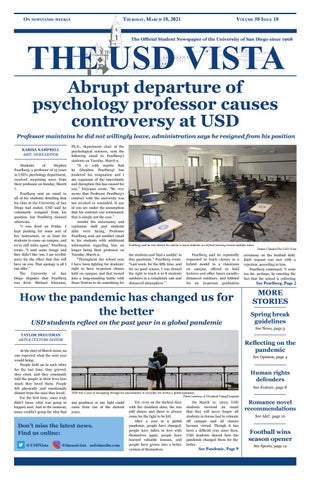
Pearlberg said he was denied the option to teach students in a hybrid learning format multiple times.
the students and ‘find a middle’ in this pandemic,” Pearlberg wrote. “Last week, for the fifth time, and for no good reason, I was denied the right to teach 6 to 8 students outdoors in a completely safe and distanced atmosphere.”
Pearlberg said he repeatedly requested to teach classes in a hybrid model in a classroom on campus, offered to hold lectures and office hours sociallydistanced outdoors, and lobbied for an in-person graduation
How the pandemic has changed us for the better USD students reflect on the past year in a global pandemic
TAYLOR DEGUZMAN ARTS & CULTURE EDITOR At the start of March 2020, no one expected what the next year would bring. People held on to each other for the last time, they grieved, they cried, and they constantly told the people in their lives how much they loved them. People felt physically and emotionally distant from the ones they loved. For the first time, some truly didn’t know what was going to happen next. And in the moment, many couldn’t grasp the idea that
ceremony on the football field. Each request was met with a rejection, according to him. Pearlberg continued, “I went too far, perhaps, by emoting the fact that the school is collecting
See Pearlberg, Page 2
MORE STORIES Spring break guidelines See News, page 3
Reflecting on the pandemic See Opinion, page 4
Human rights defenders 2020 was a year of navigating through the uncertainties of everyday life within a global pandemic. Photo courtesy of Elizabeth Tsung/Unsplash
any goodness or any light could come from one of the darkest years.
Don’t miss the latest news. Find us online: @USDVista
Tanner Claudio/The USD Vista
@theusdvista uofsdmedia.com
Yet, even on the darkest days with the cloudiest skies, the sun still shines and there is always room for the light to be felt. After a year in a global pandemic, people have changed, people have fallen in love with themselves again, people have learned valuable lessons, and people have grown into a better version of themselves.
On March 12, 2020, USD students received an email that they will never forget: all students in dorms had to relocate off campus and all classes became virtual. Though it has been a difficult year since then, USD students shared how the pandemic changed them for the better.
See Pandemic, Page 9
See Feature, page 8
Romance novel recommendations See A&C, page 10
Football wins season opener See Sports, page 12
2
The USD Vista
◆
March 18, 2021
NEWS
Professor, admin offer conflicting accounts of Pearlberg’s departure After Pearlberg told his students he was fired, Ichiyama, chair of psychological sciences, put out a statement saying that Pearlberg resigned Pearlberg from Page 1
full tuition along with room and board — but that is exactly why I am morally bound to give my students the best education I can give them. You deserve no less. I tried, and ultimately I failed. For that I am deeply sorry.” As more students heard about the situation and Pearlberg’s departure became a topic of discussion among the USD community, Ichiyama sent another email to psychology majors on March 12. “It has been brought to my attention that a rumor has been floating amongst students that Professor Pearlberg was fired by USD,” he wrote. “Be aware that his contract with USD was not revoked or rescinded … Professor Pearlberg’s resignation was completely voluntary.” However, Pearlberg maintains that he did not willingly leave the university. In an email to The USD Vista on March 12, the same date Ichiyama claimed Pearlberg resigned voluntarily, he offered his perspective. “Whether I resigned or was terminated by the university may be a technical question for somebody at the Law School. All I can do is tell you that my contract was not renewed for the upcoming year and how I found myself frustrated and disappointed with the way the university is behaving,” he wrote. According to Pearlberg, he noticed that his name had been
removed from the official Fall 2021 schedule, and that one class he normally teaches was gone and two others had been changed to different time slots. Noelle Norton, Ph.D., dean of USD’s College of Arts and Sciences, says she responded to Pearlberg’s concerns about his Fall 2021 schedule. She says she met with Ichiyama and confirmed that it is common to list “staff” for sections taught by nontenure track faculty on upcoming schedules, and that this is general practice for faculty without multiple year contracts. Pearlberg describes his employment status as a non-tenured, benefits-based adjunct (BBA) professor. “The College, Psychological Sciences, Dr. Ichiyama, and your students understood that your contract for the year extends through to May 31st. Nothing has changed with your contract at all. You have not been ‘fired,’” Norton wrote to Pearlberg on March 8. Through his interactions with Ichiyama and the psychology department, Pearlberg came under the impression that “the department wanted me to be a part of USD until late May, but that on June 1st, they did not want me here anymore.” Norton said contracts for the following school year are offered in June and July, and never earlier. Following this impression, Pearlberg said he “drafted a letter to (Ichiyama) explaining that this was unfair, wrong, and that
my consistent attempts to bring some sort of live instruction to our students should not cause the university to want me gone. I submitted it to him the same day,” according to Pearlberg. Pearlberg claims that “Dean Norton immediately accepted this letter as my resignation. I inquired whether I could still work with my researchers and Honors students throughout their theses and I was denied.” Norton explained how several of Pearlberg’s communications led to the university’s conclusion that he was resigning from his position immediately. “Professor Pearlberg told me he would not be back to teach his classes and that he was clearing his desk in an email to me,” Norton told The USD Vista in an email, “Professor Pearlberg told Dr. Ichiyama that he would not be back to teach his classes in a letter to him. We were left with four sections of Psychological Sciences to fill with less than five days notice given Professor Pearlberg’s decision to stop teaching. Dr. Ichiyama asked him to meet or call him several times and he would not agree to a meeting or call. These actions indicate Professor Pearlberg had resigned. He said he was not coming back even though he is under contract until May 31st.” First-year student Michelle Brown is enrolled in Pearlberg’s Research Methods in Psychology course and shared her condolences
on Pearlberg leaving. “Pearlberg was a teacher that advocated on behalf of students, trying to get us the best education. It’s incredibly difficult to stay motivated and interested in classes, especially since a lot of freshmen haven’t even had the opportunity to create their community at USD,” Brown said. “Pearlberg’s 8 a.m. class online was the only class that actually gave me the motivation to learn and work hard for the grade. I know a lot of other people feel the same way, so it’s really upsetting to see him leave in the midst of everything else going on.” Ultimately, Pearlberg said his goal in the midst of everything was to grant students the best education that he could, and he felt that the best way to do that was by fighting to hold classes outside and in person. “Things became exceedingly difficult as it became clear that the university had no intention to open up,” Pearlberg said. “My goal is to give us a chance to have a relatively normal fall semester going forward. The only way to open up is to do it gradually in tiny ways and I feel that I did everything in my power to make that happen for the entire school year and I received absolutely no support from the University.” Ultimately, however, it appears that the decision to begin to further open up USD for hybrid learning is beyond the university’s control at this point in time.
“Dr. Pearlberg has been very upset that he hasn’t been able to teach in-person this year,” Norton wrote. “All of us in the dean’s office understand his frustration and have told him so many times. It is not within our power, however, to change university wide decisions. Our job is to implement the decisions made by USD’s Covid Action Team, the County Department of Public Health, and the State of California.” San Diego moved into California’s less-restrictive red tier on Wednesday, March 17. This allows for schools to reopen with in-person instruction after two weeks of red tier status. “I hope to God that I was dead wrong about the University,” Pearlberg wrote to The USD Vista on March 13. “My claim is that they never intended to have any live instruction this year unless they were absolutely forced to. I have cited what I believe to be overwhelming evidence for this, but I hope that all my claims turn out to be invalid. I hope they prove me wrong by changing the shape of the campus very quickly, on Wednesday, when our county achieves the red tier. If and when they do that, I will be the first to apologize, Set the record straight, and give the University the credit they deserve.” Pearlberg is no longer listed as teaching any classes and has been replaced for the Spring 2021 semester on Banner, USD’s registration system.
School of Business announces new analytics major The decision comes after companies and alumni wish to see more business-minded people in their analytics offices TYLER PUGMIRE NEWS EDITOR After months of discussions, the USD School of Business officially announced that, coming in Fall 2021, it will offer an undergraduate business analytics major. USD was the first college in Southern California to offer the business analytics minor, and is joining less than 100 universities around the country in offering the major to students. The School of Business website states that there has been an increased number of businesses and alumni that saw a need for
data analytics students who also had a working knowledge of the foundations of business. Previously, the school had only offered the two-year masters program for business analytics, and this new change could allow for students to get their foot in the door without sacrificing two extra years of tuition. Junior Tony Le expressed his excitement regarding USD’s plan to join other schools across the country such as MIT, Carnegie Mellon, and University of TexasAustin in offering a business analytics major. “The business analytics major as an addition to the business school is an improvement,
showing the quality of our school as well as the growth of programs for business students at USD,” Le said. The extra curriculum that comes with adding a major will be added in Fall 2021. This means most first-year or sophomore students on the business path can still be on track to graduate while declaring as business analytics majors. Unfortunately, students in similar sectors who are juniors or seniors are not able to receive distinction as business analytics majors. Le, who is majoring in business economics, said his frustrations with the current
business analytics minor could be exacerbated by the announcement of the new major. “For the business analytics minor, there is an overlap with business economics electives, and a class that is an elective for both programs will not be able to count for both requirements in order to graduate with distinction,” Le said. As more companies are on the hunt for analytics-based jobs, even if the major is very similar to the current version of business economics, the currentlyenrolled students in the business economics program fear they will be at a disadvantage and that their program could lose their
enrollment numbers. “If they add the major, there’s definitely going to be overlap in terms of the classes some people take, so my worry is if there will be fewer students that are declared as business economics, as having a business analytics distinction is probably more beneficial for students,” Le said. For reference, every single elective that is available in order to fulfill the current business analytics minor are the exact same electives that count toward a business economics major. The business school is holding an information session on March 18 for all prospective students of the new analytics major.
Volume 58 Issue 18
◆
NEWS
The USD Vista
◆
USD decides to keep spring break
3
USD moves forward with spring break and puts plans in place to combat a possible COVID-19 surge afterwards YANA KOURETAS CONTRIBUTOR Each year, students look forward to reuniting with their families or traveling to different destinations with friends during spring break. For some, planning a spring break getaway is a rite of passage. Despite the uncertainty that comes with giving students freedom for a week during the COVID-19 pandemic, USD has tried to maintain a sense of normalcy this year by choosing to keep spring break in place over the week of March 29. While USD discourages
students from traveling over the break, which is often a routine part of this annual time off, there is no telling how many students will leave campus, for essential traveling reasons or otherwise, and the impact this will have afterward. Carmen Vazquez, vice president of student affairs, shared why USD decided to keep spring break this year. The administration concluded that it is a well-deserved break for students. “We received some information from the University Senate, our student government leaders, and our graduate student
Students are being discouraged from traveling for nonessential reasons this spring break.
The USD Vista Celina Tebor - Editor in Chief Jennifer Mossuto - Associate Editor Catherine Silvey - Managing Editor Mikaela Foehr- Copy Editor Tori Tanigawa - Art Director Tyler Pugmire - News Editor Alena Botros - Opinion Editor
council about what they thought students were feeling,” Vazquez said. “We considered what was
The implications of granting students a spring break are unforeseeable, but could
keep spring break as a yearly tradition was likely not made without ample planning and
“On a selfish note, I’m concerned that another spike in COVID cases will destroy any chance the class of 2021 has for an inperson graduation, I agree that we all need a break, but I also wish there was a way we could control USD students’ plans.” -Annie Fiati, senior described by students and faculty as the mental health and fatigue that students were feeling at the end of the last fall semester as a result of the remote fall experience.”
Photo courtesy of Kendric Clagett
potentially give rise to another surge of cases on campus, similar to what took place following the first few weeks of the spring semester. However, USD has plans installed to enact more preventative measures following the break, whether or not this occurs. For example, USD will be resuming weekly testing for students living in a USD housing contract and off-campus students who come to campus, requiring that all courses proceed with the remote learning format from April 6-9, and instituting a second set of “Stop the Surge” directives. Vazquez said that USD is prepared for a surge, though there are a lot of things that can’t be accounted for. The administration hopes there will be a greater chance of bringing the vaccine onto campus following the break, which could potentially open a new conversation about shifting more classes into a hybrid model before the spring semester ends. “We hope that between now and the return of spring break, we will have more of a vaccine program that will have been administered,” Vazquez said. “Though we never know what happens with vaccines, this is what we have planned for. We also are optimistic that all of the mitigations we are taking will have a positive effect, and we won’t have a spike.” Online school has shown students that Zoom burnout is real. For some, spring break will be an ideal time to escape the repetitiveness of daily Zoom calls. First year Isabella Sanchez explained her thoughts on USD’s decision to keep spring break in place. “I think everybody does need some time for themselves, and this break especially feels like a reward because online school can be so overwhelming at times,” Sanchez said. Although USD’s decision to
Editorial – 619.260.4584 Business – 619.260.4714 www.uofsdmedia.com / @TheUSDVista
Brittany Lang - Feature Editor Gina Lew - Student Media Advisor Taylor DeGuzman - Arts & Culture Editor Marie Minnick - Operations Advisor Eric Boose - Sports Editor Sean Butler - Distribution Manager Regan Ferarri - Social Media Manager Austin Piona - Finance Manager MaryCatherine Smith - Advertising Manager
consideration, there is still concern of how this will affect the possibility of other activities happening down the line. Senior Annie Flati was unable to ignore the idea that graduation or other customary senior events would not be able to take place following an outbreak. “On a selfish note, I’m concerned that another spike in COVID cases will destroy any chance the class of 2021 has for an in-person graduation,” Flati said. “I agree that we all need a break, but I also wish there was a way we could control USD students’ plans.” Other schools in San Diego, like SDSU, opted to forgo spring break in favor of “rest and recovery days” scattered throughout March. UCSD has chosen to follow a similar path to USD and is also hosting a spring break, yet they have provided a week-long enrichment plan on campus with scheduled activities every day, to encourage students to stay on campus. Donald Godwin, Ph.D., assistant vice president and dean of students, echoed concerns for having a spring break but ultimately agreed that it was a necessary mental health break. Godwin said that the administration knows students will likely decide to travel over break, but that the university has learned enough at this point to be ready for another outbreak. Now that San Diego County has moved into the red tier, USD will consider moving its students into a hybrid learning model. However, the possibility of this could be in jeopardy if an outbreak does occur on campus following students return from spring break, as they did earlier in the semester. In the face of these challenging times, USD’s decision to prioritize students’ mental health and relieve them from Zoom pushed them to keep spring break.
The USD Vista publication is written and edited by USD students and funded by revenues generated by advertising and a student fee. Advertising material published is for information purposes only and is not to be construed as an expressed or implied endorsement or verification of such commercial venues by the staff or University. The USD Vista office is located on the fourth floor of the Student Life Pavilion in room 403B. All inquiries should be sent to: The USD Vista 5998 Alcala Park San Diego, CA 92110 Opinions expressed in this publication are not necessarily those of The USD Vista staff, the University of San Diego or of its student body. Letters to the Editor can be submitted to The USD Vista office. Letters should be limited to 300 words and must be signed. For identification purposes, USD identification numbers and writer’s year must be included in the letter. The USD Vista reserves the right to edit published letters. Any content sent to the editor will be considered for publication unless otherwise stated.
“ c o
4
The USD Vista
◆
March 18, 2021
E DI TOR IA L
Reflecting on the pandemic, one year later The pandemic has made me appreciate the life I used to take for granted HALLIE WILTSHIRE ASST. OPINION EDITOR I remember the first time I ever heard of the coronavirus. I was sitting in the Atlanta International Airport on my way back from an intersession study abroad program in Jamaica. My dad called me and asked if I’d seen any news about the newest virus. I had seen the alert on the USD homepage but didn’t think much of it. Every few years there had been reports of a new virus or disease that rapidly spread. Some reached the status of epidemic, while others faded out of the news quickly. Many people expected COVID-19 to fade just as the others did; I know I did. As I sat in the airport, I thought “that won’t impact me and my life. It will be fine.” But here we are a year later, still in the midst of a global pandemic. As of March 16, there have been almost 30 million recorded cases and 530,000 coronavirus related deaths in the United States. These numbers were
is still pushback against mask mandates. People continue to attend parties and other large gatherings despite the obvious risks. Everyone wants life to just return to normal, to be able to go places and see people like we used to. I’ve been incredibly lucky and privileged. No one I know personally has died. My mom’s job easily switched to being remote and my family never had to worry whether she would lose her job or if we would not be financially supported. I’m asthmatic, but I can stay in my apartment safely and not unnecessarily risk my health. I know that I’m lucky and that most people have had it a lot harder than I have. Even so, I’ve learned a great deal about what is truly important in life and what I took for granted when life was “normal.” I’m a very type-A person who always needs a plan, and the chaos and uncertainty brought on by the pandemic left me constantly stressed. To make matters worse, Fall 2020 was
Everyone wants life to just return to normal, to be able to go places and see people like we used to. completely unexpected and the United States was wholly unprepared to deal with a public health crisis of this magnitude. We are a full year into the pandemic, and there
the hardest semester of school I’ve ever suffered through in my entire life. I was constantly doing homework or studying for exams, and rarely had a moment to relax. Even when I managed
Even with hopes of returning to normalcy, social distancing and staying at home is still absolutely necessary. Photo courtesy of Logan Weaver/Unsplash
to carve out time for myself, I was stressing about upcoming deadlines and assignments. There was no reprieve from school; there was no separation between relaxing and studying. To voice my frustration, I wrote my piece on students feeling overwhelmed. The magnitude of the response was completely unexpected. Everyone had been feeling this way but no one had really said anything, and I think many of my
peers felt validated by knowing that others were overburdened too. There was a pitiful lack of support, or even basic empathy, from USD administration. They continually refused to offer a pass/fail option, citing flimsy excuses that placed the blame on students and even going so far as to call them lazy. In an email sent on Nov. 2, 2020, administrators wrote that offering a pass-fail option would “likely reduce the effort level for some students who know they do not need to put forth the same amount of effort as they would when they receive a letter grade.” I’ve consistently taken five classes every semester since I was a first year, but I decided to only take four this semester. This ended up being the best decision I could have made. Maybe it’s just this new batch of professors, the full-length semester, or the addition of spring break, but everything is going significantly better. I actually have time to relax without the threat of homework
quality and quantity of work is completely okay. Being able to complete your assignments at all is an accomplishment, and every student should be proud of themselves for doing the best they can. It’s okay to feel overwhelmed. It’s okay to feel sad, to lack energy, to not know what to do. Not being in control is one of my biggest fears, but sometimes things are simply beyond my control and I need to accept that. There are so many things that I used to do when life was “normal” that I took for granted. Visits with my family, going to the grocery store without fear, being able to see friends. I haven’t hugged my younger cousins for an entire year. I used to visit my grandparents several times a month, but I can’t see them in-person without strict quarantining and testing. Although there have been a lot of tough times this year, there have been positives too. I’ve learned to take more time for myself and that my worth is
It’s okay to feel overwhelmed. It’s okay to feel sad, to lack energy, to not know what to do.
Students studying outside on campus while socially distancing because of the pandemic.
Tanner Claudio/The USD Vista
looming over me. I know this isn’t an option for everyone, since USD’s graduation requirements are extremely tight and difficult to accomplish even with five classes a semester, but it’s important to recognize that times are turbulent and not being able to produce the same
not determined by my grades or the amount of work I manage to produce. I’ve learned not to take my friends and family for granted, that being able to see them is a privilege that I should cherish. We’ve all struggled, but we’re coming out the other side stronger.
The views expressed in the editorial and op-ed sections are not necessarily those of The USD Vista staff, the University of San Diego, or its student body.
Volume 58 Issue 18
◆
OPINION
◆
5
The USD Vista
E DI TOR IA L
The gatekeeping of entry-level positions Access to entry-level jobs and internships is becoming more difficult every year BAYLYNNE BRUNETTI & JENNY HAN ASST. OPINION EDITORS It’s no secret that COVID-19 has drastically changed many aspects of students’ lives. One of these is a crucial aspect of the college student experience: finding entry-level jobs and internships. Although obtaining these jobs and internships is notoriously difficult during times of normalcy, the pandemic has added an additional barrier that has made it even more difficult to do so. COVID-19 highlights how inaccessible
even getting past the application phase is near impossible. Countless students know the struggle and stress of obtaining that first job. We spend months searching, applying, and waiting for responses from countless companies and industries. The majority of the time, we get zero updates on the status of those applications. It’s considered a miracle if even one company follows up to offer an interview. It begs the question: how are people supposed to get experience in their field if no place or program is offering to give it to them?
even if they do offer internship opportunities, it doesn’t guarantee that students will be correctly compensated for them. Entry-level positions and internships infamously don’t pay well; salary is usually around minimum wage. Many of these first internships, or internships in general, are unpaid. Unpaid internships serve to exclude marginalized groups. For students who are putting themselves through college with zero parental support, it is not feasible to work for free. Additionally, internships are profoundly difficult to obtain
Although obtaining these jobs and internships is notoriously difficult during times of normalcy, the pandemic has added an additional barrier that has made it even more difficult to do so. entry-level positions are, and that needs to change. Many jobs and internships weed out inexperienced workers by requiring at least one to two years of experience in the respective field. Among the few that don’t require experience,
This difficulty of obtaining an entry-level job is important to highlight because future higher-paying jobs that are relevant to one’s degree depend on experience. These already competitive firms aren’t going to hire inexperienced workers. And
because to make any applicant competitive for graduate school, it is essential to serve in an internship position. At some community colleges, career pathways have been created to afford students the opportunity to have access to
internships. One example for students interested in law is the Pathway to Law School. This program serves as a vessel for students at community college to receive assistance and guidance to eventually transfer to a four year institution and go to law school. These types of programs are essential for students coming from lower socioeconomic backgrounds so they can have a fighting chance to attend law school. There are many lawyers in the field who are well aware of the disparities taking place in the legal realm and are fighting to create programs similar to the Pathway so that students can get an opportunity. However, it still does not address that students coming from these marginalized groups may not have the privilege to take on an unpaid internship. Designing a program that creates a fund for students to work an unpaid internship would be a great way to bridge this gap; something USD does for summer internships if you apply.
If we want to create more inclusivity in the legal field — and elsewhere — it is critical we address the problematic issue that is unpaid internships. So many students cannot accept free work and it should be a crime to allow for students to have to work these unpaid jobs that are often extremely demanding. More often than not, interns are the backbone of the company or firm and are doing the grunt work for those who reap the profits. Companies mask this by giving “academic credit” to those working as interns, but academic credit does not pay the bills. It is time we acknowledge that unpaid internships are classist at their core and do not serve as inclusive entities. Jobs and internships are important for people to get ahead in their careers. But more importantly, they serve as a pivotal moment in one’s character and outlook on the world. We need to make it easier for people to have that opportunity so that we can all succeed.
Racism is further sickening our country It has been about a year since the pandemic started. But the racism Asians face because of it has only grown in severity. JENNY HAN ASST. OPINION EDITOR
A 64-year old grandmother assaulted and robbed. An 84year old grandfather killed. 2-year old and 6-year old children stabbed. A 32-year old woman sexually assaulted. These are a few of the many people that were targets of Asian hate crimes in 2021. It’s been a year since the pandemic started, and the violence and hatred that the Asian community faces have only increased. According to a study released by the Center for the Hate and Extremism at California State University Santa Barbara, “anti-Asian hate crimes surged 149%” on a national scale from 2019 to 2020. Unfortunately, the majority of these hate crimes do happen in California. This report also features a study conducted by Ipsos, a market research company. This research featured answers from a sample of “1,001 adults aged 18+ from the continental U.S., Alaska, and Hawai’i” between April 16 to April 17, 2020. One question was “If you were out in public, how concerned would you be about coming close to someone who is of Asian ancestry?” A total of 24% of
participants expressed some concern while 7%, in particular, stated that they would be “very concerned.” For so long, the discrimination and racism against Asian Americans were seen as lesser than or even nonexistent because of factors such as harmful stereotypes and the model minority myth. How many people need to be spit on, verbally abused, assaulted, and murdered for this injustice to be seen as a valid one? Now more than ever is it vital to stand up against the hatred against Asians and Asian Americans. Some of the best ways to combat this racism begin with yourself. Follow CDC guidelines by correctly wearing a mask, following social distancing, and avoiding large gatherings. Have an open eye, ear, and mind to the experiences that your fellow Asian peers may share. And if you catch someone, whether that is yourself or someone around you, making a comment about Asians in regard to COVID-19, call them out. Being racist means that you’re intolerant to those who aren’t like you and COVID-19 is a placeholder excuse. Below is an op-ed The USD Vista published in February
2020. Over a year later, the message still stands. Our generation is no stranger to using humor as a coping mechanism. Memes and humorous comments about the tragedies of 2020 from the possibility of WW3 to the death of Kobe Bryant pop up spontaneously the moment they happen and it fills our nihilistic hearts with joy. However, some of the content produced in light of the most recent pressing issues, the coronavirus, shifts away from amusing to racist and that is not okay. According to The Wall Street Journal, “health officials believe the outbreak originated in a large animal and seafood market in Wuhan, China.” It’s due to these Asian origins that some inaccurately believe that all Asians must be carrying the disease. I first encountered this maliciousness when one of my friends back from high school vented to me about their frustrations about the racist comments and posts they’ve been seeing in regards to the coronavirus. Curiosity took over me as I searched “coronavirus” in the search bars of both TikTok and Instagram. To put it simply, I was disgusted. A prime example of
this racism that I found were the comments on a TikTok featuring a voice message of a medical staff in China. Overall, the racist comments could be categorized into two categories. The first category featured comments that attempted to be funny but ultimately would come off as insensitive and ignorant — comments like “I just had Chinese food yesterday.” The second kind of comments were blatantly malicious and intentionally cruel, saying things like, “Let natural selection do its thang ... keep the gene pool strong” or “I mean it’s kinda good. It’s overpopulated anyway.” Some of you may be wondering why any of these comments are demeaning and why I personally take offense to them. Before you say anything, I do have a sense of humor and I do appreciate a “it’s Corona time!” TikTok from time to time; I am not arguing against people who joke about the coronavirus itself. But what I do not appreciate is my ethnicity being the target of that coronavirus joke because we are just as susceptible and worried, if anything more scared, about the whole situation. Every time I sneeze during class, I am terrified of the reactions I might get because they assume I have
an illness that I do not have. I am very lucky as of now to say that none of my peers have treated me this way, but the fear is very much implanted in me. The bottom line is that any illness, including the coronavirus, does not discriminate. An Asian person is just as likely to get sick from a non-Asian person and vice versa. If you are worried about getting the virus, there are several precautions that you can take. According to Centers for Disease Control and Prevention, washing your hands with either soap and water or using an alcohol-based hand sanitizer especially before eating and after going to the bathroom or blowing your nose, coughing, or sneezing are some of the things that you can easily do. Being racist is not one of those options. I hope that everyone affiliated with the University of San Diego cares or at least acknowledges this because I would like to believe that we promote and represent a college that accepts each other for what we are. If you catch someone else, or perhaps yourself, making a joke about Asians in regards to the coronavirus, ask this question: are you really afraid of the virus or are you actually afraid of those who are unlike you?
The views expressed in the editorial and op-ed sections are not necessarily those of The USD Vista staff, the University of San Diego, or its student body.
6
The USD Vista
◆
March 18, 2021
Here’s to the Spring Breaks of the Past Many students held out hope that after a year of lockdowns and travel restrictions, this spring break would be the time for students to finally jet off to their favorite vacation destinations and safely gather with all of their friends once again. However, despite the fact that the vaccination process is speeding up and many Americans are said to qualify for vaccines by the end of May, freedom of travel has not yet returned to how it was pre-COVID.
some USD add to your
students’ favorite spring break post-pandemic vacation bucket list:
Photos courtesy of Kendric Clagett
are can
Senior Kendric Clagett in Israel taking a class last spring break.
Jenelle Seguin in O’ahu, Hawaii with a few of her friends from USD.
Photos courtesy of Jenelle Seguin
Nevertheless, here memories that you
◆
The USD Vista
View of the beach and mountains in Hawai’i.
Senior Brooke Henry at Lanikai Beach in Kailua, Hawai’i with her roommates.
Lounging underneath an umbrella on the North Shore of O’ahu.
Senior Shannon Daley on the Crouching Lion Hike in O’ahu, Hawai’i.
Photo courtesy of Simaran Chauhan Senior Simaran Chauhan relaxing on Lake Como in Italy.
Senior Madeline Jackson at the Grand Canyon with a group of her closest friends.
7
Photos courtesy of Brooke Henry
FEATURE
Photos courtesy of Shannon Daley
◆
Photo courtesy of Madeline Jackson
Volume 58 Issue 18
Spread by Tori Tanigawa/The USD Vista; Content by Brittany Lang/The USD Vista
8
The USD Vista
◆
March 18, 2021
ART S & FEATURE
Stories of human rights defenders at the border
University of San Diego and Alma Migrante collaborate to create digital narratives DOMINIC URQUIDEZ ASST. FEATURE EDITOR The process of immigrating to a new country is filled with difficulty, abnormality, and novelty. In the U.S., immigration has been a controversial topic and has undergone many changes throughout history. Often forgotten are the stories of immigrants — the anecdotes of people who left their home country in pursuit of a better life. Even more overlooked are the accounts of those who helped change the policies of immigration to be more inclusive and welcoming. Alma Migrante is a nonprofit organization based in Tijuana, Mexico. The group advocates for
crafted by Alma Migrante. In partnership with USD, Alma Migrante will create short videos that will be roughly two to four minutes long. The visuals will include an array of pictures that were presented by the defenders. Photographs of themselves, their environment, and those that helped them in their journey will be included in the narratives. In the background will be the voices of the defenders. They will detail the accounts of their own lives. In their words, they will recount their experiences that led them to where they are now. “They are completely authored by the human rights defenders. This is their own words, it’s narrated in the first person,” Silva said. “The human rights defenders themselves are
two USD Spanish courses in the creation of the digital stories. Alma Migrante pre-selected the defenders to be included in the project. The organization listened
-Maria Silvia to the stories of the defenders, to their visions, and searched for ways in which to support them. Judith Galindo Lima (Camino de Salvación Shelter), Julia Gomez (Centro Comunitario CSER y Colectivo LesVoz Creando
-Maria Silvia creating the transcript, they’re creating their own narrative and they’re reading it out loud however they want to. We want to make sure that the stories are owned by the human rights defenders and we are just the channel through which these stories get shared.” The role of USD students is to record, arrange, and translate the information that is given to them. The interaction between the defender and the student is less like an interview and more like a collaborative project. The students will arrange the pictures into a smooth slideshow where the audience can follow along with the audio. If the stories of the defenders are told in Spanish, the students will translate the audio into English to be read in the subtitles and vice versa. UC Davis’ Humanizando la Deportación, Cultiva Ya! and Universidad Iberoamericana Tijuana will assist students from
“I hope it positions the organization as a very unique and important leading organization in Tijuana that is moving the needle in immigration,”
“They’re unique because their approach isn’t necessarily to provide direct services to immigrants — what they’re doing is they’re kind of taking the back seat and supporting the people who are providing those direct services.”
“In a nutshell, they have helped make Tijuana a much more welcoming place for immigrants who are residing or transiting through there. The other area in which they are having a lot of influence is the project that we’re involved in … to support human rights defenders who are working with immigrants on the ground.”
humane immigration policies. The nonprofit reached out to USD, and the two partnered in 2021 to create 10 to 15 digital narratives that highlight human rights defenders in the border region of Tijuana. Defenders are those who commit their time and energy to protect the rights of immigrants through policy building and reform. Director of Community Partnerships at the Mulvaney Center for Community Awareness and Social Action, Maria Silva, discussed the impact of Alma Migrante. “In a nutshell, they have helped make Tijuana a much more welcoming place for immigrants who are residing or transiting through there,” Silva said. “The other area in which they are having a lot of influence is the project that we’re involved in … to support human rights defenders who are working with immigrants on the ground.” The idea for this plan was
Comunidad), Linda Hamze (Al Otro Lado), and Lourdes Lizardi Lopez (Angeles sin Fronteras y la Alianza Migrante Tijuana) are some of the defenders
who will be interviewed for the collaborative project. The individual videos are part of a larger plan which will contain a painted mural in Tijuana and a documentary. Together, all three parts will focus on issues varying from the security and advancement of the rights of immigrants to immigration policy building and study. The project is intended to impact many people’s lives. Not only are the stories of defenders told and shared through art, but the students who participate and those who watch will also be moved by the digital narratives. People who view the stories will be engaged with cultural immersion and exposure.
Silva said. “They’re unique because their approach isn’t necessarily to provide direct services to immigrants — what they’re doing is they’re kind of taking the back seat and supporting the people who are providing those direct services.” The narrative, the mural, and the documentary all combine to tell the unique stories of people who have fought and continue to fight for humane immigration policies. Through the united forces of Alma Migrante and the University of San Diego, the narratives will dive deep into the anecdotes of human rights defenders. The videos that detail the accounts will be published in May 2021.
Alma Migrante and USD work together to uplift the stories of human rights defenders. Photo courtesy of the University of San Diego
ARTS & CULTURE Volume 58 Issue 18
ARTS & CULTURE
The USD Vista
9
A year in a pandemic: “The pandemic has given me more of a reason to live” How a year of isolation and constant uncertainty still lead to positive change From Page 1
The person I was a year ago vs. The person I am today
USD senior, Maddy Bass, described the person she was a year ago as someone who was distracted, overly involved, and too busy for a healthy, active social life. It would be an understatement to say that Bass had too much on her plate: she was a USD Resident Assistant, part-time student employee, intern, University Ministry retreat leader, sorority member, leader for two clubs, and a full-time student. She found it hard to say “no” to invitations and worked herself to the point of exhaustion. “I believed that productivity was the key to happiness; but, after a while, I felt mentally drained,” Bass said. “I was constantly waking up late for class, calling in sick for work shifts because I was low on sleep, and skipping meals because I simply did not have time to eat.” When students had to move off campus, Bass was both relieved and disappointed at the sudden change of pace in her life. While she was happy to finally take a break and catch a breather, Bass’ life was flipped upside down from always doing something to practically doing nothing — she had never had free time since she started college. “I slowly spiraled into a period of anxiety and deep loneliness, but the extra space in my life encouraged me to see the life that I was living on campus,” Bass said. “I felt unintentional with my time, constantly making excuses, changing plans, and cramming things into my schedule. I was not always a sincere friend and the time that I gave to people felt conditional as if it was just another thing to check off my to-do list.” Amidst remote learning, Bass found a silver lining while at home, that helped her find inner peace and strength. While the “on-campus version” of herself barely had time for anyone else, let alone herself, Bass found limitless time to heal emotionally, socially, and mentally. “I started utilizing the USD Health Center and going to therapy, and I know that therapy and counseling are not the only solutions to achieving mental stability, but for me, it was a space I could be vulnerable and emotional without distractions,” she said. It was an “imperfect improvement process,” Bass said, but one that opened her
USD students shared the most valuable lessons they learned from the last year living during a global pandemic. Jennifer Mossuto/The USD Vista
eyes to who she was before, and how much time alone allowed her to grow into a better person who now has a better understanding of her needs. Now, Bass has time to explore different passions that
had the ability to change her negative thought patterns, learn valuable lessons, and begin to see how beautiful life can be. Abaya used to constantly worry and feel anxious about the things not in her
Abaya said. “I would seek so much validation from external sources, that I never listened to my own thoughts or feelings.” Abaya explained that she learned that she can either entertain negative
This year, compared to last is vastly different: there seems to be a light at the end of the tunnel and the best of days yet to come. Photo courtesy of Unsplash
she’s always wanted to pursue. “I started to write a lot, which was a talent of mine I kind of brushed under the rug when life got too stressful,” Bass said. “Writing became a powerful outlet for me to connect with people, and I ended up submitting a lot of articles I wrote to different blogs and websites. I feel like I grew in storytelling and finding value in my life story and value in others’ stories.”
control, so much to the point that it would completely consume her thoughts. “When we made the shift
“The pandemic has given me more of a reason to live”
from being at school to staying at home, it was scary having to listen to my own thoughts 24/7, especially since I used to spend so much time with other people,”
For USD junior Camille Abaya, this past year she has
thoughts or actively make the decision to let them go. Although spending time alone spurred some negative
“The pandemic pushed me out of my comfort zone and guided me towards the purposeful learning of self and towards a journey of self-acceptance and gratitude.” - Kiara Dias thoughts, she also used the alone time to look introspectively and realize her worth — she began to fall in love with herself again. “I began to focus on my
own self-growth, my passions, and actually take the time to care for myself,” Abaya said. “I would always put others before me because I love to make people laugh and smile, but at the end of the day, I didn’t even think about loving myself.” While Abaya is grateful for the growth and goodness that came out of the past year, she also recognizes that the year has been hard on those who have lost parts of their lives to the pandemic, whether it be jobs, education, and especially loved ones. “I really feel like this was one huge wake-up call,” Abaya said. “Everybody in the world is going through the same battle, just in different degrees, and this has allowed me to check my privilege and be thankful for what I have. The pandemic has given me more of a reason to live.” Being forced to be independent “I’m typically the type of person who craves social interaction and quite honestly, I used to despise doing things by myself,” USD junior Kiara Dias said. Dias was the kind of person who needed to be on FaceTime in between her small commutes to and from classes on campus, the kind of person that she described as merely a member of an organization or a sidekick friend. But quarantine and isolation changed all of that and more. “The pandemic forced me towards independence and maturity and I am genuinely grateful for that,” Dias said. “Eating alone, watching the sunrise alone, pumping my own gas, and driving without a passenger guide were all things I learned to do this quarantine, and though they may sound small, these actions are huge for me.” She slowly began to romanticize her own life. Last year, Dias grew comfortable with identities that attached her with another person or a group of people, but in the end, she grew into the person she was always meant to be: someone who is intentional about rebuilding herself based on her own thoughts and conceptions, rather than how others perceive her. “The pandemic pushed me out of my comfort zone and guided me towards the purposeful learning of self and towards a journey of self-acceptance and gratitude,” Dias said. Dias feels eternally grateful that this past year helped her to find herself and refind her purpose.
10
The USD Vista
March 18, 2021
Book recommendations for all the hopeless romantics
Here is a list of the best romance novels to get your nose into this spring of other people completely, so why not give up the attempt, she thought, go running in the other direction, depend on people for everything, allow them to depend on you, why not.”
BRITTANY LANG FEATURE EDITOR This coming spring break will look a little different for most students compared to previous years. In order to follow along with the current pandemic guidelines, many of us will opt for a relaxing staycation rather than jetting off to Cabo for a week filled with piña coladas and continuously watching night turn into day. After spending almost exactly a year of being glued to our computer screens, this spring break can be used as a time to completely unplug from the stress of the virtual world. Instead of watching reruns of your favorite Netflix shows, take a trip to your local bookshop and pick up a novel from the following list of recommendations. These outstanding novels are bound to help you escape to a foreign land by living vicariously through the stories of these dynamic characters. The following stand-alone novels provide a little something for every romantic. Whether you are looking for stories with LGBTQ+ characters, ones set in alternate universes or mythological lands, ones to leave you smiling, or ones with heartwrenching endings that will make you question everything you know about love, without giving away any spoilers, this list has something for everyone. “The Song of Achilles” by Madeline Miller An instant classic, Miller’s “The Song of Achilles” is a transcendent masterpiece. Riddled with tales of gods, goddesses, and immortal fame, this Greek mythological novel follows the story of two young boys — the demi-god Achilles who is destined to become the greatest warrior who ever lived, and Patroclus, an awkward exiled prince. The pair forge an inseparable bond during their infancy that eventually grows into the purest form of love. When they are on the cusp of manhood, Achilles is called to lead in the Trojan War. Caught between love and fear, Patroclus decides to follow him to where cruel fates will test them both. This 369-page retelling of the events of Homer’s Iliad explores themes of the immutability of fate and the pursuit of glory, through one of the most tragic, memorable, and beautiful love stories widely thought to ever be written. “The Song of Achilles” is unmissable. “I could recognize him by touch alone, by smell; I would know him blind, by the way his breaths came and his feet struck
“Red, White, and Royal Blue” by Casey McQuiston
“The Song of Achilles” is a retelling of one of Greek mythology’s greatest love stories. Brittany Lang/The USD Vista
the earth. I would know him in death, at the end of the world.” “Giovanni’s Room” James Baldwin
by
Written by someone who is regarded as one of the greatest writers of all time, Baldwin’s “Giovanni’s Room” not only has an extremely well-developed plot but reads like pure poetry. This novel is set in Paris in the 1950s and while reading it, one feels as though they are transported to the terrace of a parisian brasserie sipping on a café crème. The story follows the life of an American man named David, living in Paris, who is running just as much from himself as the potential future life that awaits him. Throughout the novel David deals with his frustrations with other men in his life, specifically with an Italian barman named Giovanni who he meets in a gay bar in Pars, and his torment with the parts of himself he cannot accept. It is a book filled with profound lessons on the human condition and sexuality, and particularly that one cannot love fully when they are unable to love themselves first. Though this 166-page novel is not for the faint-hearted, it is a must read for anyone who loves the classics. “People can’t, unhappily, invent their mooring posts, their lovers and their friends,
anymore than they can invent their parents. Life gives these and also takes them away and the great difficulty is to say yes to life.” “Normal People” by Sally Rooney Anyone who has ended up on the “Book Tok” side of TikTok, is bound to have come across this novel. Rooney’s “Normal People” is set in Ireland and follows the characters of Connell and Marianne as they float in and out of each other’s lives from high school to university. Their relationship is initially marked by complicated socio-economic divisions and secrecy. Connell and Marianne both end up attending Trinity College in Dublin where over the course of four years they try to navigate intimacy against the tide of emotional uncertainty. Their relationship faces moments of heart-wrenching struggle due to miscommunication and their own feelings of unworthiness. Despite the frustrations the reader might feel as a result of this, both Connell and Marianne remain extremely loveable characters who open themselves up to moments of hope despite everything, and redefine the idea of soulmates. Rooney’s 279-page will-they-or-won’t-they novel cuts right to the heart and is relatable, graceful, and hopeful. “No one can be independent
A perfect LGBTQ+ romance filled with drama, hilarious banter, and international scandal, this novel is made for all of the politics nerds out there who also love the enemies-tolovers trope. “Red, White, and Royal Blue” is mainly rooted in historical and political accuracy, but is set in an alternative universe in which a woman Democratic presidential candidate won the 2016 presidency. The story follows the First Son, Alex Claremont-Diaz, a half-Mexican Georgetown senior and his relationship with Prince Henry of Wales, a potential heir to the British throne. The two characters begin as sworn enemies but after an embarrassing incident involving Alex and Henry threatens British-American relations, the two must stage a fake friendship for damage control. However, as the story evolves, the two boys realize that maybe what they felt for each other all this time was something far from hate. Eventually they enter into a secret romance that is a ticking-time bomb for a tabloid catastrophe. This lively 418-page novel will keep you smiling all the way through. “Thinking about history makes me wonder how I’ll fit into it one day, I guess. And you too. I kinda wish people still wrote like that.” “History huh? I bet we could
make some.” “The Hating Game” by Sally Thorne Arguably one of the best modern enemies-to-lovers novels, “The Hating Game” is impossible to put down and despite the title, impossible to hate. The main characters of the novel, Lucy Hutton and Josh Templeman, are work rivals who have become entrenched in a never-ending game of oneupmanship. The pair appear to be polar opposites and are forced to sit directly across from each other 40 hours a week. When a new executive position becomes available that will make it so whoever is chosen will become the other’s boss, Lucy and Josh’s rivalry becomes even more intense. However as the story progresses, the dynamic between the two begins to shift. Josh’s changing behavior towards Lucy makes her start to question if she actually doesn’t hate him, and likewise if he doesn’t hate her, or if it’s just another game. Thorne’s writing grabs the reader’s attention from the very first page. The transition from enemies to something more is organic and believable. This 384-page read is full of tongue and cheek humor and charm, and makes for the perfect poolside read. “Hating someone feels disturbingly like being in love with them. I’ve had a lot of time to compare love and hate, and these are my observations. Love and hate are visceral … your body is barely under your control. You’re consumed, and it scares you.”
“Red, White & Royal Blue” is the perfect LGBTQ+ romance for all readers. Brittany Lang/The USD Vista
Volume 58 Issue 18
◆
SPORTS
◆
11
The USD Vista
SP ORT S
Toreros come up short against Bears
USD women’s tennis loses four-game winning streak to no. 17 Cal MARIA WATTERS ASST. SPORTS EDITOR The University of San Diego’s women’s tennis team attempted to continue their four-game winning streak against 17thranked Cal Berkeley at home on Sunday. The Toreros got off to a slow start against the Bears after losing two of the three doubles matches and relinquishing the first overall point. Down 0-1, USD would have to swing the momentum back in their favor during the singles matches in order to stand a chance at securing the victory. But the Toreros would be unable to overcome the one-point deficit early on as they quickly conceded the first two singles matches, putting Cal up 3-0. USD saw a glimmer of hope when they captured their first point on court four. However, with only one point away from victory, the Bears were able to silence the Toreros soon after by clinching the win on court four. Ultimately, USD came up just short, losing 3-4. USD was set to kick off play in the West Coast Conference on Saturday against Gonzaga. However, due to COVID-19 regulations, the match was postponed. That meant the only opponent facing the Toreros would be the 8-2 Bears. Cal was the second team ranked in the
top 20 USD had faced thus far, with the first being 3rd-ranked UCLA, who swept both the Toreros and the Bears earlier in the season. Most notably, however, is the fact that the Toreros entered Sunday’s contest with a fourgame winning streak, all of which were monumental 7-0 sweeps. “Coming into this match with a four-match win streak, I think, helped us a lot with our overall confidence and energy as a team,” redshirt sophomore Solymar Colling said. “We know how good we are and how close we are to beating top ranked schools.” The contest began with three doubles matches for the first overall point. USD’s Colling and redshirt first year Elizabeth Goldsmith took on the 40th-ranked doubles partners, sophomores Haley Giavara and Valentina Ivanov on court one. Below them, redshirt senior Kati Kukaras and sophomore Victoria Kalaitzis faced Cal’s senior Anna Bright and first year Hannah Viller Moeller. Rounding off the doubles matches on court three were USD’s first years Jordyn McBride and Abigail Desiatnikov against Cal’s senior Julia Rosenqvist and first year Jada Bui. Court three was the first to finish when Rosenqvist and Bui defeated McBride and Desiatnikov 6-2. The Bears
needed to win on one more court in order to secure the doubles point. They would do just that when Kukaras and Kalaitzis lost to Moeller and Bright 6-3. Despite Cal capturing the first overall point, the remaining doubles match on court one continued. Colling and Goldsmith would emerge victorious over Giavara and Ivanov, winning 6-4. Having won two of the three doubles matches, the Bears had clinched the first overall point, putting them up 1-0 heading into the round of singles. After her team lost the doubles point, Colling knew that, while it would be a difficult task to overcome the deficit, she and her teammates had what it took to pull it off. “Going into singles after losing the doubles point made me more motivated to try and win my singles match,” Colling said. “As a team, it’s always tough to start with the momentum shifted towards the other team, but I knew that everyone was capable of winning their singles matches with how much depth our team has.” The Toreros would need to win four of the six singles matches in order to defeat the Bears. However, Cal put forth a daunting lineup with three nationally ranked players. 61st-ranked Colling would have the difficult task of taking on 18th-ranked Giavara on court
one. Below her, 124th-ranked Goldsmith took on 43rd-ranked Rosenqvist on court two, and McBride faced 26th-ranked Ivanov on court three. The second half of the singles lineup started with USD’s Kalaitzis versus Bui on court four, Desiatnikov against Moeller on court five, and Kukaras versus Bright on court six. Cal drew first blood on court four when Bui defeated Kalaitzis in decisive fashion — 6-1, 6-0. But USD was quick to respond with a quick victory on court five when Desiatnikov beat Moeller 6-2, 6-2. The Bears still had a one-point lead over the Toreros with the overall score at 2-1. But the Bears inched one step closer to victory when Bright secured a crucial victory over Kukaras on court six. Up 3-1, Cal only needed to win on one more court to clinch the win over USD, and with Colling and Goldsmith entering their third sets, it was up to McBride to hold off the Bears. But after losing the first set 6-4, she simply could not deny Ivanov the win. The 6-4, 6-3 victory on court three clinched the overall win for Cal at 4-1. While USD had lost the team matchup, the remaining matches on court one and two continued. Colling had lost the first set 4-6, but came back to dominate the second, winning 6-2. Ultimately, Colling was able to overcome the power of Giavara and emerged
victorious after winning the third set 6-4. Goldsmith had won her first set against Rosenqvist 6-3, and narrowly lost the second 5-7. Because their second set ended after Cal clinched the victory, the contest would be decided by a 10-point tiebreaker. After several highly competitive rallies, Goldsmith came out on top over Rosenqvist, winning the tie breaker 10-6. At the end of the day, the Bears narrowly defeated the Toreros, 4-3. Despite a tough loss, assistant coach Nadia Abdala had a positive outlook on the contest and where her team would go from here. “I thought we played and competed well,” Abdala said. “(I’m) glad for Soly (Colling) and Elizabeth (Goldsmith) that got a ranked win in singles and doubles … This match shows how good we are and we just need to get back to work and keep getting better.” The USD women’s tennis team has some time to do just that as they have a full week to practice before facing their next opponent, the Oregon Ducks. But after their promising performance against a top ranked team, the Toreros are confident they have the ability to compete against anyone who crosses their path. The Toreros take on Oregon at home on Sunday, March 21.
12
The USD Vista
◆
March 18, 2021
Torero defense denies Bulldogs upset in opener
USD holds off Drake to escape with 13-10 win despite turnovers, red-zone struggles ERIC BOOSE SPORTS EDITOR The old adage, “defense wins championships,” held true on Saturday as the University of San Diego’s defensive unit made sure that 13 points was all the Toreros needed to begin their pursuit of a seventh straight Pioneer Football League title with a win. USD allowed Drake only 25 yards of total offense and three first downs all game, and the Bulldogs’ two scoring drives both came after San Diego’s offense coughed up the ball. Head coach Dale Lindsey called the game, “an outstanding day for the defense, a very average day for the offense.” “The positive is that we won,” Lindsey said. “We weren’t pretty doing it, we turned the ball over twice on offense that really helped the Drake team, and it kept us in a hole. Plus, we had two missed field goals that could have iced the game for us earlier. That’s the negative side. The positive side was everybody played hard, the defense rose to the occasion, did what they needed to do, which was minimize points and give us good field position.” Redshirt senior defensive lineman Kevin Glajchen led that outstanding day for the Toreros’ stifling defense, recording a team leading eight tackles and three sacks, plus a forced fumble. He was named PFL Defensive Player of the Week for his performance. While they were not as dominant as the defense, the USD offense picked up after a slow start under the guidance of another redshirt senior — quarterback Mason Randall. Randall finished the day with 19 completions on 25 attempts for 234 yards passing, but he started with a couple moments he will surely want to forget. On the second play of the game, Randall fumbled the snap from first-year center Finley Leckey but was able to fall on the ball. One drive later, he was not so lucky. On USD’s next offensive play, Randall did well to keep a high snap from Leckey in front of him, but could not recover in time to make a clean handoff to his running back, and the Bulldogs got to the ball first, taking over only 24 yards from the end zone. While the fumble put the Torero defense in a tough spot, it was a possibility they had prepared for, as senior linebacker Kama Kamaka explained. “We always practice those situations, sudden change situations where our offense turns it over and our backs are kind of against the wall,” Kamaka said. “Those are situations where we try to thrive in, where we
Michael Carner makes a grab over a Drake defender. It would have been a touchdown, but the referees ruled Carner bobbled the ball when he hit the ground. Photo courtesy of Dylan Heuer/Drake Athletics
need to get a stop for our team and try to hold them to three points, or minimize whatever points they can possibly get out of that situation.” Unfortunately for USD, a roughing the passer penalty on third down gave Drake first and goal at the ten yard line, and San Diego’s defense could not keep the hosts out of the end zone. Bulldog quarterback Ian Corwin scrambled out of the pocket and dove in at the pylon to put the home team ahead, 7-0.
third down. On the next play, Randall connected with another redshirt sophomore, tight end Derek Kline for 29 yards, despite Kline having a defender draped all over him. With the Toreros ten yards from tying the game, Drake’s defense stood up, holding San Diego to a field goal, which sophomore kicker Brandon Eickert knocked through from 25 yards out. That became the pattern for the rest of the half. USD’s
did what they could and forced another three and out, but Drake was still in field goal range, and a 44-yarder made their lead 106. In need of points, the Toreros finally found the end zone on their next drive. Senior running back Emiliano Martinez picked up a couple first downs on the ground, and Randall picked up a couple more through the air (one of which was thanks to a defensive pass interference penalty) to get San Diego deep
“The positive side was everybody played hard, the defense rose to the occasion, did what they needed to do ... Overall, I thought it was an outstanding day for the defense, a very average day for the offense.” - Head Coach Dale Lindsey The Toreros responded immediately, as junior safety Hunter Nichols’ 62-yard kickoff return set Randall on the offense up at Drake’s 31 yard line — well within striking distance for a team that put up 49 points the last time these two teams met. Unfortunately, USD’s offense wasn’t on the field very long. On second down, Randall’s throw was too far ahead of his intended receiver, making easy pickings for Bulldogs defensive back Joey Lukrich and handing the ball back to Drake. The Bulldog offense only went backwards thanks to backto-back sacks by San Diego’s defense, and on their fourth offensive drive, the Toreros finally started clicking. First, Randall hit redshirt sophomore receiver Michael Carner with a nice pass to the sidelines on a
defense would immobilize Drake’s offense, their offense would get close to the endzone (usually through passes to Carner or Kline, both of whom finished with yardage counts in the 90s), but the Bulldogs would hold them to a field goal. Eickert had a chance to give San Diego the lead right before halftime, but missed his 23-yard kick. With 30 minutes of football in the books, the score was Drake 7, USD 6. The second half started similarly to the first. After Drake went three and out to start the third quarter, the Toreros handed the ball right back to the Bulldogs thanks to yet another high snap. Randall couldn’t even keep this one from going over his head, and it bounced to USD’s 28-yard line before a Bulldog grabbed it. San Diego’s defense
into Drake territory. Then, USD got some help from a lucky bounce. On a second down run, Martinez fumbled the ball, but junior offensive lineman Luke Lacilento fell on it at the oneyard line. A quarterback sneak by Randall gave the Toreros their first lead of the season, 1310. They had chances to add to it. Almost immediately after scoring, Glajchen’s sack-fumble gave USD the ball on Drake’s 15yard line, but the offense only went backwards before Randall saw a pass get batted into the air and picked off. The third quarter ended with San Diego leading, but only by three. In the fourth quarter, USD once again got within 10 yards of the goal line, and thought they had another touchdown as Carner out-jumped his defender
to pull down a pass in the corner of the endzone. However, the referees ruled that Carner had failed to maintain possession of the ball as he hit the ground, making the pass incomplete and bringing up fourth down. To add insult to injury, Eickert missed his second chip-shot field goal of the day, this time from 25 yards. While the six points that Eickert’s two misses left on the table would have helped the Toreros see out the game, Lindsey made it clear that he still backed his kicker. “He has the leg, he has accuracy, it just was off the other day, and I’m sure he didn’t enjoy it any more than we did,” Lindsey said. “What we need to do is probably practice more kicking from the hash mark, which is what he had to do the other day … We’re going to practice at a different angle, which probably, in his defense, we haven’t done enough.” Down only three but needing a spark on offense, Drake called on backup quarterback Ben Nienhuis, and while he did record the Bulldogs’ first completed pass of the game, he could not manufacture even a scoring threat, let alone points. With the win over Drake, USD extended their PFL winning streak to 38 games, one away from the all-time Football Championship Subdivision (FCS) record for consecutive conference wins. They will have a chance to tie that record on Saturday, as they host another squad of Bulldogs, this time from Butler, in San Diego’s home opener. The game kicks off at 1 p.m.