On newstands weekly
Volume 58 Issue 19
Thursday, April 15, 2021
THE USD VISTA
The Official Student Newspaper of the University of San Diego since 1968
This is NCAA qualifier Gianna Sbarbaro Sophomore from Hawai’i becomes first cross country athlete to qualify for NCAA Championship race KAT PEREIRA CONTRIBUTOR Sophomore Gianna Sbarbaro has proven herself to be an inspirational runner with strong dedication that led her to becoming the first Torero among both men and women to qualify for the NCAA Cross Country Championship. However, there is much more to her story. Starting her sports career as a soccer player, Sbarbaro first saw her passion for running emerge in sixth grade while running on the off-road dirt trails of O’ahu, Hawai’i and having a parent bike beside her during runs around the neighborhood. At first, running was just a part of training to make herself a faster player out on the soccer field. However, Sbarbaro’s dedication to improving as a runner led her to join a local run
club, where she would participate in 5k runs with other club members. By eighth grade, Sbarbaro found herself immersed in the team mentality and thoroughly enjoyed those 5k runs. This newfound passion for running steered her to join the school cross country team. Cross country was an outlet for Sbarbaro’s competitive side as she ran races, partook in friendly competition with teammates, and got to play a sport that had both a group and an individual element to it. By her sophomore year, she had completely switched from playing soccer, where injuries were more likely to occur, to running cross country and track and field. Without an official cross country team at her high school, Sbarbaro joined “Pac-5,” a running team comprised of students from
See Sbarbaro, Page 11
KARISA KAMPBELL ASST. NEWS EDITOR
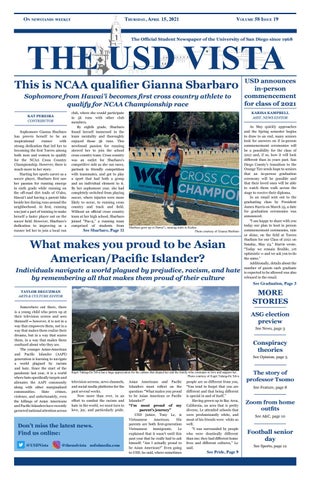
Sbarbaro grew up in Hawai’i, running trails in Kailua. Photo courtesy of Gianna Sbarbaro
What makes you proud to be Asian American/Pacific Islander? Individuals navigate a world plagued by prejudice, racism, and hate by remembering all that makes them proud of their culture
See Graduation, Page 3
ASG election preview See News, page 3
Conspiracy theories See Opinion, page 5
Kapri Tulang-De Silva has a huge appreciation for the culture that shaped her and the family who continues to love and support her. Photo courtesy of Kapri Tulang-De Silva
television screens, news channels, and social media platforms for the past several weeks. Now more than ever, in an effort to combat the racism and hate in the world, we must turn to love, joy, and particularly pride.
Don’t miss the latest news. Find us online: @USDVista
As May quickly approaches and the Spring semester begins to draw to an end, many seniors look for answers on if in-person commencement ceremonies will be a possibility for the class of 2021 and, if so, how it will look different than in years past. San Diego County’s transition to the Orange Tier sends hope to seniors that an in-person graduation ceremony will be possible and that their loved ones will be able to watch them walk across the stage to receive their diploma. In an email sent out to the graduating class by President James Harris on March 25, a date for graduation ceremonies was announced. “I am happy to share with you today our plan to host in person commencement ceremonies, rain or shine, on the field at Torero Stadium for our Class of 2021 on Sunday, May 23,” Harris wrote. “Today we remain flexible, yet optimistic — and we ask you to do the same.” Additionally, details about the number of guests each graduate is expected to be allowed was also released in the email.
MORE STORIES
TAYLOR DEGUZMAN ARTS & CULTURE EDITOR Somewhere out there, there is a young child who peers up at their television screen and sees themself — however, it is not in a way that empowers them, not in a way that makes them realize their dreams, but in a way that scares them, in a way that makes them confused about who they are. The younger Asian-American and Pacific Islander (AAPI) generation is learning to navigate a world plagued by racism and hate. Since the start of the pandemic last year, it is a world where hate specifically targets and alienates the AAPI community along with other marginalized communities. Hate crimes, violence, and unfortunately, even the killings of Asian Americans and Pacific Islanders have recently garnered national attention across
USD announces in-person commencement for class of 2021
@theusdvista uofsdmedia.com
Asian Americans and Pacific Islanders must reflect on the question: “What makes you proud to be Asian American or Pacific Islander?” “I’m most proud of my parent’s journey” USD junior, Tony Le, is Vietnamese American. His parents are both first-generation Vietnamese immigrants. Le explained that it wasn’t until this past year that he really had to ask himself: “Am I actually proud to be Asian American?” Even going to USD, he said, where sometimes
people are so different from you, “You tend to forget that you are different and that being different is special in and of itself.” Having grown up in Bay Area, California, an area that is pretty diverse, Le attended schools that were predominantly white, and most of his friends were white as well. “I was surrounded by people who were drastically different than me; they had different home lives and different cultures,” Le said.
See Pride, Page 9
The story of professor Tsomo See Feature, page 8
Zoom from home outfits See A&C, page 10
Football senior day See Sports, page 12
2
The USD Vista
◆
April 15, 2021
NEWS
Vaccination eligibility expanded to ages 16 and up USD makes effort to brace for next step in vaccination of on-campus members
YANA KOURETAS CONTRIBUTOR For college and high school students alike, the possibility of vaccination has been longawaited. Over the past few months, the administration of vaccines in California has been in full swing, although the roll-out has not been without its interruptions of constantly changing eligibility requirements and unreliable supply allocations in the beginning of the process. The distribution of vaccines in the state of California has amassed over 20 million and counting, starting with health care workers and long-term care residents to the currently available group of individuals ages 50 and older, according to the Los Angeles Times. The number of doses that California will obtain in April alone is already set to significantly surpass the 1.8 million doses that the state has received weekly up until now. For each week in the first half of April, the state will receive 2.5 million doses, and in the second half of the month, the allocations will increase to 3 million weekly. With vaccinations now veering toward a younger population, this
raises the question of whether or not USD will make vaccines open to students on campus. The rise of more consistent dosage supplies has made it possible for those ages 16 and older to soon be vaccinated. In terms of looking at the bigger picture, this provides the essential response to direct college instruction and activities back onto the path to normalcy. Sophomore Lily Burger is eager to get in line to be vaccinated, but will explore the most accessible course of action when the occasion presents itself. “I definitely want to get the vaccine when it is my turn so I have that extra level of protection for myself and for others in the USD community,” Berger said. “That being said, if other places are offering a shot sooner than on campus, I will probably get it somewhere else.” The likelihood of organizing a vaccination system for all students on campus, facilitated by the Student Health Center, is very possible, but not concrete. Pamela Sikes, director of the Student Health Center, clarified USD’s intentions to move forward with this process when they feel as the supply is constant enough to present it to all students, and the protocols are properly put in place for it to run smoothly.
“The SHC has been receiving small and sporadic allotments of the vaccine as we follow the San Diego County tier system,” Sikes said. “Currently, we are still vaccinating those in phase 1B, so I
not receive any, or a much smaller quantity than ordered,” Sikes said. “When the SHC has vaccines available for students, we will let them know immediately.” Regardless, the university
requirements that the school is following. This includes those with high-risk medical conditions and those who have specified on-campus activities, such as students that attend in-person
“I definitely want to get the vaccine when it is my turn so I have that extra level of protection for myself and for others in the USD community. ” - Lily Berger, Sophomore think it may be some time before we have vaccines for anyone over the age of 16. Still, we are actively trying to get vaccine supplies for all on campus, especially for our students.” Although the vaccination process is underway, it still takes an extensive effort to bring all the pieces together, especially when the amount of individuals looking to get vaccinated outweighs the capacity of doses allotted. In the meantime, as USD prepares for the time when a more steady vaccine reserve will be attainable, Sikes and the rest of the administration urges students to stay vigilant and keep an eye out for vaccination slots as the date approaches. “The vaccine supply is constantly changing. It can be ordered weekly, and we’ve been doing that — but we usually do
has taken the steps necessary to present student employees and staff with the option for vaccination on campus, under the “Vaccination Action Plan,” which is solely contingent on the number of vaccines the school receives weekly. On April 7 and 8, USD hosted a clinic inviting on-campus student employees, faculty, staff, and administration members to collect their first dose of the Moderna vaccine. However, they are finding that many employees have already been vaccinated elsewhere. As of now, the school is also proceeding to meet students who fall under phase 1C with a vaccination opportunity. On April 9, an email was sent to students from the SHC announcing their limited vaccine supply to those that fall under the latest eligibility
classes and scholar-athletes. Appointments are sparse, but the SHC will continue to notify students as more vaccines become available. With this in mind, the school has emphasized to the eligible groups that there is no guarantee of a sufficient supply of the Moderna vaccine to serve each individual with their second dosage on campus as well. In the upcoming weeks, the university braces to facilitate this process for a broader range of students as the Student Health Center progresses through the different vaccination phases. Although the image of an entirely vaccinated student body and a normal college experience is still far off, the prospect of a return to normalcy is hopeful to happen in the near future.
Into the Orange Tier: What this new tier means for USD Classes make their return to campus, indoor dining comes back to the SLP, and gatherings of 50 people or less are now allowed MARIA SIMPSON ASST. NEWS EDITOR Within the past few months, there has been a struggle in San Diego to bring down COVID-19 cases enough for life to begin to feel somewhat normal again. Whether it was going to the movies, dining inside your favorite restaurant, or working out at the gym, everyone has missed something. On April 7, San Diego County was able to move into the Orange Tier due to the COVID-19 case rate falling below six cases per 100,000 residents. Cases have been falling rapidly, moving from the Red Tier to the Orange Tier in less than a month, with the help of more than 20 million doses within California according to the LA Times. It seems like there may finally be a light at the end of the tunnel after over a year of the pandemic’s
reigning control on our lives. California’s Blueprint for a Safer Economy explains all of the loosened restrictions, which includes indoor seating at restaurants, movie theaters, and restaurants at 50% capacity, gyms open to 25% capacity indoors, and retail stores being able to operate with no capacity limits. Yet another sign that normalcy is getting closer is Governor Newsom’s statement that as long as hospitalization rates remain low and the vaccine stays readily available, it is possible that California’s economy can reopen completely on June 15. While the exact policies following this reopening are not yet clear, it has been stated that certain public health measures, testing, and contact tracing will stay in place. However, the tier system and the Blueprint for a Safer Economy will be tossed out. Newsom also
mentioned that as the state opens back up, education, including institutions of higher learning, will also be permitted to carry out in-person instruction. First-year Katri Gardner shared her thoughts on the possibility of having in-person classes. “I’m really excited to have classes in person,” Gardner said. “I’m tired of Zoom, I think everyone has a lot of Zoomfatigue. I’m excited to see my professors in person and meet more people in in-person classes … I think opening back up to have in-person classes will only benefit the community.” Junior Chloe McDonald commented on the ease of restrictions and shared some concerns about everyone returning to campus. “As a soon-to-be senior, I like the idea of being in person in a
lot of ways,” McDonald said. “I do think that if students are still afraid or they haven’t gotten the vaccine for whatever reason, they shouldn’t have to come back and I don’t know how they would do that because it’s hard to have everyone in person except a couple of people.” As the county moves into this new tier, USD’s community guidelines will also be affected. A statement from USD was released from Student Affairs in an email on April 9, detailing what moving into the Orange Tier means for students on campus. Beginning the week of April 12, some classes will be taught by hybrid instruction. This will primarily apply to labs, research, studio, and performance courses. According to the Core Connect guidelines, the Orange Tier permits gatherings of up to 50 people. This opens up the possibility for clubs and student
organizations to meet in person as long as all school guidelines are followed. “I think right now we’re very disconnected from each other in a lot of ways… that environment of having college clubs and college events would be a lot more beneficial than just sitting on your computer screen in your room,” McDonald said. Within recent weeks, the USD community has seen indoor dining return in the SLP, mass take place inside the Immaculata, and campus recreation previously stated that the Bosley Fitness Center will be reopening on April 19. And now, there is a distinct possibility of in-person classes next semester. There is no denying that life in a pandemic has been difficult for everyone in numerous ways, but as restrictions continue to ease, it is beginning to look a little brighter.
Volume 58 Issue 19
◆
NEWS
The USD Vista
◆
ASG Presidential candidates make their case to student body
3
Voting takes place on the MySanDiego Portal on April 15 and 16
TYLER PUGMIRE NEWS EDITOR Justice Zoto and Fanisee Bias are both juniors looking to take over the reins of Associated Student Government (ASG) after serving in the organization for the entirety of their academic careers. Bias and Zoto have been campaigning virtually, and now rely heavily on social media in order to voice their message to the student body. While they have both served ASG in their own rights, their visions for the future of student government are different.
Justice Zoto
Zoto has many goals and dreams for her potential term as president, but specifically is looking to amplify marginalized student voices by meeting with different organizations to pressure university administration into making systemic changes. Zoto noted that effective change is still in dire need at this school. A primary reason for her to run for president is the opportunity to have a seat at the table with administrators in order to demand change. Zoto is a first-generation college student, who says she knows not only what USD can do to help its students, but also that to make college comfortable
for students of all backgrounds, many accommodations must be made. She is looking to be a president that will actively listen to students and advocate for them at all levels. Zoto says she is ready to be held accountable and plans on establishing important relationships with both administration and students so that she has the capacity to create a real dialogue between the two. Zoto has experience with the ASG Senate, serving as both an Academic Senator and the Public Relations Chair. She has also attended many leadership conferences. In her eyes, ASG would be different with her as president because she would look to unite the organization as a whole, so that students can properly utilize the senators and event coordinators to their full capacity. Ideally, for Zoto, students would know where to turn whenever they could contribute something to the rest of the student body. Zoto believes she understands both how the university works, and how truly disappointing USD can be to some students in times of need. USD, in her eyes, continues to lack all of the proper needs for students and she wants to be the change that makes students feel accepted at their college.
Fanisee Bias
Fanisee
Bias
has
made
Justice Zoto (left) and Fanisee Bias (right) are both promising change to how ASG will operate. Photo courtesy of Justice Zoto and Fanisee Bias
listening and paying attention to students’ needs her number one priority in her campaign for ASG President. She recognized that the next year is going to be tough, but that with proper communication there can still be a lot of positive change on campus next year. For Bias, that change comes in the form of motivating individual students to reach their full potential, for the University to acknowledge the past history and harm of systemic actions, and to support all of USD in developing actions towards equity, inclusion, accessibility, and solidarity. In her time with ASG, she has
served as a Residential Senator, an At-Large Senator, a Committee Chair, Committee Coordinator, and Speaker Pro Tempore. Bias founded the Alliance of Disability Advocates and interned for the United Front Multicultural Commons, and the combination of these experiences is why she feels as though she is more than ready to be president. Bias says empathy, equity, and representation are guiding values in all of her leadership roles, and she plans on using those ideals to create the best environment possible for students. She claims that ASG is not perfect and that
being a member during those times of shortcoming have taught her a lot about what can be better. Mainly, she wants the organization to be seen as a safe, accessible, and successful place for students to utilize whenever they may need accommodations. Bias is attempting to leave her final mark on USD as president and is confident in her ability to make this school a better place for everyone. She says she has talked to many former ASG mentors and past presidents and has been reassured that her experience is worthy to be a candidate for this role.
USD to hold in-person graduation
Commencement will take place on May 16 for Class of 2020, May 23 for Class of 2021 KARISA KAMPBELL ASST. NEWS EDITOR
Graduation from Page 1
“Due to space restrictions and health and safety guidelines,
The USD Vista Celina Tebor - Editor in Chief Jennifer Mossuto - Associate Editor Catherine Silvey - Managing Editor Mikaela Foehr- Copy Editor Tori Tanigawa - Art Director Tyler Pugmire - News Editor Alena Botros - Opinion Editor
we are planning to extend two invitations per graduate,” Harris wrote. “While this is our working
plan, we need to recognize that San Diego County health and safety requirements could further restrict us, depending on the impact of the pandemic at the time of the commencement ceremonies.” According to the commencement page on the USD website, a graduation for the class of 2020 will also be held in person on Sunday, May 16. Commencements for the various graduate programs offered at USD will also be held in person Saturday, May 15 and Sunday, May 22. For many seniors, the announcement on plans for an inperson graduation is promising, yet some still hold concerns.
Editorial – 619.260.4584 Business – 619.260.4714 www.uofsdmedia.com / @TheUSDVista
Brittany Lang - Feature Editor Gina Lew - Student Media Advisor Taylor DeGuzman - Arts & Culture Editor Marie Minnick - Operations Advisor Eric Boose - Sports Editor Sean Butler - Distribution Manager Regan Ferarri - Social Media Manager Austin Piona - Finance Manager MaryCatherine Smith - Advertising Manager
Senior Taylor Provenzano shared her cautious enthusiasm regarding the graduation update. “I think every senior is really excited to have a graduation in person, my only concern comes from how they decide if we get to have it or not,” Provenzano said. “If there is a spike on campus that comes from the freshmen, but it affects commencement plans for seniors, that would be really unfortunate.” Although commencement ceremonies may still not look the way they have in years past, the plans offered by the university to help guarantee a celebration of the Class of 2021’s accomplishments is a promising sign of a return to normalcy.
The USD Vista publication is written and edited by USD students and funded by revenues generated by advertising and a student fee. Advertising material published is for information purposes only and is not to be construed as an expressed or implied endorsement or verification of such commercial venues by the staff or University. The USD Vista office is located on the fourth floor of the Student Life Pavilion in room 403B. All inquiries should be sent to: The USD Vista 5998 Alcala Park San Diego, CA 92110 Opinions expressed in this publication are not necessarily those of The USD Vista staff, the University of San Diego or of its student body. Letters to the Editor can be submitted to The USD Vista office. Letters should be limited to 300 words and must be signed. For identification purposes, USD identification numbers and writer’s year must be included in the letter. The USD Vista reserves the right to edit published letters. Any content sent to the editor will be considered for publication unless otherwise stated.
“ c o
4
The USD Vista
◆
April 15, 2021
E DI TOR IA L
The newfound elitism surrounding COVID-19 As the United States moves toward vaccinating every individual, a dangerous debate heats up about the different vaccines BAYLYNNE BRUNETTI ASST. OPINION EDITOR Currently, 72 million people in the United States have been fully vaccinated for COVID-19. The U.S. has been fortunate enough to have access to three vaccines; Pfizer, Johnson & Johnson, and Moderna. On the news and social media, I had seen some misinformation and a large focus on the efficacy rate of the vaccines. I had also seen some memes on Instagram about the difference in girls who get the Pfizer or Moderna vaccine versus those who get Johnson & Johnson and it had seemed harmless enough. TikTok had blown up with “rivalries” between vaccine companies and the vaccine you have received. This was all deemed as funny and just a way to cope with the pandemic. However, when my mother and I were informed our vaccination site had run out of Moderna and we were offered Johnson & Johnson, my mother was hesitant and almost cancelled her vaccination. Had these harmless jokes actually
begun to taint the vaccine itself and make people hesitant to get it? Staring at my mother rushing to read online articles about Johnson & Johnson, I realized that yes, it had. You can ask people who have
to NBC Boston, while the overall effectiveness data may suggest the Johnson & Johnson candidate isn’t quite as strong as the two-dose Pfizer and Moderna options, all of the world’s COVID-19 vaccines have
The difference lies in the fact that the vaccines have different makeups opinions about the difference between vaccines what the distinction is and most do not know. The difference lies in the fact that the vaccines have different makeups. For example, the genetic material in the mRNA vaccines is RNA, whereas the genetic material in the Johnson & Johnson vaccine is DNA, but both encode the information to make the spike protein of SARSCoV-2. The Johnson & Johnson vaccine had a 72% efficiency in mild to moderate COVID-19 symptoms in the United States trial — 66% globally. The vaccine provided 100% efficacy against hospitalizations and deaths. For Pfizer and Moderna, the CDC confirmed that both vaccines are 90% effective after two doses in study of real-life conditions. According
been tested differently, making comparisons nearly impossible. As of April 13, the CDC put a halt on Johnson & Johnson vaccine distribution due to 6 doses out of 6.8 million that potentially could have caused
platelet counts were not included in trial and thus, the adverse and rare effects were not foreseeable. Additionally, the CDC started an investigation immediately into the cases to see what happened. When it comes to the flu shot, most of us cannot even name the company who gave us our vaccine. Additionally, the flu shot on a good year is only 40%-60% effective but we line up to take it without criticizing the study or the company giving it to us. It is reasonable to question and have a certain level of scrutiny about things presented
scientists for their tireless efforts to put out a life-saving vaccine. These vaccines are proof that when we fund science, scientists can do incredible things. Even in good fun, there are repercussions for starting an elitist game between vaccines and we should be cautious about what we say and spread online. Clearly, there are real effects to the “vaccine gang” TikToks and the memes that follow suit. At a time where we can finally come back together, let’s not tear each other apart. Don’t be the reason someone does not get a vaccine because you decided to become
If anything, we should be thanking these scientists for their tireless efforts to put out a life-saving vaccine. These vaccines are proof that when we fund science, scientists can do incredible things blood clots in women. This has less to do with the vaccine and more with the fact that scientific studies often do not include enough women in their studies due to concerns of infertility or pregnancy issues later on. This leads to instances such as this— where likely, women with low
to us. However, pinning vaccines against each other is not the way to resolve the deep wounds inflicted by the pandemic. It is ungracious to the scientists who worked so hard to find a solution to a year that put a halt to our lives. If anything, we should be thanking these
an expert on efficacy rates on social media because you saw a percentage headline. Instead, think about the privilege you hold to have already been vaccinated and thank our incredible scientists for trying to get us back to some form of normalcy.
Daisy Martinez/The USD Vista
The views expressed in the editorial and op-ed sections are not necessarily those of The USD Vista staff, the University of San Diego, or its student body.
Volume 58 Issue 19
◆
OPINION
◆
The USD Vista
E DI TOR IA L
5
Conspiracy culture
From flat-earthers to QAnon, conspiracy theories are nothing new—so why have they become widespread in the past decade? HALLIE WILTSHIRE ASST. OPINION EDITOR In the past year, conspiracy theories have exploded in popularity. Although some are relatively harmless, many feed on hatred and even provoke violence. From the claim that COVID-19 is a hoax created by China to accusations that the 2020 presidential election was stolen by the Democrats, what were once fringe movements have become hard to ignore. Conspiracy theories have always existed, but recently they have gained significant traction. Following any major event in America, you can expect communities of deluded believers to come out and claim that not all is as it seems— there is a deeper, darker, and more secret cause behind what happened. These people feed on tragedy to fuel their fanatical theories. After the Sandy Hook shooting, where 26 people, including 20 children, were killed, some claimed that the entire event was orchestrated by the U.S. government in order to promote stricter gun control laws. Others, including far-right radio host Alex Jones, asserted that the entire event was fake. Real grief felt by the parents who lost their children was mocked by sick individuals looking to promote their deluded agendas.
As soon as news about the novel COVID-19 virus was reported in the U.S., claims that it was a hoax began to spread. Even today, after millions of deaths worldwide, some are unwavering in their belief that the entire virus is fake. This can lead to careless and selfish behavior, which allows the virus to spread faster. There is also skepticism about the new COVID-19 vaccines, as some claim that the government is injecting GPS microchips into the population. Conspiracy theorists live in an alternative reality where everything is suspicious. No member of the “establishment,” whether that means the government, scientists or someone else, can be trusted. They are all out to trick the public. Ryan Neville-Shepard, a professor of communication studies at the University of Arkansas, studies conspiracy theories as a genre of rhetoric. According to him, conspiracy rhetoric has the following characteristics: it is antiestablishment, it is a critique against a dominant mythic framework, and it contains a broad political ideology that creates common ground amongst its supporters. Neville-Shepard says that the political climate during the 2020 election was a perfect storm for conspiracy theories, as they often “come at a time
Graffiti found in Notting Hill, London suggesting COVID-19 is a hoax.
of major political polarization — especially when one party loses a lot of power and another party comes into power.” He also asserts that conspiracy theories are dangerous and must be taken seriously. They prey on people who are not media literate and feel politically polarized, which describes a large population of the U.S. The 2020 election was one of the most tense in U.S. history. Avid Donald Trump supporters were adamant that if he did not win the election, it was a conspiracy. Some believe in QAnon, a far-right conspiracy theory claiming that a secret group of cannibalistic, Satan-worshipping pedophiles is running a global child sextrafficking ring and plotting to take down former U.S. President Trump while he was in office. There has been no evidence of the existence of this organization, and it is this lack of concrete evidence that acts as a common thread between conspiracy theories. QAnon supporters feel that they’re the only ones who can see the truth behind the scenes. Everyone else is a sheep, blindly following the rules of the establishment. But QAnon supporters believe they’re smarter than everyone else — they haven’t fallen for the government’s tricks. This bonds QAnon supporters together, they feel they have a duty to
inform the public and to reveal the secrets hidden behind the curtains. Most just laugh these people off, but they can be dangerous. Trump used every mode of communication within his reach to alert his supporters that the 2020 election had been stolen by the Democrats and that he was the victim of a nation-wide conspiracy. He encouraged them to challenge the results and fight for a fair election. When thousands of Trump supporters violently stormed the Capitol on Jan. 6 to prevent Congress from certifying Biden’s win, many wore QAnon merchandise. This failed insurrection has been called an attack on democracy, and five people lost their lives in the struggle. Conspiracy theories “are forms of misinformation that people are creating, often to make a profit. And at first, it seems like it’s just sort of funny. But it has, as we’ve seen with the insurrection of the Capitol, dangerous ramifications,” Neville-Shepard said. Political conspiracy theories, particularly ones like QAnon that have no base in reality and intend to rile up audiences, are a threat to American democracy. No conspiracy theory is truly harmless. Their root ideas of anti-authority and antiestablishment cause people to question, and even outright attack, the government. There is
Photo courtesy of @theblowup/Unsplash
nothing wrong with questioning the government, but to do so solely based on false facts and unsupported conspiracies is dangerous. One of the primary issues with conspiracy theorists and evidence is that the theories are non-falsifiable. There is no piece of evidence that will prove to conspiracy theorists that they are wrong because if you provide this evidence, they will simply say that it is part of the conspiracy and the establishment put it there to deceive the public. Conspiracy theorists are beyond logic, they are caught up in their own worlds and won’t take anything said outside of that world seriously. Many theorists obtain the majority of their information from the Internet. Whether in the form of self-made videos on YouTube or blogs, theorists say they’ve unlocked the information that the establishment wants to keep hidden. They gather in Internet discussion boards to exchange information that hasn’t been fact checked and lacks basic evidence. Certain people are more likely to fall for conspiracy theories, and may even support multiple. At the forefront is a mistrust of authority. Combined with this is a frustration with the dominant political scene. This fusion was lethal during Donald Trump’s presidency. A significant aspect of his platform was that he was not a political insider; he hadn’t been corrupted by the political establishment and therefore was a candidate for the people. It’s no surprise then that many of his most enthusiastic supporters are also conspiracy theorists. Trump not only tolerated but encouraged conspiracy theories such as QAnon. He retweeted QAnon accounts frequently and never formally denounced the group. His supporters took this as his approval. It’s easy to laugh off flatearthers as they try to debate real scientists but their adamant anti-establishment ideas could lead to escalation down the road, just as we saw at the Capitol riots. Fact checking information and not relying on online discussion boards for information are two easy ways to avoid falling for conspiracy theories. It’s also important to recognize that changing one’s opinion when new information is presented is completely rational. We are quick to dig our feet in when our ideas are challenged, and conspiracy theorists are no different.
The views expressed in the editorial and op-ed sections are not necessarily those of The USD Vista staff, the University of San Diego, or its student body.
6
The USD Vista
◆
April 15, 2021
A Guide to Navigating Core Curriculum Requirements Choosing the right courses to fulfill core requirements can be a challenging and stressful process for students. Many students grow to view core classes as being bothersome distractions from the courses they need to take for their degree. Nevertheless, there are a handful of fascinating courses to choose from that double up core requirements and will ease up some room on students’ schedules.
POLS 130, Introduction to the Politics of Race and Ethnicity: fulfills the social/behavioral inquiry area and domestic diversity level one
EOSC 105, Natural Disasters with Lab: fulfills the scientific and technological inquiry and quantitative reasoning competency requirements
Foreign language majors and minors can use their fourth semester language course towards the oral communication competency requirement
THRS 340, Being Human: Race Gender & Sex: fulfills the upper division theology and domestic diversity level two requirements
THRS division
120, Christianity theology and
and Conquest: Fulfills domestic diversity level
lower one
HIST 180, Great Moments in Time: fulfills the historical inquiry area and the oral communication competency requirement
HIST 304, Africa in the Western the historical inquiry area and global
Imagination: fulfills diversity level two
Volume 58 Issue 19
◆
FEATURE
◆
The USD Vista
7
COMM 101, Introduction to Human Communication: fulfills the social/ behavioral inquiry area and the oral communication competency requirement
ARTH 356, Race, Ethnicity, Art, and Film: fulfills artistic inquiry area, advanced writing competency, and domestic diversity level one requirements
ENGL 230, Various topics in U.S. literature: fulfills literary inquiry area and domestic diversity level one requirements
Photo Credit Anna Behrens/The USD Vista
Spread by Tori Tanigawa/The USD Vista; Content by Brittany Lang/The USD Vista
8
FEATURE The USD Vista
April 15, 2021
A Buddhist nun, scholar, and social activist: Karma Lekshe Tsomo USD theology and religious studies professor shares her life story MEGAN SHANNON CONTRIBUTOR Karma Lekshe Tsomo, a Buddhist nun who teaches at the University of San Diego in the theology department, has life endeavors stretching far beyond the classroom. Her Buddhist path has taken her around the world, where she has studied the history and teachings of Buddhism and become an advocate for female advancement. Tsomo is a woman of faith and fortitude, as her path has led her on a pursuit to cultivate a world of peace, compassion, and gender equality. Born in 1944, Tsomo was raised in Malibu, California, where she spent her early life attending school and surfing in the Pacific. Her birth surname, Zenn, was a misspelling of the German last name Zinn, a mistake made on a relative’s passport long ago. Although only slight, this misspelling had considerable impact on the trajectory of Tsomo’s life. “My name was like a birthright that led me to my path,” Tsomo said. In elementary school, she was frequently teased by her classmates. They called her a Buddhist, as her last name correlated with Zen Buddhism. Not knowing what a Buddhist was, Tsomo was moved by her innate curiosity to visit the local public library, where she checked out two books on Buddhism. Aftering reading both books front to back, she found that Buddhism answered many of the questions she had about life. Even at a young age, Tsomo noticed the superficiality of the world around her, where people saw money and material goods as sources of happiness. She was deeply disappointed with the world around her, and Buddhism was her escape. She was drawn to the Buddhist teachings of inner peace and
living a life of compassion. At twelve years old, Tsomo announced to her mother that she was a Buddhist, and since then has dedicated her life to the faith. After graduating from high school in 1962, Tsomo attended Occidental College only to drop out a year and a half later with aspirations to explore Buddhism in Asia. “I had a karmic affinity to Asian culture from a young age, but I wasn’t finding it in California at that time,” Tsomo said. After working to save up money for a ticket, at just 19 years old Tsomo set off on a boat heading to Hawai’i and then Japan. Leaving the U.S. in 1964, Tsomo wandered Asia, surfing and seeking out the teachings of Buddhism. During this time, she struggled to find a monastery for women. Regardless, Tsomo continued to develop an interest in becoming a Buddhist nun. “I was on a boat, at the age of 20, on the way from Yokohama to Singapore and I had this dream,” she said. “In the dream I was in a community of religious seekers, and I got the wish to be a nun.” This desire would stay nested inside her for 13 years before officially joining the monastic community. During these 13 years, she partook in many adventures such as being a yoga instructor, a musician, and an artist. Finally in 1977, Tsomo became a nun in France. In the same year, she moved to Dharamshala, India to attend classes taught by the Dalai Lama. During this time, Tsomo again noticed the limited amount of monastic communities for nuns. Once Tsomo did find these female communities, she quickly noticed the disadvantagements of nuns compared to monks. Many nuns were poor, as the lay Buddhist community only supported the monks. In addition, many nuns had no educational opportunities
“If everybody holds up one little piece of the sky, I think it will make a difference.”
and did not know how to read or write. Through these observations, Tsomo began developing a deep feminist awareness of the inequalities of men and women in Buddhism. Eager to support fellow nuns, Tsomo taught a group of Tibetan nuns how to read in 1985. She was amazed by the nuns’ motivation and eagerness to learn, as they quickly mastered reading in two months and moved swiftly onto grammar. In the early beginnings of Buddhism, women were not allowed to join monastic life. Similar to many other cultures, women were tied to the home and the family. “For the Buddha to allow women to leave their families and go off to seek the spiritual path was a radical move,” Tsomo said. Although women were eventually welcomed into the monastic community, gender inequality continues to influence the lives of nuns. If women have equal potential for awakening they should have equal opportunity to pursue that,” Tsomo said. In 1985, Tsomo founded the Jamyang Foundation, which supports educational opportunities for girls and women in remote developing communities, particularly in India and Bangladesh. The foundation has established schools for girls and study programs for women in monastic communities. Inspired to learn more about the experiences of nuns in Buddhism, Tsomo wrote letters to nuns from all over the world, inviting them to a conference in Bodhgaya, India to discuss the female experience in Buddhism. In 1987, the conference resulted in the founding of Sakyadhita International, in Sakyadhita meaning “Daughter of the Buddha.” Sakyadhita International is an independent nongovernmental organization that aims to unite women around the world to work toward the advancement of women in Buddhism. This organization welcomes both laywomen and nuns and holds conferences every two years
in
different parts of Asia. In addition to being a founder, Tsomo was the president of Sakyadhita International for eight years and organized the first 15 conferences. As a result of these conferences, the organization has published books based on topics and conversations pertaining to women in Buddhism. “Women’s stories have not been heard, and they’ve been neglected in the tradition,” she said. “Rarely were their lives and accomplishments known. So we wanted to change that and bring their accomplishments to light.” These books have inspired women to create schools for girls, retreat centers, women’s shelters, and fund continued research on women in Buddhism. The work Tsomo has done with Sakyadhita International has given women in Buddhism a voice, influenced the advancement of female education, and cultivated a compassionate and empowering community of women. The most recent book she edited, “Bridging Worlds: Buddhist Women’s Voices Across Generations,” was published in 2018 and is available to download on the University of San Diego website. In 2000, while finishing up her doctorate in Comparative Philosophy, Tsomo was encouraged by two friends to apply for a postdoctoral annual position at the University of San Diego. Hesitant at first, she eventually decided to apply and ultimately secured the job. In time, the position became a full-time job, and since then Tsomo has been a professor in the Theologies and Religious Studies Department at USD. She has taught a variety of classes including Buddhist Thought and Culture, World Religions, and Negotiating Religious Diversity in India. “There are two things I love about teaching,” Tsomo said. “I love working with young people, and second, it has given me all the conditions I need to do research.” n addition to teaching, sh has taken advantage of the resources available at USD to
continue to research topics such as women in Buddhism, Buddhist feminist ethics, and Buddhism and bioethics. Tsomo has continued to develop her curriculum to keep it current and up to date with modern religious and political events. Due to the virtual format of USD during the 2020-2021 school year, she is currently living and teaching from O’ahu, Hawai’i. “My most recent endeavor is the La’i Peace Center, which is going to be a learning center for peace,” Tsomo said. At the peace center, courses will be held on topics such as conflict resolution, peace-building skills, women empowerment, substance abuse, and Hawaiian healing herbs. At the center, guests will be able to participate in meditation, yoga, and tai chi. Currently in development, the La’i Peace Center is situated on five acres of land. Tsomo spends her days preparing the center by planting trees and creating beautiful spaces for people to learn. She plans for the peace center to be a free resource for all attendees. After retiring from her role as a full-time professor in two years, Tsomo plans for the La’i Peace Center to be her “post-USD endeavor.” Karma Lekshe Tsomo has lived a life of curiosity, compassion, and advocacy for women. Her curiosity led her to discover her path towards Buddhism. Tsomo’s compassion can be seen in all she continues to do to cultivate a peaceful and just world through the founding of the Jamyang Foundation, Sakyadhita International, and the nearly completed La’i Peace Center. Through her research, teachings, and publications, she continues to advocate for women in Buddhism and inspire women around the world to take part in female advancement. “There is still a lot of change that needs to happen to establish equity for women around the world,” Tsomo said. “If everybody holds up one little piece of the sky, I think it will make a difference.”
Volume 58 Issue 19
◆
ARTS & CULTURE
◆
The USD Vista
A RT S & C U LT U R E
9
Love and pride can overcome hate
USD students share what makes them proud to be Asian American/Pacific Islander
Pride from Page 1
said. When thinking about what makes him most proud about being Asian American, his parents’ journey to America came to mind. Le’s parents’ journey is one that he spoke of with great pride and admiration. “My parents came at the end of the Vietnam War with nothing, and they went from nothing and were able to provide for me and my family,” Le said. “When my parents were going through the whole immigration process, they have never forgotten the people they interacted with, and so many people they met through the process are still a part of their lives. It encompasses that whole idea in Asian culture that family is much more than just blood.” Le’s biggest support system, his family, is something that he talked about with a beaming smile. It was more than apparent that the family that surrounded him during his childhood had a huge impact on who he is today. “When I was a kid growing up, when my grandparents were still alive, we would consistently do Saturday night potlucks at their house with a majority Vietnamese food; everyone came together, all my aunts and uncles too,” Le said. “It’s just one of those things that not a lot of my friends at school did — seeing your extended family every week.” “I am so proud to be of Japanese, Chinese, Hawaiian, Filipino, and Portuguese descent” Kapri Tulang-De Silva, USD junior, is of Japanese, Chinese, Hawaiian, Filipino, and Portuguese descent. Both Asian American and Pacific Islander, Tulang-De Silva is most proud of the cultural values and traditions that are instilled within her — they have been influential in both her upbringing and all that she stands for. Tulang-De Silva grew up in Hawai’i and comes from a family very immersed in Japanese, Chinese, and Filipino heritage as well as Hawaiian culture. Attending USD in the “continental United States” has helped her grow an appreciation for her culture. “My Asian American and Pacific Islander cultures are so important and have molded me into who I am today, they have laid the foundation of my path,” Tulang-De Silva said. Ever since she was a little girl, Tulang-De Silva dreamt of visiting the Philippines to experience the roots of where she came from, and meet the family she had only heard about and seen pictures of. The moment she visited the same exact house her great-
Crystal Nguyen has a great appreciation for her Vietnamese culture that continues to shape the woman she is today. Photo courtesy of Crystal Nguyen
great-grandfather lived in before migrating to Hawai’i, she was brought to tears. “The trip taught me so much about who I am as a Filipino and about where I come from; it also taught me about humility and sacrifice,” Tulang-De Silva said. “My great-great-grandfather made a hard decision to leave his home and everything he knew to move to Hawai’i for a better life for his family.” Tulang-De Silva speaks about her family and her culture with such overwhelming pride and joy, and it is no surprise that she has made and continues to make a huge impact on USD’s campus with her passion for social and cultural justice and community awareness. To describe her culture in one word, Tulang-De Silva used “resilient.” “As someone with a multiracial background, many of the cultures I identify with have endured major struggles or have been directly affected by colonialism,” TulangDe Silva said. “Yet, they are still powerful. They are still present. They are thriving and surviving. And for that, I am so proud to be of Japanese, Chinese, Hawaiian, Filipino, and Portuguese descent.” “I get to honor the sacrifices my parents and grandparents had to make…” “I’m proud to be Asian American because I get to honor the sacrifices my parents and grandparents had to make in order to live in the United States,” USD senior Nathan Chang said. Chang is Korean American, and growing up every Saturday night he enjoyed Korean BBQ with his dad’s extended side.
“Every week, we would have cousins, aunts, and uncles come over to enjoy each other’s company. The lively dinner conversations often consisted of Korean, English, and ‘Konglish’ (English words appropriated into the Korean language),” Chang said. “The adults and grandparents would have their conversations in Korean while the kids would have theirs in English.” He painted the scene: while all of these conversations took place, family members would grill up meats while simultaneously cracking jokes and ensuring that everyone got their share of food. Afterward, all of the adults would sip on coffee and eat dessert, while the kids would watch TV and play games with each other. “We would spend hours with each other, creating memories that we would learn to cherish for the rest of our lives,” Chang said. For Chang, if one word could encapsulate Korean culture it would be “respect.” Chang explains that throughout the Korean culture, one can find many practices that serve the purpose of teaching one how to respect others. “For example, when having meals, elders would be seated first and given the first servings. Moreover, when greeting elders or strangers, you have to bow in order to show respect and gratitude towards them,” Chang said. “While these practices might seem excessive, I’m grateful for them due to the respect and manners they instilled in me from an early age.” “I can carry on their legacy as a first-generation Asian American” “When I think of a time I
felt extraordinarily proud to be Asian American, specifically Vietnamese American, I think back to my time as a receptionist at my mom’s nail salon. Every day was a rush, but I don’t mean that in terms of adrenaline,” USD junior Crystal Nguyen said. “Every day, I saw the workers rush up and down the salon, doing the things that nobody else wanted to do. Massages, foot scrubs, waxing, filing nails — they pretty much did it all.” Nguyen distinctly remembers every Friday afternoon shift at her mom’s nail salon. “It was so busy that no one got the chance to eat,” she said. She explained that even though she pushed for the workers to take their breaks, they would insist on helping ‘just one more client.’ After every Friday shift, Nguyen expected most of them to be
as exhausted and unhappy as she was, but she was surprised that, despite the long 10-hour workday, “I witnessed them cracking jokes with each other as they cleaned their stations and I saw them reach into their untouched lunch bags and offer each other food to bring home to their own families.” As the days and weeks went on at the nail salon, Nguyen began to learn all of the nail technicians by their name and their story. She remembers the youngest technician, who was in her early 20s, had recently come over from Vietnam, looking to make enough money to bring her mother to America as well. “By the time I left for college, they were all my aunties and my family,” Nguyen said. As an Asian American, Nguyen explained that sometimes she’s overwhelmed by the amount of work she has to do in order to create a “spot for me at a table that does not invite me to sit.” However, when she considers giving up, she forces herself to think of a Friday shift at her mom’s nail salon. “The work ethic demonstrated by my Asian immigrant aunties is not one I can easily forget,” Nguyen said. “I can’t help but straighten my spine with pride and determination, knowing I can carry on their legacy as a firstgeneration Asian American.” Crystal Nguyen is more than proud to be Asian American. Tony Le is more than proud to be Asian American. Nathan Chang is more than proud to be Asian American. Kapri Tulang-De Silva is more than proud to be Asian American and Pacific Islander. There is so much to be proud of within the Asian American Pacific Islander community, and with this pride and this much love, hate can be overcome.
Tony Le and his family Ho Chi Minh City’s Independence Palace. Photo courtesy of Tony Le
10
The USD Vista
◆
April 15, 2021
Zoom from home outfits
USD students share their favorite online school fashion pieces and places to shop from ANNA VALAIK ASST. A&C EDITOR Online school does have its perks. One such perk is that students can show up to class in their pajamas and no one will ever know. However, the flexibility and comfortability of Zoom means many people have not been flexing their fashion skills as much as they would have on campus. There’s no need or pressure to wear a new shirt, change according to inclement weather, or put those jeans on for the dreaded 8 a.m. In this new online world, students have altered the way they dress for class, many choosing comfort over style. Here are some USD students’ own take on their “Zoom from home” outfits. Kiara Dias, a junior at USD, describes her style as “grocery store chic.” Dias has some goto’s when dressing for class. “I’m constantly wearing mom jeans and a tank top,” Dias said. “My top brands are Cotton On, Zara, Urban Outfitters, and Target.” Dias says her style has, in fact, changed since going online for school. “I would say, my style has transitioned to be a bit more casual and comfortable,” Dias said. She also noted how USD’s campus culture was something that greatly shaped
Kiara rocking her go-to outfit that she describes as ‘grocery store chic.’ Photo courtesy of Kiara Dias
her
style when in-person. “Compared to last year with all in-person classes and wherein campus culture had students dressed immaculately, it’s been nice to develop a more relaxed style given the only people I see daily is my close circle and Zoom,” Dias said.
Megan Shannon, a sophomore, shares a similar thought-process when putting on clothes for class. “For Zoom class I always dress comfy on the bottom, such as leggings, sweatpants, or sweat-shorts,” Shannon said. “When I need to look a
All of Lauren Smith’s fashion pieces are either thrifted or second-hand; she’s a huge believer in repurposing clothing. Photo courtesy of Lauren Smith
little more put together, my go-to tops are cardigans and sweaters because they look nice and are still comfortable.” Shannon makes sure to never forget her slippers, too. Some brands she particularly likes and recommends when looking for Zoom clothes are Set Active, Free People, Patagonia, and Aritzia. One tip she has is to check out a local Goodwill or Salvation Army. “Make sure to always scour your local thrift stores. At thrift stores you can find the best comfy sweatshirt and t-shirts,” Shannon said. Junior Lauren Smith’s perspective on Zoom dressing has changed over the school year. “During my first semester on Zoom I was a huge fan of pajamas in class; but lately, in an effort to battle fatigue, I’ve been finding any excuse to get dressed and ready,” Smith said. Smith gave a full run-through of her outfit, which sheds light on her style and fashion sense. Smith cares for the environment, and those beliefs are reflected in her clothing choices. “I’m a big advocate of repurposing clothing since so much waste occurs in the fashion industry. For example, the jeans I’m wearing have made it through a few generations before me,” Smith said. To Smith, these are more than just jeans; they are actually a family heirloom. “Originally, they were a
pair of overalls back when my great-grandfather wore them working in the mines. A perfect item of clothing for protecting your legs from dirt, rocks, and misplaced pick axes while also looking chic,” Smith said. Her jewelry was all recently purchased at a local boutique during her trip to Hawai’i. Her shirt was another repurposed item, but this time it wasn’t from her own closet. “Since nothing beats an oversized shirt, I got mine from my brother’s closet, but he doesn’t know that, so I’m hoping he’s not going to see this anytime soon,” Smith said. Lastly, the shoes are bright pink and surprisingly name brand, something Smith says she rarely wears. However, she still purchased them as a conscious-shopper. “The shoes are a pair of Ralph Lauren’s that I thrifted because I don’t wear brands often, but when I do, I only wear the ones with my name on them,” Smith said.As all students know, Zoom comes with its pros and cons. Although dressing up for class was sometimes stressful and simply a nuisance, it did provide an opportunity to show some personality and flair. Even though students and teachers can only see the tophalf of one another on the screen, these USD students and many more have still found a way to be themselves and have fun with their clothing.
Megan posted up at her computer with a colorful striped cardigan on. Photo courtesy of Megan Shannon
Volume 58 Issue 19
◆
SPORTS
◆
SP ORT S
Santa Clara spoils senior day
Sbarbaro earns national championship berth
Hard work pays off for USD’s first ever XC nationals qualifier Sbarbaro from Page 1
USD recognized seven seniors before Sunday’s game. Photo courtesy of Thomas Christensen/USD Athletics
ERIC BOOSE SPORTS EDITOR On the day when USD celebrated their seniors, it was Santa Clara’s seniors who celebrated. Veteran Bronco forward Oladayo Thomas scored a pair of goals and fellow senior Juan O’Neill added a third to earn the visitors a 3-0 victory and fourth place in the West Coast Conference in Sunday’s season finale. The loss dropped the Toreros to fifth, and was USD’s worst result in WCC play. The Toreros’ captain, senior midfielder Ross Meldrum, summed up the game. “I think we started well, we started probably the better team,” Meldrum said. “Their first goal was probably against the run of play but that set us back a little bit, and then giving away another goal so early in the second half, that was tough. From there we struggled to really get back in the game. We had a few chances and we had good possession in the second half but we never really looked like getting back in it, unfortunately. They finished off with a good third goal. Tough afternoon, really.” Before kickoff, the day started well for San Diego, as the team honored seven seniors, including Meldrum and 2018 WCC all-freshman team goalkeeper Matt Wiher. After the kickoff, the Toreros controlled the game in the early stages, but while they spent plenty of time with the ball at their feet in the first 10 minutes, they could not generate good chances to score. After the game, Head Coach Brian Quinn identified what was missing for his team’s attack. “Our final pass was lacking,” Quinn said. “I felt that we were getting the ball in the right areas, but the final pass, in regard to opening them up and creating that bona fide chance wasn’t there.” With their defense holding off San Diego’s attacks, Santa Clara made their way back into the game. Thomas, the Broncos’ top scorer, showcased his attacking threat in the 16th
minute, wriggling through the Toreros’ back line, but his shot was easy for Wiher to handle in goal. Ten minutes later, Thomas found the back of the net. USD’s junior defender Till Stockman misread a pass, allowing Santa Clara to put a cross into the box from a dangerous position. While senior Paul Ramlow headed the cross away, San Diego could not get the ball out of their end of the field, and it fell to Thomas. He danced past a couple defenders before gently lofting the ball over Wiher’s outstretched leg, peeling away to celebrate as it rolled into the back of the net. Up 1-0 and with around 15 minutes before halftime, Santa Clara could have scored more. With less than five minutes until the break, the Broncos blew a pair of chances. First, junior midfielder Nicholas Cudini got the ball with only Wiher between him and the goal, but USD’s keeper stood his ground, snuffing out the chance. Moments later, first-year Timmy Rast showed why he is listed as a defender, putting a shot well wide of Wiher in a one-on-one situation. But while Santa Clara was missing their chances in the first half, San Diego was barely creating any of their own. The Toreros registered only one shot on target in the first 45 minutes, a tame header that was never going to trouble the Broncos’ keeper. Even so, as Meldrum emphasized after the game, USD was down but not out at halftime. “We’ve been behind a few times this season, and we’ve come back and pulled a win out, so I think, from my point of view, we have to remind the guys of that and take confidence that we’ve been in this situation before and we’ve had a good record with this, even last season, going a goal down and coming back and getting a win,” Meldrum said. Coming into Sunday’s game, San Diego had come back from being a goal down four times in the season. Two goals down? Never. That became relevant
Con’t on Page 12
11
The USD Vista
various high schools on the island who all shared the same goal — to compete despite not having a team at each of their respective schools. It was through running for Pac-5 that Sbarbaro began to see growth and personal development unfold for her, notably after first meeting one of her teammates, Jordan Jones. Being a year older, Jones was known for winning every single race she ran, doing so with poise and integrity. Jones showed kindness to everyone regardless of how her races went and demonstrated ideals of great sportsmanship. Sbarbaro remembered Jones’ motivational leadership during a tough practice in high school. Pac-5 met at the bottom of Montserrat Street, a hill with almost a quarter mile of vertical climbing. Sbarbaro described the terrain as “so steep it is exhausting to just walk up.” That day the team had to complete 20 minutes of hill repeats, continuously running up and down the hill. Sbarbaro initially thought her coach was joking, and then became disheartened when she realized he wasn’t. She explained how the team relied on Jones to lift them up and carry them through the workout. “I wanted to give up before the run even started, but Jordan somehow inspired our entire team to have grit and perseverance,” Sbarbaro said. “Jones remained composed and didn’t let anyone fall into the dangerous negative mindset that can be so easily tempting at times.” Sbarbaro aims to embody the supportive, teamoriented disposition that Jones represented on her high school team. Having an inspirational leader and figure in Sbarbaro’s life didn’t stop in O’ahu, as USD cross country coach Will Guarino pushed Sbarbaro to continue to improve in college. Guarino first met Sbarbaro her junior year of high school at a running camp where he saw her strong work ethic and learned about her aspirations as a runner. “All Sbarbaro needed was a group to believe in her and a good training program,” Guarino said. As Sbarbaro’s goal of running at USD became a reality in Spring of 2019, her dedication to the cross country team was impeccable as she popped in and out of her pre-orientation trip to avoid missing practice. At USD, running cross country at a Division I level is a major commitment. It entails full-time training year round as cross country runners in the fall also run track in the Spring. Sbarbaro explained that runners must also follow summer running and
weightlifting regiments. This, however, was just the tip of the iceberg, as being a part of the uplifting team dynamic at USD was soon cut short by an unprecedented new challenge — COVID-19. With no way to gather together, limited training capacity, and a nationwide shutdown underway, Sbarbaro had to find a way to adapt. It was during this time that she saw how important the cross country team support system was for her. During the pandemic, it fell on the players to motivate themselves to train hard individually. Thankfully, Guarino provided his athletes with a training program along with an attempt to maintain some sense of community on the team despite not being physically together. Guarino thinks highly of Sbarbaro both as an athlete and a scholar. “Academically, Sbarbaro is very dedicated. She’s more than a runner, she’s an athlete. She never cuts corners, and engages in flexibility and pre-warm up drills, all while maintaining a nutritious, plantbased diet,” Guarino said. At the heart of fostering a strong team dynamic as a coach is a focus on the character of individual athletes as their positive outlook affects the entire team. This could be seen during the NCAA Championship, as Sbarbaro found support across the board when the men’s running team sent her off with a visor and a card. This gesture speaks to the cross country team dynamic that Sbarbaro speaks highly of. “Knowing I had a great support system and so many people rooting for me meant a lot,” Sbarbaro said. Another motivator for Sbarbaro, especially before limited-capacity training began, were her roommates: Grace Beal, Sofia Green, and Meghan Rotter, who are also on the cross country team. Sbarbaro’s roommates admire how dedicated Sbarbaro is with training. “Gianna does yoga and core everyday, making sure to always keep her water bottle nearby to stay hydrated,” Rotter said. Fortunately, once training did begin at limited capacity, Sbarbaro could also rely on her team captains and upperclassmen to better herself by learning from inspiring leaders. Senior Hannah Rasmussen in particular has influenced Sbarbaro’s journey since they first met on a recruiting trip during Sbarbaro’s senior year of high school. Rasmussen remembers the great first impression she had of Sbarbaro. “I could tell from the jump that she’s super motivated, and was one of the people that wanted to be there,” Rasmussen said. Sbarbaro has thoroughly enjoyed
training with Rasmussen and the other team captains and seniors who set great examples for underclassmen. There are some strong leadership qualities Rasmussen sees in Sbarbaro. “(She) inspires everyone else to show what hard work can do,” Rasmussen said. She remembers how everyone did a time trial for practice. “Sbarbaro raced fearlessly, she just goes after it and is ready,” Rasmussen said. “Sbarbaro was able to trust in her training and during that time trial was nine seconds away from the school record for a 5k time trial.” If COVID-19 wasn’t enough of a challenge for Sbarbaro, she pulled a muscle two weeks before her first race in over a year. Instead of accepting her fate of not being able to race, Sbarbaro went to the athletic department everyday and swam laps in the pool until the pain was manageable. This hard work and determination got her to the point where she could still race in the West Coast Conference Championships. Despite having just recovered from her injury, Sbarbaro ran one of the best races in her career where she finished 10th with a time of 20:43 and averaging a 5:31-mile pace. This race qualified Sbarbaro for the NCAA Cross Country Championship. Going into nationals, Sbarbaro knew that the race would be unlike the WCC. “The race featured the most elite college runners from all over the nation,” Sbarbaro said. “Many of these athletes intended on continuing their athletic careers at the professional level, and as a result, the competition field was a bit intimidating.” In addition to facing fierce competitors, Guarino remembers the strenuous course that awaited Sbarbaro at Oklahoma State University. “It was extremely windy, and had grass, but a major freeze led to it being brown and slippery, and had major hills,” Guarino said. Given the difficulty of the race, Sbarbaro put her best foot forward and took nationals as an important learning experience as well as an opportunity to compete with other talented athletes. Sbarbaro placed 186th at the NCAA Championships running six kilometers with a time of 22:15. A key takeaway from the NCAA Championships that Guarino wanted Sbarbaro to see was that she belonged at nationals and that by pushing past boundaries, she opened the door for many other runners. In the end it was her dedication, community, and initiative to push past the roadblocks over these past months that led Sbarbaro to where she is today.
12
The USD Vista
◆
April 15, 2021
USD tramples Stetson
Football earns comeback victory over the Hatters 34-10 on Senior Day MARIA WATTERS ASST. SPORTS EDITOR The University of San Diego’s football team dominated the winless Stetson Hatters on senior night at home on Saturday. Despite being heavily favored to win the contest, 3-1 USD got off to a slow start against the Hatters. Despite trailing 3-10 at the end of the first half, the rest of the game was all USD. The Toreros held Stetson scoreless for the entire second half, while proceeding to score 31 points to win the game. Saturday’s matchup against the Stetson Hatters was a fight for redemption for the Toreros. USD faced their Pioneer Football League rival Davidson Wildcats one week earlier, losing 31-25. Both teams entered into the contest undefeated in conference play this season, but USD was strongly favored having not been defeated by the Wildcats since 2009. But more than that, the Toreros had not lost to a conference opponent in 39 games. However, the streak was broken after USD was unable to make a second half comeback. In addition to the Toreros’ motivation to redeem themselves after losing their 39-game conference win streak, leading up to Saturday’s game, USD had never lost to Stetson in their eight matchups since 2013. The Toreros have dominated the Hatters at every meeting, with Stetson scoring a mere 10 points on average to USD’s 45. This, in addition to the advantage of playing on their home field, made USD the favorite to win the contest. USD received the kickoff to start the first quarter and began their opening drive on their own 37 yard-line. The Torero offense would get off to a rough start, as they were held to a mere two yard gain after three plays,
From Page 11
as not even a minute into the second half, Thomas scored again. The Broncos’ danger man received a pass on the left wing, out-ran the Torero defense, and cooly slid the ball past Wiher for his fourth goal in the last three games. Still, there was basically the entire second half to play, and USD was not going down without a fight. “I don’t think the mindset necessarily changed,” Meldrum said. “I mean, we still had a lot of (soccer) left to be played when they scored the second goal so early on in the second half, but it obviously does make things a lot tougher … But I don’t think anything changes in how you look at the game, there’s a lot of time to be played, you just have to be thinking about how we can get back in the game. You get one and then take it from there.” After Thomas scored, the Toreros picked up the pace and
forcing them to punt at 4th and 8. But the USD defense came out firing, forcing the punt after sacking Stetson’s redshirt junior quarterback Alex Piccirilli for a loss of six yards. Stetson drew first blood after nine minutes of scoreless play. Starting at the USD 46 yard-line, a 19-yard run from Piccirilli and 17 total rushing yards from sophomore running back Jordan Young-Humphrey got the Hatters into the red zone. However, the USD defense held strong and kept Stetson
yard pass to redshirt sophomore wide receiver Michael Carner. USD got to the Stetson seven yard-line, but had to settle for a field goal, tying the score 3-3. The Hatters were quick to respond with the first touchdown of the game. A 40-yard pass from Piccirilli to sophomore receiver Connor Becker to set up an 18-yard pass to sophomore receiver Quinton Lane for the touchdown. After making the extra point, Stetson closed out the first half with a 10-3 lead over USD.
and 10 on their own 47 yardline, Randall completed a 45yard bomb to Carner who was taken down at the Stetson eight yard-line. Unable to get into the endzone, the Toreros had to settle for yet another field goal, cutting the Stetson lead down to 10-6. Unlike the last time USD scored, Stetson was unable to put together a scoring drive in response. The Torero defense put pressure on Piccirilli, resulting in an intentional grounding penalty that forced them to punt
out of the end zone. At fourth and goal, the Hatters’ redshirt first-year kicker Cameron Gillis successfully kicked a 22-yard field goal, giving Stetson a 3-0 lead entering the second quarter. It wasn’t until late in the second quarter that USD was able to get on the board. After their last drive ended with a fumble in the red zone, the Toreros forced the Hatters to punt from their own 15 yardline. USD’s redshirt senior quarterback Mason Randall kicked off the drive with a 31-
Once again, the USD Toreros found themselves trailing at half time. They would have to manufacture a way to swing the momentum in their favor in order to steal the lead and secure the win. Stetson received the kick off to start the second half. Despite a 32-yard pass from Piccirilli to Becker, the USD defense forced the Hatters to punt at 4th and 13. Starting from their own 20 yard-line, the Toreros began marching down the field. At first
at the USD 30 yard-line. From their own five yardline, USD’s senior running back Emilio Martinez ran for 84 yards before being taken down on the Stetson 11 yard-line. The massive run by Martinez set up a six-yard pass from Randall to redshirt sophomore wide receiver Christian Brown for the Toreros’ first touchdown of the game. After a successful extra point kick, USD stole the lead from the Hatters, going up 1310. Stetson began their next
drive at their own 25 yard-line, but with one minute left in the third quarter Piccirilli’s pass was intercepted by USD’s senior cornerback Michael Hawkins. The Toreros would get to start their next drive on the Stetson 40 yard-line. Randall capitalized on the interception with a 55-yard pass to Brown. Senior running back Terrence Smith topped off the drive with a four-yard run into the endzone, making this the Toreros’ third scoring drive in a row. After another successful extra point kick by sophomore kicker Brandon Eickert, USD further increased their lead to 20-10. With three minutes left in the game, the Toreros added insult to injury by driving 49 yards before Randall completed a 26yard pass to Carner for another San Diego touchdown. The Toreros hammered the final nail into Stetson’s coffin after two sacks by redshirt senior defensive tackle Kevin Glajchen for a combined loss of 11 yards, the Toreros got the ball on the Stetson 24 yard-line with just over two minutes left in the game. Smith took advantage of the defensive effort, rushing for 24 yards to score USD’s fourth touchdown. The final whistle signaled the end of the game and USD secured an impressive 34-10 win over Stetson. With this comeback victory, the Toreros improved to 4-1, and redeemed themselves from their conference loss the week before. With only one game left in their season, the Toreros will be looking to secure the conference championship for the seventh year in a row. However, the streak is in jeopardy with the loss to Davidson. To win the title, USD will need to win their next game against Valparaiso on Saturday, April 17 in addition to Davidson losing their next game, against Stetson that same day.
started to control the game again, but still struggled to create scoring chances. Their best opportunity came in the 56th minute. Sophomore Jake Schneider was scythed down by a tackle from a Bronco defender at the edge of the box. The referee allowed USD to play on, as the ball fell to first-year attacking midfielder Ross Johnstone, who let loose a line-drive shot which stung the palms of Bronco goalkeeper Andreu Cases Mundet. With the play over, the referee awarded a free kick for the challenge on Schneider. Junior defender Michael Barrow took the kick, but could not get it over the wall. That turned out to be USD’s best chance at a comeback, as Santa Clara scored their third, game-clinching goal shortly after the hour mark. O’Neill got on the end of a cross and headed the ball past Wiher, into the far bottom corner. With the game all but
decided, the Toreros still produced a couple chances to score before the final whistle. With 15 minutes left, Meldrum lofted a cross into the middle of the penalty area which barely went over the heads of first year Nicklas Clausen and junior Taylor Perales. Inside the last five minutes, Clausen had two more chances to make something happen. First, he had a close-range shot blocked, but gathered the rebound, only to put it wide from a tough angle. Second, Clausen broke through the backline, but his pass to set up senior Amit Hefer was intercepted. The game finished without the hosts finding the back of the net. The defeat was one of three losses San Diego suffered in its eight-game season, the others being a 1-0 defeat on the road against the 14th-ranked, undefeated LMU and a 4-1 season-opening loss at home to Cal Baptist. In somewhat perfect
contrast, the Toreros also earned three wins, all against WCC opponents, and all by one-goal margins. They beat both Pacific and Gonzaga 2-1, but the pick of the bunch would be USD’s 3-2 overtime win against USF in San Francisco, when they came back from a goal deficit twice, scoring the equalizer with five minutes remaining in regulation. And San Diego’s two draws are not to be overlooked. The Toreros held No. 21 St. Mary’s scoreless through two overtimes in a 0-0 stalemate, and they came back from a goal down versus Portland to rescue the tie. It was a season that Quinn called “a season to remember in many different ways,” but the coach expressed his thought that the Toreros could have picked up another win or two. “There were good games, there were games where I felt we had done really well and deserved a win, and then there were other games where I felt that we were
inconsistent,” Quinn said. “And the record probably shows that, where we were a .500 team. That’s something that you look at as a coach and say, if we had played better in two or three other games, we could have had a really, really successful season. But I always feel like the results and the standings reflect the type of season you had, your ups and your downs.” Despite the season ending with a thud against the Broncos, Meldrum pointed out a silver lining, an undeniable benefit of playing soccer at USD. “We lose 3-nil yesterday, but we’re winners at the end of the day,” Meldrum said. “We’re out in San Diego, at a brilliant university, playing (soccer) with our friends every day. The day before the game, all the seniors said a few words, and all the guys sort of echoed the same thing: enjoy the time, it’s a great program, we’re very lucky to be here.”
After a slow start, QB Mason Randall and the USD offense scored 31 unanswered points to claim victory. Tanner Claudio/The USD Vista