On newstands weekly
Volume 58 Issue 13
Thursday, February 11, 2021
THE USD VISTA
The Official Student Newspaper of the University of San Diego since 1968
COVID-19 cases surge as students return to campus COVID-19 cases from first two weeks of Spring 2021 exceed total Fall 2020 cases
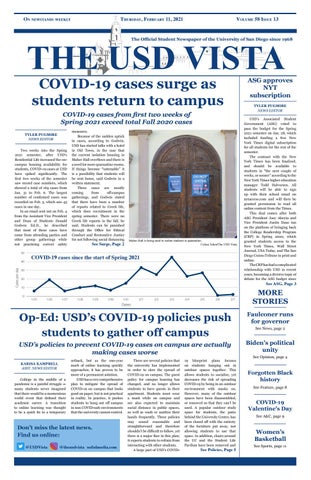
TYLER PUGMIRE NEWS EDITOR Two weeks into the Spring 2021 semester, after USD’s Residential Life increased the oncampus housing availability for students, COVID-19 cases at USD have spiked significantly. The first two weeks of the semester saw record case numbers, which showed a total of 169 cases from Jan. 31 to Feb. 6. The largest number of confirmed cases was recorded on Feb. 3, which saw 45 cases in one day. In an email sent out on Feb. 4 from the Assistant Vice President and Dean of Students Donald Godwin Ed.D., he described that most of these cases have come from attending parties and other group gatherings while not practicing correct safety
measures. Because of the sudden uptick in cases, according to Godwin, USD has started talks with a hotel in Old Town, in the case that the current isolation housing in Maher Hall overflows and there is a need for more quarantine rooms. If things become “untenable” it is a possibility that students will be sent home, said Godwin in a written statement. These cases are mostly coming from off-campus gatherings, and Godwin stated that there have been a number of reports related to Greek life, which does recruitment in the spring semester. There were no Greek life reports in the fall, he said. Students can be punished through the Office for Ethical Conduct and Restorative Justice for not following social distancing
See Surge, Page 2
Maher Hall is being used to isolate students in quarantine. Celina Tebor/The USD Vista
COVID-19 cases since the start of Spring 2021
ASG approves NYT subscription TYLER PUGMIRE NEWS EDITOR
USD’s Associated Student Government (ASG) voted to pass the budget for the Spring 2021 semester on Jan. 28, which included funding a free New York Times digital subscription for all students for the rest of the semester. The contract with the New York Times has been finalized, and should be available to students in “the next couple of weeks, or sooner” according to the New York Times higher education manager Todd Halvorsen. All students will be able to sign up with their school email on nytaccess.com and will then be granted permission to read all online content from the Times. This deal comes after both ASG President Joey Abeyta and Vice President Justin Daus ran on the platform of bringing back the College Readership Program (CRP) in Spring 2020, which granted students access to the New York Times, Wall Street Journal, USA Today, and The San Diego Union-Tribune in print and online. The CRP has had a complicated relationship with USD in recent years, becoming a divisive topic of debate for the ASG budget since
See ASG, Page 3
MORE STORIES
Op-Ed: USD’s COVID-19 policies push students to gather off campus USD’s policies to prevent COVID-19 cases on campus are actually making cases worse KARISA KAMPBELL ASST. NEWS EDITOR College in the middle of a pandemic is a painful struggle — many students never imagined that there would be a momentous world event that defined their academic career. A transition to online learning was thought to be a quick fix to a temporary
setback, but as the one-year mark of online learning quickly approaches, it has proven to be more of a permanent solution. USD has a very comprehensive plan to mitigate the spread of COVID-19 on campus that looks good on paper, but is not practical in reality. In practice, it pushes students to hang out off campus in non COVID-safe environments that the university cannot control.
Don’t miss the latest news. Find us online: @USDVista
@theusdvista uofsdmedia.com
There are several policies that the university has implemented in order to slow the spread of COVID-19 on campus. The guest policy for campus housing has changed, and no longer allows students to have guests in their apartment. Students must wear a mask while on campus and are also expected to maintain social distance in public spaces, as well as wash or sanitize their hands frequently. These policies may sound reasonable and straightforward and therefore shouldn’t be difficult to follow, yet there is a major flaw in this plan; it expects students to refrain from interacting with other students. A large part of USD’s COVID-
19 blueprint plans focuses on students hanging out in outdoor spaces together. This allows students to socialize, yet decreases the risk of spreading COVID-19 by being in an outdoor environment with masks on. However, many of the outdoor spaces have been disassembled, or removed so that they can’t be used. A popular outdoor study space for students, the patio behind the University Center, has been closed off with the entirety of the furniture put away, not allowing students to use that space. In addition, chairs around the UC and the Student Life Pavilion have been removed and
See Policies, Page 5
Faulconer runs for governor See News, page 2
Biden’s political unity See Opinion, page 4
Forgotten Black history See Feature, page 8
COVID-19 Valentine’s Day See A&C, page 9
Women’s Basketball See Sports, page 11
2
The USD Vista
◆
February 11, 2021
NEWS
USD increases housing capacity, sees rise in COVID-19 infections The university has seen 169 cases in one week, the highest number at USD for the entirety of the pandemic Surge from Page 1
guidelines depending on the evidence presented and the student’s response, and can be removed from campus-provided housing if found guilty of violating said guidelines, among other potential penalties. Cynthia Avery, Ph.D., assistant vice president of student affairs, said that the university anticipated a rise in cases due to the increase of students that would be living on campus, but expected it later in the semester. Paired with the new, more contagious strain of the virus, it seems as though an outbreak was bound to happen. Some changes that have come this semester include the removal of many chairs outside of the Student Life Pavilion and
University Center, which were previously accessible for one person per table to eat a meal or study outside. It is still acceptable to eat outside during San Diego County’s purple tier ranking, and students are often found eating on the stairs outside of the SLP, being watched by social distancing enforcers. As cases in the county decrease, ICU rates continue to decline, and vaccinations are distributed, it is unclear how USD will manage campus life if there is not a slow to the current spread. Classes will not return to campus until San Diego County is in the red tier and professors opt to come back to the classroom. Classrooms on USD’s campus have been ready to hold in-person classes since August.
All persons on campus are required to wear a mask at all times.
Tanner Claudio/The USD Vista
Kevin Faulconer announces campaign for California governor Former mayor of San Diego says “It’s time for a California comeback” in new political venture TYLER PUGMIRE NEWS EDITOR Kevin Faulconer reached his six-year term limit as mayor of San Diego in 2020 and has now focused his efforts to be the next governor of California, challenging incumbent Gavin Newsom in either the upcoming 2022 election, or in a recall election that would happen in July. Faulconer is running on the platform that he is not an establishment figure, and is using his former status as the only California Republican to be the mayor of a large city to show that he can bring Democrats across party lines to elect him in 2022. His main criticism of Newsom comes in the form of how the state has responded to the pandemic, and Faulconer has shared that he signed the petition to recall the current governor. The former mayor lists reducing homelessness as his number one priority on his campaign website and has made claims that he is proud of his recent work in San Diego, which was able to house homeless persons when the pandemic began through Operation Shelter
to Home. Faulconer touted that San Diego was the only big city in California to see homelessness rates go down in the past four years. Critics of Faulconer point out that he only prioritized the homelessness crisis after the 2016-2017 Hepatitis A outbreak that wiped through San Diego’s homeless population. Faulconer has also been criticized for losing the Chargers, paying $535,000 per month to a vacant highrise, and not doing enough to help rent control. If Newsom is recalled, Faulconer would be the most notable challenger, even with his Republican party status in the Democrat-heavy state. The Recall Governor Gavin Newsom Committee has received 1.3 million signatures up until this point, but will need 200,000 more before March 17 in order for a recall election to take place. Former Republican gubernatorial candidate John Cox says he would also run against Gov. Newsom if the recall movement receives enough signatures. Joe Biden’s White House team has declared opposition to the Recall of Newsom. The last Republican governor of California was Arnold
Schwarzenegger, who came into office in 2003 after a recall of Gray Davis, who was caught in an electricity scam for the whole state. Ever since, recalls have been used as a threat against anyone in the California governor’s office. Governor Newsom stated at a press conference at Dodger Stadium that his efforts are focused on the pandemic and vaccine distribution, and has not paid too much attention to the
recall effort. On Feb. 9, Gavin Newsom took a trip to Petco Park, one of the mass vaccination sites in San Diego. He was joined by San Diego Mayor Todd Gloria and County Supervisor Nathan Fletcher. Gloria and Fletcher both reinforced the idea that the city will be working in accordance with the state’s leadership in order to get more vaccines distributed in a timely manner.
Faulconer is going to need both Democrats and Independents to lean heavily away from Gavin Newsom if he wants a chance to win. As he has the support of other Republicans across the state and country, whether it will be enough is still up in the air. Recall or not, Faulconer will have a long way to go to reach the top if he wants to gain gubernatorial power in the nation’s most populous state.
Tyler Pugmire/The USD Vista
Volume 58 Issue 13
◆
NEWS
The USD Vista
◆
Where San Diego COVID-19 vaccinations stand
3
San Diego has become a model for how to vaccinate as efficiently as possible
MARIA SIMPSON ASST. NEWS EDITOR Almost one year ago, all of our lives were turned upside down when the COVID-19 pandemic struck in the United States, and our world has not looked the same since. However, scientists’ tireless work to combat the virus has found a vaccine within this short period of time. The COVID-19 vaccine first became available in the U.S. in Dec. 2020, through two companies, Moderna and PfitzerBioNTech. These are the current manufacturers and distributors of the vaccine, but three more vaccines are in clinical trials, soon to be released for distribution. Both of the current vaccines are mRNA vaccines. According to the CDC’s website, these work
by teaching our bodies to create a protein which then triggers the formation of antibodies to fight the protein, creating immunity. It is important to remember that this process can sometimes take a few weeks to occur, so COVID-19 can still be contracted for a little while after getting the vaccine. Because the body is being exposed to a protein similar to COVID-19 when vaccinated, side effects such as fever, aches, or fatigue are possible. However, according to the CDC, these symptoms are normal and they are also a sign that the vaccine is taking effect. Both of the vaccines that are currently available require two doses to become fully effective. The first dose starts to build protection in the body and the second dose boosts that protection to its full capability. According to the trials conducted
on the COVID-19 vaccines, Moderna is 94.1% effective and Pfitzer-BioNTech is 95% effective. Right now, supplies are limited, so the first priorities recommended by the CDC are healthcare workers and at-risk individuals. With this information, all counties have laid out their own plans for how the vaccines will be administered throughout the population. San Diego County is currently in Phase 1B of vaccinations. People at top priority to receive the vaccine now include healthcare workers, long-term care residents, and individuals 65 or older. Anyone can go online or call to check if they are eligible and can sign up to be notified once the state has reached a phase where they can be vaccinated. Phase 1C will include employees in food and agriculture, emergency services,
child care, and education, residents ages 50 to 64 and highrisk individuals such as those with underlying health issues. When California reaches Phase 2, the vaccine will become available to everyone over the age of 16. COVID-19 rates in San Diego are still high and the county remains in the most restrictive purple tier. However, hope is on the horizon. 508,287 doses have already been administered in San Diego County as of Feb. 9, according to California’s COVID19 website. There are several locations throughout the county that are administering the vaccine daily. USD will have a vaccination site on campus as well, and will be following the state’s vaccination phase guidelines. Two of the county’s locations, the Petco Park Vaccination Super Station (which has already administered
100,000 doses) and the RIMAC vaccination site, are both run by UCSD and are asking for volunteers to help run vaccination appointments. Anyone over 18 can volunteer, and volunteers that work at least three shifts will be eligible to receive the vaccine. The Petco site has also been giving out their extra vaccines to people who wait at the site at the end of the day, so no doses are going to waste. As vaccines are administered to more citizens, ICU capacity rates will begin to fall and counties can begin to lessen restrictions on gatherings. However, health care officials are urging that even after being vaccinated, one should continue to distance themselves, wear a mask, and wash their hands so that we stay safe and stay on the fastest route possible to overcome COVID-19.
ASG brings back New York Times subscription for all USD students ASG officially voted to approve the $8,570 budget proposal in order to bring back pared-down College Readership Program ASG from Page 1
most current students have been on campus. Since the beginning of the 2018 school year, there was much discussion about whether or not the then nearly $30,000
program was worth it, including two petitions that revealed that one in three students on campus supported the program. The program was officially defunded in Nov. 2019.
The USD Vista Celina Tebor - Editor in Chief Jennifer Mossuto - Associate Editor Catherine Silvey - Managing Editor Mikaela Foehr- Copy Editor Tori Tanigawa - Art Director Tyler Pugmire - News Editor Alena Botros - Opinion Editor
Now in its return to campus, the pared-down College Readership Program will cost ASG $8,970. This subscription is only available for students, as faculty and staff have not been permitted
access to the New York Times through the CRP. ASG’s budget comes from the $125 student activity fee that every student pays, and they have roughly $1.2 million dollars to spend each year. USD students were without a national news subscription throughout the entirety of the pandemic, and until now there had been no real traction in ASG to fund this program, other than some small pushes by groups of senators. Daus was responsible for bringing the idea of restoring a New York Times subscription to the finance chair for a spring budget vote. Daus said the delay in discussing the revival of the CRP was because of more pressing issues that came about during the summer. For both Daus and Abeyta, their focus was to engage in
Editorial – 619.260.4584 Business – 619.260.4714 www.uofsdmedia.com / @TheUSDVista
Brittany Lang - Feature Editor Gina Lew - Student Media Advisor Taylor DeGuzman - Arts & Culture Editor Marie Minnick - Operations Advisor Eric Boose - Sports Editor Sean Butler - Distribution Manager Regan Ferarri - Social Media Manager Austin Piona - Finance Manager MaryCatherine Smith - Advertising Manager
productive civil discourse in order to reignite the College Readership Program conversations. “The debates that surrounded the College Readership Program (a year ago) were very divisive, there was bias on different sides of the argument and it was very unproductive,” Daus said. “As far as concrete things happened, College Readership Program debates enveloped that entire semester (Fall 2019).” This time around, a simple vote on the yearly budget brought the College Readership Program back to life. Although just a fraction of the wide range of news sources the CRP used to provide, the discourse surrounding this year’s debate seemed to be much more efficient. The long-term future of the CRP is still unknown, but soon enough all students will see the benefits of the program.
The USD Vista publication is written and edited by USD students and funded by revenues generated by advertising and a student fee. Advertising material published is for information purposes only and is not to be construed as an expressed or implied endorsement or verification of such commercial venues by the staff or University. The USD Vista office is located on the fourth floor of the Student Life Pavilion in room 403B. All inquiries should be sent to: The USD Vista 5998 Alcala Park San Diego, CA 92110 Opinions expressed in this publication are not necessarily those of The USD Vista staff, the University of San Diego or of its student body. Letters to the Editor can be submitted to The USD Vista office. Letters should be limited to 300 words and must be signed. For identification purposes, USD identification numbers and writer’s year must be included in the letter. The USD Vista reserves the right to edit published letters. Any content sent to the editor will be considered for publication unless otherwise stated.
“ c o
4
The USD Vista
◆
February 11, 2021
E DI TOR IA L United, we fall
Biden’s America is more divided than ever; fixing that division is not how we fix America JENNY HAN ASST. OPINION EDITOR On Jan. 20, Joe Biden addressed the U.S. for the first time as president. “We must end this uncivil war that pits red against blue, rural versus urban, conservative versus liberal,” Biden said. “We can do this if we open our souls instead of hardening our hearts. If we show a little tolerance and humility.” In some respects, Biden isn’t wrong; the boasted strength of the U.S. is that despite our differences, we are united. And during this undeniably difficult time, his statement is reassuring. However, the reality is that it is unlikely that the U.S. will unite because of its vast differences. Therefore, Biden’s goal for unity is unrealistic and he must choose a side. Biden unquestionably needs to tackle many of the issues that haunted the U.S. in 2020: COVID-19, police brutality, rapid climate change, increased unemployment, and homelessness. The most prevalent, however, is a problem that has existed long before 2020: systemic inequality. I choose to use the words systemic inequality rather than systemic racism because I believe the U.S. doesn’t simply discriminate just based on race; race is a part of
the bigger picture. However, the “two sides’’ of America, particularly the liberals and conservatives, have completely different approaches to the concerns listed above. While some liberals argue for a complete stay-at-home lockdown like New Zealand did, many conservatives don’t even believe that masks work. Some liberals preach ACAB (All Cops Are Bastards) while some conservatives boast that Blue Lives Matter. Many liberals advocate for the Green New Deal, while most conservatives tend to prioritize economic growth over the environment. Some liberals want to increase the minimum wage to $15 and increase taxes, particularly on the one percent, to get more funding to fix community problems; many conservatives believe that increasing minimum wage and taxes are what causes those problems. And finally, many liberals protest tirelessly for marginalized communities. In direct contrast, some conservatives don’t even think that systemic injustice exists; some will go as far as to claim that the majority group is superior to the minorities. Although I acknowledge that I am reducing these groups of people to their most extreme versions, the point still stands. There is no middle
ground between these groups of people who hold fundamentally different core beliefs; Biden either has to take concrete action to solve these issues or maintain the current status quo by doing nothing. And more importantly, trying to achieve the middle ground will ironically make no one happy. Liberals would be furious that Biden is not doing enough while
their opposing partisans. One of Biden’s strengths is his willingness to do so. However, we frankly don’t have the time or the luxury to wait for everyone to reach an agreement; these issues aren’t going to solve themselves. In addition, politicians are unwilling to set aside their political affiliation to vote for anything that is against their party’s favor. Biden is going to
Unity is not going to heal those with COVID-19 or relieve those who are suffering under systemic injustice. In fact, the concept of unity is weaponized as a way of further oppressing minorities. conservatives would be angry that Biden is doing too much about a nonexistent problem. In addition, each side is passionate about their beliefs. If Biden truly wants to change America for the better, he can’t wait for the opposing team to suddenly stop believing what they’ve believed for years. He’s going to have to choose and firmly stick to a side despite pushback. Some might believe that I’m advocating for Biden to completely disregard Republicans and conservatives. I believe that it’s essential for a president to take the time to converse, listen, and understand
have to come up with a brilliant plan that even Republicans can agree on. However, judging Republicans’ responses from Trump’s impeachment to Biden’s COVID-19 plan, it’s unlikely that they would be willing to compromise to make such changes. Unity is not going to heal those with COVID-19 or relieve those who are suffering under systemic injustice. In fact, the concept of unity is weaponized as a way of further oppressing minorities. The most notable example of this is in the ALM, All Lives Matter, movement in opposition to the BLM, Black
Lives Matter, movement. On a surface level, both movements seem to want the same thing: equality. In reality, ALM is uncomfortable with being aware of how the system they, mostly white Americans, created is exploitative so they blanket it over with a “We’re all human!” rather than address it. The majority’s version of unity is a codified form of maintaining the current inequalities that convenience them. Compromise and unity can only be truly achieved when everyone at the table is treated and acknowledged as equals. Otherwise, unity is weaponized as a way to silence the minority for breaking a “pact” that never existed in the first place. Biden can preach and go pursue the concept of unity after minorities aren’t treated lesser than. Until then, attempting to unify the country is performative at best and exploitative at worst. All in all, Biden is correct when he states that “to overcome these challenges – to restore the soul and to secure the future of America – requires more than words.” However, “Bringing America together/ Uniting our people/ And uniting our nation” is not the answer. President Biden needs to pick a side, and unapologetically pursue it. That is what will secure the future of America.
You cannot move on from the insurrection AOC’s recount of the U.S. Capitol mob and her sexual assault details the impact of trauma WHITNEY LYNN CONTRIBUTOR Congresswoman Alexandria Ocasio-Cortez has been known to ruffle a few feathers — as all smart, determined women tend to do. Last week she shared on a live stream that she is a survivor of sexual assault. No one should be surprised that AOC chose to share this personal piece of her life. Her progressive, unfiltered reputation is well known. She explained how trauma compounds itself. Every incident piles on top of the other. The mob attack on the U.S. Capitol brought to the surface the same harrowing feelings she went through when her body was attacked. While Republicans were quick to say that the mob attack was simply a protest of election fraud gone incredibly wrong, I disagree. The
mob attack on the Capitol was an attack on every person in that building, and democracy itself. I do not care what political party you subscribe to. If you were not outraged watching the coverage on Jan. 6, it is time to realize that you are part of the problem. In 2019, there was a Facebook group chat of border patrol agents discovered that frequently spoke of AOC in derogatory, xenophobic, and misogynistic ways. There were edited images and jokes in the chat making up scenarios about raping a sitting congresswoman. About 9,500 agents were in this group chat depicting her rape. These agents are in control of migrant lives, and they found this funny? In July 2020, Representative Ted Yoho from Florida accosted AOC on the steps of the Capitol. “(He) put his finger in my face, he called me disgusting, he
called me crazy, he called me out of my mind and he called me dangerous,” AOC recounted in a viral speech to the House of Representatives. He then went on to call her “a f-cking b-tch’’ in front of a crowd of reporters. AOC stood up for herself and women across the country in refuting Yoho’s apology. “Representative Yoho decided to come to the floor of the House of Representatives and make excuses for his behavior, and that I could not let go. I could not allow my nieces, I could not allow the little girls that I go home to, I could not allow victims of verbal abuse and worse to see that, to see that excuse and to see our Congress accept it as legitimate and accept it as an apology and to accept silence as a form of acceptance,” AOC said. Enough is enough. We must hold public officials and officers
to a higher standard than this. It’s disgusting and disgraceful. On Jan. 6, 2021, the U.S. Capitol was attacked by a mob of Trump supporters who purported claims of election fraud. Five people died as a result of the attack. We were all glued to Twitter and news coverage of the insurrection. Pipe bombs were discovered around the Capitol. The public has seen the photos of a man sitting with his feet up on House Speaker Nancy Pelosi’s desk and a man in an animal costume on the House floor. We saw the chaos and destruction, but we hadn’t heard personal stories. On Monday, Feb. 1, AOC went on Instagram live stream and gave a candid, emotional recount of her experience during the insurrection. The live stream was about 90 minutes long. “I thought I was going to die,” AOC said.
She spoke about being in her office, when there was banging on her door. She says no one identified themselves. Her legislative director instructed her to hide, so she ran to her office’s bathroom. The person trying to get in made it through, and he was screaming “where is she?” according to AOC. She hid behind the door to her bathroom, fearing for her life. “This is the moment where I thought everything was over … I had a lot of thoughts. You have a lot of thoughts, I think, in a situation like that … I really just felt like if this is the plan for me then people will be able to take it from here … I felt that if this was the journey that my life was taking that I felt that things were going to be okay and that I had fulfilled my purpose,” AOC said, while wiping away tears. The
Con’t on Page 5
The views expressed in the editorial and op-ed sections are not necessarily those of The USD Vista staff, the University of San Diego, or its student body.
Volume 58 Issue 13
From from Page 4 man who broke in turned out to be a Capitol police officer, who failed to identify himself as such. AOC, along with other non-white Americans, aren’t put at ease by the presence of law enforcement. The rest of the day AOC describes as operating on adrenaline. She fled to another building and sheltered with Congresswoman Katie Porter. AOC was incredibly vulnerable during this live stream, which is something that
◆
OPINION
◆
5
The USD Vista
E DI TOR IA L the public doesn’t normally see from officials. “The reason I say this and the reason I’m getting emotional in this moment is because these folks who tell us to move on, that it’s not a big deal, that we should forget what’s happened, or even telling us to apologize. These are the same tactics of abusers. And I’m a survivor of sexual assault. And I haven’t told many people that in my life. But when we go through trauma, trauma compounds on each other,” AOC said. She has had plenty of trauma during her
tenure as a member of Congress, and now opened up sharing she is a survivor of sexual assault. “One reason I’ve hesitated to tell this story has to do with some of that trauma. As a survivor, I struggle with the idea of being believed,” AOC said. We’ve seen it with Anita Hill, Christine Blasey Ford, and countless other women. AOC’s fear wasn’t irrational. Days after her emotional testimony of her experience during the insurrection, ‘AOC lied’ and ‘Alexandria Ocasio-
Cortez Smollet’ were trending on Twitter. ‘Alexandria OcasioCortez Smollet’ is in reference to Jussie Smollet, an actor who allegedly staged a hate crime against himself. We live in a white supremacist and patriarchal society that fears strong intelligent women, specifically women of color. This cycle of silencing women and minimizing their trauma is nothing new. So, when AOC calls on Ted Cruz and Josh Hawley to resign for their part in stoking the insurrection, they do the only
thing they know how to do. They call her a liar. They discredit her. They say she wants attention. As AOC put it, these are the “tactics of abusers.” This disgusting response to a woman’s truth shows we have not made as much progress as one would hope. We, must do better. When a survivor is brave enough to come forward with their story, the public has an obligation to accept how the experience made them feel. So no, I will not “move on” from the insurrection, and neither should you.
USD must modify COVID-19 policies
The university’s policies create unrealistic expectations for students living on campus Policies from Page 1 tables pushed together so that they cannot be used. This leaves dorm rooms as one of the only options where students can eat meals. And if students are expected to eat in their rooms, there is also the expectation that students are eating alone, as some students do not have suitemates. Outdoor dining is now allowed again in San Diego County, so the removal of chairs in these spaces is unreasonable on the university’s part. Actions like these are forcing students to choose between interacting with other students or following the rules, and it’s pretty clear which of the two most college students will choose. By taking chairs and outdoor spaces away, students are then just further encouraged to go to other students’ rooms or off campus to eat dinner or study, which increases the risk of not being COVID-19 safe. Additionally, an important note to make is that last semester when these outdoor spaces were available for students to use, the number of COVID-19 cases on campus were drastically reduced in comparison to the surge that USD is experiencing now. As of Nov. 3, when USD had roughly 600 students on campus, only 16 residential cases were reported for the entirety of the fall semester. Now, with over 1,000 students, 141 residential student cases were reported after the first two weeks of testing alone. While it can’t be said for certain that the lack of these outdoor spaces is the reason for the surge, these spaces allowed for students to hang out in safer ways. Without these spaces, students don’t have opportunities to hang out safely on campus, pushing students off campus to hangout. The university’s COVID-19 policies and actions make it impossible for students to hang out with each other in a way that doesn’t break the rules and is COVID-19 safe. Students feel
pressured by these policies to go off campus. In some ways, it appears that USD favors this “out of sight, out of mind” mentality when it comes to students hanging out, but this mentality proves to be more dangerous. USD has no control of what students choose to do off campus. Yet by not providing students with safe opportunities to hang out on campus, it’s pushing students who may not be inclined otherwise to go to parties or bonfires to do so anyways, as they feel it is the only option to socialize with their peers. The university encouraged more students to come on campus for the spring semester but are now not providing these students with the proper resources to interact with each other safely. Now, USD is panicking and blaming students for the COVID-19 surge on campus. If the university was truly prepared to almost double the amount of students that are living on campus, they would have created efficient plans and opportunities for students to socialize. The solution to these surges is to not take away all available places for students to interact with each other on campus because students will just go elsewhere to do so. As part of a brand new initiative, USD has launched the “Core Connect” program to help promote safely making connections with other students. It outlines different rules for gatherings based on the different county tiers. In the purple tier, San Diego County’s current and most restrictive tier, a social bubble of no more than four people is being encouraged. This program may seem promising, yet the following day on Feb. 4, Assistant Vice President and Dean of Students Donald Godwin sent an email to the student body directly contradicting what was said about small group interactions in the previous email.
USD’s lack of outdoor spaces may be causing students to find off-campus activities that result in an increase of COVID-19 cases. Tanner Claudio/The USD Vista
In regards to the surge of on campus cases from this last weekend of testing, Goodwin’s email emphasizes USD’s COVID-19 protocols, and completely ignores the “Core Connect” initiative saying in bolded capital letters, “NO GROUP GATHERINGS.” Whether or not students are able to hang out in a group of four people that was outlined very clearly in an email sent the day before is now unclear. With these contradicting emails and information, it is impossible for students to understand the rules on social gatherings, therefore follow them. If the university expects students to follow its COVID-19 policies, they must become more diligent, clear, and precise on the information that they are giving to us. The idea that the best way to protect students from COVID-19 and stop its spread is by not hanging out at all is flawed in the same way that saying
abstinence is the best way at preventing STDs and pregnancy — it works, but for a lot of people it’s unrealistic. The best way to prevent pregnancy and STDs is by educating students and providing them with the resources they need to be safe and successful. The same approach should be applied to COVID-19 policies. Students are going to hang out regardless of what USD’s COVID-19 policy says, but wouldn’t the university rather know that students are doing it safely? The lounges that remain closed in residence halls could be a perfect solution to encourage students to hang out on campus safely. Just as Copley Library operates, these spaces could be used on a reservation basis only, requiring students to mask up and sit six feet away from other students. The number of students allowed in the room could change as
San Diego County moves into different tiers. Opening lounges in residence halls would give students spaces to watch movies, play board games, or socialize with others in a space on campus. They would allow for COVID-19 safe interactions that the university has control over. If USD were to modify its COVID-19 policies, re-establish outdoor facilities such as tables and chairs on campus, and provide specific spaces for students to hang out while still following the university’s COVID-19 policies, there may be a decrease in coronavirus cases on campus. Fewer students would feel the need to go off campus to socialize in an unsafe manner. The university would be able to control these social interactions in a way that they are not able to do so now, and ensure that safe COVID-19 practices are being implemented and followed by the students.
The views expressed in the editorial and op-ed sections are not necessarily those of The USD Vista staff, the University of San Diego, or its student body.
6
The USD Vista
◆
February 11, 2021
At the Intersection of Body Positivity and Social Media Social media apps like Instagram and TikTok can be positivity by granting individuals the ability to share the click of a button. They can be used as a platform as help individuals embrace the parts of themselves
powerful tools in the promotion of body their self-love journey to the world with to promote and celebrate diversity, as well that society told them they should hide.
Public figures like Lizzo can be credited for continuously creating content that promotes confidence, acceptance, and that one’s health and self worth is not determined by their physical appearance. By showing off the most vulnerable parts of themselves, influencers are advancing the idea that no one particular body type is more beautiful than another. Equally as important, when people see other users loving aspects of their own bodies that they personally struggle with, it creates a virtual community of individuals who feed off of each other’s positivity and self love. Despite all the good that can result from social media, trying to completely dismantle societal beauty standards in our own minds is often a lifelong and onerous process. Social media has other sides to it that even if they began with good intentions, have led to a few steps in the wrong direction in the body positivity movement. On TikTok for example, videos titled “what I eat in a day” or “my daily workout routine” might be inspiring to some users, but to others they can trigger guilt and create a toxic environment of comparison. When discussing the nuanced relationship students at USD have with the intersection of body image and social media, this is what they had to say: “On the one hand, Instagram has made me feel envious of people’s hair and skin colors as well as how thin or easy they can fit into clothes. Not having to readjust your outfit or feel conscious when you eat can be a big thing — and it’s something I’ve experienced as my weight has fluctuated up and down.” -Simaran Chauhan, senior
Volume 58 Issue 13
◆
FEATURE
◆
The USD Vista
“Society makes girls and women feel a need to be in competition for this ‘perfect body’ and that the way to attain it is through extreme dieting and dangerous habits. But that ‘perfect body’ changes with trends, making us incapable of ever achieving it… we need to normalize not commenting on people’s food choices, appearance, weight, and demand representation in the media.” -Miranda Gonzalez, junior
“At the beginning of quarantine everyone wanted to ‘level themselves up’ when the pandemic started and people were pushing the narrative to not waste this idle time. However, it’s important to focus on mental health and not just physical health.” -Ashley Raines, senior
One thing that many students agreed on was the fact that social media offers us a choice to follow the pages that preach the right kind of messages, and that to a large degree we are in control of the content we expose ourselves to. This means that once we learn what is not promoting a healthy and productive way of thinking within ourselves, we can try our best to filter out the content that triggers those negative responses.
All photos courtesy of @/bopolena on Instagram
Most importantly, students commented on the fact that social media has taught them to challenge the status quo and question why “ideal” body types exist in the first place. This has led many to discourage promoting idealized beauty standards and instead push for continuous acceptance and kindness, and despite the differences in our physical appearances, to always be gentle with one another.
7
8
The USD Vista
◆
February 11, 2021
ART S & FEATURE
Hidden figures of Black history Bayard Rustin, civil rights activist and advisor to Martin Luther King Jr., is a Black leader often left out of history DOMINIC URQUIDEZ ASST. FEATURE EDITOR Martin Luther King Jr., Rosa Parks, Malcolm X. These are some of the names people often remember during Black History Month. Though they are very important figures to recognize and celebrate, there are many other Black individuals who have not been highlighted in the media and are often left out of our history textbooks. Black History Month started in 1915 when famed historians Carter G. Woodson and Jesse E. Moorland aimed to promote the achievements of Black Americans. What started off as only a week grew to a monthlong observance as schools, cities, and states started to recognize the importance of Black history. In 1976, President Gerald Ford officially acknowledged Black History Month. Now, it is an annual celebration meant to recognize the contributions of AfricanAmericans in U.S. history. Each year, there is a theme for the month of February. For 2021, the theme is “Black Family: Representation, Identity and Diversity,” which explores the spread of Black families across America as well as the African Diaspora. The month of February not only recognizes the advancements made thus far, but also the work that still needs to be done to create a more equitable society is a continuous fight. The Washington Memorial reflects onto the calm waters of the National Mall in Washington D.C. Thousands of Black and white Americans awaited Dr. King Jr. to make his soon-tobe iconic “I Have A Dream” speech. People gathered under the blistering sun to protest an unjust society and government. Unbeknownst to many, this
iconic protest, over 200,000 strong, was made possible by the efforts of a tall, queer Black man, Bayard Rustin. He not only put together this protest, named the March on Washington, but was also an advisor to Dr. King Jr. himself. Assistant Professor of History Channon Miller, Ph.D. said that Rustin’s history of activism started before the march. His ability to strategize, make connections across state lines, and elicit a common message helped bring the protest to such a large scale. “Everyday people play such a central role in spreading the word and cultivating a movement, but it has to be a movement that you believe in,” Miller said. “So I do believe that Bayard Rusitn played a critical role in creating an agenda or a concept people could believe in and get behind.” Rustin was born on March 17, 1912, in West Chester, Philadelphia. The legacy he would create for himself would be one of intellect, pacifism, and organization. His peaceful roots started at a young age, as he came from a family of Quakers and his grandmother was a member of the National Association for the Advancement of Colored People (NAACP). Many leaders of the Black community such as W.E.B. Du Bois visited his home frequently. Rustin attended college at Wilberforce University, Cheyney State Teachers College, and City College of New York. It was in college where Rustin joined the Young Communist League (YCL), as he believed in their commitment toward racial justice. However, when they switched their focus away from civil rights, he left the organization. After YCL, he helped coordinate workshops on non-violent actions, joined the Fellowship of Reconciliation (FOR), and co-founded the Congress of Racial Equality
(CORE). Rustin became King’s advisor during the Montgomery bus boycott where African-American participants organized together and refused to ride city buses in order to protest segregated seating. Rustin’s story was not a simple one. Throughout his years of activism, he had many run-ins with the law. Since he did not believe in the need for war, he objected to the World War II draft. For this reason, he was imprisoned for over two years. In 1947, he and other CORE members were arrested for challenging segregation in interstate travel in what became known as the Journey of Reconciliation. This protest served as the basis for the Freedom Riders in 1961. After he was arrested, he was sentenced to be part of a chain gang where his details of the matter were published in several newspapers. Then in 1953, his sexuality became a public matter. He was arrested on a morals charge for having sexual relations with men in public settings. Ten years later, when he was asked to put together the March on Washington, many civil rights activists challenged the nomination because of his sexuality. For this reason, it was encouraged that he play more of a behind the scenes role. “When you are planning and cultivating a movement, a lot of its leaders, including Martin Luther King, were very interested in conveying an image that fit a more respectable image,” Miller stated. “...and respectable meant heterosexual… it meant to represent a certain class politics and Bayard Rustin fell outside of what was deemed respectable.” Rustin was ridiculed for being gay, for choosing not to join the draft, and for being a Communist. Despite the mockery, he organized one of the largest protests known to the country at the time. The people
Rustin was instrumental in the Civil Rights Movement, but his name is often forgotten. Photo courtesy of pingnews.com/flickr
that believed in Rustin and his fight toward racial equality, who worked with him on the ground, gathered in front of the Lincoln Memorial to protest for equal justice under the law. Rustin is one of the many Civil Rights leaders that have been undervalued in their contribution to history. He was Martin Luther King Jr.’s righthand man and helped organize several influential protests. His intersectional identity as a gay Black man was critiqued by many, but that did not stop him from his mission to challenge segregation and the status quo. Rustin spent his final years as the president and co-chair of A. Philip Randolph Institute. He died in 1987 in New York. Bayard Rustin’s legacy is one to be remembered and celebrated. His contributions toward the fight for equal treatment under the law are monumental. He,
Bayard Rustin organized the famous March on Washington, but rarely gets credit for his work due to his sexuality. He served as an advisor to Martin Luther King, Jr.
along with other undervalued activists, should be honored not only during the month of February, but every day. “I want students to really understand that Black history is broad and vast,” Miller said. “That it includes the names and faces that we knew, that we see circulated and publicized, but also know that there are hundreds of thousands of other movers and shakers who played a critical role in trying to sustain Black lives in the United States and try to promote the well-being of Black people in the midst of white supremacy.” Honoring Black History Month is to research and recognize the contributions of the many activists who have fought to create a more equal and equitable society. One cannot study American history without learning about Black history — the two are intertwined.
Photo courtesy of the Library of Congress
Volume 58 Issue 13
◆
ARTS & CULTURE
◆
The USD Vista
A RT S & C U LT U R E
9
The perfect (COVID-friendly) Valentine’s Day in San Diego
When love and COVID-19 are in the air, there are many ways to celebrate in a fun, safe way TAYLOR DEGUZMAN ARTS & CULTURE EDITOR Love is in the air, and unfortunately so is the coronavirus. Though it’s been over a year since COVID-19 crept into the U.S. and “quarantine” became a frequent topic of conversation, nothing has stopped people from crushing on someone over Zoom, going on dates with strangers, and even finding love. While some dread this overly pink and red, flowerfilled day, many can’t wait to get dressed up, eat more Lindor truffles than necessary, and spend the day showing someone how much they love them. However, Valentine’s Day isn’t just for taken people, and anyone can celebrate this day by showering themselves in self-love and retail therapy. With masks on, hungry stomachs, and even hungrier hearts, San Diegans can enjoy the perfect, lovefilled Valentine’s Day in the most COVID-friendly way. “Let’s start the day off with breakfast in Hillcrest!” Great Maple, 1451 Washington St, San Diego, CA 92103 Maple bacon donuts and Fruity Pebble silver dollar pancakes sound like a dream come true. Good thing at Great Maple in Hillcrest, dreams do come true. An Instagrammer foodie’s paradise, Great Maple serves a diverse menu of comfort food dishes that photograph incredibly well and taste even better. Other delicious breakfast choices include
Johnny’s Lolliwaffles, which described on their menu are “Three Waffles on a Stick with Salted Caramel, Lemon Custard, Raspberry Coulis & Whipped Cream,” Pigs in a Blanket, Peanut Butter and Fried Banana silver dollar pancakes and Chocolate Bacon pancakes. Great Maple has outdoor dining and masks are required prior to seating. There is a small lot for parking, but a lot of Great Maple-goers find available street parking. However, some recommend bringing walking shoes, because parking might not be the easiest to find on busy days, especially on Valentine’s Day. Because Valentine’s Day is typically a busy day for breakfast and brunch restaurants, make a reservation before heading to Great Maple to ensure that a maple bacon donut has your name on it. “Let’s cut into a cake with wine glasses and make a charcuterie board” Mission Bay Park 2688 E Mission Bay Dr, San Diego, CA 92109 Aesthetic picnics that match the free-spirited energy of SZA’s “Good Days” are taking over TikTok. Several TikToks incorporate short clips of each and every snack item on the picnic menu, and with music in the background and a few added effects, users make Goldfish and CheezIts look like they’re the most magnificent treats on the planet. The most mesmerizing part of these TikToks is when the people dig into a fully frosted cake with wine glasses, using the glasses as a cup to eat the cake. Friend groups can only hope of making a picnic worthy
Great Maple’s customer favorites, maple bacon donuts and Fruity Pebble silver dollar pancakes.
of TikTok material. A TikTokworthy picnic would have to include a charcuterie board donned with crackers of every kind, only the best of cheeses, prosciutto and pastrami, lots of fruits, and of course, jam. After getting a dry throat from all those crackers, bring a pack of Trader Joe’s Sparkling Strawberry Juice or any drink of choice, preferably milk tea boba. Everyone is usually still hungry after feasting on an entire charcuterie board, so save some room for the special, Valentine’s Day heart-shaped box of Chickfil-A chicken nuggets with a ton of Chick-fil-A sauce. For sweets, buy some cherry danishes and almond croissants from a local bakery, and don’t forget to buy some of your friends’ or significant other’s favorite candies and chocolates. Last, and most importantly, a TikTok picnic is not complete without a beautifully decorated, frosted heart-shaped cake, big enough to stick a wine glass into and enjoy from the glass. The cherry on top is a view that rivals the picture-perfect picnic.
Mission Bay in San Diego boasts a beautiful sunset. Mission Bay Park is the perfect place to enjoy a picnic with friends or lovers.
Mission Bay Park is the spot to enjoy a picnic with great company and incredible views. The wide space allows for enough social distance from other people. Unlike other San Diego parks that are now packed with individuals trying to replicate TikTok picnics, Mission Bay Park is the perfect inbetween for doing a little people watching of bikers, dog walkers, and joggers, and feeling like the environment is safe enough to lounge and relax without invading other people’s space. There is lots of space for parking, so no need to stress about finding a spot. The only necessities are good food, great lighting (San Diego has it covered), and incredible people to share the perfect picnic with. Oh, and don’t forget the wine glasses and lots of hand sanitizer. “Let’s get dinner with a view...you’re my best view” Brigantine Seafood and Oyster Bar at Portside Pier 1360 North Harbor Dr, San Diego, CA 92101
Photo courtesy of moonjazz/flickr
Photo courtesy of Great Maple
After a full day of food, it’s important to end the day on a high note with even more food. Before sunset, grab a jacket, put on that fancy outfit, and get ready to indulge in some San Diego-style surf and turf while taking in the beautiful view of San Diego’s bay. Before dinner and before the sun finally sets, head on up to the second floor for a full panoramic view of San Diego Bay and take a picture to capture a beautiful memory and another iconic San Diego sunset. Located on Downtown San Diego’s waterfront, Brigantine Seafood and Oyster Bar is one of the delicious dinner options located at Portside Pier — entirely constructed on an “overwater platform,” according to Portside Pier’s page. Among Brigantine Seafood and Oyster Bar, people can choose from Miguel’s Cocina, Ketch Grill & Tap, or Portside Coffee and Gelato for dessert. Brigantine’s menu is full of diverse selections, from Golden Ale-Batter Cod Fish & Chips to Macadamia Crusted Mahi and Lobster Tempura Tacos. One of their most popular dishes, the Wok-Charred Ahi, is described on their menu as “seared sushi-grade tuna, wok-tossed vegetables, wonton crisps, jasmine rice & wasabi-shoyu sauce.” Dinner options range from $21 to $50, so be prepared to splurge on this dinner. Valentine’s Day only happens once a year! But maybe after trying Brigantine’s food, Valentine’s Day will be a monthly celebration. With plenty of outdoor dining and masks required, Brigantine Seafood and Oyster is the perfect option for a socially-distanced dinner with a stunning view. Setting aside time to find parking in this area is recommended.
10
The USD Vista
◆
February 11, 2021
Best and worst dates of USD Students reflect on their own unforgettable best and worst dates ANNA VALAIK ASST. A&C EDITOR With Valentine’s Day right around the corner, many people have love on their minds, whether they like it or not. In the age of dating apps, Instagram DMs, and Snapchat etiquette, the dating scene is shifting toward an online focus, which can be both a good and bad thing. Rather than official, pre-planned dates, people are having their initial introductions on their devices. When a relationship exists almost entirely over one’s phone, there is no more worrying about lettuce in their teeth or seeing friends out in public on a date, which is a relief for many. At the same time, this means no more dreamy picnics at Sunset Cliffs or adventurous hikes at Torrey Pines with a possible love interest. In the wake of COVID-19, people are unable to gather and have in-person interactions in hopes of meeting a partner. This is why The USD Vista wanted to throw it back this Valentine’s Day and highlight
are a little nervous because it shows they care about the date and want to impress you.” Brotherton also mentioned the importance of feeling confident in herself during a date. “When I feel my best, I automatically feel like the date will be ten times better,” Brotherton said. “Also, when the guy is dressed as nice as me, I feel like it shows we are both taking the date seriously and want to put our best foot forward.” Brotherton shared some of the red flags she looks out for. “I hate when someone just talks about themselves. I’m sorry, but I don’t care that you tore your ACL in high school and that’s why you don’t play college football,” Brotherton said. Brotherton described her worst date, which happened back in high school in Colorado. “A high school boyfriend took me to dinner after one of his basketball games. First, we went to Chick-fil-A and when we went through the drive-thru, he asked for two separate orders,” Brotherton said. “After we ate, he decided he was still hungry, and he
“The best date I’ve ever had was a day trip with my boyfriend to Los Angeles. We planned it all the night before,” Brotherton said. “We woke up around 5 a.m., and caught the 8 a.m. flight. We hit up my favorite coffee shop on Abbot Kinney, Intelligentsia.” Brotherton and her date went on to enjoy some of L.A.’s greatest offerings. “We then walked on Venice Beach, listened to the music on the boardwalk, and held hands all the while. He was a sweetheart, and it was fun going to a new place together and listening to him talk about what stood out to him the most.” Luke Bradley, a USD junior from Hawai’i, knew exactly what set apart a good date from a bad date. “A good date requires a few key ingredients: an open attitude, a lack of expectations, and a fun way to get to know each other. A bad date comes from one of two things: either a lack of connection or dishonesty from one party,” Bradley said “The worst date I ever went on was at Raising Cane’s in Honolulu. I’m pretty sure she just wanted a free meal and a ride
Even during COVID, young adults have still found ways to go on dates. Photo courtesy of Unsplash
Raising Cane’s, among other fast food restaurants, is a popular place for friends, or couples, to grab dinner. Photo courtesy of Unsplash
the special moments that come out of good dates and the funny stories we gather from the not so good ones. Sophomore Lulu Brotherton explained a few key things she looks for in a good date. “I think it’s really important to feel comfortable with the other person. The conversation
drove to Noodles and Company.” If Brotherton didn’t think the date could get any worse, she was wrong.“He was still in his basketball warmup suit, so he decided to change into jeans in the middle of the parking lot. He was literally standing in his boxers with people walking by. Thankfully, Brotherton
home. We never talked again.” On the flipside, Bradley shared his positive dating history. “The best first date I went on was with my current girlfriend. We got coffee and went to the beach and just had an overall good time,” Bradley said. “If I could plan my ideal date with her, I would pick her up with
“The worst date I ever went on was at Raising Cane’s in Honolulu. I’m pretty sure she just wanted a free meal and a ride home. We never talked again.” - Luke Bradley should flow naturally,” Brotherton said. “On the other hand, though, I like when they
has since gone on to bigger and better dates, even flying to a new state during one.
some flowers, take her skydiving, and still make it for our dinner reservation at Juniper and Ivy.”
Lastly, USD junior Fallon Judy had some great advice on how to approach a date. “If people went into dates just being themselves and not trying to prove anything, I think everyone would benefit,” Judy said. “Maybe have a go-to question or something to break the ice.” In high school, however, Judy endured a pretty rough date with someone she met on Instagram. “We planned to meet for boba, which in my opinion is a casual date that doesn’t have to be longer than it needs to be in case it’s bad — lucky me,” Judy said. “He was a little shorter than I expected but was kind, so we proceeded inside where he offered to buy my drink.” Things took a turn for the worse when Judy’s date admitted the real reason he was so nervous during the date. “After getting small talk out of the way, he began to tell me how his nervousness from this date, which seemed cute, was actually just his body reacting to some under-the-table, black market, creatine preworkout powder,” Judy said. “He said he was ‘tweaking’ out from it and was starting to twitch.” Immediately, Judy was taken aback, and the flow of their date completely changed.
“After he mentioned that, he would address it anytime the conversation topics would shift making me feel like maybe he needed to leave. However, Judy has had many special dates since, and even has a clear idea of what her ideal date would be. “My dream date has no specific location,” Judy said. “It could even be the car ride to wherever we are going (there or back), but it would have to consist of exchanging favorite songs, making jokes, and good conversation flow where we both are actually learning something about each other and feeding off of each other’s energy.” Judy really doesn’t expect or want anything crazy from her date. “I think if anything, the cherry on the top would be ice cream at some point during the date,” Judy said. “Otherwise, all I need is some good laughs and an opportunity to hear about the other person’s passions because usually that’s how you get to know someone.”If it isn’t obvious already, dating has its ups and downs. What comes with these experiences are incredible memories, funny stories, and most importantly, lifelong lessons in that very special thing we like to call love.
Volume 58 Issue 13
◆
SPORTS
◆
11
The USD Vista
SP ORT S
Defense guides USD to win versus LMU Toreros hold Lions under 30% shooting, force 26 turnovers in 51-43 victory
ERIC BOOSE SPORTS EDITOR The University of San Diego women’s basketball team’s characteristically strong defense meant that an 18-point fourth quarter was enough to get the hosts over the line against the visiting Loyola Marymount University in Thursday’s lowscoring contest. Neither team made more than a third of their shots and, after trailing 19-18 at halftime, the Toreros mustered more offense than the Lions could in the second half to earn the win. USD, who leads the West Coast Conference in steals (187), steals per game (14.38), and turnover margin (+7.23), racked up 16 steals and forced 10 additional turnovers, but could not score enough to ever pull too far away from LMU. San Diego’s largest lead of the game, 10 points, came well into the fourth quarter, as their shooters had finally found some rhythm. The Toreros won the tip to start the game and started the first quarter well, hitting an early shot and stifling LMU. It took over three minutes for the Lions to get on the board and over five to make their first field goal, but USD’s missed shots and fouls let the visitors finish the quarter up 13-10. The second quarter was more of the same for San Diego. They played tenacious defense, frequently unleashing a fullcourt press to contain LMU’s offense and force turnovers. But the Toreros still missed plenty of shots, including all four of their free throws in the quarter, and a wide-open three
at the buzzer. Having made only a quarter of their shots in the first half, redshirt senior guard Jordyn Edwards explained how hard it was for the team to avoid frustration and stay focused. “Sometimes I do get a bit frustrated, but my teammates are really good at picking me up,” Edwards said. “Whenever we see someone down or frustrated we try to pick each other up.”
said. “It will come, because I see it in practice every day … Any time that you’re confident that you have good offensive rebounders, it gives you the confidence to shoot the ball, so it will continue to get better.” And in the second half, it did get better. San Diego shot 37.5% from the field in the third quarter, and 42.86% in the fourth, taking the lead and
(Pace) had a couple nice pullup jumpers, Kendall (Bird) had some good attacks, that nice high-low with Laura (Erikstrup), I thought we just had more opportunities to get nice shots in the paint, and I thought they worked really hard for those.” “In the beginning of the game I was a little timid, I think I was a little more passive,” Edwards said. “I was getting to the rim
Jordyn Edwards was a key part of USD’s offensive surge, scoring and assisting 15 of the team’s 38 second-half points. Photo courtesy of Tom Christensen/USD Athletics
Despite their rough first half on Thursday, head coach Cindy Fisher stood by her team’s shooting, saying that it comes down to confidence. “You know, shooters are just rhythm, they could come out on Saturday and shoot at 45, 50%, so I think it’s just continuing allowing them to shoot, making sure they are comfortable shooting, giving them the confidence to shoot it, and continuing to work hard,” Fisher
slowly building it until the game was just out of the Lions’ (who improved on their first-half shooting as well) reach. Fisher and Edwards agreed that the Toreros’ scoring came from a more aggressive offense, attacking the paint more frequently. “I thought all of them did a really good job, especially Jordyn, getting inside the paint and getting a couple of those floaters,” Fisher said. “Myah
and to the middle of the key but I was just more passive, and then my coaches just told me I need to be more aggressive. Once I did that, just changed my mindset, I was able to still get into the key and make those little floaters.” Edwards, despite scoring only two points in the first half, finished with a game-high 13, plus nine rebounds, five assists, and five steals, all team highs. However, as good as USD’s defense was, and even though
their second-half offense got the Toreros to a win, there was still room for improvement for Fisher’s team, especially with two games in the following four days, including a rematch with LMU in Los Angeles. Three-point shooting was at the top of Fisher’s list of improvements to make after San Diego’s 0-9 performance beyond the arc on Thursday, as were limiting fouls (USD committed 16) and second-chance opportunities. LMU pulled down seven offensive rebounds in the first half, which Fisher called “not normal.” San Diego blew out the Pepperdine Waves in a 70-45 home win on Saturday, but the real test was Monday’s game in LA. Fisher’s team allowed only six offensive rebounds over the entire game in Los Angeles on Monday, giving up only three second-chance points in their 74-64 win over the Lions. San Diego’s three-point shooting improved as well. The Toreros drained five of their 13 shots from beyond the arc, with guard Steph Gorman leading the way with four. Gorman added seven steals as the San Diego defense stayed aggressive, forcing a total of 17 turnovers. At the time of printing, the Toreros are scheduled to begin a three-game road trip today, Feb. 11, against St. Mary’s before returning home on Feb. 18 against the Portland Pilots in a rematch of last year’s WCC Tournament championship game, which the Pilots won in last-second fashion in overtime. Today’s game against the Gaels in Moraga is scheduled to tip off at 6:30 p.m.
Toreros take down Mustangs USD men’s tennis team defeats Cal Poly 6-1 in season opener
MARIA WATTERS ASST. SPORTS EDITOR After nearly a year away from the courts, the University of San Diego men’s tennis team returned to action at home on Friday against the Cal Poly Mustangs. The best-of-seven contest began with three highly competitive doubles matches for the incredibly important first overall point. After one set of very close competition, the Toreros were able to beat the Mustangs on two of the three courts, giving them a 1-0 advantage going into the singles matches. The six matches
would decide the winner of the matchup, with USD needing to win on three courts, and Cal Poly needing to win on four. When the dust settled, the Toreros were declared the winners, yielding only a single loss out of the six, resulting in an impressive 6-1 victory. In the ten months since Torero fans have seen their sixtime WCC champions compete, the men’s tennis team has experienced some changes. The Toreros will be competing at the newly renovated Skip and Cindy Hogan Tennis Center for the first time since its completion just weeks earlier. A new season also means a new lineup of players eager to carry on the
legacy of the six championship teams that came before them. These new additions to the roster include first years Blake Kasday from Las Vegas, Nev. and Ilias Zimmerman from Zürich, Switzerland. The time away from competition was a significant factor in the preparation for Friday’s match according to redshirt third year August Holmgren. “All teams in the country are performing worse than they are used to, I’m sure, because we haven’t competed in almost a year,” Holmgren said. “It is very important that we recognize what’s going on in terms of that and the nerves, and are
prepared that we need to find ways to compete even when we are not playing the best tennis … We need to make sure that we are ready for that because when those tough moments do happen, if we are prepared for them, then we will play better tennis.” And though the young new faces bring hope for a bright future for the Torero men, returning players and coaches add experience and much stability to the 2021 team. Head coach Ryan Keckley begins his sixth season with the Toreros with high expectations for his team and a clear message for his players to achieve success. “The message was two fold,
with number one being how are we going to handle the moment?” Keckley said. “We are going to handle the moment by sticking together … and within that just the competitiveness that we need to be successful in order to win. The other message was respect your opponent but expect to win, and we need to do that with a confident swagger that USD tennis has had, quite frankly, for the last number of years. And if we could find that swagger in the beginning, then I knew we could play to our strengths and eventually I thought we would prevail.” Leading the team are three upperclassmen who have
Con’t on Page 12
12
From Page 11
received preseason rankings from the International Tennis Association. Redshirt senior Gui Osorio and redshirt junior Nico Borter were ranked 26 in the ITA’s doubles rankings. Osorio also received a singles ranking along with redshirt junior August Holmgren at 51 and 60, respectively. But the changes surrounding the USD men’s tennis team are only half of the story. The history between the Toreros and the Cal Poly Mustangs is long, and heavily favored USD entering into their first contest since 2015. The Torero men have won five straight matchups against the Mustangs, with their most recent victory the result of a dominating 7-0 performance. However, Cal Poly entered Friday’s match with a win under their belt after defeating San Diego State on Thursday 5-2. Despite their winning record against the Mustangs in the past, Keckley was weary of underestimating their first opponent of the season. “Cal Poly is a very competitive, loud, emotionally charged team,” Keckley said. “I was afraid that if we found ourselves on our heels, it could have been a very different day than we saw unfold today.” Gameplay started with three doubles matches to decide the winner of the first point in the overall best-of-seven contest. On court one, redshirt juniors Holmgren and David Norfeldt took on Cal Poly’s redshirt senior Antoine Noel and redshirt first year Joe Leather. Redshirt junior Nico Borter and redshirt first year Marvin Schaber faced redshirt sophomore Gary Vardanyan and first year Noah Berry on court two. Rounding out the doubles lineup for USD was redshirt first year Sacchitt Sharrma and first year Ilias Zimmerman, and redshirt juniors Alex Stater and Roman Shenkiryk for the Mustangs. All three matches were highly competitive. Cal Poly got the first win on court three, defeating Sharrma and Zimmerman 4-6. The Toreros would have to win both remaining doubles matches or surrender the first point to the Mustangs. Holmgren and Norfeldt managed to secure the win on court one, 7-6, levelling the score to one match all. The doubles point would be decided on court two. Ultimately, Borter and Schraber were able to pull off the win for the Toreros, defeating their opponents 7-5, and putting USD up 1-0 in the overall score. Despite winning the doubles point, coach Keckley was not fully satisfied with his players’ performance. “We came out pretty flat and quite frankly, pretty nervous,” Keckley said. “But they did a great job responding and building each other up by their energy and their composure.” The singles lineup was equally formidable for both teams, leading off with Holmgren against Noel on court one. It wasn’t surprising to see Holmgren taking up the number one spot for the
The USD Vista
◆
Toreros, especially with the notable absence of Osorio who was unable to compete due to injury. Holmgren is very familiar with playing on the top court for USD and his success at that spot led to him receiving an impressive preseason ranking from the ITA. Borter took on Berry on court two, followed by Norfeldt and Stater on court three. On court four, Sharrma was set to face off against Leather, with Zimmerman against Vardanyan behind them on court five. Completing the lineup for the Toreros was Schraber against redshirt first year Fernando Fonseca for the Mustangs. USD came out swinging during the second round of play, refusing to lose a single first set across all six courts. The most decisive first-set victories were secured by Holmgren and Sharrma, 6-0 and 6-1 respectively. Keckley was much more pleased with how his players competed during the singles matches following the close doubles contests. “The boys did a really good job after the first twenty minutes of doubles finding their feet and understanding what they needed to do to win and making the adjustments in singles,” Keckley said. The second sets were more competitive overall, with Cal Poly’s Stater able to win the Mustang’s first set 6-1 against Norfeldt. But it wasn’t enough to stop the Torero’s momentum after their dominating performance in the first sets. Holmgren made quick work of Noel on court one, securing a decisive 6-0, 6-0 victory. Borter followed suit by defeating Cal Poly’s true first year Berry 6-4, 6-1. The final nail in the Mustang’s coffin came from court four where Sharrma took down Leather 6-1, 6-4. Holmgren’s impressive, shut-out victory over Cal Poly’s Noel certainly started his season off with a bang. “I feel like I played really well, and it was important to get that second point coming after a shaky doubles point,” Holmgren said. “It makes me feel really good to have my first match in the new facility with one of the biggest, most convincing wins of my college career.” At the end of play, USD emerged victorious, defeating Cal Poly 6-1 overall. But despite the impressive victory at the opening of their 2021 season, Keckley felt his players’ performance left much to be desired. “I thought we left a lot of meat on the bone today in regards to how each individual needs to play and how they actually played,” Keckley said. “We have been playing ninety to one hundred percent in practice, and today I thought we played fifty, sixty, maybe seventy percent of what we could play, and how we need to play in order to be successful.” Torero tennis fans can only hope that their West Coast Conference champions will bring their best tennis this week when they face UC Irvine on Feb. 14 at home.
February 11, 2021
Entrepreneurship Club
JOIN THE CLUB
"E-CLUB" Are you an aspiring entrepreneur, waiting to unlock your potential? Enter a community of like minded students, passionate about business and sharing their ideas with the world. We welcome everyone at every level of their entrepreneurial journey. We can't wait to see you!
@usdeclub Friday’s season opener was also the debut of the remodeled Hogan Tennis Center. Anna Behrens/The USD Vista
UPCOMING EVENTS
V2 PITCH COMPETITION
WORKSHOPS KEYNOTE SPEAKERS
AND SO MUCH MORE!