business@tribunemedia.net
MONDAY, JUNE 27, 2022
$6.97
$6.97
$7.39
$6.98
‘Horrendous June’ cuts Aquapure’s output 40%
GOV’T ‘SNEAKING IN’ TAX BREAK FOR RICH
By NEIL HARTNELL Tribune Business Editor nhartnell@tribunemedia.net
By NEIL HARTNELL Tribune Business Editor nhartnell@tribunemedia.net
A
Bahamian bottled water supplier has endured “an horrendous June” after equipment failure and a “bonkers” supply chain cut production for the month by 40 percent. Christian Knowles, Aquapure’s chief of operations, told Tribune Business he was “crossing my fingers” that output will return to regular levels today following what he described as “a nightmare” four weeks due to the company losing up to 2,000-3,000 units of production per day. He revealed that one of the company’s “worst months” was sparked when the machine that “blows” all its five-gallon bottles broke down, forcing it
* Water supplier hit by breakdown, supply chain ‘nightmare’ * Raw material hikes of up to 100% create price rise pressure * Shipping costs branded ‘insane’, supply chain is ‘bonkers’ to scour the globe for a replacement part. While able to source one fairly rapidly, Mr Knowles said it was located in COVID lockdown-hit China and, despite paying for priority air freight, it became stuck in DHL’s warehouse there for two weeks before finally reaching the US state of Ohio on Friday. Optimistic that the replacement part will reach Aquapure’s Bernard Road headquarters today, he added that Aquapure’s traditional back-up supply of five-gallon bottles - sourced from the Dominican Republic - had also
Health insurance VAT: ‘This not about money’ By NEIL HARTNELL Tribune Business Editor nhartnell@tribunemedia.net THE Government has undertaken not to change the VAT treatment of private medical insurance claims until a full study is done, its top finance official asserting: “This is not about trying to get tax money.” Simon Wilson, the Ministry of Finance’s financial secretary, told Tribune Business that Bahamian healthcare insurance providers had reacted prematurely to efforts to remedy a situation that was not in compliance with the VAT law. Suggesting that the sector had over-reacted, he revealed that all sides were supposed to waiting for the outcome of a study conducted by the Insurance Commission, the industry regulator, which was to assess the financial impact of any reforms on insurers, medical providers and consumers as well as “benchmark” the VAT treatment of medical claims payouts in other countries. Calling for a “sober discussion” on the matter once the Insurance Commission has completed its work, Mr Wilson said it was not the Government’s intention to cause an increase in health insurance premiums or
create undue financial hardship for health insurers and their clients. However, he affirmed the Government’s position that the 10 percent VAT levied on health insurance claims payments to medical providers is a service provided to the end-consumer, and thus treated as ‘output’ VAT, rather than treated as an ‘input’ by the insurance carriers and claimed as a deduction against their own tax payments. “From our point of view, what we asked the Insurance Commission to do was to study the matter and give us a position because, yes, there’s the law but we have to think about the impact on the industry,” Mr Wilson told this newspaper. “The Commission was to study the matter, do a benchmarking and then we were to all have a discussion. The benchmarking to be done by the Commission is important. “What the industry did, which is disappointing in my mind, is that they did not allow that to happen... We gave an undertaking that no action would be taken until that work is completed but it is what it is. The industry decided they did not want to wait, although this discussion had
SEE PAGE 7
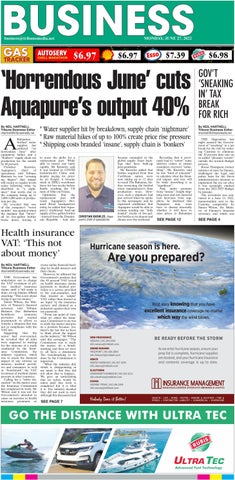
CHRISTIAN KNOWLES, Aquapure’s chief of opearations
become entangled in the global supply chain backlogs that have built-up post-pandemic. Mr Knowles added that bottles acquired from that Caribbean nation were now taking up to 12 days to reach The Bahamas, further worsening the bottled water manufacturer’s June production woes. However, such a shipment had just arrived when he spoke to this newspaper, and he expressed confidence that Aquapure would be able to resume sending out “fully loaded” trucks of five-gallon bottles to its depots and clients over the weekend.
Revealing that it previously had to “ration” some delivery routes to ensure customers received “something”, Mr Knowles said he was “kind of reluctant” to calculate what the financial impact and loss will be while describing it as “significant”. And, under pressure from “insane” freight shipping rates and raw material cost increases from suppliers, he disclosed that Aquapure may soon have to discuss internally whether it will have to raise prices to Bahamian
THE Opposition last night accused the Government of “sneaking” in a tax break for the rich by ordering Customs to eliminate the 10 percent duty rate on so-called “pleasure vessels” outside the normal Budget process. Kwasi Thompson, former minister of state for finance, challenged the legal and policy basis for the Davis administration’s decision to implement the tax cut after it was seemingly omitted from the 2022-2023 Budget by mistake. The revelation was contained in a June 23, 2022, memorandum sent to the Customs comptroller by Simon Wilson, the Ministry of Finance’s financial secretary, and which was
SEE PAGE 12
SEE PAGE 4
PAGE 2, Monday, June 27, 2022
THE TRIBUNE
Assessing how robust your security systems really are THE annual report on crime, and related trends, by the Commissioner of Police should be applauded. It is a commendable attempt at transparency, allowing members of the public - who are also major stakeholders in the fight against crime - to make assessments of the Royal Bahamas Police Force’s performance, efficiency and reliability. The report validates or disproves based on numbers, not pure conjecture and emotion. We can always question the numbers, but in the absence of any count or audit, we must accept what has been laid before us as a reliable account of crime in The Bahamas. Both the police and the public must remember they are partners in maintaining the security and safety of
The Bahamas. Too often it appears to be an ‘us against them’ mentality, while the criminal sits in the shadows as the only real beneficiary of poor police-community relations. Based on the report, firearms were used in the majority of armed robbery incidents in 2021. The report goes on to state that companies are being most frequently targeted between the hours of 6pm and 10pm. Some 151 businesses were held up, placing staff and customers alike in harm’s way. With that type of information, business owners and security planners need to make better decisions on where to allocate resources. These crime mitigation strategies can range from cash reduction initiatives such as increased cash drops
or moving to electronic payment platforms. I am amused when I see investments have been made in ballistic cash cages but the staff are not using it. Another noteworthy aspect from the Crime Report indicates that ‘Thursdays’ appear to be the day of choice for the commission of armed robberies. It would thus appear that the ‘armed robber’ is preparing for the weekend, which is not an unusual trait in our society, as many persons look to the weekends to relax from a long work week. Finally, ‘location…. location…. location’ is also touched on in the crime brief. Without a doubt, New Providence remains not only the economic hub for The Bahamas but, unfortunately, also leads the way
for armed robbery. It would appear that notwithstanding the bulk of the population lives in the east of New Providence, the south and south-western areas appear to be more impacted by armed robbery. As stated, it is a good idea to improve relations with the police station responsible for your area and take some initiative in making your community safer. In visiting several businesses, it is interesting how these operations manage the implementation of their security programmes and do not fully use the natural preventative mechanisms already in place. Thus, in many instances, critical initiatives are overlooked, repeated or are just plain silly. What is even worse is when the operations
manager or security director is asked about what they have done, and there seems to be no method to their strategy. The intentions are certainly good. However, the approach is disjointed and wasteful financially. I have decided not to mention some of these failures as I do not want to put lives and other assets at unnecessary risk. Business owners and managers need help, and not necessarily just from security service providers, who too often are only concerned about making the extra dollar. Recommendations for additional cameras or more guards should not come from the third party selling that product or service. At the least, a second opinion should be sought. Here is a quick, easy method for companies to assess their security. The intent of this list is to help you, especially persons who have been given the security ’hat’ as a part of their regular duties, to fine tune and improve upon current efforts. The ingredients listed are by no means final, but do set a good foundation and provide structure for the way forward. So here is my 11-step guide to assessing how robust your security systems actually are: 1. Business Type - The service you offer puts you at greater risk of a particular type of loss event. Thus a commercial bank’s security priorities will differ from that of an investment bank. Retail concerns vary from those of the wholesaler. 2. Inventory Type – Similar to what are you selling, items that can be pushed into a shoplifter’s pocket, or services that can be gained via identity theft and the use of other fraudulent methods. If the assets are intellectual, how do you protect them? 3. Location – Critical to the success and failure of many businesses. However, if you have not taken into account the negative components of your demographic base, then you are exposed to a variety of potential risk factors 4. Access - How easy is it to get to your assets (staff/ inventory/information/reputation). Attention must be given to external and internal design controls, which allow trusted and appropriate entry and exit. 5. Emergency Response Plan - As a result of ‘Murphy’s Law’, have a plan on how to prepare, respond and recover from events that are typical to your industry and location. 6. Insurance – Notwithstanding the potential for the scope and negative impact of ‘Murphy’s Law’, you will need this in varying forms and fashions. 7. Employees - Some may argue that this group should be at the top of the list, as statistics from a wide cross-section of industries and professions suggest that they cause the greatest loss for companies, be it through negligence or intentional criminal or malicious acts
SAFE AND SECURE BY GAMAL NEWRY 8. Customer – Not far behind is this group. You know who they are, as in too many instances their intention is not good. 9. Awareness and Education - The simple ‘shoplifters will be prosecuted’ or ‘business is being monitored by surveillance cameras’ will not stop everyone, but it will eliminate a percentage of potential threats. People need to know what type of behaviour is expected from them and what penalties exist for their non-compliance. 10. Continuous Review – The approach must be dynamic and fluid, adjusting and adapting. Be as flexible as necessary and within reason. 11. Security Plan – As simple as a document outlining the above categories, detailing your awareness and mitigation of issues identified. Fundamental to understanding this list is recognising how comprehensive security is, and the fact that every business invests in this in one way or another. This investment speaks to the company’s commitment to protecting its assets, people, information, property and reputation from damage or loss. What it entails is that the end result actually, and positively, impacts operations. When speaking with managers and business leaders, there are clearly disconnects in the level of understanding about security. ‘Security’ is the prevention of loss or protection of assets from loss, be it harm or theft. This definition opens the mind to an entirely different perspective. So many persons are stuck in the loss recovery component of security, which is a reactive or ‘after the event’ approach. The loss has already occurred, which indicates your security systems have failed. The reduction and removal of loss events is true and successful security. I hope this list is helpful in your development and management of a real, resilient and robust security programme. NB: Gamal V. Newry is the president and senior consultant for Preventative Measures. He brings over 35 years of insight and experience as it relates to crime and security risk management, business continuity and disaster management. Comments inquires, and questions can be sent to info@ preventativemeasures.org
THE TRIBUNE
Monday, June 27, 2022, PAGE 3
Developer attacked by PM: ‘We’re on schedule’ THE DEVELOPER behind a $200m Eleuthera resort project has pledged it is “on schedule” and “will open in four years” after recently coming under fire from the Prime Minister for its seeming lack of progress. Cotton Bay Holdings, the vehicle owned by Colombian billionaire, Dr Luis Carlos Sarmiento, in a statement issued over the weekend sought to reaffirm its commitment to the development after Philip Davis QC said he complained to the South American nation’s president about the 25-year wait for the project to move from concept to reality. Noting that it signed the latest Heads of Agreement for the project with the Davis administration in December 2021, the developer revealed the latest version had received an approval in principal from the Minnis administration in March 2021. It was now working with its resort operating partner, Marriott, whose Ritz-Carlton Reserve will brand the proposed 90-room open-air resort that will now be the project’s central element.
“We have been diligently working through the processes required with our partners to advance this joint venture,” Cotton Bay Holdings said. “Given the scope and complexity of this multi-million dollar project, it requires a phased approach beginning with planning, design and preconstruction activities. “We wish to confirm that the development is on schedule, and that Marriott executives have visited the island and are actively engaged in our processes. Following the first stage, we will move into the construction stage, which we anticipate will stimulate 300 jobs and is expected to last at least 24 months. “The final stage of the project will involve interior installations, recruitment and training. Ultimately, it is projected that the resort will open in four years and, once operational, will employ over 200 Bahamians.” This, though, still remains some way off as Cotton Bay Holdings acknowledged it was still assembling both international and local design, engineering, architectural and environmental
teams needed for a project of this nature. “We have been working tirelessly with Marriott representatives and our consultants to select and retain a team of worldclass designers and service providers to meet all of the requirements that are essential to guarantee the success of a project of this nature,” Cotton Bay Holdings said. “In addition to our overseas partners, we have also engaged local consultants and will be retaining others in the coming months as we assemble a first-rate team to deliver a world- class resort development to the island of Eleuthera.” And, conceding the lack of progress over the past two-and-a-half decades, the developer said: “Cotton Bay Holdings affirms that we are fully committed to bringing this project to fruition. We are grateful to have been a part of the landscape of the island of Eleuthera for over 25 years, and it is our firm belief that this project will revitalise the island’s tourism product and hospitality experience and transform its future economy.” Many Bahamians, and
especially Eleuthera residents, will likely take some convincing that Dr Sarmiento’s project is now ‘a go’ after several previous efforts stalled. This outlook is likely to have been reinforced after Mr Davis revealed he complained about Dr Sarmiento’s lack of progress in reviving the former Cotton Bay Club to Ivan Duque Marquez, Colombia’s president, when the two met at the recent Summit of the Americas. “I expressed our disappointment over the fact that one of his citizens has been in The Bahamas for more than 20 years threatening to develop a 1,000-plus acres in south Eleuthera and that threat has not come to reality,” the Prime Minister told Bahamian media upon his return. “As a result of that he has indicated that he will be making an official visit to The Bahamas sometime in early July and he will bring that developer with him, and he will go down there and make sure that he gets started somehow. So he’s going to join me in ensuring that the threat becomes a reality.” It is, though, difficult
to see what powers of compulsion Mr Duque will have given that he is an outgoing president following the recent Colombian election. It is also unclear just why Mr Davis has seemingly soured so quickly given that his administration signed a Heads of Agreement with Cotton Bay Holdings less than seven months ago on December 6, 2021 - a ceremony at which he was personally present. The Cotton Bay Holdings statement was phrased diplomatically, and made no mention of the Prime Minister’s comments, although it was obviously released in response to them. Numerous Heads of Agreement have been signed between the Government and Dr Sarmiento, with the first sealed in 1996 under the inaugural Ingraham administration. Little development happened, though, but during a May 2012 campaign rally at Governor’s Harbour, then-prime minister Hubert Ingraham said the Government was “very close” to sealing a deal with the Colombian billionaire, reputedly the South American nation’s richest man with a $10.3bn fortune obtained
from banking. “I was very pleased yesterday, ladies and gentlemen, as my final act with Cabinet in the Bahamas, to finally give the approval to the Sarmiento development at Cotton Bay,” Mr Ingraham said then. He added that the project was first conceived in the 1990s but did not make much progress as Dr Sarmiento wanted to buy more land but the Government would not allow it. “I flew into Bogota, Colombia, met with Dr Sarmiento and we now have a deal,” Mr Ingraham said. “The project has changed over the years but I’m happy to be able to tell you that we’ve very close to completing the final arrangements for the centre piece hotel.” That Heads of Agreement, which involved a Four Seasons-branded property, was left for the subsequent Christie administration to sign in 2015. However, the development again failed to move forward, and little had been heard of it until December 2021’s revised Heads of Agreement signing at the Prime Minister’s Office that replaced Four Seasons with a Ritz-Carlton Reserve.
TECHNOLOGY PROVIDER EYES DATA RECOVERY LABORATORY By YOURI KEMP Tribune Business Reporter ykemp@tribunemedia.net
A BAHAMIAN technology provider says it is investing in a “data recovery laboratory” that will employ biometrics, and face and voice recognition, to help prevent fraud in an increasingly digital world. Peter Bridgewater, Open Systems Technologies’ president, told Tribune Business that data protection is becoming increasingly pivotal to the conduct of business as cyber fraud continues to increase on a global level. And, with facial recognition and biometric technology, which uses fingerprints and other unique characteristics to verify identity, becoming
increasingly accepted he hopes to use this to combat fraud. “One of the newest things that we provide in terms of identity verification and anti-money laundering is be able to provide biometrics,” he said. “We’ve moved into voice, biometrics and facial recognition, and there’s a lot of fraud, so we have a solution whereby you can scan with a selfie and it records your face and checks against various legal documents you have, like your driver’s licence, your passport, and ensures that that is you who’s actually using that documentation. “We will be rolling out a number of other services, and identity verification and some other solutions very shortly, that will enable
businesses and customers to be able to recover data no matter what type of device that they’ve lost or used.” The push towards biometric verification and screening is moving the technology industry towards better storage facilities for personal data, “We’re setting up a lab to be able to do that for any type of electronic device, being able to open up the hard drive, take the disk out, put it into a donor drive and be able to extract the data, and things like that, so you you don’t have to worry about sending that outside of the country,” Mr Bridgewater said. Having personally experienced how distressing data loss can be, Mr Bridgewater said this is part of the reason why he is investing
in a “data recovery lab, and I think it will also be one of the first ones here in The Bahamas”. He added: “Basically all of the devices are brought to this lab, and we will have all of the tools to do what it is we need to do. We are working with a top lab where all of these things are produced, particularly the chips for the CCTV, to be able to extract the data no matter how much of it someone had destroyed. “Cyber security is a very important issue, but what we are doing is a data recovery and biometrics lab, because facial recognition is going to become very important when you start using digital IDs. You need to be able to ensure that the facial recognition
technology, when it moves to electronic voting and digital IDs, that you have
the tools that can prove that someone is who they say they are.”
February Point Resort Estates in picturesque Great Exuma is seeking applications for the following positions: -Landscaping Manager -Maintenance Manager Qualified persons are asked to send their resumes to the following email address:
teneeshia@februarypoint.com
PAGE 4, Monday, June 27, 2022
THE TRIBUNE
‘Serious effort’ urged to slash food imports FOOD insecurity was the focus at a recent lecture sponsored by the Department of Cooperative Development, Ministry of Agriculture, Marine Resources and Family Island Affairs and the Bahamas Cooperative League. Dr Shelley Bridgewater, Bahamas’ representative for the Caribbean Agricultural and Research Development Institute (CARDI), called for “serious efforts” to reduce this nation’s dependence on imports that account for 92 percent of all food consumption. Speaking at the National Training Agency (NTA) last Monday,
TAX BREAK FROM PAGE 1
obtained and subsequently released by Mr Thompson and the Free National Movement (FNM). “I am directed to advise that, as a result of the change to the rate of duty on pleasure craft vessels
she said: “If we can make the correlation between agricultural empowerment and reducing food insecurity, we can find ways to sustain ourselves, especially given our dependence on other countries. Given that 92 percent of the food in The Bahamas is imported, we must make serious efforts to reduce the dependence on imports, especially given the current climate we’re in.” Dr Bridgewater identified various methods that farmers can tap into when it came to the economics of agriculture, and she highlighted five key steps towards empowerment. These include
inadvertently being omitted from the Budget measure sheet, the Customs Department is now instructed to treat the following tariff heading as duty-free until the subsequent amendment to the Tariff Act is done during the next Budget exercise,” Mr Wilson wrote. “All pleasure vessels that currently attract a
climate resiliency, where farmers will be guided by the climate to maximise crop planting and production, plus market Intelligence, where they will study the market to ensure the products they offer meet demand. The other three are training and development; partnerships that farmers can establish through co-operatives; and creating circular agriculture economies, such as maximising on all the various uses of a crop. As an example, coconuts can be used for their fruit; their skin can be used for mulch; and they can also be used to produce drinks, oil and vinegar, etc.
10 percent rate of duty in Chapter 89 of the Tariff Act under Tariff Heading 8903 are now approved for a duty-free rate of duty. The change is effective immediately.” Michael Halkitis, minister of economic affairs, who was copied on the memorandum, could not be reached for comment and did not respond to a Tribune Business message before press time last night. However, Mr Thompson, the east Grand Bahama MP, queried how the pleasure vessel tariff elimination can take effect legally since this requires Parliament to approve the necessary change to the Tariff Act - something that has not been done and, according to Mr Wilson’s note, will not happen for another 12 months given that both the House of Assembly and Senate have now passed the 2022-2023 Budget. And the former state finance minister in the Minnis administration also called on the Government to justify the policy rationale for the tax break. Pleasure vessels refers to boats, yachts and other craft bought by Bahamians and residents abroad, and then brought back to this nation for personal use. Given that some of these vessels at the high-end are sold for multi-million dollar sums, Mr Thompson
Held under the theme, Economic empowerment through cooperatives, the lecture is part of a series recognising June as Cooperative Month. Phaedra Rahming-Turnquest, permanent secretary at the Ministry of Agriculture, Marine Resources and Family Island Affairs, said the theme captured the sector’s impact for many Bahamians. She added: “This is a very timely theme given the Ministry’s objective of addressing food insecurity. Cooperatives owned by the people, for the people, have been empowering Bahamians for years, in a cross-section of financial
asserted that the Davis administration’s move amounts to a tax break for “high income and wealthy individuals” who can afford to pay since the 10 percent rate would amount to a sixfigure sum on such craft for the Public Treasury. Mr Wilson’s memorandum indicates he was acting under orders from the political-level policymakers, either Cabinet or a minister, but Mr Thompson said the document “raises a number of very serious and fundamental questions” that the Government needs to answer. He said in a statement: “What exactly is the legal authority for the Ministry of Finance to adjust these tariffs outside of the parliamentary process? It is our understanding that only through Parliament can tariffs be changed. As such, are the instructions in the memorandum lawful instructions? “Why is this being done in secret? This matter was never raised in the public domain during the Budget exercise as a policy initiative of the Government. Why has the Government sought to sneak this on the Bahamian people? Whose interests are being served by these changes done outside the public’s view?” And, questioning why the Davis administration is seemingly “giving further
ventures, whether it is home ownership, education or other types of loan and savings objectives. “This theme encourages Bahamians to work in a unified manner to focus on the fight to sustain ourselves.” Also present at the lecture were Leroy Major, chairman of the Bahamas Agricultural and Industrial Corporation (BAIC), and Dr Patricia Symonette, executive director, Bahamas Agricultural Health & Food Safety Authority (BAHFSA). Jack Thompson, permanent secretary in the Office of the Governor-General, served as master of ceremonies.
tax breaks to the well-off”, Mr Thompson argued: “There is no good reason to provide blanket dutyfree provisions for pleasure crafts that are purchased in the main by high income and wealthy individuals. “We cannot accept that we have asked pensioners to pay VAT on medicine, and single parents to pay VAT on baby suppliers, while we allow the rich to buy pleasure boats duty-free. That is an untenable position that must be reversed immediately.” Plausible explanations could be that the Government views the 10 percent pleasure vessel tariff as an obstacle to creating a longtalked about Bahamian yacht registry. This was why the 10 percent tariff on aircraft was eliminated to help facilitate the development of an aircraft registry, and this move may be intended to align aviation and boating import tariffs in that vein. However, Mr Wilson’s memorandum appears to expose an oversight in the Government’s Budget and its preparations, even though it only involves one tariff line item. And Mr Thompson said the Government’s motives and strategy remain questionable without an explanation to the Bahamian people. “It just raises a huge number of questions,” he
told Tribune Business. “Pleasure vessels are different from fishing vessels. Our question would be: On what legal basis are you changing the tariff without Parliament’s approval because when it comes to changing tariffs that is changing legislation, which means that you have to get Parliament’s approval to do so. “On what legal basis are they able to do that, and why are they doing that in this manner? If you have a policy to make pleasure vessels duty-free, shouldn’t you have done it in this Budget exercise, come to the Bahamian people and say why you are doing it? Nobody knew the Government was taking this policy decision. It has to come to the people and explain what it’s doing and why. What is the justification for making pleasure vessels duty free?” Pointing out the multimillion dollar value of high-end yachts, Mr Thompson added: “This is a tax break you are giving to those who can afford to pay, which is not the poor or middle class. Why are they giving tax breaks to those who can afford it? What is their justification? It is the Government’s obligation to present their tax policy. They must come and justify the legal basis on why they are presenting this change.”
THE TRIBUNE
Monday, June 27, 2022, PAGE 5
Time for a new global order which deals everyone a fair hand By Ricardo Evangelista SINCE the financial crisis of 2008, the idea that globalisation is doomed gained traction in some circles, fed by the rise of nationalist movements, trade wars, the COVID pandemic and, most recently, the war in Ukraine. The free capital flows and open borders trading, which characterised the global economy over the past four decades, currently face a serious backlash. Market optimisation is giving way to security concerns, as several states take steps to repatriate supply chains or prioritise business with like-minded partners, rather than embracing a politically neutral trading strategy. In principle, such policies are not wrong, but common sense must be applied to avoid going too far. It is easy to lose perspective amid the noise generated by events such as Brexit, Donald Trump’s election to the US presidency or the ongoing war in Ukraine, and how how the latter exposed the West’s dependency on Russian gas and oil. However, an objective analysis of data from the last 40 years reveals that extreme poverty at a global level dropped from 42 percent in 1981 to 8.6 percent in 2018. In great part, such change was driven by globalisation. Interconnected and interdependent economies offer greater diversity, in a dynamic that drives competition and leads to greater efficiency. This is the opposite of what happens when markets are closed within themselves. Absolute selfsufficiency may sound like a good idea to some, but in practice it limits options, potentially leading to complacency, nepotism, corruption and poverty
TO ADVERTISE TODAY IN THE TRIBUNE CALL @ 502-2394
for large segments of the population. Another issue detractors of globalisation tend to bring to the table is the rise in inequality recorded over the last four decades - a phenomenon that is behind the rise of populist movements across the world, which promise simple solutions for complex problems. While it is undeniable that the top one percent of earners has, since 1980, increased its share of wealth, while that held by the bottom 50 percent has decreased, this is not necessarily a by-product of globalisation. Fair redistribution of wealth, or the absence of it, is the real problem. Fiscal authorities have so far failed to create mechanisms to compensate for the inequities exacerbated by the cross-border circulation of goods and capitals, in what concerns the distribution of the income generated by these flows. This problem can be mitigated through the implementation of fairer and more efficient taxation regimes, as well as legislation conducive to greater financial transparency. The global economy needs re-thinking. The blind pursuit of profit must be kept in check by greater state and corporate responsibility. Trade deals must consider governance and sustainability criteria.
FLAGS representing the countries across the globe. Turning a blind eye to such concerns, provided the price is right, often leads to undesirable outcomes. The short-term advantages of pursuing a profitable contract with an autocracy do not compensate for the risks. Germany certainly regrets betting its long-term energy security on dependence on Russian natural gas. Clearly, the globalisation of the last 40 years came with undesirable sideeffects. However, it would be a mistake to completely undo it. We must not throw the baby out with the bath water. Instead, now is the time to rethink the world’s supply chain and capital markets, and to engineer a
new global order; one that strives to eliminate dependency on unreliable partners,
and stimulates the adoption of positive values, such as fairness and respect for
human rights, sustainability and financial transparency.
PAGE 6, Monday, June 27, 2022
THE TRIBUNE
Did corporate greed fuel inflation? It’s not biggest culprit By PAUL WISEMAN AP Economics Writer WASHINGTON (AP) — Furious about surging prices at the gasoline station and the supermarket, many consumers feel they know just where to cast blame: On greedy companies that relentlessly jack up prices and pocket the profits. Responding to that sentiment, the Democratic-led House of Representatives last month passed on a party-line vote — most Democrats for, all Republicans against — a bill designed to crack down on alleged price gouging by energy producers. Likewise, Britain last month announced plans to impose a temporary 25 percent windfall tax on oil and gas company profits and to funnel the proceeds to financially struggling households. Yet for all the public’s resentment, most economists say corporate price gouging is, at most, one of many causes of runaway inflation — and not the primary one. “There are much more plausible candidates for what’s going on,” said Jose Azar an economist at Spain’s University of Navarra. They include: Supply disruptions at factories, ports and freight yards. Worker shortages. President Joe Biden’s enormous pandemic aid programmes. COVID 19-caused shutdowns in China. Russia’s invasion of Ukraine. And, not least, a Federal Reserve that kept interest rates ultra-low longer than experts say it should have.
Most of all, though, economists say resurgent spending by consumers and governments drove inflation up. The blame game is, if anything, intensifying after the US government reported that inflation hit 8.6 percent in May from a year earlier, the biggest price spike since 1981. To fight inflation, the Fed is now belatedly tightening credit aggressively. On June 15, it raised its benchmark short-term rate by threequarters of a point — its largest hike since 1994 — and signalled that more large rate hikes are coming. The Fed hopes to achieve a notoriously difficult “soft landing” — slowing growth enough to curb inflation without causing the economy to slide into recession. For years, inflation had remained at or below the Fed’s two percent annual target, even while unemployment sank to a half-century low. But when the economy rebounded from the pandemic recession with startling speed and strength, the US consumer price index rose steadily — from a 2.6 percent yearover-year increase in March 2021 to last month’s fourdecade high. For a while at least — before profit margins at S&P 500 companies dipped early this year — the inflation surge coincided with swelling corporate earnings. It was easy for consumers to connect the dots: Companies, it seemed, were engaged in price-gouging. This wasn’t just inflation. It was greedflation. Asked to name the culprits behind the spike in
gasoline prices, 72 percent of the 1,055 Americans polled in late April and early May by the Washington Post and George Mason University’s Schar School of Policy and Government blamed profit-seeking corporations, more than the share who pointed to Russia’s war against Ukraine (69 percent) or Biden (58 percent) or pandemic disruptions (58 percent). And the verdict was bipartisan: 86 percent of Democrats and 52 percent of Republicans blamed corporations for inflated gas prices. “It’s very natural for consumers to see prices rising and get angry about it and then look for someone to blame,’’ said Christopher Conlon, an economist at New York University’s Stern School of Business who studies corporate competition. “You and I don’t get to set prices at the supermarket, the gas station or the car dealership. So people naturally blame corporations, since those are the ones they see raising prices.’’ Yet Conlon and many other economists are reluctant to indict — or to favour punishing — Corporate America. When the University of Chicago’s Booth School of Business asked economists this month whether they’d support a law to bar big companies from selling their goods or services at an “unconscionably excessive price’’ during a market shock, 65 percent said no. Only five percent backed the idea. Just what combination of factors is most responsible for causing prices to soar “is still an open question,’’
economist Azar acknowledges. COVID-19 and its aftermath have made it hard to assess the state of the economy. Today’s economists have no experience analysing the financial aftermath of a pandemic. Policymakers and analysts have been repeatedly blindsided by the path the economy has taken since COVID struck in March 2020: They didn’t expect the swift recovery from the downturn, fuelled by vast government spending and record-low rates engineered by the Fed and other central banks. Then they were slow to recognise the gathering threat of high inflation pressures, dismissing them at first as merely a temporary consequence of supply disruptions. One aspect of the economy, though, is undisputed: A wave of mergers in recent decades has killed or shrunk competition among airlines, banks, meatpacking companies and many other industries. That consolidation has given the surviving companies the leverage to demand price cuts from suppliers, to hold down workers’ pay and to pass on higher costs to customers who don’t have much choice but to pay up. Researchers at the Federal Reserve Bank of Boston have found that less competition made it easier for companies to pass along higher costs to customers, calling it an “amplifying factor’’ in the resurgence of inflation. Josh Bivens, research director at the liberal Economic Policy Institute, has estimated that nearly 54 percent of the price increases in nonfinancial businesses since mid-2020 can be attributed to “fatter profit margins,” versus just 11 percent from 1979 through 2019. Bivens conceded that neither corporate greed nor market clout has likely grown significantly in the past two years. But he suggested that during the COVID inflationary spike, companies have redirected
A MAN purchasing fuel in the Queens borough of New York. (AP Photo/John Minchillo) how they use their market with plenty of competitors, power: Many have shifted jumped nearly 10 percent away from pressuring sup- last month from a year earpliers to cut costs and lier. By contrast, the price limiting workers’ pay and of alcoholic beverages has have instead boosted prices risen just four percent from a year ago even though the for customers. In a study of nearly beer market is dominated 3,700 companies released by AB-Inbev and spirits by last week, the left-leaning Bacardi and Diageo. “It is hard to imagine that Roosevelt Institute concluded that markups and AB-Inbev isn’t as greedy as profit margins last year Maytag,’’ Conlon said. So what has most driven reached their highest level since the 1950s. It also the inflationary spike? “Demand,’’ said Furman, found that companies that had aggressively raised now at Harvard Univerprices before the pandemic sity. “Lots of government were more likely to do so spending, lots of monetary after it struck, “suggesting support — all combined a role for market power as together to support extraoran explanatory driver of dinarily high levels of demand. Supply couldn’t inflation.’’ Yet many economists keep up, so prices rose.’’ Researchers at the Fedaren’t convinced that corporate greed is the main eral Reserve Bank of San Francisco estimate that culprit. Jason Furman, a top government aid to the economic adviser in the economy during the panObama White House, said demic, which put money in that some evidence even consumers’ pockets to help suggests that monopolies them endure the crisis and are slower than companies set off a spending spree, has that face stiff competition raised inflation by about 3 to raise prices when their percentage points since the own costs rise, “in part first half of 2021. In report released in because their prices were April, researchers at the high to begin with.’’ Likewise, NYU’s Conlon Federal Reserve Bank of St cites examples where prices Louis blamed global supply have soared in competitive chain bottlenecks for playing a “significant role” in markets. Used cars, for example, inflating factory costs. They are sold in lots across the found that it added a stagcountry and by numerous gering 20 percentage points individuals. Yet average to wholesale inflation in used-car prices have sky- manufacturing last Novemrocketed 16 percent over ber, raising it to 30 percent. Still, even some econothe past year. Similarly, the average price of major mists who don’t blame appliances, another market greedflation for the price spike of the past year say they think governments should try to restrict the market power of monopolies, perhaps by blocking mergers that reduce competition. The idea is that more companies vying for the same customers would encourage innovation and makes the economy more productive. Even so, tougher antitrust policies wouldn’t likely do much to slow inflation anytime soon. “I find it helpful to think about competition like diet and exercise,” NYU’s Conlon said. “More competition is a good thing. But, like diet and exercise, the payoffs are long term. “Right now, the patient is in the emergency room. Sure, diet and exercise are still a good thing. But we need to treat the acute problem of inflation.’’
THE TRIBUNE
VAT
FROM PAGE 1 been going on for five to six months. I thought we were going to have a sober discussion about this issue.” Arguing that “the law is clear” on the VAT treatment in question, Mr Wilson added: “Nobody is trying to unnecessarily increase insurance premiums or create any undue pressure that puts health insurers at financial risk. That is clear. We said this was not to impact the industry or taxpayer much. We said let’s get the regulator involved, get the study done and get their input. “The issue, which they’ve [the industry] not made very clear, for insurance companies the premium is output VAT. VAT on the premium is output VAT. What insurance companies
Monday, June 27, 2022, PAGE 7 are saying is that they are treating any VAT that attaches to a claim as input VAT. We are saying to them: ‘No, no, no’. The law says you can only claim input VAT if the service is to your benefit. If you are paying a claim, that service is not to your benefit; it’s to the benefit of the policyholder, your customer.” Acknowledging that Bahamian health insurers have applied this VAT treatment since the tax was introduced in 2015, Mr Wilson said the Government has also promised not to make any reforms “retroactive”. He added that it hoped to resolve the matter in an “amicable fashion”, and said: “It’s not about trying to get money. This is not us trying to put on ordinary Bahamians an additional tax. “This is us saying: ‘Guys, we’re not following what the law
says, and the idea is: ‘Do we we need to change, do we make an adjustment?’ What do we do? I just hope to have these discussions soon, and hope the regulator completes the detailed study and we can then move forward.” Health insurers fear any changes that prevent them obtaining VAT deductions on claims payouts will result in increased premiums for both groups and individuals with private health insurance, increasing medical treatment costs and making coverage increasingly unaffordable. At present, the health insurance industry can deduct, or offset, the VAT portion of patient care bills submitted to it by doctors, hospitals and other medical facilities against what it pays to the Government from the 10 percent levy imposed on client
premiums. However, the Ministry of Finance and Department of Inland Revenue - initially with effect from July 1, 2022, although this date is unlikely to now be met - want to change this treatment such that health insurers are no longer able to deduct/offset the VAT charged on their clients’ medical bills against the taxes collected on the premium. With the industry no longer able to treat medical bill VAT as an ‘input’ deduction, it has warned that consumers will “ultimately” pay the price through having to absorb the levy on their patient care expenses - something that will effectively increase health treatment costs by 10 percent at a time when Bahamians are grappling with soaring inflation and the continuing
fall-out from the ongoing COVID-pandemic. Given that some medical costs can be substantial, reaching into the hundreds of thousands and even millions of dollars, the potential revenue boost for the Government could well be significant. Yet, if implemented, the increased cost could be just as impactful for both individuals and employees who presently enjoy private health insurance under their company’s
group policy, potentially making quality healthcare less affordable and accessible when COVID-19 remains a threat. Should the revised VAT treatment become law, insurers would likely be forced to alter their pricing while providers of medical care would need to adjust their services. The change, if implemented, could impact over 100,000 Bahamians with private health insurance.
PAGE 8, Monday, June 27, 2022
THE TRIBUNE
INFLATION SPARKS GLOBAL WAVE OF PROTESTS FOR HIGHER PAY, AID By AYA BATRAWY Associated Press RISING food costs. Soaring fuel bills. Wages that are not keeping pace. Inflation is plundering people’s wallets, sparking a wave of protests and workers’ strikes around the world. This week alone saw protests by the political opposition in Pakistan, nurses in Zimbabwe, unionized workers in Belgium, railway workers in Britain, Indigenous people in Ecuador, hundreds of US pilots and some European airline workers. Sri Lanka’s prime minister declared an economic collapse Wednesday after weeks of political turmoil. Economists say Russia’s war in Ukraine amplified inflation by further pushing up the cost of energy and prices of fertiliser, grains and cooking oils as farmers struggle to grow and export crops in one of the world’s key agricultural regions. As prices rise, inflation threatens to exacerbate inequalities and widen the gap between billions of people struggling to cover their costs and those who are able to keep spending. “We are not all in this together,” said Matt Grainger, head of inequality policy at antipoverty organisation Oxfam. “How many of the richest even know what a loaf of bread
costs? They don’t really, they just absorb the prices.” Oxfam is calling on the Group of 7 leading industrialised nations, which are holding their annual summit this weekend in Germany, to provide debt relief to developing economies and to tax corporations on excess profits. “This isn’t just a standalone crisis. It’s coming off the back of an appalling pandemic that fuelled increased inequality worldwide,” Grainger said. “I think we will see more and more protests.” The demonstrations have caught the attention of governments, which have responded to soaring consumer prices with support measures like expanded subsidies for utility bills and cuts to fuel taxes. Often, that offers little relief because energy markets are volatile. Central banks are trying to ease inflation by raising interest rates. Meanwhile, striking workers have pressured employers to engage in talks on raising wages to keep up with rising prices. Eddie Dempsey, a senior official with Britain’s Rail, Maritime and Transport Union, which brought UK train services to a near standstill with strikes this week, said there are going to be more demands for pay increases across other sectors.
“It’s about time Britain had a pay rise. Wages have been falling for 30 years and corporate profits have been going through the roof,” Dempsey said. Last week, thousands of truckers in South Korea ended an eight-day strike that caused shipment delays as they called for minimum wage guarantees amid soaring fuel prices. Months earlier, some 10,000 kilometres (6,200 miles) away, truckers in Spain went on strike to protest fuel prices. Peru’s government imposed a brief curfew after protests against fuel and food prices turned violent in April. Truckers and other transport workers also had gone on strike and blocked key highways. Protests over the cost of living ousted Sri Lanka’s prime minister last month. Middle-class families say they’re forced to skip meals because of the island nation’s economic crisis, prompting them to contemplate leaving the country altogether. The situation is particularly dire for refugees and the poor in conflict areas such as Afghanistan, Yemen, Myanmar and Haiti, where fighting has forced people to flee their homes and rely on aid organisations, themselves struggling to raise money. “How much for my kidney?” is the
TRUCK drivers protest against the high price of fuel in Madrid, Spain, on March 25. As food costs and fuel bills soar, inflation is plundering people’s wallets, sparking a wave of protests and workers’ strikes around the world. (AP Photo/Manu Fernandez) question most asked of one of Kenya’s largest hospitals. Kenyatta National Hospital reminded people on Facebook this week that selling human organs is illegal. For the middle class in Europe, it’s become more expensive to commute to work and put food on the table. “Increase our salaries. Now!” chanted thousands of unionised workers in Brussels this week. “I came here to defend the purchasing power of citizens because demonstrating is the only way to make change,” protester Genevieve Cordier said. “We cannot cope anymore. Even with two salaries ... both of us are working, and we cannot get our head above water.” In some countries, a combination of government corruption and mismanagement underpin the economic turmoil, particularly in politically gridlocked countries like Lebanon and Iraq. The protests reflect a sense of growing financial insecurity. Here’s how that has played out in Africa: — Health care professionals in Zimbabwe went on strike this week after rejecting the government’s offer of a 100 percent pay rise. The nurses say the offer does not come close to skyrocketing inflation of 130 percent. — Kenyans have protested in the streets and online as the price of food jumped by 12 percent in the past year. — One of Tunisia’s most powerful labour unions
MEMBERS of various trade unions march during a demonstration to protest against the rising cost of living in Brussels on June 20. (AP Photo/Geert Vanden Wijngaert) staged a nationwide public in emerging and developsector strike last week. ing economies this year. The North African country Global economic growth faces a deteriorating eco- is projected to slow by 40 nomic crisis. percent, to 3.6 percent, this — Hundreds of activ- year and next. The IMF is ists this month protested calling on governments to the rising cost of living in focus support packages to Burkina Faso. The UN those most in need to avoid World Food Program says triggering a recession. the price of corn and millet The slowdown comes as has shot up more than 60 the COVID-19 pandemic percent since last year, is still gripping industries reaching as high as 122 per- worldwide, from manufaccent in some provinces. turing to tourism. Climate “As far as this cost of change and drought are hitliving that keeps increasing ting agricultural production is concerned, we realised in some countries, promptthat the authorities have ing export bans that push betrayed the people,” said up food prices even further. Issaka Porgo, president of Rising food prices are the civil society coalition particularly painful in lowbehind the protest in the income countries, where west African country. 42 percent of household Protesters condemn the incomes are spent on food, military junta, which ousted said Peter Ceretti, an anathe democratically elected lyst tracking food security president in January, for at risk advisory firm Euragiving themselves a pay sia Group. “We will see raise while the population more protests, probably faces rising prices. broader and angrier, but I The International Mon- do not expect destabilising etary Fund says inflation or regime-changing prowill average about six per- tests,” he said, as producers cent in advanced economies adjust and governments and nearly nine percent approve subsidies.
THE TRIBUNE
Monday, June 27, 2022, PAGE 9
BTC SAYS SEMINAR EVENTS OPEN SMALL BUSINESS EYES By YOURI KEMP Tribune Business Reporter ykemp@tribunemedia.net THE Bahamas Telecommunications Company’s (BTC) chief executive says the three-seminar annual series it stages in partnership with its parent’s Caribbean affiliates has enabled local entrepreneurs to broaden their horizons. Andre Foster added of the BTC Inknowvation Small Business event: “Small businesses run a great part of our economy and, you know, especially in a place where The Bahamas is not that big, you want to support each other; you want to support your own. “When we started off with the conferences, it was out first time in 2019, and it was at the hotel and it was an extreme success. COVID came and put a big challenge on us, but like we expect entrepreneurs to do you meet your challenge. “And I think that we met that, and we took advantage of that, certainly by going virtual. We only reached
a certain small audience because it was live, but because we’ve gone virtual, and not only here within The Bahamas but within the region,” he continued. “Because the issues entrepreneurs have here in New Providence and in the Bahamas are the same issues that other companies and entrepreneurs have regionally as well, they learn from each other. They feed off of each other, and it’s this proliferation of ideas that comes from this conference that gives the full digital understanding moving forward.” Mr Foster continued: “For an encore we’re going to have a big month of small business at the end of this year. So we’re going to continue this small business focus, but, more importantly, we’re going to bring value in the products that we’re giving to these customers to empower their businesses. I know our small business teams out there, they’re making sure our customers are getting the best value from a connectivity perspective.”
Bahamian farmer named ‘rural leader’ in Americas A Bahamian farmer has been recognised as a Leader of Rurality by the Inter-American Institute for Cooperation on Agriculture (IICA). Deon Gibson received the Soul of Rurality award as part of an initiative by the agricultural and rural development agency for the Americas. It honours men and women who are making a difference in rural communities amid growing demands for food and nutrition security plus environmental sustainability. Mr Gibson is known as Gibby da Farma, which is also the name of his business, where he advises other farmers on best agricultural practices. He is also in charge of the farm at One Eleuthera Foundation. The organization aids rural communities in The Bahamas in becoming selfsufficient, while caring for their ecosystems and increasing production. His work focuses on empowering and providing technical support to Bahamian farmers, as well as collaborating with ongoing agricultural education at high schools across the country. “A farm is a living organism. Everything existing on a farm is alive, and just like each of us monitors our own health, we have to monitor the health of plants and animals, ensuring that they aren’t sick and that they have enough water and food,” Mr Gibson said. He is also the face for the Buy Fresh, Buy Local, Buy
Bahamian campaign, which is held in conjunction with the IICA, the Tourism Development Cooperation (TDC) and the Ministry of Agriculture, Marine Resources and Family Island Affairs. IICA representative Mari Dunleavy, who nominated Mr Gibson for the award, said: “As our spokesperson for Buy Fresh, Buy Local, Buy Bahamian national campaign, I recognised Deon’s influence and contribution to food security in The Bahamas. “So, nominating ‘Gibby da Farmer’ to be recognised as a rural leader in Latin America and the Caribbean was important for IICA Bahamas. I could not be prouder and more pleased that, for the first time ever, a Bahamian agriculturalist has been recognised with IICA’s international of Soul of Rurality award. The Government of The Bahamas is serious about encouraging more young leaders in careers in agriculture, and Deon is a strong Bahamian role model to lead that effort.” Clay Sweeting, minister of agriculture, marine resources and Family Island Affairs, added: “Mr Gibson is a prime example of the type of farmer we need more of in The Bahamas. He is passionate about growing and sustaining food security in the country and passing his knowledge on to the youth. We are very proud of what he has been able to accomplish and we are looking forward to him continuing to excel in all his ventures.”
THE TRIBUNE
Monday, June 27, 2022, PAGE 11
French energy giants: Reduce fuel and electricity use now PARIS (AP) — Leaders of three French energy companies called on the French public yesterday to immediately reduce consumption of fuel, oil, electricity and gas amid shortages and soaring prices due to Russia’s supply cuts and the war in Ukraine. “The effort must be immediate, collective and massive,” the leaders of the three companies, TotalEnergies, EDF and Engie said in a joint statement
published in the French weekly Journal du Dimanche. “Every gesture counts,” the statement said. Russia has cut — and in some case shut off — gas supplies to several European Union countries in retaliation for the 27-member bloc’s sanctions against Moscow for its February 24 invasion of Ukraine. The European energy system has been under severe strain for months. The level of
alert on gas stocks across the continent is high, and rationing measures have been put in place. France, like other European countries, is trying to beef up its gas reserves for winter, aiming to fill up its storage by early autumn to avert an economic and political crisis. “Taking action in the summer will prepare us for winter,” the energy companies’ leaders said. In addition to the gas supply shortages linked to
the war in Ukraine, there are pressures on electricity production capacities in Europe and reductions in hydroelectric production due to drought. “The soaring energy prices are a result of these difficulties that threaten our social and political cohesion and have a heavy impact on purchasing power of families,” according to the statement. The French government plans to restart a
coal-fuelled power plant located in the eastern Moselle region to meet the country’s winter electricity needs, according to French media reports, citing a statement from the Ministry of Energy Transition. The government shut down the power plant in Saint-Avold in March as part of President Emmanuel Macron’s plan to close all coal-fuelled plants by the end of the year to protect the environment
and Earth’s climate. One coal-fuelled power plant in France remains open. The Saint-Avold restart would only be temporary, given the “situation in Ukraine” and the “uncertainty of the energy markets,” radio station RTL France reported yesterday, citing the ministry’s statement. No Russian coal will be used and France would still remain bellow one percent of coal-produced electricity, the statement said.
PAGE 12, Monday, June 27, 2022
THE TRIBUNE
‘HORRENDOUS JUNE’ CUTS AQUAPURE’S OUTPUT 40 PERCENT FROM PAGE 1
consumers which is “the last thing we want to do” given the present cost of
living crisis. Affirming that “every single one” of Aquapure’s raw material suppliers have increased their prices, some by as
much as 100 percent with the average around 40 percent, Mr Knowles said the price for a 40-foot container from China had near-tripled
compared to pre-COVID levels. “We’ve had a drop in the supply of our five gallon bottles for a few reasons,”
he told this newspaper. “Our machine broke down about almost four weeks ago, and I’ve been waiting for a part from China. It blows all my five-gallon bottles. But China has these rolling lockdowns because of its zero COVID policy. “Once I finally got the part, it was amazing to get it shipped to us. The DHL warehouse had so many lockdowns that goods were piling up. I paid $700 something to get a priority space, fast air freight, and it stayed there for 14 days. It’s in Ohio now. It got to Ohio [last Thursday]. I was hoping to get it on Friday, but it was still in Ohio. It’s a nightmare.” The machine failure’s impact was worsened by the problems encountered with alternative suppliers, Mr Knowles explained. “We do have some emergency supply avenues for five-gallon bottles. We get it from the Dominican Republic. But the logistics from the Dominican Republic is also a complete mess as well,” he revealed. “It used to take ten days, six days if you caught the boat right, but now it takes 12 days. The good news is a shipment of five-gallon bottles just came in. They’re at my loading dock, we’re about to get them cleared with Customs, and then we can start cleaning and filling those bottles until 9pm-10pm tonight. I was so excited when I saw those containers pull up. “Hopefully we will be back on track by Monday and be able to give full truck loads to go out over the weekend. Hopefully we get the part Monday [today] and fix the machine. We do see some light at the end of the tunnel, and we should be pretty good next week. But June was an horrendous month, one of the worst months we’ve had in a long time, because of supply.” Mr Knowles told Tribune Business that the machinery and supply chain woes had combined to slash Aquapure’s production by 40 percent compared to normal levels. “I’m down on five-gallon bottles by 2,000 to 3,000 units a day,” he revealed, “and we move a whole lot this time of year because it’s summer. We’ve been down to 60 percent of what we normally do at this time of year. “My smaller packaged water has not been affected by the supply chain, but we’ve had to ration our routes just to get everybody something [on the five gallons]. We had to make that decision. In terms of jumping through the hoops and lost production, when you’re talking about losing the movement of more than 2,000 units a day, 3,000 in some cases, that’s money out the door that you won’t recoup. If you don’t sell product that day, you cannot pick it up the next day. “It’s been a tough June. It’s been a really big problem, and it’s kind of significant in terms of the financial impact. I’m kind of reluctant to add it all up. I want to keep moving forward. Sometimes you have to take a licking and keep moving forward. There’s hard times, but if you keep moving to solve problems, solve the issues, that’s pretty much the singular focus you should have.” Tribune Business visited two water depots last week that had run dry of Aquapure five-gallon bottles. In a Facebook message to customers, the bottled water supplier explained: “Due to ongoing global supply chain
issues, we recently experienced a dip in our ability to make and source new, empty five gallon bottles. “However, we now have a resolution in sight and should be back to normal production levels by early next week. For those who may have experienced a delay in your five-gallon water deliveries, we apologise and thank you for your understanding.” Aquapure’s production issues hit amid growing inflationary pressures that are challenging the company’s ability to continue absorbing rising input costs, forcing it to mull whether price increases to consumers may be warranted if the situation persists for much longer. “In some cases, for some of my raw materials, they’ve gone up 100 percent,” Mr Knowles told Tribune Business. “I’d say across-the-board there’s been an average 40 percent increase, but some have gone up 100 percent and that’s just raw materials. “We have an issue. Everybody raises prices on us, all my suppliers, every single one and, in some cases, significantly. How are we supposed to raise our prices to the end user? Water is a necessity, it’s a necessary commodity. How am I supposed to propose price increases for our customers? We’ve absorbed most, if not all of that, so far.” Mr Knowles said Aquapure is focused on producing “a quality product with quality processes”, meaning it is not the cheapest product on the market. “We’re a large enough company to absorb some of that,” he added of rising input costs, “but a prolonged period of that is not sustainable, and not conducive to our long-term future. “The last thing we want to do is raise prices to customers. You guys are our boss, you guys pay our bills. We’ve done everything we can to put in more efficiency and minimise costs as best we can so we can absorb higher freight rates and costs, but at this point we’re seriously looking at pricing. We may have no choice; that’s the difficult decision we face now. The larger the financial burden is, the bigger the internal discussion.” Shipping freight rates, Mr Knowles said, had seen just as steep an increase as raw material costs. He revealed that Aquapure’s Texasbased resin supplier had been quoted a 60 percent freight rise by Mediterranean Shipping Company (MSC) despite possessing an existing contract with it. Branding freight rates “insane”, Mr Knowles said a 40-foot container containing five-gallon water bottle “pre-forms” had once cost $6,000-$6,800 to ship from China but the last two sourced from that nation cost $17,000 apiece - almost triple the price. He added that a colleague of his who sells machinery had been quoted $30,000 for a similar sized container from China last year. “To see what’s happening with the global supply chain it’s mind-boggling. It’s bonkers,” Mr Knowles told this newspaper. “Nobody seems to want to do anything about it; all they want to do is belly ache.” He added that major shipping companies appeared to be focused on the major developed markets to the extent that they were neglecting small nations such as The Bahamas and regions like the Caribbean.