WOMAN & HEALTH TUESDAY
Savory McGriddles & Biscuits
HIGH 88ºF LOW 75ºF
i’m lovin’ it!
Monday,
February
CARS! CARS!
8, 2021
The Tribune Established
Being Bound To
Swear To The Dogmas
1903
Of No Master
The Tribune
Volume: 118 No.115, May 11, 2021
L A T E S T
N E W S
tise Call
To Adver
-2351
601-0007 or 502
Starting at
$33.60
CLASSIFIEDS TRADER
ed
VAT includ
Established 1903
O N
T R I B U N E 2 4 2 . C O M
Biggest And Best!
THE PEOPLE’S PAPER: PRICE–$1
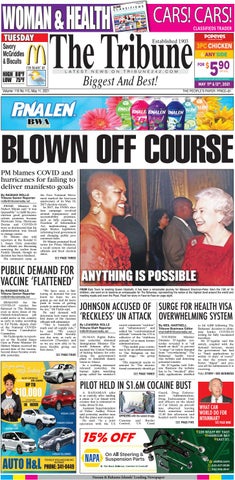
BLOWN OFF COURSE
PM blames COVID and hurricanes for failing to deliver manifesto goals By RASHAD ROLLE Tribune Senior Reporter rrolle@tribunemedia.net PRIME Minister Dr Hubert Minnis said “it was impossible” to fulfil his preelection good governance reform promises because Hurricane Irma, Hurricane Dorian and COVID-19 were so detrimental that his administration was forced to change course. Dr Minnis also told reporters at the Kendal G L Isaacs Gym yesterday that officials are discussing removing the curfew from Family Islands, though no decision has been finalised. His comments came as
the Free National Movement marked the four-year anniversary of its May 10, 2017 election victory. In 2017, the FNM’s election campaign revolved around transparency and accountability promises, such as fully enacting a Freedom of Information Act, implementing campaign finance legislation, reforming local government and changing public procurement rules. Dr Minnis promised fixed terms for Prime Ministers, a recall system for elected officials and fixed election dates. SEE PAGE THREE
PUBLIC DEMAND FOR ANYTHING IS POSSIBLE VACCINE ‘FLATTENED’ By RASHAD ROLLE Tribune Senior Reporter rrolle@tribunemedia.net
DEMAND for the COVID-19 vaccine has flattened in The Bahamas even as more doses of the Oxford-AstraZeneca jab could arrive in the country as early as today, according to Ed Fields, deputy chair of the National COVID19 Vaccine Consultative Committee. Mr Fields spoke to reporters at the Kendal Isaacs Gym as Prime Minister Dr Hubert Minnis received his second dose of the vaccine. Second doses became available yesterday.
“We have seen a flattening of demand but you know we hope we are gonna go out and do more push in terms of getting people to understand where we are,” Mr Fields said. He said demand will determine how many more first doses of the vaccines officials will administer. “This is basically all math and all supply side,” he said. “We expect another 33,000 literally any day now, as early as tomorrow (Tuesday) and so we are now able to be more flexible giving out first doses.” SEE PAGE FOUR
FROM Bain Town to meeting Queen Elizabeth, it has been a remarkable journey for Missouri Sherman-Peter. Born the 15th of 16 children, she went on to become an ambassador for The Bahamas, representing the nation at the highest level around the world and meeting royals and even the Pope. Read her story in Face-to-Face on page eight.
JOHNSON ACCUSED OF SURGE FOR HEALTH VISA ‘RECKLESS’ UN ATTACK OVERWHELMING SYSTEM By LEANDRA ROLLE Tribune Staff Reporter lrolle@tribunemedia.net HUMAN Rights Bahamas yesterday slammed Immigration Minister Elsworth Johnson after he accused the United Nations of lacking balance for criticising the government’s plans to demolish shanty towns in Abaco. In a scathing statement released yesterday, the human rights watchdog group called the minister’s
recent comments “reckless” and “inflammatory” and added his “confrontational attitude” towards the UN is reflective of the “stubborn attitude” of so many former administrations. “This mulish pose continues to be an embarrassment to The Bahamas on the world stage,” the group said. “His argument seems to amount to: ‘The international community should go SEE PAGE THREE
By NEIL HARTNELL Tribune Business Editor nhartnell@tribunemedia.net TOURISM Minister Dionisio D’Aguilar yesterday revealed it is “all hands on deck” to prevent “a surge” in visitor demand from “overwhelming” The Bahamas’ health travel visa website and deterring potential tourists. Mr D’Aguilar told Tribune Business the website has to be “tweaked” after daily applications doubled
to hit 4,000 following The Bahamas’ decision to eliminate border COVID-19 testing for fully vaccinated travellers. Mr D’Aguilar said this switch, coupled with the demand increase, meant the government has had to “limit applications to within 14 days’ of travel” so that the system can better “digest” and process all the submissions it is receiving. FULL STORY - SEE BUSINESS
PILOT HELD IN $1.6M COCAINE BUST
A BAHAMIAN pilot is in custody after landing a plane in Cat Island with cocaine that is estimated to value about $1.6m. Assistant Superintendent of Police Audley Peters said yesterday another man fled the plane and escaped. He said: “In a joint operation with the US
OFFICERS with the seized drugs. Customs Control,
and US
Border Coast
Guard, Drug Enforcement Administration, Drug Enforcement Unit and officers on the island of Cat Island, an aircraft was observed leaving Haiti sometime around 12.30 this afternoon and headed north towards the SEE PAGE FIVE
WHAT CAN WORLD DO FOR MYANMAR?
SEE PAGE NINE
226 WULFF RD EAST HARBOUR BAY EAST ST.
aidltd.com
242.427.0026 242.359.3641
Nassau & Bahama Islands’ Leading Newspaper
PAGE 2, Tuesday, May 11, 2021
THE TRIBUNE
Tributes paid to fallen of the Flamingo By EARYEL BOWLEG Tribune Staff Reporter ebowleg@tribunemedia.net MARINE Seaman David Tucker joined the Royal Bahamas Defence Force two months before his untimely death 41 years ago. His sister, Joan Knowles, said the 21-year-old was interested in another field until their father suggested her brother try seeking an altruistic occupation. “David initially really wanted to be an accountant, but Daddy told him to try and find an occupation where you’re giving back to your society, where you’re helping more people at one time than just one person. And on that advice and being one of the older sons, he decided he would join in (the RBDF) so he could help out because the rest of us were still at school so he wanted to help Mummy with raising us and being financially fit to raise us the way we should and so I think all of that coupled with wanting to make a difference, yeah, I think that’s why he joined. “Daddy unto his death, he just blamed himself. He figured if he had not told David to join the force or recommend that he do it, that David would have still been alive and so it was just
horrible. A horrible experience for everybody.” Her brother, along Marine Seaman Austin Smith, Marine Seaman Edward Williams, and Able Seaman Fenrick Sturrup would end up giving the greatest contribution to the country — their lives. On May 10, 1980, the men were killed during the sinking of HMBS Flamingo by Cuban military jet fighters. An annual memorial ceremony was held yesterday at HMBS Coral Harbour. Family and loved ones, including Ms Knowles, of the victims joined other RBDF marines and officers to commemorate the sacrifice made 41 years ago. Retired Captain Whitfield Neely, a survivor of the incident, says the tragedy is still fresh in his mind. He was just 20 years old when the sinking occurred. “I knew everyone that died,” he said. “Edward Williams and I grew up on the same street — East Street. He lived on Lewis Street. I lived down on Lily of the Valley Corner so we saw each other very often but the other three guys, I met them when I came in on the Defence Force and they were all wonderful guys. We all got along very well back in those days.” He added: “The incident
was very vivid in my mind. I spent a lot of time thinking about it. Just about every day I think about it, the sinking of the Flamingo, because I remember all of the explosions. I remember all of the scenes that came along with the incident. A lot of them were very horrific, very traumatising but it happened and I made a mental note to move on and stay focused on me. “I was the one who went out initially in the sea boat to look for them and I spent quite a while after the initial attack on the Flamingo riding around the scene looking for the four missing comrades that were missing and it was very traumatic for me because it then dawned on me that this job is a job where one can lose your life if you’re at the wrong spot at the wrong time. “Because I knew right then they were never coming back because of where we were and the depth of the water. The water there was about between 70,000 and 90,000 feet deep and I knew nobody could survive in that if you didn’t see them swimming on the surface right away.” Despite the deadly incident, Neely stayed in the force years after. After 42 years of service, he retired last month.
WREATHS being laid as part of the tribute to the Flamingo crew. Photos: Donovan McIntosh/Tribune Staff David’s sister said on Mother’s Day 1980, their mother got the devastating news. At the time, Ms Knowles was only in junior high school at CH Reeves. “We were all at home and David had not arrived at home and anybody knowing David, David is one who Mother’s Day, Christmas, Mummy’s birthday, David was always home,” she told The Tribune. “We were all worried and then there was a knock at the door and I’m thinking it was the commodore at that time who came and told mummy. Back then when persons came to the house, the children were not allowed in the front room with the persons who would come and so we were all in the dining room area and we just heard when he left, but the door never closed and so when we finally walked out mummy was still standing at the door looking out in disbelief that her son would not be coming home.” Asked how she took the news as a teen, she said: “It was kinda surreal because you’re going through so many emotions and then you’re watching everyone around you and you’re not certain where you stand in the whole dynamics of
it, but it was definitely sad to know that David wasn’t coming home anymore and the saddest thing for Mummy was that she could not see his body again to properly bury him and she went to her grave feeling that way and she would always say ‘a parent ought never to bury their child.’ It should always be the child burying the parent so it was really not easy for anyone, and I just took it as it came. “There are moments even today where we’re still crying about and other times we’re just laughing about all the just and the memories we have of David.” Tucker’s death did not stop his nephew, Miscak Clarke, from joining the RBDF. “After coming here for so many years in primary school and seeing the occasion, how (he) was celebrated and remembered on a yearly basis, it sparked my interest and also always hearing my mom and my uncles talking about Uncle David it got me interested in saying you know this is something I may want to do.” Asked if he had the fear he may lose his life, Mr Clarke answered: “I’m a firm believer in what (is) supposed to happen is going to happen. So whether
I’m out to sea for work…. whether I’m just standing on the pier if my demise (is) suppose to come on the waterfront then that’s what will happen.” While speaking at the ceremony, Governor General Sir Cornelius A Smith said the fallen men had made the “ultimate sacrifice” for their beloved country. “Now while we lament the fact that their bodies are no longer with us, we can take courage, comfort, and inspiration from knowing that these four gallant marines gave their lives for a greater cause and by so doing they have ensured that their bravery, their heroism, their fighting spirit, and their love for country will be an example for all marines to emulate. “Our fallen heroes join the Royal Bahamas Defence Force not for fortune, but rather because of their deep sense of duty to the country. They gave of their service not for fame, but rather for the reward of serving mankind. They endured the fog of state conflict not for personal gratification but rather for the reward of knowing that their endurance was necessary for the defence and protection of Bahamian sovereignty.”
THE TRIBUNE
Tuesday, May 11, 2021, PAGE 3
PM blames COVID and hurricanes for failing to deliver manifesto goals from page one However, many of the promises have not been fulfilled. Progress on the Freedom of Information Act has been slow and a Public Procurement Bill that recently passed Parliament has yet to be enacted. Although the administration tabled an Ombudsman Bill and an Integrity Commission Bill early this term, the bills have not been debated in Parliament, prompting critics to accuse the administration of neglecting its transparency and accountability pledges in favour of less consequential legislation. “I am still a strong advocate for term limits for Prime Ministers,” Dr Minnis said yesterday. “I am still a strong advocate that no Prime Minister should go beyond two terms, ten years. I am still a strong advocate for fixed (election) dates, that’s still coming. But as I’ve said, priorities had to be shifted because we have three years of destruction. We could have totally ignored the destruction and just stick to your programme but if you did that your country would be a disaster.
“We could have concentrated only on the catastrophic problems that we faced, but then what happens? Your country stagnates and you don’t move. It was impossible to deal with all of what we promised within that one (term) but be assured that all will be done.” Hurricane Irma impacted The Bahamas in 2017 while Hurricane Dorian ravaged Abaco and Grand Bahama in 2019. The COVID-19 pandemic has upended life in The Bahamas since March 2020. “We had three challenges so we had to decide whether you just stop and deal with catastrophic problems or are you a true government and run on two parallel tracks, one track deals with catastrophic problems that you face or another track and still move the country forward,” Dr Minnis said. “We kept on course with moving the country forward. We had stated that what we want to do, we want to ensure that each and every Bahamian is entitled to partake in what we termed the Bahamian dream.” This dream, he said, comprises four components: free education, affordable
PRIME Minister Dr Hubert Minnis speaking to the media yesterday. access to housing, jobs and affordable healthcare. He discussed his administration’s education policy, which resulted in education at the University of the Bahamas and the Bahamas Technical & Vocational Institute becoming available to a wider number of people for free. He also highlighted efforts to make pre-school free for children. “Phase Two, every Bahamian wants to own a home or a land,” he said. “We introduced a land policy in Carmichael Road, 400-plus lots that’s well on their way.
For the first time, Bahamians can buy land with all the infrastructure in place for $20,000. In addition to that, they can build their homes duty free. We (are) now introducing a new category, the Prospect Ridge area so that young professionals whom we have defined already, they will be able to purchase land which is worth in that area a minimum of $150,000. Once the infrastructure is in place that land will (be) worth $220,000 or more. That’s what we’ve done, and we have additional lands here to give
Photo: Racardo Thomas away to the Bahamian populace. We’re doing the same things in the Family Islands. “Component Three, jobs. We were successful in terms of implementing a vaccination programme. We managed what we thought was well the COVID pandemic that we’ve seen throughout the world and now we’re slowly opening up our economy. I’ve had discussions with some of the medical professionals already and there is a possibility, I’m not saying that it will happen, there is a possibility that all Family
Islands, excluding New Providence and Grand Bahama, will have the curfew removed so we’re opening up the economy, the jobs are returning. “Phase Four is health. We’re advancing the national health programme and we’re moving through all the Family Islands upgrading our health infrastructure, ensuring that all the personnel are there and we’re introducing telemedicine again which we started in 2007-2008 when I was the Minister of Health and which the previous government dismantled.”
JOHNSON ACCUSED OF ‘RECKLESS’ UN ATTACK from page one fix Haiti before they bother us.’ First of all, the majority of the individuals in question are not Haitian, but Bahamian citizens or lawful permit holders, as his government’s own studies have shown. “Secondly, the long suffering families in question would not be in their current predicament if his government had done something to provide some form of shelter or plan for a path to long-term housing for those who lost everything in Hurricane Dorian. How will it benefit The Bahamas to push these families into the street?” Rights Bahamas said Mr Johnson ought to be reminded that The Bahamas is a member of the UN Human Rights Council, representing CARICOM of which the Republic of Haiti is a member. The group also went on to accuse the Minnis administration of being discriminatory towards the Haitian community and having a hidden agenda. “The government of The Bahamas cannot continue to pretend that their Abaco home demolition plan is about building standards, when it is quite obviously and blatantly a discriminatory effort to destroy communities of a particular ethnic background,” the group continued. “The continued references to Haiti highlights this fact, as does their failure to apply the same extreme policy to other communities that suffer the very same building code deficiencies.” On Friday, UN experts urged the government to halt its plans to demolish dozens of homes in shanty towns in Abaco, calling it a “serious violation of
the human right to adequate housing” that will likely result in increased homelessness and extreme poverty. However, in response, Mr Johnson said officials were just enforcing the law, explaining shanty town structures do not adhere to the nation’s current building code practices. The minister also criticised the UN for lacking balance in its assessment of the country’s shanty town issue. “There’s no notice that goes out to those individuals who are constructing irregular construction and those who intend to do it,” Mr Johnson said on Sunday. “You’d expect that the UN would say ‘those of you who are now doing it and you have no legal authority, stop because it’s injurious to the country as a whole.’ The Haitian community has said it. You’d expect the UN now to say that for those persons who find themselves in the Bahamas, it’s a sovereign and democratic country governed by laws.” In April, the Ministry of Works spearheaded the demolition of 45 “incomplete and unoccupied structures” in The Farm after conducting a joint sting operation in the unregulated community weeks earlier. Last week, Minister of Works Desmond Bannister said the government was ready to continue its actions in the community which could begin as early as this week. When The Tribune contacted locals to find out if any demolition works were under way in the area, many told this newspaper that no buildings were being demolished. However, they claimed that some workers were seen in the area, marking certain structures. Yesterday, Abaco
resident and activist, Frankie Fleuridor told The Tribune he receives multiple calls daily from shanty town residents who are fearful and uncertain as to where they will go after their homes have been demolished. The situation is also compounded by the island’s housing crisis, which has been a major issue since Hurricane Dorian in 2019.
“They said they’re going to destroy the house but where are these folks going to go? There’s no shelter, we can’t find no place in Abaco to rent. We have a housing problem,” he told this newspaper. “I have people from The Farm call me every day. They calling me to find out if the people coming... and if they’re going to demolish the homes because they put the
last paper on these homes that’s built. “The people are stressed right out right now and they don’t know what they’re going to do because you have people living in Abaco living in tents. You have folks who are still living in cars. I don’t agree with them building like that and the government had said they don’t want shanty towns in Abaco, but they
don’t have no plan.” In 2018, the Supreme Court granted an injunction protecting shanty town homes in New Providence from destruction pending the outcome of a judicial review challenge over the matter. Government officials, however, have said newly built homes in The Farm and elsewhere are not subject to that injunction.
PAGE 4, Tuesday, May 11, 2021
THE TRIBUNE
PUBLIC DEMAND FOR VACCINE ‘FLATTENED’ from page one “Obviously the demand will determine how we manage that, so I want the folks who are out there to know that we’re literally monitoring this day by day based on the demand for first doses and, of course, making sure that second dose folks all have doses available for them so that’s how we are going to have to manage it. “I couldn’t sit here right now and say we’re gonna stop on this day or we’re gonna stop on that day. We have to look and see how the demand is happening.” The Bahamas expects to have received at least 120,000 vaccine doses before the summer. “You remember from previous conferences we’ve said that we would be getting our full complement of that by the end of May so in addition to the 33,000, by the end of May we’ll be getting some more doses that will take us to the full 120,000. That doesn’t account for the fact that we are continually working on getting more supplies from
other sources in addition to that,” he said. The Bahamas received 33,000 doses through the Pan American Health Organization/World Health Organization’s COVAX Facility in March and is expected to get 100,800 doses through that facility. The country also received 20,000 AstraZeneca vaccine doses in March as a donation from India before that country was overwhelmed by a new massive outbreak. “We anticipate easily that we will meet all expiry date issues,” Mr Fields said. “Whatever is the expiry date that’s closest, we then load those into arms as fast as we can prior to that date. We don’t feel that we are going to have any issues with (the) expiry date. We anticipate that as we get more in the summer months, supplies will become more available.” In recent days, some residents have complained about the vaccine registration website, saying they are unable to book their second appointment. Mr Fields said officials are working to correct glitches with the site.
“Very simply as you know, when we were asked to start this process we had already in process the development of an appointment platform but as we learned that the vaccines would be coming to us more quickly than we previously thought we then put in a back-up and the back-up that was used was Doctors Hospital which already had a platform up though it wasn’t as flexible as we like,” he said. “We were able to use that platform to initiate doses, the first 10,000 doses. In order to be able to issue certificates of vaccines, etc, we need to have all of the people who were on the Doctors Hospital platform integrated into the new platform we are using. As you know, any transfer of data creates some hiccups because you now have to transfer 10,000 names in the same format over to a new platform that may not have the matching format so I think out of 10,000 we recognise that we have probably 800 or 1,000 names that didn’t transfer for whatever reason. “We then subsequently
NATION ‘NOT IN A GOOD PLACE’ By TANYA SMITHCARTWRIGHT tsmith-cartwright@ tribunemedia.net FORMER Health Minister Dr Duane Sands feels the country is “not in a good place” where COVID-19 cases are concerned and thinks the only way forward is to tighten restrictions. He said enforcement of whatever restrictions are put in place is key to putting COVID-19 in check. His recommendations coincide with suggestions from officials of the Pan American Health Organization. “We are not in a good place right now with COVID,” he told The Tribune yesterday. “I think we have reached the point where we ought to be tightening restrictions. How tight? I think that would best be decided by recommendations of health, plus business, plus government, but certainly tighter than it is now. “We also need to make sure that we are enforcing whatever it is that we tighten, because it makes no sense to tighten if we are not going back to make sure that someone didn’t loose it ten minutes later. That metaphor I used deliberately because we are pretty good at making laws, but we are not good at adhering to or enforcing them.” With health officials previously confirming COVID-19 variants are in the country, Dr Sands said this is concerning considering the country’s proximity to Florida. “We have heard from the ministry’s press conference that there is indeed, if not a concern, that there is evidence of variants in The Bahamas now,” he said. “What the exact variant or variants are, I certainly do not know because I have not seen that presented. “This is such a moving target that unless this (is) something being done in real time, daily, weekly, that whatever report you have from a month ago is now outdated. That has been the experience around the world. Certainly what is very concerning is that we live in proximity to a state in the United States that has the highest number of variants of any state in the United States and that is Florida.
“We have people moving back and forth between South Florida and The Bahamas on a regular basis. So it is reasonable to assume that The Bahamas probably parallels to some degree what is happening in South Florida.” He also referred to the fact there is now a prevalence of younger people being infected with COVID and a prevalence in COVID-related deaths of people under the age of 60 as well. “What we have also seen in The Bahamas has been a trend where the patients that are being affected and infected with COVID by younger people – people in their 30s and 40s and some in their 20s,” Dr Sands said. “We are now seeing a surge in COVID in The Bahamas with a number of cases with severity of illness, a number of people hospitalised. “It is not good on the ground when you look at the public or private facilities that manage COVID patients. They are incredibly busy right now. And, the clinical problems are very, very challenging. We have seen an increase in deaths, but we have also seen an increase in deaths in younger people. “I’ve been saying this for the last four weeks. We have a problem. If you look at the number of cases in January, February, March… if you add them up, they don’t equal the amount of cases we had in April. May seems to be on a pretty good pace as well. So after cases come hospitalisations. After hospitalisations come deaths and they lag so there is an offset in terms of the expectations.” According to the latest data from the Ministry of Health, there were 46 new cases of COVID-19 reported for Sunday: 17 males and 29 females. Another death was also reported: an 85-year-old New Providence man who died on May 9, bringing the number of deaths to 214. Twenty-six additional deaths under investigation. Fifty-eight people were in hospital with COVID-19 at last report. The total number of COVID19 cases in The Bahamas is 10,908.
PRIME Minister Dr Hubert Minnis receives his second dose of the COVID-19 vaccine. Photo: Racardo Thomas updated. That number is is where the hitch is. That issue with that, that’s just a now dwindled down sig- only affects a small minor- matter of time. They have nificantly. We’ll have to ity of people. Of course, all to get their second dose work until all the data is the people who are on the seven weeks after they get transferred and that really new platform, there is no their first dose.”
NURSES: END STATE OF EMERGENCY By LEANDRA ROLLE Tribune Staff Reporter lrolle@tribunemedia.net
THE Bahamas Nurses Union has suggested the government put an end to the state of emergency, which is set to expire on May 23, saying The Bahamas must learn to coexist with the COVID virus. Speaking to The Tribune yesterday, BNU General Secretary Sheniqua Cox said while the union believes the nation should have some sort of legal framework in place to enforce current health measures, Bahamians must also be able to make their own decisions relating to their health. Saying the current emergency order and associated protocols did not stop the country from experiencing a second or third wave, Ms Cox stressed it’s now time for the government to focus on other preventative strategies aimed at keeping virus cases low. Key among them includes a robust vaccination campaign and a comprehensive public education campaign centred on the COVID-19 prevention initiatives, she said. “We were in this pandemic for over a year, so how long is this government going to take away our decisions on protecting ourselves? We need to now educate our public on the importance of the health guidelines, national regulations and guidelines on COVID-19 such as wearing masks, such as social distancing and such as crowd control and sanitisation,” she told The Tribune. “We need to have these national guidelines in effect, straight across the board, so when you go to any island across The Bahamas, this is what is accepted. Also, we now have vaccines. They have to educate the public on the importance of getting vaccines and once they are educated, they become better equipped to make their own informed decisions.” She added: “As I always hear (attorney) Wayne Munroe say, does COVID go away at 10pm? Our nurses work around the clock 24 hours a day. COVID is still out there from after 10pm so what has being on a curfew from 10pm done for us? We’re experiencing a third wave even though we’re under curfew at 10pm. You
TOTAL CASES
10,908 TOTAL DEATHS
214
NEWLY CONFIRMED CASES SUNDAY 46 CASES NEW PROVIDENCE ANDROS GRAND BAHAMA EXUMA
35 8 2 1
RECENTLY CONFIRMED DEATHS • AN 85-YEAR-OLD MAN FROM NEW PROVIDENCE ON MAY 9.
have to give people freedom in terms of health and making their own decisions.” The BNU official also said those who choose not to follow the health measures should have to face the consequences, noting the importance of law enforcement. “That’s why we have COVID teams and teams to go around to ensure that there are establishments adhering to these guidelines and if an establishment is not adhering to the guidelines, then you close down that particular establishment. “You can’t just punish everybody for that one person not adhering so that’s why I say we need national rules on how to govern ourselves,” Ms Cox continued. “We have to learn how to cope with this (virus). We have to learn how to make informed decisions for ourselves and loved ones. There’s no way around this but education and advising and teaching people how to live with
this.” The country has been under a state of emergency since March 2020. During the first wave of the pandemic, cases and deaths were relatively low — with just over 100 confirmed cases at the beginning of July 2020 and 11 deaths. Those numbers, however, surged in early July 2020 after the country re-opened its borders, ushering in a second wave of infections. In April, health officials confirmed The Bahamas had entered its third wave of infections after more than 1,100 new cases were reported for that month alone. On Sunday, total cases in the country rose to 10,908 after 46 new cases were recorded. Of the total figure, 764 of those cases are active. Meanwhile, there have been 214 virus related deaths confirmed. On Friday, Prime Minister Dr Hubert Minnis said officials have not decided whether to extend the country’s state of emergency when it expires May 23. He told reporters that his administration will make a decision on the matter following discussions with physicians. Last month, Attorney General Carl Bethel confirmed that whether a new statutory framework is implemented, or the state of emergency is extended, “there will be some legal framework” to restrict physical contact until the country obtains herd immunity. Yesterday, Ms Cox said to her knowledge, no one has contacted the union on the way forward. However, she acknowledged that the union believes implementing new legislation to replace current emergency orders is the more “ feasible” approach. For his part, Progressive Liberal Party Deputy Leader Chester Cooper said the opposition party will not support another extension of the emergency orders. “We are well documented on record in saying that a constant state of emergency is unhealthy for the economy, is unhealthy for the psyche of our people and unhealthy for industry, particularly tourism. We advise the government to really amend the necessary legislation that’s already on the books so that we can move to a state of a new normal,” Mr Cooper told The Tribune.
COMMODORE: RBDF MANAGING INFECTIONS, DECLINES TO DISCLOSE HIS TEST RESULT By EARYEL BOWLEG Tribune Staff Reporter ebowleg@tribunemedia.net THE ROYAL Bahamas Defence Force only had about eight active cases and 31 people in quarantine as of a week ago, RBDF Commodore Raymond King said yesterday. He added the force is managing the situation well amid the country’s third wave of infections. “With this third wave, I don’t want to become elated too soon or too quickly, but we’ve managed this third wave in terms of numbers within the organisation,” he told reporters. In April, the Cabinet
Office revealed in a statement that the Commodore was exposed to COVID19, was experiencing mild symptoms and had entered quarantine at home, however his COVID-19 status was never publicly announced. The incident also caused Commodore King’s immediate members of staff to be placed in quarantine. The commodore said it was “unfortunate” that there were a few people from his office who were also exposed. “I think we got caught up in a bubble, a false bubble, that we work together in a small confinement — that we are safe. But the reality of it
is persons when they leave the workplace and they go to their various homes they have their own circles and (sphere) of influences. “And so the policies would’ve been relaxed somewhat with that false sense of comfort. Thank God everyone has recovered. They’re doing extremely well, but the weight of my office requires me to be in a number of meetings, briefing sessions with internal and external stakeholders. “But having a number of my close staff members being also exposed that sort of told me that there was a small cluster within the office and so now we have to adhere to the health
protocols and I’m sure I certainly have even more so now having been exposed.” When asked if he tested negative for the virus, Commodore King answered: “I wish not to disclose that medical information.” The commodore explained the force is adhering strictly to the Ministry of Health’s COVID protocols, but the RBDF has taken other precautions. He said: “Before any deployment, before any vessel proceeds at sea, persons will be tested prior, about up to five days prior to, and once they are cleared then our ships will proceed. “Persons will go on deployment because for
us, our largest ship carries a crew of some 60 persons and it takes just one case onboard and now you have 59 persons who must be quarantined and so it impacts us even greatly and that is why we have taken those proactive steps to test before they move out to sea. “So if we could detect any sense that someone may be exposed to address it immediately. Even during the first three days at sea if anyone falls ill due to the abundance of caution, that vessel will be returned and everyone tested. Placed on quarantine.” He also said the force has a “robust medical plan”.
“We are satisfied that if we were to test those persons before they actually enter training — they’re tested, they’re kept in a bubble, and we keep the entire training staff, and once we adhere to the medical protocols of wearing masks (and) social distancing we should be fine.” Asked about vaccination hesitancy or concerns, he commented: “We still have a level of hesitancy amongst the membership but slowly persons are going to be vaccinated they have but there was a high level of hesitancy early on but it has somewhat eased and persons are now going to be vaccinated.”
THE TRIBUNE
Tuesday, May 11, 2021, PAGE 5
Floating bar cited for fourth time for breaching orders By TANYA SMITHCARTWRIGHT tsmith-cartwright@ tribunemedia.net A LOCAL floating bar has been cited some four times for breaching COVID-19 emergency orders, according to police. Officer-in-Charge of the COVID Enforcement Unit, Chief Superintendent Zhivargo Dames was contacted about the floating bar on East Bay Street after pictures were recently sent to The Tribune of patrons crowded on the boat, not observing social distancing. “The floating bar in
question has been cited a number of times by the COVID Enforcement Unit,” Chief Supt Dames said. “They were cited about four times between October of 2020 and March of 2021. It’s interesting to see that this is recent.” Asked about another bar in question that is said to also be in breach of protocols, Chief Supt Dames said it only appears to be so but officers have proven otherwise. “The thing with (that other bar) is that you might find a lot of cars there but as you go into the establishment itself, you would see that they are operating under the capacity of
persons who are supposed to be there and they are following all of the protocols,” CSP Dames said. “That is not to say that in the beginning we did not have to cite that location for breach of protocols, but in recent times of our checking the establishment, we have found them to be compliant with the orders.” The Royal Bahamas Police Force has been criticised for not enforcing the emergency orders as they pertain to restaurants, bars, gatherings and the wearing of masks. Chief Supt Dames took exception to this and gave numbers to the contrary.
“If the persons are saying the rules need to be enforced, the thing is that according to my data, the COVID Enforcement Unit is up and about every day doing its job for which it was formed,” he continued. “For a year, thus far to date, we have issued some 831 citations. “We have issued persons patronising a prohibited business some 234 citations; breach of curfew some 103 citations; not wearing a mask as required 102 citations; operating a prohibited business some 100 plus citations. So I am not sure who it is making these assertions, but according to the data that we have
gathered the Enforcement Unit is out there doing its job. “Now can we do a little bit more? Yes we can. We can always improve on what we are doing, but I must say as the officer in charge of the unit we are up and about every day doing our best to enforce the protocols and I think the data is there to back me up on that.” He said repeat offenders are also penalised. “Of course we have some persons who have been repeat offenders and wherever we find that we take the necessary action against them,” CSP Dames explained. “If you find a business which has been
cited and we would have taken that business to court and they are convicted, on the second time the fine goes up to about $10,000, if I remember correctly, and your business license can be revoked for up to 14 days. “Then on a second summary conviction the fine goes up to $30,000 and your business license can be revoked according to the orders. This pandemic has truly brought on a level of uncertainty that is unprecedented.” Chief Supt Dames urged people to follow the protocols set by the authorities as he thinks in the not too distant future the country will emerge from the pandemic.
ANOTHER 40,000 TONS OF DORIAN DEBRIS
THE DRUGS seized by officers from the Drug Enforcement Unit.
Photo: Racardo Thomas
PILOT HELD IN $1.6M COCAINE BUST from page one
Bahamas. That aircraft landed in Long Island and left immediately.” “It later landed on the island of Cat Island where a male was seen disembarking the aircraft with two multi-coloured suitcases. The male ran into nearby bushes. However, one of the surveillance aircraft
landed and officers from that craft pursued the male. “However, he made good his escape. Those officers were successful in recovering those two suitcases and on examination of those suitcases, 58 black packages suspected to be cocaine were discovered. “The aircraft that landed on the island went on to Cat Island where the pilot was later arrested by officers on
that island. The street value of that cocaine is estimated value of $1.6m.” ASP Peters said the pilot, a 38-years-old man, is not familiar to police. Officers suspect this activity was part of a larger, transnational drug operation. ASP Peters said officers are not sure if the escaped suspect is still in The Bahamas.
By DENISE MAYCOCK Tribune Freeport Reporter dmaycock@tribunemedia.net HURRICANE Dorian generated record amounts of debris totaling some 40,000 tons collected in the last quarter of 2019, compared to the 12,000 tons collected that same period a year earlier on Grand Bahama, according to the chairman of Keep Grand Bahama Clean Committee (KGBCC). Nakira Wilchcombe said that the debris collected in Freeport during Dorian shows a “drastic comparison” with the amounts collected in 2018, and also in 2016 during Matthew. “We wanted to understand the dynamics of the debris generated from Hurricane Dorian versus other periods in history,” she said. She was the guest speaker at a recent Rotary of Club of Grand Bahama bimonthly meeting via Zoom. She spoke on the topic, “The Impact of Hurricane Dorian on the Natural and Physical Environment”. During her presentation, she reported that in September 2019 11,718 tons of debris were collected, almost over 3,000 truckloads, compared to 4,000 tons collected in 2018 during a normal year with no storms, and 6,932 tons collected in 2016 following Hurricane Matthew. In October 2019, debris collected was recorded at 15,000 tons, compared
to 4,000 tons in 2018, and 9,000 tons following Matthew in 2016. In November 2019, debris collected totaled 13,000 tons, compared to 4,000 tons in 2018; and 11,000 tons during Matthew in 2016. “So, we can see this comparison from 2016 to 2019 and the impacts of what Dorian would have generated,” Mrs Wilchcombe said. Mrs Wilchcombe said that bulk waste accumulation in several residential subdivisions was extensive. She noted that the Sunset Subdivision in Freeport was among those severely affected. Of 190 homes there, over 150 were damaged by floodwater and debris, she reported. The KGBCC chairman said that cleanup lasted from September 2019 well into 2020 because even though the hurricane was over, one of the main challenges was that people were slowly recovering, rebuilding, and putting their lives together. Another serious issue, according to Mrs Wilchcombe, was derelict vehicles that were destroyed by the storm. “The horrific sites on Queen’s Highway and
Queen’s Cove where persons were either just dumping their cars – tow truck drivers or residents with no permission – on the verges.” Mrs Wilchcombe reported that some 500 cars have been moved, but there are still lots more remaining. “So, it is only the tip of the iceberg. We believe there are many cars left in many other areas, particularly through the civic industrial area where persons have discarded vehicles,” she said. She indicated that an area has been designated for the storage of derelict vehicles until they can be exported off the island and used as scrap metal. “We believe (derelict vehicles) are in the hundreds in the port area alone, and I know in East Grand Bahama, the government has a storage yard of the vehicles as well. It is not going to be an overnight fix, but we are hoping we could address the issue because it is not only an aesthetic issue but an environmental and safety issue. We want to partner with necessary stakeholders to tackle this ongoing problem and issue that we are hoping to resolve.”
FOR SALE Commercial Property Montgomery Street Palmdale Area PHONE: 424-4207 | 328-8391
PAGE 6, Tuesday, May 11, 2021
THE TRIBUNE
The Tribune Limited NULLIUS ADDICTUS JURARE IN VERBA MAGISTRI “Being Bound to Swear to The Dogmas of No Master”
LEON E. H. DUPUCH,
SIR ETIENNE DUPUCH,
jamaaltheartist@gmail.com
Publisher/Editor 1903-1914 Kt., O.B.E., K.M., K.C.S.G., (Hon.) LL.D., D.Litt .
Publisher/Editor 1919-1972 Contributing Editor 1972-1991
EILEEN DUPUCH CARRON,
C.M.G., M.S., B.A., LL.B. Publisher/Editor 1972-
Published daily Monday to Friday
Shirley & Deveaux Streets, Nassau, Bahamas N3207 TELEPHONES
News & General Information Advertising Manager Circulation Department Nassau fax Freeport, Grand Bahama Freeport fax
(242) 322-1986 (242) 502-2394 (242) 502-2386 (242) 328-2398 (242)-352-6608 (242) 352-9348
WEBSITE, TWITTER & FACEBOOK www.tribune242.com
@tribune242
tribune news network
Dr Minnis and his impossible dream APPARENTLY, it was Mission Impossible for the FNM. So says Prime Minister Dr Hubert Minnis, who tells us today “it was impossible” to fulfil his pre-election promises for good governance reform. What were the hurdles? Hurricanes Irma and Dorian, plus COVID-19. Now I think we all acknowledge the scale of the hurdles that have faced the FNM government with the impact of hurricanes and the pandemic, but… is that really a good enough excuse for some key promises falling by the wayside? First things first, the FNM won by a landslide. The number of votes it had available for legislation was unassailable by an opposition reduced to just one seat on New Providence and a handful elsewhere. At no stage was the PLP ever going to outvote the FNM. Secondly, any party aspiring to lead The Bahamas knows it faces the risk of being hit by hurricanes – and should plan accordingly. Irma hit in 2017, and severely impacted Ragged Island, but left pretty much the rest of The Bahamas unscathed. It was two more years before Hurricane Dorian, two years in which a lot of the FNM agenda could have been enacted. Even after Dorian, you expect the government to be able to do more than one thing at a time. Sure, a lot of energy and resources needed to be spent on helping people affected by the storm that ripped through Abaco and Grand Bahama – but that shouldn’t stop the government from being able to drive through legislation in the meantime. The biggest hurdle that has brought the economy grinding to a halt and occupying the focus of all parts of government has been COVID-19. We absolutely accept that the past year and a bit has been a huge challenge – but there was plenty of time beforehand to deal with matters. Let’s take a few examples. Term limits for Prime Ministers, for one. Why has that been left so late in the day that it’s slipped off the agenda, that should be a fairly straightforward vote in the House. How about the Ombudsman Bill and Integrity Commission Bill. They were tabled early on, but never debated. The FNM had the opportunity to act on them – but didn’t. We’ve seen a late flurry on the Freedom of Information Act with a commissioner appointed at last – but let’s not be fooled, with the announcement that the commission wouldn’t be up and running for the public for another six months, that’s effectively going to run out of time to have an effect before any election. Catastrophes have happened – but governments need to plan for
catastrophes too. We live in a hurricane zone, they should come as no surprise that we need to prepare for them, both in getting ready before they hit and in being ready to deal with the aftermath. There are pieces of legislation that would have a considerable price tag attached that we understand might have to be delayed because of the drain on the public treasury from the pandemic – but many of these have little to no cost value. How much would it cost the treasury to put a term limit on Prime Ministers? None. Just get the vote done. There’s no reason why that should have been impacted by either the hurricanes or the pandemic. The frustration for many is that some of these pieces of legislation are lowhanging fruit that would be easy to deal with. When the government doesn’t hurry to do so, it makes voters wonder why. If you promise transparency, then fail to fulfil your freedom of information promise until shortly before you might be out of the door, is that really transparency? Where is our opportunity to use it to examine the work of this government? What about campaign finance reform? Surely that should have been on the table and resolved long before parties were ready to launch the next campaign? Election signs and banners are already going up – and we don’t know anything more about their financing than ahead of the last election. There has been a lot for the government to deal with, but it should be able to walk and chew gum at the same time. To protest otherwise sounds like excuses.
Travel limit
We roll our eyes a little at the news that the health visa website is having problems. The government is having to limit applications to within 14 days of travel after a surge of interest in coming to visit The Bahamas. Holidays are, of course, frequently booked months in advance – so who knows how many tourists we’re driving away with this two-week limit. The limit is to “ensure the system does not get overwhelmed”. This is surely what we were supposed to be preparing for – and now we find out we weren’t ready for more interest? Dionisio D’Aguilar says it is “all hands on deck”. Well, Mr D’Aguilar, if not enough hands is the problem, we would point out the number of unemployed people right now. If you need extra hands, go hire them. The country needs to be ready to go – and website problems shouldn’t be holding us back.
Sent into a tailspin EDITOR, The Tribune. THIS COVID-19 Pandemic has thrown the world into a tailspin. But it has also revealed the selfishness and ignorance of so many of this world’s people, many of whom think it an imposition to be told that the only way to protect themselves and others is to be vaccinated – or at least tested. And, oh, by the way don’t forget that mask! There is no known cure, there is only the trialand-error belief that if everybody followed certain protocols, the COVID-19 pandemic could not only be slowed, but eventually destroyed — as was leprosy, typhoid, cholera, and polio, among other diseases over the years. The Bahamas has had to contend with all of them. As a child I well remember the dreaded leprosy. There was even the Lazaretto off Carmichael Road, which was closed when the last patient died – and leprosy has never been heard of since. This generation has probably never even heard of it. Many generations from now Bahamians will probably be talking about COVID-19 in the same way, but while it is with us, it is a clear and present danger, and we all know what we have to do – like it or not. Eateries in Nassau were closed for a period to give their owners time to do all in their power to make
LETTERS letters@tribunemedia.net certain – in the words of lawyer Michael Scott, who with his wife also owns a restaurant – that their guests didn’t “come for sushi and leave with a COVID dessert.” So there had to be drastic change. Not only did restaurant owners have to sterilise their premises, especially the kitchens, but also those who worked there and could be COVID carriers – in other words their staff. Now, here is where it gets interesting, and a union leader led the tune, of “I does have a contract, and nothing in it says that I have to be vaccinated, so nobody better come messing with my stuff!” – to me it was the voice of the typical ignorant. Some of the employees objected to the new rule, because they had signed a contract, and nothing in the contract allowed for COVID, or for the contract to be changed, not even be renegotiated. When that contract was negotiated no one had even heard of COVID! So the restaurant is disinfected, the kitchens are spotless and the food well cooked — but. Yep, it was a big “but” – COVID was not in the contract, nor were there any conditions that they had to be tested before they continued serving patrons. In other words,
in serving dishes of delicious food, they could also be passing on COVID! But apparently, they were not budging because, it “ain’t in de contract!” And no one could fire them for non cooperation during a deadly pandemic because “it just ain’ in de contract.”’ They were entitled to their job with all the terms of their contract intact — COVID could take a flying leap! Apparently a union leader agreed. I believe Mr Scott eventually worked it out to everybody’s satisfaction. But, just let’s suppose the union got its way and those who refused to be vaccinated remained on the job serving unsuspecting customers. A customer fell ill. The COVID was traced back to the restaurant and it was quickly closed. No restaurant, no job, and where did that employee say his contract was, and what did it have to say about forced closure because vaccination was not in the contract of one of the employees? So everyone suffered, because of the ignorant selfishness of a few. Just see where ignorance will lead us! We just urge everyone to cooperate during this pandemic, if only for selfish reasons – so that you and your loved ones will not fall victim to COVID 19.
A mother left frustrated Zimbabwe government EDITOR, The Tribune.
ON WEDNESDAY, May 6th, a group of eight persons from the Ministry of Education toured the entire prison facility. On a daily basis external construction workers, electricians and contract workers enter and work throughout the prison. Why is it that almost a year and a half later, inmates at The Department of Corrections are being denied their lawful and humane right to have visits by their loved ones? If officers, contract workers, lawyers and special visitors can enter
unvaccinated and with masks why are we as mothers and wives still being denied the right to see our husbands, sons and daughters? The only response I get from prison officials are excuses and the Ministry of National Security does nothing but dodge by referring to the prison. I too am waiting on a loved one that was granted clemency since December. It has been two months since Minister Dames said that all that remained to be done in some cases was to call the victims. Minister, how does this take two months to complete? What about those
persons who have no victims? How can you brag about preparing to review a new group of persons for clemency when the first set of people after six months later are still waiting. Yes, I, and others just like me are frustrated. Yes I and many like me have lost confidence in the promises of this FNM Government. To the average Bahamian it is clear that every single thing you people do is purely for political gain. Disappointed this mother’s day. MS WALLACE Nassau, May 9, 2021.
EDITOR, The Tribune. IT IS tearful that in Zimbabwe there is one set of laws and law enforcement agents for those who actively oppose the ZANUPF regime and corruption; and another set of laws and law agents for those who don’t. In essence the rule of law is an alien concept in Zimbabwe. Government of Zimbabwe violates the rights to shelter, food, freedom of movement and residence, freedom of assembly and the protection of the law. Government agents of
Zimbabwe continued to perpetrate physical and psychological torture. The constitution and law prohibit arbitrary arrest and detention, although other sections of the law effectively weaken these prohibitions. The government enforced security laws in conflict with the constitution. Security forces arbitrarily arrested and detained persons, particularly political and civil society activists and journalists perceived as opposing the government. The government continued to arrest, detain, and harass critics, and journalists practised
A VOICE IN WILDERNESS Nassau. May 7, 2021
THE
self-censorship. It is also painful and offensive that in Zimbabwe you die for the truth, end up in prison, tormented, or disappear forever. Poor leadership corruption remains perhaps the biggest problems facing Zimbabwe today....I am now pleading for the organisation to make a plan about the failure of Zimbabwean President Emerson Mnangagwa. KUDZAI CHIKOWORE London, May 3, 2021.
THE TRIBUNE
Tuesday, May 11, 2021, PAGE 7
Officer’s sentence quashed for assault By FARRAH JOHNSON Tribune Staff Reporter fjohnson@tribunemedia.net THE Court of Appeal yesterday quashed the sixmonth sentence of a former police reserve sergeant who was convicted of abducting and assaulting a teenage girl at a police station over two years ago. In July 2018, Dwayne Dacosta was accused of having sex with a then 13-year-old girl in the precincts of the South Beach Police Station. During trial, it was initially alleged that he digitally penetrated the teenager and made her perform oral sex on him in a room upstairs in the station’s fire services garage. However, when the girl gave sworn evidence, she denied telling police about any sexual acts allegedly committed by Dacosta, and in fact said the contents of her statement were “incorrect”. The teenager said although she signed her statement, she did not read
it over before she signed, and it was not read back to her by the interviewing officer. She also said she didn’t sign the document truthfully. She did acknowledge she told police that at one point while at the station, an officer alleged to be Dacosta called her from the foyer and directed her to a room upstairs at the rear of the building. In 2019, a nine-member jury unanimously acquitted Dacosta of the unlawful sexual intercourse charge but found him guilty of committing the lesser offences of abduction and assault. He was subsequently sentenced to six months behind bars, placed on probation for one year and ordered to keep the peace and be of good behaviour. His attorney, Krysta Mason-Smith, recently appealed his sentence after arguing the verdict was unreasonable given the circumstances of the case. During a virtual hearing before Justices Milton Evans, Carolita Bethell and Roy Jones yesterday,
MAN ON MARIJUANA CHARGE TO TAKE DRUG COUNSELLING By FARRAH JOHNSON Tribune Staff Reporter fjohnson@tribunemedia.net A 41-YEAR-OLD man who was charged with marijuana possession was conditionally discharged after he agreed to attend drug counselling classes. Dion Tynes was arrested after officers found a half gram of hashish in his home on May 3. He pleaded guilty to one count of possession during his hearing before Deputy Chief Magistrate Andrew Forbes. During his arraignment, prosecutors also charged the accused with two counts of dangerous drug possession with the intent to supply, after they alleged officers found two other packages, each containing 27 and 12 grams of marijuana in Tynes’ home that day. He attempted to plead guilty to simple possession for those matters as well; however, the prosecution was not willing to reduce the charges. As a result, a not guilty plea was entered for the offences.
The court was told that officers, acting on information, went to Tynes’ residence armed with a search warrant. Upon their arrival, they identified themselves and informed the accused that his home would be searched in reference to dangerous drugs and firearms. During their investigation, officers found the hashish. In his plea in mitigation, Tynes’ attorney, Roberto Reckley, told the magistrate his client did not waste the court’s time and cooperated with officers from the onset of the investigation. He also insisted his client had the drugs for his personal use and noted that the hashish that was found was a “small amount of oil” Tynes had stored in a tiny Ziploc bag. As a result, Magistrate Forbes granted Tynes a conditional discharge on the condition that he would attend drug counselling classes for six months. He also adjourned the case for the latter two charges for trial on November 8. Tynes was granted $1,000 bail in the interim for those offences.
LYFORD CAY SCHOLARSHIPS COVID-19 turned the world upside down, closing schools to in-person learning, shutting down tourism and forcing countries to ramp up healthcare operations. But there is one thing it did not dampen – Bahamian students’ desire to go to college. More than 600 applicants in the Bahamas applied for a Lyford Cay Foundations scholarship for studies outside of the country, according to a press release from the organisation. According to executive director, Dr Nicola VirgillRolle, “While the number of applications is slightly down from prior years, interest in pursuing higher education both abroad and locally remains extremely strong.” All applications are reviewed by an independent scholarship consultant and then further assessed through independent screening committees to ensure the integrity of the review process. The first-round for applications closed on March 15 while the second round of reviews closed on April 15. The complete process can take up to four months, a timeframe the Foundations is working
toward reducing. “All applications are considered for financial need as well as academic qualifications. However, we also make sure that there is a financial plan in place to fund costs not covered by the scholarship” said Dr Virgill-Rolle. “Additionally, we are continuously working on new scholarships. For example, through generous new gifts, we will be expanding our offerings of scholarships for studies at universities in Canada.” Dr Virgill-Rolle expressed her gratitude to the donors, many of whom have consistently provided support to the Foundations. Some 25-30 new Lyford Cay Foundations scholarships will be awarded for students to attend Canadian and American universities, with final notices going to successful candidates by mid-July. Another 25-30 students will benefit from ongoing scholarships. Through annual disbursements since 1997, Lyford Cay Foundations has also provided just over $7m to University of The Bahamas (formerly College of The Bahamas) for scholarships, the Harry C Moore Library and study abroad programmes.
she contended that the judge should have acquitted the appellant at the no case stage and not proceed with the other matters, since there was no evidence to support the accusation brought against her client. “At the stage that the learned judge found that there was no evidence of any sexual offence being committed before her, and on the concession of the Crown to that effect, that ought to have brought the matter to an end,” she stated. “Having regard to what the law says about any other offence arising on the facts, then what ought to have happened is that that particular indictment ought to have been formally quashed and or amended and none of that transpired.” Mrs Mason-Smith said while the Supreme Court was “armed with power,” there were procedures put in place to ensure the authority they possessed was “executed in the correct fashion”.
She also noted the Crown never made an application to amend the indictment, despite the fact that the evidence produced during trial “revealed” something contrary to their allegations. “The evidence of the complainant herself said he (Dacosta) did nothing to me. There was no evidence of him doing anything sexual or otherwise other than the seven minutes that the Crown made much of. If it had been a situation where the facts revealed indecent assault... even that had to be left to the jury at the appropriate stage. That’s what we’re saying. At a no case submission stage, we have a difficulty with the manner in which the case unfolded and led to a conviction.” Mrs Mason-Smith said the judge’s ruling, in which she concluded that there was not sufficient evidence “in respect to the current charge that the jury properly directed may consider relative to the charge of unlawful sexual intercourse,” proved the teen’s
evidence did not assist the Crown “whatsoever”. “He was there for an offence of a sexual nature only (but there was) no evidence,” she said. “The Crown in their attempt to even raise the issue of indecent assault, show us that their mind also was aligned that lesser offences must come from the greater offence. Our submission respectfully is that the offences for which Mr Dacosta was unusually asked to lead a defence (for) do not form the lesser of the greater in these circumstances nor was the correct process followed”. In her submissions, Crown attorney Jacklyn Burrows asserted there was “no need” for a formal arraignment or amendment to the indictment. “The prosecution did concede that on the facts, the unlawful sexual intercourse did not occur on the evidence. However, we are of the view that lesser offences did arise from the evidence,” she stated. Still, when Justice Jones
said it was not “fundamentally fair” to place an indictment in front of the accused without first charging him for the offences, Mrs Burrows argued that Dacosta was “fully aware of all the allegations of conduct”. In response, Justice Evans told her that Dacosta was only arraigned on “one specific charge”, which meant that if the Crown was “moving away” from it, an amendment had to be made. The Crown had originally filed an appeal to contest Dacosta’s sentence as well. However, after considering the point raised by the appellate panel during Dacosta’s appeal, the prosecution opted to withdraw the court action. After some deliberation, Justice Jones said the panel elected to rule in favour of Dacosta. “We have decided to allow the appeal, quash the conviction and sentence and we do not order a retrial,” he said. “We will give our reasons at a later date.”
PAGE 8, Tuesday, May 11, 2021
THE TRIBUNE
Missouri’s mission fuelled by parents who taught their children to dream THERE was a time when a Bahamian woman bearing 16 children would not be nearly as shocking as it would be today. Back in the day, large… or rather, huge families were commonplace. Despite their size, these families were close knit, in some cases, even more close knit than much smaller ones today. Sticking together and relying on each other was a means of survival. Loving and caring for one another was a choice – and these things made for formidable families with legacies that have stood the test of time. The Sherman family of Bain Town is one of them. Missouri Sherman-Peter was born the 15th of the 16 children of John Alfred Sherman and Effie Sherman (nee Lafleur), and she was the last girl born to them during their 32 childbearing years. The family homestead was located opposite what is now the
Face to Face
By FELICITY DARVILLE
University of The Bahamas (UB) on a property that ran from Hutchinson Street across Eneas Lane. The home had two bedrooms. All the girls slept in one and their parents in the other. The boys lived in a small, separate house in the yard. Missouri never saw a stove in her parents’ house until she was a teenager. The children would collect firewood near the Nassau Guardian, the sisters toting it atop their heads in a fashion that she says led to their excellent posture today. The neighbourhood had family, and an aunt lived on a
property where Brightley’s restaurant sits off Poinciana Avenue today. Missouri recalls a tightknit unit with family values that pulled them through the toughest of times: “We lived a very difficult life. Everything was handed down from one child to the next – all of our clothes and shoes. Everything was handed down except the brain – you had to have one of your own. My parents were hard-working; they did not have much education; in fact, my father never had any education in his life. But it was very important to them that
we took our education seriously. “My parents focused on God, community, and their children. Education was so important that they never let us miss school. Back then, a stranger would come to your home and read your report card… there was no chance of a sibling faking a good report for you. “I remember when I had the opportunity to go to Queen’s College – that was very unusual in those days. The night before I went to school, our yard was full of neighbours, family and friends. Everyone was so happy for me. This was a moment of pride not only for my parents, but for everyone, because not many black people had the opportunity to attend that school in those days.” In addition to focusing on their education, the Sherman children also had to work. Missouri was eight when she got her first job as a babysitter, and she took care of the child from she was eight until she was 12 years old. As the older children graduated and got jobs in the real world, they were assisted with the rearing and financing of the younger children – a responsibility they took seriously. Missouri’s older brother George (Dr George Sherman, The Bahamas’ first board-certified Obstetrician) was the one who brought her home from the hospital. Back then, without a car, they had to walk home to Bain Town from the hospital on Shirley Street. George carried the newborn on his shoulder for his mother. Later in life, he would purchase Missouri a property and build her a home, paying off half of the mortgage for her. Missouri said the Sherman siblings understood the value of togetherness: “Whenever we were going to school and coming home, there was always a bunch of us. So, when other children were not kind to people like us with no means, and would say things like, ‘We are better than you’, it did not matter to us because we had each other. “What made it better for us is that people of Bain Town appreciated us for how we were, as they always saw us in a large group together. We did have fun times growing up. I could remember our moonlight dances. With no electricity, when the moon was big and bright, we would go outside and have ‘jump-in’ dance and play ring play with songs like, ‘Brown Girl in the Ring’. The Cat n’ Fiddle (a popular nightclub for tourists and locals) was right around the corner from us. “Bain Town kids would climb the wall and get on the roof and watch the sights and scenes and performances, as it was an open-air club. If your parents caught you, you would be in trouble. Some nights, we would go crabbing in the area where UB is now – I learned to catch crabs there; so that spot has always been an area for education, even way back then.” Missouri graduated high school and then studied at the University of the West Indies (UWI), where she obtained a bachelor of arts in history with special honours. Once complete, she was gearing up to be a teacher and she looked forward to a life educating children. However, as a bonded student, the government had a different assignment for her. She was chosen by Foreign Affairs Minister Paul Adderley
MISSOURI Sherman-Peter with, above, Prince Charles and, below, Pope John Paul II.
to go into the foreign service, with a goal of setting up the administrative structure of the Bahamas mission to the United Nations (UN). She was surprised, but excited to learn that she would be sent to New York City to work for her country. She started off with a bang and because of it, she was entrusted with the job establishing the first Bahamas Consulate in New York. She was just in her 20s and had two young babies in tow. She took her work seriously and because of it, she continued to grow from strength to strength – understanding diplomatic relations, working on treaties that would benefit her country, and producing well-defined reports to Bahamas Government officials for plans of action. “He was firm and strong, and he would tell you what he expected of you, and he expected you to produce,” Missouri said of Minister Adderley. “You were always on your tippy toes with him and he would tell you exactly what he liked about what you did and what he didn’t. He and Minister Carlton Francis are amongst my mentors, because they believed in me and entrusted me with great responsibility. “It was a time (just postIndependence, when young people were given a time to shine in their talents and help build the country). Mr Franklyn Wilson was supportive of my work and pushed for the publication of a paper I wrote. Minister Charles Carter also had a lot of confidence in me and it was incredible. They allowed you to advise them and they took your advice. I remember when Mr Adderley and I were attending a session at the UN and I suggested to him that The Bahamas needed to join the Commission on Narcotics to tell our own story. (This was in the 1980s during a major drug trafficking wave, and The Bahamas was an ocean passageway for transhipment to the United States). I told him that the CND meets every year, and we needed to be there to discuss our own matters and problems. That was in 1982. He put me on that commission and I sat on it for over a decade.” “I am a diplomat servant to the world and The Bahamas,” Missouri told me. “You are doing your work for the good of the entire world, but always with your own country in mind. In multilateral relations, we are working for the betterment of people and countries across the globe. In bilateral relations, you are working on the relations between another country and your own. So, the work of diplomacy is for your country and the world.” Having given more than 40 years of dedicated service in diplomacy, Missouri has been saying she would retire for quite some time, hoping to spend even more time in her home in Nassau, and spend even more quality time with her children,
Sebastian Jr and Senaka. However, she keeps getting called back into service. After her initial retirement, she served as an advisor to the Ministry of National Security. She led the drafting of a National Action Plan and guidelines for Trafficking in Persons and Narcotic Drugs. Once she had completed her national mission, CARICOM came knocking and she could not say no as it was this body that provided countless documents of useful information and research to back her work throughout the years. Currently, she is back in New York City, working as an ambassador and permanent observer for CARICOM, a work which makes her proud and which she considers a fitting way to end her career. She is currently writing her memoirs in a book: “Ordered Steps of a Woman in Diplomacy and Public Service”. A consummate ambassador, Missouri has written on a wide range of subjects which appear in publications such as the UN Bulletin on Narcotic Drugs: “Swords into Ploughshares, Building Peace through the United Nations”. She has served as Consul General, New York, Deputy Permanent Representative to the United Nations; High Commissioner to Canada; non-resident High Commissioner to Zimbabwe; and Permanent Secretary for the Ministries of Foreign Affairs, National Security and Office of the Attorney General. She has monitored elections and lectured at academic institutions all over the world. She holds a master’s degree in international affairs (international law and organisation) from Columbia University, New York; an honorary doctorate of laws from UWI; an award of honour from the International Council on Alcohol, Lausanne, Switzerland; and the International Woman of Courage Award from the United States Embassy in Nassau. Missouri is also the recipient of the Papal Medal of Pope John Paul II. Of all her achievements, she is most proud to have received the “Hero of Bain Town” award from Rev CB Moss. She is proud of her roots and whenever she is in Nassau, she still takes a stroll through Bain Town. She is proud of her upbringing and notes that her parents produced a fine cadre of children, including: two doctors, a Royal Ballet dancer, three medical educators, one who cooked for the rich and famous, three members of the Royal Bahamas Police Force, and two diplomats, including herself. She is an ambassador and international organisation official, including at the United Nations and the Commonwealth, London. “We all did exceptionally well,” she said of the Sherman children, “Our parents had hope in us and faith in God and they worked so hard for us – God gave them their wish.”
THE TRIBUNE
Tuesday, May 11, 2021, PAGE 9
What can the world really do to end Myanmar’s agony? IN today’s troubled times, when one can read at the click of a mouse about extreme human suffering somewhere in the world, there are those who refuse to accept any responsibility for helping unknown people in distress in some distant and unknown country. By contrast, there are others who consider that in the modern inter-connected world there is a moral imperative to alleviate suffering wherever it occurs. It can be argued one such case is Myanmar where some three months after a military coup its leaders have intensified their crackdown throughout the country. The horrifying drama of death and destruction being played out on TV screens around the world has led to growing pressure for the international community to intervene. For, despite the regime’s efforts to conceal their actions – by, for example, cutting off the internet – the extent of the brutality has been exposed for all to see. Amid worldwide condemnation, the US has accused the security forces of a “reign of terror” in quelling the resistance by defiant and determined young anti-coup protesters who are calling for the release of detainees and the restoration of civilian rule. More than 750 people have been killed and thousands wounded while over 3,000 have been detained, including President Win Myint and State Counsellor Aung San Suu Kyi and other members of her National League for Democracy party. As a reminder to readers, Myanmar gained its independence from Britain in 1948. It has a population of 54 million and its main religion is Buddhism. The armed forces ruled the country from 1962 to 2011 when they began ushering in a return to civilian government. On February 2, they seized control of the country again, citing widespread electoral fraud, after Aung San Suu Kyi’s party won a landslide victory in elections in November, 2020. Many countries have expressed horror as they see Myanmar sliding into
ANTI-coup protesters hold the flag of the National League for Democracy party of ousted Myanmar leader Aung San Suu Kyi, while others flash the three-fingered salute during a “flash mob” rally in Bahan township in Yangon, Myanmar, on Sunday. secure its own people, it The UN has already said analysts say this softly- been many failures. But, is doing the exact oppo- that military intervention as softly approach may have because of the power of the site and attacking them. a last resort would be likely emboldened the military veto available to the five The UN’s primary purpose to lead to a massive loss of government to act as they permanent members of the is, of course, to maintain life. So, in the first instance, wished without the expecta- Security Council, some critinternational peace and R2P in the context of Myan- tion of serious international ics say the UN, which has security. Even though, mar means finding ways of consequences. no armed forces of its own, according to its Charter, it dealing with the crisis that Now, it is argued, the has become less responis not authorised will have the gloves should be off. This sive to crises over the to intervene in ‘More than 750 maximum effect means imposition of a UN years. However, if the situmatters that are on the junta arms embargo together ation deteriorates further essentially within people have and a minimum with global travel bans and sanctions and other the domestic been killed negative impact and asset freezes on the measures do not work, prejurisdiction of and thousands on the people. entire military leadership sumably a peacekeeping any state, it now These include and increased humanitar- force cannot be ruled out. has a global wounded while diplomatic initi- ian assistance for the most The cynics maintain, incicommitment in over 3,000 have atives to isolate vulnerable in the country dentally, that ultimately UN the shape of its been detained, the junta and to while also drawing up plans support does not always “Responsibilwork with other to assist refugees escaping matter in different circumity to Protect” including countries to the violence. But China as stances when, for example, principle, also President Win bring pressure a protector of Myanmar, a large state presses forward known as R2P. Myint and State on it. and backed by Russia, may with its own aggression – and This is based on In the past, be a stumbling block, after they cite the US-led 2003 the responsibil- Counsellor there has been having already forced the invasion of Iraq which was protracted violence, and ity of each state a reluctance weakening of a UN Secu- declared by the then SecreAung San Suu already the US, UK, EU to protect its to impose UN rity Council statement tary General to have been and others have imposed own people and Kyi and other sanctions and condemning the coup. illegal despite US and UK different forms of sanctions it was endorsed members of apply too much However, China has also leaders claiming otherwise. and an arms embargo. by all member pressure on called for a return to demoMeanwhile, it is reported The pressing question states in 2005. It her National the military cratic norms and the release the UN Human Rights now is whether the United was established League for rulers for fear of the detainees. Council has been gathNations will take collec- to end the worst Democracy of underminSo where is all this likely ering evidence against tive action to stop the junta forms of violence ing Aung San to end? Since 1948, the UN Myanmar’s military leadin its tracks when, instead and to ensure party.’ Suu Kyi and the has conducted successful ers, including in respect of of acting to defend and the international fragile democ- peacekeeping operations earlier atrocities against the community never again ratisation process – and in dozens of countries Rohingya Muslims, so that fails to halt the mass atroc- there was always the likeli- like – to name just a few – one day it is possible they ity crimes of genocide, war, hood of a Chinese veto in Cambodia, Guatemala, El could be brought to justice ethnic cleansing and crimes the Security Council lurk- Salvador, Mozambique and through the International against humanity. ing in the background. But Namibia. There have also Criminal Court.
The Peter Young column
KEEPING A CLOSE EYE ON WHAT’S ON THE AGENDA AN INTERNATIONAL event which I need to cover this week is the meeting in London of the G7 Foreign Ministers, not only in view of its inherent importance but also because it is a precursor to next month’s meeting in Cornwall in the west of England of G7 leaders when some of the issues discussed will be addressed again. The June meeting is due to be attended by President Biden who will be making his first overseas trip since entering the White House. The G7 includes the UK, US, Canada, France, Germany, Italy, Japan and the EU, and last week’s meeting was also attended by guest nations Australia, India, the Republic of Korea, South Africa and Brunei as the current chair of ASEAN (Association of Southeast Asian Nations). This G7 Foreign Ministers’ meeting was the first major in-house diplomatic gathering since the beginning of the pandemic and their first since 2019. It was an opportunity for the leading democracies to exchange views on pressing geopolitical issues that threaten to undermine democracy and its freedoms and human rights and to agree action on the most pressing foreign and security challenges. Discussions included relations with Russia, China and Iran, as well as the crisis in Myanmar, the violence in Ethiopia, and the ongoing
war in Syria. But the agenda was, of course, much wider than that. There is no space today to go into detail, but what struck me most forcibly was the size and scope of the long and comprehensive communique at the end of the meeting. It spoke of the G7’s general commitment to strengthen democracy, open societies, shared values and the rulesbased international order and its reaffirmation that free and fair trade and a secure flow of capital, data, knowledge, ideas and talent was essential to long-term prosperity. In more than 80 longish paragraphs the communique set out detailed positions on a huge range of issues; and, in a section about climate change, there was an acknowledgement of the impact of global warming on the most vulnerable communities and the need for financial support of Small Island Developing States. While a commitment to such assistance is encouraging, it is not new. But it might make people wonder again about the extent our own government is monitoring what funding from international sources could be made available to small counties like The Bahamas to fight the effects of global warming – and this will surely become more important as donor countries prepare for the major UN climate change conference in Scotland in November.
One thing Boris is good at - winning Since, under the Westminster system, a general election is normally held every five years, one is not due in The Bahamas until this time next year. But those who are intrigued by politics will have followed closely the recent speculation about what might trigger an earlier election. Such people also tend to be fascinated by political developments in other countries so they may be interested in last week’s local elections in Britain. These elections were cancelled in 2020 because of the coronavirus restrictions. Last Thursday’s election round is said to have been the largest since the 1970s and it was also the first test of public opinion at the ballot box since the pandemic. Millions of people across England, Scotland and Wales cast votes for local councils, mayors, police commissioners and members of the Scottish and Welsh parliaments – and there was also a by-election in Hartlepool in the northeast of England. The results across-the-board have shown in England the Conservative party racking up a string of stunning poll victories and, in particular, gaining control of a series of local councils. So, given the significance of this spectacular performance, I find myself writing once more about the Tory leader, Prime Minister Boris Johnson, having last week covered the controversy about refurbishment of his Downing Street flat. Perhaps the most dramatic example of the Tories’ success was the by-election in Hartlepool. A traditional safe Labour stronghold, it returned a Conservative MP for the first time
and with a substantial majority. Such a result would have been unthinkable even a couple of years ago and it has been described as a political earthquake. Nonetheless, some commentators are already suggesting the plaudits being heaped upon Mr Johnson by the UK press have become excessive. To my eye, comparisons with the long-serving Margaret Thatcher as an “era-defining” Prime Minister and predictions about a rosy future for him may be premature. But there is no denying his success at winning elections - from gaining a second term as Mayor of London in a supposedly Left-wing city to his successful leadership of the Leave campaign at the time of the 2016 referendum, and then winning the Tory leadership contest followed by a landslide general election victory with a thumping majority in 2019 and, finally, departure from the EU. Boris Johnson’s shortcomings are well documented – from accusations of being unreliable and untrustworthy in cutting corners, ignoring rules and
flouting convention to being called by some a clownish buffoon with a chaotic personal life. But he has managed to fight off everything that has been thrown at him and even survived a scare with COVID-19 that landed him in intensive care. It is clear he is a popular figure generally. People like him and think “he’s doing the best for us”, not least, of course, because of the successful rollout of the vaccination programme which is seen as the most effective among leading Western countries. With his bonhomie and sense of optimism, he also seems to have the ability - often rare in politicians - to communicate with ordinary people on their own terms. All that said, it seems to me that the Conservatives have romped home in these elections because they are now seen as the “people’s party” which is in tune with the national mood — and that means emphasising patriotism and a belief in the nation’s heritage together with the importance of well-funded public services, toughening up on law and order and a commitment to spreading opportunity and investment throughout the country. One astute commentator described the outcome of this election round as a popular incumbent savaging an unpopular opposition. But it is normally the other way around at local elections which are traditionally used as a protest vote by those who are unhappy with an unpopular sitting government. It remains to be seen whether or not the results represent a long-term political realignment, as some maintain. But most people must surely hope they do not lead to a permanently weakened opposition at Westminster – because holding a government to account is a vital role in a properly functioning democracy.
PAGE 10, Tuesday, May 11, 2021
THE TRIBUNE
FANGS FOR THE VACCINE BUCHAREST Associated Press
THE GOTHIC Bran Castle, better known as Dracula Castle, in Romania’s central Transylvania region.
Photo: Vadim Ghirda/AP
AT Dracula’s castle in picturesque Transylvania, Romanian doctors are offering a jab in the arm rather than a stake through the heart. A COVID-19 vaccination centre has been set up on the periphery of Romania’s Bran Castle, purported to be the inspiration behind Dracula’s home in Bram Stoker’s 19th-century gothic novel “Dracula”. Every weekend through May “vaccination marathons” will be held just outside the storied 14th-century hilltop castle, where no appointment is needed. “We wanted to show people a different way to get the (vaccine) needle,” Alexandru Priscu, the marketing manager at Bran Castle, said, adding: “People benefit with free entry to the (castle’s) torture rooms, which have 52 medieval torture instruments.”
Palestinians fear being evicted from their homes JERUSALEM Associated Press WHEN Samira Dajani’s
family moved into their first real home in 1956 after years as refugees, her father planted trees in the garden,
naming them for each of his six children. “The Samira tree has no leaves,” she says, pointing
to the cypress that bears her name. “But the roots are strong.” She and her husband,
empty nesters with grown children of their own, may have to leave it all behind on August 1. That’s when Israel is set to forcibly evict them following a decadeslong legal battle waged by ideological Jewish settlers against them and their neighbours. The Dajanis are one of several Palestinian families facing imminent eviction in the Sheikh Jarrah neighborhood of east Jerusalem. The families’ plight has ignited demonstrations and clashes between protesters and Israeli police. It also highlights an array of discriminatory policies that rights groups say are aimed at pushing Palestinians out of Jerusalem to preserve its Jewish majority. The Israeli rights group B’Tselem and the New York-based Human Rights Watch both pointed to such policies as an example of what they say has become an apartheid regime. Israel rejects those accusations and says the situation in Sheikh Jarrah is a private real-estate dispute that the Palestinians have seized upon to incite violence. Settler groups say the land was owned by Jews prior to the 1948 war surrounding Israel’s creation. Israeli law allows Jews to reclaim such lands but bars Palestinians from recovering property they lost in the same war, even if they still reside in areas controlled by Israel. Samira’s parents fled in 1948 from their home in Baka — now an upscale neighborhood in mostly Jewish west Jerusalem. After several years as refugees in Jordan, Syria and east Jerusalem, Jordanian authorities offered them
one of several newly built homes in Sheikh Jarrah in exchange for giving up their refugee status. “I have beautiful memories from this house,” says Samira, now 70, recalling how she played with the other children in the closeknit neighbourhood, where several other Palestinian refugee families had also been resettled. “It was like heaven after our exodus.” Things changed after Israel captured east Jerusalem, along with the West Bank and Gaza, in the 1967 Mideast war, and annexed it in a move not recognised internationally. The Palestinians want all three territories for their future state and view east Jerusalem as their capital. In 1972, settler groups told the families that they were trespassing on Jewish-owned land. That was the start of a long legal battle that in recent months has culminated with eviction orders against 36 families in Sheikh Jarrah and two other east Jerusalem neighborhoods. Israeli rights groups say other families are also vulnerable, estimating that more than 1,000 Palestinians are at risk of being evicted. The Dajanis and other families have been ordered to leave by August 1. A Supreme Court hearing in the case of another four families that was to be held on Monday was postponed for at least a month. If they lose the appeal, they could be forcibly evicted within days or weeks. A woman from another family in Sheikh Jarrah said it was “an inhumane act” to take away someone’s home.
US RESTORES TRANSGENDER PROTECTIONS DENIED BY TRUMP WASHINGTON Associated Press
THE federal government will protect gay and transgender people against sex discrimination in health care, the Biden administration declared yesterday, reversing a Trump-era policy that narrowed rights at the intersection of changing social mores and sensitive medical decisions. It marked the latest step by President Joe Biden to advance the rights of gay and transgender people across society, from military service, to housing, to employment opportunities. The policy announcement by the Department of Health and Human Services affirms that federal laws forbidding sex discrimination in health care also protect gay and transgender people. The Trump administration had defined “sex” to mean gender assigned at birth, thereby excluding transgender people
from the law’s umbrella of protection. “Fear of discrimination can lead individuals to forgo care, which can have serious negative health consequences,” said HHS Secretary Xavier Becerra. “Everyone — including LGBTQ people — should be able to access health care, free from discrimination or interference, period.” Both opponents and supporters of Biden’s action said it’s likely to lead to litigation. Speaking for the medical community, the American Medical Association said in a statement the Biden administration “did the right thing” by ending “a dismal chapter which a federal agency sought to remove civil rights protections.” But some conservatives warned that doctors could be forced to perform gender reassignment procedures against their professional judgement.