HOUSE & HOME MONDAY “We got you covered under our radars”
HIGH 80ºF LOW 68ºF
CARS! CARS!
The Tribune L AT E S T
Volume: 123 No. 29, Monday, January 5, 2026
N E W S
CLASSIFIEDS TRADER
O N
T R I B U N E 2 4 2 . C O M
Biggest And Best!
THE PEOPLE’S PAPER: PRICE–$1
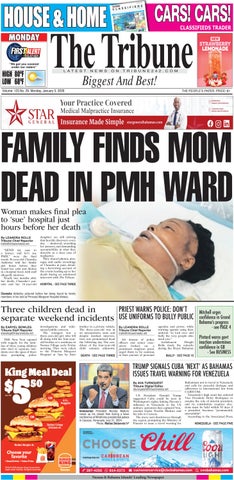
FAMILY FINDS MOM DEAD IN PMH WARD Woman makes final plea to ‘sue’ hospital just hours before her death By LEANDRA ROLLE Tribune Chief Reporter lrolle@tribunemedia.net “SEND my case to a lawyer, and let’s sue PMH,” were the final words 36-year-old Clanesha Adderley told her family just hours before they found her cold and lifeless in a hospital ward, with staff allegedly unaware. Nearly two months after her death, Clanesha’s parents and her 16-year-old
daughter are still reliving that horrific discovery every day – shattered, searching for answers, and demanding accountability in what they describe as a clear case of negligence. They shared photos, messages and audio recordings of Clanesha in pain, detailing a harrowing account of the events leading up to her death during an emotional interview with The Tribune. HOSPITAL - SEE PAGE THREE
Clanesha Adderley pictured before her being found by family members in her bed at Princess Margaret Hospital lifeless.
PRIEST WARNS POLICE: DON’T Three children dead in Mitchell urges in Grand separate weekend incidents USE UNIFORMS TO BULLY PUBLIC confidence Bahama’s progress By EARYEL BOWLEG Tribune Staff Reporter ebowleg@tribunemedia.net
THE New Year opened with tragedy for the families of three young children who died in separate incidents over the span of three days, prompting police
investigations and widespread public concern. The youngest was a three-year-old girl, who fell ill along with her four-yearold brother at a residence in Nassau Village early Friday morning. They were taken to the Princess Margaret Hospital at 3am by their
mother in a private vehicle. The three-year-old was in an unresponsive state and despite medical intervention, was pronounced dead the following day. The condition of the four-year-old child remains unknown. DEATH - SEE PAGE THREE
By LEANDRA ROLLE Tribune Chief Reporter lrolle@tribunemedia.net
AS dozens of police officers and senior executives looked on, a prominent Anglican priest urged them to be cautious in their pursuit of personal
agendas and power, while warning against using their uniform “to lord over and bully the very people who need you.” Archdeacon Dwight Rolle made the remarks during the Royal Bahamas BULLY - SEE PAGE 15
- see PAGE 4
Pintard warns govt inaction undermines confidence in GB - See BUSINESS
TRUMP SIGNALS CUBA ‘NEXT’ AS BAHAMAS ISSUES TRAVEL WARNING FOR VENEZUELA By AVA TURNQUEST Tribune Digital Editor aturnquest@tribunemedia.net
Venezuelan President Nicolas Maduro raises up his closed fists during a news conference at Miraflores presidential palace in Caracas, Venezuela, July 31, 2024. Photo: Matias Delacroix/AP
US President Donald Trump suggested Cuba could be next in Washington’s sights, linking Havana’s influence in Venezuela to the US military operation that captured Venezuelan leader Nicolás Maduro and his wife in Caracas. The move sent shockwaves through the region, prompting the Ministry of Finance to issue a travel warning for
Nassau & Bahama Islands’ Leading Newspaper
Bahamians not to travel to Venezuela and calls for peaceful dialogue and adherence to international law from CARICOM. Venezuela’s high court has ordered Vice President Delcy Rodriguez to assume the role of interim president, and its constitution requires elections must be held within 30 days if a president becomes “permanently unavailable”. According to the Associated Press, VENEZUELA - SEE PAGE FIVE
PAGE 2, Monday, January 5, 2026
THE TRIBUNE
Candlelight vigil honours life of drowned boat captain Jayden Pinder
Family and friends set candles adrift at Junkanoo Beach where an emotional memorial for Jayden Pinder was held Saturday. Photos: Chappell Whyms Jr
By LEANDRA ROLLE Tribune Chief Reporter lrolle@tribunemedia.net AN emotional candlelight vigil was held at Junkanoo Beach on Saturday in memory of Jayden Pinder, a promising young boat captain who died in a drowning incident after a wave knocked him from his jet ski just a day after Christmas. Family, friends, former classmates and colleagues of the 19-year-old gathered along the shoreline, lighting paper lanterns that rose into the night sky and releasing floating candles into the ocean in tribute to his life. Jayden’s grand-aunt, Isadora Blyden, described the beachside vigil as a fitting farewell, reflecting both his love for the sea and the positive impact he had on those around him. She said the event was organised by his friends and former baseball teammates, who wanted to honour his life in a meaningful way. “This was fitting for
us as a family, to be here together with people whose lives he touched,” she said. “For us we know him to be someone who always wore a smile, who was always helpful, respectful, polite, and I think we were moved by the request of his friends in wanting to be a part of this tribute to him.” Jayden, a former Junior Baseball League of Nassau player, was riding a jet ski in waters off West Bay Street on Boxing Day with another individual when a wave reportedly caused both to fall into the sea shortly before 6pm. Bystanders helped them back to shore; however, Jayden became unresponsive. Cardiopulmonary resuscitation was administered until Emergency Medical Services arrived. He was transported to hospital, where he later died. His death sent shockwaves through his family, particularly his mother, who continues to mourn the loss of her only child.
“She’s been able to laugh, but she’s had a lot of tears,” Ms Blyden said. “This is her only child, someone who she’s poured her life into, and every interest that he had, Janeile has supported 110 per cent, and so as a family, we feel her pain because we know the love that they shared and so it’s a difficult time.” Relatives said Jayden, a boat captain aboard The Allegra, dreamed of owning his own vessel and starting a charter company. “He wanted people to be able to explore and enjoy the waters as much as he loved to,” another relative said. His aunt, Devera Pinder, described her nephew’s death as one of the hardest experiences of her life. She said she would miss her kind, loving and gentle giant of a nephew, who stood over six feet tall and was always leading and protecting his cousins. “Although we can’t understand in this moment, we’re still grateful we had him in our lives,” she said.
JAYDEN PINDER
THE TRIBUNE
Relatives demand probe into family member’s death while at PMH HOSPITAL from page one “This is not my first chance with these people. In 2008, they nearly killed her,” her father, Clay Adderley, said, pointing to his wife beside him. The tragedy comes nearly two decades after Clanesha’s mother, Vernitta Adderley, had her own close encounter with death at the same hospital. Mrs Adderley said a “botched operation” for what was supposed to be a simple tubal ligation at Princess Margaret Hospital nearly killed her, leaving her in a coma for days. She said doctors considered pulling the plug, but she — 37 at the time — survived and later shared her account with The Tribune in 2010. Now, nearly two decades later, the family faces a painfully familiar story — that of their daughter, who died at PMH just two weeks shy of her own 37th birthday. The case is the latest to place PMH’s quality of care and services under public scrutiny. Mrs Adderley said the ordeal began on October 27, when her daughter called asking to be taken to a clinic after experiencing severe pain despite taking overthe-counter medication. Clanesha visited a doctor, received an IV drip and prescriptions for three medications, but her symptoms persisted. Seeking a second opinion, the family took her to PMH, where she underwent tests and scans. Staff later told them her condition was critical and that she needed to be hospitalised immediately, though no one could explain what was wrong. All they knew, the family said, was that her white blood cell count was dangerously high. Frustration mounted as Clanesha waited days to be admitted. “She waited nearly three days sitting in the ward,” Mr Adderley said. “Two days sitting in the chair at A and E,” his wife added. On November 1, Clanesha was admitted to the Female Medical-Surgical East ward — a day the family says marked the point when “everything went downhill”.
They said her condition deteriorated rapidly. She could not eat or drink, struggled to breathe and ran a high fever. As her condition worsened, the family said doctors could not definitively say what was wrong, instead offering possible diagnoses. “Then at the same time, the care on the ward was atrocious from the nurses. She couldn’t get them to bring her water, ice or nothing,” Mr Adderley said. The family said other patients on the ward told them they had to ask staff for help on Clanesha’s behalf. They recalled a moment when she suffered a seizure after a severe reaction to a blood transfusion. Clanesha later told relatives nurses did not check on her for nearly two hours. In her final days, Clanesha repeatedly sent voice notes begging her family to hire a lawyer and to transfer her to another hospital. She also raised concerns that medication was being administered without her consent or knowledge. The Tribune has obtained and listened to the recordings. “We asked them. They say she couldn’t move because we wanted to take her off to the states. They said she was too critical,” her mother said. The family accused staff of being neglectful, recalling moments when Clanesha called home asking them to contact the nurses’ station. “I would call there to the ward and call the nurse station and tell them, bed four — Adderley is trying to get your attention,” Mrs Adderley said. She said the situation became so dire she had to purchase Panadol to keep her daughter’s fever down after the hospital reportedly ran out. The family said the most harrowing moment came on November 14, when what was meant to be a routine visit turned into a nightmare. Clanesha’s bed was located reportedly near the nurses’ station with a curtain drawn around her bed. Nearby, the family claimed, nurses were arguing over food. Relatives waiting outside the ward were admitted minutes later. “So they were arguing over food around 6.20 something and they said
okay y’all can come in now and my daughter right there to the door,” Mr Adderley said. Clanesha was cold, eyes and mouth open, and unresponsive. The family said nurses rushed to the bed, asked them to leave and attempted to resuscitate her. “But my daughter was done dead,” Mr Adderley said. “I worked in the hospital as a porter. I know dead when I see it.” His wife added: “No revival could’ve happened. Only God could have brought her back.” The family said they had spoken to Clanesha earlier that morning. She had pleaded for them to get her out of PMH. Later that day, relatives said doctors finally provided blood test results the family had been awaiting, revealing that Clanesha had acute lymphoblastic leukaemia. Mrs Adderley said doctors informed her daughter of the diagnosis without family present, which she believes caused distress. “She sent me a message asking why they were talking about chemotherapy,” she said. She said doctors had indicated Clanesha would be moved to intensive care for closer monitoring, but that never happened. “Two days before her death, y’all decide to do this blood work when she needed it from the day she went in,” she said. Mrs Adderley said the family needs answers. “This is not about money. It’s about principle and the fact that she was neglected for the 12 days she was on surgical med East,” she said. Relatives described Clanesha as full of life and said she had been looking forward to her only child’s 17th birthday this month and her graduation later this year. They said losing her — the second of their four children — just before the holiday season has made the grief even heavier. When asked about legal action, the family said they are still considering their options. When contacted for comment, a Public Hospital Authority official confirmed that a complaint had been filed regarding the allegations and that the matter is under investigation.
New year tragedy: Three children dead in three days DEATH from page one Police said they were notified of the death shortly before 3pm on Saturday. Nassau Village MP Jamahl Strachan expressed condolences to the family. “I’m human, so I’m definitely grieving with the family, but I’m patiently waiting the ultimate the investigation,” he told The Tribune. In a separate incident, a 10-year-old boy collapsed while playing at a park in Blackwood, Eleuthera, on Saturday. Police said officers responded shortly after 4pm and found the child unresponsive. Emergency Medical Services administered CPR, but the boy was pronounced dead by a
medical doctor. Preliminary information indicates the child had been playing with other children before collapsing. Reports suggest he had a history of similar episodes, though no known illnesses were reported at the time. In a third case, a seven-year-old girl became unconscious on New Year’s Day after reportedly ingesting a food product while at a residence in Pinewood Gardens. Police said the child became unconscious shortly after 6pm and was taken to hospital, where resuscitation efforts proved unsuccessful and she later died. Police said autopsies will be conducted in all three cases to assist in determining the causes of death.
The deaths have sparked widespread concern across the community. Sea Breeze MP Leslia Brice appeared to reference the tragedies in a New Year prayer shared on Facebook. “As this new year begins, our hearts are heavy with loss. Cover our children with Your mighty protection. Send Your angels to stand guard around them, to shield them from harm, to comfort their spirits, and to hold them safe in Your everlasting love,” she wrote. “Bring healing to grieving families, strength to those who mourn, and hope to every broken heart. Let Your peace reign over our land, and may Your light guide every child into a future filled with promise.”
To advertise in The Tribune, contact 502-2394
Monday, January 5, 2026, PAGE 3
Clanesha Adderley pictured before her being found by family members in her bed at Princess Margaret Hospital lifeless.
Mitchell urges confidence in Grand Bahama economic revival PAGE 4, Monday, January 5, 2026
Denise Maycock Tribune Freeport Reporter dmaycock@tribunemedia.net FOREIGN Affairs Minister and Progressive Liberal Party (PLP) chairman Fred Mitchell said residents of Grand Bahama should remain confident as work continues on the island’s major redevelopment projects, including the Grand Lucayan hotel, the airport and the new hospital. Speaking during a wide-ranging interview, Mr Mitchell acknowledged growing public frustration and concerns about transparency but insisted tangible progress is being made, even if timelines have been slower than many residents hoped. “There are some things that are in mid-flight,” he said. “They are not always as straightforward as people would want them to be, but progress is being made, and people will see that progress in the months ahead.” Mr Mitchell pushed back against criticism from the Free National Movement (FNM), calling it “a bit rich” for the opposition to raise transparency concerns given its own record on Grand Bahama’s major infrastructure assets. Referring to the Minnis administration’s handling of the Grand Lucayan hotel and the airport, he said previous owners were allowed to walk away with insurance payouts while Bahamian taxpayers were
THE TRIBUNE
“There are some things that are in mid-flight. They are not always as straightforward as people would want them to be, but progress is being made, and people will see that progress in the months ahead.”
Foreign Affairs Minitser and PLP chairman Fred Mitchell speaks during an interview. left carrying the burden. Despite public scepticism surrounding the stalled Grand Lucayan redevelopment, Mr Mitchell said agreements are now in place and movement is expected soon. He urged residents to view the situation as “half full, not half empty”. “You’ll see progress on both the airport and Grand
Lucayan,” he said, adding that work already under way at the new hospital is visible proof the government is delivering. Mr Mitchell said Grand Bahama’s economic revival is already under way, pointing to developments such as Celebration Key in eastern Grand Bahama, which he said have absorbed
unemployment and injected renewed optimism into the community. The opposition, however, maintains that key commitments to Grand Bahama remain unmet. In a statement issued yesterday, Opposition Leader Michael Pintard said promised upgrades to critical infrastructure, including
healthcare and airport facilities, have not materialised and called for clearer timelines and accountability. Looking ahead, Mr Mitchell said the island is poised for significant growth, with projections of up to six million tourists passing through Grand Bahama by 2027 once infrastructure improvements
are completed. However, he cautioned that increased tourism will require expanded public services, housing and workforce capacity. “This uplift is exactly why we’re working to get the airport and the hotel done,” he said. “Grand Bahama needs a steady hand to guide that process.”
PLP chairman: US inflation driving Bahamas cost of living crisis Denise Maycock Tribune Freeport Reporter dmaycock@tribunemedia.net FOREIGN Affairs Minister Fred Mitchell said the Bahamas’ cost of living crisis is being driven largely by external forces, particularly inflation imported from the United States, warning that no government can fully shield the country from those pressures. “The Commonwealth of The Bahamas is entirely
dependent on the United States of America,” he said. “Whatever inflation there is in the US, it comes straight here.” Mr Mitchell said the country’s heavy reliance on imported food and consumer goods leaves it especially vulnerable to rising prices abroad. While acknowledging that the government cannot control global inflation, the minister said measures have been implemented to help ease the burden
on Bahamians, including adjustments to Value Added Tax (VAT), customs duties, social services transfer payments and increases to the minimum wage. “To the extent that we can, we’ve tried to give people relief,” he said. “But there are certain things you simply can’t control.” Mr Mitchell said the housing market has also come under significant strain, pointing to the expansion of Airbnb, strong tourism demand and the
dismantling of informal settlements as factors that have tightened housing supply. “These were necessary actions,” he said, “but they’ve put pressure on the housing market.” He said addressing these interconnected challenges requires a government that is “steady at the wheel” and capable of balancing economic growth with social stability. Mr Mitchell also defended the PLP’s record
against accusations of a lack of transparency, describing much of the public discourse as driven by “gotcha moments” and “melodramatic opposition politics” rather than substantive policy proposals. “Everybody can’t be a crook,” he said. “We all went to the same schools, the same churches. The math just doesn’t add up.” He argued that many of the country’s challenges — including food prices and migration — are structural and long-term, requiring sustained policy implementation rather than abrupt changes in direction. On that basis, he said the PLP should be granted a second term to complete projects and reforms already underway. “The work is
complicated,” he said. “But the country has progressed, and it will continue to progress with investment in our people and our children.” Mr Mitchell also emphasised the importance of social safety nets, saying that in his Fox Hill constituency no resident should go hungry, noting that assistance remains available through constituency offices and social services. As inflation and affordability continue to dominate public concern, he said the government’s focus remains on maintaining stability, expanding opportunity and completing projects already in progress. “We’re asking the Bahamian people for the opportunity to finish the work,” he said.
THE TRIBUNE
Monday, January 5, 2026, PAGE 5
Region on edge as US captures Maduro VENEZUELA from page one people were slow to resume routines in Caracas after Maduro’s capture with dozens of stores, restaurants and churches closed. The press agency said those on the streets looked shellshocked, staring at their phones or into the distance. “May God give us strength for what we are experiencing. I’m sad. He is a human being,” said Nely Gutiérrez, a retiree, as her eyes welled with tears. “They have him handcuffed, and if he is in the hands of the empire, no one can save him from there, only God, not even God. He will die there.” A newly unsealed US Justice Department indictment contends Maduro’s government was fuelled by an extensive drug-trafficking operation that flooded the US with thousands of tons of cocaine. Maduro is charged alongside his wife, Cilia Flores, who was also arrested on Saturday. Also indicted are his son and three others. Outside the Brooklyn jail holding Mr Maduro, a throng of Venezuelan expatriates, many draped in flags, gathered on the sidewalks Saturday night to celebrate his capture. The crowd cheered as the law enforcement motorcade believed to be carrying the deposed leader and his wife arrived at the jail. During a January 3 press conference following the US operation in Venezuela, Mr Trump was asked whether the action carried a message for Cuba. “Cuba is an interesting case,” Mr Trump said. “Cuba is not doing very well right now, that system is not been a very good one for Cuba. The people there have suffered for many, many years. And I think Cuba is going to be
something we’ll end up talking about because Cuba is a failing nation right now.” He continued: “We want to help the people in Cuba, but we want to also help the people that were forced out of Cuba and living in this country.” Mr Trump did not outline specific policy steps toward Havana but suggested Cuba would be addressed as part of a broader regional reassessment following the Venezuela operation. Secretary of State Marco Rubio, himself a Cuban American, expanded on the president’s assessment of Cuba’s condition and further alleged its involvement in Venezuela’s security structure. Mr Rubio called Cuba a “disaster” with its leadership comprised of “incompetent senile men”, adding that the country “has no economy. It’s in total collapse.” He also alleged Cuban influence within Venezuela under Maduro, and claimed that Cuban officials had sought to dominate Venezuela’s security sector. “One of the biggest problems that Venezuelans have is they have to declare independence from Cuba,” Mr Rubio said, adding that Cuban authorities “tried to basically colonize it from a security standpoint.” Asked about energy flows to Cuba, Mr Rubio referred to existing sanctions enforcement. “Anything that’s sanctioned, it’s sanctioned oil, it it’s not going to be allowed to get there,” he said. Beyond Cuba, Mr Trump used the press conference to reiterate a broader hemispheric stance, saying: “Under our new national security strategy, American dominance in the Western Hemisphere will never be questioned again.” He also issued comments directed at Colombian
Venezuela’s President Nicolás Maduro speaks during an interview with The Associated Press at Miraflores presidential palace in Caracas, Venezuela. Photo: Ariana Cubillos/AP
Who is Oran Munroe? THE Ministry of Foreign Affairs has confirmed it has raised concerns through diplomatic channels regarding the safety and security of a Bahamian national who is currently being “unlawfully detained” in Venezuela. While the ministry did not name the individual, The Tribune understands the detainee to be Oran Munroe, a Bahamian pilot who has been in Venezuelan custody since 2021. In a statement issued amid heightened regional tensions following a US military operation in Venezuela, the ministry said it has communicated its concerns regarding the detained Bahamian’s welfare and continues to monitor the situation. President Gustavo Petro, accusing Colombia of producing and exporting cocaine and saying Mr Petro “does have to watch his ass.”
Bahamas government advises against Venezuela travel amid US operation By EARYEL BOWLEG Tribune Staff Reporter ebowleg@tribunemedia.net THE Bahamian government has advised citizens not to travel to Venezuela following the US military operation that resulted in the capture of President Nicolás Maduro and his wife. Maduro’s arrest on Saturday stunned the international community and drew widespread condemnation of the Trump administration, despite the Venezuelan leader’s nearly 13-year rule being widely viewed as authoritarian. In contrast, Caribbean governments have adopted what appears to be a more measured and principled response. The Ministry of Foreign Affairs said The Bahamas supports a statement issued by the Caribbean Community (CARICOM) Bureau of the Conference of Heads of Government, which reaffirmed adherence to international law and called for peaceful dialogue. “The Bahamas takes note of the statement of the CARICOM Bureau of the Conference of Heads of Government issued 3 January 2026 and supports that statement,” the ministry said.
“Of particular importance to The Bahamas is that all parties involved act in accordance with international law. Owing to the current security situation, the Government of The Bahamas advises Bahamians to not travel to Venezuela.” US forces carried out the operation in Venezuela and detained Maduro and his wife, Cilia Flores, at their residence in Caracas. The couple were transported to the United States to appear before a federal court. President Donald Trump initially said the United States “will run the country until such time as we can do a safe, proper and judicious transition”. But US Secretary of State Marco Rubio later back-tracked on those comments, suggesting that the US would not govern Venezuela day-to-day other than enforcing an existing “oil quarantine” on the country. In its statement, CARICOM said the region is “firmly committed to the fundamental principles of international law and multilateralism enshrined in the UN Charter, including sovereignty and territorial integrity of States and respect for human dignity”.
“The Region reiterates its call for peaceful dialogue through diplomatic channels to ensure Venezuela’s stability, good governance, democracy and prosperity for the people of Venezuela,” the statement said. CARICOM added that it remains ready to support such efforts in a “spirit of cooperation and mutual respect” and said it is committed to ensuring the safety and security of citizens across the region. Reports have indicated that Barbados has experienced flight disruptions as a result of the military operation. However, The Tribune understands that Lynden Pindling International Airport has not experienced any such issues. Baha Mar Vice President Robert Sands said he believes the fallout has primarily affected countries in the southern Caribbean. “I have no update as to the status, but I assume the air travel lanes were delayed or shut down as a result of the action that was taking place in Venezuela,” Mr Sands said. “To the best of my knowledge, everything is back to normal from midnight last night.”
To advertise in The Tribune, contact 502-2394
“Owing to the current security situation, the Government of The Bahamas advises Bahamians to not travel to Venezuela,” the ministry said, adding that concerns regarding the detained national have been raised through diplomatic channels. Munroe was first reported missing in July 2021 after departing The Bahamas aboard a private aircraft. At the time, the Royal Bahamas Police Force issued a missing person bulletin stating Munroe was last seen on July 24, 2021. Police later confirmed that the aircraft, which had been reported stolen, crashed in Venezuela after leaving Abaco. Authorities in Venezuela
subsequently informed Bahamian officials that Munroe and a Colombian national were in custody after seeking medical treatment for injuries sustained in the crash. Police said the two men were being questioned in connection with an alleged drug trafficking investigation. However, Bahamian authorities said at the time they could not confirm whether drugs were found on the aircraft. Munroe was previously employed by the now-defunct Sky Bahamas airline. The owner of the missing aircraft told The Tribune in 2021 that he had reported the plane stolen and denied any involvement in the incident.
PAGE 6, Monday, Monday, January 5, 2026
THE TRIBUNE
The Tribune Limited
PICTURE OF THE DAY
NULLIUS ADDICTUS JURARE IN VERBA MAGISTRI “Being Bound to Swear to The Dogmas of No Master”
LEON E. H. DUPUCH,
Publisher/Editor 1903-1914
SIR ETIENNE DUPUCH,
Kt., O.B.E., K.M., K.C.S.G., (Hon.) LL.D., D.Litt .
Publisher/Editor 1919-1972 Contributing Editor 1972-1991
RT HON EILEEN DUPUCH CARRON,
C.M.G., M.S., B.A., LL.B. Publisher/Editor 1972-
Published daily Monday to Friday
Shirley & Deveaux Streets, Nassau, Bahamas N3207 TELEPHONES News & General Information Advertising Manager Circulation Department Nassau fax Freeport, Grand Bahama Freeport fax
(242) 502-2350 (242) 502-2394 (242) 502-2386 (242) 328-2398 (242)-352-6608 (242) 352-9348
Have a cool, fun, interesting, amazing photo? Have it featured here in The Tribune’s picture of the day! Email your high quality image to pictureoftheday@tribunemedia.net WOLF Supermoon rises above Paradise Island and Montagu Bay on Saturday January 3, 2026 in Nassau, Bahamas. Photo: Tim Aylen
WEBSITE, TWITTER & FACEBOOK www.tribune242.com
@tribune242
tribune news network
Without international law there is chaos Without the law, there is chaos. Without international law, there is nothing to stop invasion, nothing to maintain peace and order, nothing to provide security. Two things can be true. It can be true that Venezuela is better off without Nicolás Maduro as its president, and it can be true that his removal in a US military operation at the weekend may well not be legal under international law. One of the concerns with the Maduro regime is that it was undemocratic – a sham government imposed after a rigged election. Having, as US President Donald Trump says, the US “run the country” does not provide a democratic solution for the people of the nation either. It has also led to concern about where next for the US if it chooses to exert further force. Previously, Trump has made noises about Greenland becoming part of the US. He reiterated that in the wake of the Venezuela action with The Atlantic, saying: “We do need Greenland, absolutely. We need it for defence.” The wife of Trump’s deputy chief of staff also posted an image of a map of Greenland to social media, with the map in the colours of the American flag and the word “SOON”. This prompted the Danish Prime Minister, Mette Frederiksen, to post to social media: “It makes absolutely no sense to talk about the United States needing to take over Greenland. The U.S. has no right to annex one of the three countries in the Danish Kingdom.” Greenland’s Prime Minister, Jens-Frederik Nielsen, also said: “Our country is not an object of superpower rhetoric. We are a people. A country. A democracy. This has to be respected.” Meanwhile, Secretary of State Marco Rubio has turned the focus to Cuba, saying the country is “in a lot of trouble”. He also pointed out that Maduro was “not guarded by Venezuelan bodyguards. He had Cuban bodyguards”, while Trump added: ““I think Cuba is going to be something we’ll end up talking about, because Cuba is a failing nation right now, a very badly failing nation, and we want to help the people.” The fact we are talking about where next rather than the legality of the Venezuela action in itself points up the widespread concern about whether the US is acting by laws or in the manner of a rogue state. Let us think back for a moment to the build-up to the Iraq war. Whatever one thinks about the legality of that war, built on the premise that leader Saddam Hussein had weapons of mass destruction – which proved untrue in the end – there was considerable time and effort spent on building the case for war by US President George W Bush and UK Prime Minister Tony Blair. Significant work was put into pursuing UN resolutions to provide an international case for the Iraq War. None of that is the case here. There has been no case presented by the US to the UN for the removal of
Maduro. There has been no case presented to the US public of what danger Maduro’s government presents to the American people. And there certainly has been no case presented anywhere as to why it would be appropriate for the US to “run” another sovereign nation rather than its destiny being decided by its people. Rubio and other Republicans have rowed back on those statements since, suggesting a far less interventionist stance. However, Trump has also said that the US would take control of Venezuela’s oil reserves, and recruit US oil companies to invest in the country’s oil industry. Note, Maduro has been arrested and faces charges in the US over narcotics and gun smuggling – what part of that justifies the US taking control of another country’s oil reserves has yet to be explained appropriately. Already, old statements are being re-examined, including a 2019 testimony from Fiona Hill, a former US national security official on Russia in the first Trump administration, who suggested that Russia floated a “swap” in which Russia would abandon its support for Venezuela if the US abandoned its support for Ukraine. Since the Venezuela intervention, Russia has called for a full meeting of the UN Security Council, describing the US move as “ideologised hostility” and calling the pretexts for the action “unfounded”. The statement added: “Latin America must remain a zone of peace, as it declared itself in 2014. Venezuela must be guaranteed the right to determine its own destiny without any destructive, especially military, interference from outside. We reaffirm our solidarity with the Venezuelan people and our support for the course of its Bolivarian leadership aimed at defending the country’s national interests and sovereignty.” Legal processes are important. We must ensure that is true both within nations and internationally. There are treaties to cover such matters as extradition, there are laws to prevent nations being invaded or governments deposed without a lawful basis. It is the duty of the US now to present its case as to why such action was not only lawful, but why it was so urgent. There is little indication in the public realm of Maduro posing any significant threat to the US – as undesirable as any involvement in drug smuggling might be. So why now? And why was it so important to the US that it needed to put itself in the position of running another country and controlling its oil reserves? If the US can act without making such a case, what is to stop any other nation – or the US again – from doing the same? Laws are important – and one of the crucial foundations of law is that they should apply to all, from pauper to prince, or president. The coming days are crucial ones, if international law is to be respected.
KINDLY allow me space in your valuable column to articulate an opinion why I believe the Royal Bahamas Police Force deserves our praise and encouragement. Firstly, I would like to think of myself as a friend of the Police. Having been connected in some way to Police officers over the past five decades. I can that Police officers inclusive of former heavyweight boxing champion Bert Perry, former welterweight champion of the Bahamas Ray Minus Sr, former Olympian boxer Nathaniel
‘Nat’ Knowles, the late Austin Conyers and Police boxing team played a very important role in helping to mold my character. And I thank them. While it may be obvious that there is some negativeness within the force, I believe it is more important to identify and recognise the positive work the police do on a daily basis. And to praise and encourage them. I believe from the commissioner at the top down that 99% of officers are good, decent, law-abiding men and women. Unfortunately, it is that
EDITOR, The Tribune. AS the curtain is about to descend and we bid farewell to another remarkable year, The Bahamas looks back on memorable events that showcase our vibrant culture, natural beauty, and warm hospitality. Despite challenges such as Hurricane Melissa and the ongoing efforts to combat crime, we remain a beacon of prosperity and safety in the Caribbean. We’re proud of our law enforcement agencies, particularly the Royal Bahamas Police Force, which, I believe, has been doing a great job through its tireless efforts to combat crime and keep our communities safe. Their dedication and bravery at the risk of losing their own lives and their reputation tarnished have led to significant strides in reducing the crime rate and improving public safety. Notably, we’ve seen a dramatic decrease in the murder rate, with homicides down significantly compared to this time last year, reflecting the government’s combined efforts and targeted initiatives to address violent crime. Our rich cultural heritage was on full display during the Junkanoo Jingle to Bay 5K and the Boxing Day parade. The Junkanoo celebrations brought excitement and energy, with a new champion emerging as one family dethroned the reigning Shell Saxons Superstars, who placed third this year, marking
1% that overshadow the good work the committed officers perform. The Police College continues to fulfill its mandate in building character, discipline and strength in males and females. This training I believe is essential in the future of the college and the trainees. I would encourage the public to hold hands with the Police and become their friend. Crime is an ongoing challenge in our country, especially New Providence. PAT STRACHAN Nassau, December 29, 2025.
LETTERS letters@tribunemedia.net a thrilling shift in the Junkanoo scene! The Bahamas proved itself a prime destination for international events, including the Bahamas Culinary and Arts Festival and the 2025 Battle 4 Atlantis college basketball tournament. We also hosted the Caribbean Gigabit Society (CANTO) Conference, where Prime Minister Philip Davis highlighted that leadership in the digital space doesn’t depend on size but on vision and courage. We’re proud of the progress made in the fight against HIV and AIDS, and we recognise the dedication of the over 40 individuals honored at Government House for their contributions to this cause. Our athletes delivered fantastic performances at the 2025 NACAC Championships and CARIFTA Games. Several of our athletes brought home medals, showcasing our nation’s athletic talent. When we compare the Bahamas with other Caribbean countries, we can honestly say that God has been good to us. Our unique natural beauty, rich culture, and warm hospitality make us a standout in the region. As we look forward to the new year, The Bahamas will continue to shine as a premier destination for tourism, business,
and culture. Notably, after nearly 15 years of vacancy, we welcome Herschel Walker as our new US Ambassador, who is expected to strengthen ties between the United States and the Bahamas. The new US Embassy, located on Shirley Street, officially opened on September 18, 2025, symbolising the deepening relationship between both nations. We’d be remiss not to thank The Nassau Guardian and the Tribune for their persistence in keeping readers informed throughout the year about what’s happening in the country and the world. Their dedication to a free press is appreciated. In just a few days, we’ll be closing out the year with the New Year’s Morning Junkanoo parade, an old-time tradition that represents the spirit of joy, freedom, and community that defines our nation. As we pause to kiss each other under the mistletoe and drink a cup of kindness, we’re reminded of the blessings and opportunities we’ve received. As Frank Sinatra would say, “It was a very good year.” Wishing you a healthy, prosperous New Year. God bless you, and God bless the Bahamas. To all Bahamians and friends of The Bahamas, thank you for making this year unforgettable. Here’s to a bright, joyful, and prosperous New Year! ANTHONY PRATT Nassau, December 23, 2025.
Stop selling our land to cruise industry EDITOR, The Tribune.
Recognise our decent officers EDITOR, The Tribune.
Reflecting on an extraordinary year in or nation
THE government seems to be willing to sell our Bahamian islands to any foreign bidder offering the right price. They also do not seem to take time to consider the reputation or character of the people or organisations they sell our islands to. They have been sold to persons who have been charged with crimes and are now in jail, and they have been sold to companies like Disney ,who in my opinion do not promote Godly or family values. This is obvious based on the kinds of movies or cartoons they are creating. They seem to be pushing a homosexual agenda as they seem to ensure that homosexual characters are in movies made for children.
Now it seems that the trend is to sell to cruise lines that pollute our waters with human waste and offer no decent jobs for Bahamians. Other countries are moving away from cruise lines but we are constantly allowing more and more of them to come here. How many more cruise ships do we need and how many more islands are we going to sell? We must value our islands and our people. We should not expose our people or our children to people from different cultures and mindsets and who have different values. Can’t Bahamians be allowed to come together to start businesses and invest in these islands? We must allow our people to have opportunities to prosper and not just
foreigners. Let everyday Bahamians who have ideas be given chances to play a part in tourism and in the Bahamian economy in general. What happens if these cruise lines decide to leave or abandon these islands? What happens if they sell these islands to questionable persons? We need to lease islands for five years and then decide if the lease should be renewed based on how the company is operating and the effects of the business on the island. We must be more discriminating.as a country and more mindful of who we open up our country to. CONCERNED BAHAMIAN Nassau, December 23, 2025.
THE TRIBUNE
Monday, January 5, 2026, PAGE 7
Sands says voter registration changes risk election confusion By LEANDRA ROLLE Tribune Chief Reporter lrolle@tribunemedia.net
AS the Parliamentary Registration Department ramps up preparations ahead of the next general election, Free National Movement (FNM) chairman Dr Duane Sands has raised concerns about recent changes being implemented by the department, warning that they could create confusion and undermine public confidence. Dr Sands criticised the department after it revised voter transfer rules and issued a notice advising voters to verify their registration status. Although officials later clarified and effectively backtracked the notice, Dr Sands described the process as “a ball of confusion”. “It is as if there is a deliberate effort to create chaos,” the FNM chairman told The Tribune yesterday. “Our concerns are pretty simple: let us define what it is that you're trying to do, determine whether or not it is consistent with the law, and then maybe we can move forward.”
Dr Sands said the changes risk confusing voters at a critical time, stressing the importance of clarity and consistency in the electoral process. “The bedrock, the foundation of a democracy is fair and free elections, right? Let's execute free and fair elections. Let's make it possible for people to register. Let's make it possible and easy for people to transfer. Let's give a consistent message that doesn't change from day to day or week to week,” he said. Progressive Liberal Party (PLP) chairman Fred Mitchell acknowledged the confusion over the weekend but clarified that voters are not required to verify their registration. However, Dr Sands said the missteps do little to inspire confidence that the department is adequately resourced or functioning effectively. He called for greater transparency, saying the opposition is not confident the department is properly carrying out its scrutinising responsibilities. Under the revised rules, voters seeking to transfer constituencies are now
FNM CHAIRMAN DR DUANE SANDS required only to swear an oath and will no longer need to present utility bills for verification. Parliamentary Commissioner Harrison Thompson said the change was made in response to
Eleuthera man accused of rape By Earyel Bowleg Tribune Staff Reporter ebowleg@tribunemedia.net A 53-YEAR-OLD man has been accused of raping and causing harm to a 27-year-old woman in Eleuthera. Derek Ingraham was arraigned on Friday before Chief Magistrate Roberto Reckley on charges stemming from
an incident said to have occurred on December 28 in Lower Bogue. It is alleged that the accused had sexual intercourse with the woman without her consent and intentionally caused her harm. Inspector Deon Barr, the prosecutor, told the court the matter is to proceed by way of a voluntary bill of indictment.
Mr Ingraham was not required to enter a plea, and the matter is expected to be transferred to the Supreme Court. The voluntary bill of indictment is scheduled to be presented on April 30, 2026. After the matter was adjourned, Mr Ingraham briefly spoke with his daughter, who was present in court.
Teen charged with rape on cruise ship By Earyel Bowleg Tribune Staff Reporter ebowleg@tribunemedia.net A 17-YEAR-OLD boy was arraigned in the Magistrate’s Court on Friday in connection with the alleged rape of a 16-year-old girl aboard a cruise ship. The juvenile, who appeared in court accompanied by his mother, was
brought before Senior Magistrate Algernon Allen Jr. He is accused of having sexual intercourse with the girl without her consent while aboard the Carnival Sunrise on December 26, 2025. He was not required to enter a plea, and the matter is to be transferred to the Supreme Court by way of a voluntary bill of indictment,
which is set to be presented on June 25, 2026. Due to the nature of the offence, the magistrate does not have discretion to grant bail, and the accused must apply to the Supreme Court. The teen was remanded to the Simpson Penn Centre for Boys until his next court appearance or until bail is granted.
challenges voters faced in obtaining utility bills. “We don't want to disenfranchise anybody and made the process simpler for them,” he told The Tribune yesterday. Mr Thompson said any
instances of fraud would be dealt with appropriately and insisted the department would be ready whenever the election is called. Mr Mitchell has indicated that biometric voter
cards could be available as early as March. However, Mr Thompson declined to give a specific rollout date, saying he is expected to meet with vendors next week to finalise the details.
Stay home and avoid crowds, magistrate warns drug offender By Earyel Bowleg Tribune Staff Reporter ebowleg@tribunemedia.net A magistrate on Friday urged a young man to avoid risky situations after convicting him of possessing Indian hemp and placing him on probation. Senior Magistrate Raquel Whyms accepted Lade Knowles’ guilty plea after the court heard he was found in possession of Indian hemp during an arrest made at the 2026 New Year's Day Junkanoo parade. She ordered him to undergo six months of drug counselling. Before passing sentence, the magistrate also issued
a stern warning to the defendant, stressing the importance of self-preservation and avoiding situations that could place him at risk of further arrest. She warned the defendant that large crowds and volatile environments could quickly place him back in conflict with the law. “If you see me, basically became an adult in jail, things like Junkanoo and Carnival. You can’t get me go them places. Nowhere there’s a bunch of crowds where even if I think I blink or spit I could get arrested for something,” she said. “Stay home. You go out there to Junkanoo. Somebody provoke, do
something, next thing you in a fight. Next thing you mix up. You see how the police just grab all y'all in, because as far as the police concerned, ‘Come all, y'all look like a bunch of dope heads’. So they just throw the net,” she said. “Why you in the sea swimming you don’t have to be swimming?” “Y’all don’t have nobody guiding y’all?” she added. “You have adults who speak to you? You spend too much of your young life in jail as it is. You should be so busy trying to keep your nose clean and trying to stay out of anything would look, smell, act, walk like trouble.”
To advertise in The Tribune, contact 502-2394
PAGE 8, Monday, January 5, 2026
THE TRIBUNE
Abaco and Crooked Island experience power outages By EARYEL BOWLEG Tribune Staff Reporter ebowleg@tribunemedia.net DAYS after experiencing a power outage, parts of Abaco and Crooked Island were hit with another disruption over the weekend. An unexpected mechanical issue at the Wilson City Power Station caused a power outage across parts of Abaco on Sunday, affecting Central and South Abaco and the Cays. Bahamas Power and Light (BPL) said restoration was delayed, leaving areas including South Abaco, Murphy
Town, Forest Drive, Hope Town and Central Pines without electricity for several hours. Restoration efforts began later in the morning, and power was fully restored across Abaco by 9.27am. Roscoe Thompson, head of the Marsh Harbour/ Spring City Township, called for greater accountability from BPL over the island’s recurring power issues. “It's the lack of maintenance and the lack of upkeep that is that has caused this,” he said. “These generators were supposed to be able to maintain for the next 30
years when they were put in.” Abaco residents had already expressed frustration after power outages earlier in December, which in some areas lasted for days. Meanwhile, BPL reported on Friday afternoon that technicians were alerted to a separate outage on Crooked Island, caused by a downed high-voltage line. The outage occurred in the Fairfield area at approximately 2.38am, when a primary high-voltage (HV) line fell, resulting in a cable fault. BPL said the fault
bypassed the intelliruptor installed near the power station and travelled directly to a recently acquired generator, causing a loss of power supply across the island. The damaged infrastructure affected BPL’s M and E power generation unit. The company said technicians travelled from New Providence later that afternoon, and power was fully restored shortly after 8pm. The outage followed another disruption the previous Saturday. Before power was restored, Pedro Marcello, BPL’s Regional Manager for the Southern Region,
said efforts were under way to restore supply as quickly as possible. “I understand how frustrating the inconvenience caused because of no supply to our consumers in the Crooked Island area,” he said. “However, BPL is undertaking every effort to restore supply as quickly as possible to those consumers via this unit.” He added that two additional units remain out of service, with parts already in New Providence. David Daxon, Chief Councillor of Crooked Island and Long Cay, estimated that power was
fully restored by 10pm on Saturday. “It's a challenge for residents,” Mr Daxon said. “This time of the year is part of the peak period for tourists, and also when most of the winter residents or second homeowners are on the island.” He added that the outages placed an added financial burden on residents. “Many people had to purchase ice just to secure or save some of their perishable items,” he said. “Some had to buy gasoline to run standby generators, and gasoline is a costly commodity.”
Bahamian advocate chosen for US leadership programme By LEANDRA ROLLE Tribune Chief Reporter lrolle@tribunemedia.net WHEN environmental advocate Crystal Darling-Sargent was selected as the only Bahamian from among thousands of international applicants for a US exchange programme, excitement soon gave way to anxiety as the reality of leaving her home and family set in. Still, the 32-yearold pressed forward, becoming one of just 65 participants chosen for the US State Department’s Community Solutions Programme, an initiative aimed at developing emerging leaders in energy, environmental protection, human rights, women’s empowerment and security. Mrs Darling-Sargent, who has long been active in her community — volunteering in areas ranging from theatre to environmental causes and hosting an
environmental podcast — applied after learning about the programme through a friend. Making such a leap for the first time, she said she did not think she would be selected, with more than 12,000 applicants from over 100 countries applying for the exchange. News of her acceptance brought a wave of mixed emotions. “It wasn't easy, because this was my first time applying to something like this, and when I got accepted, I was happy. I was very excited, but I was very concerned as well because I have family here and I also have responsibilities and I volunteer a lot,” she said. “So, I felt bad about that.” After accepting the opportunity, Mrs Darling-Sargent said she knew she had made the right choice and credited the support of her husband for helping her finish strong. The six-month
programme began in June, with participants travelling to Washington, DC, and Houston between September and December. During that period, Mrs Darling-Sargent and her fellow cohort members engaged with non-profit organisations and government offices, completing a three-month practicum alongside American leaders on issues of national interest. Mrs Darling-Sargent focused on energy and environmental work during her placement and described the experience as an eye-opener. “They taught us a lot like management training, overall leadership training, how to maneuver when you face the difficulties and different circumstances in the workplace, how to put together a team, how to create a sustainable project, how to plan out and structure, like those type of things,” she said.
She added that one of her most memorable experiences was meeting other like-minded participants, learning about their cultures and sharing her own. “It’s like a cultural exchange and everything I’ve learnt and developed, now it’s execution time,” she said. In addition, Mrs Darling-Sargent successfully completed online course content through the Community Leadership Institute as part of the programme. As for what’s next, she has spent the past six months developing a Community Action Project — the next phase of the programme — which she intends to launch this year. “It’s called the Aquamarine Project,” she said, “and it focuses on marine conservation and teaching students about marine conservation and how to communicate.” “So that is going to be a whole series of workshops
Environmental advocate Crystal Darling-Sargent was selected as the only Bahamian from among thousands of international applicants for the US State Department’s Community Solutions Programme. and presentations and activities for people and upon the successful completion of that, I will have officially done the entire course.” She noted that the Community Solutions
Programme is just one of many initiatives offered by the US State Department and encouraged Bahamians to take advantage of similar opportunities when they arise.
THE TRIBUNE
Monday, January 5, 2026, PAGE 11
The US capture of Venezuela’s Maduro: a brief international law breakdown By YUSRA SUEDI, PhD Assistant Professor of International Law, University of Manchester US President Donald Trump announced that the United States has launched strikes in Venezuela and captured President Nicolás Maduro and his wife. This raises some of the clearest violations of international law we’ve seen in decades. The legality of US intervention Are the strikes on Venezuela legal? No. Absolutely not. Under international law, the use of force is prohibited unless one of two narrow exceptions applies: self-defence (Article 51 of the UN Charter), or authorisation by the UN Security Council. Neither applies here. Venezuela has not attacked the US, nor was it about to do so, and there is no Security Council mandate. That alone makes the strikes unlawful. Is intervening to remove Maduro or “take over” Venezuela legal? Also no. International law strictly prohibits intervention in the internal affairs of another state, including deciding who governs it (Article 2(7) of the UN Charter). Whether Maduro is unpopular, oppressive, or illegitimate does not give another state the right to impose regime change by force. One can believe Maduro should not be leading Venezuela and still recognise that a US attack is illegal. “But the US has good motives!” The following common arguments don’t change the law: “Maduro is illegitimate or authoritarian” Even if true, illegitimacy does not legalise invasion. You cannot uphold international law by violating it. Two wrongs don’t make a right. “Maduro is pushing drugs into the US / narco-trafficking” (JD Vance and Marco Rubio have both claimed this.) There is no such thing as a lawful cross-border “war on drugs” that would justify military force against another state. Drug trafficking does not justify military action. “Maduro is committing human rights violations in Venezuela” Some states have argued that it is lawful to use force to protect populations from serious human rights abuses by their own governments. However, unilateral
MEN watch smoke rising from a dock after explosions were heard at La Guaira port, Venezuela, Saturday. Photo: Matias Delacroix/AP humanitarian intervention is not generally recognised as lawful under international law. There is no general exception allowing states to use force to enforce human rights in another country. “Venezuela has oil”: If anything, this makes the violation worse. Strategic or economic motives never justify the use of force. What about capturing Maduro and his wife? This too is illegal. First, you cannot simply seize people in another country without that country’s permission. Doing so amounts to an unlawful extraterritorial arrest under international law. Even if a country’s laws apply beyond its borders in some cases, entering another state to arrest or detain someone is not permitted unless that state consents or the UN Security Council authorises it. Neither occurred here. Second, this also violates international human rights law. Kidnapping someone from another country without proper legal procedures constitutes an unlawful deprivation of liberty (see Article 9). What happens next? Can Maduro be tried in New York?
No. If Maduro is still considered president following his capture, he enjoys personal immunity from prosecution before foreign courts. This applies even if another state claims he is “not legitimate”, as confirmed by French courts when dealing with Syria’s Assad. Some may argue that Maduro is no longer president following his capture. However, reading the Venezuelan constitution (Articles 233–234), this is not clear. Can the US govern Venezuela during a “transition phase”? No. The practice of one state administering another largely belongs to the past, dating back to UN mandates and trusteeships after the world wars. There is no legal basis for this today, especially when done unilaterally. Accountability and consequences An unprovoked use of force constitutes an act of aggression, which is a crime under international law. The International Criminal Court can prosecute the crime of aggression,
but it cannot exercise jurisdiction over nationals of states that have not joined it, including the United States. This remains the case even when aggression is committed against a state party, such as Venezuela. At a minimum, states should be clearly condemning this action. Vague expressions of “concern”, or outright support, are not sufficient. If we accept a world where international law is disregarded and “might makes right”, this will not stop here — whether in Ukraine, Taiwan, Greenland or elsewhere. Global stability depends on states insisting that international law is applied consistently, even when doing so is politically inconvenient.
US PRESIDENT DONALD TRUMP
PAGE12, 4 , Monday, XXXDAY,January XXXMONTH XX, 2015 PAGE 5, 2026
THE TRIBUNE THE TRIBUNE
Bahamas Aviation, Climate & Severe Weather Network set to engage with airlines prior to startup of Caribbean’s First ‘NextGEN’ Aviation Meteorological Centre IN an exclusive interview with The Tribune, renowned U.S. Aviation, & Severe Weather Scientist, Dr. Roelof Bruintjes, PhD, provided insight into how the US. National Centre for Atmospheric Research (NCAR), National Oceanic & Atmospheric Administration (NOAA) & FAA’s Aviation Weather Centre plan to assist Bahamas Aviation Climate & Severe Weather Network address some of the glaring deficienices in our aviation sector and bring the Prime Minister’s carbon credits legacy to fruition. “It’s a pleasure to have scientists of such calibre, like Professor Bruintjes, visiting us once again,”stated Mr. Patrick Rollins CEO of BACSWN. “I feel confident, based on the support we’ve received in various meetings with governmental agencies and other stakeholders, that such efforts will yield untold benefits for The Bahamas, its people and airspace users. Echoing such sentiments, Professor Buintjes shared that he was drawn to work with the company after seeing BACSWN’s presentation at a weather conference in Jamaica in March of 2023. Having worked in 120 nations during an illustrious tenure spanning 34 years, Professor Buintjes said: “I know the company’s founder has endured his fair share of doubters. But, the products being considered by way of the Memorandum of Understanding with NCAR, NOAA and Tomorrow.io will be revolutionary. They will be the ‘First- in- the-World,” he stated “Bringing BACSWN’s Intellectual Property together with work from US. National Centre for Atmospheric Research (NCAR), National Oceanic & Atmospheric Administration (NOAA) Aviation Weather Centre and Tomorrow.io will result in “creations that have never been envisioned - far surpassing those of other industrialized nations,” he added. “As Director Basden can attest, there’s been tremdendous interest from other nations,” explained Dr. Bruintjes. “In point of fact, many of his fellow meteorologists throughout the Caribbean are praying Bahamas passes on the opportunity so they can rollout such an ‘advantegard’ system in their own nations.” “Be that as it may, we are committed to helping the Government secure its sole, sovereign right to tens of millions of dollars in “Overflight Fees” per annum— so The Bahamas, like 186 other countries, can address its delapidated aviation infrastructure”. “While the challenges mentioned above present major shortcomings for a nation whose economy is tourism focused,”warned Prof. Roelof, “there are a number of external factors which must, and can be addressed, by the entities BACSWN has assembled to assist the Government of the Commonwealth of The Bahamas First and foremost: “I am unaware of any other circumstances where ICAO has allowed a Flight Information Region (FIR) of other nation to encroach upon another nation’s soverereign territory to the extent that The Bahamas doesn’t appear on any aviation map” lamented Dr. Bruintjes. “If The Bahamas wishes to continue as a sovereign nation it must regain positive control of the airspace above its archipelagic baselines, territorial
“
Members of Bahamas Aviation, Climate & Severe Weather Network (BACSWN) visiting the U.S. Department of Commerce, National Oceanic & Atmospheric Administration (NOAA) headquarters in Boulder, Colorado last year. Our photo shows: Front Row: (Left to Right) Mr. Quincy Rolle, President of TribuneDigitaLabs, Mr. James Powell (Advanced Radar Company) Mr. Lyrone Burrows, CEO of Bahamas First Alert Project Management Ltd.; Mr. Dan Nietfeld (NOAA); Mr. Leslie Pindling, Consultan, Bahamas First Alert Project Management Ltd; Second Row: (Left to Right) Arnaud Dumont (NCAR); Mr. Darrel Kingfield (NOAA), Mr. Adam Darville, BACSWN’S VP of Infrastructure , Mr. Trevor Basden, BASCWN’s Sr. VP & Director of Meteorology; Third Row: Professor Roelof Bruintjes (NCAA); Mr. Patrick Rollins, Chief Executive Officer, BACSWN, Mr. Michael Strachan, Chief Operating Officer, BACSWN; Mr. Jason Graig (ROMIO); Back Row: Mr. David Tomalak, NOAA’s Automatic Weather Information Processing System (AWIPS)
seas, and economic exclusion zone,” he explained Second: “Notwithstanding any other assertions to the contrary, the cost of any meteorological related equipment and staff not to mention EMS infrastruc-
the costs of said improvments. Until, that is, they saw the unique benefits of such investments.” Third, while such challenges have no impact upon BACSWN’s ability to start its consultations with the airlines; nor, the standing-up, staffing and levying fees for the Caribbean’s first NextGEN Aviation Meteorological Centre, it does affect the Bahamas Government’s ability to collect air navigation fees -in keeping with the nation’s sole, sovereign right, like 186 other nations currently avail themselves, under the Articles of Chicago Convention for Intl. Civil Avation. Commenting on the recent events in Venezuala, BACSWN’s founder, Mr. Robert Dupuch-Carron, said that “he hoped Secretary Rubio might also be minded to lend his support to the company as it claws back control of the nation’s airspace from Cuba’s communist grip.” Once BACSWN has had a chance to present the unparalled benefits of its proposed $427M investment in its own ‘WxSenseNet’ to the airlines and other aviation stakeholders, the company is confident it can “help to transform the safe, expeditious and efficient passage of every flight of any US or foreign carrier using The Bahamas sovereign airspace”.
Although ICAO has turned a blind eye, the U.S. Secretary of State might find it of note that Cuba, whom the U.S. Dept. of State has designated as a “state sponsor of terrorism” Fed. Register Vol. 86, No. 99 (May 25 2021), levies ‘Overflight Fees’ on each and every flight of any U.S. commercial, cargo or private carrier using the bottom 1/3 of The Bahamas’ sovereign, archipelagic ‘territory’ without the consent of the Government......
“
ture should not be placed on the backs of Bahamian taxpayers,” explained Professor Roelof. “In point of fact, I faced the same issue three years ago in Africa. Airlines were jumping up and down protesting about the state of that continents’ infrastructure and
U.S. National Centre for Atmospheric Research
PAGE 14, Monday, January 5, 2026
THE TRIBUNE
How the Monroe Doctrine factors into US arrest of Venezuela’s Nicolás Maduro By MEG KINNARD Associated Press
IN detailing the US military action that led to the arrest of Venezuelan leader Nicolás Maduro, President Donald Trump referenced the Monroe Doctrine, a maxim that has shaped American foreign policy for two centuries. The doctrine formulated by President James Monroe was originally aimed at opposing European meddling in the Western Hemisphere. It has since been invoked repeatedly by subsequent presidents angling to justify US intervention in the region. On Saturday, the consequential doctrine of America’s fifth president was cited by the 47th president as partial justification for the capture of a foreign leader to face criminal charges in the United States. Trump even quipped that some now called it “the Don-roe Doctrine.” Political scientists are now looking back on the use of the Monroe Doctrine
President Donald Trump points to a reporter to ask a question during a news conference at Mar-a-Lago, Saturday, January 3, 2026, in Palm Beach, Florida. Photo: Alex Brandon/AP through history and drawing connections to how the Trump administration is seeking to apply it to current foreign policy, including the Republican president’s assertion that Washington would “run” Venezuela until a suitable replacement for Maduro was in place, Here’s a look at the Monroe Doctrine, how it has been invoked over time and how it has informed Trump’s decision making:
What is Doctrine?
the
Monroe
Articulated in Monroe’s 1823 address to Congress, it was intended to ward off European colonization or other interference in independent nations of the Western Hemisphere. In return, the US also agreed to stay out of European wars and internal affairs. At the time, many Latin American countries had just gained independence from
European empires. Monroe wanted both to prevent Europe from reclaiming control and to assert US influence in the hemisphere. Through the centuries, much of that has included Venezuela, according to Jay Sexton, a history professor at the University of Missouri. “Historically, Venezuela has been the pretext or the trigger for a lot of corollaries to the Monroe Doctrine,” said Sexton, author of “The Monroe Doctrine: Empire and Nation in Nineteenth-Century America,” citing instances from the late 1800s, all the way through Trump’s first administration. “And going back to the 19th century, this has been a divided, fractious country that’s had difficult relations with foreign powers and is also courted, relationships with rivals of the United States.” The Roosevelt Corollary and ‘Big Stick’ diplomacy European leaders initially paid little attention to the proclamation, but the Monroe Doctrine has been invoked in the two centuries since to justify US military interventions in Latin America. The first direct challenge came after France installed Emperor Maximilian in Mexico in the 1860s. After the end of the Civil War, France relented under US pressure and withdrew. In 1904, President Theodore Roosevelt’s argument that the US should be allowed to intervene in unstable Latin American countries became known as the Roosevelt Corollary, a justification invoked in a number of places, including supporting Panama’s secession from Colombia, which helped secure the Panama Canal Zone for the US The Cold War era saw the Monroe Doctrine invoked as a defence against communism, such as the US demand in 1962 that Soviet missiles be withdrawn from Cuba, as well as the Reagan administration’s opposition of the leftist Sandinista government in Nicaragua. Gretchen Murphy, a professor at the University of Texas, described Trump’s reference to the doctrine as in line with how it had been used by his predecessors, including Roosevelt, who she said “claimed that the Monroe Doctrine could be extended to justify interventions that instead of
defending Latin American nations from European intervention, policed them to make sure their governments acted in US commercial and strategic interests.” “I think Trump is jumping on this familiar pattern -– citing the Monroe Doctrine to legitimate interventions that undermine real democracy, and ones where various kinds of interests are served, including commercial interests,” said Murphy, author of “Hemispheric Imaginings: The Monroe Doctrine and Narratives of US Empire.” What has Trump said about the Monroe Doctrine?
Trump said that Venezuela, under Maduro’s rule, had been “increasingly hosting foreign adversaries in our region and acquiring menacing offensive weapons that could threaten US interests.” Trump called those actions “in gross violation of the core principles of American foreign policy dating back more than two centuries.” But, Trump added, “under our new national security strategy, American dominance in the Western Hemisphere will never be questioned again.” “We want to surround ourselves with good neighbours, we want to surround ourselves with stability, and we want to surround ourselves with energy,” Trump said. “We have tremendous energy in that country. It’s very important that we protect it. We need that for ourselves. We need that for the world.” The Trump Corollary? Asked Saturday how the US running a country represented his “America First” mentality, Trump defended the move as one that, similarly to the Monroe Doctrine’s origin story, was aimed at strengthening America itself. The administration’s national security strategy references “a ‘ Trump Corollary ‘ to the Monroe Doctrine,” intended to “restore American preeminence in the Western Hemisphere.” “Under our new national security strategy, American dominance in the Western Hemisphere will never be questioned again, won’t happen,” Trump said. “For decades, other administrations have neglected or even contributed to these growing security threats in the Western Hemisphere. Under the
Trump administration, we are reasserting American power in a very powerful way in our home region.” “What presidents used to do is they would cloak whatever their agenda was in the Monroe Doctrine by issuing corollaries,” Sexton said. After World War II, Sexton said, rather than devising corollaries to the Monroe Doctrine, presidents started issuing their own, citing Harry S. Truman and Richard Nixon. He Sexton said he assumed Trump might take similar action. “When you’re talking about a Trump Corollary, I just knew Trump wouldn’t want to be a corollary to another president’s doctrine, that somehow this would evolve into a Trump doctrine,” he said. The national security strategy released by the White House in December portrayed European allies as weak and aimed to reassert America’s dominance in the Western Hemisphere. Laying out a series of military strikes on alleged drug trafficking boats in the Caribbean Sea and the eastern Pacific Ocean as “a ‘Trump Corollary’ to the Monroe Doctrine” to “restore American preeminence in the Western Hemisphere,” the document said it aimed to combat the flow of narcotics and control migration. The strategy marked a reimagining of the US military footprint in the region even after building up the largest military presence there in generations. Sexton said the military operation to capture Maduro — and a possible protracted US involvement in Venezuela — could cause another split among supporters of Trump’s “Make America Great Again” movement, similar to the one after the administration’s strikes last year on Iran’s nuclear facilities. “This is not just the sort of hit-and-run kind of job where, like in Iran a couple months ago, we dropped the missiles, and then you can then you can go on and carry on as normal,” Sexton said. “This is going to be potentially quite a mess and contradict the administration’s policies on withdrawing from forever wars — and there’s a lot of isolationists, within the MAGA coalition.”
Gunmen kill at least 30 villagers and abduct others during raid Nigeria Associated Press AT LEAST 30 villagers have been killed and several others are missing after gunmen raided a village in northern Nigeria’s Niger state, police said Sunday, the latest in a cycle of deadly violence in the conflict-hit region. The gunmen stormed the Kasuwan-Daji village in the Borgu local government area on Saturday evening and opened fire on residents. They also razed down the local market and several houses, state police spokesman Wasiu Abiodun said in a statement. At least two residents put the death toll at 37 and said it could be much higher as some people remained missing as of Sunday. Locals also said the security forces are yet to arrive in the area, contradicting a police claim that they have deployed officers to search for those kidnapped. Rev. Fr. Stephen Kabirat, a spokesman for the Catholic Church of Kontagora Diocese where the attack happened, told local media that the gunmen killed more than 40 people and abducted several others, including children. Nigeria’s President Bola Tinubu condemned the attack and said he has directed security officials to hunt down the gunmen and rescue the hostages. “These terrorists have tested the resolve of our country and its people,”
Tinubu said in a statement. “They must face the full consequences of their criminal actions. No matter who they are or what their intent is, they must be hunted down. In addition, those who aid, abet, or enable them will also be brought to justice.” The gunmen had been lurking around nearby communities for about a week before the attack, according to one resident who asked not to be named for fear of his safety. Now survivors are too afraid to go recover the bodies. “The bodies are there (in Kasuwan-Daji village). If we don’t see any security, how can we go there?” the resident said, adding that the attack lasted for up to three hours. Such attacks are common in Nigeria, Africa’s most populous country, where dozens of rogue gangs seeking control often target remote communities with limited security and government presence. The attack on Kasuwan-Daji village happened near the Papiri community, where more than 300 schoolchildren and their teachers were kidnapped from a Catholic school in November. The attackers who raided Kasuwan-Daji arrived from the National Park Forest along Kabe district, according to the police, pointing to a usual trend where abandoned expansive forest reserves act as hideouts for armed gangs.
THE TRIBUNE
Monday, January 5, 2026, PAGE 15
Archdeacon Tells Police: Serve With Integrity, Not For Power BULLY from page one Police Force’s annual church service at Christ Church Cathedral yesterday. The service, attended by officers, dignitaries, and community leaders, included prayers, uplifting songs, tributes to fallen officers, and messages designed to inspire unity and integrity within the force. Archdeacon Rolle used his speech to both encourage and caution officers about the importance of their work. He said the country is living in a culture where mediocrity is replacing excellence, with many becoming satisfied with simply collecting a pay-check. However, he said this much change, adding: “Continue to serve but you must continue to serve with integrity. “Community policing and walk-about will become ineffective if there is no trust and communities cannot feel safe, even among the police
officers,” Archdeacon Rolle continued. “Officers, you are the mentors for the next generation, whether you realise it or not, people are looking to you for guidance, for a sense of direction, for finding their purpose, and for comfort and ease, you must exercise integrity.” He called on them to be shining examples and “dreamers, the pioneers and the vision builders” for the future generation. “Be careful about your personal agenda, your quest for power and position,” Archdeacon Rolle added. “The police force should not be just an easy pay job, but a calling that makes a difference and your institution better as we better this our beloved Bahamas.” Turning to the country’s social ills, he said many are witnessing the troubling rise of illegal drugs, the flow of guns through the nation, and an increase in gang activity, armed robberies, home invasions, and senseless killings. He said these criminal activities are all signs that, as a nation, “our bond of
peace and love is becoming untied.” “These actions must never go unnoticed. But there must be a radical and intentional approach to deal with these ills that are destroying the very fiber of our country, and by extension, this nation,” the religious leader added. “As you begin this new year, know that you are a moral responsibility to promote justice for all, particularly our little ones who cannot defend themselves.” Other speakers included Bahamas Christian Council President Bishop Delton Fernander and National Security Minister Wayne Munroe, who offered words of gratitude and support to the officers. Police Commissioner Shanta Knowles, for her part, thanked the force for their dedication, saying she looked forward to a successful year with God’s guidance. She also presented a cheque to the Christian Council to support their ongoing work in the communities.
THE RBPF marching band performs during their annual Garden Ceremony and Parade yesterday. Photos: Shawn Hanna
PAGE 16, Monday, January 5, 2026
THE TRIBUNE
Celebrating two-straight wins
COLOURS Junkanoo Group came together to celebrate winning both the Boxing Day and New Year’s Junkanoo Parades. Photos: Nikia Charlton