Thread FW25 Museum of Matters

Page 1


Museum of Matters

Fall/Winter 2025

Cornell University is located on the traditional homelands of the Gayogo hó:nǫɁ (the Cayuga Nation). The Gayogo hó:nǫɁ are members of the Haudenosaunee Confederacy, an alliance of six sovereign Nations with a historic and contemporary presence on this land. The Confederacy precedes the establishment of Cornell University, New York state, and the United States of America. We acknowledge the painful history of Gayogo hó:nǫɁ dispossession, and honor the ongoing connection of Gayogo hó:nǫɁ people, past and present, to these lands and waters.

As Cornell’s premier student-run fashion, art, and culture magazine, Thread aims to create a collaborative environment where Cornellians can learn to express themselves with different forms of mixed media. Thread cultivates and celebrates individuality among its members and models as well as through our partner campus groups and external organizations. We draw inspiration from students of all interests and disciplines to create a bi-annual publication, each showcasing a unique aspect of the human experience. Embedded within are a diverse array of perspectives and content creation we hope will continue to captivate our readers in years to come.

Museum Matters

Museum of Matters

Materials are the scapegoats of fashion because they have no voice and experience no pain. Polyester is a prime example of this. How can we blame plastic for its incompatibility with the earth when it was people who designed it to be durable and quick to produce? Materials are the interface between the consumer who succumbs to the illusion of choice manufactured by corporations that market the illusion of care. You may see a sweater from Banana Republic and compare it to one from Forever 21 and default to the material blend as the ultimate evidence of quality difference, but to understand materials’ significance would mean to understand chemistry, supply chain, craftsmanship, economics, and so much more. By making this the focus of my issue, I am asking people to acknowledge fashion is a tangible art, rather than something designed to be observed on a screen or the page of a magazine. Even in this magazine, you are observing fashion in its weaker form: do you appreciate a dress more when you feel its silky fabric against your skin? Can you still wear that sweater whose knit scratches against your neck or those jeans whose stretch deeply unsettles you?

Ironically, while this issue is an homage to materials, I hoped to dedicate a larger part of it to labor. Any material can fall under luxury or fast fashion with the appropriate craftsmanship. My brief interactions with fiber science have singlehandedly swayed my opinion of synthetic fibers like polyester and nylon, and now I struggle to engage with those who use material to judge fashion absolutely. The tag on your clothing is the only form of transparency the seller needs to provide, and many times it does more to obscure than clarify your understanding. “Handmade” clothing in 2025 is short of a scam: people buy it to tell others they appreciate and can afford fashion made out of love, not necessity, but who can show me a piece of clothing without the influence of a human hand? Everything is handmade, but corporations have masterfully trained our eyes to ignore the obvious: a machine, no matter how advanced, must yield to a human’s touch.

When you participate in fashion, sight should not be your guiding sense. Feel on your skin and feel in your heart why you love this medium. Where there is passion, there is contact. “Museum of Matters” is my ode to materiality, to fabrics, to labor, to time. I could only make this issue “matter” more if I could print it on cotton paper, bind a leather cover to it, and package it in translucent plastic film. When you flip through the pages, you ache for a different fiber. Fashion, fiber, and flesh matter.

CATHERINE PAK

BEAUTY TEAM chloe jiang, linda sun, mia wang, sarang kim, sorong dong, stella chun, victoria campos.

CREATIVE TEAM ada rauber, aj weinstein, andrew mo, angelo vrdoljak, ava perez, emily hsiao, farrah koester, fernanda paz, isabella fang, jasmin sin, jennifer kim, kavita amin, kylee lee, lucia trenard, maggie sandberg, raven lee-spera, suri wang, victoria campos, william sharpe.

DESIGN TEAM annabel jung, aven li, hallie lu, hana lahham, jimin park, jolene cai, kelly chen, leah sim, lexie chen, meira chenicheri, milena chan, naisha srivastava, peter buskirk, samika agarwal, wylie lerner, wynee li.

LILLIAN CASAZZA editor-in-chief SUSANNA BURR managing editor

CATHERINE PAK creative director CHRISTY LAW print director AYON DUTTA finance director ERIN YOON communications director ALANNA STEIN casting director LAURA TWIZERE community director ELIOT LEE events director RENEE WANG events director BRIAN SA web master JADEN WOLF beauty director EMMA HOGAN content creation director SETH STEPHENSON content creation director ASUKA KUREBAYASHI design director LILIAN CAO design director EMMANUEL GADSON design director SOPHIE FELDMAN editorial director EVE RISKIND editorial director LYDIA OLIVIERI editorial director ROAN HARVEY fashion director LIRIANA NEZAJ fashion director JASPER DRAKE photography director PAT SEVIKUL photography director.

EDITORIAL TEAM defne yucesir, jupiter bhanot, katherine zhao, meghan barr, rhea balakrishnan, rose yardeni, sage hueston, sara garcia, sofia bonilla, sophie liu, tayla williams, valencia massaro.

FASHION TEAM amina mccain, blake ricketts, catherine fang, dante napoletano, david musheyev, hannah luna, ines norma christakis, isabella veckerelli, jonathan panameno hernandez, lucy haura, megan el’zayyat, miranda lin, natalie farber, olivia tigner, shreem chakravarti, waka horie, zia elam.

PHOTOGRAPHY TEAM adam stein, annie park, claudine miller, fara hameed, heilani kim, joy huang, lilly rubinstein, peter radzio, sarah hathorn, terra li, zoe ku.

EXTERNAL STAFF aidan park, asya wise, audrey hua, hannah antonyak, kendall kanarowski, mia pacelli, rukma chaudhury, saghyna ibraev, sanaa huda, shreyaa sanjay, sophie anderson, theona hsu.

Shot by Adam Stein.

1

Polyester / 2 - 27

The Fabric That Ruined And Revolutionized The 21st Century Rose Yardeni.

RE: Last Week’s Manhunt And All Accompanying Press Sofia Bonilla.

Sticky Synthetic Suffocation Sophie Liu.

2

Cotton / 28 - 49

American Blue Jeans Valencia Massaro.

Mom Jeans: From Protest To Product Meghan Barr.

Brit Eaton: Mining For Blue-Gold Jasper Drake, Catherine Pak.

Museums Are Complicated Rhea Balakrishnan.

3

Leather / 50 - 69

Life Of A Leather Jacket Sage Hueston.

From Abattoir To Runway: Leather’s Lifespan And Plant-Based Future Sara Garcia.

Boots, Bonds, And Belonging: A Queer History Of Leather Jupiter Bhanot.

4

Collagen / 70 - 87

Getting Under Your Skin: Collagen’s Relevance In Beauty And Skincare Rhea Balakrishnan.

Diamond Blue Tayla Williams.

5

Construction / 88 - 105

Deconstruction: Fabric As Retaliation Katherine Zhao.

The Corporeal Limits Of Construction Defne Yucesir.

Polyester

1.1 Creation

The Fabric That Ruined And Revolutionized The 21st Century

Rose Yardeni / 7

RE: Last Week’s Manhunt And All Accompanying Press

Sofia Bonilla / 14

1.2 Decay

Sticky Synthetic Suffocation

Sophie Liu / 26

Once a miracle, and now a burden. Polyester weaves its manmade fibers into the clothes that inhabit our shopping malls and computer screens. Its origins are manmade, created from a chemical process of petroleum and air. First introduced in the early 1930’s, the creator was an employee of DuPont chemical company; its process was later experimented on by two British scientists before being patented by DuPont. Made public in 1951 polyester was advertised as the never wrinkly, ready to wear fabric that consumers craved, and craved they did.

From the 1950s to the 1960s, Polyester was the most popular thing on the market. Everyone was buying and creating polyester fabric. It was cheap, durable, and barely wrinkled, but soon the downside of the chemical creation came to light. Consumers quickly turned their backs on the fabric, claiming polyester not only felt cheap but looked it too.

In the 1980s, polyester’s reign ended as buyers began to associate the fabric with cheapness and a lack of fashion knowledge. It stank, pilled, ripped – it ruined its own reputation for durability. However, this wasn’t the end for polyester,

rather it was the beginning. Textile and fiber scientists devoted decades to creating different fiber blends that include polyester, making them more durable and, most importantly for us, cheap.

The creation of ultra-fine microfiber threads allowed fiber scientists to experiment with different blends that include polyester making it cheaper. Over recent decades scientists have worked to create fabric blends that feel almost identical to 100% materials, while still being blended with polyester. The fiber blend makes it cheaper for both manufacturing and retail.

Recent fast fashion trends only amplified polyester’s use. Now, polyester makes up for 52% of all fibers produced for clothing while also being one of the hardest fibers to break down. Being that it is a chemically manufactured plastic fiber, polyester is nonbiodegradable and can take over 200 years to completely break down. When polyester is broken down it devolves into millions of micro plastics that embed themselves into the environment. Polyester’s legacy as one of the widest used fabrics will go down in written history, but its chemical history will seemingly outlive its cultural counterpart.

Photo by Mahmoud Aboelkheir via the Cornell NanoFibTex Lab.

The Fabric That Ruined And Revolutionized The 21st Century

In the midst of the 20th century, technological innovation shaped people’s world, and they were enthralled by its prospects. Man had just landed on the moon, nuclear power was invented, and computers were around the corner. Much of Western society was coming to believe that man could conquer nature. The introduction of polyester, made from petroleum through a chemical reaction between purified terephthalic acid and ethylene glycol, seemed to embody that promise. The resulting plastic threads could be spun into fabric that was strong, lightweight, and adaptable. This showed that clothes too could be part of this technological transformation. In the 1960s, new fashion houses such as Cardin, Rabanne, and Courrèges created a distinct aesthetic to which synthetic fabrics were crucial. This was due to the way these fabrics symbolized innovation, coinciding with the vision of the modern woman that these brands were curating. Using these materials, they introduced modern space-age collections that envisioned a new look for women involving short hair, sleek and sleeveless dresses, flat shoes, and white boots, available in synthetic material. At the same time, working class subcultures in England adopted synthetic fabrics as a symbol of their cultural resistance, to create a rebellious look centered around the newness and lack of mainstream use of synthetic fabric. The fabric was more proof of scientific innovation, and a source of artistic inspiration for those in the fashion world.

Polyester is no longer the artistic inspiration of high-fashion houses or a groundbreaking subcultural fabric. Its rise coincided with and exacerbated the spread of cheap, globalized labor, making clothing easy and inexpensive to produce.

This synergy gave birth to the fast-fashion system, for which polyester remains the backbone. Today, polyester accounts for 59% of the world’s textile fiber production.

In everyday life, the dominance of polyester is everywhere. A handful of semi-affordable retail giants control much of clothing production, and most of what they sell, and therefore most of what society wears, is polyester. The result is a striking uniformity: the same thin, stretchy “denim,” athletic-feel tank tops, and endless recycled styles. Micro-trends emerge and vanish at algorithmic speed, fueled by TikTok aesthetics and nostalgia-driven recreations of decades past. Polyester makes this possible but at the cost of quality and authenticity. What once was denim, silk, or cotton is now a polyester blend, signaling disposability rather than craftsmanship. The consequences extend beyond aesthetics. Polyester is fossil-fuel based, sheds microplastics, and resists biodegradation, persisting in landfills for centuries. The cheapness of polyester clothes and their poor construction makes them feel disposable. Ethically, its low price often rests on exploitative labor, where underpaid workers produce disposable garments for wealthier markets.

Though its effects are undeniably harmful in many ways, at the heart of polyester’s cultural function is still innovation and creation, which we often consider good in a capitalist economy that prioritizes growth. It is not only being constantly produced by humans in factories, but is also the medium through which fashion trend cycles are constantly and quickly reinvented. It has revolutionized our cultural attitudes towards clothing.

Polyester’s constant innovation, however, comes at the expense of culture, creating a distorted value system around clothing. Fashion is no longer anchored; our culture around dress has, in many ways, decayed. Clothes have lost authenticity—we look like clones, treating garments as disposable. Today’s clothing even alienates us from ourselves, stripped of attachment and reduced to a “copypaste” aesthetic. Taste and authenticity are now easy to mimic by turning to thrifted pieces, since most modern items look interchangeable. But when taste and authenticity become so easily reproduced, we risk erasing those who genuinely seek to cultivate intentional cultural curation. Society now finds itself at a complicated intersection. The innovation of polyester is undeniable, and the fast-fashion world certainly makes clothes more accessible. At the same time, we must pay more attention to not only the environmental and ethical repercussions of this system, but the cultural ones. A homogenized culture around clothing from both a material and aesthetic standpoint poses a threat to our humanity, art, and authenticity. Does our economy depend on polyester? Or might a switch to other fabrics and systems of production be possible?

Rose Yardeni
Polyester Draped Top In Black designed and sewn by Isabella Fang
Black Nike Joggers styled by Jonathan Panameno Hernandez
White Cotton-Polyester Blend Joggers styled by Seth Stephenson
Polyester Draped Top In White designed and sewn by Isabella Fang

Polyester is a relatively cheap yet massively innovative material. It allows designers and produces to create pieces that are accessible to nearly everyone.

At the same time, polyester poses the major issue of being very fragile; pieces can fall apart only after a few wears if not treated or cared for properly.

Polyester’s innovativation has also been confining, both environmentally and cuturally.

Environmentally, polyester has enabled the overconsumption of clothes and fashion as a whole.

Culturally, mass produced clothes, while democratizing in cost, also has resulted in the decline of individuality.

RE: Last Week’s Manhunt And All Accompanying Press

In the wake of discovery, everything else seems insignificant. Genius is realized in the material makeup of creation—this perfect product defining and redefining its maker. I have made and remade my image as many times as I have found necessary;W country after country welcoming Sadie or Alex or Pia or Lina, to work, becoming whoever would be worth investing in.

The first time I gained notoriety was for my patent on bottled happiness. It was one of my more

The second product I launched (under a different name and in a different place because my home country developed strict laws against artificial sourcing) explored the digital sphere. We marketed it as a material connection to the virtual world: anything you could dream up, you could make real. It was a hit with design labs, quickly replacing all forms of 3D modeling and shutting down productive industries. I used it to make my new prosthetics, the best on the market, and the safest ones too. Its development process did

out of a country, a life, at a moment’s notice. It should have been easy enough to get out and restart, but I had to leave a fiancée behind, and finally I decided I wouldn’t journey that route again. It was just too messy.

I figure it’s only a matter of time before the government decides I should be making things for them, not just for myself. It was hard enough to fend them away when I worked on my modeling project (they claimed it would revolutionize

creative ventures, and the first one that I decided might need the push for public protection; a patent to claim its model as my own intellectual property. Its development cost me a literal arm and leg— phantom fingers twitching whenever I wrote. R&D had a few setbacks, and I was in the lab when it all came down. Still, though, I made a killing, and I usually pull from the happiness fund to start other projects. Companies from all sectors tripped over themselves to adopt marketable aspects into their products. Apparently, laws started going into place about disclosures; companies weren’t allowed to use it without letting consumers know. It got real boring real quick after that. Everyone wanted to use it to target their consumers, but where was the creativity? Everything was the same: use this, buy this, and you’ll be happy. Yeah right.

end up damaging my hearing, leaving the world halfway muddled, but I figured I could probably come up with a fix later. It made it easy to make weapons and terror items at home, though, which was unfortunate. I decided it was time to try something else when I heard about the role it played in the Paris attacks. Not a good look for the brand.

I tried out medical research, came up with some pretty experimental drugs that did their job well enough, and settled down for almost a full decade. Then, some idiot decided to weaponize it, and the exposé tied my product to terror, again. No one is ever content with creation. International law agencies started to follow the trail of destruction I’d accidentally left behind (though I stand by the fact that it’s not actually my fault). By then, I had almost perfected the art of disappearing, slipping

weapons making and national protection, and it was such bullshit that I knew I would never go into militarized projects.) I thought it might help if people knew who I was. No more anonymity. One last redefinition: you get my name, my body, my history. I’ve already given away my mobility, phantom aches still trick my brain, and my hearing, slowly worsening with time, and any life I could have had. There isn’t much left to lose.

But then again, what’s one less piece of myself? I’ve always been good at making new ones.

Sofia Bonilla

How do we as consumers then grapple with the fact that while polyester has made clothing much more accessible, its also made it just as disposible as well?

Is this accessibility helpful or harmful to us? Does mass production truely result in the democratization of fashion or is it actually eroding our own individuality?

What then happens to all the polyester clothes that we get bored of and abandon? Where do they go? Do we throw them out? Leave them in landfills? Burn them away?

Polyester does not decay in a traditional sense. While its form unravels, its individual fibers remain, floating through our natural environment for millions of years virtually untouched.

Thus we are presented with an enevitable cycle. We create new clothes made from polyester, and we are consumed and confined by their novelty. We let these clothes decay as our interest for them falls. We repeat.

Polyester Draped Top In Black, Decayed designed and sewn by Isabella Fang
Polyester Draped Top In White, Decayed designed and sewn by Isabella Fang

Sticky Synthetic Suffocation

The material of your $8 SHEIN top clings to your spine as you jump to the beat of the music, lights strobing across the room. You can feel the fabric tightening with every movement; hot, synthetic, suffocating.

Sweat beads at your hairline and slides down your face as you tug your tank top lower, racing to the finish line. The fabric doesn’t lift or breathe; it presses back, slick and stubborn.

Ithaca’s heavy summer air doesn’t help. As you weave through the stalls at the farmer’s market, your dress grasps every inch of your skin, turning each step into a reminder of the heat you can’t escape.

The culprit behind these daily miseries? Polyester. A fabric born from plastic, polyester is naturally unbreathable—its fibers trap heat, moisture, and every lingering smell. And yet, it fills our closets.

Nearly half of the world’s clothing, about 49%, is made with polyester. So how did a material that leaves us sticky become the backbone of modern fashion? The obvious answer is accessibility: polyester is cheap to produce and easy to integrate into almost any garment.

But cost isn’t just a number on a tag. Cheap fabrics encourage overconsumption—because the clothes are inexpensive, we buy more, replace more, discard more. The “cost” we save as consumers shows up elsewhere: in landfill piles, carbon emissions, and garments that last only a season.

Still, polyester persists because it can be engineered to mimic anything we want it to be. Need athletic wear? Its fibers can be loosened or treated with “moisture-wicking technology.” Want winter layers? The same material becomes fleece. Want luxury on a budget? It’s spun into “satin” blouses and “silk” dresses at Zara. Polyester shapeshifts, slipping into every category of clothing with ease. That adaptability makes it feel endless. It creates an infinite supply of colors, textures, and trends, all for a fraction of the price. But despite the rebrands, polyester never escapes its origins. Even “quickdry” versions eventually reveal themselves for what they are: plastic pressed against skin, trapping heat, refusing to breathe. No matter the form—fleece, activewear, or fast-fashion cocktail dress—the ending is the same: peeling a polyester shirt off your body after a long, sweltering day, skin left damp, sticky, and relieved to be free.

Sophie Liu

Are we forever trapped in this cycle of creation, confinment and decay, or is there a way out?

Cotton

2.1 Denim Forever

American Blue Jeans

Valencia Massaro / 32

Mom Jeans: From Protest To Product

Meghan Barr / 34

Brit Eaton: Mining For Gold

/ 36

2.2 Living Artifacts

Museums Are Complicated Rhea Balakrishnan / 44

Jasper Drake, Catherine Pak

From the Arabic “quṭn,” before being adopted into old French through trade. Native to the Americas, Africa, and Asia, its uses have fluctuated widely over time and place. Cultivated by indigenous communities for thousands of years and serving as the baseline for many global textile arts and techniques, cotton was recognized for its durable, breathable, and strong qualities.

high fatality levels among their communities, but due to the overwhelming risk of poverty they provide for their families even at the expense of their own lives.

Cotton was unheard of in Europe until the Middle ages, and widely unused until its acquisition became an imperial and oppressive task. The East India Company turned cotton into luxury, but as American plantations began to process the plant, its preciousness dwindled. The exploitation of colonized lands and enslaved people for the expedition of this textile remains a haunting stain on cotton’s history, and yet today, producing it remains grueling and deadly. A majority of the world’s cotton is produced in India, where over six million cotton farmers rely on the financial stability of its constant demand. Pesticide poisoning leads to

Today used in coffee filters, money, and medical supplies, cotton is in a precarious place. Once the standard for almost all clothing, cotton has somewhat reinstated its luxury status, with many high-end brands flaunting 100% cotton products to signify quality. Meanwhile, fast-fashion brands favor polyester for its efficient and cost-effective production, despite its short wear cycle and nearly endless landfill lifespan. In a $150+ billion dollar industry, cotton’s backseat role becomes one of slight concern. Its push and pull is dramatic and intense: as our values and needs change as a society, there’s no doubt that our relationship with the materials that feed our lifestyles will change as well. Whether as simple as a bandage or as complex as a financial lifeline, cotton has lived uncountable lives and will continue to live endless more into the future.

American Blue Jeans

In the same way your favorite pair of jeans has molded and frayed to fit your body, the specific role denim has played in the U.S. has shifted throughout history. Initially, denim was seen as workwear, only to be donned by bluecollar workers. Denim was then taken over by cowboys and served as a symbol of the youthful vigor of the American Wild West as the country began to expand its frontier. The freedom to wear jeans also represented liberation for the feminist movement. During the Civil Rights movement, denim-clad black students traveled for protests using the garment as a symbol of solidarity with the Southern black working class. And who could forget the iconic flared jeans of hippies during the 1970s counterculture movement? In the 1990s, baggy denim was intertwined with the rise of the hip-hop movement.

Today, denim is as popular as ever, with different styles riding the constantly changing microtrend wave. Denim has been seen in both the highest fashion and the most grueling work. Regardless of the era of history, denim was probably involved in some shape or form.

But where did denim come from? How has it become this popular? When asked, everyone will say that the origin of blue jeans boils down to the story of Levi Strauss and the Gold Rush. People talk about Levi Strauss as if he were a mythic tale of the American Dream. Levi Strauss was an immigrant who made jeans available for the masses. But this isn’t the whole story. Yes, Levi Strauss was able to bring the popularity of jeans to new heights, but jeans were already a prominent fashion staple in the United States long before.

Photo: Pat Sevikul

Often left out of the narrative is the role that enslaved West African peoples played in the rise of denim. Enslaved people brought over both the labor required to mass produce cotton, as well as the expertise required to utilize indigo, the main dye used for denim. Enslaved people were among the first to wear denim in the United States, although the denim they were given was very different from the denim we wear today. The denim of slaves was a thick, cotton material that was referred to as “slave cloth.” It was the only fabric tough enough to withstand the harsh work slaves were subjected to. The reason jeans are their iconic blue is because dying cotton with indigo allowed for dirt to show up less on workwear. Denim was so commonly worn by enslaved people that many of the runaway slave ads of the time featured descriptions of denim attire. During the Civil Rights Movement in the 1960s, activists worked to reclaim denim by sporting jeans to pay homage to those who were denied freedom.

Additionally, people often cite the story of Levi Strauss as one of the American Dream because its simplest illustration depicts an immigrant working his way to the top through sheer determination, fueled by just a vision and a work ethic. However, the depiction of his success as an example of the “American Dream” ignores the contributions of countless other immigrants. Levi Strauss was developing his Company while the Chinese Exclusion Act of 1882 took hold. This was a movement where white workers advocated for the exclusion of Chinese laborers, as they feared that Chinese laborers would threaten their

jobs. As Levi Strauss’s jeans were flying off the shelves, the company was only hiring select workers. In fact, one of Levi’s original slogans posted on the label of his denim was “the only kind made by white laborers.” This exclusion, unfortunately, lasted all the way until 1943.

Even today, the story of denim isn’t as glorified as we make it out to be. We pride ourselves on having the American Blue jean as the symbol of our culture, yet isn’t it ironic that most denim isn’t even produced in the U.S.? Bruce Springsteen was singing about being “Born in the U.S.A.” sporting jeans that were probably produced offshore. The jean industry, like most other clothing industries, has fallen prey to the rise of fast fashion. Levi Strauss and Co., which boasted about being made by “American laborers” in the 1800s, now produces nearly all of its denim offshore and has three pages worth of factories in China alone. The majority of denim that you see on a daily basis has been mass-produced in a sweatshop, probably by a poorly paid worker in brutal conditions.

Like much of American history, the story of jeans is coated in nuances and complexities. It is a garment that is constantly evolving and taking new shapes. Flare, bootcut, baggy, straight, Levi's, or Calvin Klein’s, it’s hard to expect that jeans will go out of style any time soon. The role of denim is simply going to reinvent itself for each generation, just like the idea of the American Dream.

Photos: Renee Wang

Mom Jeans : From Protest To Product

Denim has long been woven into the fabric of American identity. It has overseen the various social, political, and economic states of the nation since its inception. Analyzing denim trends as a cultural artifact offers insights into how American attitudes have been constructed and redefined at any given time. Among the many narratives embedded in this fabric, women’s denim trends offer a particularly revealing lens into the evolving meanings of femininity. Beginning as a symbol of resistance and liberation, women’s denim has since been co-opted, commercialized, and reinterpreted in various directions— a testament to the tension between self-expression, consumerism, and social expectation.

The history of women’s denim is deeply intertwined with political resistance, specifically 1960s counter culture and activism. In this period, many women wore denim consciously to transgress the dominant worldview of femininity and its corresponding ties to race and class. Within the Student Nonviolent Coordinating Committee (SNCC), “natural hair and denim became the so-called official SNCC uniform” indicative of an “ideological metamorphosis,” the rejection of middle-class respectability politics that had long constrained Black womanhood. Denim, particularly in the form of jeans, was also part of the “androgynous uniform” that was adopted by women’s liberationists and lesbian feminists. This style often included jeans, buttondown work shirts, and work boots. Visually representing their political goals of creating a society free of gender distinctions. In this way, the practical styling of jeans allowed women to reject stereotypical submissive femininity and escape the discomfort and objectification imposed by conventional women’s fashion.

As fashion tends to cycle, what began as countercultural soon became mainstream. By the 1970s, denim as a fashion staple for women grew. Styles like bell-bottom jeans, flared jeans, and high-waisted jeans defined the decade. Women’s jeans moved definitively from a countercultural uniform to mainstream fashion. By the late 1990s and early 2000s, denim’s association with female empowerment had been completely rebranded with low-rise jeans becoming all the rage. Popularized through pop culture icons and mass marketing, low rise jeans celebrated a hypersexualized version of femininity that contrasted sharply from the feminist origins of women’s denim. The rise of the jeans was not in itself problematic, but more so what it represented about women’s bodies: the glorification of thinness, “negative-calorie” diets, and the idea that “nothing tastes as good as skinny feels.” With the popularization of low-rise jeans in the 1990s and 2000s, so too came a standard of an impossibly flat stomach and a narrow vision of femininity that left many women feeling alienated from their own bodies.

The 30-year transformation of women’s jeans trends reflects contradictions in the cultural politics of femininity and fashion. The “androgynous uniform” that once represented political defiance was soon commercialized. Jeans that once signaled the rejection of the male gaze were instead reimagined to invite it. As women’s resistance gained visibility, fashion industries responded by repackaging empowerment into marketable forms. The significance of women’s denim was subsequently reshaped by capitalism and patriarchy; a revealing symptom of the ways in which American culture continually negotiates and polices the boundaries of acceptable femininity.

Ford, T. C. (2013). SNWCC Women, Denim, and the Politics of Dress. The Journal of Southern History, 79(3), 625–658. http://www.jstor.org/stable/23795090; 2. https://www.vogue.com/article/reject-low-rise-jeans; 3. Betty Luther Hillman. “‘The Clothes I Wear Help Me to Know My Own Power’: The Politics of Gender Presentation in the Era of Women’s Liberation.” Frontiers: A Journal of Women Studies 34, no. 2 (2013): 155–85. https://doi.org/10.5250/fronjwomestud.34.2.0155

Photos: Pat Sevikul & Renee Wang

Brit Eaton: Mining for Blue-Gold

Photos: Jasper Drake Jeans courtesy of Brit Eaton
Interviewed by Jasper Drake Edited by Catherine Pak

What originally sparked your fascination with denim, and what has kept that alive for nearly your whole career?

So honestly, I didn’t have some huge affinity for denim growing up. I just wore beat-up jeans like everyone. What happened was: I was living in Norway, and everyone there wanted old Levi’s. After college, they wanted old Harley-Davidson bikes too. So I taught myself to ride, bought an old Harley, rode it around, shipped it to Holland, rode it through six countries, then sold it and doubled my money. That paid for my whole Europe trip. I thought, “This is cool”, so I repeated it. But I got injured at Princeton — broke my ribs — and kick-starting old Harleys with broken ribs is not ideal. Meanwhile, people also wanted Levi’s. And you don’t have to kick-start Levi’s. I realized it’s a lot easier selling someone a $100 pair of jeans than a $20,000 motorcycle. That’s how the Levi’s thing started. I planned to backpack Europe selling jeans, but instead ended up wholesaling them overseas and to Americans. In 1997 I bought a bale of Levi’s — like 1,000 pairs, baled in the 70s — and discovered some people would pay 10× more for the older ones. That’s where it really began…

So I’ve been in denim since around ’95 — about 30 years. Doing vintage clothing full-time since ’97. These days people contact me nonstop with old denim they’ve found — to appraise, buy, broker, whatever. It’s like the stock market. If I know something is worth $5,000 and I can buy it—or

send someone to buy it—I can broker it. When something incredible turns up, like the pair on Antiques Roadshow in April, I sometimes even buy it.

Would you describe yourself as a pioneer in the realm of denim-hunting? What do you think got you this far in the game?

People were doing this long before me — I’m second-generation. My son’s generation is third. And now there’s this huge wave of smart, young people entering the vintage world — Ivy-League kids choosing vintage clothing as a career path. It’s wild.

Two things set me apart: (1) I’m a hoarder. I kept everything I thought was cool — even things I couldn’t sell immediately. Because I lived in rural Colorado, I could store endless stuff cheaply. I even made boxes labeled “Open in 2020.” I just opened one and found a Snoop Dogg tee from 1998 — now worth $2,000. Designers came to me because I had the destroyed pieces. Not just pristine 1960s Levi’s, but the blown-out, patched, unique ones. Those are more useful for design — they’re canvases painted by time. If 100 people wear 100 pairs for 100 days, you get 100 totally different fades. (2) I worked with almost everyone: Gap, Abercrombie & Fitch, 50+ designers at Abercrombie, 100+ at Ralph Lauren, J.Crew, Levi’s itself, Japanese collectors and brands. Designers would go to London, Paris, L.A., and then come to Durango to see my archive!

Denim seems to have this intrinsic value that most other materials don’t, like comparing gold to modern currency. Why do you think that is?

Vintage denim is timeless, but trends play a role — yoga pants hit denim hard for a while. I invest in denim like art. I bought a pair this July for $50,000 and… let’s just say I sold it very well. The market used to be mostly designers. Now it’s mostly private buyers, collectors, and stores like Loved in Boulder — Melissa buys thousands of dollars worth of Levi’s at a time. The supply is finite. No more 1980s Levi’s are being made. People are trying to buy bulk stashes before they’re gone.

You famously had a TV show that focused on old town history. Could you touch a bit on that?

I had a show called Ghost Town Gold. We tried to document ghost towns before they got decimated. Sadly, ranchers are charged “improvement taxes” on every standing structure, which encourages them to tear down historic buildings. These places are disappearing fast.

I recall that you have over 1800 pairs of jeans, but could you tell us some of your personal history about the specific pair you lent Thread for us to display?

The pair I sent you came from a crazy day. I drove onto this remote, historic ranch. An hour later, the whole property was on fire. I assumed I caused it by idling my car on dry grass — which can spark a fire.

I panicked. I called 911. Planes were dropping slurry. I thought I’d be arrested. Eventually I drove back, told the fire chief I was turning myself in. He looked at me and said, “Unless you’re lightning, you didn’t start this fire.” Turns out a storm the night before had ignited it. The fire had been burning for hours before I arrived.

Because the property was threatened, I asked the owner if I could run into an old house on the ranch — one I had peeked into earlier — to grab historic clothing before it burned. He agreed. Inside was hundreds of thousands of dollars of vintage—much of it ruined by the collapsing roof, but a lot still salvageable. I made a deal with him and bought everything.

That pair of jeans came from that house. A whole video series about that day is on my Instagram — a three-part story.

Why does there seem to be a relative abundance of vintage denim in barns? Seems like a bit of an outlandish place to find luxury-priced clothing artifacts.

Usually because people moved out in the 1920s or ’30s and never cleared the place. Ranchers have endless land and outbuildings. It’s not like back East, where every structure has a use or a tenant. Out West, people just leave stuff in a barn forever.

Do you have any thoughts on the concept of vintage being “mainstream,” especially for people in the younger generations?

You know, when I started, I was literally digging in dumpsters to make a living. I was making almost nothing. And now vintage clothing has grown like crazy — not just denim. Your generation shops thrift for fashion, sustainability, and rejecting fast fashion. Back in the day, people thrifted out of necessity. Now it’s a cultural and ethical choice. And vintage is healthier — old garments don’t have the same chemicals modern fast fashion does.

Kids today find $10,000 jeans at the bins. There’s that treasure-hunt thrill. Even a $5 T-shirt you love forever is a treasure.

But it’s getting harder. I just spent a week in mines looking — found one great jacket. A whole week of costs, travel, gear — basically break-even. Mine hunting has always been difficult, and now even more so.

But I still love it.

Could you insight upon the rest of us what you see in the future of denim and the culture surrounding it?

I was just some guy trying to make a living selling Levi’s. Over time you get addicted — to the hunt, the research, the history.

Do fashion brands honor the past? Many do. And even reproductions that aren’t 100% “purist” still keep the legacy alive. Sometimes the best repros are modernized to actually fit people.

As for the future of denim:

As long as people wear it, the vintage world stays alive. If denim ever stops being worn, well… I have 10 warehouses full of clothing.

Opposite Page: Close-up of jeans from Brit Eaton. Photo: Jasper Drake
Above: Models styled and shot in film. Photo: Renee Wang
2.1 Denim Forever

Museums Are Complicated

I first crossed the Atlantic Ocean on a plane when I was twelve. It was the first “real” vacation I’d been on, and the itinerary included flights into and out of London before visiting my cousins in Barcelona. Before we joined them, we decided to stay in the UK for a week. I enjoyed being a tourist at first: the rich city atmosphere was exhilarating. I loved the throes of crowds zig-zagging just across the weathered stone monuments, or the wide spread of culinary specialties and cuisines I could taste just from a food market that stretched a single block.

Rhea Balakrishnan

I was especially looking forward to visiting the museums. Standing in front of the British Museum, I took in the columned Greco-Roman facade with a sense of awe. However, when I went inside, I noticed that my mom was different. She seemed notably irritated, especially when we got to the Indian artifacts: representation I thought she’d be excited to see after the many meals of Indian food we scarfed down during our time here. When we went to the Tower of London, it got worse. A big, dazzling jewel sat on top of an opulent crown, interrupting the corridors of dank Medieval hallways and winding staircases I trekked through. It was the Kohinoor diamond. I’d heard of it being the museum’s prized possession, and my mom had vaguely told me that it belonged to India at some point.

But upon seeing her seethe as she silently stood in front of the diamond, a pit started to form in my stomach. There must’ve been more to the story. The legacy of colonization continues to live on, and its influence can be especially pernicious in the spaces of anthropology and archeology. The beginnings of anthropology were popularized by eugenicists who sought to justify a biological hierarchy among the different races. The American School of Anthropology emerged through the work of Samuel Morton, one of the early proponents of polygenism. Morton argued that all “races” were separate species, with European whites at the top, using skull measurement as his “evidence”. He justified African enslavement through his work in the early 19th century, and similar ideologies popular at the time set the foundation for race-based eugenics movements in the 20th century.

Top Right: Seated Shiva, Johnson Museum of Art, Ithaca NY.
Bottom Opposite Page: Yakshi with a Love Letter in Her Hand, India. Johnson Museum of Art, Ithaca NY.
Bottom: Golden Temple Amritsar photo artifact at the Johnson Museum of Art, Ithaca NY.
Top and jeans designed by Ashley Zhao.
Photo: Pat Sevikul
2.2 Living Artifacts

White supremacist narratives in the foundations of anthropology can also remain embedded in contemporary museum collections. Many collections in the British Museum take on a celebratory tone without mentioning the violent imperialist context of their artifacts.

In fact, the foundation of the British Museum’s collection was given by Sir Hans Sloane. He was a doctor whose collections were funded by his wife’s slave plantations in Jamaica. The stance that museums take on their colonial histories is, oftentimes, silence. The QR codes or hallway plaques that briefly acknowledge colonialism are better than nothing, and reflect a genuine want to engage with discussions around decolonization.

However, these are surface-level acknowledgements, and fall short of acknowledging the colonial structures that systemically allowed museums as an institution to flourish.

But there’s one caveat that might make me a hypocrite: I love a museum. Perhaps my love of the big-city life while visiting London foreshadowed my attitude towards moving to New York City just a year later. The Metropolitan Museum of Art was a go-to hangout spot for my friends and I all throughout high school. Being exposed to historical artwork from around the world had the opposite effect that early anthropologists intended; it made me realize how the same base experience of being human could be expressed through unique mediums of labor and creativity. It instilled a deep curiosity and empathy within me: one that also questions whether museums deserve to exist if they hide such a dark, violent past while essentially profiting off stolen goods.

I believe it’s not easy, but I think there’s a helpful perspective to consider. During my most recent museum visit, I saw an exhibition in the Johnson Art Museum that displayed regalia worn during the Yorùbá egúngún ritual, aimed to invoke the presence and blessings of their ancestors. They consulted Babaláwo Oluwole A. Ifakunle Adetutu Alagbede, a Yorùbá priest and scholar based in Harlem, on how to best display and care for the egúngún. Rather than propping up the multicolored layers of cloth on a stand behind a glass wall, they displayed the egúngún on a pillar designed to be spun by visitors, as it was meant to be seen in motion while adorned preachers danced through the streets. Consistent dialogue can be started with communities harmed by systemic colonization to determine what the best move forward would be. That could look like increased transparency about violent colonial histories that enabled the acquisition of exhibits’ artifacts, the racist legacies that key institutional stakeholders upheld, making an active effort to center the personhood of those who engage in nonWestern cultural customs, or repatriation (returning an artifact to its place of origin). There should be an increased effort to understand the emotional weight of colonization, and how that impacts affected communities today.

Photos: Pat Sevikul, Jasper Drake, Renee Wang
Garments in image, right: Tavi Bhalotia, Avneet Kaur

Leather

3.1 Inheritance Life Of A Leather Jacket

Sage Hueston / 53

From Abattoir To Runway: Leather’s Lifespan And Plant-Based Future

Sara Garcia / 56

3.2 Second Skin Boots, Bonds, And Belonging: A Queer History of Leather

Jupiter Bhanot / 66

The creation of leather is an ancient art that has been practiced for more than 7,000 years. Made from animal skins and hides, leather is renowned for its durability, innately resilient due to its dense fiber structure and natural oils. It is no wonder, then, that leather’s legacy is as enduring as the material itself, standing as one of humanity’s oldest and most culturally significant resources.

Converting hides to leather requires numerous steps. Skinning yields a raw, perishable skin. Fat, flesh and subcutaneous tissue, which encourage rot, must be removed to produce a pelt. Through a tanning process the pelt is chemically stabilized to become leather. One of the oldest tanning methods is called vegetable tanning. Pelts are immersed in tanning liquors with crushed plant parts that contain tannins. The specific plant depended on location. In central Europe, these crushed plants were typically species of oak. In Northern Europe, birch, willow, spruce and larch were favoured.

pelts with alum in a process known as tawing. The origin of this method is assumed to be Asia Minor however Roman and Arabic craftsmen contributed significantly to its popularization. Tawing is a faster process and yields a softer and lighter leather than vegetable tanning which was favored amongst the craft conditions in Antiquity and the Medieval Period. Crucially, alum tended to be more washable, and once removed by water, the leather again behaves like a raw skin.

Today, the global leather industry overwhelmingly favors chrome tanning, a rapid method developed in mid-19th century Europe. Chrome tanning involves soaking the hides in baths containing acidic salts and chromium tanning agents. The acidity of the bath is decreased until the surface of the hides starts absorbing the chromium agents.

Another traditional method to tan leather is to treat the

Certainly, there will be further innovations in the craft, but as a testament to its long-standing legacy, leather will remain what it has always been, one of humanity’s most enduring and valued resources.

Leather can last a lifetime or several, holding onto decades of laughter, grief, love, joy, resentment, and gratitude. Old boots become a treasured heirloom.

Life Of A Leather Jacket

I have lived many lifetimes. More than any person can.

I remember watching the world from the window of my Soho storefront. Envious of the jackets adorning shoulders rather than hangers. 1994, the decade of grunge and streetwear was passing me by.

Then, one day, I found myself in a bag. The crisp folds of paper brushed against my smooth exterior and, at last, I was freed from the confines of my glass window display. Although I couldn’t see the streets around me, I heard the busy bustle of people darting through streets and the screeching of the subway as I was taken to my new home. I felt more alive than I had in years. I arrived in New York City’s Upper West Side, where a man first put me on – a jacket’s highest honor. His arms slid into my sleeves like a second skin. He corrected the crooks in my collar and fiddled with my fit. When the man looked into the mirror, for the first time I saw who I had become. In merely a few hours, I had transformed from an empty jacket to a strong-shouldered man.

Together, we explored the city and I embraced New York’s chaotic energy with passion. Soaring six feet above the sidewalk, my skin became armor. When forceful winds whipped my surface, I remained warm inside. And when I had to, I would fight. Emulating The Verve’s “Bittersweet Symphony” music video, I shoved the jackets of distracted passersby on the sidewalk, carving a path for myself in the big city. At night, I bounced between underground bars, the Black Betty in Brooklyn being a favorite. With a vivacious energy pulsing through my skin,

I danced into the early hours of the morning. I absorbed every drop of punk music until my pores reeked of it. When I emerged from the lively bars, the sunrise warmed my brown leather with its orange glow. I emitted a luxurious shine, so natural it felt like the blood had been pumped back into my veins.

I’ll never forget those nights, although times are different now. The man got married and had a family. I grazed the floor as I slumped his children’s small shoulders. I watched them grow up and come into lives of their own.

My life is morphing once again and my skin has become accustomed to another. The man’s daughter styles me with boots and bags of complimentary leathers, striking sunglasses, and chunky silver jewelry. I’ve never felt so pampered! My life as an 18 year old girl in the 21st century is quite different from that of a man in the 1990s. Dive bars are now hip restaurants, and my new life is now documented in a series of mirror pictures. I am an object of desire among my new friends as they pinch me between their thumbs and forefingers, in awe of my thick, glossy texture. They feel my time-worn skin and call me vintage.

Time doesn’t have the durability of leather, so I’m careful not to waste it. I soak in every experience, every story, every life until they are all as much a part of me as the thread running through my seams. My leather creases like wrinkles in time, each fold a testament to my past lives. These are not my first stories and they won’t be my last.

Sage Hueston

From Abattoir To Runway: Leather’s Lifespan And Plant-Based Future

Leather’s ubiquity is undeniable. It is deeply ingrained in a wide variety of industries and cultures, and as American academic Gary Francione stated “...to most people,…using animal products such as leather, wool, and silk, is as normal as breathing air or drinking water.” From industries of luxury, bookbinding, furniture, and agriculture to cultural communities like kink, punk, and motorcycle clubs, leather has represented everything from opulence to durability to rebellion and counterculture. Yet, leather’s very existence is a testament to humanity’s compulsion to subjugate, slaughter, butcher, and refine in the postscript. The leather industry is a small cog in the larger machine of the slaughter industry, in which every fistful of cash is earned soaked in blood. We must begin to interrogate our passivity at the ruthless bloodshed of leather’s origin. Just like its ubiquity, leather’s brutality and strain on natural resources are also undeniable.

In the following interview, I spoke with Mikaila Roncevich, Fiber Science researcher and vegan leather accessories designer. She is the founder of Kaila Katherine, a luxury vegan brand that works exclusively with toxic chemical free plant-based leather alternatives.

Sara Garcia

The dictionary definition of leather is animal skin dressed for use. As a designer that works with alternative leathers, how do you think your work fits within this scope, and would you use another definition?

Definitely, I would say that the use of animal skins is for that animal that it comes from, and it’s not for the use of other animals. I want to redefine that, and I want people to think about leather and the materials that we use to dress ourselves or adorn ourselves differently. I think that’s increasingly widely accepted for sure. Humans use other animals’ fur to adorn themselves instead of leaving it for the animals that it was made for, but for leather it’s a little bit more of a contentious topic because it’s so tied to the food industry.

In my master’s research, I really dug into how important that product is in that industry. A lot of people want to define it as a waste product that’s then used for another kind of product, whether it’s for clothing or for transportation or for furniture, but it is a skin for an animal who was killed and then it needs to go through a process to become usable for us. So it’s made up of collagen fibers, and those collagen fibers have to be cross-linked in a process called tanning. And a lot of people know it to be pretty toxic because it uses something called chromium, which is a heavy metal.

A lot of leather proponents claim that vegetable tanned leather is safer; vegetable tanned leather does not exist in the market. I worked with some scientists who were trying to test vegetable tanned leather and all of the vegetable tanned leather that they sourced, they found chromium

in all of them. So it doesn’t really exist on the market. Animal-derived leather wouldn’t be usable unless we went through a really toxic process. It’s really harmful to the workers that do it, usually in third world countries, and if you go to those places, you’ll see. The workers look like they have tan skin themselves and they’re really young, but they look really aged because that chromium tans their own skin. There are an abundance of materials we can easily use for the same aesthetic and mechanical properties that we’re looking for. I hope that we can define leather by how it looks and what its functionality is versus defining it as coming from another animal’s life.

There are many other luxury materials that could use systemic reform but you chose leather. Why leather? What drew you to this material?

I went vegetarian when I was eight years old. I mostly grew up in the south, so that was not something that anyone around me was doing, but I watched this PETA video and I could not even fathom anymore the fact that we ate animals. It was heartbreaking to me. In high school, I think I watched one documentary and went vegan overnight because I had no attachment to any animal product, but when I learned more about the health aspects and the environmental benefits of being entirely plant-based, it was a no brainer for me. I’ve always been passionate about reducing animal products in our supply chain generally, and around the same time that I went vegetarian, I started sewing. I always wanted to be a fashion designer, and I wanted to make an impact and reduce animal materials in fashion and in food. Leather

I’m very interested in how cactus leather is produced. What’s the farm to table breakdown?

The cactus that they use is called the prickly pear cactus, and it’s native to the region where it’s made in Guadalajara, Mexico. The owners of the startup, they’re both from Guadalajara. They cut the cactus in a way that they don’t have to ever replant the cactus; they just re-harvest whenever it’s time to cut the leaves off again. Then, they sun-dry the cutoffs and grind those dried plants into fiber, and they take the cellulose material from that and mix it into the formula that they use for the leather.

Can I ask about the average wear of your products? How do they wear and how long do they last?

Animal-derived leather can range in durability, and it’s all based on that tanning process that I mentioned, the life of the cow that it came from, and the coatings on the animal leather. A lot of them are coated themselves with PVC or polyurethane to get custom types of finishes and durability. Vegan leather can also have a range of durability, and the properties of the cactus leather that I use is super resilient, even if you leave the bag scrunched up or crumpled for a certain amount of time. I’ve been using my original samples myself since 2020; I still use them all the time and they’ve seen a lot of travel. I’m super proud to show that they still are holding up well. I think ever since I made my first product, the durability and the probabilities of these materials have gotten increasingly better. Something that’s true of both animal leather and plant leather is the more harmful inputs you use, the better and longerlasting your material is. Organic matter should degrade, so the more tough and harmful coatings or cross linkers that you use, the more durable it can be.

was always an interest for me because I cared so much about reducing animal products generally.

On your website and on Instagram, you state that your brand is against fast fashion, and that at Kaila Katherine, you believe that fashion should do no harm. Cost is a major hurdle preventing people from being free of fast fashion, one that has historically been overcome by thrifting clothing. Where do you stand on thrifted leather?

I think as much as we can keep products in circulation, I think that should be the first place people go to buy new clothes. Of course, I love when people find my products and tell me that they’re excited by vegan leather and they’re excited by my product, but my product is priced based on fair wages for the labor that it takes to make things in small batches locally in the U.S., in New York specifically. I personally thrift most of my clothes and I would certainly go to a secondhand product before I went to buy a new product, unless I believed in the brand in some way or was really attached to a certain silhouette. So yes, I am a huge proponent of buying things secondhand. I think it’s always better than buying something new. I always get excited by people wearing vegan leather and animal free products. I, personally at this point, don’t want to buy leather, even if it’s secondhand, but I definitely think secondhand is the most sustainable, hands down.

I feel like people gravitate towards leather specifically because of its aesthetic, material properties, and its connotations within culture. Specifically in America, it has heavy connotations with much of mainstream culture, so it seems badass and like a very sleek material. Once you start to do a little research of your own, it takes away from that beauty.

Yeah, during my master’s research I got really into the environmental footprints and the methodologies for those footprints for leather. They’re really complicated because you have to factor in different parts of an animal’s life to be able to determine what the worth or the importance of a hide is in the overall process, because different amounts of emissions and impacts should go to meat or other co-products in that process. I found that, generally, the footprint for leather should be a lot higher than it is. 88% of the emissions immediately at the farming level are allocated to dairy. Those really expensive hides come from animals that never produce milk. I think there’s a lack of understanding about how important leather is and what kind of importance leather plays at the farm level.

The highest priced hides also come from animals that don’t have sun damage, skin damage, bruises, bug bites, or any kind of blemishes, and those happen to

Leather can be purchased, but patina is inherited. A stranger’s jacket pairs well with a grand-uncle’s duffle.

animals naturally if they are living a life outdoors and a long life. It can drive decisions on the farm where they’re kept out of the sunlight their whole lives, and really small pens so that they never scratch their skin. At that point, it becomes a welfare issue. The prices of hides will vary from farm to farm, region to region, and the quality of the hides, as in whether they have blemishes or not. If people care about the experiences of the animals, I think you have to step away or be aware of the cognitive dissonance that comes with seeing something that’s beautiful to your eyes on the rack, and then think about how that product got there — why it’s so smooth, why it’s so soft. The smoother and softer it is, the younger that animal was that was killed for that product. I think it’s badass to reject these antiquated ideas that we’ve developed over time where we’re exploiting other beings to get materials that we don’t really need. I think it’s so cool for us to reject that over something that’s more aligned with your beliefs or modern civilization and modern technology. And plant leathers, of course, can look the same.

On the spectrum of leather to pleather where do you think your alternative leathers fit, if at all?

I think that definition should be fluid. Leather is just something that has certain mechanical and aesthetic properties, and there’s a range of more sustainable to less sustainable. I think animal-derived leather is at the least sustainable end of the spectrum, depending on what metrics you’re looking at. Even the most egregious fossil-derived leather, based on many environmental impacts, is still not as harmful as animal-derived leather when you’re talking about greenhouse gases, waste water, and solid waste. The plant leathers that are being made now and the ones that I’m using have almost zero impacts in all of those categories, from greenhouse gas emissions to toxic water runoff, so they’re unbelievably sustainable. The materials that I use all have their polyurethane content made with plant-derived polyols, which is one of the components to make polyurethane. You can either have fossil-derived polyols or like corn or soy or other polyol components. The materials that I work with don’t have fossil-derived components.

As much as we can make these transitions towards animal free materials, with companies either increasing or decreasing their plant cellulose usage, I think that any transition where we are not using virgin animal-derived materials is a win, and those companies need support from the industry and customers to be able to keep developing, to get better sustainability metrics.

Continues on page 64.

Belt, J.Crew. Sage Hueston
Boots, Cole Haan. Lucy Haura
Patchwork Suede Jacket. Waka Horie
Jacket. Claudine Miller Belt, Madewell. Lilian Cao
Sweater, Aries. Wylie Lerner
Bag, Born. Lucy Haura
Bag, Bottega. Waka Horie
Boots, Frye . Claudine Miller
Bag, Gili. Lilian Cao
Cowboy Boots, Just Nashville. Sage Hueston
Boots, DSW. Lucy Haura
Sneakers, Adidas. Farah Koester
Bag, Isabella Fiore. Raven Lee-Spera
Wallet, Kaila Katherine Mikaila Roncevich
Bag, Free People. Farrah Koester
Lace-Up Boots, Rick Owens. AJ Weinstein Jacket, Collezione SA. Sarah Hathorn
Jacket, Guess. Kaila Ah Moo
Belt, Paola da Ponte. Wylie Lerner
Bag, Falorni. Waka Horie
Boots, Guidi. AJ Weinstein
Jacket. Emma Hogan
Jacket, Nine West. Sara Garcia
Bag, Coach. Emma Hogan
Bag, Born. Lucy Haura
Handbag, Kaila Katherine. Mikaila Roncevich
Handbag, Kaila Katherine . Mikaila Roncevich
Photos by Claudine Miller and Sarah Hathorn

Is working with alternative leathers easier from a design/construction standpoint compared to standard animal derived leather?

It’s just different. The material behaves so differently from animal leather because its chemical makeup is so different. The materials that I used in our factory at first, they rejected the adhesives that we were using. They rejected hot foil stamping. They rejected all sorts of stuff. It was really interesting to explore what new techniques you have to use on the factory level to be able to design a product with the material’s properties in mind, which is, from what I understand from other people, one of the biggest barriers for incorporating plant derived materials into their supply chain because the factories work in a line. So if you want to change one component of the design or one input of the materials, it trickles down to the whole rest of the line, and if you’re going to mess with or test one step, it’s going to delay the whole process on the back end. That was something that I ran into.

In the factory, it took twice as long, and of course I had to pay for all of the time that they’re spending to retry and retry. Factories also work on a tight schedule where they can have another client coming in for their product and the client uses up the whole line. It’s very hard to introduce new practices to your factories, and for my wallet that I’m working on, I moved my production to a small goods factory in Italy. These Italian factories are so old school, it’s really hard to change what they’re doing.

I think that’s also a reason why we don’t see a lot of plant leather or sustainable material products gaining traction within these luxury brands. I wouldn’t say that it’s harder, but it’s a different material, so you have to treat it differently in the process and you can’t just brute force the same manner of construction that you do with animal skin.

What do you believe is in store for the future of leather?

Oh, I think that animal leather as we know it, is going to be phased out in the future. I think this is really controversial, but I think we’re moving towards more alternative proteins in the food system. I think we’ve hit a lot of road bumps in terms of initial adoption or initial scale of different companies and practices. The more that these materials develop and the more the startups develop, the more we move away from animal materials and proteins. What we have on our planet is not enough to sustain animal farming anywhere close to the scale that it is currently operating at. It’s self-destructive. I absolutely think that we will move more towards animal free materials just out of necessity because from climate change to deforestation and a whole list of problems that come with animal agriculture, it’s just not sustainable long term at all. We need those solutions, and I think it’s inevitable.

There’s this inertial push towards our own ruin on this planet.

I’m so glad you said that because there is a little bit more context about pushback that I’ve been seeing. I recently worked for an NGO called Collective Fashion Justice, and I developed the first methane footprint estimate for the fashion industry and we published it. It was covered in the Wall Street Journal and got picked up by Vogue Business and a few other really big publications. All of the negative responses or the pushback was super emotional, not science-based, and came from people who profit off of the wool and leather industries, whether it’s farm owners or part of the Walmart company or things like that.

All of them, with the exception of a few pseudoscience-based people, were saying that it’s important to preserve the heritage and the tradition of these materials. People said that about the cotton industry. People said that about so many industries, even beyond textile production. It is, I think, a grotesque excuse. Attachment to historical exploitation to make an excuse for clinging to this practice that we know is so harmful for so many people. For the communities around these farms, for the animals themselves, using living sentiment, and thinking about them as disposable objects and tools for profit and for enjoyment is, to me, horrifying. The pushback I expected from all of those people in those industries, I was not expecting to be confronted with heritage and tradition so frequently as reasons why we should throw away

innovation and even just science, like good environmental reporting. I think that is definitely really a big issue for the textile industry and we don’t really see that with other industries. I think we see that in the initial stages, like when a technology is improving, and we saw that in first computers and then AI, I think there’s always an initial questioning. But for fashion and for textiles, I do not see why, for any logical reason other than emotional attachment and the fact that people who have built their livelihoods in exploiting these systems, I don’t have any reason why we should maintain them.

Learn more about Mikaila’s work at @kaila.katherine on Instagram or kailakatherine.com.

Find the full interview transcript at https://threadmagazine.framer.website/ threadwrites.

Boots, Bonds, And Belonging : A Queer History Of Leather

Growing up, I struggled to understand my mother’s fascination with handbags. Everywhere we went, every foreign city or road trip stop, my sister and I were dragged to the nearest outlet mall to look at discounted gucci and louis vuitton bags. I found the plainness of them to be the most egregious; all the song and dance around sales associates and hardware color and factory defects, just for one more beige purse. And her friends were obsessed, every new bag came with oohs and ahhs even though they all looked exactly the same.

At nineteen, I stare down at my drawer of damn-near identical black leather collars as I get ready for a night out, and I get it. I fumble with the buckle, I tug on the nickel-plated o-ring, i flick the custom bone-shaped tag, and I get it.

The primary difference between my mother’s collection and mine is that I’m a college student, so most of what i have isn’t actually leather. My first collar, and my favorite, is a flimsy piece of pleather from spencer’s, complete with an equally flimsy chain leash. It used to have a little bell, which has since fallen off and been replaced with the aforementioned dog tag, inscribed with my name on the front and the phrase “I BITE” on the back. It’s a far cry from the luxury restraints sold by lingerie brands like fleur du mal, and further still from the bondage-inspired designs of rick owens and vivienne westwood. Still, though, all three face a similar question of authenticity. Bondage as a practice dates all the way back to ancient mesopotamia, but the roots of the subculture as we understand it today lie in 1940s queer culture. The emerging “greaser” subculture, and the return of disaffected queer men and women from the war sparked the birth of the leather “look”. As a material, leather is desirable for its Jupiter Bhanot

durability, hence its applications in both military and biker gear. Gay biker gangs created a space for gay men to explore their sexuality and birthed a variety of different kink spaces with their own unique flavor and culture surrounding BDSM. Many of these practices were a direct successor to military traditions and culture, with a focus on strict roles, authority, and attire.

The association of leather with toughness and alternative lifestyles was the first step in the mainstreaming of fetish fashion. Rockstars donned leather jackets on stage, femme fatales sealed themselves into tight catsuits on the big screen, and Vivienne Westwood opened her boutique, SEX, in 1974. Leather became countercultural, a way to symbolise that you were at odds with “the man.” While the queer inspirations behind high fashion fetishwear are clear, they often feel shallow. It’s easy to talk about the fun parts of leather culture; the Tom of Finland-esque biker gangs roving the streets of 1970s San Francisco, the striking crisscrosses of harness straps against skin, the way light glints off the studs on a leather jacket. What’s harder to talk about is how the AIDS epidemic ravaged these communities and how anti-gay legslation has and still does put queer lives in jeopardy. Popular culture loves the aesthetics of queerness; bondage gear and EDM and poppers and RuPaul’s Drag Race, but actual queer people are an afterthought. We are muses, but we are also expendable.

I want to come back to the question of authenticity. My collar is not made of leather. When I die, it is going to sit in a landfill for hundreds of years, never decomposing, slowly leeching toxic chemicals into the surrounding environment while thousands of identical collars do the same all around the world. At the same time, my collar bears the name I’ve fought for years to have recognized as mine. The pathetic excuse for a leash that I clip onto it is my tether to not only a rich history (and on a good day, to a big, mean butch), but an alive and kicking present-day of queer bondage. The continued survival of the leather scene is in large part thanks to the service aspect of bondage. Bootblacking is a subset of leather culture with a focus on the care and maintenance of boots as well as other leather items. While bootblacking is generally considered a sexual activity to some degree, with the bootblack taking on the submissive role, it exemplifies what has kept the queer community fighting for so long. Bootblacks look after not only leather gear, but the people who wear them. They learn the stories of the boots they shine, maintaining an oral tradition of the scene.

While leather is a material chosen for its durability, it also requires frequent, deliberate upkeep. Every day, queer people are told we are so brave for being who we are, that we are so tough for fighting for our rights when every day things seem to be getting worse instead of better. Our fashions and culture take off because they seem hardcore, disconnected. I won’t pretend bondage isn’t about whips and chains and getting your rocks off, because it is (and that’s why we love it, right?). But bondage is also about mutual care and service, it’s about community and shared struggle and the right to help one another. It’s important to note that when the AIDS epidemic struck, it was leatherdykes who stepped up to take care of gay men dying alone in hospitals.

I’ll end off with a quote from x user @livedeadgirls.

“Look, most of the sex stuff people say on the internet is fake. Not real. Nobody really does that stuff. It’s all promises and theater. There is a dog crate, it was expensive, and mostly serves as a side table now. Look, the most degrading thing you can ever do is fall in love.”

Leather is love because it’s a pain in the ass.

Leather boots, leather riding gloves, leather jacket, and leather seat.

Collagen

4.1 Face Masked
Getting Under Your Skin: Collagen’s Relevance In Beauty And Skincare
Rhea Balakrishnan / 74
4.2 Shades Of Hue
Diamond Blue Tayla Williams / 78

The name collagen has Greek roots: prefix kólla meaning “glue” and suffix -gen meaning “producing”. As the most abundant protein in mammals, it comprises the main structural protein of connective tissue in many animals––literally the glue holding us together. Part of its abundance is due to its versatility. Its stiffness can range from rigid to compliant, lending to its structural “jack of all trades” niche in the body. In humans, collagen is mostly found in cartilage, bone, ligaments, tendon, and skin; however, it’s also abundant in corneas, blood vessels, the gut, and muscle tissue. There have been 28 types of human collagen identified, with fibrillar Type I and Type III making up 90% of collagen in humans.

included boiling the skin and sinews of horses and other animals to obtain the glue.

The oldest glue in the world (carbon-dated as more than 8000 years old) was found to be collagen, used as a protective lining to seal rope baskets, embroidered fabrics, and utensils. It was also used to imprint crisscross decorations onto human skulls. Early processes employed by the Egyptians and Native Americans

Modern applications of collagen include using it as “biological glue”. Collagen can be constructed into grafts, scaffolds, and artificial skin for wound healing, reconstructive surgery, and cosmetic surgery. The denaturation of collagen can yield gelatin, widely used in food, dietary supplements, and pharmaceuticals. More recently, collagen has been heavily employed in the cosmetic industry. Many creams and sheet masks containing collagen are marketed for their anti-aging effects, despite topical collagen being too large to penetrate the skin. Benefits in skin elasticity have been shown in some small studies, but these results may be due to supplemental hydrating ingredients. Oral supplements of collagen are marketed to improve hair and nail growth, but its effects have also been minimally proven. Further studies are needed for collagen to live up to its silver-bullet marketing status, but it can still be considered the universal glue.

Getting Under Your Skin: Collagen’s Relevance in Beauty and Skincare

When you think of collagen, you probably think of skin. Dermatologists note that “collagen is the most abundant protein in the body…responsible for keeping skin strong and firm.” But starting around our mid-20s, we produce roughly 1% less each year. Failure to synthesize new collagen and replace the damaged material contributes to visible signs of aging such as wrinkles. With this, the beauty industry has rebranded collagen as the magic elixir for retaining your youthful glow, putting it in skincare creams, masks and supplements.

Nowadays every other serum or sheet mask seems to tack “With Collagen!” on the label. TikTok trends like the “morning shed” depict an influencer layering “glass-skin” collagen masks upon multiple serums, peeling it off to reveal dewy, perfect skin underneath. However, the visual boost doesn’t come from collagen perfusion into the skin, but from the sheet mask’s hydrating ingredients. These hydrating materials are usually supplementary antioxidants like Vitamin C or biotic extracts. In the words of one board-certified dermatologist: “fully hydrated skin appears smoother, so fine lines fade temporarily under the sheen.”

Scientifically, it’s hard for collagen to do more. Collagen molecules in creams or masks are usually too large to penetrate the skin’s outer barrier. Some products use “hydrolyzed” collagen fragments that are smaller, but even those only

soak into the very superficial layers. Scientists are also skeptical about the effects that collagen supplements as powders or pills have on collagen production. Your gut digests collagen like any other protein, breaking it down into amino acids before reassembling them into different molecules wherever they’re needed––but collagen can’t be absorbed into your body in its whole form. So eating or drinking collagen-rich supplements doesn’t magically pump more collagen into your skin or increase its production. Some small trials have found that collagen supplements can modestly improve skin hydration or elasticity, but further studies need to be conducted with larger sample sizes and standardized doses and products to establish causality. As the Cleveland Clinic succinctly puts it: “The benefits of collagen may be more hyped in the media than the evidence behind it.” Experts still recommend a balanced diet, sun protection, and basic skincare as the best remedy, even if it may not yield immediate results.

More viscerally, the collagen craze isn’t confined to adults. A rising trend shows children forming an almost emotional attachment to various TikTokrecommended skincare or makeup products they find in beauty stores: known as the “Sephora kids”. One former Sephora employee describes a parent shopping with preteens who insist that they, “should get a retinol and start preventing aging now.”

It’s not an entirely harmful thing for kids to care for their health, but the routines they’re emulating are ultimately not suited for their skin. A study by Northwestern Medicine examined adolescent skincare routines in highly-watched TikTok videos, and found that each routine contained an average of 11 potentially irritating active ingredients. This could lead to rashes and long-term allergies especially without proper sun protection: which 26% of the routines didn’t include. In short, children plastering on retinol and glycolic acids are chasing a nonexistent problem, and can end up with burns or broken barriers in the process. There’s also an issue of overconsumption, with kids either trashing in-store product testers faster than they can be replaced, or buying products they already have just because the brand might’ve been touted by their favorite influencer.

When we consider the skin as an accessory, we should also consider its visibility by proxy. With much of the global beauty standards centered around achieving youth, especially for women, the publicity of our skin can be utilized (and at worst weaponized) by beauty brands. Our skin then becomes valuable: an ad space based on the serums and concealers we use. While avoiding skincare or makeup entirely is implausible, there’s some power to reclaim with embracing the natural decay of collagen. And that’s a valuable message to pass down.

Diamond Blue

I suspect you wouldn’t believe it if you saw her outside a Times Square screen, but Diamond’s skin really took on a cerulean blue color sometimes. She had these iridescent fish scales peeking over her shoulder, too, and when I touched them they felt reptilian.

Anyway we were drinking in Diamond’s manager’s friend’s apartment, ten or twenty or possibly more of us, all holding these gorgeous sparkling glasses full of expensive liquor that most of Diamond’s girl-friends were spilling everywhere. Their hands tended to droop, I noticed. The apartment was lavishly furnished, high-pile crimson carpets and thick patterned blankets thrown sloppily over the recamier; a low yellow chandelier hung from the high ceiling.

Diamond and I were leaning against the kitchen countertop speaking to some of these girl-friends. They were as perfectly polished as Diamond, their hair silky, their eyelashes wispy and long, glitter on their cheeks. Their skin, though vibrant, didn’t compare to hers.

“How is your skin so good?” I asked her. And so blue. Her eyes slid towards me and the corner of her mouth curled upwards. One of the girls said, “Oh, come on. Diamond’s told you.”

“It’s just the photo editing,” Diamond said. Her eyes, as blue and bright as her skin, didn’t leave mine. “And the surgeries.” The girls giggled. “I knew you looked different,” I said.

4.2 Shades Of Hue

Tayla Williams

“Mostly the photo editing,” one of the other girls said. I glanced at this girl. She redirected my gaze towards the magazine prints decorating the wall behind her. Diamond was in three out of four prints, her face and her neck and her whole body glistening red, then purple, and in the third a natural honey color several shades lighter than her own. She had freckles decorating her cheeks in that one. “How popular did you get,” I said. Diamond had turned to look at these photos. Her back was sort of to me. I noticed a delicate seam folded into her skin along her spine, as if she’d sewn the pieces stretching across her back together there. This line wasn’t in the magazine prints, nor on any of the other girls. “Pretty popular,” Diamond said.

Several hours later I was looking at her back again under the harsh sounds of some rooftop club she

and I and two of her girls and her manager and his friend had slipped into, her looking off the rooftop into the starless sky and I pushing through the crowd towards her until one of my hands landed on her shoulder blade. The bass was so heavy I could feel it through my feet. My thumb brushed that seam at her spine and I was surprised to find the skin gave way under my touch. Underneath was something hot and coarse. Diamond turned to me and then turned away, and then continued our conversation from earlier like there hadn’t been any space between.

“Do I really look different?” she asked me. “I don’t know,” I said. “Aren’t looks always fleeting?”

Another hour passed. We’d fallen off the rooftop or something and landed in the park, Diamond

barefoot with her heels in her hand, my hair long fallen out of the complicated braid I’d put it up in as we walked through the grass and under the trees. “Come on. I only got popular for my looks,” Diamond said. “I’ve had sixteen surgeries. I wasn’t kidding about that.” “Why’d you ask if you look different if you already know?”

“Fishing,” Diamond said. “I used to be so ugly.” “Shut up,” I said. Diamond stopped, suddenly. We were underneath this great big willow tree, its tendrils waving softly in the wind, hardly visible in the night. I stopped too. She turned to me. “Your skin’s different,” I said. “Is there a surgery for that?”

Diamond shrugged. “You wanna see?” “See what?” I said. She turned back again so the seam at her spine was front and center in my sight. She reached

to pinch at something at her collarbone, where I couldn’t see, and then her fingers traced a line across her shoulder to the nape of neck. Her skin seemed to spring up slightly following her touch. Then she dragged her fingers along her spine, along that seam, and her skin just peeled apart. Her arm bent slightly unnaturally. I barely knew what to say as I watched her press her fingers further and further down, to her back, to her waist, her skin separating from her shoulders and then sliding down along her arms like a loose jacket, her musculature underneath bright red, like a liquid. It seemed to pulse in time with my own heart. How didn’t it spill out?

I stepped closer and then I saw it was all covered by a thin cloudy layer, crimping and pulling at her veins like plastic wrap, and maybe that kept Diamond safe.

“Oh my god,” I said. She shrugged again. Her skin all fell away, its blue sheen dying as it hit the ground in a pile surrounding her feet. “I got it while it was still in development,” she said. “Got what?” “The surgery,” she said. “For my skin. I…needed a new one anyway.”

She made no move to pull out a new skin. I wasn’t sure where she’d have hidden it anyway. She just stood there, her whole self wrapped in plastic or whatever it was, bare and red in the moonlight, and she turned her face to me. The skin was still on it; I wondered if it came off. So blue.

4.2 Shades Of Hue

Construction

5.1 Then

Deconstruction: Fabric As Retaliation

Katherine Zhao / 93

5.2 Now

The Corporeal Limits Of Construction

Yucesir / 101

Defne

From the Latin “construere,” meaning “to heap together,” brought to the English language via Old French. Construction: a word with ample applications in building, grammar, and of course, fashion. Bone needles and sinew thread predate even the earliest of civilizations by thousands of years; constructed garments that resemble modern clothing date back as far as we have evidence of sewn objects. Construction was not limited to sewing; draping, folding, knotting, weaving, and patterning all evolved in various forms globally. In fact, construction does not refer to any one method of making—rather, it refers to its essence.

the construction of our clothing is often quite plain in comparison, but construction lives on as a somewhat isolated art form. It has made a transition from representing a practical display of skill to a radical one—complex constructions are not to be worn, produced or sold; rather, they are to be looked at.

A combination of improved tools and techniques would lead to continuous advancement in construction, culminating in a technical peak which came to a head with the invention of the sewing machine. The 19th century saw some of the most complex construction techniques and silhouettes that fashion would ever see, before the early 20th century brought more simplicity to clothing. Today,

In the high fashion world, impractical construction enshrouds humankind’s most creative forces of talent, though their client lists are small to nonexistent. Museums applaud such construction in settings like the annual Met Gala exhibits, social media doing much of the same for viral moments from runway shows. And yet, the uniqueness or quality of clothing is frequently misattributed to a mystic quality of a brand name rather than the observable characteristics of construction that make up said piece. Knowledge of construction should be celebrated and disseminated, not hidden and lost. Regardless of its visibility, construction always has been at the front and center of fashion, and always will be.

Deconstruction: Fabric as Retaliation

Arachnids are the children of Arachne. Spiderwebs are the residue of her blood.

In Greek mythology, Arachne was an extraordinary weaver. People would travel from every corner of the Mediterranean to view her tapestries. As her name slowly became synonymous with godlike craftsmanship and dexterity, she boasted that her skill surpassed Athena’s, the patron goddess of weaving, and challenged her to a weaving competition.

Athena descended from Mount Olympus to accept her challenge. Some versions of the myth state that Athena won the contest and turned Arachne into a spider as punishment for her hubris. Other versions say that Arachne won, and her brutal transformation was Athena’s revenge. Still others say that at the end of the competition, Arachne attempted suicide after losing, and was turned into a spider out of pity.

But Arachne didn’t want to be pitied—and she turned art into retribution. Reduced to a small body and eight spindly legs, she continued weaving delicate lattices: spiderwebs. Even if they can be destroyed by a gust of wind or the swat of a human hand, they are also diaphanous webs that can entrap and asphyxiate vermin in seconds.

Just like how Arachne used constructed webs for

retribution, what we do with fabric has always served as a medium of revenge—whether we acknowledge its potential or not.

Princess Diana wore her black “revenge dress” to the Serpentine Gallery in June 1994 after Prince Charles confessed on national television to having an affair. Rather than slink in humiliation at her husband’s brazen unfaithfulness, the People’s Princess proved to the world that she remained an alluring yet classy force of nature.

Punk fashion’s iconic spikes and bold use of chunky leather members layered with plaid rebels against traditional norms of dress. “Street style” and alternative aesthetics rose to the mainstream with the contributions of designers unafraid to challenge conservative conventionality, such as Vivienne Westwood. Even if punk fashion is now—often derogatorialy—associated with teenage “phases” of rebellion, such an association serves as a testament to the experimental and thus liberating nature of shattering preconceived notions of fashion.

Designer Rei Kawakubo’s works appear to deconstruct the very principles of fashion with their unintuitive swells, layers of sleeves, and unfinished hems. Her label itself is called “Comme des Garçons,” which directly translates to “like the boys”—and her mission is to liberate the female

body. She aims to give substance to the female gaze and defamiliarize what the public’s collective consciousness has classified as “feminine” fashion. The exaggerated curvatures in the silhouettes of her pieces displayed in her 1997 “Body Meets Dress, Dress Meets Body” collection address the unrealistic constraints of female beauty standards concocted by the 1990s fashion industry and diet culture.

Sometimes, it’s the fabric of the physical body that bears the burden of deconstruction as a form of rebellion. The Amazons, a tribe of female warriors in Greek mythology, removed their right breast, a prominent symbol of femininity, to reduce hindrance when using a bow and arrow. In contemporary culture, extreme body modifications such as stretching out the skin, blacking out the sclera of the eye, or splitting the tongue for a serpentine aesthetic have become an alternative form of expression to challenge the conventional.

The word “construction” itself evokes a sense of order. A building construction team follows the blueprint of an architect before laying down a foundation of concrete and a frame of timber. However, rules cannot be defined without exceptions—order cannot exist without chaos. Revenge and retaliation will always remain inherent in art and fashion as long as artistic expression exists to create novelty.

The Corporeal Limits of Construction

Defne Yucesir

As Anok Yai makes her way down the runway, her body shakes in almost cinematic sobs. One hand presses to her face before clutching her stomach, her frame doubles over in a gesture of grief, all while she wears a dramatic black ballgown. The outfit comprises a bodice, fitted perfectly to Yai’s frame, and a voluminous black skirt that protrudes at the front, blending timeless elegance with formal defiance. This is how Vetements decided to close its Spring-Summer 2026 show at Paris Fashion Week.

Exactly a year earlier, at the Vetements Spring-Summer 2025 show, Yai had fled the runway as a runaway bride in a wedding dress that featured a ruffled white skirt and a layered corset. Renowned for its unconventional and avant-garde approaches to luxury streetwear, Vetements has used such performances to situate itself within a wider movement in the fashion industry – the collapse of the boundary between model and performer.

Vetements did not intend for Yai’s grieving widow to be the show’s finale. Rather, it was initially Cara Delevingne who was meant to close the collection. When Guram Gvasalia – creative director and co founder of Vetements – learned his father had a heart attack the night before the show, he decided to end on an image grief, channelling his personal pain through Yai.

In tandem, the two Vetements shows evidence a tangible shift in the role of the fashion model since the late 20th century. Until then, models were favoured for their passivity – a tradition dating back to figures like Rose Dolores, an early couture model credited with

inspiring the detached high-fashion look that dominated the early 1900s. The message was clear: models were to minimise distraction from the clothes, to clear the construction site for the designer, or in other words, the architect.

However, the early 2000s painted a very different picture. Designers no longer wanted expressionless mannequins, but rather individuals who would be remembered alongside the garments they wore. Alexander McQueen – who spray-painted Shalom Harlow live in his 1999 Spring show – was one of the earliest architects of this transition. Harlow walked onto the stage in a pristine white dress held up by a leather buckle belt. As she stepped onto a revolving platform, robotic arms spray-painted the dress green and black as the audience watched the garment be constructed in real-time on the catwalk.

McQueen’s idea was later echoed by Coperni, who sprayed Bella Hadid into a dress in their Spring Summer 2023 show. Hadid initially emerged on the runway wearing nothing but nude underwear. Three men dressed in black joined her on the catwalk, spraying her white liquid fibre, which was dried, cut, and assembled into the final design on the very stage, as though the existence of the garment was predicated on the performance.

The idea that the body might act as a canvas for the design, is one that labels like McQueen and Coperni both advance and satirise. Before Coperni spray-painted Bella Hadid, she was the garment, the only thing staged to the audience being her body. Once the design was finalised, the liquid fibre settled on her like a second skin, a garment that still could not exist outside of conversation with the corporeal form.

It is difficult, if not impossible, to discern where such designs begin and where – or even if – they end. In the Coperni performance, were the men who joined Hadid on stage part of the design too? What about the robotic arms in the McQueen show? These questions invite us to consider what the final product of a design is, and how we distinguish this product from its process.

Whether keeled over in a tragic collapse or spray-painted into liquid fibre, the body, and by extension, models, act as the building blocks of design. So perhaps, to construct a garment is to scaffold an emotion and to speak of the innumerable ways fashion performs it.

Shoot Credits

DIRECTORS

Brian Sa, Seth Stephenson.

BEAUTY MODELS

Pat Sevikul, Jasper Drake, Renee Wang.

Avni Bhati, Donovan Ennis, Isabela Chaveztello, Kirsten Williams, Lourdes Diaz, Luke Szathmary, Sebastian Waizenegger, Solhaine Thera, Steven Folowosele.

Emma Hogan, Lilian Cao. Collins Elumogo, Hugo Royalty, Isabel Pronto Breslin, Issei Nishii-Kim, Julia Romano, Srija Ghosh.

Chloe Jiang, Victoria Campos.

Sarang Kim.

Alanna Stein, Emmanuel Gadson, Jaden Wolf.

Roan Harvey, Liriana Nezaj.

Mia Paz, Brinai’ Anderson, Andrea Kim, Charlotte Clark, Noah Reckhart, Michael Ayanwola, Remy Kageyama, Lara Geermann.

Christina Tallents, Elizabeth Balzac, Elizabeth MacLeod, Gregory Sharma, Rebecca Apsey.

Sorong Dong.

Mia Wang, Stella Chun.

Dia Ganjegunte, Elom Eskender. Linda Sun.

AJ Weinstein, Emily Hsiao, Farrah Koester, Lucia Trenard, Raven Lee-Spera.

Lahham, Peter

Annabel Jung, Meira Chenicheri, Milena Chan, Wylie Lerner.

Meghan Barr, Valencia Massaro, Rhea Balakrishnan.

Jupiter Bhanot, Sage Hueston, Sara Garcia.

Fang, Dante Napoletano, Zia Elam.

PHOTOGRAPHY

Angelo Vrdoljak, Jennifer Kim, Suri Wang.

Lexie Chen, Samika Agarwal, Wynee Li.

Rhea Balakrishnan, Tayla Williams.

David Musheyev, Hannah Luna, Lucy Haura, Waka Horie.

Ada Rauber, Maggie Sandberg, William Sharpe.

Kelly Chen, Leah Sim, Naisha Srivastava.

Defne Yucesir, Katherine Zhao.

Isabella Veckerelli, Miranda Lin, Shreem Chakravarti.

Blake Ricketts, Ines

Norma Christakis, Megan El’Zayyat, Natalie Farber.

Andrew Mo, Fernanda Paz, Isabella Fang, Kylee Lee.
Ava Perez, Jasmin Sin, Kavita Amin, Victoria Campos.
Aven Li, Hallie Lu, Jimin Park, Jolene Cai.
Hana
Buskirk.
Rose Yardeni, Sofia Bonilla, Sophie Liu.
Amina McCain, Jonathan Panameno Hernandez, Olivia Tigner.
Catherine
Annie Park, Fara Hameed.
Jasper Drake, Pat Sevikul, Renee Wang.
Adam Stein, Annie Park, Claudine Miller, Peter Radzio, Sarah Hathorn.
Joy Huang, Sarah Hathorn, Terra Li.
Heilani Kim, Lilly Rubinstein, Sarah Hathorn, Zoe Ku.

Museum of Matters

Fashion is an amalgamation of matters: matters of culture, matters of politics, matters of science, matters of business, the list goes on. Far from glamorous, but arguably the basis for all fashion matters are materials: fashion is impossible without material constituents, but in modern times, sustainability, heritage, and engineering seem to be conflicts of interest with no solutions in sight. A clear example is cotton, which has thousands of years of culture and has become a poster child of sustainability for its naturality. Other materials like polyester only gained relevancy in the last 50 or so years but are already creating devastating effects on our society. Thread is a fashion magazine that reaches hundreds of students across Cornell, and with that presence comes a responsibility to provide nuanced, interesting discourse surrounding fashion. We hope that “Museum of Matters” exhibits the depths of materials’ impact on fashion, and provokes consideration about what matters to you.

Turn static files into dynamic content formats.
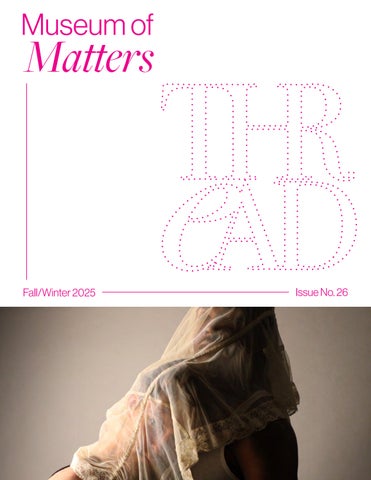
Create a flipbook
Issuu converts static files into: digital portfolios, online yearbooks, online catalogs, digital photo albums and more. Sign up and create your flipbook.