DARE WHEN OTHERS DON’T
SETAS BRING THE DESIRED EFFECT TO THE ECONOMY PAGE 7-8
— SOUTH AFRICA {thetelegramlive.co.za} — FRIDAY, MAY 6/MAY19, 2022 —
NEONATAL SEPSIS: ALARMING NUMBER OF NEW-BORNS LOSING THEIR LIVES PAGE 6
The Telegram ZA
A REBELLION AGAINST GROUPTHINK!
PAGE 11
@telegramrsa
AWARD-WINNING URBAN COOPERATIVE AIMING EVEN HIGHER PAGE 18
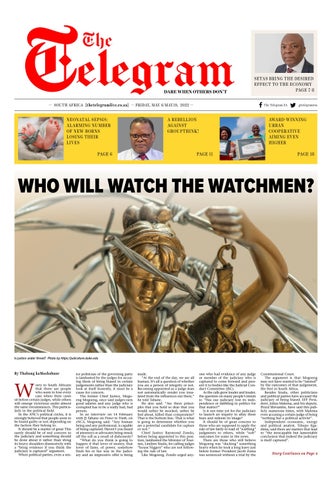
WHO WILL WATCH THE WATCHMEN?
Is justice under threat? Photo by https://judicature.duke.edu
By Thabang kaMashobane
W
orry to South Africans that there are people who seem to lose every case when their cases sit before certain judges, while others will emerge victorious under almost the same circumstances. This particularly in the political field. In the ANC’s political circles, it is strongly believed that people seem to be found guilty or not, depending on the faction they belong to. It should be a matter of great This surely should be of real concern to the judiciary and something should be done about it rather than shrug its heavy shoulders dismissively with a “bring evidence if you think the judiciary is captured” argument. When political parties, even a sen-
ior politician of the governing party is lambasted by the judges for accusing them of being biased in certain judgements rather than the judiciary look at itself honestly, it must be a cause for concern. The former Chief Justice, Mogoeng Mogoeng, once said judges earn good salaries and any judge who is corrupted has to be a really bad, bad person. In an interview on 14 February with JJ Tabane on Power to Truth, on eNCA, Mogoeng said: “Any human being and any professional, is capable of being captured. Haven’t you heard of attorneys or advocates being struck off the roll as a result of dishonesty? “What do you think is going to happen if that lover of money, that lover of fame, of power, somehow finds his or her way in the judiciary and an impressive offer is being
made. “At the end of the day, we are all human. It’s all a question of whether you are a person of integrity or not. Becoming appointed as a judge does not automatically render you insulated from the influences out there,” he told Tabane. He also said: “Are there principles that you hold so dear that you would rather be mocked, rather be lied about, killed than compromise? That is the bottom line. That is what is going to determine whether you are a potential candidate for capture or not.” Chief Justice Raymond Zondo, before being appointed to this position, lambasted the Minister of Tourism, Lindiwe Sisulu, for calling judges “house Niggers” who are not following the rule of law. Like Mogoeng, Zondo urged any-
one who had evidence of any judge or member of the judiciary who is captured to come forward and present it to bodies like the Judicial Conduct Committee (JSC). As the calls grow louder and louder, the question on many people’s minds is: “Has our judiciary lost its independence or dabbling in politics for that matter?” Is it not time yet for the judiciary to launch an inquiry to allay these fears and redeem its image? It should be of great concern to those who are supposed to apply the rule of law fairly to read of “scathing” judgments to others, while “soft” outcomes for some in the news. There are those who still believe Mogoeng was “ducking” something heavy when he took a long leave just before former President Jacob Zuma was sentenced without a trial by the
Constitutional Court. The argument is that Mogoeng may not have wanted to be “tainted” by the outcomes of that judgement, the first in South Africa. Besides Sisulu, other politicians and political parties have accused the judiciary of being biased. EFF President, Julius Malema, and his deputy, Floyd Shivambu, have said this publicly numerous times, with Malema even accusing a certain judge of being “nothing but a political activist”. Independent economic, energy and political analyst, Tshepo Kgadima, said there are matters that lead to “the inescapable but lamentable conclusion that indeed the judiciary is itself captured”.
Story Continues on Page 2
2
FRIDAY, MAY6/MAY19
Former Chief Justice Mogoeng Mogoeng said being “judge does not automatically render you insulated from the influences out there.” Photo by AFP
Story Continues from Page 1 Kgadima told The Telegram: “In order for the state to remain free from capture by special interests, the judiciary must dutifully rise to the occasion and remain ‘strict constructionists’ who are indeed the night watchmen for a constitutional democratic state such as ours to survive. “Furthermore, a closer study of judgments delivered over the last decade or so, an argument can objectively be sustained that a greater percentage of our country’s judges lack personal attributes of integrity,
CONTACT US
9 Main Road Farrarmere, Benoni, Johannesburg
NEWS DESK
+27 10 448 1108
EDITOR
Themba Khumalo
thembakhumalo@thetelegramlive.co.za
MANAGING EDITOR Mbangwa Xaba
mbangwaxaba@thetelegramlive.co.za
NEWS
newsdesk@thetelegramlive.co.za
PRODUCTION
production@thetelegramlive.co.za
NEWS DESK
advertising@thetelegramlive.co.za
DISTRIBUTION
Themba Khumalo
distribution@thetelegramlive.co.za
Distributed in Gauteng, Limpopo, North West, Free State and Mpumalanga
Published by The Telegram Media
objectivity, tolerance of opponents which are a prerequisite for one to be a judge.” He said if anything, “the almost R1 billion Zondo’s State Capture opera” has brought into sharp focus Major General James Jackson’s quote in 1809 that “eternal vigilance is the price of liberty”. Kgadima elaborated: “The mere notion that the state was ever captured as tacitly accepted by Zondo, who has patently been richly rewarded with the plum job of Chief Justice, notwithstanding his remarkably poor and shoddy performance during the recent JSC interviews, carries the inescapable but lamentable conclusion that indeed the judiciary is itself captured. “It is therefore appropriate to ponder Juvenal’s pertinent question: “Quis custodiet ipsos custodes?” (Who will watch the watchmen?) in the light of what are arguably utter failures of the Judicial Service Commission which is constitutionally entrusted with the duty of “guarding the guards (judiciary)”. He said the other equally important question to ask is: “What percentage exactly of our judiciary possesses genuine judicial temperament which encompasses being neutral, open-minded, decisive, respect, composed?” “Beyond the judicial capture narrative, which appears to have lamentably taken root, it appears that the jurisprudence being developed by our judiciary is an antithesis our country’s constitutional order arising from what can be found to be some members of the judiciary’s lack of professional competence with large knowledge of the law, passion for constitutional law, legal analytic skills, good judgment and intellectual concentration,” Kgadima said. These allegations have become so strong over the years that President Cyril Ramaphosa once said during a media briefing, that allegations about the judiciary being captured were serious and should not be taken lightly. Ramaphosa then said it was not in the interest of anyone who loves this country to hold the view that the judges have been captured. EFF Deputy President, Floyd Shivambu, once wrote that “there were indications that Gauteng Judge President Justice Mlambo was Minister of Justice Ronald Lamola and Ramaphosa’s preferred candidate for chief justice. He had accused the two of meddling in the affairs of the selection of the judiciary. Shivambu said then that there was a “widely held belief that Mlambo had presided over court decisions
NEWS
Floyd Shivambu and Julius Malema have been openly critical of the judiciary. Photo by www.polity. org.za
Tshepo Kgadima, said there are matters that lead to “the inescapable but lamentable conclusion that indeed the judiciary is itself captured”. Photo by pbs.twimg.com
Chief Justice Raymond Zondo has urged anyone with evidence of any judge or member of the judiciary who is captured to come forward. Photo by GCIS which unfairly and illogically favour Ramaphosa’s faction”. Judge Mlambo has repeatedly dismissed suggestions that the Gauteng High court favours those in the same bed with Ramaphosa. However, attorney Mpumelelo
Zikalala of Mpumelelo Zikalala Attorneys said it may be difficult to capture the judiciary in South Africa because of the safeguards the country has. He told The Telegram that the safeguards that are there are enough to deal with corrupting the judici-
ary: “But in instances where there is proof of judicial capture, the JSC is there to make sure it deals with those who are aggrieved. They should also direct their complaints to appropriate structures. “The biggest problem is that those who accuse judges of being corrupt, do not bring any concrete evidence forward. “Forums like the JSC are there for a reason and people should use them. What perhaps needs to be done is tighten the content and the quality of the judgments, meaning judgments should have an educational aspect or further explanation how a particular decision was arrived at,” Zikalala said. “This should be done, especially in cases of the Supreme Court of Appeal and the Constitutional Court. These Apex courts set a precedent whereby their decisions apply to all the lower courts. “It is imperative that they should explain to us how they reached those decisions.” He said it was important for litigants to understand that if they do not trust a particular presiding officer, they have a right to ask that the judge should recuse himself or herself. Zikalala said: “This is easy. You don’t even have to prove the actual biasness. You simply have to prove there’s a perception of biasness. So, my short and long answer would be that I don’t necessarily think there is judicial capture unless there is something that proves it exists. “For now, the structures that we have to guard against state capture seem to be there. But seemingly they are perhaps not utilised properly.” Interestingly, during a media briefing to respond to Sisulu’s attack on the judiciary, Judge Zondo said “one does see, from time to time, certain actions that appear to be attempts to capture the judiciary”. But he said as far as he knows, such attempts have never succeeded and it was up to everybody to make sure those attempts are never successful. Mogoeng’s chilly words of warning during the 2019 Mandela Lecture must not be forgotten: “Be on the lookout, be vigilant and be forceful in making uncomfortable anybody who seeks to establish a pliable judiciary. We owe it to this country, and generations to come, to make sure that we don’t have a compromised judiciary. “A captured judiciary will never be able to use the Constitution as an instrument of transformation. … when certain issues are involved, well the decision is known in advance, so and so can’t lose.”
5
CITY PRESS, 5 SEPTEMBER, 2021
news
NEWS
CITY PRESS ONLINE FOR
FRIDAY, MAY6/MAY19
SUBSCRIBERS
news: VBS LIQUIDATORS GUN FOR VENDA KING The liquidators of VBS Mutual Bank applied for a writ of execution at the Johannesburg High Court last month to recoup more than R10 million allegedly owned by a family trust whose sole trustees are Venda King Toni Mphephu Ramabulana and Portia Mphephu.
3
PASTOR LUKAU’S R50M RENTAL
SCANDAL
PAY UP Alleluia Ministries International in Kramerville, Sandton. The church defended pastor Alph Lukau (inset) after he performed the so-called miracle resurrection of Elliot Moyo in 2019 PHOTO: LUBA LESOLLE / GALLO IMAGES
Companies linked to the controversial megachurch preacher evade debt collection as he and his business associates are said to be in Portugal
“The guard, who refused to provide me with his name, did not allow me access but told me to wait. He disappeared into the guard hut on the property and echnology distribution and warehousing spoke to this supervisor, who came out to speak to me. giant Tarsus Shared Services is battling to “After explaining the purpose of my visit and the recover a R50 million deficit allegedly documentation that I had with me, the supervisor also owed by controversial pastor Alph Lukau refused to provide me access. and several of his business associates. “Similarly, he refused to provide me with his name. I The matter relates to a cancelled lease could see that he had been speaking to someone over evicted from the premises early securities and/or members’ and agreement pertaining to the premises of Alleluia his cellular phone from time to time ... After seeing the last year because it could no directors’ registers follows multiple Ministries International in Sandton, Johannesburg. letters attached to the gate, the supervisor said that I longer meet the R1 million monthly requests for access, and is such a The company lodged a court application this week at should come [back] the next day,” they say. rental fee. clear interference with an the Johannesburg High Court, flagging three companies Lukau shot to fame over the past two years by The company instituted, among unconditional statutory right. The linked to Lukau for failing to declare their company performing so-called miracles during his church services, Patients outside thethat Forta punitive Beaufort Provincial Hospitalincluding casualty department complain about For three weeks the vehicle patients from Monday Thursday in Fort Beaufort to East London has other to things, arbitration applicant requests security registers in their arbitrationwhich processtransports as when he publicly “resurrected” a man. the lack of ambulances. by Mkhuseli Sizani been grounded at Fort Beaufort Hospital due to a paramedics’ by Mkhuseli Sizani proceedings strike. in whichPhoto it claimed: cost award be made Photo against each of prescribed by the Companies Act, citing Provincial that the Lukau claimed that the man, Elliot Moyo, had died . Arrear rentals and charges up the respondents.” information sought would enable it to track the intricate and the latter’s body was brought to the pastor by his ACCORDING TO ARBITRATION to the date it cancelled the The applicants say this refusal has web of companies that operate the church in South family a few days later. DOCUMENTS, TARSUS SHARED sublease; put a strain on the arbitration Africa and throughout Africa. The incident angered some within the religious SERVICES HAS BEEN TRYING . Damages for the period the process, further delaying the The court papers also indicate that attempts to serve community, who called for Lukau to be investigated by TO RECOVER THE DEBT defendant was in occupation after recovery of debts. Lukau and a close business partner, identified as John the Commission for the Promotion and Protection of the SINCE MARCH 2018, LEADING the cancellation; They further highlighted that their Ferguson, with a summons have failed, as they have Rights of Cultural, Religious and Linguistic Communities TO THE PERIOD . Future loss of rentals and legal representative visited Lukau’s allegedly taken up residence in Portugal and refuse to after a video of his purported resurrection of Moyo went WHEN THE CHURCH WAS charges calculated from the date known place of business in June, accept service through legal counsel. viral. EVICTED FROM THE PREMISES the defendant ceased to occupy but the representative was denied They emphasise that “the appellant requires the It also emerged in 2019 that Lukau’s church members EARLY LAST YEAR, the premises as a church until the entry. information in the registers in order to unravel the regarded him as being similar to Jesus, proclaiming that AFTER WHICH IT COULD NO expiry date of the sublease; and “The premises has access control relationship between Lukau and Ferguson, and the he was crucified for helping to heal others. LONGER MEET THE R1 MILLION . Restoration of the premises. and requires a security guard to respondents [King Vision Holdings, Alph Lukau Group The applicant’s lawyer, Andrew Scarrott of AB Scarrott MONTHLY RENTAL FEE The proceedings also reveal allow access. spoke to the security and Al Resident Holdings] to recover the debts due by GroundUp: “The service to comment. we offer to that “I know the I strike. Eventually we managedAttorneys, and declined a certificate of fitness is issued from my own experience church leaders, including Lukau, guard on duty and asked that I be Lukau and Ferguson”. “I have received your enquiry, [but] I have no the public is very poor. Our ambu- that there are no ambulances avail- to get a private ambulance to come. before a vehicle is put on the road. have blatantly refused to grant the applicants access to allowed into the property in order to deliver the request According to its arbitration documents, Tarsus Shared instructions to make any comment at this time,” he said. hospitals have been using their Efforts Wetoare in agreement that and if athe vehicle Theretoare able in this hospital. Three months information pertaining company directors. to the respondents to inspectThe the securities and/or Services has been trying to recover the debt since Marchlances have no equipment. source comment from Lukau bakkies to transport patients.” does not carry the valid licence and/ no machines to check diabetes and ago, I was stabbed and admitted to “As the refusal to allow access to the respondents’ member registers of the respondents. 2018, relating the periodCape when the church was companies were unsuccessful. hetoEastern Department MDUDUZI NONYANE
T
mduduzi.nonyane@citypress.co.za
R1M
EASTERN CAPE PARAMEDICS FACE DISMISSAL
By Mkhuseli Sizani
T TOP FASHION GURU MUST PAY BACK THE MONEY
Regional Nehawu coordinator or the certificate of fitness displayed, of Health has served more high blood pressure. Our radios don’t this hospital. Doctors transferred me than 200 paramedics with function because we work in deep to Cecilia Makiwane Hospital but Mzamane Mgwantashe says the it should not be used. “There are more than enough letters of intention to dismiss rural areas where there is a network they told me I should find my own workers are not on strike. “Over 200 workers are coming vehicles in the pool even while vehiproblem. We use our cellphones to transport because ambulances are not them for embarking on a strike. cles may be grounded whilst being Long-standing problems with respond to the calls and communi- available. My brother had to take me every day to work. “But they cannot perform their repaired. The rough terrain of our with his car to East London.” access to ambulances in parts of the cate with our control room.” duties because are faulty predominantly rural areas and high Mihlali Matshoba says the ambu“These issues have been raised for Eastern Cape have worsened over attach Segapo’s assets after the designer allegedlyambulances JULIA MADIBOGO BUSINESS and not fully equipped. In February, volume usage does make them vulmany years with the department but lance crisis has been going on for a the last three weeks as paramedics IS SLOW moved out of his place of business. julia.madibogo@citypress.co.za Fashion Segapo, who has styled celebrities including Idols SA ambulances were fully equipped by nerable to breakdowns.” have stopped work in Buffalo City it has always been empty promises. long time. Businessperson Kabelo Ncholo has accused celebrity If we transport a patient in an ambuhost ProVerb, award-winning musician in order designer Department to obtain “On 7 October producer I gaveandbirth at the Ndamase said the vehicles were Municipality, Amahlathi and RayPaledi fashion designer Paledi Segapo of reneging on a Prince Kaybee, veteran actor Warren Masemola and US service compliance certificates. The home because ambulances are not replaced every 300,000 km. lance which is not fully equipped the IN THE SETTLEMENT AGREEMENT, WHICH mond Mhlaba Local Municipality. Segapo says repayment arrangement the pair entered into out of singer Tevin Campbell, was hired by Ncholo in 2018 to CITY PRESS HAS SEEN AND WHICH IS DATED same day after the assessment was available here in Fort Beaufort. SomeOn the issue of cellphones, he said department shifts the blame on us The are demanding fully his business court paramedics after the latter allegedly failed to deliver the design attire for his wedding, which was scheduled to NOVEMBER 2020, THE SEASONED DESIGNER has been wedding-related items that Ncholo had ordered and take place in 2019 at Sun City, North West. happens to the times they are hours late or we are done the equipment was stripped by the department had issued “pushequipped ambulances, with valid if something wrong AGREED TO PAY BACK ABOUT R300 000 TO affected paid for. The wedding did not take the placeDepartment. that year and Ncholo We don’t know by why to-talk devices” earlier this year and patient. We are not onNCHOLO strike, because there is only one ambulance licence discs, and cellphones. BY THE END told OF NOVEMBER Covid-19 Ncholo dragged Segapo to the Johannesburg High got married in November last year after obtaining the that was done and we don’t know most paramedics had accepted them. we come daily to work. operating.” They want electrocardiography PHOTO: OUPA Court in an effort to recoup payments he made to the services of other designers. where that equipment was taken.” Responding to the complaint about “The Department is threatening Nolly Oliphant had to borrow (ECG) monitors, batteries, spine BOPAPE/ seasoned designer agreed to pay back about R300 000 Palse fashion label owner while preparing for his According to Ncholo, the popular designer was also GALLO IMAGES to Ncholo by the end of November. wedding. set to arrange a team that was meant to include a He said workers had been told cell- equipment being put in the ambuboards, blankets, head blocks, cervi- to fire us but it’s fully aware that it money to put fuel in her car to take “The defendant shall pay the her plaintiff an to amount of Makiwane Segapo was scheduled to appear at the Randburg wedding planner, a photographer, a hairhad and make-up is failing its workers and patients.” son Cecilia Hospital phones been bought for them, lances just to get licence approval, cal collars, and baby cribs. R297 000 in a full and final settlement of the dispute, Magistrates’ Court on Tuesday on a separate criminal artist, and a booking for a segment in the lifestyle When GroundUp visited Fort Beauafter he injured his hand. but they had never received them. Ndamase said this was being invesThe workers are members of the [an offer] which the plaintiff accepts on the terms and charge of fraud for the same transaction. television programme Top Billing. “I drove with him to Fort Beau“Instead, the Department bought tigated. fort Provincial Hospital on Tuesday, National Education, and due conditions contained herein,” reads the settlement. That matter was not placed on Health the roll, however, To secure his services, Segapo reportedly requested a The conditions were that Segapo had to make the to the out-of-court settlement agreement that the pair R150 000 deposit of the R300 000 he had charged the “None of these issues are considAllied Workers’ Union (Nehawu) we found patients being transported fort Provincial Hospital. The doctors ‘push-to-talk’ devices without confirst payment of R118 500 by thetreated end of March, reached. for his suit, his bride’s the gown workers.” and attire in private vehicles. him and andthetoldbusinessperson me that I should sulting ered valid reasons to suspend services which maintains that the paramedics other payments were to be made in R20 000 monthly National Prosecuting Authority spokesperson Phindi for the entire bridal party. Thando Ntsume from Hillside take him with my own transport to Mkhululi Ndamase, spokespersondue totoCovid-19 the communities we serve.” are not onconfirmed strike but arematter exercising instalments until the end of November. – not so that he could avoid making Mjonondwane that the was “not However, Segapo allegedly only created outfits for the dropped a patient in casualty with Cecilia Makiwane Hospital. I had for Health MEC Nomakhosazana The department was using private their right to safety at work. with the Segapo was also asked to pay Ncholo’s R30 000 legal payment to Ncholo. placed on the roll, pending consultation bride and the bridesmaids. costs on or before December 31 this year. “Why would I discontinue my businesses while I complainant”. The settlement letter states that failure by the to borrow R1,200 for fuel because Meth, confirmed the notices to ambulances to respond to emergency The paramedics come to work his private vehicle. However, says Ncholo, Segapo has only paid R85 000 have to [conduct] business? I am not the first person to Ncholo first opened a civil case against Segapo in seasoned designer to pay what is due to Ncholo per “I could see that she was in severe ambulances are not available. dismiss over 200 workers who had calls, which was costly. every day in full uniform and wait thus far and is expected to pay R45 000 by the end of close their store at the moment because we are going April 2019 and then opened a criminal case of fraud the settlement agreement will trigger pursuit of a pain and battling to breathe. Her “The strike has been devastating,” embarked on an unprotected strike.through aTwo of these ambulances had been at their ofwork places until shifts this month or Ncholo will move to obtain a judgment difficult time. in August the same year to push their the latter to pay civil case. family had been calling for an ambusaid one of the Fort Beaufort doctors. He said the department had addressed stoned, said. are over. against him. “What they arehe doing is making me look like I am a him back. Yesterday, Segapo said he couldn’t comment as the But the businessperson says he is scared that, even if thug on the run when the truth is that could not no InOne the settlement agreement, which City Press has matter was sub judice. Ndamase said a rule of Ino work of the workers, who has lance since the morning but it never “We had to ventilate a patient in Fort the issues raised by the union. he obtains a judgment, there might be no way to afford to pay rent,” he said. seen and which is dated November 2020, the However, he said his store in Newtown was closed Beaufort for over 24 hours because of “All vehicles are licensed annually pay would apply. –- groundup.org.za been a paramedic for six years, told arrived,” she said.
R300 000
4
FRIDAY, MAY6/MAY19
NEWS
LONG WAIT CONTINUES FOR APARTHEID REPARATIONS
People seeking reparations for apartheid-era crimes have been demanding justice at the Constitutional Court in Braamfontein, Johannesburg, for a week. Photo by Andy Mkosi
By Dennis Webster
F
or nearly a week and in deepening cold more than 70 activists demanding reparations for apartheid crimes have occupied the steps of the Constitutional Court in Braamfontein, Johannesburg. The mostly elderly activists, who all suffered great personal loss at the brutal hands of white minority rule in South Africa, say the country’s mechanisms of redress for apartheid atrocities, particularly the Truth and Reconciliation Commission (TRC), have largely failed to secure the dignity of the victims of those crimes. The activists, who mostly come from Gauteng’s East Rand, though some are from elsewhere in South Africa, are organised under the banner of the Khulumani Support Group, a non-governmental organisation that campaigns for redress for the victims of apartheid crimes. The road that has led them to the Constitutional Court has been a long one. Neither local government structures nor Parliament responded to their many memorandums. Now they say they will not leave the steps of South Africa’s apex court, which they call the country’s “biggest house” and “our assembly place”, until either Minister of Justice and Correctional Services Ronald Lamola or President Cyril Ramaphosa addresses them directly. Many of the activists, including Dineo Makhura*, a woman in her 60s, are veterans of the TRC. “For 28 years, we have been knocking on the door of the Department of Justice to fix this unfinished business of
The activists refuse to leave until they’ve been heard and sleep in front of the court entrance at night. Photo by Andy Mkosi the TRC,” said Makhura, who now believes that the commission was set up “for the perpetrators, not the victims” of apartheid crimes. Her mother attended the TRC hearings seeking justice for her son, who was
abducted from the family’s home by a gang coordinated by apartheid police. She and Makhura later found his half-burnt body in a state mortuary after he had been stabbed to death in a Vosloorus hostel.
Every victim counts Stories of atrocities similar to those Makhura’s family endured are standard among the activists huddled outside the court. They claim that more than 100 000 victims of apartheid
crimes are still owed reparations and say they will demand that none of them receives less than R1.5 million. “We need the government to pay, from the first victim to the last,” said Nomarussia Bonase, Khulumani’s Gauteng provincial chairperson. The nature of any further TRC-recommended reparations will likely require wholescale government cooperation. Lamola’s department would have to work hand in hand with a host of others in order to oversee the provision of decent housing and education, for instance, or the implementation of community and cultural projects intended to heal apartheid’s symbolic scars – all hallmarks of TRC-style reparations. Lamola’s spokesperson, Chrispin Phiri, who met with the activists, said he “understands the issues they have marched for” and added that the minister was “open to meeting them at his earliest convenience”. It had so far not been possible owing to “a scheduling issue” and Lamola being “unable to drop other commitments”, said Phiri, who claimed the activists had “reneged on [earlier] commitments to meet”. Meanwhile, the activists continue their Constitutional Court vigil, sleeping under thick blankets on makeshift beds of cardboard under the court’s famous façade. They are subsisting largely on bread and tea and have no access to toilets or running water between 5pm and 7am. Many have fallen ill and at least one has been hospitalised while they wait to hear from Lamola. – newframe.com *Not her real name. ● This article was first published by New Frame.
NEWS
5
FRIDAY, MAY6/MAY19
Judith Candiru, an Assistant Nursing Officer in Yumbe district Uganda, provides COVID-19 vaccination services within the community of Midigo. Photo by Zahara Abdul/ UNICEF
RECORD PROFITS, WHILE COVID TREATMENT OFTEN ‘OUT OF REACH’ FOR THE POOR By Staff Reporter
D
espite weekly Covid-19 fatalities being at their lowest since March 2020, World Health Organisation (WHO) chief Tedros Adhanom Ghebreyesus told journalists at a weekly briefing in Geneva that “these trends, while welcome, don’t tell the full story.” More sub-variants The South African scientists who identified Omicron late last year have now reported two more Omicron sub-variants, BA.4 and BA.5, as the reason for a spike in cases there. While it is too soon to know whether the sub-variants can cause more severe disease than others linked to Omicron, early data suggest that the best way to protect people remains vaccination, alongside tried and tested public health and social measures. “This is another sign that the pandemic is not done with us,” warned Tedros. Address ‘bottlenecks’ He reiterated that the best way to save lives, protect health systems and minimize cases of “long Covid” is by vaccinating at least 70 per cent of every country’s population – and 100 percent of most at-risk groups. Although more jabs have become available, a lack of political commitment, operational capacity problems, financial constraints, misinformation and disinformation, are limiting vaccine demand. “We urge all countries to address these bottlenecks to provide protection to their populations,” the top WHO official said. Crucial testing “Testing and sequencing remain absolutely critical,” he continued, noting that both sub-variants were identified because “South Africa is still doing the vital genetic sequencing that many other countries have stopped”. Tedros cautioned that many countries are blind to how the virus is mutating – not knowing what lies ahead. And the scant availability and high prices of effective antivirals continue to render them inaccessible to low and middle-income countries. “Coupled with low investment in early diagnosis, it is simply not acceptable that in the worst
pandemic in a century, innovative treatments that can save lives are not reaching those that need them,” underscored the WHO chief. Playing with fire While “we’re playing with a fire that continues to burn us”, he said that “manufacturers are posting record profits”. WHO supports fair reward for innovation and while ACT Accelerator partners are negotiating lower costs and increased availability, he stressed that “we cannot accept prices that make life-saving treatments available to the rich and out of reach for the poor”. Africa Turning to the Horn of Africa and the Sahel, Tedros spelled out that the climate crisis, spiking food prices and food shortages are threatening to cause famine and further insecurity. With the vast region experiencing its worst drought in 40 years, 15 million people are estimated to be severely food insecure in Ethiopia, Kenya and Somalia and repeated attacks on scarce water resources in Burkina Faso are depriving citizens of access to the minimum amount of water they need just to survive. Meanwhile, in the Democratic Republic of the Congo, WHO is supporting vaccinations for an Ebola outbreak. “WHO is responding to a huge range of challenges around the world – to say nothing of our work outside of emergencies to strengthen health systems and promote the conditions in which people can live healthy lives,” said Tedros, reminding that “all of this work costs money”. On the eve of World Hand Hygiene Day, and the International Day of the Midwife, Tedros told reporters that WHO was launching its first Global Report on Infection Prevention and Control. “The simple act of cleaning hands can save lives, especially in healthcare facilities, where vulnerable patients can be exposed to infection.” He said an astonishing 70 per cent of infections can be prevented where good hand hygiene and other “cost-effective practices are followed”. He said simply cleaning your hands regularly, “can be the difference between life and death, for you and for others.” – news.un.org
6
FRIDAY, MAY6/MAY19
NEWS
Professor Angela Dramowski attends to a new-born baby in the paediatric unit at Tygerberg Hospital in Cape Town. Photo by Kim Cloete
By Lilita Gcwabe
A
global study has found that neonatal sepsis in new-borns – caused by antibiotic resistance – is a rising cause of
death. The study, conducted by the Global Antibiotic Research & Development Partnership (GARDP), examined just over 3,000 babies from 11 countries, including South Africa. It assessed which antibiotics are currently being used on infants who had each experienced a sepsis episode and the extent of the resistance towards these treatments. One of the key findings showed that mortality at 28 days of life was high at 11.3%. It also revealed that more than half the deaths were due to infections acquired from the hospital. Dr Tanusha Ramdin, senior neonatologist at the Charlotte Maxeke Johannesburg Academic Hospital, described antibiotic resistance as a major problem. “It breaks my heart to see a baby dying when an antibiotic hasn’t worked. We are running out of options. If we don’t get more antibiotics on board, more babies are going to die,” said Ramdin. She is also the sub-principal investigator of the Neonatal Sepsis Study. What is neonatal sepsis? Sepsis happens when an infection you already have, triggers a chain reaction throughout your body. Infections that lead to sepsis most often start in the lung, urinary tract, skin, or gastrointestinal tract. Without timely treatment, sepsis can rapidly lead to tissue damage, organ failure, and death Neonatal sepsis is an infection that lives in the bloodstream of a newborn baby, and can cause a life-threatening condition within hours of life. The study explained that when germs get into a new-born baby’s body, they can cause an infection. If not stopped, it can cause sepsis because new-borns don’t yet have an immune system that can fight off infections. Without timely treatment, sepsis can lead to tissue damage, organ failure, and death.
NEONATAL SEPSIS: ALARMING NUMBER OF NEW-BORNS LOSING THEIR LIVES
Delayed treatment of neonatal sepsis can lead to death. Photo by neonatalcareacademy.com
A study has revealed that neonatal sepsis in new-borns is a rising cause of death. Photo by www.bmj.com
Antibiotic resistance reduces the odds of a baby surviving neonatal sepsis due to delays in the provision of appropriate treatment. According to the study, effective therapy is often neither available nor affordable. Babies who survive are often left with long-term and disabling health effects. Infant health neglected Decades of neglect of the impact of drug-resistant infections on babies has worsened the crisis of neonatal sepsis. Of the 3 200 babies suspected to have neonatal sepsis, 11% of them died during the study period in hospital. The number increased to 18% where a pathogen was detected in their blood culture. This is a test that checks for bacteria, yeast and other microorganisms. Ramdin added: “There remains an urgent need to develop novel antibiotic treatments to keep pace with rising rates of resistance and to ensure appropriate access and stewardship to these treatments across the world. These challenges represent decades of neglect by policymakers, governments, institutions, and companies to collectively address a systemic failure that is leading to the avoidable deaths of babies, especially in low to middle income countries.” A major concern In 2019, nearly 1.3 million deaths were caused by bacterial antimicrobial resistance (AMR), which included almost 140 000 new-born deaths. The World Health Organisation (WHO) recommends Ampicillin and Gentamicin antibiotics for the treatment of neonatal sepsis. However, the study showed that many hospitals are using other combinations due to high levels of resistance to the
WHO-recommended treatment. Principal investigator, Professor Angela Dramowski from the University of Stellenbosch, is concerned about pathogens with a resistant profile becoming entrenched in the neonatal unit. ‘We have so many vulnerable babies, it could have disastrous outcomes. Infection prevention and control becomes exceptionally important to prevent this spreading more widely,” she said. The findings of the study stressed the importance of developing new treatment that isn’t resistant to pathogens. “Pathogens that were easily treated ten years ago now require increasingly expensive, toxic drugs to treat, and have limited or lesser chance of successful outcomes. This is because they are not necessarily the most effective drugs. They are the only drugs we have left. In the past, we could get away with treating newborn babies with a single antibiotic. Now we often need to give three drugs for the best possible outcome. When you add so many antibiotics together, the added effect and potential for complications and adverse events is higher,” Dramowski explained. Further analysis underway The aim of the study was to inform the development of improved antibiotic treatment regimens for neonatal sepsis worldwide. It indicates that the analysis of the bacteria causing the infection and antibiotic use at trial sites is currently underway. This will help in identifying existing knowledge gaps in the choice of antibiotic treatment. It will also help in improving and strengthening vaccines, treatment, and diagnostic development for neonatal sepsis. In addition, the study team is developing a recovery score based on factors associated with either recovery or deterioration during treatment. “This will provide clinicians with key information, for example, on the need for treatment escalation. It will also support antibiotic stewardship by enabling clinicians to prescribe standard regimens with greater confidence, knowing that responses predictive of recovery or deterioration are monitored,” Dramowski said. – Health-e News
UP YOUR GAME
7
FRIDAY, MAY6/MAY19
SETAS BRING THE DESIRED EFFECT TO THE ECONOMY S
outh Africa has the highest Gini Coefficient in the world. The Gini Coefficient measures the deviation of the distribution of income (or consumption) among individuals or households within a country from a perfectly equal distribution. Not surprisingly, given the legacy of apartheid, this inequality in South Africa is clearly visible along racial lines. It is felt along racial lines right across from the workers (skilled and unskilled) all the way to the unemployed. The reasons often given for this inequality include a lack of opportunities and a lack of or poor education and training. Having said that, skills development is essentially a voluntary exercise. The government has for a number of years engaged with the private sector to try and turn the workplace into training places. A lot of incentives were put in place to encourage employers to train the unemployed and improve the workforce. These initiatives would be done through the Sector Education and Training Authority (SETAs) 21 in total. The SETAs were established with a clear mandate to address the skills shortages in the country. This they
CHARLTON PILISO do by facilitating skills development in the 21 identified sectors. It includes research on what skills shortages exist, developing programmes to respond to those shortages and making funding available for various interventions including learnerships, bursaries, internships etc. For purposes of this article, the focus will be on the Food & Beverages Manufacturing Sector Education and
Training Authority’s (FoodBev SETA). This SETA facilitates skills development in the Food and Beverage Manufacturing sector. Its scope of coverage includes Beverage Manufacturing, Dairy Manufacturing, Manufacture of Food Preparation Products, Processed and Preserved Meat, Fish, Fruit and Vegetables, and Baking, Cereals, Confectionery & Snacks (BCCS). Typical member companies to this SETA include breweries, meat processors, snack manufacturers etc. With all the challenges of high unemployment and the low skills base in the country, SETAs have become the go-to structures that are expected to respond to the challenges listed herein. The employers and the unemployed have over the years seen the important role that SETAs play in advancing skills development. The FoodBev SETA is one of the SETAs that is primed to respond to such challenges. The end product from their member companies is consumed throughout the country and in all seasons. It can develop entrepreneurs and prepare the youth to enter in the economy. The sector they service hardly experiences a decline in demand of their products. In the last financial year alone,
despite the challenges placed by Covid 19, the Foodbev SETA achieved 80,49% performance against the targets. The SETA registered a total of 7,406 pupils (employed and unemployed) on various learning programmes, of which 6, 752 were SETA funded. In addition, 3, 897 pupils completed their learning programmes of which 3, 366 were SETAfunded. A total of 654 pupils were registered into learning programme funded by the sector of which 531 pupils have completed. Even though we shouldn’t praise a fish for swimming, this performance is commendable given the challenges brought about by the Covid-19 pandemic. Indeed, some similar institutions do not reach such achievements on any normal financial year. It is important to note that these achievements were reached with a downward revised budget. The FoodBev SETA’s total budgeted revenue decreased from the approved amount of R432 million to R305 million. This was due to the four-month skill development levy holiday and other Covid-19-related financial impacts. This resulted in a R118 million downward budget adjustment. This performance alone is certainly not going to improve the country’s
Gini Coefficient discussed earlier. However, this and the performance of various other SETAs can go a long way in addressing the skills gaps and ensuring that South Africa has a capable workforce and a pool of employable youth. What is encouraging, however, is the report from the Auditor-General of South Africa. In the report to Parliament the auditor expressed a favourable opinion which shows that the SETA has strong governance in place. SETAs get easily swayed from the main objective by having to deal with governance gaps that always result in bad publicity. It is refreshing to note that the FoodBev SETA has not had such issues and continues in a right trajectory in facilitation of skills development. Skills development of the workforce cannot be left to chance. The SETAs must now pay attention to future skills. South Africa is a global player and, as such, skills from other countries may impact our industries. Cross sectoral programmes with other SETAs is crucial in ensuring that this Gini coefficient score is reduced. ● In my next article I will be looking at the governance problem within the SETAs.
8
FRIDAY, MAY6/MAY19
ADVERTORIAL
RIGHT SKILLS FOR THE RIGHT JOB
O
ver 1 000 beneficiaries receive skills training through FoodBev partnerships. Skills development is essential for a competitive workforce where people are equipped with the right skills to future-proof businesses, improve employability, and create entrepreneurial opportunities. As such, the FoodBev SETA offers various discretionary grants that encourage stakeholders to contribute towards skills development and the provision of critical skills within the food and beverage manufacturing industry. “People need the right skills to get a foot into the job
market or to create their own opportunities. Therefore, we work with the sector and reputable partners to provide skills development that meets our objectives to grow the economy, create jobs, and advance social development. “We want to encourage young people to develop their skills to increase their employment opportunities. We want to motivate them to become inspiring leaders - successful employees, entrepreneurs, and game-changers,” explains FoodBev SETA CEO, Nokuthula Selamolela. In the past year, FoodBev SETA enjoyed interventions with various partners that allow learners to enter
the job market and get the necessary skills and training. This includes a R30 million SETA partnership with Universities South Africa (USAf) to fund over 600 students with historical debt, covering their unpaid fees and allowing them to graduate. The FoodBev SETA also funds learnership qualifications developed by other SETAs that address gaps specific to the food and beverage manufacturing sector. The goal of these learnerships is to get a nationally recognised qualification while doing workbased learning. The FoodBev SETA recently graduated 100 people with
disabilities as they completed in food and beverage and general management in a R4 million partnership with Rose Mugs and the Cum Laude Training Institute. The one-year learnerships consisted of six months of theory and six months of practical work, ensuring effective skills transfer and on-the-job training. Additionally, the FoodBev SETA and the Bakery & Food Technology Incubator currently have a memorandum of understanding which has enabled 60 people receive learn-
erships where they are trained in cooking and baking. “Our partnerships have resulted in great programmes that benefit communities from the inside out and empower and upskill beneficiaries. Together, we can drive action and positive change through skills development and training, which will benefit the sector and the nation,” Selamolela said. For more information about FoodBev SETA and how you can benefit, visit www.foodbev.co.za
NEWS
FRIDAY, MAY6/MAY19
9
10
FRIDAY, MAY6/MAY19
TECH
Photo by news.trust.org
WHY MILLIONS OF AFRICANS ARE RIGHT TO RESIST SIM CARD REGISTRATION Mobile SIM registration linked to digital ID is causing exclusion of marginalised groups, and concerns about privacy in the absence of sufficient legal safeguards, especially in nations with a history of abuse by authorities. By Tony Roberts and Ridwan Oloyede
Photo by cdn.mos.cms. futurecdn.net
I
n recent weeks, millions of Nigerians have been barred from making calls after the government instructed telecommunications providers to disconnect their SIM cards because they failed to comply with the government directive to register and link them to their digital ID, known as the National Identity Number (NIN). Most countries in Africa – 50 nations according to research by Privacy International - and around the world require SIM registration to identify the user. However, Nigeria has gone further by requiring SIM cards to be registered and linked with a citizen’s digital ID, and therefore with the biometric data that it contains. Nigeria is not alone in doing this: some 30 countries globally require SIM registration linked to digital ID including biometric data such as fingerprints or facial images. Such a registration policy excludes many marginalised groups such as some ethnic minorities or migrant workers without ID proof such as a birth certificates, needed to obtain a digital ID. This locks them out from obtaining a SIM – and therefore from mobile connectivity – and from government services that increasingly require mobile or internet service to access. Secondly, SIM registration linked to digital ID is causing concerns about privacy rights – not only in Nigeria but also in Uganda, Zambia and Kenya – in the absence of sufficient legal safeguards to protect their data. More so, where there is a historical record of abuse by authorities. From our research at the African Digital Rights Network, we believe citizens are right to be concerned. Linking digital IDs and mobile SIMs, and linking these with mobile banking apps and other digital services, is the “unholy trinity” of digital surveillance. When combined with further government or corporate
Photo by images. easytechjunkie.com
data, this surveillance stack enables governments to track an individual’s real-time movements, transactions, email, voice and social media communications, providing a powerful infrastructure for state surveillance. Digital identification is becoming a central component of repressive digital surveillance. In the six African countries we studied, we found governments making major investments in surveillance technologies, not only in digital IDs and SIM registration, but also in CCTV, encryption breaking and car licence plate and facial recognition systems. They also created laws forcing telecom companies to capture and store citizens’ communications for possible state use. In Nigeria, that fear was exacerbated in February, when it was reported that President Muhammadu Buhari had allowed security agencies to access the NIN database. The government’s argument for mandatory registration of SIM cards linked to digital IDs hinges on security, and
allowing governments to track criminality. However, there is no evidence that mandatory SIM registration lowers crime or makes a difference in crime detection. Everyone wants governments to track the most serious criminals to prevent mass atrocities. But citizens also want governments to respect and protect everyone’s right to privacy. Due to the covert nature of surveillance, and the large power imbalance between the state and the people being watched, there is a clear opportunity to abuse power: our research on surveillance law in Africa shows that most surveillance is conducted on political opponents, business rivals, journalists, civil society activists and low-level criminals. These are all in violation of privacy rights. In most African countries, including Nigeria, it is also in violation of the constitution, international human rights conventions, and domestic laws which protect privacy of communication. However, branches of the state regularly violate this privacy law, and they do so with impunity, with no accountability for such violations. To protect citizens against abuses of their data and privacy rights, robust data protection and privacy laws are needed that provide for independent oversight bodies with the independence, resources and power to monitor surveillance practices, and hold governments and corporations accountable for any breaches. Citizens have a right to legal citizenship and to access government services and entitlements. This should not be contingent on a biometric ID system that locks out the most vulnerable, and enables repressive governments to conduct mass surveillance. – news.trust.org ● Dr Tony Roberts is a research fellow at the Institute of Development Studies, and a member of the African Digital Rights Network. Ridwan Oloyede is a legal practitioner, research fellow and consultant based in Nigeria, and a member of the African Digital Rights Network.
YOUR TAKE
11
FRIDAY, MAY6/MAY19
“in Unmasking the Politics of Mass Deception: An Intellectual Act of Rebellion sipho seepe once again offers a testament of what punditocracy should be. Written with vigour and passion, this book confronts and combats the liberal consensus that continues to saturate the post-1994 south African scene. By writing against this decadent grain, seepe’s radical refusal compels us, lucidly so, to come into contact with his signature of speaking truth to power – parrhesia.” Tendayi sithole, Professor, Department of Political sciences, UNisA, author of The Black Register
ISBN 978-1-928539-12-4
9 781928 539124
africa century editions (ace) Press
siPho seePe
About the Author Professor siPho seePe is currently the Deputy Vice Chancellor: institutional support at the University of Zululand. seepe holds an Msc (Physics) from Wits University and Med from harvard University. he also holds a PhD from the University of North West. he is a recipient of harvard fellowship and the senior research fulbright fellowship. seepe re-joined the academy following a 9-year stint in government where he served as special Advisor to Ministers in several departments; Public service and Administration, human settlement, Communications, and Defence and Military Veterans. Seepe is a prolific writer on social and political issues. He is a former columnist for both the Mail & Guardian and the Business Day.
UNMASKING
Mogomme Alpheus Masoga, Professor and Dean, faculty of Arts, University of Zululand
si Pho se e Pe
the Politics of Mass DecePtion
“seepe’s voice is not apologetic, nor is it innocuous, but ‘risky’, and valiant and determined to pioneer ‘annoyance’ to power, a needle in the comfortable couch of the ‘politics of the stomach’. … i value seepe’s audacity and tenacity to pen down such a challenging work. one does not have to pick sides to take notice and appreciate seepe’s line of vision with respect to the issues he is problematising. We can appreciate his presence and his decisively courageous brilliance in calling out compromised, ‘single and false’ narratives. seepe’s voice intrepid and audacious is a harbinger of a nascent and greatly needed intellectual trend that should lend credence to a currently developing culture of south African intellectualism. And one marvels at a voice that looks at issues in a direct, courageous and unsettling manner. …”
UNMASKING the Politics of Mass DecePtion An Intellectual Act of Rebellion
A REBELLION AGAINST GROUPTHINK!
T
he inspiration for this book is multi-faceted and multidimensional. First, it is a response to the many readers and scholars who have asked for a compendium of my essays. For those who have only been exposed to fragments of my writing, I hope this collection provides them with a fuller portraiture of my ‘ideological orientation’ and intellectual posture. For those who have attempted and battled to pigeonhole me into a particular grouping or political home, I trust that after reading this collection they will find that my passion lies not in the domain of narrow party politics or inter-party politicking but rather in a quest to make a case for justice and fair treatment for all. In this regard, redress for historical injustices and the total liberation of the previously (and still) marginalised in South Africa loom large. Secondly, Unmasking the Politics of Mass Deception seeks to protect the complexity of history. It rails against the tyranny of a single narrative. In doing so, it seeks to provide the kind of intellectual activism that African American feminist scholar bell hooks writes in Killing Rage: Ending Racism (1995): “At the heart of intellectual work is critical engagement with ideas. Intellectual work can itself be a gesture of political activism if it challenges us to know in ways that counter and oppose existing epistemologies (ways of knowing) that keep us colonised, subjugated, etc.” Ours is a troubled state marked by contradictory impulses. As Justice Cameron observed during the Sunday Times Literary Awards (in 2013) that our “polity is boisterous, rowdy, sometimes cacophonous and often angry… Political debate is sometimes annihilatingly divisive. Race
YOUR TAKE SIPHO SEEPE
rhetoric still sometimes substitutes for performance. Gross inequality, largely racially structured, persists… We have had nearly two tempestuous decades of disputes, clashes of interests and contests. There have been conflicts between civil society and the state, between provinces and central government…” A single narrative is a grave insult to the rich portrait of the country’s unfolding drama. There are fewer ways of gaining crystal clarity of one’s thoughts than the willingness to subject one’s political and intellectual positions to ruthless but factbased and reasoned critique. I ask for no less. There ought to be no holy cows, irrespective of their location, or locus of power, whether this is in the House of Parliament, the halls of academia, the editorial hubs of the media, the command centres of government or in the lobby of civil groups. However, mindless and senseless
criticism, devoid of logic and common sense should not be entertained. I am certain some who read this collection will do so not with the intention of learning anything from it but with the sole purpose of misunderstanding, misrepresenting and distorting what has been written. For this kind of a reader, there is simply no cure. Put simply, this book is an act of rebellion. It is a deliberate refusal to jump onto the safe and cosy bandwagon of mainstream ‘thought’ that is nothing short of an echo chamber of parochialism and partisanship. Unmasking The Politics of Mass Deception is an attempt to broaden our conceptual lenses as we engage in this experiment called democracy. It dismisses the attempt to locate political players outside the historical continuum of socio-economic and political structural issues and challenges. This dislocation of political players outside the political parties is dishonest and serves to exonerate the new mandarins of their individual and collective culpability to errors of commission and omission undertaken under their watch. The world we inhabit does not present us with neatly packaged problems so that we can work out neatly packaged solutions. Ours is not a world that is made of saints and demons. It is made of fallible human beings whose lives are inspirational and, at times, disappointing. There is no attempt in the book to try to rehash the obvious. Neither is there an attempt to quarrel with some of the valid comments made regarding the main political players of our time. The book, however, takes issue with the ubiquitous pretence that there is only one way of explaining
the motives behind human actions. The complexity of human behaviour requires deeper engagement that goes beyond the headlines. In doing so, this book provides a necessary balance to the onesided picture that has been bandied around. One hopes the articles contained in this collection are helpful in providing plausible explanations that would have been deliberately dislodged from public discourse and public memory. Finally, putting together this collection of essays was probably inevitable. My previous collection, Speaking Truth to Power Post-1994 Political Reflection provided a reflection and a critique of the Mandela and Mbeki presidencies. Speaking Truth To Power represented, to quote Professor Jonathan Jansen, “an inspiring assembly of alternative thought and a monument to what is possible – intellectually and politically – in our youthful democracy”. Unmasking the Politics of Mass Deception seeks to continue this exploration of the times we live in and interrogate the political lens through which political reality is viewed. To find the most appropriate title for this collection of essays was not easy. It took months of exploring various options. Competing titles included, Against the Herd, Speaking Out of Turn, Restoring the Balance, Opting Out of the Echo Chamber, Cutting Through the Clutter and Rebel With A Cause. There is a convergence of intended meaning in all of them. Each title reflects a certain sense of disquiet and revolt against the current ubiquitous groupthink that infects and contaminates the public discourse. It is groupthink that falls for easy answers. And make no mistake, the falsification and oversimplification
of history is not new. We have been here before. Subscription to a simplistic narrative obtained during the political transition from the Mbeki to the Zuma administration. In an insightful and perhaps unknowingly prophetic article Waiting for the barbarians (Business Day, 31 October 2005) the late Karima Brown and Vukane Mde dismiss the “Mbeki, good – Zuma, bad” proposition. They argued that: “[such a proposition] ignores the reality that under Mbeki’s stewardship we have developed the clear symptoms of crony capitalism. It ignores the virtual disintegration of the state at the local level as patronage and rampant corruption take over. The ‘corrupt Zuma, anticorruption Mbeki’ hypothesis conveniently ignores the quashing of the investigation into the arms deal, which is identified by some commentators as the real tipping point in our slide towards officially sanctioned graft. It is a mark of Mbeki’s successful image management that he now finds himself cloaked in the robes of an anticorruption crusader, instead of being held responsible for the slide that has occurred under his rule.” The same can be said of the fast-floundering narrative of the “nine wasted years” in light of the last “four wasted years”. “Nine wasted years” was conceived as part of a broader narrative designed to perform a cruel trick to mislead in the name of Thuma Mina and New-dawnism. The ‘New Dawn’ has since proved to be a figment of fertile imagination. Without doubt, there were missteps and wrong decisions taken during the last decade. But these cannot be resolved by finding and isolating a few convenient scapegoats. ● Professor Sipho Seepe is the Deputy Vice Chancellor – Institutional Support at the University of Zululand
12
FRIDAY, MAY6/MAY19
Editorial Hope for a better life for all has taken a leave of absence
T
here was a time in the not so distant past when May Day was used to mobilise millions of disenfranchised people – employed and unemployed – to bring the apartheid regime to its knees. May Day was one of those days which fuelled the engine of the vehicle of hope… hope for a better future. With every song sung and every speech delivered, hope of a better future seemed within reach. Optimism, for people who had been considered to be lower than a belly of a snake. It was on steroids. 1994 reverberated with a promise of jobs for all. But the beastly hand of apartheid still has a firm grip on the necks of what political parties call the “masses of our people”. The metal jackboot of the past continues to break every bone in the body of the masses. It has kicked us to the kerb of unemployment and socio-economic despair. As the masses roll with pain and rage, bleeding from the betrayal, the collapse of an emancipatory vision becomes dangerously dimmer. The optimism that was inspired by May Day lies bleeding on the kerb. The youth of South Africa are jobless, and under the prevailing circumstances, not likely to ever have one any time soon. They are, like their parents, hungry, angry and frustrated. It does not take a genius to figure out that a substantial number of unemployed young people can negatively impact the country’s stability. If left unaddressed, it can have devastating social repercussions. Unemployed youth are inclined to feel angry and the possibilities of them being used to commit crime, grows. Even charlatans, whose grasp for democracy is below zero, can exploit the situation for their own reprehensible desires. Some of these young people have gone as far as telling their parents that in the rush to cast a vote, they did not realise they were being bamboozled. As the beneficiaries of an evil past gain more power and wealth, skilling and employment of the masses have become swear words. We have watched, with utter anger and frustration, for a number of years as our country became deindustrialised, laying to waste millions of jobs. The private sector, at their own peril, has galvanised their greed for profit at the expense of investing in people. The greed has unashamedly
come out naked to play with the emotions of the unemployed, unemployable and poorly paid workers. We have some CEO getting paid truckloads of money while workers are told to be comfortable with the few cents that accidentally fall on the ground as a salary. Some melanin-deprived chap, who heads a mining company, makes R300 million per annum while workers have to make do with just about R60 000 per annum. Workers’ requests for an extra R12 000 per annum is described as unreasonable. The ruling elite, in their desire to keep the luxury given to them by capital, are quiet because they do not care a rusty dime. Add to people’s suffering, the state’s obsession with austerity measures and you will realise that the masses are nothing but convenient tools for voting and breaking their backs on poor paying jobs. This austerity poppycock is chopping away at the last hope people still held onto. Many of the few new jobs that are created are not paying well. Little wonder why the country’s first citizen was told to go fly a kite in Rustenburg on Workers Day. What the workers were saying is that they have reached the end of their tether. Because he deliberately failed to catch the whiff of disgruntlement, President Cyril Ramaphosa had the gumption to retreat to his office and write some incoherent column about: “We are undertaking fundamental economic reforms that will improve the competitiveness and economic contribution of the energy, water, telecommunications and transport industries. These reforms, together with increased investment in infrastructure, will enable faster economic growth and employment creation.” How we wish this made sense and had some ounce of truth in it. The state has done very little, if anything, to dismantle the deeply entrenched colonial structural features of our country. These features are so entrenched that they have swallowed once-trusted comrades into the belly of the beast of greed and deceit. It is also telling that in 28 years the governing party’s antipoor economic policies have directly played a huge part in keeping the past socio-economic structures entrenched. None of their policies have thus far been useful in building a viable economy.
Photo by newrepublic.com
OPINION & ANALYSIS
YOU’VE BEEN SOLD FOR A DIME... AT THE TABLE OF GREED!
T
he ANC is sinking deeper into a political abyss of its own making. At sixes and sevens, in a desperate clatch onto straws, it is now throwing the party’s loyal black majority voting cows under the bus. This is, if media reports about the ANC’s draft discussion document on economic policy to be finalised at its policy conference later this year are to be believed. They intimated that the party is placing privatisation central on its transformation agenda, or reform, as its lexicon goes these days. If this is true, it means the private sector, the same people who maintained apartheid and later benefitted from its inheritance for the past 28 years, are now official heirs of the democracy project – a ‘freedom” that was meant for the oppressed black majority. A promise of future inclusion in the economy and society as equals to the former oppressors has kept these South Africans devoted to the ANC in every election since 1994. They have endured apartheid’s extraordinarily high remnants of inequality for a further three decades under the democratic government. That expectation has now been shattered; vaporised into drops of despair and hopelessness! This is betrayal on a grand scale. It awakens South Africa’s bitter history of land dispossession by a state serving the interests of white settlers. It cuts too deep. If you can swallow it, take it with experiences of forced removals, mass murders, detention without trial and all that apartheid was. Land dispossession alone, altered South Africa’s economy radically in favour of the white minority. Besides dehumanisation, it condemned black people to servitude. Having managed to transfer a mere 9% of farmland to black people through a combination of land restitution and redistribution after 28 years, the democratic government is now asking “kind whites” to “donate” land to blacks. Don’t cringe yet, because it is in financing and access to finance where the duplicity of the 1994 freedom is at its most wicked. Here, the ANC’s knife on the backs of the people who trusted it with their lives is turned and twisted as it cuts and goes deeper. Racism is entrenched in almost every financial institution. Never mind the Financial Sector Charter, nothing there is worth the paper it is written on. The banking sector is the vilest blight on the democratic transition from apartheid. Combined, South Africa’s banks carry a total asset value of about R6.5 trillion. As of March 2021, the five major banks accounted for over 90% of total banking assets in the country valued at approxi-
MY TAKE
MBANGWA XABA mately R5.8 trillion! Most poor black people are kicked out of the banking systems. They simply have no means to have and maintain bank accounts due to unaffordable banking charges. Those who scrape in are milked dry and kept as paupers with adverse credit ratings and blacklisting by the banks if they default on payment. The banking sector is not only untransformed and unrepresentative of the South African demography, it is racist. Racial employment in banks, specifically black employment in top management, is forbidden. Statistics indicate that 49% of the top six banks in South Africa are owned by foreign investors, 34% by institutions such as pension fund investors and 17% by other categories of investors. The Centre for Competition, Regulation and Economic Development (CCRED) stated that transformative finance is inclusive and rules of the game should be changed, not to favour insiders only. The CCRED has showed that entry and rivalry bring benefits to consumers and that barriers to entry remain unjustifiably high. It says entry brings benefits in lower fees, more dynamic products, and competition for low-income customers. These barriers include limited transparency and comparability of bank offerings. However, obtaining a banking licence is as difficult as extracting the truth from a politician. The infrastructure is costly and there are limits to using alternative technologies. These requirements affect small banks disproportionately. Failure to encourage and support entry through a flexible, adaptive, risk-taking, permissive regulation has the same effect as high barriers to entry. Let me not spoil the party by stating the importance of introducing better monitoring and publishing of commercial lending to SMMEs and
black-owned businesses. It is common course that South Africa requires a long-term, risk-taking, patient funding for new investments. We all know that provision of services to SMMEs and black-owned entrants should be incentivised and that licensing should be opened up to promote the diversity of offering. But white supremacy won’t let this happen, better still, now they are to become champions of economic development. These institutions are cruel to the poor. The lending and collection methods, especially property repossession by banks, are not only illegal, racist and unconstitutional, they are the staunchest economic development stumbling block. It is nauseating to watch how millions of homeless South Africans, the grandchildren of victims of forced removals being unable to afford housing due to structural poverty in a democratic society. Banks are law unto themselves, thanks to an absent government. No attention is paid to the ability of people to retain houses that have been purchased through mortgages or used as collateral in securing loans. Banks rake in huge profits from consumers loan services repayment models to insure these loans. Even with appropriate legislative regimes to be followed in executing recovery and repossession, banks simply do as they please ignoring every law. It is alleged that banks don’t give homeowners the opportunity to buy their properties back through auctions as the law requires. More insidiously, law enforcement and local government officials have been buying these houses for themselves. An additional complexity is when other low-income households purchase the properties and then face the dilemma of having to evict the occupants themselves. More than 225 applicants, mostly from Gauteng townships, have launched a suit in the Constitutional Court, claiming damages from the big banks for home repossession abuse. Black people are on their own. No government backing them despite the colossal and growing housing backlog. They are claiming R60 billion from the banks for unlawful repossession of homes since the Constitution came into effect in 1996. I truly wish them success. But what are the odds my wish being realised? Not too bright I may venture. Nkosana Makate is still at it after more than a decade of fighting Vodacom, the country’s biggest cellular company, for his invention of “Please Call Me”. Good luck black brother and sister. You have been sold for a dime at the table of greed and deceit; you are, in all honesty, on your own.
OPINION & ANALYSIS
13
FRIDAY, MAY6/MAY19
HELLO DARKNESS, MY OLD FRIEND! T
here is something sad about the people who fiddle with the levers of political power. These dogsbodies do not have an inkling of how idiotic they sound when they repeat their handlers’ lies as if they were the truth. Their incoherence and the truckload of bull manure drives me bonkers. I had no intention of shining the light on the lies they keep repeating about the unequalled dithering at Eskom, until I listened closely to some mutterings by these despicable minions. I thought I would not write a single word again about Eskom’s desire or failure to keep the lights on. I thought I would sit here and just whisper my displeasure in the dark. Why not, when Eskom has turned off the lights and forced me to light the candle? I had no intention of flipping on the Eskom-bashing switch, which has become a South African pastime, because I am trying to avoid making public the dark rage, I find myself in. When Public Enterprises Minister Pravin Gordhan told Parliament that government and the clumsily managed monolithic Eskom were hard at work to address South Africa’s energy crisis, the tiny cool I had, flew out of the window and was replaced by dark rage. Afterall, we live in the age of darkness. “Government and Eskom are working to resolve the energy crisis taking place in this country, and I can assure the members and South Africans that many people are working very hard. It’s going to take time, resilience and lots of hurdles along
the way,” muffled Gordhan. This old man was hurtling down the dark road at unbelievably stupid speed by lying: “There are many honest, patriotic South Africans who are members of the ANC, just like any party. These are people who want Eskom to run well and want the criminals that undermined Eskom to end up in orange overalls. So don’t call us thugs, we are not. We want to fix Eskom.” I hope he does not mind telling us who these honest and patriotic ANC members are and where they are based. In the darkness, where we stand as South Africans, we do not agree with Gordhan. In the past 28 years a number of South Africans have come to the realisation that the ANC is a criminal enterprise and directly responsible for all that is wrong with Eskom. The gold-plated lies he told Parliament are sickening because, like many of his comrades, he believes the nonsense he spewed. Some person wise with age, once observed that it happens that for the sake of status, career or wealth, or simply unwillingness to change, many choose to live a lie for years. They constantly tell lies to people dear to them and even strangers. But mostly, they deceive themselves, cheat themselves, and lie to themselves. I find it scary – my blood runs cold – because Gordhan and company think they are doing a great good job and deserve an ear-splitting applause from the pissed-off public. As they blunder willingly, taking
us into darkness with half-truths and lies we have lost the patience and energy to believe anything that comes out their mouths. In fact, we keep wondering whether these chaps in fancy suits have a clue what they are doing. It is because of the governing party that load-shedding has become part of our everyday parlance and a distasteful daily diet. This never-ending nightmare called load-shedding, proudly brought to us by Eskom, is a direct result of years of wheeling and dealing, executive ineptitude, intentional blunders and political subterfuge. Even a drooling village idiot can easily interweave a reasonable sequence of events of the epic clodhopping that has plunged our country into darkness. For years, long before darkness and the citizens were forced into an uncomfortable embrace, the governing minions refused to grant Eskom permission to build more power stations. Had Eskom not been blocked from building the new power stations, the country would have avoided the power crisis we are currently experiencing. This refusal which drove the cart of power supply into the gorge appears to have been deliberate. A well-crafted 1998 document titled White Paper on the Energy Policy of the Republic of South Africa, sounded the alarm bells. Yes, the alarm bells were sounded in 1998, long before the era of what has come to be known as nine wasted years or state capture. The document was produced by
energy expects and the Department of Minerals and Energy (DME) under the leadership of Penuell Maduna. The problem was highlighted clearly on 7.1.5.5 of the document: Meeting growth in electricity demand Eskom is the world’s fourth largest electricity utility, with an installed generating capacity of about 39 000 MW in 1997. The maximum demand in 1997 was about 28 330 MW. Eskom’s latest Integrated Electricity Plan forecasts for an assumed demand growth of 4,2% that Eskom’s present generation capacity surplus will be fully utilised by about 2007. Timely steps will have to be taken to ensure that demand does not exceed available supply capacity and that appropriate strategies, including those with long lead times, are implemented in time. The next decision on supply-side investments will probably have to be taken by the end of 1999 to ensure that the electricity needs of the next decade are met. Just as piss follows beer, by 2007 electricity demand had exceeded supply and Eskom was forced to implement load-shedding to prevent a national blackout. It is mind-boggling that despite these unambiguous recommendations from the DME, the government failed to act quickly and commence building extra capacity. Could it be government did not respond swiftly on the recommendations because it did not comprehend the urgency of the situation? With great reluctance, the mighty and arrogant but unbelievably stupid bigshots met in the early 2000s at some fancy hotel in Pretoria to
map a way forward for the country’s electricity industry. That meeting, one of many that were to follow, delivered disastrous outcomes, whose proof is the darkness which has become our friend. The workshops that were held between 2000 and 2001, at the fancy hotel, away from the loud and bamboozled public, to craft a strategy to overhaul the electricity industry, for it to match the vision portrayed by energy white paper, failed to deliver the desired outcomes. Those who were privy to these meetings started seeing imaginary light at the end of the long, dark and tunnel. The tunnel has unfortunately become even darker. Darkness swallowed whatever little hope I had when Gordhan said: “At all times the main imperative is to avoid the total collapse of the grid… There are therefore internal plans to manage the power system that will allow the systems operator to implement up to Stage 8 load-shedding in order to protect the grid from total collapse.” During stage 8 load-shedding, we are going to be without power for 48 hours over four days, or 96 hours in eight days. It is about to get worse… Could this be a precursor to completely privatise Eskom? I don’t know, but there are scary signs if you were to follow Noam Chomsky’s observation when he said: “That’s the standard technique of privatisation: defund, make sure things don’t work, people get angry, you hand it over to private capital.” See you on the darker side!
14
FRIDAY, MAY6/MAY19
SHOWBIZ
Thandiswa Mazwai. Photo by www.thandiswa.com
Young Stunna. Photo by Young Stunna/Instagram
MZANSI MUSIC HAS DEEP HISTORICAL UNDERTONES By Nathi Ngwenya
I
t would be amiss to have a word about South African music without having an appreciation for its integral ties to the country’s history. As Melanie Triegaardt, Spotify’s head of music strategy and operations in Sub-Saharan Africa, correctly observed in an opinion piece on ewn. co.za: “A country’s history is so often told through its arts and music - most notably the songs its people have sung on their journey through time. “South Africa has a rich culture of music and singing about freedom and for the past 28 years that sound has grown, evolved and told many new stories in the country’s streets.” To further drive the point home, Triegaardt asserted that irrespective of what stage of freedom South Africans have located themselves in the last 28 years, “music has remained an enduring thread of commonality and even unity in the midst of societal challenges”. She said: “Long before the days of music streaming, the end of apartheid collided head-on with the rise of kwaito, spearheaded by the likes of Oscar “Oskido” Mdlongwa who took inspiration from international House music beats, slowing them down and infusing them with local genres and township slang.” As stated by data captured over the past three months by Spotify, kwaito continues to reverberate locally and internationally. “Over the past 90 days, streams were generated as far and wide as countries such as the UK, the US, Germany and Australia – all listed among the top five sources of kwaito streams outside of South Africa. “What also emerges from the data is that kwaito’s popularity is not specific to any particular age range, with music lovers between the ages of 18 and 44 all listening to the genre in equal measure, at an average of about 22% for each age band,” wrote Triegaardt. As a mark of respect and appreciation for the songs that have be an adjunct to South Africans on their journey to freedom, Spotify has released two new playlists, alongside a documentary highlighting the profoundly noteworthy history of kwaito, and how amapiano echoes that same history.
OSKIDO. Photo by Oskidoibelieve/Instagram
The documentary, Freedom Sounds: From Kwaito to Amapiano, features chart-topping kwaito and amapiano musicians. The musicians vary from Oskido, Thandiswa Mazwai to Young Stunna and Uncle Waffles. The documentary tells the authentic, layered story of how these musical genres are linked to the expression of freedom. “Our 28th year of freedom comes at a time when positivity and hope for our future are much-needed. Our music culture and creative community continue to serve as a source of relief, pride, escape, opportunity, and hope for our future. “With this documentary, we want to showcase the importance of the creative community in the freedom of expression and showcase the similarities and differences of eras seen through the music culture in South Africa,” explained Triegaardt. Directed by Chris Kets and Lindiwe Mngxitama, the documentary tells the evolutionary story of amapiano by tracing it back to kwaito, which originated from Soweto and coincided with the inauguration of Nelson Mandela. Kwaito was birthed during the post-apartheid zeitgeist, quickly establishing itself as a mainstream genre and, for many, it epitomised the sound of freedom in South African streets, with musicians of colour now able to access the industry and find global recognition. The playlists, Sound of Freedom and Kwaito Classics, each contain hit tracks by South African musical icons that pay homage to the sounds of
Brenda Fassie. Photo by Gallo Images
South Africa’s streets. Kwaito Classics draws attention to leading lights such as Thebe, Mdu, Trompies, Bongo Maffin and TKZee, their songs evoking the rhythm and musical heartbeat that would give rise to genres like gqom, South African House/Dance, and, contemporarily, amapiano. Spotify said: “Over the past 90 days, South Africa-based music lovers led amapiano listens and generated a whopping 149 million streams of tracks in the genre on Spotify. Moreover, listeners in the UK, the US, Canada, the Netherlands and France combined generated streams reaching 42 million, while streams generated in Nigeria, Botswana, Kenya and Namibia came up to 16 million. In total, the top 10 countries streaming amapiano over the past three months produced a total of 207 million streams, with most listeners falling in the age groups of 18-24 (44%) and 25-29 (20%).” The Sound of Freedom playlist is dedicated to the iconic tracks South Africans have come to know and love. These songs are entrenched in the culture and climate of post-apartheid South Africa and innately linked to the struggles for, and celebration of, freedom. Spanning artists like Hugh Masekela with Bring Him Back Home, Miriam Makeba with her hit Pata Pata, and Johnny Clegg and Savuka’s Great Heart, there is something for all South African tastes, rounded off by tracks from Just Jinger, Brenda Fassie, Sipho ‘Hotstix’ Mabuse, Vusi Mahlasela and more.
SHOWBIZ
15
FRIDAY, MAY6/MAY19
Jarrid Geduld plays Theo Abrams in Indemnity. Photo by Magnet Releasing
TAUTE’S ACTION MOVIE BRINGS MENTAL HEALTH ISSUES TO THE TABLE! A seemingly average man with a lethal set of skills finds himself on the run in INDEMNITY, a subversive, edge-of-your-seat local action film, produced in South Africa, but on a level South Africa’s never seen before! The film had its overseas premiere at the Fantasia International Film Festival in North America last year. The intense action film, from the producers of Netflix’s Blood & Water, releases in South Africa on 13 May. Praises from international media poured in after its international release earlier this year: “A great deal of fun.” – The New York Times “A stylish, high-stakes thriller laced with eroticism and subterfuge.” – Los Angeles Times “Beefed up with punchy action and suitably incendiary special effects.” – Screen International “Travis Taute’s debut feature impresses with its slick, nimble action sequences.” – Variety South African best-selling author, film critic and award-winning lecturer, Leon van Nierop, thoroughly enjoyed the film and said the following: “It is the bravest, best and most balanced South African action film ever to be made.” South African writer-director Travis Taute’s debut feature tells the story of Theo Abrahams (Jarrid Geduld), an ex-fireman suffering from severe Post Traumatic Stress Disorder (PTSD). He is unable to return to work and turns to alcohol. Becoming increasingly frustrated and volatile, Theo’s world is rocked when his journalist wife Angela (Nicole Fortuin) is murdered – and he is the prime suspect. He soon finds himself on the run from the police for a murder he is positive he didn’t commit. But was he framed? Or did one of his violent nightmares cause him to do something he didn’t mean to? As he is hunted by Deputy Chief Alan Shard (Andre Jacobs) and Detective Rene Williamson (Gail Mabalane), connections are revealed between his past, the origin of his PTSD, the murder of his wife, and a government conspiracy with chilling implications. INDEMNITY is an intense and impressive film which
Gail Mabalane is Detective Rene Williamson. Photo by Gail/Instagram moves from one thrilling action set to the next as Theo literally fights for his life. Geduld gives a terrific performance, making Theo believably flawed and human. “I wanted to make an action film, and was fortunate that my producers bought into that vision and ambition. However, I wanted to combine that with a film that had a heart that was driven by a character. A story about a man who has this trauma and then weaves in the action sequences to his emotional journey,” said Taute. Whether staging fights in the close confines of an elevator or a spacious abandoned factory, Taute – co-writer of Nosipho Dumisa’s award-winning Number 37 and the Netflix series Blood & Water – knows how to grab viewers’ attention. Favouring real
stunts over CGI, he truly put the team through its paces with some serious challenges. Geduld does all his own stunts, a mission he prepared for by spending three months training with stunt masters Vernon Willemse and Grant Powell (Fury Road, Tomb Raider). The SAFTA-award winner’s confident physical performance contributes to his character. PTSD is at the heart of the story and on extensively exploring this issue, the writer-director says: “When it comes to issues regarding mental health, there is such a terrible stigma attached to it. It’s considered weak. This inability for men to converse in a constructive way about not being well emotionally and psychologically and being supported in that conversation. This
INDEMNITY is distributed locally by Filmfinity Pty (Ltd.) and will be released in South African cinemas on 13 May. is an important and powerful issue and I wanted to speak about it.” The movie is a paranoid conspiracy thriller beefed up with punchy action and confirms Taute’s talent as an action director. “In South Africa, there has been a limit to the kinds of films we can produce. We wanted to do something that could stand up with all the rest of the international titles – some-
thing to move the needle in terms of the perception of what kinds of films can come out of South Africa. The process was amazing and I can’t wait for the next one,” Taute concluded. It is produced by Gambit Films, in association with M-Net Films, Marche Media, National Film and Video Foundation and the Department of Trade, Industry and Competition. – citylifearts.co.za
16
FRIDAY, MAY6/MAY19
LABOUR MATTERS
DISMISSED FOR EATING CARROTS
I
n a judgment delivered on 14 April 2022, almost fours year after being dismissed, the Durban Labour Court ruled that an employee at Nando’s Scottsville must be reinstated. On 8 April 1998, Ntokozo Gwala, employed as a Front Griller, had taken two slices of carrot and had eaten them. In July 2018, subsequent to a separate investigation, Ntokozo was suspended. On July 2019, he received a notification of a hearing in respect of an allegation of a suspected misconduct. The charge sheet stated that Ntokozo was facing a charge of gross misconduct: “Unauthorised Consumption of Company Stock; It is alleged that you were dishonest by consuming company stock being vegetables whilst on duty on 08/04/2018 at Nando’s Scottsville.” In his defence, during his disciplinary hearing in July 2018, and at a subsequent hearing at the Commission for Consolidation, Mediation and Arbitration (CCMA), Ntokozo had insisted he was just “testing” the cooked carrots because they appeared to still be frozen. On 30 July 2018, Ntokozo was found guilty and summarily dismissed for “dishonesty” following a disciplinary hearing. He then referred the matter to the CCMA, challenging both the procedural and substantive fairness of the entire process. The CCMA subsequently ruled that the process had been substantively unfair and ordered reinstatement. Substantive fairness relates to the existence of a fair, equitable and justifiable reason to dismiss. (Du Plessis and Fouche, Practical Guide to Labour Law, 2007) opine that “Whether or not dismissal is for a fair reason is determined by facts of the case and the appropriateness of dismissal as a penalty”. The CCMA would have looked at the probability of the two versions presented to Commission i.e., by Ntokozo on the one hand, and by Nando’s, on the other, and arrived at a conclusion that the version presented by Ntokozo was more credible. In an article written on behalf of Honey Attorneys, published online on 4 February 2016, the writer states that: “In respect of substantive fair-
UMSEBENZI TEBOHO MOKOENA
Eating two sliced pieces of carrots led to dismissal.
ness, therefore, a valid reason or ground for the termination of an employee’s employment must always exist. It is not always easy to establish whether there is a valid reason. Various tests have been proposed, but whether a termination is fair will in essence depend on the specific facts of each case and may require a value judgment from the employer, the court or an arbitrator. An issue which gave rise to a good deal of debate was whether a Court or an arbitrator is entitled to “second guess” a managerial decision to terminate employment. To what extent, in other words, should, or an, arbitrator and adjudicators interfere in operational decisions taken by management? This question was finally resolved by the Constitutional Court in Sidumo & another v Rustenburg Platinum Mines Ltd & others [2007] 12 BLLR 1097 (CC). The prerogative to dismiss, said the Court, lies with the employer, but the determination of the fairness thereof lies with the arbitrator or adjudicator. Suggestions that a commissioner determining an unfair dismissal case ought to defer in some way to the decision of the employer are incorrect. The commissioner must consider all the circumstances, including the importance of the rule that was breached; the reason the employer imposed the sanction and the employee’s submission. Other relevant factors might include the
harm caused by the employee’s conduct, whether counselling or training might avoid a repetition thereof, the employee’s length of service and the effect of the dismissal on the employee. As far as factual disputes are concerned, arbitration proceedings take place de novo before the commissioner, and the fairness of the dismissal must be decided on the evidence before the commissioner. This might result in the commissioner hearing different evidence from the heard by the chairperson of the enquiry. For example, a witness who might not have been available at the enquiry might well give evidence before the commissioner, or, conversely, a witness who gave evidence at the enquiry may no longer be available. Part of the evidence before the commissioner might then be that the chairperson of the enquiry heard evidence which may no longer be available, but which may have been recorded and may well be admitted by the commissioner, having regard to the rules and principles relating to hearsay evidence. In order to dismiss substantively fairly, an employer must not only have a valid reason, but must prove such reason. Section 192 of the LRA provides that the employer bears the onus of proving, on a balance of probabilities, that the dismissal was fair, both substantively and procedurally.”
My take on the above, is that an arbitrator, in hearing the matter, de novo, disregards whatever that may or may not have happened at the disciplinary hearing, and hears the matter afresh and for the first time. In this regard, arbitration serves as an essential check and balance, as was intended by the legislature. This provides an opportunity for the arbitrator, to evaluate the evidence presented before them, and arrive at a determination accordingly, a determination which may or may not be the same or similar to the one arrived at by a chairperson during the disciplinary hearing, preceding the arbitration. It is incorrect, I further submit, to suggest that the CCMA is merely there to “second guess management decisions” or interfere in operational matters. The CCMA is a creature of statute which is meant to promote sound labour relations in the workplace, at the behest of employees and employers alike. Nando’s was naturally aggrieved and set about in seeking to have the CCMA decision reviewed and set aside. In summary, the Acting Durban Labour Court Judge Durban Kelsey Allen-Yama held that while Ntokozo had eaten the carrots and had broken the rules, he had simply tasted them to determine if they were
suitable to be served. The judge has now agreed with the CCMA finding, and ordered Nando’s to give Ntokozo his job back. Ntokozo, who had been employed at the company since April 2014, was a “front griller” when he took two slices of carrots from the bain-marie and tasted them. He was charged with gross misconduct: “unauthorised consumption of company stock”, a charge which, the company said, inherently involved dishonesty with the penalty being dismissal. The CCMA commissioner, however, ruled that there was no dishonesty a finding Judge Allen-Yama has now confirmed. She said while Ntokozo had eaten the carrots and had broken the rules, he had simply tasted them to determine if they were suitable to be served. At the inquiry the CCMA had said Ntokozo did not know he could be fired for this. “In the review proceedings, the company argued that the mere consumption of stock without authorisation demonstrated an intention on the part of the employee to deprive it of its property and accordingly the element of dishonesty is inherently present,” the judge said. However, in a previous case, managers, apparently confused over the company rules regarding the size of cool drink they could have with their lunch, had not been disciplined or fired. “This was because the company accepted that it resulted from a type of misunderstanding and it negated the possibility of dishonesty,” Judge Allen-Yama said. “It was not now open to Nando’s to argue the contrary in Mr Gwala’s case.” The judge said while it was correct that Ntokozo had not notified the manager about the possible problem with the carrots, his unchallenged evidence was that he had drawn the “icy carrot” issue to the attention of a colleague, who had also felt the temperature of the carrots with his own hand. She said further that the “Grilled Roast Vegetable: procedure manual” was silent on whether the tasting of vegetables was prohibited or permitted. Also, in his opening statement Ntokozo had said it was common practice to taste the pap and the rice. While he had breached a workplace rule, Ntokozo had not been dishonest. The company argued in the labour court that even if there was no dishonesty, the trust relationship had broken down and Ntokozo should not be reinstated “because he was aware of the rule” and because the company had a serious issue with stock losses. The judge said while the company had sought to adopt a zero-tolerance approach to its rules, the reason for breaches should not be ignored: “Gwala did not perceive himself as having breached the rule. He appears to have understood that it was relevant only to the consumption of food for personal pleasure … his motive was not to serve his own needs but to ensure the quality of the product was not compromised. “There is no objective evidence that the relationship has been irretrievably damaged.” The judge noted that the employee was permitted to work for more than three months (to allow the other grievances to be resolved) before he was suspended, disciplined and finally fired. With regards to the issue of costs, she said to award costs in favour of Gwala would potentially hamper the re-establishment of a harmonious working relationship between the two parties and she ordered each party to pay its own.
MOTORING
17
FRIDAY, MAY6/MAY19
GLOVES ARE OFF IN LUXURY CAR SECTOR
A
few decades ago, a nasty battle for the throne of the taxi industry was fought bitterly on South African roads. After nasty and bitterly contested three-decade long war, Toyota emerged a champion. All the would-be challengers went underground, never to be seen for over three decades until recently. Toyota did not only win the minibus bout but also the mid-size SUV crown in the form of a Fortuner. Competitors are having none of it. All gloves are off. The war is getting prettier by the day. Most contenders are from countries like Korea and some are from home Turf in Japan. Some challengers are from as far as the US and the UK. The following are contenders for the throne of the mid-size SUV market. Let’s review each counter starting with the incumbent king which is the Fortuner. With 89.6% stake in the SUV market there is no doubt this is the king of people movers. The base price is R605,000 and two bulletproof engine options. This king is totally reliable with a Hilux platform and drive trains. Based on a bakkie platform, the previous generation was a bit agricultural but buyers didn’t mind at all. Sales figures don’t lie. The current facelifted model is comfortable, well-refined and balanced. You get six services over 90,000km or 100,000km five-year warranty or whatever comes first. With a fuel range of over 720km per tank, you have no worries of spending time next to the fuel pump. Ford Everest Base Price R575,400 Service plan at 4 years 60,000km a bit lacking compared to competitors. This has been totally redesigned specially to aim a sharp pointed spear at the heart of the Fortuner. This model comes currently with
Mitsubishi Pajero sport. Base price R654,000 0nly one engine option. 2.4DID. this is a very good engine. Well tested and dependable. You also get five years or 90,000km service plan or whatever comes first. This is a solid built machine with reasonable premium quality interior. Land Rover Discovery sport Base price R1,032,800
RIDE ON DUMI XABA
3 engine options. A lot of market research has been conducted to improve on the next generation. With consumption almost identical to Fortuner but some lack on performance on the current model. Is the next generation contender from the west good enough to dethrone the Asian King? Hyundai Santa Fe. Base price R792,000. With only one engine option 2.2 litre diesel. This is one of the most promising competitors. Well put together and extremely luxurious. On a bit of a hind side with a smaller fuel tank and a fraction more on consumption. You get around 600kms on a full tank. Kia Sorento Base price R809,000 This is more of the of Santa Fe in a different package. A bit better less consumption but the same platform and drivetrains
There are three engine options and a no nonsense British luxurious interior. However, over years Landies were well known for their breakdown attitude. A bit on high side when it comes to fuel consumption. The rest haven’t really made a mark in the battle for the market but I will mention them as they are all contenders. Chery Tiggo 8 pro. R496,000 Haval H9 R694,000 Isuzu muX R693,000 Nissan Terra R597,000 Peugeot 5008 R719,000
18
FRIDAY, MAY6/MAY19
FEATURES
AWARD-WINNING URBAN COOPERATIVE AIMING EVEN HIGHER
Violet Mathusiemang and Dingilizwe are the driving force behind the award-winning farming cooperative. Photo by Magnificent Mndebele/foodformzansi.co.za
“You Reap What You Sow”, reads the embroidered line on Themba Dingilizwe’s green work overalls. It is a motto to live by, but it’s also the name of the award-winning farming cooperative that he helps to run on the West Rand in Gauteng. By Ayesha McGowan
t is nine o’clock on a sunny Saturday morning when he enters a small white office. On the inside, Violet Mathusiemang waits for him. Mama and Baba exchange a few words and it’s easy to get the impression that they are husband and wife. But they laugh at this, saying it’s a perception they have encountered hundreds of times, if not a thousand. But it’s simply because they are so at ease doing what they both love. Mathusiemang is the chairperson and Dingilizwe the deputy of the award-winning farming cooperative. Collegial endearment has guided them to run and manage the agri-business, nestled on a 20-hectare piece of land in the township of Mohlakeng in Randfontein. Of the 11 cooperative members, only seven are active. “Our job is to control the business so that it is successful,” Mathusiemang says. “Without our planning in the office, nothing can materialise in the business. We also have to produce and distribute our products. We have to make the business run sustainably. Whatever challenges or successes that come to the business, they first hit the management.”
them, which proved to be instrumental in their journey. The mentor advised them to plant as a team rather than individually if they wanted to be more powerful. That really opened their eyes. “They taught us a lot – from production to business operation. Now we have water, electricity, transport, a tractor and more,” says Dingilizwe. Today the cooperative owns six tunnels in which they produce vegetables such as tomatoes, spinach, cabbage, broccoli, onion, green pepper and lettuce. As some parts of their farm do not have a stable water supply, they are forced to keep production limited to 10 hectares. “But where there are no pipes, we try to plant things that do not need water,” Mathusiemang adds. In this dry land, they have planted sweet potatoes, sugar and green beans, beetroot, carrots and mealies. They deliver some of their produce to Sibanye-Stillwater three times a week. Beyond this, they also sell to well-known retail stores, independent customers and hawkers, “at reasonable prices so that they can also sell to our communities at reasonable prices,” Mathusiemang says. Dingilizwe adds that they also plan to expand what they offer. “Our aim is to get processing machines because we are adding value to our products when we do that.”
Stronger together Despite Mathusiemang and Dingilizwe being so aware of their pivotal role in the thriving farming cooperative, they remain humble. “We do not consider ourselves as bosses,” says Dingilizwe. “We are working collaboratively with the rest of the members.” At the beginning, right after their establishment in 2011, they were deeply crippled by high levels of distrust. Their solution was to demarcate planting space for each member but to still sell their produce as a unit. A mentor was then assigned by Sibanyane-Stillwater mine to guide
‘We are more than happy’ Dingilizwe says he is proud of the work they have done so far, especially of the opportunities they have managed to create. To date, they have employed 10 full-time workers and an extra 10 workers who usually come in peak seasons. These are mainly during plantation and harvesting. Moreover, the department of agriculture, land reform and rural development regularly entrust them with the responsibility of imparting knowledge and skill to upcoming farmers. At the moment, they have at least five interns. To sell their pro-
I
What’s in a name? For the members of You Reap What You Sow it’s also a philosophy to live by. Photo by Magnificent Mndebele/foodformzansi.co.za
It’s easy to mistake Mathusiemang and Dingilizwe for husband and wife. But their addressing each other as Mama and Baba is simply a sign of mutual respect and collegial endearment. Photo by Magnificent Mndebele/ foodformzansi.co.za duce to hawkers at reduced prices is also their attempt to reduce poverty, which they feel is partly perpetuated by the unabated soaring of prices. “Before Covid-19, we supplied to some of the orphanage shelters for free. “We helped a lot in the West Rand [up to] Krugersdorp,” says Mathusiemang. It is all part of the way in which they measure success. “Sometimes you see progress when you check how far you’ve come. When we check our achievements, we are more than
happy.” But they believe they have not yet fulfilled their destiny. “There is a lot of other things we still want to have, and we haven’t yet achieved them. But we are working towards achieving those things,” Dingilizwe says. “We do not have to wait for someone to come to help us. We will do it ourselves and if help comes, it’ll find us along the way.” Already two awards in the bag Even though they did not come
easy, two awards have been given to the cooperative thus far. Their first award was won in 2018 during a competition by the Gauteng Enterprise Propeller (GEP). This initiative aims to promote, foster and develop small enterprises in Gauteng as a means to curb the triple challenge to growth: unemployment, inequality and poverty. They still remember vividly that this township entrepreneurship competition was such a fierce one. “What kills people is fear,” Dingilizwe says, adding that there were 133 entrants. After a tough elimination process, they were nominated to be included in the top 33. Even when the battle became even steeper, they made it to the top 10. “From then, there was a tougher, tougher, tougher competition where they needed only the top six,” Mathusiemang recalls. They persevered until they were crowned the overall winner in the category for agriculture. “Out of that competition, we decided to do something meaningful,” Mathusiemang explains. “We built net structures. We also bought a potato harvester and some implements. “Whatever we have in our hands, [lets us] think of growing the business. We can’t just eat the money. It doesn’t matter how small it is… whatever profit we get, we put back in to grow the business.” It paid off when, in 2019, they entered for the Gauteng government’s Female Entrepreneur Awards, and they were crowned the runner-up. And despite the Covid-19 pandemic putting a brake on their progress, they still long for more awards. They have no regrets for ever choosing to venture into agribusiness. “A lot of businesses close, but agriculture is the only one that is holding the economy,” says Mathusiemang. “You need a farmer from breakfast to supper. Through agriculture, a person can feed themselves, the community and the market at large.” – foodformzansi.co.za
SPORT
19
FRIDAY, MAY6/MAY19
BURUNDIAN WORLD RECORD HOLDER GIVEN HONORARY ROLE
B
urundian President Évariste Ndayishimiye has made 2,000m world record holder Francine Niyonsaba an “extraordinary” ambassador for the East African country. Last September Niyonsaba set a new 2,000m world record at the Continental Tour Gold meeting in Zagreb. Her time of five minutes 21.56 seconds was two seconds faster than the record set by Genzebe Dibaba indoors in 2017. Niyonsaba, a world and Olympic silver medal winner over 800m, is among several athletes banned from competing between 400m and 1500m because of naturally high levels of testosterone. The 29-year-old said she has kept competing after her enforced switch to longer distances to “make sport a better place and inspire others”.
A world and Olympic silver medal winner over 800m, she was the fourth fastest women in 2021 over 5,000m. “I have not had an easy life and I love challenges,” she said of her switch. “I have faced it with a lot of determination and perseverance. No-one was going to help me or wanted to coach me from shorter to longer distance. No one believed in me but I believed in myself. “I can say I come back because to make sport a better place and keep inspiring others. I am very happy.” While Niyonsaba is one of a number of athletes who have been forced to change events by a 2019 ruling by governing body World Athletics, she has excelled over longer distances. Her world record run, which also broke the outdoor record set by Ireland’s Sonia O’Sullivan in 1994, came a week after claiming victory over
All the 800m medal-winners from Rio 2016 - (left to right) Francine Niyonsaba, Caster Semenya and Kenya’s Margaret Wambui – were forced to change events by new limits on testosterone levels. Photo by Eric Feferberg AFP/Getty Images 5,000m in the Diamond League meeting in Zurich. At the Tokyo Olympics she finished fifth in the 10,000m final, but was disqualified from her 5,000m heat for a lane infringement. Later in the summer she became
Niyonsaba has kept competing to “ inspire others” and is now Burundi’s “extraordinary” ambassador. Photo by wikimedia.org
the fifth-fastest woman of all time over 3,000m. The 2,000m has never been held at an Olympics or World Championships but is often featured at track and field meetings. President Ndayishimiye did not
spell out why he had conferred the honorary title on her, but the 29-year-old athlete is regarded as a hero in Burundi. Niyonsaba has not yet commented on the announcement. – bbc.com
20
DARE WHEN OTHERS DON’T — {sportdesk@thetelegramlive.co.za} — FRIDAY, MAY 6/MAY 19 —
The Telegram ZA
@telegramrsa
Unistar Soccer Academy players. Photo by unistar/twitter.com
By Itamar Dubinsky
S
occer academies are springing up across Africa with remarkable speed, evidence of the immense popularity of the sport and the many aspirations it arouses. These academies – institutions that at their core combine a sportive and an educational system – first arrived in Africa from Europe in the late 1990s, following three interrelated processes:
●
The mistreatment by unscrupulous agents of young African players who migrated to Europe
● The Bosman ruling of 1995 that
further increased the migration of African players to Europe
● The introduction of new transfer
regulations by FIFA in 2001 that aimed at curbing the abuse of young migrant players by making it harder for clubs to sign players under the age of 18. As a result of the new regulations, European clubs began to seek alternative ways of securing the services of young talented players from Africa.
Soccer academies provided them with an effective solution. European clubs began establishing academies throughout the continent, nurturing young players with the expectation that, once they reached the age of 18, they would automatically be eligible for transfer to Europe. Gradually, not only European-funded academies but also African-owned ones began forming across the continent, hoping to benefit from the globalized and commercialized world of soccer. Since the founding of the first of these academies, scholars and journalists have sought to uncover their impact primarily through the prism of migration. On the positive side, academies have been seen as a springboard to migration to Europe where players can earn improved salaries that contribute to their upward social mobility. Such migrations can also create ripple effects as the players send remittances to their home communities. On the negative side, academies have been identified as reproducing neo-colonial relations in which the Global North profits from the underdevelopment of the Global South. By exporting Africa’s talents abroad,
academies are seen to be contributing to Africa’s muscle drain. Many Africans who migrate with the hope of finding a club, sign exploitative contracts or fail to make the grade. They feel reluctant to return home and face the humiliation that they expect their failure might bring to their local communities. The focus in academia and media on aspects of migration is illuminating, and contributes important insights on the potentials and pitfalls of the academy system in Africa. Nevertheless, such a focus also marginalises academies that have fewer international links, namely, African-owned academies, thus limiting our understanding of the impact different types of academies have. Furthermore, the emphasis on the player’s transfer from a local setting (academies) to a global one (leagues and markets) overlooks the roles that academies play locally. If we are to understand the roles these institutions play in their communities, it is critical to look beyond the focal point of migration and observe the local entrepreneurs who establish academies, the young women and men who play there, their parents, and people surround-
ing the academies, such as teachers, spectators, and vendors. An examination of soccer academies established by Ghanaians, rather than by Europeans or through European-Ghanaian cooperation, reveals the diverse ways in which Ghanaians create new paths for improving their lives through soccer, as well as the lives of those in their adjacent communities. Whereas Ghanaian soccer academies at times promote nefarious practices or raise unattainable expectations, they can also be seen as engines for local development in various areas. Such academies can provide educational opportunities, empower youth, advance the participation of young women, promote public health, serve as a source of pride and identification for local fans, be a source for mutual help, and provide gathering and entertainment spaces free of charge. For example, Unistar Soccer Academy provides sustainable development to its local community in the towns of Kasoa-Ofaakor. Ernest Kufuor, a chartered accountant by profession, formed the academy primarily as a way of exploiting the economic potential of soccer and
to provide children with access to education to better their lives. Kick-starting the careers of dozens of professional players, employing local workers, inspiring a local fandom culture, and transforming an unused plot of land into an ample communal park. However, where Unistar falls short is on academic performance. Most children ignore the reality that most do not end up achieving a professional contract by neglecting their schooling obligations. Shifting the focus from European-owned to African-owned academies can challenge not only the predominance of the former in scholarship and media, but also the notion that a successful academy should be judged only by the number of players it produces (that is, the players who migrate to Europe and earn a living there as soccer players). Success can be achieved in various ways, both on and off the pitch, and these benefits are not limited to the wealth and knowledge of Europeans. Europeans might have brought the academy system to Africa, but many of these institutions have also developed according to local circumstances, needs, and resources. – africasacountry.com