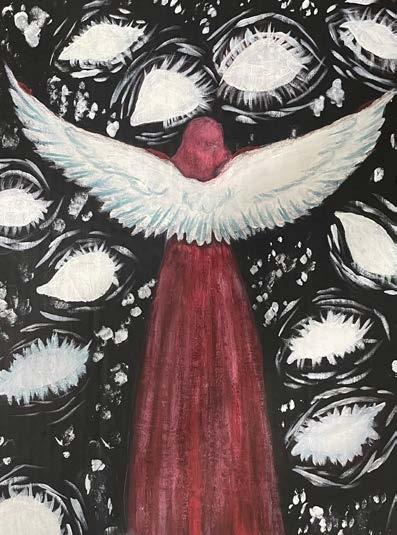
As of late, the literary term “dystopian” has been used to describe the way society is progressing and the dismal future that many prophesize. By the Merriam-Webster Dictionary defnition, a dystopia is “an imagined world or society in which people lead wretched, dehumanized, fearful lives.” In essence, the term describes an imaginary reality and characterizes a genre of literature and media that encompasses everything from 1984 to The Hunger Games. However, the word dystopia was frst used by English philosopher John Stuart Mill to denounce late 19th-century Irish land policy, a very real issue based in reality, not fction. This begs the question: can the word be used once again to describe the state of the modern world?
It is possible that “dystopian” is too strong a word to characterize the issues humanity faces. Civilians are not fghting to the death in the streets, and the world does not appear to be on the brink of collapse, as one would imagine in a dystopian society. However, one can easily draw parallels between the overindulgent nature of mankind in Brave New World to the consumerist culture of the United States. Some may even argue that the overturning of Roe v. Wade teeters very close to the subjugation of women in The Handmaid’s Tale. While it is important to draw a line between exaggeration and reality, these comparisons may evoke the feeling that dystopian literature is not entirely fctitious but is becoming the modern way of life.
One of the defning characteristics of a dystopian society is a populace that is desensitized to the warped, inhuman version of the world around them. Civilians live their lives complacent with the daily abuses, indulgences, and other issues present in their society without ever realizing that something is wrong. In the present day, one could argue that the strong presence of social media in today’s youth, as well as the incessant bombardment of pessimistic news is creating a generation that will not even bat an eye at injustice or a loss of privacy. They are in a sense “desensitized” to war and death, and could be seen as unconcerned with the oppression of their reality, similar to the characters in Fahrenheit 451 that do care that their books are banned or that they have no sense of free thought.
Some may even say that, though today’s society is not dystopian, future generations may reach that dismal reality as the world progresses. With the advent of ChatGPT, there comes the fear that the youth will never learn to write properly and will not value originality because a machine could write their essays in thirty seconds, instead of the hours it may take by hand. However, these notions are all incredibly speculative, and one must remember that the way society’s progression is viewed depends on perspective. The older one gets, the easier it is to claim that the world was better when they were younger when in reality, the technology they grow up with is the only thing today’s generation will ever know. One cannot pretend to love a time when there was no television, when computers were but a distant dream, when they were never there to experience it.
Powerful despots, such as President Snow of The Hunger Games or the Chief Elder of The Giver, are instrumental to the construction of certain dystopian societies. Comparisons can be drawn between these fctitious individuals and the dictators of history who incited wars, inficted genocides, and committed other unspeakable horrors all

 BY SKYLER BENNETT
through their corrupted rhetoric and immoral actions. While these fgures of oppression are not at the moment a cause for concern in today’s age, it is necessary to recognize the characteristics of a villain and to remember how easily dystopian politics can be compared to the main actors in the darkest corners of history.
With the plethora of dialogue around whether or not today’s society is dystopian–or if it will become so in the future–one may see little hope on the horizon to change the trajectory of the world. Yet, there are ways that one can combat this feeling of inaction and isolation. Voting is one of the most direct ways to create a voice in local, state, and national politics that sets the stage for future actions that could better the country, and the world. Moreover, being able to recognize what makes a dystopian society could help one realize the faults in their life and distance themselves from whatever those may be.
In the end, with the correct mix of awareness and action, the world is unlikely to collapse into a dystopian world, despite what popular rhetoric may invoke. A dystopian society is an avoidable reality, and each new generation brings a new desire to fx the past, to bring hope to the future, and to prevent this earth from falling into ruin.
Continue reading at thetalonohs.com

 Sandra
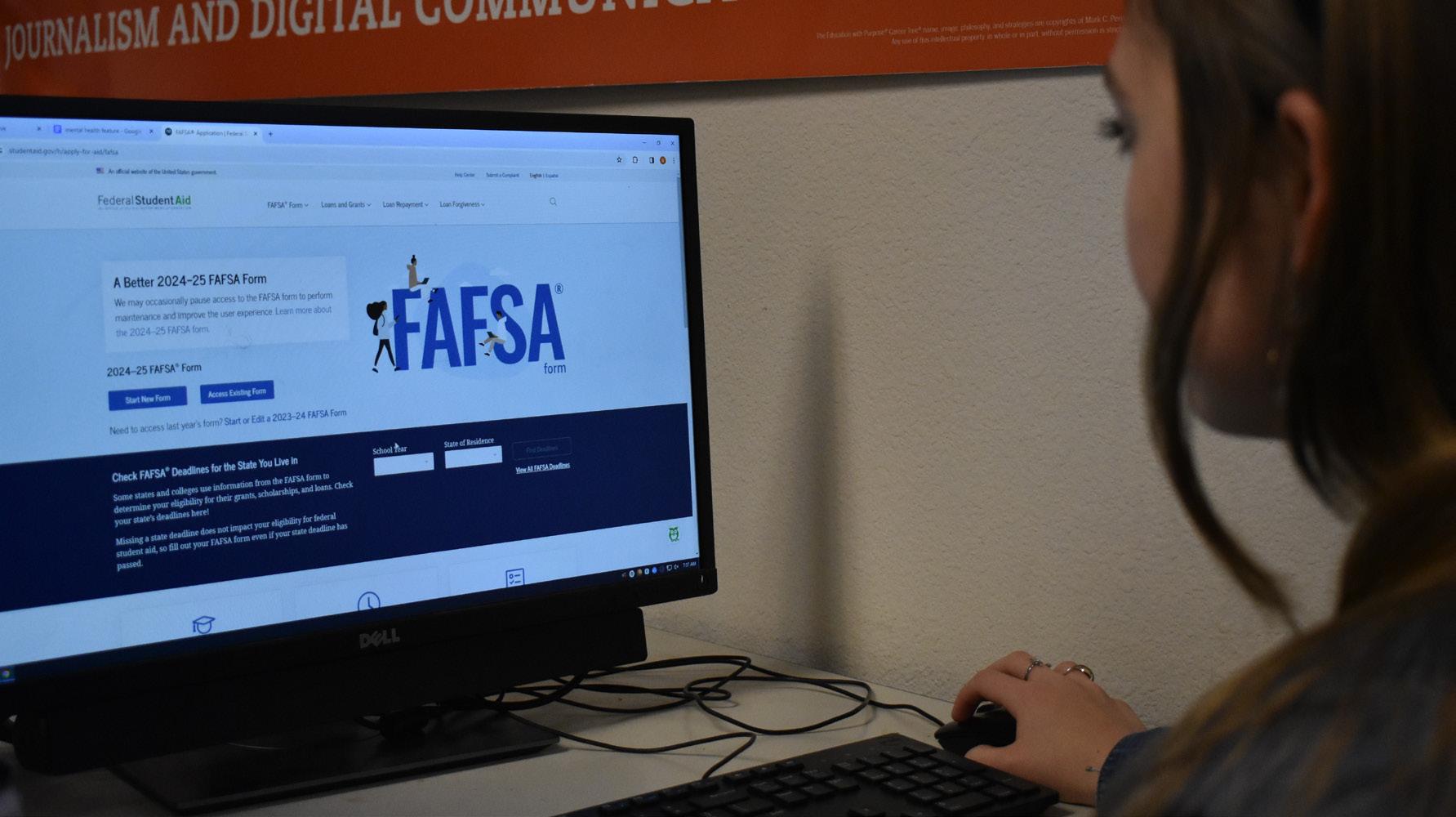
With the season of college admissions creeping upon the new year, fnancial aid often becomes the shortfall that prevents many students from pursuing higher education. With the average annual cost of a United States education being around $40,000, the evolving dynamics of fnancial accessibility poses a concern for those with soaring academic ambitions.
Though afordability is a problem, opportunities are presented in various scholarships that institutions strive to provide, with the most substantial amounts being ofered due to exemplary academic performance.
“The biggest type of scholarship that most students will get are ones where they apply to a school and then their application is automatically screened for academic scholarships…they tend to be fairly large amounts and they’re renewable every year,” said Kathleen Giacini, counselor.
This aid is awarded based on the student’s ability to manage
their school work throughout high school. Universities, including local ones in Arizona, value students who take advantage of enhanced educational opportunities.
“With all my grades and taking dual classes that are available here, that has helped because I don’t have to take them in college now. I’ve submitted all my grades and transcripts and they are able to give me more money based on that,” said Raegan Holtorf, junior.
Aside from purely the oferings at the college of one’s choice, many businesses provide scholarship opportunities. Eligibility depends on a variety of factors, and these applications often require items such as essays and transcripts.
“There’s going to be a whole lot of private scholarships which are ofered by an organization, company, or something to that efect that you really have to start doing some research about,” Giacini said.
There are also outside resources that have proven to be very reliable for students. Especially for individuals looking for one-to-one attention, these free sources
of guidance are efective in reducing the stress of searching for scholarships alone.
“College Depot is a great one. It’s done by the Phoenix library…not only does it have a database of scholarships, it also is an organization that is stafed where you can make an appointment with them and sit down and they will actually go through scholarships with you,” Giacini said.
Another experience students undergo is QuestBridge; a program that helps match learners with the college of their dreams.
“It’s more focused on those
whose parents make less than $65,000 a year and they give a full ride to basically these top Ivy League colleges or top tier universities that would otherwise be too expensive,” said Hailee Wing, senior.
Though this process is lengthy and requires a head start of almost a year, the end result is helping thousands of students. QuestBridge even has personalized assistance to mentor students on the college admissions process and requirements.
“They help you so much and then they have actual admission people on their
QuestBridge team that you can talk to at any point about college in general,” Wing said.
Though even small sums can be signifcant when added together, the process of fnding scholarships is a time consuming one. Thankfully, some have already been found for student’s convenience and are located on the district website.
“On our main district page, dvusd.org, you can actually look at fltering scholarships down by month…all these are ones that have contacted us or we know about, there’s a lot,” Giacini said.
In the past couple of years, infation has been through the roof. Gas prices have gone from $2.17 per gallon on average in 2020, to almost $3.50 per gallon on average in 2024. High school students that are often reliant on part-time jobs are fnding it difcult to cope with the high prices.
More and more of student’s wages are going towards basic necessities like gas or insurance, leaving little for college savings or navigating daily routines. The higher prices are compelling students to adapt to a new economic reality that many are unable to get by with.
“I noticed a lot of my coworkers have issues with making their paychecks last,” said Sarah Vaughn, junior.
Students highlight the widespread impact of rising prices on young workers, displaying the challenges they face in managing their earnings amid mounting expenses.
“I’m currently trying to save, but I would say my current paycheck is making that a little difcult - it’s
not as high as I would like it to be,” Vaughn said. “Prices continue to rise, but paychecks have not until [recently]… you’re not able to keep up with it.”
High school students fnd themselves navigating how to make their dollar stretch further, causing them to adopt more cautious budgeting practices and rethink their approach to personal fnance. A strain is certainly placed on the shoulders of working students. There is a growing urgency for measures to
help lessen the impact of infation on the fnancial well-being of the younger generation. However, it’s not as simple of a solution as it may seem.
“I feel like infation is caused by a lot of diferent conditions tied together,” Vaughn said. “There’s less people joining the workforce.”
There is a noticeable trend in infation and how the world around impacts its outcomes.
“Thievery plays a role in infation,” said Joshua. Cole, geometry teacher. “People steal…
and businesses have to account for that which therefore raises the prices for everyone.”
There’s also other aspects of how infation increases. The reality of infation is that it causes changes that can heavily impact both companies and their workers.
“Companies raise prices to balance out the new minimum wage,” Vaughn said. “Like, because the minimum wage was raised in California, they had to lay people of and raise their prices… [Minimum wage rising] is better

for some people, but worse for others.”
There are contrasting perspectives that emphasize the complexity of minimum wage adjustments, infation, and consumer behavior in shaping the economic environment for both businesses and consumers.
“Is it about infation or is it about how we’re in a society where everyone wants things to be convenient?” said Denise. Hsu, assistant teacher at OHS. “There is infation, yes, but the thing is people are still going to pay it…Prices are based of of how convenient people want it to be.”
Overall, the impact of infation on high school students and young workers is undeniably profound, with rising prices reshaping fnancial realities and causing a shift in their approach to personal fnances. As the cost of essentials continue to rise, students are confronted with the daunting task of stretching their earnings further to meet their basic needs, leaving little room for saving or personal spendings. The evolving economic realities are slowly but surely beginning to shape fnancial futures.
“You can only keep up with it for so long,” said Vaughn.
Volunteering is a vital aspect of community. Donating one’s time and labor fosters tangible and efective change; however, it is experiencing a shift in culture, particularly in schools.
The issue arises when teenagers treat volunteer hours as a checklist, and do not acknowledge the groups that they afect. There are people with their own complex lives behind these numbers. Students may begin to volunteer with the mindset of boosting an application, but one’s outlook can evolve.
“I feel like in this age, there’s still a lot of the mindset that we need this for college, but once you really start to get out into your community and you start to meet those people, that’s when you kind of realize the impacts,” said Elena Murrietta, junior.
The moral question that emerges is the balance between intention and impact.
“In the end they’re still putting in work and volunteering. So hopefully, there are still people that are getting the benefts of that, even if they have alternative
motives they’re still helping someone by just doing the work,” said Carrie Anderson, math teacher and NHS sponsor.
Nevertheless, there are certain situations where sensitivity to others and being cognizant of reasons why causes or organizations require assistance matters.
“If you’re volunteering extremely hands on with children, volunteers, single mothers, groups like that, I think your intention is extremely important to make sure that you’re passionate about what you’re working for, that you understand them, that you’re in the right mindset to be working with those groups,” Murrietta said.
The solution is researching opportunities that align with one’s values and interests.
“Finding something that you identify with and that you really love doing, I think encourages them to continue doing it once they get to college and after college,” Anderson said.
Through networking, people are able to see the various facets of volunteer work and service opportunities.
“We all have diferent things that we care more specifcally about. Through talking to


The Talon is published as a forum for student opinion at Sandra Day O’Connor High School: part of the Deer Valley Unifed School District. The Talon is an award winning publication with dozens of awards for it’s staf members as well as ranked the

others and discussing with people that you meet, often they’ll tell you about other things happening or that they’re also involved in,” said Maehur Aulakh, senior.
Volunteering does not just aid communities, but rather results in creating them.
“I met people who have the same interests. You realize that you share the same values... It allows us to build a tighter community, and allows groups to become closer when they’re able to make volunteering memories together and able to share those experiences and opportunities,” Murrietta said.
At OHS alone, entire clubs have formed around volunteering. To them, positive engagement is a priority.
“We don’t want our club culture to be something that we’re pushing onto people because at the end of the day why are you doing it if it’s just a chore for you or something that you’re not wanting to
do. By doing that we actively engage our members,” Aulakh said.
Though numerous teens also work jobs and may struggle to consistently volunteer, many places are fexible. A simple hour of help can still be benefcial.
“It’s just fnding supervisors that can kind of pair you with your needs, if you’re interested in joining with a volunteer community. If you don’t want to work regular volunteer hours then there’s always one stop volunteering like at the food banks or some farmers markets,” Murrietta said.
Even if college is not an avenue one is interested in pursuing, volunteering still allows people to experience new things and discover what they are passionate about.
“I think a lot of students do understand the beneft of diversifying their experiences while they’re in high school because I think in the long

top online publication and one of the top print publications in the state. Letters to the editor must be signed and dropped of in Room 508, e-mailed to thetalonohs@gmail. com or mailed. Letters may be edited for content and/or
space consideration. Obscene or libelous statements will not be printed. Opinions refected here are of those of The Talon staf and do not refect the Deer Valley Unifed School District. Visit The Talon online at thetalonohs.com
Adviser: Cindy Garraway
Editor-in-Chief: True Van Dyke*
Copy Chief: Victoria Kirova*
run it will help them kind of decide what they want to do in their life path,” Anderson said.
Seniors are in a unique position and prove that once one starts volunteering, they tend to stay motivated because they are integrated into a community.
“When you’re with a group, you have to think about the group. For me to be done with college applications, I’m still a part of these groups,” Aulakh said.
There is no denying that volunteering is a factor colleges consider, however it may not be for the reason students believe.
“Colleges are not just looking for someone who can get straight A’s and good test scores. They’re looking for someone who has life experiences that they can take with them to college and continue to contribute to the college community as well,” Anderson said.
News Editor: Kendall Walker*
Features Editor: Ruth Mioc*
Staf Writer: Matthew Hood-Hunt
Staf Writer: Aakarsh Mahey
Arts & Entertainment Editor: Amber Hayden*
Design Chief: Ashley Pereria*
Editorial Chief: Brooklyn Smith*
Sports Editor: Amaya Kelly*
Staf Writer: Sedona Bellows
Staf Writer: Skyler Bennett
Staf Writer: Abigail Bryand
Staf Writer: Avery Massie
Staf Writer: Aiden Reed
Staf Writer: Colin Robison
*Denotes member of editorial board.
It is no surprise that many young adults struggle with mental health. Many students would agree with the claim that they fall into the “perfectionist” or “overachiever” categories, whether that be in school, sports, or other extracurriculars. It is difcult to fnd a balance between all of these pursuits on a daily basis.
In order to keep up with outside activities in addition to schoolwork, it is necessary to fnd the perfect symmetry between these two things. However, many students fnd this especially hard to do, leading them to spiral into previously stated perfectionist and overachiever mentalities.
“I think it’s defnitely harder being an athlete and being in hard classes, but I feel like being an athlete has taught me a lot of time management. I’m able to do sports and school because of this ability,” said Callie Garraway, junior.
Alongside extracurriculars that students partake in, many students are at constant war with the amount of work from certain grueling courses, such as AP, honors, and dual enrollment classes.
“AP classes are a lot harder than regular classes. [The amount of stress they have] depends on the person and how motivated they are to do
their schoolwork,” Garraway said.
Extracurriculars absorb a lot of energy and time from students, leaving them with unfnished school work and stress, leading to the struggle to balance everything out equally.
“Outside activities can defnitely divert your attention. A lot of outside activities can make it so that you have more to focus on at once and because of that it can be difcult to maintain both outside and inside school ones,” said Jackson Benjamin, freshman.
On the other side of this, some athletes may feel as if their outside activities do not afect their schoolwork, however, schoolwork has the potential to afect extracurricular activities.
“I don’t think sports afect my schoolwork because I’ve grown up doing them and I’ve always known it, so I’m used to balancing that alongside school,” said Sami Mondino, freshman.
The amount of stress a student struggles with really depends on the person, afecting everyone’s mentality in a diferent way. Some students are much more organized than others, which opens up the possibility of a less stressful daily routine, and even lifestyle in general.
“If you’re able to put the right amount of time in and do
assignments and practice and use time management, I think it’s doable,” Garraway said.
Another way that students power through their work is remembering the path that they want to take in their lives, what lies in front of them, and thinking ahead to their future.
“I care about my future and I know that education is an important part of that,” Benjamin said.
For many juniors and seniors, this thought process may be a little more predominant and at the forefront of their minds than those of underclassmen, due to college swiftly approaching.
“I strive to get good grades because I want to set myself up for the future and also just graduate with good grades going into college and taking those AP classes to prepare me for college,” Garraway said.
However, for younger students like freshmen who are relatively new to high school, schoolwork can be wearing for them in a whole new way.
“[What makes high school hard compared to middle school is] the longer hours, the stricter grading system, the stricter teachers. More classes, harder classes, longer classes,” Mondino said.
There are also many students on campus who take upper level classes, especially in math. Students step up one grade, and even two, learning at the same pace and level as

students in the grades above them. This, too, can just be another burden added on top of a student’s already stressful workload.
“I take Algebra 3-4 because I skipped back in second grade, and then I skipped again in seventh grade. Mostly it was because I’m a relatively fast learner,” Benjamin said.
Students also have lives outside of school and extracurriculars - family, friends, things they like to do for fun - and those can translate into their schoolwork and performance in extracurriculars, as well as vice versa.
“If I’m behind in school, I let it take over and overpower my mind, especially if I’m not having a good day,” Mondino said.
PHOTO BY ABBY BRYANDHowever, while school does afect life outside of it, there are ways to minimize that stress. Solutions may vary for each student.
“A lot of the time it’s trying not to overstress myself because a lot of the time I fnd myself being stressed about school, and also stressed about soccer, and both at the same time,” Garraway said.
Ultimately, at the end of the day, the only thing a student can do is to put their best work forward and set their priorities straight. This can be hard to do but extremely rewarding in the long run.
“The way I view it is I just want to try my best. I don’t expect to be the best; I just expect to at least try. If I fail, that’s fne, I just want to do the best I can,” Benjamin said.
Every teacher, from kindergarten to college, has a unique story to tell about how they found their calling as educators. In the nucleus of OHS’ algebra program is Phoenix native and seasoned math teacher, Kellen Chavez, who has also taken a unique path. While Chavez is known for teaching math and coaching cross country, he initially wanted to be a sports journalist, graduating from ASU with a journalism degree in 2007.
“The ultimate dream job for me in college, why I chose journalism, would’ve been to be a sports columnist,” Chavez said.
However, he never got to ‘give it a go’ as he was not a part of State Press, ASU’s student-led newspaper.
“I had a one-week position part-time there [at the State Press], [but by] the frst deadline I got an internship
“They [DPS] were in charge of security at the football stadium…that’s the closest I ever came to writing a sports
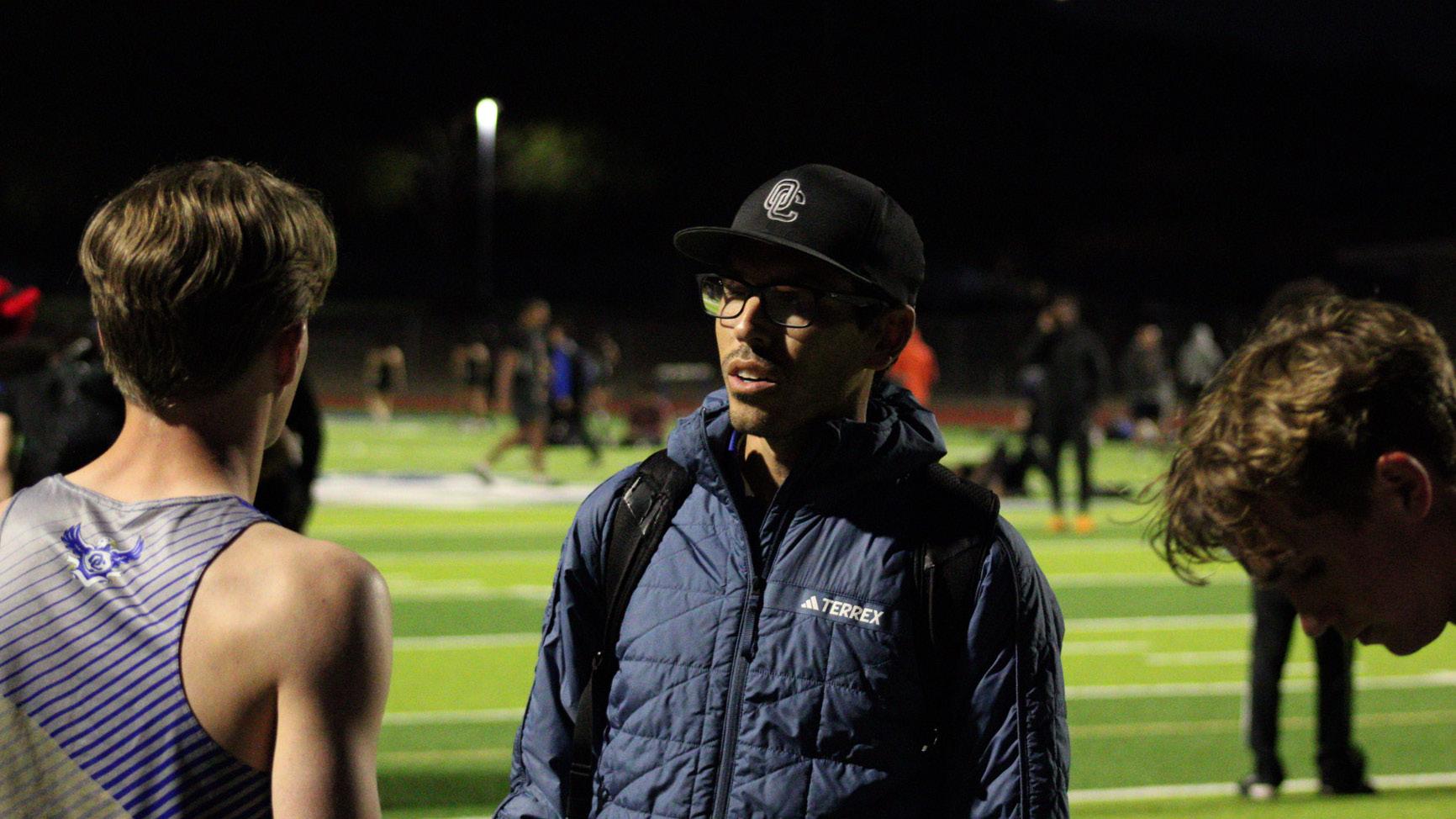
“I’d help them with press releases, planning press conferences; I’d write features for stuf within that police agency,” Chavez said.
story, was writing about the actual police security that DPS provides at Cardinals games,” Chavez said.
However, the ‘journalistic process’ ended up not being the right path for him, as the steps to writing an article can be quite strenuous.
“Chasing stories is a little stressful when you have to come up with ideas, and you have to go interview people and put everything together; that sort of chase,” Chavez said, “some people love it, that’s what they live for, but for me, that was a little much.”
While working as a PIO, Chavez was also employed part-time as a personal trainer after becoming heavily involved in ftness, and made connections that altered his career path. The decision to pursue a degree in education was infuenced by those connections.
OHS boasts a plethora of clubs and organizations within its walls. Many clubs are for hobbies or niche interests, and many more are for academics, but one that is commonly left out of that conversation is the Academy.
The Academy of Civic Engagement and Advanced Studies, or as most students and teachers call it, the Academy, is an organization that once used to lean more towards the history side of academics, as it was formerly named The Academy of American Studies. If the name change was not enough to suggest, the Academy now is quite diferent from what it was when it came to OHS in 2009.
“Originally, when it started out, [it] was geared towards history and civics education…over time, we found that we were getting students less interested in history and more interested in politics or were in gifted classes,” said Tifany Ellis, AP U.S. History and Human Geography teacher.
At the core of the program are several advanced classesAP Human Geography and Honors English and Biology for freshmen, Honors Chemistry, AP World History, and Honors English for sophomores, AP English Language and Composition and AP United States History for juniors, and AP Gov. and Econ. as well as AP Literature for seniors- and the history aspect of it virtually splits
the program into halves.
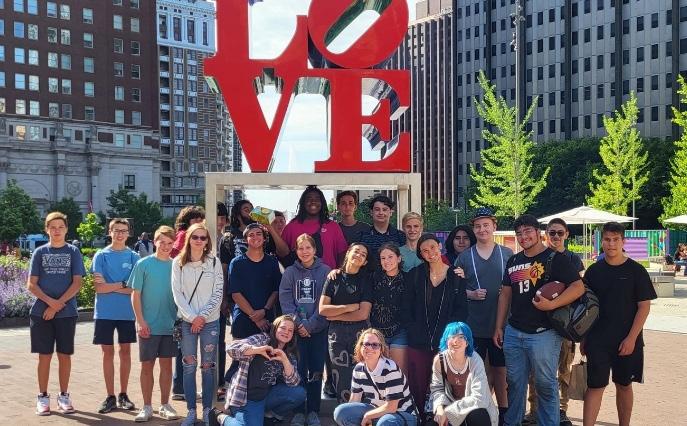
“There’s really two components to the program; students have to take a series of honors and AP classes that cross over a whole bunch of diferent subjects, so they get a wellrounded education, but there’s a civic engagement component to it as well,” said Amanda Schlueter, Academy co-director. That civic engagement component can take several forms, both inside the classroom and out.
“We have long-term projects on Canvas, the latest one in the fall/winter semester was an emphasis on the local, state, national, and worldwide level, and we had to pinpoint issues [based] on those four criteria, and we had to fnd solutions to those problems… the other part of it is obviously the experiential
learning, the feld-work aspect… we go to Crow Canyon, we take mini feld trips…” said John Zeng, Senior and Academy President.
The Academy is currently in a sort of transitional period, blurring the lines between a club and organization. On one hand, it promotes the elaboration of topics learned in American history, which would be a more club-like attribute, but it also incorporates non-history classes into the program, something more like what an academic organization, not a history club, would do.
“We do more things that are a little bit more formal than a club, which makes us more of an organization, but recently, because we’ve had new directors, this year we’re more like a club,” Ellis said.
The new directors, Schlueter and Cross split their duties as co-directors, with Schlueter planning a sure-to-be incredible trip to Crow Canyon, Colorado, and Cross running the US2 and US4 Canvas courses.
“This summer we’re going to Crow Canyon, it’s an archeological site in Colorado and we’ll get to learn about how archeology is done; we’ll get to learn about the Pueblo peoples of the southwest from actual descendants of the Pueblo peoples of the southwest, and we’ll get to incorporate things like physics, museum studies, museum ethics… it all works together in the real world,” Schlueter said.
The US2 and US4 canvas courses are project-based online classes that Academy students take during their sophomore and
senior years, where students get to choose a certain topic from American history to write about or make a presentation for.
“You had to write an essay about the Panic of 1819, or the Women’s Rights movement during the 1800’s… it forces you to actually research the stuf… [one of] mine was about Lewis and Clark’s expedition across the Great Divide, which was pretty interesting,” said Spencer Thompson, junior.
The Academy, aside from US2, US4, and their trips across the nation, also has several meetings for planning future trips and other activities.
“In the past [meetings] were about once or twice a month… we have breakfasts; they’ve had one this year; and we sometimes would do guest speakers in the past… we’ve done day-trips… we have an Academy banquet at the very end where parents and students put on dinner…” Ellis said.
The Academy promotes advanced education in all felds; the four year program requires students to take certain AP and Honors courses throughout their high school career, and many of the students stay grouped together in these classes over the years.
“Especially freshman year, it was really nice to be in a class where you could see the same people over-and-over again, and you could really get to know them…with the Academy, where we all have similar goals and similar interests, it was really easy to connect.” Zeng said.
From confusing trailers to unsystematic marketing teams, a new theme is becoming prominent in the flm advertising industry: not promoting movie musicals as musicals.
Multiple movies this year have been receiving backlash from the media due to a lack of honesty throughout press tours, trailers, and promotions for the flms. The media have been disappointed by the movies as they have not lived up to their promotional hype. As a result, people are becoming more cautious in their movie choices and are demanding a higher level of transparency and honesty from the movie industry.
Many believe this uprising trend is a tactic to raise box ofce sales. A vast majority of movie-goers tend to avoid musicals, as the nonstop breaking into song is not appealing to the general audience.
Director Paul King’s new flm, Wonka, faced a lot of controversy in the media due to the lack of advertisements stating that it was a musical adaptation of Willy Wonka and the Chocolate Factory and not just a remake. With Wonka topping the box ofce charts and generating fve hundred million dollars within the frst few weeks in theaters, it is
safe to say that this strategy is working.
Across social media, many viewers have made it apparent that they would not have seen Wonka if it had been advertised as a musical. However, in this case, many viewers were pleased with the soundtrack and pleasantly surprised with Timothée Chalamet’s harmonious musical debut; although, this was not the case for other musical adaptations such as Mean Girls.
With a strong cast of talented actors, this movie was set up for success. With a rotten tomato score of 70%, it is clear this was not the commercial triumph that Paramount Studios hoped for. Musicians such as Reneé Rapp were showcased brilliantly throughout the musical but not one trailer showed the exBroadway star singing or the impressive talent she brought to production.
Musicals in the past, such as La La Land and West Side Story were extremely successful even though they were not disguised as nonmusical movies. So what has shifted to make such a phenomenon necessary?
Some contend that the appreciation for musicals is dimming, as more extravagant flms are being made with visual efects and CGI, instead of purely songs and dance numbers. The target audience for musicals is much slimmer than the broad audience for

action or romance movies. To play it safe, many studios stay far from producing a musical, let alone proudly advertise it, due to the lack of devotees and fans.
With upcoming Broadway
adaptations releasing later this year such as Wicked, it will be interesting to see which way flmmakers choose to advertise their movie musicals. Will audiences continue to be pleasantly surprised or led into
deception once again? Only time will tell whether this strategy will continue to be efective or whether studios will return to promoting musicals for what they truly are.
When the casting is announced for a movie, many people are both excited and scared to see who will be in the flm. Though people often like the actors in any particular cast, others may not favor the actors who have been chosen. Fans must be
open-minded when casting movies as many can surprise you with how good they can be despite the initial choice of actor or actress.
In 2019, it was announced that Robert Pattinson, famous for his role in the movie saga Twilight, would be playing Batman in the 2022 movie of the same name. Considering his roles in other media, there was widespread doubt about
how well he could portray such a dark character. However, the movie’s release silenced all doubt, as Pattinson lived up to the name and legacy of Batman set by other actors such as Christian Bale and Michael Keaton. This movie is one of many that proves that the public should hold back their judgment before actually seeing an actor in their role.
People should keep an open

mind about the casting options since, most of the time, even if the actor does not seem ft for the role, they could still act exceptionally well in the movie. In 2025, there will be a movie called Fantastic Four, which will be released on May 2nd. Joseph Quinn, who is in Stranger Things, is heavily rumored to play human torch. Many people think that Stranger Things is a kid’s show, so they do not take it seriously. Since many people do not like the show, they might not like the movie as Joseph Quinn could possibly be playing Johnny Storm, and they will let this casting choice afect their view of the flm as a whole. When people tend to not like the actor or the choice of the cast, a majority of the time, they exceed people’s expectations despite that. The audience should only judge the person or the acting member after purely their
acting performance ,for most of the time, people would be astonished despite their hesitations. Pedro Pascal will be playing Mr. Fantastic in the movie Fantastic Four. Pedro Pascal is known for The Last of Us, The Mandalorian, and Game of Thrones. Many fans think that Pedro Pascal will act fairly well in the movie, as a result of what he has accomplished in the past. Still, since the character is white,and Pedro Pascal is a Chilean-American actor, some people think it is an unexpected choice to cast him as a notorious white character. An actor can always bring something special to a movie, no matter how many viewers might doubt them beforehand. Actors work exceptionally hard to make a movie worth watching, and for fans to criticize them before they have even acted in the movie is ridiculous.
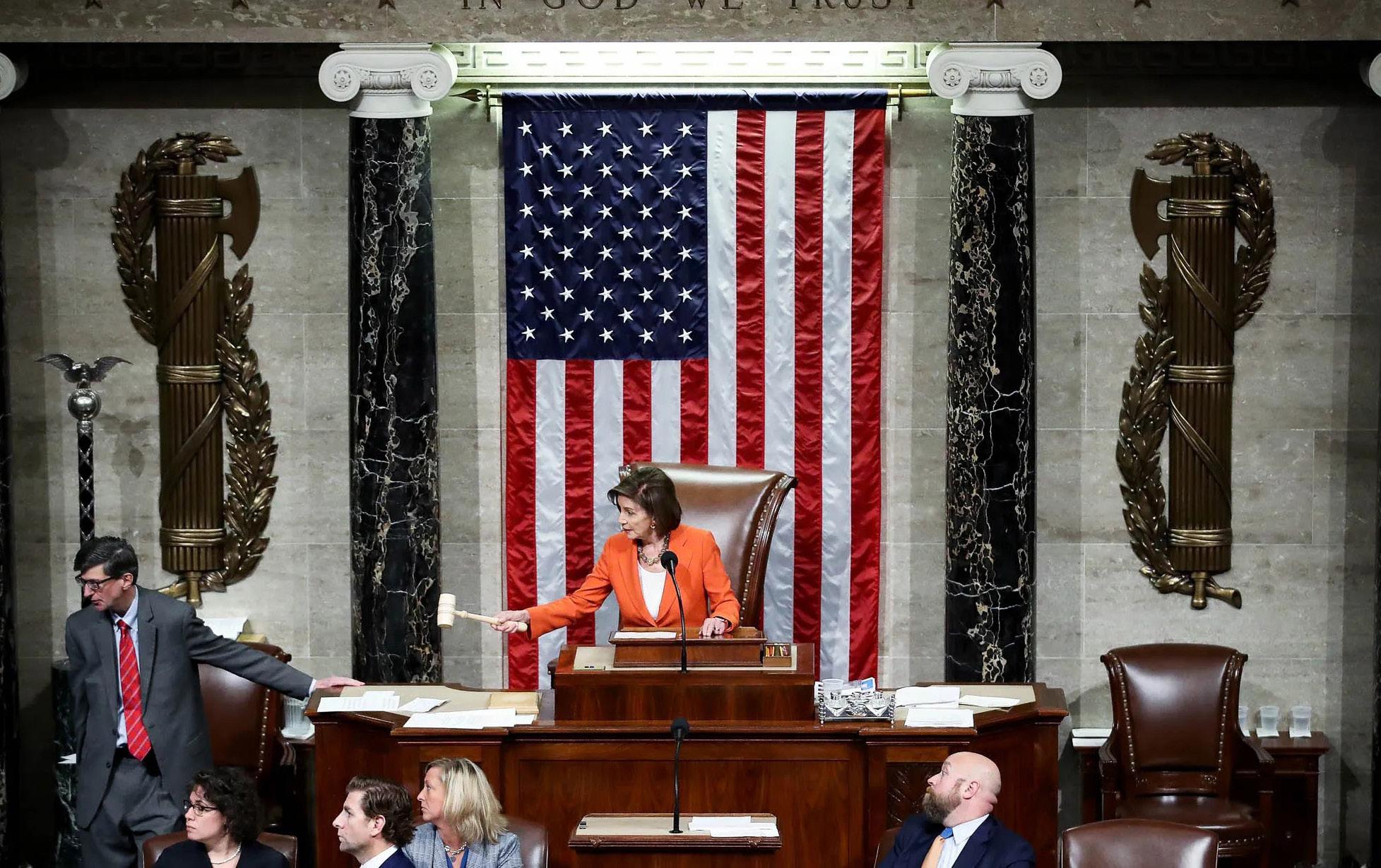
The clashing of reality TV and U.S. politics has continued to get worse and worse in recent years. A person can barely tell the diference between the two, and this sensation just continues to prove to American citizens that the emphasis on “sensationalism” and “scandals” in political discourse transforms their media presence into a mirror of what reality TV has become.
This phenomenon has only continued to worsen through the years and is a rising problem in the United States of America. How or when this common occurrence started is a complete mystery, but perhaps it was when a reality star was elected as president. When you mix these two worlds, the line between reality and politics blurs, creating a drama this country does not need.
Political leaders are not supposed to be celebrities; they are meant to help the people of this country, and politicians are not doing that. In this day and age, we have political leaders using money to beneft themselves, corrupting the government, and doing anything and everything to beneft themselves rather than doing the job they were assigned to do and working for this Nation.
The problem only
continues to grow as more and more governmental and public leaders resemble the same drama such as in Keeping Up with the Kardashians. Where people with too much money create drama and problems to get people talking. The increasing fact that celebrities and political leaders are becoming the same continues to push its way through the modern media and take precedence over any other meaningful topics that should be spoken about. The drama surrounding political discourse seems more valued than the actual people at their expense. Political leaders creating docu-reality-like or even South Park-comedy style plots
at the cost of the U.S. populace will only bring the country down, rather than building and fxing it like so many public fgures promise. There needs to be an understanding of the diferences, or incidents such as the political leader involved in being inappropriate with her partner at a family-friendly showing of Beetlejuice, which will only continue to get worse and even more unnecessary in the future.
The two vastly diferent forms of public presentation have continued to mix in a dangerous recipe for disaster. This has changed the very nature of what political discourse should look like and the perspective and expectations of what the
government and politics should be. The people are more drawn to those who show charisma and a slight charm. However, reality TV is just that. It is TV for the entertainment of the people, and those reality TV show stars are acting to draw in audiences into their dramatics. That is the same for political leaders in this day and age. People are more drawn to the dramatization, rather than the importance of government. The biggest thing to realize with the insanity that is becoming this phenomenon is the distrust many will start to grow with the government and politics, as many people have a distinct understanding that reality TV is just as fake
as any other TV show. When the lines cross, people’s opinions of the falsities that are blatantly in front of them will only continue to grow more negative.
Many people could see this as an opportunity to have a much more involved and informed electorate. Citizens may feel more passionate about politics if there is an entertainment aspect involved with the job; it could help someone want to play more of a part and care about politics. However, this does not account for the majority of the problems involving this subject. And one of the biggest problems is the greed that runs deep in our society.
The root of this wilting line between politics and reality TV is money bargaining. Money drives greed and power. When someone in government has power already, they have that platform to grasp onto the money that they want. The shady things that people do behind the scenes get leaked, and then it creates drama and problems that are completely unnecessary.
Politics and TV shows should never collide as one can be charismatic to gain a political following without being problematic or forgetting what their job is, what they do, and how they should be acting. This is a job, it is not a game and these people afect the image of the U.S. signifcantly.
It has become glaringly apparent in the past months that kids in today’s world are growing up faster and faster than they ever have in past generations. As the world changes and trends begin to shift, people are naturally inclined to adapt along with them: this especially pertains to preteen girls, who are at a very impressionable age.They are beginning to dive into the beauty industry earlier and earlier in their lives, signifying a trend of kids leaving childhood behind in the pursuit of acting much older than they really are.
This topic has sparked many debates on whether or not this is a healthy habit for girls at this young of an age. While it is still essential to expose children to taking care of themselves and teaching them the importance of establishing routines, it is getting unarguably out of hand, leaving girls as young as the third grade running rampant in beauty stores like Sephora and Ulta. At these stores, they have full access to so many mature products, ranging from anti-aging skin
creams to high-end makeup.
This is extremely harmful for several reasons, one of the most prominent ones being that it exposes them way too early to a world full of unrealistic beauty standards and ridiculous expectations.
Letting these little girls grow up in a society where they feel like they have to conform to said beauty standards could potentially fracture their self-worth. It can teach them to pick themselves apart from a young age when it is completely unnecessary, and also when it could be prevented so easily.
Social media also plays a critical role in this phenomenon and is creating an immense problem. Companies both online and in store heavily market their products in such a way that influences little girls to believe that they need beauty products that are alleged to be “antiaging”, “skin brightening”, etc. These things should not even cross the mind of a 10, 11, 12-year-old girl. There is still a wide variety of products that children of that age have to choose from that are much better suited for their still-developing and sensitive skin. Children
should be prioritizing skin health over a whole beauty routine, yet these stores continue to market to them in search of a greater profit.
If young girls are going to be using expensive, highend brands on their skin, their guardians should consider the risks of what the potential effects could be in both the present and future.
Another contributor to this issue is peer pressure, which is no surprise for pre-teen girls. At such an impressionable age, they possess a very strong urge to do what those around them are doing. This causes these
types of unhealthy trends to spread like wildfire, with constant pressure from friends to have the right product, no matter the price or consequences.
It has also been noted that among these young girls, there has been a consistent tendency for rudeness and entitlement in public places. If children get used to being excessively pampered and spoiled when they are young, this will be an expectation for them as they grow older. This also leads to the issue of the poor store etiquette that many “Sephora” girls have and think is normal and acceptable. Their poor
attitudes leave them with the impression that they are able to be rude to store employees, their peers, and even their parents, with no consequences.
With so many beauty products marketed to a more and more youthful audience, today’s young girls are being exposed to unnecessary cosmetic practices and a world of privilege that warps their entire perception of society. It is a rapidly expanding issue, and polluting the minds of young girls with unrealistic beauty standards is the last thing that society should be doing.

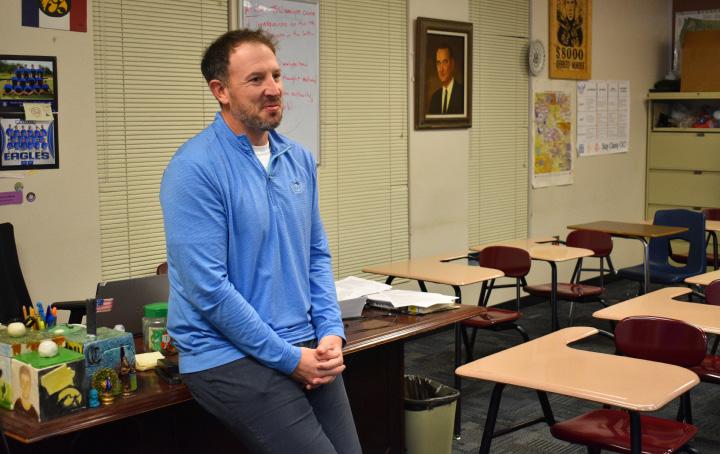
I think I get along with a wide variety of kids because innately I really do care for their wellbeing, not just in the class but post high school career as well.
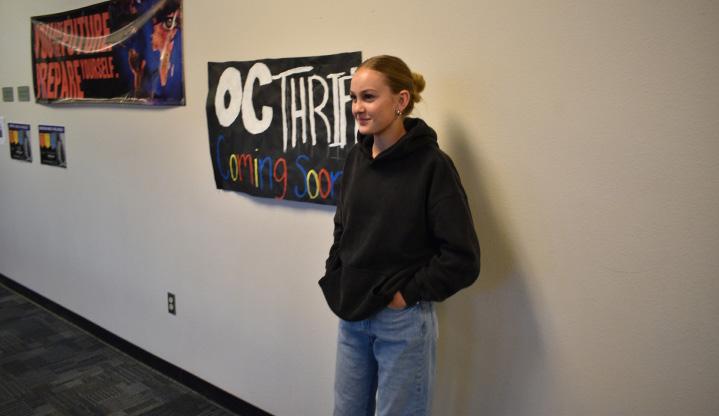
I just want to grow the school’s culture even more.





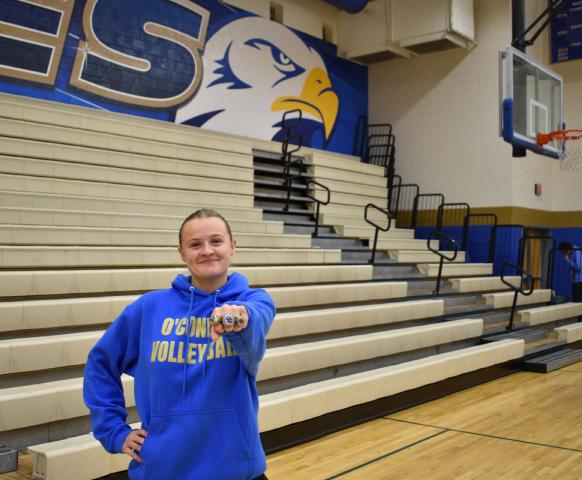
Make sure that your teammates are your best friends. And make sure the chemistry is always there because that is what’s going to make it fun and that’s what’s going to motivate you to play and work hard.

I think music is a really holy thing; it’s just super spiritual [in] a lot of old cultures, and it’s very healing. [Music] has always helped me through stress.
1930: Born in El Paso, Texas on March 26
1952: Received law degree from Stanford, married classmate John Jay O’Connor III
By TRUE VAN DYKE Editor-In-ChiefOHS’ legacy did not just begin in 2002 when the buildings were painted blue and yellow, or when the SDOHS letters were notoriously cemented at the front of the school, but ultimately started with the woman whose name our school bears proudly.
Sandra Day O’Connor lived an incredulous life working to display fair justice, compassionate patriotism, and equality for everyone under the label of innate freedom -- traits everyone should look up to.
“The fact that she contributed so much to the world, that she was one of the great leaders of this nation, and her dedication to lifelong learning, I think that is her life, and that is what we try to promote here at the school,” said Richard Weyker, government teacher.
Learn, Lead, and Contribute: the motto OHS students hear almost daily and see plastered to every classroom
wall. Through advocating for historical learning opportunities, being the frst woman on the Supreme Court, and contributing to America by giving back through her life of public service, Justice O’Connor is at the core of what it means to be a symbol of those attributes.
“She was a pioneer; she was a woman that was ahead of her time; she went out there and blazed a trail; I like to think that’s what we do,” said Dr. Lynn Miller, OHS principal. Justice O’Connor set aside social prejudices and career constructs in persistence of perseverance as a woman in government. From working without pay for years before gaining a leadership position, to having a voice of public servitude and equality, she set forth a motion of determination. OHS has lived up to the same mission of success through the integration of technology, test scores, and pushing students towards
1957-1962: Moved to Phoenix, AZ, three sons are born
their best futures.
“At the school, and even more than just this school, overall really taking seriously the need to educate oneself about their government and participate,” Weyker said. “That was what she wanted her lasting legacy to be, a society that did its best to understand issues from both sides,”
Following the loss of Sandra Day O’Connor, her legacy carries on through both the lives of those who pass through the school and the fght for social justice throughout the country. “That legacy continues to grow and get stronger; I think for me, and maybe all of us, hope that when we leave this earth, we can leave a legacy that continues to grow, and I think when we look back on all the accomplishments that she’s done, the things that she has stood for, I think that that gives us hope,” Dr. Miller said. As a light for women,
1969: Appointed to Arizona State Senate & became the 1st woman to hold majority leader
students, and society alike, the impact Sandra Day O’Connor has left is something of remembrance of her character and a public fgure worth modeling.
“I was required to read many of her decisions, and my impression of her was that she was an incredibly pragmatic and thoughtful person, she really took into consideration how her decisions would impact the lives of the people that she was ruling on, more so than many other justices,” Weyker said.
As an advocate for unity, Justice O’Connor’s career is an olive branch to every political party and the diferences currently segregating society. A voice for pushing what is right for the country, and not her personal beliefs on a panel of justice and life altering decisions, is a source of hope in a politically divided world.
“Another thing that Justice O’Connor brought, was that she was able to be a
stateswoman, but to be able to bring both sides together. We’ve lost that a little bit in our society where ‘I’m only on this side’, or ‘I’m on this side’, and I like to think Sandra Day O’Connor high school can be that blend, be that leader of saying ‘Hey, we’re going to be the best’, but we’re also going to do the best,” Dr. Miller said. Her actions in court were both notable and honorable as a person, but also as an infuential woman in government.
“Where she came from, and how she grew up was very important to frst, the American dream, but also the American dream associated with women, who at the time didn’t have the ability to do what she did,” said Amelia Thompson, junior.
Growing up in Arizona, a woman who pursued her dreams, and lived a life of learning and giving back is a proud symbol of our school and the ideologies we hold here. It is
1981: First woman to serve on the United States Supreme Court
something to never forget even as her presence sadly leaves us.
“We’re losing that example, we’re losing her wisdom, we’ve lost it ever since she left the court. Her way of really looking at the impact of the law, I think, is sometimes lost, and at a time more than ever when you need people to value learning about the government, we just lost one of the greatest advocates for that,” Weyker said.
A powerful representative of the free, inclusive, and successful parts of both the country, and our school, Sandra Day O’Connor will never be forgotten, as our school strives to honor everything she accomplished and so humbly handed down to us.
“My hope and prayer for all of Sandra Day O’Connor high school is to continue that legacy, not to forget the roots of where we came from, and what we’ve done,” Dr. Miller said.
2023: Died in Phoenix, Arizona on December 1
Fall of 2002: OHS opened and was named after her
2006: Retired from Supreme Court
Ofensive, over-the-top, and unnecessary jokes are what have built stand-up comedy into what it is today. However, many comedians struggle to grasp where the line should be drawn.
As society evolves decade by decade, the media has become much more in touch with social issues. Comedians must adapt their material accordingly if they want their careers to be safe. While some may argue that cancel culture has gone too far, it is important to remember that humor does not have to come at the expense of others.
Many comedians write problematic jokes in hopes of getting a reaction out of their audience, but when their jokes do not land with the crowd, their witty remarks are quickly regretted.
“joke” after “joke,” the
Golden Globes audiences winced at every word that came out of host Jo Koy’s mouth. After a long night of Koy sexualizing women and completely missing social cues, he was ridiculed on social media, leading to a large amount of criticism of his career.
“Oppenheimer is based on a 721-page Pulitzer Prizewinning book about the Manhattan Project, and Barbie is on a plastic doll with big boobies; the key moment in Barbie is when she goes from perfect beauty to bad breath, cellulite, and fat feet. Or what casting directors call character actor!” Koy stated at the 81st Annual Golden Globe Awards.
At the obvious signs that Koy’s jokes were not landing with the celebrity-flled audience, he quickly shifted the blame onto his writers. This was a clear indication that his inappropriate humor failed to resonate as intended. With the current climate of

the world, it is easy for a single joke to tarnish a comedian’s entire reputation. Many comedians fnd ways to walk the unspoken line that society has created.
The popular comedian, Matt Rife, who gained a large following through social media has recently faced criticism for his usage of taking serious issues and turning them into a
laughing matter.
“Just testing the waters, seeing if y’all are gonna be fun or not…I fgure if we start the show with domestic violence, the rest of the show should be smooth sailing” were Rife’s opening words for his Netfix special Natural Selection.
After dropping jokes that range from domestic violence to racism, it seems unlikely
that his career will be able to recover from this backlash. While the point of stand-up comedy is to push boundaries, it is key that comedians recognize the impact of their words. Since it is a competitive industry, comedians must uphold a healthy balance between being entertaining and still remaining respectful toward their audience.
We see celebrities everywhere, whether that be on social media, TV, in magazines, or in the news with various “candid” paparazzi pictures. The public is always being reminded of the most current updates on the latest stars.
It gets to a point where the media can glamorize and idolize celebrities so much that the public grows tired of hearing about them constantly.
Many people can relate to growing tired of a song because it gets replayed too much. Can one also feel that way about a person?
Taylor Swift, for example, is one of the most well-known and successful music artists of all time. Her chart-topping albums, recent Eras Tour, and high-profle relationship with football star, Travis Kelce, have put her in the spotlight even more so than usual.
The persistent advertising and oversaturation of Swift has caused a number of fans to grow tired of her and her music being shoved into their face every time they open their phone or turn on their radio.
Glamour magazine describes the public’s reaction to Swift’s oversaturation in the media as “Taylor Swift Fatigue.” She has grown so popular that the public has grown wearisome of seeing her being panned to between every play at the Chiefs NFL games, or hearing a track from Midnights over every store speaker, or of seeing endless posts about her every time they open social media.
This is entirely the media’s fault, as they try to force the infuence of celebrities onto the public as a way to market them and further their
careers. Unfortunately, these techniques tend to push people away after initially drawing them in and cause annoyance. Another group of widely known public fgures is the Kardashians. It could be argued that they are one of the most well-known and infuential families in the modern day.
The 5 Kardashian-Jenner sisters are constantly in the spotlight and have complicated dating histories that have been used for publicity and kept them center stage in the world of pop culture. Most recently, the unlikely pair, Kylie Jenner
and Timothée Chalamet have made their relationship ofcial with their appearance together at the Golden Globes Awards.
Throughout the show, the flm crew was persistently showing clips of the new couple. Footage of them talking, kissing, and exchanging wistful glances at one another was shared online, and the public quickly became enamored with their love story. The publicity of their relationship has drawn in many new fans and catapulted the success of Chalamet’s new movie, Wonka.
The media has sunk their
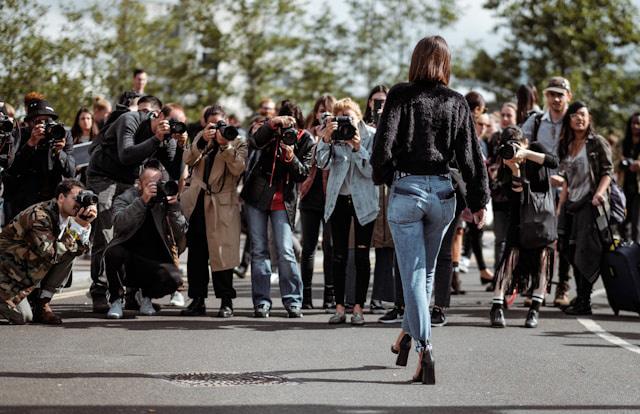
claws into what started out as a low-key, unconfrmed relationship that has now spiraled into ridiculous TikToks, conspiracy theories, and debates the public is forced to see whenever they open their phones.
Additionally, Kendall Jenner and Devin Booker were engaged in a two-year relationship. This pair was well-known, and Kendall was always spotted courtside at Booker’s games.
Similar to how Kelce and Swift’s relationship infuenced football fans and brought in new exposure to the NFL, Jenner and Booker’s relationship drew more public attention to the NBA.
When all is said and done, today’s society idolizes celebrities. The public enjoys the drama of fame and the look into the lives of people who seemingly have it all.
Big celebrities almost inevitably become oversaturated in the media and consequently drive fans away when the incessant content gets to be too much.
A fanbase as a whole can like a celebrity and respect their work, but eventually it gets to a point where the fans may grow tired of seeing them absolutely everywhere!
After another year of hard work from theater students, and following the success of other school musicals earlier in the year, like Mamma Mia, OHS theater is set to debut its Seussical performance.
Students put in work through both December and January, driven by their determination to put on a good show for OHS students at the start of February.
“It’s based of Dr. Seuss and all of his diferent books so it’s a conglomeration of ‘Horton the Elephant’ and there’s the ‘Cat in the Hat.’ There’s a lot of the classic childhood books and so they fuse it with a story about having a bright imagination,” said Benjamin Hsu, senior.
Seussical explores several messages that align with the source material of classic children’s books, but though they may not often be considered, they are important lessons for people of any age.
“There’s a whole confict between being able to think what you want, and being conformed into what other people want you to think, so it goes both ways for a character named JoJo and Horton himself. It’s a great play to learn about how you’re able to have your own opinions,” Hsu said.
Alongside characters like JoJo and Horton, Seussical is flled with other distinctly animal characters, coming from a variety of diferent
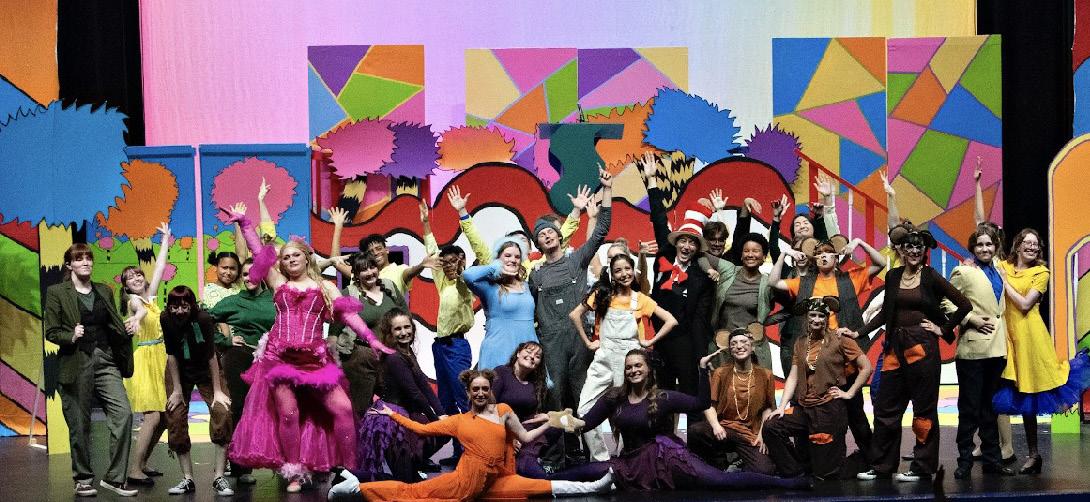
Dr. Seuss books that come together to make a unifed musical.
“With Seussical, it’s mostly animal characters that are usually Dr. Seuss characters and so I have to have more, not necessarily animal characteristics, but defnitely have to incorporate more of an animal-like embodiment of the character, rather than more of a humanized version,” said Megan Wolny, senior.
Seussical is a play with many parts that all work together to create the musical, from the ensemble cast to some of the more well-known characters like the infamous ‘Cat in the Hat’.
“I’d say this is probably the frst time I’ve played a character that’s as quirky as this because the ‘Cat in the Hat,’ he’s very energetic and
he is kind of a moderator in a sense. He’s like everywhere all at once. It’s kind of weird. You see him in diferent places all the time and he’s just a high-energy character. I’m not usually cast as that, so this show is a good opportunity to experiment with that,” Hsu said.
Seussical, with all its unique characters, courtesy of the books by Dr. Seuss, gives everyone involved a chance to have fun with it and enjoy the production.
“[My favorite part of being in theater is] probably meeting new people and getting to express yourself when you’re doing musicals. I’m in the ensemble, so I’m a Who. The people are really nice and we get to do a lot of fun dances,” said Imani Williams, freshman.
To get Seussical ready for the stage, everyone needs to work together throughout the time they have been allotted to get it done.
“Because this is the senior show, or the AP performance show, we typically take our class time to work on rehearsals and practicing all the dances, choreography, and practicing music, but now we started doing after-school rehearsals with our ensemble, and building sets, and really preparing to clean and fnalize the show,” Wolny said.
With all the hard work and dedication that goes into making a performance a success, OHS theater students have continuously put in the efort during their rehearsals to show up for their team.
“Honestly, rehearsals have been going great. It is
hard because we do have to accommodate a lot of people’s schedules, but overall they’re really great. Everyone carries their weight in rehearsing, and we all work as a team to make it all work together,” Wolny said.
After the performance has fnished, this year’s seniors are at last reaching the end of their high school theater experience and for many, the idea that it is soon to be over is unbelievable.
“It honestly feels unreal. Coming into freshman year I didn’t expect to actually get into all the shows that I did and honestly, it’s a great feeling and the role I got, even though it only is called a bird girl or I am featured ensemble, it’s still something I enjoy looking forward to every day, coming into class and being with my peers,” Wolny said.
Percy Jackson and the Olympians is the newest adaptation of the book series by Rick Riordan. Written from 2005 to 2023, the original series Percy Jackson and the Olympians is one of the best selling book series, with over 180 million copies sold. But this is not the frst time the series has been adapted for flm, as in 2010, Percy Jackson & the Olympians: The Lightning Thief was released to moderate reviews. It was then followed by Percy Jackson: Sea of Monsters which received many more poor reviews than the frst, and left a bad taste in the mouth of many Percy Jackson fans.
Percy Jackson fans have long awaited the return of the series to the screen, and they have not been disappointed, with the fve episodes currently released receiving many positive reviews. The show has stayed true to the source material as Riordan was
very involved with production of the show, making sure it lived up to his original vision.
Expanding the Percy Jackson series, the seventh book in the series Wrath of the Triple Goddess is set to release on September 24, 2024, adding to the Percy Jackson universe of 17 books.
The show follows a 12 year old demigod Percy Jackson, a son of Poseidon, as he quests after Zeus’s stolen “Master Bolt” in order to save Olympus from war, and rescue his mother from the underworld. With him are Annabeth Chase, a daughter of Athena, and Grover Underwood, a satyr (forest spirit) and Percy’s best friend.
During their journey to the underworld, located in Los Angeles, Percy and his friends face many threats including multiple Furies, Medusa, and many famous fgures from Greek mythology. One of the series’s greatest strengths is its appeal to all ages, reintroducing Greek myths and legends to the newer generations.
The modern setting is one of
the shows greatest strengths, with the show set in the mid 2000’s, the contrast between the ancient Greek monsters and the modern technology makes the show something wholly original, and interesting to watch. One of the factors contributing to the show’s success is its incredible visual efects, making the characters of Greek mythology look incredibly realistic.
The casting for the show is another highlight with Walker Scobell bringing the character of Percy to life. Scobell is incredibly funny as Percy, adding much of the humor in the series alongside his co-stars, Leah Sava Jefries and Aryan Simhadri as Annabeth and Grover, respectively.
Percy Jackson fans are sure to be appeased by this excellent interpretation of the books to the screen, and many are already hopeful for the announcement of a season 2, as Percy’s story is far from over. Percy Jackson and the Olympians is an excellent addition to the ever expanding universe of ‘Percy Jackson’.

In this day and age, art is hard to fnd in the music industry. Artists who once showed a unique brightness before having a platform become a carbon copy of the music industry and what it wants to put out there. One does not have a platform and a following, it is easier to connect to oneself and put the music one wants to have out.
Ethel Cain, a singer, songwriter, and storyteller is one of the many ‘underground’ artists that can impact people’s souls and how they view music. Her latest album, Preacher’s Daughter came out around two years ago and has continued to impact her fans. The concept album tells the story and tragic end of a girl named Ethel Cain, using biblical imagery and themes, introspective lyrics, and ethereal vocals to draw listeners into a world of emotional acuity and raw vulnerability. The story itself is a symbol and a metaphor for women in life and many people can connect to it.
People are drawn to new and diferent sounds or lyrics.
GayEthel Cain, aka, Hayden

Silas Anhedönia, is unique and continues to fnd new sounds and beautiful lyrics to envelope her music and make something diferent for today’s music listeners. The diference between her and many mainstream music today is the much-needed connection and vulnerability that many artists we hear and see all the time lack. Listening to Ethel Cain, people can feel her genuine passion and her emotions. Her music has an empathetic sound to it, connecting the listeners she has.
Artists who can connect a whole fanbase with the sound, lyrics, passion, etc. are scarce
and something important to the people. Listeners will drift to those who show genuine passion in what they do. People will fock to something diferent when everything feels and sounds the same.
And there are many artists like her out there who have a genuine connection to music and a passion for what they create. Artists such as Flowerface use unique sounds to push their emotions through her art. She mixes lyrics and eerie sounds to connect to her fanbase, making sure her meaning and emotions get seen and heard. Another great artist who doesn’t get nearly enough credit is Arlo Parks.
Her music creates a beautiful atmosphere, granting her listeners a mix of indie pop and folk music. Her voice is beautifully unique and her lyrics are written like poetry.
John Sunday Cruise is an underground band that creates indie/alternative rock music. Together they weave upbeat and poppy music, with an alternative infuence woven through. They are more fun and create relatable music for the listeners, connecting them through entertaining and inviting music, while also having many deep and emotional lyrics for some of their songs.
Sofa Isella is another rising artist who has a unique way of putting her music together. With a mission of putting issues of the world into music, she encapsulates the emotions and exactly how these issues make people feel. Her voice is powerful and she uses it to her advantage to show how urgent and painful these problems are.
These artists ft together the beauty they put together one by one, continuously adding to the mosaic of music they are creating. They make sure they keep their style and their uniqueness, and that they stay true to who they are. They all put out an important message for listeners to grasp.
Underground artists have powerful voices that don’t always get heard. They all have diferent sounds and create diferent art compared to most of the mainstream music that people are used to. It is a refreshing, and invigorating experience to fnd these unique artists, these unique people, and connect with them. Connecting with music on another level and feeling the way it speaks to the listener is more important than anything when listening to music.
Sarah J. Maas, known for her captivating works in series like A Court of Thorns and Roses and Throne of Glass, has ventured into a new literary realm with her latest series, the Crescent City novels. Departing from the traditional kingdoms, magic, and medieval-style technology found in her previous works, Maas introduces a refreshing fusion of modern technology and magic in the Crescent City books. The novels mainly follow a half-human and half-Fae girl named Bryce Quinlan and her partner, Hunt Athalar.
The books are intensely emotional, and the Crescent City series delivers a complete rollercoaster ride, punctuated by jarring plot twists that leave both characters and readers alike in a state of shock. The series has its fair share of darkness and violence that unfolds, yet the brilliance of Sarah J. Maas’s writing is such that one glides over these elements. The emotional resonance of the characters becomes a personal experience,
mirroring the reader’s sentiments with an intensity outside of the pages of the books. The series ensures that every twist and turn is not observed, but rather felt - an experience that will absolutely tear readers apart and put them back together again.
The worldbuilding and how all the characters connect is written beautifully and easy to grasp. One standout feature of the Crescent City series lies in its narrative structure, using a diverse range of character perspectives that
enhance the depth and complexity of the story. By shifting between different characters throughout the chapters in both of the currently available books, Maas provides readers with a multifaceted exploration of the characters’ thoughts, emotions, and interactions. This narrative technique not only enriches the storytelling experience, but also allows readers to form a connection with the diverse characters in the universe.
The world of Crescent City is vast and filled with several different and unique
species. Maas expertly explains government workings, hierarchy structures, technological advancements, and practices of magic while flawlessly blending them together.
However, the books are not only focused on the Crescent City realm. This interwoven tapestry unfolds gradually, with Maas skillfully introducing connections and overlapping details from her previous book series that steadily build until a complete convergence

occurs, merging the realms of Crescent City with one of her other series. The gradual overlap of the series not only adds a layer of complexity to the narrative but also rewards her dedicated readers with connections and Easter eggs that enrich the overall reading experience. Readers will be eagerly anticipating each revelation and connection that unfolds in this masterfully written series.
In conclusion, Sarah J. Maas’s Crescent City series stands as a testament to her storytelling prowess, seamlessly blending modernity with magic in a narrative that is both emotionally intense and visually captivating. The series not only introduces compelling characters but also masterfully intertwines with Maas’s previous works. As the universes collide and characters evolve, the Crescent City novels offer an immersive, and unforgettable literary experience, leaving readers eagerly anticipating the next revelation in this intricately woven saga. Many eagerly await the newest installment of the series, House of Flame and Shadow.
The Marvel Cinematic Universe’s (MCU) latest project Echo has a lot of fans intrigued, due to how diferent the show is compared to earlier ones. This is the frst show apart of Marvel’s brand new Spotlight series which focuses on smaller characters andEcho is also the frst MCU show to release all their episodes at the same time. The show additionally features the return of notorious crime boss, “Kingpin,” and fan favorite superhero, “Daredevil.” While the reviews for this series have been pretty negative, many viewers are still happy the show was diferent and switched up the typical ‘Marvel formula’.
The beginning of Echo features a recap of Hawkeye, the show where the main character Maya Lopez was introduced. Many viewers were a little disappointed, most of the episode was just fashbacks, but it was a nice way to get a short recap of what happened. This episode was also cool because it featured

an objectively awesome fght between Maya and Daredevil but after that, unfortunately, it was simply uninteresting. For how good Kingpin is in other MCU projects, he is kind of lackluster in this and is not as menacing as he could have been.
Due to the way Daredevil’s return was being advertised, many viewers assumed he would be in the show more than he was. Daredevil is unfortunately only in the show for maybe two minutes for his fght with Maya. Their fght was reported to be around six minutes and when it was much
shorter, many fans were left disappointed. Another issue with the series was how rushed it was, and a lot of storylines felt skimmed through. One of the main complaints from viewers was it felt like the show was purely an outlet to set up future projects and not primarily focused on Maya.
Even though the show was disappointing, it was still cool that Marvel is letting these side characters get their own time to shine. It is also cool because Alaqua Cox, the actor who plays Maya, is actually deaf in real life, just like her character. One of the
main reasons many people were excited for the show was because it is the frst TV-MA project in the MCU, which is essentially the rated ‘R’ of television. Unfortunately, the show just felt like a gimmick and did not even warrant the TV-MA rating. Honestly, the best part of the whole show was at the very end during a small, minute post credit scene.
At the end of the last episode, there is a post credit scene that depicts Kingpin listening to the news as reporters talk about the mayor race of New York City. For
a casual Marvel viewer this does not mean much, but this can actually mean a lot for the future of the MCU. There is a storyline in the comic books where Kingpin runs for mayor, and Daredevil and Spiderman team up to get rid of him. In the future there is a new Daredevil project, and a new Spiderman movie, so many viewers are expecting that this post credit scene will set up both of these two projects. So while this post credit scene was nice, and gives the viewers a sneak peek at what is to come in the future, it felt like this show was to purely show that Kingpin is alive and will be in other various projects.
Overall, the show just felt very mediocre and kind of unimportant. While it was not bad, it was almost hard to fnish just due to how rushed it felt. It is defnitely cool and refreshing that Marvel switched up from their standard formula, but the execution was not there, and there were most defnitely better ways to go about it. Marvel advertised the show diferently from the actual project so many fans were left enraged and disappointed.

of Silence: Love,
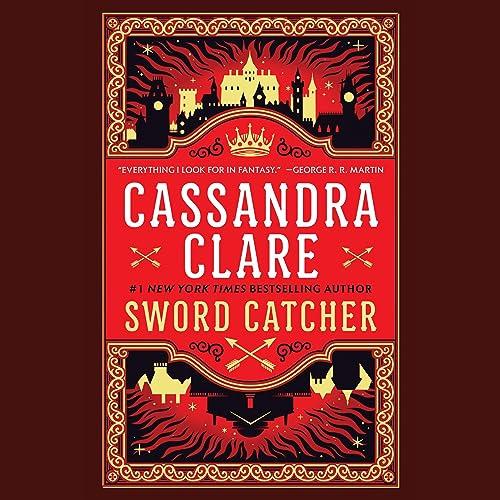
After many years working on the Shadowhunter Chronicles, Cassandra Clare has come out with a new fantasy book called Sword Catcher. From the beginning, readers are led to care about the characters, learning about their backgrounds that made them who they are at the start of the story and how their diferent relationships have impacted the course of their lives. The book focuses on the two leads, Kel and Lin, and though they initially seem part of two diferent worlds, soon their worlds collide. The reader gets to know both Kel and Lin well from Kel’s interactions with Prince Conor, to Lin’s protective nature toward her best friend. It is because of their other relationships that gets them into trouble and ultimately brings them together. Throughout the novel, Sword Catcher proves itself to be a spellbinding adventure of two people trying to protect those they love with the hand they have been given.
First Lie Wins by Ashley Elston delivers all the perfect thriller aspects and keeps the reader’s interest until the very last page. First Lie Wins brings something new to the genre, with twists and turns throughout that readers will only see coming once it is too late. This book utilizes two timelines showing the main character, Evie, both in present day and in years past. This was the right way to tell her story because it shows how Evie is in tough water at work and shows how her boss went from trusting her to losing his faith. In the present day, Evie works on her new job assigned to her by her boss, known only as Mr. Smith, all while he works behind the scenes to take her down. Using the timelines to captivate the reader, First Lie Wins showcases Evie’s fght to get the life she wants. Though most of the characters are not necessarily good people, they are intriguing to read about nonetheless.
Soundtrack of Silence: Love, Loss, and a Playlist for Life is a captivating memoir by Matt Hay detailing his experience of discovering he was going deaf as a college student entering adulthood. He shares his experience of what his childhood was like to him failing his frst hearing test as an adult. Hay’s narration makes it easy to understand how his hearing problems got overlooked all of those years and why it took so long even after learning about it to get it checked out. From the beginning, he explains how big of a role hearing everything from the car passing by on the street, to music through headphones, plays in everyone’s lives though most people do not even notice it. Through the format of a brilliant and engaging memoir, Matt Hay’s Soundtrack of Silence: Love, Loss, and a Playlist for Life, gives a glimpse into his life and can successfully give a new perspective on music.

ALL PHOTOS COURTESY OF AUDIBLE
Check and Mate is the latest romance novel by Ali Hazelwood, but instead of tackling the concept of a woman in STEM as many of her other books are known for, this time the lead is a woman entering the chess scene. In a smart move by the author, the book starts with her mixed feelings about the game though it’s not known why, as the novel progresses, the reasoning unfolds nicely with the rest of the plot. As she reemerges in the world of chess, Mallory learns she has a lot to manage, such as a new job, a reappearing love of the game, and an unexpected romance. Even though romance is present, and is a big part of the story as this is a romance book, it does not overshadow the complicated family dynamics or Mallary rediscovering her love for chess. Rather, it accelerates these elements to make them better and creates an all-around, more engaging story because of it.
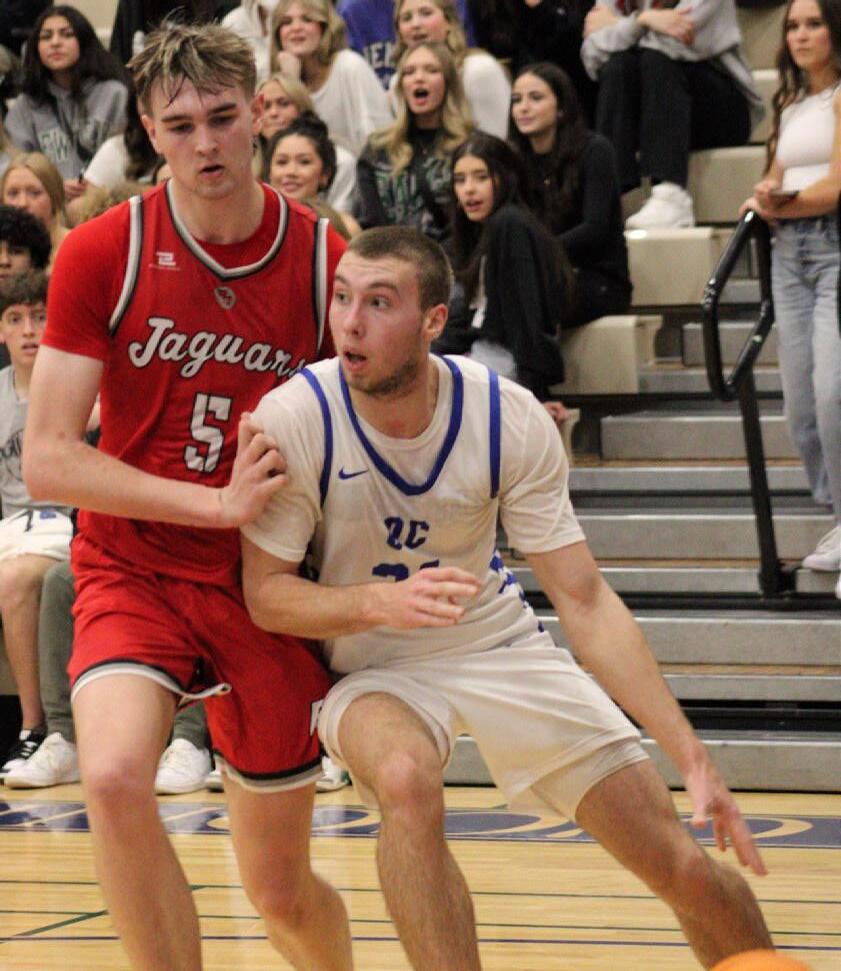
PHOTO COURTESY OF IMDB Sword Catcher by Cassandra Clare First Lie Wins by Ashley Elston Check and Mate by Ali Hazelwood Soundtrack Loss, and a Playlist for Life by Matt HayIn the world of OHS sports, boys basketball continues to shine and make a name for themselves. Boys basketball has grown a lot since last year due to their increased focus on friendship and comradery.
“I feel like we defnitely like each other more, and we’ve become [better] friends and family, and have that closer bond that we didn’t have last year,” said Jason Cullum, senior.
OHS basketball has not just improved their relationships of the court, they have also shown great growth within the lines as they push themselves to their max.
“Our practices are defnitely more intense, we take more time focusing on the little things that matter, and we also do a good job at scouting the other team,” said Michael Simcoe, junior.
The team only has a few losses this season so far, but the adversity they are faced with still requires perseverance in order to continue their widespread success.
“We practice everyday to get ourselves exposed and used to those kinds of moments so that when [adversity] comes in the game, we’re ready for it,” said John Simcoe, junior.
The OHS coaches are very supportive of the players, helping them push through tough
situations and keep their heads up.
“If we give our best version, and we lose a game,then we take our hat of to them and get back to work; If we give our best version and blow a team out we take our hats of and get back to work,” said Josh Cole, head varsity coach.
A lot of teams get too arrogant and fnish of the season poorly, but OHS has been working on keeping their success going and making it to the championship.
“[We] don’t get in over our heads, don’t become too arrogant, and just keep working because our end goal is a championship,” said Michael Simcoe.
The whole team has one common goal, and they all work towards it. Whether it be training together, building bonds together, or even having ‘Focus Fridays’ where they meet with mentors.
“I think everybody has the same answer on the team: just to win state, I think we have a good shot at it, we just have to keep working,” Cullum said.
JV:
A lot of people get lost in the freshman and varsity levels of high school athletics, but JV basketball has gone above and beyond, having a fantastic season so far and although they have experienced lots of success, they stay humble.
“We just try to stand out… we just play basketball, and if we win that’s good for the whole program,” said Connor Skinner, junior.
The JV team has undergone many changes since last season, whether it be court adjustments or even the additions of new players, which has allowed the team to step out of their comfort zone.
“We’ve got a lot of the same players, a couple transfers, we’ve just gotten a lot better at defense, we score the ball a lot better, and we’ve gotten bigger,” Skinner said.
The JV team has done a good job embracing new transfers from other schools, working well together and building comfort in a new team.
“People care a lot more here… people have a lot more fun and it’s a diferent environment,” said Carsen Pavey, junior.
Some of the transfer students also note how the OHS coaches were much more accepting than those from their previous schools.
“[OHS Coaches] are much more supportive and have a lot more understanding,” Pavey said.
The team has also focused more on growing of the court as a brotherhood, so that they can work better, and understand each other on the court.
“It’s been a great season so far… it’s been really fun and we are like a family,” Skinner said. Freshman:
Every year a new set of freshman basketball players join OHS and have to make the tough adjustment from middle school to high school athletics.

“The biggest jump has probably been the pacing of the game, just how fast it is,” said Liam Pavey, freshman A lot of the players mentioned how the coaches really helped them work through this adjustment and make the transition smooth.
“[The coaches] made it really easy and are patient with us,” said Demarkus Allen, freshman.
While the Freshman team has been pretty successful this season, they have still had some lows and the players strive to change that.
“Our efort throughout some of these games has been on and of, so I feel like if we change that we could have won more,” said Brody Wilson, freshman.
With there being so many options for high schools in the valley, it can be difcult for students to narrow it down to just one option.OHS stands out a lot for athletes due to how supportive the coaching staf was.
“[The coaches] made it really easy and they are patient with us,” Allen said.
The players are looking forward to growing as a team together this year, and in their future seasons, as they go up in the levels of highschool basketball together.
“Just knowing that their basketball program is good and we have a bunch of young players so we’re going to be good in the future,” Allen said.
Varsity:
The OHS girls varsity basketball team had a winning season and are playof bound, fnishing thier regular season with a record of 16-8 overall.
Adversity has been a common factor of the year, as the team began their season with many players that had to sit out due to transfer rules.
“It’s been tough to keep everybody happy- it’s a lot of comfort. They [the players] know that I have their back; having that communication with them is a big deal in building that of-thecourt relationship, so that on the court everything is a lot easier.
Just a lot of communication, a lot of honesty, a lot of transparency, a lot of sacrifce- for me as well as a coach,” said Charles Wilson, varsity coach.
Communication is something that many players agree is important to the team, as it helps to keep them unifed.
“To be able to get along with my teammates, I think it’s important to understand things from their point of view, not just my own,” said Bella Overlock, sophomore.
Working together and simply understanding each other as people is an important value held on the varsity team. One of Coach Wilson’s biggest goals is to create a good culture among his athletes, and he claims to value it even above winning.
“Winning is not as important as
culture. I love winning, obviously, and competing with the girls that we have, but I learned very quickly that the foundation that you stand on when winning doesn’t last as long as the culture that you have.
So just having that ‘buy in’ from everyone: that sacrifce and that willingness, it defnitely goes a long way,” Wilson said.
While many people may think that winning is all that matters, OHS girls basketball fnds other values that are just as important.
“Winning is defnitely the ultimate goal, it’s just not our ‘end all be all’. We want to make sure that we keep our culture intact, our foundation, our consistency, and togetherness,” Wilson said.
That togetherness is what keeps the team close and forms such meaningful bonds.
“I have a good relationship with all the girls so it’s really fun. Even though we’re all really close already, it’s nice being able to get even closer,” Overlock said.
Bella Overlock is not the only player to agree that the team environment is strong, with numerous other teammates to share similar thoughts.
“My favorite part of being on the team is the environment. I love my team and I think that we can win this year for sure,” said Alana Gewargis, junior.
JV:
As the season progresses, the JV team continues to battle it out and play hard. Part of what makes their game play so good is the connections that have been formed between players.
of just got used to them, and we get along well, you know?” said Alana Haddad, sophomore.
The team has had many opportunities to get close to each other. The bus rides to away games are frequently used as another time to strengthen their connections.
“Being on the bus; it’s just so fun because we’re going to be quiet for half the time, then the other half we’re going to be screaming and it’s just so great all around,” Haddad said.
Having a positive attitude around teammates seems to play a big factor in the spirits of the athletes, which ultimately afects their gameplay.
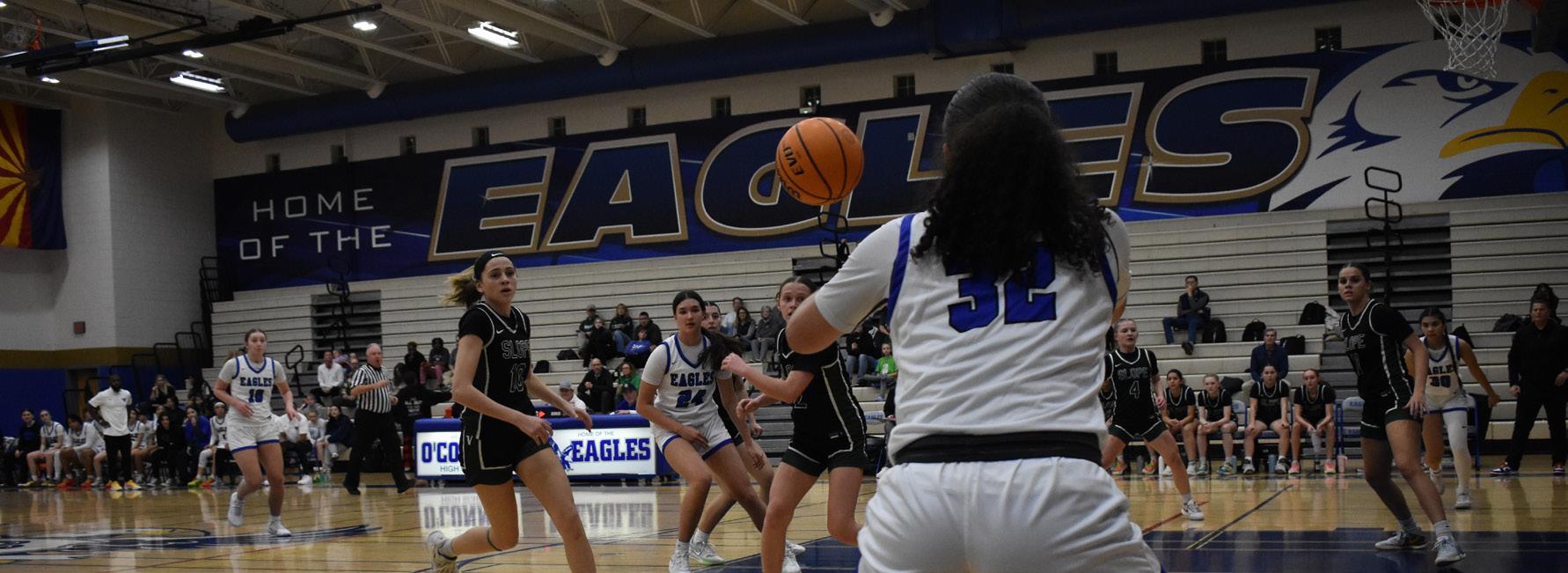
“We get along really well, we’re all good friends. We also do a lot of team bonding which includes hanging out after school,” saidSimone Russell, sophomore.
Combining so many diferent personalities may seem challenging to some people, but the team is quickly fguring out how to get along.
MASSIE“Some people are diferent on the team, not my usual type of friends, and even though I don’t really understand them yet, I kind
“Starting of strong with the team and just trying to be a good team player. If you do that at frst, it will rub of on them [the rest of the team],” Haddad said.
Overall, the season has been going well for the Eagles, and they are expected to continue to do well as the year goes on.
“I actually feel pretty confdent, honestly. Our team is good, we’re getting our chemistry. Even though we’re just starting of, we’re doing well,” Haddad said.
The girls soccer program at OHS has always been a force to be reckoned with, and this year they have surpassed expectations by becoming 6A Desert Valley Region Champs, a frst in OC history.
Even in the face of various challenges, the team has been able to persevere and adjust to various changes. They have been able to adapt and emerge stronger and closer with one another.
“In the beginning of the season we had a lot more girls that we thought were going to be playing with us, and then it kind of just slowly dropped of with injuries, and then people wanting to just stay on club.
So, it was a little inconsistent, but I think we’ve defnitely picked it up and we’ve been able to fll in those places that we needed, and we’ve all just kind of bonded because of it,” said Sophia Shlicklin, senior.
Just like in any sport, athletes unfortunately obtain injuries that can be hard on both the team and the individual. One of the biggest obstacles that the team has had to face this year has been players getting hurt.
“The key injuries have been a big challenge this year,” said
Josh Gibbs, girls soccer coach.
With the quick transition between club and high school soccer, it can be hard to get used to the diferent teammates and styles of play. This is something that the team has been able to recognize and wants to continue to improve and work on.
“I think we want to build our team fuidity a little more and kind of just build of of what we’ve been working on as a team,” Shlicklin said.
High school soccer can often pose its own challenges and issues as the two worlds of school and soccer combine, but the team has been able to come together and focus on achieving their goals for the season.
“I feel like there’s not any confict, like socially or just in general. We’re all just on a team here,” said Kierstyn Malig, junior.
There are various diferent factors and pieces that come together to form a great team. Having experience in stressful situations and having already learned how to adapt and improve has helped this team fnd the success and results that they want.
“I think this team seems to be a little bit more mature. These girls are seniors and juniors that have kind of come through and have been in the
big games a couple of years now. They understand what the big games are, so I think there’s the maturity there,” Gibbs said.
An important aspect of a team environment is being able to have fun and enjoy the
season while also being able to stay focused and get the desired results; something that this year’s team has been able to efciently achieve.
“I think the personalities this year are great. There’s a lot of outgoing personalities and I think it has really kind of made the environment a little bit more fun and lighter,” Gibbs said.
With a great record so far, and coming of of some big wins, the team is aiming high and wants to make it far this season.
“Our goals are to make the quarterfnals at the state tournament,” Gibbs said.
High school soccer gives these athletes the opportunity to play for their school and enjoy a more relaxed season where they can also fnd accomplishments.
“Playing soccer with friends, taking a break from club, and getting to play against your club teammates and getting to see them; it’s all just really fun and I love it,” Malig said.
JV:
With a near perfect record,
Varsity:
Winter has arrived in Arizona, and along with the short days and chilly weather, winter sports have made a comeback.
No team is more excited to take to the feld this year at OHS than boys soccer. With an already promising start to the season, the team is back and better than ever, ready to kick of another year of victories.
“We had a tournament to start the season of. It was the Barry Goldwater Tournament, and we won all fve of those games,” said Connor Mattingly, senior.
Outside of goals scored and games won, the boys are passionate about sharing the feld with their teammates, forming new bonds, and strengthening old ones.
“We’re really close this year,” said Braedan Judge, junior. “We’re competing, so I think it’s just brought us together. We’re brothers.”
This season marks the last time that many graduating players will take to the OHS feld, and the team recognizes the impact this has on their desires for success.
“It’s my senior year, and a lot of the guys are seniors, so I think we just have a diferent passion this year to go as far as we can,” Mattingly said.
Along with the determination and enthusiasm that older members bring to the team, many have grown signifcantly in their time as an eagle, accumulating the wisdom and outlook of a veteran player.
“I’ve learned a lot from a bunch of diferent philosophies of soccer and diferent coaches,” said Ricky Ulloa, senior. “There’s always a diferent ideology of the
the JV girls soccer team at OHS refuses to be overlooked. They are working hard to fnd success and win as many games as possible, while also enjoying the season and the time they get to spend together.
High school soccer is able to provide athletes with a less stressful and more relaxed environment, where they can play with diferent people and enjoy the break from club soccer.
“Some of my favorite parts of playing high school soccer are just being with my best friends and how it’s diferent
from club,” said Marina Canady, sophomore.
Although the environment is less stressful, it still takes work to come together and put each individual skill set together in ways that work.
“We’ve had to work to come
together and be better as a team,” Canady said.
Especially when facing teams with fuctuating ranges in skill, there are big risks of injury and it can be difcult to play together efciently.
“The biggest challenge has been overcoming injuries, and also just coming together and working together but I think we have done a really great job at that,” said Raegan Pool, freshman.
The team environment can make or break a season, and this year the team has been able to put other factors aside and focus on playing a sport they all enjoy and love.
“I absolutely love the team environment and it’s like the best thing. Everyone is just so positive and uplifting and it’s actually really really cool,” Pool said.
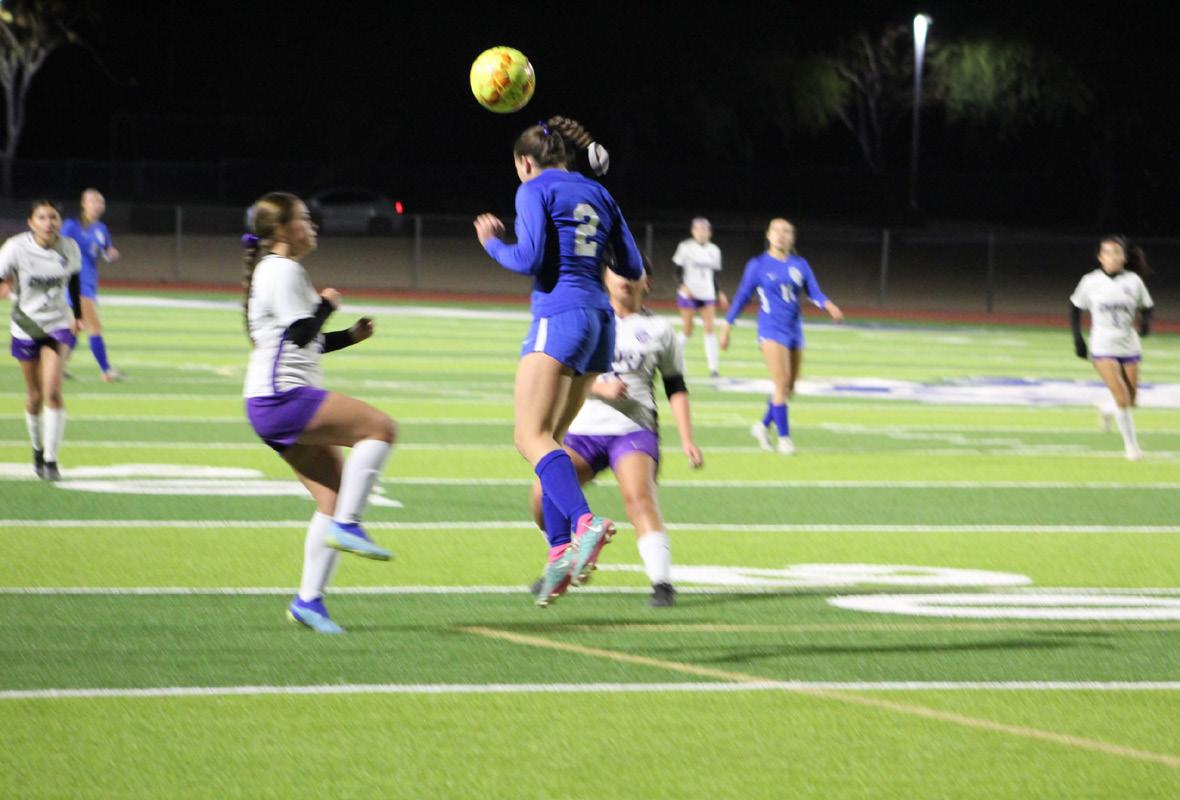
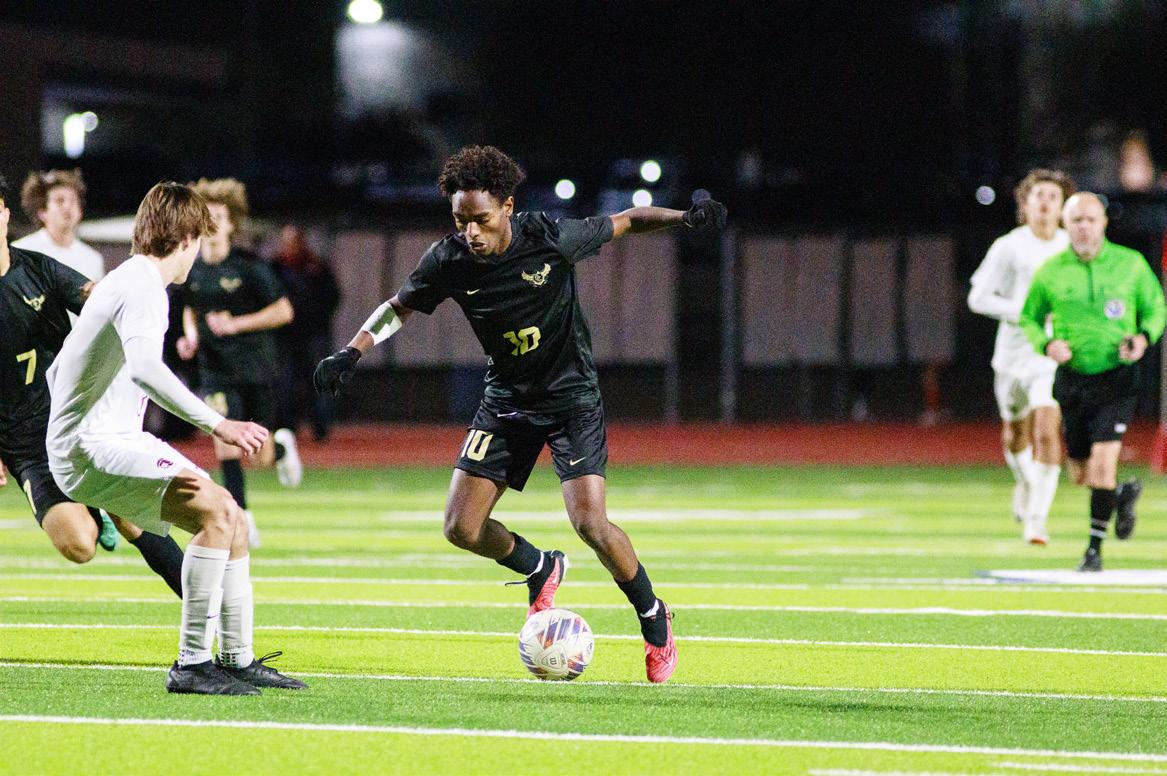
game. There’s always diferent philosophies, [so] be openminded.”
Furthermore, certain players have learned how to work through personal hardships that have challenged them throughout their season–or their entire journey at OHS.
“I got injured my freshman year and my sophomore year and my junior year, and I was injured a couple [of] weeks ago…but I try to just keep on going and have as much fun as
I [can],” Mattingly said.
One of the most prominent aspects of this year’s team is their pre-game ritual that they use to set the tone for the entire match.
“The whole team, before every game, we spend ffteen minutes in silence just visualizing and meditating, getting our mind right,” Judge said.
All in all, it is clear that the OHS boys’ soccer team has grown tremendously this
season–both in the quantity of victories and the quality of their bonds–and will continue to improve as the year progresses.
“Most of us are just hungry to win. When we lose, we hate it, so the next game we get a chance, we want to go out and attack and win,” Ulloa said.
JV:
The Junior Varsity boys soccer team is full of new faces and young players, eager to make their frst mark on the high school feld.
With only a short time to get to know each other, the players are already developing the relationships necessary to make a successful team.
“Even though I’ve barely known them for a little bit, it already feels like we’ve been playing for a long time,” said Cristian Diaz, freshman.
As the boys wrestling season draws to a close, many OHS athletes look back on a successful year. OHS has a division 1, section 2 team which comes with some very tough competition.
Despite various struggles this season, the team is hopeful for the following year and those beyond.
“As a team we defnitely could be doing better this season, but I feel like we are all trying really hard to
improve,” said Gabriel Garcia, junior.
The team dynamic in wrestling difers from other sports, mainly for the fact that wrestling is an individual sport, with entirely separate scores. This gives matches a more exciting atmosphere.
“The feeling of [the judge] raising your hand while your entire team is cheering for you, it’s indescribable,,” said Jameson Blagg, sophomore.
While wrestling is an individual sport, the team bonds that wrestling forges are solidifed through the sport,
often extending beyond just school and wrestling.
“The [JV] team is pretty close, we’re pretty good friends, and we hang out sometimes during the of season,” Blagg said.
Wrestling is a very intense sport that often puts a strain on wrestlers physical and mental health. This is more evident during the end of the season, as the wrestlers push themselves to their limits.
“It’s very difcult, especially later in the season but that’s one of the best parts for me, I love the grind,” said Justin
Dobbins, sophomore.
While some of the team is struggling this season, Gabriel Garcia is certainly not. Garcia is currently number two in the state for his weight class with a record of only three losses.
“My season is going well, I only have 3 losses as of right now and I’m second in the state, I’m hoping to make frst,” Garcia said.
Wrestling is a sport that ofers incredible room for growth and improvement, even during the season the athletes still train often.
“I like knowing that if I
put in the efort and I really work for it I can improve,” said Dobbins. “Seeing myself improve over time is one of the most gratifying things for me personally”.
The wrestling team is continuing to improve throughout the season, but some wrestlers are predicting that next season will be one of OHS’ best.
“Next year is going to be O’Connors year, I know it, the dedication me and my teammates are putting into it [wrestling] is defnitely going to pay of,” Garcia said.
As the winter season fies by, girls wrestling is looking to make its mark at OHS and create a legacy for both the present and future of the new and upcoming sport.
The uniqueness and increasing popularity of wrestling is something that strives to be acknowledged. Students who decide to join are given endless, new opportunities within a sport that is just beginning to further its stride.
“[Wrestling] is unlike a lot of other sports where, for soccer, for football, for softball; these kids have been playing those sports since they were young. A lot of the girls specifcally, and the boys that come to wrestling their freshman year, don’t really know anything, so they get to learn from that point on,” said Autumn Webb, girls wrestling coach.
Along with the new sport comes less experience and distinct challenges, but the team is doing their best to learn and adapt to obstacles that they face.
“I think because of the fact that this is only our second year with a girls wrestling team, there are defnitely some challenges because we’ve only had one year of experience,” Webb said.
Both players and spectators alike are able to witness the expanding and newfound popularity of girls wrestling at OHS.
“It’s defnitely a growing sport because at competitions there are always a lot of girls there and you can just see that it’s growing for sure,” said Cassidy Langford, freshman.
Students who join wrestling get to experience a sport that is unlike many others. The unique skill sets required within wrestling can provide fresh perspectives and opportunities for students at any age level.
“I decided to take a leap of faith after being cut [from a sport] and join wrestling this year. I’ve done many sports but none like wrestling. I’m extremely lucky to have found a sport that I can push myself and get consistently better at,” said Morgan Dunne, senior.
Just like any other sport, wrestling comes with its own set of challenges. The losses and tough days highlight the necessity of teamwork and perseverance.
“As a team we’ve had some challenging days, but we always bounce back and fnd the little wins,” Dunne said.
A short term memory mindset is very vital within wrestling, but can also pose as an obstacle to overcome. Athletes have to let go of the bad days and focus on improvement for the next
ones.
“I just have to try and stay out of my head about matches and just recognize that there is another one coming up and you have to get ready for that before you can keep those bad ones with you,” said Kaylee Coleman, sophomore.
Recognizing that more opportunities and chances will come can help prevent the athletes from dwelling on a loss. Instead, they can look for other ways to win and improve.
“I think wrestling is unique maybe just because there’s more chances to go against the same person and more ways you can beat them and win. If you don’t get it right the frst time, there still might be other chances,” Langford said.
Even though these athletes compete individually, a team environment can be a key to success and perseverance. Teammates build and push each other to their limits, creating the environment that every athlete needs.
“I learned this from my brother: wrestle smart, wrestle tough. I kind of bring it with me and then just after the matches, win or loss, I go up to my teammates and try to calm them down and talk to them,” Coleman said.
The girls wrestling team is putting in the work, and wants to get as far as they can this season. They are looking forward to continue
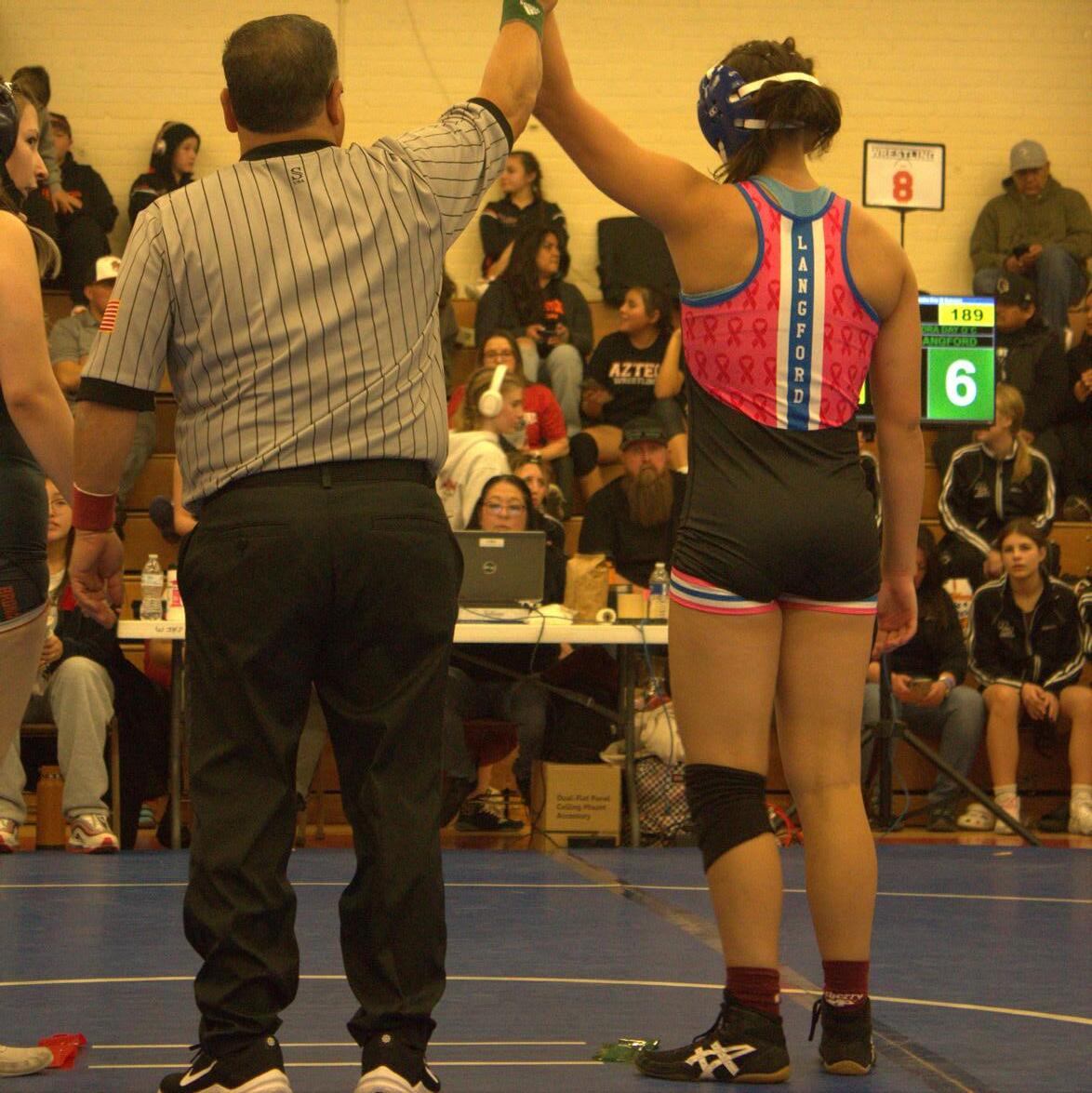
showcasing their skills and competing to win.
“We defnitely want to have multiple girls qualify for state, and in wrestling in order to go to the state tournament you have to place at the sectionals tournament,” Webb said.
The bonds that the wrestling team has created this year have allowed them to celebrate both the individual and team wins. They are not only working hard, but also enjoying the season and the memories being made.
“I think that because wrestling is so hard and the practices are so hard, it has kind of pushed the girls to lean
on each other, and build tight friendships and inside jokes and things that only they can understand because they’ve gone through the super hard losses and the super great wins,” Webb said.
The girls wrestling team is willing and eager to tackle any challenges that they face. Continuing to strive for success, the team is raising the bar of expectations for both themselves and the sport as a whole.
“We have a young team, so it’s a challenge, but a good challenge because we can teach from the ground up and fnd success there,” Webb said.
“I had clients…who I’m still really close with, who were community college professors, [and] my mom was a teacher, so I’ve always been around education growing up, and I was around people [in education] at a crossroads in my late 20’s,” Chavez said.
Going back to college proved to him the importance of one’s younger years and setting up your future.
“What you choose to do there [late teens to 20’s] is largely going to set your path for your career,” Chavez said.
Although Chavez was always good at math, he was not ready to pursue a career in it while in college or high school.
“In another lifetime, maybe I [will] end up an engineer, but in college I didn’t enjoy applying math skills to
sciences,” Chavez said.
Chavez earned his master’s degree in secondary education from GCU in 2016 and has taught at OHS ever since, now enjoying what he can inspire students academically.
“There’s actually not much that I’ve experienced that’s more rewarding than kids wanting to learn, pushing themselves, making connections [mathematically]
that I don’t necessarily show,” Chavez said.
Teaching and coaching share places in Chavez’s heart. Chavez is an experienced runner specializing in longdistance running, and initially got into it as a way to stay healthy and set goals. Even though he does not run competitively, he loves seeing improvement in himself, his students, and his athletes alike.
“I fnd joy in the process of improving, and doing something that, over the longhaul, [I] can get better at for the sake of getting better at it,” Chavez said, “and having kids give that a try and fnd reward in that, is a skill that can translate into a mentality that can drive so many other things in life.”
Cheer:
This season, the OHS cheer team has had many ups and downs, but the girls are doing their best to push through and perform. Players are staying positive, and are remarkably there for each other when support is needed.
“We’re just not dwelling on it. Stuf happens, but we get over it and fgure out new ways to be better,” said Kate Mosby, JV captain, sophomore.
Conitnuing to better themselves is a big focus throughout all levels of cheer. Many girls target the mental aspect of their competition alongside the physical aspects.
“I try to focus mentally to be in a good spot. I try to just look on the positive side of things and just keep myself in a good headspace so it doesn’t afect me or my teammates,” Mosby said.
Being on a team that does not have many girls, such as the Varsity cheer team, can occasionally prove to have its challenges. However, the girls at OHS have no problem overcoming anything thrown their way.
“I’d say we get along pretty well. Our team isn’t too big (there’s like 17 girls), and you can talk to anyone on the team. Before a comp, we’ll pray for each other and get in our groups and hug each other. On the mat we will be hugging and encouraging each other. … Everyone is just trying to help each other and make our team good,” said Sage Mitchell, senior.
Along with encouraging each other, it is important to the girls
that they remain in good spirits. Negative energy within one person can very quickly drag down the entire team.
“One of the hardest parts of cheering is being consistent: your energy, how bad you want it, and just constantly having to remind yourself, ‘We’re a team- we want to win, we want to do good.’ just keeping that energy up,” Mitchell said
If there’s one thing that the cheerleaders are good at (other than cheering!), it is believing in each other.
“It’s a good environment to be in- it’s fun and we’re always trying to bring each other up and make each other more confdent in what we do,” Mosby said.
Other cheerleaders agree that this group of girls is more than just a surface level team, with all members going above and beyond to support each other.
“We’re all just so fun and the energy is good. We’ll all play songs before [competitions], and we will get each other bracelets. It’s such a good program to be involved in,” Mitchell said.
Compared to previous seasons, this year’s team has bonded wonderfully with each other, and everyone feels included.
“I defnitely think that it’s been one of the best teams that we’ve had. My freshman year, the seniors weren’t connected with us at all, but I feel like all the seniors this year really tried to connect with all the underclassmen and I think that’s really impacted us all. It doesn’t just impact the sophomores, it impacts us too. I feel like they’ve helped me as much as I’ve helped them,” says Mitchell.
Pom:
Another year has gone by with OHS pom working hard and creating breathtaking routines in
an efort to win it all at nationals. This year they have already seen lots of success, and are currently preparing themselves for the big competition ahead.
Many girls have created personal routines to mentally ready themselves for what is to come. These types of eforts start at practices, which are some of the most important times for the girls to get themselves in check.
“I wake up at 3am, I do my morning routine, I do my bible study, and I get myself ready. I have to make sure that I have a good, positive attitude going in because as a captain, I don’t want to go in there tired and unmotivated. Looking forward to each day and being in the moment are important,” said Kaylee Candrea, pom captain, senior.
This type of attitude comes down to a more personal level, and begins with what individuals
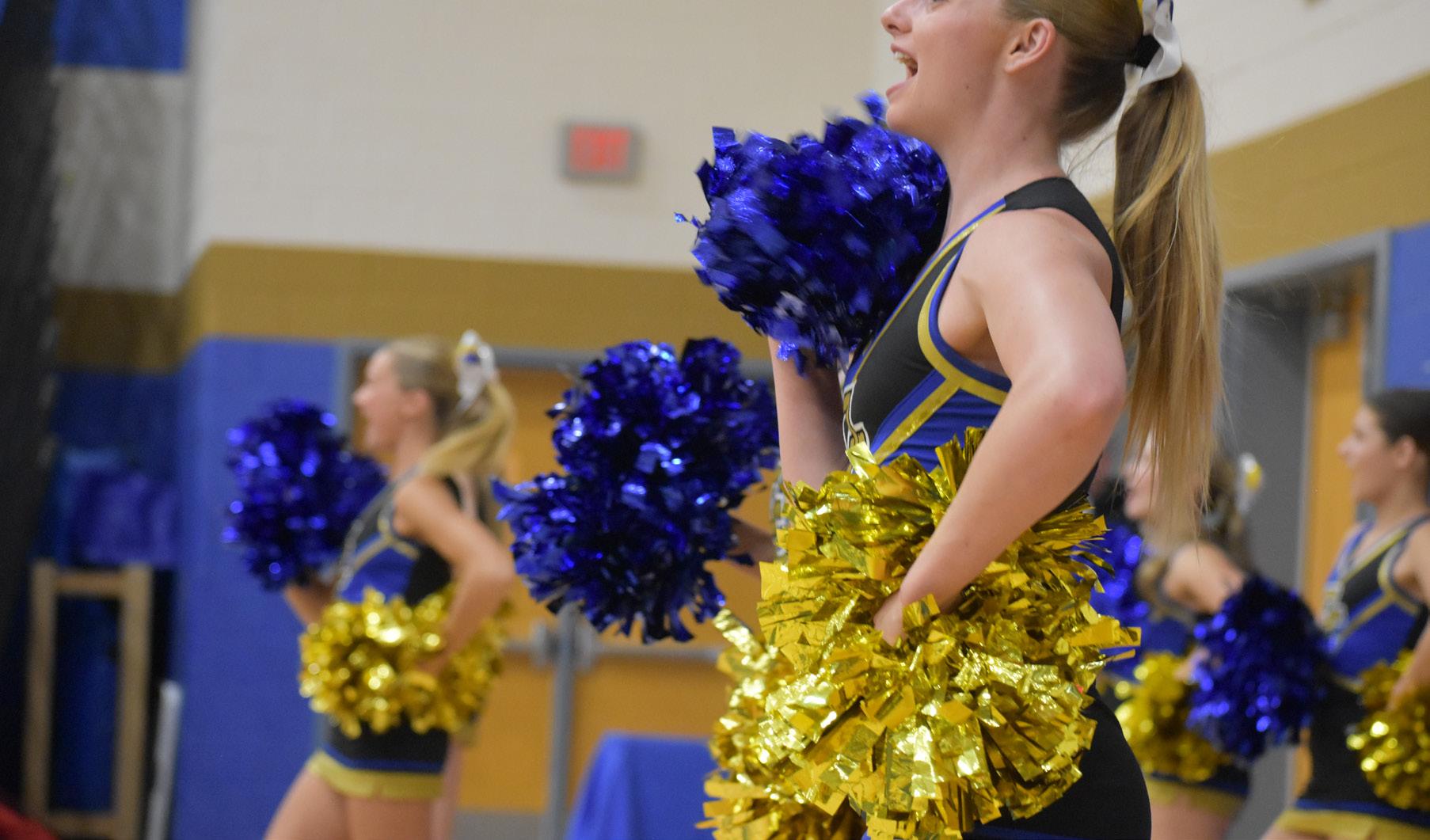
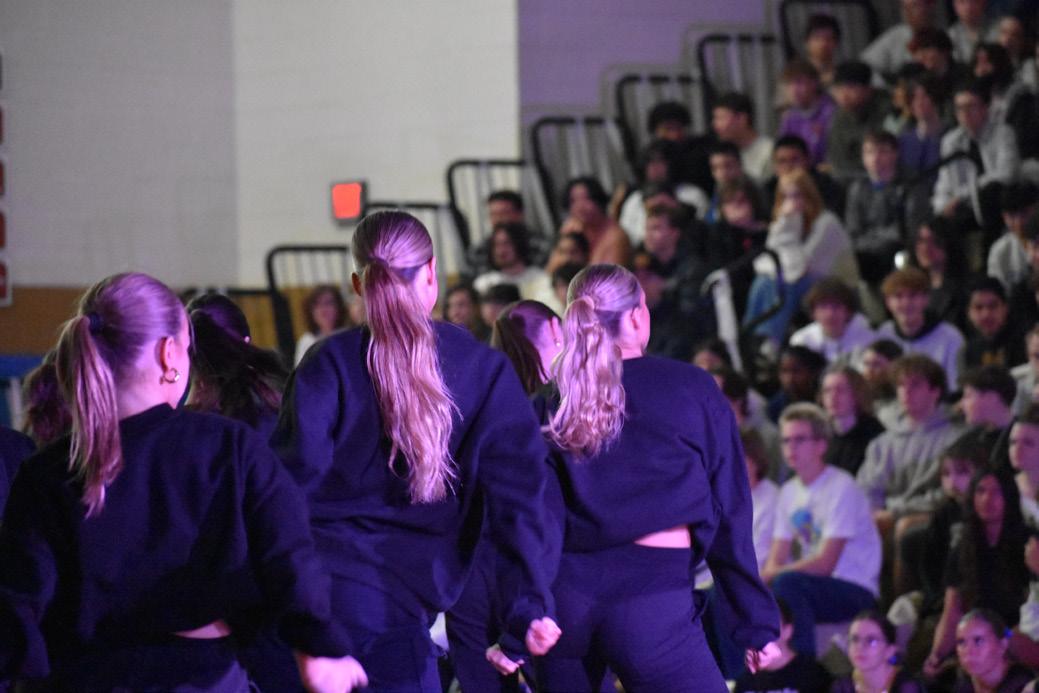

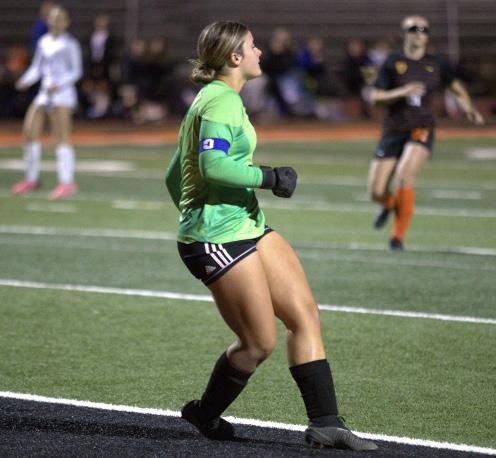
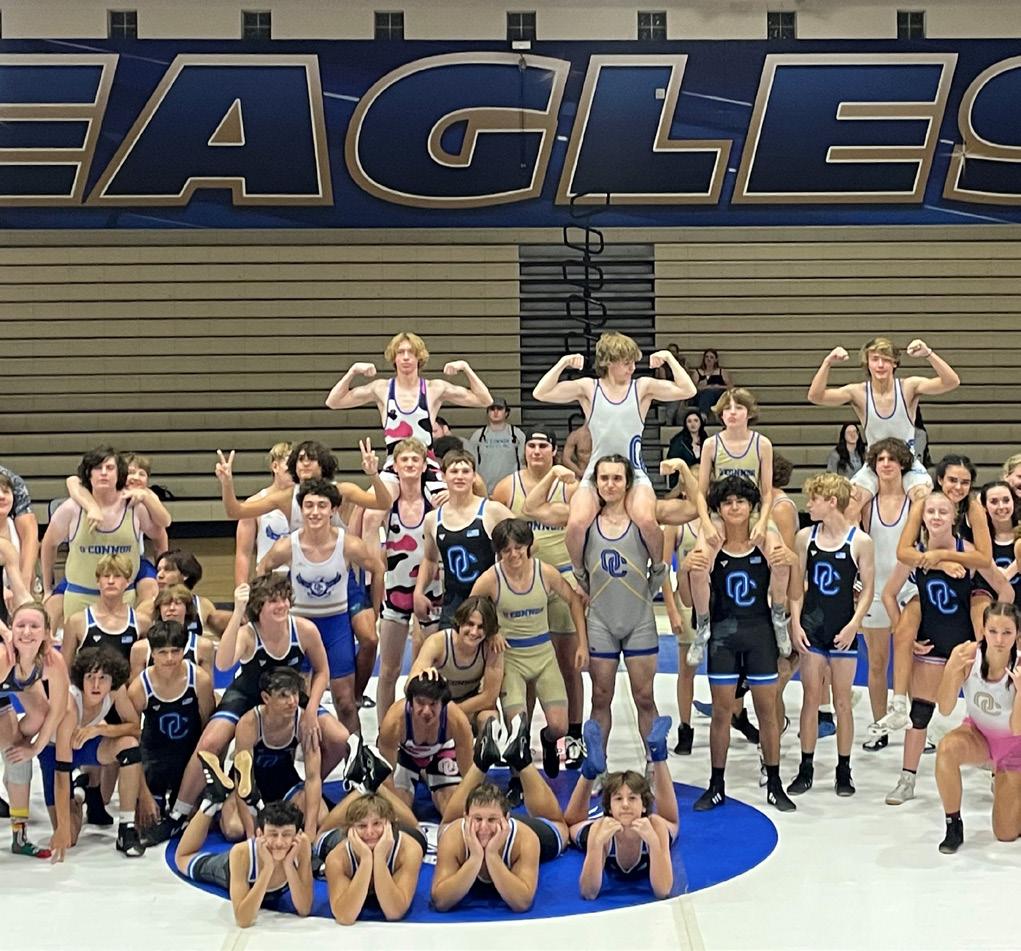
are doing to try and improve themselves throughout the course of the season.
“One of my goals has been overall growth: to lead positively, and to not bring up negative thoughts around the girls. I think setting a high bar for myself makes it easier for me to stop trying to look at the outcome, and just enjoy the process instead,” Candrea said.
This level of maturity afects the rest of the team greatly, and sets an example for success. It also infuences girls considering joining the team, and can be very helpful when motivating them to become a part of the program.
“My sister was on pom last year, and watching the team and how they interact with each other just seemed so fun,” said Brooklynn Regnier, freshman.
These types of interactions build bonds that translate outside of just the sport. Many players agree that the OHS team feels extremely unifed.
“It’s like a family, for sure. I think anyone on our team can testify to that. I think all of us girls, especially on pom, are really close. Since we have a smaller team it’s been nice to bond, and we do everything together. After every game or competition we go out and get food, or go back to one of our houses. It’s just one big family,” Candrea said.
While constantly being with each other may seem like it would cause issues, the girls are quick to fnd ways around it.
“We’re together a lot so there’s little things, but in the long run we all just love each other and we all support each other,” Regnier said.