


By KAITLYN SMITTEN Sports Editor
Athletes have to be some of the strongest people in the world to play their sport, but the mental aspect of being an athlete is often overlooked. With the pressure of trying to be perfect and the work ethic it takes to get a starting spot in the line up, athletes are challenged both physically and emotionally when it comes to their sport.
Student athletes are often expected to function without any faws or distractions when it comes to their grades and sport.
The sheer amount of time and effort one must put into their sport takes away from time that could potentially be used to do school work and vise-versa.
“I feel like people think that athletes are like robots, play their sport, get good grades, go to sleep, and that's not how it works and I think there is a big misconception about that. They are people before they are athletes,” said Maisie Jesse, senior.
Overcoming the stereotype of having to be perfect is often diffcult for many students and even more so for student
athletes.
“I think there is more stigma. A negative connotation towards athletes’ mental health than other students’, because other students are allowed to seem vulnerable while athletes are supposed to be the popular kids. You're the athlete. You can't have a mental breakdown, you need to be that top person,” said Tom DeVito, wrestling coach.
Mental strength is oftentimes said to athletes in regard to getting through workouts and getting better at one's sports. What many coaches and even players disregard is the difference between mental health and mental toughness.
“Mental toughness is preached to athletes so much. You have to push through your sprints, you have to push through your hard practices and they preach that so much but it's different. Mental toughness and mental health are completely different things and they should not be intertwined at all. Mental health is not something that you can necessarily push through without the help of a sports
psychologist or therapist,” Jesse said,
The pressure athletes are put under often drives them into a depression or state of anxiety. Finding help can be diffcult for anyone but especially those who are constantly told they are supposed to be perfect in every aspect of their lives.
“There is nothing wrong with you. I feel like a lot of people always feel like there's something wrong with them because they feel that way. Especially when the people around you don't speak up about it then you really start to feel like you're broken,” Jesse said.
Having a positive environment plays a vital role in the development of an athlete both physically and mentally, but knowing that you have someone to talk to, whether it be your teammates or coaches, also helps eliminate the feeling of loneliness.
Jump to page 5
By ANANYA THEKKEMELEPATT News Editor
OHS is incredibly fortunate to have teachers that can inspire students and guide them to becoming more educated individuals. Richard Weyker, government and economics teacher, is one of these people, giving the students at OHS a role model to learn from.
Dedicated to his own career, Weyker emphasizes that doing something you are eager about is what is most important when fguring out what you want to do for a career.
“When I was 15, at a family reunion, very successful types [of people], every single one of them had this look of fatigue and detachment,” Weyker said. “Looking at the toll of a life of sitting behind a desk and doing something purely for monetary gain made me realize that if I did one thing with my life, I had to be passionate about it.”
After seeing some of his family members being stuck and stagnant in their careers, he started exploring what he was passionate about to avoid the same fate. Becoming a teacher was his solution.
“I really enjoyed the process of learning something and fguring out how to communicate that with the class,” Weyker said. “I went from being pathologically afraid to speak in front of the class when all of a sudden I started giving presentations in high school. I don’t know what it was but I just started to love it.”
Jump to page 4


By AAYUSHI DATTA Podcast Manager
Seniors applying to college is a usually chaotic process. Students spend an entire year of ups and downs where each student experiences both tension and happiness.
Applying to college adds extra pressure on students because students consider it an opportunity towards their desired future.
“It’s been really stressful, and I think that’s just because it’s that pressure of ‘this is your future.’ You only get one shot at it, so you really want to make sure that you put your best foot forward and get the best qualifcations as well,” said Esha Saraswat, senior.
The OHS counseling department gives students tremendous support for the overwhelming process of applying to college. The department provides students with opportunities to fnd guidance during this time.
“It’s a lot of pressure but we do our very best to help the
seniors apply and help them get into schools. We have lots of resources in the counseling offce for them. They can email us, they can come in; we have presentations that we do for the seniors,” said Tracy Heath, counselor.
Timing is an important factor for many applicants during the process. Last minute deadlines have proven to be an inconvenience for people involved in the admission process.
“I think the most diffcult thing counselors face during the college application process is when students ask us late for the process of recommendation letters. So we do have a process when students ask us for recommendation letters. Normally, we give them a form, sort of like a brag letter. We want them to fll out this letter and brag all about them[selves],” Heath said. “If the students give us a day, it’s not enough time. We need time.”
The application process can weigh on a student’s mental health, and their confdence. However, students have been able to get through this phase with a
support system by their side.
“You have a lot of selfdoubt. You think, what if I am not good enough for them? What if I get rejected? It just makes you doubt yourself, makes you think maybe your accomplishments weren’t enough,” Saraswat said. “I have been able to get through that kind of thing because of the people who I have with the support system.”
Although a regular college application process is stressful, applying to the service academies like the Air Force Academy can be even more exhausting. The Air Force Academy is a full-ride scholarship program, making it highly competitive. There is a required nomination process, with authorized nominating entities like the president and members of congress being able to nominate potential candidates. Other than the nomination and application, cadet-hopefuls need to undergo medical and physical tests as well.
“It’s really extensive. There [are] a lot of interviews that go into it. Interviews with people that are in the military, people that went
to the academy, people that work with senators. So it’s a lot of work. It’s the most amount of work I have seen so far in an application process,” said Keaton Rodems, senior.
Students are able to take benefcial life skills that are useful for their future, just from the application process alone. It also gives them a better understanding of themselves.
“You get an experience of actually being able to talk with these people. Always taking interviews is going to help you no matter what. During the process, you get to learn more about yourself because you never really talk about yourself as much,” Rodems said. “You get to fnd what [are the] key details about you. The more interviews you go through, the more you know what to say and what I should be saying, and how to prepare myself specifcally for the academy.”
The application process for the academy requires a lot of dedication, and is a good way to learn multitasking and time management abilities.
“Becoming a good
candidate for the process you’ve got to be able to do a lot of things. I am doing a lot of things but then you have timelines and stuff for the actual process. So it’s a lot that goes on,” Rodems said. Any application process can be easier with the right timing. Some OHS students have already accomplished this entire procedure.
“The process itself of seniors applying to college is a smooth one. They just need to know when to start. We have already gotten emails from NAU. Many of our students have already gotten into college,” Heath said “Lots have received scholarships. So it’s been great.”
The end of the process seems to be worth it because of the relief and joy it brings to both the students and their families.
“It’s really good when you get an acceptance letter. You feel really proud of yourself. More than that, just the fact that my family has been really invested in my education, Saraswat said. “Seeing how excited they get for you, I feel like that’s more of a reward.”
By ANANYA THEKKEMELEPATT News Editor
OHS has an extremely diverse selection of organizations to be a part of, all with different missions and goals. The Society of Female Scholars is one of them, centered around female empowerment and academia.
SOFS was resumed last year after being put on hold due to COVID-19. After some time without the society, girls at OHS decided it was time to bring it back.
“We had a lot of girls that were interested, excited to have a place to meet and provide support with girls that are high-achieving, hardworking,” said Sara StollarYates, club advisor.
This club is geared towards girls that have proven they strive for excellence in their academics. Based on grades, junior and senior girls are sent a letter inviting them to the society.
“There is a minimum requirement of a GPA of 3.5,” StollarYates said. “Part of the goal is to provide support for girls that have academic excellence because [there is] an academic and social support you need to
perform at that level.”
As the news spread about the organization restarting, many girls became curious about SOFS.
“I really liked what it stood for…a club that promotes what it does,” said Julia Martin, senior. “It was cool to see other people recognize the struggles women can face in education.”
The re-establishment of SOFS has allowed these girls to connect to people that have similar goals and a mutual understanding of the struggles they face in order to accomplish them.
“I liked the idea of a community of like-minded individuals that I could relate to and form a community with,” said Maehur Aulakh, junior.
But SOFS is not just focused on OHS alone. They have made it a goal to discuss social justice issues that are affecting women around the world, as well.
“We’re looking to empower each other as well as spread awareness about current issues happening around the world,” Aulakh said. “In one of our meetings we discussed the current situation in Iran which was really eye-opening

for a lot of us.”
Along with learning about women’s issues internationally, the society intends to aid women in need in the community.
“We also have plan[s for a] women’s drive like we did last year,” Martin said. “Also to spread some positivity to our female teachers through gifts…our Valentine’s Day baskets for our lovely teachers.”
Spreading their impact through the community, the
club also offers opportunities to connect with women in professional felds the OHS girls are interested in advancing in.
“We had Hiral Tipirneni, [a local physician and politician], come and sp[ea] k at the end of the year last year, she spoke a lot about having a mission and a goal to strive for,” StollarYates said.
With so many goals, so many girls, and so many upcoming projects, the club
has made sure it covers all possible aspects of women and women empowerment at OHS.
“I hope that it provides a place for girls that are driven and goal-oriented and to have a place where they have support from other girls and from faculty,” StollarYates said. “And also recognize that they should and need to give back to the community that has supported them and helped them and make connections.”
By CIAN RYBACK Editorial Chief
As the frigid air of winter approaches, the OHS student body prepares to celebrate their exciting festivities. With such a diverse campus, OHS is home to dozens of traditions and customs to explore during the holiday season. While most are only familiar with a few, this part of the year is a good opportunity to become acquainted with the many cultures across the campus.
Winter celebrations carry a certain charm with them, almost always entailing gift-giving to bring about all the best feelings of community and family. From Thanksgiving to Hanukkah, people are drawn together to celebrate something greater than themselves in these winter months. It would be crazy to overlook the most well known holiday in the country, Christmas.
Celebrating the birth of Jesus Christ, a tradition carried out by Christians and NonChristians alike, entails giftgiving, caroling, and feasts at many church services.
"God did," said CJ Stevenson, senior. “It brings me closer to God and those around me… it’s truly a beautiful time.”
Another popular Abrahamic holiday is celebrated at a similar time as Christmas. Starting on the 25th day of Kislev on the Hebrew calendar, and spanning eight days, the Jewish celebration of Hanukkah takes place. Hanukkah, or Chanukah, commemorates the rededication during the second century B.C. of the Second Temple in Jerusalem, where according to legend, Jews had risen up against their Greek-Syrian oppressors in the Maccabean Revolt. In the temple of Jerusalem, the candles of the menorah supposedly burned for eight

whole days while only having enough oil for one, hence the eight day celebration.
"Eight gifts are better than one," said Hailey Bishop, senior. "Eating bread and singing prayers are all nice, but nothing can beat the presents, which I guess is pretty common."
Although not known to be typically celebrated in America, Three Kings Day remains a staple throughout
many Hispanic families in the U.S. Also celebrated as the day of "Epiphany", Hispanic and some Orthodox Christians celebrate the revelation of Jesus Christ as God incarnated. This "little Christmas" brings about a day of feasting and prayer.
"It's like [a] Christian, Latin American thanksgiving," said Eli Murrieta, sophomore. "Nothing beats a feast."
Even if some members of
the student body do not have culture-specifc holidays at this time of the year, many students can fnd value in cross-cultural traditions in winter.
“I got to make Thanksgiving dinner for my family this year,” said Ash Kaushik, senior. “It’s something very special to me, and I'm glad I have the opportunity to do something for them.”
By KAITLYN SMITTEN Sports Editor
As one of the most potent and dangerous drugs, fentanyl is ravaging people's lives and causing thousands of deaths. Fentanyl is a manmade drug 50-100 times more potent than morphine.
Being a synthetic drug, fentanyl is very easily produced and is therefore oftentimes present in other drugs. Due to its synthetic nature, the opioid is also extremely deadly, even in the smallest of doses.
“For the frst time in years the average life expectancy for Americans has gone down. It is a crisis that is so bad, that the average person is living a lesser amount of time now,” said Richard Weyker, government and economics teacher.
Not only has the drug resulted in an increase of overdose related deaths, it has also exhausted the economy, causing the country and individual states to wear out their resources on the war against fentanyl.
“Economically, it exasperated the resources of the state. We are spending more and more on the war on drugs. We are spending more and more on treatment. The legal system is being overburdened by it,” Weyker said.

The amount of time, money, and effort being put into the drug crisis is straining the government at both the state and national level. Although drug resources should be readily available, some states fail to see the importance of drug education systems, rehab centers, and even drug testing strips.
“We are no longer talking about drug use as a moral failing, but as a mental health crisis, which it is. Now that it is clear that the war on drugs is a failure. Overdoses are higher than they have ever been before. You’re hearing the narrative change where we are trying to fgure out how to help people instead of ostracizing them,” Weyker said.
Arizona, along with the majority of the U.S. states, has made fentanyl testing strips illegal. Many
government offcials believe that making testing strips available to the public would only increase drug use among the population.
“By making it harder to get access to the tools that people can use to test for fentanyl, we are causing people to die,” Weyker said.
Not only is the economy affected by the increase in fentanyl use, but also many individuals and families who have suffered a loss due to the crisis.
“As much as people would like to try stuff, just don’t. You don’t know if your parents might have been addicts and passed that gene onto you… We want to see people live and we don't want to have to bury a friend because of drugs,” said Lauren Clark, junior.
Clark lost her older brother last year to fentanyl poisoning
and since the event, her and her family have put forth their best efforts in order to bring more attention to the topic and inform others of the dangers of fentanyl.
“Since the death of my brother, I’m just trying to help everybody I can,” Clark said. “As much as it may feel good to you, you need to fnd a different outlet that will feel good, but not drugs.”
There are many different reasons why people tend to get into drugs. Whether it be because their friends are doing it, or because they use it as a coping mechanism, drugs, especially synthetic opioids, have plagued society for centuries and part of the reason is the stigma around dealing with addiction.
“We have been misunderstanding addiction in this nation for the last half a century, and in my opinion, what we need to do more than anything else is to stop treating drug addicts like criminals, and start appreciating them as victims,” Weyker said.
The school system and even society itself has always treated drug addicts or people who abuse substances as “bad people,” when most of the time, people who do struggle with addiction are suffering from an underlying issue that they are using substances to help cope with.
“These are victims of a mental health crisis and so criminalizing addiction makes about as much sense to me as criminalizing depression. You are only going to make the situation worse. We need to focus on better treatment,” Weyker said.
Although society has made substantial progress in combating addiction, there are still more measures that need to be put in place in order to ensure everyone has access and availability to rehabilitation resources and ways to introduce themselves back into society.
“Providing a system where we can help people who are addicted and fnd them places to work, get effective treatment, be provided things like counseling and a support system and people they can talk to, that is what I think will combat this,” Weyker said.
There are many different forms of rehabilitation and therapy that people who have addiction can seek out. One of the most successful and prominent places in Arizona is called Billy's Place, which is a place that offers grief support to families after a loss of a loved one.
Continue reading at thetalonohs.com
His love for teaching was based on his belief and admiration for the education system and its impact.
“I believe very much in the education system, I believe very much in helping kids, that’s when you can really make a difference,’’ Weyker said. “So that desire to do something that mattered coupled with something I found out I had a knack for early on is why I decided to get into teaching.”
Weyker’s belief in the system came from witnessing frsthand how it helped his parents create their future.
“Both my parents grew up in very low socioeconomic households and it was through the education system that my dad was able to work his way [up] and get a PhD,” Weyker said. “My dad’s an engineer, my mom’s an occupational therapist and it was the education system that allowed that.”
However, seeing the pros of the system has not stopped Mr. Weyker from acknowledging the system’s cons.
“There’s no way you can work your way through college anymore; there are elements of the system that have become extraordinarily dysfunctional,” Weyker said. “There has been this obsession with reforming education that oftentimes just makes things worse.”
But instead of being pessimistic or hopeless about the state of our education system, he remains a strong believer of it and hopes to use his classroom as an example of its positive attributes.
“There’s certain jobs that if they disappeared
overnight the whole thing would just fall apart, farmers are there…and I believe educators are there too,” Weyker said. “As fawed as the system is, it is still a vital part of society without which nothing we have would be possible without an educated population.”
Teaching any subject requires a lot of love for it, especially ones as subjective and opinion-based as government and economics, and Weyker has made sure his passion for his subjects are translated into the classroom.
“For me, government and economics deals with so many of the important questions of humanity and society and how we’re organized and they’re so relevant to our lives so I just found those subjects incredibly interesting to study,” Weyker said. “I grew up in a very political family so it was something I was exposed to a lot as a kid.”
But with an increase in partisanship in our society regarding politics, teaching these subjects takes extra care and sensitivity.
“I have never put this much emphasis as I do now on encouraging people to look at both sides,” Weyker said. “It’s so important for people to educate themselves on multiple perspectives and I never put quite as much emphasis on that until the last couple of years…it’s something that kids need to hear.”
The media and the internet have made this even more diffcult, especially with how anyone can make biased claims, and those biases spill into the classroom amongst students.
“The way that modern media, especially social media, works is that you have this proliferation of toxic ideas and outright lies and it means that I will say something that normally wouldn’t be controversial, but I know I’ll be stepping on some people’s toes,” Weyker said. “I’ve never in my life seen so many people, so many kids with so many opinions…I want students to appreciate that and I want students to learn to just have a conversation.”
With this in mind, his classroom has become one that is heavily reliant on conversation and debate, inviting all sorts of opinions and ideologies.
“I want to instill in every one of my students that everyone, no matter how far off they are, has something to teach you, has a perspective they can offer you and you can learn something,” Weyker said. “That doesn’t necessarily mean you’re going to agree with them, but at least you’ll have a better understanding of one person’s perspective and the world as a whole.”
Weyker slowly realized the importance of different viewpoints during his junior year of high school as he ventured into the world of debate.
“I did speech and debate in high school and it really made me appreciate how little I understood about the world… you’re just exposed to all these different ideas, all these different perspectives,” Weyker said. “That inspired me to delve deeper…to really understand what my opinion really is.”

But as much as his high school experience infuenced the way he is as a high school teacher, Weyker also draws from non-academic infuences that have built his character.
“The thing that really impacted my life more than anything else was doing taekwondo,” Weyker said. “I learned so much about what it really meant to build those friendships…what it meant to overcome obstacles. I learnt what it means to be a leader.”
Taekwondo, a Korean form of martial arts, allowed him to break through barriers that seemed daunting and almost impossible before.
“It took years and years
of dedication,” Weyker said. “Sixth grade, very anxious kid, not a whole lot of self esteem, not very athletic… but by freshman year of high school suddenly I was the senior ranking student in the class, I was winning sparring tournaments…it made me the person I am today.” With all these infuences and growing understanding of our world, Weyker stands as an amazing example of what a great role model a teacher can be for people, and the students of OHS.
“I wasn’t always the smartest person in the room but I was usually the most passionate person in the room,” Weyker said.
By TRUE VAN DYKE Features Editor
The holiday season is not just full of Christmas lists and twinkling lights, but also people with hearts to serve and drives for philanthropy. The months of November and December are not labeled ‘the giving season” for nothing, and students at OHS help prove that.
Whether one has never had the opportunity to volunteer before, or it is a weekly ritual, holiday cheer offers a new sense of inspiration for every area of generosity. Philanthropy is not just a blocked time on your calendar, but can have an everlasting impact on other people’s lives. Simple acts can lead to big changes, within the christmas season or not.
“We volunteer, we make food for the homeless shelters, or go volunteer for dog shelters and stuff like that,”said Taylor Wick, sophomore.
Wick is a part of a motherdaughter service organization that participates in volunteer days, year-round. Anyone can fnd a source for giving and an outlet to help, some of which are even on campus.
“I’m in charge of a committee right now, and that is philanthropy. Right now we are working on “Adopt a Family,” [and] we’re splitting up kids for each person in STUGO,” said Nellie Taylor, senior.
STUGO has always targeted projects for philanthropy during the holiday seasons, such as Stockings for Soldiers, Feed my Starving Children, and Adopt a Family, but one does not just have to be a part of Stugo to want to help others.
“We’re all growing up and learning so much right now, and I feel like we need to learn, right now especially, that we need to serve [other] people,” Taylor said.
In such an infuential time in high school, teenagers
need to know that they can also have infuence on others and this world. Whether Christmas is being used as an excuse to serve or not, there is no better time to express your gratitude than now, by spreading joy to those who could use it.
“A lot of people don’t have a lot, and I feel like a lot of us are super fortunate, and so I think knowing what we have and how we need to be grateful for that, and then give what we can give to other people, so that they can experience that too,” Taylor said.
Knowing the importance of serving is just one step to making an impact and putting in the effort to help others. It can be intimidating to jump into volunteering, but it does not have to be.
“Just start, it’s so easy to look up places and just go; there’s so many, like [St.] Mary’s Food Bank or Salvation Army at the mall, these are all close places,”

somebody else’s life.
Ultimately, the holiday season can be your reason to start the act of philanthropy, but it does not just stop there. Anybody, including students at OHS, can help people in need year-round, giving back, and making an impactful difference in
“I think it’s just knowing the joy you can bring other people, and it’s just nice to do good things for people all around the year, but especially during the holiday season because it’s such a happy time for everyone,” Wick said.
By SAMANTHA SHARLOT Staf Writer
The political arena plays a huge role in America’s social, cultural, and economic values. Politics mold the American community, and within recent years, has become a focal point for the United States’ young people. Whether youth engagement is demonstrated through the support of candidates, or the advocating of issues, students have become hyperfocused on conficts our nation is facing, and more importantly, how they can make an impact on the world they are living in.
Politics have become exceedingly more inclusive to the upcoming generation, with political fgures placing more value on dedication and work ethic, rather than age and experience. Matthew Martinez, the youngest feld director in America who worked for Kari Lake starting at age 20, as well as former Director of Youth Engagement for President Trump, notes that his age played no role in his job position.
“Kari didn’t even know my age. She thought I was twenty-fve or so. She doesn’t care about age, all she cares about is if you have a passion for this state,”Martinez said.
No matter the age, young students can be put to work to help increase their political experience and deepen their understanding of the world of government.
Arturo Whipple, former West Valley Youth Coordinator for President Trump and intern for gubernatorial candidate Kari Lake, as well as the youth director for LEXIT (a movement centered around Latino involvement in
politics), refects on his role while working for Kari Lake as a senior in high school.
“When people would go canvassing, I’d write different scripts based on the regions people were going through. I did a lot of data analysis and I worked in social media,” Whipple said.
The interest in politics is evident, yet the reasoning behind each individuals’ captivation on government is very subjective.
“What got me into politics was the 2016 election.
There were tons of different perspectives to look at and I was able to fnd my own. I was so passionate that I became an activist,” said Arturo Whipple, senior. 2016 played a major role in the uprising of youth in politics, and not only pushed young people to be involved in their government, but to understand it on a deeper level and become educated.
“After [the 2016] election, I was fghting for the Republican cause at my high school. I was joining every other group I could join just so I could enlighten and teach others. I remember even joining Democrat clubs. I wanted to develop my political understanding, not just for the Republicans, but I wanted to know what Democrats thought,” Martinez said.
The ability to have a conversation is a vital aspect to the world of politics that is so lost today, making it something the upcoming generation must rectify to be successful.
“There’s a few things I would tell people my age. One of them is to be openminded. Even if you are a strong Republican, it’s okay to challenge your mind in
conversations. It’s good to hear both sides,” Martinez said.
Morality often plays a signifcant role in political opinions, and infuences not only the way young people think, but the way they vote. Depending on the background of the person, the political view of that person can fuctuate.
“I have values that are totally about the individual and about family. The largest reason I have to feel those values is because I am a Mexican-American. I grew up knowing that hard work and ambition could lead to success,” Whipple said.
Feeling as though morals are under fre can be an additional reason for the increased engagement America’s youth has in the political realm, and forces those who have ideologies that are in question to get involved.
“There used to be an idea that if you had personal sacrifce then you would have personal gain. Society now believes in sacrifce of the individual for group gain. The idea that you are not in control of your own destiny is very dangerous because it forces people to no longer care about themselves and their families, and pushes a nihilist view of our future,” Whipple said.
The idea of protecting the people of America is a key component to the increased engagement in politics, and holding those in power accountable is a necessity every generation can clearly see. When discussing a spiritual experience Matthew had that led to his deep-dive into government, he had this to say about his purpose within the feld.

“What I was told to do is to spread light into the darkness of the government and to poke holes into it, and here I am,” Martinez said.
But being involved in politics is much more than a small social media post. It’s about being involved in the community and making a difference.
“[My internship] told me there aren’t as many kids that are as active as they would like to think. If you are truly passionate about your views, then you will go out into the real world, the youngest you can, and start making a difference,” Whipple said.
Serving in politics is rewarding, yet comes with a unique set of challenges. Despite the adversity faced when serving as a young political voice, the bigger
“Understand that your team is around you. Yes, you may dislike me as a head coach. Yes, you may dislike what I’m doing but understand that you have teammates and assistant coaches around you who will listen to you and talk to you about whatever needs to be talked about,” DeVito said. It can be daunting talking about one’s mental state and the stigma around mental health, especially in athletes, makes it even more diffcult for one to seek out help.
“I think that we need to do a better job of letting athletes know that they are more than their stats, more than their performance, more than their grades,” Jesse said. “Your sport is what you do, not what you are.”
Oftentimes, when athletes are in a bad place mentally,
it affects their physical performance which only adds to the feeling of being a failure.
“When I have a bad game it affects me mentally and I remember everything I did wrong. My performance on the feld will wear on me for days or even weeks and all I can think about is what I could have done better,” said
“Your sport is what you do, not what you are.”
-Maisie Jesse
Emily Osborn, senior. it takes on them.
Last spring, the collegiate world lost a numerous amount of athletes to suicide, which brought more attention to the mental health of athletes.
“I think that because society is changing more of the mental health struggles are coming to the surface. I think it is very important that when you’re choosing a school as an athlete to take into consideration the resources they have,” Jesse said.
Unfortunately, not every athlete has access to a sports psychologist or even a therapist, which is why knowing who you can talk to is important.
“In the classroom and on the mat I talk to my students and my athletes about mental health.. I’ve seen and lost too
picture is much more important.
“Integrity is the most important thing when it comes to having beliefs in a political philosophy. It’s being able to defend and being confdent in what one believes in. As much as I wanted to have those friends, I value my beliefs and integrity much more than a few friends that I had when I was younger,” Martinez said.
Entering into the political world can be daunting, but the reward of making change makes the challenges faced worthwhile.
“If you are able to be brave and courageous and someone who speaks for themselves and the people they care about, then you can make a real impact on the world,” Whipple said.
many friends to suicide,” DeVito said.
Being able to identify when you are in a bad spot mentally and accepting that you need help is one of the hardest things someone can do, but having a good support group behind oneself, makes the process a lot easier.
“Having people behind you to help you makes it a smoother process. Being able to talk to your friends or teammates and knowing that they’ve been through something similar really helps you know that one, you’re not alone, and two, people are there for you and they want to see you succeed,” Osborn said.
Feeling alone is one of the biggest struggles when it comes to mental health, but having a support group and being able to talk to someone
about your current mental state can help subdue any thoughts of feeling broken or alone.
“Being able to reach out and admit you need help is the frst step, but actually fnding someone to talk to that will understand is insanely diffcult. Sometimes no matter what you do or say it feels like everyone is judging you,” Osborn said.
Being an athlete can be incredibly stressful and degrading at times, but in the end it should be a privilege and not an obligation.
“I think when you’re in a slump people just think ‘oh I need to get back to where I was before,’ but if you get help then you are going to go 10 steps beyond where you were,” Jesse said. “Being an athlete should add to your life, not take it.”
Kaitlyn Elsholz
senior


“
I transferred here halfway through the year, so I wasn’t really part of the culture last year... At O’Connor, there’s much more of a drive to be successful. Everyone is pushing each other to be the best they can. ”


“
In my original department, (athletics) I got to see a lot of kids, and I loved it... Now I get to see even more... Seeing the student body change over time has been exciting, and obviously I love that I get to decorate-- make a welcome place for the students.
“ “
[The O’Connor Soccer team] had a rough season last year, but we’re ready to bounce back. It’s all about... holding each other accountable while lifting each other up. We do what we do best, and play as a team... We have fun a lot, but we get what we need to do done.
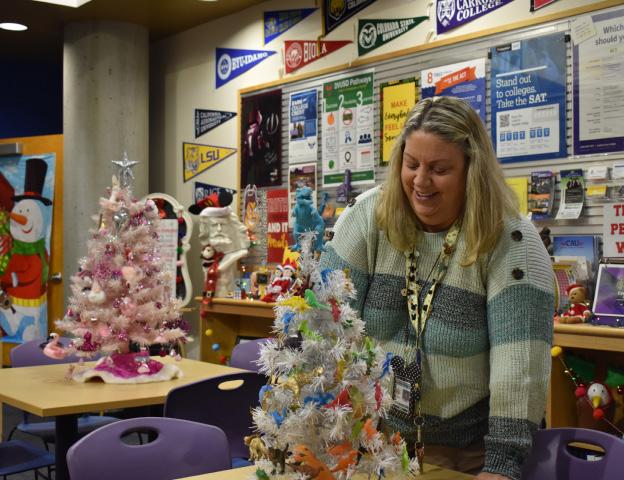
Sue Perreault Counseling Secretary
Stories by Abby Mills, Victoria Kirova, and Gabriel de Souza

Through the central focus on writing, researching, and presenting, AP Seminar strives to help students dive deeper into the development of these essential pieces of knowledge.
With the end goal of a composition of all their research into a portfolio, this class teaches students how to effectively utilize other writing strategies, in order to best represent the research, and connect it to a future profession.
“The benefts of this class are getting the practice of different types of writing,
learning different types of citation, so [students] are really encouraged to explore beyond MLA…so it kind of lets them take skills that would be applicable to a profession and apply those to their research [that] they’re writing and presenting,” said Veronica Elton, AP Seminar teacher.
Another immeasurable beneft this class gives its students is the ability to look at the world in a different way, discovering the reasons behind certain research.
“One of the research skills is going to be more looking into bias. Looking into different lenses, and by lenses we were talking about like ‘is it a scientifc lens, a political lens?’ And looking into different perspectives as well,” Elton said.
Communication is a basic element in human life. This CTE course offered by OHS, enables students to master communication skills as they learn the best way to effectively talk to others.
From personal relationships, to the workplace, and even the relationship between yourself, exemplary communication skills are vital. The course allows students to understand the importance of listening, speaking, observing, and emphasizing. They get the opportunity to develop these skills for future employers.
“Many employers require these soft skills. They're looking for critical thinking, creativity, and defnitely communication skills. It aids you in all aspects of your life,” said Cindy Garraway, Communications teacher.
The class is unique, as it teaches lessons students will continue to use for the rest of their lives.
“There’s no other course here on campus that can impact one’s life, both within their relationships, within their workplace, within their health. All of that contributes to a more meaningful life if you have good communication skills,” Garraway said.
In the past 20 years the world has undergone a technological revolution; OHS strives to prepare students for this increasingly digital world by teaching the in-and-outs of computers.
“We teach basic web design. Web design skills are very important wherever you go, and we teach all parts of programming,” said Sini Thomas, Computer Science teacher.Computer science is a rapidly growing feld that has been integrated into virtually every industry in the
Hosting a wide variety of agricultural practices, cultures, terrains, Arizona contains many examples of what students to learn about in AP Human Geography. With eight different covering human patterns and processes, there is much to taking this course.
As an Advanced Placement class, students are taught using curriculum that prepares them for a fnal exam administered College Board. Test-takers who score well can obtain college the class.
“[In] Human Geography, we study how humans modify and environment around them,” said Tiffany Ellis, AP Human teacher. “We also look at current events around the world how humans use land—especially in a modern setting.”
Through the Human Geography curriculum, students opportunity to learn and explore how and why humans across have developed in the ways that they have.
“It’s a good class to talk about world events, [learn] why the way they are, [and learn] how we interact with the environment,” Ellis said. “We talk about the development of large urban what they look like in the past, present, and future.”
With videography skills becoming ever more important and desired in today’s online world, Media Productions training students to be able to effectively and creatively produce media.
Media Productions allows students to see what it takes create flms and series within the entertainment industry. First-year students learn how to edit and enhance video clips with music and digital effects, oftentimes using their own clips.
“A lot of the frst year [assignments are] project based where students do their own video editing,” Bzdak. “We cover safety, lighting, cameras, [and] microphones.”
Students are given the opportunity to work in the Media Productions studio. While gaining tasked with providing OHS with “The second-year announcements,”

world. This course prepares students for the demands of the job market. Day by day society is becoming more dependent on computers and technology and it is important for students to learn how to interact with it.
“Computer science is everywhere, right? If you want to take up a job, mostly they’re related to computers,” Thomas said. “Any kind of offce job contains some background knowledge in computers. The more knowledge you have about computers in the current era, the better off you are because the chances of employment for you are much higher.”

One of the most Design, enables a digital form. With products at their explore.
“We take an entire graphics, and then which is pixels instead Design teacher. Once students course, there are also to participate in completing several internships, some studentsemployment—bypassing
“There are more and students out of high
cultures, and students can expect different units be gained by using a rigorous administered by the college credit for and adapt the Human Geography world in terms of students have the across the globe cultures are environment,” urban areas and

important is creatively to industry. video their based “We
Students may submit changes to their requested classes on PowerSchool through January 6th
While utilizing desirable business platforms such as Excel and Quickbooks, Accounting teaches students the skills they need to be familiarized with effective personal fnance and budgeting techniques. This three-year program provides an environment to master these fnancial lessons, learning more advanced concepts throughout every step of the course. Through this, Accounting provides opportunities for students regardless of the feld they are interested in.
there.“Nomatterwhatcareerorindustryyouwanttogointo,thereareaccountants
So even if you don't want to be an accountant, you’re going to have to work with accountants and with their software, so being able to understand that lingo, how they do things…is really benefcial in every aspect of business,” said Tiffany Kurtz, Accounting teacher. While the curriculum used in Accounting benefts all who take the class, a common misconception misleads students about the competencies needed for this course.
“Accounting is not math. If you can add, subtract, multiply, and divide, you have all of the math skills that you need and I’ll even let you use a calculator to do it,” Kurtz said.

work with the advanced equipment they learn about gaining valuable skills and experience, students are also with a useful video announcement each week. second-year students are responsible for doing our video announcements,” Bzdak said. “[Students] gather all the
information, they write their script, they flm, and then they edit it into a cohesive [video].”
most popular CTE courses offered by OHS, Graphic students to learn how to express their creativity in With a computer lab decked with Adobe software their disposal, students have many programs to entire semester for Illustrator, which is vector then we go to the second semester with Photoshop, instead of vectors,” said Patrick Bzdak, Graphic complete the introductory graphic design also advanced classes offered that allow students OHS’s school-run business, Eagle Ink. By years of Graphic Design, and participating in students are able to take that experience and fnd employment—bypassing traditional routes of tertiary education. and more companies that are hiring entry-level high school, especially if they’re three or four

Through the exploration of thoughts, behaviors, and actions of people, AP Psychology allows students to discover the inner workings of a human's motivations. This biology-heavy Advanced Placement class explores the nervous system and brain anatomy in order to best provide an explanation for the behaviors of people.
“They are learning critical thinking skills; the ability to change perspectives, so empathy, putting themselves in somebody else’s shoes, social awareness, body language skills. Being aware if somebody is feeling anxious or happy. How to identify those small types of movements,” said Kristen Liptow, AP Psychology teacher. Though the lessons being taught are all focused on preparing students for the national exam at the end of the year, there are immense benefts to being able to view the world through the lens of psychology.
“They can use pretty much anything that they learn in their personal life. When it comes to the felds, psychology can be applied widespread to any feld that you go into. HR runs heavily on psychology in general…[students] can apply communication skills with their peers or coworkers,” Liptow said.
The CTE course makes students read, write, and think like a journalist.
With journalism being more important than ever, students learn the intricacies of the feld.
This four year program allows students to understand how to create a newspaper from scratch, and the inner workings of the feld. It also provides students with a great appreciation for the work of journalists.
“In our current world right now, journalists are some of the most important people out there. They deliver the truth, they should be unbiased, they are fair and impartial. We are able to know what is happening in the world because of these people,” said Cindy Garraway, Digital Communications teacher. “To be in that area and knowing what impact you’ve made on the world and the people around you is something that is defnitely important.”
The class nurtures students' love for writing, photography, and informing those around them.
“You can be the Nancy Wheeler of O’Connor, how cool is that? Knowing everything that’s happening and being involved, plus for college applications and scholarships you’ll have a built-in portfolio if you stay and take newspaper,” Garraway said.
Advertisement

Many students struggle with balancing work and school, not to mention allocating time for other areas in their lives such as spending time with family and friends, or simply pursuing hobbies. It is often diffcult to tell what exactly they should prioritize, but jobs and schoolwork often demand the most time and effort for many students.
Life comes fast, and students typically feel the pressure of adulthood mounting as they apply for their frst job. Suddenly, they do not get to fnish homework just to play videogames for the rest of the night— daily routines have to be sidelined to make room for long working shifts. If they are lucky enough, they have the liberty to quit and resume life as a normal highschool student, but some big changes are inevitable.
While some may have the luxury of simply wanting money to spend on fun toys, many students fnd themselves facing college,
the next step in life that places youth on their own for the frst time. Eventually, work becomes more than an annoying hustle to get some spending-money, but something necessary to prepare for the future. The question stands: how can students balance jobs with demanding schoolwork?
Unfortunately, there is no one-size-fts-all solution, but there are some common things that students struggle with, and some key takeaways. These changes are stressful, and it is no surprise that student lifestyles may have to change with them. Getting an adequate amount of sleep can be a struggle, but a worthwhile investment to stay on top of schoolwork while dealing with a job. Of course, some students are unfortunate enough to be forced into late shifts in the wake of their school schedules. So, frst things frst: students should talk to their manager. Even before applying, make sure the establishment can work
around your schedule; it is an absolute must as a student, and if their manager is not receptive, it is best for them to search for other options. Students often feel conficted with these choices of focusing more on school or work because it seems that no matter what they do, it is still not enough to accomplish everything they want. If they have the ability, students should take advantage of the fact that you are under your parent’s wing, and take time for themselves and their hobbies, doing so will decrease the stress felt on and off campus. Furthermore, the amount of exhaustion felt at a workplace has a direct relationship with the amount of enjoyment gained from the job, so look for somewhere that does not overload you with stress (maybe work with a friend). It might be hard to believe, but talking to a teacher or school counselor can also mitigate some of the school-side issues pretty signifcantly. Getting some

leeway on deadlines, and maybe even solutions for school courses can never hurt, and may alleviate a good deal of stress.
Obviously, nobody’s problems can be fxed with a simple, “do this,” or “do that,” and we cannot shy
away from the hard truth: even with all the proper precautions, students tend to have too much on their plate between meeting deadlines, participating in extracurriculars, making time for hobbies, and working enough to get by.
By SAMANTHA SHARLOT Staf Writer
Black Friday has been an American-tradition for decades; families across the country rush to their local malls to take advantage of the annual deals, kicking off the holiday season with a bang. Companies across the nation market their items cheaper than ever before, motivating shoppers to ditch their Thanksgiving leftovers, and rush to fnd the best discount. With the obvious yet genius marketing tactics in mind, companies play on the emotional and fnancial focus of the shopper, as well as the seasonal joy of buying gifts for loved ones.
The advertisements, deals, and the timeframe of the discounts all play into the excitement around the busiest shopping day of the year.
Companies begin advertising their deals weeks in advance, some even before Halloween. The holiday season is undoubtedly the most prosperous, and more importantly, most proftable, time of the year. Businesses rush to turn the page from autumn to winter to generate larger fnancial gains than the years prior.
The atmosphere surrounding the American retail free-for-all is, at the very least, chaotic for the every-day shopper. Yet different from the aggressive
customers depicted in movie scenes, the intense crowds and fast-paced energy surrounds the shopping center as prices become lower, and the excitement becomes higher. People may not punch or hit, but the subtle shove is not uncommon to experience. The focus on consumerism is truly exemplifed within this day of deals, and it displays the effect material goods have on the traditional holiday season.
Many argue that the emphasis stores place on the sales they produce is toxic to the sentimental and familyorientated energy that surrounds the holiday season. Those opposing the obsessive clearances and constant advertisements claim that

the true meaning behind Thanksgiving is camoufaged by the parade of low prices stores provide. Americans all across the nation leave their dinners early to speed to their local mall to fnd the best deal, which takes away the value of togetherness that our national holiday invites. Family members will risk ditching their family gatherings, just to ensure the coveted items on their wishlist are not whisked away in the frenzy that is Black Friday. Those against the spree of sales Black Friday presents look at those extreme scenarios, and derive a judgment from the toxicity, consumerism and materialism present.
However, Black Friday is more than just a percentage off an item or an adrenaline rush at a mall. It is about going out to buy for those you love. It is an extremely helpful tool families nationwide use to budget their gift spending, and allows shoppers to get more bang for their buck. The excitement of purchasing the perfect present for a beloved family member, or fnessing a discount that was only available for a select amount of time, allows for not only a feeling of excitement for the shopper, but a sense of accomplishment and success. The nationwide retail holiday
gives shoppers the ability to buy more for less, in turn providing more disposable income for the typical middle-class family to spend on their children, household expenditures, or, given the philanthropic energy that surrounds the holiday season, allocate more money for charitable contributions.
Black Friday is more than just a day where crazy shoppers frantically food the mall at discounted stores. It is an event that, whether supported or not, has transformed America’s cultural norms and pushed the emphasis on materialism and consumerism that our nation digests. However, it is a day where people all around can consider those they love, and do whatever they can to make the holiday season most special for them. Whether that is the newest iPad or simply a bouquet of fowers that were discounted at the grocery store, gift-givers are fnancially motivated to think of their loved ones, which in turn stimulates our economy. But more important than that, it pushes shoppers to think of the deeper meaning behind the gifts they are giving: making the people in their life feel valued, no matter the price, which is the real meaning of the holiday season.
By TRUE VAN DYKE Features Editor
ELF: The best and most nostalgic Christmas movies are the ones where you know all the jokes in and out, and make you want to curl up on the couch with a fuzzy blanket and hot chocolate. Hence it is apparent the best Christmas movie is, “Elf.” Everyone starts to crave the sugary taste of pancakes, maple syrup, and chocolate sauce at the simple thought of the movie and the Christmas season.
Two hours of Christmas store fronts, falling snow, and New York holiday cheer automatically lifts anyone's spirits, especially from people who live in a dry desert. No one can go through a mall with holiday jingles playing on the speakers without thinking of “Elf.” The movie reigns over the season, reminding us of it through almost every tradition. What about “Home Alone” reminds you of Christmas? Scary middle aged men?
The perfectly absurd performance of Will Ferrell may be a bit much for some people, but it is his unique charisma that makes “Elf” stand out from the cliche stories Christmas usually brings us. Who else is better ft to play a giant elf? People crave something light hearted and fun to watch during the Holiday season, no matter how outlandish it may be; not a movie about a child’s home invasion under the backdrop of Christmas decorations.
“Elf” is the best Christmas movie for all occasions: family movie night, friends’ gift exchanges, a post-Christmas afternoon nap, and any other time throughout not just the winter season but year round. No matter when the Christmas season started for you, “Elf” should be a staple for every household.
Just like plaid pajama pants, Christmas lights, and peppermint favored drinks are staples of every December, “Elf” reigns over every other Christmas movie to date, rounding out the season fully.


By GABRIEL de SOUZA Editor-in-Chief
HOME ALONE: With hilarious action scenes, a beautifully decorated Christmas home, and an exceptional soundtrack, “Home Alone” has something for every viewer—while still maintaining a message about the true purpose of one of the most celebrated holidays in the world.
Unlike other flms, whose main characters are terribly unlikable whiney manchildren, “Home Alone” stars Macaulay Culkin as 10 yearold Kevin McCallister. The adorable and clever young McCallister, with cunning wits, is able to wart off a nefarious home invasion all on his own.
“Home Alone’s” premise uniquely depicts how the hustle and bustle of modern life can distract from appreciating and valuing one’s family. Kevin is mistakenly left home alone after his family, in a hurried and chaotic state, departs for
a Christmas vacation to Paris, France. After noticing their grave error, the McCallister family—especially Kevin’s mother, played by Catherine O’Hara—does everything and anything possible to travel back thousands of miles and reunite with Kevin. This plot line revealed the flm’s not-so-unique message about family; however, what keeps audiences coming back every December is the remarkably comedic way by which “Home Alone” presents this.
Just how successful and adored “Home Alone” is can only be seen by its box offce triumph. The flm was the second highest grossing movie of 1990, beating out other iconic flms of the year like “Pretty Woman,” “Back to the Future Part III,” and “Die Hard 2.” Grossing over 476 million dollars, “Home Alone” knocks it out of the park when compared to other Christmas movies like 2003’s “Elf” that grossed a mere 225 million dollars. With so much to love, “Home Alone” will forever be a classic.
By VICTORIA KIROVA Copy Chief
With the current true crime obsession many individuals share, questions arise about when this infatuation with real-life terror becomes problematic. Though some people innocently view this type of media in order to delve deeper into the mindsets of these inhuman people, consuming too much true crime content is downright concerning.
To put it plainly, true crime dehumanizes the victims of these abhorrent crimes. When shows and movies are created detailing the explanations behind the killer’s means, the victim simply becomes another casualty. They are another unknown name that is used to drive the main “plot” surrounding the
actions of the abuser.
The problem with this occurrence is that most of the time the victim or a relative of theirs is still alive, and is forced to revisit their trauma. They are also often not even contacted prior to flming, so they have no say regarding what they would feel comfortable about sharing with the world. While this media is a form of entertaining pastime for some, for others this extremely insensitive approach to showbusiness is disturbing and often even inaccurate portrayal of the real-life events.
This common issue also glorifes the person committing the barbaric crime. It makes their name memorable, as these shows and movies are often named after them, and feature
an attention-getting title.
A known example of this is the Ted Bundy movie, “Extremely Wicked, Shockingly Evil and Vile.” The inclusion of these adjectives make the deeds of this cynical man seem like that of a character. They make Ted Bundy the equivalent of a villain in a storybook, instead of showcasing the very real man he was.
Another controversy surrounding true crime is the fact that some people feel sympathy for the murderers, rapists, and sociopaths of the world. These despicable people often have traumatic backstories that are showcased in these mysteries. Their actions are then blamed on an absent parent, an internal confict, or another type of scarring

The Talon is published as a forum for student opinion at Sandra Day O’Connor High School: part of the Deer Valley Unifed School District. The Talon is an award winning publication with dozens of awards for its staff members as well as ranked as the
top online publication and one of the top print publications in the state. Letters to the editor must be signed and dropped off to Room 508, e-mailed to thetalonohs@gmail. com or mailed. Letters may be edited for content and/or space
consideration. Obscene or libelous statements will not be printed. Opinions refected here are of those of The Talon staff and do not refect the Deer Valley Unifed School District. Visit The Talon online at thetalonohs.com to see stories weekly.

occurrence. While it is important to understand the full story, there is absolutely no justifcation for the crimes committed, and any pity on the audience’s part is quite frankly disgusting. These feelings of empathy that viewers are made to feel almost praises the killer and makes them seem like just another misunderstood person. The desire for movies and tv shows to include these tragic backstories stems from their need to include some confict and turmoil, resulting in the unfair rehabilitation
Editor-in-Chief: Gabriel de Souza*
Copy Chief: Victoria Kirova
Advisor: Cindy Garraway
Design Chief: Abby Mills*
Podcast Manager: Aayushi Datta
of these sinister people. This completely disregards the feelings of the victims and their families, stirring up even more agonizing emotions. True crime content has been viewed and encouraged to a point of toxicity. Though they make some feel powerful as they dissect the true motives behind a criminal’s behavior, Hollywood is blending the line between fction and reality, creating the nauseating glorifcation of these abominable individuals and a reduction of their crimes.
Sports Editor: Kaitlyn Smitten
Editorial Chief: Cian Ryback*
News Editor: Ananya Thekkemelepatt
Features Editor: True Van Dyke*
Staff Writers: Amber Hayden Samantha Sharlot*
*Denotes member of editorial board.
brilliant effects of Disney’s animation skills.
“Strange World” was only given a “B” grade by CinemaScore which is currently one of the worst recorded marks for a Disney animated flm. With Disney’s last animated movie being “Encanto,” “Strange World” naturally had some big shoes to fll and if moviegoers give it a chance, they will surely see the excellence of this new flm.
Even with this less than stellar rating, “Strange World” has a lot going for the flm. It has stunning visuals with vibrant colors in all scenes which draws the viewer's attention. The flm's animation goes perfectly with the tone of the story, emitting the right emotions at the right times. If viewers pay attention to the expressions on the characters' faces, they will come to realize and appreciate the effort put into making the story come to life on the screen with every little detail. Even with characters that do not have speaking roles, you can still tell exactly what emotion they are feeling with the
When it comes to the story itself, “Strange World” tells the narrative in an unexpected way which is unfamiliar to a Disney flm, but it could not really be told any other way. Even if it could, this would forever be the superior method because it showcases the beginning of the complicated relationships that would later be explored in the flm as well as plenty of foreshadowing at the adventure ahead.
The movie immediately grips its audience with beautiful graphics and the introduction of the amazing main cast. When it skips ahead to the main story, it becomes clear that the trailers for the flm did not lie when they said it would be an adventure. The problem they have to solve in the story requires the structure used which beautifully showcases the masterful storytelling showing the incredible plot dynamics between both the character relationships and adventure in the tale itself. The foundation for any good story are characters and “Strange World” establishes multiple lovable characters
for fans to root for.
The flm shows a wonderful family that each have their individual problems which build up over time as the story goes on. It shows daily life and spends no extra time getting to the root of the problem they will have to solve thus bringing the highly anticipated action to the story.
The family reaches the plot point in the flm where they have to go on a mission and as with any thrilling family adventure, chaos ensues. It is only when they depart on this adventure that the themes circling around family really come into play. The resentment in the family becomes both seen and recognized. They are forced to come to terms with it and work out their complicated family ties.
It is fascinating to see in a Disney flm how all three generations of a family work on understanding each other better. They each admit how they are truly feeling and explain what the others have missed the whole time, truly highlighting the importance of these conversations between families.
Even with it being a Disney

movie, it still deals with many complicated topics in a fairly lighthearted story. It shows how communication in families is important and what can happen when those needs are not met. It showcases the complicated ties between different generations and does a brilliant job at showing how everyone feels in those situations.
Alongside the beautiful character journeys comes an incredible plot that really takes the characters for a ride. If not for the story itself, the flm would not have been able to explore the themes it did. There are many high stakes action sequences which each beautifully showcase the characters saving the others which drives the themes of the flm home. Every scene is important to the plot and
continues to keep the viewer on the edge of their seats wondering just what is going to happen next, because in this strange world, anything seems possible.
The main story ends in a satisfying way with the flm coming around full circle tying up any loose ends by revisiting the characters one year later. It is fascinating to see how things have changed with all of the characters as well as how they have all changed since the beginning.
Even though “Strange World” did not become the success it deserved it be, it stands to be an incredible movie for anyone looking for a fun adventure with elements of family, complex characters, and a plot that always leaves you wondering just what is going to happen next.
There is only one thing audiences can rely on during the Christmas season: bad romance movies. With the frst fall of snow comes a slew of low-budget romance movies to give the world a little Christmas cheer. Netfix’s hit movie, “Falling for Christmas,” is no different. The feature flm follows Sierra Belmont, played by Lindsay Lohan, as she undergoes a traumatic head injury, leaving her with amnesia and falls in love.
“Falling for Christmas” follows the perfect Christmas romance movie formula: an improbable relationship between a rugged widow and a wealthy heiress— who is already engaged. Although seemingly generic, the basic plot of the movie is bizarre. Our protagonist, Sierra Belmont, wakes up at hospital with no recollection of who she is. Jake Russell, depicted by Chord Overstreet (yes that is his real name), takes pity on Sierra and offers her a place to stay while she regains her memory.
Sadly, the romance is
lackluster. Sierra and Jake have no chemistry together, making their interactions full of awkward glances and no passion. This makes it even more unrealistic when, over the course of only four days, Jack and Sierra begin to fall in love with each other. Half way through the flm, Sierra says to Jake, “I don’t think I’ve ever met anyone like you before.” Which is funny, given he is one of the only people she has ever remembered meeting. The entire selling point of the movie, the romance, is disappointing to say the least.
One of the main issues of the flm is its acting. Every character on the screen seems almost hyper-aware they are in a movie, constantly overacting to the point where it distracts the audience. Specifcally, the character Tad, portrayed by George Young, is a tad too much. His obnoxious line delivery leaves much to be desired. However, Jake’s daughter, played by Olivia Perez, was an absolute delight. Her presence flled the screen with joy every time she stepped onto the big screen.
“Falling for Christmas”
has the perfect setting for a Christmas movie. North Star Lodge, where Sierra stays at is flled to the brim with Christmas decorations. There is not one scene throughout the movie where holiday trinkets do not make an appearance. The fctional town in the movie almost seems magical and sets the tone of the flm fawlessly. Other elements allow the flm to shine as well, such as the hair and costumes department. It would be criminal not to mention Sierra’s hair, curled fawlessly in effortless ringlets. It looked so perfect it could take movie goers out of their viewing experience. The outfts the characters wear, also, do a great job of immediately telling the audience who they are. This gives a little more life to characters, like Sierra or Jake, whose personalities were nonexistent.
When compared to other Christmas romance movies, from the likes of Lifetime or Hallmark, “Falling for Christmas” shines brightly among the rest. The flm is not terrible; it just is not good. Its biggest fault is the dreadful plot but the movie
has obvious heart. “Falling for Christmas” would be best watched as background noise when doing something else.
Or else you may suddenly want to become amnesiac in order to forget the experience.


“Anti-Hero” by
Taylor Swift
At the top of her well anticipated album, “Midnights,” the song “AntiHero” has come out as a fan favorite, even climbing Billboards Top 100 to its number one slot. Its more upbeat tone in comparison to the rest of the album has clearly caught the attention of many, but for some, it has not gained the good kind. A select crowd of listeners are drawn to immediately skip the song when it comes on instead. The cringe lyrics and mid 2000s infuence the song gave did not leave much hope for the rest of the album the frst time around listening to it. The 2012-Ellie Goulding and Natasha Bedingfeld era was too recent to start introducing their styles back into music today. For the excitement and expectations that Taylor gained for the album, “Anti-Hero” as the third track put a damper on what we know she can do. Even though it may be a fan favorite, the album contained songs worth more hype than they got, and at least as much as this one gained.


“Made You Look” by Megan
Trainor
Whether you hate Megan Trainor or not, most people have not been able to escape the endless stream of TikToks just from this one song alone. But a lot of listeners are not that mad about it. Fans of hers typically have a very specifc taste, and love the energy her music gives off, but even for those that don’t, after one 15 second sound clip of “Made You Look,” it is almost sure that it got stuck in their heads. The catchy lyrics of the song are sure to annoy anyone that listens to them by the way they will not be able to stop thinking about it, which is not necessarily a bad thing. The success of the song has skyrocketed, spreading in popularity, rapidly. It could end up being a week-long trend, or it could continue to climb different charts as it has been doing, but either way, the little taste of modern Megan that has taken over every platform, already gives the collective a boost of serotonin and a new curiosity for what else she has in store.
“Spin Bout You” by Drake, 21 Savage
While Drake’s new album, “Her Loss,” was collectively disappointing, a few of the songs stand out more than the others, such as “Spin Bout U” Even people who are not the biggest fans of Drake, can agree 21 Savage makes him ten times better, as showcased in this song. For the hype that this album was expected to gain, many anticipated there to be more fan favorites than there were. Yet, everyone agrees that some stand out signifcantly more than others. The only song continuously seen at the top of people’s rankings was “Spin Bout U.” The song, thrown in the mix of a bunch of mid ones, matched the reputation that Drake has built for himself and only left a wish for what the whole album could have given. The song is the selling point of the album and one of the only redeeming qualities. “Her Loss” won’t go down as a win for the artist, but “Spin Bout U” was a clear glimpse into what we know he can clearly do, and hope for the future of our playlists.
“Lift me up” by Rihanna
This sentimental addition to the “Black Panther: Wakanda Forever” soundtrack has branched out on its own as an individual success, leading up to the release of the movie. The modern ballad has cultural infuences that tie into the movie’s theme, capturing the same emotional heart that the flm is sure to withhold. Rihanna had been teasing new musical releases for years, leaving us to listen to her old songs on repeat in the meantime, up until now. The repetitive lyrics are more like a meaningful stamp on us than they are headache inducing, leaving you wanting to listen to the beautiful lyrics over and over again. Whether you are a RiRi fan or not, this release is sure to send you down a spiral of all of her music, and leave you wanting to watch the new Black Panther movie, just to see the song in action. It is up for debate if this song is enough to hold people over until Rihanna’s next full album release, but fans are not complaining at the spot it’s flled for now.
By VICTORIA KIROVA Copy Chief
After years of excited anticipation, the sequel to the cinematic masterpiece that was the original “Black Panther” has fnally hit theaters. Though the plot of this new movie was overstuffed, the alluring imagery and honorable tribute to the original black panther, Chadwick Boseman, allowed the movie to still be an overall success.
This flm follows the necessary rise into power of Wakanda rulers in order to protect the nation following the devastating death of King T’Challa, played by Boseman.
The overall tone of this movie was somber but heartwarming, portraying one of the most emotional stories recently seen in the Marvel Cinematic Universe. The power behind this movie came from the praise the cast was eager to give following the real life passing of Boseman. Due to the deep personal connection he had with the cast, the palpable love they carried was evident throughout the flm. This emotional attachment made the acting phenomenal, as the tributes to Boseman played a pivotal part in engaging the
audience and allowing them to feel both the real life and on screen pain this death brought.
As the plot of the movie unfolds it is evident that a courageous leader is needed and soon. Thankfully, King T’Challa’s sister, Shuri, portrayed by Letitia Wright, is ready to step into this role and prove to everyone that she has what it takes to be a successful and respected fgure, who will fght for the protection of Wakanda.
A signifcant positive of this flm was watching the gradual ascension of Shuri into a higher position of power. In the frst movie, she was much more of a comedic character who amazed the viewers with her inventions, so watching her fght to stay true to herself when faced with dilemmas, while still remaining a fan favorite, was an interesting shift for the audience to witness. Through her character, the movie does a phenomenal job at showcasing the ways that individuals process the tough reality of death and the effects that follow. Wright was able to successfully convey these complicated emotions in an effortless manner, putting her talent on display for the audience. Though the character
development throughout the movie was inspiring, a shortfall is the overly condensed plotline. The plot surrounding the potential attack of Wakanda by the newly introduced character, Namor, played by Tenoch Huerta, simply seemed like a hasty attempt to create confict. Though Namor did add some intensity to the plot due to his depth as a character, the entire two hour confict of the movie seemed like a prequel explaining the backstory and setting the stage for the hopefully more engaging third movie.
Another disappointing aspect of the flm was the repetitive and dull action scenes. Marvel is known for creating unique battle scenes and with this flm, they had a lot of creative freedom to utilize new technology in order to make the most cinematic scenes; however, these moments seemed pointless and only a couple truly stood out to the viewer.
Though this sequel to one of the most well-known Marvel movies had some faults, overall it was an enjoyable watch that left the audience with a sense of content. With consideration of some of the complaints surrounding unnecessary plot points, there is no doubt in

By SAMANTHA SHARLOT Staf Writer
OHS’s fall sports teams have always brought about a culture of school spirit and involvement around campus, starting off the new school year on an exciting note. OHS fall sports teams have always performed outstandingly, and this year was no exception. This season brought about an enthusiasm that has not been seen in a long time. OHS fall sports were exceptional this year, with multiple teams competing at state, earning titles and making it to playoffs.
Football:
Football made incredible strides this season, making history for not only the
school, but for the district. OHS football was the frst team in DVUSD history to compete in the open division for state playoffs. This is not only the most prestigious division in Arizona, but is ranked as the sixth hardest division to qualify for in the nation. Throughout the season, the team performed exceptionally well, and relied on each other to achieve victory.
“I would say all of us being like a family, including the coaches, [contributed to our success]. Practicing hard, lifting hard, buying into what the coaches were telling us, and just loving each other, never doubting each other, and just playing football,” said Cooper King, senior. .

It was evident that the bond the players had with their coaches, and how invested each of them were contributed to their players’ success, both on and off the feld.
“They treated us like their own sons. They loved us. You could tell they actually cared for us and wanted us to win and wanted what’s best for us. They always put us frst instead of them,” King said.
Aside from the dedication shown by the coaches, the football program has evolved in other aspects as well, in particular, the team’s chemistry with each other.
“The culture has changed from different types of groups to one big family. Usually the seniors had their little group, the juniors are their own group, then sophomores, then freshmen had their little group. But the freshmen, sophomores, juniors, and seniors had one big family, and we always tried to make each other better. I think that was a big change,” King said.
It was clear how tightknit all the players were this season, and how well the seniors led each other to become not only a winning team, but a unifed family.
“I think it’s mostly from
last year. A lot of us seniors realized in order for us to win and be good, we had to be a whole team and not just seperate teams,” King said.
Boys Golf:
Not only did football do exceptionally well this year, but boys golf did as well. They placed high in state and competed in the state championships. However, their season did not start off as celebratory.
“We started out rough. We didn’t really play how we all knew we could play,” said Quinn Jackson, junior.
Luckily, their season took a 180° turn, and the team began performing how they felt they should, and the results paid off.
“Towards the end of the season, we put it together and bumped ourselves up to 9th in state, going into the state championships,” Jackson said.
Team chemistry is vital to the success of a team and even though golf is more of an individual sport in the sense of competing, each player has to know that their teammates have their back.
“We all clicked, for a couple of matches there,” Jackson said. “I think that’s what made the biggest effect.”
As the season continued,
the team started to bond, providing unity and trust amongst the players.
“We went up to Flagstaff, we went to Tucson, which was a 2.5 hour drive,” Jackson said. “You spend such good times with your fellow golfers, so I just developed really good relationships with all of them.”
The team worked incredibly hard all season to generate impressive results for OHS, and always had a clear motivation at every match.
“Practice with a purpose when you’re on the golf course. You can’t just go and hit golf balls. You have to hit golf balls and with every swing try to do something different to help you get better,” Jackson said.
Swim:
Along with boys golf, OHS swim also received a ton of accolades this year, representing the school at the state level
“I think we did a lot better than last year. We had more relays make it to state this year, and we also had our relays make it into the A-Finals, which is super cool,” said Caelle Armijo, junior.
Continue reading at thetalonohs.com
By KAITLYN SMITTEN Sports Editor
With Friday night lights dying down, the OHS 2022-23 winter sports season comes to life. Composed of basketball, soccer, and wrestling, OHS has an exciting glimpse into what to expect from these teams.
Girls Basketball:
Going 13-5 last year, OHS girls basketball has quite the reputation to uphold. With a new coaching staff, and an abundance of young players, the team has a lot of preparation to do in order to top their amazing run last year.
“This team is very different from the previous years. We have some new pieces [players] to our team that contribute a ton. We are going far this season and really pushing for a state title,” said Makaylei Snyder, senior.
The OHS girls basketball team has been working harder than ever during the offseason in order to meet their goals of winning a state title this year.
“We all have the common goal of winning state and we know that all the other teams are putting in just as much work as us so when we don’t have the motivation at our early morning workouts, or other times, we tell ourselves that this is just going to
make us better and set us apart from the competition,” Snyder said.
Combined with determined and extremely talented players, the OHS girls basketball team is eager to show off their hard work.
“The players still have the same mentality of giving it all and 100% and working for what we want. This year we have built a brand new team and structure and are really looking forward to working for what we want,” Syder said.
OHS has always been a very competitive sports school, and girls basketball is no exception.
“Sandra Day O’Connor women’s basketball isn’t an easy team to beat and will bring the energy to fght every game,” Snyder said.
Boys Basketball:
Along with their counterparts, OHS boys basketball has also been working extremely hard to meet their goals of making it to the post season this year.
“Our team has been working really hard in preparation for this season so you can expect lots of wins this year,” said Ryan Larson, senior.
One of the most important aspects to any team sport is the chemistry and friendships between the players.
“I plan to develop the team
by having our team be friends outside of basketball. The closer we are off the court, the more chemistry we will have on the court,” Larson said.
Not only does OHS boys basketball intend on getting closer as a team and winning this year, they also plan on continuing to develop the program in order to make OHS a top school for basketball.
“Winning should be the most important aspect of the team for all the players and coaches involved,” Larson said. “If you want something, go out and pursue it until you get it.”
Wrestling:
This year, OHS wrestling is fortunate to have both girls and boys on their team, which is a frst in school history.
“We are pretty much newbies, but I expect great things from these girls. They put their hearts out there and they put everything, their blood, sweat, and tears, and they are just in it to win it,” said Mia Martinez, senior.
Despite the team dynamic changing from a boys team to a co-ed team, the OHS wrestling team will no doubt be able to keep up with their opponents.
“The thing that we all have in common is that we all have a drive. We all just want to test our mental and physical
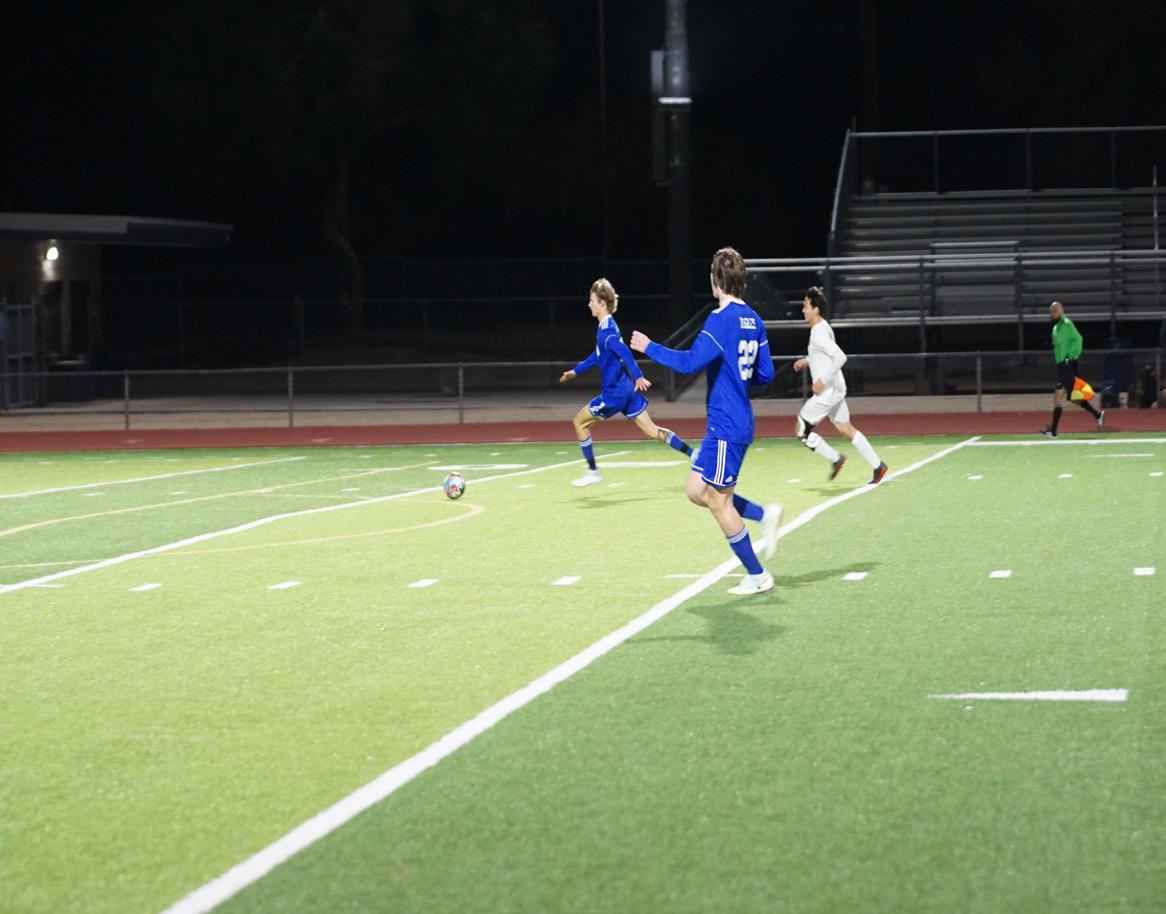
strengths,” Martinez said. “Wrestling is considered one of the hardest sports because not only does it break you down physically, [but] it also breaks you down mentally and you really have to break through. You have to be broken down and then built back up.”
Girls Soccer:
After a tremendous season last year, OHS girls soccer is back and better than ever.
“We look really good this year. We’ve got a lot of younger talent that we have brought up from J.V so I think that honestly, you’re probably looking at a fnal four team right now,” said Rece Grant, senior.
Every year, the OHS girls soccer team improves, and
this year, the team is expected to continue that trend.
“From [my] freshman year until now, I feel like we have made it further in the postseason than we have in years prior,” Grant said.
With a fair amount of senior players on the team, each and everyone of them is looking to make their last season their best.
“I would try and bring out some creativity in the team. Like not just passing the ball like maybe taking someone on or trying something new in games,” Grant said. “Just keep working, it will all work out in the end.”
Continue reading at thetalonohs.com
