


OHS is never short of talented athletes and rigorous students, the balance of the two something to be impressed by. Despite the variation, all student athletes eventually have to answer the looming question of which area in their life they choose to prioritize.
The diference between a student athlete and an athlete student might be small, but can also be evident in the future paths of diferent OHS students across not just the school, but also their respective sports.
“Student athlete; the student comes frst, academics come frst, and then obviously athlete student is the other way around; they prioritize their skills, abilities, and their sport,” said Charleigh Schuettler, junior, Rutgers University commit.
The passion for school or one’s own sport is not always one distinct path or the other, but can typically be seen in varying gestures by both outsiders and peers.
“Usually those athletes will
take not as hard classes, and they don’t really care as much about their grades,” Schuettler said, “Obviously you still have to have good enough grades to be eligible to play, but there’s defnitely some motivation [diferences].”
School will never not play an essential role in every high school athlete’s life, but the efort demanded from those that choose to challenge themselves in every area vary greatly.
“I realized that I couldn’t do both, it was just getting too much for me, and mentally it was just smarter to just give myself a break; I’m doing an easier load this year so that I can focus on swim and really lock in before college,” said Caelle Armijo, senior, University of Southern California commit.
From the perspective of those that hold their sports to a higher standard than the classes they may take at school, athletes can also see the difering levels of efort within their team environment.
“You can tell when someone doesn’t care as much about basketball, but it’s also important for them to be focused on school,” said Blake Colvin, senior.
As much as high schoolers may like to give a hundred percent of their efort in every area of their lives, ultimately one can only give
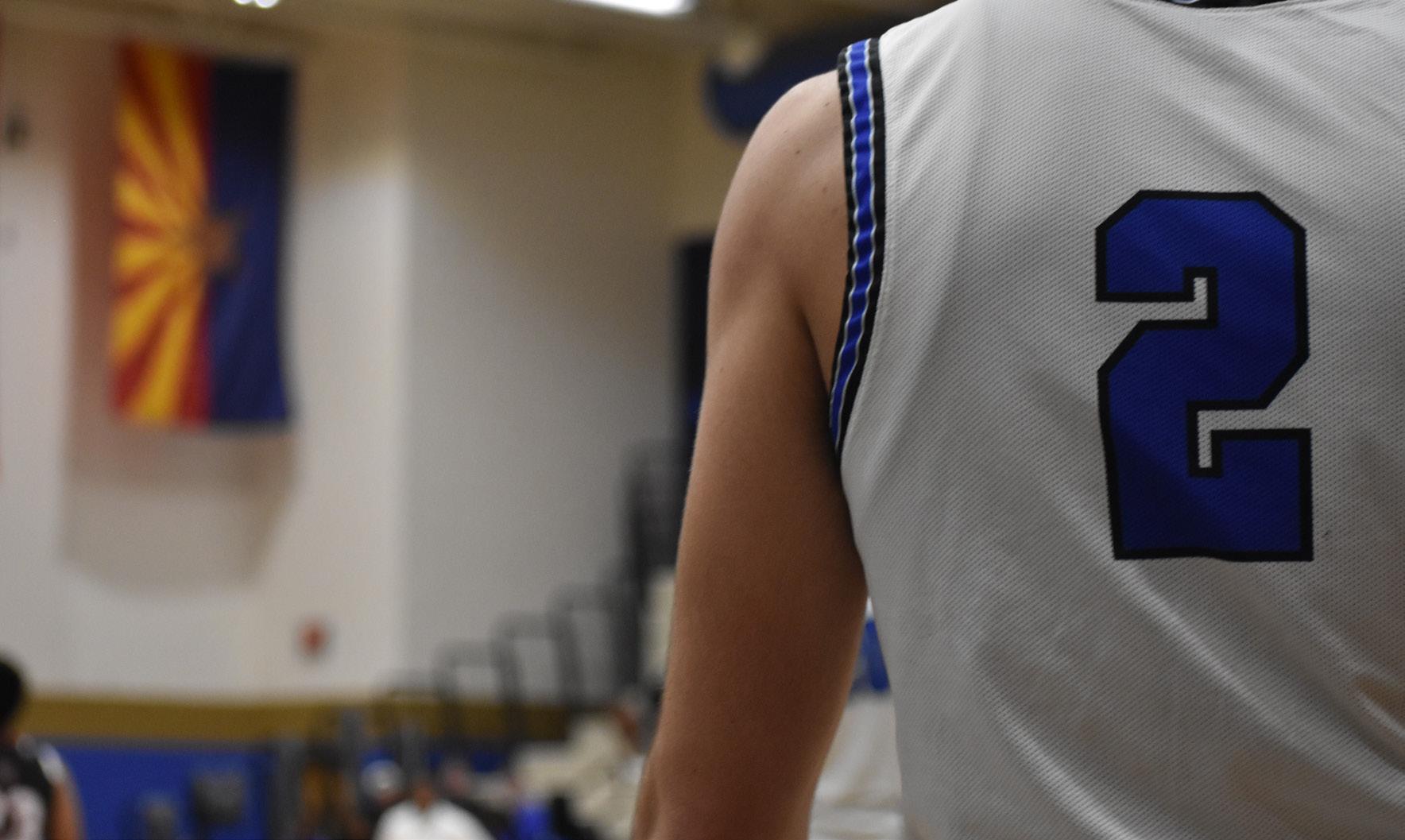
so much before it starts to wear on both their mental and physical health.
“You always have to have a balance; my coach always tells me you have to have a balance between your sport, your social, and your school life, and you can only give into two at a time,” Armijo said.
While the level of courses taken in school can be a diferentiating factor, the time allocated outside of school between sports and social activities can also be a large factor dividing student athletes’ priorities.
With college admissions season in full swing at OHS, upperclassmen not only deal with the struggle of getting into a university, but must also begin to select career paths.
The unfortunate reality is that a great deal of young adults are abandoning their humanities majors for STEM (Science, Technology, Engineering, and Math) felds, even when they have utterly no interest in the subject matter. The notion of a useless degree has become popularized, and the stigma behind certain academic paths are consequently infuencing student choices.
“I do not think there’s such a thing as useless degrees because I never think
education is useless,” said Tracey Heath, counselor.
The pursuit of a highpaying job directly after graduation is a primary reason students leave felds not based in economics or engineering. However, a relatively unknown fact is that non-STEM careers catch up fnancially in the long run.
“Sometimes people are choosing majors that they don’t necessarily want because they want to make the money,” Heath said.
Unfortunately, lowincome students are disproportionately afected when faced with the stress of choosing a profession. They need more than the automatic merit scholarships universities may ofer and cannot aford to graduate with student loan debt.
“I would never want
students to not go to college and pursue their dreams because they can’t aford it... all of us in the counseling department really push students to look for private scholarships. There’s so much access to them, there’s millions and millions of dollars to be had in scholarship money. Students just need to look for it,” Heath said.
If students are unsure of what they are truly good at, and how to apply that in the future, the counseling ofce ofers efective career tests.
“We actually can see it right in their faces when they’re taking the test. I have found when we give those career tests, if they answer the questions honestly and thoughtfully, it does get some students thinking about it,” Heath said.
“It takes a lot of planning, I use an agenda and calendars, but school comes frst; I make sure I get all my homework done, even if that means doing it on the car ride to practice or staying up late, I have to get it all done,” Schuettler said.
OHS and its athletic program is not the only domain for athletic talent and sportsmanlike competition.
“If you play a sport outside of school, it’s probably at a higher level than what you experience at school, and so their commitment and dedication to the sport is going
to be a lot greater,” Schuettler said. There is a lot that goes into the range of youth in sports, and what defnes their priorities–a battle between talent, time, and the future. The level of competition and commitment is a rollercoaster of variation, all crammed underneath the title of “student athlete”.
“If you’re doing a sport, that’s not just going to carry to college all the way; nothing is guaranteed, like you could have an injury, [so] it’s still important to keep grades up, but you should still pursue your sport more,” Armijo said.

Page 4
Page 2 Page 5
After graduation, many high school students may feel lost, unsure if they should enroll in a university, take a year of from their education, or perhaps join the workforce. One thing remains constant in the search for the correct path to follow postgraduation: a pervasive feeling of uncertainty about what one should do for the sake of their future.
At OHS, many students have taken this frst difcult step into adulthood in the form of pre-professional programs, ranging in a variety of specialties from Culinary Arts to Welding Technology. These classes provide an extraordinary opportunity for those students with the drive to jumpstart their journeys in their respective trades.
“I chose to enroll in nursing because I want to be a nurse when I grow up, and this was an easier way to start that,” said Dominic Bustamante, senior.
For some, programs such as West-MEC (Western Maricopa Education Center) fulfll lifelong dreams in desired careers.
“I’m doing fre science,” said Brody Blatnick, junior. “My dad is a frefghter, and I want to follow down his path.”
Furthermore, these classes come with many benefts that one would be unable to fnd at an expensive university, a community college, or even a local trade school.
“I missed out on taking advantage of the opportunity, and so I’m so passionate [about] what CTE and trade opportunities can do for students,” said Joleese Meadows, West-MEC recruiter.
“They can take advantage of West-MEC before leaving high school, get certifed for an industry, [and] get college credits for a lot cheaper.”
Such benefts are wide-ranging, touching the lives of students far beyond classroom instruction.
“We [had] a coding student. His family was struggling fnancially, and he was wanting to do this to then get a job that paid well. He went from having no money and having to borrow a family car to buying his little sister a car to get to West-MEC as well,” Meadows said.
One of the most notable characteristics of West-MEC and other pre-professional programs
is the career-based experience that students can partake in.
“As a second year, we have animals, so we usually would do animal intake where we have to get split up into groups and do vitals on animals,” said Kelsey Kurtz, senior.
Outside of the worklike environment that these classes provide, the separate campuses all have their own unique sense of community, a group identity that they foster based on their shared interest.
“In the nursing class, we’re all from diferent schools, but we’re all friends; we’re very close,” Bustamante said.
Many are able to look past the inconveniences that these ofcampus programs present due to the overwhelming amount of advantages, and simple joys, that West-MEC and similar schools deliver.
“The drive is a little far, but it’s worth it. It’s fun hanging out with diferent schools and all working together,” Blatnick said.
This sense of togetherness is not only a product of smaller, specialized courses that attract dedicated students; the schools themselves are devoted to
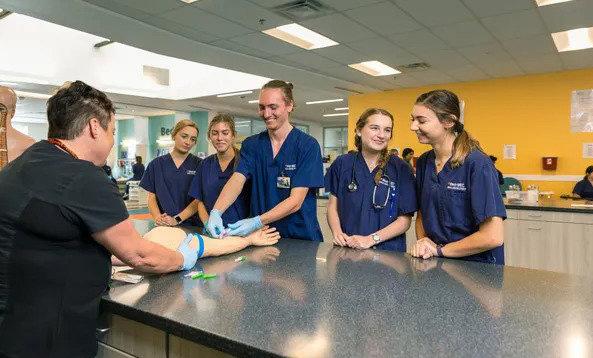
promoting this exceptional feeling of kinship.
“We have a lot of community events that happen. For example, on Friday we’ll have our ‘Experience Orange’ where we open our campus to the community to come in and learn about West-MEC and what they do,” Meadows said.
Looking toward their futures, a majority of pre-professional students have strong aspirations to continue on the path they have already chosen to follow.
“[After graduation], I can go straight into working as a veterinary assistant which usually, you have to go to school for a year…so I’m going to probably go
work as an assistant while going to college for whatever it is that I end up wanting to do,” Kurtz said.
Just as students employ WestMEC and similar programs to chart their lives after graduation, these schools are also looking to the future–and to how they can expand their courses and infuence even more students, in an even greater number of locations.
“Our ffth campus is going to open sometime…[and] we’ll see a lot of program expansion,” Meadows said. “Being able to see even more students become economically independent and not have to struggle through college and try to aford their lifestyle…is going to be really great to see.”
The infamous infnite scroll is something every teenager has faced in this generation; scrolling through TikTok, watching seemingly harmless videos out of boredom for hours on end.
At least that is how it starts. The fun videos come before clips of tragedies, violence, and what can only be described as traumatizing to young, developing brains. Some may wonder where this issue begins. What is the real root of Gen Z’s mistrust in the media?
It may very well start with overexposure. Teenagers have continuously grown accustomed to the ever-growing social media platform TikTok, a platform where viewers can watch all sorts of content. That includes fun, innocuous videos, but can also include the real-life horrors that teenagers are being subjected to. Many teens would rather use social media to kill time, than to see all of the stresses that this world can bring. But when watching TikTok and other social platforms, going from fun videos to depressing ones can become exhausting for the teenage mind to handle.
“It's a buzzkill. I kind of went on there to clear my mind and distract myself from real life,” said Audrey Palacios, junior.
Centennials are living in a world where everything is accessible to them via social media and news services. However, there is a common thread between teenagers and the media. Most teenagers have a level of distrust of the media when it should be a source to understand what's going on today. Yet, teenagers have continued to express disappointment and tend to be wary of what they see online.
“I don’t believe anything the news says. I believe it's completely monitored and regulated in ways that they purposely don’t want us knowing stuf, and they purposely manipulate opinions to favor a certain thing,” said Megan Wolny, senior.
However, it is not shocking that people feel this way about the news and news stations themselves. According to rsf.org (freedom of press index) America is ranked number 45 out of 180 countries. The United States doesn’t place in the top ten countries in terms of press freedom. This is a contributing factor to the mistrust people are expressing.
“I feel like the news is pretty biased. Each news station has a diferent perspective,” said Vedant Singh, junior.
The amount of negativity that can be seen due to social media, and the news is a lot for young developing minds to comprehend.
Gen Z as a whole, has been exposed to so much due to the chronic internet presence that has been forced upon this generation; and when people see too much of the same topic, they become desensitized to that problem and it becomes normal.
“I do think we are desensitized, just because when you see something so much where you can’t escape it, that's gonna be the only thing you're going to think about,” Palacios said.
However, there is also a mental health factor that ties into the root of the issue. Anxiety and depression have only continued to get more light and attention as more people are afected by the issue, and apathy seems to be one of the coping mechanisms that teens use today.
“I don’t like social media. For a long time, it's made me feel gross.
The idea of it– the fact that you can go online and fnd out anything about anyone within seconds. If I could, I’d get rid of it,” Wolny said.
Social media has a huge infuence on society and teenagers. There is often a debate on what the infuence is. If it is positive or negative, yet ultimately the truth is, the infuence is both; however, the negative poses a signifcant impact and is messing with the minds of today.
“You have young impressionable minds listening to this stuf,” Wolny said. “They don’t do their research, some people do and props to them, but some people don’t do their research and it kind of goes of the fact that the news can use all sorts of ethos, pathos, and logos, all of that to lure people in. They use trigger words that entice people to keep reading.”

Ethos, pathos, and logos are the appeal to credibility, logic and emotion, drawing you in. The unhinged headlines using the trigger words go into yellow journalism, a crude exaggeration of a story, which is pushing people away from the news and creating the distrust that society has with the media today. This ties into the desensitization and apathy that Generation Z has expressed through the years.
“Social media does desensitize us to a lot of topics that may be heavier to the general eye. I do feel like other external factors play a role, however, with lots of media being published, whether it be factual or not, Gen Z is exposed to a lot of information that can be overwhelming and result in that apathetic attitude,” Wolny said.
The whiplash teenagers feel from the constant negativity battling the withering positivity of the internet, continues to control the general public. Media is geared towards specifc audiences, creating a bias that people naturally seek. And more often than not, that pushes an increasing number of people away, rather than gaining a larger audience of support.
“Because the media is so directed towards people, that once they see you're following a trend, they will keep suggesting stuf that feeds into that,” Wolny said.
When it comes to junior or senior year of high school, the opportunity of having partial days arises. In some cases, students strive to obtain the least amount of classes possible, thus making this option an enticing one.
Nevertheless, students choose both full and short days, each providing their own advantages and disadvantages.
Early release days create an easy exit for many students. They can avoid the stress and frustration of getting to or from school at the same time as everyone else.
“I like that I can sleep in, the fexibility of getting to come to school late, and not having to deal with trafc in the mornings,” said Tanner Clark, junior.
Shorter school days also provide a sense of freedom that students do not experience during a full day of school. It allows time to de-stress and focus on completing course work or pursuing other passions.
“Being able to leave school early is amazing in my opinion. There isn’t that much trafc like at the end of the school day and it also makes me feel more productive since my day ends earlier,” said Jami Shaver, junior.
Some students opt for taking online classes as an alternative way of shortening their day on campus. Online classes allow
students to obtain course credit from their home, and provide a sense of fexibility to their daily schedules.
“I’m taking photography and algebra online this year. I would recommend people take online classes because it’s so easy, and worth the benefts,” Clark said.
With students choosing to have shorter on campus school days, it becomes difcult to adjust schedules due to the limited class options, and set periods that are ofered. This can pose an issue, especially if a student was needing or wanting to rearrange their schedule.
“It’s hard to make your schedule change if you don’t have a full day because a lot of the classes I’m taking are one specifc period. So, if I wanted to change, I couldn’t,” Clark said.
There are a few students, however, who prefer to keep a full schedule even in their later years of high school. The choice empowers them to take advantage of any classes that spark their interest before they go of to college.
“For me personally, I chose to have a full day because I had certain classes that I wanted to take during my last year. For example, taking forensics and being a teacher’s aid in the counselor's ofce,” said Mackenzie Bailey, senior.
Full days can also ensure that students are prepared for college by providing the opportunity to take the classes
that are needed, and those that will help to aid them in the future.
“A full day gives you the opportunity to take other classes that you missed and need to take in order to graduate, or classes that you didn’t have time for in previous years,” Bailey said.
Another option that leads to partial days is the West Mec program, where students can practice and take specifc career training courses. Students that choose to take a West Mec class have to travel to diferent schools either in the morning or afternoon, giving them a partial on campus day.
“I defnitely think that one of the pros is that West-Mec really gives you a head start in your career choice and prepares you for real life scenarios… WestMec also looks very good on resumes and job applications especially when employers see that you have prior experience
in that career,” Shaver said.
Although West Mec provides several advantages, it can also be stressful when it comes to having to leave school, driving somewhere else everyday, and juggling two diferent types of learning.
“One of the cons is defnitely having to balance West-Mec with school, but if you put your mind to it, you can do it,” Shaver said.
Many teachers also have various opinions when it comes to students taking partial school days. In some cases, teachers get more chances to collaborate and further improve their teaching tactics, ultimately benefting the students.
“I think it [short days] does beneft students, not directly, but because it gives teachers a chance to work together, and create plans to help students,” said Andrew Cardon, math teacher.
People see partial school days as an opportunity to get a job and start saving money for the future, as well as the chance to receive careerbuilding experiences.
“I like it because if you are a kid who didn’t fail any classes and get to have a partial day, then you can get a job and get some experience working,” Cardon said.
Nevertheless, many students fnd that the positive attributes and benefts of partial days are well worth it, while others decide to stick with a full day. Every student is diferent, and each one chooses to have the schedule that is best for them.
“Yes I am 100% planning on having a short schedule next year as a senior. I am currently in the two year medical assisting program, so next year I will be doing the same thing. I really enjoy being able to leave early so I’m excited for that,” Shaver said.
OHS has no shortage of activities available for students to be involved in, with everything from marching band to FBLA. Amidst so many programs available, it may seem difcult to stand out, but there are many students who go above and beyond and are exceptionally involved in their community.
These students accomplish this level of achievement by taking things a step further, and being willing to take on added responsibilities out of school, which are oftentimes accompanied by a new role for the beneft of the club, or for their own personal achievement.
“So my sophomore year I went to audition, did an essay and everything and then I was chosen and became a DMA which is a drum major assistant which would mean that my senior year would be drum major,” said Evan Knudson, senior.
After her determination to become drum major for the OHS marching band, Knudson went through the process and was chosen to participate in the 2023 Macy’s Thanksgiving Day parade.
“[In] February this year

auditions opened up. I had to perform a solo, march, and explain who I was in a video, and I got accepted. So for the Macy’s Thanksgiving Day Parade I’ll be marching piccolo,” Knudson said. Though most of the time people choose the clubs they want to be a part of, sometimes, as is the case with SSEC, which stands for Superintendent Executive Council, students are selected to be a part of it.
“I was in NJHS and STUGO in seventh grade and eighth grade, so I had one of my teachers pick me to do this so I hadn’t really known about it until they just picked me and put it in and I was just like ‘oh this is cool’ and ended up
continuing to do it until now,” said Preston Buhl, sophomore.
There are many clubs and activities that have assigned roles, while others put everyone on an equal playing feld, such as the case with SSEC, where everyone works together instead of giving people diferent roles.
“We don’t have a president because we have two representatives from each of the main high schools; so what we do is we have a week where the executive council meets and we discuss what we are going to talk about in our next meetings, and what our main points will be, and then at the advisor council one of us will lead it, and then we’ll talk about that,” Buhl said.
Alongside being a part of SSEC, Buhl is also a member of STUGO and plays his part to help put on many of the events students see at OHS.
“We pretty much do all the big events like we do Homecoming, we do the assemblies, we did the carnival and parade, we organized all of that,” Buhl said.
High school comes with plenty of tough decisions, but sometimes clubs are able to present new opportunities that turn out to be the perfect ft, such as the case for one individual at OHS with joining FBLA eventually leading to them becoming a state ofcer.
“Starting junior year frst semester, what I did is I joined a council and through this I
was able to form connections with the current state ofcers as well as other members and so starting in January is when I actually applied for the position,” said Victoria Kirova, senior.
Since achieving her position, Kirova now works with others to accomplish their goals, while also helping other members of their organization.
I’m on a team of eight other students from across Arizona, and so together we’re working to complete our program of work. It’s a clearly outlined set of goals that we have in FBLA in order to really utilize the resources that we have, and make the year successful for all of our members,” Kirova said.
With her work as a part of FBLA, Kirova gives credit where it’s due within the program for helping her to realize a passion of hers that will be useful many years down the road.
“I would say this position is primarily responsible for my career path because being in FBLA has [shown] me that my journey lies in business, and so now I’m going to be majoring in business with an emphasis in international relations and I would 100% credit that to FBLA,” Kirova said.
When undertaking a production as massive of a sensation as “Mamma Mia”, a myriad of skills are put to the test. The OHS theater department did more than just prove their abilities and deliver remarkable technical performances. At each showing, people gathered around for the heart and soul of the show.
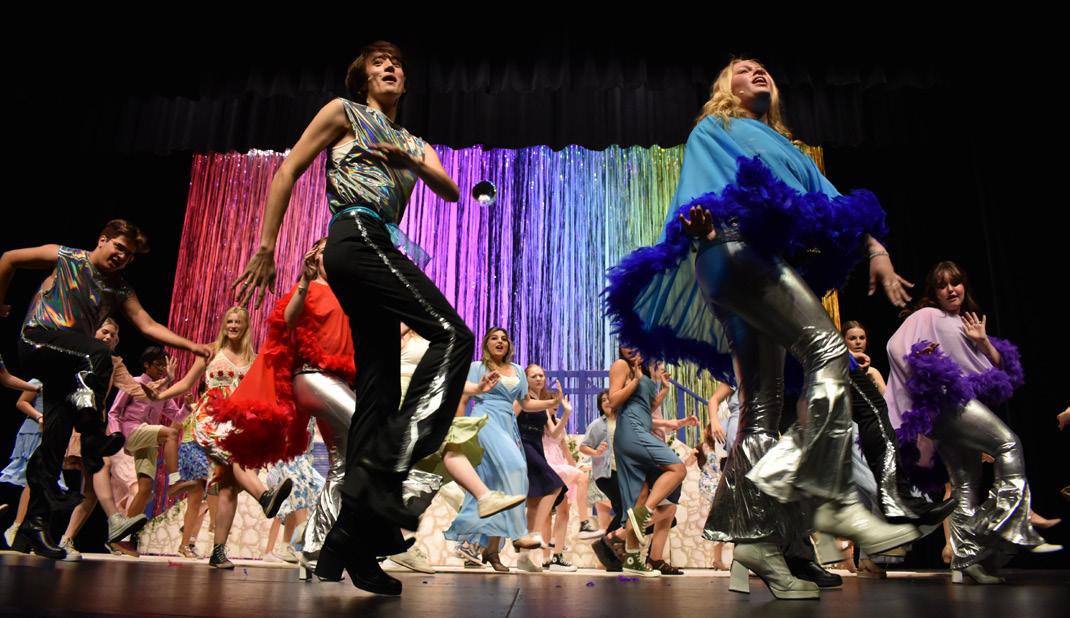
After months of diligent work, Mamma Mia premiered on October 19th and continued through the 21st. The dazzling sets breathed life into the musical, adorned with sequins and disco balls. Audiences were also charmed by the characters, due to the dedication of each cast member to ensure that all facets of their personalities shined.
“I love the connections Donna had with all of the other characters. The depth of her character was really good… She’s really strong headed, but she still has a lot of love inside of her. She’s not really afraid to speak her mind,” said Grace Wiggins, senior.
Students can be taught how to further cultivate their talents through the diverse identities of the characters they portray.
“It was a drastic change from some of the usual roles I play. The main purpose of Sky’s character is to refect of of the main character, Sophie. A big part of their relationship is how intimate and in love the characters are. It was kind of a mental game of fguring out
how to do that realistically in a scene with somebody that I’m not in a relationship with. But it was good to learn how to do that, and have that experience as an actor,” said Hagen Walsh, senior.
On the surface, the appeal of Mamma Mia is the lighthearted comedy. However, humanity is ingrained underneath as the complexities of various roles are revealed.
“I love performing ‘Lay All Your Love on Me.’ It was always super fun. But I think one of my favorite Sky scenes is in the second act where he ends up fghting with Sophie, mainly because of how angry and hurt he gets. That gave some layers to him that we didn’t see before in the show,” Walsh said.
During planning and rehearsals, a trial and error method can be the most efective. There is a balance that must be found between accurately portraying the character, and including one’s own interpretation.
“She was kind of like me, but not exactly. You try diferent things, sometimes they work, sometimes they don’t…I wanted to try my hardest to show to the audience those diferent relationships and bonds… and to appreciate your mom, to appreciate the time you have with people,” said Macey Doyle, junior.
At its core, the premise of Mamma Mia revolves around relationships, and character interactions drive the plot forward. As a result, an immense amount of chemistry
is necessary to craft a compelling story. Fortunately, high school students are able to spend time with and get to know the ensemble.
“You’re with the people all the time and you just grow to love all of them. Working with all of them becomes super fun, and you just want to be there with them. You want to be performing your best,” Doyle said.
As members mature and form important friendships, those bonds can be refected on stage. Consequently, connections between characters appear natural and organic.
“With Macey, we already had that chemistry. I’ve been doing her hair and getting her ready since her freshman year,” Wiggins said.
The essence of each scene manifests beyond dialogue. Choreography can emphasize lyrics and contribute additional energy to the performance.
“You look at those words and what the messages are trying to convey, and you do that in dance… The overall goal is to make sure that it’s something the audience can be sucked into and know the storyline is still happening within the dance number,” Wiggins said.
Furthermore, the world of stage design and tech crew enhances elements out of the actors’ control.
“We had a lot of memories and reminiscing scenes. So during ‘Our Last Summer’ when they would sing, the lights would turn pink for memory and all these fower
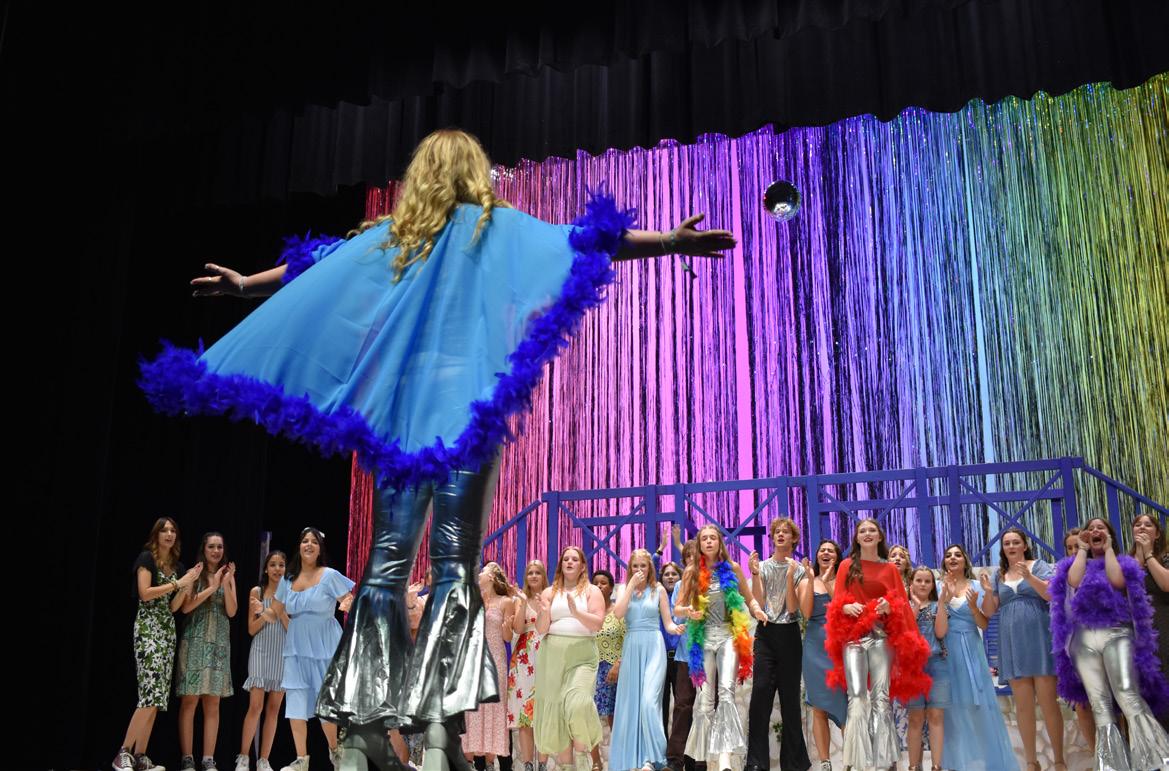
people would come in. Then all of a sudden they talked and it was gone,” said Devin Clark, junior.
The integration of technology ofers its own unique situations. While crew members try to prepare for every faulty microphone and soundboard issue in advance, dealing with them calmly and efectively is of the utmost importance.
“One thing I like to tell them is that I’d rather mess up in rehearsal than at the show. And if we mess up with the show, it still goes on,” Clark said.
Some challenges span every area of the theater department.
“The biggest thing that comes up is time. You always think that you have more time to do all the dances and songs than you actually do,” Doyle said.
Mamma Mia is special because it deviates from the traditional format of a musical. The songs are not written for the production. Instead, it is the other way around.
“Jukebox musicals are really
hard to do because you still have to keep the original artists in mind. As a musical you have to think in that 70s ABBA headspace of what they were trying to accomplish, what we are trying to accomplish, and how we can relate them to each other,” Wiggins said.
On opening night, it was evident by the vibrant crowd reaction that the songs are well loved.
“It makes people a lot more attached to the songs. It also makes the show very engaging because most people know the music…then they get put into this musical with the storyline and now it has this whole new life,” Walsh said.
Overall, despite a director change and large-scale project, the show was phenomenal. Every person that played a part in Mamma Mia should be proud, they conveyed all its themes both on and of stage.
“We worked so hard to make this piece one that would go down in OC theater history and that was defnitely achieved,” Wiggins said.
OHS is well known for its performing arts and music programs. With a reputation for nurturing talent and encouraging students who have gifts, OHS has made a name for itself in the area of musical expression. The choir program, in particular, only goes to show the school’s commitment to creating a community of singers where passion, talent, and the joy of music intertwine.
At a glance, choir may be
seen as simple and easy. One may think that students merely go up on stage and sing. As it turns out, there is a lot more that goes on behind the scenes.
“There are three diferent choirs,” said Kristen Olds, choir director at OHS. “We have Eagles Voice… Honor Choir… [and] Harm onics. Harmonics is our show choir and they do primarily pop and broadway style music and they sing and dance at the same time. It’s very physical. They have to have good vocal technique and they have to be able to match pitch… all while
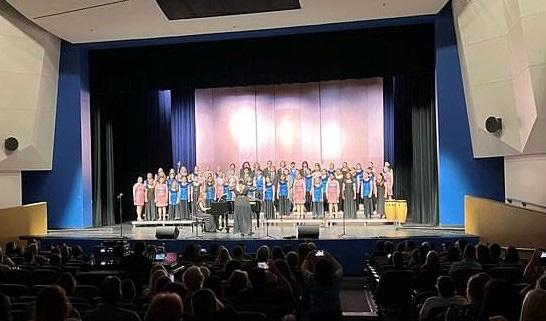
moving. Once a week we have to do conditioning for it.”
Choir is a lot more than just being able to sing, there is a lot that goes into the efort to be able to put on a good show. The choir council is also involved when it comes to events and shows.
“I’m vice president of choir council,” said Amelia Thompson, junior. “Choir council basically organizes the events for the choir and decides the theme. We also make sure the choirs are all engaged with each other.”
The involvement in the events help to get more students and peers involved with the program.
“I’m the secretary of our choir council,” said Gianna Dykstra, sophomore. “So I get to be involved with a whole group of people to run and make events for our choir members to be involved, and have fun in OHS and its choir program.”
The time and dedication to choir is shown in every one of
the students. The community of the choir only goes to further demonstrate how they all collaborate.
“People are very generous and very kind, and are always there if you need them,” Dykstra said. “They will drop whatever to help you in a moment’s notice. Everyone’s very involved from the seniors to the freshmen.”
Every choir student voiced the same sentiments in regards to one another. The way they interact and communicate with one another is seen by every person.
“This community is great… [we] lovingly [make fun of] each other… and we love to have fun with each other,” Thompson said.
Many people may look at the choir and think they do not have the singing capabilities. Fortunately, choir is available to anyone despite any abilities or lack thereof.
“It’s my job to help you to learn how to sing,” Olds said. “[Choir]s a great place to make
friends and express yourself. Eagles Voice, which is our introductory level choir… it’s open to anybody - they don’t have to audition. Most people’s frst year in choir go into that group. We work a lot on vocal technique. We also work on reading music. It’s a lot of foundational things that get you ready to be in the other two choirs.”
Choir can also be benefcial to other branches of the performing arts as well. One of which being, the theater program.
“Choir and theater collaborate well,” Dykstra said. “When you’re doing a musical you have to sing and if you’re in the show choir then you have to dance so that kinda goes hand in hand together with learning how to use your voice correctly and to incorporate all the dance moves… They go very well together because we do a lot of the same things even though people might think they are totally diferent.”
The Talon
For the past several years, a few determined English Language Arts teachers and the students in their classes have worked together to give back to the community in a special way. In these classes, students organize into groups to work on a lengthy service project revolving round a charity of their choosing.
Each student in their designated group, for their project, must write a research paper, interview someone from the charity, create a mini documentary, serve the charity they have chosen in some way, and write a refection paper to conclude it all.
“Several years ago Mrs. Simon and I decided we wanted to do a service learning project. It came from reading “I am Malala” and in the book [Malala] was able to help people and she was a teenager. We wanted to show students that they can help by just being a teenager as well,” said Ronda Cunningham, ELA and AP Seminar teacher.
The goal of each group’s project difered from another’s. They all selected diferent charities, and each project was unique in the way the students were able to
serve their organizations. Groups this year selected charities this year like Gigi’s Playhouse and did bake sales, etc.
“The students choose a group and in that group they have to choose a charity. It can be any charity that’s local,” said Cunningham.
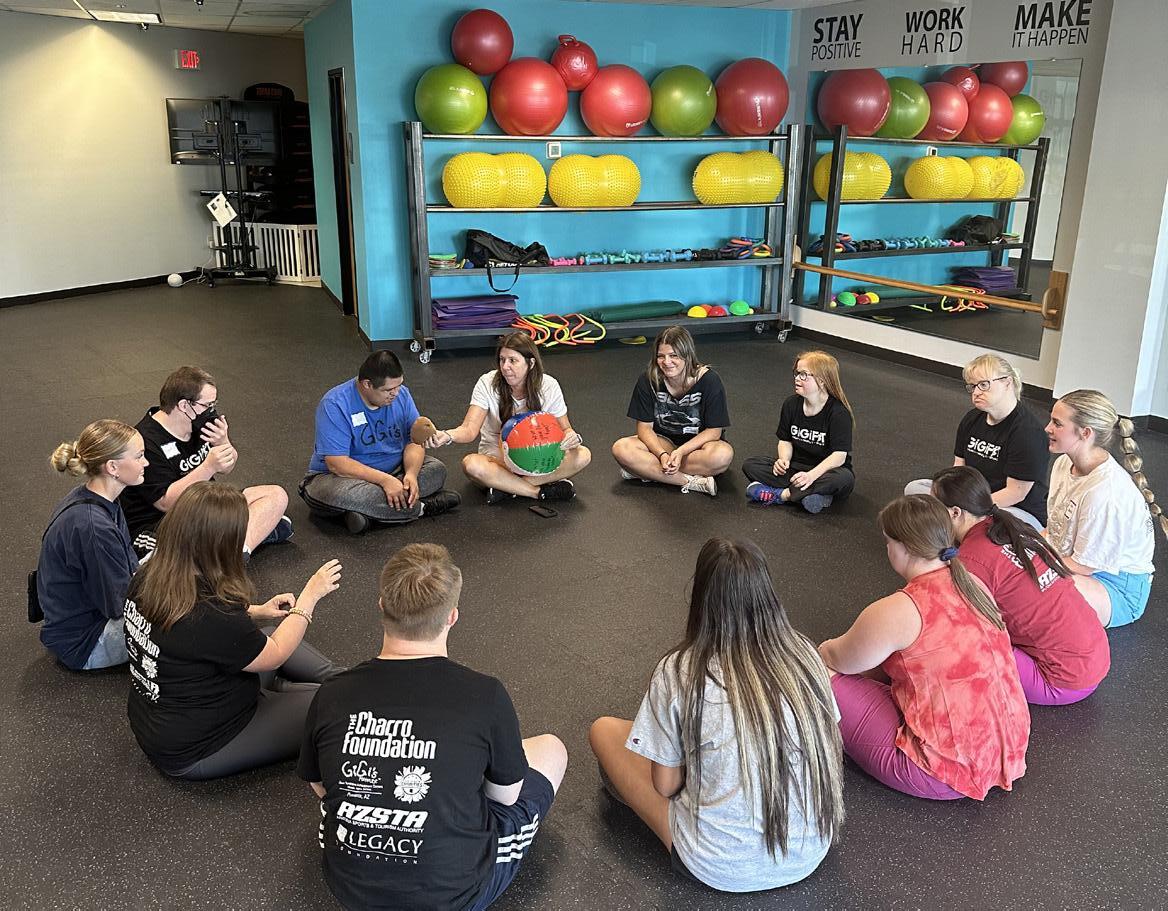
One of the charities that was chosen this year by a group was GiGi’s Playhouse, an achievement center for people with down syndrome that grants support to them and their families.
“Obviously we had to do it for a project, but [our group] just wanted to go help out an organization like this. All of us still want to go out and help more,” said Shay Garraway, sophomore.
Before any of the actual handson volunteering could happen for groups that chose charities where they could physically go in and serve, students were required to do a few things beforehand.
“We did a bunch of research on it and it seemed so fun and so open,” said Garraway.
Along the way, many of the students participating in the project meet new people who help them see through new, unique lenses and expose them to things that they may not have experienced before in their lives.
“I met this girl named Angelina and she was the sweetest girl ever. Everyone was so fun to be around and [the down syndrome kids] loved being around people kind of their age,” said Garraway.
Other groups had intended reasons that came into play when picking out their charities. The project was fexible in the way that groups could pick their own organizations to focus on. If they wanted to, they could tailor the charity they chose to their interests.
“My friend wants to be a foster parent so we decided our project could help her get more information,” said Izzy Owens, sophomore.
Each experience is diferent for every individual, and means something a little diferent depending on what they learn from their project. Every single person has an important role to play in their team’s project - and in helping the charity overall - but they also all have to collaborate and work together as a team.
“We were all calling and emailing and we all worked together pretty well,” said Owens.
Many groups get creative in selecting their charities because there is such a wide expanse of organizations to choose from, even just in Phoenix. On top of
that, there are endless possibilities to serve those organizations.
“I’ve had groups in the past that have sold paper hearts. They cut out all these paper hearts and they chose Phoenix Children’s Hospital - [the group] sold them for $2 a heart, and they had a competition between all of my classes. Each class had a diferent color and they put them on the windows as they sold them so you could see which class was in the lead. By selling paper hearts, they made $600.”
Every year, countless important lessons can be learned from each project. Every one is a relatively
lengthy process, and a fairly big deal that involves a lot of efort. Students tend to come out the other side of it having gained more of an understanding on how to give back to the community.
“My biggest takeaway is that everyone is equal. [GiGi’s Playhouse’s] whole goal is to make sure that the Down Syndrome kids feel equal to everyone else, and that they can do all the things that everyone else can do,” Garraway said.
Continue reading at thetalonohs.com
Teachers are the sources behind an engaging and thriving learning environment. However, as they mentor their students throughout their educational journeys, they are sometimes in need of a helping hand. This is where TA’s (Teaching Assistants) come in to complete smaller tasks for educators, supporting them throughout their mission to cultivate knowledge for today’s youth.
Thankfully, at OHS, there are many eager students who are willing to take on this responsibility. Having been in their teacher’s class prior, they inquire about the opportunity to continue fostering their bond with them as an assistant.
“I took a couple AP classes last year, and the one that really stood out to me was Physics and I really liked how the teacher ran the class and I talked to him about the responsibilities he expected a TA would have, and he gave me a list of them,” said Autumn Knapp, junior.
With the decision to become a TA comes the question regarding which teacher a student would like to aid. However, for some students, this connection came almost instantly.
“Ever since I had chemistry
with him, I knew I wanted to help TA a science…I feel like Mr. Burton would be a really laid back teacher, and he’s not going to be one of those teachers that doesn’t require you to do anything but he’s not going to require me to do a lot of work,” said Mona Takrouri, senior.
While it is not a requirement, getting a headstart on deciding whether one would like to have this position in the future can beneft an applicant. The process is lengthy as the school wants to ensure the most trustworthy and capable students are representing their staf.
“I did ask Mr. Burton my sophomore year if I could be his TA my senior year so I could be ahead of it…I went up to him and got this form you have to fll out…there are a lot of signatures you have to get,” Takrouri said.
While the day to day tasks for these students vary, they are able to immensely avail the teacher with the preparation for their classes.
“Sometimes Wylie asks me to go run some errands, like pick up tissues or lab materials in diferent science buildings that I have to go pick up. I assemble a lot of labs for Physics 1 and Physics 2,” Knapp said.
There are also individuals that choose to assist other departments at the school, such as the counseling ofce;while
the expectations remain the same, the responsibilities difer.
“Depends on the day, but on the days where it’s super busy there’s a good 10-12 passes on a little shelf and I go and sort them out by class, or building, and then I go to each building and pass them out…whatever they ask me to do I’m there to do it,” said Mackenzie Bailey, senior.
While these students are always ready to do whatever task is required, sometimes when the time permits, they are able to relax and work on their own personal goals.
“On a really slow day, I just focus on my own schoolwork because if they haven’t asked me already to do anything diferent, I just do my homework, read, and maybe talk to the people that are in there,” Bailey said.
Even though TA’s are instituted to beneft the teachers, these individuals also receive many advantages. This is seen with the connection that is sustained throughout the year.
“I love being around Mr. Burton, but I just didn’t like AP chemistry. Instead of having to do an actual class that he would’ve taught that was hard, I could be around one of my favorite teachers without actually having to do academic work,” Takrouri said.
Spending so much time in
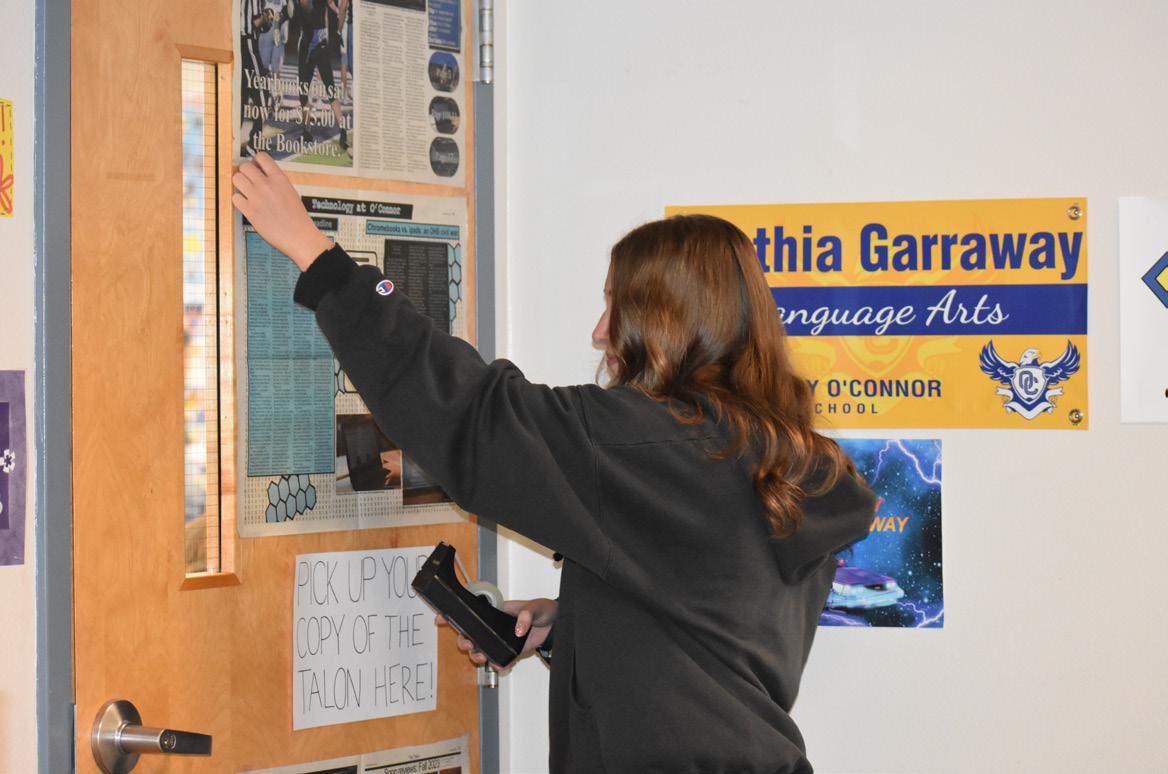
the counseling department also gives its participants invaluable perks. Students are able to frequently ask questions about diferent topics, such as their courses and future.
“They’re really there for you if you need help or anything, especially if you’re a TA because you’re in there everyday so you get the opportunity at any time when you’re in there in that hour to ask them questions,” Bailey said.
Apart from the connection TA’s gain with their teachers, they are also able to create substantial bonds with the other students in the classroom.
“Usually I thought TAs aren’t very interactive with the students in their class, but since I know chemistry give or take, I could help out a lot of the students and they’re really sweet and nice and fun to hang around…they address me like
I’m just their friend,” Takrouri said.
Overall, people looking to take on this role need to ensure they are building a relationship with the staf member they are thinking about asking for this responsibility.
“I defnitely say make sure you have a strong relationship and bond with the teacher you want to TA for, because you work with them throughout the whole entire year and also it’s nice to have a trusted adult,” Knapp said.
Working with educators on a more personal scale allows students to feel confdent in the bond they have formed over the course of their high school careers..
“This is not explicitly stated but I’m totally [Mr.Burton’s] favorite student,” Takrouri said.
“ We all understand that everyone goes through hard times, but we’re here to help every individual be successful. “




“
I feel like I become a better person when I put myself in situations that I normally wouldn’t be in.
“

Freshman
“
I mean [other students] care about you, but no one really cares about what you’re doing. They’re just kind of there, like you.
“
YES: To be a Christmas movie, or not to be a Christmas movie–it’s an age old debate that may never have an answer. Die Hard, starring Bruce Willis, has frequently been debated as to whether or not it is a Christmas movie, and frankly, it is not even a debate. Die Hard is clearly a household Christmas movie, even though many people refuse to admit it.
Popular Christmas movies such as the Home Alone franchise follow the same tropes and plot points as Die Hard, but touch on them in a less intense way. Die Hard follows John McClane, a police ofcer who comes home from New York to see his wife on Christmas. Hans Gruber, a German terrorist who executes a robbery scheme, the antagonist, takes over the building they’re in, and John goes into defense mode. Just as such, Home Alone follows Kevin McCallister, whose parents accidentally leave him at home while they go on a Christmas trip. The famous robbers Harry and Marv, also known as the “Wet Bandits,” try to rob Kevin's house, but he also successfully defends himself. So if Home Alone, a tamer version of Die Hard, can be considered a Christmas movie, then why can’t Die Hard?
The main argument from many other people is that Die Hard only takes place during Christmas but has nothing to do with Christmas itself.
However, a lot of Christmas movies could not be considered holiday staples if the time of year was switched, especially Home Alone. If that movie took place during any time other than Christmas, it would still be the same movie but during a diferent time of the year. While Die Hard is defnitely not your traditional Christmas movie,it certainly invokes the Christmas spirit and can totally be a staple in everyone's holiday movie rotation.
The Die Hard Christmas debate has become a worldwide phenomenon and is talked about a lot around the holiday season. This argument brings up the question: what are the criteria for something to be considered a Christmas movie? The one thing wanted in a Christmas movie is the Christmas spirit, whichDie Hard has, so if the movie takes place during Christmas and the plot somewhat revolves around Christmas, then why can it not be a Christmas movie?
The debate over whether Die Hard qualifes as a Christmas movie is straightforward. It is, without a doubt, a Christmas movie, albeit with a diferent twist. Die Hard captures the holiday spirit and wintery atmosphere, even though it happens to be action-packed. While some may argue it does not ft the typical Christmas movie mold, it delivers the necessary festive vibes and the holidaysetting.
By AIDEN REED Staf WriterNO: The age-old debate of what makes a true Christmas movie has been argued over for years, one of the most contentious movies in this discussion is Die Hard. While Die Hard is a classic movie, it is not a Christmas movie. There are some requirements to be a holiday staple; For example, the movie should have a theme that both relates to Christmas and afects the plot. Die Hard is an action movie through and through, and does not have any of the required Christmas elements.
John Mcclain and his wife attend a Christmas party at Nakatomi Plaza.The party is interrupted by a group of terrorists who take many of the party-goers as hostages, so John McClane then takes it upon himself to rescue them. While “Die Hard” may take place on Christmas Eve, the themes of the movie do not relate to Christmas at all.
The themes in “Die hard” are rather typical of an action movie, in place of traditional Christmas themes, like family, joy, or the sense of home. These can be seen in many Christmas movies like “Home Alone,” where Kevin helps Old Man Marley reunite with his family.
Another unspoken requirement of a Christmas movie is that the movie cannot have taken place in another season. For example in How the Grinch Stole Christmas the movie can only

take place during Christmas, not any other holiday or time of year in order for the plot to make sense. This cannot be said the same for “Die Hard” however, as one could replace the word “Christmas” with any other holiday, and it would not detract from the plot.
Some people who think that “Die hard” is a Christmas movie say that since John Mcclain reunites with his family at the end of the movie, it gives the movie a “familial theme”--something that is also present in many holiday movies. However, this statement is misguided because during the movie itself, John’s family fades into the background in place of the stereotypical action movie plot.
While “Die hard” is an excellent movie, and undoubtedly a classic, the lack of traditional holiday themes and the emphasis on action and suspense all contribute to the fact that "Die Hard" is an action movie with a Christmas background rather than a true Christmas movie.

The Talon is ranked school newspaper in the state!
the #1 school newspaper state!





Evermore Taylor Swift, Bon Iver

Voyager Boygenius

Last Christmas WHAM!
I Am the Grinch Tyler the Creator, Fletcher Jones
Do Not Wait Wallows

Take Care Beach House

Happy Xmaswar is over John Lennon, Yoko Ono
Christmas Baby Please Come Home Michel Buble
OHS boasts one of the most extensive and well rounded lists of electives in the district and continues to add more each year. This next year will see the addition of dance conditioning (Yoga/Pilates), future career experience, as well as the expansion of the Mandarin program. These classes will give students new opportunities to explore their interests and gain real life experience in the workforce.
The addition of dance conditioning to the OHS campus is exciting for many
students and teachers alike, with the class expected to become prominent among the other fne arts.
“There always seems to be an interest in more active classes, especially those that aren’t as competitive,” said Jennifer Swaine, guidance counselor.
Dance conditioning is not only directed at aspiring dancers either. The class will also teach students about the muscles in the body, and how they work together.
“[The class is] for dancers, athletes and any students, really, that want to move more efciently, improve their
technique, endurance, and coordination,” said Kristen Lucero, dance teacher.
Work experience is another very exciting opportunity, where students can earn money and gain experience in a career-focused environment. The class allows students to leave campus for one period to attend a job that schedules them at least 5 hours a week.
“It’s going to be able to work around the students schedule; you do not need to attend a physical class, it is just a Canvas course,” Swaine said.
This class will be especially appealing to any students who
already have jobs outside of school, or are looking to save money for furthering their education after high school.
“This class is going to give those students who already have jobs a bit of a break, so they don’t have to stress as much over both school and work,” Swaine said.
Within the language department, the Mandarin program is adding Mandarin 3-4 and AP Mandarin in order for the students who have already started learning the language to further their knowledge of both the dialect and the culture.
“We had many students
coming in from middle school with Mandarin experience, and we had what they needed to advance, and now we are expanding the program for those students who choose to take higher level classes,” Swaine said.
These classes will give students the opportunity to further their interests in diferent subjects and gain experience in a job; all of which will be useful for students in the future.
“There is a lot of demand for these classes, [and] I’m really excited to see how students like them next year,” Swaine said.
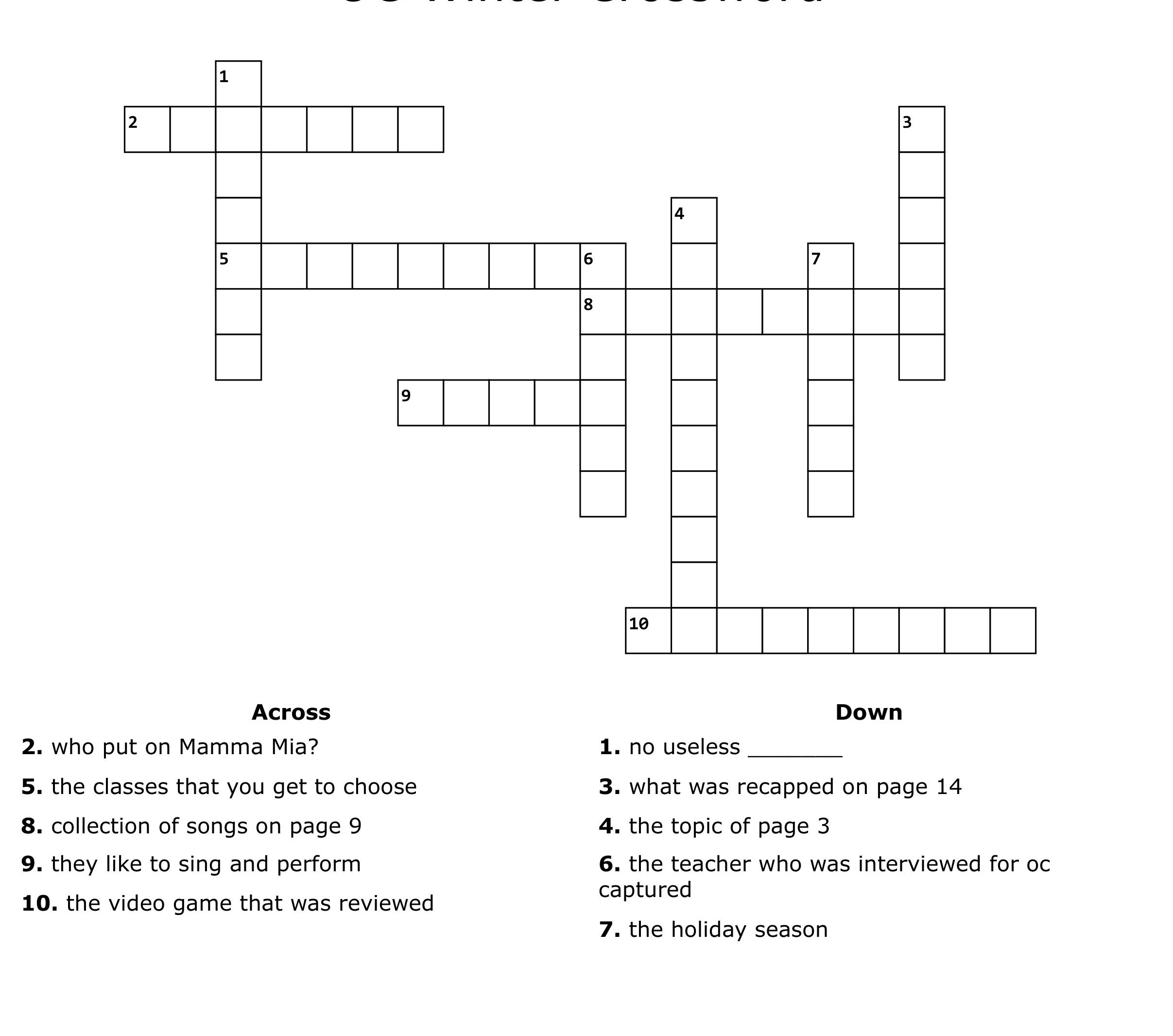
2. who put on Mamma Mia?
5. the classes that you get to choose
8. collection of songs on page 9
9. they like to sing and preform
10. the video game that was reviewed

The Talon is published as a forum for student opinion at Sandra Day O’Connor High School: part of the Deer Valley Uni ed School District. The Talon is an award winning publication with dozens of awards for it’s sta members as well as ranked the
top online publication and one of the top print publications in the state. Letters to the editor must be signed and dropped o in Room 508, e-mailed to thetalonohs@ gmail.com or mailed. Letters may be edited for content and/or
1. no useless _______
3. what was recapped on page 14?
4. the topic of page 3
6. the teacher who was interviewed for oc captured
7. the holiday season
Adviser: Cindy Garraway
Editor-in-Chief: True Van Dyke*
space consideration. Obscene or libelous statements will not be printed. Opinions re ected here are of those of The Talon sta and do not re ect the Deer Valley Uni ed School District. Visit The Talon online at thetalonohs.com
Copy Chief: Victoria Kirova*
Design Chief: Ashley Pereria*
Editorial Chief: Brooklyn Smith*
Sports Editor: Amaya Kelly*
News Editor: Kendall Walker*
Features Editor: Ruth Mioc*
Arts & Entertainment Editor: Amber Hayden*
Sta Writer: Sedona Bellows
Sta Writer: Skyler Bennett
Sta Writer: Abigail Bryand
Sta Writer: Matthew HoodHunt
Sta Writer: Aakarsh Mahey
Sta Writer: Avery Massie
Sta Writer: Aiden Reed
Sta Writer: Colin Robison
*Denotes member of editorial board.
The idea of a teacher, a person who exists to extend their knowledge to students with an equal desire to learn, has been around for centuries. Teachers have taken many forms, shifting from individuals who teach their trades through generations of apprentices or oversee numerous grades in one small schoolhouse, to ft the mold of a present-day educator.
By the time a student reaches high school, they will have experienced many diferent teachers in a variety of subjects. Many learners have since formulated their own opinions on what makes a good educator, and how certain personality traits ultimately lend themselves to a better learning experience.
One of the most notable indicators of a “good teacher” is the amount of respect they show their students. Of course, immaturity can mar any relationship between student and teacher when a pupil thinks they can speak over the person who is running the classroom, or treat them as a close friend instead of a mentor. However, all too often, it feels
as though teachers do not understand that respect goes both ways, that one must be given consideration in order to receive it. Feeling overlooked by a teacher can make students become disinterested in their education, unable to feel enthusiastic to learn from someone who seemingly does not care about them.
The amount of interest given to each student also factors into another important aspect of good teaching: the passion a teacher has for their job. While it is benefcial for a teacher to be spirited when discussing their chosen subject, many agree that it is much more important–and crucial to one’s learning experience–if an educator is impassioned about teaching itself. Some even feel that there is a domino efect in which a teacher’s ardent lessons make a student become much more involved and interested in what they are learning, even if it is in a subject they typically dislike.
For many students, one of the worst things a teacher can do is to pick favorites–and make this inclination glaringly obvious. While a teacher
having certain students they inherently gravitate toward is largely inevitable, students often take note when that preference starts to create divisions between the class, separating those who are liked by the teacher versus those who are not. Often, students feel singled out by not being a designated “favorite,” creating tension among classmates, and leading to some of the aforementioned issues, such as a subsequent lack of enthusiasm to learn.
Conversely, one of the best things students can receive from their teachers is specifc and clear instruction. While this may seem obvious, many students have found that when asking a question about course content or homework, they will receive an answer that leaves them even more confused, questioning their own teacher’s knowledge on the subject. A teacher’s ability to anticipate and understand student questions, as well as give a satisfactory answer and ensure their student fully comprehends it, goes a long way in providing a wellrounded education experience.

In the end, there is no such thing as a perfect teacher. Oftentimes, students are receiving the best instruction they can get from educators who are putting their heart and souls into their teaching, even if it does fall short at times. However, many students can often agree that desiring thorough instruction, obvious
enthusiasm, and a healthy balance of treatment between students and teachers is not necessarily the bare minimum for a classroom, but should not be considered an unrealistic expectation for teachers to achieve.
Students go to school to learn, and that is exactly what a teacher is paid to do in return.
A common fear is fnding oneself trapped in or confned to a major. Luckily, the declaration made to a college right out of high school is not permanent and rather fexible.
“Once you’re in and you’re a freshman and you’re taking all of these diferent types of classes, it is not difcult to change your major. It’s easier earlier in your college career,” Heath said.
The future of every student depends on what they ultimately want. Paths can be tailored to individual aspirations, and a middle ground can be found.
“There’s a lot of occupations out there where you only need an internship, or go straight into the feld, or you need a certifcation. I don’t think you necessarily need a degree in all areas to become successful,” said Lauren Tessmer, CTE teacher.
On occasion, a degree is not enough to reach desired toplevel and prominent positions. There are other factors that contribute to success.
“Any of our CTE programs ofer an internship program so the students can get credit for working in the real world, and getting that networking and experience,” Tessmer said.
When applying for jobs, it is crucial to remember that companies and employers seek a wide variety of skill sets.
“Even companies that are centered around one specifc thing want a diverse workforce in the way that people think and approach problems,” said Holly Maxwell, English teacher.
The most dangerous misconception is that career paths are limited with a humanities degree. Upon further research, students discover that there are a plethora of valuable jobs available.
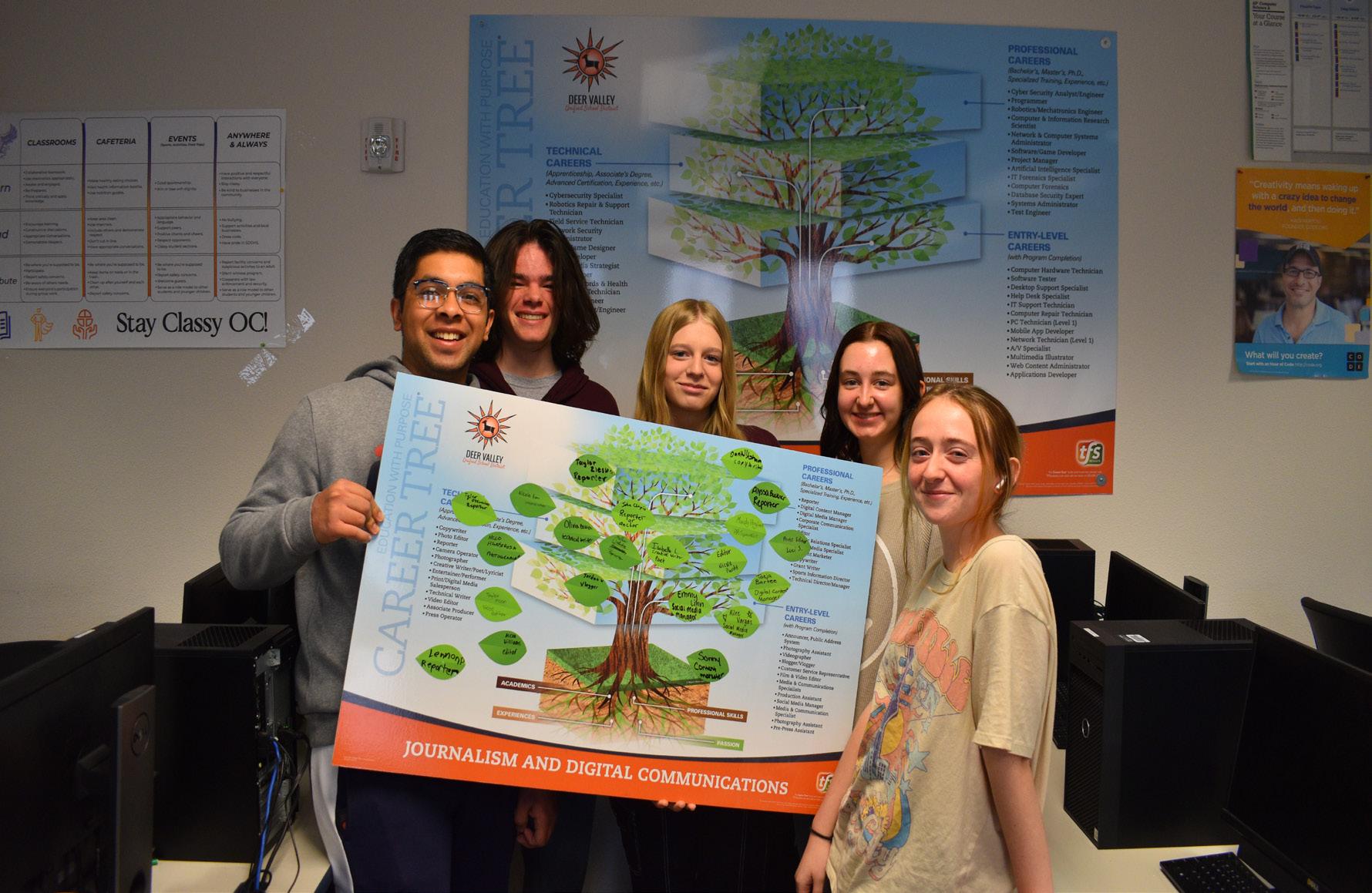
“We have something called a career tree. It basically allows students to see what diferent careers are out there and pinpoint what’s right for them,” Tessmer said.
The pursuit of a humanities degree is not arbitrary. Passion for the study of culture, including literature, the arts, history, and philosophy yields critical thinking. Humanities and STEM intersect and infuence one another.
“The humanities are very important because they focus on why we are creating things and how it is going to impact human beings…we still need to have that balance
and communicate those ideas efectively to other people that don’t necessarily have that specialized knowledge,” Maxwell said.
As artifcial intelligence becomes integrated into daily life, people may be under the impression that jobs are disappearing, especially those that involve communication and writing. In actuality, the opposite is true and particular occupations may simply
evolve.
“I think they’re not being taken away, I think with as far as we are going, and as far as we have come with technology, that in the future there’s way more jobs, and endless possibilities,” Heath said.
Ultimately, the presumption that a stereotypical “useless” degree serves no purpose because the resulting career is “unproductive” to both the
individual and society is not only false, but disregards what drives culture forward.
“Art and music and writing add so much to the human experience and just add color and depth to our everyday lives. I don’t think anyone wants to live in a world where that’s not valued and it’s just stagnant because we’ve steered everyone away from exploring the humanities,” Maxwell said.
It is no secret that Taylor Swift and Travis Kelce have emerged as one of the most dominant celebrity couples within the last few months. There could not have possibly been a better time for the international pop star and Chief’s 6 ‘5’’ tight end to begin their relationship, especially with the recent release of Swift’s newest album, “1989 Taylor’s Version”, and the football games leading up to the 2024 Superbowl.
Fans on both sides of this powerhouse relationship have admittedly become suspicious of their romance - their relationship seems to be a little too perfect to be real. Although everything adds up, and makes sense on paper, there is still doubt running among the public. Is the pair truly in love, or are there underlying reasons for the two to be together? Or is there a little bit of both?
Taylor Swift fans are suddenly very interested in the NFL, with a heavy emphasis on the Kansas City Chiefs. Travis Kelse was already a fairly massive football superstar before Taylor, but recently, he has been blowing up more than ever. As an important
tight end for the Chiefs, Travis Kelce currently holds the record for the most receptions by any tight end in the Chief’s frst 10 seasons, with a total of a whopping 814 catches; It is not like the football star was exactly hiding in the shadows before his relationship with Taylor Swift.
Swift has been seen at many of Kelse’s games, and the two have also been captured by the paparazzi out and about on numerous occasions. Whenever Taylor Swift does something big, it feels like the whole world stops to listen to what she has to say. Supporters have already poured in a lot of money surrounding the singer’s world tour; buying concert tickets, plane tickets, rental cars, hotels, and more to keep up with it. The last place that people may have thought Taylor’s reach would have extended to is the NFL, but that is clearly no longer the case.
Taylor Swift is a force to be reckoned with, showing up at silly little football games is not usually the top priority for a musician as big as her, and yet she has shown up to many so far. The question is, for what reason?
Taylor Swift seems to like to maintain an air of mystery.

Swift and Kelce’s relationship seems to ft the stereotype that only presents itself in Hallmark movies, not in real life, with the 6 ‘5” football star dating arguably the most famous singer in the world.
If their relationship was true, it would make sense for her to want to support him, but it would also make sense to be raising publicity, both for Swift and Kelce, through her attendance at the games. The Chief’s football games are not the only way that Taylor and
Travis have publicly expressed their relationship either. There seems to be a questionable amount of faunting of the relationship that has occurred. Swift has been on her Eras Tour for quite some time, and has appeared as one of the world’s biggest lyrical masterminds and artists, and will likely remain that way for the foreseeable future. It would be weird to say that the timing of the relationship is not a little odd, but there is also the defnite possibility
that their love is genuine.
If the relationship is solely for PR purposes, it very clearly worked. The pair have created so much buzz, reaching both football stans and superstar fangirls alike. The world may never know whether or not their relationship is that of enduring love or if it is merely a publicity stunt. In the end, all one can do is speculate and watch as the two continue to grow exponentially in popularity and fame for years to come.
 By SKYLER BENNETT Staf Writer
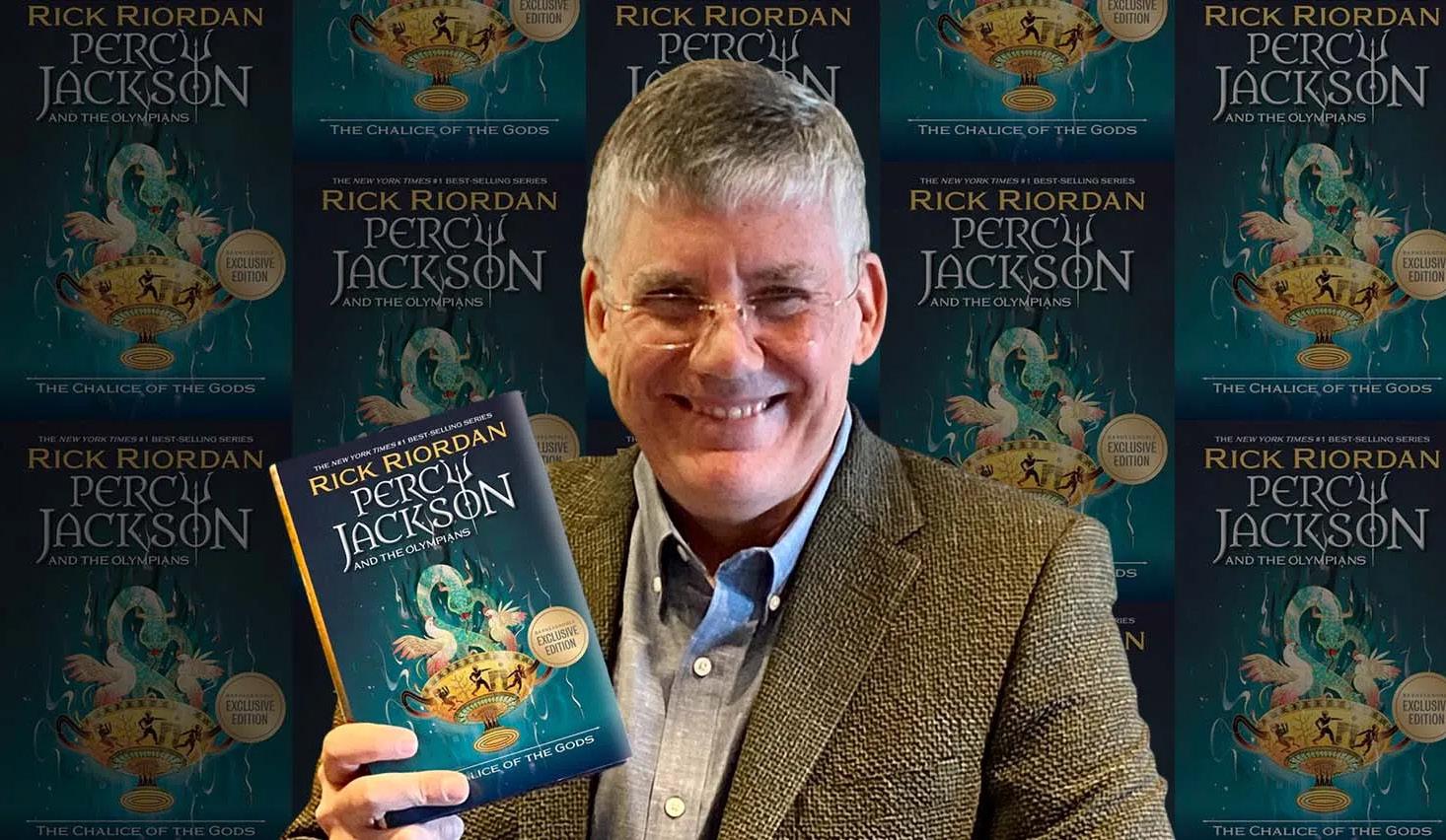
Fans of Rick Riordan’s, Percy Jackson were not prepared for the newest installment in the series. Being a fan of this series means you are always on your toes, waiting for what Rick Riordan has in store, and, frankly, he never disappoints.
Rick Riordan can weave a tapestry of myths and legends with the strings of
today’s world. He has been doing this since 2005 when The Lightning Thief was frst released. In the wake of new content, Riordan has been exceeding expectations with the upcoming installments of the series, including the T.V. show that will be premiering on Dec 20, 2023.
Now, putting aside the show, imagine you sitting at home, working on college admissions, worrying about the recommendation letters
needed to get into your dream college. Then, add the stress of having to get the gods’ approval, when they hate your existence. That is when things start to get interesting.
The latest book, Percy Jackson: Chalice of the Gods is an adventure for new and old fans alike. Readers get to see the original trio fghting side by side again, just as they had been years ago when the series frst began. With loved characters fghting the Greek
myths of wrathful goddesses and spaghetti-like snakes, and trying to get their friend into college when the Greek gods are standing in his way.
Riordan has a way of writing that completely immerses you into the story, making you one with the book. His parlance ties the story together, showing his knowledge of writing. Riordan knows his story like the back of his hand, the same way he knows his characters.
Percy Jackson, Annabeth Chase, and Grover Underwood are three beautifully written characters. Riordan understands the complexity that they each carry as the adventure progresses. He knows how to write the efects and changes that each of them have to go through after they deal with traumatizing events, and he knows how to bring happiness to the story when it starts to feel like there is none to be found.
Riordan has also mastered the art of writing characters with representation that the media lacks. This includes diferent learning difculties. Every demigod in this universe has ADHD and Dyslexia, and it explains why they can think fast and read other languages.
Rick Riordan turned conditions that were typically frowned upon and made them into superpowers. Flipping the script, and helping adolescents feel less bad about themselves.
Throughout this book, we see the struggles and diferences that Percy Jackson goes through with being in a learning environment that does not support his needs, along with the stress and pressure that he is under to get into the college that he needs to go to, as well as his need to get approval for his academic future. Sound familiar?
High-schoolers who grew up with this series and watched Percy and his friends grow along with themselves will see everything he needs to do and relate to it in some way, shape, or form. From battling bad grades, to graduating high school, to the fact that he is no longer a kid anymore. He is growing up, just like them.
The truth about this book and the books that came before it is that everyone who reads it can fnd a bit of themselves in many of the characters. Anyone can fnd themselves in the story. That is the beauty of this universe of myths and legends in the present day.
Announced way back in 2015, the Five Nights at Freddy’s (FNaF) movie has had more than enough time to build excitement. It has gone through nearly a decade of delays, and in the meantime, the once indie game has turned into a full on franchise. While the delays were disappointing, the added storyline to the game is good for the movie, and eight years after its announcement, the movie was ofcially released into theaters on October 27.
The movie features Josh Hutcherson as the main character, Mike Schmidt, and Matthew Lillard as the main antagonist, William Afton, who is disguised under a fake name. Other characters include Elizabeth Lail as Vanessa Monroe, a police ofcer who knows a suspicious amount of information about Freddy Fazbear’s Pizza, and Piper Rubio as Mike’s kid sister, Abby.
The actors put on a good performance for a movie with
a moderate budget of only 25 million in a time where movie budgets exceed the hundredmillion mark. Some of the acting in the more emotionevoking scenes was slightly sub-par, but for the most part, it was solid. The movie’s plot added to its perceived mediocrity, being largely predictable before the climax of the flm.
Major criticisms of this movie were that the plot got lost in trying to make the movie scary and vice versa, and that viewers who are not familiar with the game are confused and overall displeased with the showing. Some of these criticisms are valid; the intention to make the movie scary did at some points overshadow the plot, and likewise, the plot at several times overshadowed the inherent horror of the terribly tall animatronics. Remember though, that this movie was always intended to be for fans of the game, and not so much for the “general public”.
The attempt at giving Mike, the pizzeria security guard and main character, severe childhood trauma and also
extreme stress about taking care of his young sister did detract from the desired horror of the animatronics. It added to the plot, but also watered it down. In the now world renowned game, simply titled Five Nights at Freddy’s, the animatronics have blank, expressionless faces with gaping white eyes, giving them an intensely uncanny look. This mostly carries over to the movies, but instead their eyes glow red, disappointing many hearty fans of the game. Furthermore, the heart-wrenching, and utterly horrifying lore of the games is almost completely nonexistent in the flm, and instead is replaced by almost all-new characters and a far-removed storyline.
What made the games so famous is the animatronics themselves, who only move while the player is not looking. The player is confned to a small dingy ofce, whereas in the movie, Mike is free to walk around, and his sister Abby blatantly interacts with and talks to the robots, furthering the disconnect between the movie and dedicated fans of
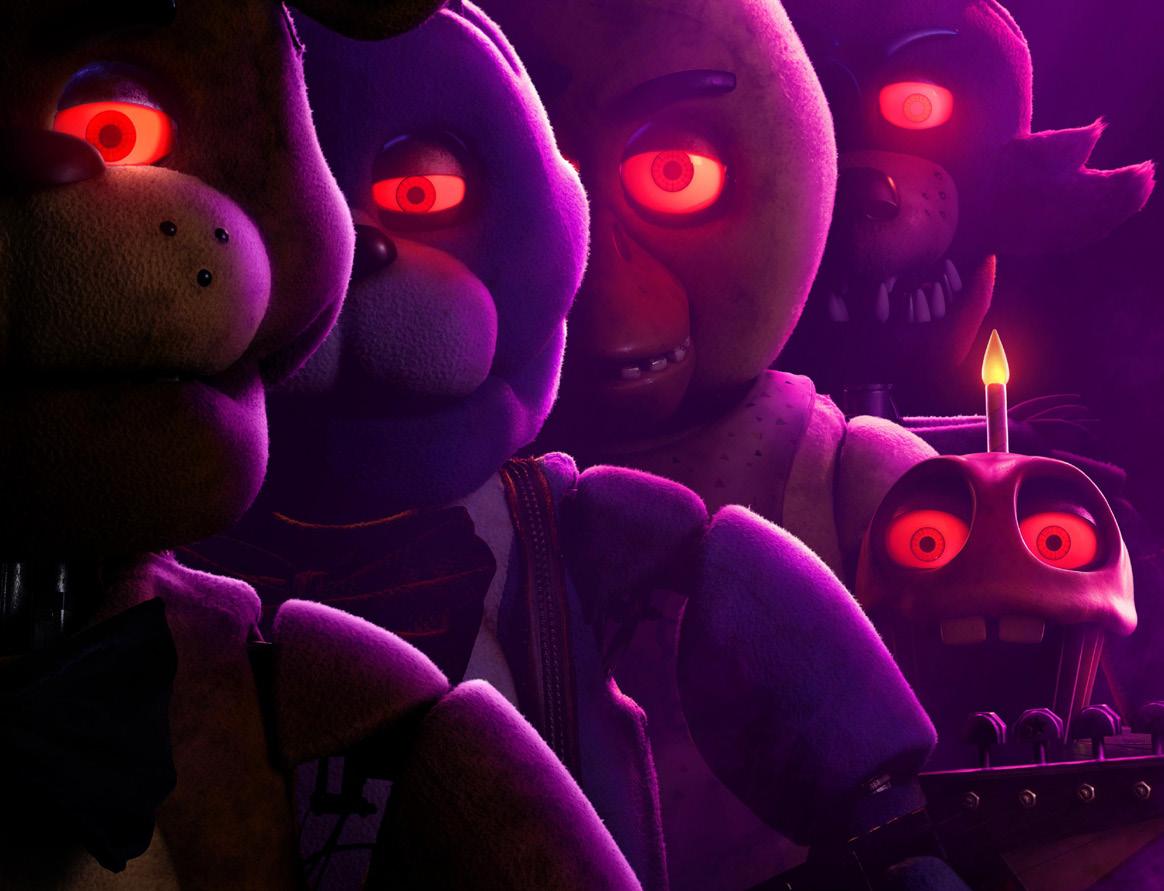
the game. Alienating the fans, while also making the flm indigestible to the general public, defnitely was not the way to go.
Many also claim that the movie is not scary enough, or at least not in comparison to the games. This point is highly defensible, although the movie is supposed to be seen by young audiences, so the horror could not have been too potent. Still, the point remains that the movie is disappointing in its efort to mimic the style of the games. There are several moments with potential to terrify the
audience with jumpscares and gore, but ultimately never happen. On a multitude of occasions, a character is killed in what would have been a gory way, but the audience never sees more than a hint of it. Again, the flm cannot contain that much to maintain its PG-13 rating, but a little would have gone a long way with the fanbase.
Overall, the movie was decent for fans, and just okay for everybody else. It seems to have displeased both parties by trying to stay impartial to either, but it still remains an “I might watch it again” tier flm.
The long awaited sequel to Insomniac’s Spider-Man Ps4, was released with high praise from fans and critics alike. Spider-Man 2 scored a 90 on Metacritic, which means the general audience and critics would recommend it. The release of the game was a big event among the gaming community, and rallied everyone together. The game is super compelling and interesting from the moment you start it to the moment you fnish.
The game opens with a fght against the infamous “Spiderman” villain Flint Marko, also known as “Sandman”, and it does a perfect job of introducing all the new features in the game. The main plot of the game was advertised as Miles Morales and Peter Parker teaming up together and this is executed fawlessly in this sequence. Spider-Man 2 introduces new aspects of the game such as
an extended map, new combat layout, and web wings, allowing characters to glide and fy around New York City.
Spider-Man 2 clocks in at 15-18 hours to complete the main story, and then consists of many side quests that take around 24 hours to complete. The key selling point of the game is that Spider-Man gets the “Venom Symbiote Suit” and the player gets to see how that afects his mood and the decisions he makes.
One of the best aspects of this game is how there are so many diferent villains such as “Mister Negative,” “Kraven the Hunter,” “Lizard,” and the main one, “Venom,” and all of them get their time to shine. The game does such a good job of introducing a lot of new aspects, but also keeping what the frst game strived in.
As the frst Spider-Man game to be exclusively on the Playstation 5, the graphics are absolutely stunning and look as realistic as a character swinging around with webs can be. The second game’s stories build upon ideas
introduced in the frst game, and add more depth to certain characters. We are introduced to Harry Osborn, who plays a massive role in the story and also in Peter Parker’s life.
Some of the most fun to be had in the game is during the carnival missions when we see a massive revelation in Peter and Harry’s lifes. The player also gets to see and play fashbacks of Peter and Harry in high school. It is cool to see someone like Spider-Man in high school and deal with problems teenagers deal with.
When the game is fnished, players usually long for more content to play in that game, and Spider-Man 2 ofers that.
With the map in the second game being nearly twice as big as the frst game there is much more to do after completing the main story of the game.
Most big story games are not open world so you can only play the story mode and you are done with the game so it can be hard to justify the price of $70. So with Spider-Man 2 excelling in storytelling and immersiveness after the game
is completed, it is hard not to justify the price.
As people start to fnish the game many fans have been looking forward to a third Spiderman game, but it does not seem like that is anywhere near in the future. The wait from the frst game to the second game was fve years, so it would not be surprising if the wait was the
same or even possibly longer. It is likely that Insomniac’s “Wolverine” will come out frst, as it is confrmed to be in the same universe as the Spider-man games and it will likely lead into the third game. Spider-Man 1 and 2 both do a great job of adapting Spiderman so there’s no reason to believe the third game will be disappointing.

Although the 2023-2024 fall sports season comes to an end at OHS, the memories made, and relationships built between these high school athletes will last a lifetime.
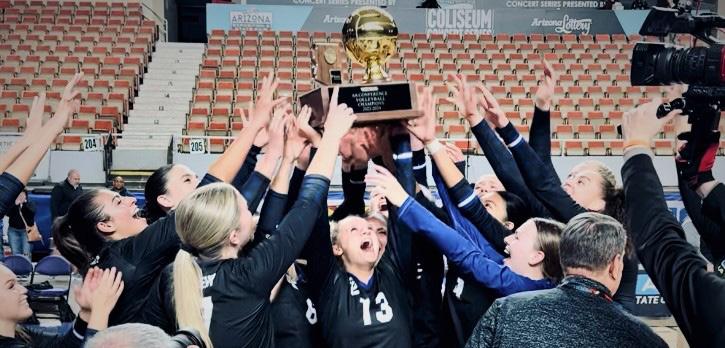
The team mentality and culture amongst the sports programs at OHS is an undeniable factor aiding in their triumph. Girls volleyball for example, went undefeated this season and continued to dominate the court in playofs, winning frst place as state champions.
“This season we found a lot of success in focusing on building our relationships with each other, and focusing on the mindset aspect of volleyball,” said Maggie Paulsen, junior. “Everything else kind of followed along.”
Being close with your teammates can really help the athletes to push not only themselves, but the other members on their team to be better as a whole.
“[Building] those relationships and learning what to do for your teammate when they are down, to get them out of that rut, is really helpful especially in a team
setting,” Paulsen said.
The undefeated record of girls volleyball did not come without its struggles. As the athletes strive for perfection, errors are bound to happen in practice or in games. But a positive team environment helps to mitigate any problems they face.
“Be okay making mistakes because it’s gonna happen and that’s how you get better,” Paulsen said.
Another sport that has shown continual promise throughout the season is boys golf, as they took home another victory from the DV (Deer Valley) Cup.
“We’ve won this tournament for the last nine years,” said Noah Kaoni, junior.
Beating all of the boys golf teams in the district at the DV Cup was no easy feat, but the male golfers here at OHS were able to achieve their goal by unifying as a team.
“When we have a sense of comradery, when we don’t just play for ourselves and start playing for the actual higher goal of making state, I think we tend to play better,” Kaoni said.
Some might view golf as a laid back sport, but at OHS, the golf program requires a
combination of focus, efort, and intensity at all times.
“Golf is not a sport you can take a break at, you have to grind at it in order to get better,” Kaoni said. “You can’t just go in there expecting to be good.”
Hardwork is a key component to other sports such as swimming. Athletes at OHS are learning to push their boundaries, and challenge themselves to be better alongside their teammates.
“It’s gonna be hard, it’s gonna be a learning curve at the start,” said Michael Simcoe, junior. “But keep pushing through the difcult things, because in the end, swimming is actually really enjoyable.”
A sport becomes enjoyable when that sense of friendship comes into play. Being able
to encourage and lift up your teammates can help the overall performance of a team.
“It’s a hype sport,” Simcoe said. “We are defnitely behind the blocks talking to our teammates, talking to our swimmers, making sure their heads [are] in the race.”
The unity between swimmers at OHS has led the team to success and victory throughout the 2023-24 season.
“Our relays have defnitely been successful this year. We have all three of our relays making state, and we also won boys regionals for the third year in a row,” Simcoe said.
In addition, varsity football at OHS continues to over take their opponents and tackle their competition. Like during their game against Pinnacle, where the players were able
to push one another and come out on top.
“Against Pinnacle, in the 3rd quarter, we were all hyping each other up and we started playing [well] again,” said Colton Wiggins, junior.
Like other sports teams, the bond created between players in the OHS football program is undeniable.
“We’re all super close with each other and we are all best friends,” Wiggins said.
When it comes to being the best, you need to put the goal of the team to improve, before yourself and accept constructive criticism. Being close with your teammates can make pushing each other easier and more efective.
“We can get on each other’s case without it being awkward. And we can help each other get better,” Wiggins said.
Incoming freshman joining the football program and underclassmen looking to make varsity have big cleats to fll. Perseverance, determination, and grit from new players will ensure another victorious season for OHS football.
“Come ready to play and work hard because we need that if we are gonna be good next year,” Wiggins said.
Boys basketball:
Last year, the basketball team went 16-12. Running of of a great season, they hope that this year they can go to the fnals once again, working overtime to ensure they can reach those goals.
“We don’t talk about the record as much, but at the end of the year, we believe that we will be right where we want to be,” said Joshua Cole, varsity boys basketball head coach.
Every year, there are always new players who can aid the team with their talents and hard work. Each team improves every day by going into practice and making those minor adjustments that help the team in a small way.
“They are more confdent, and we have added some few pieces either that have transferred in, or that have come from the lower level. So I think we are bigger, longer,
and more skilled; so we have a chance to be better than we were last year,” Cole said.
Girls basketball:
The OHS girls basketball team has been working hard through the of-season in hopes of making the playofs and taking the trophy home. Players must make minor improvements in the ofseason to achieve a perfect record.
“Discipline, consistency, comradery, team togetherness are the things that we have been preaching. Our acronym right now is trust like togetherness, respectful, understanding, stability,” said Charles Wilson, varsity girls basketball coach.
Every year, the team works on the weaknesses that they may have. When they work on their weaknesses in the ofseason, they go into the season much stronger, and more prepared than their opponents.
“One thing we have been working on [since] last year, was building good team chemistry. We have struggled
in the past, and our main focus is growing together. We work on the mental and physical aspects every day, and continue to build our program,” said Sanjana Karra, junior.
Girls soccer:
The girls’ soccer team has put lots of efort into this upcoming season, so that they can round out the 2023-24 year with a string of wins, and a roster of successes to look back on.
“We should make it through the second round of playofs.
That is kind of where we stalled out the last couple years in the second round, so our goal is to get into the next round of playofs, like the quarter fnals.” said Josh Gibbs, varsity girls soccer coach.
Through the of-season they would play on their club team, and then when school starts they would play for the soccer team. In that time period they would try to meet up so that they don’t lose the bond that
they have built.
“We stay in touch; [I] communicate with some of the girls and some of the team over the break, to kind of just keep the excitement going for the upcoming season,” Gibbs said.
Boys wrestling:
Last year was a developing year for the wrestling team. They have been working a lot to make sure that they can make it to the fnals and win it all for OHS. Last year they had a lot of new players who joined who were new to wrestling.
“ I had a bunch of freshmans who were frst time wrestlers on the varsity line up last year, and the whole thing is that the more you do it, the more you get used to it, [and] the better wrestler you are. “said Tom Devito, varsity boys wrestling coach.
The boys wrestling team are ready for this year. They are working on their team coordination and the team bonding that they need for this
year.
“Be ready and see if you can swim, because we are going to take you into the deep water,”
DeVito said
Boys soccer:
The boys soccer team had ups and downs last season, but this year they hope they can ensure their weaknesses turn into strengths to get that undefeated season.
“I think we can go undefeated if we put in the work, and we also have the talent for us to go undefeated, no doubt,” said Braedan Judge, junior.
In this upcoming season for boys soccer, they have been putting in the work individually, with one goal, and that is to make sure they win it all, as they represent OHS. They are ready to go to work to have a good record.
Continue reading at thetalonohs.com
Aspects of being a student athlete can be rigorous and demanding. On top of the constant balance of school and sports, injuries also tend to plague these student athletes, especially during their high school years.
Athletic injuries in high school can range from a sprained ankle to needing surgery. Nonetheless, no matter how big or small, these injuries can afect and impact students’ lives.
“I fractured my femur and then completely tore my ACL, partially tore my MCL, tore both sides of the meniscus, and bruised my patella tendon,” said Abigail Weisberg, sophomore.
In some instances, an injury can push the athlete to work even harder and prove to themselves just how much they love their sport. Various
“Mentally, it made me stronger just because I kind of spun it in a positive way, and instead of just quitting volleyball and being down about it, I just recognized that this is an obstacle that I can get over and so I just pushed through and got cleared two months early,” Weisberg said.
On the other hand, it can be really hard for student athletes to cope with the stress of returning to their sport. The fear of getting reinjured can limit them from rebounding to their full potential. “I tore my

patella tendon, I dislocated my knee, and it just ripped and tore,” said Jaden Maxey, sophomore. “It impacted me mentally because it kind of scared me that it might happen again. I’m getting back into the game, and kind of taking things slow.”
While it is important for athletes to stay involved in their sport even after getting injured, it can be mentally draining. No matter how bad they want to get back on the court or feld, with an injury, they can’t.
“I went to every single one of my club team’s games. It’s just kind of hard to watch everyone because when you’re on a team, especially a club team, you’re a family,” Weisberg said. “So, it’s just kind of hard watching everyone win and me just kind of sitting there.”
The numerous doctor appointments can also take students out of school when
dealing with an injury. However, some choose to prioritize school as a thing they can control during a time of uncertainty.
“I did miss a lot of school because I had to go to a lot of meetings about my knee and a bunch of doctor appointments,” Maxey said. “But I still wanted to keep my grades up, and that was a big thing, so I kind of balanced that.”
There are multiple factors that can increase the risks of an injury, and in high school these factors tend to develop from two main situations: either an unfortunate accident or from pushing themselves too hard within their sport.
“The [injuries] are either some type of weird contact or position that happens in their sport that they can’t really fully control, or on the fip side we see a lot of overuse,” said Akayla Dolezal, advanced sports medicine teacher.
While certain instances and aspects of injuries are out of the players control, other factors like proper preparation and muscle strengthening can create a level of tolerability that increases injury prevention.
“Other things that are more avoidable which we could probably do a better job of… could be strengthening and conditioning the joints, ligaments, and tendons that are required for that sport,” said Dan Maggio, physical therapist and sports strength coach.
Sleep and nutrition can also be a big component within causes for injuries. Without doing the basics frst, it can be hard to progress without getting held back.
“I like to think about big rocks, then small rocks, then pebbles. Big rocks might be making sure you’re getting around seven to maybe eight hours of sleep. And then
we think about eating, so prioritizing protein and then some kind of carbohydrates,” Maggio said.
In high school, where everything seems like a race, it can be hard for athletes to take a step back and work on some of the basics, but agility and mobility can keep the body healthy.
“I think knowing the demands of their sport, and kind of making sure they’re strong enough and they work on their form is really important,” Dolezal said.
Another major step in injury prevention revolves around recovery time and allowing the body to rest when it needs to rest. Student athletes have multiple interests to prioritize, and often struggle to fnd time to listen to their body.
“You’re in school, like a full time job. Then you have homework on top of that. Then you have sports practice on top of that. So there is a lot of things that you’re asking your body to do, and not just that but also recover from,” Maggio said.
Returning from an injury is important to an athlete in both mental and physical ways. Proving to themselves that they can get over their obstacles is essential.
“No one should ever let an injury determine when they stop playing. Come back from that injury and play and then decide, ‘ok this sport is not for me, but the injury wasn’t the thing that took me out of playing,’” Maggio said.
It is not uncommon for students to have to transfer schools at some point in their high school career, but athletes are the ones who know the true consequences of such actions.
Article 15 of the AIA (Arizona Interscholastic Association) Bylaws details the transfer rules applicable to students who switch schools either during or after completing a season of sports at their original high school and intend to play at a varsity level. Some of the limitations included in transfer rules involve having to sit out for 50% of the games in a sports’ season, as well as having to miss the first invitational tournament.
One of the reasons the AIA has these rules in place is to prevent unfair recruitment. Some worry if there was no playing time penalty, athletes would constantly be transferring to schools that were doing the best sports-wise, rather than focusing on their ac -
ademics. However, sometimes that plan backfires.
“I didn’t move because of volleyball. I didn’t come to O’Connor for volleyball. I came because it’s a good school,” said Brooklyn Palmer, sophomore.
Although her motives were not sports related, she was still forced to sit for half of the 2023 fall volleyball season due to AIA rules. This is the case for many athletes who do not get a say in when or why they transfer schools.
“I wouldn’t be against that [one allowed transfer], because there’s certain situations that don’t get ruled hardships. But I also don’t think it was necessarily up to the kid whether they moved schools, and I feel bad for that kid not being able to play because of a thing they couldn’t control,” said Jason Rypkema, Athletics Director at OHS.
However, even while filing for hardships, many athletes have already begun to prepare themselves for their inability to play for half their season.
“I don’t really care about it, because I knew
it would happen before I came here,” said Landon Wilson, junior.
This shows how some athletes have already accepted the fact that they cannot do anything to change their situation.
“I understand [the transfer rule] to an extent. I understand just moving schools- people obviously recruit, and it’s obviously preventing recruitment, but that wasn’t my case, so it’s frustrating since I moved cities,” Palmer said.
Hardships falling through and not working prevents students from playing to their full abilities and can cause many issues, mentally and socially.
“I always think when kids have to sit out, whether it’s for an injury, for transferring, or whatever else, kids and families don’t realize how hard that is on a kid’s mental state, because it is a struggle. When your teammates are doing something, and you’re seeing their success, or whatever else and you can’t be a part of it, that’s tough. And as much as a coach tries to get that
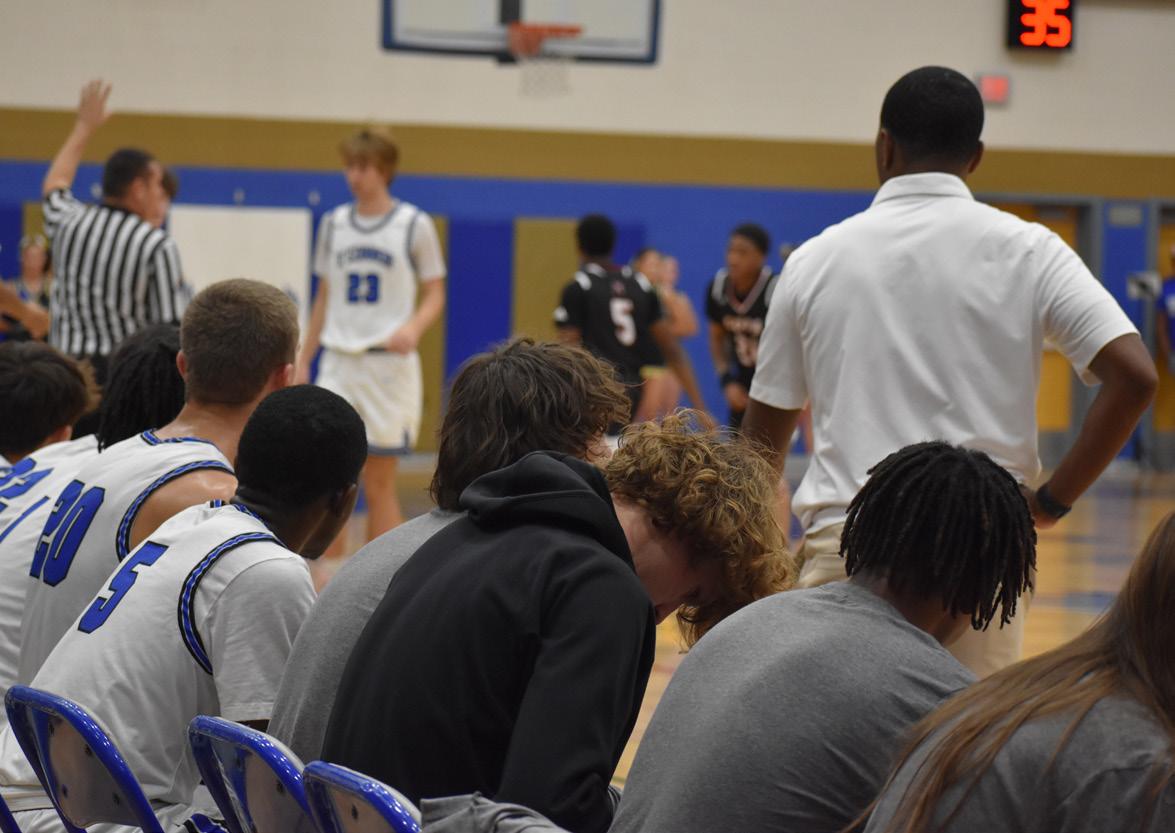
person involved in the team and everything else, at the end of the day, during the game, you’re still sitting there and you’re watching someone else play, and that can be tough on a teenager,” Rypkema said.
Multiple athletes have explained their experiences involving missing the first half of the season, and the results may be surprising.
According to these athletes, coaches tend to not give as much practice time to players who are ineligible, and not only does that affect an athlete’s morals, but also their abilities.
“It kind of messed with my game and now I have to build back up what I’ve missed,” said Jaden Maxey, sophomore.
Losing practice time can also affect a player’s relationship with their teammates; the beginning of the season being an integral time for team bonding. So now even while a player is dealing with missing playing time, they must also deal with the adversities of being a teammate.
“It sucks but, I mean, I believe in myself so I’m not going to get [upset] about it,” Wilson said.
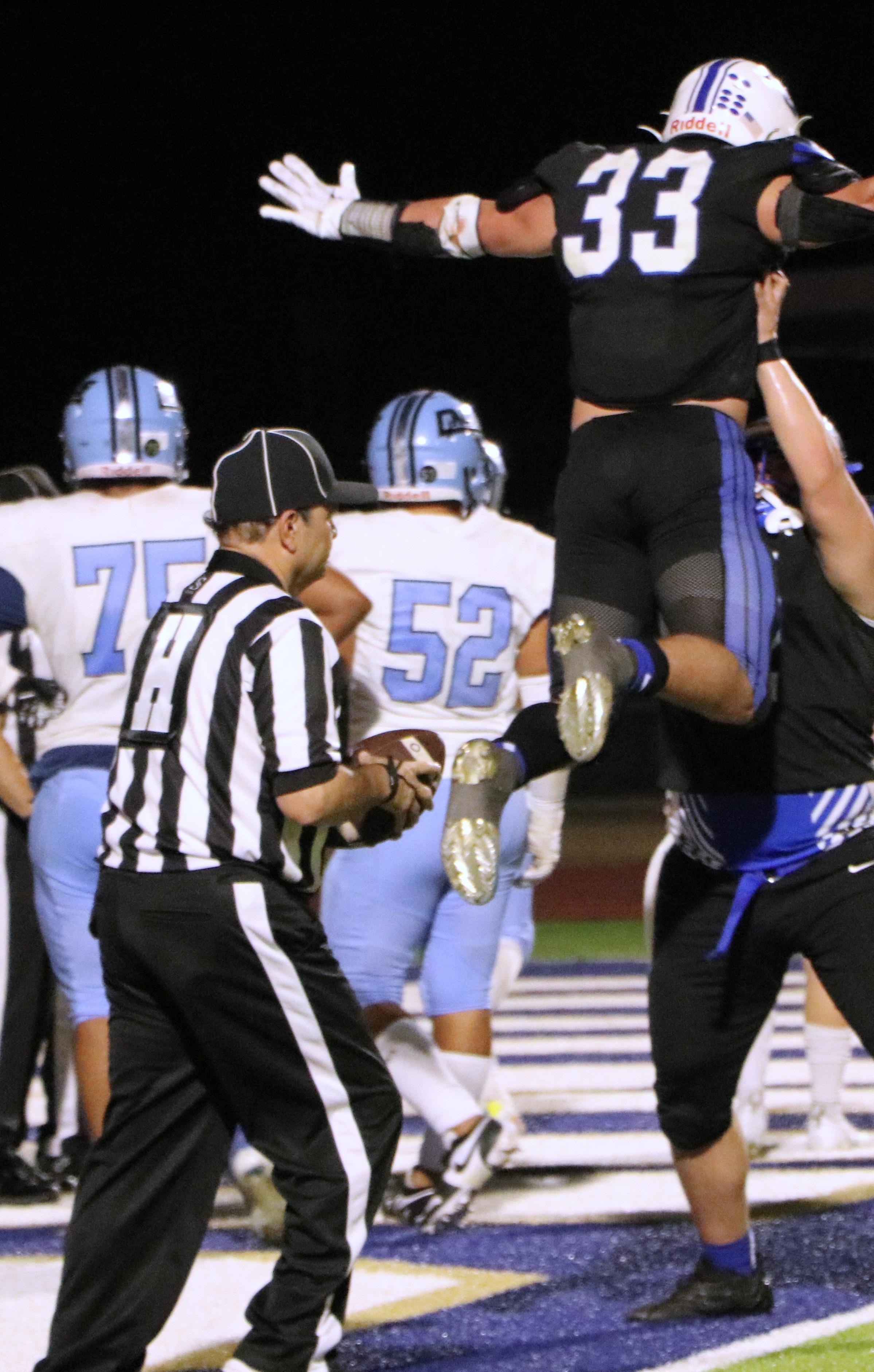
Yearbook prices will increase to $85.00 on January 8th.