B1
SUNDAY, SEPTEMBER 17, 2017
Business
Ray S. Eñano, Editor / Roderick dela Cruz, Issue Editor business@manilastandard.net
HOW APPLE DISRUPTED THE WORLD OF TELECOM
G
UY Kawasaki, a Silicon Valley marketing specialist, has challenged Asian telecommunication companies to keep innovating and follow the lead of Apple Inc., the world’s most valuable company, “so that you will not die.”
“Every company has to innovate,” says the 63-year-old former Apple Inc. ‘chief evangelist’. “Apple innovates a lot. It spends billions of dollars on innovating and they are highly successful, and customers love them.” “I can’t think of an example where customers don’t want their tech companies to innovate and they just want to get the same old thing. That is a sure way to die in tech,” says Kawasaki during ACC 2017, formerly Asian Carriers Conference dubbed as the region’s premier tech and telco event, hosted by PLDT Inc. at Shangri-La’s Mactan Resort & Spa in Lapu Lapu City, Mactan Island, Cebu province. More than 1,500 delegates from over 60 countries representing 400 companies attended this year ’s ACC which carried the theme ‘Reinventing Customer Experience in the Digital Age’. Now in its 13th year, ACC provides a venue for industry leaders to discuss and share the latest technologies and breakthroughs in telco, ICT and related industries. “What started as a group of carriers has transformed into an influential gathering of technology, software leaders and innovators. Given this emerging direction, it is fitting that we have invited a Silicon Valley icon, the former ‘chief evangelist’ of Apple, to provide insights on customer experience in this digital age,” PLDT executive vice president Eric Alberto says, referring to Kawasaki, a former chief marketing executive at Apple. Kawasaki, who is now a ‘chief evangelist’ of Australia-based online graphic design tool Canva, apart from being a brand ambassador of Mercedes-Benz, an executive fellow of the Haas School of Business at the University of California in Berkeley and a trustee of the Wikimedia Foundation, recalls the ‘art of transformation’ that has enabled Apple to become a $700-billion global company and change the way people communicate. Kawasaki, a Japanese-American, started working for Apple under Steve Jobs in 1984 where he was tasked to market Macintosh or Mac, the company’s first mass-market personal computer with a graphical user interface and mouse. Kawasaki is known for his people-centric approach to marketing, which focuses on highlighting products as experiences. He popularized the term ‘evangelist’ in the tech sphere and is heralded as one of the industry’s most passionate stalwarts. Kawasaki worked for Apple twice, first from 1983 to 1987, before he started a few companies. He came back to Apple, as Apple’s ‘chief evangelist’ from 1995 to 1997, then left again and started a venture capital firm. He also became a writer and speaker. Kawasaki says one of the most startling transformations that he has seen in his 35-year career in IT is Apple itself under Steve Jobs. “Think about the transformation that Apple went through. It was incorporated on April Fools Day, 1976. From there, it became a Macintosh company,” he says. “We went from Apple II personal computer to Macintosh personal computer. And then the mother of all transformations occurred of course when Apple became this extremely successful company. This is the kind of transformation that I was a part of, that I hope I helped cause a little bit. I learned a lot of lessons from Steve, from Apple, and I would like to pass on those lessons onto you, because you are in an industry that must transform itself, must disrupt itself. You are in a very, very competitive business,” he says in
Scan this icon to view the PDF
Together with Unicef celebrity advocate for children Anne Curtis (standing, left), Cebu Pacific cabin crew volunteers Kathleen Yu, Albert Atienza, Kokia Carpio and Tara De Los Reyes assist in the health and nutritional visit at San Isidro Day Care Center in Bobon, Northern Samar.
CEBUPAC, UNICEF TEAM UP FOR CHANGE
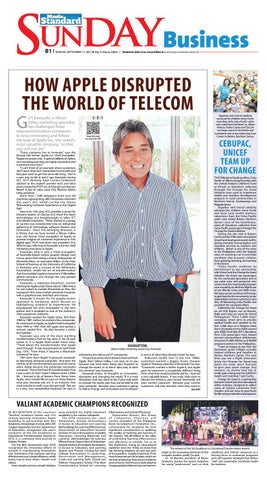
DISRUPTOR.
Silicon Valley marketing expert Guy Kawasaki
addressing the telcos and IT companies. “I hope that some of the lessons I learned from Apple, from Silicon Valley, I can pass on to you because you have been using your business to change the world, or as Steve Jobs said, to dent the universe,” says Kawasaki. Kawasaki shares 10 thoughts on innovation, disruption and changing the world. “If it is truly disruption that you want to do, if you truly want to change the world, you may not be able to ask your customer. Because your customer is going to define change and innovation and revolution
in terms of what they already know,” he says. Kawasaki recalls that in the mid 1980s, customers wanted a bigger, faster, cheaper Apple II. “Nobody asked for a Macintosh,” he says. “Customers wanted a better Apple II, but Apple gave its customers a completely different thing from what they would probably ask for. I learned a very valuable lesson. If you truly, truly want to disrupt the industry, you cannot necessarily ask your current customer. Because your current customers will only describe what they want in Turn to B2
THE Philippines’ leading airline, Cebu Pacific re-affirms its partnership with the United Nations Children’s Fund or Unicef, as donations collected through the Change for Good initiative were used to implement health and nutrition development projects in rural communities in Northern Samar, Zamboanga and Maguindanao. Together with Unicef celebrity advocate for children Anne Curtis and local rural health workers, volunteers from the Cebu Pacific cabin crew visited Bobon, Northern Samar—one of the beneficiaryareas of donations collected from Cebu Pacific passengers through the Change for Good initiative. During the site visit in Bobon, Curtis and the CEB cabin crew joined Unicef and local government staff in giving prenatal, immunization and nutrition services to mothers and children. Bobon is one of the areas in the Philippines with the highest rates of stunting—an irreversible condition that prevents children from growing, learning, and earning in the future “Ce b u Pa c i f i c re a f f i r m s i t s commitment to our partnership with Unicef and the Change for Good initiative. We thank our passengers for the continued generosity and to our cabin crew and personnel who ensure that this meaningful program runs smoothly on all of our flights out of our Manila, Cebu and Iloilo hubs. We hope we can continue to find ways to give back to the community, to our stakeholders and our customers,” said Atty. JR Mantaring, Cebu Pacific vice president for corporate affairs. Collections for Change for Good on all CEB flights out of Manila, Iloilo and Cebu are used for Unicef Philippines’ “First 1,000 Days” campaign, which aims to provide optimal health and nutrition in the first 1,000 days of a Filipino child, from conception to the child’s second year of life. As of July 2017, donations from CEB passengers have helped prevent micronutrient deficiencies of around 41,000 children and 46,000 pregnant women in the Philippines. “I was so happy to see how the donations given inflight actually helped children and families in Bobon, Northern Samar. The next time you see a flight attendant bring the Change for Good bag down the aisle, don’t hesitate to give your spare change. Any amount, no matter how big or small, goes a long way for children’s health and nutrition,” said Curtis. Change for Good is a partnership between Unicef and the international airline industry, designed to collect coins of various currencies from travelers and use these to pool funds for life-saving materials and programs.
VALIANT ACADEMIC CHAMPIONS RECOGNIZED IN RECOGNITION of the country ’s “fearless” academic heroes and 21st century learning innovators, Bayan Academy, in partnership with Rex Bookstore, Knowledge Channel, ABS-CBN Lingkod Kapamilya and the Department of Education, recognized this year’s recipients of the 5th Excellence in Educational Transformation Awards or EETA in a ceremony held recently at Dolphy Theater. For the fifth consecutive year, EETA recognized the innovative efforts of schools in transforming themselves into institutions that promote learning effectiveness and school efficiency while being true to their vision, mission and values. Four schools and two schools division
were awarded the highly esteemed accolades in the various categories. The EE TA recipients are: Lawit Elementar y School (Innovations in Access to Education and Learning Methodology for Learning Effectiveness), Department of Education–Schools Division of Carcar (Innovations in Quality Education: Learning Materials and Learning Methodologies for Learning Effectiveness), Department of EducationSchools Division of Camiguin (Innovations in Access to Education, and Learning Spaces and Places), Chiang Kai Shek College (Innovations in Leadership, Governance and Management), Create and Learning Paths School and Diliman Preparatory School (The Most Transformative School for Learning
Effectiveness and School Efficiency). Dominador Buhain, Rex Group of Companies chairman and current president of the Philippine Book Development Federation Inc., commended the recipients for their significant contributions in uplifting the quality of teaching and learning in the country. “We all believe in the value of promoting learning effectiveness and efficiency in schools. For us at Rex Bookstore, being an educational publisher since the 1950s, we know that our learning solutions are just one part of the equation. Equally important, if not more important are the schools, which are the hub of learning. They are our students’ second home. How these schools adapt to change greatly influence how our learners
The winners of the 5th Excellence in Educational Transformation Awards
adapt to the increasing demands of this complex modern world,” he said. Dr. Ed Morato, president of Bayan Academy, lauded the award recipients for using “weaknesses” such as their
smallness and inferior resources as a driving force to customize programs and craft superior strategies that deliver “real” and sustainable beneficial results for students.
Business
B2
SUNDAY, SEPTEMBER 17, 2017 business@manilastandard.net
BATAAN LURES BEACH GOERS
Villa Dolores Beach Resort in Barangay Saysain, Bagac, Bataan.
BATAAN province, a peninsula with a long coastline that hugs the West Philippine Sea and Manila Bay, now rises as a beach destination that can be reached in two and a half hours by car from Manila. Bagac town in particular now attracts beach goers all year round, with the rise of modern facilities such as the newly built Villa Dolores Beach Resort. “We’d like to help make Bagac, Bataan a popular beach tourism destination in Luzon,” according to a representative of Villa Dolores. The resort, located in Barangay Saysain, is one of the nearest beach destinations west of Metro Manila. There’s no need to go to the airport and travel by plane to discover a favorite getaway and have an unforgettable beach and sand experience, the Villa Dolores’ representative says. The resort features beachfront rooms and cottages and facilities that are ideal for team building, wedding, events, group or family bonding.
RETAIL STORE GETS URBAN JUNGLE LOOK LIFESTYLE retailer urbanAthletics, known for its meticulous selection of sneakers and apparel from the most sought-after brands, has recently unveiled a new design for its flagship store at Greenbelt 3 in Makati City. The refashioned store follows the urban-industrial look with a dramatic and inspiring design that was first introduced in its boutique at S Maison, Conrad. Established in 2009 by the same group that runs Toby’s Sports and RunNR, urbanAthletics has attracted loyal customers who want to get their hands on the latest sneaker releases from the top sportswear brands. With a new store look and an improved product selection, the retailer hopes to increase its market share and establish its retail locations as an integral part of the local sneaker scene. Space Encounters, a firm that specializes in interior branding and furniture production, led the creative execution of the new urbanAthletics store, taking inspiration from the brand’s image and culture—street smart with polished class. “We really wanted the new stores to establish urbanAthletics’ retail and brand identity, separating it from all the other sneaker boutiques in the country. The new design of our stores reflects our commitment to elevating the customer experience to a new level. When clients enter the space, we want them to feel like they are at the heart of the sneaker culture. We want them to feel the passion that urbanAthletics has for its wellcurated selection of sneakers in a modern urban space that inspires creativity and individuality,” said Toby Claudio, president of Quorum International Inc., the parent company of urbanAthletics.
HOW APPLE... From B1 terms of what they already know. If they know an Apple II, they are gonna ask for a better, faster cheaper Apple II.” “The second thing I learned is that if you want to truly disrupt, then you have to jump to the next curve, to not simply build a better Apple II, but to get to the next curve in computing,” says Kawasaki, in highlighting the importance of innovation. He says most companies were so used to embracing their current operations that they failed to ride the next curve of technology. “You have to get to the next curve. You could be the most successful ice factory, but if you don’t embrace the refrigerator curve, you will die,” he says, citing the example of the ice business. K awasak i listed a number of companies that failed to jump to the next curve and lost their market, including Kodak, Wang, Polaroid, Smith Corona and Remington Rand. “Think about all the taxi companies that are threatened by Lyft and Uber. Think about all the hotels that are threatened by Airbnb. Those things are the next curve. Airbnb is not a slightly better hotel chain. Lyft is not a slightly better taxi company. You want to be on the next curve, if you truly want to disrupt,” he says. In developing a product, Kawasaki shares the product development technique called MVVVP, or minimum viable, valuable, validating product. “If you could create something viable, but
SOCIAL MEDIA’S BEAUTY QUEEN
P
ia Alonzo Wurtzbach, the German-Filipino model who was crowned Miss Universe in 2015, acknowledges the role of social media in helping her win the world’s most prestigious beauty pageant title.
Wurtzbach, the third representative out of the Philippines to become Miss Universe after Gloria Diaz (1969) and Margarita Moran (1973), is an active user of Instagram, Facebook and Twitter. “My best experience in social media was of course everybody’s help in online voting during the 2015 Miss Universe. We actually crashed their website, because there was so much of us [Filipinos],” Wurtzbach, 27, tells journalists at the sidelines of ACC 2017, formerly Asian Carriers Conference, dubbed as Asia’s premier tech and telco event which was hosted by PLDT Inc. at Shangri-La’s Mactan Resort & Spa in Lapu Lapu City, Cebu. Wurtzbach, a five-foot-eight stunner whose father was from Stuttgart, Germany, got the highest scores from the judging panel, the contestants and the online voters during the competition held in Las Vegas on Dec. 20, 2015. Prior to this, she won the Binibining Pilipinas pageant on March 15, 2015. “From what I know, it was actually a unanimous decision from the judging panel. So all voted for Team Philippines. The girls voted Philippines also, and during the online voting, the Philippines was also number one. It was a big help. If in case the judges voted 50-50 on me, then maybe that [online voting] would have been the difference,” she says. “But it also really showed that we are number one, that we are the biggest fans of pageant, of Miss Universe and we have proven that through the statistics, especially during the online voting. That is why they had the pageant held here early this year,” she says, recalling Manila’s hosting of the 65th Miss Universe pageant in January. Wurtzbach, who studied at the Center for Asian Culinary Studies, says the existence of reliable Internet connection in the Philippines played a part in delivering Filipinos’ votes during the online voting segment of the competition. She recalls that in 2015, the Miss Universe organizers changed the mechanics of the competition. “I found out when I was already in Vegas that there would be a fifth judge for the competition, and the fifth judge was going to be you –the people who were watching at home. There was a small window that the votes could come in. If you missed that opportunity, the votes would not count anymore. So it was important that you had a fast Internet connection, whether at home, in your mobile phone, or your tablet. It was important that you got the live streaming, real-time,” she says. “When I came in until I exited the stage, that’s when you voted. After I exited, the votes would not count any more. We wanted the Philippines to win, so it was very important for me. And social media has been very helpful for me, also to reach a lot of people, not only during my journey towards Miss Universe, but also after Miss Universe,” she says. Wurtzbach has been an active social media user, with millions of followers for several years now. She has 5 million followers on Instagram, over 1.67 million on Facebook and 574,000 on Twitter. She describes her social media accounts as records of her life’s training and career. “I needed to work on my physique, my public speaking skills. I needed to work on a lot of things. A lot of people were l0oking down on my chances at Miss Universe because of the way I look, because I am not pure Filipino, but I am by heart. I used social media as a tool to show my progress, and to show people how dedicated I was in winning the crown for the Philippines. And you can see through my social media accounts that it is like a diary,” she says. “When you go back to my timeline, you will see the changes, the progress. You will see me going to the gym. You will see me doing the catwalk training.
not valuable, you would not dent the universe. Apple for example could sell laser printers. It could probably be quite successful with it, but is it a valuable contribution to society? Not at all at this point,” he says. Kawasaki then cites the importance of art or design in product development. “One of the things that separated Steve Jobs from any other tech CEOs in Silicon Valley is that Steve Jobs believed that engineers are artists. It was about art. I think if you want to disrupt the market, you have to think of engineers as artists, that they are making art. That is an expression of their soul. Make design count,” he says. Kawasaki says in order to disrupt the market, innovators should be willing to polarize people. “This means that when you have disrupted the market, you will polarize people. Some people will love what you do, some people will hate what you do. Some people love Macintosh, some people hate Macintosh. It is okay. The worst case is people don’t care what you have done, and you are irrelevant,” he says. “Don’t be afraid of polarizing people. I am not saying that you intentionally try to piss people off. But I am telling you that great innovation, that disruption tend to piss people off. Some people would love what you do, some people will hate what you do. It is okay,” he says. Kawasaki says disruptors should also learn how to ignore naysayers. “The naysayers are gonna tell you, it cannot be done, it should not be done, it is not necessary. When Apple came out with Macintosh, many people predicted its demise. When Apple decided to do
2015 Miss Universe Pia Wurtzbach
You will see me lose three times as Binibini even. Everything is there. If you go to my social media account, and you go way, way back, you will see the first time I joined Binibini, the second time I joined, the third time, and finally Miss Universe, and now after Miss Universe,” she says. Wurtzbach says it is now very important to connect with people through social media. “It is really how we are all connected,” she says, in describing the power of technology. “So it is also kind of a responsibility, isn’t it, for each and everyone, not just for me as a beauty queen or ‘celebrity’, but for every individual? Personally, it has helped me to share what my life is after Miss Universe and what I am up to now. Now, social media is really the way to connect to other people. Don’t you guys notice that whenever you want to check up on someone, instead of going to their house, you just search on Facebook or Instagram?” she asks. “I would say that in the last five years, the growth of social media use has been significant. Nowadays, you can find old relatives online,” she says. On what things she avoids posting on social media, she says: “If you have the smallest doubt that you have to share it, don’t share it. That’s how I go by it. If you think that it is something people will like, that it is something fun and it is harmless, go for it. But if you have a little bit of doubt, then think about it, sit on it, don’t do it yet,” she says. Wurtzbach says she has also learned how to respond to negative comments on social media. “During my early years joining pageants, I used to reply to people who did not like me. But I have learned, with the guidance of my trainors, that it is better to just avoid negativity and ignore it is as part of the job. There will always be people who are going to have negative opinion about you. So it is just better to ignore this. Especially if you are going to join a competition, it can really get into your head, and you can lose your focus,” she says. “My worst experience was when I, during the competition, would
the Apple Store, many people said that there is no way that an Apple Store would work. It is a single brand. You cannot possibly support a store with a single brand. And yet today, per square foot, Apple is the most successful retailer in the world,” he says. Kawasaki says changing one’s mind in the middle of product development is fine. “To be successful as a disruptor you have to be willing to change your mind. Changing your mind is a sign of intelligence. It is not a sign of stupidity, not a sign of making mistake. Changing your mind is a good thing,” he says. A disruptor, he says, should find a niche. “For the marketing of disruption, it comes down to a very simple point. If you are an engineer, you need to create a product that is unique and valuable. If you are a marketing person, you need to convince the world that it is unique and valuable. When the iPod came out, it was unique and valuable,” he says. Kawasaki says to determine the success of the product or service, “let a hundred flowers bloom” or wait until the right market embraces it. “It means you take your best shot at positioning, branding and figure out who you are unique and valuable for. Then you shift it. Then you wait and see what happens. In many cases, you notice something happens. Your intended audience may not embrace your product. If you’re lucky, your unintended audience start buying your product or service.” “Companies star ted to use Macintosh for desktop publishing. It is not something we anticipated, not something we created. They were
gifts from God to Apple Computer. I believe in God. One of the reasons why I believe in God is that there is no other explanation for Apple’s continuous survival than the existence of the benevolent God,” he says. “At the end of the process, you have to churn, baby churn. This is the most difficult thing for a disruptor to do. Because as you have learned to be a disruptor, you have to ignore naysayers and experts who tell you that it cannot be done, it should not be done, it is not necessary, that an Apple retail store will not succeed. You need to be able to ignore those people. Once you shift, once your curve is now available to the public, you need to completely switch you mindset and churn. Churn means version 1 becomes 1.1, 1.2 1.3, 1.4, 1.5 and 2.0,” he says. “Macintosh started in January 1984. It took to 2017 to get a computer like an iMac Pro. One of the big learning lessons for me in my life is that I thought that Macintosh was so great that by January 1985, Apple would control the computing world. It never happened like that. It took 20 or 30 years for Apple to be truly successful. I never thought it would take that long,” he says. Kawasaki says the main lessons for telecom companies is to jump to the next curve. “When you jump to the next curve, that curve does not have to be perfect. Remember MVVVP. The first refrigerator was not perfect. The first laser printer was not perfect. The first digital camera was not perfect. Once you shift, you need to churn, baby, churn. This is the toughest thing for a
still see or read comments that would upset me, and then it would kinda rattle me for the night or for the day. It was really unnecessary because you were about to represent the Philippines in Miss Universe, and one comment on social media should not let you lose your focus on your ultimate goal. I have learned just to ignore, ignore,” she says. “We can be helpful when it comes to boosting our representatives in other countries, especially when they are about to go on competition representing the Philippines. We have seen that with beauty queens. We have seen that with athletes. We have seen that with artists or talents who are showcasing their abilities in the international stage. And we are very proud and it becomes a trending topic if a Filipino is joining the competition in other countries,” Wurtzbach says. “With that also comes some bashing, some nitpicking and I think it really comes with it. You can’t control everything we see online, or what we read online. What we can do is control how we feel about it, or our action,” she says. Wurtzbach says she is excited about the future of social media. “I can’t wait to see how it will become in the next five years. I really did not imagine five years ago that I would be able to find, connect to titas and cousins, or that I would be able to see my niece or sisters, even though they are in another country.” She says social media is generally good. “It has its disadvantages of course, but that only comes with irresponsible action or use of technology, but I think in general, technology can be very good,” says Wurtzbach. Wurtzbach is one of the speakers during ACC 2017, which was attended by more than 1,500 delegates from more than 60 countries representing over 400 companies. This year’s ACC ran on the business theme ‘Reinventing Customer Experience in the Digital Age’. ACC provides a venue for industry leaders to discuss and share the latest technologies and breakthroughs in telco, ICT and related industries. It brings together delegates from the wholesale fixed and mobile telco carriers, network and infrastructure providers, applications and service developers, handset and equipment manufacturers, and entertainment and content distributors around the world. “Apart from providing an ideal venue for discussion and sharing of ideas, the ACC also spearheads Thought Leadership on the future of technology and telco around the world,” says PLDT Global Corp. president and chief executive Kat Luna-Abelarde. Aside from PLDT and Smart, other platinum sponsors of the event are Huawei of China, BICS of Belgium, Ciena of Singapore, Orange of France, PCCW Global of Hong Kong, Sigma Telecom of Istanbul and XiComm of the US. Roderick T. dela Cruz
disruptor to do, because you have to go from ignoring feedback to listening to feedback,” he says. Kawasaki says a disruptor shall firmly believe in his idea, even before it becomes a reality. “One of the most valuable lessons I learned from Steve Jobs is not the skeptic’s point of view. The skeptic’s point of view is that if I see it, I will believe it,” he says. “But if you want to be an innovator, if you want to be a disruptive force, if you want to dent the universe, if you want to change the world, you need to embrace this attitude—that some things need to be believed to be seen.” “If you believe in the Internet of Things, if you believe in Macintosh, if you believe in iOS, if you believe in Android, if you believe that people would rent out their spare rooms to total strangers in the Internet [Airbnb], if you believe that people would get in the car from a company [Lyft], if you believe that it can happen, then you will see the Lyfts and the Ubers and the Apples and Airbnbs and all the companies that changed the world. Some things need to be believed to be seen. That is the art of disruption,” says Kawasaki. On what is the next curve for telcos, Kawasaki says: “I don’t know. By definition, if it is disruptive, people like me should not necessarily know. Probably, two people in a garage, or two people in an apartment, or two people in college who are gonna come up with this idea. Not somebody who is 63 years old. Your job is to encourage that kind of thinking, so that the next Steve Jobs is Filipino.” Roderick T. dela Cruz
LGUs PHILEX AWARDS 30 COLLEGE GRANTS By Dexter A. See TUBA, Benguet—Philex Mining Corp. has awarded 30 new college scholarships to beneficiaries in the host and neighboring villages of its Padcal mine in this province, bringing to at least 95 the total number of scholars for the current academic year enrolled in various schools in Baguio City and Benguet, and nearby Pangasinan and Nueva Vizcaya. Other than the six previous scholars who have failed to achieve the gradeweighted average required by the company and who now receive a 75-percent financial assistance, the rest of the scholars enjoy free full tuition, a book allowance, and a monthly stipend. “We are very proud of this program, as everybody agrees on the importance of education for the future of an individual, his or her family, the community, and the whole society,” the company’s CEO and president, Eulalio Austin Jr., said. “And we still extend assistance to those scholars who even have failed to obtain our cutoff grade average.” The number of new scholars may increase as there are four other applications undergoing screening, according to Aurora Dolipas, manager of Padcal’s Community Relations (ComRel) Department, who earlier said the company had set aside P14.4 million for its scholarship program for college, high-school, and elementary students, as well as for those in the technical/vocational (TechVoc) courses. Last year, Philex Mining allotted P11.8 million for its 114 full college and 24 TechVoc scholars; 374 students in elementary and high school who received educational subsidies; and 130 secondary students who were given education assistance (monthly monetary allowance). In a report, ComRel’s Crisel Alberto-Rosado said the first semester of schoolyear 2017-18 has 64 full college scholars and five others enjoying financial assistance through the company’s Social Development and Management Program, while 25 full scholars and one other receiving financial assistance through the DMTG, or Development of Mining Technology and Geosciences. All 95 college scholars were given a budget of P2.82 million, broken down as P1.87 million for the first 64; P69,699 for the next five; P858,768 for the 25; and P18,750 for the last one. SDMP and DMTG join the IEC, or Information, Education and Communications campaign, as three of the company’s major programs on corporate social responsibility. Having been implemented religiously by the company, these three programs get a mandated current annual budget of 1.5 percent of Philex Mining’s total operating expenses in the previous year. This year Philex Mining saw 24 of its college scholars graduating in various disciplines from the different colleges and universities, while seven other scholars finished their TechVoc courses.
SOLAR ‘SPARADISE’ IN PUERTO PRINCESA By Robbie Pangilinan PUERTO Princesa City is the gateway to paradise. It boasts of the world-famous Underground River and Tubbataha Reef, beautiful Honda Bay and Sabang Beach, Cowrie Island and Lu-Li Island, Butterfly Garden, Tribal Village, Ugong Rock, Wildlife Rescue and Conservation Center, Mitra Farm, and the Special Battalion WW2 Memorial Museum. Hundreds of fireflies light up the night, too! Puerto Princesa is not only home to these tourist attractions, but also the location of the first full solar-powered spa in Palawan—Ella Spa. The “Solar Man” himself, Korean national Ralph Kim, had a vision on his very first day in the city—to build a business powered entirely by the sun. In 2015, Kim came to the Philippines and saw the country’s energy problems. He has been around Asia but felt particularly drawn to the Philippines because he says the people are more friendly. He set his heart on the Philippines and went back and forth from Korea before establishing his mission here, which is to use solar power for electricity. “Sunshine is a gift from God. It is clean and free. We should use it. You have abundant sunlight here, but a shortage of electricity supply,” said Kim. He established the Unique Korean Corp., a company that supplies solar energy to residential, commercial, and industrial clients from the Sky Taeho main factory in Korea. Years later, Kim established the 600-square meter, 50-bed Ella Spa, with 15 rooms that harness the natural energy of the sun via 20kw solar power generator. Forty-eight solar panels and 40 batteries power the spa’s 13 air-conditioning units and almost 100 lights.
SUNDAY, SEPTEMBER 17, 2017
B3
mst.daydesk@gmail.com
NEGROS ‘BIRD BABBLERS’ IN DANGER
T
HE government has pressed for the conservation of endangered “Zosteropidae” bird babblers in Negros Island as biodiversity preservation has become crucial to the rural economy’s sustainable development. The babblers at the Mt. Kanlaon Natural Park in Negros Island are threatened by bird hunting, illegal cutting for timber, firewood and charcoal production, human-induced air pollution, and conversion of forest to agricultural commodities, according to the Sylvatrop Journal of the Ecosystems Research & Development Bureau. In Sylvatrop’s special issue with the Biodiversity Conservation Society of the Philippines, experts revealed both Negros babblers—the flame-templed babbler (Dasycrotapha speciosa, endemic to Negros and Panay) and Negros-striped babbler (Stachyris nigrorum, endemic to Negros) have been classified as endangered by the International Union for Conservation of Nature. As of 2015, BirdLife International indicated that the population of D. speciosa in Mt. Kanlaon ranged at 2,500 to 9,999 individuals. This was greater than the
600 to 1,700 mature individuals for S. nigrorum. Reduction in population, threatened at 50 to 90 percent, of the bird species is believed to be continuing. “[We should] intensify regular forest monitoring in Mt. Kanlaon; establish and revisit biodiversity monitoring system for population of babbler species,” according to Sylvatrop authors Andrew T. Reintar, Shaira Grace B. Pios, and Dennis A. Warguez. They also pressed for conservation initiatives to start and education materials to raise public awareness on the biodiversity threat. ERDB director Dr. Henry A. Adornado said the study increases understanding of the status of Philippine biodiversity. “These efforts are aligned with ERDB’s mission to provide science-based information for the improvement of our environment. May this scientific information inspire us to work hard for the conservation of our rich flora and fauna,” Adornado said. Biodiversity protection promotes sustainable development of forests that are significant sources of food, timber and non-timber products, and raw materials for manufacturing supplies while generating livelihood for rural people. “We need biodiversity for its invaluable ecosystem services, providing oxygen, food, clean water, fertile soil, medicines, shelter, protection from storms and floods, a stable climate and recreation,” according to the Earth Institute. The IUCN itself recommended more surveys in Panay and around Mt. Silay
and Mt. Mandalagan in north Negros to locate other birds. It pushed for the establishment as protection area of the proposed Central Panay Mountains National Park and other key sites as the North Negros Forest Reserve. “This lowland forest species has a very small, severely fragmented and declining range. It is estimated that just 10 percent of remaining forest on the two islands where it occurs lies within the elevation range suitable for this species,” said IUCN. Reforestation is a solution to their threatened extinction. According to the study, “Tree density was found to be significant in the abundance of S. nigrorum; a decrease in tree density would
mean an increase in the abundance of S. nigrorum. This result strongly presses the fact that the species prefers mid-montane and mossy forest.” Thick undergrowth should be developed for D. speciosa, which is an omnivore. These babblers feed and breed in understory bushes, trees, vines, and ferns. According to the IUCN, while conservation sites have been identified, there has been no species management that successfully reintroduced the population, no awareness-education program, and no action recovery plan or monitoring. Needed protection includes site protection and management and habitat and natural process restoration.
BULAKENYO HERO. Bulacan First District Rep. Jose Antonio R. Sy-Alvarado, Gov. Wilhelmino M. SyAlvarado and Vice Gov. Daniel R. Fernando lead the wreath-laying activity at the monument of Marcelo H. del Pilar during the celebration of the 439th Founding Anniversary of the Province of Bulacan at the Bulacan Capitol Gymnasium, City of Malolos, Bulacan. Joining them are (from left) Board Member Allan Andan, Hagonoy Vice Mayor Pedro Santos, Board Members Felix Ople, Allan Ray Baluyot and Rino Castro, Second District Rep. Gavini Pancho, and Board Members Ma. Lourdes Posadas, Alexis Castro, Therese Cheryll Ople, Emelita Viceo, Perlita delos Santos and Enrique dela Cruz. Rey Espiritu
VILLAVERDE HIGH’S VERMICOMPOSTING PROJECT LAUDED By Ben Moses Ebreo BAYOMBONG, Nueva Vizcaya—The town of Villaverde not only prides itself with its aggressive reforestation program but also on solid waste management. The Villaverde National High School recently received a Gawad Kalasag Award on Solid Waste Management from the Department of the Interior and Local Government this year at the Philippine International Convention
Center. The award was attributed to VNHS’s best practices on Ecological Solid Waste Management, which started five years ago. VNHS has been implementing and sustaining its vermicomposting facility, which transforms segregated waste materials into organic fertilizers. “We use these fertilizers for our Gulayan sa Paaralan Project that serves as our source of vegetables to improve the nutritional status of our school-
ers,” said Ian Daryl Martin, VNHS’s SWMP coordinator. The school also uses its Material Recovery Facility used for generating recyclable materials as income-generating project. A paper conservation program was also introduced, using paper conservation trays to generate less-crumpled papers and advocate efficient consumption of papers. Each class also follows a weekly schedule to lead the picking of pieces
of paper and other wastes inside the school compound. Martin said these activities and projects contribute to their Trash to Cash Project, an income-generating activity approved by the Department of Education, which generates cash yearly from P2,000 to P3,000. “We use this amount in buying classroom needs such as instructional materials, which reduced the cash contributions from our students,” he said.
TANAUAN PROUD. Students Veronica G. Ocampo, a resident of Barangay Wawa
'MARING' RELIEF. Mayor Antonio Ferrer of General Trias City leads the distribution of food packs to residents of low-lying areas in Barangay Bacao at the height of Typhoon 'Maring' on Tuesday.
in Tanauan City, Batangas, and Dalton D. Mojica, who lives in Barangay Santor, flank Tanauan Mayor Antonio C. Halili (center) with their respective families. They paid a courtesy call on the mayor and hold up plaques containing copies of a resolution of commendation from the Sangguniang Panglunsod and their certificates of recognition as bronze medalists in the International Math Open for Young Achievers in Singapore from Sept. 1 to 4. Roy Tomandao
B4
SUNDAY, SEPTEMBER 17, 2017
Jimbo Gulle, Editor
Roger Garcia, Issue Editor
LGUs mslocalgov@gmail.com
MANILA BREAKS RECORD FOR COASTAL CLEANUP DAY By Bill Casas
T
HE City of Manila broke a record set two years ago in the number of volunteers who turned up at Manila Bay on Saturday morning for the 32nd International Coastal Cleanup Day.
As of 9 a.m., 10,849 volunteers turned up at the Baywalk along Roxas Boulevard to pick up trash and marine debris from Manila Bay’s shoreline, according to Belle Borromeo, chief of the city’s Department of Public Services leading the cleanup. During the 2015 ICC Day in Manila, Mayor Joseph Estrada led 8,351 volunteers and 700 Manila City Hall employees, who were later joined by 1,000 others from 20 private groups, in cleaning up the Baywalk area along Roxas Boulevard. About 372 cubic meters of waste were collected that day. The volunteers came mostly from various schools, colleges, and universities in and outside
Manila and corporations such as Asian Terminals, Inc., Petron, Magsaysay Group of Companies, Manila Hotel, Rizal Park Hotel, Toyota Motor Philippines, San Miguel Corp., Samsung Philippines, Republic Cement, and Unilever Philippines, among others. Speaking on behalf of Estrada, City Administrator Ericson Alcovendaz said the City of Manila is proud to have hosted this all-volunteer coastal cleanup activity done simultaneously worldwide. “On behalf of Mayor Estrada and the people of the City of Manila, we would like to express our most profound gratitude to all volunteers who are here this morning in an effort to clean our famous Manila Bay,” Alcovendaz said. Through ICC, he said people have learned to take care of the world’s seas, oceans, and waterways even as many others have remained undisciplined in the proper garbage disposal. “We still have a lot of countrymen who don’t follow the correct way of disposing their garbage. They still throw trash on our streets and into our rivers, seas and esteros,” Alcovendaz lamented. With the ICC Day 2017’s theme “Together for Our Ocean,” Alcovendaz called on Filipinos to “renew our commitment and cooperation so that we may succeed in our mission to rescue
our oceans, rivers, and waterways, and preserve them for the next generations.” Employees of various government offices were also present such as Department of EducationManila, Department of Environment and Natural Resources-Mimaropa, Department of Public Works and Highways-NCR, and Department of Tourism, as well as Rotary Clubs of Makati and Neopolitan. The Philippine Navy, Philippine Coast Guard, and Philippine Coast Guard Auxiliary also made their presence felt in the event. Various offices from the City Hall of Manila and the Manila Police District also sent representatives to the cleanup operation. Held every third Saturday of September, ICC is the largest volunteer effort for the ocean and waterways initiated in 1986 by Ocean Conservancy, a non-government organization based in Washington, DC, to engage volunteers in collecting marine debris from the world’s waterways. Around 90 countries, including the Philippines, regularly participate in this event. The Philippines canceled its coastal cleanup day activities on Sept. 17 last year due to the declaration of state of lawlessness by the national government.
IN CHARACTER.
Senator Manny Pacquiao (center) is flanked by Pauline Laping (left) of Miss Global Philippines and Rizza Lao (right), founder and chairman of Miss Global Philippines, during the launch Friday of Comic Con Asia at the City Club of Alphaland Place in Makati City. Coming on March 24 and 25, 2018, the convention will gather the best of comics, movies, series manga, anime, toys, gaming, and cosplay at SMX in Pasay City. Lino Santos
LENI BRINGS ‘ANGAT BUHAY’ TO EASTERN SAMAR VICE President Leni Robredo recently sat down with community leaders and residents to discuss how to improve their livelihoods during a visit to the towns of Hernani and Salcedo in Eastern Samar. In her visit to Canhugas Nature Park, Barangay 2 Poblacion in Hernani, Robredo met with fisherfolk, tricycle drivers, and sari-sari store owners to discuss the various problems faced by the community. Lack of sufficient livelihood was the main issue raised, despite the community’s proximity to a possible tourist spot. “We cannot rush this [development]. We want tourists to visit this
place, but we need to prepare it first. A lot of opportunities can open up for you when it is easier to get here,” the Vice President told residents. The VP was accompanied by representatives from TripKada and the Management Association of the Philippines, both of which committed to assist in the development of Canhugas Nature Park as a tourist destination. Through Angat Buhay partners Lingap sa Laylayan ng Lipunan and Federation of Filipino-Chinese Chamber of Commerce and Industry Inc., two Eastern Samar schools also received water filtration systems, and a pledge of two new
classrooms for Salcedo National High School, respectively, were also turned over the same day. She also encouraged the community to create a plan that would promote ecotourism in the area. The Vice President stressed the importance of careful planning especially when it involves bringing in livelihood opportunities. “If there’s no master plan, it might go to waste. If we just talk among ourselves, we might waste this beautiful spot. We might not maximize the opportunities here. So developing this area is the first step,” she said. The same day, Robredo also visit-
Local Gov’t Units
ed the members of the Farmers Entrepreneurs Association at a demo farm in Barangay Naparaan, Salcedo. In their conversation with the VP, the farmers identified the lack of financial resources to purchase livestock, poultry, and other farming materials as the biggest obstacle to improving their income. In both dialogues, VP Leni underscored the importance of enhancing incomes of existing livelihood opportunities, as well as the need to create new ones. “There should be enough jobs and income for you. If there’s a lack, something must be done,” she said.
MAKATI MATH WIZARDS LAUDED TEN math wizards from Makati public schools won one gold, four silver and five bronze medals at the 2017 International Mathematics Open for Young Achievers (IMOYA) held in Singapore last Sept. 1 to 4. Makati Mayor Abby Binay congratulated the winners and thanked them for valuing the investments of the city in their education. “Congratulations to our young Math wizards! Your hard work has paid off with your excellent performance in such a prestigious competition. Your achievements are the best reward we could ever hope for as we continue to invest our city’s resources in upgrading our public education system,” Binay said. In her report to the mayor, Department of Education-Makati superintendent Rita Riddle named Grade 3 student Justine Mae Vito Cruz of Bangkal Elementary School-Main as the gold medalist in the competition. The four students who won silver medals were Grade 7 students Ma. Angelica Marquez, Cedric Gabriel Evasco and Chryss Anika Bersabal, all from Makati Science High School, and Grade 5 student Juwan Emmanuelle Osama of Rizal Elementary School. The five students from Makati public schools who bagged bronze medals were Grade 7 students Lheiza Jhoy Caro and Gabrielle Leonard Cuadra of MSHS, and Grade 5 students Ron Aldwyn Abustan (Fort Bonifacio Elementary School), Allan Dave Pabillano (Comembo Elementary School), and Jameiah Marielle Prayco (F. Benitez Elementary School-Main). IMOYA is aimed at providing student-participants with a venue to showcase and enhance their skills in Mathematics while at the same time, giving them opportunity to share their home country’s culture and heritage to fellow delegates. During the competition, the Philippine delegation competed in various categories which included Middle Primary (Grades 3 and 4), Upper Primary (Grades 5 and 6), Junior High School (Grades 7 and 8), Intermediate Level (Grades 9 and 10) and Senior High School (Grades 11 and 12). The Philippines and Singapore competed against delegates from Indonesia and Thailand. Meanwhile, in August this year, 39 students from public elementary and high schools of Makati joined the Philippine delegation at the 13th International Mathematics Contest held also in Singapore. They brought home numerous medals which included three gold, seven silver and 14 bronze medals. Last February, 16 MSHS students became recipients of the prestigious Youth Excellence in Science medal from the Department of Science and Technology. It is given to Filipino students with exemplary achievements in international individual or team competitions in Mathematics and Science.
SM, UBS TEAM UP FOR SCHOOL BUILDING
The new building of Cogon Central School in Ormoc City bears a marker of the partnership between SM Prime Holdings and UBS Investments Philippines (inset) for the two-story, fourclassroom structure erected through SM Foundation and the Department of Education.
ORMOC CITY—“In the history of Cogon Central School, today is a memorable day for the pupils, parents and teachers since the long-awaited dream of having a new building becomes a reality.” Principal Marita T. Albienda said this of the school building SM Foundation recently turned over to the Cogon Central School, witnessed by Department of Education Schools Division Superintendent Dr. Manuel P. Albano and Councilor Nonilo Quilang, a representative of Mayor Richard Gomez. Construction of the new school building was made possible through the efforts of SM Prime Holdings through the SM Foundation in partnership with UBS Philippines. On hand to witness the official turn-
over was SM Foundation’s Executive Director for Education, Carmen Linda Atayde, and Juris Soliman, head coordinator of the Schoolbuilding Program of the Foundation. The new two-story four-classroom school building is furnished with 200 armchairs—including 20 specifically made for left-handed students— along teachers’ desks (all made by the Foundation of the These-Abled), 16 wall fans, eight blackboards, four wall clocks, four toilets, plus a toilet in the ground floor for persons with disability. According to DepEd Division Senior Program Specialist Elvin Wenceslao, the building is very safe having been tested last July 6 when a magnitude-6.5 earthquake struck the area.