The Southern Accent
Update of the Week page 2
New bronze sculpture installed at Hulsey
The Student Voice Since 1929
Pressing Issue page 3
The struggle for worship and cultural credits
Update of the Week page 2
New bronze sculpture installed at Hulsey
Pressing Issue page 3
The struggle for worship and cultural credits
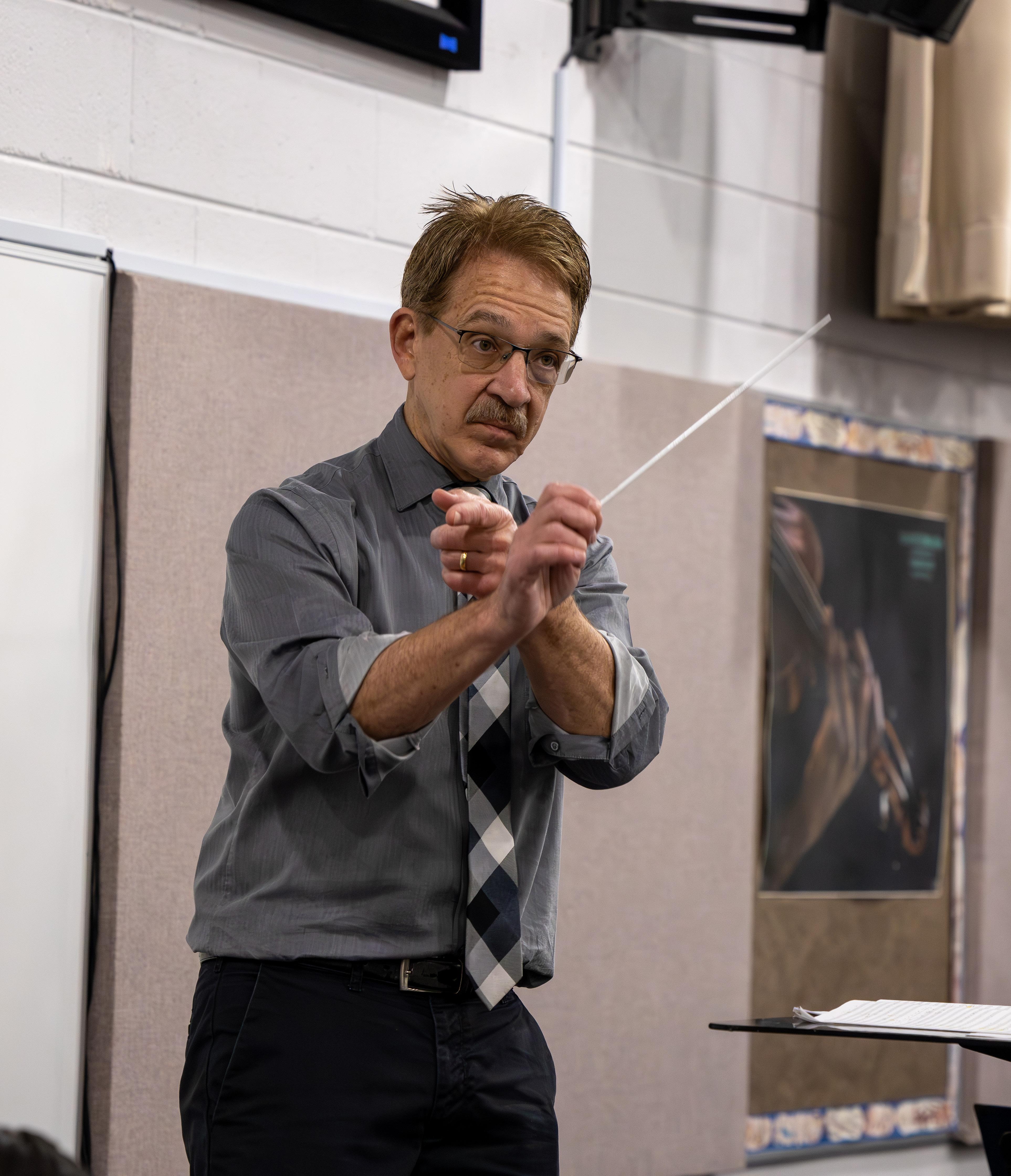
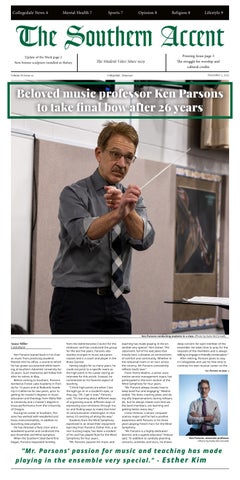
Ken Parsons leaned back in his chair as music from practicing students filtered into his office, a sound to which he has grown accustomed while teaching at Southern Adventist University for 26 years. Such memories will follow him after he retires in May.
Before coming to Southern, Parsons worked at Forest Lake Academy in Florida for 14 years and at Redlands Academy in California for two years, prior to getting his master’s degrees in music education and theology from Walla Walla University and a master’s degree in brass performance from the University of Oregon. During his career at Southern, Parsons has worked with woodwind and brass instrumentalists, in addition to launching new projects.
He has directed a flute choir and a woodwind quartet and conducted the Jazz Ensemble and Wind Symphon.
When the Southern Steel Band first began, Parsons requested funding
from the Administrative Council for the endeavor and has conducted the group for the last five years. Parsons also teaches trumpet in music education classes and is a coach and player in the Brass Quintet.
Having taught for so many years, he could not point to a specific event as the high point in his career during an interview for this article. Instead, he commented on his favorite aspect of teaching.
“I think high points are when I see the light go on in a student’s eyes, or they say, ‘Oh, I get it now,’” Parsons said. “It’s learning about different ways of organizing sound, different ways of expressing your emotions through music and finding ways to make that kind of communication meaningful. In that sense, it’s exciting all along the way.”
Students from the Wind Symphony expressed in an email their enjoyment learning from Parsons. Esther Kim, a senior nursing major, has been a student of his and has played flute for the Wind Symphony for four years.
“Mr. Parsons’ passion for music and
teaching has made playing in the ensemble very special,” Kim stated. “His classroom, full of his dad jokes that mostly land, cultivates an environment of comfort and community. Whether in the rehearsal room or on tour across the country, Mr. Parsons consistently reflects God’s love.”
Franc Henry Madrio, a senior automotive service management major, has participated in the horn section of the Wind Symphony for four years.
“Mr. Parsons always knows how to keep band fun and engaging,” Madrio stated. “He loves cracking jokes and doing silly impersonations during rehearsals, but he always makes sure that we, the band members, are learning and getting better every day.”
Linton Feitosa, a senior computer science major, said he had a positive experience with Parsons in his three years playing French horn for the Wind Symphony.
“Mr. Parsons is a highly dedicated director and a superb educator,” Feitosa said. “In addition to carefully planning concerts, activities and tours, he shows
deep concern for each member of the ensemble. He takes time to pray for the requests of the members and is always willing to engage in friendly conversation.”
After retiring, Parsons plans to stay in Collegedale and use his free time to continue his own musical career on the

“Mr. Parsons’ passion for music and teaching has made playing in the ensemble very special." - Esther Kim
Jaeda Goode Contributor
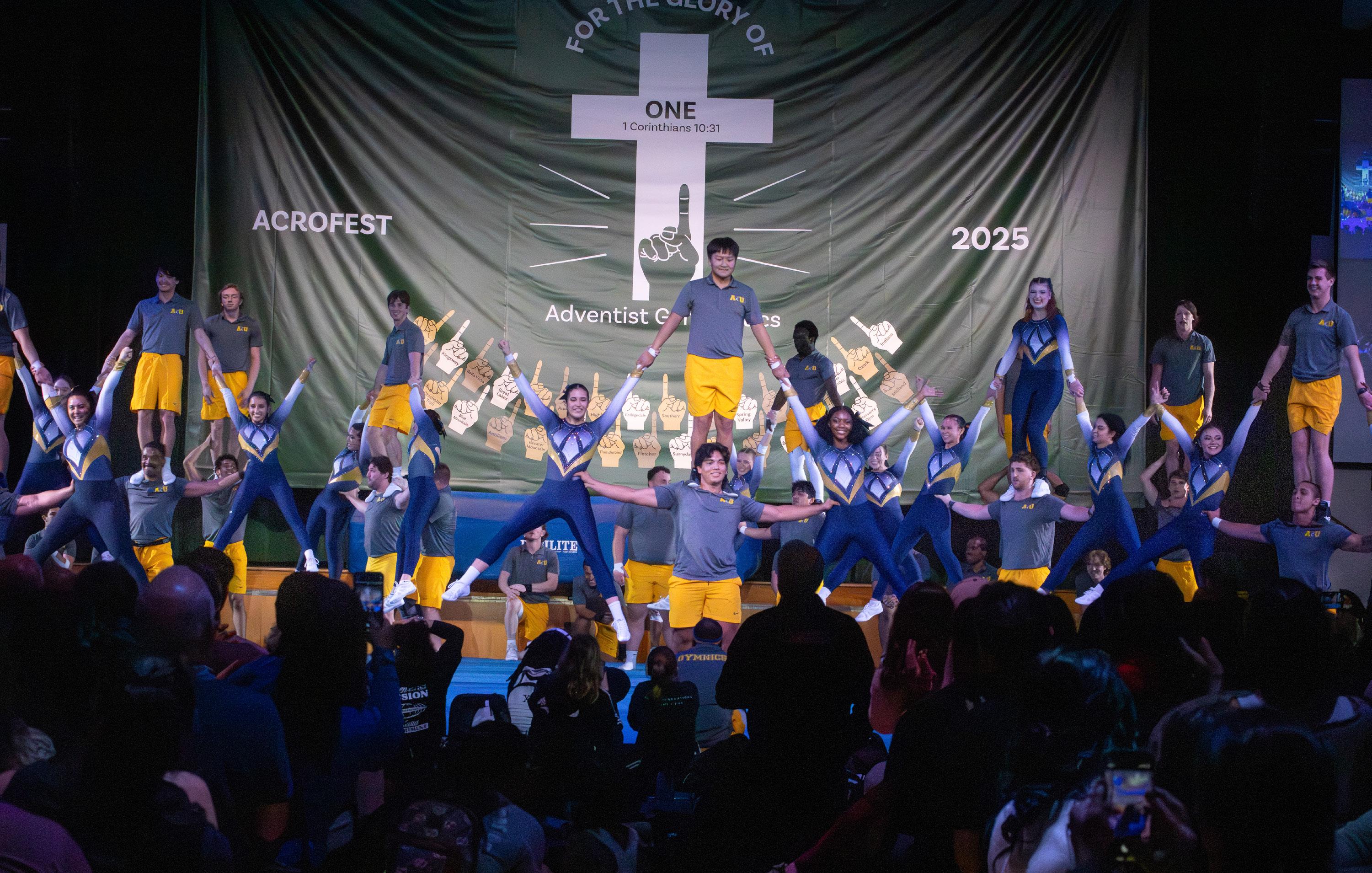
For the sixth time in its 50year history, the Gym-Masters hosted Acrofest at Southern Adventist University.
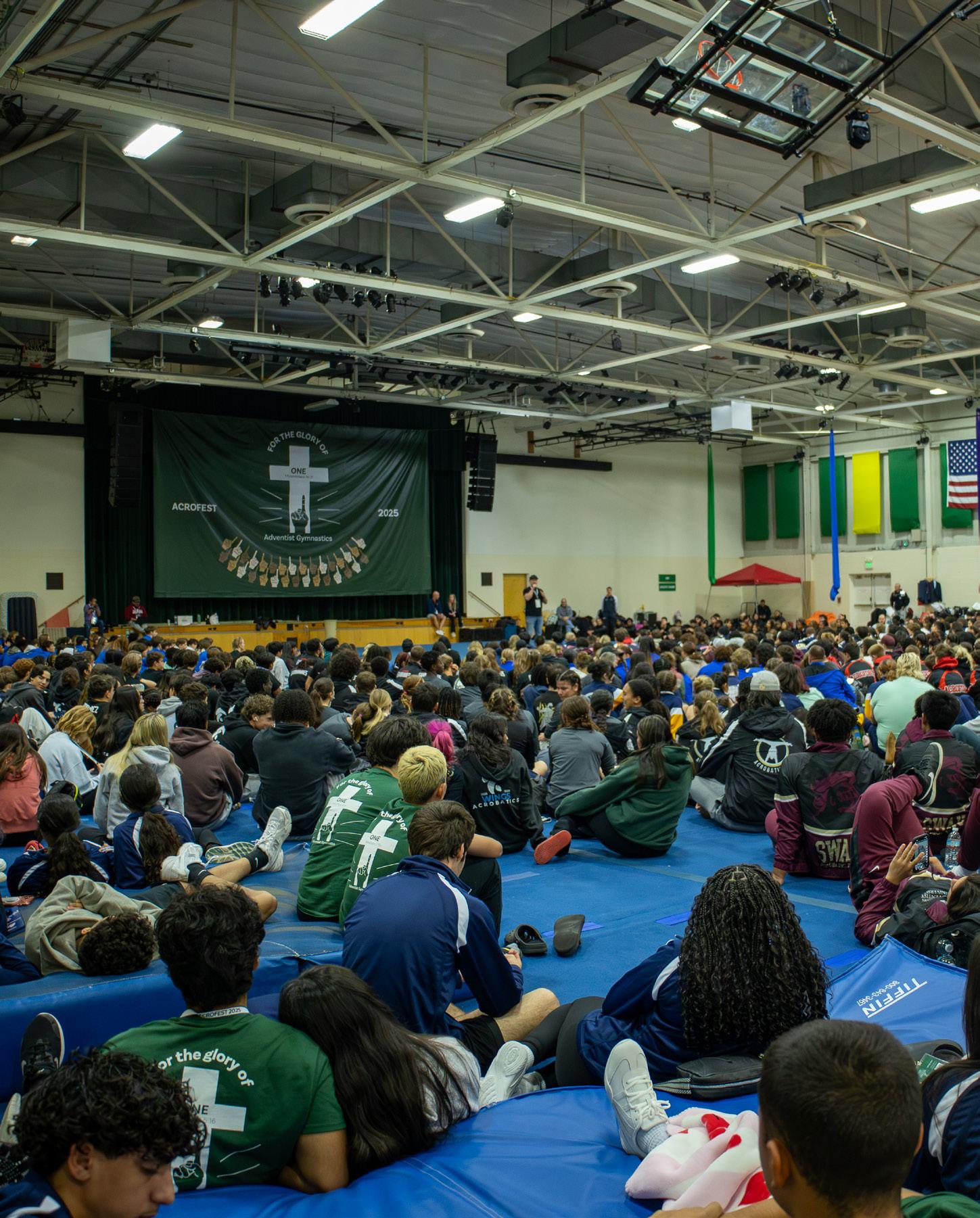
From Nov. 13 to 16, gymnasts from over 30 Adventist universities and academies occupied Iles PE Center, as well as Collegedale Academy’s high and elementary schools, to train during clinical sessions. The event concluded with a special performance on Saturday night.
Schools traveled from as far away as Texas, Nebraska and even Canada and Puerto Rico to train alongside their peers in the three-day event.
This year, the theme focused on the “The Glory of One,” with a featured banner showing hands pointing upward to a larger hand, with all pointing to the cross.
Craig Johnson, the head coach of Southern’s Gym-Masters, explained that the different hands on the banner represent all the participating schools and the larger hand symbolizes Adventist gymnastics as a whole, which points to the cross of Jesus.
On Thursday and Friday, hired professionals at 10 differ-
ent stations taught a specific clinical skill, such as tossing and handstands. Athletes from all schools were mixed and separated into groups, training for one hour at each station before rotating between the different skills offered.
Elizabeth Rosette, a junior animal science major at Andrews University and a member of the university’s Gymnics, said in an interview with the Accent that her love of gymnastics was sparked by her dad, who was on a collegiate gymnastics team for 18 years, coaching and performing. She attended Southern during her freshman year and shared how important Acrofest is to her as a gymnast.
“Coming to Acrofest brings the creativity and the life back,” Rosette said. “It reminds you why you do the sport that you do and why you love it so much.”
On Saturday, schools performed their routines for a packed crowd, showcasing the tricks and skills they had prepared for the occasion.
To begin the event, all of the teams introduced themselves to the audience by running around the performance stage, holding signs that displayed their schools’ names.
The first team to perform was Washington Adventist University’s (WAU) Acro-Airs, which showcased skills such as butterflies and tumbling. Teraka Salvador, assistant coach of Acro-Airs, praised her team for their performance and the dedication required to craft a high-caliber routine.
“We had a little hiccup in the beginning, but we overcame it; and honestly, tonight just proves that no matter what happens, especially if you have God at the forefront, it’s going to work out,” Salvador said.
Following the opening act, the other teams wowed the crowd with their performances before Southern’s Gym-Masters closed the show.
Naomi Franco, a senior gymnast attending Antillean Adventist University in Puerto Rico, spoke about her full-circle moment of being able to participate in the event after watching her first Acrofest in the crowd at Southern six years ago. At that time, she had no gymnastics experience, but witnessing the talent displayed by the gymnasts inspired her to pursue training.
“Now, I’m standing here at my very last Acrofest, right where I started, and I am literally doing every single one
of those things that I thought I would never be able to do,” Franco said. “It’s literally insane.”
Lucas Hallam, a senior at Highland Academy in Portland, Tennessee, said being at Acrofest was encouraging for him and made him feel connected to Christ.
“It feels amazing because I can look, and I can watch and see what I can learn, but it also inspires me to seek God more because of the miracles He works with all the stuff that goes on,” Hallam said.
Sam Schmidt, a Gym-Masters team captain, said his favorite part of Acrofest was
how spiritual he felt during the final performance of the show. He also described some tense moments when the team members couldn’t hear their music due to the intensity and volume in the gym during their performance.
“I feel like God really pulled through, because even though we were losing counts, it was actually one of the most in-sync performances we’ve done,” Schmidt said.
As the schools left on Sunday, Johnson said he hoped the teams would feel inspired to push to the next level of their craft because of the high standard set at Acrofest.

Lily Mutai Contributor
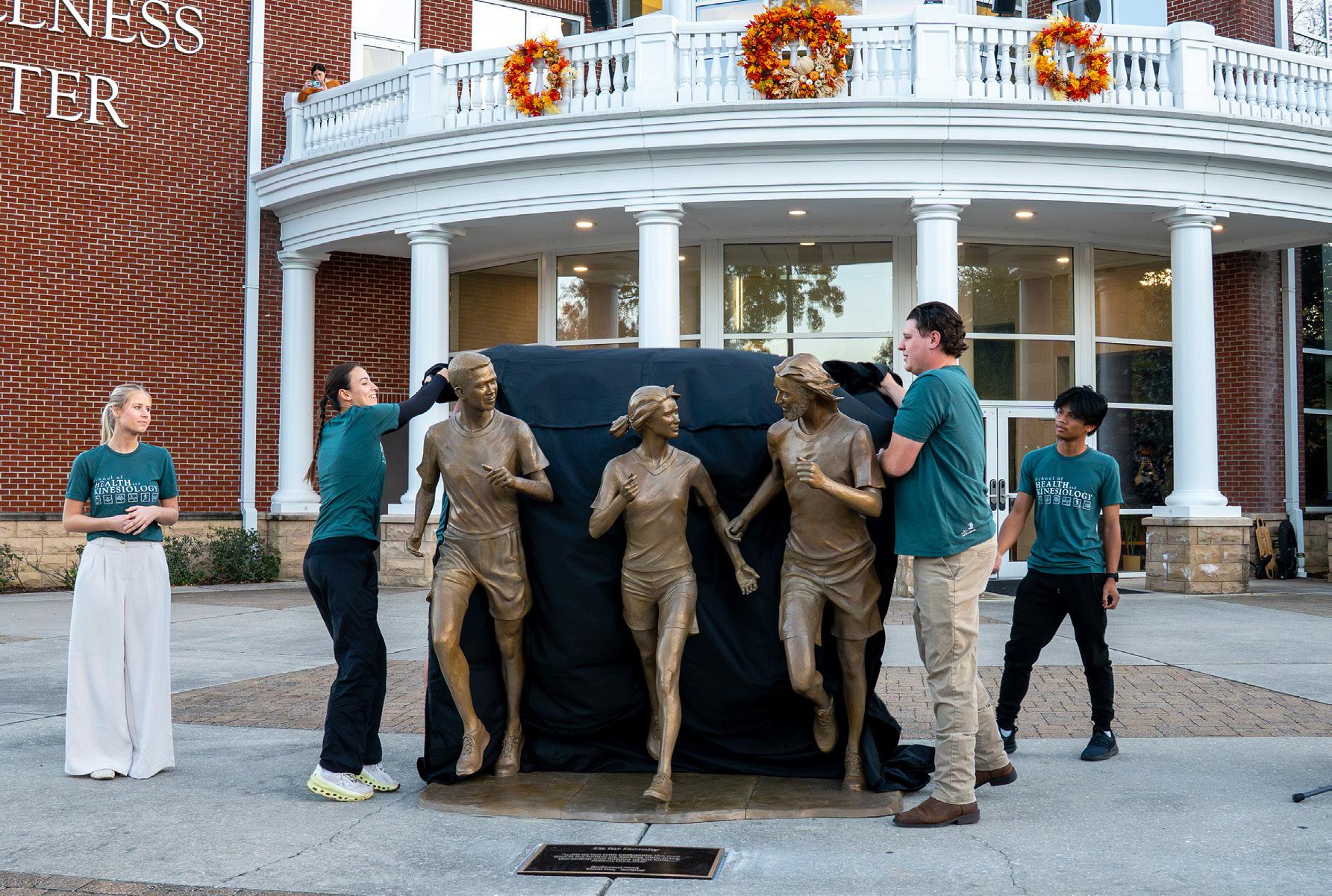
Students walking on campus to the Hulsey Wellness Center now pass a story cast in bronze, with the center having gained a new addition to its entrance: a statue that depicts an image of Jesus joyfully running alongside two young people.
The art piece is difficult to miss, as its placement is the first thing people see upon approaching the building.
Many are unaware that this statue holds historical and memorial significance. Judy Sloan, dean of the School of Health and Kinesiology, explained that the visionary behind this piece was Philip Garver, former dean of the department and City
of Collegedale commissioner. Garver passed away recently on Sept. 2, 2025. According to Sloan, Garver was also the visionary behind the bronze statues at the Veterans Memorial Park of Collegedale.
The artist of the sculpture, Victor Issa, was chosen for the piece in front of the Hulsey Wellness Center because of his work at the memorial park. Issa, a Lebanese immigrant, did not always believe he could be a full-time artist.
“In all my years, I had never met a working artist,” said Issa. “And it never occurred to me that I could make a living as an artist.”
It wasn’t until his college adviser at Union College (now
Union Adventist University) in Lincoln, Nebraska, directed him to consider adding a minor in art that he realized how much joy he found in creating art.
Issa ultimately graduated with a double degree in art education and music. During his schooling, he sought to further his education in sculpting; however, no sculpting classes were offered at Union College. Due to this, he attended the nearby University of Nebraska for a sculpting class.
“That one sculpting class generated an electrifying energy unparalleled in any other activity. I was hooked,” said Issa. “I love creating art that can be viewed from all angles. It’s much more demanding but also much more rewarding.”
Lifestyle
The Accent encourages readers to write articles and voice their opinions. However, the views expressed do not necessarily reflect the opinions of the Accent, the Southern Adventist University or the Seventh-day Adventist Church.
For any questions, comments and article submission information, email the editor at haydenjkobza@southern.edu.
For all advertising inquiries, email alvajohnson@southern.edu.
Staff
After his experience, Issa focused exclusively on sculptures, beginning in 1988. He said his goal has been to capture moments and convey stories and messages through his art pieces. Issa explained that another goal is for his work to inspire deep reflection and engagement.
“I intend for my work to communicate to others, believers and non-believers, that there is a God, He is real, He loves us supremely, and He is patient,” Issa said. “And regardless of what life is offering us at any moment, we can find peace and beauty in Him.”
Garver reached out to Issa in 2012 to share his vision for the sculpture at the Hulsey Wellness Center. Issa stated that Garver wished to portray Jesus engaged with young people, joining in healthy activities and connecting with them on a personal level. For this statue, Issa reflected on Hebrews 12 a passage about living a disciplined Christian life by enduring hardship with perseverance and completed a small sculptural study, presenting four copies to be used in the fundraising efforts for the statue.
However, according to Issa, it wasn’t until last year that Dayne Grey, a former student and friend of Issa, saw the small study during a visit and learned about Garver’s vision, which then gave the project momentum. The clock was ticking, though.
“We made a valiant effort to complete the work before Dr. Garver’s passing. Sadly, we missed it by a few weeks,” said Issa. “But I’m thrilled that the
vision is now complete, and I trust it will be a great blessing to many in the years to come.”
According to Issa, Giselle Hasel, an associate professor at the School of Visual Arts and Design and curator of the John C. Williams Gallery, learned about the upcoming installation. She took the opportunity to invite Issa to participate in the School of Visual Arts with a workshop and todisplay his work at the gallery.
Southern students have expressed varied reactions to the piece.
“My first impression was, ‘Why is there a big crowd of people blocking my way into the gym?’” said Aly Lopes, a senior history education major.
Lopes questioned the intention behind this piece, believing that the money allocated to this project could have been used for other campus issues, such as parking, housing or increasing student wages.
Maiah Swaisgood, a sophomore nursing major, shared the same initial confusion as Lopes, but ultimately had an appreciation for the piece.
“Once I got closer, I appreciated the look on the runners’ and Jesus’ faces," Swaisgood said. "The tenderness and love with which Jesus looked upon them and the admiration with which they looked at Jesus were truly inspirational.”
Sloan hopes the sculpture will remain an inspiration.
“It is the desire of the School of Health and Kinesiology that this sculpture will inspire all who see it to run the race before us with endurance,” she said. “Just as Garver did.”
Copy
Photographers Sam
Christian
Layout
Circulation
Office
Parsons continued from page 1
trumpet and to work on projects around the house while his wife, Kristi, continues her career as medical technologist at CommonSpirit Health Memorial Hospital. Once she decides to retire, Parsons said they plan to travel.
Parsons is the second professor in the School of Music to retire this year, as the department
is currently looking for a new choir director after Gennevieve Brown-Kibble’s retirement.
Associate professor Laurie Redmer Cadwallader has been teaching nine rehearsals a week since Kibble retired. She is now in charge of the Voices of Southern—comprised of Bel Canto and Die Meistersinger— and I Cantori, in addition to the Symphony Orchestra.
Cadwallader commented on Parsons’ retirement.
“Mr. Parsons and I came in the same year,” Cadwallader said. “His office is right there next to mine. We’ve shared a lot over the past 25 and a third years. It’ll be sad, but he’s looking forward to retiring, so we can’t feel sorry, and we can’t feel bad about it.”
Cadwallader said that during the search to replace vacant positions, the school creates a job description for each opening, advertises the position and
sifts through applications and resumes before meeting candidates on campus.
“In this situation, we really need to see them conduct,” Cadwallader said. “Whoever comes in, if it’s a flute player, or a saxophone player, or a tuba player—it doesn’t matter what—we would want to see that person teach a lesson and conduct the Wind Symphony.”
Amid the search for a replacement, students and fac-
ulty voiced their gratitude for Parsons' many contributions to the department.
“It is bittersweet to see him leave,” Kim said, “but I am very fortunate to have been his student for the past four years. Mr. Parsons, you will be missed!” Parsons final concert with the Wind Symphony will be held April 12, and his final concert with the Jazz Ensemble will be on May 2.
Ken Kelly Contributor
On Nov. 18, Campus Safety
partnered with the Tri-Community Volunteer Fire Department to host a fire safety demonstration in the WSMC parking lot, where they burned down a small shed.
According to Joe Ervin, training chief for the Tri-Community Volunteer Fire Department, the demonstration aimed to help educate students and faculty as well as train recruits for the fire department.
“We are happy to help participate [and] give our guys a chance to do some training, to do some demonstrations and for everybody to get more of a understanding of each other's organizations and what expectations they may have in case of emergency,” Ervin said.
The event was advertised to Southern students through an email sent out on Nov. 17. The email also contained information about safe practices for keeping warm in the upcoming cooler weather and electrical hazards that come with decorating for the holiday season. Planning for the event came with many barriers, since multiple organizations had to coordinate. According to Lieutenant Josh Fraker, Southern’s fire and life safety specialist, this was the first time everything came together for a fire safety demonstration since Campus Safety had the idea to do one fifteen years ago.
“We had to coordinate a lot of schedules with everyone. Fraker said. "From media to air
pollution control, to the fire department to 911, to everything in between.”
Another layer of planning included ensuring that regular calls and responses would not be affected by the event, according to Ervin.
The demonstration quickly attracted a crowd, and it offered one cultural credit to students.
Officials voiced their hope that the attendees would learn valuable information to prevent an accident.
“We are hoping people take away from this event an idea of how fast a fire can start, how fast a fire can spread, [and] good and bad things to not have in your dorm rooms,” said Fraker.
For the first demonstration, firefighters set a pan of grease on fire to demonstrate how it could easily spread and how adding water can have an explosive effect. Then they extinguished the flames with a CO2 extinguisher.
In the next demonstration, the firefighters lit a candle and let the audience watch items around it catch on fire, showing why candles are not allowed in the dorm.
During each demonstration, firefighters showcased different types of fire extinguishers and how to use them.
At the end, firefighters set fire to the entire shed where the demonstrations took place
The flames grew so big that the crowd had to step back significantly, and the barriers began to bend because of the heat. The shed continued to burn and was completely on

the ground at least 40 minutes later.
Reactions to the safety demonstration and the final burning were overwhelmingly positive.
“I thought it was super fun,” said Hevanna Hippler, a junior media production major. “I like how it was a training effort for both the firefighters and us watching to be able to be informed about the different things that can happen in a
dorm room and things to be prepared for.”
Michael White, a junior film production major, said, “It's kind of fascinating how fast the room gets consumed in flames, and they give some good advice on how to stop the fires from spreading as far as possible.”
After the event, Fraker commented on the overall success of the event and areas for improvement.
“I think it showed people the development of a fire, the use of an extinguisher, how simple it can be, how much it puts out, and also just shows how fire develops, and some good indications on when to get out of a building,” he said. “We have some notes for next year when we do this again as long as we’re able to make it bigger and better, but everything today went well.”
Madelynn Brower Contributor
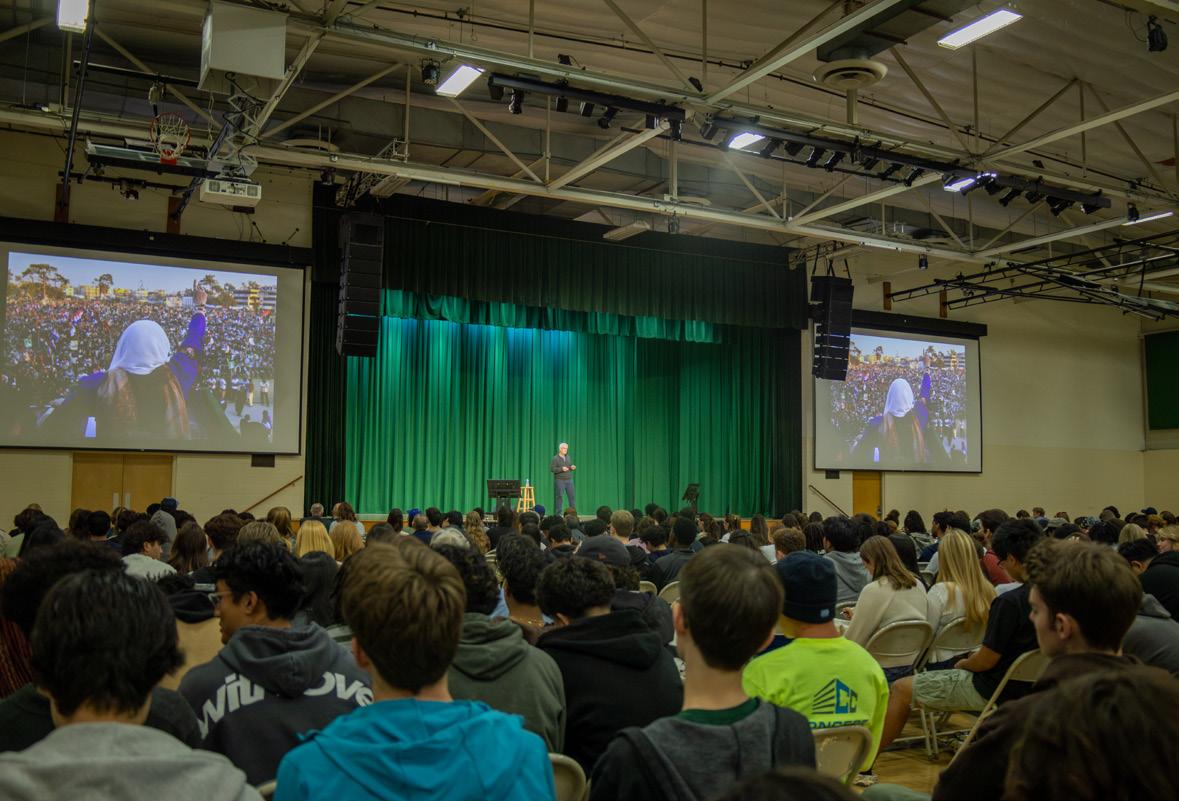
Bleary-eyed after less than five hours of sleep, sophomore nursing major Jackson Robison stumbles into Morning Meditations, the group worship offered in Talge Hall every morning at 7 a.m.
To make up ground on collecting the amount of worship credit necessary to register for next semester’s classes, Robison is forced to choose going to school assemblies over working his usual 30 hours a week at Erlanger hospital in Chattanooga, often getting off shifts at 2 in the morning.
For Robison and many other students, getting the required worship credits each semester has not been easy.
“All the time that I have that I’m not either studying or in class, I’m usually working, which makes getting worship credits intensely difficult,” said Robison. “Southern is an expensive school. I shouldn’t have to be calling off work so that I can go to worship.”
There are two different types of worship credits, and two different requirements for each. The first is enrichment credits, which can sometimes be obtained in sets of twos, by attending events such as vespers, hall worships in the dorms and Morning Meditations in Talge Hall. The second is cultural credits, also usually obtained from convocations and music recitals.
According to Southern’s residence life website, each
class standing has its own level of credits required. For campus residents, freshmen must get 60 credits in total, 16 of which are cultural. Sophomores must get 55 credits with 14 being cultural. Juniors must get 32 credits total, eight cultural, and finally, for seniors, the number drops to 30 credits, eight of which are cultural. Students in their graduating semester are not required to get credits.
Students such as Jeremy Zamora, a sophomore nursing major, acknowledge that while it’s important to go to events to collect credits, there are also challenges faced by some students to gain the required amount.
“I think it’s important for students to have to go to vespers and get worship credit and cultural credit,” said Zamora, “but I feel like having the rate or the amount at the end of the semester is a little bit challenging for some other students who might have other extracurricular activities that hinder them from attending.”
When students do not obtain the correct amount of worship credits, 50% of their total before Fall break, several consequences may arise. One is a hold being placed on a student’s academic accounts, which prevents them from registering for the next semester’s classes. Students must then get the required level of credit
before they can register.
In an email to the Accent, Dennis Negrón addressed some of the other issues that could arise if students do not get their credits in time.
“There are other consequences [besides being unable to register for classes] for those who ultimately end a semester with excessive misses,” said Negrón. “One, ineligibility to hold a student leadership position; two, ineligibility to apply to live in upper-classmen housing; and three, ineligibility to apply for a Housing Exception to live off campus.”
According to Negrón, about 5% of students received a hold on their account at the beginning of October, many of whom have resolved the issues and had the hold removed.
When asked if they think the amount of credit required by the school is unreasonable, there have been mixed reactions among students. Some believe the amounts are fair, while others struggle to get the required amount.
One area that students stated they struggled with is a lack of engagement in the services offered to students for credit. Some students mentioned their difficulty connecting with various worship services due to a lack of cultural relevance.
Ariana Davis, a freshman film production major, mentioned some of the dissatisfactions in
an interview with the Accent.
“Considering that vespers is pretty stagnant, and it doesn’t really cater towards different groups or demographics of our student body, I just feel like the amount [of credits] they’re asking, especially with how it literally affects your ability to stay here and your enrollment, I think it is unreasonable,” said Davis.
The number of credits students were required to get each semester was changed in 2014, creating a new system including both student and faculty input that many thought was more reasonable than the previous plan.
In an email to the Accent, Negrón stated this change and his opinions on the reasonableness of credit levels, stating that previously, students had been required to attend chapels or assemblies five to seven days a week to get the amount of credit necessary.
“In 2014, students and employees sat down to create a system that they believed was reasonable,” said Negrón. “The result was asking freshmen and sophomores to attend spiritual programming twice a week and juniors and seniors once a week. Is it unreasonable to ask students to attend one or two spiritual programs a week on a Christian campus? I ultimately have to say 'no.'”
Editor's Note: The Southern Accent has produced a two page Collegedale News section this issue as part of a national initiative to enhance community news coverage. The local effort, led by Southern's School of Journalism and Communication in conjunction with the Center for Community News (CCN) at the University of Vermont, places student journalists at the forefront of addressing the news desert crisis, a phenomenon caused by the decline of newspapers in local communities. The Accent believes local news is vital to a thriving democracy, and we remain committed to reporting about important issues, novel occurrences and interesting people in the greater Collegedale area. We will publish this special section in five issues of the newspaper this semester. To submit tips or press releases, go to https://southern-accent.org.
Leif Bromme Collegedale Reporter
On Nov. 3, the Collegedale City Commission unanimously approved a Memorandum of Understanding (MOU) that will allow the United States Secret Service to train at the Collegedale Police Department’s firing range. According to Police Chief Jack Sapp, the Secret Service has already completed the necessary forms and will now be allowed access following the commission’s decision.
According to the United States Department of Education, MOUs are documents that outline interactions between two parties. They help to develop a mutual understanding of roles, rules and conflict resolution without it being legally binding. While it serves as a precursor to more formal arrangements, Assistant Police Chief Jamie Heath stated that the Collegedale Police Department will rely on the MOU in lieu of a formal contract.
MOUs are used to cement partnerships in many contexts, especially in law enforcement. Despite this, the city did not always require an MOU to use the firing range. According to Heath, the requirement was set after an influx of usage requests.
“With more agencies training here, it made sense to put clear protections in place for the city and to outline our expectations up front,” Heath stated in an email to the Accent. “The MOUs help reduce the risk of injuries and makes sure every partner agency understands the rules and guidelines for using our range.”
Collegedale local, Timothy Kanarski, said he does not have an issue with the Secret Service utilizing the Collegedale Police Department’s firing range.
“As a first responder myself, I understand the proper train-

ing and necessity of having preparedness and the mindset of what could go wrong and how can we avoid it and how can we train properly towards it," he said.
“I know that [there are] a lot of people that have issues with certain aspects of training and other things,” he added, “but when it comes down to it, you can't know how to react to something without training for it.”
Matthew Savino, a junior business administration major at Southern, also did not have a problem with the partnership.
“I think it’s fine as long as they keep it in the range,” he said.
Other community members did not want to disclose their identities but felt uncomfortable with the Secret Service training in Collegedale.
Though a local Secret Service presence may cause some concern, Heath explained that the process is routine.
“We can’t make a comment on whether or not another law enforcement agency is preparing for anything specific,” he stated. “What we can say is that their presence isn’t unusual, and there’s no reason for concern. Like every other law enforcement agency, they have routine firearm qualifications and training requirements. Staying proficient with issued

weapons is just part of the job.”
Heath also emphasized that local ranges are often used to train federal agency employees, as compared to more centralized spots.
“Federal agencies operate all over the country, with offices in major cities across every state,” Heath stated. “It’s far more efficient for them to partner with state and local agencies, and that often includes using local facilities for training.”
According to the Chattanoogan, many agencies trained at the now-closed Moccasin Bend firing range, jointly operated by the Chattanooga Police Department and the Hamilton County Sheriff’s Office. The site was closed when an archaeological study unearthed Native American Settlements. After the discovery, Hamilton County Sheriff Austin Garrett began the search for a space to build a new, state-of-the-art range. The search is still underway, and many of the agencies that frequented Moccasin Bend have now turned to Collegedale, according to Heath. Though the firing range has seen more traffic, he emphasized the benefits.
“In the end, these partnerships strengthen every agency involved and improve the service we’re able to provide to the public when it matters most,” he said.
Hayden Kobza Editor-in-Chief
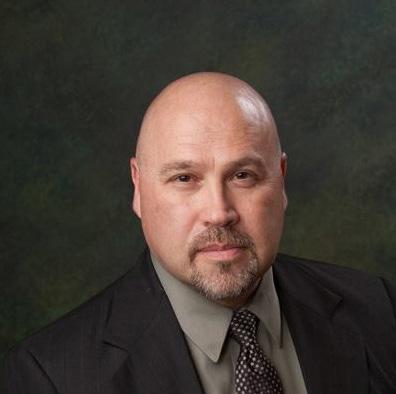
On Nov. 24, the City of Collegedale Board of Commissioners selected Jon Holmes, former City Manager of Aurora, Mo., to fill the city manager position recently vacated by Wayon Hines.
The selection was made at a special commission meeting, where Holmes was one of three finalists considered for the job.
During the meeting, there was some debate about whether the council should go with Holmes or James Ross, who currently works as a staff attorney at the Georgia Legal Services Program in Dalton, Ga., and previously served as the Dalton city administrator.
Commissioner Tim Johnson and Debbie Baker both agreed that Holmes would be a good fit for the city.
“I like Jon Holmes,” Johnson said. Baker added to his sentiments, stating, “I have to agree with Commissioner Johnson. I think overall, just his rapport, his education, his ability to work with us and work with the staff, I think he would be a good asset. Not that the others weren't capable. They had good
qualities. I just think he stood out.”
Mayor Morty Lloyd and Commissioner Laura Howse said they wanted every city employee to be a part of the decision, and Baker said she had consulted with other city leaders to see what they thought of each candidate. According to Baker, department heads will work with Holmes closely, and their input was vital to her decision.
Howse then expressed gratitude to interim city manager Andrew Morkert for taking over, and Vice Mayor Tonya Sadler shared her thoughts on the candidates.
“My top two are Mr. Holmes and Mr. Ross,” Sadler said. “I mean, they're great candidates. The one that edged out for me was Mr. Ross. For him, he has experience in East Tennessee.”
Sadler said that Ross’s experience as an attorney and what the Mayor of Loudon, Tennessee, had to say about his vision for the city were things she admired. According to Sadler, Holmes is accustomed to larger budgets, which was one of her concerns.
“One thing I wondered, though, is he has so much experience with a large budget of
100 plus million dollars,” Sadler said. “Could that work against him, where we have to be more frugal on a smaller budget. So that's my rationale for picking Ross over Holmes.”
According to Baker, Ross also had experience with a large budget of over $70 million.
Once the discussion ended, Lloyd asked for a motion on any of the candidates, and Johnson subsequently made one—Howse made the second. The commission then all voted unanimously for Holmes, selecting him as the new city manager for Collegedale.
After some discussion of what the pay should be, the Commission decided that they would offer $150,000 plus or minus 10%, with car benefits and a $15,000 moving cost. Along with the offer, the Commission debated whether Holmes would be allowed to take on outside work while serving as city manager.
They ultimately agreed that the contract would specify that any side work must receive Commission approval. Ending the night, the Commission thanked those involved for their help in running the city while they had been searching
for a full-time city manager.
In an email to the Accent, Commissioner Laura Howse shared her thoughts on the selection.
“I spent the afternoon speaking with city staff about the city manager candidates,’’ Howse stated. “All key managers of city staff felt very strongly and unanimously that it should be Mr. Holmes. I will say I very much appreciated Jon Holmes’s dialogue with students from Southern Accent, and his ideas for improving communication with the community. Tonight, the commission voted to extend an offer to Jon Holmes.”




Abby Dizon Contributor
In a device-driven world, it is common to keep devices within arm’s reach while you sleep. According to Northshore, almost three-quarters of adults have their devices close by during the night. Devices are often one of the last things we put down at night and the first things we pick up in the morning. Although it is convenient to sleep with our devices, this article sheds light on the negative effects of sleeping with your phone.
Harmful radiation and overheating:
Mobile devices operate by producing “non-ionizing radiation,” which is commonly emitted from microwaves and smartphones. According to the article, “How is sleeping next to your cell phone dangerous?” it can result in various health issues, such as headaches, muscular pains and other serious problems that are correlated with cell phone radiation symptoms. Furthermore, mobile phone radiation can cause devices to heat up, especially in areas with a lack of ventilation. Placing your phone under your pillow increases the risk of overheating, especially if you leave your phone charging. There have been reported cases of phone explosions or fires in bed caused by phone batteries. While such incidents are rare and the evidence to
prove that devices bring about radiation is insufficient, it is wise to exercise caution and avoid keeping your phone too close while you sleep.
Damages sleeping waves:
While you sleep, your body emits delta and theta waves. Delta waves are linked to relaxation and restorative sleep, and theta waves are associated with creativity, intuition and time to
tap into a subconscious mind. These waves are crucial in wakefulness and sleep, contributing to memory, learning and problem-solving. When you reach for your phone in the morning, you disrupt this natural rhythm and deprive your mind of its relaxed state. Checking texts or emails immediately when you wake up can introduce a sense of stress and disrupt the sense of calm-
ness provided by delta waves at the start of the day. Alternatively, you can begin your day with meditation or try focusing on your breathing. This not only honors your body’s needs and efforts but also offers a much healthier start to the day. While it is convenient to keep your phone nearby for notifications or to snooze your alarm in the morning, it is important for your physical and mental
health to create boundaries between your sleeping space and your devices. By prioritizing your sleep routine, you will not only avoid unnecessary incidents or disturbances during the night but also will increase the chances of waking up in a relaxed state, thus setting the stage for a successful morning ahead.

important for your
Matthew Taylor Sports Editor
For the world of motorsport, the summer of 2025 offered something arguably more valuable than a new lap record: a global invitation to a new audience, courtesy of the motion picture “F1”, directed by Joseph Kosinski. While the sport had previously enjoyed a renaissance through the Netflix documentary series “Drive to Survive,” the film’s release marked a transformative phase for the sport.
The film didn’t just sell tickets; it accelerated the sport’s entire demographic shift. According to the 2025 Global Fan Survey, three of every four new fans identify as female. But for students at Southern Adventist University, these global trends aren’t about box office numbers or stock prices. Instead, the sport is serving as a consistent pastime and community builder, offering an engaging reason to wake up early and cheer together on Sunday mornings.
For those who don’t follow the sport, Formula One (F1) is the pinnacle of motorsport, featuring the fastest circuit-racing cars in the world. Unlike NASCAR, which uses stock cars on oval tracks, F1 uses open-wheel “hybrid” cars: vehicles that combine traditional combustion engines with advanced electric power, racing on complex road courses. Following Sunday’s nail-biting conclusion of the penultimate race at the Qatar Grand Prix, the World Drivers’ Championship has officially come down to the wire. Red Bull Racing driver Max Verstappen, the
four-time reigning champion, closed the gap on McLaren driver and current season leader Lando Norris in Qatar. The two, plus third-place contender (and Norris’ teammate) Oscar Piastri, are now separated by a razor-thin margin heading into this Sunday’s finale in Abu Dhabi. The drama on the track has finally eclipsed the drama on the screen.
The sport’s explosion in popularity can probably be traced to the fact that the entry point is easier than ever. For many students who previously saw F1 as a niche European sport, the movie became the accessible entry ticket to this technical world.
“I remember a time when it felt like my dad and I were the only ones in the United States that watched F1,” shared senior history major Sam Schmidt, who has been watching the sport since 2010. For Schmidt, the film served as confirmation that F1 racing could have universal appeal. “A Hollywood movie kind of validated the fact that it’s just as big here in the United States as it has been in the rest of the world for years.”
As a long-time fan, Schmidt admits that he “cringed at some of the inaccuracies” in F1’s portrayal of racing physics but acknowledges that the film succeeded where it mattered most.
“The movie fan in me loved it,” Schmidt added. “An SAU student should be interested in F1 for the same reason they would get invested in another sport: human drama backdropped by real danger and high stakes.”
That human drama has resonated with a new wave of fans who see the drivers not just as
athletes, but as characters in a season-long narrative.
“I feel like it’s more personable than most sports,” explained senior media production major Taylor Moren. “There’s a lot more at stake. ... I feel like people don’t realize how much physical effort is put into racing.”
Moren, who began watching during her senior year of high school, credits the movie with widening the circle of fandom on campus.
“It made me appreciate the fandom more,” she noted. “I feel like the movie helped bring in a lot more fans and appreciation for it.”
This growing community has transformed how some students spend their weekends. Sunday mornings, once reserved for catching up on
sleep, have become the time to watch the morning races.
“It is fun to watch, especially if the person is into cars and finds a large community that enjoys watching F1,” said junior nursing student Caitlyn Keller, whose father introduced her to the sport as a child.
For Keller, the appeal lies in the intellectual side of the sport, specifically “the strategy behind all the decisions they make” regarding tires, fuel and pit stops.
But for students who want to do more than just watch the finale, this new wave of popularity has a local outlet. Just 15 minutes from campus, the simulator rigs at SpeedHub Sim Racing and Flatout Sim Racing allow fans to drive the same circuits they see on TV. These venues are community
hubs where students can experience the physical exertion Moren described, wrestling with force-feedback steering wheels on the virtual tarmac of world-famous circuits such as Yas Marina, site of this Sunday’s finale. It is a chance to bridge the gap between the passive moviegoer and the active participant.
As the championship fight moves to the global stage in Abu Dhabi this coming Sunday, the eyes of the world—and potentially more Southern students than ever before—will be fixed on the starting lights. The movie may have brought them to the screen, but the winnertake-all race for the championship is what will keep them on the edge of their seats.

Allison Grundy Contributor
What is your dream job? Is it to be a musician, a movie star, an award-winning doctor or scientist?
Famous actors, talented artists and celebrated CEOs are people with an abundance of fame, prestige and respect in coveted jobs, yet they still experience their fair share of struggles. Despite their success, these people sometimes struggle with addiction or have tumultuous relationships and other mental health issues.
The current emphasis on having a dream job may be partially due to perceiving our-
selves through our means of labor. In this society, a person’s value is inherently attached to a career.
James Baldwin, a writer and civil rights activist, once said,
“I don’t have a dream job, because I don’t dream of labor.”
Work is not the purpose of life. And while dreaming and working toward more is important, focusing one’s entire hopes and dreams on a single, idealized job is to gamble on future happiness and on potential disappointment.
Two things can happen.
One is that people never find success and feel trapped in the shadow of a dream that may never be achieved. The other is
that, if they do achieve it, a new dissatisfaction sets in as they realize that the dream is still just a job—requiring work, concentration and compromised time away from family.
Even at the job that someone thought they always wanted, they may have to deal with an intense amount of pressure, struggling with co-workers and balancing work with the rest of their life. Also, it’s true that some jobs bring harm to others or to the employee, which are not jobs to settle for.
The ideal job may not rest on a better title or a promotion but, rather, on having kind co-workers, a supportive environment or a location close
to home. These are the things often taken for granted in the workplace. With this mindset, anything could become the right job rather than a dream job.
I used to think that only having my “dream job” would make me happy. However, now that I’ve had jobs that seemed perfect for me on paper, I know that with any job hard days and disappointments can come. But I’ve also realized that happiness comes with appreciating the small things and I couldn’t be happier at a better job if I don’t take account of all I have to be grateful for.
That’s why I think fulfillment, for many people, is about
doing what you can during the small, daily moments to bring joy into your day, such as taping a photo of your loved one to your work computer or packing all of your favorite foods for lunch. But beyond these nice moments, you can create the real satisfaction that comes from the work itself: helping others, providing a good service and being creative, which can be found in a wide range of positions.
Chasing a distant “dream” can blind us to the life we’re already living. With the right mindset, we can build a fulfilling life to enjoy—both at work and after hours.

Nina Bueno Contributor
At the beginning of this semester, we looked at a portion of Isaiah 43 and how it calls us to be witnesses to what God has done in our lives. But now I want to really focus on the first four verses of this chapter. It reads:
“But now, this is what the Lord says— he who created you, Jacob, he who formed you, Israel: ‘Do not fear, for I have redeemed you; I have summoned you by name; you are mine. When you pass through the waters, I will be with you; and when you pass through the rivers, they will not sweep over you. When you walk through the fire, you will not be burned; the flames will not set you ablaze. For I am the Lord your God, the Holy One of Israel, your Savior; I give Egypt for your ransom, Cush and Seba in your stead. Since you are precious and honored in my sight, and because I love you, I will give people in exchange for you, nations in exchange for your life.’”
Now this is a heavy passage and it fits into an even heavier narrative, called the Book of Comfort. This literary section begins in Isaiah chapter 40 and seems to follow a specific path. God isn’t just offering comfort to Israel but showing them a plan that He is working out on their behalf.
What does God’s plan of redemption for his people look like, both back then and today? Firstly, it looks like a complicated relationship. Israel has been accused of being deaf and blind to their role in their relationship with God. They are not following His covenant and don’t care about the relationship as they should. However,
God does something radical. He says, “But now, now after everything you’ve done, now I still will be faithful to my side of the covenant.” He reminds them that He’s not only their covenant partner, but even their creator. He calls them by their name, claiming them as His chosen people.
Just as God was still faithful to Israel and desired to reinstate His relationship with them, so he desires a relationship with each one of us.
Secondly, God’s redemption looks like protection. During the Assyrian and Babylonian takeovers, the people of Israel felt abandoned by God, even though it was they who had walked away from Him. However, here God reminds them that trials will come in this sinful world no matter what!
We now also have daily and lifelong trials that we go through. In fact, in John 16:33, Jesus gave us a promise, “In this world you will have trouble.” And when the trials do come, we can feel like we’re all alone. This is especially true if we’ve separated ourselves from God and thrown our relationship with Him to the wayside. When we can’t feel God He reminds us just like he did his disciples “But take heart! I have overcome the world.”
Thirdly, God’s redemption looks like ransom. After having been exiled to Assyria and then Babylon, the people of Israel were in slavery and bondage to different nations. But God freed and delivered His people by ransoming them. Today we are in bondage to sin. We are slaves to this world and to our own sinful desires. Paul writes in Romans, “For I know that good itself does not dwell in me, that is, in my sinful nature. For I have the desire to
do what is good, but I cannot carry it out. What a wretched man I am! Who will rescue me from this body that is subject to death?”
This is the cry of every human heart. This is the question we all ask ourselves deep down inside as we see life getting harder, as we see our relationships falling apart, as we see the world growing more evil, as we realize that the end is coming fast. Who will rescue us?
God’s redemption of his people—us—today looks like a beautiful plan of reinstated relationship, protection during trials and ransom from bondage. But Isaiah 43:1-4 is not just a plan, it is not just a course of action. It is a love letter.
Have you ever imagined what it would be like to receive a love
letter? One of those old-fashioned, flowery love letters filled with sentiments of never-ending love and devotion, perhaps you’ve even gotten one. Well, we all have received one, because this is God’s love letter to lost humanity. Verse 4 says, “Since you are precious and honored in my sight, and because I love you, I will give people in exchange for you, nations in exchange for your life.”
God’s ransom of us was done through the death of Jesus, and John the Beloved ties this all perfectly together for us. He states, “Greater love has no one than this: to lay down one’s life for one’s friends.” God’s redemption looks like love. You are precious and honored in His sight. And God says, I love you.
Today, I simply ask you to
meditate on this passage, to read God’s love letter to you, and to awaken again that desire to be in a relationship with Him. He calls each one of you, “You have forsaken the love you had at first…Repent and do the things you did at first.” Will you return to your first love? God wrote and mailed you this letter long ago. Perhaps you’ve read it before, perhaps this is your first time hearing it. God loves you and longs to redeem you to be His own, to protect and to ransom.
God’s redemption looks like love. Will you open His letter? Will you accept His love and let it redeem you? Will you say I love you back?

Rhett Seitz Lifestyle Editor
Rejection is one of the first real tests young adults face, especially when stepping into the world of internships, competitive programs, and dream schools.
You work hard, you hit submit, and then you wait. Sometimes you get the response you hoped for. A lot of times you don’t. And when those no’s stack up, even the most motivated student can feel the weight of discouragement begin to settle in. This was a shocking lesson I had to learn coming to college where in high school I basically got accepted to everything I applied for.
Earlier this semester, I picked up “Aim High” by Terry Johnson, a former member of the U.S. Air Force. Johnson’s story stuck with me because it’s simple but powerful. He joined the Air Force without a clear direction, struggled in his early training and felt out of place. Then, almost by accident, he applied for a position with the President’s Honor Guard. He didn’t think he had a shot. But he made the team, served for years, traveled the world and ended up in a role he never would’ve imagined. His message was straightforward: aim high because you truly don’t know where God might take you. That idea hit home because college students are some of the most ambitious people you’ll ever meet. Many of us grew that ambition in high school, where we learned to
take on big goals and dream about what our future could look like. The problem is that ambition runs directly into reality. You send in five internship applications and hear back from none. You interview for programs you’ve prepared months for and still get turned away. After a while, even the strongest confidence starts to crack.
I learned that firsthand. In high school, I developed a love for civics after taking a freshman civics class. My teacher encouraged me to apply for the Governor’s Honors Program in social studies. I didn’t think much of it at first, but I made it past the district level. Then I advanced to the state level, a place that only about one percent of applicants reach. My
teachers were thrilled, and so was I.
I drove to Berry College in Rome, GA for the interviews, sat in front of a panel, participated in a mock United Nations simulation and waited for the results. A few weeks later, I learned that I didn’t make it. I told myself it was fine because most finalists were juniors, not sophomores.
The next year I applied again, believing this would be my time. I went through the same steps, answered the same types of questions and left feeling confident. Then the email came: denied again.
I felt embarrassed, disappointed and honestly, a little confused. I thought I had done everything right. That experience could have made me
stop trying for opportunities altogether. But life is full of people who kept going after they failed. Abraham Lincoln lost multiple elections before becoming president. Michael Jordan didn’t make his high school varsity team at first. None of that stopped them. They learned from it, pushed through it and grew because of it. Rejection doesn’t end your story. Sometimes, it redirects it. Here are a few reminders worth keeping close:
1. Keep going: Most people who succeed aren’t the ones who never failed. They’re the ones who didn’t stop.
2. Keep applying: The right opportunity often shows up
after ten that weren’t right for you.
3. Your worth isn’t measured by a yes or no: It’s measured by perseverance, character and the courage to keep showing up. God made you for so much more than just a bunch of yeses and nos.
You don’t know what God is preparing you for. You don’t know which application will change your life. But you do know this: quitting guarantees you won’t get there. Keep aiming high, my friend. I can’t wait to see when you finally reach what you have been waiting for.


Created by Ander Aviles

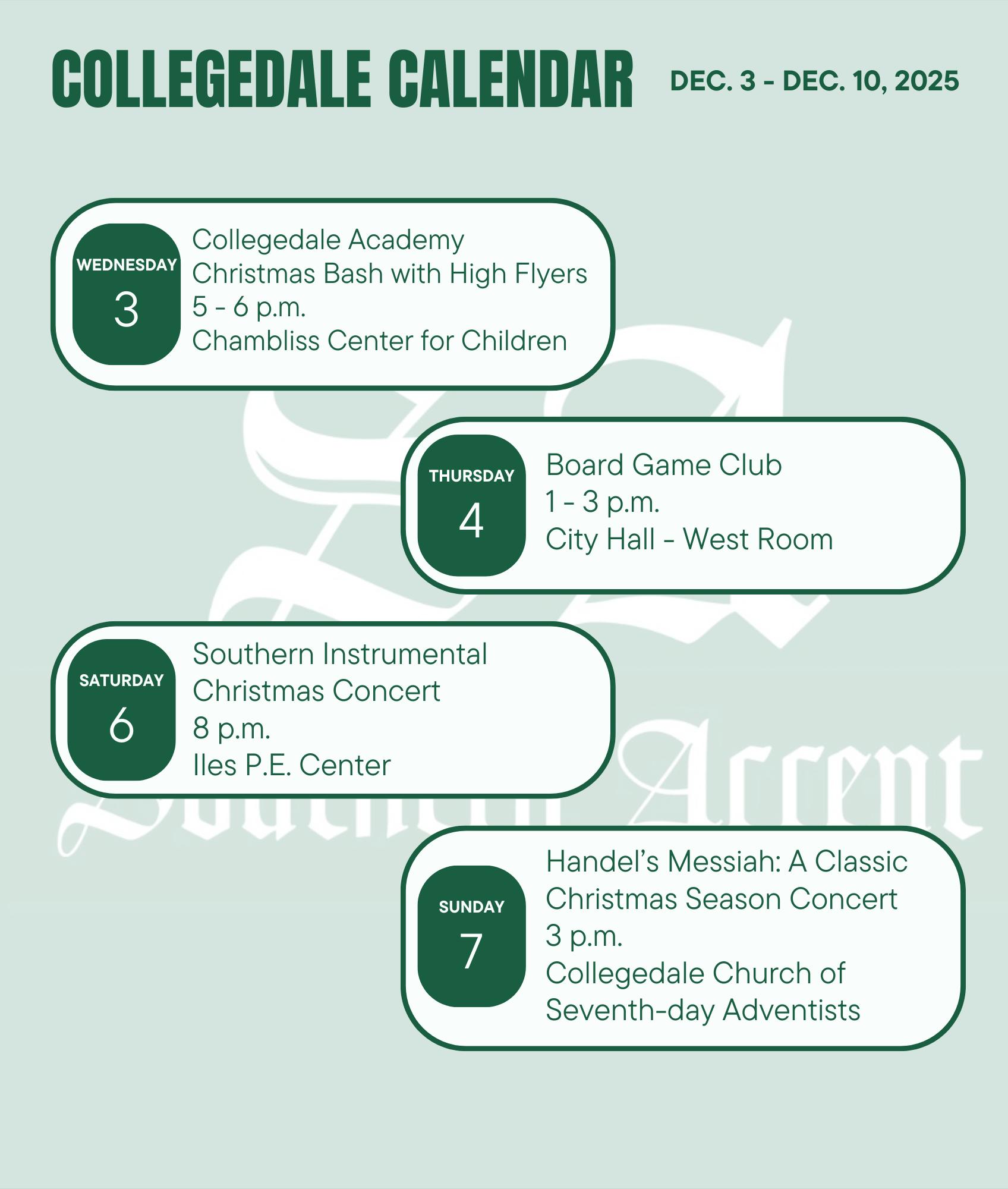
8:00 pm - 9:00 pm Student Association
Senate @ Bietz Center for Student Life, Old Southern Shoppe.
Friday — 5

• 5:29 pm Sunset • 6:30 pm Vespers: Joseph Khabbaz @ Collegedale Church of Seventh-day Adventists
7:30 pm AfterGlow @ Collegedale Church of Seventh-day Adventists
8:30 pm Vespers: Joseph Khabbaz @ Collegedale Church of Seventh-day Adventists

Sunday — 7
• 2:00 pm - 8:00 pm Christmas in the Square with Engage Worship @ Off Campus 9453 Bradmore Lane in Ooltewah, Tennessee.
• 6:00 pm - 8:00 pm Christmas Party @ Bietz Center for Student Life.
Tuesday — 9
2:30 pm - 4:30 pm Pop With The Prez @ Wright Hall Outside Ulmer Center.
11:00 am Convocation: Student Association @ Town Hall. 1:00 pm ACT On-Campus Test @ Bietz Center of Student Life Testing Offices. 6:30 pm Annual Christmas Tree Lighting: Rain Date.
• 10:00 - 11:15 am French Sabbath School @ Lynn Wood Hall Room 3050.
• 10:00 am SOAP: Caving, Outdoor Church, Tumbling Rock Cave @ Wright Hall.
• 5:00 pm Evensong: Organ Students @ Collegedale Church of Seventh-day Adventists.
• 8:00 pm Concert: Southern Instrumental Christmas @ Iles P.E Center.
— 3 Thursday — 4 Saturday — 6 Monday — 8
All Incomplete Grades for W25/S25 Due.
Intramural Schedule: Wed
Floor Hockey
6:00 pm
- Pucker Up vs Cold Blooded (Men’s)
- Pucker Up vs Stick Chicks (Women’s)
7:00 pm
- Jagerbombs vs Seal team sticks (Men’s)
- The Mountie Patrol vs Dr. Chang (Men’s)
8:00 pm
- Stick Boyz vs Monster Pucks (Men’s)
- Wranglers vs Puckingham Palace (Men’s)
9:00 pm
- puck dynasty vs Puck Patrol (Women’s)
- Goal Getters vs Flockey flockerinas (Women’s)
Intramural Schedule: Thu
Floor Hockey
6:00 pm
- Heavenly Pucks vs Biscuit blasters (Men’s)
- Goal diggers vs LPC (Women’s)
7:00 pm
- Love Muffins vs Seal team sticks (Men’s)
- puck puck goose vs not fast, just furious (Women’s)
8:00 pm
- Cold Blooded vs Frozen Biscuits (Men’s)
- Goal patrol vs Eh Team (Women’s)
9:00 pm
- Biscuit blasters vs Seal team sticks (Men’s)
- Pucker Up vs Stick Attack (Men’s)
Become an advanced practice nurse and earn a doctor of nursing practice at the same time.
The BSN to DNP program mentors bachelor’s degree-level graduates as they gain necessary RN experience through an advanced nursing practice emphasis of their choice.
Options include:
• DNP/MBA
• Lifestyle Medicine
• Nurse Educator
• Nurse Practitioner (emphases include Acute Care–Adult/Gerontology, Primary Care–Adult/Gerontology, Family, and Psychiatric Mental Health)
Call or visit online to find out how to get started.