
The Voice of Skyline College, San Bruno, Calif.
SKYLINE VIEW
Faculty union voices frustrations over stalled negotiations
By Joshua D. Picazo Editor-In-ChiefNearly nine months after initially presenting propos als to the San Mateo County Community College District (SMCCCD), AFT 1493, the union representing the district faculty, continues to press for changes, claiming the District has been ignoring them.


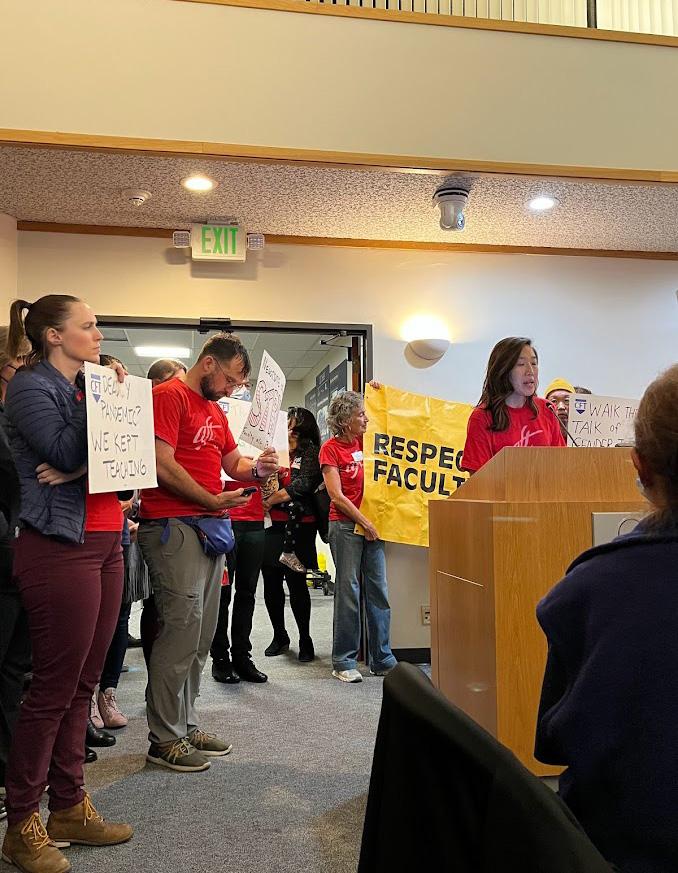
These proposals include one-month paid parental leave, extending health care to parttime instructors, and increasing the ability to work remotely.
Monica Malamud, AFT 1493 president, said that these proposals were first submitted to the District in February and that they have been continu ously turned down or stalled at each turn.
“In some cases, the Dis trict has responded by citing existing law, but obviously, we do not need to negotiate what’s already in the law,” Malamud said.
Rika Yonemura-Fabian, the Skyline College chapter chair of the union, echoed these frus trations regarding the parental leave proposal.
“It’s just not good for stu dents to see [parental] faculty member working exhausted, not to mention lack of sleep and lack of concentration that comes from exhaustion. But also, it kind of teaches our stu
dents that working without pay is normal. It’s normal to be exploited like this without sufficient support from the system,” she said.
On the issue of remote work, professors that teach online courses feel there isn’t a need to require a min imum of on-campus hours if they have their classes
online.
Moreover, the union stress es that increasing the ability to work remotely would not af fect students as students taking online classes generally prefer to meet during office hours online, particularly as the Covid-19 pandemic continues.
“The vast majority of stu dents are still choosing remote
counseling appointments. The District needs to meet students where they are right now so that they can access the education we’re offering,” Marianne Kaletz ky, AFT 1493 union, told The Skyline View.
“When faculty spend four hours a day commuting because our salaries don’t
New laws regarding safety on campus to take effect Jan 1st
By Joshua D Picazo & Gra ham breitbarth Editor-in-chief & digital me dia editorWith the new year around the corner, new laws will come into effect on Jan. 1st. Several of these laws affect college students in particular.
SMCCCD students will no longer have to pay tuition with the signing of AB 893.
Other bills passed and signed into law will offer more services to students who are victims of sexual assault or domestic violence on campus. AB 1467 passed the state senate unanimous ly and was signed into law by Gov. Gavin Newsom in September.
The bill states that under the changes, colleges would be required “expand the information that victims are required to receive, including information regarding the availability of counselors
and support services and information regarding any alternative dispute resolu tion or other accountability processes.
Another bill, AB 2683, also intends to educate victims on the resources offered. Under this new law, colleges are required to post information on how
to prevent sexual assault as well as methods of receiving peer support.
Skyline public safety officer Chih Chu Zee ex plained that under current protocols if an assault hap pens, officers will report and forward the information to local police.
“We have to work along
with our local agencies,” Zee said. “Sometimes [victims] don’t want to talk to us, but we under stand. We’ve gone through training...”
“I feel like there’s not much of a threat here [on campus],” freshman Abby Alonso told The Skyline View.
“There’s plenty of staff here and I feel that every thing is well advertised,” she added.
AB 2683 states that “Campuses are urged to adopt policies to eliminate barriers for victims who come forward to report sexual assaults and to advise students regard ing these policies. These policies may include, but are not necessarily limited to, exempting the victim from campus sanctions for being in violation of any campus policies, including
allow us to live anywhere near San Mateo County, we can push as much as possible to be present for our students, but we just won’t have as much energy or be able to be avail able as much of the time. The same is true when part-time faculty, who are the majority of our faculty, are rushing off to teach at another institution so they can get health coverage through that job,” said Kaletz ky.
According to the District fact book, roughly 40% of the District’s staff was either parttime or adjunct faculty. Under the current agreement, these staff members that are not fulltime receive stipends but are not fully insured.
Malamud said that the District would actually save money if they gave part-time workers health insurance as the District is reimbursed by the state for this, whereas the District uses its funds to pay for the stipends.
Other frustrations men tioned were the high cost of living in the Bay Area as an educator, which echoes the cur rent ongoing University of Cal ifornia graduate student worker strikes, and a significant reason for the current public K - 12 staffing shortages.
When reached for comment, Interim Director of Public
alcohol or substance abuse policies or other policies of the campus, at the time of the incident.”
A campus report on crime showed only one reported act of domestic violence in the previous three years. Find the latest stories from The Skyline View by scan ning this QR code!

Issue 1 December 1st, 2022
theskylineview.com
THE
Photos by Marianne Kaletzky
AFT 1493 members rally at a board of trustees meeting on Oct. 26
Graham Breithbarth/ The Skyline View
Continued on page 2
Public safety vehicle parked on Skyline College campus.
Editor-In-Chief Joshua D. Picazo
News Editors
Joshua D Picazo & Graham Breitbarth
Focal Point Editor sean sapino

California community colleges face free falling enrollment rates
By Joshua D Picazo Editor-in-ChiefA new study released by Ed Source has shown that Cali fornia’s community colleges are struggling with plunging enrollment rates.
The 2021-22 semesters hit 30-year lows in enrollment as the system struggles to attract students to their campuses. A mix of economic issues, the COVID-19 pandemic, and soaring tuition rates are being blamed for these staggering numbers.
Enrollment at California’s community colleges is seeing steep declines (Graph courtesy of Yuxuan Xie/Edsource.org)

The pandemic oversaw one of the steeper declines, as the two-year period between the fall 2019 semester and the fall 2021 semester saw a 20% drop in enrollment of transfer intending students.
This has also affected fouryear universities, as seen by CSU campuses’ loss of 12,000 students between fall 2020 and fall 2022.
The state has looked at ways to make community col lege education more enticing, particularly for low-income Californians, by doing away with tuition for the next four years after the passage and signing of SB 893.
“The underserved commu nities are missing from our classrooms.,” Student Trustee Lesly Ta told The Skyline
Continued from page 1 - Fac ulty union voices frustrations over stalled negotiations
the district “cannot share the details being discussed at the negotiation table.
“I can share that the District’s leadership values and recognizes the contribu tions made by our faculty to provide our students with a quality education,” Pulido added.
View.
“So the best thing to do to get enrollment is to provide easy access to com munity college, to allow the underserved communities to have access to the class room more easily. In regards to providing free college, SB 893 is providing travel assistance and helping,” she added.
Getting potential students back into classrooms will likely be a long-term chal lenge, and expanding online courses may be one way to reverse the trend. This re flects a survey conducted by Educause, which found that after the pandemic, pref erences for asynchronous online learning rose dramati cally by 220%.
“I am an online student.
If COVID-19 didn’t happen and online classes were not as accessible as they are and built out the way they are, I would not have an opportunity to get a degree,” Ta said.
According to EdSource, “since pre-pandemic 2019, the 115 campuses have collectively lost about 300,000 students, an alarming 18% drop that portends significant enroll ment-based funding cuts if not reversed.”

Colleges generally rely on
tuition to keep themselves funded; however, the state has taken notice and stepped in.
Pandemic and relief funding will keep commu nity colleges running for the next three years; however, campuses are rushing to stop the bleeding of enrollment before the clock runs out. If colleges cannot reverse the trend, layoffs and class cuts are possible to balance the budget.
Graph by EdSource.com https://edsource.org/2022/california-community-colleges-eye-a-different-fu ture-amid-pandemic-disruption/681483
Ex-Virginia state trooper kidnaps California teen
By Graham Breitbarth digital media editorA police officer from Vir inia was shot and killed in a shootout with San Bernardino Police on November 25th, following a kidnapping. Ac cording to police just hours earlier he had shot and killed 3 of the kidnapped girl’s fam ily members.
ed hearing arguing from the home before a fire engulfed it. Edwards fled the scene with the girl shortly after.
was pronounced dead on the scene and the girl was recov ered unharmed.
The Skyline View is a First Amend ment Publication. The Skyline View is published bi-weekly during the spring and fall semesters by the journalism students at Skyline College. The Skyline View is a member of the Journalism Association of Commu nity Colleges. Opinions expressed in the paper are those of the writers and should not be interpreted as the views of Skyline College, SMCCCD, the faculty, administrators or the newspaper adviser. Additionally, the paper does not endorse any of the products or services advertised.
The Skyline View welcomes Letters to the Editors; letters must include full name, address, and phone number for verification. The Skyline View reserves the right to edit letters for length, libel, clarity, and taste.
The union, however, feels that these proposals would directly help improve the equality of education stu dents receive.
“We faculty are here because of you, our students. We want you to be success ful. We want to be the best faculty we can be, and to accomplish that, faculty need to have good working con ditions. This is what negoti ations are about,” Malamud said.
Austin Lee Edwards is an ex-state trooper from Vir ginia, who left the job after accepting a new one with the Washington County Sher iff’s Office on October 28th. Whether he was a sworn-in officer during the events of the kidnapping is currently unknown.
According to police, Ed wards had catfished the girl online, obtaining her infor mation and driving from Vir ginia to Riverside, California. Edwards had parked a few doors away from the girl’s house, awaiting the family’s return. Neighbors had report
The Riverside Fire Depart ment arrived on the scene, attempting to put out the fire when they discovered three bodies at the residence. Mark Winek, 69; Sharie Winek, 65; and their daughter Brooke Winek, 38. The fire seemed to be intentionally set according to investigators but an official statement has not been released on if it was an accident or not.
Hours after the shooting and fire, Edwards was spotted driv ing on Highway 247. He was tracked by aircraft as SWAT units and other deputies pre pared to intercept him. During the attempted stop Edwards fled once again. Shortly after he lost control of the car, crashing off the road. Edwards was shot exiting the car after aiming his weapon at the officers. He
While the girl was unharmed physically and recovered, this is just further proof of how much on line safety is needed. The internet was a revolutionary idea but people have always attempted to abuse it, such as the case with Edwards. Kids are now growing up in a digital age and it’s more important than ever to keep them safe.
Unfortunately this case is not that unique of a sce nario, people misrepresent themselves everyday on the internet and while it doesn’t always lead to something as drastic as this. Something this catastrophic could occur at anytime. It may be time to reconsider just how you can keep your kid safe on the internet.
The Staff December 1st, 2022 News 2 Want
you
for us?
to yell at us?
Opinions Editors gabriel mendez & nishad karulkar Sports Editor Kathia noriega Chief Copy Editor Joshua D. Picazo digital editor graham breitbarth Social Media Editor Danielle Cosino Faculty Adviser Nancy Kaplan-Biegel
more news? www.theskylineview.com Or maybe
have news
(650)738-4302 Want
theskylineview@gmail.com Or use snail mail: The Skyline View c/o Language Arts Room 8-8110 Skyline College 3300 College Drive San Bruno CA 94066
Empty chairs in the Skyline common area
Graham Breithbarth/ The Skyline View
Skyline View calls for better security for students
Skyline security systems need to be improved. The ability to call for help during emer gencies is vital for students on campus. The cultivation of a productive learning environ ment, where students feel safe on campus is a critical pillar of quality educational institutions.
It is difficult to focus on school if you’re scared for your safety or uncomfortable on campus. For this reason, most college campuses have security call boxes of some sort. The most prominent of these systems are the blue light emergency phones. These phone boxes usu ally take the form of blue poles with lights, and can be used to call for help in emergencies.
Skyline college has opted to not use this system. Instead, the school has placed several call boxes around campus. These call boxes allow people to directly call campus security in the event of an emergency on campus. There are 36 call boxes around campus, located near the en trance inside several buildings.
This is a good system, and would no doubt be very useful in
an emergency situation. How ever, there are a few issues that need to be addressed. First, their location. All of the call boxes are located inside a building, meaning that help cannot be called from the outside. The im plication is that if a building is
Editorial cartoon
By Gabriel MendezChristmas movie staff picks
Gabriel’s Pick: How The Gtinch Stole Christmas (1966)
This Christmas classic has got it all. Beautiful animation, memerable music and a heart warming story. In less than half an hour it fills the viewer with Christmas spirit. Watch it and your heart will grow three sizes that day.
Nishad’s Pick: The Santa Claus (1994)
Scott Allen goes from grinchlike capitalist divorcee to Santa Claus ovenight thanks to the heart warming curiosity of his adolescent son Charlie. As the movie progress es, Scott learns to value spirit of the holiday season as he finds himself in the unique predicament of replacing an oddly important urban legend. So grab a cup of cocoa, throw over a blanket, and enjoy this modern Christmas classic!

Graham’s Pick: The Nightmare Before Christmas (1993)
This Hallo-mas movie has got everything you need for the holiday season. Jack Skellington, the King of Halloween has become bored of his routine of horror. One day he
mistakenly stumbles into Christ mastown, a winter wonderland he couldn’t believe. He begins to plot to take Christmas for himself, but even Jack soon learns that every thing has a place.

Sean’s Pick: Rise of the Guard ians (2012)
Who would’ve known that Santa Claus, the Easter Bunny, the Toothfairy, Sandman, and Jack Frost would be the ultimate team, borderline Avengers. In this action-packed animated film, our childhood wonders comes together to defeat the Boogieman. While this seems like a light-hearted concept, the stakes are much higher than you would expect. This movie is a great pick to watch among friends!
Joshua’s Pick: It’s A Wonderful Life (1946)
A traditional watch in my house hold, nothing quite captures the best and worst of the holiday season like this classic by Frank Capra. A film about second chances, the impor tance of support from your family and friends and most importantly the meaning of life.
locked, say early in the morning or late at night, an individual in distress will be unable to call to use the system to promptly call for help.

If an altercation on campus can occur anywhere, students should be able to call for help
from anywhere. Being able to access a call box outside would go a long way to make Skyline’s campus safer.
Another issue is visibility. The blue light system, as the name suggests, is painted blue. This makes it stand out and
easy to see. The call boxes are painted in bland colors. In an emergency you can easily miss them as they are now.
The call boxes should be made more visible so that it is near impossible to miss them. Students should be able to clear ly and quickly identify the sys tem during an emergency. When in crisis, people will panic and subsequently their processing is slowed. This is why higher visibility of call boxes should be made a priority. This would be a cheap and easy fix. A large sign or a new paint job can easily solve this issue.
Thinking about worst case scenarios can be scary, but it’s important that we as a commu nity are prepared for the worst. The hope is that no one will have to use the call box during their time at Skyline College; however, if it does come up, emergency systems need to be as effective and efficient as possible.
The necessity of public transportation
By Joshua D Picazo Editor-In-ChiefCalifornia needs to prioritize funding for public transportation as soon as possible.
In 2008, Californians voted to build an ambitious project that would take riders from the Bay Area to Los Angeles via high-speed rail in under three hours. In the 14 years since this vote, little has been done to reach this goal. California has been and continues to be notori ously slow-moving in building infrastructure despite receiving federal and local funding.
But this isn’t just an issue that California faces; it is a nationwide problem. The United States, when compared to many European and Asian countries, has an aging train system in the form of Amtrak and other local rails.
The slow pace of building can’t be blamed on the size of the country alone, as the aforementioned California HighSpeed Rail’s phase, 1, would only span 500 miles because Japan, China, and Europe also famously have lines with similar lengths. The Japanese J-rail took five years to complete its initial line.
More than funding is needed. Local governments should do more to publicize the accessi bility and affordability of buses and BART. By getting drivers comfortable with public trans port, they can increase income and ensure public transportation is self-funded.
COVID-19 did much to dis suade passengers from taking BART. As a result, most workers still take cars to their jobs compared to other metro areas, meaning the state and local gov ernments will be starting from a more difficult position than other countries regarding getting people to take public transit.
However, living in one of the world’s most densely populat ed metro areas, creating better, affordable transportation is imperative.
One in five African Americans and one in 10 Hispanic and Asian Americans don’t own a car, making public transporta tion a particularly pressing issue for marginalized groups. Public transportation also remedies the difficulties some disabled people have concerning transport.
In 2022, California spent a little under $20 million on transportation, comparable to how much the state spent on prisons annually. Therefore, our priorities should be tweaked because these issues are related.
In fact, a study by the University of Pennsylvania found that an increase in transit led to lower crime rates due to the develop ment around transit.

Transportation is a consider
able cost burden to the work ing class. Tackling these costs by offering a low-cost public alternative would help people’s socioeconomic conditions that lead them to commit crimes in the first place.
To increase accessibility, provide underfunded neighbor hoods with development, and supply economic relief to middle and working-class residents, the state and local governments must prioritize funding for trans portation.
Feb. 24, 2021 Editorial
Opinions December 1, 2022 3
Joshua D Picazo/The Skyline View BART has seen decreased ridership since the pandemic began in 2020, but funding could make the transit system more enticing.
Graham Breitbarth/The Skyline View
A photo of one of Skyline College’s callboxes in building 8.
“One in five African Americans and one in 10 Hispanic and Asian Americans don’t own a car, making public transpor tation a particularly pressing issue for marginalized groups.”
Ethical ethnic studies
By Gabriel Mendez Opinions EditorHu Classes like Ethnic Studies, and others like it, help students understand and better navigate our world.
Since July 2021 an ethnic studies requirement has been set in place for the students of Califor nia community colleges. This was enacted primarily in response to the Chancellor’s Office report on “Di versity, Equity and Inclusion (DEI) Call to Action” completed back in 2020.
UC Berkeley describes Ethnic Studies as the study of experiences and world views of people of vari ous races and ethnicities throughout the United States and beyond.

While this requirement may seem annoying, it is and will be a net positive for future Skyline students. After all, California is an incredibly culturally rich and ethni cally diverse place to live. Research
from the Public Policy Institute of California, an independent research organization, shows that the state’s demographics are not just over a third Latino but ethnic groups like Pacific Islanders, Asians and those who identify multiracial are also growing.
Skyline College is not exempt from these trends, as demonstrated by the most recent annual report. 30.7% of the students identify as Hispanic/Latinx. Asian and Filipino people make up significant portions of the student body.
As people who live in a diverse state, it is important to understand the history and culture of those around us, especially when it affects our everyday lives. This isn’t just insignificant day to day interactions with others, it can have major conse quences. Just think how often topics like immigration are brought up in politics and the news media. Ethnics Studies and courses like it would
Is true crime problematic?
By Danielle Cosino Social Media EditorWhile the cases mentioned in the true crime genre are infor mative, perceiving them as just entertainment is unethical.
The true crime genre has taken storm through various media like YouTube videos, books, podcasts, documentaries, and series. There’s been much debate surrounding the approach of covering these real-life cases of serial killers, murders, and kidnappings.
True crime is typically covered on YouTube through mukbangs, in which someone is eating food while discussing the case, and “get ready with me” (GRWM) videos. These types of videos water down the serious and heavy themes of the case since these YouTubers discuss gruesome details while casually doing their makeup or eating alfredo pasta.

However, there are other YouTube channels that exclu sively focus on the case without the added element of doing a casual, unrelated activity which maintains the serious tone of the crime. Their videos provide in-depth details of the case since they’re created by current or previous experts in the criminal justice field. They’re also advo cates of bringing justice to these victims and providing hope for current victims.
Some notable channels are: JCS - Criminal Psychology, True Crime Daily, and Kendall Rae.
Netflix also has a plethora of true crime content.
The docu-series “Don’t F**k With Cats: Hunting an Internet Killer” covers the story of Ca nadian killer Luka Magnotta and how a group of people on Face book tried to hunt him down via the internet.
While it’s satisfying watch ing these ordinary people from all over the world play detective on the internet, it didn’t high light the actual victim, college student Jun Lin.
This cat-and-mouse chase between Magnotta and the Facebook group overshadowed who Lin was as an individual. In fact, the docu-series interviews Magnotta’s mother and asks how she feels about her son being a murderer but doesn’t follow up with Lin’s family.
More recently, Netflix received a lot of backlash for their new drama series “Dahmer – Monster: The Jeffrey Dahmer Story.”
Even though the show tired to humanize the victims and their families, several victims’ family members have actually expressed frustration towards Netflix for producing and releas ing the series.
One of the victim’s family members, Eric Perry, tweeted:
“I’m not telling anyone what to watch, I know true crime media is huge rn, but if you’re actually curious about the vic
give students a better comprehen sion of the people affected by these types of issues.
Some argue that ethnic studies
isn’t useful to people, that these classes are a waste of time, and instead students should focus on studies that are essential.
A quick look at the news proves this wrong. Race and ethnic ity has a huge effect on our country. There is no better examples of this where the protests in response to George Floyds murder. According to the Carr Center for Human Rights Policies, estimates of the number of protestors range in the millions,. There is no doubt that this event will have a major effect on American politics. People need to know about the various social issues that caused it. At this point not having students taught ethnic studies seems foolish. This is not an isolated opinion. The Associated Press reports that last year California implemented a new law that will make ethnic studies classes required for high schoolers by the end of the decade. Classes like these will help future students be better prepared for the real world.
Twitter gets smoked
By Graham Breitbarth digital Editortims, my family (the Isbell’s) are pissed about this show. It’s retraumatizing over and over again, and for what? How many movies/shows/documentaries do we need?”
Furthermore, Perry tweeted that Netflix never reached out to their family.
“...To answer the main question, no, they don’t notify families when they do this… My family found out when everyone else did.”
The dramatization of these murderers is very harmful since it minimizes these cases into en tertainment only and takes away the real-life aspect of the crime.
The most ethical way to produce true crime is to not let these murderers and kidnappers be the focus of the story. Lay out all the facts, don’t dramatize any details just because it would make “better television,” and be considerate of the victims’ families.
Remember that these are real cases involving real people. Be empathetic and conscious of the content that you’re consuming.
True crime is a great way to bring awareness to the victims of murder and kidnapping that would’ve never been heard of if it wasn’t for these various out lets; however, it must be done in a way where it truly brings light to these victims and advocates for real justice.
Since Elon Musk bought Twitter, the platform is losing its credibility for information and con nectivity. Musk recently acquired Twitter for 44 billion dollars, taking over the company as the new CEO. In the five weeks since, it’s been overrun by misinformation, bot accounts and the censorship of free speech.
Twitter is suffering massively from the recent changes that Musk implemented. Accounts have no ticed that they’ve been censored for speaking out against Musk, in some cases even being banned. Company employees have also faced issues with thousands of them either resigning or being fired, leaving Twitter with minimal staff and more problems
Features are currently being added and revoked, Workers across the company lost badge access in mid november. The employee’s are sitting with uncertainty everyday this goes on, wondering if they’ll lose their jobs or what changes they’ll have to implement on the site each day they go in.
Musk’s changes have caused is sues for not only Twitter but a mul titude of other companies as well. The launch of Twitter Blue brought a new wave of internet trolls to cause havoc. Blue introduced paid verification, allowing users to pay for a verification badge that would show their account as trustworthy sources or notable accounts.
User’s abused this almost im mediately, claiming the badge and changing their usernames to repre sent companies, beginning to post
faux tweets. Irreparable damage was caused to companies reputation and stock, as some users posted tweets that would cause an immediate pub lic backlash against the companies they posed as.
Other social media sites have al ready started to compete with them. The Hive is a new and very similar social site to Twitter, keeping the same features like reposting. It has introduced new features as well with image only sections and song features on your profile. Hive is just one of the first serious competitors, already taking on a few thousand new users from Twitter.
The loss of Twitter as a platform could prove to be catastrophic to brands, news companies and the public in general. They have functioned as one of the internet’s largest connectivity platforms with free speech for over a decade. The rise of bots, misinformation and unbannings of those who have broken their Terms of Service in the past may just prove to be the end of it once and for all.
Whether the social media giant will survive is anyone’s guess. There’s been plenty of alarmists posting that it’ll go down any day, but it’s obvious it won’t. Twitter’s code will keep it functioning for as long as it was designed to run without error. Unless it is forcibly brought offline the social site will continue to function as it always has, just with more misinforma tion and less free speech than ever before.

Opinions 4 December 1, 2022
Gabriel Mendez/The Skyline View
John Ulloa stands on a desk to better instruct his students during a History of Ethnic Groups in US class at Skyline College in San Bruno, California
Danielle Cosino/The Skyline View
The true crime genre has taken storm through various media like YouTube videos, books, podcasts, documenta ries, and series.
Graham Breitbarth/The Skyline View The Twitter bird smoking a cigarettw.
Someone please go take care of Drake
By Nishad Karulkar Opinions EditorI’ll admit as a self-proclaimed hardcore fan of hip-hop and rap, I am a big, no, a huge fan of Drake and the music his OVO Sound label produces almost every year. Though I feel I understand his strengths and weaknesses as both a pop artist and a man better than most, I believe he is an outlier in the music industry as his sound can range from elegant piano sam ples to bass filled rap songs.
And as we music fans consume the rapper’s recent studio album Her Loss, it’s worth looking back nearly 11 years at the project that made the walking internet meme we know today as just Drake.
From the sullen piano riff on the opening track “Over My Dead Body” to the overly honest yet fittingly titled “I Hate Sleeping Alone” close to the LP, Drake’s production and lyricism shine on his sophomore album Take Care (Deluxe Edition).

Combining his talents of rapping, singing, sampling, and of course whining about lost love, Drake officially ushers in a new era of music that bridges the hiphop/rap genre with R&B to a 2011 audience who was ready for the change.
The melding of somber melo dies and rap in Take Care is proof that Drake is the definition of a post Kanye artist, championing the tasteful use of expensive sampling while also featuring legendary artists across the record.
Collaborators range from old ies like Stevie Wonder crushing it
on the harmonica for the ultimate breakup song “Doing it Wrong,” to the special women who have constantly been rumoured to have broken Drake’s heart in Rihanna and Nicki Minaj. Just like his heart, their fingerprints are all over this album.
Whether it be then young upstart Kendrick Lamar essentially having his own personal interlude on the LP (Drake doesn’t even have a written credit to “Buried Alive”) or fellow Toronto native, The Weeknd, Take Care demon strates why music can and should be a collaborative process.
Heck, he even samples 90s provocative classic “Baby Got Back” by one hit wonder Sir Mix-a-Lot on “The Motto,” while simultaneously featuring his per sonal mentor Lil Wayne.
Drake is making music for people who like music. Borrowing recording studios from legends like Marvin Gaye and production styles first used by Kanye, Aubrey Gra ham, and co-executive producer of the album Noah “40” Shebib act almost as historians of the art form on this unique project.
While Drake may believe he has many haters, some of his critics, including artists within the genre, raise valid criticisms of Aubrey Graham’s music.
Because at the end of the day, Drake doesn’t really say anything. At least, nothing of real substance. Sure, classic musical tropes of love, loss, and heartbreak draped in the insecurity of his braggadocio make Take Care and by extension the artist he’s become since one of
the most relatable characters on the internet.
But as an artist of color blessed with as much talent and success as Aubrey Graham, unlike contempo raries J. Cole or Kendrick Lamar, he fails and continues to fail at commenting on the state of culture beyond, and pardon my french, “b****s.”
Perhaps he hasn’t experienced much bigotry or adversity in his life (which I doubt), or he con sciously shys away from con troversial issues to maintain his widespread popularity.
He is the first artist of the streaming era to break 50 billion streams, maintaining a healthy 4 billion stream lead over the next artist on the list.
I speculate that his fairer com plexion and consistent avoidance of political controversy in his lyrics, however eloquent they may be, might have something to do with his record shattering commer cial success.
But on Take Care, Drake does tease the cultural commentary he is so often criticised for omitting from his bars, rapping “Her white friend said, you…[n-words]…cra zy, I hope no one heard that, I hope no one heard that. ’Cause if they did we gon’ be in some trouble” on the drunk dial classic “Marvins Room.”
The isolated line from the al bum seems to hint at the possibil ity of Drake opening up about his mixed race identity crisis on future projects. But he never does, which brings me to the lone fear I have about Drake’s second album drop
Thuy comes home to the Bay Area
By Sean Siapno Focal point EditorIn my years living in the Bay, I have yet to experience a concert in the iconic Regency Ballroom. While names like Keshi and Niki have performed there this year, I didn’t get a chance to see them despite being an active listener to both singers. Never would I have thought that the first concert I attended at the Regency would be for an artist I knew little about.
On the night of Nov. 26, I had the
opportunity to see Thuy.

Thuy, pronounced as ‘twee,’ is a Los Angeles-based pop R&B artist. She first started her journey with the song “Hands on me,” and since then has released many more records, continuously racking up streams. She’s become worldwide famous and is now embarking on her sold out tour titled, “Girls Like Me Don’t Cry,” under the basis of her recent song release.
While she established her ca
reer in Los Angeles, this Vietnam ese singer is actually a Bay Area native. Naturally, the moment she stepped on stage, she felt a wave of emotion. As the crowd roared upon her arrival, she couldn’t help but take a moment to embrace it all. She was performing in her hometown, and the fans didn’t waste a second to give her a warm welcome. After sentiments were shared, Thuy finally started to sing. It was this moment where I found a new appreciation for Thuy’s angelic voice and music.

Thuy’s music is truly transcend ing. With various messages about love, friendships, and toxic pasts, her music illustrates these pictures in a harmonious way. You feel the warmth of a relationship with the mellow music complimenting Thuy’s sweet voice. But you also get an upbeat song where the tem po rises, demonstrating her anger towards toxic people.
In the end, it was her latest song “girls like me don’t cry” that left the biggest impression. With a flip on the term “crybaby,” Thuy val idates those who cry. She wants us to acknowledge the pain we’ve gone through and eventually rise from those struggles.
Overall, what separated this concert from others is the consid erable amount of crowd interac tion. Thuy is one of the most down to earth artists. She invited a fan to sing a duet with her, sang happy birthday to my friend and had a couple slow dance on stage while serenading them with her most ro mantic track. Thuy earned herself another fan that night and I believe she’ll easily earn more for the astounding quality of her music.

of 2022.
I worry that in 11 years, the content of Drake’s sonically pop ular music has failed to grow and will continue to remain stagnant no matter how beautiful his produc tion and lyrics may be.
I mean the new album’s title is literally Her Loss. I would be shocked if Drake elected to unpack his own Jewish ancestry on the recently released project, even
in light of recent public bouts of celebrity antisemitism.
Instead, it feels that he is far more comfortable simmering in his overt dissatisfaction and de pression with having everything. I guess my good friend Aubrey is fighting other demons.
So Drake, just take care of yourself.
5 Arts and Entertainment
December 1, 2022
Nisahd Karulkar/The Skyline View
This is the original vinyl with album art for Drake’s sophomore LP Take Care.
@thuymusic/Instagram
Thuy’s tour visited these U.S. cities through the month of Novmeber.
Sean Siapno/The Skyline View
Thuy strikes a pose while performing in the Regancy Ballroom.
Super Duper Burgers provides a super duper experience!
By Sean Siapno Focal point EditorSerramonte continues to up grade its foodie interests by adding great restaurant chains to its loca tion. They’ve had Chick-fil-A, Izu mi Revolving Sushi, Jollibee and Super Duper Burgers have now joined them. As the majority of its locations are within the city, this gourmet burger place has become more localized and ready to give you a super duper experience!
Before we head into the food, let’s start with the overall ambi ance of the restaurant. I would like to commend them on the design of this location as the place looked very modern. Since this isn’t really a sit-down kind of restaurant, the tables and chairs provided really fit
the aesthetic of ‘dine n’ go.’
If you do get the chance to eat there, you’ll have the choice to eat either indoors or outdoors. The indoor seating consists mainly of wooden tables and stools giving the interior space a more rustic feel. The outdoor seating is stan dard for those who want to enjoy the weather if the sun’s out.

While it’s great to know about the setting, let’s head on the main course of the article and talk about their food! Their menu is quite typical as you have your burgers, fries, and milkshakes. The only thing that does standout has to be their vegetarian options and seasonal milkshakes. While this
sounds like any other burger place, Super Duper has its unique flavors to make it stand out.


Milkshakes. The classics are all there: vanilla, strawberry, chocolate, and oreo. I had the opportunity to try the oreo shake and the flavor was well mixed in!
It was a good balance between the cookie and cream so nothing was overpowering one another. However, the best part definitely has to be the smoothness of the shake. While it doesn’t seem like a big deal, shakes like these are hard to find. It was such a great feeling having a shake effortlessly travel up the straw. Definitely saves you the headache!
Fries. It’s hard to go wrong with fries as it’s a staple in the fast food chain. If a burger is Romeo, then fries are its Juliet, they are the perfect pair. While Super Duper’s regular fries are great, their garlic fries are a must when eating at this restaurant. They go beyond the usual components of garlic fries. Of course, the garlic is there, how ever, it’s also topped with 6-month aged cheddar that blends in harmo niously with everything else.
Burgers. They have the usual components like: tomatoes, lettuce, and onions, however, the main part of a burger is the patty. Super Duper capitalizes this by making the meat the show-stopper of the
dish. With a choice of having a single or double patty, either way, you’ll experience the juiciness of the meat. Topped with their Super Sauce, this burger goes beyond what’s expected and truly deserves to be served in a place called Super Duper.
With the fast food essentials elevated in their own way, this burger place is definitely one to check out. Because of the level of quality this restaurant provides, be expected to pay a little more com pared to your average fast food spots. Other than that, head on over to Super Duper to experience the great atmosphere and delicious food.
How to navigate through community college
By Zach Hernandez Special to the skyline viewIsaiah Clark, a freshman at Skyline College, has trouble keep ing up and getting involved with extracurricular activities and stay ing on top of different programs outside of academics.
Clark is part of the Promise Scholars Program, and that pro gram requires you to complete at least one workshop per month. Clark struggles with attending workshops because taking classes as a freshman is already time-con suming.
“My biggest challenge is trying to do extracurricular stuff,” Clark said. “I’m in the Promise Program, and sometimes I forget to do work shops. I also forget to meet with my counselor sometimes.”
Clark is not alone when facing challenges in community college. Trying to keep up with different commitments outside of academics is a very common problem among students. Students may feel over whelmed with making friends or maintaining good grades.
Joseph Jaballa, the Programs Services Coordinator for the counselor division at Skyline and former Skyline student, under stands the different challenges that students face.
“I think one of the biggest challenges is making sure you get connected to the right folks,” Jaballa said. “For me personally, I
was able to have a good counselor when I first came to Skyline, and I got connected with the different learning communities that we have, which establishes a sense of community and belonging on cam pus. That is really important and it helps students feel welcomed in their spaces.”
Getting connected with differ ent groups of people is a crucial part of creating an enjoyable community college experience. However, making those connec tions may not be the easiest thing to do.
Considering there’s a variation of established groups on campus, that makes it even tougher for students to reach out and make more friends. Maddy Hauscarrai gue, a junior at Skyline, has talked about the social part of community college.
“The social aspect is crazy,” Hauscarraigue said. “It’s not too hard to make friends, but a lot of people already have their friend groups.”
Through all these challenges and obstacles, there are always people there to help. Staff mem bers want the best for students, and they have plenty of tips on how to successfully enjoy and get through community college.
Alberto Santellan, a counselor and coordinator for the Student Success Program, has been around
students for a while, and has help ful advice for students entering or going through community college.
“Feeling nervous, scared, or asking yourself if this is the right move is a very common way of feeling, and that’s okay,” San tellan said. “I encourage you to get involved on campus. Make friends that have similar goals as yourself. Make relationships with your teachers. Get involved early, within your first semester or year of community college.”
Involvement around campus goes a long way in your commu nity college experience. Making relationships with teachers is also important as they want you to succeed. Attending office hours, asking questions, and requesting feedback are very simple ways to grow a relationship with your teacher.
Hauscarraigue vouches for the same pieces of advice to help students get through community college.
“Try to be outgoing,” Hauscar raigue said. “Ask for help, and use your resources.”
Skyline College has all sorts of resources available to help you through your academic and life journey. Counselors, instructional aids, and even your professors are here to listen and help you when you need somebody.

Jaballa has different pieces of advice for students. He has been through these situations first-hand, and knows the best way to navi gate through these times.
“Stay focused,” Jaballa said. “It
does get hard, especially during your educational journey, but always remember your goals and your purpose. I tell students all the time to get grounded in their purpose because without purpose, you’re just floating around. With the goals that you have, know that you can do anything as long as you work hard.”
Hard work is the biggest part of achieving your educational & career goals. With hard work throughout community college, you can make your dreams become reality.
This is a very important time in the life of a student. Searching for different life paths, seeking new opportunities, and staying on top of your work can all lead you to having a successful tenure in com munity college, and eventually, a successful life.
Clark explained the different
types of challenges he has gone through in his Skyline journey, but knows he is able to overcome these obstacles. The best way is through determination with his intent.
“Think of community college as your one shot to do what you want to do,” Clark said.
“Be more direct with your in tent and what you want to pursue.”
He continues to strive for his goals and focus on his destination, and that has allowed him to work on not letting challenges hold him back.
Through the struggles of stay ing on top of obligations outside of academia, Clark has found himself loving Skyline and his community college experience.
“My classes have been great,” Clark said. “The food is delicious here, and I see some old friends around. I want to come here every day.”
December 1, 2022 Focal Point 6
Sean Siapno/The Skyline View Serramonte’s location of Super Duper provides a modern-rustic look.
Creative Commons
Aerial view overlooking the Quad of Skyline College.
Skyline Men’s Soccer Earns 14 Seed in CCCAA NorCal Regional
 By: Kathia Noriega Sports Editor
Skyline men’s soccer team has officially ended their season with an overall record of 12-6-2. Finishing the season off, with the 14 seed in the CCCAA NorCal Re gional Playoffs. They ended their season in the opening round with a final 4-1 loss to the West Valley Vikings.
However, the young group had an outstanding season with an eight-game winning streak through all of September. This gave them a taste of what the playoffs would look like for the first time at Sky line soccer.
Team captain Edgar Muñoz en joyed being the leader of the young team all season. He had high expectations for his teammates, where he noticed the steady pro gression of his teammates through out the season. Muñoz explained the reason behind the turning point before the winning streak earlier in the season:
“We were just really close as a team,” Muñoz said. “That’s what helped us keep that winning streak. We communicated more. Our formation was a little bit different. I feel like it impacted our perfor
mance as well.”
Unfortunately, there was an er ratic turn of events before playoffs. The team’s starting forward Luis Rodriguez got injured at a critical point in the season. He broke his collarbone during a game against De Anza Community College.
While he was dribbling the ball, after beating a player, he was pushed from the side and fell.
Once he fell, he knew he was done for the season, which defi nitely took a toll mentally on the team for the rest of the season.
“After I got injured,” Rodri
Men’s basketball take on the game of academics
By: Kathia Noriega Sports EditorTrojans hoop for the best
By: Kathia Noriega Sports EditorSkyline women’s basketball have begun their season strong with a 6-3 record. They picked up right where they left off, after a running start into the playoffs last season. Placing fourth on the All-Conference Team, women’s basketball has a spark of moti vation to return to the playoffs again this 2022-23 season.

Head coach Chris Watters, has guided this team into the playoffs six times out of the last seven seasons. He recognizes the ambition and pride that this team carries, and continues to use that tool to push them to their best efforts in winning more season games
“We always tell our players,” Watters said. “That it’s our job as a coaching staff to challenge them, and then it’s their job as the players to rise to the occa sion.”
Freshman Crystle Gumban would describe this team as very welcoming, accountable, and hardworking. They have curated a special bond that has helped them communicate through their struggles.
Gumban mentions sophomore and captain of the team, Tatiana
Newsome. She honors her and her role as a leader of the team, when she explains the account ability she takes to encourage players during practices.
“Teams are built on commu nication, and she is big on that,” Gumban said. “She had a little talk with us and she pointed out, ‘Hey this isn’t who we are as basketball players, as a team. I think we can do better. We need to step up for not only the coach es, but for ourselves because that’s the only way we can get better.’”
Amanda Diaz values the di versity of the program, and how their different skills can work together. She feels the vibration during practices when they chal lenge each other to level up their skill set.
“We like to challenge each other,” Diaz said. “ Since we have different skills, we get to focus on each other’s weakness and work on it. So it becomes our strength.”
The Trojans will be playing their next two games on the road this Friday Dec. 2 against Mt. San Jacinto and Saturday Dec. 3 against Victor Valley.
Justin Piergrossi, the head coach of the Skyline men’s bas ketball team is embarking on his 19th season and is excited to see how this team will grow during the 2022-23 season. Piergrossi takes pride in knowing he can be a role model for his player’s, and really tries to emphasize the importance of school for student athletes.
“My objective is to try to model behavior that can help them in the future when they are adults,” Piergrossi said. “Bas ketball is extremely important to them at this stage in their life. We’re not just trying to prepare them for basketball. We’re just trying to prepare them to be happy, successful people.”
He has successfully driven his players onto the dean’s list 126 times, with his encouraging attitude to do well on and off the court. This demeanor has already left a mark in his athlete’s lives, including their team’s point guard Aaron Friedkin.

“It’s one of the first things he talks about when we get here,” Friedkin said. “You have to be a student first, and basketball comes second. That was just a big thing that he’s preached from the beginning.”
However, their academic success isn’t the only strength this team has. Friedkin describes being a part of a close knit team as a joyful experience. He takes pride in the interactions among
guez said. “I didn’t see as many goals coming through. I feel like that affected the team in that way. I feel like they played way better defensively. So I think it kind of motivated them to make sure that they don’t get scored on.”
Goalkeeper, Agustin DuenasMen’s Soccer Final Coast-North Conference Standings
San Francisco 7-3-1
Evergreen Valley 6-2-3
Foothill 6-4-1
Skyline 5-5-1
Cabrillo 3-3-5
Monterey Peninsula 0-9-2
believed this season was one for the books. He enjoyed playing a part of their winning team in a turn around season from last year.
“I think it was a great sea son,” Duenas said. “It was a great rebuilding season, considering Skyline soccer was not the best last year. They had pretty much a losing record. I think it was great that we had a great season, making sure everyone knows that Skyline’s back on the come-up.”
the team during practices, road trips, and even outside the game.
“It’s amazing, I love the guys,” Friedkin said. “We all just kind of connect. We all have similar personalities. We love ev erybody, and we bring everyone into the team.”

The chemistry on the team is at an all time high, and they definitely use that to their advan tage when trying to win games. They’re hanging out outside of practice, which has made it a lot easier to be able to glue the team together, and improve their team bonding.
Team captain Ryan Wilson, describes this team as a tough family during his interview when he explains how great this team has worked together throughout the season. Everyone is ‘buying into their roles’ and proving their strengths during games to add to their winning record.
“I feel like we play together as a team a lot,” Wilson said. “We move the ball well. We’re always looking for the open man. We get along really [well] together.”
Catch the team in action on the road, this Friday, Dec. 2
SPORTS 7 December 1, 2022
Kathia Noriega / The Skyline View
Mali Ennis makes offensive play against Siskiyous Friday Nov. 18 at Skyline College.
Kathia Noriega / The Skyline View
Sean Richardson defends Skyline College against Monterey Peninsu la at home game on Nov. 16.
Kathia Noriega / The Skyline View
Jacob Deinla (2) defends Miguel Moreno (10) during CCCAA NorCal Regional Playoffs at Skyline College on Wednesday November 16, 2022.
By:
On the first day of school, Ofek Sirkis from Israel didn’t know how to get to Skyline College from his home. Five minutes after he left the house his phone died, and subsequent ly he realized his fuel tank was running dangerously low. Sitting almost 8.000 miles from friends and family with no GPS, for the first time in his life Sirkis felt truly lost.
22-year-old Ofek Sirkis left friends, family, and a position in the Israeli Air Force behind to study abroad. Living with his ex tended family in Palo Alto, Sirkis is now a flourishing forward for the Skyline Men’s Basketball team, with his athletic success fueled by the lessons he learned in the air force.
In Israel it is obligatory for high school graduates to serve in the army - for girls it’s 2 years, while it’s 2 years and 8 months for boys.
Before coming here, Sirkis had lived in Israel his whole life. From 2019 to 2021 he served in the Israeli air force. With a big smile on his face, Sirkis said that this was probably the best time of his life.
Most of his days in the military base were spent in the weight room as a personal train er, where he helped pilots and soldiers in important positions to become bigger, stronger, and healthier.
“I did whatever I was asked to, whether it was to help with some bullsh*t – sorry…,” Sirkis apologizes with a charming smile. “… Help with some stuff in the kitchen or helping to carry something heavy to the commander of the air force. But day-to-day I was in the weight room.”
Ofek Sirkis measures 6-foot-5 and weighs 210 pounds, yet there is nothing intimidating about his happy blue eyes, open body language, and friendly smile. “Wholesome, charming, and ath letic,” are the words international student program manager Clair Yeo-Sugajski uses to describe Sirkis.
As the conversation contin ues, Sirkis says that his time in the army has taught him three main lessons.
“First of all, you have to be on time. If someone asks you to be there at 6 in the morning, you gotta be there on time, no matter what,” Sirkis says. “I was 20 minutes late once, and as a punishment, the commander told me I had to stay in the base for two weeks instead of going back home. And I learned the hard way,” he said, laughing.
The second lesson Sirkis learned in the air force was to respect people who had already achieved great success in their life. Working day-to-day with pilots was a big privilege for the Israeli who, back then, was just a teenager, because of the extreme difficulty of completing the pilot study.
The third, and most important lesson for Sirkis was to appreci ate life.
“I learned in the army that life
From Air Force to Air Jordan
came first and foremost from a passion of winning: “I love the feeling of winning. The fact that you worked hard, and you can see the results.” And while he seems calm and composed off the pitch, that’s not always the case when he’s playing.
“Whenever he has missed a couple shots, he’ll shout some thing in Hebrew and it’s pretty funny,” Richardson said with a laugh. “Nobody understands what he’s saying besides him self.”
When speaking of Sirkis’ personality traits, the head coach believes Ofek has something in his locker that not a lot of young people have.
“He’s a very responsible and mature young man,” Piergrossi said. “I trust him. I can tell that when we get in big situations in games, that it doesn’t impact him that much. So, I would assume that his life experience thus far helps him on the basketball court.”
Back in the gym, Sirkis is showing off Skyline’s impressive basketball court with adjustable stands and references all over the walls to Skyline’s great history in college basketball. When sitting down to complete the interview, Sirkis talks about a Mediterra nean restaurant in San Bruno, where he often comes to eat.
Even though Sirkis is a dedicated athlete, he’s still a real foodie. When asked about the biggest cultural differences between the US and his home country, the initial response is about cuisine.
“First of all, the food. Food here is bad and full of cheese and oil,” he said, laughing. “But as someone who really likes food, and good food, the variety of different kind of food here is amazing. I’ve never lived in a place that has so many types of food. Since I came here, I’ve tried Indian, Korean, Chinese. So, it’s really cool that you have a lot of options. But Israeli food is still the best!”
It’s not just the food that Sirkis misses. Living halfway across the world from his home country means that he rarely gets to see his family and the friends he grew up with. Out of all the sacrifices, one in particular stood out to him.
“Life is short, and some of my family members are old already,” Sirkis said. “I wish I could be closer to them.”
is important, and you don’t need to take it for granted,” Sirkis said. “Some people lose their life, just because they’re protect ing their country, so you gotta appreciate life. The tough time for some is the dream for other people.”
While in the air force, Sirkis played Division 3 basketball in Israel, which set him up for col lege offers. Then in the summer of 2021, he was recruited to play for Fort Lewis College, a fouryear school in the mountains of Colorado. But a lack of playing
time meant a transfer to Skyline College felt like the natural move for Sirkis, who has family in the Bay Area – a decision that made head coach for the Skyline men’s basketball team Justin Piergrossi very happy.

“Ofek has a lot of skill and a very diverse skill set, so he’s a very good passer, and he sees the floor very well,” Piergrossi said. “He’s a skilled shooter as well, he works hard at that craft. He’s a good mid-range and threepoint shooter. And just overall the diversity of his game – he’s
equally good with the ball in his hands and when the ball’s not in his hands, because he really has a great understanding of the overall game.”
With his big frame, Sirkis is a natural fit for the forward posi tion. But according to teammate Sean Richardson, the Israeli is much more than just muscles.
“He’s passionate,” Richardson said. “A leader that pushes others to do good. And that not only makes himself better but every one else around him better too.”
Sirkis’ love for basketball
At the same time, Sirkis has no regrets - he knows he’s on the right path towards his goals. The 22-year-old aspires to get a university degree and ultimate ly go on to play professional basketball.
Skyline Men’s Basketball has had a decent start to the season with four wins in seven games. The next chance to watch Ofek Sirkis and the rest of the team in action will be on Dec. 2 against Gavilan College!
SPORTS 8 December 1, 2022
Jacob Haag Hartmann Special to The Skyline View
Kathia Noriega / The Skyline View
Ofek Sirkis directs teammates on defense at Skyline College on Wednesday Nov. 16.