SCENE THE
THE
Spring Issue 2
March 8, 2019
THESCENEFP.COM
www.thescenefp.com
A class on gaming? See page 3
Trump’s absurd wall See page 7
St. Louis Community College at Forest Park
Posters prepare campus for active shooters
Funeral service major Louise Deckert, 24, has been concerned about the possibility of an active shooter at Forest Park with the “Run. Hide. Fight.” uptick of violence at other schools and easy Those words top the Active Shooter Pre- availability of firearms in the United States. paredness posters that line the halls of the “Someone could be having a bad day, and Forest Park campus, Meramec campus and you get caught up it,” she said. “You never Harrison Education Center, and they will know.” soon be displayed on the Florissant Valley There were 23 school shootings in the campus. United States last year, according to CNN. The posters are part of a national The most deadly was Feb. 14, 2018, campaign pioneered by the Federal at Stoneman Douglas High School Emergency Management Agency in Parkland, Florida, where a gun(FEMA) and the U.S. Department man killed 17 students and staff of Homeland Security and adopted members and injured 17. by the St. Louis Community ColDeckert said she’s grateful for the lege police department. information provided on the Ac“Run, hide, fight. Call 911 only tive Shooter Preparedness posters when it is safe to do so,” the postaround the Forest Park campus. ers advise. “The posters are good,” she said. Becirovic The Active Shooter Prepared“Prior info, I think, is now outdatness campaign has been going on for five ed, focused on hiding, maybe leaving you years, and the “run, hide, fight” method of trapped, and the new (information) focuses responding to an active-shooter emergency running to escape.” has long been suggested on the STLCC poNot all Forest Park students have noticed lice webpage under the section for emergen- the posters. Fine arts major Jordan Cunningcy evacuation procedures. ham, 22, said he’s too busy getting from But after listening to campus response, class to class to pay attention to what is disForest Park Lt. Adis Becirovic was con- played on hallway walls. cerned that the message wasn’t reaching The hanging of posters isn’t the only acenough people. tion being taken by STLCC police to protect “I’m trying to meet 100 percent of the students, faculty and staff in the case of an community’s needs,” Becirovic said. “This active shooter. They train every year in conis very important, and I wanted to make junction with other law-enforcement agensure that individuals who don’t visit the cies in the region. website get a chance to see something like Each campus also conducts an annual this.” “armed intruder lockdown drill,” as well as To that end, Forest Park police have hung tabletop exercises. about 200 posters around campus, partic“I encourage everyone to take 10 or 15 ularly in areas where students, faculty and minutes to go through the quick reference staff might have occasion to stop and to read of what to do, and assure the community them, including in elevators and above wa- that the police department is ready to reter fountains. spond to something like this,” Becirovic Many students are noticing. said. By Rebecca Friedman The Scene staff
Photo by Timothy Bold
Forest Park police officer Davie Jost patrols an F Tower stairwell on the night shift March 4. He has radio contact with a dispatcher on the Florissant Valley campus.
College centralizes police dispatch at Flo Valley
Talley called the dispatch transition “seamless” and said most Forest Park students, faculty and staff won’t know the difStudents who call the number for Forest ference. Some people question whether dispatchPark police may be surprised to learn that its ers 10 miles away can be as effective when calls are being answered by a dispatcher on they don’t have regular contact with Forest the Florissant Valley campus. Park students and aren’t as familiar with Dispatch operations for St. Louis Community College’s four campuses and two campus buildings, activities or personnel. Culinary arts student Ariel Oakley, education centers have been consolidated as 23, doesn’t like the part of a larger police change. reorganization plan “We’re one college. “When I call the that was developed Having three dispatch police, I want them to five years ago. answer the phone,” she centers for one police “We’re one college,” said. “I don’t want it to said Capt. Benjamin department for the be routed somewhere.” Talley, who is stacollege makes no General transfer stutioned at Florissant dent Jonathan Claylogistical sense.” Valley. “Having three ton, 21, has a different dispatch centers for – Capt. Benjamin Talley view. He said he feels one police department safe on the Forest for the college makes Park campus, and he no logistical sense.” doesn’t see a problem with the dispatch conEach campus continues to have its own solidation. staff of police officers, who dispatchers call “It’ll save money, and it’ll serve students if their services are needed by students, facbetter,” he said. ulty, staff or visitors. No one was laid off as part of the dispatch Dispatchers at Florissant Valley began anconsolidation, according to Alfred Atkins, swering Forest Park police calls on Jan. 6. Interim President Julie Fickas doesn’t STLCC director of public safety and emerexpect the change to cause any safety prob- gency management. “They’ve just been relocated,” he said. lems at Forest Park. She said she has called police before and after the consolidation, “They have the same job functions. They’ve just been relocated from Meramec and Forand response times were the same. “It’s just streamlining things,” Fickas said. est Park to one central location at Florissant “Essentially, you have a police station in a Valley.” The Forest Park campus has a staff of nine city that reaches out and dispatches all over police officers this semester, the same as last the place. 911 is a centralized location that reaches out all over a region. That’s kind of semester. the same idea.” See Dispatch page 8 By Joshua Phelps The Scene staff
Photo by By Rebecca Friedman
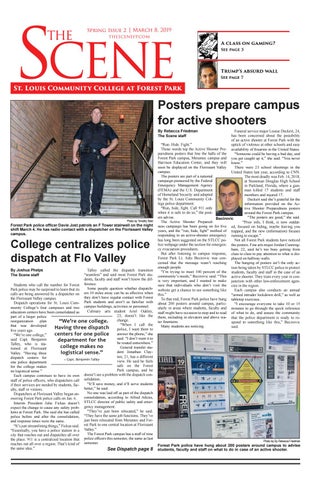
Forest Park police have hung about 200 posters around campus to advise students, faculty and staff on what to do in case of an active shooter.
Choose UMSL. Open office hours for STLCC Forest Park students: Mondays and Tuesdays Walk-ins only 9:00 am – 5:00 pm Advising Center – SC-200
“I can help with all of your questions about transferring, scholarships and what it’s like to be a Triton!”
Stacey Pugh Transfer Specialist
2018142/0718/jb
askstacey@umsl.edu 314-516-5161
Serious education. Serious value.SM
Webster Preview Day!
Discover what makes Webster a unique university Join us at Webster Preview Day to talk with faculty, learn about our 100+ academic programs, take a campus tour, explore campus resources, and enjoy a free lunch!
JOIN US! Connect with Webster — on your campus or ours! • March 22 - Webster Preview Day @ Webster • March 28 - 10am-1pm; Advising Office
For more information on transferring: WEBSTER.EDU/TRANSFER Office of Admission 314-246-7800 or 1-800-753-6765 • admit@webster.edu
R
EC-3399 WEbU_FP Scene_03_19.indd 1
Page 2
1/29/19 8:10 AM
The Scene
THESCENEFP.COM
March 8, 2019
Campus chatter Zachary Schaffer, 29, automotive technology “No. It shouldn’t be offered in school. It’s not educational.”
Karen Mueller, nursing professor “No. I don’t see a play for it. It doesn’t build skills for a profession. Any student would get an easy A.”
Sandra Calvo, 41, art “No. I don’t think it allows people to use their heads, and it makes people’s emotions go crazy, especially my kids.”
Domonsha Williams, 22, early childhood education “Yes, because most games are strategy-based. It helps the thought process.”
Ashley Brown, radiology instructor “No. How does it apply to student life or educational experiences? I don’t play video games anyway.”
Darnielos Luster, 37, music and graphic design “Yes, because it’s already offered at other schools. Put it in the course catalog, and students will choose it for sure.”
Nathan Doering, 20, network engineering “No, unless it has something to do with game development.”
Should gaming be a class at STLCC?
Nancy Seymour, 67, art “The gaming itself? No. The strategy part? Definitely. It would be a course of about the ‘how,’ not just playing.”
By Timothy Bold
Arnode Bikindow, 33, network engineering “No. Gaming is a distraction to academics.”
Damion Arnold, 28, computer technology “Yes. If it was here, everybody would be taking the class.”
Gavin John, 13, gifted program “It depends on what type. Playing video games isn’t a course, but coding to create them is.”
Hajar Almotori,19, ESL student “No, I don’t think so. You come to school to study, not play video games.”
Layout by Lulu Ali
March 8, 2019
The Scene
THESCENEFP.COM
Page 3
Photo by Neftali A
General transfer students Kevin Santander, 25 and Willnelle Warren, 20, and business student Stephone Gordon, 19, play Monopoly at the Stud Government Association Game Day in the Forest Park cafeteria.
A DAY IN TH
Photo by Jonny Geigle
Workers with Insituform, a provider of trenchless technologies for gravity and pressure pipelines, renovates a sewer on the south side of campus on Feb. 28 while Louisana Tech University students measure levels of volatile organic compounds, or VOCs, in the steam. VOCs have a high vapor pressure at ordinary room temperature.
Adjunct automotive master trainer Angelo Vitullo, left, gives instructions to au 67, on checking the coolant in a 2006 Nissan Murano SL in the campus garag Layout by
Page 4
The Scene
THESCENEFP.COM
March 8, 2019
Acosta
Photo by Bethany Tyler
dent
Nikko Farmer, a recruiter from Hope Healthcare, provides information to a student at the Forest Park job fair on Feb. 27 in the cafeteria.
HE LIFE OF FOREST PARK
Photo by Timothy Bold
utomotive technology student Chris Fries, ge.
Photo by Bethany Tyler
Information technology student Jarrell Gines, 28, left, registers for the Forest Park job fair on Feb. 27 with Helen Melen, a career development adviser, in the cafeteria.
Lulu Ali
March 8, 2019
The Scene
THESCENEFP.COM
Page 5
Opinion Chaos Crew
By Arrak Hutcherson
Scene THE
Managing editor: Timothy Bold
Business/web manager: Victor Paletta Circulation: Zacchaeus Windham Reporters/photographers: Joshua Phelps, Soroda Nasiri, Jonny Geigle, Rebecca Friedman, Neftali Acosta, Kevin Bailey, Bukundabababo Felicien, Bethany Tyler Layout: Lulu Ali Cartoonists: Arrak Hutcherson, Cameron Kuntz Faculty advisers: Teri Maddox, Fred Ortlip
Read us at home or on the run! Check out The Scene’s website at thescenefp.com Page 6
The Scene is a publication written and designed by students at St. Louis Community College at Forest Park, 5600 Oakland Ave., St. Louis, MO 63110. The office is in F Tower, Room 408. The telephone number is (314) 644-9140. The e-mail address is the_scene_fp@yahoo.com. All text, photos, graphics and other content are property of The Scene and may not be used without permission. Views expressed are not necessarily those of St. Louis Community
The Scene
THESCENEFP.COM
College, its Board of Trustees or administration. The Scene welcomes opinion pieces and letters to the editor. They should be signed and include the writer’s student or staff number. They can be mailed to the above addresses or delivered by hand. We reserve the right to edit for length and taste. The Scene will run classified ads for students free of charge. They should be submitted in the manner described above.
March 8, 2019
Opinion
The nation is traumatized by Trump Uncensored
By Soroda Nasiri The Scene staff On Jan. 25, the federal government ended a 35-day partial shutdown, the longest in U.S. history. All because our beloved president didn’t get funding from Congress for his border wall, which for the record, he had promised Mexico would pay for. Throughout negotiations, Trump threatened to declare a national emergency, which would allow him to take funds allocated to other agencies and programs and use them to build a wall. He called the declaration a “very powerful weapon” but insisted that he didn’t really want to use it. Unfortunately, the president used that weapon on Feb. 15, when he declared a national emergency. It made me feel uneasy and caused my blood pressure to skyrocket, and I know many other people felt the same way. So I did what I do best: research.
First, let’s dissect the government shutdown. Even though it’s over, it’s good to have an understanding of what happened, especially because there have been 21 shutdowns in U.S. history. Government employees aren’t paid during shutdowns. Some have to keep working without pay. Others are told to stay home on “furlough.” I ran across a story by Kevin Breuninger, a reporter with CNBC, that helped explain the impact of a partial government shutdown. It was published on Dec. 21, 2018, the day before the last shutdown began.
After the shutdown ended, NBC News reported that it cost the nation $11 billion, including $3 billion that would never be recovered. “CBS This Morning” reported that it could take the IRS up to a year to get back to normal, noting that 5 million pieces of mail went unopened during the shutdown. Not good. After I completed my research on government shutdowns, I turned my attention to national emergencies. I found a Photo illustration by Joshua Phelps good background piece, written by Deanna Paul and Colby Itkowitz, reporters for the Washington Post. Cost to the nation: $11 billion “In 1976, Congress passed the National He wrote that more than 420,000 federal Emergencies Act, which permits the presemployees would continue to work and not ident to pronounce a national emergency be paid until the shutdown ended. Homewhen he considers it appropriate,” they land Security employees also were affected, wrote. “The act offers no specific definiincluding Transportation Security Administion of ‘emergency’ and allows a president tration employees and many from the Coast to declare one entirely at his or her discreGuard, Forest and National Park Services, tion. By declaring a national emergency, the IRS, Housing and Urban Development and president avails himself or herself of dozens Transportation Department. of specialized laws. Some of these powers “All of that lost work could cost taxpayhave funds the president otherwise could ers huge amounts of money,” Breuninger not access. wrote.
Forget It
“Under current law, emergency powers lapse within a year unless the president renews them. A national emergency can be re-declared indefinitely, and, in practice, that is done frequently. There have been 58 pronounced under the National Emergencies Act, of which 31 are still in effect.” How is a national emergency different from an executive order? National emergencies are usually declared through executive orders. These are commands issued by the president that carry the force of law. The power is authorized, in part, by Article II of the U.S. Constitution. Executive orders direct federal agencies on how to spend available resources. Thousands have been created by past presidents, covering topics as varied as the duties of the commander-in-chief. The U.S. Supreme Court has only rarely held an executive order invalid, including one issued by President Harry S. Truman in 1952 that seized the country’s steel mills during the Korean War, and another issued by President Bill Clinton in 1995 involving workers on strike.
Congressional hurdles
Executive orders don’t create new law or allocate additional funding, which is where Trump has run up against congressional hurdles. After his inauguration, he issued an executive order making construction of a wall across the southwest U.S. border a federal priority. But a wall needed funding, and Congress has “power of the purse” under the Constitution.
See Uncensored page 8
By Cameron Kuntz
“Please ... promise me that you’ll call my manager ... and tell him that my shift (COUGH) needs to be covered.”
March 8, 2019
The Scene
THESCENEFP.COM
Page 7
News Photo by Bukundabababo Felicien
Faculty art
Photo by Neftali Acosta
Michale Paradise, fine arts, mimics his piece, “Self-portrait with Ebony Jeweling Damselfly Floater, a.k.a. Dragonfly Swimmer.”
This year’s Forest Park Faculty Art Exhibition kicked off March 1 with a reception in the Gallery for Contemporary Art on campus. Current faculty members in the art department are showing in ceramics, painting, photography and sculpture. The exhibit will run through March 28. Gallery hours are 10 a.m. to 2 p.m. Monday through Thursday or by appointment. Admission is free.
Photo by Neftali Acosta
Mario Carlos, fine arts, and his multimedia piece, “Settings.”
Photo by Neftali Acosta
Metra Mitchell, studio and art history instructor, poses with her works. At left are “Complex Choreography” and “Yellow Cushions.” At right from top, “Mannequin,” “Stylist” and “Sweet Sixteen in Blue Light.”
Uncensored I wonder how all this will affect our country. I wonder how it already has affected government employees and their families. I wonder if Trump is sitting back and thinking about the trauma suffered by the people he claims to “dearly love” and he is “fighting” for. I know American citizens hear news from other countries and are often horrified by what is going on. When I tell people I’m from Afghanistan, their reaction is usually, “Oh, you poor thing,” or “I’m happy you are here in America.” While I don’t disagree with these sentiments, I can’t help but believe that Americans also have traumatic experiences. It’s not the same as someone throwing a grenade on your house and having to rush to safety so your limbs can stay attached, but it’s trauma just the same.
A deep depression
A president is someone we should look up to for guidance, someone who tells us we are safe, not someone who instills fear and hatred for people of different races. In Afghanistan, at least people know their government is against them. In America, Trump is mind-f—king people, giving them false hope, making empty promises and separating the country. When President Barack Obama was in office, people weren’t so stressed out. They didn’t always agree with him, but they felt more at ease, knowing he wasn’t going to sink the county. I felt as if there was hope for equality.
Page 8
from page 7 Under President Trump, America is in deep depression. We can feel the toxic energy he is spreading, but we’re not willing to sit down and lose our voices. We won’t be fooled into thinking we are powerless. We won’t forget about American history, which proves that those with less power can make a difference.
Minor issue, major trauma
I think what is bothering me most is the fact that border security is such a minor issue, yet it is causing major trauma. I am not oblivious to the fact that sex trafficking and illegal drugs are a problem, but building a wall is not the solution. What about the internet black market, which allows pedophiles to sell trafficked children? What about the legal drugs that are killing Americans? It’s easy to place blame for social problems on “others” who are different rather than take time to really understand the roots of those problems and do what it takes to heal. Asking Congress to spend $5.7 billion for a border wall is absurd. It’s time to put all our energy into doing something that will really make a difference. I’m all for taking a stand for what you believe in, but not at the expense of the American people. I don’t know how Trump’s actions will affect the country, but they’ve made me more aware of how much power our president has, and it has encouraged me to become more politically educated and involved.
Photo by Neftali Acosta
David Potthast, graphic communications, poses with his piece, “Untitled.”
Dispatch The college gave the dispatch consolidation a green light in the spring of 2017, when Atkins joined the district. “This is not just something that popped up yesterday,” Talley said. STLCC police and dispatchers at campuses and education centers are communicating through the St. Louis Area Trunked Emergency Radio (SLATER) system, which includes repeaters at each location. The SLATER system also is being used by police, fire departments and emergency medical service personnel throughout the
from page 1 St. Louis metropolitan area. “It has allowed us to work as one agency,” Talley said. “It’s what we are.” Talley said response times have improved since the college adopted the SLATER system late last year and that dispatch consolidation has allowed the police department to be more efficient with resources and officers to spend more time in the field. “Now our dispatchers are working 24/7, and that allows us to monitor fire and burglar alarms and other things the dispatcher has to do,” he said.
Photo by Tmothy Bold
Dispatch services for all four St. Louis Community College campuses and two education centers are now centralized on the Florissant Valley campus.
The Scene
THESCENEFP.COM
March 8, 2019