SCENE THE
June 29, 2018
Summer Issue 1
www.thescenefp.com
St. Louis Community College at Forest Park
Happy grads See page 3
Fourth of July See pages 4-5
Taking out trash See page 7
Plans to demolish A and B towers stir controversy
By Joshua Phelps The Scene staff
Kevin Harrington was shocked when he learned that St. Louis Community College was planning to demolish a large section of a Forest Park classroom building. The Chicago architectural historian is writing a book on mid-century modern architects Ben and Cynthia Weese. Ben helped his brother, Harry, design the Forest Park campus in the 1960s. They collaborated with renowned landscape architect Dan Kiley, who also designed the original Gateway Arch grounds. “To throw away something — with all the money they put into it — is not a good idea,” Harrington said this spring after visiting Forest Park with his wife, Elaine. “It’s kind of silly to throw away the energy that’s embedded in those buildings and
pollute the atmosphere and destroy the climate when instead, you keep the buildings and continue to use them for the purpose for which they were built.” STLCC plans to demolish A and B towers of the classroom building to provide walkways and green space around a new Center for Nursing and Health Sciences, which now is under construction. Harrington is professor emeritus at the Illinois Institute of Technology. He said preserving Forest Park’s original buildings makes sense from an historical, architectural, financial and environmental standpoint. “Although these buildings are (more than) 50 years old, they’re still good and effective for the purpose for which they were built,” he said. The Center for Nursing and Health Sci-
See Towers page 2
Photo by Bethany Tyler
Construction on the new Center for Nursing and Health behind A Tower is progressing.
Photo by Daniel Shular
Gov. Mike Parson, left, and his security detail leave the Hispanic Leaders Group meeting at Forest Park after his speech on June 13.
New Gov. Parson makes appearance on campus By Daniel Shular The Scene staff Missouri Gov. Mike Parson had been on the job less than two weeks when he stopped by Forest Park. He was wrapping up a listening tour across the state at a meeting of the Hispanic Leaders Group of Greater St. Louis. One attendee asked about his transition from lieutenant governor to governor on June 1, when former Gov. Eric Greitens resigned amid scandals and efforts to impeach him. “Most people get 60 days to transfer from one position to another,” Parson said. “We had 60 hours. So it was a daunting task.” Parson later joked that the experience was like “drinking water out of a firehose.” The Hispanic Leaders Group is a
non-profit, non-partisan group that supports the advancement of the Hispanic community through networking, education and advocacy. They also give scholarships to Hispanic students. The group’s meeting was held June 13 in a Hospitality Studies banquet room at Forest Park. It started with a presentation by Ness Sandoval, associate professor of sociology and anthropology at St. Louis University. Sandoval shared information on Missouri Latinos, including their projected population growth, the entrepreneurs among them and the tax revenue they generate. Parson first committed to appearing at the Hispanic Leaders Group meeting when members met with him on March 7 at the state capitol. After he became governor,
See Governor page 3
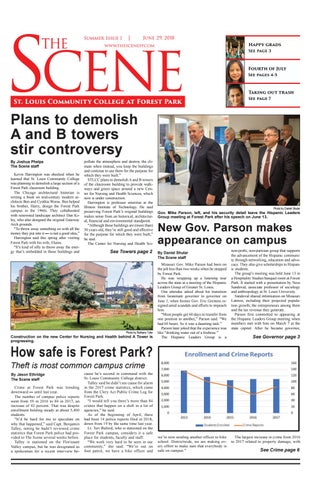
How safe is Forest Park? Theft is most common campus crime By Jason Ethridge The Scene staff Crime at Forest Park was trending downward — until last year. The number of campus police reports went from 59 in 2016 to 84 in 2017, an increase of 42 percent. That was despite enrollment holding steady at about 5,400 students. “It’d be hard for me to speculate on why that happened,” said Capt. Benjamin Talley, noting he hadn’t reviewed crime statistics that Forest Park police had provided to The Scene several weeks before. Talley is stationed on the Florissant Valley campus, but he was designated as a spokesman for a recent interview be-
cause he’s second in command with the St. Louis Community College district. Talley said he didn’t see cause for alarm in the 2017 crime statistics, which came from the Clery Act Public Crime Log for Forest Park. “I would tell you there’s more than 84 crimes that happen on a shift in a lot of agencies,” he said. As of the beginning of April, there had been 14 police reports filed in 2018, down from 19 by the same time last year. Lt. Teri Buford, who is stationed on the Forest Park campus, considers it a safe place for students, faculty and staff. “We work very hard to be seen in our community,” she said. “We’re out on foot patrol, we have a bike officer and
we’re now sending another officer to bike school. Districtwide, we are making every effort to make sure that everybody is safe on campus.”
The largest increase in crime from 2016 to 2017 related to property damage, with
See Crime page 6
News
Towers
from page 1
ences will be a four-story, 96,000-squarefoot glass building with brick accents along Oakland Avenue. It will house modern classrooms, labs and offices for nursing, dental hygiene and eight other health-related programs considered vital in meeting future employment needs. Construction on the $39 million project began in March. The college plans to demolish A and B towers after the center is completed in 2019. They will be “obsolete,” according to Paul Zinck, STLCC vice chancellor of finance and administration. “The reason that we’re building the new (center) is that those old towers, and much of the rest of the structure over there, are very inefficient from a standpoint of energy usage and heating,” he said. “They’re built in an architectural style and decorated in such a way that is outdated and very expensive to modify,” Zinck added. Last fall, STLCC Chancellor Jeff Pitman noted that the new Center for Nursing and Health Sciences will be a gold LEED-certified building. LEED stands for Leadership in Energy and Environmental Design. Certified buildings use less water and electricity, reducing greenhouse emissions. When asked about other classroom buildings on the Forest Park campus that are just as old as A and B towers, Zinck said decisions on how to deal with them will have to be made in the future. “They all have similar challenges in their adaptability and level of maintenance,” he said. “It really sort of becomes an equation of how much can you do at any one time and what is acceptable by way of college leadership and taking on new building projects.” William Hubble, district division dean of academic affairs for health sciences, had no opinion on demolition of A and B towers, but he supports plans for a new Center for Nursing and Health Sciences. “It’s going to be state-of-the-art,” he said. “It’s going to offer St. Louis Community College students the opportunity to train in a state-of-the-art facility with all new equipment.”
1960s showcase
Harrington isn’t the only architecture enthusiast opposed to the college’s plan to demolish A and B towers. The Rev. Greg Johnson, associate pastor of Memorial Presbyterian Church in St. Louis, has argued against it in several articles for NextSTL.com, an online magazine that promotes “smarter development and civic engagement.” In one article, Johnson noted that after Forest Park opened in 1967, construction continued for three more years, gaining national attention. “By 1970, William Moore could note in
Photo courtesy of Forest Park Archives
In this view to the west, construction nears completion on the Forest Park campus in the 1960s. Trees and other landscaping haven’t yet been planted. ‘Against the Odds’ that 307 other community colleges already had sent representatives to Forest Park Community College to observe and learn,” Johnson wrote. “Forest Park was designed to be a leader.” Johnson considers Harry Weese and Dan Kiley two of the “best architecture modernists in North America.” Johnson also noted that the Forest Park campus won the first-ever 25-Year Award for buildings that have “withstood the test of time” from the St. Louis Chapter of the American Institute of Architects in 1994. “The tragedy is that the Weese towers are not even in the footprint of the new (Center for Nursing and Health Sciences),” he stated in an email to The Scene. “These mid-century works by these truly great architects cannot be replaced once bull-dozed.”
Mixed campus views
Michelle Swatek, executive director of the St. Louis Chapter of AIA, said the organization has decided not to take a position on demolition of A and B towers. “We know it’s an iconic building,” she said. “And as architects, we value its merits and the design. We also know that there are times when buildings need to be changed for future needs.” The STLCC Board of Trustees directed staff to investigate the possibility of a new center for nursing and other health-related programs in September 2016. The following February, board members hired KAI Design & Build to design the new building. No one opposed the plan, including the demolition of A and B towers, during board meetings, according to Zinck and STLCC Communications Manager Nez Savala. “It’s going to ruin the whole look of the
KAI Design & Build
The new Center for Nursing and Health Sciences is shown at left in this artist’s rendering of what the east end of the Forest Park campus will look like after A and B towers have been demolished.
Page 2
place,” said Karen Kacer, Forest Park archivist and reference librarian. “I imagine they have a new look they want to put in. There’s nothing I can say that’s going to make any difference. I don’t really care as long as everything works OK.” One of the programs that will move into the new building is funeral sciences. Student Makaya Bowers, 25, is excited. “St. Louis is mainly a medical (community),” she said. “You have people from all over coming here to pursue school in medical or a medical field. For St. Louis Community College to have their own building to teach that, I think it’s beneficial for St. Louis.” Assistant biology professor Tommie Frison agrees that a new Center for Nursing and Health Sciences is needed to replace outdated facilities. Frison wonders how the college is going to find space for classes and other activities that now occur in A and B towers. For the past 10 years, he has been teaching in large lecture halls in A Tower. “The demolition of the A and B towers seems to be, on the surface, a waste of space,” Frison said. “But I think that, based on what I understand of what they’re going to do with the space, (they want) to provide a very different entryway into the campus, which I think is positive, and provide additional green space.” Janet Woodworth started working for STLCC in 1966, the year before the Forest Park campus opened. She retired last year as a secretary for social and behavioral health sciences. In theory, Woodworth likes the idea of students having access to state-of-the-art
training in health-related fields, but she isn’t sure how to feel about demolition of A and B towers. “That’s going to displace a lot of people,” she said.
Brutalist architecture
In April of last year, Johnson wrote a piece for NextSTL detailing Forest Park’s original design. Apparently, Harry Weese & Associates and Kiley designated space for a lake on campus, but that never materialized. A sunken, stair-step fountain was built, but in recent years, it has remained dry due to plumbing problems. Johnson described the building architecture as “brutalist,” but warm red brick was used instead of “cold and expansive concrete” that was typical of the style. Harrington questions this description. “One (term) that I did see used about the Forest Park campus is brutalist, and that seems entirely wrong,” he said. “There’s nothing ‘brutal’ about those buildings.” Harrington called them “handsome.” Window sizes on classroom buildings vary from floor to floor, which Harrington said was intentional. “If you look at the facade of the east building, you can see there are four different treatments of the windows on each of the four levels,” he said. “The bottom level is mostly open, the second level is a series of narrow strip windows faced by projecting brick. “On the third floor is a series of horizontal strip windows moving along the facade, and on the top floor there are very few windows because that floor is lit by the slight angle of the ceiling.”
Illustration by Brian Ruth / KAI rendering
The new Center for Nursing and Health Sciences is circled in this artist’s rendering showing what the Forest Park campus will look like after A and B towers have been demolished.
The Scene www.thescenefp.com
June 29, 2018
News
40 adults complete unfinished business HiSET program confers high school diplomas at Forest Park By Timothy Bold The Scene staff Marilyn Minor was a successful beauty salon owner in St. Louis for more than 25 years before she finished high school. The 58-year-old had dropped out her senior year. “Back then, I got a real job making good money,” she said. “I made a bad mistake and suffered two strokes. God gave me another opportunity to come back 39 years later.” Minor enrolled in the HiSET FastTrack Program at Forest Park. HiSET stands for high school equivalency test (formerly known as general education diploma or GED). On June 7, Minor was one of 40 students who received high school equivalency certificates. It was Forest Park’s first graduating class since it began offering the FastTrack program last year. Graduates, who ranged from 17 to 58, walked across the cafeteria stage with smiles and tears. A capacity crowd of more than 300 staff members, parents, families and friends clapped and cheered. “I’m so excited and happy,” said Minor’s sister, Brenda James. “Her determination is amazing.” Minor plans to pursue an associate’s degree at Forest Park. She hasn’t decided on a major. All the graduates in the HiSET program were completing unfinished business. Each had his or her own reason for dropping out
Photo Sara Schmidt
Graduates of the HiSET FastTrack Program hurl their mortar board caps skyward after the graduation ceremony in the Forest Park cafeteria. of high school. Hagen Svendsen, 18, said he faced “economic class discrimination” at his school. He saw the HiSet program as a better way to accomplish his goals. “I want to go to college, further my education and go into a career that I like,” he said. The HiSET FastTrack Program allows students to work at their own pace. They must be at least 17 and test at a ninth-grade equivalency level. Staff sets up a curriculum after assessing each student’s entry test score. “Some students take a couple of weeks,”
said Kathy Bender, adult educational learning instructor at Forest Park. “Others can take months. It all depends on study habits.” Paul Banda, a communications officer at Washington University and who attended HiSET preparation classes at St. Louis Community College at Meramec, was the keynote speaker at Forest Park’s graduation ceremony. Graduate Ash Kaltmayer, 18, had enrolled in the program after experiencing difficulties with the normal high school curriculum. “The traditional high school setting didn’t work for me,” she said. “The FastTrack program was personalized for what I needed to succeed.” Kaltmayer’s mother, Sandy Costello, noticed a change in her daughter immediately after she started the program. “She was coming home excited for the first time being in school,” Costello said. “I’m extremely proud and was a little emotional when she crossed the stage.” Like Minor, Kaltmayer plans to pursue an associate’s degree at Forest Park. Graduate Dwight Futrell, 25, hopes to earn his real-estate license and buy, sell and develop property. “By going back to school, I wanted to show leadership, open doors and be an example to other people that age doesn’t matter,” he said. “I came from a pretty rough environment on the north side of St. Louis. (Graduating is) an experience I’ve never had and a feeling I will always remember.” Some graduates needed the certificate as a requirement for their employment. That
included Theresa Young, 33, a sterile-processing technician at Barnes-Jewish Hospital. “If I can accomplish that, I can do anything,” she said. “I wanted to be an example for my daughter.” The HiSET FastTrack Program started eight years ago at the St. Patrick Center in downtown St. Louis. The graduation rate has been about 88 percent. The program relocated to the Forest Park campus last August because the requirements of a U.S. Housing and Urban Development grant forced St. Patrick’s Center to eliminate all programs not related to housing. “(HiSET FastTrack instructors) wanted to stay in the city and continue our program,” Bender said. Enrollment in Forest Park’s program resumes in July. Students can register by calling 314-984-7777 between 8:30 a.m. and 5 p.m. Monday through Thursday or 8:30 a.m. and 4 p.m. Fridays. Instruction can occur online or in person. Forest Park instructors are available from 8:30 a.m. to 3 p.m. Tuesday, Wednesday and Thursday in F Tower, Room 327. Student tutors are available every day. The certification exam costs $95, which is covered by a grant from the Missouri Department of Elementary and Secondary Education. Students also get free Metro passes. Micki Hoffman, an STLCC caseworker, assists graduates who want to transition into the WorkForce Solutions Group, STLCC associate’s degree programs or bachelor’s programs at four-year universities.
Governor
Photo by Daniel Shular
Gov. Mike Parson addresses the Hispanic Leaders Group at Forest Park.
June 29, 2018
The Scene www.thescenefp.com
from page 1
they weren’t sure if he would still show up. “Once the resignation happened, I called his office and he said he would keep his commitment,” said Antonio Maldonado, the group’s president. “He’s a man of integrity, a man of his word.” At Forest Park, the governor talked about the importance of higher education in filling skilled positions in the workplace. “(College students) walk out of there, some do, with a tremendous amount of debt,” he said. “… You almost start them in a hole where it is very difficult to climb out.” He later asked, “How do we team up with the private sector to make sure that when they do graduate, they do have a good job that pays good money?”
Page 3
Photo by Daniel Shular
Photo by Daniel Shular
Swimming I students Demar Harrold, 29, left, Faith Warren, 21, second from right, and Tim Burns, right, practice breathing exercises with P.E. instructor Frank Johnson in the Forest Park pool.
Art instructor Mario Carlos, left, offers tips to stud flower in Painting I class.
A Day in the L of F
Cook Tony Sanford makes a sandwich for a customer in the cafeteria.
Photo by Destini Clark
Hazel Nettles, enrollment service specialist for int major Kashawna Walker, 24, enroll for fall classes
Layout by And
Page 4
The Scene www.thescenefp.com
June 29, 2018
dent Barbara St. John for painting a
Photo by Bethany Tyler
Photo by Bethany Tyler
Students Ntenikoum Opekou, left, and Sveltiana Ekeocha Okana study for a psychology exam in the Forest Park library.
Life Forest Park
Photo by Destini Clark
ternational students, left, helps diesel mechanics s.
Photo by Daniel Shular
Automotive technology major Andrew Venker, 23, views a monitor as he balances a tire in the automotive shop.
dreal Luedde
June 29, 2018
The Scene www.thescenefp.com
Page 5
News Crime
from page 1
the number of incidents rising from 13 to 20. The number of assaults went from one to five. Both years, the most common crime was theft. There were 26 thefts in 2017, three more than the previous year, with the majority occurring in parking lots. Buford didn’t identify types of items stolen, noting they “vary from case to case.” She stressed the need for students to use common sense when it comes to personal possessions like cellphones, book bags, purses and wallets. “The best way to protect yourself in any environment is this: Don’t leave things in your car that you think someone else might want …. We have to get into the habit of saying ‘If it’s important to me, it’s possibly important to someone else.’” Officer Dan Taylor concurred. “I see so many valuables in plain view, from purses to phones charging to iPods Photo by Destini Clark – everything,” he said. Officer Dave Rodriguez patrols the Forest Park staff parking lot. Forest Park enrollment went from 6,815 students in fall of 2013 to 5,776 ble locations on campus. students in 2014, 5,254 students in 2015, plaints.” Dental hygiene student Jessica Find“The more people see us, the less these 5,440 students in 2016 and 5,430 students er, 22, often walks to her car after dark, things will happen,” Taylor said. “Our in 2017. During the same period, there were 134 especially in the winter. Sometimes that presence is a deterrent.” The lower numbers of crime reports so police reports filed in 2013, 101 filed in makes her feel uncomfortable. Finder thinks Forest Park police do an far in 2018 is good news for campus po2014, 86 filed in 2015, 59 filed in 2016 “alright” job. lice. They hope to see the trend continue and 84 filed in 2017. “I feel safer having them around, havthis fall, when more students will be on Beyond property damage, assault and ing them present,” she said. “But I’d like campus. theft in 2017, there were 10 reports of to see them around “We’re well aware that when school harassment, sevmore.” comes back in August that we get busier en of peace dis“Don’t leave things in your Forest Park has on the campuses,” Talley said. “We nevturbances, four presence er lessen service, but we put our bodies of auto accidents, car that you think someone police 24/7 with three of- where the bodies need to be.” three of stalking, ficers from 7 a.m. two of trespassing, else might want …. We have to 3 p.m. weekdays two of sex offenses, one of drugs or to get into the habit of say- and three officers and a supervisor alcohol, one of iling ‘If it’s important to me, from 3 to 11 p.m. legal weapons, one THE weekdays, accordof forgery, one of it’s possibly important to ing to Buford. graffiti and one of “When students a hate crime. someone else.’” are here, we run Nursing student three deep,” she Makayla Wil– Lt. Teri Buford said. liams, 19, didn’t Managing editor: Timothy Bold One officer patell campus police that someone broke her car window and trols locked buildings from 11 p.m. to Business/web manager: Victor Paletta stole several items in April. Even if the 7 a.m. weekdays and on weekends. If thieves were caught, she said, she proba- there’s a special event taking place on campus, the college calls in more officers Reporters/photographers: bly wouldn’t get her things back. and possibly a dispatcher. Williams blamed the theft on lack of Joshua Phelps, Jason Ethridge, “We are in a very good place,” Buford surveillance on Forest Park parking lots. Antonio Lloyd, Destini Clark, Daniel Shular, “I don’t ever see the campus police do- said. “We do our jobs quickly, effectively Bethany Tyler, Soroda Nasiri ing that much,” she said. “They’re just and we are operating within our budget.” She emphasized the importance of cositting in their cars, not really watching.” Illustration/design: Business administration student Deon- operation and collaboration between police officers and students. Taylor called zae Johnson, 24, had a different view. Arrak Hutcherson, Jayy Dixon, Andreal Luedde “I see (police officers) around from students “our eyes and ears.” Buford and Taylor also stressed the imtime to time,” he said. “They do their job Faculty advisers: portance of having police officers in visiefficiently. I have no negatives or com-
Scene Teri Maddox, Fred Ortlip
The Scene is a publication written and designed by students at St. Louis Community College at Forest Park, 5600 Oakland Ave., St. Louis, MO 63110. The office is in F Tower, Room 408. The telephone number is (314) 644-9140. The e-mail address is the_scene_fp@yahoo.com. All text, photos, graphics and other content are property of The Scene and may not be used without permission. Views expressed are not necessarily those of St. Louis Community
Page 6
The Scene www.thescenefp.com
College, its Board of Trustees or administration. The Scene welcomes opinion pieces and letters to the editor. They should be signed and include the writer’s student or staff number. They can be mailed to the above addresses or delivered by hand. We reserve the right to edit for length and taste. The Scene will run classified ads for students free of charge. They should be submitted in the manner described above.
June 29, 2018
Uncensored
Take out the trash and heal By Soroda Nasiri The Scene staff Take a moment and imagine what would happen if you didn’t take out the trash. A full trash bag has been sitting in your home for a few days. Banana peels are starting to rot. Meat thrown away from Thursday’s dinner is starting to stink. The few drops left in the milk carton are starting to curdle. The combination of smells swirl together to create that oh-so-familiar, “it’s-time-totake-out-the-trash” stench. Our emotional and mental health can be compared to this trash bag when we choose not to heal or deny the healing we need. Everyone needs healing, whether it be from sexual or emotional abuse, assault, neglect, crime, domestic violence, a serious accident or illness or the death of a loved one. No one is free from pain, strife or wrong
dealings. Sadly, as a society, we often deny ourselves the wonderful gift of healing. The gift of sitting with our pain. Getting to know it. Learning from it. Being grateful for it. Instead, we choose to pile trash on top of trash, causing emotions to become trapped. We stuff in so-called “negative” emotions in order to move forward with life. But people shouldn’t get intimidated by the word “heal.” Healing is a powerful tool to which we all have access. Healing is the process of making things whole again. Simply moving forward with life is not living a life of abundance. Healing must happen for the body to be at ease, ultimately taking burdens off the mind and soul. It’s restoration. Here are three steps I’ve been following to guide healing in my life:
Opinion
coming more familiar with your personal inner workings.
3. Create peace with your trauma
The path to peace is different for different people. Whatever speaks to you the loudest, follow that path. Is it finding God? Which God speaks to you the most? Does
1. Understand the pain
Don’t dismiss it or make it a friend. Don’t tell yourself hurtful things such as, “Get over it.” You don’t have to get over it. Pain is a part of life. Understanding the “whys” behind pain will help you overcome it.
2. Marinate in your discomfort
Understanding pain is not a comfortable process. Allow yourself to feel everything. Do not deny anything. Marinate in your discomfort. Try embracing your “negative” emotions as positive. Focus on the benefits you’ve received from them. This is a crucial step to be-
Chaos University
June 29, 2018
meditation intrigue you? Will a new diet plan or a therapist help guide your movement toward peace? In creating peace, learn not to blame the past. Instead, observe what it is and embrace it. Taking the time to understand your pain, marinate in your discomfort and create peace with the past are undeniably courageous things to do; they’re not easy. However, once you’ve fully realized and accepted everything, you can begin your path to recovery. After you’ve taken out the trash and cleansed your mind … that is the time to discover your true self. Today, I encourage you to stop sleepwalking through life. Stop letting your heart be clouded by hurt, pain, anger and disappointment. Allow yourself to elegantly soar through this life with an open heart, mind, understanding and confidence. I’m excited about your future. May the space around you stay sacred. May your mind stay flowing. And may your heart stay open.
By Arrak Hutcherson
The Scene www.thescenefp.com
Page 7
Campus chatter Jinah Thomas, 23, respiratory care “The Fourth of July is celebrating my dad’s birthday.” Jeanenne Adams, 47, phlebotomy “We celebrate our freedom as Americans. We wouldn’t have it if our ancestors didn’t fight for liberty and justice.”
Joe Kelling, 42, phlebotomy “It means (getting) independence from the imperialist, fighting for our rights.”
Ling Zhang, 47, lab clinical technology “My boyfriend and I go down to Fair St. Louis to watch the fireworks finale.”
Kyle Anthony, 19, mechanical engineering “It’s a time for having fun and gathering with loved ones to remember America’s history of gaining independence.”
What does Fourth of July mean to you?
Jennifer Ngo, 22, radiology “I usually travel (sometimes to Branson), eat barbecue and spend time with family.”
Erin Weissler, 25, radiologic technology “It’s a day I spend with my family and enjoy eating barbecue.”
By Timothy Bold
Sara Schares, 32, nursing “It’s a joyous celebration with family and friends, eating delicious barbecue.”
Kathy Bender, AEL instructor “It’s a celebration where my family goes to the Lake of the Ozarks.” Marnese Jones, 50, truck driving “It means independence. It’s a special day for America.”
Page 8
Jordan Holmes, 23, general transfer “Fourth of July is a day of hanging with my friends, and going to watch fireworks at Fair St. Louis.”
The Scene www.thescenefp.com
Damilola Jila, 20, nursing (from Nigeria) “I think it’s a celebration of independence for America, only being here for three years now. I’ve enjoyed barbecue at a friend’s house on this day.”
Layout by Andreal Luedde
June 29, 2018