SCENE THE
THE
Fall Issue 6
Dec. 8, 2018
THESCENEFP.COM
www.thescenefp.com
Decision fatigue See page 7
worst Christmas gifts See page 8
St. Louis Community College at Forest Park
New-look Archers fall short in nationals
By Timothy Bold The Scene staff
Photo by Daniel Shular
Photography student Dane McCrary, 30, buys a drink from the vending machine on the fourth floor of F Tower on Dec. 4.
Vendors work to improve reliability of machines By Jason Ethridge and Joshua Phelps The Scene staff It’s never hard to find a snack at Forest Park, but some students complain about high prices and periodic malfunctions with vending machines. For a while, a beverage machine on the fourth floor of F Tower was dropping juices to the bottom, said respiratory therapy major Rick Mahio, 26. Fine arts major Amanda Rhodes, 31, has had trouble with the snack machine in the same location. “It takes your money,” she said. “It’s annoying. You want a snack, but you can only use quarters. You can’t use dollars because they won’t go in. You can swipe your card, but that doesn’t work either.” Forest Park has 36 vending machines,
according to Ellen Gough, campus manager of auxiliary services, which includes the bookstore. Beverages are sold by Pepsi and snacks come from Company Kitchen, the vendor that operates the cafeteria. Beverage machines on campus charge $1.50 for 16-ounce sodas and up to $3 for other selections. General transfer student Lakeecia Taylor, 18, thinks $2 is too much for a can of Mountain Dew Kickstart, an energy drink. Nursing major Shavazz McMurry, 27, feels the same way about snack machines. “They need to cut the prices,” she said. “The chips are $1.25. It’s a 30-cent bag of chips.” Early childhood development major Melissa Young, 31, also thinks prices are too high, but her main complaint is snack selections.
See Vending page 3
Another trip to the national community college soccer tournament for the St. Louis Community College men’s team looked disappointingly similar to the one last year. The Archers split two games in pool play on Nov. 12-13 at Daytona State College in Daytona Beach, Fla., and were eliminated. They went into the tournament seeded 10th among 12 teams and were shut out 3-0 in the first qualifying match to third-seeded Barton Community College of Kansas, the eventual tournament runner-up. A missed penalty kick by sophomore midfielder Noah Vezzu late in the game concluded a lackluster performance. Day two was a different story against Georgia Military. Playing with fire and intensity, the Archers got the game-winner from Vezzu in extra time in a 2-1 victory.
Photo by Daniel Shular
See Soccer page 6
Photo by Daniel Shular
Gloria Williams, posing in the Forest Park cafeteria, plans to take her culinary education to the next level, studying for a semester in France.
Culinary arts student returns to college after four decades By Joshua Phelps The Scene staff
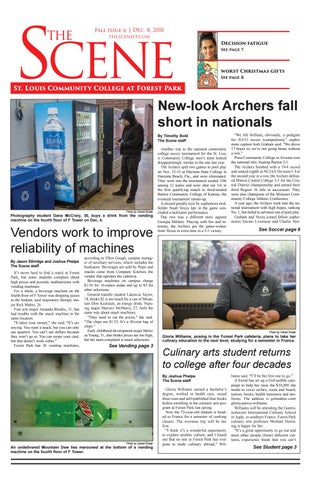
An undelivered Mountain Dew lies marooned at the bottom of a vending machine on the fourth floor of F Tower.
“We felt brilliant, obviously, a pedigree for JUCO soccer (competition),” sophomore captain Josh Graham said. “We drove 17 hours — we’re not going home without a win.” Pima Community College in Arizona won the national title, beating Barton 2-1. The Archers finished with a 19-4 record and ranked eighth in NCJAA Division I. For the second year in a row, the Archers defeated Illinois Central College 3-1 for the Central District championship and earned their third Region 16 title in succession. They were also champions of the Missouri Community College Athletic Conference. A year ago, the Archers went into the national tournament with high hopes, ranking No. 1, but failed to advance out of pool play. Graham and Vezzu joined fellow sophomores Savino Livornese and Charlie Nor-
Gloria Williams earned a bachelor’s degree, worked in health care, raised three sons and self-published four books before enrolling in the culinary arts program at Forest Park last spring. Now the 72-year-old student is headed to France for a semester of cooking classes. The overseas trip will be her first. “I think it’s a wonderful opportunity to explore another culture, and I found out that no one at Forest Park has ever gone to study culinary abroad,” Wil-
liams said. “I’ll be the first one to go.” A friend has set up a GoFundMe campaign to help her raise the $10,000 she needs to cover airfare, room and board, tuition, books, health insurance and uniforms. The address is gofundme.com/ gloria-pierce-williams. Williams will be attending the Gastronomicom International Culinary School in Agde, in southern France. Forest Park culinary arts professor Michael Downing is happy for her. “It’s a great opportunity to go out and meet other people (from) different cultures, experience foods that you can’t
See Student page 3
@theSceneForestPark
Congratulations, December Grads! Discover transfer and scholarship opportunities at Webster! JOIN US! Connect with Webster — on your campus or ours! Dec. 6 • 10am-1pm, Outside Advising Office Dec. 7 • Webster Preview Day (@ Webster) Learn about: Webster’s exciting academic programs; generous transfer scholarships; apply for free; and request free estimated evaluations of your transfer credit! For more information on transferring: WEBSTER.EDU/TRANSFER Office of Admission 314-246-7800 or 1-800-753-6765 • admit@webster.edu
R
EC-3365 WEbU_FP Scene2018_12_7.indd 1
Page 2
The Scene
THESCENEFP.COM
10/15/18 1:19 PM
Dec. 7, 2018
News
Student get here,” he said. “I think it’s a wonderful “The bookmobile would come to our opportunity for anyone.” community, and you could only get five Students, faculty and staff also can help books every two weeks,” she said. “I’d Williams by purchasing her books, which read those five books before the two weeks are available in the campus bookstore or at were up, and I was ready for the next five Amazon.com. They sell for $10 to $20. books.” “She is an example of the great non-traAfter high school, Williams earned a ditional students we have at St. Louis Com- bachelor’s degree in medical technology at munity College, how creative they are, how St. Louis University 1968 and worked in you can learn a lot about resilience from laboratories for about 25 years. Her favorthem and about the importance of being a ite part of the job was doing blood work lifelong learner,” said Ellen Gough, man- and helping to determine what made paager of auxiliary services, which includes tients sick. the bookstore. Over the years, Williams wrote four Williams grew up in St. Louis in the books, including two novels, “Above and 1940s and ’50s, Not Beneath” and when schools were “I am so excited. I’m hoping “Running Interferstill segregated, but ence”; one memshe benefited from oir, “Trusted”; and to learn about the French, living in a close-knit a non-fiction book, community. their sauces, the delicacy of “Big Mama’s Se“Everything was crets of Survivright there, a school, their pastries, the placement al.” But she didn’t a church, entertainself-publish any of food on their plates, ment, and everybody of the books until was about the same 2017. the use of fresh fruits and economically,” she “‘Above and said. Not Beneath’ is a vegetables.” Williams’ fathird-generationther died when she al story about two – Student Gloria Williams was 13, forcing her biracial children, a mother to work as a brother and sister, maid and house cleaner to provide for her and (they’re) trying to make a decision to four children. pass for black or white,” Williams said. “My mother kept us all together, and it “‘Running Interference’ is a story of dowas a normal childhood,” she said. mestic violence and how it can be stopped, Williams was an avid reader, but it was and four different men tell their story of difficult to get to the public library in how they got involved with domestic viodowntown St. Louis. She borrowed books lence.” from a library on wheels. Last year, Williams was at the For-
from page 1
Covers of two of Gloria Williams’ four books. Growing up, she was an avid reader but found it difficult to get to the public library in downtown St. Louis. est Park library, designing covers for her books, when she met a student who proudly asked if she wanted to see her diploma. The resulting conversation led Williams to fulfill a dream by returning to college and enrolling in the culinary arts program. She has enjoyed the experience so far. “I feel younger, being around the kids and studying for tests, going to the library and working on projects,” she said. Williams found out about STLCC’s study-abroad program from a poster on a bulletin board. She called the number for information and found out that she needed to put down a $3,700 deposit to go to
Vending
e
e’s
Read us at home or on the run! Check out The Scene’s website at thescenefp.com
Dec. 7, 2018
France. That was the exact amount Williams was getting from an academic scholarship. She thought it was a “sign.” “I am so excited,” she said. “I’m hoping to learn about the French, their sauces, the delicacy of their pastries, the placement of food on their plates, the use of fresh fruits and vegetables.” Williams expects to graduate in 2019 or 2020, and she hopes to get a job in a restaurant. “I want to work under a good chef,” she said. “I want to teach, and I want to write cookbooks about nutritious fresh food.”
from page 1
“They need to have healthier choices instead of chips,” she said. But not everyone is down on vending machines at Forest Park. Clinical laboratory sciences student Alex Nemiroff, 23, considers them crucial to his education. “I would say that every time I’m between classes, I go and get something,” he said, holding a bag of barbecue-flavored potato chips. “They are so convenient because of all the ways you can pay. Card, cash, smart phone …” Locations of vending machines are jointly determined by the college and vendors. Decisions on whether they stay or go depend on sales and foot traffic. Bookstore employees inspect beverage machines weekly to ensure cleanliness and product availability, officials said. Pepsi delivery drivers report once a week for stocking. Company Kitchen follows a “just-intime” system, according to Justin Rudick, senior manager of auxiliary services for the St. Louis Community College district. Employees monitor snack machines and use the data to determine when delivery drivers need to show up for stocking. Beyond product availability, Pepsi, Company Kitchen and the college have put systems in place to increase reliability of vending machines and, in turn, customer satisfaction. Company Kitchen Operations Manager Kate Linders promises a response time of less than 24 hours if a snack machine is found to be defective. When Pepsi is contacted about a problem, a representative shows up that day or the next day, Rudick said. As a result of the new systems, Gough and Rudick report few complaints from students this semester. Nemiroff also has noticed an improvement.
Photo by Daniel Shular
Beverages in campus vending machines range in price from $1.50 to $3. “It’s not as bad as it was in the day,” he said. “Sometimes things get stuck, but all you have to do is buy another.” Students, faculty or staff who lose money can call numbers on vending machines to reach vendors. However, Gough and Rudick would prefer that people report problems by going to the bookstore in person or by calling extension 9146 or 314-951-9893. “Communicate with us,” Rudick said. “If something is not working, it doesn’t do anyone any good. It doesn’t help the student. It doesn’t help Pepsi or Company Kitchen or us.” Bookstore employees will refund money lost in vending machines. People just need to provide their names and the locations and circumstances of their problems.
The Scene
THESCENEFP.COM
Rudick said there have been times when bookstore employees have even delivered products to people who didn’t get what they paid for from vending machines. “We’ll come and help you out,” he said. “We get it. This is a hard campus to walk all over.” The college can take action to help with product availability and reliability of vending machines, but it can’t lower prices. Rudick said the college’s contract with Pepsi, signed in 2016, allows for incremental price increases each year. “It’s kind of the same way across the country, he said. “Anywhere Pepsi goes, they are going to determine, ‘This is what we sell it for.’”
Page 3
A DAY IN THE LIFE OF FOREST PARK Photo by Daniel Shular
Pottery Club co-president and pre-pharmacy major Brian Hogan, 37, sands the bottom of a bowl at the pottery sale in the cafeteria on Dec. 5.
Police Lt. Adis Becirovic calls an all-clear over his radio in the cafeteria on Nov. 27 as stud Photo by Timothy Bold
Culinary arts student Kathryn Edwards, 20, cuts out an isomalt Stitch figure in the campus bake shop on Dec. 4.
Page 4
The Scene
THESCENEFP.COM
Dec. 7, 2018
Photo by Zach Windham
Student assistant specialist Tamala Turner sets up a table of shoes at the Brown Bag Cafe garage sale on Dec. 4 in the Forest Park cafeteria.
Photo by Daniel Shular
dents who sheltered inside a bathroom leave during an active shooter drill.
Photo by Daniel Shular
Forest Park police officer Dan Taylor buys a backpack on Dec. 4 from Marcy Polander, assistant to the dean of liberal arts, with tokens that came from donations of canned goods at the Brown Bag Cafe garage sale.
Dec. 7, 2018
The Scene
THESCENEFP.COM
Page 5
Sports Soccer
man on the first-team MCCAC conference team, and Tim Mosby won coach of the year. The four players were the team’s only returnees from last season. “This team impressed me the most for their willingness to be flexible, play out of position and never complain — selfless guys wanting to win,” Mosby said. The team had different expectations coming off a No.1 ranking in the country, a taste of success in the NCJAA tournament and seeing two players, Connor Summerhill and Chris Eduardo, named All-Americans. “That team was very strong, having bigger characters and techniMosby cally better,” Graham said. “We did very well this season, and the expectations weren’t as high as last year’s team, so no pressure really.” The 2018-2019 team added eight players from four continents, bringing different accents that developed chemistry. Those freshmen were Keisuke Mafune (Indonesia), Fortu Hernandez (Venezuela), Ricky Turcis (Italy), Kevin Zapata and Camilo Castro (Canada), Ricardo Navia (Ecuador), Malte Oxenberg (Denmark) and Odaine Reid (Jamaica), plus eight other freshmen from the United Kingdom, who joined five fellow countrymen who were sophomores. The team had six St. Louis area players, all freshmen: Chase Horst, Alec Buol, Philippo Barkat, Ben Sanders, Alem Sabic and Kaleb Weeks.
from page 1
“This team impressed me the most for their willingness to be flexible, play out of position and never complain — selfless guys wanting to win.” – Coach Tim Mosby
Photo by Fred Ortlip
STLCC’s Josh Graham clears the ball out of danger in a regional tournament game last season against Illinois Central College. Graham, a sophomore midfielder, scored 13 goals this season for the Archers. Turcis, a midfielder who led the team with 17 goals, found the club through an agency. “It was random, I wasn’t looking for it. Just happened,” he said. He wasn’t familiar with the program but decided to try out in January and now loves playing for the team. “A good group of guys —everyone gets along,” he said. “We’re like family.” Mosby uses ex-college teammates, friends
and agencies to recruit international student athletes. Developing a system from a diverse unit took some bumps and bruises early in the regular season. The Archers’ first defeat was 4-3 to Parkland College of Illinois in the fifth game of the season. Another wakeup call was losing twice more to Illinois Central College and Lewis
and Clark. “It’s way better to lose early than late,” Mosby said. “You’re used to losing so you learn how to react.” After the four sophomores rode on a cloud from last year’s success, this season was an eye opener. The team was unranked nationally the majority of the season but won its final eight games going into the national tournament. Mosby felt the team “started gelling towards the middle of the season when the players were healthy and playing together. It takes the full season to stride.” Zapata said, “The beginning of the season we started off slow, but we adapted to each other and started clicking at the end of the season.” Graham, from Manchester, England, is attracting NCAA Division I attention with scholarship offers from the likes of St. Louis U., Pittsburgh, Siena and others. Vezzu and Livornese have gotten Division II and NAIA attention.
Scene THE
Managing editor: Timothy Bold
Choose UMSL.
Business/web manager: Victor Paletta Layout editor: Jayy Dixon Circulation: Zacchaeus Windham Reporters/photographers: Joshua Phelps, Jason Ethridge, Daniel Shular, Soroda Nasiri, Jonny Geigle Cartoonist: Arrak Hutcherson Faculty advisers: Teri Maddox, Fred Ortlip
Open office hours for STLCC Forest Park students: Mondays and Tuesdays Walk-ins only 9:00 am – 5:00 pm Advising Center – SC-200
“I can help with all of your questions about transferring, scholarships and what it’s like to be a Triton!”
Stacey Pugh Transfer Specialist
2018142/0718/jb
askstacey@umsl.edu 314-516-5161
Page 6
Serious education. Serious value.SM
The Scene is a publication written and designed by students at St. Louis Community College at Forest Park, 5600 Oakland Ave., St. Louis, MO 63110. The office is in F Tower, Room 408. The telephone number is (314) 644-9140. The e-mail address is the_scene_fp@yahoo.com. All text, photos, graphics and other content are property of The Scene and may not be used without permission. Views expressed are not necessarily those of St. Louis Community
The Scene
THESCENEFP.COM
College, its Board of Trustees or administration. The Scene welcomes opinion pieces and letters to the editor. They should be signed and include the writer’s student or staff number. They can be mailed to the above addresses or delivered by hand. We reserve the right to edit for length and taste. The Scene will run classified ads for students free of charge. They should be submitted in the manner described above.
Dec. 7, 2018
Opinion
Decision fatigue is cramping my style Uncensored
By Soroda Nasiri The Scene staff There is one week of classes left before finals, and many deadlines are approaching, yet I have no inspiration or motivation to complete my assignments. The problem? Decision fatigue. It’s a condition that is caused when a person has had so many choices and made so many decisions over a period of time, they’re too tired to continue. This has a negative effect on your confidence, your willpower, your mood and your emotions. It was bound to happen. Normally, I would have my routine down to a science, avoiding too much mental stress. But this year, I took on more than I could handle. I enrolled in too many classes. I volunteered too often at my son’s school. I got involved in too many extracurricular activities. And I tried to maintain an active social life.
A simple task, such as brushing my hair, seems as difficult as preparing for a chemistry exam. And don’t get me started by asking what it takes to decide what to prepare for dinner. My mind feels like a sore muscle after a long workout. All I want to do is hire someone to make simple decisions for me, even telling me what to eat and when to go to bed. I just want to lie on the beach for a month with a coconut drink, all by myself, to give my mind a break. The first time I heard about decision fatigue, I was searching for a book on self-discipline and found one by Martin Meadows, a best-selling personal development author. Meadows explained how fatigue of the mind can lead to a lack of self-discipline. He talked about former President Barack Obama, who once told Vanity Fair that he would only wear gray or blue suits to reduce decision-making. I also read a story in The New York Times called “Do You Suffer from Decision Fatigue?” by John Tierney. “Three men doing time in Israeli prisons recently appeared before a parole board consisting of a judge, a criminologist and a social worker,” the story read. “The three prisoners had completed at least two-thirds of their sentences, but the parole board granted freedom to only one of them. Guess which one?” The choices were: Case 1 (heard at 8:50 a.m.): An Arab-Israeli serving a 30-month sentence for fraud. Case 2 (heard at 3:10 p.m.): A Jewish-Israeli serving a 16-month sentence for assault.
Case 3 (heard at 4:25 p.m.): An Arab-Israeli serving a 30-month sentence for fraud. “There was a pattern to the parole board’s decisions, but it wasn’t related to the men’s ethnic backgrounds, crimes or sentences,” the story continued. “It was all about timing, as researchers discovered by analyzing more than 1,100 decisions over the course of a year.” Tierney was referring to researchers Jonathan Levav of Stanford University and Shai Danziger of Ben-Gurion University. The story went on to explain that “prisoners who appeared early in the morning received parole about 70 percent of the time, while those who appeared late in the day were paroled less than 10 percent of the time.” The researchers attributed the phenomenon to an occupational hazard, one that former President George W. Bush described as being “the decider.” “The mental work of ruling on case after case, whatever the individual merits, wore them down,” the story explained. “This sort of decision fatigue can make quarterbacks prone to dubious choices late in a game and CFO’s prone to disastrous dalliances late in the evening. “It routinely warps the judgment of everyone, executive and nonexecutive, rich and poor — in fact, it can take a special toll on the poor. Yet few people are even aware of it, and researchers are only beginning to understand why it happens and how to counteract it.” I apologize to Tierney for lifting so much of his story for my column, but I’m not sure I could do as good a job of explaining this
Chaos and Contradiction
By Arrak Hutcherson
research project. So decision fatigue doesn’t just affect 26-year-old college students like me, but also judges and probably U.S. presidents. With the semester coming to an end, I have formulated a plan to keep myself from getting into the same mess next semester. Here are main points: Make plans the night before Instead of spending an hour watching TV or engaging in social media each night, I’ll set aside time to make decisions, like what to wear, what to eat for lunch, when to take a shower and what errands to run the next day. Set reminders on my phone Instead of trying to remember things on my own, I’ll take advantage of Siri’s services. She can remind me to do homework, make an appointment or call and check up on my mother or siblings. Give my mind a break I will set aside 30 minutes a day to meditate, take a hot bath, go on a walk, listen to instrumental music or do nothing at all. The idea is to give my mind a break from decision-making or being productive. Take on less responsibility I will stop taking on too much responsibility. I will never take five classes at the same time again. I will volunteer, but keep it at a reasonable level. I will learn to say “no” to extracurricular activities when I don’t have time. Somehow, I will get everything done this semester. I always do. But I want next semester to be more pleasant and less stressful.
HAVE A BEST HAPPY HOLIDAY HOLIDAY WISHES SEASON FROM THE SCENE STAFF
Dec. 7, 2018
The Scene
THESCENEFP.COM
Page 7
Campus chatter Trong Luu, 30, health care administration “My aunt got me a flannel scarf and skull cap, and I never wear them.”
Jonathan Clayton, 20, general transfer “A pair of long, gray wool socks that I’ve never worn in my life.”
Lathan King, 19, business administration “My grandma got me a toothbrush because she’s cheap.”
Justin Gross, 26, addiction studies “I got a used My Chemical Romance T-shirt from a friend.”
What was your least favorite Christmas gift? Ronne Stovall, 22, general transfer “My cousin got me the wrong color jacket. I only wanted video games.”
By Timothy Bold
Ciarra Hayles, 19, general transfer “My mom bought me the wrong pair of boots (style and color).”
Julia Green, 16, dual enrollment “My mother got me a pencil case when I was 11 years old. I actually used it for two years, until it broke.”
Stephanie Mason, 38, office information systems “At a past job, we did a Secret Santa. I received a two-piece outfit from a co-worker that wasn’t my style.”
Leaira Banks, 19, nursing “I’ve never gotten any terrible Christmas presents.”
Isabella Servia, 19, general transfer “One time, my parents decided to take my present -- a printer -- for themselves. I didn’t get anything for Christmas.”
Joni Hynes, library services coordinator “When I was a kid, I got an Oopsie Daisy doll, and the head popped off. It was quite traumatic.”
Maryan Thabot, 28, radiology “My family doesn’t celebrate Christmas, but we receive gifts. My family always gets me clothes that don’t fit and are not my taste.” Layout by Jayy Dixon
Page 8
The Scene
THESCENEFP.COM
Dec. 7, 2018