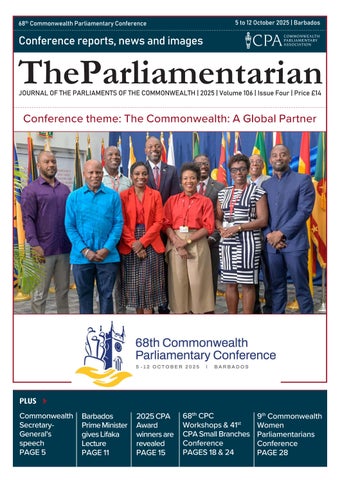
TheParliamentarian
5 to 12 October 2025 (inclusive of arrival dates)
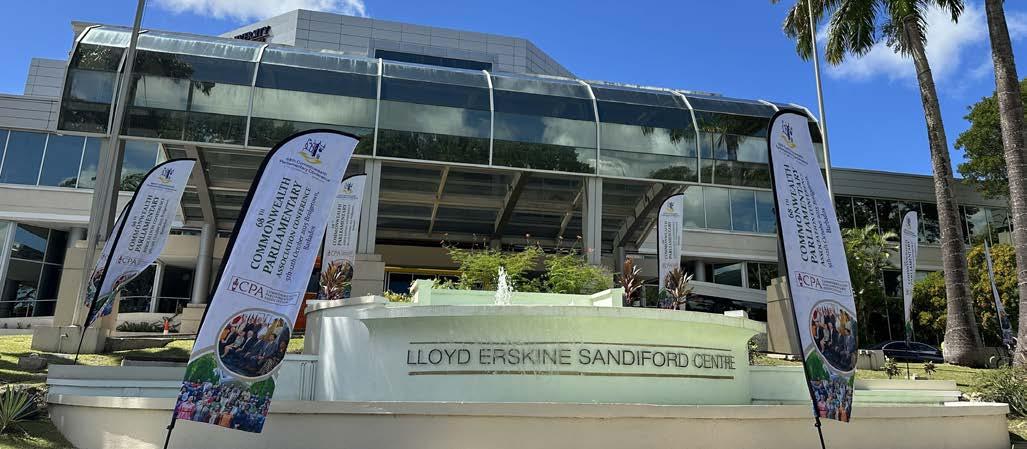
Ū One of the largest annual gatherings of Commonwealth Parliamentarians. Hosted by the Parliament of Barbados and the CPA Barbados Branch.
Ū Over 500 Parliamentarians, parliamentary staff and decision-makers from across the Commonwealth for this unique conference and networking opportunity.
Ū CPA’s global membership addressing the critical issues facing today’s modern Parliaments and Legislatures.
Ū Benefit from professional development, supportive learning and the sharing of best practice with colleagues from Commonwealth Parliaments together with the participation of leading international organisations.
During the 68 th Commonwealth Parliamentary Conference , there will also be several additional conferences and meetings including: 41st CPA Small Branches Conference; 9th Commonwealth Women Parliamentarians (CWP) Conference; meetings of the Commonwealth Parliamentarians with Disabilities (CPwD) network; 2025 CPA General Assembly and debate; meetings of the CPA Executive Committee ; presentation of the 2025 Commonwealth Parliamentarian of the Year awards; the 3rd Lifaka Lecture; and the 59th Society-of-Clerks-atthe-Table (SoCATT) meeting. At the 68th CPC, eight learning and development workshops will be held during the main Conference with four addtional workshops during the CPA Small Branches Conference and four additional workshops during the Commonwealth Women Parliamentarians Conference. This year, delegates at the Conference will also elect the Chairpersons for the Commonwealth Women Parliamentarians (CWP) and the Commonwealth Parliamentarians with Disabilities (CPwD) networks as well as appoint a CPA Treasurer and a CPA Vice-Chair.
Visit the 68th CPC Hub for more information - www.cpahq.org/68-cpc or email cpc@cpahq.org.
Commonwealth Parliamentary Association (CPA) | Email: hq.sec@cpahq.org | Tel: +44 (0)20 7799 1460 www.cpahq.org | Twitter @CPA_Secretariat | Facebook.com/CPAHQ | Instagram @cpa_secretariat | LinkedIn | Flickr
68th CPC Opening Ceremony
The Vice-Patron of the Commonwealth Parliamentary Association (CPA) and President of Barbados opens the Conference
Page 2
Speech: Commonwealth Secretary-General
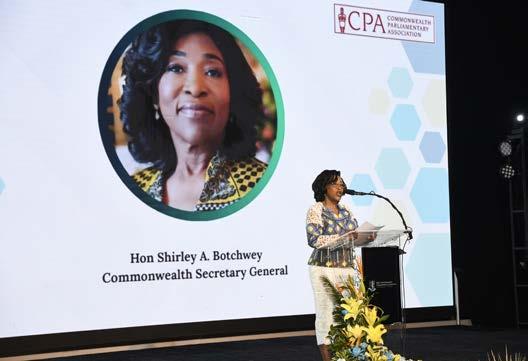
The Commonwealth Secretary-General, Hon. Shirley Botchwey addressed delegates at the 68th CPC Page 5
Speech: CPA Chairperson
'Reaffirming our shared commitment to democracy' - Hon. Dr Christopher Kalila, MP (Zambia), Chiarperson of the CPA Executive Committee
Page 6
Editorial: Crucial Role of MPs
Stephen Twigg, CPA Secretary-General 's editorial for The Nation Barbados
Pages 7-8
68th CPC News
Balancing grand design against everyday realities in Barbados Pages 9, 12-15
Engaging Youth People in Democracy
One of the youngest MPs at the 68th CPC, Deputy Tom Rylatt (Guernsey) shares his General Assembly speech Pages 10-11
Lifaka Lecture: Barbados Prime Minister Hon. Mia Mottley highlights Commonwealth's role in democracy Page 11
Commonwealth Parliamentarians with Disabilities (CPwD)
Outreach event, workshops and election of new CPwD Chairperson Page 13
68th CPC: Photo Gallery Pages 16-17
68th CPC Workshops
The Commonwealth: A Global Partner Pages 18-23
41st CPA Small Branches Conference Workshops and reports for small jurisdictions Pages 24-27
9th Commonwealth Women Parliamentarians (CWP) Conference
Workshop reports, speeches and election of new CWP Chairperson Pages 28-35
59th Meeting of the Society-of-Clerks-at-theTable (SoCATT) Page 36
Publication design: Jeffrey Hyland, Editor of The Parliamentarian editor@cpahq.org
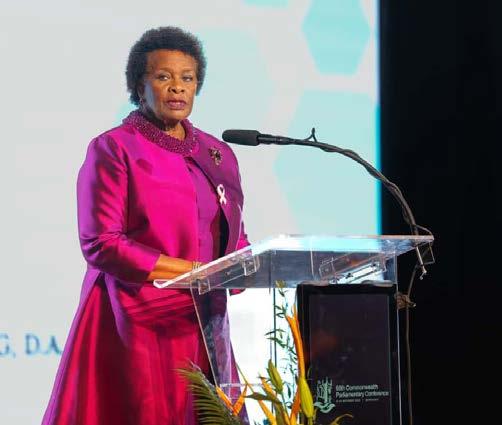
The Vice-Patron of the Commonwealth Parliamentary Association (CPA), Her Excellency Dame Sandra Mason, GCMG, SC, the President of Barbados, urged Commonwealth Parliamentarians to work together to uphold the values of the Commonwealth as she opened the 68th Commonwealth Parliamentary Conference (68th CPC) for over 500 delegates in Bridgetown, Barbados.
The CPA Vice-Patron said that the Commonwealth and its institutions hold a special place for her in light of her work. She recognised the work of the organisation and its values saying that the vast network of the Commonwealth has the ability to promote its values across the world and that the Commonwealth family works best when it works together. She highlighted that the Commonwealth Charter reaffirmed the importance of the role of the Legislature, the Executive and the Judiciary.
The CPA Vice-Patron also recognised that the CPA has served its membership for 114 years to sustain parliamentary governments in the Commonwealth and to promote the role of Parliamentarians. She reflected on the theme for the 68th CPC on the role of the Commonwealth today and that the Commonwealth shines as a positive beacon of multilateralism and a global partner. She also emphasises that education and advocacy can help to promote the benefits of the Commonwealth and welcomed the recognition for youth in the CPC programme as they are the future of the Commonwealth.
One of the largest gatherings of Commonwealth Parliamentarians, the 68th CPC was hosted by the Parliament of Barbados and the CPA Barbados Branch. The main conference theme for the 68th CPC was: ‘The Commonwealth: A Global Partner'.
Delegates to the 68th CPC were welcomed by Hon. Arthur Holder, MP, SC, Speaker of the House of Assembly of Barbados.
Hon. Arthur Holder welcomed the new CPA international legal status which will allow the CPA to play its part on the international stage and thanked the CPA Secretary-General for his work in this area. He
“ The CPA Vice-Patron recognised that the CPA has served its membership for 114 years to sustain parliamentary governments in the Commonwealth and to promote the role of Parliamentarians.”
said that the 68th CPC was being held at a critical time for the Commonwealth - where there are a wide variety of challenges - stability, financial, social, environmental, responding to technological challenges. He welcomed the work of the Commonwealth Parliamentarians with Disabilities (CPwD) network and the advances made in Barbados for persons with disabilities. He also welcomed the discussions being held at the 68th CPC on mental health for MPs, strengthening parliamentary institutions, youth development and support against gang violence.
The Commonwealth Secretary-General, Hon. Shirley Botchwey addressed delegates at the Conference and said: “The Commonwealth is an association of nations – but it is also, crucially, an association of Parliaments. Governments propose, but it is Parliaments that debate,
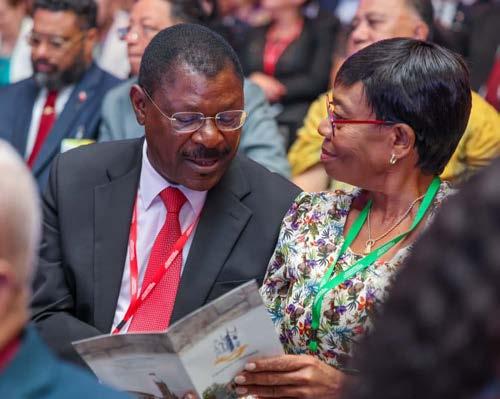
amend and decide. You embody the democratic values that lie at the very heart of our Commonwealth Charter. At a time when democracy is under strain, your role is more important than ever.
Strong, inclusive, accountable Parliaments are the foundation on which all our ambitions rest. Without them, there can be no trust, no legitimacy, and no progress. That is why the CPA’s work is so vital – building capacity, sharing best practice, empowering women and young Parliamentarians, and defending the integrity of our democratic institutions.” Turn to page 5 to read her full speech.
Hon. Ralph Thorne, MP, the Leader of the Opposition in Barbados said that the island nation had seen ‘democracy in action ’ on the same day as the Parliament had elected a new President of Barbados. He emphasised that Barbados and the Caribbean are a place of peace where democratic transition is peaceful.
The 68th CPC was the second time that the CPA Barbados Branch had hosted the event – the previous
time was the 35th Commonwealth Parliamentary Conference in 1989.
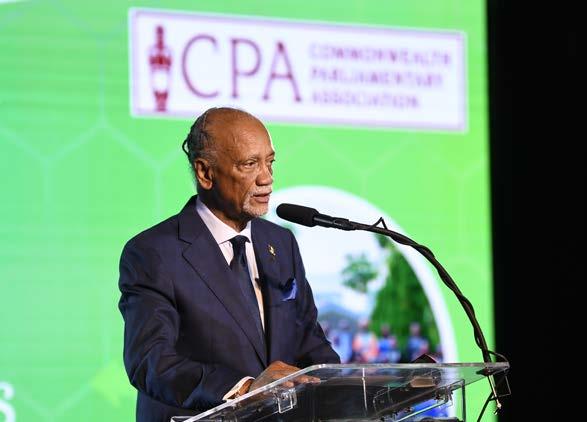
The Chairperson of the Executive Committee, Hon. Dr Christopher Kalila, MP (Zambia) highlighted three key points saying: “Firstly, I would like to express our gratitude to Barbados - its government and its people - for hosting the 68th CPC. Secondly, I thank all Commonwealth ParliamentariansSpeakers and Members of Parliament - who have travelled across the world to attend this important CPA conference and thirdly, I thank the Commonwealth Secretary-General for speaking at the 68th CPC and sharing her vision for the Commonwealth.
The 68th CPC theme of 'The Commonwealth: A Global Partner' shows us that the Commonwealth is a global partner for all of our Parliaments. The Commonwealth represents a third of the global population and so it is essential that we promote the rule of law, democracy and human rights. The Commonwealth is a global leader, and the CPA is at the forefront of this work as the parliamentary wing of the organisation. The CPA offers a platform for Parliamentarians to meet to address global challenges, fostering inter-parliamentary dialogue, peer-to-peer learning and best practice. The CPA ensures that no Parliament stands alone.”
Delegates were also welcomed by the Prime Minister of Barbados, Hon. Mia Mottley, SC, MP
“ Our task as Parliamentarians is to build trust in our nations and with our citizens. Nations grow together when we commit to work together in partnership” says Hon. Mia Mottley, Prime Minister of Barbados.
The Barbados Prime Minister welcomed representatives from one third of humanity to the small island nation of Barbados. She welcomed the CPA legal status change. It was with great pride that the Barbados Parliament was hosting the 68th CPC – Barbados is one of the oldest Parliaments in the Commonwealth (third oldest). The Prime Minister welcomed the urgency of the conversations on peace and democracy in the world that would be taking place at 68th CPC and that the climate crisis is ever present in the Caribbean. "Our task as Parliamentarians is to build trust in our nations and with our citizens. Nations grow together when we commit to work together in partnership." She also welcomed the call for reparations from across the Commonwealth and that conversations need to take place.
The CPA Secretary-General, Stephen Twigg said: “On behalf of the Commonwealth Parliamentary Association, it is my great pleasure to welcome delegates to the 68th Commonwealth Parliamentary Conference in Barbados and to thank the Parliament of Barbados for their generosity in hosting this year’s conference. This conference offers the opportunity to bring together MPs and key stakeholders to share and exchange ideas and best practices, re-enforcing the fact that we live in an inter-connected world and have a shared responsibility to address our common challenges.
That is why the CPA’s annual conference in Barbados this week offers an important opportunity for Parliamentarians to benefit from mutual learning and the sharing of best practices with colleagues from across the Commonwealth to become more effective Members.”
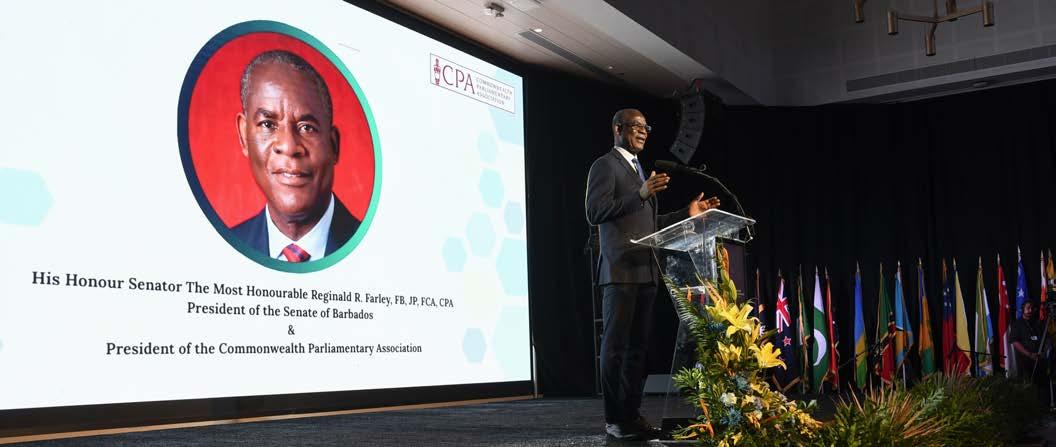
The Vote of Thanks was given by the CPA President (2024-2025), Senator Hon. Reginald Farley, JP, President of the Senate of Barbados who said that the CPA is a pivotal arm of the Commonwealth and that the Parliament is delighted to welcome the 68th CPC delegates to Barbados. He also said that we must always recognise the work undertaken in our Parliaments by our Clerks and parliamentary staff.
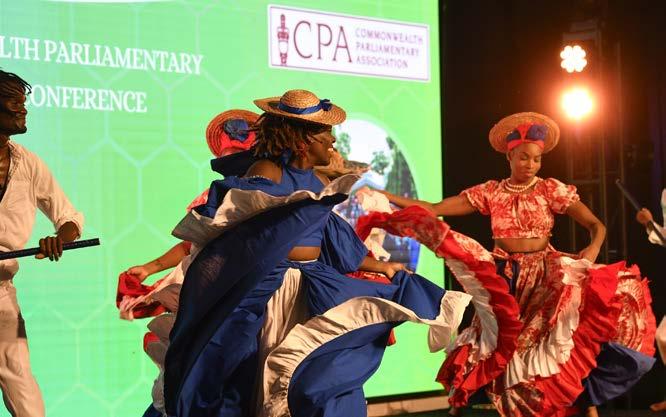
The opening ceremony also saw cultural performances and music by the Christ Church Foundation School Steel Orchestra, Celebration of Rhythms, Adrian Green (Spoken Word Artist), Betty Payne (singer) and the Zuoave Marching Band. The Master of Ceremonies was Mr Crispin Hackett.
During the conference, MPs and parliamentary staff would benefit from professional development, supportive learning and the sharing of best practice with colleagues from across the Commonwealth together with the participation of leading international organisations. The conference also explored a wide range of workshop topics including strengthening Parliaments to support democracy, leveraging technology and AI to transform Parliaments, examining the impact of climate change on global health and building trust in Legislatures.
The 68th CPC was attended by Speakers, Presiding Officers and Members of Parliament from across the membership of the Commonwealth Parliamentary Association (CPA). The CPA is the only parliamentary association to bring together national, state, provincial and territorial Legislatures and the CPA’s membership includes almost 180 Parliaments and Legislatures across the Commonwealth.
The Commonwealth Secretary-General, Hon. Shirley Botchwey addressed delegates at the 68th Commonwealth Parliamentary Conference
It is a privilege to be with you in Bridgetown for the opening of the 68th Commonwealth Parliamentary Conference. I must make a confession. The Bridgetown Initiative, named after this city, inspires my vision for the transformation of development cooperation, and I feel that it is the right place, in the time we live in, for this conference.
I thank the Government and people of Barbados for their generous welcome, and the Commonwealth Parliamentary Association for its tireless work to strengthen democracy across our family of nations. This conference comes at a defining moment. Around the world, we see overlapping pressures: conflict and insecurity; rising inequality, debt and poverty; the mounting climate crisis; and growing attacks on, and erosion of trust in, institutions and in democracy itself. These are not isolated challenges. They feed and worsen each other. And they cannot be solved by any nation standing alone. So, as this moment is defined by uncertainty and drift, the Commonwealth must be defined by purpose.
Fifty-six nations. One-third of humanity. A family bound by shared values - democracy, the rule of law, respect for human rights - and by the conviction that when we stand together, we can turn vulnerability into resilience, opportunity into shared prosperity. That conviction is at the heart of our new Commonwealth Strategic Plan, which our nations - through your governments - with the support of Commonwealth institutions and accredited organisations - have helped shape and approve. It focuses on building resilience: democratic, economic and environmental. And it recognises that making investments in our people, especially women and young people, and giving them the skills for the future of work and for entrepreneurship, is key to safeguarding our democracies, building resilience and realising the democratic dividend.
My vision and strategy for delivery is to ensure that the Commonwealth is not only relevant, but indispensable in meeting the needs of our time. And I am here because of a simple and vital truth: our work cannot succeed without you. The Commonwealth is an association of nations – but it is also, crucially, an association of Parliaments. Governments propose, but it is Parliaments that debate, amend and decide.
You scrutinise budgets, ratify treaties, pass laws that give life to our commitments, and hold the Executive to account. Through public hearings you enable effective participation by the people. Indeed, we cannot today ensure public support for multilateral solutions without parliamentary hearings. You
embody the democratic values that lie at the very heart of our Charter.
At a time when democracy is under strain, your role is more important than ever. Strong, inclusive, accountable Parliaments are the foundation on which all our ambitions rest. Without them, there can be no trust, no legitimacy, and no progress. That is why the CPA’s work is so vital – building capacity, sharing best practice, empowering women and young Parliamentarians, and defending the integrity of our democratic institutions. And it is why, as Secretary-General, I see you as essential partners in delivering the Commonwealth’s vision:
• Partners in strengthening democracy where it is fragile, including through election observation.
• Partners in eliminating trade barriers among Commonwealth countries, promoting digital trade, and targeting investments in the countries that need them.
• Partners in reforming international debt treatment and concessionary funding, with vulnerability, including climate, at its centre.
• Partners in leading the global push for climate justice, and for a renewable energy revolution.
• Partners in ensuring that millions of our young people receive digital skills and training in entrepreneurship through amply funded distance learning.
Honourable Members, We live in an age of turbulence. But it is also an age of possibility. With shared purpose, we can transform the vulnerabilities of small and fragile states into examples of resilience. We can turn the Commonwealth’s trade advantage into a platform for inclusive growth. We can show the world that multilateralism works - that nations, and Parliaments, can come together to solve problems that no one can solve alone. That is the power of the Commonwealth. That is the promise of this conference. So let us use this gathering to reaffirm our shared values, to exchange ideas and innovations, and to strengthen the bonds between us. Let us leave Bridgetown with renewed energy, not only to debate the future, but to shape it. Because the world needs hope. It needs cooperation. It needs solutions. And the Commonwealth - through its Parliaments, its governments, and its people - can provide all three. Thank you.
Hon. Dr Christopher Kalila, MP (Zambia), Chairperson of the CPA Executive Committee recommitted to the CPA's mission
It is a profound honour to stand before you at the opening of the 68th Commonwealth Parliamentary Conference - the first CPC I am attending in my capacity as CPA Chairperson.
Allow me to begin by expressing my gratitude to the country of Barbados, its Government and its Parliament, for hosting us on this majestic island and for the time and energy that has gone into ensuring this week is a great success. It is much appreciated. And to express my thanks to you, all of our member Parliaments represented here today, for being a part of this conference and reaffirming our shared commitment to dialogue, democracy and development.
This year’s conference theme, 'The Commonwealth: A Global Partner', could not be more timely. In a world where challenges transcend borders - from climate change to economic uncertainty, from inequality to democratic instability - partnership is no longer optional. It is essential.
The Commonwealth and our family of nations is uniquely positioned to demonstrate how diverse voices can come together in pursuit of common good and a common goal. We represent one-third of the world’s population, exemplifying great diversity in culture, background and experience. And yet, through our institutions and this very Association, we commit to listening to one another, to learning from each other and to leveraging our diversity as a source of strength rather than division.
However, what gives the Commonwealth its power is not simply our size or diverseness, it is also our shared values: democracy, human rights, the rule of law, inclusivity and sustainable development - to name but a few.
The Commonwealth is not just a community of states. We are a community of people; driven by the same ideals and holding the same shared purpose of addressing our current global challenges – many of which we will be discussing this week in our workshop sessions.
Our age is defined by challenges that no nation can solve alone. Across the whole Commonwealth, the integrity of our political institutions is threatened. Climate change endangers the very existence of small island states. Food insecurity and unequal access to healthcare persist. The increasing digital divide risks excluding citizens and deepening existing inequalities.
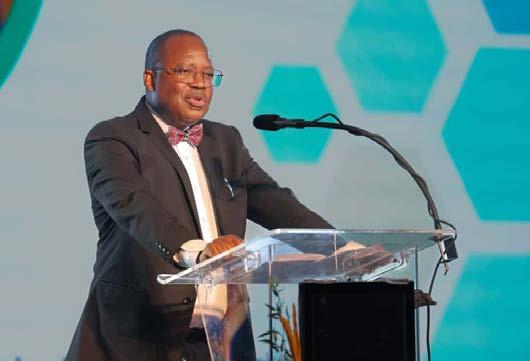
But the Commonwealth and the CPA offer a platform where innovation and solidarity meet to counter these challenges.
We can champion climate action that balances growth with sustainability.
We can strengthen parliamentary capacity to deliver effective oversight and good governance.
We can ensure that the voices of historically marginalised communities - women, young people, persons with disabilities – are heard and amplified.
In doing so, the Commonwealth becomes not only a global partner, but a global leader.
As Parliamentarians, within the CPA and our own Legislatures, our role is pivotal. Through legislation, oversight and representation, we give life to the values of the Commonwealth and ensure good governance is upheld.
By fostering inter-parliamentary dialogue and knowledge exchange, the CPA ensures that no Parliament stands alone. In our collaboration lies our strength - whether it is a Legislature seeking technical expertise, or one offering best practice – conferences such as these and our CPA programmes provide a unique platform for exchanging ideas in addressing common challenges.
Our position is further strengthened through our strong intra-Commonwealth relationships. I am, therefore, delighted that we have the Commonwealth Secretary-General, Hon. Shirley Botchwey, with us this evening, as well as representatives from many of our other valued partners.
Colleagues, at a time when global discord and conflict are rife, let us use this conference to recommit ourselves to open dialogue, peer-to-peer learning and supporting one another in strengthening our democratic institutions. Thereby ensuring that the Commonwealth remains credible, relevant and resilient. A vital partner in achieving global progress.
Together, let us prove that partnership is the most powerful instrument for change.
As Commonwealth Parliamentarians gathered in Barbados for the 68th Commonwealth Parliamentary Conference, Stephen Twigg, Secretary-General of the Commonwealth Parliamentary Association (CPA) reflected on the crucial role that they can play in an editorial for The Nation Barbados.
This is not the first time that the Parliament of Barbados will host the annual Commonwealth Parliamentary Conference (CPC). When the CPC was last in Barbados in 1989, discussions focused on the Commonwealth’s role in sanctions against South Africa under apartheid and the impact of the ‘fall of the Berlin Wall’ on global politics.
1989 also marked progress in women’s participation in the Commonwealth Parliamentary Association with the establishment of an informal group called the ‘Commonwealth Women Parliamentarians’ initiated by Senator Norma Cox Astwood (Bermuda) which would later be constituted as the CWP network of the CPA. Today, many Caribbean Parliaments are led by female Speakers and Presiding Officers, and record numbers of women have been elected.
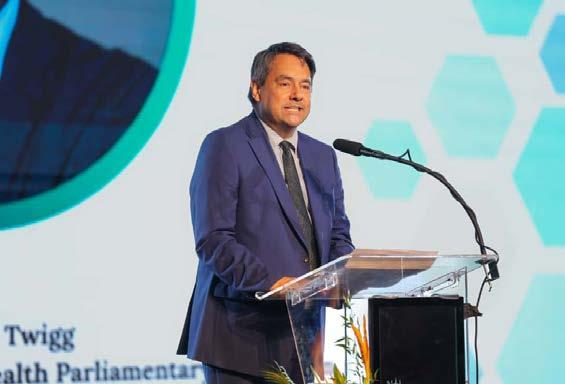
The CPA organises its annual conference to address global issues and developments in the parliamentary system and brings together Parliamentarians from throughout the Commonwealth. This week, discussions will include strengthening our Parliaments to support democracy, leveraging technology and AI to transform our Parliaments, examining the impact of climate change on global health and building trust in Legislatures.
The democratic process is alive and well in many parts of the Commonwealth - as demonstrated last year with one of the highest numbers of elections taking place worldwide including the largest democratic election in the world in India right through to elections in small states like the Solomon Islands.
However, we cannot be complacent, and democracy needs to thrive to survive. The 68th Commonwealth Parliamentary Conference in Barbados comes against the backdrop of international conflict, global economic uncertainty, cross-border security threats, the effects of climate change, especially on small and vulnerable jurisdictions, and pressures on the shared values of democracy, good governance and inclusivity.
As one of the largest gatherings of Commonwealth Parliamentarians, this year’s conference will address the theme of 'The Commonwealth – A Global Partner'. The Commonwealth offers the opportunity to bring together MPs and key stakeholders to share and exchange ideas and best practices, re-enforcing the fact that we live in an inter-connected world and have a shared responsibility to address our common challenges.
The Commonwealth has a special place in the international community and is widely recognised for its convening power in bringing together nations and territories of vastly different sizes, populations and development. The CPA Caribbean, Americas and Atlantic Region has always played a huge role in the Commonwealth and continues to champion its role in global politics.
In Barbados this week, we will also look ahead to the Commonwealth Heads of Government Meeting (CHOGM) due to be hosted in Antigua and Barbuda next year – another Caribbean nation hosting a global event that will see discussions on climate protection and ocean management, protecting human rights and promoting equality for all Commonwealth citizens, as well as
“ The Commonwealth has a special place in the international community and is widely recognised for its convening power in bringing together nations and territories of vastly different sizes, populations and development.”
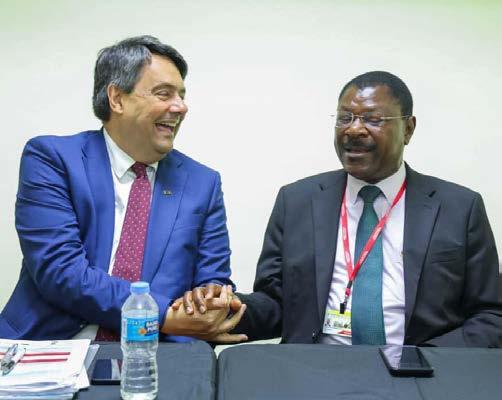
supporting our young people, who make up 60% of the Commonwealth’s 2.7 billion people.
The CPA has a long history since its establishment some 114 years ago. Indeed, the Parliament of Barbados pre-dates the CPA having been established on 26 June 1639, one of the oldest Legislatures in the Commonwealth.
At the CPA, we recognise aspects of the Commonwealth’s more painful history and the importance of discussing inequality and righting the wrongs of our colonial past as we come together.
The Commonwealth can position itself strongly and unequivocally beside its citizens and help to tackle the inequalities that cause so much poverty and injustice in our societies. Parliaments have a duty to represent the people they serve. One way that they fulfil this responsibility is by being inclusive, accountable, open and transparent public institutions.
Another key priority is the fight against climate change and Small Island Developing States in the Caribbean have been powerful voices within the Commonwealth as they find themselves in the frontline of the battle to avert a climate disaster as sea levels rise and extreme weather events increase. The Commonwealth helps to amplify the voices of those who need the most urgent action to protect the environment and to promote sustainable development.
The CPA also represents different groups within the parliamentary community and our three CPA networks - the CPA Small Branches representing jurisdictions with populations under one million people, the Commonwealth Women Parliamentarians (CWP) promoting gender equality in Parliaments and the Commonwealth Parliamentarians with Disabilities (CPwD) supporting disability representation as well as accessible Parliaments - all aim to provide an additional platform for these voices and common interests to be heard throughout the Commonwealth.
Each of the almost 180 Parliaments within the CPA membership is a unique institution reflecting its own historical evolution and the CPA represents Legislatures at the national, state, provincial and territorial level. What all Parliaments have in common is a capacity to strengthen democracy by acting as powerful agents of change. Success here is most likely if MPs and parliamentary staff have the necessary support to carry out their parliamentary and constitutional responsibilities. Parliamentarians have an important responsibility to hold governments to account as well as ensuring that legislation and budgets are scrutinised.
That is why the CPA’s annual conference in Barbados this week offers an important opportunity for Parliamentarians to benefit from mutual learning and the sharing of best practices with colleagues from across the Commonwealth to become more effective Members. Let us hope that we can work together across the Commonwealth, and beyond, to learn lessons from each other and dedicate ourselves again to meeting the many challenges faced by Parliaments and citizens alike.
This editorial was first published in The Nation Barbados on 7 October 2025 to coincide with the 68th Commonwealth Parliamentary Conference.
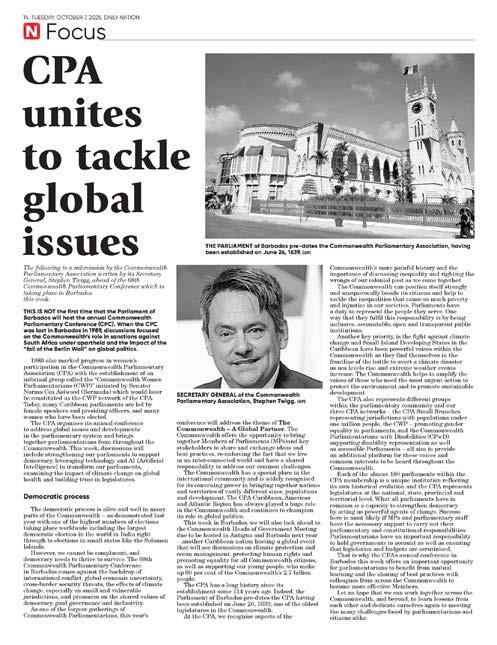
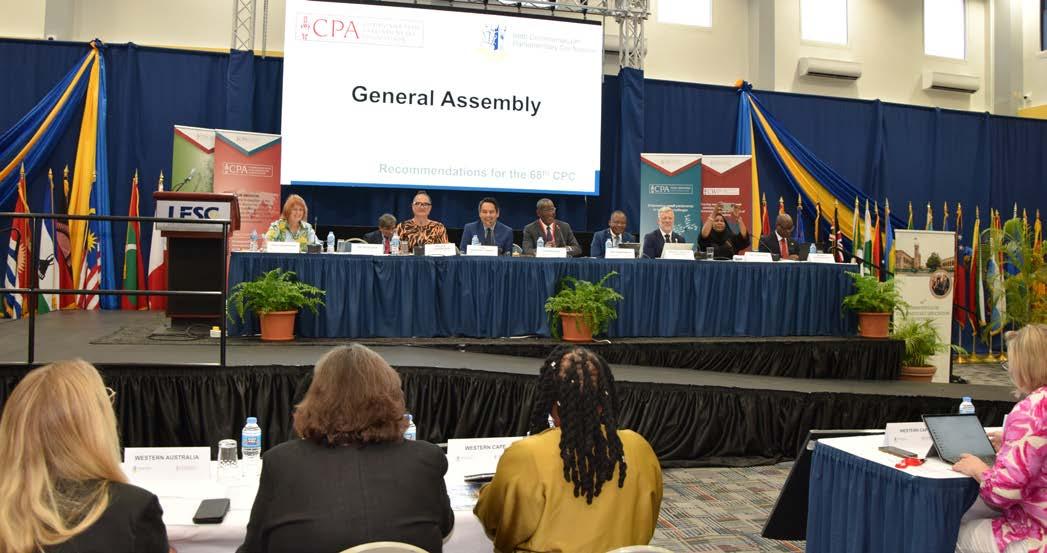
During the 68th CPC in Barbados, Commonwealth Parliamentarians attended the 2025 CPA General Assembly on 10 October 2025. The CPA General Assembly was presided over by the CPA President (2024-2025), Senator Hon. Reginald Farley, JP, President of the Senate of Barbados and was attended by Members from 121 CPA Branches. The CPA General Assembly, the Association’s supreme authority, is constituted by delegates to the annual Commonwealth Parliamentary Conference.
The CPA General Assembly also included a topical debate on 'The Commonwealth – A Global Partner' with presenters from CPA Branches including India; Kenya; Sri Lanka; Canada Federal; Cyprus; Maldives; Australia Federal; Pakistan; Jersey; Punjab, Pakistan; Guernsey; Fiji; Singapore; New Zealand; Cook Islands; Bermuda; Malta; Balochistan.
During the 2025 CPA General Assembly, CPA delegates approved the nomination of Senator Hon. Sue Lines (Australia Federal) as the new CPA Treasurer for a three-year term. The role holder overseas the finances of the Association and works closely with the Trustees and Finance team at the CPA.
Some of the key decisions and outcomes from the 2025 CPA General Assembly were:
• Delegates approved the new CPA Strategic Plan 2026-2029 which sets the priorities for the Association for the next three years.
• Delegates were updated on the progress of the new legal status akin to an international, interparliamentary
organisation following the UK Parliament passing the 'Commonwealth Parliamentary Association and International Committee of the Red Cross (Status) Act 2025' and progress on the UK Government’s secondary legislation.
• Delegates were also updated on changes to the CPA’s structural changes and the creation of the CPA Charitable Funds (CPACF).
• Delegates approved the 2024 CPA Annual Report (including the audited Financial Statements), the CPA Membership Report, the CPA Budgets and Financial Management Reports.
• Delegates endorsed reports from the three CPA networks - the Commonwealth Women Parliamentarians (CWP), the Commonwealth Parliamentarians with Disabilities (CPwD) and the CPA Small Branches.
The 2025 CPA General Assembly also approved the Chief Pleas of Sark as a new CPA Branch. One of the smallest Legislatures in the Commonwealth, the CPA Sark Branch joins the CPA British Islands and Mediterranean Region (BIM) and the CPA Small Branches network.
Delegates also looked ahead to the next Commonwealth Parliamentary Conference – the 69th Commonwealth Parliamentary Conference (#69CPC) to be hosted by the CPA South Africa Branch and Parliament of South Africa in 2026, following their approval as the next host Branch.
Why are young people turning away from politics?
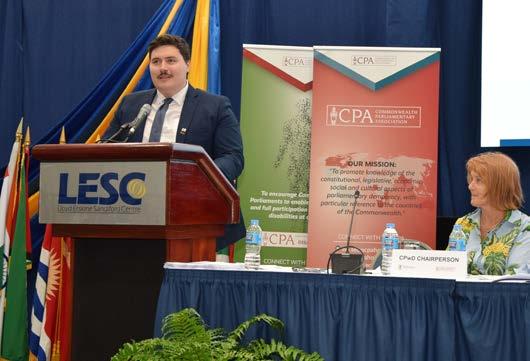
One of the youngest MPs at the 68th CPC in Barbados, Deputy Tom Rylatt (Guernsey) shares his debate speech
During the closing debate of the 2025 CPA General Assembly, I had the privilege of addressing the delegates as part of the CPA Guernsey delegation. The debate topic, ‘The Commonwealth: A Global Partner’ lent itself to a broad range of speeches and issues – from trade and climate change to shifting geopolitical relations.
As the youngest elected Parliamentarian in attendance, I felt the debate was fertile ground to argue that the Commonwealth must lead the charge in renewing young people’s faith in democracy and democratic institutions.
Engaging young people in democracy is a longstanding challenge in most places. However, in recent years, that lack of interest has begun to harden into apathy. A report from the Future of Democracy at Cambridge University found that in most global regions, satisfaction with democracy has fallen most steeply in the 18 to 34-year-old cohort. A major contributor to this, is the growing perception among young people that democratic institutions are no longer tackling the issues that most affect them. Rising living costs and unaffordable housing have created a sense of economic exclusion in many countries. While social media - by curating the world’s problems onto every individual’s smartphonehas deepened scepticism in the political status quo.
From a law-making perspective, good policy is often the product of broad consultation and rigorous scrutiny. If a policy doesn’t affect a young person’s life in the shortterm, it likely will in the future. Consultation and scrutiny are therefore at their most effective when young people are actively engaged in the process.
With over 60% of the Commonwealth’s 2.7 billion population being under 30, I urged delegates to lead by example. To future-proof their democracies by ensuring young people have a genuine stake and voice within them. In representing those voices, Parliaments stand a far better chance of delivering positive outcomes for younger generations and when young people see that government is acting in their interests, that indifference is far less likely to develop into democratic disillusionment.
Living on a small, self-governing island, we can quite easily fall into the belief that the world begins and ends at our shores. Yet our membership of the Commonwealth and the CPA is a reminder that small Legislatures have
a role in learning from, and contributing to, the global democratic conversation. The CPA also helps highlight that our challenges are rarely unique – and that, in facing them, collaboration across borders and generations gives us our best collective chance of success.
‘The Commonwealth: A Global Partner’
Across our association of Members, there runs a common thread - a belief that every voice should matter, and that every generation should have the chance to shape the future they inherit. And yet, that thread is beginning to fray. Young people, increasingly, are losing faith in the institutions built to serve them. So when we ask, what does it mean for the Commonwealth to be a global partner?
I believe the answer lies right there - in how we renew that faith - in how we preserve and promote democracy by making youth engagement and youth involvement in our institutions not an afterthought, but a priority. Now, I should declare an interest - despite the questionable moustache and a few grey hairs that are starting to make an appearance - I am, in fact, a young person. My name is Tom Rylatt - I am 25 years old, and I am the youngest member of Guernsey’s Parliament, the States of Deliberation. And I belong to that generation that is, increasingly, turning away from democracy. I stood for election in Guernsey to help address the issues that have oftentimes forced our young people to leave their own island - such as the cost of housing, renting and raising a family. But throughout the election, a worrying trend started to emerge. Fewer young people were taking part in the democratic process. The next generation - the ones who will live longest with the consequences of our decisions - had the least say in shaping them. That same youth apathy on display in Guernsey’s modest electoral stage is now echoing across the largest theatres of democracy. Dr Roberto Foa, a Cambridge University researcher observed - “This is the first generation in living memory to have a global majority who are dissatisfied with the way democracy works while in their twenties and thirties”
This should alarm each and every one of us. The views of our young people today, represent the prospects of our institutions tomorrow. Without action, we risk liberal democracy becoming an heirloom, with its meaning and value fading with each successive generation.
So, how do we fix this? We must begin by engaging with young people, involving them in government - whether that be through Youth Parliaments, youth caucuses or supporting their candidacy for public office. Because when young people see leaders who represent their concerns - when Parliament works not above young people, but with them - we begin to plant seeds of trust and understanding, that will take root and sustain our democracies for generations to come.
Who could be better placed to meet this moment than the Commonwealth? This community of nations represents over 1.6 billion young people. While, at the same time, bringing together democracies at every stage of the journey - some
that have been forged slowly over centuries, and others born from struggles still fresh in the memory.
In Guernsey, I realised that we couldn’t solve the problem of young people leaving the island without first making them true stakeholders in our decision-making. During the election I would repeat: “If young people have a say in the future, they’ll stay for the future.”
What is true for Guernsey and its young people, I believe will be true for the future of democracy, both within the Commonwealth and beyond. Our role as a global partner, I would submit, must therefore be this: to ensure that democracy is renewed by each new generation, for the generations to come. Thank you.
Deputy Tom Rylatt is a Member of the Guernsey States Assembly where he is also a Member of the Committee for Employment and Social Security and the Constitution Committee.
Email: tom.rylatt@gov.gg
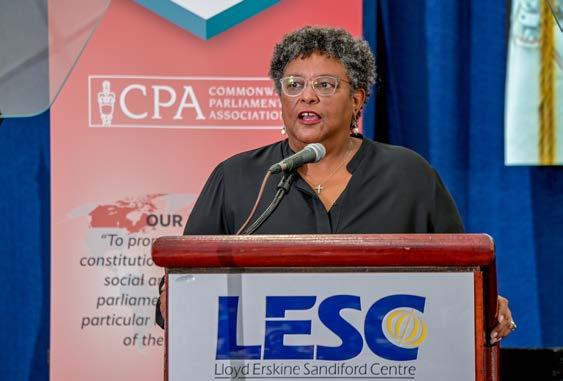
The Prime Minister of Barbados, Hon. Mia Amor Mottley, SC, MP spoke about Parliaments’ role in protecting democracy as well as the ongoing impact of climate change on small islands states at the third CPA Emilia Monjowa Lifaka Lecture. The Lecture took place in the margins of the 68th Commonwealth Parliamentary Conference in Barbados and was attended by delegates and specially invited guests in Bridgetown. Hon. Mia Mottley also urged the Commonwealth to lead by example and demonstrate that democracy, even in the most trying times, remains the fairest and most effective path to peace, prosperity and human fulfilment. Watch the 3rd CPA Lifaka Lecture via the Barbados Parliament's YouTube channel. The CPA Lifaka Lecture was established in 2023 in memory of Hon. Emilia Monjowa Lifaka, the late Chairperson of the CPA International Executive Committee and Deputy Speaker of Cameroon. Hon. Emilia Monjowa Lifaka was a passionate champion of the CPA and served as CPA Chairperson from November 2017 until her untimely death in April 2021. The CPA Lifaka Lecture is intended to provide a fitting tribute to her work.
Let us move forward hand in hand, with courage and conviction, to build a Commonwealth where democracy is not a privilege of the few, but the birthright of all. This is not simply the work of government but the work of all of our citizens, and those of us who will know better must guide and prepare, to allow those who may not yet be awakened to this reality, the opportunity to join us in this battle that truly will determine whether we progress or whether we regress into the domination of countries and individuals by a few. It is against this backdrop that we address how we secure the rights and aspirations of our people within the boundaries of our nations. How we protect them from the excessive power of any Executive or any Parliament. How we build democracies that deliver for every resident. We know what we must do. Let us do it together. ”
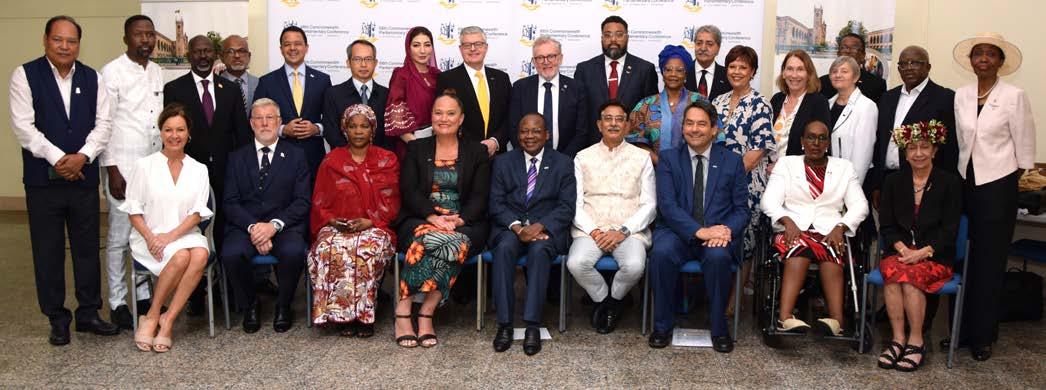
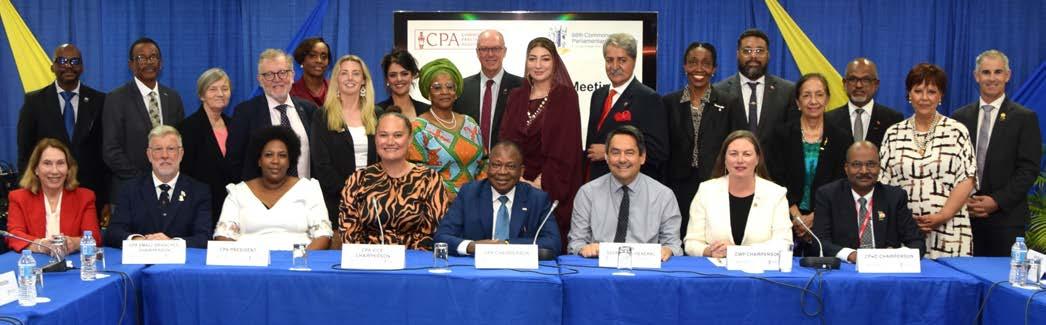
The CPA Executive Committee met ahead of the 68th CPC in Barbados on 7 October 2025 chaired by the Chairperson of the Executive Committee, Hon. Dr Christopher Kalila, MP (Zambia). CPA Executive Committee Members discussed key governance issues and planning for the year ahead including updates to the CPA’s legal status, financial reporting and future activities. The CPA Secretary-General, Stephen Twigg and other staff from the CPA Headquarters also attended the meetings. The CPA Executive Committee represents the nine regions of the CPA - Africa; Asia; Australia; British Islands and Mediterranean; Canada; Caribbean, Americas and Atlantic; India; Pacific; South East Asia. The CPA Chairperson said: “The 68th CPC is the most prominent event in the CPA’s calendar, as it offers a unique opportunity for the representatives of the Association’s almost 180 Member Parliaments and Legislatures to network with colleagues from other jurisdictions and discuss common issues of concern which affect Commonwealth Parliaments.” Members of the CPA Executive Committee were received by the President of Barbados, Her Excellency Dame Sandra Mason, GCMG, SC, who is also the Vice-Patron of the Commonwealth Parliamentary Association (CPA) at a reception at State House.
The CPA Chairperson, Hon. Dr Christopher Kalila, MP (Zambia) chaired a meeting of the new CPA Executive Committee at the conclusion of the 68th Commonwealth Parliamentary Conference in Barbados. During the meeting of the new CPA Executive Committee, Hon. Carmel Sepuloni, MP, Member of the Parliament of New Zealand and Regional Representative for the CPA Pacific Region was re-elected to the position of Vice-Chairperson of the CPA Executive Committee. The position of Vice-Chairperson is for a term of one year and the holder is also a Member of the CPA Co-ordinating Committee.
The Commonwealth Parliamentarians with Disabilities (CPwD) network, led by the CPwD Chairperson, Hon. Laura Kanushu, MP (Uganda), have highlighted how Parliaments can engage with local communities on disability inclusion during a town hall event in Barbados. The CPwD Regional Champions and delegates attended a town hall event in Bridgetown that examined how Parliaments can engage with civil society and representative organisations in shaping inclusive public policy.

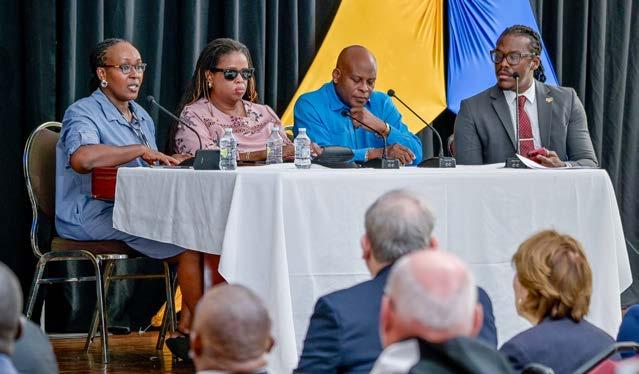
The Chairperson of the CPwD network, Hon. Laura Kanushu, MP said: “While many Legislatures express goodwill toward disability inclusion, meaningful engagement with civil society often falls short due to limited resources and poor mechanisms for consultation. This event aims to provide a platform for open dialogue between Parliamentarians and disability advocates, grounded in shared learning and mutual accountability.” Panellists at the town hall event included Hon. Kerryann Ifill, President of the Barbados Council for the Disabled (BCD) and former President of the Barbados Senate; Hon. Kirk D. M. Humphrey, MP, the Barbados Minister of People Empowerment and Elder Affairs; Mr Edmund G. Hinkson, former Member of the Parliament of Barbados; and Senator Andwele Boyce (Barbados). The event also heard opening remarks from local disabilities advocate, Janelle O’Dell.
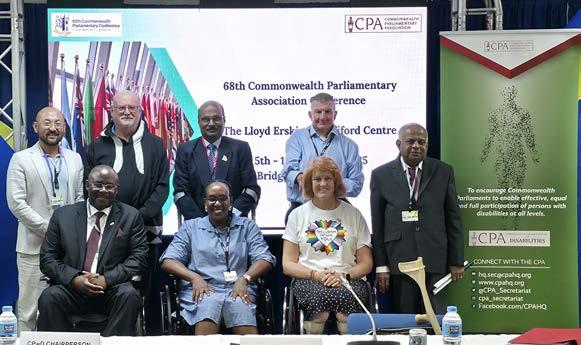
The CPwD network was established by the CPA to support Parliamentarians living with disabilities to be more effective in their roles and to help improve awareness of disability issues amongst all Parliamentarians and parliamentary staff. The network also seeks to address inequalities facing persons with disabilities and helps to raise awareness within the parliamentary context.
The Regional Champions of the Commonwealth Parliamentarians with Disabilities (CPwD) network also met during the 68th Commonwealth Parliamentary Conference. The CPwD Regional Champions represent each of the CPA’s nine Regions and promote the rights of Commonwealth Parliamentarians with disabilities in their respective Regions. During the meeting, the CPwD Regional Champions elected Senator Hon. Isaiah Jacob (Member of the Senate of Malaysia) as the new Chairperson of the CPwD network for a new three-year term. Hon. Liesl Tesch, AM, MP (Member of the New South Wales Legislative Assembly) was elected as the CPwD Vice-Chair. The CPwD Regional Champions also set the agenda of the network for the year ahead including the CPwD Capital Investment Fund which supports Commonwealth Parliaments to become more accessible.
Delegates at the 68th CPC in Barbados also joined two workshops promoting disability inclusion. The CPC Workshop C looked ahead to the Commonwealth Heads of Government Meeting (CHOGM) due to be hosted in Antigua and Barbuda in 2026 and how Parliamentarians could champion the ‘human factor from a gender and accessibility lens’ with panellists including Richard Rieser, the General Secretary of the Commonwealth Disabled People’s Forum.
Delegates also joined a joint Commonwealth Women Parliamentarians (CWP) and CPwD Workshop on overcoming the barriers to the involvement of women with disabilities in politics.
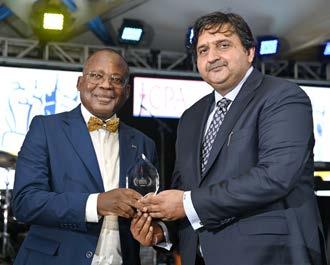
The Commonwealth Parliamentarian of the Year 2025 Awards have been announced at the 68th Commonwealth Parliamentary Conference in Barbados. Hon. Malik Muhammad Ahmad Khan, MPA , Speaker of the Provincial Assembly of Punjab in Pakistan was announced as the recipient of the 2025 Commonwealth Parliamentarian of the Year Award in recognition of his transformational leadership and instituting unprecedented reforms that have strengthen transparency, accountability and legislative independence. Hon. Ted Arnott, the former Speaker of the Ontario Legislature in Canada was awarded the 2025 Parliamentarian Life-time Achievement Award after 35 years of parliamentary service and Hon. James Evans, MS from the Senedd Cymru/Welsh Parliament was awarded the 2025 New Parliamentarian Award in recognition of his contribution to promoting parliamentary democracy in his first term and through his work with multiple Parliamentary Committees. Hon. Olivia Grange, MP, Minister of Culture, Gender, Entertainment and Sport and the Deputy Leader of the House in the Parliament of Jamaica was awarded the 2025 Parliamentary Equality and Diversity Award in recognition of her transformational and inclusive leadership in advancing gender equality and social justice in Jamaica.
The awards were presented by the CPA Chairperson, Hon. Dr Christopher Kalila, MP (Zambia) at the conclusion of the 68th CPC. The CPA Secretary-General, Stephen Twigg said: “The Commonwealth Parliamentarian of the Year Awards aligns with our strategic objective of promoting the Commonwealth values of parliamentary democracy and sustainable development to a wide audience. Through these annual awards, the CPA recognises and highlights the invaluable contributions that Parliamentarians are making to their local communities within the Commonwealth.” CPA Awards are open to nominees who are current Parliamentarians* across the Commonwealth. The Commonwealth Parliamentary Association’s unique membership includes almost 180 national, state, provincial and territorial Legislatures. The next awards will be open for nominees in 2026. *Nominees should be sitting Members of Parliament in a Commonwealth Legislature or have been a sitting Member of Parliament in a Commonwealth Legislature in the award period. The award can be made posthumously. Please check the CPA website for full nomination criteria.
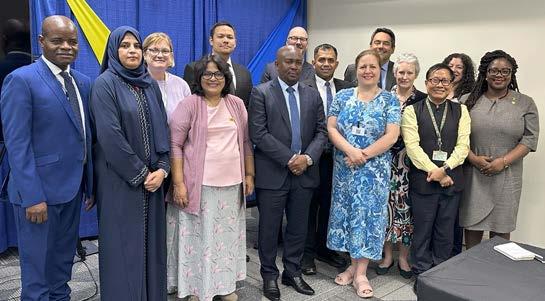
Ahead of the 68th Commonwealth Parliamentary Conference in Barbados, the Regional Secretaries of the nine Regions of the CPA met to discuss CPA activities and the year ahead, joined by CPA Secretary-General, Stephen Twigg and CPA Deputy Secretary-General, Jarvis Matiya. The nine regions of the CPA are: Africa; Asia; Australia; British Isles and the Mediterranean; Canada; Caribbean, Americas and the Atlantic; India; Pacific; and South-East Asia.
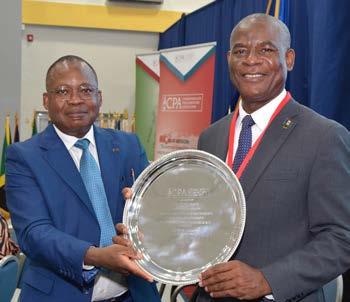
At the conclusion of the 68th Commonwealth Parliamentary Conference (#68CPC), the CPA President (2024-2025), Senator Hon. Reginald Farley, JP, President of the Senate of Barbados was presented with a commemorative silver salver by the CPA Chairperson, Hon. Dr Christopher Kalila, MP (Zambia) to thank the CPA Barbados Branch for the hosting of the conference.
Hon. Malik Ahmad Khan, MPA, Speaker of the Provincial Assembly of Punjab, Pakistan was recognised as the winner of the 2025 Commonwealth Parliamentarian of the Year Award in recognition of his transformational leadership. He has revolutionised parliamentary governance in his Legislature by instituting unprecedented reforms that strengthen transparency, accountability and legislative independence. He has introduced the first comprehensive revision of the Provincial Assembly’s Rules of Procedure in decades, ensuring that Parliamentary Committees have stronger powers to hold the Executive to account. To further promote transparency, he also mandated the live streaming of the Provincial Assembly sessions and digitized legislative records, making parliamentary proceedings accessible to the public in real-time.
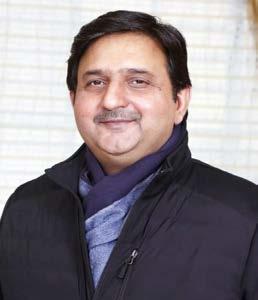
• Read the Speaker of the Provincial Assembly of Punjab, Pakistan’s article in The Parliamentarian (2024 Issue Four) about parliamentary reforms in the Legislature.
• Listen to our CPA Podcast interview with the Speaker of the Punjab Provincial Assembly on his role as Speaker, strategies for inclusive growth and regulating emerging technologies.
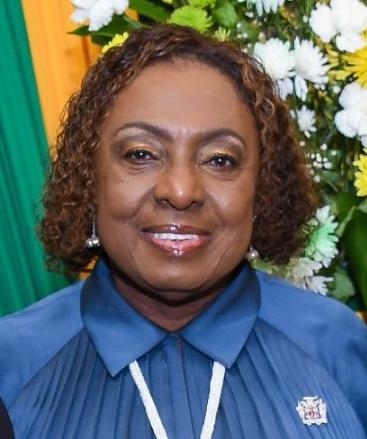
Hon. Olivia Grange, MP, Minister of Culture, Gender, Entertainment and Sport and the Deputy Leader of the House in the Parliament of Jamaica has been awarded the 2025 Parliamentary Equality and Diversity Award in recognition of her transformational and inclusive leadership in advancing gender equality and social justice. She led the development and implementation of Jamaica’s National Strategic Action Plan to Eliminate Gender-based Violence and has piloted significant pieces of legislation such as the Sexual Harassment (Protection and Prevention) Act, 2021 and the Domestic Violence (Amendment) Act, 2023.
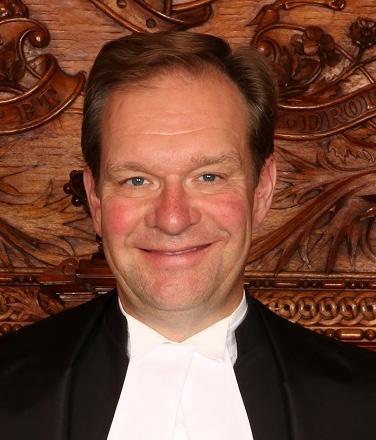
Hon. Ted Arnott is the former Speaker of the Legislative Assembly of Ontario in Canada who has been awarded the 2025 Parliamentarian Life-time Achievement Award, in recognition of his 35 years of parliamentary service and his commitment and contributions to the Legislature during that time. Praised for his encouragement to colleagues and an ability to inspire greater decorum and less divisiveness in the Chamber, Hon. Ted Arnott was also the Dean of Presiding Officers in Canada, sharing his knowledge and expertise with new Speakers from across the country.
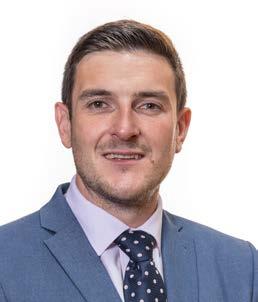
Hon. James Evans, MS from the Senedd Cymru/Welsh Parliament has been awarded the 2025 New Parliamentarian Award in recognition of his contribution to promoting parliamentary democracy. In his first term, he has advanced the principles of good governance through his work with multiple Parliamentary Committees, including the COVID-19 Inquiry Committee. Through cross-party collaboration, he has also fostered bipartisan solutions to national challenges, best exemplified through his work behind the landmark Mental Health Standards of Care Bill.
Discussion Leaders:
• Tom Duncan, Clerk of the Australian Capital Territory Legislative Assembly
• Vanisha Proctor, Clerk of Committees, Anguilla House of Assembly
• Nerusha Naidoo, Clerk of the KwaZulu Natal Legislature
• Fathimath Niusha, Secretary-General of the People’s Majlis, Maldives
What can Parliamentarians do to ensure their iInstitutions are best placed to promote democracy? In times of profound democratic crisis globally, it is essential that iInstitutions are upholding the standards that citizens expect and deserve.
CPA HOST BRANCH BARBADOS TOPIC
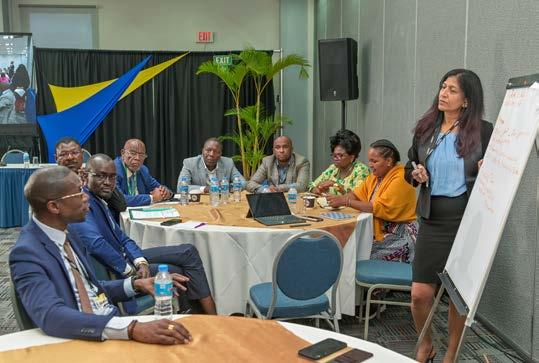
This interactive workshop examined how Parliamentarians can best serve their citizens by examining the institutions that serve them. Senior Clerks from the Australian Capital Territory, Anguilla, KwaZulu Natal and Maldives shared how their Parliaments are upholding best practice and evaluating their practices utilising the updated CPA Benchmarks for Democratic Legislatures, which provide a guideline for how Parliaments can strengthen their institution to support democracy.
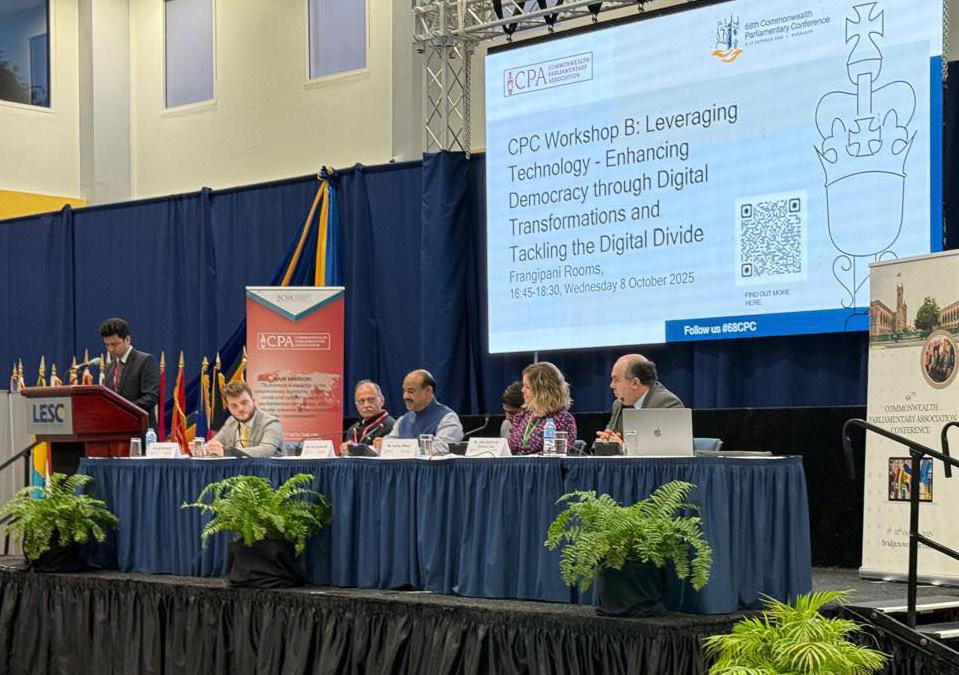
Discussion Leaders:
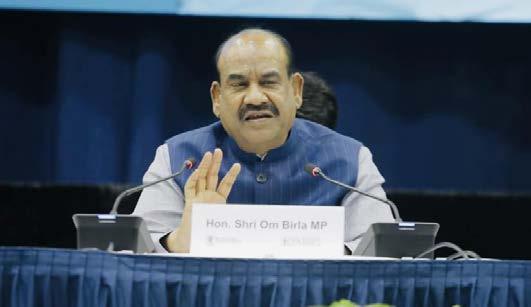
• Hon. Shri Om Birla, MP, Speaker of the Lok Sabha, Parliament of India
• Mr João Alberto de Oliveira Lima, Federal Senate of Brazil
• Mrs Aubrey Wilson, VOXPOP Foundation
Across the Commonwealth, Legislatures are navigating the profound opportunities and challenges of the digital age. While digital transformation offers the potential to make institutions more efficient, transparent and accessible, the persistent 'digital divide' risks excluding citizens and deepening existing inequalities. Framed by a discussion on the broader challenges of digital inclusion, particularly within the context of Commonwealth jurisdictions, this workshop aimed to move beyond theory to action.
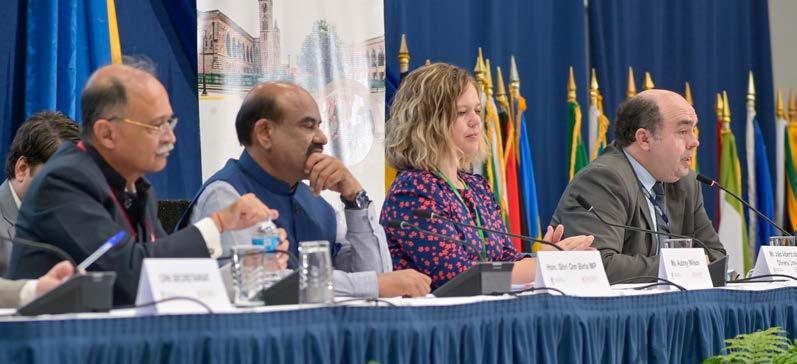
This workshop explored this dual challenge, focusing on practical, innovative solutions that can enhance democratic processes for all. The discussion was led by the Speaker of the Lok Sabha (Parliament of India) along with experts on the topic from the Federal Senate of Brazil and the VOXPOP Foundation.
Democracy becomes truly powerful when citizens remain deeply connected with their Parliament. In this era of technology, the Parliament of India has consistently endeavoured to bridge the gap between the institution and the people through innovative digital transformations.
Multiple initiatives have been adopted to make parliamentary functioning more transparent, responsive, and paperless. Under the ‘Digital Sansad’ (Digital Parliament) initiative, India has developed an integrated digital ecosystem based on the concept of ‘One Nation, One Legislative Platform’. This platform digitally connects Members of Parliament, Ministries and citizens on a single interface.
Within the Parliament of India, Artificial Intelligence-based translation systems, AI-enabled e-Library, and speech-totext reporting technologies are making legislative work more efficient and inclusive. In the near future, the ‘Sansad Bhashini’ real-time AI translation system will allow every Member of the India Parliament to participate in debates in their own language - a remarkable leap for a linguistically diverse democracy like India.
Under the dynamic leadership of the Indian Prime Minister, Shri Narendra Modi, India has achieved world-class milestones in the digital domain. A comprehensive and open Digital Public Infrastructure has been developed for 1.4 billion citizens, driving human-centric innovation and transforming both governance and the economy.
India today has about 1.2 billion mobile users and 950 million Internet users. The average Indian consumes nearly 30 GB of data per month, and Internet data costs as low as 12 cents per GB, among the most affordable globally.
With rapid rollout, India has become the world's second-largest 5G market and is now progressing swiftly toward 6G readiness. The country's Common Service Centre (CSC) network has expanded to over 550,000 operational centres, reaching about 90% of rural India, making it one of the largest digital service delivery networks in the world.
UPI (Unified Payments Interface) has surpassed major global card networks, like Visa, symbolising India's digital payment
revolution. Furthermore, the Indian Government is providing free AI training to one million citizens, especially Village Level Entrepreneurs, strengthening AI literacy and innovation at the grassroots.
These achievements demonstrate that India has not only expanded digital connectivity but has made it affordable, inclusive, and people centric.
India's ‘AI Mission’ - AI for All and AI for Good - reflects the visionary leadership of our Prime Minister. This initiative positions Artificial Intelligence not merely as a technological tool, but as an enabler of citizen empowerment, inclusive growth and transparent governance.
Our collective goal should be to promote responsible and ethical use of AI across Commonwealth nations, while working together to bridge the digital divide.
Through cooperation and knowledge-sharing, we can ensure that technology becomes a bridge of inclusion rather than a wall of separation.
I am confident that the meaningful deliberations of this workshop will help us all take concrete steps toward strengthening democracy through digital transformation.
Panel Chair: Stephen Twigg, CPA SecretaryGeneral
Discussion Leaders:
• Hon. Osbert Frederick, Speaker of the House of Representatives, Antigua and Barbuda
• Dr Elizabeth Macharia, Legal Policy Advisor, Commonwealth Secretariat
• Richard Rieser, General Secretary of the Commonwealth Disabled People’s Forum
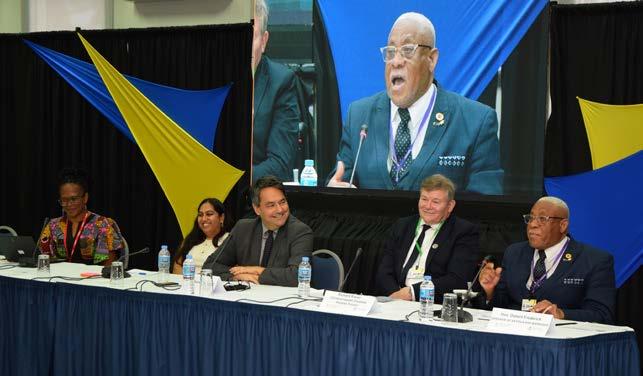
In preparation for the 2026 CHOGM that will be hosted by the government of Antigua and Barbuda, this workshop examined the significance of inclusion and representation of marginalised groups. Panellists explored how gender equality, accessibility and human rights can be further embedded into CHOGM outcome documents and policy, ensuring that the inclusion of those often underrepresented or marginalised is not an afterthought.
The discussion was chaired by the CPA Secretary-General with contributions from the Speaker of the House of Representatives of Antigua and Barbuda, the Commonwealth Secretariat and the Commonwealth Disabled People’s Forum.
Panel Chair: Hon. Dr Christopher Kalila, MP (Zambia), Chairperson of the CPA Executive Committee
Discussion Leader:
• Prof. Michael Taylor, Professor of Climate Change and Dean of the Faculty of Science and Technology, University of the West Indies
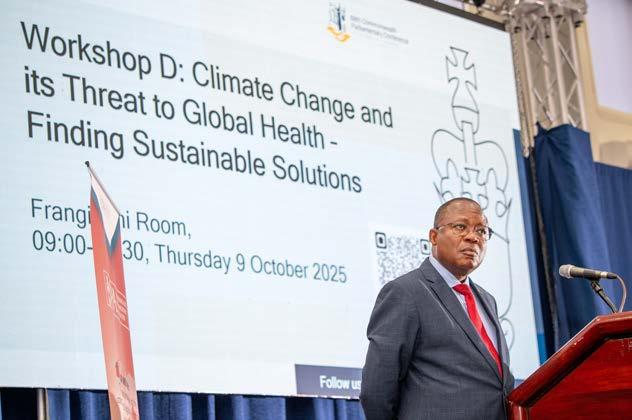
What can Parliamentarians do to tackle the negative impact of climate change on health from a national and international perspective? This workshop examined the dynamics between climate change and its direct impact on physical and mental health, and what role Parliamentarians can play to tackle this global challenge. Panellists examined the profound health impacts of a warming planet across the Commonwealth, from the rising burden of vector-borne diseases to the devastating mental health consequences of extreme weather events. Delegates also had the opportunity to discuss related questions and share what their own Legislatures were doing.
This workshop session was chaired by the Chairperson of the CPA Executive Committee alongside an expert in climate change from the University of the West Indies.
Panel Chair: Senator Hon. Andrew Cardozo (Canada Federal)
Discussion Leaders:
• Senator Hon. Alvina Reynolds, President of the Senate (Saint Lucia)
• Hon. Mark Furner, MP (Queensland)
• Geoff Dubrow, Founder, Nexus PFM Consulting
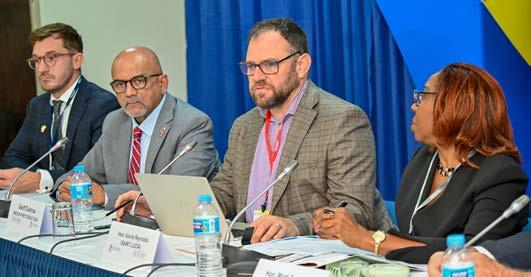
Are Parliamentarians building trust with their policies on financial transparency in elections and in their Legislatures? In an era of declining public trust, the financial integrity of political institutions has become a defining measure of democratic legitimacy. Allegations of opaque campaign financing, weak parliamentary oversight and a misuse of public resources continue to challenge confidence in Commonwealth governments.
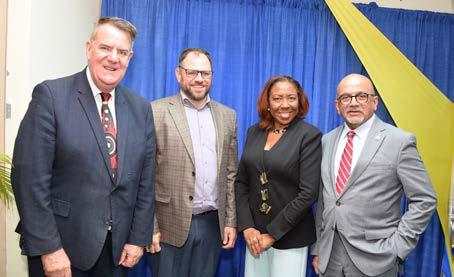
Panellists from Canada Federal, Saint Lucia, Queensland and a financial expert from Nexus PFM Consulting explored how Parliaments can strengthen financial transparency in their internal operations and how electoral processes can be made more robust.
How can Parliaments ensure the fair distribution of powers in multi-level governance systems within the Commonwealth? This workshop examined the distribution of powers in multi-level governance systems within the Commonwealth, focusing on the balance between national and sub-national Legislatures. It emphasised the importance of institutional responsibility and non-encroachment, drawing on the Commonwealth Charter and the Commonwealth Latimer House Principles.
Delegates also had the opportunity for group discissions looking at solutions which could tackle unique and broader challenges faced by Parliaments. The workshop was chaired by a Member from the Welsh Senedd and also heard from a Member of the Parliament of India and an expert from the CPA Secretariat.
Panel Chair: Hon. Natasha Asghar, MS (Wales)
Discussion Leaders:
• Hon. Harivansh Narayan Singh, Deputy Chairperson of the Rajya Sabha, Parliament of India
• Lydia Buchanan, Deputy Head of Programmes (Bilateral), CPA Secretariat
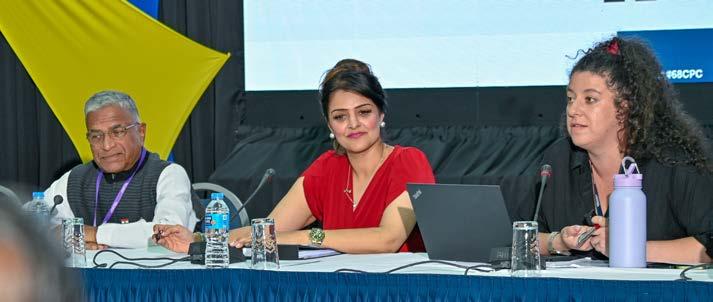
Panel Chair: Hon. Syed Yousaf Raza Gilani, Chairman of the Senate of Pakistan
Discussion Leaders:
• Hon. Carmel Sepuloni, MP, (New Zealand), CPA Vice-Chairperson
• Hon. Aristos Damianou, MP (Cyprus)
• Dr Elizabeth Macharia (Commonwealth Secretariat)
How can the Commonwealth strengthen good governance and remain a trusted voice in multilateralism and international relations?
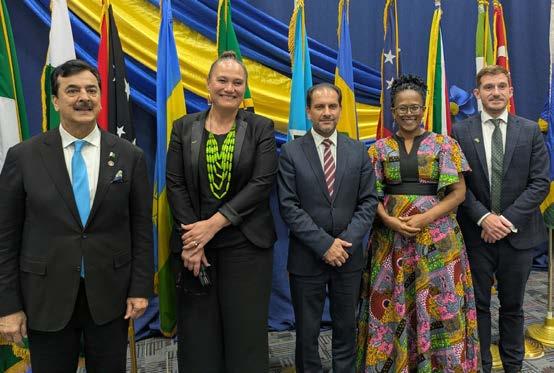
This workshop explored how the Commonwealth can remain a credible actor in an increasingly fractured world by strengthening its commitment to good governance, championing multilateral cooperation and supporting Parliamentarians as key agents of international engagement. Drawing on the Commonwealth Charter, the Harare and Millbrook Declarations and the Commonwealth Latimer House Principles, the discussion highlighted how Parliaments can resist democratic backsliding, navigate geopolitical and economic turbulence and respond to global challenges such as climate change, Artificial Intelligence and disinformation.
This workshop was chaired by the Senate of Pakistan with panellists from New Zealand, Cyprus and the Commonwealth Secretariat.
Young people across the Commonwealth face a wide range of interconnected challenges - from the physical threats of gang violence and exploitation to the digital risks of cyber-bullying, online harassment and misinformation. These pressures can limit their freedom to learn, participate and thrive, often leaving them vulnerable to harm, exclusion or disengagement from society.
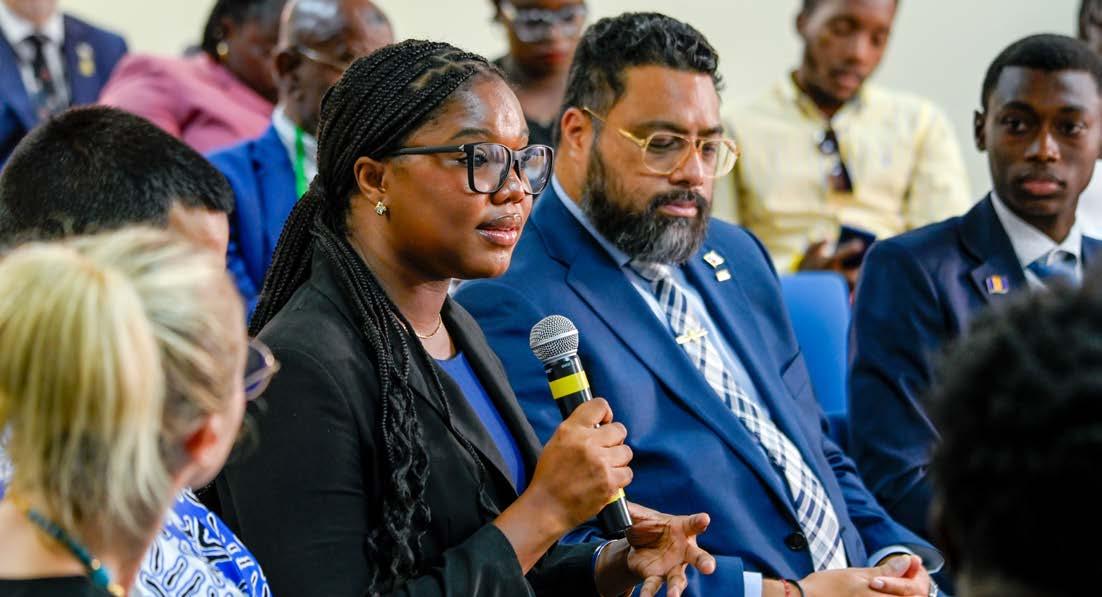
The Youth Roundtable provided a safe and inclusive platform for young people from Barbados to share lived experiences, learn from each other and work with policymakers to co-create practical strategies for safety, resilience and empowerment. Parliamentarians and parliamentary staff from Northern Territories, Guernsey, Limpopo, Selangor, Tonga, Western Australia, Pakistan and the United Kingdom joined the discussion which drew inspiration from Commonwealth commitments to youth development, human rights and digital inclusion, ensuring that young people’s voices are central to shaping solutions.
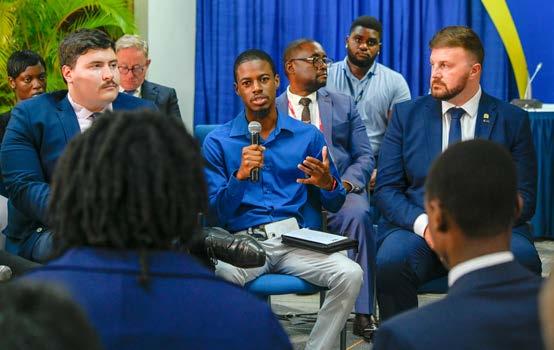
During the 68th Commonwealth Parliamentary Conference (CPC) in Barbados, delegates had the opportunity to join a number of networking events with civil society organisations and charities.
Event Summary: The Ashley Lashley Foundation - ‘The power of three: Youth, voice and vision in global leadership’
This event was hosted by The Ashley Lashley Foundation and focused on youth leadership, climate advocacy and crossCommonwealth collaboration. The facilitators introduced the work of the Foundation and shared the biography of Ashley Lashley, who began her climate advocacy at 16. Concerned about childhood obesity in Barbados, she linked health issues with environmental challenges and mobilised young people to act. In December 2019, she engaged with UNICEF in youth climate conversations, pushing for youth inclusion in decision-making spaces.
The Foundation presented its flagship initiatives: ‘Safe Coast BIM’, which builds youth disaster preparedness; ‘Eco-Fit’, which promotes the 5Rs in schools and communities; ‘By case’, which strengthens youth engagement; and the ‘HEY Campaign’, which trains youth ambassadors to advocate for climate action. Through these programmes, the Foundation has expanded to 20 countries and distributed over US$30,000 in grants to support youth-led projects, including initiatives in Brazil and Nigeria.
The Foundation outlined its three leadership pillars: collaboration, mentorship and representation. The session enabled delegates and youth advocates to exchange experiences and ideas directly. It invited stakeholders to contribute through mentorship, resource sharing, advocacy and partnerships that elevate youth voices and strengthen climate action. Three advocacy videos demonstrated how the media amplifies youth leadership and connects climate change with public health.
Delegates praised the Foundation’s impact and highlighted opportunities for legislative support. The session closed with a clear message: ‘youth are powerful agents of change’. Parliaments, civil society and regional networks must actively support youth leadership to drive sustainable, inclusive solutions to climate challenges.
Event Summary: The Maria Holder Foundation and The King’s Trust International (Barbados) – ‘Forging partnerships and unlocking youth potential’
This session opened with representatives of The Maria Holder Memorial Trust, who introduced the organisation’s mission and engaged the audience in an interactive discussion on the importance of supporting youth. They emphasised that youth development is a strategic priority requiring bold action, parental support and partnerships to nurture potential.
The Trust has an active presence in Barbados, Grenada, Antigua, Dominica, St Vincent and the Grenadines, and St Lucia, with 271 projects completed across the Organisation of Eastern Caribbean States (OECS). Its work focuses on poverty alleviation, education,
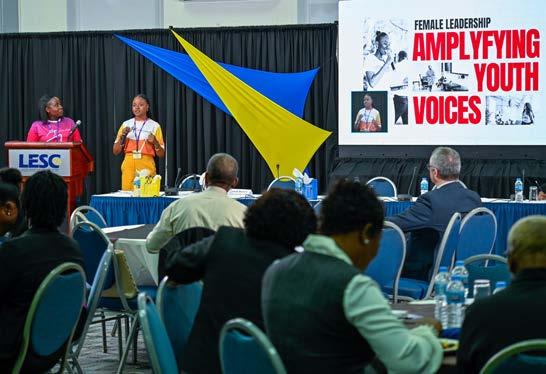
training, healthcare, disaster relief, gender equality, social inclusion and climate resilience. Partnerships with Government Ministries, NGOs, the University of the West Indies (UWI) and community groups have been central to its impact.
A key partner is The King’s Trust International, founded in 2015 by King Charles III, working across 20+ countries to tackle youth unemployment. It builds on the work of The King's Trust in the UK, providing education, employment and enterprise programmes to empower young people worldwide. Since 2016, Caribbean programmes have emphasised education, employment, enterprise, personal development and technical skills. Country highlights include early childhood and legacy nursery projects in Barbados, paediatric health access in St Vincent, youth development through ‘Grencoda’ in Grenada, wheelchair-accessible student transportation in St Lucia and youth centre refurbishment in Dominica. Programmes such as ‘Project Rescue’, ‘Dance4Life’, and the 12-week ‘TEAM initiative’ build confidence and employability. More than 93% of participants transition into jobs, education or entrepreneurship.
Youth advocates like Akeme Cox and Roslyn (St Lucia), who won the 2025 King’s Trust International Global Young Achiever Award, reflect the programmes’ successes. Regional recognition includes the Sisserou Award of Honour (2021) and the Faithful and Meritorious Service Plaque and Cross (2024). Presenters concluded by emphasising the power of equitable partnerships to unlock leadership and expand opportunities for young people across the Caribbean.
Other networking events included:
• Project Discovery Barbados – ‘Give the Youth a Chance’
• Hope Foundation – ‘Fighting for self and making a difference’
• Global Equality Caucus – ‘LGBT+ rights in the Commonwealth’
• Water Climate and Security: ‘The Role of a Parliamentary Water Caucus in accelerating progress’
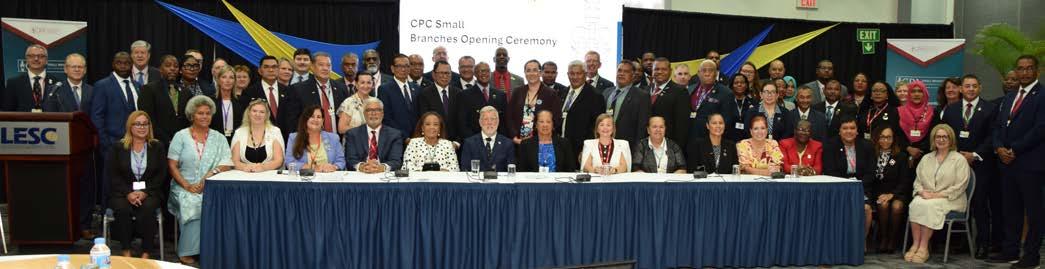
Commonwealth Parliamentarians met at the 41st CPA Small Branches Conference from 7 to 8 October 2025 to examine how to shape the future for CPA Small Branches and to strengthen Parliamentary Independence in small jurisdictions. The conference discussed strategies to meet the unique developmental needs of the CPA’s smallest Legislatures through key thematic workshops that helped to build parliamentary capacity for Members and parliamentary staff while also creating greater opportunities for the sharing of knowledge, parliamentary strengthening and cooperation across the network.
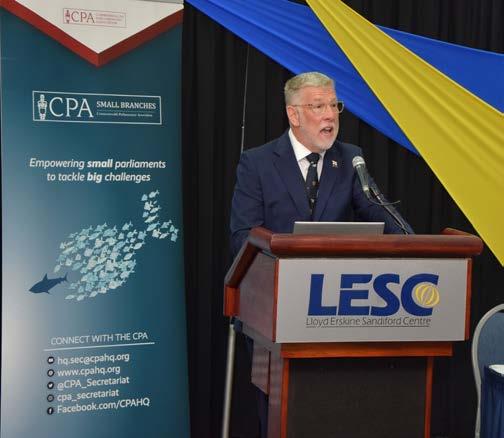
The CPA Small Branches Vice-Chairperson, Deputy Adrian Gabriel (Guernsey) said: “We gather today as representatives of small jurisdictions from across the Commonwealth - places with unique challenges, diverse cultures and incredible resilience. Though our populations may be modest in number, our commitment to democratic governance, parliamentary excellence and service to our communities is anything but small. However, with these challenges come extraordinary opportunities - to innovate, to lead by example and to collaborate in new ways.
The CPA Small Branches have often been at the forefront of adaptability. With limited resources, we’ve learned how to be creative. With smaller populations, we’ve remained closely connected to the voices of our citizens. And with shared challenges, we’ve strengthened one another through partnership and solidarity. This is a time for vision - to imagine what’s possible when CPA Small Branches are equipped, empowered and connected. Our goal is not just to react to the future - but to help shape it. Let us work together - across oceans and time zones - to build a stronger, more resilient and more inclusive future for all of the Small Branches of
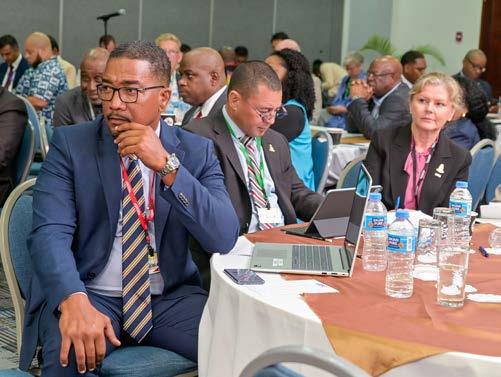

the Commonwealth Parliamentary Association.” The CPA Small Branches Vice-Chairperson also thanked the CPA Small Branches Chairperson, Hon. Valerie Woods, Speaker of the National Assembly of Belize.
The CPA Secretary-General, Stephen Twigg said: “The 41st CPA Small Branches Conference brings together Members of Parliament and parliamentary staff from the smallest jurisdictions in the Commonwealth to discuss issues relevant to their Legislatures. The smallest of the CPA’s Legislatures have unique challenges and yet are asked to meet the same expectations of service delivery as larger Legislatures, requiring additional support and innovation.”
The CPA Small Branches Conference included four plenary sessions exploring key themes proposed by
“
The CPA Small Branches have often been at the forefront of adaptability. With limited resources, we’ve learned how to be creative. With smaller populations, we’ve remained closely connected to the voices of our citizens. And with shared challenges, we’ve strengthened one another through partnership and solidarity.”
SHAPING THE FUTURE FOR CPA SMALL BRANCHES: STRENGTHENING PARLIAMENTARY INDEPENDENCE AND CAPACITY IN SMALL JURISDICTIONS
the Membership: Navigating Challenges, Exploring Priorities; Public Accounts Committees: Roles, Challenges and Solutions; Work-Life Balance and Mental Health for Parliamentarians in CPA Small Branches; Human Rights and the Legacy of Colonial Laws. In the margins of the conference, the CPA Small Branches Steering Committee met to discuss the strategic direction for the network. The CPA Small Branches Steering Committee comprises the CPA Small Branches Chairperson and nine Commonwealth Parliamentarians who represent the nine Regions of the CPA with Small Branches: Africa; Asia; Australia; British Isles and the Mediterranean; Canada; Caribbean, Americas and the Atlantic; India; Pacific; and South-East Asia.
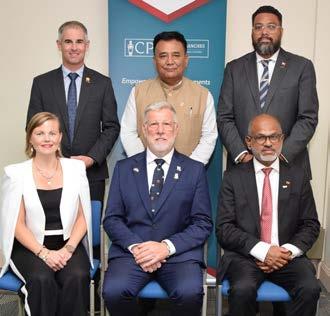
Of the almost 180 Branches of the CPA, fifty Branches are classified as ‘Small Branches’. The classification for CPA Small Branches was changed by the CPA General Assembly in 2022 to raise the population threshold to one million people. Examples of CPA Small Branches include Commonwealth countries such as Malta and Tonga, as well UK Overseas Territories such as Turks and Caicos or states and provinces within larger countries like Northwest Territories in Canada or the Northern Territory in Australia.
The 41st CPA Small Branches Conference took place as part of the wider 68th Commonwealth Parliamentary Conference in Barbados.
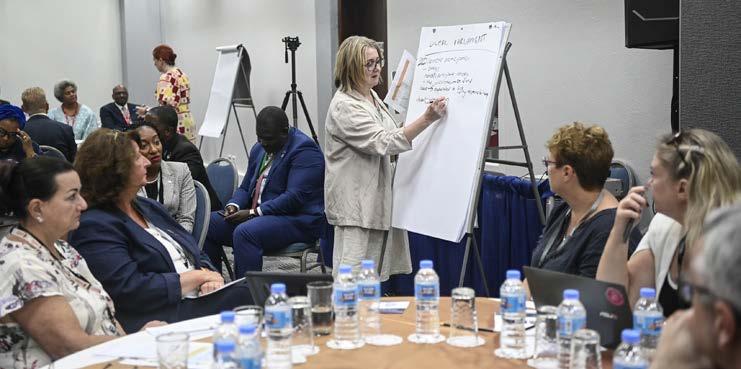
How can Parliamentarians address their most pressing challenges by collaboratively exploring priorities and developing a practical roadmap for their jurisdictions?
Parliamentarians and parliamentary staff in CPA Small Branches report that while their institutions are essential to democracy, they are often constrained by systemic challenges such as limited resources, an over-reliance on the Executive and a lack of technological capacity. This workshop aimed to tackle these and other pressing issues head-on. Delegates explored four interconnected topics led by facilitators from Northwest Territories, Belize, Australian Capital Territory and Tasmania.
• The Accountable Parliament - exploring how Parliaments strengthen public trust through oversight, scrutiny and collaboration.
Workshop
• The Digital Parliament - exploring how technology transforms legislative operations.
• The Connected Parliament - focusing on collaboration and knowledge sharing across Legislatures.
• The Resilient Parliament - examining how Legislatures build capacity to respond challenges, including misinformation and disinformation, climate change, security threats and declining trust.
SHAPING THE FUTURE FOR CPA SMALL BRANCHES: STRENGTHENING PARLIAMENTARY INDEPENDENCE AND CAPACITY IN SMALL JURISDICTIONS
Panel Chair: Deputy Adrian Gabriel (Guernsey), CPA Small Branches Vice-Chairperson
Discussion Leaders:
• Hon. L. Craig Cannonier, JP, MP (Bermuda)
• Geoff Dubrow, Financial Expert, Nexus PFM
This workshop examined how small Parliaments can strengthen the effectiveness and independence of their Public Accounts Committees (PACs), which serve as the final link in the accountability chain by scrutinising government expenditure. Delegates explored structural, political and resource-based challenges common to small jurisdictions and shared innovative approaches for reform.
Participants discussed the implications of having the Leader of the Opposition chair the PACs, with representatives from Anguilla, Antigua and Barbuda, Bermuda, British Virgin Islands (BVI), Grenada, Montserrat and Turks and Caicos noting that while this model promotes scrutiny, small Legislatures often lack the numbers to sustain balanced Committees. Some jurisdictions, such as Belize and Barbados, have moved toward joint-PAC
models that draw members from both Houses or include independent Senators to mitigate government majorities. Examples from Jersey and the UK highlighted the use of lay members as another way of increasing the objectivity and overall effectiveness of PACs.
Break-out discussions identified key priorities: establishing PAC secretariats to provide onboarding and financial expertise; reducing government dominance on Committees; ensuring Members’ disclosure of interests; and enhancing public engagement in oversight processes. Delegates also highlighted the value of continuous peer learning through the Commonwealth Association of Public Accounts Committees (CAPAC) and proposed creating a standing PAC agenda to advance issues raised at future Conferences.
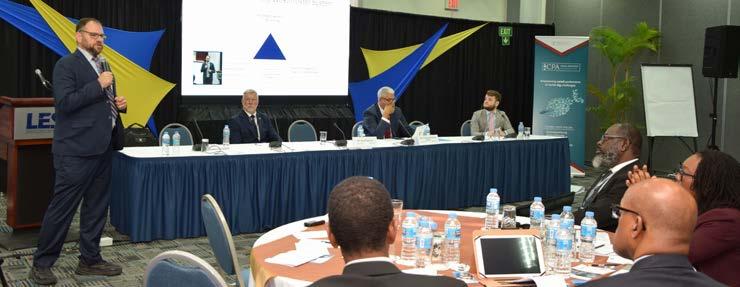
This workshop explored the intersection of work-life balance, professional development and mental health among Parliamentarians in small jurisdictions. Participants reflected on the pressures of long hours, travel, public scrutiny and the absence of institutional wellbeing support, while identifying strategies to promote sustainable and healthy parliamentary careers.
Breakout discussions highlighted the need for intentional boundaries and personal wellbeing routines. Across their groups, delegates recommended setting cutoff times for work communication, scheduling regular family time and establishing support systems within Parliament. Others stressed the value of planning, prioritisation and delegating to staff or diary secretaries to maintain balance, as well as using available facilities like gyms for recreation.
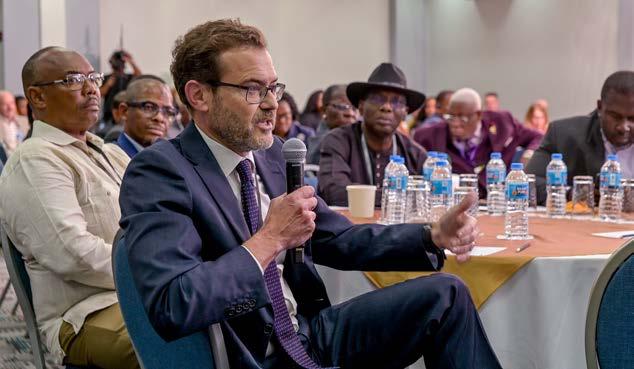
Discussions around professional development gave rise to calls for continuous learning in skills like communication, stress management and governance processes beyond parliamentary rules. Participants also encouraged self-driven training, supported by the CPA Parliamentary Academy online courses. Greater awareness and use of the CPA Mental Health Toolkit were strongly encouraged.
SHAPING THE FUTURE FOR CPA SMALL BRANCHES: STRENGTHENING PARLIAMENTARY INDEPENDENCE AND CAPACITY IN SMALL JURISDICTIONS
Panel Chair: Deputy Adrian Gabriel (Guernsey), CPA Small Branches Vice-Chairperson
Discussion Leaders:
• Hon. Arthur Holder, MP, SC, Speaker of the House of Assembly of Barbados
• Hon. David Agius, MP, Deputy Speaker of the House of Representatives, Parliament of Malta
This workshop took the form of a general debate under the central topics of human rights and the legacy of colonial laws. Facilitated by the CPA Secretariat, the debate encouraged delegates to consider how colonial-era laws continue to influence justice systems and human rights across the Commonwealth. Participants reflected on whether these laws still hold relevance or whether their repeal is essential to advance modern democratic and constitutional values.
The Speaker of the House of Assembly of Barbados opened the debate and noted that many colonial laws were imposed without the consent of the governed and often contradict constitutional guarantees. He called for a people-centred process of reform involving civil society, academics and non-governmental organisations, stressing that postindependence Legislatures must legislate for their own realities.
The Deputy Speaker of the House of Representatives of Malta emphasised that while reform is necessary, repeal must be thoughtful and well considered. Drawing on Malta’s evolution from British colony to European Union member, he highlighted the importance of constitutional stability, the separation of powers and adherence to international conventions. He also urged collective moral leadership against global injustices, including those in Gaza and Ukraine.
Delegates from Gibraltar, Jersey, the Cayman Islands, Fiji, South Africa, and Australia added perspectives on migration, overlapping rights, gender equality, LGBTQ+ inclusion and indigenous justice. Delegates also raised the concern of how treaty obligations may often contradict local legislation and how this must be handled, particularly
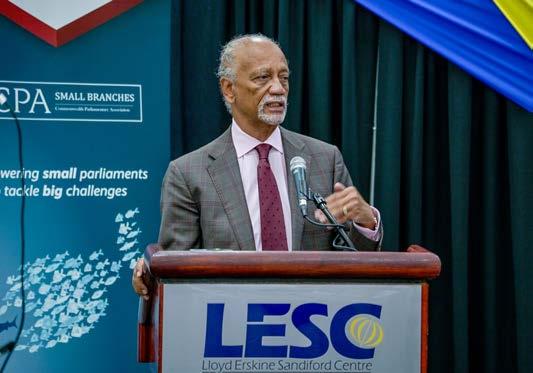
in cases where complying with international treaties may place their local populace at a disadvantage.
The debate concluded that while reform paths differ, the Commonwealth remains united in its resolve to modernise laws and strengthen collaboration between parliaments, civil society, political opposition, and the judiciary to ensure justice, equality, and human dignity for all citizens.
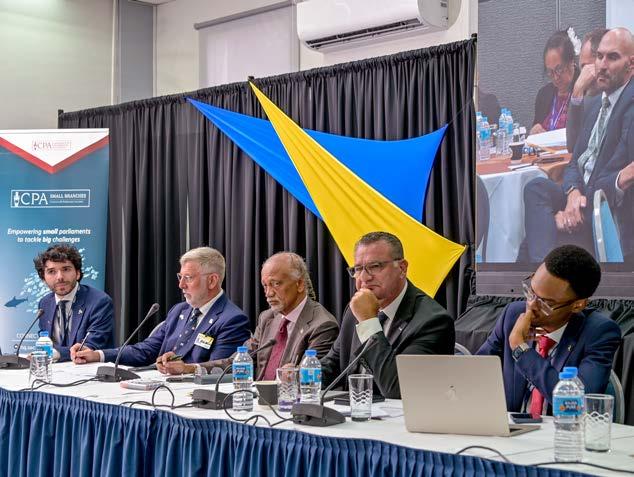
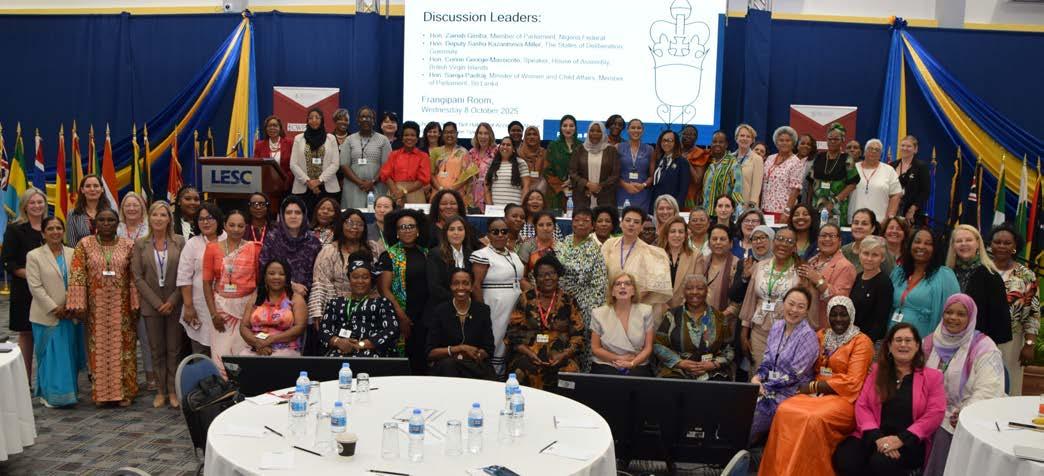
Women Parliamentarians from across the Commonwealth held their 9th Commonwealth Women Parliamentarians Conference in Barbados from 7 to 8 October 2025 to discuss women’s representation in Parliaments, amongst a wide range of topics. The main theme of the conference was: ‘Parliaments since Beijing +30: Progress, challenges and the road ahead for gender equality' and highlighted 30 years since the Fourth World Conference on Women, held in Beijing, China in 1995, where the United Nations (UN) adopted the landmark Beijing Declaration and Platform for Action on gender.
The 9th CWP Conference also brought together Members of Parliament to discuss equal representation in Parliaments through a series of workshops and governance meetings including four learning and development workshops for delegates. The host Branch of Barbados also held an open debate session where women Members provided contributions from the floor.
The CWP Conference was opened by the CWP Chairperson, Hon. Dr Zainab Gimba, MP, Member of the House of Representatives at the National Assembly of Nigeria who welcomed delegates and gave an update on the activities of the CWP network. The CWP President (2025), Hon. Marsha K. A. Caddle, MP (Barbados) spoke to the CWP conference about her experience as a legislator. She also highlighted that the Caribbean Region has been a leading advocate for gender equality and so it was particularly nice to welcome the CWP network to Barbados for this Conference. She added that the Caribbean aims to be a beacon for peace and security in the world and this can be extended through the work of the CWP and the CPA.
Over 100 Commonwealth Women Parliamentarians and delegates attended the conference from across the Commonwealth. The CWP conference saw leading figures in Commonwealth Parliaments addressing the conference and included four wide-ranging sessions for delegates on the following issues: Good Practices and Strategies to Realising Gender-Sensitive Parliaments across the Commonwealth; ‘Debate Not Hate’: Not Accepting Abuse as an Outcome of Free Speech; Parliamentarians Combatting Discriminatory Laws that Perpetuate the Disempowerment of Women; Overcoming the Barriers to the involvement of Women with Disabilities in Politics (a joint Workshop with the Commonwealth Parliamentarians with Disabilities network).
The CWP Conference also heard from a wide range of Members including the Parliaments of Zambia, Jersey, Western Cape, Fiji, Guernsey, British Virgin Islands, Sri Lanka, Barbados, Scotland, India, New South Wales as well as experts from UN Women and the Barbados Council for the Disabled.
The CWP Business meeting updated on the CWP network’s activities during this year and the plans for the year ahead. The CWP Chairperson also pledged to renew the effort to increase women’s representation and political participation in Parliaments across the Commonwealth. The CWP Conference was previously triennial (every three years) but in 2023, CWP Members agreed to hold an annual conference to held in the margins of the Commonwealth Parliamentary Conference.

Women Parliamentarians from across the Commonwealth held their 9th Commonwealth Women Parliamentarians Conference in Barbados where they held elections for the Chairperson of the CWP network on 7 October 2025.
Hon. Catherine Fife, MPP (CPA Ontario Branch) was elected as the new Chairperson of the Commonwealth Women Parliamentarians network in succession to the outgoing CWP Chairperson, Hon. Dr Zainab Gimba, MP from the House of Representatives at the Federal Parliament of Nigeria during the CWP Conference. It is the first time that a woman from the CPA Canada Region has held the role. The newly elected Chairperson of the Commonwealth Women Parliamentarians (CWP) network, Hon. Catherine Fife pledged to renew the effort to increase women’s representation and political participation in Parliaments across the Commonwealth with a focus on education for all. She also thanked the CWP membership for electing her to the role and said: “The world needs more Commonwealth and leadership, and this starts with education. We also need to form more strategic alliances so that we can support each other and not focus on the divisions that we are seeing across the world but on the things that connect us.”
The other candidates in the CWP election were: Hon. Nontembeko Nothemba Boyce, MPL (CPA KwaZuluNatal Branch); Hon. Kate Doust, MLC (CPA Western Australia Branch); and Hon. Fathimath Sauda, MP (CPA Maldives Branch).
The new CWP Chairperson was elected for a three-year term at the CWP Business Meeting. Under CPA election
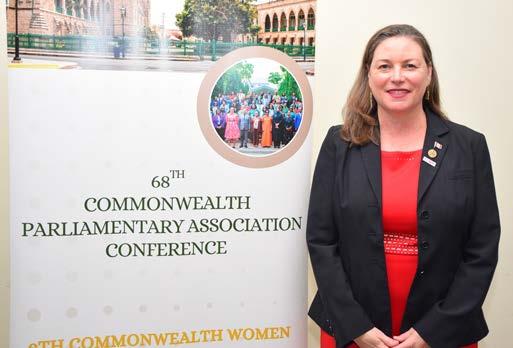
rules only women delegates to the 68th Commonwealth Parliamentary Conference and CWP Steering Committee Members could take part in the vote to elect a new CWP Chairperson. The CWP Election process was presided over by the CWP Steering Committee Member for the CPA Pacific Region, Hon. Lenora Qereqeretabua, MP, Deputy Speaker of the Fiji Parliament.
The CPA Secretary-General, Stephen Twigg said: “I congratulate Hon. Dr Zainab Gimba, MP, the outgoing CWP Chairperson for the achievements she has made during her term in office. On behalf of the entire CPA membership, we are grateful for her participation over the past three years. I very much look forward to working with Hon. Catherine Fife, the new CWP Chairperson, during the next three years and wish her all the very best in this important role.”
Following the 9th CWP Conference, the CWP Steering Committee met in Barbados representing the nine CPA Regions: Africa; Asia; Australia; British Islands and the Mediterranean; Canada; Caribbean, Americas and the Atlantic; India; Pacific; and South East Asia. CWP Steering Committee Members discussed activities for the year ahead as well as key themes for future conferences and meetings. The CWP Steering Committee elected Deputy Sasha Kazantseva-Miller (Guernsey) as the CWP Vice-Chairperson for a one-year term.
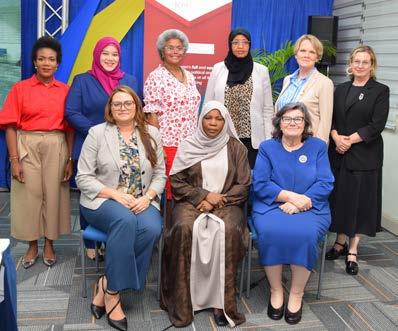
Right: In Barbados, a historic photograph was taken with the past, present and future Chairpersons of the Commonwealth Women Parliamentarians (CWP) network - Hon. Lindiwe Maseko MP (right), former Speaker of the Provincial Legislature of Gauteng who was the first CWP Chairperson from 2004 to 2007; outgoing CWP Chairperson, Hon. Dr Zainab Gimba, MP (Nigeria) (centre) and
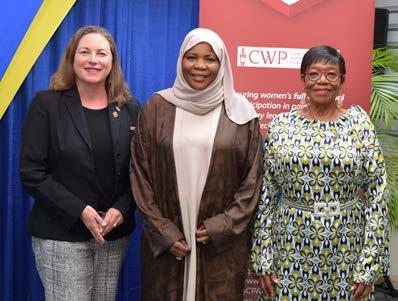
Chairperson-elect for 2025 to 2028, Hon. Catherine
PARLIAMENTS SINCE BEIJING +30: PROGRESS, CHALLENGES AND THE ROAD AHEAD FOR GENDER EQUALITY
Hon. Dr Neelam Gorhe, MLC is the Deputy Chairperson of the Legislative Council of Maharashtra, India
As a legislator for the last 23 years and as a Deputy Chairperson of the Maharashtra Legislative Council of Maharashtra in India for the last seven years, it is a privilege and profound honour to share my remarks on the theme of ‘Parliaments since Beijing +30: Progress, Challenges & the road ahead for gender equality’.
While setting the context, I would like to draw your attention to following points:
a) The Beijing Declaration and Platform for Action (1995) remains the most progressive global blueprint for advancing gender equality.
b) Parliaments have played a critical role in transforming commitments into laws, policies and institutional frameworks.
c) As we mark Beijing +30, it is important to reflect on progress made, persisting challenges and the road ahead by listening to voices unheard and understanding best practices regarding transforming dreams into concrete actions.
When we review global progress in Parliaments through reviews, global research and international platforms, I would like to underline three observations:
1. There is an increase in women’s representation in national Parliaments worldwide, though uneven across several regions.
2. The adoption of gender-sensitive laws on issues such as domestic violence, sexual harassment, maternity benefits and political participation has had an impact. I would also like to add the example of the new Bharatiya Nyaya Sanhita or ‘BNS law’ in the legal framework in India as an important game changer for gender justice.
3. Strengthened Parliamentary Committees and forums focusing on issues of women, children and social justice in many countries.
It will be appropriate to mention India’s parliamentary achievements at this juncture including:
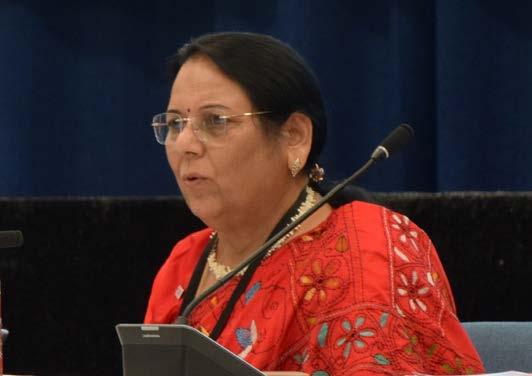
• 33% Women’s Reservation Bill (Nari Shakti Vandan Adhiniyam 2023): A landmark step to ensure women’s representation in the Lok Sabha (Parliament of India) and the State Assemblies. The Indian Prime Minister, Hon. Narendra Modi has taken this initiative personally and the Bill was passed unanimously in the Upper House and by a large majority in Lok Sabha.
• Progressive legislation has been passed such as:
- Protection of Women from Domestic Violence Act (2005)
- Sexual Harassment of Women at Workplace Act (2013)
• Maternity Benefit (Amendment) Act (2017) (extending leave to 26 weeks)
• Increased budgetary allocations for gender equality through gender responsive budgeting (GRB) has been adopted since 2005.
• Parliamentary debates increasingly addressing issues of women’s health, digital safety and economic empowerment.
Maharashtra is the first Indian State to adopt a comprehensive Women’s Policy (first in 1994, updated in 2001 and 2013 and the Fourth Women’s Policy under discussion). We are progressing in the following areas: increasing the limit of minimum legal marriage age; gains in girl's education; improvements in reducing maternal mortality ratio; child mortality ratio and malnutrition among citizens as per the national indicators of India.
Institutional mechanisms needed at the local level for progress to be made. These include:
• State Commissions for Women to actively address grievances with good support.
• District-level Committees or women’s forums consisting of women in decision-making roles at all levels and
women NGOs; also women’s community-based organisations (CBOs) to review of women’s safety and empowerment.
• Progressive schemes and initiatives like: Ladki Bahin Yojana for direct financial help given to vulnerable women for survival through state budget; special squads for curbing harassment of women/girls/ students; prevention of the misuse of Acts regarding women’s health; special support for women farmers and self-help groups; policies for women workers in the sugarcane cutting, construction and unorganised sectors.
• 2019 Resolution in the Maharashtra Legislature on SDGs and the empowerment of women and girls was introduced by the ruling party and parties in opposition together. I initiated this resolution in the Legislative Council. Similarly, in 2023, the Priorities for Gender Equality was discussed before formulating the fourth state policy. These Resolutions were introduced in 2023 in the Legislative Assembly by Adv. Rahul Narwekarji and I introduced them in the Legislative Council. All the suggestions by MLAs and MLCs in this debate were included in the fourth policy for women.
• Strong advocacy by women leaders and leaders committed to gender-sensitive policing, women’s safety audits and the rehabilitation of victims of violence is also essential.
• Underrepresentation of women in leadership positions in Parliament and State Assemblies still exist.
• Implementation gaps in gender policies - laws exist but enforcement, implementation and institutional mechanisms remain weak.
• Gender-based violence, cyber harassment, trafficking and workplace discrimination continue to hinder equality.
• Women in informal sectors like agriculture and women’s migrant labours still remain vulnerable in many parts of the world.
• Effective Implementation of the Women’s Reservation Bill globally in all countries.
• Strengthening Parliamentary Committees and gender budgeting mechanisms to ensure accountability.
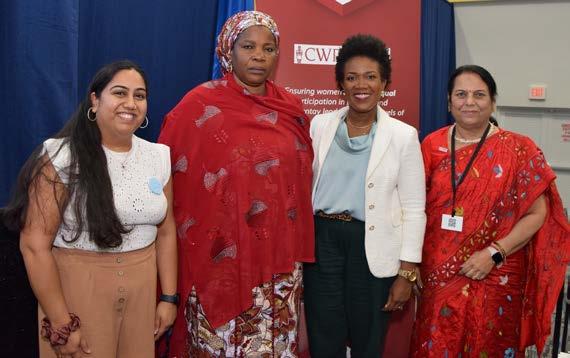
• Encouraging youth and marginalised women (Scheduled Castes SC, Scheduled Tribes ST and Other Backward Classes OBC, and other minorities) to enter politics and governance.
• Expanding digital literacy, AI safety measures and skills training for women in the new economy.
• Building inclusive, resilient democracies where Parliaments actively safeguard women’s rights during crises such as pandemics, climate change and disasters.
Conclusion
I would like to underline that:
• Parliaments are not just law-making bodies; they are platforms of justice, equality and social change.
• Both India and Maharashtra have shown pioneering leadership but must accelerate efforts to fulfil the Beijing vision.
• The road ahead requires collective political will, women’s grassroots participation and gender-sensitive governance as well as having women at the centre of implementation, planning and monitoring.
I conclude with the slogan of the Fourth Women of the World Conference – ‘Look at the world through women’s eyes!’. We look forward through aspirations, expectations and a new vision for the road ahead.
Discussion Leaders:
• Hon. Nelly Mutti, MP, SC, Speaker of the National Assembly of Zambia
• Deputy Raluca Kovacs (Jersey)
• Hon. Nomafrench Mbombo, MPP (Western Cape)
• Hon. Leonora Qereqeretabua, MP, Deputy Speaker of the Parliament of Fiji
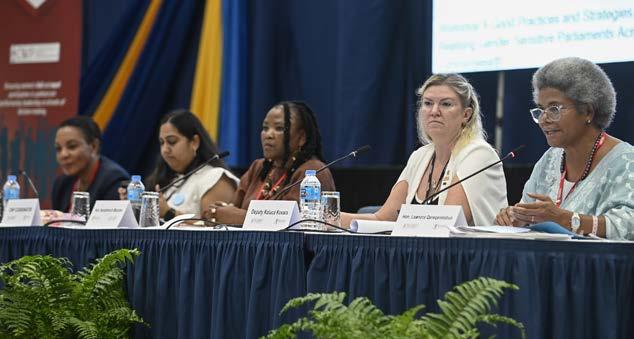
How can Commonwealth Parliaments become effective gender sensitive institutions? Despite growing representation, many Parliaments across the Commonwealth still face systemic challenges in becoming truly gender-sensitive institutions where women have equal opportunities to participate, contribute and lead. This workshop aimed to move beyond identifying these challenges to a proactive exploration of solutions.
Guided by the CPA Gender Sensitising Parliaments Guidelines and Seven-Step Field Guide, this interactive workshop equipped participants with the tools to either start or further their Parliament’s gender sensitive journey. Panellists came from Zambia, Jersey, Western Cape and Fiji and they shared their own Parliaments’ perspectives on the role of a gender sensitive institution.
Panel Chair: Hon. Dr Zainab Gimba, MP (Nigeria), CWP Chairperson
Discussion Leaders:
• Deputy Sasha Kazantseva-Miller (Guernsey)
• Hon. Corine N. George-Massicote, Speaker of the British Virgin Islands House of Assembly
• Hon. Saroja Savithri Paulraj, MP, Minister of Women and Child Affairs, Sri Lanka
How can Parliaments combat violence and harassment against women Parliamentarians in the digital space? Free speech is a fundamental pillar of democratic societies, but it must not be misused as a shield for harassment, intimidation, discrimination, or threats. Across the Commonwealth, abuse and harassment in its many varied forms, micro-aggressions and misogyny, particularly targeting women Parliamentarians, are eroding healthy political discourse and discouraging democratic participation. As technology permeates every corner of our daily lives, it is being weaponised to harm women and girls, posing serious threats to their safety and wellbeing making it
increasingly difficult for women to feel safe not only in public spaces, with technology-facilitated violence, in their own homes too. This workshop aimed to unite Parliamentarians in order to combat harassment and violence within political and parliamentary sphere’s and to provide a collaborative platform to explore how Parliaments and Parliamentarians can foster respectful debate, safeguard political engagement and ensure that they are seen and heard without fear or harm. Panellists came from Guernsey, British Virgin Islands and Sri Lanka.
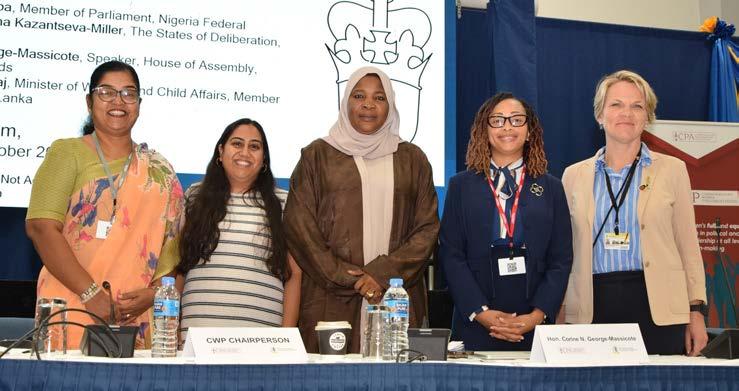
Hon. Surama Padhy, MLA, Speaker of the Odisha Legislative Assembly, India
The Beijing Declaration of 1995 was a turning point in our collective journey for gender equality. It gave the world a shared vision - that no society can be just, fair or prosperous if women are left behind.
Thirty years later, we celebrate progress. Women’s representation in Parliaments have increased from about 11% in 1995 to nearly 27% today. And yet, we also recognise the challenges: stereotypes that persist, unequal opportunities in leadership, digital and economic divides, and the new threat of online harassment.
Beijing +30 is therefore not the end of a journey - it is a milestone. It reminds us that the work of building gendersensitive Parliaments is still ongoing.
India, the world's largest democracy, has taken strong steps under the leadership of Indian Prime Minister, Shri Narendra Modi. His vision is clear: ‘Women-led development’ must be at the heart of our national growth. This has been demonstrated through several initiatives including:
• The Women's Reservation Bill guarantees 33% representation for women in the national and state Legislatures.
• Flagship schemes like Seti Bachao Seti Padhao, Ujjwala Yojana and Jan Ohan Yojana have empowered women with health, dignity and financial independence.
Today, women lead in every sector of Indian life - from entrepreneurship to defence, from technology to space exploration. The message from India is simple: empowering women is not charity; it is a necessity for building a just and prosperous nation.
From the perspective of my state, Odisha, we have put women at the centre of our governance. Odisha reserves 50% of seats in local governance for women, ensuring strong participation in grassroots democracy.
Through Mission Shakti, nearly eight million women are united in Self-Help Groups. They run businesses, manage resources and strengthen families and communities. Our recently launched Subhadra Yojana provides direct financial support to women, ensuring that social justice translates into economic independence. We have also adopted gender-sensitive budgeting to make sure every policy and
programme is designed with equity and inclusion in mind. These initiatives show that when women rise, families prosper, and societies transform.
Allow me to share some practices that can help Parliaments become truly gendersensitive:
1. Representation with Responsibility - Women must not only enter Parliaments but also hold leadership roles.
2. Capacity Building - Training and mentorship programmes aimed at women can strengthen legislative and policymaking skills.
3. Safe & Inclusive Workplaces - Parliaments must guarantee dignity, respect and zero tolerance for harassment.
4. Gender Lens in Law-Making - Every law should be reviewed for its impact on both women and men equally.
5. Link with Grassroots Voices - Women's experiences from villages, towns and civil society must enrich parliamentary debates.
The Road Ahead
The Commonwealth is a family of diverse democracies. Our unity is our strength. Together, we can shape a future where Parliaments are inclusive, representative and responsive to every citizen.
The road ahead must be guided by three principles:
• Equality of opportunity for women
• Dignity of participation in political life
• Celebration of women's leadership in every sphere.
Conclusion
Democracy without gender equality is incomplete. Our Parliaments must reflect not just numbers, but the values of fairness, inclusion and justice.
From India's ancient ethos: "Where women are honoured, there the divine flourishes."
With shared resolve, let us build Parliaments that truly honour every woman, empower every generation and ensure that equality is not a dream but a reality.
Panel Chair: Hon. Marsha Caddle, MP (Barbados), CWP
President (2025)
Discussion Leaders:
• Ms Nisha Nicole Arekapudi, UN Women
How can Parliamentarians pursue and champion legislative reform for gender equality? Across the Commonwealth, discriminatory laws continue to undermine women’s rights, entrench economic inequality and signal that gender discrimination is acceptable. At the same time, recent years have seen notable reforms that demonstrate what is possible when political will, strategic advocacy and evidence-based policymaking come together.
A new publication, Understanding, Assessing & Achieving Equality before the Law in the Commonwealth: A Practical Handbook for Change Agents with Historical Records, Statistical Data and Case Studies, provides up-to-date mapping of such laws and highlights successful reforms.
Produced by UN Women, the Commonwealth Parliamentary Association, the Commonwealth Secretariat, and the World Bank Group’s Women, Business and the Law, the handbook serves as a practical tool for Parliamentarians seeking to lead change. Vital structured engagement with legislators enhances and strengthens
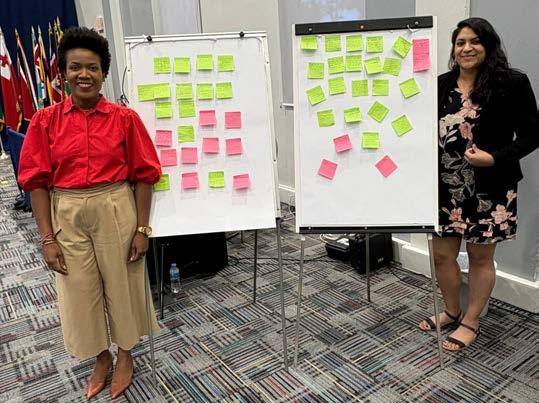
efforts to address legislation, deepens public debate and enhances accountability in the movement towards greater gender equality and equity.
This workshop launched the new handbook and provided a unique space for Parliamentarians to share reform experiences, discuss priority areas for legislative change and commit to concrete next steps.
Discussion Leaders:
• Hon. Roz McCall, MSP (Scotland)
• Hon. Liesl Tesch, MP (New South Wales)
• Keryann Ifill, Barbados Council for the Disabled and former President of the Senate of Barbados
What are the barriers faced by women with disabilities in politics and what are ways to overcome these? This interactive workshop explored the unique barriers faced by women with disabilities in political life, with reflections of those with lived experience and those that advocate for their wider representation.
Panellists from Scotland, New South Wales and Barbados began the discussion by sharing the personal, structural and cultural challenges they have encountered on the road to elected office - from inaccessible political party systems and campaign infrastructure to broader issues of gender discrimination.
Delegates were also able to provide contributions and reflections during the collective dialogue in order to promote empathy, raise awareness and identify tangible pathways to support political participation of women with disabilities across the Commonwealth.
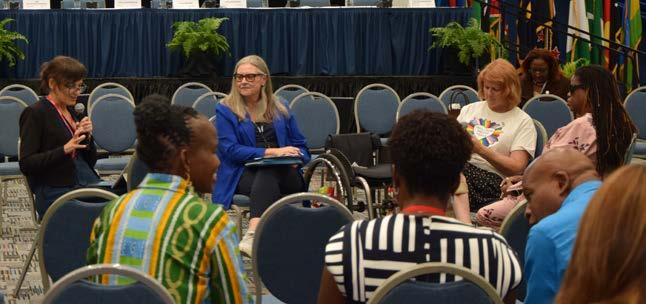
‘FROM THE EXECUTIVE TO THE LEGISLATURE AND BACK: WHO HOLDS THE KEY TO ADVANCING GENDER EQUITABLE LAW AND POLICY?’
Hon. Rita
Theodorou
Superman, MP (Cyprus)
In a nutshell what can be derived from our experience at the Cyprus House of Representatives is that the Executive and the Legislative branch must work hand in hand in order to advance gender-equitable law and policy.
Our political system in Cyprus is one of presidential and not solely parliamentary democracy and thus, there exists a distinct separation between the three branches of authority.
On the Executive side, Cyprus has adopted a renewed National Strategy for Gender Equality (2024-2026), coordinated by the Commissioner for Gender Equality, which sets out goals such as dismantling stereotypes, promoting women's participation in decision-making and closing the gender pay gap.
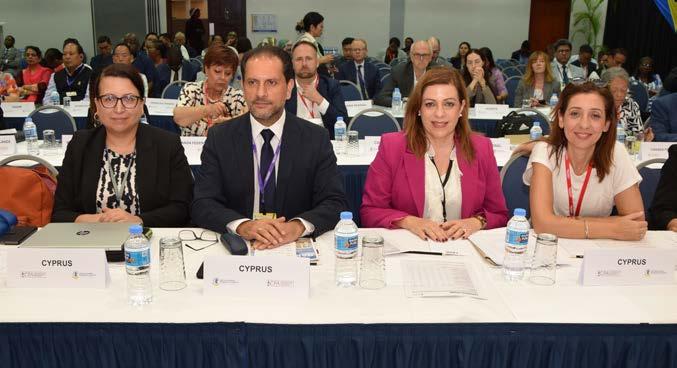
On the Legislative side, Parliament has translated these priorities into concrete measures: in 2025 alone, it passed laws on workplace violence and harassment aligned with
“
The lesson from Cyprus, which I am sure many of my colleagues share, is that no branch alone holds the key. When the Executive branch leads without parliamentary engagement, strategies risk remaining aspirational. On the other hand, legislative initiatives without the Executive's backing often face resource and implementation gaps. The most effective pathway has been co leadership, where the Executive sets strategic frameworks and mobilises resources, while the Legislature ensures scrutiny, accountability and translation into binding legal frameworks.”
ILO Convention No. 190 - strengthened protections for child victims of sexual abuse, extended maternity protection and introduced mandatory breastfeeding facilities in workplaces and public spaces.
The lesson from Cyprus, which I am sure many of my colleagues share, is that no branch alone holds the key. When the Executive branch leads without parliamentary engagement, strategies risk remaining aspirational. On the other hand, legislative initiatives without the Executive's backing often face resource and implementation gaps. The most effective pathway has been co leadership, where the Executive sets strategic frameworks and mobilises resources, while the Legislature ensures scrutiny, accountability and translation into binding legal frameworks.
This balance of roles underscores that genuine progress toward gender-equitable law and policy requires dynamic interaction between both the Executive and the Legislative branches, supported by a strong Committee system, active civil society participation and consistent monitoring mechanisms.
The 59th Meeting of the Society-of-Clerks-atthe-Table (SoCATT) took place in the margins of the 68th Commonwealth Parliamentary Conference (CPC) in Barbados. The meeting brought together Parliamentary Clerks and parliamentary staff from Commonwealth Parliaments to discuss the latest legislative practices and to share best practice.
The meeting was chaired by Mr Pedro Eastmond, Clerk of the Parliament of Barbados and also included a meeting of the Society’s Advisory Committee.
Presentations were made during the twoday meeting on a wide range of subjects including:
• New Zealand’s Parliament Bill by Dr David Wilson, Clerk of the House of Representatives, New Zealand
• Governance in Parliament: A Clerk’s perspective by Catherine Vickers, Clerk of the Legislative Council of Tasmania
• Perspectives on AI in Parliaments by Barbados; UK; Prince Edward Island; Australian Capital Territory; New South Wales Parliament
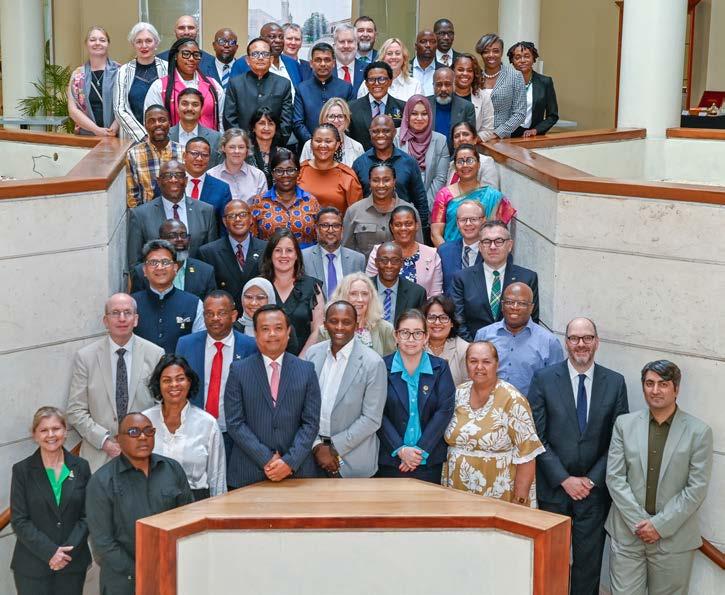
• Development of procedure and privilege in the Parliament of Kenya by Mr Samuel Njoroge, Clerk of the National Assembly, Kenya
• Impact of procedural and administrative reforms in Legislatures by Shri Pradeep Kumar Dubey, Principal Secretary, Uttar Pradesh Legislative Assembly
• The role of the Presiding Officer in ensuring transparency and accountability in Parliament by Brian Caesar, Clerk of the House, Parliament of Trinidad and Tobago
At the conclusion of the meeting, the Society’s accounts for 2024 and proposals for the agenda for the 60th SoCATT General Meeting to be held in 2026 were discussed.
For further information about SoCATT please visit www.societyofclerks.org.
The Conference Concluding Statement for the 68th Commonwealth Parliamentary Conference (CPC) which took place in Bridgetown, Barbados from 5 to 12 October 2025, hosted by the Parliament of Barbados and the CPA Barbados Branch was issued by the Commonwealth Parliamentary Association (CPA) Secretariat on 16 October 2025 following the conclusion of the Conference. The statement is also available at the CPA website: www.cpahq.org or by emailing hq.sec@cpahq.org.
This online supplement features a full round up of all of the conference news and workshop reports from the 68th Commonwealth Parliamentary Conference (CPC) in Barbados and is published as an online supplement to the CPA Journal, The Parliamentarian (2025 Issue Four) launched in December 2025.
• Images from the events of the 68th CPC are available at the CPA’s Flickr page.
• Image credits: Parliament of Barbados/Jeffrey Hyland at CPA Headquarters Secretariat/Dennis Mawira Gitonga at Parliament of Kenya.
• With thanks to the Rapporteurs team from the University of the West Indies for assistance in compiling these reports.
The Parliamentarian is available to Members of Parliament and parliamentary staff through their CPA Branch Secretaries (print and digital editions) or to individuals and organisations by subscription. Email editor@cpahq.org for details about the CPA Journal. Please contact the CPA Headquarters Secretariat if you require any further information about the 68th Commonwealth Parliamentary Conference.
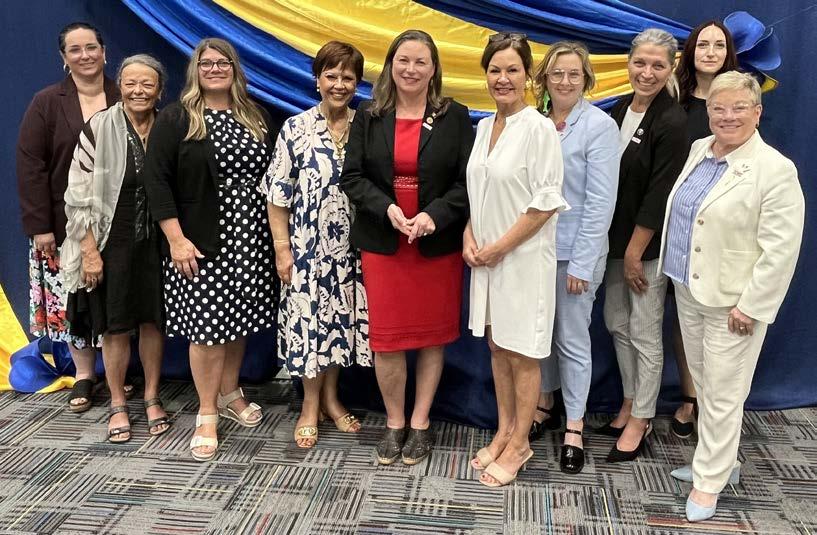
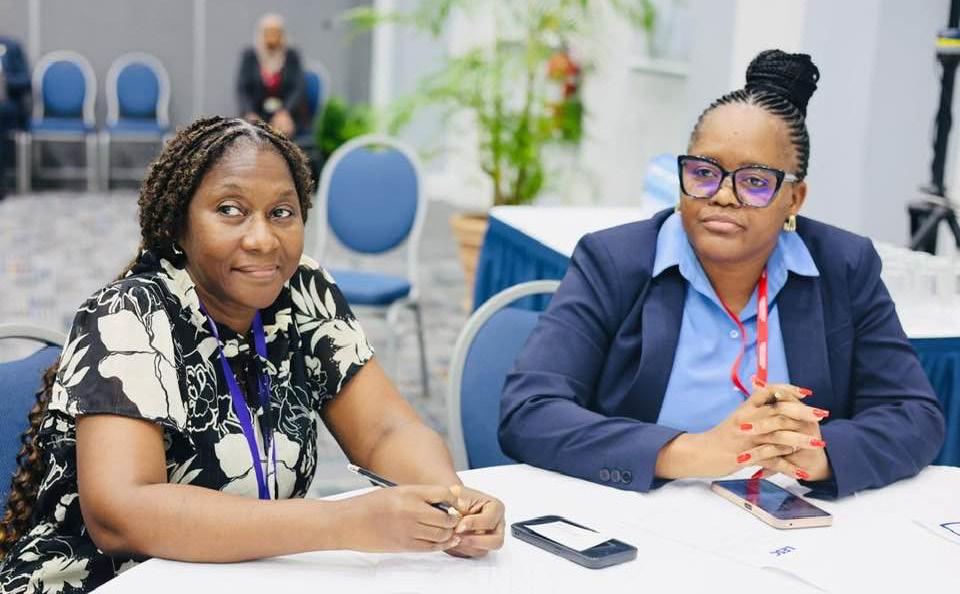
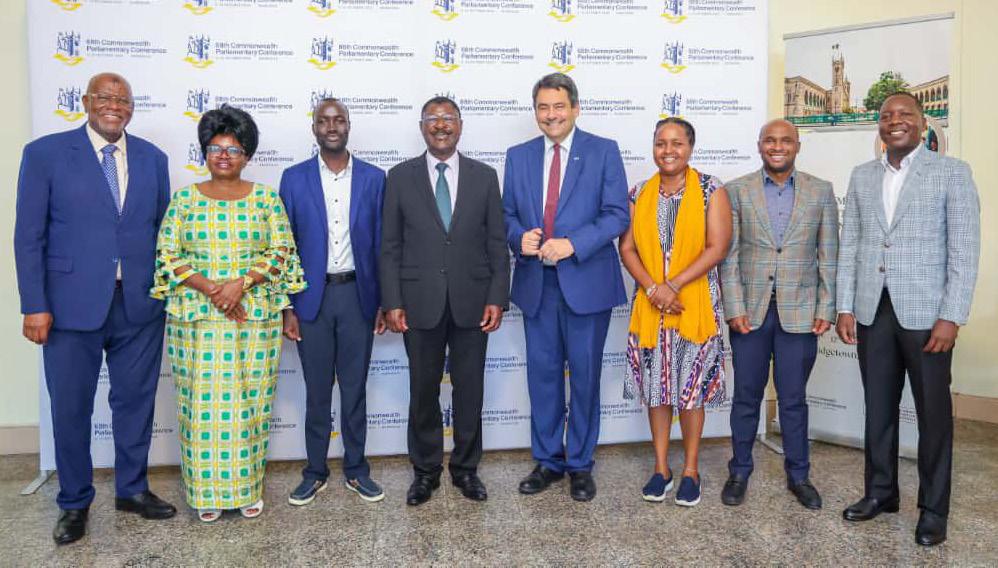
The Parliamentarian Journal of the Parliaments of the Commonwealth
This supplement features conference news and workshop reports from the 68th Commonwealth Parliamentary Conference (CPC) in Barbados and is published as an online supplement to: Vol. 106 2025: Issue Four
The Parliamentarian ISSN 0031-2282
Issued by the Secretariat of the Commonwealth Parliamentary Association, CPA Headquarters Secretariat, Richmond House, Houses of Parliament, London SW1A 0AA, United Kingdom Tel: +44 (0)20 7799 1460 Email: hq.sec@cpahq.org www.cpahq.org
Publisher: Stephen Twigg CPA Secretary-General
Editor and designer: Jeffrey Hyland editor@cpahq.org
With special thanks to contributors from Barbados who have contributed to this supplement.
Images: Parliament of Barbados, Shutterstock and CPA Headquarters Secretariat.
Printed in: United Kingdom by Warners Midlands, PLC; and Singapore by Times Printers Private Limited.
Published in December 2025 as a supplement to The Parliamentarian, the Journal of Commonwealth Parliaments. Available at www.cpahq.org and ISSUU.