The experiences we create
ACADEMIC ESSAY
LUANE PRETORIUS 241010
31 OCTOBER 2025
LUANE PRETORIUS 241010
31 OCTOBER 2025
Iam a 3D Animation student who wants to work in the gaming industry one day, and thus I want to focus on how we can create unique and engaging stories and experiences that can influence and connect audiences. In one of her talks, Pippa Tshabalala mentioned “Interactivity can often communicate a point in a more effective manner than traditional means of communication”. (TEDXtalk, 2013. 2:13). I agree with her as the stories and experiences moving image makers create are far from simple and can be used to communicate with and connect audiences. This essay will focus on theories of play and the interactive experiences we create as moving image makers, as well as the challenges, opportunities and responsibilities within the South African Gaming Industry.
In the Ontology of Video Games (Aarseth & Calleja 2015), Aarseth and Calleja define a game as a system (Aarseth & Calleja, 2015, p. 3) and a process (Aarseth & Calleja, 2015, p. 6.) A game can be seen as a system as it has a set of elements within an environment that has an effect on each other to create a larger structure (Aarseth & Calleja, 2015, p. 3). Aarseth and Calleja also state, “Each game is an ongoing process. As it is played it always contains the potential for generating new practices and new meanings” (Aarseth & Calleja, 2015, p. 6). The player also becomes an important aspect as the player has to interact with the system, for a game to be experienced (Aarseth & Calleja, 2015, p. 6). Thus it becomes important that we as creatives look at games as processes and systems, and create games that focus on the engagement and gameplay, and the interaction of the player instead of just the outcome (Aarseth & Calleja, 2015, p. 3). An example for this is the game Semblance (Nyamakop 2018) (Figure 1 and 2). Its puzzle game that redefines what a platform game can be through its
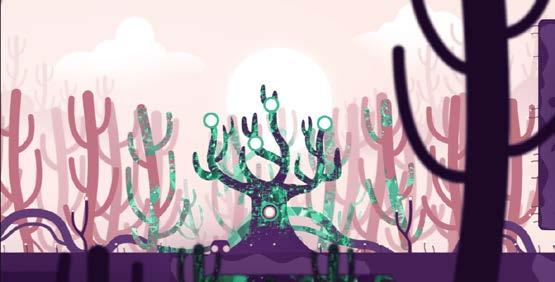
Screenshot 1 from Semblance.
Note: Nyamakop, 2018 (via semblance-game.com).
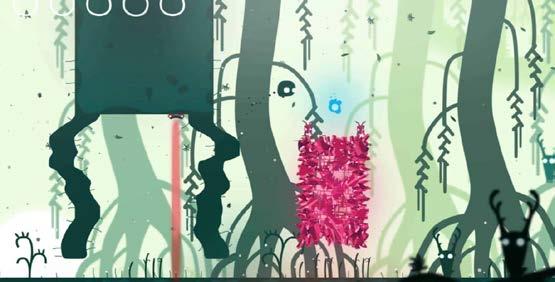
Screenshot 2 from Semblance.
Note: Nyamakop, 2018 (via semblance-game.com).
interactivity and game play where you can reshape the world of the game itself (Nyamakop 2018). The studio who created the game has placed a lot of focus on the gameplay and experience of the player and not just the outcome.
To better understand how these interactive gaming experiences or moving images can influence audiences I referred to Cultural Studies Theory (O’Donnell 2005 & Ross 2005). Hall created the decoding and encoding model (Ross, 2005, p. 1). Encoding is where meaning is within a message and decoding is how the receiver makes meaning of the message based on their own knowledge and experience framework (Ross, 2005, p. 3). Thus to get audiences to take meaning or relate to the messages from gaming experiences it needs to be something they can relate to and understand. However it’s not always assured that audiences will interpret an image or gaming experience as creators intend as audiences have different and unique experiences, and can find different meanings within the same message (O’Donnell, 2005, p. 524).
Next, to also understand how a game can have a great interactive experience, and convey stories and messages to audiences, led me to look deeper into ludology and how to combine it with narrative elements. Ludology focuses on the elements and systems within a game (Frasca, 2003, p. 1). Frasca states that game designers have been looking for ways to bring together ludology and narrative elements to create gaming environments with compelling experiences through interactivity (Frasca, 2003, p. 7). A big part of this is to see games as simulations and to have an interactive narrative where the narrative pretends to give the player freedom through how the player interacts with the game and the gameplay. It is a way
to keep the message a game wants to convey through its story while making it an engaging experience (Frasca, 2003, p. 7). According to Frasca there are 3 different ways that messages can be conveyed through gaming simulations (Frasca, 2003, p. 10). The first is events and representation of settings, environments, characters, objects and cut-scenes. The second is what the player is allowed to do while playing the game. The third is what the player must do to win during the simulation of the game (Frasca, 2003, p. 11). Thus what makes simulations so interactive is that the actions of the player are not only allowed but needed to move forward in the game (Frasca, 2003, p. 7), and messages can be conveyed through the narrative, gameplay and environment itself.
According to Aarseth “Storytelling has been, and still is, the dominant form of cultural expression” (Aarseth, 2004, p. 50) proving the importance of the narratives we as moving image makers create. Aarseth also states that simulation is the key aspect when creating a game to create an overall more engaging experience (Aarseth, 2004, p. 52). Games that focus on simulation, on top of story telling and game mechanics to create an overall more engaging experience are the future of the gaming industry (Aarseth, 2004, p. 54). Thus Simulations and narratives can be used together to create more compelling and impactful games for audiences. An example of a game making use of story telling combined with simulation, and having a message that can influence the player, is Viscera Cleanup Detail (RuneStorm 2015)
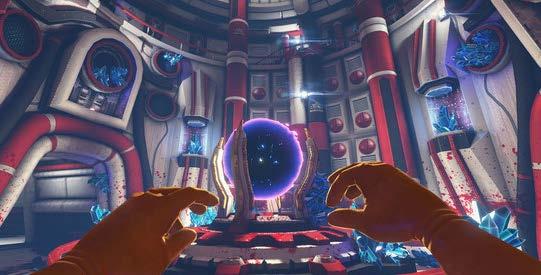
Screenshot from Viscera Cleanup Detail.
Note: RuneStorm, 2015 (via https://store.steampowered.com/app/246900/Viscera_Cleanup_ Detail/).
(Figure 3), where you as the player must physically clean up deadly messes and have to deal with the consequences (Steam, 2015).
Creating these unique stories and engaging experiences through simulations and narratives comes with its own challenges for game designers and animation artists within the South African Gaming Industry. However these challenges provide a lot of opportunities and responsibilities moving image makers have to face.
The challenges I want to focus on are funding and skillset, how to create interactive and appealing gaming experiences to be able to tell unique narratives, and how to reach players and audiences. The African Games Industry Report (2024) mentions that there is a lot of experience and specialized skills needed to produce a game and professional moving image makers have to work together to create an engaging narrative and a believable world and characters. They also have to make sure a game’s system functions as it should (Maliyo Games, 2024, p. 17). It’s a challenge to be a professional with all these needed skills or try and gain experience within an industry that is still growing in South Africa. Above the required skillset, experience and the challenge of bringing these interactive experiences to life is funding
within an industry that is still developing. Funds are needed for these professionals, their work, and equipment to create projects (Maliyo Games, 2024, p. 46).
It’s also a challenge to get these interactive experiences with unique narratives to reach audiences. Statistics from the NewZoo’s Global Gamer Study (2023), shows that audiences engage with games in more than one way (Newzoo, 2023) and that needs to be kept in mind when creating and designing new games. Eight out of ten people from the online population engage with games in more than one way through multiple platforms and the act of playing and engaging itself is constantly evolving as the industry is growing (Newzoo, 2023).
Though the gaming industry in South Africa has its challenges because it’s still growing, it also provides a lot of opportunities for moving image makers. Games are a great way to tell stories and create engaging experiences as they allow audiences to actively take part in a narrative and to have messages leave a more permanent impact on audiences (TEDXtalk, 2013. 2:20). Even if the challenge is there to reach audiences in an industry where the act of play and engagement is evolving, the opportunities are also there for game designers and animation artists to also evolve and learn new ways of engagement. An opportunity of how to do this is where game designers have started to combine the ludology and narrative elements in games (Frasca, 2003, p. 7) and place more focus on simulations and how interactive and engaging they can be. There are multiple creative ways to include unique narratives and
getting audiences to engage with them through incorporating them into the gameplay and the environment which players have to interact with (Frasca, 2003, p. 11).
A growing industry also allows for new opportunities for education of professionals. Educational institutes have started to ensure that there are programs and institutions that provide the necessary skills and training for the next generation of designers and game developers (Maliyo Games, 2024, p. 13) for example South Africa which has educational institutes with dedicated digital media and game programs (Maliyo Games, 2024, p. 40). As the industry grows, and opportunities grow, ways of funding and revenue also grow (Maliyo Games, 2024, p. 15). Another big opportunity in South Africa is unique stories and creative expression. Games provide a strong platform for communities to form and create unique narratives. South Africa has unique cultures and stories that audiences have a chance to relate to and experience through gaming platforms (Maliyo Games, 2024, p. 40).
With story telling being the main form of cultural expression (Aarseth, 2004, p. 50), It is important to know the responsibilities that come with creating narratives and engaging with audiences. Culture and different forms of media can influence norms and social behaviours (Maliyo Games, 2024, p. 13), thus we as moving image makers have the responsibility to create interactive experience to which South Africans can relate to, change how people think and act and in turn change people’s behaviours and leave messages behind with a bigger and lasting impact on audiences. The South African Game Industry is a place that can bring out the rich diversity and culture (Maliyo Games, 2024, p. 33) South Africa has through creating unique narratives and better interactive experiences, and we as the new generation of moving image makers should aim for that. Moving image makers also have the opportunity and responsibility of connecting different people from different backgrounds
and cultures to help audiences connect and build communities (Maliyo Games, 2024, p. 33.) and break down norms and barriers.
Animators, artists and game designers should take on the challenges we face with a growing industry and create and care about having interactive gaming experiences and narratives that can connect audiences. The experiences we create and stories we tell have grown to be so much more than just playing a video game or watching an animation film. Interactive experiences and unique narratives have become a great way to engage with audiences and to create a place for South Africa’s culture and diversity to grow. South African moving image makers have the chance to create games to tell the unique stories it has that audiences can relate to and understand, which can leave a lasting impact and change how people think and act.
Aarseth, E., & Calleja, G. (2015). The Word Game: The ontology of an indefinable object. Retrieved from https://pdfs.semanticscholar.org/6c85/ bdd2216a56e296cdc708af0480c4a20cd21c.pdf (Accessed 4 August 2025)
Aarseth, E. (2004). Genre Trouble: Narrativism and the Art of Simulation. In First Person: New Media as Story, Performance and Game, ed. N. Wardrip-Fruin, P. Harrigan, Cambridge.
Frasca, G. (2003). Simulation versus Narrative: Introduction to Ludology. In Video/Game/ Theory. Edited by Mark J.P. Wolf and Bernard Perron. Routledge.
Maliyo Games. (2024). Africa Games Industry Report.
Newzoo. (2023). How consumers engage with games today.
Nyamakop (n.a). Semblance. Retrieved from https://semblance-game.com/ (Accessed 6 August 2025).
O’Donnell, V. (2005). Cultural studies theory. In K. Smith, S. Moriarty, G. Barbatsis, & K. Kenney (Eds.), Handbook of visual communication: Theory, methods, and media (pp. 521–537). Mahwah: Lawrence Erlbaum.
Ross, S. (2011). THE ENCODING/DECODING MODEL REVISTED. Retrieved from https://drive. google.com/drive/folders/1sXfwEiSvoM7rq4enX25AMuCGYE5v9Olh (Accessed 17 September 2025).
RuneStorm (2014). Viscera Cleanup Detail. Retrieved from https://store.steampowered.com/ app/246900/Viscera_Cleanup_Detail/ (Accessed 6 August 2025).
TEDx Talks. (2013). Video games and social change: Pippa Tshabalala at TEDxSoweto 2013. [Video]. Youtube. https://www.youtube.com/watch?v=EfUdPBJgO2E (Accessed 14 October 2025).
© 2024 The Open Window