DECEMBER 17, 2025
VOLUME 9, ISSUE 3
The future of Hillsdale Mall San Mateo residents and officials weigh in on a new development project that would replace sections of the mall.
Nueva rocks the Guild
How the tables have turned
On Dec. 7, Middle and Upper School students performed at The Guild Theatre in Menlo Park.
An exploration into the impact of classroom layouts on student learning and class culture.
Culture // Page 5
Features // Page 13
Student Standoff: Should Nueva have final exams?
Math teacher makes waves
Timothy C. ’27 and Alexis C. ’27 debate the value, benefits, and drawbacks of final exams.
A look into the double life of calculus and linear algebra teacher Jana Comstock as a competitive rower.
Opinion // Page 15
Sports // Page 19
News // Page 2
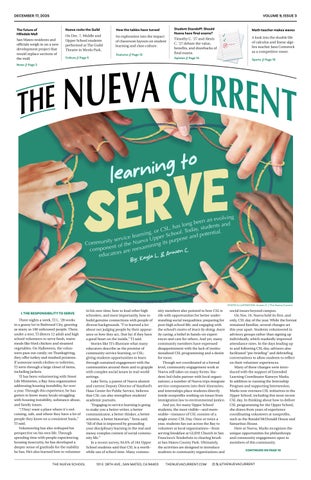
PHOTO ILLUSTRATION: Anwen C. / The Nueva Current
I. THE RESPONSIBILITY TO SERVE Three nights a week, TJ L. ’28 works in a grassy lot in Redwood City, greeting as many as 100 unhoused people. There, under a tent, TJ directs 12 adult and high school volunteers to serve fresh, warm meals like fried chicken and steamed vegetables. On Halloween, the volunteers pass out candy; on Thanksgiving, they offer turkey and mashed potatoes. If someone needs clothes or toiletries, TJ sorts through a large closet of items, including jackets. TJ has been volunteering with Street Life Ministries, a Bay Area organization addressing housing instability, for over a year. Through this experience, he has gotten to know many locals struggling with housing instability, substance abuse, and family issues. “[They] want a place where it's welcoming, safe, and where they have a lot of people they know on a consistent basis,” TJ said. Volunteering has also reshaped his perspective on his own life. Through spending time with people experiencing housing insecurity, he has developed a deeper sense of gratitude for the stability he has. He’s also learned how to volunteer THE NUEVA SCHOOL
in his own time, how to lead other high schoolers, and most importantly, how to build genuine connections with people of diverse backgrounds. “I've learned a lot about not judging people by their appearance or how they act, [but by] if they have a good heart on the inside,” TJ said. Stories like TJ’s illustrate what many educators describe as the promise of community service learning, or CSL: giving students opportunities to learn through sustained engagement with the communities around them and to grapple with complex social issues in real-world settings. Luke Terra, a parent of Nueva alumni and current Deputy Director of Stanford’s Haas Center for Public Service, believes that CSL can also strengthen students’ academic pursuits. “Engaging in service learning is going to make you a better writer, a better communicator, a better thinker, a better scientist, a better historian,” Terra said. “All of that is improved by grounding your disciplinary learning in the real and messy complex context of social community life.” In a recent survey, 94.6% of 184 Upper School students said that CSL is a worthwhile use of school time. Many commu-
nity members also pointed to how CSL is rife with opportunities for better understanding social inequalities; preparing for post-high school life; and engaging with the school’s motto of learn by doing, learn by caring, a belief in hands-on experiences and care for others. And yet, many community members have expressed disappointment with the lack of institutionalized CSL programming and a desire for more. Though not coordinated at a formal level, community engagement work at Nueva still takes on many forms. Student-led clubs partner with local organizations; a number of Nueva trips integrate service components into their itineraries; and internships place students directly inside nonprofits working on issues from immigration law to environmental justice. And yet, for many Upper School students, the most visible—and memorable—instance of CSL consists of a single event: CSL Day. Once or twice a year, students fan out across the Bay to volunteer at local organizations—from serving breakfast at GLIDE Church in San Francisco’s Tenderloin to clearing brush at San Mateo County Park. Ultimately, the activities are designed to introduce students to community organizations and
131 E. 28TH AVE., SAN MATEO, CA 9��03
THENUEVACURRENT.COM
social issues beyond campus. On Nov. 19, Nueva held its first, and only, CSL day of the year. While the format remained familiar, several changes set this year apart. Students volunteered in advisory groups rather than signing up individually, which markedly improved attendance rates. In the days leading up to and following CSL day, advisors also facilitated “pre-briefing” and debriefing conversations to allow students to reflect on their volunteer experiences. Many of these changes were introduced with the support of Extended Learning Coordinator Kamryn Marks. In addition to running the Internship Program and supporting Intersession, Marks now oversees CSL initiatives in the Upper School, including this most recent CSL day. In thinking about how to deliver CSL programming for the Upper School, she draws from years of experience coordinating volunteers at nonprofits, such as the Ronald McDonald House and Samaritan House. Here at Nueva, Marks recognizes the unique opportunities for philanthropy and community engagement open to members of this community. CONTINUED ON PAGE 10
@THENUEVACURRENT
P2
|
NEWS
DECEMBER 17, 2025
|
VOLUME 9, ISSUE 3
|
Conflict in the Caribbean The United States has ramped up military action off the coast of Venezuela in recent weeks. On Dec. 12, the President refused to rule out land operations.
WWW.THENUEVACURRENT.COM
|
THE NUEVA CURRENT
Quoted: “We see our landscape changing, and our city changing, and we too will need to change with it.” —Adam Loraine, Mayor of San Mateo
By the Numbers REPORTING BY ELLIE L.
PHOTOS: Hillsdale Reimagined / Bohannon Companies
200 rivets in the First Robotics Competition team’s robot, which was demonstrated to prospective students of all ages in admissions event Student Life Night on Dec. 4.
400+ 400+ pounds of food raised by Science Club in partnership with Second Harvest in a fundraiser Nov. 20-21.
80 gingerbread houses made by cross-grade advisory groups in a bonding activity organized by the Council on Intergrade Advisory on Dec. 10.
12 Santa hats used in a hat-snatching competition during the Dec. 3 Student Council spirit assembly. For both rounds, seniors were the last ones standing, having grabbed all their competitor’s hats. PHOTOS: Ellie L. / The Nueva Current, Freepik
Reimagining Retail at Hillsdale Mall Big changes are expected to take place at San Mateo’s Hillsdale Mall in the coming years STORY BY AVIVA S.
New clothes, friends, and the sweet taste of boba tea—all things the Hillsdale Mall has offered Nueva students and the surrounding San Mateo community for years. Students seek out the buzz and social energy of the mall, just half a mile away from campus, for anything from an after-school Starbucks trip to a full-blown shopping spree. But what if that buzz slowly died out? Bohannon Companies, a local developer, has undertaken the task of revamping the Hillsdale Mall—a project expected to take around 20 years to complete. The project, titled Hillsdale Reimagined, aims to create a neighborhood of “unparalleled quality,” according to the plan’s website,
to see it [be] the best it can be. And it's nowhere close to that right now.” The local community is also concerned by the estimated length of the project. The original plans for the Bay Meadows development gave a 20-year timeline for completion; however, after 20 years, the project still continues, with several blocks remaining incomplete. Residents of the area worry that the mall redevelopment will hit the same hurdles that occurred with the Bay Meadows development. Residents also shared concerns over traffic and the loss of community staples such as the Trader Joe’s grocery store. “All my neighbors walk to Trader Joe's, and nobody wants to see that replaced with another high-end grocery store,”
Before and After The Hillsdale Mall's current layout pictured left, the proposed layout pictured right. // PHOTOS: Hillsdale Reimagined / Bohannon Companies
as well as a hub for increased housing opportunities, and retail and outdoor spaces. While the final development application is expected to contain a few minor changes, the current proposal for redevelopment seems to already be in play. The plan entails the construction of several 10-story high-rise buildings, packed with office space. The proposed amount of retail opportunities is also much lower than what the mall currently offers. The renderings appear to provide the minimal amount of housing required to qualify for a density bonus with the city, much to the disappointment of many current residents. “I think the community is really concerned that this is not what we envision for our [future],” Dana Sahae said. Sahae is a representative of Checkpoint Hillsdale, a community watchdog group that has voiced concerns over the proposed redevelopment of the mall. “I understand that this project will happen, but I want
Sahae said. Loss of tax revenue from the current volume of stores is another point of worry: “You have to wonder how the city is going to make that up in the future,” Sahae said. During the Nov. 3 City Council meeting, the city addressed residents’ worries about the proposed redevelopment. Commencing with an explanation from a representative of Bohannon, council members and residents were able to voice their questions and concerns. While many attendees aligned with Checkpoint Hillsdale's opposition, others expressed alternative viewpoints and considerations. “This project will give trades like mine stable work to continue to provide for our families,” said Juan Valesco, a San Mateo resident who works in construction. Other participants agreed with Valesco, urging the city to utilize this plan to further “invest in the working class of the City of San Mateo.”
Many residents shared that they were looking forward to the affordable housing that the plan promises, and they encouraged the City and developers to keep that promise of accessible housing for the whole community. Bohannon also sought to address concerns about a massive construction project’s impact along the busy streets of San Mateo. They proposed a continuous multistep ‘phasing’ plan for the project. The plan consists of several demolition and construction sets, beginning with the destruction of the parking structures lining Edison Street and the side of Guitar Center. The demolition would then be followed by the construction of several townhomes, marking the beginning of the long construction process. The phasing will continue throughout the project in order to address concerns of San Mateo city residents, among others, who frequent the area. Bohannon’s second ‘phase’ proposes the demolition of the southern end of the mall, which would include a large portion of the current retail space. This section of demolition would then pause after the deconstruction of infrastructure currently closest to the dining terrace. This part of the mall would then be replaced by more residential infrastructure. The ‘phasing’ proposition intends to gradually demolish the current mall and implement more housing along with retail and several office-oriented high-rise buildings. “We will do our best to see that this project is the best it can be for our city,” said Adam Loraine, Mayor of San Mateo. “I also ask for some open-mindedness on the change that a project like this could bring to our city. We see our landscape changing, and our city changing, and we too will need to change with it.” The meeting concluded with San Mateo City Council Member, Rob Newsom Jr., urging Bohannon Companies to, within the best of their ability, “give back to the community.” The only expected additions to the current project plan are responses to concerns raised around traffic, access to first response, and other vital infrastructure needs. However, the development of this conversation among City Council members, San Mateo residents, Hillsdale mall frequenters, and the Bohannon group is expected to continue until the plans are finalized.
THE NUEVA CURRENT
|
DECEMBER 17, 202�
|
Trump Blocks AI Regulations The President signed an executive order on Dec. 11 requiring a single “federal framework” for AI, overriding existing regulations by state governments.
VOLUME 9, ISSUE 3
|
WWW.THENUEVACURRENT.COM
Quoted: "“Even after putting the bins out, I have to ask students to take the dishes left near the bins and put them in. I’m kind of numb to it now, but people aren't." —Jackee Bruno, US Dean of Students
|
P3
NEWS
New return carts introduced to mitigate dirty dishes issue PHOTO: Eduardo Munoz / Reuters
ANALYSIS
Clean Energy For Who? Understanding the Genesis Mission STORY BY ALVIN Y. AND KAYLA L.
On Nov. 24, the Trump administration launched the “Genesis Mission,” an initiative to bolster artificial intelligence (AI) infrastructure and research. According to the White House website, Energy Secretary Chris Wright will be responsible for developing an “integrated AI platform” for “pressing national challenges,” in particular furthering development of nuclear fission and fusion energy. Project Genesis’ dedication of federal resources toward nuclear energy is a sharp turn from the Trump administration’s historic prioritization of oil and gas. By invoking the National Emergencies Act to declare the first “national energy emergency” in history, Trump gave himself the power to suspend certain environmental regulations and reopen fossil fuel projects. Simultaneously, the administration has cancelled $7.6 billion in funding for hydropower, solar, and wind projects. In this issue’s A Fuller Picture column, we investigate the importance of nuclear energy and its ties to the AI industry. Environmental experts often disagree on the role of nuclear energy in a green energy transition: while some want to focus on 100% renewable energy, such as wind and solar, others think nuclear projects are an essential component. Already providing almost 20% of total American energy output, nuclear energy in the U.S. boasts a 90% capacity factor, making it the most efficient energy source in the U.S. today. Project Genesis intends to expand the current nuclear output from 100 GW (gigawatts) to 400 GW by 2050, one of the largest energy expansions in American history. However, nuclear energy remains one of the most expensive energy sources to build from scratch. The cost to build new nuclear power generation is more than $7,000 per kilowatt-hour, substantially more than any other energy source. For example, two new plants in Georgia, whose construction was completed in 2024, cost over $36 billion, which was nearly $18 billion over the original budget. But for tech giants including Amazon, Google, Meta, and Microsoft, nuclear energy is the ideal method of powering the large data centers. AI development has led to a surge in energy demand for data centers, even as companies promise to go net-zero in carbon emissions. As a result, tech giants have already begun the transition to nuclear energy. Amazon has been powering their $650 million data center with the nearby Susquehanna Steam Electric Station, the largest operating nuclear plant in the United States. Meanwhile, OpenAI CEO Sam Altman, in 2021, invested $375 million into Helion Energies, a company dedicated to building the world’s first fusion power plant. Trump’s nuclear pivot and Big Tech’s energy scramble suggests that the future of clean energy will not be decided by climate summits so much as by corporations and their political allies. As AI reshapes priorities, the Genesis Mission’s real test is whether its development will extend beyond the needs of powerful corporations to the broader aim of a national low-carbon power grid.
As plates and cups left around campus after school continue to pile up, community members are disappointed STORY BY ELLIE L.
In response to the ongoing issue of dirty dishes being left around school after lunch, Dean of Students Jackee Bruno introduced new dish return carts for students directly after Thanksgiving Break. The carts, placed on the first and second floor with bins for students to return their dishes, utensils, and cups, are the latest of Bruno’s efforts to address the problem and followed a division-wide email on Nov. 19 that called for student accountability. “I am offering another chance. And yes, I’m angry. Because it’s not just about mess, it’s about respect. For this space. For the people who maintain it. For each other,” Bruno wrote emphatically in the email. “Let’s see if we can leave this place better after lunch than we found it.” History teacher Tom Dorrance characterized the email as a crucial reset for the student body. “It’s important to know the expectations of being a part of this community,” Dorrance said. “Cleaning up after yourself is a pretty baseline and acceptable expectation.” Arisa A. ’29 was not surprised to receive the Nov. 19 email, having seen the mess around school within her first semester at the high school. Though she sees the carts as progress, she does not expect them to fully solve the problem. “We do possess the ability to be responsible, but I think there needs to be something to help us get back on track, that can be taken away once everyone’s being responsible,” Arisa said. She suggested disciplinary action as a next possible step. Since Bruno’s first year at Nueva in 2022, he has tried out a variety of tactics to address the post-lunch mess. These have included bans on eating outside or on couches, disciplinary dishwashing for repeat culprits, and consistent
reminders for students to clean up after themselves. In total, he has sent 16 emails to the student body about abandoned dishes. Bruno initially took action after re-
“
WHEN I FIND FULL PLATES OF FOOD LEFT IN COMMON SPACES, BOWLS OF SOUP SHOVED UNDER COUCHES, TRASH ON THE FLOOR, OR DISHES LEFT IN BATHROOMS, IT DOESN’T FEEL LIKE PARTNERSHIP. IT FEELS LIKE DISREGARD. ceiving photo after photo from teachers of dishes left around campus—from the café tables, to foosball tables, to at one point, a toilet seat. The operations team and adults were constantly left to pick up the mess. Near the end of his first semester, Bruno sent out a division-wide email imploring students to clean up after themselves. At first, the message seemed to work. The beginning of the new semester seemed like a fresh start: he saw fewer and fewer plates each day. But two months later, the problem returned, with dirty dishes once again piling up around campus. Three years on, Bruno remains determined to solve the issue. Beyond keeping the campus clean, he hopes to spare staff the extra energy on cleaning and reduce the thousands of dollars the school is billed each year for missing silverware and dishes, some of which end up in the trash. Still, Bruno continues to notice the same pattern in response to his various efforts: each new solution brings a short period of improvement, followed by a disappointing return to the sight of dishes and silverware strewn all over campus. “Even after putting the [dish] bins out, I have to ask students to take the dishes left near the bins and put them in. I’m kind of numb to it now, but people aren't,” Bruno said. “For example, the admissions team shouldn’t have to walk the halls to pick up plates before tours. Currently, that's their practice, and that's sad. I feel like I owe them better.” In particular, he continues to be frustrated with the
general lack of change amongst the students. “[Students are] given real privileges at Nueva. You’re trusted with open space, flexible learning, and a culture where you are encouraged to call adults by first names and invited into real partnership. These things exist because we believe you can handle them,” Bruno said. “So when I find full plates of food left in common spaces, bowls of soup shoved under couches, trash on the floor, or dishes left in bathrooms, it doesn’t feel like partnership. It feels like disregard.” His dissatisfaction is shared by students across multiple grades. Since her freshman year, Agata I. ’26 has seen the issue persist without any tangible shift amongst the students. “I think it’s terrible that we leave out dishes all the time. We’re high schoolers—we’re old enough to pick up after ourselves,” Agata said. Hayes S. ’27 similarly described a lack of proper prioritization or care amongst students, which he has seen extended to food waste and trash sorting at Nueva. As a member of the Environmentalism Club’s food waste committee, he intends to establish a better composting system and a food
Cart Patrol New dish return carts have been installed around campus // PHOTO: Ellie Lin / The Nueva Current
waste tracker next semester. For dirty dishes, though, he is adamant that this is squarely an issue of student responsibility. “Sometimes people are very busy at lunch, to a point where it’s a rush to eat as quickly as possible, and putting away your plate becomes a second priority,” Hayes said. “As a community, we need to start working on that because there really isn't a change being made at the moment.” Maddy S. ’28 believes she has begun to see this change with the new carts. “I feel like with the carts being more local to where everyone eats, it's more convenient. It would make less sense if you left something out because the carts are two steps away,” Maddy said. “So yes, I feel like we are making that change. And hopefully we continue to bring that into the rest of the year, and for the rest of high school.”
Dirty Dishes Abandoned cups, bowls, and plates have become a common sight after lunchtime // PHOTO: Ellie L. / The Nueva Current
P4
|
NEWS
DECEMBER 17, 202�
|
VOLUME 9, ISSUE 3
|
Remembering a San Francisco Legend The California Academy of Science’s beloved albino alligator, Claude, passed away on Dec. 2.
WWW.THENUEVACURRENT.COM
|
THE NUEVA CURRENT
The Hard Conversations Read more about Nueva’s culture towards civil discourse in Oliver Leung’s opinion. Page 14
Students raise funds for Second Harvest CSL and Food Science clubs led fundraisers as SNAP cuts increase local need STORY BY NATALIA R.
Two student groups organized on-campus food drives in late November to support the nonprofit organization Second Harvest of Silicon Valley. The Community Service Learning (CSL) Club and Food Science Club were responding to recent reductions to federal SNAP (Supplemental Nutrition Assistance Program) benefits and a rising number of local families experiencing food insecurity. The CSL Club chose to support Second Harvest after researching the organization and its mission. Second Harvest is a regional food bank that distributes food through local partner agencies across Santa Clara and San Mateo counties. The organization serves around 500,000 people in Silicon Valley each month, including families affected by recent SNAP benefit cuts. “We narrowed it down to some organizations that were specifically also helping people who get SNAP benefits and were affected by cuts,” said CSL Club member Langley V. ’28. “We determined that [Second Harvest] would be a good place to send the money that we would make from the bake sale.” Second Harvest estimates that every
Cocoa for a Cause CSL club members making and selling hot chocolate to raise money for Second Harvest. // PHOTO: Aerie L. / The Nueva School
donated dollar helps provide roughly two meals to the community, a figure CSL Club members said helped ensure their fundraising would translate into direct, tangible support. The club held a hot chocolate sale on Nov. 20 and a bake sale on Nov. 21, offering brookies, rice crispy treats, and cookies. The CSL Club also ran a breakfast food drive in partnership with Samaritan
House, a local organization that provides food programs, shelter, and social services to families in need. The partnership grew out of previous CSL Day collaborations, which made it easier for the club to coordinate the drive with Samaritan House. “Continuing to foster those connections is really important, and it makes it a lot more accessible to plan,” said CSL Club co-lead Meera N. '27.
Separately, the Food Science Club conducted its own Second Harvest food drive on Nov. 20–21, collaborating with the Castilleja School’s Hope Against Hunger club. “We both mutually chose Second Harvest,” said Food Science Club lead Talia F. ’27. “Together we ended up raising over 400 pounds of food.” Fine described the timing—before Thanksgiving—as added motivation to aid families experiencing food insecurity. “Not having the option to have food at that kind of event is a very harsh reality. We wanted to at least relieve families a little bit,” Talia said. She also emphasized the broader role of nutrition in daily life. “Having food as fuel is really important. Everybody should have access to what they need to support themselves,” Talia said. Because hunger is a year-round problem, both clubs highlighted the persistence of the issue beyond the holidays. “Food insecurity is never going to not be an issue for some people,” Langley said. The groups expect to maintain their partnership with Second Harvest and other local organizations as part of an ongoing commitment to community support.
Nueva hosts civil discourse practicum sessions Half-hour practicums led by students and faculty explore controversial topics in discussion STORY BY SENYA S.
In a continued effort to provide opportunities for civil discourse at Nueva, the history department and school administration collaborated to facilitate half-hour civil discourse practicum sessions on Nov. 13. Hosted by both students and faculty, the 14 practicums covered a variety of topics, ranging from the “History of Palestinian Statehood” to “Designer Babies: Bioethics in the Age of CRISPR.” “The idea was to actually have practice in engaging in controversial topics and topics that maybe are going to have different opinions within the room,” said Simon Brown, chair of the history department. “Last year, we had a lot of discussion about the idea of civil discourse and how important it is, but it stayed pretty abstract, and what we wanted to do this year was actually do it.” Brown co-hosted a practicum with fellow history teacher Tom Dorrance on “Israel and Palestine in the 20th Century.” The session began with students writing questions they had about the topic on notecards, after which Brown and Dorrance gave a brief overview of the history, striving to answer some of the notecards in the process. The practicum ended with time for students to talk amongst themselves about overlaps between the history of the conflict in Israel and Palestine and other histories of the 20th century. “A big insight I gained from the session was that students came with specific questions that showed familiarity,” Brown said. “I think that that might inform how I would want to have sessions like this next semester.” Other practicums took a more conver-
sational approach. Upper School academic support coach Gretchen Kellough, who has led multiple Nueva trips including the 10th grade trip to Kauai, offered a session exploring the question, “Should Nueva travel to places with a history of American imperialism?” She sought to foster open discussion around Nueva’s 10th-grade curriculum, in which students learn about the imperialist implications of tourism in Hawaii before travelling there. “I think nearly everyone contributed in some way,” Kellough said. “I didn't feel like people were complaining just to vent. It felt like people were really trying to grapple with the topic in ways that I thought were helpful.” The student-led practicum “American Polarization: Political Violence and Political Discourse on Abortion” was similarly discussion-based. Ava J.ʼ'26, along with other members of Nueva’s Ethics Bowl team, worked with Philosophy of Consciousness teacher Lee Holtzman to craft the session. “[In our practicum] we talked about political violence and abortion, and we were ultimately aiming to answer the question of when it's okay to take someone's life,” Ava said. Ava's experience hosting the practicum challenged her preexisting notions about the diversity of viewpoints at Nueva. “It made me consider my own assumptions about our student body, and it helped me realize that people have stuff to say and that when you're not really given these kinds of spaces to be able to share your viewpoint, it might get lost,” Ava said. “I thought it was cool to hear
new voices from people that I've never even spoken to before.” While the practicums gave students a space to engage in civil discourse at Nueva, it was often a struggle to fully dive into the often contentious topics within the provided window.
“It's hard to have a good, productive discussion without a little bit more time than we had in one 30-minute session,” Brown said. Additional civil discourse practicums are being planned for the spring to continue these conversations.
ART: Senya S. / The Nueva Current
THE NUEVA CURRENT
|
DECEMBER 17, 202�
Dec. 22: Live Jazz Nueva students will perform a jazz-fusion set at Cuban Kitchen in San Mateo from 6 to 8 p.m.
|
VOLUME 9, ISSUE 3
|
WWW.THENUEVACURRENT.COM
Marty Supreme Josh Safdie’s drama featuring Timothée Chalamet follows a table tennis player’s journey in pursuing his dreams and releases on Dec. 25.
P�
|
CULTURE
Pop Culture Senior writes score for locally-produced film In her debut film composition, Andromeda W. ’26 brings personal and emotional depth to Thermometer the music On a scale from freezing to blazing hot, here's the latest in pop culture STORY BY CALLUM SCHEIN
BLAZING HOT: BEYONCÉ TO COHOST 2026 MET GALA The Met Gala has proven it doesn't need more celebrities, it needs more taste—Beyonce brings both. After more than a decade off the Met’s steps, her return comes at a moment when the event has been missing hosts with real cultural weight. Pair her with Nicole Kidman and Venus Williams, and suddenly the tired fundraiser is worth paying attention to.
PHOTO: Getty Images
WARM: 2025 SPOTIFY WRAPPED After last year's sloppy AI-centric mess, Spotify Wrapped returned the features that we actually want: real stats, genres, top albums, and the new “listening age” feature. It’s addictive and designed to let us obsess over our own taste, proving that their original formula works. Before it disappears from your feed, go out, share your Spotify Wrapped, and be smug about it. PHOTO: Spotify
COLD: "THE ARCHITECTS OF AI" ARE TIME'S PERSON OF THE YEAR Sure, the “Architects of AI” are undeniably influential. But for Time to parody the legendary Lunch Atop a Skyscraper to frame AI founders as heroic builders is deeply off-putting. They took an image that once represented ordinary workers and repurposed it to promote a system designed to replace those same PHOTO: Jason workers. It Seiler / TIME turns a technology that many people already distrust into a victory image that it hasn’t earned, leaving an unnerving effect, not a celebratory one. FREEZING: NETFLIX TO BUY WARNER BROS Enjoy going to the movie theater? With Netflix moving forward on an $83 billion acquisition of Warner Bros. and HBO, it's time to panic. Netflix has been open about seeing theatrical releases as unnecessary and outdated, favoring efficiency and short windows over industry stability. Opportunities and pay for the real creatives who carry the industry on their backs have shrunk, while those embedded within Netflix’s corporate hierarchy thrive. This deal modernizes cinema for the absolute worst.
STORY BY SENNA HONG
At the heart of The Vale - Origins, an animated action short film centered on a Silicon Valley family navigating grief with a virtual world, is a score designed to support the story. Starring Robert Palmer Watkins, Egan Xander, and Grammy-nominated Tony Award winner Lea Salonga, the film serves as a prequel to The Vale, a novel about the 13-year-old son who begins to encounter glitches in his AI-generated virtual world. All of the music—10 minutes of the 13 minute film—was composed and directed by Andromeda W. ’26, who has been composing since she was four. “[Composition is] always something that's been at the center of what I do as a musician,” Andromeda said. Andromeda, who has been improvising music since early childhood, was recruited to compose the score by her mother, Abigail Hing Wen, the film’s director. “[The Vale] is close to my heart, because it was a novel she wrote when I was in middle school—one that I read all the early drafts of,” Andromeda said. “Now, I get to actually be a contributor on the project, which is really fun.” Between November of 2024 and the following summer, Andromeda composed 12 cues, or pieces of music. Her process began at the piano, improvising while watching scenes unfold onscreen. “Usually around 90% of it is completely unusable,” Andromeda said. “So I spend some time finding my favorite pieces of that, and then [use] those to arrange it with the picture.” From those fragments, Andromeda gradually incorporated other instruments, including many that she plays herself: saxophone, piano, clarinet, drums, and bass.
Fine-Tuning Wen's setup as she works. // PHOTO: Andromeda W.
When selecting which instruments to use for which song, she was careful to choose sounds that wouldn’t overwhelm the film. For example, for one song, she combined digital string instruments, piano she recorded herself, and one live oboe player. “The goal is not to dominate the scene, but support and bring out the emotions I see on screen,” she said. That emotional focus guided the entire score. “[The film’s] fundamentally a story about healing and coming back together. So, that is the goal of the music, such that when someone listens to it without the context of the film, there would be a reasonable chance that they might say the same things to describe it,” she said. After revisions, Andromeda worked with main post-producer Spencer Patzman—an industry native with experience with Chlöe, Beyoncé, and Adidas. Along the way, Andromeda also had the opportunity to work with actress Lea Salonga on the end credit song, who recorded the vocals over Zoom from a studio in New York. After just two takes, the final version was complete. Beyond just the technical challenge, Andromeda says that the
project has reshaped the way she thinks about composition. “It’s very different to think about the emotional core as the first part rather than an emergent property of the music. With film, the emotion has to come first,” Andromeda said. “[When I’m composing,] I’m trying to get at the emotions that aren’t on screen. Focusing on that as the core of the music was really interesting and a different way of thinking.” Though The Vale - Origins marks her first film score, Andromeda doesn’t believe it will be her last. Whether she’s writing for a classical concert or the bustle of the film industry, she’s eager to keep exploring how music can shape and deepen storytelling. All That Jazz Andromeda plays the saxophone at the Nueva concert at the Guild. // PHOTO: Robert Evans
Nueva Rocks the Guild Middle and Upper School student bands joined together to perform music STORY BY ALEXIS CHOI
On Dec. 7, Upper School and Middle School students performed at The Guild Theatre in Menlo Park. 120 students from 25 bands performed over the course of two sets, ranging from electives like Groove Workshop or Jazz Band to student-run bands such as Revolve or the Ultra Glazed Doughnuts. The Guild Theatre was originally built as a movie theater in 1926, before recently converting into a music venue and club in 2022. Inspired by his experience performing
at The Guild with his own ’80s cover band, Tainted Love, Middle and Upper School music teacher Jason Muscat started the tradition of a student show three years ago. “The first time I played there, I was just in awe of [the place],” Muscat said. “It was beautiful, [...] and I just had a vision that this could really rock as a concert.” Students’ hard work for The Guild performance begins months prior to December; in Groove Workshop alone, student bands practiced these songs through the entire semester. Among these bands is Sophia L. ’31’s Daydream. Sophia felt confident about the band’s performance, being their third show at The Guild. “This year was definitely our best, because we've all improved,” said Sophia. An all-student stage crew managed the green room while parent volunteers organized logistics and set up the snacks. When not performing, students were able to stand in the orchestra pit alongside their friends and family. “My favorite part was seeing the young-
PHOTO: noah nomlee / nomlee
Six Corners Molly S. and Elie W. perform a cover of Angry Young Man by Billie Joel with their Groove Workshop band. // PHOTO: Robert Evans
er kids play, because it was so wholesome,” Maia M. ’27 said. “It reminded me of when I was the younger kid, watching the older kids.” Muscat, along with fellow music teachers Jim Munzenrider, Matthew Germano, and Josh Charney, devotes himself each year to this performance. “Producing a show like this is a monumental undertaking that requires an unbelievable amount of planning and preparation,” Muscat said.
P6
|
DECEMBER 17, 202�
CULTURE
|
VOLUME 9, ISSUE 3
|
Avatar: Fire & Ash The highly-awaited third installment in the Avatar series will be coming to theaters on Friday Dec. 19.
WWW.THENUEVACURRENT.COM
|
THE NUEVA CURRENT
Morgan Wallen’s With Heaven on Top The country singer’s sixth studio album releases on Jan. 9.
Behind the Magic of A Midsummer Night’s Dream A backstage look at the people and process that brought Nueva’s fall play to life STORY BY VEDA P.
On the night before dress rehearsal, the Hillsborough campus gym looked like a hurricane had just swept through. Actors in full makeup sat cross-legged on the stairs eating sandwiches. A cast member sprinted across the gym, getting mic’d with only the bottom half of their costume one. Garlands of flowers lay tangled across the floor, glitter clung stubbornly to the blue tarp, and a white wooden arch leaned against the wall. Tech students hurried across the stage, moving set pieces and calling out notes as they worked. Then, the cast gathered in a circle onstage. “Midsummer!” they shouted together—loud, earnest, and focused in the way people get when they know exactly how much work they’ve put in. This was the world behind the Upper School’s production of Shakespeare’s A Midsummer Night’s Dream. The fall play ran from Friday, Dec. 5, to Sunday, Dec. 7. Set between Athens and the forest beyond it, it follows lovers who fall in and out of love with each other, fairies who interfere for their own amusement, and a group of amateur actors (“mechanicals”) attempting to stage a play. As spells are cast and plans unravel, characters make impulsive choices that send the story spiraling. Director Zoe Swenson-Graham described the play as “joyful and light,” a mood that was woven into every corner of the production: flower-draped balconies, a warm, fairy-lit forest, and the contrast between Athens’ rigid formality and the softness of the woods. Set and costume designer Zach Isen’s work
brought that vision to life through fabric choices, painted textures, careful set dressing, making the world onstage feel effortless. During rehearsal, the two directors moved like a practiced system. Swenson-Graham handled blocking and tone, while Isen stabilized everything around it—cues, props, costume adjustments, and last-minute fixes. But even in the rush of tech week, both remained remarkably calm. Their measured approach set the tone for the room and made taking risks feel safe. “I’ve never felt scared to try something,” Jackson N. ’29 noted. “I think that’s a really important factor to me experimenting.” That welcoming culture was amplified within the cast. With only 12 members, everyone had more chances to actually get to know each other. “I’ve never done Nueva theater before but I really feel like a part of the community now. Everyone’s so welcoming,” Elyse D. ’29 said. Huxley E.‘29 echoed that sentiment: “In bigger casts, I don’t even know everyone’s names. Here, I’ve gotten to know, and honestly love, every single person.” That closeness showed up in the smallest moments: spoon-feeding each other Smarties while doing makeup, the Italian run where everyone lost it, the 10-foot trains on Titania and Oberon’s costumes tripping people up backstage. Tech week, notorious for exhaustion, somehow felt lighter. “The community made it so much less tiring than I thought it was going to be,” Elyse commented. Despite the jokes and rituals, the work was serious. Once rehearsal began, the
Locked In on Love Emily M. '26 (Helena) and Isaac B. '26 (Demetrius), share a heartfelt, comedic moment onstage. // PHOTO: Oscar Lopez
cast snapped into focus. In Shakespeare, every word, rhythm, and pause can matter and be imbued with meaning. The cast unpacked the text through dramaturgy packets, modern translations, and iambic pentameter lessons. Blocking and physicality became just as important as the language itself. Understanding their characters required equal effort. Elyse spoke about playing Starveling as the Wall in the playwithin-a-play, explaining that her performance was intentionally flat because “[Starveling] is really bad at acting.” It was a choice she refined carefully to make the humor land. For Oliver R. ‘29, his Puck only fully came together through physicality. “He’s a little gremlin,” Oliver said. “He
loves messing with mortals. But he also uses Oberon as an escape route—like ‘don’t touch me, I know Oberon.’” When the lights rose on Athens on opening night, the cast settled fully into the world they had built. Oliver darted across the stage with restless, mischievous energy. The lovers threw themselves into their argument with total commitment. Titania and Oberon commanded the space, their ornate costumes amplifying their power. The mechanicals wrung every possible laugh from their scenes. Kylie E.-M. ‘29, who played Titania and Hippolyta, aptly summarized the experience. “There are so many interpretations of Shakespeare,” she said. “It’s a beautiful piece of art, and it’s [been] really fun to get to experience and play around with it.”
What to do this winter break
Not sure what to do over the holidays? Our field guide has you covered. STORY BY NEEL G.
Visit: The Bay Area’s first-ever Bunny Cafe
Bake: Ina Garten’s brownie pudding
Explore: Filoli Gardens
Do: Clean out your closet
The Bay Area’s first ever Bunny Cafe will open on 1327 Columbus Ave, San Francisco, on Dec. 21. While playing with these furry bundles of joy, you can indulge in grab n’ go locally supplied coffee, fruits and vegetables, pastries, and instant ramen. Their bunnies are also adoptable with a 150$ fee and a free starter pack after passing an interview stage. A share of all proceeds will be donated to local bunny rescue organizations along with other charities.
This gooey, rich, addicting dish has taken the internet by storm—and for good reason. The perfect marriage between a pudding and brownie, Ina Garten’s viral dessert is a must-try for bakers and chocolate lovers. While it’s often described as an undercooked brownie, her creation is more than you could ever imagine. From the crusted shell, to its molten center and topped with ice cream, this brownie pudding is worth every second of its 60 minute bake time.
If you’re looking for a festive yet quiet activity to spend this holiday season, look no further than Filoli Gardens. The iconic Woodside landmark offers breathtaking views and, for a limited time, enchanting gardens full of holiday cheer. Open until Jan. 11, visitors can immerse themselves in three mesmerizing experiences: the Thystlewyck village, Gilded winter garden tour, and their colorful Holiday Lights exhibition during the Night Garden.
To start off the new year on a fresh start, clean out your closet’s clutter! If you’re guilty of hoarding clothes you no longer use (I know I am), consider giving them a second life for people who can’t afford them otherwise; people are especially in need of new clothes during the cold holiday season. Instead of donating to large chains like Goodwill, look for transparent local charities that directly impact your community—like St. Anthony’s in San Francisco. PHOTOS: Bunny Cafe San Francisco, AllRecipes, Secret San Francisco, Adobe Stock
THE NUEVA CURRENT
|
DECEMBER 17, 202�
Your teachers’ year in music, uncovered From Billboard hits to indie bands, let’s take a look at what your teachers listened to in 2025. Page 17
|
VOLUME 9, ISSUE 3
|
WWW.THENUEVACURRENT.COM
Stranger Things Volume II the highly anticipated second half of Stranger Things’ final season comes out soon, with three episodes releasing on Dec. 25 and the finale on Jan 1.
|
P7
Culture
In Review Students review new releases in theaters and TV. Wicked: For Good
Stranger Things
Hamnet
REVIEW BY SENYA S.
REVIEW BY VEDA P.
REVIEW BY ELLIE L.
As an avid musical fan, it’s miraculous how I was never exposed to Wicked before the release of its first movie adaptation a year ago. It’s safe to say I left the theater with a new obsession. The acting, music, and design of act I were incredible, and its brutal cliffhanger left me overeager for the sequel film’s release. So eager, in fact, that I spoiled the entirety of Wicked act II for myself and quickly realized a fact Wicked fans know all too well: the plot of Wicked’s second act is a lot weaker than its first. If your only exposure to the franchise was the first movie and you expected a sequel of the same quality, you might be disappointed at Wicked: For Good’s comparatively disjointed plot. Nevertheless, the film is still a worthwhile watch. At the end of the day Wicked: For Good was exactly what I expected: a faithful adaptation with some needed additions. One of the major changes in the film was to have Nessarose fly instead of walk, which aptly removed the ableist trope of magically “curing” characters of their disabilities. The film also introduced two original songs, both of which were good additions plot-wise but were unfortunately musically lackluster. In an interview with Entertainment Weekly, director Jon M. Chu said that “It’s about the girls, stupid” was an important principle that the filmmakers kept going back to when crafting the movie. Glinda was added to the song “Wonderful,” a number that was previously only between the Wizard and Elphaba. Though Fiyero’s arc was there, the movie was really centered around the female leads, ending with an especially heart-wrenching rendition of the titular song “For Good.” While I know Wicked: For Good is not for everyone, as someone who grew to love the Wicked franchise dearly because of the first movie, I am grateful to the sequel film for providing a satisfying—albeit devastating—ending.
Stranger Things season 5, Volume 1 doesn’t waste a second. Hawkins is collapsing, Vecna is regaining power, federal agents are sweeping through town, and Eleven’s powers are blocked by the military, leaving her vulnerable at a moment when the stakes could not be higher. But even amid the chaos, the season makes space for something quieter—and surprisingly profound. What struck me about the first volume of Season 5 was how fully the show committed to queer storytelling, giving its characters room to grow with honesty and tenderness. Will Byers (Noah Schnapp), long the emotional core of the show, takes center stage in a storyline that intertwines self-acceptance with literal power. His bond with Robin Buckley (Maya Hawke)—an unexpected queer mentor—becomes one of the season’s strongest elements. Their quiet conversations, rooted in validation and vulnerability, hit harder than any Demogorgon fight. Robin and Vickie’s relationship provides a counterweight: warm, stable queer joy in the midst of 1980s conservatism. Their presence teaches Will, and viewers, that queer love isn’t something to hide—it’s a strength. The season also deepens the tenderness between Will and his best friend and crush, Mike Wheeler (Finn Wolfhard). A playful nudge, a lingering look there, and Robin’s soft “oh” moment make it clear who Will loves—and that the show is guiding him toward a future where that love is reciprocated. The emotional payoff comes in Episode 4’s climactic battle, when Will channels telekinetic power rooted in memories he once felt ashamed of. He finally trusts himself. More than anything, Season 5 is a reminder that the show works best when it blends spectacle with heart. It’s beautifully written, wonderfully acted, and absolutely worth watching.
In Maggie O’Farrell’s novel Hamnet, there is a line that I have never been able to forget: “Every life has its kernel, its hub, its epicentre, from which everything flows out, to which everything returns.” O’Farrell reflects how moments, whether terrible or glorious, can define a life—an integral theme of the novel. For Will (an introspective, tender-hearted literary version of Shakespeare) and his wife Agnes, the crux of their lives become the death of their son, Hamnet. Both characters are irrevocably shaped in his image—Will, with his empty heart and an immortalized tribute to Hamnet in Hamlet, and Agnes, with her fury and loss of faith in her own mysticism. However, in Chloe Zhao’s film adaptation of the novel, also titled Hamnet, this theme, translated into a filmmaking approach, overtakes the movie. The beauty of moments is in knowing which one deserves more time and care. In the film, widely released on Dec. 5, many corresponding scenes of the first half are given the same relevance in the narrative. Audio and visual details overlap to string together a shaky sketch of the love between Paul Mescal’s Will and Jessie Buckley’s Agnes. The film is at its best when Zhao lets the camera simply sit, reverently tracing the fire’s light on Hamnet’s feverish skin and the tragedy in Buckley’s’ voice. The actors become pitch perfect in their subtlety—I was surprised by how real Mescal could make the Bard, and how utterly human Buckley made Agnes. With every guttural howl and shaky word, I began to care immensely for the couple, trying to understand who they are supposed to be in a world without Hamnet. Hamnet is ultimately worth a watch, and a film filled with excellent acting and emotion—that is, when it gives its actors enough space to simply tell the story.
COMMENTARY
The role of data in the dying art of hit-making The growing influence of streaming stats and data-driven strategies creates homogeneity in mainstream music STORY BY NEEL G.
Hit-making has created some of the most iconic and pivotal moments in the music industry. Hits define eras, cement the influence of artists, and shape pop culture. Today, however, many hits sound remarkably similar. Take Sabrina Carpenter’s Short n’ Sweet and Taylor Swift’s The Life of a Showgirl, for example: two chart-topping albums that, to many listeners, feel almost indistinguishable in style. The incentive to produce hits has long driven the music industry. Labels and artists seek commercial success—high revenue and mass streaming. In the past, music titans like Britney Spears or Elvis Presley mastered hit-making while retaining distinctive sounds that made their music memorable. Now, advancements in data-tracking technology and AI have added a new layer: formulas for predicting commercial success. Billboard charts, Spotify Wrapped, and streaming analytics all provide metrics that guide decisions
on what sounds will generate popularity. The result is an increasingly homogenous mainstream. When formulas dictate creativity, artists often prioritize replication over originality. According to a Harris Poll, 52% of listeners feel there is less variety in music today compared to previous decades. Similarly, a Rutgers study titled “Manufacturing Hits” found that machine learning algorithms which identify characteristics of popular songs tend to produce music that achieves higher commercial success and streaming numbers. These formulas have shaped much of contemporary music. Many mainstream songs follow predictable structures: upbeat verses leading into repetitive choruses, lyrics focused narrowly on love or attraction, and shallow ballads that claim depth but rarely exceed three minutes. Artists such as Sabrina Carpenter, Morgan Wallen, and Drake exemplify this trend, though they are far from the only ones. The obsession with charts reinforces this uniformity. Success is measured numerically, and commercial incentives often discourage risk-taking.
Once an artist secures a top streaming spot, maintaining it can mean producing more of the same rather than experimenting with new sounds. Both the music industry and our culture have an intense focus on tracking this data—which means we’re allowing charts and statistics to control the public’s perception of what successful music means. A prime example is Taylor Swift. Swift, arguably the most commercially successful artist of her generation, blocks the chart-success of other artists. She has repeatedly released multiple versions of her songs to extend chart longevity, sometimes coinciding with other artists’ releases.While claims that this “blocks” competitors can be overstated, the strategy illustrates how commercial considerations can shape music output, often prioritizing chart positions over innovation. All of Swift’s alternate versions were hardly different. Lesser-known artists with unconventional or experimental music face even greater barriers to recognition. Social media, particularly
TikTok, further intensifies formulaic production. Viral potential often dictates what songs are released, shifting focus from artistry to shareability. Prominent artists including Halsey, Florence + The Machine, Charli XCX, and FKA Twigs have expressed frustrations with public and label pressures to produce ‘TikTok music’ shifting the focus from their artistry to virality and easily-consumed content, effectively pushing the ‘TikTok’ formula. When data guides the music industry, we center materialist values as what makes art successful; music is degrading into a replicated formula, a commodified production, a lost art that sparks comparison and scrutiny—in all, a business more than art. We are neglecting the core aspects of music: passion, expression, authenticity, creativity, experimentation. Mainstream music
doesn’t leave room for good music. We don’t listen or create anymore, we track and replicate.
GRAPHIC: Neel G. / The Nueva Current
P8
|
FEATURES
DECEMBER 17, 202�
|
VOLUME 9, ISSUE 3
|
WWW.THENUEVACURRENT.COM
Jan. 6-10: Intersession Following winter break, students will dive into four days of workshops, field trips, and special programming. Offerings this year range from “Aerial Silks” to “The Art of Pasta Making.”
Religious students reflect on discussions of faith at a secular school When Ava T. ’28 came to Nueva from her small Christian middle school, the culture shift was palpable. Bible study, chapel, and prayer were no longer on the schedule, but religion hadn’t just left the classroom—it had largely disappeared from conversation as well. “It was kind of scary coming into a school that wasn’t religious. I didn’t know how people would take it,” Ava said. “At my old school, it was definitely a lot easier to openly talk about my religion. Here it’s something you have to be a lot more careful talking about.” In most parts of America, the presence of religion is never far from view. Even secular institutions, such as public schools, regularly interact with religion in their day-to-day operations. In recent years, however, these interactions have become increasingly politicized, with the growing influence of Christian nation- alism in particular placing new pressures on public school systems nationwide. According to a 2023 Gallup survey, 68% of Americans identify as Christian. Within the Nueva bubble, however, this national majority can feel like a minority position, and irreligiosity seems to be the norm. Overt references to Christianity are often avoided during the holidays; in past years, Upper School students have instead put up a “secular holiday shrub.” With religion less visible on campus, conversations about faith are rare both inside and outside the classroom. Even students who lead religious affinity groups share
that they seldom discuss their faith outside of those spaces. “We’re a secular institution. We don’t have a religion ingrained into our teachings,” said Ayaan M. ’26, lead of the Muslim Student Association. “I'm not bothered by that, but I think as a school we largely ignore religion.” For Noah L. ’28, who takes a strong personal interest in theology, discussions of religion with peers are more common. He characterized these conversations as rooted primarily in academic curiosity. “A lot of times we can still use the same analytical tools that we use in history class,” Noah said. “A lot of the people that I discuss religion with are able to adopt different perspectives in an academic sense: ‘how would this set of beliefs influence how one thinks about this other external belief?’”
“
"CHRISTIAN AFFINITY GROUP IS A WAY TO BRING THIS PART OF MY IDENTITY INTO THE WAY I INTERACT AT SCHOOL" Other religious students described a sense of stigma surrounding religion that makes open conversations more difficult. “I think there’s a lot of anti-religious sentiment, more than just an absence of religion,” Etienne Y. ’28 said. “There’s a lot of misconceptions about it [because] we don't talk about enough. People make a lot of dogmatic assertions about what religion is.” For some Christian students, these misconceptions come from an overgeneralized association between Christianity and conservative social views—such as opposition to homosexuality—that doesn't reflect their own beliefs. “People have these notions of what religion is like and means that come up in conversation,” Eli W. ’28 noted. “Do I really care enough that I want to argue against it? Do I really want to get into that? I just brush it off.” For Eli, joining the Christian Affinity Group helped her to discover a broader community of Christians at Nueva and challenge some of these assumptions. “I never talked about my own faith that much because of that strong association,” Eli said. “After I joined Christian Affinity Group, I [started to understand] that that is not the perception that everyone has of Christianity. There are many more people who are Christian than I actually thought there were at Nueva.” Etienne, Eli, and Noah co-lead the Christian Affinity Group (CAG), which meets twice a month on Tuesdays. In
ILLUSTRATION: Jackson H. / The Nueva Current
THE NUEVA CURRENT
Quoted: “I know for some people there is a fear of judgment when we get into the religious side.” —Ayaan M.
Sharing Their Faith STORY BY JACKSON H.
|
some ways, CAG mirrors elements of a church service—providing a space for fellowship, prayer, and occasional Bible study—while remaining a space driven by students rather than a pastor. “Going to church on Sunday before a full school week can feel like it separates my faith self from my school self,” Eli said. “[CAG] is a way to bring this part of my identity into the way I interact at school.” CAG is not the only religious affinity group on campus. The Muslim Student Association (MSA) and the Jewish Affinity Group (JAG) welcome students who practice those religions as well as those with cultural or familial ties. For JAG, the focus is primarily cultural. “We want to bring the Jewish community at Nueva together, and I think the best way to do that is through culture,” said Talia F. ’27, co-lead of JAG. “The community is religiously diverse, but we can all connect through culture.” Like other affinity groups, religious groups often help organize and host campus-wide holiday and cultural events. Because many holidays have religious origins, planning these assemblies and activities can involve walking a tightrope between the intimately tied subjects of religion and culture. When planning last year’s Ramadan assembly, the MSA considered incorporating more explicitly religious elements, such as a reading of an excerpt of the Quran. Ultimately, the group decided against it. “There was some hesitancy to do that, just because there was a fear of being outwardly religious at Nueva, given a lot of people here don’t really consider themselves religious,” Ayaan reflected. “I know for some people there is a fear of judgment when we get into the religious side.” This year, an assembly on winter holidays on Dec. 17 will include for the first time a presentation on Christmas from the Christian Affinity Group. “Christmas is viewed more secularly, and we’re trying to just show the Christian origins behind that,” Etienne said. For many religious students, however, faith is not limited to assemblies. It is something they carry with them throughout their daily life. “[My faith] is pretty intertwined with how I walk throughout my day,” Brayden D. ’27 said. “It allows me to be confident, to have that servant mindset, and to be happy.” Religious affinity groups have helped provide a place for their members to share and even expand their faith together. “Faith isn’t an easy path, and coming to this school has helped me realize that,” Ava said. “Growing our faith together through those challenges has been really helpful.”
Q&A: Art of Problem Solving Founder, Richard Rusczyk REPORTING BY PABLO Z.
PHOTO: National Math Camps
Years ago, Richard Rusczyk was interested in math—but at his high school, he was largely alone in that passion. With few classmates to share his interest, he turned to math competitions, which, as he soon discovered, had done more to prepare him than anything else. Rusczyk ended up founding Art of Problem Solving (AoPS), an enrichment program and company dedicated to providing innovative and engaging curricula and support to avid math learners at all ages. WHY DID YOU START AOPS? When I got to Princeton, I was worried about competing against kids who went to high-powered private schools. [However,] I found that I had training they didn't have through my experience of struggling with really hard problems in math competitions. And it wasn’t just the math. I could take all the lessons that I'd learned in solving [those] problems and I could apply them in physics, chemistry, computer science, economics, philosophy— anything that required taking basic ideas and combining them… to solve [novel] problems. That led me and some of my colleagues to start trying to build resources for students so that many more students would have access to the sort of learning that we developed through math competitions. HOW DOES IT FEEL TO SEE HOW MUCH AOPS HAS GROWN? It's fantastic. We were trying to create things because we believed that there were more kids out there like us, and it turns out, once you start to connect them with each other, really amazing things happen. [I think] the most powerful thing that AoPS has done … [has been] networking the students so they are learning from each other, and seeing role models in other students. WHAT ADVICE DO YOU HAVE FOR ASPIRING MATHEMATICIANS? Spend time trying to create problems. You will [learn] more creating a problem than you will in solving a problem. A lot of mathematics is just playing with ideas where you maybe don't have a specific goal in mind, and creating problems will help you get some experience.
THE NUEVA CURRENT
|
DECEMBER 17, 202�
|
VOLUME 9, ISSUE 3
Thinking about summer already? Check your email for the Opportunities Hub, shared by Kamryn Marks on Dec. 11. The full roster of Nueva internship positions will be released later in February.
|
WWW.THENUEVACURRENT.COM
Community Conversations Jackee Bruno and Evan Vaughan invited affinity groups for a listening session about their school experiences.
|
P9
FEATURES
Nueva launches Equity & Inclusion Council Students from multiple grades join to shape social justice initiatives STORY BY ELLIE L.
Equity and Inclusion Representative Anika G. ’26, wanted to ensure student voices played a meaningful role in advocacy and social justice efforts at Nueva. Her goal was informed by her past experiences in equity work at school. As a freshman and sophomore, she served on the Nueva Honor Council (NHC), a student group primarily focused on addressing student conflicts through restorative justice. However, their involvement was often limited out of privacy concerns regarding the sharing of student information. The council was eventually disbanded during Anika’s junior year. “[The] NHC seemed most successful when it was used as a sounding board for admin, and at the end of its time, when it began transitioning to a more proactive organization,” Anika said. Drawing on these experiences, she conceived the Equity and Inclusion (E&I) Council, a committee of students from various grades tasked with exploring ways to address social justice at the school level. Gupta brought the idea to Upper School Equity and Inclusion Coordinator Evan Vaughan, who responded enthusiastically. As they envisioned the council, the importance of a student-administration partnership stood out to Vaughan. “The goal was to have more collaboration involved in driving equity and inclusion here at the school,” Vaughan said.
Clocked In
To reinforce that collaborative approach, Vaughan included students from different grades: a senior, three juniors, three sophomores, and a freshman. In the application process, Vaughan sought students who brought a nuanced and community-minded perspective to their day-to-day life. “They had to have an awareness in connecting with others, advocating for people who have specific needs, and understanding where there are holes, deficits and a need for something to change,” Vaughan said. The interview process itself offered a chance for students to engage with pressing issues. It coincided with the Nov. 5 StandWithUs assembly about antisemitism, which sparked debate and dissent across campus. E&I Council member Mars R. ’27 recalled how Vaughan asked them about how they would have approached the assembly, a particularly meaningful request. It felt like a positive sign that Vaughan was committed to listening to student voices. Having participated in other equity inclusion initiatives that felt more “performative,” Mars was initially cautious about whether the council would be any different. But after the interview and the council’s first meeting, Mars feels confident in the group and its potential. “Everyone was so empowered. There was an intentionality and boldness that felt powerful,” they said. Looking to the future, Mars hopes to be
Collaboration on the Couches Equity and Inclusion Coordinator Evan Vaughan and E&I Council member Neel G. '27 laugh and talk. // PHOTO: Ellie L. / The Nueva Current
able to implement a similar sense of purpose into school policies and programming regarding social justice. In particular, they are keen on transparency, through planned efforts like a statement of intention before discussions, or division-wide emails to provide background information on speakers prior to an assembly. “I want the school to [be] proactive with the information that is shared [with] students, so we can build that trust in the school’s handling of [diversity, equity, and
inclusion],” Mars said. Anika hopes to see the council reflect the wants of the community in social justice programming. “As we move through a more politically divisive time, I hope that we are able to use the E&I Council to get a better perspective of how people are dealing with elections, political polarization, and global crises, and then [develop] an actual response for students,” Anika said.
STORY BY SENNA H.
Students share their experiences and the lessons they’ve learned while working part-time jobs
PHOTO: Senna H. / The Nueva Current
PHOTO: Pied Piper Players
PHOTO: Jax L. / The Nueva School
Isabel Q. ’26
Emily M. ’26
Jax L. ’28
STARBUCKS
PIED PIPER PLAYERS
TAKAHASHI MARKET
The fact-paced nature of Starbucks can feel like a blur. To Isabel Q. ’26, though, that high-speed rhythm is just part of the experience. For her, what makes the job memorable is the people. Isabel has worked at the Hillsdale Mall location since August, often spending 15 hours a week preparing coffee and working at the cash register. One of her favorite parts about the job is working with her co-workers. “They make the day better when I'm starting bright and early, their energy brings my spirits up,” Isabel said. “Just working with them, communicating with them, learning about their lives, why they wanted to join and why they work is definitely an enjoyable part [of the job].” In fact, it was this team culture that initially drew her to apply to this location: “The team at the place that I was applying [to] had great energy, so I was very open to joining that, challenging myself and gaining independence,” she said. Beyond the rush of coffee orders, Isabel has learned invaluable life skills since getting a job. She’s acquired both responsibility and the ability to work with people from a variety of backgrounds. “I've only ever really worked with people my age and students in a high school environment,” Isabel said. “But now I'm working with people who are far older than me [and] learning to connect with them, but also be professional and make friends in that environment.”
Emily M.’s ’26 path to getting a job was unexpected. Having acted in a variety of shows for the community theater Pied Piper Players since fifth grade—most recently as a nun in The Sound of Music—they were excited to volunteer as a teaching assistant for a weekly improvisation class. However, only two weeks in, the lead teacher unexpectedly left, and Emily had to step in to lead a dozen elementary and middle schoolers alone. Two months later, they were officially hired. Now, they teach improv, working as an assistant director for performance-based classes. “When I started doing theater, I was pretty nervous. The idea of stepping out and doing crazy things was terrifying,” Emily admitted. “But part of [getting over] it is that I started recognizing that people took me on the same path that I'm now getting to take these kids on. Getting to lead them through that journey has been really cool and given me both the motivation and the energy to keep going.” Now, one of Emily's goals as a leader —and something they’ve grown into through this job—is to maintain a space where the students feel safe and supported enough to express themselves fully. “[Leadership’s] more than just being able to get a group's attention or get them all to stand in a circle. For me, a big part of it is listening to them, forming connections with them, and making them feel [like] they have a community to fall back on,” Emily said.
Most weekends, Jax L. ’28 spends her mornings wrapping around 300-400 freshly-made musubi, or packaging poke in the kitchen of Takahashi Market. She’s been working at the family-owned and operated San Mateo specialty grocer since the summer before freshman year—devoting her weekends to fulfilling seven-hour shifts. Takahashi Market was founded by Japanese immigrant Tokutaro Takahashi in 1906. The Asian-Hawaiian store offers a variety of hot food and poke, as well as regular grocery store items, with ingredients flown in from Hawaii weekly. Over time, Jax found herself not just working at the store, but becoming part of the community that frequents it. “I feel pretty good when I'm like, ‘oh hey, Will. Mochiko chicken today?’ It’s the best when they're regular customers and I start knowing their name,” she said. “Being a part of [that relationship is] special because these people are really familiar with this store and they have a history with it.” Small moments like these enhance the warm culture of the place, shared by customers and also the employees. One of Jax’s favorite parts about her job is working with her coworkers, many of whom are teenagers who live nearby. “[Initially] working with strangers was daunting, but now it makes [working] more fun. If a customer is being funny, we experience it together—or if we're on dishes together, that's bonding, because it's kind of rough,” she said. “There's a really good atmosphere within the employees, [and] that's made it really easy for everyone to feel comfortable.”
P10
|
DECEMBER 17, 202�
|
VOLUME 9, ISSUE 3
|
WWW.THENUEVACURRENT.COM
|
THE NUEVA CURRENT
Community service learnin component of the Nueva educators are reexam
CONTINUED FROM PAGE 1 “I think it’s no secret that this school is extremely privileged,” Marks said. “We collectively share a lot of resources, and with that comes the responsibility to give back.” For many students, that responsibility is felt most clearly through hands-on work: packing grocery boxes, serving food, or cleaning up local nature preserves. Jane J. ’29, who volunteered at GLIDE Church, explained how CSL Days have opened up her worldview. “We’re kind of sheltered in our day-today lives,” Jane said. “We research [social issues], but we don’t really see the diversity of the world. Through CSL, we really implement the school’s motto, learn by doing, learn by caring.” For others, CSL Day is an opportunity to forge personal connections with organizers and leaders. “What’s really meaningful for me is sitting down and connecting with the people whose initiatives we’re working at—people who’ve dedicated their lives to service,” Rowan B. ’26 said. “When you talk to them, it’s impossible not to be like, oh, I need to be a little bit more like them.” Yet for Rowan, these moments of connection are short-lived. Because CSL is largely concentrated into one day each year, it can feel difficult to develop a long-term relationship with the organizations he works with. What happens after volunteers leave, such as the continuation of work and its impact over time, often remains out of view. This sense of detachment, Rowan notes, is reinforced by the structure of Nueva’s CSL program itself. While some schools track community service hours or mandate service as a graduation requirement, Nueva has no formal mechanisms in place to incentivize student participation in community service outside of school. As a result, CSL Days are often the most direct—and sometimes only—interaction that students will have with service during the school year. “Because it’s so isolated and infrequent, [CSL] doesn’t feel like a sort of essential part of our community values,” Rowan said. “I don’t feel like people see it as part of school the way that they should.” Others echoed this tension between accessibility and depth. “[Nueva’s CSL program] definitely shines in how easy it is to participate in,” Max K. ‘26 said. “I think the trade off with that is that you are, [to] some degree, sacrificing depth and breadth for simplicity and ease.” CSL club co-lead Audra L. ’26, meanwhile, remains optimistic about the service opportunities available to Nueva students. Through organizing CSL Days as an underclassman, she’s seen firsthand how students can make a tangible difference at the organizations they volunteer with. Still, she hopes
ILLUSTRATION & DESIGN BY: Anwen C.
to see Nueva adopt a greater emphasis on regular, voluntary service. “We should frame [CSL] as not just something we do for one day, but [something that] we do throughout our lives,” Audra said. “I think Nueva’s focus should be more long-term so that our understanding of our community will become more robust.” Marks agrees that CSL Day is not meant to be an end in itself. Rather, she sees it as a “launchpad”—something to encourage students to move beyond a single, school-mandated experience and towards sustained engagement. “[CSL] should not just be another checkbox,” Marks said. “My hope is that CSL Day
organizations had been partners for the last student-organized CSL Day in 2024. But changing leadership is far from the only challenge that Nueva’s CSL program has faced over its tenure: Hart also noted the logistical challenges of coordinating transportation for hundreds of students and finding local organizations with the bandwidth to accommodate large groups. Noticing the limitations of isolated CSL Days, parent leaders on the Board of Trustees and the NPA were galvanized to bolster CSL opportunities at the school. In the summer of 2019, a group of parents worked with the school administration to create a CSL task force.
could be a starting point for people—to get uncomfortable, get their hands dirty, and keep going.”
The task force conducted research over six months through school-wide surveys and focus groups with teachers and students. The surveys found that 90% of Middle and Upper School students and 83% of parents believed it was important for Nueva to offer CSL opportunities. Yet, far fewer parents—29%—found the school’s existing CSL program to be effective. In focus groups, Upper School students “expressed frustration at the lack of opportunities, funding, and support” for CSL initiatives. And, data showed that Nueva-organized avenues for service would fill a gap: 68% of MS and US students were “not very involved in community service (either through or outside of Nueva).” Next, the task force got in touch with both national and local independent schools known for their strong CSL programs. Two parents, Tammy Crown and Jen Sepulveda, interviewed a total of 15 schools including San Francisco Friends School, Francis W. Parker School in Chicago, and Menlo School in Menlo Park. At Lick-Wilmerding High School in San Francisco, Crown and Sepulveda learned about the school’s flagship Public Purpose Program (PPP), which is housed within their Center for Civic Engagement. The Center has three full-time staff members, including PPP Director Ravi Lau, who specifically manages community partnership opportunities. One of Lau’s main priorities is to oversee PPP-specific electives, which Lick-Wilmerding juniors and seniors are required to take. These courses include learning about fabrication through building furniture for local
II. CSL THROUGH THE YEARS Over its 12-year history, the Upper School CSL program has gradually evolved from a homegrown effort led by students and faculty into a part of school programming. In Nueva’s early years, English teacher Alexa Hart coordinated CSL Days focused on specific social issues. For instance, in 2017, Hart tasked the 10th grade with learning about food deserts—areas where low-income residents do not have accessible, healthy food nearby. She sent groups to volunteer for food banks and community gardens in local food deserts, before students walked to find lunch for themselves in the local neighborhood. Later, Hart and history teacher Barry Treseler supported as faculty advisors for a student-led CSL Club, which expanded the logistics of CSL Days—transportation, food, partnerships—to accommodate hundreds of students. That responsibility remained with the club until it was passed to former teacher Morgan Snyder in the spring of 2025, and most recently to Marks. Yet while these shifts have helped CSL Days grow into a formal fixture of the Upper School experience, the frequent leadership shifts have also created discontinuities. In the handoffs between organizers, the school has lost out on long-term relationships with community organizations, which often require time and consistency to deepen. On the most recent CSL Day, just six of the 23
public schools or learning photography by taking portraits at local senior centers. Freshmen take a year-long course about identity and community, while sophomores complete 40 required service hours in a year. Students’ courses form the base for each of the four PPP Days facilitated by Lau in a year. Ultimately, no student at Lick-Wilmerding can graduate without engaging in community engagement and service learning. Lau credited the school’s strong community engagement programming to its broader culture regarding service. “We’re trying to live up to the ethos of being a private school with a public purpose. That’s built into our mission,” Lau explained. By looking to Lick-Wilmerding and other schools across the country, the task force ultimately identified specific strengths and weaknesses of Nueva’s CSL program. In their culminating presentation to school leadership in January 2020, the CSL task force described the Upper School’s community engagement program as having “a lot to offer [while being] the least structured and organized division around service learning.” At that point in time, Head of School Lee Fertig explained that Nueva lacked “carrying capacity” for a fully developed CSL program: the Upper School was in early development, and there was no dedicated, paid role for organizing CSL initiatives. In the years since the task force report, students and faculty have continued to pursue service initiatives, often outside of formal school oversight. Groups such as the CSL and Environmental Clubs regularly
“
“WE SHOULD FRAME [CSL] AS NOT JUST SOMETHING WE DO FOR ONE DAY, BUT [SOMETHING THAT] WE DO THROUGHOUT OUR LIVES.” create service opportunities for members. These often take the form of bake sales, donation drives, and even educational outreach. At the same time, some teachers are finding ways to weave CSL into everyday classroom curriculum. In Patrick Berger’s Economic Inequality elective, students use real-world data to investigate socio-economic disparities in the Bay Area and beyond. In Creature Comforts, I-Lab teacher Rob Zomber has students build animal enrichment toys for Zoo to You—an animal conservation site based in Paso Robles, CA. For Marks, these diverse community-based initiatives are full of potential but require strategic development. “[CSL] is part of what we do in many small ways. But in
THE NUEVA CURRENT
|
DECEMBER 17, 202�
|
VOLUME 9, ISSUE 3
|
WWW.THENUEVACURRENT.COM
|
P11
ng, or CSL, has long been an evolving Upper School. Today, students and mining its purpose and potential.
order for that to be systematized and made more intentional, I think we need to have some clarity around larger priorities,” she said. Sepulveda, now reflecting back on her research with the task force, similarly emphasized the importance of defining Nueva’s goals: “What do we mean by com-
“[CSL] is a space at Nueva that is ripe for a lot of growth. I think it still has room to amplify itself,” he said.
munity service? Who are we defining as the community?” she asked. “Then you can be more intentional about why and what type of activities you’re doing, whether they’re happening on trips, in the classroom, or [through] dedicated days.” Fertig echoed Sepulveda and Marks. With the Upper School now in its twelfth year of operation, he sees an opportunity to build on the CSL program now that the division has more organization and experience.
ly with CSL, the positive effects would be meaningful not just for community partnerships, but for students, too. “[CSL] shifts us. We talk about our vision of enabling gifted learners to make choices that benefit the world. There’s no better way of nourishing that than by doing this type of work,” Fertig said. Terra shares a similar sentiment. To him, the value of CSL lies in its ability to connect students to their community and situate
III. THE FUTURE OF CSL AT NUEVA Fertig believes that, if Nueva were to engage more sustainably and intentional-
their experiences within broader social issues. “Immigration, homelessness, and climate change and sea level rise don’t stop at the school’s door. Those are a part of the communities that we’re all living in and a part of,” he said. Yet the push for CSL doesn’t stop with students and educators; parents, too, are asking for deeper engagement. “There’s no shortage of interest,” Nueva parent and Lower School CSL Lead Nellie Ling said. “There are so many families and parents who tell me that they want to have more service in their lives. [Parents] want to teach [their kids] to be cognizant that we live in a very privileged community… and that we also have a responsibility to serve.” For Fertig, the challenge now is translating that enthusiasm into lasting infrastructure. “What’s best suited to our learn by doing ethos is actually doing the work with communities that are radically different from ours. I don’t think it’s a tag-on,” Fertig explained. “I think it could be core to the Nueva experience.” In the next strategic framework for 2027–2032, he plans to advocate for CSL to be a key tenet. Moreover, he intends to hire a full-time Upper School CSL coordinator in the next one to two years, who would encourage teachers to infuse CSL opportunities into their classes and curriculum. The Lower and Middle School divisions at Nueva have made progress toward developing more comprehensive CSL offerings by integrating food system education into the Lower School curriculum and emphasizing design engineering for diverse communities in the Middle School. According to Fertig, the Upper School conducted an audit several years ago of the courses that could more easily incorporate service aspects. While a positive starting point, Fertig noted that the catalogue-wide review “probably needs to be redone.” Terra imagined some community-class partnerships at Stanford could be adapted to Nueva: biology or chemistry classes working with local farmers to conduct soil analyses and learn about the complexities of field work; Spanish students helping to translate U.S. citizenship applications to personally reflect on the value of citizenship, improve their Spanish skills, and support immigrants; a history class working with the archives of East Palo Alto to document the rich and resilient history of the city. “If you confine your exploration of that topic to the four walls of your classroom, you are missing a key way that that knowledge works out in the world,” Terra said. “Our hard sciences have known this for a long time, which is why they do field experiments. They know that there’s a difference between studying chemical reactions in a lab setting and studying them out in the world.”
From witnessing current success at Lick-Wilmerding, Lau recognizes the many benefits of applying academic learning to community service. “[CSL is] sticky, relevant, and meaningful. It’s much more engaging than if you’re doing it for the grade or for the teacher. You’re doing it because this community organization is really depending on you to collect this data, or to make this thing. It’s a different level of impact,” Lau said. Finally, Fertig hopes to have many more touchpoints that extend CSL Days to more than one or two occurrences—“in advisory” and beyond, he suggested—throughout the year. Even Hart, having led many past annual or biannual CSL Days, dreams of participating in four CSL Days throughout the year: “I would love to see one be by advisory, one based on geography, one based on interest, and one that’s kind of like a grab bag. I want the whole Nueva community to be surprised by what they get to do and how they get to see their impact,” she said. Many hope that students, excited by their volunteering on CSL Days, would be inspired to follow their unique passions and to pursue service on their own time. TJ emphasized in particular the power of volunteering with an organization like Street Life over the long term. “Every night when I go, it’s good to see people come back, because that means they’re doing good, or at least they’re not in trouble. Being able to build that connection with people is really important,” he shared. It’s the same kind of continuity that Marks hopes to encourage moving forward. Immediately after the Nov. 19 CSL Day, she launched a volunteer opportunities hub— shared via email—to make it easier for students to find and return to service opportunities beyond a single CSL Day. Looking ahead, Terra encourages patient but intentional progress. “We need to give ourselves grace that we’re never going to be there all at once. It’s more common for institutions to move incrementally,” he said. For Fertig, the goal is ultimately to generate a cultural shift among students, faculty, and parents. “[At Nueva], we have a culture of innovation, design thinking, and social-emotional learning. I want to add a culture of collective responsibility through civic engagement,” he said. That shift, Fertig emphasizes, will take time and trust. But he remains hopeful that, with patience and shared buy-in, Nueva’s CSL program can mature into something deeper, more sustainable, and more meaningful for everyone involved. “For those that are skeptical, who believe [CSL] is performative—I do see why. What I ask for is their goodwill and their patience,” Fertig said. “I hope that they can presume positive intent that we want to elevate this to a different level.”
P12
|
FEATURES
DECEMBER 17, 202�
|
VOLUME 9, ISSUE 3
WWW.THENUEVACURRENT.COM
|
New year, new classes This spring semester, teachers are unveiling new electives, from “The Art of Repair” to “Architecture of Unbreakable Homes.”
|
THE NUEVA CURRENT
Jan. 15: Course Changes Still looking to get the schedule you want? The final course change request window will open on Jan. 15 at 3:15pm. Contact Ryan Sawtell if you have any questions.
More than Words
New Linguistics elective emphasizes creativity and sparks questions about meaning and language. PHOTO: Princeton University
STORY BY RAYA I.
This semester, a new elective has students discovering the inner workings of the words you’re reading right now: Linguistics. The interdisciplinary class, taught by Ted Theodosopoulos, has been investigating the mathematical logic of linguistics and exploring questions about translation, communication, and meaning. “The intent was for it to be a bridge between the two cultures—STEM and the humanities,” Theodosopoulos explained. “There would be reading and writing, but there would also be the scientific study of language, as well as concomitant fields like neuroscience.” Lila P. ’26 came into the class most comfortable with the humanities lens. The amount of computational work was a surprise to her, but after completing her first computational assignment, she realized that she actually enjoyed it. Others went into the class determined to pursue their own niches. Colin C. ’26 came into the class eager to use linear algebra and matrices to break down and reconstruct words. Over time, he’s discovered that linguistics reaches into almost every corner of STEM. “There’s never been a stopping point,” Colin said. “I always want to keep working on whatever we’re working on.” The structure of the class, modeled after Theodosopoulos’ signature “modular architecture,” encourages this type of
wide-ranging exploration. Over the course of six two-week-long modules, students probe at linguistics from all sides, learning about phonetics, morphology, syntax, semantics, and more. The modular format felt both natural and logical for Theodosopoulos, as someone interested in both mathematical and literary fields. “The whole structure of the class [is] an eclectic collection,” Theodosopoulos explained. Although he describes himself as an “amateur” linguist, he acknowledges that his unique background in the maths and sciences has equipped him to expose his students to a smörgåsbord of topics, theories, and challenges. In Linguistics, students are encouraged to both dive deeply into their niche and to venture wildly outside their comfort zone. “I really appreciate [the class], because it allows students to pursue what they're interested in for short spurts of time,” Colin said. “Because linguistics is one of those topics where you could go down a rabbit hole in a million different things, having a module every couple of weeks allows you to get a wide array of understanding in different areas.” At the end of each module, students synthesize their learning in group projects. One group, during the phonetics and phonology module, recorded around 20 bilingual Nueva community members saying one phrase in their native language before writing a computer program to determine
the language by its audio waveforms. Another group constructed a trialogue wherein each student was speaking a different language: Korean, Mandarin, and Japanese. In addition to the group projects, Theodosopoulos has experimented with oral presentations in the form of creative skits. “The intent is to demonstrate the learning to the others, not to me,” he said. “Language is something to be used, not only to be talked about.” The student response has been over-
“THE INTENT WAS FOR [THE CLASS] TO BE A BRIDGE BETWEEN THE TWO CULTURES—STEM AND THE HUMANITIES.” whelmingly positive. “I didn't realize that such a technical class would have so many creative aspects, but I really love that,” Hannah B. ’28 said. “My group performed the first chapter of Harry Potter, but without any words containing any sound found in the word ‘Voldemort.’” Student buy-in has been a crucial part of the course’s success. “[Being] willing to be vulnerable and try new things, perform in front of other people, work with other classmates—I think our class has done a
really good job of that,” Colin said. The result has been a classroom environment where students collaborate while investigating complicated questions. “What I'm looking for is for them to surprise me,” Theodosopoulos said. “This is why this class has been so enjoyable.” He has been gratified to hear students share that they have been more creative in Linguistics than in any other class. In addition to science and literature, Theodosopoulos has described philosophy as the ever-present “third strand” of the class. “What could it mean to mean anything? Why does anything mean anything else?” are central questions he asks. “The students really eat that up,” he added. “So whenever we veer into that direction, they love it.” Allowing the class to exist between disciplines often portrayed as at odds with each other has opened up a space where every student can find their niche. “It’s one of the classes where I feel like 90% of the student body would really enjoy the class, regardless of what they're interested in,” Colin said. “There’s so much freedom. There are so many resources shared with you.” Lila shared a similar sentiment. “Connections are everything,” she said. “All the best classes are when you're making connections all the time. Since language is how we communicate, how we think… I think it’s really important to see it from different perspectives.”
Learning to see what was always there Photography class asks students to look closer, cultivating attention that alters how they see the world STORY BY CALLUM S.
When so many parts of life encourage us to rush, the simple act of paying attention becomes a skill. The new photography elective, taught by Blake Masi, is built around that skill, slowing the pace just enough for students to see what they often overlook. To Masi, the real work lies in how students learn to observe the world around them. “[I] could teach the technical aspects of photography in a short amount of time. It's not about that. It's all about your way of seeing,” Masi said. “You have to cultivate a way of seeing, and that's hard. That takes a long time, and that's what this class is about.” It’s this belief that guides the structure of Masi’s course. Each week, students capture around a hundred images on their school-issued Canon T7s based on an open-ended prompt. Back in class, they share a few of their favorites and discuss what they notice, from the color grading and angles to the framing choices and the details that might have been missed at a first glance. Over time, through the cycle of prompts and critiques, students notice what they keep gravitating toward and how their choices build on one another. Those tendencies guide their final projects in the second half of the semester, which take shape as small, thematic bodies of work.
Students who were used to casually snapping photos on their phones noted that the switch to a real camera felt unexpectedly jarring. Lev B. ’29 was one of them. “Using a camera instead of a phone challenges you into having to frame things,” he said. “You need to have an eye for what [each element] adds or takes away.” Lev’s work this semester gravitated towards desaturated, washed-out landscapes and abandoned buildings—all things he had never thought to capture until he started carrying a camera with him. Beckett B. ’26 took another route, fixating instead on ordinary objects. Picture by picture, that focus slowly started to creep into his day-to-day life. “You start to look at things just a little bit differently,” he said. “It's nothing crazy dramatic, but I start thinking about how things would look in pictures, and that helps me just place physical objects in a more romantic light.” As the semester went on, Beckett’s own photos evolved from simple images of flowers to images that framed everyday objects, like fire hydrants and concrete poles, with the same care and attention he once reserved for more conventionally “beautiful” subjects. That emerging aesthetic curiosity is exactly what Masi hopes to cultivate. Rather than focusing purely on technical concerns, he pushes students to work
Desolate Boat Lev B. '29 centered his work this semester around desaturated cloudy skies and abandoned buildings. // PHOTO: Lev Bicer / The Nueva School
with whatever the world gives them. “When you are painting something, you're starting from the ground up, you're building your whole world,” Masi said. With photography, you're working with the world.” To Masi, that difference is precisely what makes photography such a demanding medium. It forces students to refine their attention, to notice the inconspicuous details that would otherwise slip past them, and to form an image out of what is already in front of them. In the spring, Masi hopes to give his students more ways to explore that kind
of attention through analog and alternative methods of photography—such as darkroom and tin-type style work—that slow the process down even further. Yet for Masi, the impact goes far beyond just the finished images themselves. “Photography can make the world more lyrical. It can help [students] see the poetry, and every day it makes things a little less dark.” The class’s semester final work is now displayed in front of the school and throughout campus. Though Masi sees the prints as evidence of progress, the real work, he believes, happens in how his students see the world.
THE NUEVA CURRENT
|
DECEMBER 17, 202�
Dylan S. '27: "I prefer when the tables are broken up [...] I think that facilitates a googd learning evnironment because students can sit with people they prefer."
|
VOLUME 9, ISSUE 3
|
WWW.THENUEVACURRENT.COM
Photography Teacher Blake Masi: “I decided to gather around [the tables] around the perimeter, so we [could] talk together and circle up."
Table Talk
|
P13
FEATURES
Have you seen these seating layouts in your classes?
Arrangements of tables, desks, chairs, and space shape learning experiences
PHOTO: Herman Miller
Anton Krukowski believes that the furniture itself plays an important role in space design. “Let’s push all the tables to the outside of the classWhen he started teaching in Room 343A, Krukowsroom,” Upper School History Teacher Barry Treseler ki advocated for tables that seated multiple students, said to his U.S. History students at the start of class. as opposed to single-student desks. Instead of sitting at desks, he invited them to take “The tables in [343A] were very individual, very seats on the floor of Room 217 for a change. small, and hard to move. So as soon as I started While the majority of the class decided amongst teaching in A, I wanted to have [more] flexibility.” themselves who would represent each of the 13 coloKrukowski said. Hoping to easily switch the layout benies, two student volunteers sat behind the teacher’s tween one large table or clusters, to facilitate personal desk at the front of the classroom, role-playing Royal conversations, Krukowski's request for larger tables Advisors to the English Crown. was ultimately approved. “It seems silly, but when you're role-playing, and Psychology and SEL Teacher Amy Hunt similarly someone is sitting up on an elevated space, there’s uses clusters of tables, but with a unique twist: by a psychological impact there,” Treseler said. “It’s not rotating each square on a diagonal, almost every stuthat we think they're really royal advisors, but you can dent can feel a part of a larger class collective. use space in a dramatic way. Theaters do this all the Sitting at one of her table groups in Room 1103, time, and there are some parts of teaching which are Hunt gestured at how easily she could see other table actually theatrical or dramatic. So you can use permembers, as well as the board. “When I sit here, it ception and you can use space to help students come doesn't take very much for me to turn and look [at to certain understandings and realizations a little the board]. But when [I’m facing]straight on, we both quicker and easier.” have to crank really hard to see,” Hunt said. By manipulating the arrangement of tables and In addition to seating arrangements, Hunt cares chairs in his classroom, Treseler intended to match about small aspects of a classroom that can support the content of his US History course with the form. student comfort and learning—such as temperature Treseler is not alone in his beliefs; for many teachand access to windows. ers, space plays a large role in the Comfort remains a shared priorbalance of a classroom—altering ity for many teachers in addition to learning and teaching dynamics, Hunt. English Teacher Amber Caras well as fostering class culture penter believes that more flexible and connection. I KNOW STUDENTS ARE seating offers a unique advantage When delivering information SEARCHING FOR [QUIET] when it comes to making a classin a lesson, Treseler prefers a room feel inviting. PLACES BECAUSE AS large horseshoe, or “U” shape so “If I were to imagine just the that students can see him and perfect space, I think students SOON AS THERE IS AN the whiteboard at the front of would have bean bag chairs, even EMPTY CLASSROOM, couches. There's something to be the room. Other times, Treseler prefers students to face each other SOMEBODY GRABS IT. said about comfortability, because in small group discussions, with otherwise [the classroom] can feel everyone seated around clusters of pretty sterile,” Carpenter said. tables pushed together. In some schools where teachers Math teacher Ihmar Aldana also prefers clusters of have their own rooms, distinct furniture and persongroup tables. alized decorations can make a space feel more lively “It makes it easier for me to monitor the learning and and approachable. At Nueva, however, teachers are facilitate it. When there's space to walk around, it makes not assigned individual classrooms and often teach in it easy for me to ensure that they are staying on task, and several rooms throughout the day. I'm able to redirect them if needed,” Aldana said. However, when Hunt needs a space to quietly Aldana prefers teaching in larger classrooms. To work, she turns to the silent lounge for faculty on the him, the added space makes it easier to facilitate galthird floor. Spaces like these are what she believes lery walks and board demonstrations, where students Nueva needs more of, for students especially. can walk around the room to observe their peers’ “To think that the only way to get a quiet space is to work. put your headphones on… I think that's incomplete,” Conversely, fellow math teacher Andrew Alexander Hunt said. “I know students are searching for [quiet] prefers smaller and cozier spaces—“dense” classplaces because as soon as there is an empty classrooms, as he puts it. Drawing upon his observations room, somebody grabs it.” from weddings and parties, Alexander believes that Ethan E. ’27 is one student who wishes for quieter more room often means less interaction. His preferred spaces that don’t currently exist. “Besides the WRC, table arrangement in class—a “U” shape— comes Nueva does not have that many [study spaces],” Ethan from his experiences in liberal arts settings. said. “[In] the fireplace area, gym couches or outside “I grew up as both a teacher and a student in liberal area, there’s so much going on. They’re more commuarts seminars, where we're all sitting around a big nal than study spaces.” table trying to sustain a single conversation among Concerns like Ethan's highlight the broader role the 15 of us,” Alexander said. “That's how I think a that physical space plays in learning. Whether it’s classroom should be. It's a single community, it's a quiet study nooks for focus, or flexible classroom single team. We're all working together to understand layouts for collaboration, the thoughtful arrangement these really challenging, beautiful, and difficult ideas.” of space can be crucial to foster valuable learning exBut there is more to classroom design beyond the periences. In many ways, “Space is the third teacher,” layout of seats and room size. In addition to the aras Hunt said. rangement of seats and size of the room, SEL Teacher STORY BY ALEXIS C.
HORSESHOE The Horseshoe shaped table arranges students in a semi circle, a “U” shape. For economics Teacher Patrick Berger, such a layout allows each student to face the front of the room. “Even if I'm not lecturing, I'll often have someone come to the board to make a graph or justify an argument in some way. So the horseshoe is nice because we're pointed at the board,” Berger said. Jonathan H. ’27 prefers the Horseshoe as well. “If you can see the faces of the people who are sitting with you, it's a lot easier to discuss.”
“
HARKNESS The Harkness method, originally developed by Edward Harkness at Philips Exeter Academy, seats twelve students and a teacher around one large oval table. In SEL, Anton Krukowski mimics the Harkness table by arranging multiple tables in one large square, with the intent to foster connections between students even across the room. “Having the table fully connect feels different,” Krukowski said. “You see that the point of being here is to share. It’s like we're physically connected to each other.”
CLUSTERS Table groups arranged in clusters or pods allow students to discuss with each other in a more [intimate] setting. When room permits, psychology teacher Amy Hunt rotates each table group on the diagonal to form a larger circle and help students to feel more comfortable.
P14
|
DECEMBER 17, 2025
OPINION
|
VOLUME 9, ISSUE 3
|
WWW.THENUEVACURRENT.COM
Giving Back Had a good experience this past CSL Day? Want to learn more about local community organizations? Check the “volunteering” tab in the Nueva Opportunities Hub.
|
THE NUEVA CURRENT
Excerpt: "True inclusion allows disagreement and fosters positive empathetic discussion."
Editorial: Speaking Our Minds What We Owe We need to transform Nueva's culture around civil discourse To Each Other to combat a perpetuation of silence How we start to build a culture of responsibility, service, and commitment together STORY BY THE EDITORIAL BOARD
It's the season of giving. As the air gets colder and the holidays approach, questions of what we owe our community have taken on a renewed urgency in our newsroom. At Nueva, we have seen service and advocacy efforts taking place across campus, from food drives to bake sales. These students’ efforts are directly responding to national cuts to welfare and SNAP benefits which have increased food insecurity in our community and placed pressure on charities and nonprofits. While Nueva students come from a range of financial backgrounds, most of our community enjoys greater security and access to resources than others. These disparities make our commitment to service all the more important. This context informed our choice to discuss the long history and future potential of Community Service Learning (CSL) at Nueva in this issue’s cover story. We believe this conversation and commitment to service is worth having year-round. One single day does not encapsulate the entirety of the service that our community undertakes. In speaking with students, faculty, and parents, one theme was clear: there is a strong desire for a culture oriented toward responsibility and service learning. Building that culture begins with how we, as students, approach CSL. It is easy to dismiss aspects of the existing program as feeling underdeveloped, fleeting, or performative. With only one day a year dedicated to service, it can be hard to build lasting relationships with these programs or engage in truly meaningful work. Yet these gaps are not an excuse to ditch or disengage; the conversation about improving our CSL model needs to begin with student commitment, not eyerolls and shrugs. Across this issue, we have explored some of the responsibilities that shape life within the Nueva community. These range from the (apparently not so) simple task of putting away our dishware to the more complex challenges of engaging in dialogue on difficult topics, from international politics to religious faith. We believe that changing our school’s culture—whether in service, the everyday habits of caring for our campus, or civil discourse—must come from the bottom up, not the top down. Even as the school has sought to address these issues with daylong programming or email reminders, the burden—and opportunity—of making a real impact rests with us. Sincerely, The Nueva Current Editorial Board
STORY BY OLIVER L.
Nueva students don’t talk. While we often have plenty to say—in class discussions, in group chats, and casual hallway conversations—when it comes to sensitive or controversial issues, many of us say very little, if anything at all. Our school values student voices and opinions. At the same time, our culture has produced self-censorship among students. I feel that the silence of the student body on topics ranging from domestic politics to Israel and Palestine is not due to ignorance or disinterest, but a sign of the systemic pressures they’re experiencing, on campus and off. Last semester, a student in one of my classes expressed a religious belief and was immediately, visibly judged by their peers: side eyes and disapproving frowns that created palpable tension in the class. That viewpoint was a minority position, and it seemed to me that my classmates sought to dismiss rather than understand it. Too often, the culture at Nueva favors consensus, and as a result alternative perspectives can be marginalized or shamed. The social penalties for expressing a minority belief—being labeled ignorant or morally suspect—can follow a student long after the conversation ends. Compounding this is people’s tendency to not ask follow-up questions that could clarify and better understand someone’s views. Students' opinions are frequently taken at face value, interpreted in the worst possible light, or shut down before clarification is even possible. Basically, people are predisposed to listen to respond rather than to learn. In class, this makes students hesitant to ask or answer questions for fear of being misunderstood. Together, these patterns create a mindset that treats difference as discomfort and curiosity as risk. Today’s politics heightens this dynamic. Nueva’s overwhelming leftof-center majority—among students, faculty, and parents—makes it difficult for views on the right and center of the political spectrum to find space. Although the school presents itself as apolitical, faculty members sometimes share their own political reactions in ways that subtly reinforce the dominant perspective. After the 2024 presidential election, for instance, some teachers did express
their disappointment in the outcome during classes. My issue is not their personal views but with the pressure such comments place on students, who may feel they must align with— or mirror—those reactions to maintain social or academic standing. Conversely, I cannot conceive that a right-leaning teacher would have expressed their joy about the
we can begin to build a community where curiosity—not judgment—is the default. The next step is promoting genuine inquiry and an attitude that does not assume we already know. Asking questions such as “Why do you think that?” should not feel risky or combative. Instead of being met with silence and side-eyes, students can facilitate positive discussion that yields more understanding, not less. One more concrete solution is to implement a required learning module for all students on constructive disagreement, modeled after Harvard University’s “Perspectives” module. Harvard introduced this online module after identifying similar issues: a lack of civil discourse, widespread silence, and marginalization of alternate perspectives. The results from the Class of 2028’s trial run of the online module were overwhelmPHOTO: Oliver L. / The Nueva Current ingly positive. Harvard found that “86% and 82% of students respectively “said that they practice OUR FREEDOM OF what they learn from Perspectives,” EXPRESSION FEELS and “the modules helped them feel MUTED, NOT BY RULES, more confident having difficult conversations with diverse perspectives BUT BY CULTURE. or experiences as their own.” My idea for replicating this course same election results in a classroom at Nueva would be to break up the setting. This asymmetry illustrates module into multiple classes over the how certain opinions feel permissible course of a semester during assembly while others feel unspeakable. When time. The module’s first section would students cannot tell which opinions be targeted towards encouraging stuare a shared community sentiment dents to interact with nuanced ideas and which are simply the loudest and avoid preconceived notions. voice in the room, it becomes nearly The second portion would concenimpossible to know when disagreetrate on refocusing how we interpret ment is allowed. others' opinions and moving away Over the past two years, the school from scanning every discussion first has increasingly focused on civil disfor what 'offends' us, developing a course. Assemblies, advisory activi“thicker” intellectual skin. The last ties, and mindful spaces have all been section would pinpoint the difference tried as ways to get the students to between disagreement and harm. hold dialogues about sensitive, often Conflict and disagreement are a controversial issues, and to do so with part of learning, not a failure of emrespect, even in disagreement. These pathy. Teaching students how to disinitiatives are well-intentioned, but I agree respectfully, without expecting feel that they still haven’t adequately emotional alignment, would serve as addressed the crux of the underlying the base foundation for the expected cultural issue. civil discourse norms. The overarchThis tension runs counter to ing goal of this course is to remove Nueva’s stated values. Our freedom of the structural barriers that prevent expression feels muted, not by rules students from expressing themselves. and policy, but by culture. Addressing Nueva’s silence is not a lack of this issue requires not a policy shift caring or opinions, but a response but a cultural one. to cultural pressure. True inclusion The first step is acknowledging allows disagreement and fosters the real problem: many students positive empathic discussion. Nueva instinctively respond negatively to must cultivate a climate where speakideas or beliefs that differ from their ing thoughtfully and respectfully is as own. Once we recognize this pattern, natural as staying silent.
“
THE NUEVA CURRENT
|
DECEMBER 17, 202�
The Final Stretch In accordance with new extension policies, all remaining work must be turned in by Friday, Dec. 19, unless otherwise stated by your teacher.
|
VOLUME 9, ISSUE 3
|
WWW.THENUEVACURRENT.COM
History Teacher Tom Dorrance: “I don't choose to do [finals] in my class. In history, I don't think it's necessary for the way in which we construct our learning goals."
|
P1�
OPINION
Student Standoff: Should Nueva classes have finals? GRAPHICS: Jackson Hayward / The Nueva Current
Without finals, we forget Cram and Crash Finals can create the retention and readiness our students need STORY BY TIMOTHY C.
Walk onto any college campus in December or May and you’ll see crowded libraries, color-coded study plans, and students whispering prayers over flashcards. For Nueva graduates, this ritual is unfamiliar. But it shouldn’t be. If our school wants to prepare students for future opportunities such as college, then the absence of final exams is not just an academic quirk—it is a gap in responsibility. I understand that finals shouldn’t define a student’s entire semester. One test cannot perfectly capture diverse strengths, and high-stakes exams induce excessive stress—the idea of an endall-be-all exam rightly makes students uneasy. Those concerns justify why finals shouldn’t dominate the grade, but not why they should disappear. Finals need not be “all-or-nothing.” A well-designed system can give exams a meaningful but reasonable weight. They don’t have to be stressful to be useful; their purpose is to encourage studying and review. Additionally, we already accept exams elsewhere, such as language and math placement tests. If these are considered legitimate evaluations of ability, a thoughtfully weighted final should not be dismissed as inherently unfair.
“
THE REAL QUESTION ISN’T WHETHER FINALS SHOULD EXIST, BUT HOW. Most colleges still give cumulative finals. Freshmen are expected to know how to manage pressure, study over long periods, and handle the intensity of finals week. Yet how would our graduates know? If we’ve never asked them to practice these skills, we are sending them into one of the most demanding academic environments of their lives without full preparation. Our school already recognizes the value of scaffolding: ninth graders receive shadow grades as a gentle introduction to letter evaluations. A school committed to student learning should not shield students from the very challenges they will soon navigate independently. Similarly, we cannot ignore the educational value of final exams. Since transferring to Nueva as a soph-
omore, I often treated rubric items like checkboxes. Complete it, get the grade, never look again. Unless teachers build in review time, the first unit’s content quietly evaporates once we reach the last. By the second semester, I sometimes feel I’m reconstructing earlier units from scratch. By contrast, at my previous school, finals ensured that I remembered content more effectively. Studying for math finals forced me to revisit earlier concepts, making later units feel like extensions of prior learning. In English and history, I drafted practice essays, reviewed old notes, and reconnected themes across units. That process made later material easier to understand—the earlier content was still fresh. Cognitive research supports this: cumulative retrieval and spaced review significantly strengthen long-term retention. Finals naturally create conditions where these learning habits take place. The value of finals extends beyond just retention. When students know a cumulative assessment is coming, they take clearer notes, review earlier topics, plan ahead, and develop long-term study habits that future academic environments will demand. For students whose grade falls just above or below a cutoff, a final can be a meaningful opportunity to demonstrate growth. Finals can help teachers, too. Cumulative assessments reveal what students actually retained, guiding second-semester adjustments and highlighting common misconceptions that might otherwise remain unnoticed. In STEM classes especially, where concepts build on earlier foundations, assessing long-term understanding is essential. Finals do introduce stress, but that stress is not inherently harmful and can be managed. A cumulative exam creates pressure, but it also teaches students how to study over time and avoid last-minute cramming. Designed well, finals can replace panic with planning. The real question isn’t whether finals should exist, but how. With reasonable weight, clear expectations, designated review periods, and coordination across classes, intentionally structured finals can turn stress into preparation, rather than burnout. Removing finals does not protect students; it simply delays the learning curve until the stakes are much higher. A school committed to fostering curiosity, growth, and lifelong learning should equip students with the tools to succeed beyond its campus. Introducing cumulative final exams is one meaningful step toward that goal.
There's more to the learning experience than tests have to offer STORY BY ALEXIS C.
The year is drawing to a close, my Canvas to-do page is filled with assignments, and I have several group chats open for final projects. Still, I have something to be grateful for. In these final weeks of school, I don’t need to stuff my brain like a Build-A-Bear with content I learned in September, or lose a night of sleep practicing 10 different Spanish verb tenses. We prioritize hands-on learning at Nueva: our finals don’t come in a single cumulative test, but in projects, essays, and labs. As a result, we’re learning how to discuss, investigate, and problem-solve over the course of the full semester. There is no need for finals at Nueva, when so much more goes into the educational experience than test-taking. Finals place undue pressure on students with little benefit, ultimately impeding the learning process. In many schools, final exams are worth 20 to 30 percent of a semester grade—my friend at Crystal Springs has a math final worth one-fifth of her grade—but they are unable to represent a student’s learning in a well-rounded manner. The extra stress and pressure placed upon students by final exams is also detrimental to their physical and mental health. A CDC study found that 72.7% of high school students sleep less than eight hours a night on average. Finals week often makes this worse by packing several high-stakes exams into a few days, pushing students toward late-night cramming instead of steady review. With the burden of final exams, students exert themselves to their limit— and any knowledge gained in the rush is soon swept away. In this way, exams aren’t even effective ways to ensure retention
GRAPHIC: Alexis C. / The Nueva Current
of knowledge. Building analytical skills in class and through projects, however, ensures that what’s really important will stick. Final exams do remain a fixture in higher education, and one might argue that finals in high school prepare students for college. However, if we are able to teach students strong study habits throughout the semester, finals in college are not worth the repercussions to mental health.
“
THERE IS NO NEED FOR FINALS AT NUEVA, WHEN SO MUCH MORE GOES INTO THE EDUCATIONAL EXPERIENCE THAN TEST-TAKING. Nueva employs numerous alternatives to final exams, often spread out through a semester to allow teachers to observe progress and growth, and offer feedback and assistance. Major assessments (MAs), which include essays, presentations, and in-class debates, often provide room for creativity across a range of mediums, making learning more enjoyable. I’ve choreographed interpretive dance for Emily Dickinson’s poetry, recorded analytical podcasts in Spanish, and used Calculus to measure the volume of vases from the Met. When Nueva courses assign tests, they have also always been free response—not multiple choice, allowing students to practice learned skills rather than brainlessly memorizing facts. Tests at Nueva also come with the opportunity to reassess, alleviating one of the largest stressors of finals: finality. Determining an entire semester’s work in one day ignores the student as a whole. If learning is about failing fast and growing from mistakes, finals subvert this entire process by emphasizing the end-state and deprioritizing what truly matters: building skills and mindsets that aid further learning, under any circumstance.
P16
|
DECEMBER 17, 202�
OPINION
|
VOLUME 9, ISSUE 3
|
WWW.THENUEVACURRENT.COM
|
THE NUEVA CURRENT
Mandarin Teacher Jamie Gao: “Bilingualism is a strength—it is not a two-sided coin, but a spinning one, opening infinite possibilities of listening and understanding.”
Dec. 17: Puppy Play Day Seniors are invited to Bay Meadows Park during lunch on Dec. 17 to destress with dogs and puppies.
Stop pushing things off to Senior Spring It’s okay to take breaks as a first semester senior
THE NUEVA CURRENT VOLUME 9 2025–2026 EDITORIAL TEAM
STORY BY NIAM K.
Throughout my time in high school, I kept hearing about this so-called magical time of “Senior Spring.” Every time there was something hard—finals, the ACT, applications—everyone told me that once I got to the second semester of my senior year, it would all be worth it. Now that I’m a senior, I have realized that this approach just isn't sustainable. Recently, a lot of my friends have said they can’t hang out for a few hours because they are working on college apps, only for them to sit at home doomscrolling TikTok or engaging in otherwise unproductive, time-killing activities. From there, a cycle of stress begins: they still need to finish their work but also think they’ll take way longer than they need to, and then refuse to take any breaks that might reset their focus. This attitude has clearly been entrenched in my fellow seniors’ minds. Every time I hear someone propose a new idea for a hobby or a weekend activity that only takes a couple of hours, it is met with “I’m down, but next semester.” But here’s the thing: pushing everything to senior spring actually does the opposite of what people think it does.
I understand the intention—college our friends. We are not so busy that we applications are probably the most can’t grab dinner or spend some time important “project” we have done in watching a movie together this semesour academic lives, so it makes sense ter. that people don’t want to take on new In the future, there will also be exdistractions. tremely busy times: college finals However, in my or busy quarters for our experience, this offices, for instance. It only creates is crucial that we begin more stress. to internalize a healthy By pushing work-life balance any fun acnow, so that our tivity to the future selves spring, the know how to almighty take a break and college remain socially applicagrounded. tions Humans are social domanimals; we cannot be inate robots, slaving away at our our work nonstop. We lives. We require connection and are more than time to relax if we want ART: Anwen C. / The Nueva Current students applying to be productive. to college—even if it does So, next time your friend not feel that way right now. We deserve asks you to watch a movie with them or to have fun with our friends and have a get dinner together, don’t just kick the life outside of writing apps. can down the road. Stay in the present All this is to say that while it is import- and remind yourself that it is perfectly ant to look to the future—here and now, okay to take a break. I promise you are we still have time to take a break with not too busy.
Embrace your second language How I learned the hard way not to be embarrassed about who I am STORY BY ALVIN Y.
For the first decade in my life, one question followed me: “Can you say something in Chinese?” Technically, I could. I’d attended a Chinese preschool, spent a month in China when I was little, and could talk to grandparents in perfect Mandarin during our daily calls. But as I got older and went through elementary school, I began to focus more on English and transitioned away from using Mandarin regularly. I wanted to fit in, to be “normal,” and Chinese didn’t feel like it belonged in the new version of myself. At first, it was small things: answering my parents in English, laughing off relatives’ questions with a shrug, as one usually does when they don’t know how to respond. Over time, those slight tendencies began to build up. The less I spoke, the more distant the language and culture became. The more foreign the language seemed, the less Chinese I felt. During family dinners, I had sat expressionless in the corner of the table, watching as those around me laughed and cracked jokes. I could pick up a couple of things here and there, but I never fully understood them or was able to express myself. When my extended family asked me questions, I needed my parents to translate for me. When my grandparents tried to tell me lessons, I answered them with a blank smile, not knowing what they were saying. In fifth grade, I realized the depth of the cultural split during my biennial summer trip to China to visit my grandparents. “Just write your name on the paper,” the bank teller said in Chinese. I could only stand there, staring at the jumble of characters, con-
Love for Language When I was younger, I attended Chinese preschool, spent a month in China, and could talk to grandparents in perfect Mandarin in our daily calls. PHOTO: Alvin Y. / The Nueva Current
fused, pen hovering above the paper. The bank teller teased me, thinking I was from China. “What kind of kid doesn’t know how to write his own name?” he asked lightheartedly. Even today, the words still echo around my head. Standing there, the embarrassment and shame that had built up for the past decade had finally caught up with me. The emotional divide between my Chinese side and the rest of me was not brought on by some external force. It was up to me to change my course. By eighth grade, I was set on taking Chinese in high school. I couldn’t stand sitting quietly at the table for another four years. I enrolled in online Chinese classes to prepare for the placement test in the summer, and eventually placed into Chinese 3. I rediscovered the joy of speaking Chinese; working on projects with friends showed me that speaking Chinese wouldn’t make me different from others. I had finally found a space where my fears of speaking Chinese disappeared, and my second language started to feel more like a part of my identity rather than
a thorn in my side. The first time I held a whole conversation with my relatives again, I was 14 instead of four. During my sophomore Spring Break, I visited my relatives in China for the first time since fifth grade. Although I had occasional issues with my grammar and tone, I was relieved to finally be able to share my stories with the people I couldn’t connect with for the longest time. Re-learning Chinese has taught me that I don’t have to choose between being “American” and being “Chinese.” I’m both. Being bilingual isn’t something that you should throw away: it’s an aspect of your identity that you should embrace and welcome. Language is culture. I spent a decade losing my bilingual ability because I “wanted to fit in,” and it created a cultural divide that took me a whole year to repair. The next time someone asks you to say something in your other language, don’t shy away from the attention. Be proud of who you are, and answer in the language you once thought you hid.
Ellie L. ’26 Kayla L. ’26 Editors-in-Chief Alvin Y. ’26 Managing Editor Neel G. ’27 Culture Editor Anwen C. ’26 Features Editor Jackson H. ’26 Opinion Editor Senna H ’26 Sports Editor Alexis C ’27 Web Editor Senya S. ’26 Managing Web Editor LiAnn Y. Faculty Advisor STAFF Violet C. ’28 Timothy C. ’27 Raya I. ’28 Niam K. ’26 Oliver L. ’27 Veda P. ’29 Natalia R. ’28 Callum S. ’27 Aviva S. ’29 THE NUEVA CURRENT strives to provide informative and impactful articles for our community. Our issues cover stories related to our school, the Bay Area, California, and other relevant spheres. We are dedicated to helping readers understand the ways in which we can all make a difference in the world around us. The opinions expressed in The Nueva Current belong solely to the writers and are not a reflection or representation of the opinions of the school or administrators.
The Nueva Current is distributed to current and alumni members of The Nueva School community. Press run is 600 copies, printed by FolgerGraphics.Fonts used in Volume 9: Optima Nova LT Pro, Basic Sans, and Utopia. The Nueva Current is a member of the NSPA and CSPA. NSPA Pacemaker Finalist 2020, 2022, 2023. Pacemaker Winner 2022. Gold Crown winner 2023. QUESTIONS, COMMENTS, SUBMISSIONS We welcome your voices. We accept photographs, letters to the editors, articles, illustrations, and other pieces of work. Please email us at thenuevacurrent@nuevaschool.org. STAY CONNECTED www.thenuevacurrent.com Instagram: @thenuevacurrent 131 E. 28th Ave., San Mateo, CA 94403
THE NUEVA CURRENT
|
Physics Teacher Nick Cinko: “I told you, Barak, I don’t believe in original thought anymore!"
DECEMBER 17, 2025
|
Overheard at Nueva: “I think it’s overdue that I’m quoted in the Nueva Current.”
VOLUME 9, ISSUE 3
|
WWW.THENUEVACURRENT.COM
Web Exclusives Visit thenuevacurrent.com for the series, 20 Questions for Teachers!
|
ENTERTAINMENT
Crossword
Cartoon of the Issue
PUZZLE BY CLARA B.
CARTOON BY ANWEN C.
ACROSS
DOWN
1. Performative male accessory 12. It will "take you everywhere," according to Einstein 13. Parts 14. Archaeological site 15. ___Fru, frozen snack brand 16. Weep 19. ___-weensie 21. Artisan 23. Talked at the dentist 24. Brit. money 25. Common pic file type 26. Cape ___ 28. Elsa and Elphaba actress 34. Ones doing the Macarena or Cha Cha Slide 35. "Yum! That's delicious."
1. "Mamma ___!" 2. MAA test with 8th, 10th, and 12th grade levels 3. Tit for ___ 4. FX tech 5. Rear 6. The Hate You Give author 7. Some t-shirts or pizzas 8. ___ Z (alphabetic) 9. Attacks, in jousting 10. Jewelry that might go well with an anklet 11. Follow 16. Ancient name for a northern European region 17. Beginnings 18. Type of egg or vibe 20. Scale smaller than µms 22. False front 23. Alley oops? 27. Mao's successor 29. One cast in Jaws? 30. Large ATM manufacturer 31. "Zed" to Americans 32. An album, to Taylor Swift 33. WWII craft
P17
Spotify Wrapped: Teachers Edition Your teachers’ year in music, uncovered REPORTING BY ALEXIS C. AND ANWEN C.
IHMAR ALDANA
LINDY JENSEN
ALLEN FROST
PEARL BAUER
Guess the Photo Can you identify this image from the San Mateo campus?
Answer: Leaf of the window sticker outside Liza's office
P18
|
DECEMBER 17, 202�
SPORTS
|
VOLUME 9, ISSUE 3
|
On your marks The 2026 World Athletics Cross Country Championships will be hosted in Tallahassee, Florida on Jan. 10.
Sports Report Card REPORTING BY TIMOTHY C.
PHOTO: Izzy Berenson
CROSS COUNTRY: A Team USA finalized its roster for the 2026 World Cross Country Championships after the national championships completed on Dec. 6. The women’s squad blends star power and stability: Weini Kelati returns as the veteran favorite, joined by consistent contenders Katie Izzo and Karissa Schweizer. On the men’s side, the team features both renowned names and emerging stars. Parker Wolfe and Rocky Hansen headline the new running generation, while Wesley Kiptoo and Ahmed Muhumed bring continued cross-country strength. Rounding out the roster are NCAA standouts Nico Young and Graham Blanks, who will hopefully help realize Team USA’s podium hopes in January.
PHOTO: Amr Alfiky / Reuters
COLLEGE FOOTBALL PLAYOFFS: B The 2025–26 College Football Playoff brackets are set, and this year’s expanded 12team format delivers one of the most unpredictable tournaments yet. Indiana is seeded first after winning the Big Ten Championship Game, followed by Ohio State, Georgia, and Texas Tech, each securing byes in the playoffs. The first round features exciting clashes: Oklahoma in eighth versus Alabama in ninth and Oregon in fifth versus James Madison in 12th.
WWW.THENUEVACURRENT.COM
|
THE NUEVA CURRENT
Coaching Kickoff The boys soccer team has a new coach: Sebastian Trevino. With 15 years of coaching experience under his belt, Trevino is stepping in to lead the team to new victories this season.
Side by Side on the Springboard How these twins turned a hobby into a shared dream with extraordinary results STORY BY OLIVER L.
For most athletes, preparation for an important meet is all about getting a good night's rest and visualization. But for Ollie and Mollie G. ’27, bowling and a Secret Santa exchange is the formula to success. It is a yearly tradition that helps them bond with their team, where they trade gifts and advice before the competition. The twins started diving over a decade ago, after being introduced to the sport by a family friend. However, before the pandemic—and before the twins started to dive competitively—training was only once a week, and relatively unserious. “I was really young, and I kind of didn't care that much [about diving]. I was just doing it in the same way that any kid does, like a sport or an extracurricular,” Ollie said. Mollie had a similar experience. “Initially, it was completely for fun, and I didn’t think I would go anywhere with it. I actually started [diving] because I had a friend who could do a backflip into a pool.” Their mentality changed after observing their diving club’s Junior Olympic team. Watching them practice and hearing about the way their team operated motivated the twins to join and compete at the next level. The twins began training with their own personal coaches and saw significant improvements. After a short period, they were invited to join the Junior team. That invitation marked a turning point in both of the twins’ journeys in competitive diving. Now, in their junior year, training is six days a week after school. Hours of
dryland training—including trampoline flips and core strengthening—diving, and conditioning, are required to maintain the high performance they consistently achieve. However, this strict regimen is hard to maintain. Burnout is a common challenge for top athletes, and Ollie and Mollie are no different. “I guess everyone gets burnt out. Sometimes I don't really want to go to practice, or it can be really difficult to go,” Ollie said. “But Mollie going [to practice] is very encouraging, so I end up going anyway.” Without each other, neither twin would have been able to get this far. “Especially since it's such a mental sport, there's a huge team aspect, and [Ollie’s] a built-in support system,” Mollie said. Ollie added, “Sometimes it's impossible to do things that you don't think you can do. But if someone else believes in you, it makes it a lot easier.” The twins have also acknowledged that diving has made their bond stronger. “I care about how well my teammates do in practice, but I definitely care a lot more about how Mollie does her practice just because I don't want Mollie to be upset with her diving,” Ollie said. Mollie echoed the sentiment, saying, “Just being able to compete with someone I know so well and to travel with is great. If I were to not have a sibling, it would definitely be harder.” Together, the twins have competed at the highest level, supporting each other every step of the way. Throughout their diving experience, the twins have experienced many highs
Taking off from the board Mollie Gullick '27 dives headfirst into the water. // PHOTO: Mollie Gullick
and only a few lows. Mollie is proud of her back-to-back second-place finishes at Zone championships, but what she remembers most are the moments with her team, bonding through travel and other activities. “Activities like bowling and escape rooms make the sport more appealing,” Ollie said. “If I were not as close to my teammates and were not able to do things like that, I don't think I'd have nearly as much fun as I do.” Now committed to Yale’s swim and diving team, the twins expect the road ahead will be tougher—but that they’ll face it side by side.
Breaking Records
Varsity boys basketball team amps up their ambition STORY BY RAYA I.
WORLD CUP POSTER: C
PHOTO: FIFA
FIFA released its first World Cup promotional poster on Nov. 19, featuring top players from all 42 qualified teams for the 2026 World Cup. Surprisingly, FIFA chose Bruno Fernandes to represent Portugal instead of Cristiano Ronaldo, Portugal’s all-time top scorer and one of soccer’s greatest. The omission of the soccer legend drew immediate backlash. Hours later, FIFA deleted the original without explanation, replacing it with a new poster featuring Ronaldo. Even if FIFA had a reason, the lack of an explanation and scramble to re-post shows the already-controversial organization’s unprofessional standards. C for the sloppiness and needless controversy.
At the first game of the varsity boys’ basketball season, senior Evan W. smashed Nueva’s record for most points scored in a single game, totaling 40. The game was a nail-biter, and although they eventually lost by just two points—77–75—to North Valley Baptist, it was a promising season opener. The team is proud of their playing, and hungry to improve. “We put in a big effort,” Aidin S. ’27 said. “I'm hopeful, as the season progresses, that our team will build more chemistry and gain more experience.” To work towards a strong season, the team is focusing on building their intuition and “basketball IQ” during practices, where they analyze all of their performances. They’re hoping to improve on last year’s record—something that a fresh roster is making a possibility. Aidin remarked that the underclassmen, who make up nearly half of the team, have a lot of “passion and heart.” Even without the experience that a large cohort of upperclassmen would bring, he’s hopeful the underclassmen’s energy and enthusiasm will carry the team to new heights. Nigel L. ’28 agreed, noting that the roster is exceptionally driven this year.
All in This Together The varsity team played against Jewish Community on Dec. 12. // PHOTO: Diane Mazzoni Photography
“We’re all very, very passionate about the sport,” he said. As a result, he said, they’re hard on each other during practices. “We hold ourselves accountable, and we hold ourselves to super high expectations,” Nigel said. However, this in-practice intensity doesn’t translate into toxicity off the court. “We’re a very close-knit team, despite coming from a variety of grade levels,”
Aidin said. “We enjoy spending time [together] outside of practice just to get to know each other.” Both Nigel and Aidin would like to see a stronger record for Nueva this year, with making the CCS playoffs being a major goal. Whatever this season’s results, though, they know they’ll continue to bring their unique mix of enthusiasm and experience to the court, pushing themselves to be a better and closer team.
THE NUEVA CURRENT
|
DECEMBER 17, 2025
Quoted: “People conflate appearance with capability. But I want to win next year … I don’t care that much about how I look.” –Jana Comstock
|
VOLUME 9, ISSUE 3
|
WWW.THENUEVACURRENT.COM
Staying active Nueva’s other PE offering this semester, Strength & Conditioning, was taught by weight room coach Nick Hryekewicz.
|
P19
SPORTS
This US math teacher can school you on sine waves and regatta waves Despite discontinuities in her rowing journey, Jana Comstock is a double sided function of athleticism and mathematics STORY BY NEEL G.
When Upper School math teacher Jana Comstock graduated high school, she was the fastest runner at her school and an avid track and field athlete. But at a larger college with faster competitors, she realized she wasn’t “built for running.” Instead, she aimed to join a sport that she could start from the ground up. “I decided I would try a new sport because if I was going to be bad at something, I wanted to be bad at something that I wasn't used to being good at,” Comstock said. “They had just passed Title IX, and with all the new energy surrounding women’s rowing, I decided I would try. And then I just fell in love with it.” Thus began a rowing journey that would continue for the next four decades. Through graduate school and beyond, Comstock competed wherever she could—racing singles when teams weren’t available, joining clubs when they were, and, later, even turning to triathlons. In college, with the help of more resources thanks to Title IX, Comstock and her team placed sixth in the NCAAs while competing against top programs nationwide. These days, Comstock continues to find success with her team at the Bair Island Aquatic Center in Redwood City. She competes at least four times a year, with the biggest competition being the Head of the Charles Regatta—the world’s largest three day regatta. Last year, her crew clinched third place, though Comstock noted that their time was compromised due to having to stop when another team refused to yield. “The team is made of adults fitting rowing into our lives, around kids and careers and things like that. Some of us do it for fun, and some of us are more competitive,” she said. “We're all really busy. Many of us, including myself, are working moms. It’s nice to have an activity reassuring us that it's okay to take time for ourselves for something that benefits both our health and social lives.” One of Comstock’s favorite traditions is the corkscrew regatta through Bair Island, where boats dress up each year. In past years, her boats were Ruth Bader
Long Strides Caroline F. '28 lining up the shot // PHOTO: Diane Mazzioni Photography
Controlling the Pitch Chemistry shapes early-season priorities for girls soccer STORY BY NATALIA R. The Final Lap Jana Comstock and her team race at the 2025 Head of Charles // PHOTO: row2k.com
Ginsburgs, Wonder Women, and a string People conflate appearance with capaof Christmas lights. bility,” she said. “But I want to win the No matter her situation, Comstock has Head of Charles next year. I don’t care that always found a way to participate in one much about how I look, but rowing is a sport or another. big part of how I relate to my body and it “I've been doing them my whole life. informs me what I can do with it.” It’s been a nice outlet when doing so Rowing not only impacts Comstock’s much academic stuff because I have a relationship with herself, but also her different part of who I am being activat- relationships with students. ed,” she said. “I value rowing and trying “Rowing helps me develop empathy new sports because I like to do things and reminds me of the perspective of my that are difficult and challenge myself. students. I push myself when I row, and Similarly, a big part of what's valuable for that’s what I’m asking my students to do me in mathematics is that there's always every day in class. It’s hard to do things a challenge and you can always push that are challenging,” she said. “I also yourself to do something you couldn't do like to talk about rowing to some of my yesterday.” students who also row. It’s nice for me to To Comstock, the appeal of rowing lies know that there are people who also care in its focus on technique. about rowing at Nueva.” “With rowing, along with the physIn addition to growing her own rowing ical challenge of how cardiovascularly skills, Comstock looks forward to watchor muscularly fit you are, there's a very ing her daughter also take on the sport. technical challenge of how to be the most Eventually, Comstock hopes to row a hydrodynamic.” parent-child double with her at the Head Comstock also is drawn to rowing be- of Charles some day. cause of her preference for team sports. “I’m so excited for her, whether or not “I’m constantly matching up and she continues it in college. It’s something working with the other people in my we can do together and talk about in the boat. I really enjoy doing it as a group future,” Comstock said. “People who row where I have other people I’m answerfrom a young age have a special relationable to while feeling like I can’t let them ship with the water. Having a sport is a down,” she said. way to think about how to exist physically, For Comstock, rowing builds [and] rowing gave me a relationship with self-awareness while allowing her to chal- my body. Seeing her as an adolescent girl, lenge erroneous assumptions. it's something I want for her. Rowing is “As I'm getting older, I have to work just so fun and so beautiful.” harder. People look at me and see old.
The girls soccer team entered the season with a familiar expectation: league dominance and a push into the Central Coast Season (CCS) postseason. “We’ve been really close [to winning],” said Juliet C. ’26, one of the team’s captains. “This year, hopefully, we’ll get the dub.” Despite injuries in the lead-up to the season, Juliet said the team looks strong and is settling into a rhythm as players reconnect on the field. The squad is working to reestablish its style of play with a focus on offensive movement, possession, and chemistry developed over multiple seasons. “We’re focusing on getting comfortable playing with each other [and] just knowing each other’s strengths and weaknesses, and how to compensate for them,” Juliet said. Off the field, the captains have emphasized team cohesion as a foundation for consistent on-field play, organizing carpools, team dinners, and other bonding activities to integrate players across grades. “When everyone works well as a team, it helps to improve everyone individually,” Maya M. ’28 said. That emphasis on chemistry also shapes the team’s goals. Beating Crystal—the team’s rival—remains a priority. “Second to winning CCS is beating Crystal on the list of our goals,” Juliet said. “It’s always a toss-up between our teams.” For Juliet, the season carries added meaning as her final year with the squad. “It’s my senior season, so I’m just excited to leave it all on the field and cherish the bonds I’ve made,” she said.
The Discipline of Defense New class teaches why restraint matters more than strength fighting technique along with lessons on avoiding confrontation and staying aware At 8 a.m. on Tuesdays and Fridays, of potential threats. while most students are still half asleep, “You don’t teach people how to win a small group gathers in the gym for fights,” Alan said. “You teach people how to Nueva’s new self-defense class. Taught be prepared.” by jiu-jitsu black belt and professional For many students, that emphasis instructor Cody Alan, the course might changes how they think about self-defense look like a typical combat workout. But entirely. Instead of treating violence as a the most important lesson students first response, Alan walks students through learn isn’t how to throw a punch—it’s scenarios that prioritize judgment and when not to. restraint. Alan, who also teaches Nueva’s music “It’s not just about learning moves,” said production elective, has been training Livie P.-F. ’26. “It’s about when to actually in Muay Thai and boxing for over 14 engage, when not to engage, and when to years and introduced the self-defense just scream and run instead of trying to class at the beginning of the school year. defend yourself.” Class by class, students learn Muay Thai At the start of each class, students begin STORY BY CALLUM S.
with stretching drills before moving on to calisthenics and controlled striking. Music plays while Alan leads the drills, correcting form without stopping the flow of the workout. During brief pauses—while students stretch or catch their breath—Alan talks through essential topics like nutrition, injury-prevention, and building strength over time. The class feels equally like a rigid workout and an ongoing conversation, guided by what students want to improve. PHOTO: CITYPNG
By the end of the class, despite the training being physically demanding, the atmosphere remains supportive and light. “It's a nice way to start the morning,” Mars R. ’27 noted. “ I find myself feeling more energized throughout the day.” For its students, the class offers more than just self-defense; it provides a structured, thoughtful start to the day, combining firstrate martial arts training with lessons on fitness and long-term readiness.
P20
|
SPORTS
DECEMBER 17, 202�
VOLUME 9, ISSUE 3
|
WWW.THENUEVACURRENT.COM
|
Off the roster Beyond football, Nueva students host a variety of independent sports clubs—including the Nueva Club Sailing Team and Ultimate Frisbee.
|
THE NUEVA CURRENT
On the field The boys soccer team will compete at the Silicon Valley Classic on Dec. 20.
Flag Football Club Finds Its Footing
Nueva’s flag football team makes a dominant league debut STORY BY VIOLET C.
Down a daunting 18 points in the third quarter, Nueva’s flag football team stood on the second yard line, patiently awaiting their cue. At the whistle’s shrill screech, they flew into coordinated motion–each player individually determined and sharply focused. With anticipation mounting, quarterback Deion H. '28 took the football and sprinted forward. He weaved through the defensive line, swerving to dodge opponents whose hands grasped at the flags on his belt. His teammates roared as he raced into the end zone. That triumph was the first of many, and they eventually won the game 30–18. In just its second season, Nueva’s Flag Football Club has evolved from a small, casually organized group of freshmen into a committed team building a successful track record. Despite disadvantages—including a small roster and operating outside the school's formal athletics program—the club finished the season as league champions, winning six of seven games. The team competes in a small league against other Bay Area schools, hosting most games on the Hillsborough campus field. Throughout the fall, they officially met every Tuesday after school at the Bay Meadows Park. However, faculty advisor Dani Moseley remarked that it often felt like “they spent all of their waking moments, when they weren't in class or doing homework, running plays or running practices.” Their success was “a product of their own
hard work, a product of their commitment and dedication to each other,” said Moseley. The club was founded last fall by Kota N. ’28 and Deion, who both described flag football as integral to their middle school experience at Nueva—and noticed its absence at the Upper School. “We just noticed a gap in the club and sport selection at the high school, and so we wanted to fill that,” Deion said. While the team began modestly last year, playing only three informal scrimmages, this season marked a turning point. “Once the schedule got more formalized at the beginning of this year, it really allowed the boys to lock in together,” Moseley said. The difference between last season and this one, she said, made “the two seasons seem like night and day.” Moseley, whose involvement includes managing the club’s finances, noted that funding was a significant challenge. Liability concerns prevent the club from being officially sponsored by Nueva’s athletic department, leaving it to operate independently. That independence has fostered a high level of student leadership. “All the outreach, club funding, and organization, that's all on us,” Deion said. Reflecting on the season, he added, “I learned the most effective leadership is when you lead with kindness [and treat] your teammates as equals.” Though not officially classified as a varsity sport, the team’s internal dynamic closely resembles one. Players describe a culture defined by closeness.
Member Ishaan B. ’28 described the club as simply “a bunch of guys who've been friends for a very long time.” The team grew closer by bonding over practices and film sessions where they analyzed recordings of their games. “When there would be a funny play that happened, we would all just die laughing together. I think those are the moments that really brought us together,” Deion said. Moseley echoed that sentiment, describing the team as showing “a lot of respect, a lot of love,” and adding that when they take the field, “it is like one band, one sound. They are all on the same page.” Many members of the team credit that cohesion as the foundation of their success this season. “Flag football is a very pure team sport," Deion said. "Everybody is an essential part of the team, and we couldn’t run without anybody.” Though Nueva’s roster is small—often half the size of the teams they face—their results have been outsized. The team won most games by wide margins, averaging 21.6 points per game. For Kota, defeating larger, fully funded athletic programs was especially satisfying.“We were just a small club compared to these schools, and we were coming in there and succeeding with the smaller team every single time,” he said. The team’s lone loss came late in the season, when several starters were gone. While
Flags on the Field The team prepares for a play. // PHOTO: Brendan L.
disappointing, the setback underscored the team’s reliance on every player. Moseley noted: “Not having our go-to players to galvanize everyone made a difference.” Rather than discouraging the team, the loss became fuel. Ashwin P. '28 remembered Hsu telling the team, “We learned from those mistakes, and they didn't learn anything by beating us.” They decisively won the rematch. Moseley described the club as a “third space” at Nueva where students can decompress and build close relationships. “A bit of this is self-care for them,” she said. Next year, the team will move to varsity, entering a more competitive division with playoffs. Long-term, the founders see the club playing a larger role at Nueva and hope to benefit from its support. “I truly believe that flag football should become a Nueva sport,” Kota said. For now, the club remains proudly student-built. As Deion put it, laughing: “It almost felt like we were raising a kid.” “And 13 other kids,” Kota added, joking, “[Deion] and I had a baby.”
The Crucial Kick-Off
A Full-Court Press
Boys soccer team gets the ball rolling in preseason
Girls basketball team looks to build early momentum PHOTO: Diane Mazzoni Photography
STORY BY ELLIE L.
Before the start of freshman year, Kepler Q. ’29 was nervous about his first high school soccer season, even though he’d been playing for several years. Over summer, high schoolers had overpowered his team in a scrimmage match, leaving Kepler unsure about who we would stack up to the rest of the team. Once he joined the team, his apprehension quickly disappeared. The student captains and coaches focused on more than just physical prowess; the strategies on the field were just as important. “It’s not just about being physical, you also have to be smart. And that’s how we play,” Kepler said. Co-captains Connor H. ’26, Jack H. ’26, and Rohan K. ’26 have worked with their coaches to ensure practices train the nine new freshmen on the team in strategy. With the coaching, Rohan hopes to ease the new players into high school soccer. “Coming to high school is a huge difference, even if you’ve played club or in middle school, because you play with kids who are three years older than you. You have to learn to play around that, [by playing] up to the physicality that you need, but at the same time, playing to your strengths,” Rohan said. “It takes some time to get used to, but I think they've been doing a good job so far.” In turn, the captains’ efforts have helped make the soccer environment quite welcoming and warm.
“Everyone works to help you get better— it’s very inclusive,” Kepler said. Kepler noted how the mentorship has not come from only seniors; the sophomores have taken the freshmen under their wing as well. For Aaron K. ’28, being that guide for the freshmen has been one of his favorite parts of the season so far, as the team slowly builds community on and off the field. “It's fun having the responsibility of being a bit of a mentor or just showing the new players the ropes a bit,” Aaron said. Although the season has not officially started yet, their teamwork has paid off so far in the preseason games, with each smooth pass and goal—with a goal by Rohan in a match against the Crystal Uplands School as a particularly exciting one for the team. Going into the official season, each player has their own aspirations: Aaron is hoping for an undefeated season, Kepler aspires to become a starter player, and Rohan aims for their team to continue to play in the Central Coast Section playoffs. Rohan's goals also extend beyond the team to the greater school community. For his last season, he hopes more students and families will come to their games and watch them secure every new victory. “Having your friends there watching, it's always like a nice feeling. And especially for the younger kids, more attendance would be cool,” Rohan said. “The energy is always fantastic.”
STORY BY NATALIA RAZO
The girls basketball team has opened its season with an emphasis on refining offensive movement, strengthening communication, and integrating younger players into key roles. One of the clearest changes has been on the strategic side. After discussions with head coach Gavin Bradley, the team has adjusted its plays early in the season. Beyond on-court adjustments, the squad has also seen changes. Leadership on the team has evolved with each graduating class. Last year’s senior captains—Lara M. ’25 and Siana K. ’25—left a strong impression, bonding closely with the group and setting a standard that Julia, as the only senior this season, hopes to maintain. Julia said she tries to pass along the same message that helped her as an underclassman—sticking with the process through mistakes and early losses rather than getting discouraged. That approach, she said, has shaped how captains support younger players this season, a sentiment that has resonated across the roster. Camilla K. ’28 emphasized how quickly the team has connected this year. “We got off to a really good start, everyone feels really welcomed,” Camilla said.
Long drives to away games and post-practice hangouts have helped newer players settle in, a chemistry that will be tested as the season moves into league play. The schedule includes several challenging matchups. Julia noted that their opening game against Burlingame, a much larger school, was particularly difficult, adding that some opponents benefit from having more students to draw from. Upcoming games against Design Tech—a rivalry matchup—and against Summit Shasta, who consistently performs well, will test the team’s early progress. Even with those challenges, players say they feel encouraged by the team’s direction. “We're already at a better place at the beginning of the season than we were last year,” Camilla said. The team enters the next stretch of games looking to build on its early improvement and maintain the momentum it has established.
Superstar Shot Willa B. ’27 shoots the ball. // PHOTOS: Diane Mazzoni Photography