News of Maine’s Coast and Islands
THE WORKING
volume 34, № 10
published by the island institute
Election gives Maine environmental opportunities
n
n
dec 2020/jan 2021 n free circulation: 50,000
workingwaterfront.com
FIRST PLACE FROM PHIPPSBURG—
Federal, state political climates offer green economy growth By Laurie Schreiber
A
s the Maine Climate Council works out recommendations to reduce greenhouse gas emissions (scheduled to go to the governor’s office and the legislature on Dec. 1), and with President-elect Joe Biden’s commitment to reenter the Paris climate accord, Maine conservationists are considering what the election results mean for climate and the environment. For one thing, the council’s proposed strategies for mitigating climate change could mean a lot of jobs. “The largest sector for job growth is clean energy jobs,” said Beth Ahearn, director of government affairs at Maine Conservation Voters/Maine Conservation Alliance in Augusta. “The opportunity is great.” Ahearn was part of a Nov. 13 virtual panel discussion hosted by the Maine Conservation Voters. She
This photo, shot in Phippsburg last December as the sun set on a skiff on the shore of Spirit Pond, won Troy Bennett a first place in the scenic category in the Maine Press Association’s Better Newspaper Contest this year. Bennett is a staff photographer for the Bangor Daily News.
said Maine’s abundance of natural resources in the field of renewable energy—solar, wind, hydro, and biomass—well position the state for a transition to a clean energy economy.
The climate council plan calls for the state to achieve carbon neutrality by 2045. State law has set a target to reduce greenhouse gas emissions by 45 continued on page 5
The smoking gun: what the fossil fuel industry knew Internal documents show climate impacts understood in 1960s By Tom Groening
T
he smoking gun on climate change is, well, the smoke. Or at least carbon pollution. But the
real smoking gun, said activists from the Center for Climate Integrity and Union of Concerned Scientists, is that the fossil fuel industry knew what impacts carbon pollution would have on the climate.
NON-PROFIT ORG. U.S. POSTAGE PAID PORTLAND, ME 04101 PERMIT NO. 454
CAR-RT SORT POSTAL CUSTOMER
And beyond casting blame, these $60,000 for an initial assessment of vulnergroups are taking action against that able waterfronts. That figure is based on work done by nearby Stonington. industry. That modest, yet daunting cost “Maine’s Climate Adaptation Costs: Holding Fossil Fuel Corporations of preparing for higher seas was an effective set-up for what Accountable,” an online followed. presentation on Oct. “One of the most 15 hosted by environsobering facts” about Blue mental groups, opened with Nellie Haldane of By the late 1980s, Hill’s plight, said Megan Matthews of the Center Blue Hill, a student at the oil industry for Climate Integrity, “is the University of Prince had a deep that it shouldn’t be necesEdward Island, talking about her volunteer understanding of sary. We are in the situation we’re in because of efforts to address rising climate change. decades of climate inacsea levels in her hometion, rooted in denial and town. Haldane showed deception by the fossil slides of two fishing fuel industry.” wharves in the commuMatthews highlighted nity which were awash with water during a high tide and storm. three documents, from 1965, 1968, and The town’s sea level rise task force on 1982, which she said showed the fossil which she serves has estimated a cost of continued on page 5
2
The Working Waterfront . Dec 2020/Jan 2021
Phippsburg oyster project is a triple win
Environment, business, school all expected to benefit from effort Story and Photos by Kelli Park
M
aine has the power to draw people with its rugged beauty. But Maine is more than a pretty face, and it casts its spell over entrepreneurs who find possibility in its vast coastline. On the shores of the New Meadows River in Phippsburg is one example. The Basin Oyster Project began to take shape three years ago in a conversation between longtime friends. The plan was to create a sustainable oyster reef using discarded oyster shells for ecosystem restoration and to offer educational programming. The project began as a three-year, grant-funded project with The Nature Conservancy and has since evolved into a collaboration with the Maine Oyster Company, the town of Phippsburg, and the Yarmouth Shellfish Nursery, a cooperative learning study in the Yarmouth schools. In 2017, Amanda Moeser, former Basin Project Coordinator at The Nature Conservancy, laid the scientific groundwork for the research site in the Basin, a saltwater inlet in Phippsburg. When the grant for the project ended, members of the Phippsburg Shellfish Committee adopted the project, including the aquaculture lease for the Basin site. From there, John Herrigel, owner of the Maine Oyster Company and a Phippsburg oyster farmer, and his longtime friend, Morgan Cuthbert, the science teacher behind the Yarmouth Shellfish Nursery, joined the effort and expanded the project into the business and educational sectors. “It’s organically growing,” said Herrigel. “It’s the best form of sharing with people because there are so many different overlaps.” It was Herrigel who first discussed the idea of students building shell castles for the oyster reefs with Cuthbert, a science teacher who created the shellfish nursery initiative for his students.
Dot Kelly and John Herrigel, owner of Maine Oyster Company at Herrigel’s oyster farm, Cape Small Oysters, in Phippsburg.
“That’s what really fires me up,” he continued, “all the different components working together. They’re never at odds—education, institution, for-profit.” In recent months, The Basin Oyster Project has taken on tangible form, as bait barrels filled with
“We can all feel like Jacques Cousteau!” —DOT KELLY
loose oyster shells are piled high at the former general store at West Point in Phippsburg. The store is now owned by Herrigel as part of his Maine Oyster Company. After much trial and error, the oyster larvae on the surface of the loose shells are on their way to becoming baby oysters and the reef in the Basin, which is surrounded by 1,900 acres of protected land and four miles of coastline. “Just to be involved with this thing that’s actually alive is so amazing,” said Dot Kelly, who took over the lease from The Nature Conservancy on behalf of the town of Phippsburg. “So many issues have two sides with winners and losers, but this project has only winners.” Herrigel echoed this view. “It puts Phippsburg right on the cutting edge of this real research that’s going on,” he said. “Aquaculture is a known entity that is open to collaboration. You can go in so many directions when you’re sharing resources, not just oysters in the Basin,” said Herrigel. “There’s a real growth curve now, from Damariscotta to West Bath to Winterport and beyond.” The project has the potential to become a model for Maine, much like oyster restoration efforts in the Chesapeake Bay and the Billion Oyster Project in New York City. Despite the project’s wide-reaching goals in a variety of sectors, the educational undercurrents bubble to the surface, time and time again. “We’d love to see this curriculum go up and down the coast,” said Kelly. “There are a lot of different ways to interact with the water and find out how to do scientific methods.” She hopes to build marine science classroom kits for students to use in their local coastal waters. “We can all feel like Jacques Cousteau!”
. Dec .2020/Jan www.workingwaterfront.com April 2020 www.workingwaterfront.com 2021
13 3
The West Wind, Winslow Homer (1893)
Weatherbeaten, Winslow Homer (1894)
Winslow Homer: A legacy of strong seeing Myth-making and self-identity in Maine art By Carl Little // Images courtesy Portland Museum of Art
W
inslow Homer settled at Prout’s Neck in Scarborough in 1883, 43 years after Maine became a state, and it was a momentous move: He would paint some of his most acclaimed canvases while in residence over the next 27 years. With the ocean practically breaking against his door, he produced remarkable seascapes that have lost none of their force and drama. In the blockbuster show at the Portland Museum of Art, Homer is paired with sculptor Frederic Remington. The central premise is critical reappraisal: What roles did these artists play in shaping and perpetuating foundational myths about our nation and its peoples? The PMA, Denver Art Museum, and Amon Carter Museum of American Art in Fort Worth assembled top-notch critics and art historians to answer that sometimes thorny question. They also invited artists and others to weigh in on the work, an MO that inspired some criticism during the PMA’s N.C. Wyeth show last year. For this Homer aficionado, the exhibition is a greatest hits delight, with major loans from around 35 museums and collections across the country. The show also provides an occasion to assess his legacy. The exhibition highlights an aspect of that legacy at times overlooked in purely art-historical accounts: Homer gave us Maine winter. He broke the mold of the seasonal artist—a pattern that actually held, with a few major exceptions (Rockwell Kent, Andrew Gerald Lemoine Winter,“Punkin” and Carl Sprinchorn come
to color—even if it was prompted by a dare. Fellow artist John La Farge had criticized Homer’s overuse of brown, so the latter bet him $100 that he could “paint a picture in browns which would be accepted and admired by critics and the public as well.” Homer ended up the victor and the painting took its place among his most popular. Homer set the stage for future John Martin, Bud Staples, and Elsie Gillespie chat around the Maine woodstove at themost annual town meeting. painters, notably perhaps, Robert Henri, the famed painter/ teacher who created what might be called “The Monhegan School” through his promotion of the island to his students, among them, Kent, Fox Hunt, Winslow Homer (1893) George Bellows and Edward Hopper. In a 2012 essay on Homer’s Weatherbeaten from the PMA collection, art historian Thomas Denenberg cited Henri’s endorsement in his 1923 Homer gave us Maine winter. book The Art Spirit: “(Homer’s) work He broke the mold of the seasonal artist. would hold a business man straight. He gives the integrity of the oncoming wave. The big strong thing can only be the result of big strong seeing.” Henri’s language may seem hyperto mind), until the 1980s when more At the same time, he accomplished feats bolic by today’s art appreciation stanof representation in this misbehaving painters started living here full-time. dards, but it’s one artist responding to The PMA exhibition offers a bounty medium that remain awe-inspiring. another’s art with genuine reverence. of Homer’s snow-and-ice paintings, Look, for instance, at his paintings of Homer’s paintings continue to inspire including the iconic Fox Hunt and Coast fish. In Fish and Butterflies, a couple of such reactions: He saw strong. in Winter, Watching the Breakers: A High monarchs share the air with a leaping “Mythmakers: The Art of Winslow Sea and Below Zero. The last-named yellow perch while An Unexpected Catch Homer and Frederic Remington” runs features two figures in bulky winterwear provides a close-up of a sunfish taking through Nov. 29. A substantial hardmaking their way through snow toward the fly of a fisherman casting from a back catalogue, Homer|Remington, is the sea, their snowshoes for some reason nearby canoe. The delineation is superb. available through the museum. The story of The West Wind, as in their hands, not on their feet. Levi Moulden Homer also broke ground in technique. recounted by Philip Beam in his With their loose under drawing, his ground-breaking Winslow Homer at Carl Little is author of Winslow Homer watercolors proved liberating to future Prout’s Neck (1966), offers an example and the Sea and Winslow Homer: His Bud Staples watercolor specialists like John Marin. of Homer’s unconventional approach Art, His Life, His Landscapes.
G.F. JohnstonConsulting & Associates Civil Engineers Concept Through Construction
• • •
Regulatory permitting • • Land evaluation • Project management
Site Planning Sewer and water supply systems Pier and wharf permitting and design
12 Apple Lane, Unit #3, PO Box 197, Southwest Harbor, ME 04679 Phone 207-244-1200—
www. gfjcivilconsult.com —
4
The Working Waterfront . Dec 2020/Jan 2021
Book Reviews
A well-lived life in Maine boat design
Noted naval architect Hendel worked in Bath and Camden Of Watercraft and Function: A Biography of Naval Architect Geerd N. Hendel By Roger Allen Moody
Reviewed by David D. Platt
A
documented, remembered career is a form of immortality. A career as long and distinguished as that of Geerd Hendel, the German-American naval architect who worked in New York, Boston, Bath, and Camden deserves a well-researched biography, and now Roger Moody has provided one. Hendel died at the age of 95 in 1998, leaving behind a wealth of material now in the possession of the Maine Maritime Museum in Bath. Moody’s biography is based on this collection plus other material made available to him by family members who still live in Maine. As part of his research, Moody also interviewed people in the maritime world who had known Hendel, giving this book a contemporary feel in addition to all the documentation. What’s most striking about Hendel’s career in Maine and elsewhere is its diversity: he designed or worked with others on projects ranging from Ranger, which won the America’s Cup in 1937, to “boom jumpers” for paper company log drives in the 1950s. His designs included large and small motor and sailing yachts, fishing trawlers, tugs, and lobster boats. He worked on designs for submarine chasers and landing craft during World War II. In 1930, during an early stint with Bath Iron Works, he was part of the team responsible for Corsair IV, the last yacht BIW built for financier J.P. Morgan and—according to Moody—the largest yacht ever built in the United States. Hendel was an early advocate of aluminum as a boatbuilding material, and designed a 26-foot sloop named Whistler, built in aluminum in 1939 at Rice Brothers in East Boothbay. After an unfortunate start—the boat sank not long after launching due to electrolysis between a copper mast-step penny and the aluminum hull, causing a hole in the hull—Hendel owned and sailed Whistler for 30 years. In his book, Moody documents Whistler’s subsequent career in ads for Alcoa Aluminum as well as her decline in a Winterport boatyard. Today, Moody reports, Whistler rests, keel-less, in a field in Monroe—a sad fate for a pioneering boat.
Hendel’s aluminum experimenting continued, but he also continued designing in other materials. His Boothbay Harbor One Design was built in wood, while the subsequent Christmas Cove One Design was done in fiberglass. Moody attributes Hendel’s knowledge of fishing draggers and trawlers—something of a specialty for him in the 1930s and after World War II—to his early years at Bath Iron Works. Most of these vessels were wooden and included trawler-type boats designed for uses other than fishing, such as Sunbeam III for the Maine Seacoast Mission. Over the years, these designs led to various vessels for lobstering and recreational purposes, built in wood and fiberglass. The work in aluminum continued, as Camden Shipbuilding undertook the construction of a series of 18-foot centerboard daysailers designed by Hendel. Prior to 1972, millions of logs were floated down rivers and lakes to Maine lumber and paper mills. All this activity required vessels to tow and control huge “booms” of logs on lakes and rivers. Hendel designed numerous log-boom tugs and towboats for Central Maine Power (proprietor of Harris Dam, through which many logs had to pass), Great Northern Paper Co., and Brown Paper Co. In addition there were harbor tugs and a small icebreaker. Then there were the boom jumpers, several of which were designed by Hendel. Moody turns the description of a boom jumper’s job over to longtime Maine columnist Lew Dietz: “It took a special boat and a special man for the tricky job of jumping booms… in due time there were men with the cowboy knack of handling them. When it was necessary to get inside a boom, the boat was headed directly at the barrier, throttle wide open. The trick was to hit the boom with the bow up so that the boat would rise smoothly on her forefoot and slide over the obstacle in one splashing leap.” When Great Northern Paper’s longtime boom expert, O.A. Harkness, retired in 1950, Hendel took on design chores for Great Northern including several boomjumpers and tugs, built in welded steel. The inland towboat business dried up after Maine banned log drives in 1972. This is an ambitious book, capturing the many phases of Geerd Hendel’s long career, from a partnership in his early years with yacht designer Starling Burgess to yachts on his own, to fishing boats, lobster boats, tugs, towboats, and Hendel’s important experimentation with aluminum and other materials. Near the end of his book, Moody includes two pages of a resume Hendel wrote in 1989, when he was 86 and had retired. Well over 50 years at the drawing board, “with the last 30 managing my own firm,” Hendel wrote, “I found my work rewarding, not a burden, met interesting people, and also made friends doing it.” A modest summingup by a man whose achievements speak for themselves: immortality, well deserved. David D. Platt is former editor of The Working Waterfront.
A return to the joy of cooking and eating
Cookbook from Portland restaurant chefs appetizing and entertaining Eventide: Recipes for Clambakes, Oysters, Lobster Rolls, and More From a Modern Maine Seafood Shack Arlin Smith, Andrew Taylor, Mike Wiley with Sam Hiersteiner
Review by Tina Cohen
I
s it because of COVID and quarantining, not dining in restaurants, or cooking special meals to share with family and friends for months now that I so enjoyed reading the Eventide cookbook this fall? Rather than reading recipes and mourning those culinary things we’ve lost (and that is looking only at a very small subset of all the losses COVID has inflicted), I felt a kind of friendly embrace extended to me by a talented and entertaining threesome of chefs. It occurred to me then that another deprivation I was feeling might be less specifically food-related and more about missing social interactions. Reading Eventide felt like being in on a lively group conversation. The cookbook Eventide comes from the popular and innovative restaurant of that name in Portland. It’s a collaborative effort by Arlin Smith, Andrew Taylor, and Mike Wiley, who have worked together to create an inventive menu. And even though the subtitle describes Eventide as “a modern Maine seafood shack,” this collection is not in the genre of a souvenir Downeast cookbook. Yes, there are pretty pictures, the inevitable iconic images: rustic clam shacks, lighthouse, fishing boats, rocky beaches, red lobster on red-checkered tablecloth,
and so on. But read what these guys have written, and I think you’ll find it’s a lot more than pictures and recipes celebrating and even elevating local Maine seafood. I enjoyed their good-natured camaraderie and felt welcomed into the kitchen, as if they were saying that even with complicated procedures or using equipment or ingredients I don’t (yet) own: “You can do it too, we believe in you!” They offer not only painstaking explanations (served up with humor and humility), but also provide some detailed how-to illustrations and photographs of the plated food as well. The dishes they create are focused on local seafood but include surprising and clever twists. And while I’m not sure yet exactly what in this book’s inspiration will find its way into my own kitchen, I feel it has already broadened my concept of possibilities working with seafood and seaweeds. One dish catching my eye—lightly pickled mackerel with a nori vinaigrette, dashi gelee, puffed sushi rice, and caramelized onion puree—is an example of what some might point out as evidence this compendium overly favors Asian flavors and style. One of Eventide’s signature dishes—the Brown Butter Lobster Roll—is served in a steamed bun, rather than the classic New England-style hot dog type. The crab roll is similarly housed and includes yuzu kosho in the mayo—a Japanese condiment made with chiles, salt, and the juice and zest of the yuzu, a tart citrus fruit. But other regional influences are in play as well, including Latin American and Mediterranean. Personally, I think that’s exactly what restaurants and cookbooks are good for— expanding our horizons, exposing us to culinary adventures. During this COVID pandemic, when travel, dinner parties, eating out, and even foraging or shopping can feel greatly limited and impeded, Eventide has reminded me it isn’t only those food opportunities that are missed, but the sharing of them, the communal experience of being among others enjoying that, too. Tina Cohen is a seasonal resident of Vinalhaven.
www.workingwaterfront.com . Dec 2020/Jan 2021
ELECTION, continued from page 1 percent below 1990 levels by 2030 and by 80 percent below 1990 levels by 2050. “There’s so much potential here,” Ahearn said. “The more we can message positively what this climate action plan can do, the more success we’ll have.” Tiernan Sittenfeld, senior vice president of government affairs at the League of Conservation Voters, said the Biden plan is “the most ambitious” in U.S. history. “He’s repeatedly reminded the world that he’ll rejoin the Paris climate agreement,” Sittenfeld said. Sittenfeld said that as the nation grapples with three other crises—the pandemic, the economy, and racial injustice—climate change nevertheless continues to be a focus of public concern. “The focus on climate change has continued as people face impacts in their everyday lives,” she said. “I think people get that all of the crises are interrelated.” Despite the Biden plan, the ability to move forward on addressing climate change will depend in part on which party controls the U.S. Senate, she said. “Regardless of what happens this year and next year, there will be a big focus on the Senate for the 2022 elections,” she said. The U.S. House of Representatives “lost some rising stars” when it comes to the environment, she said,Tom citing legislators such as Rep. Joe Cunningham By Groening of South Carolina, who lost his seat during the recent election. led efforts to Maine’s pass the forays Great into American heHe perception that offOutdoors Act, a landmark conservation bill. shore wind power have been on hold aren’t Withquite the Democrats theJake majority party the accurate,still said Ward of in the House, and Speaker Nancy Pelosi “still the strongest University of Maine. Under the name New England Aqua Ventus I, the university is pursuing siting a floating wind turbine off Monhegan Island as a test for possible further development. “Someone this morning said this is coming fast,” Ward said of the university’s bid, speaking at a sesSMOKING GUN, continuedForum from page 1 sion of the Maine Fishermen’s in Rockport on March 5. In fact, he has been involved in the fuel industry knew andpower in fact was preparing for pursuit of offshore wind since 2007. climate changes linked to carbon pollution. “This is not coming fast,” he deadpanned. “I had “The linkthis between CO2 emissions and a warming kids when started. Now I have grandkids.” climate actually back in the 19th Severalwas years ago, established UMaine had pursued—as century, ” she continued, “but by the middle of the Maine Aqua Ventus—siting two floating wind 20th century, the industry was starting to pay attenturbines off Monhegan to learn more about the tion to the link between the burning of fossil fuels floating technology and the potential to produce and increased atmospheric CO2, and the eventual electricity. To that end, a one-eighth sized floating warmingwas wasdeployed becoming clear. turbine offmore Castine in” 2013, and has Leaked documents from the 1965 annual meeting since been retrieved. ofWard the American Petroleum Institute, anasindustry said the project is now operating New advocate, asserted that carbon pollution would England Aqua Ventus, and is seeking to site a sinimpact climate, Matthews said. A report prepared gle, 6-megawatt floating turbine. Late last year, the in 1968Department by the Stanford Research Institute for the federal of Energy awarded the projAmerican Petroleum Institute concluded ect $1.4 million for design, and the Maine Publicthat carbon-linked warming could have a “severe enviUtilities Commission voted to approve a 20-year ronmental impact. ” agreement for Central Maine Power to purchase A 1982 generated internal Exxon memo which Matthews electricity by the turbine. showed asserted the same, thatuntapped it “would have a Offshore wind is the largest energy measurable impact on our climate. resource “byand far,”significant Ward said. He explained how ” And what might seem surprising today, she added, the floating turbine structure will use pre-cast was that Exxon memos identified “an ethical duty” to concrete segments. address the impact. “We’re very confident it will survive” in the maEdenvironment, Garvey, an Exxon working for the rine he said.scientist “Anything happening company from 1978 to 1982, has said: “The issue was in the Gulf of Maine is going to be floating.” not, were we going to have a problem. The issue Still, permitting remains to be secured. Fishingwas simply, and howinfast and how bad was it interestshow willsoon be included weighing proposals, going to be.said, Notbut if.” fishing advocates urged those regulators Matthews recounted more damning evidence present to be vigilant. from the early 1980s she said showed theoffossil Nick Livesay of the state Department Envi-fuel industry knew what would come. “In addition to the ronmental Protection said the project off Monheeffects of climate on agriculture, ” one of its reports gan will fall under state jurisdiction. The site locanoted, “there arehold somesway, potentially events tion law would he said,catastrophic which ensures that must be considered, ” especially if the Antarctic there will be no adverse effect on existing uses, ice sheets began to melt. In 1980, scientists hired by the American Petroleum Institute wrote that by 2067, “the world could expect to see a 5-degree temperature rise,” she said. Internal Exxon memos from 1982 describe the likely flooding of Washington D.C. and Florida. “They started to prepare their own assets for this warming world,” Matthews said. Shell oil began
5
Sittenfeld said her organization is encouraged by “the environmental speaker we’ve ever had,” House members “are ready to go to the mat” on climate explosion of people” participating in the democratic process despite the difficulties of functioning during the change, Sittenfield said. Conservationists, she said, had expected the pandemic. “People across Maine and the country continuing to “best-case scenario” from the election, with Democrats at the helm in the White House and weigh in with their elected officials, in whatever way is Congress and federal progress to be driven by safe, is important,” she said. Both speakers acknowledged the pandemic has compliboth executive action and ambitious legislation. The election results will make legislation tough, cated progress toward reducing carbon emissions. “The governor has indicated she will use bonding to she continued. “But the Biden administration has a tremen- actualize the climate action plan as much as she can,” said dous amount of executive authority and they’ve Ahearn. “However, you need two-thirds of the Legislature to pass a bond.” That ratio seems unlikely this election made a big commitment,” she said. Meeting the climate crisis, building a clean round, she said. “It’s an uphill battle,” Ahearn said. energy economy, and addressing environmental “The chance to think about what’s possible—to help our injustice are among the commitments made in Biden’s jobs and economic recovery plan for economy recover in a way that’s more just and equitable working families, called Build Back Better. The and create good-paying jobs and focus on environmental plan includes a commitment to invest $2 tril- economy—is a sea change and exciting to contemplate,” lion and create jobs to build sustainable, equi- said Sittenfeld. table, clean-energy infrastructure, WWW.WORKINGWATERFRONT.COM including . APRIL 2020 7 transportation, buildings, housing, the power sector, agriculture and conservation, and environmental justice. “He’s gone big,” said Sittenfeld. AddictionMedicinePlus.com Some of those goals, including the financial commitment, will be harder to achieve without M. C. HOTHEM, D.O., P.A. a Democratic majority in the Senate, she said. Nevertheless, sheairsaid, be opportuniscenic character, andthere waterwill quality, or other 222 Auburn St., Suite 101 ties for some legislative action and for executive natural resources in the area of the turbine. Portland, ME 04103 action. A project also must conform to the federal Natural (207) 797-4148 • Fax (207) 797-5730 In the meantime, climate Resources Protectionsaid Act,Ahearn, LivesayMaine’s said, and not action plan is poised to jumpstart the economy “unreasonably interfere” with recreation or naviAlways count your blessings while reducing gation, or harm greenhouse estuarine orgases. marine fisheries. A developer also must provide a navigation plan, a fish and wildlife plan, and a removal plan. Brian Hooker of the Bureau of Ocean Energy 156 SOUTH MAIN STREET Management (BOEM) outlined the federal role in ROCKLAND, MAINE 04841 offshore wind. BOEM’s jurisdiction lies in the waters raising its offshore oil rigs, example. the that are three to 200 miles off for state land. Th“By e multiTELEPHONE: 207-596-7476 late 1980s, the oil industry had a deep underphased, multi-year approval process includes FAX: 207-594-7244 standingand of analysis, climate assessments change.” Butof instead of planning waters and warning the public, it lied, she said. wind potential, and construction and operation. www.primroseframing.com The pivot away from acknowledging theproject ineviBOEM is reviewing the Vineyard Wind came in 1988. showed an decision ad paid intable Massachusetts, andMatthews Hooker said a final for by Informed Citizens for the Environment, is expected by the end of the year. The National a coal Fisheries industry advocate, which Marine Service is from part ofthe the1990s review proasked: “Who told you the earth was warming? cess and is represented on a task force that includes Permits for coastal structures... Chicken Little?” representatives from Maine, New Hampshire, and NEWW OR EXISTING DOCK,LPIER, Massachusetts. RAMP, FLOAT, RIP RAP RENEWABLE ENERGY INSTALLATIONS BIG OIL, BIG TOBACCO Annie Hawkins of Responsible Offshore Devel“If it sounds likeaaWashington massive, coordinated plan” opment Alliance, D.C.-based adremote/island installs to create uncertainty the impacts of fossil vocacy group formed about to protect fishery interests • Corps of Engineers solar and wind ~ generatorDEP compatible she said, confident insaid confirming thatinit Submergedpower Lands • Local Permits infuels, offshore wind“I’m development, her group clean, efficient, reliable is, because we have the plan.” That plan borrowed Commercial Fishermen, Residential, Municipal cludes 170 members. from the tobacco industry playbook, she said. B LAIR T UMP M AY (207) 832-7574getCthe ELLresults! (610) 517-8401 ...we do the work...you Regulators must consider fishing interests, she LIC #SL90000506 e-mail: tump@swnl.net And as with tobacco, climate activists want the reasonable, fixed prices money back guarantee said, and “We don’t feel that’s been done very well PV fossil fuel industry to pay for the public impact LEBLANC ASSOCIATES, Orr’s Island, Maine NABCEP certified to date.” Developers use a “divide and conquer” Call: Joe LeBlanc 207-833-6462 or leblancjd@comcast.net of its products. approach, separating states and projects to weakCorey Riday-White, a staff attorney with the en opposition. Permits for coastal structures... Center Climate aboutback,” two “We’re for trying to Integrity, take the spoke dialogue /&8 03 &9*45*/( %0$, 1*&3 dozen climate Hawkins said. liability lawsuits currently working 3".1 '-0"5 3*1 3"1 their way through theficourts. include 18 Fred Mattera, who has shed forThose 40 years from Port municipalities, New York to Honolulu, Judith, R.I., urgedfrom fishermen to document where along with five states, Washington D.C., andif %&1 t $PSQT PG &OHJOFFST they work now to make the case for mitigation the are Pacific Coast Federation of Fishermen’s 4VCNFSHFE -BOET t -PDBM 1FSNJUT they displaced by wind turbines. $PNNFSDJBM 'JTIFSNFO 3FTJEFOUJBM .VOJDJQBM Associations. The Center for “You must stay engaged,” heClimate said. Integrity is ...we do the work...you get the results! not a litigant in these cases, Riday-White added. Beth Casoni, director of the Massachusetts reasonable, fixed prices money back guarantee Big oil knew, lied, “and echoed now they Lobstermen’s Association, thatshould view, pay sayLEBLANC ASSOCIATES, Orr’s Island, Maine for“comments it,” is the basis for during the claims, hereview, said. The ing matter” public citCall: Joe LeBlanc 207-833-6462 or leblancjd@comcast.net claims relyarea on off laws nuisance, tresing a project theaddressing Bay State that was reduced negligence, product liability, and consumer bypass, 65 percent because of articulated concerns. protection. This spring, UMaine’s Ward said, the project You need a Maine island vacation facingliaison. very expensive climate adapwill“Maine hire a fiissheries Swan’s Island Vacations tation costs in the very near future,” Ridaywww.SwansIslandVacations.com White said. “A massive gap will soon exist between those costs and the municipal and state budgets. At their core, these lawsuits are COMMERCIAL FISHING • MARINE SAFETY merely about who should make up that gap.” Marine Hardware • Recreational boating equipment The industry is working to move these state Commercial filings to federal court, where it will argue that Maililani Bailey & sports fishing gear • Sports netting USCG Service Station #327 Safety Inspection the Clean Air Act is the arbiter of carbon emismailibailey@yahoo.com sion, he said. 1-207-399-2563— www.herculesslr.com —
Offshore wind is back in motion
Regulators, developer explain process to fishermen
T
Solar inds Northern ights
DESIGNER
INSTALLER
Fishermen’s group wants to raise mental health awareness Changing climate, resources, danger produce stress
By Wanda Curtis he Maine Coast Fishermen’s Association
According to the National Institute for Occupational Safety and Health, commercial fishing is one of the most dangerous occupations in the U.S. Its data
take a staycation.
6
The Working Waterfront . Dec 2020/Jan 2021
Truth-telling continues, even in online setting Island Teachers Conference featured Wabanaki workshop By Christa Thorpe
E
ducation practices have always involved responsiveness and adaptation, but those tenets have taken on new meaning this year. Along with a quick transition to online learning, conferences and professional development events have been reimagined for virtual settings. The Island Institute’s annual Island Teachers Conference for professionals from coastal and island schools and community organizations had as its theme “Striving for Equity: Rural Educators as Courageous Leaders” in response to feedback from well before COVID, but amplified by events of this year. Yvonne Thomas, the Institute’s education specialist, has helped organize the past six conferences and has been attending the annual event since 1994. “We’ve always tried to maximize personal connection at the conference,” she said, “and it was a challenge to create meaningful interactions in the virtual setting. On the other hand, it allowed us to include different people, presenters, and content which we could not have if we were in person.” At the heart of the conference was a workshop called “Interacting with Wabanaki-Maine History” presented by Maine-Wabanaki REACH, a crosscultural collaboration that supported the State Child Welfare Truth and Reconciliation Commission from 2013-2015. Today, REACH (RestorationEngagement-Advocacy-Change-Healing) continues the educational and truthtelling work recommended in the commission’s final report. Maine-Wabanaki REACH has developed and presented the interactive history workshop throughout Maine to over 2,000 participants. The presentation tells the story of the 450-year colonization of the indigenous people of Maine by Europeans and their descendants. The goal is to increase public understanding of colonization through the indigenous educational format of oral tradition. Robin Chernow of the Institute’s education team had participated in the REACH workshop in 2018 and 2019. “Both times were in-person, powerful experiences, in which the participants physically moved around the room interacting with a map and props to represent moments in history,” Chernow remembered. “Each time, I learned new details and wrestled with challenging emotions as I acknowledged difficult truths in the history.” Because of COVID, Wabanaki REACH staff member Heather Augustine and her team spent the summer of 2020 redesigning their flagship workshop. When
Chernow and her colleagues reached out to the group about bringing the workshop to the virtual Island Teachers Conference, Chernow says she “was curious to see how the REACH team would adapt the highly participatory, physical map experience into an online format.” After the conference, Chernow expressed gratitude for how the Wabanaki REACH staff and volunteer team found “creative ways to ensure each participant was active and supported in learning.” The support included a “hotline” that participants could call to process emotions with a trained volunteer. The thoughtfully crafted script took advantage of visual features of a Zoom video meeting. Participants were instructed in advance to bring a blanket, a piece of paper with the word “Resistor,” and a sticky note to cover their video screen to represent death and loss of Wabanaki people through the centuries. As one participant shared, “The Wabanaki presentation spoke to my heart. It’s nothing that I didn’t pretty much know already, but it was the way they presented the material that had such a great impact on me.” Olivia Eckert, a college senior from the University of Maine School of Social Work and current intern with Wabanaki REACH, also participated in the virtual workshop at the conference. Frustrated at the great discrepancy between her childhood learning and the historical facts shared in the workshop, Eckert noted: “My education simplified our arrival on this land to Native people welcoming us with open arms, teaching us the methods of hunt and harvest. I was taught that Thanksgiving was a day that the two parties came together, made peace, and moved forward in union.” One participant summed up the impact on her work as an educator: “It was important to keep in mind why I needed to learn this—not just for my own understanding but to invest myself in the equity and justice work that this knowledge calls out for.” Given the limitations of remote education, REACH staff—like most educators —look forward to resuming in-person programming. In the meantime, they are grateful that the truth-telling workshop continues to reach more Mainers, and the Island Institute is grateful to have been able to include this invaluable learning experience at the Island Teachers Conference. Christa Thorpe is a community development officer working on education programming for the Island Institute, publisher of The Working Waterfront.
Auto
Home
Business
Marine
The Working Waterfront relies on reader support. Consider becoming an Island Institute member today! www.giving.islandinstitute.org (207) 594-9209
Insuring the Midcoast since 1898.
(800) 898-4423
Boothbay
New Harbor
Vinalhaven
jedwardknight.com
Rockland
Bath
Wiscasset
www.workingwaterfront.com . April 2020
23
www.workingwaterfront.com . Dec 2020/Jan 2021
cRanBeRRy RepoRt
ting, painting lines, eating Island Institute awarded energy contract , and throwing Effort aimedrocks at helping islands find clean, secure systems
down, islanders mix prep work and gatherings
sford. pizzas, busier re the eason. porturiends rip to g was ere so ou did quesber at e submeetfloor!) ce and h our Maine. oal of onsidn, but virustime t to it. I can
paint, “time e and
T
he Island Institute is one of five organizations in the country to be awarded a contract by the Energy Transitions Initiative bright red with a black stripe) and, like or piece of purple rope tointhe end of U.S. the Department of Energy-sponsored initiative, the Island Institute will Partnership Project, ETIPP. As a partner this new every other lobster fisherman in Maine buoy line or toggle, but all attachments be awarded $330,000 over three years by the National Renewable Energy Laboratory. this winter, he read about, talked about, must be made with a splice or a tuck. Residents of Maine’s 15, year-round unbridged island communities face electricity rates as high as four times the national average. Energy I know it’s a stretch to compare foland experimented with purple paint. costs on remote islands increase dramatically due to aging seasonal fluctuations in demand, and lack of efficiencies of scale. lowing Maine whale rope infrastructure, requireThe latest whale regulations require For more than a decade, the Island Institute has been working with island communities in their transition to clean, secure, and costall Maine lobster fishermen to use new ments with a plein air workshop, but energy communities seek to reduce markings oneffective the ropes they systems. attach toUltimately, a personthese could return home from ei- their reliance on expensive fuel that requires transport on land and lobster traps.over Depending on how close ther renewable and say that they’d beenwill paintwater. Transitions to clean, energy sources increase community resiliency to natural disasters, regional grid failures, to shore theyand fish,fuel theyprice will fluctuations. have to add ing in their spare time. If Bruce were writing an essay oninhow he spent 2-4 purple marks on each buoyand line. Nearly all remote “islanded” communities the U.S. todayhis share one thing in common: They are pursuing holistic, long-term stratewinter vacation, painting would be a On warps that are 100-feet or less there gies to shore up their vulnerabilities to major shifts in the environment, economy, or society. must be one 12-inch purple mark with- part of it. Another part would be the Overcoming these challenges and reducing risk requires ramping up resilience—often with limited resources and capacity. As a partner in a few fathoms of the trap and a 36- description I heard him tell his brother in thewithin new initiative, aims totobridge that gap by providing resources and on-the-ground support for communities MarkInstitute about walking get doughnuts, inch purple mark 2 fathomsthe of Island seeking to transform their energy systems and lower their vulnerability. the buoy. If the warp is longer that 100 in February, with our son Robin, and “The Island Institute has been as a leader helping communities better understand and confront their unique energy our recognized grandchildren Henry in and Cora.island I feet, the requirement is for a 12-inch purple mark challenges, near the trap, a second 12-MacDonald, was away with in Portland, and officer at the Island Institute. “The ETIPP contract will provide these ” said Suzanne chieffriends community development away with friends in as they continue with their efforts to access cleaner, more affordable inch purple mark halfway with to thebest-in-class buoy, Stephanie communities technicalwas assistance and peer support and a 36-inch mark near the buoy. Florida. Father and son were in charge. energy sources.” webygot doughnuts The Bruce figuresTogether, he will bethe putting 1,500 broad coalition“Yeah, formed ETIPP will workat alongside competitively selected communities, empowering them to plan to 1,800 markings on his rope in all; two Cookie Jar and then walked to the for, withstand, and recover from disruptions and proactively address their energy and infrastructure challenges. The ETIPP network will to three weeks of extra work if he does beach for a picnic and to throw rocks.” provide that prioritizes Eating assistance homemade donuts local and challenges, values, and goals. In the winter of 2020, island communiit without hiring help.technology-neutral A number of fish- technical ties will be invited by the Island Institute to apply to participate in ermen are applying paint to their ropes throwing rocks at the beach—if thatthis multiyear collaborative effort. by resting them in 3-foot long gutters isn’t a mirror image of many childmade from lengthwise-halved PVC pipe. hood summers on Islesford, I don’t Bruce’s first attempt was with spray paint know what is. q but he soon moved on to the more efficient brush and latex paint. Barbara Fernald lives on Islesford (Little Some fishermen will add a 3-foot Cranberry Island) with her husband Bruce.
ISLAND TRANSPORTER, LLC
C
MARINE TRANSPORTATION OF EQUIPMENT AND MATERIAL
L
e
osh
m
Acadia Fuel & Marine, LLC
Acadia Fuel
Craft Charter Barge serviceLanding available for hire.for Fully licensed and insured. *Specs: Deck space 47’x14’, 50 ton cap, hydra crane with 30’ reach, Fuel & Propane drivers needed. 10 knot cruising speed.
Must have Hazmat. Must apply in person. Call to reserve 207-244-9664 or visit www.acadiafuel.com
Acadia Marine WE CAN LAND ON UNDEVELOPED SHORE
WILL BARGE ANY WHERE ON THE EAST COAST OF THE UNITED STATES AND CANADA
Full service marine—commercial and industrial work.
Two barges available for charter! Our first barge, BEACON, transports our heating products and company trucks.
With service along the entire coast of Maine •Building supplies •Asphalt/concrete trucks •Utilities/well drilling
•Gravel, stone •USCG licensed •Hazmat endorsed
The second barge, SALVAGE III, does marine construction. The barge is 86 x 24 ft. with 100 ft. crane reach. We build docks, piers, floats, complete mooring work, salvage work, and haul for winter storage of floats and repairs. State wide service. Boom truck rental also available.
Call to reserve 207-244-9664
M/V Reliance and Tug Josh Central Office: (207) 594-7860 • Cell (207) 266-3547 transporter@rocklandmarinecorp.com • www.islandtransporter.com
7
8
The Working Waterfront . Dec 2020/Jan 2021
Rock Bound What can we learn from Maine’s coastal vote? Demographics, not values, seem to tell the electoral story By Tom Groening DO ELECTIONS hold a mirror to our values, fears, dreams, and desires? Or do the choices we make on the ballot drift this way and that, just as our tastes in music and films do? Both may be true. But trying to explain why people voted this way or that is a risky business. Let me illustrate. What did you wear at that last Zoom meeting or trip to the grocery store? You didn’t randomly choose clothes from your closet, and the clothes in your closet were not randomly purchased, either. In fact, if someone buys you a sweater in a fabric, color, and pattern that makes you recoil, I bet you rarely if ever wear it. Why? If you were to try to explain, you’d struggle to find the words, because how we present ourselves is a gut-level choice. I believe the same is true when it comes to voting. So I won’t explain why Mainers voted as they did, rejecting Donald Trump statewide, yet reelecting Susan Collins; giving Trump the 2nd Congressional District, yet reelecting Democrat Jared Golden there. But I have observed trends. In my 37 years in Maine, I’ve seen the state go from reliably Republican to Democratic leaning. How far was the journey? In 1960, Richard Nixon landed 57 percent of the vote here to
John Kennedy’s 42 percent. In Maine, (66 percent; 42.1, $69,708), Sagadahoc Gerald Ford topped Jimmy Carter (57 percent; 46.9, $62,131), Lincoln in Ford’s failed bid in 1976, and it (54 percent; 50.7, $55,180), Knox (59 wasn’t until 1992 that a Democrat— percent; 48.4, $55,402), Waldo (51 Bill Clinton—carried the state. That percent; 46.2, $51,564), and Hancock Democratic trend continued: 1996, (55 percent; 48.5, $53,068). Trump took 59 percent in 2000, 2004, 2008, and 2012 saw that Washington County, where the median party’s nominee carry the state. In 2016, Hillary Clinton carried age is 48, and the median income is $41,384. Nationally, the the state as a whole, but median age is 38.2 and the Donald Trump garnered income is $64,324. one electoral vote by Maine is In Waldo County, where carrying the state’s 2nd I live and where Biden Congressional district. changing, triumphed, there was Digging a little deeper, and voting is the “Trump line,” with we see evidence of Maine’s inland towns favoring the independent streak. We only one way incumbent. Belfast gave elected nonpartisan Jim it shows. Biden 67 percent, while in Longley governor in 1974, Freedom, Trump landed a and in 1994 and 1998, we bit over 50 percent. also chose Angus King Let’s take a look at some salty towns. for that post. King also won a U.S. Senate seat as an independent in 2012 In Eastport, Biden landed almost 57 percent of the vote. In Stonington, the and 2018. Since we cover the state’s eight former VP took almost 64 percent. And coastal counties, let’s focus there. In in the Knox County island community 2016, Hillary Clinton carried seven of of Vinalhaven, Biden got 63 percent the eight coastal counties; Trump won and in Friendship, 59 percent. Heading south, Wiscasset voters Washington County. This year, the gave Biden 48.2 percent, and Trump trend held. And we’ll add median age and 48.1 percent. In Bath, Biden got 66 income (provided by the Island percent. And in South Portland, Biden Institute’s Meghan Grabill). Biden won got 74 percent. In the early 2000s, I heard former State York (55 percent; median age 44.9, median income $65,538), Cumberland Planning Office director Evan Richert
say in the towns along the immediate coast, residents who were not born in Maine outnumbered those who were born here, at least from the Piscataqua River to the Penobscot River. That was the lede in my story for the Bangor Daily News, which featured it on the front page. I later learned that a conservative radio talk show lambasted me for reporting this fact. But it’s an important way to understand the state electorate. Fifty years ago, Maine was more isolated, even from its New England neighbors. Back to the landers arrived, and later, younger retirees whose bank accounts went further in Maine than in Connecticut. After the 9/11 terrorist attacks, many chose what they saw as a simpler, safer way of life here. That same draw is bringing those we might call COVID refugees. Realtors are saying one in four home buyers are coming from out of state, and nowhere are home sales more heated than along the southern coast. Maine is changing, and voting is only one way it shows. Tom Groening is editor of The Working Waterfront.
Reflections
Success is a bit more than roll of the dice When doors close, it’s time to write another ending By Dylan McBride THE FIGHTER is paralyzed, the mage unconscious. The rogue will be too, soon. And the undead monster is still attacking us! Desperate, the rogue seizes her herbalist’s kit. It’s not magic, but she can revive the mage. A few lucky dice rolls, the fighter is back in action and the monster vanquished. I’m sitting on the floor of my room in Milbridge, laughing in relief with friends in Toronto and Seattle as we enjoy our weekly Dungeons and Dragons session. The story we’re telling together hangs between our own choices and the dice. Any one bad dice roll to attack or survive could have been the end, but I’d decided weeks earlier that I wanted an herbalist’s kit (much to everyone’s bemusement—rogues aren’t generally known for healing), and that choice was our saving grace. Back at the end of winter, before the shadow of COVID-19 swept over the land, I thought I had the whole Bike Bus story mapped out. I was creating a youth-focused mobile bike repair shop.
My job was to teach kids bike repair, get them riding safely, and improve bike resources in a county with a scenic bikeway and no bike shops. I thought I’d made the big discovery: fun should be the core of everything we do! I knew what would happen from that point on. Sure, there was room for new ideas and learning, but the overall story arc? I knew where we were headed. In D&D, the Dungeon Master has a pretty good idea of where the story will go. It will change and evolve, but there will always be a consistent core to carry it through to the end. Of course, the players don’t know that arc. Only by playing will they learn how it ends. And no one is above a roll of the dice. But what do you do when your preconceived story comes crashing down? When life reminds you that you’re not the master of this dungeon and much of the narrative depends on fate? I never anticipated a global pandemic. How could I continue a community bike program reliant on classrooms and gatherings when schools are closed and gatherings
working close together just aren’t safe? Was this bike story over? For months I explored idea after idea, trying to see what could work. Again and again I found that I couldn’t make things move fast enough. I didn’t have enough hands to do what I’d dreamt up, didn’t have the funds to implement an idea, didn’t have the ability to connect enough students virtually. What was I doing? As my frustration and self-doubt mounted, I needed an outlet and complained to a friend that I missed D&D. She had a simple solution: get together some friends and play virtually. So that’s what we did. Battling monsters and working towards our campaign goals each week, I started to see the Bike Bus project as the adventure it is. The pandemic has taken a heavy toll, but I realized I had a version of that herbalist’s kit from D&D. I’d identified it months ago: fun. What fun is anything without a dose of challenge? Those dead-end ideas came flying back out, not as solutions anymore but as possibilities. Just because I couldn’t yet see where
everything would lead didn’t mean I wasn’t on the right track. It’s not an adventure if you know how everything will turn out. The goal all along was to have fun outside with bikes. To empower kids to be creative and gain new skills. To build community! Now I’m working out the individual pieces, the story cues for the community to enjoy and interact with. Every choice and twist of fate helps shape the narrative. What exactly will happen next? I don’t know. But there will still be bikes and fun, and it will be a grand adventure we have together. Dylan McBride works with the Washington County Council of Governments and Women for Healthy Rural Living on the Bike Bus, providing free bicycling programs to improve health, build social and mechanical skills, and introduce children to outdoor recreation in their community.
www.workingwaterfront.com . Dec 2020/Jan 2021
9
STEAMER DAYS— This image shows the Casco Bay Lines passenger ferry Emita at Custom House Wharf in 1946. The steamer Emita served the islands from about 1900 into the early 1950s.
Op-Ed
Theories not based in fact can distract from climate work Hydro dams not part of Gulf of Maine warming Editor’s note: This column by Susie Arnold, PhD., a marine scientist with the Island Institute, responds to an op-ed published in the November issue of The Working Waterfront.
By Susie Arnold An op-ed column in the November issue of The Working Waterfront demands a response. The column (“Another way to understand the Gulf of Maine”) begins by characterizing statements by Dr. Carla Guenther of the Maine Center for Coastal Fisheries, quoted in a news story in the October issue, about the rate and cause of warming in the Gulf of Maine. The writer of the op-ed suggested other causes than those asserted by Guenther, when in fact the causes she cited are supported by the latest peerreviewed scientific literature. The author of the op-ed continues by sharing several arguments that are not just misleading, but untrue. I am one of 28 appointed scientists serving on the Maine Climate Council’s scientific and technical subcommittee. Over the past year, we have worked to share the latest science on how climate change is impacting our state, in an effort to inform the
Island Institute Board of Trustees
Emily B. Lane, Chair Tom Tinsley Vice Chair Charles Owen Verrill, Jr. Secretary Douglas Henderson, Treasurer, Finance Chair Donna Wiegle, Programs Chair Kristin Howard, Philanthropy Chair Bryan Lewis, Governance Chair Michael P. Boyd, Clerk Sebastian Belle Shey Conover David Cousens Megan McGinnis Dayton Michael Felton Nathan Johnson Michael Sant Barbara Kinney Sweet Katherine Vogt Carol White John Bird (honorary) Louis W. Cabot (honorary)
First, and most obvious, is simply background Governor’s Climate Action Plan, to be released Dec. 1. A great deal of work has gone into sharing scien- global warming. The air above the gulf is warming, tific research results in a digestible format with the and much of this heat is absorbed by the ocean. Second, changes in regional ocean currents are council’s decision-making body and the public. While I appreciate that hydroelectric dams do impact occurring. The warm Gulf Stream is shifting poleward, their local environments, they are not a driver of the which is linked to increasing greenhouse gasses during the 20th century. Simultaneously, the warming in the Gulf of Maine. Mixing this melting of Greenland ice sheets releases message into the narrative of the Gulf of cold, fresh water into the central North Maine is confusing and potentially detrimental to keeping the focus on the causes The fresh water Atlantic. The fresh water does not sink like dense, salty water and, thus, diminof our localized warming and our stratedoes not sink ishes the strength of the colder Labrador gies for mitigation. like dense, Current coming into the Gulf of Maine. Dr. Andrew Pershing, chief scientist The changes in these water masses—the at the Gulf of Maine Research Institute, salty water… retreat of the Labrador Current and the and his colleagues, published their northwesterly shift of the Gulf Stream— research findings in 2015 in one of the result in warmer water pooling in the most premier and rigorously reviewed scientific journals, Science, and stated that the Gulf of gulf. Additionally, there are correlations between Gulf Maine warmed faster than 99.9 percent of the world’s of Maine water temperature and atmospheric connecoceans between 2004 and 2013. No other large-scale tions and the Pacific Decadal Oscillation and the weakening of westerly winds that are under further study. water body warmed faster over that time. Nowhere in any of the reading I have done, nor in Several reasons for the Gulf of Maine’s rapid warming are discussed in this paper and other peer- the discussions of the Maine Climate Council, were reviewed, published literature. All are associated with hydroelectric dams in Canada or Russia part of the story of warming in the Gulf of Maine. human caused climate change.
THE WORKING WATERFRONT
Published by the Island Institute, a non-profit organization that works to sustain Maine's island and coastal communities, and exchanges ideas and experiences to further the sustainability of communities here and elsewhere. All members of the Island Institute and residents of Maine island communities receive monthly mail delivery of The Working Waterfront. For home delivery: Join the Island Institute by calling our office at (207) 594-9209 E-mail us: membership@islandinstitute.org • Visit us online: www.islandinstitute.org/membership
386 Main Street / P.O. Box 648 • Rockland, ME 04841 The Working Waterfront is printed on recycled paper by Masthead Media. Customer Service: (207) 594-9209
Editor: Tom Groening
tgroening@islandinstitute.org Our advertisers reach 50,000+ readers who care about the coast of Maine. Free distribution from Kittery to Lubec and mailed directly to islanders and members of the Island Institute, and distributed monthly to Portland Press Herald and Bangor Daily News subscribers.
To Advertise Contact: Dave Jackson djackson@islandinstitute.org 542-5801
www.WorkingWaterfront.com
10
The Working Waterfront . Dec 2020/Jan 2021
Downeast cranberries were a bust, too
Weather didn’t cooperate By Tom Walsh
I
n a good year, Sugar Hill Farm harvests 50,000 to 80,000 pounds of cranberries. Not surprisingly, 2020 has not been a good year, even for Maine’s drop-in-the-bucket cranberry industry. Too hot. Too cold. Too much rain. Too little rain. Such is farming. “If we produced 15,000 pounds this year, it would be a miracle,” says John Alexander, who has been hand-wringing throughout 2020 over the three cranberry bogs that he and spouse, Christine Alexander, are managing this year within Sugar Hills Farm’s 108-acre remote Washington County woodlot between Columbia Falls and Tibbetstown. “These berries need to be totally dry before we can harvest them, and lately it’s been lots of rain,” Christine said in late October. “There was no rain when we needed it months ago.” “We have an irrigation system, which we used in August when there was very little rain, and we’ve used it to protect the berries from frost,” John says. “This year was swamp water versus rainwater. Swamp water is swamp water. Rainwater has nutrients.” John Alexander has spent most of his life managing and harvesting cranberry bogs. He started at age 16 in Massachusetts, the country’s second-largest producer of cranberries, after Wisconsin. Sugar Hill’s ill-fated 2020 crop is John’s 42nd year in the business, including the last 23 years Downeast. Beyond 2020’s dismal weather, the wholesale cash market for fresh cranberries is way down. “Nine years ago, when we harvested 200,000 pounds, we were able to get at least a dollar per pound,” John said. “It costs us 20 to 25 cents per pound to produce them, and this year a buyer at Wyman said we could expect maybe 30 cents a pound.” Ten years ago, there was a lucrative market for newly harvested cranberries, though not in Maine. The week before Thanksgiving, Christine and John used to pack a small truck with berries and drive overnight to New York City’s Fulton Market, located beneath the Brooklyn Bridge. There holiday shoppers would pay top dollar—as much as $4 a pound—for hard-to-find fresh, organic cranberries. Those days are over. The couple once sold their fresh cranberries at the Fryeburg and Common Ground fairs and at other harvest events throughout Maine. Those days are over, too, at least during 2020, with COVID-19 concerns canceling them all. “We’ve gone to providing our cranberries to pick-your-own orchards and farm stands,” Christine said. “We’ve also been providing berries to food co-ops and discount food pantries.” John thinks he may have had enough. The Alexander’s cranberry ground has been for sale for the last year. “It’s been a terrible year,” John said of 2020. “I’m looking for an exit strategy, although I don’t think most people are up for this.”
In growing seasons when water shortages are not an issue, many growers “wet harvest” their crops, filling bogs with water and gathering the submerged cranberries as they float to the surface after underwater raking. It requires less labor but more cost than “dry” harvesting, which involves equipment like this walk-behind rake that John and Christine Alexander used to harvest this fall’s small crop. PHOTO: TOM WALSH
Counting cranberries
Given the upcoming holidays, chances are good there are cranberries in your future. Americans consume 400 million pounds of cranberries each year, including 80 million pounds during Thanksgiving week. Here are more cranberry facts: • Cranberries thrive in swamps and bogs and are one of only three fruits native to North America. The others are wild blueberries and Concord grapes • Wisconsin farmers are America’s largest cranberry producers, providing 62 percent of the crop in 2017. Second is Massachusetts, followed by New Jersey, Oregon, and Washington • The total number of acres of cranberries harvested in the U.S. in 2016 was 41,500; yields ranged from 5.5 to 14.4 tons per acre; the total value of that year’s crop was $292 million • Per capita, Americans consume 2.3 pounds of cranberries annually, almost entirely in the form of juice; only five percent of the cranberries produced in the U.S. are sold fresh • With a typical harvest of The cranberry crop at Sugar Hill Farm. PHOTO: TOM WALSH 400,000 tons, the U.S. is the world’s largest cranberry producer, followed by Canada (163,000 tons), Chile (103,000 tons), and Turkey (11,000 tons). Cranberries are also grown on a limited scale in India Source: USDA National Agricultural Statistics Service
www.workingwaterfront.com . Dec 2020/Jan 2021
11
OTHER WATERFRONTS—
Port of Halifax expands to handle bigger container ships Project may reshuffle Maine, Maritime Canada shipping trade By Craig Idlebrook
T
BR
ATIN
20
G
CEL E
his fall, the Port of Halifax welcomed the largest two containerized cargo vessels to ever make a call on the Canadian eastern seaboard—the CMA CGM Brazil and the CMA CGM Panama. Each ship is roughly 1,200 feet long and 48 feet in height above the waterline. Nova Scotians living on the coast may have to get used to seeing such large vessels, as a recent expansion of the Port of Halifax will allow for more of the largest container ships to call at the port. In late October, Halifax port officials announced the completion of a construction project that expands the port’s South End Container Terminal to create a deep water A close-up of infrastructure at the Port of Halifax. JOANNE DALE/STOCK.ADOBE.COM berth that is roughly half a mile long, and which has a depth of roughly 52 feet. In addition, the construction project adds a mega-crane, The expansion may help Halifax gain more market the Super-Post Panamax (SPPX) crane, the largest in share in the North American container shipping market, eastern Canada. Halifax is already a major destina- but it will not necessarily cause the port to vault ahead tion for large container vessels, and the hope is that of other leading North American ports. In 2018, Halifax this expansion will help the port maintain its status ranked 21st in North American market share, according in a shipping industry dominated by larger and larger to JOC Group, Inc., a shipping and trade intelligence vessels, according to Halifax Port Authority President firm. By contrast, the New York-New Jersey port ranked and CEO Capt. Allan Gray. third, and Montreal (Quebec) ranked 12th on the list. “It will help ensure we remain a competitive interUnlike cargo offloaded at some larger ports, some national gateway which will provide tremendous 60 percent of Halifax’s cargo is moved by rail to other benefit to national trade corridors, the local economy, destinations in interior Canada and the U.S. Midwest, and the Province of Nova Scotia,” Gray said in an offi- according to Lane Farguson, who manages commucial statement. nications for the Halifax Port Authority.
In contrast, Portland’s port did not make the JOC Group’s top 25 list. Jennifer M. Smith, director of maritime development and public affairs for the Maine Port Authority, said Portland officials consider the Port of Halifax a partner, rather than a competitor, in the shipping industry. The two ports share calls from the same shipping line, she said. However, the expansion may reshuffle the power dynamic for shipping ports in eastern Canada, according to Harry Valentine, a researcher with The Maritime Executive, a maritime news publication. There are four eastern Canadian ports that pursue business plans to compete for large-scale shipping vessels in the near future—Montreal; Halifax; St. John, New Brunswick; and Sydney, Nova Scotia. According to Valentine, Chinese funding for a planned expansion of the port in Sydney fell through, a casualty of the recent U.S.-China trade war. In addition, there has been some political disruption with ownership of the rail connections to the St. John port, he said. This means that the completed expansion is perfect timing for Halifax. “Halifax has potential to become more attractive as a port of call for the mega-size container ships,” Valentine said. Eastern ports are continuing to expand and improve, however. For example, the port of St. John is in the midst of a $205 million (CAD) project to consolidate two port terminals to expand to accommodate more mega-container vessels. Work on that project is expected by 2023.
RS!
YEA
Near & Native
Casco Bay Glassworks
386 MAIN STREET
•
ROCKLAND, MAINE
•
(207) 596-0701
Open Wednesday - Saturday 10:00 a.m. - 4:00 p.m. through December 24th Closed December 25th and 26th Like us on Facebook or follow us on Instagram for updates on hours after the holidays. Brahms Mount
TheArchipelago.net
12
The Working Waterfront . Dec 2020/Jan 2021
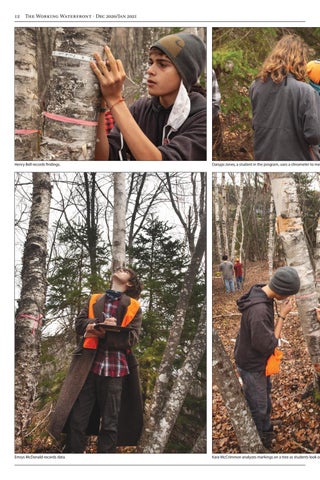
Henry Bell records findings.
Daisyjo Jones, a student in the program, uses a clinometer to me
Emrys McDonald records data.
Kara McCrimmon analyzes markings on a tree as students look on
easure tree height.
n.
www.workingwaterfront.com . Dec 2020/Jan 2021
Kara McCrimmon, director of the Cobscook Institute’s experiential programs, instructs students.
Growing trees, growing minds Cobscook Institute offers Calais students experiential learning PHOTO ESSAY BY LESLIE BOWMAN The Cobscook Experiential Program, part of the Cobscook Institute, is a high school program in partnership with Calais High School offering students the opportunity to earn their diploma while engaging in a place-based, experiential curriculum. On the Trescott campus, students maintain a FIG (forest inventory and growth) plot. In early November, students collected data to track forest growth and health. Learn more at www.cobscookinstitute.org. Learn more about FIG plots at www.mainefig.org.
Teacher Damon Weston listens to a student.
13
14
The Working Waterfront . Dec 2020/Jan 2021
Our Island Communities
Minke whale skeleton finds second life North Haven school completes years-long project
By Courtney Naliboff // Photos by William Trevaskis
S
tudents, staff, and visitors to North Haven Community School are greeted by a new, impressive sight when they enter the school grounds: a 26-foot minke whale skeleton, mounted in a spruce timber frame. The display is the culmination of a years-long project, begun in 2016 when the already dead whale washed up in Wooster Cove. Community member Chris Koerber worked to “flense” the carcass, as the process of slicing the flesh is known. Permits were secured to allow the school to keep the skeleton and bury it in the state sand pit, where it was excavated a year and a half later by a team of students, staff, and community members. Students worked under science teacher Lisa White to secure grant funding, clean the bones, and learn articulation techniques from Dan DenDanto of Whales and Nails, affiliated with Allied Whale. In the 2019-2020 school year, work continued through an extracurricular science club, also led by White, and in February, Vinalhaven timber framer Dylan Jackson led a week-long community workshop to begin carving the spruce pavilion in which the skeleton would hang. Less than a month later, all progress on the whale and timber frame ceased as the pandemic closed the campus through the end of the school year.
When in-person schooling resumed in September, the high school staff and administration were faced with two questions: how to provide students with a fall expedition during a pandemic, and what to do with the whale, which seemed no more than a pile of bones in the projects building. Staff and administration quickly decided to combine the two. “We were unable to plan for our traditional fall field study event due to COVID and changes in leadership, to be honest,” said secondary teaching principal John Dow. “The staff decided that it would be an excellent opportunity to finish this project since we were in place anyway and this would be a terrific chance for the kids to work with outside experts, radically change the face of our campus, and to contribute to the community.” DenDanto and Jackson agreed to return to campus for the week to support the completion of the skeleton and timber frame, and staff and students began planning. A traditional fall expedition includes opportunities for student leadership with tasks including cooking, cleaning, and navigating, and opportunities for socializing and collaborating outside of the school environment. To try to capture some of these elements, staff and students planned to cook meals for the week outside on the school’s grill, work in shifts to photo-document the process, and hold a beach pizza party and campfire to celebrate the end of the week.
www.workingwaterfront.com . Dec 2020/Jan 2021
15
The minke whale skeleton is now rearticulated and housed in a timber frame structure.
Once Whale Week began on Oct. 19, DenDanto quickly trained students on a number of tasks, who did the hands-on work. “I drilled holes in the vertebrae, I made the little fingers, and assembled the flippers together,” said freshman Bryn Campbell. “I attached the breastplate to the whale and drilled and attached chevron bones.” Classmate Milo Bernard drilled out ribs and helped attach the mandibles to the whale’s upper jaw. Freshman Abby Lattimer and sophomores Isabelle Haskell, Sophie Hansen, and Sofia Stockwell focused on the whale’s spine, including building a rolling cart to support it and adding foam, epoxy, and clay to the intervertebral spaces, and assembled the whale’s hyoid bones. Hansen also worked to attach various small bones to the whale’s skull. For some students, the timber frame held an irresistible allure. “It was fun to use the big hammer and smack things together,” said freshman Bret Waterman. Sophomore Henry Sandelin agreed: “This was like big Legos!” Waterman and Sandelin said they learn best when working with their hands, and spent most of the week helping Jackson, as did senior Annabell Hurd. “I did a lot of work on the timber frame, and I also learned how to use the rock drill which was my whale week highlight,” Hurd said. Timber framer Jackson appreciated the students’ enthusiasm and work ethic. “I wish every job was that easy to do, to stand there and just be like, OK, we need to move this thing from here to there,” he said. “We also got the footings set with Annabell’s help. She really did it like an expert, the first thing she said was, ‘Are you confident that I can do this?’ and from that point forward she was like, ‘What do I do?’, and I explained the steps, and she wasn’t out to prove anything. I wish I could hire workers like that,” he said. Students had the opportunity to work with other tradespeople in the community. Noah Davisson and Roman Cooper, both North Haven Community School alumni, helped out at the timber frame site, moving and spreading fill with student help, and lifting the trusses with a boom truck so they could be attached to the base structure. “I saw wonderful collaboration, I saw problem solving, I saw multi-generational interaction, I saw non-traditional learning opportunities, I saw excitement and joy in the process,” Dow said. Friday morning, after four days of sustained work, students rolled the spine from the projects building to the timber frame on a cart of their own design and construction. The skull was carried out on a wooden frame shortly after, and students screwed eye bolts into the newly-erected trusses so cabling could begin.
DenDanto and a crew of volunteers completed the installation that afternoon and added the finishing touches, such as the hyoid bones and vestigial pelvis, Saturday morning, right on schedule. Students share a sense of pride and accomplishment in the whale and timber frame. “I’d say it’s really fulfilling being a big part of something important, and I felt like I had a really important job and I wanted to get it done as fast as possible so I could do other things that were important,” said freshman Bryn Campbell. “It’s cool to see the parts that you did in the bigger picture, like your cog in the machine is working in the whole engine.” “I’ve been working on it since the end of freshman year,” said Irene Prescott, whose position as yearbook managing editor saw her focused primarily on photographing the whale’s progress. “I was here for the whole process and my senior year it’s done, I got to help with it, it feels good. Complete.” “It’s been such a long-term project, it was really motivating that our goal was to finish it. To see the light at the end of the tunnel, reachable, in sight,” said Sophie Hansen, who previously worked on the whale through science club. Her brother Josiah, one of the original students involved with the whale through Lisa White’s science elective, returned to put the finishing touches on the skeleton. North Haven Community School alumni Kelsey Jones, now the school’s guidance counselor, and Ben Lovell, who is serving an interim position on the school board, each worked on the school’s first marine mammal skeleton, a white-beaked dolphin, in 2004 and 2005. “I think it’s really fun to see what’s possible. One thing I’ve always loved about the big projects at North Haven is that you can see the way you impacted the school because there are things there that weren’t there before. A boat, a car, a skeleton, a new building, a mural on the wall,” said Jones. “It’s absolutely beautiful,” Lovell said. “It’s testament to that part of North Haven Community School that accepts challenges, it’s the students accepting the challenges and driving and working collaboratively with teachers in a way to get to a successful endpoint.” In providing the opportunity for students to develop skills, build knowledge, and collaborate with each other, community members, and experts, the whale has fulfilled Chris Koerber’s original hopes for the project. “It’s really satisfying because the investment of all the many people who put time and energy into it and cared about the project paid off in terms of creating an experience for our young people,” Koerber said. The tangible product of that experience now stands sentinel along the school’s driveway, a testament to what a school, community, and experts can accomplish with time, resources, and a collaborative spirit.
Chebeague Island has new administrator CHEBEAGUE ISLAND town administrator, Marjorie Stratton, who has served the island community for the past five years, is stepping down. According to long-time select board member Donna Damon, Stratton has left the town with a stable workforce and in a sound financial position. Stratton has spent her professional career in finance and municipal government. Following years as a municipal auditor, she served as Vinalhaven’s town manager for 12 years Marjorie Stratton before coming to Chebeague. Stratton chose to live on the island, and quickly became part of the community and happily shared her love of music, Damon said. “Part of Marjorie’s legacy has been her leadership in the town’s COVID emergency response,” she said. “Her positive messages and collaborative spirit
have helped islanders address community needs. Chebeaguers wish her well as she heads back to Vinalhaven to begin her well-deserved retirement.” Chebeague Island’s select board has hired Justin Poirier of Augusta as new town administrator. Poirer, who begins his tenure Nov. 23, comes to Chebeague after more than a decade in state and municipal government in Maine and Massachusetts. He graduated from the University of Maine in Orono with a B.A. in public Justin Poirer administration, and he earned a master of public policy from the University of Massachusetts in Dartmouth. Poirer has worked for the cities of Bath and Auburn, as well as Belmont, Mass. A certified assessor, he has also served as director of Maine’s Property Tax Division.
16
The Working Waterfront . Dec 2020/Jan 2021
South Portland’s history is in good hands Historical society director explains mission as repository By Frances Mize
L
ike many of its counterparts around the country, the South Portland Historical Society’s museum has been closed since the onset of the pandemic. The small size of the building in Bug Light Park, combined with the older age of the society’s volunteers, make keeping the museum’s doors open a risk. But Executive Director Kathy DiPhilippo, who began as a volunteer in 2004, wants you to know that this hasn’t changed much about its operations. Exhibition is not the entire mission of a historical society, and volunteers at the South Portland Historical Society remain hard at work. Some collaborate with local cemeteries, while others on the education committee spend time crafting an educational curriculum for schools in light of cancelled field trips. “We’re not a museum,” DiPhilippo says. “That’s just one of the things we offer.” In fact, since its inception in 1962, many years have passed in which the South Portland Historical Society has existed with no museum at all. She emphasizes that the primary component of its mission is to collect and preserve the history of the city, much of which is accomplished through donations of material, like artifacts and photographs, to their archives. This can be achieved regardless of opportunities for display. Even under the current circumstances, DiPhilippo underscores that “there’s just zero change in this mission for us. It is and always will be the biggest part of who we are.” Still, DiPhilippo notes that “being able to put a public face to a historical society by having museums is helpful.” When a historical society has little or no exhibition space, like when this one was housed in the basement of city hall—“that was a low point”—these donations tend to dry up. However, while the museum is now closed, this has fortunately not been the case this year. “Now I’m living through a time here where we also don’t have a museum, but I would say that it hasn’t slowed down our donations. People have been at home cleaning and organizing, and they recognize that these things around their home would serve the South Portland Historical Society.” The SPHS manages an online museum containing over 10,000 images on view for the public, so the pandemic just meant that exhibition had to be done in a virtual format. That this digital platform was in place before the museum had to close its doors is a testament to the historical society’s commitment to making public the history they’ve collected. In large part, historical societies exist to serve as repositories of original records of a location. When thinking about research, DiPhilippo expresses a deep commitment to getting it right: “If you go searching the internet and see the mistakes that are there, you’ll realize that the only real way to do your research is to go back to the original materials.” In a digital age bereft of direct fact, historical societies, no matter how big, remain bastions of historical truth. “After having spent a good portion of my career in this field, and living through the political times we’ve been living through, it is so apparent to me that understanding of history is important,” says DiPhilippo. “How can you develop policy if you don’t know what has happened before? Things that work, things that haven’t worked, why didn’t they work? That’s what an education is about.” While the South Portland Historical Society isn’t physically open to the public, its mission of preserving the history of a community, and ensuring it is accessible and understandable to that community, perseveres. The digitized archive can be accessed on the website of the South Portland Historical Society, at: sphistory. pastperfectonline.com/ There you can view the collection and, if you’re able, make a monetary donation. “We’ll definitely appreciate it,” says DiPhilippo.
www.workingwaterfront.com . Dec 2020/Jan 2021
17
Designing the Places where you want to be. For your legacy home
Factory Authorized Dealer
Parts & Service Diesel Engines Transmissions Warranty Repairs • Generators Re-Power Specialists
THOMASTON BOAT & ENGINE WORKS, INC. 2 Atlantic Highway, Thomaston, Maine 04861 Office: 207-354-0200 • Cellular: 207-542-2300 Email: pricci@mindspring.com
A Lincoln Academy student eats her lunch from a stainless-steel tiffin. PHOTO: COURTESY LINCOLN ACADEMY
A new, old-fashioned way to serve school lunch Lincoln Academy in Newcastle
L
incoln Academy students who purchase lunch will now eat it out of what are known as “tiffin” containers. Tiffins are reusable stainless-steel lunchboxes that can be washed and sanitized every day which will significantly reduce schools packaging costs as well as plastic waste. Most schools use disposable plastic containers— thousands of them—to serve breakfast and lunch to students. Not Lincoln Academy. “I am anti-plastic completely,” said chef Mikael Andersson, who has been director of dining services at the school since 2016. In his time there, he has reduced the use of disposable containers and flatware and used paper instead of plastic whenever possible if to-go containers are necessary. During the school closure last spring, Andersson prepared meals for delivery to 125 families twice a week. By necessity these deliveries included plastic containers with prepared meals, as well as kits to cook at home. “I hated using all that plastic,” he said. “Even though the containers we use are technically compostable, they really need an industrial composting facility in order to break down. Let’s face it: most of them end up in the landfill.” While planning for the fall return to school, Andersson explored his alternatives. “I thought about paper containers, but paper gets soggy when you put food in it. My only other alternative would have been styrofoam or plastic. Then I ran the numbers: at 750 containers a week, that’s 3000 per month, 30,000 for the school year. That is a lot of containers, and it’s expensive.” Andersson also considered the environmental implications.
“I can’t imagine all that single-stream plastic in the landfill. I started thinking about all the schools in the country; even all the schools in Lincoln County, and thought, ‘What can I do to help?’” After assessing the challenges, including meal preparation, container collection, sanitizing, and more, Andersson settled on the idea of traditional stainless-steel stacking food containers known as tiffins that have been used all over the word for a century or more. “My dad took a similar lunch box to work every day, when he worked as a technician for the Swedish air force,” said Andersson, who grew up in Sweden. “After dinner he would pack up the leftovers, and the next morning he took that metal container to work and put it in a warming box. At noon every day he had a nice warm lunch.” Andersson did his research, investigating several dozen models before finding one he liked. “I need a seamless, insulated tiffin. Seams are hard to keep clean, and water can get into them and compromise them over time. I finally found these, and they are great! And the company even engraved the L.A. logo on them.” In the end, he sourced 200 engraved stainless steel tiffins for about a quarter of what disposable containers would have cost for the year. The tiffin transition is not without challenges. “We have to rethink how we plan and cook food and how we clean up,” Andersson said. “Filling, stacking, and locking each container takes time, and then we will be delivering to classrooms and picking up after lunch.” For Andersson, it is worth it. “I love serving lunch in these cool, old-fashioned lunch boxes. And it is so much better for the planet.”
G ener al & Marine C ontr aCtor D reDGinG & D oCks 67 Front s treet, roCklanD, Maine 04841 www. proCkMarineCoMpany. CoM tel: (207) 594-9565
207.546.4232
The Working Waterfront relies on reader support. Consider becoming an Island Institute member today! www.giving.islandinstitute.org (207) 594-9209
l lanDing anDing C Craft raft S ServiCeS erviCeS
Three vessels, Three vessels, Three vessels, all all equipped equipped all equipped with with hydraulic with hydraulic cranes. cranes. hydraulic cranes. Also island site island site work. work. Also islandAlso site work. Call Dave allan at C(207) all Dave allan at 882-5400 (207) 882-5400
National Bank
D REAM FIRST
A Division of The First Bancorp • 800.564.3195 • TheFirst.com Member FDIC • Equal Housing Lender
18
The Working Waterfront . Dec 2020/Jan 2021
Saltwater Cure
Getting outside is critical, and never easier North Haven public lands are treasured in COVID crisis By Courtney Naliboff AS I WRITE THIS, COVID 19 has arrived on North Haven. Today, the town office announced that we had 11 positive cases, and that testing and contact-tracing continues. The store is closed for in-store shopping, we’re remote schooling at least through the end of November, and emotions are high as people fear for their loved ones and worry that they, too, might be infected. It’s illustrative of just how easily and quickly this virus can spread, even when basic precautions are in place in public settings. It’s terrifying. Against that backdrop, the features of North Haven that sustain us through trying times come into sharp relief. The store offering curbside pickup, the ease with which we can now transition in and out of remote school, the brilliant sunsets, CSA delivery—all remind us that we’re together and resilient. Exploring the trails maintained by North Haven Conservation Partners has been a sustaining activity this fall as well. The 11 properties it manages, most of which are accessible to the
public, offer tranquil woods walks, streams, and moss cushions the sides of the path in shades ranging from water access, and stunning views. The hiring of a new executive emerald to mint. It’s common to find director, a spate of trail-clearing, and urchin shells, dropped by birds, in beautiful new signage have made seemingly unlikely places. Twice the path emerges into fields the trails all the more appealing. My with unfettered views favorite board member of the water and wild(my husband Bill) told flowers through the me that the impetus summer and early fall. for the work was the The trail itself is an easy knowledge that more Twice the path though roots and community members emerges into fields walk, stones frequently cross than usual would be with unfettered the path. accessing the trails Bill and I walked the during the pandemic. views of the Mill Stream preserve the We certainly have, water… day after our wedding, although we don’t often seeking its peaceful see others. Our two beauty after all the favorites are the Mill excitement, and it was Stream preserve and the one of the first hikes we North Shore preserve. Each trail offers something completely did with Penrose as a toddler. In contrast, the North Shore preserve different, a surprising diversity of landis a little bit of a drama queen. After a scape for such a small island. The Mill Stream preserve makes a short walk through a field, including loop through the cedar-filled woods a research project on buckthorn on the banks of the Mill Stream, a management, a brilliant stand of white gloriously swimmable tidal river about birch makes a breathtaking display any which I’ve previously rhapsodized. time of year. A short walk farther down Ramshackle bridges cross narrow the trail leads to a stunning ocean
view, with a picnic table for maximum enjoyment. On a late summer visit, we watched seals chasing a huge school of fish from our perch. A side trail leads down to the long, rocky beach with plenty of craggy basalt for kids to climb on. Back on the path, a short stretch of cliff walk with a rope handhold offers a little excitement before looping gently back around through a tree tunnel to the start of the trail. There are other trails on the island to explore, some of which are maintained by the town or property owners, each uniquely beautiful and satisfying. But this month, I wanted to use my little platform here to express my gratitude to the North Haven Conservation Partners for the access they offer to the beauty that surrounds and reassures us. Get out there, bring a mask, and see for yourself. Courtney Naliboff teaches theater, music, and writing on North Haven, and plays in the band Bait Bag.
Journal of an Island Kitchen
A serving of nostalgia for the holidays
Dinner, cookies, and candies grow tastier and sweeter with time By Sandy Oliver WHEN WE HANG our stockings this year, I’ll fill them with nostalgia. Is it because I am older now that some of my childhood memories seem in sharper focus? Or is it that the pandemic’s fearsome cloud of anxieties make the past seem so much happier, even though I know there were tears and tantrums on Christmas Eve when I was young? For whatever reason lately, I’ve vividly recalled childhood holiday celebrations from Thanksgiving to Christmas, and since it’s a harmless sport, thought I would do a little historic reenactment this year. I’m blessed with a family that kept Christmas ornaments, mementoes, and recipes so I can even pull out memory-soaked objects to set the stage. Some are in annual use anyway, like the crèche my dad built in which I place the plaster figures still wearing the Kresge department store price tags on the bottom (Mary and Joseph for ten cents each). For years now on the tree, I’ve hung the Rudolph the Red Nose Reindeer ornament that was on my first tree in 1947. My sister Sally and I have my mom’s recipes for the cookies she made in large quantities in the run-up to the
holiday. Nine hundred of them, many in tin boxes in the attic, stashed to discourage Dad from casual snacking. Mom distributed cookies to friends, neighbors, the hairdressers, carried them to Sunday School Christmas parties, and we ate them, too, all through the holidays. Now, the time between Thanksgiving and Christmas whizzes by, though for a child it’s an eternity. We usually went to my mom’s parents’ house (dad’s folks were gone by then) for Thanksgiving dinner. Standard menu: turkey, mashed potatoes, gravy, stuffing, probably squash, pie for dessert. But, olives, green ones with pimentos which I loved, in a glass relish tray which I now own, and celery! Grandpa might offer me a drumstick. In my earliest years, we merely repeated Thanksgiving’s menu for Christmas dinner when in some years my grandma and grandpa came to our house. When they didn’t, we visited them and other aunts and uncles sometime in the days before the holiday, collecting and delivering gifts, having coffee (instant in those days), and eating cookies. Grandma’s sister, Lee, was a wonderful baker: her snowball cookies, buttery, nutty, and dredged in confectioner’s sugar made
a big impression on me. I suppose the recipe is around here somewhere. Spritz cookies made on a clear day because they keep their crisp lines better than in humid weather, and Gameldags Pepparkakor, a Swedish ginger cookie with orange rind and spice rolled out and cut in holiday shapes gave off lovely aromas. Starlight Mint Surprise, which I’m pretty sure were a cooking contest winner my mom read about in McCall’s or Woman’s Day magazines, which had a chocolate mint in the center, a favorite impossible now to replicate because the candies are no longer made, were transformed in my adult years into mint chocolate chip cookies instead. Sally has carried on the family cookie tradition, adding lots of other Scandinavian heritage recipes in honor of my grandmother’s birthplace, while my cookie output is pretty small because the rolling and cutting and decorating exasperates me. Maybe this year, with no parties to go to and Christmas ladies’ luncheons on hold, I’ll have time for painstaking cookie making. Mom made some Christmas candies, too. Simple ones: peanut clusters made with peanuts in melted chocolate, dropped in clumps on waxed paper until they hardened. What fun to put
one in your mouth, let the chocolate melt away on your tongue, and then crunch up the peanuts. She was fond of stuffed dates, dates with walnuts inside rolled in coconut shreds. Also, fudge, and from commerce, ribbon candy. These treats sat in a candy tray on the coffee table in front of the couch, and I sat on the couch facing the tree with the candies between me and the tree. Maybe I asked permission to have yet another peanut cluster or chunk of ribbon candy. Or maybe not. When Mom was a girl, she’d find an orange in her stocking, a major Christmas treat because oranges were rare. Even though oranges are dirt common now, I drop one down our stockings in honor of the family tradition, reminding us that life was not always as it is now. Pray God that next year, life will not be as it is today and that we arrive at another year, alive with a sharpened sense of what, and who, we really treasure. Sandy Oliver is a food historian who lives, gardens, cooks, and writes on Islesboro.
www.workingwaterfront.com . Dec 2020/Jan 2021
19
Guest Column
Maine must see bigger picture on utility project ‘Connect’ electric corridor does not pose threat opponents suggest By Orlando E. Delogu WHEN AUSTRALIA lit up with wildfires and 105-plus degree temperatures, we could ignore the consequences of global warming— it was half a world away. When California, Oregon, and Washington lit up with record breaking wildfires, air temperatures that reached 120 degrees, and unhealthful drift smoke that reached Maine, the consequences of global warming are harder to ignore. When our TV screens show us the huge degree of glacial snow melt in Labrador, and a Bangor Daily News webinar points out that Gulf of Maine air and water temperatures and thus sea-level rise are among the highest in the world, only the most obtuse climate change deniers fail to realize that sensible steps to deal with climate change must begin now. Enter former state Sen. Tom Saviello, 2020 gubernatorial candidate Max Linn, the Natural Resources Council of Maine, several towns in proximity to the proposed CMP transmission line who view any project of scale with alarm, and self-serving fossil fuel interests from
away (i.e., the Nextera Corporation) who want nothing more than to protect present fossil fuel profit margins threatened by the New England Clean Energy Connect project. These naysayers profess to be concerned with climate change but refuse to take an important first step— reducing New England’s dependence on fossil fuels—thereby reducing global warming. It’s somebody else’s problem. The arguments of those opposed to the project run a wide gamut. Why should we help Massachusetts? There’s not enough in it for Maine. What about our deer, brook trout, and pristine forests? Why are we kow-towing to foreign corporations in Canada and Spain? None of these arguments hold up when examined. We’re not helping Massachusetts, we’re helping ourselves. We’re in the same boat when it comes to climate change. Moreover, Massachusetts is bearing the capital costs ($1 billion) of the power line. Maine gets a better grid system, the construction jobs, the annual increase to the tax base, a slice of the power at a reduced cost, and enhanced broadband
hookup serving rural areas of the state. In short, the state’s public advocate, Barry Hobbins, and the governor’s office have not let Maine people down. As for wildlife and pristine forests, leading Maine wildlife and forest experts—such as Tom Rumpf, Lloyd Irland, Richard Anderson, and Richard Barringer—have stated at hearings, public gatherings, and in op-eds that populations of deer and other wildlife, brook trout, are not at risk. And that relatively minor harms are more than offset by DEP conditions imposed on CMP that enhance the overall condition of wildlife in the area. And pristine forests are a myth. Forests in the unorganized territory, certainly in the area in proximity to the project, have been cut and re-cut many times. Hundreds of miles of woods roads parallel and cut across the power line right of way. They have existed for decades. Finally, there is no kow-towing to foreign corporations. CMP is in full compliance with Maine law. The multiple approvals by the Public Utilities Commission (sustained by Maine’s highest Court), the Department
of Environmental Protection, and the Maine Land Use Planning Commission all attest to this fact. These regulatory bodies and their professional staffs can’t all be wrong. To impugn their integrity should be beneath us. Moreover, why are critics bashing only Avangrid and Hydro-Quebec? We have welcomed, lived with, and benefitted from Irving Oil and the Emera Company for decades, to say nothing of dozens of smaller Canadian companies, millions of Canadian visitors, and aquaculture firms rooted in Norway and Denmark. In short, the critics need to get real. Their narrow view of environmental harm ignores the larger reality. Global warming and climate change pose problems that must be faced. Fossil fuels are killing us. Bringing Canadian green energy into New England benefits all of us—it is a first, a small step in the right direction. Orlando Delogu is an emeritus law professor at the USM Law School, and has served on the Portland City Council, Portland Planning Board, and Maine Board of Environmental Protection.
World Ocean Observatory
Sea sickness of another kind
We must become immersed in the atrocity to respond effectively By Peter Neill PEOPLE OFTEN ASK me if I am a sailor. I demur, admitting only to owning a boat. I have too much awareness of and respect for real sailors to compare my level of skill. Like many mariners, I get seasick, unless the seas are calm or I am sufficiently infused with mint and ginger. But the susceptibility is always there, the memory of past unpleasant incidents, the anticipation (both physical and psychological) of what is to come, and the thing itself—nauseating, exhausting, humiliating, just plain awful, until it’s over and you’ve found your sea legs again. Sickness at sea is as old as seafaring itself: sailors subjected to wind, sun, heat, cold, dehydration, poor food, and all the rest. We know the tales of scurvy and such. Sometimes when we look more closely, we can sense another disease—that of loneliness, melancholy, depression, the mental illness that can result from extreme physical and psychological circumstance—until it too is over, in the best case with a successful homecoming and revival. The world ocean is a sick sea. The symptoms are no longer deniable: reported spills and leaks, bleached and dying coral reefs, depleted fisheries, hypoxic zones—vast areas so oxygendeprived that nothing lives.
I keep looking for the good news: the growing number of marine protected areas, small victories over the extraction interests, some policy or regulation that draws a line, some triumph by a local coastal community or small island state standing up to protect itself from the sickness. The thinking once was that the ocean by its vastness would dilute these things. But we are beyond that now, holding onto that homily only as a desperate belief or a cynical justification. What will it take for us to realize that to counter seasickness we must first heal ourselves? I read recently the phrase “sea blindness,” referring at some historical moment to public unawareness of the ocean’s relevance and relationship to what takes place on land. Yes, there is shipping and trade and warfare, and yes, there is fishing and food production, but true insight and awareness remains dim. If we can’t see it, or feel it, then we can’t really do anything about it. We should be frustrated and furious. We should feel the nauseating, exhausting, humiliating reality of what is happening to our ocean. We should be outraged by governments that delay or prolong any policy, regulation, or action directed toward sustaining this essential natural environment. Even the progress we have made is under attack by forces of greed, dilution,
revision, and retraction of anything that interferes with the exploitation or corruption of the ocean until we are left with only a toxic sea. What will it take? There are thousands of ocean advocates fighting to keep our ocean safe. Hats off! Honor, respect, support, and engage with them wherever you may be. We can all do that. Join them and build their numbers exponentially. But my sense is that this medicine is not working, is not yet strategic enough, strong enough, and smart enough to do what must be done. We are advocating for the ocean with best intentions and hope. We want to get beyond seasickness to that sustainable place, purged, free, secure. We know what must be done at every level. We have plans and policies and agreements in place to free us of this disease. We know what must be done, but we are not yet aware enough, mad enough, or desperate enough to do enough about it. We are talking about survival here. Every human need—fresh water, food, energy, medicine, security, and psychological renewal—is dependent on a healthy, sustainable world ocean. The ocean is our cure. Why would we destroy it? I submit we are missing the resonating psychological, intellectual, and emotional connection that enables us to understand and assert with reason and passion why the ocean matters. We have bits and pieces of the puzzle. We know
parts of the whole that convince us. We feel parts of the whole that move us. But it is the union of knowledge and emotion that compels us finally to understand how the ocean affects all things: climate, weather, sea level rise, coastal development, acidification, the polar regions, fresh water, food, health, security, energy, economy, trade, and community. Consider each of these alone, and then aggregate and relate them into what becomes an integrated system of nature, politics, and social behavior that connects the world through a skein of interwoven cause and effect, the global net in which we swim, trapped perhaps on earth, surrounded by an ocean of stars. Do we want to save ourselves? Are we not all citizens of the ocean? And is not our personal and collective desire for survival and the future enough to move us to the revolutionary action and change required to make it so? Peter Neill is the director of the World Ocean Observatory, which produces weekly radio essays that can be heard on WERU-FM, 89.9, on podcast at apple. com/us/podcast/world-ocean-radio/ id425361249, and at http://www. worldoceanobservatory.org/worldocean-radio. He lives in Sedgwick.
20
The Working Waterfront . Dec 2020/Jan 2021
Field Notes From crisis response to community resiliency Feet on the ground, eyes on horizon, relationships guide our work By Suzanne MacDonald AS THE COVID storm continues to roil our coast, my thoughts return to the image of Monhegan’s Matt Weber easing his lobster boat against a large tanker, both vessels in motion, as a Penobscot Bay pilot leaps from the smaller boat to a ladder hanging from the ship, where he will then guide the ship to safe harbor. That precise, yet nimble maneuver— made possible by the trust and skill of both captains—is what we at the Island Institute hoped would be the way that our organization and island and coastal communities responded to the pandemic. We believe it has been. In those early days, we summoned the organization’s strength to reposition our work and resources to meet the needs unfolding before our eyes. We started where we always do—by listening. In doing so, it became clear that our colleagues, our neighbors, and our friends were in crisis. Our work at the Island Institute is rooted in relationships and a commitment to helping communities along the coast thrive. For our staff, seeing communities in distress unleashed a tremendous drive, out-of-the-box thinking, and highly efficient teamwork.
The resources we had at our disposal— sometimes simply in terms of hours in the day, access to better internet, and an ability to make quick connections— meant that we could help close gaps and lighten the load. It was time to show up. In an effort to balance precision and speed, we developed a set of “crisis response teams” to bring a clear focus to our work: expanding access to highspeed internet, primarily by supporting passage of Maine’s $15 million broadband bond; increasing support to small businesses, particularly those “too critical to fail;” and helping to mobilize and support community leaders. These efforts have yielded important wins for the coast and the state. We raised the funds and built a crosssector coalition of more than 100 organizations for the “Yes on 1 for Better Internet in Maine” campaign. The bond question was approved in July with the support of 75 percent of voters; a big win for communities seeking broadband connectivity. We also worked alongside the National Digital Equity Center and the Maine Department of Education to deploy 100 hotspot-enabled tablets to students and teachers without reliable internet in 21 rural Maine communities, including nine islands.
We stepped up for small businesses to help them pivot product lines or sales models and leverage technology to help place them on surer footing— in the wake of COVID-19 and after. Through the Tom Glenn Community Impact Fund, we developed business resilience grants, distributing 67 awards to date to support island and coastal small businesses, artists and makers, and working waterfronts. We were also the first call for many small businesses seeking support in accessing federal and state funding. We leaned into supporting community leaders by connecting them to the best information, the most useful networks, and the highest quality technical support. We rallied elected officials and a host of organizations from across the state to bring focused support to the members of the Maine Islands Coalition and its crisis management efforts. We convened ferry operators, educators, and municipal leaders to identify pressing needs and share solutions. As 2020 winds to a close, we continue to invest in efforts to help the coast respond to the pandemic while preparing for future disruptions. Our staff is heavily involved in supporting the ConnectMaine Authority to rapidly accelerate the build out of broadband
across the state. We are also preparing for the coast to engage in and benefit from the ambitious Maine Climate Action Plan. We stand ready to pitch in on logistical issues like our recent efforts to help deliver rapid response coronavirus tests to the islands. As one island resident recently commented, we’re approaching the pandemic with our “feet on the ground and our eyes on the horizon.” Our work is not done. In showing up for each other, and using care to catalyze action, we’ve seen trust and connections across the coast grow. We have been buoyed by the thoughtful reflection, wise counsel, and even joy that we are finding in our relationships as we work together to find our way through these challenging times. Navigating a big ship through unseen hazards takes skill, but we’re not going it alone. Suzanne MacDonald is chief community development officer for the Island Institute, publisher of The Working Waterfront.
Observer
How I outwitted a dead turkey
Despite clear instructions, creative approach ensues By Phil Crossman EARLY ON Thanksgiving morning I came downstairs to put the turkey in the oven. Elaine had asked me to do this, she having spent most of the previous day getting things ready, making pies and so forth. On the counter was a note: “Pre-heat the oven to 350. Rinse the turkey well, inside and out, and pat dry. Carefully put the stuffing in the bird; don’t cram it. Place it in the roasting pan, breast side up. Rub liberally with olive oil and these herbs and put it in the oven.” I set the oven at 350 and concluded that, at 25 pounds, the bathtub would clearly be an easier place in which to “rinse well inside and out.” I put the turkey in the tub, reflecting all the while on how much more sense this would have made if, a few minutes earlier, I had simply showered us both. The tub was the perfect place and the massage showerhead, fitting each cavity perfectly and set on “stimulating,” brought clarity to “rinse well inside and out.” I quickly discovered
that paper towel, dissolving in pieces fasteners and there, in the person of inside the bird, was not the thing with a 3-inch deck screw and with a cordwhich to “dry thoroughly” but a hand less drill, I perceived a solution to the towel, the one I’d used earlier shaving, vexing problem of keeping the bird’s legs together. worked perfectly. Buoyed by my resourcefulness, I Back in the kitchen I focused on stuffing until the bird was full enough hastened back to the problem bird, made short work of the that the little flap at the tendons with the snips, small end would not and screwed the troustay closed and the legs blesome legs together at the other would not I hastened back to with the deck screw. stay together. the problem bird… Nestling the bird in the A tendon-like length and screwed the barely adequate roasting of something fashioned pan I covered it liberally into a loop protruded troublesome legs with olive oil, lubricating from the end of each together with the every inch, every gentle drumstick. I concluded fold, each appealing that this had been some deck screw. crease, every nook sort of barbaric hobble and, in particular, the visited on the unforcrannies, and enjoying tunate bird back at the aviary. I set about removing them, but myself altogether too much. I rubbed in the aromatic packet of herbs she’d a knife wouldn’t touch them. While impressed with the sinewy assembled and reviewed the instrucresistance I was no less determined. tions. “Breast side up” leapt out at me. I Retrieving a pair of aviation snips turned to look more carefully at the bird. There was a time, I think not long from the cellar my eyes fell upon my orderly assortment of galvanized ago, when an invitation to place a thing
breast side up would have been one to which I’d have responded flawlessly, with enthusiasm, and with no small degree of confidence. I held its tiny wings out to the left and right and tried to imagine it high stepping around, upright, in the barnyard. There only being two ways to have put it in the pan, other than by standing it on its head, whichever end that was, I knew there was at least as good a chance I had installed it breast side up as breast side down, but a 50/50 chance wasn’t good enough. The prospect of her opening the oven door and wondering aloud if I could not do anything right, perhaps even with a reference to breasts, perhaps with others by then in attendance, loomed large. It was a gamble. But then it usually is. Phil Crossman lives on Vinalhaven.
www.workingwaterfront.com . Dec 2020/Jan 2021
21
Cranberry Report
When winter gets tough, we bake cookies Quiet beauty inspires a turning inward By Barbara Fernald
Around the island, I can still pick bouquets of pine, spruce, cedar, AHHHHH. November and December and winterberries to freshen up the in the Cranberry Isles. I really don’t house. November is when I get out mind these darker months. I know my little white lights to set in various the light comes back pretty quickly indoor spots. Some are on branches in January and February and there’s in vases and others are strung along something very special about the pre- a windowsill. COVID or not, my solstice sunsets seen from a ride home mood is lifted by their magic every on the mailboat. Hello wool socks and afternoon as soon as darkness falls. old sweater friends. I happen to like Trying new recipes is a good form of the feeling of getting ready for winter. solo winter entertainment. I’m lucky Someone asked me last summer if I that Bruce and I both like to cook. My thought I was better prepared to deal latest goal is to learn to bake amazing with the pandemic because of how I baguettes, and I’m waiting to see what cope with an island winter. Maybe? Bruce will try next. Below is a recipe that was new to me Much of what I do to deal with the isolation of island living in the last summer and the cookies were a hit diminutive days could also prepare me at the Bar Road Market. The cookies are flat, crispy on the edges and still for virus-related solitude. I think all of us tend to stock up more chewy in the center. The recipe is quite on groceries at this time of year, since conducive to “making it your own.” One week I added mini chocolate bad weather can cancel boats which would cancel off-island plans. Since chips and toffee bits. Another week I it’s no fun adding a cold boat ride to added chopped dried cranberries and a doctor’s office visit, I try to be more slivered almonds. I buy large granule aware of the need to wash my hands. sugar from Amazon for rolling my The same measures I take to stay molasses cookies, and it makes this healthy in cold and flu season could chocolate version quite special. I think lessen my chances of catching COVID. for a Christmas cookie it would be fun
to roll it in crushed candy canes or nonpareils. I would like to wish everyone a safe and healthy holiday season as we reach the end of one of the worst years ever. May 2021 be a truly happy new year for us all.
Chocolate Sugar Cookies 2 cups all-purpose flour 1/2 cup Dutch-process cocoa powder 3/4 teaspoon baking soda 3/4 teaspoon salt 1 cup (2 sticks) unsalted butter at room temperature 1 3/4 cup granulated sugar, plus 1/2 cup for rolling 1 large egg plus one large yolk 2 teaspoons vanilla extract 1. Adjust the oven rack to the middle of the oven. Heat oven to 350. Line three sheet pans with parchment paper. 2. In a small bowl, combine the flour, cocoa powder, baking soda, and salt. 3. In the bowl of a stand mixer fitted with a paddle, beat the butter on medium speed until creamy, about 1 minute. Add 1-3/4 cups of the sugar,
and beat again until light and fluffy, 2-3 minutes. Add the egg, yolk, and vanilla and beat on low speed until combined. Add the flour mixture and beat again on low speed until combined. 4. Place the remaining 1/2 cup of sugar in a medium bowl. 5. Scoop the dough into 1-1/2 ounce portions (2 tablespoons). Roll each ball in the sugar. Place eight cookies on each sheet pan. 6. Bake one pan at a time, rotating halfway through baking. Bake until the sides are set and the top begins to crackle, 12-14 minutes. 7. Transfer the sheet pan to a wire rack and let cookies cool for 5-10 minutes on the pan, then remove cookies and let them cool completely on the wire rack. Store cookies in an airtight container at room temperature for up to three days. Barbara Fernald lives on Islesford (Little Cranberry Island).
Fathoming
Explaining, bridging Maine’s digital divide Obstacles include income, rural status, and age By Meghan Grabill THE THINGS A PERSON can do from their home would be unfathomable to someone 30 years ago. Those with access to broadband have opportunities to further their education, utilize telehealth, engage in remote work, and connect with anyone (who also has broadband access) around the world. “It is necessary for our civic and cultural participation, life-long learning, employment, and essential services,” says Susan Corbett of the National Digital Equity Center (NDEC). Yet, even though broadband access offers opportunity and an improved quality of life, it is not universally available. The digital divide is the term used to describe the gap between the haves and have nots. Income is a factor. In Maine, 40 percent of households making less than $20,000 do not have broadband; just 5 percent of households making $75,000 or more are without broadband. Another explanation is the lack of digital literacy. Those unaware of the benefits or who lack the skills won’t seek broadband. Louis Carrier of Owls Head teaches digital literacy classes for the NDEC. One set of classes is “Aging Well with Technology,” for those 55-plus. In
Maine, of adults age 65 and older, 20 percent do not have computers and of those with computers, an additional 10 percent do not have broadband. The classes teach individuals new to technology the skills to connect with others digitally, get news online, and utilize tools to promote better health. “Especially in these times of COVID19,” Carrier says, “it has allowed them to still stay connected and maintain that level of community.” Another reason: 61 percent of Mainers live outside urban areas. Incumbent internet service providers (ISPs) don’t have the profit motive to build the infrastructure. Broadband infrastructure is treelike, with many trunks. Like a tree, the network branches out from the trunks, followed by more branches, and then twigs. The twigs represent the connections to people’s houses, often referred to as the last mile. This last mile is the most expensive to build and maintain. ISPs earn revenue from subscribers, and so in building or improving infrastructure, they weigh the number of households likely to subscribe, the so-called take rate. Maureen Kinsey lives on Southport Island with 18 other houses on the road. “Everyone is frustrated by the current connectivity,” Kinsey says. A major ISP
recently estimated connection costs of $12,000, payable by the residents. While it may seem there would be enough houses to entice an ISP to build the infrastructure, the costs outweigh the potential profits, and so residents must carry this cost. A final reason that people do not have broadband is that data collection on speeds is flawed and therefore resources are misallocated. The Federal Communications Commission (FCC), which allocates resources to improve access to adequate speeds, bases its measurements on the presence of a minimum speed at a single household as adequate for the entire census tract. This measurement is self-reported by ISPs. The under-inclusion of households without service, sometimes referred to as “dark pockets,” can prevent communities from being eligible for federal grants. Many find these metrics fail to represent their home experience, severely overestimating access to broadband level speeds. Urban as well as rural areas are harmed by this erroneous mapping. There are even neighborhoods in Portland and South Portland that do not have access to broadband, yet the FCC maps show they do. According to Kerem Durdag, president of GWI, these areas are also often low-income areas.
“They get lost in the numbers. They are in urban areas, as much as they are present in rural Maine, and are assumed to be connected and so they get rolled over.” Communities have started contesting the FCC numbers using a massive series of crowd-sourced internet speed tests where results are aggregated to a central data warehouse. Maine is launching its own speed test. Go to mainebroadbandcoalition.org/speedtesting-link to participate. The obstacles preventing Maine from getting universal broadband are not insurmountable. State and federal money has been secured. Digital literacy is increasing, thanks to classes like those offered by the NDEC. Affordable options, creative financing, and digital tools are potential options for increasing universal broadband access. Data from the speed tests will allow Maine to secure more funding and target the funds to those locations where access will benefit those with the greatest need. Meghan Grabill is a community development officer with the Island Institute.
22
The Working Waterfront . Dec 2020/Jan 2021
SUNBEAM, THEN AND NOW— The Maine Seacoast Mission’s Sunbeam draws interest wherever she cruises. The vessel had been getting upgrades and repairs at Front Street Shipyard for much of this year, but as Billy Black’s photo shows, she is looking fit as she leaves Belfast harbor earlier this fall. The older photo is a bit of a mystery. The phrase “Sigma Kappa, living with heart” was included with it when it was posted on the Seacoast Mission’s Facebook page. Readers? Contact editor Tom Groening at tgroening@islandinstitute.org if you can shed some light.
Linkel Construction, Inc. Locally owned and operated; in business for over twenty-five years.
• • •
•
Warm Holiday Wishes To my buyers and sellers with many thanks. It has been a pleasure working with all of you over the years but especially this unusual year. I am very grateful for your business and look forward to working with more properties in this beautiful part of the world. To my colleagues, it is always great to connect with you and thank you for all your effort as we work to sell properties together.
TACY RIDLON 207-266-7551
•
Specializing in slope stabilization and seawalls. Department of Environmental Protection (DEP) certified. Experienced, insured and bondable. Free site evaluation and estimate. One of the most important investments you will make to your shorefront property. We have the skills and equipment to handle your largest, most challenging project.
For more information: www.linkelconstruction.com 207.725.1438
BROOKS TRAP MILL & MARINE SUPPLIES
A large selection of traps and trap kits
GET HAULIN’
Stop by for all your fishing and commercial boating needs
Enter to win a $100 gift certificate by visiting our website or “Like” us on Facebook. Jonesboro, ME (207) 434-5791
Portland, ME (800) 244-8727
BROOKSTRAPMILL.COM Thomaston, ME (800) 426-4526
West Bath, ME (855) 848-6027
www.workingwaterfront.com . Dec 2020/Jan 2021
Letters Kudos to columnist
See you in 2021!
TO THE EDITOR: After reading Courtney Naliboff ’s column (Salt Water Cure, November issue) about her experiment directing outdoor, site-specific theater on North Haven, I just want to add what a delight it was for the audience. Biking down to Mullins Head—to avoid the steady stream of theatre-going cars and trucks headed her way—I found the gathering of a hundred or so people under a grove of twisty black locust trees. A perfect setting for Ray Bradbury’s The Veldt. It was a sunny day and everyone came with masks and sat apart on blankets and chairs. As if to underscore the play’s theme of the wild, a hive of ground nesting bees was disturbed and had to be quickly fenced off with fallen branches. I remembered Bradbury’s story vividly from childhood, about a futuristic nursery where everything the children imagine comes to life on the nursery wall. Cyrus and Rita Brown, sibling actors, played their parts with aplomb all the way to the chilling last scene, when after the gory denouement, Wendy calmly offers the family psychiatrist a cup of tea. Kudos to Sophie Hansen, who spurred her drama teacher to try outdoor theater and who played the increasingly nervous mother to perfection. Naliboff writes she is looking forward to spring weather when she might revisit outdoor theater. COVID or no COVID, I hope she does! — Alice Cornwell , North Haven
The Working Waterfront returns in new year Each year, The Working Waterfront prints a December/January issue (which you’re now reading), followed by a February/March issue, which begins circulating in late January. As with so much in these challenging months, our modest little newspaper has had to rethink its mission, adapt to new realities, and work to remain relevant, even if only to entertain. And maybe we’ve done more than entertain. All things considered, I am pleased and proud of the job we’ve done. Our new designer, the Island Institute’s Sharon Pieniak, has done a great job managing the potpourri of advertisements, stories, columns, and photos that come her way, and produces what I think is an attractive and organized publication. Our contributors—freelancers, all—refused to let the work-at-home life stop them from reporting, documenting, and reflecting. I am especially proud of our four island columnists, who didn’t duck the tough issues that COVID presented in their communities as they shared their takes on that life. An opinion columnist needs a good measure of courage in ordinary times; that they continued writing reveals much about their character. Our news and feature offerings also reflected a willingness on the part of writers to go where the stories were—even if that was an hour-long Zoom meeting—and I’ve been pleasantly surprised to see the incredible images our photographers have been able to share from their forays into the corners of our coast. When life begins to approach normal again, we look forward to the work that an unfettered state allows us to pursue. As I’ve often written in these pages, we’ve got the best “beat” in Maine (if not anywhere), and we want to do it justice. My sincere thanks to our loyal advertisers and readers. And also Island Institute members and donors, and the organization itself, for committing to publishing The Working Waterfront. We’ll remain active on our website and on social media, but as far as print goes: See you in January!
The Working Waterfront welcomes op-ed columns and letters to the editor. Columns should contain about 650 words, and cleared before sending with editor Tom Groening (tgroening@islandinstitute. org). Letters should contain about 300 words and sent to the same address with “LTE” in the subject line.
—Tom Groening, editor
NEW BOOKS from Penobscot Books “You live according to what you’ve got.”
e, fishing for lobster, halibut lend a hand to those in display and participated in the ude of times.
Told in his own words and his kitchen table, listening to family, friends, work and
y touched directly, as he did f our shared experiences. For fe’s lessons is here for all.”
Nat Barrows, Publisher
$37.95 978-0-941238-31-1
941 238311
53795>
82 YEARS ON THE WATER ANDREW GOVE
age 7, he started lobstering at hard-work ethic stemmed cused on family interdepenthroughout his entire life.
THE LIFE OF A MAINE LOBSTERMAN
Jason Paige Smith photo
ou’ve got.”
The LIFE of a MAINE
LOBSTERMAN
Andrew Gove 82 YEARS ON THE WATER
Andy Gove, a lobsterman for 82 years, wrote his memoirs in later life. His stories embody the true sense of island living. He knew and understood the coast of Maine and its resources and stood for the values of a bygone way of life, one of self-sufficiency and selfreliance. This is a story like no other— Andy was a legend up and down the coast and “Uncle” to many. Andy represents the last chapter in a culture that is fast disappearing. His memoir is a unique opportunity to gain a deeper understanding of what it means to be a Maine lobsterman, at work and at play, with family and friends. Reading The Life of a Maine Lobsterman is like sitting with Andy in his kitchen, in view of his lobster boat racing trophies, and listening to decades of stories over a cup of coffee.
Sea Farm Loan FINANCING FOR MAINE’S MARINE AQUACULTURISTS
For more information contact:
Nick Branchina | nick.branchina@ceimaine.org |(207) 295-4912 Hugh Cowperthwaite | hugh.cowperthwaite@ceimaine.org | (207) 295-4914
$37.95, 196 pages, 156 photos
For all who love LOBSTERS!
Roop
"This ABC will appeal to adults and children alike. A must-read for first time visitors to Maine!"
Maine Lobster ABC
Learn all about lobsters and lobstermen, their lore and their gear, in this beautifully illustrated book for both children and adults. By Peter and Connie Roop, the authors of more than 100 children’s books, illustrated by Jeremiah Savage. $21.95, 68 pages Penobscot Books
$21.95 ISBN 978-0-941238-32-8
52195>
A division of
Penobscot Bay Press
Community Information Services Stonington, Maine
Order online at penbaypress.me
9 780941 238328
Penobscot Books
Learn all about lobsters and lobstermen, their lore and their gear, in this beautifully illustrated book for both children and adults. From Peter and Connie Roop, the authors of more than 100 children’s books, including Keep the Lights Burning, Abbie and Maine Lighthouse ABC. Illustrated by Jeremiah Savage.
Peter & Connie Roop
MAINE
LOBSTER
—Captain Linda Greenlaw
or call 207-374-2341 or email books@pbp.me
ABC
Illustrated by
Jeremiah Savage
Penobscot Books Stonington, Maine
Funds can be utilized for boats, gear, equipment, infrastructure, land and/or operational capital.
Contact us for our local retail partners
23
24
The Working Waterfront . Dec 2020/Jan 2021
OUR BUSINESS IS TO LEND YOU MONEY. OUR MISSION IS TO GROW YOUR SUCCESS.
Shop our holiday flyer! Our flyer is filled to the brim with goodies for the boater in your family. From must have knives to stocking stuffers to cozy warm weather gear, there's something for everyone on your list! Plus, keep an eye on social media! We're filling our sleigh with a selection of Super Specials that you don't want to miss out on!
800-639-271 5 hamiltonmar ine.c
om
2020
Nobody finances commercial fishing like Farm Credit East.
X20-01.ind
d 1
Not sure what to get the boater on your list?
10/23/20
4:43 PM
Like agriculture, the fishing industry has its own unique credit needs. And we’re proud to serve them both.
Hamilton Marine Gift Cards The one size fits all gift! Order a Hamilton Marine gift card, available in any amount. Order# GIFTCARD
KITTERY PORTLAND ROCKLAND SEARSPORT SW HARBOR JONESPORT
Call 800-639-2715 or visit hamiltonmarine.com to order today! Typographical errors are unintentional and subject to correction.
Financing For: Boats & Trucks Real Estate Permits Bait Storage Facilities
No other lender offers more expertise, specialized financial products, or dedicated services to achieve your goals.
Wharves
farmcrediteast.com | 800.831.4230
Operating Lines
Equipment Haul Out & Repair
11530_FISHING_Made in Ag_Our Business_4.9x7.35.indd 1
10/8/19 1:03 PM
Become a member of the
ISLAND INSTITUTE ...and help support Island Fellows like Mark Macey. “ The Fellows program offers a fresh set of eyes for a community. You can see where you have a different perspective on things and see opportunities that other people aren’t seeing. In Eastport there was a lot of enthusiasm for the arts, but they were in need of artistic leadership. I stepped in by directing a show for Stage East called Dear Elizabeth. They had never put on a show in the winter and it felt good to help continue the sense of community even in the bitter cold.”
Mark works with the Eastport Arts Center and its constituent groups to develop and implement meaningful youth and adult programming. He also helps the staff with events both on and off-stage.
BECOME A MEMBER TODAY! 3 WAYS TO MAKE YOUR GIFT TODAY: 1 - Online at giving.islandinstitute.org 2 - Call the Island Institute office at (207) 594-9209 ext. 141 3 - Mail your gift to: Island Institute, PO Box 648, Rockland, ME 04841