Brothers unite
To form Business of the Year
Here comes Paris
A look at the Olympic Aquatic Centre
Commercial filtration
A top consultant’s view

Deep learning
AI in the pool industry
www.splash.online
Swimming Pools / Leisure / Aquatics / Spas / Health
February/March 2024
Issue 152

Size does matter
AutoChlor® is the hallmark of AIS Water, an internationally acclaimed brand of inline chlorine generators that symbolises excellence in the industry. It’s the go-to choice for saltwater, coastline, and seawater pools, especially those with salinity levels between 3,500 - 35,000ppm.
Offering a diverse range of models, from 10 to 5,000 grams per hour, AutoChlor® ensures there’s a perfect fit for you and your customers this summer.
ALSO AVAILABLE AS A LOW SALT (3,500PPM) VARIANT
51 Millennium Place, Tingalpa, QLD 4173 Australia
Phone: +61 7 3396 5222 I Email: info@aiswater.com.au
aiswater.com.au
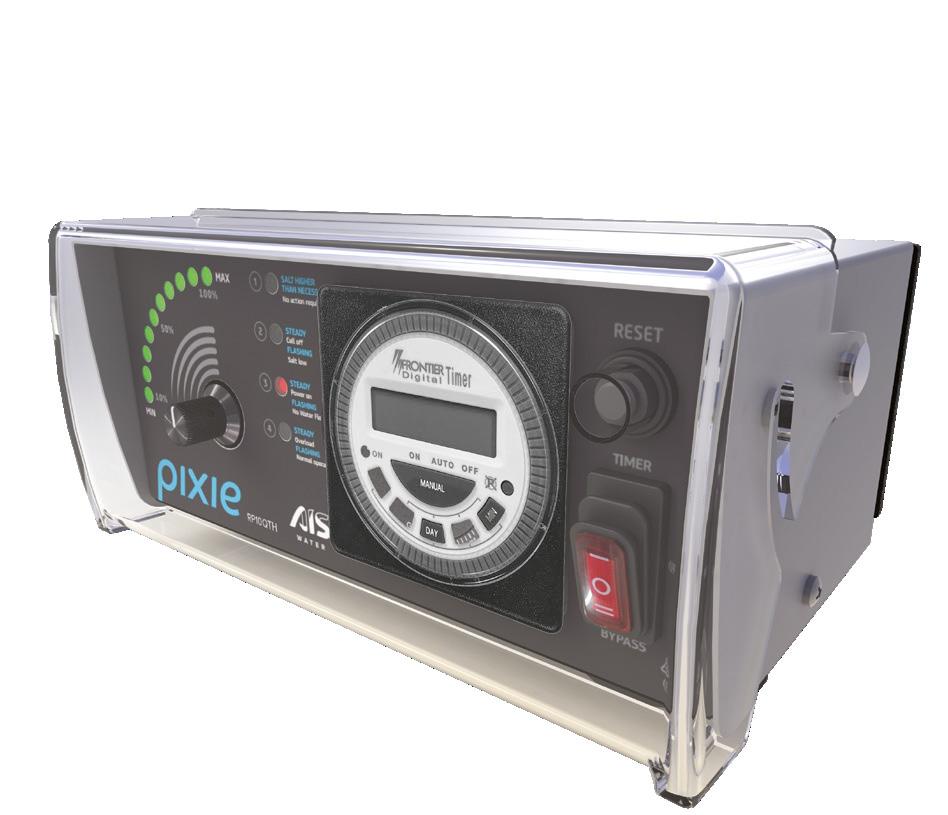
AutoChlor® Pixie
Chlorine output: 1 -10 g/h
Salinity Range: 4,000ppm - 5,000ppm
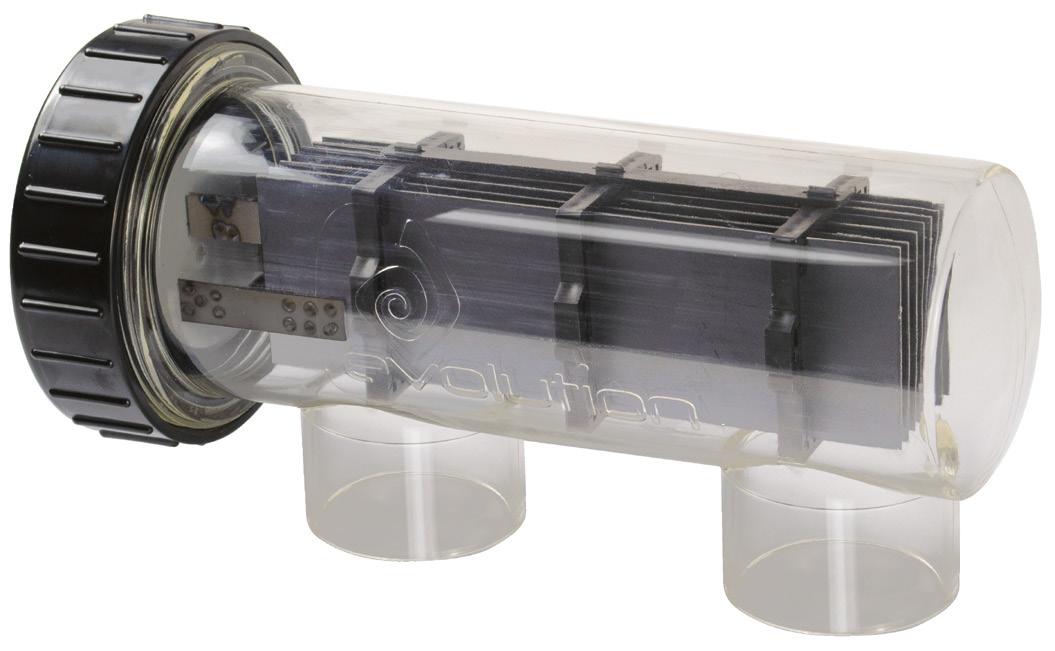
Designed in Australia to meet the surging demand in the plunge pool and spa market, the Pixie micro chlorine generator inherits the DNA of its bigger AutoChlor® counterparts. With a reverse polarity cell, water flow alarm, and high/low salinity alerts, it also shields your pool or spa from over-chlorination. Say goodbye to risky chlorine dosing and oversized chlorinators intended for larger pools. Pixie delivers peace of mind with its cost-effectiveness, simplicity, reliability, and hassle-free installation.
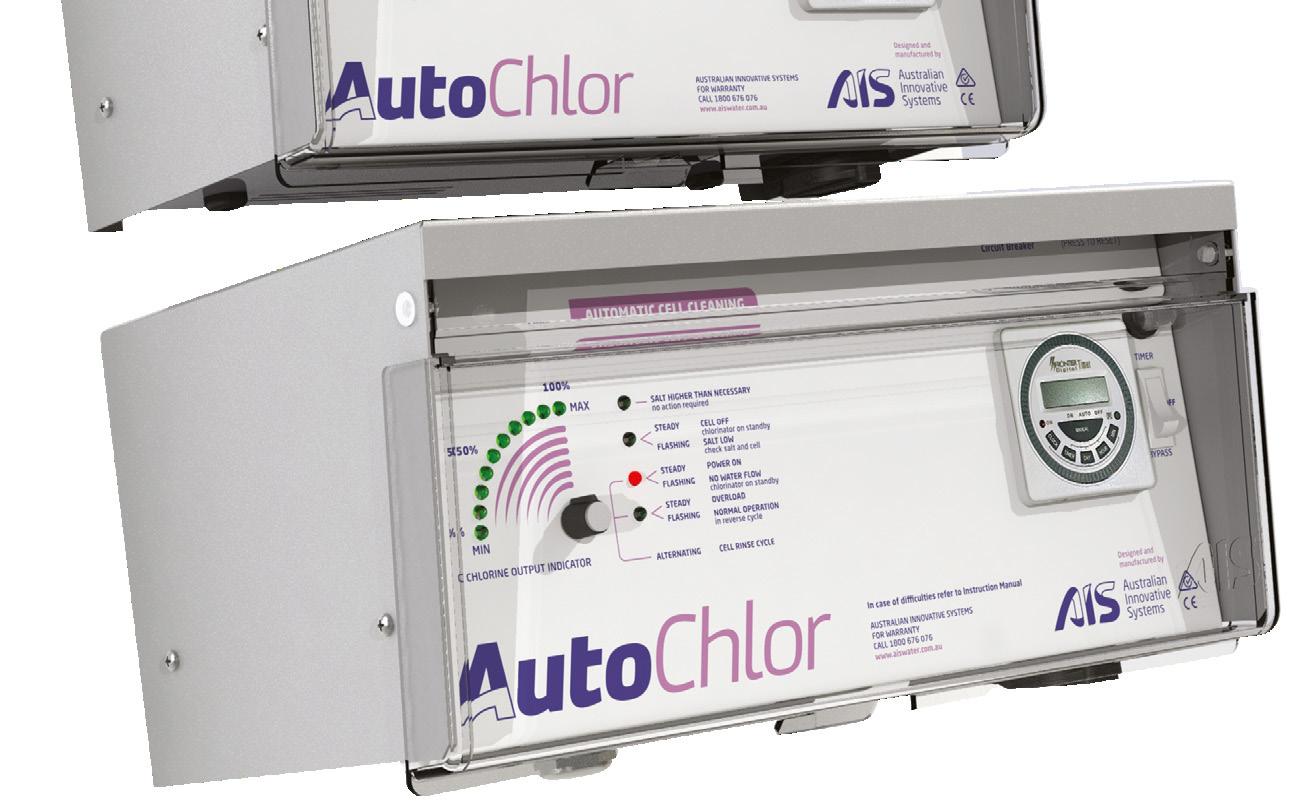
AutoChlor® Classic MkII
Chlorine output: 15 / 20 / 25 / 36 / 50 / 64 / 80 g/h
Salinity Range: 3,500ppm - 5,000ppm
Born over 30 years ago, the AutoChlor® Classic™ series reigns as AIS’ flagship, celebrated for its unwavering simplicity, unmatched reliability, and effortless installation. The Classic™ series has continuously advanced, and in its latest iteration, AutoChlor® Classic™ Mark II proudly features an aluminium heatsink, fortifying its durability to excel in the most extreme, high-temperature conditions with unparalleled ease.
Download the AIS Water AR app from the Apple App Store or Google Play Store and scan the AIS Water logo to learn “Why choose AIS technology?” AR
No Pro Rata No Small Print No Pro Rata No Small Print
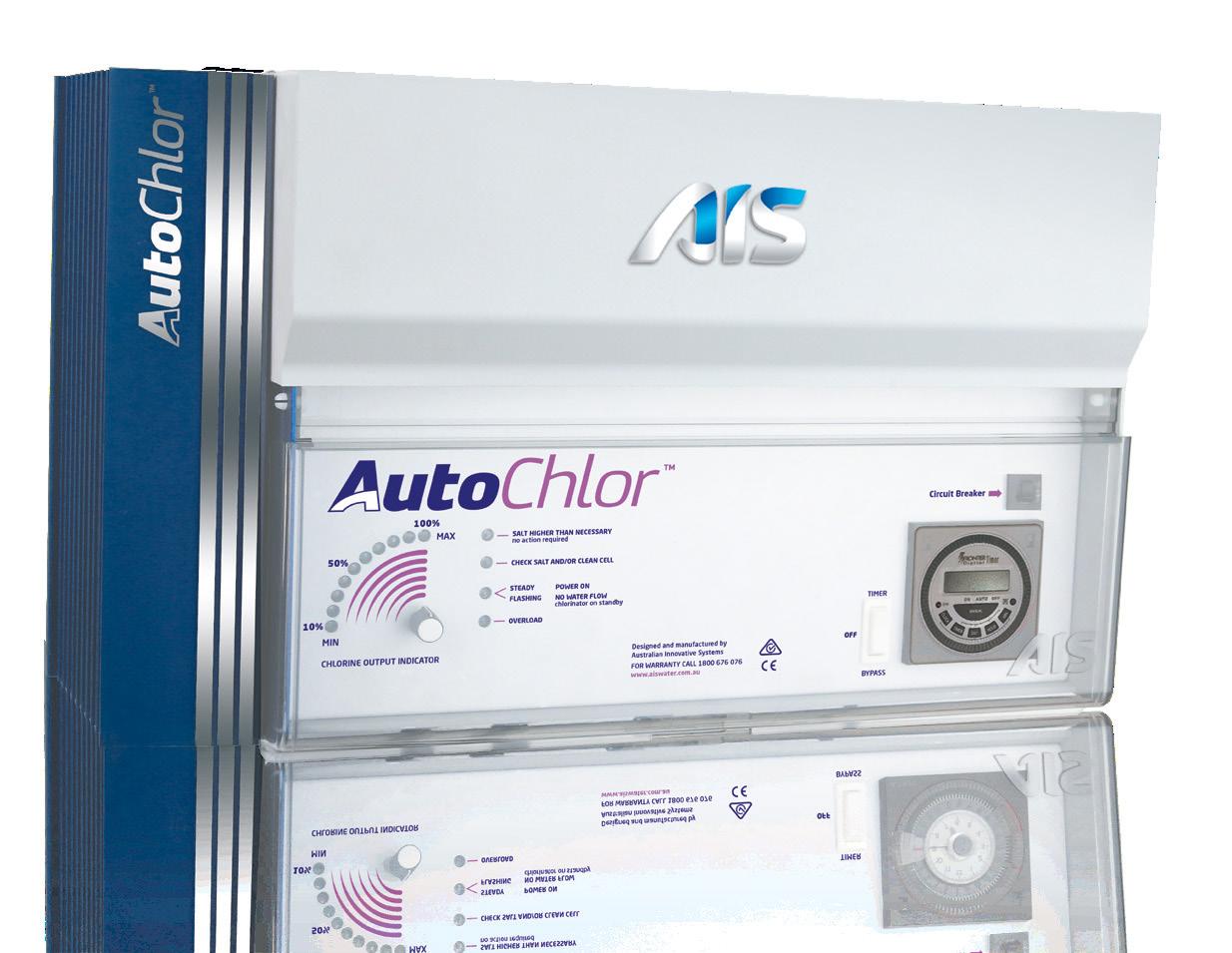
AutoChlor® MIDI
Chlorine output: 100 & 150 g/h
Salinity Range: 3,500ppm - 5,500ppm
Say goodbye to juggling multiple residential chlorinators. Elevate your pool experience with the AutoChlor® MIDI™ – the ultimate solution for busy pools. With its industrial aesthetics and unmatched performance, this semi-commercial powerhouse provides the chlorine your pool demands. Operating at a salinity level as low as 3,500ppm, the RP150 model, takes your swimming experience to the next level. AutoChlor® MIDI™: where reliability, strength, and top-tier functionality meet.
AutoChlor® Commercial
Chlorine output: 100 - 5,000 g/h
Salinity Range: 4,000ppm - 35,000ppm
AIS Water stands as a pioneering force in commercial pool water disinfection, leading the charge in innovative solutions for over 25 years. The awardwinning AutoChlor® commercial range, designed for saltwater, coastal, and sea water swimming pools, is the culmination of 25+ years of relentless research and development. Today, it remains the unrivaled chlorine generator of choice, diligently disinfecting thousands of swimming pools in resorts, hotels, public swimming pools, aquatic centres, swim schools, lagoons, water parks, and schools across more than 55 countries worldwide. AIS Water - setting the gold standard in commercial pool water purification.

A 30 year history of innovation and a laser focus in chlorine generation via electrolysis.

2023 Australian Manufacturing Awards
Embracing Innovation Award Winner Queensland
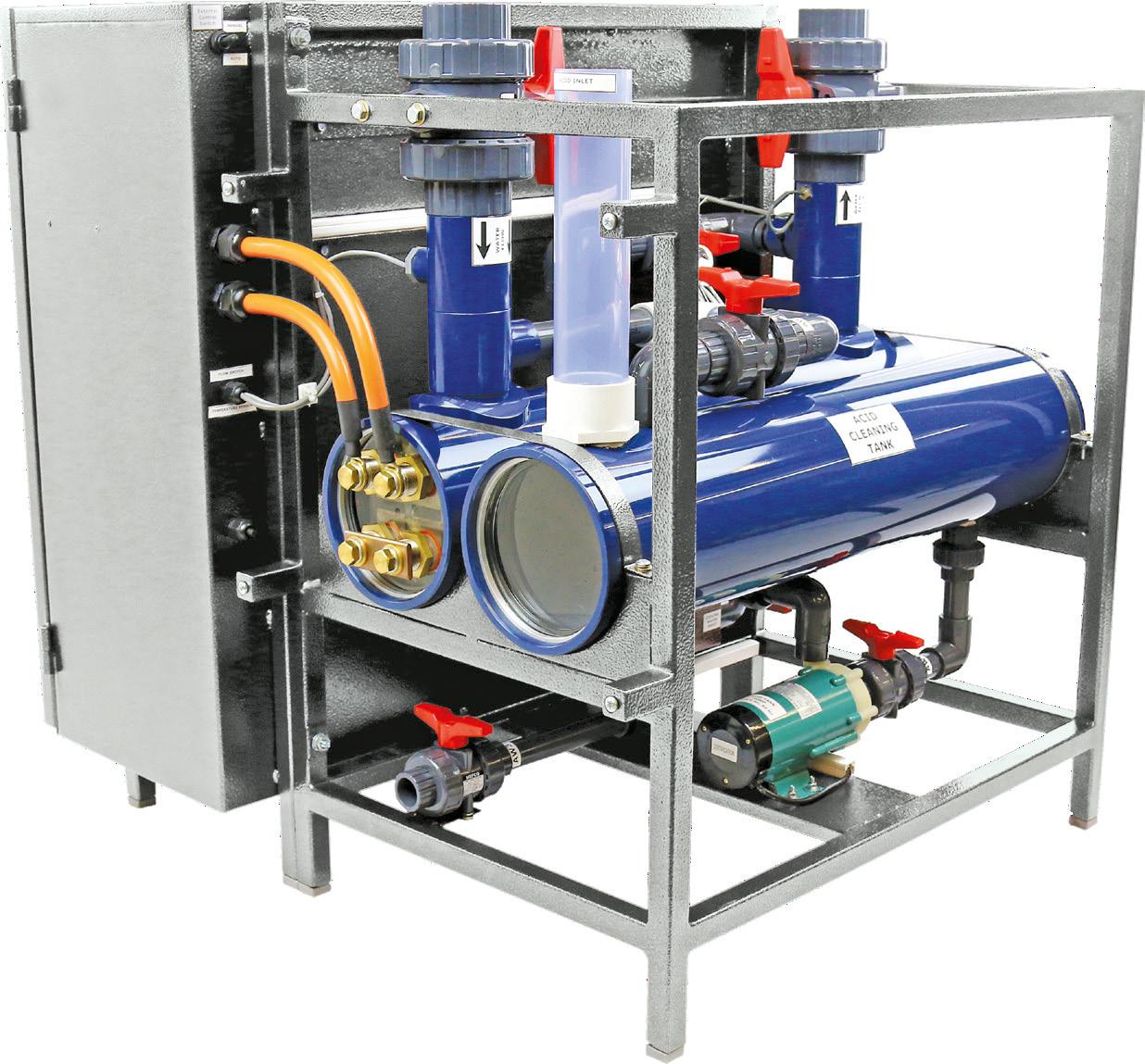
Power
Supply and electrolytic cell


AWARDED AUSTRALIA’S BEST POOL HEAT PUMPS SUPPLY SUPERIOR COMFORT WITH THE #1 POOL HEAT PUMP Consult an EvoHeat specialist today for your customers’ perfect solution! 450 independent reviews
THE ULTIMATE COMFORT, PERFORMANCE, & ENERGY-EFFICIENT POOL HEATING

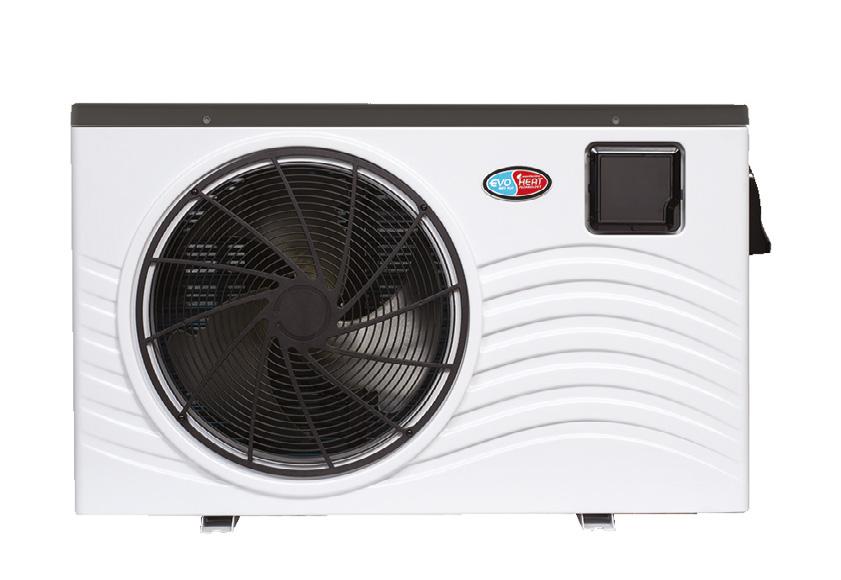
EVO FUSION-i HEAT PUMP
Reliable solar alternative Extended swim season
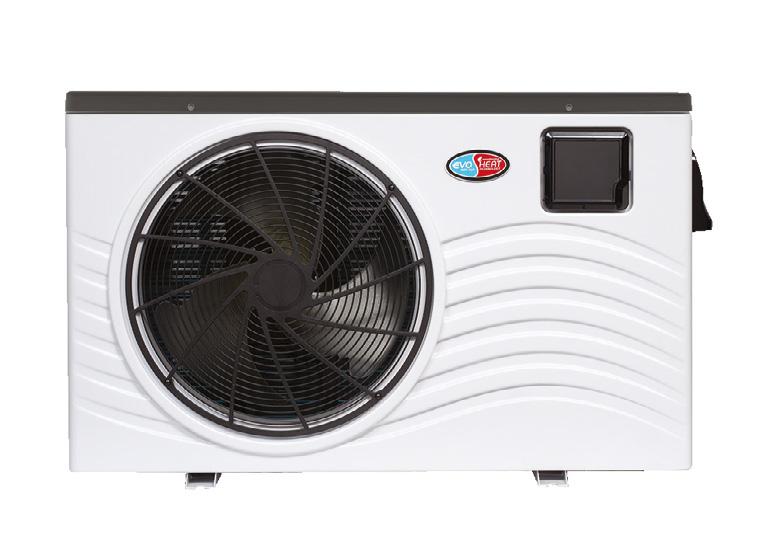
• 7kw to 19kw models • latest full inverter technology • heating, cooling and automatic modes • LCD touch screen controller • built-in timers • auto defrost • quiet operation • simple installation

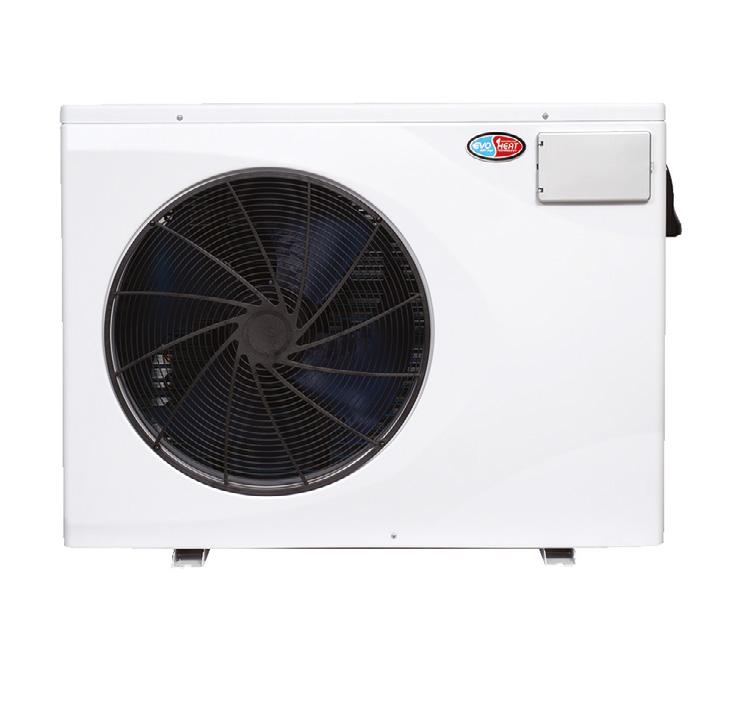
EVO EDGE-i HEAT PUMP
Space saving design Extended swim season
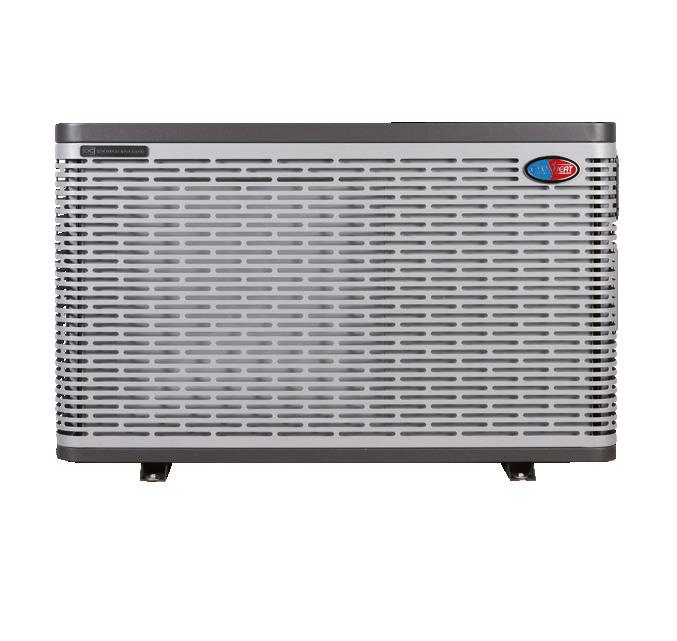
• 7kw to 18kw models
• latest full inverter technology • space saving design
• install almost anywhere • heating, cooling and automatic modes • LCD touch screen controller • wi-fi control • built-in timers • auto defrost • quiet operation • simple installation

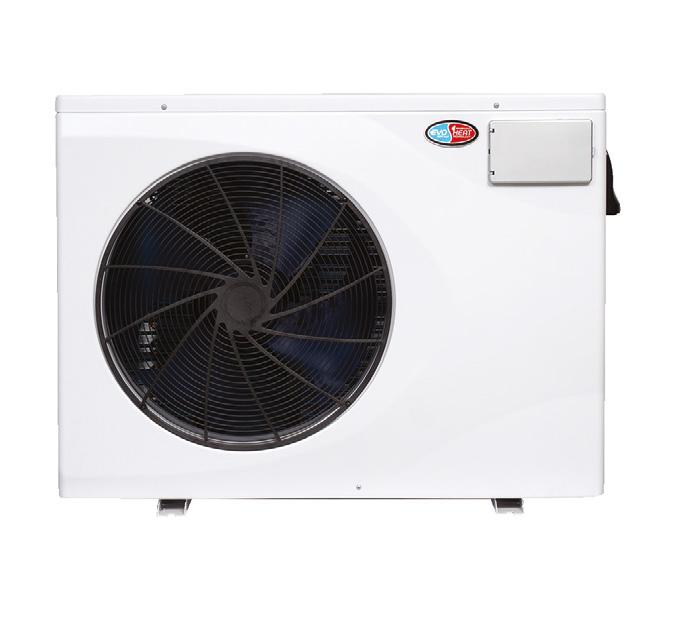
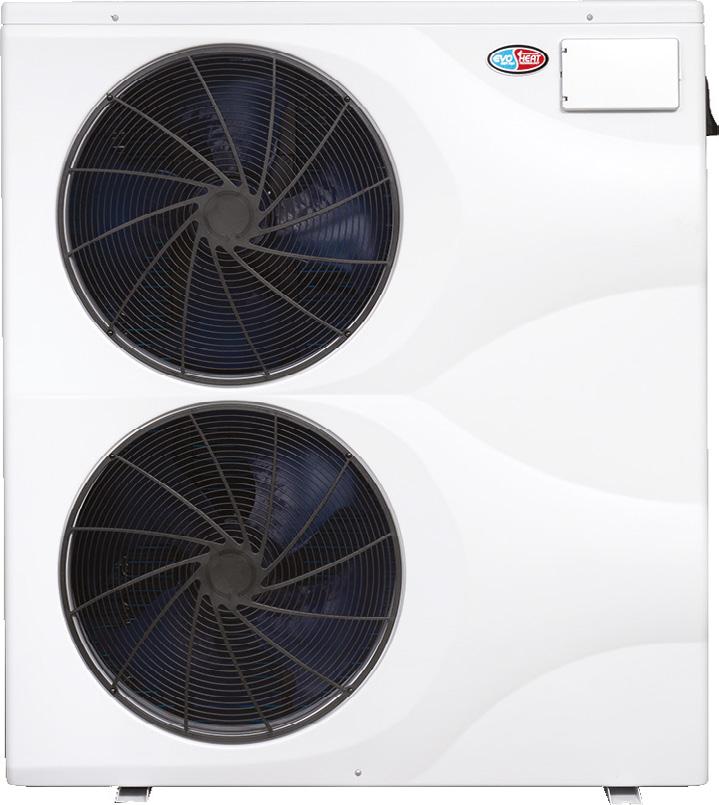
EVO FORCE-i HEAT PUMP
Lowest running costs Year round swim season
• 9kw to 28kw models • latest full inverter technology • lowest operating costs
• heating, cooling and automatic modes • intelligent LCD touch screen controller • wi-fi control • built-in timers • auto defrost • quiet operation • simple installation
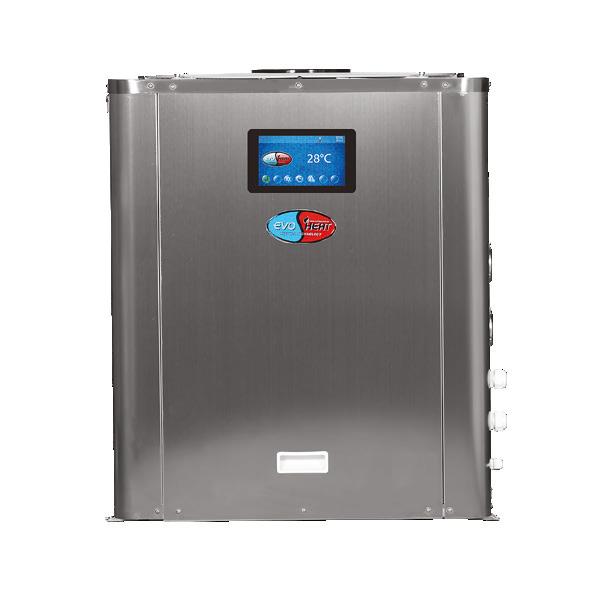


EVO DHP-R HEAT PUMP
Cold climate series Year round swim season
• 9kw to 27kw models • ideal for cold climate performance • heating, cooling and automatic modes • intelligent LCD touch screen controller • wi-fi control • built-in timers • stainless steel cabinet • dual defrost • quiet operation • simple installation

EVO CS-i HEAT PUMP
Commercial inverter series Year round swim season
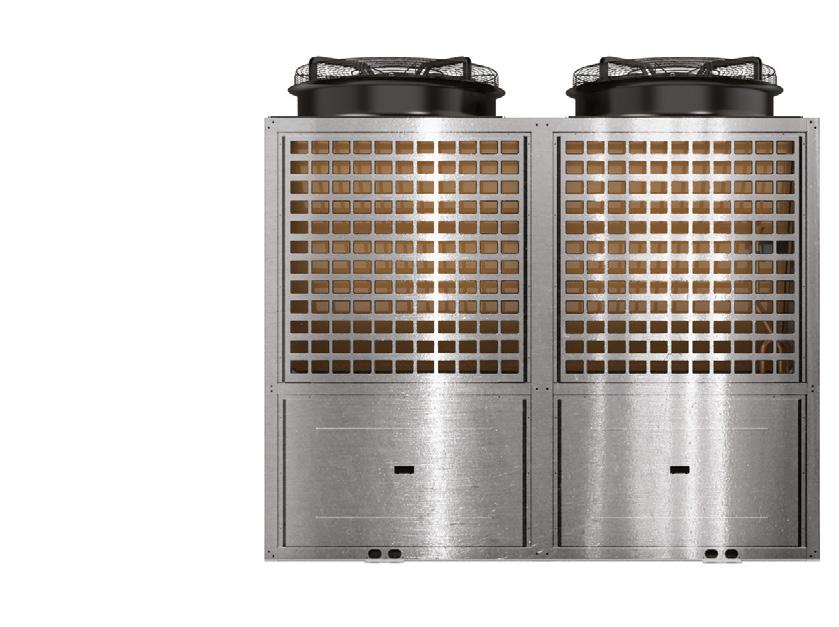
• 65kw to 250kw models
• latest full inverter technology • lowest operating costs
• heating, cooling and automatic modes • intelligent LCD touch screen controller • power boost mode • built-in timers • stainless steel cabinet • auto defrost • quiet operation • simple installation
2022 Commercial Systems & 2021 Sustainable Product Award Winner
1300
859 933 | evoheat.com.au
2024 PR award won for the Fusion-i & Force-i pool heat pumps. PR ratings as of the 05.01.2024
*


Published by
The Intermedia Group Pty Ltd
ABN 940 025 83 682
41 Bridge Road, Glebe, NSW, 2037 Australia
Ph: (02) 9660 2113 Fax: (02) 9660 4419
On behalf of The Swimming Pool & Spa Association of Australia Ltd (SPASA Australia)
Managing Editor: Chris Maher
Phone: 0412 048 639
Email: chrismaher@intermedia.com.au
Contributors: Veda Dante, Brett Abbott, Paul Stevenson.
Advertising Manager: David Stennett
Phone: 0404 725 554
Email: david@spasa.com.au
Graphic Designer: Leanne Hogbin
Production Manager: Jacqui Cooper
Subscriptions: 1800 651 422
Email: subscriptions@intermedia.com.au
Copyright
All material in this publication is copyright to the publisher and/or its contributors. No material may be reproduced without the express permission of the publishers.

Disclaimer: This publication is published by The Intermedia Group Pty
editorial

Time to prepare
The SPLASH! Expo only comes around every second year – and this year is SPLASH! Year.
Registrations have now opened for SPLASH! 2024 and it’s a good idea to register online to smooth your entry on the day, and to save yourself the door charge.
It’s also worthwhile booking accommodation early as it’s going to be a busy time up there this August, with major Gold Coast events being held either side of SPLASH! Week, and the week itself chock-full of special industry events.
the Trade Practices Act 1974 and any statutory modification or re-enactment thereof. To the extent permitted by law, the Publisher will not be liable for any damages including special, exemplary, punitive or consequential damages (including but not limited to economic loss or loss of profit or revenue or loss of opportunity) or indirect loss or damage of any kind arising in contract, tort or otherwise, even if advised of the possibility of such loss of profits or damages. While we use our best endeavours to ensure accuracy of the materials we create, to the extent permitted by law, the Publisher excludes all liability for loss resulting from any inaccuracies or false or misleading statements that may appear in this publication.
This issue of SPLASH! magazine published by The Intermedia Group Pty Ltd (Intermedia) may contain magazine or subscription; offers, competitions, forms and surveys (Reader Offers) which require you to provide information about yourself, if you choose to enter or take part in them. If you provide information about yourself to Intermedia, Intermedia will use this information to provide you with the products of services you have requested and may supply your information to contractors that help Intermedia to do this. Intermedia will also use your information to inform you of other Intermedia publications, products, services and events. Intermedia may give your information to organisations that are providing special prizes or offers that are clearly associated with the Reader Offer. Unless you tell us not to, we may give your information to other organisations that may use it to inform you about other products, services or events or to give it to other organisations that may use it for this purpose. If you would like to gain access to the information Intermedia holds about you, please contact Intermedia’s Privacy Officer at The Intermedia Group Pty Ltd, PO Box 55, Glebe, NSW 2037.
Copyright © 2024 - SPASA Australia. Proudly


The Intermedia Group takes its Corporate and Social Responsibilities seriously
Chris Maher Managing Editor chrismaher@ intermedia.com.au
Just a small list includes the ASSA Conference, the Women in Industry breakfast, dozens of seminars and workshops, the welcome drinks, the SPLASH! Golf Day, the SPLASH! CEO Lunch, the National Awards Gala and to finish it all off, the SPLASH! After Party. That’s all on top of the sold out show floor presenting hundreds of the latest innovations to the pool and spa industry.
Special delegate rates have been negotiated at a selection of Gold Coast hotels. Go to www.splash.online/expo for more information.
Already this year we’ve seen some successful consumer shows – with people turning up ready to buy. It’s no wonder, given the popularity of swimming pools as an investment in a property. In fact, Domain found pools ranked number one on their search list, making swimming pools the most sought-after property feature in Australia. This has been backed up by anecdotal evidence from real estate agents and vendors, with several reporting the popularity of pools in a recent Daily Telegraph article, where they also confirmed the cost of building a swimming pool is easily recouped by at least at much at sale time.
And think of all the benefits you get while you live in that home: a pool improves mental and physical health and family relationships; and the children even get to make friends with all the other kids in the street, who just love to come over for a swim.
For the pool owner, it’s not just an investment in their property; it’s an investment in their family and themselves.
What more can you ask for?

The cover
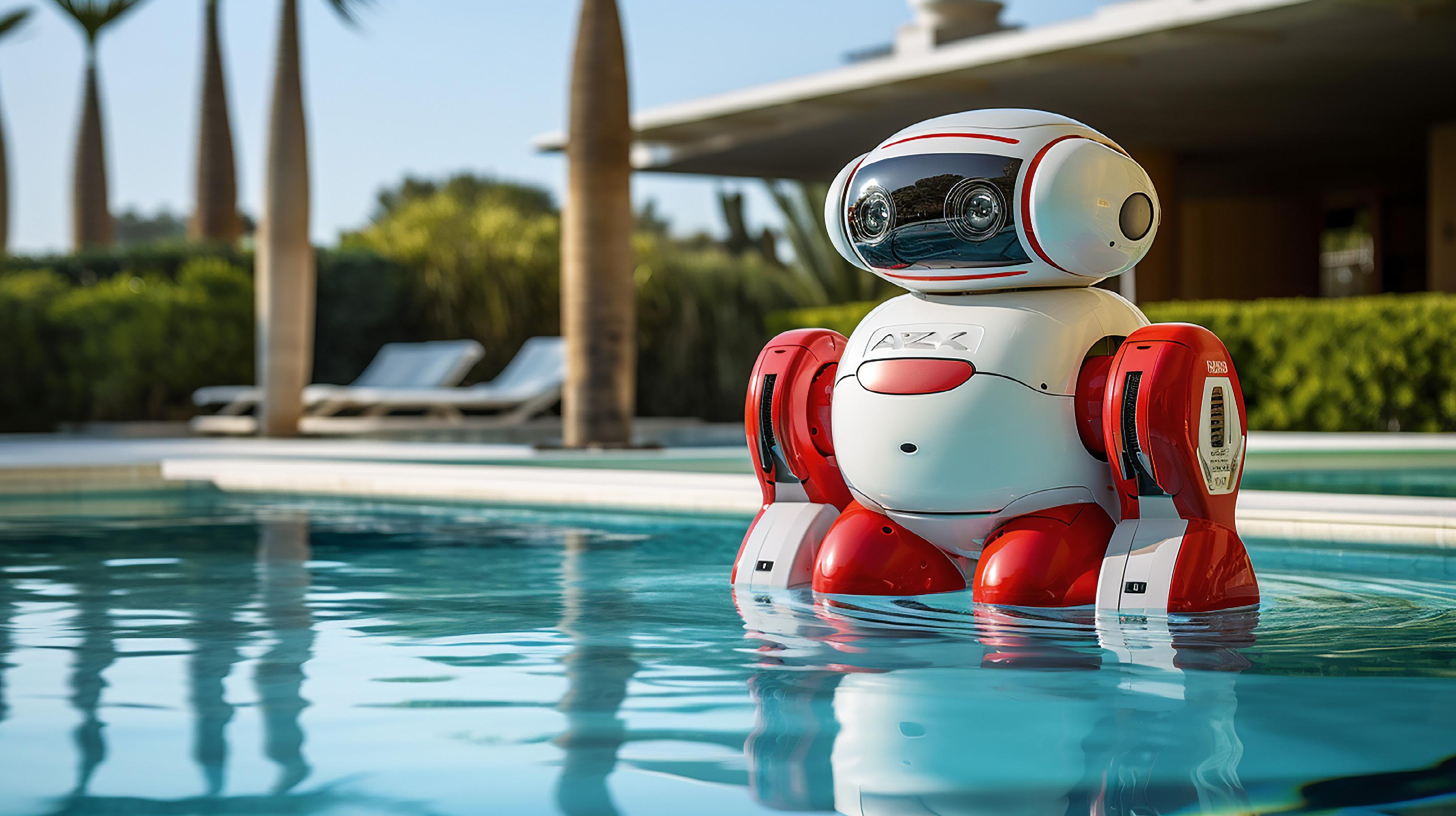
Artificial intelligence is having an impact on the swimming pool and spa industry. For more on AI in the industry see page 28.
and is committed to reducing its impact on the environment. We continuously strive to improve our environmental performance and to initiate additional CSR based projects and activities. As part of our company policy we ensure that the products and services used in the manufacture of this magazine are sourced from environmentally responsible suppliers. This magazine has been printed on paper produced from sustainably sourced wood and pulp fibre and is accredited under PEFC chain of custody. PEFC certified wood and paper products come from environmentally appropriate, socially beneficial and economically viable management of forests.
Ltd
behalf
Materials in this publication have been created by a variety of different entities and, to the extent permitted by law, the Publisher accepts no liability for materials created by others. All materials should be considered protected by Australian and international intellectual property laws. Unless you are authorised by law or the copyright owner to do so, you may not copy any of the materials. The mention of a product or service, person or company in this publication does not indicate the Publisher’s endorsement. The views expressed in this publication do not necessarily represent the opinion of the Publisher, its agents, company officers or employees. Any use of the information contained in this publication is at the sole risk of the person using that information. The user should make independent enquiries as to the accuracy of the information before relying on that information. All express or implied terms, conditions, warranties, statements, assurances and representations in relation to the Publisher, its publications and its services are expressly excluded save for those conditions and warranties which must be implied under the laws of any State of Australia or the provisions of Division 2 of Part V of
(the “Publisher”) on
of SPASA Australia.
supported by The views expressed in this magazine do not necessarily represent those of the above supporters, nor should any product advertised in SPLASH! magazine be seen to be endorsed by the above.
February/March 2024 SPLASH! 7
In Control

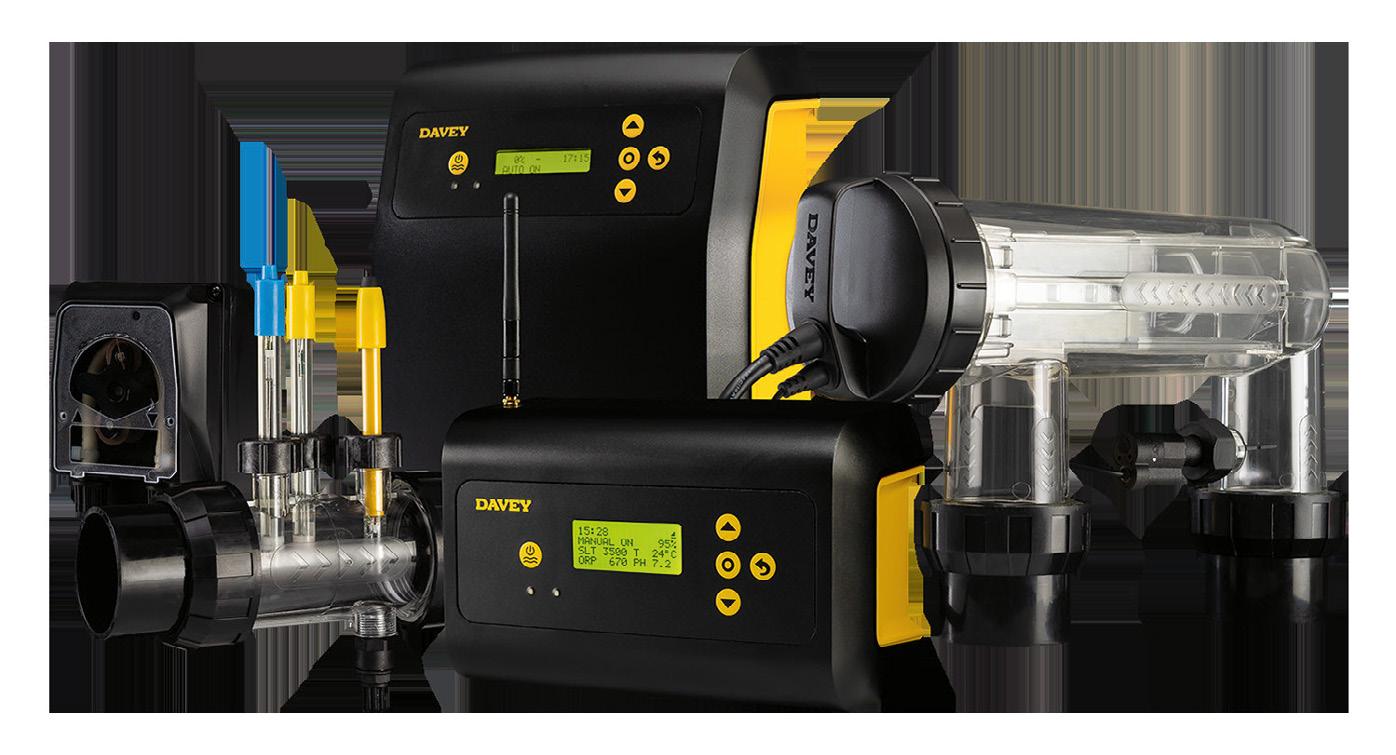
A complete pool and chemistry controller that offers simple, automated pool chemistry control and monitoring, is completely plug and play and is easy to install and program.
Depend on Davey.
Davey. Proudly Australian since 1934.
daveywater.com
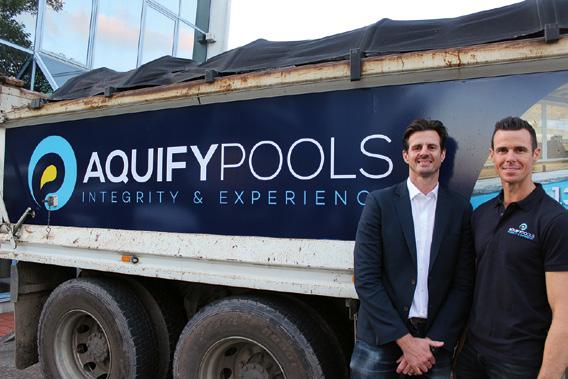
22 Brothers work together to make a winning company
Matt Ranieri explains how he and his brother Tim developed Aquify Pools from the ground up, eventually seeing it become the SPASA 2023 National Business of the Year.
28 Artificial intelligence and the pool industry
Veda Dante looks at the rise of artificial intelligence, and asks what makes it different from standard computing, and what effect is it having on the pool and spa industry.
42 New TV program putting pools top of mind
Poolside Spa & Garden Australia is a fresh series focused on living your best poolside life, from the creators of Channel 10’s Healthy Homes Australia.
45 Beware promises to eliminate one-star reviews
Brett Lloyd Abbott issues a caution on companies that promise to remove negative reviews about your business on Google Review and other platforms.

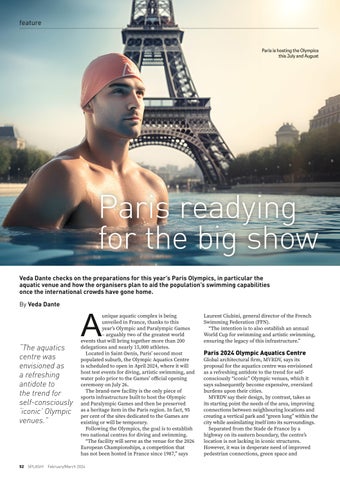
52 Paris readying for the big show
Veda Dante checks on the preparations for this year’s Paris Olympics, in particular the aquatic venue and what will happen once the international crowds have gone home.
58 Comparison of commercial filtration systems
One of Australia’s most experienced consulting aquatic engineers, Paul Stevenson, provides a comprehensive analysis of the four types of filtration used for large commercial projects.
regulars News 10 Pool DAs 11 Calendar 13 Commercial news 48 New products 64 Ad index 66
28 22
February/March 2024 SPLASH! 9
52 Contents
Former Narellan Pools owner and managing director Chris Meyer passes away
It is with great sadness that we report the passing of Chris Meyer. Chris started working with Narellan Pools at just 14 years of age. He went on to own and run the business, taking it from humble beginnings to a global leader in the industry. He sold the business in 2019.
During his impressive 30-year career, Chris’s entrepreneurial flair, commitment to professionalism, obsession with quality, values-based leadership and passion for the industry has left an enduring mark, and notable legacy.
Australian brands Sapphire Spas and Halo Spas form retail alliance
Tim Parkinson from Sapphire Spas and Rob Kruber from Halo Spas have recently signed an agreement to form a retail alliance for their spa ranges.
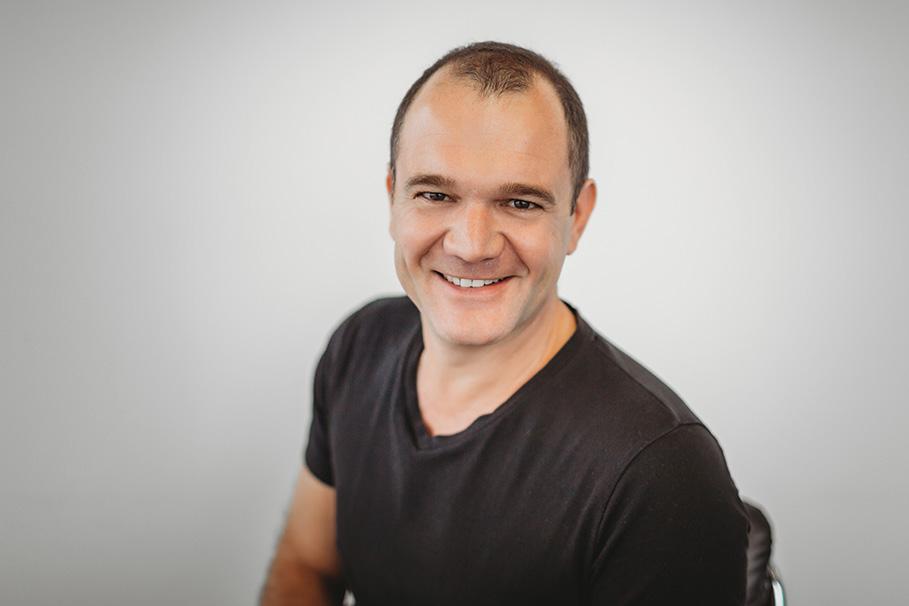
Chris was not only a huge contributor to the pool and spa industry, but an inspiring leader, boundless source of knowledge, generous sounding board and wonderful friend to many. Chris will be greatly missed.
Everyone at SPLASH! offers their heartfelt condolences to Chris’s wife Debb, his children, Eliza, Kingston and Hudson, family, friends and colleagues at this devastating time.
The agreement will see these two leading independent Australianowned companies offer their ranges of Australian made spas and swim spas to retail pool and spa stores across Australia and potentially overseas.
“This alliance will provide our retail partners with the best offer of products for their stores, with the backup and support that can only come from local manufacturers,” says Parkinson.
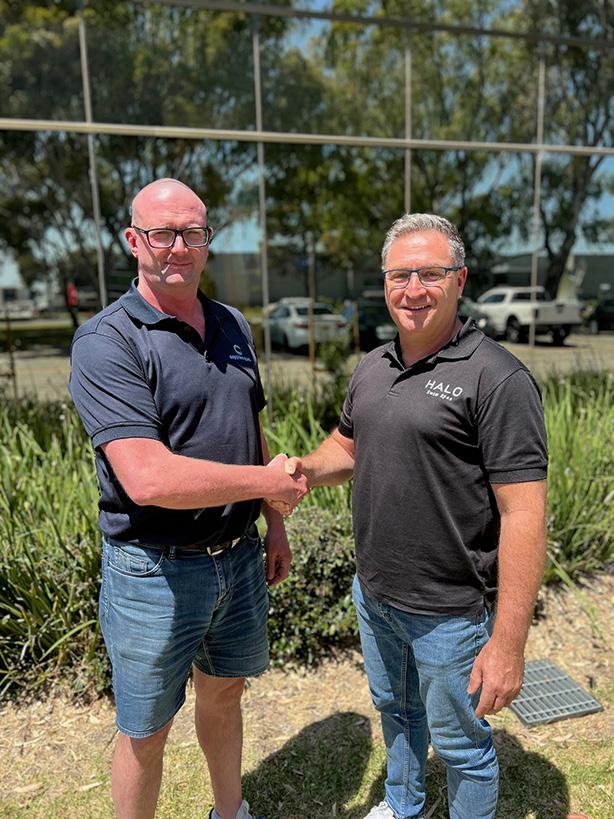
“The changing retail market has welcomed the opportunity to display and retail both the Halo and Sapphire ranges, which sit together well and provide a complete retail solution that we all believe cannot be beaten,” says Kruber. In a combined statement, Parkinson and Kruber say they and their teams are excited about the prospect of seeing their retail networks grow even stronger, with the opportunity to showcase these two outstanding brands next to each other on the same retail floors.
Valentina Tripp appointed managing director of Fluidra APAC
Valentina Tripp has been appointed to the role of managing director of Fluidra APAC, effective February 29, 2024.
Tripp replaces Stephen Matysiak, a 32-year Fluidra veteran who led the company’s ANZ, Asian and South African businesses since 2014. He has taken the decision to explore new opportunities.
Tripp says that Matysiak’s unwavering commitment, passion for people and wealth of experience was pivotal in shaping Fluidra’s success in the region, leaving the business in excellent financial health with a strong plan for future growth and a positive outlook for the regional industry.
“Stephen’s enduring legacy of continuous improvement and excellence will continue to inspire and guide the company,” she says.
Tripp is an experienced leader with a diverse 30 year career in Australia and internationally across food, agriculture and water industries. Most recently she was CEO of Davey Australia.
She is eager to build on Fluidra’s strong foundations and lead the team into a new era of growth and innovation with fresh perspectives and innovative strategies.
“I am honoured and excited to join the Fluidra family,” she says. “I look forward to working with our team and customers on shaping the next chapter of Fluidra’s story, finding innovative ways to accelerate growth in the region.”
Tripp will work alongside Matysiak over the next month to ensure the leadership transition is seamless.

The executive team supporting Tripp has more than 100 years combined experience in the Australian pool industry and remains committed to maintaining Fluidra’s market leading position in the region.
“We are used to change at Fluidra,” says Jonas Ryberg, marketing and R&D director at Fluidra ANZ.
“In fact, learning to adapt to change is one of our core values. Over the years, we have become pretty good at responding to change – whether internal or external in nature. This latest change will ensure that we don’t become complacent, and that we continue to look for new opportunities to grow and improve,” he says.
Spas
Industry moves
Passings
Chris Meyer
Tim Parkinson and Rob Kruber
10 SPLASH! February/March 2024 news
Valentina Tripp
Aquatune founder Warwick Abbott passes away
Sadly, industry stalwart and South Australian legend Warwick Abbott passed away in January.
After completing university with a BSc (Hons) at the University of Adelaide, majoring in Physical and Inorganic Chemistry and Organic Chemistry, Warwick began his career in the sixties with Monsanto Chemicals and Mobil Oil in Melbourne.
He then worked for Mobil in both the UK and Europe for several years. In the seventies, he was the managing director of several major Adelaide firms. In 1984 he founded Aquatune, supplying pool and spa chemicals with a strong emphasis on water chemistry advice and consultation to the trade and commercial customers.
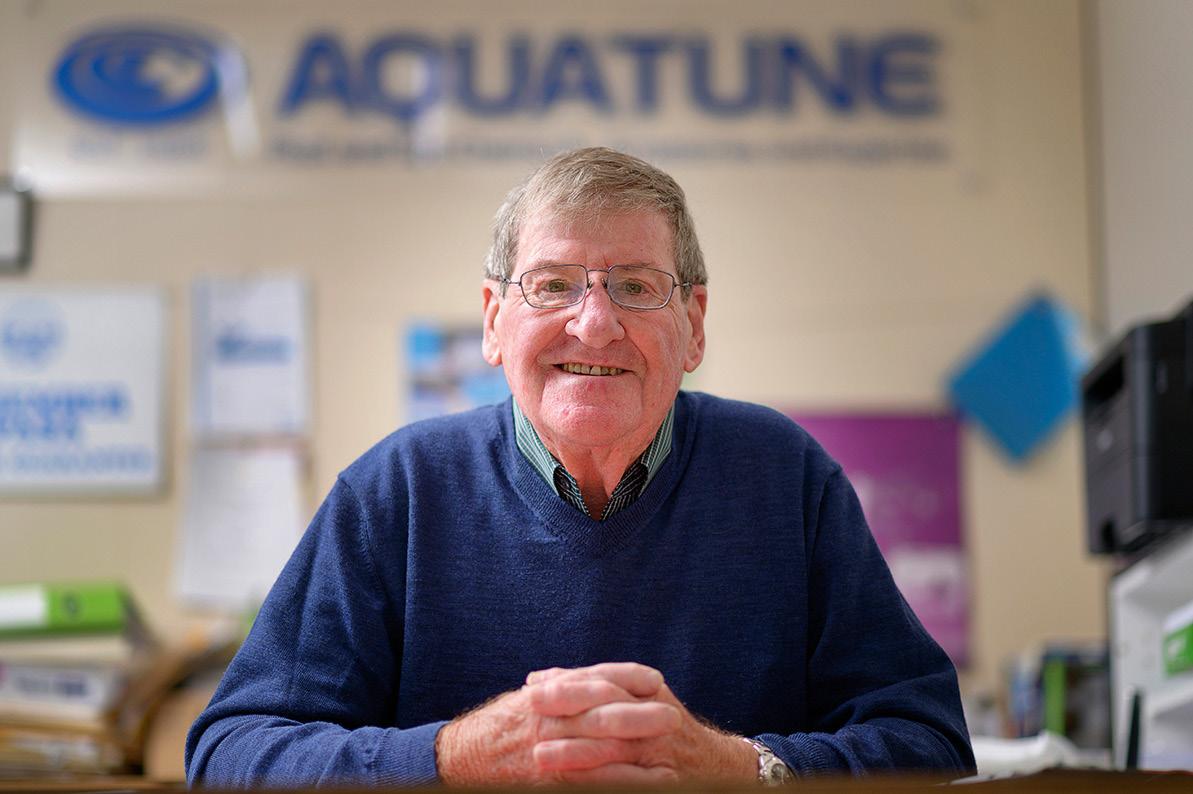
Over the years, he acted as SPASA’s water chemistry adviser and was instrumental and actively involved in the original (now SA Health) Regulations (1989) and its supplementary codes.
As Warwick moved closer to retirement in recent years, he oversaw the expansion of Aquatune to include the establishment of Aquatune Trade in South Australia.
Warwick’s endless dedication to providing technical assistance and mentorship to the industry will be sadly missed. Many in the industry have fondly referred to Warwick as the Guru, the Godfather, Legend of the Trade and an Industry Icon.
Aquatune and Warwick’s family have already received an overwhelming response from the industry to the news of his passing. A memorial was held in early February, attended by 200 family and friends including many industry members. He was remembered as a gentleman full of integrity, humility and boundless knowledge, which he was always willing to share with a smile. Everyone at SPLASH! offers heartfelt sympathy to Josh, the Abbott family, and the entire Aquatune and Aquatune Trade team.
Annual pool DAs down 12 per cent
Comparing the available pool DA figures for the 12 months to January with the same period last year, annual applications were down by 12 percent nationally. South Australia was up a massive 192 per cent, an increase sourced to an improvement in data collection rather than simply an increase in actual DAs. All other states were down: Victoria by two per cent, Western Australia by 18 per cent, New South Wales by 24 per cent and Queensland by 25 per cent.
The DA numbers over the most recent three months were down by seven per cent nationally when compared to the same period last year, which is an improvement of 17 per cent on the previous comparison. The November-January numbers from Cordell show South Australia up by 750 per cent and Western Australia up by 15 per cent; but all other states were down: Victoria by nine per cent, Queensland by 11 per cent and New South Wales by 31 per cent.
MIDDLE GRAPH HAVE TO DO MANUALLY
Cooke wins global award
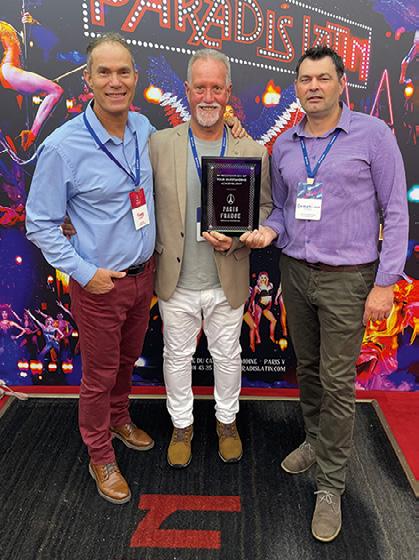
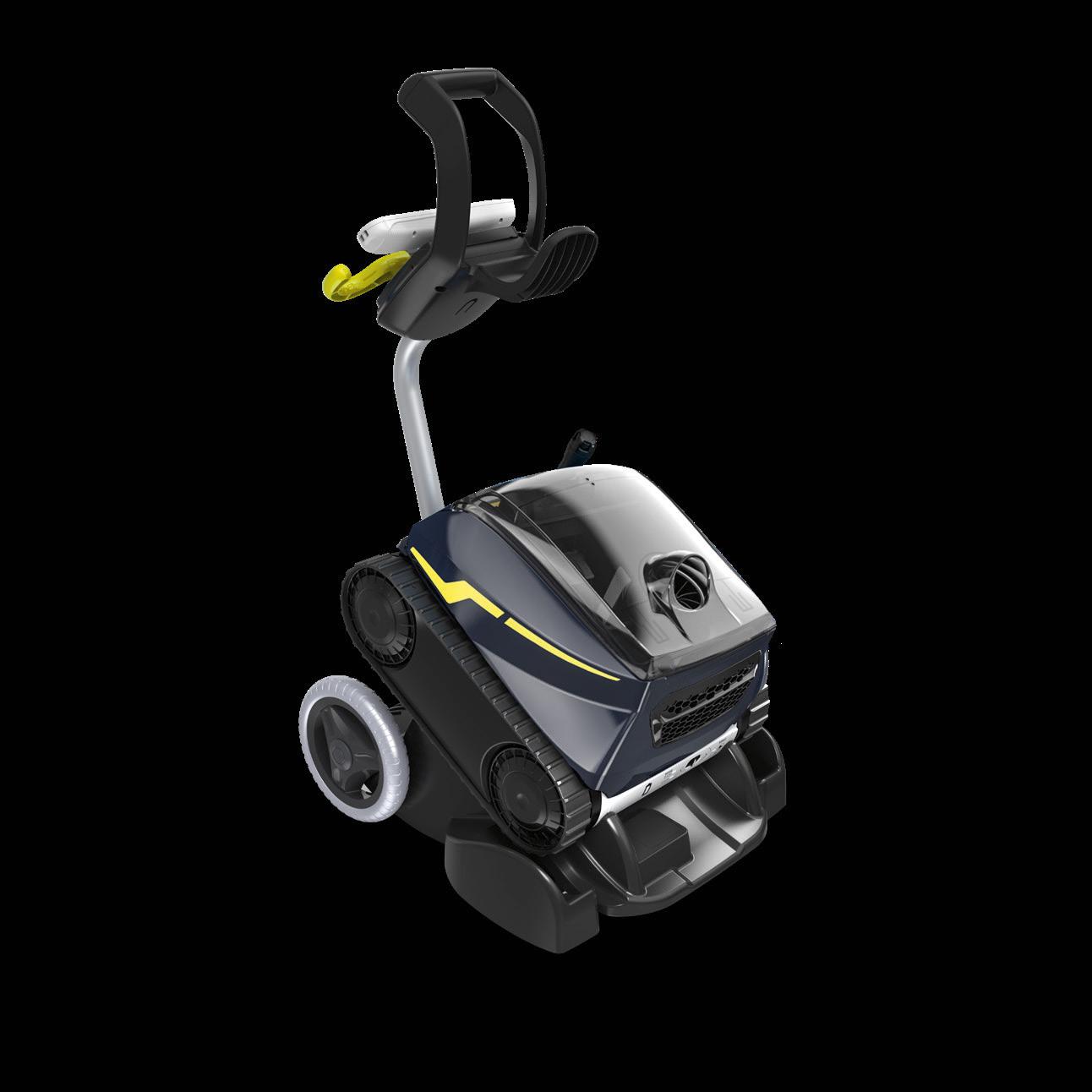
Cooke Industries has won the 2023 QuikClean International Distributor of the Year Award on the back of selling the most QuikClean systems globally.
“This award is testament to the dedication of our team and their efforts to support our trade partners,” Cooke says.
“Our growth trajectory has been tremendous and it means a lot to our team that the Australian market values our contribution and trusts us, not just as a supplier of in-floor cleaning systems and pool equipment, but as a valued business partner.”
Cooke Industries has been the Australian distributor of QuikClean in-floor cleaning systems since 2007, and their 2023 sales represent a six-fold increase from a decade ago.
these figures give an indication of the way the market is trending, they are not comprehensive and don’t include all pools built or even all DAs lodged. By some estimates, the total national numbers including all types of pools could be almost double these figures. They do not include pool projects that are approved as part of a new home, smaller projects under the cost threshold, renovations that don’t require a DA, or some aboveground pools. Additionally, not all councils are forthcoming with data or report on time; councils in some states such as Queensland and Victoria are particularly reluctant. For further information, call Cordell Information on 1300 734 318. Jan Dec Nov Oct Sep 0 3000 6000 9000 12000 15000 Year new Year old 0 Year new SA WA QLD VIC NSW Three-monthly comparison Yearly comparison by State 0 500 1000 1500 2000 Year new Year old Jan Dec Nov Oct Sep Aug Jul Jun May Apr Mar 3000 6000 9000 12000 15000 0 1000 2000 3000 4000 5000 6000 7000 8000 Year new Year old SA WA QLD VIC NSW Yearly comparison by month 0 500 1000 1500 2000 Year new Year old Jan Dec Nov Oct Sep Aug Jul Jun May Apr Mar Feb 0 1000 2000 3000 4000 5000 6000 7000 8000 Year old NSW
While
Passings
Pool cleaners
Warwick Abbott
February/March 2024 SPLASH! 11 news
Cliff Cooke and Demetrious Zaxos in Paris with Greg Huber (left)
Sanitisation versus sanitation
In last edition’s article “Make sure your water sanitisation claims are real”, astute readers may have observed a misuse of the word sanitation while referring to pool water disinfection systems. You’ll note the correct term was used in the title.
The terms “water sanitation” and “water sanitisation” are often used interchangeably, but there is a crucial difference between them. This is a good time to quickly explain the differences between the two similar terms.
Water sanitation:
• Focus: Proper management of human waste.
• Goal: Stops the spread of harmful pathogens from faeces and urine to water sources and the environment.
• Examples: Building toilets, managing sewage systems, safely disposing of wastewater, promoting handwashing practices.
• Impact: Prevents diseases like cholera, typhoid, and hepatitis, improves public health, reduces environmental pollution.
Water sanitisation:
• Focus: Eliminating harmful microorganisms and contaminants from water itself.
• Goal: Makes water safe for drinking, cooking and hygiene.
• Examples: Filtration, chlorination, UV radiation, boiling water.
• Impact: Reduces waterborne diseases like diarrhea, dysentery and worm infections. Promotes healthy communities.
Keep
Former Narellan Pools owner Chris Meyer passes away
Sadly, Chris Meyer, Narellan’s former owner and managing director passed away in December. He will be greatly missed by friends, family and colleagues.
Passings
Helen Strangos passes away
Sadly, Diamond Pool & Spa’s Helen Strangos passed away in December, following a three-year battle with lung cancer.
Helen started working in the pool industry more than 35 years ago, working in the office of Brian Huxham’s Prestige Pools. When Brian passed away unexpectantly, the business was wound up. Helen Strangos and Maurice Romero saw a golden opportunity and made an offer to buy the business. Together they turned Diamond Pool & Spa into one of the most successful pool shops in Melbourne.
Helen was renowned in Melbourne for her dedication to the pool industry and to SPASA, and was often on award judging panels. She was also a strong supporter of training programs for general industry education.
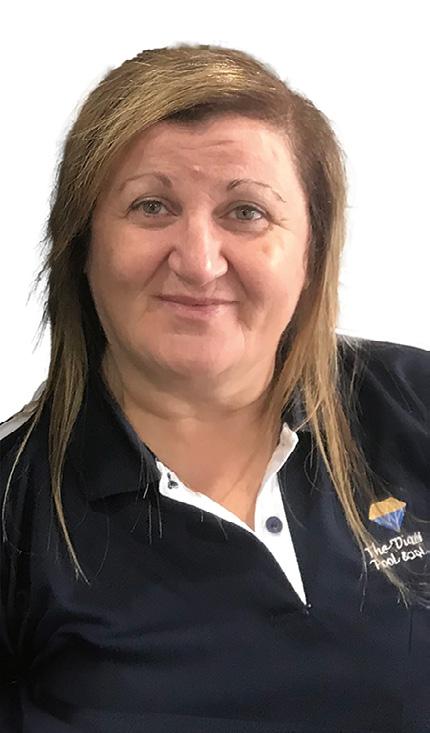
Helen was a stalwart for professionalism and an inspirational leader and this shines through her staff today. Her business acumen is evident in the success of Diamond Pool and Spa, a business she shared with husband Arthur and Romero. She made friends easily and people all over the world are mourning her loss. Bronnie Wallis of Focus Products says that Helen was more than a client, becoming a very good friend over the years.
“She ran a tight ship and had high expectations of her staff, but evoked total loyalty. Testimony to that strategy are the long-term staff and client base that remain to this day. She will be greatly missed within the industry,” says Wallis. Peter (PJ) Zukowski of PJ Pool and Spas says that Helen was always very easy to get along with.
“She was welcoming and always willing to provide guidance. She was very interested in all facets of the pool industry,” he says.
Chris Papa from Maytronics says the world has lost an amazing human being.
“I had the pleasure of dealing with Helen for over 20 years,” he says. “A fiercely loyal customer that turned into a good very good friend. Helen was never scared to tell you her thoughts and where she stood which is what I loved most about her. She was extremely easy to deal with and had integrity in all that she did. The pool industry is worse off without Helen Strangos and she will be sorely missed. RIP beautiful woman.” Helen was farewelled on a bright December day in a joyful and moving tribute by family, friends and industry representatives.
Everyone at SPLASH! offers their heartfelt condolences to Arthur, Georgiana, Alexandra and Katherine, and to her business partner Maurice Romero and family.
Top five online news stories
The online stories that made the news over the past two months.
Leading Australian brands form retail alliance
Sapphire Spas and Halo Spas signed an agreement to offer their ranges to pool and spa stores across Australia and potentially overseas.
New TV program puts pools top of mind
A new TV series, Poolside Spa & Garden Australia, will provide a fresh series focused on living your best poolside life.
Aquatune founder Warwick Abbott passes away
The industry stalwart and South Australian legend Warwick Abbott passed away in January. He will be sadly missed by friends, family and colleagues.
Cooke Industries wins global distributors award
Cooke Industries won the distributor of the year award on the back of selling the most QuikClean systems globally.
Clarification
12 SPLASH! February/March 2024 news
Helen Strangos
informed by subscribing to the free online newsletter.
Upcoming events
2024
Mar 12-13 National Aquatics Symposium, Melbourne
Mar 23-24 Adelaide Pool & Spa Lifestyle Expo
Mar 27 SPASA Awards deadline
Apr 26 Victorian SPASA Golf Day, Peppers, Mornington Peninsula
May 3 WA SPASA Golf Day, The Vines
May 10-12 Asia Pool & Spa Expo 2024
May 11-12 New Zealand Pool & Spa Expo 2024
May 15-16 Country Pool Managers Conference, Club Forster, NSW
May 17 NSW SPASA Golf Day, Oatlands
May 18-19 Brisbane Pool Spa and Lifestyle Expo
May 20-22 AALARA, GCCEC
June 15 SPASA Awards Gala Evening, Qld
June 21-23 Perth Home Show
June 22 SPASA Awards Gala Evening, SA
June 29 SPASA Awards Gala Evening, NSW
July 20 SPASA Awards Gala Evening, WA
July 27 SPASA Awards Gala Evening, Vic
Aug 1 SPASA Awards Gala Evening, Tas
Aug 2 SPASA Awards Gala Evening, NZ
Aug 20-22 Australian Swim Schools Association National Conference, Gold Coast Convention & Exhibition Centre
Aug 20 SPLASH! Golf Day
Aug 21 WAVES Breakfast at SPLASH!
Aug 21 SPLASH! CEO Lunch
Aug 21-22 SPLASH! Pool & Spa Trade Show, Gold Coast Convention & Exhibition Centre
Aug 21 SPASA Awards Gala Evening, Nationals
Aug 22 SPLASH! After Party
Aug 23-25 Melbourne Home Show
Sep 27-29 Brisbane Home Show
Oct 18-20 Sydney Home Show
More details at splashmagazine.com.au. Dates are subject to change and should be checked with the relevant organisation. Send calendar submissions to info@splashmagazine.com.au

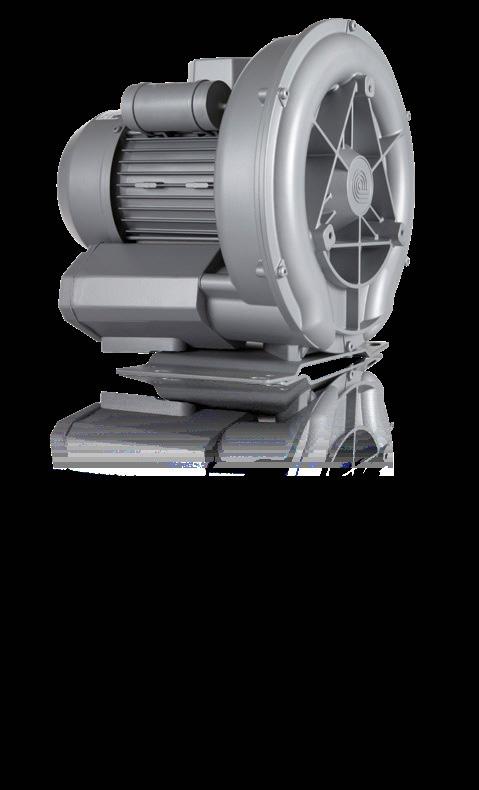
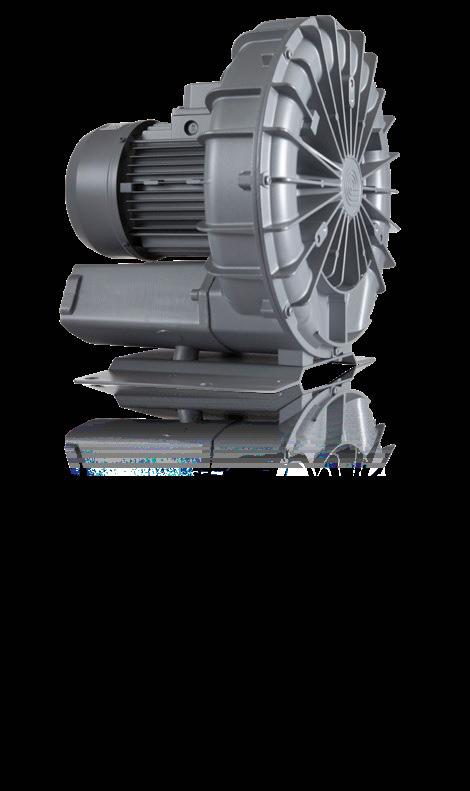
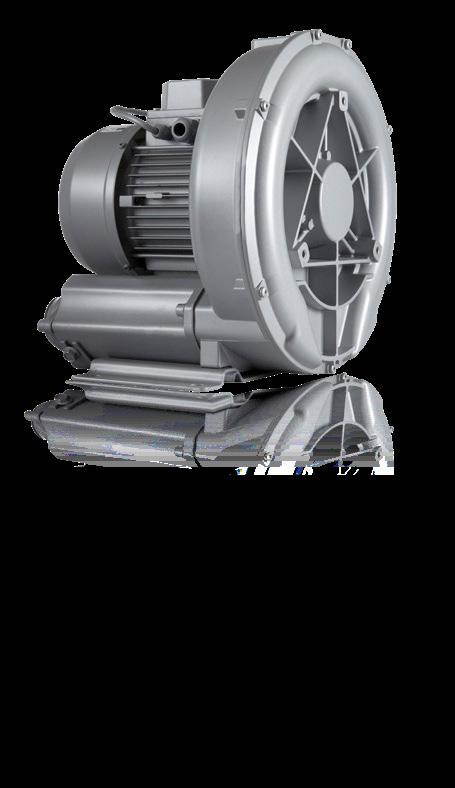
The full range of now proudly distributed by BLOWERS Splash_magazin_2130_ZZPR.indd 2 01/12/2023 8:14 AM
February/March 2024 SPLASH! 13 news
In Brief
The SPLASH! Pool & Spa Trade Show registrations are now open. Start planning your trip to the largest pool and spa professional trade show in the Southern Hemisphere. If you register online, you save time at the door and don’t pay the door charge of $149. Going online also enables you to book for the National Awards of Excellence, the SPLASH!
After Party, the SPLASH!
Golf Day and the WAVES Breakfast. SPLASH! will be held at the Gold Coast Convention and Exhibition Centre on August 21-22, 2024. Go to www.splash. online for more information.
SPASA was part of the Standards Australia Technical Committee that saw AS3958, Installation of Ceramic and Stone
Tiles revised for the first time since 2007. The main changes within the standard that deal with the swimming pool and spa industry can be found in Appendix E – Installations subject to immersion and their surrounding areas.
Topics reviewed include:
Tiling design factors; Effect of water chemistry on tiling; Cyclic changes on tiling; Swimming pools of concrete construction (excluding saltwater pools); Minimum curing time between successive tiling stages; Membrane requirements, where needed; Pool surrounds; Walls (rendering) and Floors (screeds); Cement and sand mixing and curing for floors and walls; Penetrations; Movement joints; Filling and emptying pools; Installation of pool surrounds and adjacent areas; Types of tiles; Surface preparation; Adhesives and grouts; Curing times.
ACCC warns against greenwashing
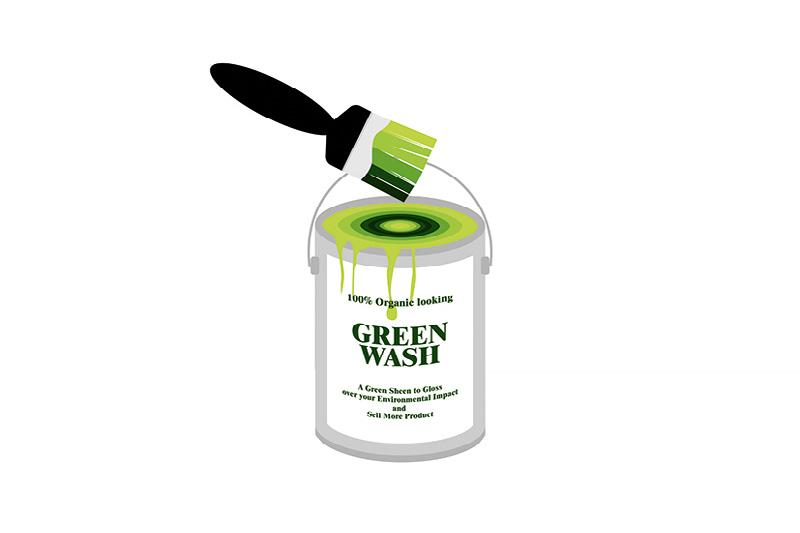
The Australian Competition and Consumer Commission (ACCC) has released updated advice on making environmental and sustainability claims, after they conducted an internet sweep to identify misleading marketing claims. False statements about a product’s environmental or sustainability qualities mislead consumers. They also put the businesses making genuine claims at a competitive disadvantage.
The ACCC has finalised guidance for businesses making environmental and sustainability claims. They say that now, if you choose to make environmental claims, it’s easier to do it the right way.
The guidance identifies eight practical principles to apply when making environmental claims. In short, claims must be accurate, truthful and verifiable.
1. Make accurate and truthful claims.
2. Have evidence to back up your claims.
3. Don’t hide or omit important information.
4. Explain any conditions or qualifications on your claims.
5. Avoid broad and unqualified claims.
6. Use clear and easy-to-understand language.
7. Visual elements should not give the wrong impression.
Industry moves
Be direct and open about your sustainability transition.
All businesses must ensure any environmental claims made are accurate and truthful. This includes taking reasonable steps to verify supporting information provided by your suppliers.
Case study: MOO
The ACCC accepted a courtenforceable undertaking from yoghurt manufacturer MOO Premium Foods Pty Ltd (MOO). This follows an investigation into MOO’s “100 per cent ocean plastic” representations. These representations appeared on its yoghurt packaging, website and social media pages.
Between at least November 2021 and the date of the undertaking, MOO claimed that its yoghurt tubs were made from “100% ocean plastic”.
The ACCC was concerned the claims gave the impression MOO’s yoghurt tubs were made from plastic waste collected directly from the ocean. But this was not the case.
MOO has undertaken to remove the “ocean plastic” representations from its yoghurt packaging, social media platforms and website. MOO has also committed to publishing corrective notices on its website and social media platforms.
Download the guidelines at www.splash.online/ articles/links152 or www.accc.gov.au.
David Daft joins Waterco
Industry veteran David Daft has been appointed as Waterco’s new product training manager.
Daft will oversee the company’s learning and development programs across eight global divisions including Australia, New Zealand, the European Union, the USA, Malaysia, China, Singapore and Indonesia.
Daft’s career in the swimming pool and spa sector began in 1999 with Polaris Pool Systems and included a 24-year tenure with Fluidra.
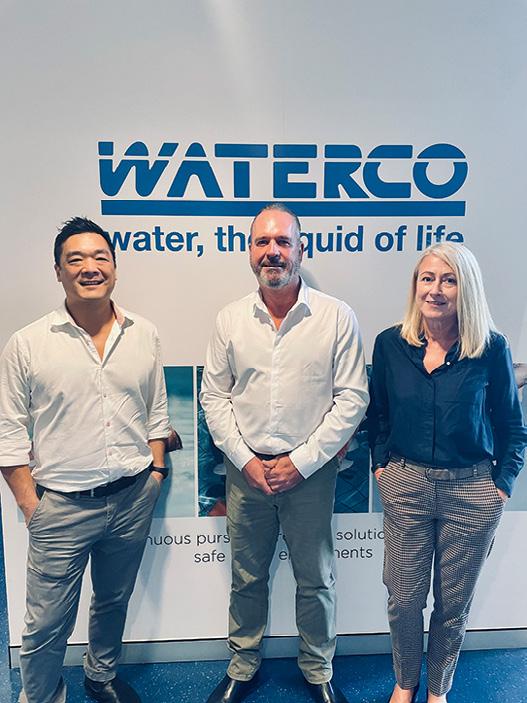
He says his primary goal is to ensure that the company’s sales and service employees, as well as potential customers and partners, have a comprehensive understanding of the products and services offered by Waterco.
“This will involve cultivating strong relationships with the product managers; the mechanical, electrical and software engineers; the state managers; and
the sales teams to ensure that our training programs align with their needs and goals,” he says.
“I also look forward to working with Davey Water Australia to stay informed and updated with their new product developments and training methodologies, to ensure our educational programs platforms remain relevant and practical.”
Waterco Group COO Bryan Goh says Daft’s appointment comes at a time of significant international growth for Waterco, and the new role will be key to grow awareness and understanding of its ever increasing suite of products.
“David has great passion and enthusiasm for the pool and spa industry and brings with him a wealth of expertise in technical support and training,” Goh says, adding that his insights on the highly competitive, multi-billion dollar pool and spa sector will be an asset.
Regulations
truthful and verifiable
14 SPLASH! February/March 2024 news
David Daft (centre) with COO Bryan Goh and CCO Jo Ainsworth
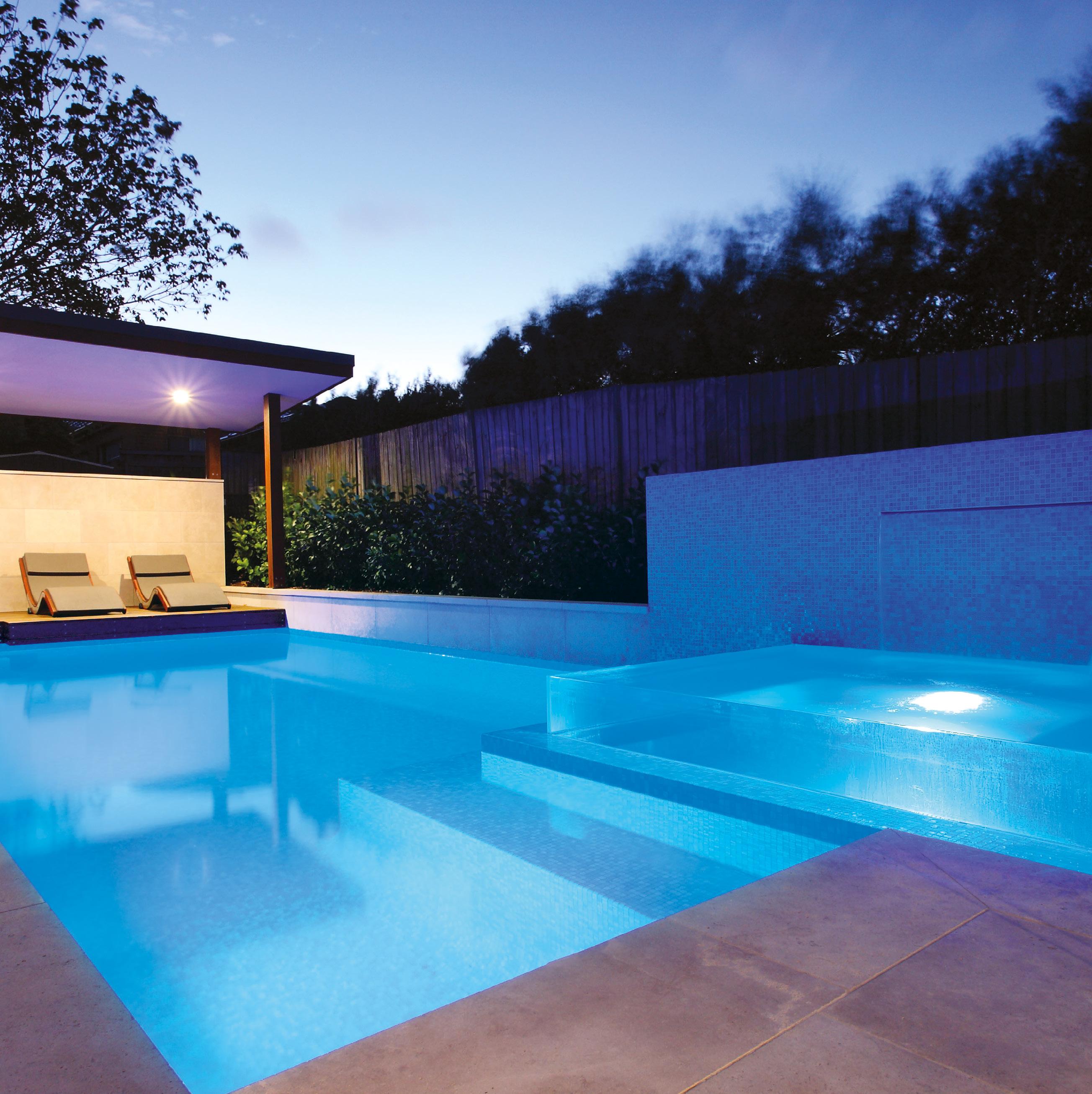
Underwater Lighting Specialists
Aqua-Quip designs and manufactures in Australia, innovative underwater LED lighting systems for use in concrete and fibreglass swimming pools, spas, water features and catch tanks for the Australian and international pool markets.
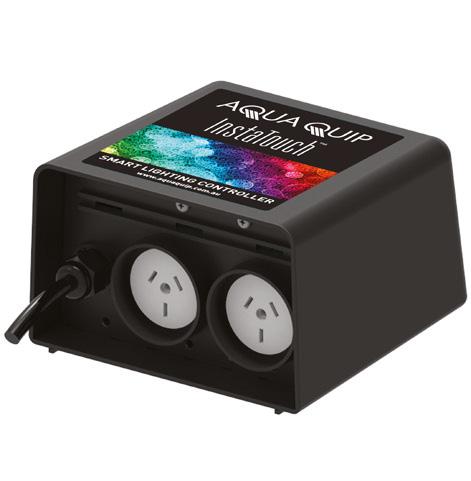
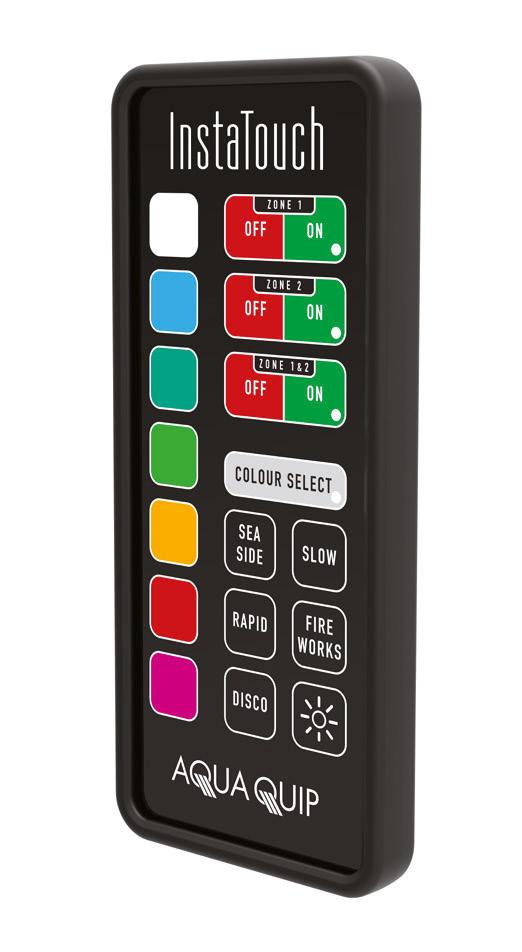
Lights are compatible with all popular pool controllers and home automation systems. The innovative InstaTouch™ Smart Lighting Controller provides instantaneous control via a water-resistant handset to enhance the evening atmosphere in your pool and spa.
Light up your life
SMART LIGHTING CONTROLLER As well as popular pool controllers COMPATIBLE WITH SPASA National Award – Pool of the Year built by Urban Escape aqua@aquaquip.com.au | 02 9643 8338 Aqua-Quip Australia www.aquaquip.com.au aquaquip_au SPLASH fp 240220
AIS Water supports in-company entrepreneurs
Brisbane-based water disinfection company AIS Water has been named the first Accredited Intrapreneurial Organisation by the Global Intrapreneurs Institute (GII).
AIS Water CEO Elena Gosse says that being the first company to complete the program was yet another example of AIS’ commitment to innovation and excellence.
“Most people are familiar with the term entrepreneur, however the benefits of encouraging intrapreneurship within an organisation are many, including increased employee engagement, improved problemsolving skills, and a greater capacity for innovation,” she says.
“As leaders in excellence it is important to us to encourage every member of our staff to strive to achieve their best for themselves and the business. We all know that happy and fulfilled individuals make for happy employees, and this is even more the case when they know their work, ideas and efforts are valued.”
In the context of the GII program, an intrepreneur means someone who is working inside the organisation and who actively embraces innovative thinking and a leadership mindset, irrespective of their role in the company. This empowers the individual to leave behind limiting beliefs and make positive contributions to the company as a whole.
Founder and CEO of the GII, Dr Irena Yashin-Shaw, describes
intrapreneurs as “the enterprising employees who think and act like entrepreneurs while working inside an organisation” and who are the “opportunity finders”.
“Intrapreneurs are the most valuable of all employees. They are the ones who drive positive change, transform their organisations, innovate relentlessly and create a thriving and robust intrapreneurial culture,” says Yashin-Shaw.
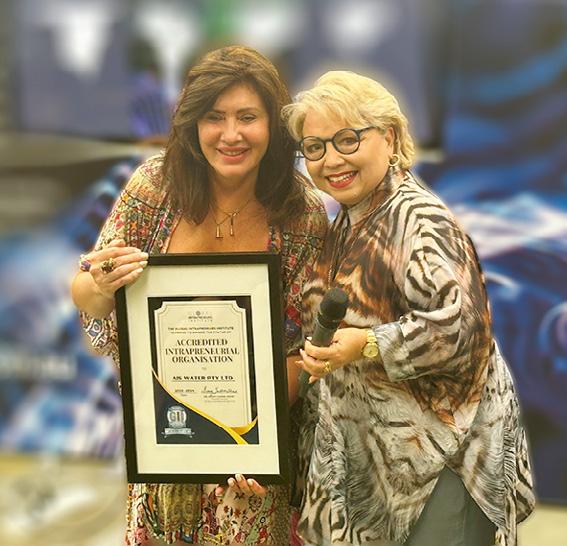
“In the ever-evolving landscape of the contemporary workplace, where adaptability and innovation are imperative for organisational success, AIS Water has emerged as a trailblazer. The company’s pioneering journey into this uncharted territory speaks volumes about its dedication to staying ahead of the curve. It makes a statement about AIS Water’s commitment to fostering intrapreneurial skills among its workforce which demonstrates the company’s commitment to employee growth and development.”
Additionally, two AIS Water team members, Nayani Kasthuriathne and Marco Oneeglio, were awarded Professional Certificates of Intrapreneurialism for completing the intrapreunership course work.
Contact: https://gii.institute; www.aiswater.com.au
NZ industry aids liquidated company’s clients
Ex-clients of a liquidated company are now getting their pools, thanks to the assistance of the New Zealand industry.
Last year was extremely difficult for ex-clients of the NZ company Container Pools which went into liquidation in May.
Ultimate Pools along with trade suppliers such as Space Industries, Austral Pool and Spa Products, Glass Vice Fencing and Dolphin Pacific rallied together to support customers to continue to pursue their dream of pool ownership.
Ultimate Pools general manager Rainbow Morris says it was heart wrenching to see so many families disheartened and disillusioned.
“We really wanted to provide reassurance that the pool industry in NZ is in a strong financial position, we have excellent core values as business owners and we want to restore good faith amongst pool buyers,” she says.
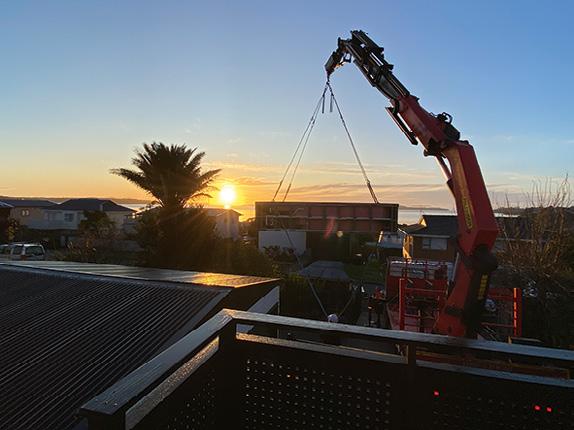
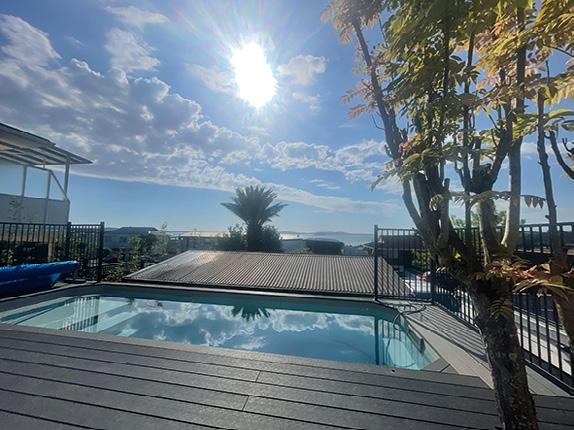
The Price family, ex-Container Pools clients, contacted Ultimate Pools to see if their plans of installing a pool at their property could be bought to fruition.
“Mr Price was part of a buyers collective formed by customers of Container Pools which had lost deposits to the company after it had gone into receivership,” says Morris.
“Many of these customers were part way through the process of buying a pool, and lost tens of thousands of dollars, or had pools installed
without filtration equipment, pool covers or other components.”
Price was lucky he wasn’t too far into the process. He found the six metre Compass Express pool could fully use the space available, and was the most suited to the intended location. He worked through the consent and engineering process with Ultimate Pools; and the install took place just three months from the time he first contacted them.
Price says that while Ultimate Pools had a job to do, they seemed to genuinely care.
“Along with their suppliers, they went out of their way to accommodate myself and other customers who had been exposed to the more unprofessional side of the pool industry,” he says.
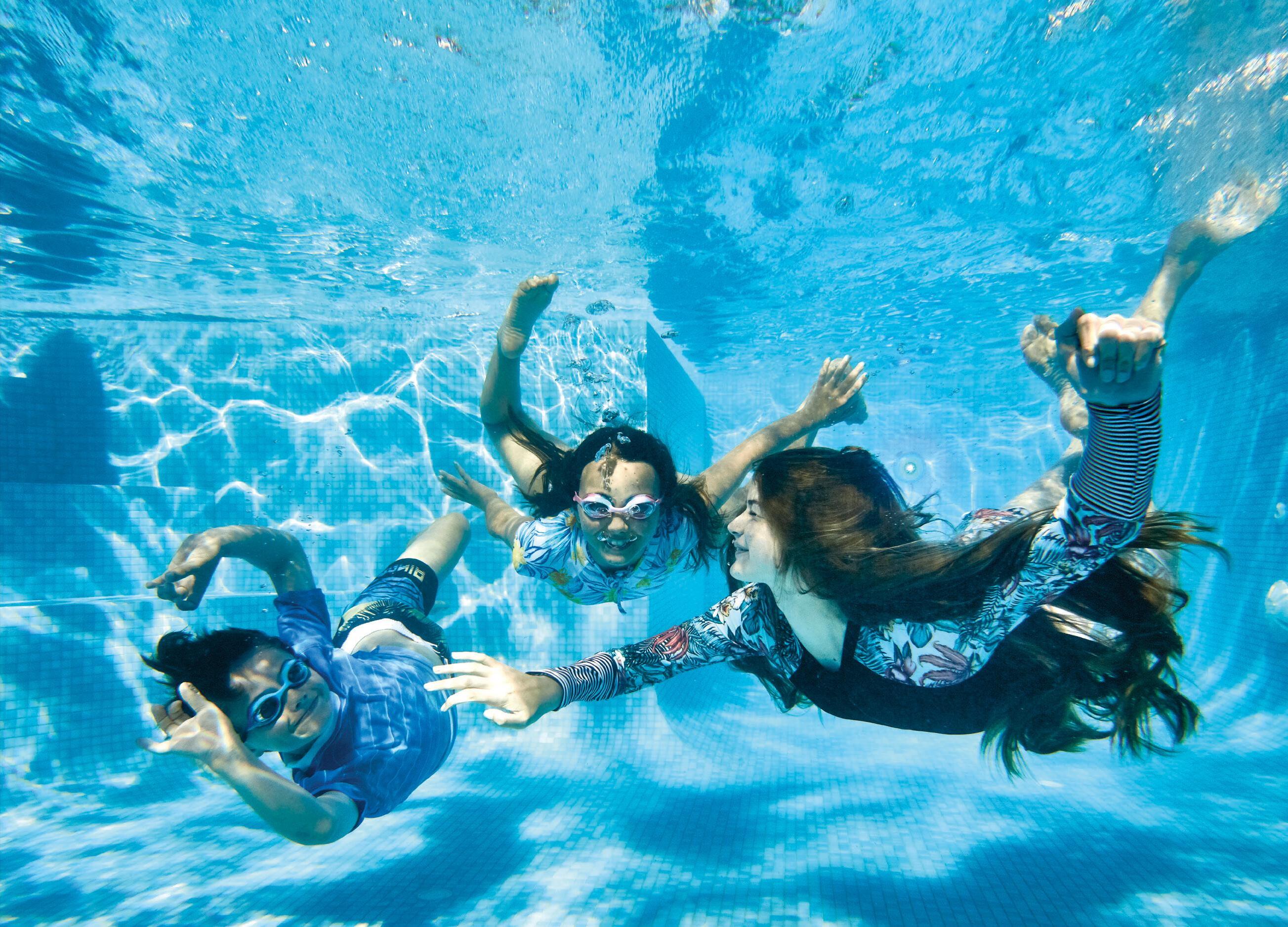
“Jordan, Rainbow, Steve and Chelsea – just a few of the team all worked together with their suppliers and partners and I would not hesitate in recommending them, and continue to do so. They are examples of professionalism, and our children – and adults – are now enjoying the pool and making a lot of noise much to the delight of our neighbours”.
Morris says this is a great result for the NZ pool industry, showing solidarity and coming together to support the community and end users.
“We hope that there can be a silver lining as industry professionals work together to ensure more families such as these are able to fulfill their dream of pool ownership,” she says.
Innovation
Installations
AIS Water CEO Elena Gosse with GII CEO, Dr Irena Yashin-Shaw
The new Express pool being delivered
16 SPLASH! February/March 2024 news
The finished product
www.remco.com.au


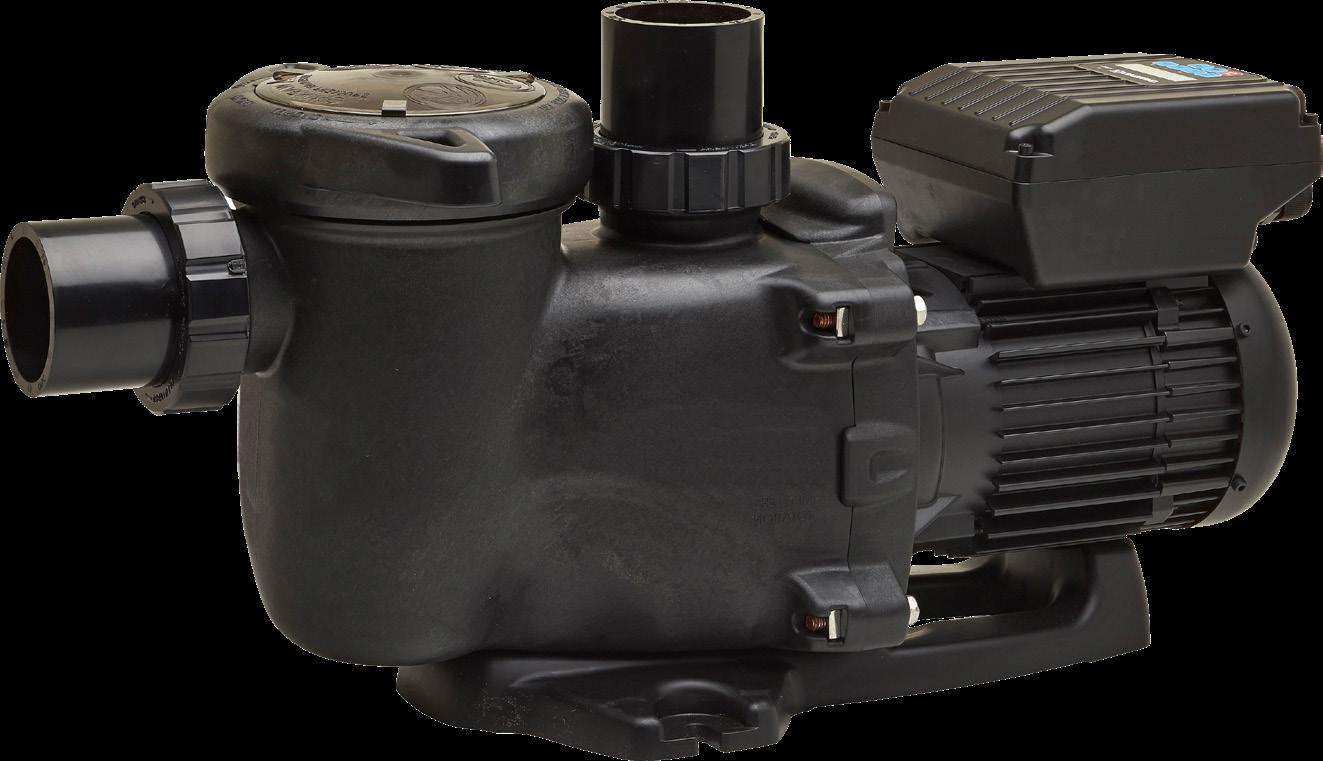
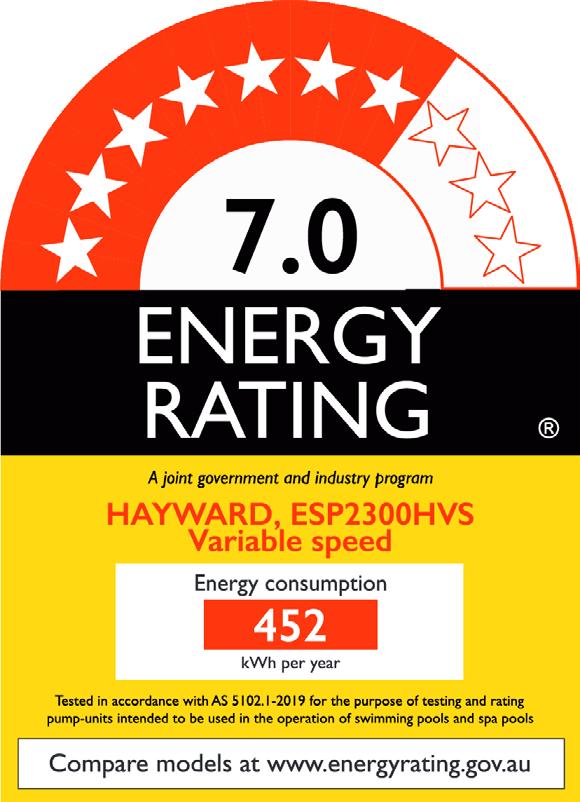
AUSTRALIA’S MOST EFFICIENT POOL PUMP EcoStar VS 1HP Variable Speed Pump • Better filtration • Programmable interface • Perfect for retrofit installations PUMPS HEAT PUMPS FILTERS CLEANERS SANITISATION WHITE GOODS au.hayward.com sales@hayward.com 1300 766 571 • •
Melbourne and Perth kick off expo season
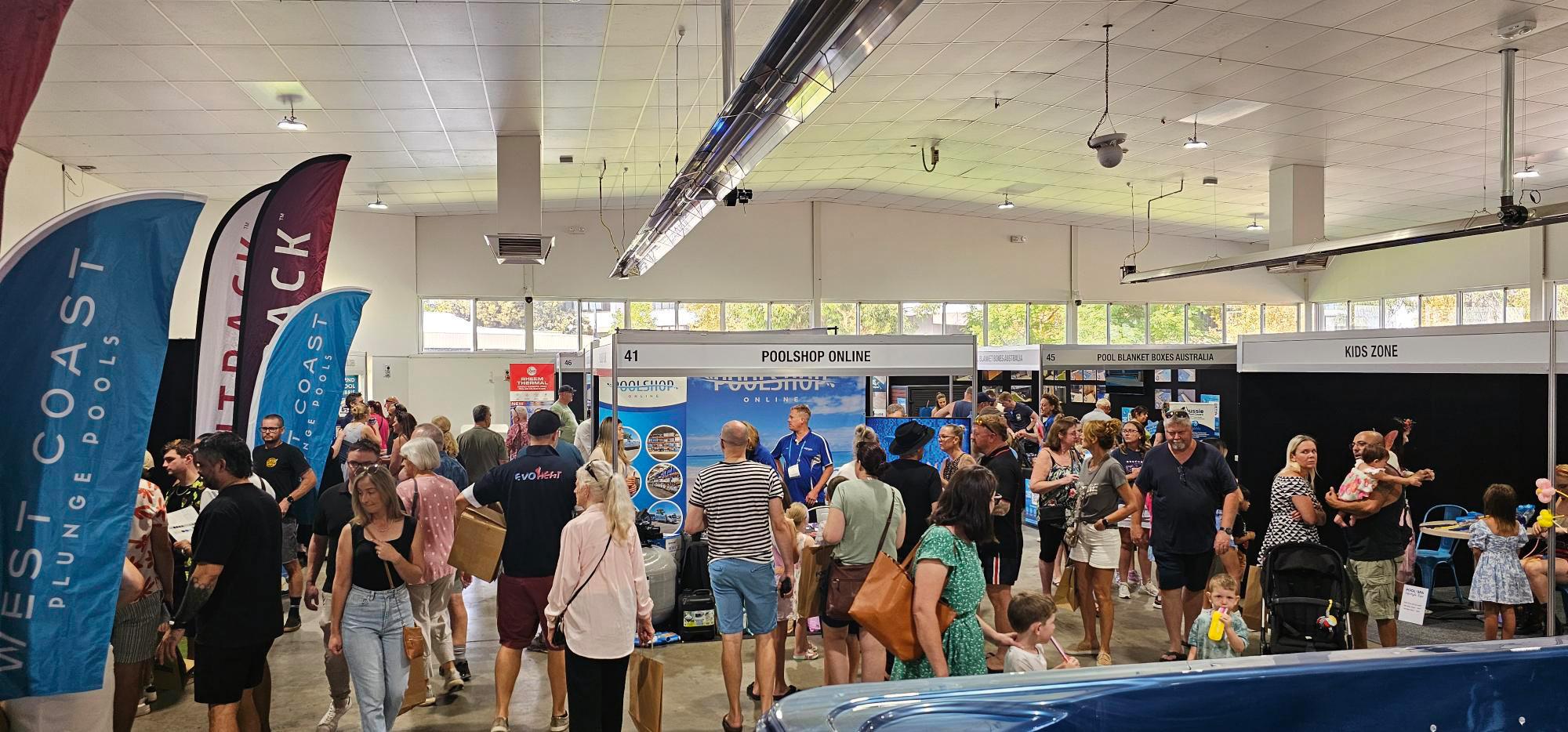
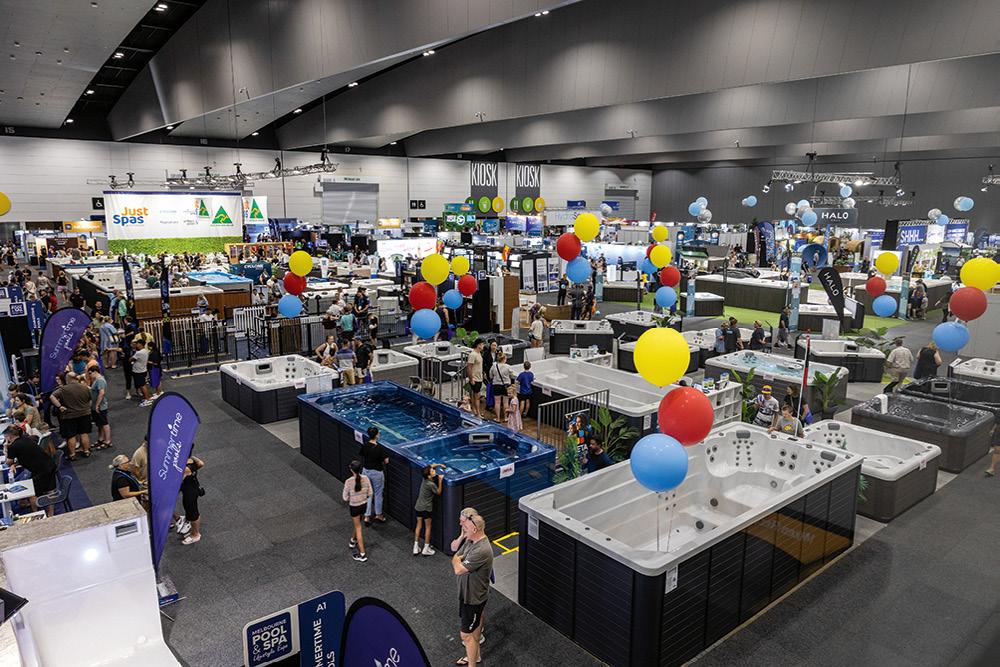
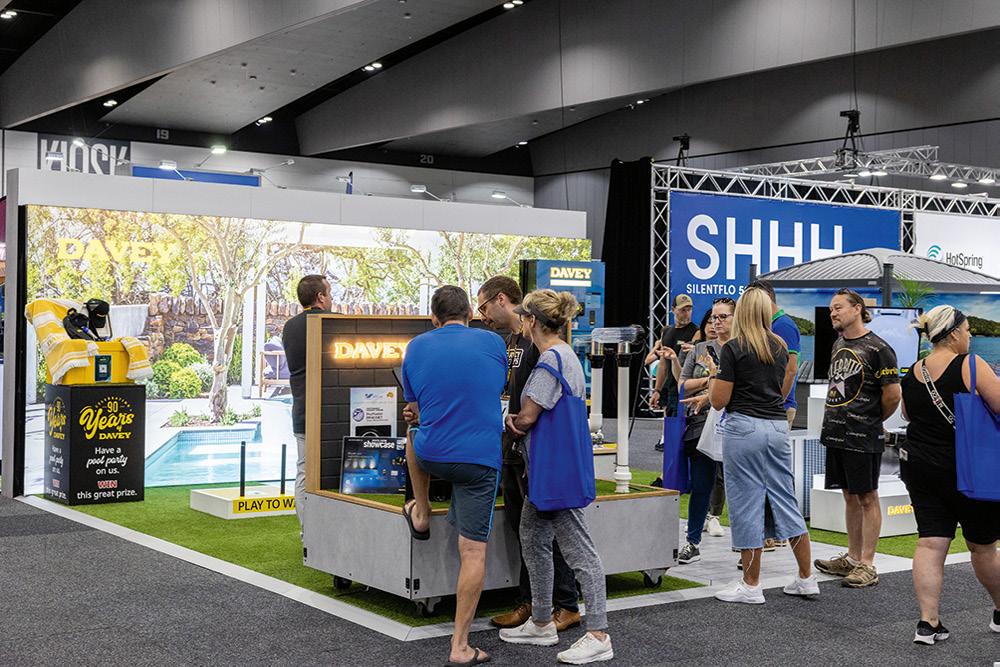
The 2024 Pool & Spa Lifestyle Expo calendar officially kicked off in Melbourne, drawing a solid crowd after weeks of inclement weather in the Victorian capital. Expo visitors covered the full gamut – from prospective buyers seeking initial advice while shopping for new pools and spas, through to experienced owners looking for the latest in aftersales care, equipment upgrades and sustainable products and services.
Rob Kruber was at the combined Summertime Pools & Halo Spas stand. “We recently exhibited at the Melbourne Pool & Spa Expo with stands for Summertime Pools and Halo Spas, utilising the event as a platform to launch our new portable spa range,” he says.
“Our teams found the consumers coming through the door to be of a high quality with the vast majority ready to make a decision regarding putting a pool or spa in their backyard.”
He says that exhibiting at these events not only assists him to promote the brands but also ensures that the category as a whole remains relevant and front-of-mind in a market competing for consumers' leisure dollars with boats, caravans and travel.
Next on the list was the Perth Pool & Spa Expo which drew a bumper crowd. Exhibitors at the show say interest was high, with plenty of ready-topurchase visitors keen to take advantage of show specials and get answers to their questions.
Ben Coyne from Daisy Pool Covers says the show was packed.
“From 9:30am, straight out of the gates, people were firing – they showed up en masse. We had a consistent flow of people asking good questions and interested in genuine conversations. They knew what they wanted and were ready to learn as much as possible.”
Bob Biernat of Freedom Pools says the show was amazing.
“We’ve been flat out the whole time, completely run off our feet,” he says. “We’ve completely run out of brochures, and had people lining up to place orders. Couldn’t be happier with the results...best show ever.”
Pool & Spa Lifestyle brand manager, Daena Bougoure-Latchford says the strength of the consumer expos is identifying current consumer trends and concerns by putting potential buyers directly in front of industry members.
The next Pool & Spa Lifestyle Expos include Adelaide (March 23-24), the New Zealand Pool & Spa Expo (May 11-2) and Brisbane (May 18-19).
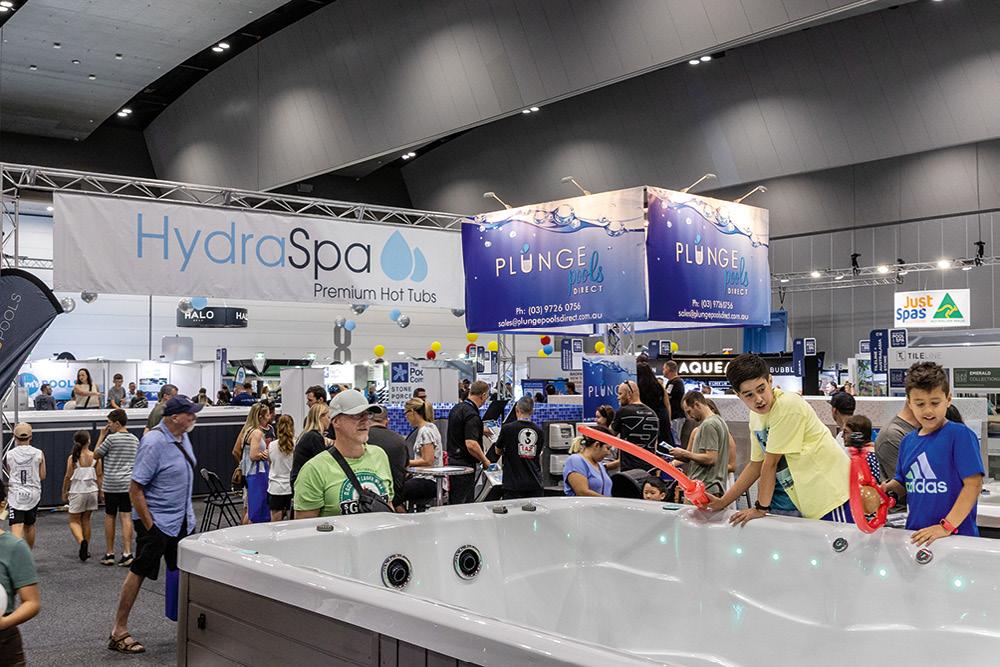 Perth consumers were filling the expo from the time the doors opened
The Melbourne Pool & Spa Lifestyle Expo kicked off the consumer expo season
The vast majority of consumers were ready to make a decision
Kids were everywhere at the Melbourne expo
Expos
Perth consumers were filling the expo from the time the doors opened
The Melbourne Pool & Spa Lifestyle Expo kicked off the consumer expo season
The vast majority of consumers were ready to make a decision
Kids were everywhere at the Melbourne expo
Expos
February/March 2024 SPLASH! 19 news
Heating
EvoHeat performs in product review awards
EvoHeat has won the 2024 ProductReview award for Best Pool Heaters & Pool Heat Pumps.
ProductReview is a trusted online review platform for Australian consumers, offering insights into real-world product performance. Their annual awards spotlight products and services that are deemed the best and most reliable choices available to Australian consumers.
Evo Group marketing manager Nicole Chapman says the core of EvoHeat’s success is a dedication to innovation.
“The Evo Fusion-i and Evo Force-i heat pumps were celebrated for their exceptional performance, efficiency, smart features and design with over 450 independent consumer reviews,” says Chapman.
“EvoHeat’s integration of cutting-edge EvoTech inverter technology in the Fusion-i and Force-i heat pumps exemplifies our commitment to energy efficiency. This innovative approach allows the heat pumps to dynamically adjust their output based on heating requirements, optimising performance while significantly contributing to energy savings – an essential consideration in today’s eco-conscious society.”
Contact:
www.evoheat.com.au; www.productreview.com.au
new super legislation
HR Anywhere has provided an update on several law changes relating to employment, including changes to superannuation in the Fair Work Act. Superannuation is now an entitlement under the National Employment Standards (NES) in the Fair Work Act as of 1 January 2024.
• Employees covered by the NES can now seek to remedy unpaid super under the Fair Work Act (if the ATO hasn’t already commenced proceedings in relation to that super).
• The NES entitlement to super aligns the Super Guarantee, so if you are meeting your obligations under super laws, you are also meeting your obligations under the other. But, if you are in breach of super laws, you will also be breaching the Fair Work Act.
• Employees who are in the national workplace relations system because their state referred their powers to make workplace laws to the Commonwealth, are exempt from this entitlement although they may have an entitlement under another industrial relations instrument.
• An updated Fair Work Information Statement has been released by the Fair Work Ombudsman incorporating this new entitlement – this needs to be provided to all new employees and supersedes earlier versions of the statement.
Download the updated Fair Work Information Statement at www.fairwork.gov.au or www.splash. online/articles/links152.
Closing loopholes laws
In the coming 12 months, a number of changes to the Fair Work Act are being implemented. However, on the 15 December 2023 the following initial changes were made:
• Employees, unions and host employers can now apply to the Fair Work Commission for new types of orders relating to labour hire employees whereby the labour hire employer must pay their employees supplied to a host employer at least the same rate they would receive under the host employer’s industrial instrument.
• New discrimination protections for employees experiencing family and domestic violence –it is unlawful for an employer to dismiss an employee who is experiencing these hardships.
• Small business redundancy rules – if a large business downsizes its workforce to become a small business (under 15 employees), they may still be required to provide severance payments as per large businesses.

• Workplace delegates now have new rights and protections under the Fair Work Act with new applicable General Protections rules.
• Right of entry rules - the requirement for officials assisting a state or territory work health and safety representative to hold an entry permit under the Fair Work Act has been removed.
There are also some changes to workers compensation and workplace health and safety laws as part of the Closing Loopholes Laws.
On 01 July 2024 the Bill also criminalises industrial manslaughter and increases maximum penalties under Federal Occupational Health and Safety (OHS) laws. This change will bring the Federal OHS regime in line with most of the states and territories including South Australia which recently passed the Work Health and Safety (Industrial Manslaughter) Amendment Bill making industrial manslaughter a criminal offence in South Australia.
The Bill will also expand access to workers compensation for first responders in relation to post-traumatic stress disorders; and bring silica and silica-based illnesses in line with asbestos under the Asbestos Safety and Eradication Agency. Also under the new laws, the intentional underpayment of wages will be criminalised. These changes won’t start before 1 January 2025.
Employee authorised deductions
Fair Work has always had specific requirements when it comes to making deductions from employees for reasons that could include overpayments etc. However, Fair Work has now provided instruction around employee authorised deductions from pay that are either one-off or recurring; or for specific amounts or for amounts that change from time to time.
In order for an employer to make a lawful deduction under Fair Work, employers need written permission from the employee and follow the rules about when these deductions are allowed and how they need to be recorded. There may also be further information about lawful deductions in Awards and registered agreements.
Contact: 1300 208 828; info@hranywhere.com.au
Business
Keep abreast of the latest HR laws 20 SPLASH! February/March 2024 news
Stay on top of the



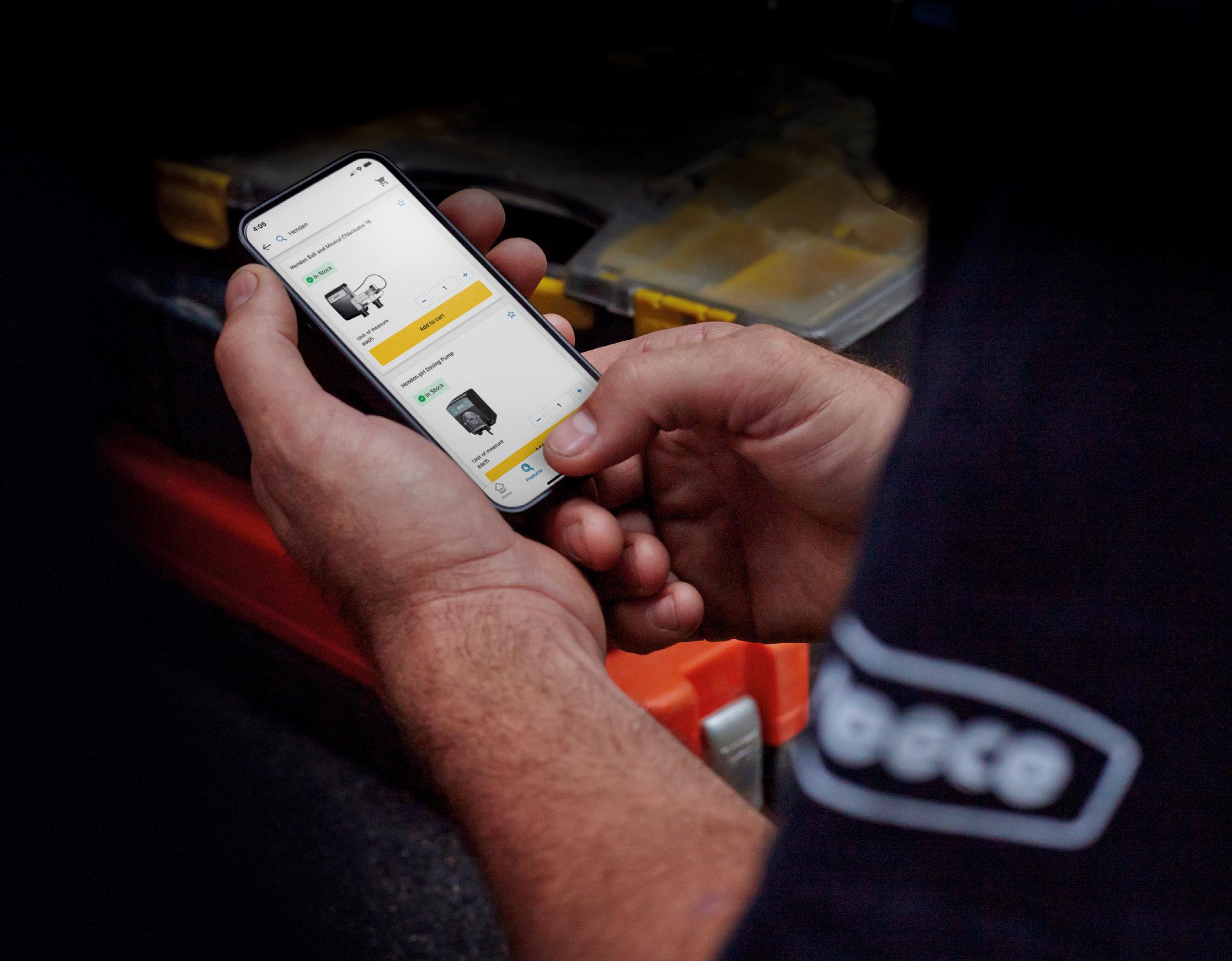
Put pools in your pocket.
Our maX app gives you access to Reece Irrigation & Pools on your phone. It puts live pricing, stock availability, online ordering, delivery tracking and more in the palm of your hand. It’s your next pool project, on your terms.
Reece. Works for you. Find out more at reece.com.au/pools
Brothers work together to make a winning company
Matt Ranieri explains how he and his brother Tim developed Aquify Pools from the ground up, eventually seeing it become the SPASA 2023 National Business of the Year.
The Ranieri brothers, Matt and Tim, started in the pool business in 2008, but their pool heritage goes back much further than that.
“My father was in the pool and spa industry, in the fiberglass sector. He really liked the industry and thought it presented good opportunities,” says sales and marketing director Matt Ranieri.
“He suggested to my brother Tim that he should consider the industry, and he encouraged us to work together.”
At the time, Matt, 27, was living in Melbourne, running his own labour recruitment firm. Tim was 24 and was just finishing his apprenticeship for a large commercial building company.
“My father suggested that if my brother wanted to go out on his own, we could do some sort of partnership as I had more experience in sales and administration. I already had plans to sell my business in Melbourne and return to Sydney where all my family was, and when I came back, my brother and I started T&M Pools Pty Ltd. That was back in 2008.”
The legal entity of T&M pools still exists today, although they have traded as Aquify Pools since 2022.
Initially, they joined the Narellan franchise group, and were offered the choice of two areas: the Northern Beaches or the Sutherland Shire. Being from Western Sydney they didn’t know either area well.
They flipped a coin, took the Northern Beaches franchise and started with humble beginnings,
“It was just Tim and myself, and we did everything from quoting and selling to installing and landscaping. Subcontractors would help with excavation, cranage and concrete bonding. And we would do all the rest of it,” says Ranieri.
In their first year they did 16 pools.
But soon the effects of the global financial (GFC) crisis hit. Against expectations, the GFC saw their business boom.
“What we learned later was that we were operating in a predominantly traditional concrete swimming pool market. However, we were hitting a sweet spot in the market, because people still wanted a swimming pool, but didn’t want to spend quite as much due to the GFC.”
At this time the fibreglass option was still considerably less expensive than concrete, but had yet to become as popular as it is now.
“People were a bit more open to the fibreglass option due to the economic climate at the time,” he says. “So we managed to really build the business and we improved our profile and customer base in the Northern Beaches over the next few years.”
They slowly started to bring on staff, moved to larger premises, and developed systems and processes within the business as they grew.
Ranieri says that that was really the trick: balancing the push for growth while making sure to get the staff and systems and processes in behind it, to consolidate the growth and make sure it was sustainable.
In fact, those systems which have developed over time, as well as new ones introduced by the company, are fundamental to ensuring the success of the business today – especially given the current skills shortage.
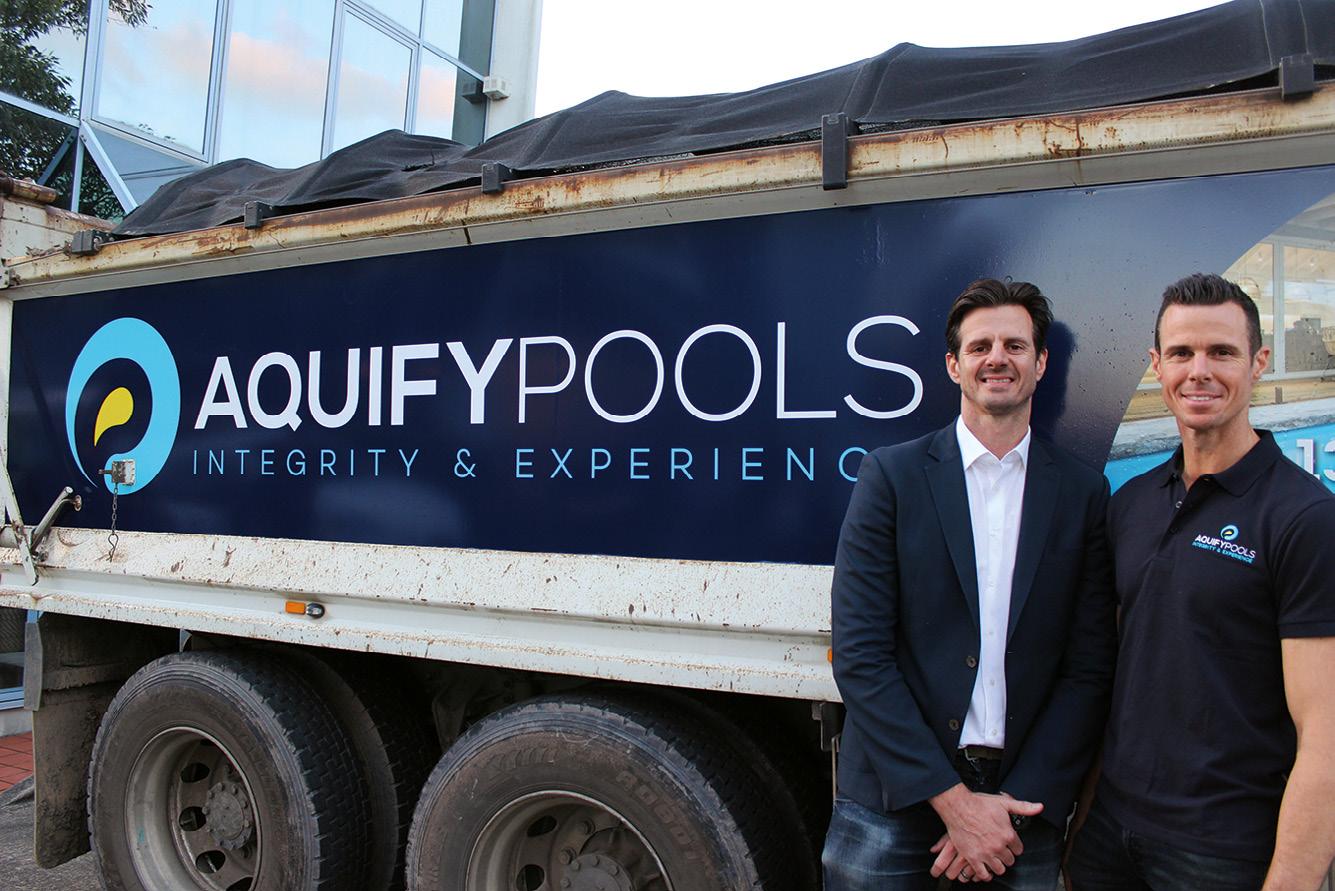
Matt and Tim Ranieri, founders and directors of Aquify Pools
22 SPLASH! February/March 2024 feature
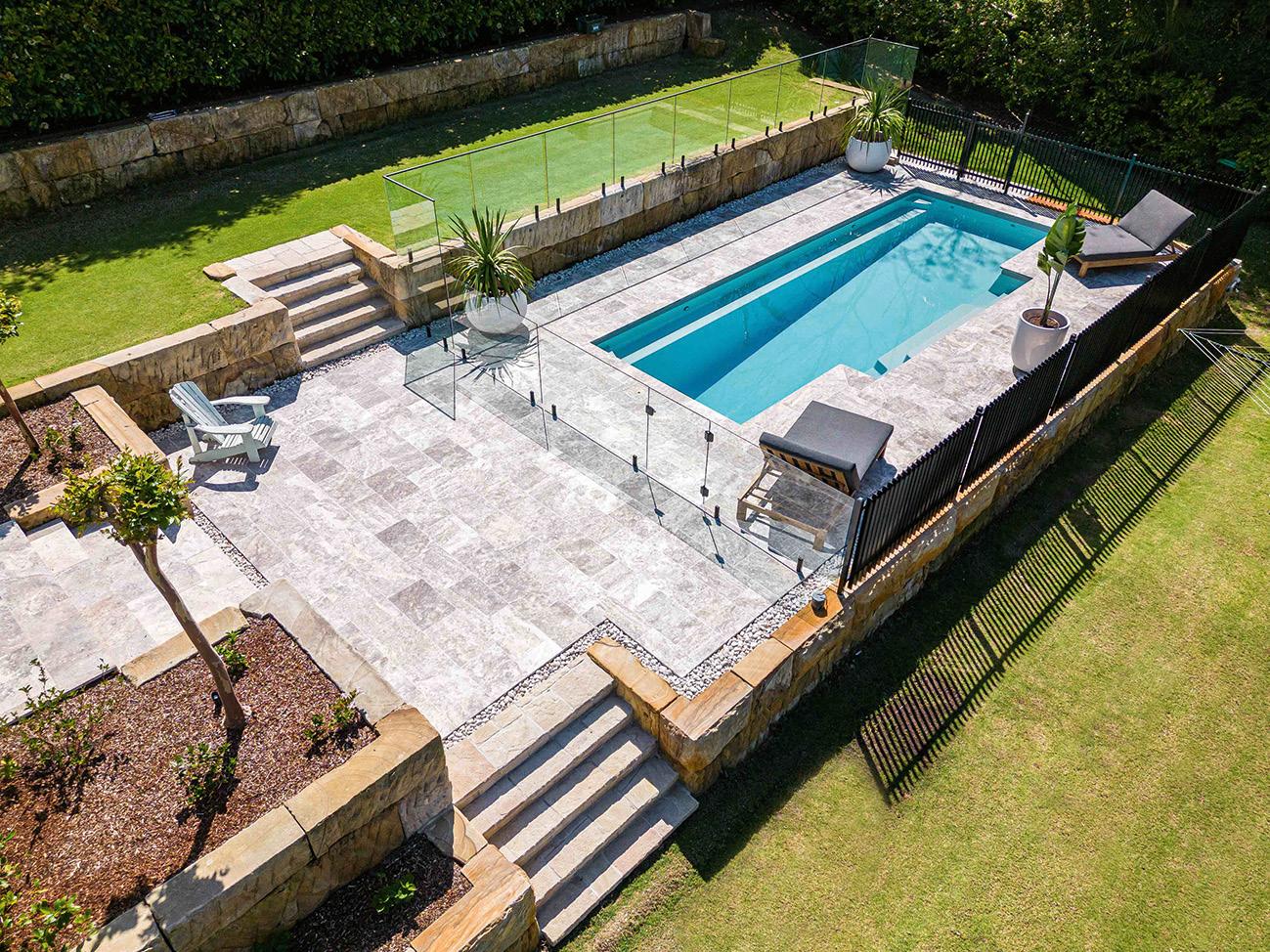
A transformed outdoor space at Newport on the northern beaches
“Having the systems and processes at the start makes it easier to onboard staff, because there’s a set way of doing things and set tools to use,” he says.
“It makes it easier for new staff members and makes it easy for existing staff members to have visibility across different parts of the business and to manage into their day-to-day tasks.”
For example, Ranieri says they’ve only lost one member of the senior team over the past three years.
“We now have around 40 staff across our three companies. Aquify Pools is our core business, but we also have a business that does excavation work, and another division that builds concrete pools.
“Aquify Pools is the largest and longest running part of our business.”
Fibreglass and concrete Aquify remains a fibreglass pool builder, now operating as a dealer for Aquatic Leisure Technologies (ALT).
But Ranieri says there are some circumstances where they can’t build a fibreglass pool, and in that situation they assist their clients through sister company, Winrani Pools, which builds concrete pools.
“What we discovered was that sometimes it’s just not possible to do a fiberglass pool. Previously, if clients requested a concrete swimming pool, we’d have to turn them away.
“But as we developed and got larger, we started doing inhouse landscaping again, and transitioned to also doing concrete pools. Now with Winrani Pools we have a wider offering to the market.”
Ranieri says the situations where they may not be able to do a fiberglass pool, while uncommon, include not being able to get the shell on site, or if the person is intent on a customised pool.
“Sometimes we just can’t physically get the shell into the site for a number of reasons. One could be there’s nowhere to set up the crane, because the road is too narrow and winding, or there are too many trees with large canopies. Some places on the Bilgola Plateau, the roads are very narrow and have huge gum trees. But that’s rarely the case.
“Or somebody may already have a DA approved for a customised pool. The pool might be quite narrow in one space, then opens up to an irregular shape; maybe a triangular shaped pool due to the house or a large tree,” he says.
“The other limitation with fiberglass is the size you can transport. So if someone has their heart set on a 20-metre long lap pool, there’s nothing really that can be offered in fiberglass – they tend to top out at 12 metres long.”
“If anyone’s ever not sure, I always encourage them to get a quote on both and just see what suits them better.
“I definitely don’t think one is better than the other: it’s just different applications for different families or different needs.”
Benefits of fibreglass
One reason a family that has quotes for both concrete and fibreglass might choose fibreglass is time considerations.
As
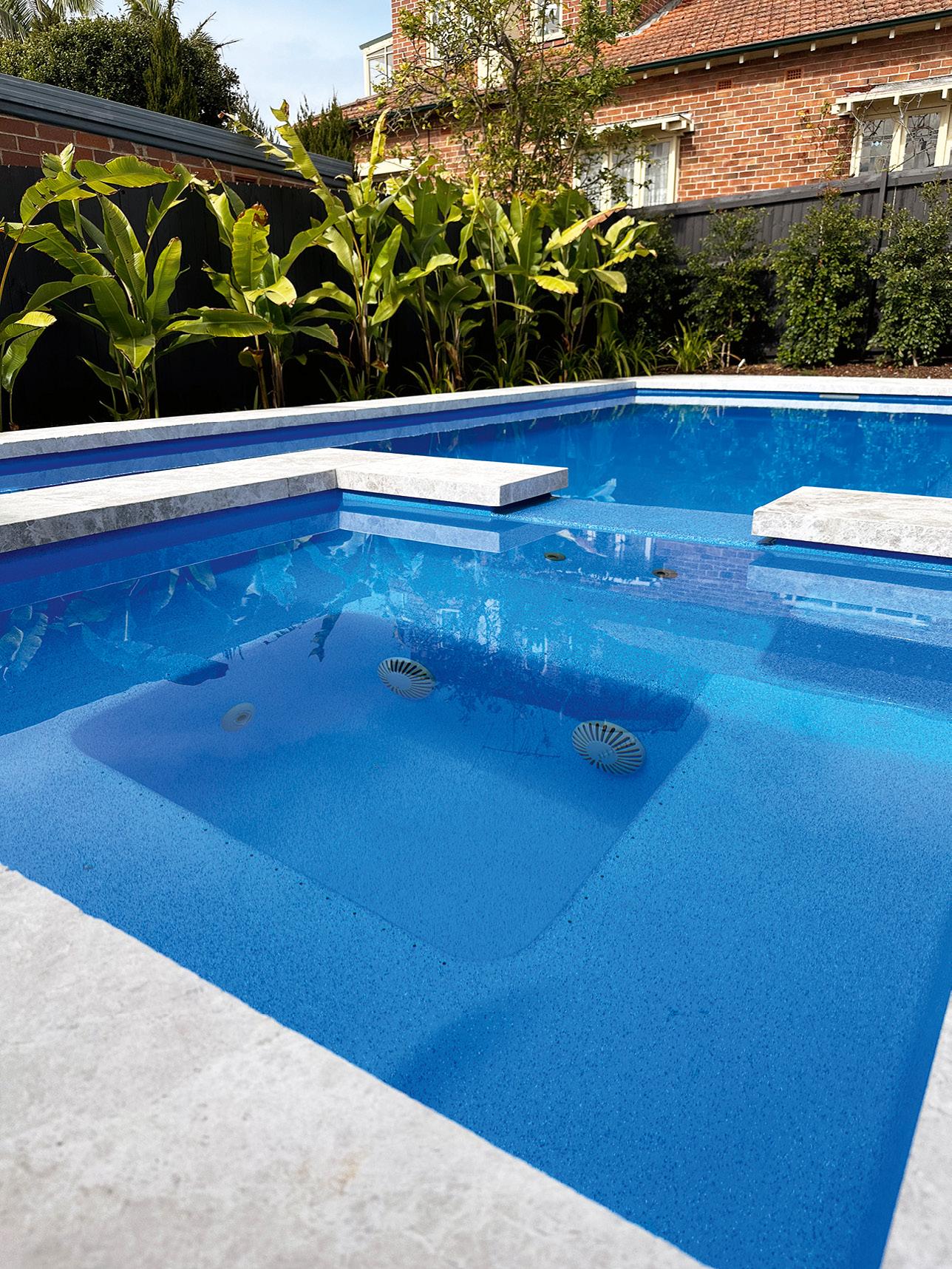
a predominantly fibreglass pools installer and builder, Aquify has benefited from the improved technology used in fibreglass manufacture
site time is faster as well,” Ranieri says.
“Installing a fiberglass swimming pool on-site can take one to three weeks, whereas concrete can take a bit longer. And generally, it’s not quite as weather dependent.”
Another benefit is the warranty, he says, especially now that shell manufacturing technology has advanced so much that the warranties are much longer – even extending to lifetime.
“We were hitting a sweet spot in the market, because people still wanted a swimming pool, but didn’t want to spend quite as much due to the GFC.”
“The swimming pool shells we install from ALT have a lifetime structural warranty and a lifetime guarantee on the interior colour to not fade as well,” he says. “We’ve installed a lot of these swimming pools and we just don’t get people coming back with issues. Very rarely.
“With concrete swimming pools, you generally get a seven to 10 year warranty, structurally and cosmetically.”
Another reason they may choose fibreglass is the surface.
“Fibreglass has a nice perfectly smooth surface,” he says. “It’s very hard to scratch yourself – it’s completely non-abrasive. And because it’s smooth, there isn’t as much surface area, so it’s easier to keep clean and to keep the water chemistry balanced.”
The fact that on-site times are generally reduced is a real advantage for the builder, as is the fact that the warranties are longer, as Ranieri says there’s less chance they’ll need to go back and fix things up.
“Also, having set shapes and sizes can be a blessing. If its A, B or C, you can generally make a decision quite quickly. Whereas with a concrete pool and you can do any design you want, it can sometimes make the process more difficult because there’s a lot more to think about.”
On the other side, he says a family might chose a concrete pool if they want something very bespoke, such as a glass wall on one side of the
February/March 2024 SPLASH! 23 feature
pool or a long lap pool, or if they have quite a tricky site and can’t crane the shells in.
Price decisions
Price is always a consideration when purchasing anything, especially something of high value like a swimming pool. Ranieri says it is even moreso the case in the present economic climate.
There is more certainty around pricing with fibreglass, because there tends to be fewer variables than with concrete.
“There can be a few more variables with concrete in terms of shoring, in terms of piering, and it’s hard to quote the job exactly until you’ve had all the engineering done.”
Nowadays the price difference between fibreglass and concrete can be small – but at the upper end of the concrete market it can still be considerable.
“It varies quite a lot,” he says. “It’s not uncommon for people to spend north of $150,000 or $250,000 on a concrete pool, whereas with fiberglass it’s quite difficult to get anywhere near those sort of numbers.
“Fifteen or 20 years ago, fibreglass was seen as a lot less expensive but the technology in the fiberglass swimming pools has come a long way. Twenty years ago, you could only have white or blue colour, and shapes were limited. And they didn’t spend as much money on paving – they may not even do a concrete bond beam.
“These days the technology in the shell has come a long way, and they have longer warranties. ALT has graphene technology in the shell and colour fade resistant technology. I think all these things have made the product itself more time consuming and expensive to produce, and transport costs have changed too.”
He also believes that the concrete market adapted to meet the popularity of fibreglass, through less expensive options.
“Using pebble instead of being fully tiled for example, to bring the cost down. So in some ways, the market is meeting in the middle.”
Effect of inflation
Ranieri says he had read that a lot of people doing renovations, such as swimming pools, are using savings, not financing the project through the
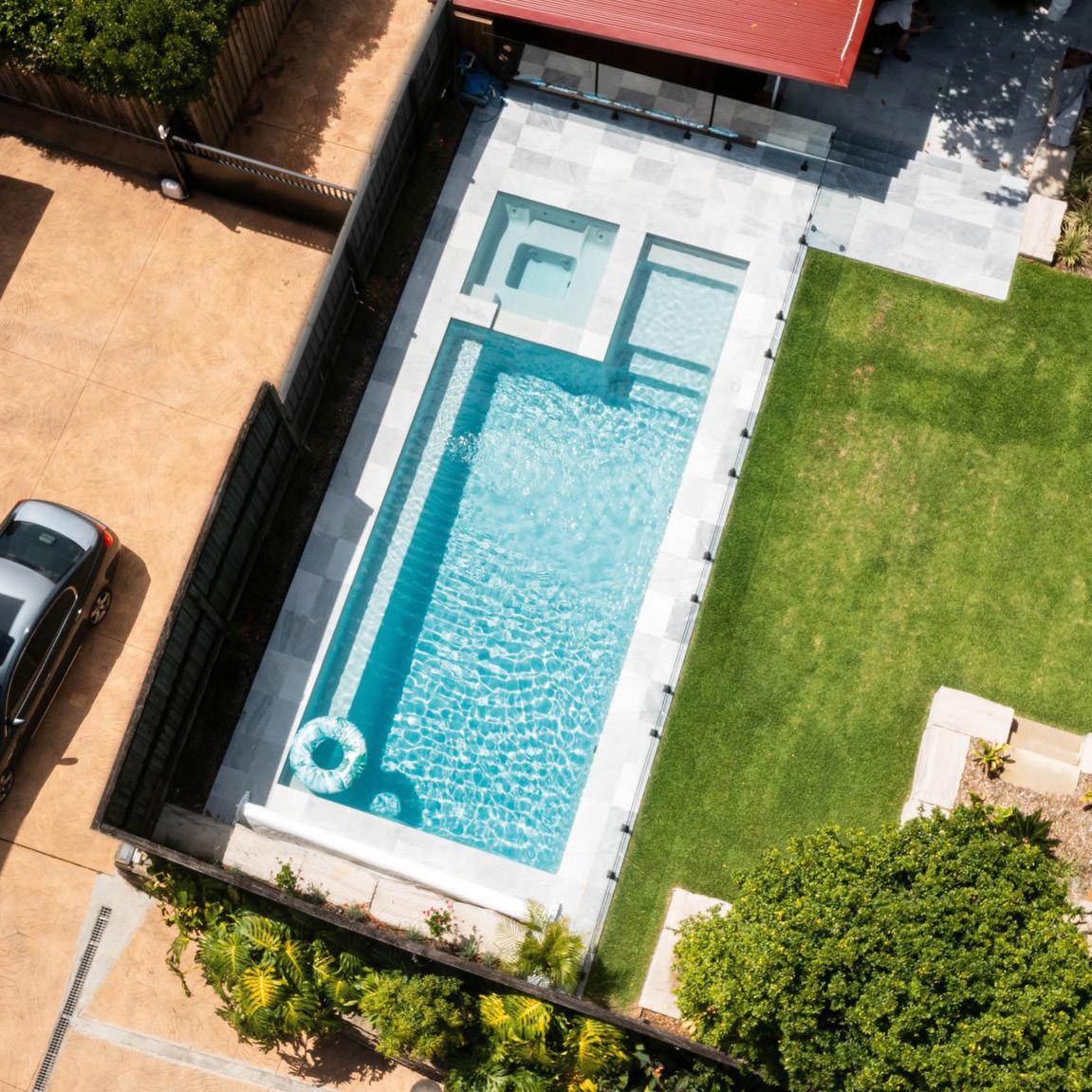
money and are ready to go. If you tick all the boxes, they’re pretty much ready to sign up straightaway,” he says.
“We now have around 40 staff across our three companies.”
“I think the market of people who want a swimming pool definitely seems to have gotten smaller since the interest rate rises. But of the people who seem to be moving ahead, a much larger percentage as compared with a few years ago don’t seem to be financing the project. They’ve got the money and they’re ready to go.”
Because lending criteria has become stricter, he believes some people are less willing to borrow or remortgage their property to fund a project, wary of the possibility of further interest rate rises.
“Those people are sitting on the sidelines for a little bit,” he says. “But people still definitely want swimming pools and we’re getting huge amounts of inquiry.
“I think covid was a bit of a false reality – a lot of people were willing to move ahead quite quickly. And now it’s swung more the other way, where people are a little unsure or not quite as confident. Even though they’re getting a quote, they may not be as confident to pull the trigger.
“But we’re still hitting our numbers. People are moving ahead as well, but the general feeling is a little more cautious. We’re still getting a lot of inquiry. I think because it is nice weather.”
Advice to fibreglass pool builders
Taking
the home into the outdoors
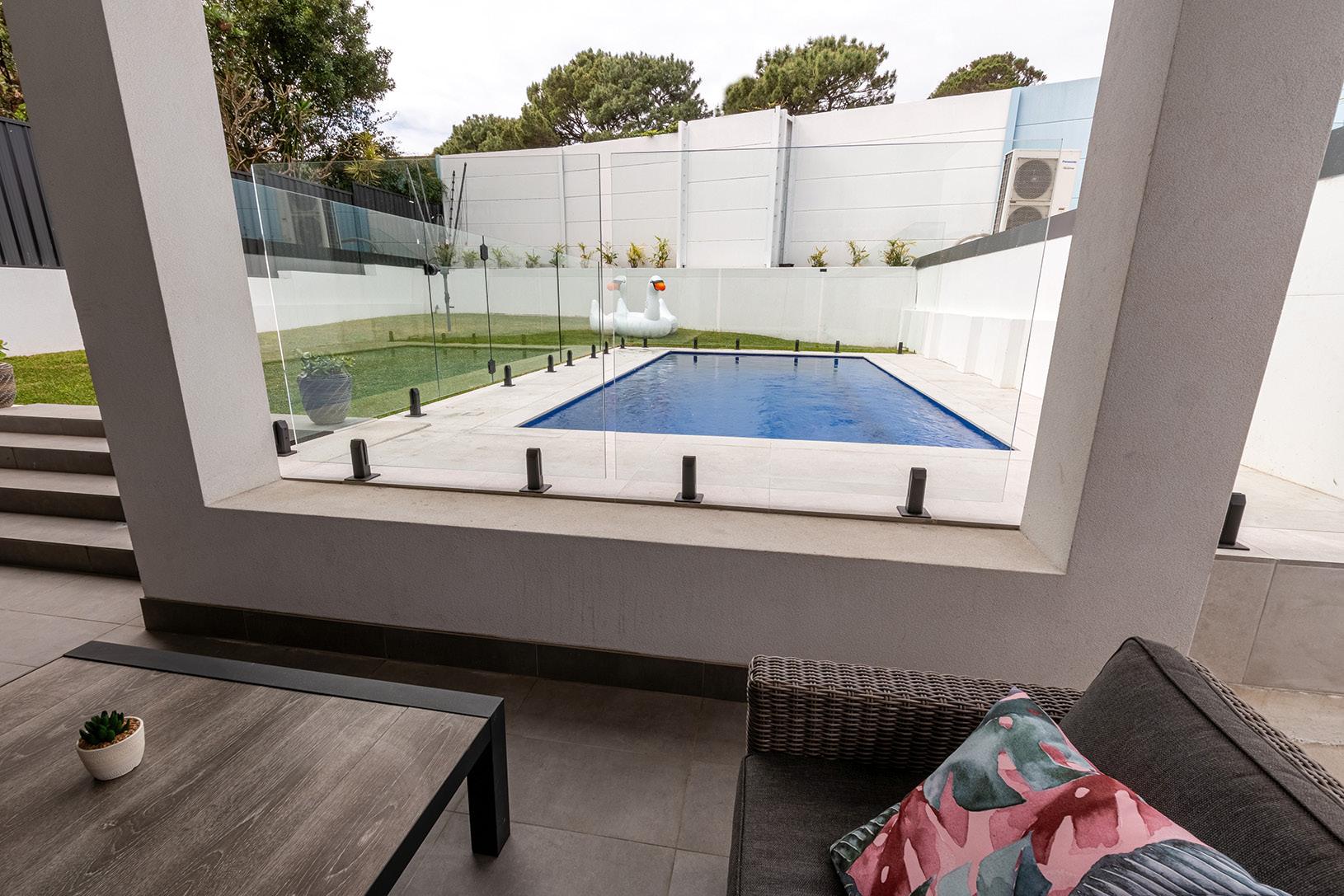
Having been building fibreglass pools for 15 years, Ranieri has learned a few thing along the way. One of the most important is how to manage growth.
“In the fiberglass space, there can be really good builders who install somewhere between 40 and 280 swimming pools a year, and they do everything themselves. I think that’s great; those guys do a great job,” he says.
“Then you’ve got other businesses who want to get to higher numbers. They need to hire staff and introduce systems and processes. And sometimes they go backwards for a little while before they can justify all those extra staff and systems, and it can be quite difficult.”
He says he’s seen some builders come unstuck when they take that step.
“They try to be too many things for too many people. You should work out what you’re really
24 SPLASH! February/March 2024 feature
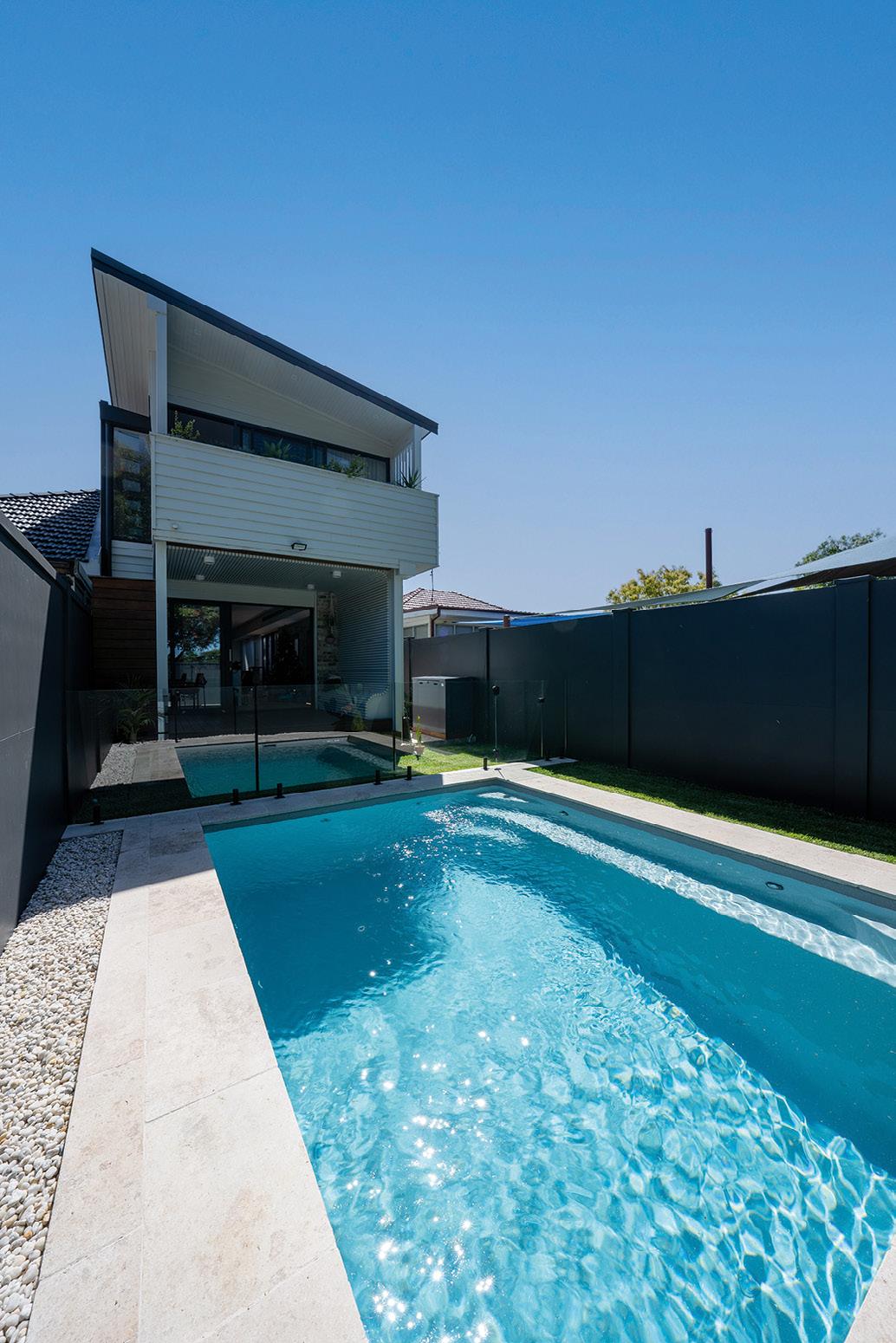
good at, and stick to that as much as possible. Have a clear plan and run your business like a business, even if you need help from a business coach or an accountant.
“Client relations are also essential, ensuring you keep the client in the loop every step of the way.”
He says that above all, the basis of your business has to be installing a good product.
“Make sure you’ve got good equipment and a good quality swimming pool shell. Without that, nothing else matters.”
A strong relationship with suppliers is essential.
“We make sure we can get the equipment from the supplier when we need it, that it is all good quality equipment, and that if there are issues down the track, the supplier is going to come and help us out. So we try not to chop and change too much, and it’s definitely not based on price.”
Aquify have relationships with Theralux for pumps, filters and mineral chlorinators, Naked Pools for their freshwater system, Madimack for heating systems and Maytronics for robotic cleaners.
“We have a really good relationship with Reece, who supply our pipework and plumbing and are happy to stock any equipment we want – and we get it on site within two hours. Reece recently purchased Theralux, which is one of the reasons we partner with Theralux.”
Opportunities for 2024
Despite the inflationary pressures of 2023, Ranieri has high hopes for 2024 and beyond.
“There’s a housing crisis right across Australia; they can’t build houses quickly enough. All these new homes that are being built – even though they tend to be larger homes on smaller blocks – I still think there’s going to be huge scope for swimming pools,” he says.
“I can’t think of a better investment for your home. It brings a family together, creates memories in the backyard, gets the
1800 625 331 sales@naked-pools.com www.naked-pools.com *For full terms and conditions see website. YEAR 5 QUALITYASSURED WARRANTY ON ANY NKD-R UNIT That feeling just got a whole lot better. At Naked we’re committed to delivering the ultimate freshwater experience for you and your customers. Which is why we now offer a 5 Year Warranty on all NKD-R Units.* Isn’t it time you went Naked? Find out more on our website or call us on 1800 625 331 NAK6229 SPLASH 5 year Warranty HPC.indd 1 29/2/2024 11:55 am
Fibreglass pool designs are much improved nowadays
February/March 2024 SPLASH! 25 feature
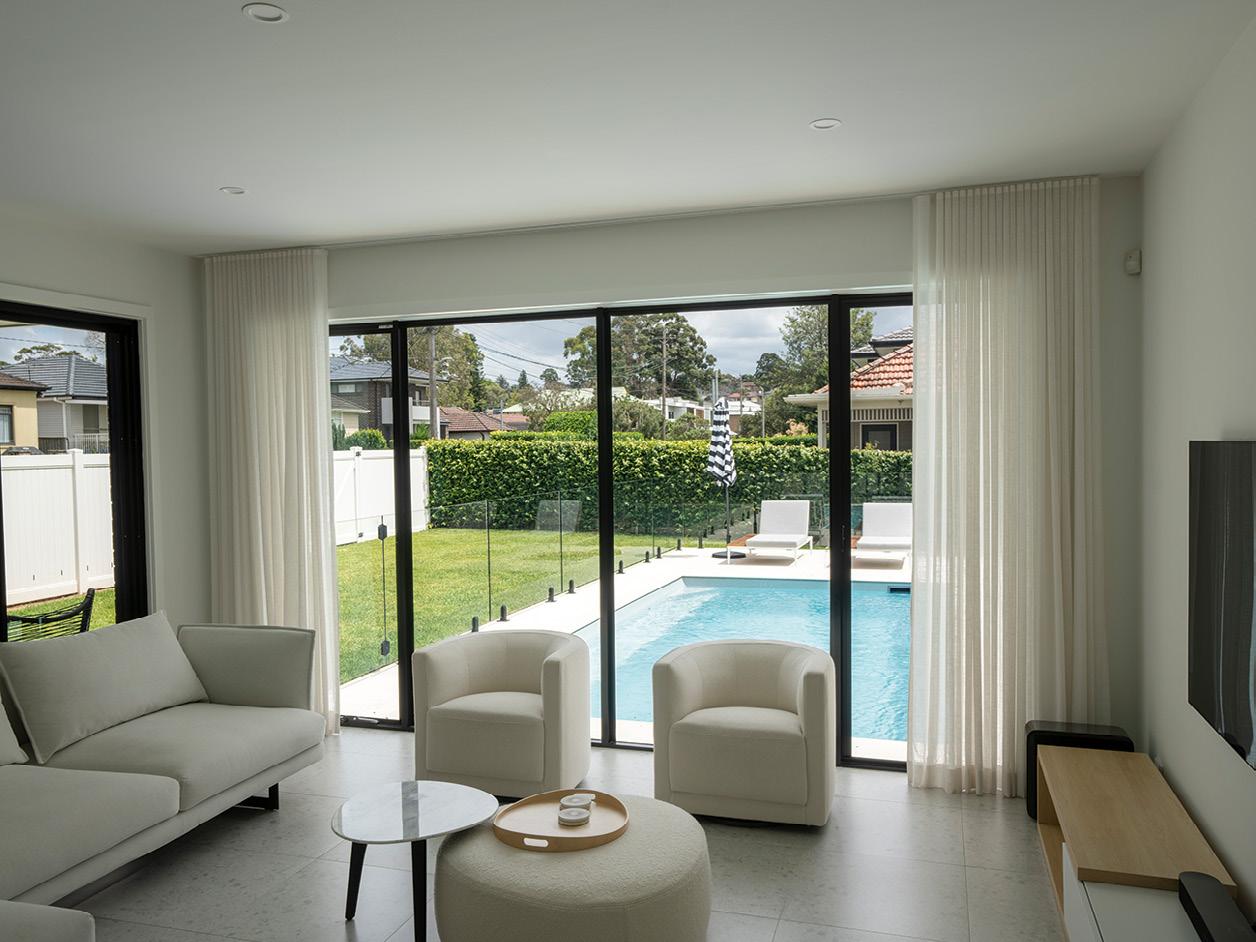
A great way to make family memories
kids off the screens and the iPads. It’s healthy and doesn’t depreciate in value – it actually adds value to the investment of the family home. It’s just still such a winner.”
He believes that once interest rates start to come down, people will be more inclined to invest in the property with a swimming pool – and the pool companies that manage to survive the downturn will reap the benefits of a huge upturn.
“I saw some figures that in New South Wales alone there were nearly 3000 businesses that went insolvent in 2023 – more half of them in construction.
“But I think for the companies that manage to stick it out, there will be a huge upside. The ones that can weather the storm and be there at the other end will obviously have a lot of opportunity. And probably less competition to be honest.”
Business of the Year Award
The brothers have been in the industry for 15 years as T&M pools, and have been responsible for nearly 2500 pool installations. They typically don’t subcontract any part of the installation process, preferring to keep as much as possible inhouse, helping control the timing and the quality of service.
These are things that he believes helped sway the judges to award them Business of the Year.
On top of that, they don’t split contracts and don’t cut corners in terms of insurances and requirements.
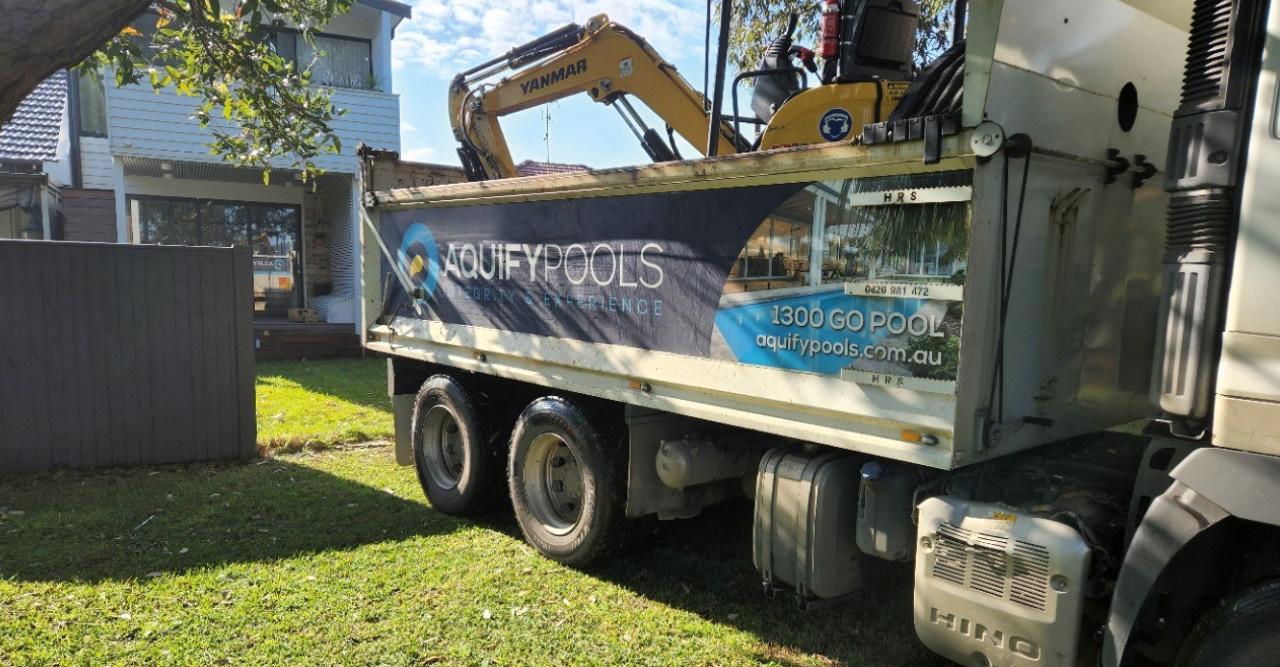
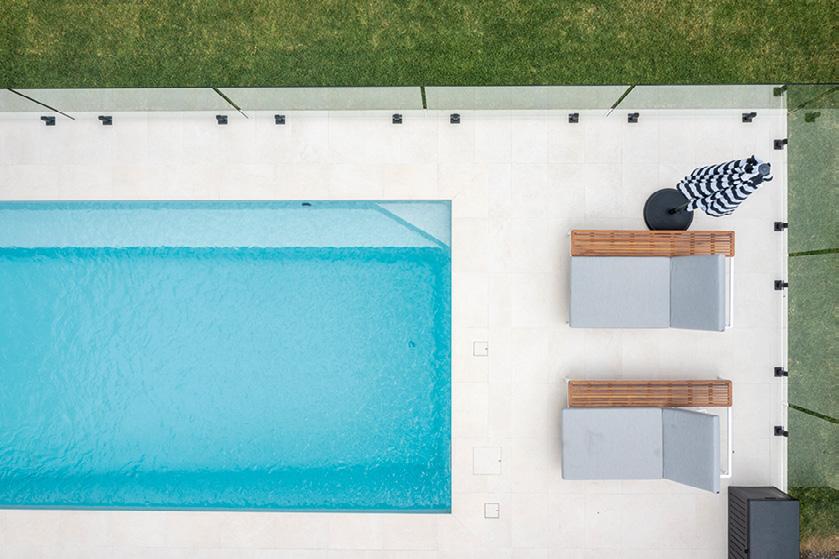
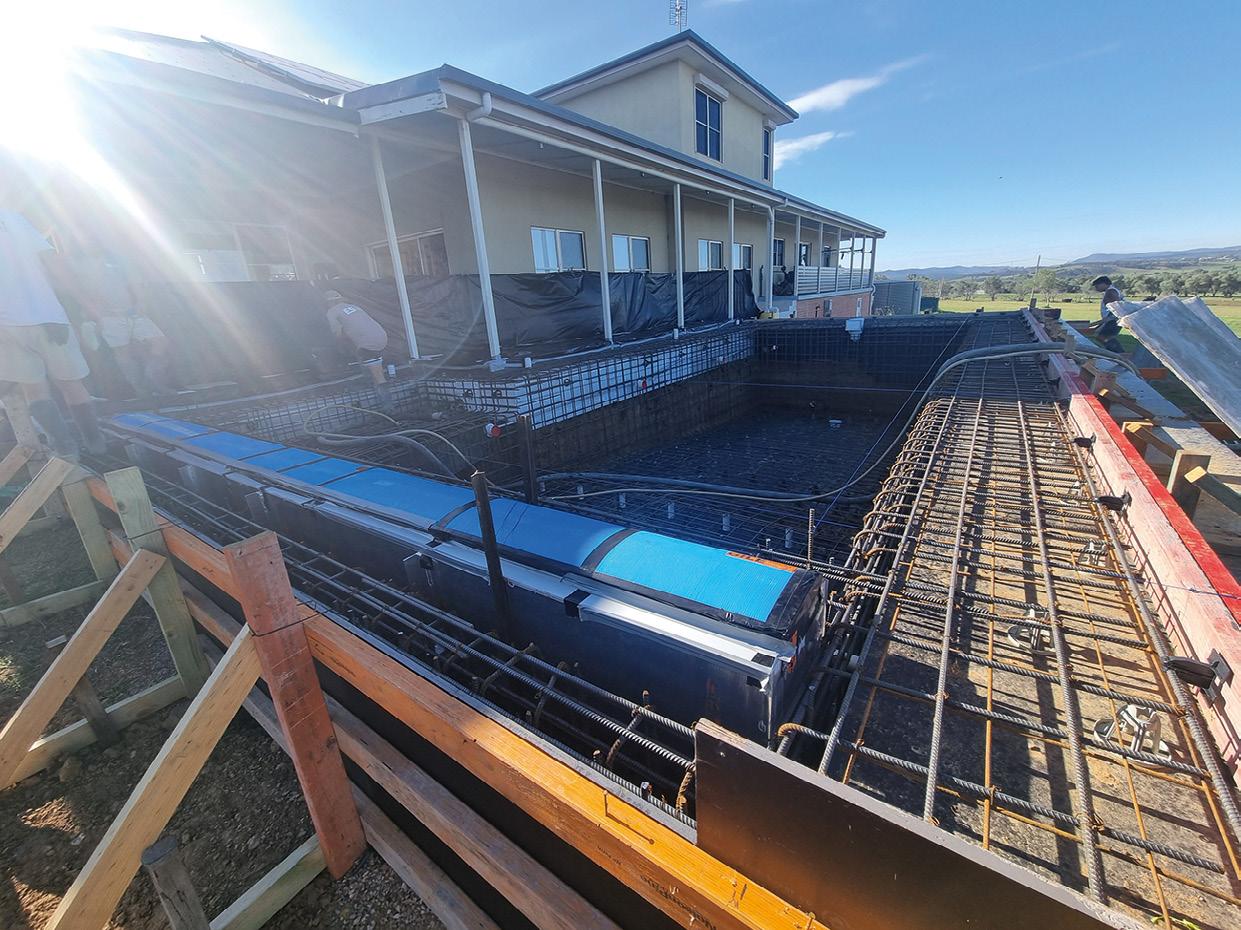
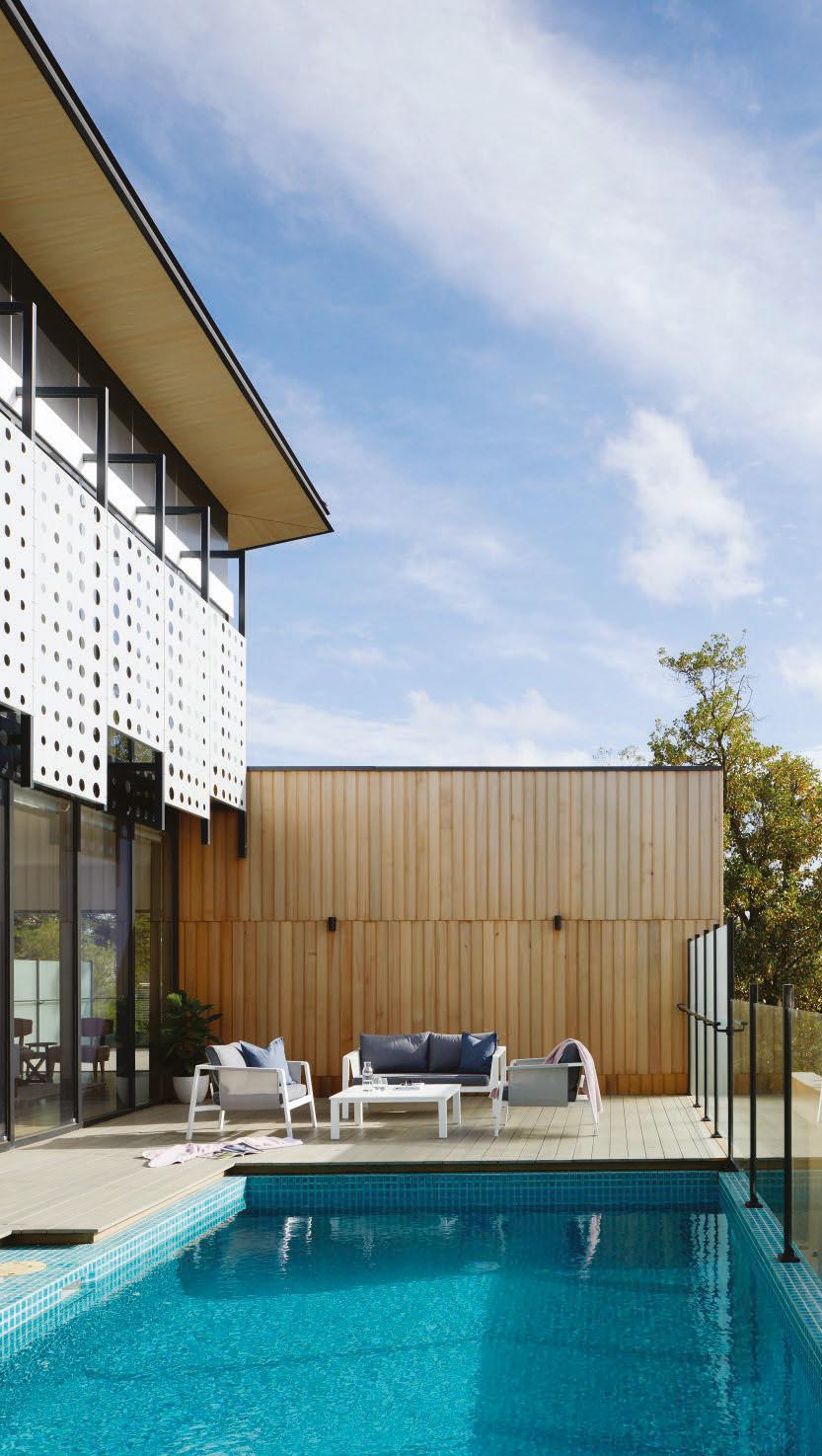
ABOVE: Getting to work
LEFT: The beauty of geometric lines
BELOW LEFT: The brothers are now also doing concrete construction through their sister company Winrani Pools
“I can’t think of a better investment for your home.”
Hanging on to handover
There has been some discussion about handing off the pool handover to third parties recently. SPLASH! asked Ranieri what his opinion is on this matter.
“I understand why someone may use a third party, if they’re busy or for ongoing service relationships,” he says.
“But I think the opportunity is too great not to go back at the end and hand the pool over yourself. I mean, the clients trusted you with installing their swimming pool for their family. I just feel it’s a great opportunity to go back and show them all how it works, shake their hand, double-check there’s not any outstanding issues, ask for feedback, and get a couple of photos.”
He believes in the long run, you may actually save yourself time by doing a good handover yourself.
“What if the third party doesn’t know the reasoning behind what you’ve done, and it’s not quite explained properly? It might be the first time they’ve seen the property and the pool. So I don’t think it’s a great idea, but I understand why people do it.”
supporting the industry and upholding the highest values. And I think that helps protect the industry in the market, if we all try to have the right values.
“Each project gets a unique project manager assigned to each job, start to finish, and the systems and processes we have in place give good visibility for us and for the clients. Our 12 month rolling figure at this point in time is that we build pretty close to 250 pool per year; and we have installed more than 300 per year in the past.”
As a dealer, Aquify has exclusive access to ALT products in a broad geographical area that includes the majority of Sydney, the lower half of the Central Coast and the Illawarra.
One of the benefits of winning the award is getting more exposure for the Aquify brand.
“T&M Pools has been around since 2008, but the Aquify trading name has only existed since 2022. If people were to do their research, they could see the heritage of our company – but it really helps to give that brand name some legitimacy and public credibility by winning the Business of the Year,” he says.
“It’s been really nice for our team to get recognised, and to feel like they’re part of something special. I want to thank SPASA for putting on the awards and giving us the opportunity to put in an entry.
“It’s been a huge boost and we really appreciate it, and love being a part of SPASA.”
Contact: www.aquifypools.com.au n
A pool can bring a whole new lifestyle
26 SPLASH! February/March 2024 feature

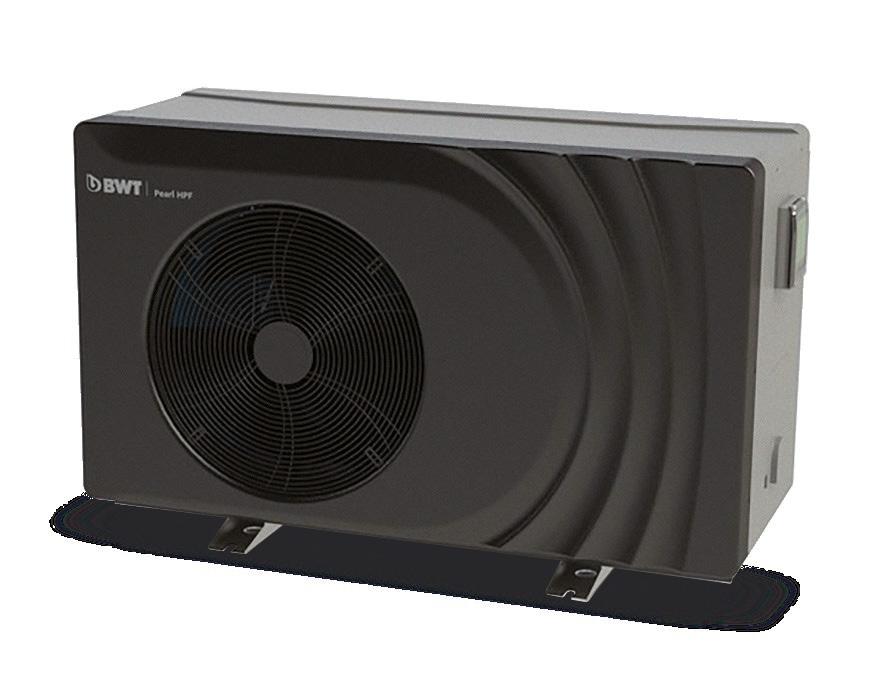


www.linc.com.au sales@linc.com.au 03 9580 9016 Ltd 09 262 3902 20638 GROUP Always ahead of the curve! T H E IN TELL I G E N T S W I MMIN G POO L H E AT P UM P P E AR L I N V E R TE R HE A T P UM P S provides an effortless heating lutio *heat exchanger titanium components only Exclusive to: R32 Refrigerant Quiet Operation Full Inverter 15o Temp HPF range 10o Temp HPT range 25 Year Warranty* 25 WARRANTY Now Available Remote management with a smartphone and supervision by our TechniCenter SO L U T IO N BWT Connect inside:
Artificial intelligence and the pool industry
By Veda Dante
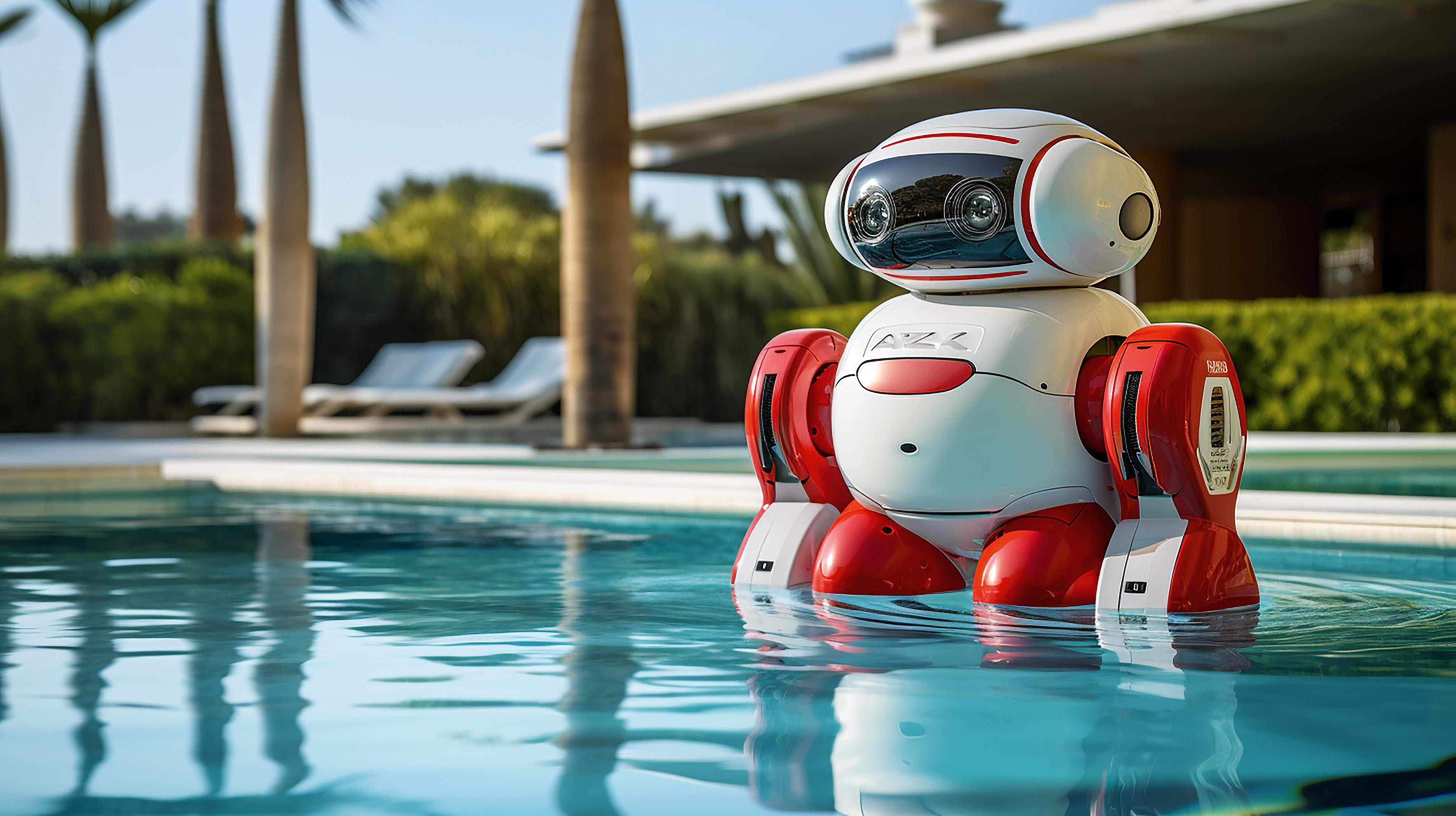
Long before Siri and Alexa were household names, a man by the name of Alan Turing was sowing the seeds for what would become one of the biggest technological revolutions known to humankind: artificial intelligence, or AI.
Among British computer pioneer’s many achievements, in 1945 he predicted that computers could be programmed to play chess. A few years later he wrote the first computer chess program. In 1997, Deep Blue, a chess computer built by IBM, beat the reigning world champion, Garry Kasparov, in a six-game match.
In 2024 computing is vital for anyone doing business. But the next stages are the AI, machine learning and deep learning technologies that are being adopted by industries across the globe –including the swimming pool and spa sector.
But what exactly is artificial intelligence, or AI?
Put simply, artificial intelligence makes it possible for machines to learn from experience, adjust to new inputs and perform human-like tasks.
Most AI examples that you hear about today – from social media and self-driving cars to autocorrect and facial recognition – rely heavily on deep learning and natural language processing. Using these technologies, computers can be trained to accomplish specific tasks by processing large amounts of data and recognising patterns in the data.
The root of the smarts
Luke Dawson, who is senior software engineer at Waterco, graduated with a degree in Mechatronic
Engineering and Psychology from the University of Sydney. He says that while AI is a loaded term that has changed over the past decade, it still has its roots in computer science.
“When neural networks were first being developed, we saw how effectively they performed certain tasks. The field grew enormously and it quickly found applications across a huge range of industries,” he says.
“The concept of ‘deep learning’ arose, followed by the next umbrella term that was ‘machine learning’, which was really about developing more sophisticated models and algorithms, training them against big data sets, and essentially finding a process to write a computer program where you didn’t need to explicitly write the code yourself to achieve on outcome to a given problem.”
The programs and models had reached a point of maturity, Dawson explains, where we could feed massive real world data sets in, and they would spit out meaningful decisions and classifications that were mimicking what human intelligence could do.
“We were still writing computer programs at the end of the day, but not in the traditional way,” he says.
From a computer science perspective, AI is simply the capability of a system to mimic what humans can do and how they solve problems.
“The scope for AI in the swimming pool and spa industry is immense.”
The pool industry is preparing for a revolution
28 SPLASH! February/March 2024

“For example, if we look at a picture of a car or truck or train, we are very good at picking out their different characteristics and classifying them. These seemingly simple problems have typically been very hard problems in computer science to solve, but recently the capabilities of machine learning can now actually do that and do it very effectively,” Dawson says.
“Now, in 2024, that umbrella term of AI covers any type of computer system than can mimic the capabilities that a human has to solve a staggering number of problems in any given industry.”
For the pool and spa sector, Dawson says AI may be being worked on “in bits and pieces”, but the more common use cases are the next layer down, such as machine learning.
“We’re not really seeing a huge amount of AI yet. It’s more been about efficiency, reducing operating costs, and utilising automation to improve water quality and the end user experience, which is all solvable within the machine learning scope which Waterco has been developing,” he says.
“For example, with the way we do our water testing and water chemistry – as well as what can we combine with real time sensors – there is a fair amount of machine learning based smarts that we can build within our products that will allow us to do intelligent, ongoing monitoring and maintenance.”
The future of content creation
Paul Arrighi from Clark Rubber says the scope for AI in the swimming pool and spa industry is immense.
In his role as head of learning and organisational development, he is utilising AI to create initial storyboards and content for technical training.
“While there is software to create courses from scratch, we successfully use AI to act as a subject matter expert, or SME, to map content and provide initial content to be subsequently reviewed by an inhouse technical specialist,” he says.
If Arrighi is writing a training course on chlorine chemistry, for example, he asks AI for its input on
“From a computer science perspective, AI is simply the capability of a system to mimic what humans can do and how they solve problems.”
a topic first, rather than beginning by searching through Wikipedia, technical data sheets or other sources of information.
“AI will trawl different websites, much like Google, but then it’s able to pull the information together to provide an answer,” he explains. “That answer, however, needs to be checked by a human and primary sources like data sheets for accuracy. AI responses definitely require an experienced person to review the content and provide input on it.”
These systems help speed up course development, making the process easier, quicker, and more flexible without sacrificing quality.
“It knocks hours off creating storyboards, which are then turned into training modules,” says Arrighi.
February/March 2024 SPLASH! 29 feature
Human intelligence working with artificial intelligence to bring dividends Pools may be easier to design, construct and maintain thanks to AI







“What’s emerging this year will be integration of AI with authoring tools, so that will be interesting to see how it further addresses question marks around things like accuracy.”
One of the dangers of AI is the limitations on how it is trained and what it generates on occasion.
“So, for example, there is a ‘hallucination’ effect, where AI, through its algorithm, doesn’t have the correct answer but instead infers it, which means it can get things wrong,” he explains. “That means it pulls together information and synthesises an answer that can be persuasive although fanciful.”
Artificial intelligence systems like ChatGPT hallucinate, Arrighi says because they look at probabilities of words belonging with other words.
“It’s not sentient. It doesn’t understand the content. It just looks for patterns and connections. The cleverness is it’s able to draw different connections between different bodies of knowledge,” he says.
The emergence of AI video creation software allows businesses to create high-quality marketing and promotional videos without the need for actors, cameras, studios or even microphones. Using the text-to-video function, you can now create polished video content with realistic AI presenters in minutes.
“If we ask the AI video generator to create a video on how a chlorinator works in keeping a pool sanitised, it is capable of finding examples of fresh water, chlorinators and diagrams of how it all works before putting it together,” Arrighi says.
But is it going to find the equipment Clark Rubber sells? Probably not. Is it going to have the precise set up, given there may be two or three approaches to chlorination? Maybe.
“It comes down to how you describe the question and engineer the prompts. While it’s surprisingly
good, it’s still at a superficial level when providing a finished product.”
AI’s biggest difference is its ability to interact with humans to refine the finished product based on user feedback.
“Rather than asking Google a question and it provides an answer, you can ask AI to include examples, adjust the tone or adopt a different persona - because it’s capable of reacting that way,” he explains.
While we have yet to see AI disrupt the industry with pool equipment or swimming pools themselves, when it does, Arrighi says it will happen quickly.
“You didn’t need to explicitly write the code yourself to achieve on outcome to a given problem.”
“If you look at the current offering across all pool and spa equipment, there is a segment of the consumer market that readily adopts a new technologies,” he explains. “For that market segment, price is often not a primary concern if a product solves a particular problem. For your mum and dad customer, new technology will come. I mean, who would have thought ten years ago that an automatic chlorinator would be a common thing to have?”
A coming revolution in the pool industry
The swimming pool and spa industry is no stranger to innovation; but with the rapid advancements in artificial intelligence, it is on the brink of a significant transformation, according to Julian Brady, founder of Pool Site Quote.
Brady says that as AI continues to evolve and become more effective at solving problems, it will
February/March 2024 SPLASH! 31 feature
Human input is vital
undoubtedly influence various aspects of pool construction and design.
“Increased efficiency and creative designs are two key features that will have a substantial impact on our sector,” he says.
“Is it clear who owns the content that generative AI platforms create for you or your customers?”
“The automation of creativity is a frightening prospect, as human creativity has been at the forefront of pool building innovation forever.”
There are currently AI-driven design software programs that assist pool builders in simplifying the design process by creating highly accurate 2D and 3D models with simulations.
“This saves time for builders as they can quickly generate and modify pool designs, considering various factors such as space constraints and local regulations,” he says.
“This streamlines the design and approval process, allowing builders to present clients with realistic renderings and make changes on the fly, reducing revisions that often waste time and money.”
Enhanced efficiency in project management is another way AI is impacting the industry.
“Project management in swimming pool construction involves coordinating various tasks, from excavation to plumbing and electrical work,” he says.
“AI-powered project management tools can help builders schedule and track these tasks a lot more efficiently, using predictive analytics that can anticipate delays or issues. This can help builders make proactive decisions to keep the project on track and keep it within budget as well.”
Utilising historical data
AI’s sophisticated capability can also analyse historical data and project specifics to provide
accurate pool quotes.
This helps builders provide clients with estimates that will be more precise, reducing budget overruns and potential disputes.
“Additionally, AI can optimise material procurement, ensuring that builders have the right materials when they need them,” Brady says.
As AI-driven virtual reality (VR) and augmented reality (AR) tools continue to grow, the visualisation of the final product will be more accessible and more accurate.
“Customers will be able to experience a much more detailed and immersive view of the product they are receiving,” he says. “This will further enhance customer satisfaction and promote transparency between builders and their clients.”
Brady even believes there will be a time when automation enables excavation machinery to autonomously dig pools precisely to design specifications.
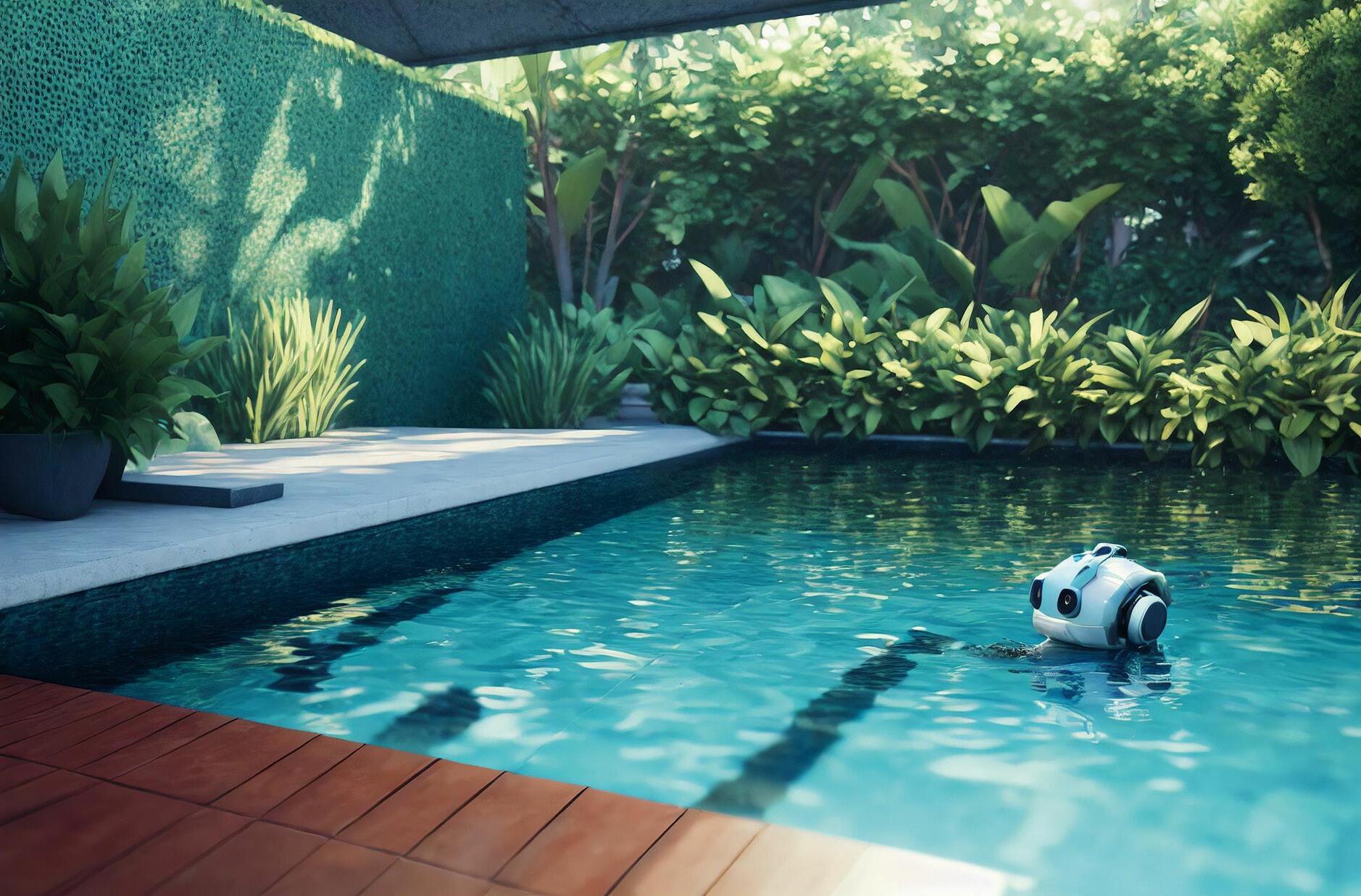
“AI will probably operate steel-fixing robotic machines to bend and fix steel to design specifications as well,” he says. “Other laborious tasks such as pumping concrete will eventually be automatic, with robotics spraying the pool shell to the optimum pool mix recognising climatic conditions on the day and following engineering requirements.”
From a service perspective, AI will also be able to analyse a client’s preferences, location, and budget to recommend the most suitable filtration, sanitisation, heating, cleaning and lighting equipment.
“This will ensure that clients receive bespoke recommendations that meet their specific needs and preferences,” Brady suggests.

Manufacturing is well used to input from machines
32 SPLASH! February/March 2024 feature
An advanced future is on the horizon
“This leads to happier customers while reducing operating costs — two key features that will help drive the pool building industry forward.”
Once the pool is built, AI will continue to play a role in maintenance by including smart sensors and algorithms to monitor the pool’s condition and water quality.
“By predicting maintenance needs and water chemistry adjustments, builders will be able to offer maintenance services that are both proactive and cost-effective, extending the customer/builder relationship,” he says.
With consumer behaviour tending more towards sustainability, AI will help builders create more eco-friendly and sustainable pool designs.
“Analysing factors like energy consumption, water usage and environmental impact will help guide recommendations for sustainable materials and energy-efficient equipment, aligning with the growing demand for environmentally responsible pool construction,” says Brady.
AI is poised to revolutionise the swimming pool building industry in numerous ways, from streamlining the design and construction process, enhancing project management to improving customer experiences and promoting sustainability. But will AI replace labour?
“The integration of artificial intelligence and machine learning technologies has the potential to automate certain tasks and processes, leading to increased efficiency in various industries, including the swimming pool building industry,” he says.
“While AI may replace some routine and repetitive tasks, it also has the capacity to create new job opportunities and transform existing roles.”
“Before businesses can embrace the benefits of generative AI, they need to understand the risks — and how to protect their brands and reputations.”

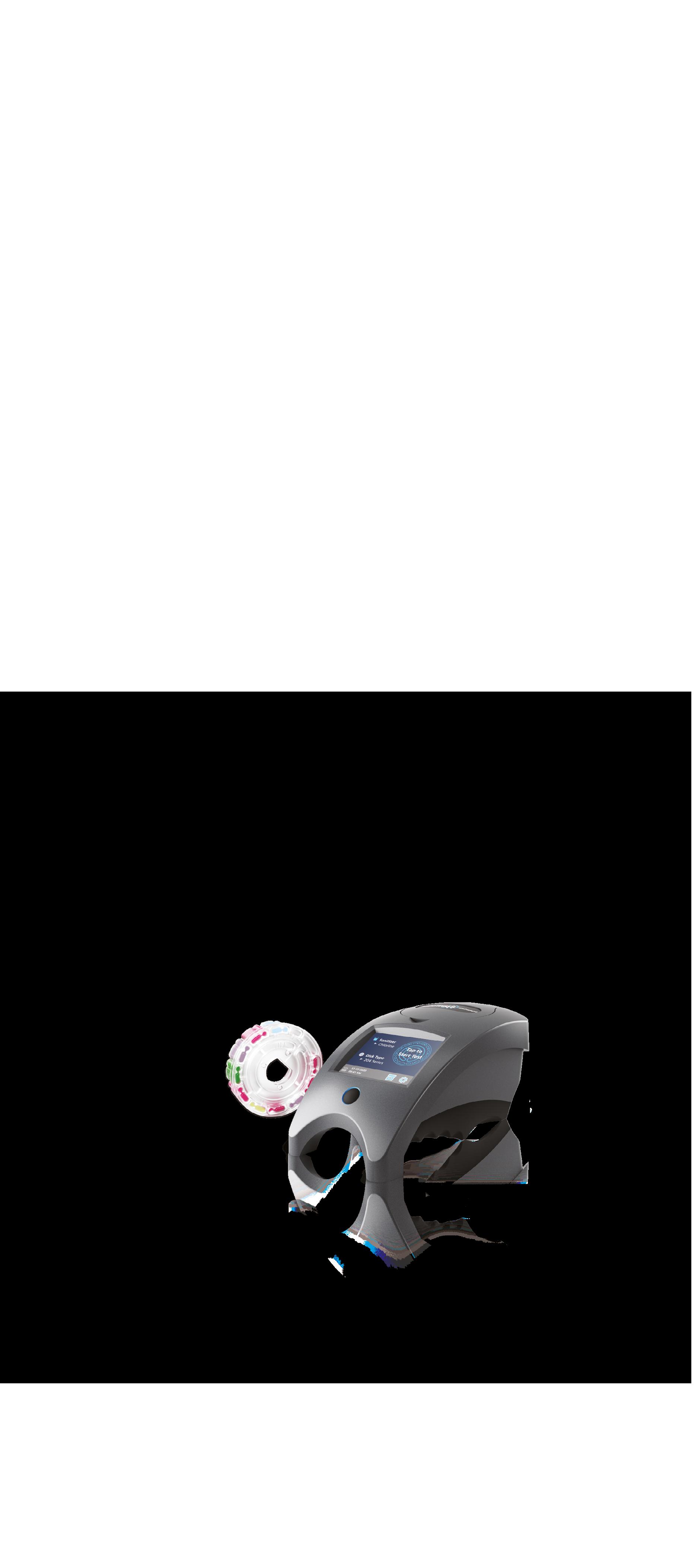
February/March 2024 SPLASH! 33 feature
As this wide-ranging technology continues to evolve, swimming pool builders who embrace these innovations will be better equipped to meet the demands of a rapidly changing market, providing more value to their clients, and staying ahead of the competition.
“AI can be scary, but the AI-driven era shines a light on how bright and efficient the future of swimming pool construction could be,” he says.
“We are certainly living in exciting times!”
The future of robotic pool cleaning
Artificial intelligence enables robotic pool cleaners to operate with greater efficiency and effectiveness by optimising cleaning patterns, navigating obstacles and learning from their experiences.
As AI algorithms become more sophisticated, robotic cleaners can adapt to diverse pool environments and debris types, ensuring cleaner pools with minimal manual intervention.
David Dean, marketing and customer experience manager at Maytronics Australia explains:
“Dolphin pool cleaners can optimise resource usage such as energy and time. By efficiently navigating pools and targeting areas with higher debris concentration, AI-driven cleaners can reduce overall cleaning time and energy consumption, leading to cost savings and environmental benefits.”
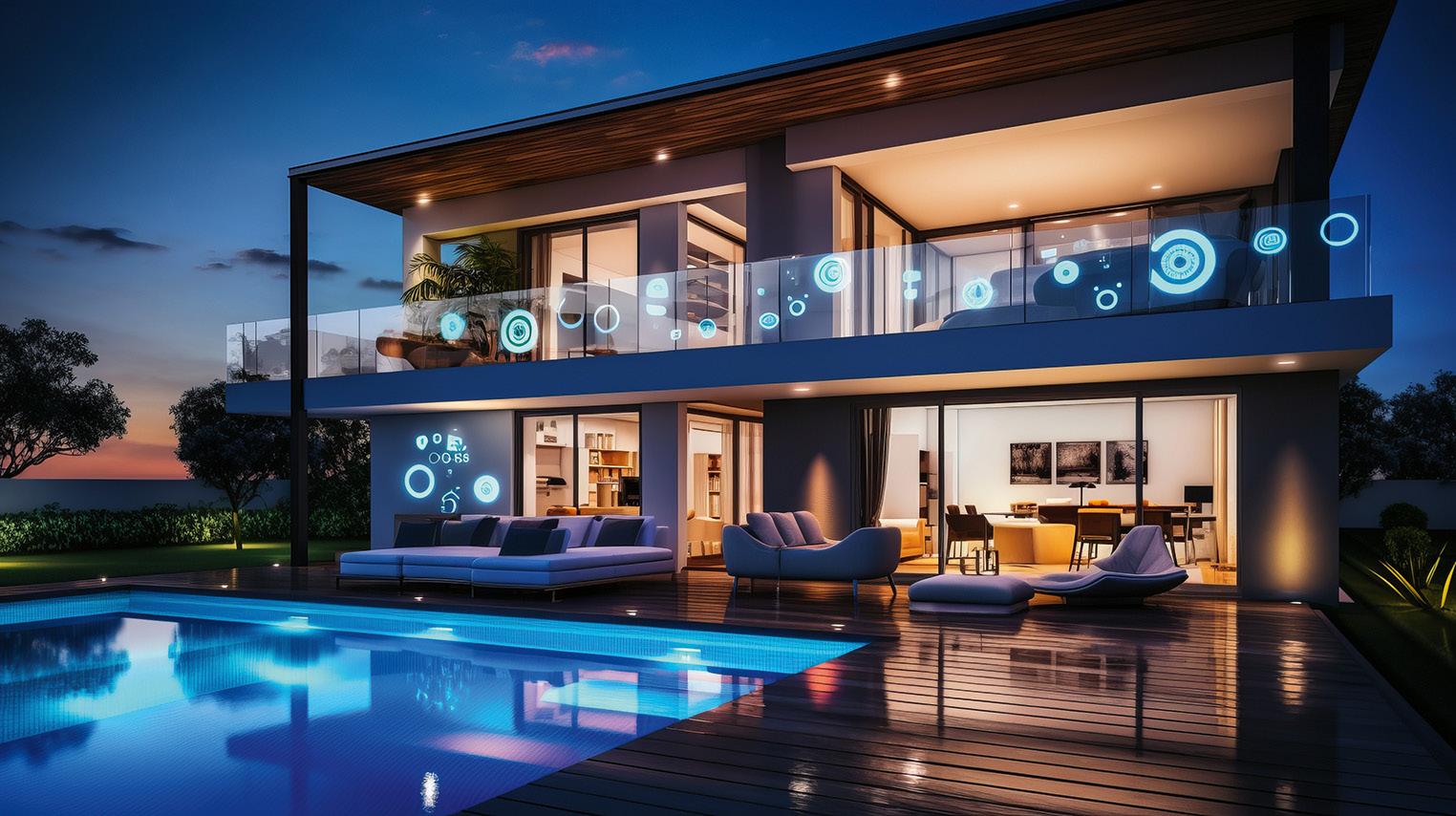
AI-enhanced pool cleaners offer a better user experience by providing smart features such as automated scheduling, remote control capabilities, and real-time monitoring. Users can conveniently schedule cleaning sessions, monitor cleaning progress through mobile apps, and intervene, if necessary, to enhance convenience and control over pool maintenance.
“For the future, AI opens doors for further innovation in robotic pool cleaning technology,” says Dean. “As these algorithms advance, future pool

34 SPLASH! February/March 2024 feature
Ai is like to further enhance smart homes and connected pools
cleaners may incorporate complex features such as predictive maintenance, self-diagnosis capabilities, and integration with smart home ecosystems – all of which are projects in Maytronics’ pipeline. These innovations can enhance reliability, longevity, and overall performance, driving further adoption of robotic pool cleaners.”
Dean says that Dolphin robotic pool cleaners often
learning algorithms that allow them to learn from their cleaning experiences. By analysing patterns and adjusting their cleaning strategies over time, these cleaners can become more efficient and effective at maintaining the pool.
• Optimised cleaning patterns
AI algorithms help Dolphin pool cleaners determine the most efficient cleaning patterns
“It’s not sentient. It doesn’t understand the content. It just looks for patterns and connections.”

























feature
Protecting your intellectual property
The legal landscape is quickly evolving as courts grapple with issues related to copyright, ownership and licensing in the context of AI-generated content. One well-known recent example is the New York Times’ December 2023 lawsuit against OpenAI and Microsoft which accuses the companies of infringing on its copyrights by using millions of its articles to train AI technologies like the ChatGPT chatbot.
“The ChatGPT phenomenon — which is just a really good re-hasher in that it scrapes a ridiculous amount of content that’s out there and re-packages it in a layman’s way that clearly makes sense to people — has really exploded in the past few 12 months,” says Waterco's Luke Dawson.
“There’s no genuine creativity or authentic human reasoning behind it, which is why you’re seeing all of these intellectual property cases.”
Generative AI platforms, like ChatGPT, are pretrained on large datasets that include diverse sources such as books, articles, websites and more. During this training process, the model learns to recognise patterns, relationships and context within the data. This is achieved through the adjustment of billions of parameters to minimise the difference between its predicted output and the actual data.
Once the model is trained, it can be fine-tuned for specific tasks or domains. For example, when you provide a prompt to a generative AI, it uses the
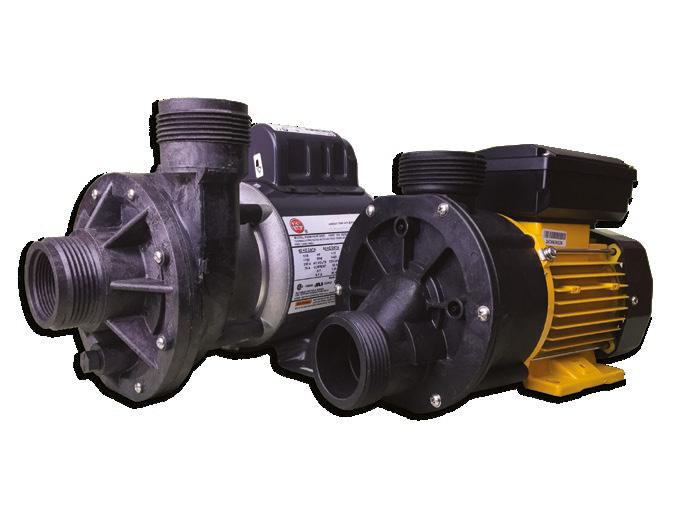
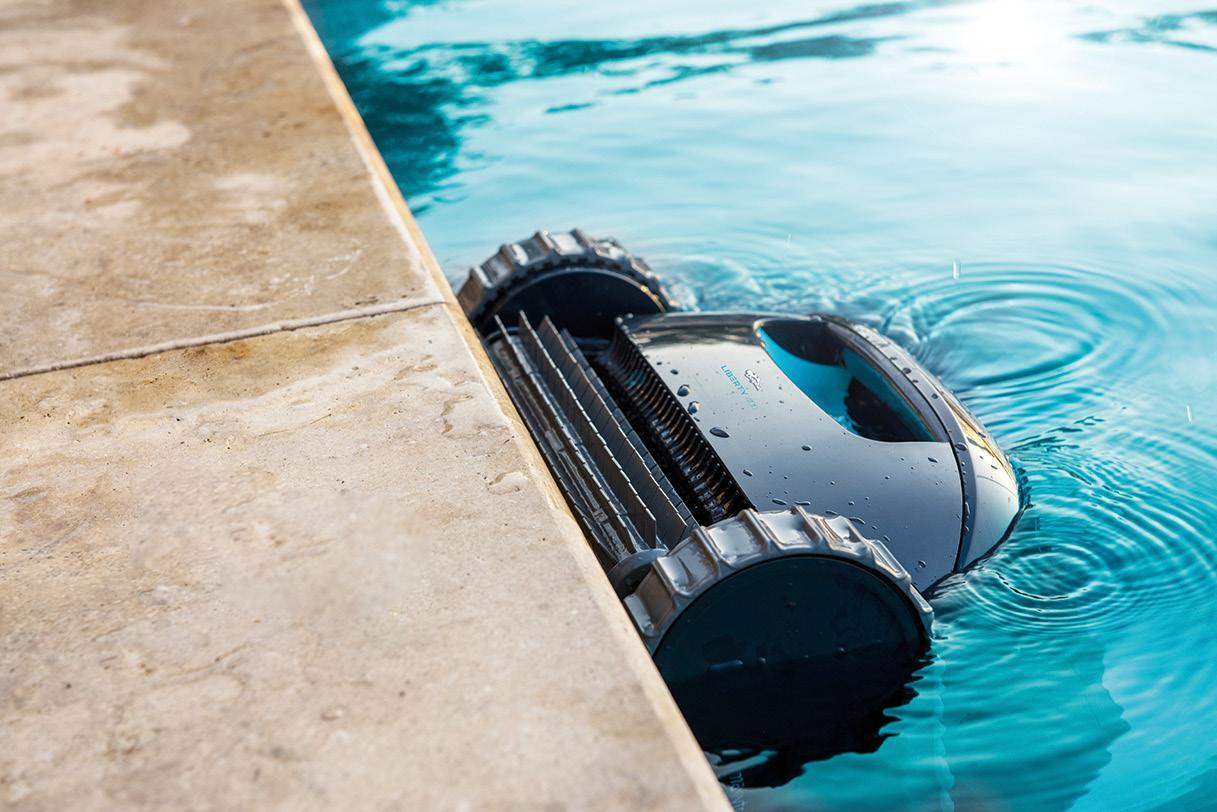
knowledge it gained during training to generate responses or creative outputs. It doesn’t truly create new concepts from scratch but combines and reorganises the patterns it learned from the training data.
It’s important to note that while these AI models are powerful and versatile, they don’t possess true understanding or consciousness. They operate based on statistical patterns and correlations present in the training data, and their responses are generated based on those learned patterns.

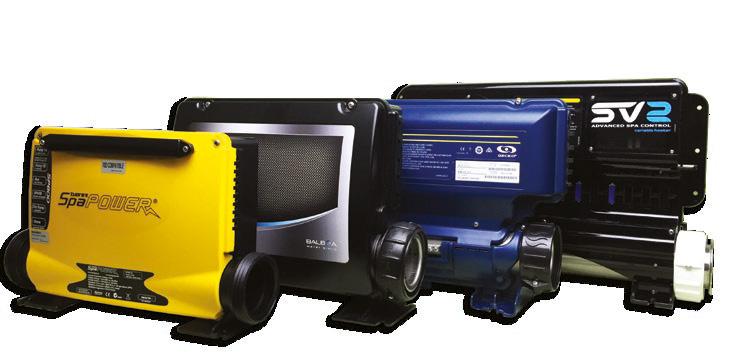
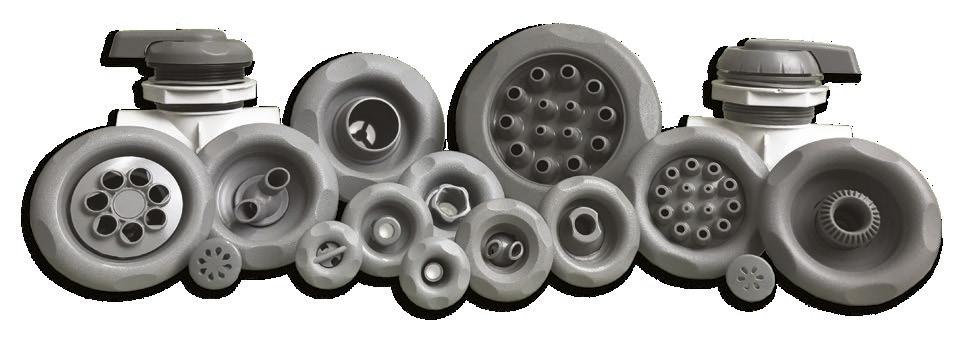

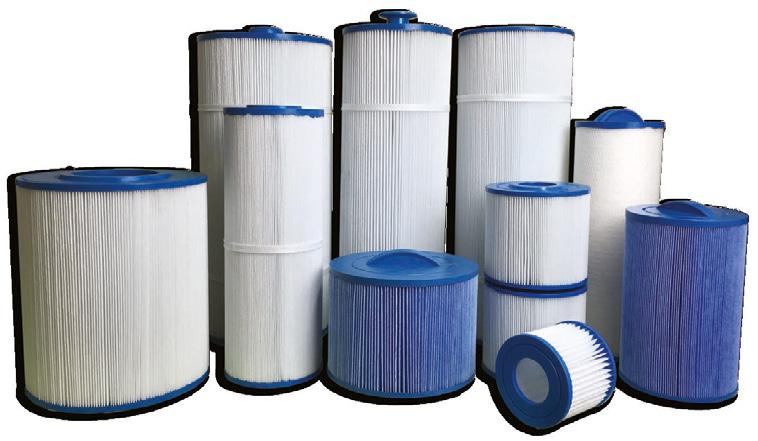

36 SPLASH! February/March 2024 feature
info@spa-craft.com.au www.spa-craft.com.au
1300 498 819
Head O ce: 20 Curtis Road, Mulgrave NSW 2756
VIC Branch: 13 Lieber Grove, Carrum Downs VIC 3201
Artificial intelligence enables robotic pool cleaners to operate with greater efficiency and effectiveness
This process comes with legal risks, including intellectual property infringement. In many cases, it also poses legal questions that are still being resolved.
For example, does copyright, patent and trademark infringement apply to AI creations? Is it clear who owns the content that generative AI platforms create for you or your customers? Before businesses can embrace the benefits of generative AI, they need to understand the risks — and how to protect their brands and reputations.
Key legal points
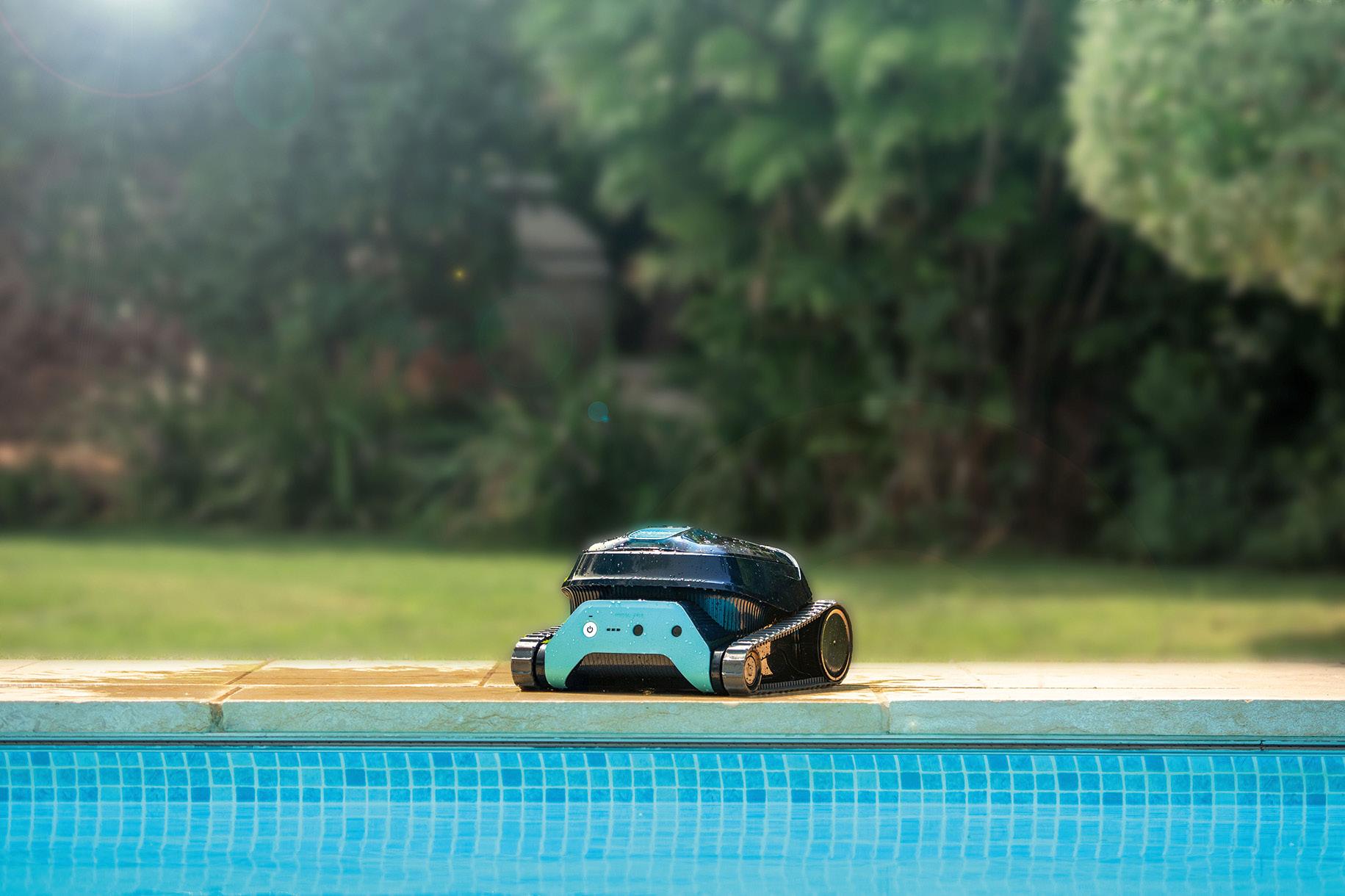
Below are some key points and considerations related to the legal implications of generative AI.
• Copyright infringement
Determining whether AI-generated works infringe on existing copyrights is a complex issue. Courts are faced with questions about the level of human involvement, creativity and originality in the AIgenerated content.
• Ownership of AI-generated works
The question of who owns the rights to AI-generated content is a significant legal challenge. In traditional creative works, copyright typically belongs to the human creator. However, AI complicates this notion as the algorithm itself generates the content.
• Unlicensed content in training data
The use of unlicensed or copyrighted material in the training data for generative AI models raises
AI milestones
1950s–1970s: Early work with neural networks provokes excitement for “thinking machines”.
1980s–2010s: Machine learning becomes popular.
2011–2020s: Deep learning breakthroughs drive AI boom. Present day: Generative AI, a disruptive tech, soars in popularity.
concerns about potential copyright infringement. Companies need to ensure that their training datasets comply with intellectual property laws to avoid legal repercussions.
As AI algorithms become more sophisticated, robotic cleaners can adapt to diverse pool environments and debris types

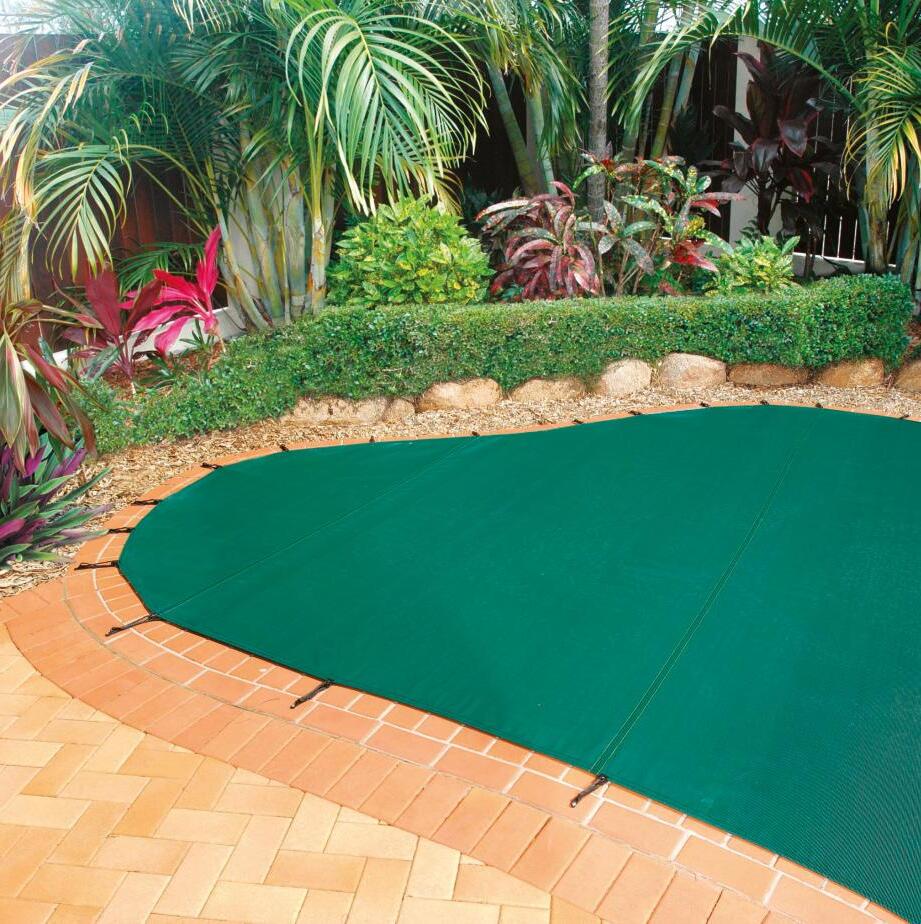


feature Cont ac t us t o arrange a quick les be doing your fir s t Pho t oMeasur C ould you use some ext r a pr ofit t his w int er? H E A D O F F I C E 07 3803 9000 | Email us@abgal.com.au | www Add Poolt ex cover s t o your range and you’ll add happy cus t omer s t oo. Available in standard sized rectangle shapes, or fully custom m to order in any shape or size with A B G A L’s PhotoMeasure system. Even the most difficult pool shapes can be measured without the need for complicated mark-outs. Just a few check measurements and a series of photos which are uploaded in the online portal, straight from your phone - while you’re still on site! Easy to measure, easy to install. Happy pool owners. Unhappy ducks. Scan for more info or phone Richard on 0408 764 258
Subject matter expert integration
The integration of human subject matter experts (SMEs) and the utilisation of artificial intelligence (AI) tools are major trends in the evolving landscape of search engine optimisation (SEO) and content marketing. Let’s delve deeper into these two trends.
• Authenticity and authority
SMEs bring a depth of knowledge and experience that can’t be easily replicated. By involving them in content creation, businesses can establish themselves as authoritative voices in their respective industries.
• Thought leadership
This authoritative voice can contribute to unique perspectives and insights, positioning a company as a thought leader in the industry. This helps in building trust and credibility among the audience while providing a valuable perspective when pitching new products and services to the media.
• Customer-centric approach
SMEs understand the pain points and questions of the target audience. Their involvement ensures that the content directly addresses the needs of customers, making it more relevant and valuable.
• Content optimisation
Content created with the input of SMEs tends to be more detailed, thoughtful, and comprehensive. This is crucial for SEO, as search engines often prioritise content that provides in-depth information. SEO basically improves your website’s content to generate more traffic and increase its ranking.
• Personalisation
AI enables businesses to personalise content based on user preferences, behaviour, and demographics. Personalised content tends to resonate more with audiences, leading to higher engagement.
• Automating routine tasks
AI can automate repetitive tasks in content creation, allowing human resources to focus on more creative and strategic aspects. This improves efficiency and ensures a consistent content output.
• Data-driven insights
AI tools can analyse data to provide actionable insights into content performance, user behaviour and market trends. This data-driven approach helps in refining content strategies for better results.
• Natural Language Processing (NLP) NLP, a subset of AI, is used to understand and generate human-like text. This technology enhances the quality of content, making it more conversational and engaging for readers.
In summary, the integration of SMEs and the strategic use of AI tools offer businesses in the pool and spa industry a potent formula for creating high-quality, relevant, engaging and performance-driven content.
RIGHT: Human labour and input will always be required, but automation may remove some easily repeatable jobs
BELOW: An AI generated image of a woman enjoying a pool


• Provenance and attribution
Establishing the provenance of AI-generated content is crucial for legal compliance. Companies should consider developing methods to track and attribute the origin of generated works to demonstrate compliance with copyright laws.
• Mitigation strategies
To mitigate legal risks, companies should implement strict protocols for selecting and vetting training data. Ensuring that it is free from unlicensed content and obtaining proper licenses for copyrighted material can help reduce the likelihood of legal challenges.
• Collaboration with legal experts
Given the evolving nature of AI and intellectual property laws, companies should collaborate with copyright experts to stay informed about legal developments and law reforms to proactively address potential issues.
• Transparency and ethical considerations
Companies can also enhance transparency by clearly communicating the use of generative AI in their creative processes. Ethical considerations, such as respecting the rights of content creators and ensuring fair compensation, should be part of the decision-making process.
As the legal landscape continues to evolve, companies using generative AI must remain vigilant, adapt to changes, and prioritise legal compliance and ethical considerations in their AI development and deployment processes.
“For the pool and spa industry, protecting the actual models and algorithms, such as the smarts we use for water testing, the type of chemicals we use when and how often to achieve even better levels of automated and ongoing preventative maintenance, is where we’ll see some unique AI,” says Dawson.
“Protecting this ‘recipe’, much like KFC’s secretive 11 herbs and spices, is just another part of our product development journey.” n
Contacts:
www.clarkrubber.com.au www.maytronics.com
www.poolsitequote.com www.waterco.com.au
38 SPLASH! February/March 2024 feature
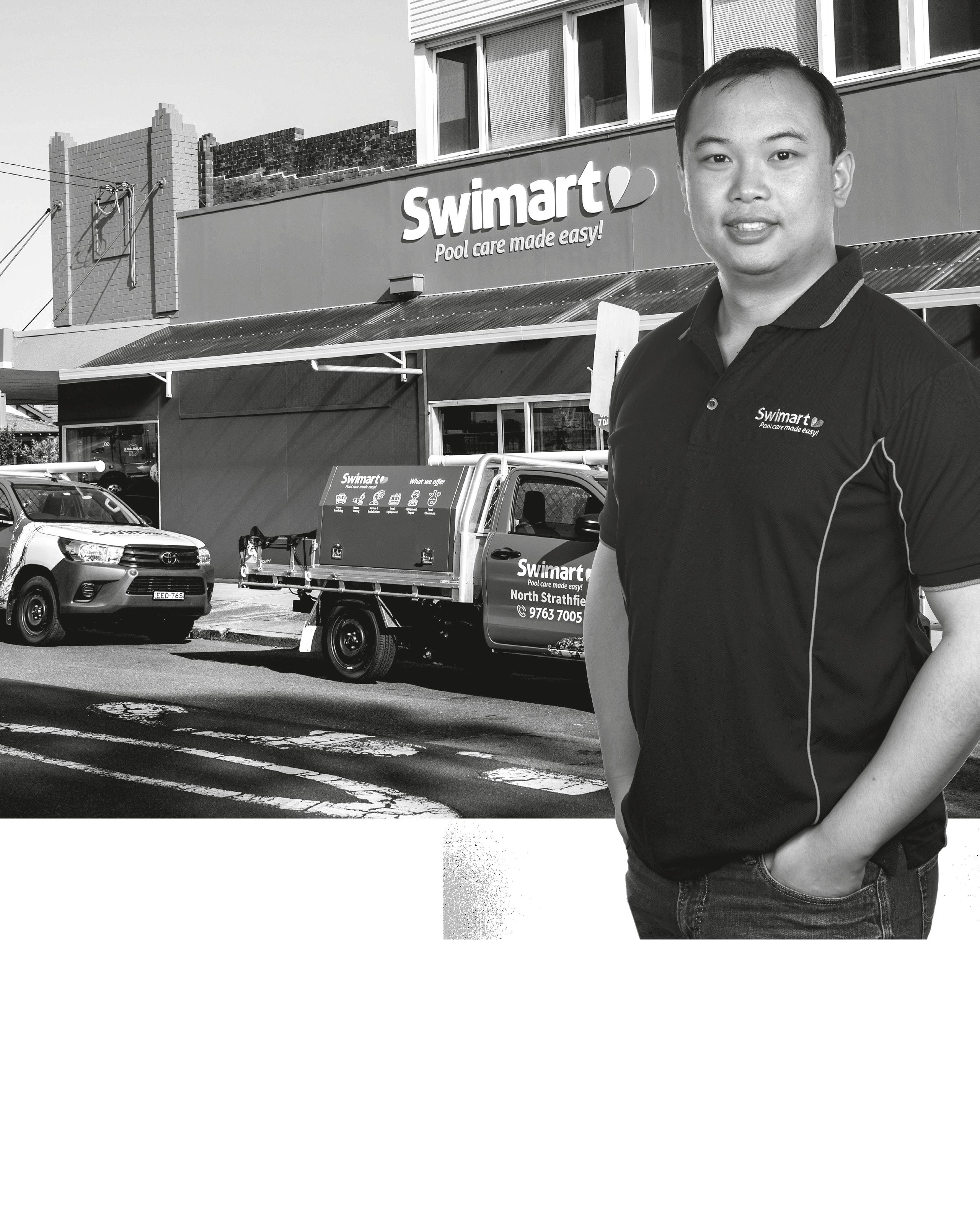
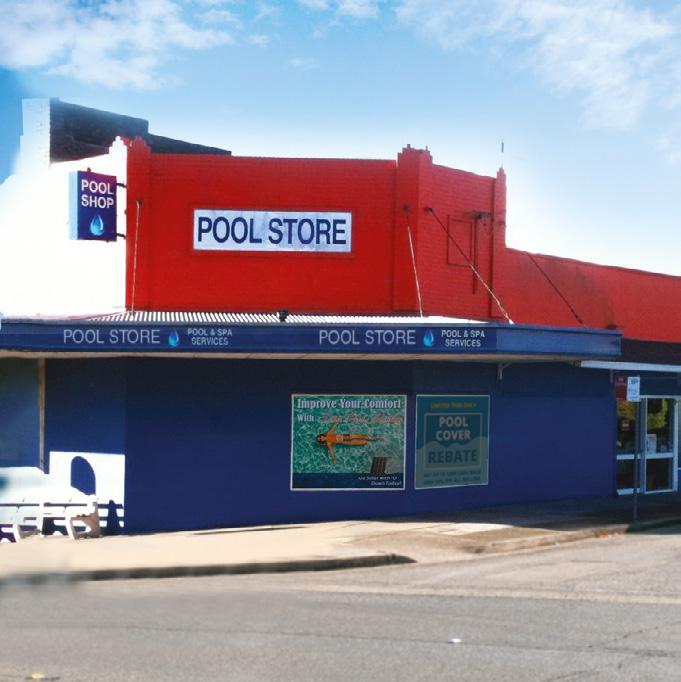
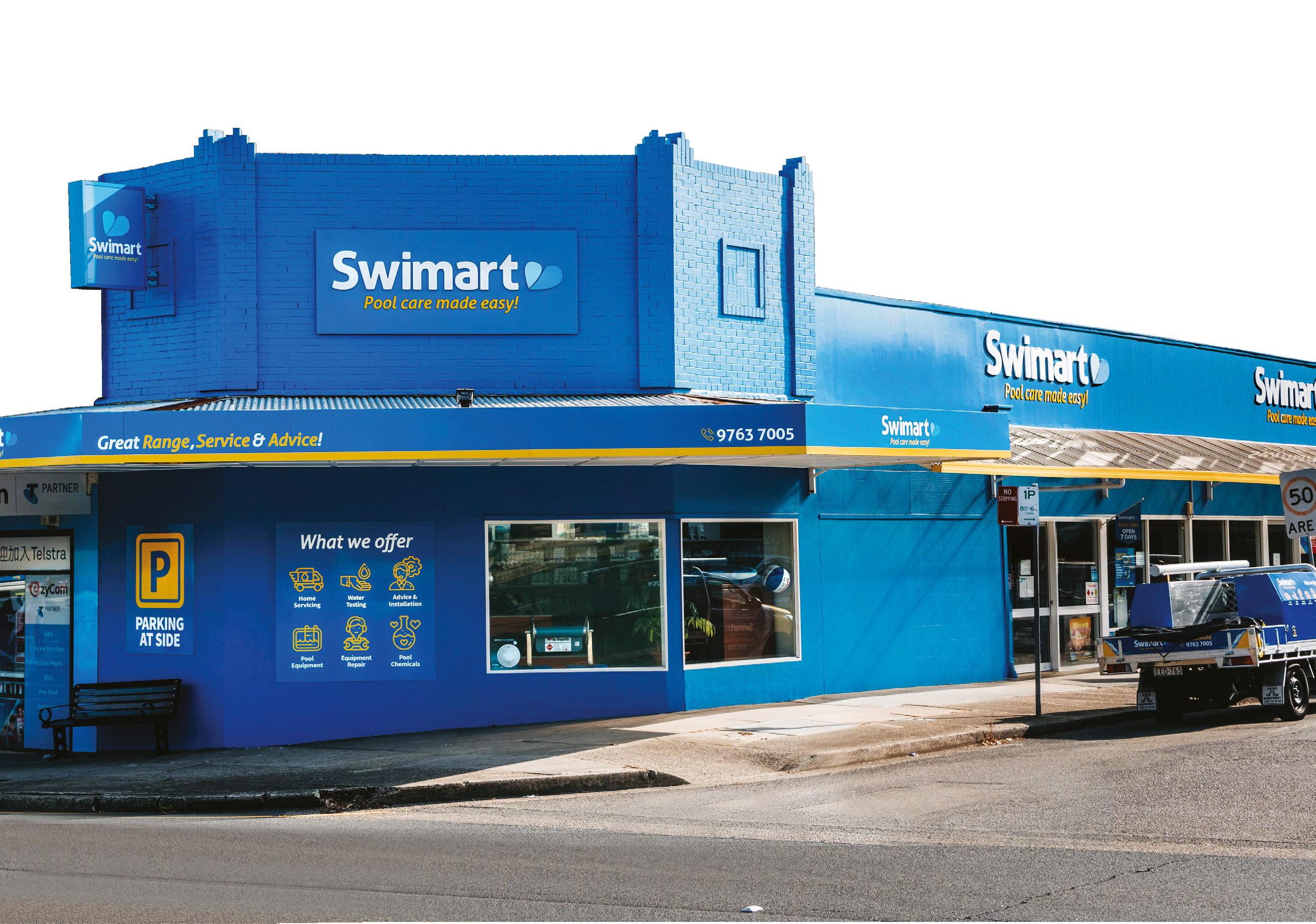
Thinking of selling? Celebrating 40 years of pool care Join Australia’s and New Zealand’s Longest Serving Franchise Network. With 40 years of leadership and brand recognition, converting and selling your pool shop to Swimart means stepping into expertise, stability and franchising know-how. Easily transition with our best-in-class Independent Conversion Program that offers tailored financial incentives. And see for yourself what happens before and after. Call Brett Reading, National Franchise Development Manager today +61432088264 Before After
Rapid Pro Heat Pumps
The Rapid Pro heat pump has a coefficient of performance (COP) of 20.
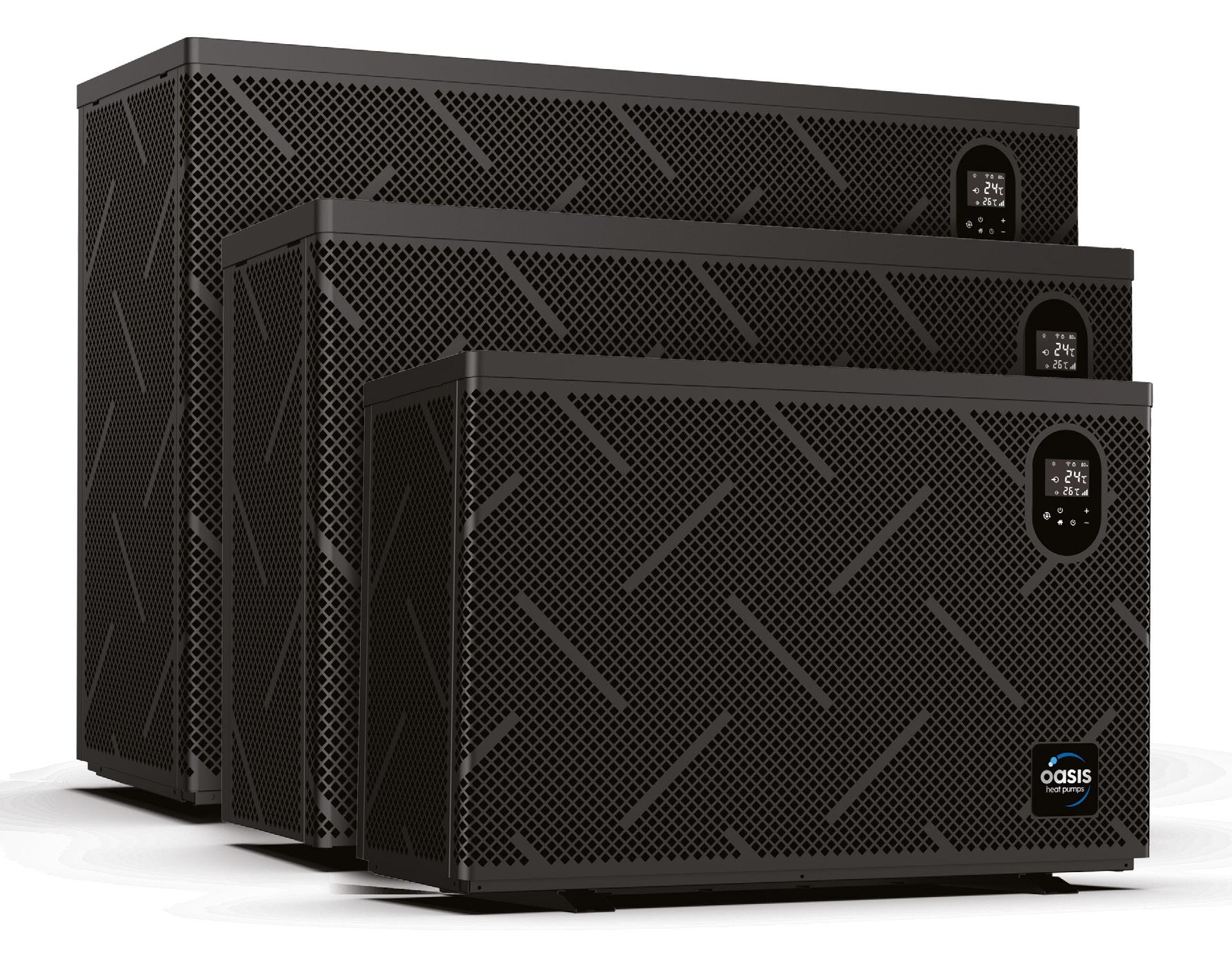
Faster Heating 120%
20x
Energy Saving
20x
Quieter Operation


RapidHeat Technology.
Achieving a 20% faster heating rate, operating at a capacity between 100%and 120% to swiftly reach the desired temperature.

Next generation 3D heat exchanger. 3D heat exchanging technology is redefining the titanium heat exchanger. Increasing efficiency by 30%.

Over 35 years of experience in the industry makes us the expert choice for advice, quality products and after sales support.
Sunlover Group, the home of leading pool equipment and heat pump brands.
COP

QLD 11 Andy Court Upper Coomera QLD 4209 Phone: 07 5679 6821 NSW Unit 2, 10 Boden Road Seven Hills NSW 2147 Phone: 02 9838 0000 Head Office 6-8 Austral Place Hallam VIC 3803 Phone: 03 9887 2131 sunloverheating.com.au sales@sunloverheating.com.au PV Ready Heat Pumps Heat your pool, without boosting your power bill. PVReady
New TV program putting pools top of mind
Anew TV series showcasing pools and landscaping is due to air in late 2024.
The new series, Poolside Spa & Garden Australia, is a fresh series focused on living your best poolside life.
It comes from the creators of Channel 10’s highly acclaimed series Healthy Homes Australia, and takes viewers on an immersive journey into the world of pools, spas and gardens.
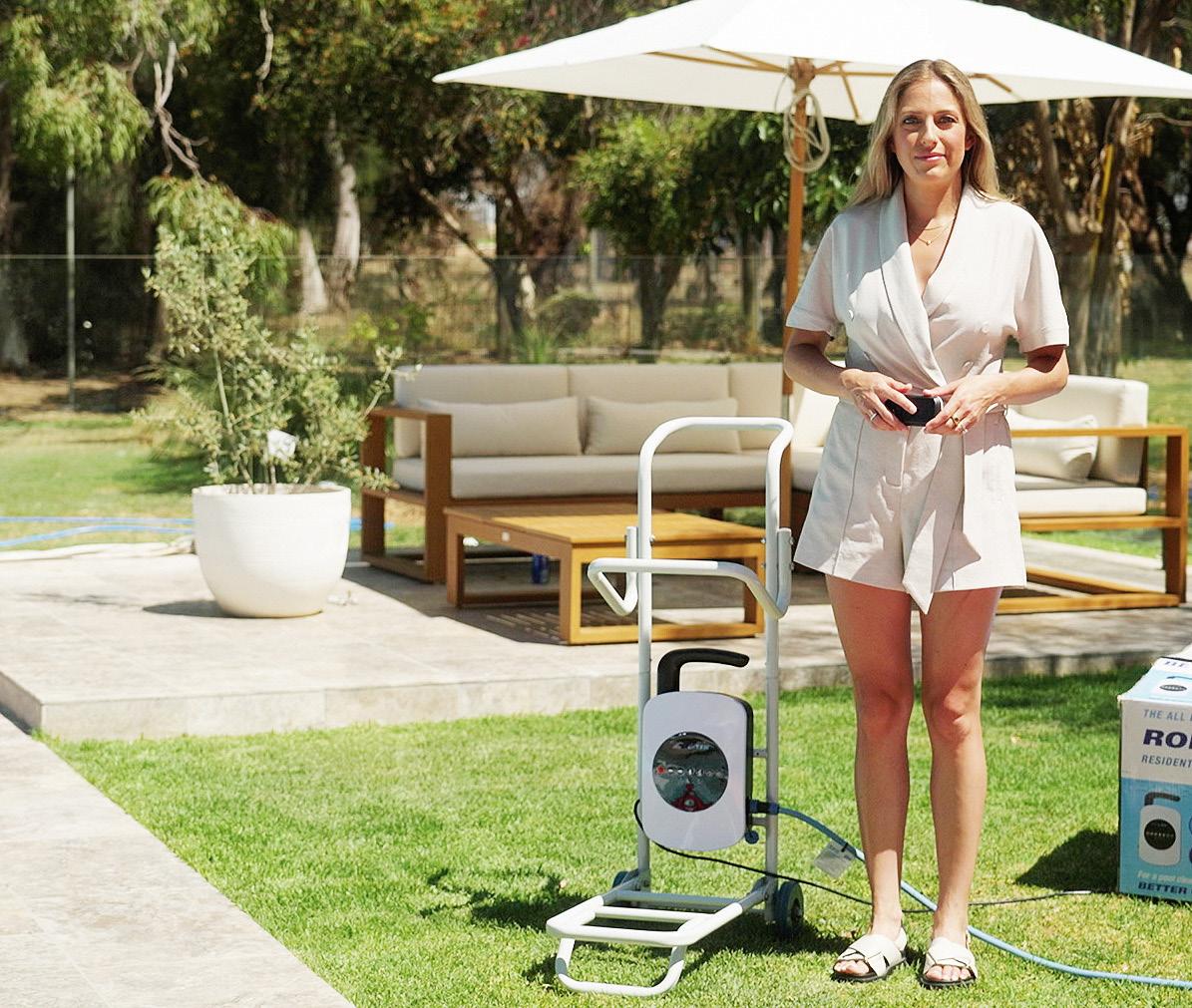
It is another addition to the TV world for the swimming pool and spa industry, following the successful Best Pools TV that debuted in 2022.
The series is a consumer driven show with detailed segment featuring strong calls to action, showing consumers how they can improve their lifestyle with a pool or spa. It will look at every aspect from construction and maintenance to operation and, ultimately, the enjoyment of a pool and spa.
ABOVE: Host Dani Wales has considerable presenting experience, having hosted Healthy Homes Australia almost every weekend for the past 10 years
BELOW: More pools will soon be on our screens, such as this Narellan Grandeur 9
Daena Bougoure-Latchford, Pool & Spa brand manager says she is excited that the industry is marketing a new TV program that is fully integrated into SPASA’s consumer platform.
“Pool & Spa is already reaching millions of consumers every year through expos, digital campaigns and magazines,” she says. “So having a program that’s fully owned by SPASA makes sense in our pursuit to reach every Australian household and extoll the virtues of owning a pool and spa.”
Bougoure-Latchford says that the Aussie dream of owning a pool or spa shows no signs of waning. In their End of Year Wrap 2023, Domain found the most sought-after property feature in Australia is a pool, with pools ranking as the number one search item.
“This trend aligns with a shift in the preference for families who now prioritise having a complete entertainment space at home,” she says. “We live our best lives outdoors with time spent poolside etched into so many of our childhood memories.”
With only 14 per cent of Australians living in a home with a pool or spa, she says there is plenty of room for growth.
42 SPLASH! February/March 2024 feature

“Having a program that’s fully owned by SPASA makes sense in our pursuit to reach every Australian household.”
Dani Wales announced as host Dani Wales has been announced as the host of Poolside, Spa & Garden.
She has been a staple of Australian lifestyle TV for more than a decade, going back to her appearance on Season 5 of The Block in 2012 with husband Dan Reilly (now foreman Dan on The Block).
The duo proved to be hugely popular, returning the following year for another crack on The Block All Stars, with Wales going on to co-host successful lifestyle program Healthy Homes Australia. This show aired almost every weekend for the past 10 years.
Wales and Reilly have ample experience in the real world too, as they own their own building and design company, Manna Made, an interior design and construction business.
Bougoure-Latchford says Wales will make the perfect host.
“She has warmth on camera, a huge depth of knowledge in the building space and a passion for creating amazing homes as lifestyle spaces,” she says.
“She’s also a great communicator, and the sponsors of Healthy Homes have been impressed with her level of professionalism and knowledge.”
Maytronics Australia marketing manager David Dean says that the Healthy Homes team took the time to thoroughly understand their Dolphin and Mineral Swim brands and their unique selling points, as well as the company’s values.
“The thoughtful and detailed approach to presenting our products has undoubtedly resonated with our target audience. It has fostered a deeper connection and understanding of what sets us apart in the market, with increased visibility translating into tangible business growth,” he says.
“The positive feedback and sales enquiries generated from the segments have been instrumental in elevating our brand to new heights.”
Getting involved
SPASA is offering selected partners the chance to be an integral part of the show – but there are a limited number of spaces.
Bougoure-Latchford says that by becoming a show partner, your brand will be positioned in front of highly engaged audiences, reaping the reward of targeted exposure and increased brand recognition.
She says this is a strategic promotion that is fully integrated with SPASA’s consumer platform Pool & Spa, and brand content will be cascaded across other SPASA platforms including consumer expos, magazines and digital platforms, ensuring maximum visibility and impact.
“The series will deliver top-notch, purpose driven content that not only entertains but also seamlessly weaves in your brand story and makes your product look awesome,” she says.
“Strategic calls to action will be sprinkled throughout each segment, so your business is bound to generate abundant leads.” Contact: daena@poolspalife.com.au; 0452 366 856. n
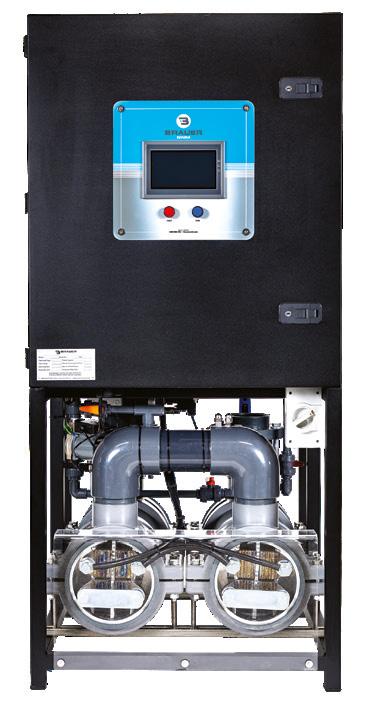
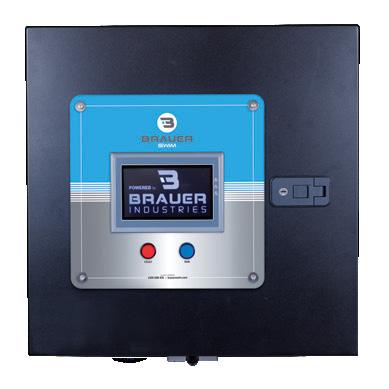
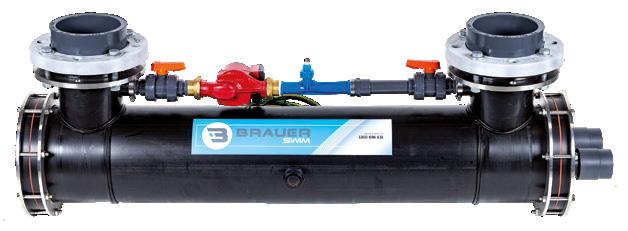

February/March 2024 SPLASH! 43 feature
NEXT GENERATION POOL GELCOATS
an exciting new range of Australian manufactured pool gelcoats
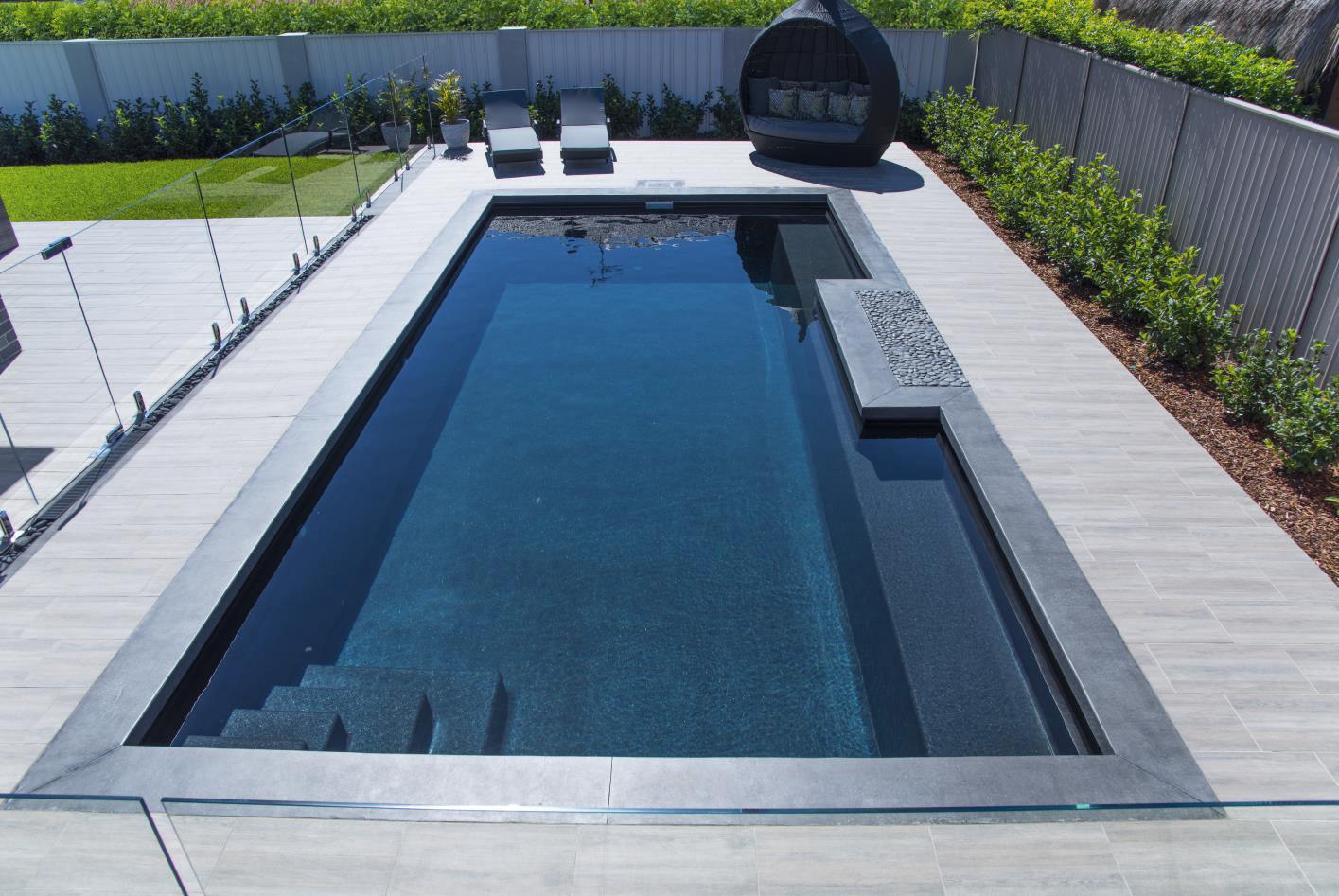

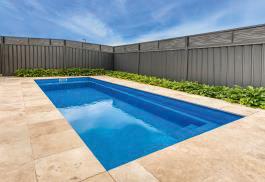
AQUAGUARD X® GELCOATS are high performance finishes for the manufacture of composite swimming pools that have been designed to withstand harsh outdoor conditions. These gelcoats have long been the flagship product of our offering to the local and global composite pool markets with over 20 years of proven field history.
Product Features
High Performance
Surface Coating
High Quality Gelcoat Pigments
Excellent Chemical Resistance
Benefits
A striking and visually appealing cosmetic finish with exceptional durability
The Aquaguard® X technology protects the decorative finishes from harsh effects of the sun
Products are tested extensively for chemical fade resistance to ensure a longer lifespan for the cosmetic finish
Aquaguard® X gelcoats are available in a range of contemporary colours and striking finishes
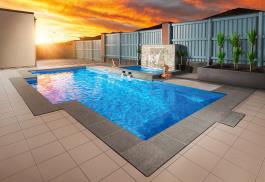
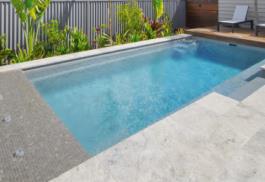
Performance Advantages:
• Improved chemical (chlorine) & water resistance
• Improved UV resistance, protecting the finish of your pool for many years
• Increased colour retention during outdoor exposure
• Superior aesthetics of laminate during service life which maintains the original cosmetic ap pearance for a longer period
For further information scan the QR code below , contact allnex on 1800 789 607 or visit www allnex com :


No one likes them, but how you approach one-star reviews is important

IBeware promises to eliminate one-star reviews
By Brett Lloyd Abbott
doesn’t want an instant boost in your five-star ratings on Google?
Yes, it’s possible to get rid of one-star reviews. But there are right ways and wrong ways to do it, and a little bit of a grey area as well.
The right way to get rid of a bad Google review is to “report” it, offering one of these seven reasons:
• Off topic (review doesn’t pertain to an experience at or with this business).
• Spam (review is from a bot, a fake account, or contains ads and promotions).
• Conflict of interest (review is from someone affiliated with the business or a competitor’s business).
• Profanity (review contains swear words, has sexually explicit language, or details graphic violence or other illegal activity).
• Bullying or harassment (review personally attacks a specific individual).
• Discrimination or hate speech (review has harmful language about an individual or group based on identity).
• Personal information (contains personal information such as address or phone number).
Bogus reviews
pummel Google over and over again, until they finally remove the review. Personally, I don’t see anything wrong with that –it’s just an automated squeaky-wheel approach.
It gets grey when you use this technique to eliminate valid one-star reviews. Probably not ethical, but admittedly tempting. And technically, you aren’t exactly harming anyone, are you? Now don’t get me wrong, I’m not recommending it. But I’m not going to shame you either.
“Do not try to resolve it in the Google review space. Do this offline, in person or over the phone.”
If it’s a bogus review from someone you never did business with, then “conflict of interest” is usually your best choice, with “spam” or “bullying/harassment” as possible alternatives.
If your first attempt doesn’t succeed, then I suggest the “squeaky wheel” approach. Resubmit your request every week, and ask your employees, co-workers, friends, family and associates to do the same. At some point, Google will notice, and with a little luck (or potentially out of frustration), they will take it down.
On the other hand, if it’s a valid review from someone who was truly disappointed in the work you did for them, then your only real option is to contact them and try to work it out with them.
Do not try to resolve it in the Google review space. Do this offline, in person or over the phone.
The smart business owner will negotiate a deal in writing that says basically “If I do (whatever you agree to), you will remove your one-star review.”
Review services
Now what about those services who promise to eliminate the one-star reviews?
Where I will caution you, however, is the flip-side approach of some of these “eliminate your one-star reviews” companies. While their system pummels Google on the one-star reviews, they also try to load up the system from the other end with as many five-star reviews as possible.
Getting lots of five-star reviews is a great idea, as long as they are valid.
The problem here is most of these companies aren’t getting you any “real” reviews. Instead, they have a bank of covert, semi-talented individuals all over the world who repeatedly set up fake Google accounts, and submit (what you hope are) realistic-sounding reviews on your behalf.
The dangers here are twofold.
First, most humans are pretty good at intuitively picking up the difference between real and fake. It’s true with robots, it’s true with social media posts, and it’s true with fake reviews.
When you start piling up a bunch of fake reviews, like the one below, the whole experience starts to smell fishy, even if they are written by AI:
“I am very picky; I require perfect work and I spent months interviewing and getting quotes from many local pool contractors for our project. I am so glad I went with them, they had the best price and did the best work.”
I don’t know about you, but I’m noticing more and more fake reviews online, to the point that I’m losing faith in the system.
Apparently, I’m not alone. In the US, the FTC recently proposed rules to fine businesses $50,000 per fake review. (That goes for the business using the fake reviews, and the business producing the fake reviews.) It would prohibit activities such as selling or obtaining fake reviews, using fake-review websites and using employee reviews.
My recommendations?
• If you get a real negative review from a client, invest the time and money to win back their hearts and your reputation.
February/March 2024 SPLASH! 45 feature
• If you get a fake negative review, report it to Google.
• If you want more five-star reviews from your clients, just ask them. But don’t bribe them, because that too can lead to a fine. And under no circumstances should you pay anyone to provide you with fake five-star reviews.
PS - We have a method for legitimately and elegantly requesting five star reviews from your clients without bribing,
“Getting lots of five-star reviews is a great idea, as long as they are valid.”
and without taking time out of your already busy day to do it.
Contact us if you’re interested.
Contact: www.poolbuildermarketing.com n
ACCC guidelines for online reviews
The Australian Competition & Consumer Commission (ACCC) addresses the issues of online product and service reviews below. It’s against the law for a business to create fake or misleading reviews or to arrange for others to do so. Businesses can avoid misleading consumers by following a few guidelines.
People offer reviews about business products and services they have used or experienced. Reviews can appear on a business’s own website, social media, or review platforms, which are sites that show product reviews about a range of businesses.
Reviews should be independent and reflect the genuine opinion of the person who experienced the product or service.
It’s against the law for a business to create fake or misleading reviews or arrange for others to create fake or misleading reviews. There are some features or signs that can indicate a review is fake. Look for:
• A spike in highly positive or negative reviews over a short period of time;
• Many reviews written from the same email or IP address;
• Similar reviewers’ names;
• Generic reviews without specific detail about the business or product;
• Reviews written in similar language as other reviews for the same business or product;
• Some review platforms require proof of purchase. These may be more reliable than those that don’t.
Case study: platform allowed businesses to create own reviews
Reviews can mislead consumers if they are written by family, employees, or people paid in some way by the business to write the review, without stating the personal connection or commercial relationship with that business; created by someone who hasn’t actually used the product or service; edited or changed by someone else after being created.
Service Seeking Pty Ltd is an online tasking platform. Customers can seek quotes for jobs such as gardening, building or cleaning services from businesses on the platform.
Service Seeking let the businesses on its platform draft their own reviews. A business could give themselves their own star rating of jobs done. These were then sent to their customers. If the customer didn’t respond to the review within three days, the review was automatically published.
The Federal Court ordered Service Seeking pay $600,000 in penalties for making false or misleading representations by publishing these reviews.
Case study: suppressed and edited negative reviews
A business may also mislead consumers if they suppress or edit negative reviews or remove genuine reviews that are negative. HealthEngine is an online health marketplace. It provides a booking
system for patients and an online health care directory that allows consumers to search for and book appointments with healthcare practitioners. Until June 2018, HealthEngine also published reviews from patients about the quality and services of healthcare practitioners.
HealthEngine admitted that it did not publish a large volume of negative reviews (submitted between March 2015 and March 2018) and edited other reviews to remove negative aspects. HealthEngine also admitted that it misrepresented to consumers the reasons why it did not publish a rating for some health medical practices.
The Federal Court ordered HealthEngine pay $2.9 million in penalties, including for publishing misleading patient reviews and other conduct.
Other ways reviews mislead
Businesses that offer incentives to people to write a positive review risk misleading consumers and breaching the law. Incentives include offering discounts or free gifts.
Incentives offered to customers to provide reviews must be applied regardless of whether the reviewer leaves a positive or negative review; and clearly disclosed so consumers know the review was incentivised.
Commercial relationships between review platforms and businesses may affect the overall rating of a business on the platform. It may look like the business has more favourable reviews than it has.
Failing to disclose commercial relationships and how they may impact the reviews that appear on a website, platform or social media account may amount to misleading conduct.
Businesses need to ensure they disclose any relevant context and it is clear to consumers. For example, businesses and review platforms should ensure they clearly display the total number of reviews a star rating is based on. For example, ‘3 stars – 24 reviews’. Businesses should carefully consider any complaints they receive about reviews on their website, social media or platform being false or misleading.
If a business is concerned that a review platform has published a false or misleading review about it, the business should contact the review platform and request that the review be removed. Alternatively, the business can respond to the review to correct the public record.
Businesses or review platforms that don’t remove or correct reviews they know are fake – or should be aware they are – may be in breach of the law.
However, businesses need to be careful that they have an adequate basis to conclude that a review is likely to be fake or misleading before removing or editing it. Reviewing or removing a negative review that was genuinely created may mislead consumers.
Source: www.accc.gov.au
46 SPLASH! February/March 2024 feature
Commercial & Aquatics
Energy upgrade grants open 50
In brief 51
Paris readying for the big show 52
Comparison of commercial filtration systems�
58
Crypto outbreaks across New South Wales and Queensland
After a steep increase in cryptosporidiosis cases across the state, NSW Health is advising the community not to swim for at least two weeks after they’ve had diarrhoea.
Executive director of Health Protection NSW, Dr Jeremy McAnulty, says there had been 498 cases of cryptosporidiosis reported in NSW this year up to mid-February, compared to the five-year average of 95 cases for the same time period.
Cryptosporidiosis is a diarrhoeal disease caused by the parasite, Cryptosporidium, which infects the intestine and is a common cause of acute diarrhoea in young children. Other symptoms can include nausea, vomiting, fever, headache and loss of appetite.
Infection can come from swimming in infected rivers, creeks, dams and beaches after heavy rain; and in public pools.
McAnulty says that almost half of the cases in children were under ten years old, so parents needed to be especially aware of the risks and precautions.
“Cryptosporidiosis is commonly acquired by swimming in and swallowing water contaminated with cryptosporidium parasites,” he says. The parasite can survive for many days, even in most chlorinated pools, and in the past very large outbreaks have been caused by people who had recently been infected going swimming.
“Almost half of the cases reported this year had been swimming during their exposure period, and with such a high proportion of young children affected and with many schools about to hold swimming carnivals, we are urging parents to stay alert for symptoms.”
He says that people who have had diarrhoea should:
• Avoid swimming for at least two weeks after your symptoms resolve.
• Avoid sharing towels for at least two weeks after your symptoms resolve.
• Avoid handling food for at least 48 hours after your symptoms resolve.
• Children who have diarrhoea should be kept home from preschool, childcare or playgroup until 24 hours after the diarrhoea has completely stopped.
To avoid catching cryptosporidiosis:
• Avoid swimming in estuaries and inland waterways (e.g. rivers, creeks, dams) during and for at least three days after heavy rain.
• Avoid swimming at ocean beaches during and for at least one day after heavy rain.
• Avoid swallowing water when swimming.
• Wash your hands thoroughly with soap and water for 20 seconds after using the toilet, handling animals or their manure, changing nappies, working in the garden and before preparing food or drinks.

• Do not drink untreated water (for example, from lakes or streams). Boiling water by bringing it to a rolling boil is sufficient to kill Cryptosporidium.
Queensland and Victoria
The increase in cases has also been experienced in Queensland, with authorities concerned about the threat at public swimming facilities.
More than 820 cases were reported up to the middle of the second week of February, which is more than 13 times higher than the same period last year.
The most common places of infection were public pools and water parks.
The majority of Queensland cases have been recorded in West Moreton, Darling Downs, Central Queensland, Townsville and Mackay.
There has also been an increase in cryptosporidiosis cases in Victoria since the beginning of September 2023, with some cases linked to swimming in public pools. Several European countries and New Zealand have also reported a recent increase in the number of cases.
� � � � � � � � � � � � �
Health
�
48 SPLASH! February/March 2024 commercial news
BELOW: Cryptosporidium oocysts
Emma McKeon receiving her award
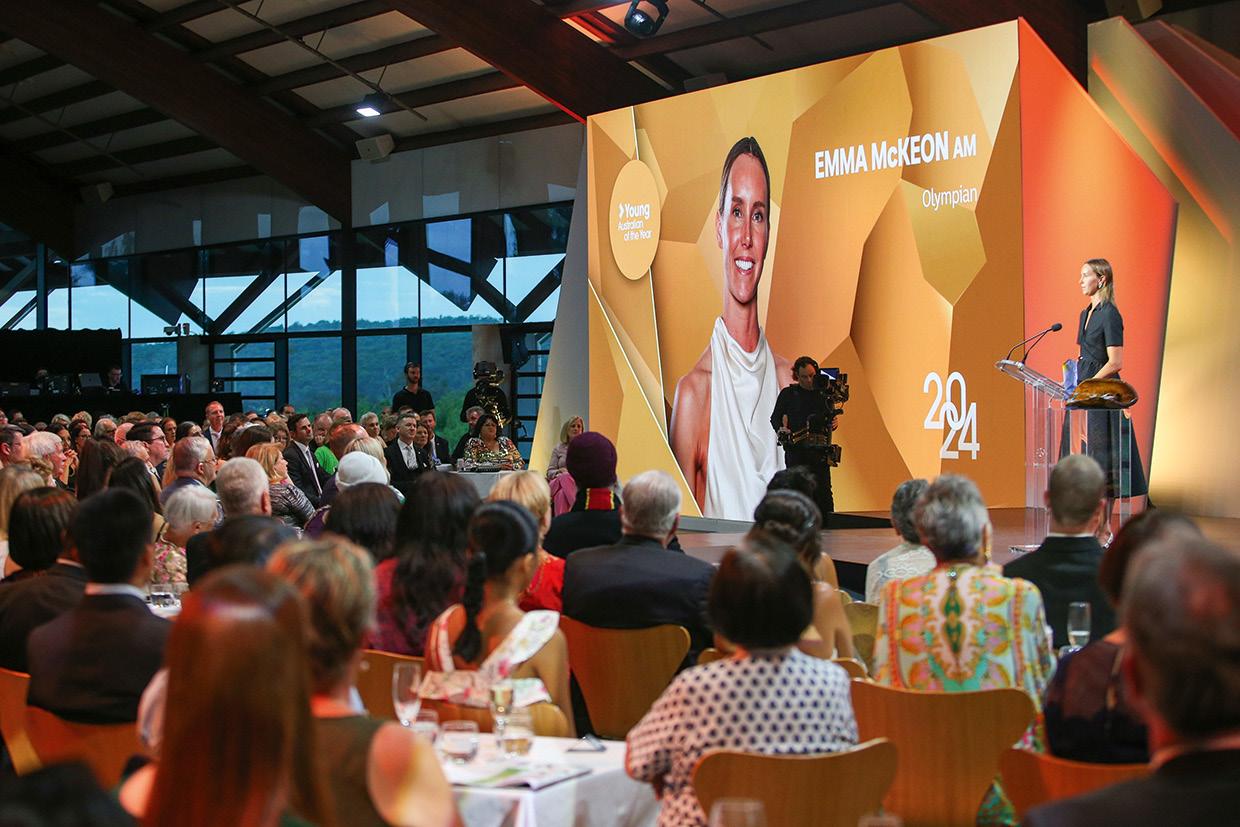
Emma McKeon named 2024 Young Australian of the Year
The 2024 Young Australian of the Year is Australia’s most successful Olympian, Emma McKeon AM, of the Gold Coast.
McKeon is the most successful Australian Olympian of all time – a title she claimed before her 28th birthday. She comes from a strong family of Australian swimmers, with her father, uncle, brother and mother all having represented Australia.
Back in 2012, Emma just missed out on being chosen for the London Olympics. She took a break, but rediscovered her passion and went on to make a splash at the 2014 Commonwealth Games, where she claimed six medals from six races.
At the 2020 Summer Olympics, Emma became the first female swimmer and the second woman in history to win seven medals in a single Olympics. She has also broken Commonwealth Games, Olympic and World records.
Now aged 29, McKeon has other titles to her name. In 2022 she was made a Member of the Order of Australia, and in 2023 she was named Gold Coast Young Australian of the Year. McKeon says she wants to have an impact on people’s lives by encouraging them to push hard and go after their dreams and what they are passionate about.
“Don’t be afraid to take on hard things and set aspirational goals that may at times be scary. This is how we push ourselves to achieve our dreams,” she says.
Meanwhile, Paralympian Ellie Cole received a Member of the Order of Australia (AM) in the Australia Day Honours.
Cole, 32, is our most decorated female Paralympian with six gold, five silver and six bronze from four Paralympic Games. Others in the swimming community to be honoured include Michael Bushell, NSW (AM); Warren Riley, NSW (OAM); Gerald Tucker, Vic: Medal of the Order of Australia (OAM); Ellena Morris, NSW (OAM); and Stephen Robinson, WA: (OAM).

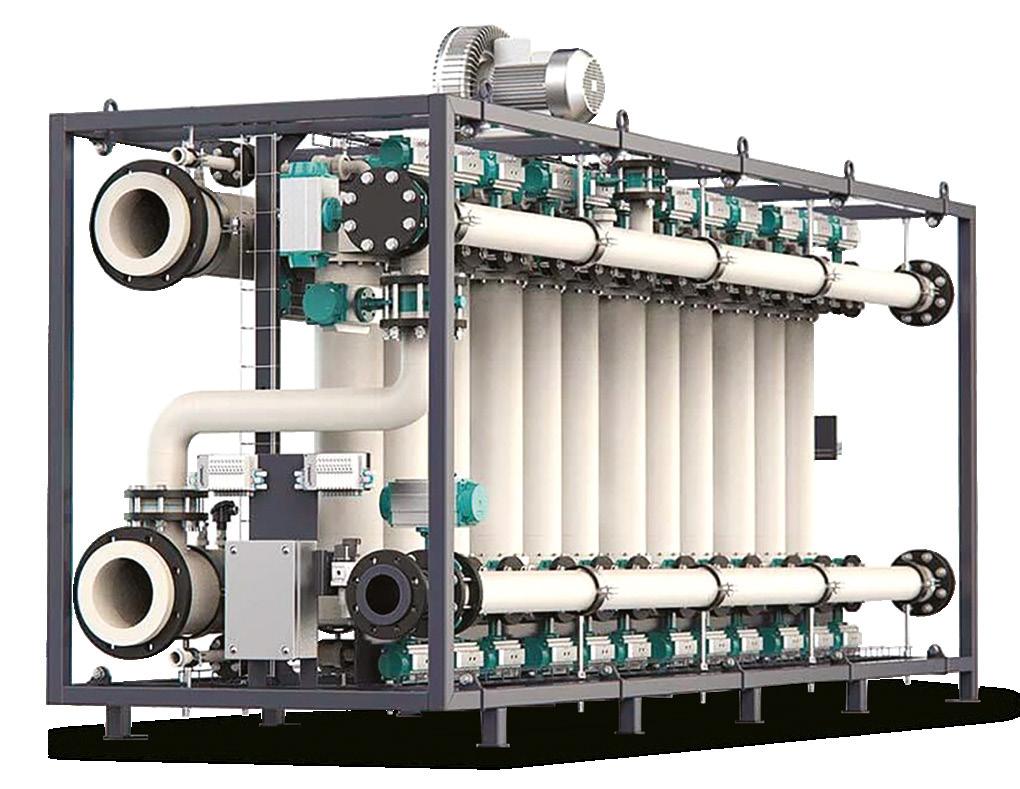
Liqtech offers a new innovative filtration system based on high quality silicon carbide ceramic filters providing absolute 3-micron filtration, high efficiency and reduced life cycle costs. ADVANCED SiC MEMBRANE FILTRATION www.waterco.com Proudly distributed by Splash_magazin_2130_ZZPR.indd 1 01/12/2023 8:13 AM
Aquatics
February/March 2024 SPLASH! 49 commercial news
Energy upgrade grant applications open
Aquatic centres are often rated as one of the highest energy-consuming assets for local councils. Now, the Australian Government’s $100 million Community Energy Upgrades Fund is open for applications which can be used to improve the efficiency of aquatic centres.
Councils can apply for co-funding grants between $25,000 and $2.5 million, where the grant will be a maximum of 50 per cent of the project cost.
Key dates are:
• 21 December 2023 - round 1 grant applications open and guidelines released
• 30 April 2024 - round 1 grant applications close
• September 2024 - funded projects for round 1 are expected to start being implemented
• January 2025 - round 2 grant applications scheduled to open
Funding assessment criteria:
• Assessment criterion 1: Describe how your
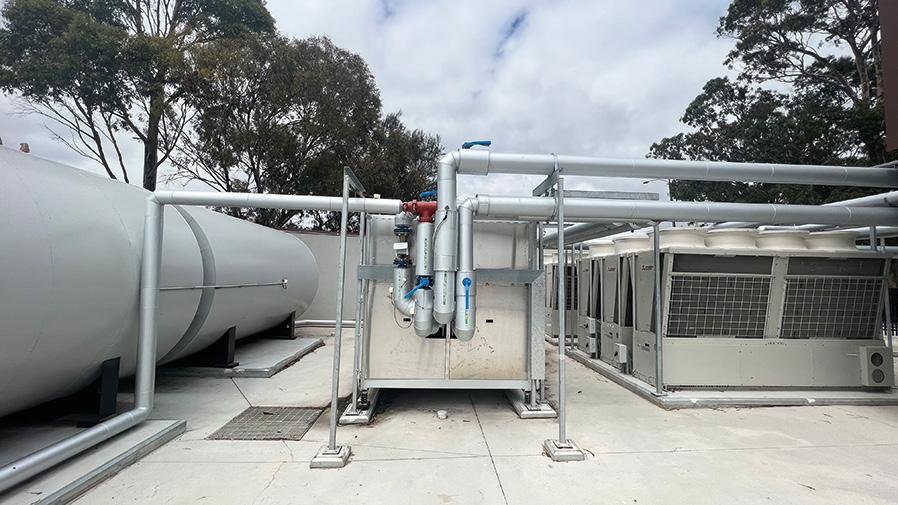
project will reduce local government greenhouse gas emissions and/or provide load flexibility (30 points).
ABOVE: The award-winning Brimbank Aquatic Centre
• Assessment criterion 2: Wider impact of the grant funding (20 points).
• Assessment criterion 3: Capacity, capability and resources to deliver the project (30 points).
• Assessment criterion 4: Economic and social benefits (20 points).
Round 1 closes on the 30 April 2024, so there is limited time to complete the work to get first round funding.
The Australian Alliance for Energy Productivity (A2EP) recommends engaging an energy consultant to map energy flows with at least 12 months of data to understand the average and peak heating loads as well as ensuring you have the right data so you can claim white certificates and demonstrate an energy
performance improvement for the centre (expect this to take to four weeks). Note that white certificates (VEECs in Victoria and ESCs in NSW) could return you more than 20 per cent of the project value in certificate value.
Engage an energy consultant to perform an energy audit (preferably Type 2 according to AS3598) so you can incorporate energy efficiency into your project and maximise the economic returns and greenhouse gas reduction (expect this to take three to four weeks)
Engage a consultant to perform a feasibility study which will allow the government to assess the project scope and hence value for money (expect this to take four to six weeks).
A2EP also suggests ensuring that the system is designed with electrical load-flexing in mind.
Contact: www.energy.gov.au; www.a2ep.org.au

50 SPLASH! February/March 2024 news
Efficiency
In Brief
Former Olympic and Commonwealth Games swimmer Rob Woodhouse has been appointed CEO of Swimming Australia, commencing mid-April. Following swimming success he forged a successful 30-year international career in sports administration. He will replace interim CEO Steve Newman. The directors also appointed Shaun Creighton to the board. Creighton is well credentialled within the high-performance environment in sports law, governance and administration. The board also appointed Matt Abood as athlete director. Abood is a World and Commonwealth Champion and an Olympic Bronze medallist who served as an executive member of the Australian Swimmers’ Association from 2012 to 2019.
Sadly two country poolies have passed away. Brian and Pat Williamson managed the Young Pool for many years and unfortunately Brian lost his battle with Pat by his side. Peter and Carmel Hurst loved the Gulargambone and Coonamble communities. Peter has been a
huge supporter of the Country Pool Managers Conference and ensured all staff had the opportunity to attend the conferences. Carmel unfortunately also lost her battle with her family by her side. SPLASH! offers sincere condolences to family, friends and colleagues. Sadly, respected aquatic venue manager and recreation industry leader Simon Weatherill died while competing in the annual Portsea Swim Classic in January. He was a passionate swimmer and former CEO of Melbourne Sports and Aquatic Centre and State Sport Centres Trust. His family says swimming was very much a passion throughout his professional and personal life, and he had continued to mentor and coach within sports industry and broader sectors. SPLASH! offers sincere sympathies to family, friends and colleagues.
Australian Olympic swimmer James Magnussen is risking his legacy according to many by putting his hand up to participate
in the dope-friendly Enhanced Games. The 32-year-old says he will “juice to the gills” to chase the $1 million prize for breaking the 50-metre freestyle swimming world record. Singapore has been unveiled as the host city for the 12th edition of the World Para Swimming Championships at the OCBC Aquatic Centre within the Singapore Sports Hub, from October 3-9, 2025. The event will align with Singapore’s 60th birthday celebration. Taking a more aggressive stand than the rest of the world, the European Parliament has approved a new rule that will phase out the use of HFCs in the EU by 2050 and reduce the EU-wide quota for these f-gases between 2024 and 2049. The rule also introduces specific phase-out dates for the use of f-gases in sectors where alternatives are “technologically and ecologically feasible,” such as in domestic refrigeration, air-conditioning and heat pumps.

The original & best
Here
From
training to installation,
today at daisypoolcovers.com.au
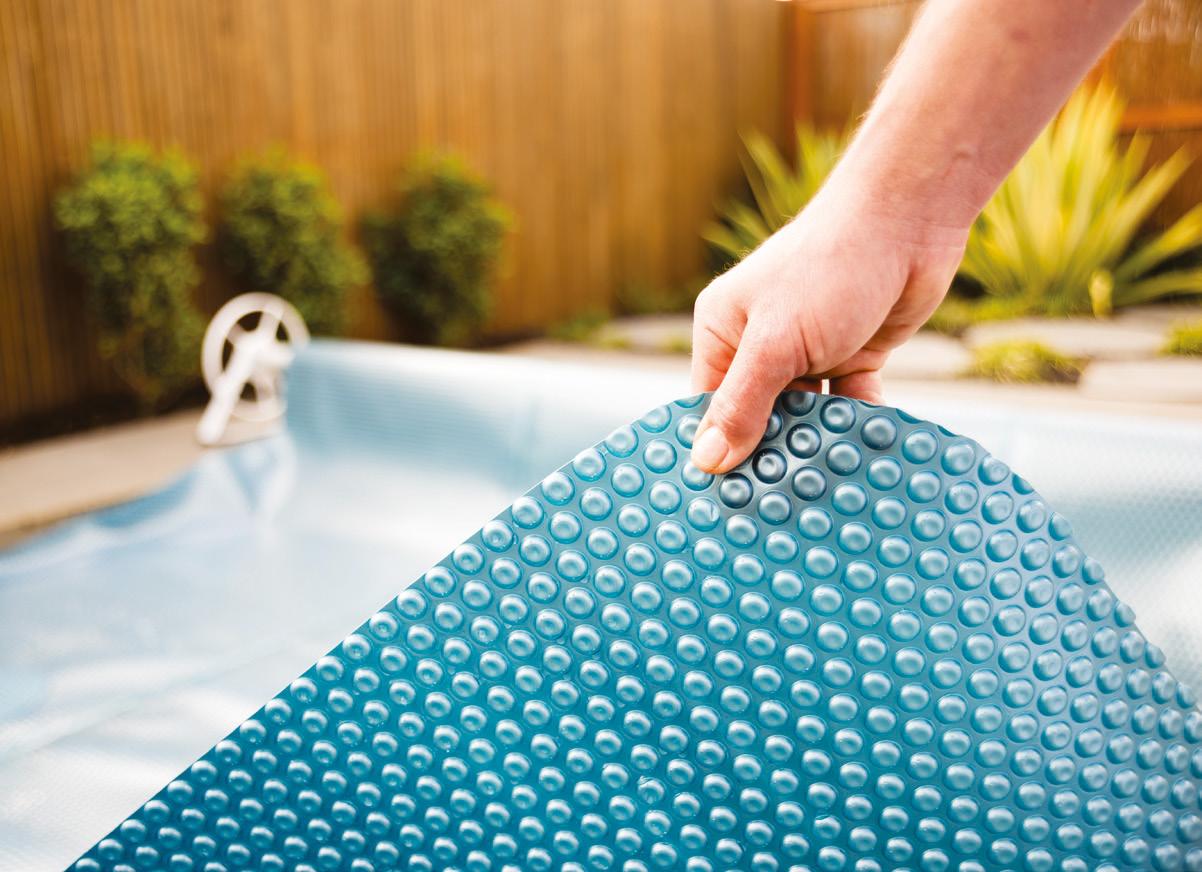
February/March 2024 SPLASH! 51 news
at Daisy, we’re doing our best to help grow your business!
Committed to helping you sell more Australian Made AUSTRALIA’S FAV URITE. 1300 55 18 11 • hello@daisypoolcovers.com.au daisypoolcovers.com.au
product
Daisy is your full service pool cover partner. With the most extensive range of pool covers and rollers in Australia, finding the right solution for your customers has never been easier. Find out more
Paris is hosting the Olympics this July and August

Paris readying for the big show
Veda Dante checks on the preparations for this year’s Paris Olympics, in particular the aquatic venue and how the organisers plan to aid the population’s swimming capabilities once the international crowds have gone home.
By Veda Dante
A“The aquatics centre was envisioned as a refreshing antidote to the trend for self-consciously ‘iconic’ Olympic venues.”
unique aquatic complex is being unveiled in France, thanks to this year’s Olympic and Paralympic Games – arguably two of the greatest world events that will bring together more than 200 delegations and nearly 15,000 athletes.
Located in Saint-Denis, Paris’ second most populated suburb, the Olympic Aquatics Centre is scheduled to open in April 2024, where it will host test events for diving, artistic swimming, and water polo prior to the Games’ official opening ceremony on July 26.
The brand-new facility is the only piece of sports infrastructure built to host the Olympic and Paralympic Games and then be preserved as a heritage item in the Paris region. In fact, 95 per cent of the sites dedicated to the Games are existing or will be temporary.
Following the Olympics, the goal is to establish two national centres for diving and swimming.
“The facility will serve as the venue for the 2026 European Championships, a competition that has not been hosted in France since 1987,” says
Laurent Ciubini, general director of the French Swimming Federation (FFN).
“The intention is to also establish an annual World Cup for swimming and artistic swimming, ensuring the legacy of this infrastructure.”
Paris 2024 Olympic Aquatics Centre
Global architectural firm, MVRDV, says its proposal for the aquatics centre was envisioned as a refreshing antidote to the trend for selfconsciously “iconic” Olympic venues, which it says subsequently become expensive, oversized burdens upon their cities.
MVRDV say their design, by contrast, takes as its starting point the needs of the area, improving connections between neighbouring locations and creating a vertical park and “green lung” within the city while assimilating itself into its surroundings.
Separated from the Stade de France by a highway on its eastern boundary, the centre’s location is not lacking in iconic structures. However, it was in desperate need of improved pedestrian connections, green space and
52 SPLASH! February/March 2024 feature
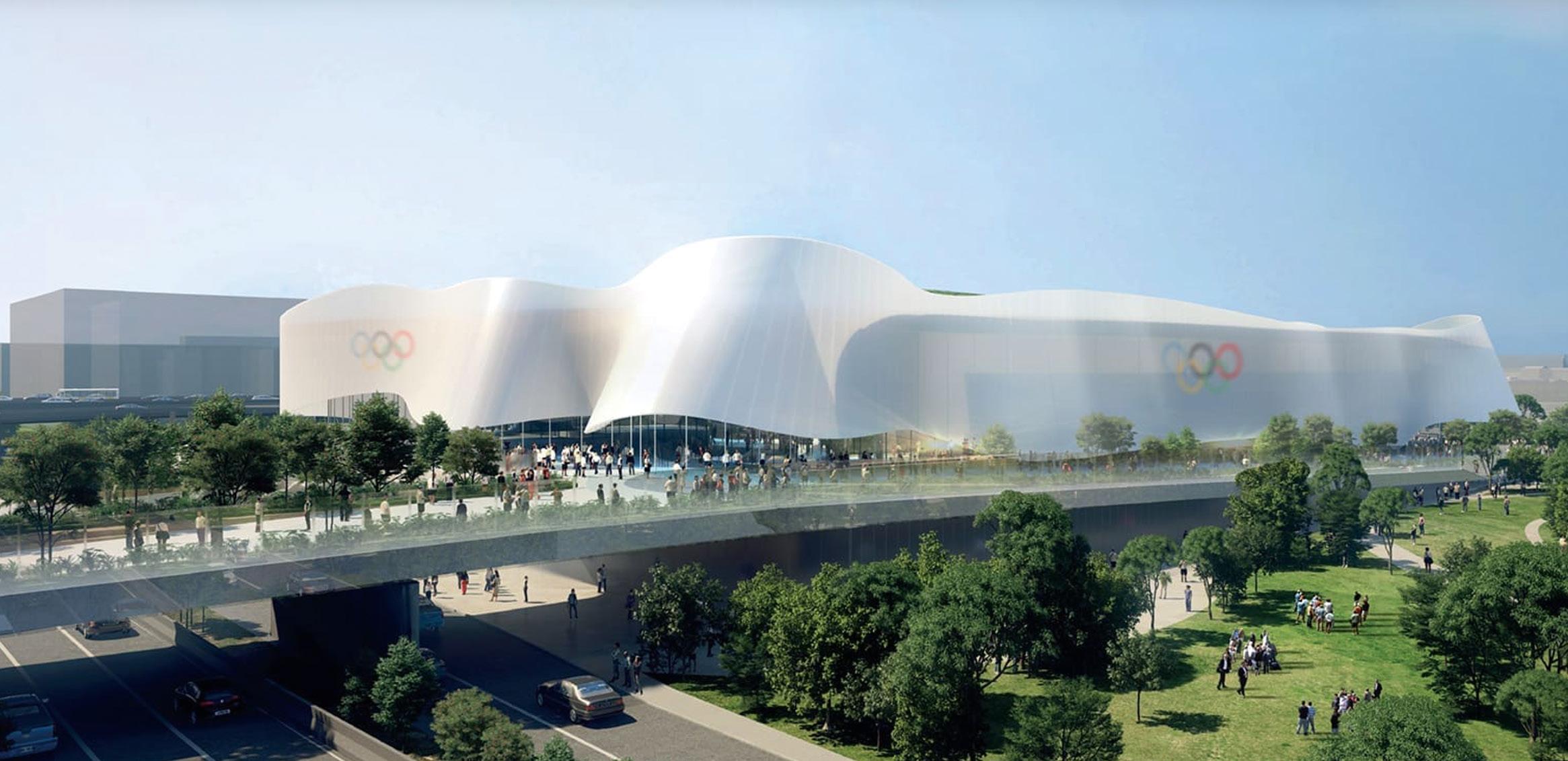
amenities for the neighbourhood – in particular, for the residents of the concerted development zone (ZAC) of Plaine Saulnier, located to the west of the site.
MVRDV’s successful proposal provided solutions, with a broad avenue and a pedestrian bridge connecting the ZAC Plaine Saulnier to the Stade de France.
Rather than competing with the stadium for attention, the shape of the aquatics centre is essentially a simple rectangle. It includes spaces for sport, such as the indoor climbing area, fitness and meditation zones, a splash pad for children, coworking spaces and a restaurant, all of which are positioned around the central space holding the Olympic swimming and diving pools, with seating for up to 6000 spectators.
Continuing this modest approach, the exterior surfaces – façade, roof and paving – are all finished in a light-coloured low-carbon concrete, with gently curving edges giving the impression of a continuous sheet that has been “draped” over the new addition, seamlessly blending the building with its surroundings.
The building’s signature feature is the striking explosion of greenery covering its roof. On its western façade, the building gradually rises from the floor, with a series of paths and steps leading upwards through shrubs and grasses, providing pedestrians access to outdoor leisure spaces, the first-floor restaurant terrace, and a climbing wall. This vertical park and its amenities animate the façade facing the ZAC Plaine Saulnier, adding a visible and lively piece of public space for the neighbourhood.
The roof is also covered in greenery, with smaller grasses and shrubs covering the centre of the roof and larger plants up to two metres tall closer to the roof’s edges, where the structure can
support a deeper soil layer. At its very edge, the roof slopes downward. These sloped edges reveal this green landscape to passers-by, with plants hanging over the roof adding to the impression of the diverse natural landscape behind.
This expanse of plants offers substantial benefit to the area in terms of sustainability, with this “green lung” of over one hectare within the city helping to improve air quality and lower local temperatures. Unlike the western façade, the roof itself is not accessible to visitors, making it a perfect attraction not only for plant biodiversity, but for animal biodiversity as well. Inside, oval windows and skylights provide excellent daylighting for the pools, reducing energy consumption, while significant effort was made
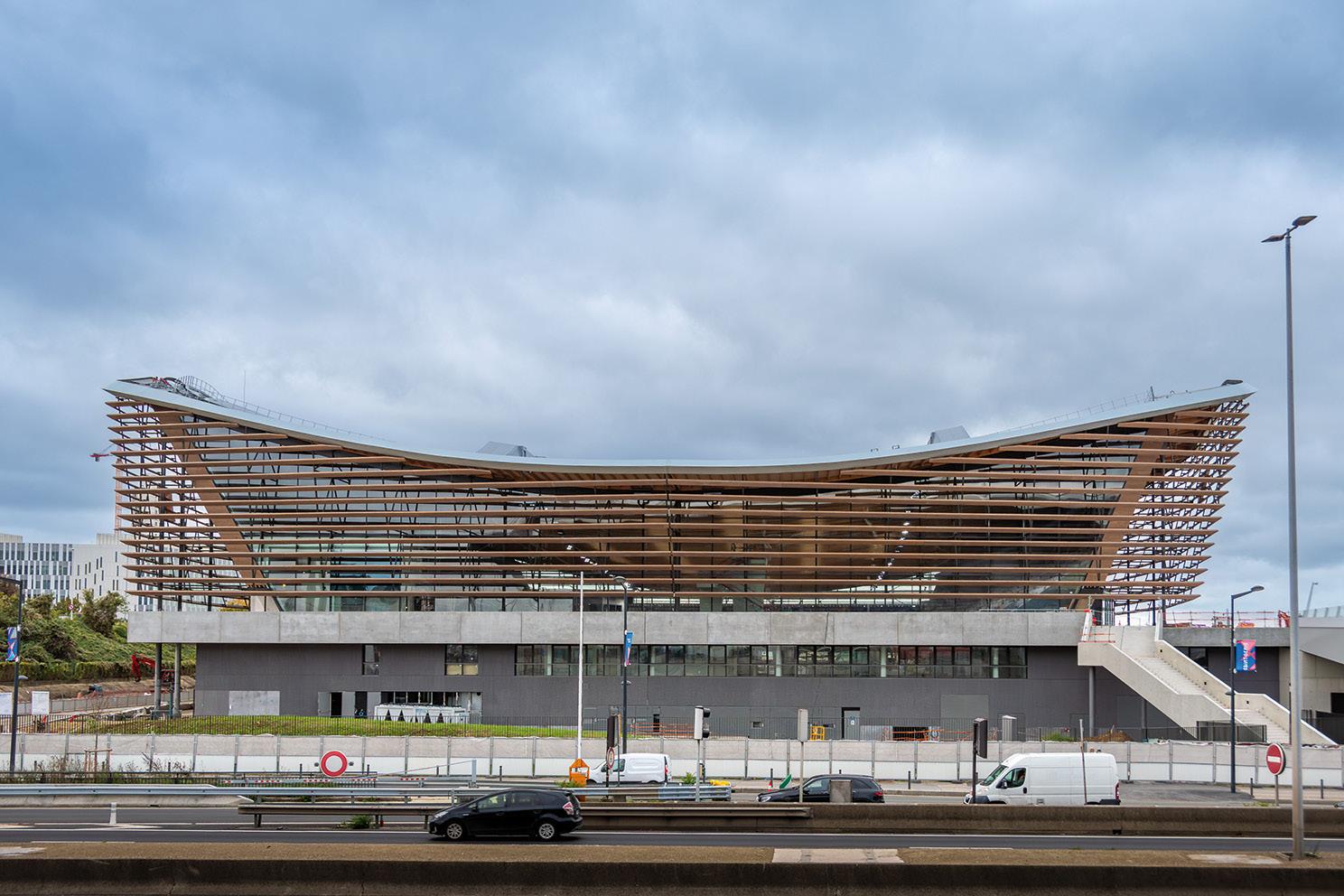 An artist’s impression of how the Olympic Aquatic Centre will look when completed
February/March 2024 SPLASH! 53 feature
The aquatic centre in progress

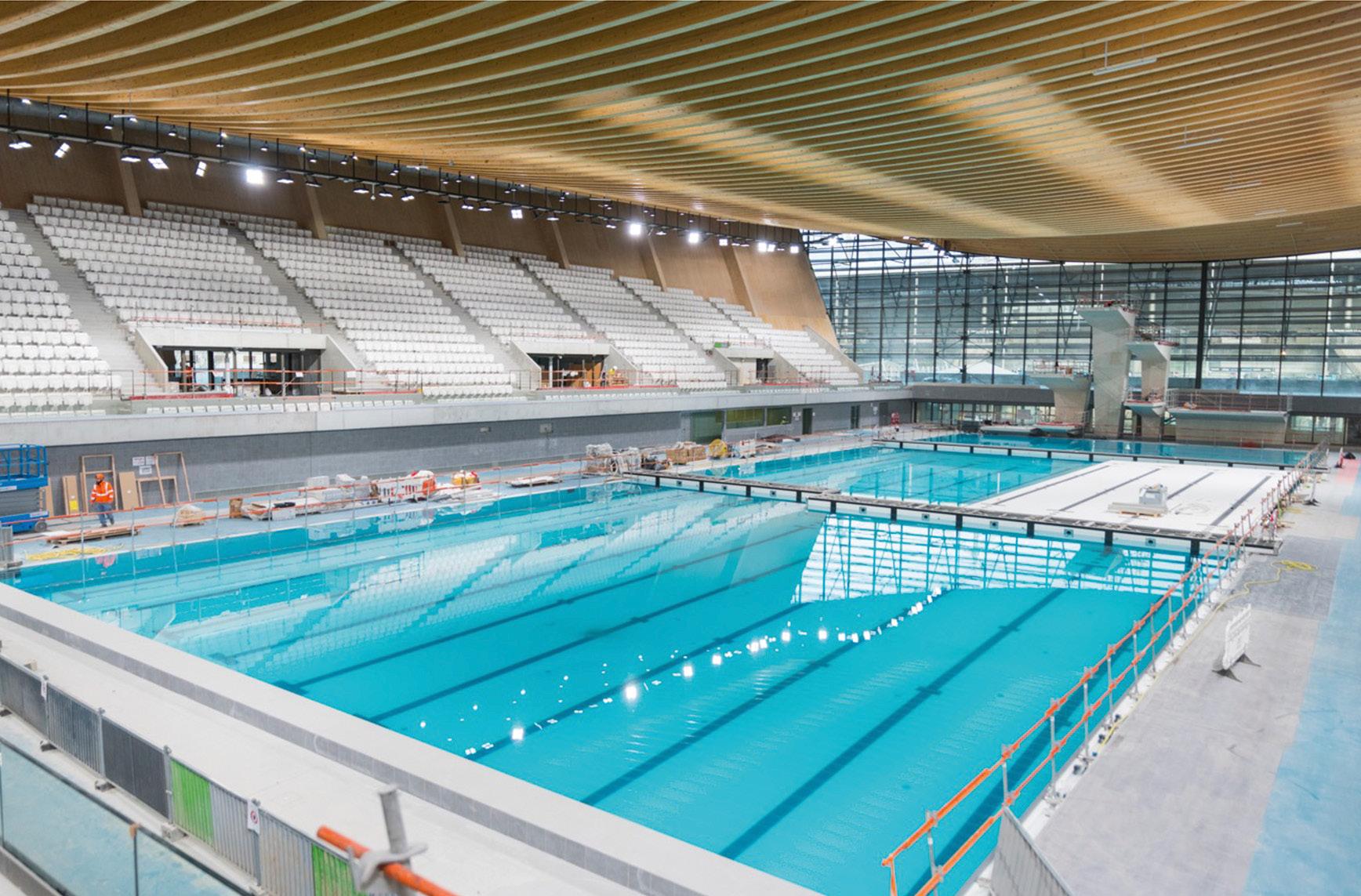
to reduce the water consumption in the pools themselves. Thanks to the partnership with Engie, 80 per cent of the energy used by the building will come from sustainable sources.
An aquatic learn-to-swim legacy
The Paris 2024 Games will leave an aquatic legacy in Seine-Saint-Denis as more than twenty pools will be built for the use of residents as part of the Games.
“Every year, the drowning figures remind us that knowing how to swim is not only a pleasure, but also a public safety issue that reflects social
•
•
•
•
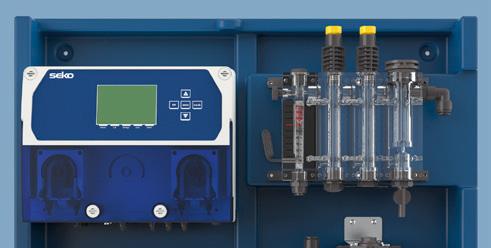

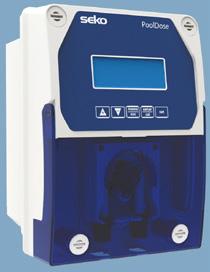


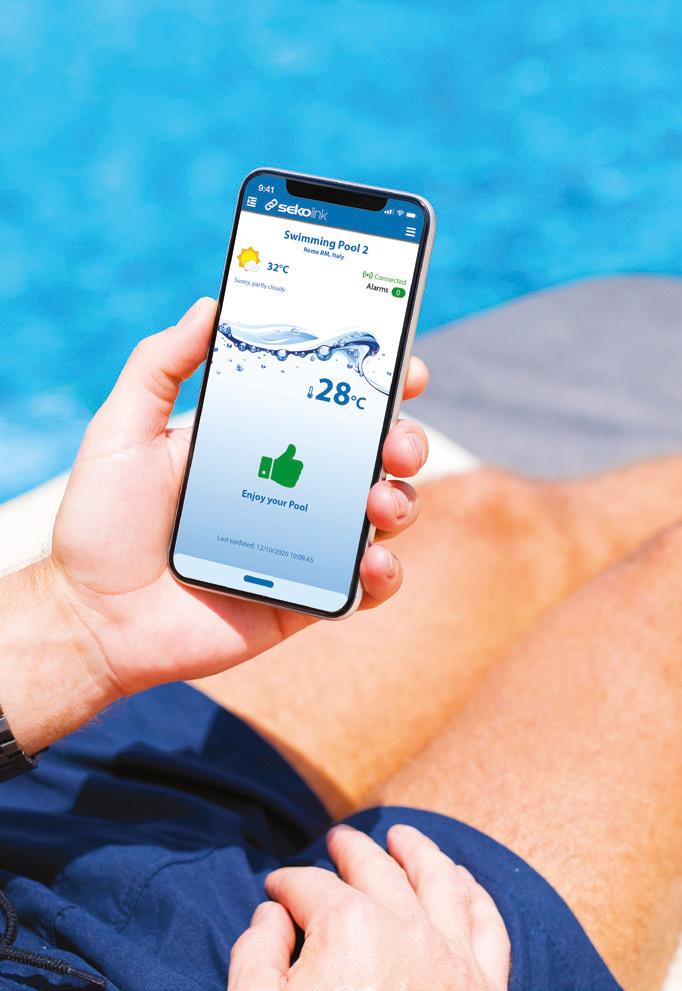
completion
pool will also be used for the 2026 European Championships 54 SPLASH! February/March 2024 feature
The
interior of the aquatic centre nearing
The
Live and historical data on demand
Adjust programmes 24/7 via smartphone
Minimise chemical consumption
Reduce technician visits and maintenance requirement
management
of your
dedicated apps for pool technicians and users, SEKO’s IoT solutions enable 24/7 access to data and settings for constantly clean, healthy pools.
Swimming pool
in the palm
hand seko.com With

and territorial inequalities, as children from disadvantaged backgrounds rarely benefit from swimming lessons,” Ciubini says.
“In Seine-Saint-Denis, an area which has only 38 swimming pools for 1.6 million inhabitants, 48 per cent of children do not know how to swim when they enter middle school.”
The Savoir Nager program – co-financed by Paris 2024, the National Sports Agency, the French Swimming Federation and energy retailer EDF Group – aims to act for the prevention of drowning and the water safety of children, by communicating the fundamental
skills of aquatic activity and the enjoyment of swimming to children.
“Focussing on areas that no longer have, or do not yet have, enough swimming pools is the priority of this program,” says Ciubini.
“The ‘I learn to swim’ operation from which this concept arose has already made it possible to teach more than 160,000 children to swim, and I have no doubt that with these new opportunities, we will make a lasting contribution by reducing the number of drownings in France each year.”
Gilles Sezionale, Président of the French Swimming Federation says that ensuring people

“The building’s signature feature is the striking explosion of greenery covering its roof.”


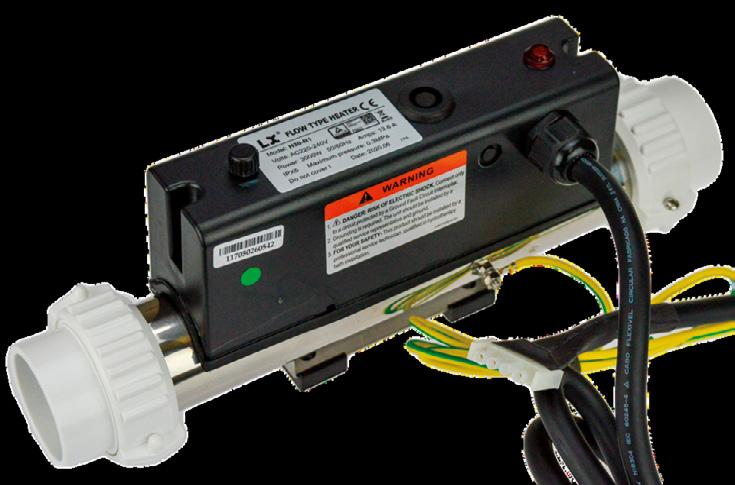
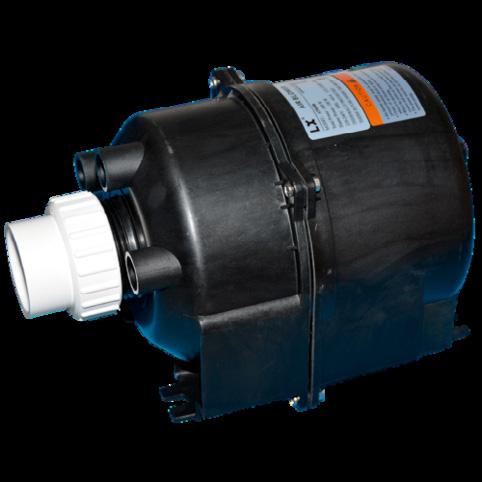
February/March 2024 SPLASH! 55 feature Proud supplier of LX pumps, blowers & heaters 2 year warranty spatex.com.au on most pumps
The arrondissement of Saint Denis will benefit from the use of the pool after the Games are over
“In Seine-SaintDenis, an area which has only 38 swimming pools for 1.6 million inhabitants, 48 per cent of children do not know how to swim when they enter middle school.”

know how to swim is a genuine concern for society.
“In this context, I have been determined to make learning to swim a priority for our Federation,” he explains. “The prospect of the Olympic and Paralympic Games Paris 2024 must serve as a veritable catalyst to profoundly transform our society and move us on from being a nation of sportspeople to being a sporting nation.”
Tales of triumph and heartbreak
It is a formula that has shaped the Dolphins into Australia’s most successful Olympic unit, accounting for 45 per cent of medals at the Tokyo Games and cementing swimming as our country’s “power” sport of the Games.
the 2023 World Championships held in July.
Swimming Australia released the selection criteria for Paris 2024 late last year and in many cases the times are quicker than those set by swimming’s governing body, World Aquatics for the Games.
With a maximum of 26 spots for men and 26 spots for women, Taylor says the standards are there to help select a team of athletes that can navigate heats, semi-finals and then lift again to deliver in finals.
“This is a successful formula that we have used for the past 10 years. Is it tough? Yes, it is but it also an important part of the process to develop athletes that can manage the load and perform when it matters most,” he explains.
As well as the pool, the centre includes many facilities for the community
And it’s also the formula Dolphins’ head coach Rohan Taylor has backed to deliver success in Paris 2024 starting with selection criteria that is based on achieving a qualifying cut-off time that is the eight fastest time – or better – from
Taylor readily admits that when the team is announced for Paris after the last event at the June 2024 trials in Brisbane, there will be tales of triumph but also of heartbreak for those who didn’t make it.
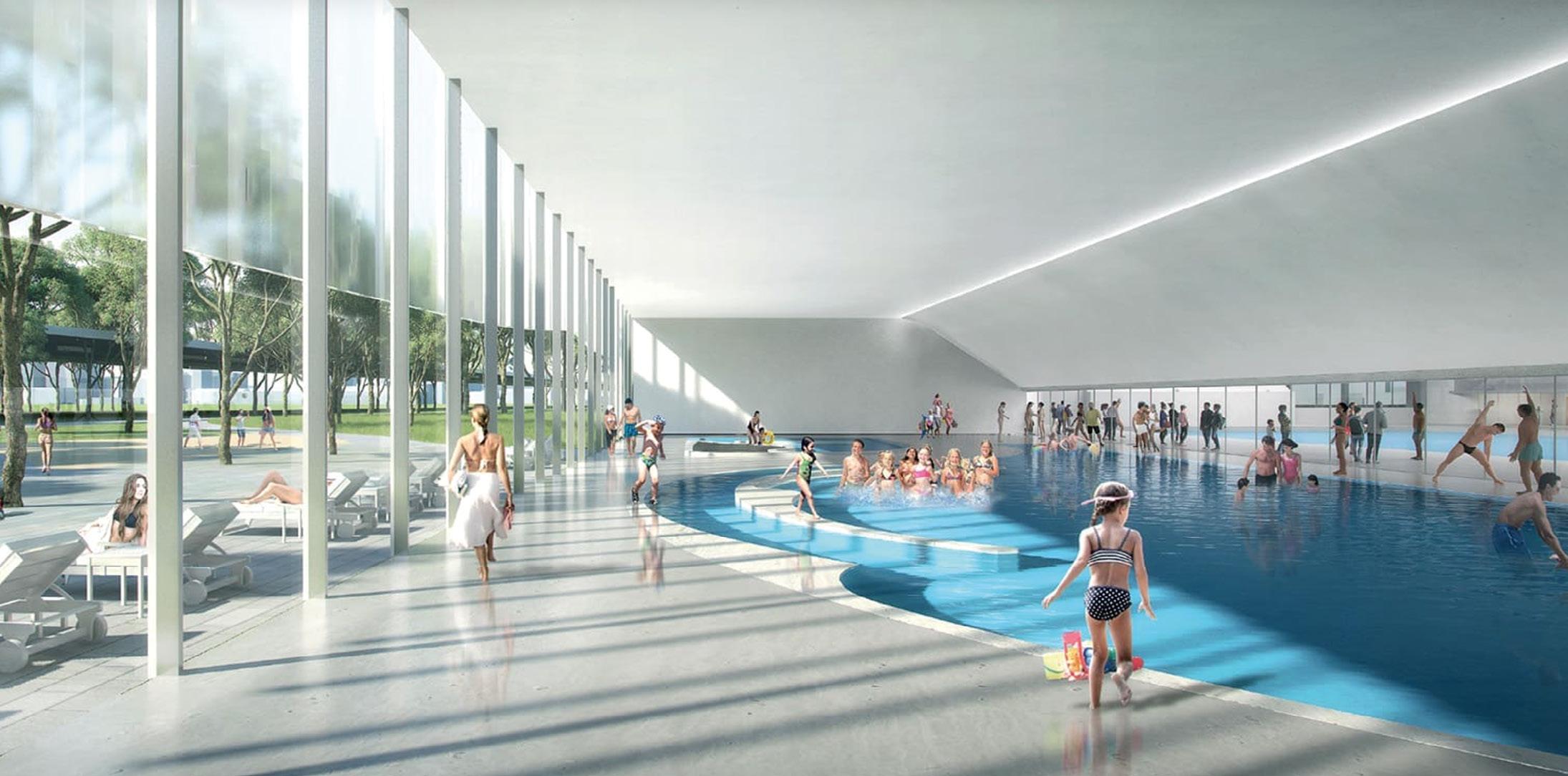
56 SPLASH! February/March 2024 feature
“The roof is also covered in greenery, with smaller grasses and shrubs covering the centre of the roof and larger plants up to two metres tall closer to the roof’s edges.”
“We have the best athletes in the world busting a gut in training and preparation, but the standards are necessary for Australia to compete against the world’s best,” he says.
Swimming Australia is giving athletes the best chance to convert when they get the opportunity and as part of its highperformance strategy, it will continue to invest in providing opportunities for our athletes to make these benchmark events.
“This also includes investing in coaches and the highperformance program as we continue on the green and gold runway to Brisbane 2032,” Taylor explains. n
Contacts:
www.ffnatation.fr
www.mvrdv.com
www.olympics.com
www.swimming.org.au
www.worldaquatics.com
France’s largest urban solar farms
The aquatics centre is the only permanent sports facility to be built for the Paris 2024 Games, under the authority of the Metropole du Grand Paris. In 2024, it will welcome the world’s greatest athletes for artistic swimming, water polo and diving events.
Looking beyond the Games, the aquatics centre has been designed to address the needs of Seine-Saint-Denis, its host region, and the French swimming community, which will now have a facility that can host the biggest national and international competitions.
Connecting to the neighbouring Stade de France over a footbridge spanning the A1 motorway, its modular configuration will be able to be reduced to a 2500-seat facility to host local events.
The aquatics centre will be low-carbon and all the building materials bio-based. Its timber structure and roof frame are designed to blend seamlessly into the surrounding greenery.
With a 5000 sqm roof covered with photovoltaic panels, it will be one of France’s largest urban solar farms and supply all the energy that the centre needs.
The interior fittings will be made of recycled materials –and made in France to showcase the country’s expertise in environmental performance.
February/March 2024 SPLASH! 57 feature
Comparison of commercial filtration systems
By Paul Stevenson
An article on commercial filtration in Edition 150 of SPLASH! caused a bit of kerfuffle.
This is a tricky and complex subject, and some sections of the commercial filtration sector believed crucial information was left out, and disagreed with some of the opinions from engineers and others quoted in the article.
It is worth noting that in that earlier article (Edition 150), a broad range of suppliers were contacted to contribute to the article, but some did not respond. Naturally, this left a gap in some of the information.
For this article presented here, Paul Stevenson, one of Australia’s most experienced consulting aquatic engineers, contacted SPLASH! and offered to produce a more comprehensive, although subjective, analysis of the four types of filtration discussed in the article. Suppliers from each category were contacted to contribute to this article, and they did so willingly and made significant contributions to this study.
This article has been sent to relevant parties prior to publication, and their comments have been taken into account in the final draft.
In this article I will look at four filtration types: sand filtration, cartridge filtration, ultra fine filtration and ceramic filtration.
Based on a typical and quite common 25m long, 20m wide indoor pool, the following selection of filters has been made resulting in the tabulated plantroom areas and heights required. (See Chart 2 page 59.)
For each filter type, the filter selection was confirmed with the manufacturer and the areas and heights reviewed by them. Threedimensional modelling was conducted using models provided by the manufacturers.
In Charts 1-4, the areas shown are purely for the filters, access space around them, and service areas associated with them. They do not include “common” items such as pumps, UV and chemical dosing, control panels and heating. They include filter face plumbing if required, to provide a single flow and discharge connection to a bank of filters.
The heights shown include the physical height of the filter and any service space above the filter. A minimum plantroom height of 2.4m has been assumed.
Filter comparison table
See Subjective Filtration Comparison Chart 1 page 59.
Pros and cons table
See Subjective Pros and Cons Chart 3 page 60.
Costs
Filter costs have been provided by the manufacturers and to this, the cost of face plumbing if required has been added to provide a single flow and discharge connection to a bank of filters.
Cartridge filters are by far the cheapest option. The next cheapest are sand filters at about twice the cost of cartridge filters. The next cheapest are UFF filters at about twice
the cost of sand filters. Finally, the most expensive are ceramic filters which are about three times the cost of UFF filters.*
The cost comparison did not include the plantroom, balance tank or backwash tank sizes.
However, any saving in these aspects between the options will be quite minor when compared to the cost of the filters themselves and have little consequence on the outcome of any cost/benefit analysis.
*It should be noted that Waterco says that, while ceramic filtration is more expensive than regenerative filtration, the cost disparity may be much closer when a detailed quote is provided for a specific project. It is important that when choosing commercial filtration, the specifier should get detailed costs for each type of filtration system from suppliers, according to the project’s specific plans and requirements, to enable a clear comparison. – Ed
Conclusions
There is no question that each filter type will provide perfectly good water quality if applied correctly.
If cost were the most important consideration, then commercial cartridge filters would be the obvious choice but due to their small capacity, are generally considered to be inappropriate for large bodies of water.
Having said that, all the pools and hot tubs at the recently completed Sydney Crown Casino were fitted with commercial cartridge filters. This included two large 50m long pools. Cartridge filters need manual cleaning and can’t deal with Giardia and Cryptosporidium in a way that UFF and ceramic filters can. Their environmental impact is however very low as they have very low quantities of wash water.
If tradition and then cost were the most important considerations, then sand filters
“There is no question that each filter type will provide perfectly good water quality if applied correctly.”
58 SPLASH! February/March 2024 news
*
into account water lost due to high TDS caused by low backwash water
The UFF component is an average of the different brands and some brands perform better in terms of automation, energy consumption and maintenance time.
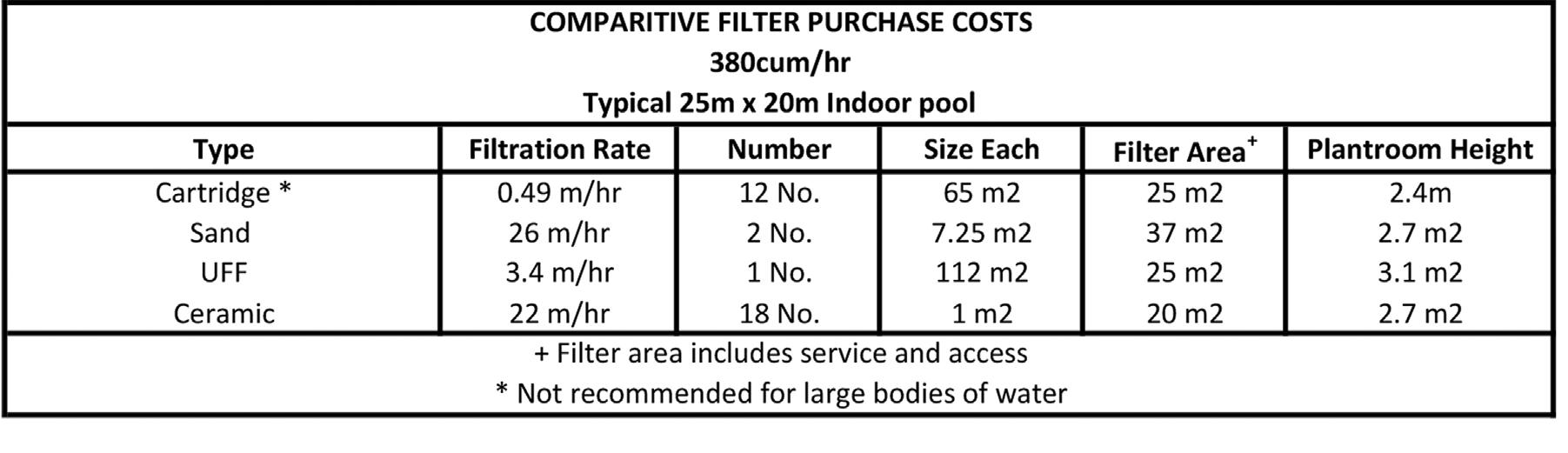
FILTER COMPARISON TABLE 1 = least favourable 10 = most favourable Aspect Cartridge Sand UFF Ceramic Comment Capital Cost 10 6 4 1 Cartridge is by far the cheapest option & Ceramic is by far the most expensive. Extensive Local Experience 10 10 10 3 All options but Ceramic are well known in the Australian market. Local Support 10 10 10 Ltd Information Little local history to fully judge Ceramic. Maintainability 10 7 6 Ltd Information Little local history to fully judge Ceramic. Water Quality 7 7 10 10 UFF and Ceramic clearly provide the best water quality. Automated System 7 7 7 10 Whilst Ceramic plants come prepackaged and automated, all the others options can be largely automated if desired. With ceramic, the frequency
the number process
permeability makes automation a necessity, not an option. Complexity 10 8 6 5 Sand and cartridge filters are quite simple whereas UFF and Ceramic are not. Plant Operator Attendance 7 6 7 10 Ceramic filters require little attendance. Filter Cleaning 3 7 5 10 Ceramic is automatic. UFF typically requires 2 to 4 week cleaning and its filter media has
be handled with PPE. Cartridge filter elements have
be removed
washed
has to be cleaned weekly and the need
automation
justified
Pump Power Consumption 10 7 6 10 This relates to the pressure drop in the filter and can be impacted greatly by the filtration rate selected. Filter Cleaning Water Usage* 10 1 10 10 Only sand uses enough water to satisfy TDS requirements. The others will have
dump water
achieve that. Uses Fewer Chemicals 10 5 10 10 As a sand system uses about 3 times that of the other options, more chemicals are wasted in its wash water. Wastes less heating 10 5 10 10 As a sand system uses about 3 times that of the other options, more heated water is wasted in its wash water. Minimises Cryptosporidium/ Giardia 1 1 10 10 Only Ceramic & UFF filter down to levels where Cryptosporidium/Giardia are 99% removed. Code "Browns" 7 7 9 10 Ceramic & UFF handle Code Browns' very well although the Ceramic automatic cleaning does give it the edge in this respect. Takes Less Space 8 5 8 10 This includes connections and OH&S access/service space. Plantroom Height 10 8 6 10 UFF requires the most height in a plantroom. A typical minimum plantroom height is in the order of 2.5m. Typical Filtration Particle Size 8 to 13 microns 10 to 15 microns 1 to 2 microns 3 microns Irrespective of particle size removal, all options will provide visibly good water quality. Typical Average Filter Pressure Loss 35 Kpa 35 Kpa 55 Kpa 30 Kpa UFF has the highest pressure drop by far. Ceramic the least. Plantroom Access 10 5 6 9 Door size is not the only criteria. The length of the filters as well as it's cross section have to be taken into account. Ceramic can be broken down to smaller units and cartridge are very small by nature. Minimal Install labour 10 7 6 10 Very little to install re Cartridge and Ceramic comes pre-built. Pre-Installed Equipment 10 5 5 10 Both Ceramic and Cartridge can be prebuilt. Temperature Monitoring 10 10 10 10 All plants can be monitored although standard on Ceramic. Pressure Monitoring 10 10 10 10 All plants can be monitored although standard on Ceramic. Large Pool Size Compatibility 5 10 10 10 Typically Cartridge would only be used on small bodies of water although there are examples of
scale use. Cartridge can be ideal for high-rise lightly loaded projects like Hotel
Motel pools, where
to provide the infrastructure necessary for other forms of filtration.
and
steps necessary to maintain
to
to
and
by hand, typically 2 to 4 weeks. Sand typically
for
is rarely
or warranted.
to
to
large
and
it is often difficult
Takes
Chart 1: Subjective comparison of the four filter types
February/March 2024 SPLASH! 59 news
Chart 2: Specified equipment for the hypothetical project
FILTER PRO & CONS SUMMARY
Pros
Simple
Very cheap to install and use
Small plantroom area and height
Easy to install
Easy to look after
Performance enhanced if used in conjunction with a Cyclone filter.
Cartridge Filters
Low pressure drop
Good water quality
Long filter cleaning cycle
No backwash tank required
Minimum wash water
Smaller balance tank
Local manufacturers are available
Simple
Low cost to install and use
Easy to install
Sand Filters
Easy to look after
Good water quality
Low pressure drop
Local manufacturers are available
Excellent water quality
Cryptosporidium or Giardia Protection
Small wash water quantities
Smaller plantroom
UFF Filters
Smaller backwash tank
Smaller balance tank
More suitable for high risk pools
Local manufacturers are available
Excellent water quality
Automatic cleaning cycle as standard
Cryptosporidium or Giardia Protection
Small wash water quantities
Deals with Code Browns easily
Lowest pressure drop
Ceramic Filters
ABOVE:
Smallest plantroom
Smaller backwash tank
Smaller balance tank
Minimum operator involvement
More suitable for high risk pools
Easy to install
Chart 3: Subjective pros and cons table
RIGHT: View from above
BELOW RIGHT:
Cons
Generally only used for small bodies of water.
Minimal Cryptosporidium or Giardia Protection.
Banks of multiple small filters might be necessary with several elements in each filter.
The filter elements have to be manually removed and washed.
Periodically, the elements will need to be soaked in a filter cleaner.
The elements will need replacing over the years and can range from 2 to 3 years depending on the pool/spa type.
Minimal Cryptosporidium or Giardia Protection.
Very large wash water quantities
Larger backwash tank
Larger balance tank
Largest plantroom
Typically manual cleaning is required and the sand replaced every 5 years or so.
More complicated
High cost to install and use
Harder to install
Harder to look after
Higher plantroom height required
High Pressure drop
Manual cleaning is required and the filter socks replaced anywhere between 5 to 10 years. Filter media has to be handled with PPE and is fresh media after each clean.
Some makes of UFF filters are fully imported
More complicated plant
Very high cost to install and use
Unknown product with minimum use in Australia. Built overseas
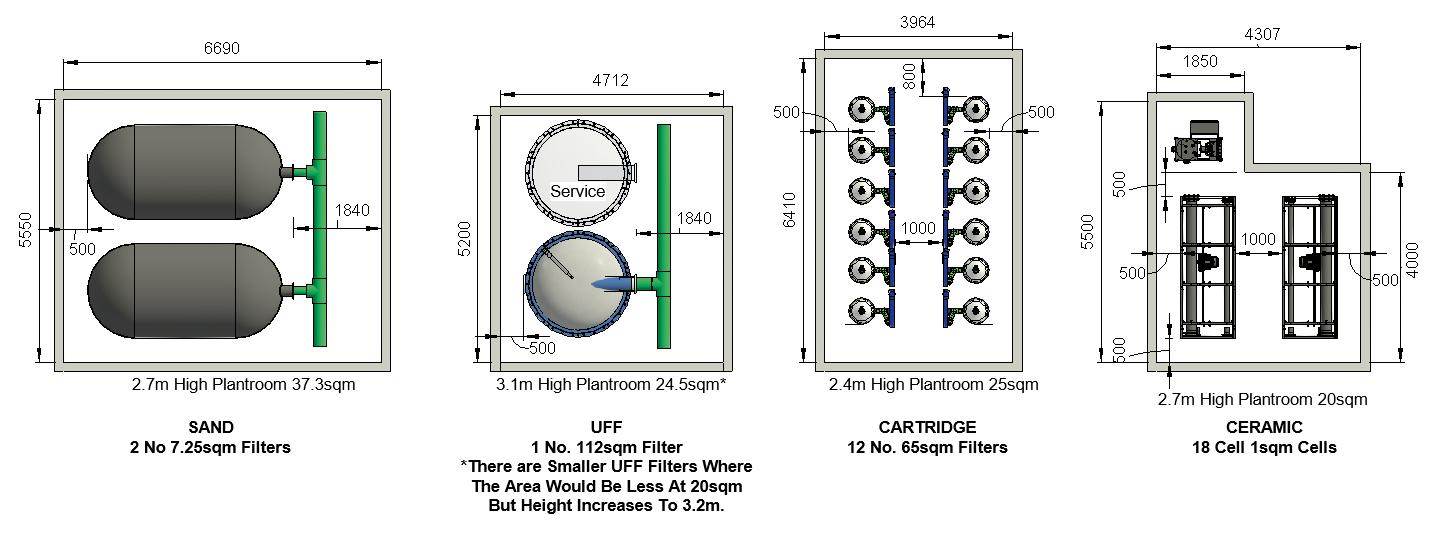
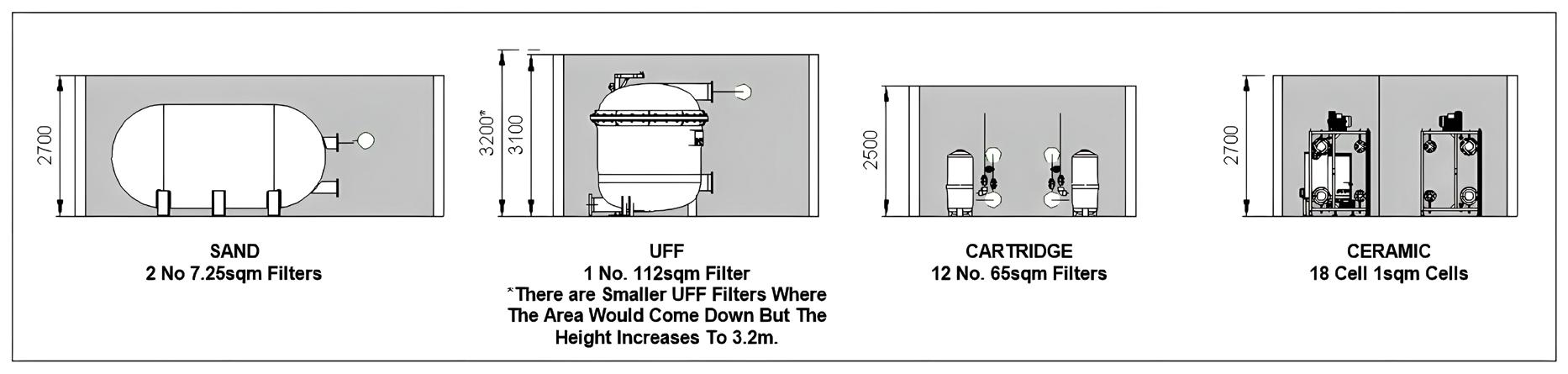
60 SPLASH! February/March 2024 news
Graphic of comparative filter height requirements
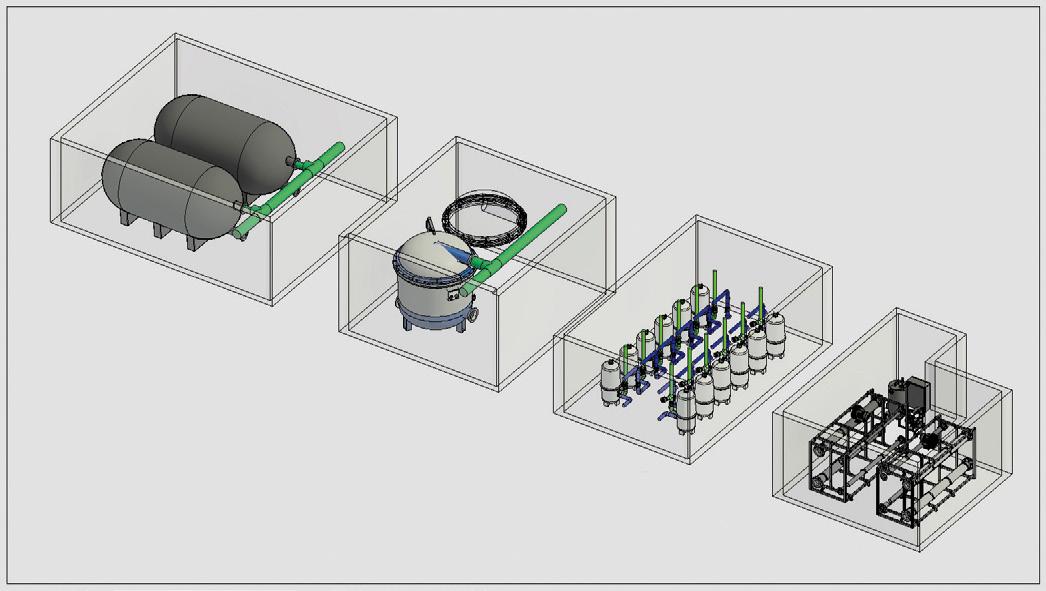
BEST SOFTWARE


would be the obvious choice as these types of filters are well known in the industry and loved by many operators. If the environment were a part of your consideration, sand filters would not be the ideal selection due to the very high quantity of wash water. The same goes for space where sand filters require a large plantroom. While these filters can be fully automated, they can’t deal with Giardia and Cryptosporidium in a way that UFF and ceramic filters can.
SHOPS &
Finally, UFF and ceramic filters. Both provide all desirable benefits, but both are expensive to install, especially ceramic filters which come at a significant premium, even when compared to UFF filters. Basically, the only real downside of these filters is cost and industry familiarity.
UFF filters can be semi-automated and ceramic filters must be fully automated. UFF operators do have to handle filter media, but this is safe when used with suitable PPE and there is no evidence of any harm to operators in carrying out this process. UFF is now the filter of choice by many pool designers and there would have to be a very good pressing reason why ceramic filters were used.
www.bufferzone.info
It should be noted that ceramic filters are relatively new here in Australia and I believe the “reliability” of a fully imported automatic system (particularly one that required many cleaning processes per day) deserves some mention. Maintenance of such a plant may or may not be an issue and only local experience and time will provide this knowledge. Some makes of UFF filters are also fully imported.
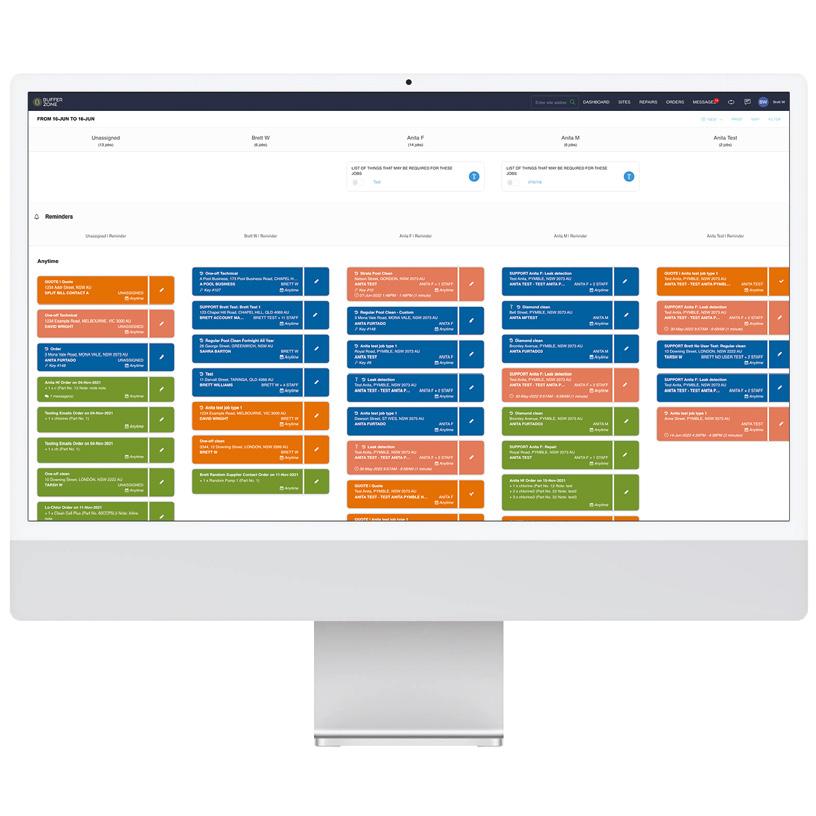
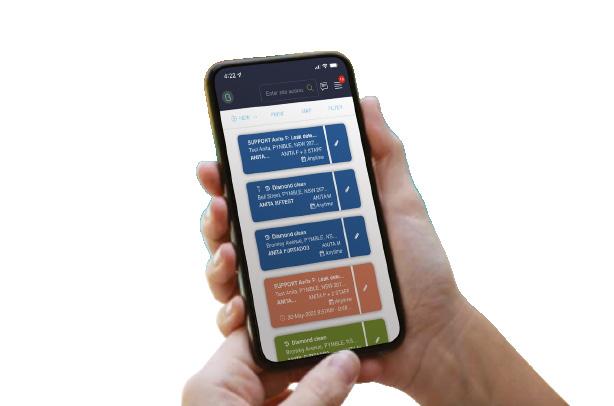

While this study didn’t specifically address plantroom, balance/backwash tank costs, these would have no significant impact in the writer’s opinion on the outcome of any cost/ benefit comparison. n
Disclaimer: The information in this article is based upon decades of local and international knowledge and experience with the design and specification of pool water treatment plants. This generic information should not be construed as being “advice”. The reader is encouraged to conduct their investigations and to form their own opinions on what form of filtration best suits their client’s needs. Being a critical but complex topic, the services of an independent and accredited aquatic consultant is essential.
Pool filtration standards
An interviewee in the previous SPLASH! article discussed European DIN Standards, suggesting modified DIN standards should be considered, but concluded that we could never just adopt the DIN Standards in Australia as that would never work. A separate article on Standards is planned for a future issue.
for the pool industry the pool industry
POOL
SERVICE
BUSINESSES
Built for the pool industry by the pool industry THE BEST SOFTWARE FOR POOL SHOPS & SERVICE BUSINESSES www.bufferzone.info
3D graphic of comparative filter spaces
SAND
UFF
CARTRIDGE
February/March 2024 SPLASH! 61 news
CERAMIC
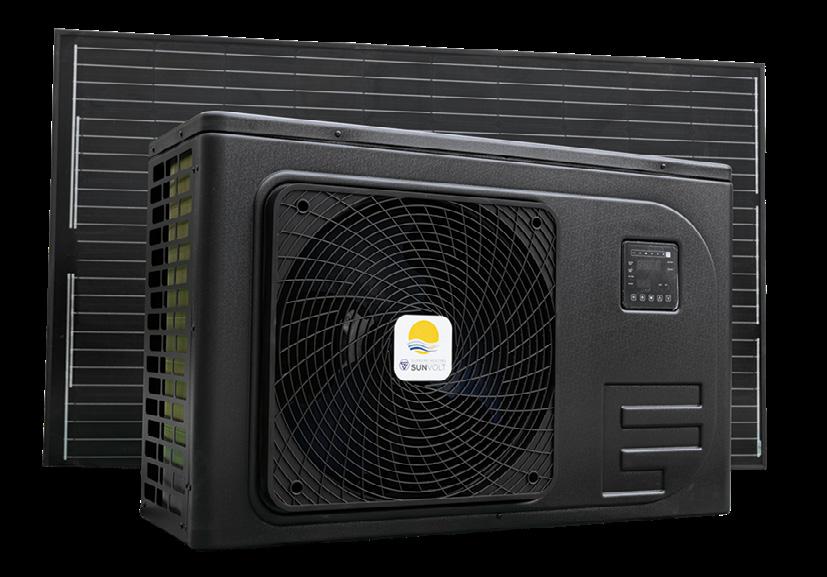
SunVolt hybrid heat pump
SunVolt is a hybrid heat pump that can be powered directly by its own solar panels (DC power).
Unlike other AC heat pumps or solar-ready heaters, this means there is no need to install an AC inverter or seek approval from the energy provider to install additional PV panels for pool heating.
These innovative heat pumps can still tap into grid’s AC electricity as a backup. The optional direct DC-powered circulation pump ensures zero running costs, making it ideal for seasonal or year-round swimming. The SunVolt also preserves the household’s PV panel energy and does not affect load balance and electricity bills.
Contact: www.supremeheating.com.au
Saving time with updated pool design software
Structure Studios has updated its award-winning 3D design software with powerful, timesaving new tools and assets to help design beautifully rendered outdoor living spaces for clients.
Complete with faster real-time 3D, an intuitive new 3D gizmo, new Smart Snaps, a reimagined camera, a wealth of design tools, and 1400 new assets including numerous widely requested plants and trees as well as new pets, furniture and equipment. The new 3D Grid, which seamlessly aligns with the familiar 2D Grid, enhances precision with its intuitive reference points.
This feature-packed update is available now for Vip3D, Pool Studio and VizTerra.
Contact: www.StructureStudios.com

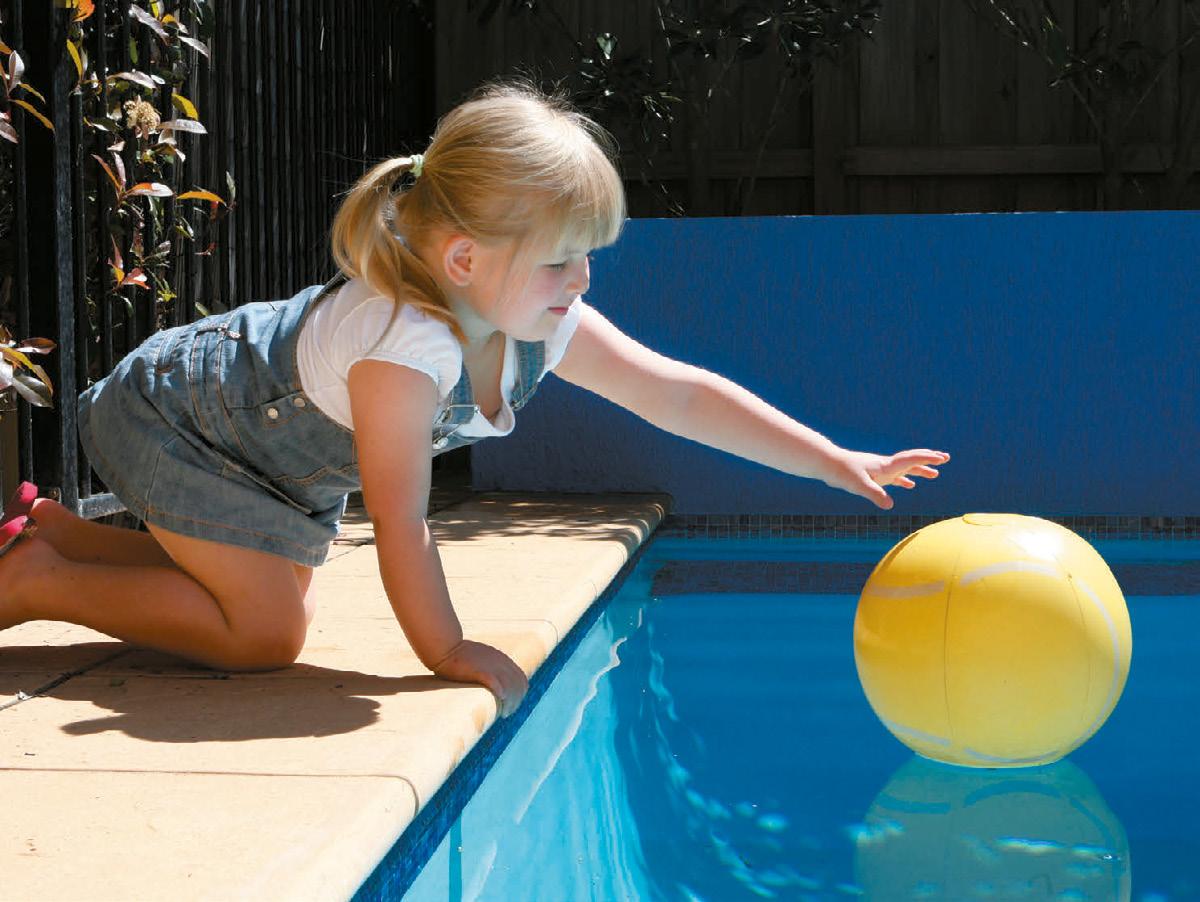
View our online video showing common pool fencing faults and how to spot them at www.kidshealth.chw.edu.au/projects/drowning-prevention/swimming-pool-fencing
View our online video showing common pool fencing faults and how to spot them at www.kidshealth.chw.edu.au/projects/drowning-prevention/swimming-pool-fencing


Protect Your Pool, Protect Your Kids KIH1025/0811/SC
Protect Your Pool, Protect Your Kids KIH1025/0811/SC https://www.corelogic.com.au/software-solutions/cordell-connect?utm_medium=magazine&utm_source=splash&utm_campaign=au-con-splash-magazine-2023 Receive regular updates on new construction activity Discover upcoming construction projects in your area with Cordell Connect to help you secure your next opportunity. 1300 734 318 corelogic.com.au/cordell
64 SPLASH! February/March 2024 new products
Enhancing poolside relaxation potential
Perfect for whiling away long warm afternoons, a hammock immediately conjures thoughts of sun, sea, sand and snoozing. The benefits of physical and mental rest are well known, giving our minds and bodies time to recover, prevent injuries, improve our overall performance, and support a healthy immune system. And what better way to relax than in a hammock by your pool?
Two Trees hammocks come in double and king size, and in three styles: Hamilton, a take on the Hamptons look; Nurture, embracing the botanicals interior trend with a tropical twist; and the natural, earthy appeal of Tribal.
Contact: www.twotreeshammocks.com.au
Tile-look pool lining
Haogenplast’s new and unique StoneTile designs provide an attractivewaterproofing solution to build or renovate a private pool with the look and feel of real stone tiles.
The StoneTile range is formulated with quality ingredients including enhanced surface coating, ensuring superior stain resistance, high UV resistance, and a stone perforated dryfeel non-slip grip.
While the dimensions of the tiles vary, most are approximately 40cm by 20cm.
Haogenplast has been supplying advanced PVC products for more than 50 years. Their reinforced pool linings are designed to protect the pool structure from damage caused by water, chemicals and everyday wear and tear. Typically made from reinforced PVC or polyethylene, they provide excellent resistance to UV rays, abrasion and punctures.
Contact: https://pools.haogenplast.com
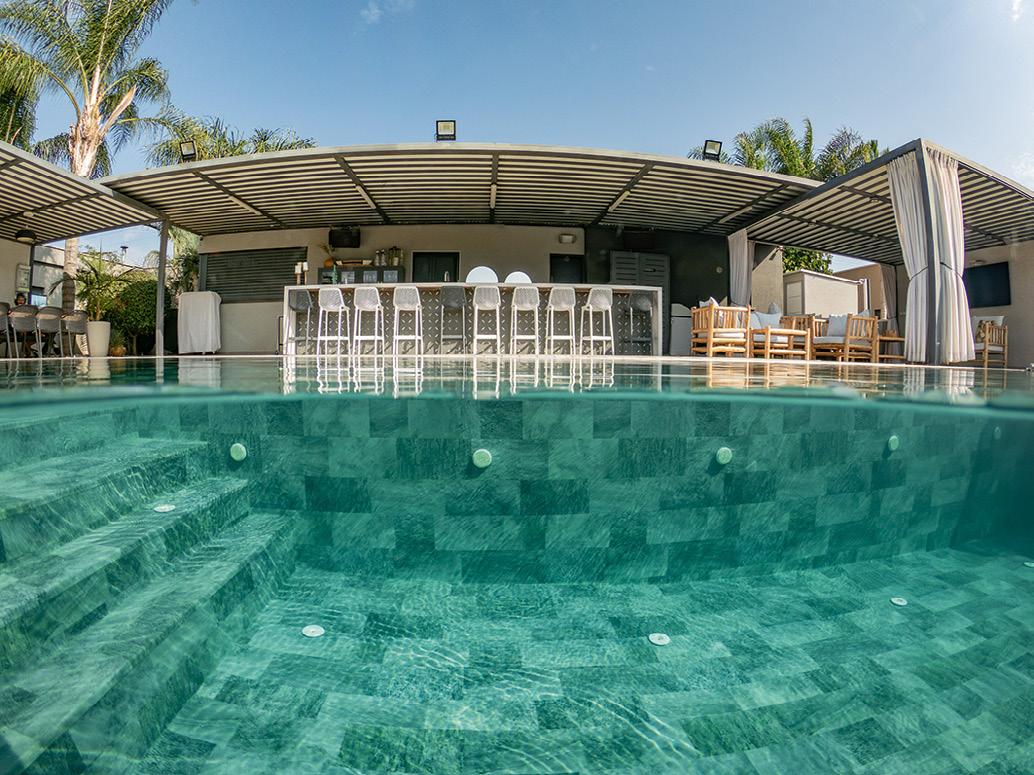
February/March 2024 SPLASH! 65 new products

Yes! I wish to receive SPLASH! magazine Within Australia * $AUD65.00 – 1 year, 6 issues $AUD104.00 – 2 years, 12 issues – Save 20% $AUD136.50 – 3 years, 18 issues – Save 30% * Prices quoted include GST Overseas Rates New Zealand $AUD75.00 – 1 year, 6 issues Asia Pacific $AUD80.00 – 1 year, 6 issues All Other Countries $AUD90.00 – 1 year, 6 issues We are committed to handling your personal information in accordance with the privacy act. Please Select one of the following: Yes No - Please send me information about special offers and or events from SPLASH! Subscribe to Tax invoice Please find enclosed my cheque/money order for $_________ payable to The Intermedia Group Pty. Ltd. OR please charge my: Mastercard Visa Amex Cardholder Name: Expiry Date: __ __ / __ __ Signature: Name: Job Title: Company: Address: Suburb/Town: Postcode: Ph: Fax: Email: The Intermedia Group Pty Ltd ABN 94002583682 PO Box 161 Hornsby NSW 2163. www.shop.splashmagazine.com.au or call +61 8227 6486 ✁ Splash Subs HPV FEB 2024.indd 1 28/2/2024 2:38 pm 66 SPLASH! February/March 2024 Index Advertisements Abgal Liners & Covers 37 AIS Water IFC Allnex 44 Aqua-Quip 15 Aussie Under Cover 65 Brauer Industries 43 Bufferzone 61 BWT Lincoln Pool Equipment 27 Cordell 64 Daisy Pool Covers 51 Davey Water Products 8 Evo Industries Australia 4 Evolution Water & Lighting Solutions 30 Fluidra 6 Hayward Pool Products (Australia) 18 LaMotte Pacific 33 Lasatec (Seko) 54 Mg2Plus 50 Naked Pools 25 Pool-Water Products IBC PoolWerx Australia 57 PSQ 34 Rainbow Pool Products 47 Reece 21 Remco Australia 17 Spa-Craft 36 Spa Electrics 35 Spatex 55 Sunlover Solar 40 Swimart 39 Waterco 13, 49 Westmead 64
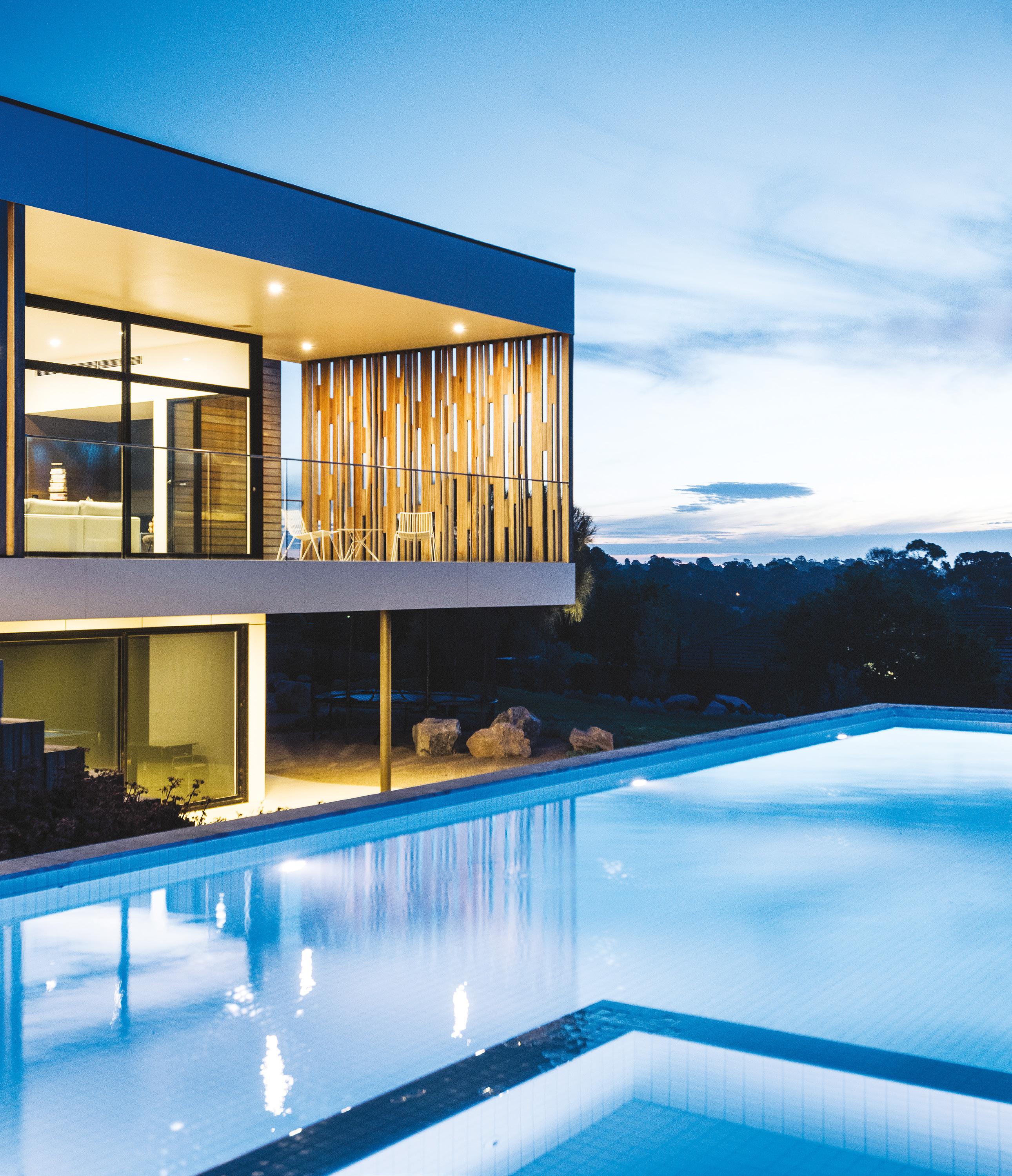




www.pool-waterproducts.com.au Pool-Water Products | P: 03 9873 5055 Email: info@poolwaterproducts.com.au www.poolwaterproducts.com.au Paramount’s custom built in-floor cleaning systems are engineered to automatically clean any pool you design, including floors, steps, benches and spas. Minimising maintenance and maximising enjoyment. PARAMOUNT IN-FLOOR CLEANING SYSTEMS THE WORLD’S NUMBER 1 IN-FLOOR CLEANING SYSTEM BROUGHT TO YOU BY POOL-WATER PRODUCTS Aquarius Pools – Mornington VIC AUSTRALIA’S LEADING POOL BUILDERS CHOOSE PARAMOUNT
The Prowler 930W Robotic Cleaner has all the easy, drop-in-and-go intelligence of all the Prowler family. With the 930W’s WiFi connectivity, all you need is the Pentair Home app to make pool cleaning a truly hands-off experience.



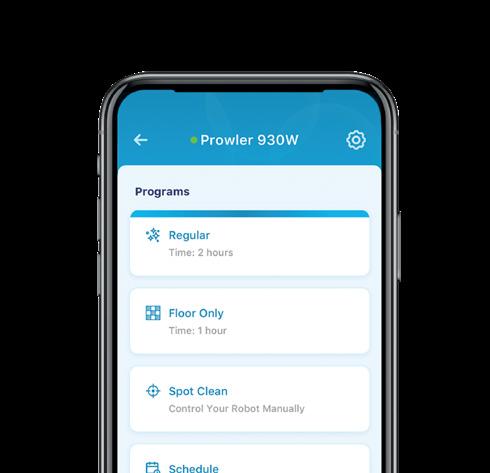
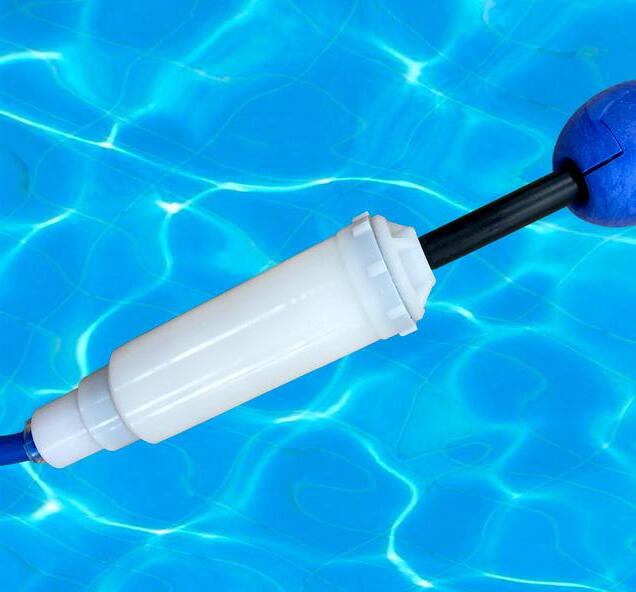
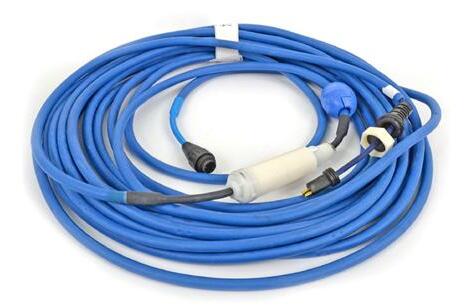
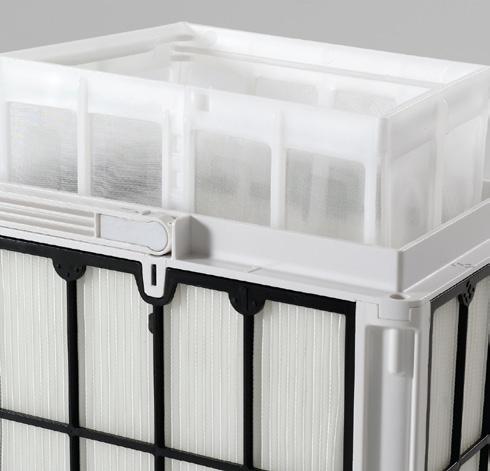
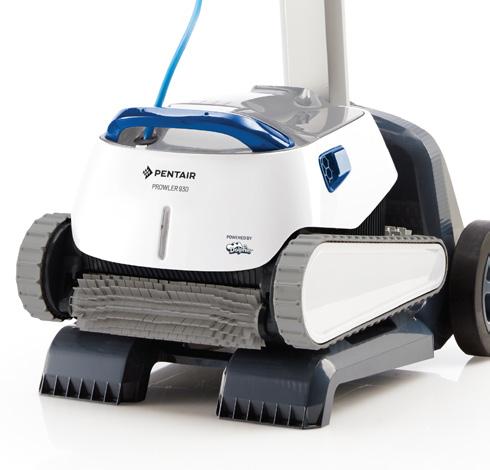
Visit us at PENTAIRPOOL.COM.AU
Robust Caddy Easily transports cleaner from pool to storage Easy Access Top Basket Capture small and large debris Customisable Cleaning Features Built-in weekly timer, fast-clean and delayed start features Wifi Connectivity Via the Pentair Home app
Pool cleaning made simple.
Cable with Swivel NEW