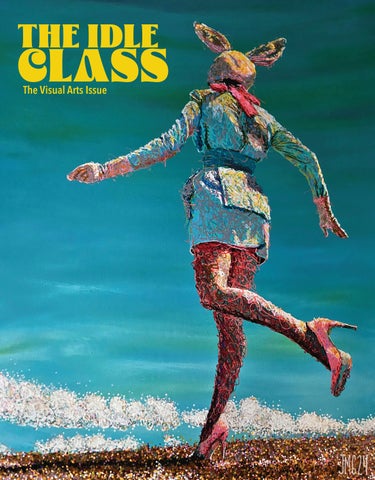
THE IDLE CLASS
The Visual Arts Issue
ARKANSAS WOMEN TO WATCH 2026:
WORDS BECOME MATTER


MARK YOUR CALENDAR
Arkansas Women to Watch 2026: Words Become Matter will travel to five venues across Arkansas.
LITTLE ROCK
Opens Feb 13, runs through April 18: Join us for “2nd Friday” at CALS Roberts Library of Arkansas History and Art Underground Gallery, 401 President Clinton Avenue.
BLYTHEVILLE
Opens May 1, runs through June 13: See Words Become Matter at the Blytheville Air Force Base Exhibition, 3711 Idaho
PINE BLUFF
Opens July 9, runs through Aug 15: Hosted by the Arts & Science Center for Southeast Arkansas, 701 S. Main Street.
BATESVILLE
Opens Aug 21, runs through Oct 3: On view at Kresge Gallery of Lyon College, 2300 Highland Road
FORT SMITH
Opens Oct 15, runs through Dec 12: At the UAFS Gallery of Art and Design, 535 N. Waldron Road.
FEATURING
In support of the National Museum of Women in the Arts in Washington, D.C., the Arkansas Committee of NMWA presents a traveling exhibition in 2026 of Arkansas women artists’ books.
Curated by Dr. Catherine Walworth, the Jackye and Curtis Finch Curator of Drawings at the Arkansas Museum of Fine Arts, the ACNMWA traveling exhibition features art by K. Nelson Harper of Fort Smith, Acadia Kandora of Fayetteville, and Rebecca Resinski of Conway.
A major exhibition at NMWA, including one artist chosen by NMWA curators from the Arkansas exhibition and showcasing the national museum's history of collecting artists' books, will be open from April 11 to August 15, 2027.
K. Nelson Harper, Naked, North of the Arctic Circle
Acadia Kandora, Windswept
Rebecca Resinski, But Just Now (Installation view)


Sixteen years ago, I quit drinking. I went pretty hard in the paint with booze during college, so I put it behind me early on. But the thing is, idle hands are the devil’s workshop. I needed something to fill my time.
In 2011, it came to me — I’d start covering the arts in Arkansas to bridge the creative bubbles across the state.
One day at the late, great Hastings in Fayetteville, I stumbled upon a DVD of Charlie Chaplin’s short films. One of them was called “The Idle Class.” Now I had the name — an ironic twist on the stereotype of creatives not being hard workers. We launched a Tumblr shortly thereafter, and the next summer, we
EDITOR’S NOTE
had our own website. Print seemed out of the question, but once I researched costs, I realized I was wrong.
Two years to the day after I kicked booze, snowflakes the size of packing peanuts pounded my windshield as I drove down I-49 at 25 mph, headed to Little Rock for a release party at the White Water Tavern organized by my friend Kara Bibb. I arrived a few hours late. As soon as I put the copies out on the table, people snatched them up, flipping the pages quickly, taking it all in. No one had done anything quite like this before in the state, and it was a rush watching people react positively to it. That feeling has never gotten old.
For 15 years, I’ve been the driving force behind The Idle Class. There have been times when I felt embittered, watching other people excel in their ventures while we kept dog-paddling, keeping our heads just above the water. But comparison is the thief of joy. We pulled this off for years with no corporate backing, no trust fund,
TABLE of CONTENTS
10-11 / Roots & Realms: A look at the artwork of Delita Martin
14-15 / Red, White, & You: Kat Wilson’s creates a #SelfieThrone for America’s birthday
no boss telling me “no.” It feels good to say that I did it my way, but the work that comes with that level of creative freedom is a young man’s game, and I’m getting long in the tooth.
Now it’s time for me to say goodbye. Sure, I’ve walked away before, but this time, I mean it. However, we aren’t dead yet. I am leaving it in capable hands with my assistant editor, Rachel Farhat, so that it can live on. I believe she can do better than I ever did. So, I wanna thank all of our readers, our advertisers, our collaborators, our donors and our contributors. Doing this wasn’t easy, and without you all, it would’ve been impossible.
In 2011, we had it good, but we took it for granted. Now, the world is a darker place. We’ve got to keep pushing ourselves, keep fighting, keep creating. So make art, raise hell and get your fingernails dirty.
KODY FORD
Founder, The Idle Class Magazine
The Visual Issue
16-17 / Small Worlds, Deep Lore: The rise of indie video games in Arkansas

18-19 / A Dance & an Act of Will: Potter Steven Driver on a lifetime of making
20-26 / Cultural Infrastructure: The DIY groups and businesses at the forefront of the arts in Arkansas
30-47 / Artists We Love: A round up of some of Arkansas established artists and rising stars

THE TEAM
Publisher
Assistant
Contributors
Meikel
Sarah Coleman | Lauren Ganim
Carl Napolitano | Shannon Padilla
Taylor Sone | Rebecca Stalcup
Sydney Sullivan | Molly Wheat
Kat Wilson | Isabella Wisinger
Cover
Arts
Contact Us editorial@idleclassmag.com advertising@idleclassmag.com theidleclass@gmail.com Online IdleClassMag.com Issuu.com/theidleclass Instagram.com/theidleclass


EVENTS STATE around the

EL DORADO
El Dorado Film Festival
February 25 - March 1
South Arkansas Arts Center eldofilmfest.com
The El Dorado Film Festival (EDFF) returns Feb. 25–March 1, 2026, at the South Arkansas Arts Center (SAAC), located at 110 East 5th St. in El Dorado, Arkansas, with award-winning films, industry workshops, regional short films, and late-night parties at venues like Gabe’s Cave. Tickets are on sale now and can be purchased online at eldofilmfest.com or at the SAAC box office.
Opening Night takes place Wednesday, Feb. 25, with a pre-show reception at 6:00 PM and sneak previews of TV pilots Savage and Fixation at 7:00 PM, followed by a Q+A with the filmmakers. Savage, produced by Picture Pool Productions, is a six-part mystery-horror epic written by and starring Connor Paolo (Gossip Girl). The story follows a troubled private investigator hired to solve a missing persons case in a town of only 11 people, where nothing is as it seems.
Fixation, produced by Bespoke Works LLC and Picture Pool Productions, stars Bridget Regan, Nicholas Logan, Brett Dalton, and El Dorado native William Ragsdale. Written by Alexander Jeffery, Paul Petersen, and author Steve Smart, the story centers on the suspicious death of a young Korean woman at Fort Riley, Kansas. Smart began writing the story decades ago as a historical record for his children before publishing it as a novel in 2017.
Festival highlights also include Tribeca/ATT Untold Stories Award winner Honeyjoon, Sundance favorite Never Get Busted!, grassroots cinema documentary The Big Picture, mockumentary American Comic, and Filmland: Arkansas Audience Award winner Peeping Todd. Panels include “Adapting Musicals from Stage to Screen and Back Again!” with Matthew Decker and “Taking a Short Film From Oscar-Qualified to Oscar-Nominated” with producer Tara Sheffer.
PINE BLUFF
The Lion King Jr. March 12 - 15
The ARTSpace on Main, 623 S. Main St., Pine Bluff artx3.org
Based on the beloved Disney film and Broadway musical, The Lion King Jr. follows the journey of Simba, a curious young cub who must learn to accept the responsibilities of adulthood and his destiny as king. Along the way, he meets unforgettable characters including Nala, Timon, and Pumbaa, and must ultimately confront his wicked Uncle Scar to save the Pridelands.
The show is directed by Emily Burris. From March 12–15, audiences can enjoy The Lion King Jr. at the Catherine M. Bellamy Theater. Tickets are $13 for ASC members and $18 for nonmembers.
Blaque
February 19 - July 3
In the galleries, ASC will present Blaque, a new exhibition by artist Jonathan Wright, on view from Feb. 19 through July 3. An opening reception will take place from 5–7 p.m. on Thursday, Feb. 19, and is free and open to the public. While additional details about the exhibition and featured works have not yet been announced, the extended run offers visitors multiple opportunities to experience Wright’s work throughout the spring and early summer.
FORT SMITH
Our Common Ground
June 27 - October 25
Submission deadline: April 24
Fort Smith Regional Art Museum fsram.org
The Fort Smith Regional Art Museum (RAM) has announced its 2026 Annual Invitational, Our Common Ground, a national competitive exhibition with a submission deadline of April 24. The exhibition will run from Saturday, June 27 through Oct. 25, 2026.
Hosted annually since 1948, the RAM Invitational invites artists to submit work reflecting this year’s theme of connection across cultural and geographic boundaries, emphasizing art as a unifying force. Cash prizes, a RAM Purchase Award selected by the museum’s Executive Director and Permanent Collection Committee, and a People’s Choice Award determined by visitor votes will be presented. Submission details are available at www.fsram. org/2026-call-for-works.
Ozark Regionalists: Collection of Dr. Chris Ashworth
Jan 17 – May 10
Join us for Ozark Regionalists, an exhibition of artwork from the collection of Dr. Chris Ashworth. Regionalism was an American realist modern art movement focused on rural and small-town scenes, particularly in the Midwest, peaking in popularity from 1930 to 1935 during the Great Depression. Dr. Chris Ashworth’s collection showcases oil paintings and stone lithographs featuring Regionalist artists like Jackson Lee Nesbitt, Carl R. Krafft, and Thomas Hart Benton. Lecture with Collector, Dr. Chris Ashworth: Friday, March 13, 5:30 – 7 pm. Museum admission and lectures are free.
EDFF Executive Director Alexander Jeffery hosts a Q+A with Arkansas native and actor William Ragsdale during a 40th anniversary screening of Fright Night last year.
Photo by Candy Phillips
INSIDE LOOKING OUT
Phillip Rex Huddleston
Launches Role-Playing Game
The Dream Mirror
Is the person we create in our dreams as important as the person we create when we’re awake? The Dream Mirror takes the surreal and strange dream logic of Winsor McCay’s Little Nemo and crosses it with the great life choices we make in our waking world.
According to creator Phillip Rex Huddleston, the game originated while reading the visionary ideas of the poet William Butler Yeats. He believed we each had four key faculties: the Will, the Creative Mind, the Mask, and the

Body of Fate. Throughout the game, you strengthen or weaken each faculty based on your decisions.
Huddleston said, “I tried to find that good mix we all want in solo role-playing: prompt-driven reflection paired with meaningful mechanics. One can stroll through The Dream Mirror and ponder life’s varied and contrasting expectations or one can attempt to rise to the highest of statures among the elemental kingdoms. Waking or dreaming, it is your life to create.” - Kody Ford

TRAUMA BECOMES MYTH
Inside Spet’s New Graphic Novel The Mourning Light
Storytelling can often be a path to healing. In The Mourning Light, spet (aka Arkansas artist Stevie Petet) transforms lived trauma into myth. The comic is a metaphysical retelling of gritty autobiographical experiences shaped by domestic violence, drug use, love, and the ever-present pull of the void.
Rather than recounting these moments directly, spet filters them through an invented species of anthropomorphic, cat-like beings called Leeonians, with the central character serving as a vessel for memory, survival, and reckoning. The result is a narrative that confronts the emotional toll of these experiences while searching for meaning beyond


them—where pain, love, and self-understanding coexist in a liminal, otherworldly space.
“I told this story to put a period at the end of a sentence in my life,” they said. “I found that through the use of archetypes and personal visual metaphors, I am able to obtain more insight into myself than I would through other means. This book is the output of that.”
To get a copy of The Mourning Light, visit: email Stevie.lee.petet@gmail.com or DM @stevie.spet.comics on Instagram.
- Kody Ford


“Unfriendly Fire” by Meikel Church
TRAJECTORY
Like everyone else, when I see the plane, I get up from the table to get a better look. I’m not exactly sure at what speed planes travel, but I know a plane must travel faster when it’s diving.
Nothing is on fire. Not the engines. Not the wings. Not the cabin. Not the cockpit.
There is no trail of smoke or debris, nothing looks out of the ordinary.
Except, of course, that it’s traveling down.
Nearby, a few servers cluster together and begin speculating.
“I bet it’s terrorists,” one whispers.
“My money’s on human error,” another says.
“Or mechanical,” says another.
“Aren’t those basically the same
Fiction by Nicholas Claro
thing?” the first one says.
Now the servers and most everyone else have their phones out, held up, recording or livestreaming.
Everyone except me and a nearby woman who has an infant pressed against her chest. She holds the baby’s head in place so they have no choice but to face the opposite direction of the falling plane.
And then it happens. A split-second after the plane disappears, there’s a brief flash and then pillar of curling black smoke spewing fire climbs high into the air. When the sound of the explosion reaches me, it’s no louder than a refrigerator door sucking closed.
“Holy shit,” one of the servers says.
“This isn’t happening,” the woman says, quietly. I hardly hear her. She starts bouncing the baby, rapidly
patting the child’s back. She looks away, looking at me. “That didn’t just happen.”
“I had a brother once,” I say.
BIO: Nicholas Claro is a three-time Pushcart Prize nominee, fiction reader for Write or Die Magazine, and holds an MFA in Creative Writing from Wichita State University, where he was the 2024 Fiction Fellow. His work has appeared or is forthcoming in Necessary Fiction, Louisiana Literature, Cleaver Magazine, XRAY, Write or Die Magazine and others.
“Trajectory” was originally published in X-R-A-Y Lit Mag, July 12, 2022. It can be found in his short story collection This Is Where You Are (Roadside Press, 2025). His next short story collection Sedgwick County will be published in September 2026.
When the Body Wavers, The Dance Remains
This
Little Rock
dance studio helps people with Parkinson’s Disease reclaim their joy through movement.
WORDS / ISABELLA WISINGER PHOTO / REBECCA STALCUP
Little Rock dancer and instructor Rebecca Stalcup is offering movement classes for people with Parkinson’s Disease at her studio, Arkansas Academy of Dance, twice a week on Wednesdays and Thursdays in Little Rock. She was inspired to start the program, called Dance for Life, after a close friend was diagnosed with Parkinson’s. Since then, the class has grown into a consistent community and a welcoming space for people living with Parkinson’s.
Parkinson’s Disease, a disabling condition afflicting almost a million Americans, impacts a person’s balance, coordination, and emotional state. It’s considered a dynamic disease because its symptoms may present differently from day to day. People with Parkinson’s can’t predict how their bodies will behave when they wake up in the morning, so even simple activities like walking and standing become a challenge. But inside Rebecca’s downtown studio, people with Parkinson’s are finding the courage and confidence to continue moving — together.
Dance therapy is a promising way to manage Parkinson’s symptoms, including rigidity, tremors, confusion, and depression. The rhythms and symbolism in Dance for Life classes stimulate the brain in much the same way as dopamine, allowing students to reconnect with lightness and emotional freedom.
Rebecca says the class is a breath of fresh air. “We use lots of imagery — a babbling brook, a flock of birds, a rising moon. Storytelling helps students find new excitement and motivation.”
Rebecca began the class as a tribute to her longtime friend and fellow dancer, Scott McGee, after his Parkinson’s diagnosis. Inspired by his struggle, she pursued
specialized dance therapy training.
“These people face something unexpected every day,” she said. “The class becomes like a whole new planet they can step into, where they can feel good again.”
The top priority during a Dance for Life class is safety. The floors are completely smooth with all tripping hazards removed. There’s also a water station and emergency kit nearby, and volunteers participate in the class alongside Parkinson’s patients, ready to assist. “If they’re having mobility issues, we work around it. If someone falls, we make sure they’re okay and get them into a seated position, then get them re-engaged with the class if they are able to continue,” explained Rebecca. “I want them to walk in and know that however they’re moving that day is okay.” Dance for Life is a judgment-free zone where anyone with motor differences can enjoy the self-expression of dance in a safe and supportive environment.
Before the first class, the team at the Arkansas Academy of Dance held mock sessions over six months with senior volunteers to refine their new offering. The trial period confirmed to Rebecca that intentional movement could lead to real improvement in her students’ lives.
Medical students occasionally attend Dance for Life, participating alongside regulars and later listening to students with Parkinson’s disease share their self-reported experiences. Rebecca notes that her students look forward to the laughter and excitement in class and seek refuge in peaceful moments of visualization. On these days, conversations among students, teachers, and doctors further illuminate the deep impact and meaning Dance for Life holds for people with Parkinson’s disease.
ARKANSASACADEMYOFDANCE.COM

visual art
Roots & Realms
How
Delita Martin Weaves Legacy, Imagination, and Community into Her Art.
WORDS / SYDNEY SULLIVAN
PHOTO / KODY FORD

More than a decade ago, Delita Martin was establishing herself as an artist whose work intricately wove identity and spiritual symbolism into striking portraits of Black women. At the time, she was based in Arkansas, balancing her studio practice with a role teaching fine arts at UA Little Rock, and quickly emerging as a powerful voice in Southern contemporary art. Drawing from oral tradition, ancestral memory, and printmaking techniques, Martin created richly layered visuals that offered alternative narratives of Black womanhood. In the years since, her influence has extended far beyond the region, with her work exhibited in major institutions nationwide.
Martin’s transition back to her home state of Texas marked a significant turning point. In 2014, she and her husband purchased land in Huffman, where she now works as a full-time artist. “We were living in different states — he was working in New York, I was in Arkansas. Coming back to Texas brought us closer to family,” she says.
The decision ushered in a new season of creative expansion. Her studio, known as Black Box Press and nestled in nature, has become a sanctuary for deep artistic inquiry. “As a child, I was fascinated by being immersed in the world,” she reflects. Now, she lives that immersion every day.
The sense of connection to land, people and purpose infuses Martin’s work. During the pandemic, she began regularly connecting with a group of women artists across Atlanta and beyond through FaceTime critiques and conversations. These relationships formed the basis for her 2021 exhibition, Conjure, a body of work that evolved from shared experiences and sisterhood. “You cannot create in a vacuum,” she says. “It’s impossible to do impactful work and be alone.” That communal ethos continues to inform her art, rooted in collective memory and storytelling.
Despite her physical distance from Arkansas, Martin still feels deeply tied to its arts community. “Arkansas will forever be in my heart…it’s my second home.” She recalls an early memory after moving to Little Rock when her young son wanted a birthday party, but they didn’t know anyone yet. “I mentioned it to a neighbor, and on his birthday, she showed up with a cake and half the neighborhood kids. You don’t forget that kind of community.”
Her time teaching at UA Little Rock not only shaped her students but also helped her understand the responsibility of artists as storytellers and change-makers. “We are on the front lines of storytelling. We see things and
have a responsibility to record them. Art can change lives, systems, and circumstances.”
Looking ahead, Martin’s next chapter is as layered and expansive as her work. She’s currently writing a novel about women living on an island called Yvonne — descendants of the Flying Africans who’ve lost their ability to fly but communicate with birds and transform into trees. The accompanying body of artwork will debut alongside the novel in 2027 at the Denver Botanic Gardens. She’s also preparing a traveling exhibition for Newfields (Indianapolis Museum of Art) and evolving her earlier project Follow the Waters into a multisensory experience titled Sometimes My Blues Change Colors
“I want people to see the work differently — to feel it, hear it, smell it,” she says. “I’m interested in challenging the senses.” As ever, Martin continues to shape new worlds where history, imagination, and legacy intertwine. “I can’t sit still,” she laughs. “But that’s the beauty of it. There’s so much still to dream about.”
Though her practice has grown to include writing, sound, and immersive installations, her core mission remains unchanged: to reframe the portrayal of Black women and create space for their stories to be seen, honored, and felt.
BLACKBOXPRESSTUDIO.COM

ABOVE: John Gaudin hosts a Q&A with Delita Martin during the ACANSA Arts Festival in September 2025.
BELOW: “Together We Stand” - Acrylic, Charcoal, Pastel, Relief printing, Hand-stitching, Printed papers, 10’ x 6’, 2025
LEFT: “These Roots Run Deep” - Acrylic, Charcoal, Pastel, 40”x60”. 2025

MADE OF WORDS

Arkansas Women to Watch 2026: Words Become Matter Exhibition Examines Books
as Objects, Structures and Experiences.
WORDS / RACHEL FARHAT
Words are often treated as carriers of meaning — read, interpreted, and set aside. In the Arkansas Women to Watch 2026: Words Become Matter exhibition, presented by the Arkansas Committee of the National Museum of Women (ACNMWA), language takes on physical form. Folded, printed, stitched, mailed, cut, and constructed words move beyond the page to become objects that invite close looking, touch, and participation.
“Three Arkansas artists have been selected for their innovative approaches to the book as art,” said Demara Titzer, President of ACNMWA. “Their work pushes beyond traditional bindings and printed pages, reimagining words as material that can be folded, stitched, carved, and constructed into new dimensions. Each artist demonstrates how language can be embodied, and how words themselves become matter.”
Arkansas Women to Watch 2026: Words Become Matter focuses on artists’ books and book-based artworks that move beyond traditional formats. The featured artists use text, structure, and material to explore how language can function as a physical form. Their work invites viewers to consider books not only as vessels for reading, but as visual and tactile objects.
The exhibition of contemporary book art features artists K. Nelson Harper of Fort Smith, Acadia Kandora of Fayetteville, and Rebecca Resinski of Conway. Starting in February, Arkansas Women to Watch 2026: Words Become Matter will travel to five venues across the state stopping in Little Rock, Blytheville, Pine Bluff, Batesville and Fort Smith, partnering with museums, colleges and arts organizations along the way.
Rebecca Resinski
“Artists who work with words may press them, paint them, fold them or mail them, so that a text becomes a three dimensional object — not the usual book, but an object that carries word,” said MaryRoss Taylor, Exhibitions Committee Chair for ACNMWA. “Invited curator Dr. Catherine Walworth, the Jackye and Curtis Finch Curator of Drawings at the Arkansas Museum of Fine Arts, surveyed the state to choose three artists who take different approaches — all the more fun for audiences. We can look closely to get the words, and also admire the artful shape.”
Walworth’s curation of the exhibition brings together three distinct approaches to book art. While each artist works differently, all three challenge expectations about the relationship between words and form, emphasizing how meaning can emerge through materials, process, and structure.
THE ARTISTS
K. Nelson Harper
K. Nelson Harper works within the genre of the artist’s book, drawing on a background in photography, printmaking, graphic design, creative writing, and reading. Harper writes that the medium “allowed me to call upon my background…to bring life to books as an art form,” with the goal of engaging the reader “not only with words, but also visually and tactilely.”
Harper notes that “digital printing and delivery methods have freed up the physical book to become something much more than a vehicle for imparting information.”
Across Harper’s practice, material choices and printing processes are selected to best serve the concept, with the guiding principle that “in my books, the text is boss, and I merely carry out its demands.”
Acadia Kandora
Acadia Kandora’s work combines printed matter, collaborative publication, sculpture, and community-based projects that examine humanity’s relationship to nature. Her practice explores “nature as armor, nature as sanctuary, and the intersection between the imaginary and the concrete,” informed by deep ecology, the theory of indistin-

guishability, and glitch as a form of disruption.
Kandora’s studio practice is grounded in time spent outdoors, where she observes and collects material for an extensive archive. From this archive, she deconstructs and alters imagery to create prints, publications, and sculptural objects. Her sculptural works incorporate cut, twisted, and folded publication imagery to form reimagined plant structures, embedding fragments of narrative within physical form. Kandora also maintains a public-facing practice centered on collaboration and empowerment, including projects such as the Community Zine Garden Project, a mobile zine-making station installed in a local park.
Rebecca Resinski
Rebecca Resinski designs, creates, and distributes pamphlets under the imprint Cuckoo Grey, a one-person workshop devoted to experimentation with form, content, and reader interaction. Through pamphlet-making, Resinski explores “the relationship between form and content…inviting [the reader’s] seeing and thinking to complete a pamphlet.”
Resinski connects the pamphlet to historical traditions of accessible publishing, working with modest tools such as a laser printer and readily available materials to focus on interaction rather than spectacle. Her pamphlets are offered free of charge and circulated through the mail, reaching a wide audience. Influenced by her background as a professor of Classics, Resinski’s work reflects an interest in how texts travel across time and space, and in the ongoing dialogue between historical book forms and contemporary practice.
The exhibition is part of the National Museum of Women in the Arts’ Women to Watch program, which supports women artists through regional exhibitions across the United States and abroad. One artist from the Arkansas exhibition will be selected to represent the state in Women to Watch 2027: A Book Arts Revolution, a major exhibition at the National Museum of Women in the Arts in Washington, D.C., opening in April 2027.
ACNMWA.ORG

Acadia Kandora
K. Nelson Harper


RED, WHITE & YOU!
Artist Kat Wilson Turns the Camera on America’s Legacy for Its 250th Birthday with Her Latest #SelifeThrone.
WORDS / KODY FORD PHOTOS / KAT WILSON
Depending on your cultural outlook, the advent of the iPhone was either the ultimate democratic tool or the death knell of the Republic. Almost overnight, high-def cameras in every pocket ushered in an era of unprecedented accountability, pulling the curtain back on world-changing events with a raw, visceral focus. Yet this same technological leap birthed the Influencer age: a digital landscape characterized by rampant materialism. As these competing impulses vied for our attention, an eventual numbness to the relentless stream of history crept in as we doomscroll until the friction wears on our thumbs.
One thing that America had in the 18th century that has eroded greatly today is a sense of community forged through real world interpersonal relationships. But on the eve of America’s 250th Birthday, artist and photographer Kat Wilson aims to bridge these worlds through her Participation Art, aka “Party Art”- a movement of community-driven public artworks where the artistic vision only comes to life by engaging a diverse group of people in an act of art. Putting participation at the center of her work changed the dynamic and direction of her career. The pinnacle of her Party Art has been the interactive installations
known as #SelfieThrones.
Launched in 2015, the #SelfieThrone is Wilson’s evolution of her popular Habitats portrait series. #SelfieThrones are a participatory collision of sculpture and performance that blurs the line between self-empowerment and social media obsession. Wilson constructs these monuments from a hodgepodge of neon, projection mapping, and salvaged objects, then performs her most radical act: she walks away, leaving the public to capture their own images. This redefinition of the portrait shifts the power to the participant. Wilson has created #SelfieThrones for pop-up art shows, her own studio and even the shortlived Format Music and Art festival in Bentonville, which featured her largest throne to date. Her latest, The United States of Selfies, is on display now in the Baum Gallery at the University of Central Arkansas in Conway in honor of the USA’s sesquicentennial.
Dr. Rachel Trusty, Director of the Baum Gallery at UCA, contacted Wilson shortly after taking over as curator to invite her for a show that would encourage engagement from students who had not spent much time in the gallery.
During their early meetings, Wilson and Trusty brainstormed on ideas amidst the backdrop of university planning for America’s big celebration. Once Wilson confirmed her intent, Trusty gave her a prompt. She said, “I asked her if she would be willing to use the questions, ‘What does it mean to be an American?’, ‘What does it mean to be a citizen?’ as a foundation for her installation…that is how we arrived at this plan for The United States Of Selfies. A #SelfieThrone for the People. A 250-Year American Portrait. I think it will be a fantastic opportunity…to reflect critically on where the US is now and what ‘being an American’ means.”
Having UCA’s backing allowed Wilson to think big for the piece. She said, “I couldn’t make this alone, but my role as the artist hasn’t changed. It’s still my shitty sketch and my concept. When you have a budget, you can hire the best, most reliable people, show them that shitty sketch and half-baked concept, and then get out of the way.”
To construct this, Wilson enlisted longtime collaborator Maxey Neon and art appraiser Jennifer Carman to turn that concept into an actual definition that was clear, but still ready to party. “Once the idea was born to mark 250 years with 250 objects, we both knew I was the person that would make the objects appear,” Carman said. “I said to Kat, ‘We gave the world Abstract Expressionism and cheeseburgers and the blues!,’ and then it was on. Ultimately, I’m just one more collaborator. The only difference is that the other guy is bending neon and I’m on eBay buying a vintage “Viagra Nation” pharmaceutical pin and a 19th century hand-enameled bust of George Washington.”


Carman has selected items associated with American people, places, products, activities, and historic events, seeking to gather items that evoke a real zing of nostalgia and joy, while also inviting reflection and honesty. “It’s the glory of our pop culture mixed with the heartbreaks we’ve endured,” she said. “Our country isn’t a utopia of snow cones and shimmying flappers and biscuits and Model Ts and rock and roll. Our first 250 years have also been marked by wars, pandemics, greed, national tragedies, and a multitude of profound moral failures. I’ve chosen a handful of objects that acknowledge difficult moments in our history, but I aim to remain true to the upbeat spirit of #SelfieThrone”...This throne will be a love letter to America’s beauty and pop culture and innovation and sorrows, but most of all, it will be really fun.”
The United States of Selfies is a collective portrait of America that took 250 years to take.
“This #SelfieThrone doesn’t tell you what America is,” Wilson said. “It says you need to come love yourself and add yourself to this picture we’ve been making for 250 years. You’re invited. And as you walk past 250 objects from 250 years of America to take your American throne, you might feel a rush of patriotism, like the first time you watched Hamilton on Netflix during a pandemic. Or you might start thinking about the parts of this story that aren’t easy to look at and wonder if you even want to belong. Either way, just remember you’re making Benjamin Franklin very uncomfortable.”
KATWILSONARTIST.COM
A glimpse of Kat Wilson’s latest #SelfieThrone on display now in the Baum Gallery at the University of Central Arkansas in Conway.

SMALL WORLDS, DEEP LORE
The
Rise of Story-driven Indie Video Games in Arkansas.
WORDS / TAYLOR SONE
Anascent industry is emerging in Arkansas. Independent video game creators are crafting new stories and experiences that are personal and intimate, and which take inspiration from local traditions.
“We’re really trying to build awareness that there are people here in Arkansas making video games that are inspired by things like Ozark folklore,” said Kjartan Kennedy, Studio and Technical Director at Causeway Studios. Their latest release is “The Haunting of Joni Evers,” which they describe as “a psychologically thrilling adventure-strollplayer that tells an emotional story of an estranged family underscored by a malevolent, inter-dimensional haunting.”
“The Haunting of Joni Evers” uses a supernatural setting to explore universal experiences, like feelings of abandonment and grief. The game currently sits at a 92% positive rating on the Steam Game Store, and was the recipient of several Collision Awards, recognizing the game’s achievements in narrative and voice performance.
Kennedy thinks that all aspects of game design require making artistic decisions, and that collaborating on a final product is similar to other artistic pursuits.
“Our games are a product that is greater than the sum of its parts, so everybody’s bringing something to it. And then when we start to sort of riff off of each other, it’s like a band, it’s like a jazz collective in that somebody will come up with something and somebody else will riff off of that, and then somebody else will remix it in a new and interesting way and add their own little twist on it,” Kennedy said.
Brain&Brain is another local studio creating in the indie game space. The studio is made up of husband and wife David and Brooke Condolora. Their most recent release is “Burly Men at Sea,” which plays as a choose-your-ownadventure storybook inspired by Scandinavian folklore. The player controls the titular trio, the Brothers Beard, through interactive illustrations and animations brought to life with a capella sound effects. The reserved deployment of color and minimalist design are highly stylish,
and place the title among the increasingly popular genre of the “cozy game.”
Brooke Condolora said that one reaction to the game took her by surprise: that her game was a source of healing.
“It was unexpected, because we didn’t set out with that as a goal: we just turned our insides out and put the best of that into the game. For players to respond in that way really gave us an awareness of how much of an impact what we make can have on others. That’s a huge responsibility. I think it’s easiest to perpetuate darkness, but if we can bring light and healing, that’s what I’d like to reach for,” Condolora said.
If brush strokes are the vocabulary of the painter, what form is specific to video games that give the medium its particular voice? Adam Meredith, or Addy Valentine to his 8.6 thousand subscribers on YouTube, is a local pixel artist, video game designer, and video essayist who uses his YouTube channel to showcase his own games and to give perspective on elements of game design. He is a master of pixel art, referring to the arrangement of pixels on a grid that originated from the early limitations of computer hardware but now has recognition outside games (see street artist Invader) and has remained popular even as graphics have approached photo-realism. Pixel art instantaneously communicates this is a video game, and is arguably the medium’s most recognizable form.
“Pixel art is a very intentional art style. Much like pointillism, the artist needs to place almost every pixel by hand…It’s one of those few art styles that you can look at
and tell that someone had to place each individual pixel,” Meredith said. “You look at pixel art and you know you’re looking at a game.”
Meredith is currently working on the game “Gun Nose,” a top-down action RPG reminiscent of the sci-fi noir Blade Runner, which deploys pixel art in a unique fashion.
“I’m experimenting with using pixel art in a 2D animation pipeline for things like cut-scenes, as well as trying to render the game world to be a 3D kind of pixel art that still retains its fidelity from every angle,” Meredith said.
Causeway Studios and Brain&Brain also have games currently in production. Causeway Studios are working on an unnamed title that is internally referred to as “Project Red.” The game takes inspiration from the films of David Lynch, the video game “Alan Wake,” and the music of Lord Huron. Brain&Brain are working on “The Marvelous Raincaster of Yell Holler,” which takes inspiration from Condolora’s memories growing up in rural Arkansas, Vance Randolph’s book Ozark Culture and Folklore, and the story of real-life rainmaker Charles Hatfield.
To learn more about these and other local indie game developers, visit the Ozark Games website and sign up for their Oz Play showcase slated for April 16, 2026 at the Fayetteville Public Library, where attendees will get to play demos, talk with developers, and support local video game creators.
CAUSEWAYSTUDIOS.COM / OZARKGAMES.DEV BRAINANDBRAIN.COM / YT: @ADDYVALENTINE

Pg. 16: “The Haunting of Joni Evers” by Causeway Studios Pg. 17: “Gun Nose” by Addy Valentine
A DANCE & AN ACT OF WILL
Potter Stephen Driver on Clay, Fire and a Lifetime of Making
WORDS / CARL NAPOLITANO
PHOTO / MOLLY WHEAT
In the mid-1970s, Stephen Driver bought a piece of land in the Ozarks and began to build what would become his home and studio, Mulberry Creek Pottery. Now, after more than fifty years of making, teaching, and collaborating, Steve has become a fixture in the ceramics community, both locally and abroad.
In 2024, he was the subject of the documentary short film “Ozark Wabi” (directed by Molly Wheat and Eliot Peterson), and in 2025, he was named an Arkansas Living Treasure by the Arkansas Arts Council. Looking at his pots and talking to Driver over email, however, it’s clear that he’s not the kind of artist whose ambitions are for awards or notoriety. Instead, he’s a potter whose ambition, as the poet Carl Phillips writes, “is to commit to a lifelong apprenticeship to mastery
over what cannot truly be mastered... the ambition for the work.”
There’s a sturdiness and liveliness to Driver’s pots, which draw inspiration from a wide range of traditions, from early American salt-glazed pots to Japanese teaware to Pre-Columbian effigy vessels from Peru and Ecuador. He throws his forms using stoneware and porcelain clay on a potter’s wheel and then alters them “by pinching, squeezing and distorting.” A cup twists and writhes. The rim of a bowl undulates as if caught in a current. A teapot is squared into a box-like shape, given the texture of tree bark, and fitted with a handle made from a thick wisteria vine. Sometimes animals adorn the pots: frogs perch upon lids, salamanders crawl up walls, a heron’s neck arcs into a handle as it tucks its beak in-

side the pot.
“I say a good pot has to seduce you, entice you to pick it up, handle and use it,” Driver asserts. “I am not looking for perfect, whatever that is. I am looking for vitality, movement, joy or humor.”
Driver’s humor comes through most prominently in his sculptures, alongside serious environmental themes. Here, the animals take center stage. Frogs mount fish and ride upon them in a “Race To Extinction.” Fish stand upright on their tails to hold up plates serving fortune cookies containing quotes about climate change. A yellow-bellied sapsucker clings to an effigy vessel, dipping its beak into a spout like it’s stealing a drink, as a remembrance of a real woodpecker that died hitting a window.

“The destruction of habitat and species extinction became the story I wanted to tell with my work,” Driver says. Currently, he’s making pieces he calls Reminders “with the hope that having them in your presence will move one closer to making decisions that would be better for the planet.” He acknowledges that making pottery consumes a lot of mineral resources and energy, but he tries to curb his contribution to the problem by utilizing solar power on his property and by using wood from sawmill waste and fallen timber rather than gas to fire his kilns.
It’s in the wood kiln where Driver’s ceramics come to life. As wood is burned to heat the kilns, wood ash flies through the air inside, sticking to pots and sculptures and eventually melting into a glaze that accumulates
irregularly on their surfaces, creating flashes and gradients of rich colors and textures that can be, at times, dramatic and subtle. (Soda ash and salt can be added to contribute to this effect.) When I asked him why he’s drawn to wood firing, Driver tells me that “the whole process…is intimate and requires your full attention and… engagement in the process from the moment you light the fire [until] you finish. Also, each piece has a surface that is unique unto itself and doesn’t lend itself to replication.”
His passion for the wood-firing process is something Driver shares with others, out of both artistic generosity and simple necessity. The firing of his multi-chambered anagama kiln requires an immense amount of pottery to fill it and many hands to make sure it burns hot and long enough,
so Driver invites potters from around the state to put their work in the kiln and help fire it.
“I think it is important for potters to understand that up until recent times, pottery was always a community effort,” he says about the event. “There’s something quite magical about a creative community effort firing 800–1000 pots over 4–5 days.”
When I asked him how he would describe his relationship to clay, he says, “Sometimes working with clay is a dance and sometimes it is an act of will.”
CULTURAL INFRASTRUCTURE
KALEIDOSCOPE COLLECTIVE - Rogers
KaleidoscopeCollective.Store
IG / @Shopkaleidoscopecollective
In the heart of downtown Rogers lives Kaleidoscope Collective, a retail space and workshop studio that features local artists, hosts creative workshops, and is home to a rotating gallery.
Ashlyn Dillard-Hansen, the owner and a Fayetteville local, got the idea when she was a furniture designer looking to furnish homes with local art. She found it difficult to find pieces handcrafted by local artists — not just painters, but also ceramicists and textile artists — all in one place.
What started as a retail space quickly expanded into art workshops, with local artists teaching their craft. Kaleidoscope Collective became a community space where artists could not only create but also meet other artists.
Workshops range from pet portrait painting to silversmithing, where participants mold and solder their own rings. They also include tufting, a form of rugmaking, in which participants learn how to create a rug from designing to backing and leave with their own rugs the same day. Needle felt and vision boards are also on the ever-growing list of workshops, priced from $45 to $130.
Ashlyn says her idea of the workshops is to be the middleman, so people can focus on making rather than selling a product, which allows a flow for artists to focus on what they do best: creating handcrafted pieces.
These workshops aren’t just for artists, but for anyone with an interest in creating. “My favorite thing is that so many people think they can’t do it. They’re like ‘I could never paint my pet,’ but I have yet to see anyone leave with something they think is not worth the time they spent in class.” Kaleidoscope Collective crafts these moments of newfound experiences between friends and strangers alike. “It’s fun seeing people shocked by their own ability,” she says.
Staying within the community is important to Ashlyn. “There are great artists everywhere, but we have so many good artists here that I feel like we don’t even know about because they don’t have a place to sell or be seen if they aren’t big painters,” she says. Kaleidoscope Collective provides that space for Northwest Arkansas, not only through workshops but also through its rotating gallery. Every month, a new artist showcases work within the gallery, “You’re helping your neighbor,” says Ashlyn, which is the sentiment behind so much of Northwest Arkansas’ artistic community. — Shannon Padilla
Inside the artist-run spaces, nonprofits and businesses shaping Arkansas’ creative culture from the ground up.

THE LOOM - Little Rock
IG / @theloomartsocial
It’s a Saturday night at a tattoo parlor in Little Rock. The space is filled with the sounds of a saxophone, the clacking of solids and stripes on the pool table, and a steady hum of conversation. Everyone has shown up for the very first assembly of The Loom, a social club designed to bring together Little Rock artists.
The Loom’s founder, Riley Hope, first had the idea for a new social club after attending The Singing Word. Riley’s mission is to provide local artists with the opportunity to network. “We took a lot of inspiration from Andy Warhol’s The Factory. We want to create a space for artists who are just starting out,” Riley explained. “We’ll also have studio days starting in 2026 for people of different disciplines to come in, work on projects, and get constructive criticism from their peers.”

Riley and her co-founder, Alondra Cruz, say that the Loom is meeting a present need for growth in Little Rock. Their opinion is that the arts scene is scattered across the city, without a clear point of entry, and that the ambiguity can be intimidating to recent graduates or newcomers who may not have the money or connections to access the right networks.
Financial barrier to entry was a top concern that Riley and Alondra addressed immediately. “A lot of artists — and people in general — are struggling financially,” said Riley. “We want to sell tickets that are affordable for people paying bills.” She decided to produce the event at a cost of only $12.00 per ticket.
Riley plans to expand operations in 2026 by partnering with event organizer Yaya’s Productions, hoping to make The Loom a traveling event hosted at different locations across town. — Isabella Wisinger


CREATIVE SPACES NWA
Fayetteville
CreativeSpacesNWA.org
IG / @CreativeSpacesNWA
Opportunities for artists in Northwest Arkansas are booming thanks to Creative Spaces NWA. As part of Mount Sequoyah, whose mission is to be a welcoming space to celebrate and connect with people, land, and spirit, Creative Spaces NWA is intended to be a space for artists to work in accessible studio spaces, gather in community, and access opportunities to grow.
What started in 2019 with only a few studios quickly grew, with the help of grants, into the program it is today. Jessica DeBari, the Director of Creative Spaces NWA, wanted to meet the need for a community space. She noticed that artists, especially after college, needed a central point of connection and support on their artistic journeys.
Over the last few years, the space has grown to over 50 creatives working within Creative Spaces’ walls. From writers, actors, ceramicists, painters, and more, there are now over 67 resident artists.
Creative Spaces NWA opens doors for these creatives, providing them with gallery space within Sequoyah Hall featuring six showcases, each on display for six weeks. They also work one-on-one to actualize each artist’s specific goals by connecting them to the right audience, providing educational and grant opportunities, and marketing their work to the community.
Creative Spaces NWA works with the Parks and Recreation department in the City of Fayetteville to feature Creative Spaces’ artists on The Ramble for First Fridays, providing these artists with paid opportunities to showcase their work.

The importance of giving local artists opportunities is the heart of Creative Spaces NWA’s vision. “Very often,” says Jessica, “the artist community is the first community hit and priced out when gentrification happens, and prices rise for housing or studio space.” She notes the importance of artists’ work within a city, saying, “I think artists have had a hand in making Fayetteville desirable to others to come live here.”
“Art is a major thriver of a community and economy,” says Roslyn Imrie, Creative Spaces NWA’s Program Coordinator, “and our society is very much built on art, yet we often underappreciate its drive.” With three murals on campus, five sculpture installations, and art scattered across Fayetteville, Creative Spaces NWA’s work affects everyone in a positive way, even those who might not be intentionally seeking it. — Shannon Padilla

HER SET HER SOUND
Northwest Arkansas
IG / @HerSet.HerSound
If we were to hang Robyn Jordan’s vision of Her Set Her Sound on the wall of a gallery or museum, its placard would say that the groundbreaking vessel is a first-of-itstime platform that inspires new possibilities and alters realities for Black and Indigenous women, multi-marginalized artists, professionals, and music lovers alike. By creating a staple festival in the Ozarks and offering a holistic approach to live music experiences, Her Set Her Sound has trailblazed new paths toward addressing racial and gender disparities in the arts and music industries.
While it’s one of the first recognizable staples to her craft, Rhythm Rob doesn’t rely on sound alone for her movement. She begins with feeling. She imagines bodies moving freely — sweat, glitter, laughter, and joy filling the room. Different backgrounds and identities arrive as they
PARLOR PINK - Little Rock
Little Rock is loved by locals for its thriving arts scene; however, none of its existing locales have done it quite like Parlor Pink, a small independent arts space on 818 Garland Street.
Founder Tanya Hollifield likes to approach art as a social, rather than solitary, experience. “As an extroverted artist, I have always craved a more creative community. I hope others can benefit from a space to socialize and exchange ideas,” Hollifield explains.
Parlor Pink draws artists in with its charming American Foursquare porch; to explain its atmosphere to one who hasn’t walked its steps, Hollifield recalls a Parlor guest describing the space as “cozy, comfortable, and inclusive.” Her mission is to create a space that feels like home, though she welcomes visitors of all backgrounds. She claims art, advocacy, and community as the cornerstones of its culture.
Art events are designed for collaboration, including workshops, drawing sessions, social gatherings and discussion spaces.
“Even though a parlor is thought of as the front of a house, I see it as a space for ‘back of house’ rather than ‘front of house’ activities,” Hollifield says.
Outside its four walls, Parlor Pink has engaged in community events with local organizations such as Beautywood Books. Together, they celebrated Peace Week with an event titled “Our Stories are Ceremony: Art as Ancestral Witness,” aiming to celebrate Indigenous culture and resistance. “[We] brought advocacy, art and poetry together for a magical experience, Hollifield says.
Hollifield looks forward to the coming year; she anticipates themed drawing sessions and has many more events in the works. “I am open to seeing what the art community needs and hope the Parlor Pink can grow into something beyond my vision. I hope to grow with it,” she says. — Rachel Farhat


are and leave more connected. “Sometimes you can’t describe what joy feels like,” Jordan says, “but I know what it looks like.” That embodied freedom is the foundation of Her Set Her Sound.
As founder and sole operator, Jordan occupies many roles: curator, producer, organizer, booking agent, promoter, and host. While each role is necessary, curation is where her intuition lives. At the core of her work is a commitment to sustainability: ensuring that Her Set Her Sound remains relevant, nourishing, and built to last.
Visual intention shapes every experience. Lighting, color, and spatial design are emotional tools rather than decoration. Warm tones evoke wellness and connection; purples and blues suggest awakening and wholeness. Whether inside a former church, a nightclub, or an openair festival space, Jordan approaches venues with flexibility, allowing each environment to inform the energy of the gathering.
Performers function as visual artists within these spaces. Their fashion, movement, and presence tell stories of individuality, resilience, and creative survival. Jordan is deeply intentional about visibility without spectacle. She manifests long-term relationships, communicates clearly, pays artists competitively, and supports them beyond the stage. Care extends into the green room, the planning meetings, and the quiet labor that makes the night possible.
In a time when marginalized communities are often rendered invisible, representation is a luxury that becomes attainable for artists. Jordan hopes people leave her events feeling seen, affirmed, and lighter in their bodies—understanding that joy itself can be a radical, sustaining act. While the movement is for everyone, the spotlight is reserved for the women who are tired of being put on mute or forced to shrink. This magic, fellowship and growth is built for Her. — Shannon McGill


Northwest Arkansas got a little bit cooler with the opening of Backroom Art Lounge and Social Club in Springdale. Located at 200 Holcomb St., the venue is described as an art studio by day and a dance floor by night.
Co-owners Karen Leibowitz and Sam Solano moved to NWA a few years ago and quickly found a gap in the music scene. Where there was little consistency and early last calls, the pair soon created the scene they desired.
“At its core, Backroom is about creativity and connection, especially connecting with people who share similar interests, or sometimes completely different ones,” Leibowitz said.
Leibowitz said they love to give local musicians and artists a platform to appreciate music together and to create a place where people can share experiences, opinions and celebrations.
“People need community. Sometimes it is as simple as dancing next to a stranger during an insanely fun DJ moment and sharing a smile. That alone can make someone feel seen, which is infinitely better than feeling invisible at home,” Leibowitz said. “Our hope is to continue serving all creatives, the weirdos, the normies, the nerds, the goths, the clowns, the punks, and everyone in between.”
Behind the thick, velvet, blue curtain that separates the bar from the dance floor, there are five working art studios where artists are actively creating every day, working in light and sound production, painting and mixed media.
“The art you see on our walls is never from big box stores. It is always created by local artists who currently rent studios with us or have done so in the past at our old Bentonville location,” Leibowitz said.
This journey has been rewarding for Leiobowitz and Solano, as they have created a third space where new friendships, friend groups and even organizations have blossomed.
“It really shows how many like-minded people are here in NWA who might never have met if it were not for third spaces like Backroom and others,” Leibowitz said.
With events such as its Halloween celebration, murder mystery, trance and disco nights, monthly jazz nights and frequent rock shows, Backroom’s lineup for 2026 is starting with its biggest act to date: Detroit techno pioneer DJ Assault on Jan. 10.
January will also include The Van Gogh Shough, a performance art experience from New York and an MLK Day multi-band rock show featuring Avery Lee and The Sweeties. In March, NTHNL, a touring loop pedal multi-instrumentalist from New York, will make an appearance as well.
“Our personal favorite [event] is a Radiohead appreciation party with open mic, trivia, karaoke, themed drinks, and music videos playing all night.” — Sarah Coleman
ARTEMIS TEMPERANCE LOUNGE
Fayetteville
IG / @ArtemisFayetteville
Entrepreneur Bo Counts has uncovered plans to open a community space in the Metro District of Downtown Fayetteville. Formerly home to the CBD American Shaman Kava Bar and Club 509, this spot will now be known as Artemis Temperance Lounge. Counts, owner of Pinpoint and co-owner of Muselet, will be partnering with Alex Thaley, co-owner of Botanical, to welcome this passion project into brick & mortar.
Counts said that Club 509 was the primary reason he got on board. The idea of keeping Club 509’s legacy will work by reserving the intimate space for comedy shows, poetry readings, singer/songwriter nights, and other gatherings for the arts. They have also kept a handful of the original Kava crew to stay on deck for this new spot.
Artemis Temperance Lounge will be a non-alcoholic space to take away the barrier of entry; it is designed to be a place where people of all ages can gather and have a sense of community. One of the main goals for this lounge is to have a space that lets people organically discover the community on their own, without letting anything filter them out.
“Young people don’t have as many opportunities to explore the world anymore without an algorithm, and I

think third spaces can help with that,” said Counts. They plan to host events like ‘Magic Mondays’ for Magic the Gathering, or ‘NWA Film Club Fridays’, and other alliterative days of the week to allow the space to cultivate its own identity.
“I really hope people take a chance on checking something out that they’re not sure about or haven’t read a five-star review about yet,” Counts said.
— Lauren Ganim
WINDOW ON SIXTH - Little Rock thewindowonsixth.com IG / @thewindowonsixth
As artists and owners, Thomas James “TJ” Deeter and Rhonda Lee Baber, director of ambiance & experience, cemented their mark on the growing collective in the city with Window on Sixth, a gallery, studio and event venue located at 112 West Sixth Street in downtown Little Rock.
Deeter, who has been involved in Little Rock’s art and music scene for 25 years, returned to the city in summer 2025, along with Baber. After finding the unit, which contains a huge window, the duo couldn’t help but envision a gallery space of their own.
“After being away for a few years, I love to return and see the art culture in Little Rock continue to grow through artists and musicians I have known for years and, now, their kids,” Deeter said.
Baber said they are excited to have a space in the cultural heart of the city, next to Arkansas Festival Ballet, Ballet Arkansas, The Rep, Robinson Center and more.
“We are a true small business…we want to thrive in that model for both ourselves and the artists we represent,” Deter said, adding they see local artists as an integral part of a city’s thriving culture.
After opening in September, the space has hosted several events, including seven art shows (In The Window), four music shows (INNUENDO) and one product/book reveal (Salon 6). In addition to hosting free art openings and participating in 2nd Friday Art Night, Window on Sixth has much planned for 2026. Nearly every month is booked with a featured up-and-coming or established artist, ranging from local to national names.
“We encourage everyone to support the local art community so that artists can make a living as thriving, not starving, artists,” Baber said. “Now more than ever in the current climate of the country, art is essential for civil society.” — Sarah Coleman

WOMEN OF THE OZARKS
WomenoftheOzarks.org
IG / @WomenoftheOzarks
What started as a conversation between Tram Colwin and Claire Pongonis has become Women of the Ozarks (WOTO), a collaborative show featuring female and femme-identifying artists in Arkansas’ Ozark Mountain region.
Colwin and Pongonis are full-time artists who both craved more opportunities to show their work. Beginning as a group show, WOTO quickly grew into a bigger mission of showcasing an underrepresented demographic within the creative collective. WOTO has evolved into a featured cohort of artists from diverse backgrounds and a range of media.
Both Pongonis and Colwin have experienced the impact of support and mentorship from artists and creatives who understand the passion, commitment and challenges their work requires. According to Pongonis, this gave her the confidence and guidance she needed to work as a full-time artist. For Colwin, having people to bounce ideas off of was invaluable to her journey.
“We wanted to give artists throughout their creative journeys the opportunity to learn from each other in a space that felt inclusive and judgment-free,” Pongonis said.
Colwin added, “NWA is a true gold mine of creatives, and being able to spotlight their work for the community and see that support returned is such an honor.”
In 2025, WOTO expanded its cohort through an open call and collaborated with community advocates and artists to select six participating artists. The show theme, Unbound Spectrum, featured over 50 works of art, traveled to four cities and included its first-ever pop-up at MIXD Gallery. With each cohort member selling at least three works, the combined sales totaled $21,500, with 100% of the proceeds going directly to the artists after gallery commissions. Several members were also selected for the ANCMWA’s Biennial Juried Artist Registry.
This year, WOTO is focusing on building a stronger network to highlight more local artists. By pausing the traveling exhibits, it will focus on bringing in more collaborators from within the cohorts and the broader community to create more opportunities.
The duo is grateful for the support they have received in creating WOTO and is thankful for their creative community. — Sarah Coleman

UPON ARTARRIVAL

Clinton National Airport + XNA showcase what Arkansas has to offer for the arts to travelers.
WORDS / KODY FORD

The Clinton National’s Art in the Airport program was established in 2020 to reflect Arkansas’s creative spirit and make a positive first impression on visitors. Russellville printmaker Neal Harrington was chosen to create a triptych entitled Arkansas as Home with each section reflecting the state’s geography — Homegrown: mountain regions, Down Home: wetland regions and Home Sweet Home: delta regions.


In 2025, Crystal Bridges Museum of American Art and the Momentary opened a new satellite gallery at Northwest Arkansas National Airport (XNA), located just past security near the B gates. Designed for travelers, the gallery offers a calm pause from the pace of travel, featuring rotating works from the museum’s permanent collection. Over two years, the space will present four rotating groupings, including landscapes, cityscapes, works inspired by home and travel, and self-portraits.
Arkansas As Home By Neal Harrington
Clinton National Airport Little Rock
Crystal Bridges +
Northwest Arkansas National Airport (XNA) - Bentonville
The Momentary Gallery


“The Cat’s Whiskers” by Jessica Jones Summer Avenue, Memphis
“Untitled” by Tammy Harrington Curran’s Abstract + Title, Clarksville
“Round Up” by Barry Thomas Argenta Arts District, North Little Rock
PUBLIC DOMAIN
Outdoor works by some of our favorite Arkansas artists.


“Frustrums” by Alex Cogbill + Paul Siebenthal Bluebird Sculpture Trail, Bella Vista
“Untitled” by Jason Jones + Lucas Aoki Mount Sequoyah Center, Fayetteville
“Tiger Twist” by the UA School of Art Mural Painting Class Professor: Su A Chae, Visiting Instructor: Olivia Trimble - Community Art Wall, Fayetteville
“Answering the Call” by Ryan Rooney Hot Springs Creek Greenway Trail, Hot Springs
ARTISTS WE LOVE

What first drove you to create art? Are you still driven by the same urge, or has it evolved?
I started making art because I wasn’t good at communicating. Images were easier. They didn’t need to explain themselves. Early on, art was a way to cope. Something between distraction and survival.
That impulse is still there, but it’s less frantic now. These days I’m more interested in observation than release. I try to create spaces where people can linger. The work has become less about expression for its own sake and more about world-building and atmosphere. I’m still trying to understand things, just with more patience and intention.
At what point did you know you were an artist?
I’ve been painting since I was 3 years old. My dad is an artist and I was always encouraged to embrace my proclivities. After getting sober in 2019, my preparation finally met with some opportunities. Imposter syndrome made it difficult to call myself an artist before I was making a living at it. I’m very grateful that, nowadays, enough people like what I’m doing that I get to spend my days putting ideas onto canvas.

JEREMY COLBURN
Acrylic / 25 years active / North Little Rock
Representation: M2 Gallery / jeremycolburn.com
If you work in multiple mediums, what do you love about each one?
Right now, I work exclusively with acrylic paint pens over brushed acrylic backgrounds. I like the contrast between the loose underpainting and the precision of the pen. It creates a push and pull between atmosphere and control.
Paint pens come with real limitations, especially when it comes to value. Getting a full spectrum, from subtle midtones to deep shadows, takes patience. You can’t blend in the traditional sense, so value has to be built through layering, density, and repetition. Sometimes it means accepting approximation instead of perfection.
The palette itself is limited, and I enjoy working inside that constraint. It turns color into a problem to solve rather than a choice to indulge. Figuring out how far I can push a handful of colors keeps the process fun and demanding at the same time.
Where do you think your artistic journey is leading you? Toward fewer, deeper projects. I’m interested in sustained narratives that unfold over time. I don’t think much about arrival. I care more about building a body of work that feels coherent and honest, even if it’s a little uneasy. I want to stay a little bit uncomfortable so I can keep learning.

REX DELONEY
Mixed Media, Acrylic / 36 years active / Little Rock
Representation: Hearne Fine Art + Studio Henry rexdeloney.com / IG: @rexdeloneyart
What is your favorite medium to work in?
I love working in mixed media because it allows me the opportunity to use found objects and other materials to convey my messages. My recent works are assemblages that incorporate wood, metal, and clocks. I love how mixed media allows the artist to go beyond the canvas to tell their stories.
DENNIS MCCANN
Soft Pastel, Oil, Watercolor / 52 years active / Maumelle
Representation: Boswell Mourot Fine Art + Justus Fine Art Gallery / mccannfineart.com IG: @drmccann1952
What first drove you to create art?
I was inspired, as a teenager, when I saw the great artworks at the Los Angeles Museum of Art in 1970. That inspiration prompted me to study art at the college level where I became passionate about the creative process.
Through decades of experimentation in technique and subject matter, my work has evolved and become more diverse.
What does your creative routine look like?
Years ago, to facilitate time in the studio, I took a job with the Little Rock Fire Department, which provided a work schedule of 24 hours on and 48 hours off duty. This allowed more free time to produce my artworks. Because I am now retired, I have unlimited time to spend in the studio.
Where do you think your artistic journey is leading you?
My artistic journey has always
What is your creative process like?
My creative process starts with using bold, vibrant, colors, lines and shapes to create an abstract picture plane. The composition is usually made up of acrylic paint, spray, paint, and collage. I create several abstract backgrounds at a time and then set them aside before I determine what the subject matter will be. The subject matter, which is usually portrait or figurative, is then drawn on sketch paper and transferred to the surface. The next step is to begin painting; being mindful to use the same colors that I have used in the background to create a sense of color harmony. This process is my unique style called abstract realism.

been diverse in medium, scale, and content. My plan is to always continue looking for new subject matter and sources of inspiration. Every day brings new possibilities.
ARTISTS WE LOVE
KEITH RUNKLE
Oil on Linen, Canvas / 20+ years active / Little Rock
Representation Boswell Mourot Fine Art runkleworld.com / IG: @runkle.world
What first drove you to create art?
From a very early age, I began drawing and I just never stopped. My love of art eventually led to me obtaining a BFA in painting from Edinboro University of Pennsylvania (now known as Pennsylvania Western University). For the past 40 years, I’ve focused much of my artistic skill into the realm of graphic design in Pennsylvania and Arkansas as my occupation. As a result, I’ve received a number of professional accolades as a designer on the local and regional scale, which included several American Advertising Awards (formerly known as Addys). In the beginning I’d say that the urge to create was more raw talent than necessarily what it has become today. Today I’d say oil and linen has evolved into my voice and method of expression.
At what point did you know you were an artist?
I’ve been privileged to show my work frequently in cooperation with a local Little Rock gallery. Boswell Mourot Fine Art is an established gallery that represents some of the best artists in the state of Arkansas and beyond. I knew I was an artist for the first time in college but it wasn’t really until I began to show my work publicly that I felt

ASHLEE NOBEL
Pen & Ink, watercolor, acrylic, and digital / 12 years active Sherwood / leeleearts.com / IG: @leelee_arts
At what point did you know you were an artist?
I have flip-flopped on this throughout my life. I got my first quality sketch book at 12 and would carry that around with me for years and felt being artistic was a big part of my identity. That feeling followed me through college where I got a BFA. Once starting my graphic design career though, traditional art fell to the wayside and I put all my efforts into designing. I didn’t really draw for years. I

like I had really earned the right to say that out loud. I had a show last year that I thought really captured the embodiment of my work so far. I’m very grateful for the support that I’ve received from the local art scene. We have a lot of great artists in Arkansas and people who support them!
called myself a designer, not an artist. Around 2014 I made it a point to start getting my hands dirty again. My artistic style was all over the place, and I finally developed what I consider my style of drawing around 2021. That’s when I finally felt like an artist again, but really, I always was.
If you work in multiple mediums, what do you love about each one?
Pen & Ink is my favorite medium. I love line work and repetition in details, and it lends itself to that style. Watercolor is my favorite way to add color. I love its unpredictability. I prefer mediums that are less toxic to myself and the environment and easy to work with. I have recently switched to a non-toxic acrylic paint that is much safer for rinsing down the drain. I like acrylics for larger areas of flat color for my more graphic pieces.
What have been some of the high points of your career so far?
Getting an illustration licensed from a company for use on a yoga mat was a fun experience. Seeing my art in yoga lifestyle pictures marketed internationally felt validating. Renting the studio space in Argenta with Stacey Bowers of Bang-Up Betty has also been a high point. I have felt more connected to the artistic community since we participate in the 3rd Friday Art Walk each month. It keeps me motivated to continue producing work and have something new for art walk attendees to experience or see what I’m working on.
SOYOON AHN
Ceramics / 12 years active / Russellville
Representation: Boswell Mourot Fine Art
IG: @soyoon.ahn.pottery
What first drove you to create art and how has it evolved?
I have always been a visual person. Even as a child, I preferred expressing my emotions through drawings rather than words, and I found myself drawn to the vibrant pages of magazines more than books. That heightened visual sensitivity has stayed with me my entire life.
Initially, I was driven by a pure, child-like curiosity, the simple joy of seeing how I could transform the world on paper. But over time, that urge has deepened. It is no longer just about visual thrill; it is about “language.” Today, I focus on how I can express my inner self and engage in a meaningful dialogue with others through my art. What started as a personal curiosity has involved into a way to connect and speak to the world.
You work in multiple mediums — what do you love about each one?
I am a ceramicist and a painter. My work is inspired by my Korean roots, especially the Joseon Dynasty (1392-1910). I love taking things
DUSTYN BORK

from nature and giving them a Korean aesthetic touch.
What I love about ceramics is that it is a functional art, which people can use in their daily lives. I especially embrace the spontaneity of the kiln. You can never fully control the fire or the outcome, and I find beauty in the unpredictability.
For painting, I focus on Korean Folk Art (Minwha). Unlike ceramics, I can control every small brush stroke. It gives me a sense of calm and peace. My current goal is to find natural way to bring those two different worlds together.
Printmaking, Painting, Collage / 23 years active / Batesville
Representation: Justus Gallery, MIXD Gallery + Cole Pratt dustynbork.com / IG: @dustyn_bork_art
What does your creative routine look like?
My creative practice is to make the routine a routine, but without a formula or schedule. I make time to get to the studio, whether I have a project started, a deadline, or nothing in particular to work on. When getting to the studio becomes a habit, I’ve found I can prioritize my art and not let my other responsibilities outgrow that balance. I am prolific and get to the studio nearly every single day, and if I can’t make it there physically I always have my sketchbook and art materials (smaller and easily portable for on the run techniques) to make collages
or drawings. I need to have a number of works in progress to fully explore my ideas. Have to be working instead of waiting for something to come my way.. Right now, in this country where immigration is front and center in the news cycle, it is an important moment to push for a system of immigration that is humane and people-centric. It is about keeping families together.
What have been some of the high points of your career so far?
By far the most impactful and pinch-me moment was participating in the artist residency at


the Rothko Museum in 2019. Anyone that knows me, knows that I am enamored with Rothko and his work. The chance to make work in his birthplace inspired by Latvia was pivotal and a moment I will also cherish.
BROOKS TIPTON
Acrylic, Watercolor, Screen Print, Sculpture / 3 years active Little Rock / brookstiptonart.com / IG: @brookstiptonart
At one point did you know you were an artist?
I feel like I have to work at every piece that I set out to create. I just throw my hand into it and let the subconscious do most of the work. I follow it and try to listen to what it needs, what will make it feel balanced. I say that I’m an artist because that’s the easiest way to communicate what I do to others, but I don’t feel like an artist. I feel like a soul trapped in a body that’s trapped in this society and I’m trying to express the beauty and horrors that I’m witnessing in here. I guess that’s art, and being an artist but then I see some real artists who just seem to have the vision all the way through and can execute it, masterfully.
What are some of the high points of your career so far?
I was asked to do a solo gallery
claire PONGONIS
show at Viva Gallery in Keller, TX last month. That show will be up until the end of January. I loved that experience and even got to do a pottery collab with Adrian (the owner of that space). Once of my pieces got chosen by Gray Benko for her TV series (Anything But Gray) that you can check out on HBO Max. I have some other really cool irons in the fire that I’m excited about. Mainly, I’m just happy to be able to create and get it out in front of people.
Where do you think your artistic journey is leading you?
I hope that it is leading me to being able to make art in a peaceful space and then to share that art in spaces that compliment what I do. If I can achieve that, then that means that I’ll be connecting to like minded people who I can (hopefully) help to inspire and be
Multidisciplinary (primarily fiber) 5 years active / Fayetteville clairepongonis.com / IG: @claire.pongonis
You work in multiple mediums — what do you love about each one?
I work in multiple mediums, primarily oil pastel and fiber, often taking the form of embroidery. Throughout my work, you will see a merging of embroidery, drawing, and painting, in which I build color fields through methodical layering of materials.
In my works on paper, I layer expressive, vibrant oil pastel marks to create emotive imagery that falls somewhere between expressionism and figurative. These pieces are often nostalgic, evoking natural spaces that have had a deep impact on me.
My fiber work is a constant exploration of space and dimension. I work with layers of paint, cyanotype, mirrors, and fiber to bend imagery and work with light in positive and negative space. In many ways, this work feels boundless, and I love that I can continue to push the limits of my own creativity with it.

inspired by. I think art can change the world, by changing each individual who discovers that expression in themselves. We need more of that. I crave it.

What new trends in art do you find intriguing?
Pop model for Galleries — with established galleries coast to coast closing their doors, I’m seeing the benefits of the pop-up model for showing and selling work firsthand.
I’m also deeply excited by the increasing recognition of fine craft within the contemporary art landscape. My own practice exists at the intersection of traditional craft and fine art, and it’s been encouraging to see this hybrid approach more widely celebrated. This shift feels like a meaningful expansion of what is valued in the art world, honoring labor, time, and embodied knowledge alongside intellectual and theoretical frameworks.
KATHERINE STRAUSE
Oil Painting / 40 years active / Little Rock
Representation: Gallery 26 / katherinestrause.com
IG: @katherineannstrause
What first drove you to create art?
I began making art as a way to understand the world around me. It was instinctive — something I returned to again and again. That impulse is still there, but it’s changed over time. Now I’m more interested in allowing the work to unfold on its own, without rushing it or forcing a particular outcome.
How do you maintain balance with life and your creative routine?
Right now, my routine is intentional and steady rather than rigid. After a break from painting last year, I’m focused on rebuilding a consistent studio practice without rushing it. Years of balancing teaching and other responsibilities taught me that showing up matters more than perfect conditions. That lesson feels especially relevant now.
What have been some of the high points of your career?
Teaching was a profound high point — working with students and watching them find their voices sharpened my own. Exhibitions that sparked real dialogue rather than simple praise have stayed with me the longest. At this stage, the highest points are less about milestones and more about clarity — when a painting finally becomes what it needs to be.
JENNIFER BAUGH
Colored Pencils, Alcohol markers / 11 years active Fayetteville / jennbaughart.com / IG: @jenn.baugh.art
What first drove you to create art?
I have long experimented with various art projects, initially as a form of personal enjoyment or to create objects I wanted but could not find.
My professional artistic journey, however, began unexpectedly after I was diagnosed with aspergillosis, a condition that left me chronically breathless and fatigued. As an active person who finds it difficult to remain still, recovery required me to do exactly that. Wanting to help, my husband asked what might support my healing. I suggested coloring books with thick pages and markers, thinking they might keep me engaged while resting. He eagerly brought them home, and I completed several within a week. He

then encouraged me to create my own drawings — an idea I initially resisted.
I have long struggled with selfdoubt and perfectionism and was convinced that anything I created would fall short. Yet, as part of my broader recovery from those hang ups, I decided to try. To my surprise, I found the process deeply freeing.
What new trend in art do you find intriguing?
I am deeply interested in the sensory dimensions of art and light, as well as the continually evolving possibilities of large-scale, immersive exhibitions in contemporary galleries, such as James Turrell’s Transcendent Light Experience at Superblue in Miami.


CC MERCER WATSON
Poetry, Theatre Arts, Fiber Arts / 35, 25 & 13 years active / Little Rock
Representation: M2 Gallery / IG: @ccmercertoo
What first drove you to create art? Are you still driven by the same urge(s), or has it evolved?
This creative career journey has been 35 years in the making. At 7 years old, I declared myself a poet, writing my first Haiku in my 3rd grade class. I was a shy kid, so poetry gave me the opportunity to express my feelings without having to say too much out loud. Textiles came naturally to me. My paternal grandmother, Tarvell Linda Shears Mercer, affectionately known as “Big Mama”, owned a laundromat and boarding house in Pine Bluff, Arkansas. She made dresses by
hand and our parallel with textiles inspires me daily. Also at the age of 7, I learned how to thread a needle from my late father, Attorney Christopher C. Mercer, Jr. Big Mama made sure that everyone knew how to stitch. She said it was a life skill. Those skills transferred through the generations and fueled my father in other ways. It was his work during the 1957 Desegregation Crisis at Little Rock Central High School (LRCH, my alma mater) that prompted me to use my craft to tell social justice narratives. It was at LRCH where I found my love for theatre, and in addition to poetry and tex-
tiles, those became the main pillars of my creative output over the years since. I studied fabric more closely in my graduate school work in Ghana, West Africa. Post my formal education, I’ve added music and film to my creative pillars.
The future of my creative practice continues to blend multidisciplinary and multidimensional concepts into how I interpret my role as a storyteller in the South. The work will always pay homage to the past, praise the present, and ideate on the future. Nina Simone once said, “An artist’s duty is to reflect the times.” My artistic work has allowed me to collaborate with city, state, federal, and international organizations, coordinating community through curating events that gather and encourage inter-generational dream spaces.
Where do you think your artistic journey is leading you?
I don’t know my artistic journey is leading me. The evolution of my creative practice has taken many shapes over the years and the journey is like following the yellow brick road. There’s danger, there’s adventure, there’s mystery, and there’s an endless paved paradise that pivots and turns with me as I discover something new about my various crafts. I am the center of a Universe that revolves around my experiences and how I interpret my life through honoring my ancestors, loving myself, doing some good, and helping others along the way. Maybe this journey is leading me closer to myself...and that’s enough.

Photo by Quincy Watson

COJO THE ART JUGGERNAUT (COLIN JORGENSEN)
Acrylic, Pencil, Adobe Illustrator, Photoshop, Midjourney / 34 years active / Fayetteville
Representation: Art On The Square / artjuggernaut.com / IG: @cojoartjuggernaut / TT: @ artjuggernaut
What does your creative routine look like?
Having a phone that lets you make art, brainstorm, take notes, generate references, document work, photograph, and shoot video is a total game changer. It is essentially an entire studio in your pocket. That flexibility allows creativity to integrate into daily life instead of competing with it.
What have been some of the high points of your career? I once shared the same manager as rapper Rick Ross. I had ground-floor NYC gallery representation and a solo show. I ran one of the five NYC art blogs you should be reading, according to the Huffington Post. In the early 2000s, I designed three seasons of Parcel Audio Couture bags shaped like boomboxes, guitars, cassette players, tapes, and turn-
VERSHEA
Glitter, Soft Pastel, Watercolor, Spray Paint, Acrylic
tables. They were sold nationally through Urban Outfitters, Hot Topic, and Spencer’s Gifts.
I also collaborated with Jay-Z, Usher, Redman, Lil’ Kim, Mario, Ja Rule, and Cam’ron on a charity art exhibition for LIFEbeat, the Music Industry Fights AIDS.
Where do you think your artistic journey is leading you? It feels like everything has led me to being here in Northwest Arkansas. I am launching an artist interview podcast series called ArtistInRepose, where I sit down with artists in their studios and talk through their entire life and creative journey. I am also producing several musical art experiments and committing fully to platforms like TikTok, Facebook, and YouTube.
11 years active / Little Rock / Representation: M2 Gallery (seasonal) IG: @vershea.art
What first drove you to create art?
I have always had a drive to create art. When I was a child, most of my inspiration came from my love of Lisa Frank designs. I would get lost in the details of every color and shape. I do find that my drive still comes from looking at art. Nothing beats a day at a gallery or museum then coming home and sketching all night.
You work in multiple mediums — what do you love about each one?
Glitter is my absolute favorite medium to use. I love how it really attracts the eye and how I have found
a method that keeps the glitter from moving off the canvas. Soft pastel is a tricky medium, but it’s my favorite to use for pet portraits because of how wispy the fur can get. I have a favorite palette of watercolors that are just different shades of glitter.
What have been some of the high points of your career so far?
My top three accomplishments have been: 1) getting into M2 Gallery last September, 2) receiving the artLAUNCH grant from UALR, 3) starting my own art market with a couple of my fellow UALR graduates.

REBECCA FARHAT
Paint (digital and traditional), Crochet, Pyrography, Paper Cutting, Needle Felting / 5 years active / Fort Smith (OKC) IG: @beccafarhat
What first drove you to create art?
Some people find writing or music to be the easiest way they can express themselves, but for me it has always been art. My urge to create came to me when I was a very young child, but there wasn’t a reason, it was instinct. As I grew, I realized this instinct could be more than just that. I found it helps me process and communicate my emotions, learn about the world, and even give me the opportunity to leave my mark after I’m gone. This urge to create has given me a way to connect with others and myself. Without it, I’m not sure I could.
What does your creative routine look like?
I wouldn’t quite call it a routine because it’s so unstructured. Any chance I get, I’m drawing — I mean ANY chance. The margins on my notes at
HBOMB!
work are always full, and once I used my nail to carve a doodle onto a receipt while waiting in line. Where I am or what head-space I’m in doesn’t affect my drive to create.
I will say my best works come from when I hide away in what I call My Cave. Having a little sanctuary where I can limit outside interference and just focus on my feelings, ideas, and goals allows me to flourish and be unapologetically myself. It’s filled with art supplies, trinkets, video games, and cozy spots for my cat, Rosemary. I try to give myself a day at least twice a month, which my husband and I refer to as “Becca Days.” Basically I stay in My Cave all day and see where my mind and energy take me. Sometimes it’s art, sometimes it’s other hobbies for a mental reset.
Borosilicate Glass / 10+ years active / NWA HbombAF.com / IG + TT: @HbombAF

Are you still driven by the same urge(s), or has it evolved?
Is it an urge? I suppose eating to survive is an urge. Turning on my torch is almost as mindless as any daily task. I am here to appreciate the beauty of being alive, and so I must use today, and

each day, to leave a piece of me behind while I can.
At what point did you know you were an artist?
When I realized I had to create. Art stopped being a hobby and started being therapy, meditation, and my life.
Do you find there to be an urgency when working with glass?
It’s more about timing and being certain, with steady hands. Every artist has a different relationship with their craft. You have to be fully present. That mindfulness has shaped me as much as I’ve shaped the glass. It’s taught me trust, trusting my hands, my instincts, my timing. It can be difficult, but it’s also freeing. There’s something powerful about committing fully to a moment and letting go of all outside noise.

What have been some of the high points of your career so far?
Blowing glass live while Wu-Tang Clan performed was pretty epic, as was working at A Biker’s Garage during Bikes, Blues & BBQ.
Another high point is seeing people connect deeply with my work and feeling the love and care I put into each piece. These are objects that go on to become meaningful parts of someone else’s life.
SLUGKNIVES (jENNA JONES)
Acrylic, Wood, Mixed-Media / 5 years active Little Rock / IG: @slugknives
What first drove you to create art?
I’ve always been inspired by the natural world- specifically the smallest, slimiest, most ignored and reviled creatures — namely worms, slugs, and bugs, and presenting them in bright fluorescent hues. As I’ve progressed, I’ve paired my love of insects with sticky desserts, biological cross-sections, and mid-century gelatin recipes.
What does your creative routine look like? How do you maintain this schedule along with other life priorities?
I manage the teen department at North Little Rock Public Library full time, and I work in my studio on my days off and a couple of evenings a week after leaving the library. I also use a friend’s home woodshop
as a space to cut my larger pieces. Each piece requires shaping, sanding, priming, more sanding, and then thin coats of gesso (sanded between each) before I apply any paint. I limit myself to two markets or fewer a month- otherwise I wouldn’t have time to keep up an inventory of new work or have time to create just for myself.
What new trends in art do you find intriguing?
This is more of an anti-trend, but I greatly value artists speaking out en masse against generative AI “art.” Prompt-generated images not only reference and plagiarize artist’s existing work, but AI data centers deplete freshwater sources and bring environmental turmoil to their surrounding community.


HANNAH GENEVIEVE LAWRENCE
Textile Art / 21 years active / Little Rock IG: @hannah.genevieve
You work in multiple mediums — what do you love about each one?
So I do a mix of macrame and weaving. There is something about knotting and weaving that feels so old and primal. Human beings have been knotting and weaving since before written language existed. It makes me feel connected to an old tradition but making it my own. The literal process is a series of connections. I hope that connection reaches my audience.
What have been some of the high points of your career so far?
I’ve had some incredible commission opportunities. I worked with Jill White Designs, a local interior designer, on making a custom piece of work for one of her clients and it was one of the biggest
pieces I’ve ever made at 9 foot tall by 5 foot wide. It was decorative and functional, attached to the inside of a conference room door, it vibrates as the door slides. Not many of my pieces have movement in them and I would love to explore this more.
I also did a custom piece for one of the conference rooms in the ledger several years ago. It was two separate pieces that were interconnected by the same two large braided cords running through them. I wasn’t able to go to the opening due to not being able to get off work but I finally went and saw it in November 2025. I wish I had done that sooner or quit that job that day and gone to that opening. Ha. Seeing that piece on a wall really made me believe in myself again.


OATMEAL GOTH
Traditional and Digital Illustration, Animation / 7 years active / Little Rock oatmealgoth.com / IG: @oatmealgoth
What first drove you to create art?
Illustration fascinated me because you’re making something from nothing. I found that so interesting, like magic. I was also enthralled by the technical element, all the little choices that lead to a finished product. What currently drives me is exploration, trying out new techniques, and seeing what will appear.
At what point did you know you were an artist?
I’ve always known I wanted to make art but I felt shy about that label. But always.
If you work in multiple mediums, what do you love about each one?
I’m really captivated by illustration as a snapshot of a moment. I view my illustrations like contextless scenes of a narrative. Animation then reveals the narrative as a whole. I also love how both are the closest we get to seeing alternate realities. Things that can’t be real here are mundane there, i.e. Richard Scarry’s apple cars. I’d love to drive a hollowed out apple but I can’t. I can, however, draw one.
What have been some of the high points of your career so far?
I’ve worked with a lot of really cool local businesses and markets. I really loved working on an Arkansas Cannabis Times cover this year. Fidel and Co. is one of my favorite spots, which made it super exciting to collaborate with them. Misfit Makers Market always lets me go crazy with flyer designs. Any time a local place wants to collaborate, that is always a high point.
Where do you think your artistic journey is leading you?
I think my artistic journey and I are having a good wander and finding cool spots to stop along the way. I want to keep exploring and trying new mediums. Make another short film. Create a graphic novel. Wherever I’m going, there’s gonna be a lot of sketchbooks trailing behind.
Brennan Henson
Acrylic, Mixed Media on Thrifted Wood, Procreate
2 years active / Little Rock / brendullflyart.com
IG: @brendullflyart
What first drove you to create art? Are you still driven by the same urge(s), or has it evolved?
I’ve been making art since I was a kid, I’ve always been drawn to art supplies in general. I’m obsessed with pens, markers, paint, paint brushes and trying out new mediums and techniques. I think I was like “If I could use these things for a job one day, I would always be happy!” It wasn’t until I was in my early 20s that I looked past the materials and thought more about the emotion that went into the work. I had a lot of heartache and pain that I needed to express and since I am not one for words, that came out in my art. Skip forward to 10 years later, and now my art is as happy and joyful as it’s ever been. In the year 2023, I started creating things that brought
Sulac
me immense joy and realized it also makes others feel that way when they see my work so that really cultivates me to keep creating.
At what point did you know you were an artist?
I have wanted to be an artist since I was in the 1st grade. I know that sounds really early but my mom is a painter and so I always saw her painting or creating things and I wanted to be like her when I grew up! I started winning art contests in the 1st grade, throughout my grade school years, and onto high school. My high school art teacher who taught me all four years, Rex Deloney, really pushed me to apply myself in the art community and be who I wanted to be! I owe it to him for sure.
Mixed Media / 25 years active / Little Rock Representation: Gallery 26 / sulacartstuff.com
At what point did you know you were an artist?
I still feel weird to even say, “I’m an artist.” I don’t know. Maybe the first time someone bought a piece? I don’t like saying that it had to do with money either, but it meant they liked it, at least as much as the burrito they could have bought instead. That’s enough validation for me.
What have been some of the high points of your career so far?
High points? I’ve been high since 1993! Just kidding. Well, sort of.
I’ve had the privilege of sharing gallery walls and/or collaborated in one way or another with some of my favorite artists: Matthew Castellano, Amy Edgington, Emily Galusha, Cookie Golden, Kevin Kerby, John Kushmaul, Milkdadd, Neon Glittery, Jose Hernandez,
Katherine Rutter, Grace Mikell Ramsey, Ginny Sims, Slugknives, Michael Schaefer, Amber Uptigrove, Donna Uptigrove, Rene Williams, Kat Wilson, Miranda Young.
So many to remember, I know there’s a lot of people I’m going to forget to mention here, but I hope they know that I love them too.
Where do you think your artistic journey is leading you?
Hopefully to places I’ve never been to meet people I’ve never met. I’ve never had a proper gallery show outside of Pulaski county so, I’d like to branch out in that way and have exhibitions in other cities.
Make another zine? Do more murals? I’ve been wanting to mess with ceramics lately. Who knows?


THE FLOWERSLINGERBRITTANY + DOUG MURRAY
Floral Art, Large-scale Floral Installations, Photography
6 years active / Fayetteville / theflowerslinger.com IG: @theflowerslinger
What makes a floral arrangement transcend into the world of fine art? For us, it starts with intent and ends with feeling. Flowers are inherently fleeting. They live, peak, and disappear. That temporality is part of what makes the work powerful. But Doug’s ability to photograph the work with restraint and reverence allows the designs to live on in another form. The florals exist briefly in real space, while the photographs give them permanence. Together, they create a complete artistic cycle of ephemeral work transformed into something lasting. When composition, light, and emotion are considered as carefully as the flowers themselves, the work moves beyond decoration and into fine art.
What does your creative routine look like? How do you maintain this schedule along with other life priorities?
There isn’t a rigid routine but our process is fluid and seasonal. Creativity happens in the margins: during installs, while traveling, raising our kids, or building mechanics in the studio. Balancing work, family, and life requires flexibility and communication. Some seasons demand intensity; others allow for reflection. Both are essential to sustaining long-term creativity.
Since you moved here from Brooklyn in 2022, how as the NWA arts community treated you?
The community has been largely supportive and curious. There’s a genuine interest in cultivating arts and culture here, and we’ve appreciated the open-
ROBIN TUCKER
Acrylic / 45 years active / Little Rock
Representation: M2 Gallery + Art On The Square robintucker.studio / IG: @robintuckerstudios
What first drove you to create art? Are you still driven by the same urge(s), or has it evolved?
I’ve been drawing and painting all my life. The urge to create continues. The joy continues.
At what point did you know you were an artist?
I never considered myself a “real” artist until I had my first paying commercial gig. I had sold some of my work previously for friends and family but never considered it as a vocation.
What does your creative routine look like?
I draw or paint almost everyday. I don’t set a designated time for work. It depends on my mood and the particular project. I do not force myself to paint. And while painting in the studio, I take several breaks and putter in the garden to recharge. Like most artists, when I’m in the”zone,” I do not stop.
Where do you think your artistic journey is leading you? I continue to hone my craft and push my limits with every new painting. The learning never ends.

ness to new perspectives. When we first got here there wasn’t anyone designing the kind of work that we were putting out. Now everyone wants to be a florist and it’s fun to see that momentum. It’s a growing ecosystem, and being part of that growth has been meaningful.

BETH BOBBITT
Encaustic (beeswax, resin, & pigment) / 10 Years active Bella Vista / Representation: The Gallery bethbobbitt.com / IG: @bethmbobbitt
What first drove you to create art?
I was a highly sensitive child, and art became my language — a way to translate the chaos around me. Today, that impulse has deepened. Art is still expression; but it’s now also medicine -and my livelihood. It’s how I steady my breath, untangle grief, share joy, and connect with the world around me.
What have been some of the high points of your career?
Starting my art business was a defining moment — taking a leap in my 40s was both humbling and exhilarating. I’ve been reminded that when you put your goal out there, people will help lift you toward it. Delivering a TED Talk on creativity as a lifeline was another deeply meaningful experience after a yearlong health crisis. It gave me the chance to share my story and the healing power of art.
I’m also grateful for opportunities like being commissioned for Washington Regional Medical Center’s 75th Anniversary to honor a 300-year-old “Witness Tree.” Contributing to the hospital’s legacy felt special, and I love imagining someone sick or visiting finding a moment of comfort through art.
What new trends in art do you find intriguing?
Hopefully it’s not just a trend but I’m fascinated by the growing intersection of art and science — particularly art therapy, social prescriptions, and the emerging field of neuro-arts. These ideas recognize what many of us have felt intuitively: creativity isn’t just decorative, it’s deeply restorative.
Art therapy has long been used to help people process trauma and regulate emotions, and now we’re seeing healthcare systems prescribe creative activities — painting, music, dance — as part of treatment plans. Neuro-arts explores how art impacts the brain at a cellular level — how looking at or making art can lower cortisol, boost neuroplasticity, and support cognitive resilience.
These approaches affirm that creativity is not a luxury, but a lifeline — and they open up possibilities for art to play a central role in healing and human flourishing.


TRAM COLWIN
Watercolor / 8 years active / Siloam Springs tramcolwinstudio.com / IG: @tramcolwinstudio
What do you love about working in watercolor?
I love it! There’s an unpredictability to this medium that keeps me coming back. I enjoy navigating what I can control and what I need to let go of, almost like a lesson in life itself.
What does your creative routine look like? How do you maintain this schedule along with other life priorities?
Under the Tram Colwin Studio umbrella, I create original works, custom paintings and illustrations, teach workshops, and wholesale watercolor kits that I design and produce. My routine varies quite a bit depending on the project or order at hand. I try my best to prioritize art making whenever I can, and fill in the rest of the time with emails, website upkeep, content creation, social media management, and more. Like many solo creatives, I wear many hats.
I’ll admit I don’t have it all figured out, but two of the most important lessons I’ve learned in recent years are that my people and my health must come first, and that it’s essential to understand and be honest about my capacity. Burnout is real, and my creative life simply wouldn’t exist without prioritizing these two things.
M. PAIGE SCHROCK
Hand-cut collage, acrylic, watercolor, colored pencil, scratches, words / 41 years active / North Little Rock Representation: The Window on Sixth IG: @m.paigeschrock

ADRIANNA KIMBLE-RAY
What first drove you to create art?
Art was all around me from my earliest memories. My great-grandmother was an accomplished watercolorist and landscape painter, my grandmother was a hairdresser [and] seamstress. I wouldn’t even call it seamstress because she made entire capsule collections of clothes, elaborate dresses which my mother smocked in details the likes I’ve never seen the equal too. She made dolls. Everyone embroidered, quilted, knitted, cross-stitched.
We lived very close to them until the age of 5 and spent the majority of our time in this house that was just room upon room of paints, canvases, fabrics, buttons,
Digital Illustration, 2D + 3D Animation, Paper Collage, Painting 7 years active / Little Rock / IG: @astrosadri
If you work in multiple mediums, what do you love about each one?
Digital Illustration allows me to be extremely precise with the positioning of objects as well as with colors. Digital art software helps me to create smooth gradients between colors. I love that it is easy to transform colors and it’s forgiving and I can change anything about it as many times as I like. 2D Animation allows me to take my once static illustrations and transform them into kinetic art. I love that I’m able to bring my illustrations to life.
I love teaching myself how to do new things and that’s really what I enjoy about doing 3D Animation. It’s very satisfying to do 3D Animation tests and have them be successful. Since I primarily work in digital art, paper collage is a way for me to physically touch the material.
I love experimenting with different color palettes and sorting the paper before and while I create the collage. I enjoy painting because it’s a newer medium for me to work in. I always thought I didn’t know how to paint and that’s just not true. It just took me years to figure out how to make painting work for me and my art style.
What have been some of the high points of your career so far?
In 2025, I had my first solo exhibition at The North Little Rock Library System’s Argenta branch, titled Connected Through Color: Parts of a Whole. Everything featured in that exhibition were new original art pieces and I learned about all the work that goes into curating a gallery space. Another high point has to be being a
notions, craft supplies just literally everywhere, but also actual art work, object d’arte, and curiosities galore! So there was no drive, per se, it was just the environment I was immersed in. All of my sisters are artists in various mediums as well.
It has evolved, and continues to evolve. I make art now usually because I have an emotion or an idea I want to express, or actually I want to express it TO Someone, but I’m not going to actually express myself ( to that person) I just put it in a painting.
Where do you think your artistic journey is leading you?
Hopefully somewhere beautiful.

featured artist in The Loom Art Social’s first event. This is a once a month pop-up run by creatives with the intention of networking and celebrating local artists. In undergrad, another high point was receiving Exhibition Honors for my senior thesis project Geometric Iterations that included four monitors and a total of 24 different animations.
bEKAH WILD
Linocut Printmaking / 1 year active / Little Rock bekahwild.com / IG: @bekahwild
What first drove you to create art?
I was at war with the ants, as it happens. I know it sounds ridiculous, but after years without picking up so much as a crayon I found myself in a corner of my little home with a 2mm Micron and a massive sheet of water color paper — drawing thousands of ants. They had taken over my home, nothing was working, and in an actual fit of frustration I turned to art to work through my emotions. This was November 2024, and a light turned on for me then. I remembered what it was like to be a kid, full of emotion and feeling, growing up in a community that put ever more pressure on girls to be quiet, sweet, helpful. By the time I was 17 I was so tired of fighting the current, I finally let it take me — all of me — away. Creating art is my way of swimming up-
TJ DEETER
stream, of reconnecting with myself and my emotions, of letting them out into the world.
What does your creative routine look like?

I am a public librarian by trade, which means work in my studio is confined to a handful of hours on weeknights and — if I’m lucky and say no to other things — a whole day on the weekend. The routine I do have, however, is sacred. I clock in (literally, I keep a log) one hour after work at the library. There is a steaming mug of tea to start, and a run through my current projects and upcoming goals — everything is recorded in my Hobonichi planner which, frankly, deserves a raise. Then it’s headphones on — an audiobook or period drama or playlist — while I carve, carve, carve. I have a hard stop at 9pm on weeknights, and usually spend the last fifteen minutes or so flipping through art books I’ve either thrifted or checked out from the library for some offline inspiration. The balance is found in organization, and in flexibility — if I know what’s coming up this week in my personal and work life, I know how many “shifts” I can schedule at my art desk. Some weeks it’s five nights in a row, some weeks it’s only two, but there is always a time log and a cup of tea.
Paper, Pen/ink, Video / 20+ years active / Little Rock
Representation: The Window on Sixth thewindowonsixth.com / IG@: thomasjamesdeeter
What first drove you to create art?
The Wizard of Oz is the first thing I remember drawing a lot. It’s the first time I remember being captivated by colors. As I got older, I guess I just really liked making things. It’s always been a part of who I am.
Are you still driven by the same urge(s), or has it evolved? I’m still driven by that same primal urge that I always had but now things are mostly driven by the ideas themselves in my urgency to share them with the world.
At what point did you know you were an artist?
I guess around college. That’s when I first started really sharing art with others that I made. I used to go around and do these night drawings with chalk. The idea was impermanence inspired by Tibetan sand paintings.
If you work in multiple mediums, what do you love about each one?
My choice of medium is always been about availability. What’s laying around? What’s accessible? Paper, however...I love to work with because if it’s versatility.
What new trends in art do you find intriguing?
I don’t know if intriguing is the word. I feel like an artist should also be a critic and I have a lot of critiques about art today. I feel like a lot of it lacked depth and symbolism. It seems to all be about process because of social media. I don’t really find that too interesting. There is, however, lots of amazing art that people are making that has lots of depth and is rendered exquisitely. I’d like to see more artists being together. When you read about people like Picasso, they were surrounded by other

artist, even Van Gogh who is considered a lonely artist, hung out with lots of other artists. Everything seemed so isolated. I’m doing everything I can to go against that.
GRETA KRESSE
Oil on Aluminum / 11 years active / Fayetteville gretakresse.com/ IG: @g.kresse.art
At what point did you know you were an artist?
There was never a question in my house, which was full of artists, that art was not valid or important; it was something I have always done. But this question reminds me of advice given to me by Kimberly Trowbridge. She said it was up to me to think of myself as an artist before anyone else did. If someone at a party asks what you do, you say you're a painter, regardless of what job you're working at the time. I said I was an artist way before I believed in my work or thought it was good. There was a point last year when I job to help support my practice and realized that I was, in fact, an artist, fully. It was the years of showing up to the studio and all the tiny commitments I made to myself that added up to that realization.
What does your creative routine look like?
I am lucky that I am in a position with my MFA that I have a lot of support and dedicated time in the studio. I schedule studio time like anything else though. I get up early to try and work with a fresh mind. It can be hard to find the motivation some days for sure, but I always have the realization in the studio that painting is my absolute favorite thing to do, it’s all the life commitments that are the hard part. It’s great being a plein air painter as well because I can bring my paints or inks when I am hanging out with friends or when I am traveling. It is a way to experience something that you might just brush past. That keeps the studio practice fresh.

Where do you think your artistic journey is leading you?
This is an interesting question to think about as I finish graduate school and approach this next chapter. My MFA has given me so much more confidence in my work, my writing, and my abilities as a teacher. The possibilities for where my career can go feel much broader now. Some of my dreams remain the same as they’ve always been: continue taking risks with my work and surprising myself. The best things come from discomfort. I’d like to live somewhere else for a time while pursuing residencies. I’ve also collaborated with more and more writers and poets this past year, and I’d love to see where a more robust methodology between those mediums could develop. Ultimately, I’m not sure, but I am excited and more motivated than ever.


+ Words
IG: @tanyahollifield
Representation: M2 Gallery
Art
by Tanya Hollifield