The Index
The student voice...
since 1888
Ευταξια Σωζειν Δοκει September
Volume LXXXVII, No. 1
Haverford, Pennsylvania
2019
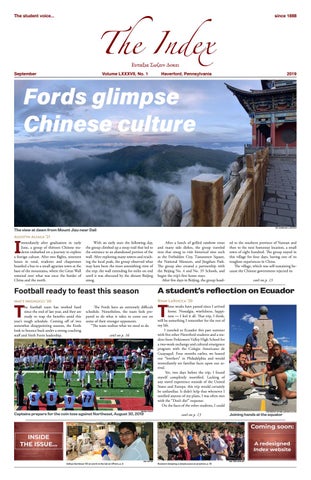
Fords glimpse Chinese culture
MS. BARBARA LAPENTA
The view at dawn from Mount Jizu near Dali Agustin Aliaga ’21
I
mmediately after graduation in early June, a group of thirteen Chinese students embarked on a journey to explore a foreign culture. After two flights, nineteen hours in total, students and chaperones boarded a bus to a small agrarian town at the base of the mountains, where the Great Wall towered over what was once the border of China and the north.
With an early start the following day, the group climbed up a steep trail that led to the entrance to an abandoned portion of the wall. After exploring many towers and reaching the local peak, the group observed what may have been the most astonishing view of the trip: the wall extending for miles on end until it was obscured by the distant Beijing smog.
After a lunch of grilled rainbow trout and many side dishes, the group traveled into that smog to visit historical sites such as the Forbidden City, Tiananmen Square, the National Museum, and Jingshan Park. The group also created a partnership with the Beijing No. 4 and No. 35 Schools, and began the trip’s first home stays. After five days in Beijing, the group head-
ed to the southern province of Yunnan and then to the next homestay location, a small town of eight hundred. The group stayed in this village for four days, having one of its toughest experiences in China. The village, which was self-sustaining because the Chinese government rejected its con’t on p. 13
Football ready to feast this season
A student’s reflection on Ecuador
Matt Mignucci ’20
Ryan LaRocca ’20
T
he football team has worked hard since the end of last year, and they are ready to reap the benefits amid this year’s tough schedule. Coming off of two somewhat disappointing seasons, the Fords look to bounce back under a strong coaching staff and Sixth Form leadership.
The Fords have an extremely difficult schedule. Nonetheless, the team feels prepared to do what it takes to come out on some of their stronger opponents. “The team realizes what we need to do con’t on p. 16
INDEX STAFF
Captains prepare for the coin toss against Northeast, August 30, 2019
Aditya Sardesai ’20 at work in his lab at UPenn, p. 4
DR. XIN BI
T
hree weeks have passed since I arrived home. Nostalgia, wistfulness, happiness — I feel it all. That trip, I think, will be something I remember for the rest of my life. I traveled to Ecuador this past summer with five other Haverford students and a student from Perkiomen Valley High School for a two-week exchange and cultural emergence program with the Colegio Americano de Guayaquil. Four months earlier, we hosted our “brothers” in Philadelphia and would immediately see familiar faces upon our arrival. Yet, two days before the trip, I found myself completely mortified. Lacking of any travel experience outside of the United States and Europe, this trip would certainly be unfamiliar. It didn’t help that whenever I notified anyone of my plans, I was often met with the “Don’t die!” response. On the faces of the other students, I could con’t on p. 13
Runners keeping a steady pace at practice, p. 16
COURTESY OF MR. JAVIER LLUCH
Joining hands at the equator
MR. TIM LENGEL
Page 2
The Index’s
The Index
- Editorial
September 2019
2019–2020 Staff Yan Graf ’20 Editor-in-Chief Ryan LaRocca ’20 Editor-in-Chief Toby Ma ’20 Editor-in-Chief Daniel Chow ’20 Managing Editor Matthew Schwartz ’21 Managing Editor Tyler Zimmer ’21 Managing Editor Obaida Elamin ’20 Design Editor Quinn Luong ’22 News Editor Jeffrey Yang ’22 News Editor Matt Mignucci ’20 Features Editor
Class of 2020 takes the torch
2
018-2019. A school year besmirched by racial tension and disciplinary incidents, which unfortunately highlighted ineffective student leadership. During some of Haverford’s most sensitive times since the so-called “Main-Line Takeover,” the leadership did not prevail. And despite some efforts by the Class of 2019, these problems were not sufficiently addressed. The 2019-2020 school year presents this year’s student body with an opportunity for redemption. Long said to be “one big group of friends,” the Class of 2020 enters the school year as this year’s agents of change.
And ready they are. With all eyes in their direction, the Class of 2020 must set an inclusive tone for the younger Fords. Mistakes and incidents are inevitable — but it is how a community deals with these challenges that allows it to heal and to grow. Rather than turning a blind eye, addressing issues head-on is the only way to produce this kind of growth. Effective leadership can surely limit the number of setbacks our community faces. Serving as supportive pillars for the rest of the community, the Class of 2020’s job is to promote acceptance and encourage camaraderie.
Haverford is a community of brothers. We must love each other for who we are, and learn to respect one another’s differences. The Class of 2020 must work to produce this camaraderie, as it will surely trickle to the younger members of the community. With Vincent Scuazzo as our captain, accompanied by one of the most responsible classes of Sixth Formers in recent history, we will undoubtedly progress. This community of acceptance is not only possible. It’s our goal.
Agustin Aliaga ’21 Academics Editor Vincent Scauzzo ’20 Neighborhood Editor Cole Stecker ’20 Campus Opinions Editor Jon Krouse ’20 Off-Campus Opinions Editor James Wang ’21 Off-Campus Opinions Editor Jake LaRocca ’22 Sports Editor Mitav Nayak ’22 Sports Editor Ryan Rodack ’22 Arts Editor Sebastian Bilash ’20 Staff Photographer Ms. Emily Harnett Faculty Advisor Mr. Thomas Stambaugh Faculty Advisor
The Index is a student-run publication of the Haverford School that does more than bring news: it provides the diverse perspectives of the Haverford student body. It is an outlet for student writers to take stands on issues they deem important. It chronicles the daily struggles and accomplishments of the Haverford community. The Index also provides a forum for discussion of pertinent issues, such as student culture, academic policy, and Haverford’s place in world affairs. The Index presents new ideas and aspires to influence constructive change. All opinions and viewpoints expressed herein do not necessarily reflect those of The Index or the school. The Index is designed and produced digitally. Photographs may be retouched. Submissions and letters to the editors regarding any and all articles are welcomed at index@haverford.org. The Index, a member of the Columbia Scholastic Press Association, is composed using the applications of Google Suite and Adobe Creative Cloud. Its surveys are conducted via SurveyMonkey and are advertised on Facebook to current Haverford students. Graphic designs are created by Index staff via Canva. Southern Dutchess News prints 200-400 copies of each issue, and its editorial staff distributes them in the Upper School on the day of release. The Index serves the needs of a total school population of 1152 community members, consisting of 952 students and 200 faculty and staff members. Contact The Index: 450 Lancaster Ave, Haverford, PA 19041 index@haverford.org Twitter: @Haverford_Index Volume LXXXVII, No. 1 - September 4, 2019
INDEX STAFF
The 2019-20 Editorial Board (left to right): Editor-in-Chief Ryan LaRocca ’20, Managing Editor Tyler Zimmer ’21, Editor-in-Chief Toby Ma ’20, Managing Editor Daniel Chow ’20, Editor-in-Chief Yan Graf ’20. Missing: Managing Editor Matthew Schwartz ’21 and Design Editor Obaida Elamin ’20
Letter from the student body president Vincent Scauzzo ’20
G
entlemen! It is my pleasure to welcome you back to school this week. I hope you’ve had a relaxing summer and are ready to hit the ground running in your classes. After meeting with Dr. Nagl and my fellow Sixth Form leaders over the summer, I am confident that this year will be one to remember. You will see more student leadership than ever before. Expect an example from the upperclassmen, who shall try to emulate the virtues etched into our walls. I will be visible this year, providing you with speeches and discussions about the school’s challenges and triumphs. When the leaders of the Sixth Form gathered in late August, we talked about goals for the year. One of the primary goals was integration and engagement between all the grades. Not only in the upper school, but also in the lower and middle schools; we hope to have a stronger presence of upperclassmen, thereby unifying Haverford into the brotherhood it aspires to be. In return, I hope to see great things from all of you. I expect participation in clubs, arts, and sports by every member of the student body. This school provides you with
INDEX STAFF
Student body president Vincent Scauzzo ’20 so many opportunities. It would be a shame I'll explain this more in my speech to the to pass them by. Upper School on Monday, September 9, Our virtue this year is compassion. We but until then, enjoy meeting new people want students to act with genuine care for and teachers. And remember: EA must be other people, seeking to better each other defeated. and by doing do so, bettering themselves.
Page 3
The Index
- news
STEM crafting creative curricula COURTESY OF MR. JUSTIN GAUDREAU
Mr. Justin Gaudreau’s Algebra II class made popsicle stick catapults as part of the project-based learning pilot last year Jeffrey Yang ’22
I
n the past year, some students have noticed a sizeable increase in projectbased assignments from teachers. This change is not a result of teacherly whim, but rather a strategic move to incorporate more project-based learning (PBL) into the curriculum. These past two summers, Mr. Nathan Bridge, Mr. Justin Gaudreau, Dr. Daniel Goduti, and Ms. Taylor Smith-Kan participated in the Penn Graduate School of Education’s Project-Based Learning Certificate program. Over the course of one week on Penn’s campus in August 2018, virtual, videobased, instructional coaching throughout the 2018-19 academic year, as well as a final week back on campus this past summer, Haverford faculty engaged with groups of other professionals of all backgrounds. During their days on campus, teachers collaborated with other members of their cohort, who were randomly selected and ranged in background. “It was so much fun because we were treated like students who would engage in a project,” Mr. Bridge said. For example, they built towers using marshmallows and spaghetti, dropped eggs off of balconies, and simulated being stranded on a desert. “All of these activities were designed to get us thinking about the different aspects of project-based learning,” Mr. Bridge said. The four aspects are as follows: authenticity, which is about creating an authentic learning experience; collaboration, focused on how group members work together; disciplinary practice, about how the project reflects the area of study; and iteration, revolving around how students are able to improve upon their project in multiple attempts. One of Mr. Bridge’s favorite projects, where they discussed whether plastic straws should be banned, highlighted each facet of PBL and even presented the differences of opinions stemming from each participant’s background. Mr. Gaudreau said, “You had teachers from different disciplines with different outlooks. My group had an environmental scientist, and you could see where her perspective came from. But you also had people who
were like, ‘Why is this a big deal?’” The environmental scientist used her knowledge to argue her point; a chemist could have brought up the properties of plastic that makes it difficult to decompose; a biologist could have talked about how plastic straws would affect animals living in polluted habitats. All of these exemplify some sort of disciplinary practice. However, debating the question also required collaboration, as the goal was to reach a final group decision after considering all the different perspectives. “Everyone had an opinion, but it was how we came together and collaborated as strangers to solve the task,” Mr. Gaudreau said. The implementation of PBL in the curriculum is a significant change for these teachers, primarily a change in focus. The shift in teaching technique may create a more effective learning experience. Mr. Gaudreau says he focuses now the question, “How can I get my students to climb the ladder, to draw the conclusion, as opposed to me giving them the conclusion? Instead of me giving them an equation, how can I allow them to work with each other, use their strengths and their weaknesses, their collaboration skills, as well as previous knowledge to get to the point where they’re drawing the conclusion when I could have just said, ‘Here’s what you need to know for Friday’? There’s more value in the process the students are going through to draw their own conclusions than for us, as teachers, to stand and just deliver content.” PBL does come with its challenges. For one thing, the faculty found some students dismissive and unenthusiastic about the change because of the lack of strict guidelines, set path, or definite answer. “A lot of times, the answers that come out of these learning experiences is not a right or wrong answer, it’s an argument, it’s a perspective, it’s open ended,” Mr. Bridge said. “You can’t go to the back of the book to check what the answer is, there is no right answer. It really was about constructing an argument to try to make a case for how to solve the situation. There was a general discomfort from the students when they realized, ‘I’m going to be graded for this, but
how? It’s not a formal test; it’s not a formal quiz. How are you going to give me a grade on it, and why is your grade valid?’ It feels uncomfortable because it is brand new.” As a result, when the four teachers piloted PBL last year, they made “buy-ins.” In building the rubric, they made sure that students were involved in the process to understand how and why they were being graded in such ways. In addition, students may find it difficult at first to collaborate effectively by balancing and sharing ideas, listening to others, and creating a space where everyone speaks. For Mr. Bridge, he found that the hardest part of some projects was giving other members in his cohort speaking time. “I knew that their ideas can contribute
September 2019
to a better overall project for us,” Mr. Bridge said. When the teachers implemented projects into their curricula, they both found that students grew keen. Teachers have found that there is more student buy-in to the information, and it is more powerful, fun, and interesting for the students. Moving forward, both Mr. Bridge and Mr. Gaudreau expressed a deep interest in continuing PBL in their courses after the pilot year. They said that the degree to which project-based learning will be incorporated depends on students’ needs. “In many classrooms, I don’t think it’s the teachers driving the train, and all the students are aboard it. I think it’s really a collaboration between the two when a class achieves its maximum objective,” Mr. Bridge said. In addition, the change will not be a “zero to one-hundred” shift. The traditional educational technique has its time-tested values, whether it be repetition and direct teaching that build a foundation for the material, or tests and quizzes that serve as data points. That foundation can then be used in an applied process through a project. Teachers are working to find the balance between the two that develop the most effective means of learning. As Mr. Gaudreau said, “It’s really a question of learning. How can we best let the students learn the material in addition to learning from us.” To see the change to PBL throughout the community will probably be a greater, longterm shift. “Teachers get comfortable with the way they have been teaching,” Mr. Gaudreau said, “and if you research education from a few centuries ago, you can see that things have changed. These changes, in the beginning, may not have been well-received, but gradually people realized that there is value in them.”
TYLER ZIMMER ’21
Yan Graf ’20 perusing some posters based on project-based learning
Page 4
The Index
- News
Fords dip into collegiate research
September 2019
Yan Graf ’20
W
hile some of us spent the summer at the beach, traveling the four corners of the globe, or playing sports, five Sixth Formers were pushing the boundaries of human knowledge. Sixth Formers Toby Ma, Alexander Greer, Daniel Chow, Aditya Sardesai, and Jack Ballenger are all part of the Advanced Lab Research Program—led by Biology teacher Mrs. Kara Cleffi—which exposes students to a professional lab environment over the summer, where they can work with real scientists. Ma, Sardesai, and Ballenger worked in labs at the University of Pennsylvania, while Greer researched at MIT and Chow assisted researchers at the Children’s Hospital of Philadelphia (CHOP). Ma and Sardesai were both in the Rader Lab at the Perelman School of Medicine at UPenn, where they worked on gene therapy methods and learned about the ways proteins worked in the body and affected bodily functions.
“To be doing research at a really forward-thinking institution like Penn, and some of the top labs, which Haverford has connections with, is a really good opportunity to experience research at a really high level” “I got to work under a mentor who was investigating a protein that helps regulate cholesterol levels,” Ma said. Sardesai, who worked on similar proteins, said that this research allows scientists “to better understand the chemical pathways that may let [them] determine someone’s risk for heart disease and increased cholesterol levels, allowing [them] to develop better treatments.” Across the street, Chow participated in
the Akizu Lab at the CHOP Research Institute, which specializes in studying earlyonset brain diseases that occur in children. Meanwhile, Ballenger worked in the Wilson Lab, which focused on AAV gene therapy, a process that involves using viruses to replace DNA sequences and cure certain genetic diseases. While the other four were working on projects closer to home, Greer labored at MIT in the lab of Dr. Ellen Roche. Unlike his peers, who worked primarily on biology and physiological research, Greer spent his summer continuing his work in the Soft Robotics Club at Haverford by developing new biocompatible soft robots for use in physical therapy and drug delivery. Greer was surprised to learn how the work the Soft Robotics Club weighs against the research being done at MIT. “What Haverford has been doing with soft robotics has been at a comparable level [to MIT],” Greer said, “and the field shows a lot of promise for innovation from high schoolers.” The students all said they had learned a great deal about the scientific fields that they had studied in school. However, it seems that the students learned more about working in a professional lab environment than the science itself. Ballenger said, “I learned a lot about the time and effort required for research and discovered that there are often setbacks in the lab.” “I learned a lot about how professional lab research is conducted, and what lab researchers do every day,” Ma said. Now that the summer has drawn to a close, the students will be shifting their focus from their labs to summarizing their results in a research paper that they will write over the fall and present early next year. Once this year’s group is off to college, their work will be hung up on the first-floor wall near the science classrooms, next to the work of their predecessors. All five of the participants highly recom-
Aditya Sardesai ’20 at work in his lab at UPenn mend the program, which is open to all Fifth Formers, who should contact biology teacher Mrs. Cleffi if they are interested. “To be doing research at a really forwardthinking institution like Penn, and some of the top labs, which Haverford has connections with, is a really good opportunity to
DR. XIN BI
experience research at a really high level,” Sardesai said. Chow said, “For any [Fifth Formers] passionate about anything STEM related, I highly recommend the program.”
Crossing the Bridge to Haverford Matt Mignucci ’20 & Jeffrey Yang ’22
A
MS. SARAH LEONARD
Ms. Heather Stinson (right) with new Third Formers during the Bridge Program, July 7–11, 2019
lthough not many students know about it, every summer Mr. Fifer and a group of teachers host an orientation program called Bridge, which welcomes all of the new incoming Third Formers. For one week, new Third Formers come to Haverford to meet each other and participate in a multitude of activities. The goal of the Bridge Program is to bring together the new students before the first day of classes to familiarize them with Haverford and with each other so they already have some friends on the first day of high school. On the first day of the program last year, Fourth Former Mitav Nayak said that there was minimal awkwardness. “The staff did a very good job making everyone feel comfortable. We were all new and didn’t really know much,” Nayak said. At the Bridge Program, the students engage in icebreakers with each other and meet with Haverford staff and upperclassmen to speak about their experiences at Haverford, preparing them for their upcoming high school experience. The introduction included speeches from Dr. Nagl, Mr. Andrén, and the leaders of the Honor Council, which helped the incoming Third Formers get a better understanding of the school culture. “That way when you go into the first day of school, you already have a feel for the en-
vironment,” Nayak said. Later in the week, new ninth-graders from Agnes Irwin joined the boys to get to know each other and work together on fun games and challenges. The most valuable part of the Bridge Program was the opportunity to make friendships.
“[The program is] a fond experience that I look back on with those people I met.” One incoming Third Former, Brendan Leary, thought that the Bridge Program “helped me transition into Haverford because of the faculty, staff, and students who were very kind and welcoming to the Haverford community, as well as meeting new people who I hope will become my close friends throughout high school.” A few years after Sixth Former Yan Graf participated in the program, he said that “the Bridge program really made me feel more secure when I first joined in ninth grade. It’s a fond experience that I look back on with those people I met. For the new freshmen, it’s a common experience, and even somewhat exclusive because not many people know about it.”
Page 5
The Index
- Features
September 2019
Mr. Leech adds to the chemistry equation Mitav Nayak ’22
M
r. Will Leech’s journey began far away from Haverford, in the United Kingdom. Before heading off to university, he took a gap year to do youth work in schools, where he discovered a deep, genuine passion for teaching. Now, he is excited to share his knowledge of chemistry with the student body. After graduating from university with a degree in chemistry and working as a youth pastor for a church in the UK, Mr. Leech decided to explore teaching as a profession. “I think I knew for a long time that I was probably going to be a teacher,” Mr. Leech said. “I really wanted to use my chemistry degree, but I still really wanted to work with young people. If you take a love for chemistry and a passion for working with young people and put the two together, you end up with teaching.” For about four years, Mr. Leech taught in a variety of schools in several areas across the UK, including Brighton, York, Harrogate, and Newcastle. “I taught in lots of different locations,” Mr. Leech said. “Some were city-center schools and some very rural schools; there were lots of challenges associated with that.” Mr. Leech moved to the U.S. with his wife in January. He is thankful for the support he has received from Haverford as he adjusted. “Haverford was really welcoming and accommodating of my needs,” Mr. Leech said. “I’m coming into this with no experience of the American education system, and yet
Mr. Will Leech they’ve been so welcoming. Just even terminology. I didn’t understand what a sophomore is; I had no idea how old a sophomore student is. They’ve really guided me through that and that’s been a really big difference.” Mr. Leech is excited to embrace new chal-
INDEX STAFF
lenges. “I’m really looking forward to working at Haverford,” Mr. Leech said. “I’ve actually never worked in a private school. I’ve never worked in an all-boys school. So there are lots of really new exciting challenges for me.
It is going to be hard to adjust but I’m really looking forward to the challenge.” This year, Mr. Leech will teach both standard and Honors Chemistry, working closely with science teacher Mr. Chris DiBello. “Honors Chemistry has obviously been Mr. Trocano’s thing for a long time,” Mr. Leech said. “We want to carry on as much of the challenge that comes with it. We know Honors Chemistry has a reputation for being a very hard course, and we’re not going to shy away from that, but you might see some changes, which might be quite exciting. And then with standard chemistry, we want to continue to develop and grow that as time goes on.” Mr. Leech sees chemistry as the perfect middle ground between biology and physics. “It tells you about the building blocks of the universe,” Mr. Leech said. “It’s a real cliché phrase that I use all the time, but it really does. If you want to think about how things work you need to go down to the atomic level. Then, once you understand that, you can build up.” In addition to teaching, Mr. Leech will lead a Third Form advisory. “I’m looking forward to getting to know [my advisory], to supporting them and helping them whenever I possibly can. I think that the community aspect makes such a big difference. I think I’ve been really welcomed by the staff. Now, I’m looking forward to meeting with the students.”
Teachers prepare for Virture Villagers Quinn Luong ’22
C
urrently undergoing construction, the new Middle School will replace Crosman Hall to reflect a 21st-century learning environment. This year, middle schoolers are housed in temporary classrooms called “Virtue Village,” a brand-new modular space located on the tennis courts. It is similar to Crosman Hall but has even more security: more cameras, updated fire prevention systems, and keycard access. Virtue Village consists of two buildings: Respect and Courage. The sixth grade and Form I will occupy Building Respect while Form II will reside in Building Courage. Celebrating the beginning of the new school year, Virtue Village welcomed many parents in a ribbon-cutting ceremony and open house. Faculty and staff settled into their classrooms throughout August and are adjusting to the modern environment. “I love [Virtue Village]. I think there is great energy and light in them. They are a lot bigger than my expectations, so I think it will provide a great space for our boys to learn and grow this year,” said language teacher Mrs. Kerry Kettering-Goens. The middle school faculty and staff showed their overwhelming approval of Virtue Village as they adapted to their new classrooms.
“I think I am still going to be able to implement a lot of things the same way I did before. Because we’re all together in this tightly knit space, I will try to make it fun for the students too. We will try to get out of the space occasionally, so we don’t feel a bit claustrophobic. I’m assured it will not take too much adapting,” history teacher Mrs. Kori Brown said. Although it seems that the logistics have not changed dramatically, the question of how students will adapt to Virtue Village remains. Middle schoolers will have a short commute to arrive to art, theater, and music in Centennial Hall, but all other classes will happen in Virtue Village. Still, some faculty are hesitant about the students’ adaptability to Virtue Village. “I think the students are going to find it a bit tougher because it’s going to be close quarters. Instead of using lockers, they will have to utilize cubbies. We’re going to have hooks for them to hang up their belongings, but they won’t have the same space like Crosman Hall,” Mrs. Brown said. The classrooms in Virtue Village are new and beautiful, though. Many teachers highlighted the efficiency that the village brings, especially for the Second Formers that will not have to travel through the outdated basement of Crosman Hall.
Mrs. Kori Brown’s room in MS “Virtue Village”
QUINN LUONG ’22
An exterior view of Virtue Village, from Alumni Walk
QUINN LUONG ’22
Page 6
The legend of LIGGY1
The Index
- Features
September 2019
Vincent Scauzzo ’20
T
ypically, teachers’ cars are not what you would call interesting. A Subaru Forester here, a Volkswagen Passat there — not much in the way of diversity or excitement. The Haverford School is an exception. There are many cars that inspire a double take — some that you might even want to drive yourself. But in the back of the Lower School parking lot, behind the sea of traditional sedans and SUVs, there is a splash of color, a tinge of uniqueness, and the most famous license plate on campus: LIGGY1. Over the years, many interesting rides have had the custom plate mounted to their tailgates, most notably a cherry-red Smart Car. Kids are enamored with the car’s tiny footprint and desk chair-sized wheels, which are known throughout the school. Today, the car holding the famous sixcharacter plate is a 2016 Fiat 500X: a little bit of Italian flair to spice up the parking lot. For students who attended Lower School, that license plate is synonymous with cursive handwriting, five-paragraph essays, and Where the Red Fern Grows. This car belongs to none other than fifth grade English teacher Mr. Joseph Lignore. He always tries to help others, whether in the classroom or in his town, and driving a fun car that students and pedestrians can point to makes himself and those around him smile.
Flyers Orange with dark brown leather seats, it was perfect for a diehard Philly sports fan. Needing more room than was available in his little cherry bomb, Mr. Lignore decided to upsize to a Fiat. When starting with a Smart Car, anything is bigger. Having decided on the quasi-cross over Cinquecento, Mr. Lignore went to the Philadelphia Auto Show
VINCENT SCAUZZO ’20
Mr. Lignore and the new Liggy, a 2016 Fiat 500X to test it out. There he met his dream car. ment bring the fun inside, and the espresso Flyers Orange with dark brown leather seats, seats provide apt comfort needed to tootle it was perfect for a diehard Philly sports fan. around town. He pictured in his mind the black-and-white What I have learned from my time with pin stripe going down the beltline, ending at the car and Mr. Lignore is that it is not for a small Flyers logo on the rear quarter panel. driving like your hair’s on fire. The Fiat This was the one. wants you to enjoy your time in its cabin. Before it had gotten back on the dealer’s The 9-speed transmission is smooth cruising floor from the show, Mr. Lignore had bought along, but having the driver stomp on the the Fiat, and it was quite the step up. With throttle and force the ‘box down a few gears four doors, a higher ride height, and an all- is not the little car’s favorite activity. This wheel drive, this version of the Fiat 500 is reluctance to bolt could be more related to quite the departure from the usual lineup of the engine, which is very European in its size small, economical city car. The cabin is airy, and power. with good visibility out of the front, and it While this might be classified as a Crosshas lots of nice design touches in the interior. over or CUV, the Fiat is still compact, and The body-colored dash and glove compart- its light, easy steering reminds you that it has
city-car roots. Sure, it shares a lot of parts with the Jeep Renegade, but the Fiat is more accustomed to the road and handles better than its FCA sibling. Feedback from the pedals and steering wheel is commendable, and the suspension takes bumps nicely. Now you might be thinking: How could this Fiat, a car from a company infamous for its unreliability, possibly be easy to live with? Well, according to Mr. Lignore, who has owned this car since it was new, the only thing he has put in it is oil. Everything runs smoothly: it feels like it just came off the big ship from Italy. Mr. Lignore points out that he meticulously cleans his engine and takes great care of the bodywork, waxing on and off frequently. He takes pride in his work, and rightly so. Most people will tell you that you should not buy a Fiat. Consumer Reports trashes them, consistently giving them poor ratings based on their own tests and owner reviews. Honestly, I don’t know where it comes from. When one buys a car, one must remember the purpose of the car. Does it go fast? Does it hold a lot of cargo? Is it fuel efficient? The Fiat has a very specific job for a very specific person: it is for fun. Driving around with Mr. Lignore, you get the sense that he really loves his car. He talks passionately about it as though it were some kind of collectible. This car, then, suits Mr. Lignore perfectly. Not only can you tell by the car he drives that he is a happy spirit, but the amount of care he puts into his car is matched by the amount of care he puts into his work in the classroom. Driving a car like this brings attention, but it’s good attention. It puts a face to a name. Now whenever people see a bright orange Fiat go by, they’ll say, “Hey, it’s LIGGY1!”
Ms. Harnett offers literary experience and passion to the English department Chair Mr. Tom Stambaugh explained that before ModPo, many educators thought that this style of learning would not be possible in the humanities, especially for areas like poetry. Ms. Harnett’s literary experience and passion extends beyond teaching. In May of this year, Ms. Harnett wrote an article for The New Yorker about Doris Lessing’s 1988 novel The Fifth Child. Her combined experience of writing for a renowned magazine and analyzing literature at a high level should add to Haverford’s literary community. Her favorite novel is Leo Tolstoy’s Anna Karenina. She believes that every line has a philosophical meaning, and that while the author had none of the same concerns or cares as many of his readers, there is still a deep connection with them.
INDEX STAFF
Ms. Emily Harnett Matt Mignucci ’20 & Agustin Aliaga ’21
M
s. Emily Harnett joins the English Department to teach English II and III along with advising The
Index. Before joining Haverford, Ms. Harnett, who holds a bachelor’s degree from Penn and a masters from Yale, was a ninth and twelfth grade English teacher at Friends Central. “I’m from the Philadelphia area and love living where I do in West Philly, so I wanted
to continue teaching at a great school in this area,” Ms. Harnett said. “I know Haverford has great academics, and an amazing student newspaper and literary magazine, so I was excited to be offered a position at a school with a strong extracurricular literary culture.” Starting off her new journey at Haverford, Ms. Harnett is most excited to “meet the new kids, of course — the students I met during my interview were all amazingly
smart and fun to talk to, and I’m sure the rest of the student body is just as great.” Ms. Harnett’s passion for teaching is expansive, as she contributed to a revolutionary online English course called ModPo, or Modern and Contemporary Poetry, offered by Penn’s Kelly Writers House, as a teaching assistant for eight years. In this role, she helped expand the horizons of online learning in the humanities. English Department
Her combined experience of writing for a renowned magazine and analyzing literature at a high level should add to Haverford’s literary community. “Ms. Harnett brings to our department a passion for literature and an impressive academic background,” Mr. Stambaugh said. “Early on, we hope that she can help complement our current curricula with some contemporary poetry, one of her many areas of expertise. We find her early in a promising teaching career, so we hope she finds Haverford a happy intellectual home.”
Page 7
The Index
- Features
September 2019
Ms. Brown adds photography, digital skills to art department Jeffrey Yang ’22
W
alking past the art facilities, you may find Ms. Kristin Brown tinkering behind the 3-D printer. A Long Island native, Ms. Brown joins the art department, teaching Visual Arts Foundations and Digital Art I and II. She will also advise The Haligoluk. Although Ms. Brown grew up in a family without artists, she was always experimenting and tinkering around. She spent this past summer fiddling with a 3-D printer. Though she broke it in a few instances, she is proud that she has been able to fix it each time. Her love of photography, both analog and digital, also came out of exploration. As an undergrad studying photographic illustration at the Rochester Institute of Technology, she loved processing film in the darkroom, discovering digital photography, and working in Photoshop.
“I want to have a classroom where there is no such thing as a wrong answer” Ms. Brown also has an interest in printmaking and the process of setting up different type fonts on her tabletop letterpress. Her passion for teaching comes straight from her love of art. “To be able to share that passion and inspire students to problem solve really keeps me going,” Ms. Brown said. “I get paid to make art every day, and I get paid to hang out with students who make art, and talk with them, see where they go, and see them problem solve. It’s just fun.” Growing up, Ms. Brown remembers both
of her high school photography teachers as greatly influential. During that time, her dream job was to be a photographer for National Geographic and travel the world taking photos. However, at her first job working at a magazine in New York, she realized that her dream job did not really exist anymore. “It was interesting to see how the photography world was changing, right when digital [photography] started,” Ms. Brown said. Ms. Brown wants to create a classroom setting where students are free to tinker around and not be constricted by avoiding doing something wrong. “I want to have a classroom where there is no such thing as a wrong answer, where students can continually explore and try new things,” Ms. Brown said. When visiting, one of the factors that drew her to the school was the amount of student engagement in the classroom. “I was so impressed at how thoughtful the students were with their art projects and pushing themselves and learning new things,” Ms. Brown said. Outside of art, Ms. Brown loves backpacking and traveling. “I’ve backpacked different sections of the Appalachian Trail,” Ms. Brown said. “I used to teach outdoor education. I really like hiking the Wissahickon, which is local, and on the weekends going to some other places.” Her favorite place she has ever visited is Guatemala, because of the adventures she had there and because “the people there are the happiest people on the planet.”
Ms. Kristin Brown
COURTESY OF MS. KRISTEN BROWN
Ms. Sides brings real-world design experience to the Design and Engineering Studio Matthew Schwartz ’21
W
Ms. Jill Sides joins the woodworking program this year
INDEX STAFF
From working on geometric domes to building Christmas trees out of reclaimed pallet wood, the newest addition to the art department, Ms. Jill Sides, arrives with a unique backstory that she hopes will give the students in her Woodworking I and II classes the best experience possible. Born and raised about thirty minutes away from Haverford in Alden, Pennsylvania, Ms. Sides attended the Savannah College of Art and Design, with plans of earning a degree in illustration and painting. Not far into her time there, she found that the school was not creatively stimulating and shifted her ambitions to the third dimension. “Someone at the time suggested I take one of the furniture classes, and so I dropped all the classes I was scheduled for, and I took one furniture class. I instantly knew,” Ms. Sides said. “I just got this feeling and I was like, ‘This is what I need to do, this is what I’m meant to do, I love this.’” By the time Ms. Sides graduated with a B.F.A. in furniture design, she noted that her classes “were pretty much all woodworking.” After earning her degree, Ms. Sides obtained a position at her alma mater, where she worked for five years before returning home to work at the Philadelphia-based company Anthropologie, owned by Urban Outfitters, whose immense catalog of items features home furniture and décor. As a display coordinator, Ms. Sides worked on many different creative projects and showcased them on a massive scale. Some of the items she worked on during her eight years at the company were a twentyfoot-high geometric dome made of aluminum pipes and covered in hard canvas and some large platforms used at the Devon
Horse Show. Ms. Sides is excited to use her experience in college and at Anthropologie to help in the classroom. “I’ve done a good cross mix of things and I’m excited to be able to bring that into a school setting,” Ms. Sides said. Although being a mother of both an eleven-year old and a five-year old has given her plenty of teaching opportunities at home, Ms. Sides did not plan on moving into academics. “I have a five-year old who is starting [at Haverford] in kindergarten, and I was there for a new-parent reception and kind of wandered off at one point to find the woodshop and afterward told the school how impressed I was with it, and then one thing led to another,” Ms. Sides said. “Coming into it too from a parent side and faculty side was a little scary at first because I thought, ‘Oh, am I going to see things behind the scenes I don’t want to know about?’ but I’ve been really impressed seeing the school from both angles.” Finally, Ms. Sides cannot wait to begin working with the students not only on their artwork, but also on being able to explain and understand what it is they are creating. “[The art department is] starting to bring in more of a discussion about the artwork and the pieces as well as the process, which is something that we focused on a lot when I was in school, so I’m eager to bring my experience of that and talking about it and the creative process and walking kids through that verbal part of it,” Ms. Sides said. “I’m excited to get started, to work with [Mr. Greg] Ressler and Mr. [Mark] Thorburn, I really feel like I’m in a great department there, and I’m grateful and thankful for that as well.”
Page 8 & 9
Obaida Elamin ’20
A
s finals week came to a close, fifteen Haverford students let out a collective sigh of relief and began to pack their bags in anticipation for the coming week and a half away from home. The group would travel with three other schools through four major cities in Morocco. Arriving half asleep after the long-haul flight to Casablanca, we were barely awake when we arrived at Mohammed V International Airport. The ocean breeze was a welcome sensation after leaving the stuffy, cramped plane and waiting to pick up our bags. We stayed in Casablanca for less than a day, going first to the 690-foot tall white marble Hassan the Second Mosque, named for the late king of Morocco. It sat perched atop a foundation peering over the Atlantic coast. We spent most of our time touring Rabat, Fez, and Marrakesh, where we learned a lot about the blend of peoples and traditions that make up Moroccan culture, food, and Rocky beach and the Atlantic ocean in front of Hassan II Mosque in Casablanca
Visions of Morocco Sunset from restaurant balcony in Marrakesh
Hassan II mosque in Casablanca
OBAIDA ELAMIN ’20
Panoramic view of the city of Fez
The I
Index
- Features
language. While beautiful, this blend is the root of some of their social and economic problems. After several classes at a cultural learning center in Rabat learning about these challenges, we split up into groups to develop hypothetical plans to correct some of the systems that take advantage of the land and indigenous people of Morocco. The rest of the time we toured the landscapes of Morocco: sightseeing in the Atlas mountains, touring the bustling marketplaces of Fez and Marrakesh, stopping at rural farms to eat one too many platters of couscous or tagine lamb. Some of the most memorable elements of our trip were the many flights of uneven steps, the gorgeous countryside, the stench of the tannery, and the scenic Atlas mountains. Most memorable were the friends we met in the few days together. We came in as strangers to each other and the country but left knowing more than we expected about our classmates and Morocco.
Palace of the ruler of Marrakesh, now a museum open to the public, covered in mosaics
Photos by Sebastian Bilash ’20
Hand-painted piece from the ancient medina of Marrakesh
September 2019
Page 10
The Index
- Features
September 2019
Ms. Surdel to complement science, robotics programs INDEX STAFF
Mrs. Alexandra Surdel in the third floor hallway Cole Stecker ’20
F
rom a talented biologist to a new mentor for the school’s world-renowned VEX robotics team, Ms. Alexandra Surdel’s expertise covers many areas. We are lucky to welcome her as a new addition to the science department. Ms. Surdel will teach physics and biology during her first year, and she will also assist coaching to the VEX team. Before Haverford, Ms. Surdel attended the University of Pennsylvania, where she majored in economics and minored in psychology. After graduating magna cum laude from Penn, she worked as an assistant buyer
at the Lord + Taylor corporate offices in New York, where she leveraged her experience in economics. “While the job had its exciting and challenging moments, I did not feel passionate about what I was doing,” Ms. Surdel said. She then moved from New York to Philadelphia to receive a masters in education. Ms. Surdel earned qualifications to become a math and science teacher during her masters experience. Her passion for learning is evident from her proficiency in an impressive range of academic fields, everything from biology to economics.
After receiving her degree, she began her teaching career as a math and science teach-
Her passion for learning is evident from her proficiency in an impressive range of academic fields, everything from biology to economics. er at Boys’ Latin of Philadelphia Charter School. She taught there for six years before
she made the decision to move to Haverford. “It has always been my belief that education is as much about content as it is about character,” Ms. Surdel said. “Haverford’s mission to prepare boys for life aligned with my philosophy for learning and teaching.” Ms. Surdel is excited to begin her Haverford career.. She values hard work and understands the grueling side of education, a sentiment clearly echoed by a favorite quotation, Thomas Edison’s: “Genius is one percent inspiration and ninety-nine percent perspiration.”
Ms. Dieckhaus joins Upper School office James Wang ’21
T
he new upper school administrative assistant Ms. Megan Dieckhaus (pronounced “deck-house”) is a dancer, interior design enthusiast, and a mother of two boys. In the upcoming year, Ms. Dieckhaus will be the one to help organize the school year for students and faculty. Ms. Dieckhaus went to DeSales University, where she studied the performing arts. She later worked at the performing arts company Grishko as director of sales. She then served as an executive assistant at eBay, which led her to pursue administrative assistance elsewhere. Recently, she worked in Malvern Prep’s admissions office.
“I had a friend I worked with at Malvern Prep who had such wonderful things to say about Haverford” “I had always heard wonderful things about Haverford, and I had a friend I worked with at Malvern Prep who had such wonderful things to say about Haverford,” Ms. Dieckhaus said. In the upcoming year, Mrs. Dieckhaus is excited to get to know all the students and faculty.
“The person before me had this position for seventeen years, so I am just looking forward to making the position my own.” “The person before me had this position for seventeen years,” Ms. Dieckhaus said, “so I am just looking forward to making the position my own.”
Ms. Megan Dieckhaus sitting at her new desk in the McBride Suite
INDEX STAFF
Page 11
The Index
- Academics
September 2019
Mr. Hart seeks connections in Contemporary International Relations this spring Mitav Nayak ’22
“N
othing happens in a silo.” Through the new Contemporary International Relations course, history teacher Mr. Jeremy Hart hopes to demonstrate this axiom by examining various events in recent history. The class will study interactions between countries, states, and non-state actors. Students will focus on how these interactions have evolved since World War II. While many people see major events as singular, Mr. Hart view them as “culmination[s] of many other moments throughout history.”
“For modern world history and international relations — outside of what the U.S. does — there’s so much rich culture and so many characters in history that have all led up to how the dominoes have fallen.” For example, he explains that the Cuban Missile Crisis has intricacies that are often overlooked. “If you look at [the Cuban Missile Crisis] just as a moment, you’re going to lose a lot of the interesting nuances of the people involved, of the event itself, and why the outcome was what it was,” Mr. Hart said. “You can miss what the outcome could have been, like nuclear war. You can kind of lose some of the storytelling.” As students look at events, Mr. Hart
hopes they understand that “often times there are tons of ways to view a situation, even in today’s world.” “You can talk about how after 9/11, President Bush 43 went into the Middle East and Afghanistan,” Mr. Hart said. “You can look at that in a silo, but also understand that Bush 41 had Desert Storm. He had his own relations with Saddam. You can also look at how the CIA had some say on what happened in the Middle East and go even further back. You see how all those things just kind of layer on top of each other.” Mr. Hart plans to integrate simulation into the course to allow students to gain an even deeper understanding. Introduced to the program when he was in college, Mr. Hart is excited to bring it to Haverford. “It’s this program where everyone is sorted into countries,” said Mr. Hart. “It’s a turnby-turn, week-by-week evolution of this world. As it develops, the world brings up interesting international relations points, like resources, geography, and trading. Through the computer ‘game,’ you can see how these issues might come up and relate them [to current events].” Mr. Hart described the program as “one of the highlights of my college career,” and he hopes Sixth Formers will find it as engaging this spring. The class also allows Mr. Hart to follow his own interests. “My passion is looking at global events, keeping up with current events, and understanding that not everything happens in and of itself,” Mr. Hart said. “For modern
INDEX STAFF
Mr. Hart will teach the new Contemporary International Relations class world history and international relations — to it,” Mr. Hart said. “I hope the guys come outside of what the U.S. does — there’s so out of the class with the ability to kind of much rich culture and so many characters in see that and see the bigger picture and then history that have all led up to how the domi- make their judgments on it, which is fine. noes have fallen.” We’re all entitled to that, but making sure Overall, Mr. Hart would like students to that it’s not just taking what someone else see how events are connected and look close- says at face value.” ly at characters who “you miss if you look at After taking Contemporary International the event from the Wikipedia point of view,” Relations, Mr. Hart said, Sixth Formers Mr. Hart said. should be able to “think critically on some “I want students to be able to say: ‘Hey, of the major events of our time as they go this event that happened that’s breaking forward to college and beyond.” news on the news networks . . . the story that they are telling, there are fifteen other layers
Standardized testing — the ACT is up
A student bubbles in his answers for an SAT practice test
DANIEL CHOW ’20
Toby Ma ’20
E
ach year, millions of high school students across the world spend long and stressful hours poring over thicklybound tomes and answering question after question for practice. Then comes the anxiety of test day, the opening of crisp test booklets and answer sheets with rows of
empty bubbles, sitting down and staring at the abstruse questions. For many, taking the SAT or ACT is an unpleasant experience, but is it even necessary? Although different tests, both the SAT and ACT aim to assess the same thing. The SAT—which does not actually stand for any-
thing—is a test given by the College Board, a non-profit organization that also gives the SAT Subject Tests and AP tests. While the SAT Subject Tests and AP tests are intended to assess students’ proficiency in specific academic topics, the SAT “is more focused on the skills and knowledge at the heart of education,” according to the College Board website. The test includes a reading test, which assesses students’ reading comprehension; a writing and language test, which involves finding and correcting grammatical mistakes and improving the clarity of a passage; a math test; and an optional essay. These tests are used to determine, in the words of the College Board, “[w]hat you learn in high school” and “[w]hat you need to succeed in college. The ACT—which also does not stand for anything—is in a similar vein to its counterpart. The scores “reflect what students have learned throughout high school and provide colleges and universities with excellent information for recruiting, advising, placement, and retention,” according to ACT, Inc. Along with gauging student success in college, the ACT also claims to determine student preparedness for their future careers. In terms of the actual test, the ACT has one more section than the SAT: the science test, which evaluates a student’s ability to analyze scientific data and information — it’s structure is similar to the ACT and SAT
reading test, but with passages from scientific research and reports instead of fiction and nonfiction. While it is up for debate whether reading, English and language, writing, math, and sometimes science are the only measures of future success, the ACT and SAT stand out in a world where grades and test scores are diminishing in importance—especially in college applications, as admissions offices nationwide have deemphasized ACT and SAT scores or not required them at all.
Despite both tests’ commitments to assessing one’s high school knowledge, performance on the test itself seems to rely more on testtaking strategies than what a student learns in school. Despite both tests’ commitments to assessing one’s high school knowledge, performance on the test itself seems to rely more on test-taking strategies than what a student learns in school. Most test-prep books and websites focus on how to ace the test with tips, tricks, and strategies that often do not depend on the academic level of the student. These types of strategies look into how SAT con’t on p. 12
Page 12
The Index
- Neighborhood
September 2019
Lantern flies invade Pennsylvania Vincent Scauzzo ’20
A
s the trade war between the Chinese and the United States rages on, the two opponents continue to undermine each other. Five years ago, a portion of America’s food production industry took a direct hit when the Chinese introduced the Spotted Lantern Fly (Lycorma delicatula) into the region. In an attempt to take out the entire grape processing industry of Southeastern Pennsylvania, the Chinese strategically placed the Lantern Flies’ eggs on a shipping container bound for Berks County. Upon arrival, the eggs hatched, releasing a biological bomb throughout Penn’s woods. The flies go through anything in their path — fields, trees, other bugs — until they have destroyed everything, allowing the Chinese government to invade the region. Of course, this scenario is fiction — the stuff of conspiracy theories. Nonetheless, the Spotted Lantern Fly (SLF) is an invasive species from Asia that continues to spread and eat native plants. It is true that a shipment from Asia brought the bugs here, as is the way most invasive species arrive. While SLFs were noticed in regions around Berks County in 2014, they did not start to emerge here until about two years ago. You might see them in a park or on a golf course, and while they are pretty to look at, with their orange wings and black polka dots, they are dangerous. They have travelled as far as Delaware and Virginia and move in waves: one year a region might get bombarded, but the next year the bugs might not be so prevalent. In an attempt to contain the spreading, in May, 2018 the PA Department of Agriculture issued a quarantine for fourteen counties. This means any vehicle, especially farm or construction equipment, is checked for SLFs or SLF eggs. However, this method is not effective because it relies on the diligence of local authorities employing people to in-
Lantern Flies spotted in PA spect the vehicles. But why are SLFs thriving so far from home? For one, they love to eat grapes and stone fruit (peaches, nectarines, etc.), causing problems for these industries. They also seem to have an equally invasive habitat already here: the Tree from Heaven (Ailanthus altissima). This tree is necessary for the survival of the SLF and since it is common in the Northeast, the fly had no trouble finding
U.S. DEPT. OF AGRICULTURE
a home when it arrived. Areas with these trees and grapevines are affected most, which is why you might only see the occasional fly around here. Garden centers like Stoneleigh in Villanova are aware of the problem, but say they are not having as severe an infestation as other regions. To combat the flies, local governments are removing and encouraging the removal of all Trees from Heaven from homes and parks.
Some parks, however, leave a couple behind. These few trees, which maintenance workers feed with toxins, act like mouse traps for the invasive pests. However, this method is not universally recommended because the toxins can also kill native insects. The Porcelain Berry plant is another invasive species to which SLFs are attracted, and professionals recommend owners remove these plants from their properties, too. People have noticed that the natural toxins in Milkweed plants kill SLFs, so adding this plant to your garden can lure the flies into a trap (at the same time, helping the native Monarch Butterfly). Some people have resorted to wrapping sticky bands around tree trunks to capture the flies, but Stoneleigh Horticulturalist Ms. Samantha Nestory recommends putting a mesh cover over the bands. That way, small birds that climb on the trees don’t get stuck, but the SLFs still do. As for the general public, the best we can do is kill them on sight. Also, during the winter, if you notice the egg masses of the SLF that typically reside on a smooth surface, remove them and place them in alcohol. These egg masses look like a gray, slimy putty. Although people continue to try to remove the SLFs from the area, and while the press gives the species ample coverage, the bugs continue to spread. Because they are relatively new to the area (and only in this part of the country), not everything is known about the flies. They might compete with other bugs and reduce their population. Some wonder if the flies will devastate some of the local vineyards. Others speculate that, because the SLFs are in a new climate, the excessive heat could wipe them out. Although, judging by their persistence to live through this hot summer, that outcome is not likely. As they continue to spread throughout the area and into other states, we must do our best to contain them by killing them with native toxins and by simply squashing them.
Standardized testing, continued from the previous page... and ACT questions are designed and how answer choices are created, not into the actual content of the question. In addition, these strategies might not have anything to do with the question at all, and instead focus on the stance of the College Board and ACT, Inc. For example, the Barron’s SAT, 29th Edition said to “expect minority group members to be portrayed in SAT reading passages in a favorable light” and choose the answer choice that positively portrays attitudes towards minority groups. Although learning how to take tests effectively and strategically is a beneficial skill for college, SAT and ACT test-taking strategies focus on the design and specifications of each test, and not on mastery of content. This makes the test less about knowledge and more about of how well you know the test. What’s more, having test-taking strategies means that one does not need to understand the answer fully to get the question correct. Someone who is stronger academically can look the same on paper as a student who is not as knowledgeable, but who is able to guess the correct answer choice without fully
understanding it. Even though test-taking skills are important, those taught by testprep materials inaccurately represents students’ true academic ability. The amount of variability and chance that goes into every test also affects student performance, making it hard to accurately gauge ability. For one, the difficulty of the ACT and SAT from month to month often varies, depending on the passages chosen and the types of questions asked. Different students can respond differently to different tests, and on certain days they might do better than others. This obviously favors those who can afford to take multiple tests a year, which not only increases their chances of having one really good score, but also increases the chance of having a better superscore, or the best section scores of all tests taken by a student. There can be other unforeseen advantages to taking the test multiple times. According to a report by The Washington Post, the College Board is known for recycling old tests— the most recent being last year, when the August SAT turned out to be the exact same test as the October 2017 International SAT.
According to USA Today, the answer key for this exam was known to be available online, which gave those who happened to study the old test a massive advantage over their peers.
Instead of being a tool for looking at college and career readiness, the ACT and SAT have become competitions, where students try to get the highest score possible. Finally, the time commitment invested into the ACT and SAT is simply too much for a standardized test. With so much of success on both tests relying on how much one has practice beforehand, and with a single practice test taking up to three hours to complete, a high school student can easily spend many hours studying, time that often conflicts with schoolwork, athletics, extracurriculars, and sleep. In addition, the price tag that goes into
test-preparation and registering for a test date is nothing to scoff at. The cost of an ACT or SAT test with writing is over sixty dollars, an SAT or ACT test-prep book is about twentyfive dollars, and tutoring sessions can cost up to hundreds of dollars per hour. These costs make it especially challenging for students in lower-income families to do well. Although free ACT and SAT practice are available online, tutoring and test-prep books are arguably more beneficial. A student without the time to study for the test and fewer financial resources to receive high-quality test-prep will be at a disadvantage. Instead of being a tool for looking at college and career readiness, the ACT and SAT have become competitions, where students try to get the highest score possible. By trying to push their scores higher and higher, a student’s score has little relation to their actual performance in school, and primarily reflects ability to take the test itself. As a result, hundreds of hours and dollars are poured into a test that does little to show academic ability, and instead serves to put a high number on one’s college application.
Page 13
The Index
- Off-Campus Opinions
September 2019
Who is Andrew Yang and what is UBI? Agustin Aliaga ’20
W
ith a seemingly never-ending field of 20 Democratic presidential candidates, it is easy to lose sight of candidates that are not always in the spotlight. But if you look just a bit from the center stage you might find yourself wondering, “Who is that Asian man standing next to Joe Biden?” as the new and unconventional candidate has described interest in his candidacy. Andrew Yang, the first Asian-American Democrat to run for president, has created a spotlight of his own with a combination of unique, forward-thinking, bipartisan ideas, and a sense of humor rare on the debate stage. While he has proposed a number of uncommon opinions such as lowering the voting age to 16 and having 18-year congressional term limits, Yang has driven his campaign on the platform of Universal Basic Income (UBI), or The Freedom Dividend, as he calls it. This plan will tackle one of the most pressing issues of the coming decades, which is the rapid growth of automation and Artificial Intelligence (AI). UBI proposes the creation of a basic monthly salary as a right of American citizenship and adulthood.
Yang’s projections show that UBI, in its stimulation of the economy, could create 900 billion dollars in new revenue. Yang argues that this will compensate for rapid unemployment and decreased compensation for more labor created by automation in manufacturing and truck driving, which is the most common job in 29 states, according to NPR. UBI would give a basic income of $1,000 a month to all Americans over the age of 18. With that proposition alone, many doubts arise. But the theory is quite foolproof. The most obvious question that arises is, “How are we going to pay for this?” Yang proposes
four main ways of paying for what The Center on Budget and Policy Priorities (CBPP) says is a $3.28 trillion dollar plan. The first is that UBI could replace current welfare systems, which cost about $600 billion dollars per year. However, Yang’s plan gives people the option between UBI and the existing welfare benefits. Studies find that most would opt for UBI as it is unconditional, whereas welfare can be taken away with employment. This policy actually solves the second objection to Yang’s plan, which asks if this will create an incentive to be unemployed as welfare often does. The second and arguably most important solution is the use of Value Added Tax (VAT), a tax levied on corporations for the increase of value on a good at each stage of production or distribution. This tax is already used by most developed nations, where it essentially replaces an income tax with a flat tax rate that is then put on consumers through increased value of goods. This tax creates accountability for the wealthiest Americans, as highly profitable businesses and their owners are often exempt from high tax rates because of the many loopholes in the income tax system. Yang’s trademark example is to refer to Amazon and its executives, one of the most profitable companies and people in the world, and how it pays practically nothing in federal taxes. However, this raises another question. How will this will affect inflation? While a VAT will certainly cause an increase in prices, Yang’s studies predict that market competitiveness will keep prices in check and the benefits of UBI simply outweigh a small increase in prices. A VAT could supply about 800 billion dollars in tax revenue at only half the rate it is charged in most European countries. The third is the self-generating effect of UBI or new revenue. Yang’s projections show that UBI, in its stimulation of the economy, could create 900 billion dollars in new revenue. This economic growth includes the creation and stimulation of local businesses and the creation of jobs.
Yang’s fourth source of revenue returns back to the revenue source of taxes. As president, he would end favorable tax treatment for capital gains and carried interest as well as imposing a carbon tax, which would work to curtail pollution. This begins to highlight the many other benefits that can build off of UBI. The revenue created by these adjustments would cover the remaining cost needed to implement UBI. Moreover, UBI creates massive social benefits with unintended sources of revenue. One example of this is that with the creation of UBI, Americans will be far less inclined to commit crimes, as convicted criminals that are in jail do not receive this benefit. In Alaska, where there is a type of dividend distributed from oil profits, incarceration rates went far below the national average pace between 1960 and 1980 when the dividend was taken away from convicted criminals, according to The University of Chicago’s Pro Market. Yang proposes that this will work equally as well on a national scale thereby reducing crime and incarceration rates. Even better, this in theory also provides a source of funding for UBI from savings from the maintenance of our jail systems, which Yang proj-
ects could be up to $200 billion dollars. Yang also projects that savings would come in the diminished need for government projects like homelessness services.
While his name may not be recognizable just yet, his group of supporters, “The Yang Gang,” is only growing While there are more benefits of UBI, Yang has laid out his platform clearly and unlike any other. Voters have begun to take an interest in his unorthodox stances which may prove to be successful as they are not only well researched but are also for the best interest of all Americans not just for a targeted group of voters. While his name may not be recognizable just yet, his group of supporters, “The Yang Gang,” is only growing, and his non-partisan movement of “Humanity First” is certainly gaining steady momentum. This just may be because of what Yang always says about UBI: “It’s not left or right. It’s forward.”
Andrew Yang in Merrimack, NH on August 19, 2019
MARC NOZELL VIA WIKIMEDIA COMMONS
China, continued from the front page...
Ecuador, continued from the front page...
ethnic-minority citizens, lacked many amenities students take for granted. Not only did it not have televisions and other electronics, but it also lacked a functioning sewage system, sealed windows, and meal variety. Some homestay families often ate the same meals many days in a row in order to make the best of what they had. While our days in the village were spartan, group members all learned a lot, making the trip a truly international experience rather
see the same angst. At least I wasn’t alone, I thought. Our arrival in Guayaquil, Ecuador, on a Sunday night immediately eliminated all of our apprehension. At the airport, our exchange partners met us with a warm greeting, and we were at home. We no longer felt scared nor in danger. The warm welcome carried over into our first day of school. Every single student at the Colegio Americano de Guayaquil graciously greeted us. During the first week, we became closer with some of CAG’s students than anyone could think possible in such a short period of time. Whether it was teaching us new Ecuadorian words or making us fall with their soccer moves, the students were kind and generous. When we left for the weekend to tour Ecuador’s capital city, Quito, we were all disappointed. While we all looked forward to the various activities of Quito — hiking, ziplining, white-water rafting, and visiting the actual center of the world (coordinates 0.18° S, 78.46° W) — none of us wanted to
than a tourist’s vacation. The next destination was the city of Dali. Here, the group immersed itself in Chinese life by going to Chinese marketplaces and traditional Chinese tea houses. Students could then explore local culture on their own. Some students found the tradition of preparing and drinking tea most interesting and spent a lot of time in tea houses speaking with owners about how the tea is prepared.
COURTESY OF NACHIKETHAN SRINIVASAN ’21
Nachikethan Srinivasan ’21 with his homestay family in China
leave our new friends at school. Our time in Quito offered some amazing sights. The mountain Quilotoa was the most beautiful terrain any of us had ever seen. And zip lining, although very terrifying, provided a staggering view of the Andes Mountains.
During the first week, we became closer with some of CAG’s students than anyone could think possible in such a short period of time. After that weekend, we happily returned to Guayaquil. And that enjoyable atmosphere continued into our second week. Despite missing a day of class due to a trip to the beach, we became even closer with our new friends. In the blink of an eye, it was our last day. We had to say some hard goodbyes. We had all made friends for life.
Page 14
The Index
- arts
September 2019
Notables gather in Avalon Ryan Rodack ’22
H
averford’s premier vocal ensemble, the Notables, began their year with an August weekend retreat in Avalon, New Jersey. The group has been long revered for its members’ abilities to refine their voices. Able to sing music of great complexity and vocal range, the Notables’ repertoire entails a capella music from around the world. “The main goal of the Notables annual summer retreat is first and foremost to get to know everyone in the group and to set into stone the group’s dynamic for the year,” Sixth Form Notables President Pearse Glavin said. During the retreat, the Notables stayed in houses belonging to two members of the group. Spending so much time together, group members were able to strengthen friendships. “It helps everybody get to know each other and develop a good sense of camaraderie among the group,” Fourth Former Damian Ferraro said. Fourth Form member Caleb Cavazos said, “Not many a capella groups are as close as the Notables.” Rehearsals and free time also helped the
Notables to improve and become even closer. The group also prepared for a final performance at the end of the weekend. The first two days consisted of sectional rehearsals for each part of the ensemble (Tenor 1, Tenor 2, etc.). After each section rehearsed, an entire group rehearsal took place. Then, the Notables went to the beach and out for meals. On Saturday, the group began to advertise their performance. They went to a local ice cream parlor and previewed parts of their solos to the customers. After two days of rehearsals and advertising, the Notables performed two services at Wells Memorial Church in Avalon on Sunday, August 25. The church allowed the Notables to be a part of the worship as they sang three songs at different points in the service. The group began by singing “Precious Lord,” which has come to be the Notables’ anthem. The song is a tribute to Mr. Michael Stairs, who passed away in August 2018. Mr. Stairs was the former organist of the Philadelphia Orchestra and the founder of the Notables. They sang the religious song “Steal Away”
next and concluded with the “The Animals,” an upbeat song referring to the animals in Noah’s Ark. Upper School music director Mr. Mark Hightower said, “The week prior, a woman unexpectedly passed away who had been a staple of the church. She even hosted the Notables in years past. The Notables’ performance of songs like “Precious Lord” or “Steal Away,” that deal with loss of life, helped heal those who are hurting. This to me is the
most important impact that we can make, although there is obviously a social element on a more fun note regarding the boys being in town together.” “The performances went very well, considering we only had two days to practice and then we were placed in front of 150-200 people to sing,” Glavin said. “I’d say the guys did very well, and it is a promising glimpse of what is to come this year.”
Notables in Avalon, outside Wells Memorial Church
MR. MARK HIGHTOWER
Sony lures Spider-Man back to its web Toby Ma ’20
O
n August 20, 2019, a report by Deadline announced that talks between Sony Pictures and Disney regarding the future of Spider-Man broke down. Marvel Studios would not be involved in any future Spider-Man films, essentially exiling the character from any future appearances in the Marvel Cinematic Universe (MCU). The announcement came as a huge shock to fans of the MCU and the latest incarnation of the web-slinger, portrayed by Tom Holland. This is the first major setback for Marvel Studios in an otherwise fantastic year, with Avengers: Endgame becoming the high-grossing movie of all time and SpiderMan: Far From Home earning over one billion dollars at the box office. The end of the Disney-Sony deal now threatens to throw the entire future of the MCU into jeopardy. In Disney and Sony’s original deal, Spider-Man was allowed to appear in three Marvel films—Captain America: Civil War, Avengers: Infinity War, and Endgame—and two films produced and financed by Sony but with involvement from Marvel Studios and its president, Kevin Feige, serving as producer on the films. Disney would only receive five percent of first-dollar gross, which is the amount of money earned by the movie on opening day, but 100% of merchandising profits would also go to the company. According to the Deadline report, Disney wished to have a 50/50 co-financing agreement in future Spider-Man films, where Disney would pay for half of the movies’ costs. In addition, this deal might also extend to other films in the Spider-Man universe that are in the works at Sony, but not part of the MCU. It’s unknown how much Disney wanted in return for footing half of the bill, but Sony evidently thought that the deal wasn’t worth it. The Hollywood Reporter also revealed that Disney proposed a 30/70 deal, where they
Dan Chow ’20 geeks out on Spider-Man: Far from Home would pay for thirty percent of the costs, but Sony apparently rejected this as well. When the news first broke, many people were quick to blame Sony for ending the deal, believing that they had ruined an astoundingly successful partnership in favor of lining their own pockets. In recent days, however, many have also turned against Disney for their greed, as the new deal would increase their own revenue significantly. Disney does deserve a higher stake in the franchise since Spider-Man’s inclusion in the MCU and Marvel Studios’ involvement is probably one of the only reasons why its movies are successful. But the company does not need the extra money, given the massive earnings from its other intellectual properties, such as Star Wars, Pixar, and recentlyacquired intellectual properties from Fox. In response to the end of the deal and the massive backlash, Sony Pictures released a statement placing the blame on Disney for discontinuing Kevin Feige’s involvement in the Spider-Man franchise. The company
AGUSTIN ALIAGA ’21
cited how Feige’s “many new responsibilities that Disney has given him — including all their newly added Marvel properties — do not allow time for him to work on IP they do not own.”
Regardless of whether Disney or Sony is to blame for the end of this deal, both studios stand to lose This statement seems out of touch with what has been reported by other news sites and Marvel Studios’ plan for the future of Spider-Man in the MCU. The most recent Spider-Man film clearly set up future sequels with its cliffhanger ending, and the MCU Peter Parker has been well established as a successor to Iron Man, meaning he would likely become a prominent figure in future Avengers films by carrying the legacy of Tony Stark. It is impossible that Feige would be unable to continue working on Spider-Man,
since it is one of the most profitable and popular characters in the MCU and an important part of its future. Regardless of whether Disney or Sony is to blame for the end of this deal, both studios stand to suffer from the loss of this partnership. The MCU without Spider-Man will have to cope with one of its major characters suddenly disappearing without a trace. And even if Peter Parker can seamlessly leave the Marvel spotlight, his presence will be missed in future films. Sony may be emboldened by its recent successes with the Spider-Man property— with the popular, high-grossing Spider-Man spinoff Venom and the critically acclaimed, award-winning animated film Spider-Man: Into the Spider-Verse—to believe that an independently produced Spider-Man film will also be successful, but this confidence is somewhat misplaced. Despite Venom being a financial success for the studio, it was not well-received by critics. And other Spider-Man spinoffs in development — which will feature characters such as Morbius, Kraven the Hunter, and Silk — will not have the same amount of draw because they are lesser-known characters. In addition, the success of Spider-Verse may be a fluke — this is the same animation studio that created The Emoji Movie. All in all, the studio still has to prove that it can handle the Spider-Man franchise by itself, and to rise the same level of success as Disney. Because of the many of conflicting reports and rumors surrounding this topic, it is hard to say whether Disney or Sony is responsible for this mess, and with negotiations allegedly still ongoing, Spider-Man may still return to the MCU. If not, the present incarnation of Spider-Man will be sorely missed.
Page 15
The Index
- Sports
September 2019
Preseason sets soccer team up for success Daniel Chow ’20
A
fter a wildly successful 2018-2019 season, the soccer team hopes to carry on the momentum this year. Taking over the role of team captains are Sixth Formers Luke Macaione, Will Boyes, Mitchell Hark, and M.J. Atkins. In their new positions, they have been leading the team both on and off the field, focusing on building team chemistry, something they feel is important. “Being senior leaders and a captain is definitely a pretty drastic change because I’ve always been more of a quiet kid who loved to listen to Will Micheletti, Griffin Wada or Scott Marshall fire the team up,” Macaione said. “But now me, Mitchell, M.J., and Will have the responsibility of leading the team in our own way, and it’s definitely different from the more rambunctious senior class last year.” On taking up the new leadership role as seniors, Macaione said, “It’s also definitely been a personal challenge, and I am still learning the best way to lead and finding the good balance of an enjoyable experience but also an intense and ambitious training atmosphere.”
“[W]e have a lot of depth and a bunch of underclassmen who will be key pieces of the team this season, which is rare for such a competitive team.” Of course, practice and hard work remain a staple for the team. During the preseason, the team practiced roughly four hours a day, in addition to training to complete a twomile run in under twelve minutes all summer. “Preseason was definitely a grind,” Macaione said, “but we found out that we have a lot of depth and a bunch of underclass-
DR. MIKE NANCE
INDEX STAFF
Starting goalie William Boyes ’20 about to rock the ball up the field against Archbishop Curley men who will be key pieces of the team this After their weekend at Long Beach Is- Hark said. season, which is rare for such a competitive land, NJ, the team jumped right into action The team is already looking to the future, team.” to prepare for their first game against Arch- however. “The only thing we’re focused on As per tradition, the team had their an- bishop Curley, during which they reaped the is the Inter-Ac championship and the state nual beach weekend after preseason, giving benefits of their hard work and came away tournament,” Hark said. “Hopefully prethe team a chance to build chemistry off the with a 2-1 overtime victory. season continues to build chemistry amongst field, which Macaione said, “is just as imporHark, who netted one of the team’s goals, the players, creating a well-oiled team that tant as on the field.” said, “The first game against Curley was can steamroll through teams.” “A huge part of the Haverford soccer cul- a huge morale boost.” After all their hard This season will be the second under ture is the family bond we have with each work during practice, practicing their runs Coach Keefe and Coach Poolman, and with other. That’s one of the many reasons why I and spending multiple hours a day running the team in good shape, they look to head love and enjoy it so much,” Macaione said. drills, “it felt great to come out with a win,” into the regular season and win it all.
Water polo led by junior Olympians Jake LaRocca ’22
I
n July of 2019, USA Water Polo sponsored the National Junior Olympics Tournament, which was held in Orange County, California. Although a national tournament, a majority of teams participating come from California, where the highest level of water polo is played in the United States. Despite the lack of teams on the East
Jake LaRocca ’22 contests a loose ball
Coast, Haverford Coach Kevin Van Such and multiple upper school students booked flights to compete in the tournament. The students involved were Matej Sekulic, David Gobora, Koby Degendhardt, Ryan LaRocca, Jake LaRocca, Ty Godorecci, and Bram Schork. The Fords made up a good percentage of Maverick Water Polo, a Philadelphia-based
INDEX STAFF
team consisting of mostly Inter-Ac players. With the seven Fords on the Mavericks, Coach Van Such got a glimpse of how the talented 2019 roster could play together. To compete in the national tournament, teams must first qualify at the regional level. At the beginning of June, Maverick Water Polo finished fourth in the Northeast Junior Olympic qualifying tournament, which secured their participation in the July event. Hence the Fords went on to face new competition in California in July. Even with the tough competition that comes with playing at JO’s, the Fords and the rest of the Mavericks overcame that competition, going 5-3, which is an impressive record out in California. “Playing at a high level brings out the best in yourself, your teammates, and allows you to improve not only on a personal level but also as a team,” Sixth Former Koby Degenhardt said. With the chance to play with their future teammates, each Ford is able to learn more about one another for the 2019 season. Bram
Schork had the ability to learn the playingstyle of his teammates for the fall season. “While playing at such a high level of the game, all of the players learned to use their game-theory skills in a real and stressful situation. The effect of working as a cohesive unit during the tournament will aid in our development during the high school season,” Schork said. “The ability to know your teammates’ strengths and weaknesses, preferences, and plays gives us an advantage by taking away one of the biggest struggles in the game: communication.” Having finished 8-0 in league competition last year, Fords Water Polo plans to set higher expectations for the 2019 season. In addition to repeating as Inter-Ac champions, the Fords intend to do some real damage at their tournaments, like “Beast of the East” and Easterns. The Fords will compete against the top teams on the East Coast, playing against players who also competed at the Junior Olympics in July.
Page 16
The Index
High hopes and low times
- Sports
September 2019
Tyler Zimmer ’21
W
hile many relaxed and recovered from a strenuous school year this summer, others made headway on their goal to run as fast as they possibly could come September. Unlike students cramming for a test, these runners had to maintain a steady but demanding regimen throughout the summer. Coach Tim Lengel leads the team, entering his fifth season as varsity head coach. He helped bring the team to its first InterAc title in fifteen years back in 2016, and he looks to do it once again. His experience as a runner and a coach puts the team in good hands. Sixth Form captains Vincent Scauzzo and Lleyton Winslow held practices at school and various other sites, working on running hills “because EA’s course is the hilliest of them all,” Scauzzo said. The regimen did not end with scheduled practices, as each runner was expected to make gains on their own time. The coaches provided each runner with a packet that mapped out the schedule. Fifth Form 800-meter specialist A.J. Sanford described the summer regimen as “nothing short of challenging. It included ten-mile runs, 1000-meter intervals, intense hill days, and more.” With strong upperclass leadership and work ethic, the team attracted many motivated runners. “Our strength has grown in numbers. This year we have fifty guys signed up to be on the team, a record amount,” Scauzzo said. While a large turnout is great, the captains and coaching staff believe the number is too high. Therefore, everybody’s commitment will be monitored to determine who stays.
“We’re not trying to cut half the team,” Scauzzo said. “We just don’t want to burden ourselves with the few kids who consistently don’t put in the effort or desire to improve.” The team’s strength is not limited to upperclassmen, as a few underclassmen have proven themselves through dedication and leadership among their peers. Scauzzo praised Fourth Former Ben Szathmary for “really stepping up into a leadership role.” Not only does Szathmary motivate his fellow runners, but he “brings a lighthearted personality while putting in maximum effort every day.” Another young runner to emerge was Jeffrey Yang, making the leap to the varsity squad. Scauzzo is “looking forward to seeing him during the races. I might even be looking ahead instead of behind.” Like every fall sport, the season can be defined by a single day. The team believes that all the hard work over several months leading up to EA Day will be worth it, and there’s reason to believe it will be. With a year of leadership already under his belt, Scauzzo knows how to motivate his fellow runners to beat EA. Sanford believes the team “stacks up well because [EA’s] third runner graduated and our younger guys are stepping up.” Sanford defeated their first runner last year in a spectacular finish in front of the student body. He is confident he can do it once again. “This is by far the most competitive we’ve looked since I’ve been here,” Scauzzo said, “but we’ll have to wait for race day for the results to speak for themselves.”
Runners keeping a steady pace in a late-August time trial
MR. TIM LENGEL
Charlie Baker ’20 putts early last fall
MR. JIM ROESE
New coach, same scores Daniel Curran ’21
2
018 was certainly a season to remember for the golf Fords, who went 35-0 while capturing an Inter-Ac championship, state title, and numerous other accolades in the process. The 2018 team has its place engrained as the best team in school history. This year, however, is a completely new team starting with former Haverford School golfer, Coach Cole Berman ’14. “Returning to Haverford has been a very special experience. I was a lifer and I always looked forward to one day having the opportunity to give back to the school and team that gave me so much,” Berman said. Berman certainly has big shoes to fill, as former Head Coach Gui Costin ’85 set the bar high. After coaching for nine seasons, Mr. Costin has led the team to six Inter-Ac titles, three of those titles being undefeated seasons. “I have been beyond lucky to have had the chance to learn from Gui as one of his players, his Assistant Coach, and as one of his employees. Gui has set the bar for the Haverford Golf Program and how it operates both on and off of the golf course. I hope to be able to support the team in any way possible just like he did. I remember the great experiences I had as a player, and I hope one day all of the current team members look back at their time on the Haverford School golf team similarly,” Berman said.
Despite losing six starters from last year’s team, all of whom received all Inter-Ac honors, the goal remains the same. “The boys are looking to win the InterAc Championship,” Berman said. “That is their first priority and they are excited to get started in their first Inter-Ac tournament on September 10.”
“I always looked forward to one day having the opportunity to give back to the school and team” Among the two returning starters from last season is Fifth Former Jake Maddaloni. Coming off a strong summer, he has lofty goals. “My personal goal for this golf season is to keep my scoring average below 35,” Maddaloni said. “The goal for the team this year is to repeat what we did last year,” Maddaloni said. “Due to the inexperience of this year’s team, a key will be staying in the moment. I believe the biggest key for success is just focusing on the next shot . . . the last shot you hit is in the past. As long as we can stay in the present moment and not get ahead of ourselves on the course, I believe we can go undefeated again.”
Football, continued from the front page... all we can leading up to the games to be as prepared as possible,” head coach Mr. Mike Murphy said. “There is not one game on our schedule that is not against a quality opponent, so that means that week-in and weekout we will need to be our best to win.” This tougher schedule, Coach Murphy believes, motivated the team to be more productive on the field and in the weight room throughout the offseason. “Knowing what challenges lie ahead of us kept this team focused throughout the summer. We were very productive and hardworking with some of our best attendance numbers for a summer session ever. This is a compliment to these players and our coaches who spend the better part of eight weeks pre-
paring for our ten-game schedule. The sessions were tough, but yet the spirit and work ethic was terrific,” Coach Murphy said. With all of this hard work, the Sixth Formers committed themselves to creating a strong brotherhood for the team and leading through example. Captain Kwaku Adubofour, in particular, values being one of the most experienced players on the team this year. “Being a senior is an amazing thing because I feel like an older brother to all of the underclassmen,” Adubofour said. “Because I’m a senior, my actions are mirrored by my teammates as well, especially the freshmen and sophomores. This helps create a new and improved culture as long as I behave right.”
INDEX STAFF
Quarterback Dante Perri ’20 looks upfield in a 0-36 loss against Northeast, August 30, 2019