the index


few weeks ago, Haverford’s fall play production of Aaron Sorkin’s A Few Good Men came to a close. When the final curtain fell, the applause wasn’t just for the actors on stage, it was for the entire Performing Arts Department, whose dedication and creativity transformed the production into one of the most memo-
rable performances in recent years.
The winter track team has been hard at work over the past several weeks. If you use the athletic facilities during these cold months of the year, you have surely seen these athletes running north of fifteen miles per hour sometimes in their workouts.
In a sport that is already physically taxing within itself, freezing outdoors for two hours each day is certainly not the most comfortable place to play. However, runners manage to push through the pain and continue to produce times that qualify them for large competitions.

“The special part about being with the team is that everyone is willing to push each other a little harder and suffer a little more every day,” Third Former Alex Peter said. “You can’t get fast quickly in this sport, and, knowing that, everyone tries their hardest at practice forces everyone to give their best effort.”
con’t on p.18

Mr. Hengst said, “I wanted to strip away all the extra technical aspects of the show and just really hone in on the skills of our actors.”
Due to the Big Room’s constricted size, Mr. Hengst introduced students to a “tra-
Since the mid-1980s, the school’s major productions have been performed in Centennial Hall. However, director Mr. Darren Hengst decided to perform this year’s fall play in the Big Room. Centennial Hall provides all the necessary technical developments a production needs to succeed, but the Big Room presents an entirely different atmosphere.
con’t on p.17



2025–2026 Staff
Ajay Chakraborty ’26
Editor-in-Chief
Ryan Wang ’26
Editor-in-Chief
Nate Gill ’26
Senior Managing Editor
Adam Brown ’27
Managing Editor
Matt Lo ’27
Managing Editor
Ayush Varma ’27
Managing Editor
Ben Qu ’28 News Editor
Edward Cheung ’28
Features Editor
Jayden Thomas ’27
Academics Editor
Byron Yang ’28
Neighborhood Editor
Keith DiMarino ’27
Campus Opinions Editor
Brandyn Luong ’27
Off-Campus Opinions Editor
Sahil Manjeshwar ’28
Off-Campus Opinions Editor
Peter McConnell ’26
Voices Editor
Will Komada ’28 Arts Editor
James MacColl ’26 Sports Editor
Jonny Wang ’26 Staff Writer
Jesse Kanefsky ’29
Photography Editor
Riyadh Rolls ’26
Photography Editor
Charlie Schreiber ‘26
Photography Editor
Mr. Anthony Pariano Faculty Advisor
Mr. Thomas Stambaugh Faculty Advisor
The Index is a student-run publication of the Haverford School that does more than bring news: it provides the diverse perspectives of the Haverford student body. It is an outlet for student writers to take stands on issues they deem important. It chronicles the daily struggles and accomplishments of the Haverford community. The Index also provides a forum for discussion of pertinent issues, such as student culture, academic policy, and Haverford’s place in world affairs. The Index presents new ideas and aspires to influence constructive change. All opinions and viewpoints expressed herein do not necessarily reflect those of The Index or the school. The Index is designed and produced digitally. Photographs may be retouched. Submissions and letters to the editors regarding any and all articles are welcomed at index@haverford.org The Index, a member of the Columbia Scholastic Press Association, is composed using the applications of Google Suite and Adobe Creative Cloud. Its surveys are conducted via Google Forms and are advertised via email to current Haverford students. Graphic designs are created by Index staff via Canva. Southern Dutchess News prints 200-400 copies of each issue, and its editorial staff distributes them in the upper school on the day of release. The Index serves the needs of a total school population of 1152 community members, consisting of 952 students and 200 faculty and staff members. Contact The Index: 450 Lancaster Ave, Haverford, PA 19041 index@haverford.org
Twitter: @Haverford_Index
Instagram: @Haverford_Index
Volume 93, No. 4 - December 12, 2025
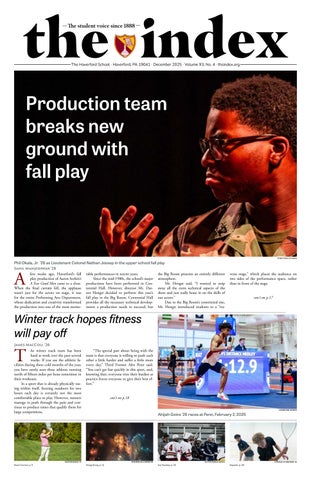
As 2025 comes to an end, The Index encourages you to reflect on the year.
No really. Take a moment from your day to think. What about yourself and the communities around you have changed? What did you achieve? Where did you come up short? Think about your happiest and grimmest moments of the year, then let them go. Truthfully, moments in our lives do not grow larger or smaller over time. Only the size of our world changes. Dictate that change.
Moving into 2026, create a bucket list of things you hope to accomplish, whether
academic, athletic, habitual, or personal. If you wish to uphold the respect the previous generations of students brought to the school’s name, find your footing and purpose, and be disciplined towards that cause.
Go find that teacher and ask for help. Go to that extra workout. Go pick up that new skill. Go be more mindful of and respectful to those around you. Even better? Do it all, and become that well-rounded man Haverford so says to foster.
To the Third Formers: You’re no longer middle schoolers. It’s time to take things seriously.
To the Fourth Formers: Take the extra
step. Get yourself ready to be an upperclassman with greater responsibilities.
To the Fifth Formers: You’re about to enter the hardest year yet—junior year spring and senior year fall. Be ready to work.
To the Sixth Formers: College applications are done. All there is to do now is to wait. With the stress of writing applications now over, take some time to relax, but don’t let yourself slip. Don’t waste away the $24,000 your parents paid for this final semester.
The Index hopes that you seriously consider our message, and wishes you a joyous holiday season and end of the year.
Editors-in-chief for the 2025-26 school year, Ajay Chakraborty ’26 and Ryan Wang ’26

Boys, As the holiday season progresses, we must embrace those closest to us. With the change in weather and the heightened risk of illness this season, we need each other to navigate these challenges.
By now, school is in full gear, but if you’re falling behind or moving ahead swiftly, things can always change. For the guys falling behind in any class, it’s not too late to pull through.
For those doing well, it’s essential not to fall into complacency, which has always been
at the root of many failures. If your relationship with a teacher or a peer has begun to falter, it’s never too late to repair it, and it is always noble to be the one to do so.
I also encourage you to expand your relationships; reach out to guys you don’t know, say hello to the guys you see in the hallways, or reach out to the people you haven’t seen in a while.
If you ever catch yourself thinking it’s too late to do something at this time of the year, you’re wrong.
We’ve settled into school by now; it’s time to capitalize on new opportunities. I
think that we can do a better job of making time for each other this month. I know that I haven’t supported my brothers at as many events as I could have in the past months, which means that many others have also not done so. I don’t want to sound like a broken record, but it’s so important that we show up for each other throughout this year.
Find time to support guys in robotics, on the basketball team, squash team, in the Notables, or in any other extracurricular activities you know that are going around. Do good this winter, and good will come back to you.
Cody Luong ’29
Sports would be nothing without their fans. Fans fund the stadiums, bring in money from merchandise, and buy tickets and food to watch the games.
They cheer, enliven the atmosphere, and motivate their favorite teams.
They even help bring the popularity of the sport higher.
This begs the question: is the fans’ impact always positive?
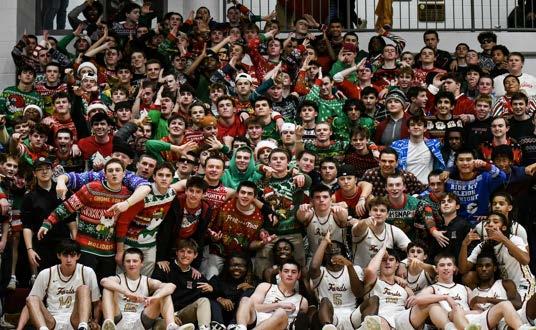
Coming from a loss on EA Day, there has been some controversy regarding fan behavior. During EA Day, the soccer game went into overtime, the game having been scoreless. At last, Haverford did the impossible; they scored a goal. Fired up, students knocked over the fence and stormed the field while the game was still going. This action led to serious consequences.
“During the storm-in at the soccer game, one kid ran into an elderly woman. She fell over and struggled to get up, so we all tried to get Mr. Kolade to get her medical attention. We could tell she was hurt,” Third Former Quin Pollard said.
“I don’t think I should’ve taken the fall for something that wasn’t in my control.”
MR. KEITH CAPPO
In the BBC article “Why people get more stupid in crowds,” researcher Daniel Richardson said that “When people interact, they end up agreeing, and they make worse decisions. They don’t share information; they share biases.”
In Haverford’s case, varsity soccer coach and math teacher Mr. Keith Cappo received the consequences.
Early in the EA Day soccer game, Mr. Cappo got a yellow card for arguing with the referee.
“The whistle was blown for no reason, so I tried to argue with the referee. Then I got a yellow card for dissent. I understand that it was my fault for getting that first yellow card,” Mr. Cappo said.
Then, he got another yellow card, leading him to be suspended from the PAISAA championship. However, this time, it was out of his control.
“I was given another yellow card after the game was over, but the reason was unexpected. It was for the crowd storming the field,” Mr. Cappo said.
This was devastating for Mr. Cappo, as he couldn’t be on the field during the state championship, one of the most important games of his team’s career.
“They shouldn’t have stormed that field. I tried to stop them, but they disregarded my warning. I don’t think I should’ve taken the fall for something that wasn’t in my control,” Mr. Cappo said.
On the flip side, fan behavior was great during the PAISAA championship.
Hanru Li ’29
Wilson Hall is a masterpiece, from the beautiful woodpaneled corridors we walk through to the modern glass pods we study in. Additionally, Haverford offers many different programs and opportunities, begging the question: where does Haverford’s revenue come from?
It is a common saying that students’ tuition covers more than just the cost of simply attending Haverford for a year. While tuition accounts for a significant chunk of the money the school receives, it is not the only revenue factor.
“Haverford is a nonprofit, operating for education purposes rather than for profit.”
Interestingly enough, the Haverford School is a nonprofit, operating for educational purposes rather than for profit, while receiving little money from state and local governments.
Looking at the school’s 990 tax form, you are able to see the yearly report the school is required to fill out. Here, we get to see how our school really makes its money.
The biggest chunk of the revenue comes
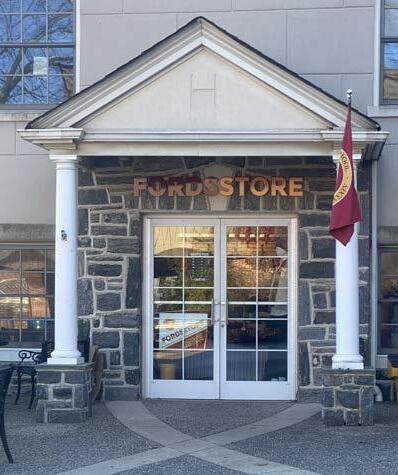
from tuition, sitting at $38 million last year. Next is our total contributions, equating to $11 million. The school hosts numerous events and has multiple committees, such as the HSPA (Haverford School Parents Association), which build community and raise funds. The development office in Palmer House also raises funds. An avenue of fundraising is the annual fund, where alumni, staff, and parents all donate. Other avenues include the HSPA giving a gift every year to the school for unrestricted funds to the school for whatever is needed. The “Party for a Purpose” event and the school store also raise funds, giving all proceeds to the school.
The daycare brought in nearly $700,000, and the music lessons offered in the conservatory contributed $160,000.
The school’s investments gave $1.2 million, facility rentals $250,000, and fundraising events $140,000.
The cafeteria raked in $1.4 million, the cafe $216,000, and lastly the summer camp $223,000. Other miscellaneous sources of revenue gave us the last $350,000, bringing the grand total up to $55 million.
Many believe that the tuition would be split between tuition at 99% of the revenue, and everything else at 1%.
However, it’s crucial to note that there are so many different pieces and committees to keep the Haverford school operating. Every one of the things listed above is essential to Haverford consistently improving and making sure that we are in an environment where we can thrive.
“There were around a thousand people there, give or take,” Mr. Cappo said. “They were great, nothing but positive. No smack talk, no heckling. Just pure respect for the game. They brought out this fiery atmosphere into the stadium. The energy enveloped the whole place.”
Overall, fans are a double-edged sword. They can bring support that fuels athletes to perform at their peak, but they can also lead to serious consequences.
The solution to the double-edged sword is to add a handle: to take time and think about the effects of our actions.
Across the immense, consuming sweep of human history, one truth remains principal: we seek moments that give life meaning. Among these, few shine as brightly as Christmas, a magical time when joy, wonder, and purpose come alive.
Adjacent to the secondary parking lot, in a compact 400-acre school in the center of the little town of Haverford, voluntary students and faculty unite to kindle a warm glow that engulfs the campus in vibrant red,
green, and gold colors. It’s here, beneath the soft yet bright lights of a small tent— where a couple of zealous students laugh over Christmas movie conversations with homemade hot chocolate in hand between helping families decide which Balsam Fir to bring home—that the spirit of Christmas comes to life.
“It’s a really positive event,” history teacher and tree sale coordinator Mr. Brian Long said. “We have families that have been doing it for many years, and they always
have a good experience. But the success of the tree sale really relies upon [the students], and offering families a good experience when they’re buying a tree. They enjoy coming in and interacting with you guys, and by and large, [they] have a great time.”
Dating back decades, the distribution of two hundred twenty-two Balsam Fir trees fresh from a small farm in Nova Scotia helps fund student prom tickets.
“I think the best part of the tree sale is seeing the students kind of rally together
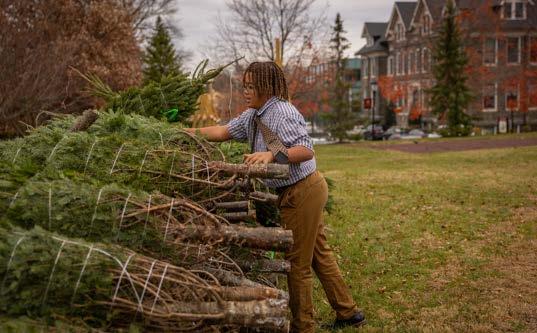
and get some real-life experience outside the classroom,” Mr. Long said. “They’re running a small business, and it’s fun to oversee that and to see them gain experience working with real money, having real customer interactions, and learning to problem-solve on the fly. I think that that’s really valuable at a school.”
Beyond the service itself, the tree sale opens a window for families to see Haverford’s culture.
“It’s a great way for the families that are not involved in Haverford’s community to get a sense of the people that we are,” tree sale captain Sixth Former Caleb Siever said. “I feel like it gives perspective to families that maybe don’t have too much perspective on Haverford and its mission.”
“People judge teenagers in certain ways, and they’re surprised by how efficient and quick we are,” Sixth Form tree-sale captain Elliott Goodspeed said. “We’re actually some of the best tree sale workers.”
This year brought several updates to the sale, including adjusting tree sizes based on previous sales and adding resources like the shed, as well as streamlining logistics to make the process more efficient. These changes give students the chance to slow down and appreciate the small, ordinary moments.
“I think it’s really fun to kind of sit there with your friends,” Siever said. “The downtimes are always nice because it’s not always a super busy process. You’re not always moving the trees. There’s always time in between sales, where you’re just kind of sitting there with your friends, having a football game propped up, enjoying the moment.”
“There’s a certain romance in bonding with classmates you’d not normally talk with,” tree sale coordinator and history teacher Mr. Timothy Lengel said.
a swing:
Sahil Manjeshwar ’28
For Sixth Former Sean Curran, golf isn’t just a sport; it’s his world, as he is one of the region’s most promising junior golfers.
Earlier this year, he won the 111th Junior Boys’ Championship at Merion Golf Club in a 19-hole victory against his own teammate, Sixth Former Nicky Nemo.
Curran’s strong performances have cemented his spot among Pennsylvania’s top junior golfers.
However, Curran’s story is more than results and trophies. As a member of the Signet Society, he also embodies what it means to be a leader.
“I want to be a good example of what a senior can be: both a strong student and a dedicated athlete,” Curran said. “My goal is to do everything I can for this school. To be someone people look up to, and to be a good person, classmate, and teammate.”
Passionate and devoted to golf, Curran was recently recruited to the University of Pennsylvania, where he will pursue his athletic future in Division-I golf.
“I’m super excited,” Curran said. “My focus is to just keep working on my game, and I’m really happy to be going to such a strong school.”
Haverford is a crucial part of his story.
“The people at Haverford are special. It really is a brotherhood like everyone says. I don’t feel like there are any people here that I don’t know very well,” Curran said.
Balancing academics and athletics can be difficult, but Curran has found a routine that works for him.
“In the fall, it’s really tough since I don’t have much free time. But if I stay on top of things, it all works out. I spend two-to-three

hours playing golf every day, then I go home and do my schoolwork. It’s kind of a repeating cycle, but I’m able to do it because I love it, which is key.”
Curran emphasizes commitment for progress.
“Commitment is key. Be honest with yourself about what you’re good at and what you’re not, and then spend your prac-
tice time improving those weaknesses. For example, when I’m practicing, I will spend around 70% of my practice putting until it’s perfect,” Curran said.
Most people see Curran as a golfer, so his quiet passion for the arts often goes unseen.
“One thing people don’t know about me in school is my time in the art depart-
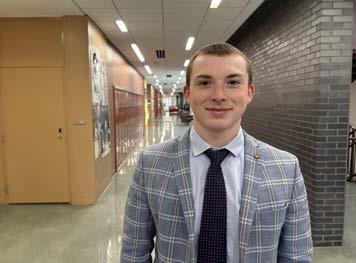
During his four years at Haverford, Sixth Former JC Chapman has come to measure his high school experience not only by his classes, but also by the habits, relationships, and responsibilities he has developed along the way. From challenging coursework to leadership roles and a widening sense of community, Chapman’s time on campus has been defined by steady growth and an expanding understanding of leadership.
For Chapman, his most formative class is U.S. History* with history teacher Mr. Timothy Lengel.
“It was definitely my hardest class,” Chapman said. “But there were so many core writing and history skills that I learned in that class; doing the research papers, learning footnotes, annotated bibliographies. It was really helpful for my growth as a historian and a student.”
This year, Chapman was elected into the Signet Society.
“As a freshman at Camp Saginaw, I remember seeing the Signet Society guys and how impressed I was by them,” Chapman said. “So being elected by my peers to be one of those guys is a really great honor.”
Still, Chapman quickly learned that the position carries unexpected expectations.
“You have to look like a leader not only to your own grade, but also to the younger guys,” Chapman said.
Maintaining that standard in the hallways and on campus can be difficult, especially “when it’s easy to slack off or just goof around,” but Chapman aims to set the example, especially for the freshmen.
Not only is he looked up to by the student body as a Signet member, but also as a brother. JC Chapman is the oldest of three Chapman brothers attending the school. Being a brother has pushed him to be someone his younger brothers can look up to. While many brothers may feel embarrassed attending the same school, Chapman feels the opposite.
“It’s nice to have your people there with you, I really enjoy them being here with me,” Chapman said. “I really have to cherish this year, it’s special that I can go to school with one of my siblings, let alone two of them.”
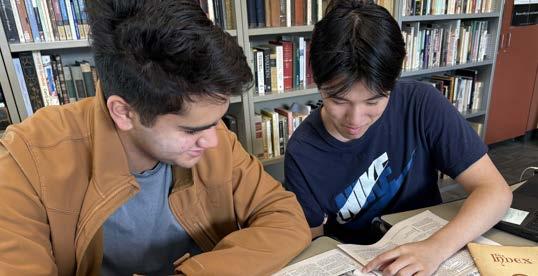
As a busy student, Chapman engages in Model U.N., Mock Trial, Honor Council, sports, and more. Balancing these commitments with schoolwork requires significant discipline from Chapman—his favorite strategy is focusing on schoolwork at the local library.
“Everybody wants to see their peers and classmates succeed.”
JC CHAPMAN ‘26
“What I like to do is go over to Ludington Library after school with some of my friends, and then kind of lock in there before doing any type of athletic or social activities,” Chapman said. Chapman credits his parents, family,
and close friends for giving him support— especially during exams and test periods.
“I think I have a really good group of friends who are always there to support me, helping me out on tests and schoolwork,” Chapman said.
Contrasting with his Third Form year, Chapman is a lot more willing to meet with teachers for support now.
“It made a big difference for me,” Chapman said.
As Chapman cruises through his Sixth Form year, he hopes younger students embrace a widely-echoed Haverford message of
ment at Haverford. I do musicals, and I have taken Mr. Hengst’s theater class for all four years. I just love to have something different,” Curran said.
In the off-season for golf, Curran continues to practice, but he also commits himself to the school’s musicals. This year, Curran will be acting in Haverford’s spring musical Ragtime
being unafraid to try new things.
“I’ve tried just about every sport and every club, and that’s not to say I’ve stuck with all of them, but I’ve found a few things that I really like and rolled with them,” Chapman said.
Above all, Chapman exalts Haverford’s cultural brotherhood.
“The way guys show out not just for the sporting events, but for the theater productions and other non-athletic events. Everybody wants to see their peers and classmates succeed,” Chapman said. “I think that’s just a great thing.”
JC Chapman ’26
This past November, Elijah Lee ’22, alongside CEO Alfred Goodrich and Grammy Award-winning cellist Mike Block, debuted a line of affordable violins and cellos from his company, Forte3D, on Shark Tank, hoping to get more funding and raise their public profile. These classical instruments were 3D printed and made from carbon fiber, which makes them much more affordable. The Shark Tank investors were impressed: Forte3D was funded for $250,000 with 16% equity.
Lee, a current senior at Yale University, laid the foundation for Forte3D as a Haverford student.
“I started it with Alfred Goodrich. He was the orchestra director at Haverford at the time, and he had sort of this crazy idea, and obviously was looking for people who had experience in engineering and out of manufacturing more broadly,” Lee said. “And he knew that I was involved in the robotics scene at Haverford and other engineering groups as well. We just kind of started thinking about it together and started putting together our initial 3D printers and shop space and sort of started popping out prototypes, and that’s sort of how we initially got started.”
“I’ve always been interested in entrepreneurship. And it was something that I sort of knew about, but I had never seriously considered that I was getting into.”
ELIJAH LEE ’22
Lee’s dream of owning a business has grown over the years.
“I’ve always been interested in entrepreneurship. And it was something that I sort of knew about, but I had never seriously considered that I was getting into. So this was a very good way to get into that sort of space, which is also something that I was thinking of getting into more when I was looking towards graduation,” Lee said. “Broadly, I knew I wanted to be in some sort of engineering adjacent field.”
Forte3D brings fresh and modern designs to classical string instruments and introduces classical music—a rigid and oldfashioned industry—to the next generation of musicians. However, the rare classical music players present unique challenges for Lee and Forte3D.
“The classical music industry as a whole is very traditionalist and sort of set in its ways,” Lee said.
Still, Lee believes that Forte3D is unique compared to competitors.
“There are existing carbon fiber or other composite instruments. This is not a new idea. They’ve been around for a few decades at this point. The problem is that[other products] don’t sound like wooden instruments because they’re trying to emulate traditional wooden instruments with the new material. They’re not taking advantage of the new material or actually engineering around the [new materials] to unlock different acoustic sounds.”
Lee recognizes that non-traditional string instruments are recognized as inferior to hand-crafted wooden instruments. However, Lee believes that they should embrace the potential in the materials they use.
“This [prejudice] is something that we

fundamentally disagree with because once we have these instruments [engineered around the new materials], they’re not better than wooden instruments,” Lee said. “So kind of breaking open that perception of what a carbon fiber or a composite or a nonwood instrument sounds like is one problem we’re trying to fight.”
For Lee and Goodrich, the mission has always been more rooted in the everyday realities of young musicians than in grand concert halls. Forte3D’s carbon-fiber designs address an issue many people and schools rarely say out loud: traditional wooden string instruments are expensive, fragile, and difficult to maintain. Many students first encounter classical music through their school programs, yet those instruments—often decades old—often break down.
“We’re constantly operating through working with people and thinking about how to reshape those perceptions. As a result of those sorts of traditional mindsets, there are definitely barriers to accessibility in the music world,” Lee said.
To make matters worse, many schools across the country are cutting funding for the arts, making an already existing problem even worse and discouraging future musicians from pursuing the art form.
“In a lot of the cases, especially at schools, instruments are falling apart,” Lee said. “That’s one of the things that causes people to give up on their instrument, especially if they don’t have the financial means
to purchase really nice string instruments.”
Lee believes that having more affordable and durable instruments that don’t sacrifice sound quality in the market would ameliorate access to music education and significantly boost interest among the youth.
“Our instruments are much more durable, so they’re great for travel and outdoor performances,” Lee said. “And if you go to any elementary or middle school, you see all these wooden instruments that are just dilapidated and trashed. Cheap wooden instruments just don’t stand up well to everyday use.”
“It’s
sort of daunting, and it’s scary, but I think the numberone thing is to just try making some things and try learning new things.”
ELIJAH LEE ’22
In fact, some professional musicians tour with Forte3D cellos because of their durability and sound.
As Forte3D scales its production, schools remain one of the company’s biggest priorities.
“We hope as soon as possible [that we expand to schools],” Lee said.
Looking back, Lee credits much of Forte3D’s foundation to his time at Haverford. Robotics, engineering clubs, and access to 3D-printing tools gave him the hands-on experience he needed long before stepping into college labs. However, his biggest influence came from the faculty.
“The number one thing was the mentorship from teachers,” Lee said. “I learned so much just from talking to them—inside class and outside of it.”
Today, Forte3D is preparing for its next stage of growth. After years focused on the cello, the company recently debuted its first violin, with prototypes for a viola already underway.
“Launching the violin was a big step,” Lee said. “Now we’re looking toward expanding into other instruments.”
For Haverford students who have great ideas but are uncertain what to do, Lee advises just taking the first step.
“It’s sort of daunting, and it’s scary, but I think the number-one thing is to just try making some things and try learning new things. I think you’ll kind of shock yourself with how quickly you can advance your skills by just taking the time to start learning,” Lee said. “Start finding resources online and watching YouTube videos. Take initiative and take an active role in developing your skills to try to accomplish what you want to accomplish.”
Edward Cheung ’28
What does it take to turn a notoriously difficult language into a beloved subject? To Chinese teacher Ms. Yi Lee, the answer is 10,000 hours of meticulous preparation and creativity. According to the Foreign Service Institute (FSI), the government’s training center for diplomats and foreign personnel, while ranking languages closest to English in Tiers I (closest) to IV (furthest), Chinese ranks as a Tier IV language in while languages like Spanish and Latin are classified as Tiers I and II, respectively. Despite this significant difficulty gap, students in the Chinese program continue to excel, thanks in large part to the systems, resources, and classroom environment Ms. Lee has built.
“It’s a very well-structured curriculum. We cover about five lessons in a year, whereas in college, they cover a whole book in one semester.”
MS. YI LEE
Part of the course’s success lies in the classes’ material and speed.
“We don’t move too fast, so students can learn effectively. The foundation of my PowerPoints is based on Integrated Chinese, a college-level textbook used at Harvard, Yale, UCLA, and many other American universities,” Ms. Lee said.
“It’s a very well-structured curriculum. We cover about five lessons [½ the book] in a year, whereas in college, they cover a whole book in one semester.”
When designing the class curriculum, Ms. Lee’s goal was engagement.
“I was the kind of student who always questioned my teachers, asking, ‘Why are we doing this?’ So when I became a teacher, I tried to do everything I wished my teachers had done. That’s how my lessons developed—I design them based on what I would enjoy. When I took Japanese in high school, there was too much free time. All we did was chit-chat and work on worksheets; there were no activities,” Ms. Lee said.
“Three years after I started teaching in 2009, I already had a work portfolio.”
MS. YI LEE
Since Chinese is a strenuous language, classes must be comprehensible and easy to learn. Ms. Lee spends a significant amount of time making her presentations visually engaging, minimal in text, and enriched with relevant images, pop-culture references, and interactive activities that support student learning.
“It took a long time to make my PowerPoints. In my first eight years of teaching, I would go to bed at one o’clock and sometimes wake up at 6:30 to finish them. A one-hour lesson probably took me over eight hours to prepare,” Ms. Lee said. “Now I just edit them to keep them relevant, which doesn’t take as much time, but overall building a curriculum from Chinese I to Chinese V took over 10,000 hours [over thirteen years].”
Many Chinese students don’t even real-

ize the amount of work that goes into making the Chinese curriculum.
“People don’t always realize I made the worksheets myself. Students often assume they were bought or provided by a publisher, like a textbook,” Ms. Lee said. “The activities we do in class, like word searches, dialogue practices, and worksheets, I created.”
Few teachers have spent thousands of hours perfecting their curriculum, but Ms. Lee feels it is important.
“I’m an overachiever. I’m a perfectionist, and I like things to look a certain way. I cannot stand some AI-generated PowerPoints; they feel like a joke. I have high expectations for myself and my work,” Ms. Lee said.
Ms. Lee’s presentations have even grown into a successful side business, including selling PowerPoints to over 200 teachers and, most notably, to the Punahou School in Honolulu, Hawaii, which former President Barack Obama attended.
“Three years after I started teaching in 2009, I already had a work portfolio. People saw my PowerPoints, liked them, and wanted to buy them. That’s when I started my side business selling PowerPoints. It also motivates me to make them as good as possible,” Ms. Lee said. “I use Facebook advertising— mainly through open public Facebook pages. Whenever I see interesting ideas, I share them, and I also post the materials I create. As soon as I [started] sharing my presentations here, a lot of teachers have reached out asking if they could buy it, so since then it’s
been doing pretty well.”
Before Haverford, Ms. Lee was the Chinese teacher for eleven years at the Henry J. Kaiser High School—an International Baccalaureate World School in Honolulu. At Kaiser, teachers were assessed one to two times per year using the Tripod Survey, an anonymous research-based K-12 feedback tool that collects perceptions from students, teachers, and families to assess teachers.
“I like having complete control of the curriculum for all the upper school classes... That autonomy is very nice.”
MS. YI LEE
“Having high-quality, engaging PowerPoints was a direct motivator for me to create strong presentations. By 2017, my scores were very high—100% for engagement, classroom management, care, and comfort—while the school [Tripod survey] average was 56%,” Ms. Lee said.
Ms. Lee also faces the challenge of being the only Chinese teacher.
“It’s very challenging because I’m one of the only teachers on this campus teaching five different classes, even though some
class sizes are small. A two-student class takes as much preparation time as a seventeen-student class. This year, unlike previous years, I work on weekends and sometimes at night. Sometimes it feels like I’m a beginning teacher again,” Ms. Lee said.
Conversely, Ms. Lee enjoys the independence of being the only upper school Chinese teacher.
“I like having complete control of the curriculum for all the upper school classes. I don’t have to discuss my lesson plans with other teachers, and that autonomy is very nice,” Ms. Lee said.
Whether it be engaging presentations or fun activities, Ms. Lee’s end goal is to set her students up for success.
“I try to make learning as easy as possible. With retake policies, students can redo assignments, so they not only earn some credit back but also really learn the material, and they can always come to me after school or during lunch for extra help. I find that students who engage with these opportunities make the most progress,” Ms. Lee said.
Reflecting on her teaching career so far, Ms. Lee feels successful.
“Teaching Chinese helps students become better global citizens and respect different cultures. It helps them understand that priorities and practices differ across countries. Most students made me feel 成 就感—very accomplished. My interactions with the students have been really rewarding,” Ms. Lee said.
For the annual Parker Lecture, the history department invites a notable historian to deliver a lecture about their work on different historical eras, naturally leading to mixed feelings among the student body depending on personal interests. This year, Haverford welcomed Dr. Caroline Elkins, professor of History and of African and African American Studies at Harvard University.
Dr. Elkins’ lecture highlighted her groundbreaking work as a leading figure in the history of British colonialism in Kenya. Specifically, she was responsible for investigating and exposing the systematic torture used in British detention camps during the Mau Mau uprisings, justified through the concepts of “states of exception” or “legalized lawlessness,” which allow governments to establish authoritarian levels of control and overstep many legal barriers. The meticulous and rigorous research across British archives and other sources of evidence that the British failed to erase is detailed in her numerous publications, namely Imperial Reckoning: The Untold Story of Britain’s Gulag in Kenya.
Elkins’ distinguished work served as the basis for legal claims filed by survivors of the Mau Mau detention camps against the British government, an ordeal that ultimately led to a 20-million-pound cash payment and a monument dedicated to the victims of the camps.
This unique lecture was largely coordinated by History Department Chair Ms. Hannah Turlish.
“ I wanted someone who went a little bit away from the United States to have a more global perspective,” Ms. Turlish said. ”What I liked about Dr. Elkins, once I learned more about her, is the fact that her work led to actual tangible results in a court of law. And I
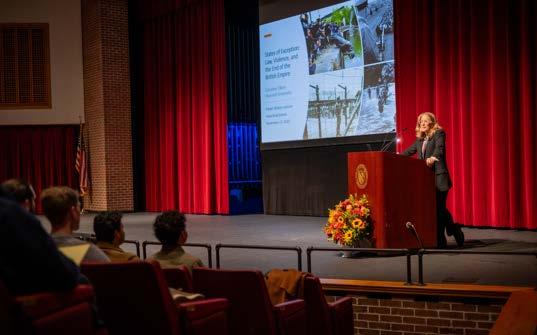
really can’t say that there are other historians like that.”
While Dr. Elkins noted the controversy surrounding her work, her presentation was well-received at Haverford.
“ Standing there on the side during the lecture, I got a sense that Centennial was with her,” Ms. Turlish said. “The student body was interested and engaged, and I’m hoping that [they] collectively saw it as a positive experience. I know [many] students, especially seniors, who said it was the best [lecture] they’ve seen in four years.”
Aside from her lecture in Centennial Hall, Dr. Elkins also engaged with students more personally at a separate evening lecture and a lunch. Students who found both her lectures to be particularly interesting could freely ask her questions about her work at lunch, and many noted their respect for the scope of her research.
“I found it especially interesting how she talked about her process of arguing and proving her point, and just how much time and research goes into doing what she did,” Fifth Former Daniel Khan said. “She kind of
gave everyone a peek into what it means to be a historian and what it means to do historiography as well.”
Many students also admired the boldness of Dr. Elkins’ work.
“Her career demonstrates how you should pursue what you are passionate about and keep going if you know you are right,” Fifth Former Hugh Williams said. “If she stopped because of any of the pressures she was facing, the information about what the British did in Africa might never have been released.”
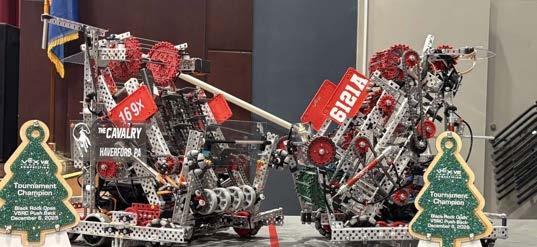
The robotics team looks to have another season of success, showing promise before heading into the winter. Four robotics teams have attended two tournaments: one in late October and one in the middle of September, and the results show positive signs as the bulk of the season approaches.
During the September tournament, Firebird at Holy Ghost School in Bensalem Township, team 169A took first place. The team consists of Fourth Former Ben Qu and Sixth Formers Ajay Chakraborty, Jack Ford,
and James Friel. At the next tournament, the LMSD qualifier at Black Rock Middle School, three teams competed in their first tournament of the year: 169B, 169Y, and 169X.
169X, made up of Third Formers Steve Xie and Eric Xiao, found major success.
The team finished first in the qualification stage, with a 5-1 record, earning them the first seed for the knockout stage and allowing them to skip the first round. The team found a close win in the quarterfinals before unfortunately losing in the semifi-
nals. Despite not quite reaching the finish line, the young team has a promising season ahead of them.
“We did well for our first competition, but there’s definitely room for improvement,” Xiao said. “I’m a little disappointed that we lost, but there’s not so much we can do about that.”
Xiao is optimistic about future tournaments.
“[Our performance] just shows that we have to practice more. We didn’t have that much drive practice beforehand. We need to
do a lot more of that in the future.”
At Black Rock, Team 169B received the Judges’ Award, which is given to a team that is worthy of special recognition based on an interview with the judges. In 169B’s case, they received the award due to their extensive knowledge of their robot’s inner workings, while also showing team proficiency and proper communication with the judges.
“It’s one thing to base your design off of [other teams], but you need to know your own processes,” Fifth Former Brandyn Luong said.
Winning this award changed the team’s mentality.
“It motivates us. If we can win that award, we can win so much more,” Luong said. “It makes us more fueled to achieve better awards.”
After the competition, both 169A and 169B continued on to the WPI Signature Event, which took place at the Worcester Polytechnic Institute, Massachusetts. At the event, 169A performed exceptionally well, finishing with an 8-1 record, although losing the elimination match.
Though 169B fell short at a 4-4-1 record, both Haverford teams were able to utilize their previous experiences to improve their game strategy, and test their new iterations of their robots, whose quality was above average at the event.
Fords Robotics will look forward to preparing for various local events following the new year, and the Gateway Signature Event in West Virginia.
In a 10–4 vote on November 19th, the Lower Merion Board of Commissioners approved an ordinance that will phase out gas-powered leaf blowers by 2029. The ban will apply to all properties in the township and will be introduced gradually, beginning with seasonal restrictions that expand each year until a complete prohibition takes effect. Fines for violations will start at $100 for a first offense and increase to $250 and $600 for subsequent violations within a twelve-month period.
Lower Merion’s decision reflects a nationwide shift toward electrified lawn equipment. Policies addressing gaspowered tools exist in at least 27 states and Washington, D.C.
Township officials say the move is part of a broader effort to reduce both noise and air pollution. According to environmental data cited during the discussions, running a gas-powered leaf blower for just one hour creates the same amount of pollution as driving a car from Lower Merion to Florida. These machines also lack the emissions controls found in modern automobiles, contributing to Montgomery County producing as much pollution from small engines each year as roughly 32,640 cars.
Noise levels were another major concern. Gas-powered blowers can reach up to 115 decibels—similar to a car horn or listening to headphones at maximum volume— raising long-term risks for hearing and quality of life in residential areas.
While many residents support the transition to cleaner, quieter equipment, some remain concerned about cost and convenience. Electric lawn tools often come with a higher upfront price, and landscaping companies and homeowners will need to replace their existing gas-powered equipment. Battery life and performance on larger properties have also been debated.
However, industry professionals note that modern electric tools are significantly more capable than their reputation suggests. In an interview with The Philadelphia Inquirer, Doug Downing, founder of Advanced Environmental Lawn Services, explained that although electric equipment costs more initially, it becomes cheaper over time.
As the township prepares for the 2029 deadline, residents and businesses will have several years to adapt.
“You’re essentially buying years’ worth of fuel at the time of purchase,” he said. “Aside from that, everything else is unfounded. The power of this equipment is absolute-
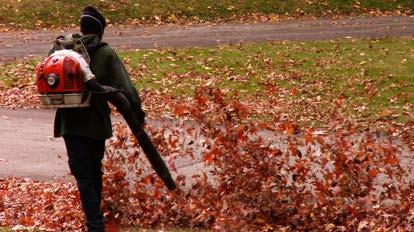
A gardener uses a gas-powered leaf blower to clear leaves
ly equal, if not more powerful than the gas equivalent.”
Electric leaf blowers are also far quieter. Many top models operate below 65 decibels, and even the loudest seldom exceed 85 decibels—well below the noise produced by the gas standards. Battery life continues to improve, with some models lasting up to 90 minutes on a full charge. Charging times vary depending on battery size but generally range from half an hour to a few hours.
Lower Merion’s decision reflects a nationwide shift toward electrified lawn equipment. Policies addressing gas-powered tools exist in at least 27 states and Washington, D.C. Major retailers are preparing for this transition as well: Home Depot has pledged that over 85% of its outdoor lawn equip-
Hidden in a small strip of restaurants, bakeries, and bike shops less than half a mile from Haverford is a tiny restaurant. Just down Lancaster Avenue, past the Dunkin’, is an unassuming entrance with a modest sign that reads TaoOne - Asian Cuisine.
You step in and sit down. You’re handed a menu. It’s huge: TaoOne has virtually every type of Asian cuisine you could want. From Wonton, Miso, and Tom Yum soup to dozens of sushi rolls and sashimi, Thai curries, Kung Pao, and Szechuan Chicken.
With all of these options, just ordering a

simple meal can seem daunting. While all of the food is of high quality, a few dishes stand out to me as especially good.
It’s not just the main courses that are superior; the appetizers are nothing to ignore.
One of my favorite dishes at any Asian restaurant, the Salmon Lover ($24), is especially decadent at TaoOne. Of all types of sashimi and sushi, the salmon is extremely soft and flavorful. Within the same realm, the Sashimi Deluxe features 21 slices of assorted fish, including salmon, tuna, squid, and fluke, for just $28. The Sashimi Deluxe can easily become a shareable dinner when combined with a starter or two, as it already comes with a miso soup and house salad.
It’s not just the main courses that are superior; the appetizers are nothing to ignore. Some of my favourites are the Miso soup ($4-8), with good broth but a bit lacking in tofu; the Egg or Spring Roll ($2.50), both crunchy and packed with flavour; and the Seaweed Salad ($9), deliciously cold and refreshing for the course ahead. As for their Japanese-Style Garden Salad ($6), it’s refreshing while having a hint of sweetness from its carrot ginger dressing; though house salads aren’t typically my thing, so your opinion on it will likely vary.
Japanese cuisine is a major focus of
ment sales will be battery-powered by 2028, and Lowe’s reports that 60% of its current sales are already electric.
As the township prepares for the 2029 deadline, residents and businesses will have several years to adapt. The hope is that the gradual rollout will ease the transition while helping Lower Merion reduce emissions and create quieter neighborhoods.
For Haverford students who live in or near the township, the shift may soon become noticeable in their own neighborhoods, where the familiar roar of gas blowers could gradually give way to quieter, cleaner equipment. As the 2029 deadline approaches, the transition is likely to subtly reshape the daily soundscape around the school and the wider community.
TaoOne—in fact, they have a live sushi bar to watch—but their other cuisines are just as delicious. As a repeat customer of both the General Tso’s ($17.50) and Orange Chicken ($18.50), I have not been disappointed with TaoOne’s chicken. It’s always extremely crispy, crunchy, tender, and packed with flavour. Their Fried Rice ($14-$21) is very good as well, both flavourful and filling.
Like many Asian restaurants on the Main Line, a humble entrance hides many different dishes, cuisines, and styles, all of which are extremely appetizing.
Their Thai selection is great as well; the Pad Thai ($16-22) allows visitors to combine fried rice with an array of vegetables and meats—pork, chicken, beef, shrimp, and seafood—to cater to whatever the mood may be. They also have X-O Shrimp, Thai Triple Delight, and more.
Like many Asian restaurants on the Main Line, a humble entrance hides many different dishes, cuisines, and styles, all of which are extremely appetizing. So if you’re not quite sure where to eat after a long day at school, consider TaoOne as a close, reliable option with top-notch choices.
and Alex Schwarting ’29
Philadelphia was ranked America’s worst city to drive in, according to a recent WalletHub study, with residents experiencing long commute times and poor road conditions.
The study focused on four key factors to qualify a city’s driving conditions as “good”: traffic and infrastructure, cost of ownership, safety, and access to vehicles and maintenance.
Subpar infrastructure in the city makes driving a difficult task.
Philadelphia was ranked near the bottom in traffic congestion and long commutes. Limited parking and poor road conditions, including potholes in highly congested areas, add to the problem. Philadelphia also has higher prices for vehicle maintenance, insurance, and gas compared to other cities.
Many students dread driving in the city.
“[The] traffic is really bad,” Fifth Former Jack Macziewski said. “The other thing that makes it hard is that the people [drivers] are crazy. They are easily irritated, creating a harsh, impatient learning environment.”
Not just students are affected by Philadelphia’s frustrated drivers. Upper school English teacher Dr. Del Rosario commonly encounters similar frustrations during his
daily commute from West Philadelphia.
“People often use the left-turning lane after approaching an intersection and cut in front of the people going straight,” Dr. Del Rosario said.
Subpar infrastructure in the city makes driving a difficult task.
“There are a lot of potholes and little parking,” Macziewski said.
“It sometimes feels as if my car is getting beaten up,” Dr. Del Rosario added.
Complications from the lack of investment in infrastructure stand in the way of improvements.
The Haverford community is familiar with the daily frustrations that come with driving around Philadelphia.
Ethan Diamond ’21, now a master’s student in urban planning at New York University, explains that public transportation systems are deeply tied to the traffic problem.
Diamond said, “The lack of a more cohesive public transportation system in the City of Philadelphia could have been a factor of traffic congestion. Simply put, it is

extremely difficult for anybody to plan on a long-term planning horizon when an agency has to move from funding crisis to funding crisis.”
Diamond, however, doesn’t believe the city deserves this title, explaining, “It is not a problem unique to the City of Philadelphia.”
Similar problems are seen across the entire country. It can often be difficult to make large-scale improvements due to population density, limited space, and other factors.
“These issues are not necessarily unique to older East Coast cities,” Diamond said. “The difference is that in older East Coast
cities, there are still legacy public transportation systems that have, for the most part, seen significant divestment.”
The Haverford community is familiar with the daily frustrations that come with driving around Philadelphia.
For many upper schoolers learning to drive, the conditions can feel hostile. The city must address many issues, from simple improvements in traffic enforcement to large-scale developments and projects, but the problems facing Philly drivers are difficult to fix and will likely persist for the foreseeable future.
Cody Luong ’29
“Pennsylvania has always been a place where people come to write the next chapter of their story, and that includes our LGBTQ+ community,” Anne Ryan, Deputy Secretary of Tourism for the Pennsylvania Department of Community and Economic Development, said. Philadelphia’s inclusiveness and sense of belonging are its beauty. Home to Chinatown, the Italian Market, Reading Terminal Market, and many other communities with several different cultures, Philadelphia is rich with diversity. Many places celebrate the city and its diversity, such as the LOVE Park and Liberty Bell visitor centers and the Jewish History Museum. Yet, beyond the Gayborhood and Giovanni’s Room bookstore, there are few for the LGBTQ+ community. This
is where Philadelphia’s one-of-a-kind hub for LGBTQ+ travelers comes in.
Fittingly, one of the nation’s earliest gay rights protests occurred in Philadelphia.
Philadelphia Gay News reported that the new visitor center will contain many different types of activities. One major feature is the variety of attractions, such as museums, art exhibits, and other events. It will also offer itinerary planning, with staff available to help visitors organize their day.
Ryan hopes the center will create a space
“where LGBTQ+ travelers will find community, pride, and a warm Pennsylvania welcome.”
Fittingly, one of the nation’s earliest gay rights protests occurred in Philadelphia, when 39 people protested outside Independence Hall on July 4th, 1965. This protest continued each year until 1969, igniting and influencing future movements for gay rights.
Philadelphia has striven to welcome everyone, and the LGBTQ+ community is no different. According to Community Marketing & Insights, 63% of LGBTQ+ travelers already think Philadelphia is welcoming. This travel hub will not only boost tourism and revenue in Philadelphia, but also bring up the percentage of people who believe Philadelphia is a welcoming place.
The new LGBTQ+ visitor center isn’t
Step into Nanu’s Hot Chicken, and you’re immediately hit with an urban vibe, with graffiti-covered walls and bold, animated signage. It sits next to the Señorita’s at the corner of Lancaster and Ardmore Avenues, bringing a refreshing taste to the Ardmore West Shopping Center rather than the usual Chipotle or McDonald’s. Inside, the space is compact yet inviting, including three small tables and a high-stool
counter. Diners can place their orders either at the counter or via an online kiosk mounted against the wall, streamlining the process. The menu is straightforward yet satisfying, featuring hefty portions of chicken tenders, sandwiches, fries, and more. Prices on meals range from $10 to $25, depending on the portion size. You can also add small sides to complete your order. Drinks consist of soft sodas, bottled ($2.50) or canned ($1.50),

and smoothies priced at $7.
Is it messy? Yes. But is it worth it? Absolutely.
The real star, of course, is the chicken. After selecting your meal, you choose your preferred spice level, ranging from no spice to the hottest choice: reaper. Within ten to fifteen minutes, your meal arrives in a simple plastic container. But don’t be fooled by the packaging. The elements inside are anything but simple. The chicken pieces are impressively large, roughly six inches long, and exploding with flavor. Even without sauce, the chicken is still well-seasoned and flavorful. The spice produces a satisfying ratio of heat to flavor, allowing you to enjoy both aspects thoroughly. The chicken sandwich is similar, though it can be quite messy.
As for the sides, the fries are compa-
only for the LGBTQ+ community, though. Kathryn Ott Lovell, president and CEO of Philadelphia Visitor Center, points out that Philadelphia is a tourist center for all.
“We’re building a starting point for tourists, a dedicated space for this community, and a true reflection of what our city stands for,” Lovell said.
Philadelphia is a diverse community, welcoming people from all over the globe. The creation of the LGBTQ+ center is no different.
The establishment of the center showcases the legacy and past movements of the community and represents the progress that has been made. It is clear that the LGBTQ+ visitor center will be both a resource hub and a testament to Philadelphia’s role in advancing LGBTQ+ rights.
rable to a crispier, less seasoned version of Crabfries. The waffles served with various meals definitely exceeded expectations, but the smoothies fell short. They taste watered down and underwhelming compared to the rest of the food.
If you’re in the mood for spice or just good chicken, Nanu’s Hot Chicken is the place to go.
Is it messy? Yes. But is it worth it? Absolutely. Nanu’s is a must-visit for anyone craving big flavors in a casual, quick manner. Perfectly positioned near Haverford, it’s an ideal spot for a swift, satisfying bite close to campus. If you’re in the mood for spice or just good chicken, Nanu’s Hot Chicken is the place to go.

For decades, our school has carried down traditions of support and brotherhood.
One of the most meaningful ways we can honor that legacy is by filling the stands for one another and strengthening school spirit. It is vital for the school and our brothers that we support one another. One of the best ways to do it is by showing up to games. As we reflect on the fall season, we are left to wonder—are some traditions beginning to fade?
There are roughly 450 students in the Upper School, yet a crowd of just 100 is often considered a great turnout. This fall, the football team played ten games, split evenly between home and away matchups.

During my time at Haverford, I’ve frequently found the amount of printed paper excessive. We are often given large packets at the start of class, just to barely touch them before tucking them into our backpacks, never to be seen again. Or we throw them into the class trash can, sometimes in the blue trash can specialized for paper, sometimes not; it doesn’t matter. All the trash bins—general waste, recycling, and paper—at Haverford go to the same place anyway, as the school no longer recycles classroom paper, bottles, or cans.
The production of paper exerts a heavy environmental toll, as it drives deforestation, requires large amounts of water, and demands significant amounts of energy, leading to further greenhouse gas emissions. For every ton of new paper produced, 17-31 trees and about 27,000 gallons of water are used. The pollutants from the manufacturing process end up in both the atmosphere and waterways, threatening public health and ecosystems.
The two options for the disposal of pa-

Understandably, not everyone wants to trek to SCHA on the weekend and deal with the traffic to get there and back home. But home games are a different story; they should be packed with students on any given weekend. Some students might argue that they are not football fans, or they are busy that day. However, people need to understand that it is not as much about football as it is about our brotherhood.
Where are all the students? Every home venue this fall occurred on Saturday afternoons at 1 p.m., except for a single Friday game on September 19th, when they played at 3:30. Weekend games provide everyone a fair opportunity to attend and enjoy. No classes, practices, or other school conflicts overlap. If timing isn’t the issue, then what
Of course, some games naturally draw bigger crowds. Malvern and Episcopal will always reign as the most anticipated matchups. The Episcopal football game lands on EA Day every year, and this year, the Malvern game landed on Saturday, October 18th. Still, every game should have the kind of attendance those games have.
Students need to recognize that while football is being played on the field, football itself isn’t the point. It is about showing up for one another through the highs and lows of a long season. Our school is built on brotherhood; every assembly, every form meeting, every reflection, you are almost guaranteed to hear about brotherhood.
Take the Penn Charter game on Oc-
tober 11th. The team lost 0-14 on a cold, rainy, and miserable day. By the final whistle, everyone was drenched. But the section stayed the whole game yelling and screaming relentlessly, listening to “voice of the Fords” Alex Scharpf energize the crowd. The Episcopal game was an emotional loss for everyone, with EA holding the football with 3:00 left on the clock, up by 21 points, the game was over. Still, the section stayed to the end, regardless of the score. We need more of that.
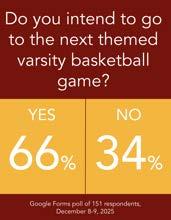
Haverford should be more mindful of its paper waste
per lead to dramatically different outcomes.
Throwing paper into general waste, which Haverford does, means it ends up in a landfill, where it anaerobically decomposes into methane, a powerful greenhouse gas with a warming potential 81x more powerful than carbon dioxide across a 20-year timeframe.
In contrast, recycling paper offers ecological savings. Manufacturing paper from recycled pulp requires 70% less energy and water than manufacturing paper from virgin wood. Additionally, recycling one ton of paper can save up to 17 trees. Furthermore, it reduces air pollution by up to 73% and, crucially, avoids the production of methane.
If Haverford is to say it is “preparing boys for life,” it must teach its boys to be cognizant of the environment, as the threat of environmental damage only becomes more imminent each year, moving the crisis from a distant, abstract concept to an urgent reality impacting global stability.
Simple acts such as recycling shouldn’t be far-fetched goals in the fabric of the curriculum and campus life.
If the school refuses to recycle daily paper waste, what are our alternatives? Firstly, teachers can look to be more mindful of the amount of paper material that they print. If it’s not going to be thoroughly used, why bother?
Another solution is for students to take matters into their own hands. The Sustainability Alliance, led by faculty advisor Mr. Samuel Walters and Sixth Formers Chase Baker, Jack Chisholm, and Ryan Wang, is leading a paper recycling initiative, where students collect paper from classrooms and the printer rooms at the end of each week to recycle at public municipal drop-off centers, reducing Haverford’s environmental footprint.
Haverford’s problem with paper waste isn’t just a matter of environmental awareness and sustainability, but a reflection of how we treat the systems and world around us.

For what was the longest shutdown in history, federal employees were without pay for 43 days due to the 2025 government shutdown. This was more than just a political standoff in Washington. The shutdown highlighted the extensive reliance of federal systems on political coordination and the miscommunication of service agencies and corresponding transactions.
Statistically, 1.4 million federal employees, a number comparable to Philadelphia’s population, went without pay. Most affected were the Environmental Protection Agency and the Education and Health departments.
Although not as crucial as air traffic controllers, their absence caused ripple effects
on their respective sectors. Offices closed, response time lengthened, surveillance stopped, and support and research slowed.
The dependence on America’s two major political parties for such an urgent, necessary funding is astounding.
The economy, while booming, yearns for consistency. Predictions show the GDP, which highlights economic development, slowing down its growth this quarter and reversing the decrease in the new year. The Federal Reserve releases its employment and market data weeks late, and rate cuts loom in the background—all of which are economic and stock market indicators. Backlogs of data and payments do subside, but the headaches will remain.

The economy should never be so connected to politics.
Another topic of interest is how exactly workers would get compensated. President Donald Trump, in a post on his Truth Social media platform, claimed “docking” payments for FAA and ATC aviation workers who did not show up to work, an argument which seems unhelpful and unjustifiable to growth or motivation, considering an increase in flight accidents and other supporting factors and a decrease in overall labor.
The largest program affected was perhaps the Supplemental Nutrition Assistance Program (SNAP), which provides nutrition to millions of Americans, most of whom are lower-class and more elderly. Delays are not uniform across the nation, but rather separated by state discretion, which complicates resumption day by day for many households and families. States are also increasingly under pressure to share program data, and eligibility continues to be reduced. These so-called “efficiency reductions” are to save spending; however, stubbornness to reassess adjusting larger programs, like the Department of Defense, which requests a $1 trillion budget, ultimately shoulders the consequences on not only the population of our nation, but also our federal employees, who must deal with the constant changes these alterations press on them.
It is worth asking why there is not more respect dedicated to our federal employees. Those who, despite having to significantly reduce their living environment, still choose

to endure the long hours of maintaining security, updates, and other duties. We put “America First” as our agenda, but what happens when we can’t even support the backbone of our government? At that point, we should ask again: what value and respect do we have for the systems we depend on? The shutdown highlights how deeply woven federal workers are into daily life. Their actions are not to be taken for granted. While it is easy to speak about budget and efficiency, it is far harder to recognize that the people working behind each paycheck people whose responsibilities cannot wait forty-three days to resume.
The repercussions of this shutdown will not vanish.
Citizens will lose trust in politicians. The federal system will seem ever so more vulnerable to political drift and adversity. Fragility in one can become fragility in the lives of millions.
If this shutdown taught anything, it is that our nation cannot function on resilience and words alone.
The brotherhood and stability of the country must be built. If we hope to move forward, we must confront whether we can accept a system that allows millions to be placed at risk.

The ultimate irony of human consciousness is right in front of us: we are the only species aware of our terminality. And for young men, that awareness can settle as a whisper of deep apathy, signaling that we are never quite enough; the world is unforgiving. Why strive for academics, for work, for the pursuit of happiness, when the entire system eventually collapses into nothingness?
My generation received its first warning of fragility not through philosophy, but through a mandated shutdown. We went from the predictable rhythm of a school day to the disorienting silence of the COVID-19 lockdown. Governor Wolf called it an initial ten days; we all knew better. The entire structure of our lives—from teachers scrambling to invent virtual learning overnight to the sudden, eerie silence of outside life—proved that the world is unforgiving and ready to end at any moment.
I watched the fallout fracture my own home. My sister’s graduation withered into a husk of ceremony, our family stuck watching from the isolation of the minivan. My brother, even two years later, bore the lingering aftershocks. I was lucky enough to miss the worst of it, but the virus stuck as a permanent warning: anything and everything we have can vanish in an instant.
It wasn’t work that drained me; it was the realization that my identity was tied to my utility.
This global chaos only intensified a personal, foundational dread I learned years ago. As a part of the family business, my obligation was helping out during busy days. I began young, about nine or ten, playing receptionist and janitor. I was not asked to do chores at home; this was their form of discipline, the “value of hard work.” But during the most vulnerable time of my life, I began to loathe the sound of the front door opening.
My time, my peace, and my presence were not my own; they were part of a binding contract to put food on the table. When the phone rang downstairs, it was a command, not a request. I remember evenings when I would lie upstairs, burying my head into my pillow, rigid with resentment. I silenced my phone, trying to carve out a small, private space from the obligation that seemed to be constantly invading. It wasn’t work that drained me; it was the realization that my identity was tied to my utility.
If accomplishments are the currency of purpose, then by the metrics of this unforgiving system, we have illegitimate value.
That early experience taught me that every interaction is transactional. And when you are judged solely on your contribution, you are perpetually vulnerable to the second lesson: mediocrity.
Every test score, every missed opportunity, every accolade not won is a quantitative data point reminding me that I am below
par. If accomplishments are the currency of purpose, then by the metrics of this unforgiving system, we have illegitimate value. In that sense, we are rendered no different from the inert, inanimate objects that surround us, merely existing.
This struggle with purposelessness is the heavy, suffocating side of freedom. Philosophers like Emerson tell us we are free to live by our own morals, untethered to predetermined roles. But how can we embrace this freedom when we are crushed beneath obligations and the anxiety of failure? The truth is, we often yearn for disappearance, not out of malice, but to dissolve a contract we never asked to sign.
In the face of an individualistic world and the crushing burden of expectation, apathy seems to be the only rational response.
But clearly, humans have persisted for hundreds of thousands of years.
I’m definitely not an “artsy” guy.” My experience with purpose was tied to transactions and test scores. But I joined the musical, as a townsman, mind you, to see if I could find a different kind of utility. I wasn’t chasing an accolade or trying to get on the good side of anyone, just the satisfaction of
contributing to an effort where the simple fact of showing up held value.
You are being left behind only if you continue to operate under the premise that your value must be earned. You define your own worth, and it is up to you to protect the passion that fuels it.
The emotional climax wasn’t mine: it happened watching Jai Bonaparte ’24. He was my brother’s friend, someone I knew only through the transitive property of being a sibling. Here was someone breaking down not because he lost something, but because he loved something. His integral role in the play and devotion to the visual details—the costumes, the sets, the unspoken things— mattered to him. Seeing his genuine emo-
tion made me forget my own grievances. The memory of that musical will be tethered forever to the concrete image of the raw emotion of the actors that had no utility other than simply being real.
This, I believe, is the fix to the apathy and crushing weight of modern life. We don’t need a test score or money to fill the void in our heart. We need an anchor.
The Haverford community, in that shared purpose of the stage, created a reality that momentarily paused the end of the world: the abyss cannot consume us en masse.
You are being left behind only if you continue to operate under the premise that your value must be earned. You define your own worth, and it is up to you to protect the passion that fuels it.
The world may still be looming with calamity. The system is unforgiving. But in the shared satisfaction of a castmate, or the triumph against impossible odds on the field, we find the reason to keep waking up. And in a world obsessed with the bottom line, that choice is the only accomplishment that is truly ours.
Edward Cheung ’28
The renovation mesh draped over the Wang-Fuk Court towers was designed to protect the streets below from falling debris. Instead, on the afternoon of November 26th, it sealed the fate of those inside. What started as a category-three-alarm fire progressed into a category-five less than ten hours later: the highest-level fire emergency in Hong Kong. Behind the opaque green sheets, residents, a majority elderly and retired, boiled water for tea or napped, unaware that the air outside their windows was turning to poison. By the time the alarms finally rang—for those lucky enough to hear them—the stairwells were impassable. The death toll climbed with terrifying speed, rising from single digits to 159, with over 200 still unaccounted for.
The blackened skeleton of the complex stands in stark contrast to the bright green mesh that covered it just days ago. For my family, this tragedy is not just a headline. My great-aunt Grace lives in a tower much like Wang-Fuk. She is 75, retired, and on the nineteenth floor of a building in close proximity to the incident.
Close by, construction workers at local sites smoke cigarettes during their break. If the sparks hit the safety mesh, it could lead to a dangerous result.
On the afternoon of November 26th, my father called my great-aunt Grace frantically. As he paced the living room back and forth, news footage showed towers billowing in thick smoke, girded with the wailing firetrucks.
“Ah, don’t worry, I’m fine,” she eventually answered calmly. “I was just sleeping.”
Because my great aunt was very close to the incident, my family and I are grateful that she and our other relatives were unaffected.
However, to those who had to endure the consequences of this tragedy, I feel sorry for them. Words cannot describe what they have gone through. It is a shame that many elderly residents have felt the consequences of substandard construction efforts. This disaster brings light to a long-criticized issue

in Chinese and Hong Kong construction: cutting costs and negligent oversight. This is sometimes referred to as “tofu-dreg” construction.
This negligence of taking shortcuts is ultimately the factor leading to substandard and non-fire-resistant safety mesh being used
for the renovation. This, in turn, allowed the home of 4000 residents to become a glowing oven in 40 hours. “Tofu dreg,” which was coined by Former Chinese Premier Zhu Rongji, refers to buildings or infrastructure produced with substandard materials, rushed timelines, or improper planning.

While Hong Kong historically has had stricter standards, the fire raises questions about the quality of safety when such renovations are done.
Authorities associated with the renovation project, including those in charge of materials and overseeing the safety compliance, have since been arrested. Early investigations into the companies in charge of the renovation suggest there were prior warnings regarding the flammability of certain materials, raising concerns about whether or not safety protocols were followed or enforced.
The deadly consequences of the Tai-Po towers were far from the first of these “tofudreg” incidents. On November 11, 2025, the HongQi Bridge in the Sichuan Province of China collapsed only ten months after construction. Thankfully, the bridge was closed prior to its collapse, and no one was hurt. Watching from afar, I worry for my extended family in Hong Kong and Mainland China. They, like millions of civilians, live in buildings whose safety depends on the diligence and integrity of contractors, inspectors, and policymakers.
When I called my aunt, she noted how ubiquitous negligence was, specifically smoking at construction sites.
“There’s a building next to our home. There is some reconstruction going on, and every day I walk by the workers, they are smoking when they are having a break. Each of them is smoking! So that might be the cause of the fire,” Aunt Grace said.
With Aunt Grace living in the shadow of the possible perpetrator of the fire, I realize I am lucky to live in a world where neither I, nor my Aunt Grace, have felt the effects of tofu-dreg or any similar catastrophes. But luck is not a survival strategy.
While I am privileged to be safe, safety should not be a privilege: it should be a right for everyone.
One of the beautiful things about the holiday season is that it allows for time set-aside time for hope, peace, love, and joy.
Hope is brought forth through activities to look forward to: baking Christmas cookies, holiday concerts, and all the collective busyness of the season.
Peace is brought through the shimmering snowflakes drifting through the air, the glistening holiday lights, the beauty of a familiar hymn that just meditates so closely to the heart, the gathering of family and friends throughout the season, and the joy shared in those moments.
Love is shared among all the festivities throughout the season, like caroling, crafting holiday gifts, shopping for loved ones, and putting up Christmas lights, among many other possibilities.
Joy is found in togetherness. This makes the good news of the holiday season spread so fast and the season so special. While the cold, dark, and gray so often can bring us down, the joy supplied by the season, especially the gift of a savior born on Christmas Day, spreads fast.
Sharing this joyful news through collectively gathering loved ones together for Christmas tree lightings, singing music at
Christmas concerts, and more—these all are what bring the joy out of the season.
The holiday season also allows everyone to take a step back, listen to some beautiful music, and embrace the warmth of the season amidst the potential cold, dark, and gloomy winter.
During this beautiful season, take a moment to gather with friends and family and to remember the true reason for the season.
We all have different reasons to celebrate the season, but do it and enjoy the vibrancy of the holidays. I personally enjoy spending the season with my family, friends, and the beautiful music that is appropriate
for this time of year. I enjoy the calming, heart-warming tunes of familiar hymns such as “Silent Night,” “Joy to the World,” and others.
As the days get shorter and the sunlight grows shorter, know that the light of the season is here. It will continue to grow larger and larger, brighter and brighter. Take a moment to soak it up and embrace it. Change up what exists in your life and heart, and use the season to bring about a different kind of joy to that which you are used to. Play some music, decorate the home, and feel the vibrance of the season to brighten up your world!
Through rain and sleet, cold mornings and sunny evenings, old streets and grand cathedrals, the Notables represent the school, bringing joy to any and every community they visit.
The Notables have a busy schedule leading up to winter break: ten concerts, with nine rehearsals in between. Venues include Bryn Mawr Hospital, The Merion Cricket Club, Waynesborough, The Melmark School, Centennial Hall, and the Big Room.
“It’s a great time of year to be a musician, first of all, because there’s so much great music that is associated with this time of year. We have the opportunity to sing for so many different groups of people. And in the midst
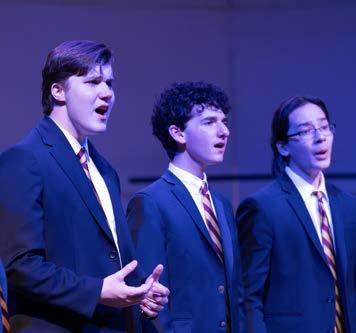
Notables Alex Scharpf ’27, Adam Brown ’27, and Andrew Witmer ’26, performa at the Michael Stairs Concert, May 1, 2025
Art, Design, and New Media Department chair Ms. Aki Torii’s 2D Art II class recently made a Flemish-style oil painting of drapery as their introduction to the craft.
“It
is a great way to understand volume, in a simple way, rather than painting things with eyes and noses and mouth.”
MS. AKI TORII
In this technique, students used layers of painting to develop the piece. They began with the wipeout stage, then used burnt sienna (a reddish-brown pigment), before mixing it with Turpenoid paint thinner and applying it extremely thinly, to break down the oil paint.
Next, they covered the entire piece in
of the cold and dark and rainy weather, we can bring a spark of joy,” Notables director Mr. Donald Holdren said. “It’s really an honor, and it’s a privilege. It’s very exciting.”
The Notables demonstrate that music not only enriches our lives with spirit, beauty, excitement, and hope, but also facilitates the connection of people and communities.
“One of the things that I’m really excited about this year is new, exciting events,” Mr. Holdren said. “We’ve never been invited to sing at this event before, but it’s being held at the Melmark School in Berwyn. The Melmark School is a school for special needs students, and so the opportunity to go there and to sing for them is very exciting.”
The Notables are far from finished, as their journey and influence continue to grow.
“The Notables improve from year to year, but also from rehearsal to rehearsal. We consistently insist on raising the bar. There’s always something that we can sing more tightly, performances we can polish, or one more correction and step forward that we can take,” Mr. Holdren said. “And honestly, one of the great things about being the director of this year’s group in particular is that they are hungry to get better. They want to be the best, and they have that fire.”
These performances can be for both curious strangers and those closest to its members.
“My favorite venue that we go to is the Toys for Tots concert in the Big Room,” Fifth Former Mookie Dombar said. “It’s mostly family and friends. [Last year] we also went to EA’s campus for an Inter-Ac meeting. The
chapel there is incredible, which led to our best performance there.”
“I
get to be in a group of guys who really care about what they do.”
ALEX KEUFFEL ’29
As their voices rise in chapels, concert halls, hospitals, and schools, many people realize that their impact is more than just songs. Each song becomes a unifying piece of art woven into the lives of the people they meet, leaving behind warmth, connection, and a sense of being seen. It’s that sense of service and connection that many of its members love most.
“I get to be in a group of guys who really care about what they do, and I get to show my talent to the community,” Third Former Alex Keuffel said. “When someone at a concert is having a bad day or is going through a rough time in their life, and we make their day just a bit better, that’s all I can ask for as a performer.”
“I really enjoy performing in front of crowds and seeing the joy we bring others,” Fifth Former Hugh Williams said. “I don’t feel much pressure as a Junior anymore, so it feels more of a brotherhood than anything. I love how we explore music while forming friendships for a lifetime. My wish is that our music brings joy to whoever hears our music and makes the world a better place.”
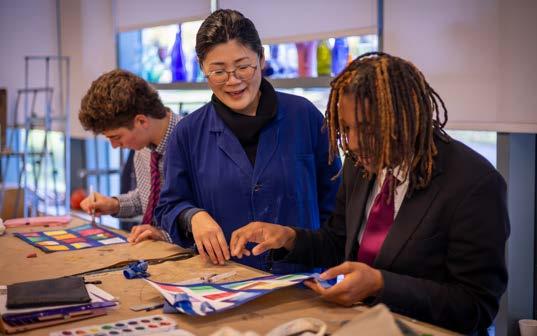
grey paint in order to complete a much more detailed value study.
On top of that, they used glazing, which adds depth to the color and produces a richer final result.
Ms. Torii decided to choose drapery— cloth, curtains, or clothing hanging in loose folds—to introduce a new concept.
“It is a great way to understand volume, in a simple way, rather than painting things with eyes and noses and mouths,” Ms. Torii said.
The traditional Flemish-style they are
practicing can be applied to their self-portrait project coming up at the end of the semester. By practicing how to paint folds and fabric creases, students will feel less intimidated when approaching the more complex forms of muscles, fat, and bone structures in future assignments.
Flemish-style oil painting is a difficult technique.
“This type of technique is not for everyone, and this style of oil painting is as traditional as it will get,” Ms. Torii said. “Students will have to take a break and look at their
work from a distance. I recommended to many of them that they take a walk. Also, I reminded them not to try and finish this in one sitting. This piece and style of art takes time to complete and requires a tremendous amount of patience.”
Ms. Torii hopes to instill a sense of appreciation for oil painting.
Ms. Torii said, “I hope students gain a foundational understanding of this centuries-old oil painting technique and develop a deeper appreciation for other oil paintings and the labor involved in creating them.”
“Our biggest challenge was managing the audience, because it was such a small space compared to Centennial [Hall],” Mr. Hengst said.
The setup presented several challenges to the cast and crew. The Big Room is a common space for all students. To allow the space’s use during the academic day, the production had no fixed set, unlike all the previous productions in Centennial Hall.
Despite the challenges, the cast embraced this challenge wholeheartedly.
“It was a great experience for the department, the boys, and the audience all together,” Mr. Hengst said. “We can’t replicate the type of acting we need in that space in Centennial [Hall]. It’s a completely different style. The cast took it on very well.”
This difference in style required a learning curve for the cast and the production team. Many were surprised by how close the audience was during the open dress rehearsal, just before the actual performances.
The preparation for the play was planned by production team members Mr. Dex Woodward, Mx. Victoria Gill-Gomez, Mr. Hengst, Ms. Kay Strine, and Ms. Rhonda Brown. Additionally, the hard work of the stage crew, headed by Sixth Former Desmond Heneks, helped to outline the play.
“We ran through every situation we needed, ensuring that we and the cast were ready for anything,” Mr. Hengst said.
For Mr. Hengst, directing A Few Good Men was not just about staging a play, but also about creating a positive experience for everyone involved. He carefully planned the play by replicating the Big Room stage in Centennial Hall for early rehearsals. Mr. Hengst’s priority was ensuring that every actor was visible and that their actions were engaging to the audience. He made sure that all the actors were able to enter the stage seamlessly, as only a bare-bones arrangement of curtains masked movement on- and off-
stage.
“It was different having to individually make sure everyone on stage is able to be seen clearly, while on Centennial [Hall] that is just a given,” Mr. Hengst said. “Additionally, I had to make sure that everyone was part of the action and that being able to enter the stage was always easy.”
The sold-out performances, the challenges the cast and crew overcame, and all
of the unforgettable moments on stage contributed to a production that will be remembered as one for the books. Mr. Hengst only regrets the limited capacity, preventing many students from experiencing the show.
“Usually we can have the whole baseball team show up,” Mr. Hengst said, “and we would have space for them, but unfortunately, we were fully sold out for all our shows, so it was a bummer a lot of students couldn’t
come see the play.”
In the end, A Few Good Men was more than just a play: it was a showcase of the resilience, creativity, and talent of the cast and crew.
“I want the audience to take away that we have some really solid actors in the school,” Mr. Hengst said.

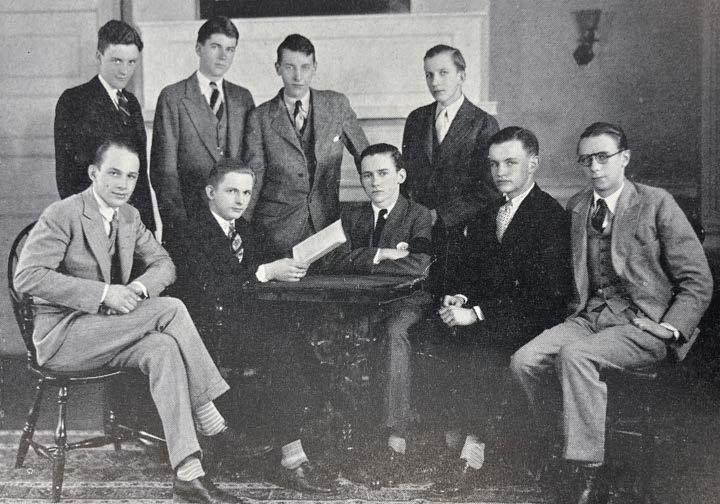
Coming off a rough season, the members of the ice hockey team are ready to prove themselves. It is the second year of the team in the County League, a higher level of hockey than previously, which allows them to play in the highest tier of hockey in this area.
When Head Coach Thomas Lindberg, an alum of the team itself from the 2000s, was hired after COVID, he was given the keys to how the team would progress.
“COVID shut down the program entirely,” Coach Lindberg said. “The whole program changed. This sport is different in that it is really malleable in where you can go with the team. I had a plan, and I knew whatever our boys want to do: we will strive for greatness. I felt since my playing days in ’07 and ’09 that the ice hockey team was an afterthought, but so close to being a top-tier program. This is the league we belong in. Mr Murphy told me that if you think you can do it, then do it.”
The Atlantic League, which the county league feeds into, features several Inter-Ac rivals, including Malvern and EA, as well as
schools like Salesianum and LaSalle.
Coach Lindberg is in his fifth season coaching at Haverford and his ninth year coaching overall, including time in youth hockey. His philosophy centers on development beyond the rink.
“The program is developing the highest quality young men,” Coach Lindberg said. “I lead with and believe it is not about hockey. Anything outside of the classroom is a tool used to develop and sharpen the young man. Hockey is my avenue. I am not building wins. If you do that, then everything follows.”
The Fords opened the season 0–2, but Lindberg is not worried. Their opponents had already played several games by the time the Fords took to the ice.
“We let this team marinate long enough, and it will become powerful,” Coach Lindberg said. “Salesianum had already played seven games. Devon Prep was the same. We do not have the opportunity to play in the fall like other teams. It is hard to give the kids a letter grade when we have not seen enough yet.”
By the time they reach matchups with Father Judge and Hun, Coach Lindberg believes the group will have a clearer identity.
“Malvern and EA at Christmas will be the biggest gauge. The kids are going to feel like they know where we are and understand where we need to build.”
Sixth Form forward Jaxen Smyth echoed that idea.
“The improvement from Salesianum to Devon Prep was huge,” Smyth said. “We skate right up and play. We are not on the radar for getting the best ice slots, and the team knows it. But I think we will do a good job fighting that adversity.”
After a three-win season last year, Lindberg sees growth.
“We are older than we have been in the last three years,” he said. “This group is learning to mature together. I get the sense they are taking more ownership. Last year, they were afraid of success. There was imposter syndrome. Now we know we belong. We can play and win.”
Despite losing players to boarding schools, college lacrosse commitments, and
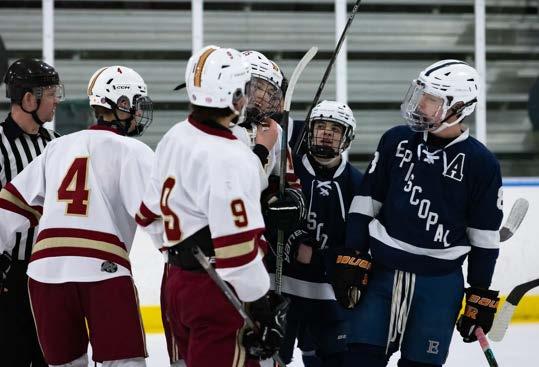
As everyone starts to settle in after the first few weeks, the Fords travel to Lehigh on December 13th for their first meet of the season. It is a large event, with many schools from the greater-Philadelphia area competing in it.
“The first meet of the season is always one of my favorites. I’m able to showcase all of the work I’ve put in during the offseason and also get to see the strength of the other teams.”
AHIJAH GOINS ’26
“The first meet of the season is always one of my favorites,” Sixth Former Ahijah Goins said. “I’m able to showcase all of the work I’ve put in during the offseason and also get to see the strength of the other teams.”
Despite the cold, the boys have been putting in a ton of effort in a variety of different training styles.
“Coach Hawkins has us do a whole combination of speed and short-distance workouts tied in with endurance,” Goins said.
“On some days we are on the track doing very speed-intensive 300m workouts, and other days we are at the college running laps around the nature trail to build more cardio.”
As the competitive part of the season kicks off and the boys start to regain their strength, the Fords will continue to push for another strong winter season. It will take grit
goalie transfers, the players have rallied around the coaching staff, including assistants Ben York and Radnor Miles and goaltending coach Carson Rooney ’18.
“They believe in the coaching staff,” Lindberg said. “If we just get into March, into the Flyers Cup, anything can happen.”
“We have a better chance of playing in the Flyers Cup this year. Last time we played was 2007. Ever since Coach Lindberg came in, it has been an exponential rise,” Smyth said. “The future is pretty bright.”
Every player meets with Lindberg in end-of-season exit interviews. Last year revealed a clear weakness.
“Every player mentioned trust,” Lindberg said. “They were all jovial in the locker room and strangers on the ice. I told the seniors to be the gatherers. Bring the team together for lifts and practices. No phones or speakers in the locker room. Talk to each other.”
Smyth felt the same shift.
“The weakness was not enough players taking it seriously. Now we are way more disciplined and motivated. No phones means everyone is talking about the season,” Smyth said. “It was a pretty good change.”
As for strengths, Lindberg said, “Our strongest asset was intelligence about what does not work. We were not close enough and did not have good enough relationships, so now we meet guys where they are.”
The schedule is demanding: multiple matchups with Salesianum, Father Judge, and Devon Prep.
Smyth said, “Considering what it used to be, it is a tougher schedule, but we have tougher players.”
With only one goalie, Fifth Former Liam McGrath, protecting the defensive end is a priority.
“We do not score the most anyway,” Lindberg said. “We have to minimize shots and take away turnovers. They are not afraid of failing. If we get hot, who knows?”
Lindberg believes the program is close to a breakthrough.
“We are a year or two away from potentially winning a Flyers Cup,” he said. “We just have to get into March. Anything can happen there. This group is ready to take a step. They expect themselves to take a step.”
Smyth agrees.
“We are a lot better than last year,” Smyth said. “Everyone has gotten better. We are fully together and disciplined. I think we are going to do a great job.”
and dedication, but as long as everyone stays focused on their health and fitness, Fords

Keith DiMarino ’27
The basketball team is off to a hot start this year, with its first win over Friends Central, 67-46. A standout storyline from the game is Fifth Former Silas Graham’s 42-point game.
“I hadn’t realized that I scored that much until Christian Joachim, one of our managers, told me I had 29 of our 31 at half. I didn’t do anything different in the game; the ball was just finding me in good spots, and my teammates and coaches were able to put me in positions where I could succeed,” Graham said.
Sixth Form starting forward Emmanuel Butts believes his performance set the tone for the rest of the game and season.
“I feel like for us as a team, it definitely was a tone-setter Tuesday with the incredible game Silas had… and once everybody else picks up the pace, it’ll really set the tone for everybody else in the area that we play against,” Butts said.
The Fords have had a long preseason, dating back to May of 2025, to prepare for this season.
“It was fun to get back out there after the preseason,” Butts said. “Building off of the summer and everybody having fun competing while playing together definitely carried over to this season.”
This year, the Fords want to emphasize playing a tougher defense than in previous years.
“We want to be more gritty on defense,” Butts said. “We definitely have a more gritty defense than we had my last four years here.”
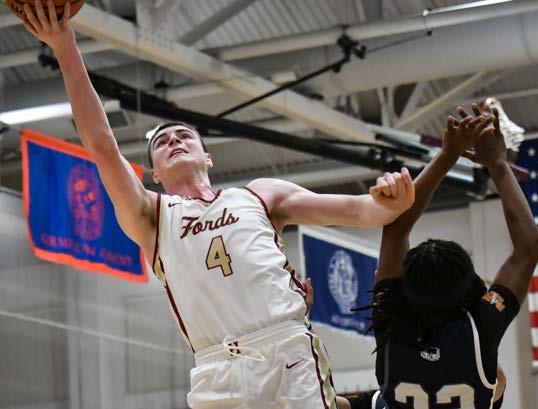
Graham said, “This year we are really trying to emphasize our defense, being low off the ball, knowing who you’re guarding, and keeping guys in front have all been focal points so far.”
The players are holding themselves to a high standard, with their biggest goal being to win the PAISAA Championships.
“PAISAA is the last draw for us. In the last couple of years, we have always gotten out of PAISAA in the first or second round. So, even just making it to the championship this year in PAISAA will be pretty big for us.

With significant talent, strength, camaraderie, and leadership, the swimming and diving team looks stronger moving into their first meet against Episcopal Academy.
“I think we’re looking pretty good. We’ve got a lot of good swimmers and a lot of good talent on the team that’s going to grow,” Fifth Former Ezra Walters said. “Right now, some standout guys are Conor Kirby, who is looking really good; Jack Grimley is also looking really good; and Liam Jones, who, as a freshman, is looking great.”
Not only does the team have strong athletes, but it also has a strong sense of brotherhood and camaraderie.
“Swimming’s not super fun. So if you have a good team sphere and team camaraderie, it makes it a lot easier. And you feel a lot better when you’re doing it, because you know you’re doing it with guys you like to hang out with,” Walters said.
The team’s philosophy is not just to win, but also to put everyone in their strengths.
“I think the overall vibe of the team is getting to where you want to be, and swim-
“In a nutshell, we’re some dogs this year. We’re going to play hard, and we’re gonna bring it every night.”
EMMANUEL BUTTS ’26
Fords
The team looks forward to their game against Malvern, which will likely be this season’s biggest matchup.
“I wouldn’t say I’m necessarily scared of anybody we play this year, but a contender that’s going to compete with us and try to give us a hard time is Malvern,” Butts said.
Ultimately, Butts is confident in his team.
“In a nutshell, we’re some dogs this year,” Butts said. “We’re going to play hard, and we’re gonna bring it every night.”
ming to your strengths and not swimming to what the team needs, and more of what you want to do and what you are strongest in,”
“In meets, there is lots of energy from your teammates who cheer you on, and when you are in the practice lanes, and you are placed with faster guys, it motivates you to push harder”
EZRA WALTERS ’27
Walters said.
The team’s competition and community ultimately make athletes stronger.
“In meets, there is lots of energy from your teammates who cheer you on, and when you are in the practice lanes, and you are placed with faster guys, it motivates you to push harder,” Walters said.
The team’s goal has not changed.
“Our overall goal this season is about getting better by swimming, beating our opponents, and having the drive to win,” Walters said.
The team is supported by its coaches, who help with strengthening athletes and coordinating practices.
“The coaching staff has had a tremendous impact on us. We have [assistant coach] Hunter Gillin, who helps with our lifts and gets us stronger. Then we have [Head coach] Sean Hansen, who builds the practices. Additionally, we got a former graduate, Antonio Octaviano [’20]—he’s a really good coach. He kind of knows what it’s like to be on the team, so he understands us and how to help us improve,” Walters said.
“The sport is not very fun, but sticking with it and showing up to practice is the best way to know where you want to be and get there.”
EZRA WALTERS ’27
Walters believes that consistency is key to success in swimming.
“The sport is not very fun, but sticking with it and showing up to practice is the best way to know where you want to be and get there, and it is how you really improve,” Walters said. “Swimming is an individual sport. So we all need to improve for the team to do well. As I said earlier, we’re focusing a lot on individual talents and skills this year, but that is conducive to the team’s success.”

Haverford Squash: 53-time InterAc Champions and arguably the school’s most competitive program, enters the new season with high expectations and incredible talent. This year’s roster stands out as one of the most skilled groups, but also one of the youngest. The varsity team includes three Sixth Formers,
one Fifth Former, five Fourth Formers, four Third Formers, and one Second Former, making them significantly younger than most high school teams they will face.
Even with such a young lineup, the team’s confidence hasn’t changed. Captains and Sixth Formers Aiden Chiang, Grant Oliver, and Grayson Morgan share that the goals remain the same.
“The biggest goals for us this season are
After a strong first season, Director of the Wrestling Program Mr. Chris Kober is looking to pick up right where he left off. A 2017 Haverford graduate and former Division-I wrestler at Campbell University, Kober returned to his alma mater last year after coaching D-I athletes. His experience and intensity quickly reshaped the program’s culture.
“The team is bought in now. They have learned the different coaching philosophy and style of wrestling that I showed them last year, and now we are using it,” Coach Kober said. “I talk to the boys about attitude. There are three parts for me: discipline, commitment, and accountability. My goal is to have a group full of men who have a workman’s style of accountability. Strap your boots on and get to work.”
Sixth Former wrestling captain Ian Thomas explained Coach Kober’s impact.
“[Mr.] Kober is a great coach. He always does everything with a purpose. He competed at the highest level, so he’s a great example. Some of us have had lots of contact with him—I’ve known him forever. He loves all the wrestlers, and everyone loves him. He does a great job of making sure everyone is connected and accomplished.”
Several other upperclassmen remember Coach Kober from when he was a Sixth Former and helped out at a summer camp they attended.
Building on last season, Coach Kober sees clear signs of progress.
“I want them to go out there and grind, even if the guy is better than you on paper,” Coach Kober said. “The attitude has
definitely improved from last year. I strive to have lots of healthy competition at practice. Once it hits 3:30, and you enter the wrestling room, your friend is not your friend. They are your training partner and can get you better. Don’t let them down.”
As a first-year high school coach last season, Coach Kober had to adjust his approach.
“I coached very high-level D1 wrestling where all of the kids were extremely experienced,” Coach Kober said. “Now in high school, there are still some kids who have been doing it for a very long time, even since the age of five, but others who have just put on wrestling boots freshman year.”
With more experience under his belt, Coach Kober has refined his approach.
“Last year, I [...] ran every little detail of practice. This year, with many seniors returning and the upperclassmen familiar with my and the other coaches’ style, I don’t need to run through every detail. I can focus on creating the workout and helping people with some technique errors,” Coach Kober said. “Additionally, I’ve been working on taking feedback to see how I can improve the team.”
Coach Kober is also pushing for more competition this season.
“I want the kids to do a lot of matches. It’s not about the wins and losses but the experience. We have 45 matches scheduled for each athlete this year, hopefully. There is a good balance of high-level tournaments and lower-level JV meets. Lots of dual meets as well,” Coach Kober said. “Wrestling is not a sport that is fun if you just practice all year,
against Brunswick Academy, which won the national championship last season and has been one of Haverford’s toughest rivals for years.
“We were honestly expecting to lose. Statistically speaking, off player ratings, we were only going to win two of the seven matches, but we ended up winning six of them,” Oliver said. “There was a huge crowd there, and that definitely helped a ton. Peter Pierce had a huge game, beating the number-one U17 player in the country even as he just moved into the age bracket [from U15]. Winning this was a really big deal. It was electric.”
Coming off this huge win, the team looks to stay focused.
“This game doesn’t hold any bearing in winning the Inter-Ac, so we’re just looking to stay focused and to carry this momentum into the rest of the season,” Oliver said.
Compared to previous seasons, one of the biggest differences is the team’s depth. Last year, the Fords were especially strong at the top of the ladder.
Oliver said, “We have strong players all the way down the lineup. There are not many high school squash teams that have the same kind of depth, and it will most definitely serve us well in the closer matches.”
Chiang agreed, emphasizing the team’s long-term potential.
winning the Inter-Ac, beating Brunswick, and placing well in Nationals,” Chiang said.
“Our main goal as a team has always been to win the Inter-Ac,” Oliver said.
“Winning against high-ranked out-of-league teams is always a cool thing to do, but it doesn’t get us any titles.”
The team started the season with a strong 6-1 win over Mercersburg Academy. They followed this with a huge victory
“This year’s team is very young in comparison to previous seasons,” Chiang said. “We obviously have a lot of young talent, which means we have a lot of potential as a team moving forward.”
With so many players stepping into new roles, staying healthy has become a major focus.
Oliver said, “Any injuries in the team force everyone below them to play up a spot, which, in most cases, can cripple a team and end a potentially strong season.”
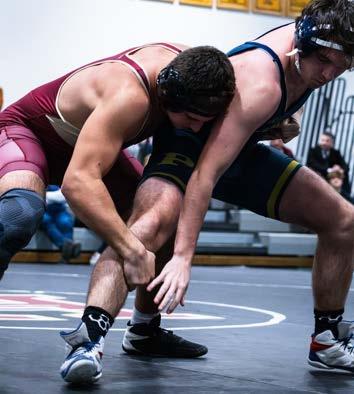
so we are going to do five to eight matches per week to keep everyone enjoying the season and improving.”
The team itself is smaller this year, which Thomas believes is an advantage.
“The biggest weakness last year was everyone figuring out their role,” Thomas said. “The biggest improvement is the type of community that we have this year. It’s a smaller group of guys—just roughly 25 of us. We are closer together.”
With the season approaching, Coach Kober is optimistic.
“I think we will be good,” Coach Kober said. “There are a couple of injuries coming over from football, but we have every class filled besides 113. Lots of guys, including Finn Thomas, Max Lu, Jerry Collins, Ahmad Harris, and Adris Harris [ ’30], are all standing out. I’m excited for the season and to see how we perform.”