The student voice... since 1888
The Index Ευταξια Σωζειν Δοκει
October 2018
Volume LXXXII, No. 2
Haverford, Pennsylvania
www.havindex.com
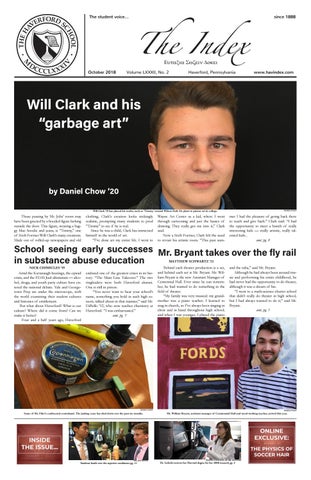
Will Clark and his “garbage art”
by Daniel Chow ’20 Will Clark ’19 has placed his works, such as ‘Timmy,’ around Wilson Hall. He plans to pursue art in college.
Those passing by Mr. Jobs’ room may have been greeted by a hooded figure lurking outside the door. This figure, wearing a baggy blue hoodie and jeans, is “Timmy,” one of Sixth Former Will Clark’s many creations. Made out of rolled-up newspapers and old
clothing, Clark’s creation looks strikingly realistic, prompting many students to prod “Timmy” to see if he is real. Since he was a child, Clark has immersed himself in the world of art. “I’ve done art my entire life. I went to
Wayne Art Center as a kid, where I went through cartooning and just the basics of drawing. They really got me into it,” Clark said. Now a Sixth Former, Clark felt the need to revisit his artistic roots. “This past sum-
INDEX STAFF
mer I had the pleasure of going back there to teach and give back.” Clark said. “I had the opportunity to meet a bunch of really interesting kids — really artistic, really talented kids... cont. pg. 8
School seeing early successes Mr. Bryant takes over the fly rail in substance abuse education MATTHEW SCHWARTZ ‘21
NICK CHIMICLES ’19
Amid the Kavanaugh hearings, the opioid crisis, and the FDA’s Juul ultimatum — alcohol, drugs, and youth party culture have entered the national debate. Yale and Georgetown Prep are under the microscope, with the world examining their student cultures and histories of entitlement. But what about Haverford? What is our culture? Where did it come from? Can we make it better? Four and a half years ago, Haverford
endured one of the greatest crises in its history: “The Main Line Takeover.” The two ringleaders were both Haverford alumni. One is still in prison. “You never want to hear your school’s name, something you hold in such high esteem, talked about in that manner,” said Mr. DiBello ’12, who now teaches chemistry at Haverford. “I was embarrassed.” cont. pg. 3
Behind each theater production is a set, and behind each set is Mr. Bryant. Mr. William Bryant is the new Assistant Manager of Centennial Hall. Ever since he can remember, he had wanted to do something in the field of theater. “My family was very musical: my grandmother was a piano teacher; I learned to sing in church, so I’ve always been singing in choir and in band throughout high school; and when I was younger, I played the piano
and the tuba,” said Mr. Bryant. Although he had always been around music and performing his entire childhood, he had never had the opportunity to do theater, although it was a dream of his. “I went to a math-science charter school that didn’t really do theater in high school, but I had always wanted to do it,” said Mr. Bryant. cont. pg. 5
INDEX STAFF
Some of Mr. Fifer’s confiscated contraband. The juuling craze has died down over the past six months.
MR. JIM ROESE
Students battle over the superior condiment pg. 11
INDEX STAFF
Mr. William Bryant, assistant manager of Cenntennial Hall and wood working teacher, arrived this year.
PHOTO COURTESY OF DR. GOLECKI
Dr. Golecki recieves her Harvard degree for her 2008 research pg. 4
Page 2
The Index - Editorial
October 2018
Letter to the Editors, SEAMUS MCCLOSKEY ’19 Nostrant:
Haverford must leave its Kavanaugh side behind The Kavanaugh hearings have placed the nation on edge, magnifying the issues of sexual assault and party culture. Judge Kavanaugh attended GeorgetownPrep, a school not dissimilar to Haverford, and Yale University, Haverford’s college equivalent. Haverford sits on the Main Line, one of the wealthiest suburbs in the nation, making the school an attraction for the elite. Students here, like all teenagers, are no angels: some drink, some smoke, some party. Many of us are wealthy. Many of us see our future selves as bankers and businessmen, lawyers and politicians. We don’t sexually harass young women or drink ourselves to oblivion, but we have all made mistakes. How can we not fear that those mistakes will come back to haunt us? How can we not see part of ourselves in Kavanaugh? But, we must also ask: is that all we are? Are we just the privileged guys spitting at Dr. Ford’s testimony saying, “That was back in high school?” Are we just a bunch of wealth-hungry, entitled, prep-school jerks? Or, are we a diverse brotherhood of responsibility and respect? In recent years The Index has covered our community’s shortcomings in race relations,
treatment of women, and substance abuse. The entitled side of Haverford still holds a shadow over our community, and the Kavanaugh situation has shone a light on it. Haverford cannot escape national discord, teenage desire, or youthful risk taking. But, we can recognize the cultural faults that have penetrated our walls and attack them head on. The majority of Haverford students are thoughtful and responsible in their decision making: showing empathy for their peers,
respecting women and shying away from binge-drinking. It is of the students’ own initiative that this respectful culture continues. We must set aside our defensiveness and see ourselves as members of a generation more responsible, more respectable, more loving than Kavanaugh’s. Editors-in-Chief, Nick Chimicles ’19 and Neetish Sharma ’19
INDEX STAFF
A few weeks ago there was an article put out by Nick Chimicles about Coach Nostrant’s exit of leaving Haverford School. When I read this piece it seemed strange to me because there were some points that were true about Coach Nostrant, but also some points that did not seem right to me. In saying this, I know Coach Nostrant well and can say only good about him Coach Nostrant is someone I have looked up to over my entire career at Haverford and is someone whom I always admire when looking for advice in life or improving my game of lacrosse. When I first heard about him leaving, it was shocking to me. At first I thought, “Wow this is my last year and his final year to coach lacrosse.” I never thought in my life I would hear about Coach leaving. After talking to Coach about everything that is happening, I told myself there is nothing bad here or nothing wrong here with him leaving. I understand that he is leaving for multiple reasons and that it is time to move on. It is part of life. Everyone has to leave at some point, and unfortunately Coach Nostrant chose this year, which I completely understand. We have to make this year the best one for Coach.
The Index editors, from left to right, Nick Chimicles ’19, Toby Ma ’20, Yan Graf ’20 and Neetish Sharma ’19
From what I can see, the year is off to a great start. I attended my first peer counseling meeting last week, and I saw something new from our community. I experienced boys truly open up and share their deeper emotions with their peers. Men have hard times expressing emotions, myself included; to see my peers pour out their feelings opened my eyes to the sense of trust that holds root in this community. In regards to community, I feel as if the camaraderie is at its strongest. I feel this year we boys are striding together, and the barriers between the different Forms seem to be dissolving. I see people of different grades collaborating and laughing with one another. It is great to see this, especially in a time when outside of our community the world is so divided. I love to see that the political divisions do not breach Haverford. Our community seems to be coming together. Like always, it did not take long for Haverford to enjoy success. All fall sports are performing well. Soccer is nationally ranked
A letter from the President
Biagio DeSimone ’19
and water polo is top in the state. Football has drawn great crowds of parents, students and chicken nuggets. Our community is running well. Community is of the utmost importance to Student Council. We will work on programs throughout the year to make the school experience better for you. I wanted to reinforce that if you have any ideas for an assembly, fundraiser, or any schoolrelated activity, please feel free to contact any member of the Student Council, and we will help bring your idea to fruition. I hope that all of you are enjoying the year so far and that you will continue to immerse yourselves as Fords. Let’s continue the march! Biagio DeSimone
Biagio DeSimone ’19, the student body president. He is proud of our community’s camaraderie this year.INDEX STAFF
The Index’s 2018-2019 Staff
Nick Chimicles ’19 and Neetish Sharma ‘19, Editors-in-Chief Yan Graf ’20, Managing Editor Toby Ma ’20, Features Editor Obaida Elamin ’20, Design Editor Matthew Schwartz ’20, News Editor Vincent Scauzzo ’20, Features Editor Daniel Chow ’20, Features Editor
Nick Chimicles ’19, Head Web Editor Lleyton Winslow ’20, Head Web Editor Noah Rubien ’20, Web Editor Aditya Sardesai ’20, Web Editor
All opinions and viewpoints expressed herein do not necessarily reflect those of The Index or the school. The Index is designed and produced digitally. Photographs may be retouched. Submissions and letters to the editors regarding any and all articles are welcomed at index@haverford.org.
Robert Esgro ’19, Opinions Editor Yeshwin Sankuratri ’20, Asst. Opinions Editor Matt Mignucci ’20, Politics Editor Jon Krouse ’20, Asst. Politics Editor Tyler Zimmer ’21, Arts Editor Augie Aliaga ’21, Arts Editor Nick Pippis ’19, Sports Editor Ryan LaRocca ’20, Sports Editor
The Index is a student-run publication of the Haverford School that does more than bring news: it provides the diverse perspectives of the Haverford student body. It is an outlet for student writers to take stands on issues they deem important. It chronicles the daily struggles and accomplishments of the Haverford community. The Index also provides a forum for discussion of pertinent issues, such as student culture, academic policy, and Haverford’s place in world affairs. The Index presents new ideas and aspires to influence constructive change.
Ms. Alicia Evans, Faculty Advisor Mr. Thomas Stambaugh, Faculty Advisor
The Index, a member of the Columbia Scholastic Press Association, is composed on Mac OS X, using Adobe InDesign CS 2018. Its surveys are conducted via SurveyMonkey and are advertised on Facebook to current Haverford students. Graphic designs are created by Index staff via Canva. Southern Dutchess News prints 200-400 copies of each issue, and its editorial staff distributes them in the Upper School on the day of release. The Index serves the needs of a total school population of 1156 community members, consisting of 956 students and 200 faculty and staff members. Contact The Index: 450 Lancaster Ave, Haverford, PA 19041 index@haverford.org Twitter: @Haverford_Index http://www.havindex.com/
Page 3
The Index - Features
October 2018
School seeing early successes in substance abuse education continued from front page... The response from the administration has been one of absolute transparency and a head-on attack against substance abuse. “There were more intentional steps taken after the Main Line Takeover,” said Mr. Fifer. Dr. Nagl, having then been headmaster for less than two years, established a task force to choreograph the assault. This group established regular Freedom from Chemical Dependency (FCD) surveys, the expansion of drug education through a speaker series, mindfulness as an alternate coping mechanism, and the Brother’s Keeper Program. The general objective was to delay drug use. “Our stance is delay, delay, delay. Delay use as long as possible,” said Mr. Fifer. “The studies show that if students use at an earlier
“Kids have the financial resources to procure, resources to have easy access to automobiles, to have multiple houses, to have houses with big basements” age, then they are more likely to develop an addiction.” Attacking drug use head-on included initiating conversations around the topic, something Mr. DiBello noticed upon returning to Haverford. “It was an unsaid thing that was happening. There was obviously talk, but it was kind of hushed,” Mr. DiBello said. “Now, drug use is definitely more talked about. The fact that we can sit down and have a conversation about it and have it not be super taboo
upon his release from jail. “When I put Timmy Brooks on the [Centennial] stage, parents asked me why I was putting a felon on stage. And I said, ‘So none of the boys become felons,’” Dr. Nagl said. When it comes to Dr. Nagl, one Sixth Form student found him to be one of the most compelling speakers he has heard: “When Dr. Nagl talks with us, it has a real effect,” he said. “I have a great respect for him. He goes to all the games... and it’s amazing to talk with him one on one.” The administration’s tactics balance strict on-campus regulation with support and information. “We want to have multiple tools to address the issue,” said Mr. Fifer. “If you only have one tool in your toolbox — the hammer — it’s not a well-rounded arsenal.” Despite this holistic approach, surveys indicate that drug and alcohol use levels have remained constant since 2014, with underclassmen using below the national average and upperclassmen above it. “The board was not happy with the results,” said Dr. Nagl. “They expected more of a decrease. And my answer to that was that we don’t know if it could have gotten worse.” Yet, Haverford’s drug culture has evolved positively in the past few decades. “There’s a good-news macro story,” said Dr. Nagl. “Drug and alcohol abuse levels across the high school population are lower today than they were in my generation. That’s because of a broader realization of the dangers that can be caused.” But it is that generation, a generation of normalized drug use, that is parenting Haverford students. “I do think some parents today permit drug use and alcohol use in ways that are really ill-advised,” said Upper School Counselor Ms. Heed. “I think that our culture in America has become more permissive. I think some parents don’t give a very clear message to their kids.” “If you don’t know any better, if your parents or older siblings or the administration don’t tell you, then you experiment,” said a Sixth Former. The school plans to counter this influence with increased parental education. “After I gave you guys the ‘actions-have-
“Drinking to the point you aren’t yourself and drinking to get drunk have negative connotations. You stick out as a sloppy drunk”
is refreshing.” For the education of the student body, Dr. Nagl brought Timothy Brooks ’13 back into the Haverford community to speak
consequences talk’ two weeks ago, for the first time I sent that speech home to the parents. I asked them to sit down with you guys and talk about it,” said Dr. Nagl. “We’ve talked about whether we should have mandatory parental education events.” Haverford’s location on the Main Line may also play a role in the availability of drugs. “Kids have the financial resources to procure, resources to have easy access to automobiles, to have multiple houses, to have houses with big basements,” said Dr. Nagl. “But, for a private prep school with many children of privilege, we are not as bad as we could be.” The pressure of going to an elite prep
school is a factor in drug abuse. “I think there is something in adolescence that leaves you open to experimentation,” said Ms. Heed. “Kids today cite increased levels of stress in comparison to other generations.” “When there is an expectation for excellence in all that one does in and out of the
classroom,” Mr. Fifer said, “it can lead to a certain amount of pressure and stress on the students. And then you add the stresses of college into that mix. All of those are ingredients can result in high levels of stress. We want to develop programming that provides a more healthy coping strategy, and one thing we’ve tried to infuse is mindfulness.” On the other hand, some believe that the busy lives of students may have a positive effect on use rates. “Happy kids are involved kids, and we have a bunch of kids who are super involved here,” said Mr. Stambaugh ’90. “They probably think there are more important things on their agenda than getting high.” “Haverford provides so many opportunities for students,” said Mr. DiBello. “It’s when teenagers have too much time on their hands that they get in trouble.” Students resisting the recent Juuling craze may exemplify the effects of the administration’s educational efforts. “The vaping thing is overplayed. I can’t think of that many that Juul on a consistent basis. Here, people think it’s kind of lame,” said a Sixth Former. Another Sixth Former added, “Everyone I know who used to Juul ended up quitting.” Students claim the reason for this rapid reversal was their realization of the dangers of Juuling. “There was so much hype, but no one had
real information. People thought it was super healthy,” said one student. “Then, people learned that it’s basically the same thing as smoking.” “I think the studies, as well as the school’s programming, had a big impact,” said another. “But there are still definitely a handful of kids that are on the ‘Juul train.’” Mr. Fifer called the student’s self-education on the effect of Juuling “a positive.” “One would hope that something they hear about in one of these educative programs sparks their desire to learn more about it,” Mr. Fifer said. Dr. Nagl seemed visibly relieved when informed Juuling rates had decreased. “I am terrified that kids are going to be in college and come down with throat cancer to the point where they have to have their tongues cut out. It’s all in the aerosols and carcinogens,” Dr. Nagl said. “We’ve hit that message pretty hard, and we’re not seeing as much vaping.” Still, alcohol remains “the drug of choice,” according to one student. “It’s almost a tradition,” said a Sixth Former. “It’s something the older generation did. They tell their kids, then the kids do it.” Another motive is rooted in Haverford’s social climate. “There’s a very logical reason,” said one student. “It’s that we go to an all-boys school, and you want to see [girls and boys from other schools] from time to time. Alcohol is the ‘social lubricant.’ It makes conversation easier.” Another stated, “If people go to a party and drink, it’s because they’re at a party, not because they want to drink. It’s more of a social thing than an actual need.” “First, we don’t want kids drinking. But, it is in fact a ‘social lubricant,’” admitted Dr. Nagl. “It reduces inhibitions. It helps people who have a hard time interacting with other humans.” “But,” he emphasized, “we don’t want kids binge drinking.” In the 2017 FCD survey, 47 percent of
“The vaping thing is overplayed. I can’t think of that many that Juul on a consistent basis. Here, people think it’s kind of lame” the Class of ’17 class found that “heavy or binge drinking is okay.” Yet, only 19 percent of the Class of ’19 said the same in that survey. “Drinking to the point where you aren’t yourself and drinking to get drunk have negative connotations. You stick out as a sloppy drunk,” said one Sixth Former. “I do know kids from [other Inter-Ac schools] who are sloppy drunks, but not many, if any, Haverford kids. Most get too drunk sophomore year, but now have found their comfort zone.” “There are so many resources committed to making drinking beer cool, for example, the NFL’s advertisements running on beer ads,” said Dr. Nagl. “Are we going to make drinking uncool? No. But drinking until you lose control of your bodily functions? We can make that uncool.” cont. pg. 4
Page 4
The Index - Features
October 2018
School seeing early successes in substance abuse education continued from front page... Marijuana uses, according to the 2017 FCD survey, exceeded national averages, with 33 percent of the Class of 2017 reporting that they “have smoked in the past 30 days.” “I smoke [weed] once a month,” said one current Sixth Former. “You have a lot of work some week, and you think that by the weekend I can hang with my buds and smoke a little bit. And that’s a pretty good reward at the end of the week.” But, another student approached his drug use with caution. “The day after I first did it, I was thinking — I don’t want this to be who I am,” he said. “I was concerned the first time I did it, but it doesn’t take over your identity. Afterwards, I’m pretty much the exact same.” Students see some benefit to experimental
drug use in high school. “It’s easier getting the experimenting out of the way now,” said one student. “I’m glad I know my limits and feel comfortable going to a bar or something like it when I’m older.” Another commented, “The only benefit I see is that you don’t go off the rails in college. It’s good to know what you want to do and what you don’t want to do.” This form of responsible experimentation counters the administration’s message. “Any use is bad use,” said Dr. Nagl. “Delaying use and minimizing use saves the kids who are prone to addiction but don’t know it.” Mr. Fifer said, “When you start talking about ‘it’s okay to experiment,’ it leads to mixed messages being sent.”
Haverford’s uncommon method of constructive support over punishment facilitates transparent dialogue. “I don’t think there’s anything particularly unique about drug/alcohol use or adolescent life at Haverford,” said Ms. Heed. “But, I think we are particularly inclined to being supportive rather than punitive.”
“The day after I first did it, I was thinking—I don’t want this to be who I am” “We will not hold you responsible if you drink off-campus,” said Dr. Nagl. “We will not kick you out. We’ll talk to your parents. We’ll try and get you help.” Yet, sometimes that individualized
Dr. Golecki brings bioengineering to students
by Toby Ma ‘20 Dr. Golecki in 2008 making chitosan thin films using a spin coater, an instrument that spins at ~1500 rpms to create very thin layers of material
Last August, Dr. Golecki received her Ph.D. in bioengineering from Harvard University. Now a science teacher and Director of Robotics at The Haverford School, Dr. Golecki remembers the process that led to her doctorate. “I always wanted to teach, my whole life,” Dr. Golecki said, “I was good at math and science, and a lot of people in my life encouraged me: specifically, my mother encouraged me to study engineering because she thought that was just going to be a good career path.” Dr. Golecki went to Drexel University, where she majored in Material Science and Engineering. “At the end of my undergrad I really wanted to learn how materials can be used inside the body,” she said. “I had learned a lot about materials and their properties, and now I wanted to use them in a bio-based application. That’s why I decided to study bioengineering.” “I reached out to a bunch of different universities and one of them was Harvard. There was a group at Harvard studying devices for use inside the body and materials that could help tissues build themselves. I joined that lab and I worked for four and a half years,” Dr. Golecki said. “It was really a wide range of topics that I studied, all with the goal of building materials that could help your body repair itself.” In the process of earning a Ph.D., Dr. Golecki had to take many classes and do years of research. “You have to identify a problem, something that no one has addressed before, and you want to use theory and experiment to support your hypothesis,” Dr. Golecki said.
Dr. Golecki had a novel idea in utilizing synthetic biological proteins to assist in healing wounds. “My hypothesis was that we could use mechanical forces to control chemistry and build fibronectin fibers to redirect the wound-healing cascade in adults,” she said. Fibronectin is abundant in human fetuses, and scientists theorize that because of its prevalence, the fetus has skin that will heal scarlessly after injury. “So we had the idea that if you applied fibronectin fibers to adult wounds, you could trick the wound into thinking it’s a fetal wound, and then maybe it will heal scarlessly,” said Dr. Golecki. “We basically made wound dressings — bandages — out of fibronectin fibers, applied them to adult wounds, and then monitored the healing.” “We saw that while the healing rate wasn’t much faster, it was faster in the first few days, which was critical. And it led to a reduction in scar formation. We showed we were able to regenerate hair follicles and fat tissue in that area. The result was exciting, however I was particularly interested in the process of making those fibers in the dressing. We used fluid dynamics to model the process of unfolding the molecules. We developed a unique method of unfolding proteins that allowed us to treat wounds in this way,” Dr. Golecki said. Dr. Golecki defended her dissertation at Harvard on August 28th. This consisted of a forty-five-minute presentation in front of a committee of professors, and then a question-and-answer session. Dr. Golecki said the defense was an “awesome experience.” At Harvard and Drexel, Dr. Golecki was further inspired by outreach programs that
PHOTO COURTESY OF DR. GOLECKI
showcased graduate-level science to school students. “[The outreach] really got me interested in this idea of adapting graduate-level research for a K-12 audience to inspire students to get excited about science and engineering,” Dr. Golecki said. At Haverford, Dr. Golecki teaches engineering, where she can use her experience in graduate-level labs and research to teach students. Dr. Golecki wants her students to appreciate and understand the connections in science. “Just knowing about the literature and what’s on the cutting edge is exciting and so being able to bring that into the classroom,
“Research doesn’t have to wait until graduate school or even undergraduate — you can do it now.” like teaching students how to read papers, teaching students how to analyze materials and properties and connecting biology, chemistry, and physics; that’s the one thing I really like to do,” said Dr. Golecki. “Take all the sciences that students have taken in discrete chunks and tie them all together to show that in real life they’re all interconnected.” “I went to graduate school and studied at the highest level,” Dr. Golecki said, “and so I know what’s necessary to get to that point. Maybe I can help my students feel confident that they can also get to that level.” Dr. Golecki also mentors the school soft robotics team, a group which conducts research in the field of soft robotics and is “exactly that idea” of promoting high-level research in high school.
“help” comes only when a student has a life-threatening problem, not when kids first start experimenting. Dr. Nagl stated, “It’s frustrating. We’re getting kids help on the far end, but we don’t know how many kids we’re preventing from using.” The school’s greatest desire is to keep students healthy and to prepare them for life. “There’s a whole pile of problems that our generation has not solved,” said Dr. Nagl. “We want you to be smart and committed, and we want you to have everything you need to solve those problems. And if you are addicted, you are going to be less effective. Not many kids are able to go to this school, and we need all of you to be leaders in solving these problems.” “I’m really very interested in engineering education and how you inspire the next generation of innovators,” explained Dr. Golecki. “Research doesn’t have to wait until graduate school or even undergraduate — you can do it now. “The way we run soft robotics is very similar to the kind of research that I was doing at Harvard, where we have a look at the field: What’s the problem? What’s missing? What can we do to advance the field and come up with solutions to problems facing society?” Dr. Golecki said. “Students run the studies, they present the work and then publish the work. And I am just there to support and guide them. It’s the full graduate-level experience,” Dr. Golecki said. “In Vex Robotics as well, we are starting to ask those fundamental questions — how are the principles of physics and chemistry impacting the components we use and our performance? Just like in sports analytics, can the data drive us that much further?” Dr. Golecki also encourages her students to consider studying science and engineering as they eventually go to college and beyond. “I think [pursuing a doctorate] opens up opportunities for thinking about complex problems,” Dr. Golecki said. “Inspiring students to know that it’s possible to achieve the Ph.D. is important to me. Even though it’s something that seems really far away: it’s closer than they think, and maybe seeing my process can inspire them to also try to study at that level. I have been fortunate to have great mentors in my career, two women in particular that I can think of. They helped me to realize what was possible and pushed me to achieve that. I would like to pay it forward and inspire students to achieve what may seem impossible.” “If students are interested in doing a number of years of an intense intellectual exploration, I think it’s a really good idea, and I think it was an awesome opportunity that I had to be able to do that, because you could easily go to industry and make more money right out of the gate. But I think having the opportunity to just be surrounded by people who are intellectually focused and studying these kinds of interesting questions is really fun,” Dr. Golecki said. “If you like that intense exploration of applied math and science, then I think I’d definitely recommend a Ph.D. in engineering.” Dr. Golecki has advice for students who have already decided to pursue scientific research at the college and graduate level: “start innovating now.” “It’s not too early and the scientific community really is a community, so knowing that scientists and faculty members are people too and that you can reach out to them, talk to them and network with them…Ph.D.s were once in high school too, and usually they are more than happy to help out a budding scientist or engineer,” said Dr. Golecki. “And I’m happy that I can help facilitate some of that here at Haverford.”
Page 5
The Index - Features
To be the best, one must think like the best. To be the best at soccer, one must study the ways of the pros. That’s how Luke Macaione ’20 found his life-long passion in the sport. Growing up in London, he went to the great matches, as they call them, seeing some of the best players in the world battle on the pitch. The sounds, the energy, the athleticism — who wouldn’t be inspired? Born in 2002 in the land of the Queen, Macaione grew up around soccer. In Europe, being a soccer fan is expected as much as being a football fan is here. Macaione said he got hooked when he went to his first game. He played in the local parks on outdoor grass fields, which made playing on American fields a new challenge. The indoor turf facilities here are wide open, and the style of play is different. “Where the Brits are all about strategy and precision,” Macaione said, “American soccer is more about physical strength and athleticism.” Macaione crossed the pond permanently in 2010, joining Mrs. Thorburn’s third-grade class halfway through the year. He grew up going to Long Beach over the summer, and most of his family was in the greater Philly area. Therefore, he was somewhat familiar with the idea of breakfast bigger than a croissant, but he had the full British accent and loved watching his “cartoon color TV programs,” as he put it. The first thing Macaione did when he
arrived was join the local soccer club, YSC. There he had his first encounter with the strange new fields. It didn’t phase Macaione much, because before too long, he was playing with the advanced group. He played in the Radnor soccer league, too, meeting Haverford students like Fifth Former William Boyes. Eventually, Macaione outperformed the local teams and moved on to the next step: a big travel team. At FC Delco, “I got so much better at soccer because I was playing with kids a year older.” They showed him the way he needed to train and forced him to work hard. This travel team set him up for his high school career, where he faced a difficult decision. At Haverford, a player can’t play the school soccer team and a travel team. With a lot of great travel teams in the region, it’s a hard decision for the athletes. During the first game of his Third Form year, still on the travel team, Macaione broke his leg, putting him on the bench for the entire season. “I had never experienced an injury like that at all.” Having taken so many months off, Macaione was thrilled to get back out on the field, but after only three weeks of play, he was diagnosed with a stress fracture in his lower back. Devastated, Macaione stood on the sidelines again for another six months. Over that time, though, he discovered something about himself.
Upper School Head Mr. Patrick Andrén met with The Index recently to discuss his transition from his previous job, his goals for the year, and his longing for Texan salsa. Mr. Andrén has acclimated to his new surroundings and is looking forward not only to getting to know the place, but also
to taking some time to build lasting relationships. “Getting to know the stories that people bring to the table and the stories that the school has,” said Mr. Andrén, encapsulates his plan for the year. There are some differences and similarities between Haverford and St. Mark’s
Mr. Andrén’s settling into the saddle
by Mitav Nayak ‘22 Mr. Andrén in his office. This is his first year as Upper School Head.
INDEX STAFF
October 2018
Luke Macione finds his ‘tekkers’ by Vincent Scauzzo ’20 Luke Macione ‘20 shooting on goal in a game against Kiski this year. He has loved soccer his entire life.
“[That experience] taught me how to appreciate playing soccer and being healthy and not taking that for granted,” Macaione said. When the next season arrived, he saw “the brotherhood and family aspect” that the Haverford team had to offer and “thought it was really special.” He talked with his father and decided to commit to the school team. “I have all the support in the world, and I’m extremely fortunate,” Macaione said. School of Dallas, where Mr. Andrén also served as Head of Upper School. Beyond the Southern accents, there are regional differences that one would expect between Dallas and Pennsylvania. Different parts of the country, different curricula, and a different mix of kids were few among many, but there were also apparent similarities. Like Haverford, St. Mark’s is a boys school, grades one through twelve with around 870 students in total. Mr. Andrén, who has four sons of his own, loves boys and truly believes in the purpose of facilitating an allboys school. “The great thing so far has been that it’s been affirming in every way from just the strength Haverford has, to the passion which you guys bring to everything that you do,” said Mr. Andrén. “Just the balance between having fun with seriousness of purpose is what I love so much about boys.” Mr. Andrén’s biggest goal is to get to know the people at Haverford. “When you know the people you know the place,” Mr. Andrén He is excited to get to know the students as well as the school. One of his more ambitious goals is to know the names of all of his colleagues along with every boy’s name by the end of the year, saying, “463 of them, so I have some work ahead.”
MR. JIM ROESE
Macaione said his father, whom he calls his “number-one fan,” always pushed him to be his best, keeping him focused and determined. Macaione wants to play soccer at a Division-I level in college, and he’s already connected with the assistant coach at Penn. Since he’s lived here, Macaione has picked up a passion for The Eagles. He went to the Super Bowl and always tries to get to the games if he can. He’s one of the most enthusiastic fans in the school. Mr. Andrén believes his role is like that of an archaeologist. “Just trying to understand the history of this place and the people in it.” said Mr. Andrén. Mr. Andrén, who has moved twice in three years, is no stranger to change. “When you leave a place you do miss friends and you miss the familiar things,” said Mr. Andrén. “I personally miss the salsa and guacamole from Texas. It was really good!” While it is hard to move, the Andrén family is also excited about the opportunities that are here at Haverford, especially getting to know the community. “People here have been great. The Haverford community has been so welcoming to me and my family,” said Mr. Andrén. There are some aspects of Haverford that have made an especially strong impression on Mr. Andrén. “When I walk through the halls, I do see a seriousness of purpose about getting the job done,” said Mr. Andrén, “but I also see some play and fun, what I would qualify as positive competitiveness.” Mr. Andrén feels that we drive each other to be better at Haverford. Additionally, he said, “Part of our role and responsibility with each other and this community is to make my classmate, my brother, and my teammate better.”
Mr. Bryant takes over the fly rail continued from front page... It wasn’t until college, at the University of Delaware, when Mr. Bryant noticed that one of the student theater groups was doing a production of The Phantom of the Opera. He had always enjoyed that show and decided to audition for a role. He got a part and finally, during his sophomore year of college, participated in his production. “I really like the aspect of creating a world for the theater or show you’re depicting,” said Mr. Bryant. “You can do a literal set where it’s exactly like what it says; ‘they’re in a house,’ so you build a house. And sometimes that’s what the show calls for, but sometimes you have the opportunity to kind of interpret the story and represent the setting in a way that tells the story without even the actors having to say anything. So you can already see what’s happening. I love bringing those ideas that people have, making them concrete, and letting audiences see them as it influences their perception of the work.” Transforming a director’s vision or a student’s vision into a set fuels Mr. Bryant to
continue designing and building future sets, even when they might seem difficult or not possible. “In my opinion, when you’re a technical director, your default should always be yes, at worst a maybe, but like really unfortunately, I have to say no to things. I’ve always tried to make it happen when I approach my work . . . you want to say yes to as many requests as you can, and if you’re saying no, you should have another option already,” said Mr. Bryant. Make sure to check out the upcoming plays from the theater department to catch a glimpse of Mr. Bryant’s work. The Enemy of the People, is currently in rehearsal now and will be performed November 16, 17, and 18. “Our big goals are to put on a really professional product and show that just because the work force is primarily students,” said Mr. Bryant. “The quality of technical theater can be just as good as anywhere else.” Mr. William Bryant in ‘the shop’ of Centennial Hall. He heads up the stage crew this year.
INDEX STAFF
Page 6
The varsity football team enjoyed a 69-24 victory over the Chester School on Saturday, September 22 on a newly remodeled Sabol Field. The Fords’ newly revamped football field, which features maroon end zones that say “FORDS,” and a large maroon “H” at midfield, were completed just in time for the home opener. The field restoration project began way back before summer break and took all summer and the majority of September to complete. Going into the project, the staff knew that drainage problems under the field and by the end zone farthest from the field house would be a major problem. This contributed to the long time frame allocated for the remodeling. As well as the drainage problems, the process took longer than expected because the turf carpet’s delivery from Georgia was delayed. After the carpet finally arrived, the work crew meant to install the carpet was also delayed coming over from Pittsburgh by a few days. Between the delay of the turf and the delay of the work crew, the project lost a week. Due to the field’s high quality, the one-week delay proved worth it.
The Index - News
October 2018
Sabol Field gets a makeover
Ryan Roddack ’22
The new track that will be laid RYAN RODACK ‘22 A picture of the new field after its completion. Workers have not yet surfaced the track. down in the coming weeks is the highest-tier quality of run- summers of 2001 and 2009. Fords’ quarter- sequently pushed back the remodeling of track, including Mr. Michael Murphy, Mr. Bill back Ben Gerber said, “After years of heavy the track for another one to two weeks. Four Wardle, Mr. David Gold. Mr. John Nostrant ning material. The field not only looks better on the outside, but it also has higher quality turf compared to its predecessor. The turf will make the field more durable and more playable. A shock-absorbent pad under the turf will assist with drainage. This pad will hopefully make tackles less painful and will eliminate all drainage problems in the future. Prior to the replacement of the turf over the summer, the turf was last replaced in the
playing activity, turf can get worn down and the surface isn’t as forgiving. You can definitely feel the difference the new field makes while playing; it is softer and feels better to run on.” Apart from just the field, work was done to the track. The track was intended to be completed the week of September 17. Due to the football team’s home opener on September 22nd, the work crew wanted to focus on getting the field 100% ready which sub-
or five days without rain are needed in order to lay down the track and let it dry. The new track that will be laid down in the coming weeks is the highest-tier quality of running material. The track was last resurfaced in 2007, so the new material being laid down should be beneficial to all runners whether it is for track, P.E. class, or crosscountry. Many people put their time and effort into the remodeling of Sabol Field and the
was also asked for his opinions regarding the field’s details, and Mr. Luqman Kolade, Varsity Track Coach, was asked for his input as it relates to the track. The Haverford School worked with and received support from Facilities Manager Mr. Bob Wisler. The company that oversaw and managed this project, Engineering and Landscape Architects, also worked on Memorial Field and Class of ’75 Field construction projects several years ago.
several construction projects. Started last May and finished just in time for the Fords’ football home opener, the new football field is the most prevalent change. The track will be installed at a later date. Another notable change is the bathroom off the Centennial Hall gallery, where new paint and floors adorn the space.
On the lower level, crews have created a new art studio. So far, they have installed new glass doors as well as some tables and shelves. According to art teacher Mr. Greg Ressler, “It is currently a blank slate, but we hope to make it a relaxing space for the seniors.” The art teachers think that students who have worked up to the Portfolio-level classes deserve a “corner office” to retreat to. The teachers also plan to have it run by the students, and it will eventually feature a couch with possibly a TV. Another ongoing project is updating several community spaces in the Upper School with new furniture. The furniture from the area outside the admissions offices has already been moved to the second-floor “Street,” but there is much more to come. Haverford staff and representatives from Staples met over the summer to discuss Upper School community spaces. The Staples reps considered the floorplans and, with teachers’ input, planned new furniture to update the current spaces. One area the committee improved was the Community Room. English Department Chair and planning committee member Mr. Tom Stambaugh said, “The Community Room has been a concern with students trashing it. The question is: if there was better furniture, could it be better?” The committee considered this question and has designed a new furniture layout. The
new layout will include three groups of four chairs with whiteboards for each group. The two ping pong tables will remain. Another space the committee focused on was the “Street.” Aside from having destroyed furniture, teachers feel the layout was not productive and that there was a lot of wasted space. The representatives designed four separate spaces between the pillars. The area closest to Mr. Poolman’s office will feature high-backed benches and two chairs with one table in the middle. One bench will have a small table on the back with space for another two people to work. In the middle section, where the high tables and old admissions furniture are currently, there will be two “clubhouses.” These clubhouses will be a three-walled room with two benches and a table. Ideally, this will offer a private space for up to four students to work while still allowing teachers to monitor activity. The area closest to Mr. Lengel’s room will receive new sofas and chairs in a similar arrangement. A new whiteboard for this space will likely have five separate sections: one large whiteboard in the middle with four swinging boards in front of it. The four swinging boards will be detachable and connected with hinges to the main whiteboard.
Summer’s subtle changes in Wilson Hall EVAN BRABSON ’20
Many schools capitalize on a long summer break to make campus improvements. Aside from welcoming new teachers and division heads, Haverford has installed a new football field, updated the bathrooms in Centennial Hall, created a new art space, and held meetings to plan for future changes. Over the summer, the school completed
A general idea of one of two “clubhouses” coming to the second floor “Street.”
STAPLES
Page 7
The Index - News
October 2018
Hopes rise for new middle school AIDAN LOWE ’20
After a number of years planning, Haverford is finally preparing to rebuild the middle school. As of now, there is no name for the building, though the dining hall may be renamed Crosman Hall. It will be a similar size and shape to the current building, but will include three floors rather than the current two. In addition, the bottom floor will be completely above the ground, with no classrooms in the basement. Each floor will accommodate its own grade, as well as its own community space.
The second floor will feature a balcony overlooking the 1,000-square-foot community room on the first floor, allowing for plenty of open space in the building. All classrooms will be on the side of the building facing Wilson Hall, with the other side being used for lockers, storage space, and other small rooms. On the side facing the hallway, the classrooms will have see-through glass walls, unlike any other building on campus. Impressively, all of these features are packed into a building whose footprint is not much different from the current middle
school’s. In fact, it actually takes up slightly less space. Despite this, the new building still has 12,000 more square feet of floor area thanks to the addition of the extra floor. Traffic flow around the campus will remain entirely unchanged, so any walkways and driveways will still be as they currently are. Both Mr. Greytok and Dr. Nagl hinted that that building could feature some special security work, though it is not entirely clear what some of these measures would be. Also, it is likely that an ID-based attendance system will be implemented, allowing stu-
Middle School Head Jay Greytok holds plans for the new middle school. Dr. Nagl hopes to recieve board approval for the design next week.
dents to “sign in” as present by swiping their badges. And, the current goal is to achieve a LEED-Silver designation of environmental friendliness. Sections of the roof will be flat, allowing it to serve as a potential platform for astronomy. Although there are currently no plans in place, it is possible that the roof could feature an observatory sometime in the future, provided that it has sufficient funding. Mr. Maley is a strong proponent of building the observatory. He believes that it would greatly benefit not only Haverford’s astronomy program, but other learning institutions as well. He argues that outside schools could rent out the space, much like Centennial Hall, which would help support the cost of building and maintaining the structure. Again, there’s no official word on this happening yet, but it is a possibility. During the two-year span that the building is under construction, middle schoolers will reside in an elaborate structure located on the tennis courts to be called “Mustang Manor.” It will include around a dozen classrooms set up in trailers. Unfortunately, the administration has not provided much information on where the tennis team would practice in the meantime. According to the plan, the current middle school building is scheduled to be demolished this June, provided that there is board approval by October 6. The new building is scheduled to be completed by the start of the 2020-2021 school year.
INDEX STAFF
HAVERFORD ANALYTICS BY JACK PHELAN ‘21
This year, Haverford as a total of 145 new students, with 45 in the Upper School. This is a 2.8% increase from last years 142 total new students and a 18% increase in new Upper School students from last year’s 38.
Third Formers bring fresh perspective to schedule BY JEFFREY WANG ‘22
For Third Formers, the new Upper School rotation schedule is just another part of assimilating into Wilson Hall. While some upperclassmen may have found the new schedule perplexing, Third Formers have only ever known this schedule while attending classes in the Upper School, and can only compare it to middle school. For many Third Formers, the introduction of free time, whether that be with flexes or study halls, is their favorite aspect of the new schedule. “Free time makes the workload at home much less,” said Ben Szath-
mary, a Third Former new to Haverford.
“The ratio [of free time to classes] is pretty reasonable and allows for the completion of some homework.” The change from the Middle School’s cramped rotation, which was similar to an X-Day without study halls, allows for a more “spread out” school day that feels less tedious.
But the issue with free periods lies in the distribution of flexes and study halls throughout the seven-day cycle. Third Formers with no classes after lunch on some days have commented that the unequal allocation of free time makes other days when they have no free periods feel packed. Quinn Luong, a Third Former who had come up from the Middle School, responded, “The ratio [of free time to classes] is pretty reasonable and allows for the completion of some homework.” Nevertheless, Third Formers have found
a few negative aspects about this schedule; the first being the late lunch periods. Coming from the Middle School’s 11:20 lunch, to the B Lunch’s 12:35 to 1:10 period has been said to feel particularly late. The problem worsens when sports begin, as Third Formers are still full from the late lunch. Another argument that has arisen is the feeling that long blocks are too long and frequent. In the Middle School, each day only had a single long block; however, Third Formers now have to grow accustomed to having three long blocks per day.
Page 8
The Index - Arts
October 2018
Will Clark and DANIEL
...and it was great to just be in that kind of environment and see kids being as excited about something that I was at that age,” Clark said. Down in Wilson’s Hall’s Durham Community Room, students and faculty can spot a large spider web made from plastic wrap hanging from the pillars. This of course, is also one of Clark’s creations, inspired by his time studying in Ireland. “Cow House Studios is run by an alumnus of Haverford. He runs the program over at Ireland outside Dublin. I did work over there the summer of my freshman year, and it was a blast,” Clark said. “Although I was the youngest one, I learned a lot there. It gave me the opportunity to dig into areas of art that I really hadn’t focused on before like painting or ink.” “I worked with plastic wrap before when I went to Ireland that summer, and I really liked it, so I wanted to work with it again,” said Clark. “I just kind of randomly took a space in the Community Room and started working. It wasn’t too difficult or anything; it was just my interpretation on a spider web using the material I had.”
“Timmy”
Clark is currently pursuing his artistic passion in an independent study with Mr. Fox. “I basically get to go in every day and create my own plan. I go in every single day and get to create whatever I want,” Clark said. Although Clark was initially more of a sketching artist, his focus has since shifted over to creating more material-based projects. “[My artwork is] now really all sculpture and material based. It’s not traditional sculpture with like metals and clay. It’s really just anything,” he explained. Because of his unconventional use of materials like plastic wrap, nails, and newspaper rolls, Clark has coined his recent works “garbage art.” As unorthodox as his material choice is his approach to creating his projects, which is far from straightforward. “I personally set a goal that I create a different art piece every single week, and it’s based off of a material. So, I don’t pick what I want to do, I pick the material I...
“Heart over mind”
“Web of structure”
Page 9
The Index - Arts
October 2018
his ‘garbage art CHOW ’20
want to use to make it,” Clark said. “From there I figure it out. I know most artists will usually sketch out really in depth what they want to do, and when they plan things they do it to a tee, but I don’t do any of that, I just do whatever.”
“For Clark, art is a form of escape.” Unlike many contemporary artists, Clark stays away from symbolic art. “I had a lot of people stop by and ask me like what was the idea behind my work. Honestly, none of my art has intended meaning to it,” Clark said. “I just make things that will ultimately look interesting.” “Most people look at art and they think, ‘What’s the message there? There must be a deeper message!’ But I have never had an initial intent to my art,” said Clark. “I, to this day, have never made a piece that I personally thought like that’s representative of X-Y-Z feeling.” “Everything I’ve ever done has been for the sole purpose of creating something that looks interesting and intrigues people
from a visual standpoint, not from a mental standpoint.” “For ‘Timmy,’ all I thought was, ‘I have some clothing, some paper, and some thumbtacks. Let’s just see what I can do,’” said Clark. “I met an artist in Ireland who would put statues in very awkward positions, so awkward to the point that people would see it and think that it was real or that something was going on there when in fact it was just a stationary sculpture. I wanted to take that into my own hands and see if I could get some kind of ‘Oh, my God’ reaction from people.” Clark is currently working on a largescale cyclops statue made of VEX Robotics parts and looking to write and illustrate a children’s book. For Clark, art is a form of escape. “I have a very busy mind,” explained Clark. “It’s very hard to shake all the thoughts in my head to the point of the only real time where I’m not thinking about grades or home life is when I’m sketching or when I’m doing some work on a sculpture project. It gives me an opportunity to not think about other things in my life.”
“Paper face”
“Vex flower”
Detail from “Lincoln”
ALL PHOTOS COURTESY OF WILL CLARK ’19
Page 10
The Index - Off-Campus Opinions
October 2018
Migration to Europe Part 2: Historic immigration YAN GRAF ’20
The past few years brought hundreds of thousands from all around the globe to Europe’s shores. What to do with these people and what their futures will be like is a question that grips political discourse in Europe. While the current wave of migration is among the biggest Europe has ever seen, it is far from the first. For decades, millions of guest workers and migrants have been making their way to Europe, just like the refugees of recent times. How they have fared in Europe can tell us a lot about the futures of current and future refugees. The story of recent European migration begins shortly after World War II. In order to rebuild Europe, and also to replace the millions of men who died in the brutal war, Western European countries began importing labor, mostly unskilled and uneducated, from abroad. While many people came from within Europe, millions came from Africa, the Caribbean, and the Middle East. In order to understand the rising anti-immigrant attitude in Europe, it is important to understand the descendants of these guest workers, and the later waves of migration that followed them. In particular, I want to focus first on Germany. While people from all over Europe and outside came to Germany, the largest and most controversial source of migration was Turkey. To this day, GermanTurks make up the largest ethnic minority in Germany, with an estimated three million living in Germany, out of a population of 81 million. The German Turks are emblematic of the integration disaster that is destined to affect nearly all of the current migrants making the journey to Europe. The core of the problem revolves around the fact that Turkish immigrants do not feel a strong bond to Germany. According to ARD, a state news service, 39% of German Turks said they felt strongly that Germany was their homeland, While 61% said the same about Turkey. A similar poll showed 46% of total participants saying they felt strong ties towards Germany, while 83% of the same survey said the same about Turkey, demonstrating marked overlap. Perhaps an even better indicator came during the most recent Turkish election. The relationship between Germany and Turkey has reached perhaps an all-time low in the last few years. The Turkish president Erdogan has repeatedly insulted Germany, once calling it a “Nazi state.” He has also imprisoned German journalists who criticized him, once even calling for the arrest of a German comedian who made fun of him. The European population at large dislikes Erdogan, and he is heavily criticized as a dictator in German media. Despite this, during the recent election, 66% of German Turks voted for Erdogan, as compared to only 52% overall. This shocking turnout exposed Germany’s failed integration of Turkish residents. As Green Party representative Cem Ozdemir, himself a German Turk, put it, “The Turkish-German Erdogan supporters aren’t only celebrating their dictator, they are also expressing their rejection of liberal democratic values.” Der Spiegel writer Hassan Kazmir sums up the general feeling towards this result the best, saying, “As painful as it is to write this, one cannot support an autocratic system, capital punishment, the arrest of critical journalists and the jailing of the political opposition to then turn around and complain
that you are not accepted in Germany as a German. That’s unacceptable. It shows that integration in Germany has failed — and that it isn’t just the Germans who are to blame for that.” It is impossible to mention the situation with German Turks without mentioning the highest profile case of the estranged relationship between German Turks and Germany, namely the scandal that occurred when German soccer players Ilkay Gundogan and Mesut Ozil posed with Erdogan, with Ozil saying, “Much respect towards my president,” just one month before playing for Germany in the World Cup. A month following the disastrous German World Cup exit, Ozil accused the German soccer federation and German fans of being racist towards him and retired as a national player. This issue still remains controversial, with many arguing whether criticism of
Europe for close to seventy years, migrants simply have not integrated into European
According to ARD, a state news service, 39% of German Turks said they felt strongly that Germany was their homeland, While 61% said the same about Turkey. A similar poll showed 46% of total participants saying they felt strong ties towards German. society. Another prime example would be France, which itself has roughly five million citizens from North Africa or the Maghreb, mostly Muslims. The French Maghrebi Population, at around 12% of the population, are anoth-
PHOTO VIA WIKIMEDIA
Turkish procession in front of Brandenburg Gate in celebration of Turkish Day. Turks have a large prescence in Germany.
PHOTO VIA WIKIMEDIA
PHOTO VIA WIKIMEDIA
A car in Paris destroyed by the 2005 French riots, sparked by religious and immigrant tensions.
A campaign poster of Erdogan, who is criticized by the German media but has many German-Turk supporters.
Ozil’s performance at the World Cup was justified or not. One thing is clear: the controversy surrounding Ozil and Gundogan exposed the underside of immigration and integration in
er example of how open immigration policies have failed Europe. They, just like the Turks in Germany, began arriving in large numbers after World War II. This community now mostly lives in low income, highcrime neighborhoods on the outskirts of French cities like Paris and Marseille. Racially and religiously based riots have rocked these suburbs in the past few decades, as best demonstrated by the 2005 Paris riots, which involved many North African and other immigrant youths burning 8,000 cars in three weeks in the Paris suburbs. The department in Northern Paris known as Seine-St. Denis has become a symbol of these failed communities. The department has both the highest foreigner population in France and the highest crime rate out of all 66 departments in France. This trend is further backed up when examining the makeup of prison populations. According to The Washington Post, “60 to 70
Another problem stemming from these forgotten and marginalized communities has been radicalization and the rise of French-born terrorists. Areas with these high Muslim, normally North African populations have become hotspots for crime and terrorism. the EU’s largest nation. While the German Turkish population is only one example, they are symbolic of the wider issue within Europe. Despite being in
percent of prison inmates are Muslims, despite only being 12% of the population. In Britain, 11 percent of prisoners are Muslim in contrast to about 3 percent of all inhabitants, according to the Justice Ministry. “Research by the Open Society Institute, an advocacy organization, shows that in the Netherlands 20 percent of adult prisoners and 26 percent of all juvenile offenders are Muslim; the country is about 5.5 percent Muslim. In Belgium, Muslims from Morocco and Turkey make up at least 16 percent of the prison population, compared with 2 percent of the general populace, the research found.” And according to Moussa Khedimellah, a sociologist conducting research on Muslims in the French penal system, “The high percentage of Muslims in prisons is a direct consequence of the failure of the integration of minorities in France.” Another problem stemming from these forgotten and marginalized communities has been radicalization and the rise of Frenchborn terrorists. Areas with these high Muslim, normally North African populations, have become hotspots for crime and terrorism. One such neighborhood, Sevran, in northeastern Paris, has seen 15 men leave to fight for ISIS from a population of just 50,000. In the aftermath of the Paris attacks in November 2015, while much of the American media focused on the one perpetrator who was a Syrian refugee, nobody was willing to talk about why six French men had decided to kill hundreds of their own countrymen and women. The answer is in large part due to the lack of integration that has happened between these communities and the rest of France. Given this troubled history of immigration, especially from outside of the EU, it may make more sense why more and more Europeans are wary of future immigrants from Syria and the people I met over the summer in Morocco and Spain. Many fear that these new immigrants, just like their guest worker predecessors, may end up integrating just as poorly into their new homes in Europe. It may seem from this article that I am merely laying blame on exclusively Muslims. While much of the integration problems in Europe stem in large part from Muslims, it is mainly due to the fact that immigrants from Muslim-majority countries happen to be represented in large numbers in Europe and have turned out to be some of the least successful in Europe. These problematic immigrants are a result of how these guest countries have selected and treated them, not because people from North Africa and Turkey are simply incompatible. These large Muslim communities in Europe have been failing while Muslim populations in America have been thriving. Immigrants from all around the globe are by in large success stories in the U.S., while immigrants to Europe, mostly Arab and Muslim, have been anything but successful. In the next and final part of this series, I want to examine why American immigration and integration work, and why European immigration, has not, does not, and will not work.
Page 11
The Index - Off-Campus Opinions
October 2018
Nike and Kaepernick: Just Don’t JON KROUSE ’20
Colin Kaepernick has become one of the most polarizing figures in recent years. Kaepernick was born in 1987 in Milwaukee, Wisconsin, and attended the University of Nevada, where he played quarterback, setting many college records. Kaepernick was drafted in the second round of the 2011 NFL draft by the San Francisco 49ers. In 2013, Kaepernick led the 49ers to their first Super Bowl appearance since 1994. He also contributed to the team reaching the National Football Conference (NFC) Championship in 2014. Yes, Kaepernick is an influential person for much-needed change in this country, yet I do not believe he deserved this prominence for the advertisement. However, his following seasons in the NFL did not play out as well as he had hoped. Over the next three seasons, the 49ers did not make the playoffs, and he constantly fought for the starting quarterback job. Some people argued that Kaepernick’s career declined because of his poor performances.
Then came the September of 2016. On the first day of September before a preseason game, Colin Kaepernick made one of the most controversial decisions in professional sports: he kneeled during the national anthem. His action automatically generated criticism and debate throughout the United States. Kaepernick kneeled because he wanted to protest racial injustice in the United States. He said that “[he was] not going to stand up to show pride in a flag for a country that oppresses black people and people of color.” For his protest, Kaepernick received many awards including “Citizen of the Year” by GQ Magazine, an international monthly men’s magazine, which released its December issue with Kaepernick on the cover. Yet many people saw it as an attack on the United States by being disrespectful towards veterans. After Kaepernick’s protest, he left the 49ers, but no other teams in the NFL signed him. Recently, Nike created a new commercial with the theme: “Believe in something. Even if it means sacrificing everything.”
PHOTO VIA WIKIMEDIA
Kaepernick’s protest last year inspired other football players kneel during the national anthem. His inclusion in a recent Nike commercial has reinvigorated the controversy.
I personally love the advertisement and everything that it stands for, yet there is one thing that I am not sure I agree with. With athletes like LeBron James, a basketball player who has basically dedicated his life to helping the less fortunate, including building a school for the underprivileged, and Shaquem Griffin, a professional football player with one hand, why is Kaepernick the main part of the commercial? Kaepernick was on the decline of his career, so did he really sacrifice everything if he was not going to play anyway? Yes, Kaepernick is an influential person
for much-needed change in this country, yet I do not believe he deserved this prominence for the advertisement. Even though he was trying to make a difference when he took the knee, I think that it offended veterans and was disrespectful. If he wants to solve more problems, he should be part of the change, rather than saying a change needs to occur. I am not saying that I do not have respect for Kaepernick — I do — yet I think that he could be doing other things to spur a change in America, rather than disrespecting people in his efforts.
Serena Williams: Victim of sexism or sore loser? QUINN LUONG ’22
Serena Williams is undeniably the greatest female tennis player in history. She has won thirty-nine Grand Slam titles, twentythree singles titles, fourteen double titles, and two mixed — doubles titles. So it came as a surprise when, in the women’s singles final of the 2018 U.S. Open, Japanese tennis player Naomi Osaka defeated Williams, 6-2, 6-4. The result was a huge upset and a historic moment: Osaka is Japan’s first tennis player to win a U.S. Open. During the final, Williams received three code violations. The conflict started when chair umpire, Carlos Ramos, penalized Williams for an illegal hand signal that was sent from her coach. Williams defended herself and verbally jabbed back at Ramos, saying, “I don’t cheat to win. I’d rather lose. You owe me an apology. I have never cheated in my life.” After a mistake Williams made in the second set, she smashed her racket into the court. This caused her second code violation, leading to a point penalty. The dispute grew worse between Ramos and Williams when she called him “a liar” and “thief,” which led to her third violation—verbal abuse—giving Williams a
game penalty, awarding the game to Osaka. Is Williams a victim of sexism or sore loser? The public has been divided on this controversial issue. There have been many occurrences where men were not penalized for smashing their racket or verbally abusing the chair umpire, although there have
There have been many occurrences where men were not penalized for smashing their racket or verbally abusing the chair umpire, although there has also been times where tennis players were disqualified because of their actions. also been times where tennis players were disqualified because of their actions. I strongly believe that the allegation of sexism surrounding this event depends on the types of people the chair umpire and tennis player are. Williams was portrayed as a sore loser at the U.S. Open, but she had a lot of pressure put upon her. She would PHOTO EDWIN MARTINEZ VIA WIKIMEDIA
Serena William in the 2013 US Open. Her behavior at the 2018 US Open is in question.
PHOTO VIA WIKIMEDIA
Ramos issued three code violations against Williams during her match, allegedly leading to her loss.
have won her fortieth Grand Slam and, a $3.8 million check. Williams is neither a victim of sexism nor a sore loser. It is quite complex when discussing these issues because there is not enough factual evidence to support claims of sexism and unsportsmanlike behavior. To understand both angles, one has to be empathetic and understand what Williams felt before assuming one assertion over the other. Who was the real winner? Williams was undoubtedly the crowd’s favorite. The crowd supported and adored Williams throughout the match, cheering whenever Williams defended herself. Unfortunately, Osaka’s ultimate victory was tainted with this controversy. Especially during the trophy ceremony, the crowd booed poor Osaka, although she had noth-
ing to do with the dispute. Despite her tears and covering her face from the verbally abusive jeers, Osaka was humble and selfless even though it was her time to celebrate her victory. During Osaka’s speech, she spoke about how her parents sacrificed everything and how much of a privilege it was to compete against her idol, Williams. After the U.S. Open, many people have come to support Osaka as they feel sympathetic towards her. Williams had a lot at stake to win her fortieth Grand Slam. Even though Williams was controversially accused of her actions, I believe that Osaka is the true winner. Even though she won the U.S. Open, she showed true humility and courage through her actions and words.
Page 12
The Index - Off-Campus Opinions
October 2018
Koreas find common ground CARTER KARINSHAK ’21
North Korea is in the news yet again after North and South Korean leaders met on September 18 for their third summit of the year. This summit was of particular importance, as North and South Korean officials signed a multitude of significant documents that will drastically alter the future of the two nations. 2018 has been a remarkable year for diplomacy on the Korean Peninsula. Before 2018, North Korean officials had only met with South Korean leaders twice — in 2000 and 2007 — since the year 2000, while this year North and South Korea have already held three summits, this marks the first time a sitting U.S. president met a North Korean head of state. North Korean leader Kim Jong Un has already made it clear he is much more open to cooperating with fellow world leaders in 2018.
However, while this document is a great start on the path to peace, there is still much to do in securing the safety of the Korean Peninsula. Perhaps the most important of the agreements was a declaration between North and South Korea officially to “cease all hostile acts against each other.” This document also solidified a North
Korean pledge to remove missile testing facilities, allow inspections from international diplomats, and even opened the possibility of closing their main nuclear complex. The Korean leaders also pledged to end military drills at the DMZ by November 1 of this year. South Korean president Moon Jae-in declared “[t]he era of no war has started” after signing the historic document. However, while this document is a great start on the path to peace, there is still much to do in securing the safety of the Korean peninsula. One bridge that North and South Korean leaders must cross for the years to come is officially ending the Korean War. While fighting between North and South Korea with allies China and the United States had ceased since July 27th, 1953, a formal treaty to end the war has never been signed. Such a treaty between the countries would be historic and likely increase ties between all parties significantly. Other topics of discussion at the summit included plans to build roads and railroads connecting the two countries within the year. While it is unclear whether Koreans will be allowed to travel between the two countries, this decision is definitely a step in the right direction. The two countries also agreed to file a joint bid to host the 2032 Summer Olympic Games. 2018 was a historic year for North Korea as it was the first year since 2010 the
PHOTO VIA WIKIMEDIA
Kim and Moon signed an unprecedented agreement to “cease all hostile acts against each other” at the summit.
PHOTO VIA WIKIMEDIA
Kim and Moon at the Inter-Korean Summit in September. Such a friendly meeting of the two nations is unusual.
country participated in the Winter Olympic Games. Hosting the Summer Games would increase the prestige of North Korea and the unity between the two countries on the world stage. The North and South Korean leaders have already promised to meet again “very soon,” this time for Kim to travel to Seoul, the capital of South Korea. This meeting in Seoul would be momentous for North and South Korean relations, as a North Korean leader has never travelled to South Korea. Days later, the U.S. announced that Secretary of State Mike Pompeo would return to North Korea to schedule the next meeting between President Donald Trump and Kim. Trump continues to remain optimistic over the denuclearization of North Korea and the future of the Korean peninsula. After the meeting, he tweeted that the news from the Korean summit was “very exciting!” While conditions between North Korea and the world continue to strengthen, I still question whether North Korea will follow through with its promises. North Korea has a long history of falling back on agreements, and there is still ambiguity over the results of the last summit between the U.S. and North Korea. Earlier this year in August, Trump was less optimistic, tweeting, “I have asked
Secretary of State Mike Pompeo not to go to North Korea, at this time, because I feel we are not making sufficient progress with respect to the denuclearization of the Korean Peninsula.”
I question whether North Korea will follow through with its promises. North Korea has a long history of falling back on agreement. Although conditions between the United States and North Korea may look bleak at times, this talk is purely political. North Korea has, without a doubt, become much more open to negotiations in the past months, and I still believe a deal will be made soon. It is clear that Kim understands time is running out. If given the opportunity to make a deal in which they have some negotiating power, I believe North Koreans will gladly accept it. Relations between North Korea and the world appear to continue improving, but only time will tell whether the promises of the North will come to fruition.
Promise me, Trump JAMES WANG ’22
On Tuesday, September 25, during President Trump’s address to the U.N. General Assembly, he announced, “In less than two years, my administration has accomplished more than almost any administration in the history of our country.” This comment was met with laughter by the audience filled with diplomats and heads of state. Trump diffused the awkwardness of the moment well by answering, “Well, I wasn’t expecting that, but that’s okay,” but the damage was done. By now Americans have all heard Trump speak in extremes, but was he serious about having “accomplished more than most other administrations? “How many of the promises he made during his campaign have been delivered in the first half of his presidency?” I wanted to know myself so I did some investigating:
DONE: Lower taxes for working Americans and corporations Exit the Paris Climate Deal to boost American growth Nominate a Supreme Court Justice Bomb ISIS to obliteration The use of the “Mother of All Bombs” PARTIALLY DONE: Trade deals, and withdrawing from the Trans-Pacific Partnership Muslim ban Restrict trade with Cuba Repeal Obamacare Move the American Embassy in Israel from Tel Aviv to Jerusalem Troops out of Afghanistan NOT DONE: Border wall between US and Mexico paid for by Mexico
PHOTO VIA WIKIMEDIA
Trump speaking to the General Assembly on Tuesday, where his remarks drew unanticipated laughter.
Deport all illegal immigrants Leave NATO Bring back torture Prosecute Hillary Clinton It is hard to discern whether or not
President Trump’s administration will become the most accomplished. Given that he still has two more years — six if he wins his second term — it is not impossible that he fills out his “DONE” list. At this point, all is speculation.
Page 13
The Index - Campus opinions
October 2018
Tensions flare in condiment smackdown YAN GRAF ’20 It’s a debate that feels like it is as old as our school itself. Every Blackjack Chicken or Blackjack Burger day, an invisible battle plays out in the dining hall. The sauces in question: Spicy Mayo and BBQ Ranch. So, which is the king of Wilson Hall? The answer may surprise you. Before diving into this heated debate, it is important to recognize that my or any other person’s opinion expressed here should not be taken as a personal attack. The Index sent the poll “BBQ Ranch vs Spicy Mayo” to each of the four classes on September 25. Enclosed was a Google Form that asked students which sauce they preferred. The 203 responses show definitively that Spicy Mayo is more popular sauce. Spicy Mayo received almost half of the responses, with 47%, or 97 people, saying they preferred it. BBQ Ranch received only a third of the responses, with 67 students making for 33.5% of the responses. The remaining 39 responses are from those who said they preferred neither of the sauces, or 19.5%. While this sounds like a large number of people who do not like the two sauces, this poll shows us that on days where these sauces are available, 80.5% of students get either Spicy Mayo or BBQ
Ranch, as opposed to hot sauce, ketchup, or eating it dry. The results get more interesting when broken down by grade. The Third form surprisingly is the only form to prefer BBQ Ranch, with 22, or 41%, preferring BBQ Ranch as opposed to 20, or 37%, liking Spicy Mayo. The rest of the grades preferred Spicy Mayo, with the Fourth Form being the biggest Spicy Mayo lovers. 56.4% of IV Formers liked Spicy Mayo, and only 30.9% liking BBQ Ranch. Many students are fiercely loyal to their chosen sauce. Fifth Former Cole Stecker said, “I tried Barbeque Ranch, and it was disgusting. It overpowered the sandwich. I think Barbeque is just too sweet, it’s disgusting. Terrible, just terrible.” Stecker added that both sauces can be overpowering, clarifying, “Sometimes, when they put on a lot of Spicy Mayo, it can overpower the sandwich as well.” He explains that he only asks for “a little bit of Spicy Mayo.” IV Former Matt Wang said, “Spicy Mayo is hot trash. Actually, it’s not spicy and also trash, which makes it actually cold trash. BBQ Ranch is just good, so good. What’s not to love?”
A pie chart of students’ preferred condiment. 47 percent ranked Spicy Mayo first.
Not everyone is as adamantly supportive of one side. Fifth Former Jon Krouse is part of the 20% that likes neither sauce. He said, “I like my sandwiches dry. Condiments ruin the sandwich. I like my sandwiches with only meat and cheese.” Some do not even have to try both sauces to have a favorite. Fifth Former Vincent Scauzzo said, “I like Spicy Mayo. I’ve only ever had Spicy
Nelson Liu ‘19 squares off against Asher Laackman ‘22. The battle between BBW Ranch and Spicy Mayo is fierce.
YAN GRAF
Mayo. I just sort of hopped on the bandwagon, I’ll be honest.” About an effort to try BBQ Ranch, Scauzzo said, “Now that everyone is talking about it, I might.” Perhaps those who would know the king of the sauces would be the Sodexo Staff themselves. Chef Henry Ruffin, a veteran of Blackjack Chicken and Burger days, said that according to his observations, it seems that Spicy Mayo is the more popular Blackjack Chicken condiment, while BBQ Ranch gets used more for Blackjack Burger. Chef Henry’s favorite is Spicy Mayo on a veggie burger with peppers. Chef Henry’s estimates at least partially assuage me. If we are to believe the poll, then we truly do live in dark times. As a person who is a die-hard BBQ Ranch fan, it is a shame that we are in the minority. But I will be comforted by the fact that when it is Blackjack Chicken day, I will be eating the superior sauce. BBQ Ranch possesses all the tanginess and sweetness that you could ever ask for. Spicy Mayo, on the other hand, is a fraudulent condiment. It isn’t even spicy. Nor does it taste like Mayo. Rather, it tastes like watereddown sriracha sauce. If that is the flavor you look for with your sandwich, then get some pepper flakes and hot sauce. If that is not enough, then bring your own sriracha. Regardless of your preference, it seems as if this debate will not be settled in the near future. Maybe, once we are all alumni of this school, when we all come back to visit this school, we will finally find out which condiment reigns supreme.
INDEX STAFF
Do we often overlook our privilege? AGUSTIN ALIAGA ’21 This summer, the United Nations Human Rights Council’s Special Rapporteur, Philip Alston, strayed from investigating third-world countries for human rights violations. Instead,
Many argued against his visit as a waste of time, unnecessary, and frankly against the Human Rights Council’s purpose. U.S. ambassador to the U.N. Nikki Haley, announced that the United States would drop out of the council, saying that it was ridiculous for the U.N. to be investigating anything in “the wealthiest and freest country in the world.” But, Alston’s visit brought a huge problem to the attention of not only the world but the people
“Alston believed that the richest country in the world having the highest wage gap in the western world and a 12.7% poverty rate according to the 2016 U.S. Census might indicate a problem.” STATISTA
Top countries in the world rated by GDP. The U.S. is first.
Alston came to the greatest and richest country in the world, the United States. While there may not be explicit human rights violations in the U.S., Alston believed that the richest country in the world having the highest wage gap in the Western world and a 12.3% poverty rate, according to the Census Bureau, might indicate a problem.
of the United States who are unaware of the lives of their fellow citizens. Haverford students are privileged to live where we want, live like we want, and go to school where we want. It is hard for any one of us to fully imagine the bitter reality of living in poverty. We can discuss if Alston was out of place to criticize the United States or if the United States should have left the Human Rights Council, but instead we should focus on the often-ignored issue of poor government accountability and wage
MLK GLOBAL Share of national income of the top 1% and bottom 50%. The top 1% has gained power over national income.
disparity in the United States, which Alston resurfaced. I do not think the United Nations should take action in the United States, but the investigation was a necessary wake-up call for the government and people of the United States. Poverty in the U.S. goes beyond wage disparity, as far as racially motivated lack-of-government accountability. PBS NewsHour reported the same tour that Alston took through the primarily African American Lowndes County, Alabama, to view how poverty manifests itself in the United States. What they saw were people living in inhumane conditions with no sewage system nor money for septic tanks, yet, they somehow end up with sewage in their yards. This was because the neighboring, primar-
ily white, county’s sewage system lead out to Lowndes County. The neighboring county not only fed sewage to the homes of these innocent people for decades; additionally, the local government constantly denies Lowndes County a hygienic way of living. This is just one example that shows wage and racial disparities as well as lack of government action to fight poverty in the United States. The disparities that we see in this Alabama county can be seen across the United States. If our great country stays on this track as Philip Alston warns, these disparities will be “steadily undermining democracy” in the United States.
Page 14
The Index - Sports
Keefe soccer coup brings results
Ryan Roddack ’22 Will Springer ’20, Will Micheletti ’19, Carson DeMarco ’20, and Mitchell Hark ’20 form a wall in a free kick against Kiski.
“He’s the man,” Fifth Former Brennan McBride said about Haverford’s new Varsity Soccer head coach, English teacher Mr. Daniel Keefe. The departure of former head coach Mr. William Brady marks a new era for the varsity soccer team, one led by Mr. Keefe and assistant coach Mr. Andrew Poolman. The team is embracing the shift with several preseason wins. The team is so far undefeated heading into Inter-Ac competition. Both Mr. Keefe and Mr. Poolman served as assistant coaches under Mr. Brady for a number of successful years. Mr. Keefe describes the dynamic between him and Mr. Poolman as “Coach 1 and 1a, if such a thing exists. There is an equal partnership between [us].” The label of head coach is just a formality because, while Mr. Keefe deals with management and logistics, “any decision that is made out on the field — from substitution patterns to making practice schedules — is a partnership,” Coach Keefe said. This is not lost on the team. “[He] and Poolman are both basically head coaches,” Sixth Former and Captain Griffin Wada said, “They both bring a lot to the team.” Despite the new coaching staff, many of the players share Fifth Former William Boyes’ sentiment that “Coach Keefe picked up right where Brady left off.” Sixth Former and Captain Nick Pippis said that although Mr. Keefe has a different mindset, “I think that it has worked well with the team, and he’s managed to uphold a lot of the culture and traditions that we value.” Mr. Keefe noted, “When we took over
the program this year, one of the things that we wanted to do was a continuation of what we saw had been tremendous with Brady’s program, which is the idea of: it’s about the soccer on the field, but it’s also about building a community amongst the players.” Mr. Keefe also has a
DR. MIKE NANCE
ture,” he said. Mr. Keefe has elevated the dynamic of the team, and this is evident even for players new to the squad. Fourth Former Trent Davis said, “I don’t know what it was like before he came, but now it feels like the team is a lot more energetic and a lot more excited to play… Keefe has brought a new motivation to the
team and that is resulting in wins.” Another large part of the team dynamic are the Sixth Form leaders on the team. “We have a very heavy senior class,” says Fifth Former Mitchell Hark. The Sixth Form group has not experienced a significant amount of success in the past two years. Despite being 8-9-4 last season, the
zero-patience policy for players who disrespect opponents, referees, and each other. He said, “I think that the team has come to recognize that there are a few things that I’ve come to value: hard work and positivity Sixth Former Connor Tracy dribbles the ball on the field against Kiski and making sure that we are communicating well and making sure that we are taking care of each MR. JIM ROESE other.” Mr. Poolman echoed this sense of family senior members have gone from leading a on the field. .500 team to being a local powerhouse this “It’s really about creating a familial cul- year. “For many of the players, they are excited to be on a team that has won a fair amount of games, and has won them in a convincing fashion, and has been playing great soccer. So much of that happens because of our senior leadership on the field who essentially have been through two years of growing pains,” said Mr. Keefe. Hark says that Mr. Keefe has done well to unite the seniors. Boyes said, “He’s done a good job of bringing the team together and increasing team chemistry…Last year the team was a little disjointed, and now with the team chemistry we are really able to grind out results and get the results we need.” This chemistry is evident to fans. The team does well to play off of each other, running over opposing teams and creating scoring opportunities. Beyond the captains, Mr. Keefe has been impressed with the emergence of new leaders on the team. He says, “I have been happy with the emergence of [Sixth Formers] Scott Marshal, Nick Brill-Edwards, and Jed Senior. INDEX STAFF Coaches Mr. Keefe and Mr. Poolman debate strategy prior to a game vs. the Hill School on September, 26. Their leaderThese seniors who have maybe played marship has brought the team great success.
October 2018 ginal roles in the past are now playing central roles on the team, and it is just exciting to see them blossom in that moment.” Tactically, Mr. Keefe has been using players in unique ways. “We have modified some of the things that were going on last year by putting players in other positions, asking them to do different things for us,” explained Mr. Keefe. “So far some of our experimentation has worked out, and some of the guys have really stepped up and are playing spots they don’t traditionally play in the club world, but it’s working in our team concept.” With a strong offense, many teams have played defensively against the Fords waiting helplessly for counterattack opportunities. No match has made this more abundantly clear than the Fords’ only draw to the weaker Germantown Friends School team. The Fords were leading 1-0 for much of the match and, unfortunately, missing key opportunities. Nearing the end of the match, a GFS player went down in the box and was awarded a penalty, which they scored to tie. That penalty was one of GFS’s only shots the team took all game. To be less vulnerable to this strategy, Boyes says that Mr. Keefe is utilizing a style of play that is different than in years’ past. “We are going with a low pressure to medium pressure which helps us stay compact so we’re not susceptible to counterattack.” Additionally, the soccer team has a lot of depth, which has helped them significantly in beating some excellent teams, and Mr. Keefe is willing to capitalize on this advantage. He said, “There are lots of players who are going to play roles on our team.” Subbing on a whole new set of guys makes it hard for defenses to adjust to a fresh set of legs, but also to the unique style of play each player brings. The next games for the Haverford soccer team are when “the rubber hits the road,” as Mr. Keefe put it. Inter-Ac competition starts on Tuesday with a match against Malvern Prep. Inter-Ac brings a new level of play, one that is more physical. The Fords look strong this year and have a good shot at winning the competition Mr. Keefe said, “Sometimes the games get chippy — my hope is that we play soccer. If we play soccer, I think that we can win the Inter-Ac. If we get caught up in chest thumping shows of bravato, then we even the playing field for some of these teams that want to park the bus and counter attack.” Mr. Keefe said, “Episcopal Academy is putting out a good squad and are entering Inter-Ac competition undefeated as well. Springside Chestnut Hill Academy had a national ranking and is going to be an interesting matchup for us. Malvern always plays us tough — they are gritty and play a good team concept.” In terms of rankings, the Fords are currently 15th in the nation and the best boys soccer team in Pennsylvania. For the players, the high ranking is a sense of pride that they previously did not have, but none of this matters a whole lot to Mr. Keefe, who said that rankings only matter in the end. He described these rankings as being highly volatile where “one bad game, one loss, can knock you out of the rankings entirely.” Mr. Keefe has done well to energize the Fords to turn them into a highly competitive force. The players are happy with the coaching duo of Mr. Keefe and Mr. Poolman. Mr. Keefe loves to coach and all of the players agree with that. Mr. Keefe said, “I think that sports are just a wonderful way to develop the whole person, and this is just another avenue for me to work with young men to let me make them into better men. I love coaching. “I think of coaching and teaching like they are the same thing: I work on the board in one and on the field in the other.” Brennan McBride’s words echo true—Mr. Keefe is the man.
Page 15
The Index - Sports
October 2018
Eagles expand wide receiver core RYAN LAROCCA ’20
Emerging as a top-slot receiver in the league, Nelson Agholor posted 62 receptions for 768 yards and eight touchdowns during the 2017-2018 season. But, due to the injury of Pro-Bowl wideout Alshon Jeffery, Agholor has lined up on the outside for the Philadelphia Eagles’ first few games. During the Eagles’ week-two matchup against the Tampa Bay Buccaneers, Mike Wallace, who served as the Eagles’ WR2 in the absence of Jeffery, suffered a potentially season-ending ankle injury. Placing Wallace, who caught 52 passes for 748 yards and four touchdowns last year, on the IR. This injury was another detrimental blow to an alreadycrippled Eagles’ receiving core. On September 19, the Eagles strategically signed WR Jordan Matthews due to his familiarly with Coach Pederson, Carson Wentz, and the organization to fill the void left in the receiving core after the injury of Wallace. Matthews previously played for the Eagles from 2014 to 2016. His addition was supposed to provide relative stability in the slot with Agholor remaining on the outside.
As someone who watched quarterback Carson Wentz throw his first NFL touchdown pass to Matthews during week one of the 2016 season, I couldn’t help but express a little bit of excitement regarding this recent signing. Wentz and Matthews, who grew close during Wentz’s rookie season in 2016, were united again during week three. But struggling with drops during his time with the Eagles, Matthews failed to perform as many fans, including myself, had hoped. Without both Jeffery and Wallace, Matthews failed to have an immediate impact. He caught 2 passes for 21 yards. This was disheartening because during week three, Wentz relied primarily on his tight ends for production. Serving as WR2 until the inevitable return of Jeffrey, Matthews could become vital for the Eagles over the next few weeks if he begins to produce as we had hoped.
PHOTO BY KEITH ALLISON VIA WIKIMEDIA`
Browns win first game
Eagles wide receiver Alshon Jeffery during a game against the Washington Redskins on September 10, 2017. Jordan Matthews has taken over the WR postition until Jeffery’s return.
RYAN LAROCCA ’20
PHOTO BY ERIK DROST VIA WIKIMEDIA
Cleveland Browns versus the Giants during preseason 2017. The Browns won their first game on Thursday, September 20, with the leadership of Baker Mayfield.
For the first time since Robert Griffin, III, was at the helm in Cleveland, the Cleveland Browns have won a game! Recovering from a 14-0 deficit, the Cleveland Browns defeated the New York Jets 21-17 on Thursday, September 20. Serving as the first Browns win in over a season, this victory sparked optimism into the hearts of Browns’ fans nationwide. This newly emerging optimism is thanks to the performance of one man: walk-on, Heisman-winning, first overall pick in the NFL Draft, Baker Mayfield — and Carlos Hyde, of course. With less than a minute left in the second quarter, Mayfield entered the game to fill in for Tyrod Taylor. Over the course of the second half, Mayfield led a comeback to claim a victory for the Browns. Not only did he throw for 201 yards, but he also caught a two-point conversion from wide receiver Jarvis Landry. Consider this sequence of events: first overall pick Mayfield makes his first NFL appearance, and the Browns win more games in a single night than they won all of last season. The Baker Effect is evident in Believe-
land, Ohio. As a native of northeastern Ohio, my mother grew up in a city that failed to win a major sports championship during her childhood. Until 2016, when the greatest basketball player of all time led the Cavaliers to a 1-3 comeback against the Golden State Warriors in the NBA Finals. Also in 2016, the Indians went to the World Series. Cleveland’s championship drought had ended. But, the Cavaliers, albeit without LeBron, and the Indians are not the only good teams in Cleveland. Now, the Browns have won a game. I am not saying the Browns are going to the Super Bowl. Elite quarterback Blake Bortles and the Jaguars will represent the AFC, end of discussion. Jalen Ramsey agrees with me, I think. But the Browns could very well sneak into the playoffs by winning the AFC North Division. Le’veon doesn’t even want to play for the Steelers, and Joe Flacco simply is not elite. Also, the red-headed quarterback from Cincinnati was back to his midseason form with four interceptions in September. The Browns are back!
Mr. Goodrich takes up orchestra’s baton DANIEL CHOW ’20 For the second time in two years, the music department will change orchestra directors. Just over a year ago, Mrs. Danielle Garrett resigned after several years of directing. Over the summer of 2017, Music Department Chair Mr. John Stroud was able to find the right candidate. In the beginning of the fall orchestra season, students were greeted by a smiling Mrs. Anita Pisano, last year’s orchestra director. But Mrs. Pisano was just recently offered a fulltime teaching position at another school, leading to scheduling conflicts that impeded her ability to direct Haverford’s program as well. Reluctant to leave, Mrs. Pisano put in a great amount of effort to make things work, volunteering her time at night to hold rehearsals from 7:00 - 8:30 p.m. Unfortunately, the rehearsal time was inconvenient for most students, forcing Mrs. Pisano to resign. “I want to thank Mrs. Pisano for what she did with the orchestra,” said Fifth Former Caleb Reed, a member of the orchestra since first grade. “We sounded phenomenal last season thanks to her work.” With less than a week before the fall orchestra season began, Mr. Stroud began another search for the right director. A couple days later, the announcement went live: Mr. Alfred Goodrich was to be Haverford’s new music director. Mr. Stroud issued a statement about the new director, writing:
“An accomplished cellist, Mr. Goodrich spent ten years as Principal Cellist of the Main Line Symphony. In addition to his many years of experience in classical music and smaller chamber music, Mr. Goodrich has his own Cello-driven acoustic rock band — The Alfred James Band. Just this past summer, Mr. Goodrich toured Italy with his band while conducting performances of original compositions with members of the Orpheus Club chorus in venues such as the Vatican and San Marco.” “In 1999, Mr. Goodrich founded Silvertone Studios in Ardmore and has made a successful career producing and recording artists in a myriad of styles from classical to pop to video game music — including our own Notables and Celebrantes,” Mr. Stroud wrote. “In 2012, Michael Stairs, founder of the Notables and former Haverford Upper School music teacher, wrote, ‘Alfred: I was thrilled to work with you on my final Notables CD. Your studio is amazing, and you are a miracle-working genius to produce such magnificent results from a group like Haverford Notables, and me, the temperamental maestro. We all loved working with you.’” “Mr. Goodrich is also an accomplished singer - having begun his vocal career as a soprano in the Philadelphia Boys Choir. I am thrilled to have Mr. Goodrich join our team, and I hope the boys are excited to work with an artist with such a richly diverse background,” Mr. Stroud’s
announcement continued. Reed said, “I cannot wait to meet the new director and am sure Haverford did a great job choosing the new director. This is also the first
time at Haverford that I know of that our orchestra director is male. So I’m excited and ready for the new season.”
Matthew Wang ’21 harmonizing with other cello seats at the Upper School’s annual winter concert two years ago. Mr. Goodrich will now lead the orchestra.
MR. JIM ROESE
Page 16
The Index - Sports
October 2018
Fresh blood helps the hive take off to a flying start OBAIDA ELAMIN ’20
The Haverford cross-country team has had a big change in leadership and participation in bridging this year and the last. All three captains of last year’s cross-country team left — Alumni Will Merhige, Mark Gregory, and James Ives — among them the school’s top two runners—Merhige and Gregory. All three of them brought a lot of energy,
character, and leadership to the team. Merhige always made an example of how hard work pays off, and he was always a great person to talk to. Gregory was always the funny guy during a run, but he always was there if you needed him. Lastly, Ives was the spirit of the team. He always brought his famous baked goods to every meet. He was never a
A.J. Sanford ’20 competing at last year’s EA Day. He has the best 5k time on the team this year.
fast runner, but he worked as hard or harder than everyone else. This year, the role of captain fell upon Sixth Former Khalil Bland and Fifth Former Vincent Scauzzo. Bland has run since he was in Middle School and sets a great example for the rest of the team. Fifth Former Vincent Scauzzo is known for his work ethic and charming personality. He is a big car enthusiast and is never seen without his “Save the Manuals!” pin. You can spot him in Mr. Long’s room or “The Street” in the mornings. Some of the unnamed leadership on varsity is Third Former Ben Szathmary. Appearing in the varsity lineup at the beginning of this year, some might compare his personality to Merhige’s, minus the sarcasm. Lastly, the number-one runner this year, Fourth Former A.J. Sanford is a talented and hard-working individual who sets a good tone for the rest of the team. Although he is talented, he works just as hard everyone else, keeping everyone on their toes while on his heels.
MR. JIM ROESE
Ryan Ngo ’20 competing at a meet last year. He runs with the varsity seven this year.
MR. JIM ROESE
Jason Chen puts in extra shift at Beast of the East RYAN LAROCCA ’20
PHOTO COURTESY OF COACH SEAN HANSEN
Coach Hansen consults with the water Fords during preseason this year.
After a disappointing 13-6 loss to Cathedral Prep in the Flight Two Finals in the Beast of the Beast tournament, Haverford Water Polo fell to 11-2 on the season. Cathedral Prep, who lost to the Fords the previous day 11-10, capitalized on the Fords’ inability to stop the counter attack and ended the tournament on a high note. During the Beast of the East Tournament, which is a tournament including the majority of teams from Connecticut to Virginia, the Fords finished with an overall record of 4-2 (loss to Brunswick on Day 1). Although the Fords ultimately fell short in their goal of winning Flight Two of the tournament, Goalie Jason Chen played some of the best games of his brief career. In late July, starting Haverford goalie Nick Biddle played in a water polo tournament in California; he suffered a concussion on the first day of games. Filling the void at the goalie position left by Biddle, Jason Chen stepped up to the challenge. Previously a goalie, Chen had planned to play the field during his senior season. “It was definitely a bit challenging…. I had practiced in the field for the entire offseason, and I didn’t think
PHOTO COURTESY OF COACH SEAN HANSEN
Water Polo team after their 10-7 victory over St. Francis at the Beast of the East tournament, September 28. Jason Chen ’19 is center.
I’d be playing goalie at all until the day of the first preseason game.” Despite a short learning period, Chen served as a strong goalie until the imminent return of Biddle. “He has been great so far. He has helped us win a lot of games,” said Third Former Jake LaRocca. Chen also expressed his content with his time in goal this season; “It’s fun to
be able to coordinate the defense and communicate with all of our players throughout the game.” During the week of October 1, the Fords take on their first two league opponents, Malvern Prep and Penn Charter. The Fords hope to start the Inter-Ac season off 2-0.
YAN GRAF ‘20