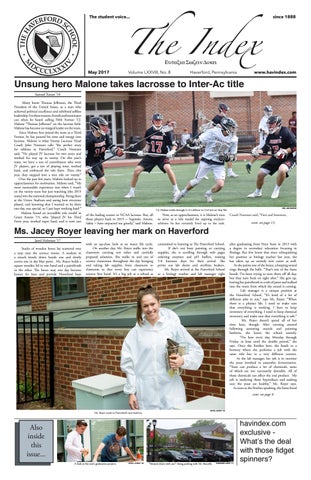
The Index
The student voice... since 1888
Ευταξια Σωζειν Δοκει
May 2017
Volume LXXVIII, No. 8
www.havindex.com
Haverford, Pennsylvania
Unsung hero Malone takes lacrosse to Inter-Ac title Samuel Turner ’18 Many know Thomas Jefferson, the Third President of the United States, as a man who achieved political excellence and exhibited selfless leadership. For these reasons, friends and teammates can often be heard calling Fifth Former T.J. Malone “Thomas Jefferson” on the lacrosse field. Malone has become an integral leader on the team. Since Malone first joined the team as a Third Former, he has poured his time and energy into lacrosse. Malone is what Varsity Lacrosse Head Coach John Nostrant calls “the perfect story for athletes at Haverford.” Coach Nostrant said, “He played JV lacrosse for two years and worked his way up to varsity. On this year’s team, we have a ton of contributors who were JV players, got a ton of playing time, worked hard, and embraced the role there. Then, this year, they stepped into a nice role on varsity.” Over the past few years, Malone looked up to upperclassmen for motivation. Malone said, “My most memorable experience was when I wasn’t on the varsity team but just watching [the 2015 team] win the national championship. Being there at the Union Stadium and seeing how everyone played, and knowing that I wanted to be there one day, was special, so I just kept working hard.” Malone found an incredible role model in Grant Ament ’15, who “played JV his Third Form year, worked super hard, and is now one
MR. JIM ROESE
T.J. Malone works through G.A.’s defense in 13-6 win on May 9th
of the leading scorers in NCAA lacrosse. But, all those players back in 2015 -- Supinski, Ament, Sabia -- have impacted me greatly,” said Malone.
Now, as an upperclassmen, it is Malone’s turn to serve as a role model for aspiring studentathletes: he has certainly lived up to the task.
Coach Nostrant said, “First and foremost,
with an up-close look at an insect life cycle. On another day, Ms. Royer walks into the classroom carrying test tubes and carefully prepared solutions. She walks in and out of science classrooms throughout the day bringing and taking lab supplies from classroom to classroom so that every boy can experience science first hand. It’s a big job at a school as
committed to learning as The Haverford School. If she’s not busy painting or carrying supplies, she is scrolling through web pages ordering enzymes and pH buffers, waiting 5-8 business days for their arrival. She prints out lab sheets and sterilizes beakers. Ms. Royer arrived at the Haverford School as a biology teacher and lab manager right
after graduating from Penn State in 2013 with a degree in secondary education focusing in Biology. But few know that since relinquishing her position as biology teacher last year, she has taken up an entirely new career as well. As she paints one of the boxes, a beeping sound rings through the halls. “That’s one of the fume hoods. I’ve been trying to turn them off all day, but they turn back on right after.” She gets up, leaving her paintbrush in a tub of paint and walked into the room from which the sound is coming. Lab manager is a unique position at the Haverford School. “It’s kind of a lot of different jobs in one,” says Ms. Royer. “When there is a physics lab, I need to make sure that everything is working. I have to keep inventory of everything. I need to keep chemical inventory and make sure that everything is safe.” Ms. Royer doesn’t spend all of her time here, though. After running around following annoying sounds and painting beehives, she leaves the school entirely. “I’m here every day, Monday through Friday, at least until the double period,” she says. Once she finishes here, she heads to a brewery where she performs a job with the same title but in a very different context. As the lab manager, her job is to monitor the yeast involved in anaerobic fermentation. “Yeast can produce a lot of chemicals, some of which are not necessarily desirable. All of these chemicals can affect the end product. My job is analyzing those byproducts and making sure the yeast are healthy,” Ms. Royer says. As soon as she finishes speaking, the fume hood
cont. on page 13.
Ms. Jacey Royer leaving her mark on Haverford Jared Holeman ’17 Stacks of wooden boxes lay scattered over a tarp near the science rooms. A student in a smock kneels down beside one and slowly covers one in sky blue paint. Ms. Royer holds a square wooden lid in one hand and a paintbrush in the other. The boxes may one day become homes for bees and provide Haverford boys
cont. on page 8.
Ms. Royer tends to Haverford’s new beehives
INTEL CHEN ’19
Also inside this issue... A look at this year’s graduation projects
INTEL CHEN ’19
“Musical chairs with cars”: fixing parking with Mr. Boccella
CONNOR LEES ’17
havindex.com exclusive What’s the deal with those fidget spinners?
Page 2
The Index
Announcements
May 2017
Introducing the 2017-2018 Index Editorial Staff Editors-in-Chief - Sam Turner ’18, P.J Rodden ’18, Nick Chimicles ’19 News Editor - Neetish Sharma ’19 Features Editor - Eusha Hasan ’18 Assistant Features Editor - Toby Ma ’20 Opinions Editor - Will Henderson ’18 Opinions Editor - John Comai ’18 Politics Editor - Grant Sterman ’18 Assistant Politics Editor - Robert Esgro ’19 Arts Editor - Gaspard Vadot ’18 Assistant Arts Editor - Vincent Scauzzo ’20 Sports Editor - Matt LaRocca ’18 Assistant Sports Editor - Nick Pippis ’19
This year’s editors-in-chief Sam Turner, Connor Lees, and George Rubin.
INDEX STAFF
Letter from student body president Evan Scott I don’t even know where to begin with, you guys. Fitting, since we’re about at the end… This year was a great one for me especially, the best one of my entire life so far. Much of that has to do with where I was every weekday from 7 a.m. to 5 p.m. This place rules, man. It rules, plain and simple.
“Haverford would not be what it is right now if everyone was not here making it special.” I don’t want to write too much about what it was like since I still have a speech left, but I pretty much want this last letter to preface my speech on June 9th. This whole year, all I have left to say is a HUGE thank you to everyone in the community, whether that be the faculty, the board, the facilities employees, or my fellow students. Haverford would not be what it is right now if everyone was not here making it special. From the morning library hangouts to the hallway hellos and daps, from the looks we all give one another after tests and quizzes (usually math ones), to Peer Counseling (GO TO THAT) to basketball games after school lets out, I’ll remember every moment that I had with all of you, because they were all the most important moments in my life. I lived my life this year looking forward to every second of every day, because youse guyses are the ones I love to death.
My parting words are these: “You all have opportunities and skills and education that so many folks who came before you never could have dreamed of. So just imagine the kind of impact that you’re going to make. Imagine how you can inspire those around you to reach higher and complete their own education.” - Michelle Obama. - Evan Scott.
“You may not see that now, but there are guys in the class of ‘17 that I’ll rely on for the rest of my life. Brothers don’t choose brothers, but they love one another unconditionally anyway.” No, but for real, guys, you all are all one another have. You may not see that now, but there are guys in the class of ‘17 that I’ll rely on for the rest of my life. Brothers don’t choose brothers, but they love one another unconditionally anyway. Love you guys! I look forward to next year.
The Index’s
2016-2017 Staff
Connor Lees ’17, Editor-in-Chief George Rubin ’17, Editor-in-Chief Samuel Turner ’18, Editor-in-Chief Bill Wu ’17, News Editor Will Henderson ’18, Opinions Editor P.J. Rodden ’18, Sports Editor Grant Sterman ’18, Politics Editor David Bunn ’17, Photography Editor Harper Weigle ’17, Website Technician Andrew Lengel ’17, Outdex Editor Will Pechet ’17, Outdex Editor Mr. Thomas Stambaugh, Faculty Advisor Ms. Alicia Evans, Faculty Advisor
All opinions and viewpoints expressed herein do not necessarily reflect those of The Index or the school. The Index is designed and produced digitally. Photographs may be retouched. Submissions and letters to the editors regarding any and all articles are welcomed at index@haverford.org.
Student Body President Evan Scott looks foreward to ending the year strong.
JOHN NOSTRANT
The Index is a student-run publication of the Haverford School that does more than bring news: it provides the diverse perspectives of the Haverford student body. It is an outlet for student writers to take stands on issues they deem important. It chronicles the daily struggles and accomplishments of the Haverford community. The Index also provides a forum for discussion of pertinent issues, such as student culture, academic policy, and Haverford’s place in world affairs. The Index presents new ideas and aspires to influence constructive change. The Index, a member of the Columbia Scholastic Press Association, is composed on Mac OS X, using Adobe InDesign CS 2015. Its surveys are conducted via SurveyMonkey and are advertised on Facebook to current Haverford students. Southern Dutchess News prints 200-400 copies of each issue, and its editorial staff distributes them in the Upper School on the day of release. The Index serves the needs of a total school population of 1091 community members, consisting of 975 students and 116 faculty members. Contact The Index: 450 Lancaster Ave, Haverford, PA 19041 index@haverford.org Twitter: @Haverford_Index http://www.havindex.com/ (610) 642-3020 x. 1222 Volume LXXVIII, No. 8 - May 16, 2017
Page 3
The Index
Features
May 2017
Community fallout from 13 Reasons Why Gaspard Vadot ’18 In March, Netflix gave us what perhaps will be the most controversial TV show of the year. The show in question, 13 Reasons Why, is based off of The New York Times bestselling book, written in 2007 by Jay Asher. The show was seemingly an immediate success. After being available on the popular streaming website for just a few days, it was a recurring topic in conversation for millions of people online, but also for many Haverford students. So much so, that Haverford-like a number of other schools across the country-felt that it was necessary to send an email home about the gravity of the issue at hand. 13 Reasons Why tells the story of the days following the suicide of Hannah Baker, a girl who struggled to fit into an harsh environment of gossip, rumors, and bullying at her high school. The accumulation of all the struggles she faces culminates with Hannah taking her own life. The viewer follows along as her social circle, including a good friend of hers named Clay Jensen, listens to thirteen tapes that she leaves behind, explaining why she felt pressured to commit suicide. Each tape is dedicated to one person (with the exception of Clay) who wronged her in a way that contributed to her decision. Slutshaming, objectification, rape; these are a few of the many things of which Hannah was a victim. Each person who appeared on the tapes had to listen to all of them and then pass the tapes onto the next person, from her ex-best friend to the school counselor who failed to help her when she needed it. It is hard for a TV show to address such a complicated topic, especially when the show is intended to be seen by a wide range of people, but even more so when it is meant to be seen by teenagers. It is important to have these conversations, as depression, suicidal thoughts, and general struggles at school and in personal lives are issues that aren’t always in the spotlight when they should be. It is a very complicated topic to discuss because, as the show demonstrates,
ROBERT MANGANARO ’18
Myles Ford ‘18 considers 13 Reasons Why
people dealing with these issues sometimes have a hard time opening up about them. The question many people are asking themselves is simple: should this show have been made? A more interesting question would be asking ourselves whether or not the show succeeded in getting its message across. Although the show earned many fans very quickly, and Netflix has already renewed the show for a second season, it received a large amount of criticism, specifically because it failed to achieve the very thing it attempted to do: bring awareness to the widespread issue of adolescent suicide. Undoubtedly, the makers of the show had good intentions when making 13 Reasons Why. They believed it would begin an interesting conversation around what we are doing as a society to address the issue of suicide and promote
better behavior in schools to prevent tragedies like Hannah Baker’s. Yet, it was argued that the show set a poor example by creating a situation in which reaching out for help does not work and it feels like suicide is the only option. The “romanticization of suicide” was the biggest concern for Haverford. We as students should be an environment where suicide is not an option, where getting help will work. That idea of how high school should be was not represented well in the show, where Hannah Baker attempts to reach out multiple times, but ultimately does not get the help she deserves. Another worry is that the show would oversimplify the way we see suicide. Starting a discussion like this with a TV show can affect how we as students react to it, how we see it as an issue. The school understands that, for many, once
something appears on screen, it loses some of its reality and its meaningfulness, especially when it is told through a fictional story. That is a part of the reason why the administration sent the email, to ensure that the school community continues to take this issue seriously, as it should. There is too much at stake in this discussion for students to attach it to the same world as The Walking Dead or Game of Thrones. In some ways, though, the show did achieve part of its goal. The issue of suicide has become a major talking point in schools across the country, both in student bodies and in school boards and
roads to park, show up ten minutes late, and take the tardy. Or, we could take another student’s spot to not miss any school. Either way, someone shows up late. Guaranteeing a spot to all Sixth Formers for all four quarters prevents this loselose scenario. As Fourth and Fifth Formers, we missed classes
steps to improve parking. Those steps include opening the grass lot next to Dr. Nagl’s house for parking when the Red Lot is closed, and working with the parking authorities from Lower Merion and Haverford townships to open curb space for more parking during big school events. Mr. Boccella may be the most misunderstood man
said, sitting in his office next to the multi-purpose room in the Lower School. “I’m going to follow through [on parking solutions], hopefully by the end of the school year. This summer I will work with the police department [on time-restricted parking].” Many students use time-restricted parking on side streets, and, as a result, get tickets. Every side street, except for a patch of spots on Booth Lane, have restrictions, mostly for 2 or 4 hours. The side streets are governed by two different township’s parking authorities, Lower Merion and Haverford. But the neighbors are the ones responsible for these 2-hour and 4-hour time restrictions, as they don’t want people parking in front of their houses all day. That happens anyway because students leave one 2-hour parking spot and go to another, which leaves the same result: students parking in front of neighbor’s houses all day. If the townships approved 6 or even 8-hour parking, the parking problem would be solved as Red Lot spots wouldn’t be as important as they are today. Renaming the Red Lot is an easy first step to stop visitors from taking student spots. “My idea was to have a big sign that said ‘Red Lot’ and underneath, ‘student parking’,” Boccella suggested. However, lot naming and signage is handled by the administration. Haverford College had a similar student parking problem; their popular nature trail around the college draws people who need to park. To fix that problem, Haverford College placed signs in front of every student parking spot clearly stating that the spot was reserved for a student, and that violators would be towed. In addition, they have signs that point visitors toward the right parking lot. When one spot is taken in the Red Lot, the whole system breaks down. Better signs would help. As Sixth Former Will Pechet put it, “Parking is a big game of musical chairs, but with cars.” The most promising solution is the grass lot next to Dr. Nagl’s house. Mr. Boccella said that
cont. page 8.
“Musical chairs with cars”: Fixing parking with Mr. Boccella Connor Lees ’17 The Red Lot is the Wild, Wild West: visitors take student spots, Fifth Formers steal what is a Sixth Form privilege, and parking spots are parking suggestions. But there’s hope. The long-term solution is a parking garage. But Haverford will build a new middle school before a new parking garage. While the garage might fix
Haverford’s infamous “Red Lot”
the problem ten years from now, it doesn’t solve the problem today. So solve the problem, anyway? Mr. Green has acknowledged that attendance this year, especially among Sixth Formers, has been terrible. Fixing the parking problem will help fix the attendance problem. Sixth Formers who arrive at 8:20 often find their spot taken. Since we are given a parking spot, we drive to school expecting it to be open. If our spot is taken, we could weave through back
and lunches to move our cars. We walked in the rain, cold, and snow for two years to avoid $20 parking tickets, and some of us even tolerated angry neighbors on Buck Lane and Booth Lane along the way. For students who live far away or have two parents that work, they have to put up with parking off-campus. The good news is that parking is a preventable problem. And Mr. Joe Boccella, the Director of Public Safety, understands that. This year, he has taken
CONNOR LEES ’17
at Haverford. Many Sixth Formers rush to pin blame for Haverford’s parking problems on him because he sends out emails on Red Lot closures. That isn’t right; he actively tries to help. The problem is caused by the number of students who need parking, and the limited space Haverford has. There are about 60 Red Lot spots for Sixth Formers, from spot #23 on. There are over 100 graduating seniors. Parking is a numbers problem. “I try to do the best I can,” Mr. Boccella
cont. page 8.
Page 4
The Index
News/Features
May 2017
Robotics makes it to Worlds, 169A finishes third Aditya Sardesai ’20 The robotics team’s season came to a bittersweet end in Louisville, Kentucky this past April. The Cavalry showed up strong with four upper school teams, 169A, 169E, 169X, and 169Y, and one middle school team, 169D, which all competed amongst some of the best robotics team in the world. Team 169A, comprising of Fourth Former Scott Shaw and Sixth Former Mohid Khan, were the only team to make it to the elimination rounds, but placed third in the world for their skills challenge run. Along with the regular matches, there is a secondary aspect to the competition, the Skills Challenge, a way to test and show off the robot’s ability. The Skills Challenge is a one-minute long period where all of the game objects are on one team’s side of the field at the start of the timer. The competition is split up into two sections, driver and programming. In each section a team has one minute to either drive or program the robot to score points. The scores of each are then added with the highest score at the competition being the one that counts. Teams are also limited to three runs of each. The object of the game is simple: score as many total points as possible in under sixty seconds. It is just the one robot against the clock, and whichever team scores the most points wins. The Skills Challenge is a good test of a robot’s capabilities as only the best robots can put up high Skills scores. Along with having a good robot practice makes perfect and a lot of the teams at Worlds have practiced the same routine for hours and hours on end to try to improve their score. “Throughout the year, Mohid and I have worked on perfecting our runs for the challenge, which is what allowed us to succeed at world,” said Shaw. Team 169A scored an impressive 65 points in Driver Skills and 49 points in Programming Skills given them a total score of a whopping 114 points. Their stellar performance in the Skills Challenge allowed them to run one extra Driver Skills run, the only difference being that the run would be done on the main stage in front of everyone at the competition in what is referred to as “The Dome.” Khan said, “The Dome is always a great experience: this time, however, there was little to no pressure as we had already secured third place and knew there was no chance of us getting second.” Shaw said, “I was definitely nervous to be in
front of so many people, but it was one of the most unique experiences I’ve ever had.” Both eventually got to know the other teams that had the opportunity of running their Skills runs in The Dome as well. Along with placing third in the world for Skills, team 169A was the only Haverford team to make it to the elimination round of their division. After the qualifying round was over, 169A was seeded 13th with an impressive 8-2 record. They were eventually picked to join the seventhseeded alliance. Team 359A Hawaiian Kids from Waialua, Hawaii and team 56777A Stargazer from Shenzhen, Guandong, China were the other two teams in their alliance. Together they beat the second-seeded alliance to move onto the division semifinals. Unfortunately 169A’s run to division finals ended prematurely with two tough losses to the sixth seeded alliance in the semifinals. Unfortunately none of the other Haverford teams received the same success, since they did not qualify for elimination rounds. Team 169D finished 6-4, teams 169E and 169X both finished 5-5, and team 169Y finished 3-7. All of these teams were unlucky due to having tough match schedules, often playing with weaker teams, and experiencing various motor and mechanical issues. A reason why good teams faced bad luck is because the game was too easy. As Fourth former Will Clark said that “This year the game made it easy to be good so it was harder to separate from the crowd.” This made it easier for good teams to statistically come across as bad. Communication with other teams was very important as that was how a team that did not perform as well as it should have could still be picked for the elimination rounds. Team 169X were told by the first and fourth-seeded teams that those teams would pick 169X as the final member of their respected alliance, yet neither did. “Stuff like this happens all the times at Worlds and while it does suck, there is nothing you can do about it,” Coach Dan Troy said. In elimination rounds it is not just about the best robot, but it is also about the chemistry the teams have with each other. Occasionally that means a team will pick a team from their own country or a team that speaks a common language other than English over the better robot. This is the case with team 169E. “The number one team in our division was a Chinese team and
Robotics team competes at local tournament
even though we convinced them to pick us they ultimately did not and picked another Chinese team over us,” Clark said. It is important to point out that when teams from across the globe work together they typically form dominating alliances. The winner of the entire competition comprised of a team from the United States, a team from Canada, and a team from China. While teams experienced many ups and downs throughout the competition, the overall experience was positive. Third former Daniel Chow said, “The competition was tough and we did not perform as well as we hoped to, but overall it was a good and fun experience.” The team also worked on the robot nearly 24/7. Shaw said, “The days consist of waking up at 6:30 and working on the robot or competing until early in the morning.” For Shaw the most memorable moment was, “Standing up on stage and receiving our third place award for skills. It was an experience like no other I’ve had at at
MR. MICHAEL SHAW ’78
worlds before.” For Khan, who is graduating, there is much to be missed. “I will mostly miss spending the late nights in the shop with some of my closest friends solving engineering problems. Furthermore, the sense of camaraderie on the team, and by extension Haverford, is something irreplaceable.” “I am enormously proud of the robotics team,” Dr. Nagl said. “I am enormously proud of the guys who finished third in the world in the Robot Skills Challenge.” The team gave a demonstration to alumni during alumni weekend at the Golden Fords Luncheon. “For the first time ever they watched the robotics team engage in its activity and were impressed by what they saw there,” Dr. Nagl said. According to Dr. Nagl they were not only impressed with what they saw but also with, “what [the boys] they gained from the competition and in particular the international aspect of the competition.”
Editors Soslow and Biddle let Pegasus soar Abuobaida Khujali Elamin ‘20 and Index Staff Alongside The Index and the brand-new Newton’s Notebook math journal stands Pegasus, the Columbia Scholastic Press Association’s goldmedal-winning literary magazine. Mostly based around writing, photography, and painting, Pegasus showcases student creative work. In preparation for the Spring 2017 issue, the editors are making some major design changes. “The last few years have been marked by… this very clean, very professional, image-heavy design, which looks absolutely stunning,” Fifth Form Editor-in-Chief Robb Soslow said. The new look of the magazine will focus more on Soslow’s and Sixth Former Jack Biddle’s graphic design features. “We’ve created a magazine where a lot of the interesting parts come from [our] graphic design philosophy, which is a lot more interesting,” Soslow said. In addition to his editorial work, Soslow is involved in many extracurricular activities based around the arts. “I’m on the squash team,” he said. “I used to row crew. I do jewlery in my spare time, and I’m in the Notables...but Pegasus ranks in the top.” In his Fourth Form year, Mr. Keefe recruited Soslow. “He saw that I was someone who had a pretty strict eye for grammar and typos and I really loved English as a subject,” Soslow said. “After that it was all a blur.” Pegasus receives about 150 submissions an issue. The editorial board goes through a blind vetting process, which means that the name is removed and editors read through for the pieces for style. Then they go through proofing for grammar and spelling. Soslow said, “We create a magazine from pretty much nothing, but the themes form the writing of the students and
INTEL CHEN ‘19
Editor Robb Soslow hard at work on the latest issue of Pegasus.
faculty.” Those themes tend toward the serious. “A lot of the work we get is pretty dark in nature,”
Soslow said. “We’ll often get violent pieces or dark topics. When you’re writing on your own, you’re not usually writing about daisies and
lollipops.”
Page 5
The Index
Features
May 2017
First-person experience: social media addiction Charlie Rahr ’17
INDEX STAFF
What’s the first thing you do when you wake up in the morning? If you’re like me, you lie in your bed, grab your phone, and scroll through the notifications that arrived overnight. Eventually, you see all of those new notifications and you begin aimlessly scrolling. I spend about ten minutes scrolling
through Facebook and Instagram every morning, wasting time that could be better spent asleep. Why do I keep wasting my precious time in the morning looking at images and posts that I really care nothing about? Well, it’s because I have an addiction — an addiction to my phone and social media.
Aimlessly scrolling on my phone doesn’t stop as soon as I finally get out of bed. It’s all day long, consuming almost every minute of boredom throughout the day. From before class, to between classes, and in the lunch line, my phone is in my hand. My head has been so firmly glued to my phone’s screen that I haven’t been able to fully experience the world around me. Take concerts for example. Whenever I go to a concert, I become more occupied with filming what’s in front of me than actually experiencing what’s in front of me. I’m more engaged in sharing my experience than living my experience. Not being fully present in my day-to-day life is just one effect of my phone and social media addiction. Without my phone addiction, it’s doubtful that I would be nearly as involved in social media as I am today. I have constant access to social media and because of this access I have come to a few realizations-none of which are positive. One of these is that much of social media is superficial. Plenty of us claim to have hundreds upon hundreds of “friends” on Facebook, but I bet that most of us would not even say hello in public to most of them. The overwhelming majority of my eight hundred or so “friends” on Facebook aren’t really my friends at all. Social media is entirely self-promoting. Instagram, for example, is an almost constant stream of the attitude, “Look at me and look at what I’m doing!” I am guilty of this, as I often post pictures to Instagram when I feel that I am doing something interesting. I have now come to realize that most people could care less about what I am doing. However, I doubt that I will stop because I have access to it at my fingertips twenty-four hours a day.
My phone addiction has forever changed the way I interact with others. Although it may sound like it, I am not texting or messaging every minute of the day. I tend to send fewer messages than others do. But, even this relatively small amount of messages has weakened my in-person communication skills. I often struggle to talk about uncomfortable or awkward topics with my friends because I usually talk about those topics through text messaging. I do this because texting allows me to not actually encounter the person I am communicating with. I can just send a text message, not have to look the receiver of the text message in the eye, and in doing so, eliminate any awkwardness surrounding the question or topic I am messaging about. Going into my adult life, I am at a serious disadvantage because I prefer to ask tough or potentially awkward questions through text messaging and not through face-toface communication. Phones and social media have innumerable benefits, but they also have innumerable dangers. One of these dangers is an addiction to them and that is what I have. With my addiction comes a disconnect from the world around me and a negative change in the way I interact with others. On the positive side, I have learned because of my addiction how superficial and self-promoting social media can be. Thankfully, there are ways to cure my addiction or, at least, lessen my phone and social media usage. I plan on limiting my screen time on my phone to one hour per day. By doing this, I will feel connected, but will not have social media consume my life. After identifying my addiction and its harmful effects, I have a newfound motivation to live in the present moment.
13-second sellouts: the success of Supreme clothing Evan Haas ’17
Sitting in the first row of Centennial Hall, my phone was cradled between my legs, waiting for the clock to hit eleven. An hour earlier, my phone was bombarded with texts from Evan Scott and Ethan Weiss. All the texts related to the upcoming Week Nine Supreme Release. “I just got a gift card. I will get that Lilac Anorak,” said Evan Scott. The Anorak is a waterproof pullover which sports a box logo front and center. Supreme prices the piece at $148. Twenty minutes later, there was a second text: “Dude,” said Evan. “The Anorak is dropping at $328.” Not only was the hefty price tag for the jacket a problem, but it also sold out worldwide in thirteen seconds. Streetwear is now a lifestyle for those who are fortunate enough to wear Supreme. Supreme first opened in 1994 under the management of a man named James Jebbia, who was also still managing the famous streetwear brand Stussy. At that time, when Supreme released clothing and accessories, pieces would sit on shelves until they went out of style. But the store, or white-walled container space as it once was, had an identity like no other. Jebbia wanted to keep the brand underground to attract only the most worthy shoppers. By portraying his streetwear as a holy grail, the public began to believe it. As years have passed, the demand for Supreme has grown exponentially. Anything with their infamous box logo sells out in a mere seconds, online and in store. The key to Supreme’s success: staying true to its roots. Supreme could be a household, high-fashion brand, but because the brand is essentially in a gated community, it keeps it legitimacy and rarity. With only ten stores in total, it is safe to say that Supreme is one of the hardest brands to get a hold of. The two stores in the United States are in New York on Lafayette Street, the other is on North Fairfax Avenue in downtown Los Angeles. A majority of the stores, which are arguably the most popular, are in Tokyo, Japan. The past decade’s recent influx of Japanese and Koreans in Los Angeles has changed the style of streetwear completely. When Supreme opened stores in Tokyo, it attracted a massive group of Japanese millennials looking for something different than the typical Japanese streetwear,
which then consisted of bright pink, baby blue, and checkered accessories. Supreme took the place of Bape, a Japanese brand which opened a year before. Supreme was a cheaper, yet innovative brand, which attracted the growing streetwear culture in Japan. As the brand began to grow, and Japanese people continued to flow into the culture capital of the USA, the brand began to pick up. In 2004 Supreme opened a store on Fairfax, and it is roughly double the size of the New York store. Because the band’s following grew immensely, and there was such limited quantity, “reselling” became a tactic that most “line sharks” utilized. Reselling is the act of purchasing an item, and then selling it usually for a higher price. Reselling is a way for people who were unable to buy Supreme at the release to buy it later. On the flipside, people who resell items make immense profits quickly. Resellers camp outside on the sidewalk of the store for days, sometimes up to a week before a release. Often times, resellers or line sharks have clients who pay them before the release to get the most desired items. When the reseller finally gets into the store, they can buy any amount of any item. Online, buyers are limited to one item per style. Line sharks will even pay people to wait in line for them and then purchase the items they are able to buy in the store for retail price. This way, they can pay a small fee on top of retail pricing and walk out of the store with thousands of dollars in Supreme merchandise. Just minutes later they can start shipping out pieces to their already paid clients. For people like Evan Scott and Ethan Weiss, resellers can be a real problem. “It didn’t accept my card,” said Scott. “Damn. I was late too. Literally everything sold out,” said Weiss. The irony in their statements is that this was one of the slowest sell-outs in a few weeks. The Lilac Anorak sold out in thirteen seconds, but it only took ninety-three seconds for the entire online store to sell out. That includes hats, leather jackets, and even a plastic money gun which shoots out fake Supreme dollar bills. The reason that the releases go so fast is not always due to the amount of website traffic, but rather a downloadable “bot” which checks out items automatically. There are browser extensions and purchasable
SUPREMENEWYORK.COM
programs which can add an item to your cart, and check out in under five seconds. It skips the information section but autofilling, and even skips right over the captcha. Entering all of this information usually takes about a full sixty seconds, making it almost impossible to get a desired item without a bot. When you see someone on the street wearing anything Supreme, whether it be a North Face Supreme Puff Jacket or simply an original Supreme Five-Panel Hat, you should have a tremendous amount of respect for that person. You may think that giving so much effort to purchase clothing is insane, but for these people, it is a lifestyle. They make their living off kids, or celebrities who either
have the funding to buy such expensive secondhand items, or spend their paycheck each week on the newest gear. The amount of time and money that is required to acquire anything Supreme is tremendous. There comes a point where it is no longer worth the time it takes to buy just one article of clothing. But, as Supreme evolves and continues to pump out the hottest pieces each week, it keeps its customers coming back for more.
Page 6
The Index
Off-Campus Profiles
May 2017
Mind, body, and ECK Jack Molitor ’17 It’s a cloudy day in Hatfield, Pennsylvania. A couple of churches, a fire department, and a strip mall line South Main Street. Branching off, back roads wind and weave; there’s not much unique in this town — quintessential small town USA. Down one of those back roads, the last house on a rowhouse, lives Marcelina Bovell. With a large smile and a Spanish accent, she greets her guests, people she’s never seen or met before, as friends, “Hello, so nice to see you! Come in! come in!” She has no reservations about letting strangers into her house; she does it twice a week. Inside, the strangers settle down: the man with a ponytail sits on the floor, the elderly woman sits on the couch next to her, the man in a suit on a chair. “Blessings to each and every one of you,” Bovell says, “For every face I haven’t seen I’d like to give an introduction.”
“You must know that this body you have is just a shield, a barrier — a heavy, course shield, and a barrier which is trying to stop you from hearing and seeing your true identity as Soul.” Bovell’s house is quaint and cozy with a slightly cluttered coffee table and a worn out rug in the living room and a sparkling clean kitchen island. Atop her mantle is a photo, not of Jesus or of Buddha, but of the “ECK masters.” She rummages around in her purse and pulls out a pamphlet adorned with the face of Sri Harold Klemp, the living ECK master (also known as the Mahanta). She reads, “Every moment of your life, you must be the HU. This is more than just chanting HU. This is being the HU. The sound must always be in your atoms. And as an atom in the body of ECK, there is a sound that comes from you. That sound is HU. This sound not only comes from you, but it is you. You must know that this body you have is just a shield, a barrier
— a heavy, course shield, and a barrier which is trying to stop you from hearing and seeing your true identity as Soul.” Bovell is a member of Eckankar, a religion founded in 1965 by Paul Twitchell, a friend of L. Ron Hubbard. Eckankar’s doctrine draws heavily from Eastern religions, Christianity, and the New Age movement. The ShariyatKi-Sugmad (the Eckist holy book) reveals that Sugmad is God. By chanting HU Eckists can sing a love song to god and attempt to reach the eleventh plane of existence: the Anami Lok, ruled over by Anami Purusha. One of Eckankar’s essential teachings is the importance of dreams. According to Paul Twitchell, dreams are a window into past lives and higher planes of existence. “Since I was a little girl I always had dreams,” Bovell explains, “and I used to get up and say ‘Mom, I dreamed of a past life,’ and she’d say, ‘How do you know it was a past life?’ and I’d say, ‘Because I was dressed in a different outfit, and I was talking to people that didn’t even speak Spanish — they spoke another language, but I knew what they were talking about.” According to Eckankar, visiting other planes of existence is why people dream. “We have the physical body which is this plane and then higher one which is soul, but in between we have the astral plain, which is the emotional body and the causal body, which is the past actions or past lives. You can go to the causal plane and have recalled experiences. And why do you need to do that?” asks Bovell. “So that you recognize that you’re eternal; so that you know you’ve been here many many times.” She puts the pamphlet down and explains, “A HU chant or doing the HU is a simple spiritual exercise that helps you connect with your soul. It’s not your body, your body is what protects the soul from the physical plain. So, basically, it’s light and sound, that’s what it is, it’s light and sound. So when I do the HU, I listen to the inner sound, and I also see a light on my third eye.” A loud bang cracks from the back door. “Don’t worry about that. It’s just my dog.” Bovell takes a deep breath and encourages Sri Harold Kemp’s Autobiography about ECK.
Eckankar Masters in the home of Marcelina Bovell in Hatfiled, PA.
JACK MOLITOR ’17
her guests to follow suit. “I’m going to start. Close your eyes and join in when you’re comfortable.” A pause. A breath. “Ha-yoooooooo. Ha-yoooooo. Ha-yoooooo.” Soon, the room is filled with accidental harmonies. Some voices hold on for a long time and others die out quickly. Some voices shake a bit by the end of their HU, others remain strong. Around 20 minutes into the chant, the house phone rings. Nobody budges. Nobody flinches. As the phone rings, a reminder of the busy world they are trying to rise above, they sit still, backs straight, eyes closed, and continue their love song to god. 30 minutes in and people begin to tire. The HUs are getting shorter and shakier. Finally, Bovell stops, and the various tones start to go silent until the last chanter falls quiet. “It’s time for silent contemplation.” 15 minutes of dead silence, then, the ritual is done. As most of the guests filter out, some remain to talk with Bovell. “I discovered Eckankar thirty years ago,” one says. “I always dreamed about people dying, and my brother had died ten years ago at that time. She said she had a book about people who dream about their past loved ones, and when I read it, it resonated with my heart. I decided to try it. I’ve been in Eckankar since 1993.” The conversation turns to the framed photo of the ECK masters on her mantel. Bovell walks over and picks up the frame. She brings it to her remaining guests, “Just like you have angels, angels are there to help you, we have ECK masters. The most familiar one, Sri Harold Klemp, is the living ECK master - he has a physical body. The others are what we call ascended masters. They assist the living ECK master. They’re hundreds of them and they walk around just like angels and help people.” Bovell takes a seat on her couch as more and more people filter out from her Eckist sanctuary back into the real world. She awaits her husband’s
AMAZON.COM
return home from work. Her life is strongly attached to her family. Her brother’s death forty years ago started her on her spiritual journey. Her twenty-three year old daughter is a devout Eckist, and the two have bonded through their faith. Bovell is one of 50,000 to see the world through the lens of Paul Twitchell. Eckankar is still unknown to most, but to Eckists, such as Bovell, Eckankar is a journey of existence, from life to life and from plane to plane.
As the phone rings, a reminder of the busy world they are trying to rise above, they sit still, backs straight, eyes closed, and continue their love song to god. 30 minutes in and people begin to tire. The HUs are getting shorter and shakier. Finally, Bovell stops, and the various tones start to go silent until the last chanter falls quiet. ‘It’s time for silent contemplation.’ “Life will throw you all kinds of problems, challenges, hardships. And you look at life as a whole,” she says, looking at the photo of the ECK masters. “You need to understand any situation you deal with has to do with karma and past lives. Let things be and know the ECK is in everything. Things aren’t good or bad, they just are. It’s all cause and effect, that’s what it is, cause and effect.”
Page 7
The Index
Off-Campus Profiles
May 2017
Old school: Mike’s Barber Shop in Media Peter Solomon ’17 On a rainy Saturday morning, not many people are out and about the streets of Media. The occasional car zooms by the set of signs for Mike’s Barber Shop. The small parking lot can fit about five cars, and the building looks like a typical Media house. Inside, the buzzing of clippers bounces off the pictures, and memorabilia of President John F. Kennedy covers the walls. A small ramp divides the room into two sections: a waiting area and a section with two chairs and a TV in the middle for people to watch while getting their haircut. The front section is filled with sports magazines and newspapers; these stay on the table, as most clients are greeted immediately. They then either talk amongst themselves or talk with Mike Lobiondo and his daughter Stephanie. Mike and Steph spend most of their time in the other section. Mike often fiddles with the TV remote, putting something different on all the time. One day, it’s reruns of Mad Men, other days it’s a historical documentary from Netflix. In a day where convenience is king, old fashion places like “Mike’s” are refreshing. SportsClips, Supercuts, and other more modern places are changing the concept of barber shops, staying up to date with their design and format. Not Mike’s. In a place that feels right out of the 1960s, Mike plays the part. His discussions during haircuts are almost always about history. “You ever hear of Ruby Ridge? That was a crazy standoff,” Lobiondo says. The Kennedy pictures are unique too. They are posted all over the shop. Lobiondo says, “I like Kennedy. He’s one of those guys who just seemed genuine. He’s a guy who probably would have spent a lot of time in a barber shop too. I would have liked to cut his hair.” But it’s more than that. “Back in Kennedy’s time, there were more people like me,” Lobiondo explains. “It reminds me of the neighborhood barber shop where you and your dad and all the guys on your block went for a haircut. The barber was a friend, and people would go there to hang out even if they didn’t have to get a haircut. I want this to be an old-fashioned place like that.” He certainly does his best.
Mike and his daughter Steph cutting the hair of two of their clients.
PETER SOLOMON ’17
“One client sits down. ‘The usual?’ Mike asks him. The man nods his head and smiles. ‘The usual,’ he replies. A personal connection is also refreshing. ‘I’ve been thinking about getting Lasik,’ one client tells Mike.” A sign on the wall reads the prices. $16.00 for a regular cut, $15.00 for seniors, and $14.00 for children. “I charge less for regulars,” Lobiondo says. Regulars make up a big portion of Mike’s clients. Lobiondo says, “Everyone is a regular. People who come here like to come back. I don’t know why, but I hope it’s because we give a good haircut.” One client sits down. “The usual?” Mike asks him. The man nods his head and smiles. “The usual,” he replies. A personal connection is also refreshing. “I’ve been thinking about getting Lasik,” one client tells Mike. “I don’t know,” Mike replies, “I like the glasses look. I almost got Lasik, but I just stuck with the bifocals.” The two men continue to talk about their families as Mike continues the cut. “I like to get to know my clients,” Lobiondo says. “Some of them have been coming in here for years and years, so I want to know who these people are. Others are newcomers who I want to feel at home, so they’ll come back. Everyone has a story to tell, too. Conversation makes the cut go faster and more enjoyable.” Cutting hair is in Lobiondo’s blood. “I’m a fourth generation barber,” he says. “I’ve been around this environment my whole life. Changing the format wouldn’t feel right.” Still, Mike is willing to adapt in some regards.
GOOGLEMAPS.COM
Mike’s Barber Shop is located in Media, Pennsylvania. Founder and Owner Mike Lobiendo outside of his barber shop.
“Steph is great. She can give you an old fashioned hot lather shave, and she can cut your hair in any of the newer styles,” Mike says. A different client sits down with Steph. “The usual?” she asks him. “Let’s change it up and keep it a little longer today,” the man says. “I try to bring a little bit of youth in. My dad is old fashioned, and I like that, but I also understand that some people don’t like everything about the old-fashioned way,” Steph says. It gets busy quickly. At 11:30, one person is in the waiting section. By noon, all six seats in the waiting section are full. Lobiondo says, “Saturdays are the busiest days by far. We’ll have people coming in when we open at 8:00 in the morning, and people walking out when we close at 4:00 in the afternoon. It’s usually the same faces, but every once in awhile, we’ll get a new face walking in.” With only two barbers, it can sometimes be difficult to keep everything moving. “Sometimes,
MIKESBARBERSHOPONLINE.COM
some people will see the line waiting, and walk out,” Lobiondo says. “Some of them come back later, some of them don’t. Most people seem to not mind waiting, though, surprisingly.” “It’s worth it for the quality!” one client yells.
More and more, chain barber shops are taking over, but Mike isn’t worried. He says, “I think there will always be a bunch of people who like the genuine feeling of the shop, and the personal nature we try to provide. Because of that, I think places like this will last for a long time to come.”
The Lobiendos take pride in quality. “I like most of the people who come in here, so I try to cut their hair well just because they’re like my friends,” Steph says. “It’s just kind of fun for me.” Every Saturday, the regulars come back to Mike’s. They leave with more than just that, though, they leave with an experience, they leave with knowledge about something historical Mike told them, they leave with a conversation they had with Steph, they leave with more than what they were charged for. “They’re our friends!” Steph says. “With most of them, we’ll keep talking to them until they walk out the door.” More and more, chain barber shops are taking over, but Mike isn’t worried. He says, “I think there will always be a bunch of people who like the genuine feeling of the shop, and the personal nature we try to provide. Because of that, I think places like this will last for a long time to come.”
Page 8
The Index
May 2017
News & Features
Leaving a mark: Ms. Jacey Royer cont. starts beeping again, and she sets off running. After eventually silencing the fume hood with help from a student’s long reach, she kneels down and returns to painting the boxes, this time alone. Her student has left to go to class. Throughout the morning, science teachers and other members of the community constantly stop by to talk to her. “Cricket Field Green from Behr,” she says, in response to a query on the particular color of green she’s using. “Hey, I’m also going to need a big bag of Haribo gummy bears, specifically Haribo,” says
another science teacher planning out a lab later that day. “A lot of times at the grocery store people look at me like I’m crazy because I’m buying mass quantities of candy,” Ms. Royer says. “Haverford Honey?” a student asks, after seeing the beehives strewn out across the tarp. “Eventually perhaps,” she says. “We have to figure out how much honey we can harvest without causing the bees to starve to death over the winter” “Where will the bees actually go?” asks biology
teacher Ms. Cleffi.. “Over in that fenced area between the Upper School and Middle School,” Ms. Royer says, pointing in that general direction. Ms. Cleffi smiles. “I didn’t know the bees would be so close,” she says. “I’ll steer clear of that area.” With bees arriving on Saturday, Ms. Royer has a lot of work to do this Wednesday morning. After resolving the fume hood situation, she gets right back to painting the hives. Hundreds of paint strokes later, she begins to pick up the newspaper protecting the floor from
the paint. She rearranges the brightly painted boxes and buckets of paint. She stacks the lids and frames that soon will be covered with honey, wax, and bees. With the beehives painted, she gets up and walks away to a different science classroom. Since she arrived here, Ms. Royer’s position has evolved, first as a biology teacher in conjunction with lab managing, later as a lab manager alone. There’s no doubt that the lab manager is crucial to the overall function of our school’s science program, but it’s unclear if Ms. Royer will stay here forever.
parking lot might actually happen. All these solutions are great, but without better enforcement of the rules, we won’t fix the problem. Fifth Formers, seeing that there is no enforcement of the parking rules, have been parking in the Red Lot all year. Every so often, Mr. Boccella takes down the registration numbers and put a warning on cars without pink tags in the Red Lot. To fix the problem, warnings should
come more frequently, and with consequences, maybe detentions. “If we had perfect parking, there would still be a few people taking spots. I don’t have control over that,” Mr. Boccella said. “The school can put other sanctions on you. We can revoke your parking privilege, things like that.” Yes, student parking is complicated. But we can fix this: the Wild West needs to be tamed.
Fixing Parking cont. he hopes the grass lot will be open for all students who don’t have a spot. “Personally, I’d like it make the grass lot permanent with asphalt. But unfortunately, I don’t have the last say on that,” Mr. Boccella said. “Since we have been using the grass lot, the number of phone calls we have been receiving from neighborhoods is zero.” Last year, there were neighbor-student parking disputes. Students who legally parked on Buck
Lane near Haverford Friends’ School received multiple angry letters on their windshields. Overall, the grass lot has changed parking for the better. Neighbor complaints are down, and more students can park without getting a ticket. However, zoning prevents the school from laying down asphalt. Haverford can appeal the zoning, but neighbors would have to approve it. Given how the grass lot has helped the neighbors, a
A playmaker at home: Chris Kober Mallik Twyman ’17 “Chris, wake up! Me and Dad have to leave for our shifts and to pick your brothers up from the airport. I need you to feed your brother and help with his math.” Everyone knows Chris Kober is a nationally ranked wrestler and varsity football captain. However, when his life’s long book is turned back a few pages, the story gets more complicated. The time is 7:15 a.m. Wandering into the kitchen, Chris must decide what breakfast he will prepare for his little brother Frankie. Typically, he will make eggs with bacon and a cup of orange juice. Today his little brother slowly walks into the kitchen wearing Spiderman pants and says, “Chris, can I have waffles today? I’m really tired of the eggs and bacon.” Annoyed but understanding, Chris nods and accepts the request. The only thing is, he’s never made waffles. “I honestly don’t mind it,” Kober says. “I think this has taught me great responsibility -- being able to take care of my brother while my parents work -- while also managing my own school work
and a social life.” Today, Chris teaches his brother to multiply fractions, beginning by asking what he knows already, where he is finding trouble, and any other questions he might have. “I don’t understand how the six turns into a twenty four here,” Frankie says, “but the number on the top didn’t change.” Frankie forgets the rule of multiplying the top and the bottom by the same number. Once he is aware of the mistake, he begins to speed through each problem. After a few worksheets and mini lessons, Frankie needs his mid-day nap. Chris can finally begin doing what he wants. Taking a seat on the couch, he turns on the NFL Network and eats the leftover waffles. “The Eagles better get Christian McCaffrey,” Kober says. “We need a playmaker on offense with Wentz. Maybe we could snag a few cornerbacks and a lineman too, but definitely we need to have McCaffrey. He can run the ball and catch it. It would be dope to have him learning from Sproles. They’d be the combo the Eagles needed
MS. DAWN BLAKE
The Kober Family at 2016 Commencement
Chris Kober waves to the crowd at a wrestling match.
MR. ENRIQUE HERVADA
Reaction to 13 Reasons Why administrations. The silence surrounding suicide was not an absent idea to Haverford. In the beginning of 2015, and again in the summer of 2016, the students here stood in solidarity with students, friends and family from The Shipley School. It is something that plenty of people deal with everyday, and a show like 13 Reasons Why helps begin a conversation, it brings the problem out in the open. No viable solutions can be found
since Mike Vick and DeSean Jackson.” Chris suddenly remembers he has a big-time math test the following Monday. He anxiously opens his computer to see the study guide of all the things he forgot to study. He was so caught up with helping his brother that he completely forgot about himself. Lucky for him, the teacher moved the test to Tuesday. In a moment of relief, he lays his head back and takes a well-deserved nap. Just as the Chris and Frankie lay sleeping together, the family walks in the door: their mother, Christine; father, Tim; and two college brothers, Mickey and Timmy. Mr. Kober says, “Chris is one of the most dedicated people I know, and I am not saying that because he is my son. Since [he was] a young kid, he always gave his all. Even if he wasn’t the best
just yet, you would always know he would work to be.” Mrs. Kober nods. “Chris is also very genuine,” she says. “I think him working with his little brother while struggling with his older brother leaving him has been hard. It really speaks toward his character. He’s a great kid.” At the family dinner table, everyone sat and spoke about their days. The two college brothers shared funny stories of friends doing stupid things or football coaches screaming at the players. The parents spoke about their days at work, then were curious about how Frankie did with his math. Everyone is at the table relaxed as a family, which is what Chris says he “looks forward to every day.”
cont.
to this issue without it being discussed. Without a doubt, this show is controversial. It addresses a complicated topic in ways that some people might see as an encouragement to dangerous behavior or irrational decisions, yet it has sparked discussion. Through the show, a larger conversation can be started that will make people more conscious and aware of the problems that some of their friends and classmates might
face. Suicide is an invisible threat. It shouldn’t be kept in the dark. Nobody wants to find out ‘why’ when it’s too late. If you need to talk about something that is bothering you, or if a friend has come to you and has said anything that may point to them wanting to hurt themselves, call 1-800-273-8255, and go find an adult to talk to. Ms. Heed on the third floor and Mr. Green in the Upper School Office
will always be open to a discussion.. DISCLAIMER: 13 Reasons Why contains scenes including, but not limited to, graphic depictions of sexual assault, rape, violence, and suicide that some viewers may find disturbing and may not be suitable for younger audiences. Viewer discretion is advised.
Page 9
The Index
Opinions
May 2017
We are all breaking the Honor Code Anthony Calvelli ’17 There has been a drastic reduction in Honor Council hearings in the 2016-17 school year, but we have not become a more honorable community. Unfortunately, Honor is turning into a question of “What can I get away with?” instead of “What is the right thing to do?” In fact, many students are extremely vocal about their cheating. I have heard my peers casually talk about indiscretions ranging from looking at someone else’s paper on a five-point quiz to paying a classmate to write a lab report. My peers’ ability to talk about cheating in such an offhand manner, even to a member of the Honor Council, insinuates the act’s normalization; they know how easily they can get away with it and do not view it as a big deal. This normalization is concerning. Why does the entire community lash out in anger over theft, but not express similar outrage about cheating? The answer is complex. One reason is simply that we are selfish; as much as we hate to admit it, many of us only care about things that directly affect us, like theft. If our community is truly a brotherhood, we should care that our friends choose to cheat, instead of brushing it aside. I am confused when I hear peers complain about the faculty’s lack of trust in the student body. Trust is earned, not given; the existence of an Honor Code and the school’s faith in the community are mutually exclusive. Frankly, we have not earned the right for the school to trust us. Why
should we expect teachers to give us a take-home test when we know that people will take advantage? Just because we claim to be a community based on respect, honesty, and courage does not mean we are entitled to any special treatment. The reality is that many Upper School students cheat, and those who do not cheat tolerate it. I can only speak with certainty about the Sixth Form, but I doubt the situation is any different in other grades. If anything, it might be worse. If second semester seniors still feel a need to cheat or plagiarize, imagine what a college-stressed Fifth Former might do. In a sense, we are all guilty of breaking the Honor Code. The widespread toleration of cheating means that we are not striving to build a community based on respect, honesty, and courage. An honorable member of the Haverford community must not only be accountable for his own actions but also hold his peers to the same standard. “Ratting out” your friends does not need to be your course of action, though. In such a small community, expecting anyone but teachers to bring forward Honor Council allegations is simply unrealistic. We can still take the first step toward becoming a more honorable community. We can end the cheating culture at Haverford. Let your friends know what they are doing is wrong.
Are we really brothers? Max Brooks ’17
Nick Chimicles ’19
INTEL CHEN ‘19
Ryan Shepherd ’19, Jordan Berry ’19 and Zak Summy ’19 chatting in the library
A brother moves to steal from a bag hastily left behind. Would you stop him? A brother is attacked by his own in the locker room. Would you protect him? If a brother, intoxicated, falls down the stairs at a party, whould you call the ambulance? Our brotherhood, the connection between students of this community, is weaker than it ought to be. Within this brotherhood, we hide our valuables from thieving peers, we allow the contempt between us to snowball into brawls, and we may not be able to support one another when it is needed most. If we cannot trust and protect and support each other, then what brotherhood do we have? “Everyone must be willing to be vulnerable and not be so concerned with being right or wrong,” said Director of Community Mr. Donta Evans, explaining how to eliminate bigotry and insensitivity at Haverford. “We simply must take our guards off to really listen and understand the different opinions and perspectives of individuals in our community.” If we desire for our community to be a more welcoming and connected place, then we all must be willing to listen to all opinions, right or wrong, and empathize with others who may seem different from ourselves. These
essential skills, however, escape us because of the competitiveness, the perpetual quest for correctness, that has grown in the Upper School. And yet, Haverford “is a more diverse community, ethnically, racially and economically than when I first arrived [16 years ago],” said Mr. Upton. “[This diversity] has actually given rise to a more accepting community.” Still, others have furthered divided themselves. The latter form cliques that offer little diversity and divide our ‘brotherhood’ into small, tightlyfastened groups. There is one aspect of our school that ties every student together: becoming a Haverford gentleman. The Lower School experience ingrained into our minds how to become that man: what values to have, what morals to follow, and how to carry ourselves. What unites us as brothers is our common quest and similar core values developed through that journey. But is that enough? Our brotherhood must have a foundation stronger than a shared ideology: we must eliminate what divides us through our own will to understand each other. By finding unexpected commonalities, we will unite ourselves as a true brotherhood.
A poster of the Honor Code.
INDEX STAFF
A Sixth Form space? Yes, in the library
Severinghaus Library serves as one of the most active and interesting places in the Upper School. It’s also the most controversial. As students moves through the forms, an implied rulebook determines where they can spend their free time. The Third Formers generally stay inside of the Community Room, separate from the rest of the student body. As you move up the food chain, you gradually upgrade your space. The Fourth and Fifth Formers occupy parts of the upstairs and downstairs library. Then come the Sixth Formers — the trouble makers. The back corner of the library has been a notoriously loud and raucous spot for students approaching their last days in Severinghaus. It is interesting how it all occurs. No one says anything about it, but on that first day of the Sixth Form year, your spot changes. You naturally migrate to the back corner. For the most part, you do the same things you always do in the library. You chat with friends, make jokes, go on your computer, and occasionally engage in an idiotic activity to pass your forty-five minutes of free time. But class blocks do not create problems in the library; counterintuitively, it’s during the short free blocks where the chaos ensues. In particular, the times before first period, community, and after lunch are mayhem. It seems as if half the Sixth Form crams
into the back corner during these free times. Your voice is drowned by both the murmuring and shouting of others You can hardly hear the librarians telling you to be quiet. Then, someone gets removed for the day by a librarian. Rather than leveling off with the exile of said person, the noise usually increases. People shout and go crazy when someone is kicked out. And not one person thinks, “this is a library — we need to be quiet.” We designate our own space. We take control of that space. And we do not like when we are told how to use that space. This results in tension between the administration and the students over the right to spend our free time the way we please. I realize that, at times, the back corner gets out of control, but the problem is that there is nowhere else to go. We didn’t choose where to spend our free time. Someone ahead of our time chose for us. The only solution that I can see for the feud between administration and students in the library is a designated space for Sixth Formers. This idea has been brought up multiple times throughout the school year, but it has never been implemented. The deal earlier in the year was good behavior in library would result in Sixth Form’s admission to the first-floor library classroom. The behavior improved over time,, but we were never given that space.
INDEX STAFF
The entrance to Severinghaus Library.
Page 10
The Index
May 2017
Should the school pay for parking tickets?
No, don’t pay college athletes
Opinions/Politics
Will Henderson ’18 For a school that boasts its state-of-the-art computer and science labs, athletic buildings, engineering studio, libraries, and much more, Haverford certainly does not show off how easy it is for students to park at school. That’s because it isn’t. The school is only able to withstand one grade’s worth of students parking on campus (in addition to faculty), and of that class, students are only guaranteed parking for three-quarters of the year. Students are inevitably forced to park off campus, where they can enjoy at least two pleasant halfmile walks before and after school, assuming they aren’t forced to move their cars during the day. Some students even have to park in two-hour parking zones, causing them to either miss class to move their cars or receive a fine from the police. If the school is unable to provide adequate parking for its students (unlike Agnes Irwin, Baldwin, Episcopal Academy, Malvern Prep, and Shipley to name a few), then it should pay for any parking ticket a student receives. Parking anywhere on or close to campus is extremely difficult for students. Although the school’s tuition is almost as much as the median U.S. household income, students have been pushed into the role of Tantalus: students are teased with the construction of a parking garage, but no progress has been made to date. Aside from the fact that Haverford cannot even accommodate parking for an entire grade of students, it is fortunately surrounded by two non-major roads. One of those roads does not allow parking at any time, and the other allows parking for only two hours. Rather than walking half a mile to school or getting yelled at by neighbors, some students opt to park in the two-hour parking zone. This leaves these students one decision: they can either miss class to move their car in the middle of the day or receive a parking ticket. Since Haverford does not seem to make any effort to alleviate the parking situation, it seems only fair that it should, at the least, pay for parking tickets. Not only is it difficult for students to park near school now, but it is still becoming more and more difficult. For example, two roads that are relatively close to school installed “No Parking” signs just last spring. If Haverford is unwilling to either push back against the township’s decisions to limit off-campus parking or create on-campus facilities, it should pay for any fine a student receives. Afterall, $38,000 of tuition would pay for about 1,900 days worth of parking tickets. Haverford is rather unique in this problem; essentially every other local private school offers parking to its students. It is, therefore, all the more important that Haverford finds a way to resolve this issue if it wants set itself apart from other local independent schools for good reasons and not bad ones.
INTEL CHEN ‘19
Henry Scarlato ’17 Becoming a college athlete is a major decision in any young athlete’s life. It is the result of years of practice and extra hours on the court and field. Still, college athletes should not be paid. In a previous Index article, Evan Haas argued that college athletes should be paid. The focus of the article was strictly on football players and did not reference any other sport. If you pay college athletes, where do you draw the line? There are 128 teams in the Football Bowl Subdivision (FBS). If you allow teams to pay athletes, the entire recruiting process becomes a money-fest. Whoever can offer recruits the most money will have the strongest team. This detracts from the university’s academics and makes money a factor in prospective students’ college decision. Haas also argues that although the students may be going to school completely free, they are not getting the world’s best education. He backed this claim by using the acceptance rates for both the University of Alabama and Clemson University to support his argument. Clemson did have a 50% acceptance rate last year. But, as a direct result of winning the National Championship in football, its acceptance rate dropped below 47%, and they had the most applicants in history. In addition, Clemson also has a two-thirds in-state requirement, so out-of-state applicants face lower odds. To suggest that you aren’t getting “the nation’s best education” is frankly a pretty ignorant statement. 2016’s first-year average SAT score amounted to 1243 (math and critical
reading). The average score nation-wide is just over 1000. One can make the argument that the practice schedule is too rigorous to keep up with school work. If you make the choice to be a college athlete, you are still enrolled in a university. Take John Urschel, for example. The former Penn State offensive lineman studied spectral graph theory, numerical PDE’s, matrix algebra, computational finance, mathematical physics, and others as an undergrad. The Baltimore Raven is currently pursuing a Ph.D. in Mathematics at MIT. Look at the Winklevoss twins. Cameron and Tyler Winklevoss were rowers at Harvard University competing at the highest level. The two went on to compete in the 2008 Beijing Olympics and now are venture capitalists. These athletes and many more were able to receive a college education and compete at the highest level in their sport. Alternative options have arisen for athletes trying to support their families after graduating high school. The Pacific Pro League is a new league set to launch in the summer of 2018 as an alternative for graduating high schoolers. The league’s average salary is aimed at $50,000 a year for players. In addition, the league will attract attention from NFL scouts. New leagues like the Pac-Pro League are great alternatives for athletes looking to support their families.
CONNOR LEES ‘17
The bottom line is that Haverford does little to make parking easier for students, and there really is no excuse. Students should not have to pay $20 fines every other day (on top of $38,000 in tuition, thousands of dollars for food, hundreds of dollars in school supplies, and, in many cases, donations to the school itself ) just because the school has insufficient facilities. Haverford needs to provide adequate on-campus parking and compensate students for parking tickets in the meantime.
MS. DAWN BLAKE
College-bound Haverford athlete after signing their national letters of intent.
What will Trump’s first 100 days mean for his presidency? Matthew Mignucci ’20
President Trump has had one of the most provocative first 100 days of any United States president in history. For example, a week after being inaugurated, President Trump signed an executive order banning seven Middle Eastern countries from traveling to the United States. This resulted in an eruption of controversy from citizens of those countries, emigrants from those countries and American citizens. Trump also found failure with the Republican’s new healthcare plan, which was supposed to be a homerun for the Republicans for replacing the disputed Obama Care. However, because of its loose ends and lack of clarity, the healthcare plan was pulled. In spite of its shortcomings, the Trump presidency has ushered in substantial growth. Even though the stock market is up right now, that doesn’t mean it will be up for long. With a businessman as President and with all of President Trump’s
promises to revive the American economy, people have been hopeful, even though nothing concrete has happened yet. The bulls are leading the market with continued optimism, warranted or not. All of these actions have struck anger and annoyance into many people. With all the speculation of Trump’s legitimacy and qualifications as President, he will need to have an effective plan for the next 100 days and also for the rest of his presidency. If President Trump can follow through with one of his promises in the next 100 days -- that promise being tax reform -- it would settle any questions over his capabilities. President Trump is not the first president to have a controversial, provocative first 100 days. The beloved President John F. Kennedy had one of the worst first 100 days in the history of America. Many people questioned President Kennedy’s ability as Commander-in-Chief after
the Cuban Missile Crisis. President Lincoln also had a provocative 100 days when four states, on top of seven states from before his presidency, dropped out of the Union and a Civil War was brewing. President Lincoln didn’t crumble under the pressure of the people that doubted him, and he reunited the Union. Likewise, President Trump has the opportunity to erase the doubt and controversy of his presidency and make a turn for the better -- if he can successfully pass an effective tax reform. With an effective tax reform, people would have more money to spend and therefore help the economy, which is growing by the day. With the economy thriving and unemployment rates decreasing monthly, this reform would be a great accomplishment for President Trump to silence his skeptics and position his next 100 days on a path for success. WIKIMEDIA COMMONS
President Trump taking the oath of office.
Page 11
The Index
Politics
May 2017
Haverford students at the climate march in D.C Eusha Hasan ’18
On April 29th, hundreds of thousands of protesters swarmed Washington to observe the one hundredth day of President Trump’s term in office. The tradition of honoring a President’s hundredth day dates back almost a century ago when the people elected Franklin Roosevelt. With a promise to eradicate the Great Depression, Roosevelt enacted several federally-funded programs and pushed Congressional reform to stimulate the economy and bring jobs back. The news media praised President Roosevelt on his hundredth day for providing government jobs, relief, much-needed business regulations, and quickly reviving the U.S economy. 85 years later, President Trump made similar pledges; however, he clearly did not receive the same praise as his predecessor. From dawn to dusk, ardent liberals marched on Washington D.C. to protest the Trump administration’s inflammatory environmental policy, which disadvantages minority populations in the U.S. and perpetuates global warming, a growing threat to the planet. On the campaign trail, President Trump incessantly pandered to blue-collar workers and uneducated voters who believe that climate change does not exist. In fact, these voters cared more about returning American jobs that were outsourced to Third World countries. This allowed Trump to latch onto one key campaign promise: bring back manufacturing and mining jobs. However, as a result, he was willing to tear apart valuable trade deals, like the Trans-Pacific Partnership and sacrifice indigenous people’s land, most notably the Sioux tribal nations within the Dakota Access Pipeline territory. Although Trump was well-intentioned, his
way of bringing jobs back regresses American domestic policy to the 18th and 19th century. During this period, politicians persuaded citizens that the economy could be rejuvenated through territorial expansion, which would foster job creation. However, the American people ignored the inevitable consequences: brutal massacres and relocation of native Americans to exploit their lands and pollution of urban centers. Respiratory issues became a part of daily life. The defining contrast between FDR and President Trump is that FDR understood the needs of the future, whereas Trump drags America back to its bleak origins. Haverford and Agnes Irwin students, sensing the urgency of Trump’s philistine environmental regulations, jumped at the opportunity to join the resistance. On the bus, students discussed their reasons for attending the climate march, which ranged from simply experiencing a protest in person to fighting for anti-global warming legislature and protecting impoverished people in Third World countries. Once we reached the capital, we trekked for miles on pavement until we reached the Capitol building, where the procession began. As we squeezed ourselves into the vibrant, high-spirited crowd, I met people completely different from whom I usually encounter on the Main Line: hippies, LGBTQ community members, Latinos, Arabs, Muslims, the elderly, and so many more. I conversed with a man from Beijing, and a member of the 1970’s counterculture movement even complimented my sign, which read “There is no Planet B.” I continued to shake more friendly hands, forming connections with strangers through our common
Jack Roarty ’17 joined Haverford and Agnes Irwin students in the April climate march in D.C.
JACK ROARTY ’17
bond. As soon as half an hour passed, the march commenced. Raising signs high, the crowd walked for two hours in the sweltering heat while chanting against President Trump. The crowd suddenly sat on the asphalt, and people began to hit their palms over their hearts. This was the heartbeat chorus, which symbolized the shared goal of sustainability and that people must work together, not alone, to effect change. Sitting there,
I realized that the borders dividing us stand no chance against our unified principle, that we must nurture our planet while ensuring human rights for all across the world. This march was more than just a show of willpower for liberals across the country; the experience was eye-opening, revealing the plight of less fortunate people. I learned to recognize suffering outside of the Main Line bubble, a lesson which everyone could take to heart.
of friendship with China, risking its nuclear program which is as precious as its own life,” it read, “no matter how valuable the friendship is.” Due to China’s increased frustration with North Korea, it is open to talks between countries and resolving the situation through diplomacy. However, the US desires China to have an active involvement in the growing problem. Secretary of State Rex Tillerson encouraged China to “use all available tools to moderate North Korea’s destabilizing behavior” in a meeting with Chinese Foreign Minister Wang Yi. It is very unlikely that China will listen to the United States. China is interested in keeping North Korea, as it acts as a buffer zone between it and South Korea. China also opposed the installment of THAAD, as it could be used to block Chinese missiles. More important in the US’s strategy for dealing with North Korea is South Korea. Moon Jae-in, the new president of South Korea after the impeachment and ousting of former president Park Geun-hye, wants to have more friendly communication with their northern neighbor. “We must recognize Kim Jong-un as their [North Korea’s] ruler and as our dialogue partner,” said Mr. Moon. “The goal of sanctions must be to bring North Korea back to the negotiating table.” The two former presidents before Mr. Moon supported harsher sanctions against North Korea, which matched US policy. The new administration in South Korea will have many differences in policy, which will cause problems in the future. A controversial topic for South Korea and the United States is the recent installment of THAAD. South Koreans are opposed to having the defense system in South Korea. Mr. Moon would be open to removing it, but he was elected too late in stopping the installment of THAAD. President Trump also asked South Korea to pay for THAAD. The South Korean defense ministry said that there is currently no such deal. “I informed South Korea it would be appropriate if they paid. It’s a billion-dollar
system,” noted Mr. Trump, “It’s phenomenal, shoots missiles right out of the sky.” The US has also stationed a strike force in the Sea of Japan in response to North Korea’s missile testing. However, a permanent solution is needed. The United States could pursue tighter sanctions on the communist nation, but it’s unlikely that they would have any positive effect. The main objective of North Korea’s nuclear program and missile testing is for the nation’s own security. Ukraine agreed to get rid of its nuclear weapons in 1994. In exchange, Russia, the United States, and the United Kingdom promised not to infringe on the sovereignty of Ukraine. However, Russia broke this promise by annexing Crimea in 2014. In 2004, Muammar Gaddafi agreed to end Libya’s nuclear program, but was later killed by rebels supported by Western governments in 2011 during the Libyan civil war. “I don’t see how North Korea will soften its position,” says Tong Zhao, an associate at Carnegie-Tsinghua Center for Global Policy. “They see a nuclear deterrent as absolutely crucial to ensure the country’s survival.” In addition, Mr. Moon might be opposed to tougher sanctions, preferring to solve the issue through diplomacy, something that President Trump would also agree. In a recent interview, Trump said that he “would be honored” to meet with Kim Jong Un, stressing that it would only occur “under the right circumstances.” Diplomacy seems to be the best option for the future of the Korean Peninsula and for peace in the region, as the US, South Korea, and North Korea try to find common ground. If all else fails, the only option might be direct military involvement. However, this is a bad idea, as Kim Jong Un’s possession of nuclear devices would greatly complicate an attack, regardless of North Korea’s nuclear maturity. If conflict did break out, South Korea would be devastated during the battle, as North Korea has large stockpiles of conventional weapons pointed to their southern neighbor.
Nuclear War looms on the Korean peninsula Toby Ma ’20 On Monday, May 9, the American missile defense system THAAD (Terminal High Altitude Area Defense) became operational in South Korea, further escalating tensions on the Korean Peninsula. For the past five months, North Korea conducted multiple missile tests, threatening US allies such as South Korea and Japan. North Korea has conducted nuclear tests for nearly 11 years. The explosion from the first test in 2006 was less than one kiloton, although the nation made rapid strides in recent years. The most recent nuclear test in September of last year created an explosion of 10 kilotons, although it is still smaller than Little Boy, the nuclear bomb dropped on Hiroshima. In the first 100 days of the Trump administration, North Korea test-fired nine missiles. Although none of these missiles went very far, US and South Korean officials reported on January 20 that North Korea is possibly in possession of two intercontinental ballistic missiles (ICBMs) that it has yet to test. According to military experts, these ICBMs would have the range of about 1,550 miles. The United Nations has imposed multiple sanctions on the communist state to force the nation to terminate its nuclear program. The UN initially placed sanctions on the import and export of arms to and from North Korea. Later sanctions froze assets of North Korean individuals and organizations and allowed other countries to search shipments heading into North Korea for contraband. In November 2016, the UN Security Council unanimously agreed to a resolution that enforced sanctions on North Korean exports of coal, copper, and zinc in response to the nation’s nuclear test in September. Former Secretary General Ban Ki-moon noted that the resolution comprises “the toughest and most comprehensive sanctions regime ever imposed by the Security Council.” The sanctions are expected to cut North Korean revenue by $800 million dollars a year. The People’s Republic of China, historically one of North Korea’s strongest and closest ally,
decided to vote in favor of the resolution. “China fully, earnestly and faithfully enforces relevant Security Council resolutions, which include clear provisions on North Korea’s coal exports,” asserted Foreign Ministry spokesman Gene Shuang. The harsher stance of China on its neighbor is due to the increased volatility of the regime after Kim Jong Un took power in 2011 and his stubbornness in continuing his nuclear program. China has found it harder to control its communist ally, and resorted to helping draft and pass the resolution imposing more sanctions on
WIKIMEDIA COMMONS
North Korean president Kim Jong-Un
North Korea in order to keep the nation in check. In the People’s Daily, China’s state-run newspaper, an editorial was published on April 30, writing, “It is reasonable for the DPRK to pursue its own security, but its nuclear and missile ambitions have put itself and the whole region into dire peril.” In response, the state-run news agency in North Korea released a statement criticizing China. “The DPRK will never beg for the maintenance
Page 12
The Index
Arts
May 2017
UPenn a capella group mixes US, Indian culture Aditya Bhise ’17
move more slowly. Some effects have been added that detract from the a capella aspect of the piece, such as auto-tune for the soloists and a faint echo. However, all harmonies and additional parts— such as beatboxing and snapping— make a blend that sounds natural, haunting, and pleasing to the ears. Penn Masala does a great job spicing up The Weeknd’s verses with harmonies found only in Bollywood pieces, adding originality to the piece. Penn Masala has come a long way since its founding in 1996, having performed internationally and in the blockbuster film Pitch Perfect 2. Resonance, a collection of diverse sounds and interpretations that brings two worlds together, proving that Penn Masala’s success is well-deserved.
PENNMASALA.COM
Penn Masala in their “Agar Tum Saath Ho – Treat You Better” Youtube video.
Thirteen thousand, five hundred and ninetyfive kilometers apart: India and the United States are different in almost every fashion. However, by using music—the universal language— one a capella group has found a way to mix Indian and American pop culture, bridging the gap. Penn Masala, an all-male a capella group at the University of Pennsylvania, fuses modern US and Bollywood hit songs into a single composition. Their most recent album, Resonance, features many mashups that contain creative twists to popular tunes. “Main Rang Sharbaton Ka – Sunday Morning,” the album’s opening song, highlights the hit song from the 2013 Bollywood film Phata Poster Nikhla and one of Maroon 5’s most famous pieces from its album Songs About Jane. The song is formatted like many of Penn Masala’s other works,
a back and forth between the American and Bollywood lead vocalists. The choral parts’ pinging “shums” and the group’s talented beatboxer, who enters the piece during the American verses, makes it an upbeat crowd pleaser. The singers will also clap at certain moments, adding to the cheery tempo. The American vocalist especially impresses with solid high notes and a soft, yet crisp, falsetto. “Stay – Tere Bina,” featuring Rihanna’s hit song from her album Unapologetic and A. R. Rahman’s number from Bollywood film Guru does not do justice to “Stay” as much as it does to “Tere Bina.” In the beginning, in Rihanna’s verse, the low tenors are strikingly loud, drowning out all other voice parts; from here, voice parts only continue to get louder, seeming to fight over one another.
The purpose of “Stay,” it being an emotional and personal piece, cannot be accurately displayed by the tone displayed in “Stay – Tere Bina.” On the other hand, the Bollywood lead vocalist matches A. R. Rahman’s riffs and keeps up with his long and fast-paced phrases. During the sections featuring “Tere Bina,” supporting voice parts do a better job blending and staying true to the essence of the piece being performed. It is clear in this composition that Penn Masala is more comfortable with Hindustani singing and Bollywood arrangements. “Can’t Feel My Face – Rehna Tu,” a combination of one of The Weeknd’s first popular songs from the album Beauty Behind the Madness and A. R. Rahman’s piece featured in the movie Delhi-6, is simply a work of art. Both songs feature unique pacing — words are slurred to make time seem to
PENNMASALA.COM
Cover of Penn Masala’s “Resonance” Album.
Artist of the Issue: Zakee Hawkins Richie Souders ’17 In the library, out of sight from the public eye, a familiar face, wearing Beats headphones, sits completely focused on his computer. Sixth Former Zakee Hawkins spends much of his free time at school and at home working on his music. “I motivate myself to make music,” Hawkins says. “I don’t want to be someone that did nothing with his life. I see movies and watch people have so much potential... but throw it all away to pursue things that will help them gain wealth. I want to be happy and successful with what I do.” During his childhood, Hawkins learned how much time and effort goes into making good music. “I would spend about 14 hours on each song, just making sure all the sounds were where I wanted them to be and how I wanted each instrument to sound. I learned at a young age that music takes time,” Hawkins says. He would then go on to take up a few instruments because that’s what he pictured real musicians doing. He started with a guitar and would listen and learn how to play songs from popular bands. “First it was Michael Jackson, then it was The Beatles, then it was The Rolling Stones,” Hawkins says. “I was obsessed with how each artist’s music had a unique sound.” After playing songs from these bands on his guitar, he moved on to electronic music, mainly following Swedish House Mafia. From there he started to pursue rap music, making his own beats and rapping on top of them. Even though he would just begin writing lyrics for music, he has experience writing a different kind of poetry. “I started writing my own raps during the freshman year of high school,” Hawkins says, “but as a little kid I would write poems and love letters and sometimes I would give them to girls to impress them in elementary school.” During his time experimenting with different types of music and sounds, he looked at music as much more than a hobby. “I really look to music as an identity. I felt myself becoming something I’m not. I stumbled upon a YouTube interview of A$AP Rocky, who stressed to always be yourself, so I strongly kept that message in mind.” Once in high school, Hawkins started to take music more seriously. He found himself spending more time creating rap beats and started to focus on developing an album
with his work. He realized he was getting better at his craft during a strange incident. “The moment I took my music seriously was when I released a diss track against one of my best friends,” Hawkins says. “Unfortunately, things didn’t end well, but that was the moment I realized that I actually had something. I started getting better in my production and spending more time rhyming.” While he was trying to perfect his craft, he noticed he did not have a sound or beat that he could call his own. Through his experimentation, he struggled to find his own unique sound that would be specific to himself. “In the middle of everything, I had to start from scratch. Nothing seemed right for me. All the beats I made sounded like songs on the radio, and I hated that,” Hawkins says. To Hawkins, music is an avenue in which he can tell his story. He raps about
his experiences and the problems he has faced through life. Women specifically have been the main topic of his recent projects. “Women have been a great part of my life and also a problem. And I usually rap about how in most cases, neither people in a relationship really know what they want, and it sometimes gets repetitive,” Hawkins says. “I just try to tell my story in the best way that I can.” Although he has been working mostly on creating rap beats and lyrics, he still listens and learns from a variety of musicians that are popular in different music genres. He uses this to try and find his sound. “Some... other artists that influence me are The Weeknd, Tyler the Creator, Mac DeMarco, Tame Impala, Lana Del Rey, A$AP Rocky, and Travis Scott. I like to keep my music catalog very diverse because I think that the music world, especially rap, needs someone to shake the game up, to introduce a new
Zawkee Hawkins ’17 recording in a studio.
sound that incorporates many different sounds besides hip hop-based sounds,” Hawkins says. Hawkins hopes to dive into different types of businesses and pursue other options so he can branch out and find himself. “I want to change the rap game. I want to do everything. I want to sing. I want to own my own label. I want to design clothes. I want to be involved in business and finance.” Rap and music are his main focuses right now because he feels that his sound can reach people and relate to them on a personal level, giving him the identity he craves. Currently, Zakee goes by the name “prettyguynamedkey” and has released an album called Cozy which can be found on Soundcloud. “I just want to make something out of myself,” Hawkins says. “I believe that music will be my contribution to not only myself but to the world.”
JOSH RIDENHOUR ‘17
Page 13
The Index
Arts/Sports
May 2017
Wes Anderson’s Rushmore (1998) is a slice-of-life drama John Comai ’18 Wes Anderson’s Rushmore (1998) is a sliceof-life drama that chronicles the endeavors of 15 year old Max Fischer at his Houston boarding school, Rushmore Academy, and his love for an elementary school teacher named Ms. Cross, a woman in her thirties with an alluring British accent. At Rushmore, Max is highly active in clubs and extracurriculars, but barely stays afloat in his academics. He meets Ms. Cross one day and promptly falls in love with her. After courting her for a while, Max is rejected. Meanwhile, she begins to fall in love with Mr. Blume, a rich, middle-aged industrialist who is a friend to Max as well as a depressed Vietnam War veteran. Mr. Blume’s relationship with Ms. Cross is seen as a betrayal by Max, and he begins sabotaging Mr. Blume, sparking a series of petty retaliations from both parties. Max is kicked out of Rushmore for his failing grades soonafter, and is forced to attend his local public high school, where, despite his efforts to liven up the extracurricular scene, he finds himself mostly alone. Eventually, Max, aided by his younger friend Dirk, reconciles with Mr. Blume, accepting his relationship with Ms. Cross, and begins to apply himself fully at his new high school. The first thing that Wes Anderson does well in Rushmore is the characters. Rushmore’s array of unique, multifaceted characters makes the movie compelling and enjoyable, even when characters,
especially Max, do things that may frustrate the audience. Max Fischer, as we learn through depictions of his home and school life, is more than what meets the eye. His public persona is not just a front for attention, but a desperate search for something to cling to in the wake of his mother’s death and his family’s troubled financial situation. Max constantly mouths off to his elders, or shows disrespect to certain people that he shouldn’t. Yet, Max’s witty retorts don’t come off as snotty; instead, they make him a memorable, charismatic central character. Another example is Mr. Blume. His laziness and general disregard for formality might seem obnoxious, but his struggle with an unfaithful wife and his mental health issues make the audience empathize with the man. More minor characters like Dirk still manage to be deeper than they appear, and their complex relationship to Max makes the movie even more engaging. Rushmore’s dialogue also hits the mark, giving characters appropriate lines, and letting the film’s imagery do the talking at some critical moments. Anderson’s reservations in using dialogue to explain important backstory, like Mr. Blume’s experience in Vietnam, make the film perfectly subtle while containing profound themes and messages. That being said, several pieces of the film seem to be loose ends, or inadequately examined. Max’s mother, while clearly playing a role in his
T.J. Malone Profile
TJ is a great person: always positive, great communicator, and just a good-hearted kid who loves his teammates. He’s a guy that embraces his role: he plays basketball here, plays lacrosse, and is really a part of the whole fabric of the school.” A two-sport Varsity athlete, Malone displays both his athletic and leadership potential in Haverford athletics. As a distinguished goal-scorer, Malone instinctively claims a major role on the team, but his influence on his peers has extended far beyond that. Fifth Former and longtime teammate Payton Hollway said, “T.J.’s one of my best friends at the school. I respect him, and he is always thoughtful in his actions. If there is ever anybody that I need
character development, seems to be completely left out of the picture at the end of the movie. Likewise, Mr. Blume’s trouble with his divorce and mental health are left relatively unresolved at the end. However, the film allows for wide interpretation of those elements, making the “loose ends” opportunity for speculation that can be even more enriching. Though Rushmore was made and set in the 90’s, a casual observer might mistake it as a movie set in the 60’s. Max’s constant struggle against authority and quest to find a sense of purpose mimic the youth of the antiwar movement and New Left. Mr. Blume, who finds himself depressed and disillusioned with society, seems representative of the aging generation of Vietnam veterans. Even the aesthetics are reminiscent of the 60’s, featuring a soundtrack entirely comprised of music from the “British Invasion” of the rock scene, and a movie release poster depicting Max with his fist raised, reading “Love, Expulsion, Revolution.” In some ways, Rushmore is a reflection of this turbulent time, and a reminder that its energy can be captured and used to revitalize the dull repetitions of life in a factory or in a high school. Max does this near the end of the movie by putting on a play he wrote about the Vietnam War in the school gymnasium. Between Rushmore’s excellent plot, characters, dialogue, and personality, it is no wonder that it was showered with praise. Just last year, the film was immortalized by earning a place in the
national Library of Congress, where it is stored as a piece of American cultural significance. Rushmore is a top-tier film that will have a place in the heart of American culture for years to come.
the ability to put it into the net or that he’ll give somebody else a chance to get it in.” Malone’s success on the field stems from his persistent pursuit of excellence. He plays with a club lacrosse team during the summer, lifts with Coach Rosko in strength and conditioning in the fall, and plays basketball in the winter. In the midst of his rigorous athletic schedule, Malone can be seen playing wall ball every morning to maintain his stick skills. Because of that, Malone “is very good at evading defensemen and his stick skills have always been amazing,” said Hollway. In addition to his stellar skills, Malone displays a mental toughness and confidence that contribute to his continued success. Hollway said, “What
he’s gained the most over the past three years is a sense of confidence and a hard work ethic. He’s got the mentality that if he works hard, he can beat anyone at anything.” As Malone and the lacrosse team look to tie for the InterAc title this year, both Hollway and Coach Nostrant are positive that Malone will continue to dominate on the field next year. Coach Nostrant, said, “The goal next year will be to win the League outright, and I’m sure he’ll be a big part of that. I’m excited for him to finish strong this year and also be a great leader next year.”
Rushmore was released in 1998.
IMDB.COM
cont.
to call for help on an issue, I call T.J.” Despite scoring up to six goals a game, Malone remains humble about his success. He approaches every game with a focused and simple strategy. “I want to keep the ball moving. I just try to contribute and lift guys up,” Malone said. Malone’s attention to detail and commitment to the team shines brightly. Coach Nostrant said, “Although he’s a great goal-scorer, he’s also an assist guy, rides hard, and does all the little things well. The big thing with T.J. is the team.” Both on and off the field, Malone has impacted peers like Hollway, and he has cemented himself as an offensive leader. Hollway said, “When he has the ball, you have a lot of trust that he has
Lacrosse clinches third straight Inter-Ac title Harrison Fellheimer ’18 At the start of the 2017 season, the lacrosse team struggled to match the success of the previous year. With the graduation of a starting lineup filled with Division-I athletes, including All-Americans Dox Aitken and Forry Smith, the future seemed desolate while competing against six of the nation’s top-ranked teams.
Beginning the season with a crushing defeat to Maryland’s McDonogh School, the Fords headed back down to Maryland to compete against St.Paul’s. Four quarters was not enough to name a victor, while in overtime, Parker Henderer stood on his head, making several key saves to keep the Fords in the game. At the end of the hard fought
battle, the Fords lost, heading back home with an 0-2 record. In the following days, the Fords regrouped and focused on beating the top-ranked team in the country, Culver Academy. The Fords battled hard, emerging on top with an overtime goal scored by Fourth Form midfielder Peter Garno.
John Nostrant ’17 contributed to a 13-6 win against GA on May 9.
MR. JIM ROESE
Ever since this victory against a top team, the Fords showed no signs of slowing down, resulting in wins over Boys Latin, Episcopal Academy, and Penn Charter. The success is a result of the Sixth Formers and coaching staff. Whether it’s lifts or footwork training in the morning or getting focused in practice and games, the Sixth Formers have turned the team into a cohesive unit. The experienced coaching staff has elevated the talent and competitive nature of the team. With a starting lineup consisting of first-year starters, no one thought that Haverford had much potential -- except for the players and coaches. Coaches Nostrant, Loving, and Petrone all saw the talent in each player and the transformation of JV players into high-level varsity athletes. Such examples include attackman Luke O’Grady and T.J. Malone. Scott Deck is also included on that list, having scored at pivotal moments such as a last second goal against Episcopal Academy. Deck said, “When we come out with high energy and we focus on what the coaches draw up for us, we are dangerous. We were down to #5 La Salle 9-3, but we were persistent, we got excited, got poised, shut them out the second half, and almost came back to win against a very good team. But now we are looking to win the Inter-Ac and win out the rest of the season.” Following a crushing 10-4 victory against Springside Chestnut Hill, the Fords have clinched their third consecutive InterAc title and will now march into the playoffs as the #1 seed. Reenergized by a recent stretch of victories, the Fords look to carry this vitality to the playoffs and reclaim the cup from Culver Academy.
Page 14
The Index
Sports
May 2017
Crew conquers cities, on to Stotesbury and Nationals Abuobaida Khujali Elamin ’20 The crew team has made much improvement since the start of the season. After weeks of training on technique and strength, all boats performed well at the fifth Manny Flick and the City Championships. The first medal at City Championships was won by the Third Form quad, which won silver after having placed 7th in the 5th Flick and 2nd in both the time trials and finals, losing to Haddon High School by a margin of 3.5 seconds. Haverford’s second medal was won by the JV quad that won a gold after having placed 5th at the Flick regatta, 3rd at time trials, and 1st at finals by a margin of 3 seconds. Fourth Former Jeff Pendergast said, “After our strong performance at City Championships this year, I think our boat is definitely going to do some great things at Stotesbury and Nationals.” The third medal was taken by the Varsity Four, which won bronze after placing second at the Flick regatta, 5th at time trials, and 3rd twice at
the semifinals and finals. Third Form coxswain, Andrew Tornetta said, “I feel like we have something special on the team here. The bonds we form are keys to our success. Coming into the season I was skeptical about joining, as it was a sport I had no knowledge of, but now that I have the chance to be with a great team and win some big races, there is no better feeling.” The eight, which unfortunately did not place at the Championships, had outstanding performances at the fifth Flick, taking first place by 3 tenths of a second. At City Championships, the eight underperformed its previous time by 2 seconds and lost to first by 2.3 seconds. Fourth Former Aidan Leavy, who is on the eight, said, “We have a long way to go until Stotesbury, but if we continue to make small improvements along the way we have a chance at making finals and placing.”
MR. JIM ROESE
After early struggles, Ultimate competing again
Another year, another Inter-Ac title for tennis
Biagio DeSimone ’20
Matt LaRocca ’18
The tennis team has been one of the school’s most successful sports over the last decade. Last spring, the team finished with a 16-1 record and won the Inter-Ac title for the seventh consecutive year. This year, they finished undefeated and took home an eighth consecutive Inter-Ac. The tennis team returned many key players from last season, including starting singles players Sixth Formers Connor Lees and Will McDevitt. They also brought back Fifth Formers John Walsh, Benji Bacharach, Grayson Potter, Michael Pilkington, and Julius Golz. Along with these upperclassmen, Third Formers Aly Ba, Cole Wolf, and Sunny Yu all played major roles, but none bigger than Wolf and Xu, who sealed off the Inter-Ac title with a three-set win over EA. Because of their experience and depth, the Fords finished undefeated yet again and won the Inter-Ac title for the eighth year in a row
Coach Stephanik encouraging the crew team in the river.
by sweeping GA 7-0, the third-best team in the league. They clinched an undefeated season by sweeping perennial powerhouse Princeton Day School. Still, the Fords had some close matches. “Our toughest match was against Episcopal Academy,” said Fifth Former Grayson Potter. “It came down to the final match to decide the winner, and we won 4-3.” The Fords also faced quality non-Inter-Ac schools like La Salle College High School and Lawrenceville. The tennis team also expects to be strong for the 2018 season. This year’s Fifth Formers, eight players strong, will return next season along with more talent in the upcoming freshman class. The future looks bright for them; the Fords could make it an astounding nine consecutive years on top of the Inter-Ac.
Sixth Former Tucker Matus with a sweet fingertip grab over a Holy Ghost defender.
MR. JIM ROESE
Sixth Form captain Connor Lees smacking a forehand down the line on Haverford’s home courts at Baldwin.
The Ultimate Frisbee team is on its way to entering the Division 1 league. After losing a couple of their strongest handlers, the team struggled early in the season. Now, the team has found its groove and has been competing with many top programs. Fourth Former George Maguire said, “It’s just a great time. Although it may seem like a relaxed sport, we take it seriously and compete every day.” The practices begin with a couple of warmup jogs and then followed by some routes in which Coach Ressler throws a pass. Players then work on plays and strategies such as vertical stacks and flow plays. The practices are a great way to combine fun and competition. The team has had its ups and downs through the season but remains a tight bunch. Maguire said, “It’s a very close team and a pleasure to be a part of.”
MR. JIM ROESE
The camaraderie can hopefully bring success to the hardworking ultimate frisbee team. Fifth Former David Aspinall said, “Some new handlers have been stepping up and improving. The seniors and the juniors have been doing a good job of playing roles of leadership on the team.” Unfortunately, however, the team has not been able to make great footsteps towards progress. The season has been accompanied by mostly losses, but they can turn it around here in the last couple of weeks. The team will wrap up its year with the largest event of the season - the Cities Tournament on May 20-21. Hopefully, the hard work and team chemistry is able to translate into some wins on the field.
Page 15
The Index
Sports
May 2017
Baseball ending season strong, looks to PAISSA Connor Lees ‘17 and Grady Nance ‘20
After a shaky start, the baseball team played well to end the season, finishing 5-5 in the Inter-Ac. After two hard-fought battles against Malvern Prep and Penn Charter resulting in losses, the team battled back, avenging a loss against EA and completing a season sweep of Springside-Chestnut Hill in thrilling fashion.
“We’ve been on a roll lately. We are looking to carry our momentum into the state tournament and hopefully make a deep run.” -Bryan Hyland
The team finished with a 16-11 record, and got there thanks to a crazy ending in their last game. To sweep SCHA, Sixth Former Tommy Toal stole home on a wild pitch in the top of the last inning, and Fifth Formers Nick Holtz and Logan Keller each had one hit and one RBI to help secure the victory. To repeat as PAISSA state champions, the team will need to dig deep. Toal and fellow Sixth Formers David Hogarth and Bryan Hyland lead an offense stacked with firepower, but sometimes goes quiet. In their past few games, the Fords offense has been erratic, posting monster numbers like sixteen runs against Conestoga High School and fourteen runs against Devon Prep. Other times, like against Malvern Prep and La Salle, they get shut out. The pitching has been more consistent. Sixth Former Tyler Dunbar leads a pitching staff that has gotten better as the season progressed. “We’ve been on a roll lately,” Bryan Hyland
said of the season. “We are looking to carry our momentum into the state tournament and hopefully make a deep run.” This season has been difficult, but the team has stuck by each other. “Failing to achieve the regular season success we’ve had in previous years has been unfortunate, but I’m proud of the team for sticking together and never giving-up,” Hyland said. Baseball can position themselves for another run in the PAISSA state tournament. For that to happen, the team needs to find consistency with the bats, and continue their consistent pitching. If they can do that, this team, despite their upand-down season, has what it takes to repeat.
Coaches Kolade and Long on the Track
MR. JIM ROESE
Sixth Former Tyler Dunbar pitching to Malvern Prep
Matt LaRocca ’18 Has the track team lived up to expectations this season? Distance coach Mr. Brian Long said, “I think so. It seems like the majority of guys, beyond times they’ve ru,n have been really committed to becoming better distance runners, and that’s sometimes the most challenging thing. There are a lot of new guys out this year, and we are seeing personal records across the board. In the Springside Chestnut Hill dual meet, everybody had personal records except for one or two guys who set them the week before.” Head Coach Mr. Luqman Kolade said, “For the most part I’ve been really pleased so far. We have lost some Sixth Formers who we were counting on who decided they did not want to be part of the team any more. The team has rallied, and it is in some ways almost better than what we thought it was going to be.” As for training, Coach Long has a training process that is based around the year. This process is complex and professional. “I do not think you can become a great distance runner without running all year. I view it as a triangle. You build
Jamal Shaw clearing his heigh in pole vault.
MR. JIM ROESE
your base — quality volume and distance which is your summer and hill training.” Coach Kolade said, “There is a very specific plan that I have for the guys and it’s geared toward making sure everyone it at their best.” Year to year, coaches notice things that they would like changed for next season. Coach Kolade said, “I might have been more forceful with some of the guys in terms of being part of the team or not.” Mr. Long said “I think we race too much. Racing is fun, so we race a lot, but it is frustrating because it goes against my philosophy. If a runner is racing correctly, at the end of that race, he should be destroyed psychologically, physically, and emotionally. You should not really be able to do it a ton.” Underclassmen are going to be key factors in the future. Mr. Long said, “It is always be difficult to lose Sixth Formers.” Fifth Form star sprinter Sam Lindner has some advice for underclassmen: “Don’t quit.”
Key Sixth Formers quit Track mid-season Josh Ridenhour ’17 Some Haverford teams and organizations do not get as much recognition as they should — the Track and Field team is one of them. Many in the community might not know that the team won the Inter-Ac championship as well as the PIAA championship in the 20142015 school year. That year the team also had a few student-athletes go to college to run track. Such a big legacy, but such little recognition. Track might go unappreciated because of the long, sometimes uneventful meets that can take up to five or six hours. For some, however, track makes their school day manageable. Sixth Form runner Taj Bland is one of these people. “I hate working out, but I love competing. I also love the feeling of winning,” Bland says. “Track is an individual sport, so everything I do is on me and I don’t have to share success. It’s a physical sport and uses all parts of your body. When you’re running, it gives you a thrill. You just feel good. We won Inter-Acs two years ago, and we lost last year because of injury. This year, however, we have a lot of good, young guys who have ability to carry the team. If everything works out right, we should be able to win once again.” For others, the fondness of track is not reciprocated as much as their commitment. Most track Sixth Formers are not solely trackrunners. They use track to get in shape for other sports seasons or to complete the two-sport requirement. Many athletes compete outside of school track as well, running AAU with nearby club teams. Plenty students take the sport seriously.
But their passion conflicts with those who do not care as much. For whatever reason, a lack of care has gone through 2016-2017 track team. Sixth Form 2015-2016 200-meter Inter-Ac champion, and now-retired track runner Carnel Walker, says, “School is almost over, and my enthusiasm to participate in something so egregious has not been as high as it has been. It was too much on me. I already participated in winter track and that put a toll on me. I knew the following the weeks I would have to be dealing with graduation projects and forms for the Air Force. My last couple weeks of track I was not enjoying myself, and it wouldn’t be fair to not give it my all when the coach deserved it.” Walker’s words reflect how a number of the Sixth Formers have been talking and acting towards track this year. Head coach Mr. Luqman Kolade recognized this lack of care, and the day after prom, he wrote an email to the team’s Sixth Formers. “I have noticed a change in many of you in the last month or so, especially after the college decisions have come out, that has troubled me,” Mr. Kolade wrote. “There has been a general demeanor of, for lack of better words, ‘halfassedness’ or a feeling of going through the motions. Whether you like it or not, whether you consider yourself a ‘star’ on the team or not, everyone looks up to you guys… I ask you to consider that when you think about the next six weeks or so that are left in the season. I ask you to consider the accomplishment that comes from completing a difficult task… I wrote this because
I wanted to challenge you all. I wanted to ask you to ride with us for the next month and half or get out of the way. I wanted to hold you all accountable and wanted you all to think about your last season as a Ford.” This message caused some turmoil within the community. A few members of the team decided to leave the team, Walker included. Another was Sixth Former Solomon Dorsey, who was a large part of the 2015-2016 track team’s success and the team’s leading scorer. “I never really resonated with the sport like that,” Dorsey said. “Yeah, I became good at it, but it was never something I loved like soccer or basketball. After getting mono and missing the winter season, which messed up my chances of committing somewhere, I really didn’t want to do it anymore. Also, when I decided to go to Loyola where they don’t even have a track team, that made the decision even more clear for me that it just was not something I wanted to do anymore.” Since both Dorsey and Walker have left the team, two more Sixth Form athletes did the same. With the big-time scorers in a number of events gone, Haverford will face a challenge moving forward. The team will go into InterAc championships in mid-May, and they are anticipated to win. Competition will be fierce from Germantown Academy, who won the league last year’s season, and Penn Charter who has some standout athletes and came in second place for the 2015-2016 season. It’s up to the veterans and younger runners to step it up and bring home the trophy that has only been in
the Ford’s possession twice in the past several decades.
MR. JIM ROESE
Sixth Former Solomon Dorsey long jumping in a meet last year.
Page 16
The Index
Sports
May 2017
The biggest night of the Sixers season? Draft night Jacob Werthheimer ’17
XFINITY Live was buzzing that night in what looked like a scene from Coachella or Woodstock. It was packed. People had to stand on top of tables, hang from the upper decks -you had grown men sitting on top of each other’s shoulders just to get a good look at the absurdly large screen. It was as if The Beatles, Michael Jackson, and Kanye West were all performing on stage together, and the crowd was reduced to fanboys gushing at what they might see. The 2015-16 Philadelphia 76ers were the second worst team of all-time with a record of 10-72. The only team worse? The 1972-73 76ers team that went 9-73. The franchise has not be legitimately in contention since the early 2000s -- the Allen Iverson era. Twenty years earlier, the 76ers drafted Iverson with the first overall pick in the 1996 NBA draft, and now they had the opportunity to earn the top pick once more, and the stakes were higher than ever. The 2016 NBA Draft was clearly a one-manshow. It was 6’10” Australian Ben Simmons or bust. Simmons, after his freshman season at LSU, wowed the nation with his uncanny combination of size, strength, explosive athleticism, vision, intelligence, and ball-skills. He dominated college basketball with ease, and earned comparisons to past top picks -- and arguably top five players of all time -- LeBron James and Magic Johnson. Following a disastrous trade in 2012 for injured All-Star Andrew Bynum, who would never play a game for the team, the 76ers ultimately fired Tony DiLeo to hire Hinkie. At the core of Hinkie’s process was the goal of any other NBA team, and a widely-accepted fact across the league: to win a championship, you need to have superstars. Basketball, unlike other team sports, can be completely dominated by a single player. Any team with LeBron James on it is a contender every year. The difference between Hinkie and other
WIKIMEDIA COMMONS
The draft stage on the night of the NBA Draft.
general managers was his approach to get such superstars. Hinkie realized that mediocre teams were doomed to stay mediocre forever. Always towards the bottom of the playoffs bracket, getting eliminated in the first round, not bad enough to get a high draft choice, and not good enough to sign a big-name free agent. To break the chain of mediocrity, Hinkie decided to blow up the team. He traded away his veteran players for draft picks, and began to lose games intentionally. With the third pick in the 2014 NBA Draft he took the injured Joel Embiid, a prospect who would not play for the Sixers until the 2016-17 season, but was brimming with upside. Dario Saric, who was also
taken in the lottery of that same draft, would stay in Europe, and not join the team until this past season as well. He found ways to both add talent and lose games at the same time. “It’s honestly the most exciting program on television,” a Philadelphia native said about the draft lottery. “Every second as they announce where each team will pick you’re holding your breath.” By the time it came down to the top-three picks, the pressure was on. Passionate fans cheered as Boston and Los Angeles, rival cities, lost the top pick, and once it became clear that the 76ers would receive the first pick in the draft, the rights to Ben Simmons, the building
erupted. “It was the most exciting day in Philly sports in the last couple of years, honestly,” remarked one fan. Sam Hinkie, the man responsible for it all, was not even around. Hinkie stepped down from his position the month before as it became obvious to him that the NBA itself was trying to push him out of the franchise. One fan stated, “The NBA was scared of Hinkie’s tactics spreading across the league. All the sudden, it was becoming both cool and smart to lose… If anything, though, their actions reinforced the opinions of those in the city… Hinkie has become a messiah around town, there were billboards on I-95 saying ‘Hinkie Forever’ and people talked about how he’s died for our sins.” During the 2016-17 season, some of Hinkie’s labor came to fruition. While Ben Simmons would not play due to injury, Joel Embiid finally took the court. His per-minute production as a rookie has only been matched in NBA history by Philadelphia legend, and arguably the most dominant force of all time, Wilt Chamberlain. The team increased their win total by eighteen between seasons, and over Embiid’s last ten games, before shutting down the season due to injury, the team finished 8-2. The playoffs became a real possibility. “Throughout the games, you would hear the crowd chant ‘Trust The Process.’ You could hear it on television, the whole arena. Other team’s arenas even,” said an anonymous fan. even Washington D.C. to see the team play. “I didn’t believe what I was hearing when I was watching the game against the Celtics, and I heard trust the process chants in Boston, our biggest rival,” said the fan. “You would always think that a fight would break out between the two fan bases, but Philadelphia definitely showed up, and they were loud. Louder than the Boston fans!”
The Outdex
Contributors: Connor Lees ‘17, Shea Dennis ‘17, Tucker Matus ‘17, Ryan Sanfilippo ‘18, Bryan Hyland ‘17 The Outdex research team has compiled a list of the futures of graduating seniors. Jack Brown will pursue a career in stand up comedy after having a joke land during his freshman orientation. Reports say he is hoping to land another joke by the late 2030’s Sam Claytor will be elected to a position of leadership in his fraternity before becoming a senator in 2040. Will McDevitt will blink for the first time. He will not enjoy it. David Nieds... Niedz...Ni... This joke isn’t worth the effort to find out how to spell his last name. Kirk Oliver will be successful as an investment... no he won’t, he’ll be Kirk. Aidan Veno will show up with his grey pants, white shirt, and Haverford tie on June 9, 2027. Devin Weikert will star in the reboot of The Office as Jim Halpert. It bombs. In other news, Mr. Fifer has reportedly banned John Comai from asking questions at all future assemblies.
The Outdex editors make jokes, and also treat their jobs like a joke. Best Sixth Form prank goes to Main Line News, who got Mohid Khan bad with this one.