Digging In To The Past
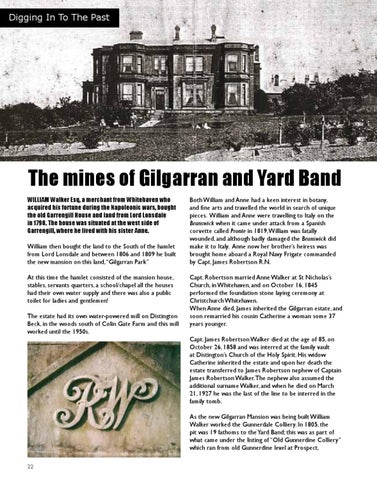
The mines of Gilgarran and Yard Band WILLIAM Walker Esq, a merchant from Whitehaven who acquired his fortune during the Napoleonic wars, bought the old Garrengill House and land from Lord Lonsdale in 1798. The house was situated at the west side of Garrengill, where he lived with his sister Anne. William then bought the land to the South of the hamlet from Lord Lonsdale and between 1806 and 1809 he built the new mansion on this land, “Gilgarran Park” At this time the hamlet consisted of the mansion house, stables, servants quarters, a school/chapel all the houses had their own water supply and there was also a public toilet for ladies and gentlemen! The estate had its own water-powered mill on Distington Beck, in the woods south of Colin Gate Farm and this mill worked until the 1950s.
Both William and Anne had a keen interest in botany, and fine arts and travelled the world in search of unique pieces. William and Anne were travelling to Italy on the Brunswick when it came under attack from a Spanish corvette called Pronte in 1819, William was fatally wounded, and although badly damaged the Brunswick did make it to Italy. Anne now her brother’s heiress was brought home aboard a Royal Navy Frigate commanded by Capt. James Robertson R.N. Capt. Robertson married Anne Walker at St Nicholas’s Church, in Whitehaven, and on October 16, 1845 performed the foundation stone laying ceremony at Christchurch Whitehaven. When Anne died, James inherited the Gilgarran estate, and soon remarried his cousin Catherine a woman some 37 years younger. Capt. James Robertson Walker died at the age of 85, on October 26, 1858 and was interred at the family vault at Distington’s Church of the Holy Spirit. His widow Catherine inherited the estate and upon her death the estate transferred to James Robertson nephew of Captain James Robertson Walker. The nephew also assumed the additional surname Walker, and when he died on March 21, 1927 he was the last of the line to be interred in the family tomb. As the new Gilgarran Mansion was being built William Walker worked the Gunnerdale Colliery. In 1805, the pit was 19 fathoms to the Yard Band; this was as part of what came under the listing of “Old Gunnerdine Colliery” which ran from old Gunnerdine level at Prospect,
22