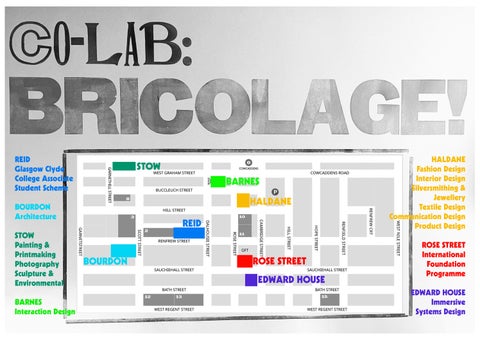
WORK-IN-PROGRESS SHOWCASE
1-5PM 9TH DECEMBER 2025
SCHOOL OF ARCHITECTURE / DESIGN / FINE ART / INNOVATION & TECHNOLOGY.
This Work-in-Progress Showcase across the Glasgow Campus is a culmination of the Year 1 Cross-School Project Co-Lab Bricolage Introducing students to sustainable creative practice, Co-Lab is designed to bring Year 1 students together from across the schools and programmes of GSA to foster community and enable them to explore their potential as emergent creative practitioners through research, studio-based making, and collaborative encounters. This year's project theme is "Bricolage!".
documenting conditions as encountered, and responding to existing ecologies rather than imposing new ones.
School of Fine Art: PAINTING & PRINTMAKING, SCULPTURE & ENVIRONMENTAL, PHOTOGRAPHY
Stow Building
Painting & Printmaking: 3.22 & 3.28
Fine Art Photography: 5.024)
Sculpture & Environmental Art: 5.025
In the School of Fine Art, Co-Lab’s Bricolage theme explores what a sustainable art practice can be and how we might rethink our relationship to the morethan-human-world. Using Ursula Le Guin’s Carrier Bag Theory of Fiction as a starting point, students gather and assemble ideas while considering the origins of their materials, how they are used, and our responsibilities and connections to the world around us.
with layout and proportion, using hand and machine joining techniques and subtraction-cutting to create a new and unique garment, displayed during the Work-in-Progress Showcase.
School of Design: SILVERSMITHING & JEWELLERY
Studio B, Ground Level, Haldane Building
S&J students made an object or a vessel, where form, materials, and perhaps decoration converge to express an idea aligned with values in sustainable and ethical design. A handling session of silver objects at GSA Archives & Collections acted as a starting point for inspiration, considering and documenting how precious metal has been used and manipulated to create a diverse variety of outcomes. Students used non-precious, sustainable materials to create an object that shares a meaningful message
School of Design: COMMUNICATION Level 2, Haldane Building
The focus in Com Des was on sustainable and ethical design through prototype publishing. Students engaged in research, material experimentation, group discussions, and the creation of a final prototype publication. The course emphasised interdisciplinary learning, critical analysis, and the exploration of sustainable practices. The final output is a publication that communicates an idea or issue related to sustainable design
School of Innovation & Technology: PRODUCT DESIGN, Level 2, Haldane Building
GLASGOW CLYDE COLLEGE ASSOCIATE STUDENT SCHEME
Principal Seminar Room 1, Reid Building
Completing their Co-Lab project over two weeks, the Glasgow Clyde College associate students began by collecting discarded, disused and no longer useful ‘materials’. The ‘materials’ collected ranged from bus tickets to scaffolding connectors to expired QR codes and vape smoke. These collections were used as a starting point for research and reflection before being transformed into new work
MACKINTOSH SCHOOL OF ARCHITECTURE
Grace & Clark Fyfe Gallery, Bourdon Building
In “Liminal Lands” students explored bricolage by working resourcefully with what already exists in the city its materials, atmospheres, histories, and overlooked fragments. Through their journey to and investigation of one of Glasgow’s derelict sites (Liminal Land), students approached sustainability not only environmentally but as a creative methodology: re-using found materials,
School of Design: INTERACTION
Floor 3, Barnes Building
“High-Low Tech”: For this year’s Co-Lab, Interaction Design students have been investigating the theme of Bricolage through a combination of analogue and digital processes to explore various media and methods of making. Some students have used the Workshops as a start point. Others have chosen to recycle work they already have by changing the physical form of an object, its material and surface properties, or by adding interactivity using touch to create work that integrates high and low technological materials and processes.
School of Design: FASHION
Studio B, Ground Level, Haldane Building
Fashion Design students considered the labour and materials that produce garments, and how their lifespan can be extended through up-cycling. They gained an understanding of conventional pattern cutting and construction methods through the deconstruction of second-hand garments, ordinarily destined for landfill. They experimented
School of Design: TEXTILES
Studio B, Ground Level, Haldane Building
In Textiles, students reimagined traditional crafts through a lens of innovation, environmental and social responsibility. They sourced waste textiles as raw material to explore crafts such as crochet, macrame, darning and patchwork. The outcomes were documented in a series of visualisations that showed final designs in context.
School of Design: INTERIOR
Studio B, Ground Level, Haldane Building
“Perfectly Imperfect” - Something is missing from the domestic interior! The Co-Lab Bricolage course in Interior Design used sustainable design to create a substitute for an interior feature or detail of a Glasgow tenement. Over a period of four weeks, students undertook research, development, experimentation with prototypes and critical analysis They created a final proposal to resolve an imperfection, substituting found materials in something they found at Glasgow’s Tenement House Museum
Product design students used a bricolage inspired approach to transformatively repair or revive a broken or disused object provided by their classmates Students explored ways to adapt, reshape, add to and combine, different materials to objects to give it new meaning and value. These transformed objects will be displayed at the Showcase.
School of Innovation & Technology: IMMERSIVE SYSTEMS DESIGN Edward House, Sauchiehall Street
Digital Bricolage: The School of Innovation & Technology’s 3D and Games + VR students are presenting interactive, nonlinear stories exploring themes around sustainability through the lens of bricolage.
INTERNATIONAL FOUNDATION PROGRAMME Rose Street
Students explored and researched artists and designers that work sustainably using bricolage materials and processes, considering the materials and processes that connect to the specialism they plan to go on and study next year They then developed a studio-led response inspired by their research connected to the theme of bricolage.