
GTheettysburgian
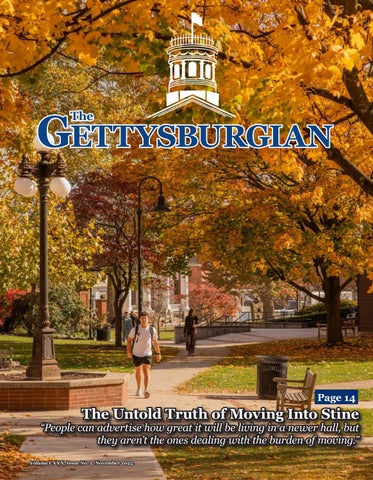
The Untold Truth of Moving Into Stine
“People can advertise how great it will be living in a newer hall, but they aren’t the ones dealing with the burden of moving.” Page 14
A Note From the Editor: On Change and Discovery
By Sophie Lange, Managing Editor & Features Editor
Growing up, I always loved writing. It did not matter if it was creative, academic or otherwise; I simply loved putting words down on paper and being able to tell a story. I have a distinct memory of my fourth-grade English teacher encouraging this passion, and little did she or I know, I would go on to become the Managing Editor of my college’s newspaper.
When I first arrived at Gettysburg, I truly had no idea how this place and the people I would encounter would change me for the better. I had only a vague inclination that I might want to write for The Gettysburgian, and I had no intentions of becoming involved in many of the activities in which I participate today. After all, I was merely a wide-eyed, anxious 18-year-old who thought she would never find her place on campus. Now, I am a senior, preparing to finish my last fall semester here at Gettysburg.
A lot has changed since then. Since joining The Gettysburgian, I have had the privilege of serving as both the News and Features Editors and the Social Media Manager. I stepped out of my comfort zone and pushed the boundaries of what was “safe” and “familiar” as a result of becoming involved with the newspaper, and I will always look back fondly on my time here. Throughout this period of growth, I took risks and worked toward leadership opportunities across campus, becoming not only the Managing Editor but also the philanthropy chair of my sorority, Tri Sigma.
Truly, college is a time of great change in so many ways. I am not the same person I was three years ago—and that familiar experience of change is something that we should all celebrate in our own lives. The Gettysburgian has allowed me to hold onto my love of writing in a way that has given me confidence and meaning in my time here at Gettysburg, allowing me to develop my passions while becoming someone of whom I could be proud.
This issue of The Gettysburgian highlights the changes within our community—from the opening of the Gettysburg Railroad Company to a new club on campus to the West Quad dorm renovations, there are so many exciting changes happening right now.
Yours Truly,

Sophie Lange Managing Editor & Features Editor The Gettysburgian
(Photo
By Brandon Fey, News Editor
By Ella Prieto, Editor-in-Chief
By Madilyn Cataloni, Staff Writer
By Cassidy Haines, Magazine Editor
By Jules Young, A&E Editor
By Max Ferguson, Staff Writer

Implementing New Academic Programs: Finance, Public Health Policy and Communication Studies
By Brandon Fey, News Editor
As of the Fall 2025 semester, Gettysburg College has begun offering new academic programs in public health policy, finance, and communication studies. The finance and public health policy programs were approved by faculty on Sept. 26, 2024, and the Communication Studies program received approval the following March. Students have since had the opportunity to start pursuing curricula towards these majors and minor.
Public Health Policy
The public health policy major seeks to provide students with an interdisciplinary foundation in health science and public policy by integrating courses from the two departments. The program is co-chaired by professors Anne Douds and Amy Daily, of the departments of public policy and health sciences, respectively.
“In this new major, we cultivate critical thinkers to develop evidence-based responses to current and emerging public health policy challenges and consider public health through a social justice lens,” commented Douds.
The major consists of 14 courses, including an individualized “study-internship,” amounting to a Bachelor of Arts. Among these courses is the new crossdesignated PP/PHP 222: Health Organizations and Policy offered during the fall 2025 semester, which professor Douds designed
to connect students with a series of guest speakers working in positions within the public health field. Guest speakers so far have included the director of Healthy Adams County, the former director of communications at the New Jersey Department of Health and the vice president of policy research for the American Heart Association.
“The major gives students a real interdisciplinary home if they are interested in health but do not see themselves in a traditional health sciences track,” said public health policy major Gavin Wilson ’27. “It pulls together policy, ethics, data and local community work in a way that exemplifies Gettysburg.”
In the upcoming spring 2026 semester, health sciences professor Megan Benka-Coker will teach HS/ PHP 350 Exposure Assessment, another new course for the major. This aims to instruct students in the fundamentals of exposure assessment, including source identification, measurement and assessment of exposures and the prevention of harmful exposures in the interests of public health.
Multiple courses required by the major are also available to complete through the College’s study abroad program in Bonn, Germany, which was introduced in the spring of 2025.
Professor Daily is confident in the major’s success based on its first semester so far.
“Student interest has been strong,” she said. “We’ve had a number of students eager to declare public
health policy as their major. We’re looking forward to meeting with even more interested students next semester as they begin planning their coursework for next year.”
Finance
The finance major is intended to equip students with skills to succeed in professional financial analysis. It offers a 12-course Bachelor of Arts through the business track and a 16-course Bachelor of Science through the economics track. The program is co-chaired by professor Brendan Cushing-Daniels of economics and professor Patturaja Selvaraj of management.
About 30 students have declared finance majors as of the fall 2025 semester. First-year students already taking classes on the business track are unable to declare the major until their sophomore year, and several senior students who are likely too late to pursue the new major have enrolled in courses within its curriculum.

The two tracks require a combination of math, economics and management courses, some of which were newly created to support the major. For the business track, this includes the new Financial Analysis, Modeling, and Forecasting course and Advanced Topics in Finance and Strategy, which counts as the capstone course for that track. Students pursuing the economics track will take the new Financial Econometrics course as a requirement, and will have the option of taking the new History of Finance as an elective. The Finance and Advanced Finance courses previously listed under the ECON designator are being rebranded as ECON/MGT 267 Principles of Corporate Finance and ECON 367 Investments, both of which are components of the major.
To supplement the new major, the College has installed the new 24/7 Bloomberg Terminal Lab on the second floor of the College Union Building above the Bullet Hole. The lab is equipped with machines with Bloomberg software that is universally used by professionals in the industry. The terminal allows students to learn Bloomberg Query Language for finance functions in Microsoft Excel, in addition to four self-
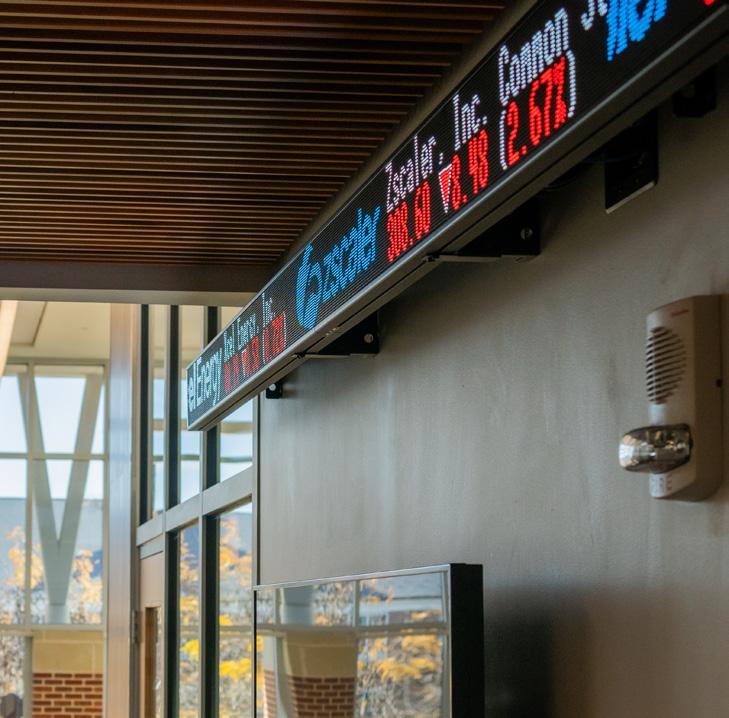
paced online certification programs with the technology. This enables finance students to use real-time financial data for class assignments as opposed to synthetic data used for economics classes in previous years. The Bloomberg Lab is available for use by all members of the College community and is not exclusive to finance students.
“Finance students are enjoying the classes that they have taken in the field, where they are learning new and interesting things,” said professor Cushing-Daniels. “We have always had several dozen students who want to pursue finance coming out of Gettysburg College, and now the specialized major and access to the Bloomberg technology will certainly be an asset.”
Communication Studies
The new communication studies program intends to foster skills in writing, media analysis, digital content creation and public speaking through a multidisciplinary curriculum that combines theory and practice. It includes a 10-course major with optional concentrations in public or digital communication, as well as a 6-course minor. As of November, 16 students have declared communication studies majors and 7 are pursuing minors.
The communication studies curriculum involves classes across multiple disciplines, the majority of which are from the English and cinema & media studies departments. The major consists of three core courses — an introduction, methods and a senior capstone — three analysis courses and three praxis courses in written and audio communication, in addition to a full-credit practicum. These include new courses specific to the program, such as COMM 110
Introduction to Communication Studies, COMM 241 Media Advertising & Sales, COMM 221 Social Media Strategy and COMM 399 Practicum.
Communications studies is cochaired by English professor Jack Ryan and cinema & media studies professor Jack Udden, and also includes lecturer Melissa Forbes and assistant professor Aisha Mershani of interdisciplinary studies. In addition, the department has hired new adjunct professor Ted Carlin, who has a doctorate in communications, to help teach courses in the curriculum. Both of his courses this fall semester, COMM 110 and COMM 241, were moved to the Joseph Theater due to high enrollment. Communication studies plans to hire an additional fulltime lecturer for the spring 2026 semester to allow for the creation of more new courses. The program seeks to engage students with experiential learning opportunities within coursework, as they are instructed to create podcasts, videos and social media content, while also writing articles with the option of pursuing publication in The Gettysburgian. Communication studies students will also have the opportunity to manage the College’s social media accounts and provide live coverage of events on campus.
“Approximately 30 first-year students indicated that comm. studies was their first or second major of interest when they began the fall semester,” said professor Ryan. “…All in all, the future looks bright for Communication Studies. ∎
The Bloomberg Lab's stock ticker, visible around the Bullet Hole. (Photos William Oehler/The Gettysburgian)
Senior Spotlights: Ella Reidway, Soprano & Jules Young, Tenor
By Jules Young, Arts & Entertainment Editor, and Ainsley Green, Staff Writer
On Saturday, Oct. 25, 2025 at 7 p.m., Ella Reidway ’26 performed her Senior Recital, the capstone project for Sunderman Conservatory Music Majors. Reidway is a Music Education major, and the recital is the culmination of all her work as a soprano vocalist.
The recital opened with two French pieces that were connected by their theme about stars. One of which was a duet with soprano vocalist Lana Dyer ’27, accompanied by pianist Athena Komitas ’26. Reidway and Dyer work closely on the student Music Education board, and attended the Orvieto Musica summer music program together; Reidway and Komitas are both members of Alpha Delta Pi. For these reasons, as well as “being long time friends, it was important to [her] that the two were included on [her] recital program.”
The pieces that followed came from Cuatro Madrigales Amatorios by Joaquín Rodrigo, songs in the Spanish language that drew influence from Spanish folk music. These pieces were personally significant to Reidway because of her work with the Vida Charter School, a bilingual school that caters to Spanish-speaking students.
There were some pieces with
particular sentimental significance to Reidway on the program. The first was “Will There Really be a Morning?” by Ricky Ian Gordon, using a poem by Emily Dickinson. She described this as “a piece that sums up the end of her college experience,” as well as “[having] certain figures in the text that represent the members of [her] family.” Additionally, the final piece on the recital was “She Used to be Mine,” from the musical Waitress, which she had been working on since middle school. In a cyclical nature, this song was the first one she ever performed at Gettysburg College, at the conservatory’s Night On Broadway event in Fall of 2022. Her second collaborative piece was a set of two American Folk songs arranged by Ruth Elaine Schram and Mark Hayes. The two songs were duets that she sang alongside
tenor vocalist Jules Young ’26. Reidway and Young are the only two vocal music majors of their class year, working closely alongside each other throughout their respective college careers. The two wanted to feature each other on their recital programs, showing off their collaborative efforts over the years.
This culmination of Reidway’s experience in voice during her time at the Sunderman conservatory is a testament to how much she has grown as a musician.
She will go on to student teach at Vida Charter School and Gettysburg Middle School next semester, jump-starting her career in music education. After graduation, she plans to start teaching elementary music and ultimately work towards teaching in higher education.
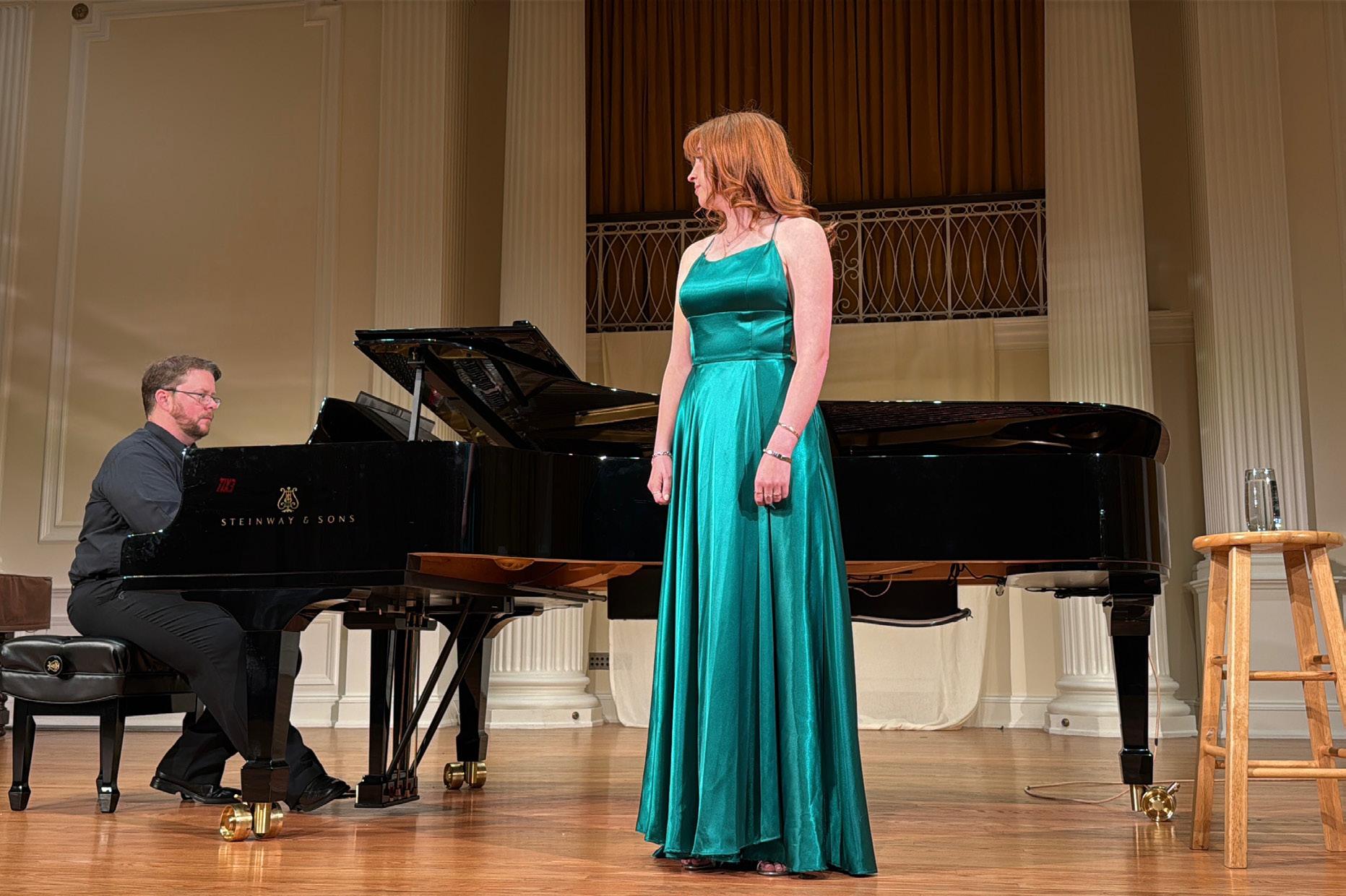
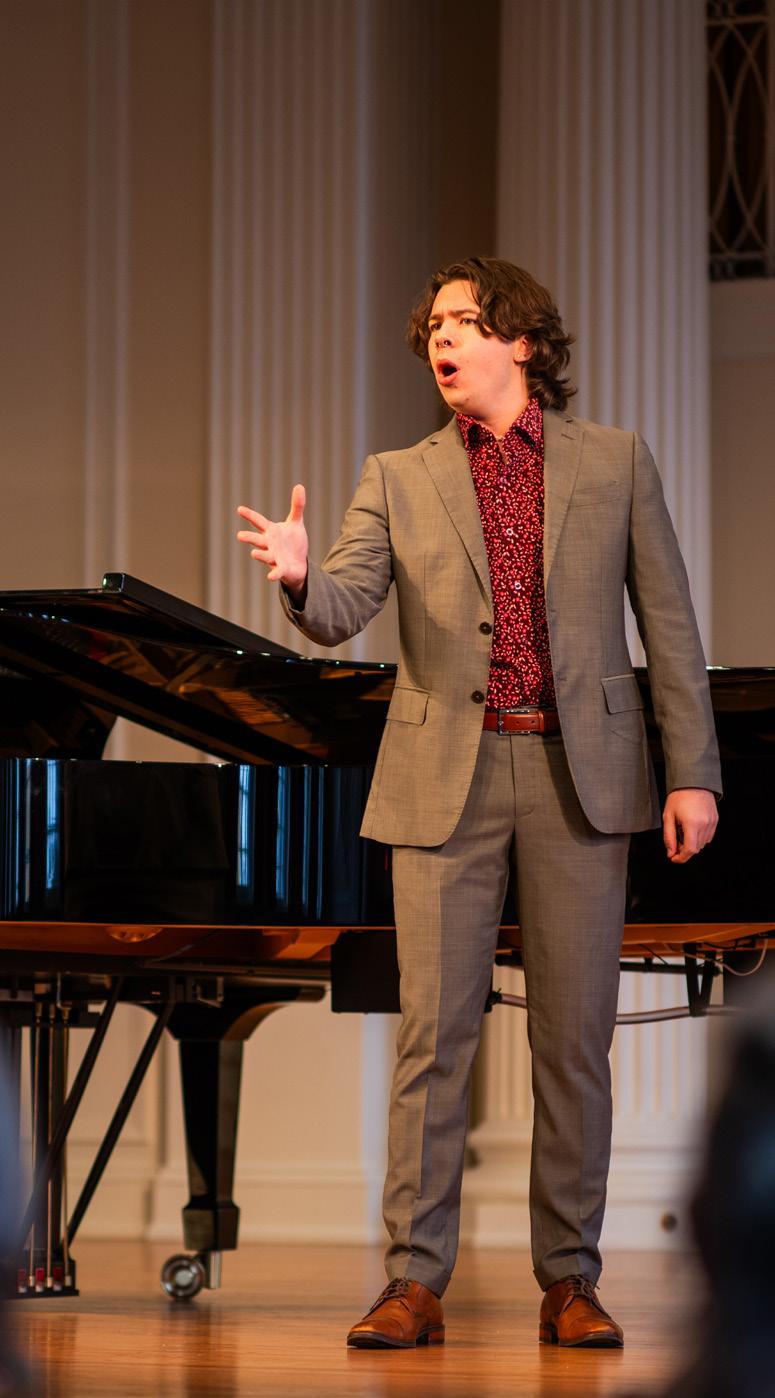
On Sunday, Nov. 9, Jules Young ’26 performed his senior recital in Paul Recital Hall at 2:30 p.m. Young is a double major in English with a writing concentration, and music and a minor in French. He primarily sings tenor. The recital showcased his love of the arts, themed around the text of the music and how it interacts with the compositions. The audience was full of family, friends and community members to cheer on Young for his accomplishment. The first piece on the program was “Dalla Sua Pace” from W.A. Mozart’s famous opera Don Giovanni, accompanied by Dr. Scott Crowne on piano. The story of the opera has always been fascinating for Young, who has been on a journey working with pieces from Don Giovanni throughout his college career. Young then sang three art songs by Gabriel Fauré, entitled “Mandoline,” “Prison” and “Clair
de Lune,” which depicted poems by French poet Paul Verlaine inspired by Jean-Antoine Watteau. Young then sang two songs by Reynaldo Hahn, which depicted travels in a gondola with a Venetian dialect in the text. The pieces were two selections from Venezia—“I. Sopra L’Acqua Indormenzada,” and “II. La Barcheta,” translating to “Over the Sleepy Waters,” and “The Little Boat,” respectively. Directly afterward, Young sang another piece from Don Giovanni entitled “Il Mio Tesoro.”
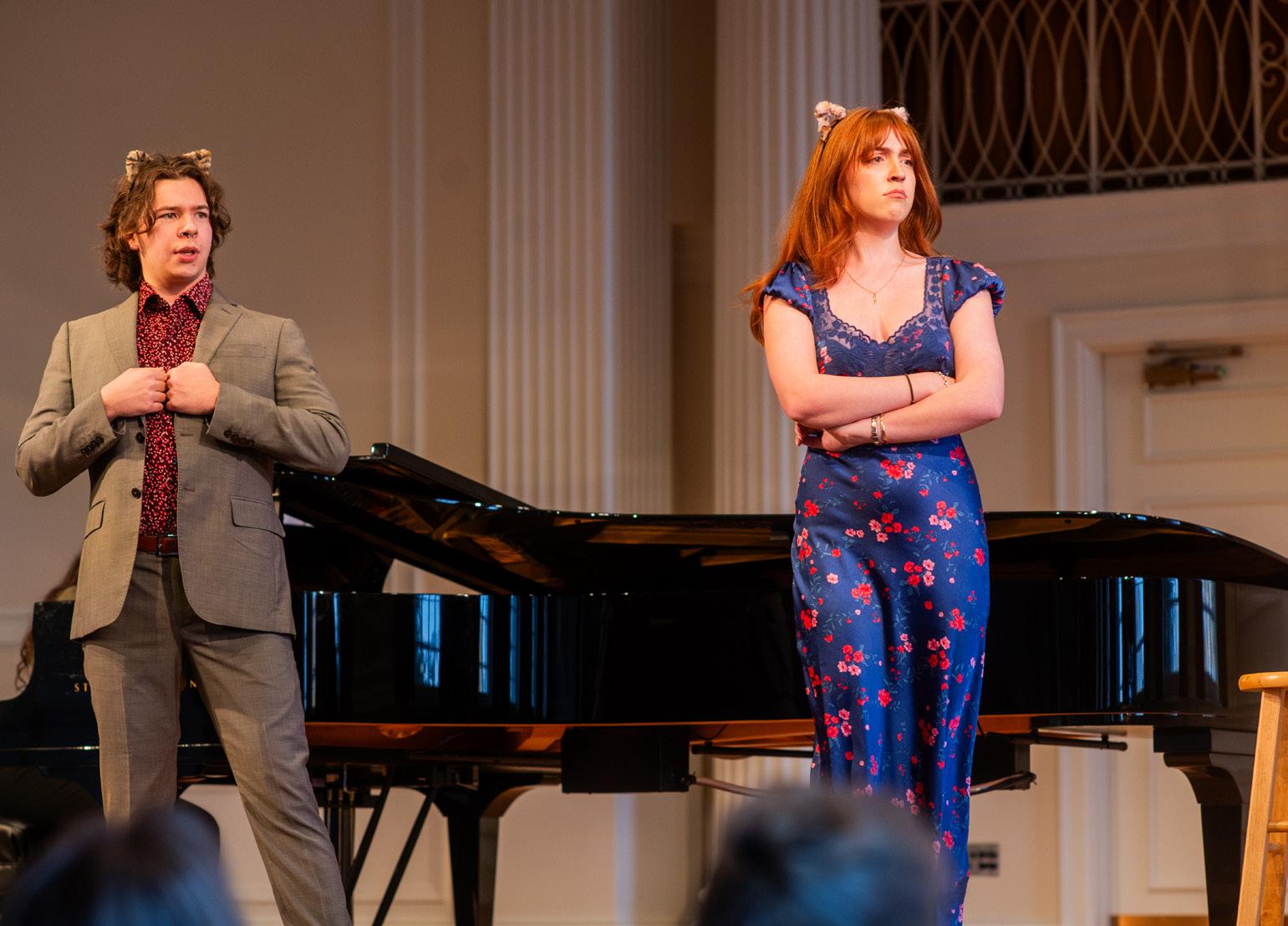
Young was joined by friends Ella Reidway ’26 and Athena Komitas ’26 for a comical addition to the recital with a rendition of “Duetto Buffo Di Due Gatti” by Gioachino Rossini. The “Comic Duet for Two Cats” had only the lyric “Miau!” Young and Reidway told a dramatic story of two cats interacting with their voices. All three musicians wore cat ears for the performance, bringing a smile to the audience’s faces.
Young fulfilled his interdisciplinary credit for the Gettysburg College
curriculum in a way that exemplifies his two areas of study, combining a course cluster of Music Theory III and Shakespeare: The Major Works to set songs from Shakespeare plays to music. The art songs from Three Shakespeare Songs were called “Full Fathom Five,” “The Willow Song” and “Sigh No More,” showcasing Young’s musical depictions of the texts he studied.
The final three pieces on the program were “Fairy Lullaby,” by Amy Beach; “It was a Lover and his Lass” by Gerald Finzi; and “La Danza,” another piece by Rossini. These final songs showcased Young’s versatility in singing in many musical styles and acting along with singing, finishing the recital on an exciting note. Young is looking to pursue a career in music education after graduating, and dedicated his performance to loved ones and mentors who have inspired and encouraged him throughout his musical experiences at the Sunderman Conservatory. ∎
(Photos William Oehler/The Gettysburgian)
Dreamscapes: Waldo’s & Co Debuts New Studio Holders Gallery Exhibition
By William Oehler, Director of Photography
“Dreams are really ineffable, weirdly hard to penetrate. You can ask what a dream means, but it is hard to penetrate your subconscious to figure out [what they mean].”
Ethan Hartranft, a studio artist of Waldo’s and Co’s, described his interpretation of the non-profit, community art space and café’s new studio artist exhibition titled Dreamscapes, which opened on Nov. 7.
Waldo’s & Company, located below Lark at 17 Lincoln Square, offers its walls and floor space routinely to artists and their works, often housing a new exhibition each month. Friday, Nov. 7, however, was specially reserved for artists who rent studio space in Waldo’s.
As part of the Gettysburg Area Retail Merchant Association’s (GARMA) First Friday initiative, Hartranft and almost a dozen other studio artists created works that aligned with the theme centered around dreams and imagination.
Shannon Palmer, Waldos’ new Tradeshop Manager, featured her Little Monstrosity ceramic sculpture of her selfdescribed alter-ego inspired by European folklore. While first a printmaker and photographer, Palmer turned toward pottery and ceramics upon beginning her position at the Tradeshop, saying, “I didn’t even know I was interested in ceramics until I got here, it's a totally different [experience], I'm usually a 2-D

artist and now I’m a sculptor!” Palmer intends to practice the throwing wheel to best serve new artists joining Waldos’ community of ceramists.
Sharon Birch, Board Member and Treasurer for Waldo’s, submitted her work titled Living the Dream. Birch described her work as an “abstract villagescape... an environment where one might live that’s completely surrounded by color.”
She also commented on how her piece offered a different interpretation than that of her fellow artists: “I don’t usually title my work but... that is kind of what it is, a dream that is so vivid and you’re actually living it.” Her work stands out with its use of bright, almost neon acrylic details, in contrast to other works that use darker palettes. Birch also expanded upon what art inspires her, citing her younger self finding Georgia O’Keefe and Keith Haring. Currently, Birch finds curiosity in street art, both in Philadelphia where “murals are hodgepodges of shape and color,” and in Paris where “they’re
really into stencil work.”
Tucked into the typically couchfilled stage in the corner of Waldo’s café space, Hartranft combined his love of math and art to create his exhibition piece. Based on an idea he had to create a work inspired by Császár’s polyhedron, Hartranft used a technique called Lino block, where a print design is carved from a block of linoleum. “You get to make many [copies] which slots into the concept of
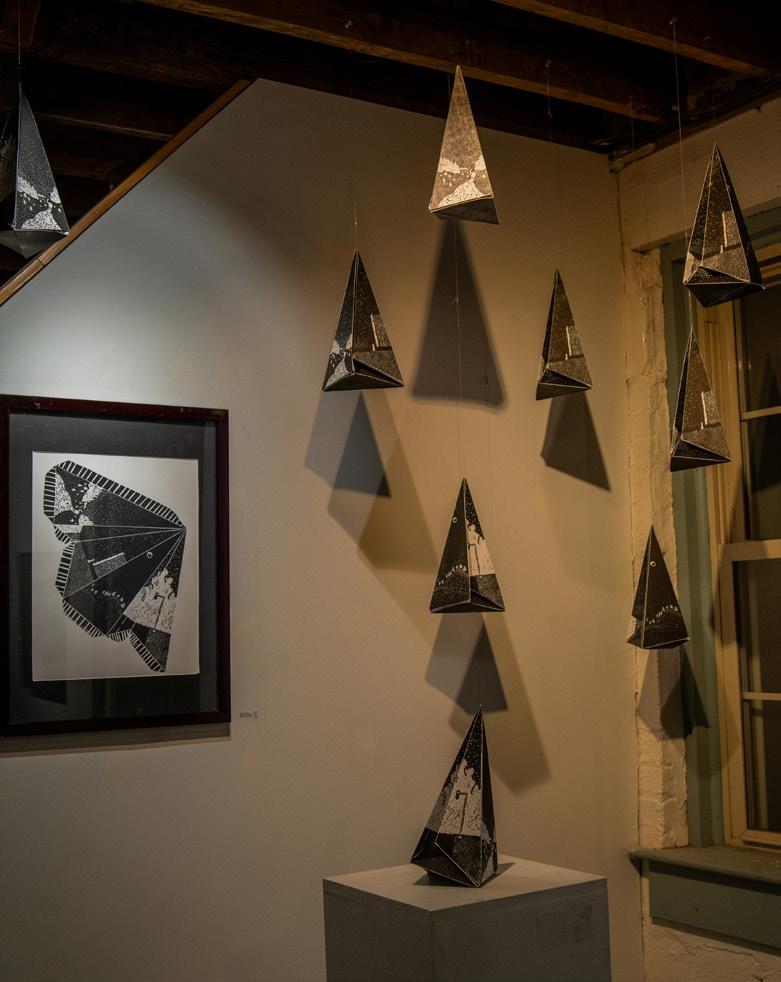
Printwork by Ethan Hartranft.
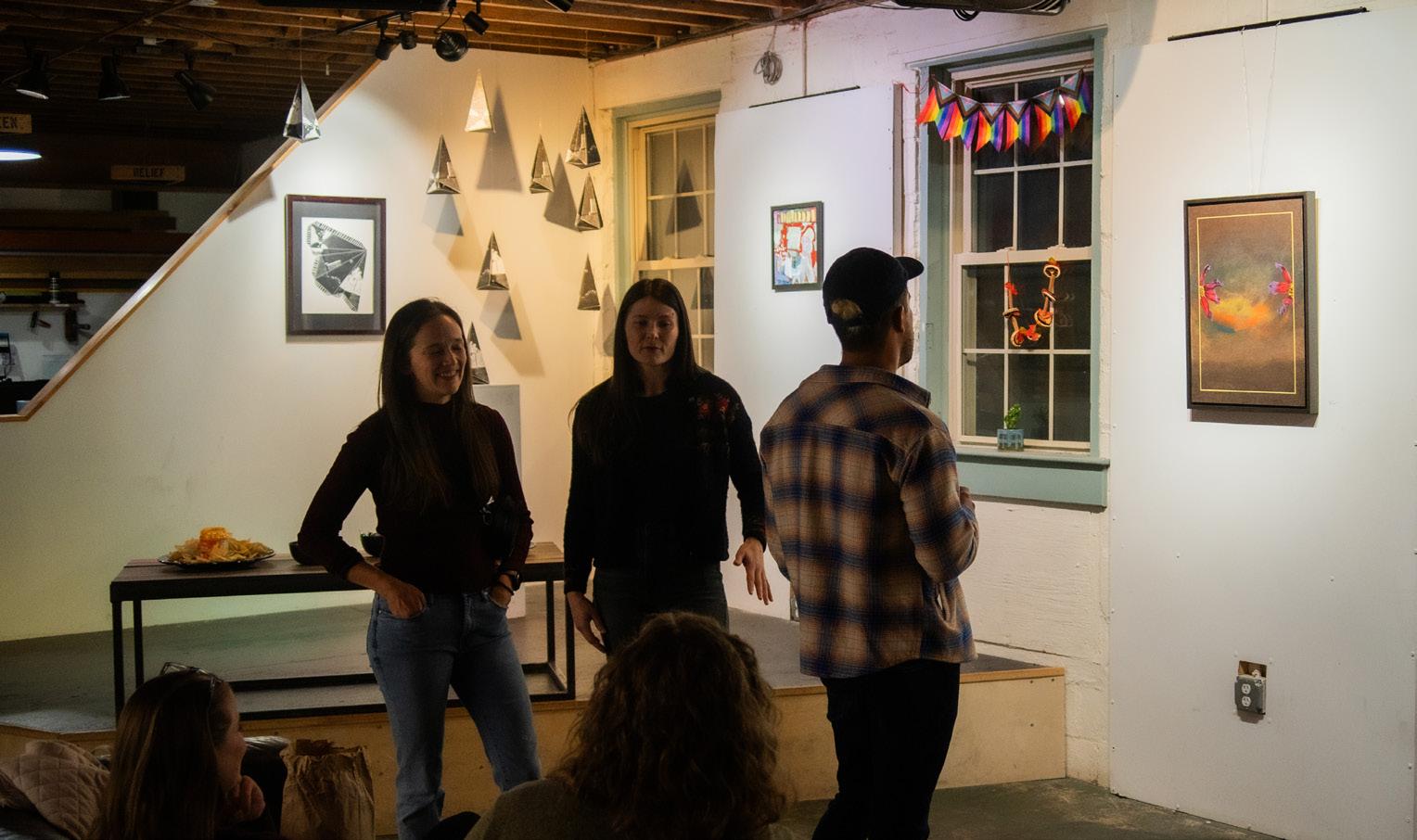
recurring dreams, images you see multiple multiple times... that's what printmaking is, the power of repeated images.”
Courtney Billow featured her untitled work that used the idea of “metaphysicism, and how we connect ethereal elements and representational images that we see every day with the emotional stuff we can’t quite describe.” Two halved flowers mirror each other against an almost sunset-like background of oranges, browns and blues, all mixing to create what Billow described as the ethereal aspect of her work. As almost decade-long studio artists, Billow and Molly Fenbie graduated from Shippensburg University in
2015, and they now collaborate under MCFB Ceramics studio at Waldo’s.
As one of the first studio holders, Tim Smith recognizes Waldo’s work bringing together “local artists, creativity and great people [in a place] to share ideas.” He touched on the fact that he typically does not create work in tandem with a theme, but he chose to include aspects from everyday life, including a sunset scene in D.C. He chose to use what he called “dream bubbles” to work with the theme of Dreamscapes. He described, “as I sat with live music, I would draw [what came to mind], and it is really just ‘life as a journey’”.
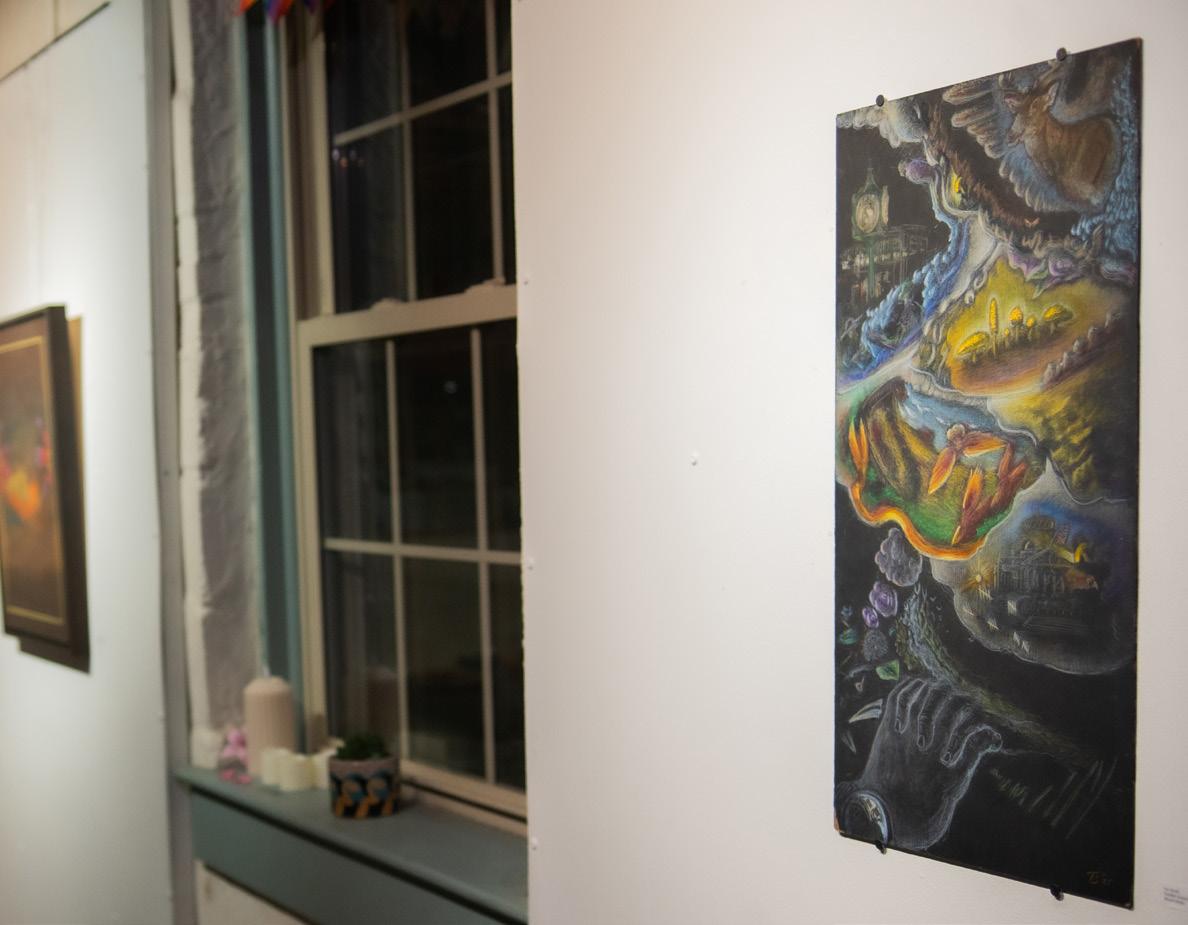

Smith’s work, titled Golden Dream, was created using watercolor pencil.
Waldo’s typically hosts a new exhibition each month, highlighting a local artist’s work. Each year, the non-profit turns its focus to its studio holders: “once a year, we love to show them off to the world in the studio holders gallery exhibit.” Alongside the rest of the featured artists, the rest of the studio holders’ works will be on display until the end of November. To best appreciate their work, you can visit Waldo’s & Co., which is open every day but Tuesday, 10 a.m. to 10 p.m. ∎

Tim Smith's "Golden Dream" (above); Shannon Palmer's "Little Monstrosity" (right).
Sharon Birch's "Living the Dream".
Vote for Equality: Gettysburg’s Feminists in Action
By Cassidy Haines, Magazine Editor
On the first Tuesday in November, voters across the country filled their ballots for midterm and local elections. As in past years, the College Union Building served as a polling place for Adams County, and students across the political spectrum welcomed townspeople and encouraged them to make their voices heard. One of the organizations involved this year was Vote for Equality (V4E), which officially launched on our campus at the start of the fall semester. Marisa Conners ’26, campus organizer team lead, club president and founder of the Gettysburg chapter of V4E, shared that “V4E is the political arm of the Feminist Majority, which is a 501(c)(4) nonprofit, so it can engage in political activity by advocating for causes and endorsing candidates. At Gettysburg and dozens of campuses across the nation, Vote for Equality groups are working to advance gender equity and related issues through elections. We have
lots of volunteer opportunities and awesome pink merch! In fall 2025, V4E Gettysburg is working on voter education and mobilization.”
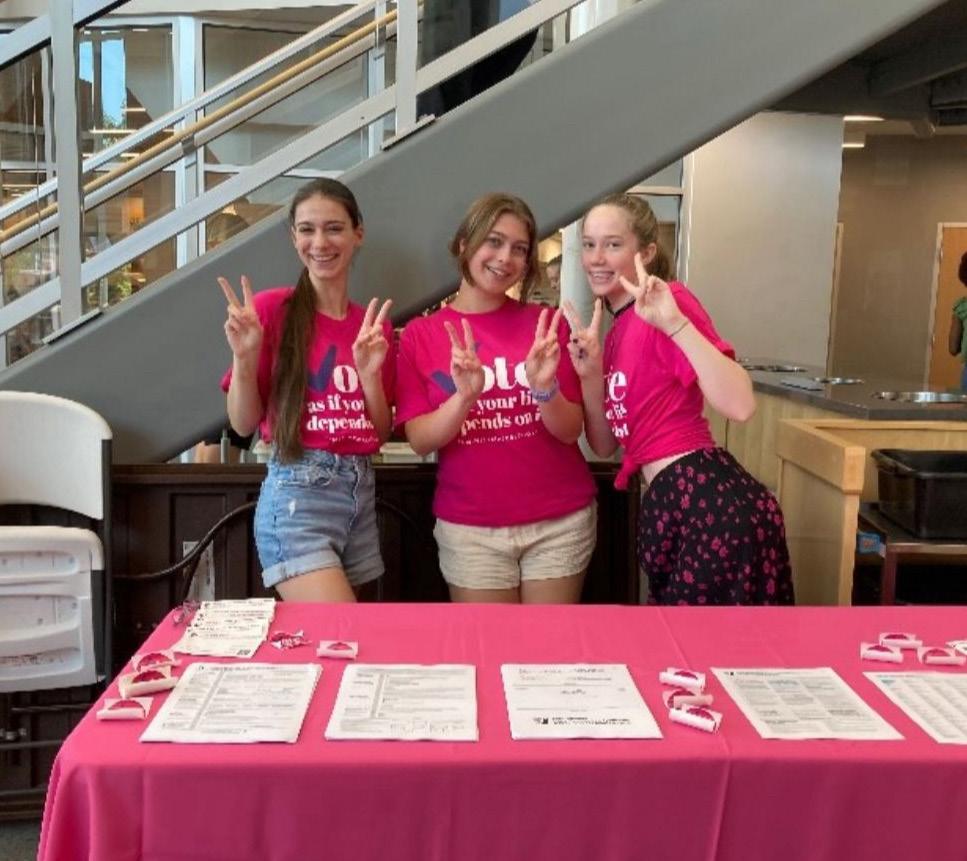
As of November, the organization now has over 40 volunteers throughout the Gettysburg community. While this is the first term that V4E has been a part of the college community, they have hosted plenty of events around campus to get
their name out there, including “DONUT Forget to Vote,” “HOWL-o-ween” and their First-Year Festival. In the weeks leading up to Election Day, V4E organizers and volunteers tabled around the College Union Building to spread the word about their candidates and ideologies in preparation for the group’s major focus: the November 4 election.
Conners discussed the club’s goals heading into this year’s elections: “People aged 18-29, including college students, still have the lowest turnout in the nation. In 2024, Vote for Equality student organizers helped elect Governor Josh Stein in NC, Rep. Josh Riley in NY (flipping the seat), Sen. Ruben Gallego in AZ and more. V4E Gettysburg has spread awareness about this year’s upcoming election, registered at least 30 people to vote and provided valuable resources to
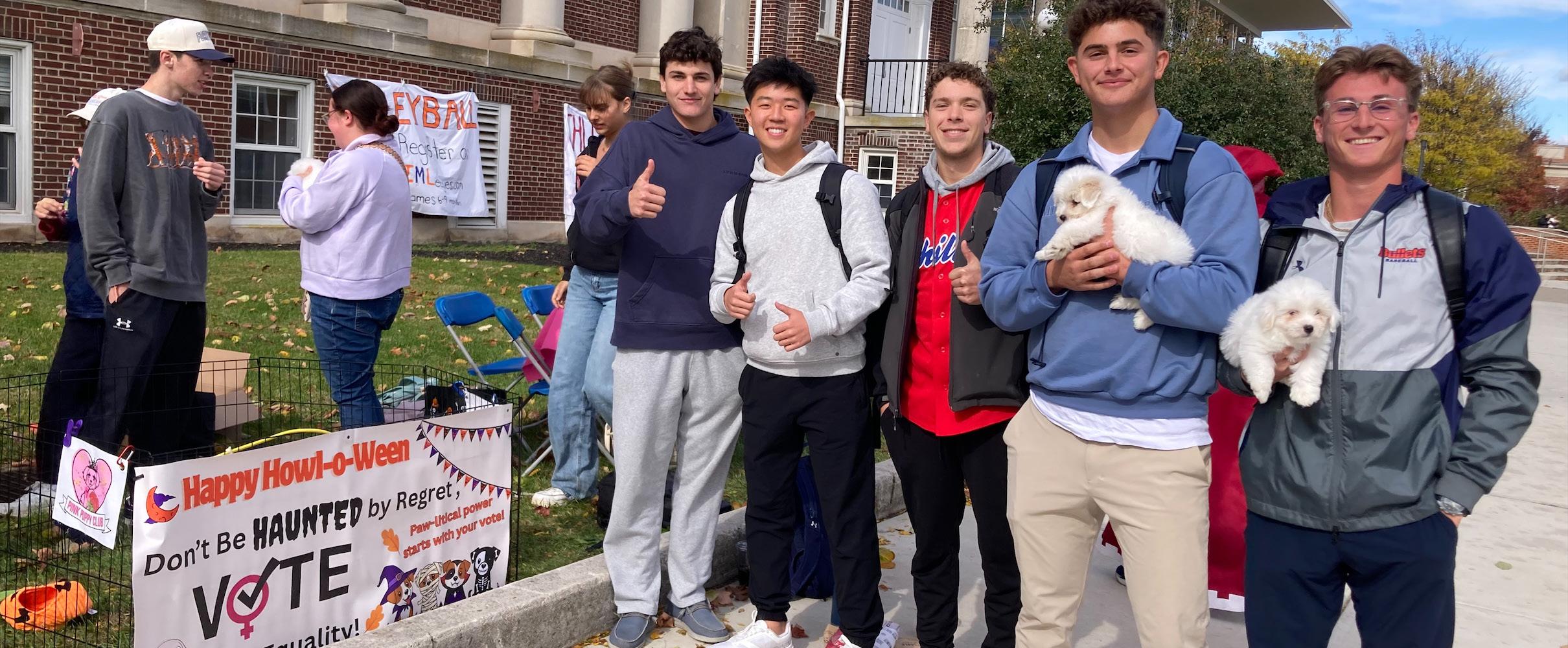
Scenes
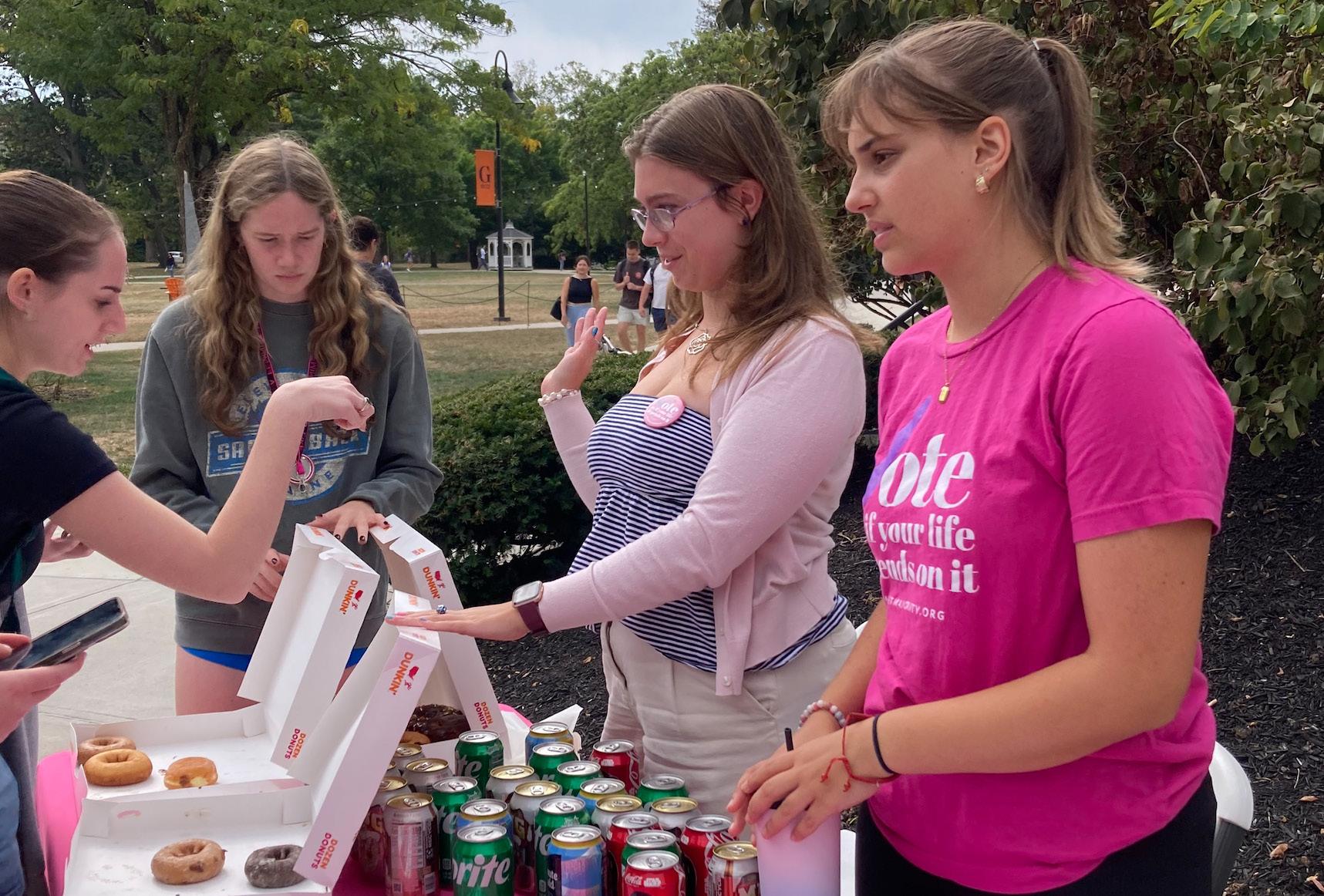
make sure students are ready for Election Day.”
With these objectives in mind, the V4E volunteers campaigned up to the minute on Election Day. This year, roughly 30,000 people voted in Adams County, and after all was said and done, Vote for Equality at Gettysburg was able to register dozens of these people to vote.
Fellow campus organizer Chloe Hanousek ’27 explained the election results and V4E’s efforts this election cycle: “The people are the power — it’s our job to remind them of that. In Gettysburg, voter participation among students and community members exceeded expectations this election cycle. Across Pennsylvania, V4E groups on college campuses worked to mobilize student voters, contributing to a near recordbreaking statewide turnout. As a result, all three Pennsylvania Supreme Court judges were retained, ensuring continued protection for the state Equal Rights Amendment, abortion rights and fair redistricting. This outcome represents a major victory for equality, civic engagement and the collective power of informed voters.”
Conners, Hanousek and the
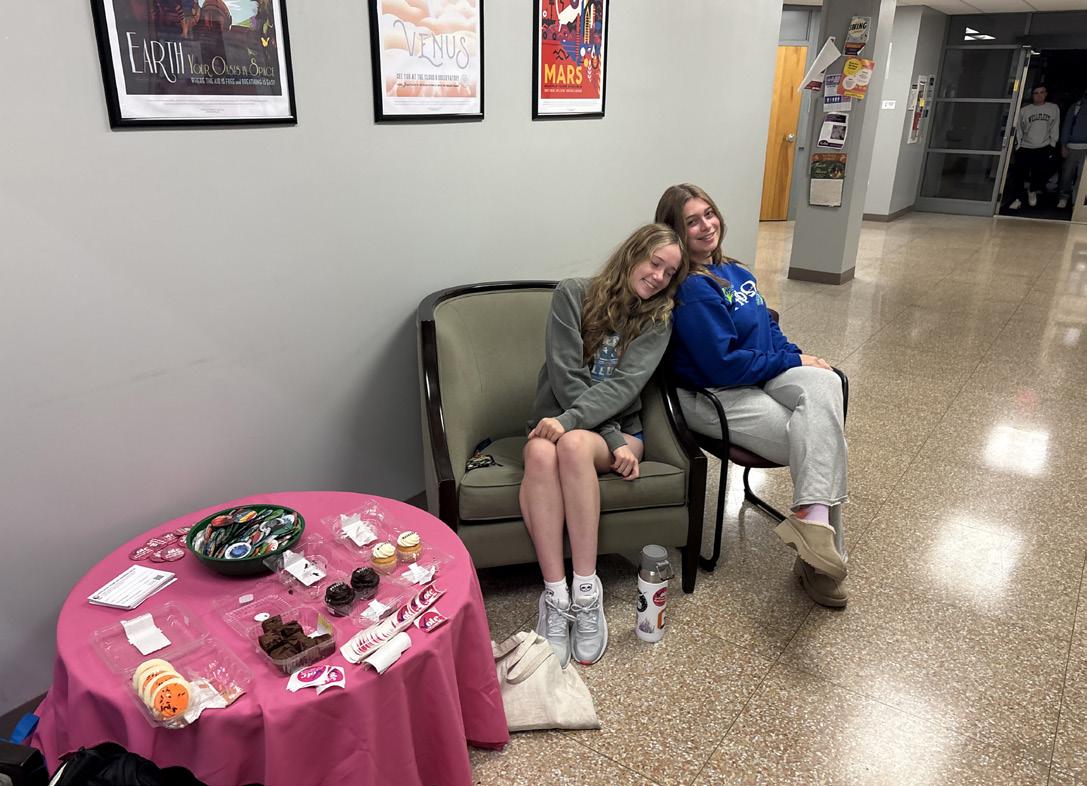
other establishing members were approached by the Feminist Majority to become campus organizers over the summer, and then this team became the club’s executive board. Conners was also a campus organizer during the fall 2024 election cycle and had the opportunity to intern for the Feminist Majority while she spent her spring 2025 semester in Washington, D.C. “It’s been an honor to be a part of this campaign,” expressed Hanousek.
About her experience with the club, Hanousek stated, “When I was feeling powerless in the face of American politics this summer, I got an email saying that I’d been recommended for the position. I knew I had to apply. This organization has given me a voice and reminded me of my power as an organizer, American citizen and student activist.”
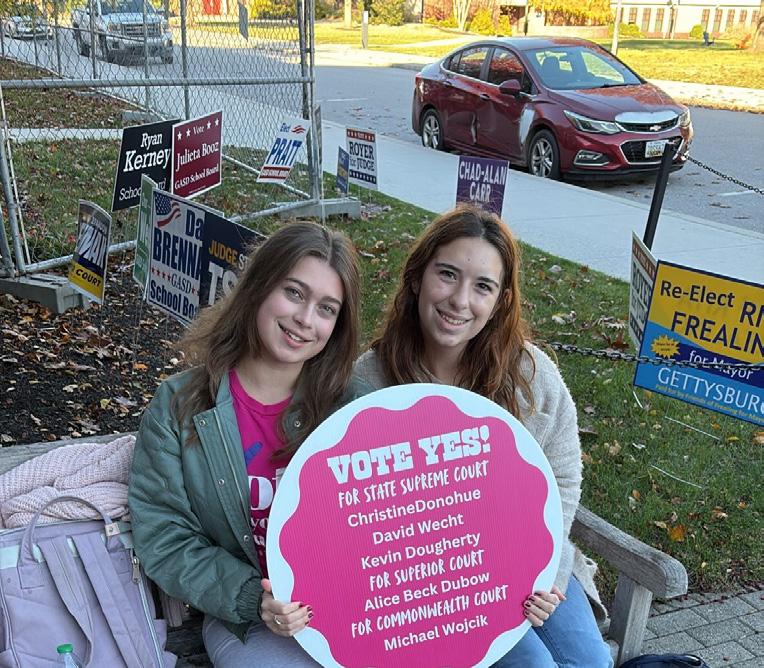
Following a busy election cycle, V4E will slow down for the fall semester, with Conners anticipating smaller volunteer efforts throughout the spring.
To learn more about Vote for Equality or to join the Gettysburg chapter, Conners invites students to contact her at connma04@ gettysburg.edu, and Hanousek suggests requesting to join on EngageGettysburg. You can also follow them on Instagram @gburg_ v4e to keep up with their upcoming campaigns and events. ∎
Gettysburg Railway: Providing Trips to the Past with Economic Gains for the Future
By Ella Prieto, Editor-in-Chief
A story every Gettysburgian knows by heart: On Nov. 18, 1863, President Abraham Lincoln arrived in Gettysburg, PA, via train, before delivering his famous Gettysburg Address the following day. One of the many historical highlights of Gettysburg College is that the train station Lincoln arrived at is situated on campus, nestled between the ICE Complex and Constitution Apartments. However, the station had become bleak since the passenger rail service shuttered in the 1950s, rundown with glass shards and trash often littering the surrounding area.
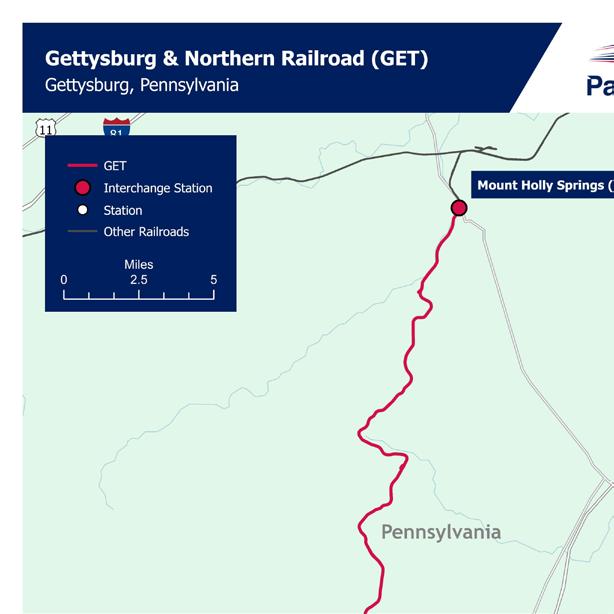
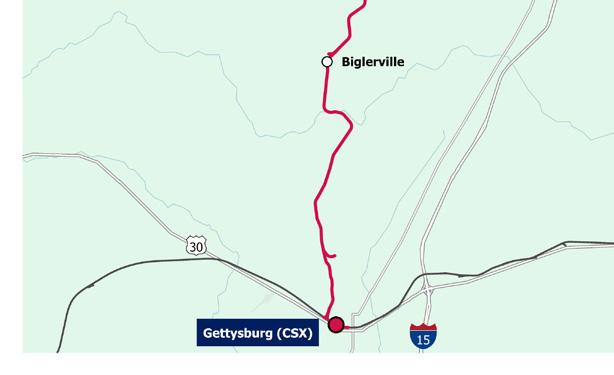
In 2023, the scene began to change. Patriot Rail, a shortline rail company, purchased the 26.8-mile Gettysburg & Northern Railroad (GET) in 2022, which included the historic train station. Leading all the way to Mount Holly Spring, PA, the route traversed several notable landmarks, inspiring the idea for an Excursion Railway.
Commenting on the change of the area, Gettysburg Railway General Manager Amy Welsh stated, “This is our community’s train. This isn’t just Patriot Rail’s and Gettysburg Railway’s. Our entire community is thrilled to have [visitors] on board.”
Landmarks seen include


perspective to the Battle of Gettysburg monument that symbolizes enduring peace and unity between the North and South.

Conewago Creek, an Iroquois term meaning “at the place of the rapids.” Beyond its scenic view, the creek served as a favorite trout fishing spot for President Dwight D. Eisenhower. Also seen is the Eternal Peace Light Memorial atop the hill overlooking Gettysburg Plain. The train ride provides a different
As riders pass through these areas, they hear about the history of Adams County beyond just the Battle of Gettysburg. Welsh explained this was important for the Railway to share, as the area has so much to offer. Overhead speakers detail the surrounding apple industry, the founding of Gettysburg and Adams County, and general history, including the carriage-making commerce that defined Adams County and the establishment of Gettysburg College. This is all in addition to the history of the Battle.
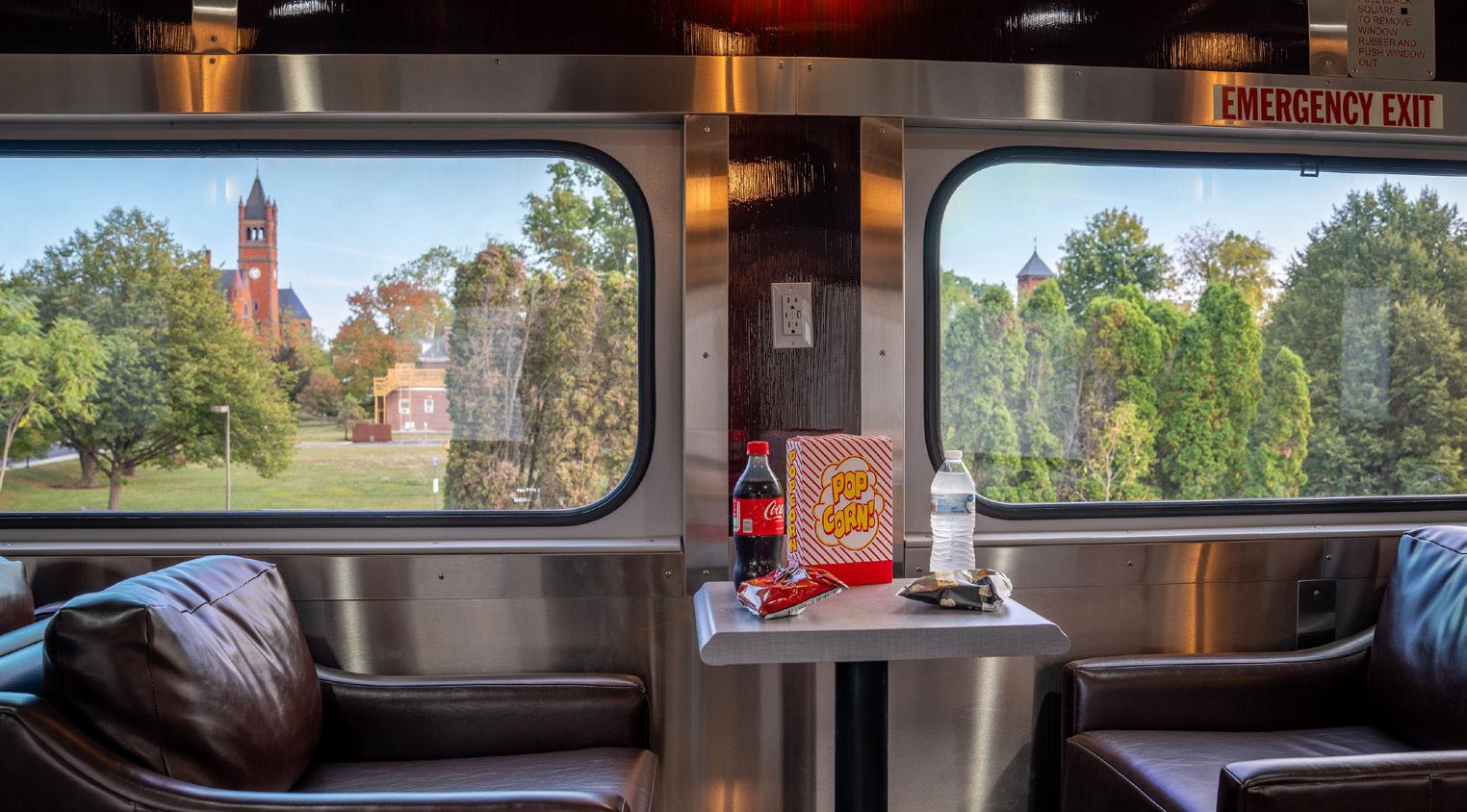
The renovated 1950s-era Budd passenger coaches are pieces of history as well, providing comfort and a nostalgic feel to the ride.
GET Rail Map (Courtesy of Patriot Rail)
Inside the renovated train cars, with comfortable leather seats and selections from the Concessions Car. (Photo Courtesy of Gettysburg Images)
There is also a concession car, where riders can purchase a variety of drinks and snacks to enjoy.
To attract riders, Gettysburg Railway offers themed excursions, ranging from holidays to certain industries. Examples include haunted tours and tasting tours with local breweries. They also offer Chartered Excursions, collaborating with hotels, businesses and tour operators to provide private rides. All of the ideas are centered around maximizing community impact.
“This is our community’s train.”
- Amy Welsh, Gettysburg Railway General Manager
Assistant Vice President of Communication for Patriot Rail, Katie Roller, explained
how important this is, stating, “The Gettysburg Excursion Railway is becoming a key driver of local economic development by attracting visitors and partnering with hometown and regional businesses. Our train rides and seasonal events are strategically scheduled to encourage extended hotel stays, which in turn support

revenue growth not only for hotels but also for restaurants and the retail sector.”
Through working with Gettysburg Borough’s tourism strategy, the Excursion team is happy to already see the positive impact the railway has had on local businesses in the short time since its opening. Patriot Rail’s broader Excursion Division, including the Blue Ridge Scenic Railway, Granite State Railway, and the Winnipesaukee Scenic Railroad, hosted over 800,000 riders in 2024 across both train and rail bike excursions, highlighting its success throughout the region.
Students interested in riding the Railway are provided with a discount with a valid student ID for the 75-minute trip cost to be $26.99. ∎
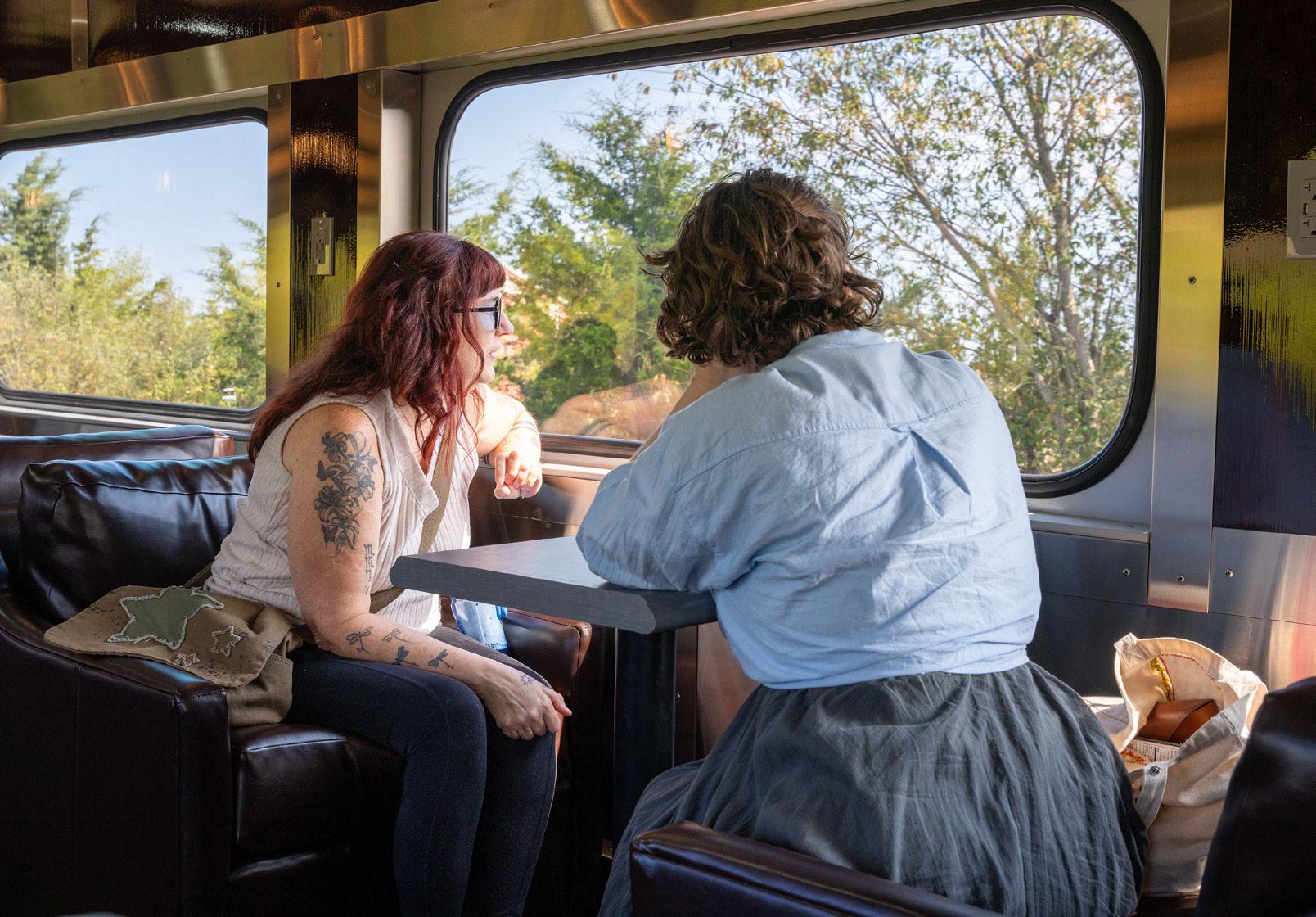
Passengers enjoying the scenic views. (Photo Courtesy of Gettysburg Images)
A Gettysburg Railway worker in the Consessions Car, where riders can buy fresh popcorn, candy, slushies and more. (Photo Courtesy of Gettysburg Images)
The Untold Truth of Moving Into Stine
By Madilyn Cataloni, Staff Writer
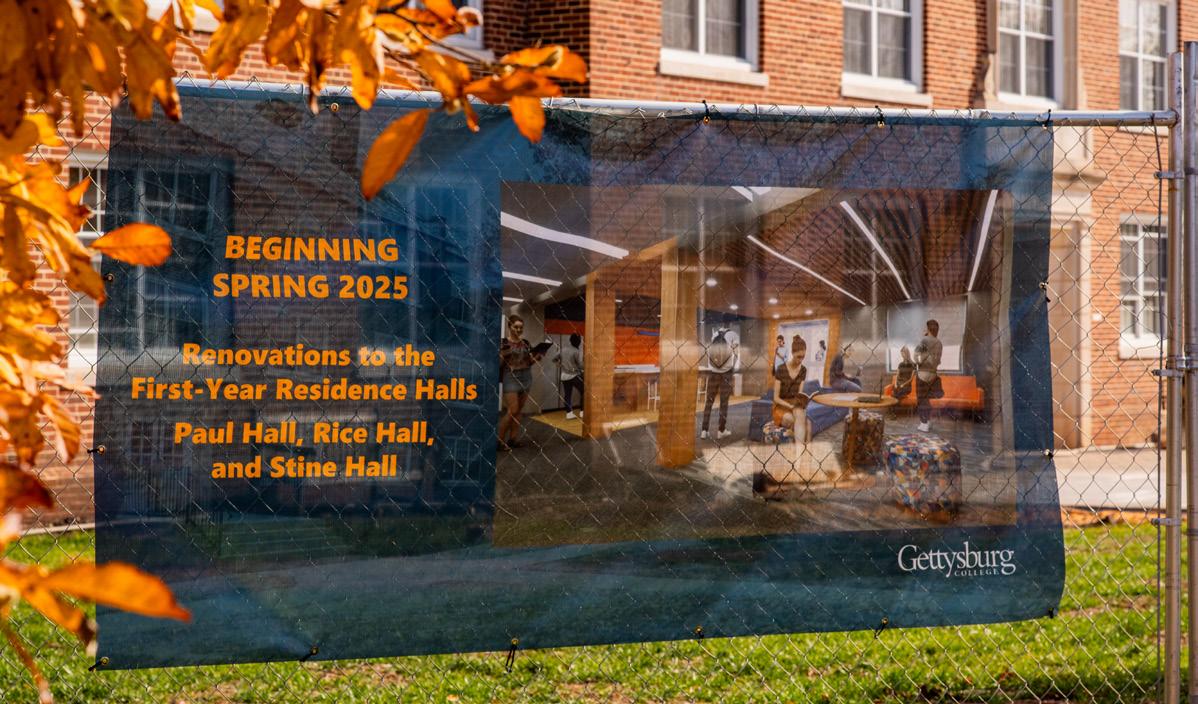
During my first-year orientation, I came to find out that my dorm building, Paul Hall, was going to be switched to a new building. To be honest, I was excited at first. I selfishly loved the idea that I would be in the newest dorm on campus. Obviously, all college dorms have their cons, but Paul Hall had many of them. From no community kitchen to outdated furniture, there was a lot of room for improvement. So, I was pretty happy about the move until I began thinking about the logistics.
The first official notice given to the residents of Paul Hall was emailed on Monday, Sept. 8. The email explained the new amenities we would be receiving in the new dorm, things like new furniture in bedrooms, lounges and study rooms, as well as new laundry rooms and laundry equipment. There is also to be a new patio and outdoor space. The Paul residents were excited about this new information and bragging to all the other halls about the upgrades.
While this sounds lovely, I have started getting used to my living space. I had accepted that the furniture in my room is nowhere near as nice as the furniture in Patrick. My eyes had already adjusted to the lounges in Paul and the ugly, stained blue couches which look like they came straight out of the 80s. If I’m honest, the only excitement that I feel is the possibility of a bigger room, which is not included in the renovations.
It took me at least two days to fully get comfortable in my dorm, set my pictures on the wall, hang my fairy lights and figure out what storage can fit where. Now, I have to go through this process again in the middle of January, with no measurements of the new room or details about the supposed furniture. I’m at the point where I’m questioning if all my things will fit into this new room. Will the layout be the same? Will the walls still be the brick that doesn’t hold my command strips? While Gettysburg is trying to make the move easier for residents by hiring professional movers to move our stuff over winter break, we are still expected to pack everything up into boxes. The residents were also advised in a new email to take any breakable items with them as they depart for winter break. While I am fortunate to have my car that I will be traveling in, what is expected of the students who must take the plane? Where would they put their breakable things and the stuff they don’t want movers to touch?
finals season will not be easy. All of your clothes now need to be sorted into boxes. Anything you have up on the walls needs to come down. All of the drawers need to be emptied, and all the boxes and storage need to be labeled. You must do all of this while maintaining your grades and studying for exams or papers.
Furthermore, packing up everything you own during
As I reflect on my feelings about this move, the thing I am most disappointed in is that the residents of Paul were never given a choice. We weren’t asked if we would be interested in moving to a new hallway through our freshman year. We weren’t even made aware of this when we received our housing assignments. The idea of having to move and redecorate a whole new room that I have no information or photos of is overwhelming. People can advertise how great it will be living in a newer hall, but they aren’t the ones dealing with the burden of moving. ∎
(Photo William Oehler/The Gettysburgian)
Postcard from Abroad: American Brits
By Sarah Daniels, Content Manager
LANCASTER, ENGLAND —
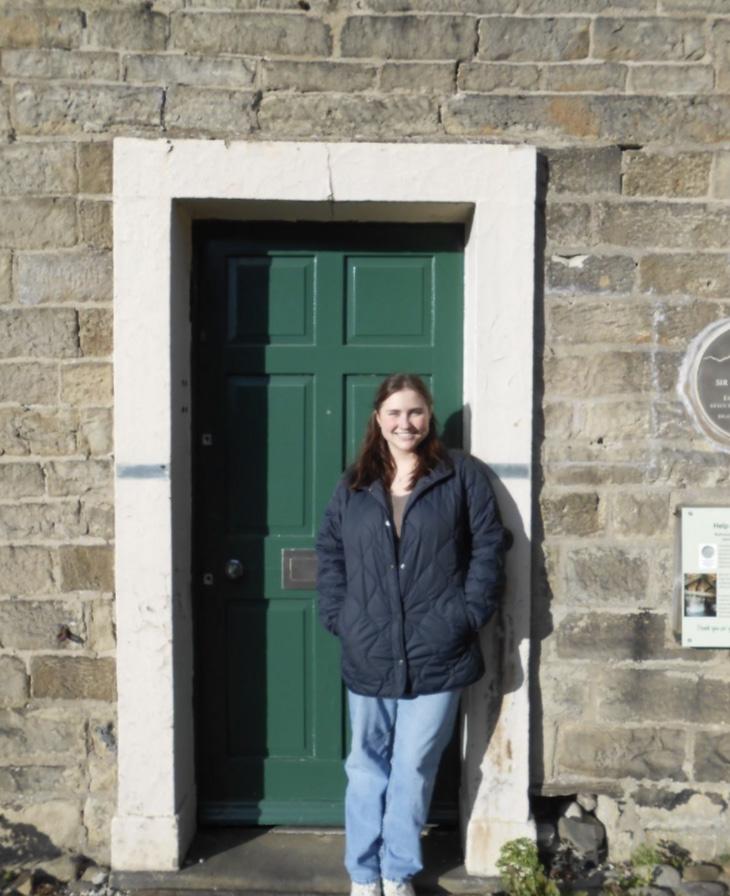
Before coming to Lancaster, England, I had never left the United States. As one would expect, I was a ball of nerves in the days leading up to my flight; I obsessed over English culture to try my best to assimilate once I landed. Imagine my shock when I learned the United Kingdom isn’t so different from the US after all.
My discussion partner in my philosophy course sniffed out my American nationality almost immediately.
“So…” she started, turning to me with a small smile, “where are you from?”
“I’m from the States!” I replied, “I’m from Wisconsin, but I go to school in Pennsylvania."
“Ah, Wisconsin. The capital of the country, right?”
I laughed, but it quickly trailed off as I slowly realized she wasn’t yanking my chain. Most Brits I have met don’t know what Wisconsin is, but no one has mistaken it for the capitol.
I explained Washington, D.C. is the capital, but not to be confused with Washington state. She confessed she didn’t know either existed or who the namesake is.
While this particular individual may not be a British history buff, this general lack of knowledge of American history and culture is coupled with a deep adoration.
In my first week here on campus, some teenagers approached my friend group in a restaurant. They asked if we were Americans, then gushed praises on the country.
“We watch everything you guys watch, and we love your fashion.” They listed all sorts of popular states they want to visit, clamoring over each other to keep our attention.
Certainly, the culture here in the UK is different from America, but not wildly so. I definitely did not expect to find so much of the States here. Finding friends is fairly easy; we’re all operating with the same internet references and new movie releases.
I see American brands like Essentials and Converse more than references to Lincoln in Gettysburg. NFL advertisements
cover the sides of buses, and radios play hits from Sabrina Carpenter and Taylor Swift. American food stores line the streets of cities like Manchester, Glasgow and London. The Lancaster University campus is from the 1960s with basic modern architecture, so until you walk into a coffee shop serving an onion meat pie, it can be easy to forget you’re in the UK.
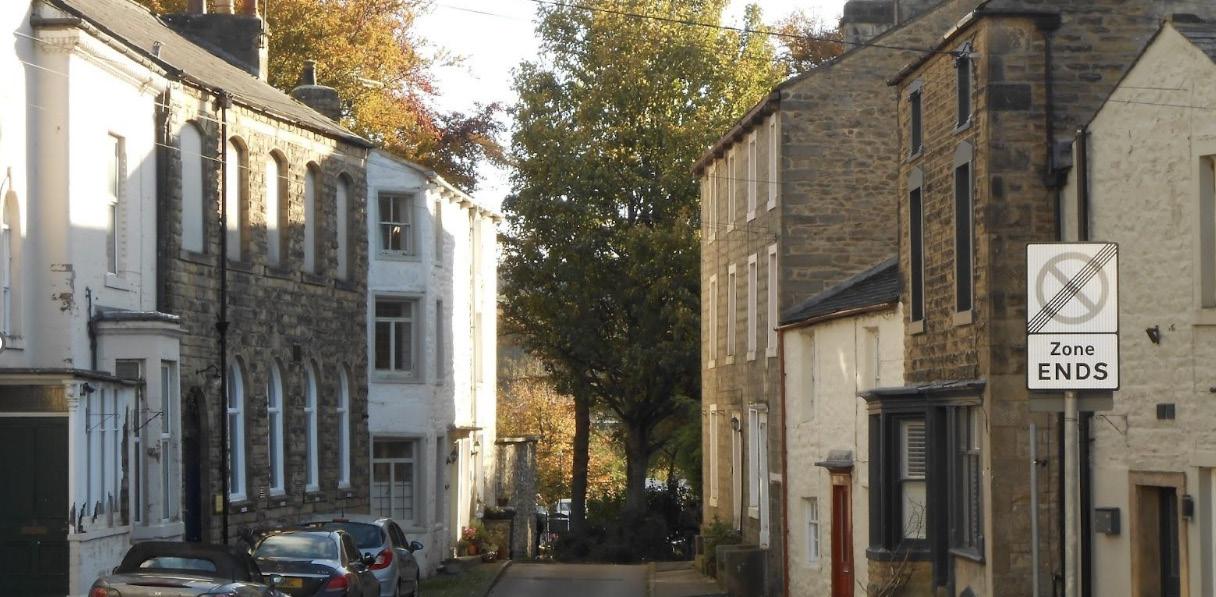
The surrounding cities and towns have old stone buildings from before the United States was established. It’s a surreal feeling to just walk in the city center’s castle, which housed thousands of prisoners for centuries. Most streets are Pinterest-worthy, with elegant ivy vines cascading down fences and yellow leaves gently falling on crimson post boxes. For history enthusiasts like myself, the sheer amount of ‘ordinary’ daily life history found here is astounding. I am beyond grateful I am here, and I have learned so much, from British cuisine to history. It’s amazing to meet new people, travel to new destinations, trip on uneven cobblestone sidewalks, and grow closer to my Gettysburg friends. ∎
Gettysburg Club Sports
By Caitlin Rubsamen, Sports Editor
While the 24 NCAA teams that compete in the Centennial Conference for Gettysburg have excelled for years and continue to represent the college in the highest levels of athletic competition, it would be remiss not to feature the nonvarsity but still high achieving club sports teams that also compete for the Bullets.
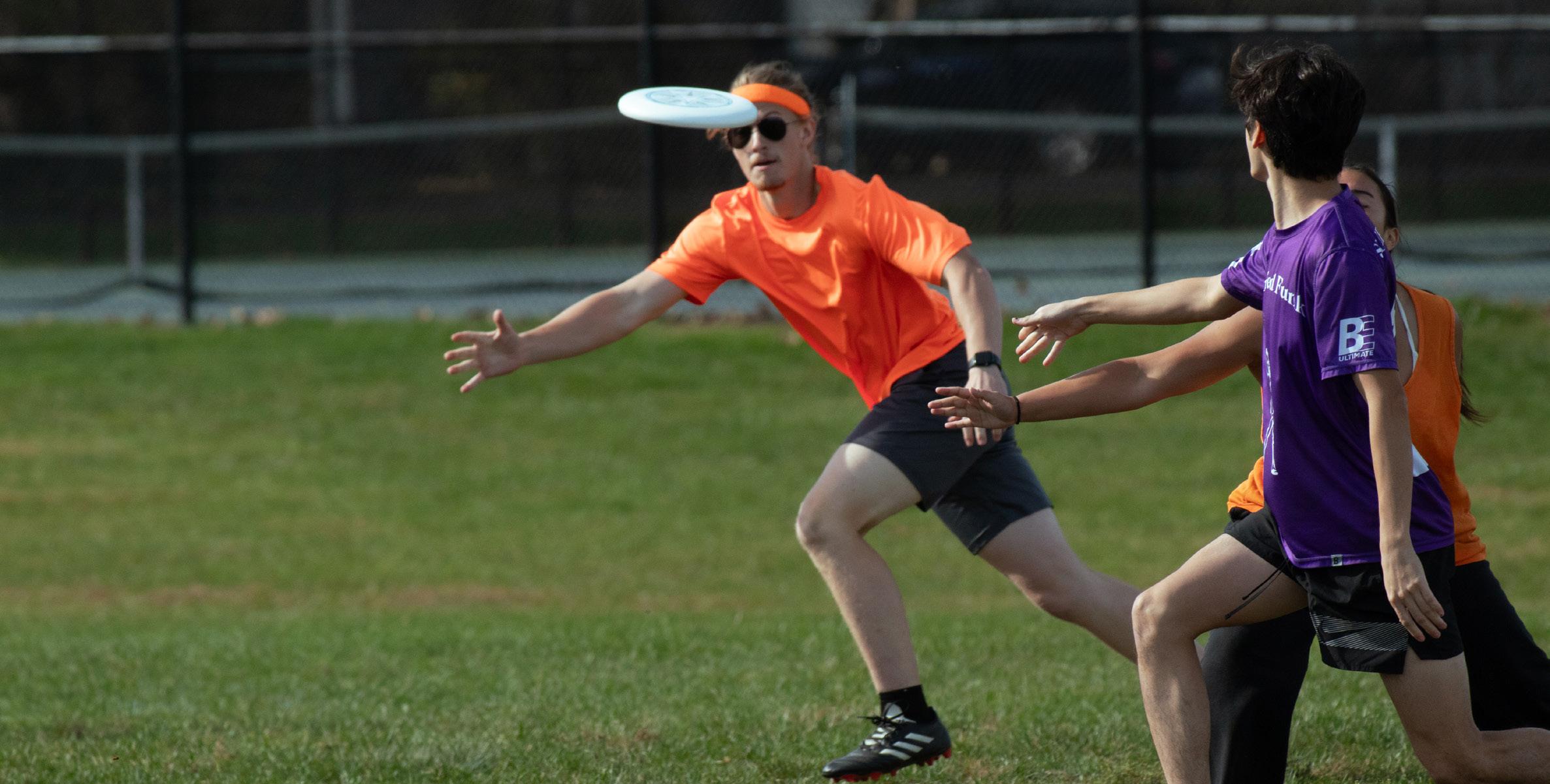
At Gettysburg, we currently have seven club sports that run through our Campus Recreation Department. While each team’s schedule and quantity of games vary, it is still an excellent opportunity for students to either get involved in a new sport, or continue to compete at a high level in a sport they grew up playing.
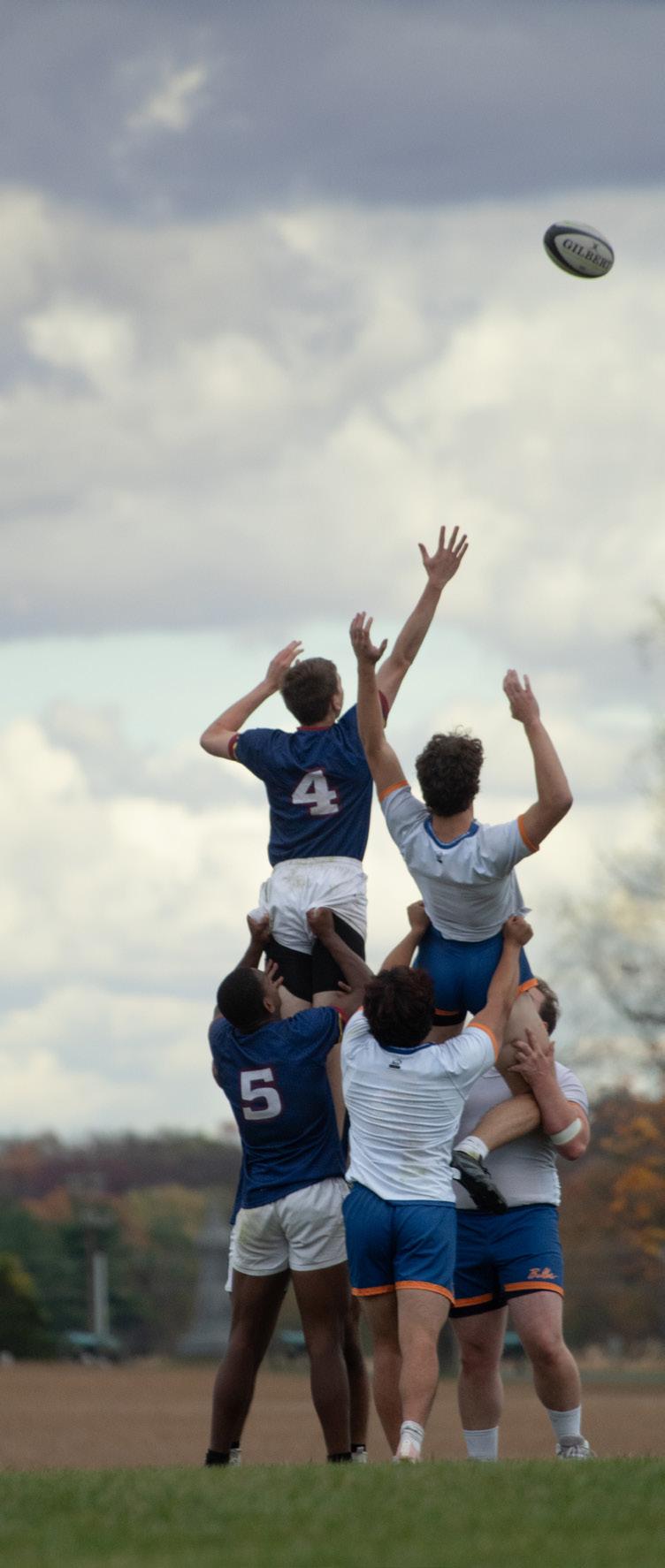
Currently, the college offers ice hockey, men’s rugby,
women’s rugby, equestrian, climbing, men’s volleyball and ultimate frisbee.
Annette Hunt-Shephard is the Director of Campus Recreation and Wellness and also serves as the Senior Woman Administrator in athletics. In her role, she also assists in overseeing all of club sports.
In how the program is designed, each club sport has an executive team that is voted on within their respective organizations. They serve as the voices of their sports and communicate with Hunt-Shephard, her staff and other teams executive members in monthly campus sports meetings. This model allows for students to continue to play their sport, but it also provides opportunities in management and leadership.
“Being a part of Club Ice Hockey has been one of the
best parts about my time at Gettysburg,” said assistant manager Lilly Ball ’26. “Even though I’m not a player on the team, being a manager has been just as crucial to the team’s success. I’ve made so many connections and strong friendships through the club ice hockey program that I wouldn’t have ever able to make otherwise.”
For many students, this opportunity has changed their college experience.
“Being on a club sports team was something I never imagined I’d get to do in my college career— especially for a sport that is rarely set in a team environment!” explained equestrian team member Alessia Buoso ’26. “The club sport program has allowed me to do what I love while also making great connections.”
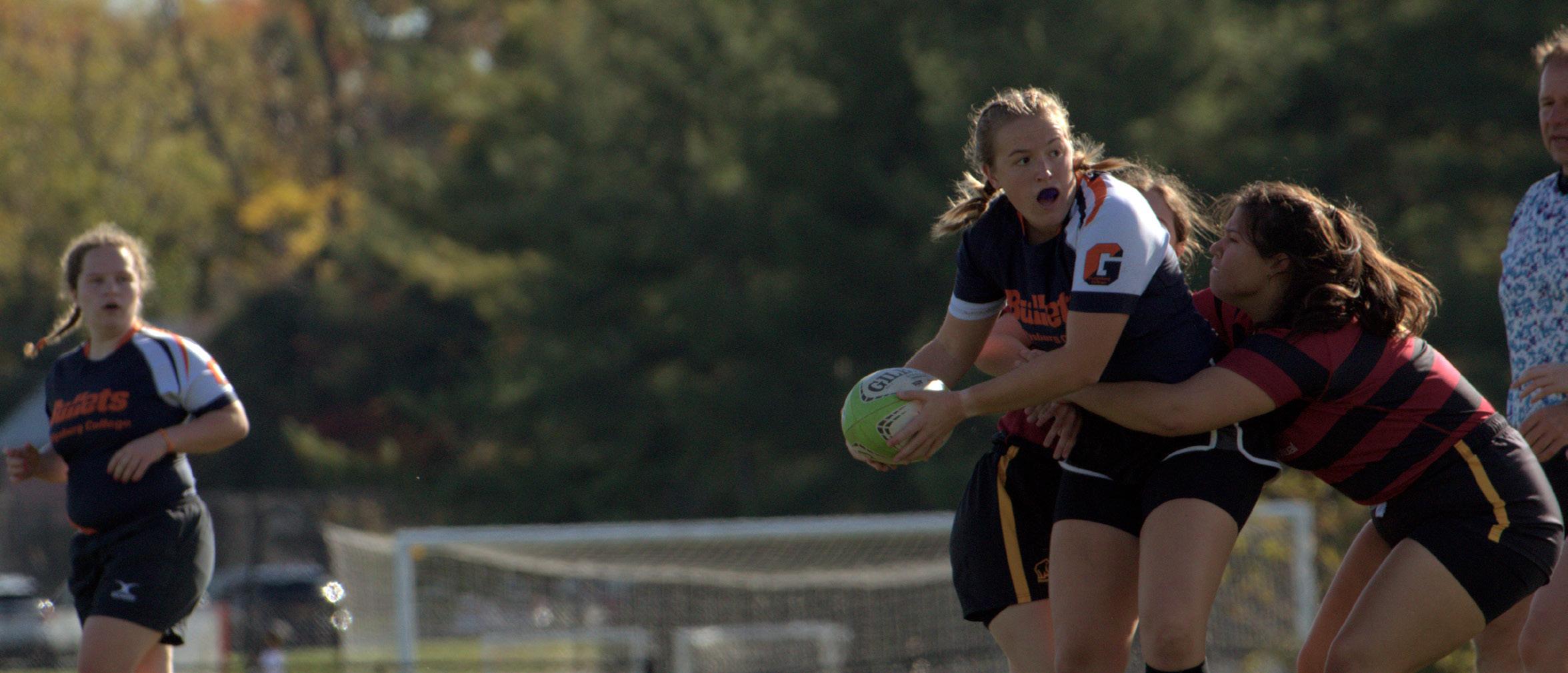
Women’s rugby player Izzy Coupe ’26, a four-year member of the team, shared: “Joining rugby helped me find my place at Gettysburg when I was a first-year, and I know the friendships I’ve made on the team are going to last a lifetime.”
Club sports also provide flexibility for students who want to participate in athletics, with many students engaging in several at the same time.
“Being in two club sports has allowed me to meet so many wonderful people and explore two very different sports that I love,” said Holly Vollman ’26, president of Climbing Club and assistant captain of ultimate frisbee. “Both teams have a great culture and being in a leadership position for both continues to give me opportunities to grow.”
There is also a unique social aspect to club sports, with participants getting to relax by taking a break from academic pressures with people who share the same
interests. This, combined with fewer stressors than a collegiate sport, makes the experience a highlight for many. Additionally, students can acquire new skills, as their club sport may be their first experience with the activity. “Climbing club is one of my favorite things that I get to do here at the college for so many reasons,” shared club secretary Riley Nolan ’26. “I had never climbed before coming to Gettysburg, so I hold a special place in my heart for this team that has taught me. There’s such a great community that we’ve built in the sport here, and you can really feel it when one of us gets on the wall and the rest of us are cheering that person on. With the team, I’ve also been able to go to other schools, gyms and even outdoor climbing, which has been such a cool experience and one that I never would’ve done without club sports at Gettysburg.”
Students interested in club sports can visit www. gettysburg.edu/campus-life/ clubs-organizations/sports to learn more. ∎
(Photos Alice Van Etten/The Gettysburgian)
Postcard from Abroad: Studying Abroad on a Budget
By Liz Houston, Contributing Writer
ROME, ITALY —
It is so easy to get swept up in the excitement of studying abroad. As a first-time traveler I had no concept of prices or what it was like to travel. So, when I was daydreaming about my time abroad, I had a vision of constant travel, going out with friends every night, and shopping until I dropped.
I quickly realized that this fantasy I created in my head was not exactly achievable. Even though I spent all summer working hard to save up money, it still was not enough for this lofty dream I envisioned. But this

newfound frugality did not mean that I could not enjoy my time in Rome. In turn, I found ways that combined my hope for adventures, and studying abroad on a budget.
With my strict budget set at the beginning of the semester, I had to plan out how to enjoy my time here within manageable constraints. For me, this looked like limiting the number of major international trips I took. I learned that, without planning ahead, traveling from Rome, flights can be expensive. So, I ended up only taking three major trips: Munich, Prague, and Vienna. Each of these trips were budgeted at the beginning of my semester. But I knew I still wanted to see new places. The train system in Europe is superior to that in the United States. Because of this, I was able to see several cities and regions within Italy, truly helping me to gain a deeper understanding of the country I was living in.
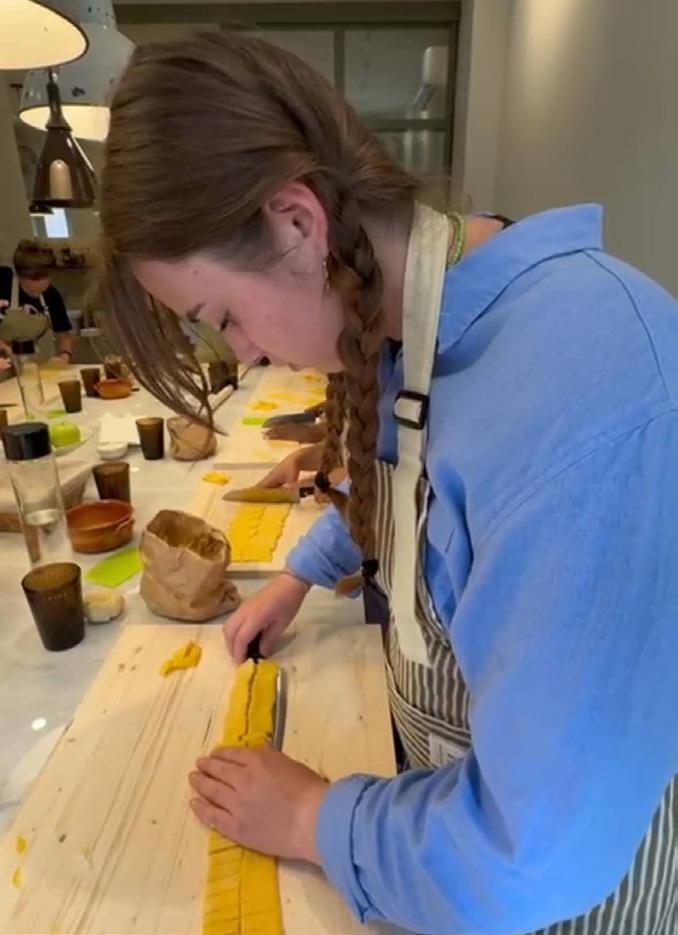
Going out is expensive. So, this was the first thing that I put on the chopping block. Rather, I found other free ways to explore Rome. I took classes that offered field studies that took me to explore my host city. And I talked to my host parents about tips on where to go. I accepted the Italian pastime of hanging out in piazzas and parks with friends. When it came to food, I was lucky enough to benefit from
my host parents’ amazing cooking skills, especially during our dinners. For my other meals, I leaned into the Italian cuisine and began to cook traditional meals with local ingredients.
Although the budget-friendly approach to studying abroad may not be as glamourous as spending a fortune, there are plenty of ways to have a lifechanging experience. In my time, living like a local and leaning into a host country’s culture really brings a more impactful understanding of what studying abroad can be. If I could give any advice to those looking to study or travel abroad, do not get caught up in the excitement of wanting to do everything. You will not be able to do it all. So, find the things that are important to you, factor those into your budget, and dive deep into the local culture. ∎
Sunderman Conservatory of Music Hosts High School Students for “String Day”
By Jules Young, Arts & Entertainment Editor
On Thursday, Oct. 9, Sunderman Conservatory hosted roughly 100 high school students for String Day, an orchestra workshop and performance for high school students in the area. Organized by Dr. César Leal, Director of Orchestral Activities, this event was a full 12-hour day opportunity for high school musicians in the surrounding area to work directly with college students and faculty. Notably, this event was both free and open without audition to any high school student who wished to participate.
This event was the second of the conservatory’s annual String Days, though Dr. Leal has been involved in similar events as a conductor at other schools. He wanted to bring a largescale event like this to Gettysburg because he feels that “it’s time for the conservatory to strengthen its musical presence in the surrounding area.”
Last year, the conservatory hosted about 80 string students, garnering much enthusiasm surrounding the event. Last year's success led to an “unprecedented growth of 40% more students” wanting to be involved. Dr. Leal also expanded the program to include percussion players as well as strings.
The high school students were treated to a packed schedule that included watching faculty members perform, meals at Servo and Mama Ventura, workshops with college students on their specific instruments, and a substantial concert to end the day. Dr. Leal was particularly enthusiastic about their performance of a world premiere piece: Danzas Latinoamericanas by José L. Elizondo, which featured a Soprano vocal solo from Dr. Susan Hochmiller, Coordinator of the Voice Area. Alongside this premiere, the
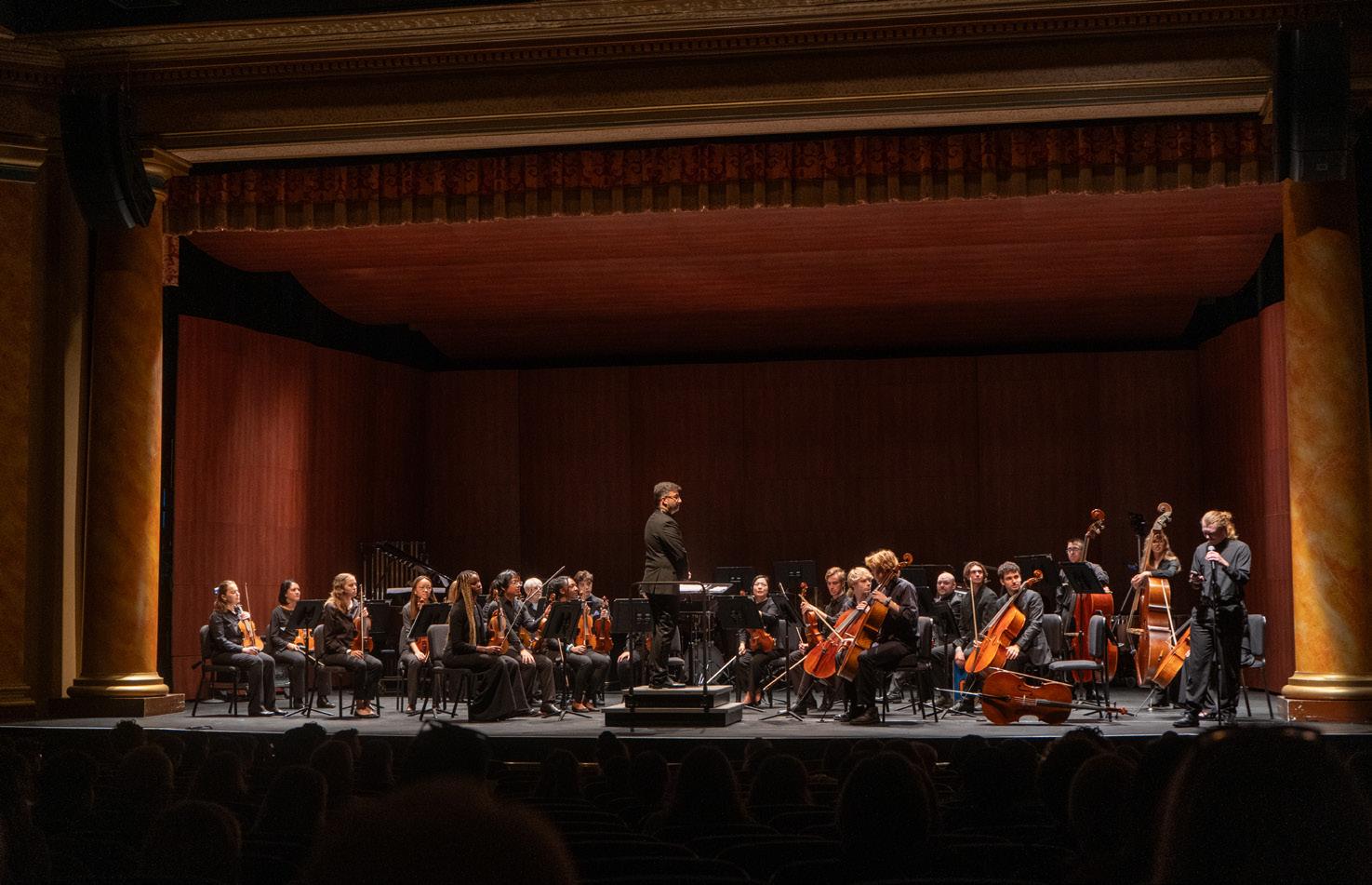
concert featured a wide array of pieces spanning across time and cultures.
With such a large number of students in attendance, Dr. Leal emphasized how much of an “ambitious project” this String Day would be, and how it “involved lots of students and lots of hands.”
Students from all factions of the conservatory were involved in the event. The Music Ambassadors— music students who work with admissions as a direct link to prospective music students visiting for auditions and open houses— directed students to lunch and dinner and shed light on the Conservatory’s admission process. NAFME, the student music education board, was heavily involved, and Lana Dyer, the NAFME president elect, was the official student organizer for the event. The student orchestra staff worked with Dr. Leal to purchase, print, and distribute all of the music for the high school students. Student involvement was particularly
important for String Day because of the special opportunity to act as a short term mentor for these high school students. With a sizable portion of conservatory students majoring in music education, this was a golden opportunity for them to get an extra bit of experience in their prospective field.
As both the creator and organizer of String Day, Dr. Leal had this to say about his ultimate goal: “We see this event as ultimately turning into a youth orchestra—the first in the area that can cater to these students, as Gettysburg has the ability to serve as a music hub for the nearby area.”
Given the respective successes of the two String Days so far, and the fact that the event is only growing each year, there is certainly hope for Dr. Leal’s goal of starting a local youth orchestra. If String Day can expand just beyond the singular day, high school level orchestra students will be able to receive pivotal experience that is much needed to hone their skills, and potentially jumpstart their musical careers. ∎
Views from String Day. (Photo William Oehler/The Gettysburgian)
A New Era For Gettysburg Men’s Basketball: Sitting Down with Coach Matt Hunter
By Max Ferguson, Staff Writer
In August, former Bullets Men’s Basketball Head Coach B.J. Dunne resigned to fill a vacant head coaching position at Massachusetts Institute of Technology. In his stead, Coach Matt Hunter was hired from York College, a non-conference opponent for most Bullets sports teams. There, he served as the head coach of York’s Men’s Basketball Program for thirteen years with a record of 170-148. Leading into his inaugural season as the Men’s Basketball Head Coach, Hunter sat down to discuss his experience prior to Gettysburg, and what he hopes to accomplish here as head coach.
Matt Hunter’s time on the Salisbury University basketball team made him realize that he wanted to be a college coach. He then served in coaching roles at The College of New Jersey (TCNJ) and DeSales University before arriving at York. He began his coaching career right out of college at TCNJ. He reflected on this time in his career as “the year [he] really got a true education into [...] what it takes on [the coaching] side of things”.
He then became TCNJ’s head coach at the age of 24 in his third year with the program. He shared
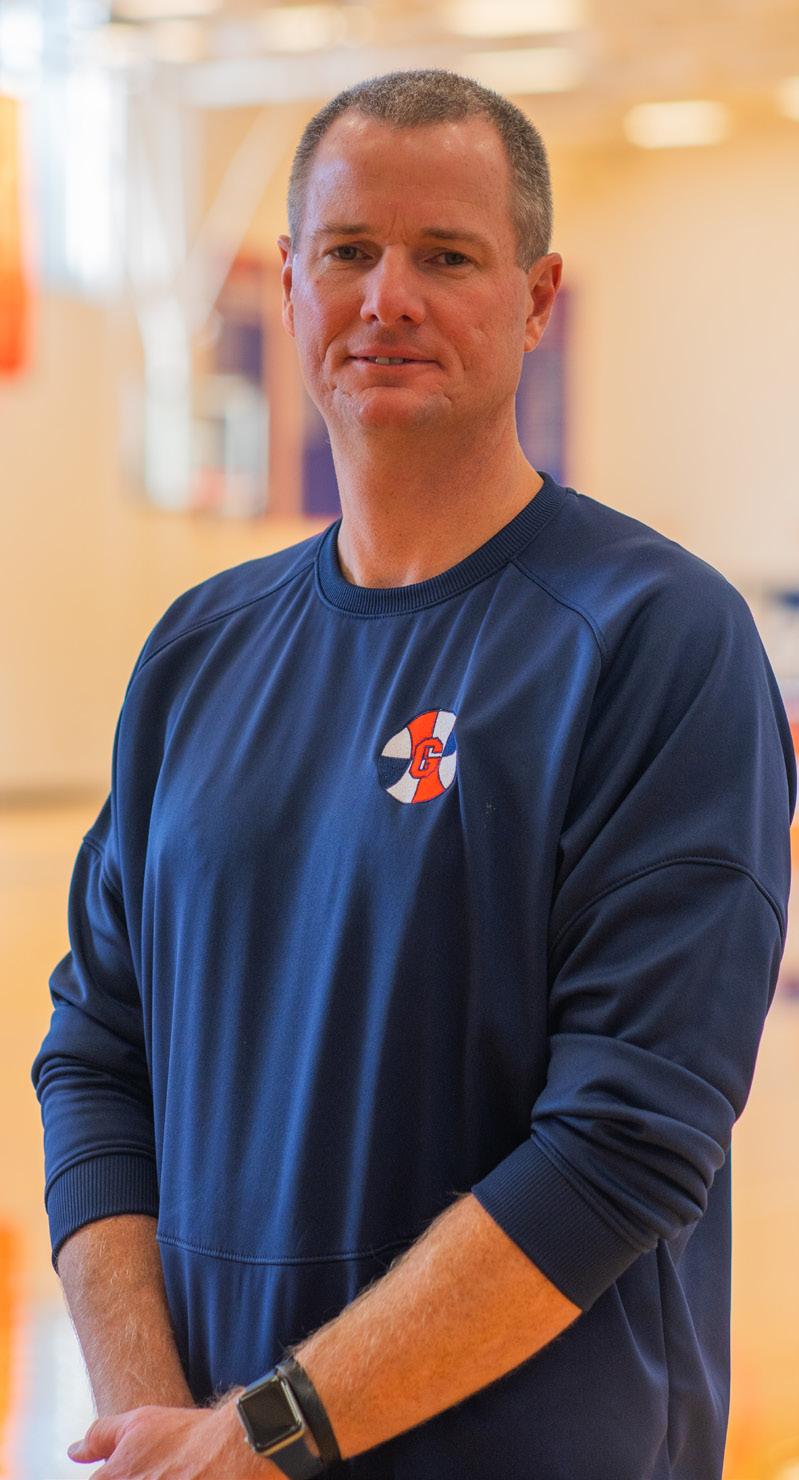
that his time as a young head coach was an “incredible experience”, however, he also spoke candidly of his time in the role, stating that he "got to make a lot of decisions that in hindsight, [he] probably wasn’t ready for.”
From TCNJ, he then moved to DeSales University, where he was hired as a full time assistant under Coach Scott Coval, who currently holds the title of third most victories among active DIII coaches. Coval has recorded 583 career
wins as of Nov. 10, 2025. Under his mentorship, Coach Hunter “got [his] education on winning at an elite level and sustaining that success”.
Coach Hunter has described his onboarding process as “a whirlwind”. During this process, he has focused on getting to know his new players above all else. However, this has left him little time to prepare before his new team would play in their first game.
Upon his arrival to campus, he “[dove] headlong into focusing on [his players] and putting [the team] in order to play a basketball game in three weeks.” Hunter elaborated on this team philosophy by saying: “our job is to be better today than we were yesterday [...] I don't look any further than that.”
“I use the words ‘compete’ and ‘sacrifice’ a lot [...] trying to educate our guys that; no matter what we're doing, we're competing to be the very best that we can be[...] understanding we’re a part of something bigger than ourselves,” said Hunter.
Coach Hunter inherits a talented group of players from across the globe. According to him, "talking to players from all over the world and different backgrounds is something that is neat and exciting and really adds to the culture of
our program”. Coach Hunter wishes to maintain the international pipeline the program has. However, the sudden nature of his hire has forced him to be “way more involved with our current guys than our future guys.”
Coach Hunter is cognizant of the program’s success and looks to expand upon it. He remarked that he is “excited to build off all the great history here at Gettysburg and, you know, certainly put our own spin on things as we go.” He is also aware of the footprint his predecessor had on the athletics department as a whole. Coach Dunne was involved in bringing the ‘A Long Talk’ speaker series to campus and served as Student-Athlete Well-Being Coordinator among other involvements.
Coach Hunter looks to leave the Gettysburg community better than he found it. He “can't wait to get involved. [...] A lot more of those bigger
picture, more impactful things will start to take place after the season is over. I can't wait to really kind of tie myself and tie the program into all that Gettysburg has to offer.”
Coach Hunter hasn’t had much time yet to make an impression on the greater campus community.
When asked if there was one thing he wanted the campus community to know about him, he responded: “I just hope that they grow to respect the way that we compete, the passion that we're going to have for our players, for Gettysburg College, Gettysburg Athletics, our men's basketball program and the way that we as coaches and players will represent us as a program”.
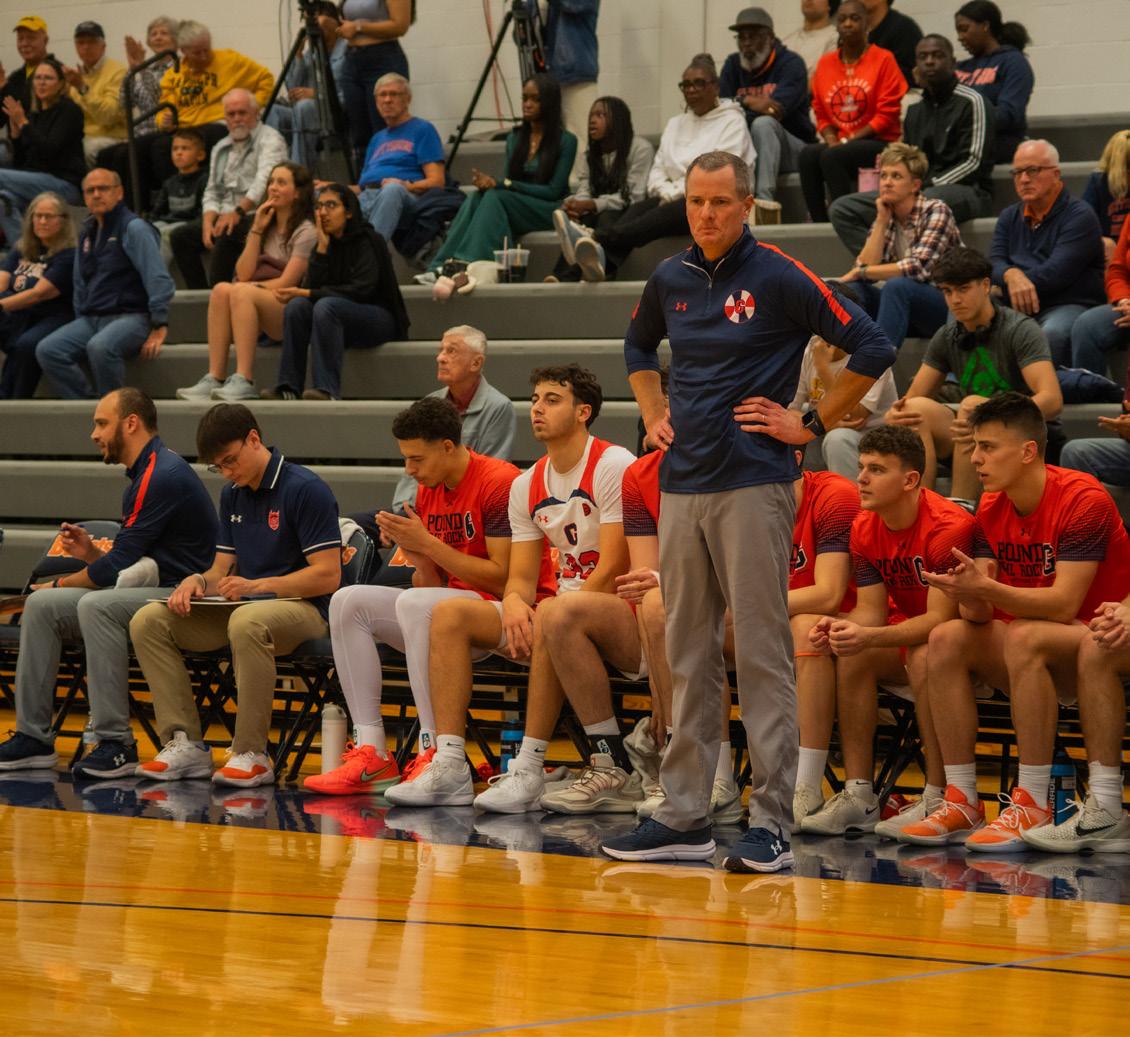
Coach Hunter and his Bullets will look to make good on his hopes as they enter regular season play, carrying the momentum of last season’s NCAA Tournament appearance. His experience, philosophy and expectations stand as positive indicators that he and his athletes can achieve those aspirations. ∎
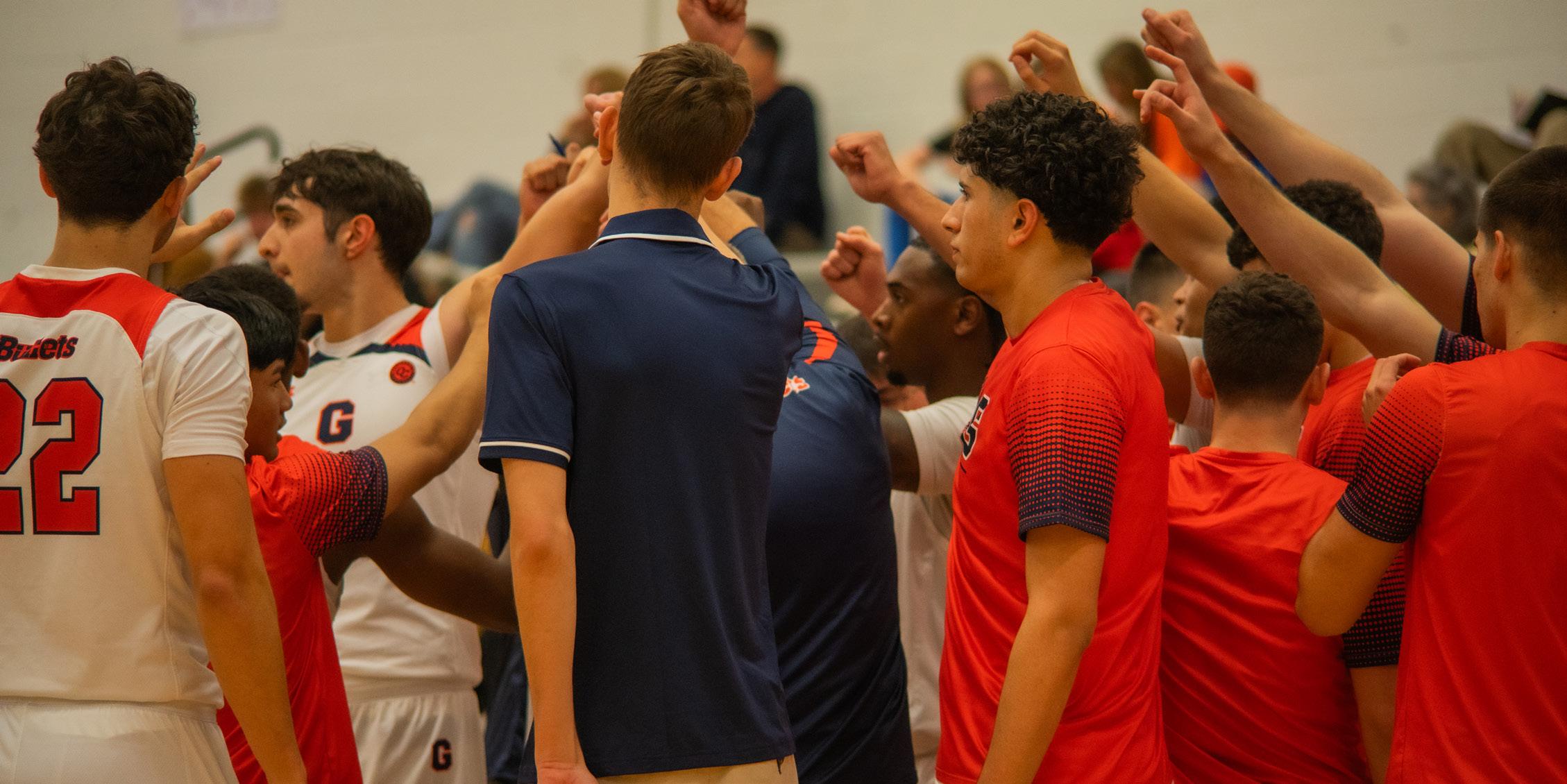
(Photos William Oehler/The Gettysburgian)
The Big S Word
By Omer Shamil, Opinions Editor
Not to be John Lennon, but imagine a world where we all have the same stab at life. Where people didn’t have to let “life” get to them because they could afford to get sick, send their kids to school and never worry about them going to bed hungry. Where lovers could love freely, without the quiet fear of what tomorrow might take from them. Imagine a world where organizations existed for the betterment of people, not at their expense.
Some people only imagine that world. Others spend their lives sketching its edges. New York State Assemblymember Zohran Mamdani is one of those others. His proposals: rent-stabilized apartments, free childcare, free buses. Sounds radical only if you forget that fairness is radical in a country built to reward the few.
To me, they feel like scaffolding: small acts that make breathing room possible.
We all have challenges, and part of life is overcoming them. But what if I told you those challenges are often designed to benefit the few, while the rest of us carry the weight?
James Baldwin once wrote, “Not everything that is faced can be changed, but nothing can be changed until it is faced.” America keeps asking the same people to face the hardest parts of life. About 60% of Americans live paycheck to paycheck. For every ten people you know, your classmates, your neighbors, six of them are one bad month away from losing everything.
Imagine a world where necessities didn’t cost so much, not because
they magically became cheaper, but because people mattered more than profit margins. Today, 112 million adults struggle to afford medical care. Nearly a third skip treatment entirely. It’s not an anomaly, it’s a pattern. And the pattern is one we could change if we allowed ourselves to imagine differently.
Wouldn’t you want to wake up in a world where everyone had equal opportunities, where the difference between people’s lives came down to the choices they made, not the circumstances they were born into? Imagine an education system focused on learning, not just grades. One that gave us space to grow, fail, and grow again. I know it sounds idealistic, even unrealistic, and some say these ideas have failed before. But maybe Baldwin was right, progress isn’t unrealistic. It’s uncomfortable for the people who benefit from how things are.
Imagine a life where education wasn’t treated as an “investment,” where people could pursue what they love and live fuller, dignified lives. Where the idea of “bad jobs” didn’t exist because all work carried value not just in money, but in meaning. Policies like rent stabilization, free childcare, and fare-free buses aren’t luxuries. They are small steps toward that kind of life: stable, humane, possible.
And don’t get me wrong, this isn’t about avoiding hard work. It’s about building work that lets people live, not just survive. It’s about a system that values our time, effort, and dignity
as much as our productivity. That’s what these so-called “socialist” policies are trying to do: not erase ambition, but ensure ambition isn’t the price of survival.
Still, I can hear the hesitation: the Big S Word. The label makes people shut down before they listen. But maybe the discomfort isn’t with the word. Maybe it’s with what it asks of us: to believe that dignity should be shared, not earned. Bernie Sanders calls democratic socialism the radical idea that everyone deserves a decent life. That’s really all this is: the belief that no one should have to struggle just to exist.
Maybe imagining a better world isn’t naïve. Maybe it’s what keeps us honest. We already live in a kind of shared system. We just tend to share upward, not outward. What if we decided to change that? What if we let fairness be more than a fantasy? When a candidate rooted in that Imagine-world wins, it doesn’t mean the world is fixed. But it does mean we’ve placed a stake in possibility. Mamdani’s win reminds us. we aren’t just imagining alone. We are imagining together, and maybe that’s what change begins with.
Baldwin once said that nothing can be changed until it is faced. Maybe this is what facing looks like: a vote, a vision, a refusal to stop imagining.
If only it weren’t called the Big S Word. ∎
The Crossword
By Cassidy Haines, Magazine Editor
Across
2. What you'd call someone friendly, funny and social.
7. A substance's ability to flow.
11. You're doing Gettysburg ___!
13. What do you ____ to do/be after college?
15. Rural areas are typically ___ populated.
17. Something's off... (abbr.)
18. We'll be seeing lots of these when it hits midnight on New Year's Eve! (plur.)
21. Automobile.
23. Seaweed's close friend.
25. Not inward.
27. What do you do at Servo?
28. The ____ of Students is Jeff Foster.
30. A compound word that travels on water.
33. Once upon a time in a land __ away...
34. A sport and a high-end brand.
35. A deck of cards has four of these. (singular)
36. Subretinal fluid (abbr.)
37. Mixed feelings; both ways.

Down
1. A casual way to refer to a young lady.
3. Pennsylvania Hall's roof color.
4. A more informal way of saying "eureka!" is "I ___ it!"
5. To bury in a place or grave; also an obsolete form of spelling for a word meaning "to carve or cut into a surface".
6. Asteroids, the planets and our moon all exist in...
7. A wading bird known for its bright color.
8. The one standing behind a baseball catcher.
9. A short word for anger.
10. The opposite of no.
12. Your range of vision is your...
14. If you're going to ___ a game, make sure you don't get caught.
16. College of Fine Arts (abbr.)
19. To annoy or to bother.
20. Not just hungry, but starving!
21. Focus on the heart.
22. Absent without official leave (abbr.)
24. A common cartoon trope is a character slipping on a banana ___.
26. To unnerve, unsettle or upset.
28. American phone numbers have ten of these.
29. A shorthand for the abdominal muscles.
30. You might feel this way after a long workout.
31. What trees make for us.
32. Ta-ta for now! (abbr.)
34. Another word for perspective, but abbreviated.
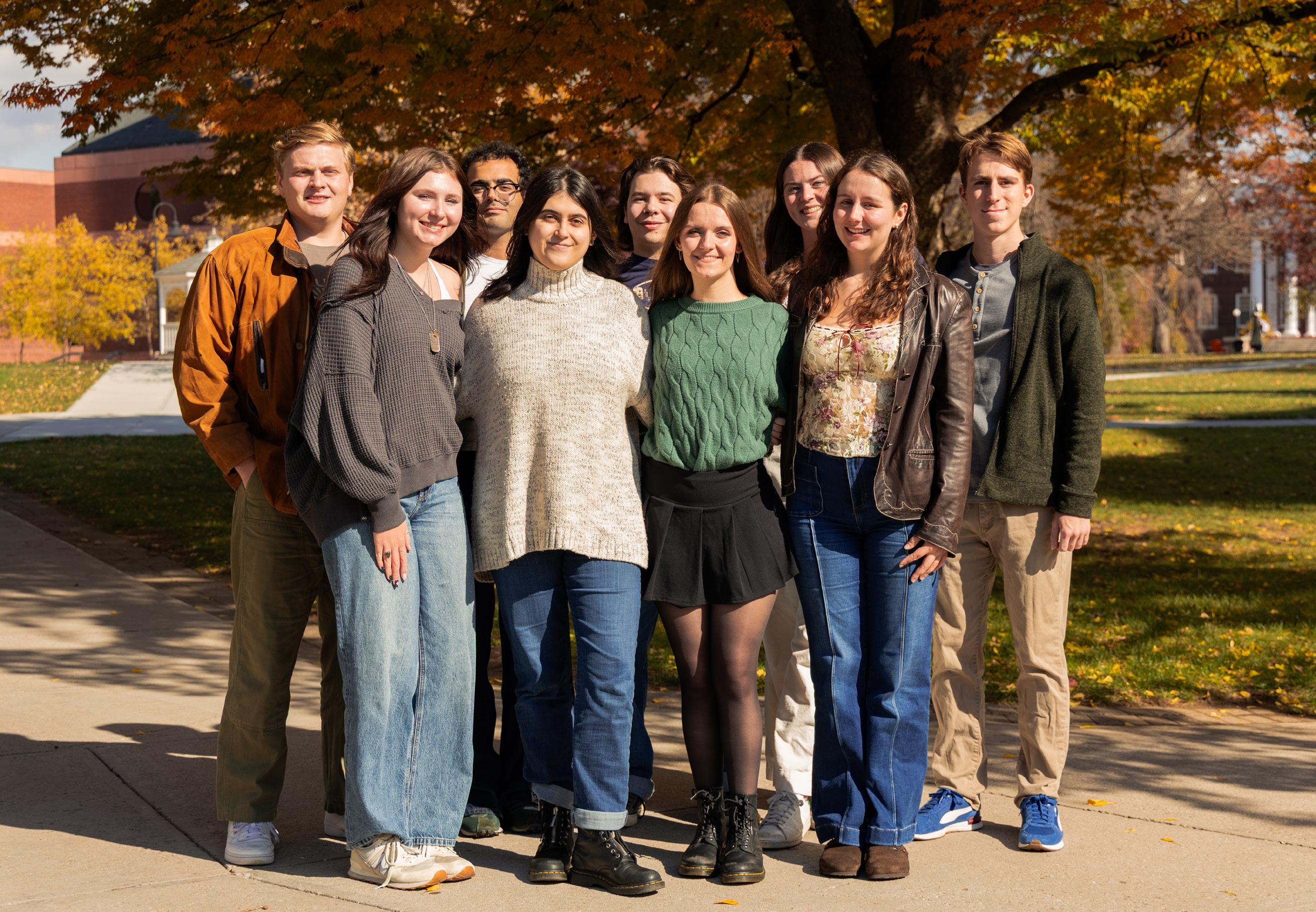




Ella Prieto, Editor-in-Chief
Sophie Lange, Managing Editor & Features Editor
Cassidy Haines, Magazine Editor
Beatrice Slevin-Trigo, Assistant Magazine Editor & Lead Copy Editor
William Oehler, Director of Photography
Brandon Fey, News Editor
Omer Shamil, Opinions Editor
Jules Young, A&E Editor
Jenna Lanza, Social Media Manager
Caitlin Rubsamen, Sports Editor
Professor Jack Ryan, Advisor
Cover photo by William Oehler, staff photo by Sofia Gutierrez / The Gettysburgian