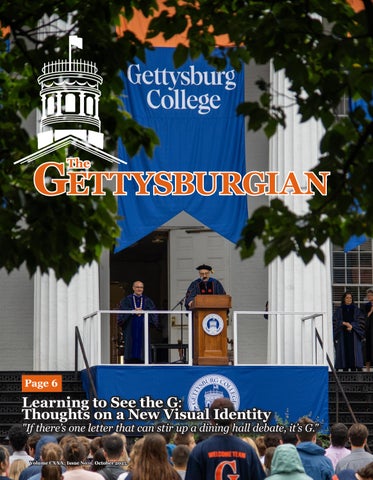
GTheettysburgian

Page 6
Learning to See the G: Thoughts on a New Visual Identity
"If there’s one letter that can stir up a dining hall debate, it’s G."
A Note From the Editor: Optimism in the Face of Despondency
By Ella Prieto, Editor-in-Chief
A hallmark of this generation has been living through “unprecedented” events. Yet, our current circumstances feel like the most extreme. The country is facing censorship, an uptick in political violence and divisiveness. Artificial Intelligence (AI) has warped our reality, and everyday atrocities from across the world are displayed, yet meaningful action by our elected officials remains elusive. In such a bleak world, it can be hard to find motivation.
Yet, we go on. Recently, in a class, a student asked my professor how she deals with the horrific state of the world. The professor replied, simply, that she is an optimist. Simple advice, but meaningful. While I believe we have a duty as engaged citizens in a democracy to stay informed on topics and issues, becoming plagued by them accomplishes nothing. Thus, we must also recognize the improvements of our society, or even in our local community. Taking Gettysburg College as an example, we have amazing new programs to support students, incorporating new majors and redoing resident halls for a better undergraduate experience. Last year, our President reacted to the political climate, and took a stand condemning federal interference in higher education. While this College is far from perfect, it is important to recognize the strides we have made at this important moment in history, and to protect them with everything we have. The Gettysburgian, with the history we document of the good and the bad, is my role in protecting our growth, and your readership plays a role as well.
In this issue, we examine changes at the College, from our new logo to Musselman Library’s new layout and changes in the Administration. We also highlight our language department with a TA article, examining the cultural richness and educational enhancement they add to our campus. The Mayoral Election is covered as well, spotlighting the importance of local government in these trying times. My hope is that these stories and articles provide you at least a little optimism to continue doing the great work I know we are all capable of.
Until next time, Ella
Prieto

Ella Prieto Editor-in-Chief
The Gettysburgian

(Photo William Oehler/The Gettysburgian)
Dr. Jocelyn Swigger
By Ainsley Green, Staff Writer
Omer Shamil,
By Sophie Lange, Managing & Features Editor
Emerging Writer Lecturer Lauren Osborn
By Ella Prieto, Editor-inChief
Teaching Assistants
By William Oehler, Director of Photography Professor Banana
Ball
By Caitlin Rubsamen, Sports Editor
Robert Schwartz, VP for EES
By Ella Prieto, Editor-inChief

Dr. Jocelyn Swigger Premieres Etudes and Idylls of Hidden Gem Composer Agnes Tyrrell
By Ainsley Green, Staff Writer
On Sat. Sept. 13, Dr. Jocelyn Swigger performed a piano recital featuring the 12 etudes and a handful of idylls of 19th-century composer, Agnes Tyrrell in Paul Recital Hall at 7 p.m. The hall was nearly filled with many members of the College and greater Gettysburg community. The audience present at the concert were likely the first audience in many, many years to hear the magical music of Tyrrell.
The recital began with two idylls, A884, entitled “Pastorale in E Major” and “Scherzo in a minor.” Swigger then provided a brief introduction to her work on the pieces and how she came across them. She reminded the audience early on to listen intently to the pieces and brainstorm nicknames to describe their character and what they evoke, for many classical pieces obtain a recognizable nickname that stands out amongst opus numbers.
Swigger first began her journey of uncovering Tyrrell’s music when she discovered her name in an anthology of women composers and noticed that her works were seen and even praised by Franz Liszt, a prominent piano rockstar of the period. When she looked on Google to find out more about this intriguing pairing of names, especially the unknown woman from the book, no

information came up. Since then, Swigger has devoted research, practice, and determination to reviving Tyrrell’s music, which is speculated to have not been heard for generations.
“I am on a big mission to make her music heard because it totally deserves it,” said Swigger on an episode of the podcast The Ivory Attic hosted by professors Kurt Andresen and Ian Isherwood. “It’s complicated and passionate and often very funny. I’m completely obsessed, and I think this is going to be the project for the rest of my life.”
The next set of music in the recital was the “Concert Etudes Book
One, Op. 48, A837,” which consisted of six pieces played consecutively. The etude is a piece that is written to develop a certain skill on an instrument that is technically difficult. From rapid octaves to hand crossing, Swigger displayed a different type of piano expertise on each piece, demonstrating the depth and emotion of Tyrrell’s etudes.
An unexpected portion of the recital showcased another of Tyrrell’s artistic outlets by playing recorded readings of her poetry. The four poems were called “In Thale die Mühle (The Mill in the Valley),” “An den Mond (To the Moon),”
Dr. Jocelyn Swigger performing at Paul Recital Hall. (Photos courtesy of the Gettysburg College Office of Communications and Marketing)
“Sehnsucht (Longing),” and “Abschied (Farewell),” and were paired with scenic images projected onto the screen above the piano. Another idyll, “Idyll in G Major ‘Olivia’” followed the poems.
The final set of pieces performed by Swigger were “Concert Etudes Book Two, Op. 48, A837,” to finish off the evening with the complete, dazzling twelve etudes of Tyrrell. Another six etudes were performed before the concert closed with a final standalone piece, “Die Mühle (The Mill).” The audience gave a resounding applause as Swigger took her last bow of the evening and finished the first performance of many of the etudes and idylls.
Riley Dunbar ‘27 has worked with Swigger under a Kolbe fellowship on an important aspect of bringing Tyrrell’s work to life, which is typesetting handwritten manuscripts of the sheet music that Swigger was able to access from archives in Tyrrell’s home country of the Czech Republic. “Seeing how clearly and intricately she writes her music leads me to believe that she knew someone would be reading and performing her work one day,” said Dunbar about the experience of bringing Tyrrell’s music to life.
Agnes' story gives
me so much hope as a student, composer, and performer,” said Dunbar, who is a cinema & media studies and music double major. “ I've even noticed some of her techniques bleed into my own original compositions, and I truly think there is so much we can learn and appreciate from her and her story.”
For more information about the mission to bring Agnes Tyrrell’s music to life, visit Swigger’s blog at https:// jocelynswigger.com/ agnesblog to stay up to date on her work with this incredible music. ∎


Learning to See the G: Thoughts on a New Visual Identity
By Omer Shamil, Opinions Editor
Just like many of you, I got to know the new logo through the school’s social media post, where it looked quite right but not so right at the same time. I think the biggest question that was making it more uncomfortable was why? As the semester started, I heard the logo in many different circles in many different environments. While many never wanted to say anything on the record, the general sentiment can be defined as follows:
Con·fu·sion: a lack of understanding; uncertainty.
The murmurs in CUB and Servo were strong. Not angry— just puzzled. The kind of talk that lives halfway between complaint and curiosity. “Why now?” someone would ask over beef mushroom tips at Servo, and there would be no answer. I kept hearing versions of that all through September. This confusion wasn’t hatred; it was misplaced emotion. We were looking for a reason to understand a decision that had already been made. So I started looking for the “why.” I reached out, read the email, asked around, and found that the answer wasn’t a single sentence but a sequence. The first piece came quickly: the redesign coincides with Gettysburg’s bicentennial and a new curriculum and strategic direction, its simple consequential education. It’s not just a logo; it’s part of a larger moment of reflection. Who we’ve been for two centuries and who we’re trying to become next.
But that’s the official line, right? I wanted to know what that actually means. When I spoke with members of the Communications and Marketing team, they told me, “It wasn’t about replacing our past, it was about making it legible for our future.” Their
words carried that triad the College has now made its refrain: distinct, timeless, enduring.
When I finally sat down with the design notes, I realized how easy it is to mistake change for departure. The redesign, I learned, isn’t a break from who we are but an evolution of how we show it. It’s the same name, the same cupola, the same spirit— just drawn with a steadier hand for a new age. The difference is subtle but intentional: a realignment, not a rebrand.
The first thing that caught my eye was the wordmark. The letters are heavier now, built on a serif font that carries the weight of tradition without feeling dated. “College” has grown slightly in size—a small design decision that suddenly makes it legible on a phone screen, a street banner, or a water bottle.
Then there’s the Gettysburg G, the centerpiece of all this conversation.
The old Split G had muscle and
pride, but it was never uniquely ours; too many other schools shared its silhouette. The new G feels different. There’s a curve in its spine, a touch of calligraphic movement that makes it look drawn rather than printed.
Professor Felicia Else, who served on the Visual Identity Campus Working Group, told me the letter reminded her of Renaissance brushwork—“age-old calligraphy streamlined for contemporary use,” she said. “It’s a perfect symbol of what the College does: drawing from the lessons of our past to prepare for a new, current age.” The more I looked, the more I saw what she meant.
Even the seal carries that dialogue between old and new. It still holds the Cupola, the flag, and the delicate beading of earlier versions, but now a laurel wreath circles the design—a quiet nod to the pattern carved into Penn

Scenes around campus featuring the new Gettysburg College visual identity. (Photos Grace Jurchak/The Gettysburgian)

Hall’s rotunda floor, the same floor students cross when they arrive and when they graduate. Amy Lucadamo, the College Archivist, called that detail “a bridge between generations,” and I think that’s true. The more I looked, the more I realized how much of our story still lives inside the new mark.
By the time I started tracing how this all came together, the redesign wasn’t born in a closed meeting room; it grew from yearlong conversations with more than 200 people across 30 focus groups.. Students, professors, alumni, and staff all weighed in, bringing every possible version of “what Gettysburg feels like” to the table. I didn’t attend the early concept meetings, but I heard about them; the differing openings, the strong opinions, the quiet nods. Some sessions started with skepticism and ended with curiosity. One participant told me, “We knew how important this was going to be, and that made us listen harder.” That line stuck with me. It wasn’t just about fonts and flags; it was about ownership, who gets to decide what represents us.
As I read through the summaries and spoke with those who were there, I kept thinking how this mirrored the College itself. Every suggestion, every disagreement, every revision — it all reflected
the same diversity of thought we pride ourselves on in classrooms and clubs. In a way, the design process became its own Gettysburg seminar: discussion-based, sometimes messy, but ultimately rooted in care. And maybe that’s why the result works. It wasn’t handed down. It was shaped, challenged, and collectively signed off by a community that, for once, got to see its identity debated out loud.
If there’s one letter that can stir up a dining-hall debate, it’s G. The Split G : bold, blocky, and forever stitched across sweatshirts—still feels like a badge of belonging. hoodies, lacrosse gear, even mugs that have outlasted move-ins. It’s a logo that’s lived more lives than most of us. So when a new G arrived, it was only natural that people compared it to the one they grew up with here.
Around campus, the conversations sound almost rehearsed by now. Some admire the change: “It looks cleaner,” a friend told me.. And some still can’t decide if they like it or not. Change, I’ve realized, is always hardest when it touches identity, especially the small, familiar symbols that quietly mark our time here. Michaela Carroll ’25, one of the student representatives on the Visual Identity Working Group, told me she saw it as “giving the Athletic G back to athletics while introducing a G that better reflects
the full range of who we are as students.” I think she’s right. Most of us aren’t rejecting the new G; we’re just learning where to place it in our own stories. If there’s one thing this whole process has taught me, it’s patience. Understanding takes time, just like change itself. The rollout is happening gradually, funded through restricted, Board-approved marketing investments, with most updates folded into existing budgets. Old merchandise is being discounted, new banners are appearing, and both versions of the G will likely coexist for a while. That feels right, honestly. Change doesn’t need to erase what came before it. When I walk across campus now, I still see the Split G on hoodies and laptop stickers, and the new Gettysburg G on banners fluttering over the Quad. Both feel like us—just different moments in the same story. If our logo is the face of who we are, maybe this is less about changing the face and more about growing into it. Time will tell, but for now, I’ve learned that understanding why something changes is often the first step to seeing yourself in it. ∎

Gettysburg’s Approaching Mayoral Election and What it Means for the Borough
By Brandon Fey, News Editor
This Nov. 4, Gettysburg voters will decide whether or not to reelect the incumbent Mayor Rita Freeling as part of the 2025 Municipal General Election. Mayor Frealing is challenged by Councilman Chad-Alan Carr, who holds the at-large seat of the Gettysburg Borough Council. Carr defeated Frealing in the Democratic Primary in May, after receiving 268 votes compared to Frealing’s 237. However, Frealing was able to continue her campaign with a place on the November mayoral ballot because she received 119 write-in votes from registered Republicans, thus exceeding the 10 write-in minimum to remain on the ballot as the Republican nominee. Frealing has served as mayor of the Gettysburg borough since her initial election in 2021, after she had defeated Carr in the Democratic Primary of that spring.
This electoral rematch under novel circumstances has raised several questions about the nature of the mayoral office and the future of the borough over the next four years.
Gettysburg has operated under a “weak mayor, strong council” system of local government since its ordination in 1806. The Borough Council is the primary governing body, which consists of seven members, six of whom are elected from three wards and the other chosen at-large. This council works alongside the mayor, with each holding separate responsibilities.
Per the Pennsylvania Borough Code, the Mayor of Gettysburg is elected to four-year terms, serving as the sole elected executive officer of the borough. The office is tasked with preserving order, enforcing ordinances, ensuring faithful performance of borough
officers, approving legal documents and reporting to the Borough Council. The mayor also has direct oversight over the Gettysburg Borough Police Department and possesses emergency powers to maintain public safety in times of crisis.
Carr and Frealing expressed their aims and official positions on some of the issues facing the borough at a forum hosted by the Eisenhower Institute and affiliated campus organizations on Sept. 16 at Gettysburg College.
Police Oversight
One of the primary issues of this mayoral race involves the oversight of the borough police.
State law provides that the mayor may choose to delegate non-legislative and nonjudicial powers, including oversight of the police department, to a borough “officer.”
Any other change to the current system of police oversight would require a change to the structure of the borough government through a home rule charter approved by a vote of the people.
Both candidates shared their thoughts on the issue at the forum when asked about ensuring the fairness and accountability of the Gettysburg Police Department in light of recent concerns about the alleged
misconduct and aggression of some local officers.
Frealing is in favor of retaining the current system of mayoral oversight, and if change is desired, it should be enacted by a committee of elected officials. At the forum, she stated that during her tenure, relations between the police and the local community have improved, and mentioned that she often speaks with officers and sees that they undergo proper training. She said that the public must also be held accountable, just as officers are expected to exhibit professionalism. “It’s a duty of respect between each other, and not fearing one or the other,” she said.
She cited Section 1121, subsection A of the Pennsylvania Borough Code as stating that “the mayor shall have full charge and control of the chief of police and the police force.” Frealing remarked that there are only two places in the commonwealth (Bethel Park and Penn Hills) that use a different structure of police oversight, which in both cases was instated by home rule. She said that if residents wish to change the oversight of the police in Gettysburg, it should be done by a vote of committees comprised of different elected officials, as opposed to the mayor signing authority over to another individual. She emphasized that the structure of


police oversight has been clearly stated in Pennsylvania law, and claimed that, per her experience as an attorney, a change to this system will likely invite a lawsuit, which she has been able to avoid during her tenure.
She also acknowledged that there had been issues between the police and some community members, and stated that she believed that they had been corrected. Frealing invited community members to attend the “National Night Out” event held each August, where they can interact with the police department. She announced as well that she will increase her office hours on the Gettysburg College campus, during which she will be accompanied by the new officer in charge, Sergeant Evans, for students to voice concerns and ask questions.
On this issue, Carr believes that the police department needs “more and better oversight,” and said that the police department ought to be under the same oversight as each of the other departments of the borough, which report to the Borough Council directly. He stated that a true transfer of oversight to “the people” cannot be done without home rule. Carr expressed his support for home rule, connecting it to the importance of listening to the wants of residents.
“That is why I ran three years ago, and that’s why I’m still running again,” he said. “I do not feel that things have changed in the last three years.”
Carr spoke in favor of police oversight from a council as opposed to just the mayor, as it is currently. He also applauded the “good work” Sergeant Evans has done as officer in charge, as the borough
continues to search for a new chief. He said that, despite wishing him well, he is glad that the former Chief Robert Glenny is no longer in the Borough of Gettysburg.
Economic Development, Affordable Housing and Historical Preservation
The other main issue that has confronted Gettysburg over the past few decades is the question of the town’s need for economic growth and affordable housing, while still preserving its historic character. Candidates were asked about this at the forum.
Carr is generally in favor of development, hoping to strike a balance between growth and preservation. He spoke about the difficulties of economic development due to the limited size of the borough, much of which, he said, is owned by the National Park Service. He discussed limited opportunities for tax revenue, as the borough does not have many taxable properties, and despite its many tourists, only a small percentage of the county’s “pillow tax” on temporary lodging goes to the borough. He argued that “smart growth” could attract business and young families to Gettysburg, and the town should increase communication with community partners to create an economic balance that can actively pursue development while maintaining the historical character of the town.
“We are going into the year 2026, and we’ve got to think forward about how we can bring in more people to Gettysburg that are taxpaying residents, and more businesses as well,” Carr said.
Carr also mentioned that he proposed the Non-Discrimination Ordinance to the Borough Council that established the Gettysburg Human Relations Commission, which is tasked with eliminating discrimination in housing.
He emphasized the importance of the local service industry to support tourism in the town, and argued that these workers must be able to afford to live in the town where they can walk to work. On this, he said that he would like to work with the Adams County Economic Alliance and @Home In Adams County, to create incentives for future developers to work with property owners in downtown Gettysburg.
Frealing believes that Gettysburg should follow a model that is unique to the historic nature of the borough, which separates it from other small towns. She is in favor of utilizing existing resources to support the economy without sacrificing the town’s history, which she believes is crucial to the local tourism industry. She spoke about repurposing existing buildings in the borough, such as that of the public library, which is expected to be vacant, as “business incubators.” She also said that Gettysburg needs more jobs that attract young people and encourage Gettysburg College students to remain in the community after graduating.
In terms of housing, Frealing stated that there are existing resources for people to purchase homes, such as the PA Housing Finance Agency, that should be further utilized to help people with low credit ratings finance homes. She also stated that a high cost of living is not unique to Gettysburg, and called for constructive collaboration with neighboring communities to find common solutions.
“We need to find a way that we can get people to buy their own homes through agencies and banking programs that people aren’t yet aware of,” said Frealing. “You have to ask to find out about these things.”
While the Gettysburg Mayor remains a limited public office given the nature of borough law, the election is likely to represent the sentiments of the Gettysburg voter base on the perceived need (or lack thereof) for change, the extent of concerns over local policing and the pursuit of development versus the historical preservation of the community. ∎
Summer Changes to Musselman Library
By Sophie Lange, Managing Editor & Features Editor
Over the summer, the Musselman Library made several changes. This included merging departments, combining the Checkout and Research Help Desks, relocating the Writing Center, and creating a study space that students can reserve. Due to staffing changes and a desire to unite employees who provided related services, the library staff decided last spring to combine the two public services departments, Research & Instruction Services and User Services. Now, a single department, Research & Access Services, encompasses the responsibilities of both. Along with this change came the decision to combine the two existing service desks in the library, providing a single location for all student services in Research & Access.
“Now, students don’t have to try to figure out where they should go to ask their questions. ‘Do you have my textbook in the course materials collection?’ or ‘Can I check out an umbrella (or power bank or charger or calculator)?’ or ‘I need to find peer-reviewed articles on my fun, but
obscure topic and I’m not sure where to get started…’—all of these, and more, can be asked at the combined service desk on the main level of the library,” Assistant Director of Research & Access Services Meggan Smith ’04 explained.
At this desk, the Circulation Student Assistants will work alongside the Peer Research Mentors. However, research assistance offered by the librarians is still available Sunday through Thursday from 6 to 9 PM or during the week, starting at 9 AM. Students also have access to resources such as the librarian's email (ask@gettysburg.edu), phone number (717-473-4532), and research appointments.
According to Smith, the impacts of these changes have been largely positive from the perspective of the library staff: “It is a more seamless experience for students, and we have a great team of student and staff colleagues who are eager to assist. As with all changes, there is a learning curve, so we appreciate your patience if the person helping you takes a little longer or verifies processes while assisting you. But overall, we are super happy with the changes and hope the campus community is pleased as well!”

Some of the staff in the former User Services Department joined the Collections & Technical Services Department, which assists with course reserves and the interlibrary loan system, and Scholarly Communications Librarian Mary Elmquist joined the Research & Access Services Department, which allowed her to move to the RASD Office Suite from her former office in Room 015.
The Writing Center is now located in Room 015. Its former location in Room 006 was converted into a reservable study room, a resource which students have requested in the past. The space may be reserved by students for up to two hours at a time, and reservations can be made online. Because the room is a shared space, it can only be reserved up to two weeks in advance and cannot accept recurring reservations.
“The room has seen a lot of usage even in these first few weeks of classes!” Smith said.
Finally, the library installed new quotes over the library doors facing Penn Hall and Stine Lake.
Above the door facing Penn Hall is a quote by 1993-1995 United States Poet Laureate Rita Dove: “The library is an arena of possibility, opening both a window into the soul and a door onto the world.”
The other door has a quote by Gettysburg College President Bob Iuliano: “A liberal arts education opens the world to us one idea at a time.”
Additionally, the library plans to complete the ongoing renovation of the fourth floor later this year. This will fully enclose Special Collections and Archives, providing a quieter study area outside the reading room in Special Collections. ∎
Photo William Oehler/The
Gettysburgian
Insects, Imagination, and the Slipstream: Meet Emerging Writer Lecturer Lauren Osborn
By Ella Prieto, Editor-in-Chief
Growing up in Mississippi and Alabama, Gettysburg College is the farthest north Lauren Osborn has ever lived. But when the Emerging Writer Lecturer position for the 2025-26 academic year opened here, she jumped at the chance to join academia as a faculty member.
“I love academia; the environment of it is really lovely,” expressed Osborn. This love shines through in her experience, accomplishing an undergraduate degree in psychology from the University of Alabama at Birmingham, a Master of Fine Arts from Queens University of Charlotte and a PhD from Oklahoma State University with no breaks in between. Now, however, she is excited to work with students while continuing her craft, and has found Gettysburg to be a great place to do so.
In her one-year position, she is teaching Intro to Creative Writing classes and one class per semester that is completely her own. The first, running this semester, is titled “Stranger than Fiction: The Slipstream Dream.” The course focuses on the term “slipstream” coined by Bruce Sterling in 1989, to describe writing “which simply makes you feel very strange; the way that living in the twentieth century makes you feel, if you are a person of a certain sensibility.” Students' exploration of such writing
works to inspire their own odd stories.
“I love weird fiction,” explained Osborn. “Real life bores me. Anything that surprises me and takes me out of an element of reality, I tend to be drawn towards. Since those are my favorite books to read, I love breaking apart what makes writing weird, and the craft of how the author achieves making people feel strange, which is usually done through very specific elements.”
Many of her favorite authors have this component of “weird” or “strange” fiction, such as Aimee Bender, Kevin Brockmeier and Joy Williams. Their works center around magical realism and lyricsism, which draw readers into their worlds.
Her other class, “A Bug’s Life: The Etymology of Entomology,” was born from Osborn’s love of insects, including her 17 pet tarantulas. In her PhD program, she also studied under an entomologist as part of her concentration. In this experience, she saw the connections between creative writing and science, even using scientific articles as inspiration for her work.
“Everything is a narrative. A science article is a narrative with a lot of super fancy language, but at the end of the day, still a narrative,” stated Osborn.
A Bug’s Life highlights scientific


and literary inspiration to focus on insects, with students reading and discussing fiction, non-fiction, poetry and scientific articles. Osborn hopes to build an appreciation for insects through narrative empathy, defamiliarization of language and scientific education.
In all her classes, however, she has appreciated working with her students, who all show interest and excitement in the topics she covers, producing meaningful conversations.
“It’s been a wonderful experience so far. I like the relationships students have with faculty and staff; it creates a great environment where conversation can flow, and you can ask really important questions,” Osborn asserted.
Outside of teaching and settling into campus, Osborn is working on the final edits for her story collection that comes out through Dzanc Books in the Spring of 2026. ∎ The Gettysburgian
Professor Lauren Osborn in her office, Breidenbaugh 314G. (Photos William Oehler/The Gettysburgian)
Language Immersion at Gettysburg College: Five New Teaching Assistants Join our Community
By William Oehler, Director of Photography
For the academic year of 202526, Gettysburg College welcomed five new language Teaching Assistants (TAs) to its French, Chinese, Spanish, Japanese, and German language classes and departments. Angelle Depuy, Jiahui Ouyang, Alba Chacon, Kotoha Mori and Antonia Voss all participate in and outside classrooms. Teaching their own classes, liaisoning with culture clubs, hosting review sessions and working with their supervising professor to build-out class instruction-time, the TAs work directly with their students and department faculty.
The group of five are split between two academic buildings on campus; Ouyang and Mori, as a part of the East Asian Studies department, have their office in Breidenbaugh. While the three European language TAs, Depuy, Voss, and Chacon work on the fourth floor of McKnight. They were three recipients of the Fulbright scholarship program.
“I personally heard about it from a friend, and since I had wanted to live in the US for some time, I decided it was the right program and applied online,” explained Voss, describing her experience along with the other McKnight TAs while applying for the scholarship. “The whole process took so long, almost a year.” They all described the rigor in applying, stating “it's a great scholarship, so it makes sense we needed to write so many essays.”
Fulbright pays for students’ accommodation, flights and location-specific needs. This year however, after experiencing uncertainty from the U.S. President Donald Trump’s recent actions, the Fulbright program board did not offer preferences related to institutional placement. While Voss, Depuy, and Chacon were not able to choose their placement, they have found a great community in Gettysburg.
“Americans give more compliments… one time a worker in Servo, he said he liked my tattoo and one day he just offered me a magnet with a sunflower on it,” said Depuy. They all remarked on a different time a “random stranger” complimented them.
While the McKnight TAs arrived at Gettysburg through the Fulbright scholarship, Ouyang and Mori partnered with their home universities in Japan and China. Ouyang attends Beijing Language and Culture University in Beijing, China. Her program requires a year's worth of teaching abroad, and specifically partners with Gettysburg College for students to fulfill that requirement. For Mori, she has already spent a year teaching at Wesleyan College in Middletown Connecticut. She works with Kansai Gaidai University in Osaka Japan–a global study affiliated program at Gettysburg– in order to be placed in American Colleges and Universities.

Teaching Assistants Jiahui Ouyang and Kohota Mori in the East Asian Studies Department office on the second floor of Breidenbaugh. (Photo William Oehler/The Gettysburgian)
During the lead up to their departure, both Ouyang and Mori experienced issues with their visas, Mori receiving her visa the week she flew to the United States. But that has not gotten in the way of enjoying the campus and the Gettysburg community. “I love the community here, the students are so nice!” Mori said.
She also remarked on how free she feels when planning for classes. Her supervising faculty members are Professor Eleanor Hogan and Professor Yoko Nishimura.
“When I have an opinion or idea, they just say go for it.” Mori also hosts homework help sessions and meets with a consistent group of students so they can ask more specific questions so she can work more closely to deepen their learning.
Ouyang works with 100- and 200-level students in and outside of class-time with the Chinese Culture Club and hosting fourth-hour activities. What she has found most impactful as a TA is her students. She recognises the difficulty of learning a new language especially one using a non-latin-based alphabet.
But working with her colleagues and even sharing an office with Mori has given her the support needed in starting a career in education. Ouyang “celebrated when [she] got [her] visa” understanding what it meant for her to have earned it.
Ouyang explained that coming to Gettysburg was nervewracking, but she knew Professor Junjie Luo had attended her own University so she felt that connection already.
It was a common theme with all TAs that their Gettysburgian colleagues welcomed them into not only their lives at the college, but outside of the classroom as well. Voss described being invited by German Professor
Henning Wrage to have dinner with his family.
“They invited me to dinner at their home in the first week without even knowing me and I really appreciated that… it felt so private… They share so much about their family life.”
When asked what each TA wanted in terms of an impact on campus and their time here, each one stated a similar refrain surrounding student immersion in their native languages. Chacon in the Spanish Department hopes to make “the learning environment as inviting as possible” and that even the students taking spanish just for Gettysburg’s language requirement walk away with a similar sentiment as Chacon: “...language has changed my life and I want at least one student to follow my path.”

Voss and Ouyang’s goals were similar, citing that they both grew up surrounded by their own culture.
“I want to share my own culture, because it is what shaped me as a person, so share it with everyone” Voss remarked. Ouyang looked more towards her home country as a whole: “I want everyone to know that China… it’s not as far away as people think, it is more similar to the States than people think.” She wants to create a closer relationship between China and the United States, “it’s a multidimensional country!”
Though the TAs are spread
between two different buildings, they all make time to hang out together, cooking, celebrating and getting coffee in town. They work closely with their supervisors, and are already joining a bustling campus community with their clubs, rigorous course instruction and cultural programs. While only with our campus for a year, they are important members of the Gettysburg community, supporting each of their students to thrive in and out of the classroom. If you want to chat and learn more about their stories, Mori and Ouyang are in Breidenbaugh 212 within the East Asian Studies department, and Chacon, Depuy, and Voss are each on the fourth floor of McKnight. ∎
Angelle Depuy, Alba Chacon and Antonia Voss outside McKnight. (Photo William Oehler/The Gettysburgian)
Schmucker Art Gallery: Yesterday on Display
By Cassidy Haines, Magazine Editor
At Gettysburg College, almost all of our arts and music programs are housed in Schmucker Hall. Named for the College’s founder, Samuel Simon Schmucker, the building is home to the renowned Sunderman Conservatory of Music as well as the Schmucker Art Gallery, where student curators and international contemporary artists alike can view their work in a formally artistic setting. Although the building itself has been with the College for most of its history, the Art Gallery is a much more recent addition, now popular with both faculty and students to visit for classes or for fun.
Sarah Kate Gillespie, professor of Art History, Public History and Civil War Era Studies, has served as the Interim Director of the Schmucker Art Gallery for two and a half years. She shares, “I decide on the schedule of exhibitions, and then oversee all aspects of getting those exhibitions planned and into the space, which usually takes one to three years. Much of what I oversee is the work done by student curators and researchers. We use the gallery as a hands-on learning experience for all aspects of museum work.”
As an example of Gillespie’s work, the main gallery

showcase for the current fall semester has been curated by students with her assistance. On display from Sept. 3 to Dec. 6, the Art Gallery’s main exhibition is titled “Footprints Across the Ocean: The Art of Gan Yu” and features the work of Chinese-American artist Gan Yu, known for his visual interpretations of global economic and societal issues. Student researchers Westley Rathbun `27 and Md Nafisul Hasan Sami `27 worked together to create the presentation.
Professor Gillespie adds, “I always love seeing the students’ hard work come to fruition. It’s very satisfying, both for me and for them, to see the work on the walls next to the labels they write.”

Views from the main hall of the Schmucker Art Gallery.
(Photos William Oehler/The Gettysburgian)


These days, the Schmucker Art Gallery is studentcentered and especially interactive with the artistic departments, but in the past, it turns out the gallery space used to be our campus library. Gillespie reached out to College Archivist Amy Lucadamo to collaborate, and she shares, “The first mention of the gallery in its current space that [Lucadamo] has found is from the March 15, 1982 issue of The Gettysburgian, which discusses ‘Schmucker Memorial Hall, Gettysburg’s New Fine Arts Center.’ The article mentions the gallery specifically, with the same brass doors and marble columns we currently have. The library had previously been housed in Schmucker.”
Imagining the space within Schmucker as a library might feel impossible, with Musselman Library as such an integral part of our campus. Rather than bookcases and desks,
Schmucker Art Gallery now hosts eight to ten visual exhibitions each year. Nonetheless, the College’s changing layout and revamping of classic buildings over its history reveals a campus not so far off from today’s: even though some buildings or departments might move around, Gettysburg makes sure to fill empty spaces with something new.
own exhibition during the spring, then open it in the gallery the following fall. Finally, the Art History department offers
“I always love seeing the students’ hard work come to fruition. It’s very satisfying, both for me and for them, to see the work on the walls next to the labels they write.”
-Professor Sarah Kate Gillespie
If you are interested in being involved with the Schmucker Art Gallery, Professor Gillespie recommends applying for one of the many on-site jobs available in the Gallery on Handshake, including front desk attendants who open or close the area and keep watch of the art on display. Schmucker Art Gallery likewise offers an internship with applications open in the fall, called the Biernat Internship, which gives students the chance to curate and research their
ARTH 214, Methods of Art History, which leads to the class curating an exhibition together.
“We are often looking for student researchers in departments other than Art and Art History to give interdisciplinary perspectives on the exhibitions, and we often need students to help with social media and photography for events,” says Professor Gillespie. “Keep an eye on Handshake, and come to the openings and other events to say hi!” ∎
Examples of student-curated exhibits at the Schmucker Art Gallery. (Photos William Oehler/The Gettysburgian)
Faculty Spotlight: Professor Lacayo on Literature, Cinema, and the Spanish Language in an Interdisciplinary Education
By Sophie Lange, Managing Editor & Features Editor
Assistant Professor and Mellon Faculty Fellow of Spanish & Latin American Studies Aarón Lacayo graduated with a Bachelor of Arts from New York University with a double major in Spanish and History before continuing his education at Rutgers UniversityNew Brunswick, where he received his Master’s and PhD in Spanish/Latin American Literature & Culture. During his PhD program, he also earned a certificate in Film Studies, as his doctoral dissertation focused on Central American cinema, and he took a variety of film classes in graduate school.
“It sounds like a straight path of study, but it certainly wasn’t. I took several years off doing other jobs that couldn’t be any more different from each other, such as magazine advertising/publishing and a very short stint as a high school Spanish teacher in NYC public schools,” Lacayo explained.
He had always felt the desire to pursue a career related to literature due to his lifelong love of reading, writing, and literary analysis, but it was not until his late 20s that he began to consider going back to college to pursue that goal. He had always enjoyed college and found inspiration from his Spanish professors, which led to his decision to pursue his PhD in Spanish with the aim of becoming a professor in the end. Then, while visiting a professor at Rutgers-Newark, he discovered a year-long position in the Gettysburg Spanish Department,
where they were searching for someone whose focus was on Central America.
“It was a matter of wonderful luck and timing!” He said of the position. “While I was teaching that first year and on the job market, a tenuretrack position with a one-year Mellon Fellowship opened up. I decided to apply, got the job, and I’ve been teaching here since.”
In his professorship, Lacayo has three main areas of focus: Central American studies, film studies, and environmental humanities. The majority of his recent projects, including journal articles, book volumes, and academic panels, fall within one of these areas.
“I think learning often occurs somewhere between understanding and unease. I encourage students to allow themselves to recognize this positive discomfort as they approach challenging material and discuss sensitive topics.”
-Professor Aarón Lacayo
“A few years ago, I enjoyed writing a pedagogical article on how to teach short films in class using two Nicaraguan short films, Cinema Alcazar and Blanco organdí (White Organdy). I enjoyed the autobiographical “hands-on” nature of the essay since I had taught both films in my courses, and I incorporated some of the things
that my own students had done in class. They were a crucial part of my research!” Lacayo elaborated.
In addition, he works as a literary translator, with two published books of fiction. He translated Gordon Matta-Clark’s visual poetry collection, Art Cards, into Spanish (Fichas de arte), and Claudia Hernández’s novella, La han despedido de nuevo, into English (They Have Fired Her Again). He is also working on his manuscript, Unaccompanied Cinema: Ecologies of Violence in Contemporary Central American Film, which focuses on Central American cinema.
“These academic projects are vital because scholarship is always evolving, and it’s both important and relevant to be aware of new and exciting critical ideas taking shape among my fellow scholars and colleagues,” he explained when asked why projects such as these are important not just to academia but to the greater world.
As a professor who focuses on literature and cinema, many of the works with which Lacayo engages continue to inspire him well after he has finished them: “I feel as if what I’m currently reading or watching is taking hold of me in ways that I might not know or understand until I think about it further.”
He is currently reading Ocean Vuong’s 2019 memoir, On Earth We’re Briefly Gorgeous, which focuses on his experiences growing up in the United States as a refugee from Vietnam.
“It’s devastatingly beautiful,” Lacayo

said. “As a queer immigrant, Vuong has the power to get to the root of things like the pain of fragmented memories with genuine sensitivity.”
He has found that the most fulfilling part of being a professor is the students. He said that last year, he ran into a former student who had taken Lacayo’s Spanish 301 course on short films, but Lacayo had not seen him since that semester. The student, now a senior, told him that he remembered all the films, particularly Yo no soy de aquí (I’m Not From Here), a documentary about a woman from the Basque Country who migrated to Chile and lives with Alzheimer’s disease. Lacayo was thrilled to learn that the student had visited the woman’s home village in Spain while studying abroad. To Lacayo, this was a clear demonstration of the power of cinema and teaching.
In the classroom, Lacayo enjoys talking with his students about the wide variety of perspectives each student brings to the courses Lacayo teaches. He engages students in these courses by listening as the students share the stories of their lives, their viewpoints on current events, and the insights they bring to each class, particularly during class discussions about the literature, cinema, and culture of the Spanish-speaking world. Because most of the courses Lacayo teaches are in Spanish, he has found that speaking in another language both challenges and invites students to think and speak about their ideas regarding difficult and complex topics in a way that they may not have in English.
“I think learning often occurs somewhere between understanding and unease. I encourage students to allow themselves to recognize this positive discomfort as they approach challenging material and discuss sensitive topics,” Lacayo said.
He also believes that higher education plays a range of roles in preparing students for life beyond college. It fosters spaces for critical thinking, debate, the exchange of ideas, and the opportunity to question the institutions that provide these learning possibilities.
“In our current times, the value of a college education in the humanities is being questioned and threatened more than ever before. The ability to take apart and critique any text is a marketable skill in any industry beyond the classroom,” Lacayo explained. “The difficult but rewarding process of thinking and learning is not a clear-cut path from one idea to another.”
He described the study of Spanish as a world language as being inherently interdisciplinary. It is more than simply reading and analyzing literature because it extends into a wide variety of fields, such as healthcare, business, law, and many others. To Lacayo, the fact that such a substantial number of the Spanish majors at Gettysburg are also majoring in something else is further proof of that because it shows the ways in which the ability to speak a second language is relevant in any industry.
As a Spanish professor, Lacayo enjoys the opportunities he has to work with students from diverse backgrounds and fostering a community of inclusivity and support: “In the classroom, I always encourage my students to draw connections from their own experiences as we explore a wide range of voices and texts in the classroom.
I’m aware of the Latinx community of Adams County and their rich contributions to South Central PA and the different ways that our students can learn from their experience.
As co-faculty advisor of the Latin American Student Association for several years now, I enjoy seeing firsthand the way students engage with social activism on campus.” ∎
Professor Aarón Lacayo in his office, McKnight 33A.
(Photo Sofia Gutierrez/The Gettysburgian)
From Gettysburg Baseball to Banana Ball
By Caitlin Rubsamen, Sports Editor
From a young age, Dylan Ed ’24 knew he wanted to play baseball at the professional level. Ed is a Gettysburg native and Gettysburg College graduate of the class of 2024 who obtained his Bachelor of Arts with a double major in Business, Organization and Management and Economics.
A transfer student who came to Gettysburg in his junior year, Ed saw action in several games with the Bullets Baseball team both his junior and senior years as a catcher and as a pinch hitter.
The Centennial Conference is highly competitive, but Ed knew he had a slim chance of getting drafted to a Major League Baseball (MLB) team out of a Division III institution.
“The two options were to either play independent baseball or Banana Ball [league],” said Ed. “Banana ball is a super rare and unique opportunity because you’re able to play on some of the biggest stages and MLB stadiums in the country in front of almost 100,000 fans every weekend, and millions in the future.”
Banana Ball, as Ed noted, is a fast-paced version of baseball designed for entertainment purposes. There are several
rule changes, trick plays, and entertainment features, such as dances and costumes, which are included throughout the course of the two-hour competition. Social media has also been a tool used by the teams and players of banana ball to grow the game over the past few years.
“It is highly encouraged to be active on social media. The main platforms used are TikTok and Instagram,” said Ed. “The reason for this is that banana ball is fans first, and social media allows the players to connect with the fans.”
As with most aspects of Banana Ball, the process to earn a contract looks different than what a traditional Major League Baseball draft and recruitment process would be. When they are looking to bring new people into the game, the Bananas send out a form to all interested parties. From there, they select 150 players from those who fill out the form and invite them to a tryout. Last year, Ed was one of the 150 who earned a tryout spot.

Dylan Ed ’24 after participating in a game at Nationals Park this summer as a guest player for the Firefighters.
For Ed, the tryout was like no baseball tryout that he had ever had before.
“I had my tryout in Philadelphia last year. At the tryout, you were required to do memorized dances that are given beforehand, a defensive showcase with your trick plays,
(Photo Courtesy of Dylan Ed ’24)

Ed was one of the few to make a team. Over the summer, he had the opportunity to play as a guest player for both the Firefighters and the Savannah Bananas so that he could gather experience playing banana ball.
As Ed prepares for his first official season of Banana Ball, he reflects on his experience playing Division III baseball and what the transition is going to look like.
but going from that to playing with former affiliated MLB players and Division I guys is a big difference,” explained Ed. “I saw limited action at Gettysburg due to the previous Coach, so I had to work my butt off to get back in shape, which was tough. I made it a point to train, catch, throw, hit, and lift every single day over the next year, up until my Banana Ball tryout. I ended up being in the best shape of my life. The whole experience has caused me to realize that everything happens for a reason.”
Ed’s hard work is paying off as he is now getting the opportunity to live out his childhood dream.
that I grew up going to as a kid, getting to meet some truly amazing people, and getting to connect and make an impact with so many fans on a more personal level,” stated Ed. “I am truly so thankful for the opportunity to be a part of something so special. Banana Ball is only getting started, and it’s gonna continue to grow over the coming years.”
In 2025, Banana Ball will be played in 18 different Major League Baseball stadiums. While the MLB is not affiliated with banana ball in any capacity, this will be an opportunity for these teams to play in professional stadiums. Ed will report to Savannah in January, where he will begin his first official contract for Banana Ball. ∎ on-field batting practice, and a full nine-inning banana ball simulated game. Only a select few are chosen from the tryouts to play for a banana ball team.”
“The transition from playing DIII baseball at Gettysburg to Banana Ball was a huge jump. The Centennial Conference for baseball is pretty decent,
“My favorite part about this opportunity so far has been getting to play in some of the most beautiful MLB stadiums
Dylan Ed ’24 with fans before playing as a guest with the Savannah Bananas. (Photo courtesy of Dylan Ed ’24)
Full Circle: Gettysburg Alum Brings Corporate Experience to Campus Leadership
By Ella Prieto, Editor-in-Chief
On the second day of classes for the 2025-26 academic year, Gettysburg College President Bob Iuliano announced that Vice President for Enrollment and Educational Services (EES) Carey Thompson had stepped down from the role after four years. While Thompson’s title may not be easily categorized for many, he oversaw the College’s admissions, financial aid, institutional analysis, intercollegiate athletics and campus recreation. His role as a senior administrator, reporting directly to the President, had a significant influence on the direction of the College.
So, when just two days later, Iuliano shared the appointment of Robert Schwartz ’92 as Gettysburg College’s next Vice President for EES, many in the campus community were surprised. Schwartz, a thirdgeneration Gettysburg College graduate, has not made his career in higher education. He instead centered on transformation and growth strategy through senior executive roles at notable companies such as IBM and AT&T. The College also did not conduct a national search to fill the position, which is typical for high-ranking positions like Vice President for EES.
However, Schwartz has remained close to his Gettysburg connections—
he was a Trustee of the College for the past fourand-a-half years, during which he chaired the EES Committee and served on the Advancement, Audit & Risk, Conservatory, Endowment, and Technology Committees. Iuliano remarked, “His [Schwartz’s] love for this place is unquestioned.”
In a meeting with Schwartz, his love and commitment to the College certainly shone through.
“I am steward of this place, you know?” he said. “And I approach this role [Vice President of EES] with that same feeling…We are but pieces of the chain of continuity since 1832.”
Reflecting on his undergraduate experience—the foundation of his appreciation— Schwartz shared that he was an English major with a theatre minor. His favorite classes were anything taught by American Literature Professor Peter Stitt and Romantic Literature Professor Suzanne Johnson Flynn.
“I’ve always been in love with words…And at that discipline is the sort of core foundation of building and communicating an argument,” he stated. “Those are the things that I’ve used in my career.”
Schwartz also discussed how he remained close to the College despite living in New York City after graduation, and what that has meant for his career. What started as attending College reunions and

funding scholarships bloomed into a position on the Board of Trustees, and now a full-time job as a senior administrator.
“What’s remarkable to me is how important each of those things, and how kind of lifealtering each of those groups has been for me personally,” he reflected. “If you had told me that, in May 1992, as I was standing out there in a milliondegree weather, what was going to happen to me beyond the four years I spent on campus, I would have told you you were crazy. But it has.”
However, what led Schwartz to take on the position of Vice President of EES is what he describes as a matter of following his heart.
“If you let yourself, there comes a point in your journey of life where you have the opportunity and the good fortune of being at a place in your life that allows you to follow your heart, maybe more than you ever have. And that’s what this is.”
Schwartz also responded to the potential anxiety some may feel about his new tenure. He pointed out that Thompson is staying with the College as a consultant for the next year, making the transition as seamless as possible. Moreover, he is surrounded by a “solid team with so many years of experience in understanding the market,” which he considers vitally important. And while his work may not have been with universities or colleges, he handled massive enterprises in an ever-changing global market.
“[My] global experience in changing the largest organizations in the world with the core foundational
understanding that exists in the current team is something that is really compelling,” Schwartz stated. Transitioning to the financial situation of the College, he acknowledged that Gettysburg is currently under pressure, but so is almost every college and university.
“We sit squarely in the kind of upper middle of our weight class, as it relates to endowments in the market we serve,” explained Schwartz. “I think this institution has done a phenomenal job with its financial health, which you measure in two kinds of pictures. The first is endowment size, and we are healthier than a lot of competitors. The second is actual cash in hand, and we have been incredible stewards of our balance sheet and cash position… That is not true for a number of our competitors.”
that and evaluate it in a way that crystallizes not just the emotional impact on lives, but also the real-world, return-oninvestment impacts.”
As Schwartz settled into his role, he is committed to his goals that are oriented toward the ongoing vitality, health,

“Are these challenging times?” he continued. “Absolutely. But I would encourage students to think in this way.”
Schwartz concluded with what he is most excited about in the position, particularly sharing the “Gettysburg Stories” alumni have to tell on the road.
“We have the ways [Gettysburg College] changed our life, and we have a path by which we can see
and success of the College, but also to broadening his understanding of the current campus community.
“If anybody wants to stop me and ask me a question while walking across campus, please do. People already have, and I’ve enjoyed that dialogue a lot.”
Schwartz speaking at an event for IBM. (Photos provided courtesy of Robert Schwartz)
Walking (And Walking, And Walking) With Wordsworth
By Aubrey Mandichak, Guest Writer
LANCASTER, ENGLAND —
“I resolved to write a journal of the time till W & J return, & I set about keeping my resolve because I will not quarrel with myself, & because I shall give Wm Pleasure by it when he comes home again.”
The above is an excerpt from the first entry of The Grasmere Journal, Dorothy Wordsworth's account of living with her brother, William Wordsworth, in the Lake District town of Grasmere. The attitude it expresses has been hugely influential on me since reading it a few weeks back, and while it wasn't what inspired me to write a journal (I resolved to do that long before I came to England for study abroad) it has inspired me to try a new instrument, to see an unexpected show in London’s West End, and to take the hike from Ambleside to Grasmere.
If you don't know what that means, it's okay. A few weeks ago, I didn't either. In fact, a few weeks ago, I didn't know anything about any Wordsworths (aside from those accursed daffodils!). It wasn't until my seminar’s visit to Grasmere and to Dove Cottage, the Wordsworths’ home, that I became interested in Wordsworth at all—Dorothy, that is. Her life, what little I learned in the museum tour, appealed so snugly to the themes of my own. She held a close, platonic relationship with her brother, with whom she lived, worked and created. To be close to someone you love and to inspire each other seems ideal to me. I had to know if it was to her. I bought her journal that day.
You will find within the journal beautiful poetic prose (Beatrix Potter said Dorothy was the better poet), cheeky little insights into the day-to-day of some of the most famous romantic poets, and walking. Lots and lots of walking. Most days, Dorothy would make the six-mile round trip from Grasmere to Ambleside and back, just to get her mail. One day she made it twice. For reasons beyond me, I resolved to make Dorothy


Wordsworth’s mail trek, and I set about keeping my resolve.
I brought a piece of my own mail, a letter penned the night before, ready to be stamped and sent. I also set the goal to get a piece of Grasmere Gingerbread when I arrived, which is worth it.
Google Maps had the walk from Ambleside to Grasmere (reversed because of logistics) at four miles, one more than Dorothy’s, but I didn't realize that then. For most of the walk, I saw that the blue dotted line was surrounded by pure green. I had expected to walk through pastures. The walk would take an hour and a half, quite a bit, but nothing I haven't done before. And besides, if I couldn't make it back, there was a bus. I hate to plan for failure though. This was doable. And then I walked up a sheer driveway, steeper than anything I had expected, and came face to face with a gate and a rocky mountain path. It turns out that all that green was not just pastures, but the vertical, mountainous pastures of the Lake District—far more involved than I had expected. Still, I had a resolve to keep.
It was here that I became certain that I was no longer on Dorothy’s path. I had known from the beginning that this would not be a truly historical exercise—after all, Dorothy didn't have to dodge cars on the stretch of highway leading to my alpine doom, but I had thought that it would at least be a similar path. But this couldn't have been Dorothy’s route. She would have written about it—about the pain in her calves and the bottoms of her feet, and about the sublime views of the sun through the trees and over the mountains, enough to make anyone quiver.
I made it to Grasmere. Sweaty and dizzy, my backpack weighing 2,000 pounds, I rounded the corner out of the woods and there, the first thing I saw, was Dove Cottage. I could've stared at it for hours if I wasn't determined to end my dread quest.
I got my gingerbread, I mailed my letter, and, because I will not quarrel with myself, I took the bus home.
Here's to Dorothy Wordsworth, a great writer, and a better walker than I am. ∎
The Crossword
By Cassidy Haines,
Magazine
Editor
Across
1. An example of something; a small figure of something larger; someone worth admiring.
3. A tradition or rite is also called this.
7. Not above.
9. Made up of squares.
11. Dazzling, glowing.
14. To leave someone out is to…
15. Lou Gehrig’s Disease is also called this (abbr.)
16. Provide for, pamper, supply.
17. …. lemon squeezy!
19. Students with financial aid must fill this out each year of college (abbr.)
21. Excellence, quality, goodness.
24. The __ is the 17th card in traditional tarot decks, followed by The Moon and The Sun.
25. Artist
26. This word relates to the nerves, brain and/or nervous system.
28. Moray, electric and conger.
29. 2000 pounds.
30. Dollar bills!
31. Synonym for insensitive or dense.
33. Lawyers often have to deal with the division of these in divorces or estates.
34. After fall, it’ll be time for this.

Down
1. Not quite a catchphrase.
2. Not wizards, sorcerers, clerics or paladins (plural)
3. How to measure gemstones or pearls.
4. Electrocardiogram (abbr.)
5. A longer way to say swing or sway.
6. Time for festivities!
8. Dead on arrival (abbr.)
10. Cured meat.
12. Cool, distant and detached.
13. A type of storm in the north Atlantic Ocean named for its directions.
18. Without any obvious stitches.
20. These leave from airports (plural)
21. A country house.
22. A disorderly scatter or defeat.
23. If your jeans tear, you should ____ them up.
27. An older way of spelling a popular blush wine.
31. You might see this farm animal on your commute to Gettysburg!
32. The airport code for the largest airport in Sweden (abbr.)


Jenna
Omer
Jules
Caitlin
Professor Jack Ryan, Advisor
Cover photo by William Oehler, staff photo by Sofia Gutierrez / The Gettysburgian