Page 1
Volume CXVIV, No. 4
National The Obama administration has officially accused Russia of trying to interfere with the 2016 election process, stating that Russia was behind the recent hackings of emails about upcoming U.S. elections. The announcement marks the first time that the U.S. administration has officially accused Russia of hacking into U.S. political systems and hacking emails on sites such as DCLeaks. com and WikiLeaks. In a joint statement the Department of Homeland Security and Office of the Director of National Intelligence said, “We believe, based on the scope and sensitivity of these efforts, that only Russia’s senior-most officials could have authorized these activities.” The statement went on to explain that the disclosures of hacked emails are intended to interfere with the election process and influence public opinion, and that such tactics are “not new to Moscow.” Dmitry Peskov, Russian presidential spokesman, referred to the accusations as “some kind of nonsense” and stated that despite the numerous hacking attempts on Putin’s website that are traced to U.S. territory, Russia does not blame the White House each time it happens. The House intelligence committee is calling for the U.S. to work with European allies to develop a response that will protect institutions and deter any meddling.
International The Syrian war continues to cause devastation with an airstrike on the biggest market in the rebel-held side of Syria’s Aleppo kill ing at least 15 people on Wednesday. This strike comes just a day after at least 41 people, including five children, were killed in another series of airstrikes across rebelheld regions of the city. Rescuers were still digging through the rubble from Tuesday’s strikes when they were called to respond to the scene of the market bombing. Numerous other countries and prominent figures have responded to these attacks; Pope Francis has called for an urgent cease-fire in Syria to give time to ev acu a te civ il ians. The United Nations Security Council is at a deadlock over how to respond, with Russia and the U.S. failing to agree on renewing a ceasefire. Russia blocked the resolution proposed by France and Spain on ending the hostilities in Syria, prompting the French Foreign Minister to call on the International Criminal Court to investigate Russia for possible war crimes in Syria. This week’s “Top Stories” were compiled by Nora Tidey with information from abcnews.go.com and cnn. com.
Thursday, October 13, 2016
Thursday, October 13, 2016
FREE
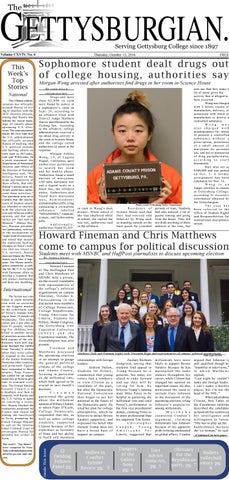
Sophomore student dealt drugs out of college housing, authorities say Morgan Wong arrested after authorities find drugs in her room in Science House By
jamie welch
editor - in - chief
Drugs and more than $2,000 in cash were found by police in a sophomore’s room on Sept. 29, according to an affidavit filed with District Judge Matthew Harvey and obtained by the Evening Sun. According to the affidavit, college administration received a tip about drug activity in the room in Science House and the college called authorities to assist in the response. Morgan Ashley Wong, 19, of Laguna Niguel, California, gave authorities permission to search her room and her mobile phone. Authorities found a small amount of marijuana, LSD tabs, marijuana wax and a digital scale in a black box, the affidavit states. Authorities also found more marijuana wax, hydrocodoneacetaminophen pills, a bag co n t a i n i n g a c r y s t a l l i n e substance labelled “MDA/MDMA,” Adderall, ecstasy, and hydrocodone pills. Additionally, authorities found $2,324
in cash in Wong’s desk drawer. When asked if she was employed while at school, she replied she was not, authorities said in the affidavit.
Photo credit Gettysburg Police Department
Residents of Science House said that they had noticed odd behavior by Wong s uch as standing outside on the back porch for extended
periods of time. Students had also noticed a lot of guests coming and going from the house. They did not think anything of these oddities at the time, but
now say that they make a lot of sense given the activity that is alleged to have occurred. Wong was charged with 3 felony counts of manufacture, delivery, or possession with intent to manufacture or deliver a controlled substance. W o n g w a s also charged with misdemeanors for intent to possess a controlled substance without a prescription, possession of a small amount of marijuana for personal use, and use or possession of drug paraphernalia, according to court documents. Bail was set at $100,000 and was posted on Oct. 3. A formal arraignment has been scheduled for Nov. 14. Wong is no longer enrolled in classes at Gettysburg College, according to directory information obtained by the Gettysburgian. The case has been referred to the Office of Student Rights and Responsibilities for institutional disciplinary action.
Howard Fineman and Chris Matthews come to campus for political discussion Students meet with MSNBC and HuffPost journalists to discuss upcoming election
B y A nnika jensen editor - in - chief Howard Fineman of The Huffington Post and Chris Matthews of MSNBC held a private, on-the-record roundtable with representatives of the college’s political organizations on campus Thursday, October 6. Participating in the discussion were members of College Democrats, College Republicans, Young Americans for Liberty, Students for Hillary, Model Congress, the Gettysburg Anti Capitalist Collective (GACC) and the Eisenhower Institute. The Gettysburgian was also present. Fineman and Matthews discussed the upcoming election in an attempt to gauge the general political climate of the college and Adams County, focusing in particular on the millennial vote, which both agreed to be crucial in next month’s decision. F i n e m a n questioned the group about the millennial opinion of Hillary Clinton, to which Piper O’Keefe, College Democrats, responded that she, as well as other college students, supported Clinton because of her experience as Secretary of State and her ability to build and maintain
Inside This Issue
This Week’s Top Stories
♦
EI Fielding Fellows Panel pg. 2
Matthews (left) and Fineman (right) with President Riggs and representatives of campus’ political organizations.
Photo credit: GCC&M
relationships with foreign leaders. Andrew Dalton, Students for Hillary, commented that young voters had a tendency to view Clinton as a candidate of the past, but after the Democratic National Convention they began to see her potential as the future of the Democratic party. He cited her plan for college affordability, which he believes to attract Bernie Sanders supporters, and expressed his belief that Donald Trump does not have a broad base of support on campus.
Bodies in Conflict Exhibit Review pg. 3
Zachary Bartman disagreed, saying that students find appeal in Trump because he is genuine, but many are afraid to come forward and say they will be voting for him. He believes Trump’s running mate Mike Pence to be helpful in garnering the millennial vote and cited Pence’s performance in the first vice presidential debate, claiming Pence to be more professional than his opponent Tim Kaine. Christopher Condon, Young A m e r i c a n s f o r Liberty, suggested that
Dangers of the Galaxy Note pg. 4
millennials were more likely to support Bernie Sanders because he has maintained the same stances throughout his career, while Clinton has changed her opinion on important issues. He also mentioned the need to include Gary Johnson in the discussion of the upcoming election, citing Johnson’s popularity among millennials. M a t t h e w s countered Condon’s argument, claiming millennials fear Johnson because of his apparent pride in being uneducated on global affairs. Condon
Diet advice from Ari, pg. 5
argued that Johnson is still qualified though he “stumbles in interviews,” to which Matthews replied, “Last night he couldn’t name any foreign leader. I can’t name a hockey player, but I’m not the head of the NHL.” When asked about Clinton, Ben Taber of the Eisenhower Institute described the candidate as hawkish but reinforced her intelligence and willingness to listen. “She has to play up the hawkishness because she’s a woman,” he said. -Continued on next page-
Obituary Bullets for the Republican volleyball party, pg. 7 vitory pg. 8
THE GETTYSBURGIAN
Page 2
NEWS ♦
Thursday, October 13, 2016
Eisenhower Institute holds Fielding Fellows panel By
ben pontz
staff writer
Joseph Theater could barely contain the excitement in the room. By the 7:30 p.m. start time, there were few open seats at the Eisenhower Institute’s first panel of the year, titled “Policy or Personality: The Key to Swing Voters,” which was held Tuesday, Oct. 4. Featuring three panelists from the world of politics, an hour long panel discussion was
followed by a halfhour question and answer session on issues pertaining to the upcoming election. The panelists w e r e : A l e x i s S i m e n d i n g e r , an experienced Washington journalist presently serving as the White House Correspondent for RealClearPolitics, who shared her experiences covering the past several presidential administrations and called this “an election
unlike anything we’ve ever seen.” John Baer, a political columnist for The Philadelphia Daily News who has won numerous statewide and national awards for political journalism. He provided insight on campaign strategy, the news cycle and political polarization. Kat Atwater, a 2007 Gettysburg alumna who serves as the chief of staff of BlueLabs, a firm that focuses on polling,
fundraising and communication. She discussed issues that drive voters to the polls, turnout and political advertisements. The panel was conducted “off the record” to allow panelists to speak more freely about issues pertaining to the upcoming election and share uncensored opinions. Two Fielding Fellows, Mariam Aghayan and Taylor Beck, moderated the discussion and the
ensuing question and answer session. Topics of discussion included the enthusiasm gap between supporters of Donald Trump and Hillary Clinton, the perception that Clinton’s election is inevitable and how that can hurt her and the potential for a close election decided by voter turnout. Firstyear student Elay Echavarria said of the panel, “I definitely was introduced to some new ideas I wasn’t
thinking about before, particularly when they were talking about whether this would be a high voter turnout or low voter turnout election.” At about 8:50 the discussion was promptly adjourned to allow the political junkies in the room (this article’s writer included) to go watch the vice presidential debate.
Students engage in roundtable political dialogue Continued from previous page
Aljosa Mrsovic, GACC, expressed that he did not support Clinton as a candidate but approved of some of her policies and attributed Donald Trump’s appeal to his personality and overexposure from the media. Bartman cited a different reason for Trump’s rise to prominence, saying that the candidate represents an outsider for many people as one who pushes change against the status quo. Matthews and Fineman then posed the question of the efficacy of the Affordable Care Act, or Obamacare, to which Jamie Welch, The Gettysburgian, cited the issues currently
plaguing the act, such as millennials not signing up for coverage. Piper O’Keefe countered, asking, “Who in here isn’t on health insurance?” When no hands were raised, O’Keefe continued, asserting that the Affordable Care Act is effective in covering college students and that students at Gettysburg have healthcare because of Obama’s policies. Kelsey Meisch, the Eisenhower Institute, agreed, asserting that when students turn 26 and are no longer able to remain on their parents’ insurance plans, their attitudes about the Affordable Care Act will change. Also discussed
was social security, which all participants agreed is a delicate subject and one that carries stigma in political discourse. “Talking about social security is pretty radioactive,” Welch said. When Fineman asked about the political climate of Gettysburg College and other liberal arts colleges that “believe in facts, science and discourse,” Mariam Aghayan weighed in on demographics, referencing her Political Science capstone in which seven of roughly 16 students in the class are Trump supporters; furthermore, Aghayan said, all seven are “white heterosexual men in fraternities.”
She accused Trump of fear mongering, particularly toward Muslims, claiming he is “one star of David away from putting them in a database.” Matthews and Fineman steered the conversation toward voting in Pennsylvania. Bartman expressed confidence in the state voting for Trump, while Dalton claimed that while Adams County might lean more Republican, business owners are not buying into the “Trump phenomenon” because of their reliance on migrant workers. Piper O’Keefe mentioned that more Gettysburg students have registered to vote this year than in 2012. Corrine Day, College
Republicans, weighed in on Trump’s treatment of women: “I cannot support someone who has no respect for [us].” Day stated that she has been a Republican all her life but will be supporting Clinton in this election because of Trump’s reactionary nature and carelessness: “He doesn’t seem like someone who should run a country.” A g h a y a n concurred, stating “People who think he can run a business think he can run a country.” Danielle Jones, College Independents, spoke up to express her frustration with the twoparty system, claiming that both Clinton and Trump alienate young
people. She believes that this election will bring about a system and the millennial vote will be higher. Meanwhile, Rachel Haskins, the Eisenhower Institute, insisted that young people voting for Gary Johnson do not actually resonate with his platform, they are simply casting protest votes. Fineman and Matthews ended with a question: If the Pennsylvania election were held today, who would win? The majority of the room predicted success for Clinton, while Bartman maintained confidence in Trump, citing the crucial role of Bucks County in the result.
From the Bullet Hole to the Libertarian soul
Hundreds gather in the ballroom to listen to Gettysburg alum and distinguished politician Ron Paul By
ben pontz
staff writer
In 1954, a young man from Pittsburgh stepped off a Greyhound bus and embarked on a four-year journey at Gettysburg College that would include a stint as manager of the venerable Bullet Hole, a decision to study biology and a marriage to a young woman named Carol. In 2016, that same man, who now hails from Texas, stepped off an airplane with his wife of 59 years for a four-day whirlwind visit to Gettysburg College that included celebrating the 100th anniversary of the Lambda Chi Alpha fraternity’s presence at Gettysburg, lunch with the Eisenhower Institute’s Fielding Fellows and - the highlight -serving as the keynote speaker at the political science department’s annual Constitution Day Lecture. That man is Ron Paul, a 1957 alumnus of Gettysburg who went on to
serve as a physician both in the Air Force and in private practice and then as a United States congressman for a total of 24 years with three runs for the Presidency interspersed in 1988, 2008 and 2012. Paul, a jovial octogenarian who retired from Congress in 2013, is a frequent speaker on college campuses around the country where he shares his message of liberty; something he thinks resonates with young people. “Young people are more inclined to look at a philosophy like this, and now is when they are sorting their beliefs out,” he said. “Liberty is a young person’s issue.” His speech last Thursday drew a crowd of more than 800 people including a sizable number of non-students who traveled, in some cases, from several hours away to hear the libertarian movement’s charismatic spokesman. One Facebook event reached thousands of people before the event, spreading the
word on campus and off. Paul’s speech began with an introduction from Dr. Ken Mott, professor of political science, who called Paul a “totally independent thinker” who delivered a “worrisome, challenging, and inspirational” message to the crowd. Paul discussed a non-aggression principle that has been lost in America to a mindset of the government providing for people and protecting people from themselves. He sees little difference between the Republican and Democratic parties, claiming that America essentially has a one-party system, the two major parties in conglomeration. Paul decried the influence of money and lobbyists in politics, pointing to the military industrial complex as “huge welfare” that should be eradicated. Ultimately, Paul believes that a free market system provides the best opportunity for anyone to achieve prosperity
without dependence on the government. He foresees the current system of entitlements and taxation as likely to lead to a financial crisis worse than that of 2008. “The situation will get worse and worse, and eventually we’ll have a crisis,” he said. “Eighty to ninety percent of government activity is not explicitly defined in the Constitution. If you’re not allowed to do it, the government shouldn’t be allowed to do it, which is why taxation is theft.” Anticipating various counterarguments to his message of removing government safety nets, Paul reported that Americans donated $385 billion to charity last year, which indicates that if they did not have to pay taxes, they would donate more and our system would be better off. Paul closed his speech by saying that, “We need to release the creative energy that comes when government gets off our
backs. There’s no reason we can’t do that.” After the speech, a question and answer session began that predominantly featured questions from nonstudents in the audience who were disciples of Paul’s and the libertarian movement in general. Themes included steps individuals can take to promulgate the libertarian cause, the upcoming election and general Ron Paul fandom. Dan Bower, a junior at Gettysburg, appreciated Paul’s remarks. “I think Ron Paul definitely had a great message,” he said. “His message is definitely much more reassuring than what is being said by most politicians today.” The next day, The Gettysburgian sat down with Paul to discuss the libertarian movement more broadly. Paul said that despite considerable enthusiasm from grassroots activists and other observers, he is less than enamored with the Libertarian Party’s
presidential ticket, which does not espouse pure libertarian values. “I don’t think Gary (Johnson) gives us a crystal clear view of what libertarianism is,” Paul said, adding, “but he could pick up some votes if he got onto the debate stage.” Paul puts considerably less stock in elections than in conversations; he could not recall an election in his lifetime that fundamentally changed America. Consequently, he focuses on talking to people about the libertarian way, and he thinks the future of the libertarian movement is bright. “If you just listed some principles, I bet 80 percent of people think the libertarian philosophy is pretty good,” he said. “I’m more encouraged by the libertarian thinking among the young people I meet on campuses than about the party.”
Mike Pence stops to speak in Gettysburg
Vice presidential candidate talks veterans affairs in hopes of winning crucial Pennsylvania vote B y A ri S naevarrson F eatures E ditor On Thursday, October 6 Mike Pence and his daughter, Charlotte, made the trip to Gettysburg to speak at a town hall event held at the Wyndham Hotel. The two first visited the Gettysburg National Military Park, paying their respects and taking in the profound historical significance of the site. Pence made the campaign stop in hopes to gain some traction for the Trump-Pence ticket in Pennsylvania, as every major poll currently has Hillary Clinton on top in this swing state. Congressman Scott Perry, an outspoken advocate
of Trump’s cause, welcomed Pence with an opening speech. Another notable speaker who appeared at the event was Otto Voit, candidate for state treasurer known for being the first open Trump supporter in the Pennsylvania state government. Not even two minutes into the talk, two men, one dressed in a red rain jacket and the other in yellow, stood up and began chanting obscure remarks. It may have had to do with a group of Evangelists outside holding signs that read “Repent your sins,” as some claim they heard the men shouting similar sentiments. The
only coherent segment of their tirade, peculiarly, was, “Pence! Pence!” Whatever the case, the men were hollered at by surrounding Trump supporters and eventually carried out forcefully by security. Pence stuck to a humble style of speaking, missing no opportunity to deflect credit ascribed to him to Trump. For instance, when suggesting a popular consensus that he had won the vice presidential debate against Tim Kaine, he immediately made sure to exalt Trump for being the true winner. He also capitalized on the treatment of veterans and the priority
of improving a declining military strength. One emotional point that stood out was his mention of the fact that brave Americans fight in foreign lands for our freedoms just to come back home and die because of unacceptable care by the VA. This was met with great acclamation by a sizable number of veterans in the audience. As well, he warned of what would be to come with a Hillary Clinton presidency, specifically citing her e-mail mismanagement and irresponsibility regarding the lives lost in Benghazi. Thematically, Pence emphasized his Christian
faith and its influence on his policies with a saying of his to which he has been inextricably linked in this election cycle: “I’m a Christian, a conservative and a Republican, in that order.” Among a few other questions about veteran care and attention to the inner city under a Trump-Pence administration was what seemed to be the pinnacle moment of the event: a 10-year-old named Dwayne was the last person picked to ask his question in the Q&A portion of the townhall. He asked how long it would take, under their leadership, to “fix everything that Obama has done.” Met
with some chuckles and “aw”s from the audience, Pence went on to answer the child by assuring him it would not take “as long as you’d think,” referencing his accomplishments as Governor of Indiana and policy changes that his running mate, Donald Trump, has proposed. Minus the brief heckling incident, the event went over smoothly and ended right on time. Pence stayed for a little while to meet and take pictures. Chris Matthews was in attendance, coming from the roundtable discussion he had hosted with Howard Fineman earlier that day at Gettysburg College.
THE GETTYSBURGIAN
Page 3
♦
A&E
Thursday, October 13, 2016
Featured films in WZBT: Gettysburg Gettysburg College’s Very Own Radio WZBT’s Top Weekly Adds and Albums “Artist”- “Disk” - “Label”
Majestic Theater The Beatles: Eight Days a Week 2 hours, 17 minutes – NR Academy Award-winner Ron Howard’s highly anticipated documentary feature film tells the story of The Beatles’ phenomenal early career and the incredible, profound impact the band imparted upon the music industry and the world. Friday - Saturday (10/14 - 10/15) - 4:00 PM and 7:00 PM Sunday (10/16) - 2:00 PM Monday (10/17) - 2:00 PM Tuesday - Thursday (10/18 - 10/20) - 4:00 PM and 7:00 PM Equity 1 hour, 40 minutes – R A senior investment banker attempts to navigate the cutthroat world of Wall Street when a company’s IPO threatens to derail the career she’s built. Starring Anna Gunn, James Purefoy and Sarah Megan Thomas. Friday - Saturday (10/14 - 10/15) - 4:15 PM and 7:15 PM Sunday (10/16) - 2:15 PM and 5:15 PM Monday - Thursday (10/17 - 10/20) - 4:15 PM and 7:15 PM
Gateway Theater Showtimes FRIDAY OCTOBER 14TH THRU WEDNESDAY OCTOBER 19TH **BARGAIN TUESDAYS – ALL SEATS $5 – ADDITIONAL FEE FOR 3D** KIRK CAMERON’S REVIVE US NR NO PASSES TUESDAY 8PM EVENT PRICING
WZBT Radio 200 | ‘Top New Releases’ | CMJ 1408 1. Devendra Banhart- Ape in Pink Marble-Nonesuch 2. Hamilton Leithauser + Rostam-I Had A Dream That You Were Mine- Glassnote 3. LVL UP- Return To Love- Sub Pop 4. Public Access T.V. -Never Enough -Cinematic 5. Warpaint- Heads Up- Rough Trade WZBT Radio 200 | ‘Top 10 Requested Albums’ | CMJ 1408 1 Wilco-Schmilco- Anti/Epitaph 2. Dinosaur Jr.-Give a Glimpse of What Yer Not-Jagjaguwar 3. Thee Oh Sees-A Weird Exits-Castle Face 4. De La Soul-and the Anonymous Nobody... -A.O.I 5. Dyan -Looking For Knives-Self-Released 6.The Julie Ruin-Hit Reset -Hardly Art 7. Morgan Delt Phase Zero Sub Pop 8. Of Montreal-Innocence Reaches-Polyvinyl Records 9. Preoccupations-Preoccupations-Jagjaguwar 10. Tobacco Sweatbox-Dynasty-Ghostly International
Want to Write for Arts & Entertainment?
THE ACCOUNTANT R I.D. REQUIRED (1:10) (4:10) 7:00 9:45 NO PASSES
Email Raichl Davenport at
KEVIN HART: NOW WHAT? R I.D. REQUIRED (1:45) (4:45) 7:30 9:45 NO PASSES
davera01@gettysburg.edu
THE GIRL ON THE TRAIN R I.D. REQUIRED (1:20) (4:20) 7:20 9:50 MIDDLE SCHOOL: THE WORST YEARS OF MY LIFE (1:40) (4:40) 7:10 9:30 *NO SHOWS AFTER 6PM ON TUESDAY
Upcoming at the Burg
PG
DEEPWATER HORIZON PG-13 (1:25) (4:25) 7:25 9:50 MISS PEREGRINE’S HOME FOR PECULIAR CHILDREN 2D PG-13 (1:00) 7:00 MISS PEREGRINE’S HOME FOR PECULIAR CHILDREN 3D PG-13 (4:00) 9:45 THE MAGNIFICENT SEVEN PG-13 FRI. & SAT. 7:05 9:50 SUN. – WEDS. (1:15) (4:15) 7:05 9:50 STORKS PG (1:35) (4:35) SULLY PG-13 7:15 9:40
A walk through the exhibit; Bodies in Conflict B y K evin W right C ontributing
writer
Art can alter one’s own perception of a certain subject or event. Any piece of art implicitly contains the artist’s own biases and viewpoints about the world and their place in it. While this might seem true with creative arts like painting and sculpture, it is also true with photography, in that the artist chooses what picture they will take and from what physical and ideological angle they will position their camera. Bodies in Conflict: From Gettysburg to Iraq explores this idea. Curated by Laura Bergin ’17, this brand new exhibit explores the stress and changes bodies undergo during wartime, and how these changes are depicted in various artistic forms. The varieties of tones and themes addressed in the gallery showcase the different viewpoints of war through both nationalist and humanitarian lenses. The exhibit features a stark contrast between the propaganda that encourages the fulfillment of duty and courage and pieces that emphasize the damage caused by war, thereby representing an anti-war perspective. When a viewer walks into the gallery, they will probably first notice one of the World
War I and II propaganda posters. While these posters might have slightly different messages, they all contain an implicit call to action. The message emphasized in these posters encourages an “us versus them” mentality. Will you stand up for your neighbor? Will you do your part in this war and help bring our sons and brothers home safely? War is depicted as a time or crisis where everyone needs to fulfill their duty in order to overcome the enemy. However, none of these pictures show the true cost of war, but only a romanticized call to honor one’s duty as an American citizen. All the American soldiers in these works are strong and powerful looking. The artists clearly had nationalist political intentions when creating this work The Gallant Attack of 150 Pennsylvania Bucktails showcases an American view of honor in war, this time during the actual battle. This artistic interpretation of an episode from the American Civil War shows a romanticized version of warfare. The bravery and action of the Union soldiers are exemplary of the ideal warrior. Dead are shown in the bottom of the lithograph, but the horror of death does not permeate the scene. Rather, a sense of virtue and national pride is felt. One should
not mourn for the dead, but rather celebrate the valiant acts of the victors in battle. A piece which conveys the physical detriments of war to the viewer is the anti-war poster Vietnam Summer, 1967. When the viewer looks at this piece, they are likely to feel a sense of disgust and horror at what war is doing to the civilians caught in the crossfire. This helps drive the point home of how damaging war is, which is something one might not fully know if they never saw it firsthand. Wafaa Bilal’s The Ashes Series: Chair, showcases the physical desolation cause by war. It also features one lone chair in the rubble, which symbolically represents the humanity in the room. The isolation of the chair stands for individual i s o latio n b r o u g h t o n b y warfare, including losing loved ones and emotional isolation brought on by the trauma of war. The Iraqi artist witnessed war in the Iraq war first hand, losing both his father and brother to the conflict. Bodies in Conflict should above all make the viewer consider war and the different lens it can be viewed through. Only when one closely evaluates how war is justified and conceptualized by the public at large is peace possible.
The LGBTQA Advocacy Resource Center and the office of LGBTQA Advocacy and Education will be hosting an Open Mic night on Friday, October 21, 2016. The event in entitled ‘OUTspoken.” The event will take place in the Attic from 9pm to 11pm. The event is part of the LGBTQA spirit week! The event is free to enter, and will be Host Provider. There will be a raffle drawing throughout the event, so be sure to come early and stick around to win some goodies.
This Week at the Burg
THE GETTYSBURGIAN
MONEY, SCIENCE & TECHNOLOGY Page 4
♦
Thursday, October 13, 2016
2016 Nobel Prizes awarded
Gettysburg professor has a personal connection B y A phra M urray S taff W riter On the Nov. 27 1895, Alfred Nobel, inventor of dynamite, signed away a large sum of his fortune to a committee now known as the Nobel Prize Committee, forever immortalizing a series of prizes in Physics, Chemistry, Medicine, Literature and Peace. Starting on Oct. 3, the Nobel Prize in Medicine was awarded to Ohsumi for his contribution to the research in autophagy. Autophagy, from the Greek “self” and “to eat,” is a process by which cells recycle cellular components and degrade them. While lots of work had been done on this particular aspect of medicinal research before, Ohsumi lead the way to identifying which genes were involved in the process
of autophagy, a discover which the scientific community believes will help in targeting specific diseases where autophagy is the mechanism of destruction. On Oct. 4, the Physics Prize was awarded to Thouless, Duncan, Haldane and Kosterlitz for their work in topological phase transitions and topological phase: in essence, for using mathematical models to study unusual phases such as superconductors and superfluids. The next day the Chemistry Prize was awarded to Sauvage, Stoddart and Faringa on the design and synthesis of molecular mechanism. Gettysburg College actually has a claim to fame, in the form of a dusty postcard written to our very own Professor Jameson. Sauvage had written to Jameson over 15 years ago, to ask about a
paper that he had published. When asked about the prize, Professor Jameson explained that not only was he excited to have been contacted by one of the winning researchers, but was also very proud that his same line of work was being awarded the Nobel Prize in Chemistry. While the grand ceremony is months away in December, it is clear that these advances are not too far out of the hands of our very own students and faculty. J. Michael Bishop, a Bullet alumnus, won the prize in Medicine in 1989, for his work in showing the transformation of a healthy cell to a cancerous one. Who knows, perhaps in ten or fifteen years, we will see another Bullet on the Nobel Prize stage doing even more great work!
CITES releases report of animals in danger of extinction
Photo credit: telegraph.co.uk
B y S am S iomko S taff W riter You have probably seen photos of the pangolin online while you were procrastinating on your five-page paper. This little mammal looks like the combination of an armadillo, an anteater and a basketball, and when it is scared, it rolls up into a ball. The scaly plates line along its body like armor. It is those plates that get the pangolin into so much trouble, though, mostly from people who wish to hunt the animal for use in traditional medicine or fashion. The illegal pangolin trade plummeted all eight species of pangolins into endangerment, bringing them closer and closer to extinction. That is where CITES comes in. CITES (The Convention on International Trade in Endangered Species of Wild Fauna and Flora) is an agreement between countries
across the world that ensures the wild animal trade does not put species in danger of extinction. The convention was the brainchild of the IUCN, The International Union for Conservation of Nature and Natural Resources. The need for CITES reflected the growing illegal trade of animals and plants for commercial or traditional use. Regulating this trade ensures that one species is not over-exploited, and the species will be around for future generations. And it just so happens that CITES met this week (September 24 to October 5) for the seventeenth time to assess which specie require more protection. CITES categorizes species based on their level of endangerment: Appendix I lists species that are very much in danger of becoming extinct, and Appendix II lists species that are close to becoming endangered. This
year, they listed the Devil Ray and Silky Shark on Appendix II. As for Appendix I, they decided to list the African Grey Parrot, one of the most trafficked birds in the world, and of course, all eight species of the pangolin. Listings on Appendix I makes the species especially difficult to get across borders. This includes extensive legal action if the species is transported or sold illegally. It is unfortunate that any animal could be harvested so extensively that its survival is threatened, but these listings are a huge step forward in the protection of all species involved. As more and more species become threatened by climate change and other human-made influences, organizations like CITES will continue to work to make sure that animals like the pangolin will survive.
The dangers of buying a Galaxy Note 7 device By Graham Alabdulla Contributing Writer On September 7, the American based company Apple announced and demonstrated the iPhone 7 and iPhone 7 Plus with its sleeker dimensions, lack of an audio jack, and various upgrades. The main rival to Apple is South Korean based Samsung who announced their Galaxy Note 7 on August 19, more than two weeks beforehand. Samsung’s product was the main rival to Apple’s latest cell phone, and it has not exactly put its best foot forward. Since its launch, there are 35 reports of the Galaxy Note 7 exploding or similarly malfunctioning from the battery. Now, you may be thinking to yourself, “A little heat is nothing to worry about, my current phone gets hot from time to time.” Let me stop you there — the Galaxy has reportedly burned the hands of a six-year old, caused a car to catch fire, and exploded in a hotel room causing over a thousand dollars in damages. But an even greater concern is that all devices
powered by a lithium-ion battery could possibly explode. Let’s explore this further. Lithium-ion batteries store, transform and release energy because of natural chemical reactions. This battery has two electrodes, which are places for the electricity to enter or leave; there is a cathode, or positively charged area and an anode, or a negatively charged area. The cathode stores positive ions and the anode stores negatively charged ions. Basically the battery charges by electricity bringing charged electrons through the battery contacts until the positive ions cannot accept any more negatively charged ions. Lithium, one of the lightest metals on the periodic table, is an excellent material for a lightweight portable battery that can hold a charge –and let us watch Netflix– for a long time. In order for batteries with such a reactive metal to be “safe”, they are sealed under pressure with a thin coat of lithium surrounding the entire battery. This thin coat sounds
more dangerous than having a thicker coat of metal, but if it was thicker, more pressure would be able to build up and essentially create a larger explosion. Experts cannot conclusively report on what the cause of the exploding battery is, but physical damage and heat can cause a meltdown. The current theory is that the pathway between the cathode and anode, the pathway that charges the battery, became overloaded and shorted out. This short resulted in the buildup of energy in the form of heat within the battery, which would increase the pressure in the battery case, and would ultimately result in an explosion of liquid metal shrapnel flying everywhere. So, the next time you use your phone, just know that you are essentially holding a small bomb in your hand, a relatively safe bomb, but a bomb nonetheless. And if your bomb is called a Galaxy Note 7, know that they are armed and dangerous: deactivate and dispose of it responsibly.
Three-parent baby raises controversy about ethics By Emma Gruner Contributing Writer In a perfect world, every new scientific discovery would be received with unequivocal excitement and praise. However, as modern scientific research becomes increasingly entangled with political and ethical questions, these advancements are not quite the heroic milestones they once were. Nowadays, groundbreaking experiments often generate more uneasiness than enthusiasm. Such was the case earlier this year with the birth of a baby boy to three genetic parents. According to a story published by New Science on September 27, a Jordanian couple consented to a revolutionary in vitro fertilization procedure in order to prevent mitochondrial disease in their newborn. While the majority of DNA in a human cell is contained in the nucleus, a portion resides in the mitochondria, the organelle responsible for generating the cell’s energy. This mitochondrial DNA is inherited maternally, so a mutation in the mother’s DNA can lead to a variety of life-threatening conditions in her offspring. The couple in question had already lost two children to mitochondrial disease due to mutations. Desperate, the couple contacted the New Hope Fertility Clinic in New York City. They were referred to fertility specialist Dr. John Zhang, who had experience performing unconventional IVF procedures. He decided to try a newly developed technique known as spindle nuclear transfer, but because of U.S. restrictions on human embryo manipulation, he had to perform the procedure in Mexico. Zhang ultimately created five embryos using this technique. For each embryo, he transferred the nucleus from the mother’s egg cell into a donor egg cell with its own nucleus removed. The new egg now contained nuclear DNA from the mother and healthy
mitochondrial DNA from the donor. These eggs were then fertilized with the father’s sperm, and the one viable embryo was implanted into the mother. The embryo survived to term, and the baby boy was born this past April. Further information on the story is currently limited, although more details are promised at the American Society for Reproductive Medicine meeting on October 19. Surprisingly, this is not the first time such controversial fertilization techniques have been attempted. In 2003, Zhang himself tried a similar IVF technique in China, transferring an already-fertilized nucleus into a donor egg cell. While his patient became pregnant, the embryos did not survive to term. In the 1990s, before the U.S. began regulating mitochondrial replacement techniques, embryologist Jacques Cohen helped create several three-parent embryos by transferring donor mitochondria into the mothers’ egg cells. Many of these embryos did, ultimately, survive; Cohen has continued to monitor these threeparent children, and reports that they have no obvious health problems. The fact that the procedure was performed in Mexico is of great concern to many. While the U.S. National Academy of Sciences panel theoretically approves mitochondrial transplant, Congress has blocked the FDA from using federal funds to review such treatments. This forces specialists like Zhang to take their experiments abroad. Interestingly enough, though, the majority of criticism is directed not at Zhang but at the U.S. government, claiming that their restrictions are fruitless at best and harmful at worst. According Norbert Gleicher, a fertility specialist at the Center for Human Reproduction in New York City, the U.S. regulation situation, “kind of doesn’t make any sense because what it results in is exactly what you have been witnessing”: essen-
tially, an experiment that moves “to places with no supervision”. Another worrisome aspect of the procedure was its end result. While the baby was reported to be “doing well” at three months old, tissue analysis revealed that his cells still contained 1-2% of his birth mother’s faulty mitochondrial DNA. Most scientists agree that no symptoms will occur as long as fewer than 20% of the DNA is faulty, yet others are still concerned. Before implementation, the embryo reportedly contained 5% of the mother’s faulty mitochondrial DNA. According to Dietrich Egli, a stem-cell scientist at the New York Stem Cell Foundation, this value is ten times higher than that seen in past embryos produced using spindle-transfer, and those were not even designed for implementation. As such, Egli concludes that the experiment was “not carried out well”: not exactly a comforting assessment where a child’s life is at play. Also, analysis is unable to be performed on the baby’s heart and brain tissue. As these are the areas where weak mitochondria can be especially problematic, this adds yet another level of uncertainty to the future of this child’s health. Overall, the birth of this “three-parent baby” has left a bittersweet taste in the mouths of the scientific community. As the reactions of these various experts show, it can be difficult to celebrate an achievement, even one that promises a solution for infertility and genetic disease, if one disagrees with the methods that were used. As Dietrich Elgi puts it, “this kind of new technique needs a very serious approach and careful planning”, two attributes that many feel that Zhang’s procedure was lacking. Whether the rewards of the procedure will ultimately outweigh the risks remains to be seen, yet it is safe to assume that Zhang’s experiment will be re membered — for better or worse.
AppTeezr Byte-size reviews of the latest apps Photo credit: Apple.com
Waze
Stressed about making the long drive home during Thanksgiving? Check out Waze! It is a free app that you can download within seconds and will get you to your destination faster and safer than ever before. I t w i l l a l e r t y o u t o p o l i c e , r e d l i g h t s a n dPhoto c ocredit: n sApple.com t r u ction ahead so you will be ready for whatever is on the road and avoid traffic tickets. And so long to the dreaded traffic hour; Waze will let you know what traffic is ahead long before you get there and redirect you mid-route. Free Category: Navigation Updated: Sep 20, 2016 Version: 4.12.1 Size: 76.8 MB Compatibility: Requires iOS 7.0 or later. Compatible with iPhone, iPad, and iPod touch.
THE GETTYSBURGIAN
FEATURES
Page 5
♦
Thursday, October 13, 2016
How to stop screwing up on your diet (Part 7) The content-to-process shift and more
What it is like to stay on campus for Reading Days by
N oelle Z immerman S taff writer
Staying at Gettysburg during Reading Days was an experience that I will never forget. I went home for one day but returned to campus on Sunday morning. Upon my return I noticed that there was a major lack of cars and, of course, people. For the first few hours I felt like I was in a ghost town; barely anyone walked by my window, and there was no sign of life in my hall. After about three hours of
blasting music and dancing around my room alone, I finally heard a knock on my door. Seeing a friend was probably the happiest moment of my life. Thankfully, I had a few friends who stayed here for Reading Days. When we went into Servo, it seemed like everyone had a group of two to four people with them. We all started to recognize each other for those few days because we all sat in the same section, the only section that was open. We were able to spend so much time
getting our food. If only the grill was open, and if only they served us omelettes! We also took advantage of quiet study spots like the library, the Junction and even our dorm rooms. There was a larger-than-usual number of tours that came through, which made us miss everyone even more. While deserted Gettysburg was fun and relaxing to experience, it definitely was not the same without everyone here.
Photo credit: Rishi Bandopadhay
B y A ri S naevarsson F eatures E ditor Last time Where I left things last time was an introduction into the next section of this series, namely actual diet changes. Some might read this and think the fact that it took seven installations to get to the actual recommendations for dietary interventions signifies my inability to get to the point in my articles. While it is true that brevity is my downfall in writing, I assure you this was entirely intentional. I cannot emphasize strongly enough the relative unimportance of changes to the diet itself, assuming you are not trying to follow a blatantly terrible diet that is fueling your relapses. Some workable ideas As mentioned earlier, my go-to when it comes down to the wire and I am in a situation where an intense craving pops up (maybe in an instance when you are around food) would be to challenge the voices. Rather than allowing the voice that says, “Go ahead, treat yourself” to win without putting up a fight, it is imperative to stop yourself and really hone in on what is happening. Is it that you are physically incapable of stopping yourself from eating, or is this just the byproduct of a nagging line of habitual thought? Hint: You are physically capable of not eating. Challenging this voice can even be accomplished by speaking out loud, although this has its limitations, as it is obviously not advisable while in public. But if you are alone in your room with snacks nearby, for example, positive verbal affirmations can go a long way. I have found that, just as the act of verbally communicating your problem can make things better in its own right, so too can a phrase like, “I am stronger than this” said aloud help get you out of your head. This almost makes the affirmation more “binding,” in a sense,
not letting the thought of giving in fester in your mind and become the start of a regrettable decision. Content-to-process shift This ties in nicely to the next concept I will address, namely a content-to-process shift. I picked this term up over the summer from a documentary on the topic, and it applies perfectly to this. Essentially, it describes the active switching of your focus from the “content” you perceive to the “processes.” For example, when caught in this decisive moment, you might shift your focus from the fact that you “really want food” and “have to eat something” to the sensory processes at play: the subtle physical symptoms you might be noticing (palms sweating, weak knees, Mom’s spaghetti, etc.), the feeling of being grounded and the points of contact you are making with the floor, or why your mind is bringing on this urge (which brings us back to all the points made earlier). Mindfulness The umbrella term for basically all of these concepts would be “mindfulness,” something I preach heavily when talking to people who do not know how to stick with a diet. Mindfulness in its essence imparts a forgiving attitude of self-appreciation. It holds that enjoying this present moment is a far more productive use of your time than over analyzing the past or worrying about the future. I find that the concepts I have learned from spending some time each day practicing some type of mind-body relaxation carry over into nearly every facet of life. Diet is no exception. Hand-in-hand with everything else discussed so far, practicing mindfulness every day in some form should allow you to reside in those moments of temptationso that you may take a
more caring look at your deeper processes. Stop and breathe, imagining that breath going to some body part and then really tuning into the sensations that come up. And if it has already happened, then use mindfulness to acknowledge the circumstance, sincerely forgive yourself, understand that there is nothing that can be done now and worrying will only exacerbate the issue, and then “return to the breath.” In meditation, this means recognizing you have let your “thinking mind” take over and then literally returning to concentrating on your breath, without judgment. In this way, you aim to return to whatever it is you have deviated from without harshly judging yourself. While the sentiment stands, I reject the expression “You are your own worst enemy” on the basis that this does not have to be the case. On the contrary, with a little bit of practice, you can (and rightly should) be your own best advocate. What about food hacks? Some of the more superficial, although not necessarily inconsequential, strategies include chewing sugar free gum or drinking some carbonated beverage. There is some evidence that artificial sweeteners may increase appetite by not providing the level of nourishment our brains expect from such a high degree of sweetness, but there is nothing inherently unhealthy about them in their own right. Next time In next week’s article, I will move onto the tactic of not thinking about it. Believe it or not, mindfulness does include some level of not thinking about things, which I will explain. Then we can progress to discussion of what not to do when you have screwed up on your diet or fear you soon may. Stay tuned!
Interested in Writing for Features? E-mail Ari at snaear01@gettysburg.edu
Photo credit Ninniane
Art exhibits of note at Musselman Library musselman library
Next time you’re in the library and need a break from your work, take some time to visit a few of the art exhibits currently on display throughout the building. Right to Serve, Right to Lead: Lives and Legacies of the USCT Visit the current Special Collections exhibit Right to Serve, Right to Lead. The exhibit uses original artifacts, documents and photographs to follow the evolution of AfricanAmerican participation in the Civil War and show how sacrifice both redefined the purpose behind the war and created a lasting and illustrious military tradition. Curated by 2017 Brian C. Pohanka Intern Matthew LaRoche ‘17, this exhibit draws from both the private collection of Angelo Scarlato and local pieces from the collections of the Adams County Historical Society.
Take a break from studying and let your artsy side roam free sym•bi•o•sis Visit the main floor apse to view award-winning nature photographer and wildlife artist Sandra Blair’s photographs of flowers and insects. Blair lives in Central Pennsylvania and is the Visual Resources Curator in the Department of Art and Art History.
Around the Global Family Table & Setting the Table On Musselman Library’s ground floor members of the Globalization Studies capstone class present a photo display, Around the Global Family Table, and a case display, Setting the Table, complement each other with photos of diverse food dishes and displays of tableware items used around the globe. The photos and display items were contributed by Gettysburg College students and faculty. According to the
members of the Globalization Studies class, “Our hope with the two projects is to shed light on the diversity of cultural experiences by our Global Gettysburg family through the visual display of international cuisines in a familystyle setting. We also hope to spark dialogue about globalization and what it means to be living in our highly interconnected world.” We're hiring! If you are thinking about a campus job, Musselman Library will hire student employees in many departments for Fall 2016. Read the student job descriptions on our website and submit your application online. If you have already applied before coming to campus, there is no need to check in with us. We will contact you about interviews. See you in the Library!
THE GETTYSBURGIAN
ADVERTISEMENT Page 6
Thursday, October 13, 2016
♦
E E R F with College ID. Climb aboard the GRAY line bus at these campus stops: Huber Hall
W. Lincoln Ave. near Carlisle St.
The Pike
Dining Hall
W. Lincoln Ave. at College Ave.
Gettysburg National Military Park Visitor’s Center
apple Hall
Search FreedoM TrAnSiT
The Shriver House
Dobbin House Tavern
Perkins
Follow us on
Walmart
Make your own bus stop. Simply wave to signal the driver to stop anywhere along the route.
ridethetrolley.com
TGI Friday’s Majestic Theater
flag stop
800-632-9063
Staples
W. Lincoln Ave. near Constitution Ave.
Gettysburg Village Cinema
Peebles
It’s that simple.
Friendly’s
The David Wills House
Giant The Outlet Shoppes at Gettysburg Foods
Gettysburg Heritage Gateway Gettysburg Center Theater Weis Markets
O’Rorke’s Eatery & Spirits For information on other routes featuring medical facility destinations, please visit us online.
1-800-632-9063 ridethetrolley.com
Ride FREE with College ID Interested in advertising in The Gettysburgian? Contact welcja01 or jensan02
THE GETTYSBURGIAN
OPINIONS
Page 7
♦
Thursday, October 13, 2016
Note: The opinions published in this section are those of the individual writers and are in no way representative of the views of The Gettysburgian staff, The Gettysburgian or Gettysburg College.
The obituary of the This week in women’s Republican Party issues: “Just Words” By alex romano contributing writer
Undoubtedly, the presidential election of 2016 will be one of the most memorable events for this generation. It will add vibrant color to the pages of high school history textbooks and political desk references across the nation for ages to come. Our children will learn about this critical year and hear all of the stories, gossips and peccadillos surrounding the candidates who all took a stab at making the White House theirs in 2017. Definitely, the memory of this turbulent period will remain branded in the national consciousness for a long time, but in nobody’s mind should it be branded the longest and the most deeply than in those of the Republican party’s current members. Ever since the end of the second--and thankfully final--Bush administration, the GOP has been scrambling to recover from the low esteem many Americans share for its legacy and party platform. The attempts at salvaging a reputation that was weakened considerably by an economic recession, a controversial and expensive war, a slow and seemingly halfhearted response to a natural disaster and an executive branch seeming to be run by the vice president have proven ineffective for conservatives. Instead of encouraging its politicians and other public figures to shift on the issues and support more progressive policies, the GOP has stuck to its usual route: frequently mix religion and morality in the creation of public policy for the purpose of retaining the Christian Right’s influence in modern politics; stress the importance of tax cuts, deregulation of industry and decreased government spending to benefit large businesses and corporations; urge the repeal of Roe v. Wade (still) and the overturning of the more recent Supreme Court decision legalizing gay marriage; and regularly alienate women and minorities in crafting the policy agenda. After John McCain’s defeat in 2008 to Barack Obama, Republicans became aware of the need to change their stances. However, they failed to alter them for the party as a whole, leading to the vacancy of a definitive and uniting platform and the splintering of the GOP into various factions, each possessing ideologies different to one another. And some of these differences turned out to be irreconcilable, as was evidenced by the Republican primaries that ran from late 2015 through early 2016. In the summer of 2015, during the first Republican primary debate, the lack of several core points of agreement in political views among the candidates was revealed when the leading ten contenders pounced all over each other, finding significant fault with whatever each speaker had to say. Over the next eight months, the potential Republican candidates for the presidency started to drop out of the race, and it became increasingly clear that Donald Trump would be the GOP’s
nominee in 2016. This was a blow to both sides, with Democrats fearing a bombastic and self-indulgent tyrant taking over the White House, and far-right Republicans fuming over some of the business mogul’s less traditional political ideas. Conservative pundits and media outlets were relatively mixed regarding Trump’s campaign for the nomination, but they grew increasingly wary and critical of him as he came closer to obtaining it. But obtain it he did, though not without turning off a number of stauncher Republicans with his tax plan in the months preceding his nomination. These New Republicans were not sure whether they had an ally in their presumptive nominee or not. Fretful neoconservatives had been suggesting a contested Republican National Convention weeks before Trump’s nomination, which would have meant that the RNC would have started without a named nominee. It would have been a desperate last-ditch effort to avoid a Trump candidacy, as well as a blatant disregard of the public will. So the Republicans dug up Mitt Romney from the RNC (Republican National Cemetery), propped him up on a stage and had him urge the party not to endorse Trump. Peculiar action to take, considering the GOP pressured Trump to sign a pledge that he would not run for third party and that he would endorse whoever was nominated the past summer. It was a stab in the back for Trump with a knife that was only twisted when Ted Cruz and several other candidates refused to endorse him at the convention in July, and the wound was deepened with Cruz’s much-booed speech persuading the convention to “vote with (its) conscience.” With a party as disunited, consternated and lacking in confidence as the GOP is now, it is a wonder how it has stayed afloat for so long, since its mortal wounding by the economic downturn in 2008. And the reason is there are more people who want a change of direction for the Republican party than have a voice loud enough to be heard, and they form a larger percentage of the party than the neoconservatives. So, the GOP hasn’t been killed just yet. But it has been incapacitated. It has been bedridden for the better part of a decade. As a Republican, I know to what the party should attribute its sorry present condition: the neoconservative resistance to change. I have grown tired and frustrated with the Republican party supporting trickle-down economics, decrying regulatory agencies and attempting to overturn a Supreme Court decision that was made over 40 years ago. For the past 35 years, the GOP has perpetuated the same beliefs and supported the same policies brought to national attention by Ronald Reagan, many of which are now irrelevant and dated. Changing a party does not necessarily mean killing it; it means reshaping it. The fact that the GOP changed from a party with
a leader who founded the EPA to one with a leader who dramatically cut back that agency’s funding in just over ten years is evidence enough of how quickly and significantly party ideology can be reshaped. And after neoconservative leadership repeated the same economic policy in the 1980s that plunged the early 1990s into recession in the late 2000s to the same effect, Republicans should know that it is time to change their image and renounce New Right tradition. Until then, the GOP will remain the sick man of American politics. After the tumult of 2015-16, there can be no recovery with the state of the party as is. And that state is broken, in many ways. Donald Trump broke the heart of the Republicans by introducing his unpredictable and nonconservative ideas in the early debates. Willard Mitt Romney broke the back of the Republican party when he encouraged the delegates to disregard the will of the people and block Trump’s nomination. Failure for the most popular candidate to receive his/her party’s endorsement would have been the noose for the Republicans’ chances at taking the White House. Mitt Romney wanted to be the hangman, and he had the GOP willing to back him (what rational political party would do that to its own most popular candidate?). Ted Cruz broke the party’s concentration two times, once when he hinted that he might run as a third-party candidate against Trump after Cruz dropped out of the race (a move that would have handed the election over to Hillary Clinton practically gift-wrapped) and later when he refused to endorse Trump for a whole season before he finally caved in September. And the party itself broke its own spirit by subjecting itself to two defeats in 2008 and 2012, unaware that Obama’s famous campaign pledge for change extended not only to the economy and small businesses, but in a different sense to the Republicans too. As a broken party, and no matter who wins the election this November, the GOP will continue to languish unless it helps itself not just by adjusting the platform of one candidate, but by adjusting that of the entire party. The GOP needs to progress, but it needs to progress as a unified whole, and it must do so without the New Conservative faction. That radical rightist group, which was spawned by Reagan and nurtured by such enlightened gurus as Glenn Beck and Rush Limbaugh, is a carcass that will weigh the Republican party down continuously, perhaps even cause its death. This obituary is a warning. The neoconservative branch is limping towards its grave. The rest of the party, that is, all of those moderates and pragmatists who possess a willingness to compromise and who form the silent majority, better not follow. In any event, the party born out of the Reagan Revolution is kaput. Here lies the New Right: January 20, 1981- January 19, 2017. Rest in pity.
By anika jensen editor-in-cheif Let me preface this article by saying that I am a sexual assault survivor. I spent nearly a year in an unhealthy relationship in which I was coerced into sex, guilted into sex, manipulated into sex and forced into sex in addition to being groped in public, derided in person and via text message, and made to feel that I was the impetus behind my partner’s threats of suicide. I still struggle to understand that I am not at fault for anything that happened to me and to reconcile my assault as something that happens to one in every five women. I could not grasp how someone could even fathom sexually assaulting their partner and wriggle out of the blame just to do it again. I grasp it now. I grasp it in the form of a presidential nominee who was recorded in a professional setting saying that he could get away with sexual assault, who described his comments as “locker room talk,” as if rape culture is simply a pastime for powerful men to
perpetuate after a workout; who insisted that they were “just words,” even though just words are those that children hear and eventually learn to believe, those that Brock Turner’s father uttered in an attempt to nullify the heinous crime his son committed against a woman whose life was utterly altered by somebody else’s “just words”; who was accused of raping his first wife but was acquitted because you “can’t rape your spouse.” As a sexual assault survivor, these are not just words, they are the root of every anxiety I feel when I smell the noxious sweetness of Jagermeister and the reason I flinch when I’m tapped on the shoulder. They are the only encouragement little boys need to flip little girls’ skirts up. They are an excuse for anyone who has ever looked for one because if the Republican nominee for president says it’s okay, I guess I won’t get in trouble. Remember the “fondler” from two years ago? Locker room talk: “I can grab whoever I want.” Every email from Bill Laf-
ferty? Locker room talk: “I just want to get laid.” My assault? Locker room talk: “She’s mine, and she has to do what I want.” So no, you can’t just grab her by the pussy. You can’t kiss her without asking, and even if you do ask, you can’t kiss her unless she says yes. Your power, your money, your influence are no free pass to a woman’s body, and they are no excuse. You claim that you respect women, you just don’t want them to have ownership over their bodies or the power to make decisions about their sex lives or self love or confidence in their professional life or safety at the workplace or sufficient maternity leave or an argument against you or equal speaking time at a national debate or the opportunity to lead a country. Locker room talk is a manifestation of rape culture, and rape culture is a problem that will not be distracted by empty rhetoric. The real threat to women in the United States isn’t coming from Mexico; it’s running for president.
An endorsement for Donald Trump A Gettysburg student weighs in on the election By zach sobeck contributing writer
America is now at a crossroads. We are presented with the choice of corrupt politics as usual with the Democratic Presidential nominee, Hillary Rodham Clinton, or actual change which will benefit the American people with Republican Presidential nominee, Donald J. Trump. Unlike his opponent, Donald Trump is not a mouth-piece for the special interests, lobbyists and mega-donors. He is free to do what is right for the people of America, as he is bound to nobody. Moreover, Donald Trump realizes the threat that illegal and massive amounts of legal immigration pose to the American people. He realizes that migration policy should benefit the citizens of the United States, not foreign nationals. Also, Donald Trump will protect the traditional American values upon which this nation was founded, including free speech and Second Amendment rights. Donald J. Trump will put America first and make America great again. Donald Trump is not a puppet for the special interests or the mega-donors, much unlike his opponent who is totally controlled by Wall Street and other big-money institutions that are funding her campaign. It has been far too long since we have had
Photo credit: Political Insider
a president who was free to make deals and craft policy that put the American people first instead of the corporate donor class. Donald Trump is beholden to nobody and is truly free to serve the people of this great country. Often, the U.S. government does not make competitive deals, which is a leading factor to our massive national debt. Currently, the U.S. government does not competitively bid on military supplies. Instead, politicians pay more than they should in order to benefit the big manufactures who donated to their campaign. Donald Trump owes nothing to the industrial big-money donors and will therefore be able to make the best deals for the American people. Donald Trump realizes the massive threat that illegal and massive amounts of legal immigration pose to America. Donald Trump will end illegal immigration by building a great border wall, for which Mexico will pay. He will also deport all those who are here illegally in accordance with the law. No longer should foreign nationals be allowed to stay in the United States illegally at the expense of the American populace. These migrants also pose a serious threat to national security. Hillary Clinton wants to dramatically increase the number of Syrian refugees admitted to
this country. This is not only careless but is also potentially very dangerous. We have not yet found a truly effective way to vet Syrian refugees, so extreme vetting is necessary to protect the people of the United States. This will often mean not allowing refugees to enter this country. Donald Trump will put America first and will not allow immigration policy to threaten the lives or livelihood of the American people. Donald Trump is committed to protecting the values upon which America was founded. Free speech and Second Amendment gun rights must be preserved to make America great again. Hillary Clinton poses a serious threat to both of these principals. She will appoint Supreme Court justices who will infringe upon gun rights and who will censor free speech. Donald Trump will preserve what made America great in the first place in order to make America great again. The choice is clear. On one hand we have the same old hackneyed corrupt politician who is a puppet to her donors, and on the other hand we have someone who will bring about real change, put America first, restore law and order and make America great again. Please help make America great again by voting this November.
THE GETTYSBURGIAN
SPORTS
Page 8
♦
Thursday, October 13, 2016
Bullet Men’s soccer ousts Swarthmore Shot: Bullets improve from tenth to seventh in regional rankings Athlete of the Week
Senior Samantha Wright By
elizabeth
hilfrank sports editor
Senior field hockey captain Samantha Wright scored two of the three Gettysburg goals that lit the scoreboard in Saturday’s face-off against Swarthmore College. Wright played 70 minutes of Saturday’s game, which marks a new season high for the forward. These two shots brought Wright to a team-best total of seven goals for the season. The stat also places Wright in a tie for eighth place in the Centennial Conference for total goals. Wright also ties for ninth in the conference for total points at 17. Since her first year at Gettysburg, the forward has appeared in nearly all By emily sheehan games played by &the elizabeth hilrfank team. This season she Staff Writer & Sports averages 0.78 goals editor per game, a personal best, and 3.56 shots per game. Wright has continually made the news due to her aggressive success on the field. Of the nine games played, Wright has had newsworthy influence in five. One of the three captains on the team, Wright leads both on and off the field. Halfway through the fall season, Wright appears to bringing her all for her last year in orange and blue. Her current stats top some from previous full seasons. She has already surpassed her season goals from 2013 and 2014, and she needs only one more to tie her personal best of eight from last year. Wright’s shot percentage of 0.219 surpasses those from 2014 and 2015, approaching her first year’s 0.273 record. Wright’s consistency and offensive success as a forward warrants her the title of The Gettysburgian’s Athlete of the Week.
By
stephanie karalis
S taff W riter The Gettysburg College Men’s Soccer team defeated Swarthmore College 2-0 Saturday. As the rest of campus emptied for reading days and the rain poured down, the Bullets remained busy on Clark Field. The two teams entered the game in a four-way tie for fourth place in the Centennial Conference (CC). Gettysburg’s victory kept them in fourth place, now only tied with Johns Hopkins. The majority of the game being a scoreless match made it evident it was an evenly played game, but the 18-16 shot advantage the Bullets held helped them achieve the win. This victory marked the first time the Gettysburg men’s soccer team beat Swarthmore College in nine years. Since 2007, the Garnets have earned six victories and a pair of ties over the past eight meetings. The game against Swarthmore was the Bullet’s fourth shutout of the season. First year Thomas Keane stopped three shots this game, making it his third clean sheet of the year. Swarthmore sophomore Michael Thut stopped
nine Gettysburg shots for the Garnets. For most of the opening half the game was defensively controlled with both the Bullets and the Garnets only shooting once on each other in the first 29 minutes. For the rest of the game, however, both teams increased their intensity, and the Bullets were able to outshoot the Garnets 7-4 in the last 16 minutes of the game. “I think a weakness for us was the first moments of the game,” said senior captain Henry Smith. “We weren’t as
energetic and threatening as Swarthmore. [The team] played [its] game, moved the ball well and created scoring chances, which [it] eventually capitalized on. That’s always promising.” The second half opened with tension as the Bullet’s almost broke the tie in the first six minutes. Smith kicked in a goal, but it was called offside. T h e g a m e remained scoreless until the 51st minute of play, when junior Patrick Santini finally broke through the Garnets’ net.
First year Precious Ozoh delivered a pass from the midfield to the right side of the box to junior Patrick Santini. Santini dribbled the ball twice up on the right side of the box and striked the ball into the far post for the team’s first goal, Santini’s third of the season. This was Ozoh’s first collegiate assist. This goal lit the fire beneath the Bullets’ cleats as senior Henry Smith followed with an insurance goal in the last few seconds of the game. The blue and
Photo courtesy of David Sinclair, GC C&M
Junior Patrick Santini scored one of the two goals in Saturday’s game versus Swarthmore College.
orange kept the intensity high for the remainder of the half and outshot Swarthmore 11-10, but Thut saved five shots the rest of the way before the Bullet’s Smith put in his goal. Smith headed the goal kick by Keane and sent it up the field. Smith was able to beat three defenders to the ball and then, at the top of the box, was able to get a shot off and score, finding the left side of the net. This goal put the game away and aided Smith’s role of being the team-leading scorer, his fifth goal of the year. “The team has taken many steps in the right direction,” said Smith. “It’s clear [the team has] become closer on the field, but also off the field.” The cohesive unit that defines the Gettysburg team has helped them to have such a successful season, standing 3-2 in the conference and 6-3-1 overall. “I hope by the end of the season we are able to play our best soccer when it matters most,” said Smith. “If we do that, the team has the potential to do things it hasn’t been able to do in past years.” The Bullets next face sixth-place Dickinson College on Clark Field, Saturday at 7p.m.
Bullet personal bests all around
Gettysburg volleyball sweeps Columbus Day Weekend matches B y andrew milone S taff W riter The first week of October proved to be memorable for Gettysburg volleyball as players young and old conquered new milestones. Kim Rain, class of 1992, took her spot among the greats in the Gettysburg College Hall of Athletic Honor Sept. 30. Rain was inducted due to her success as a player and as a coach, where she has earned 800 wins. The current orange and blue team then swept a pair of matches in Williamsport, PA on Oct.11, defeating Wilkes University 9-13 in three games and the previously unbeaten Alfred State 12-1 in five games. “The team was able to be so successful in the tournament this past Friday because we were aggressive in all aspects of the entire game,” said junior Katherine Gilbert. “The team was very focused and disciplined in
our skills, and it led us to our victories.” Senior Laura Bergin highlighted the tournament when she reached the 1,000 career kills milestone during the final battle with Alfred State. Bergin is one of 11 Bullets in history to earn this honor. Bergin is a twotime Second Team AllCentennial Conference selection, and she had a career high day by tying her personal bests in kills and putting up her best dig total of the 2016 season. Her kill set remains the best on the team at 3.39. The Bullets outmatched Wilkes in three games with scores of 25-8, 25-16 and 2512, respectively. In the first match, the Bullets got the first six points before maintaining their composure in the latter part of what was a back-andforth affair of rallies. The second match featured Wilkes having a 7-6 lead before the Bullets
strung together two streaks of five straight points to close out another victory. It was a similar story in the third match with Gettysburg dominating the service and eventually conquering in the three set sweep. Bergin had 15 kills to start her day while junior Stephanie Blair marked up the stat sheet with six kills, 27 assists and 11 digs. Gilbert added to 15 digs to her season totals. “We came out and really gave it our all,” said Blair. “I haven’t seen us play with so much fire in us and a desire to win as much as I did this past weekend. I think that desire really pushed us to go after every ball and never give up when we were down.” Alfred State made Gettysburg work in the second half of the tournament by extending the affair to the full fivegame set. The first game was back and forth for the entire match until a kill by junior Maddie Weikert put
This weekend in Gettysburg College fall sports: Saturday, Oct. 15: Men’s Cross Country vs. Gettysburg Invitational - 11:00a.m. Women’s Cross Country vs. Gettysburg Invitational - 10:30a.m. Men’s Soccer vs. Dickinson College - 7:00p.m. Volleyball vs. Bryn Mawr College - 1:00p.m. Field Hockey at Bryn Mawr College - 1:00p.m. Football at Muhlenberg College - 1:00p.m.
the game to rest. The second game had a style of rallies, but the Alfred State Pioneers came out on top with a three point margin to spare. Gettysburg showcased some dominance in the third game with a pair of five point streaks. Alfred State took the fourth game before Gettysburg got a chance to take home an impressive win in a final do-or-die game. Blair assisted many points for the orange and blue in this match while junior Lauren Godshalk
tallied some kills early on in the match with Bergin bringing in the kills at the end. Blair had a career five sets, matching her personal best with 51 assists while tallying the 19 digs. Firstyear Francesca Garison had 10 kills. “Our goal for the rest of the season is to keep playing our game and focus on what we can do to win each game individually,” said Gilbert. The Gettysburg volleyball team will next battle Dickinson College Oct. 13 in Bream Gym at 7 p.m.
Photo courtesy of David Sinclair,GCC&M
Senior Laura Bergin became the 12th Bullet volleyball player to reach 1000 kills on Oct. 7.
Are you interested in writing for the sports section? Contact Elizabeth Hilfrank at hilfel01 for more information!