Page 1
Blasts from the past
This week in 1917, an ad appeared in The Gettysburgian for the college bookstore. It was a small ad with the address of the bookstore, and it listed some of the available stock: the usual books, supplies, college jewelry, and athletic goods, but also, very specifically, Waterman’s fountain pens, fresh candies, and “sunshine biscuits.” I wonder what those fancy biscuits were? They must have been famous like Servo cookies to be listed in this ad! This week in 1962, Owl and Nightingale and Delta Phi Alpha were preparing to present their next production, Goethe’s Faust. The three main characters, Faust, Mephistopheles, and Gretchen, were to be played by Sidney James, Ed Baierlein, and Jane Smith, respectively. The Gettysburgian reported the problems the stage crew were facing: there were 21 scene changes in the two acts. They wanted to have 45-second scene changes for each one. They mainly had special effects with the devil, Mephistopheles, such as having a black poodle that must change into Mephistopheles in a puff of smoke. They also had to make many of the costumes for the production. As with any play, the students put a lot of work making it happen! This week in 1987, The Ivy League Delegation came to Gettysburg to see if the college had “the look.” As they walked around the college, the representatives noticed that at noon, the college post office was packed with students, who were only using one door. The tour guide for the delegates joked that the other door had never been opened. Then, the sudden change came- one of the delegates opened the door! As the Gettysburgian wrote, “It was the dawning of a new age for Gettysburg!” The delegates then discussed the conundrum and had to be taken immediately to the president of the college. The post office doors stayed open after that day. It is unclear what the ramifications of this event were, but, apparently, it was a big deal at the time. This week in 1997, as with this week in 2017, students waited outside for another wonderful Servo Thanksgiving. That year, planning began in October when Servo had to purchase one hundred and eighty turkeys for the dinner. It was a wonderful event. Students were happy to have a feast with their friends before leaving for the Thanksgiving break. Students were greeted at the door by President Gordon Haaland and his wife, and faculty served each table of twelve. The Servo Thanksgiving was done for 15 years; however, it ended for some time and then returned in 1992. This tradition is something students still enjoy to this day and many alumni remember their Servo Thanksgivings These archived “blasts from the past” were compiled by staff writer Shannon Zeltmann thanks to Special Collections in Musselman Library.
Thursday, November 16, 2017
Thursday, November 16, 2017
FREE
SERVO THANKSGIVING
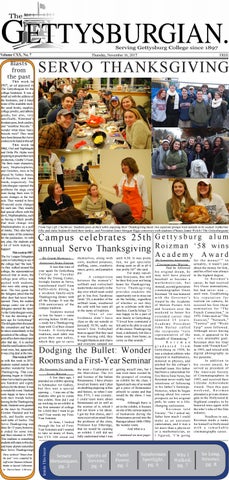
From Top Left, Clockwise: Students pose at their table enjoying their Thanksgiving meal; two separate groups wait outside to be seated; Katherine Ellis and Julia Stefanelli hold their turkey; and President Janet Morgan Riggs converses with students (Photos Jamie Welch / The Gettysburgian)
Campus celebrates 25th annual Servo Thanksgiving B y G auri M angala A ssistant N ews E ditor It was that time of year again for Gettysburg College on Tuesday when the Dining Center, lovingly known as Servo, transformed itself from buffet-style dining, to a sit-down family-style Thanksgiving dinner with all the fixings. It was the 25th anniversary of the campus tradition. Students waited in line for hours -- some arriving before 10:00 a.m. -- ready for a Thanksgiving feast with 12 of their closest friends. A Gettysburg tradition, each table was given their own turkey, which they got to carve
themselves, along with corn, mashed potatoes, stuffing, yams, cranberry sauce, gravy, and pumpkin pie. A competition between the women’s’ softball and volleyball teams broke out early in the day over which team could get in line first. Sarahrose Jonik ‘20, a member of the softball team, weathered the cold with her team all in the name of tradition. “One of our freshmen didn’t have class so she sat outside at [around] 10:30, sadly we weren’t first. Volleyball beat us again! But they said it was freezing cold, they brought blankets and chairs and everyone camped out
until 4:30. It was pretty fun, we got specialty dining seats so all in all it was pretty lit!” she said. For many out-ofstate first-years, this will be their first year not being home for Thanksgiving. Servo Thanksgiving provides students the opportunity not to miss out on the holiday, regardless of whether or not they get to celebrate with their families. Camila Seluja ‘21 was happy to be a part of new family at Gettysburg: “I loved how communal it felt and to be able to eat all of the classic Thanksgiving food, it definitely felt like a home away from home, as corny as that sounds.”
the most – Exploration of the Marvelous: The Art and Science of the Italian Renaissance. I have always loved art history and I plan on doubling majoring in this and history, so when I saw this FYS, I was ecstatic. I could learn more about Renaissance art as well as the science of it, which I did not know a lot about. I got my first choice, and I soon received an email from the professor of the class, Professor Kay Etheridge, that we would be curating an exhibit. I still did not fully understand what I was
getting myself into, but I was even more excited by the prospect of creating an exhibit for the class. I figured each one of us would get a piece of Renaissance artwork to curate and that would be the show. I was wrong. Although there is art in the exhibit, it focuses on one of the curious aspects of humanists during the Renaissance period into the Baroque (about 1400-1700): the wonder room. And what is a
Dodging the Bullet: Wonder Rooms and a First-Year Seminar B y S hannon Z eltmann S taff W riter A few days ago, I attended an exhibit opening in Schmucker Art Gallery, but this was a special opening … I was one of the students who got to curate this exhibit. How did I end up working on an exhibit in my first semester of college for a field that I want to go into? Four words: my FirstYear Seminar. In June, I looked through the list of FirstYear Seminars and I wanted to take so many of them, but FYS 188 stood out
Inside This Issue
Volume CXX, No. 7
♦
Senate Shenanigans, pg. 2
Spirits of Stevens, pg. 4
-Continued on next page-
Panel Poster, pg. 5
Gettysburg alum Roizman ‘58 wins Academy Award B y S amantha A nastasiou
C ontributing W riter Had he followed his original dream, he may well have played baseball or become a mathematician, but instead, second generation cinematographer Owen Roizman ’58 was honored with the Governor’s Award by the Academy of Motion Picture Arts and Sciences over the weekend to honor his extended career that spanned 25 years. Academy President John Bailey called the recipients “very representative of the breadth of filmmaking.” R o i z m a n graduated from Gettysburg in 1958; he was a student athlete who majored in mathematics, minored in physics, and pitched for the college’s baseball team. His father had been a cameraman for Fox MovieTone News, but Roizman never really had intentions of following in his father’s footsteps. However, when he began asking about his career prospects on his original path, he came to a lifechanging realization. Roizman told Variety: “So I asked my father how much I could make as an assistant cameraman, and it was a lot more than a physicist or a mathematician, so I figured, ‘I’m going
Sunderman Spotlight, pg. 6
Why I Walked, pg. 7
for the money!’” In actuality, it wasn’t just about the money for him, and his effort was always to the highest degree. In Roizman’s career, he had received five Oscar nominations, but had never won … until now. Establishing his reputation for realism on camera, he received his first Oscar nomination for “The French Connection,” in 1972. Films such as “The Exorcist,” ”Network,” ”Tootsie” and “Wyatt Earp” soon followed. Although never having won, it appeared to be a very attainable goal. Roizman shot his final frame with “French Kiss” in 1995, and retired with digital photography as his passtime. In addition to his recent award, he served as president of The American Society of Cinematographers in 1997, and received their Lifetime Achievement Award. Then this past weekend, Roizman attended a private dinner gala at the Hollywood & Highland complex to be honored once again with the who’s who of the film industry. Needless to say, Roizman made a name for himself in Hollywood with a remarkable cinematography career.
So Long, Streeter, pg. 8
THE GETTYSBURGIAN
Page 2
NEWS ♦
Thursday, November 16, 2017
Students work on battlefield beautification B y S arah K irkpatrick S taff W riter In these tight budgetary times, the National Park Service had struggled to find a work force to clear brush from around the Eternal Peace Light Memorial on the Gettysburg Battlefield until Alpha Chi Rho, Alpha Omicron Pi, and the ROTC program offered to help. On Saturday, October 21, over 80 Gettysburg students from these organizations donated three hours of their time to work on park beautification efforts and learn more about the historical importance of preserving this battlefield. Park Service employees divided the volunteers into two groups – the Union and Confederate
teams – and educated them about the battle that took place. “Each group learned about generals from each army during the Battle of Gettysburg,” explained Alpha Chi Rho President Ned Hughes. “Students learned about the early lives of these leaders and how they became generals in the Confederate/ Union Armies. The group also discussed the meaning of leadership in great depth.” The Eternal Peace Light Memorial was an ideal place for this service because its surrounding brush had been allowed to grow unchecked for years, which compromised the aesthetic appearance of the monument and the historical experience of visitors. The
Dodging
the
Peace Light was created to celebrate the armistice between North and South and was dedicated by President Franklin Delano Roosevelt in 1938 to celebrate the 75th anniversary of the battle. The Park relies on volunteers to help preserve the monument’s beauty and profound message, and Gettysburg students accepted the challenge. “The event was created…as a way for Greek Organizations and other campus organizations to give back to the community,” said Hughes. “This is the first time that Alpha Chi Rho has participated in a community service event as large as this one.”
Bullet
Students from Prof. Kay Etheridge’s first-year seminar “Exploration of the Marvelous: The Art and Science of the Italian Renaissance” pose in their wonder room at Schmucker Art Gallery (Photo courtesy of project website) -Continued from page 1wonder room, you ask? A room (or sometimes a cabinet or several rooms) filled with art, religious objects, artifacts from the Americas and Asia, books, plants, mummies, exotic animal parts, “unicorn horns” and other oddities, and a whole list of other staples. But why would humanists want a wonder room? Humanists wanted to understand the entire world in one room as outside of their rooms, the world was exploding with new knowledge with the rise of classical Greco-Roman ideas, the advent of the printing press, and the age of discovery. Throughout the semester, we learned about how the collections’scholars, scientists, rulers, and everyday collectors had acheived this, each with their own flare. While today we have distinct lines designating science and art, then humanists crossed this line continuously throughout their studies. With these things in mind, we worked with the ARTH 284 class, taught
by Professor Felicia Else, to create our own wonder room. The ARTH 284 class focused on the artifice that was found in wonder roomstexts in Latin, paintings, prints, Ming porcelain, and other pieces. The FYS focused on the naturalia- birds, plants, minerals, fish, fossils, manmade synthetic creatures like the phoenix, and other parts of the natural world. We had to come together to create a working exhibit that captured the chaotic mess of these collections, instead of the usual museum exhibit. This meant placing a shark’s jawbone above a print of some classical architecture, scattering coins around fish bones, and numerous other juxtapositions of the same nature. This also meant countless hours of research. Each one of us had one or two primary objects to focus on. I personally had minerals, and digging to find out what humanists used minerals for during the Renaissance led me to some interesting facts about their use in medicine and in pigments, while still being
displayed for their beauty. Each object in the show has some unique story behind it. This research not only led to the creation of a website to catalogue our exhibit, but also to us making audio guides and a short synopsis for a catalogue people can use when they look at the exhibit. Everything came together for our opening. Approximately 180 people came to the reception on Friday, November 10. It was amazing to see all our research into the wonder room era come to this point and the reactions of professors, students, President Janet Morgan Riggs and others as they stepped back in time to a point when wonder rooms were people’s means of understanding the world. This was an amazing exhibit to put together, and I still cannot believe I had the opportunity to be one of the curators of this exhibit in the first semester of my first year. Here is a link to the wonder room website: http://wonder-cabinet.sites. gettysburg.edu/2017/
Senate debates budgets, appoints new members, hears proposed new policy B y S arah H inck S taff W riter & B enjamin P ontz M anaging N ews E ditor Budget proposals, committee presentations, and the proposal of an amendment to the Student Senate Constitution came to the floor at the body’s final meeting before Thanksgiving break Monday evening. Entering the meeting, Senate had allotted 47% of its annual budget, though only 18% had been spent as of the meeting. Because clubs are required to remit any unspent funds at the end of the semester, Treasurer Sarah Berkowitz said she anticipates having some additional money to work with in the coming weeks, though it is unclear how much. Senate intends to allot only half of its annual budget in the first semester. To that end, two budget requests that came to the floor Monday evening were heavily scrutinized both at the Budget Management Committee level and by the full body. A request from the International Club for $1,681 towards decorations for its annual BurgBurst event was approved, although a larger request for funds towards food for that event was denied because the money would not have been available to the club until only a few
days before its scheduled event. As such, the club was advised to consider rescheduling its event for next semester. As of November 15, the event still appeared on the college calendar for December 2. Model Arab League saw its request for $570 towards conference registration reduced by $225 after senators raised concern over whether participants were contributing their share toward the event. Later in the meeting, Patrick McKenna ’20, Chair of the Senate Policy Committee, read a proposed amendment to the Senate that would: limit the total amount allotted by the Senate for a conference to $200 per attendee, make clubs responsible for funding half the total cost of the registration of attendees for the conference, require clubs to advertise the conference to the entire campus community in some form and present proof that they did so to the Clubs Liaison before the date of that event, have verifiable proof that they explored obtaining funding from relevant academic departments, the Eisenhower Institute, the Provost’s Office, or other relevant offices or organizations, and, after the conference, host an educational event advertised and open to the entire campus showcasing
the club’s experience. The amendment was tabled after reading for discussion at a future meeting. Elsewhere in the meeting, President Luke Frigon announced that, in accordance with the Executive Board’s constitutional prerogative to appoint “no more than 3 (three) Senators-at-Large if it feels that representation for a segment is lacking,” Candice Montenegro ’20 and Suleymi Suarez ’19, Co-Chairs of the Senate Diversity Committee, would join the Senate as full voting members. A presentation from their committee during the meeting said that Senate needs to do more to engage diverse perspectives and suggested that Senators be required to attend events and/or club meetings pertaining to diversity each month. While any formal policy proposal would have to come through the Senate Policy Committee, the suggestion was heard and briefly discussed by Senators, who expressed interest in further exploration of the issue. Finally, a proposed opinion from the Opinions Committee pertaining to freedom of expression was sent back to committee for further development. Senate will not meet next week and will reconvene on Monday, November 27.
C o l l e g e Democrats received $2,000.00 to bring Amanda Litman to campus for an address on political participation. Litman is the co-founder of “Run for Something,” a political activist group that encourages young people to run for office particularly in downballot races in their communities. T h e c l u b representative informed Senate that this was a negotiated figure, stating that the original quote had been $5,000. Finally, Young
Americans for Freedom’s $3,087.00 budget request was approved to bring Bay Buchanan, a conservative political commentator, former Treasurer of the United States, and sister of Pat Buchanan, to campus, in what they described as an effort to “further the dialogue that the College Democrats began with their pro-choice speaker earlier in the semester.” The meeting adjourned well before its scheduled 8:00 p.m. finish, something that had been unusual in recent weeks prior.
Senate flies through three budget requests, adjourns B y M iranda F eeley S taff W riter The Senate sped through their meeting on Monday, November 6, making short work of the three budgets up for approval. Outerspace received $175.76 as a reimbursement for products bought for its Genderbender event, held the previous Friday. A representative assured the Senate that all purchases had been necessary and noted that many of the materials for the event had been donated by local vendors.
Are you listening to our signature podcast ...
DPS Crime Log
October 30, 2017 (Monday) - Drug Abuse Violation: Possession: Marijuana at Campus: Exterior - North Lawn McKnight Hall; Closed: No Suspects or Witnesses October 31, 2017 (Tuesday) - Larceny: Theft of Bicycles at Campus: Exterior Musselman Library Bike Rack; Closed: No Suspects or Witnesses Bicycle Recovered - Sex Offense: Rape, Domestic Violence at Campus: Residential Facility; Closed: Referred to Title IX Officer November 1, 2017 (Wednesday) - Sex Offense: Fondling/Liquor Laws: Underage Consumption in Hanson Hall; Closed: Referred to Title IX Officer November 2, 2017 (Thursday) - No crime to report November 3, 2017 (Friday) - Vandalism in Patrick Hall; Open Case: Under
Compiled by Gauri Mangala, Assistant News Editor Investigation by DPS - Liquor Laws: Underage Consumption in Patrick Hall; Closed: Pending Citation by GPD November 4, 2017 (Saturday) - Bias Related: Race/Harassment in Dining Center; Closed: Referred to Office of Student Rights & Responsibilities (SRR) November 5, 2017 (Sunday) - Liquor Laws: Underage Consumption in Stine Hall; Closed: Referred to SRR - Disorderly Conduct at Campus: Exterior - East Lawn Huber Hall; Closed: Referred to SRR - Arson: Malicious and Intentional Burning in an Uncontrolled Manner at Phi Gamma Delta; Open Case: Under Investigation by DPS - Fire: Intentional Burning of Lawn Chair at Phi Gamma Delta; Closed November 6, 2017 (Monday) - No crime to report
November 7, 2017 (Tuesday) - Sexual Assault: Rape/Domestic Violence and Liquor Law Violation: Underage Consumption on Campus Residential Facility; Closed: Referred to Title IX Officer - Sexual Assault on Campus; Closed: CSA Report, Referred to Title IX Officer November 8-9 2017 (Wednesday-Thursday) - No crime to report November 10, 2017 (Friday) - Larceny: Theft of Bicycles at Campus: Exterior - Ice House Bike Rack; Closed: Referred to GPD November 11-12, 2017 (Saturday-Sunday) - No crime to report
THE GETTYSBURGIAN
FEATURES Page 3
How
to
diet
(Photo courtesy of Flickr.com) mean filling yourself up B y A ri S naevarsson on the good stuff and subsequently not feeling F eatures E ditor so hungry for the bad stuff. Having been There seems a student at this fine to be some confusion institution since 2013, regarding whether and an avid diet nerd protein supplements are throughout that same worth it, but in the end, time, I have come to I see little reason to pick up some tips and avoid it in your diet. It tricks, and learn some is often difficult to get lessons that I thought enough protein from might be helpful to food sources alone on share with you all campus, even if you today. Whether you are try really hard (which I an athlete, meathead, have). A nightly shake or simply healthwith two to three scoops conscious student, this of protein powder can information can really ensure you are getting be applied to anyone a sufficient intake each and everyone. I have day. When it comes come to find in my time to which one to buy, dealing with nutrition it is pretty hard to go through a variety of wrong, assuming you lenses (and now in the are sticking to reputable official capacity of brands and, generally, nutrition coach) that it sticking to whey protein. tends to be the simple Do not buy into the hype things where the greatest regarding the “more benefit lies. Rarely is quickly absorbed” “what you need” going isolate or hydrolysate to be some intricate, forms, or any other of advanced diet technique the marketing tricks that or “cleanse.” Rather, supplement companies it is often working on like to pull. To simplify cementing those “big things, I recommend rocks” that yields buying from MyProtein, the greatest and most a British brand that sells measurable successes. A cheap, no-nonsense lot of these might sound products. Their protein at first to be age-old powders taste good, mix platitudes and mantras well, and come in large you have heard before sizes so you can buy in and “already know,” but bulk. I would challenge you to read all the way through 2. Schedule in your and humble yourself exercise to realize some of the Another habit most basic areas can the importance of which afford to be addressed. cannot be overstated is One more note: A lot regular exercise. I know, of these “hacks” do not I know, this is probably specifically deal with the 500th time you have diet but instead address heard this, but it is larger areas that can still absolutely instrumental be instrumental to your to ensuring proper health or performance health, performance, goals. Let us begin. and weight management. Stick to a form of 1. Invest in protein exercise you love; there powder is nothing special (or It is hard to even really that great) overstate the importance about doing thirty to of protein in your diet. forty-five minutes on Few of us actually get the elliptical. Whether an optimal amount of it is recreational pickprotein each day, which up games with friends, is a bummer since it nightly runs, or heavy can be make-or-break. resistance training, Adequate protein intake anything is better than (which I have done nothing. articles on and, suffice You likely to say, you should aim already know the oftfor just under a gram per cited reasons exercise pound of body weight is so great: weight in most cases) does management, regular more than just promote release of endorphins, retention or building general stress and of lean muscle mass; mood therapy, spacial it boosts your immune awareness, prevention system, improves of injury, etc. But regulation of hormones, here is another one I regulates blood glucose, would be remiss not to and more. Not to throw your way before mention, it is the most moving on to the next filling macronutrient topic: Keystone habits. of all, which alone can
♦
Thursday, November 16, 2017
hack
You may or may not remember the article I wrote a while back on keystone habits, but if not, here is the rundown: Keystone habits are any habits that lead to the development of other habits. They are usually foundational things like morning meditation or keeping a to-do list or… exercise. You will recall I said exercise is the greatest example of a keystone habit, because it naturally structures and segments your day. If you were to start, say, an exercise plan that has you lift three days out of the week, assuming those are set days (and they should be), you now have a solidified schedule through which the rest of your other good habits can branch off. You could easily schedule a healthy post-workout meal or shake, or you could take a lesson from one of the middle-aged men at my health club and hit the sauna after lifting to make small talk with other gym members, or maybe you could wrap each lifting session up with some stretching. Flexibility and mindfulness are always a plus! 3. Drink water incessantly I do not quite see the appeal of carrying around an entire gallon of water (though it will totally accomplish the goal of getting others to think you are a badass), but keeping some BPAfree bottle (ideally 32 oz or more) can be a great reminder to keep chugging the water. Why is this so important? The nutritional reasons are so great it would probably suffice to say: Promotion of every single metabolic reaction and structural mechanism in your body. The majority of your basal metabolic rate (the baseline amount of energy spent each day on essentially keeping you alive) is devoted to osmoregulation, keeping fluid on the right side of the cell (to massively simplify things). It is not hard to draw from this why regular fluid intake is so important to a healthy diet. A n o t h e r smaller benefit of drinking enough water throughout the day is that it is filling. I mentioned this briefly
your
college
in my last article, but a super simple way to resist snacking is to fill up on water. I recommend drinking at least 16 oz immediately upon waking up (again, keeping a bottle full of water ready and accessible so you can grab it the second you roll out of bed can be helpful) and then constantly throughout the day. Probably the best way to measure that you are getting an adequate intake is to shoot for five to seven clear urinations a day. Once you hit that, you will know you are drinking enough water. Remember that water does not only come from water drank directly but also water-heavy foods like non-dried fruits and vegetables. 4. Focus on your big rocks Moving more into the realm of broad life skills, this tip could help you reorient yourself if you feel like the entire concept of nutrition is too convoluted and advanced for you to even begin exploring. Focusing on your big rocks means prioritizing what is important and shifting away the fixation on the smaller things. Let me give an example to make this concept more concrete. I like to talk about intermittent fasting with people, something I consider primarily a “diet scheduling” technique, though it is not something I am currently using. I find it to be a super helpful way for people to keep eating big meals and to structure their days appropriately while being in a caloric deficit (often without even needing to count calories to make sure this is so). I have had clients really take this up and embrace it, and then come to me and ask all sorts of questions about whether or not they are doing it right. Maybe they are fixating on getting the “fasted window” down perfect, or maybe they simply want to know what foods are allowed during this period (short answer: anything calorie-free). But often times I will press and come to figure out something foundational, like getting enough sleep or eating whole, minimally processed foods, is missing. I have to remind them (and myself, sometimes) that until those “big rocks” are in place, we are really majoring in the minors by worrying about the minutia. So, what does this mean for you, as a college student? In the most broad language possible, I would say to choose four or five foundational areas to set aside and have as your big rocks. These would be things like “get seven hours of sleep a night” or “de-stress for 15 minutes each day.” Choose them carefully, and stick to them, whether this means writing them down somewhere important or just committing them to memory. In times where
experience
you feel like stress is weighing you down and your diet or general self care methods are out of your control, you can pull this out and limit yourself to worrying about those four or five things. Tell yourself that as long as you are routinely doing those foundational habits, you are on track. That is the definition of being in control. 5. Make sleep a priority It has become somewhat of a meme to remark on how little sleep we must necessarily get because we are college students. I find that notion a bit ridiculous, as we readily admit it is not just bad but horrendous for our health and yet we forgo it for all-nighters full of unfocused, unproductive work. The importance of sleep is too great to sacrifice for anything else, and for the vast majority of people, I reject the idea that you simply must sacrifice s o me s leep b ecau s e o f your busy schedule. If you cannot bring yourself to drop one of your responsibilities or reevaluate your time management so that your sleep is not ill-affected, you must accept that you are willingly performing at increasingly suboptimal capacity at all waking hours. Sleep is how our body cleanses itself on a cellular level daily. It is when growth and repair happens, we process and consolidate memory, and we perform the functions of the parasympathetic nervous system: rest and digest. To skip it is to deny our bodies a huge portion of its needs. Often times we are unable to recognize that unmanageable stress and fatigue is the byproduct of a lack of sleep, and it is easy to convince ourselves why other tasks might be more important. Do yourself a favor and set aside the time necessary to get seven to eight hours of sleep a night, and make this a priority. In fact, go write this down on your list of four to five big rocks that I just recommended you make. You are going to make that, right? 6. Manage your stress bucket The concept of the stress bucket is simply that we are not unlimited tanks for stress accumulation, as much as some of us refuse to believe it. If you schedule your day so that every single waking hour is spent being “productive,” you might be able to keep it up for a while due to sheer willpower, but inevitably you will crash and burn, and it is not going to be fun. It is so simple yet so important to constantly keep in mind whether our stress bucket is being managed. It does not mean dedicating time each day to hours of meditation or yoga; it just means scheduling in breaks and being realistic with your expectations. You might think you can fit three
homework assignments in the one hour you have free between classes, but you could be doing yourself a great disservice by not giving yourself a margin of error and purposefully underestimating how long it will take. Shoot for having some free time every day, and do not let your free time happen “accidentally.” 7. Do not put your weaknesses on a pedestal To wrap up this massive piece (sorry), I want to talk about a topic I discuss all the time with my clients, namely the diet “on-off switch.” This is the cliche story of the fitnessand health-obsessed individual “giving in” to the temptation of some appealing junk food and subsequently “going off the rails” and binge-eating everything sweet or salty in sight. It is the epitome of all-ornothing thinking, which is usually prevalent on some level in most dieters. This leads into the idea of putting our weaknesses (in terms of temptations and diet triggers) on a pedestal. This might be a different way of thinking about it than you are used to, but it makes sense. Paradoxically, when we give a ton of power to, say, the brownies in the fridge we have been dying to get our hands on, we almost guarantee failure. If, instead, we are able to remove power from those foods or temptations, it is by definition no longer tempting to give into them, and if nothing else, we stop ourselves from engaging in this destructive habit of going from perfect to “a mess” at the first inkling of a slip-up. So, how do we actually go about removing power from these tempting foods? The deceptively simple solution is to employ the “all foods fit” philosophy and stop restricting entire food items (unless, of course, allergies or intolerances are at play). Find a way to incorporate your favorite foods in moderate amounts each day, to the point of satisfaction and not “nibbling on a cookie.” I can promise you no irreparable harm will be done by doing so; in fact, I can promise you that if anything, irreparable harm only comes from not doing so and subsequently ingraining this devastating all-ornothing mindset. In closing, I would say to anyone looking to incorporate healthy eating and living into their life that focusing on the simple stuff is almost always going to be your best bet. Focus in on where you are falling short or could afford to pick things up, and work on that, starting small and setting your expectations realistically. Above all, remember that we are here to learn, have fun, make memories, and grow as our own people. Diet obsession and fixation does not fit into that equation.
THE GETTYSBURGIAN
FEATURES Page 4
The spirits Stevens
♦
Thursday, November 16, 2017
of Hall
(Photo courtesy of Flickr.com) B y N oelle Z immerman S taff W riter Gettysburg College is very unique for many reasons, one of which is the supposed ghosts that haunt our campus. We all know the story of the blue boy, although there
The
may be some confusion as to what is true and what is false. Stevens Hall, according to a blog about haunts and history, used to be a girls’ school called Pennsylvania College Prep School. The story goes that a
Great
young boy fled from his home where he was abused, and sought out shelter in one of the girl’s dorm rooms. The Head Mistress of the school came into their room to talk to them, and so they had to hide the boy outside or else
Pyramid
(Photo courtesy of Flickr.com) B y A phra M urray The Great Pyramid of Giza is the oldest and largest MS&T E ditor of the Egyptian pyramids, P h y s i c s a n d constructed of limestone and archaeology are not two fields granite and standing at 139 that one would expect to have meters tall. It was built by the much in common. One deals pharaoh Khufu (or Cheops), with the cold, unyielding laws who reigned from 2509 to of the universe, and the other 2483 B.C. The pyramid was deals with the mystery and already known to contain intrigue of the ancient past. several large rooms, including Yet once in a blue moon, the King’s Chamber, the these two distinct worlds Queen’s chamber, and the will collide to the benefit Grand Gallery. These spaces of both. Such was the case were first discovered in the earlier this month, when ninth century and explored cosmic ray byproducts were extensively in the nineteenth, used to detect a previously but many had wondered u n k n o w n c h a m b e r i n whether they were truly all the Giza’s 4,500-year-old Great great structure had to offer. Pyramid. This finding, which Enter muons. These was reported in Nature on high-energy particles are November 2, took both produced when cosmic rays physicists and archeologists strike atoms in the upper by storm, as it marks the first atmosphere, and proceed major discovery within the to rain down on Earth at a Great Pyramid in 200 years. rate of 10,000 muons per
square meter per minute. Muons do get absorbed by certain materials, though, and can thus be used to study the presence and locations of empty spaces in large structures. In the past, muon detectors have been used in particle accelerators, and to study the interior of volcanoes and damaged nuclear reactors. In December 2015, a team of physicists from Japan’s Nagoya University turned their technology to the Great Pyramid. This team, led by Kunihiro Morishima, set up muon detectors in the Queen’s chamber, pointed towards the pyramid above. Since muons are partially absorbed by stone, a large number of muons hitting the detectors would indicate the presence of an empty space. Sure enough, Morishima’s team – as well as two other groups
he would be sent back to where he came from. Not until an hour had gone by were the girls able to let the boy back inside. When they went to let him back in, he was gone. Some stories recount footsteps walking away, some do not mention any further evidence of where the boy disappeared to. I live in Stevens Hall. In the beginning of the year, my friends and I would joke about “haunted” Stevens. Ghost tours with spooky vibes would stop by our door only to have the vibe completely turned around by a bunch of goofy college students saying, “ooOOooo, blue boy!” However, times have changed. Must be the cold weather. According to these websites, I am supposed to see blue boy looking into Stevens through the window, or “help me” written on the windows. It is still early in the year, but I have not yet experienced these things. However, blue boy is certainly not the only spirit that lingers around Stevens Hall. My first personal experience was nothing short of the rise to the
plot of a horror movie. But do not get your hopes up, this is solely because I am nothing short of a wimp. I was in my room after a long day of work. My roommates were in the library (science majors), so I decided to watch a movie. All of the sudden, a terrible vibe came over the room. I had never felt more afraid for no reason. This could have been my imagination, but when I felt ready I stood up and went to the common room. I ran into two of my floorm ates w h o s har ed that they have had strange experiences including things randomly going missing. I also recounted items falling all around my room throughout the night, and my neighbor’s appliances being unplugged when he leaves the room. My very spiritual friend and floor-mate, Elay Echavarria, has a lot of knowledge about these spirits. He says there is a “purple spirit who stands on the north staircase between the first and second floor. She is roughly 16 and wears a light cotton dress with short sleeves. Her
hair is dark and her skin a dark shade of purple, and black eyes. The curious thing about her is that her aura seems to change with her mood. Sometimes she radiates a darker energy, other times a lighter one. She is friendly and seems to like giving high fives.” He says that she is not always in the staircase, she must venture into our rooms to cause trouble! Elay mentions a “red spirit who floats over only parts of the building with rugs. It is a male in a white button shirt and a black vest. He also has no legs, simply disappearing from the waist down as a mist. He seems mischievous, though he is not able to do anything. There is also group of miniature troublesome indigo spirits who like playing pranks on people (tying knots in shoes, pulling out plugs, knocking over things).” Whether these spirits are actually here or not will never truly be known. However, after listening to Elay, I hope the residents of Stevens Hall (spirits and all) can get along peacefully.
of researchers – all detected a large void in the same location above the Grand Gallery. The researchers cannot discern the space’s exact orientation – it could even be two smaller spaces – but it is still a remarkable and unexpected find. There are currently multiple theories being explored by prominent Egyptologists as to the nature of the newly discovered chamber. Unfortunately, most do not believe the chamber contains any hidden artifacts or treasures – since there is already a burial chamber, complete with a sarcophagus. Instead, the chamber is thought to serve a more practical purpose. Adrian Dodson, of the University of Bristol, believes the space to be a “relieving chamber,” designed to lessen the weight of stone on the Grand Gallery. This theory is given credibility by the presence of similar spaces above the King’s chamber and in other pyramids, although Colin Reader, a geologist from Liverpool, believes that the chamber is too far away from the Grand Gallery to serve this purpose. On the other hand, Bob Brier of Long Island University thinks the chamber could be part of a counterweight system used in the pyramid’s construction. Many experts are already looking into this matter. Yet the physicists’ job might not yet be over. Seeing how useful the muon
detectors proved to be, Mehidi Tayoubi, president of the Heritage Innovation Preservation Institute, intends to use them at least once more to study Khafre’s pyramid. This pyramid is the secondlargest of the Egyptian structures, and has already been the subject of one muon imaging study from the 1960s. This study, conducted by Luis Alvarez, did not reveal any hidden chambers, but there have been vast improvements in technology since that time, and Tayoubi is cautiously optimistic. He says, “I think
Alvarez was a real visionary guy. He had the right idea, maybe too early. Our dream would be to give a tribute to Alvarez and redo the Khafre experiment, to see if he was right.” In any case, this muon study has launched a series of rejuvenated investigations into these 4,500 year-old wonders, merging state-of-art technology with the ancient past. Today’s science has revealed yesterday’s secrets, and will likely continue to do so for ages to come.
Musselman Library over Thanksgiving break B y M usselman L ibrary
you plan to use the holiday to get a head start on your endP l e a s e t a k e n o t e o f of-semester work, you can Musselman Library’s hours access the library’s databases with your Gettysburg College over Thanksgiving Break: network username and Tuesday, November 21 – password. Close at 5:00 p.m. Wednesday, November 22 – Leisure reading: If you’re looking to relax with some CLOSED Thursday, November 23 – n o n - r e q u i r e d r e a d i n g , you can take advantage CLOSED Friday, November 24 – of our popular fiction and non-fiction downloadable CLOSED Saturday, November 25 – ebook collection available through Overdrive. Visit CLOSED Sunday, November 26 – Open m u s s e l m a n l i b r a r y . l i b . at 12:00 p.m. and begin 24 overdrive.com for more information or ask a librarian. hour access If you prefer reading your Research from home: Take books in print, stop by the advantage of Musselman Browsing Room before you Library’s online sources even leave campus to check out when you’re off-campus! If what’s available.
Staff Box The Gettysburgian Editor-in-Chief, Jamie Welch Managing News Editor, Benjamin Pontz Assistant News Editor, Gauri Mangala Arts & Entertainment Editor, Katherine Lentz Features Editor, Ari Snaevarsson
Money, Science & Tech Editor, Aphra Murray Opinions Editor, Alex Romano Co-Sports Editors, Claire Healey & Elizabeth Hilfrank Lead Copyeditor, Morgan Hubbard
Copyeditors, Lauren Hand, Nora Tidey, Sidney Caccioppoli, Maddie Neiman, Jessica Greenman, & Shannon Zeltmann Director of Photography, Claire Bickers Advisors, Jim Duffy & Jack Ryan To join our staff, visit http:// tinyurl.com/gettysburgian
THE GETTYSBURGIAN
ADVERTISEMENT Page 5
♦
Thursday, November 16, 2017
The Eisenhower Institute and the Department of Political Science present
Holding the Powerful Accountable: Investigative Journalism in the Fake News Era Paula Knudsen is an investigative reporter for The Caucus who previously served as director of legal affairs for the Pennsylvania NewsMedia Association. An adjunct professor in the Elizabethtown College Department of Political Science before joining The Caucus, Knudsen has spoken around the Commonwealth on civil and constitutional rights to audiences including high school, college, and law students, attorneys, and the general public. She has also served as a guest lecturer at the Dickinson School of Law and Widener School of Law.
Brad Bumsted is the Harrisburg Bureau Chief for The Caucus, a state government watchdog publication of LNP Media Group, which is based in Lancaster, Pennsylvania. The author of two books on government corruption in Pennsylvania, Bumsted’s career in journalism began in 1974 and he has won numerous state and national prizes for his investigative reporting. From 1998 until 2016, he covered the state capital for the Pittsburgh Tribune-Review, and he helped to found The Caucus last year. He regularly appears in local media across the Commonwealth to discuss state government.
Jan Murphy is the Capitol Bureau Chief for the Harrisburg Patriot-News and PennLive.com. She focuses her reporting on state government and higher education policy specifically in state and state-related institutions. A past president of the Pennsylvania Legislative Correspondents Association, she has worked with reporters from across the Commonwealth in the Capitol newsroom for more than two decades. Currently, in her role with a digital-first publication, she turns around stories almost every day on issues of state government.
Thursday, November 30 · 7:30pm · CUB 260
THE GETTYSBURGIAN
Page 6
♦
A&E
Thursday, November 16, 2017
F e a t u r e d f i l m s i n Review: Celebrating Ella Fitzgerald in concert Gettysburg B y A lex P earson
Majestic Theater “Loving Vincent” 1 hour, 34 minutes – PG-13 The world’s first fully oil painted feature film, brings the artwork of Vincent van Gogh to life in an exploration of the complicated life and controversial death of one of history’s most celebrated artists. Friday - Saturday (11/17 - 11/18) - 4:15 PM and 7:15 PM Sunday (11/19) - 2:15 PM and 5:15 PM Monday - Tuesday (11/20 - 11/21) - 4:15 PM and 7:15 PM Wednesday - Thursday (11/22 - 11/23) - THEATER CLOSED “The Florida Project” 1 hour, 51 minutes – R Set over one summer, the film follows precocious 6-year-old Moonee as she courts mischief and adventure with her ragtag playmates and bonds with her rebellious but caring mother, all while living in the shadows of Disney World. Starring Willem Dafoe. Written & directed by Sean Baker. Friday - Saturday (11/17 - 11/18) - 4:00 PM and 7:00 PM Sunday (11/19) - 2:00 PM and 5:00 PM Monday - Tuesday (11/20 - 11/21) - 4:00 PM and 7:00 PM Wednesday - Thursday (11/22 - 11/23) - THEATER CLOSED
Gateway Theater Showtimes **BARGAIN TUESDAYS – ALL SEATS $5 – ADDITIONAL FEE FOR 3D** JUSTICE LEAGUE 2D PG-13 NO PASSES, (1:00) (1:30) (4:00) 7:00 7:30 9:45 EXCHANGE OR DISCOUNT TICKETS JUSTICE LEAGUE 3D PG-13 NO PASSES, (4:30) 10:15 EXCHANGE OR DISCOUNT TICKETS WONDER PG NO PASSES (1:15) (4:15) 7:15 9:50 THE STAR PG NO PASSES, (1:50) (4:50) 7:30 9:40 EXCHANGE OR DISCOUNT TICKETS DADDY’S HOME 2 PG-13 (1:45) (4:45) 7:35 9:55 MURDER ON THE ORIENT EXPRESS (1:25) (4:25) 7:25 10:05
PG-13
THOR: RAGNAROK PG-13 (1:10) (4:10) 7:10 10:00 A BAD MOMS CHRISTMAS R (1:40) (4:40) 7:40 10:05
I.D. REQUIRED
Contributing Writer The Jazz Concert on Friday, November 3rd was sensational! Carmen Bradford and the Jazz Ensemble really know how to groove. The Jazz Ensemble started the show with ‘Opener 2’. They had beautiful dynamics and really started the show off with a bang. The soloists, Jenna Pavis, Doug Kowalewski, and Patrick Peters were spectacular. The ensemble played with such force and power. The tune was reminiscent of a different time and was a great way to start the show. They continued the show with ‘There Is No Greater Love.’ The Jazz Ensemble had great tempo balances and the beginning was very cheery. Their dynamic changes filled the room and gave the feeling you can only get from hearing jazz and blues. Jenna Pavis’s alto saxophone solo brought the audience to thunderous applause. Jenna says, “There was a lot of excitement. Knowing that Carmen was going to sing was really suspenseful. The opening was played at a burning tempo. I was just thinking about how I could make my lines fluid and how to make a story by coming to the climax.” The ensemble played with a mellow tone and finished with a jazzy fade out. ‘Honey Suckle Rose’ was the next song and the ensemble really brought it. Carmen Bradford embodied Ella Fitzgerald but was her own superstar. The teamwork was very prevalent in this piece and the dynamic changes were phenomenal. Carmen Bradford brought great vibrato, great resonance, and an amazing stage presence. The song was full of gives and takes and the ensemble and Carmen Bradford did a beautiful job. It had mellow tones and a great jazzy ending. Bradford had a great sense of humor and was very gracious. She told a little of her life story and then took it away with ‘Daydream.’ There was dissonance at the very beginning and then it transformed into a lullaby sound. There were beautiful crescendos and a great swingy feeling. Jenna Pavis performed another magical solo based on Johnny Hodges’ interpretation. The piece had a fairytale feeling to it and was wonderful to experience.
‘I Wish You Love’ was the next piece performed. It had great dynamics and was very powerful. The piano part, played by Charles Quinn, was so delicate and intricate. Carmen Bradford once again captured us all with her vocals and emotions. The ensemble jammed out. There were nifty dips in the instrumental and vocal parts. It had a swing feeling and great tempo changes. Carmen Bradford commanded the stage and she and the ensemble finished the piece powerfully. ‘The Very Thought of You’ was such a fun piece to watch. It was very much a dance piece. A little girl came up front and danced in front of the stage; very cute to watch! The ensemble really jammed and Carmen was on a performance high. There were awesome dynamic changes and it was very fun to experience. Up next was ‘Mr. Paganini.’ Carmen Bradford came alive during this piece. The performance was so soulful and it was really neat to watch the ensemble follow Bradford’s lead. The piece had a very jazzy and chord driven feel to it. It had a simple quality to it and was absolutely amazing. The tempo changes were awesome and changed the quality to rhapsodic. The ensemble really jammed and gave such a powerful vibe. It was a fantastic piece. C a r m e n addressed the little kids in the audience and talked to them about the love of jazz. After smiling at them, she and the ensemble began ‘ILL Wind’. It continued building to a smooth, melancholic sound. It had great dynamic changes and beautiful emotions. The ensemble came alive and jazz truly lived in that theatre. Carmen Bradford was spectacular and the piece was awesome to experience. Camerata came to the stage and began to sing ‘I Thought About You.’ It had a beautiful swingy tempo. The harmonies among the group were amazing. The piece had great dynamic changes and an almost “punchy” quality to it. The piece had wonderful movement and runs. They sang ‘Someone to Watch Over Me,’ a favorite Gershwin ballad. The harmonies and emotions were perfect for the song. Camerata performed the piece acapella and did an amazing job. The dynamic changes were great and
their portamentos were seamless. After Camerata’s beautiful pieces, the Jazz Ensemble started up again with ‘15 Minutes Late.’ It was very melodic at first and then broke into “jazz jazz”. The piece had amazing dynamic and tempo changes. The soloists, John Glennon, Marc Tessier, Patrick Peters, and Dough Kowalewski were amazing. The song was rhythmic yet one that the audience could rock out to. It was soulful and had great runs. The piece was very intense and the ensemble had great breath control. The ensemble was very into it. It was awesome. C a r m e n applauded the ensemble and commanded the performers to take credit when credit was due and bow. Then they began the awesome tune, ‘Goody Goody’. It was very swingy and resonant. Everyone was really getting into the swing of things (no pun intended). It was an intense piece with an amazing jazzy ending. The next piece was ‘Don’t Be That Way.’ It was a very “dippy” and swingy piece. The ensemble was very rhythmic but the piece was very free vocally. There were great dynamic changes. Everyone really brought it to this piece! It was followed by ‘Sweet Georgia Brown,’ sung by Ana Horowitz. Ana has a very snazzy and jazzy tone. She did a gorgeous job. The piece was rhythmic but melodic. Everyone did a great job was the dynamic changes. The back-andforth repetition between the ensemble and Ana was really neat and fun. The piece was very well done. ‘Tisket A Tasket’ was the last official piece for the night. It embodied swing and jazz at its fullest. Many of us remember the ditty as a nursery rhyme but Carmen Bradford and the ensemble made it so much more than that. The piece had great dynamics. It was really cool to watch the Jazz Ensemble sing in response to Bradford’s queries throughout the song. Everyone had great energy and it was a fun way to (almost) end the concert. The final piece was ‘Can’t Take That Away From Me,’ which Carmen dedicated to Kay Hoke. The piece was deep. It was very resonant and very beautiful. The performance was soulful and a great way to end the evening.
Sunderman Spotlight: Students dance their L a n i D e a t h e r a g e hearts out at the Fall Dance Showcase (Photo Claire Bickers/The Gettysburgian)
B y M ichelle G rosser
B y J ackie M c M ahon
Contributing Writer On Friday, November 10 and Saturday, November 11, Gettysburg College’s DanceEnsemble presented their annual fall dance showcase. A student run club led by current club president Briana Costira and vice president Katey Wilson, Dance Ensemble performs a showcase at the end of every semester to show off their student choreographed dances, with the help of advisor Shannon Egan. Dance Ensemble was also joined by B.O.M.B. Squad, Gettysburg College’s alternative dance troupe, and Zouave, an audition only contemporary dance organization at Gettysburg, for their performance. The showcase,
entitled “All That Jazz”, started off with Dance Ensemble performing a cabaret style number set to the song of the same name from the musical Chicago. The show continued with a variety of dances performed by Dance Ensemble, B.O.M.B. Squad and Zouave in many different forms of dance, including tap, contemporary, and interpretative, among others. Dances included both group numbers and featured solo performances, all set to contemporary music tracks like Ed Sheeran’s “Castle on the Hill” or Imagine Dragons’s “Believer”. Some of the impressive dance moves included lifts, jumps and body contortions, with one dancer even being thrown through the air and then caught by the
other dancers. Admission to the event, held in the CUB Ballroom, was free, but the event also collected voluntary donations to help out a great cause. Money raised benefitted the American Dance Therapy Organization, a non-profit based in Columbia, Maryland. Founded in 1966, ADTA advocates both in the U.S. and around the world for the expansion and development of dance movement therapy, the therapeutic use of movement to further the body, mind and spirit. Dance Ensemble holds a showcase at the end of every semester, so if you missed this one make sure to attend their spring showcase to support the artists both at Gettysburg College and beyond.
Contributing Writer What is your major? Bachelor of Arts in Music
What is your instrument? Trombone What has been the most important part of your conservatory experience? I love music theory. But probably the connections and the people I have met. Friends and professors alike have shaped who I am today. How will your time here have influence on your career in music? All of the classes. I came in knowing I liked music theory. And then I took it here and the world expanded with set theory and theory three. But I also learned a lot through music history and ethnomusicology. And I have learned a lot about other instruments through friends, residencies, and masterclasses. What are your plans for after graduation? I plan to go
to graduate school for music theory or trombone performance. And then on to a Ph.D in conducting, theory or performance. And if not maybe teach at a collegiate. I definitely want to play in a professional orchestra, but my day job is undecided right now.
Tell me about your recital. I am playing mostly contemporary music. However, there are three pieces that are less out there, and they are a trombone duet, Blue Bells of Scotland by Arthur Pryon, and Meditations for Thais. My favorite thing about my recital is the difficulty of my repertoire. The pieces I chose are all the most challenging pieces I have ever played. Also, they are very bizarre, which I like because its not like any other recital. And finally, I love that I get to play a duet with my teacher.
And make a schedule. Make sure you have time for a social life but schedule time for homework and practice. And Sleep! Go to class and talk to your professors. They are humans too! Shape your experience how you want to. Nobody will shape it for you. Take control of it. Don’t be afraid to try new things. Try a lot of different ensembles. I am in a lot of ensembles this year, including choir for the first time since elementary school. But I still have time for all of the ensembles I used to do! Don’t be afraid, you never know where it will take you. And don’t be afraid to take secondary lessons. You can learn so much about the different instruments. Finally, Have a life. A lot of musicians dedicate themselves so much that they burn out. Find the healthy balance between your dedication to music and your emotional and physical health.
What is your advice for future conservatory students? Practice. A lot.
Lani’s senior recital is on December 3rd at 2:00pm in Paul Recital Hall, Schmucker Hall.
THE GETTYSBURGIAN
OPINIONS Page 7
♦
Thursday, November 16, 2017
Note: The opinions published in this section are those of the individual writers and are in no way representative of the views of The Gettysburgian staff, The Gettysburgian or Gettysburg College.
Reflections on my walkout C a r o l u s R e x from ‘The School for Lies’ B y Z achary S obeck C olumnist
B y L ars H ealy G uest C olumnist
To Gettysburg College: I feel it might be beneficial for the community (and myself) to explain what happened from my perspective over the course of “The School for Lies” controversy: How I addressed the situation, my resignation as one of the Office of LGBTQA Advocacy and Education’s Program Coordinators, and the role I played in the Saturday night show’s walkout. My peers and I learned from a friend only two weeks before opening night that “The School for Lies”, Gettysburg’s Owl and Nightingale’s fall comedy, was fraught with problematic tropes within its script, one of which is the transmisogynistic ‘Man in a Dress’ trope. A main plot point involves rumors that Philante (one of the play’s main characters), dresses in drag as “the Queen.” Throughout the play, co-stars deride him as a “dragster,” “check him for pantylines,” and even slanderously label him a “transvestite.” The humor in the ‘Man in a Dress’ trope relies on the established belief that men presenting femininely, as well as transwomen, are absurd, emasculated, and deserving of ridicule and laughter. The absolute inundation of pop culture with this trope echoes and further solidifies this subconscious (or conscious) belief in the public’s mind. In essence, the trope and its historically widespread usage reduces a very vulnerable community into a cheap gag. It should go without saying that as someone who identifies as a part of the trans community, and who has many transfeminine loved ones, I was not laughing. In addition to this trope, “The School for Lies” also contains extreme ableism within the characterization of Acaste. Acaste lacks any features beyond stupidity (as he selfproclaims in a monologue). He pontificates on his lack of substance and his inability to read social situations, and worst of all, he speaks with an overemphasized lisp. Clearly this character was written and performed in a way that ridicules those with disabilities. The rest of the script houses sexist language, homophobic gags (including a few male-male groping scenes, played up for laughs), a bit that trivializes an onstage attempted rape of the protagonist, casting it as comedic, as well as a myriad of other concerns. Some peers and I assembled a group of about ten to go over the script, talk about these issues, and develop a plan to respond appropriately. Inevitably, dozens of hours were spent on short-notice planning of dialogues, both with the cast and with the public, educational presentations on tropes and slurs, and screenings of trans and drag positive movies as sociallyconscious counter-spaces during each of the play’s runs. During this time, tensions naturally mounted between our committee
of organizers and those involved with the play. Throughout the process of dialogues, cooperation, event planning, emailing, etcetera that took place in the week and a half following the initial planning committee email, I believe I was trying to work both with and against a system. The problem we were trying to address was how to educate a campus that did not seem to hear us. While we had some success, it did not seem satisfactory given the number of people we clearly were not reaching. We can participate in as many panels, dialogues, and movie nights as we want, but if the communities we are trying to reach are not attending, not listening, not understanding the very real reasons many members of the queer community were incensed, then as educators, we have failed, and as people we remain marginal, dejected, mocked, and deeply hurt that our peers, faculty, administrators, and educators are not seeing our identities or concerns as legitimate, or hearing our voices. So, I thought, where do I go from here? While grappling with this question, I had to consider my position within the queer community on this campus. I was a program coordinator with the Office of LGBTQA Advocacy and Education, a house leader, a member of the Gettysburg Anti-Capitalist Collective (GACC), and most importantly, an individual, but through email correspondence and conversations, it became clear to me that people were evaluating my actions not as an autonomous individual alone, but also as an extension of the Office. As a program coordinator, I personally felt pressure to appear at all times moderate, diplomatic, and an impeccable and impartial debater, so that my individual actions in regards to this controversy would not reflect poorly on the Office. However, as an activist, this approach is in direct conflict with my ethics. I felt in some ways stripped of my agency. I was angry, both about the controversy and at myself for not acting according to my most genuine feelings and best judgment on how to address the situation. In order to do the sort of spontaneous, direct, and grassroots activism I felt was warranted in response to the situation, while also not jeopardizing the reputations of my colleagues and the Office I hold in high esteem, I made the difficult decision to resign as Program Coordinator of the Office. So, why we walked, or at least why I walked: what the campus at large could not see, unfortunately, were dialogues that had happened between my committee and the play’s director, Chris Kauffman. Through dialogues between the committee and the cast about tropes, theatre, satire, and the play itself, I witnessed a long series of explanations about why the “man in a dress” trope, as well as other tropes, were performed by the cast with
more nuance, with more dimension, with a much different outcome than the script alone had given me— these were things I began to believe, and this “believing” was perhaps my greatest mistake. Despite being one of the more radical members of this committee, I believed in and trusted these dialogues- I believed for a short time that we had been heard by those who needed to hear us, and that maybe, maybe, the truth about this play and its problematic nature lie closer to some middle ground interpretation. I believed those involved in the play saw the heart of this issue and were devoted to working with us to improve the show, and, despite the initial problem of choosing this play, were perhaps growing and learning. And then, last Thursday, I saw the play. I felt betrayed. I realized, as I was sitting in a room full of people laughing raucously at a minstrellike caricature of an entire community of women I love and have watched ridiculed, beaten, and abused; that if someone truly understood the deep, deep betrayal and outrage being voiced by a marginalized community struggling against homelessness, poverty, illness, and murder, that someone would never try to explain away that community’s concern to their faces. They would never perform such a play they theoretically understood reinforced the very hegemonies that have been killing our community for centuries. I realized I had allowed my very legitimate feelings to diminish, that the self-sustaining pressures of the status quo had succeeded in silencing my anger, our anger, and I felt as though I had failed to stand up for the most vulnerable members of my own community. It was my job to advocate for the LGBTQA community, and I had failed. So I returned to my morals, and I walked out- on both the play and the Office I feared I might jeopardize. I apologize to any who feel I have insulted the hard work they have put into the art of theatre. This was not my intention, but I do hear you when you say this is how you received our actions, and that is legitimate regardless of our intention. But I stand by what we did, and I hope you can understand my reasoning despite the animosity this process may have created between us. I recognize many people who have been involved in this situation had nothing at all to do with the election of “The School for Lies”, and that you still worked extremely hard on the production for the last few months. For what it’s worth, I have done theatre for many years myself, and I don’t think there’s a single more physically or emotionally demanding activity (although I’m quickly learning advocacy might give it a run for its money), and I highly respect that. In the future I hope we can mend any rifts between our communities, because
yours is a valuable one- if your art weren’t influential, there would be no reason to address issues within it. Those involved in the play’s selection will likely never understand from a personal perspective the intimate struggles faced by transfeminine people, or crossdressers, or drag queens, or anyone else assigned male who dresses feminine, and at the heart of it, neither will I. I am not expecting them, or anyone else, to understand. The LGBTQA community asks what any other minority community asks for—that when we speak (in this case specifically, when transfeminine people speak) to the severity of our mistreatment, when we speak about what hurts us and why, that privileged communities believe our accounts of our own experiences, and begin unlearning and changing their behaviors so that we all may make our world a little less awful for ourselves and our progeny. I have learned, through this process, discussions about nuance or intention or reception, critiques on strategy or praxis, compromises made for respectability alone, emails to Deans and Provosts, can serve as distractions from the real process of learning. Through this ordeal, I came to the point where I no longer entertained hopes of appearing palatable to those involved in the show’s selection. Winning their sympathy did not seem realistic. My priority shifted instead to preventing the situation from happening again, regardless of whether or not those tasked with this prevention sympathize with or understand the necessity of doing so for our communities. I felt that student protest was the most effective and most peaceful way to exert this pressure. The choice to produce “The School for Lies” is not an isolated incident. It is a symptom of a larger problem with campus climate. It represents a lack of dialogue surrounding representation, inclusion, and oppression, and this lack of dialogue is what I want addressed moving forward. Inaction, in this case the lack of a discussion on the play’s implications before its choosing, is in and of itself an action, and in this case, it turned out to be a highly political and ultimately galvanizing one. May my previous and ongoing efforts be a testament to how paramount real, effective advocacy and education are to me and to the committee. They are the sole purpose behind our actions. My hope moving forward is that we will continue our work, that I will continue making myself available as an educational resource, and that soon we can all begin a policymaking process to either prevent these situations from happening in the future, or at the very least hold accountable the climate that allows them to exist. I wholeheartedly believe we can all walk away positively from this experience, and I truly hope we do. We are an institution for higher learning, after all.
Upon the passing of Her Royal Majesty, Queen Elizabeth II (now 91 years of age), her oldest son and heir, His Royal Majesty, Charles Prince of Wales, Duke of Cornwall, and Duke of Rothesay will ascend to the throne of the United Kingdom of Great Britain and Northern Ireland presumably as King Charles III. This will be the first time a new British Monarch has ascended to the throne in more than sixty years since Queen Elizabeth II ascended to the throne after the passing of her father, His Royal Majesty, King George VI, when he was only 56 years of age. Queen Elizabeth II has now ruled for sixty-five years making her the longest -reigning British Monarch. It is my opinion, and the opinion of many scholars, that Her Royal Majesty, the Queen, is one of the greatest monarchs in British history and is the greatest Monarch in the world. The Queen has presided over turbulent times early in her reign as Britain lost an empire, but more recently she has seen stable and prosperous rule. Her approval ratings are consistently high, and her British subjects generally hold her in high regard. This, unfortunately, cannot be said for the Prince of Wales whose image was badly (and wrongfully) tarnished by the handling of the death of his ex-wife and the former Princess of Wales, Lady Diana Spencer, who died in a car accident in Paris in August of 1997 (20 years ago). Despite the public’s generally negative view of the Prince of Wales, Charles will be their next King providing he outlives his mother which is likely considering his grandmother, Her Royal Majesty, Queen Elizabeth, The Queen Mother, lived to be 101 years of age, his mother (The Queen) is currently 91 years of age, and his father, His Royal Majesty, Prince Philip, Duke of Edinburgh, is currently 96 years of age. One can see that the Prince of Wales (whose 69th birthday was on November 14th) comes from a hardy stock. Prince Charles is sure to change the institution of the British Monarchy once he ascends to the throne. Not only is he likely to change the institution, he will also be the head of a new dynasty of Monarchs: The House of MountbattenWindsor which adopts the surname of his father, the Duke of Edinburgh, into the established Windsor dynastic name. The Prince of Wales, much unlike his mother, the Queen, has had a rather active role in politics. He is famous (or infamous depending on who is being asked) for writing so-called “black spider memos” which are letters the Prince of Wales has written to Members of Parliament and government officials throughout his tenure. These letters are often political in nature and show that the Prince of Wales has serious political convictions that he has tried to impress upon politicians, and he uses his position as heir to the throne in an attempt to influence policy. While this is completely within his prerogative, it should be noted that it is often considered taboo for members of the Royal Family
to participate in the affairs of government. This is purely precedent set forth by tradition though as the British Monarch does have considerable enumerated powers over the British Parliament including the opening of Parliament, inviting members to sit in Parliament, the authority to dissolve elected government, the right to withhold ascent to any piece of legislation which would prevent that legislation from becoming law, and authority over the military of the United Kingdom. Many powers and vast authority are vested in the Crown, but this power is seldom (almost never) used, especially by modern royals. The last Monarch to dissolve Parliament was His Royal Majesty, King William IV who dissolved Parliament in the 1831-32 reform crises. The Prince of Wales’s politics are somewhat of an enigma as he is often considered a liberal man, but when it comes to the politics of government institutions he is a staunch traditionalist and royalist. His conduct and behavior both indicate that he would enhance the power of the Monarchy upon his ascension to the throne. Why should the monarch’s Prime Minister who is invited by the Monarch to form a government in the Monarch’s name not take the views of the monarch into consideration when crafting legislation? This is not to say that the monarch should withhold ascent to bills he or she considers to be unaligned with his or her political agenda, but the Monarch should reserve the right to withhold ascent to bills that contradict the distinct British way of life such as the more recent laws which severely restrict free speech and expression rights. The Monarch should not be merely a pen which symbolically passes every piece of legislation into law, they should, however, become who they are. The United Kingdom has no enumerated written constitution which lays out the authority of government and the rights of the people, therefore Parliament is able to pass almost any piece of legislation. This is why it is so important for the British Monarch to be more than just a pen, they need to be a ruling King or Queen. They are the defenders of the rights of the British people. One would hope that a Communist party could never have legislation made law in the United Kingdom because the reigning Monarch would stand up to them in order to preserve the rights and dignity of their subjects. It is my sincere hope, and there is a strong likelihood that, as King Charles III, the Prince of Wales will enhance the scope of power of the British Monarchy, and transform it into what it is supposed to be. The day of the passing of Her Royal Majesty, the Queen will certainly be a very sad day indeed, but there will be a new beginning for the British Monarchy as we all say, “The Queen is dead. Long live the King.” His Royal Majesty, King Charles III of the United Kingdom of Great Britain and Northern Ireland, Defender of the Faith: Carolus Rex will usher in a new era of Monarchy that will enhance the Crown to its rightful place as the protector of the British people and defender of the rights of the British subjects.
THE GETTYSBURGIAN
SPORTS
Page 8
♦
Thursday, November 16, 2017
retires from Gettysburg Football Bullet Streeter Shot: 39-year head coach bids farewell to Musselman Stadium Senior Spotlight
Senior Elizabeth Hilfrank
By Claire Healey C o -S p o r t s E d i t o r S e n i o r Elizabeth Hilfrank will be competing in her final cross country competition this upcoming weekend. Following a 10th place finish at the DIII Mid-East Regional competition this past weekend, she automatically qualified for the NCAA National Championship, which she calls her biggest accomplishment of a long and impressive career. Hilfrank began running in middle school, following in the steps of her older sister. “It was kind of a joke in middle school. Everyone did it, an d our practices often were nothing more than a game of capture the flag,” she said. The love of cross country developed in high school when she continued to race, just as her sister had done. Her high school team still represents some of her favorite moments from her career. “My favorite moment was probably in high school at our league jamboree at the beginning of senior year. It was a really fun race, and it set up what would be my best high school season, and the best for the team too.” Hilfrank has been a member of the Gettysburg team since her first-year and has served as team captain for the 2017 season. While cross country is about an individual time, the team has a strong chemistry. “I will most miss the opportunity to routinely exercise with a team. I love everyone on my team, and I would definitely not exercise as much.” Hilfrank is an individualized major with a focus in journalism. She is hoping to find a job post-graduation and wants to go into magazine publishing. As for what she’ll miss most at Servo, Hilfrank said, “Either the chicken bruschetta or the brie and apple stuffed chicken…and the majority of the desserts.”
By Elizabeth Hilfrank C o -S p o r t s E d i t o r Head Coach of Gettysburg College Football Barry Streeter coached his last game Saturday afternoon. This season marked Streeter’s 42nd year with the Bullets. Coach Streeter came to Gettysburg College in 1975 as defensive coordinator and head track and field coach. While “not a track guy,” Streeter led the Bullets to the Middle Atlantic Conference championships. When Coach Streeter took over as head football coach in 1978, track fell to the wayside. “I knew I wanted to coach college football when I was student teaching,” said Streeter. “I was sitting in the library writing a lesson plan, and I realized that I never wanted to stop competing. I always knew I wanted to do college.” Streeter earned his bachelor’s degree at Lebanon Valley College, where he served as a tight end for the division III football team. He went on to earn his master’s degree in health and physical education from the University of Delaware while serving as a graduate assistant to the Blue Hen’s football team. When first coming to Gettysburg, Streeter never expected to still be sitting in the same office he sits in today. But once he earned
Coach Streeter talks with the team after his last home game Saturday, November 4. (Photo Claire Healey/The Gettysburgian)
the head coach position, the college community was too hard to leave. “It’s a tough place to leave because of the people here,” said Streeter. “By the time it got to the point that I thought I could move [kids grown], it was really going to have to be the ‘perfect thing.’ ” Aside from the people, Streeter admited that Servo keeps him around. The coach could not pick a favorite Servo meal, but he believes that there is good variety. He even had Servo cater his parents’ 50th wedding anniversary dinner. In his time as head coach, Streeter earned three Centennial Conference Championship titles for
the team and its first NCAA DIII playoff appearance. He is the longest current-tenured head coach in Division III, and, ranks eighth in current NCAA Division III coaches for best career record (193-1865). “In ’85 we made it to the national semifinals,” said Streeter. “That season was remarkable, the best in school history. It’s something you really come to appreciate afterward.” Although he says it’s hard to pick just one moment, Streeter says that this semifinal appearance is a top memory of his 42 years at Gettysburg. Someone who
stays in the same role for 39 years must really love his job, and Streeter is the quintessence of that. “I love the opportunity to influence young men,” Streeter said. “I love the interaction with those guys. Sometimes it’s not fun disciplining them, but knowing that it will help them is a great feeling. I love the competition. I love the preparation for the competition. I love the practices.” While being coach of a college football team has its perks, it’s not all fun and games. Streeter spends nine hours every Sunday in his office reviewing tape from the past
Saturday’s game and looking into film on the team to be faced the next week. Having his Sundays back are something that will take some getting used to for the head coach, but retirement poses new exciting surprises for the grandpa. “All of a sudden I have nine grandkids! And I’m just like, ‘Where did they all come from?” said Streeter. “I don’t want to miss out on a whole bunch any more, so I’m looking forward the opportunity to be there. I’ll spend Sundays with my wife, and do stuff she actually wants to do,” Streeter said, laughing.
Men’s Cross Country finishes strong
Bullets place 29th out of 51 in regional competition and placed 165th overall with Haverford’s own each team count towards the record. By John Zak Staff Writer The Gettysburg College Men’s Cross Country team concluded its season last weekend with the NCAA Division-III MidEast Regional competition at Big Spring High School in Newville, Pennsylvania. The team finished 29th out of 51 schools. The mid-east region spans from across Pennsylvania, down through West Virginia and over to Ohio. The regional meet allows for a maximum of seven competitors from each team. The top five finishers of
total team score, while the last two’s positions only count in the case of a tie. This 29th place finish was led by the individual performance of junior cocaptain Alex Petrecca and supported by a difference of only one-minute and 16 seconds between Petrecca and the final point scorer, junior Matt Robinson. Petrecca has been a routine top finisher for the Bullets and placed 97th out of 365 runners in the competition. The pack leader clocked a time of 27:09 for the 8,000-meter course, tying his personal
Sophomore Sam Sheldon placed second on the team and 147th overall with a time of 27:46. Sheldon was a high school soccer star, but he pursued track in college. Head coach of both cross-country and track-and-field Aubrey Shenk saw the first-year’s potential and encouraged Sheldon to join the fall running team. His first season ever running cross-country, Sheldon proved to be a valuable asset this season. Junior Mike Miller followed third for the Bullets
Sophomore Sam Sheldon (left) and junior Alex Petrecca (right) were the top Bullet finishers in Saturday’s race. (Photo Courtesy of Gettysburg College Athletics)
This Weekend in Gettysburg College Sports
a time of 28:05. Miller had been battling a stress facture in his shin for the better half of the season. “My race was adequate,” said Miller. “I ran well and tried my best. I wish I pushed the middle harder and started off faster.” The cross-country course at Big Spring High School is known for its funnellike start and hilly middle 3,000 meters. Many on the team reiterated Miller’s complaints. First year Connor Berson and Robinson rounded out the team’s scoring. With a time of 28:09, Berson was the fourth Bullet to cross the finish line, and the 173rd individual overall. Robinson followed in fifth for the team and 193rd overall with a time of 28:25. Each of the top five finishers h a s a l t e r n a t e d between being the lead finisher throughout the season. First year Dylan McKeever (205th) and sophomore Aren Heitmann (213th) finished as displacers for the Bullet squad. “I think everyone on the team tried their hardest,” said junior Mike Miller. “Alex had a great race, helping us place to where we were.” The meet itself was won by third-in-the-nation ranked Haverford College.
Graham Peet won the race in a time of 25 minutes and 23 seconds, and he was succeeded by two of his own teammates, Henry Woods and Ryan Herlihy. All seven Haverford runners finished within the top-35, granting them each all-region status. Second place was taken by Carnegie-Mellon University, followed by Johns Hopkins University, York College, and Dickinson College. The performance by the Bullets men’s cross country team, and a look back at the season as a whole, has many runners optimistic for next year. “Optimistic does not begin to describe it. Our top 8 are all returning,” said Miller. “If we all can stay healthy until the start of next season, and train hard, we can be a threat to many of the teams in our conference. We have lots of talent and dedication.” “I am extremely optimistic about the team’s prospects next year,” said Petrecca. “We are returning with most of our top runners, having both senior experience and young talent waiting to develop.” After a two-month rest, many of the cross-country runners will take to the track in January.
Friday, November 17 Women’s Basketball vs. Lehman College - 5:00p.m. Men’s Basketball vs. Bridgewater College - 6:00p.m.
Saturday, November 18 Women’s Cross Country at NCAA Division III Championships - 12:15p.m. Men’s Basketball vs. Hunter College/Moravian College - 2:00p.m./4:00p.m. Women’s Basketball at Consolation/Championship - 12:00p.m./2:00p.m. Women’s Swimming at Ursinus College - 1:00p.m. Men’s Swiming at Ursinus College - 1:00p.m. Sunday, November 19 Wresting at McDaniel University Duals - 11:00a.m.
To get the full winter 2017 Athletic Calendar Visit gettysburgsports.com