Page 1
Volume CXVIII, No. 4
♦
Thursday, March 3, 2016
Thursday, March 3, 2016
FREE
“Let’s talk about race”: students respond to YAF This Week’s Top Stories National Currently, Donald Trump and Hillary Clinton are leading the polls for their respective political parties. Hillary Clinton is the first woman to win large victories in a major political campaign. Donald Trump, on the other hand, is one of few businessmen in history to be successful in a major political campaign. He currently has ten victories in the first fifteen states to vote. Trump and Clinton’s opponents have a steep hill to overcome to win the nomination against either of them, as they are both currently strong frontrunners.
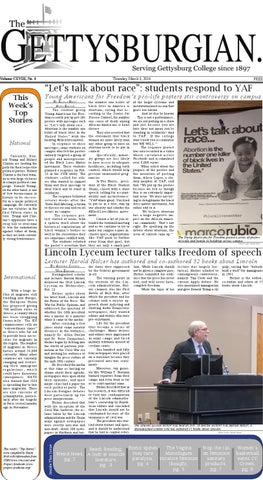
Young Americans for Freedom’s pro-life posters stir controversy on campus B y K ayla B ritt N ews E ditor The student group Young Americans for Freedom recently put up pro-life posters with messages such as “Let’s talk about race... Abortion is the number one killer of black lives in the United States” with the hashtag #blacklivesmatter. In response to these messages, some students on campus who felt the posters unfairly targeted a group of people and misrepresented the Black Lives Matter movement. These students planned a response on Feb. 23 in the CUB lobby. The students called for others who wanted to support them and their message to wear black and to stand in solidarity. The response followed several weeks after the Town Hall Meeting, a forum to discuss racism and racial issues on campus. The response protest started at noon, with a spoken word about the historical exploitation of black women’s bodies as well as the stereotypes they are sometimes saddled with. The students rebutted the poster’s assertion that
the number one killer of black lives in America is abortion, saying that according to the Center for Disease Control, the number one cause of death among African-Americans is heart disease. They also asserted that the statement that black women are more likely than any other group to have an abortion needs to be put in context. Specifically, minority groups are less likely to have access to adequate healthcare, including birth control, which would help prevent unintended pregnancies. Ja’Nai Harris, president of the Black Student Union, closed with a short speech calling for accountability and inclusiveness: “YAF whats good. You tried to put us in a box, sum up our identity and slander the #BlackLivesMatter movement. I know a lot of you attended the townhall meeting and as we continue to try to make our campus a more inclusive space, organizations like YAF push us further away from that goal, but they are only a small part
of the larger systemic and institutionalized racism that gears our nation. And let this be known ... This is not a performance, we are not putting on a show and just because you are here does not mean you’re standing in solidarity! And to YAF.. If the college won’t hold you accountable but WE WILL.” The response protest was also recorded in a video which circulated across Facebook and accumulated over 8,000 views. When asked about the purpose of the posters and the intention of posting them, Alissa Lopez, a student member of YAF, said that “We put up the posters because we felt as though this is an extremely important issue. We were not trying to delegitimize the black lives matter movement, but rather add to it. We believe abortion has a huge negative impact on the African American community. That’s not right. By sparking up the debate about abortion, the issue of context came up.”
The Young Americans for Freedom posted a series of posters on walls and boards in buildings across campus. Photo Credit: Naima Scott
Lincoln Lyceum lecturer talks freedom of speech Lecturer Harold Holzer has authored and co-authored 52 books about Lincoln B y A nnika J ensen W eb E ditor
With a huge influx of migrants still flooding into Europe, the European Union has proposed giving 700 million euros to Greece, a country which has been struggling financially. The EU commissioner calls on “extraordinary times” as Greece asks for aid to provide basic necessities for migrants in the region. The number of migrants in Greece hovers around 24,000 currently. Many other countries are currently changing and restricting their immigrant regulations, which could have disastrous consequences. NATO also warned that ISIS is spreading due to this mass migration. There are also concerns of islamophobia, particularly after the tragedy in Paris several months ago in November.
This week’s “Top Stories” were compiled by Kayla Britt with information from CNN (www.cnn.com) and Project Syndicate (www. project-syndicate.org)
Distinguished scholar and lecturer Harold Holzer delivered the 2016 Lincoln Lyceum on Wednesday, Feb. 23. Holzer spoke about his latest book, Lincoln and the Power of the Press: The War for Public Opinion, and addressed the question of whether the 16th president was a master or a monster when it came to the media. After cracking a few jokes about some notable absences in the audience, namely Dr. Allen Guelzo and Dr. Peter Carmichael, Holzer began by delving into the world of partisan journalism in the Civil War era and inviting his audience to imagine the press culture of the mid-19th century. He described the media at this time as having no shame about their agenda; newspapers were open about their opinions, and most major cities had a paper for each political party. The Lincoln-Douglas debates were particularly up for press interpretation. Holzer described that with the inception of the Civil War, however, the actions taken by the Lincoln administration and the Union army against newspapers were overtly anti-war and anti-draft: about 200 newspapers in Northern and bor-
Inside This Issue
International
der states were suppressed by the federal government in all. The turning point in the attitude of the Lincoln administration, Holzer claimed, was the First Battle of Bull Run, after which the president and his cabinet took a stricter approach about indicting and shutting down Democratic newspapers; they wanted editors and writers who were pro-enlistment. Life for the president thus became a series of challenges. Many writers and editors were imprisoned in army camps and faced military tribunals instead of civilian courts. One hundred and fifty four newspapers were placed on a watchlist because they presented anti-war sentiments. Moreover, top generals like William T. Sherman banned reporters from their camps and even went as far as to court-martial some. Holzer described that in his research, it was difficult to find any condemnation of the Lincoln administration’s censorship by Republican editors and concluded that Lincoln should not be condemned because of the uniqueness of civil war. The president was worried about traitors and spies, and it should be understood that he had to combat rebel-
lion. While Lincoln should not be given a complete pass, Holzer reminded his audience that the press has never had, and will never have, complete freedom. While the topic of his
lecture was largely historical, Holzer alluded to contemporary controversy, namely Tim Cook and the current Apple debate. He also mentioned immigration and gave Donald Trump a sly
quip, saying that “nobody built a wall” for immigrants in 1861. H o lzer is the autho r, co-author and editor of 52 books about Lincoln.
The Lincoln Lyceum lecture was held on Feb. 23 and the lecturer was Harold Holzer, a distinguished scholar who has authored 52 books about Lincoln.
The Vagina Beach Reading: Bionic spines may cure Monologues Weird News, A look at seaside paralysis, vocalize feminist pg. 2 literature, pg. 4 thought, pg. 3 pg. 5
Photo Credit: Annika Jensen
Stop the tax on feminine sanitary products, pg. 7
Women’s basketball earns CC Crown, pg. 8
THE GETTYSBURGIAN
NEWS
Page 2
♦
Thursday, March 3, 2016
Sunderman Conservatory of Music celebrates the 10th anniversary
Over ten years, the music program has expanded and added more full-time faculty members C ourtesy of GCC&M It is a minute timeframe when viewed through the lens of America’s most storied music conservatories, but for the Sunderman Conservatory of Music at Gettysburg College, it represents a significant milestone of both impact and progress. During the academic year, the Sunderman Conservatory has been celebrating its 10th Anniversary by hosting a number of marquee events on the Gettysburg campus and at the historic Majestic Theater. The celebration culminated at the end of February with an anniversary weekend that featured bookend performances by two excit-
ing ensembles, Decoda and JACK Quartet. Its members, who have garnered critical acclaim in the U.S. and abroad, are dedicated to the performance, commissioning, and spread of new string quartet music. The centerpiece performance of the weekend was a gala concert by the student ensembles featuring the College’s choirs, Orchestra, Wind Symphony, and Jazz Ensemble. Another highlight of the weekend was our symposium, Making Music in the 21st Century: Innovation, Transformation, Adaptation, featuring keynote speaker Gregory Sandow and panelists Fred Bronstein, Brian Pertl, Jeff Scott, Monica Ellis, and musicians from
Decoda and JACK Quartet. Since the founding of the Conservatory in 2005, the number of music majors and minors has increased substantially. The number of full-time faculty members has doubled. A Bachelor of Music in Performance degree was added to complement the Bachelor of Arts with a Major in Music and the Bachelor of Music Education degrees, and the program has gained accreditation from the National Association of Schools of Music.
Weird News of the Week
The Sunderman Conservatory expanded when Dr. F. William Sunderman ’19, left a donation of $14 million—the largest gift in the College’s history—to establish the Sunderman Conservatory Photo Credit: GCC&M of Music.
Senate Update
By Kayla Britt News Editor
Wigging Out A Japenese inventor, Yoshiro Nakamatsu, recently created a “guard wig” which has both protective and warming properties. It contains metal and a coiled strap inside. He claims he is saving this great invention for none other than Donald Trump. At at the Foreign Correspondents’ Club in Tokyo, he displayed diagrams which show how the wig works. Don’t Look Down The Skyslide, a glass slide which starts from the 69th story of the U.S. Bank Tower and ends at the 70th, is planned to debut this June. The building is redesigning and the new addition is part of a plan to attract guests and visitors. It will cost $25 to visit the rooftop complex and another $8 to slide. Just don’t look down!
February 29, 2016 By Brooke Gutschick Student Senate Secretary
Student Senate Bullet Points •
Jackie Beckwith presented regarding the steps that the
College are taking to improve sustainability. She asks for proactive student engagement. •
Gettysburg African Student Association was allotted
$956 •
Refugee Action Committee was allotted $800
•
Model Arab League was allotted $3,965
•
Asian Student Alliance and Young Americans for
Liberty were re-recognized
Photo of the Week!
Students are welcome to attend the weekly meetings of the Student Senate Mondays at 7 p.m. in CUB 260.
Photo Credit: Linh Phan
Interested in writing for News?
February 18 was the James Krippner Lecture Reception in Schmucker Art Gallery. James Krippner gave a lecture on 20th century modernist photographer Paul Strand and his work. Here, students examine Strand’s work as it is displayed in the gallery. To submit your own photo of the week, email your submission to ralebr01@gettysburg.edu!
Get your article on the front page of The Gettysburgian Contact Kayla Britt (britka01) for more details!
THE GETTYSBURGIAN Page 3
A&E ♦
Thursday, March 3, 2016
Beach Reading: the seaside in classic literary works B y E mily P ierce S taff W riter Spring break is almost upon Gettysburg College. Some anticipate a rejuvenating vacation, complete with tropical breezes and fun in the sun. For others, this break means going home, hunting for a summer job and doing data entry work for their mother (though perhaps that’s just me). No matter where you find yourself over break, you can almost certainly transform your experience by immersing yourself in a good book. And what better way is there to almost instantly transport yourself to a seaside location? I feel like a list of oceanic literature suggestions would be incomplete without The Old Man and the Sea. Written by Ernest Hemingway, the story deals with a fisherman attempting to conquer a giant marlin, who proves to be a worthy adversary. Despite the adventurous and testosterone-driven aspects of the book, the narrative is quite pensive. For this reason, I recommend this novel in particular to those who need respite from a trying semester. However, I
would caution against hastily running away to become a fisherman in a secluded area, tempting as such a prospect might be. The work of Jean Rhys always has a transportative feeling, due to her frequent use of the stream of consciousness technique. Her most significant work, Wide Sargasso Sea, stands as a prequel to Charlotte Bronte’s Jane Eyre and focuses on the first wife of Mr. Rochester, a character frequently written off as merely insane. The dimension of the work will leave you sobbing, so perhaps it would be best to read this in private. Of course, the ocean is very fickle and also mildly terrifying. If you’re not too wary of what lurks below, try Jules Verne’s Twenty Thousand Leagues Under the Sea. The submarine adventure that spans the seven seas is arguably much more interesting than sitting poolside. Additionally, the book is relatively ahead of its time, given that it was published in 1870 but features a great deal of scientifically accurate facts. This is definitely one for lovers of science fiction, though anybody could find
enjoyment in the novel. Life of Pi definitely deserves note on this list. The film is incredible, but reading Yann Martel’s words provides an entirely different and fresh experience. Combining aspects of survival narratives and existential discussions, the book could arguably be seen as a metaphor for the college experience. If you need further convincing of this idea, please remember that there is a tiger in the boat. Finally, I strongly endorse the concept of reading Virginia Woolf’s To the Lighthouse over spring break. Woolf hit a rare spot in modernist literature by simultaneously eschewing the loftiness of her peers and prioritizing the artistic value of her work. To the Lighthouse follows a family taking a holiday on a Scottish isle. The narrative sprawls, yet empathizing with the characters is still easy. My advice: keep your eyes open. It is a “blink and you miss it” kind of book, as this is a “blink and you miss it” kind of life. No matter where spring break takes you, I hope a book provides you with a journey.
In Theatres Near You
WZBT: Gettysburg College’s Very Own Radio Station
WZBT 91.1 FM is Gettysburg College’s Radio Station. Style described as Indie/ College Radio, the station provides the community with news programming as well as varying genres of music regularly. Tune in everyday to see what’s new on WZBT. Streaming live at: http://tunein.com/radio/WZBT-911-s24329/ You can also check out WZBT at: www.wzbt.org https://twitter.com/WZBT https://www.facebook.com/wzbt911
WZBT’s top weekly adds and albums WZBT Radio 200 | ‘Top 5 New Releases’ | CMJ 1408 1 2 3 4 5
CHARLES BRADLEY Changes Daptone SANTIGOLD 99cents Atlantic DEEP THROATS Good Bad Pretty Castle Face-Effeminate CRATER Talk To Me So I Can Fall Asleep Help Yourself POLICA United Crushers Mom And Pop
WZBT Radio 200 | ‘Top 10 New Albums’ | CMJ 1408 1 FIELD MUSIC Commontime Memphis Industries 2 DR. DOG The Psychedelic Swamp Anti 3 FAT WHITE FAMILY Songs For Our Mothers Fat Possum 4 DIIV Is The Is Are Captured Tracks 5 LUTHER DICKINSON Blues And Ballads (A Folksinger’s Songbook) Vol. I And II New West 6 SUNFLOWER BEAN Human Ceremony Fat Possum 7 C DUNCAN Architect Fat Cat 8 FRIGHTS You Are Going To Hate This Dangerbird 9 WILD NOTHING Life Of Pause Captured Tracks 10 PHOTO OPS Vacation Bad Friend
Majestic Theater
25 Carlisle St, Gettysburg, PA 17325 The Lady in the Van 1 hour, 44 minutes – PG-13 Maggie “Downton Abbey” Smith stars in this touching comedy about a homeless woman, living in her car who forms an unexpected bond with the man whose driveway she parks in for 15 years. All-star British cast includes Jim Broadbent, James Corden, Frances de la Tour, Dominic Cooper and Russell Tovey. Friday - Saturday (3/4 - 3/5) - 4:15 PM and 7:15 PM Sunday (3/6) - 2:15 PM and 5:15 PM Monday - Thursday (3/7 - 3/10) - 4:15 PM and 7:15 PM Where to Invade Next 2 hours – R To learn what the USA can learn from other nations, Michael Moore playfully “invades” them to see what they have to offer. Friday - Saturday (3/4 - 3/5) - 4:00 PM and 7:00 PM Sunday (3/6) - 2:00 PM and 5:00 PM Monday - Thursday (3/7 - 3/10) - 4:00 PM and 7:00 PM
Gateway Theater
Routes 30 & 15, Gettysburg, PA FRIDAY MARCH 4TH THRU WEDNESDAY MARCH 9TH **NO SHOWS AFTER 8PM MONDAY THRU THURSDAY** **BARGAIN TUESDAYS – ALL SEATS $5 – ADDITIONAL FEE FOR 3D** ZOOTOPIA 2D PG NO PASSES (1:10) (1:40) (4:10) 7:10 7:40 9:40 ZOOTOPIA 3D PG NO PASSES (4:40) 10:00 3D PRICING LONDON HAS FALLEN R I.D. REQUIRED (1:30) (4:30) 7:30 9:50 NO PASSES GODS OF EGYPT PG-13 (1:00) (4:00) 7:00 9:45 RISEN PG-13 (1:40) (4:40) 7:20 9:50 DEADPOOL R I.D. REQUIRED (1:15) (4:15) 7:15 10:10 THE REVENANT R I.D. REQUIRED (1:00) (4:00) 7:00 9:40 KUNG FU PANDA 3 PG (1:50) (4:50) THE WITCH R I.D. REQUIRED 7:35 9:55
A Midsummer’s Night Dream at Gettysburg College B y K ira G oodwin S taff W riter
On the final weekend of February 2016 in Kline Theatre, the Owl and Nightingale Players showcased their production of William Shakespeare’s popular comedy A Midsummer Night’s Dream. From the moment the play begins it captures the audience, starting with a dance sequence and guitar from Jacob Ryave, who also portrays Demetrius. This theme of music persists throughout the play, with Sarah Appendu and Jennifer Walisch also picking up t h e g u i t ar at t i m e s a n d Brynn Hambley mixing in the Shakespearean feel on her flute. The performance itself was extremely well-done as well. Daphne Ellis conveys the bubbliness and innocence of Hermia with her facial expressions and dance-like movements, while Audrey Bowler is powerful and intimidating as Titania, the fairyqueen. And both of them shine in their dramatic story arcs filled with confusion and love and magic. The subplot though, of The Mechanicals—the actors
who are preparing to put on a show of Piramus and Thisbe—is a purely comic element underlying the dramatic problems going on elsewhere. They are hilarious even just through their mannerisms, but their characters are also absurd, particularly Andrew Cowan’s Nick Bottom, who’s arrogance is highlighted. The scenestealer here though is Brynn Hambley as Peter Quince, the leader of The Mechanicals, as Brynn encompasses both the small actions and tone of voice to become a character whose main purpose is to provide comic relief. However, the character who was by far the most well-received by the audience was Andrew Gorelick’s Puck, another character brilliantly portrayed. His voice and his walk and all of his weird behaviors are so perfectly honed and crafted that he doesn’t even have to say anything to trigger a laugh from the audience; he can do it by simply walking onstage. From the moment he’s introduced it becomes clear that the show is his playground, and that no matter who the love interests are or the protagonists are, it is
~Please our www.thegettysburgian.wordpress.com website www.thegettysburgian.com and post your comments!~ ~Visit our visit website and post your comments!~
truly his show. The performance is also modernized to add s o me mo r e mo men ts o f comedy. For example, there is a moment where one character, Oberon, is upset, so he drinks beer and eats popcorn. And later on, the popcorn comes back into play as Puck eats it while watching other characters fight, acting as if he is watching a movie. There are also moments where modern music is mixed in. The Beatles’ hit “Yesterday” is sung in one scene, for example. Or there is a moment between scenes where a character walks across stage singing a rendition of “Free Fallin’”. Or, perhaps the best of these moments, when The Mechanicals are putting on their performace of Piramus and Thisbe and a character on piano starts playing the Charlie Brown music. The performers tried to add their own twists to their take on the classic tale so as to surprise the audience, and they definitely succeeded. The audience was laughing throughout and when the play ends and the fairies dance through the audience, it is clear that it was an enjoyable experience for all.
THE GETTYSBURGIAN
MONEY, SCIENCE & TECHNOLOGY Page 4
♦
Thursday, March 3, 2016
Bioengineers 3D print cartilage, Bionic spine to allow paralyzed patients to move future set for human organs By Marli Horwitz MS&T Editor Several years ago, bionic was a term we used to describe action figures, toys, and characters we deemed superhuman- these creatures were those that could stop time or fight the villain. Soon, research may allow us to see our own versions of these characters with the development of the bionic spine. According to a recent post in The Guardian, this 3 centimeterlong, couple millimeter-wide device will “enable paralyzed patients to walk again by allowing them to control bionic limbs with the power of subconscious thought.” Thus far, the tiny contraption has only been tested in sheep, but will be implanted in 3 humans next year; these individuals are current patients at the Austin Health spinal cord unit of the Royal Melbourne Hospital in Australia.
The bionic spine will be placed at the top of the motor cortex in the brain, where “nerve impulses that initiate voluntary muscle movements come from.” Then, and quite impressively, the bionic spine will send received signals to an apparatus implanted in the shoulder- this second device will turn the received signals to commands and, via Bluetooth, will tell the bionic limbs to move. Researchers have noted that the surgery to implant these devices is quite simple; what is more difficult is the coaching needed to help patients develop the subconscious thoughts necessary to create the transfer of signal from the bionic spine to the shoulder device, which in turn creates the bodily movement. According to The Guardian article, initially it will take significant effort for patients to develop the thought processes
necessitated to move limbs. However, eventually, these will become subconscious. Interestingly, the bionic spine is not, as commonly thought, repairing damaged pathways for movement in the brain, but rather it is helping the brain find new ways of doing maneuvers as simple as picking up a phone. This type of research and design has been done previously; however, “most require invasive surgery involving removing a piece of the skull, known as a craniotomy, and which carries a risk of infection and other complications.” The bionic spine is quite minimally invasive, and thus less burdensome for surgeons and patients alike. Looking forward, the device could also be extremely helpful to patients who experience non-physical paralysis, with such conditions as Parkinson’s, obsessive-compulsive disorder, and epilepsy.
Photo Courtesy of wlivenews.com
Developed by Australian researchers, a tiny device termed the bionic spine could be implanted in paralyzed individuals and create pathways in the brain that allow subconscious thought to move bionic limbs
This Week in Science March 3, 2016
By Mark Mednikov and Jill Glazer Contributing Writers
Photo Courtesy of nytimes.com
A 3D printed jaw bone and ear; bioengineeers at the Waske Forest Institute for Regenerative Medicine have created functioning cartilage for mice with hope for human patients soon. B y E rin S tackowitz S taff W riter From the fictional brainchild of Mary Shelley to the bioengineers at Wake Forest Institute for Regenerative Medicine in North Carolina, scientists are getting closer to achieving the technology to create fully functionally organs and body parts from 3D printers. Although there is no modern day Frankenstein in the works, scientists now have the ability to create and sustain printed cartilage in laboratory mice and have predicted that they will elevate this success to functioning organs within the next decade. Hyun-Wook Kang, Sang Jin Lee and other bioengineers at Wake Forest were able to develop a method that not only prints 3D cartilage
Byte-size reviews of the latest apps B y M arli H orwitz MS&T E ditor
Snapshot Postcard by NSN Solutoins, Inc. Size: 46.8 MB $FREE Compatability: Apple Devices, IOS 7.0 or later
Estrogen and breast cancer: Scientists have discovered five genetic variations, which could be useful in predicting breast cancer in women. These variants were all correlated with the female hormone estrogen. Roughly one in every eight women will develop breast cancer over the course of her life. Diagnose Schizophrenia: Research is suggesting a new way to distinguish between and diagnose schizophrenia, bipolar disorders, and schizoaffective disorder using MRIs, EEGs, several cognitive exams, and other tests. This information could potentially be helpful in a more accurate diagnosis and eventual treatment of those living with these mental illnesses. Source: scientificamerican.com, sciencedaily.com
Want to write for MS&T? No experience necessary! Contact Marli at horwma01 if interested!
materials that make up the cartilage. A mix of human and mice cells, gelatin, and a biodegradable plastic is placed in integrated patterns and attached to certain hydrogels. Clinically, this printer is extremely effective in printing 3D bones in the image and likeness of its recipient using computer modeling and anatomical imaging data. With the success of blood and nerve growth, the researchers at Wake Forest are hopeful and plan to move their murine trials to humans next, with the hope of building larger bones and eventually organs. This would eradicate our need for prosthetics and decrease loss due to the wait on lengthy donor lists.
AppTeezr
Genetic basis for cancer: A mutated gene associated with colon cancer was found in an 18th century Hungarian mummy. This finding shows that the genetic basis for cancer existed in pre-modern times, suggesting that the modern lifestyle is not the contributing factor to the rise in cancer levels. Danger in seafood: Scientists have confirmed that seafood originating near the Fukushima region in Japan continue to display low levels of radiation. In addition to the dangers this poses to humans who rely on seafood for nourishment, it also presents a threat to endangered species in the area.
but also maintains its integrity and sustains blood flow and growth. These engineers detail the development of the calvaria (skull cap), jawbone, and ear cartilage in “a 3D bioprinting system to produce human-scale tissue constructs with structural integrity,” published in the journal Nature Biotechnology. As soon as the bones and cartilage were reconstructed using their integrated tissue organ printer- or ITOP- they ran trials on the implant in mice, which survived and thrived for months. The successful survival of the tissue for an extended time period is due to the bone’s ability to maintain its structure. Its porous surface promotes the diffusion of nutrients allowing vessel growth. The tissue’s stability is due to its unique combination of
Photo Credit: itunes.apple.com
Going away over spring break? Don’t forget to keep family and friends back home in the loop! Forget about email! It’s more memorable and just more fun for your friends to get a SnapShot Postcard in their mailbox. From iPhone to mailbox in four simple steps: 1. Choose your photo 2. Enter message and address details 3. Tap on “Send” 4. Your postcard is printed, addressed, postage applied, and mailed!
Rating :
THE GETTYSBURGIAN
FEATURES The Vagina Monologues Health or hoax? Should vocalize feminist thought you put faith in fish oil? Page 5
♦
Thursday, March 3, 2016
By Ari Snaevarsson Features Editor
By K ira G oodwin F eatures C olumnist
This past Thursday and Friday ( February 2526), Gettysburg College hosted its annual Vagina Monologues. Brought to the college by Dean Ramsey 15 years ago, this feminist performance hopes to empower women and promote female activism. This event, sponsored by the Gettysburg College Women’s Center, sends all of its proceeds to Gettysburg PA’s Survivors Inc., a program that works to provide support to survivors of sexual assault. The Monologues, written by Eve Ensler, were compiled by interviewing women all across America about their vaginas. Some are based on one woman’s story and others on many women’s stories surrounding the same idea. The event opened with all of the night’s participants walking in quietly and sitting on the floor in front of the stage, where an open-mic set-up awaited its performers. All of the students were wearing red and black, meant to be symbolic of the night’s content. And after an introduction from this year’s directors, Naima Scott and Caroline Lewis, the stories commenced. The monologues combined the humorous with the horrific in order to shock
Photo courtesy of Daniella Snyder
the audience into attention and keep them engaged. But moreover, they were highly provocative. The actresses’ goals were to make the audience uncomfortable, because they shared truths about being a woman, and thus the audience’s discomfort came from their acknowledgement of these truths. They talked about women of all ages, from the 72-year-old who had never seen her vagina, to the sixyear-old who, when asked what her vagina would be if it were clothing, answered “red high tops and a Mets cap worn backwards.” They talked about lesbian women, prostitution, transgender women, and abuse, both sexual and otherwise. Each of these had their own moments of inspiration. For example, in the monologue “They Beat the Girl Out of My Boy,” which deals with the struggles of little boys growing up knowing they were actually women, inspiring moments of realization were shared. When they spoke of being able to get hormones and surgery and make their bodies match their insides, it was said that “I got permission to be myself.” And a line just as powerful and haunting remarked, “I would count the male particles as they died.” These sorts of moments would highlight every monologue, brought to
life by the students who put everything into their passionate readings of other people’s stories so they could successfully convey their messages. But they were not just other women’s stories. One student wrote her own monologue, detailing not only her experiences as a woman, but as a gay woman, and her powerful story highlighted the fact that everyone has their own personal experience with their femininity, no matter how much they can relate to that of others. The entire night was shocking and powerful, but one of the most powerful moments was when they cut away from the monologues for a moment to share a fact, stating that 20 to 70 thousand women were raped in Bosnia as an act of war. A monologue goes on to detail this experience, but the fact itself is so disturbing that it alone should be enough for someone to want to stand up for women’s rights. There were numerous other standout moments from the night that allowed every audience member to take away something personal from the experience. The Vagina Monologues were a significant and powerful event in inspiring female activism.
Interested in Writing for Features? E-mail Ari at snaear01@gettysburg.edu
So let me begin by saying the topic of systemic inflammation is an absolute beast to tackle, and 700 words can only do so much. Think of this as a super basic overview of fish oil and not much more. I will undoubtedly be returning to this topic later, as most supplements with a track record of fighting chronic inflammation are worth examining. To begin, let us define some operational terms. Eicosanoids are going to be our major player in this discussion; they are basically signaling molecules involved in the inflammatory and immune response, muscle protein synthesis, and CNS messaging. Eicosanoids are derived from either omega-3 (n-3) or omega-6 (n-6) fatty acids, the structural differences between the two coming from where the double-bond is located. The former are commonly found in beef, fish, and eggs from animals fed natural diets (along with other non-animal sources we will not be getting into), while the latter most often comes from vegetable oils (so, what most of your restaurant food is being
cooked in). Fish oil is generally composed of eicosapentaenoic acid (EPA) and docosahexaenoic acid (DHA), the two types of n-3 fatty acids found in animal sources. What is more important than how much of these fatty acids you are getting from your diet is the ratio of them to their n-6 counterparts. While our ancestors may have been eating diets with n-6 to n-3 ratios of 1:1, as high as 1:4, the modern Western diet looks more like 15:11. What this means for us is still a hotly debated topic, but studies do seem to reliably point to diets proportionately higher in n-3s yielding lower blood triglyceride counts2 and decreased rates of depression3. Not quite as universally agreed upon are its broader effects on systemic inflammation, muscle signaling, and so forth, but in theory, by increasing our n-3 to n-6 ratio, we are positively influencing the n-3-derived eicosanoids, which display more antiinflammatory responses to exogenous insults to the body, compared to the more pro-inflammatory n-6-derived eicosanoids4. While I am hesitant to place unquestionable faith in the effects
of high EPA/DHA fish oil supplementation, it remains a staple supplement of mine and one I recommend to most everyone. Nearly every non-genetic disease (and even those can, to some extent, be influenced by inflammatory markers) can be ascribed to chronic inflammation, meaning our body is inappropriately expressing an excessive immune response to stimuli that do not warrant it. In this vein, I have a difficult time not giving nutrients with proven anti-inflammatory properties (especially ones as nonspecific and widespread as n-3s) the benefit of the doubt. The takeaway: Systemic inflammation is right there with gut microbiota in terms of huge topics in the field of nutrition which deserve a lot more research and carry some huge implications in treating chronic disease. For general health purposes, at least from a theoretical standpoint, I think supplementing fish oil high in EPA and DHA n-3s is a great idea, but, to come back to our discussion on ratios, the bigger picture needs to be kept in mind. 3g of fat from supplemental fish oil is not going to do you much good if the rest of your diet is loaded with fried foods and processed animal products.
Students of Gettysburg Sydney Braat, Class of 2018, English major with a writing concentration
By Daniella Snyder W eb E ditor
“I thrive off of adventure, new friendships, and endless possibilities for personal growth, so signing up for an Immersion Project with the Center for Public Service (CPS) was an easy decision, but choosing where to travel was not. Every day in Morocco proved to be an adventure. We traveled from Casablanca to Rabat to Marrakesh to Rabat and back to
Staff Box
Casablanca. Sporadic moments of the trip included pulling off on the side of a highway to hop on camels for that perfect Hump Day picture and holding monkeys wearing diapers in a crowded Marrakesh shopping square. We visited one of the largest mosques in the world, met with NGOs, and heard from university professors about women’s rights and culture in Morocco. The difficulty of saying goodbye to endless Moroccan ad-
ventures and returning to my busy Gettysburg routine is a testament to the intellectually challenging and personally enriching immersion experience—one for which I will be forever grateful. My challenge for the Gettysburg College community is this: take advantage of CPS and the many opportunities they offer. Learn about other cultures. Test your boundaries. Say yes to adventure.”
Features Editor, Ari Snaevarsson
Editors-in-Chief, Brendan Raleigh & Lauren Perry
The Gettysburgian
Advisor, Jack Ryan
Web Master Jamie Welch
Sports Editor, Bethany Holtz
News Editor Kayla Britt
Web Editors, Daniella Snyder & Anika Jensen
A&E Editor, Raichl Davenport
MS&T Editor, Marli Horwitz
Opinions Editor, Isabel Gibson Penrose
Business Manager Zach Warner
THE GETTYSBURGIAN
Advertisements Page 6
♌
Thursday, March 3, 2016
THE GETTYSBURGIAN
OPINIONS Page 7
♦
Thursday, March 3, 2016
Note: The opinions published in this section are those of the individual writers and are in no way representative of the views of The Gettysburgian staff, The Gettysburgian or Gettysburg College.
Women’s Issues: Stop taxing feminine sanitary products by classifying them as “luxury items”
A map of the United States showing which states tax feminine sanitary products including tampons and classify them as a “luxuary item” (Courtesy of Fushion.net) B y I sabel G ibson P enrose O pinions E ditor March is Women’s History Month, and in honor of all the women who have fought for the rights I have today I will be writing an article about a different issue facing women every week of March. This week’s topic is sales tax on feminine sanitary products. The average woman
begins menstruating at the age of 12 and goes through menopause at the age of 51. That’s 39 years of menstruation. The average box of tampons costs $6.79, the average package of pads costs $7.99, and the average woman uses approximately 9 boxes of tampons and 7 packages of pads a year. Over 39 years that’s $2,383.39 spent on tampons and $2,317.77 spent on
pads. This means the average American woman will spend about $5,000 on tampons and pads over the course of her life – and she will be taxed the entire time, because the average American woman is financially penalized from the minute she starts menstruation The high cost of tampons and pads is an issue in itself and if I had my way women would get feminine sanitary
Stephen Curry and the evolution of basketball Photo courtesy of The Source
Stephen Curry is changing basketball into more than a “big man’s” game.
B y D ean D e L ucia S taff writer
Basketball is continuing to evolve through every game and every season. Stephen Curry has become one of the most popular basketball players within the last two years. With amazing ball handling, passing and multiple ways of scoring the basketball, Stephen Curry is being viewed as a person who is changing the game of basketball in a negative way. Basketball used to be known as the “big man’s” game. Every team wanted the tallest guy because everyone thought they were the best scorers on a ten-foot hoop. Over time people are starting to see a change in the game where there is less focus on big men. Now everybody wants to be a guard. A guard has the most important position on the court. They need to be able to do everything on the court, from rebounding, good ball handling, seeing the court well, being the coach on the court and making important shots down the stretch. Big men just need to be able to finish under the basket and
grab rebounds. The desire to be a guard has increased even more so after watching superstar Stephen Curry. Stephen Curry is doing almost everything imaginable as a guard. He is giving those that are not the biggest a sense of hope. He is proving that size does not matter in the so-called “big man’s” game. If you were to go on the internet and search Stephen Curry, you will surely be amazed as to how this young man can help his team win. But although he has many ways to contribute to a win, the most controversial contribution is the way he scores the ball. Three-point shooting is Stephen Curry’s best aspect of the game of basketball. His quick release and ability to shoot from anywhere behind the arc has made him a lethal person to defend. Besides the fact that three pointers are obviously worth more points, many coaches and fans are still attached to traditional basketball. They think that ball movement and easy two point shots is the smart way to play basketball games.
It is hard to say that easy two point baskets is the smarter way to play basketball because three point baskets are also helping Stephen Curry win many games. Maybe the amount of three pointers shot can help make players become more dangerous offensive players. The three point shot can help make players more versatile, rather than basic layups and points within the paint. Stephen Curry is not creating problems for upcoming players, instead he is making the game much more exciting and he is helping players realize that if you are not big enough to score within the paint then there are other ways for you to score. If you train to become quick enough and smooth enough to score from beyond the arc, then defenders will begin to play you tighter. This will lead to you being able to drive by them and create for your teammates. Evolution of the game of basketball is happening everyday by many different players. It is unfair to pick out Stephen Curry and argue that he is the only problem.
products for free because it is not as if any of us chose to have to suffer through shedding our uterine lining every month, but as it stands right now I am only addressing one small part of the problems American women face when it comes to our time of the month – the so-called tampon tax. The tampon tax gets is name from the sales tax that is applied to feminine sanitary products in forty states around the country. Tampons and pads are taxed despite the fact that all forty-five states with sales tax allow for exemptions for necessities like groceries. Five states (shout out to Maryland, Massachusetts, Pennsylvania, Minnesota and New Jersey) have explicitly eliminated sales tax on pads and tampons, and California and Ohio have legislation to do that same thing in the works. That would make a total of seven states that no longer tax feminine sanitary products, as compared to fifteen states that treat candy as a sales tax-exempt item (and of those fifteen states, ten of them impose sales tax on feminine sanitary products). The fact that candy is exempt from sales tax and considered a “necessity” in more states than feminine sanitary products are is a perfect demonstration of where women are ranked on the scale of American priorities. If you’re in Arizona, Georgia, Louisiana, Michigan, Nebraska, Nevada, New Mexico, South Carolina, Vermont or Wyoming you can buy a package of sour gummy worms without sales tax but God forbid you want to do the same thing with a box of tampons. I should be clear that tampons and pads are not luxury items. In fact, the Food and Drug Administration classifies tampons and pads as medical devices because they are “intended to affect the structure or function of the body.” Ask anyone who has
every menstruated and they will tell you there is nothing luxurious about it. There’s nothing luxurious about buying tampons, either. Over the summer I headed to the checkout counter of Target to buy my unused, unopened, but fully sales-taxable tampons and I received a look of disgust and an audible “ew,” from two grown men. Even more aggravating, I still had to pay sales tax even after being “ew”-ed at by two adult men who couldn’t stand the sight of a box of tampons. President Barack Obama was recently made aware of the tampon tax when he was interviewed by YouTube personality Ingrid Nilsen. I love President Obama but was not exactly surprised when he admitted that Nilsen’s question to him marked the first he had heard of this issue. He offered, “I have no idea why states would tax these as luxury items…I suspect it’s because men were making the laws when those taxes were passed.” This brings us back to the two men who “ew”-ed at me over the summer. Sorry I keep bringing you up, fellas, but you really embody the male fear of menstruation for me. Men do not like talking about feminine sanitary products and therefore tax code discussions went without mentioning them at all, making them more comfortable and the tax laws they wrote less progressive for women. Some have argued the fight against the tampon tax is overblown, usually by pointing out that some states have sales tax on other things viewed in the same vein as tampons, like toilet paper. My main problem with this argument is that those making it are missing the point. If your state has a tax on toilet paper, everyone in your state is going to be paying it. It’s not as if half the people don’t have to use toilet paper because they are biologically fortunate and never have to go to the
bathroom. The tampon tax is a problem because it adds another thing to the long list of burdens women deal with every day and it is yet another problem we have to deal with being told to stop complaining about. When it comes down to it, tax codes should not discriminate, even if it is by a few cents. I understand the financial burden imposed by sales tax on feminine sanitary products is not that large. I mean, the dollars saved would probably come in handy, especially since women get paid less than men anyway (keep reading Women’s Issues this month for more on that) but the truly frustrating thing is when various state tax codes were written women were so voiceless nobody even bothered to include feminine sanitary products in the tax codes. No man involved in writing tax laws stopped to consider if they were placing an undo burden on women by leaving out feminine sanitary products entirely and today’s women are still paying for it. Being a woman already comes with financial burdens like purchasing birth control, medication for relief of premenstrual syndrome, and essential exams for gynecological health and having another expense (no matter how low it is) is unacceptable. The actual cost is irrelevant. Getting rid of sales tax on feminine sanitary products is about ensuring women are equally represented in tax codes across the country. This small step towards equal representation will require tax laws to be amended to include feminine sanitary products in the “necessity” category because not viewing menstruation as something necessary undermines women and their bodies and it needs to stop.
Racism in Hollywood and how it connects to Gettysburg College By Jenna Seyer Staff writer
“Black people did not protest. Why? Because we had real things to protest at the time. Too busy being raped and lynched to care about who won best cinematographer.” “It’s going to be a little different this year…it’s going to be black people that were shot by the cops on their way to the movies.” “We want opportunity. We want black actors to get the same opportunities as white actors. And, not just once.” “Is Hollywood racist? You’re damn right Holly wood is racist. It’s the kind of racist we’ve grown accustomed to. Hollywood is sorority racist. It’s like, ‘we like you, Rhonda, but you’re not a Kappa.’” (The quotes above are from Chris Rock’s Opening Speech at the 88th Academy Awards) And, that’s exactly what the problem truly is: an everpresent racism of constantly changing forms that we’ve wrongly grown used to. What Chris Rock was able to make
clear was the undeniable presence of racism in society, one which has taken an altered shape of the past. Instead of burning metal into an individual’s skin, whipping people for no reason other than the color of their skin and refusing individuals of color equal, human rights, we now breed a different kind of racism. Today, we find that our social institutions, be it universities, police academies, and the political sector, practice the same deeply-rooted, racist ideology—just more subtle than 1960. It’s hard to imagine, through what our country has experienced, that racism still exists: Donald Trump’s proposal to ban Muslims from entering the United States, a minority of police officers targeting people of color in arrests and even a “Ghetto Fabulous Mixer” on our own college campus with an encompassing mistreatment of students of color—both inside and outside of the classroom. The mention of Hollywood as “sorority racist” is similar to the racial climate of Gettysburg College, the sometimes exclusionary nature of our student body.
Students of color should not have to worry whether our college is a safe environment, whether they are represented in the curriculum, whether they are treated the same as white students on campus. Students of races at Gettysburg College should be given the same opportunities, the same treatment, and the same privileges—as Rock explains with Oscar nominees and actors in Hollywood. Although efforts are finally being made toward improving that culture on campus, there still remains a long way before we are able to dispel this epidemic at its root. Change must be implemented in order to continue the struggle against racism. This collective purpose to better the way we treat others, as the Black Student Union elaborated on at the town hall meeting, includes educating people about racism, its effects, and its history, promoting the cause itself, and fighting against any organization which attempts to inhibit the progress made.
THE GETTYSBURGIAN
SPORTS
Page 8
Bullet Shot: Athlete of
Athlete of the Week the Week
Junior Ben Taber, photo courtesy of David Sinclair. B y M ichael B oncardo S taff W riter Junior Ben Taber has made his mark on the Gettysburg Men’s cross country team. From his breakout debut in the 2014 season to his current medal-winning performances with the squad, Taber has consistently proved his skill as one of Gettysburg’s top mid-distance runners. This particular season is a special one for Taber. The junior recorded the second best 3k time in Gettysburg track history at Bucknell, where he missed the school record by less than a second. Taber also medaled in the DMR at the team’s conference meet, competing in a particularly competitive bracket. “Indoor was very successful for me as an individual and as a team,” he shares. “It’s always an honor to medal in such a strong conference.” Taber is confident in both his own and the team’s prospects for the second half of the 2016 season: “I’m looking forward for the team to take a step forward and finish in the top 3 at conferences,” he says. “I think we can do even better outdoors.” Judging by the team’s last indoor meet, in which they finished 4th after a projected 6th place finish, this goal is certainly not a lofty one. Taber is eager to do his part to help the team reach their final goal: “Individually I’m just looking forward to improving in every event and trying to score as many points at conferences to help the team.” Taber’s achievements this season and his continued dedication to improvement has earned him the title of “bullet of the week.”
♦
Thursday, March 3, 2016
Gettysburg Softball brings home three wins
The Lady Bullets shut down Shenandoah University with two back-to-back wins
B y A ndrew M ilone S taff W riter The Gettysburg College Softball team got off to a hot start this past weekend, winning three of their four games on the road against the University of Mary Washington and Shenandoah University. Sophomore pitcher, Aileen Reilly, dominated on the mound. She earned three wins including a complete game victory against Mary Washington. “We strive to ‘win every pitch’ whether it is in the batter’s box or out on the field,” she said. The Bullets won the first game against Mary Washington 4-2 on Saturday. The second inning started with a nice gift of three unearned runs highlighted by back-to-back singles off the bats of sophomore Mykaela Twitchell and junior Jamie Abell. Sophomore Wendy Folfas added a run scoring double in the third to extend the lead to 4-0. Reilly allowed two runs but came away with the win while striking out four over a complete seven inning effort. Gettysburg played game two against the resilient Mary Washington. This game ended in a tough 7-6 loss on Saturday. The Orange & Blue scored three unearned runs
Photo courtesy of David Sinclair,GCC&M
Wendy Folfas, sophomore, put up a pair of doubles and brought in three RBI at Mary Washington. in the third, highlighted by a Folfas double that plated two in the process. Mary Washington would respond with three runs in the second and third innings including a solo homerun to tie the game at three apiece. Sophomore Jessica Casale had a double in the fourth inning which extended the lead by one until Mary Washington scored again in the seventh to knot the game up at 4-4. In extra innings, Gettysburg scored once in the eighth inning, and then again in the ninth inning, but Mary Washington countered each
tally with runs of their own. Mary Washington then scored one extra run in the 9th inning to win the ball game and split the doubleheader. Reilly came in for relief and took a tough loss allowing three unearned runs. The Bullets swept Shenandoah University on Sunday. They won each game by a score of 8-0 and 6-2 on Sunday. Reilly gathered her second win in a 9 strikeout, five inning performance during the first game. The Sunday 8-0 win was defined by a 6 run outburst in the fourth inning where Folfas would clear the
bases with a 3 run double in the inning. Junior Sam Misurell also collected a perfect 3-for-3 on her scorecard with a run and 2 stolen bases. Twitchell also reached base three times. Gettysburg has a lot to look forward to when it comes to the run game. “I think the team is definitely a threat on the bases, having both speed and knowledge of the game,” said Reilly. “Each week we work on a new aspect of base running which contributes to our base runners being smart on the bases.” The second game of
the double header was highlighted by a Twitchell two run double in the second inning along with first-year catcher Meredeth Taylor sending home 3 runners to contribute to the 6 run total. Reilly struck out 3 during four innings and only allowed one earned run. Reilly’s performance would put her at 3 wins to start the season and also help complete the sweep of Shenandoah University. “This was our first weekend that the team had the chance to play together all year,” said Taylor. “We made some mistakes, but now we know how each other competes and I believe that our relationship as a team will only get stronger as the season goes on.” At the end of the weekend, Reilly had pitched 17.2 innings with 18 punch outs and a 1.17 ERA. She was named Centennial Conference Pitcher of the Week and is one of the reasons that Gettysburg College challenges for a Centennial Conference Championship this season. The Gettysburg College Softball team returns to the diamond during a 10-game spring break trip at the Virginia Wesleyan College Beach Blast starting on March 5.
Men’s lacrosse loses against Salisbury University The men’s lacrosse team has not lost a regular season lacrosse game since April 23, 2014 B y S tephanie K aralis S taff W riter This past Saturday the men’s lacrosse team lost to Salisbury University, named 2nd in the nation for D3 men’s lacrosse. Last year the bullets beat Salisbury on their home turf. From the Bullet’s previous win, both teams were amped to play each other once more. The Bullet’s desperately wanted to win this game in order to continue their undefeated season, as well as, move up in the national rankings. Also, Gettysburg men’s lacrosse had not lost a game during the regular season since their game on April 23 againts No. 19 Franklin and Marshall College. The game started off with Salisbury’s Nathan Blondino, junior, scoring the first goal, giving Salisbury the starting advantage, leading to a quick consecutive second goal. However, the bullets were not going to give up. Gettysburg’s sophomore goalie, Tim Brady, cleared the ball to, first-year, Thomas Heller who assisted, first-year, Michael Risser for Gettysburg’s first goal of the game. The majority of the second quarter consisted of a constant battle for possession,
but the Bullets were persistent and worked hard, controlling the pace of the quarter. Despite Gettysburg having possession majority of the quarter, it wasn’t until after a combination of thirteen turnovers when the Bullets were able to execute a goal by senior Jameson Smith, his sixth goal of the season. With only three minutes and twenty seconds left in the quarter, the Sea Gull’s offence was able to score two consecutive goals, ending the first half (4-3) Salisbury. Within the first two minutes of the second half, Senior Paul Werner tied the game with a bounce shot. With the score board reading, 4-4, junior Brendan Hathaway scooped up the ball dropped from Sea Gull’s Christian Ottenritte, senior. Hathaway passed the ball to Smith, who assisted senior captain Mike Distler in his second goal of the season. Distler’s goal was followed by a goal by Heller, leaving Gettysburg in the lead, 6-4. After, Salisbury scored two back-to-back goals, tying the game. The rest Bullets scored one goal for the rest of the game, leaving the far behind the Sea Gulls with their additional four goals.
Photo courtesy of David Sinclair,GCC&M
Chris Palladino. junior, put down three ground balls and caused five turnovers versus Salisbury. Although the Bullets did not walk off the field this past Saturday with a win senior captain Billy McAvoy recognized that “a 10-7 loss wasn’t what [the team was] hoping for, but there are a lot of positives to pull from that game”. Additionally McAvoy mentioned that it “was only [the] second game and [the teams] first real test, so it’s encouraging to know that [the team is] only going to get better from here on out”.
McAvoy’s reassurance of the potential for the team is always a great thing to hear from a captain. Despite their loss, Gettysburg is ranked 5th in the nation in the United States Intercollegiate Lacrosse Association (USILA) Division III top-20. This is the Bullets 12th consecutive poll of being in the USILA top 10 of their top-20 poll, which dates back to week three of last season.
The men’s lacrosse team will be playing away at Lynchburg College this Saturday March 6th. The last time the bullets played Lynchburg College was at last year’s NCAA Division III semifinals. The bullets have an opportunity for redemption, so show your support either live or streamed from your computer.
This weekend in Gettysburg College winter sports: Saturday, March 5: Women’s Lacrosee vs Montclair State- 1:00 p.m. Men’s Lacrosse at No. 13 Lynchburg- 1:00 p.m. Sunday, March 6: Women’s Tennis vs John Carroll- 12:00 p.m. Men’s Tennis vs John Carroll- 12:00 p.m. Baseball vs Rivier (DH)- 3:00 p.m. Baseball vs Rivier (DH)- 6:00 p.m. Monday, March 7: Men’s Tennis vs Baldwin Wallace- 8:00 a.m. Women’s Tennis vs Baldwin Wallace- 8:00 a.m. Baseball vs Hiram- 12:00 p.m. Baseball vs. Finlandia- 3:00 p.m.
Are you interested in writing for the sports section? Contact Bethany Holtz at holtbe01 for more information!