Page 1
Volume CXX, No. 8
This week in 1897, The Gettysburg Mercury put in an advertisement asking students for songs for a college song book. They were willing to take songs from students and alumni alike. They really wanted Gettysburg students to think about it during the winter vacation and to ask “all the friends and alumni of the institution who have talent in the line of composition.” The Mercury staff was excited to create this book of “praises of old Gettysburg!” This week in 1902, The Gettysburgian reported that the Glee Club had a wonderful concert at the Teachers’ Institute. Attendees only had words of praise, and they encored all the songs they sung. Months of preparation were put into the performance, and it paid off. This work ethic can still be seen by our numerous musical ensembles on the campus who have been doing their final performances this semester. This week in 1947, Dr. Roy K. Marshall, director of the Franklin Institute Planetarium, came to the college to discuss nuclear fission. He was a renowned astrophysicist and he gave a seminar for the science majors, as well as anyone else who was interested in his research. The Gettysburgian stated that many students had already met Dr. Marshall before the event took place because he wrote about his research in the Philadelphia Evening Bulletin. It must have been an interesting event, learning more about nuclear and astrophysics. This week in 2002, Gettysburg was experiencing a Majestic revival! How did the Majestic Theater become what it is today? Back in 1925, the theater was built because of the plans of a 22-yearold Gettysburg alum, Henry Scharf. In 1922, his father died, and he became the owner of the Gettysburg Hotel. He set out to create an annex with a dance floor and a 1,200seat auditorium. The Majestic was born. The hall and auditorium were used often, however, in 1983, the Majestic was destroyed by a fire and was not refinished until the college bought the Gettysburg Hotel and Majestic in 1988. However, it quickly became inadequate for performances. In 2002, the theater was finally renovated to the wonderful theater we all know today. These archived “blasts from the past” were compiled by staff writer Shannon Zeltmann thanks to Special Collections in Musselman Library.
Thursday, December 7, 2017
Thursday, December 7, 2017
FREE
Celebrating diversity and S e n a t e p a s s e s community at Burgburst 2017 c o m p r e h e n s i v e conference control
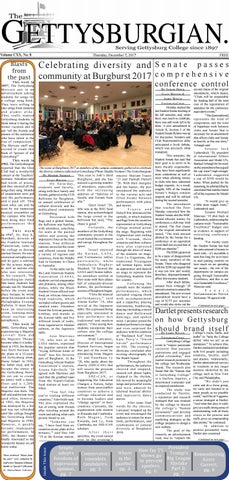
The scene at BurgBurst 2017 as members of the campus community gathered to celebrate the diverse cultures reflected at Gettysburg (Photo Maddie Neiman / The Gettysburgian) B y M addie N eiman This year is Anh’s third emcees: Mariam Traore Burgburst, and she has ’21 and Hannah Dalzell S taff W riter O n S a t u r d a y , noticed a growing number ’20. With their energetic s t u d e n t s a n d f a c u l t y , of attendees, especially and fun banter, the pair along with their family and w i t h t h e i n c r e a s i n g introduced the audience friends, gathered in the CUB addition of “families of to the various acts and Ballroom for Burgburst, faculty and friends from f i l l e d b r e a k s b e t w e e n performances with jokes an annual celebration of afar.” Quyn Israel ’20, and stories. cultural diversity and the Traore and multicultural community who was at the BSU food station, also acknowledged Dalzell first announced the at Gettysburg. D e c o r a t e d w i t h t h e l a r g e c r o w d i n t h e catwalk, in which students flags and a global theme, ballroom but said, “The and flags from the countries represented at Gettysburg the ballroom was bustling chaos is good.” C e r t a i n l y , t h e College strutted across with attendees, searching for seats at the packed members of the Gettysburg the stage. Beginning with t a b l e s a n d j o i n i n g t h e community present at the Afghanistan and ending impressive lines at the food event fueled the excitement w i t h V i e t n a m , t h e s e stations. Nine different and energy throughout the countries and their cultures were also expressed stations encircled the room space. I s r a e l e n j o y e d through the attire of many and offered cuisine from a variety of regions and t h e K o r e a n , L A S A , of the students on stage. countries, from the Middle a n d V i e t n a m e s e t a b l e s Even La Gigantona, the East to Germany to China p a r t i c u l a r l y , w h i l e t r a d i t i o n a l N i c a r a g u a n A n d e u l a z i a H u g h e s - tall woman figure, made to Australia. At the table run by Murdock ’18 favored the an appearance and danced the Latin American Student GASA and Chinese tables. on stage to represent the A s s o c i a t i o n ( L A S A ) , As attendees settled in Gettysburg students from students served empanadas their seats with their plates her country. Following the and platanos, among other full of culturally-diverse dishes, while the Black dishes, the performance catwalk were the student Student Union offered soul section of Burgburst began. p e r f o r m a n c e s , w h i c h “I love the musical included singing (both food, an African American food tradition, which performances,” said with accompaniment included collard greens and Alaina Keller ’19, who and a cappella), playing candied yams. Attendees s e r v e d a t t h e J a p a n e s e instruments, beatboxing, found the Korean pancake, table. She expressed being dancing (including a sword k i m b a p , a n d m a n d u a t especially interested in d a n c e a n d B o l l y w o o d the Korean table and five h o w p e r f o r m e r s m i x d a n c i n g ) , a n d s p o k e n different kinds of sushi, traditional and modern word. Lancaster joined the from vegetarian to Alaskan aspects. “I like seeing how student performers on stage salmon, at the Japanese students incorporate their and even surprised the culture into the college audience with his rendition table. of “Backpack Kid” from J o s e M a r t i n e z environment.” Brad Lancaster, K a t y P e r r y ’ s “ S w i s h ’19, who was at the LASA station, expressed Director of International S w i s h ” p e r f o r m a n c e the popular opinion that Student Services, began on SNL. The evening’s “trying different kinds of this part of the event by showcase concluded after f o o d ” w a s h i s f a v o r i t e introducing Irene Mugeni exciting choreography by part of Burgburst. At the ’ 2 1 a n d V u o c h n e a r L y the Bomb Squad. Throughout the Gettysburg African Student ’20, who spoke about the A s s o c i a t i o n ’ s s t a t i o n , charity (SHE-CAN) that performances, the audience A i s o s a E d e - O s i f o ’ 2 0 will receive the proceeds c h e e r e d a n d s n a p p e d , swayed cell phone lights, agreed with Martinez and from Burgburst 2017. S H E - C A N , o r clapped to the rhythm, said that she grabbed naan from the Nepali-Indian Supporting Her Education felt moved by meaningful food station at least six Changes a Nation, helps songs and powerful words, women from post-conflict a n d w e r e a m a z e d b y times. “ Y o u f e e l l i k e c o u n t r i e s t o a c h i e v e a talented musical ability you’re visiting different c o l l e g e e d u c a t i o n a n d a n d i m p r e s s i v e d a n c e countries,” Ede-Osifo said. t o b e c o m e l e a d e r s a n d moves. After some final S h e a l s o e x p l a i n e d t h e “change agents” in their fun of sitting with friends countries. Currently, the w o r d s b y t h e e m c e e s , after traveling around the organization aids women Lancaster wrapped up the room and asking what each in Rwanda and Cambodia. event and encouraged the B o t h M u g e n i , f r o m audience to return for more person found to eat. “ S o m e o n e c a n R w a n d a , a n d L y , f r o m food, performances, and say, ‘I have food from six Cambodia, are SHE-CAN celebrations of cultural diversity at Burgburst countries on my plate in five scholars. A f t e r t h e i r 2018. minutes,’” said Hoa Anh ’19 at the Korean station. speeches, the event turned over to the evening’s
Inside This Issue
Blasts from the past
♦
Senate adopts Conservatory freedom of considers expression candidates, opinion, pg. 3 pg. 2
B y S arah H inck S taff W riter & J amie W elch E ditor - in -C hief Monday marked the last Student Senate meeting of the fall semester, and, while there was much to celebrate, there was still work left to be done. A new amendment to Article II, Section 2 of the Student Senate Bylaws was up for discussion. Senators and Club Representatives alike anticipated a lively debate, which was precisely what transpired. This semester, the Student Senate has said that their goal is to strive to be more fiscally responsible. They have been significantly more contentious as well as strict when allotting money to clubs who have submitted budget requests. As a result, roughly 50% of the Student Senate’s budget remains unspent and will be utilized during the second semester. The amendment that reached the floor Monday concerned how the Student Senate and the BMC should allocate money for conferences a club may wish to attend. The first clause of the original amendment stated, “The total amount allotted by the Senate for a conference or an equivalent event shall not exceed that of $200 per attendee.” The $200 cap proved to be a topic of disagreement for many members of the Senate. Those who disagreed with the $200 cap argued that it was too low and would, therefore, disproportionately affect low-income students. After much debate, senator Nick Arbaugh ‘20 entered a motion to amend the amendment. The new revised amendment would have a cap of $275 per attendee and would also strike out the
second clause of the original amendment, which stated, “Clubs will be responsible for funding half of the total cost of the registration of attendees for the conference equivalent events.” “This [amendment] represents the kind of compromise and the kind of bipartisan work between clubs and Senate that is necessary for an amendment that affects clubs and Senate as heavily as this one does,” Arbaugh said. Senator Jack Lashendock ‘20, president of International Affairs Association and Model UN, thanked Arbaugh for his work on the amendment but argued the cap wasn’t high enough. Las hendo ck s ugges ted a cap of $350 would be better. When pushed for his reasoning, he admitted that he calculated that number based off of the expenses for Model UN. “It would give us a little more wiggle room,” Lashendock said. Senator Michael Mancuso ‘19 shot back at Lashendock, underscoring the campus-wide “Sustainable Excellence” budget cuts as evidence in support of restricting conference funding. “For twenty years the Student Senate has had the same amount of money to work with…it’s incredible it took this long for us to have to start putting controls on how much we are spending our money…the rest of the departments on campus are going through Sustainable Excellence, and this is our own Sustainable Excellence,” Mancuso said. S e n a t e Parliamentarian Patrick McKenna ‘20 agreed with -Continued on next page-
Dartlet presents research on how Gettysburg s hB oJ u l Wd b r aCollege’s n d traits, i t sfaults, e landf y
amie
elch
E ditor - in -C hief Gettysburg College exists to “inspire passionate curiosity that pursues aspirations and engaged global citizenship,” new market research presented to the college last Wednesday found. The research also found that the “human that is Gettysburg College” is a fearless inquirer, a determined contender and an inspired transformer. The study was conducted by Dartlet, a reputation and research strategist that was retained by the college to discern the college’s “human personality” and develop communications and marketing strategies as the college prepares to design a new website. The goal of the research, an advertisement read, was to “unpack the
truths” to “help the College define ‘who we are’ as an institution.” To achieve this, Dartlet conducted workshops with 614 people including students, faculty, staff and alumni. Additionally, Dartlet administered surveys to residents in key target markets identified by the college such as New York City and Philadelphia. “We didn’t just come and do a focus group, we came and listened to as many people as we possibly could,” said David Viggiano, a senior strategist at Dartlet. “And what that does it really give us a really strong sense of understanding with all those voices in the process and really gives us compounding data points,” he continued. In addition to positive personality traits, Dartlet also examined -Continued on next page-
President How far TV Trump’s Remembering Where shows go Big League is the Kerry to prevent Mistake gazebo?, Garrett, spoilers, Part II, pg. 4 pg. 8 pg. 6 pg. 7
THE GETTYSBURGIAN
Page 2
NEWS ♦
Thursday, December 7, 2017
Senate adopts freedom Gettysburg College is a “singular human” of expression opinion, which would allow “hateful” opinions B y M iranda F eeley S taff W riter The penultimate fall semester meeting of the Gettysburg College Student Senate consisted mainly of two presentations pertaining to the college’s ongoing process of adopting a statement of institutional philosophy on freedom of expression. One presentation was by College President Janet Morgan Riggs, explaining the committee process, and the other was by Senator Michael Mancuso ‘19, who presented an opinion for the body’s ratification. Later, Senate passed two budgets and tabled an amendment to the bylaws about funding for the final meeting of the semester, next week. Riggs spoke to the Senate first, emphasizing that the committee she has established to gather student opinions and sample philosophy statements from other institutions does not have any formal decisionmaking authority. Rather, the purpose of the group is to draft a statement, which will then be voted upon by the Board of Trustees, the faculty, and Student Senate, she said. Senate President Luke Frigon ‘18 also noted that if the Senate so chooses, they can send the statement to the entire student body for a referendum vote. Riggs then addressed concerns that such a vote or such a
statement would not be able to please everyone. “The best we can do is develop a philosophy that most people can agree on,” she stated. Senator Michael Mancuso ‘19 then presented an opinion that passed the Opinions Committee, which he chairs, for consideration by the full body. The opinion suggests that Supreme Court precedent should be the guiding principle for institutional conversation on freedom of expression and asserts that college students should enjoy the same right to free speech that students of a public institution would enjoy. Further, the opinion states that the college should distinguish between the rights of students and the rights of speakers brought to campus. However, the opinion explicitly allows for any “recognized student group [to] invite a speaker onto campus who espouses unpopular or hateful opinions.” After reassuring the body that the opinion had been drafted with the input of many voices over multiple weeks, the Senate approved the opinion. E d i t o r ’ s Note: The full text of this opinion can be viewed online at http:// gettysburgian.com/freespeech-opinion/
B y P eter Z hang S taff W riter Servo sure advertised the Thanksgiving dinner well. Emails rushed in weeks ahead suggesting ways to avoid the line. As a first-year, I had no idea what to expect. Around 5:30 p.m., I saw the line stretching all the way towards library. Thanks to friends from GRAB who waited in line since 3:00 and saved me a spot, I avoided much of that. Once I stepped into Servo, dressed up staff welcomed everyone. A red tablecloth was set up beautifully on each table. Three or four servers stood next to each table with delicious dishes. However, I soon realized that these weren’t the normal Servo staff: many professors and
administrators volunteered to help serve for this campus holiday. How wonderful! I spotted my GRAB family near the window in the grill area. Rachael was cutting the turkey, and everybody were joking around about how no one would be a vegetarian today. Conner, who sat next to me, was listing all the delicious dishes that are about to be served. However, foods were served before he even finished “bragging” about Servo Thanksgiving from years past. Stuffing, cranberry, mashed potatoes, pumpkins, everything that people would enjoy back home — it smelled delicious. With no time to waste, everyone started to passing the bowl around the table and filled their plates with all the dishes. Rachael suggested that we each share one thing for which we are
-Continued from page 1what they call “Death Stars,” or traits that workshop participants felt were inaccurate, untrue, unattainable, or were simply disliked. Death Star words were originally cited as accurate descriptors of Gettysburg College. One of the traits identified by Dartlet as a Death Star was “inclusive.” Excerpts provided from workshop discussion included phrases like “Greek Life is underlying exclusive and socially selective” and “I think there is a certain aspect of elitism on campus that oftentimes can be or feel exclusive.” Others said the college is behind the curve, with one participant accusing the college of being slow to make changes and another saying, “we never lead, we react.” “Charitable” was also identified as a Death Star, with one participant commenting, “the college is also very focused on money in a way that I think detracts from the learning experience.” D a r t l e t recommended that the college be more extroverted, more aggressive and more willing to take risks. “You’re saying ‘ideally we’re going to be this brilliant and transformative type’ and in order to be that, in order to express that, and in order to make decisions as a community and as an institution that reinforces that, you have to be more progressive,” Viggiano said. In addition to the personality assessment, Dartlet examined how Gettysburg College’s communications and marketing stack up against its competitors. Gettysburg scored a B- in the competitive audit, with Dickinson College also scoring a B-, Franklin and Marshall College scoring
a C- and Bucknell scoring an A. “We would say that Gettysburg College is sort of, in terms of tone and style and output, playing it a little bit safe there in the middle ground,” Viggiano said. Viggiano expressed discontent with the complete lack of historical messaging in the college’s marketing. “You are on hallowed ground here in terms of your historical past,” Viggiano said. “You have three of your competitors who are using ‘history’ and ‘historical’ as a key word, a very important theme in the marketing that they’re expressing, and it is completely absent from the marketing and what’s being expressed by Gettysburg College. “And we think it is incredibly unique…you stand on the hallowed ground of your historical past, and you are looking at how to use that history to inform the future,” he continued. While the research showed that 47% of Gettysburg’s perceived personality was based in the “friendly/provider” archetype, Viggiano doesn’t believe that that is a true representation of Gettysburg’s personality. “[Friendly/provider] is certainly something we evaluated very closely because there is [friendly/ provider] to some degree represented here,” Viggiano said. “But what we found is as we looked at how you defined what we typically call those [friendly/provider] traits, you were defining them in ways that really made them [discoverer] or [contender], not necessarily [friendly/ provider].” “Words like diversity, which are typically [friendly/provider] and yet you’re describing it in terms of… experiencing diversity,
not just bringing diversity here, but being a part of it and experiencing it, and how does that lead you to be a better person…a better institution,” Viggiano said. “We would tell you that these inquisitive, adventurous, green characteristics are what help you deliver positive impact on the world, and we think you should be screaming them from the hilltops because it is an authentic part of who you are as institution, and your history is a big part of that.” After the research presentation, Dartlet led a workshop that was designed to help college employees “weave these findings into [their] work,” an invitation said. Workshop attendees sat in small groups and were given the task of writing a sample introduction to a prospective student, and then writing a follow-up email to that same student. Dartlet provided a “messaging guide” that promised to tell the reader how to “harness Gettysburg College’s story to write your own on-brand messaging.” The process of crafting a successful, onbrand message, according to Dartlet, begins by getting into character. “Gettysburg College is a singular human being with one voice-not a fragmented split personality that people can’t recognize,” the document reads in part. Step two is to “list your evidence.” This could be a fact, event, detail, person or place that is the crux of the message you are trying to create. Step three is to map the selected piece of evidence to one or two dimensions. These dimensions are designed to offer relevant connections between the evidence and the broader
storyline. Step four is to use the chosen dimensions to find the corresponding storyline that will be used in the messaging. According to Dartlet, each storyline is weighted toward certain characteristics of Gettysburg College’s personality. The final step is to gather everything together and craft a message using the “laddering technique”. This involves either going “up the ladder” by listing evidence, followed by an elevation to the dimensions, followed by an elevation to the broader storyline, or going “down the ladder” by crafting your messaging using the elements in reverse order. The technique is harder to master than it seems. One high level administrator presented his mock conversation with a prospective student, offering an anecdote about an alumna who did great things at Gettysburg College and now works at ExxonMobil. He was interrupted by Scott Ochander, co-founder of Dartlet. “This is a great example of what I was talking about,” he said. “You were listing a lot of evidence… but you never elevated it to the story.” Vice President of Enrollment and Educational Services Barbara Fritze assured attendees that this is not the last they would hear of the work done by Dartlet. “This isn’t one and done,” Fritze said. “We’re going to come back to and be able to really review it again and again from a divisional standpoint. And then the Faculty and Student Enrollment Retention Committee will also be looking at this from a faculty perspective to make sure that they’re the champion of this as we move forward.”
thankful. I said that I was really thankful for becoming a family member of GRAB. People joked around throughout the dinner, talking about ups and downs of the semester, discussing how excited they were for the upcoming fall staff training. For a slightest moment, we forgot that each one of us were hundreds if not thousands miles away from home. However, the homesickness was erased by a group of family-like people. Servo Thanksgiving is my favorite Gettysburg event so far. Editor’s Note: This article is the thirteenth of our series “Dodging the Bullet: The First Year Journal,” in which The Gettysburgian‘s staff members from the Class of 2021 share stories, reflections, and perspective on their first year experience.
-Continued from page 1Mancuso, suggesting the Senate budget has not been increased due to the current lack of controls on spending. “I think if we move to be more fiscally responsible … and then we go [to the administration] … I think them seeing we have made moves to be fiscally responsible … will allow us to make that case [for increased funding] in a far better way,” McKenna said. Senators approved the revision to the amendment and began to discuss the amendment itself on the floor. There were still concerns that the cap of $275 was still too low, and there was a motion to raise the cap to $300. This revision, however, was struck down with 13 votes in favor, 18 opposed, and one abstention.
After having struck down this new cap, there was yet another motion to vote on the amendment as it currently stood, meaning that if ratified it would be added to the bylaws. It was with bated breath that the Senate voted and earned a twothirds majority in favor, thus officially adding the revised amendment to the bylaws. The amendment passed in an overwhelming voice vote with Lashendock the sole voice of dissent. The ratification of this amendment will most certainly impact clubs who seek to attend future conferences with money allocated by the Senate, which has expressed its intentions of becoming more responsible regarding its money, and this amendment is a testament to that.
“I’m really pleased with how tonight went,” McKenna said. Senate President Luke Frigon concurred. “We’re not always a perfect organization,” he said, “but at the end of the day we are getting things done, which is important … I hope you guys echo my sentiment of wanting to continue that next semester.” In other Senate news, two club budgets up for approval. The Owl & Nightingale Players requested $110.90, but received no funds, while Sceptical Chymists requested $41.65 and was allotted the full amount. The full Dec. 4 Student Senate meeting is available to stream on The Gettysburgian’s Facebook page.
D o d g i n g t h e B u l l e t : M y Senate restricts conference f i r s t S e r v o T h a n k s g i v i n g funding to $275 per person
DPS Crime Log
November 14, 2017 - Larceny: Theft of Bicycles from Corner Cottage Porch; Closed: Referred to Gettysburg Borough Police (GPD) - Drug Abuse Violation: Possession of marijuana, possession of drug paraphernalia, and underage possession; Closed: Referred to Office of Student Rights & Responsibilities (SRR) November 15, 2017 - Vandalism: Abraham Lincoln Memorial (Campus: Exterior - East of Stevens Hall); Closed: No suspects or witnesses November 16, 2017 - Liquor Law Violation & Underage Consumption: Rice Hall; Closed: Referred to SRR (RA/RC Referral) - Liquor Law Violation & Underage Consumption: Patrick Hall; Closed: Referred to SRR (RA/RC Referral) - Liquor Law Violation & Underage Consumption: Huber Hall; Closed: Referred to SRR (RA/RC Referral)
Compiled by Benjamin Pontz, Managing News Editor - Liquor Law Violation & Underage Consumption and Possession: Paxton Hall; Closed: Referred to SRR November 17, 2017 - Liquor Laws: Underage Consumption in Paxton Lot; Closed: GPD cited Nicholas Schraft ‘20 of Gettysburg College for purchase, consumption, possession, and transport of liquor on 12/5/2017 - Liquor Laws: Underage Consumption in Dining Hall; Closed: Referred to SRR - Liquor Laws: Underage Consumption in Christ Chapel; Closed: GPD cited Griffin McParland ‘20 of Gettysburg College for purchase of alcoholic beverage as a minor on 12/5/2017 November 18, 2017 No incidents to report November 19, 2017 - Liquor Laws: Underage Consumption in Stine Hall; Closed: Referred to SRR - Liquor Laws: Underage Consumption, Disorderly Conduct: Urinating in Public; Closed: Referred to SRR
November 20, 2017 - Larceny: Theft of Bicycles from Glatfelter Bike Rack; Closed: Referred to GPD November 21-25, 2017 - No incidents to report November 26, 2017 - Larceny: Theft of Bicycles outside Stevens Hall; Closed: No suspects or witnesses December 2, 2017 - Liquor Laws: Underage Possession in Stine Hall; Closed: Referred to SRR - Liquor Laws: Underage Possession and Consumption in Huber Hall; Closed: Referred to SRR
THE GETTYSBURGIAN
FEATURES Page 3
♦
Thursday, December 7, 2017
Four ways to cure “Holiday Eating Syndrome”
(Photo Lori G B y A ri S naevarsson F eatures E ditor A question I often get revolves around eating strategies for the holidays. At first, this perplexed me. Thanksgiving and Christmas are the primary holidays we think about when we think about stuffing ourselves with food and the tryptophan-induced food coma. In my mind, even if you were to go batshit crazy twice a year food-wise, would it really be that big of a deal in the long run? But the more I think about it, and the more I hear from clients and others about their experiences, the more it makes sense that this would be a major concern for some. First off, it is generally not just the holiday meal(s) itself/ themselves that are the issue; the feeling of going from “eating well” to “pigging out” can throw a wrench into one’s psychological soundness and, worst case scenario, set them up for a binge eating period. This is the reason the whole “eat clean during the week, ‘cheat’ during the weekends” idea is such a failure for so many people. Secondly, the holiday meals are just an extreme example of an already prevalent
reig/Flickr/CC BY-NC-ND 2.0) phenomenon that recurs in dilemma, and it pains me to smaller forms throughout see it. Sometimes people the year. Whether it’s the e v e n u n d e r s t a n d spontaneous Applebee’s superficially how damaging trip with the family or a less of a tool this is, and yet they prominent religious holiday continue to do it in little, t h a t i n v o l v e s e a t i n g possibly subconscious ways together, these instances and screw themselves over. happen quite frequently. It “Damage control” is no wonder so many refers to, either before or people worry about this a f t e r t h e e a t i n g b o u t , when trying to “clean up” reducing one’s intake or t h e i r d i e t . upping one’s energy output N o w , m y in an attempt to mitigate the immediate thoughts here are “damage” from how much roughly: Treat your body one will eat. There is the kindly, do not beat yourself obvious problem that this up for eating “too much,” just further reinforces the and embrace the 80/20 rule black-or-white thinking we in terms of moderation. are trying to avoid in the However, it is not always first place, but there are this simple, especially for some other issues at play as someone who has struggled well. First, this robs one of with this on a clinical level, the supposed joys of the something I have seen holiday. It’s devastating to personally having helped t h i n k a d a y m e a n t t o patients with active eating celebrate family and time disorders. These on-and-off together can turn into a episodes can really rock nightmare of potential someone and keep them “screw-ups” that provokes f r o m l i v i n g a l i f e o f so much anxiety. Rather moderation where food can than enjoying the holidays, be viewed as a social individuals trying to connector and form of “damage control” often end sustenance, rather than a up exercising profusely and series of moral decisions. eating troublingly small So, here are my top four amounts of food the week tips. Hope these help! or days before. By the time Christmas dinner comes, Do not “damage control” they are starving and tired This has got to be and probably pretty moody. the most common approach This leads to borderline or people take to this diet full-blown binge eating,
which means ignoring the rest of the family and eating in a shameful way all to elicit the same feelings of worthlessness that will end up spiraling back into the restrictive mindset you instituted prior. The second problem to bear in mind is that this is simply not scientifically sound. Without fixating on the actual number of calories you’ll be eating at dinner, let me just say that it is nowhere near as big or as “detrimental” as you might think. Even if you were to have considerably more than you would normally eat for dinner, that singular meal is going to have a minimal effect on body composition at the end of the day. The mental energy and willpower necessary to heavily restrict food just in preparation for a slightly larger-than-normal meal is not worth it at all. What do you do instead? Eat normally. Sure, don’t spoil your appetite before dinner too much, but other than that, I highly encourage spending the time before and after this meal eating like you normally would. You can rest easy knowing you are eating according to your body’s needs and not freaking out about calories or “pigging out.”
family you are close with. And if that means cancelling on that part of your extended family you had planned on eating with who you barely talk to and do not enjoy the presence of, so be it! That is a million times better than conjoining the feelings of discomfort with your eating quantity with the feelings of social discomfort. Spend time with people you actually enjoy, and be talkative and friendly. Another idea is to have everyone move to the living room, or some equivalent, after dinner and before dessert to talk more. Here, without the distracting food present, people will have one another’s undivided attention and can have a nice, relaxing time. You need not sit there with the pumpkin pie on the table staring you down while trying to ignore it.
Focus on the social aspects While the food itself at Thanksgiving and Christmas is pretty damn good, the real reason for the season is good company. Try to remember why you are all gathered together, and really enjoy that. Now, this seems like pretty empty advice to someone who expects to be fixated on their food intake at the time of the meal, so let me lay out some quick tips to give you an idea of how to make this work for you. First, you can make sure you are participating in conversations. This means, to go a step back further, ideally spending time with
Take a second to relax before your second serving Seemingly obvious at first, this is an important tool for managing your hunger/fullness levels. The old adage about waiting five minutes after eating to digest and assess your hunger is completely true. This is even more so the case when your satiety signals are blunted by the social atmosphere. What I mean by that is, as you are following Tip #2 and engaging in lively conversation about Bitcoin IRAs with your grandfather, your brain is not fully processing the feedback mechanisms from satiety hormones, such as leptin. This makes it necessary to wait a second after your first serving to let these signals catch up to you (and to let the immediate stages of digestion take place). You need not set an exact time to wait, but make sure, in this timeframe, to check in and see how you are feeling. If you could totally go for another full serving, go for it! If you are not completely sure, just grab your two to three
with question and answer sessions for only Conservatory students. These events give students and faculty an opportunity to be privy to the possibilities that each candidate offers. Like many Conservatory students, Bridget Haines ‘21, a Music Education major, has made it a point to go to as many of these presentations and meetings as her schedule allows. “Each of the candidates I’ve seen so far have all done some pretty neat projects that [have] been very innovative in their own communities, which excites me because I’m all for innovation and change,” Haines said. “All of them also seem very passionate. What has set some [apart from] others is that some seem to have a plan coming into the Conservatory about what they’d like to do and how they plan to do it, whereas others have seemed like they’re just here to continue what’s happening.” Haines is not alone in that observation. Rose Martus ‘19, a double major in music and mathematics, voiced concern over being prepared for graduate school auditions and focusing on building a
community structured in performance and supporting each other through performance. “I definitely want there to be an emphasis on performance and even just the small things like Now Hear This! because one problem that everyone sees in the Conservatory is Now Hear This attendance where barely any students ever show up and we don’t know how to fix that and how to get more people to come.” Martus believes that this is something that a new director can help with, but is a bit hesitant about the candidates’ game plans. “A couple of the applicants … didn’t seem to have much direction that they wanted to go in, at least from what I saw, and, when we would say ‘Okay, where would you want to take us?’, they gave us very wishywashy answers. Only one of them said ‘Okay, I have an idea, here is my idea, this is something we can potentially do.’ And I really like that attitude.” McCutcheon emphasized that the committee, led by the Provost Christopher Zappe, is taking student opinions into account: “We really value our students our opinions, we really
favorite food items that are being served. If you are feeling full, don’t eat. Sounds simple, but in the heat of food anxiety, it is not a l w a y s s o . Never eat past fullness This transitions us nicely into the final point, which is to never eat past fullness. Again, this is obvious on the surface, but it is also arguably the most ignored piece of advice in the nutrition world (if we combine the tip to always eat past hunger). While I do have some issues with the traditional method of intuitive eating that assumes our bodies know exactly what they need and when they need it, there are some nuggets of truth worth considering. If you just take the time to check in after eating and assess your fullness, you will be doing yourself a world of good. It seems to be cute and trendy to joke about how stuffed we get during the holidays, but this is not a normal thing to do to yourself. Granted, some people do not suffer from the toxic diet cycle thoughts that make binge eating so dangerous, and for them, this (while still metabolically unhealthy in an acute manner) is not such a big problem. But for those of us who have the quality of our diet on our mind constantly, this is a slippery slope. The feeling of eating enough to reach actual pain is part of the binge-restrict cycle, even at subclinical levels. This is what spurs on the desire to “take it easy” the next day, code word for “heighten our selfjudgment.” Editors’ Note: This is Ari Snaevarsson’s last issue with The Gettysburgian as he will be graduating next week. We thank him for his dedication to the newspaper during his time here at Gettysburg College, and we wish him all the best in his future endeavors! (J. Welch and B. Pontz)
Conservatory considers candidates to replace Hoke as director B y G auri M angala A ssistant N ews E ditor Earlier this fall, Dr. Kay Hoke, Director of the Sunderman Conservatory, announced her plan to retire at the end of the academic year, and, accordingly, Gettysburg College has set out to find a new director to continue developing the relatively young program. Director for a decade, Hoke took over the position in 2008 from Dr. John “Buzz” Jones, who retired last year after 28 years at the college, beginning when the cCnservatory was only two years old. Dr. Russell McCutcheon, Associate Director of the Sunderman Conservatory remarked, “Dr. Hoke, in the Gettysburg sense, has truly done great work, over the last ten years and has taken the Conservatory from a fledgling organization to where we are now.” The decision to hire Hoke was not made in haste. An educational consultant and national workshop leader for M u s i c! W o r d s ! O p e r a! who has served on the board of the College Music Society, on the Status of Women committee, and as the director of a CMS Institute on Women, Music
& Gender held at Indiana University, along with many other credentials, it was clear to Gettysburg College that Hoke could help the Conservatory take the next step in its development. Now, the search committee has identified four finalists who come from a variety of academic backgrounds. D r . S t a n Pelkey, Associate Dean of Engagement and Entrepreneurship in the College of Music at Florida State University, is an organist, pianist, and composer. Pelkey’s research involves American and British film and television music, English keyboard music, Handel reception history, and the music of Ralph Vaughan Williams. He has also learned to play the North Indian tabla and the Native American flute. Dr. Douglas Bomberger, Professor of Musicology at Elizabethtown College, is a member of the Society for American Music, the American Musicological Society, and the College Music Society. His musical interests include nineteenth-century music, piano literature, Transatlantic musical connections. His current
research involves the music of the year of 1917, marking America’s entrance into World War I and the American jazz era. Dr. James M. Day is Assistant Dean for the School of the Arts an d C o m m u n i cat i o n at The College of New Jersey, has worked with Goethe Universität in Frankfurt, Germany as a guest professor and with the Center for Cultural Partnerships, University of Melbourne, Australia as an Endeavor Award fellow. D r . J u l i a Mortyakova, Department Chair of Music and Associate Professor of Music at Mississippi University for Women, is a pianist who has performed as a soloist and a featured performer in various musical festivals across the globe including Assisi Performing Arts, Musica Nueva Malaga, Zhytomyr’s Musical Spring, and Natchez Festival of Music. Her research includes the existential philosophy of Jean-Paul Sartre in relationship to piano teaching, and the work of Cécile Chaminade. For the past week, the four candidates have been holding open forums and teaching demonstrations for the entire campus, along
value everyone’s opinions. So one of the things we are doing is we have a little form that we ask everyone to complete. It’s anonymous and certainly it’s their choice whether or not they want to complete it or not, but that form is how we collect those opinions. We do read them and we take them very seriously.” Regardless of which candidate is chosen, they will be an outsider to the Gettysburg approach. Students and faculty alike seem optimistic about that. Haines especially sees the benefits: “I feel that it is always good to get outside perspectives because everyone lives a different life and so it might be beneficial for someone who is not familiar with our day-to day way of living and question things we would never think twice about. While having an ‘outsider’ who wants to change things in our little community we have at the Conservatory might make some few defensive, I think it is important to embrace and listen to whoever the new director is and really work with them to a create a student, and community, centered action plan for the future of the Conservatory.”
THE GETTYSBURGIAN
FEATURES Page 4
♦
Thursday, December 7, 2017
Finals week relief is in Gettysburg students do sight at Musselman Library thousands of push-ups to B M L of the library). Then on semi-annual Finals Study support entrepreneurship The end of the Wednesday, December 13 Break. Join us from 7:00 y
usselman
ibrary
semester is here, and Musselman Library is happy to offer some sweet extra services to help get you through your finals week.
at 4:00 p.m., participate in Yoga with Anika (BYOM: Bring Your Own Mat). Take a moment to refocus with these mindfulness moments.
Stress Relief. The popular Stress Relief table will be returning to the ground floor of the Library. Give yourself a break from studying with the coloring pages, crayons, markers and fun craft ideas available. The table is there for use whenever the library is open, so whether you are in the building during the quiet morning hours or staying late for the midnight coffee cart, the stress relief will be available when you need it. In addition to the Stress Relief table, the library will be offering Monday Meditation on Monday, December 11 at 4:00 p.m. in Room 018 (ground floor
Extended Library Hours. Starting the last day of classes, you can stay in the library even longer than usual. Friday, December 8 the library will remain open an extra hour, until 11:00 p.m. The library will then open its doors at 10:00 a.m. on Saturday, and will not close again until the following Saturday (December 16) at 5:00 p.m. Enjoy 24/7 library access while finishing up your final projects and preparing for your exams. Finals Study Break. On Monday, December 11 Musselman Library will be hosting its
p.m. to 10:00 p.m. in Library Room 018 (Ground floor) to relax, play games, eat snacks and participate in various crafts and art projects. This year, there will again be the opportunity to decorate cupcakes! Come enjoy the food and games with friends! Research Help. The research librarians will be standing by to help you with your last minute research questions or citation dilemmas. Through Friday, December 15 at 3:00 p.m. you can just swing by the research help desk, call 717-337-6600, text (717) 473-4532, email ask@gettysburg.edu, or use the chat box on the library webpage. Good luck with your finals! We’ll see you in January!
(Photo Gauri Mangala / The Gettysburgian) B y G auri M angala University in Connecticut, In total, the dozen made its first appearance at “pushers,” who represented A ssistant N ews E ditor Two thousand push- Gettysburg this afternoon Phi Gamma Delta, Sigma ups on a Sunday afternoon? as 12 volunteers gathered in Alpha Epsilon, and the That’s what Henry Scavone Plank Gym to do push-ups. wrestling team, totaled over ’20 set out to do today as Phi Gamma Delta was the 4500 push-ups with Scavone part of the college’s first event sponsor, and proceeds alone doing nearly 1500. The Push for Entrepreneurship, went to the Connecticut event raised more than $700. an event that features Invention Convention, which, Editor’s Note: To volunteers doing push-ups to according to the Push for watch an interview with raise awareness and money Entrepreneurship’s website, Scavone, visit gettysburgian. to support entrepreneurial “is the nation’s largest com/push programming for young continuously operating Managing News people. The event, which program for K-8 student Editor Benjamin Pontz was pioneered at Fairfield inventors and entrepreneurs.” contributed to this report.
What
happened
to
the
Stine
Lake
gazebo?
What
happened
to
the
Stine
Lake
Gazebo?
(Photo courtesy of Gettysburg College)
B y B enjamin P ontz M anaging N ews E ditor No, your mind is not deceiving you. The gazebo that once anchored the point where sidewalks converged between Penn Hall, Glatfelter, Plank Gym and Musselman Library is no longer there … and it has been absent all semester. The gazebo was removed from its former spot in May
as construction began for the College Union Building’s renovations. “During the construction this summer all vehicle access routes were closed off from Lincoln Avenue, preventing delivery and service vehicles from accessing the Library, Paul Hall and Stine Hall,” explained James Biesecker, Director of Facilities Planning & Management. “The sidewalk coming from
Constitution parking lot was used for college and construction vehicle access to the center of the campus. This pathway needs to remain open through next summer, as there are still times when the drive from Lincoln Avenue could be closed down to support construction.” The gazebo is presently in storage, Biesecker said, and the college has not yet decided whether it will
return after construction is complete. “It is presently in need of repairs before it could be used again,” he said. Biesecker did not respond to a follow-up email inquiring what kind of repairs it would need; as of last spring, it was still in use as a spot for photos taken by the Communications and Marketing staff, among others. The gazebo first
came to campus prior to the 2008 election cycle, during which it was used as a hub for voter registration efforts by students in the political science department. Since then, it has been used as a point of congregation for students, a location for photos both by members of the campus community and wedding parties who have photos taken at the college, and a landmark in the center of campus. Students appear
to have mixed views on the gazebo. “Now there’s no more awkward splitting up between your walking mates,” said Skyler Ehly ‘18. However, Cole Watson ‘19 had a different take. “I miss it,” he said. “I enjoyed walking around campus seeing people chatting and laughing. It gave off a feeling of community.”
Staff Box The Gettysburgian Editor-in-Chief, Jamie Welch Managing News Editor, Benjamin Pontz Assistant News Editor, Gauri Mangala Arts & Entertainment Editor, Katherine Lentz Features Editor, Ari Snaevarsson
Money, Science & Tech Editor, Aphra Murray Opinions Editor, Alex Romano Co-Sports Editors, Claire Healey & Elizabeth Hilfrank Lead Copyeditor, Morgan Hubbard
Copyeditors, Lauren Hand, Nora Tidey, Sidney Caccioppoli, Maddie Neiman, Jessica Greenman, & Shannon Zeltmann Director of Photography, Claire Bickers Advisors, Jim Duffy & Jack Ryan To join our staff, visit http:// tinyurl.com/gettysburgian
THE GETTYSBURGIAN
MONEY, SCIENCE & TECHNOLOGY Page 5
♦
Thursday, December 7, 2017
Decontaminating New York with mussels B y E mma G runer S taff writer In today’s world, the task of caring for our planet appears more daunting than ever before. Despite increased attention to environmental issues, there are some parts of the world that simply seem beyond saving. Take the notoriously filthy waterways of New York City. Filled with everything from cigarette butts to runoff from wastewater treatment plants, these waters are becoming increasingly devoid of plant and fish life as algae block sunlight and consume oxygen at alarming rates. Fortunately, a team of scientists has recently found a promising natural “vacuum cleaner” – mussels. The work that led to this discovery w a s e x t e n s i v e , i n c l u ding input from marine scientists, commercial mussel farmers, and volunteers from an NYCbased youth development program. The team collected 32,000 adult ribbed mussels from the mudflats and salt marshes of New York City’s Jamaica Bay. These particular mussels were a natural choice for the clean-up endeavor. Ribbed mussels feed on bacteria and phytoplankton, which ultimately
reduces nitrogen levels and prevents the outbreak of algae, but they produce a foul-tasting chemical that makes them unfit for human consumption. The team then suspended the mussels in mesh bags from a 6-foot-by-6-foot raft, which they anchored downstream from the Hunts Point Wastewater Treatment Plant. This plant, which pumps out an estimated 830 to 1600 metric tons of nitrogen a year, is just one of the many contributors to the polluted state of the Bronx River estuary. After six months, the researchers removed the mussels, ground up a sample of 30, and measured the amount of nitrogen in their tissues. They determined that the 32,000 mussels would have collectively absorbed about 6 kilograms of nitrogen from the water. That may not sound like much, but a fully stocked raft of 338,000 mussels could remove around 60 kilograms, while hundreds of rafts could make a real, measureable impact on the quality of urban water. The team’s results were published last week in Environmental Science and Technology. Of course, there are some obstacles to
implementing this method on a large scale. The researchers were unable to coax larval-muss els onto the raft, meaning they had to personally collect adult mussels from a nearby salt marsh – which would ultimate prove more difficult as more mussels were needed. Also, the mussels would have to be periodically replaced – after mussels stop growing, their nutrient intakes slows dramatically, meaning that it would be inefficient to keep older mussels in the system. Yet the scientists are already brainstorming “green” ways to get around these problems – for instance, instead of just being carelessly disposed of, the older mussels could be ground up for chicken feed. After all, as the study’s lead author Eve Galimany says, “The whole point is to recycle nutrients.” While the mussel-cleaning operation may not be ready for execution just yet, its development indicates significant progress in the field of environmentally-friendly urban management. With more creative solutions like this one, we could very well be on our way to a green revolution.
AppTeezr
Byte-size reviews of the latest apps Roadtrippers With finals on the horizon, if you’re looking ahead to the break afterwards, then this is the app for you. Roadtrippers is the only map built for travelers. Whether you’re planning on going on an epic cross-country journey or a short weekend trip, this should be your top app. It shows landmarks that you should stop by on your roadtrip and ofters a variety of routes for your trip. Free Category: Travel Updated: Nov 09, 2017 Version: 4.4.1 Size: 100 MB Language: English Rated 4+ Compatibility: Requires iOS 10.0 or later. Compatible with iPhone, iPad, and iPod touch.
Upcoming Presentations Coming back in the spring, Senior Chemistry majors and other STEM students will be giving their capstone presentations. The schedule is as follows: 2/8 - Rich Gawel, Aphra Murray and Fontaine McFeaters 2/22 - Haoju (Orange) Li, Emily Harrison and Xintong (Amelia) Hou 3/8 - Emily Lutz, Siyan Chen and Sophie Johnston 3/29 - Austin Blair, Priscilla Ditren and Tyler Sadowski 4/12 - Taylor Buckley and Morgan McManus 4/26 - Jesse Martin and Joshua Wagner
(Photo A free guide to Foraging )
Senior STEM Majors ready for graduate school By: Aphra Murray MS&T Editor It is the time of the year when professors are piling on the work in preparation for finals week and students can almost taste how close they are to the finish. Application deadlines for graduate school begin to mount. STEM seniors here at Gettysburg College, in particular, have been feeling the pressure since the summer when advisors began to drop hints about resumes, GREs, CVs and personal statements. Students in the science’s in particular have mentioned that they have struggled with the balance of academic work and deadlines for graduate schools. Chemistry senior Emily Harrison stated that “before the semester started, I made a schedule of
what I needed to accomplish each week in order to have my applications completed on time.” Now that finals are coming up, most deadlines have either passed or are rapidly approaching. Harrison now says that the distraction of other classes is useful because at the moment it’s “a waiting game, but I’m excited to hear back from schools and start thinking about where I could see myself spending the next 5+ years working towards a Ph.D.” The cost of graduate schools has also been a burden on many of our students. With the rising costs of tuition and textbooks, students hoping to continue their education beyond Gettysburg are also having to cover the costs of the GRE and application fees. For the GRE, the
general test alone is around $160 and then an added cost of $27 to send the scores to every school that an applicant wants to. On top of that, there are the application costs themselves, which can range to up to $120 per school. Finally, the recently passed Senate GOP tax plan indicates that tuition waivers for STEM students attending graduate school could be taxed as income while they attend. This would increase the amount of taxes that they are currently spending by about 300 to 400 percent. Overall, it looks like seniors are getting excited for the holidays as it signals a break from both applications and schoolwork.
(Photo Amazon.com)
Bioinorganic chemistry of mineralized titanium B y E mma G runer S taff W riter In a continued effort to increase the number of scientific professional presenting their research, Skeptical Chymists brought Ann M. Valentine from Temple University. Valentine’s research has largely focused on the bioorganic chemistry of hydrolysisprone metal ions; specifically, titanium. The characteristics of this metal that were studied include metal binding and the transport and catalysis by biomolecules. Humans have found all sorts of uses for titanium outside of academic research, including in paint and
sunscreen. To this date, however, no biological role of titanium has been discovered. Valentine took care to be emphasize the yet, instead she believes that there must be some role for titanium in the human body and has undertaken the challenge to add to the growing literature on the subject. Titanium compounds are known to have a wide variety of functions, including having antitumor properties, enzyme inhibition and controlling bacterial growth. Titanium containing molecules have also been patented as growth promoters and have been recorded to mediate weight gain in some animals. As Earth’s
9th most abundant element in the crust, it is no wonder that there are such a wide range of uses for titanium. As Valentine continues her quest to find one of the biological functions of titanium, she remains connected to Gettysburg. Michael Lawlor, her husband, attended Gettysburg College for his undergraduate degree. And as a more recent connection, Valentine served as a post-doctoral advisor to our very own Professor Buettner at Temple. It is connections like these that ensure that we will stay up to date with Dr. Valentine’s fascinating research.
THE GETTYSBURGIAN Page 6
A&E
♦
Thursday, December 7, 2017
F e a t u r e d f i l m s i n WZBT: Gettysburg College’s Very Own Radio Station Gettysburg WZBT’s Top Weekly Adds and Albums “Artist” - “Disk” - “Label”
Majestic Theater
“Three Billboards Outside Ebbing, Missouri” (R) Run Time: 1 hour, 55 minutes In this darkly comic drama, a mother personally challenges the local authorities to solve her daughter’s murder, when they fail to catch the culprit. Starring Frances McDormand, Woody Harrelson, Peter Dinklage & Sam Rockwell. Friday - Saturday (12/8 - 12/9) - 4:00 PM and 7:00 PM Sunday (12/10) - 2:00 PM and 5:00 PM Monday - Thursday (12/11 - 12/14) - 4:00 PM and 7:00 PM “Lady Bird” (R) Run Time: 1 hour, 34 minutes Set in Sacramento, California in 2002, amidst a rapidly shifting American economic landscape, Lady Bird is an affecting look at the relationships that shape us, the beliefs that define us, and the unmatched beauty of a place called home. Starring Laurie Metcalf & Saoirse Ronan. Friday - Saturday (12/8 - 12/9) - 4:15 PM and 7:15 PM Sunday (12/10) - 2:15 PM and 5:15 PM Monday - Thursday (12/11 - 12/14) - 4:15 PM and 7:15 PM
WZBT Radio 200 | ‘Top New Releases’ | CMJ 1408 1. Bjork - “Utopia” - One Little Indian 2. Noel Gallagher’s High Flying Bird - “Who Build the Moon” - Sourmash/Caroline 3. Mavis Staples - “If All I Was Was Black” - Anti4. OCS - “Memory Of A Cut Off Head” - Castle Face
WZBT Radio 200 | ‘Top 10 Requested Albums’ | CMJ 1408 1. St. Vincent - “Masseducation” - Loma Vista 2. Julien Baker - “Turn Out the Lights” - Matador 3. Grooms - “Exit Index” - Western Vinyl 4. John Maus - “Screen Memories” - Ribbon 5. Hoops - “Tapes #1-3” - Fat Possum 6. Flat Worms - “Flat Worms” - Castle Face 7. King Leg - “Meet King Leg” - Sire 8. The Allergies - “Push On” - Jalapeno 9. World Is A Beautiful Place & I Am No Longer Afraid To Die - “Always Foreign” - Epitaph 10. Kissing Clouds - “You” - Self-Released
How far TV shows go to prevent spoilers
Tickets: $8.00
Gateway Theater Showtimes FRIDAY DECEMBER 8TH THRU WEDNESDAY DECEMBER 13TH **BARGAIN TUESDAYS – ALL SEATS $5 – ADDITIONAL FEE FOR 3D**
JUST GETTING STARTED (1:40) (4:40) 7:40 9:55
PG-13
NO PASSES
COCO PG (1:30) (4:30) 7:05 9:35
(File photo)
B y J ackie M c M ahon
JUSTICE LEAGUE PG-13 (1:20) (4:20) 7:20 10:05 WONDER PG (1:15) (4:15) 7:15 9:50 THE STAR PG (1:50) (4:50) 7:30 9:40 DADDY’S HOME 2 (1:45) (4:45) 7:35 9:55
PG-13
MURDER ON THE ORIENT EXPRESS (1:25) (4:25) 7:25 10:05
PG-13
THOR: RAGNAROK PG-13 (1:10) (4:10) 7:10 10:00
Is Public Access T.V. worth looking forward to in the future? B y K atherine L entz
A&E Editor Ne w Yo r k r o ck group Public Access T.V. is back with a new single from their upcoming sophomore album, Street Safari. The band, which con sist s of le a d si nge r a nd s ong w r it e r, Joh n E at he rly, X a n A i r d o n lead guitar, Max Peebles on ba ss , a nd Pet e St a r on dr ums, amassed a g reat deal of praise for their debut album Never Enough in 2016, but has their first album aged well enough since its release to ju st if y excitement fo r t h i s n e w a l b u m? I was apprehensive a b out r ev i sit i ng Neve r Enough. Although it was applauded upon release in 2016, I was afraid that perhaps it owes too much to the New York rock scene that preceded it. Much to the chagrin of John Eatherly, c ou nt le s s c om p a r i s o n s have been drawn between Public Access T.V. and the biggest New York band of the 2000s, the Strokes. Upon listening to Never Enough again, I found the band holds up on their own. Public Access T.V. deserves
more credit for developing their own sound, a difficult task for a band that’s just getting started. Comparing ever y you ng New York band to the Strokes has become a cliché in recent years, and I feel that it is highly reductive. Instead of focusi ng on shallow surface level similarities, the band should be judged on the merit of their own song w r iting and music. T he re a re numerous positive things to be said about Public Access T.V.’s debut album. One thing that stands out is the length of the album. It is concise and to the point, as opposed to being bloated and u nfocused. Being able to trim the fat off of an album is a good trait for a young band to have and something many a r t ists don’t k now how to do. For example, one of my major complaints regarding K ing K r ule’s recent album The OOZ is that it is too long; several songs cou ld h ave be e n cut from that album and it would have been made more consistent. Never Enough, on the other hand, knows exactly what it wants to be. At only
thirty-eight minutes long, it is just the right length for a rock and roll debut. T h is br i ngs me t o t hei r newest si ngle, “Metrotech.” Immediately, this song stands out from everything else the band has released. T he propu lsive re pet it ive ba sel i ne r e ca l l s f u n k y rock classics like “Let’s Dance” or “Another One B i t e s t h e D u s t .” T h e guitar adds color, taking a back seat to the vocals and bass. The drum beat is heavily syncopated and makes you want to tap your foot. The backup vocals a r e h ig h f a l s e t t o , b u t cleverly snuck in as not to be too obnoxious or cheesy. O n t he whole, “Metrotech” makes it clear that the band is moving in a new direction. The track re cord alone of P ubl ic Access T.V. makes their next album, Street Safari, an album worth looking out for. Only time will tell if the group will be able to follow up t hei r above-average debut with another great album, but if this single provides any sign of what is to come, I can safely say that any excitement is warranted.
Staff Writer R e c e n t l y , rumors hit the Internet that HBO’s hit “Game of Thrones” won’t be using scripts for their upcoming eighth season. HBO was hacked in August of this year— the culprits demanded a multi-million-dollar ransom— and when HBO refused to meet their demands, the scripts to unaired “Game of Thrones” episodes ended up online for all the world to see. While it is understandable that the network would jack up security measures in response, reports that the cast would be fed all of their lines via earpiece were met with confusion and dismay, as fans feared that the actors would not be able to deliver their best performances if they did not know their lines ahead of time. Luckily it seems that these reports were false, as the show’s cast was photographed meeting up in Belfast, Northern Ireland for a table read before production began this October. However, “Game of Thrones” still has other crazy ways to prevent spoilers. Because the show films largely on location in Ireland, Spain and other exotic locales, paparazzi often lurk to get photos of filming, sometimes even flying drones over the sets.
HBO decided to start filming fake scenes they had no intention of using during the production of season seven to throw the paps off their scent – they’re also planning to film multiple series endings. “The Walking Dead”, another popular show plagued by attempted leaks, used the same tactic with its season seven premiere – after season six ended with a main character getting beaten to death off-screen, the show filmed several different characters dying in order to keep the truth under wraps. In fact, one of the fake scenes leaked online before the premiere, which some fans took for the real deal. “Grey’s Anatomy” and “Scandal” creator Shonda Rhimes told The Hollywood Reporter that she has an assistant whose sole job is to create fake production notes, just in cas e the w r on g pers on gets their hands on them. Netflix’s 80’s set drama “Stranger Things”, which recently debuted its second season on October 31st, actually consulted with the producers of “Game of Thrones” in order to learn about their methods. “Stranger Things” initially had no security protocols in season one, but after the show became a hit, they found that they needed to be extra careful in order to keep their show secrets. The show
currently burns all their daily shooting notes and assigns code names to different characters, and even to the show itself. This was taken directly out of the “Game of Thrones” playbook— after (spoiler alert) fanfavorite character Jon Snow was famously killed off in the season five finale, the producers attempted to keep his resurrection a secret by keeping the character’s name off of scripts and wardrobe notes, and even banning cast and crew from using his name in conversation. Instead the character was referred to at all times as “L.C.”, short for “Lord Commander”. (Yet, despite all of this, paparazzi still managed to capture photographs of actor Kit Harington in costume on set.) These kinds of extreme measures come at a price. In the upcoming final season, one episode of “Game of Thrones” will cost HBO a rumored $15 million— with six episodes, that totals $90 million, not counting any alternate endings which will have to be filmed or the cast salaries, with multiple actors making $1.1 million per episode. However, it seems like HBO is more than willing to pay the price – according to The New York Times, “Game of Thrones” alone makes the network $1 billion annually.
“Alexa, play the On Target podcast.”
On Air: 91.1 WZBT-FM Tuesday 11am | Wednesday 2pm | Thursday 5pm Online: gettysburgian.com/podcast On iTunes and Stitcher: Search “On Target”
THE GETTYSBURGIAN
OPINIONS Page 7
♦
Thursday, December 7, 2017
Note: The opinions published in this section are those of the individual writers and are in no way representative of the views of The Gettysburgian staff, The Gettysburgian or Gettysburg College.
By Zack Sobeck
One hallmark of the MAGA agenda was an “America First” foreign policy. Presumably an “America First” foreign policy would place the specific needs and goals of the American people above all else when making foreign policy decisions. Trump signaled throughout the campaign that this would likely manifest itself in a less interventionalist style of international relations. One component of this less interventionalist foreign policy was the relaxation of stalwart zionist positions such as the push to move the embassy from Tel Aviv to Jerusalem. What does the movement of the United States embassy from Tel Aviv to Jerusalem do to benefit the American people? It serves only to inflate the ego of Israeli zionists while also upsetting the vast majority of the people in the region. One must remember that Israel does not have sovereignty over the city of Jerusalem. As of now, the United States is the only foreign state to recognize Jerusalem as the capital of Israel. I suspect the sudden departure from campaign rhetoric is (at least in part) to fulfil a promise given to Jewish mega-donor, Sheldon Adelson, who (in addition to being the biggest Republican donor of the 2016 election cycle) donated $5 million to President Trump’s inauguration. The movement of the embassy ultimately amounts to the facilitation of a foreign country’s geopolitical interests at the expense of the interests of the American people. This is clearly not an “America First” policy. When I cast my vote for Trump last year I was voting for America First not Israel First. It seems as though the president has unfortunately put the interests of Israel before the interests of the American people. This is indeed a Big League mistake.
Columnist On December 6, 2017, United States President Donald J. Trump delivered a speech on his intention to move the United States embassy in Israel from Tel Aviv to Jerusalem and further signaled his intention to recognize Jerusalem as the capital of Israel. This is indeed a BigLeague mistake and is a massive departure from Trump’s comments on the campaign trail. According to a CNN article on the meeting of the Republican Jewish Coalition during the 2016 Republican primaries, “Trump also faced boos from the crowd when in the question-andanswer portion of his appearance he would not pledge to keep Jerusalem as the undivided capital of Israel.” The article goes on to quote Trump as saying that a peace between Palestine and Israel, “will have to do with Israel and whether or not Israel wants to make the deal — whether or not Israel’s willing to sacrifice certain things.” This was in stark contrast to other Republican contesters at that time specifically Senator Lindsey Graham who went as far as to tell the Republican Jewish Coalition that, “I may have the first all-Jewish cabinet in America.” This was not the only occasion that Trump signaled a more realistic view on the PalestineIsrael conflict than his Republican colleagues. A different CNN article quotes Trump as saying, “Let me be sort of a neutral guy, let’s see what — I’m going to give it a shot. It would be so great.” One can clearly see how the sudden move to declare Jerusalem as the capital of Israel and the movement of the United States embassy from Tel Aviv to Jerusalem is a major departure from President Trump’s original Make America Great Again platform.
Guest Columnist L i v i n g i n Gettysburg brings our community closer to the National Park system than most towns in the northeast. Yes, we as residents complain about the tourists, and the fanfare for the park’s overwhelming presence in our town grates against our daily activities. Yet we also benefit from our proximity to this national treasure. Local communities rely on the park for the tourism revenue while college students and other locals are more able to explore the history of the land in their background. Classes in the biology and environmental studies departments use the park as an outdoor classroom, giving students crucial experience doing field work. Despite being a specific type of national park, the Gettysburg National Military park keeps in line with the progressive ethos of national conservation designations all over the country: to preserve and to teach. In interacting with the Gettysburg National Military Park, we know that it is inherently important to learn from and respect our history. President Trump, however, has not quite learned this lesson, it appears. In keeping with his path to undo Obama’s legacy, President Trump signed an Executive Order in April of this year to put 25 national monuments under review by the Secretary of Interior. Although President Trump claims that this review is necessary for erasing abuses of the Antiquities Act, it is clear that his motivation is purely down to increasing his rapport with rural blue-collar workers and the industries by shrinking or getting rid of national monuments. Yet in reviewing these designations, he also ignores many of the intricacies inherent in national monument designations. Most national monument designations come from a single piece of legislation, The Antiquities Act of 1906. This act, signed by President Theodore Roosevelt, gives the president the unilateral power to designate federally owned land that has cultural, historic, or scientific significance. More importantly, the act was to protect the cultural sites of natives from degradation and looting, but there was also a strong conservation effort to preserve these lands for future generations. National Monument designations typically have more lax regulations than those of national parks, but have a strong management hand to protect the lands. Up until now, these designations have been anything but political. Presidents of both parties have designated national monuments; even President George W. Bush, a staunch de-regulator, designated
national monuments. The designation of Bears Ears in December of last year has opened a debate, though, as to how far a president can go with this legislation. Despite having open debate on designating the lands for years before, many in intensive land use industries have said that this is a federal land grab which has created a “jobs versus conservation” argument wherein the designation will shut down all industry in the area. This argument, though, is based on logical fallacy. First and foremost, the lands included in national monument designations are always federal lands and all land permits (such as grazing) continue to be upheld. Therefore, the economy in the area will benefit from the increased tourism that the designations bring. It’s also worth noting that, in many of the national monuments, increasing land usage isn’t particularly feasible or sustainable. Yet even though these designations don’t adversely affect jobs, Trump chooses to hear these voices over other more valid perspectives to increase his political favor with industry. The perspectives he ignores have been distinctly underrepresented throughout American history. Native Americans have the greatest claims to the lands currently being debated. It is their ancestral and cultural sites that lie within those lands. They are in overwhelming support of the designations in Utah as they see it as a way to protect their culture from the looting and degradation that occurred throughout the 19th century. Many see this as the only way to truly save these pieces of their history. By ignoring this perspective, Trump ignores the foundation upon which this act was created. Beyond the human perspectives, though, lie the fates of many species. National monument designations have served as a way to conserve land without direct input from congress. Species such as the desert tortoise rely on national monuments for critical habitat. Though the review process has been closed and Trump has announced his decision to shrink at least two monuments, the fight is not yet done. What can we as citizens do to protect these national monuments? We can contact Congress directly or support the efforts of conservation and native groups in their legal fight against the shrinking of national monuments. We can make an effort to make these perspectives heard before more degradation to these lands happens. Although those of us who live in the northeast may never visit the large national monuments of the west, we have a stake in the stewardship of our public lands as citizens of the United States.
By Cassandra Shields
Guest Columnist In 2016, Donald Trump captured the American Presidency. Several months earlier, the United Kingdom voted to leave the European Union; thus triggering a wave of populism that spread across the globe. Although these have been labeled “populist” movements, they incorporate nationalism along with traditional populism. This extreme “national populist” ideology poses a grave threat to the stability of the international order. National populism in the United States may lead to a decline in international American power upon which the world has relied since the end of World War II. A realist, leaderless world presents far greater opportunities for destabilization, conflict, and even war. President Trump has established an “America First” foreign policy focused on strengthening the interests of the American people. This policy may injure American international influence instead. Multiple European nations have recently experienced national-populist movements as well. In 2016, the UK voted to leave the European Union. In 2017, Germany’s leftist populists lost their political influence, while the extreme right (Alternative for Germany) gained seats in the Bundestag, the first time a far-right party had done so since the fall of the Nazis. Though Angela Merkel’s Christian Democrats maintained power, there is undoubtedly cause for concern in Germany. Likewise, the farright Freedom Party in Austria saw its best election results in two decades. The young and charismatic Sebastian Kurz managed to utilize conservative Austrians’ anger over refugees to win votes for the Freedom Party. Although it is unclear how far right Kurz is willing to move his party, it is clear that including anti-immigration rhetoric in his platform aided him politically. Even more vitriolic movements have been brewing in Poland and Hungary, where disdain for the EU coupled with outright anti-immigrant and anti-Semitic rhetoric litter the politics of their far-right parties. Much of this national populism was present in the 2017 French elections as well where the moderate Emmanuel Macron defeated Marine LePen and the populist National Front. Though LePen was defeated handily in the final round of elections, sixty-three percent of French citizens ages 18-24 did not vote in the final election. They were LePen’s strongest supporters in the preliminary elections. With Macron’s shaky approval rating, the youth vote may lead to a surge in French populism in 2022. If national populism turns the United States inward, it may signal to the rest of Europe (and the world) that America is no longer a reliable ally in the international system. Fear of vulnerability could lead to individual European countries adopting realist policies and isolate themselves from the EU, thus diminishing interdependence in Europe and potentially destabilizing
decades-old alliances. A divided Europe would also be vulnerable to Russian power projections. Any economic, political, or military threat to Eastern Europe could bring NATO face to face with a direct military confrontation with Russia. That is the danger of national populism spreading throughout and dividing Europe. The greatest threat to the international order is a populist, declining America coupled with an autocratic, growing China. Hegemonic Stability Theory states that the international system is most stable when there is one hegemon that is willing and able to maintain relative order. This hegemon may also be assisted by a weaker, ideologically compatible great power. But President Xi Jinping’s consolidation of power and introduction of “Xi Thought” makes China highly incompatible with American democratic values. The world saw relative stability in post-World War II global unipolarity. A populist United States will inevitably lead to a weaker United States and a shift in the balance of power. The Theory of Hegemonic War predicts that a great power war will ignite when a great power approaches the might of a hegemon, while the hegemon’s power declines simultaneously. Theoretically, this war occurs when the two states reach comparable military and economic strength. Fortunately, despite its rapid development and military advances, China is still a developing country and any prediction of SinoAmerican military conflict in the immediate future is probably premature. China’s economy is extremely interwoven with America’s and considerable Chinese investment in American debt is a deterrent for war between the two countries. There is, however, cause for concern regarding a declining, populist America’s inability to check China as President Xi consolidates power and pursues Chinese geopolitical ambitions in Asia. Allowing China to simply grow into Asian hegemony may not be in the interest of global stability, as China could decide to project its power onto India, who China fought a war against in 1962 over border disputes similar to the current dispute over Doka La. As China continues its Belt and Road initiative, it may gain considerable influence in the Global South. If the United States is not careful, China may someday challenge it as a global hegemon. The world has enjoyed great power peace since 1945 because the United States has been a steadfast hegemon that provided great power safety and stability. If President Trump’s “America First” policy leads to a decline in US power abroad, faith in alliances that have stood for over seventy years could disintegrate. An international system without a strong America and steadfast alliances is far more dangerous than any system since World War II. National populism is a threat to global stability and if it is not addressed and defeated, all manner of interstate conflict is possible.
By Michael J. Defeo
P r e s i d e n t T r u m p ’ s Big League Mistake Part II
P o p u l i s m Don’t shrink b l u e s our national monuments
THE GETTYSBURGIAN
SPORTS
Page 8
♦
Thursday, December 7, 2017
swimming finishes first at invitational Bullet Men’s Shot: B u l l e t s b e a t f i v e t e a m s t o w i n h o m e m e e t Athlete of the Week
Kerry Garrett
B y N oelle Z immerman C o -F e a t u r e s E d i t o r Kerry Garrett passed away on November 16th, 2017 at the age of 40. She was a member of Gettysburg College’s Athletic Training staff, and everyone who knew her loved her. Kerry was diagnosed with liver bile duct cancer in June of 2016. Kerry’s service was held in the Chapel on December 3rd, 2017. Family, friends, faculty, students, and athletes all attended and filled the Chapel at Gettysburg College. Many sports teams attended together to mourn the loss of such a talented trainer and such an amazing person to know. This service was devastating for everyone who attended. To lose a member of such a close community as that of Gettysburg College is extremely difficult. This is especially true for Kerry; she shed so much light on the lives of everyone who was fortunate enough to know her. Kerry was a wife and a mother of two. Her husband Matt, who is the Head Coach of the Women’s Soccer team, talked at the service about how he hopes that their two daughters will grow up to be just like their mother. M a n y o f Kerry’s closest friends spoke about her at her service. They told stories about how when they first met Kerry, they immediately wanted to be her best friend. They fondly remembered the hilarious pranks she pulled, the funny things she said, and the amazing friendship she provided. Kerry’s family members reflected upon how caring, hard-working, talented, optimistic, and tough she was. She will forever remind us to live, love, and appreciate every single moment that we are blessed with. To Kerry: We will miss you, and we promise w e w i ll e mbrace the energy that you created for us for the rest of our lives. Thank you for every single amazing thing that you did for the world. One of Kerry’s favorite quotes: “And in the end, it’s not the years in your life that count. It’s the life in your years.”- Abraham Lincoln The full article honoring Kerry Garrett is available at gettysburgian.com/ kerry
By Gabi Eglington Staff Writer Last weekend, the Gettysburg College swim team hosted the Gettysburg Invitational at Bullets Pool. The two-day meet ultimately resulted in a victory for the Gettysburg men, who first out of five teams from the Centennial Conference. On Friday, the first day of competition, the men’s team accumulated 404.5 points. This gave them a substantial lead over Mary Washington (241.5), Franklin & Marshall (238), Susquehanna (204), and Dickinson (178). The men kicked off the meet with a second-place finish in the 200-medley relay. The power team consisted of sophomore Jeff Ragatz, first year Oliver Yancey, junior Francisco Nieves, and senior Ty Dougherty. Gettysburg’s final time was 1:33.70, edging out Franklin & Marshall by a small margin. Ragatz also contributed his speed to the Bullets, notably during the first individual event of the day, the 200-backstroke. He won the event with a time of 1:52:41, which was 5.2 seconds faster than his nearest competitor. The Bullets would then go on to finish 1-2 in the 100-freestyle with Dougerty leading the way and sophomore Ogden Leyens touching second. Dougerty was just fivehundreths of a second short of an NCAA ‘B-cut.’ In addition to five victories on Friday night, the men’s team won an additional five events by the meet’s conclusion on Saturday. Gettysburg finished with a total team score of 1,070 points to bring about a Bullets
Senior Ty Dougherty won three individual events and one relay at the Gettysburg Invitational. (Photo courtesy of David Sinclair)
victory over their four competitors. The Bullets beat last year’s champion, Mary Washington by 342.5 points. In third place was Franklin & Marshall with 653.5 points, Susquehanna in fourth with 434 points and Dickinson came in fifth with 419 points. The Bullets won four of six events in the morning session, helping them build up their substantial lead going into the final session. Leyens finished with a victory in the 200-freestyle. He led first year Daniel Petrillo, who finished second in the event with a time of 1:44:77. Doughtery and Ragatz also contributed two Saturday morning victories in the 100-breaststroke
and 100-backstroke respectively. The morning was rounded out by a stellar performance in the 800-freestyle relay. The Bullets went 1-2 with the ‘A’ relay beating out the strong ‘B’ relay by only a few tenths of a second. First year Jack Edelson, junior Parker Sorenson, junior Francisco Nieves and Leyes held off the team of first year Brian Berry, Petrillo, first year Duncan Proxmire and sophomore Josh Parker. Also contributing points during the Saturday morning session was Edelson with a second place finish in the 100-butterfly, Yancey finished third in the 400-IM, sophomore Jack Freeman was fourth in the 100-butterfly and junior
Jakob Hegna finished fifth in the 100-backstroke. During the Saturday evening session, Dougherty had the only individual victory for the Bullets with a win in the 50-freestyle. Leyens and Edelson each had a runners-up finish in the 500-freestyle and 200-IM respectively. The Bullets also built up points with several third place finishes. Parker in the 500-freestyle, Freeman in the 200IM and Sorenson in the 50-freestyle. Gettysburg also finished second in both relays, including the 200-freestyle relay and the 400-medley relay. Dougherty has played a crucial role in the team’s success over the past four years. He currently
holds the school record for the 100-breastroke and during his sophomore year, Dougherty became the first Bullet in men’s swimming history to reach the finals in three individual events at NCAA Division III Championships. It was also announced on M o n d a y that Dougherty has been named the Centennial Conference Men’s Swimmer of the Week for the second time this season. This marks the fifth time he has earned this title in his career. The Bullets do not compete again until the second semester. On Jan. 27, they are scheduled to visit Mary Washington in a non-conference dual meet starting at 1 p.m.
Women’s track strides into the season
B u l l e t s s h o w s t r o n g s t a r t a tthrowsf alli time r sfortthe program. competition By Alex Petrecca Staff Writer The Gettysburg College Women’s Indoor Track and Field team opened its season at Franklin & Marshall College at the Diplomat Open this Saturday. The partial squad had a successful day across the board beginning the season with many strong performances against conference foes. The partial group was without the majority of the distance team, who are on break from the cross-country season. The throwing team opened the season with strong
performances in both the shot put and the weight throw. Senior Mikaela Collins broke the school’s shot put record with a throw on 41 feet 3 inches, and finished fourth on the day out of 62 throwers. The throw was a big personal record for Collins. She is the first Bullet to pass the 40 feet mark in school history. “I was shocked and was not excepting to break the record going into the meet,” said Collins. Collins does not think that this mark is as far as she will go, however, nor does she think the team’s performance at Franklin &
Marshall is the equivalent to what will come later in the season. “We have a strong team this year, and I expect we will continue to progress,” she said. Collins led three other young throwers over 31.168 feet with sophomore Kenzie Horst, first year Diana Bianco Riley, and sophomore Katharine Taylor all launching quality throws. Taylor and Horst put up strong performances in the weight throw as well. Throwing 12.81 and 12.66 meters respectively, the duo both placed in the top five
Senior Mikaela Collins broke the school record for shot put by almost two feet Saturday at the Diplomat Open. (Photo courtesy of Gettysburg College Athletic Communications)
Team co-captain senior Sarah Congdon also had a strong start to the season on the track. Congdon placed in the top 10th of 47 in the 400-meter dash with a time of 1:03.56. She also sprinted the 60-meter hurdles in a time of 10.12 seconds, which was worthy of 15th place in a field of 51. Sophomores Abigail Rec and Emily Wielk also finished under the Centennial Conference qualification mark of 1:07.59. For the Conference championships, only runners under the mark can run; so Gettysburg now has three 400-meter racers ready for the February competition. Congdon and Rec also both ran qualifiers. Rec finished with a time of 10.73, worthy of 27th place. In the 800-meter competition sophomore Sullivan Desmond, and senior Kimberly Corcoran ran 2:44.14 and 2:47.84 respectively. The result was a personal record for Corcoran, who is in only her second season as a Bullet tracklete after a semester abroad in Australia last spring. This race was the first time Corcoran would try the 800-meter race, after typically being a shorter sprinter and jumper. The team’s 4x400 meter team showcased its
depth in the race as they posted a time of 4:27.09, which placed them 7th in the field of 12 teams. The Centennial Conference predicted the Bullets to place fifth in the Conference Championships in preseason poll. The conference coaches vote on the order based on previous years, and fifth is where the Bullets finished last year. “I hope (for the team) to place higher than last year,” said Collins. Being an invitational, there was no specific team scoring Saturday. The Bullets did face a lot of Centennial Conference competition. Aside from Franklin & Marshall, second-placepredicted Dickinson College, seventh-ranked Ursinus College and ninth-ranked Bryn Mawr College were all in attendance. With 10 first-years added to the mix, the young team could pose a threat to other competitors. Most of the graduated students from last year were distance runners, so the true test will be when the full squad convenes next semester. The full team will return to action after the month-long winter break on Saturday, January 27, at the Lehigh John Covert Classic hosted by Lehigh University.
This Weekend in Gettysburg College Sports Friday, December 8th: Wrestling vs. Messiah-7:30p.m. Saturday, December 9th: Women’s Basketball vs. Bryn Mawr-2:00p.m.
Get the full winter Athletic Calendar Visit gettysburgsports.com