Gobbler
Digital subscriptions provided by the City of Gulfport THE GABBER.COM No. 2840
November 23, 2023 - November 29, 2023
Learning on Stolen Land
In November, we celebrate and remember National American Indian Heritage Month. The month offers the chance to look into the culture and history and how it helped create the cohesive landscape of Tampa Bay. There are several areas around Tampa Bay where one can see past and present American Indian culture. Like the ancient shell mounds on Weedon Island where coastal communities would pile oyster and clam shells after a successful harvest, or the Seminole Hard Rock in Tampa. Yet a somewhat surprising location to find American Indian culture is on the campus of St. Petersburg’s Eckerd College.
CAMERON HEALY
By Aaron Chimelis
Tampa Bay American Indian History Before the beginning of colonization, the land surrounding what would become known as Tampa Bay belonged to the Tocobaga, ancestors of today’s American Indians in Florida. Subsisting on the plentiful fish and game found throughout the area, their culture thrived with complex societal structures, language, and trade routes to other people along the
When learning about Tampa Bay’s American Indian history, you will find Eckerd College is home to four traditional chickee huts.
western coast of present-day Florida. The Tocobaga used the coastline and massive network of waterways to traverse their environment in search of food, tools, and resourc-
es and trade with other communities. However, this flourishing culture would soon suffer at the hands of the Spanish in the 16th century, Indian continued on page 6
FRESH FLORIDA STONE CRABS ARE HERE! DINE IN • CARRY OUT PRIVATE PARTY ROOM AVAILABLE 7490 GULF BLVD • ST PETE BEACH • 727-367-3309 • PJSOYSTERBAR.COM
2908-B Beach Blvd. S. Gulfport, FL 33707 727-321-6965 Publisher & Editor-in-Chief Cathy Salustri Loper cathy@thegabber.com
Advertising Director Barry Loper barry@thegabber.com
Creative Director Joey Neill
Assistant Editor Cameron Healy cameron@thegabber.com
News & Politics Patrick Heinzen cityhall@thegabber.com
Operations Patrick Graney patrick@thegabber.com
Reporters
YOUR NEIGHBORHOOD MD CHRONIC DISEASE MANAGEMENT ON-SITE BLOOD DRAWS • GENERAL SICK VISITS CARDIOLOGY SERVICES • FLU SHOTS • PT/INR B-12 SHOTS • SPORTS PHYSICALS• WELL WOMAN EXAMS GEL JOINT INJECTIONS • PRP (PLATELET RICH PLASMA) WELLNESS SCREENINGS • ELECTROCARDIOGRAMS WOUND CARE • PHYSICAL THERAPY NON-SURGICAL FRACTURE MANAGEMENT, ETC.
Mike Sunnucks, Crime Amanda Hagood, Books & Environment Morgan Banno, Food & Dining Jon Kile, Columnist Elana Boses, Features Serving Gulfport, South Pasadena, St. Petersburg West, Downtown St. Petersburg, Kenneth City, Tyrone, Tierra Verde, St. Pete Beach, Pass-A-Grille, Treasure Island, Pinellas Point, Madeira Beach, Pinellas Park Owners Barry Loper and Cathy Salustri Loper Deadlines Friday at 5 p.m.
thegabber.com @gabbernews @gabbernews @gabberlife The views and opinions expressed in this publication are not necessarily those of the publishers, advertisers, or employees of the Gabber. The Gabber is not liable for any errors in advertising beyond the cost of the first printing of any advertisement. Contents of this publication may not be reproduced or copied without permission of the publisher.
2
NOW ACCEPTING
And Many Other Insurances!
DRLABRADOR.COM • BOARD CERTIFIED PHYSICIANS
LABRADOR PRIMARY CARE CENTER Now THREE convenient locations:
6775 Crosswinds Dr N, St. Petersburg, FL 33710 | 727-381-8006 2191 9th Ave N #220, St. Petersburg, FL 33713 | 727-327-9667 2200 56th St S. Gulfport, FL 33707| 727-381-8006 BILINGUAL STAFF • SE HABLA ESPAÑOL thegabber.com | November 23, 2023 - November 29, 2023
voices
REMEMBER: Today is the first day of the rest of your life!
sentenced to prison; he should be committed to a psych ward, where he will be safe. So too will be this country. —Jan Lawlis, Gulfport The Gabber Newspaper encourages letters (one per person, per month). Include your real name and city, and please keep it short – <250 words. We may edit letters for content, clarity, and length. We don’t print letters that incite violence, include attacks on private citizens, or that intentionally mislead people. Letters may appear online and/or in print. Comments on The Gabber’s website and social media may get printed. Opinions expressed do not necessarily represent the views of The Gabber owners, advertisers, or staff. Send letters to news@thegabber.com
Shell Key Adventure I have read with interest your article on the kayak tour, “Shell Key Adventure”. Sounds like a great trip! In your opening paragraph you mention a “guided kayak trip” through the mangroves of Shell Key Preserve. However you don’t mention who is offering the guided tours or where to contact any such person. Is there anyone doing this tour or is it a self guided one? If so, is there a map available to show how to do it? Thank you for your time. —Tim Marton Hi Tim! Because this was not about the outfitter and not an advertiser, we didn’t mention the outfitter’s name. You can pick from many outfitters who service the area. As a former kayak guide, I’m partial to Gulfport-based Kayak Nature Adventures, but I’m not sure they still lead guided trips at Shell Key. — Cathy Salustri Loper, publisher
Donald Trump Holy cow! After watching various clips of Donald Trump perform on TV this last month, I had to grab my DSM (Diagnostic and Statistical
Manual of Mental Disorders) and determine how many disorders he inhabits. This man should not be
or 2908-B Beach Blvd. S., Gulfport, FL, 33707.
Now accepting Humana, Freedom, Optimum, United, Wellmed, Medicare, and most commercial insurance.
All Florida Family Care, Inc. S. Tirupathi M.D. Primary Care Physician
3301 66th St N, Ste-A, St. Petersburg
727-344-6200
Call the office for a FREE tour! Hours of Operation Monday - Friday 9-5pm
We are always there for YOU! 24 Hour Answering Service with doctor on call 24 hours a day. We offer same day appointments for all our patients!
Physician Supervised Weight Loss Program 2001 Board Certified in Internal Medicine at Michigan State University. Practicing as an Internist in the area since 2003. Recipient of the 2009 and 2010 People Choice Award for Favorite Physician.
thegabber.com | November 23, 2023 - November 29, 2023
3
news Precious Poop
Grateful for Worms: Student Vermiculture St. Petersburg By Amanda Hagood
Precious Poop and Vermiculture in St. Petersburg “They are like little alchemists!” says Quintero, founder of Laica Worms & Vermicast, of the amazing earthworms who power her business. And how true it is. These creepy-crawly critters are powerful biodigesters that can turn waste such as food scraps, yard waste, or even shredded paper into high quality organic fertilizer. Vermicast (the technical term for worm poop) boasts higher nutrient content than conventional compost and can improve aeration, porosity, and water retention in soil. All without environmental costs of chemical fertilizers, which require an energy intensive production process and increase water pollution through run off. It’s no wonder that worm castings retail for up to $4 per pound. Closing the Circuit But Quintero wasn’t thinking about worms when she set out to study Geography at USF St. Petersburg in 2016. She was more focused on the complex issue of waste management, which she was researching for her honors thesis. What she discovered was alarming: With a patchwork of varying regulations across counties and states, there was little regularity in processes for dealing with food waste. And a whole lot of food waste to be dealt with. Then a vermicomposting project with the campus Garden Club, where Quintero was Vice President,
4
ANA MARIA QUINTERO
When she began writing her honors thesis at the University of South Florida St. Petersburg, Ana Maria Quintero didn’t know she was going to fall in love with worms. But somehow, they wiggled their way right to her heart.
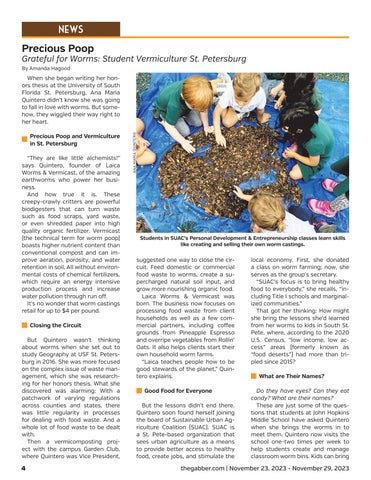
Students in SUAC’s Personal Development & Entrepreneurship classes learn skills like creating and selling their own worm castings.
suggested one way to close the circuit. Feed domestic or commercial food waste to worms, create a supercharged natural soil input, and grow more nourishing organic food. Laica Worms & Vermicast was born. The business now focuses on processing food waste from client households as well as a few commercial partners, including coffee grounds from Pineapple Espresso and overripe vegetables from Rollin’ Oats. It also helps clients start their own household worm farms. “Laica teaches people how to be good stewards of the planet,” Quintero explains. Good Food for Everyone But the lessons didn’t end there. Quintero soon found herself joining the board of Sustainable Urban Agriculture Coalition (SUAC). SUAC is a St. Pete-based organization that sees urban agriculture as a means to provide better access to healthy food, create jobs, and stimulate the
local economy. First, she donated a class on worm farming; now, she serves as the group’s secretary. “SUAC’s focus is to bring healthy food to everybody,” she recalls, “including Title I schools and marginalized communities.” That got her thinking: How might she bring the lessons she’d learned from her worms to kids in South St. Pete, where, according to the 2020 U.S. Census, “low income, low access” areas (formerly known as “food deserts”) had more than tripled since 2015? What are Their Names? Do they have eyes? Can they eat candy? What are their names? These are just some of the questions that students at John Hopkins Middle School have asked Quintero when she brings the worms in to meet them. Quintero now visits the school one-two times per week to help students create and manage classroom worm bins. Kids can bring
thegabber.com | November 23, 2023 - November 29, 2023
them carefully in gloved hands. Something gets unlocked. “When you find sensitivity, love, and care for something as vulnerable as a worm, it touches your tenderness, your empathy.” The Real Wealth of Student Vermiculture in St. Petersburg
ANA MARIA QUINTERO
Ana Maria Quintero started her honors thesis on waste management — then she discovered vermicomposting. Now she’s teaching the joys of worm farming to St. Pete’s schoolchildren.
food waste from home to compost. They also sell the castings to fund enrichment projects, learning not only worm farming, but entrepreneurial skills. Laica Worms is planning to expand this program in coming months, set-
ting up new worm farms at Lakewood Elementary School, Lake Vista Recreation Center, and St. Pete Housing Authority. There’s something magical that happens, Quitero says, when students get to know the worms, hold
AMAZING FOOD & CRAFT BEER
The season of gratitude and plenty is coming, and in that special time, it is so important to remember that real wealth doesn’t just accumulate – it grows. It grows in the ideas that inspire students, and the encouragement and support provided by caring teachers; it thrives in the strong bones and thriving energy of a well-nourished community. It flourishes in healthy soil, in the guts seemingly unremarkable decomposers that slowly, oh-so-patiently, recharge our forests and fields. These are the fruits that Ana Maria Quintero, worm farmer, cultivates. And of course, she grows the worms themselves. I can’t resist asking her how many I might find busily working away in her home and garden. “Thousands,” she smiles. “Thousands and thousands of them.” Readers who are interested in learning more about SUAC are invited to attend the group’s regular meeting from 6:30-8 p.m. on the first Friday of each month. See suacstpete.org for more information.
Accepting only 3 new members in 2023!
GOLD, SILVER & BRONZE MEDALS FOR 3 OF THE BEST CRAFT BEERS IN FL.* * ANNUAL BEST FLORIDA BEER COMPETITION
3007 BEACH BLVD • GULFPORT (727) 954-4109 • GULFPORT-BREWING.COM thegabber.com | November 23, 2023 - November 29, 2023
5
bringing with them the onslaught of war and disease. In the coming generations, European Americans used new names for the people who lived in the Tampa Bay area. Ancestors of the Seminole and Miccosukee both settled in and around Tampa Bay. Known for their adaptability and intricate beading and patchwork, these two nations carved out unique cultures within the harsh Florida landscape. They defended their way of life and homeland against the U.S. military during the Seminole War phase of Florida’s history. The U.S. government never successfully removed all the Florida Indians from their land, earning the Seminole the name “The Unconquered.” American Indian Culture Today This history is useful for understanding the current status of American Indian cultures in the U.S. and, more specifically, the Tampa Bay area. Yet, what about the contemporary American Indian voices and figures that continue to foster their own identity? One of the largest tribal gatherings in the U.S. occurred in the late ‘90s at Eckerd College. Eckerd College held an event known as ‘Discover Native America’. Craftsmen, dancers, and representatives from more than 200 North and South American Indian nations attended the multiple-day event. They gathered amongst the live oak trees to showcase their own cultural identity while learning about the identities of others.
CAMERON HEALY
Indian continued from cover
Eckerd posted educational signage inside the chickee huts with pamphlets regarding American Indian Heritage Month and history on the shelters.
To immortalize the event, several chickee huts were constructed along one of the Eckerd College ponds. Made of palmetto, with thatched roofs with a distinct rectangular shape, chickee huts are traditional Seminole shelters. The Seminole didn’t primarily use these as traditional homes, but as quickly assembled shelters. They were built when “Seminole Indians, pursued by U.S. troops, needed fast, disposable shelter while on the run,” according to the Seminole Tribe of Florida’s website. Seminole tribal member and renowned medicine man Bobby Henry blessed the chickee huts during the event following their completion, further showcasing the importance of having the mark of the Seminole Tribe
All Care Medical Consultants Dr. M.I. Yamani Medical Director
Internal medicine & lifestyle medicine primary care office serving Pinellas County over 15 years.
Accepting new Commercial, Medicare & Medicare Advantage patients 8900 Park Blvd. N. Seminole. FL 33777 | 727-545-4545 6
of Florida amongst their ancestral land. Eckerd College’s American Indian Awareness Eckerd College has made efforts to ensure their students understand the importance of National American Indian Heritage Month, as well as the struggles of American Indians. This includes different educational opportunities such as informative pamphlets, found in the chickee huts. These pamphlets describe issues such as Indian boarding schools and their harmful lasting impacts. Finally, the College highlights the ongoing struggle of missing and murdered indigenous women and children across tribal lands. To this day, American Indians across Florida and the Americas seek out ways to not only showcase their culture, but to also put their own personality within their creations and actions, further bringing what it means to be American Indian into the future. Even though the chickee huts, tucked away along the walkways and towering trees of a college campus may seem small, they stand as a reminder of the immense presence of American Indians and their cultures have on our communities and identity as a whole.
thegabber.com | November 23, 2023 - November 29, 2023
Blankets of Hope
Thankful for Betsy Mauro: Blankets for Cancer Patients Each year, thousands of children in the U.S. suffer from cancer. According to the American Childhood Cancer Organization, every 1 in 285 children will be diagnosed before their 20th birthday. People like Betsy Mauro do their best to provide support to the kids who have to face this. Mauro has spent years making fleece, no-sew blankets for cancer patients to donate to Johns Hopkins All Children’s Hospital. In 2010, when her son Chris was 17, he was diagnosed with leukemia. After getting treatment at All Children’s Hospital, completing chemotherapy, and being in remission for a year and a half, the cancer returned. In November of 2015, Chris passed away. Mauro continues to make blankets in honor of her son, who received a blanket during the early stages of his battles with cancer. It went with him to every hospital visit. Now, eight years later, Mauro keeps that blanket as a memory of the time she spent with her son. Holiday Blankets for Cancer Patients Mauro works as a seventh grade math teacher at Pinellas Preparatory Academy in Largo. Across the three schools she has worked at following her son’s death, she has brought this project to the kids each year. “It’s amazing how willing and excited they are to do it,” said Mauro. “We always do them around Thanksgiving so they can be sanitized and the hospital can get them for Christmas.” The first year, Mauro and her family supplied the cancer ward with blankets. This year, they set their sights on at least 120 blankets. “This made a safe haven in my classroom. My students can support other kids, or family members with cancer,” said Mauro. “It may just be blankets, but it’s so important for these kids to know that someone cares about them and is thinking about them.”
BETSY MAURO
By Patrick Heinzen
Betsy Mauro and her students at Pinellas Preparatory Academy make holiday blankets for cancer patients to donate each year.
Right before losing her son, Mauro published a book through Amazon called It’s Okay to Laugh: A mother and son’s journey with cancer. The book covers the struggles the family went through, but how remaining positive is necessary to get through them. “The day we were told they couldn’t do more to help, we were devastated. I went to go pick my youngest son up from school, because I knew it was more important for him to spend time with his brother,” said Mauro. “When I got back, [Chris] had the whole fami-
ly in the hospital room laughing their heads off watching a South Park marathon.” Mauro’s positivity shines brightly as she provides these kids with a blanket to keep them warm when everything seems cold. “If people want to donate blankets or toys to All Children’s, they’re always looking for them,” said Mauro. “If people want to give me fleece for next year, I will happily sit on it and prepare.” To donate fleece, reach out to Betsy at bmauro@pinellasprep.org.
727-318-0986
ALWAYS BUYING! • USED & VINTAGE • RENTALS • REPAIRS 6630 Gulf Blvd • St. Pete Beach
thegabber.com | November 23, 2023 - November 29, 2023
StPeteGuitars.com 7
Peculiar Pipe
Pinellas Park’s Monotube Landmark Many cities have landmarks that help to define their image. Obvious examples include the Gateway Arch in St. Louis and, closer to home, the Gulfport Casino. St. Petersburg’s downtown piers have also filled this role. Twenty-one years ago, the Florida Department of Transportation (FDOT) installed Pinellas Park’s peculiar pipe that became an unattractive distraction and unexpected landmark. Brown metal tubes started to rise from the ground at a busy intersection in early 2001. Gawkers stared at these cylinders on the southeastern and northwestern corners of the intersection of Park Boulevard and 66th Street. At that time, workers were expanding turn lanes and making other improvements at this location. Some rubberneckers probably assumed that crews had installed a temporary sewer detour during construction. After the traffic cones disappeared, however, the pipes remained positioned in place. A Monotube Monstrosity? Known in transportation circles as a “monotube,” this structure stands 21 feet above the pavement and stretches 230 feet. Part of a $2-million intersection overhaul, the brown metal fixture cost approximately $200,000 when installed in April 2001. Finger-pointing began before crews anchored the first traffic light,
JAMES SCHNUR
By James Schnur
Pinellas Park’s Gateway (or Getaway?) Arch. A view of the monotube from the northwest corner of 66th Street and Park Boulevard.
and not just by those looking at the monotube. When officials in Pinellas Park fielded phone calls, they promptly and properly told irate callers that FDOT bore responsibility. Cities have limited ability to override FDOT’s decisions about design elements on state-owned roadways. An FDOT spokesperson defended the tube as an economical option that avoided the need to acquire additional right-of-way. Noting that the State required the replacement of the traffic lights at the intersection, FDOT claimed that City leaders had raised no objections to the project during the planning stages. (Editor’s note: Tom Nicholls, now the City of Gulfport Public Works director, had recently been promoted
Contact: barry@thegabber.com
8
to the City of Pinellas Park’s Traffic Division Director. He told The Gabber Newspaper no one at FDOT asked for City feedback, as Pinellas County acts as the maintaining authority for all of Pinellas Park’s traffic signals.) FDOT originally proposed erecting a silver-colored truss. City leaders did not want a truss, and got a tube instead. Winds of Change Why didn’t traffic engineers simply replace the wiring and install new traffic signals? The answer to that question involves a trip back to August 1992. Hurricane Andrew, a Category 5 storm, cut a devastating path when it hit south Florida.
• Sales Director & Part-time • Must be a self-starter • Make cold calls in person • Amiable personality • Familiar with Mac and Google docs • Local resident • Able to travel throughout S. Pinellas • Lift 25 lbs. • Provide own laptop • Work from home or office
thegabber.com | November 23, 2023 - November 29, 2023
JAMES SCHNUR
Nearly all wired traffic signals in impacted areas suffered damage, though those secured to beams did better. In Andrew’s aftermath, state transportation policies called for the mounting of traffic signals at high-traffic destinations onto fixtures built to withstand most hurricane-force winds. Pinellas Park’s monotube became a possible FDOT prototype for use at busy intersections close to the coast. Designed to survive winds reaching 130 MPH, the monotube securely held signals that would otherwise thrash. Although the first of its type — that held traffic lights — in Tampa Bay, this monotube was not the original one in the Tampa Bay region.
Largo’s monotube along West Bay Drive took shape in March 2001, a month before its sibling in Pinellas Park.
A Tubular Twin Monotubes made their local debut along portions of the Veterans Expressway and Suncoast Parkway during the 1990s. In March 2001 — a month before the uproar in Pinellas Park — crews erected a green-colored monotube along West Bay Drive. Largo’s monotube originally went largely unnoticed. Installed as part of a city beautification and FDOT road-widening effort, this structure had no traffic signals. Instead, it supported directional signs for eastbound drivers approaching the Bay Drive intersection at Missouri Avenue/Seminole Boulevard.
for decades. During the 1950s, Pinellas Park became an important lower-county crossroads after the westward extension of Park Boulevard into the Seminole area and the eastward relocation of U.S. Highway 19 to its present path from its former route along Alternate 19. In recent decades, the one-time farm settlement began to grow in new directions. Stretching its boundaries into Lealman and toward Largo and St. Petersburg, Pinellas Park hoped to cultivate a new image and shed the former pastoral punchlines. The brown tube set the wrong tone.
Color Me Ugly The monotube’s color became a common critique, especially after a DOT representative referred to it as “chestnut bronze.” In early May 2001, the Vitale Brothers talked about possibly tinting the tube blue, and adding images of birds and clouds. He later agreed to paint the pipe for free if FDOT or Pinellas Park provided the paint. The chorus of criticism resumed in July. When state officials claimed the cost to repaint may exceed $100,000, some condemned these plans as yet another boondoggle.
Monotube continued on page 10
Pipe It Down! Pinellas pundits and casual observers shared their thoughts about the county’s newest landmark. A radio station even solicited names. “Pipey LePew,” a sarcastic spin on the Warner Brothers cartoon skunk character Pepé Le Pew, became a top choice. This stinky situation left a foul odor in a city that had long sought to improve its image. Pinellas Park traces its origins to a farming colony established after F.A. Davis and other Pennsylvania developers acquired nearly 10,000 acres in 1909. Incorporated in 1914, the municipality maintained a rural character
GULF BEACHES LAW, P. A. Karen S. Keaton, Esquire ESTATE PLANNING
ELDER LAW
PROBATE
CORPORATE
www.Gulf B eachesLaw.com
Your Trusted Local Attorney! Karen S. Keaton, Esquire
Estate Planning including Trusts, Wills, Health Care Directives, and Powers of Attorney, Trust & Probate Estate Administration, Elder Law including Medicaid & Special Needs Trusts, Corporate & Business Planning
We are available for phone consultations! 2816 Beach Blvd. S., Gulfport, FL 33707 • (727) 822-2200
thegabber.com | November 23, 2023 - November 29, 2023
9
Monotube continued from page 9
FLORIDA MEMORY
A one-light town: This eastward view along Park Boulevard shows a single stoplight managing traffic at the 49th Street intersection in March 1956.
Others suggested a barber pole or candy cane palette instead. Votes from a public forum supported turning the structure blue. Sandblasting and painting the monotube blue occurred in December 2001, at a cost of approximately $22,000. Roundabout Arguments As discussions about the color of the Pinellas Park monotube continued in mid-July 2001, Clearwater leaders made decisions about the fate of another controversial landmark. In December 1999, crowds gathered at Clearwater Beach to celebrate the dedication of a new roundabout. This circle connected Clearwater Memorial Causeway with Coronado Drive, Mandalay Avenue, and Poinsettia Avenue. A $2.1 million fountain at the roundabout’s center allowed water to soar over 40 feet into the
10
air. Smaller fountains surrounded the main one. The fountain and roundabout became key features in the “One city. One future.” initiative led by Mike Roberto, Clearwater’s city manager at the time. Roberto had no role in designing the fountain. However, he did himself no favors by gushing about its grandeur to a Tampa Tribune reporter. In a Dec. 22, 1999 Tribune article, Roberto claimed the entryway connecting the Causeway with roads near Pier 60 would improve “one of the most dysfunctional intersections in all of Pinellas County.” By January 2000, less than a month after the dedication ceremonies, the fountain’s mists and sprays caused confusion and collisions during breezy days. The fountain at what soon became known as the “Roberto Roundabout” lasted less than three years. Demolished in December 2002, fountain remnants ended up as
rubble stabilizing the shoreline. A smaller, drier roundabout at Park Street and Villagrande Avenue South also baffled drivers when it first appeared in 2008. Tubes and traffic circles give some vehicle operators the runaround. Monotube Monomania While residents debated pole paint colors, leaders sought ways to prevent the installation of any additional monotubes. In July 2001, they lobbied against a monotube becoming part of intersection improvements at Seminole Boulevard and Park Boulevard. In August 2001, the Pinellas Planning Council unanimously passed a resolution discouraging FDOT from adding these “obstructive and objectionable” objects to any other local projects. St. Petersburg leaders passed a
thegabber.com | November 23, 2023 - November 29, 2023
USF DIGITAL COLLECTIONS
Built in 1890-91, the Williams House moved in one piece from the present-day Johns Hopkins All Children’s Hospital campus to USF St. Petersburg in March 1995. In this image, the house sits on a trailer along 5th Avenue South at 4th Street, near the “Welcome to St. Petersburg” sign.
separate resolution against monotubes, fearing the state may add them at large intersections. Years later, a skinnier monotube soared above the crossroads of 66th Street and Tyrone Boulevard. Test Tubes During the busy 2004 hurricane season, storms tested Pinellas Park’s monotube. Tropical storm force winds from Hurricane Frances blew through the area in September 2004. Despite power failures, the stoplights stayed secured to the structure. Although Pinellas Park’s monotube passed the stress test, it failed in the structural beauty pageant. Since the early 2000s, many traffic lights in the Tampa Bay area have transitioned from hanging wires to mast arm poles. Designed to withstand strong winds, these structures offer a better level of protection for items affixed to them than traditional wires, yet lack the clunky and chubby design of their pipe progenitor.
installation, house movers could relocate threatened historical landmarks with relative ease. Utility companies temporarily readjusted above-ground wires, crews diverted traffic, and structures moved overnight. Many of the historical structures located at Heritage Village near Largo and the Pinellas Pioneer Settlement in St. Petersburg arrived in one piece. Transported in part by barge from Clearwater Harbor, the House of Seven Gables reached Heritage Village in one piece after journeying along Walsingham Road in mid-1976. When Archie B. “Toby” Thomas’s house moving team transported the Snell and Wiliams historic structures
PVC FENCE PANELS CLEANED FROM $11 A PANEL
Challenging Moves Tubes, poles, and masts that protect light fixtures pose a challenge for preservationists. Before their
to USF St. Petersburg in 1993 and 1995, respectively, Toby stood atop the homes and lifted traffic lights so they could pass through intersections. Newer traffic devices complicate these logistics. When the Turner Bungalow moved from Clearwater to Heritage Village in January 2014, crews had to remove the roof so the historic home could make the 8-mile journey. Far into the future, a yet-to-beborn preservationist may advocate moving Pinellas Park’s totally tubular pipe to Heritage Village or another site as a historic landmark. Wherever it ends up, crews certainly will have to move it in many pieces.
free quote & DEMO (727) 360-7070
thegabber.com | November 23, 2023 - November 29, 2023
11
From Attractions to Awareness Narratives of Pinellas Indian History By James Schnur
JAMES SCHNUR
One entrance sign at Philippe Park mentions the Tocobaga capital that once existed there. However, the park’s primary name continues to honor a man who engaged in the slave trade after the Tocobaga population declined, courtesy of the Spanish.
Long before year-round climate control became the norm, Florida’s earliest roadside attractions frequently scheduled their seasonal openings around or right before Thanksgiving weekend. These destinations often included gardens, springs, or other elements that showcased Florida’s natural beauty. Some venues also integrated stories about the first Floridians who have lived on peninsular Florida for millennia. People today may think of destinations near Everglades National Park where members of the Seminole and Miccosukee tribes share their history. However, two attractions briefly operated in Pinellas County. One might assume that these
Tampa Bay attractions would have shared the rich history of the lives of Tocobaga people and other nearby chiefdoms. In this regard, both failed after brief periods of operation. The Lure of Pinellas Indian History The history and culture of those who lived here long before Juan Ponce de León arrived on Florida’s Atlantic shoreline in 1513 — and long before other unknown journeys that may have happened before then — became an important part of the earliest marketing efforts to attract those wanting to vacation in or move to Florida. Subsequent events, such as the
MEDICARE IS CONFUSING…LET ME HELP! My assistance is 100% complimentary! Independent Sales Representative Florida License W566896
Medicare Supplement Insurance Plans Medicare Advantage Plans • Part D Prescription Drug Plans
Lisa Pence 12
727-560-3674
lpence@jrstoner.com • thestonerorganization.com
Seminole War phase, added more Sunshine State storylines. Unfortunately, the tales told in most of the promotional literature got the story wrong. Many early American Indian-themed attractions in Florida suffered from similar flaws. Indeed, state authorities could not even create a historically or geologically accurate state seal. A Village by Blind Pass The Nov. 18, 1928 issue of the St. Petersburg Times (now Tampa Bay Times) ran a story announcing that “Seminoles at Blind Pass Open Village To White Guests for First Time Today.” The article touted that “no change whatever will be noted ... They will live in the same kind of primitive homes, with the same domestic routine.” Ninety-five years ago, the northern portion of present-day St. Pete Beach near Blind Pass remained largely unoccupied. A two-lane bridge across Blind Pass opened in 1927. Traffic also began crossing the original span of Corey Causeway in October 1927. That span had re-
thegabber.com | November 23, 2023 - November 29, 2023
FLORIDA MEMORY
Shown here in South Florida nearly 110 years ago, Josie Billie came to the area in 1928 to set up an Indian Village near Blind Pass.
placed the McAdoo Bridge, a wooden toll bridge that entered the island at 87th Avenue. Josie Billie, a Seminole spiritual leader and healer, came from his home at the Big Cypress Indian Reservation to supervise the village’s construction in 1928. The site included areas within and near Ron McKenney Park at 93rd Avenue. The first group of Seminole Indians arrived in early November. Billie was one of the only Seminole Indians at this encampment fluent in English. While setting up the settlement, he worked in partnership with W. Stanley Hanson of Fort Myers. One of the few white residents of South Florida who spoke any American Indian languages, Hanson had gained trust within many of the Seminole and Miccosukee communities. Visits to the Village Billie and Hanson envisioned the Seminole Village at Blind Pass as a venue to share a positive story of ancestral cultural traditions. They planned for the village to remain open during the winter tourist season. Shortly before Thanksgiving 1928, the village opened to the public. For
25¢, guests could witness life in the Seminole community, watch eagle dances, see alligator wrestling and ball games, and visit a small zoo that had wildcats and a bear. Hours of operation spanned from 8 a.m. until sundown. The Seminole Indians who arrived brought their own livestock. They planned to live off the land by hunting on nearby uninhabited barrier islands. They harvested fish from Boca Ciega Bay. By December 1928, newspaper advertisements proclaimed that “You Haven’t Seen Florida Till You See the Seminoles.” Pinellas Indian Historical Promotional Antics Despite the efforts of Billie and Hanson, the St. Petersburg promoter they partnered with created publicity rife with stereotypes. Fletcher Park Bouton saw the village as an attraction that could bolster the sagging real estate market. A realtor and president of Southern Exhibitions, Inc., Bouton had a big Indian directional sign installed near Blind Pass Road. Advertisements soon encouraged visitors to see the villagers as if they were performers in a circus show. One ad from late 1928 told parents
thegabber.com | November 23, 2023 - November 29, 2023
to “Bring the youngsters — They will enjoy seeing real Indians.” Another encouraged guests to “come and see these interesting people just as they live in the Everglades.” The Christmas Day issue of the Times in 1928 announced that Bouton arrived with a tree and gifts. According to the paper’s account of this publicity stunt, “it is expected many grunts of satisfaction will be the results of the gifts that reach the br***s and sq***s through the kindness of Bouton who takes a paternal interest in the tribe.” The village closed in March 1929. The Seminole Indians returned for a second season, though this attraction ceased as the land boom ended. A Brief Return Visit Twenty-five years later, the Times included a story with a headline announcing that “Seminoles Invade Pinellas.” In the May 28, 1954 issue of the Times, columnist Dick Bothwell mentioned that “Sq***s Here to Beautify New Road” had gathered at a wooded site near the southern end of 34th Street. A small group of Seminole women parked their cars and temporarily camped near the causeway History continued on page 14
13
History continued from page 13 approach for the original Sunshine Skyway Bridge, under construction at the time. They came to place Pangola hay in areas near the roadway to help control erosion.
By time the Skyway opened in September 1954, a major transformation took place near the region’s largest mound. In January 1954, the county’s Park Board debated a plan to build a large amphitheater at Philippe Park. Construction began in August. County officials approved $65,000 for this project, with the City of Clearwater adding $10,000 from bond funding. With public dollars building the stage and grandstands, an large area of the park became a performance venue, complete with aluminum chairs and outdoor lighting for nighttime performances. An organization known as the Florida Seminole Association signed a multi-year contract to lease the facility that taxpayers built. Why did authorities turn part of a county park into a performance venue, and put it in the hands of an outside group? Florida Indian History Aflame Winter Haven native John Waldrop Caldwell wrote Florida Aflame as his master’s thesis at the University of North Carolina. This screenplay dramatized attempts to remove Seminole Indians from Florida during the 1800s. Florida Aflame had its June 1953 debut at the Lake Wales Amphitheater. Caldwell hired Ed Loessin as his director. Loessin had worked with the Unto These Hills outdoor theater performance that began in Cherokee, North Carolina, in 1950. With a cast of 68 and more than 20 scenes, Florida Aflame attracted Gov. Dan McCarty, his wife, and notable Seminole leaders to the first Lake Wales performance. Shows continued through early September. Similar to any dramatic performance, Caldwell took liberties in telling the history of the Seminole
14
GOOGLE NEWS ARCHIVE/FAIR USE
Performing Around the Mound
Ad mentioning the Eagle Dance rarely seen by the “White Man.”
people. Although his script generally followed the historical narrative, his original cast had few, if any, people of American Indian descent. White actors contrived their rendition of the sacred Green Corn Dance, something few non-Indians have witnessed. Their gyrations trivialized a sacred ritual. Their take on stomp dances and purification ceremonies seldom seen by outsiders became show-stopping elements. Caldwell wanted to bring Florida Aflame to Tampa Bay after its run in Lake Wales. He hoped that the move to Philippe Park would create a permanent location for shows “unto that mound.” Florida Aflame-d Out The production team left behind unpaid bills in Lake Wales. Despite some initial interest, having outdoor performances during summer months led to low turnout. Thunderstorms, humidity, and mosquitoes — things Seminole people had regular-
ly endured on the frontier — scared away crowds in Lake Wales. Financial challenges followed the performance as plays began at Philippe Park in January 1955. Large billboards announced the show on highways, but attendance remained low. On some nights, fewer people attended than the show had performers. With admission prices ranging from $1.50 to $3, funds generated could not even meet the payroll. A Jan. 16, 1955 review of Florida Aflame in the New York Times incorrectly stated that Philippe Park had served as the site of battles between Seminole Indians and U.S. military forces. The review also mentioned Caldwell’s correct assertion that no Seminoles participated in his show due to “their resentment and suspicion of the white man.” By the time the season ended in April 1955, outstanding debts rose along with temperatures. Two months later, the amount had soared to nearly $150,000. The Flor-
thegabber.com | November 23, 2023 - November 29, 2023
JAMES SCHNUR
Pinellas Indian history awareness includes a more respectful and accurate portrayal signage at the Indian Shores Nature Park of those who once lived here.
ida Seminole Association exited stage right on a path toward bankruptcy, leaving the county a publicly owned, unused amphitheater that obstructed access to much of Philippe Park. County park staff seized costumes, makeup, and equipment by 1957. Wooden portions of the amphitheater continued to rot as Caldwell joined University of South Florida’s faculty. He taught in USF’s drama department during the school’s first-ever term in the fall of 1960. By the time crews tore down what remained of the amphitheater in 1962, investigators from the notorious Johns Committee had used false allegations to ruin Caldwell’s teaching career at USF. Chief Complaints
some Tampa Bay entities likewise made it their business to caricature Indian imagery. Revisiting the Park During the last 50 years, a growing number of people have questioned the naming of Philippe Park. Earlier narratives referred to Odet Philippe as the county’s first white settler, a surgeon in Napoleon’s navy, and a French count. Later historians consider him the first “non-native” settler, since he
was most likely of mixed race and probably hailed from the French Caribbean colony known today as Haiti. J. Allison DeFoor, a descendant of Philippe, published a 1997 biography of this Pinellas pioneer. Never a doctor serving Napoleon, Philippe held enslaved people at his St. Helena plantation that included the park property. Additionally, no structures from his plantation remain. Significantly, Philippe’s headstone at the park sits atop an empty gravesite. What clearly remains at Philippe
History continued on page 16
EXPERIENCE COUNTS – AND SAVINGS ADD UP Find out about the Competitive Rates and Special Benefits available through our agency for all your insurance needs! Ready to learn more? Contact our agency now!
These two failed Pinellas attractions hardly represented the only times that Tampa Bay locals inaccurately portrayed Florida’s American Indians, or Indian populations more generally. Similar to complaints about collegiate and professional sports mascots in recent years,
thegabber.com | November 23, 2023 - November 29, 2023
Call today for your FREE, no obligation quote. HOME • FLOOD AUTO • BUSINESS COMMERCIAL
727-344-4500 6524 1st Ave. N., St. Petersburg, FL 33710
15
Park are portions of the Tocobaga mound, a visible reminder of a people who flourished here for centuries. The site’s designation on the National Register of Historic Places is based on the Tocobaga presence, not Philippe’s 19th-century plantation. Lou Claudio, a Safety Harbor resident, first proposed that County officials consider renaming the park in 2015. Moreover, Claudio pointed out that Pinellas County had no parks or roads named in recognition of the Tocobaga culture. He and others supportive of a name change discovered a pattern of deferral and delay. Finally, a small step occurred. One entrance sign at Philippe Park was amended to add, “Historic Site of the Tocobaga Capital City.” Despite this change, the Tocobaga still have less prominence on their ancestral lands than a man who owned enslaved people. Changing Narratives of Pinellas American Indian History Similar to the way Safety Harbor has started to confront Philippe’s troubled legacy, Indian Rocks Beach has tried to address legends of Chief Chic-a-Si. Unquestionably, stories about Indians traveling hundreds of miles to drink water from a sulphur spring at Indian Rocks no longer suffice. A monument honoring the presence of the Tocobaga Indians was dedicated at Pinellas County’s Tiki Gardens — Indian Shores Beach
JAMES SCHNUR
History continued from page 15
Even the revised headstone at the empty “grave” of Odet Philippe has questionable biographical details.
Access in June 2022. Ironically, the Tiki Gardens attraction once on that site tried to portray “a South Sea island paradise in Florida.” Presently, archaeologists, anthropologists, and artists work diligently to tell a more accurate story about the first Floridians. Gulfport resident Hermann Trappman at Neily Trappman Studio invests hundreds of hours to create his interpretation of the people who
lived here for thousands of years. Long after the Seminole Indian village at Blind Pass failed, Josie Billie worked with others to preserve Florida’s indigenous history. He also recorded traditional folk songs and information about cultural and spiritual practices. Until his death in 1980, he became a regular fixture at the annual Florida Folk Festival gatherings in White Springs.
30% OFF Your Next Purchase
Call now for your free consultation!
727-821-0976
Showroom by appointment only • 800 Pasadena Ave S
Blinds • Shutters • Shades • Motorization •
©2020 Budget Blinds, LLC. All rights reserved. Budget Blinds is a trademark of Budget Blinds, LLC and a Home Franchise Concepts Brand. Each franchise independently owned and operated.
16
thegabber.com | November 23, 2023 - November 29, 2023
business beat Veterans Pass Program and a Holiday Art Show Stay Up-to-Date With Pinellas Business
CATHY SALUSTRI
PINELLAS SUNCOAST TRANSIT AUTHORITY
By Cameron Healy
Gulfport Arts and Heritage has issued a call for artists ages 5-18 to submit their work for its holiday exhibition, A Merry Little Art Show.
Veterans Ride For Free On Veterans Day, the Pinellas Suncoast Transit Authority (PSTA) announced its new Veterans Pass program. This new initiative allows all U.S. military veterans to ride PSTA routes for free all year long. The Veterans Pass ensures veterans have accessible and affordable transportation. PSTA stated the inspiration came from a class project by a group of USF students. One student in the group is a Navy veteran. “The students’ mission was to get free rides for disabled veterans. PSTA Board members decided to take it one step further, allowing all veterans to ride for free,” according to the PSTA press release. To join the Veterans Pass program, veterans must present an
Pinellas Suncoast Transit Authority (PSTA) introduced its Veterans Pass program ensuring veterans ride PSTA routes for free year-round.
appropriate I.D. at a PSTA Customer Service Center. Veterans also must renew the pass monthly to enjoy the free rides. Acceptable forms of I.D. include: • Veterans Identification Card (VIC) • Veterans Health Identification Card (VHIC) • Military ID • Florida Driver’s License with Veteran Designation Additionally, PSTA unveiled a new bus wrapped with the American flag, a bald eagle, and silhouettes of soldiers. This bus intends to salute the “16 million men and women who have served our country during war or peacetime,” the press release says. Calling All Artists Gulfport Arts and Heritage hosts its holiday exhibition, A Merry Little
thegabber.com | November 23, 2023 - November 29, 2023
Art Show, Dec. 2 to Jan. 5. GAH is currently accepting artist submissions for the art show. This exhibit features holiday art by elementary, middle, and high school students in Gulfport. Anyone ages 5-18 may submit their work. Artists have until Nov. 28 to submit their information and featured art to the GAH. If you are interested in A Merry Little Art Show or know someone who would be, email artscenter@mygulfport.us. The reception is on Dec. 2 at the Gulfport Arts Center (2726 54th St. S.). What is the Gulfport Arts and Heritage? It is a combined effort to preserve and celebrate “Gulfport culture and history through exhibits and programs,” according to its website.
17
according to gulfport Karaoke, Snakes, and Vampires Random Quotes from Gulfportians By Chris Shablak
I’m not saying my neighbor is a vampire, but I’ve never seen him in the sunlight. —Riley Bennet, on Halloween night
“I’m massive!” —300-pound Anthony William’s response to his friend’s unwillingness to jump into the water with a “massive” dolphin
“I came over here because I didn’t want her drunk ass to step on me again.” —Marissa Nicole Koch, discussing the dangers of karaoke in Gulfport
“I can see myself living here someday; there’s just a few things I need to work out.” —Ben Soto, visiting from Seattle for the first time
“A bunch of people walked in with snakes in baskets.” — Lauren McIntyre, bartender at the Drunken Taco telling some wild bartending stories
Early Diner Special
• Salad and choice of 5 dishes • $15, 4-5:30 only • Separate check cash only
Stay Active Be Healthy and Save*
Continental-Mediterranean Fine Dining • Upscale Yet Casual
Dr. Aaron Day
Extraordinary Offerings of Camel, Antelope, Elk, Buffalo, Ostrich & Venison • Beer & Wine only
thepearlfinedining.com Reservations: 727-360-9151 Hours 4-9 Closed Sun & Mon 5802 28th Ave South, Gulfport OUTDOOR SEATING NOW AVAILABLE! 18
GULFPORT CHIROPRACTIC HAND & FOOT CLINIC 5301 Gulfport Blvd. S., Gulfport
(727) 321-9520 *Wellness Plan $150 Annual Fee includes Initial Exam & unlimited $35 visits (restrictions do apply) Neck & Back • Hand & Foot Pain Wellness Care • Personal Injury
thegabber.com | November 23, 2023 - November 29, 2023
arts Climate Change Perspective
‘The Light Pirate’ Imagines Florida One Lifetime Away Another hurricane season is nearly over – thank goodness! But with oceans warming, sea levels rising, and storms intensifying, it’s hard not to think about how climate change will change the face of Florida in coming years. Lily Brooks-Dalton’s powerful novel, The Light Pirate (Grand Central, 2022), takes us right into the heart of that easy-to-predict but hard-to-imagine future. The story follows Wanda, a young woman born in the midst of a massive storm tearing its way through her small South Florida home. As she grows, the town around her gradually begins to shrink. More and more folks drift away, pushed by the constant threat of storms and boiling-hot summers. Rooted in place by her stubborn lineman father and her resourceful survivalist neighbor, Phyllis, Wanda endures the changes, even after Florida is officially abandoned by the U.S. She gradually develops a kind of amphibious solarpunk lifestyle. Also, the ability to call forth bioluminescence – a “cool, shimmering intelligence” – from the waters around her. A Human Scale Climate fiction — literature that deals with the moral, social, and environmental impacts of climate change — is in no short supply these days. But one thing that makes The Light Pirate stand out is its timeframe. The opening chapter, in which Wanda’s family is anxiously prepping for yet another possibly catastrophic storm, feels familiar enough to walk right into. And while the changes that Florida endures in the book are profound, the fact that they develop across a single lifetime — on a strikingly human scale — makes the story feel uncannily real (special luminescent powers notwithstanding). And while it may seem like a hopeless prospect, the vision of a depopulated, climate-altered Florida that
AMANDA HAGOOD
By Amanda Hagood
Lily Brooks-Dalton’s novel The Light Pirate (Grand Central, 2022) imagines the disruptions climate change will bring to coastal Florida over the course of one lifetime.
Brooks-Dalton evokes feels weirdly redemptive. Of Wanda’s elder years, she writes: “[Time’s] progression is marked by the smoothness of water where ruins once broke the surface. The thickening of a young grove’s canopy. The collapse of an old utility pole. It is marked by the end of one species or the beginning of another. Here, time sprawls and curls. The land returns to the way it was; it becomes something brand new.” A reclaimed land reclaiming itself… No Planet B Against these elemental changes, The Light Pirate weaves a tender tale of a family in the face of existential crisis. Wanda’s father, Kirby, is a hardworking widower whose faith in the electric grid he maintains never wavers, even as he constantly rebuilds what each storm tears apart. Phyllis, a retired biologist who steps into Wanda’s life as a second parent, copes with the unraveling of the local environment by constantly sampling, surveying, observing, and recording. Both attitudes – forlorn faith in
thegabber.com | November 23, 2023 - November 29, 2023
the status quo and resigned witness to the passing of the world we know – are familiar responses to the climate crisis. And neither, young climate activist will quickly point out, is enough to save the world from catastrophe. Brooks-Dalton explores this intergenerational conflict with care and empathy. Step Into the Light Then there’s the new generation and Wanda’s enigmatic gift, her ability to illuminate and sometimes detect messages in the water around her. This is where I fall out with many of my cli-fi reading friends, who love the book’s realism but find this flourish of magical realism just a bit too… whimsical? I disagree. To me, Wanda’s luminous communication with the waters around her perfectly symbolizes an ability our society has just begun to cultivate. A meaningful and sustaining connection to the living element that created Florida. And something we desperately need if we are going to endure in a state shaped by water in all its forms.
19
food Which Dish Would You Be?
A Gulfport City Council Thanksgiving By Morgan Banno
PIXABAY
If Gulfport Councilmembers were dishes at a Thanksgiving table, Morgan Banno talks about which dish she thinks they would be?
Thanksgiving is an odd holiday. We prepare excessive amounts of food, deliberately surround ourselves with awkward extended family, and then gorge on enough calories to last for days. Between the holiday’s shady (and rather violent) history and the frenzied consumerism that immediately follows on Black Friday, Thanksgiving is pretty twisted. As the family chef, I usually have the honor (and obligation) of cooking. But this year, I’m taking the holiday off. Instead, I’m dishing out a menu with all of Gulfport’s City Councilmembers reimagined as Thanksgiving foods. So, set the table and crack open the wine! Sam Henderson: Mashed Potatoes (and Gravy) Other than turkey, mashed potatoes are the most popular Thanksgiving dish. Individual recipes may
20
vary (call me biased, but my aunt’s recipe is by far the best) but you always know what to expect with mashed potatoes. Not only are they an ultimate comfort food, (especially when topped with a rich, flavorful gravy) but they’re the glue that holds the Thanksgiving dinner together. It just isn’t Thanksgiving without mashed potatoes. Wine pairing: white Rioja (keep it classy). Ian O’Hara: Dressing/Stuffing Dressing is one of my favorite Thanksgiving side dishes. There are so many variations in breads (Wonderbread, corn bread, baguettes) and extra additions (like apples, walnuts, and fresh herbs), that it’s truly one of the most unique sides at the table. Dressing is bold enough to stand by itself without stealing the show. But it’s also the perfect complement to the Thanksgiving
pièce de résistance: the turkey. (And it doesn’t have to be stuffed up the bird to be fabulous.) Together, they make a fantastic pair. Wine pairing: any full-bodied red. April Thanos: Ambrosia Salad This Thanksgiving side dish is definitely one of acquired taste. The cacophony of canned ingredients is a little mismatched considering both the season and the other flavors of the holiday, but we all have those bizarre family members who love ambrosia. (Usually, they’re the same people who brought it to the party.) Don’t get me wrong, pineapple, coconut, oranges, and marshmallows are great on their own, but does ambrosia really have a place at the Thanksgiving table? Wine pairing: bubbles (you’ll need a palate cleanser).
thegabber.com | November 23, 2023 - November 29, 2023
Christine Brown: Candied Yams In the world of culinary, candied yams can be summed up in one word: Vintage. They’re right up there with Jell-O terrines and chipped beef cheese balls. Candied yams as a classic, generational Thanksgiving side dish and those generations probably can’t imagine a table without them. But if I’m going to eat starch cooked with loads of sugar, I’ll skip to dessert. Wine pairing: a bottle of aged Bordeaux you almost forgot you had.
Green bean casserole is a polarizing Thanksgiving side dish. You either love it or you don’t. I did not grow up with it on my table. When Campbell’s thought to combine canned green beans with cream of mushroom soup and fried, packaged onions, I think they skipped the test kitchen. I simply do not understand this dish, the ingredients, or the absurd salt content. In lieu of this hot mess of a side dish, I recommend making fresh green beans almondine instead — the dish we want to think green bean casserole could be. Wine pairing: a cloying wine, like Riesling. Thanksgiving is a perfect time to reflect on our gratitude. Whether it’s the opportunity to come together with loved ones, a day off to watch football, or the warm joy of cooking, what makes Thanksgiving so appetizing is the culmination of hard work and love. While each of these side dishes, eaten alone, are nothing special, each dish alongside the others completes our family table.
SAVE THE DATE! • Dec. 9
For more information visit thegabber.com/windows
Custom Picture Framing • Repairs • Art Gallery
Mention 25% OFF Custom Framing on November 25th (small business Saturday) 1155 Pasadena Ave S Suite K • 727-344-2202 • FrameStationandGallery.com
2023
7th Annual Studio Tour & Sale
Saturday, Dec 2: 10am–5pm Sunday, Dec 3: 11am–4pm Gulfport’s free annual self-guided tour of professional artists’ studios.
ArtJonesStudioTour.com 727.454.0453 thegabber.com | November 23, 2023 - November 29, 2023
@weareartjones
@artjonesgulfportfl
Art: Ray Domingo
Paul Ray: Green Bean Casserole
Kids Art Painting Contest
21
obituaries
COURTESY OF THE SHOVLIN FAMILY
Agnes Shovlin Agnes Shovlin of Gulfport passed away at Freedom Square Assisted Living in Seminole on Nov. 10, 2023 in her 99th year. She was one of four children of John and Agnes Arsics of Union, NJ, and their only daughter. Agnes grew up with three brothers, all of whom served in the United States Armed Services as part of the World War II effort. Agnes herself became an Army Nurse Cadet, attending nursing school at Orange Memorial Hospital in Orange, NJ. Fortunately the war ended in 1945, before she was formally commissioned. She then began her nursing career caring for the many returning wounded GI’s.
22
After the war she met and fell in love with a returning Army veteran by the name of Daniel Shovlin. They married in Summit, NJ in 1950 and settled in North Plainfield, NJ where they started their family. Since Danny worked nights as a printer, Agnes found work as a school nurse and health educator for the North Plainfield Board of Education. She would be going to work, when Danny was coming home, so child care was covered. She later attended night school for four years, receiving a BA in education from Trenton State College. During the course of her 45-year nursing career, Agnes also worked with numerous charities to meet the needs of many less fortu-
nate children. She volunteered with the Girl Scouts as a troop leader and served as a lead nurse at several regional and national scouting jamborees. Agnes and Danny retired and moved to Gulfport in 1991, happily beginning their next chapter as retired folks. Both were active owner/members of their condominium association well into their 90’s. A beloved mother, grandmother, and great grandmother, Agnes was known for her caring nature, her door that was always open, and the wonderful meals that she prepared with TLC and a side helping of advice. She also enjoyed sewing and made beautiful blankets and accessories for her home, and as gifts for loved ones. She is survived by her son Terry Shovlin and his wife Diane, her daughter Kathleen Grosch, and her faithful friend Deborah Henry. Agnes is also survived by her four grandchildren and their spouses: Blake (Elizabeth) Grosch, Brea Grosch, Daniel (Abigail) Shovlin, and Julie (Randall) King. As well by her five great grandchildren: Colby and Cassidy Shovlin, and Gordon, Frederick, and Hugh Grosch. And her dear nieces, a nephew, and their families. Agnes was predeceased by her beloved husband Daniel, her three brothers and their wives, a nephew, her sisters-in-law, and her brothersin-law (who were also WWII vets). The family would like to thank her friends and neighbors who reached out, and her nurses and aides who cared for her, especially in her last years. You all made such a difference in giving her the support that allowed her to do things her way. Services will be at the convenience of the family a later date. Agnes was a monthly contributor to National Public Radio. It was the non-profit organization that was near and dear to her heart. For those wishing to do so, donations in her memory may be made either to the network or to your local station. Go to giving@npr.org or phone 202-513-2082.
thegabber.com | November 23, 2023 - November 29, 2023
crossword
Solution on page 26
Great Lake Ports
gabber on vacation
Solution on page 26
LIZ ROBERTSON
sudoku
Liz Robertson took The Gabber Newspaper to Chennai, India for a work trip.
Have you taken The Gabber Newspaper somewhere? We want to see your pictures! Please send a high-resolution photo and a brief description to news@thegabber.com.
thegabber.com | November 23, 2023 - November 29, 2023
23
things to do
Free
Vegan Options
Dog-Friendly
Thanksgiving, Shopapalooza, and Santa Parade
ADOBE STOCK
Find the best holiday gifts at Shopapalooza Nov. 25-26.
Thursday, Nov. 23 Gulfport Beach Potluck It’s time to feast with your Gulfport friends and neighbors at Thanksgiving on the Beach. Bring a dish to share, drinks, utensils, and plates for this community potluck. Hosts are providing four turkeys and roasted veggies. Pavilion 6, Gulfport Recreation Center, 5730 Shore Blvd. S., Gulfport. 12-4 p.m. Friday, Nov. 24Saturday, Nov 25 Sustainable Pop-Up Market Visit
24
Boyd Hill’s sustainable pop-up market for a variety of low-cost, zero-waste goodies. Find household items that will lead into a more sustainable way of living. Boyd Hill Educational Center Classroom, 1101 Country Club Way S., St. Petersburg. 9 a.m.-5 p.m. 727-8937441, stpeteparksrec.org. Miracle on 34th Street: A Live Musical Radio Play Live foley effects and a score of beloved holiday carols accompany the classic story of a department store Santa and the little girl who believes in him. freeFall Theatre, 6099 Central Ave., St. Pe-
tersburg. 7 p.m. $25. 727-498-5205, freefalltheatre.com. Friday, Nov. 24 Funky Fungi Hike Enter the magical world of fungi. Take Boyd Hill’s Funky Fungi Hike. Learn about the magic of mushrooms and lichens. Magnifying glasses will be available before the hike. Boyd Hill Educational Center Classroom, 1101 Country Club Way S., St. Petersburg. 10 a.m.-12 p.m. $5. 727-8937441, stpeteparksrec.org.
thegabber.com | November 23, 2023 - November 29, 2023
All Is Bright The Morean’s annual holiday art show features the perfect gift for anyone on your list with ornaments, jewelry, functional pottery, painting, and sculpture. Morean Arts Center, 719 Central Ave., St. Petersburg. 10 a.m.-5 p.m. 727-8227872, moreanartscenter.org.
Princess Breakfast Let your hair down, but don’t let your tiara fall! Enjoy a magical feast with Princess Rapunzel at Princess Breakfast. Try the food special of Fairy Pancakes. Caddy’s, 9000 W. Gulf Blvd., Treasure Island. 10 a.m.-12 p.m. 727360-4993, caddys.com.
Holiday Lights in the Garden Get into the holiday spirit with holiday light displays. Bring your friends and family to walk through this botanical garden covered by more than two million LED festive lights. Leashed pets are welcome. Donations are encouraged. Florida Botanical Gardens, 12520 Ulmerton Road, Largo. 5:30-9:30 p.m. 727-582-2117, flbgfoundation.org.
Acts of Faith A young woman who is mistaken for a prophet begins using her “gift” to right wrongs and punish the wicked in this state premiere. American Stage, 163 Third St. N., St. Petersburg. 2 p.m. & 8 p.m. $28. 727823-7529, americanstage.org.
Saturday, Nov. 25Sunday, Nov. 26 Sanding Ovations Master sculptors use their imaginations to turn piles of sand into out-sanding works of art. Sanding Ovations, 10400 Gulf Blvd., Treasure Island. Sat., 10 a.m.10 p.m.; Sun., 10 a.m.-6 p.m. 727547-4575 ext. 221 or 237, sandingovationsmasterscup.com. Shopapalooza Returns Find the best gifts this holiday season at St. Pete’s Shopapalooza. Explore art, clothes, food, home goods, jewelry, plants, and treats from more than 350 Tampa Bay vendors. Enjoy live entertainment and family-friendly activities. This year’s nonprofit partners are Jump for Kids and St. Pete Youth Farm. Vinoy Park, 701 Bayshore Dr. NE, St. Petersburg. 10 a.m.-5 p.m. 727-637-5586, shopapaloozafestival.com. Saturday, Nov. 25 Edible Plant Hunt Learn about the naturally edible plants existing right in your backyard. Learn how to identify the native plants and the medicinal use of these plants. Hear how to safely gather and consume these edible plants. Boyd Hill Educational Center Classroom, 1101 Country Club Way S., St. Petersburg. 10-11:30 a.m. $5. 727-8937441, stpeteparksrec.org.
Santa Claus is in Town Right after Thanksgiving, is it safe to say it is Christmas time? See Santa Claus cruise the streets of downtown St. Pete in a celebratory holiday parade before the city’s official tree lighting. North Straub Park, 400 Bayshore Dr. NE, St. Petersburg. 6:30 p.m. 727893-7441, stpeteparksrec.org. Sunday, Nov. 26 Painting in the Park Let your artistic side shine with other artists. Join Artists for Impact’s Painting in the Park. Connect with nature, others, and yourself as you paint whatever your little heart desires. Bring some snacks. Light refreshments, painting supplies, and chill music provided for the afternoon. All are welcome and donations are encouraged. Vinoy Park, 701 Bayshore Dr. NE, St. Petersburg. 11 a.m-2 p.m. artists4impact.org. Natural Air Purifiers Class Houseplants help beautify and purify your home. Learn about the recommended natural air purifying plants, how to take care of them, and how to propagate. Participants will receive starter plants to keep or gift to friends. Boyd Hill Educational Center Classroom, 1101 Country Club Way S., St. Petersburg. 2 p.m. $30. 727893-7441, stpeteparksrec.org. Monday, Nov. 27 Musical Bingo Every Monday test your knowledge on the Billboard top hits with musical bingo. Bring your
thegabber.com | November 23, 2023 - November 29, 2023
friends and family to experience the best way to play bingo. Instead of letters and numbers, they are replaced with song titles and artists. Enjoy great music and win fun prizes. Jolly Roger’s Grub & Pub, 32 Madonna Blvd., Tierra Verde. 6:30 p.m. 727-498-6736, jollyrogerspub.com. Tuesday, Nov. 28 Italian Class It’s never too late to learn another language. Check out these Italian language classes provided by the Italian American Society of St. Petersburg. Two hour-long classes every Thursday will teach beginning, intermediate, and advanced levels of Italian. The course is free, but you do have to buy the textbook. Gulfport Senior Center, 5501 27th Ave. S., Gulfport. 6 p.m. 727-8931231, iasosp.org. Resin Art Night Are you in need of a craft night? Try resin art. Decorate two night lights out of resin for a Tuesday night artsy activity. With a four-inch mold and an array of supplies, make a beautiful scene in a night light. This is a step-bystep guided art class. Twisted Tiki Bar & Grill, 340 Corey Ave., St. Pete Beach. 6:30 p.m. $47-52. 727-9148881, creative-resin-ations.ticketleap.com. Wednesday, Nov. 29 Farewell, Fabulous Mermaid Remember Denise Keegan-O’Hara at her celebration of life gathering. Celebrate her life, accomplishments, and memorable moments with her closest friends and family. The Tiki Bar and Grill, 5519 Shore Blvd. S., Gulfport. 5-8 p.m. 727-4988826; the-tiki-bar-and-grill.business.site. Mixology Class Up your cocktail-mixing game with this one-hour class led by expert mixologists. Craft the perfect old-fashioned with a course teaching the history, techniques, and flavors of this timeless drink. St. Pete Distillery 800 31st St. S., St. Petersburg. 6:30 p.m. $35. 727-914-0931, stpetersburgdistillery.com.
25
solution
ADVERTISING DEADLINE FOR NEXT THURSDAY’S ISSUE IS FRIDAY BY 5 p.m. THE STORAGE HOUSE 727-327-9598
TheStorageHouse.com 1219 49th Street South • Gulfport Office Hours: Mon-Fri 8~5 / Sat 8~2
NEED MORE SPACE? We’re The Moving Place!
All are welcome, no reservations, no membership fees, but you must first read the book. 1/10
Through the Groves by Anne Hull
24-Hour Access • First-Floor Convenience • Climate & Non-Climate Controlled units available
We are a small family owned business and will not increase your rates every 6 months like a corporate facility. CALL TODAY FOR OUR BEST RATES!
We sell boxes, locks, and moving supplies.
2/14
Snakes of St. Augustine by Ginger Pinholster
26
thegabber.com | November 23, 2023 - November 29, 2023
worship 17th St. & 29th Ave N St. Petersburg 345-7777 Friday 7PM
Beth-El Shalom Messianic Congregation
ShalomAdventure.com JewishHeritage.net Rabbi@JewishHeritage.net
Good Shepherd Old Catholic Church 2728 53rd St. S. Gulfport, FL 33707
Sundays 10:00am Holy Eucharist Wednesdays 11:00am Holy Eucharist with Prayers for Healing “St. Alban's is an inviting faith community striving to live out the Gospel of Jesus Christ. So, no matter who you are or where you are on life's journey, you are welcome here.” 727-360-8406 • www.StAlbanStPeteBeach.org
Special worship rates starting as low as $30/week. Send an email to: advertising@thegabber.com
on Treasure Island 10255 Paradise Blvd, Treasure Island
(Entrance on 28th Ave.)
Where ALL are welcome at the Lord’s table. Come and See... Sunday Mass 9:30am www.goodshepherdocc.net 727-403-7178
St. Vincent’s Thrift Shop AN EPISCOPAL CONGREGATION 330 85th Avenue • St. Pete Beach Reverend Omar Reyes
Paradise Lutheran Church
5124 Gulfport Ave S. 33707
Sunday Service
10am with Holy Communion
727-360-5739
paradiseluth102@gmail.com paradiselutheran.com
Unitarian Universalist United Fellowship
Hours 10 AM to 2PM Wednesday to Saturday
Affiliated with
St Vincent’s Episcopal Church
5441 9 th Ave N. • St. Petersburg, FL 33710
Sunday Services 10AM Misa en Español: Domingos 12PM
Their life deserves more than five lines. We make sharing it affordable.
Stories live on. Tell theirs. • Free obituaries available; prices range from $75-$600 • Obituary on Legacy included
thegabber.com | November 23, 2023 - November 29, 2023
In partnership with
27
CLASSIFIEDS
If you have questions about advertising, please email us at advertising@thegabber.com or call 727-321-6965! Deadline: Friday 3 p.m. Handy Person
Accounting
CLEAR NUMBERS BOOKKEEPING Virtual bookkeeping for small businesses and nonprofits. Monthly packages customized to your needs or one time cleanups. Payroll available. QuickBooks Online Certified ProAdvisor. 10+ years experience. Call/text to 727-248-0714 or email to nspence@clearnumbers.biz
Caregivers
HOMEWATCH CAREGIVERS OF ST. PETE BEACH
Providing in-home health care services to the greater St Petersburg Area. Personal, companion, complex care, post-surgery, respite care, and more. Family and veteran owned local business. Accepting private pay, VA, and Long-term health insurance. Licensed, insured, and bonded; all employees are W2. Free consultation: 727914-7472. Hwcg.com/St-Pete-Beach.com. AHCA #2999995153.
HANDS N HEART IN HOME CARE LLC
Assistance with personal care, medication reminders, meal planning, light housekeeping, short errands, feeding, bed, bathe/ shower. To the comfort of your home. Compassionate care to meet all your needs. Contact HandsAndHeart4you@yahoo.com, 727481-4722 or 727-623-2410. Computer Service
JS COMPUTER REPAIR
Mobile computer repair – $40 per visit/hour – 727-643-0697; jscomputerrepair.com
COMPUTER SERVICES 727-343-2838
In-Home services: Internet security, training, virus & spyware removal, maintenance and repair, data recovery. (PC & Mac)
Electrical
AC ELECTRIC 727-345-3108
Over 30 years experience. Residential & commercial, new or remodel work, service upgrades, lightning arrestors, fans and lighting installed. State license #ER0007653.
28
CLEAN UP CLEAN UP CLEAN UP XERISCAPING/PLANTS MULCH
Skilled labor, anything around the house from A-Z. Weeding, rock gardens cleaned, lawn maintanence, leaves removed, mulch, sod, and plants installed. Small trees planted and removed. Pressure washing. Electrical consults available. Free estimates. 30 years experience. Locally St. Pete /Gulfport: 407-244-6045. James: 407-244-6045. SEMI-RETIRED CARPENTER At discount prices! Free estimates. Frame and finish work. Clearwater, Gulfport, and Pinellas Park areas. Call the Door Doctor. Gus: 727-644-6194. HANDYMAN SEMI-RETIRED All types of repairs. Small jobs welcome. Quality work at reasonable prices. Honest. Reliable. Free estimates. John: 727-410-2201. HANDYMAN SERVICES Electrical: ceiling fans, lighting, switches, outlets, and other devices. Plumbing: faucets, valves, and other fixtures. Door locks and cabinet hardware. Flips to problem solving and rental punch lists. References upon request. David: 727-851-7548. THE HANDYMAN CAN Who can hang your pictures, shades, and curtains, too? Assemble items from Amazon//Wayfair and do errands and tasks for you? The handyman can, the handyman can. Meet Darren, your personal handyman! Call 502-2322340 or text 727-776-2332 & get it done!
KEITH THE ROOFER
“Quality Through The Roof.” Free estimates, 24-hour emergency service available. Residential & Commercial. 20+ years experience. All types of roofs. Lic. # CCC 1334641. Call 727-768-5140.
AFFORDABLE CONCRETE PATIOS, WALKWAYS, DRIVEWAY EXTENSIONS, & REPAIRS
Custom concrete patios, driveway extensions, custom steps, & all types of concrete repairs. Storage Building slabs. Over 35 years experience. Call Mark for a free estimate: 813-859-2023. Lawn & Landscape NEW OFFICE 5217 Gulfport Blvd
Landscape L andscape Installs Installs (residential and commercial)
sod, s od, llighting, ighting, llarge arge ttree ree and palm a nd p alm iinstalls, nstalls, and yard a nd y ard ccleanups. leanups.
Home Improvement
THE TRASH QUEEN: OVERWHELMED WITH THE MESS?
My team will clean-up/clean-out, inside and out. Organizing, dumping, recycling, odd jobs, yard and maintenance work. Free estimate! We are licensed and insured, with truck and trailer. Call/text 845-866-3867.
AMERICAN BUILDERS GROUP LLC
Residential/Commercial. All phases of remodeling or renovations. Roofs, kitchens, baths, room additions, new construction, doors, windows, stone or concrete work, flooring, and much, much more. Free estimates. CCC 1333727 CGC 059964. 727410-7323.
DARCY ROOFING LLC
Residential/Commercial. All roofing types T.P.O., tapered systems, shingle, metal, tile, & flat roofs. Great prices, best warranties. Our general contracting division also does kitchens, baths, additions, new construction, and much, much more. Free estimates. CCC 1333727 CGC 059964. 727-410-7323.
Contact: Junglegirlslandscaping@gmail.com Phone: 727-947-2423
CLEAN UP YARD - CLEAN OUT HOUSES Tree work, yard work, big/small tree removal, hauling, trim/rake, pressure cleaning, garage cleanout, handyman. Call Sylvester: 727-460-8721.
IRRIGATION STAIN REMOVAL
Remove ugly rust-colored irrigation stains from vinyl fencing and most surfaces around your house or business, including signage. Free estimate and demonstration. Call/text 727360-7070. ruststainremoval@icloud.com
PLACE YOUR CLASSIFIED LINE ADS ONLINE! Deadline for classified ads is 3 p.m. Friday for the following week’s issue.
theGabber.com
thegabber.com | November 23, 2023 - November 29, 2023
James Fox Tree Service Owner/Operator for over 25 years “We make your trees feel beautiful”
ARNEY’S PAINTING INC.
30 years experience. Painting expert plus wallpaper hanging and removing. Lic. #C9579. Call Arney: 727-900-3459. PINNIX PAINTING, INC. In business locally since 1980. Interior, exterior, commercial, residential. Free Estimates. Lic. #C4334. Call 727-504-1508.
Plumbing Trees Cleaned • Bobcat Services Stump Grinding • Hazardous Limb Removal Storm and Roof Protection • Insured
727-322-1849 or 727-215-8601
LIC#0700008985
Miscellaneous Service
SILVERLINING BEAUTY AND HAIR LOSS CENTER
I am Ife Davis, a Certified Hair Loss Specialist and an Approved Vendor for the VA. If you are experiencing ALOPECIA , I can help! If you want to come in for a COMPLIMENTARY CONSULTATION, call 727-328-2623. YES, it’s ABSOLUTELY FREE! FINEGAN’S FACES Finegan’s Faces offers face & body painting for children & adults. We use non-toxic paint and eco-friendly glitter & gems. I do birthdays, holiday parties, & public events. Musical clown available. Facebook profile is Finegan’s Faces. Contact fineganeileen33@gmail.com or 484-793-5066.
PROFLO PLUMBING 727-902-7077
#CFC1430429 State-certified, residential/ commercial service. Senior and military discount. $25 off service with ad. Locally owned and operated.
Legal Notices NOTICE UNDER FICTITIOUS NAME LAW Notice is hereby given that, sole owner, Wendy D Godfrey desires to engage in business under the fictitious name “ST Wellness”, located in Pinellas County, Florida, and will register said name with the Florida Department of State.
Pets / Animals
PURRFECT PET SITTER
Specializing in cats and small dogs. Pet Photography for the Holidays. Experienced, vet-trained, special needs, overnights, affordable rates. St. Pete, Gulfport, Pasadena. Call Michelle: 310-890-5683.
Professional Services
Trauma. Anxiety. Depression. Self- Esteem. There is hope for a better tomorrow. Gulfport Counseling Center Mark Sieg, LCSW, CAP 727- 251- 2319
marksieg@gulfportcounselingcenter.com gulfportcounselingcenter.com
NOTARY SERVICES - $10
The Gabber now provides Notary Services. In office only at 2908-B Beach Blvd S. in Gulfport. Our Notary Public is not an attorney licensed to practice law in the State of Florida, and may not give legal advice or accept fees for legal advice.
Amazon.com - www.jfkvscia.com
Want to know why Gulfport does things the way they do?
GULFPORT LIONS CLUB Available for parties, weddings, meetings. Great waterfront location with full facilities. Call Jean for info and dates. 727-366-6341.
Send your questions to info@thegabber.com and we'll get the answers!
Help Wanted
Moving / Hauling
JUNK REMOVAL FULL SERVICE
Big or Small, We Haul it All. Eviction/hoarder/property cleanouts. Shed/fence removal, carpet removal, garage/storage clean outs. Too much stuff, let us help! Fully Licensed and Insured. Free estimates. Lamys Hauling and Removal Service. 727-5016464. Lamyshaulingandremoval.com.
HB HAULING SERVICES
Hauling Services Available. We do everything from junk removal, demo, debris removal, estate clean out, and so much more. 12ft. dump trailer. Mention The Gabber and get a discount. Call or text Kenny Baschuk at 727-793-5816 for free estimates. Painting SEASONS BEST PAINTING & CONTRACTING, LLC Interior/exterior painting and power washing services. Over 25 years of experience. 727-506-3677. Licensed/insured. Lic. #C-11623
The Perfect Part-Time Job! Flexible Hours...Tell Us When You Want To Work... Supplement Your Income By Helping A Senior!
Call Us Today At (727) 401-4700! License #: 234757, 299994709
General
JFK VS. CIA
thegabber.com | November 23, 2023 - November 29, 2023
29
Furnished Rentals
HOUSE FOR RENT
2bd/1ba furnished with private driveway, walking distance to downtown Gulfport. Easy access to shops and beaches. No pets, no smoking. $3,000/month includes utilities. Please email 5611gulfport@gmail.com for more details. Real Estate For Sale WATERFRONT CONDO FOR SALE Beautifully renovated Town Shores condo 2/2 with water views all around. Hurricane impact windows and Lennox AC, custom open concept kitchen with quartz countertops among the many renovations completed in 2021. Covered parking. By owner, $375,000. 732-773-0355. Please leave message.
PLACE YOUR CLASSIFIED LINE ADS ONLINE! Deadline for classified ads is 3 p.m. Friday for the following week’s issue.
WELCOME TO YOUR DREAM WATERFRONT OASIS! Looking for a modern fully upgraded floor-toceiling 2-bd, 2-ba first-floor end unit condo. Everything has been meticulously designed to add beauty and comfort. You'll be pleased to know this unit permits W/D. $469.000
theGabber.com
Call Dino Cappelli, a sales associate with Coldwell Banker in the Greater Tampa Bay area. Dino.cappelli@cbrealty.com 813-391-5684
Vacation Rentals ONE WEEK TIME-SHARE BEACH RENTAL - PASS-A-GRILLE January 6th thru 13th. Camelot-By-The Sea time share vacation rental. 1801 GulfWay, Pass-a-Grille. Beach front king studio, newly renovated, fully equip kitchen, heated pool and much more. Beach view from front patio, parking. $875 for the week. 727-244-5316.
Remember your loved ones forever with us. Support hyperlocal journalism! Donations Welcome Venmo @gabbernews
30
Stories live on. Tell theirs. • Free obituaries available; prices range from $75-$600 • Obituary on Legacy included In partnership with
thegabber.com | November 23, 2023 - November 29, 2023
Gulfport Real Estate Sales
Find More Home Sales at thegabber.com. Here’s what homes sold Nov. 10-16. 5824 24th Ave. S. (Pasadena Golf & Yacht Club) This three-bedroom, two-bath home, built in 1956, has 1,388 square feet. It listed for $597,000 and sold for $575,000. 5832 27th Ave. S. (Pasadena Golf & Yacht Club) This two-bedroom, two-bath home, built in 1951, has 1,028 square feet. It listed for $450,000 and sold for $400,000. 2960 59th St. S., #215 (Town Shores) This two-bedroom, two-bath condo, built in 1973, has 1,250 square feet. It listed and sold for $325,000. 5213 12th Ave. S. (Tangerine) This 1959 home has two bedrooms, one bath, and 916 square feet. It listed for $300,000 and sold for $306,500.
3026 51st St. S. (Waterfront District) This 1948 home has two bedrooms, two baths, and 940 square feet. It listed for $560,000 and sold for $540,000.
The Gabber lists real estate sales every week, as space allows. This may not be a comprehensive list of all homes and condos sold in Gulfport, and often does not include commercial properties or business sales.
Still time to Gobble Up these Properties 2618 44th St S
3114 59th St S #101 5617 Gulfport Blvd S
If you’re hungry for a NEW HOME, CALL US... we have more!
thegabber.com | November 23, 2023 - November 29, 2023
HAPPY THANKSGIVING TO ALL OUR FRIENDS & NEIGHBORS!
31
We have the decorations toWe make your holidays special!! have the
decorations to make your holidays special!!
St. Vincent’s Episcopal Church
Thrift Shop City of Gulfport, Florida Ciudad de Gulfport, Florida Hours 10am to 2pm ~ Wed. through Sat. y Notice of 2024 Municipal General Election Notificación del Periodo de Calificación and Qualifying Period General Municipal 2024 5124 22nd Ave. S., Gulfport, FL,Elección #727-321-7215
Notice is hereby given that, in accordance with Charter provisions, the City of Gulfport will hold a Municipal General Election on Tuesday, March 19, 2024, for the election of Council Member Ward I and Council Member Ward III. Qualifying begins at 8:30 a.m. on Monday, December 4, 2023 and ends at Noon, Monday, December 11, 2023. Candidates for Council Member shall be a resident of their ward for at least one (1) year prior to the date of qualification. Please contact the Office of the City Clerk for further qualifying information and paperwork, 893-1012.
32
Por medio de la presente se notifica que de conformidad con las disposiciones de los Estatutos, la Ciudad de Gulfport celebrará una Elección General Municipal el martes 19 de marzo de 2024, se realizará para le elección de un Miembro del Consejo para el Distrito I y un Miembro del Consejo para el Distrito III. La calificación iniciará a las 8:30 a. m. el lunes 4 de diciembre de 2023, y finalizará al mediodía del lunes 11 de diciembre de 2023. Los candidatos para Miembros del Consejo deberán ser residentes de su distrito al menos durante un (1) año previo a la fecha de calificación. Comuníquese a la Oficina del Secretario de la Ciudad para recibir mayor información sobre la calificación y documentación requerida, 893-1012.
thegabber.com | November 23, 2023 - November 29, 2023