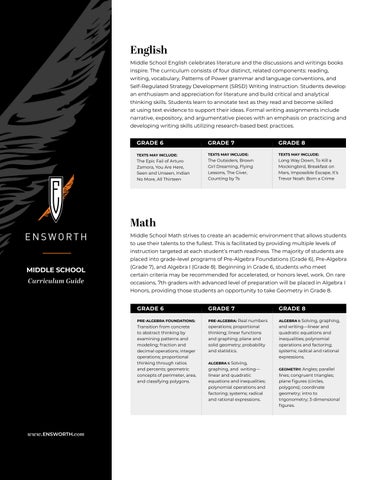
English Middle School English celebrates literature and the discussions and writings books inspire. The curriculum consists of four distinct, related components: reading, writing, vocabulary, Patterns of Power grammar and language conventions, and Self-Regulated Strategy Development (SRSD) Writing Instruction. Students develop an enthusiasm and appreciation for literature and build critical and analytical thinking skills. Students learn to annotate text as they read and become skilled at using text evidence to support their ideas. Formal writing assignments include narrative, expository, and argumentative pieces with an emphasis on practicing and developing writing skills utilizing research-based best practices.
ENSWORTH
GRADE 6
GRADE 7
GRADE 8
TEXTS MAY INCLUDE:
TEXTS MAY INCLUDE:
TEXTS MAY INCLUDE:
The Epic Fail of Arturo Zamora, You Are Here, Seen and Unseen, Indian No More, All Thirteen
The Outsiders, Brown Girl Dreaming, Flying Lessons, The Giver, Counting by 7s
Long Way Down, To Kill a Mockingbird, Breakfast on Mars, Impossible Escape, It’s Trevor Noah: Born a Crime
Math Middle School Math strives to create an academic environment that allows students to use their talents to the fullest. This is facilitated by providing multiple levels of instruction targeted at each student’s math readiness. The majority of students are placed into grade-level programs of Pre-Algebra Foundations (Grade 6), Pre-Algebra
MIDDLE SCHOOL Curriculum Guide
(Grade 7), and Algebra I (Grade 8). Beginning in Grade 6, students who meet certain criteria may be recommended for accelerated, or honors level, work. On rare occasions, 7th graders with advanced level of preparation will be placed in Algebra I Honors, providing those students an opportunity to take Geometry in Grade 8.
www.ENSWORTH.com
GRADE 6
GRADE 7
GRADE 8
PRE-ALGEBRA FOUNDATIONS:
PRE-ALGEBRA: Real numbers
ALGEBRA I: Solving, graphing,
Transition from concrete to abstract thinking by examining patterns and modeling; fraction and decimal operations; integer operations; proportional thinking through ratios and percents; geometric concepts of perimeter, area, and classifying polygons.
operations; proportional thinking; linear functions and graphing; plane and solid geometry; probability and statistics.
and writing—linear and quadratic equations and inequalities; polynomial operations and factoring; systems; radical and rational expressions.
ALGEBRA I: Solving,
graphing, and writing— linear and quadratic equations and inequalities; polynomial operations and factoring; systems; radical and rational expressions.
GEOMETRY: Angles; parallel
lines; congruent triangles; plane figures (circles, polygons); coordinate geometry; intro to trigonometry; 3-dimensional figures.