EL CENTRO NEWSLETTER
Fall 2025


Fall 2025
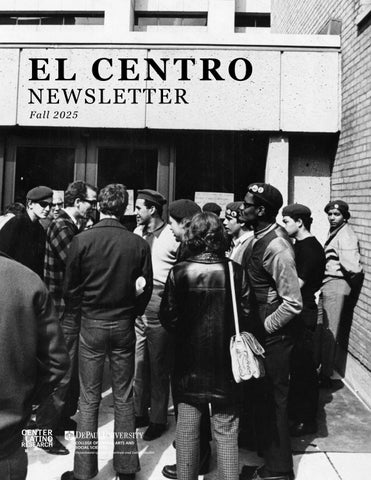
YoungLordsintheCrowdOutsideSchmittAcademicCenter
Photograph, exhibition copy, 2025
Photograph by S. Queira, May 9, 1969
DePaul Photographs Special Collection, Special Collections and Archives, DePaul University Library, Chicago, Illinois
The Black Student Union (BSU) called the Young Lords to campus after a group of white students tried to forcibly gain entry into the Schmitt Academic Center where the BSU was protesting. The Young Lords blocked the door to ensure the BSU could continue their talks with the university.
Fotografía, copia de exposición, 2025
Fotografía de S, Quiera, 9 de mayo de 1969
Archivo fotográfico de DePaul, Colección de Archivos Especiales, Biblioteca de la Universidad DePaul, Chicago, Illinois
La Unión de Estudiantes Negros (BSU) convocó a los Young Lords al campus, después de que un grupo de estudiantes blancos intentara entrar por la fuerza al Centro Académico Schmitt, donde la BSU protestaba. Los Young Lords bloquearon la puerta para asegurar que la BSU pudiera continuar sus conversaciones con la universidad.
STRC Summer Institute
our Comunidad: “I love Chicago” by Juliet de Jesus Alejandre
Unidos y Educados
Spanish Hour Club de lectura
Year of the Wind: Discussion with Karina Pacheco
The Center for Latino Research (CLR) strives to open and sustain dialogues that foster the empowerment and advancement of Latinx communities. To that end, the CLR creates learning opportunities for students and supports scholars in their research, while forging collaborative relationships with local, national, and international research partners. We also publish an award-winning scholarly journal, Diálogo, and sponsor many activities on campus, including film series and speaker series.
The Department of Latin American and Latino Studies (LALS) explores the myriad contributions of Latin Americans and Latinx people to the global community. The department’s programs emphasize the profound linkages that have emerged between Latin America and the United States, particularly through the construction of Latinx communities in the U.S. We also critically analyze the complex intersections with Indigenous, African, European, Semitic, Arab, and Asian communities throughout the Americas.
Edited and Designed by:
Gigi Lara Goutam Kumar
Michelle Cisneros

Published by:
The Center for Latino Research and The Department of Latin American and Latino Studies at DePaul University
Estimades lectores,
Originally established in 1985, the Center for Latino Research is celebrating its 40th anniversary this year. This is a tremendous achievement for DePaul, especially given the exceptionally difficult moment in American history through which we are currently living A New York Times editorial published on October 25th, for example, reflected on the current racialized targeting and harassment of Latinx people in the U.S. and grimly declared, “Being Latino in the United States Should Not Be a Crime.”
Precisely because of the heightened stakes of the moment, the CLR’s mission to support research in Latinx and Latin American Studies, and to disseminate knowledge that enlightens and empowers our communities, has never felt more urgent and necessary. If you take a look at the timeline included in this issue, you will get a glimpse of how, over the past 40 years, the center has spawned multiple national journals, supported student and faculty research, won grants, brought countless guest speakers to campus, connected DePaul to other universities, and connected DePaul to community organizations
One consistent facet of the CLR’s work has been to document and preserve Chicago Latinx history. Former CLR Director Felix Padilla, in fact, was among the first to study and document pan-Latino consciousness in Chicago The CLR’s oral history collections continue to offer a treasure trove of resources to researchers who visit us from all over the world. Just this year, elements from our collection have been included in two major museum exhibitions: Jacqui Lazu’s pathbreaking exhibit at DPAM, “Tengo Lincoln Park en mi corazón,” on the Young Lords in Chicago, and “Aqui en Chicago,” the Chicago History Museum’s monumental new exhibition on Latinos

While we take pride in the past 40 years, we continue to look forward to the future with optimism If winter and ice come, can spring be far behind?
~BillyJohnsonGonzalez

Hola lectores,
This fall has been a difficult time as we’ve grappled with the federal government’s assault on Chicago’s immigrant community. As you’ll see in the recap of events and talks featured in this newsletter, much of our programming has focused on responding to this incursion and lifting up the work of those helping us think through effective strategies for the moment
We hope you find this issue’s conversations with our friends and colleagues Susana Martínez, Lilian Jiménez, Jacqui Lazú, Jesse Mumm, and Julie Moody-Freeman inspiring and grounding Susana Martínez reflects on the Central American sanctuary movement of the 1980s and reminds us how Central Americans and their allies in Chicago mobilized, protested U S interventions in the region, and created safe spaces for immigrants and refugees Lilian Jiménez shares a poignant account of how mutual aid in Latino communities helped her family survive, and how she remains committed to fostering such efforts today while working to ensure that government truly serves the people in her district, Julie Moody-Freeman uplifts the importance of the healing arts and self-care, and Jesse Mumm discusses the ongoing gentrification reshaping neighborhoods across Chicago and highlights the forms of resistance emerging in response.
In these lean times, we are fortified and encouraged by these courageous efforts and by the long history of resistance rooted in our city. As Jaqui Lazú makes clear via her amazing exhibit of Chicago’s Young Lords, “There have been many moments where we’ve come together and had the courage to make decisions based on the values we all share We have to give light and focus on those anytime we can; otherwise, they (the forces that divide) make us think we are incapable of working together.”
Let’s hope 2026 brings us deeper community and renewed resistance
LourdesTorres
Marisa Alicea, Professor, Vincent DePaul Professor School of Continuing and Professional Studies
Carolina Barrera Tobón, Associate Professor Modern Languages
Ionit Behar, Curator | DePaul Art Museum
Rocío Ferreira, Associate Professor | Modern Languages
Martha Martinez-Firestone, Associate Professor and Director of Undergraduate Program | Sociology
Julie Moody-Freeman, Associate Professor, African and Black Diaspora Studies | Director, Center for Black Diaspora
Jacqueline Lazú, Associate Professor, Vincent DePaul Professor | Modern Languages
Jesús Pando, Associate Professor, Chair Physics and Astrophysics, College of Science and Health
José Perales, Interim Vice President Office of Institutional Diversity and Equity
Carolina Sternberg, Professor Latin American and Latino Studies
Joe R. Tafoya, Assistant Professor | Political Science
Lourdes Torres, Vincent DePaul Professor, Chair Latin American and Latino Studies
Carolina Sternberg, Professor Latin American and Latino Studies
Yoalli Rodriguez Aguilera, Assistant Professor Latin American and Latino Studies
Marisa Alicea, Professor, Vincent DePaul Professor School of Continuing and Professional Studies
Luisela Alvaray, Associate Professor Media and Cinema Studies
Glen Carman, Associate Professor Modern Languages
Delia Cosentino, Professor History of Art and Architecture
Rocío Ferreira, Associate Professor Modern Languages Department Chair, Women's and Gender Studies
Bill Johnson González, Associate Professor, English Director, Center for Latino Research
Jacqueline Lazú, Associate Professor, Vincent DePaul Professor Modern Languages
Jordan Levy, Assistant Professor Anthropology
Martha Martinez-Firestone, Associate Professor, Sociology Director, Undergraduate Sociology Program
Susana S. Martínez, Associate Professor, Modern Languages Director, Peace, Justice & Conflict Studies Program
Elizabeth Millán, Professor, Chair Philosophy
Heather Montes-Ireland, Associate Professor Women's and Gender Studies
Jesse Mumm, Professional Lecturer Latin American and Latino Studies
Camila Gavin, Social Transformation Research Collaborative (STRC) Post-Doctoral Fellow | Latin American and Latino Studies
Juan Mora-Torres, Associate Professor History
Vincent Peña, Assistant Professor Journalism and Sports Communication, College of Communication
Xavier Pérez, Assistant Professor Criminology
Olga Salazar Pozos, Assistant Professor Spanish, Modern Languages
Lydia Saravia, Professional Lecturer Writing, Rhetoric and Discourse
Monica Reyes, Assistant Professor Writing, Rhetoric and Discourse
Ana Schaposchnik, Associate Professor History
Jose Soltero, Professor Sociology
Sonia Soltero, Professor, Chair Leadership, Language and Curriculum, College of Communication
Rose J. Spalding, Professor, Vincent DePaul Professor Political Science
Joe R. Tafoya, Assistant Professor Political Science


Professor Tafoya recently presented original research at Waseda University (Tokyo) andDoshisha University(Kyoto),Japan.HisworkexaminesLatinoactivism in Chicago and Los Angeles, focusing on how communities challenge federal immigration policies through“KnowYourRights”campaignsanddemonstrations.
His research highlights Latino activists as defenders of democratic norms, reshaping civic identity and society, and explores how other groups such as Asian Americans canlearnfromthesestrategiesinconfrontingthe“perpetualforeigner”stereotype.
Professor Spalding, Vincent DePaul Professor of Political Science, received a LAS Faculty Summer Research Grant to support her project, “Resistance to Democratic Backsliding: Indigenous Peoples’ Mobilization and Social Accountability in Guatemala.”
She spent July 2025 in Guatemala gathering information about the movement led by the country’s “Seven Pueblos” to defend democratic reform and strengthen the rule of law Her fieldwork included interviews with indigenous community leaders to better understandhowtheyorganizeandadvocatefortheircollectivegoals.
In June 2025, Professor Johnson Gonzalez was selected to join the Mexican American Engagement Council for the City of Chicago, a new advisory body dedicated to promoting the needs, interests, and well-being of the Mexican American community Through this role, he will help ensure that community voices are represented in city policy discussions and strengthen collaboration between the Center for Latino Research (CLR) and community organizations across Chicago
Professor Johnson Gonzalez also received a Mellon Scholarship to participate in the Hispanic Association of Colleges and Universities (HACU) Enlace Mid-Level Leadership Program, a six-month initiative that prepares emerging Latino/a leaders for executive roles in higher education


At the National Women's and Gender Studies Association conference in Detroit, MI, Dr. Heather Montes Ireland presented her work on dignity and the post-work imagination in Latina visual culture on the panel "Dignidad y Justicia: Envisioning Latina Decolonial Feminist Conceptualizations of Dignity and Justice" along with DePaul alumnae Priscila Sanchez Neyra (LAS '23) and Kassandra Castillo (LAS MA '20).
CAROLINA STERNBERG
ProfessorSternbergwilltraveltoBuenosAiresinDecember2025toadvanceherresearch on caring cities and the unhoused population. Her fieldwork will include interviews and semi-structuredsurveyswithorganizationsthatsupportunhousedcommunities.
InMarch2026,shewillconductadditionalresearchinSalvador,Brazil,interviewingAfroBrazilian residents and anti-gentrification activists These efforts will contribute to data collectionforherCLRFellowship,whichbeginsinWinterQuarter2026,focusingonrace, whiteness,andgentrificationinSalvadorandChicago
In July 2025, Yoalli Rodríguez participated as a fellow at the Colby Institute for Environmental Humanities, where she revised an article exploring the intersections of environmentandcriticalhumanities.
During the fall, she presented her research at the University of Illinois at Chicago’s Fall Symposium in the Department of Anthropology, engaging in conversations on race, environment,andsocialjustice.
She will also serve as a virtual guest lecturer at the University of British Columbia’s Department of Architecture and Landscape Architecture, discussing the relationships betweenecology,territory,andculturalpolitics.
Over the summer, Delia Cosentino consulted on an upcoming exhibition entitled "Languages of Migration" at the Museum of Art and Design at Miami Dade College, to open in Autumn 2025. She also contributed to the Newberry Library's Digital Collections for the classroom with a learning activity related to “The Nuremberg Map and Hernán Cortés’ Letter to King Carlos V." Currently in residence at the Newberry Library (2025-2026), Cosentino will present a paper on "Gladiators in Altera Roma: Tenochtitlan in the European Imagination" at a conference on Lost Cities in a Global Perspective (Caserta, Italy, October).

Rocío Ferreira was honored with the “Gran Amauta” 2025 distinction by the XXX Tumi USA Award, recognizing her exceptional work and dedication. This award celebrates outstanding Peruvian immigrants who embody a spirit of solidarity, a strong work ethic, professionalism, and a deep commitment to community service. “Amauta,” a Quechua word meaning “wise teacher,” carries profound cultural significance, making this recognition especially meaningful for Dr. Ferreira. ¡Felicidades, Rocío!

On October 21st, State Treasurer Michael Frerichs hosted a celebration in Chicago to commemorate LGBTQ+ History Month Dr Lourdes Torres was presented with an award for her outstanding commitment to education.
¡Felicidades, Lourdes!
September 11, 2025—February 8, 2026

“The exhibit aims to give the group its dues in a moment when museums are under the microscope. ”
“The exhibit aims to give the group its dues in a moment when museums are under the microscope.”
-Courtney Kueppers, WBEZ
-Courtney Kueppers, WBEZ
“echoes the cultural, visual, and material lineages of the YLO. ” -Lucas Gómez-Doyle, The Latinx Project “echoes the cultural, visual, and material lineages of the YLO.” -Lucas Gómez-Doyle, The Latinx Project

by Angelique Lara
The 2025-2026 academic year is a monumental time in Dr. Jacqueline Lazú’s career. Her decades of research and archival work about the Young Lords Organization are finally being published and exhibited, at a time when preserving intersectional Latinx, more specifically Puerto Rican, histories, is more important than ever. This work culminates as a series of books and an exhibition, providing learners with a range of materials and analyses of the Young Lords Organization in Chicago

Dr Lazú’s series of books includes Stone Revolutionaries: The Origins of the Young Lords Movement (expected publication in the fall of 2026, Duke University Press), and The Young Lords Speak: Building Revolution on the Streets of Chicago (expected publication in March 2026, Haymarket Books) The Young Lords Speak encourages readers to listen, with their corazones, to the voices of the Young Lords Organization and their movements across space and time Dr Lazú explains the character and philosophies of the Chicago chapter as differing in political focus from the Young Lords in New York, which separated from the original Chicago chapter, becoming the Young Lords Party. The Party, in Puerto Rican civil rights discourse, is more well-known because of its political commitment to Puerto Rican liberation. The organization in Chicago was community-centered and equally as political, but with less formal avenues of social justice and marketing. Dr. Lazú commits her book to telling the story of the Young Lords Organization in Chicago using their own voices and archival material. She cites inspiration for the title and methodology of the text using The Black Panthers Speak by Philip S. Foner, emphasizing the historical value of framing these narratives within the ideological and social understandings presented by the Young Lords themselves: “It's the responsible thing to do ”
In addition to the books, in collaboration with the DePaul Art Museum, Dr Lazú curated an exhibition, Tengo Lincoln Park en mi Corazón: Young Lords in Chicago, which is currently up and will run until February 8, 2026


The museum exhibition, drawing upon a variety of archival sources, encourages audiences to experience the history of Lincoln Park, DePaul’s campus, and Puerto Rican Chicago through the spaces we inhabit and histories we take for granted: “The objective of the exhibition is to make us think about ourselves in relation to space. It is meant to invite you to imagine a history of resistance—the history of a community, through the lens of a movement, that changed the world Maybe they were removed, maybe the community was displaced, but what cannot be killed, what cannot be displaced, and what cannot be eliminated is the effect.” Through photographs, archival materials, oral histories, and contemporary artworks, the exhibition “remaps” Lincoln Park.
Redrawing historical narratives offers what Dr Lazú calls countergeographies: ways of understanding the neighborhood and community not solely through gentrification, but through the resilience, perseverance, and stories of the Puerto Ricans and Young Lords who once inhabited and made a home of Lincoln Park
The work Dr. Lazú is doing to preserve the history of the Chicago Young Lords Organization is invaluable, a communal labor of love. She states: “There have been many moments where we've come together and had the courage to make decisions based on values we all share. We have to give light and focus on those anytime we can; otherwise, they [forces that divide] make us think that we're incapableofworkingtogether.Sotheexhibitiondoesthat.”
Dr. Jacqueline Lazú is a professor in the Modern Languages department at DePaul University. Her areas of expertise include, but are not limited to, Caribbean and Latino literature, Afro-Latin American and Afro-Latino studies, social movements, and community-based research and service learning.
If you are interested in following along with Professor Lazu’s book projects and exhibit, visit www.jlazu.com or the DePaul Art Museum webpage.
Check out an article about the exhibition in WBEZ Chicago:


InJuly,theSTRCwelcomeditsfourthcohortofincomingfirstyear and transfer students for the 2025 Summer Institute for New Students program! The 2025 Summer Institute featured lectures by a wonderful team of DePaul faculty from different departments as well as guided tours and guest speakers in Pilsen,Bronzeville,andEnglewood.

Faculty Research Fellows
Xorla S. Ocloo
Michael McIntyre
Faculty Professional Development Fellows
Amor Kohli
Shiera Malik
Postdoctoral Fellow
Camila Gavin
Graduate Fellows
Rosbel Garza-Hernandez
Sukhmani Mandair
Bridget Salada
Undergraduate Fellows
Karmen Johnson
Angelique Lara
Kei Smith
Robyn Underwood
Zoe-Anna Wilson
Vivian Wong


Olivia Hanif, 2024-2025 STRC Summer Institute alum, is a second-year undergraduate student majoring in Journalism with a double minor in Peace, Justice, and Conflict Studies and Intercultural Communication In her role as contributing writer for DePaul’s student newspaper, DePaulia, she wrote an article about the 2025 STRC annual symposium. Scan the QR code to check out her article!


by Marcela L. Reales Visbal
Dr. Julie Moody-Freeman stepped into the role of Director of the Center for Black Diaspora in the summer of 2019, a few months before the onset of COVID-19. Once the pandemic unfolded, she quickly reassessed the direction of the center, and in the six years that followed, she led the development of healing-focused programming, interdepartmental collaboration, and established a renewed commitment to care. “I felt compelled,” she explains. “I needed to make sure the community was okay.”
The focus on issues related to healing began before the pandemic The theme for the CBD fall 2019 Lecture and Discussion Series was “From Trauma to Resilience: Healing Body, Mind, and Community in the Black Experience,” which included events such as Yoga for Black Lives, Black Joy and Resistance, and a lecture focused on Healing in Pre and Post Genocide Burundi and Rwanda When COVID-19 hit, Dr Moody-Freeman was compelled to respond to the moment, to make sure the community understood the effects of the virus She invited Uché Blackstock, MD , to speak about the disproportionate impact of COVID-19 on Black communities and opened space for cross-cultural health traditions. From Caribbean healing practices to Chinese medicine, she led programming rooted in care and global diasporic perspectives on wellness.
The need, however, extended far beyond individual health. Faculty, staff, and students were navigating grief, uncertainty, isolation, and unprecedented stress. Recognizing this, in collaboration with colleagues from the Women’s Center, PAX, and the Center for Community Health Equity, CBD launched the Healing Justice Dialogue Series, which included virtual circles, workshops, and support spaces: “I feel like that was what I felt, we had to help people.”
One of the most significant accomplishments of Dr Moody-Freeman’s tenure was her leadership in the Social Transformation Research Collaborative (STRC), a 3-year $1 9M Mellon grant project developed with colleagues, including Dr Billy Johnson González, as well as other campus partners The STRC, which “supports research in the humanities as a source of justice and healing for communities historically shaped by, and continuously facing, racism, violence, and dispossession,” became a university-wide effort to support first-generation students while also investing in faculty development.
The scope of the project includes a Summer Institute for incoming First-Year students, undergraduate, graduate, and faculty research and professional development fellowships, two postdoctoral fellowships, and an annual symposium. Remarkably, the results have aligned with the team’s hopes: faculty have secured book contracts and earned promotions; undergraduate students have presented at national conferences; STRC’s first cohort of Summer Institute students are now applying to graduate school, carrying forward the mentorship model they experienced: “They did exactly what we thought they would do.”
The STRC grant project was recently renewed for a second term, and Dr. Moody-Freeman will continue to serve as co-director, alongside Dr. Johnson González.
Even while co-directing STRC, sustaining the Center’s programming, teaching, and managing the emotional toll of the pandemic, Dr. Moody-Freeman found a way to creatively continue to work on her research. Her love of podcasts and desire to interview writers led to the creation of the Black Romance Podcast Series, an archive of conversations with Black writers, editors, and scholars of contemporary popular romance fiction Launched during the height of quarantine, it became yet another way to build community across distance, foregrounding Black storytelling traditions while extending the Center’s reach far beyond campus
As she steps away from the directorship of the Center for Black Diaspora, Dr. Moody-Freeman expresses pride in what the center has built under her leadership. She hopes the institution will continue supporting elements of STRC, particularly the Summer Institute and faculty fellowships, even as national pressures threaten DEI work
Part of her legacy, she emphasizes, is personal: “I had to learn that leadership is service to others, but also service to self.” But she is quick to emphasize that none of it was done alone: “I couldn’t have accomplished any of this without Billy, without the other units and center directors, Margaret, and Jennifer… Community is the center.”
Her next chapter centers on completing ongoing Black romance scholarship while deepening her research into healing traditions.


Associate Professor | Director of Peace, Justice & Conflict Studies Program
Chicago’s Central American Peace and Sanctuary Movements: A Historical Memory Project
Chicago has a long history as a sanctuary city This historical memory project connects past and present social justice activism by studying Chicago’s role in the movement to provide sanctuary to Central American refugees beginning in the 1980s Steeped in the Central American peace and solidarity movements, Chicago organizers created an interfaith coalition to reject the U S government’s Cold War agenda My primary goal is to spotlight Chicago’s understudied sanctuary activism by collecting oral histories of community members and consulting the recent donation of the Chicago Religious Leadership Network archives to the Richardson Library Several CRLN members were and continue to be active social justice leaders in the community My goal is to contextualize the oral histories within a larger context of Peace Studies and immigrant justice activism I am prepared to interview Central American community members in Spanish to add their lived experiences and critical perspectives to historical spaces where their voices have often been silenced In addition to publishing an article on my findings, I plan to introduce students to this important activism and advocacy work throughout my interdisciplinary teaching at DePaul

Assistant Professor | Sports Communication
From the Locker Room to the Press Box: Understanding How Latino Sports Figures Navigate Politics and Policy in the Age of anti-DEI
This study explores how Latino athletes, journalists, and sports professionals are navigating the growing backlash against diversity, equity, and inclusion (DEI) initiatives, particularly under the Trump administration By using sports as a political platform, recent anti-DEI efforts have had disproportionate effects on communities of color including Latinos Through qualitative interviews this study will examine the personal and professional challenges Latinos face in this shifting climate and attempt to shed light on how these policies impact one’s identity, career opportunities, workplace culture, treatment, and the overall inclusivity of American sports


Assistant Professor | Spanish, Modern Languages
Mourning Together: Artistic Interpretations of Mexico’s War on Drugs
In The Restless Dead, Cristina Rivera Garza asks: What is the ethical and aesthetic significance of the literature and art produced in the context of war? This question is especially salient to Mexico, where the ongoing War on Drugs has produced a human rights crisis that has been worsened by impunity and the constant criminalization of the victims In cases like this, where the circumstances create feelings of social fear and a separation between those directly affected and not affected by human rights violations, it becomes imperative to reestablish social connections and to mobilize collective responses against the war nationally and internationally, as this forces the State to respond The question is: how to mobilize such responses? “Mourning together,” my book project, seeks to contribute to this debate by analyzing the answers provided by an emerging culture in Mexico: a mourning culture By tracing and characterizing this movement through the study literature and documentary films, I seek to demonstrate how the mourning culture has contributed to diluting criminalizing narratives, constructed other ways of understanding human rights violations from a site of care and affect, and established or reestablished social connections between victims, readers, and spectators
I aim to examine the dynamics of the intersection between gentrification and race in Salvador, Brazil and Chicago, USA two cities with long histories of racial segregation and urban transformations that impact Afro-Brazilians’ and African Americans’ access to affordable housing Drawing from recent publications on gentrification, neoliberalism, and anti-Black rhetoric in Salvador along with my ongoing research, I plan to conduct qualitative research in Salvador to later drawn comparisons with Chicago This research will examine how anti-Black rhetoric, upgrades to the physical environment, and the growing presence of the white population in two Afro-Brazilian neighborhoods in Salvador have influenced increases in property and rent values, further limiting Afro-Brazilians' access to affordable housing
Interview by Michelle Cisneros
Dr. Susana Martínez is an Associate Professor of Spanish in the Department of Modern Languages and Director of the Peace, Justice & Conflict Studies Program at DePaul University. Dr. Martinez has conducted service learning based trips to El Salvador and Mérida, Mexico. She has also published articles and book chapters on issues such as the political violence in Guatemala, an ethnographic memoir by Cuban American writer Ruth Behar, and Archbishop Oscar Romero. Her forthcoming book is titled Coming of Age(ncy) on the Migrant Trail: Adolescent Journeys in Contemporary Latinx Young Adult Literature (December, 2025).
What is your CLR Faculty Fellowship focused on?
It is focused on Chicago’s Central American sanctuary movement. I’m excited about this project because it will be the first time I step away from a literary studies approach. My plan is to conduct oral history interviews with community members who participated in the Central American solidarity and sanctuary movement. Chicago and the Midwest haven’t received as much attention as the sanctuary work that took place in the southwest.
Where are you in your research/writing process?
I am at the very beginning stage. I’m reading and gathering notes on what has been published. As I’m reading, I am trying to put a timeline together so that I can place key moments in a larger historical context to reflect on what was happening politically in the US and Central America. I’m also jotting down questions that I would like to ask people who did this grassroots work. I’m curious to hear how they experienced the period and what memories or experiences stand out to them today. What did they find most challenging and what lessons did they learn about organizing, community building and sustaining momentum that they would share with today’s immigrant justice activists?
How is your identity reflected in your project?
I am from Los Angeles, my mother is Guatemalan, and my father is Mexican. I remember listening to stories from our Guatemalan and Salvadoran family friends about the political violence they witnessed back home.
But the only time I remember learning about Central America in high school was when we watched the documentary Roses in December (1982) about the four American church women who were raped and murdered in El Salvador in 1980. In college, I learned about the history of US involvement in Central America and was able to think about stories I’d heard about in a larger context. My identity is wrapped up in this project because of the US role in creating the harm and my respect for people who fled and told Americans that their tax dollars were being used against people working for social change. I want to learn about their initial experiences of arriving in the US and how they came to Chicago. I also want to know more about the people who offered them sanctuary when it was against the law.
In what ways has your identity shaped the lens with which you approach this project?
I’ve lived in Chicago for twenty-five years. Around 2016, I started volunteering with different immigrant justice organizations and I’ve been privileged to meet people who are long-time peace activists and were involved in the sanctuary movement and continue to support immigrants and refugees today. Over the years, I’ve only heard bits and pieces of their stories, but now I want to take the time to really listen and learn from their experiences. Most accounts of the sanctuary movement are told from a white perspective because, at the time, it was safer for them to speak out. They used their white privilege to stand in solidarity as allies and questioned the U.S. government’s role in Central America and the denial of asylum I want to collect their stories, but I especially want to interview Central Americans who risked their lives here in Chicago to help others Their stories haven’t been told, and I think it’s very important to acknowledge their role in history
Could you share a little bit about the history of Chicago’s sanctuary movement? What is The Chicago Religious Leadership Network on Latin America (CRLN)’s role in Chicago’s peace and sanctuary movements?
Chicago’s role in the peace and sanctuary movements is important because after the murders of the four US churchwomen and the assassination of Archbishop Romero in El Salvador in the early 1980s, the


Religious Task Force on El Salvador expanded its scope to become the Chicago Religious Task Force on Central America, a coalition of groups that became a leading voice for sanctuary and political organizing to oppose US military aid to Central America Later, they formed the (CRLN) In July 1982, the Wellington Avenue United Church of Christ became the first religious community to declare sanctuary in the Midwest and became a model for many others
What opportunities and challenges come with working through religious organizations?
Organizations focus on dignity and an ethic of hospitality Grounded in this welcoming understanding of human dignity, we can get to work without the politicized rhetoric of illegality and focus on root causes that force people to flee home such as economic injustice, gendered violence, and political violence against environmental activists trying to protect their rivers and ancestral lands
Maybe one of the challenges is that many of the people doing this solidarity and interfaith work are very busy people, especially now that Chicago is experiencing such a violent increase in immigration arrests and detention I imagine it might be hard to find time to reflect on everything that is happening and trace the history back to the peace and sanctuary movements I am interested to learn what memories of their accompaniment work come up for them now that we are experiencing these events again in our city
Whydidyouchoosetocollecttestimonios?
Testimonios have such a powerful history in Central America, like Rigoberta Menchú’s testimonio, which brought worldwide attention to the genocide that was happening in Guatemala in the early 1980s. I think it’s important to have firsthand accounts of how people experienced historical events. Their stories can add many important lessons and details to this understudied moment of history.
Since your project collects testimonies from bothpastandpresentactivists,whyisit particularly urgent to preserve, archive, and learn from these oral histories in today’s politicalclimate?
It feels more important than ever now that we’re seeing masked agents taking people away so violently. It reminds me of forced disappearances that I’ve seen in documentaries about Guatemala and El Salvador in the 1980s and 1990s that forced thousands of people to flee for their lives. But now it’s happening again here in our own neighborhoods. I think adding oral histories to a community archive is important so that we can document what we are witnessing and name it as an injustice like people did decades ago. By archiving these stories, others will learn about how we organized and connected with others to work for socialchange.
Oralhistoryasamethodologyoftenblends personaltestimonywithbroader movements.Howdoesthisapproachshape ourunderstandingofactivism,especially nonviolentresistance,andwhyisit importanttocontinuetoconservetoday’s voicesforfuturegenerations?
I think that as personal testimony, oral history can shape collective historical memory and offer creative examples of nonviolent resistance. This matters because it renews our faith in the power to bring about change. We’re seeing so many creative posters in the marches that are speaking truth to poweranddemandingaccountability.
How are you coping with the current political climate? Do you have any advice on howtocopeandmoveforward?

It’s been hard. I was so scared when troops entered Los Angeles and now they are here in Chicago. As scary as it feeds, I try to remember that people are resisting every day. I try to be careful about how much news I watch or read. And when I do tune in, I try to focus on how people are organizing and comingtogethertohelpothers.
I worry about how students and their families are doing. I check on friends and family, and I appreciate it when they ask how I'm doing and remind me to rest. It’s hard to constantly feel like we’renotdoingenough.
I recently attended the Peace and Justice Studies Association conference at Swarthmore, and I visited their amazing Peace Collection. They have the most extensive archives in the US focused on movements for peace around the world. It turned out that the conference was taking place as ICE was terrorizing people in my neighborhood of Rogers Park, so grappling with the importance of recording evidence that those in power might attempt to erase felt so real but also so emotionally devastating. It makes me think that peace, like memory, is ongoing and crucial. Our stories have power. Otherwise, authoritarian forces wouldn’t exert so much effort to silence them, together, we havetoolsfornonviolentchangeandresistance.
CELEBRATING 40 YEARS EST. 1985
1985-1995
1995-2005
1994-2000: FORD FOUNDATION LATINO LEADERSHIP OPPORTUNITY PROGRAM GRANTS
$188,000 OVER SIX YEARS
COLLABORATION FORGED WITH LATIN AMERICAN STUDIES PROGRAM (LST)
1996: JOURNAL DIÁLOGO WAS LAUNCHED, PLANNED TO BRIDGE ACADEMIC-COMMUNITY RELATIONS
1997: BY STUDENT INITIATIVE, ANNUAL LATINO GRADUATION BANQUET IS LAUNCHED
1995-1998: ORAL HISTORIES PROJECTS
LATINO HOMELESSNESS WITH CHICAGO COALITION FOR THE HOMELESS MEXICAN-CHICAGO, BEGUN WITH CASA AZTLÁN, BY HISTORY PROFESSOR JUAN MORATORRES
COMMUNITY PARTNERSHIPS FORGED WITH PILSEN ALLIANCE, CASA MICHOACÁN, UNIVERSIDAD POPULAR
2003: CLR FACULTY FELLOWSHIP PROGRAM INSTITUTED
MOVE TO NEW OFFICE SUITE, SHARED BY CLR AND LATINO STUDIES
ORAL HISTORIES PROJECT, CHICAGO YOUNG LORDS, COMPLETED, ARCHIVED AT DEPAUL LIBRARIES
CELEBRATING 40 YEARS EST. 1985
2005-2015
2015-2025


by Carmen Maria Machado
In the spring, our book club discussed Carmen Maria Machado’s Her Body and Other Parties, a collection of stories that blend psychological horror and speculative fiction to examine the complexities of gender, sexuality, and identity. Across our three sessions, we explored how Machado uses surreal and haunting narratives to reveal the anxieties and desires that shape women’s lives.
THANKS TO OUR ATTENDEES FOR THEIR REFLECTIONS AND OPENNESS!


The first 15 students who register will receive a FREE COPY of the book!
Discussion Dates
TUESDAYS: Oct 7 2025 Oct 28 2025 Nov 11 2025
4:30 - 5:45 PM at the Latinx Cultural Center
Join us for a discussion of
by Xochitl González
This New York Times Bestseller centers on Olga, a Puerto Rican wedding planner in New York, as she reckons with Hurricane María's aftermath and the return of her long-lost mother, a former Young Lord.

Each discussion will focus on a section of the text in preparation for the author’s in-person visit to DePaul on Wednesday, November 19th
REGISTER HERE

Wednesday, November 19th, 2025
A reading and conversation with 4:30 - 6:30 PM| DePaul Art Museum


THERE WILL BE A BOOK SIGNING AFTER THE DISCUSSION!
Books will be available for purchase.
Join us for a reading and conversation with author, Xochitl Gonzalez, who will be discussing her award-winning book, Olga Dies Dreaming, the 2025 Chicago Public Library “One Book, One Chicago” selection

|
60 seconds with 60 seconds with 60 seconds with
by Michelle Cisneros
Dr Jesse Mumm, Latin American and Latino Studies and Critical Ethnic Studies faculty member, spent the spring 2025 quarter on leave from teaching to work on his book proposal focused on gentrification in Chicago His project studies three Chicago neighborhoods: Pilsen, Humboldt Park, and Garfield Park Despite the strong and historical cultural ties of each neighborhood, they have each experienced unique pressures of gentrification. He explores community resistance, how racial capitalism has impacted the housing market, and ways we can continue the fight against it. Below are three questions that emerged from our conversation:
QWhatroledoesrace playingentrification, specificallyinChicago?
Race is central to gentrification. Neighborhoods such as Pilsen and Humboldt Park, whose populations are largely Puerto Rican and Mexican, have historically been most vocal about resisting displacement. This applies in social, cultural, and political spheres of the community. Garfield Park, a predominantly black neighborhood, portrays every urban studies textbook condition of a neighborhood ripe for gentrification. In 1998, it was called “the hottest real estate in the country ” Then it didn’t gentrify Developers just couldn’t get the white market to move there, which shows how part of this has to do with just deep-seated racism


QIsgentrification inevitable?
This inevitability mirrors the way we talk about Indian removal and the ways that colonialism always works I confront people with, if it was inevitable, how did it start? How was it literally plotted and conspired about in Pilsen in 1967 to now, when it is still majority Mexican? How have the majority of those people held on if it was inevitable?
Q Whatcanbedoneto resistgentrification?
Ithinkweneedtoactuallycompletely overhaulourtaxsystem,andIthink that'snotawild,crazydream I'monthe 26thWardZoningAdvisoryCommittee, andwejustkeepsayingnotoluxury, overpricedhousingproposalsuntilwe seethingsthatarelocallyaffordable If theexistingculturalheritagedistrict legislationthatwaspassedinthestate weregivenalittlebitmoreteeth,ifthat allowedpeopletobetaxeddifferently ortobegivenprotections,ifwe completelyestablishedrentcontrolin Chicago,wecould,Ithink,doenough toslowdowntheprocess It’snottosay therewillbeonesilverbulletthatends gentrification,butItrytoofferpeople hope
Maria G. Arias
Principal, Maria Arias Solutions
BA, Political Science, DePaul University, 1983
Martin Arteaga
President, Green Building Partners, Inc.
BA, Political Science, DePaul University, 2000
Trish Brown Cordes
Master of Public Service Management, DePaul University, 1983
Leonard Domínguez
Secretary, Little Village Rotary Club of Chicago
BA, Economics, DePaul University, 1967
Yvette Flores
Managing Partner/Director, Cardinal Green Investments LLC
BA, Sociology, DePaul University, 1986
Marisol Morales
Executive Director, Carnegie Elective Classifications, American Council on Education
BA, Latin American Latino Studies; MA/MS International Public Service Management, DePaul University, 1999
Maria Pesqueira
President, Healthy Communities Foundation
BA, Latin American Studies, DePaul University, 1990
Edgar Ramírez
President/CEO, Chicago Commons Association
BA, Political Science/Latin American Studies, DePaul University, 2000
Ulises Iván Sánchez
Human Resources Officer/U.S. Department of State
BA, Leadership and Human Resources Management, DePaul University, 2015
MS, Human Resources, DePaul University, 2016
Lou Sandoval
President/CEO, Halo Advisory Group
BS, Biochemistry, DePaul University, 1988
Interview Conducted by Angelique Lara
LilianJiménezisanattorneyservingasStateRepresentativeoftheIllinois4thdistrictsinceNovemberof2022 Wetalkedabouthertimeat DePaul,her family’simmigrantrootsandworking-classupbringing,andherlifelongcommitmenttosocialjustice
I was born and raised on the far South Side of Chicago My grandfather came from Puerto Rico to Chicago to work in the steel mill That was before the steel industry fell apart, when a lot of people were able to buy houses and have a decent living When my parents were raising us, it was difficult; there were really no jobs, no industry There's a lot of disinvestment in our communities I remember walking around my neighborhood, and everything was broken; there was graffiti in our schools, and we were overcrowded. Feeling like society was not investing in young people was a big part of my growing up.
I loved reading and learning, so I went to DePaul because somebody took me there, and I had never seen such a beautiful neighborhood. I got a scholarship and lived there for four years, which had a huge impact on my life. It was a whole different world that opened up my eyes to a lot.
How did your upbringing shape your perspective on public serviceandcommunityadvocacy?
My mom was very involved locally and in school organizing Eventhoughshewasundocumented,shewaspartofthefirst class of elected officials who were parents under the Harold Washingtonadministration Shewasactuallythefirstelected official in my household, which was huge It showed me that she was fearful because of her situation, but she was also really fierce in her wanting to protect and make the world a better place for us She took me to my first protest, and we marched because there was a school that was going to close down Whatever was accessible to her, she would take that opportunity. That’s how it influenced me to take every opportunity; every door that opens, I want to go and see what I can do with it. All that came from my mom, who was undocumented.
My dad is a U.S. citizen by birth because he’s Puerto Rican. I grew up understanding how complicated being in a mixed status family is. Contrary to what a lot of people think, you’re notappointedalawyerinimmigrationproceedings;youhave topayyourownway.EventhoughmydadwasaU.S.citizen, it was impossible to change my mom’s status, so she stayed undocumented from the age of 14 to around 60 She's now a U S citizen, but that really impacted me Being a poor family,wetookadvantageofalotofresources Everyyear,I

StateRep.LilianJiménez
got my coat because they did a coat giveaway in the neighborhood, and I got my backpack because they had a back-to-school fair where they gave backpacks with supplies ThosearethekindsofthingsIdonow,andIknowhowmuch of an impact it has Without those services, I don't know whereIwouldhavebeen Samethingwithbeingabletogoto DePaul; I got a scholarship that now would be considered DEI I ended up going to law school at DePaul and becoming an elected official who helps my community I would not have been able to do these things were it not for somebody helpingme
I always think about how hard it is to give back, and that's what my mom was always about, even though she wasn't documented. She thought about it in terms of mutual aid. She only went to 8th grade in Mexico and didn't have a sophisticated political analysis, but when we talk about what mutualaidisabout,itisnotaone-waystreet;itishowweare building the network of support for each other. There's a process of mutual aid that happens in poor communities that wedon'tthinkaboutandgiveenoughcredencetobecausewe think of it in such a paternalistic way people with money helping people without money. We need to remember what the assets are in poor communities and what we can learn from them It's not a deficit Being someone who grew up in a poor environment helps me continue to remind myself of that
Every community and culture has wonderful, beautiful thingsthattheydevelop,andweshouldbelookingforthose things as best practices and building upon them Instead, we see and hear a lot of disparaging of Latino culture, disparaging of our language, and criminalization of the Latino community You see all these negatives, and then peoplewhowanttohelpthecommunityhaveawhitesavior mentality That's what I was fighting against a lot as a young person, trying to figure out how to approach the problemsthatweseeinsociety
It's normal to have a lot of self-hatred in those communities because of the way we're positioned to be “takers”. My dad has worked his whole life, he makes minimum wage, he works in factories, he doesn't have health insurance, and he onlygetsaraisewhentheminimumwagegoesup.Istarted realizing that we are the workers who are actually creating this wealth in society, and then we're turned around and told that we're lazy. How are both things possible at the same time? That's when I started to build my internal confidence, and it took a long time because the stain of being poor and brown is very real. I don't know if other peopleunderstandit.
You’ve introduced 17 new bills this session. Which one are you most excited about, and why do you believe they will make the biggest difference for the people of Illinois?
One of the priorities we are working on right now is safe schools for all Currently, in Illinois and across the country, students can attend school, and schools are not supposed to request immigration status They are not supposed to do anything that has the effect of denying education That’s based on a case called Plyler v Doe that was from the 1980s, where the Supreme Court said, in more sophisticated terms, we don't need kids running around without an education; everybody who lives in this country should be in school if they're of school age.
A couple of months before this administration took office, people were thinking about what could possibly happen. Now, we're seeing a lot of our rights eroded, and this is one of the areas I feel should be easy for the state of Illinois to address and ensure that students who are currently enrolled are not prohibited from attending school Unfortunately, in other states like Tennessee, they're doing the opposite of my bill They just passed the senate, leaving Tennessee to deny public education to students based on immigration status, so it will go to the Supreme Court We don't know if the Supreme Court will uphold the current law If it goes the other

way, my argument is that we need to have a strong law on the books, a state law that protects K-12 education for students. It also has aspects that will prohibit ICE and immigration officials from entering schools and picking up children or parents who are volunteering. Unfortunately, there's a lot of anti-immigration sentiment that we've seen across the country, and Illinois is not immune to it.
As Chair of the Housing Committee, what are your main priorities for addressing housing affordability and accessibility, and how do you plan to implement thesechangesinyourrole?
In the 4th District, one of the main issues is housing affordability and displacement The State Representative before me created a law that allows the state to designate a district as a cultural district Our community has one of them; it’s on Division St and goes all the way West, South, and East of here
We are trying to figure out a property tax formula that will allow an abatement for families who have been here for a long time so they are not displaced We’ve seen the highest increases in property taxes in our community: the Logan Square and Humboldt Park area. We want to make sure that families are not displaced because outside investors are coming into our community and creating a double market where our property taxes go up even though we haven't done anything to our homes. We have not necessarily improved our homes; we’re just living and working in our homes. We want to ensure the property tax increases percentage-wise so that it could be capped, so we are not unjustly seeing increases in our community where other communities are seeing a small increase or even a decrease. This huge spike in our property taxes is driving homeowners away because they just can't afford to live in the community In 10 years, if we continue on the same path, the same thing will happen as in Logan Square; 20,000 people were displaced in a decade, and we don't want to see that continue to happen
As a DePaul alum, how would you say that attending DePaul shaped your perspectives on community advocacy? If it didn’t change your perspectives, how would you say it facilitated your journey to becoming a representativeandcommunity-justiceadvocate?
I remember learning a lot about the Vincentian mission That was helpful because I came from a social justice Catholic upbringing. I was learning a lot about liberation theology when I got to DePaul, and it was really helpful in framing what I wanted to do and being able to speak up for folks and issues that I care about. I can't imagine not having gone to a school that had that mission or value, especially because I went to DePaul twice, through their law school. I don't know what it would have been otherwise, but I know that it really spoke to me. I got involved in a lot of activism when I was at DePaul; we did sit-ins and protests on campus constantly. What you all are going through is another level because of the world we live in today But at the time, we were like little rabblerousers as well, and it was always a push and pull with DePaul We were like, “This is your Vincentian mission We think that you should be aligning with us on that”, and there were conversations about how far they were willing to go, but I appreciate at least being able to have that conversation At the time I felt like there was an open dialogue even though they didn't always agree with what we were doing, there was an open dialogue
I had gone to visit an encampment, and I don't think DePaul should have closed it down the way they did. My understanding is that it took people's belongings that they didn't return. The City of Chicago and the police did not ask them to do what they did. They did that completely on their own. I talked to the chief of staff of the City of Chicago Mayor and they told me that DePaul did this on their own. There was no cause for the Chicago police to take action in that moment. So I'm very disappointed in DePaul, and I wrote them a letter to that effect and let them know. As an alum who really speaks highly of DePaul on most occasions, that was very disappointing, especially because of the Vincentian mission
Students really learn through experiences, and that's one of the things that allowed me to do right Activism is another form of experiential learning because people are putting their values into action It’s extremely important for DePaul to realize that shutting down and subjecting people to negative repercussions is not a Vincentian value that they should continue Obviously, there are wonderful people who are doing good work, so it's not to say that every single person who works there is the same There's a
variety and diversity of opinions on what has taken place over the last few years
As parents and as advocates for social justice, what does thatlooklikeinyourhousehold?
It's so much I took my son to the DePaul University encampment for Gaza It's really important for me to involve him in everything that I'm doing and for him to understand why I am away sometimes.
He's 6, but he asks me a lot of questions about his classmates. Sometimes when he hears us talking about things where he sees the news, he says, you know, “What's going to happen to my classmates? Is Trump going to come and deport them?”. After the inauguration, we had a 40% decline in attendance in some schools in our district. I want to be able to answer his questions.
There are also decisions we make on a regular basis, like what school we're going to send him to and what programs we're going to expose him to We're constantly making political decisions I don't think other people think of them as political decisions, but because of my life and work and my husband's life and work, we understand that things have repercussions Where he goes to school or to summer camp is going to be part of who he is What are we deciding to invest in? Right
He goes to our local community school I don't want to take him out of the environment and send him somewhere where he's not going to understand himself or learn about his community or maintain his language. We are making sure that he is mostly Spanish dominant; that's a political decision, a personal decision. It's something that we have to work hard at. There are everyday decisions that you're making that have repercussions in your community.
It compounds like my love for the community. Knowing that I'm sending my son into this community, it makes it that much more important that we lift everybody up because he's not on his own alone; he's going to be in this world He's going to be in the community, and it could either bring him up or take him down So that's why it's so important for us to invest in the community around him


I love Chicago by: Juliet de
Jesus Alejandre
I have never loved my city more than I do now. Every block.


Every tiendita, street vendor, child going to school, every father in a work truck, every viejita/o is my grandparent, every scared yet miraculous mother is me, every neighbor coming out with a whistle,


I am the father taken on his way to work, the young girl with those eyes of terror that just wanted to speak to her brother before van doors closed shut, the family at Millennium Park and the one on 47th, and I’m the kids left behind on the road, I am the one who got ran over and stuffed in a truck with no medical attention by a demon,
I am also “La Maggie” Y tambien Silverio
and the señora who got away perhaps hiding in some backyard until the coast was clear,
I’m the one shopping at the frutería by my grammar school and kidnapped by 12 men pointing assault weapons at my heart, I am the phantom whose only trace is an abandoned car or tamal cart


I too am every one coordinating, organizing, texting their comrades blinded by tears, every person beeping their horns, everyone who runs out and films or screams,
that person who picked up the tear gas canister and threw it back at the Nazi on Armitage, And the guy on Fullerton who yelled “block them in!” the food delivery bicycler from that Sunday,
And each Black and brown baby in that South Shore building, who was zip tied in their jammies as evil men lined up their parents to be stolen,
and the Black woman who yelled, “te quiero Pepe,” as the military men disappeared her friend or lover at pre-dawn,
the guy on the west side who got choked out in Garfield Park and everyone who understood in that moment that they’re coming for us all,
senadoras running to warn her neighbors wearing heels, and alderwomen protecting a patient in Humboldt, the women who call each other to tell each other that the path to the laundromat or their babies’s school is clear for now, the folks taking groceries and medicine,
And forever the rapid responders, The rapid responders, The rapid responders, I am in awe of you every moment of the day
We need more, join us
For everyone finding new ways to be brave, big and teeny tiny ways that add up,
Take up a corner, blow a whistle or yell, check on your neighbors, show up after school to make sure babies are okay.
I love Chicago in my bones now. Te amo un chingo, like my Mexican comadres say. Let’s walk one another home. I love us so much.
JulietdeJesusAlejandre is the Executive Director of Palenque LSNA,a community organization on the northwest side of Chicago Palenque is a proud member of the ICIRR/OCAD rapid response network across the state,made up of neighbors looking out for neighbors in the most bold and beautiful ways.


“The Chicago History Museum’s new project, Aquí en Chicago, celebrates the historically persistent cultural presence of Latine communities in Chicago.
The project and resulting exhibition celebrates the historically persistent cultural presence of Latino/a/e communities in Chicago–from creating thriving Latino/a/e communities to proud displays of cultural heritage, to public actions to abolish white supremacy.
Throughout the exhibition development, the Chicago History Museum is actively collaborating with community organizations to understand and highlight the intersectionality, beyond country of heritage, of Latino/a/e Chicago. Aquí en Chicago traces the lives of Latino/a/e communities that have maintained a persistent cultural presence and flourished in Chicago.”
The exhibition includes:
An exhibition opening on October 25, 2025
Paid research internships
An oral history project
A series of workshops around the city about collecting and preserving cultural heritage
Growing in-house educational initiatives to support the development of strong allies among the board, staff, volunteers, and members of CHM
09/17 CRCOPENHOUSE
withCultural&ResourceCenters
09/17 MULTICULTURALCAMPUSTAKEOVER withCultural&ResourceCenters
09/18 CHILLWITHUS withLatinesEmpoweredatDePaul(LEAD)
1-4PM in O’Connell 3 floor rd Food,Photobooth,&,tarotcardreadings
5-8PM in Sheffield Parking Garage CulturalOrgFair,Food&RollerRink
12-1:30PM in Loop DePaul Center 11 fl. Terrace th JoinLEADforpaletas&connectingwithfacultyandstaff
09/18 withTepeyacStudentOrg 1 meetingofthequarter st
09/24 FIRSTYEARMIXER withFirstGenStudentOrg
09/25 FERIA withLatinxCulturalCenter
09/29 CRAFTERNOON withLoopLife
09/29 LOTERÍA withLoopLife
09/30 BACHATA&SALSALESSON withLoopLife
10/02 LATINXOPENHOUSE withCLR,LALS,LCC,&LEAD
10/02 SPANISHHOURBOOKCLUB withCLR&LCC
10/07 LATINXBOOKCLUB withCLR,LCC,&UCAPS
10/09 DINNER&MOVIE withDAB&LCC
10/22 LATINE/XARTWIKIPEDIAEDIT-A-THON withCenterforLatinoResearch

3-4PM in LPSC 104 (CCM)
5-6:30PM at LPSC 315 Mixertomeetnewfriends&enjoyactivities
6-9PM at Welcome Center Parking Lot Food, Live Music, Performances, & Activities
11AM-4PM in Loop Life Office CrafteventmakingMexicanpaperflowers
5-7PM at DePaul Club (11018) Lotería,food,&prizes
3-5PM in Loop DePaul Center 11 fl. Terrace th Danceclassfocusingonsalsa&bachatabasics
1-4PM in O’Connell 360 (LCC) Comemeetfaculty&stafffromCLR,LALS,LCC&LEAD
4-5PM in O’Connell 360 (LCC) SpanishBookClubfeaturing:“ElAñodelViento”by KarinaPacheco
4:15-6PM Arts in O’Connell 360 (LCC) Bookdiscussionfor“OlgaDiesDreaming”byXochitl Gonzalez
6-8PM in LPSC 120AB Amovienightwithdishesinspiredbythemovie
5-8PM Richardson Library Room 103 AWikipediaEdit-a-Thontoupdateunderdeveloped articlesorcreatecontentrelatedtoLatine/xartists
Forquestions,email:Latinx@depaul.edu
Keeping our community safe
TUESDAY, NOVEMBER 4TH 2:30 - 4:00PM
O’CONNELL 360
JOIN US FORACONVERSATION ON ISSUES IMPACTING OUR IMMIGRANTCOMMUNITYIN
CHICAGOAND LEARNABOUTRESOURCESAND STRATEGIESTOACTIN SOLIDARITY
Skill/Resource sharing Make a custom button
Assemble awhistle information kit Build community
ASPACE OPENTOALL! BRINGAFRIEND!
This eventwillbe following a discussion about communitybuilding and immigration defensewith Dr Jesse Mumm (LALS) and Cesáreo Moreno, ChairofUnited Neighbors ofthe 35 Ward,where Cesáreo willbe discussing hiswork organizing Rapid Response networks to protect immigrant communities in Chicago. The discussionwilltake place from 1:30 - 2:30 PM in SAC 161 th


The Office of General Counsel maintains an updated list of FAQs about Immigration and Customs Enforcement (ICE) on DePaul property
This page also links out to publicly available Know Your Rights resources that offer guidance for any encounters with ICE off campus


DePaul Migration Collaborative (DMC) Immigration Resource Page
Illinois Coalition for Immigrant and Refugee Rights (ICIRR) Know Your Rights workshop schedule.
These are open to anyone to attend: individuals, organizations, community members, anyone is welcomed to join!
Chicago Mayor’s Office of Immigrant, Migrant, and Refugee Rights


El año del viento, novela galardonada con el Premio Nacional de Literatura 2022 en Perú
¡Únete al club de lectura en español!
Leeremos El año del viento, de la escritora peruana Karina Pacheco Medrano, quien visitará DePaul el sábado, 8 de noviembre.
¡Todos los participantes recibirán una copia gratis del libro!

Presentación del libro
Jueves, 2 de octubre | 4:00-5:00PM
Discusión del libro con Dr. Rocío Ferreira (MOL/WGS)
Jueves, 30 de octubre | 4:00-5:00PM
Latinx Cultural Center
360 O’Connell Hall
Una tarde, poco antes de la pandemia, un encuentro imprevisto trae de vuelta a la vida de Nina un espectro largamente anhelado: Bárbara, de quien no ha sabido nada en casi cuarenta años, la mira desde la bruma del pasado Los recuerdos emergen; los juegos, el candor y los secretos de su infancia cobran vida nuevamente; pero, esta vez, la memoria que los ilumina está desprovista de toda inocencia. Para descubrir qué sucedió con Bárbara, Nina se embarcará en un viaje que la llevará, como en un descenso a los infiernos, hasta un pueblo enclavado en los Andes que fue especialmente castigado durante los años de la violencia política
Karina Pacheco Medrano (Cusco, 1969) es doctora en Antropología de América y experta en Desigualdad, Cooperación y Desarrollo por la Universidad Complutense de Madrid Ha publicado numerosos libros y artículos especializados en temas de cultura, desarrollo, racismo y discriminación


This interdisciplinary department explores the broad dynamics shaping Latin American & Latinx experiences and draws courses and insights from multiple fields The Department of Latin American & Latino Studies also serves to deepen Latinx students’ awareness of their cultural heritage


APPLICATIONS OPEN FROM 10/7/25 TO 11/3/25
$2500 scholarship
3 scholarships awarded for the 25-26 AY
Must be a Latin American and Latino Studies major or min
Must be a sophomore, junior, or senior
Must be in good academic standing
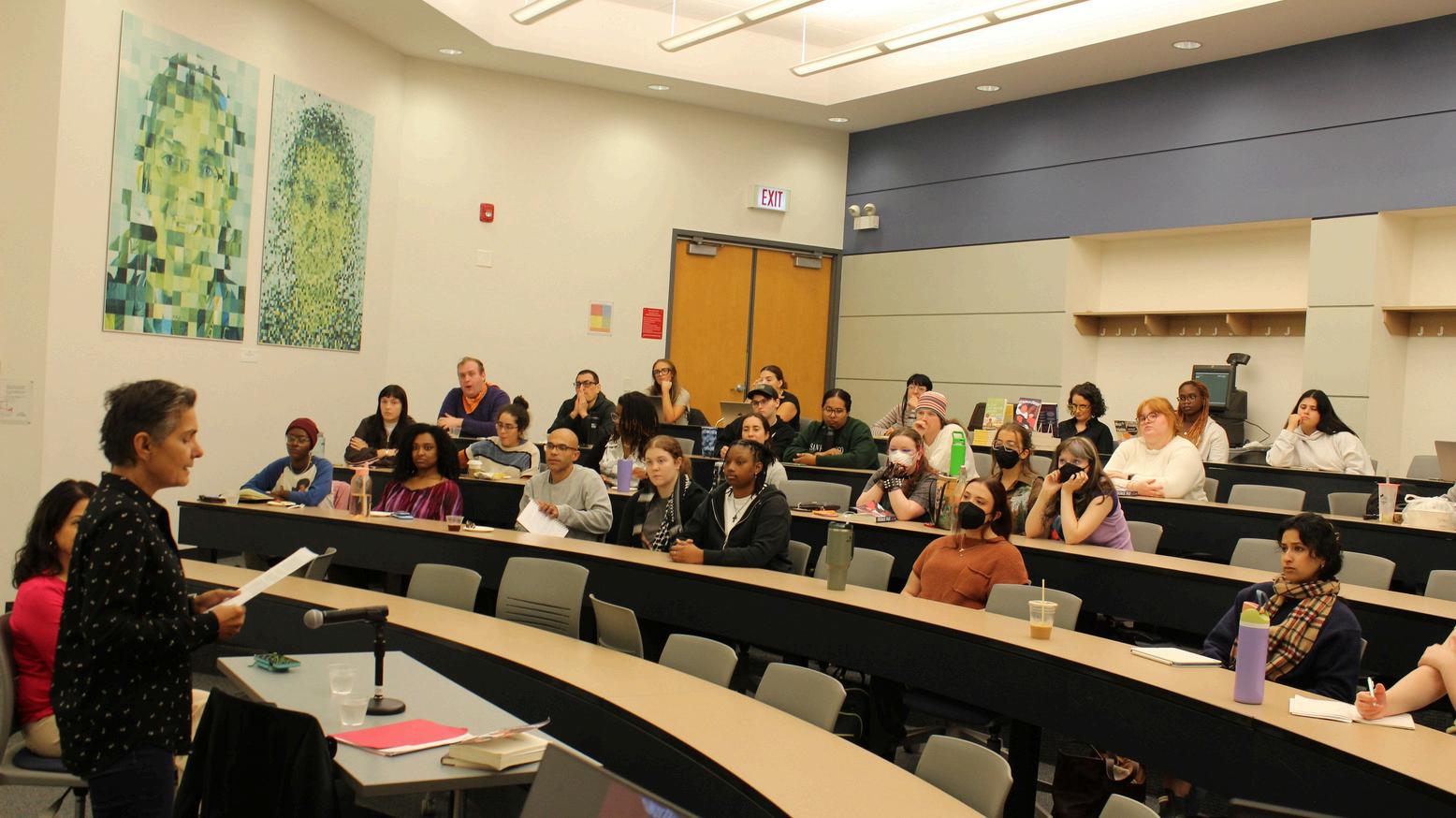
Must write a 250-word response to the following question: Discuss a Latin American or Latina/o/x studies figure, event, or text that has been important to your academic journey.
If selected for a scholarship, winners will be featured in a CLR/LALS newsletter and will meet with the CLR/LALS Advisory Board.
APPLICATION INSTRUCTIONS:
1 Complete the General Application on the DePaul Online Scholarship Application website
a. Log into the DePaul Online Scholarship Application using your Campus Connect ID and password.
b Ensure you are on the tab for “applicants” before logging in
c If you have not already, complete and submit the General Application
2 After submitting the General Application, you will automatically route to opportunities for which you qualify, and further work and/or information is needed If you are recommended for additional scholarships, you will be able to view a list of opportunities Apply for them by clicking on the blue “Apply” button beside each scholarship Additional questions or information may be required to complete the application process
3 If awarded a scholarship, you will be notified via email and see a notification on the “applications” tab of the scholarship application
Questions?
clr@depaul.edu or lals@depaul.edu

OCTOBER 2ND, 2025

1:00PM-4:00PM

Join us for a conversation with
Associate Professor | Department of Social and Cultural Analysis at New York University
Beltrán’s research engages modern and contemporary political theory, Latinx studies, feminist and queer theory. She will be discussing her second book, Cruelty as Citizenship: How Migrant Suffering Sustains White Democracy, which was awarded the Best Book Award in Latino Politics/Latino Studies by the Latino Caucus of APSA.


The Department of Latin American and Latino Studies is excited to be bringing Cesáreo Moreno, the Chair of United Neighbors of the 35th Ward, to discuss his work building and organizing Rapid Response networks to combat injustice and protect communities around Chicago.

WHERE AND WHEN: Tuesday, NOVEMBER 4 2025 th 1:30-2:30PM SAC 161
Lourdes Torres
LALS Chair ltorres@depaul.edu
Bill Johnson González
CLR Director bjohns58@depaul.edu
Marcela L. Reales Visbal
CLR Assistant Director mrealesv@depaul.edu
Emilio Díaz
Department Assistant ediaz68@depaul.edu
Gigi Lara
Student Assistant alara26@depaul.edu
Michelle Cisneros
Student Assistant mcisne11@depaul.edu
Goutam Kumar
Graduate Student Assistant gkumar5@depaul.edu

Follow us on Instagram @clr depaul @lals depaul
Email us clr@depaul.edu lals@depaul.edu
Call us (773) 325-7316 (773) 325-4818
Visit us 2320 N Kenmore Ave
Schmitt Academic Center (SAC), 5A-H Chicago, IL, 60614

Like us on Facebook Center for Latino Research-DePaul University
The Department of Latin American and Latino Studies-DePaul University