




Annual meal continues in honor of woman’s decade of service
By Hilary Nowatzki
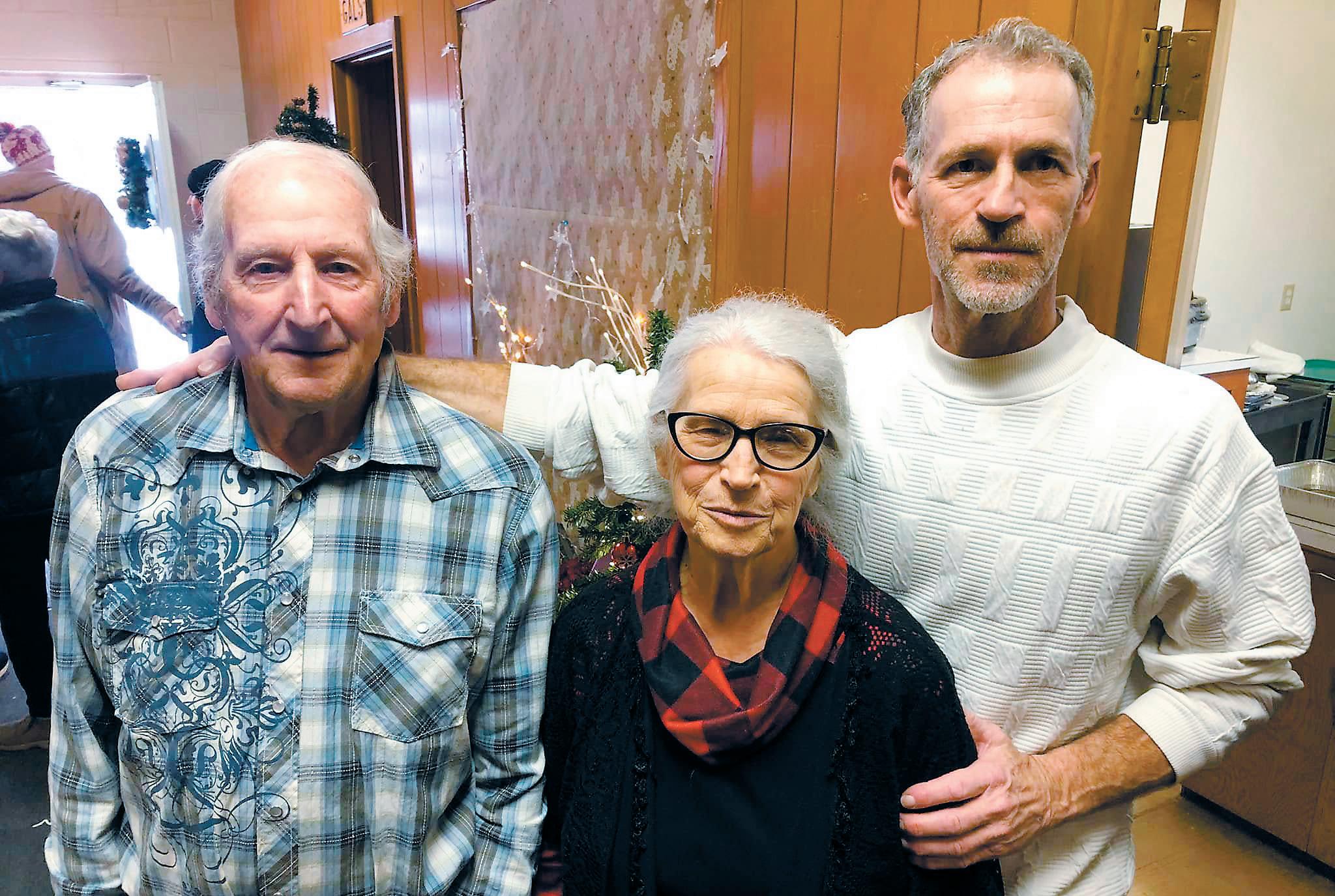
Eleven years ago, Amy Phillips was leaving mass on Christmas Eve when she noticed the people that were behind her, and especially those who were alone. Questions flurried in her mind - where will they spend Christmas? Will they have a nice meal? Will they be alone or have the warmth of fellowship?
“She was always looking out for the other person, and, you know, she would give anything to help somebody else out,” said Dale Phillips, Amy’s son.
Amy passed away this year not long before Thanksgiving this year. The holiday season has been difficult for the family, but they have kept Amy’s legacy going forward by continuing a special occasion Amy hosted every Christmas
That night after mass compelled Amy to start a community Christmas meal that is open to the public. Those who may be spending Christmas alone or are from out of town are ensured to have a place to have a delicious, warm meal and feel the love and fellowship of the season with other attendees.
except for a single year missed due to COVID-19.
By Hilary Nowatzki

The North Border Pembina chapter of the National Honor Society has kicked off a community-wide fundraising initiative to support the Ronald McDonald House Charities (RMHC) of the Red River Valley. Students, families, and community members are invited to participate by donating aluminum pop tabs, which can be dropped off in designated receptacles located throughout Pembina, N.D.
This year’s event includes a bit of North Border Pembina National Honor Society launches pop tab collection drive
cont’d. on page A5
“The reason she started was because she was helping out with communion one day, which was Christmas Day 11 years ago… She looked up at the people that were in church, and in her mind, she went, ‘That person, as soon as they leave here, has no place to go except to go home and be by themselves,’” recounted Dale with a deep sense of love that could be felt in his voice.
Amy told Dale, in a nutshell, that first year, “it’s not going to happen anymore,” referring to people having to spend Christmas Day alone. That first small gathering has grown every year,
“It started out as a small group, just a few people, and it’s just kept getting bigger and bigger every year,” Dale shared.
They are fueled by a community of love and compassion where no one has to sit alone on such a special day. The occasion isn’t just for food either. The event starts at 11:30 so that guests can spend time socializing and visiting with one another, strangers or not, before the 12:30 meal. According to Dale, volunteers are also a vital resource to the event, and they welcome more and more each season.

Eight young leaders from North Dakota have been welcomed into the 4-H Ambassador program, including Pembina County 4-Her Maddy Steele of Cavalier. The 4-H Ambassador leadership program is a prestigious initiative designed for youth aged 16 to 22.
The selection event took place on Nov. 22, 2025, at the North Dakota 4-H Camp in Washburn. Organized by the ambassador selection committee, the event included interviews, problem-solving tasks, and group projects judged by program alumni and foundation members.
Building leadership and promoting 4-H statewide The ambassador program fosters leadership and community engagement. Selected ambassadors plan and assist in various 4-H events while promoting 4-H activities to inspire youth across the state.
“I’m excited for this opportunity to meet new people and help promote 4-H - not only in my county but across the state as well,” said Steele, a senior at Cavalier High School. She is a member of the Tongue River Braves 4-H Club and the Pembina County Jr.

Leaders.
Application and selection process Candidates begin their journey by submitting an ap-

plication, which includes references. After applications are reviewed, candidates attend the selection event in person. Activities included interviews, problem-solving challenges, and group projects judged by experienced panelists.
Also participating in the selection process was Pembina County 4-H member Benjamin Carpenter, a senior from Walhalla. Ben is a member of the Northern Explorers 4-H Club and the Pembina County Jr. Leaders.
Learn more about 4-H
For more information about the North Dakota 4-H Ambassador program, visit ndsu.ag/4-h-ambassador.

Cavalier, N.D. — Gilbertson Veterinary Clinic has been selected as a recipient of the Polar Communications Economic Development Grant, a program designed to support community needs and job creation within Polar’s service area. The Pembina County Job Development Authority (PCJDA) applied for the grant on behalf of the new veterinary clinic, serving as the required public-sector sponsor.
The $10,000 award will support the purchase of a Canis Major Exam Lift Table, an essential piece of equipment that enhances safety, efficiency, and patient care in a rural veterinary practice setting. The hydraulically adjustable lift table will allow the clinic’s sole practitioner, Dr. Carla Gilbertson, DVM, to safely examine and treat animals up to 300 pounds; expand services more rapidly; and improve operational efficiency as the business grows.
“Gilbertson Veterinary Clinic fills a critical gap in accessible veterinary care for Cavalier and the surrounding region,” said Angelle French, executive director of the Pembina County JDA.
“This investment directly supports small business growth, enhances quality of life for local residents, and strengthens the long-term vitality of our rural communities.”
The clinic, located at 106 Division Ave N., Suite B in Cavalier, is structured for rural sustainability, offering wellness care, sick animal visits, diagnostics, and eventually routine surgical services. The clinic serves a region that currently lacks a local small-animal veterinary facility, requiring pet own-

ers to travel long distances for routine and urgent care.
The project aligns with Polar Communications’ Economic Development Fund criteria, which emphasize fulfilling community needs and supporting job creation.
Dr. Gilbertson expressed appreciation for the support: “Launching a veterinary clinic in a rural community is both challenging and incredibly meaningful. This grant allows us to expand more quickly and safely, ensuring that local families have access to trusted, high-quality pet care close to home. We are deeply grateful to Polar Communications and the PCJDA for believing in this project.”
The Polar Economic Development Fund provides grants of up to $10,000 for eligible community and business development projects, with funding authorized for initiatives that benefit rural communities within Polar’s service area. The PCJDA’s sponsorship and the clinic’s strong financial planning, including secured financing from Gate City Bank, the Red River Regional Council Catalyst Fund, and personal investment, helped position the project for successful review.
Gilbertson Veterinary Clinic is currently fully staffed, offering a growing suite of services, and providing longterm veterinary care for pet owners across Pembina, Walsh, and Cavalier Counties, as well as neighboring Kittson County, Minnesota.
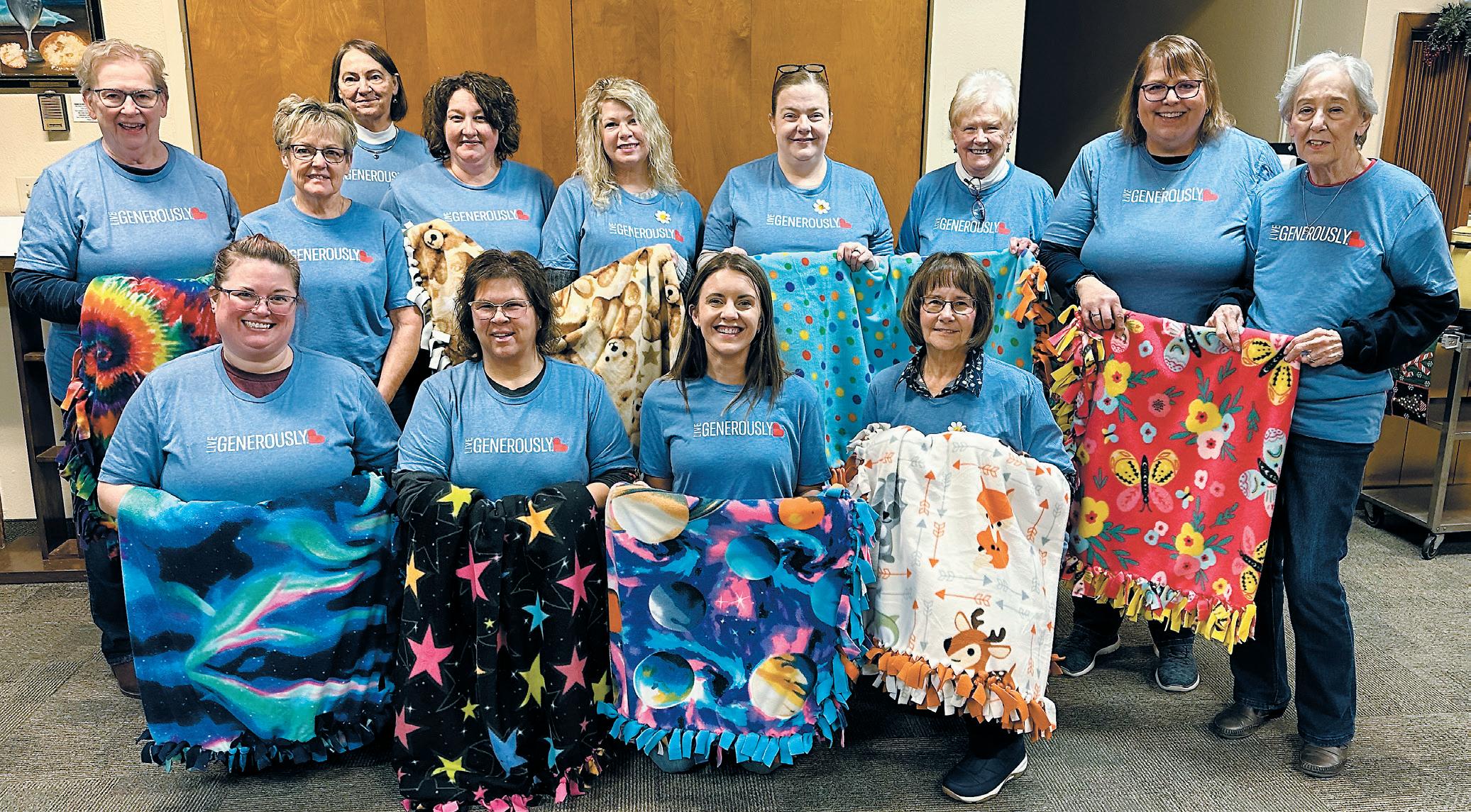
candidates and others in the United States and Canada. The financial assistance might be in the form of a loan, scholarship, grant, or merit based.
The funds for the blanket project were provided by Thrivent.

By Rebecca Davis

Winter fun officially returns to the Pembina Gorge as Frost Fire Park opens for its 2025-26 ski season on Saturday, Dec. 13.
General Manager Julie Regner said crews have been working around the clock to prepare. Snowmakers have been running 24/7 since Thanksgiving morning, pausing only twice when temperatures were too warm to produce quality snow. Optimal snowmaking temperature is 23 degrees.
While opening weekend will offer limited runs, Regner said there will be plenty open for the whole family across all skill levels. During the season, lifts will operate Friday through Sunday from 10 a.m. to 4 p.m. each day.
This season also brings a few changes on the slopes. Outdoor Manager Shelby Dahley leads the outdoor operations team and will oversee adjustments to the terrain park, including a new location that allows guests to watch the park activity directly from inside the lodge.
“We found parents really enjoy being able to sit warm and cozy while still keeping an eye on their kids,” Regner said.
Pricing for lift tickets and rentals remains unchanged this year, with fullday lift passes at $50.
Free youth passes return for Winter Break
Frost Fire will again offer one free lift pass for youth under 18 during the holiday break. This year, the program shifts to digital distribution rather than postcards sent home through schools.
The youth pass program runs Dec.19 through Jan. 4 and will be available via the park’s website and social media. Passes cover the lift ticket only; rentals are not included.
Full holiday and weekend activities Frost Fire will be open daily during Christmas break, excluding Christmas Day, with shortened hours 10 a.m. to 2 p.m. on Christmas Eve.
One highlight to kick off the season will be Dec. 20 when members of
course will be open to the
after practice, offering visitors a chance to try a competitive-style run.
That same evening, Frost Fire will host après ski entertainment from 4–7 p.m., with live music and lodge gatherings planned.
Regner said the lodge kitchen will be open with a scaled-down ski menu during the day, while full weekend menus return Friday and Saturday evenings. She also teased that Danny’s famous pizzas are expected to make a comeback this season.
Fundraising success and raffle launch
After a packed fall of events - including Max’s Haunted House, Purse Bingo and the Pray for Snow party - Frost Fire has launched a new raffle fundraiser. Tickets are $100 each, with 400 tickets available and a top cash prize of $5,000. Additional prizes include multiple $2,500 and $1,000 payouts. The drawing will be held Jan. 17.
Raffle tickets can be purchased in the lodge at the bar or from board members.
Lodging growth and staffing needs
The ski-in/ski-out cabin rentals overlooking the slopes continue to gain popularity, with bookings on the rise for December. Guests can relax in slope-facing hot tubs, keep gear at their cabins, and ski directly to their doorstep. Regner reminds visitors that while the cabins are on Frost Fire’s property, they are not owned or operated by the Pembina Gorge Foundation. Cabins can be booked through AirBnB, VRBO and Booking.com.
As the season begins, Frost Fire is still seeking EMTs and ski/snowboard instructors, along with occasional outdoor support staff. Regner noted that EMTs do not need to ski, as patrol transports patients to them.
Other winter events are still in development, but Frost Fire has confirmed Ladies’ Day on Feb. 13 and College Day on Feb. 21, as well as school-friendly Fridays open to the public.
For more information, visit www.frostfirepark.org.


USDA to begin issuing pandemic assistance – The USDA has announced plans to issue more than $223 million in Pandemic Assistance Revenue Program payments. This money is to help farmers and ranchers who suffered a drop in gross revenues due to COVID-19 in 2020. The application process wrapped up in mid-July. There were more than 38,500 applications, triggering payments of nearly $7 billion. That is far above the available funding. As a result, a 9.5 percent payment factor has been applied to all payments to ensure equitable distribution.
Activist groups petition to end registration for glyphosate – The Center for Food Safety has filed a petition with the Environmental Protection Agency to end the registration of glyphosate. The activist group is joined by four farmworker organizations and a group known as Beyond Pesticides in filing this petition. They want the EPA to immediately cancel the registration of this popular herbicide, claiming risks to human health
and the environment. A Bayer spokesperson said this petition has no merit.
Research priorities for canola –During the online Canola Research Conference, Northern Canola Growers Association Executive Director Barry Coleman outlined the organization’s research priorities. “Looking at disease management, we want to emphasize blackleg and clubroot research in our proposals, and we’ve got a separate sclerotina initiative that’s been going on for a number of years.” Research will also concentrate on crop fertility, varieties and canola’s role in the expansion of the biofuels industry.
Kernel awards presented – Congratulations to Jim Bahm of New Salem and NDSU Vice President of Agriculture Affairs Greg Lardy. They both received the North Dakota Grain Growers Association Kernel Awards. Bahm is a long-time member of the North Dakota Wheat Commission. Lardy was recognized for his commitment to the industry.
By Rebecca Davis
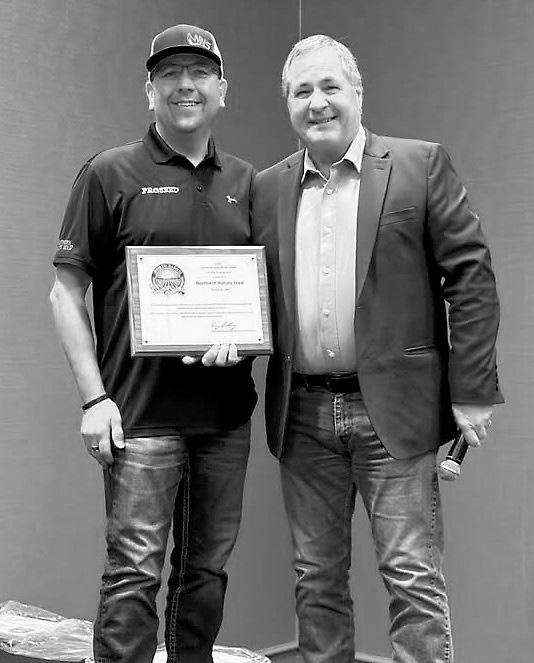
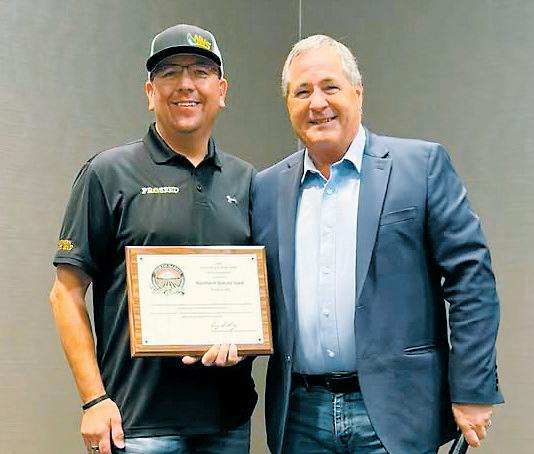
Northern Nature Seed of Drayton has once again been recognized as one of North Dakota’s top agricultural operations. On Wednesday, Dec. 3, the North Dakota Ag Association presented owner Scott Johnson and his team with the 2025 Outstanding Pesticide Dealer of the Year Award, the company’s second time receiving the honor, having also earned it in 2017.
Johnson, who has been in the agricultural industry since 1994 and founded Northern Nature Seed in 2010, described the award as a shared achievement rather than an individual one.
Attention to detail and service stand out
Johnson attributes the recognition to simple fundamentals: professionalism, safety, and organization. He joked that he is “super OCD,” noting that inspectors, vendors, and customers routinely comment on how immaculate the warehouse is — swept several times a day, stocked neatly, and maintained for safety and efficiency.
That level of care was reflected in the state’s evaluation criteria, which highlighted Northern Nature Seed’s performance in recordkeeping, storage, safety procedures, industry stewardship, operational improvements, and appearance.
“Your compliance with state and federal regulations helps make North Dakota a safer place,” wrote Division Director Lukas Wagner in the award letter.
Rooted in community and family
Northern Nature Seed is independently owned and operated by Johnson and his wife, Amber.
Several family members — including their son, soon-to-be son-in-law, and father-in-law — contribute to operations alongside long-time employees who have become family in their own way.
The company serves customers from St. Thomas to Devils Lake, south to Manvel, and east into western Min-
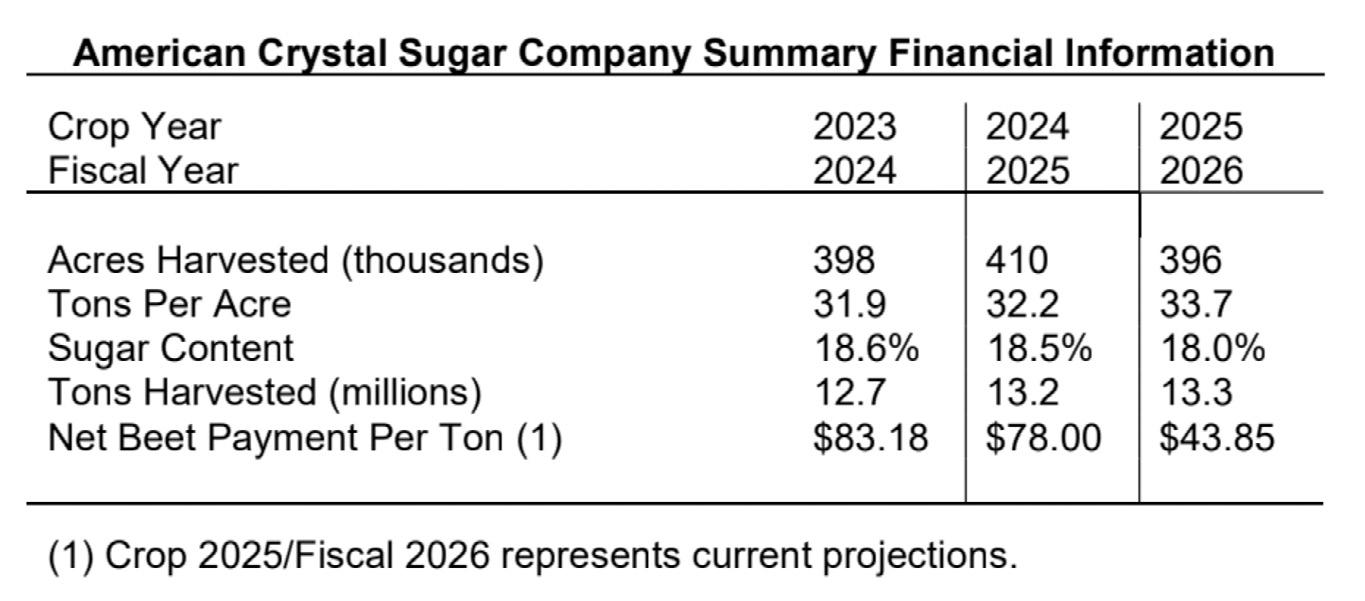
FARGO, N.D. - American Crystal Sugar Company held its annual shareholders meeting in Fargo, ND, on Dec. 4, celebrating another record sugarbeet crop, while also acknowledging significant market challenges. Today, shareholders reviewed crop and financial results from the 2024 crop year (2025 fiscal year ended Aug. 31), discussed the cooperative’s performance in fiscal year 2025, and shared market conditions impacting the forecasted results for fiscal year 2026.
The 2024 sugarbeet crop yielded 32.2 tons per acre, and growers harvested a total of 13.2 million tons. Sugar content was above average at 18.5 percent. The increased sugar content, good beet storage and processing results, and a favorable sugar market resulted in a net payment per ton of $78.00.
Crop production in 2025 was unequaled, with a total of 13.3 million tons of sugarbeets harvested this fall. Although this is a new record for harvested tons and a fair sugar content of 18.0 percent, declining world sugar prices and excessive imports are making for a very challenging sugar market, bringing the forecasted net payment per ton down to $43.85.

Now is the time to consider year-end income tax planning. There have been changes to the tax law in 2025 that agricultural producers should be aware of.
“When tax planning, it is best to start with year-to-date income and expenses, and estimate them for the remainder of the year,” said Ron Haugen, North Dakota State University Extension farm management specialist. “Estimate depreciation, and include any income that was deferred to 2025 from a previous year.”
Haugen recommends producers try spreading out income and expenses so as to not have abnormally high or low income or expenses in any one year.
Farmers and ranchers have until March 2, 2026, to file their 2025 income tax returns without penalty if they have not made estimates.
Qualified farmers have until April 15, 2026, to file without penalty if they have paid their estimated tax deposit by Jan. 15.
Haugen encourages producers to think about making a deposit by Jan. 15, 2026, if it looks like they will have a tax liability:
“That would give producers more time to prepare their return and file on April 15.”
Haugen includes tax provisions to take note of:
•Agricultural producers are allowed to use 200% declining balance depreciation for 3-year, 5-year, 7-year and 10-year property. A 150% declining balance is required for 15-year and 20-year property.
•For most new agricultural machinery and equipment (except grain bins), the recovery period is five years.
•The Section 179 expense has increased. It generally allows producers to deduct up to $2.5 million on new or used machinery or equipment purchased in the tax year. There is a dollar-for-dollar phase-out for purchases exceeding $5 million. Equipment must be above 50% business use to use Section 179. A net operating loss cannot be generated with a 179-expense election.
•The additional 100% first-year bonus depreciation has been reinstated for purchases after Jan. 19, 2025. The rate is 40% for purchases between Jan. 1 and Jan. 19, 2025. It is available for both used and new property.
•Net operating loss (NOL) carryback rules are in effect. Producers can carry back losses to offset income.
Seeds, Chemicals, Fertilizers — and Education
•Like-kind exchanges are not allowed for personal property but are allowed for real property.
•Income averaging can be used by
producers to spread the tax liability to lower income tax brackets in the three previous years. This is done on Schedule J.
•Producers may also use Form ND-1 FA (income averaging) for North Dakota income tax calculations.
Haugen offers these tax planning tips for a low-income year:
•Amortize fertilizer purchases.
•Capitalize repairs. Pick and choose which repairs to capitalize.
•Postpone expenses.
•Do not 179 expense all purchases. Use regular depreciation.
Haugen recommends noting these tax planning items for a high-income year:
•Crop insurance proceeds can be deferred to the next tax year if a producer is a cash-basis taxpayer and can show that normally income from damaged crops would be included in a tax year following the year of the damage. This would include prevented plant insurance payments.
•A livestock income deferral is available for those who had a forced sale of livestock because of a weather-related disaster. This is a very important consideration for producers who had to sell livestock because of drought.
The IRS has two provisions for deferral. The first one is IRC 1033(e), in which a livestock producer who sells more draft, breeding or dairy animals than normal due to weather-related conditions may defer recognition of the gains for up to two years. A disaster declaration is not necessary; however, if a federal disaster declaration is issued, the replacement period is four years. The second provision is IRC 451(g), in which a livestock producer that uses the cash method of accounting can elect to defer for one tax year the income of any qualified livestock sold due to weather-related conditions.
•Prepay farm expenses. Feed, fertilizer, seed and similar expenses can be prepaid. Typically, discounts are

received by paying for these expenses in the fall. Producers can deduct prepaid expenses that do not exceed 50% of their other deductible farm expenses.
•Defer income to 2026. Crop and livestock sales can be deferred to the next year by using a deferred payment contract. Most grain elevators or livestock sale barns will defer sales until the next tax year. Producers should be aware that they are at risk if the business becomes insolvent before the check is received and cashed.
•Purchase machinery or equipment. Machinery or equipment purchases can be made before the end of the year to get a depreciation or Section 179 expense deduction in 2025.
•Contribute to a retirement plan, such as a simplified employee pension plan, savings incentive match plan for employees or individual retirement account. Information on agricultural topics can be found in the Farmer’s Tax Guide, Publication 225. It can be obtained at any IRS office or ordered by calling 800-829-3676.
Additional questions on this topic should be addressed to a tax professional or the IRS at 800-829-1040 or https://www.irs.gov. North Dakota income tax questions can be addressed to the North Dakota Tax Department at 877-328-7088 or https://www. nd.gov/tax.



Winter has officially arrived with school closings and a full day or more of snow, wind and sleet, initiating a Winter Storm Warning for us and a good part of the state. If you didn’t have your winter gear out yet, I bet you do now. Snow plows are out, and ‘someone’ in our household is thrilled to be blowing snow
again.
I made it to a bantam hockey game at the Dakota Spirit Arena in Langdon last weekend. They took on the Fargo Freeze and came out on top after scoring the winning goal in sudden death overtime. Now that’s entertainment! This weekend I’ll be following the Mites in their home jamboree.
Christmas prep at our house has seriously improved since last week. The tree went up, shopping is looking very good, wrapping is coming along nicely. Food planning is only in the imaginary stage so far. I seem to do better with that under pressure and will see what comes to light next week.
I received a few comments after last week’s details of my childhood

As I sit in my office writing, I’m watching the snow come down sideways, and I’m reminded that winter has indeed arrived. Someone was nice enough at work
to sweep off the four-plus inches that had accumulated on my car that day, and I’m sincerely grateful to whoever that was.
When I got home later in the evening, I was reminded of a funny story I ought to share. It’s the first real snow of the season as I’m writing, and I heard a distinct sound when I was getting into the car to leave work.
There was another night about three years ago, not long after Phil and I had just moved here, and we heard the same noise that night. Perplexed, we headed inside the house and discussed where on earth we were hearing cows moo. I’m serious. Hearing the sound back in Tennessee
Christmases. My next oldest but not oldest brother, Wayne, recalled one of his favorite Christmas Eve meals was fresh northern pike that Dad had caught out of Devils Lake. And as far as Grandma’s knitted socks, he said you’d need size 17 shoes to fit over them. Maybe they were meant to be slippers!
Another recollection from Wayne, he and our oldest brother, Curt, received BB guns one year and .22s a few years later. They spent a lot of time in the summers on the prairie roads eliminating everything and anything that moved. I doubt Mom would have let me tag along for fear of coming home with a hole through me.
Danny Krom could relate to the noon meals served to the men and the wom-
all the time from living in the country, it wasn’t unusual to hear mooing throughout the day and night. I hadn’t recalled hearing it here before that winter, and I knew there weren’t any cattle near town, at least close enough to where I could hear them.
Phil and I wracked our brains trying to figure out whether or not perhaps a stock trailer was at the gas station fueling up or if some cows had broken a fence line and gotten into town. However, the sound wasn’t coming from where the gas station was, and I doubted there was a herd that sounded that large roaming the city of Langdon.
Finally, it hit me, and my gosh, are

I woke up Monday morning with two thoughts. One - there are only two and a half weeks until Christmas, and two - I won’t be getting tickets to Nashville for a present. What happens at a Bison playoff stays at a Bison playoff, so no, I don’t want to talk about it. I want to cry into my pillow for a few weeks, and then I’ll be over it. It doesn’t even make me feel better to gloat about UND losing their playoff game, too, except when Ella’s UND obsessed boyfriend comes over. Then I will gloat about the number of national championships that NDSU has won which shuts down the conversation pretty quickly.
After the shocking Bison upset Saturday afternoon where all the fans left in stunned silence, our group quickly made their way to the nearest watering hole to drown our sorrows and not talk about what just happened. After a few drinks and a delicious meal at Lucky’s 13, we made our way to the First Lutheran Church on Broadway to attend the annual Handel’s ‘Messiah’ concert put on by the NDSU Performing Arts. The ‘Messiah’ concert is a two-and-a-half-hour-long concert combining all the various NDSU choirs and an orchestra. ‘Messiah’ contains 53 songs, referred to as movements that are grouped into three parts. Part I tells of God’s plan to redeem humankind through a Messiah and the birth of Christ; part II covers the death and resurrection of Christ; and part III emphasizes the promise of resurrection and glorification of Christ. It was wonderful and very moving. During the last few songs, there were several members of the choir who were in tears. This was likely due to a combination of factors, one of which would be sheer exhaustion after three evening performances plus rehearsals of the hours-long concert.

By Bob Simmons, CEO, Simmons Multimedia
This week we visit with Langdon City Commissioner Lawrence Henry who manages the city street portfolio.
BS- Hello, Lawrence, and welcome to my column.
LH – Thank you for having me.
BS- You’re welcome. When the hell are you going to plow the streets?
LH- Ahhhhhhhh
BS – No, you know I kid! We LOVE city hall; we also love to pay taxes and enjoy expensive and painful root canals. But seriously, let’s talk about the streets and what Langdon residents can expect this winter. It wasn’t too many weeks ago that the first phase of the street construction project concluded, and we all love the newly paved streets and avenues. Give us the lay of the land, facts and figures please. How many
miles of streets are being plowed?
LH- In the city we have a total of about 26 miles of streets which equates to 104 lane miles. Each street gets four passes; some, depending on the amount of snow, maybe get six.
BS- What is the policy in place and who makes the decision as to how much snow needs to accumulate before the plows are sent out?
LH- Brent Benoit, the city street supervisor, makes the call. Typically three to four inches of snowfall will get the guys rolling. Anything less than say a couple of inches is a coin toss.
BS- Tax payers are keen on the math involved. Can you tell us about the crew, equipment and costs?
LH- The city has two loaders. Each requires 100 gallons of fuel, so that’s $700 bucks in fuel each time they go out, plus the man hours. Then there’s also insurance, maintenance, etc. to consider. It’s not cheap.
BS- Let’s talk about cheap. Even though this is MY column, I don’t want to make it all about ME, but as a runner who runs outside 12 months a year, I often wonder why the plow operators don’t put the blade down and scrape the roads nicely so someone running or walking doesn’t fall and break their neck. It just seems to me that the streets aren’t really ever clear of snow right down to the pavement like you see in other towns.
en cooking and cleaning, cooking and cleaning. That would be a big family to feed! All great memories! We visited about how times have changed over the years, and families just don’t get together like that so much anymore. If they do, it’s called a reunion.
I’m attaching a picture of our threeyear-old granddaughter/rink rat keeping herself entertained while her big brother played hockey. Have a great week; stay off the ice and out of the ditches!
Diane Simmons Publisher publisher@theborderlandpress.com

you and I both going to question my intelligence… The sound was coming from snowmobiles revving their engines and scooting through town. Next time you hear one, listen closely, and tell me it doesn’t at least sound a little like a moo!
I know all you engine nerds out there are judging me harshly, and that’s okay. We all have our strong suits in life, and mine is NOT engine identification.
There ought to be a way to rent snowmobiles closer to town. How awesome would that be? The closest places I’ve seen that do this are mostly in Minnesota, it seems, and quite the drive away. Being able to rent would
provide all the fun for an occasion or two without actually having to make the big financial investment. Maybe a good small business idea if someone was brave enough to take on all that liability.
Anyhoo, hopefully, you haven’t gotten buried in the snow. Thank you for reading, and have a lovely week, dear readers!
Hilary Nowatski Editor editor@theborderlandpress.com
Post concert, Greg and I dropped Bernie off at his hotel and made our way across the street to our hotel, the Four Points by Sheraton. Normally on a trip to Fargo, we would be staying with Greg’s brother or, if I’m by myself, at my friend, Katy’s. However, Greg’s brother was terribly sick, skipping the game, the meal and the concert to recuperate at home. We decided not to risk picking up a nasty bug and stayed at a hotel instead.
Having never stayed at the Four Points before, we were pleasantly surprised to see a full-service bar with a decent food menu available. The bar hours were 5-11pm, which after the depressing game and two-and-ahalf-hour-long concert, seemed like the perfect night cap stop. Greg and I bellied up around 10:15pm expecting to have a few drinks before heading to bed by closing time. Our bartender, Will, had other ideas. He was quick to engage us in conversation, taking note of our Bison attire and knowing how things had turned out. He had a lively table of patrons in the corner, which drew our attention a few times, and he claimed that they were all Nebraska folks. With a handful of Ne-
LH – So our plows are equipped with a puck system.
BS- A wha...
LH- I said a PUCK system. On the bottom of the plow is a little hockey puck looking thing that keeps the plow from hitting and destroying expensive manhole covers and gate valves for city water. The puck keeps the plow blade riding about a half inch above the street. So yes, there is going to be a little snow left on the street surface.
BS- Then how about a gate system, where the operator drops a gate along the right side of the plow to keep the snow from blocking driveways.
LH- We looked at those, and every city we talked to told us not to do it. The travel lanes become shortened. The gates get bent and break frequently, and anytime you’re clearing more than about four inches of snow, a plow gate becomes ineffective.
BS – So for those reading and keeping score – the streets won’t be scraped to the pavement, and they’ll still be blocking in your driveway. Let’s turn our attention to Highway 5 through town. It always tends to get narrower as the winter progresses. Who’s responsible for its clearing - the city or the state?
LH- Both. NDOT gives one pass to each lane; the city is then responsible for a follow up passes.
BS- The city also has a blower that I’ve seen in use.
braska players on the Bison football roster, we assumed the game was what had brought them this far north. An hour and a half later, with us now looking at pictures of Will’s home remodel project and the rest of the bottle of wine spilling over the top of my glass, we decided we’d had enough fun for one day and headed up to our room. Passing by the lobby, we heard someone yell, “hey, Langdon!” Knowing that the hotel was full of Nebraska fans, I ignored the yeller and kept walking but heard “hey, Langdon!” a second time and couldn’t help but look back to see who was yelling. A group of three women with several dead bottles of wine on the table in front of them saw me look and started smiling and waving frantically.
I shrugged at Greg and decided to go make some new friends.
As it turned out, one of the gals noticed Ella walking through the lobby with her Langdon Cardinals sweatshirt on, yelled at her to come over and, after a half hour conversation, had made a connection to a good friend of hers in Langdon and had sent that friend a selfie of her and Ella. When this gal
LH – Yes, if the streets become too narrow, we’ll use the blower and the loaders to fill the dump trucks and move the snow out to the old airport or to the open area by the city pond.
BS- I’m sure you network with other street departments in other communities, how does Langdon rank?
LH – We’re pretty good. In some towns after a big snow, they’ll plow the streets one day and the avenues the next.
BS- Talk about the priority routes.
LH – The emergency routes get plowed first such as the hospital, fire and sheriff’s department and schools. We try to make Main Street a priority, but that doesn’t always work out.
BS- And it’s just the two guys for the entire town correct?
LH- Yes. The guys split the town in half and work on their section until they are done. A big snow can take 16 hours. I don’t like them doing it all in one shot due to safety concerns, but they usually do; sitting in those loaders for such a long time isn’t good. They clean until they are done because if they stop and go back the next day, we’ll have upset residents.
BS- And if it is a huge clean up, can you call in reinforcements?
saw us, she thought we looked like we could be Ella’s parents and wanted to make sure if Ella told us what had happened, we didn’t report her for being a creep. I couldn’t help noticing the three women were all wearing Legacy shirts, so I mentioned that a good friend of mine from high school has a daughter that plays basketball for Legacy. The gals had just come from Grand Forks where they had watched the Legacy girls’ basketball team play. A third and final connection was that one of the women was from Rugby and had graduated with Greg’s cousin, Jace. Of course. And the world just keeps getting smaller.
Sara Goodman is an avid walker who says her best ideas come to her after a morning pot of coffee. She grew up on a cattle ranch in Watford City, N.D. After many years working in healthcare, she now writes, is a substitute teacher and occasionally lends a hand to her hard-working hubby on the farm. She volunteers on several boards and committees in the Langdon community and attends social outings as much as possible. The Goodman house has two kids at home, one in college and two spoiled cats.
LH- That’s right, our folks in both the water and sanitation departments are great about pitching in after a major snow storm.
BS – For those curious, the city of Langdon uses sand, not salt, correct?
LH- Yes, we had issues with salt eating away at cement driveways, so we now use 100% sand.
BS- And if you have a sidewalk in front of your home or business, you’re responsible for keeping it clear of snow?
LH- Yes, it is the property owner’s responsibility.
Thanks to Lawrence Henry for explaining the snow removal process and to all the guys who log tons of hours behind the wheel of the plows keeping our streets open after a snow. Next week it’s mirror-mirror on the wall time. You won’t want to miss this one!

By Heather Duerre, Life Enrichment Director

Greetings from your friends at PNC! December is a busy month for the staff and residents, so I am going to give you an update on what’s happening this month that is keeping us all busy.
Dec. 4: The Balyeats and Friends are entertained us with their special Christmas program. Their show included singing, trumpets, piano, guitars, and even a saxophone!
Dec. 8: The sixth graders made their monthly visit. There wasn’t scat involved this time, as we did some Christmas-themed activities.
Dec. 9: The PNC Auxiliary will be here to lead a sing-along and serve homemade treats to our residents.
Dec. 17: The annual Ministerial Christmas program will begin at 1:30 in the main dining room. All are welcome to attend!
Dec. 18: North Border Walhalla students will be entertaining us with some good ol’ fashioned Christmas caroling.
Dec. 24: Gift opening for our residents. Each resident is given a gift from an anonymous staff member. Maybe even Santa will make an appearance???
Dec. 25: Merry Christmas!!!


By Rebecca Davis
As we get into the holiday season, time passes by more quickly. I cannot believe that we are now in December, and Christmas shopping is in full swing. Don’t forget to get your Letters to Santa into us, so we can publish them in the Dec. 19 issue. Don’t wor-
friendly competition between the elementary and high schools as a challenge to see which group can collect the most pop tabs. Pop tabs are the small aluminum tabs from soda cans, energy drinks, canned food, pet food, and similar items. They are easy to store, simple to collect, and made from a denser, purer aluminum than full cans, making them more valuable for recycling.
RMHC uses the funds generated from recycling these tabs to provide support for families with children under-
ry- Santa is a subscriber of The Borderland Press, so we will make sure Santa gets a copy of the paper and each of your letters! All area schools have received templates, so the teachers can help the students out if needed.
As magical as this season can be, it can also be heavy. If you’re struggling with your mental health right now, please know you are not alone. If this is your first holiday season without a particular family member - the one who held the family together, who made traditions feel like traditionsjust know that your feelings are valid.
The empty seat is very real and so is the heartache that comes with it.
Grief has a way of wiggling its way into the moments that are supposed to feel joyful, and that doesn’t mean you
going medical care. One-million pop tabs can fund one night of lodging for 25 families. The Ronald McDonald House Charities of the Red River Valley collects $3,000–$4,000 worth of pop tabs annually.
Ronald McDonald House Charities offers a “home away from home” for families with children age 21 or younger who require medical treatment. The organization ensures that families can remain close to their child while receiving necessary care—
December 16, 2025 – James B.
Power was born in New York State in 1833. After studying civil engineering. He spent a few years as the deputy state treasurer for Minnesota. But most of his working career was spent with railroads. The Northern Pacific Railway employed him as a clerk and later as a civil engineer. For the Great Northern Railway, he worked as a land commissioner, responsible for selling thousands of acres to bonanza farmers.
And Power himself was one of the first bonanza farmers in the Red River Valley. When the Northern Pacific Railroad went bankrupt in 1875, he used the opportunity to encourage eastern investors to acquire enormous tracts of land. Power purchased 6,000 acres. He then retired to his farm where he raised purebred cattle.
Power was appointed to the Board of Trustees of North Dakota Agricultural College. He was serving on the Board in 1893 when the college became entangled in politics. There were differences between the faculty and the politicians. The faculty believed the college should serve the state in a non-partisan fashion. But some legislators saw it as a source of political patronage. Horace E. Stockbridge, the first NDAC president, was fired. Power was caught up in the turmoil, accused of misappropriation of funds. His accusers said he used the college as a market for his farm products. Governor Shortridge removed him from the board, but Power insisted he was innocent and took the matter to court. The court ruled that Power was entitled to hold his position until the end of his term in 1895. He even became acting president for the college, a position he held until the appointment of John Worst.
One earlier accomplishment of Power’s was the acquisition of the land for Island Park. This came during his time as land commissioner for the Northern Pacific Railroad. A Fargo citizen made the suggestion, and Power convinced the railroad to donate the land to the city.


are doing anything wrong. It means you are human.
Give yourself some grace this month. Celebrate what you can, when you can. Rest if you need to, and remember to reach out to friends, neighbors, or other community resources. One of the best parts of being in a small town is that there is always someone willing to show up.
Remember, if you ever feel you are in a crisis or things just get to be a little too much, 988 is just a call or text away.
As always, thank you for reading!
Rebecca Davis/Reporter rebecca@theborderlandpress.com
at no cost to them.
The North Border Pembina National Honor Society encourages all residents to participate. Every pop tab donated contributes to supporting families in need and strengthens the spirit of generosity across the community.
For more information, look for pop tab collection receptacles around North Border Pembina or contact the North Border Pembina School.
Together, small efforts can make a big difference.
James B. Power passed away on this date in 1913 at the age of 80.
Dakota Datebook written by Carole Butcher
“Dakota Datebook” is a radio series from Prairie Public in partnership with the State Historical Society of
North Dakota and with funding from the North Dakota Humanities Council. See all the Dakota Datebooks at prairiepublic.org, subscribe to the “Dakota Datebook” podcast, or buy the Dakota Datebook book at shopprairiepublic.org.


By Katie Henry, Family and Community Wellness Agent, NDSU Extension – Cavalier County

I am such a comfort food person, it’s not even funny. This time of year when it’s cold and snowing, I tend to crave it even more.
Mashed potatoes? Yes, please. Lasagna? Absolutely! Knoephla soup? Extra servings, please. Ice cream? All seasons are welcome. Roast and vegetables? Always a good idea. Homemade bread? The smell alone is worth every minute of work. Mac and cheese? Delicious!
Fajita
The great news is that there are several easy tips to help make some of those foods a little healthier. You still can get the same great taste but with a healthier twist.
Only add low fat or fat free milk to foods like mashed potatoes and knoephla soup, and leave out butter and cream.
Add lower fat cheeses or add less cheese to foods like lasagna. There are also lower sodium options for sauces.
Make your own ice cream or choose ice creams lower in sugar and fat.
Make and consume more whole grain breads and baked goods. Whole wheat flour can even be used in bars and cookies.
The only problem is that sometimes they are higher in fat, sugar, and salt than we would like.

it bring a unique kind of success and satisfaction? No doubt about it. Fishing in winter already comes with its own set of challenges. Unlike summer, where your biggest travel issue might be some road construction, winter adds icy roads, snowdrifts, and near-zero visibility into the mix. Plus, you've got to prepare both yourself and your gear to handle freezing temperatures. Staying warm and keeping your equipment in working order is
Sneak in vegetables to the dishes you make. Squash is the same color as orange cheese, so it may or may not have been added to mac and cheese at my house without anyone even knowing… (shhh, don’t tell my family my secret).
Replace part of the solid fat in the recipe with an oil to reduce saturated fats for heart health.
Below you will find a recipe from NDSU Extension to help you add a few more vegetables, some whole wheat, and a little less fat to a comfort food that some of you might like: steak! As you can see, it includes a mixture of oil and butter, a lot of vegetables (you could even double that part of the recipe), and whole wheat tortillas.
Steak Bites with Garlic Butter and Parsley
Ingredients
2 pounds steak, cut into bite-size pieces
2 teaspoons salt ½ teaspoon
battle.
Then there's the spearfishing itself.
Cutting ice holes, sitting in silence, watching and waiting patiently for a pike to appear. It takes focus, calm, and a whole lot of stillness. It’s not for everyone, and that might be part of the appeal. Darkhouse spearfishing is definitely a niche, which probably explains why the number of registered spearers in North Dakota is so much smaller compared to the crowds who flock to summer fishing.
Here’s a look at this year’s spearing: 2025-2026 Darkhouse Spearing Regulations North Dakota’s darkhouse spearfishing season opens on most state waters whenever ice-up occurs. Legal fish are northern pike and nongame species.
For Stump Lake and the Devils Lake complex south of U.S. Highway 2 and the Missouri River System (including lakes Sakakawea and Oahe and the Missouri River) up to the first tributary bridge, walleye are also legal.
All individuals who participate in darkhouse spearfishing must first register for free and are also required to possess the needed valid fishing license.
North Dakota investors to have a net worth at least 10 times the amount they planned to invest—an unusually high bar not found in most other states.
“We want to make sure our rules are strong, but also consistent with what’s happening across the country,” said Commissioner Godfread.
“This change brings us in line with national standards while still protecting
Spearers and anglers are reminded that materials used to mark holes must be in possession as soon as a hole greater than 10 inches in diameter is made in the ice.
All waters open to hook and line fishing are open to darkhouse spearing except:
•East Park Lake, West Park Lake,
•Lake Audubon – McLean County
•Heckers Lake – Sheridan County
•Lake Ashtabula – Barnes and Griggs
counties
•Larimore Dam – Grand Forks County
•McClusky Canal
•New Johns Lake – Burleigh County
•Red Willow Lake – Griggs County
•Whitman Dam – Nelson County
•Wood Lake – Benson County Specific darkhouse spearing regulations may be found in the Fishing Regulations Guide.
A look at spearing significant changes and adjustments over the years:
•2001-02 – first season.
•2008-09 – first winter that the first two weeks of March were open.
•2009-10 – first winter Minnesotans could spear in North Dakota.
•2012-13 – first winter where most of the state was open.
•2022-23 – first winter when individuals on the big waters could spear
investors and maintaining transparency in the marketplace.”
The new order, SEC-2025-01, restores consistency with guidelines set by the North American Securities Administrators Association (NASAA), that are already embedded in North Dakota’s administrative code. These guidelines include suitability standards that help ensure investors are financially prepared for these types
Toppings: Sour cream
Cilantro
Directions
Cut peppers and onion into strips and add a small amount of oil to coat lightly. Add garlic and onion powders, then place on sheet tray

•2024-25 – first winter when indi
viduals could also use archery equipment to take pike, etc. 2024-2025 highlights from Greg Power, North Dakota fisheries division chief:
► Median (9.0) and mean (10.3) weights of the largest pike reported harvested by the respondents.
► Also, 8.3% of all spearers reported they had harvested a very large (20 lbs. or larger) pike.
► For this past winter (2024-25), the following number of spearers reported harvesting the following number of
one spearer and six walleye.
Again, similar to the past two winters, no more than 600 walleye were harvested by spearers during this past season.
of offerings—without adding unnecessary restrictions.
Why it matters
The order is effective immediately and will remain in place unless amended or rescinded.
For more information, visit securities. nd.gov or contact the North Dakota Insurance & Securities Department at (701) 328-2910.
This change could open the door for more North Dakotans to participate in alternative investment opportunities such as non-traded REITs, which are often used for income generation and portfolio diversification. It also signals a broader effort by the state to modernize its approach to financial regulation and stay aligned with national best practices.




Prairie Fare: When the lights go out — Keep food safe during power outages
By Julie Garden-Robinson, NDSU Extension food and nutrition specialist
I must have unplugged the vacuum, I thought to myself when it suddenly stopped working.
I walked over to check. The vacuum was still connected. Maybe I blew a fuse.
I flipped on a light switch to go to the basement. The lights didn’t work, either.
We were in the middle of our first winter storm of the year. Since my cell phone worked, I learned our home was among about 4,500 homes without power.
I really didn’t feel like vacuuming, anyway. I also wasn’t looking forward to resetting all the digital clocks in our home.
I hoped the power outage would be brief because I had just shopped for a lot of perishable foods in the refrigerator.
The weather was frigid, so our home would be cooling down. I found our battery-operated lanterns and some candles in case the outage lasted a while. I grabbed a blanket and held a warm dog on my lap.
Unfortunately, my vacuum resumed working within a half hour.
What should you do during power outages, anyway? Let’s try a few questions based on U.S. Department of Agriculture (USDA) recommendations.
1) How long will a full freezer hold a safe temperature?
2) How long will a half-full freezer hold a safe temperature?
3) How much dry ice would you need to keep an 18-cubic-foot freezer cold?
4) What are the indications that you can refreeze meat, poultry and seafood?
5) During a power outage, how long will a refrigerator keep food at a safe temperature?
6) Should you taste the food to determine its safety? Why or why not?
7) Which commonly refrigerated foods are safe beyond a four-hour power outage?
8) What “tools” would be good to have available to help prevent food safety issues and having to throw away food.
Here are the USDA recommendations:
1) A full freezer will hold its temperature for about 48 hours.
2) A half-full freezer will maintain its temperature for 24 hours.
3) Fifty pounds of dry ice will keep an 18-cubic-foot freezer at a safe temperature for two days; however, be sure to wear heavy gloves to protect your hands and avoid putting the dry ice next to food.
4) Meat, poultry and seafood with visible ice crystals are safe to refreeze. You may want to use these foods first, and be sure to fully cook.
5) A closed refrigerator will hold food at a cold temperature up to four hours during a power outage.
6) Tasting food that may be unsafe is not a good plan. When in doubt, throw it out.
7) High-acid foods such as ketchup, mustard, pickles, jams and jellies are typically safe, but they might spoil sooner. Foods such as cut fruit, creamy salad dressing and raw or leftover meat are not considered safe if left in a refrigerator without power for more than four hours.
8) Keep appliance thermometers in your refrigerator and freezer to monitor temperatures, and keep a digital food thermometer to check foods as needed.
When the power returned, I was ready for some comforting soup, but not more vacuuming.
Smoky Sweet Potato Soup with Bacon
3 slices smoked bacon, chopped
1 medium red onion, chopped
2 cloves garlic, minced
½ teaspoon smoked paprika
½ teaspoon kosher salt (or substitute table salt)
½ teaspoon black pepper
⅛ teaspoon cayenne (or to taste)
Pinch of red pepper flakes (optional)
3 sweet potatoes, peeled and diced* 4 cups low-sodium chicken broth
Makes five servings. Each serving has 180 calories, 8 grams (g) fat, 8 g protein, 22 g carbohydrate, 3 g fiber and 450 milligrams sodium.

Extension food and nutrition specialist and professor in the Department of Health, Nutrition and Exercise Sciences.
In a large pot over medium heat, cook bacon. Transfer to a paper towel-lined plate and set aside. In the pot, sauté onions and cook until slightly softened, about 5 minutes. Add garlic and cook until soft and fragrant, around 2 minutes. Season with salt, pepper, smooth. Crumble bacon and garnish each bowl.
smoked paprika, red pepper flakes (if using) and cayenne. Add sweet potatoes and broth. Bring to a boil, then reduce heat to low and simmer until sweet potatoes are tender, 27 to 30 minutes. Blend with immersion blender or transfer to a blender in batches and blend until
Prairie Doc® Perspective: Silent but serious: How to spot and manage gum disease
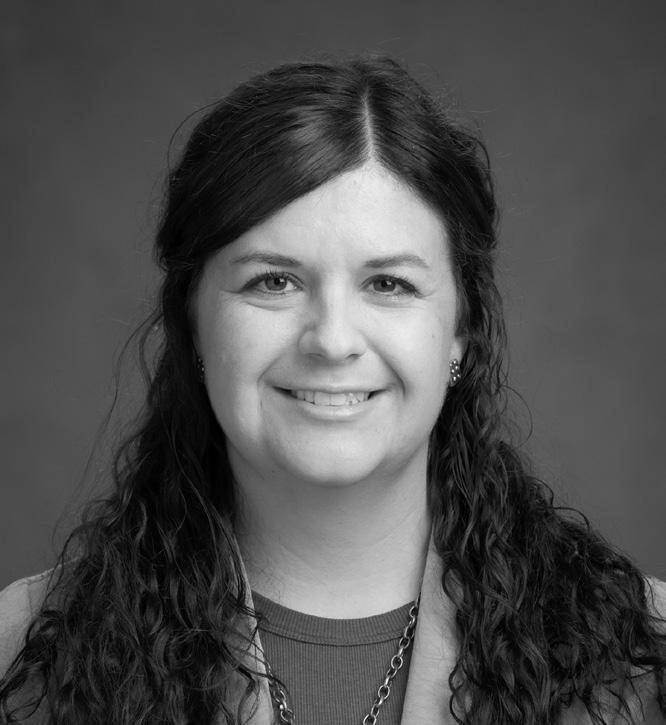
By Katie Pudwill, RDH, PhD

Gum disease is one of the most common chronic health conditions in adults. For those 40 and older, it’s also the leading cause of premature tooth loss. Unlike cavities, which often cause sensitivity or pain, gum disease is silent. Because the infection starts under the gums, you may not notice symptoms right away.
There are two types of gum disease: gingivitis and periodontitis. Gingivitis is an early, reversible infection of the gums caused by bacteria and
hardened plaque (calculus). Once the bacteria and calculus are removed, the gums can return to their healthy state. Think of it like a sliver in your skin: once it’s out, the redness and swelling go away.
Periodontitis is irreversible and develops when the infection reaches deeper structures: the gum tissue, the ligament holding the tooth, and the bone beneath. Over time, this leads to gum recession, loose teeth, and tooth loss if untreated. Signs include gum recession, teeth appearing longer, shifting teeth, or changes in your bite. These symptoms reflect permanent damage to the tooth’s support system.
Because gum infections are deeper in the gingival pocket, they can go unnoticed. Signs of both gingivitis and periodontitis include red, swollen gums and bleeding when brushing or flossing. This is often called “pink in the sink.” Other symptoms may include bad breath, a bad taste in the mouth, or irritated or “itchy” gums. If you notice these, it may be time to get your gums professionally evaluated. Most
dental hygienists recommend a cleaning every six months, as that’s when gingivitis commonly returns.
When periodontitis is diagnosed in a dental office, the first step is usually nonsurgical periodontal therapy. This involves scaling and root planing; a thorough cleaning to remove bacteria, plaque, and calculus. Dental hygienists will use special instruments, including ultrasonic scalers, to clean the roots of the teeth and allow the gums to heal. For advanced cases, they may even recommend laser treatment, localized antibiotics, and other adjuncts individualized for your needs. Patients with advanced disease may be referred to a specialist called a periodontist for surgical options to repair the damage that the infection has caused. This might include flap surgeries or bone grafting.
Home care is an essential part of managing both forms of gum diseases. Brushing twice a day with a soft-bristled toothbrush and cleaning between teeth is not just about preventing cavities, it’s about the gums, too. The
Dakota Gardener: Consider a Kalanchoe this holiday season
By
Kelsey Deckert,
Horticulture agent, NDSU Extension - Burleigh County
It’s that time of year again — garden centers and greenhouses are wellstocked with beautiful holiday plants. They make great gifts for friends and families. Nothing looks better on a table or desk than a blooming Christmas cactus or the red foliage of a poinsettia!
However, I would argue there is another plant to consider as a holiday gift: a Kalanchoe.
Let me convince you what makes a Kalanchoe a perfect gift and why it should be right at the top of the list with our other traditional holiday plants.
First and foremost, Kalanchoes have very showy flowers varying in colors of red, pink, orange, yellow and purple. It has a long-lasting bloom time of up to eight weeks, which is a huge plus. They offer waxy, beautifully scalloped foliage. These characteristics make it a standout plant, very competitive with our traditional holiday plants.
Kalanchoes is a genus of succulents native to Africa and Asia, and they
make great houseplants. They are easy to care for and require low maintenance. As succulents, they require less watering. Watering once a week will suffice during the blooming period. Once it has finished flowering, less water is needed. It is best to allow the soil to dry out between waterings.
Abundant light encourages them to maintain a more compact growth habit. Avoid low-light areas, as the plants will get spindly.
Kalanchoes are short-day plants and bloom during our winter months. After flowering, it is a good idea to upsize the pot to a slightly larger one. Cut back the flower stems, and place the Kalanchoe in a warm, sunny window. The plant can be moved outdoors in the summer after the danger of frost has passed. Choose a location that receives light shade. You will need to
bring it back indoors before the first frost or roughly three months before your designed bloom time.
infection starts in the gum pocket, so cleaning under the gumline is key. Interdental brushes and water flossers often outperform traditional floss at
Sources: National Institutes of Health. Oral Health in America: Advances and Challenges. U.S. Dept of Health and Human Services, National Institutes of Health, National Institute of Dental and Craniofacial Research; 2021.
Katie Pudwill, RDH, PhD, is a registered dental hygienist and educator in South Dakota. She teaches periodontics, ethics and jurisprudence, and dental anatomy at the University of South Dakota Department of Dental Hygiene.
removing bacteria from the gingival pocket around the tooth.
Gum disease may be silent, but its effects are not. Periodontitis has lasting consequences not only for your smile but for your overall health. Fortunately, with early recognition and consistent care, it can be managed effectively. If your gums bleed, your breath smells bad, or it’s been more than a year since your last dental visit, now is the time to act. A healthy mouth is a vital part of a healthy body.
Katie is passionate about improving oral health through education, prevention, and advocacy. Follow The Prairie Doc® at www.prairiedoc.org, Facebook, Instagram, YouTube, and TikTok. Prairie Doc Programming includes On Call with the Prairie Doc®, a medical Q&A show (most Thursdays at 7 p.m. on YouTube and streaming on Facebook), two podcasts, and a Radio program (on SDPB, Sundays at 6 a.m. and 1 p.m.).
Once it’s brought indoors for the fall, place the plant in a room that gets natural daylight and no additional light during the dark hours. Once flowers are large enough to see, there is no need to worry about the light conditions, and they can be moved to another location if you would like to display them.
watering either too much or too little. You may occasionally see mealybugs, aphids, or scale. Manually remove the insect and, if necessary, isolate the plant.

Kalanchoes rarely have any problems. The most common problem is

I hope I have convinced you that if you are looking for a holiday plant, whether for yourself or a friend, consider a Kalanchoe and step outside the traditional holiday plants. It will be a great table display and a conversational piece this holiday season!
For more information about Kalanchoes, contact your local NDSU Extension agent. Find the Extension office for your county at www.ndsu.edu/ agriculture/extension/county-extension-offices.

By Pastor Jodi Myrvik

the Advent wreath each week as we draw closer to Christmas… the day of Christ’s birth; this past Sunday invited us to light the second purple candle… the candle of peace. The soft glow of the two candles… the candle of hope and the candle of peace… is meant to remind us that darkness is gradually giving way to increasing light… the light of Christ.
Yet, peace seems distant these days amidst the wars, conflicts, bombings and devastation occurring in other countries as well as the violence, division, discrimination and political polarization happening in our own country. In the face of such brokenness, how do we live into the promise of peace that is proclaimed in this sea-
son of Advent? How do we bear witness to the Prince of Peace in a world so often ruled by the powers of fear and violence?
The other day, a friend of mine posted a picture of the devastation caused by the recent fire that destroyed the Mayville elevator. In the picture you could see the rubble left from weeks of fire damage, destruction of tractors, vehicles, buildings, and the smoke that continues to fill the air. It was a picture of devastation, chaos, and grief… a picture beyond words. But as I looked at the picture, in the not-sodistant background, reaching above all the debris, was a beautiful church steeple… unharmed and intact. I told her that her picture is an amazing il-







lustration of hope and peace… the assurance that no matter what the world throws at us… we are never alone… God is with us!
In this Advent season of promise and preparation, we are challenged to slow down, to clear space, to make room in our lives and in our hearts, and to listen for the quiet voice of God. In a world that often feels anxious, fearful and full of uncertainty, Advent asks us to pause long enough to become aware of the peace that Christ brings… not only at Christmas, but in the everyday moments of our lives.
We generally think of peace as an absence of conflict and turmoil. Christ’s peace, however, is much deeper and it is this deeper peace that Advent invites us into. It is the peace that begins not in distant countries but dwells in our own lives and hearts even when the world around us feels troubled and uncertain. Christ’s peace is one of healing where there has been hurt, courage where there has been fear and unity where there has been division. Matthew 1:23 says, “‘The virgin will conceive and give birth to a son, and they will call him Emmanuel’ (which means ‘God with us’).” Of all the names given to Jesus, “Emmanuel” stands out because it speaks not only to who He is, but what He’s come to do. God didn’t just send a message
or a representative. He came Himself. “God with us” isn’t a distant promise or a comforting phrase for hard times; it’s a reality that redefines who we are and how we live. This promise means that the peace of Christ does not come when everything in our lives becomes calm. It comes into the chaos; It comes into the ordinary, messy, hopeful places where we need God most. When life gets messy or lonely, it’s easy to feel abandoned, but Emmanuel means we are never alone. Jesus stepped into our brokenness, pain, and joy. He is not in some faroff place, looking down; He’s here, present, walking with us through every situation. This is the heart of the gospel... God came to be with us.
This Advent, as we light the candle of peace, may it be a reminder that the Prince of Peace is near, calling us to be His hands and feet in a broken world. Let us carry His light into the darkness and proclaim with our lives each and every day... Peace on earth, goodwill to all!
Pastor Jodi has served at United Lutheran Church, Langdon since December 2021. Jodi is a North Dakota born and raised farm girl. She is married to husband, Paul, and they have a daughter, Sophie. Along with serving in ministry for the past 18 years, they farm near Edmore. Jodi is also a registered nurse. They enjoy gardening, yard work, camping and doing things together as a family.




New school performance information available, North Dakota Schools show meaningful gains in Choice Ready,
BISMARCK, N.D.– State School Superintendent Levi Bachmeier last Friday said updated school accountability reports and results from North Dakota’s new statewide student assessment are available for North Dakotans to review on the state’s Insights website.
A federal law called the Every Student Succeeds Act requires state education agencies to create an annual accountability report for every public school in their state. North Dakota’s report was developed by a planning committee that included representatives from families, teachers, school administrators, and legislators.
“Honest competition and transparency help make everyone better,” Bachmeier said. “This information helps districts understand who to look to for best practices and helps citizens ask thoughtful questions about educational outcomes.”
In grades K-8, factors used to measure accountability include test scores and whether they have improved student engagement and the language skills of English Learner students, many of whom are learning English as a sec-
ond language.
A high school’s accountability standing is calculated using graduation rates, test scores, the number of students who earn a general equivalency diploma, the academic progress of students who are not fluent in English, the number of high school seniors who were deemed Choice Ready and student engagement surveys, which show the intensity of student enthusiasm for their education.
North Dakota’s Choice Ready initiative is a series of goals intended to show whether students are well prepared for the workforce, the military, or post-secondary education.
The number of students considered to be Choice Ready rose from 71 percent in 2023-24 to 73 percent in 2024-25. The four-year graduation rate improved by 2 percent, in large part because of a 7 percent increase in graduation rates among Native American students. Assessment and Choice Ready data for each North Dakota K-12 public school is available on the Insights of North Dakota website.
Accountability 2025 Insights provides the public with this statewide education information, as well as data from school districts and individual schools. Users may click on “Explore Public K-12,” followed by “Data for Specific District or School,” to peruse the information. Some data may not be available for privacy reasons if a grade or group of students has fewer than 10 members.
The state summative assessment, which is called ND A+, tracks student progress in learning the state’s new academic standards in English, mathematics, and science. To promote better education, North Dakota schools have created continuous school improvement plans, which are updated annually and include “strategy maps” that explain each school's education priorities.
The process involves identifying schools whose academic performance has consistently lagged behind that of their counterparts. These schools are identified as “Targeted Support and Improvement” and “Comprehensive Support and Improvement” schools. The Department
of Public Instruction provides money, support, and other resources to help these schools improve their results. The schools are listed on the NDDPI website.
The ND A+ assessment was revamped for the 2024-25 academic year with a new test provider and platform, a new bank of test questions, and new “cut scores” that measure proficiency levels in each subject. The assessment represents the first time North Dakota students have been tested on the state’s new academic standards in English and mathematics.
Due to the wide-ranging assessment changes, it is unwise to compare results from the current school year with those from the previous year, Bachmeier said.
North Dakota families will find the new testing program much more helpful as it progresses. It will allow achievement comparisons within North Dakota among districts, schools within districts, academic subjects, and demographic groups. It will assist in student goal setting in future years.

HuntLink
HuntLink is a new, voluntary program designed to help North Dakota landowners easily connect with hunters and trappers. The program offers a simple way to allow managed access for antlerless deer, coyotes, turkeys, and other species. For landowners experiencing wildlife depredation or looking for additional management tools, HuntLink can help.
Landowners can enroll through their North Dakota Game and Fish My Account page and may remove their listing at any time once they’ve connected with enough participants.
Hunters can view landowner requests across the state through the HuntLink Map, but must contact landowners directly to obtain permission before
hunting or trapping.
Special Allocation Lottery Application Deadline
Nonprofit organizations eligible to receive big game hunting licenses in 2026 must have the application submitted to the North Dakota Game and Fish Department no later than Jan. 1.
N.D. state law provides direction for the Game and Fish director to allocate big game hunting licenses to eligible organizations. Under this directive, up to two elk, moose and pronghorn licenses, and 10 white-tailed deer licenses, can be issued to organizations for fundraising.
Eligible organizations must be exempt from federal income taxation under section 501(c)(3) or, new this year, 501(c)(19), and must provide proof

from the Internal Revenue Service to that effect. In addition, organizations must be active and in good standing with the office of the North Dakota Secretary of State.
Successful lottery applicants must agree to donate at least 10% of the net proceeds of any license fundraiser to a conservation-related project, such as hunting access, conservation education, habitat development or shooting range management.


Walhalla Senior Meals Menu
Monday, Dec. 15
Ham•Scalloped Potatoes•Green Beans•Applesauce
Tuesday, Dec. 16 Swedish Meatballs•Mashed Potatoes•Glazed Carrots•Tropical Fruit
Wednesday, Dec. 17
Sausage/sauerkraut•Mashed Potatoes•Corn•Pears
Thursday, Dec. 18
Chicken Wild Rice Casserole Peas•Coleslaw•Fruit Cocktail•WW Bread
Friday, Dec. 19
Meatloaf•Baked Potato•Mixed Vegetables•Mandarin Oranges
This is a menu for the Walhalla Title III Older Americans Act Food Program. The full cost of the meal is $13.00. Suggested donation for those 60 and older is $4.00. EBT/SNAP accepted. Under 60 are required to pay $13.00. Meal site is Waters Family Restaurant, 1108 Central Ave., Walhalla. Call 701-5492443 before 10:00 a.m. to place an order for congregate, pick up, or home delivered meals.
Monday, Dec. 15
Salisbury Steak/Mashed Potatoes/Squash/Fruit
Tuesday, Dec. 16
Cheese Ravioli in Meat Sauce Broccoli/Fruit
Wednesday, Dec. 17 Ham /Scalloped Potatoes/Baked Beans/Coleslaw/Pumpkin Pie
Thursday, Dec. 18
Chicken Hashbrown Hotdish/ Mixed Veggies/Fruit
Friday, Dec. 19 Chef Salad/Crackers/Fruit EBT/SNAP accepted.
Full cost of a meal: $10.00. Suggested Donation: $5.50 for those over 60 years of age. Please contribute what you can. Those under 60 are required to pay the full cost of the meal. Menus are subject to change. Due to COVID-19, we have been experiencing shipping issues and food shortages.

By Nick Vorlage Grafton man submits guilty pleas
A Grafton man named in a trio of criminal cases submitted guilty pleas on Monday. Mark James Votava, 63, was charged with eight criminal offenses – seven being drug related and the eighth being a refusal to halt misdemeanor. On Dec. 1, Votava would plead guilty to that misdemeanor, as well as a methamphetamine possession – second offense, conspiracy to deliver meth and possession of a controlled substance. The court dismissed the remaining four offenses.
Sentencing for Votava was five years with the Department of Corrections, first serving 366 days with 37 days credit. Once released, he’ll be placed under supervised probation for 30 months.
Law enforcement agencies on Saturday were involved in a 130mile pursuit with a Canadian woman who refused to stop at the Pembina Port of Entry. Details into the chase are still limited at this time, but what is known is the driver led law enforcement from the international border all the way to outside of Gardner on I-29. At one point of the chase, police report the suspect attempted to drive northbound in the southbound lanes, creating a serious risk to others on the road.
Multiple tactics were used by law enforcement to end the chase, including spike strips, but ultimately a PIT maneuver was used to disable the vehicle.
The Borderland News Center will provide more details on this case when they become available.
A hostage situation in Grand Forks on Friday night ended with the hostage being released and the suspect shot several times by responding officers.
The call came in Friday evening when the suspect called dispatch claiming she was holding a man hostage in an apartment unit.
According to a media release, officers arrived and entered the apartment due to “exigent circumstances [requiring them to] protect the hostage.” Once inside, a deputy discharged his gun.
The hostage was uninjured during the incident, and the perpetrator was taken to Altru. Her present condition is unknown.
As per standard procedure, the shooting is now under investigation with the involved officer under administrative leave.
The Northern Lights Arts Council is currently looking for local talent for an upcoming community talent showcase.
The Showcase will occur later this winter on Feb. 21 and 22. However, the deadline for audition submissions is less than a month away on Jan. 5.
To audition, prospective participants of all ages can upload an audition video via Facebook Messenger to the Northern Lights Arts Council’s Facebook page. The video should showcase their talent and be about 30-45 seconds in length.
For more info, please Amber Benoit at 701-305-0089.
North Dakota Governor Kelly Armstrong plans to call a special session in January to focus on rural healthcare.
Last month, the state submitted its funding application to CMS (Centers for Medicare and Medicaid Services) on how it plans to invest $500 million over the next five years as part of its Rural Health Transformation Plan. The funds are available through the passage of the “One Big Beautiful Bill.”
According to a statement provided by the governor’s office, the session is tentatively planned for Jan. 21. Armstrong will sign an executive order calling for the session once the state receives the funding award from CMS.
A change of plea was held on Monday for a New York man accused of solicitation and luring a minor in Pembina County.
In May Robert Michael Noyer Jr., 30, of Woodside, N.Y., was arrested by local authorities after he drove all the way to North Dakota for an illicit meet-up with a 14-yearold girl. Unbeknownst to Noyer, the meetup was part of a sting operation. He would be charged with solicitation of a minor, victim under 15, and luring minors by computer. In August, Noyer pled not guilty to both charges. However, on Monday, Noyer submitted an amended plea, pleading guilty to the solicitation offense, with the state's attorney proposing the luring charge to be dismissed.
Sentencing for Noyer has been scheduled for Feb. 24.

By Mike Alan Steinfeldt

In a surprise decision, the North Dakota Supreme Court on Thursday, Dec. 4, ruled that results of a chemical breath test will be admissible in court in the case of a Fordville man accused of criminal vehicular homicide and criminal vehicular injury resulting from a June 2024 accident that caused the death of a six-year-old girl.
In March of this year, Judge Theodore Sandburg, in the Northeast Central District Court, ruled that breath test results in the case of Travis Bell were inadmissible in court. The motion to have that evidence suppressed was brought by Bell and his attorney, Mark Friese, of Fargo.
Bell was charged with the Class A and
Class C felonies after the truck he was driving slammed into the back of the car driven by then 26-year-old Nicole Louthain of the Grand Forks Air Force Base. Louthain was stopped at a red light at the intersection of US Highway 2 and Airport Road west of Grand Forks when Bell rear-ended her vehicle on the evening of June 3, 2024. Nicole’s six-year-old daughter, Katarina, was a passenger in the vehicle and died as a result of her injuries sustained in the crash. Upon Katarina’s death, the charge against Bell went from Class C Felony criminal vehicular injury to Class A Felony criminal vehicular homicide.
After the motion to suppress the breath test evidence was granted by Sandburg, the State appealed the ruling to the North Dakota Supreme Court. The Supreme Court heard arguments in the case on Oct. 8. During the hearing, attorney Drew Houska represented Bell’s case with Grand Forks County Assistant State’s Attorney Rachel Egstad representing the State.
Houska argued that voluntary consent was needed from Bell for the breath test to be administered, and he didn’t give it. Egstad also argued that implied consent applies to anyone who drives a motor vehicle and that a warrant was not needed to
administer a breath test to Bell. She also argued that Bell was indeed advised of his consent rights, as trooper Austin Erickson read the consent language twice to Bell before he volunteered to give a breath test that came in well over the legal limit.
In Thursday’s decision, all five justices agreed with the ruling that stated: “We conclude the court misapplied the law and erred as a matter of law in its decision holding the State failed to prove Bell voluntarily consented to the chemical breath test after being informed of the implied consent advisory.”
Legal experts have argued that without the breath test results, it would be difficult to prosecute the case as currently charged.
The 20-page decision concluded: “The district court order suppressing evidence is reversed, and the case is remanded for further proceedings consistent with this opinion.”
A jury trial was originally scheduled for August but was put on hold, pending the N.D. Supreme Court’s decision on the appeal brought by the state.
A motion to change the venue of the trial away from the Northeast Central District Court is still pending.
Cont’d. From Page A1 Carrying on compassion and community then serving the meal and cooking, if they want to donate any food, salads, sweets.”
“We’re always looking for volunteers,” said Dale. “Because we need help setting up on Christmas Eve and

Dale said turkeys were usually taken care of and donated from local groups.
The legacy Amy has left behind is evident in the lives she touched.
“She’s just gonna be missed,” said Dale. “She touched a lot of lives, and some, I don’t even know the people, but [everyone] knew her so well.”
Questions have circulated as to if the annual meal will continue now that Amy is no longer with us. Dale confirmed they will carry on his mother’s legacy for as long as possible.
“There have been a lot of questions with people asking if we’re going to [quit], and we decided that we were going to do it,” said Dale. “It was because this was something she wanted. So as long as we’re able.”
This annual, compassionate Christmas event will live on, continuing providing anyone with a welcoming warmth from the Borderland community to anyone and everyone who needs it this season.


By Jake Kulland, Sports Editor



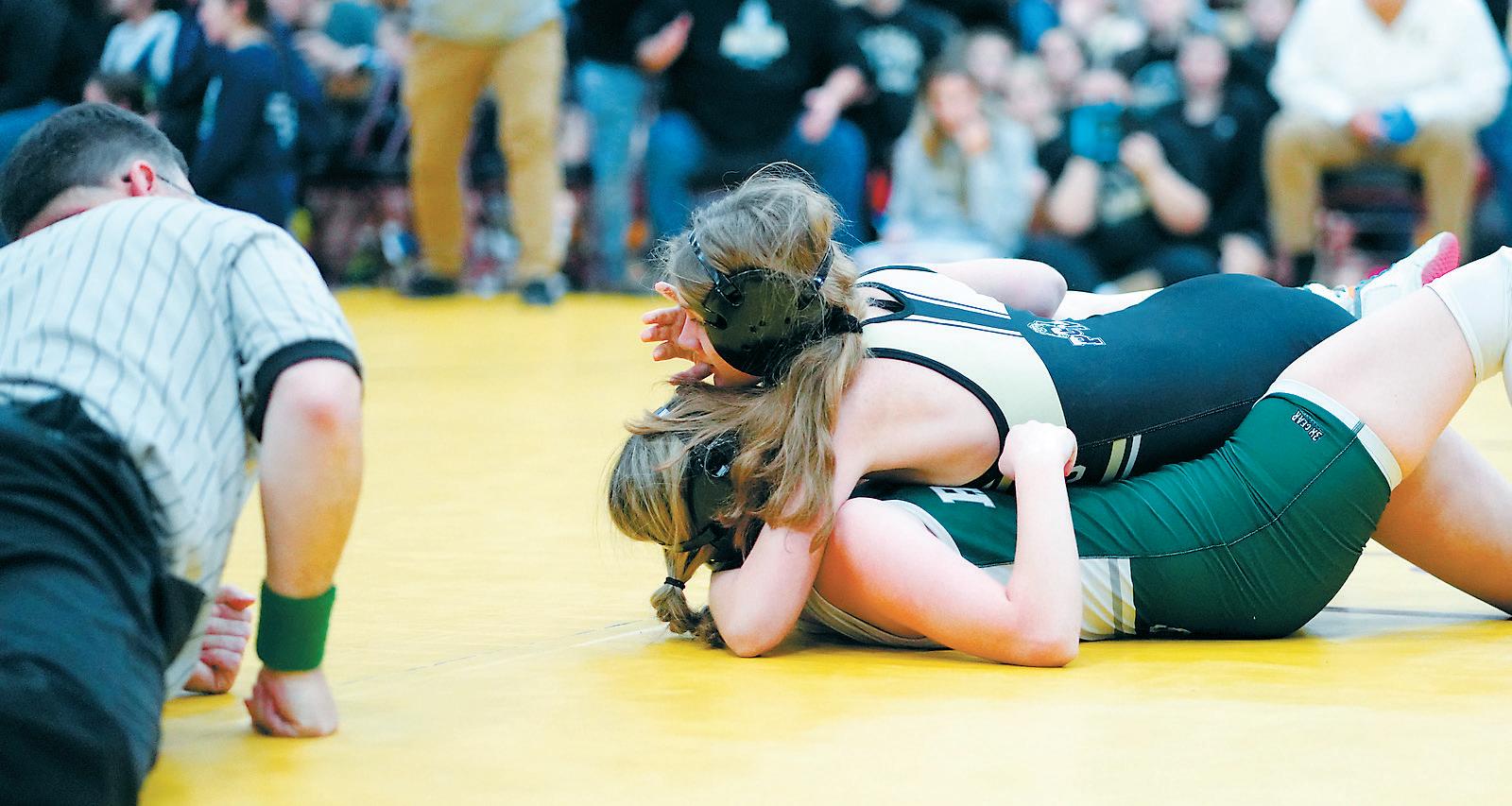


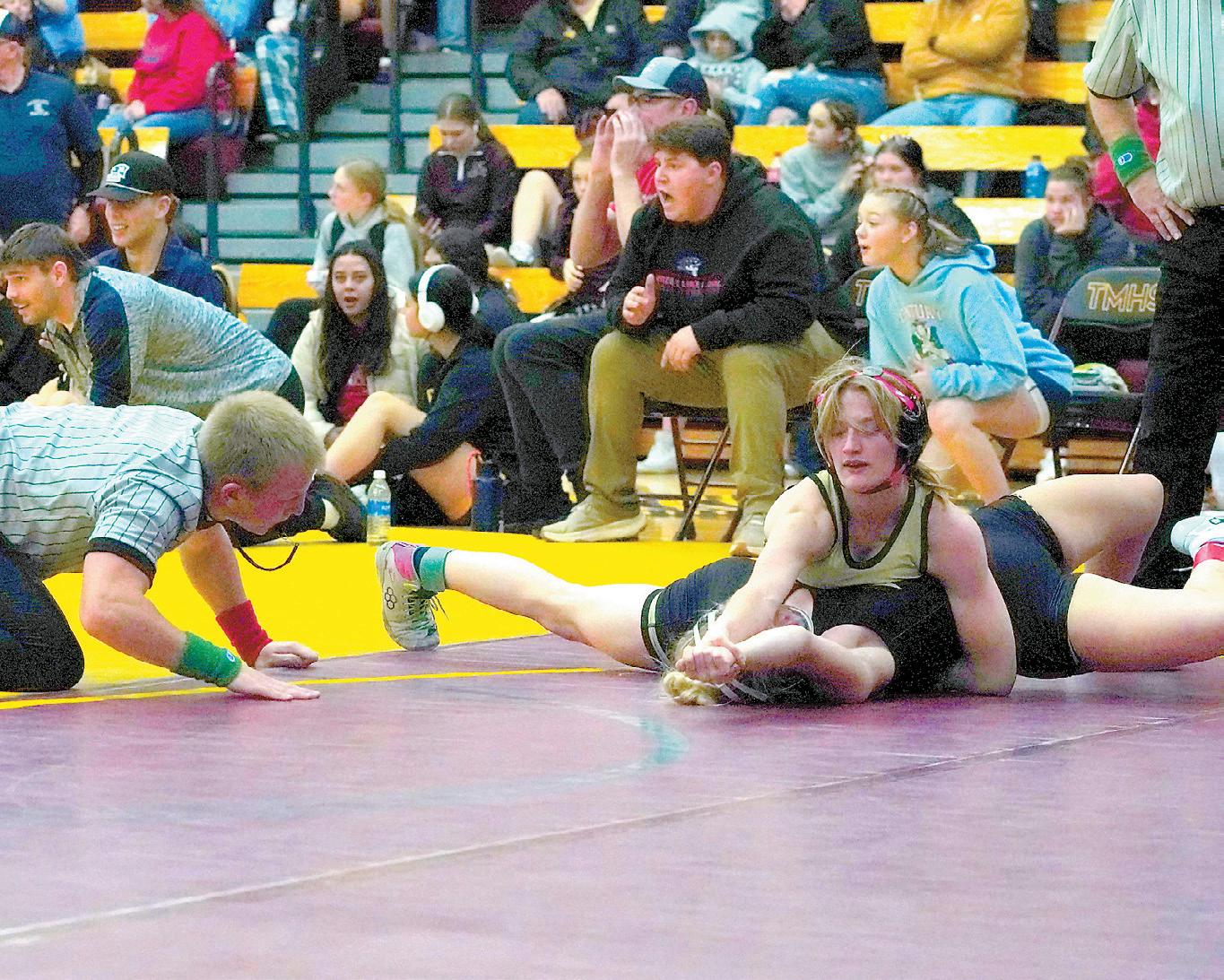


By Jake Kulland, Sports Editor
The 2025-26 hockey season got underway on the weekend of Dec. 5-7 for the Langdon Blades Junior Gold boys and 19U girls hockey teams. The
Minnesota and South Dakota. The girls played at a jamboree style tourney in Bottineau, which had a USA versus Canada format with teams from North Dakota and Manitoba.
On the boys side, the Blades finished




By Jake Kulland, Sports Editor
his first real taste of snow, and he loved it until he didn’t. He and the rest of us will get used to it, too, as this won’t be the end of winter storms for 2025-26. Let’s just hope it’s not one after the other.
Many activities coming up on the weekend As we steam into the Christmas break, there are so many things happening for our area sports teams. Boys basketball season gets underway statewide on Dec. 12, and the Langdon-Munich Cardinals are playing that night at Cavalier. The Cards have great numbers for boys hoops and are hoping for another nice season. Hear that game on 95-7 and on the MyBorderland app. North Border will get their boys season started the next day on Dec. 13 at Northern Cass. We will have the Eagles on the air at Drayton-Valley-Edinburg in Crystal on Dec. 16.
Region 2B, where Langdon-Munich and North Border are in this year in boys hoops (although sadly in different districts), should be wild. The Cards and Eagles are both looking for big seasons. Teams from Park River-Fordville-Lankin, North Star, Midway-Minto, Drayton-Valley-Edinburg, New Rockford-Sheyenne, Cavalier and others are as well. It should be a very fun winter, with lots of entertaining games on the horizon. Let’s just hope the weather allows them to happen. In girls basketball, Langdon-Munich is on the road at Dunseith and Larimore in the week coming up. For hockey, the Langdon Blades Junior Gold boys team has a home game this weekend versus Fargo at 4:00pm. Hear
second, winning pool play games over Tri-City and Wayzata, Minn., and losing to Northwood and Aberdeen, S.D. Langdon then lost in the championship, again to Aberdeen, 3-0. Ty Ramberg and Kennen Forest led Langdon with five goals each for the tourna-
ment, while Keaton Ullyott had three. For the Blades girls, they lost two games to the SW All Stars 7-0 and to Birtle, MB, 6-0 but did skate to a 2-2 tie with the GP Ice Dogs. Colby Forest and McKenzie Regner scored goals for Langdon.
The Junior Gold Blades have a home game on Dec. 13 versus Fargo at 4:00pm at Dakota
while the 19U girls will play at a tournament in Sidney, Mont.
the
on KNDK 1080 and on the MyBorderland App.


the game on KNDK 1080. Finally, for wrestling, both Pembina County North teams are at huge tournaments in Carrington for the weekend of Dec. 12-13.
Hard Times coming to the Langdon Eagles Club on Dec. 13
We leave you this week by saying our band, Hard Times, will be making an
appearance at the Langdon Eagles Club on Dec. 13. It’s the club’s Ugly Christmas Sweater Party, and many prizes will be given away for the ugliest things you can wear. As we have said in the past here, the band does not play as much as it used to, so come on out and join us for a fun evening and maybe even a Christmas song or two (don’t worry, we will go easy on them). Hard Times has always been a staple show for the holiday season, and we thank the Eagles and shall we say, other people for getting us to play on Dec. 13. See you on the dance floor!
Hey, the Vikes won a game! “See ya!” next week!

By Jake Kulland, Sports Editor
The start of the 2025-26 girls basketball season for the Langdon-Munich Cardinals got off with two non-conference home games, playing Edgeley-Kulm-Montpelier on Dec. 5 then hosting Central Cass on Dec. 8. The Lady Cards played well in both contests, beating the Rebels 48-40 but losing to a good Squirrels team, 5645. Langdon-Munich continues a busy December. They hosted the Cavalier Tornadoes on Dec. 11 then will travel to Dunseith for their first road game of the season on Dec. 16. They will also play at Larimore on Dec. 18. Here is a recap of the Cardinals first two games of the season:
Langdon-Munich vs.
Edgeley-KulmMontpelier 48 - 40 In
their season, the Cards got off to a fast start, jumping out to a 28-17 halftime lead behind 11 points from eighth grader Ary Schaefer, who was making her first varsity start. Hilary Haaven also had eight first-half points. Langdon-Munich saw their double digit lead get cut to one in the third quarter, 32-31. Two more young Cardinals players, freshman Mya Swanson and eighth grader Hallie Overby, made some big plays down the stretch to pull out the win, each having six second-half points. Swanson scored all six of hers in the fourth quarter, which included a huge three-pointer.
Schaefer finished with 13 points and Haaven 12 for the Cards. Haaven also had a team high nine rebounds and six assists. The Cardinals also held E-K-M to just 26 percent shooting on the night.
LANGDON-MUNICH 48, EDGELEY-KULM-MONTPELIER 40
EKM -- 6 8 16 7 -- 40
LM --17 11 10 10 -- 48
Langdon-Munich -- Ary Schaefer 13,

Hilary Haaven 12, Mya Swanson 6, Hallie Overby 6, Taya Feist 4, Erika Bakke 4, Kemi Morstad 3
Edgeley-Kulm-Montpelier -- Betsy Huber 14, Jaelyn Bertch 9, Mazie Tjernlund 7, Elli Lloyd 4, Anna Schelct 4, Symphony Nitchke 2
Rebounds -- LM: 37 (Haaven 9, Morstad 8, Swanson 7); EKM: 36 (Huber 9)
Assists -- LM: 11 (Haaven 6, Swanson 2); EKM: 8 (Schlect 4)
Steals -- LM: 6 (Bakke 2); EKM: 8
Block shots -- LM: 3 (Feist 2); EKM: 1
Turnovers -- LM: 19; EKM: 17
Field goal percentage -- LM: 19/51 (37.3%); EKM: 14-54 (25.9%)
Free throw percentage -- LM: 6/8 (75.0%); EKM: 9/18 (50.0%)
For the second straight game, the Lady Cards got off to another nice start. They led 11-2 in the first quarter, with five points by Kemi Morstad. CC would slowly pick away at that lead and actually go ahead in the second quarter. Erika Bakke hit a 3-pointer at the horn of the first half to tie the score at 23. Turnovers would be an issue for the Cardinals in the third, allowing the Squirrels to build an 11-point 43-32 lead after three quarters. The Cards got late 3- pointers from Lily Zimmer and Maci Gage in the fourth quarter to make things close, but CC ended up getting the win.
Langdon-Munich missed 11 free throws in the first half and were just 9 for 24 from the charity stripe for the game. Bakke led the team in scoring with 12 points and was the only Cardinal player in double figures. Taya Feist led the team with seven rebounds and two blocked shots, while Hilary Haaven had five assists and five steals. Talented freshman Kenley Haug had a game high 25 points for CC.
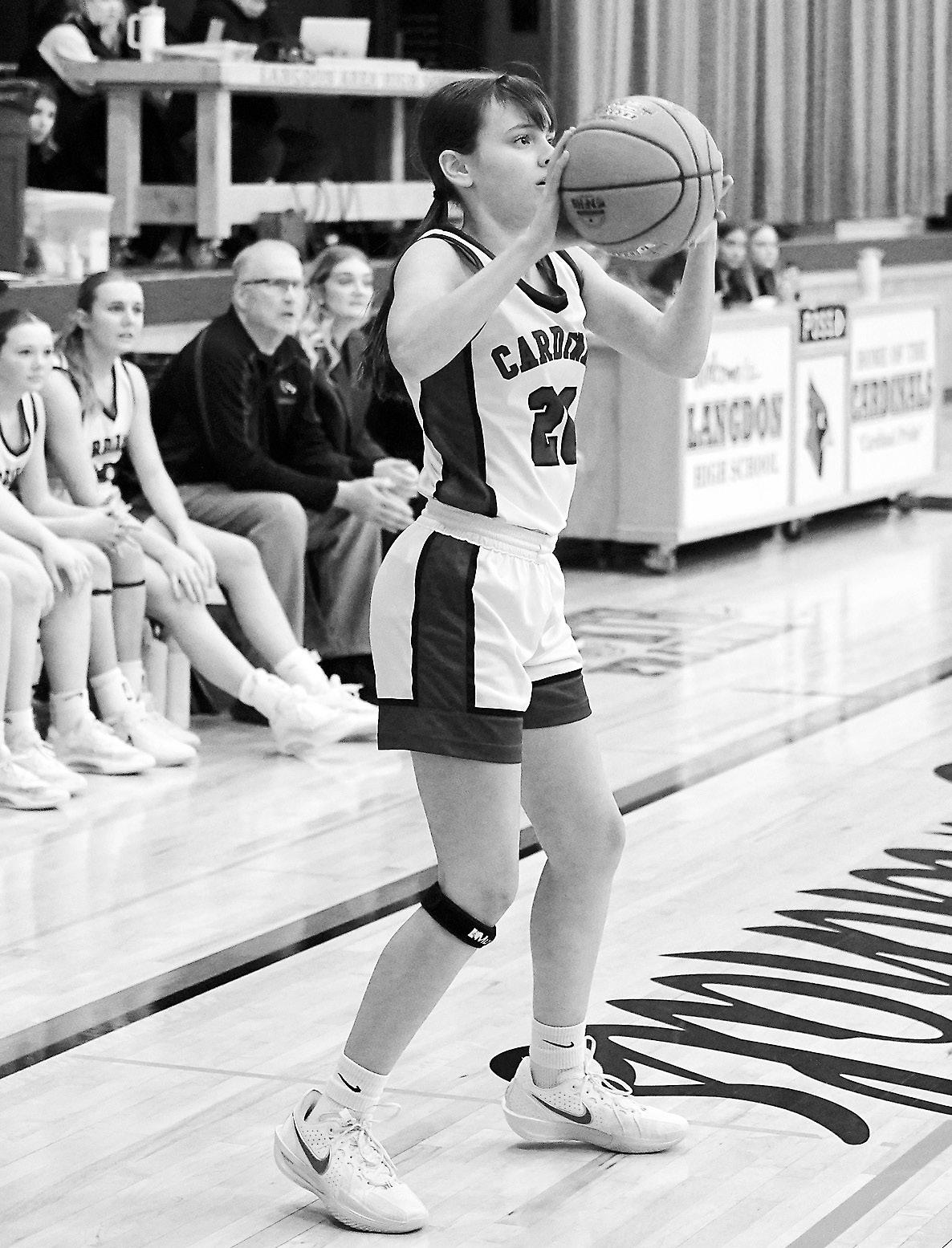


CENTRAL CASS 56, LANGDON-MUNICH 45
CC --15 8 20 13 -- 56
LM --13 10 9 13 -- 45
Langdon-Munich -- Erika Bakke 12, Hilary Haaven 7, Taya Feist 7, Kemi Morstad 6, Hallie Overby 5, Lily Zimmer 3, Maci Gage 3, Ari Schaefer 1, Mya Swanson 1 Central Cass -- Kenley Haug 25, Olivia Siverson 10, Addi Hushka 5, Abby Kobbervig 5, Keelyn Flanagan 4, Jaci Verkuehlen 4, Addi Hintermeister 3, Morgan Wald 2
Rebounds -- LM: 24 (Feist 7, Haaven 5); CC: 34 (Siverson 8) Assists -- LM: 12 (Haaven 5, Bakke 2); CC: 18 (Siverson 5)
Steals -- LM: 10 (Haaven 5, Schaefer 2); CC: 14 (Haug, Siverson 3)
Blocked Shots -- LM: 3 (Feist 2); CC: 0 Turnovers -- LM: 21; CC: 10 Field goal percentage -- LM: 15/37 (40.5%); CC: 25/57 (43.9%) Free throw percentage -- LM: 9/24 (37.5%); CC: 4/7 (57.1%)

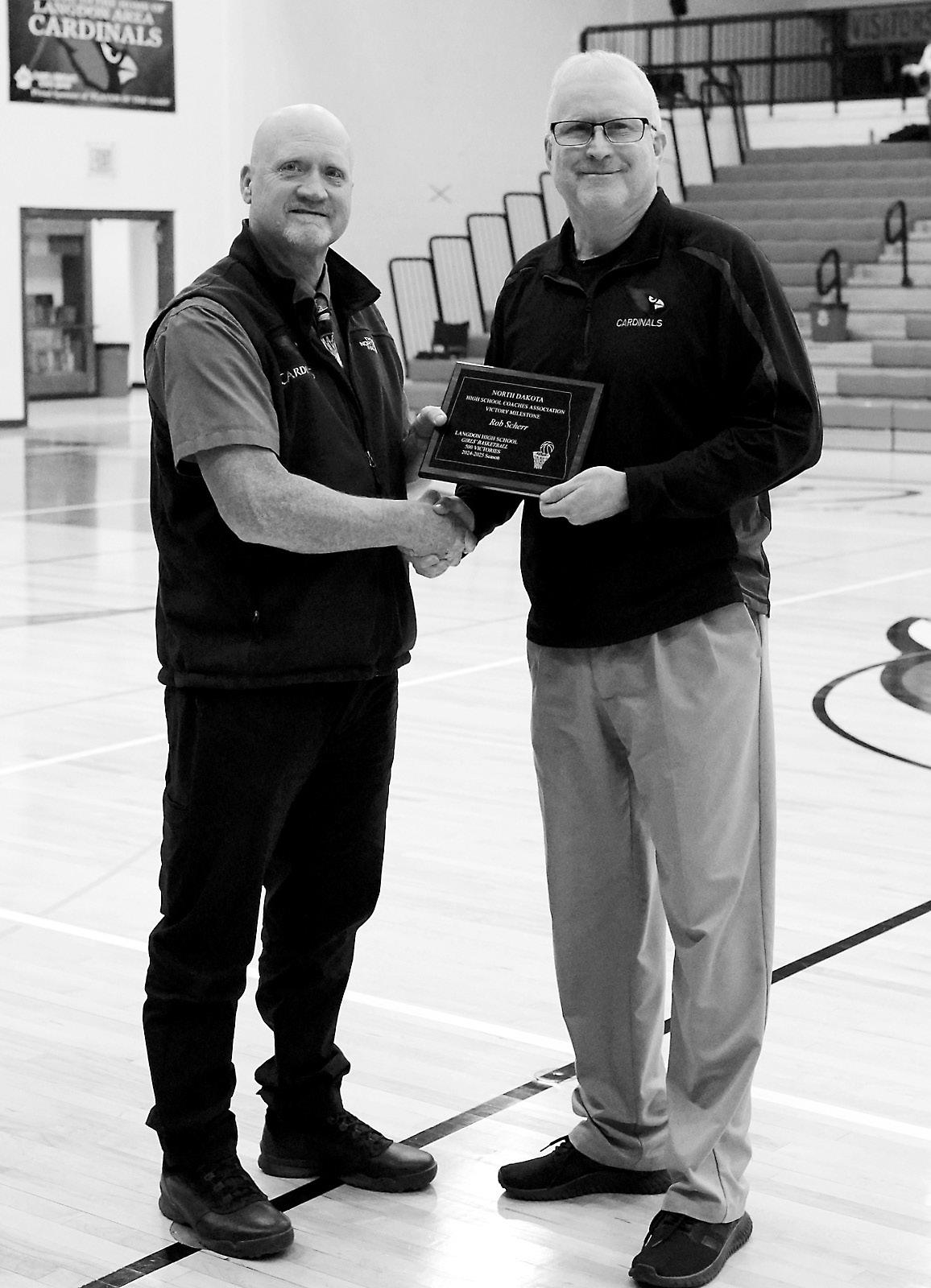

and NB-Walhalla senior Jaelyn Johnson plays last game in her
By Jake Kulland, Sports Editor
A nice crowd was on hand from all of the communities involved to support the game, and they were treated to an exciting contest, with DVE pulling out a 50-44 win. Johnson had 10 points on the night, with five of those coming down the stretch in the fourth quarter. Elizabeth Fedje led all scorers with 17 for the Titans, while Brooke Gullickson added 15, including a pair of 3-pointers. Cavalier also had three players in





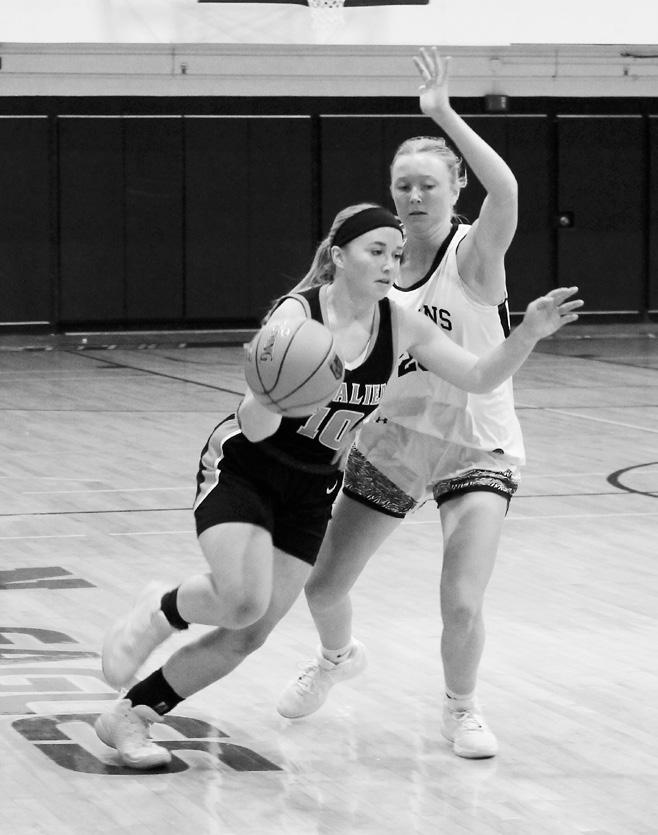
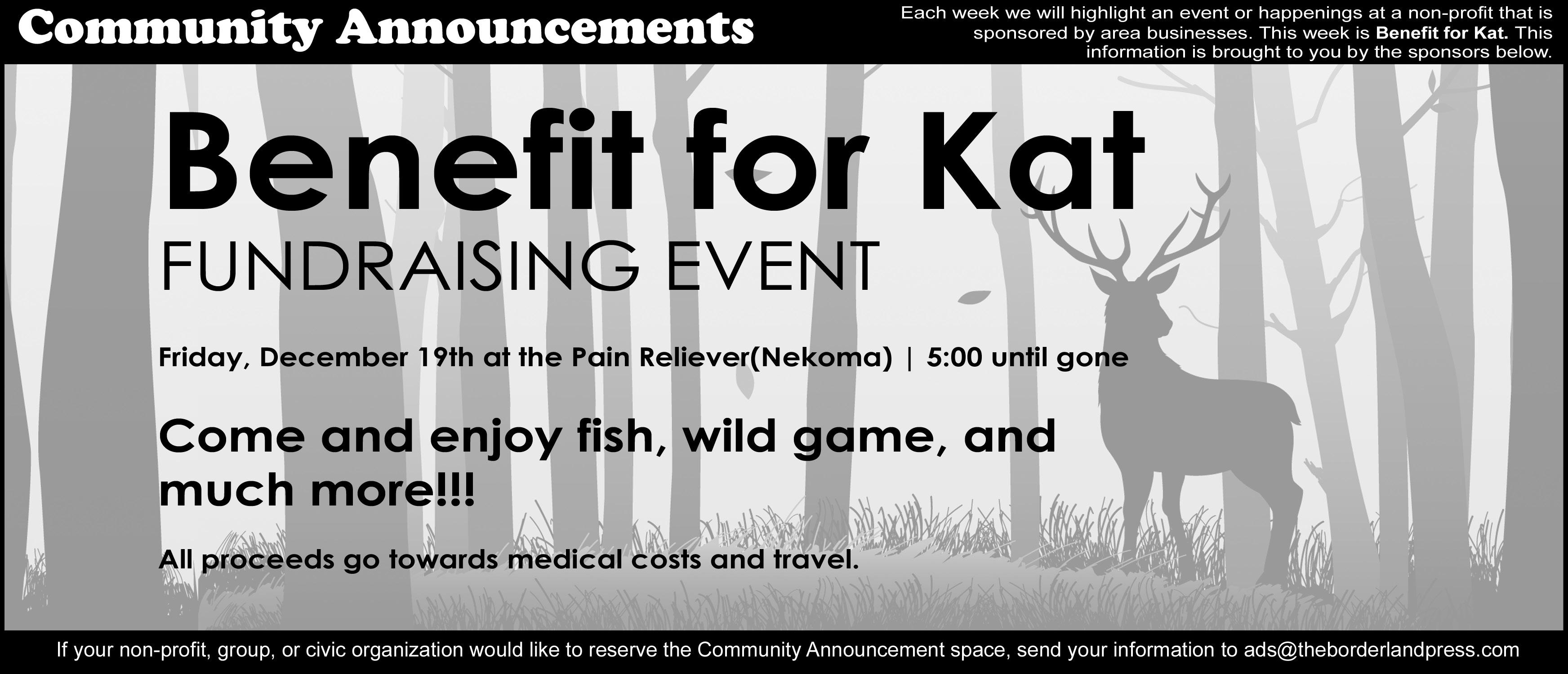



Cont’d. From Page A3 Northern Nature Seed Company, LLC
named 2025 Outstanding Pesticide Dealer of the Year
Northern Nature Seed carries a diverse lineup of seed brands, including:
•Legend, Proseed, Xitavo and Midwest Seed Genetics soybeans, corn and sunflowers
•Seedex and SES VanderHave Sugar
Beet Seed
•Invigor Canola
•Agassiz grass, deer plot and CRP
seed
•Rivard Turf and Forage products
Johnson said, “We offer a full line of agricultural chemicals, adjuvants and surfactants - free on farm delivery and free crop consulting with our products from a very experienced staff. We also offer on farm delivery of Nachurs low salt, 90-100% ortho-phosphate in-furrow liquid fertilizer.”
The business also offers fertilizer, crop protection products, customer education, and application support, which Johnson says keeps their team connected to producers throughout the year.
“If you’re just the seed guy, you’re there for planting, and that’s it,” Johnson said. “We’re in front of customers all season long.”
Growth in challenging times
Johnson said the company nearly doubled sales after hiring a seasoned salesman two years ago, and business grew another 15% this year. He attributes growth to trust, service, and the willingness of producers to take a chance on their operation, a chance Northern Nature Seed strives to repay.
A focus on safety and stewardship
Johnson believes part of their success comes from correcting misconceptions around pesticide products and ensuring people use them appropriately.
“There’s a lot of misunderstanding out there,” he said. “Roundup, for example, is probably the safest product we have when you’re educated on how to use it.”
Even homeowners who stop in for dandelion spray or insect control receive guidance on mixing rates, application practices, and safety equipment.
“Surround yourself with good people, and good things happen.”
That business philosophy, Johnson says, is behind everything Northern Nature Seed does. With roughly 15–20 competing dealers within a 50mile radius, Johnson said his team strives to outperform through service, availability, reliable supply, and relationships.
Johnson insisted the award belongs to the people backing him. He credited Dan Riley, Steve Weberg, Beaver Beauchamp, Jaden Haagenson, Hunter Johnson, Isaac Folland, Niel Keena, JP, Tim Meshefski, father-in-law “Doc,” Jared Hanson, wife Amber, and daughter Madison, along with their families and loyal customers.
“Good things happen when you surround yourself with good people,” he said.
Johnson noted their location right on Drayton’s Main Street. “We live right here, too; our kids live here,” he said. “We’re not going to do anything unsafe in our own hometown.”
Prospective growers or new customers may contact Johnson directly for product or service inquiries.

By Michael Standaert, North Dakota News Cooperative

Talk with K-12 teachers and administrators about AI in schools and there’s a sense of exasperation.
Not enough time to learn fast moving development of AI tools. Not enough training. Kids are far ahead of many teachers in adopting AI. Too many kids are using AI as a shortcut instead of as a tool to assist learning. Lack of ethical understanding among some students that may lead to abuse or misuse of those tools.
Talk with those same educators, and there’s also a sense of excitement.
Greater efficiency in lesson planning. The potential for superior, targeted, individualized learning. The possibility to quickly address and fill gaps in knowledge for a specific student. The ability to explore and work ahead for those students quickly approaching mastery of a subject.
Addressing the challenges while embracing the promise of AI is what educators are currently grappling with.
With little top-down direction, schools and school districts across the state are in charge of coming up with their own policies regarding the use of AI by educators and students.
The North Dakota Department of Public Instruction has a guidance framework educators can access but it is nearly three years old now.
Since AI and its adoption is developing so fast, some of the information is out of date.
“I think that the time is probably right to review that and explore if there are ways that we can probably put out better, more actionable recommendations,” said new state superintendent of schools Levi Bachmeier.
Bachmeier said it is important to distinguish between teacher-facing and student-facing AI tools and that those categories need to be addressed differently.
“I view those as two very different discussions, and I think we have schools across the state that are certainly exploring and implementing strategies that sort of align with both of those philosophies,” he said.
Two steps behind Jennifer Kallenbach, a high school history and social science teacher in the Kidder County school district, said teachers often feel two steps behind when it comes to using AI or addressing the use of AI with students.
“Once we catch up, students will probably find a loophole,” she said.
Kallenbach appreciated that local school administrators set aside time last year for an accredited course that allowed a deeper understanding of AI tools.
She tries to explain to her students how AI can be helpful, but only up to a point.
“I don’t ever 100% discourage students from using it,” Kallenbach said.
“I’ve told them you can sometimes jump on ChatGPT and have a brainstorming session with it, but I really warn them, from a history teacher perspective, it can be inaccurate and sometimes totally hallucinates quotes.”
Striking a balance is important for Kallenbach.
“I always think, how can I help students use this as a tool to make their life more efficient, but not lose that deep, slow, critical thinking which is really the most beautiful thing about education,” she said.
Bachmeier said that if he had to summarize his feelings on how AI is working its way into education, it comes down to three things.
“I think it’s inevitable. It makes me nervous. And it also makes me excited,” he said.
The greatest promise is how AI tools can be used by educators both in reducing the time needed for administrative tasks and increasing the bandwidth for strengthening the relationships between teachers and their students for learning, Bachmeier said.
“I think when it becomes student facing or student utilized, that’s where there are both opportunities and concerns,” he said.
“But if we can find ways to help support districts, to help support teachers, to use the benefits of AI to make their work more efficient and to help them better use data to recognize the right interventions at the right time for students, then they can do what they do really well,” Bachmeier said.
Finding the balance is a conundrum for most educators across the state, particularly when students use the technology for shortcuts.
“Schools are being challenged greatly with inappropriate use, which is actually hurting students in the long run,” said Mark Andresen, principal at Mandan High School. “Especially in math and writing.”
Need for discussion, training Cory Steiner, superintendent of Fargo Public Schools, said a recent meeting with his student cabinet brought up several discussions of AI he felt were illuminating.
“They really want to work with their teachers to figure out when AI is appropriate,” Steiner said, adding that they want teachers to have those conversations with them. “I thought that was pretty telling and actually pretty high-level.”
Steiner did say the fast development of AI tools can be overwhelming for some teachers who might opt not to use them at all because the technology can change so swiftly.
Most use in the classroom now is teacher and topic dependent, he said. “That’s partly because we haven’t done a ton of training around it, because I think, honestly, it’s changing so fast that even for those who train, it is difficult to keep up on as well,” Steiner said.
Inappropriate use of AI should be used as a teaching opportunity more than an avenue for punishment, especially if the behavior is not repeated, Steiner said.
“Honestly, with something that’s changing faster than anything we’ve seen in education, that’s going to have to be our mentality going forward,” he said.
Bachmeier said school districts are talking with each other about best practices when it comes to defining appropriate and inappropriate uses of AI, and that in a state that values local control, honing those will ultimately be up to them.
He said the DPI can help in providing guidance and assist in building capacity, and will be working to update policy around those in a quick moving environment.
“I think it’s going to be walking a fine line of how do you provide that support that’s relevant, but also, to a certain extent, a bit timeless, because it is evolving so fast,” Bachmeier said. “We want to make sure that any information that's coming out of here is relevant from the moment that districts are attempting to put it to use.”
Need for time, ethics 101
One thing many teachers would like is simply more time themselves to learn and explore the AI tools school districts have available, to better understand them and potentially use them for greater learning efficiency.
For Loren Nieuwsma, a speech and English teacher at Mandan High School, time is the main crux of the issue for him.
“I think the problem is that when you give so many tools to teachers and say, well here’s AI and how you use it, it’s turned into this thing in the past two years where teachers do not have the time to dive into things,” Nieuwsma said. “It’s literally been so overwhelming for teachers.”
Besides allowing time for a greater understanding of the AI tools at their disposal, teachers also likely need more time to develop policies about how to discuss ethics and responsible use of AI with their students.
“We’ve had a lot of ethical discussions in our department, about what is ethical use, about what we want students to be able to do,” Nieuwsma said. “How are people teaching it? Again, it comes down to time.”
Ethical usage is the hardest part of grappling with AI in the classroom, Dickinson High School principal Jefferey Brandt said, and raises questions about where support ends and where
academic dishonesty begins.
Brandt said teaching students about appropriate and inappropriate uses is possibly an area where educators are falling short, though academic dishonesty policies to address cheating and plagiarizing are only part of the formula.
“Whether a teacher is familiar with how students use AI or not, my hope is that our teachers know our students’ abilities and skill levels,” Brandt said. “If a student is utilizing something to cheat or plagiarize, a teacher knowing a student well should be able to identify a change in the student’s performance and address that change.”
Grayson Erling, a fifth grade teacher in the Bismarck Public Schools system, said he sees the potential for using AI tools as very helpful, but hasn’t seen a lot of adoption at the elementary level.
He also said there’s been minimal time set aside for training at that level – in his case around 45 minutes during one of the normal teacher training days — but it’s something he thinks would be helpful, particularly in preparing elementary students going on to middle school.
“BPS being such a large district, having a cohesiveness between all levels would be helpful, so how is the middle school using this and what can I show fifth graders to get them ready for middle school,” Erling said.
“I think just having them have an idea about how they can use those tools as a tool, and not just as a copy and paste, I think that’s a huge part of that,” he said.
“These kids, they’re smart, they know their way around a computer, which is a scary thing,” Erling said. “I feel like we don’t do enough for the safety of these kids, there are so many things they’re able to get to on these websites, they’re able to get a workaround, and it’s alarming.”
The North Dakota News Cooperative is a non-profit news organization providing reliable and independent reporting on issues and events that impact the lives of North Dakotans. The organization increases the public’s access to quality journalism and advances news literacy across the state. For more information about NDNC or to make a charitable contribution, please visit newscoopnd.org.

HVAC/R TECHNOLOGY
TOR: Position responsibilities include teaching courses related to HVAC/R Technology, curriculum development and revision, student advising, and student recruitment.
Starting Salary: $59,163, commensurate with education and experience. Screening begins immediately. Interested candidates must submit the NDSCS employment application at: www.ndscs.edu/join-our-team EOE
YOU CAN PLACE a 25-word classified ad—like this one—in every North Dakota newspaper for only $160. It’s easy. Contact this newspaper for details.
SERVICES FOR HIRE
NEED NEW WINDOWS? Drafty rooms? Chipped or damaged frames? Need outside noise reduction? New, energy efficient windows may be the answer! Call for a consultation & FREE quote today. 1-877-200-2734
ELECTRICAL SERVICES: Reliable & experienced. Competitive rates. From simple household problems to installing a brand new electrical system, we can take care of it all! Call now and have the zip code of the service location when you call! 1-877-403-0282
Struggling with debt? If you have over
$15,000 in debt we help you be debt free in as little as 24-48 months. Pay nothing to enroll. Call Now: 1-877688-0872
ND FARM LAND Values surge upward. Are you selling or renting? Pifer’s Auction and Farm Land Management. Bob Pifer 701-371-8538. Kevin Pifer 701.238.5810. Free valuation.
Donate your vehicle to help find missing children and prevent abduction. Fast free pickup, running or not, 24 hr response. No emission test required, maximum tax deduction. Support Find the Children, call: 1-833-5450694.
CA$H PAID FOR HIGH-END MEN’S SPORT WATCHES! Rolex, Breitling, Omega, Patek Philippe, Heuer, Daytona, GMT, Submariner and Speedmaster. These brands only! Call 1-833641-6634
LOOKING FOR THE most complete listing of ND Media? ND Media Guide. Call 701-223-6397, ND Newspaper Association.
WE BUY VINTAGE GUITAR’S! Looking for 1920-1980 Gibson, Martin, Fender, Gretsch, Epiphone, Guild, Mosrite, Rickenbacker, Prairie State, D’Angelico, Stromberg. And Gibson Mandolins / Banjos. 1-833-641-7066
We Buy Houses for Cash AS-IS! No repairs. No fuss. Any condition. Easy process: Call, get cash offer and get paid. Call today for your fair cash offer: 1-701-498-1853
WATER & FIRE DAMAGE RESTORATION. Our trusted professionals will restore your home to protect your family and your home’s value! Call 24/7: 1-877-936-0513 Mold Remediation services are also available!
HAVE a news release or other information that needs to reach all ND newspapers? ND Newspaper Association can help! One call does it all. 701-223-6397.



BISMARCK, N.D. – State School Superintendent Levi Bachmeier lauded North Dakota’s improvement on a national financial literacy report card, saying the result strengthens efforts to make N.D. the nation’s most financially literate state.
The report card examined state laws, educational policies, and curricula that affect financial literacy instruction in each state’s K-12 schools. It is
published every two years by the Tennessee-based American Public Education Foundation, or APEF.
In 2023, the report card rated North Dakota a “C” on financial literacy instruction. This year’s edition moved the grade to a “B,” citing a new legislative mandate that each high school student complete one-half unit of financial literacy or receive instruction in other classes about personal finance elements, including budgeting, investing, debt, and risk management.




“Our state government has set a goal of having North Dakota rated as the nation’s most financially literate state by 2027,” Bachmeier said. “This improvement on a national report card represents important progress toward that goal.”
The new K-12 financial literacy mandate was included in House Bill 1533, which lawmakers overwhelmingly approved in April. The APEF report also speaks approvingly of new K-12 academic content standards on financial literacy, which were approved by the Department of Public Instruction in July.
“This is the first time our state has developed a stand-alone set of standards specifically focused on financial literacy,” then-Superintendent Kirsten Baesler wrote in a foreword to the standards.
The report card says the new law and academic standards represented “huge progress” for financial literacy in N.D., but noted that high schools still are not required to have a standalone course in the subject. That is needed to raise the state’s grade to “A,” it says.
In April 2024, then-Gov. Doug Burgum announced an initiative to make North Dakota the nation’s most financially literate state by 2027. His statement coincided with the launch of a new website, SmartWithMyMoney. nd.gov., which includes several financial literacy tools.
The initiative is being led by the superintendent of public instruction, the state treasurer and several state agencies, including the Bank of North Dakota, the state Insurance and Securities Department and the Department of Financial Institutions, which regulates state-chartered banks, credit unions, and trust companies.
The Finra Investor Education Foundation, which publishes a national study on consumers’ financial capabilities every three years, most recently found that 30 percent of the N.D. residents surveyed scored high in financial literacy, based on their responses to a series of questions. The latest survey data was gathered in 2024 and published in July 2025.
The APEF report card rated the financial literacy of the 50 states, the District of Columbia and Puerto Rico. Seventeen states, including Minnesota, earned “A” grades. North Dakota was one of 22 that received “B”s. There were six “Cs,” four “Ds,” -- including Montana -- and three “Fs” –from South Dakota, Alaska, and the District of Columbia.


IN THE DISTRICT COURT OF CAVALIER COUNTY, STATE OF NORTH DAKOTA
In the Matter of the Estate of Michael T. Johnson, Deceased.
Probate No. 10-2025-PR-00022
NOTICE TO CREDITORS
NOTICE IS HEREBY GIVEN that the undersigned has been appointed Personal Representative of the above estate. All persons having claims against the said deceased are required to present their claims within three months after the date of the first publication of this notice or said claims will be forever barred. Claims must be either presented to the Personal Representative of the estate: Kim J. Johnson, P.O. Box 725, Walhalla, ND 58282, or filed with the Court.
Dated this 18th date of November 2025.
Kim J. Johnson PO Box 725 Walhalla, ND 58282
Personal Representative
Quentin B. Wenzel
908 Third Street
Langdon, ND 58249
Attorney for Personal Representative
First Publication on the 5th day of December 2025.
IN THE DISTRICT COURT OF THE NORTHEAST JUDICIAL DISTRICT, CAVALIER COUNTY, NORTH DAKOTA
In the Matter of the Estate of Harold Weston, Deceased.
Probate No. 10-2025-PR-00007
NOTICE TO CREDITORS
NOTICE IS HEREBY GIVEN that the undersigned has been appointed personal representative of the above estate. All persons having claims against the said deceased are required to present their claims within three months after the date of the first publication of this notice or said claims will be forever barred. Claims must be either presented to Gail Weston, personal representative of the estate, at 1321 4th St #4, Langdon, ND 58249, or filed with the Court.
Dated this the 12th day of November, 2025.
Gail Weston Personal Representative 1321 4th St #4 Langdon, ND 58249
Mondragon Law Office
Angelo S. Mongragon P.O. Box 151 Langdon, ND 58249-0151
First Publication on the 21st day of November, 2025
Allo Towers proposes the construction of a guyed style telecommunications tower within a 50’ x 50’ lease area approximately 0.14 miles west-southwest of 159th Ave. NE & 97th St. NE, Pembina, Pembina County, ND. The height of the tower will be 76.2-meters above ground level (250-feet above ground level) and 77.7 meters above ground level including appurtenances (255-feet above ground level with appurtenances). Proposed project will include ground disturbance. Members of the public interested in submitting comments on the possible effects on historic properties included in or eligible for inclusion in the National Register of Historic Places may send their comments to Andrew Smith, RESCOM Environmental Corp., PO Box 361 Petoskey, MI 49770 or call 260-385-6999.
December 15, 2025 – This date in 1885 was one piece of the timeline moving Dakota Territory to statehood as John Sherman, president pro tempore of the 49th U.S. Congress, was presented with a constitution and memorial assembled by Dakota Territory's legislature. These intensely worded documents gave reasons for splitting the territory, with the half south of the 46th parallel to be given statehood as South Dakota.
Indiana Senator Benjamin Harrison was part of the effort from the start. He introduced a bill on this date in 1885 to admit South Dakota as a state and to organize the northern division as a Territory. An amendment in the bill gave that new territory the name of Lincoln. The Senate passed the bill in February 1886, but the House Committee on Territories was opposed.
Other bills followed in January 1886 on how to divide Dakota Territory, including possible statehood options. Admitting the entire territory as a state was one such option. Another suggested splitting Dakota Territory along the Missouri River, letting the eastern residents submit for statehood.
More bills were introduced in 1887 and '88. One admitting Dakota as a state passed the Senate in 1888, but no bill dividing Dakota as north and south succeeded. Eventually, Dakota Territory's 1887 legislature put the matter of the north-south division to a vote. That November, over 67,000 people cast their ballot. Northern residents opposed the division with only four counties in favor: Burleigh, Ramsey, Grand Forks and Ward. But overall, 55 percent of the voters favored the division.
Bitterness followed in the years afterward. Southern Dakota Territory officials still felt sore over the capital moving from Yankton to Bismarck in 1883, and Democrats in general opposed the division. However, the election of Republican Benjamin Harrison as president in 1888 set the stage for statehood.
At 3:40 p.m. on November 2, 1889, Harrison signed North and South Dakota into statehood using an eagle feather. Before doing so, Secretary of State James Blaine shuffled and cov -
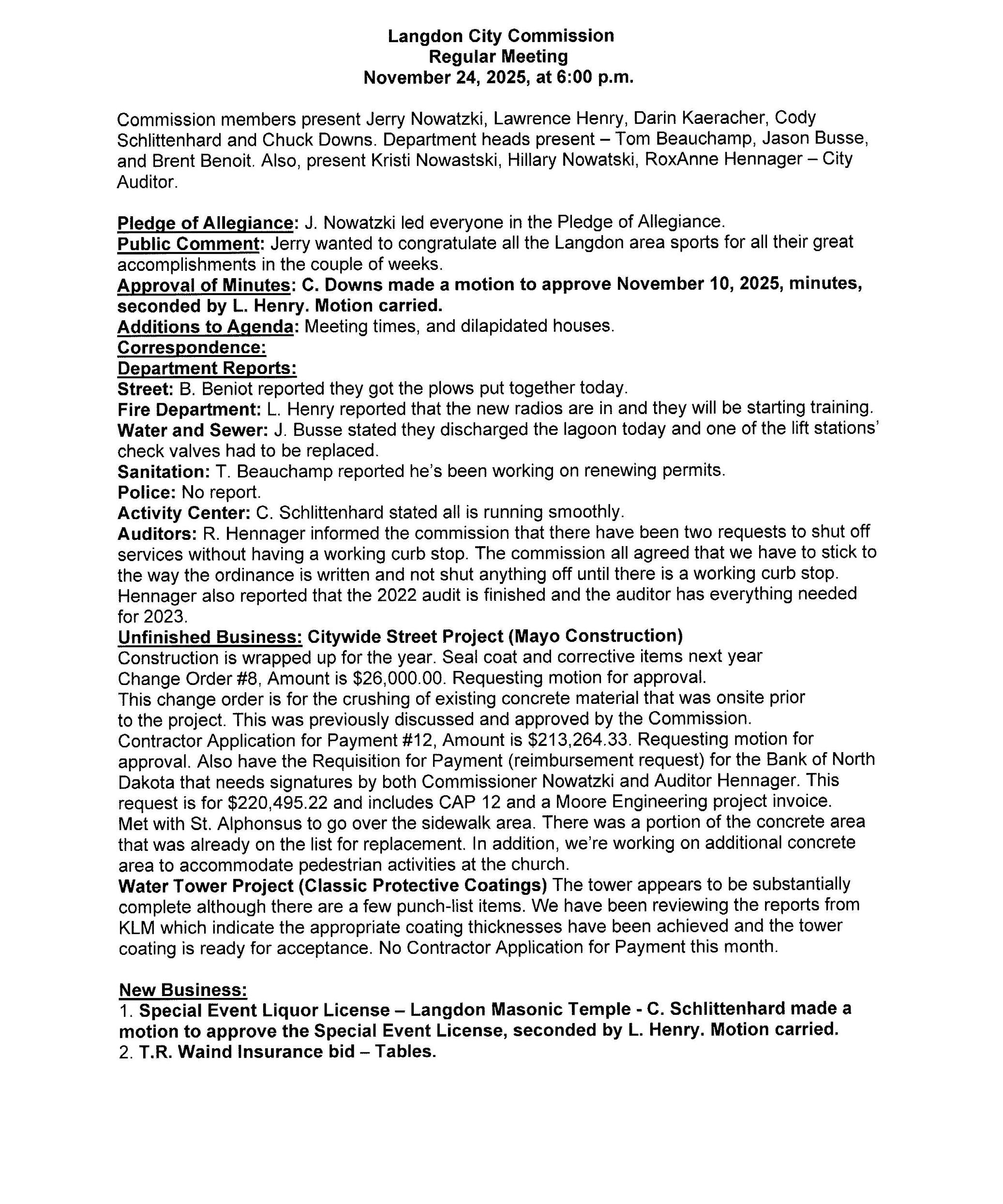
ered the statehood proclamations to avoid bickering over which state came first.
“They were born together – they are one and I will make them twins," Harrison said as he signed the Dakotas into statehood.
Dakota Datebook by Jack Dura
“Dakota Datebook” is a radio series from Prairie Public in partnership with the State Historical Society of North Dakota and with funding from the North Dakota Humanities Council. See all the Dakota Datebooks at prairiepublic.org, subscribe to the “Dakota Datebook” podcast, or buy the Dakota Datebook book at shopprairiepublic.org.
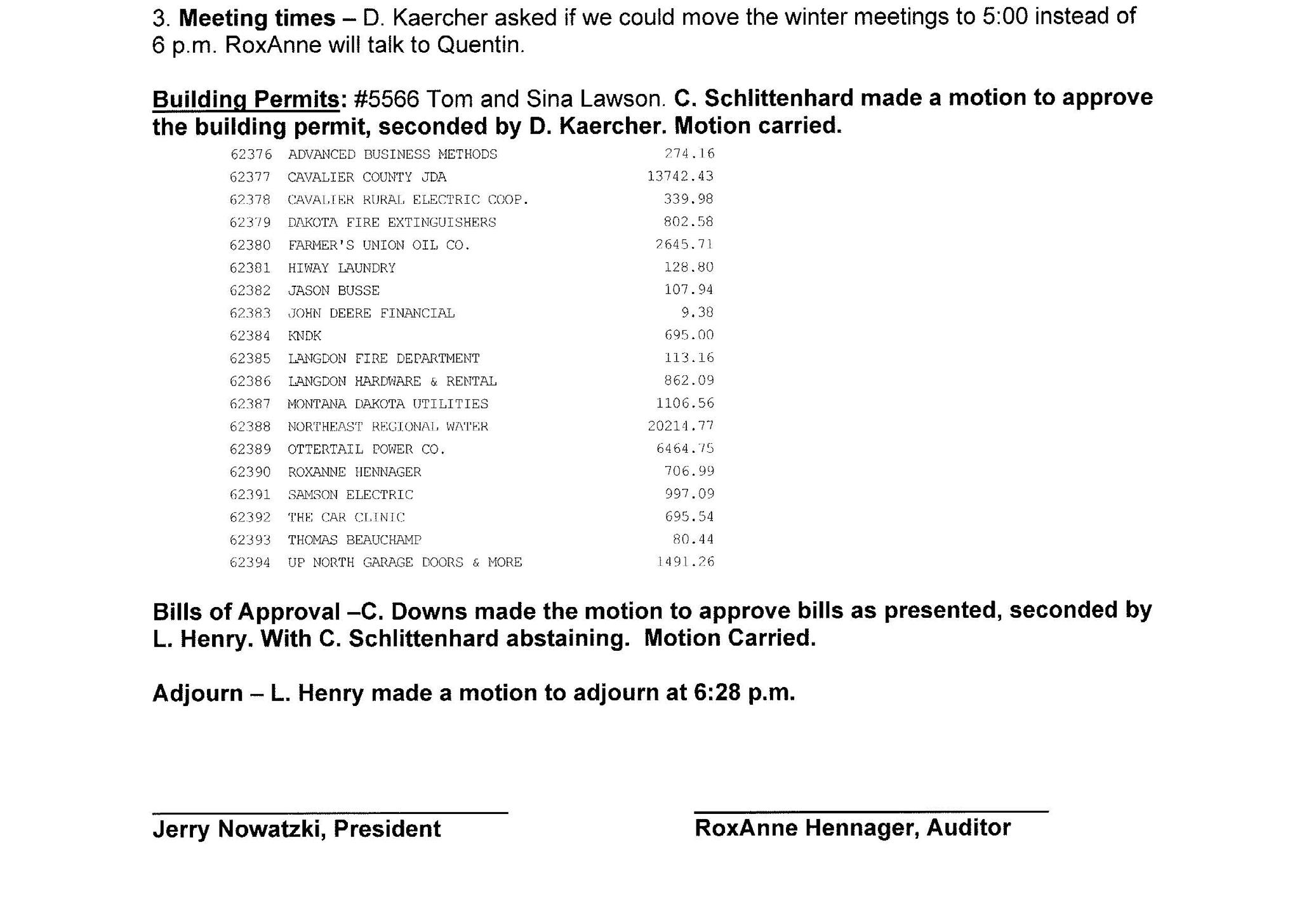





By Hilary Nowatzki
Thanks to the Gorge Arts and Heritage Council, the Walla Theatre was bright and alive on Saturday, Dec. 6. This was a second fundraiser of the season, and a premiere of The Grinch was played on the big screen for movie-goers.
The big screen wasn’t all there was to entertain the folks for the night. Grinch decor, festive surprises, a photo booth, and real life characters were present to engage with the youth in attendance. A few Whos were present, including Cindy Lou Who, as well as the Grinch himself.
“I love hearing all the kids giggling together,” said Shanda Peterson, who first envisioned the one night fundraiser idea and hosted it with volunteers from the Gorge Arts and Heritage Council as a way to benefit the historic Walla Theatre.