Independent Student voice of Boise State since 1933
14
From best friends to business partners
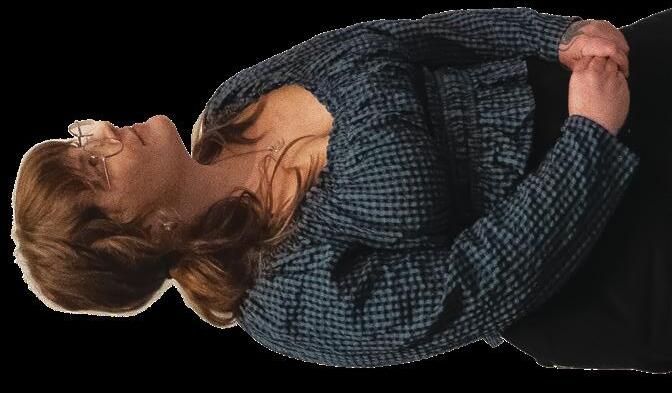
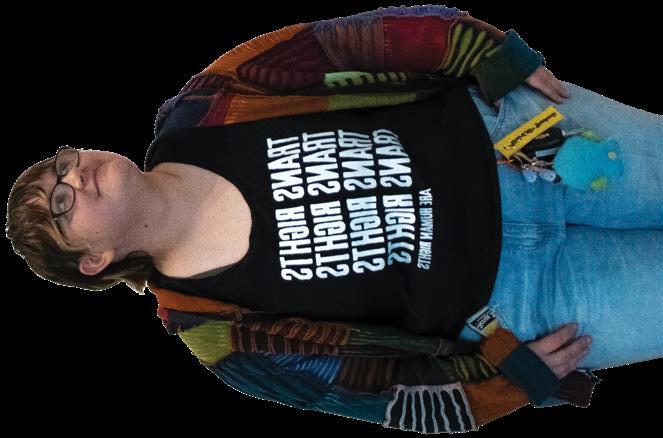
10 2025 BFA exhibition showcases talent in ‘Full Bloom’
Graduating Fine Bachelors of Fine Arts Students showcase their work at the Blue Galleries, exploring identity, education and activism across mediums.
Vol. 38, Issue 8 Dec. 11, 2025
04
Battle over HB 500 continues
Lindsay Hecox remains in the midst of a five-year legal battle despite petitioning for dismissal from the case.
08
What are we working for?
50-year mortgages do little to ease anxieties of hopeful homeowners.
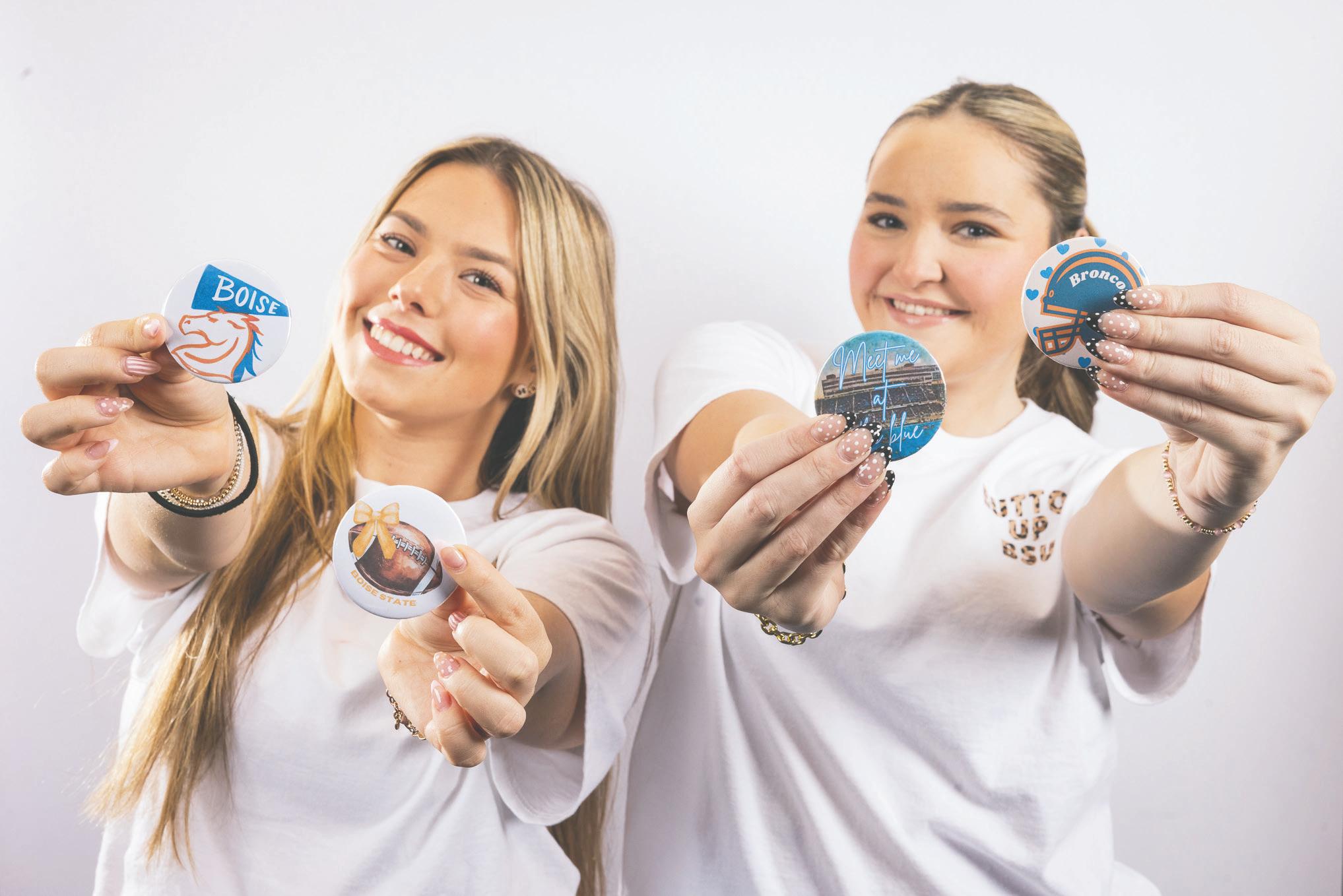
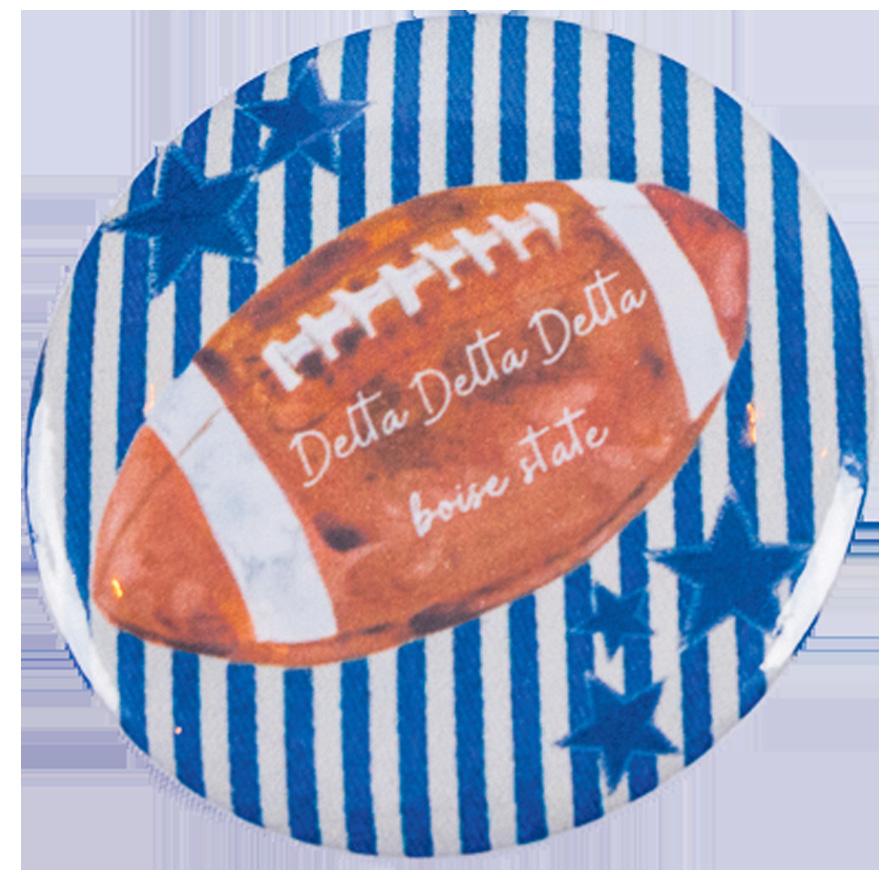
Hayden Belshe and Karlee Cons, owners of Button Up BSU, decorate campus with custom ‘Bronco Buttons’.
Editor-In-Chief
Emily Carmela Nelson
editor@stumedia.boisestate.edu
Managing Editor
Olivia Brandon
editor@stumedia.boisestate.edu
News
news@stumedia.boisestate.edu
Editor
Grace Stark
Hudson Lehew Valentin Termite
Opinion
opinion@stumedia.boisestate.edu
Zaccary Kimes
Find new stories online daily at arbiteronline.com
culture@stumedia.boisestate.edu
Editor -
Culture Sports & Rec
Julianna Kelsey
Samantha Caccamo
sports@stumedia.boisestate.edu
Jake Zamora
-
Aidan Mattingly
Assignment desk
Cole McAdams
Photo & Design
design@stumedia.boisestate.edu
Design Manager -
Naomi Brown
Graphic Designer -
Amber Jansson
Illustrator -
Mia Strand
digitalcontent@stumedia.boisestate.edu
Digital Content Manager-
Digital Content Producer -
Omar Saucedo Carter Nash
Marketing & Advertising
Advertising & Sales Manager
Zach Cerepa
ads@stumedia.boisestate.edu
Marketing Manager
Karley Rodriguez
marketing@stumedia.boisestate.edu
ON THE COVER:
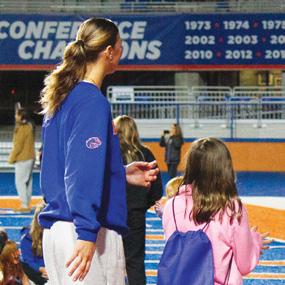
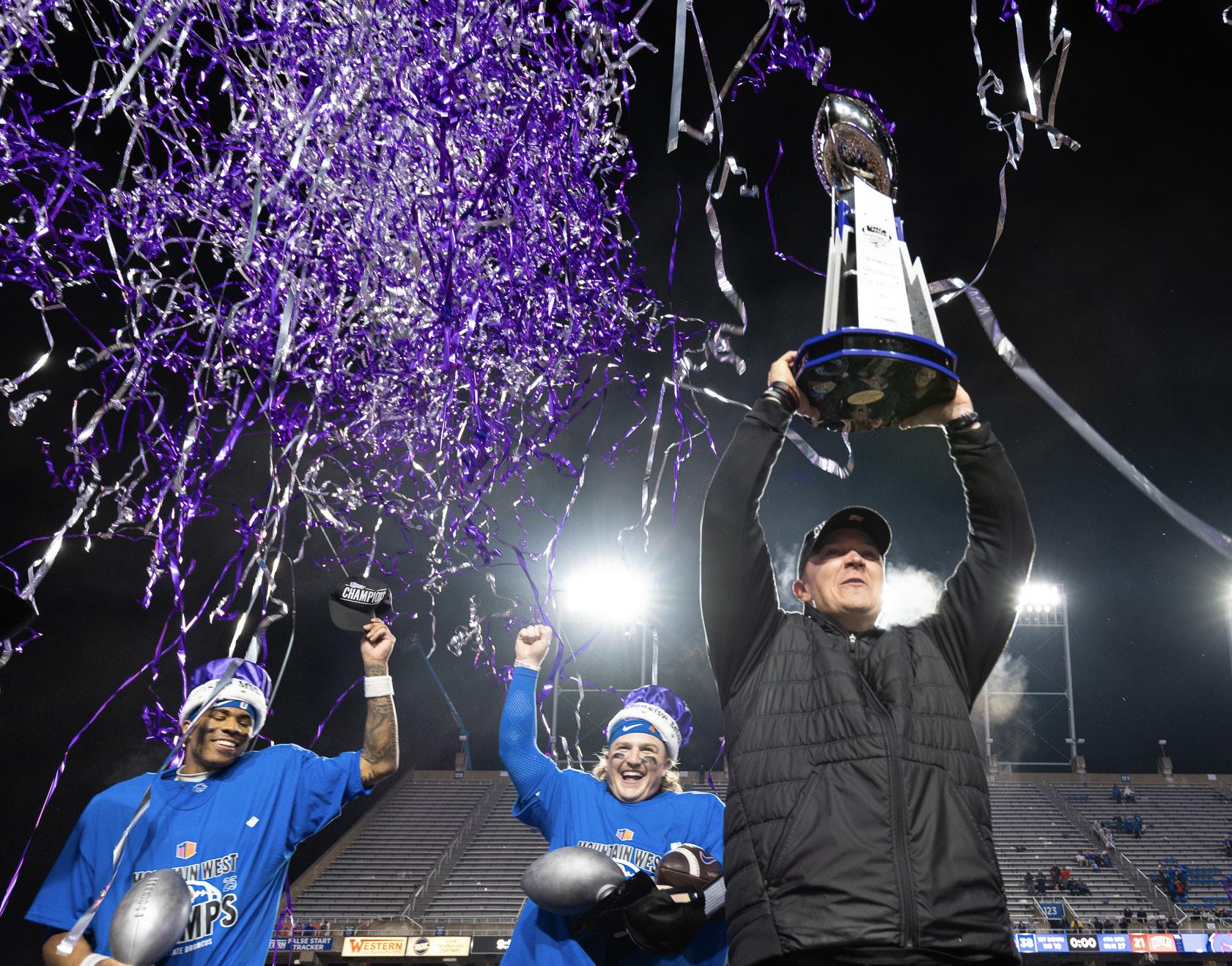
On a rainy Friday night, Boise State secured its seventh Mountain West Championship title. The Broncos defeated the UNLV Rebels 38-21 for the third year in a row, highlighting the Broncos’ resiliency after a tough start to the season with multiple losses.
PHYSICAL LOCATION: Located on first floor of Lincoln Avenue Garage Suites
MISSION:
As a student-run organization, we produce accurate and hyper-local information through non-partisan and socially responsible media.
River in Garden Valley Idaho.
Omar Saucedo
LINDSAY HECOX REFLECTS ON FIVE-YEAR LAWSUIT AHEAD OF SUPREME COURT HEARING
Lindsay Hecox, a psychology major, is in the midst of a five-year legal battle against Governor Brad Little and other defendants regarding Idaho’s House Bill 500, an act banning transgender women from participating in women’s sports.
The case, initially filed in Idaho’s District Court, progressed to the Supreme Court through petitions by defendants in November 2024.
Despite Hecox’s request to have the case dismissed on Sept. 2, 2025, the Supreme Court overrode her request, setting a hearing date for Jan. 13, 2026.
“My goal was to have this settled in the court of appeals, [but] ultimately the defendants appealed it, and the Supreme Court took that appeal,” Hecox said. “The scope is much bigger there, and that definitely changed the way I started thinking about [the case].”
As Hecox prepares for graduation, she reflects on the experiences that shaped much of her university career. In spite of anticipating renewed mainstream attention, Hecox remains confident about what the future may hold.
Hecox filed her original complaint alongside attorneys from the American Civil Liberties Union, Cooley LLP, Legal Voice and other plaintiffs in April 2020, four weeks after HB 500 passed through the Idaho House of Representatives.
In the filing, Hecox claimed the “Fairness in Women’s Sports Act”, HB 500’s legal title, would prevent her from participating in Boise State’s cross-country team or other collegiate athletics.
According to Hecox and ACLU’s complaint, HB 500 consequently violated the Equal Protection Clause of the Fourteenth Amendment and Title IX of
the Civil Rights Act.
“It was quite a unique experience because this law was very much targeted towards this small population that I just happened to be a part of,” Hecox said. “I felt compelled to join the case just for the sake of knowing how difficult it would be to gain that legal standing.”
Four months later, the courts ruled in favor of Hecox and granted a preliminary injunction — a legal tool that would allow her to try out for the team unimpeded.
However, defendants quickly appealed the case in the 9th U.S. Circuit Court of Appeals through a brief filed on Jan. 8, 2021, bringing a larger spotlight to the case.
“There’s always going to be an impact when your life gets tangled up in major news stories,” She said, explaining she feels pressure to have “solid character.”
Hecox said she tries to focus on the present and future, not the events of the past. Still, she said the spotlight made her more aware of how individual actions can “affect public opinion.”
“I wanted to fit in, not call too much attention to myself,” She added. “If I had any anxieties, it would be that I was being misinterpreted as someone who’s very angsty and politically-oriented when I really am not, I’m just a downto-earth college student.”
Sports played an important role in her life during the lawsuit, according to Hecox. She participated in a club running team in 2020 and 2023 and joined a club soccer team in 2022.
“I had some of the best experiences of my college career through both the club running team and club soccer,” Hecox said.
She attributed the positive impact to “away trips”, which helped her bond with teammates and find community.
“Those are things that you will remember for your whole life because [they are] exciting, and I got to do that because of my involvement in sports,” She added.
Hecox added legal proceedings “bogged down” the case until June 2024, when the appellate courts affirmed the District Court’s orders to allow Hecox the opportunity to try out for the cross-country team.
One month later, defendants filed a petition asking the Supreme Court to review the decision. Because of this, Hecox would need to continue litigation almost five years after beginning her lawsuit.
Contesting the new review, Hecox suggested the case be dismissed due to new life circumstances, with Chief U.S. District Court Judge David Nye reject -
ing her suggestion, citing public interest in the ruling.
“I needed to pass my classes, I wanted to have more of a presence in my group of friends and enjoy my last portion of time [at Boise State],” Hecox said. “I guess the decision to continue could have been disappointing, but I basically just brushed it off.”
Hecox aims to focus on post-graduation life, rather than the eventual ruling.
“The court had their rationale, [but] I had no reason to fixate on what that meant for me … which was to learn how to live in a general sense instead of being caught up within a political culture war,” Hecox said. “Whatever the result [or] legal opinion, it’s just gonna happen, and that’s it.”
The Supreme Court will hear arguments related to the case on Jan. 13, 2026.
Valentin Termite | News Reporter | Photo by Omar Saucedo
TARIFFS MAY BE GONE, BUT LINGERING COSTS STILL BREW FOR LOCAL COFFEE SHOPS
Hudson Lehew, Kate Salinas | News Reporter, Contributing writer | Photos by Omar saucedo
With lifted coffee tariffs
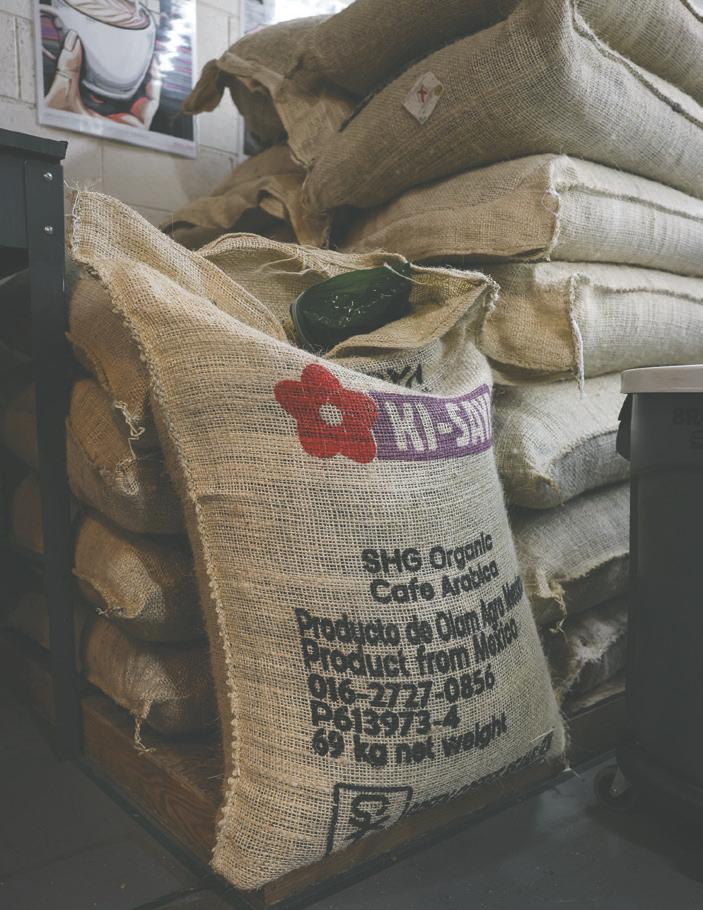
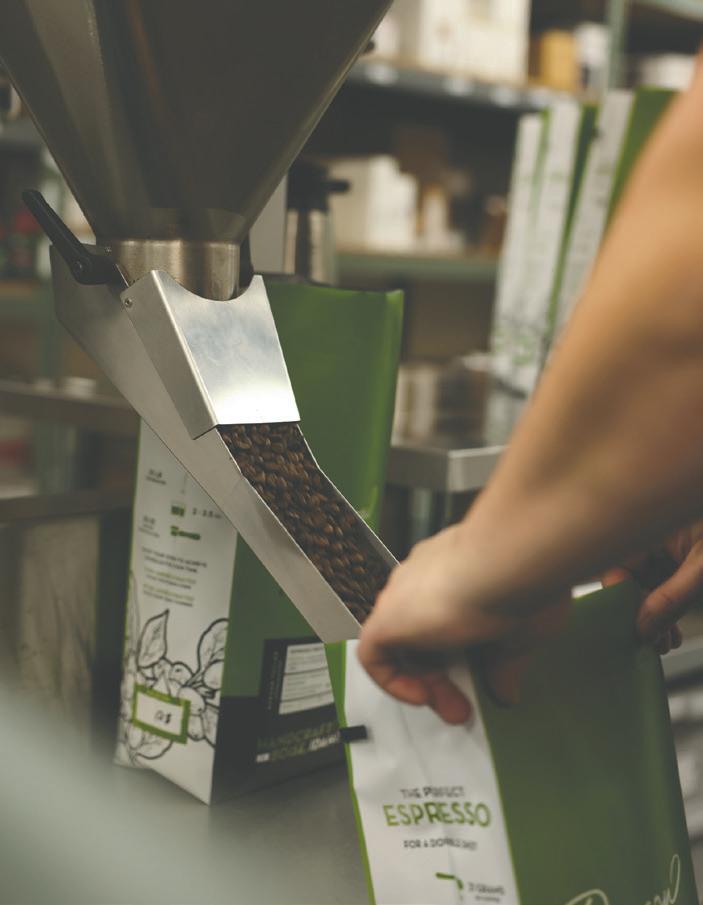
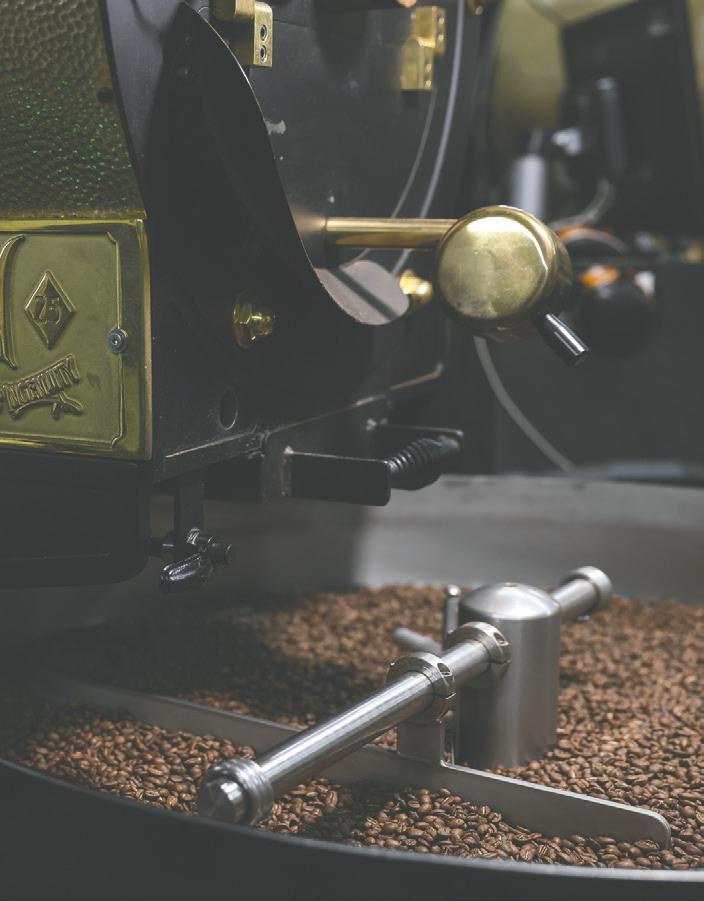
prices lingering and unroasted coffee beans, also known as green coffee, prices increasing drastically, local shops are getting creative to maintain business without drastically raising prices.
Amanda Stewart, a 15-year industry veteran, currently works as a coffee educator at Dawson Taylor in the Lusk District. Stewart said coffee tariffs have had an “insane” impact on small businesses like Dawson Taylor in comparison to large corporations like Starbucks or Pete’s. Larger companies can afford to purchase coffee beans in bulk while they are still inexpensive.
“When the tariffs happen, [large coffee businesses] can just use up the coffee they bought a long time ago and hope the tariffs will go away,” said Stewart. “Whereas, if you’re a small roaster, you [can’t] buy as much coffee in advance.”
When smaller shops like Dawson Taylor inevitably run out of coffee beans, they cannot afford to wait out tariffs. Matt Bishop, CEO of Iron Mule, a major roastery for coffee shops in the Treasure Valley, echoed this sentiment.
“They [larger companies] can use
financial tools, like buying futures and doing things to try to smooth out their cost of coffee, so they have an advantage over us when coffee prices are erratic,” said Bishop.
Stewart stated it’s not just coffee bean tariffs that affect their shop, but also tariffs on supplies such as aluminum, coffee pots and filters.
“We truly thought, ‘this can’t happen, or we’ll go out of business,’” Stewart said regarding the tariffs.
Stewart explained that Dawson Taylor sources coffee beans from all over the world, including Myanmar, Ethiopia, Central America, Guatemala, Costa Rica, Brazil and South America.
Steward noted several coffee shops faced similar situations of ordering items and tariffs being announced afterwards, resulting in an inability to avoid additional charges.
“Things have been really unpredictable,” said Stewart, who explained that tariffs were put on China after they had already ordered coffee and supplies.
While Dawson Taylor has been forced to raise prices, its general manager has worked hard to minimize how much prices increase. Steward noted the big -
gest blow to Dawson Taylor is having to consider changing their espresso recipe. While there is an option to switch to a Brazilian coffee with a lower tariff, Stewart said customers expect the coffee to taste a certain way and switching providers could change that.
“It’s kind of what built this company … thinking of making changes to classic things is a big deal.”
“We specifically are having to raise prices for coffee because most of our coffee beans are a lot more expensive,” added Java manager Alyssa Grinwas. “We do our best. Usually 90% of people understand, 10% of people are upset.”
Prices are also increasing at Common Ground Coffee on items like coffee bags and Americanos, stated co-owner Laurie Pearman.
“Our goal is to be a neighborhood coffee shop that’s affordable, and we already feel that with the cost of all of our ingredients, our menu pricing is about as high as we want it to be for our customer base,” Pearman said.
Pearman and her partner, Sarah Keck, have been keeping a close eye on the coffee tariffs since they first increased in April. Pearman said to save money, her
business is trying to reduce waste.
“[We’re] trying to be really mindful of what we order and making sure things don’t expire,” said Pearman. “We have very little waste, [we’re] making sure our team is aware of how much every little bit matters.”
Pearman noted that Iron Mule currently acts as a “buffer” for Common Ground Coffee, helping minimize the damage caused by coffee tariffs and green coffee prices by taking financial risks, such as buying green coffee in bulk.
Though the Trump Administration lifted coffee tariffs on November 14, Bishop explained there are still lingering concerns for the future.
“We’re going to still see a lagging effect of that issue, just because those importers that purchase coffee under tariffs are going to want to recoup that cost,” said Bishop. “‘I’m hopeful, but I think it’s still going to be months before we see the impact of [the lift] hit us.”
Alongside lowered tariffs not lowering prices, the price of green coffee has also gone up drastically in the past year. Green coffee prices have increased worldwide due to extreme weather conditions affecting major producers, including Brazil and Vietnam.
“Green coffee in 2019 was about $1 a pound. Now it’s over $4 a pound. So there’s been a huge increase in that,” Stewart said.
Bishop said Iron Mule salaries have had to be “significantly” reduced as a result. Despite rising prices for green coffee, Bishop’s company is actively trying to avoid continually raising their prices.
“These stores really are margin-driven,” said Bishop. “If we raise our price considerably, they’re simply going to just cut us from the shelf and put in more Starbucks.”
december 11, 2025
STUDENT ARRESTED WHILE PROTESTING ICE AT KROME DETENTION CENTER
Scar Rulien, sophomore, arrested alongside dozens of protestors in Florida
Scar Rulien, a member of the Sunrise Movement and sophomore studying Sociology, was among the 31 people arrested on Nov. 22 at the Krome Detention Center in Miami-Dade County, Florida.
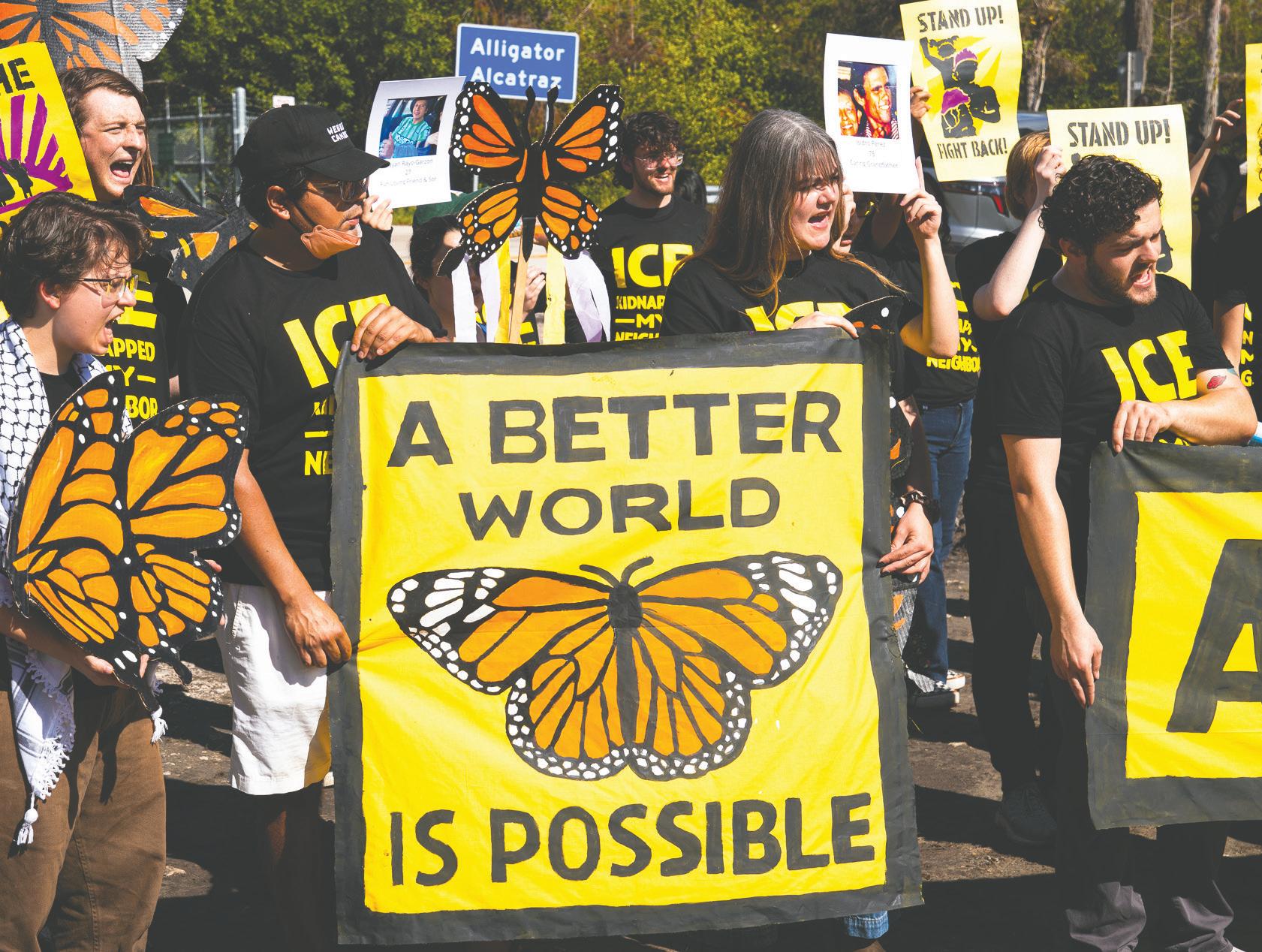
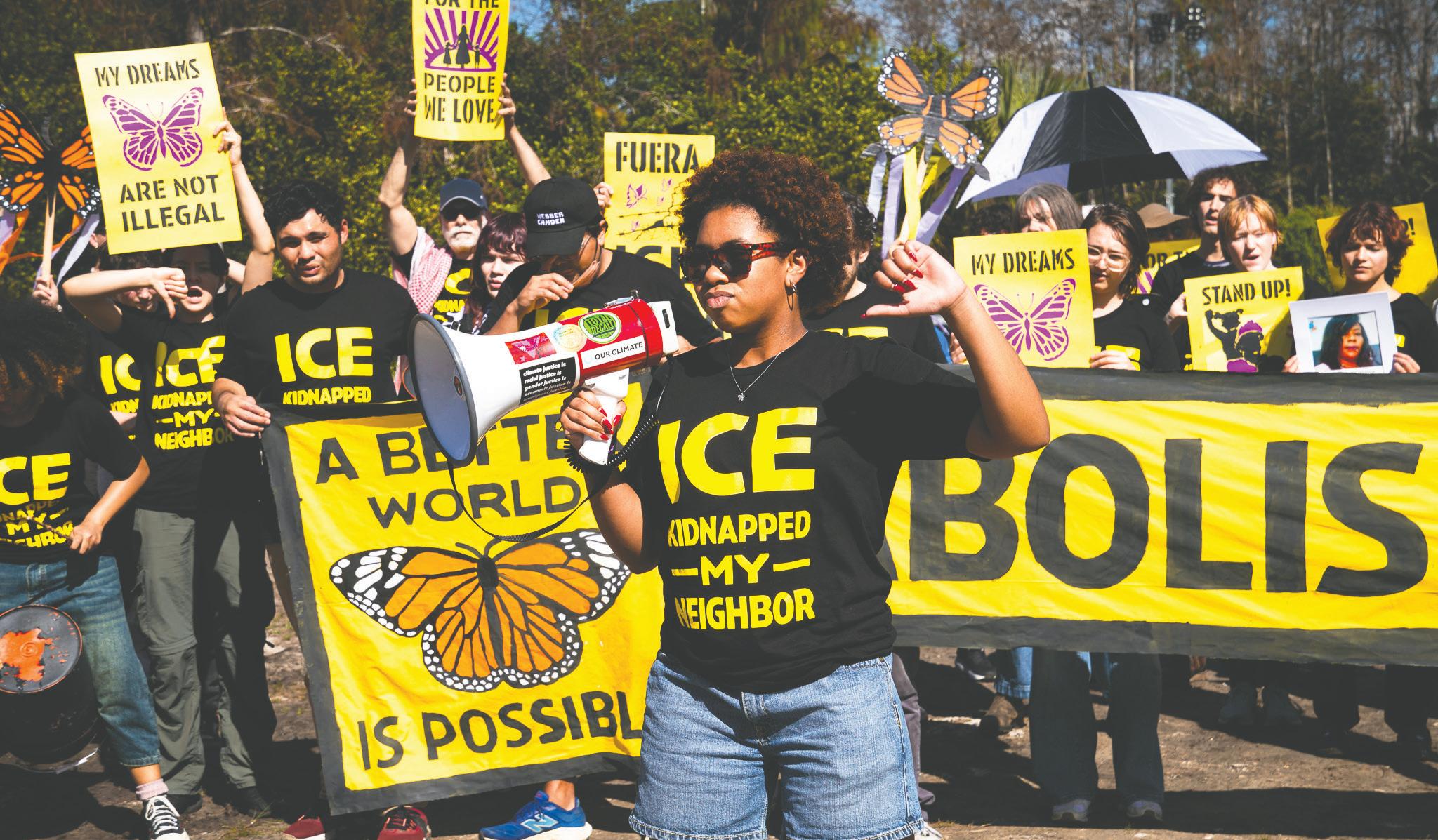
Before protesting at the Krome Detention Center, members of the Sunrise Movement and local community members gathered outside the detention center known as “Alligator Alcatraz” for a rally. Protesters wore shirts reading “ICE kidnapped my neighbor” and held signs with monarch butterflies, a symbol for immigrant rights, and slogans such as “Abolish ICE” and “A better world is possible”.
The protest was held to take a stand against the Trump administration’s deportations and treatment of people held in the detention centers.
Some estimates indicate that approximately 59,000 immigrants are currently held in detention centers throughout the country.
Florida, and Miami in particular, has been a large target for ICE raids under the Trump administration. Florida is one of several states where local law enforcement aid ICE in their efforts to meet lofty deportation quotas.
After the rally at Alligator Alcatraz, protesters outside the Krome Detention Center were arrested on trespassing charges.
According to a statement released by the Miami-Dade Sheriff’s Office, the group blocked the entrance to Krome Detention Center and refused orders to move, leading to their arrest.
“While we fully support the right to peaceful expression, we must also maintain safety and ensure access to critical facilities,” the statement read. “After repeated dispersal orders were ignored, multiple individuals were arrested for trespassing.”
Rulien, who flew from Boise to Florida for the protest, emphasized the importance of protesting what he described as a “rise of authoritarianism in our government”. He was charged with trespassing property after warning and resisting an officer without violence to his person.
“We need to do everything we can to take a stand. Everybody, regardless of class or race or really anything, deserves fair treatment,” Rulien said. “If that’s not given, then I feel like it is my duty to stand up where I can and use any privilege I have for good.”
Rulien recounted his “stressful” experience being held at the Turner Guilford Knight Correctional Center (TGK), noting the group was often given conflicting answers about routine things such as whether they could use the bathroom.
“A few of us were held longer in the initial holding room because we self-reported [health issues], and that whole process was tedious and overly bureaucratic,” Rulien said.
Rulien added he was told by doctors in the jail he would be given access to necessary medication, but was not granted it.
“Going to jail itself was so stressful and awful and a horrible process. We were already treated so poorly in so many ways,” Rulien said. “I could not even begin to comprehend how bad it is in [ICE detention facilities], and that’s ultimately why I decided to act in the first place.”
Miami-Dade Corrections and Rehabilitation has not yet responded to a request for comment regarding Rulien’s allegations.
Rulien was released around noon on Sunday, Nov. 23.
Artivista Karlin, an organizer with the Duke University chapter of the Sunrise Movement and a junior studying In -
ternational Comparative Studies with a focus on Latin America, was also arrested at the protest at Krome Detention Center.
“Throughout the entire process [I was] thinking about the privilege that we have as US citizens, to be able to stand up and fight back for our neighbors who are not US citizens,” Karlin said. “Going to jail is a very small sacrifice compared to the horrors that happened under ICE detention and the deportation process in this country.”
A monthslong Senate investigation into immigration detention centers identified 510 credible reports of human rights abuses, including 41 allegations of physical or sexual abuse, 18 alleged reports of mistreatment of children in custody and 14 alleged reports of mistreatment of pregnant women. The Department of Homeland Security refutes the claims.
Karlin spoke at the rally earlier that day at Alligator Alcatraz about their
experiences as a child of immigrants.
“[My parents] came to the United States to build a better life for their families, for their kids, for me. That’s why I’m studying at Duke now to fulfill their dreams. They also taught me that we all, we always, must stand up for others,” Karlin said. “Especially now during these times where immigrant communities are being ripped apart and people all across this country are being filled with fear … There’s nothing else that I could do than to fight for my communities.”
Sanshray Kukutla, a member of the Sunrise Movement at Purdue University studying Political Science and graduate of Timberline High School, said he related to the personal testimonies of the speakers at the rally.
“I carry my green card with me every day, and fear that ice can stop me on the street and … take me away,” said Kukutla. “When [speakers at the rally] talked about how they were holding their passport with them, keeping their
passport on their mobile phones, I really resonated with that.”
Earlier this year, Purdue students had their visas revoked amid Trump’s immigration crackdown, one of whom Kukutla said he knew. Kukutla said he worries about the future.
“This specific year, I’ve been living in almost constant fear of not being sure if I can keep my plans for this year,” Kukutla said.
Kukutla recounted how seeing so many people come out to the rally made him feel supported.
According to Shiva Rajbhandari, who participated in the rally with the Sunrise Movement, one of the goals of the rally was to show support for immigrant communities. Rajbhandi is a Boise High graduate and former Boise School trustee attending the University of North Carolina.
“[We] came out to Alligator Alcatraz to demonstrate that we stand with [immigrants], and we’re not going to let our communities be torn apart like this without fighting back,” said Rajbhandari. “And to send a strong message at the heart of Trump’s authoritarian project that young people are not going to go down without a fight.”
Rajbhandari highlighted that Idaho has also experienced recent immigration raids. On Oct. 19, 2025, ICE and other law enforcement officers raided a privately owned race track in Wilder, where
EMERGING SCHOOLS
Grace Stark | News Editor | Graphic by Amber Jansson
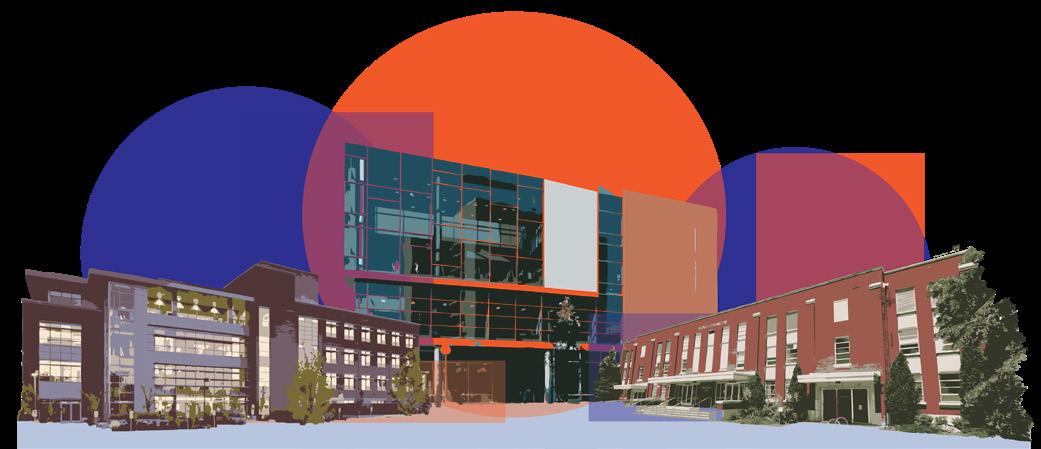
As of fall 2024, five new schools have emerged at the university to address the developing needs of students and faculty, creating increased visibility for departments and opportunity for collaboration.
These schools include the School of Computing and the School for Digital Future, Medical Imaging, Radiologic Sciences, Kinesiology and Respiratory Care Sciences.
because they didn’t recognize we had these things on campus.”
Lynda Ransdell, dean of the School of Kinesiology, added school status gives programs a “seat at the table” with other large programs.
“It enables us to sit down with some of the smartest people who are running the departments and have had successes that we can all learn from,” Ransdell said.
400 people were detained.
“You can see, even in Idaho, the repressive effect of having a federal police force invading our local communities. Immigrant neighbors are scared to leave their homes. They’re scared to go to school. They’re scared to go to work. They’re getting picked off, picked up at farms, at daycare centers. They’re getting racially profiled,” Rajbhandari said. “I think the scarier thing is the way it has been normalized, where destructive, horrible things that happen[ed] in Wilder and are happening all across the country.”
While the Sunrise Movement typically focuses on environmental issues, Rajbhandari, Karlin and Rulien noted the movement also focuses on resisting authoritarianism. They note that environmental issues closely intersect with race, class, gender and immigration.
Rulien emphasized that people shouldn’t wait to take action until “the issue is at our front door”.
“I believe there’s a growing ICE presence in Boise … We’ve seen it in other areas, you know, like Florida, where ICE presence has become a very big issue and has just been completely inhumane. I don’t see it being any different when it does come [to Boise],” Rulien said. “I don’t think we should take a stand just because it’s here and it’s in our backyards. Everybody is important and of value.”
“There is such student demand for those curricula and programs that it’s been amazing to watch student enrollment change,” Joelle Powers, dean of the College of Health Sciences, said.
Conversation regarding the newest emerging school, the School of Respiratory Care Sciences, started this fall, said Megan Koster, department chair.
Celebrating 50 years of graduating students this year, Koster noted the university’s respiratory care program is one of the largest in the world. While not much about the program changes with this new status, Koster believes the title creates additional opportunities for students.
Divisional dean of the School of Radiologic Sciences, Leslie Kendrick, echoed this sentiment, noting school status increases visibility for programs on campus, connecting them to potential donors and collaborators.
“Now we have biomedical engineers reaching out,” Kendrick said. “They’re asking for us to have potential conversations on collaboration and research,
The School of Computing and School for the Digital Future emerged in late 2024.
“We care just as much about developing human competencies as we do digital competencies,” said Kelly Arispe, launch director, noting nearly half of the school’s students are online.
Student ambassador and Interdisciplinary Studies major Allie Hampton highlighted her excitement in the school’s increased visibility because her degree, which is customized using different minors and certificates, “is recognized more significantly as its own degree”.
Director Ira Burton expressed his excitement in the growth across the university as new departments emerge, emphasizing that “a win for Boise State is a win for [The School of Computing].”
Kendrick relayed this sentiment, saying, “When we think about why schools exist, I think a lot about the power of community, a culture of innovation and how a shared vision can unite and leverage responsiveness to change in a coordinated way that is grounded in their values.”
OPINION
A CHEAPER HOUSE PAYMENT FOR OCEANS OF DEBT
Zaccary Kimes | Opinion Editor | Graphics by Naomi Brown
The average age for new homeowners in 2025 is 40 years, while life expectancy in the United States hovers at 78 years. You do not need to be a mathematician to figure out the Trump administration’s 50-year mortgage plan is wishful thinking.
Despite being “laser focused on ensuring the American Dream for YOUNG PEOPLE”, according to Federal Housing Finance Agency director Bill Pulte, current leadership is missing the mark entirely to address this generation’s concern with homeownership.
The benefits of a fixed rate for half a century disappear rather quickly if homeowners die thirty years in, still drowning in an ocean of debt. To spell it out, the issue is not just the ability to buy a home — it’s actually owning one debt-free and enjoying living there.
That American dream is all but extinguished with the rapid rise of home prices while income stays stagnant. In a journal released by the Joint Center for Housing Resources, the housing prices in Boise for 2024 were a whopping 5.8 times more than the median income.
“I’m just so discouraged,” said Adam Taylor, a junior. “You see these market prices go higher and higher just as you’re getting out of college. It’s like we got the short end of the stick.”
In a way, he’s right. When you compare the median household income and house prices in the past 45 years, there’s a significant increase. The income-toprice ratio in the 1980s hovered around 3.2, even dipping below three in the latter half of the decade, setting the older generations up to reap the rewards.
The average zoomer does not have that luxury.
“I mean, I could just rent for the rest of my life,” Taylor said, “But I’d rather have at least a chance to own a home and not be in debt for too long.”
That fate may be unavoidable as the median age for repeat buyers steadily climbs with each passing year. In a report from The National Association of Realtors, over a third of repeat buy -
ers were aged 65 or older, meaning the equity built on the cheap homes allows them to purchase another home to start gaining equity on that one, too. This effectively ices younger generations out of the market in the first place.
It’s difficult to gain that kind of equity on a 50-year mortgage if you jump into one at the ripe age of 29 (the median age for first-time buyers in 1980).
One Boise-area real estate agent sees these concerns every day. Cameron Kinzer, director of government affairs at Boise Regional Realtors, believes the proposal is unlikely to fix the housing market.
“A fifty-year mortgage does very little to improve real affordability. It does not make the home itself less expensive.” Kinzer said. “I do not believe this idea will make a meaningful difference for young buyers and it remains to be seen if it ever becomes a reality.”
According to Kinzer, the proposed plan will reduce the monthly cost by spreading the principal and interest rates throughout the term. This makes entering the housing market easier but at a significantly higher cost by adding 20 years to the loan, compounding interest at an exponential rate.
If potential buyers are looking to stay in debt indefinitely, then a 50-year mortgage is right up their alley. Lowering monthly payments seems insignificant when the total cost balloons far beyond what early-career earners can justify — that crushing reality undermines what future homeowners like sophomore Emma Olson were told for years.
“That’s the whole point, right?” said Olson. “You go to college and get a job to get a house, but being locked into something for 50 years is kind of scary in a way.”
In short, this plan wears a mask of progress but will do little to actually move the needle of debt-free ownership. It ignores the core crisis of home prices continuing to soar while wages do not, casting a shadow of debt over every financial milestone Gen Z tries to reach.
“Well, a ton of students already have student loans, so we’re already in debt that way,” Olson continued. “There isn’t really an incentive to get into more debt when you already have that to think about.”
The government is clearly not looking out for the generations looking to inherit it. If the Trump administration — or any other administration that follows — wants to win over the younger generation, the focus cannot be short-term affordability. It must be on policies that actually reduce the lifetime cost of owning a home, not just the monthly bill.
A dream should not take half a lifetime to finance and if it does, it stops being a dream at all. It becomes another reminder that the finish line keeps moving farther away, leaving younger generations stuck playing catch-up.
UNPAID INTERNSHIPS WALK THE TIGHTROPE OF SELF-RESPECT AND NECESSITY
Zaccary Kimes | Opinion Editor | Graphic by Naomi Brown
Internships are a cornerstone of higher education, providing students with real working experience to prepare for their respective field — but they don’t always keep the lights on.
For many students, each day is a balancing act. Hours devoted to lectures, rehearsals and assignments compete with working shifts to cover rent, food and in some cases other dependents.
Often, students take on jobs within industries of little interest to build a foundation for a better one. The margin for error is so slim that any additional commitment can feel impossible to take on.
This causes many to miss out on career advancement opportunities altogether, because squeezing in 20-plus hours of unpaid labor is simply unrealistic for working students.
Unpaid and unaffordable opportunities cater to students who are more financially stable and can afford working long hours for little or no compensation. It’s an outdated form of labor students are still expected to accept if they have any hope of advancing their careers.
Paul Bokelman, a senior with some internship experience already under his belt, sees the advantage some financially supported students possess.
“There’s a better opportunity for an unpaid internship if your financial situation is good,” Bokelman said. “You have an advantage there, because other students can’t afford to do that.”
Finding an internship in the first place can be a daunting task for students. Applicants must market themselves to employers and often settle for little or no compensation in exchange for professional experience. Students with financial responsibilities and tuition fees require opportunities that compensate them fairly and by only offering unpaid internships advancement opportunities become out of reach.
Bokelman, a Computer Science major, describes unpaid internships as “pretty common” although he usually avoids them out of “self-respect” and necessity.
“You can get the same value in a paid internship versus an unpaid internship, so I wouldn’t do it because I know that I could find one that would pay me,” he said. “If you’re producing some value for the company, I think they should absolutely pay you.”
Currently, he pays $900 for room and board every month, making a steady job the only option to keep himself enrolled in school. He currently works two internships to keep himself afloat, and while both pay him enough to get by, he admits, “it would be nice to make more, that’s for sure.”
For fellow senior Zoe Sexauer, a double major in Music Performance and Illustration, pay is not the only issue in play — it’s time.
She practices her instrument for about two hours per day — roughly 14 hours a week — while balancing her retail job to cover basic living expenses. Traditional internships are uncommon within her major, but affording to participate in other career development opportunities can be a struggle.
She recalled a peer who had to forgo a major clarinet conference simply because they couldn’t spare the time away from work and class. Events like these offer essential networking and mentorship opportunities for her major, but without proper financial support, they swiftly become out of the question.
“It’s an opportunity to see other musicians, to talk to them about their performance experiences,” Sexauer said. “It’s one of the only ways to be able to advance your career and he couldn’t afford to get to this clarinet conference.”
When access to these experiences depends on a student’s financial security or their availability, it leaves students behind. Yet institutions are starting to
rethink what internships can look like.
Debbie Kaylor, director of career services, works with the different colleges on campus to build out the internship programs’ accessibility. She brainstorms new alternatives with faculty, students and employers to fit internships into a modern student’s packed schedule.
“Students can think creatively about internships and not just assume that an internship is three credits,” Kaylor said. “There’s flexibility, so let’s sit down and talk about how we fit this in.”
Career Services works to establish work study partnerships to receive pay or to integrate internships into existing responsibilities. If a perfectly suited opportunity arises, career services works with employers and the student to ensure it does not slip away.
“Let’s think about what type of project or different area of the job you can take on to develop skills and do an internship within the job you’re already working at,” she continued.
“We need to grow the internship program with everything around us.”
It’s clear the current internship in frastructure was not crafted for today’s students — but it can evolve if it’s advo cated for. To bridge the gap of internship inequity, employers must compensate interns fairly and remain mindful of time constraints that shape their lives. While interns should advocate for their worth and not jeopardize their livelihood for a line on a resume.
Reimagining career devel opment means ensuring every student can keep the lights on to build a future worth stepping into.
Julianna Kelsey | Culture Editor | Graphics by Naomi Brown, Photos by Julianna Kelsey
Graduating Bachelors of Fine Arts students displayed their culminating artwork at Reflections in Full Bloom, the fall 2025 BFA exhibition. Each student explored personal themes and expressions through varying mediums and styles, illustrating how their education has shaped their artistry.
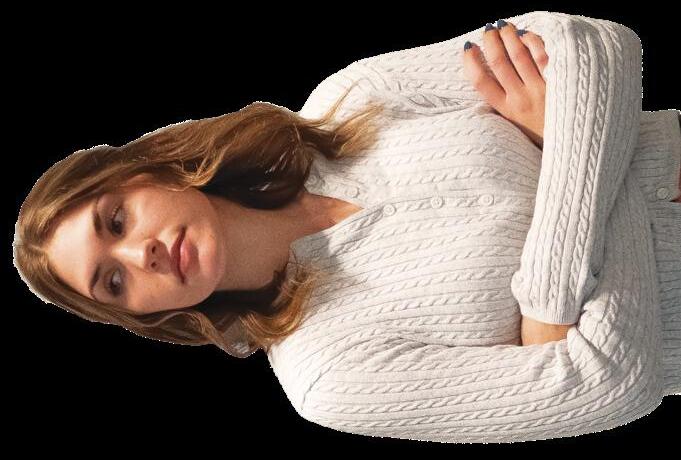
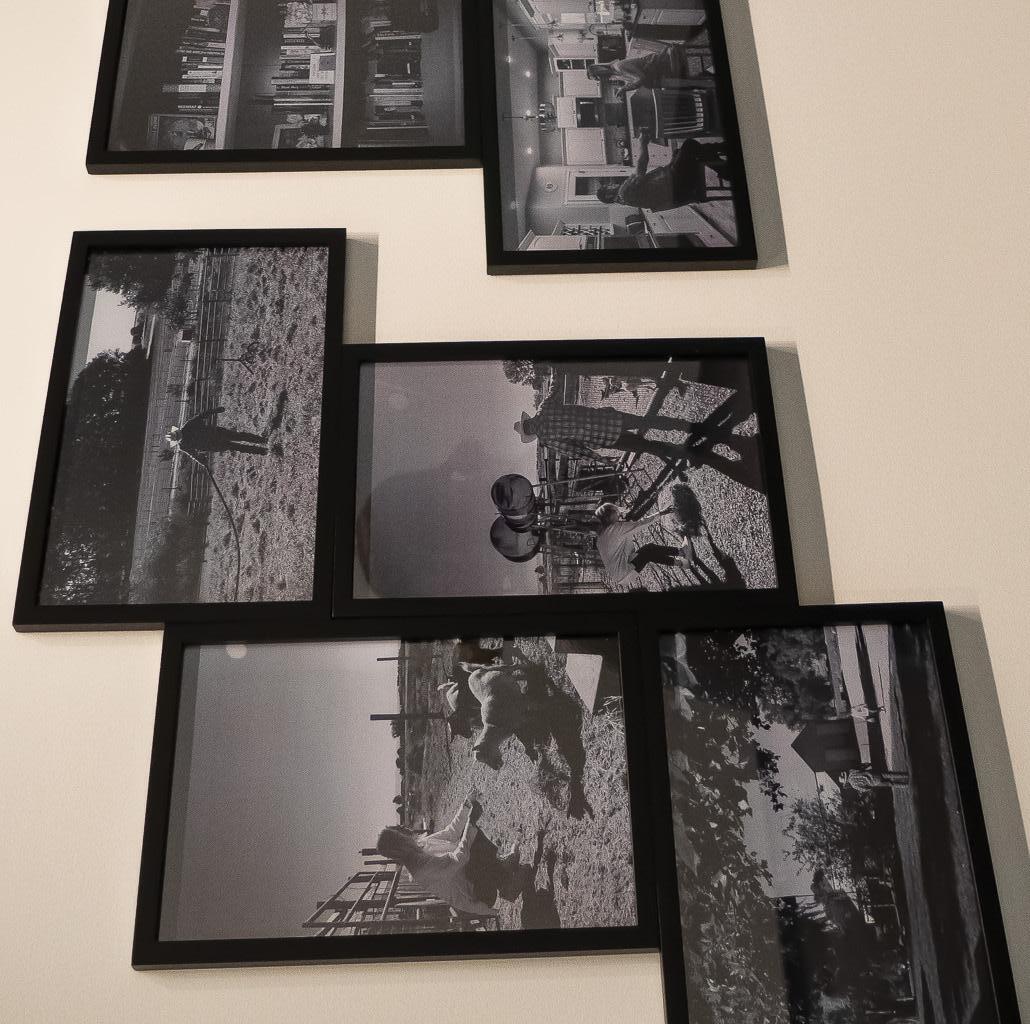
Chloe Hollingsworth, a Visual Arts major with an emphasis in Photography, took candid snapshots of her childhood home and farm in Caldwell, Idaho. Printed in black and white, the images capture her parents in their day-to-day routines — feeding chickens, tending to goats and sitting at the dining room table. “It was fun to just be an outsider in this world I’m very familiar with,” she said. Hollingsworth also captured images of scenery around the home, such as her mother’s bookshelf with personal belongings and a “Goat Crossing” sign on the property. Hollingsworth aimed to transport herself and viewers into the world she grew up in. “[The pictures] make me feel nostalgic because I don’t live there anymore,” she said. “I can go visit, but I live in Downtown Boise now, and it’s very different.” After graduation, Hollingsworth hopes to work in social media or content creation. She said her education helped her explore all areas of art, allowing her to find what she is passionate about. “It definitely took me to places I was not expecting,” she said.
Chloe Hollingsworth
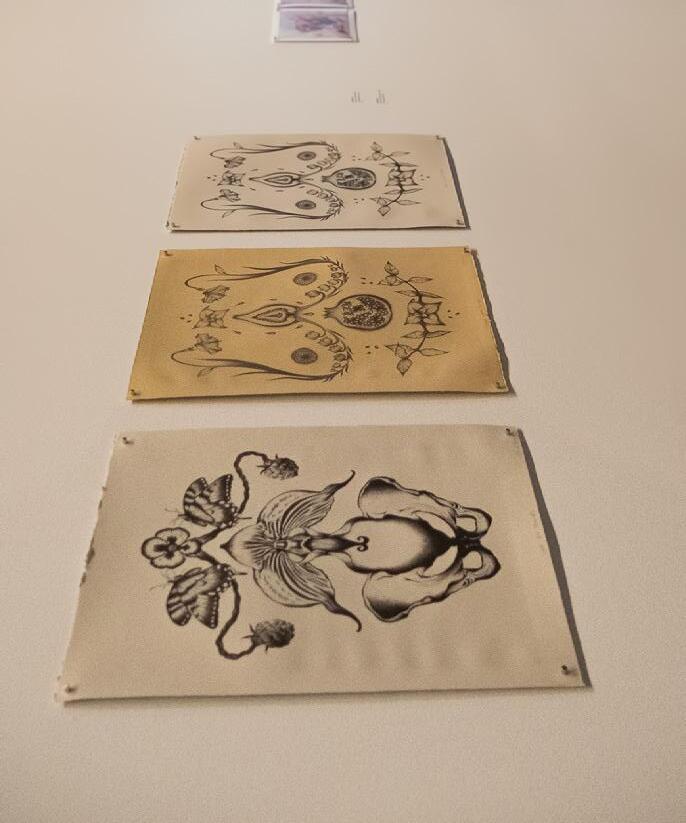
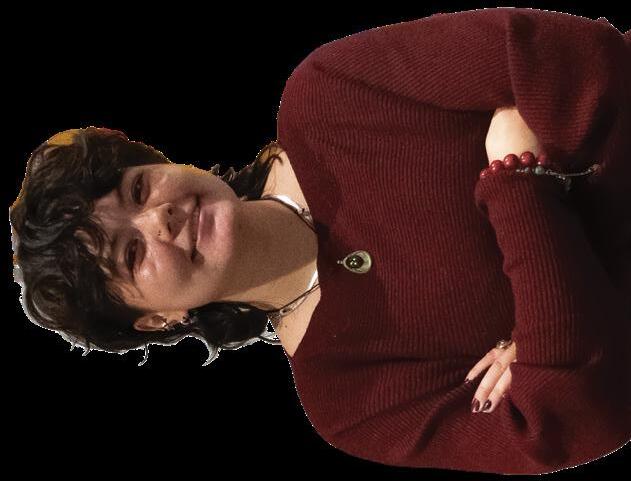
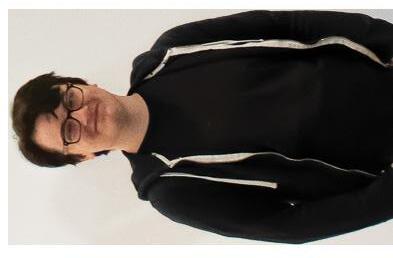
Chris Kingston, a Fine Arts major with an emphasis in Printmaking, displayed a series of screen prints, stone lithographs and digital photographs intended to evoke the grief many women feel surrounding the revocation of reproductive rights in Idaho. The screen prints are displayed in a grid with text alternating between “Liberate Abortion” and “Without Exception”. The stone lithographs use symmetrical imagery of plants and nature to create outlines of female anatomy. “I love symmetry,” she said. “I use it to represent this form of mirroring I feel happens between me and nature.” To the right of the lithographs, photographs depict a small white pill on a pomegranate spilling onto white fabric, another visual nod to the pain many feel over the loss of abortion rights. “As a woman in this state, I’m passionate about this,” Kingston said. “I know a lot of people who have suffered at the hands of abortion being criminalized.” Kingston works with the Pro Voice Project, an Idaho-based nonprofit that spreads awareness of reproductive issues in the state. She hopes to attend graduate school and one day open her own lithograph studio.
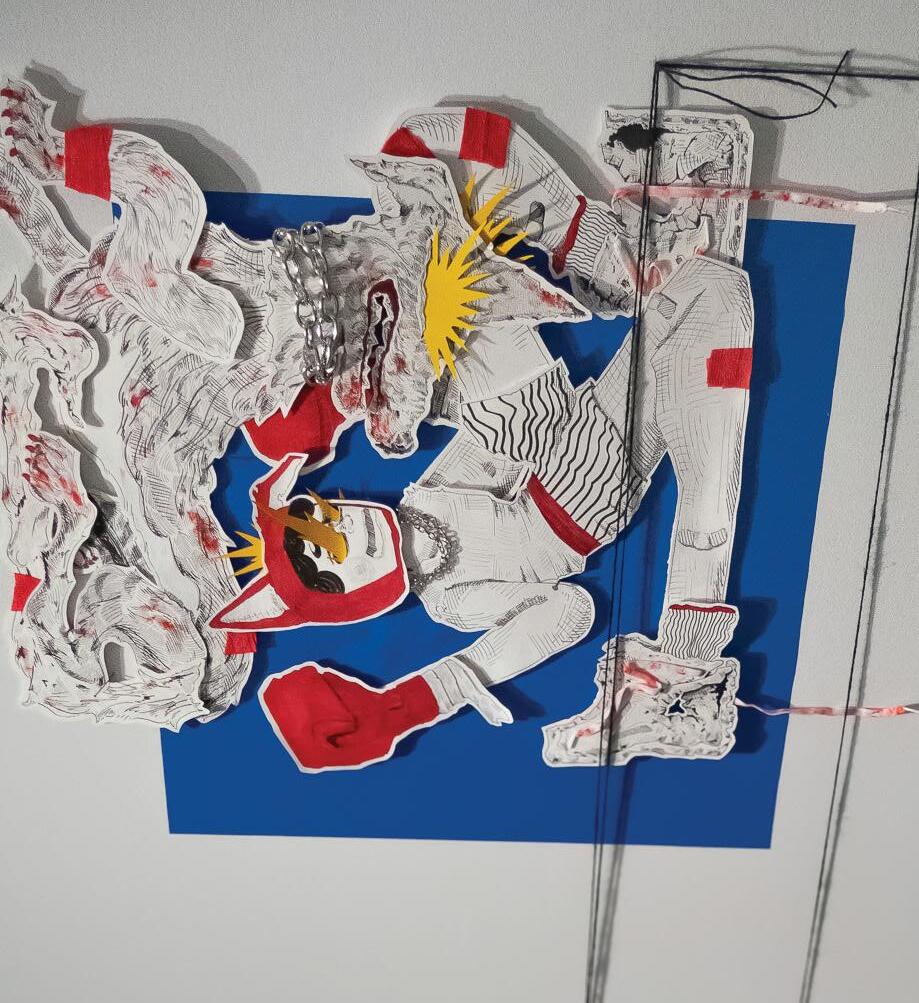
Kyra Applebach took visitors inside a literal fighting ring for her immersive installation inspired by a story from her past. While studying abroad in the U.K., Applebach accidentally joined an illegal fighting ring. Actual artifacts from her fights hung on the walls, and the sound of screaming crowds rang as videos from her fights were projected. A double major in Illustration and Fine Arts, Applebach created digital drawings based on vintage boxing posters and illustration-collages depicting the whirlwind of fighting. “It was a very gory, very vulgar experience,” she said. “I just wanted to mimic the trapping feeling of what it was like stepping in the ring.” Applebach processed the intense emotions from the experience by creating and sharing her art with others. “Seeing people interacting with the art just breathes life into what you’re working on,” she said. Applebach plans to work towards a Master’s degree and eventually pursue collegiate-level art education, but she’s interested in careers across a variety of fields. “There’s a joke that [as an art major] you won’t get a job,” she said. “I think it’s the opposite. I can apply to a job and [have] creative skill sets that would benefit me. I feel it has opened more doors for me.”
Chris Kingston
Kyra Applebach
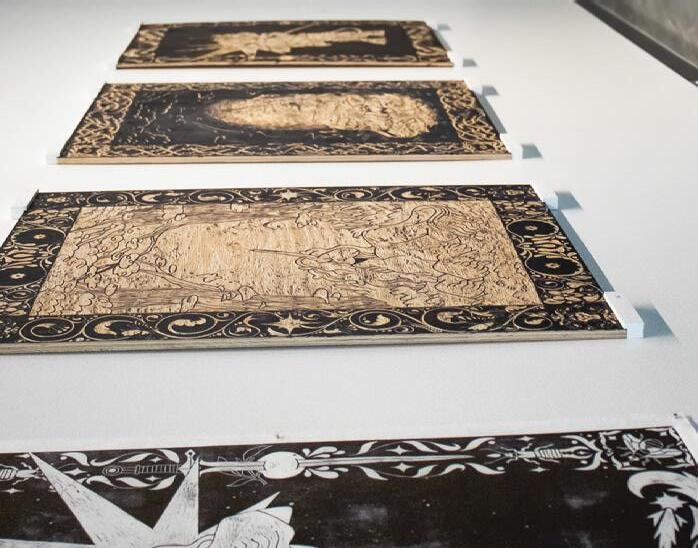
Illustration major Katie Vargas Morman’s large wood block prints tell a story about the modern-day queer experience through visuals of a unicorn in a forest. The original wood blocks show each intricate carving that Vargas Morman spent over 100 hours on.The first image represents queer joy as the unicorn lies peacefully surrounded by nature. The second image represents the fear many queer people feel in today’s political climate. “With all of the hateful rhetoric going on, there is this overbearing weight of fear of identifying as who you truly are,” Vargas Morman said. The final image represents queer individuals who face threats and violence. “It’s really important to hear queer voices right now, and I feel like, as an artist, it’s my responsibility to share what the queer experience is like,” they said. Vargas Morman hopes to continue amplifying the voices of underrepresented communities through their art. “It’s really easy to make people feel feelings through art,” they explained. “If you look at something that makes you uncomfortable, maybe think, ‘Why am I uncomfortable?’ My personal identity is unique, and a lot of people don’t have a lot of experience with non-binary or queer people. I can offer a unique perspective I can bring to other people.”
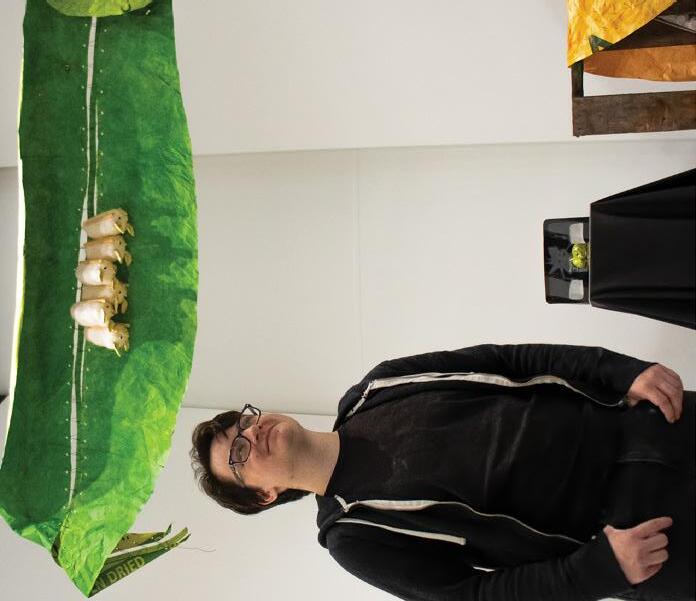
Interdisciplinary Studies major PK Payette describes himself as a “3D artist”, playing with different mediums, subject matter and themes to create art that literally stands out. His mixed-media sculpture piece, titled “Shelter”, combines seemingly unrelated elements in an unexpected way, featuring handmade, fuzzy Honduran leaf bats in a giant paper leaf nest hanging above a ceramic grocery store scanner. His other piece, titled “House Horse” depicts a small, colorless bedroom with a horse sleeping underneath a bright red rug. Payette found the concept of an animal occupying space in a human environment intriguing. Payette feels the themes of disparity in his work, paired with his fusion of mediums and styles, parallel the mixed-bag nature of his education. “I think it goes along with my major of [Interdisciplinary Studies], combining disparate subjects into sort of a unified thing,” he said. Payette, once primarily interested in painting, felt drawn to 3D art as he experimented with sculpture and ceramics. “I like that there’s an [element] of problem solving you have to work with when you do 3D art,” he explained. “I think it’s a process that’s made me really consider the materials I use.”
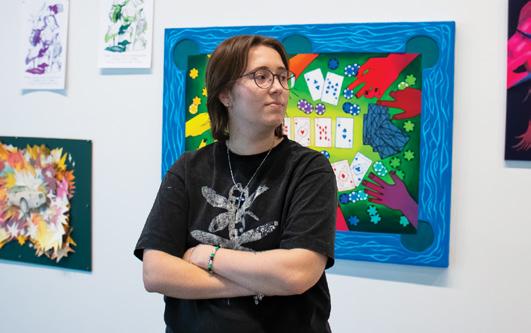
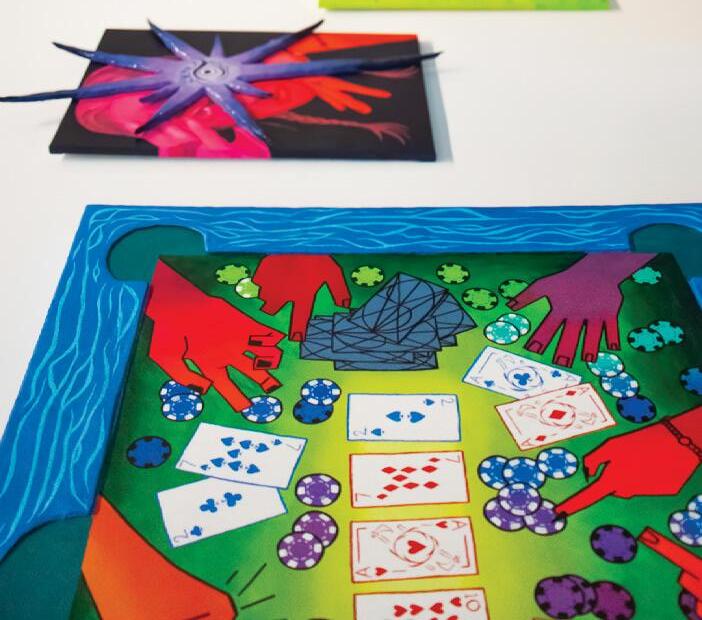
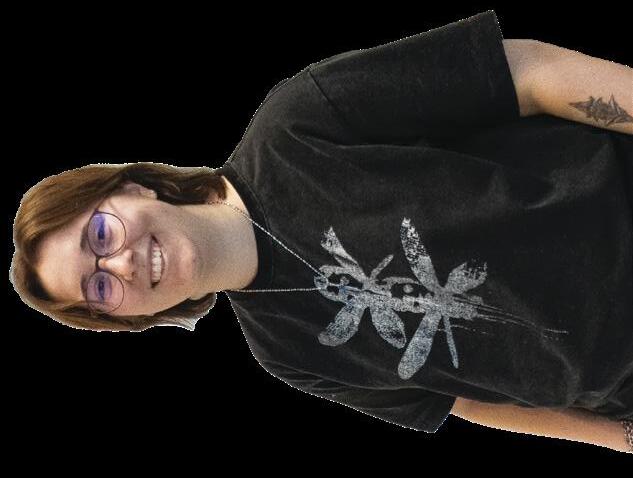
Illustration major Ana Cuntz created several bold, colorful paintings and drawings inspired by people and experiences from her life. A painting titled “Goop Girl” depicts an experience she had as a freshman living in Chaffee Hall when her dorm room flooded with antifreeze. The thin canvas represents the tight space of the room as green antifreeze monsters take over. “This is about that moment, but through a sort of whimsical lens, because the way I process hard things like that is through humor and escapism,” Cuntz said. Cuntz also makes tribute to friends and family through her art. Her largest piece, “Royal Flush” depicts her close friend group and their regular poker games, and her piece. “Flightmate” uses a labeled illustration of birds to represent her close bond with her brother, who studies birds as an ornithologist. Cuntz also dives into her identity in her mixed-material self-portrait titled “Soul Resonance”, exploring her queer awakening and self-discovery before coming out as asexual. To Cuntz, the self-portrait represents how much she has grown as an artist and individual overcoming self-image issues. “When I started art, I really hated depicting myself, and now I’ve chosen to include a self-portrait in my BFA show,” she said. “That’s some really big growth for me.”
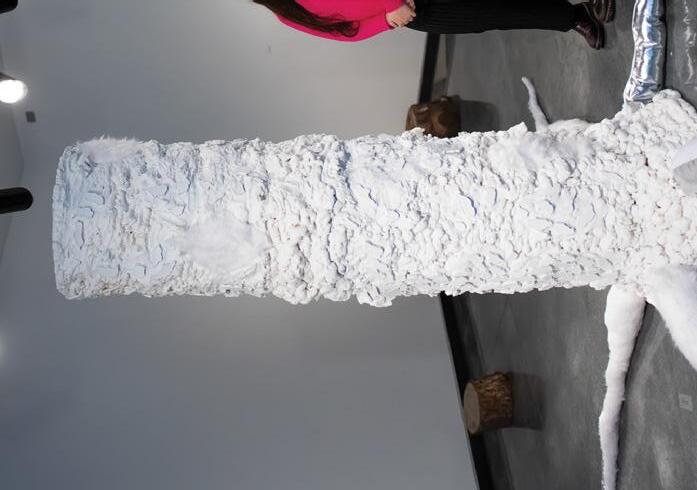
Isabelle Coffin, a Fine Arts major with an emphasis in Sculpture, works “conceptually and abstractly”, exploring complex themes of identity, heritage and trauma in each piece. The focal point of her installation is “Rooting for You”, a seven-foot-tall tree trunk made of mixed materials. “When I am struggling and feeling overwhelmed, I sometimes will see myself as a tree with roots growing into the ground,” she said. “That’s a very powerful visualization that helps me stabilize.” Coffin’s short film “Periphery” projects on the wall alongside the tree, in which she explores parallels between her great-grandmother’s experiences as a young Cherokee woman with her own experiences today. “I wanted to make her voice heard, and it felt like sharing my voice and my story would do that in a way,” she said. Coffin also highlights her Cherokee heritage in her painting titled “Forgiveness is”, exploring generational trauma and the way it shapes the soul. “Looking at my great-grandmother and my mother and what they went through, all of [their experiences] have carried down and live in my body and I have life because of them,” she explained. Coffin reflected on how art has helped her explore her mixed-heritage identity.
“I was able to express parts of me that I wasn’t feeling I was allowed to before,” she said. “I think making this was a big expression of this part of me that I’ve been exploring how to open up about.”
Katie Vargas Morman
Ana Cuntz
Isabelle Coffin PK Payette
CULTURE
15-TIME MOUNTAIN WEST CHAMPS: ESPORTS TEAM HAS THEIR HEAD IN THE GAME
Cole
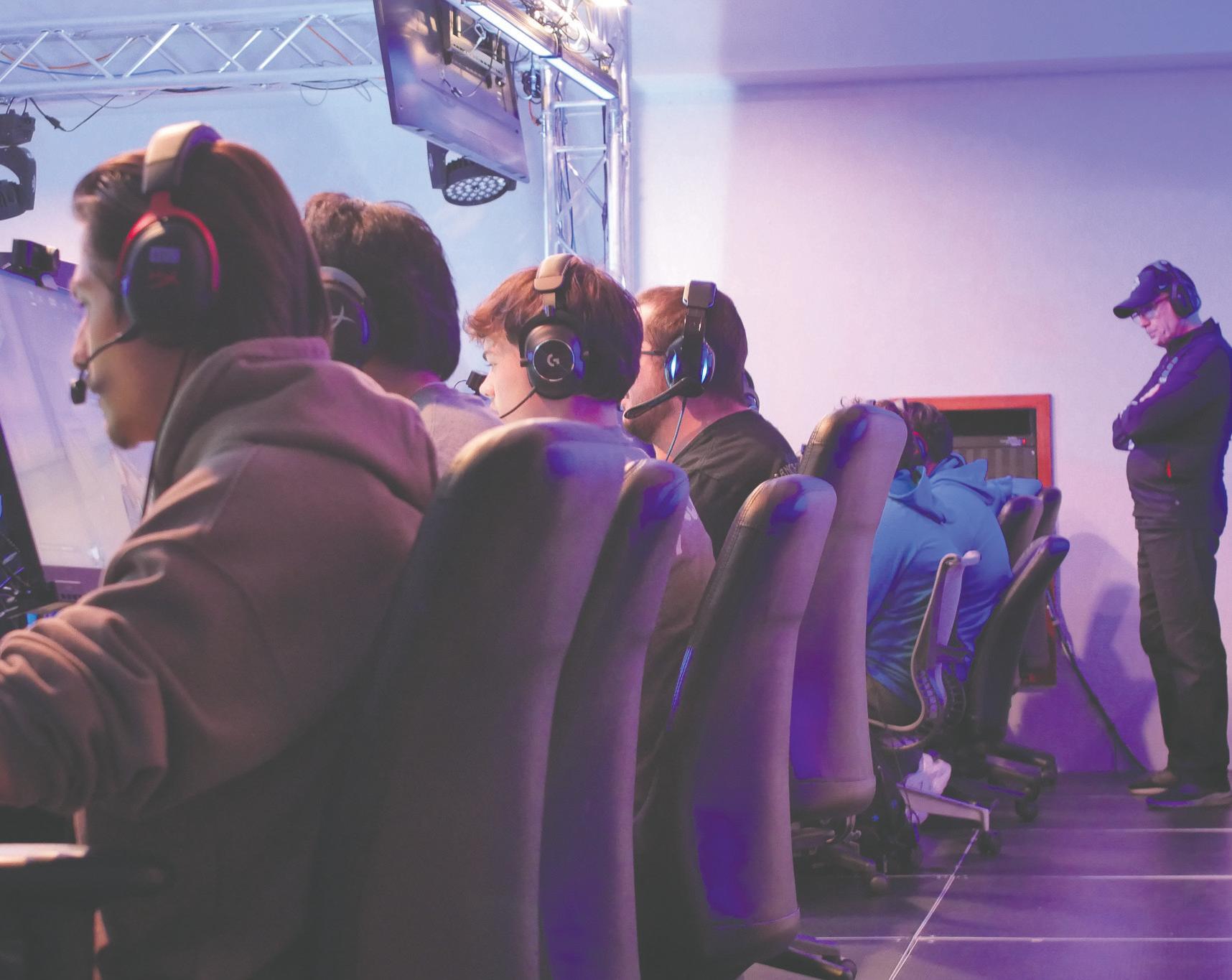
Behind the glass doors of Boise State’s Esports Arena, the smell of pizza lingers in the halls and loud cowbells sound as a team of focused faces glow from the bright lights of computer monitors.
The award-winning esports team has invited students to compete in video game tournaments against other colleges, participating for over a decade. Specializing in a variety of video games, the team currently focuses on games like Rocket League, Overwatch 2, Super Smash Bros. and Valorant.
Before leading the team, Head Coach Chris “Doc” Haskell previously held coaching positions in other student-focused activities and sports. While the medium may be different, he notes the experiences are similar.
“This was kind of connected to my area of research; games and learning,” Haskell said. “This is like coaching football and band, it’s getting really talented people prepared and on the same page.”
Player on the team Emiliano “Durtho” Flores enjoys the skill component of competing, specifically in Rocket League.
“If you lose, it’s your fault — you didn’t lose to somebody having a better gun or somebody having a better character,” Flores said.
Taking their skills and applying them to the national stage, the team often gets the opportunity to travel for championships. New memories are expected to be made on the road.
“Doc says a lot, especially when we travel across the nation, ‘Remember that time in college?’,” Flores said. “There are a lot of people that work very hard to make this all happen, but it’s really about the memories made and looking back like, ‘Wow, I remember that time
in college’. I’m super blessed.”
Reminiscing on unique team traditions, Haskell explained the origin of the cowbell noisemakers at every game, a tradition that began at a Rocket League match seven years ago.
“Some parents brought them in and started ringing them during one of the matches, and we just love that it continues,” Haskell recalled.
The esports team has fostered a community beyond the screens, being even more connected to each other offline.
“There are people who go their entire lives without feeling that camaraderie with a group of people. But it’s when everybody puts down the controllers — no one can ever take away those moments,” Haskell said. “This year, we won our first PEC national championship with [Rocket League] and so it was the huddle after — only five people in the world know what that [feeling] was. ...[The team] is family, they’re not a work obligation.”
The teams’ diligence shows. Earned this year, four Mountain West awards for outstanding achievements sit nicely in the entrance to the arena, as well as trophies from years past.
Investing time and energy into their passion, that effort has come back to the team tenfold. Haskell won Coach of the Year for Overwatch 2, Kelsey Moser won Coach of the Year for League of Legends, Austin “Prestige” Julian won Player of the Year for Valorant and the Rocket League team championed against San Diego State in the finals, 4-1. In 2024, Scholars Collegiate Gaming Awards presented Boise State Esports with the Institution of the Year award.
“The real joy is the preparation for the next [match],” Haskell said when asked about the teams’ achievements. “The wins make it sweeter, but the pursuit is
the real fun. Even now, we just finished [a match], I’m more excited about the next one than I am satisfied with the one that just happened.”
The team invites students, gamers and non-gamers to check out the Esports Facility on Capital Blvd. Broncos can check out the latest games with high-powered technology such as the RTX 5070 Ti computers found on the arena stage, which help the team “compete at the highest level”, according to Business Development Coordinator Riley Boyd.
“[The Esports Center] is open to everybody. Any one of us is open to converse and give [visitors] the time of day,” Flores said. “People don’t know about [the team], but when they know about it, they love it. The fans that we have are great, and they support us 100%.”
“I’ll be contrarian,” Haskell said when asked the same question. “There are very few people who I meet who don’t know what we do. They may not understand the games fully, but they know that Boise State is playing against Colorado State or Michigan State. They know it’s the Broncos against the world, and they can get behind that.”
Students can watch the teams’ tournaments in person at the arena or on their Twitch and YouTube channels.
“My buddy Emiliano is on the team. He’s the best guy on it, I heard, so we had to come out and support,” said first-time esports fan Brian Boehm at the arena. “[The arena] blew me away. I didn’t know this was such a great setup, the lights and everything is really cool. I’m coming back — no brainer.”
McAdams | Assignment Reporter | Photo by Cole McAdams
SPEND YOUR SPRING BREAK VOLUNTEERING FOR A GOOD CAUSE
The deadline to apply for Alternative Spring Break is Jan. 26
Julianna Kelsey | Culture Editor | Graphic by Amber Jansson, Photos courtesy of Alternative Breaks
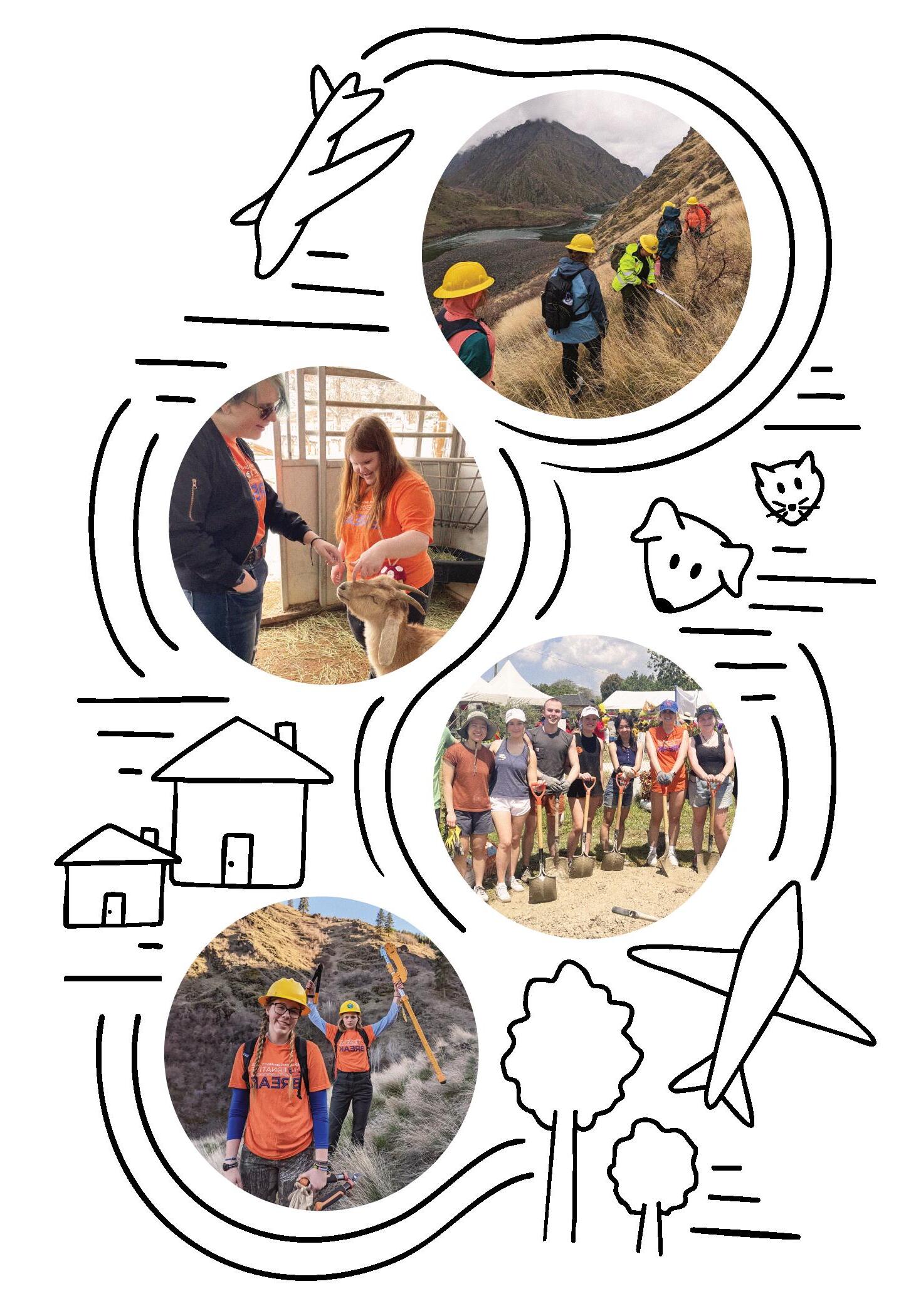
For some, an ideal spring break involves tropical getaways and parties on the beach, but some students are drawn to another type of experience. They trade in their flip-flops for hiking boots, their passports for working gloves and travel to beautiful locations across Idaho and Utah to participate in Boise State’s Alternative Break program.
Alternative Breaks are multi-day service trips students can take for academic credit, offered by the Student Involvement and Leadership Center. Students learn about “environmental conservation, animal advocacy and community support” while travelling and connecting with other students through service.
“The alternative breaks are really great service learning opportunities for students to get involved with communities [other] than Boise,” said Service Programming Lead for the Student Involvement and Leadership Center Zoe Mace.
In 2026, students can choose from three unique service opportunities in Hells Canyon, Idaho, Kanab, Utah and Boise.
In partnership with the Idaho Trails Association, student volunteers will be able to travel to Hells Canyon, where they will take a jet boat up the Snake River to a remote campsite. There, they will restore trails, preserve wildlife habitats and enjoy Idaho’s natural landscapes.
“The purpose is to keep the trail open and in good hiking conditions so other people who come and want to use this can go without having to find the trail or trip over anything,” explained Trail Projects Director for the Idaho Trails Association Alex Cravener.
Cravener noted many students do not understand the historical significance of Hells Canyon or the work that goes into maintaining its valuable natural resources.
“The work of volunteers here is re -
ally crucial, because the Forest Service doesn’t have a lot of staff to help open these,” Cravener said. “They rely on volunteers a lot to do this work.”
Students will stay in tents for the duration of the trip without access to cell service. According to Cravener, some students are nervous to completely unplug for a week, but it allows them to connect more with their peers and learn more through the experience.
“It helps foster deeper appreciation for the public land we have and the beautiful natural resources we have,” Cravener said.
Another trip option will take students to Best Friends Animal Sanctuary in Kanab, Utah, where they will assist animal care staff, preserve facilities and interact with animals at the sanctuary, one of the largest in the nation, which has made major advances in the no-kill animal shelter movement.
Volunteers will assist the sanctuary staff with a variety of tasks, such as painting pig houses, weeding animal areas and cleaning pet transport carriers.
“Groups do the type of projects that no one single volunteer could do by themselves,” said Sergio Holguin, who works in visitor experience and service group coordination. “It’s a huge help. We would not be able to do the things that we do without our volunteers.”
The sanctuary is committed to providing the highest quality of life possible for its nearly 1,600 dogs, cats, birds, bunnies, horses, pigs and other animals. Holguin noted while the sanctuary has a large staff of full-time employees, they always need more help.
“Animals will always outnumber us,” Holguin said. “In order to give them the attention and the quality of life we think they deserve, we heavily rely on our volunteers.”
For students who wish to stay closer to home, they can partner with St. Vincent
de Paul by volunteering in their food pantries, thrift stores and service programs.
Through the Building Healthy Homes program, volunteers meet each day through the break to assist in the organization’s mission of providing food, clothing, housing and basic human necessities to those in need. They will also learn more about issues related to homelessness and food insecurity and how volunteering can make a difference.
Throughout the spring semester, students going on alternative breaks will take the LEAD 225 workshop course, which meets a handful of times throughout the semester to prepare for the trip and complete team-building activities.
Mace has gone on the Hells Canyon trip twice and said the experiences she had were some of the high lights of her college jour ney, inspiring her to get more involved in the program as a student trip lead and now Service Programming Lead.
“You do four or five hours of work a day, but you’re hiking and cutting leaves and everybody’s having fun,” Mace said. “It’s a big community thing.”
Mace explained that she once went on a traditional spring break vacation, but didn’t enjoy it nearly as much as her service trips.
“I came back and was like, ‘Okay, it was fun,’ but I don’t feel like it was fulfilling
in any way,” Mace said. “It’s so rewarding to be able to have an experience that I can look back on and be really proud of.”
Applications for alternative breaks are now open and can be submitted through the Student Involvement and Leadership Center website. Students who want to learn more can also fill out the Alternative Break Interest Form via Campus Groups to receive more information.
CULTURE
BEST FRIENDS TO BUSINESS PARTNERS: BUTTON UP BSU DECORATES CAMPUS WITH ‘BRONCO BUTTONS’
Julianna
Childhood best friends and college roommates Hayden Belshe and Karlee Cons never expected they would one day become business partners.
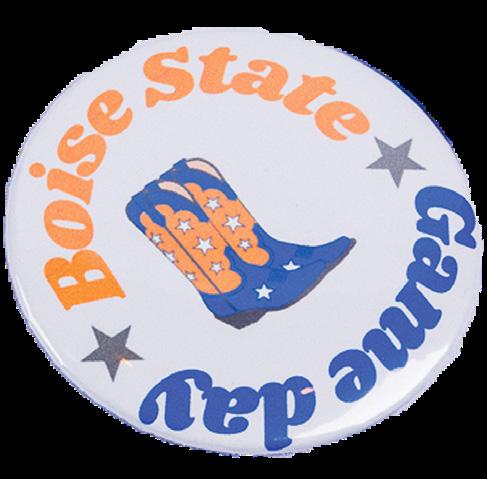
In 2025, they started Button Up BSU, creating custom “Bronco Buttons” for students to showcase their Boise State pride.
Belshe and Cons met in middle school, dancing together and remaining good friends through high school. After growing up together in California, college took them their separate ways when Belshe decided to attend Boise State.
T he duo didn’t stay apart for long, though. When Cons came to visit Belshe last year, she fell in love with the campus and culture of the university.
“ I knew that Hayden would be the perfect room - mate,”
Cons said. “Once I got in [to Boise State] it became reality. We got to live together and go to school together, and now we run Button Up BSU together.”
O ver the summer of 2025, Belshe and Cons saw TikToks posted by students at other universities showing off their custom school-branded buttons. These were popularized by schools like the University of Alabama with prominent football cultures, and the pair saw an opportunity at their own school.
T hey purchased a button machine and began creating designs. They chose the name Button Up BSU and created an Instagram account to start advertising their product.
Belshe and Cons, after years of being best friends, were a perfect fit as business partners.
“ We’re very close, and we’re very similar people, so we think alike in many different ways,” Cons said. “It also gives us a branch of creativity where we get to bounce ideas off of each other.”
A ll of their original designs are created on Canva. Sometimes drawing inspiration from other schools, Belshe and Cons have dozens of unique patterns and images to pick from.
“ Every design is completely different and customized, so that definitely allows us to be creative,” Cons said.
Most of their early designs revolved around Boise State football. These gameday buttons were their most popular prod -
ucts, offering a simple way to add a fun display of Bronco spirit to any outfit. Additionally, Belshe and Cons created Greek life designs. They began receiving custom orders for different sororities on campus, another way for students to showcase individuality with a simple button on an outfit or bag.
“ We have put a lot of time and energy into Button Up BSU,” Cons said. “Seeing them on backpacks around campus, hearing people talk about them, seeing people talk about them on social media and tag us in their posts wearing our buttons is definitely rewarding.”
Some of their first large business opportunities came from Belshe’s sorority, Tri Delta, which opened the opportunity for the pair to create and sell Tri Delta buttons at a sisterhood event.
“ We’ve definitely seen it take off from when we started in the beginning with a few small orders from my close friends, to sororities now reaching out to us to do sisterhoods,” Belshe said.
T hey were also invited by Indy Clover, a consignment shop in Boise, to sell
their buttons at a pop-up event in-store.
“ It was so fun, and it was so sweet of [Indy Clover] to reach out,” Belshe said. “A lot of people from [Boise State] came to the store to support us because they saw we posted about the pop-up on our Instagram.”
T he girls even had the opportunity to create hundreds of buttons in collaboration with Panhellenic.
“ We made about 200 buttons that they sold,” Belshe said. “We had been working on that since August and we got to give them out in October, so that had definitely been in the works for a little bit.”
Sammy Weiss, a sophomore studying marketing and a good friend of Belshe and Cons, has bought several of the button designs and supported Button Up BSU at sorority events.
One of her favorite buttons she has bought is a design Belshe and Cons created specifically for the Tri Delta social event, featuring the sorority’s Greek letter signature with a cowboy hat and lasso.
Kelsey | Culture Editor | Photos by Omar Saucedo, Graphics by Amber Jansson
According to Weiss, Tri Delta members were excited to support the small business.
“ Everyone was super excited about it, because it’s something new and something cute to add to your outfit for game day,” Weiss said.
Weiss noted Belshe and Cons take great care when creating each button, ensuring each button meets their high standards of quality.
“ They’re not just thrown together,” Weiss said. “[They] take the time to make sure they’re all even, and all the letters are right, and there’s no bumps.”
Above all, Weiss is proud of her friends for the success they’ve found with Button Up BSU.
“ They worked hard to make this an actual thing, because it just started as something not super serious over the summer, just making them for fun, and then were able to turn it into a bigger thing and spread awareness about it around campus.”
A s a business administration major, Cons feels her education has helped her with the more technical sides of the business. She has gained firsthand experience in setting prices, tracking inventory and calculating costs.
T hrough social media and tabling events, the pair has also learned the ins and outs of marketing their products.
“ There’s a lot of marketing that it teaches us [as we] get it out there and spread the word,” Cons said.
Besides their newfound business expertise, Belshe and Cons have also grown as friends. Relying on each other and working as a team has built their trust in their bond.
“ We do everything together, and I think that helps better our friendship,” Cons said.
groundwork for a lifelong friendship, whether they remain business partners after graduation or not. For Button Up BSU, they have yet to decide what the future holds.
Will they expand the business, aiming for bigger markets, or will they pass the button machine along to the next generation of sorority sisters? Belshe and Con still haven’t decided.
“ I’d love for Button Up BSU to stay at Boise State even after I graduate, or carry this out into something bigger for more schools.”
For now, Belshe and Con are enjoying the creativity and community they get to share.
“ It honestly warms my heart so much and makes me so happy when I’m with my friends and I see one of the buttons,” Belshe said. “I look over, and I’m like, ‘Oh, guys, that’s my button.’”
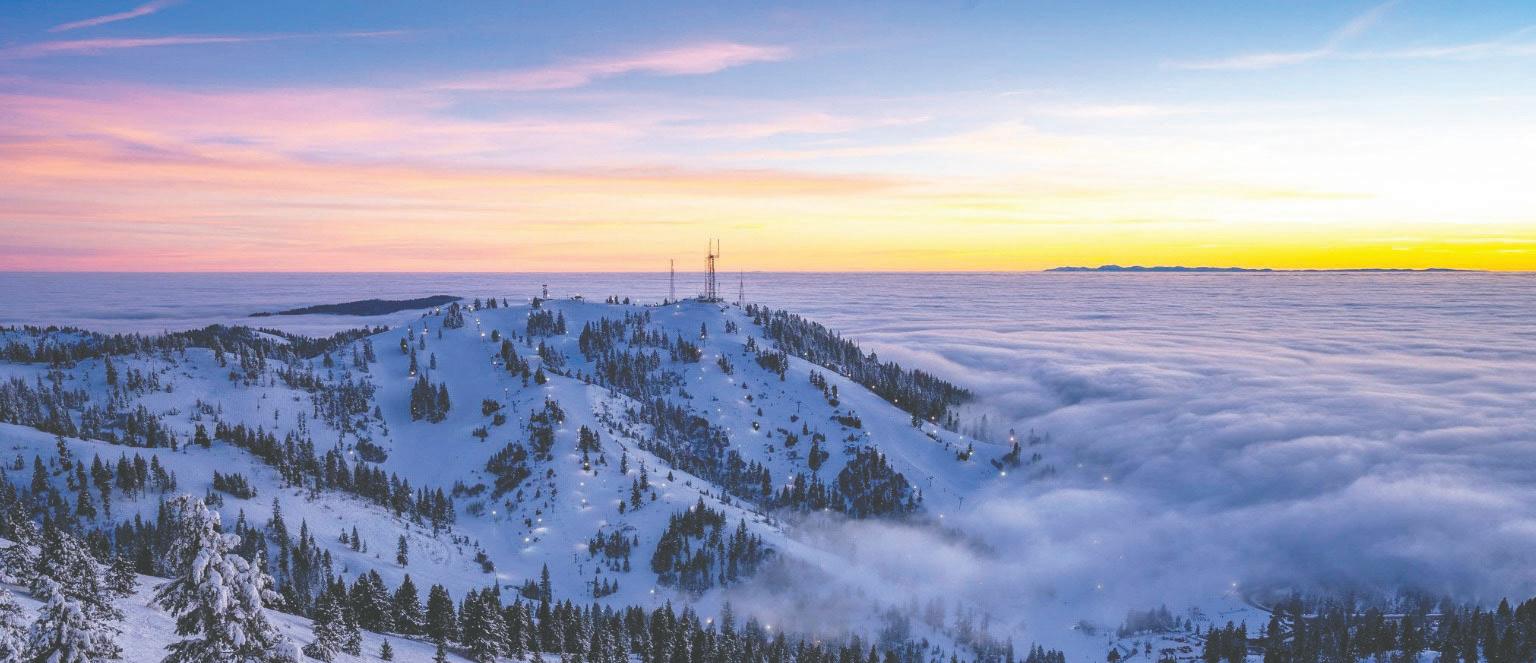
A GUIDE TO BOGUS BASIN
Bogus Basin sits only 16 miles from Boise, making it the closest and most accessible winter escape for Boise State students. The nonprofit recreation area covers more than 2,600 acres with seven chairlifts, four magic carpets and almost ninety runs. The mountain offers beginners an easy entry point into skiing and snowboarding without the high cost or high pressure of larger resorts.
New riders often start on the lower part of the mountain, where the terrain is wide and forgiving. The Bunny Hill and Coach Chair are the most common learning zones, giving beginners room to fall, stand and try again without faster riders rushing past.
Junior skier Kaie O’Shea said “snowboarding is hard to learn but easy to master”, and explained that although the first few days feel slow, progress comes quickly once techniques start to click.
Once beginners grow comfortable making turns, the next step is exploring the main green and blue runs. These trails offer longer rides and consistent snow, helping new skiers and riders learn control at higher speeds.
The front side of Bogus is especially friendly to this stage of learning. Its groomed trails, easy lift access and clear signage make navigating the mountain less intimidating.
The backside of the mountain offers
steeper, wider terrain that requires a bit more confidence, but it’s still manageable for riders who are improving.
Sophomore skier Zac Hansen said he likes how Bogus provides “an opportunity to do everything”, and thatmid-ability students have the opportunity to find challenging, yet safe terrain.
Safety plays a big role in each beginner’s experience. New riders often forget to look uphill before turning or accidentally stop in the middle of a run, where they block traffic. Senior snowboarder Curtis Stutz said beginners fall most often when they stiffen or lean back, causing their edge to catch. Staying loose and centered helps prevent sudden wipeouts.
“The easiest way to learn is just to go as much as possible,” said Stutz. “Being repetitious is going to help you a lot.” Timing your visit matters, too. Morning sessions offer the best snow and the smallest crowds. Afternoons, especially on weekends, can fill up fast. Night skiing is a popular option for students because it is cheaper and quieter, though temperatures drop significantly after the sun sets.
Checking the weather, road conditions and webcams before you go can make the trip safer and smoother.
Whether you stay on the Bunny Hill or push toward the backside, the mountain gives beginners space to learn, explore and build confidence one run at a time.
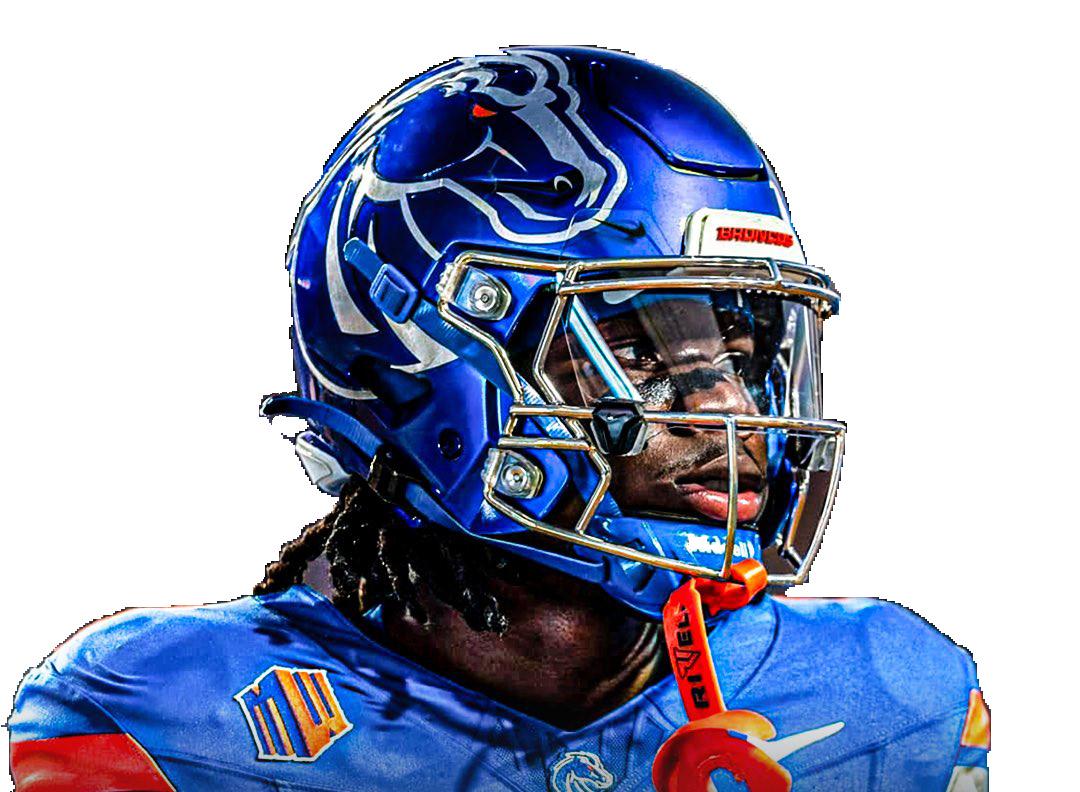
To outsiders, the coming-and-going of Boise State football players in 2025, with some facing disciplinary action and others entering the transfer portal, could be seen as a sign of a turmoil-filled program. However, after a third consecutive conference title, it’s clear the program is far from that, and Jeremiah Dickey’s comments after the Mountain West Championship game are representative of the resilient, blue-collar mentality that the program carries despite roster changes.
“To come into this season with high expectations, we had some peaks and valleys,” Dickey said. “But, you find out what you’re made of in the valley.”
The 2025 season has seen Boise State’s football roster change quickly and vastly, with numerous roster transactions quietly reshaping the team’s identity throughout the last month.
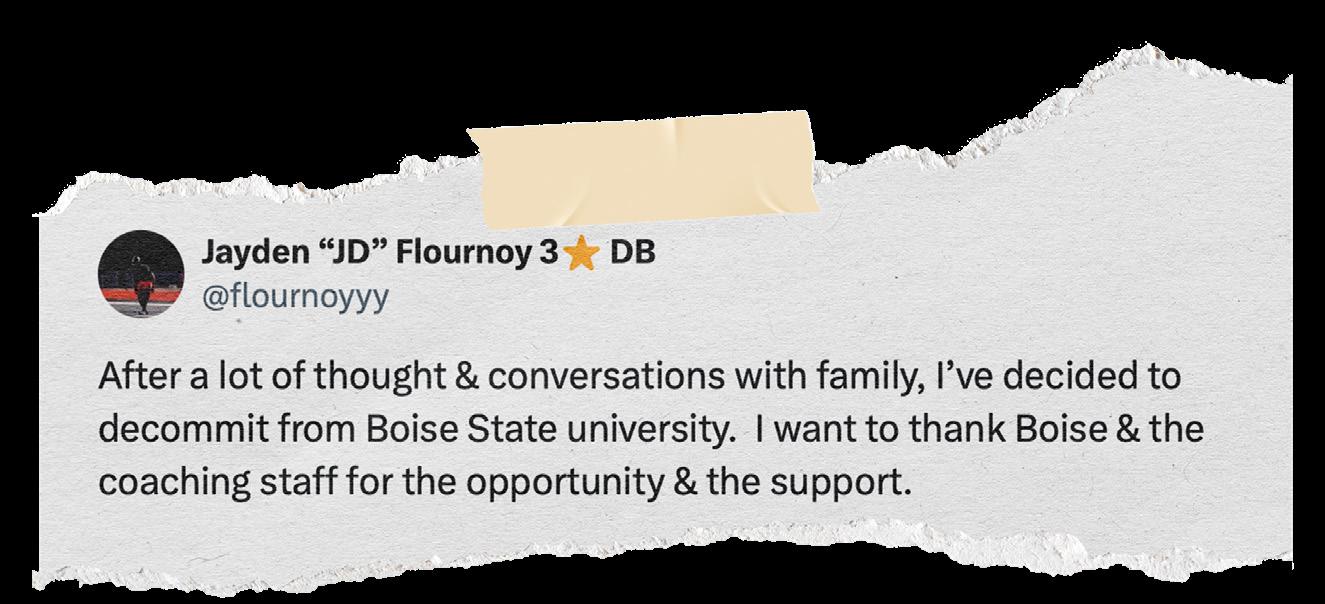
College football has seen major roster movements this season, and Boise State has been one of the biggest winners despite losing commits and transfers. Recruits who once
leaned toward Power Four schools are now choosing the Broncos, creating a boost of momentum after a year full of ups and downs.
One of the most notable commits is three-star quarterback Cash Herrera out of The Bishop’s School in La Jolla, California. Originally Big Ten bound, Herrera decommitted from Indiana in November to announce his commitment to Boise State on Dec. 2. Ranked as the nation’s No. 35 quarterback prospect, Herrera turned heads when he became the second 2026 recruit to flip from a Power Four school to Boise State.
The first to do so was Madden Soliai. Flipping his commitment from UCLA, his decision speaks volumes to the program’s confidence that he can play a valuable role — and to his own desire to grow as a person off the field. Soliai, a three-star safety from Kahuku High School in Hawaii, was rated as the No. 8 2026 recruit in the state. Second three-star quarterback recruit, Jackson Taylor, hails from Thousand Oaks, Calif. Despite numerous
Power Four offers, Taylor committed to Boise in June and signed with the Broncos on Early National Signing Day.
“Praise Jesus!” Taylor said in an Instagram post announcing his commitment. “God is working in special ways in Bronco country.”
top 2026 commits.
In recruiting, Boise State targets players who show strong character and buy into long-term development both on and off the field. For Danielson, being certain that their recruits love football, carry a strong work ethic and put the team before themselves is a top priority.
“Yes, there’s a lot of talent in this group, but more importantly, I believe all of their ceilings are really high because of their character,” Danielson said about the team’s 2026 recruiting class.
“The three biggest things we wanted with this class was, one, to know they love football, secondly, no one is going to out-work them, and thirdly, [they are] all about the team.”
Even with the momentum from this class, the Broncos still have to navigate the challenges of players leaving the program. The roster losses tell the other side of the story.
Over the summer, four-star quarterback prospect Bryson Beaver flipped from Boise State after receiving an offer from Oregon. The 6’2” gun-slinger signed with the Ducks shortly thereafter, poaching the Broncos out of one of their
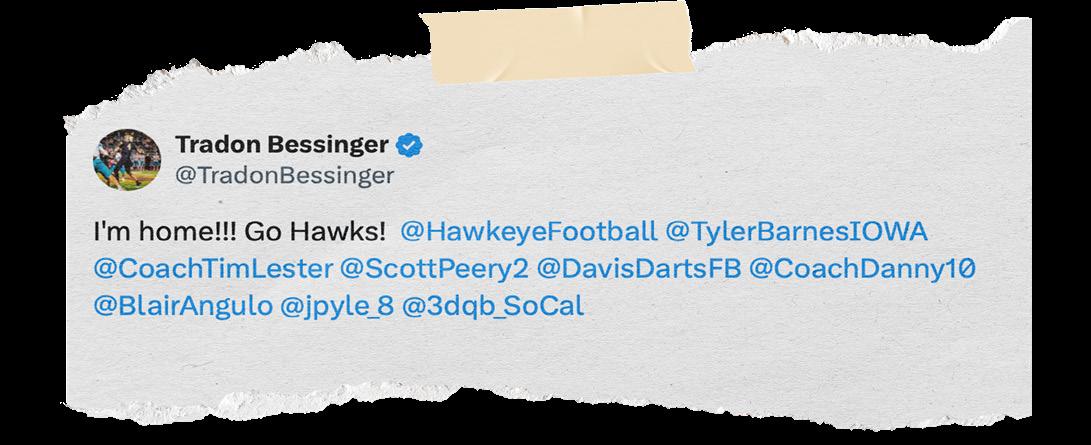
Fellow quarterback Tradon Bessinger flipped his commitment from Boise State to Iowa and signed with the Hawkeyes in early December. A four-star recruit, his and Beaver’s decisions forced the Broncos to ramp up their search for valuable pieces at the quarterback position.
Recruiting and Personnel Intern Dominic Iglesias explained how the staff responds to de-committments by leaning into a Group of Five mindset — one built on a next-man-up mentality. He said that the approach mirrors the way players inside the locker room adjust when someone goes down with an injury or isn’t performing. Instead of panicking when a recruit flips, the staff turns to the next option on their board and keeps it moving.
“We just try to dig deep to find guys and not always trust [recruiting websites],” Iglesias said, noting how certain recruitment media companies put players on pedestals who really shouldn’t be. “There are about 20 of us in the player personnel group, and they’re all mind-blowingly smart. The players that we are able to get haven’t been seen by anybody, but turn out to be stars.”
Earlier this year, several key Broncos
entered the transfer portal to pursue new opportunities and seek a better fit in another program.
Junior running back Breezy Dubar recently announced he would enter the transfer portal at the close of the season. His exit took away a physical runner who added size and speed to the backfield and was expected to compete for more carries moving forward.
Standout linebacker Andrew Simpson entered the portal and committed to Bill Belichick and UNC in May. One of the biggest impact players on defense for the Broncos, Simpson was a highly-rated high school player, playing for St. John Bosco in California, often ranked among the top three high school teams in the country.
Former five-star quarterback recruit Malachi Nelson, who spent just one season at Boise State, entered the transfer portal after the end of last season after a year in which he saw very little playing time. Nelson eventually landed at UTEP where he won the starting job to open the year but was benched later in the season for poor play.
Punter James Ferguson-Reynolds entered the portal and transferred to Oregon in May. A native of Geelong, Australia, Ferguson-Reynolds has been one of the better punters in the country the past three seasons, being named a third-team All-American in 2023.
Iglesias described the adjustments Boise State’s recruiting staff has made as Name, Image and Likeness continues to reshape college football.
“Obviously, in the NIL world, these Power Four schools can offer players a lot more than Boise State can,” Iglesias said. “We retain the guys we can, and we do a really good job at that for the resources we have. Showing the coaches you want to be there and grow as a player is something really important in the program.”
These transfers created immediate gaps and forced the Broncos to strategize how they replace experience at key positions.
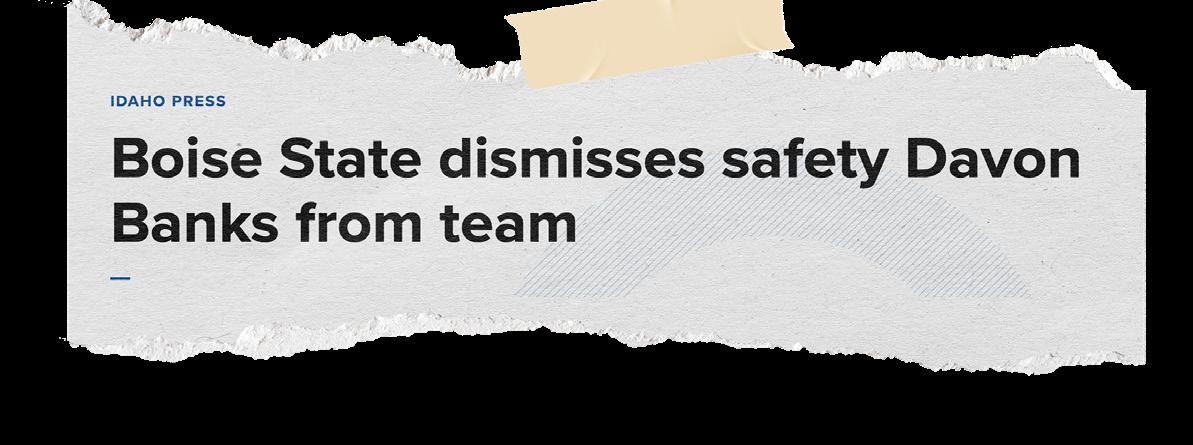
The dismissal of Davon Banks brought even more change. The coaching staff
pulled him from the team in mid-November due to disciplinary reasons, and the move made it clear that Boise State will hold standards no matter what the roster looks like.
“We have high standards to be here and how players interact with coaches and players matters,” Head Coach Spencer Danielson said. “We wish him nothing but the best. I love him, but he’s no longer going to be part of the team.”
Boise State’s early signing class, finalized on Dec. 3, brought in 29 new additions to help settle some uncertainty after a season filled with transfers, decommits, and injuries. These additions highlight how the Broncos will fill in the depth chart and shape the roster for seasons to come.
On defense, lineman Deuce Alialfaleuila and cornerback Jacob Arbuckle II headline the group. Both were highly productive in high school and arrived at positions in the depth chart where Boise State needs help. The Broncos also strengthened the edge and safety spots with Corey Webb Jr. and Beckham Hofland.
Offensively, the staff added tight end Keawe Browne, wide receiver Terrious Favors and running back Keilan Chavies — all players who bring speed and athleticism.
The Broncos experienced lots of fluctuation throughout this year, but the new recruiting class can be viewed as the start of a steadier foundation and a clearer direction for where the program is heading next. While the team does recruit certain junior college and transfer portal players, Danielson emphasizes the significance of developing high school players, as opposed to JuCos or transfers, into not only good football players but good men.
“We want to be the best in the country at developing young men, not just for football, we’re talking life too,” Danielson said. “Our recruiting staff did a phenomenal job, and I love the group of men that are coming here. Their families believe in what we’re doing here, and the future is really bright.”
NEW BLUE TURF
Jake
The most recognizable feature of Albertsons Stadium, the iconic blue turf, will soon get a major upgrade.
Ahead of the 2026 season, Boise State Athletics plans to install a new turf field, renewing the signature look. This is just one of several major upgrades, including the addition of the North End Zone Project. The athletic department received a $1.5 million gift designated to support the installation of the new field. The donor requested to remain anonymous.
The donation comes in the midst of the Unbridled Campaign, which aims to raise $500 million by 2028. The campaign’s three pillars of focus are student support and access, faculty innovation and “What’s Next” for athletics.
Boise State Athletic Director Jeremiah Dickey expressed gratitude for the donation and spoke highly of the significance of the blue turf, which was last replaced in 2019.
“We’re grateful for the continued generosity of Bronco Nation,” Dickey said. “The Blue is incredibly important to our identity and national brand. It’s bold and unique and shows how we’re built different at Boise State.”
The 2026 season will also see the completion of the North End Zone Project, which will majorly enhance both fan and athlete experiences. The project, which began construction in January, will add a 360-degree concourse, numerous field-level suites and lodge seats and 872 club seats that feature all-inclusive food
and beverage amenities. The project will also serve all 18 Boise State athletic programs with the new Simplot Nutrition Lounge.
At the time of its debut, Boise State’s blue turf was the first non-green artificial football field in the country. The turf was first installed in 1986 under Athletic Director Gene Bleymaier.
“It’s hard to think of something more iconic to Boise State than The Blue,” said Argia Beristain, CEO of the Boise State University Foundation. “This generous gift allows students, Athletics and Bronco Nation to continue to use our famous turf as a symbol of our innovation and determination.”
Since their first season on The Blue almost 40 years ago, the Broncos are 218-46 at home. The dominance that Boise State plays with on its home field, along with the passion of Bronco Nation, has made Albertsons Stadium one of the most difficult fields to play for opponents. The new turf will add extra flair to a stadium that has seen consistent Bronco success for decades.
“There’s a lot of advantages to playing at home, especially when you have a fan base like we have in Bronco Nation,” Danielson said. “They’re not just at the game, they’re in the game with you with how loud they are and how much they love their team. There have been years and years of blue-collar teams that have protected this blue, and we need to uphold that standard.”
Zamora | Sports Editor | Photo by Keara Antonelli
SPORTS
BRONCOS TAKE DOWN UNLV FOR THIRD STRAIGHT CONFERENCE TITLE
Jake Zamora | Sports Editor | Photos by Omar Saucedo
The Boise State Broncos stormed past the UNLV Rebels 38-21 in the Mountain West Championship at home Friday night, becoming the first team in Mountain West History to win three consecutive conference championships.
This year’s title marks the seventh Boise State has won since joining the Mountain West, the most of any team in the conference. Defeating the Rebels in all three contests of the three-peat, a victory over the team from Sin City is not a rarity for Bronco Nation, who stormed the field as the clock hit triple-zeros.
The Broncos, who started the year ranked No. 25 in the final preseason AP Poll, fell in their season-opener to South Florida, a team they were highly favored to beat. A loss to Notre Dame in South Bend, followed by back-to-back in-conference losses later in the season, dampened the revamped energy Bronco Nation has carried since making a run in the College Football Playoff last season.
Despite a handful of tough losses, Head Coach Spencer Danielson, the rest of the coaching staff and his players’ determination never wavered. The team showcased the resilient blue-collar mentality that has represented the program for decades and been instrumental in their conference-leading seven Mountain West Championships.
“In life, you can be knocked on the mat, you can feel like things aren’t going your way, but when you trust the Lord and you stick with it and link arms like this team did, anything is possible,”
Danielson said after the game. “It wasn’t easy. Nothing was given to us, everything was earned, and that’s hats off to our staff and players.”
In his first game back from injury, quarterback Maddux Madsen didn’t miss a beat.
The redshirt junior and heart and soul of the team threw for 289 yards and three touchdowns while also scoring one on foot. Completing 17-of-31 passes, Maddog was named the game’s Offensive
MVP. His full-extension dive to the front right pylon of the endzone to score his rushing touchdown seemed symbolic of his eagerness to return to the team and play with the people he loves.
“Just being out there with this group of guys that I love so dearly, to go out and win a conference championship is a huge deal to me,” Madsen said when asked how it felt to win after his monthlong absence. “A final staple as we leave [the conference] is a huge deal, and winning back-to-back-to-back is an even cooler feeling. Being able to experience all of this with this place is huge.”
The Broncos were full of life straight out of the gate.
On the first possession of the game, a hard hit from Boen Phelps jarred the ball loose from Rebels receiver Jaden Thomas. Ty Benefield, the game’s leading tackler and Defensive MVP, recovered the ball with one outstretched arm and gave the Broncos possession.
Madsen’s first-quarter rushing touchdown was set up by a 46-yard completion to Chase Penry that put the Broncos in the redzone, a place they found themselves all night long. Penry was the contest’s leading receiver, finishing with 96 yards.
The team’s next two offensive possessions ended with passing touchdowns to Dylan Riley and Cameron Bates, respectively. Bates’ score, which was the first of his career, came on a wide-open corner endzone shot after the Rebels’ coverage was busted and put the Broncos up 21-0.
The Rebels were then led by quarterback Anthony Colandrea down the field in a nine-play, 95-yard drive to cut their deficit to two possessions. However, the Broncos didn’t take long to answer.
Running back Sire Gaines showed shades of Jeanty when he broke countless tackles and bounced off multiple Rebels for a 35-yard gain in the ensuing possession. Madsen then found Malik Sherrod for a 39-yard touchdown reception to
put the Broncos up 28-7 with 1:50 left in the half. Almost immediately after, UNLV scored a touchdown with less than a minute to go to make it a 28-14 ball game entering the break.
Two catches that were overturned to incompletions by Latrell Caples, along with crucial tackle-for-losses by Jayden Virgin-Morgan and Max Stege, created a close game for most of the third quarter.
A UNLV touchdown late in the third made it a one-possession game, but Sire Gaines found the endzone and Colton Boomer drilled a 50-yard field goal before the Rebels could do anything else to seal the game 38-21.
Sixth-year Malik Sherrod spoke on what it means to be a part of this year’s impactful running back group and help the team win another championship.
“It feels amazing,” Sherrod said. “It’s my first time being a part of a three-headed monster. I feel like we showed that throughout the season, and it was definitely on display tonight as we all found the endzone. I love those boys to death.”
Friday’s win makes Spencer Danielson the second coach in FBS history to win three straight conference titles in his first three title game appearances, the other being current USC Head Coach Lincoln Riley. Additionally, the Broncos have defeated UNLV five times in the last 734 days, the shortest span between five consecutive wins over the same opponent by an FBS team since 1980.
After a dominant 15-year run and an extra-dominant 2023-25 three-peat run in the Mountain West, the Broncos turn a new page. They, along with four other current members of the conference, will join the newly-revamped Pac-12 in 2026. With a new era of Boise State football on the horizon, the program looks to prove that its trademark blue-collar mindset can translate to a bigger stage.