
AlamoPROMISE Economic Impact Report 2025

Preparedby

Executive Summary
This report presents an estimate of the economic impact of AlamoPROMISE since its rollout in Bexar County and demonstrates the economic importance of the Alamo Colleges District (ACD) to local economic growth and development
In 2019, a study commissioned by ACD during the planning phase of AlamoPROMISE estimated the economic potential of the program. The report noted that the overall economic impact on Bexar County could reach as high as $1 7 billion in economic activity and $26 million in tax revenues to the county, along with other benefits.
This study demonstrates that ACD and its AlamoPROMISE Scholarships have achieved the numbers anticipated during the program ' s planning stages (Alamo Colleges, 2020). To be sure, COVID had a deleterious effect, but ACD made great strides and innovated to adjust to the changes brought by the pandemic
Among the impacts reported in this study, the key statistics are employment outcomes estimated at 7,812 additional jobs over 4 years, and an estimated additional labor income of approximately $439 million Valueadded, or the local equivalent of
Gross Domestic Product (GDP), is estimated to be $634 million in additional economic growth in Bexar County during the same period. The overall impact of AlamoPROMISE is $1.1 billion over four years.
Also significant are the contributions this program made to local, state, and federal income taxes. Locally, the efforts of ACD added an estimated $2,712,163 in County taxes; and $13,695,661 in State tax revenues. The impact of ACD was also felt in the estimated $87,931,158 federal income taxes paid as a result of the AlamoPROMISE program. All told, the estimated fiscal impacts reached as high as $114,492,902.
Every dollar that Alamo Colleges spent on AlamoPROMISE scholarships leveraged an estimated $4.22 in federal funds to help educate and grow the supply of educated workers in Bexar County. These employment impacts are further supported by the growth in wages and overall earnings in several key industries. When ACD undertakes capital improvement projects, this adds even more stimulus to the local job market.
Introduction
A college degree is still considered the best way to improve the quality of life and achieve economic mobility for an individual But even now, students face numerous barriers to college enrollment, not the least of which is the cost.
Sixteen years ago, the Institute for Higher Education Research (IHEP) surveyed college students and found that constraints such as insufficient financial aid, poor messaging about academic requirements and preparation, a lack of understanding how to apply for financial assistance, and limited support for the larger community worked against students’ ability to access higher education One of the key findings of the IHEP survey showed that cost was a significant barrier.
Additionally, financial aid dollars provided in a vacuum, that is, without consideration for the totality of the needs of students, in particular lower-income students, would not solve the problem. Hence, IHEP also recommended that additional resources be dedicated to understanding the needs and availability of aid, enrollment information, and transparency about the amount and types of financial aid available (Hahn, 2008).
This report presents an estimate of the economic impact of the AlamoPROMISE program on Bexar County and demonstrates the economic importance of the Alamo Colleges system (ACD) to local economic growth and development
An economic impact study was commissioned by ACD in 2019, during the planning phase of AlamoPROMISE to estimate the economic potential of the proposed program The report noted that the overall economic impact on Bexar County could reach as high as $1.7 billion in economic activity and $26 million in tax revenues to the county, plus other benefits. The expectations were high when ACD embarked on the program
However, several external factors intervened as ACD began its rollout, the first of which was COVID, followed by the subsequent economic dislocation of the entire community that has taken years to return to its pre-COVID rates of economic activity
Free Tuition Programs Background
Paying for an undergraduate education is a key barrier to enrollment in higher education, as is the annual ritual of applying for financial aid The increasing costs for higher education are a strong motivating factor for local institutions to find ways to help students develop their human capital and contribute to the greater effort of community economic growth and development.
ACD is part of the larger community college movement that began in 2014 when Tennessee introduced its Promise Scholarship Act, which offered the state’s high graduates free tuition to attend any two-year public community college or technical college in the state (Barsahy, 2024)
The 10th anniversary report for Tennessee’s Promise (October 2024) stated that 90 percent of the state’s high school students apply for college programs, roughly 15,000 students a year ultimately use the program, 50% of whom come from low-income Pell Grant-eligible families. Tennessee estimates that the program will have produced 50,000 college graduates by 2025 (Barsahy, 2024). Since then, three models of tuition-free college have emerged:

First Dollar programs that pay for all tuition expenses at a public college; Last Dollar programs that pay for the tuition expenses that remain after all financial aid is awarded (such as Pell Grants); and Debt-Free programs that pay for tuition and all other costs, including room, board, and transportation (Carnevale, 2020). More specifically, lower-income students are the key demographic for “free tuition” opportunities. Research by the University of Michigan indicates that, overall, 12 percent of college students come from the bottom fifth of the family income distribution, while 28 percent are from the top fifth (Chetty, 2017). For the top quintile, paying for college may be less onerous than for the lower quintile.
SCHOLARSHIPOPTIONS
The AlamoPROMISE Scholarships
Education policy solutions such as “free tuition” provide a degree of certainty for lowerincome students that helps with the decision to continue with an education (Dynarski, 2020).
AlamoPROMISE is a last-dollar program that covers tuition and required fees for eligible students seeking an academic certificate or associate degree at one of the five Alamo Colleges: Northeast Lakeview, Northwest Vista, Palo Alto, St. Philip’s, and San Antonio College.

To be eligible for the scholarship, a student must be a graduating senior from a participating AlamoPROMISE high school and program, apply for admission to one of the Alamo Colleges, complete financial aid requirements, and enroll in classes for the Fall semester AlamoPROMISE does not have an incoming grade point average or income requirement. However, all students must complete the ApplyTexas application and either the Free Application for Federal Student Aid (FAFSA) or the Texas Application for State Financial Aid (TASFA). Successful completion of these steps will guarantee a spot in the program, provided students meet the eligibility requirements.
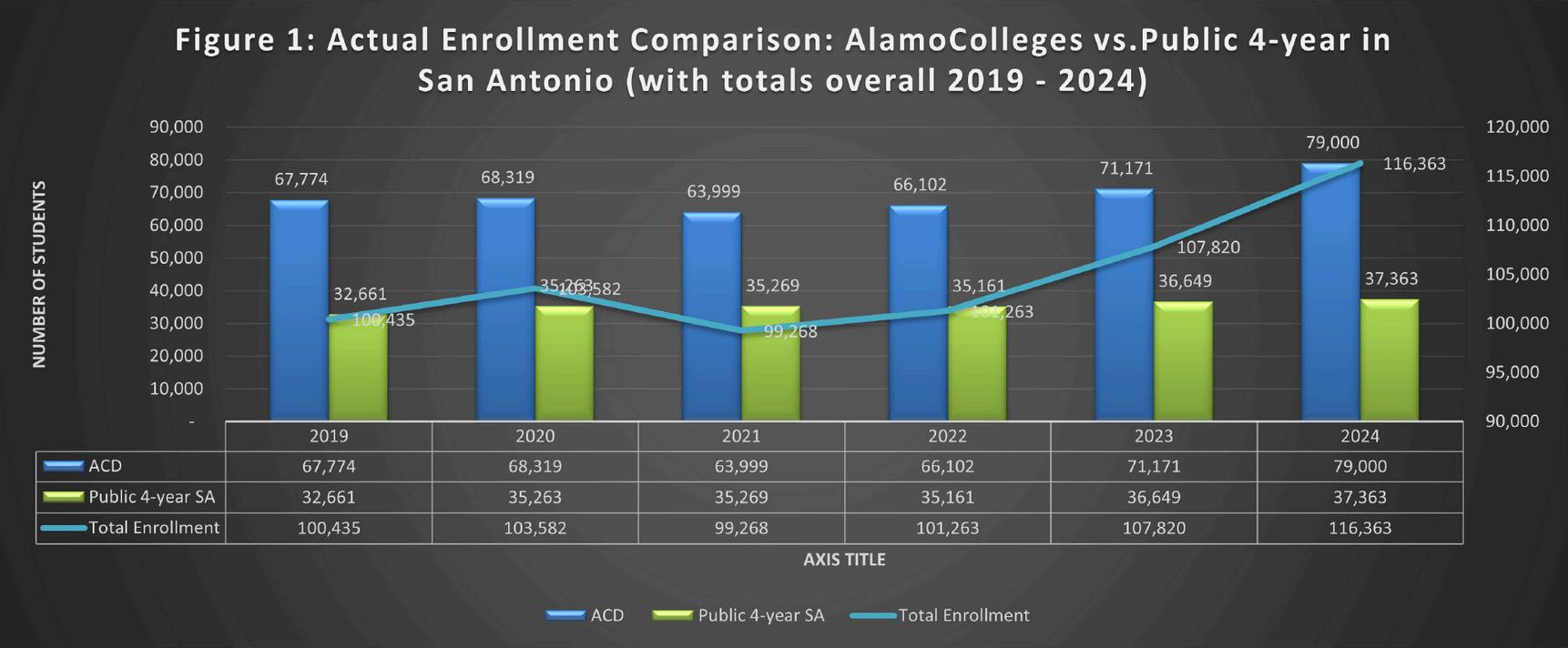
AlamoPROMISE covers the completion of an associate degree for up to three consecutive years. In addition to tuition assistance, AlamoPROMISE includes “wraparound services ” such as advising, career counseling, Advocacy Centers, and help with financial, health, and other issues that present barriers to completing a college education. This makes the AlamoPromise program a unique combination of the “tuition-free” programs described above. Furthermore, AlamoBOOKS+ ensures that students will have the educational materials (books) needed on the first day of classes As AlamoPROMISE has gained traction, ACD expanded its student transfer agreements via Promise-to-Promise partnerships with four-year universities within Bexar County, such as the University of Texas at San Antonio and Texas A&M University-San Antonio Overall, Texas’s enrollment trends show growth as seen in Figure 1
As of Fall 2024/Spring 2025, the AlamoPROMISE offered by ACD experiences its 5th year of enrollment, starting with a planning phase in 2018, followed by a launch phase in the 2019/2020 academic year, serving 27 high schools and programs In 2022, the program expanded, adding another 20 high schools and programs At the time of writing, over 23,000 students had enrolled in AlamoPROMISE The 2024/2025 enrollment promises to be the largest cohort yet This process of scaling the AlamoPROMISE program coincided with a growth in overall enrollment such that by 2024, Alamo Colleges enrolled a record 79,000-plus students. The 2024/2025 Promise incoming class numbered 15,598 (Alamo Colleges District, 2025).
AlamoPROMISE Scholarships continued
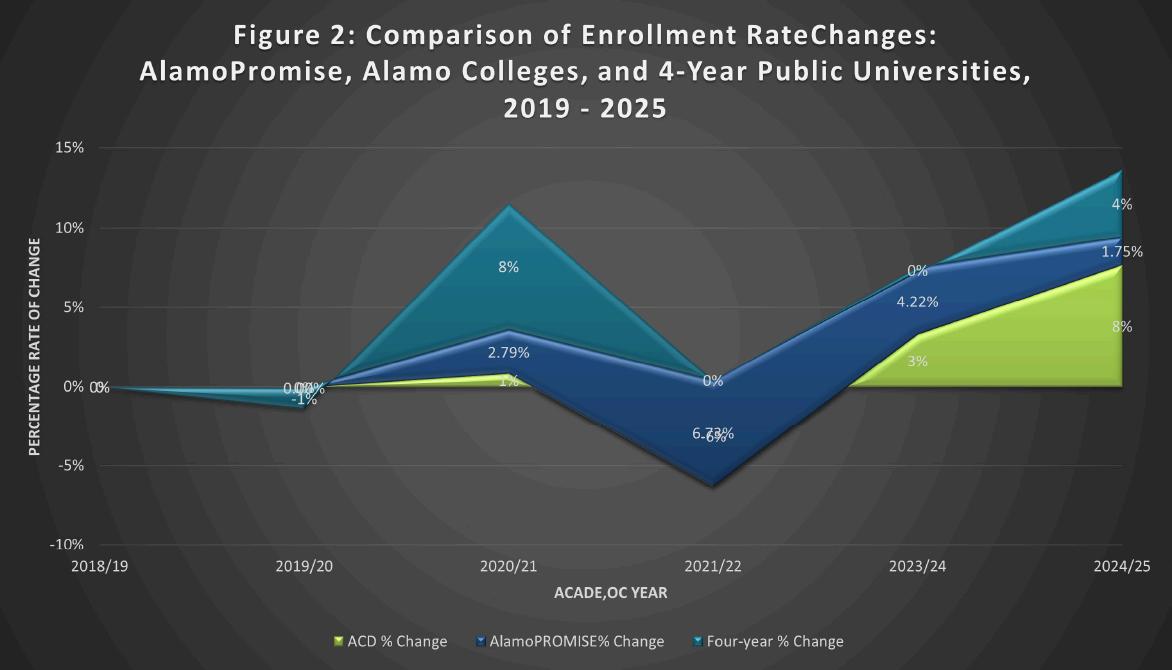
Figure 1 and Figure 2 provide additional context for the enrollment environment. In Figure 1, we can see that ACD accounted for more than 50% of the students enrolled in higher education in San Antonio. This is a consistent feature of the academic landscape for the period from 2019 to 2024. In Figure 2, we see the growth rates, or rates of change, in enrollments during the 2021/2022 –2024/2025 academic years. This perspective of local enrollments brings into stark relief the impact of AlamoPROMISE, in particular, between the 2021-2022 and 2022/2023 academic years, as the district rebounded from COVID, and increases in enrollment exceeded 60%.
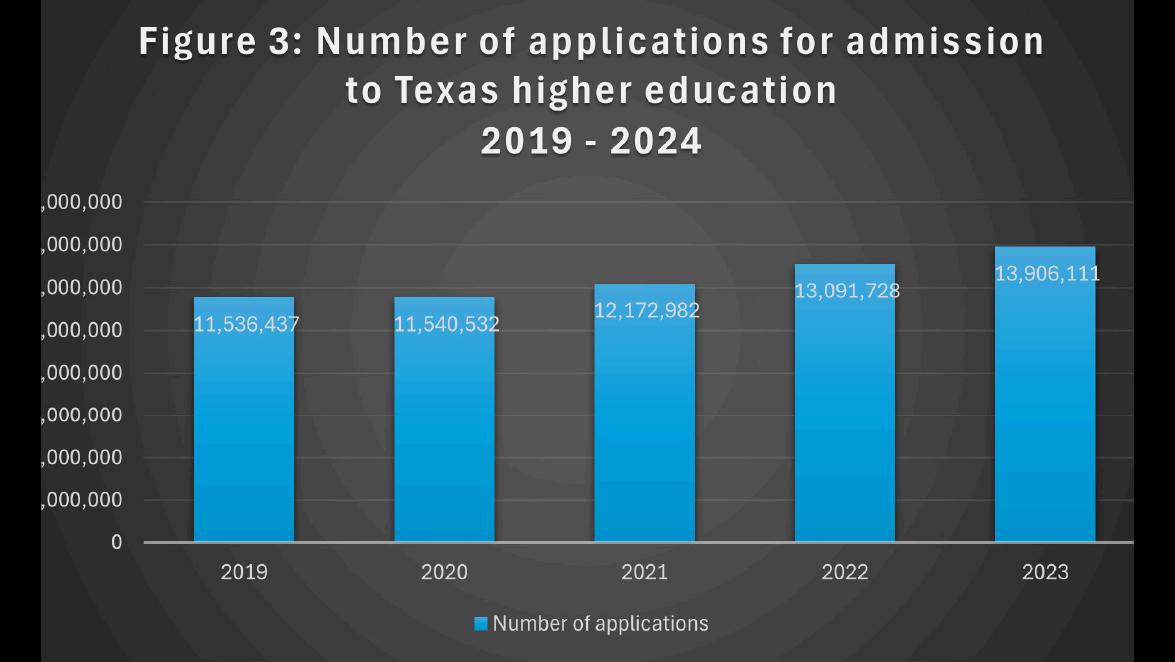
These figures provide a contrast to the single-digit enrollment for the general programs. In Figure 3, we see the general context of applications to attend public colleges and universities in Texas between 2019 and 2023. While the enrollments are growing, they are clearly growing at a slower pace than that experienced in Bexar County through AlamoPROMISE
Post-COVID data for Bexar County suggests that the percentage of applicants admitted to institutions of higher education reached 78.4%, while the percentage of admitted students who actually took the next step and enrolled was 19 6% In absolute terms, the total number of students enrolled in 2022 was 138,321. In short, based on these data, programs such as AlamoPROMISE that include wraparound services can motivate students to continue their education
Economic Impacts of AlamoPROMISE
The method of analysis for estimating the economic impacts follows the standard practice of economic impact analysis by applying “ new ” dollars to the appropriate spending categories within the local economy These are distributed via an economic model that applies multipliers and distributes spending throughout linked categories within the local economic system The IMPLAN tool was used for all impacts (See Appendix 1)
ACD invested many dollars to initiate and sustain AlamoPROMISE over the past 5 years This report is based on two main sources of investments, the scholarships awarded in the form of last-dollars, which are new dollars, since they did not come from existing local scholarship funds, and investments to increase capacity such as construction and other capital and support services, to sustain the growth demonstrated by enrollment numbers presented in the previous section. This second category of spending is derived from the 2017 bond All totaled, AlamoPROMISE invested $16,342,355 in scholarships and received an additional $ 77,069,938 in other financial aid funding to support students as they attend one of the ACD colleges
ACD invested $16.3 million in AlamoPROMISE Scholarships
An additional $77 million received in other funds to support AlamoPROMISE Scholars
The direct scholarship support provided by ACD students can be further broken down into to scholarship support per student per academic year. Table 3 presents enrollment accounts for each academic year, inclusive of 2021, along with Last-Dollar scholarships awarded. In Table 4 we see the amount spent per student, per academic year and an overall average for the four years covered in this report, which was over $852. This excludes the dollars spent on the wrap-around services, book scholarships, and capital spending, in order to focus AlamoPROMISE scholarships
Among the impacts is a summary of the outcomes presented in Table 1 The key statistics are Employment outcomes estimated at 7,812 additional jobs over four years and the additional labor income paid to these jobs estimated as $439 million. Value-added refers to the local equivalent of Gross Domestic Product (GDP) reported on almost daily in the economic and business news. Consequently, we can say that AlamoPROMISE generated an estimated $634 million in additional regional GDP.
Economic and Fiscal (Tax) Impacts
of AlamoPROMISE
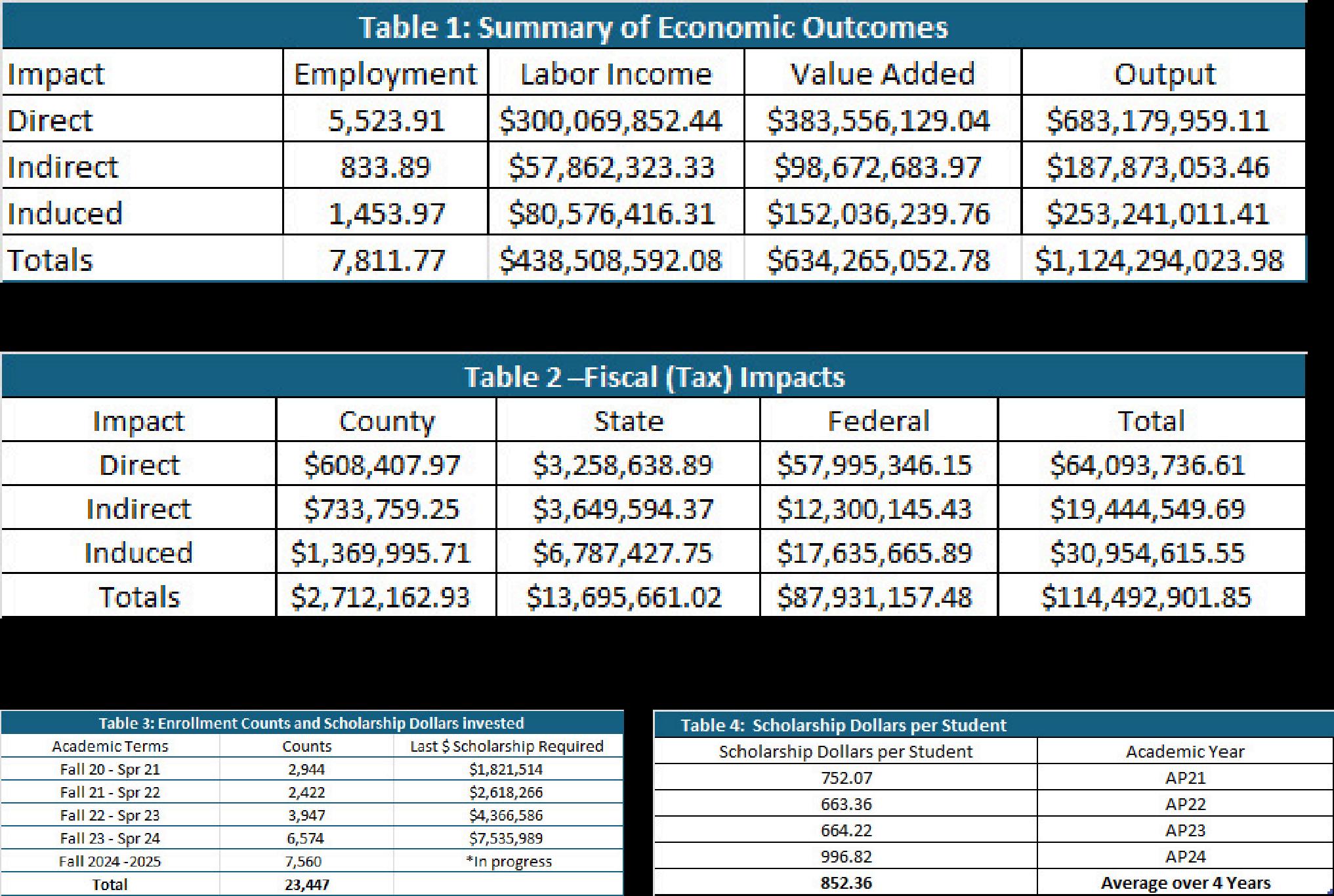
Fiscal Impacts refers to the tax impacts of economic activity. Table 2 presents the results of the estimated tax benefits of AlamoPROMISE. This is an important point to make because as explained above, this and other tuition support programs require government participation at all levels - local, state, and federal. Therefore, their contributions to these revenues provide another validation of the concept of supporting students, as they train for future employment.
Fiscal Impacts refers to the tax impacts of economic activity. Table 2 presents the results of the estimated tax benefits of AlamoPROMISE. This is an important point to make because as explained above, this and other tuition support programs, require government participation at all levels - local, state, and federal. Therefore, their contribution to these revenues, provides another validation of the concept of supporting students as they train for future employment. In the case of AlamoPROMISE, we can see that the estimated impact on tax revenues to Bexar County was $2.7 million, for the State of Texas, the impact was $13.7 million, and overall federal tax revenues of nearly $88 million.
Fiscal (Tax) Impacts of AlamoPROMISE
In the case of AlamoPROMISE, we can see that the estimated impact on tax revenues to : Bexar County was $2.7 million
The State of Texas, the impact was $13.7 million
Overall federal tax revenues of nearly $88 million.
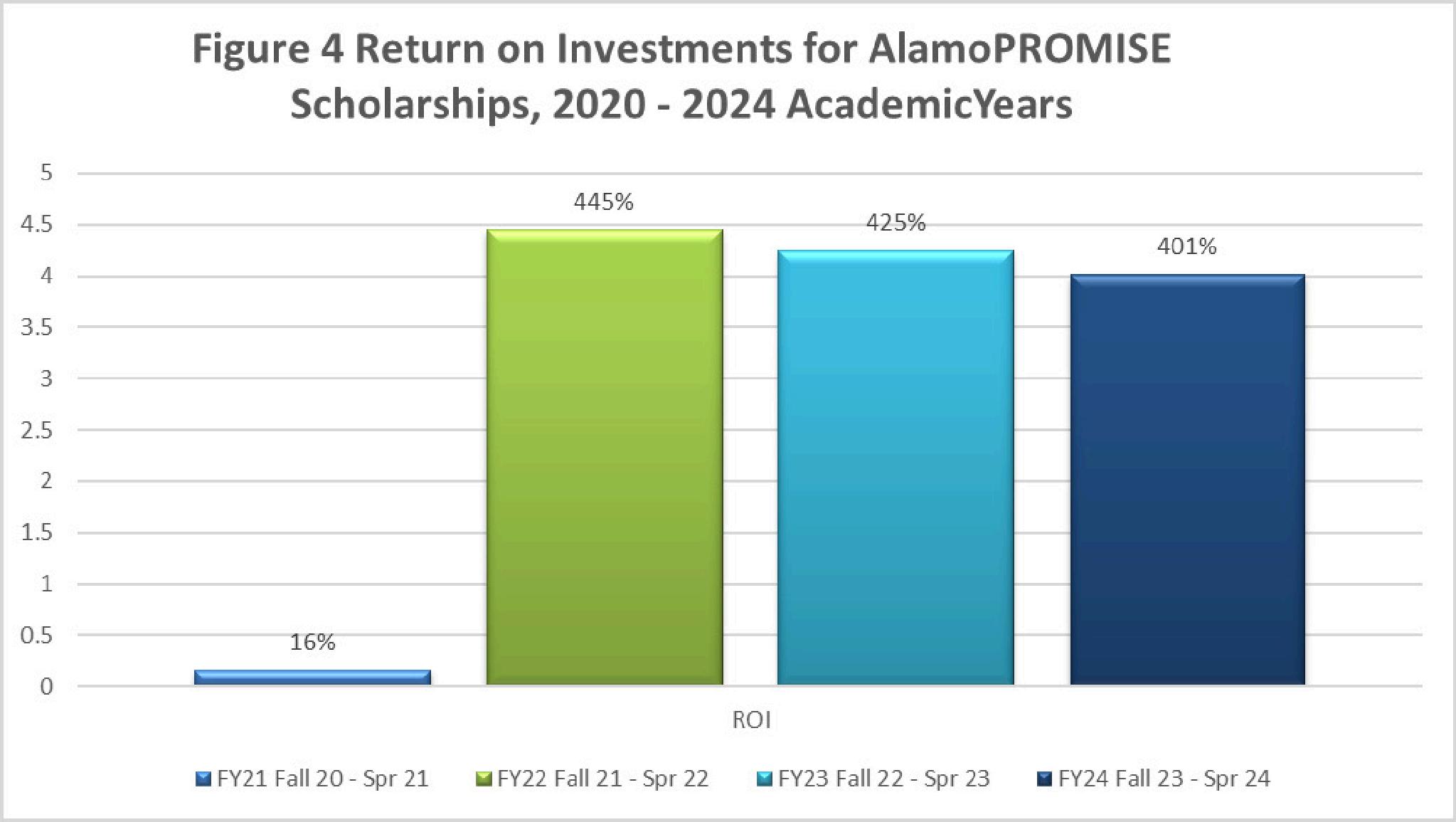
In Figure 4, we see the AlamoPROMISE return on investment (ROI) What does this mean? For every dollar that ACD spent on these scholarships, it received on average $4.22 in additional support to help educate and grow the supply of educated workers in Bexar County. How? Every student is required to complete ApplyTexas and the Free Application for Federal Student Aid (FAFSA) or Texas Application for State Financial Aid (TASFA).


$16 million in PROMISE scholarships.
$77 million in financial aid educational support
Bond supported construction and educational capital investments to support growing enrollments.
eturns on Investments
Over 7,812 additional jobs in Bexar County. Over $439 million in additional labor income
Nearly $1 1 billion in additional economic impacts were generated.
$114 million of estimated fiscal impact
For every 1 dollar invested in AlamoPROMISE, $4 22 dollars in additional leverage
Appendix 1 Methodology
Economic impact analysis is based on “ new ” spending, meaning the analysis requires that new dollars be injected into the local economy. The new spending provided by ACD staff included new scholarship dollars raised to support the AlamoPromise program. These dollars were treated separately from already existing scholarships and federal grants that may have been applied The construction spending was also provided by AlamoPromise Only those projects included in the 2019 – 2024 period were applied to the economic analysis
Economic impact analysis also uses multipliers, which are a means of estimating the interaction between individuals, industry, and the regional context. This economic activity takes the form of purchases, payments to workers, taxes, and other processes
Value-added is the economic term used to measure the value that an activity generates from the spending of a particular individual, company, or institution. The geographic unit of analysis is Bexar County Therefore, all outcomes apply to the county The technique itself provided a means to follow spending through an economy and measure the cumulative effects of that spending The general model is referred to as Input-Output Analysis and results in three elements of economic activity: Direct, Indirect, and Induced Effects. Direct result from each dollar spent Indirect effects can be thought of as supply-chain activities, and Induced effects are the impacts created by the need to add more capacity to support indirect and direct effects.
IMPLAN is a model created by the National Forest Management Act that directed the U.S. Forest Service (USFS) to plan the management of lands and their impacts on charities. This work was carried out alongside the Federal Emergency Management Agency (FEMA). The original models were linear forecasts but grew into more sophisticated analysis that relied on Input-Output data In 1985, the University of Minnesota assumed responsibility for maintaining the model and became IMPLAN, an independent corporation that continues to develop and maintain the model, which is now housed in North Carolina It is a long standing model with roots in government requirements, which makes it ideal for this project
References
Alamo Colleges (2020) AlamoPromise: 5-year impact of AlamoPromise on Bexar County San Antonio, TX: Alamo Colleges. https://www.alamo.edu/siteassets/district/news/specialnews/alamo-promise/pdfs/alamopromise-economic-impact-one-pager pdf
Alamo Colleges District. (2025). AlamoPROMISE Quest 2025 conference. San Antonio, TX: Alamo Colleges District
Barsahy, J (2024) What one state learned after a decade of free community college The Hechinger Report https://hechingerreport org/proof-points-decade-free-communitycollege/
Carnevale, A. E. (2020). The dollars and sense of free college. Washington, DC: Georgetown University Center on Education and the Workforce, McCourt School of Public Policy https://cew georgetown edu/wp-content/uploads/CEW-The-Cost-of-Free-College-FR pdf
Chetty, R , Friedman, J N , Saez, E , Turner, N , & Yagan, D (2017) Mobility report cards: The role of colleges in intergenerational mobility (NBER Working Paper No. 23618). National Bureau of Economic Research https://doi org/10 3386/w23618
Deming, D. J. (2019, July). The economics of free college (Policy Brief No. 14). Economics for Inclusive Prosperity https://econfip org/policy-brief/the-economics-of-free-college/
Burland, E , & Dynarski, S K (2020, September) The power of certainty: Experimental evidence on the effective design of free tuition programs American Economic Review: Insights, 5(3), 293–310. https://doi.org/10.1257/aeri.20220094
Hahn, R. A. (2008). Promise lost: College-qualified students who don’t enroll in college. Washington, DC: Institute for Higher Education Policy https://files eric ed gov/fulltext/ED503317 pdf
Li, D G (2020) Promise for whom? “Free-college” programs and enrollments by race and gender classifications at public 2-year colleges. Educational Evaluation and Policy Analysis, 42(3), 403–429 https://doi org/10 3102/0162373720962472
Preparedby