
MTA Policy Changes Strain Commuter Students
By JORDAN DONEGAN ASST. NEWS EDITOR
Earlier this January, the New York City Metropolitan Transit Authority (MTA) had enacted several new policy changes, including an increase in various transportation fares. For the Fordham University commuter student population, who represent roughly 40% of the university’s Rose Hill campus undergraduate student body, these new policies have presented a set of challenges related to affordability, safety and consistency of services.
These policy changes have been defined by a multitude of factors, such as a $0.10 increase in both subway and bus fares, a 4.5% increase in monthly and weekly MetroNorth as well as Long Island Rail Road fares and also the replacement of the plastic, classic taxi-yellow MetroCard with the tap-and-go OMNY system. The MTA’s website states that these policies were implemented to keep up with rising inflation rates, simplify ticketing options and improve the overall MTA transportation experience.
With these policies being in place for nearly three weeks now, Fordham commuters from all five New York City boroughs have felt “significant” impacts from the new fare increases as well as the system changes, according to some commuter students. Vice President of Fordham’s Commuter Student Association (CSA) Jasmine James, FCRH ’26, fears these new changes could discourage commuter students who make the trip to campus.
“Given the conditions of the MTA systems and the higher costs, I worry that many commuters may not feel excited or comfortable enough to make the long daily commute to school,” James said in an email to The Ram. “This impacts how many students attend
SEE MTA, PAGE 5
Tetlow to Remain University President Until 2030
By JORDAN DONEGAN ASST. NEWS EDITOR
The Fordham University President Tania Tetlow has now formally extended her tenure as the university’s 33rd president until 2030.
Tetlow described her role as a “daunting responsibility,” but members of the Fordham community have shown a mix of reactions towards
the decision for Tetlow to remain in the university’s most integral leadership role another four years.
Tetlow’s contract extension stems from a motivation for her to continue her work transforming the university’s mission, according to a recent article from Fordham Now.
In an email to the Fordham University community, the chairman of Fordham’s Board of Trustees Armando Nuñez
described Tetlow’s continuous leadership as a “momentous occasion,” noting her role as the first woman and nonJesuit to lead the Fordham community.
“The Board of Trustees stands confidently alongside President Tetlow with faith that her wisdom, tenacious leadership, and commitment to the values of a Jesuit education will lead the university through its next
SEE TETLOW, PAGE 4
AASP Hosts Author Kay Sohini
By RILEY GOOD CONTRIBUTING WRITER
The Asian American Studies Program (AASP) hosted a book event for Kay Sohini’s graphic memoir based on New York City (NYC), “This
Beautiful, Ridiculous City,” on Friday, Jan. 23. Sohini, who received her Ph.D. from Stony Brook University, chose to write the novel for her dissertation. As her first book, it has received praise from The Washington Post, Financial Times, National Public Radio (NPR), the Associated Press (AP) and others.
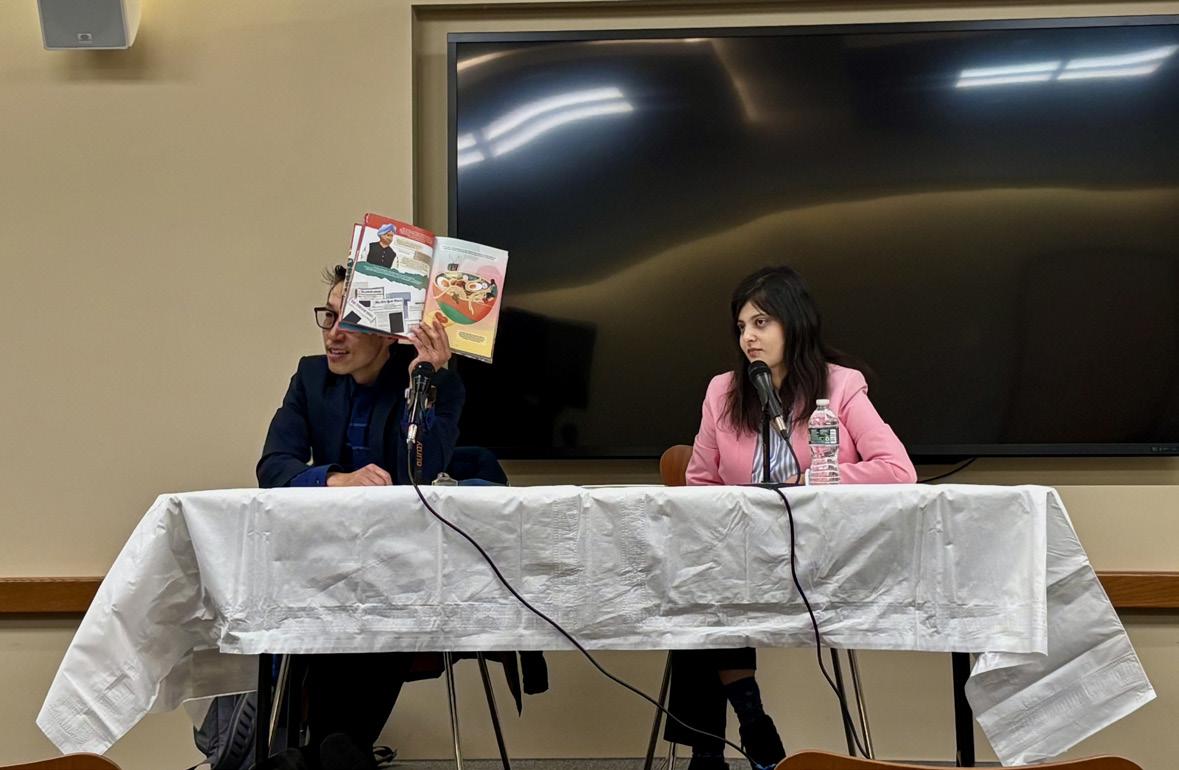
At the AASP event, Sohini talked about her inspiration behind her work, and what she hopes to inspire in others. CoDirector of Asian American Studies at Fordham University Stephen Sohn also answered questions on why the AASP chose to highlight Sohini’s work.
Sohn said, “many of our Asian American Studies minors have transnational affiliations, whether related to parents or grandparents who might have moved to the United States in search of better opportunities or who have traveled themselves across one or more national boundaries to make a new life...
In this sense, Sohini’s story
SEE SOHINI PAGE 5
Jewish Studies Department Hosts Lecture
By KAT ROSSI ASST. NEWS EDITOR
The Fordham University Jewish Studies department just held their third talk of their current lecture series titled, “On Disagreement in Jewish History” on Jan. 20 in conjunction with the Fordham School of Law. According to the department, this series was hosted in response to current polarization, as well as animosity and lack of respectful civil discourse in our society.
An emeritus professor of Jewish history, Edward Fram, Ph.D., from the Ben-Gurion University of the Negev with a specialty in Jewish Law in the modern period, spoke at the event. Fram has written four books on Jewish Law, the most recent being “The Codification of Jewish Law on the Cusp of Modernity,” from Cambridge University Press.
Fram’s lecture was titled “The Glory and Limits of Dispute in the Study of Rabbinic Culture.” According to the department of Jewish Studies, he was selected because his studies cover the early modern Jewish history period, which is not widely talked about but is crucial for understanding the history of disagreement.
A concrete aspect of Jewish faith is its long and rich history of debate and disagreement, according to Fram.
“The Jewish legal tradition offers an example of a community that (generally) tolerated divergent views on important matters,” Fram said in an email to The Ram. “They not only lived with internal disputes, but they also used them to refine and develop their beliefs.”
In the lecture, Fram had also highlighted that the development of legal pluralism regarding Jewish teachings and traditions arose from the need to adapt understandings
SEE FRAM, PAGE 4
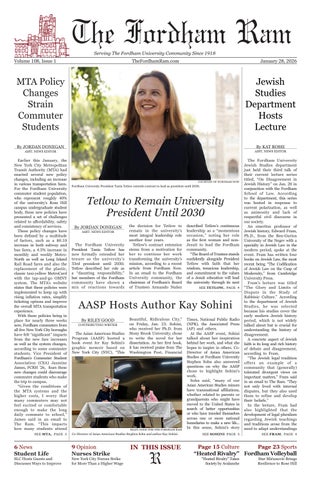
Fordham University President Tania Tetlow extends contract to lead as president until 2030.
COURTESY OF FORDHAM NOW
Co-Director of Asian American Studies Stephen Sohn and author Kay Sohini.
RILEY GOOD FOR THE FORDHAM RAM
PUBLIC SAFETY BRIEFS
Regional Garage
January 11
3:05 p.m.
On Sunday, Jan. 11, at 3:05 p.m., an employee reported the theft of items from their parked car in the Regional Garage. The supervisor responded, and the investigation revealed that the vehicle was unlocked. The supervisor reviewed the video, which showed the offender exiting campus. A banned person notice was prepared and distributed to all allowed posts.
2503 Belmont Ave
January 10
2:32 p.m.
On Saturday, Jan. 10, 2026, at 2:32 p.m., a student reported a burglary at their off-campus apartment on Belmont Avenue. The supervisor responded and contacted the NYPD. The investigation revealed the offender entered the apartment by pushing in the window air conditioner.
Terra Nova House
January 22
8 p.m.
On Thursday, Jan. 22, at 8 p.m., a smoke alarm went off in Terra Nova House on Hoffman Street. The supervisor and FDNY responded. The investigation revealed a student cooking food triggered the alarm. The supervisor ventilated the area and reset the alarm panel.
Dagger John’s
January 25
9:30 a.m.
On Sunday, there was a flood in Dagger John’s. The supervisor responded, and the investigation revealed there was a frozen valve on the exterior rear of the McShane Campus Center caused the flood. Facilities personnel responded to address the issue.
Fordham Professors Approach AI-Use
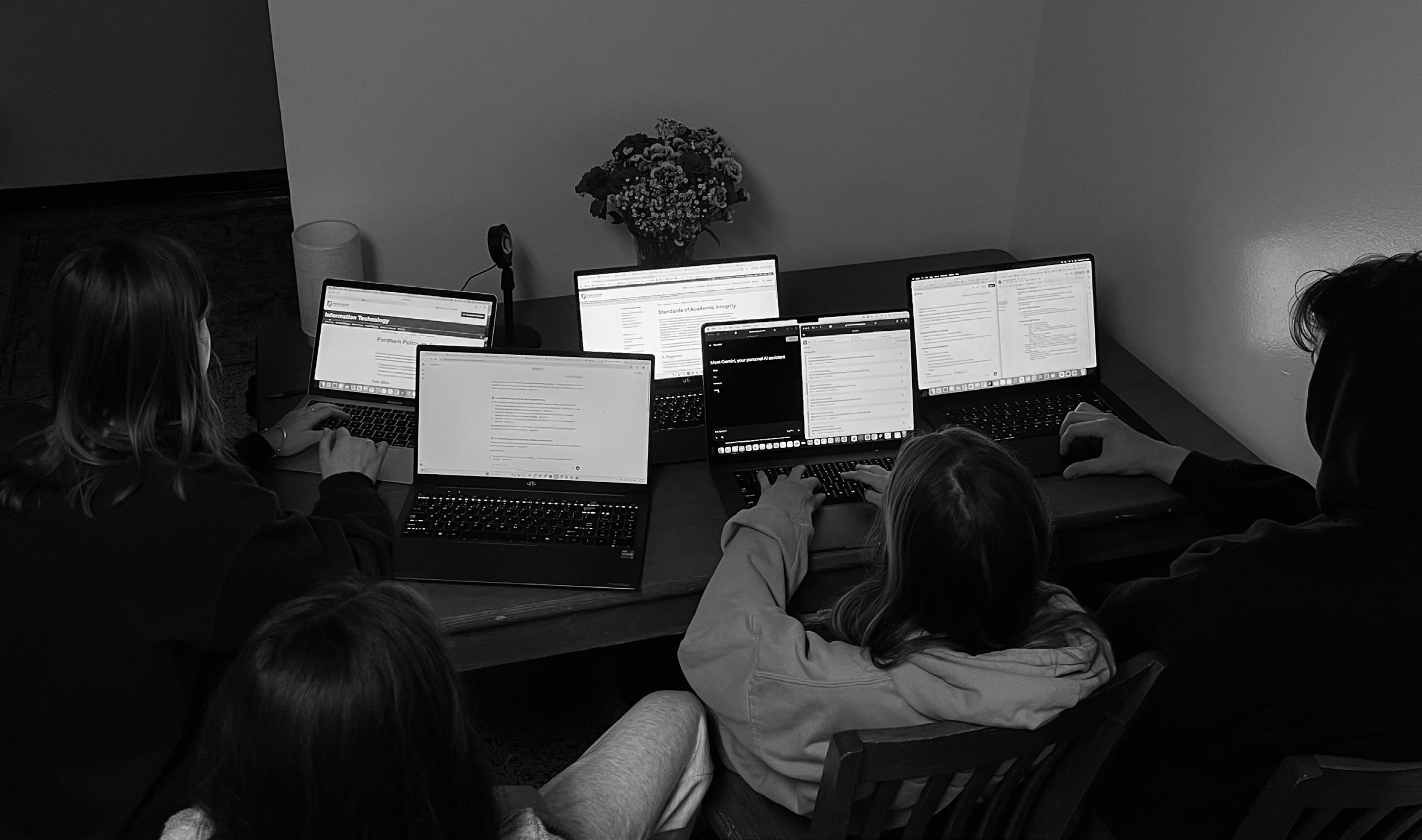
Students reading Fordham’s AI Policy and using generative artificial intelligence for class assignments.
By SIDNEY BLASCO FEATURES EDITOR
As generative artificial intelligence (GenAI) has steadily become a common tool used by students, especially in higher education, Fordham University has implemented universitywide policies aimed at guiding its usage, while leaving room for departmental and even professorial interpretation.
Since GenAI became publicly available in November 2022, there have been different approaches and regulations through the years, with the newest adaptation created this past fall.
Fordham’s official guideline on GenAI, utilized by professors and departments, states that AI is a tool that should be used in accordance with the University’s Standards of Academic Integrity.
The policy emphasizes that AI should not replace a student’s own intellectual labor or voice.
interpret these guidelines within their disciplinary context.
The policy states that “students can leverage [it] to enhance their critical thinking skills by engaging in interactive discussions with AI-generated content.” One professor who used a structured approach to AI use is Alex Gruber, who is a graduate student professor in the theology department.
Gruber had students pose questions to GenAI as an interactive machine and then pose the same questions to a faculty member. Students submitted screenshots of the AI interaction, documented the faculty conversation and wrote a reflection comparing the two experiences.
Anne Fernald, Ph.D., professor of English and women’s, gender and sexuality studies. “In fact, for the first time in decades, I have a tech-free classroom, with minor exceptions.”
Her decision was motivated by her desire for students to develop their muscles, as her job as an English professor is to teach students how to write and think about language.
On the other hand, Joshua Schrier, who is the Kim and Stephen E. Bepler chair and a professor of chemistry, regularly uses machine learning in chemistry classes.
of Academic Excellence in cyber AI,” according to a Fordham Now article. The article cited Thaier Hayanjneh, Ph.D., director of Fordham’s Center for Cybersecurity, on the impact of this designation for students.
“[This] will carry significant weight in the job market for graduates of Fordham’s cybersecurity programs,” Hayajneh said.
Follow The Fordham Ram on Instagram, Facebook and X @TheFordhamRam
Wednesday
January 28
Spring Career Fair
McShane Center - 303 1 - 4 p.m.
Companies like AlphaSights, PwC, Deloitte and many others will be at the Spring 2026 Career Fair looking to recruit students. Stop by to learn more about your favorite companies.
In July 2023, Fordham’s AI Vision Committee created a document titled “Policies and Principles on Using Generative AI Tools in Education,” which aimed to formulate “policies and principles that leverage the benefits of GenAI tools to enhance teaching and research,” as stated in the policy.
While the document lays forth general expectations, individual departments and professors are encouraged to
With no strict guidelines for professors, each comes up with their own framework. Gruber uses Fordham’s AI policy, the theology department’s advice and additional guidelines and sources such as the Vatican. However, the ultimate choice seems to lie with the student.
“If they are using artificial intelligence to substitute for their voice,” Gruber said, “especially doing it regularly, that’s their choice with their money, and I would invite them to rethink that choice.”
Other professors don’t feel the same and have strict restrictions.
“Generative AI for paper writing is prohibited and we’re not playing with it in class,” said
“We’ve created a whole series of activities that your typical chemistry major, junior or senior, will take as part of their lab experience to sort of bring machine learning into the work,” Schrier said.
Students using GenAI at Fordham are being set up for the real world, as the same tools are being used all over the country by researchers, according to Schrier and Gruber.
“Fordham has taken a pretty similar approach to other institutions of higher education, trying to put in guardrails of sorts while also trying to utilize or explore the benefits of artificial intelligence for students,” Gruber said.
Fordham has just been designated by the National Security Agency “to be one of the country’s seven National Centers
This Week at Fordham
Thursday January 29
F1 Film Screening
McShane Center - 112 4 - 7 p.m.
The collab of the semester is here, with the Career Center and Film Club screeing F1, proceeded by an IBM SkillsBuild credential on AI-Powered Racing. Popcorn, candy and drinks included.
Friday January 30
Open Jam Session
Rodrigues Coffee House 7 p.m.
Rod’s is hosting an open jam session, a mix between open mic and jazz sessions. Bring your instrument to perform, or go for the free music.
Saturday January 31
Men’s Basketball
George Washington Univ. 2 - 5 p.m.
George Washington University is hosting the Fordham’s Men’s Basketball team this Saturday. Lets go Ram’s!
In the Gabelli School of Business, the use of AI differs drastically. Navid Asgari, Ph.D., Grose Family Endowed Chair in Business, teaches classes like “Generative AI for Managers” and “Navigating AI Disruption,” according to Fordham Now. When asked if people were placing too much faith in AI at work, Asgari told Fordham Now, “Sometimes AI does something like write an essay, which makes it seem like it ‘thinks.’ It doesn’t think at all. There are neuroscientists who believe that AI is less intelligent than a cat.”
Tomas Vonder Haar, GSB ’28, supports the use of AI in the classroom.
“It’s useful for some assignments to help clarify and maybe to help find sources,” Vonder Haar said. “But for some essays you should definitely be striving to write that on your own and not just su bmitting something that AI wrote for you.”
Tuesday February 3 Blood Drive
McShane Center - Ballroom 12 - 6 p.m.
The Health Center, in collaboration with the NY Blood Center, have set up a two-day blood drive for the community.
SIDNEY BLASCO/THE FORDHAM RAM
USG Holds First Meeting of Spring Semester
By ANNA GAYTON USG COLUMNIST
The Fordham University United Student Government (USG) met for the first time this semester on Jan. 15.
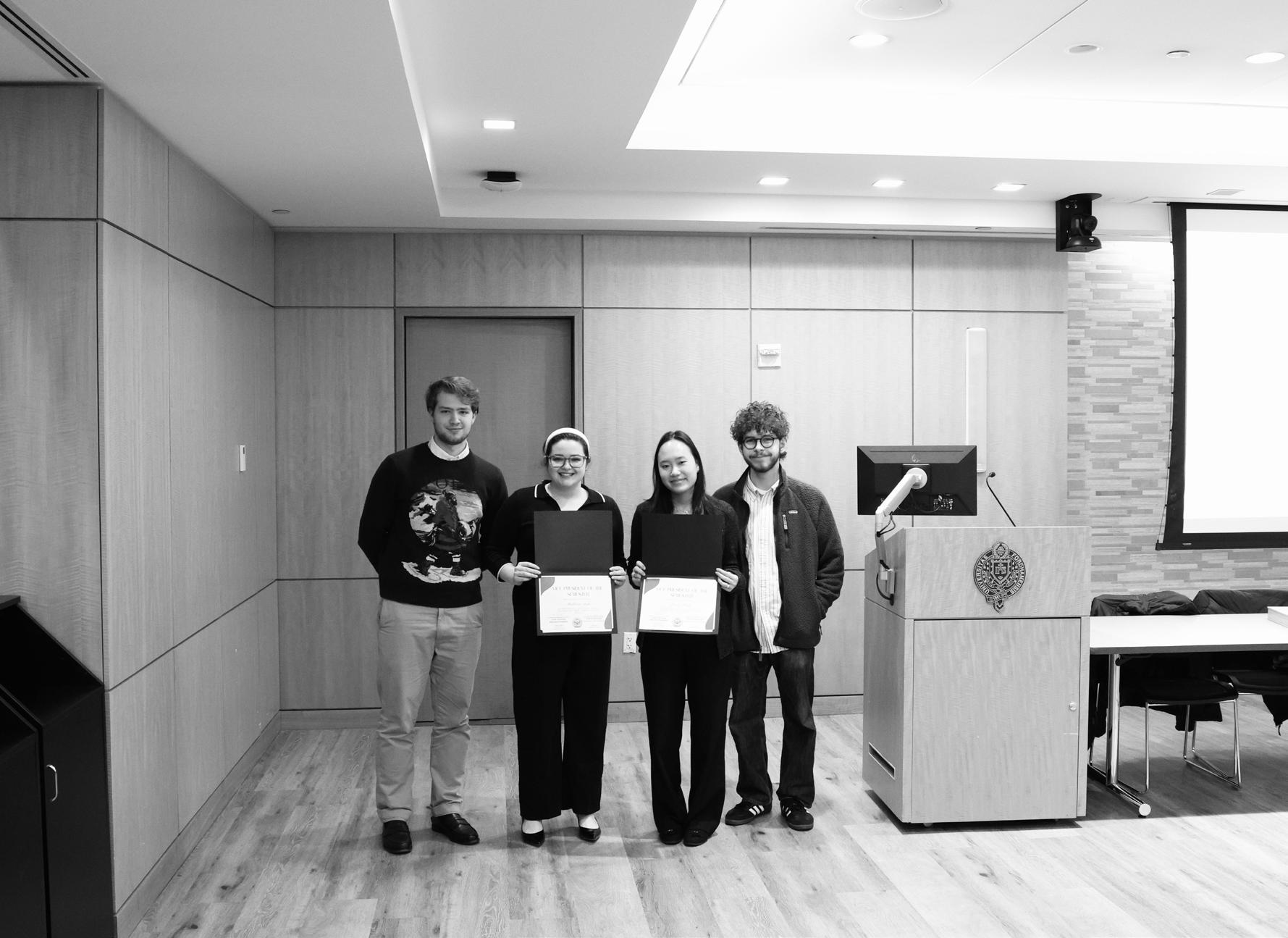
Executive President Lucas Hjertberg, FCRH ’26, and Executive Vice President Andrew McDonald, FCRH ’26, presented Vice President of Dining and Facilities Madeleine Ando, FCRH ’27 and Vice President of International Integration Jenny Hong, FCRH ’28, with the award for vice presidents of the fall semester.
To begin, Vice President of Fordham College at Rose Hill (FCRH) Mary Hawthorn, FCRH ’26, proposed a budget request for Chick-fil-A for the Dean’s Council’s first meeting of the semester. Hong presented a budget request for a hot chocolate event set for Feb. 4. Vice President of Student Experience Luc Angus, FCRH ’26, was absent but submitted a budget request for his committee’s art show. All three budget requests were approved.
Hjertberg said USG is overhauling how they do delegates before they pass their proposal. He also said that anyone who is part of Student-Athlete Advisory Committee (SAAC), Campus Activities Board
(CAB), Commuter Student Association (CSA), Resident Halls Association (RHA), the Army Reserve Officers’ Training Corps (ROTC), Center for Community Engaged Learning (CCEL), Campus Ministry (CM) or the Fordham Veterans Association (FVA), should let them know if they are interested in being a delegate for the time being.
Hjertberg also mentioned that the Jesuit Student Government Alliance is hosting a summit at the College of the Holy Cross and are looking for three members interested in attending.
USG’s meeting on Jan. 22 hosted special elections for two open FCRH 2027 senate seats, as well as one open Gabelli School of Business (GSB) 2027 seat.
Hjertberg announced the openings during this meeting.
The Contraception Policy Commission leading members, Vice President of Health and Security Aidan Costella, FCRH ’27, and Senator Henry Carstens, FCRH ’29, shared that the Town Hall regarding contraception distribution policy on campus was postponed in December 2025. They shared they were looking for ideas on how to improve support for students. Ando shared
a possibility of partnering with Catholics for Choice, a reproductive justice organization, and letting students get involved with the proposal and process. She continued by noting that many activists would want to come and help with the initiative. Carstens said the use of external forces puts a lot of pressure on the university, with Senator Domenick
Fedele II, FCRH ’29, saying that they have been gaining faculty support.
McDonald took ideas for USG’s upcoming semester retreat and Hjertberg said the tentative date is Feb. 7.
After a brief discussion, the possible ideas of Skyzone, Texas Roadhouse, Medieval Times, an escape room or a Brooklyn Nets game were suggested. However, no
concrete plans were made until their next meeting.
Hjertberg shared that there is currently about $1,500 worth of food sitting in the USG office suite. The food is from their Day of Service; however, it did not arrive in a timely manner. He said they are looking for volunteer USG members to bring the extra food to Part of the Solution.
USG Hosts 2027 Special Elections
By EMMA LEONARDI NEWS EDITOR
Fordham University’s United Student Government (USG) held their second weekly meeting of the semester on Jan. 22, where they heard public concerns, elected new senators and finished reviewing USG bylaw revisions.
To begin the meeting, Executive Vice President Andrew McDonald, FCRH ’26, asked the gallery if there were any public concerns to be addressed. Laura Cosma, GSB ’27, brought up several suggestions for campus improvements. Most notably, Cosma suggested adjusting the parking pass pricing for spaces in the Fordham garage, located next to O’Hare Hall. Cosma cited that the yearly student pricing rate is almost $1,000, placing extra financial burdens on commuters.
In response to Cosma’s concerns, Vice President of Facilities and Dining Madeleine Ando, FCRH ’27, shared that her committee is currently working on a proposal decreasing yearly rates of parking passes. Cosma also suggested the university look into incorporating artwork into campus buildings, specifically Hughes Hall, where the Gabelli School of Business
(GSB) is located. She noted that in order to be wellrounded, students should be learning about culture and history as well.
Following public concerns, USG held a special election for the three open senate seats allotted to the Class of 2027; one being available for a GSB student and the other two for students in the Fordham College at Rose Hill (FCRH).
Four candidates presented speeches on what they would accomplish in the USG senate in the hopes of being elected.
The first candidate to present was Anna Gayton, FCRH ’27. Gayton began her speech by informing the senate that as the (now former) Fordham Ram columnist for USG, she has closely followed their weekly progress and decided she wanted to become a bigger part of making change on campus through being on the USG senate.
Gayton noted that she is a transfer student, coming to Rose Hill from the University of Vermont, where she studied biology. She said her transition was difficult, as she felt alone in this new environment. If elected, Gayton informed the senate that she would work to bring back the transfer student mentorship program.
Next to present was Berkley Dorsten, FCRH ’27, former vice chair of the operations
committee and a former member of the USG senate. Dorsten noted that she hopes to continue her work with Catharine McGlade, assistant dean for Student Involvement, on improving the first-year formation program. Dorsten also suggested putting in place a feature on the Fordham app that would count the number of students in the McShane Campus Center gym at any given time.
The following speech was by Megan Ruzicka, FCRH ’27, who had previously served on USG both as a senator and as the vice president of operations. She began by citing her time as the latter, where she claims to have gotten about 10 clubs passed through the club creation process.
Ruzicka now serves on the committee of sexual misconduct. She said her main proposal would be to focus on expanding programs available to help students with chronic illnesses. A part of this would involve working on furthering the current USG excused absence proposal.
The final candidate to present their speech was Advika Dushyanth, GSB ’27, who had previously served as a senator and on the budget committee, along with the GSB Dean’s Council and Diversity Action Coalition committees. She promised
to advocate for emergency parking passes for commuter students as well as priority class registration for resident assistants (RAs) should she be elected.
Following a lengthy voting session, Gayton and Ruzicka were selected to fill the vacant FCRH seats, and Dushyanth took the sole GSB seat.
USG continued their weekly meeting by going over and finalizing the proposed bylaw revisions, put together by the specified commission and presented by Katelyn Martins, FCRH ’27, alongside Anna Wiss, FCRH ’26, and Domenick Fedele II, FCRH ’29.
The executive board updates
began with a brief statement from the new lead on the Contraceptive Commission, Vice President of Health and Security Aidan Costella, FCRH ’27, where he explained that the commission would not just serve to put on the town hall event that was postponed in the fall semester, but they would also hold various other events throughout the semester related to the policy reform. Vice President of Operations Tina Pathak, FCRH ’28, shared that the new club application form is now live on the USG website, with the form closing in three weeks.
The next USG meeting will be on Jan. 29 in Bepler Commons.
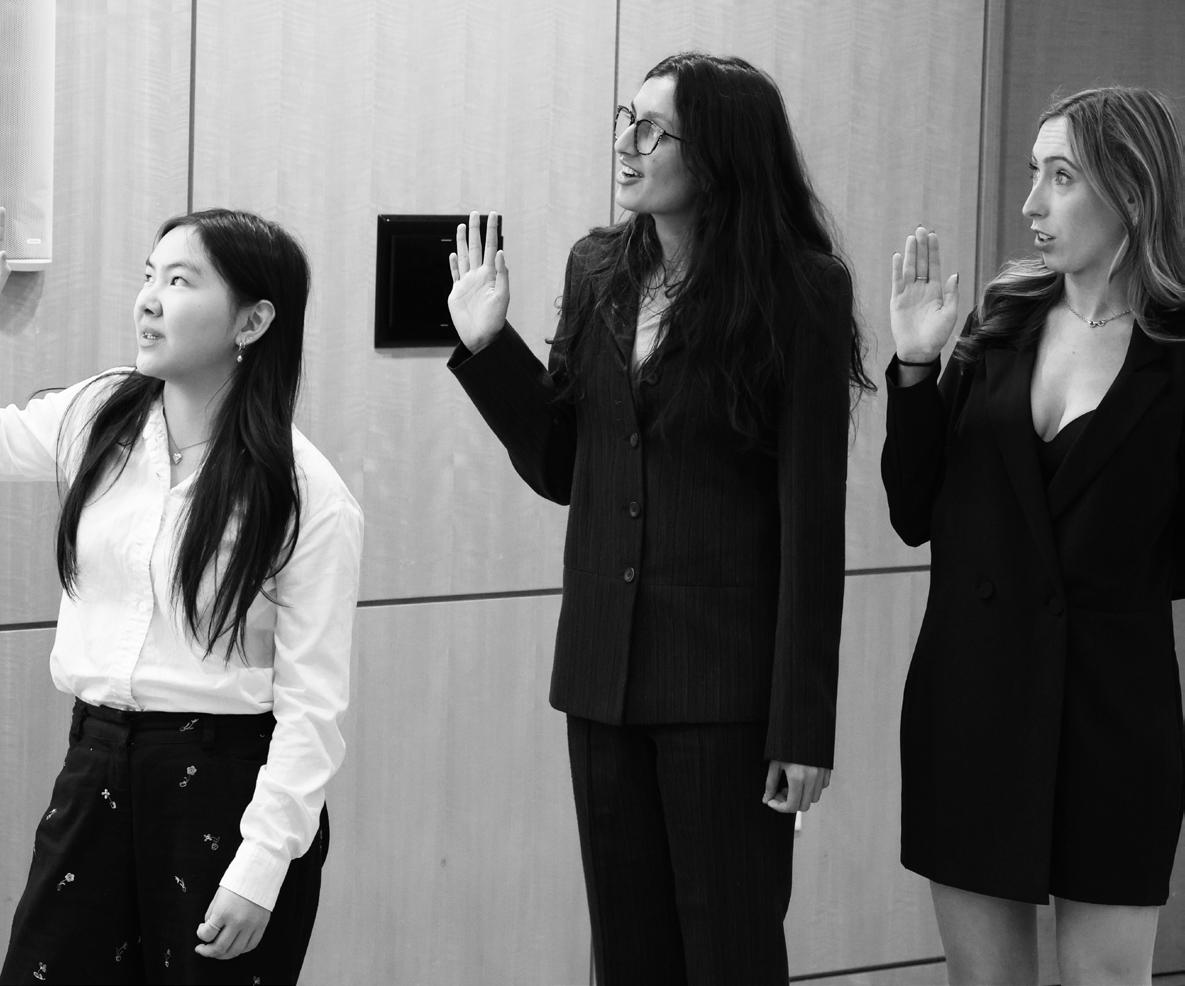
Fordham University’s United Student Government (USG) met Jan. 22.
ANDREW MASSIE FOR THE FORDHAM RAM
ANDREW MASSIE FOR THE FORDHAM RAM
Fordham University’s United Student Government (USG) held their first meeting of the semester on Jan. 15
prosperous chapter,” Nuñez said in an email to The Ram.
Tetlow described her love for the Fordham community and her enthusiasm with continuing her role as the face of university leadership in an email to The Fordham Ram.
Tetlow said she is particularly drawn to Fordham’s Jesuit mission and values, along with the individual uniquenesses of both of Fordham’s campuses.
“I am in love with Fordham – the meaning of our mission, the beauty of our campuses, the excitement of New York – and most of all, the greatest students ever,” Tetlow said.
Tetlow also acknowledged the great responsibility she carries as Fordham’s president and the deep need for Jesuit education in today’s society.
“I am thrilled to continue this work and be part of this community,” Tetlow said. “This university is so much older and bigger than any of us, and it is a daunting responsibility to lead us forward. I know that we have what it takes to face the future with courage and determination. The world has never needed Jesuit education more.”
In an email to the Fordham community, Nuñez had said
Tetlow Signs On To Stay Until 2030
that Tetlow’s leadership at the university is defined by “a series of transformative accomplishments that have strengthened the institution’s foundation.”
“She has led the university through challenging times in higher education and developed a clear and inspiring strategic vision to make Fordham the top choice for students who want to matter to the world,” Nuñez said.
Yet many of the Fordham students believe otherwise.
Atacus Jarret, FCRH ’28, cited what he described as a widespread dissatisfaction with Tetlow’s leadership amongst the Fordham community.
“It is no secret on campus that President Tetlow is very unpopular among both students and professors,” Jarrett said within an email to The Ram. “Budget cuts, hiring freezes, union disputes and weakening prestige have plagued her time as the face of the administration. However, what has stood out to me the most regarding the administration is an evident lack of identity.”
Bella Marino, FCRH ’26, expressed a need for effective leadership amongst Fordham’s president.
“We need a strong leader
at Fordham University and someone who’s going to listen to the students, professors, adjuncts and any faculty regarding the well-being and personal wellness and happiness of everyone on campus,” Marino said.
Finnegan Marshall, FCRH ’28, questioned Fordham’s decision to extend Tetlow’s leadership contract, drawing on the lack of university improvements since Tetlow took office, along with declines in Fordham’s national and academic rankings, despite
receiving a gross income of nearly $1.7 million a year.
“The general understanding to me is that when you’re the president of a university, you get paid the most because you bear the most responsibility for the success of the university, remind you, that price tag is $1.7 million in gross income a year for Tania Tetlow,” Marshall said. “Yet, it doesn’t feel like she has received much of that responsibility because while rankings continue to go down, the university of itself just isn’t really developing. I think
that it is misrepresentative of her time so far here.”
Saba Fajors, FCRH ’29, said she believes Tetlow’s contract extension will bring stability to the Fordham community. “As a freshman, I don’t know a lot about university leadership yet, but it seems like extending President Tetlow’s contract brings some stability to Fordham,” Fajors said in an email to The Ram. “It’s nice knowing the administration won’t be changing right away while I’m still getting used to campus and college life.”
Speaker Discusses Disagreements in Rabbinic Culture
of the Torah to changing times, which was achieved through interpretation and the existence of various schools.
One example of these varied interpretations that Fram spoke about is on the cooking of food during the Sabbath. Sabbath, or Shabbat, lasts from sunset on Friday to sunset on Saturday in Jewish tradition. During
this period of time, Jews are prohibited from performing 39 types of work, one of which is the cooking of food.
However, according to Fram, the rules of the Sabbath are not as clear and are open to interpretation. For instance, Rabbi Meir interpreted that food being cooked on the Sabbath could unintentionally be enjoyed provided that one
was unaware it was the Sabbath. Rabbi Judah suggested that it could be eaten but not on the Sabbath. Rabbi Hasandlar understood that any and all food could not be eaten by the same person who cooked it. All three interpretations come from various biblical interpretations.
“The rule was never codified in the Mishnaic period,” Fram said. “There was no guidance
on how to act. Nevertheless, all three possibilities are considered part of the rabbinic tradition.”
While the disagreement may seem inherently divisive, it doesn’t have to be, according to Fram.
“[There are] multiple views, part and parcel of rabbinic legal culture, [with] centuries wrapped by dealing with possibilities and creating
new possibilities. This made for a vibrant and sometimes animated legal culture,” Fram said. “I’m just in the early modern period … It’s tilted down. [It] does not mean that new ideas and positions are not being developed and deb ated to this day.”
The recorded lecture can be found on the Jewish Studies department’s YouTube page.
Staff Hopes for Volume 108 of The Fordham Ram






FROM TETLOW PAGE 1
FROM FRAM PAGE 1
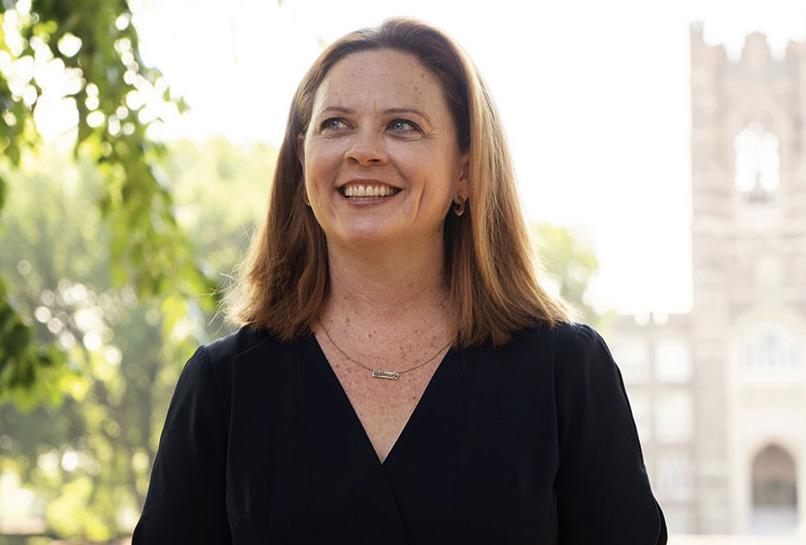
Fordham University President Tania Tetlow has enacted multiple changes during her tenure.
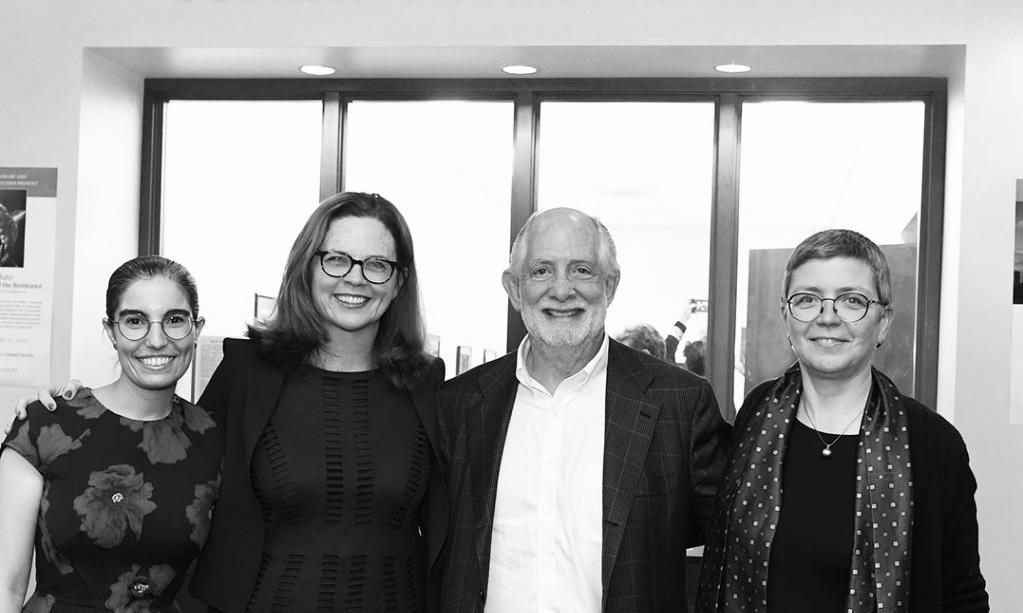
COURTESY OF THE FORDHAM UNIVERSITY JEWISH STUDIES CENTER
Kay Sohini Discusses Graphic Novel Based On NYC
comes to be one that resonates with so many of us.”
As a South Asian American migrant, Sohini conveys her personal experiences in New York and how it became a place of belonging and home for her. She was greatly inspired by Alison Bechdel’s 2012 graphic memoir “Are You My Mother?” and decided to write a comic book for her dissertation, an unconventional route but one she does not regret.
“Comics are not just about superheroes or for kids,” she said. “The versatile imagetextuality of the medium can be utilized to tell a wide range of stories in an engaging and innovative way.”
Sohini loves New York City
and its close proximity to vibrant culture. With the opportunity to attend Broadway shows and museums on a whim, “it feels magical to be in the presence of great works and cultural institutions,” she said.
However, Sohini does not gloss over the many problems that come with New York. Her memoir struggles with the conflicting feelings of loving a city that creates belonging but also creates systems which make that sense of belonging feel fragile for many.
For example, Sohini touches on the racialized divides of the city through the housing crisis. As cited by her, roughly 1.5 million adults and almost half a million children in New York are living in poverty. It
is difficult to reconcile with those numbers as the economic disparity plaguing the city continues to grow.
“I always want more New Yorkers to think more critically about this beautiful, ridiculous city, especially at this moment, when the housing crisis is at its historic peak,” she wrote in an email to The Ram. Nevertheless, in times of great political turmoil in this country, Sohini views New York City as a beacon of hope and a safe haven for many.
An attendee at the event, Eva Lee, FCLC ’27, shared her personal relationship with the memoir and why it has had such an impact on her life:
“I love that this graphic novel is widely accessible
for all ages. My mother is a Chinese immigrant and has a low reading level,” she said. “She saw Sohini’s book on my nightstand and found she was able to grasp its meaning. I love seeing my mother enjoy literature because it’s not something we’ve been able to connect on before.”
Like Lee and her mother, this novel is influential to people of all ages and backgrounds, a testament to its praise and inspiring qualities.
After the discussion about what this book means to the audience, Sohini was asked why this book means so much to her and the momentous gratification she feels in having written it.
“To write for a living is such
a privilege,” she said. “I have been writing and making comics full-time for three years now. I cannot believe that this is my life, that I get to do my favorite thing in the whole world: write and illustrate, and real publishers work with me. I come from a very humble background and I couldn’t have dedicated all my time to creative pursuits if I wasn’t making a living off it. It feels like a precarious privilege that can be taken away any moment.”
For Sohini, the ability to inspire others, while also being able to follow her dreams, is what makes this book so special.
“We all need a book that reminds us why we like New York City,” Sohn said.
Changes to MTA Policies Affect Fordham Commuters
classes regularly, participate in the Fordham community after classes and remain as Fordham students long-term.”
For Arleth Gavilanez, FCRH ’27, who commutes to Rose Hill five days a week using both the subway and local buses, the added cost of the extra fares have intensified pre-existing financial strains.
“The fare increase has significantly impacted me financially, although it was already expensive it is still a significant enough change that it significantly adds up,” Gavilanez said in an email to The Ram. “What is most frustrating sometimes is paying the fare just for the train to end up delayed or stopped and having to walk to another station and pay the fare again just to make it to class on time.”
While the most outstanding effects of these changes are the increase in fares, Gavilanez says they have also provoked a range of additional effects.
“[I’ve] noticed certain stations being policed considerably more as more people have been opting to skip the turnstiles rather than pay, understandably so with the cost,” Gavilanez said.
According to James, there have been numerous commuters who have begun taking substitute approaches to get to campus, such as driving.
“I have several friends who began driving instead of taking buses and trains, since the state of these systems, such as overcrowding and cleanliness, does not justify the heightened cost that many of us are paying for these services,” James said.
James also said the CSA has not had any formal discussions about the new MTA policies but that they “are open to collaborating with administrators in the future to hold information sessions.” She said there are ways that Fordham could better support the commuter student body while they also navigating these various system
changes with the MTA.
James had said, “Fordham could hold information sessions with MTA partners for students, highlighting the new policies.”
James continued, “Many students right now may need more clarity on the “why” behind these policies, since MTA has done little outreach with us.”
Galvinez had also noted that she believes Fordham could provide her and others with more financial assistance for their commuters, such as something similar to the City University of New York’s (CUNY) Commuter Benefits Program, which extends free transportation services to the commuter students.
Galvinaz said, “I personally would love to be able to apply for the commuter scholarship as I wasn’t offered one when I was accepted, I wish that I could explain how much of a hardship it causes having to spend up to 12 dollars a day just to be able to get the education
I’m paying for.”
She continued, “I understand scholarships can’t be offered to everyone, but maybe enacting
a program similar to that of CUNYS which allows for students to receive OMNY cards could also be of great assistance.”

Campus Security Increases in Response to Threat
By EMMA LEONARDI NEWS EDITOR
Alongside a couple of other (previously unnamed) U.S. universities, Fordham received “threatening emails containing similar language” early in the morning, of Jan. 22, according to an email sent out by Robert Fitzer, associate vice president of Public Safety, to the whole Fordham community at 11:09 a.m. on Thursday morning. In the email to the Fordham community, Fitzer said that “the emails condemn a long list of racial and religious groups,” as well as “threaten specific buildings on each campus.” Walsh Library and Freeman Hall, both academic
buildings at Fordham’s Rose Hill Campus, were named as targets of these threats.
He also said that “the NYPD [New York Police Department] Emergency Services Unit [ESU] conducted a thorough search of the interior and exterior of Walsh and Freeman” before either building opened this morning, and that they “found no evidence and determined there was no immediate threat.”
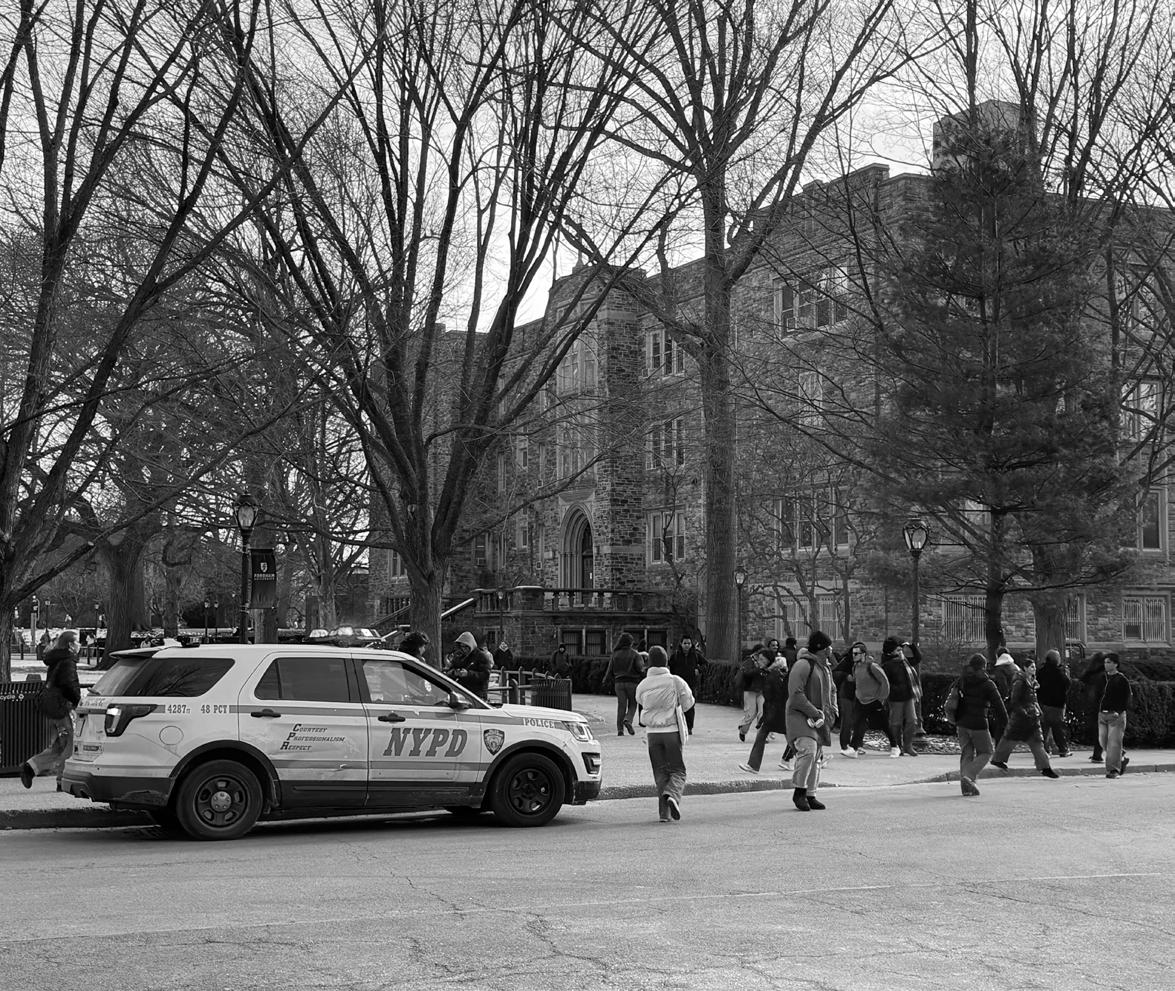
Fitzer noted that there would be heightened security on the campus Thursday, including the presence of NYPD officers, “out of an abundance of caution.” He also advised the Fordham community to call 911 or contact Fordham Public Safety at 718-817-2222 if they
see anything suspicious.
In another email that was later forwarded to The Fordham Ram, Fitzer elaborated on the incident.
“We believe the threat was a hoax or swatting, similar to those that took place in September 2025. A few senior leaders at Fordham received the emails alerting us to a potential bomb threat, as did individuals at other universities including NYU and Villanova,” Fitzer said. “Fordham will have additional resources on campus while this investigation continues and our security team will be on highalert to ensure that anyone who attempts to enter campus has proper identification and a purpose to be here.”
FROM SOHINI PAGE 1
FROM MTA PAGE 1
Subways as well as buses have been affected by this policy. COURTESY OF AMNY
The NYPD was present in front of Freeman Hall on Jan. 21.
EMMA LEONARDI/THE FORDHAM RAM
SLC Hosts Guests and Discusses Ways to Improve
By EMMA LEONARDI NEWS EDITOR
The Fordham University Student Life Council (SLC) held its first meeting of the semester on Wednesday, Jan. 21, to hear from multiple guests in order to discuss how the SLC could be improved, as well as various updates.
The first guest speakers to present were Vice Provost for Student Success Elizabeth Rainey, Ed.D., and Digital Campus Experience Manager Sara Sapienza, who spoke about the inaugural First Year Forward events. The program is a “series of events curated specifically for the firstyear class,” which attempt to “bridge the gap between wellness, career readiness, and classic NYC fun,” according to Fordham’s website page.
This is the first time these events will take place, and this lineup serves as a soft launching of the series before they become annual in future fall semesters. The events will take place from Jan. 21 to Jan. 31, and, according to Sapienza, an email was sent out to all first-year students to promote the program series.
Some events mentioned at the meeting were the Spring Career Fair, which will be held on Jan. 28 from 1 p.m. to 4 p.m. in Room 303 of the McShane Campus Center, as well as ice skating in Central Park, which will be on Jan. 30. Registration for this event closed on Jan. 23, and the first 100 students to get to the event will receive a free beanie.
When Sapienza asked the SLC for suggestions on how to improve the First Year Forward events, the President of United Student Government Lucas Hjertberg, FCRH ’26, suggested weaving the club fairs into the event lineup. Co-President of the Campus Activities Board (CAB) Emma Seber, GSB ’26, suggested collaborating with CAB in the future.
The second guest to present was Director of Fordham University’s Office of Career Services Annette McLaughlin, who was invited to talk about Fordham’s internship promise.
“Every undergraduate student will have the opportunity to land at least one internship, including research and other experiential learning, gaining real-world experience that top employers seek,” according to the Career Office’s website.
According to McLaughlin, the university is currently working with departments to curate webpages with opportunities catered to certain majors, with the hope that getting these opportunities into an online system will not limit students’ opportunities to network.
Members of the audience posed several questions to the SLC. The Paper
Editor-In-Chief Emeritus Adam Serfilippi, GSB ’26, asked whether the opportunities listed will be strictly for the Fordham community or externally as well. McLaughlin assured that there would be options listed for both.
McLaughlin noted that the opportunities will be for all students, regardless of their school, and that the university is trying to elevate resource access for Rose Hill students so that they are more balanced across the schools.
Dean of Students Kevin Williams then asked for feedback from not only the SLC council, but the gallery as well. McDonnell added that the SLC is a really powerful resource for students if they use it, with both wondering how to involve students more.
Associate Director for Campus Center Operations Stephen Clarke suggested that the council bring in guests that the student body is actually interested in, as well as bringing in different student clubs, in the same way that the different departments are invited. Serfilippi suggested bringing in club liaisons as is done during the USG weekly meetings.
Hjertberg pitched an idea for an SLC-specific Blackboard page that every Fordham student can be added to, with potential subsections for the big four clubs (USG, RHA, CAB and CSA), as well as a calendar and contact subsection. This could make it easier for students to submit public concerns and find the time and location for each SLC meeting.
For SLC updates, CAB informed the council that they are focused on Spring Weekend planning. An event for Valentine’s Week is also being scheduled, with specific dates and events to come.
Hjertberg informed the council that there were 137 clubs and/or departments at the Spring Club Fair, and estimated 1,000 people were at the event. He also told the council that USG would be holding special elections on Jan. 22 for the three open Class of 2027 senate seats, one being for a GSB student to fill and the other two being for FCRH. Information sessions for spring elections will begin in early April.
GSB Assistant Dean for Seniors Jenna Cook, Ph.D., noted that the add/drop period ended on Jan. 21. Summer registration for GSB will begin on March 2. Emails for commencement start on Jan. 23, and Cook emphasized that each graduating senior is entitled to two tickets to commencement should there be severe weather, but the tickets must be claimed.
Assistant Director of Residential Life for Housing Operations Nicole Vaughan, M.Ed., noted that the Resident

Assistant (RA) recruitment process is underway. A total of 249 applications were received, with interviews and networking sessions beginning in early February. The application for returning RAs has not closed yet. Assistant Dean of Students and Director of Residential Life Charles
Clency shared that the average returning RAs have historically been around 30, with the total number of RAs needed being 97. Vaughan mentioned that in early February, all residents will get an email for deposits for housing for the next academic year, and they will
have two weeks to submit them. During his updates, Williams explained that there would be microphones for each member of the council starting during this meeting so that everyone can properly hear one another. The next SLC meeting will occur on Feb. 11 in the Campbell Multipurpose Room.

The Fordham University Student Life Council met on Jan. 21 in Bepler Commons.
EMMA LEONARDI/THE FORDHAM RAM
RServing the Fordham University campus and community since 1918
The Fordham Ram is the university journal of record. The mission of The Fordham Ram is to provide a forum for the free and open exchange of ideas in service to the community and to act as a student advocate. The Fordham Ram is published every Wednesday during the academic year to all campuses.
Website
TheFordhamRam.com
Email Address theram@fordham.edu
Editor-in-Chief
Sienna Reinders
Managing Editor
Ian Nelson
Production Editor
Sarah Verrastro
Editorial Director
Molly O’Connor
Multimedia Director
Hannah Sullivan
Business Director
Nishanth Aduma
News Editor
Emma Leonardi
Features Editor
Sidney Blasco
Assistant News Editors
Jordan Donegan
Kat Rossi
Opinion Editor
Loressa Zeqiraj
Assistant Opinion Editors
Erynn Sweeney
Gabriel Capellan
Culture Editors
Lara Ejzak
Makenzie Smith
Assistant Culture Editor
Paolo Liaci
Sports Editor
James Nelson
Assistant Sports Editors
Molly Friedman
Ethan Bess
Copy Chief
Indigo Towers
Executive Copy Editors
Emily Mitton
Uma Petzke
Emma Kelner
Social Media Director
Haniyyah Usmani
Photo/Graphics Editor
Didintle Masie
Digital Producers
Han Le
Marisa House
Advertising Directors
Violet Wallace
Juan-Pablo Valencia
Rishika Lingamdinne
Faculty Advisor
Beth Knobel
Editorial Policy
The Fordham Ram’s editorial reflects the editorial board’s opinions or views.
Opinion Policy
The opinions expressed in this publication are those of the authors. They do not necessarily reflect the opinions or views of The Fordham Ram.
Submission Policy
The Fordham Ram Reserves the right to reject or edit any submission for any reasion, without notice. Submissions become the exclusive property of The Fordham Ram. No part of The Fordham Ram may be reproduced without written consent.
Correction Policy
The Fordham Ram is committed to fair and accurate reporting. If you are aware of an error, please contact us at fordhamramonline@gmail.com.
From the Desk | Paolo Liaci
The Whimsy “Rest” of A Snow Day
I used to think that all humans do is evolve. Do better, look better, become more efficient workers. That evolution feels like the steady march of the world — a world moving toward improvement and contribution, toward something like perfection. I still believe in growth, but I no longer believe that evolution always means progress. What even is perfection, anyway? And somewhere along the way, in our pursuit of it, we seem to have lost something small but meaningful. I found this, however, in a lost art: a snow day.
On Sunday, New York was buried under more than 16 inches of snow. Streets were quieter than usual. Cars moved slowly, if at all. The city was paused, and yet, nothing actually stopped. Emails still came through. Classes were set to meet on Monday, and the deadlines still loomed. As children, snow days meant something. They weren’t just a day off; a snow day was collective permission to rest. You’d wake up early, turn on the TV and wait for your school’s name to scroll across the screen. When it did, there was no guilt attached. No “making up” the time. No expectation to check-in remotely. Everyone was off together.
Imagine you walk outside on a Monday morning to head to work and are greeted with the terrified screams of your neighbor, a young mother. Two masked men stand by an unmarked vehicle with guns raised, pointed at the young family of three. You watch as she begs and pleads for mercy, but they take her husband and five-yearold son away anyway, offering no information about who they are or where they are taking them.
You try to yell, “Stop!” but you know it is worthless, instead capturing as much of the interaction on video as you can. You catch your neighbor in your arms as she falls to the ground, crying out for her family.
Though it may be hard to believe, this is the reality for millions of Americans right now, worst of all for those in Minneapolis.
On Jan. 7, towards the beginning of Immigration and Custom Enforcement’s (ICE) occupation of the city, Renee Good, a 37-yearold mother, was shot in the head by an ICE agent while attempting to drive away from the scene. ICE officials and President Donald Trump have claimed it was an act of self defense, stating that she was trying to run over the ICE agents. But video footage shows that her tires were facing away from the agents, making no contact with them.
ICE’s policy states that agents cannot fire at the operator of a moving vehicle unless the agent has reasonable belief that “the operator poses an imminent danger
Time slowed, and for once, that was okay.
The magic, I believe, of a snow day was never really about the snow. It was about interruption. It was about acknowledging that sometimes life demands a pause. The world didn’t collapse when productivity took a rest day. Rest wasn’t something you had to earn; it was something you were allowed. Somewhere along the way, we eliminated that pause. Remote learning, Zoom meetings, Blackboard assignments and Slack messages are now carried with us everywhere we go. The justification is convenience and flexibility, and on paper, that sounds like progress. But in practice, it’s quietly exhausting. We didn’t become more resilient; we became more reachable, and I do not think that’s a good thing. Now, even a snowstorm can’t excuse us from being unavailable. If we can log on, we should. If we can submit, we must. There’s an unspoken pressure to prove that nothing, not weather, not exhaustion nor circumstance, can slow us down. Rest has become laziness. Stillness has become inefficiency.
For students especially, this constant forward motion is sold as preparation for the “real world.” Hustle now so you can

succeed later. Stay busy so you stay relevant. But what happens when there is no later? When every moment is already filled? When there’s no space left to process, reflect and exist?
Though snow days no longer offer a shared exhale, they can still remind us that productivity isn’t the same as purpose — that time spent doing nothing could still be meaningful. Losing these days may seem trivial in the grand scheme of things, but it speaks to a larger cultural shift: our refusal to stop. Even on campus, that refusal is visible. We rush from class to class, from meeting to meeting, from
Editorial | Immigration
Love Thy Neighbor
of serious bodily injury or death to the officer/agent or to another person.” The killing of Renee Good violates this policy, contradicting the agency’s mission and causing senseless violence.
Amidst the outrage of nationwide protests following Good’s death, Alex Pretti, a 37-year-old nurse, was killed by ICE agents in Minneapolis on Jan. 24 while attempting to protect another woman and recording the agents. Again, ICE officials and the Trump administration have argued in defense of this unjust death, claiming he was holding a gun to the agents and threatening their lives. But video footage shows that he was just holding his phone to record the agents, a completely legal action. Pretti had a handgun in his holster, not in his hand, and ICE agents confiscated it while pinning him down before fatally shooting him several times. There was no threat to them but the threat of exposure from Pretti’s video, and that was enough to take his life.
Additionally, last week in a Minneapolis suburb, five-yearold Lucas Conejo Ramos was used as bait by ICE to capture his father. They had him knock on his own front door, and then detained him along with his father. He was the fourth student from his suburb to be detained by immigration officials in recent weeks. Are these really the violent criminals that we need to rid our streets of? Five year old boys in bunny hats?
But it isn’t just Minnesota. ICE
agents have been deployed all across the country, from Maine to Oregon. It would be naive to believe that New York is safe from these invasions. In fact, just two weeks ago a New York City Council data analyst was detained by ICE at a routine court appearance. Right now, it is essential for New Yorkers to know their rights if and when they are confronted by ICE.
If ICE is at your door, ask them to state who they are, confirm by showing their badge or ID and show a judicial warrant (signed by a judge). If they don’t have one, you have the right to say “I do not want to speak with you” and not let them in. If they provide one, you will have to comply.
If they enter your home without consent, clearly say “I do not consent to you being in my home. Please leave.” Even if this doesn’t stop them, it may help you with future legal cases.
If you are being detained by immigration officers, remember that you have the right to remain silent, the right to an attorney and the right to an interpreter if needed. You do not need to sign any documents or answer any questions without a lawyer present.
Unfortunately, although you have these rights in accordance with the Fourth Amendment, exercising them may not protect you because of how ICE agents are being trained. An internal ICE memo dated May 12, 2025, recently leaked by the Associated Press, tells agents to only rely on
internship to obligation, wearing our busyness like a badge of honor. We’re constantly connected, constantly informed, constantly overwhelmed. And yet, we’re rarely present. Journalism teaches us the value of observation, of noticing what others overlook. Sunday’s storm made something clear: when nothing ever stops, nothing ever gets processed. If we don’t allow ourselves moments of interruption, we lose the ability to reflect on what we’re actually working toward. During Sunday’s storm, I accomplished one thing: I made my bed, and I’m okay with that.
an administrative warrant when performing unwanted searches and seizures. Unlike a judicial warrant, an administrative warrant does not require a signature from a judge, and does not grant law enforcement entry to a private residence without consent.
The beauty of New York lies in its diversity. The food we love, the art we enjoy, the places we spend our time, none of it would be possible without the culture brought by immigrants. New Yorkers must be ready to protect their neighbors and fight back against this injustice. Report sightings of immigration officers in NYC by texting or calling 229-304-8720 from 6 a.m. to 6 p.m. or going to iceout.org, and use the SALUTE format: Size (number of officers), Activity (what they are doing), Location, Uniform description, Time witnessed and Equipment (i.e. visible weapons). Document what you can without putting yourself or others at risk.
We cannot become numb to these atrocities. What ICE is doing in our cities is nowhere close to normal or okay. The people of our country are living in fear of being kidnapped, injured or killed by a government agency that claims to protect us. Call your representatives and urge them to vote against the upcoming appropriations bill that would increase the budget for the Department of Homeland Security and ICE, and fight for substantial change that will help the Americans they have been elected to serve.
U.S. and Venezuela: Hegemony Under the Guise of Security
By ETHAN BESS ASST. SPORTS EDITOR
The second Trump administration has been beating the drums of war against Venezuela, and the American public is asked to believe a certain narrative that this is about protecting this country from drug smuggling and narco-terrorists. But many, including myself, have different thoughts and believe that this is disguised as a humanitarian act with the true goal of regime change.
In fact, Venezuela sits on top of approximately 303 billion gallons of oil reserves, making it the largest proven oil reserve on the planet. The current administration is using the justification that it isstopping the flow of narcotics from Venezuela, saying that substantial amounts of fentanyl enters the United States from Venezuela, but the paperwork and verified numbers tell a different story. The
U.S. International Narcotics Control Strategy Report, posted in March 2025, says that Mexico, not Venezuela, is the primary source of fentanyl entering the United States, and the DEA agrees with this assessment. In that same report, it’s discussed that less than 10% of all illicit drugs in the U.S. come from Venezuela, and the amount of cocaine imported is 0%.
As a matter of fact, if the U.S. was serious about stopping drug trafficking, it would look to the Pacific Ocean as opposed to the Caribbean. Mexico is a giant transfer zone of drugs into the United States, but maps from the Department of Justice show most flowing from Colombia into the Pacific. Nonetheless, one can see that this is a masked operation, just like one carried out in Iraq during 2003. It’s also necessary to acknowledge these similarities with respect to the 21st century, as the war in Iraq is the most controversial war that
has occurred since the turn, so I believe it’s only right to compare it to this recent invasion.
The buildup to the Iraq war involved about two years of propaganda buildup by the Bush-Cheney administration around the idea that Saddam Hussien had weapons of mass destruction and ties to AlQaeda, which is the terrorist group that attacked the United States on 9/11. These claims later proved to be false and exaggerated as there was no credible evidence to support them, leading many Americans to think: “Was this war about natural resources and oil?” Their suspicions had merit, as it was later reported by CNN that defense contractors such as KBR that Dick Cheney had ties to revealed that he made about $40 million from the Iraq war and the devastation that followed. The backlash proved to be very consequential, as some have argued that it broke the entire region and became a

By LAUREN LUM CONTRIBUTING WRITER
The add/drop period is a time during which students can register for and remove classes from their schedules without consequence. At Fordham, this is typically around seven school days. This usually gives the students the opportunity to attend only two or three classes in each subject, given the course meets more than once a week. One week is not enough time to decide what my fate for the semester is going to be. Will I decide to continue to suffer through my three-hour-long science class, or do I want to switch into an 8:30 a.m. philosophy class on Friday instead? It’s unfair to ask students to determine their lives for the next four months in only a few days of class. The online registration process is already stressful enough without the added pressure of knowing that there are very
few chances to decide if the class is worth taking or not. For students in STEM, the short add/drop period is even more problematic than it is for humanities majors, as STEM labs do not begin until after the period passes. In the fall of 2025, I was advised to register for biology, chemistry and pre-calculus. Bear in mind that biology and chemistry are both accompanied by a lab and recitation. As a first-year, I had no idea what I was getting myself into and only realized that my schedule was too much to handle after I took the labs. I, and many other STEM students with whom I spoke this semester, had to drop the classes with Ws (Withdraws) on our transcripts as the Fordham STEM degree plan is not a manageable schedule for many students. Undergraduates in this position end up as part-time students with fewer than the
hotbed for terrorism because of U.S. intervention. With this context laid out, let’s now look at current-day Venezuela.
The current Trump administration argues that the reason for waging this war in Venezuela is not for resources, but to stop the drug smuggling coming into the United States, referencing the theory that Nicolás Maduro is a drug lord and is the head of a major cartel by the name of Cartel de los Soles (Cartel of the Suns in Spanish). However, Cartel de los Soles is not a traditional drug cartel, nor is there any substantial proof to say that it even exists. The U.S. government hasn’t brought forward any evidence to suggest that Maduro is linked to these cartel members, so one can assume it’s a way to manufacture consent for a bigger attack on Venezuela.
This can also be linked to the fishing boats being bombed off the coast of Venezuela. Many human rights activists and groups say that these strikes, which have occurred on more than 20 boats, are not only illegal under international law, but also under U.S. law. Framing them as “extrajudicial killings,” I might also add that Article 2(4) of the U.N. charter forbids the threat or use of force against territorial integrity or political independence of a state unless that state is an imminent threat to the one exhibiting the force. Venezuela hasn’t posed an imminent threat, so there is merit to the argument that these strikes (under international law) are very much illegal, especially the double tap that Pete Hegseth ordered after the first boat strike.
U.S. operations in Iraq defined the 2000s and millennials’ lives due to their destructive
nature, and Venezuela could define Gen Z and Gen Alpha in a similar manner considering the devastating implications for the U.S. globally. What one may be concerned about is not necessarily the Trump administration carrying out this war but the continued pattern of U.S. foreign policy interests aligning on a purely economic or hegemonic scale.
There is, however, one area that seems the most merited but falls apart under minimal scrutiny and that the U.S. is doing this to liberate the people of Venezuela from a brutal and tyrannical dictator. It’s a tough game to talk on paper, but the U.S. has a history of backing dictators when it comes to expanding U.S. interests. Not to mention, according to both Counterpunch and Truthout, the U.S. arms and supports around 75% of the world’s authoritarian regimes.
The skepticism that many Americans feel surrounding this ongoing operation near Venezuela is perfectly understandable. If the United States and the Trump administration are serious about curbing drug smuggling into the U.S., they should look to the Pacific and not the Caribbean, and certainly not commit war crimes like bombing fishing boats or even attempting regime change which, again, is illegal under international law. It’s also a driving factor as to why many members of the U.S. armed forces are seeking outside legal counsel – even they are concerned that what they are being asked to do is completely illegal. The United States and the Trump administration must halt their efforts or face not only consequences but also condemnation from the globe.
12 required credits.
After speaking with my advisor, I was informed that I was not allowed to add another class even if I arranged a meeting with the teacher and caught up on the material on my own time. The idea behind the add/drop period being so short is that it is difficult to catch up on coursework that has already been covered, but I believe that is a responsibility that students can manage themselves. If a student believes they can catch up on work the class has already covered when joining a course two weeks in, there should be no reason to prevent them from registering. Since it is not an instructor’s duty to ensure that each student has done their work, the add/drop period should be extended despite the potential hardship. Many factors go into determining which classes to take. Which teachers have the best
ratings on RateMyProfessor?
Which class will fulfill the most core requirements? Is it better to bite the bullet and get the hard classes over with or should I take them in a later semester? Sometimes a class doesn’t suit the student because it is too early in the morning or too late in the evening. Perhaps one philosophy professor’s class is more writing-intensive than another, which is another aspect that could affect a student’s reasoning to add or drop the class. Some of these course elements can be quickly determined, while others are not present until later in the class. For example, I thought that my chemistry professor’s fast-paced teaching style worked for me, as the first few classes were introductory and fairly straightforward. It was only two weeks into class that I realized the other chemistry
professor’s teaching style worked better for me, but it was unfortunately too late to switch.
Fordham’s add/drop period should be extended by at least another week. While this does add stress to professors and students alike when catching up on missed work, the syllabi could be changed so that the first few weeks of class assignments are those that don’t fully require in-class attendance, such as field trips or presentations, but rather only essays or readings that the student could easily catch up on without inconvenience to the class structure. Even without reform, I believe that the vast majority of Fordham students would greatly benefit from an extended trial period for winter break.
The U.S.’s actions in Venezuela under the Trump administration constitute war crimes.
HANNAH SULLIVAN/THE FORDHAM RAM
Ethan Bess, FCRH ’27, is a media and television studies major from Roanoke, Texas.
Lauren Lum, FCRH ’29 is an environmental studies major from San Francisco, California.
By UMA PETZKE EXEC. COPY EDITOR
Walking into my parents’ house on Dec. 19 felt like an immediate weight lifted. Assignments, finals, new friends and everything in between that takes a toll on students’ physical and mental well-being was finally over. For some, going home is an easy trip away, perfect for long weekends or when you just need a break, but for many, this isn’t the case. Traveling back to the West Coast to see family and old
OPINION
Give Me a Real Winter Break
friends is a six-hour flight on a good day — that is, a day without holiday delays or layovers. For this reason, I believe that Fordham should extend winter break by a week or provide additional days off during the fall semester to make up for it. Other schools in New York provide longer breaks that end just after Martin Luther King Jr. Day. Both Columbia University and New York University resumed classes on Jan. 20 and ended their classes on Dec. 19. This extended break offers students the opportunity to relax and unwind from

the semester — and recharge their social batteries for the semester to come. The balance between school and downtime can be difficult to manage when living on-campus or sharing an apartment with peers since you have fewer occasions for complete alone-time. Processing all the new experiences that each semester brings takes a toll on mental health, and it is important to give ourselves the space to just be bored and reflect.
Boredom is a rare experience in college since friends are always calling and there is always a new update to be found on Blackboard. Winter break gives students the chance to unplug and benefit from the gift of boredom. A Harvard study found that people rarely choose to feel bored or sit with their thoughts for long periods of time because it is uncomfortable. But boredom forces us to reflect and, for many of us, that process is unpleasant. Arthur C. Brooks wrote an article on this topic and explained it as, “when you think about nothing while your mind wanders and thinks about, for example, big questions of meaning in your life.
What does my life mean?” As college students, these kinds of questions feel daunting and are cause for plenty of anxiety, but avoiding them altogether weakens the neural network and makes it even harder for us to sit with our own thoughts. Winter break is the perfect time for students to strengthen this neural network because we aren’t forced to follow an academic schedule. We can let our minds wander without the background noise of school. A three-week winter break is too short because students have to fit in so many events with friends and family from home that we are missing out on truly relaxing and giving our brains a break. We are simply hopping from one busy schedule to the next. An extended break would allow students to fill their time more thoughtfully instead of cramming visits into three short weeks.
Even though Fordham gives a few shorter breaks during fall and spring semesters, it is still surprising that we aren’t given an entire week off for Thanksgiving. Looking back at the semester, the most hectic time was the weeks between Thanksgiving
and winter break — not only because of finals, which of course cause plenty of stress, but also because of a lack of downtime for students before being pushed into the hectic prepping for finals. Without a substantial break before the month of December, students may feel even more burnt out and needing a longer break. During the spring we are lucky enough to have two breaks that provide a balance for our busy schedules.
The fall semester is extremely busy as students are thrown back into academics, clubs and other extracurricular activities after returning from summer break. Longer breaks would be beneficial for students’ mental health and overall well-being by giving us adequate time to feel fulfilled by family and reflect on our lives. Students need the time to decompress during the school year, and with a longer winter break we would have a better opportunity to balance seeing hometown friends and having a clear headspace to start spring semester on a positive note.
NYC Nurses Fight for More Than a Better Wage
By HAILEY BAKER STAFF WRITER
Safe staff-to-patient ratios, increased security amid rising violent incidents, guaranteed health benefits and accountability — these demands from the New York State Nurses Association (NYSNA) are more than reasonable. Nurses are heroes, deserving of every extra penny they are fighting for in the New York City nurses’ strike. They are the backbone of our healthcare system: holding the hands of the elderly as they pass on, welcoming new life into the world and walking beside us through the best and worst moments of our lives. Like that of many essential workers, nurses’ pay does not reflect the importance of their work. While they deserve higher wages, the purpose of the NYC nurses’ strike goes far beyond that matter.
Approximately 15,000 nurses are currently on strike throughout NYC. The work stoppage is having a major impact on staff throughout three major hospital systems in the city, including NewYork-Presbyterian, Montefiore Medical Center and the Mount Sinai Health System. Mount Sinai West is located next to Fordham’s Lincoln Center campus, where students may receive care. These privately run hospital systems are some of the largest providers in the city, serving millions of patients each year. This strike, the largest nurses’ strike in NYC history, began on Jan. 12, as nurses walked off their jobs
and onto the picket lines. After months of slow progress in negotiations with hospital system management on issues core to NYSNA, the strike did not come as a major surprise.
Even amid freezing weather and historic winter storms, these nurses are tirelessly fighting for better healthcare systems for all New Yorkers.
The nurses are not ignorant of the short-term disruption their strike is causing and the impact it has on patients’ lives. However, these efforts are not in vain, but have longterm goals of improving NYC’s healthcare systems in mind. When hospital systems do not prioritize an adequate nurseto-patient ratio, they push patients’ needs aside. Nurses are overworked, forced to take on workloads beyond what they can handle and, as a result, patients are unable to receive the quality and necessary medical care they deserve both quickly and carefully. While nurses are heroes, they are still human, and they can’t provide the high-quality care patients deserve when they lack the physical and emotional capacity to do so.
Speaking from the picket line, high-profile Senator and long-term union advocate Bernie Sanders perfectly put the necessity of the strike into words. “The people of this country are sick and tired of the greed in the healthcare industry. They’re tired of the drug companies ripping us off, the insurance companies ripping us off and hospital executives
getting huge salaries,” he argued. “Don’t tell me you can’t provide a good nurse-staff ratio when you’re paying your CEO at NewYork-Presbyterian $26 million a year, the CEO of Montefiore $16 million a year, Mount Sinai $5 million a year.”
With each of these three major hospital systems’ CEOs making millions of dollars each year while refusing to increase the pay of their essential employees, it is clear where their priorities lie. They had the power and money to stop these strikes before they began, but they chose to protect their own wealth and greed over the well-being of their workers and patients. Running hospital systems should be about helping as many people as possible to receive the care they need to live long, healthy lives. Instead, these CEOs run their hospital systems like businesses, trying to make as much money as possible while paying their staff as little as possible and failing to provide a safe work environment.
According to the U.S. Bureau of Labor Statistics, healthcare workers experience an unusually high amount of workplace violence, accounting for 73% of all nonfatal violent workplace injuries recorded in 2018, the last year for which granular data is available. In 2023, the National Nurses United surveyed nearly 1,000 nurses and found that eight in 10 experienced some workplace violence within the past year. Instead of meeting nurses with compassion and action, hospitals often
meet them with disdain and dismissal.
“A lot of my coworkers get hurt, and they don’t bother reporting because nothing gets done,” Irinia Viruet, a 53-yearold immigrant from Bulgaria who works as a registered nurse at Mount Sinai’s Morningside campus, claimed. “I felt that it’s almost normal to feel you’re in danger, to wonder if you’re going to get hurt today and be out of work. That should be an issue. I shouldn’t have to come into work and feel afraid.” She experienced an attack herself, where the hospital did not take her claims seriously and told her to go home and rest for a few days instead of increasing security measures to protect her and her colleagues.
NYSNA had announced as of Sunday, Jan. 26, that they reached an agreement with Mount Sinai Hospital, Mount Sinai Morningside and West and New York-Presbyterian to
maintain current high-quality NYSNA Plan A health coverage without cuts. Still, the fight is far from over. As long as hospital executives continue to dismiss nurses’ demands as unreasonable, it is our responsibility as students in New York City to stand with them and demand better treatment for nurses and patients alike.
When it is 3 a.m. in the emergency room and we are sick, scared and far from home, it is these nurses who will be there to care for us. We deserve a healthcare system in which those nurses feel safe, supported and able to provide care without fear, exhaustion or exploitation. Anything less puts both nurses and patients at risk and that is a cost New York City should refuse to accept.

Nurses strike at the Milstein Hospital Building.
COURTESY OF @THEWASHINGTONPOST
Uma Petzke, FCRH ’ 29, is a psychology major from San Francisco, California.
Hailey Baker, FCRH ’27, is a political science major from Gaithersburg, Maryland.
HANNAH SULLIVAN/THE FORDHAM RAM
Saying goodbye to campus for a bit longer can help students feel more rested.
OPINION
I Am Pro-Life Because I Am A Feminist
By ABIGAIL ADAMS ASST. OPINION EDITOR EMERITUS
About a mile from campus exists a small storeroom adjacent to a Catholic Church. The large, pantry-style space is filled to the brim with diapers, baby clothes, maternal health items and anything else a mom could need. The center, St. Phillip Neri Mommy Storeroom, opens its doors twice a week to local women to receive material and emotional support free of charge.
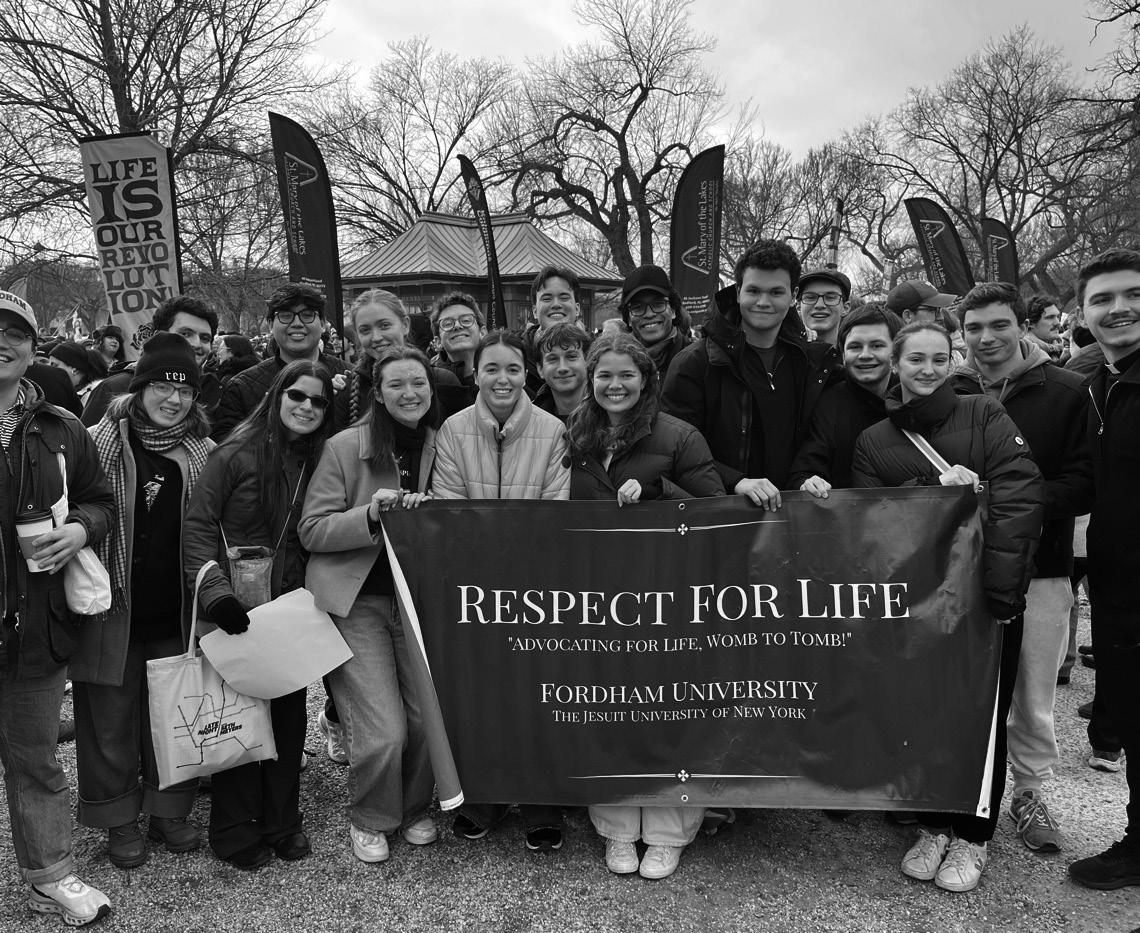
The storeroom is staffed by catholic sisters and sustained by assistance from lay volunteers, some of whom are dedicated Fordham Respect for Life club members. The center’s atmosphere is quietly profound: women coming
in to pick up items and converse with friends for support or a good laugh, their kids jumping up and down playing with toys, volunteers speaking in Spanish (or half-broken Spanish if I happen to be there) to quickly write down the mom’s requested items. People of all ages are organizing diapers, baby shoes and baby formula into a recycled Trader Joe’s bag to give to the women. With this vision of support before me, I can’t help but wonder why so many women are told that abortion is their only option.
I am pro-life because I am a feminist. Those two identities seem paradoxical in our current culture. Yet feminism with integrity demands support for the most vulnerable
of women, if it aims to support any women at all.
Pro-choice feminist narratives often overlook a more uncomfortable question: Why has abortion become so common in the first place? The reality of nearly 1.1 million abortions occurring in the United States in 2024 ought to prompt reflection, not just quiet acceptance. How do these staggeringly high numbers intersect with the lives of the women we pass on Fordham Road or even in our own classrooms? In what areas of society is our culture failing to treat women with the dignity they deserve, instead of shoving them into cycles of individual and systemic abuse?
Abortion, especially in its increasingly privatized form, places women at greater risk rather than protecting them. Chemical abortions now account for 54% of all abortions and are marketed as safe, reliable and empowering. This is a two-pill system that allows a woman to have an abortion from the safety of her home. Yet the lack of governmental regulation or medical oversight can lead women to navigate the process alone. Women are able to order these pills online, and can consume them far past the 10-week requirements. In situations of unequal power dynamics, such as abusive relationships or family pressure, this deregulation can be dangerous. A terrifying 11% of chemical abortions lead to sepsis, hemorrhaging or
other serious conditions for the mother. Rather than offering genuine care, the system often abandons women at their most isolated and vulnerable moments.
Abortion also contributes to the systematic devaluation of women in our society. Big businesses ignore women’s authentic needs by offering to pay for their female employees’ abortions, as it is cheaper to send them to a Planned Parenthood than it is to provide them with extensive paid maternity leave and financial support for childcare. Corporations can justify abortion funding in terms of productivity, arguing that because women constitute over half the workforce, limiting pregnancy-related disruptions prevents costly employee turnover.
At the same time, the abortion industry itself is a multi-million-dollar business, with both leaders and employees emphasizing profit over care. Within these systems, abortion does not operate as liberation but as a function of our highly consumerist and individualistic society.
While researching for this article, I was immediately directed to hundreds of websites giving me information on how to obtain an abortion. These pages prompted me to order the pills in advance, “just in case.” This rhetoric treats women like robots, implying that we act purely on reaction
rather than reflection. What if women do not actually want an abortion?
These frameworks transport us back to pre first-wave feminism, a society in which women were not regarded as rational beings capable of serious deliberation. By presenting abortion as the automatic response to an unwanted pregnancy, our culture subordinates women and their capacity for judgment.
Zoe Najmy, FCRH ’26, and Grace Baur, FCRH ’29, shared their pro-woman experiences with me at the March for Life and Cardinal O’Connor Conference in Washington, D.C., this past weekend.
“If we continue to tell women they are not ‘ready’ or ‘worthy’ or in a ‘good position’ for a child, we are dismissing what women are capable of,” Najmy said. “We are robbing women of their true choice as these narratives are fed to them. I believe that we must rise up and defend life as well as appreciate and value motherhood.”
Baur emphasized Najmy’s stance by saying that opposing abortion “is a true women’s rights issue.” With authentic support, women are not considered in a vacuum, but looked at as a whole person with inviolable dignity.
A Derailing MTA: Paying More For Less
By ALANA JONES CONTRIBUTING WRITER
The MTA recently increased subway and bus fares from $2.90 to a flat $3. The price increase has been controversial among New Yorkers, especially amid the introduction of congestion pricing and the ongoing affordability crisis.
New Yorkers seem to be paying more for less, and with public transit becoming more expensive, living in the city feels less and less attainable for the middle class.
I take great pride in the subway’s extensive network; every weekday, its ease of use allows roughly 4 million people to travel throughout the five boroughs and beyond. It is easy to understand why New Yorkers feel they are being forgotten. Issues that are most important to riders, such as delays and
safety, seem to be making little progress. A system that serves so many people so frequently is deserving of efficient investment, and New Yorkers deserve efficient service.
The MTA’s annual budget is $19.88 billion, which has been spent on various efforts to modernize the subway. The MTA’s 2025-2029 proposed capital plan includes a $5.4 billion budget to modernize subway signals, 69% of which are over 100 years old. “Signal trouble” accounts for roughly 31% of all delays. A total of $10.9 billion was allocated to new railcars and $1.1 billion to new turnstiles. The new turnstiles, meant to prevent fare evasion, have proven ineffective.
Many updates, especially the new railcars and fare gates, feel like superficial improvements aimed at making the system prettier rather than more
efficient I don’t care much about new cars, new turnstiles or more cutting-edge maps, for that matter. It is politically tantalizing to install new, modern-looking solutions to a relatively boring issue. Raising the fare yet again while spending money on gates that are easier to evade feels like a betrayal. Riders, especially those who pay the fare, get the short end of a multi-billion-dollar stick.
The elephant in the room is that decades of leadership have failed to adequately address is accessibility. Elevator outages occur regularly, making the subway less accessible and transportation more difficult. Accessibility is a lofty goal -- but not an unattainable one. Every New Yorker, whether by virtue of old age or a broken bone, could benefit from accessibility at some point. Transit has served millions of people, but could be improved in practical ways. Accessibility is an urgent issue for which $7.1 billion was allocated, almost $4 billion less than the budget for new railcars.
I can’t imagine a more worthy investment than public transit. The MTA is a great equalizer of the city: People of all backgrounds rely on public transit daily. There are no fare zones, and service runs 24 hours a
day. Wherever you need to go, no matter your neighborhood, transit is available. The construction of the subways marked one of the greatest public works projects launched in the United States. At the time, largely middle-class Brooklyn, Queens and the Bronx were isolated from Manhattan. The subway was an expensive, ambitious project with a high-minded goal: providing all New Yorkers with easy access to every part of the city.
The past decade has also been marked by broken promises of development. The MTA launched a plan for a new Second Avenue subway line in 2017, which eventually became the Q train, but further development has been put on the back burner. Plans for a Second Avenue line were developed in the 1920s, and have yet to come to fruition. For residents of Alphabet City and the Lower East Side, the nearest subways remain on Lexington Avenue or 14th Street.
There is also a recent proposal for an Inter Borough Express (IBX) line that would facilitate travel between Brooklyn and Queens without detouring into Manhattan. The G train is the only line that does not enter Manhattan, and the IBX
would fill the large transit gaps in Brooklyn and Queens. Both plans would involve significant investment, but I would argue that our transit system is more than worth it.
Riders’ feelings are exemplified by Ana Permadoro, an upstate resident who is disheartened by the MTA’s attempts at improvement. She told the New York Post, “Maybe they think it’s too expensive, but I think they make enough money… They raised the fare. Where is the money going?”
Solutions to the subway’s issues are not as shiny or politically exciting as billion-dollar fare gates or railcars with modern displays. Modernizing the signal systems, which are approaching 100 years old, would be a reasonable first step, saving money in the future by reducing long-term maintenance costs. We owe it to ourselves, as well as the ambitious people who made the subway possible, to take care of it. The infrastructure is in place, all we need is the willingness to maintain it.
A group of students a part of Fordham Respect For Life at the March For Life.
ABIGAIL ADAMS FOR THE FORDHAM RAM
Abigail Adams, FCRH ’26, is a philosophy major from Alexandria, Virginia.
Alana Jones, FCRH ’27, is an English major with a minor in psychology from Manhattan, New York. MTA fares have increased and commuers are unahppy with budget decsions.
GABRIEL CAPELLAN/THE FORDHAM RAM
Loyal to NYC: Mamdani Keeps Promises
By ANNE ESLICK-PERSYN CONTRIBUTING WRITER
The birth of my political consciousness occurred a long time ago, but the first time I was able to vote was this past November. As you can imagine, I was incredibly excited to finally place my ballot into that box — my first small but essential contribution as an adult citizen. I was not alone. This past November, over 2 million New Yorkers turned out to vote, the highest number in the past 50 years. Amidst a concerning national dip in voter turnout in past decades, this election garnered national attention and saw an outstanding level of civic participation.
New York City has massive political influence and many eyes were turned towards what the decision would be.
It is an understatement to say that Zohran Mamdani stood out from the other two candidates, Andrew Cuomo and Curtis Silwa, running for the coveted position. A young, Muslim Democratic Socialist immigrant won against two older, more established white men. I, along with 1,036,050 other New Yorkers, were ready to see a real change.
Thus far, Mamdani has already made strides in many of his promises on affordability,
proving to the public that he has the capability to fulfill his ambitious campaign promises. Another, and perhaps even more crucial, thing he has done while in office is make adept compromises, which many of his right wing skeptics said was impossible. He certainly has a difficult path to pave as a Democratic Socialist amidst the rise of altruistic right wing politics, but he has shown himself to be a capable leader and has my full confidence that he can bring change many of us have been urging for.
Starting strong with his first day in office, Mamdani immediately began addressing his constituency’s concerns around the unlivable New York City rent inflation. In fact, one of his first acts as mayor was visiting a Brooklyn apartment building and assuring its tenants that he would ramp up investigations of the supposedly negligent landlord. This action was indicative of his mission statement as a politician: to get involved in the daily lives of New Yorkers and to fight the battles of lower income people being marginalized by cuts to welfare funding and rising costs.
Also on the list of actions improving the lives of New Yorkers on an everyday scale is introducing a set of hearings
called “rental ripoff.” These hearings will allow renters to dispute the conditions of their building. Additionally, one of his first actions was the signing of his second executive order mandating that shelters devise plans within 45 days to bring the living standards up to par. These normal regulations were halted due to the large increase in asylum seekers and conditions that had been rapidly worsening. He is clearly committed to giving a voice to those who have been overlooked.
Beyond his promising strides in affordability, his strong stance against the Trump administration and especially Immigration and Customs Enforcement (ICE) is incredibly important in our current political climate. Mamdani has a strong anti-ICE policy, and he is in support of its complete abolition. He believes that this is the right action, “because what we see is an entity that has no interest in fulfilling its stated reason to exist.” He takes a strong stance on contentious issues at a time when many politicians are cowing to threats. Immigration enforcement is being used as an excuse to weaponize federal forces on innocent citizens, and having a mayor that is committed to protecting the city’s immigrant population as an

immigrant himself is important. We can not let the misuse of executive power go by the wayside. We must support leaders like Mamdani who are committed to taking action on a local level and who are willing to invest in the lives of ordinary people. As he said himself, “We have an opportunity where New Yorkers are allowing themselves to believe in the possibility of city government once again. That is not a belief that will sustain itself in the absence of action.”
If Mamdani is to be the future of local government, he certainly is a shining example of compromise. His civility and open-mindedness could be what the country needs to pull us back from extremism and polarization. I know that some would read this statement with disbelief. Many
of his skeptics assumed that because of his identity as a Democratic Socialist, he would be too radical to effectively cooperate with the bureaucracy and run the city. However, his retainment of Jessica Tisch, the current police commissioner, was an impressive act of self-restraint and compromise. He has faced backlash from members of the Democratic Socialist party, due to Tisch’s pro-Israel and conservative stance on police. Despite this, he represents an important image that we have been missing in modern politics: two drastically different people being able to respect each other’s views and personhood and forge a path together.
In the Face of ICE Raids We Need Rapid Response
By ANTHONY KOROLOS CONTRIBUTING WRITER
At this time of year, most New Yorkers’ main concern should be the icy conditions of the streets. However, they are instead having to worry about a different type of ICE-y condition. One rooted in violence and racial prejudice, one intended to divide, rather than unite. New Yorkers should not only be worried about incoming Immigration Customs Enforcement (ICE) raids, but also be prepared to protect a city rooted in the mass of immigrants that make New York the city it has always been: a city of diversity.
Recently, ICE raids have been prevalent in many cities across the United States, notably Chicago, Minneapolis, Charlotte, North Carolina, Los Angeles and New York City, which could be their next target. New York City, as a whole, should become more concerned about these raids as they have not only been violent, but targeted against all people of various ethnicities and citizenship statuses, notably arresting many people of color who have U.S. citizenship.
With the election of NYC mayor, Zohran Mamdani, there is hope of more resistance to these ICE raids. However, this is an optimistic hope and ask of Mamdani, as the raids have been forceful and have
occurred in very progressive cities, yet have lacked accountability or resistance due to the power of the federal government. This is cause for further concern to New Yorkers who have consistently shown retaliation and protest following the Minneapolis raids and murder of American citizen Renée Good. I think this act of violence and pressing danger against an extremely diverse city, representing so many ethnic groups, causes fear, and though Mamdani has shown his dissent against these raids, there is still a practicality that needs to be addressed. There is really not a whole lot he can do, as resistance to the federal government has been proven to be easily dismissed. Thus, it will take community action and protection of all minority groups in the city to minimize damage from these raids.
The major concern of New Yorkers is that NYC economically depends on its 38% of foreign-born citizens; thus, these ICE raids would hurt the functioning of the city and dis rupt many local communities and businesses. Furthermore, the main purpose of these raids is to target criminals and those actively making parts of the U.S. unsafe. Since the start of these raids, more than 290,000 people have been arrested. Due to the fact that many of those arrested do not have a criminal
history, this contradicts the original intent of these raids. Also, with the recent deaths of Good and Alex Pretti, it is clear that these raids are no longer about race, but an attempt to control those who are resistant to the federal government, by killing white Americans. Therefore, it should be a main concern of all New York citizens, documented or not, to be prepared to protect themselves, their families and their communities as a whole, to remain safe.
Minnesota has been the prime target of these raids and to better understand, I spoke with Hannah Butler, FCRH ’29, a resident of a suburb 30 minutes outside of Minneapolis. Butler specifically noted that “the events occurring in Minnesota are making me embarrassed to admit that [I’m] from there.” Her worries come from a place of fear, as she has witnessed both close friends and family members being personally affected by the horrific actions of ICE. She said that New Yorkers should not only be worried, but angry, as she mentioned, “if our president can do the things he’s doing to us in [Minnesota], he can just as easily do the same in [New York].” Butler feels as though New Yorkers should take the anger at what they are witnessing of the events in Minneapolis, and the murder of Good and fight back. This is
exactly what New Yorkers have started to do. I personally attended an anti-ICE protest on Friday, Jan. 24, and the thousands of angry New Yorkers enduring the cold weather to fight for their community brought some hope.
New Yorkers have every right to be worried about these potential incoming raids, yet I think most feel more anger than worry and will continue to protest and fight for this diverse city. However, there are many precautions New Yorkers can take to enhance their safety and protect one another. According to @ nycblockwatch on Instagram, New Yorkers should “keep emergency contact,” such as “lawyers and [a] rapid response team,” and should not open the door unless there is a
real warrant. Finally, it is important to “map sanctuary spots” within your neighborhood. These tips are key to ensuring the safety of all neighborhoods in New York.
This is also important for Fordham students to be aware of, as the neighborhood around Fordham is a targeted spot for ICE raids, according to Senator Gustavo Rivera. Fordham University should not simply be separated from the community, but engage with it, and thus, this means it is important for students to understand the precautions and ways to help immigrants, and all people of color for that matter, within our community.

ICE raids have become prevalent in cities across the U.S. HANNAH SULLIVAN/THE FORDHAM RAM
Anne Eslick-Persyn, FCRH ’29, is a sociology major from San Francisco, California.
Anthony Korolos, FCRH ’29, is a political science and international political economy major from Charlotte, North Carolina.
Zohran Mamdani with his wife at the mayoral inauguration earlier this month.
COURTESY OF THE NEW YORK TIMES
MEET THE STAFF
SIENNA REINDERS | EDITOR-IN-CHIEF
Sienna Reinders is a sophomore from Northern California majoring in journalism and political science. On The Ram, she has served as a contributing writer for the News section for Volume 106 and an Assistant News Editor and News Editor for Volume 107. Now, Sienna is looking forward to taking on the role of Editor-in-Chief for Volume 108 and continuing to pursue her passion for journalism. When she is not in the newsroom, you can find her doing news reporting at the WFUV radio station, running, reading or crocheting.
SARAH VERRASTRO | PRODUCTION EDITOR
Sarah Verrastro is a sophomore from Monroe, Connecticut, majoring in English with a creative writing concentration and minoring in new media and digital design. She joined The Ram as a copy editor for Volume 106 before becoming Copy Chief for Volume 107. Sarah is thrilled to be taking over the position of Production Editor for Volume 108. When she’s not in B-52, you can find her with her head buried in a book or notebook
HANNAH SULLIVAN | MULTIMEDIA
DIRECTOR
Hannah Sullivan is a sophomore from Boston, Massachusetts, majoring in English with a minor in marketing. She began as a contributing writer to the Culture section for Volume 106 and served as a Digital Producer for Ram Volume 107. She is excited to serve as Multimedia Director for Volume 108. Outside of the Ram, she enjoys knitting, crocheting and watching various TV shows and movies.
EMMA LEONARDI | NEWS EDITOR
Emma Leonardi is a junior from Washington, D.C., who is double majoring in English and psychology with a journalism minor. She has worked her way up through the news ranks from contributing writer, to staff writer, to Assistant News Editor and all the way up to her new role as news editor (with a brief stint as an Executive Copy Editor). Outside The Ram, Emma is president of a book club on campus and a WFUV Sports trainee, all while making time for her Washington Capitals.
JORDAN DONEGAN | ASST. NEWS EDITOR
Jordan Donegan is a sophomore from Portland, Oregon, double-majoring in journalism and political science with a minor in French. Jordan began her journey with The Ram as a staff writer and copy editor for Volume 107 and is now thrilled to step into the role of Assistant News Editor for Volume 108. When she’s not working with the Ram, you can find her exploring various parts of NYC, watching a good cop show or shopping for beauty products with her friends.
LORESA ZEQIRAJ | OPINION EDITOR
Loresa Zeqiraj is a sophomore from Yorktown, New York, majoring in international studies and English on a pre-law track. She joined The Ram during Volume 106 as a contributing writer, became an Assistant Opinion Editor for Volume 107 and is thrilled to step up as Opinion Editor for Volume 108! Outside of The Ram, Loresa loves reading, perfecting new yoga poses and exploring new places.
GABRIEL CAPELLAN | ASST. OPINION EDITOR
Gabriel Capellan is a sophomore from the Bronx, New York, majoring in journalism with a potential minor in either sociology or political science. He began writing for The Ram in Volume 107 as a contributing writer; now, for Volume 108, he’s thrilled to be an Assistant Opinion Editor. Outside of The Ram, he enjoys reading, working out or playing pool with friends.
MAKENZIE SMITH | CULTURE EDITOR
Makenzie Smith is a junior from Marietta, Georgia, majoring in journalism with a minor in English. She first joined The Ram as a contributing writer and copy editor her sophomore year and is excited to step into the role of Culture Editor to work alongside such amazing writers for Volume 108! Beyond The Ram, Makenzie is involved in Fashion for Philanthropy and enjoys exploring the city with friends, reading, discovering new restaurants and travelling.
IAN NELSON | MANAGING EDITOR
Ian Nelson is a sophomore from Hyde Park, New York, majoring in English. He joined The Ram as a contributing writer in the Sports section for Volume 106 before becoming Assistant Sports Editor for Volume 107. Ian is honored to take over as Managing Editor for Volume 108. Outside of The Ram, he enjoys golfing, watching movies and reading a good book.
MOLLY O'CONNOR | EDITORIAL DIRECTOR
Molly O’Connor is a sophomore from Weymouth, Massachusetts, majoring in English with a creative writing concentration and minoring in environmental studies. She joined The Ram as a contributing writer for the Opinion section in Volume 106, then serving as a Digital Producer for Volume 107. She is so excited to be serving the role of Editorial Director for Volume 108! When she’s not writing for the Ram, you can find Molly rewatching one of her comfort shows, dancing with Flava or waiting in line for SNL.
NISHANTH ADUMA|BUSINESS DIRECTOR
Nishanth Aduma is a junior from Hyderabad, India, majoring in finance with a concentration in Fintech. He began as a contributing writer for Volume 106 and later served as an Advertising Director for the spring semester of Volume 107 and later became the Business Director for the fall semester of Volume 107. He is excited to serve as the Business Director for Volume 108 and build on from the last volume. Outside of the Ram, he enjoys watching films & TV.
SIDNEY BLASCO
| FEATURES EDITOR
Sidney Blasco is a junior from New York City and Madrid, Spain, majoring in journalism with a minor in music. She joined The Ram as a contributing writer for Volume 107, and now serves as the Features Editor for Volume 108. She is looking forward to supporting new writers, and contributing to a newspaper that students are excited to pick up and read. Outside of The Ram, she plays cello for the University Symphony Orchestra and works in real estate in Manhattan.
KAT ROSSI | ASST. NEWS EDITOR
Kat Rossi is a junior from Arlington, Virginia, majoring in philosophy and economics, and minoring in Russian. Kat joined The Ram as a contributing writer for Volume 106, and now serves as an Assistant News Editor for Volume 108. Outside of The Ram, Kat plays the Bassoon in the University’s Symphony Orchestra and writes for the Undergraduate Law Review.
ERYNN SWEENEY | ASST. OPINION EDITOR
Erynn Sweeney is a junior from Cypress, California, majoring in international political economy. She wrote for The Ram during her first year at Fordham and has since been part of the Culture and Opinion teams for Volumes 106 and 107. Outside of B-52, she loves to drink coffee and play “Just Dance” with her roommates.
LARA EJZAK | CULTURE EDITOR
Lara Ejzak is a sophomore from Pittsburgh, Pennsylvania, majoring in journalism with a minor in Spanish. She began her involvement with The Ram during Volume 107 as a contributing writer for the Culture section and is now eager to engage further with the paper and the Fordham community as a Culture Editor for Volume 108. Outside of The Ram, Ejzak enjoys baking, hiking and buying any overpriced latte she can get her hands on.
PAOLO LIACI | ASST. CULTURE EDITOR
Paolo Liaci is a junior from Clifton, New Jersey, pursuing a degree in English with a concentration in creative writing, as well as a minor in journalism. He joined The Ram as a contributing news writer for Volume 107 and looks forward to entering Volume 108 as an Assistant Culture Editor. Beyond The Ram, Paolo is the Editor-In-Chief of Thee Golden Egg, a literary and culture magazine he founded in 2024.
MEET THE STAFF
JAMES NELSON | SPORTS EDITOR
James Nelson is a sophomore from Millburn, New Jersey, majoring in political science. He first joined The Ram as a first-year, serving as a contributing sports writer for Volume 106 and became an Assistant Sports Editor for Volume 107. He is thrilled to take on the role of Sports Editor for Volume 108. Outside of The Ram, James enjoys training in martial arts and cooking.
ETHAN BESS | ASST. SPORTS EDITOR
Ethan Bess is a junior from Roanoke, Texas, majoring in radio and television. He joined The Ram in his third year serving as an Assistant Sports Editor for Volume 108. He is thrilled to be a part of The Ram as he believes it will help advance his wishes and ambitions to be in sports media or media production. Outside of The Ram, Ethan enjoys reading books and learning how to speak other languages in his spare time.
EMILY MITTON | EXEC. COPY EDITOR
Emily Mitton is a first-year from Lisbon, New Hampshire, pursuing a journalism degree with a minor in psychology. She joined The Ram as a staff copy editor and contributing writer for each section during Volume 107 and is excited to become Executive Copy Editor for Volume 108! Outside of The Ram and additional extracurriculars, Emily enjoys exploring New York City, listening to music, reading and spending time with friends.
EMMA KELNER | EXEC. COPY EDITOR
Emma Kelner is a first-year from Staten Island, New York, majoring in economics and history. She joined The Ram as a contributing writer for the Opinion section for Volume 107 and is excited to take on the role of Executive Copy Editor for Volume 108. When she isn’t writing or reading, you can find her playing the trumpet, running or listening to Barry Manilow and ABBA on Spotify.
HAN LE | DIGITAL PRODUCER
Han Le is a sophomore from Hanoi, Vietnam, majoring in marketing with a concentration in communications and media management. She is joining The Ram as a Digital Producer during Volume 108. Outside of The Ram, Han is part of the Vietnamese Student Association, loves baking, finding new coffee spots in NYC and watching Formula 1 races.
VIOLET WALLACE | ADVERTISING DIRECTOR
Violet Wallace is a junior from Washington, D.C., majoring in economics. She joined The Ram during Volume 107 as part of the business team, where she will continue to work during Volume 108. She loves animals and going for walks at the New York Botanical Gardens!
MOLLY FRIEDMAN | ASST. SPORTS EDITOR
Molly Friedman is a sophomore from Park City, Utah, majoring in journalism and environmental studies. She joined the Ram her first year as a contributing sports and culture writer for Volume 107. She is now excited to take on the role of an Assistant Sports Editor for Volume 108. Outside the Ram, Molly is a member of Fordham Women's Rowing and works as a Ram Van driver. She can often be found watching baseball, attending Broadway shows, or engaging in any outdoor activity.
INDIGO TOWERS | COPY CHIEF
Indigo Towers is a sophomore from Frankfurt, Germany, pursuing an English degree with a concentration in creative writing, and a minor in theology. She joined The Ram as an executive copy editor during Volume 107, and is excited to enter Volume 108 as the Copy Chief! Beyond The Ram, Indigo enjoys reading and writing poetry and meandering around New York City.
UMA PETZKE | EXEC. COPY EDITOR
Uma Petzke is a first-year from San Francisco, California, majoring in psychology. She was a contributing writer during Volume 107 of The Ram in both the Opinion and Culture sections and is super excited to join the staff as Executive Copy Editor for Volume 108. Outside of The Ram, Uma loves to spend time with friends, read and explore the city!
HANIYYAH USMANI | SOCIAL MEDIA DIRECTOR
Haniyyah Usmani is a junior from the Bronx, New York, majoring in psychology. She joined The Ram as a copy editor and opinion writer for Volume 105 before serving as Digital Producer for Volumes 106 and 107. Haniyyah is so excited to continue working alongside the amazing staff as Social Media Director for Volume 108! Outside of The Ram and her too-long list of extracurriculars, Haniyyah is an avid reader and loves trying new crochet projects.
MARISA HOUSE | DIGITAL PRODUCER
Marisa House is a sophomore from Mendham, New Jersey, majoring in marketing. She joined The Ram as a contributing writer for the sports section during Volume 107 and became a Digital Producer for Volume 108. Outside of The Ram, Marisa is a part of Fordham’s Cross Country and Track & Field teams, loves playing the guitar, painting, listening to music and binging TV shows with her roommates.
JP VALENCIA | ADVERTISING DIRECTOR
Juan-Pablo (JP) Valencia is a first-year from Aurora, Illinois, majoring in history on the prelaw track. He joined The Ram during Volume 108 and serves as an Advertising Director. Outside of the Ram, JP enjoys exploring NYC, working out at the Ram Fit Center, playing intramural basketball and reading fiction & historical non-fiction.
RISHIKA LINGAMDINNE | ADVERTISING DIRECTOR
Rishika Lingamdinne is a sophomore at Fordham’s Gabelli School of Business majoring in finance with a concentration in alternative investments. She is passionate about markets, investing and the wider financial services industry. Rishika began at The Ram as a contributing writer and now serves as Advertising Director, working with local partners to support the paper’s business operations. Outside of academics and the Ram, she enjoys watching Formula 1 races, finding new matcha spots and exploring restaurants in New York.
Dear Readers,
As the Editorial Board of Volume 108 we look forward to keeping you informed on all things Fordham. We encourage any and all of our readers to interact with us, be that by following The Ram in print or online, or keeping up with our social media. We also think it’s important to remind our readers that there are many ways to get involved with The Ram. You can write articles for any of our four sections, take photos for said articles or come to copy nights. Best,
By RAEANN GOPAUL CONTRIBUTING WRITER
Imagine yourself walking into an 8:30 a.m. lecture; what are you most likely to see? Usually, it’s a sea of sweatpants, hoodies and the occasional student in pajamas. For many college students in America, this is the norm. However, as campuses continue to become increasingly casual and study abroad experiences expose students to different cultural standards, a question arises: Should there be expectations for how students present themselves in the classroom?
This question tends to cause a divide amongst students at Fordham, where opinions range from “anything goes” to “put in some effort.” Thomas Huvane, FCRH ’26, doesn’t hesitate about his stance. “Sweatpants and pajamas are crazy,”
OPINION
Are You Down To Dress Up?
he said. “It just says lazy in my opinion. Like you couldn’t put on an actual pair of pants this morning?”
Huvane, who typically wears jeans and a tee or polo shirt to class, believes students should embrace a basic level of presentability without going full business casual. “Just put on a pair of pants that have a zipper and maybe a second layer that doesn’t have a hood,” he said.
On the other hand, Kelvin Suarez, FCRH ’26, takes a more lenient view.
“I feel that, for the most part, students dress appropriately for class,” he said. “Everyone has their own freedom of expression, and I think it’s cool seeing everyone’s unique style on campus.” Suarez, who admitted that he prioritizes comfort with hoodies and sweatpants for early morning classes, argued that as long as clothing is not viewed as offensive or disrespectful, personal

choice should be valued.. “I feel that our main focus should be on what we’re learning, not what we’re wearing,” he emphasized.
Steven Sarmiento, FCRH ’26, stands on a middle ground. While he usually wears a sweatsuit to class for comfort, he acknowledges the value of occasionally dressing more formally. “Dressing in more formal or business casual attire once a week could be beneficial as it helps students adapt to a professional mindset and prepares them for a real-world work environment,” Sarmiento explained.
However, one important observation emerges across all three students: Lincoln Center and Rose Hill have different dress cultures. Huvane, who has taken classes at both campuses, is blunt about the difference. “There are definitely a lot of fashion-conscious students, and the competition is much more fierce,” he said about Lincoln Center, adding that Rose Hill has “a lot more” casually dressed students.
Suarez offers insight into why this discrepancy exists. He lived at Lincoln Center for two summers and points to both the student body and the physical environment. “Many students are involved in fine arts fields like theater, performance, acting and screenwriting. Because those majors naturally involve creativity and self-expression, students often treat their clothing like a canvas,” he explained. Additionally, Lincoln Center’s mostly indoor campus means
students don’t have to battle the weather each day. “At Rose Hill, since the campus is outdoors, we often prioritize warmth over style, especially in colder months,” he said.
For students who have traveled internationally, American campus culture stands out as particularly casual. Suarez, who has visited several European countries such as Spain, France, Italy and England, noticed immediate differences. “In many of these places, everyday fashion leans more toward business casual or polished casual. You see fewer sweatpants and hoodies and more dress pants, coats, polos and coordinated outfits,” he said. The architecture and atmosphere of European cities seem to encourage people to present themselves well.
Huvane also agrees with this observation, noting that, “Americans are just more lax when it comes to everyday attire. Europeans actually give thought to how they look.” This cultural difference raises questions about whether American students are missing out on developing professional presentation skills or simply embracing a more egalitarian, comfort-focused approach to education.
So, should classrooms enforce dress standards? The general consensus among these students leans toward no, but not without stipulations. Suarez argues that turning classrooms into professional environments “would create unnecessary
pressure and make things feel higher-stakes than they already are.” Students already have to deal with academic, personal and financial stress without including appearance or aesthetic expectations to the mix. However, he does see room for professionalism in certain situations. “I do see how professionalism can possibly fit into the classroom with presentations, debates or seminars, since it is good preparation for the real world,” Suarez said. Sarmiento also echoes this principle, believing that while strict dress codes aren’t necessary, occasional formal attire helps reinforce professionalism and accountability.
Perhaps the most accurate answer lies in Suarez’s definition of presentability: “Being presentable doesn’t mean dressing formally, but instead it means showing up looking put together and respectful.” Whether in sweatpants or slacks, the common ideal is effort; showing up looking intentional rather than like you just rolled out of bed. After all, college can be viewed as both a place of learning and preparation for professional life. Finding the balance between comfort and presentation may be less about enforcing rules and more about encouraging students to develop their own sense of what it means to show up and show out for themselves, their education and their future.
Protein In Coffee For Your Daily Routine
By EMMA KELNER EXEC. COPY EDITOR
After a long morning of heavy lifting in the Ram Fit Center — by which I mean three sets of bicep curls with eight-pound dumbbells — I can hear my muscles screaming out for fuel.
“Feed us! Feed us! We yearn for sustenance!” they scream as I peruse the breakfast options in my mini-fridge. Protein yogurt? Protein granola? Protein brownies? Protein smoothies? Protein oatmeal? I can even walk over to Dunkin’ Donuts and grab a protein-filled coffee! Or is that a step too far?
Many claim that there are just too many protein-enhanced foods out there. We seem to always ask, “Can we add protein?” but rarely, “Should we?” But I think we should!
Protein-filled beverages can actually help people maintain healthy diets. After all, if you get your protein from Starbucks, you don’t need to eat as much meat to hit your protein goal. That said, before we can discuss today’s prevalence of protein-rich diets, we need to understand where this obsession comes from.
It began in the mid-19th century, when scientists identified carbohydrates, fats and proteins as the three pillars of energy. In the 1860s, Justus von Liebig, a German scientist, concluded that muscular exertion required more protein
than carbs and fats. He began mass producing a protein-enriched meat extract — one of the first artificially protein-enriched products out there — as a cheaper alternative to costly animal meat. By the end of the century, the benefits of protein were widely known, as was Liebig’s faux meat.
The nutritional qualities of protein were so renowned that in the 1890s, the U.S. Department of Agriculture even recommended protein for the working man. How much protein did they recommend? Just about 110 grams per day. No wonder Liebig’s meat extract was flying off the shelves!
But this recommendation was limited to working men; protein was not recommended to women and children. In fact, protein wasn’t linked to weight loss until the early 2000s, at which point consumption surged. That surge continues today. In the 2025-2030 U.S. Dietary Guidelines, the federal government recommends 1.2 to 1.6 grams of protein per kilogram of body weight per day.
Now, many coffee chains are releasing new lines of protein-packed beverages. Starbucks added Protein Lattes and Protein Cold Foam to its menu. A beverage with Protein Cold Foam can have up to 26 grams of protein, and a Protein Latte with Protein-Boosted Milk can contain up to 36 grams.
That’s a lot of protein!
And Dunkin’, not one to be outdone, now offers “Protein Milk,” which “giv[es] guests a simple way to add protein to the drinks they already love — no new routine required.” How thoughtful! These drinks can contain up to 20 grams of protein. And, of course, just releasing protein-packed drinks wasn’t enough. Dunkin’ also announced a new campaign, entitled “Dunk N’ Pump,” featuring Megan Thee Stallion, who leads a jazzercise-inspired workout that is fueled by Dunkin’ Protein Refreshers. Honestly, I don’t mind all this protein. If people want to drink it, let them! As Marie Antoinette once (allegedly) said, “Let them eat (the protein-filled) cake!” But while it’s tempting to focus on hitting protein goals, my concern is that people are ignoring other, equally important nutritional goals.
Many high-protein diets rely on red and processed meats — foods that are notoriously full of low-density lipoprotein (“bad”) cholesterol. Higher levels of LDL cholesterol can cause plaque buildup in arteries. And when enough plaque builds up, it’s bound to break off and form a blood clot, which can cause a stroke. Cholesterol aside, studies show that people who eat red meat consistently have three times more Trimethylamine
N-oxide (TMAO) in their blood. TMAO is formed during digestion, and it has been found to both enhance cholesterol deposits in arteries and interact with platelets — blood cells that form clots to stop bleeding — to increase the risk of clot-related incidents like heart attacks and strokes.
A nationwide increase in cholesterol and TMAO levels in blood as people try to hit their protein goals plays a role in the rise in heart disease in America. Today, heart disease kills more people in America than anything else. In fact, heart disease and strokes together kill more people than the number two and three leading causes of death (all cancers and accidental deaths, respectively).
Eating more red and processed meat not only leads to
heart problems, but also to cancer. Colorectal cancer rates in Americans aged 20-39 have risen since the mid-1990s due to sedentary lifestyles and increased red meat consumption. High-fat, low-fiber diets — or diets filled with protein but lacking in fiber — increase colorectal cancer risk. Honestly, maybe protein-packed beverages are a step in the right direction — a step away from foods high in cholesterol. Starbucks and Dunkin’ may not realize it, but they might be saving lives (emphasis on might). So if you want a protein-filled coffee, go for it! And maybe the real question isn’t “should we add more protein?” but “what else can we add?”

Students should dress up instead of dressing down. CAROLINE STETSON FOR THE FORDHAM RAM
Raeann Gopaul, FCRH ’26, is a psychology major on a pre-law track from the Bronx, New York.
Emma Kelner, FCLC ’29, is an economics major from Staten Island, New York.
Starbucks recently debuted protein coffee.
HANNAH SULLIVAN/THE FORDHAM RAM
By EMMA LEONARDI NEWS EDITOR
The rivalry between hockey players Shane Hollander and Ilya Rozanov has taken the world by storm. The top prospects from the draft season of 2009 were pitted against each other starting from their respective career beginnings. However, they had been keeping a secret that not many knew: For the span of their careers (the summer before rookie season), they were not only involved on the ice, but also in the bedroom.
For those devoted National Hockey League (NHL) fans reading this who have been living under a rock, you may be confused right now. You may even be asking, “Emma, who are Hollander and Rozanov? I’ve never heard of these players!” You would be right — these are not members of the NHL, in fact, these aren’t even real people. Hollander and Rozanov are the stars of an LGBTQ+ hockey romance novel turned smash show (no pun intended), “Heated Rivalry.”
As an avid NHL watcher myself, I was resistant to watching this show, even as everyone around me was recommending that I do. As not only a hockey fan but also a woman, I felt that if I watched this series and, even worse, if I liked it, I would be judged for liking hockey just because of the, for lack of a better term, “hot men.”
Don’t get me wrong, there are a lot of attractive hockey players out there (I’m looking at you, Connor Bedard), but my love for hockey stems from the joy I get from watching
‘Heated Rivalry’ Takes Society by Avalanche Book
By ADISA BALIC CONTRIBUTING WRITER
“Wuthering Heights” by Emily Brontë is one of those books that people are hesitant to read. It has a reputation for being tough to like, dark and emotionally intense, and in many respects, that reputation is well-earned. However, that caution frequently obscures the novel’s true strength, peculiarity and memorability. “Wuthering Heights” is neither a neat Victorian morality story nor a cozy romance. Rather, it is an unvarnished and pure examination of socioeconomic class, obsession, loneliness and the enduring effects that love and cruelty may have on generations.
One of the book’s most notable features is its mood, which is set on the desolate Yorkshire moors. The characters’ emotional lives are shaped by the landscape, which is more than just a setting. The idea that this drama takes place outside the bounds of civility is reinforced by the harsh,
the sport — specifically, my Washington Capitals. However, if you know me well, you’ll know that I often turn on any NHL game and often get enraptured by the event regardless of who is playing.
Despite being convinced that watching this show would diminish my credibility, I finally caved in late into the fall semester. I watched the first episode in an attempt to procrastinate studying for my finals and immediately fell in love.
“Heated Rivalry” became famous for its sex scenes. I hate to say it, but, after watching, even I would claim these scenes to be the most well-done intimacy depictions in modern television. However, everyone who came for the sex stayed for the romance; even Hollander and Rozanov.
As aforementioned, the two started off at odds with each other under the spotlight on the ice, and explored their sexuality behind closed doors. The show starts with the players meeting before their rookie season. It goes on to cover the course of their careers and romantic journey together from late 2008 to mid 2017. They slowly transition from simply having sex, to a brief stint with each of them being involved with women, (Rozanov mainly just sleeping around and Hollander spending some time more seriously dating a famous actress) to finally admitting their feelings for each other and trying to see if they can make it work, even if it would need to remain a secret.
Many fans felt for Hollander and Rozanov not only for the aspects of the romantic
untamed environment, which reflects the unpredictability of the people who live there. Because of Brontë’s vivid, and frequently cruel, writing, the reader is drawn into the same emotional storms that shape the characters’ decisions. The story feels tense even in the absence of dramatic action, as though something is constantly about to break.
The absence of conventionally “likable” characters is one of the story’s most noticeable features. Instead of asking the reader to condone their actions, Brontë asks us to simply comprehend them. Despite their extreme flaws, selfishness and cruelty, the characters are never superficial. Rigid social hierarchies, emotional neglect and an intense need for control and belonging all influence their goals. The novel’s intricacy is what makes it so captivating; it defies easy categorization and forces readers to sit back uneasily.
The way love is handled in the book is rather unusual.
journey we all feel at some point in our lives (trying to navigate the minefield of sex and love), but also for the queer representation and the truly lifelike forbidden romance. This heartwrenching story, occurring in the five to six hours of the first season, is truly something that is not only enrapturing to watch on the screen, but has also had inordinate effects on the historically homophobic world of professional hockey.
Jesse Kortuem, a professional hockey player who had to take a step out of the spotlight due to the clash between his hockey career and his sexuality, recently came out as gay and cited inspiration from the show in helping him do so. He isn’t the only one who is facing the seeming incompatibility of their identity and their sport.
“I know many closeted and gay men in the hockey world are being hit hard by ‘Heated
Rivalry’’s success. Never in my life did I think something so positive and loving could come from such a masculine sport,” Kortuem expressed in an interview with Out Magazine.
Despite all of the good that has come from this show, I do have two critiques: one for the writer and one for the audience.
I feel very strongly that this story was as powerful as it ended up being because of the fact that the sport of choice was hockey. At the time of its release, there were no openly LGBTQ+ members within the NHL. However, I think that in writing this story not as a more serious reflection on why players feel they can’t come out, but as a romanticization, Rachel Reid, the author, diminished the real turmoil that actual queer people feel every day.
This combines with my critique of the fans. Hockey is not just a sport people watch to ogle the
players for being occasionally hot; it has been a cultural institution for over 100 years. Not every fan is watching the sport because of this show, and that should be respected, just as those who started watching for the show should be respected by longtime fans as well.
However, fans who have just started watching hockey due to the show are more likely to romanticize the players and act inappropriately towards them. I think the message, which has been pushed through the NHL and also the show, is to be respectful of everyone and understand that there would be no show, no romance, without the real people who play this game every single day.
This show has the opportunity to create real change and has even started down that path already. The message that has to remain is clear: stay respectful and keep supporting.

Brontë depicts love as devouring and destructive when unbridled, as opposed to kind or redemptive. In “Wuthering Heights,” love is tightly associated with pride, power and identity, making it difficult to distinguish between dominance and devotion. This strategy may seem disturbing to readers who are hoping for a traditional love classic, yet it is precisely this intensity that has made the book survive as a classic. Brontë suggests that love can be just as harmful as it is passionate, challenging the notion that it is necessarily moral or healthy.
Equally important is the novel’s exploration of social class and inheritance. Status dictates nearly every relationship in the book, influencing how characters see themselves and one another. Brontë exposes how rigid class structures can warp emotional development, turning resentment into legacy. The consequences of early choices do not fade with time. Instead, they ripple outward,
affecting people who had no part in the original conflicts. This generational weight gives the novel a sense of inevitability that feels almost tragic.
Despite being published in 1847, “Wuthering Heights” feels remarkably modern in its emotional honesty. Its focus on trauma, emotional repression and cyclical harm resonates strongly with contemporary readers. This relevance may explain why the novel continues to attract new audiences and adaptations. With a new film adaptation set to be released in February, “Wuthering Heights” is once again entering the cultural spotlight. The upcoming movie offers an opportunity for audiences unfamiliar with the novel to encounter its story and message, but the book itself remains unmatched in its psychological depth. Brontë’s language allows readers access to inner lives that no visual adaptation can fully capture.
That said, “Wuthering Heights” is not a novel for everyone. It
demands patience and emotional resilience. Readers looking for clear heroes, moral resolutions or comforting messages may find it frustrating. But for those willing to embrace its darkness, the novel offers a profound examination of human nature. It asks difficult questions about responsibility, desire and whether people are capable of escaping the worst parts of themselves.
“Wuthering Heights” is a novel that lingers. It does not aim to please, it aims to unsettle and provoke thought. Its endurance as a literary classic lies in its refusal to simplify emotion or offer easy answers that other novels do. Whether revisited through its pages or encountered for the first time before seeing the upcoming film that comes out on Valentine’s Day, “Wuthering Heights” remains a challenging and deeply rewarding work — one that proves to readers that some stories are meant to haunt us rather than comfort us.
Shane Hollander and Ilya Rozanov engage in a heated romance and an on-ice.
COURTESY OF IMDB
Justin’s Salt Bread: Buttered Toast’s Cooler Cousin
By LARA EJZAK CULTURE EDITOR
Butter, salt, toast. Besides potentially being my three favorite words in the English language, what do all of these culinary terms have in common? Answer: a trendy new brick-and-mortar in the Lower East Side.
Justin’s Salt Bread recently opened on Second Avenue and Third Street and already has become an instant must-try for the greater Manhattan area. The unassuming storefront conceals a cafe that expands deep into the block, decorated
sparsely with wall art and furniture.
The first variation of salt bread came across my desk in the form of an Instagram reel. The post consisted of a young woman showing her “easy” process of making these little rolls of joy and love, accompanied by the obligatory tapping and crunching demonstration nearly every cooking video includes to prove the food is, indeed, able to be heard!
After making a mental exclamation of how good this cousin of a croissant looked and how I needed to try it, I did

By KATE HERBERT CONTRIBUTING WRITER
As with most New Year’s resolutions, journaling begins strong, but within a month, it often becomes another expensive notebook collecting dust on a bookshelf or hidden away in a drawer. Journaling is repeatedly at the top of resolution lists, but there seems to be a disconnect for many people that isn’t always mentioned. Keeping a journal has proven benefits, from reducing stress to gaining self confidence, and has been recommended for just about every type of person. So why doesn’t it work for so many people?
In my experience, journaling is a lot more attractive in theory. Seeing the hardcover Moleskine journals in the front room of a McNally Jackson, sitting on the shelves like candy, makes it hard to settle the ache of wanting to be a writer. The idea of sitting down and writing your thoughts and feelings everyday until you’ve filled out a stack of journals is inspiring. In the past, when I’ve tried to start journaling, it came from a desire to have stability in my life, something to look back on with accomplishment and pride.
Usually the first couple days of journaling go smoothly, but it’s difficult to stick with
what anyone in my position would do: save the video to the void of other recipe reels I’ve compiled, scroll and promptly forget about it, never to think about salt bread again. Or so I thought until I heard what Justin had been cooking up down east.
Being a firm advocate that the forgotten macronutrients — carbs and fats — deserve just as much celebration as protein has amassed, I knew what I must do. Right after my Lincoln Center class, I made like the bone-chilling wind and rushed to Second Avenue to fulfill my glutenous mission before the shop closed.
The store ironically stands out, being among the few black-and-white features in the chaotic Lower East Side environment. Upon entering, I was taken aback by how much room there was. There were benches lining the far-reaching walls along with stools and some flat platforms where groups of four could comfortably sit criss-cross applesauce.
The offerings were limited, but nonetheless highly appealing and aesthetic. The bread is the only food item, available in bags of three or single orders, and one can choose to add a regular, chocolate or matcha sweet dipping cream.
Drinks consisted of your typical espresso concoctions, along with traditional matcha and a signature salt latte. I was highly intrigued by the last option, but unfortunately, I have received one too many overdrawn account alerts. After I secured my bread and sweet cream, I averted my eyes from the baristas and made my way to a bench.
Once I confirmed for myself that the bread was crunchable, I took my long-awaited first bite of the buttery, glistening delight equipped with a dollop of sweet cream. This bite was quickly succeeded by another and another, until the only proof of bread were my buttery fingers.
The outside delivered on that auditory crunch, greeting you with an ever so light crisp. Digging deeper, the inside had a soft, yet resistant texture. Through the middle there was a hole where the butter had exuded from to create that lovely fried crisp on the bottom of the roll.
A glorified Pillsbury crescent roll is the best way I can describe this, and that by no means does it justice. It has the hallmark pull-apart function that the Dough Boy does so well, but with an elevated level of flavor, consistency and happiness.
One piece of bread and a tiny sidecar of cream ran me about
The Trouble With Journaling
a journal when you feel your life isn’t super exhilarating. Even if it is, journaling can feel incredibly repetitive, eventually leading to it feeling like I’m forcing myself to write. This pressure to not only write daily but also write something interesting daily results in journaling feeling like a task or a chore to check off of a list, rather than a helpful tool.
One of my friends shared with me that, often, when she tries to journal, her writing comes out very literal and childish, rather than fully conveying the complexity of what she wants to write. Other times, I find my hand unable to keep up with my mind, thinking or talking about what I want to write faster than I’m physically able to. Moments that I discuss with friends or family sometimes feel too repetitive or taxing to later physically write down in a journal.
These mental blocks or difficulties around journaling are what lead most people, including myself, to quit all together. They seem to undermine the benefits that so many swear by and create the illusion that writing isn’t enjoyable. However, journaling is meant to slow our minds down, to release the stress and excitement of the day. If you, like me, find yourself overwhelmed with pressure
while journaling, it might be time to take a step back.
The most important thing to remind yourself while doing anything is that you don’t have to be good at something to do it. The pressure to not only write, but to write well, is something that even the greatest writers of all time have felt. Writers like Franz Kafka, Sylvia Plath and Dorothy Parker have all admitted to facing imposter syndrome at one point or another in their careers. Many of these authors even conveyed that sentiment within their own diary or journal entries.
People that journal daily didn’t begin strong, and they don’t feel
confident in every single entry. Like every skill, journaling needs to be trained, but journaling doesn’t have to be a daily or challenging activity. Writing when you have the specific urge or inspiration to will often lead to better results and a better attitude, even if the urges come weeks or months apart. The point of journaling isn’t to keep a record of your entire life or attempt to track time, it’s to clear and steady your mind.
The notion that journaling has to be uniform and structured is misleading. All over Pinterest, there are millions of pins about journaling prompts, page ideas or overall inspiration if you feel
$5.50; I’ll allow you to evaluate for yourself whether or not that price is reasonable. The operation was concise and the workers were on a roll (pun intended). My dining experience was certainly enjoyable, but the airiness of everything I ate did leave me wanting for something more substantial.
I think I have seen what I needed to, and, unfortunately, I don’t see Justin earning a spot in my rotation of cafes. Still, I would recommend anyone to try, and — if you are making the trek — do what I was too cowardly to do and get the latte to make the trip worth the Metro-North fares.
I often question if these onetrick pony food spots are more special or tacky. It seems a waste of precious NYC real estate to only devote your square footage to making bread. However, you can’t be disappointed or misled by the lack of options considering the name is Justin’s Salt Bread, not Justin’s Food Emporium.
Looking around the space I realized how special it was that all of us corralled in this establishment on the same mission. With limited decisions to make, the atmosphere seemed more like a lounge to talk with a side of bread for the table, and there’s something truly beautiful about that.
stuck or bored.
Journaling can also take many forms if traditional diary entries aren’t proving helpful. Book journals, film journals, scrapbooks and junk journals are just some of the unique ways to get your thoughts down. In my own experience, I’ve found writing letters inside of a journal can be more cathartic than traditional journaling. You don’t have to write strict sentences or paragraphs, but can write poetry or even fiction. Allowing journaling to take more of a relaxed, freeform structure can make it seem less like a chore and turn it into a successful resolution.
Storefront of Justin’s Salt Bread in the Lower East Side.
LARA EJZAK/THE FORDHAM RAM
Open page of one of Herbert’s journal entries.
KATE HERBERT FOR THE FORDHAM RAM
CULTURE
‘Stranger Things’ and It’s Sudden Descent Into Madness
By OWEN THEBERGE CONTRIBUTING WRITER
To simply call the Netflix original series “Stranger Things” a television show is to severely discredit its impact on the cultural zeitgeist; “Stranger Things” is more aptly titled a cultural phenomenon. I remember when season two of the show had just released and I began watching. I was quickly enamored with the quirky ensemble of child protagonists ranging from Dungeons and Dragons (D&D) connoisseurs to a telekinetic, supernatural heroine on the run from the United States government. The characters work together to fight off horrifying beings from another realm they choose to call the Upside Down in order to save the town they live in and find their missing friend. I found comfort in seeing characters who aren’t perfect, who just want to do their best to discover the dark truths that lie underneath their town of Hawkins, Indiana. As I kept watching, I couldn’t wait to see what adventures they would continue to have as more seasons were released. So, when I say that a show that had so much love and care put into it, that seemed to do just about everything right, ended on such a disappointing, dull nothing-burger of a conclusion, it should be pretty startling, and that’s because it is indeed startling.
The creators of “Stranger Things,” Ross and Matt Duffer, had a job the weight and size of a boulder thrust upon them. Somehow, someway,
they had to conclude their television show which had risen to become the biggest show in the world. No matter what they did, of course, they couldn’t satisfy each of the 120 million viewers of their last season. Still, some people — including me — argue that they could have done so much more than what they delivered. I’m not mad, just disappointed.
One of “Stranger Things” worst crimes is its refusal to put any of its characters in the grave, thus snuffing out almost all of the tension and stakes. In the series finale, titled “The Rightside Up,” the main cast of characters must defeat the show’s final antagonists, Vecna and the Mind Flayer, and miraculously, they are able to do so without a scratch on any of the multiple characters present at the final battle. Vecna is defeated mostly by Eleven, a girl with telekinetic powers, whose life is never threatened. I love these characters deeply and was happy all of them made it out alive, but I would’ve appreciated the possibility of a couple deaths. The episode had tried to do this with Steve Harrington, a main character, in the first half of the two-hour special but failed spectacularly to raise the stakes or plot in any way.
The final season of “Stranger Things” focuses far too much on the newly introduced side characters for the ending to have any true payoff for the whole series. For example, the group of 12 children Vecna kidnapped throughout the season had no impact on the result of the finale, nor did
they contribute to the ending fight at all and took valuable screentime away from the main cast. Vecna’s plan to use these children for his master plan is also completely redundant and frankly stupid, in my opinion. Nothing in season five of “Stranger Things” — like the children’s kidnappings and the military that is on the hunt for Eleven — amounts to anything.
The final 50 minutes of the finale features a yearand-a-half jump with the main characters graduating high school and moving on from the horrors they faced. It’s a very heart-warming segment made for the true, longtime fans of the series and a segment that hit me very hard emotionally. I also
just recently graduated high school, and to watch the young adults in the show grapple with college life and a life outside of high school was really touching, relevant and something I wanted to see from the finale.
In the final scene of the finale, Mike Wheeler, in a D&D campaign, shares his belief to the other characters that Eleven possibly survived, being swallowed up by the destruction of the Upside Down in a way that allows the audience to decide for themselves whether Mike’s theory is true or not. It pleases both sides of the viewers: One side that is happy to finally see a character get axed, and the other side that wanted Eleven to survive. It’s a great
way to end the series and is one of the only things the finale did right.
In short, “The Rightside Up” was rushed. Season five began filming before the Duffer brothers were done with the finale’s script, and it’s apparent. Truly, the last season of “Stranger Things” is one of only a few blunders the show ever had, and it’s a shame that what I would consider a near-perfect piece of media had to fizzle out so poorly. Let this final episode be a lesson to all creators out there to fully think through their finales and give them the time and effort they deserve. While there will never be another “Stranger Things,” there will hopefully be another perfect finale.
Behind-the-scenes on set of “Stranger Things.”
‘People We Meet on Vacation’: The Enemies-to-Lovers Story You’ve
By MAGGIE GARZA CONTRIBUTING WRITER
“People We Meet on Vacation” is a new movie based on the bestselling novel of the same title by author Emily Henry. Actors Tom Blyth and Emily Bader portray Alex Nilsen and Poppy Wright, two former best friends who are forced to reconcile a rift in their friendship when Alex’s brother invites Poppy to his brother’s wedding in Barcelona. Alex and Poppy’s friendship spans nearly a decade, as they first met in college on a road trip from Boston to their hometown of Linfield, Ohio. Since then, they have made an effort to travel together every summer, no matter where they are in their lives. This remains true until a trip to Tuscany leads to a conflict that forces them apart for two years.
The movie travels back and forth between the past and present, allowing viewers to learn the history of Alex and Poppy’s friendship. Blyth and Bader both do a great job of conveying their characters’
contrasting personalities. Alex is reserved, serious and pragmatic, while Poppy is carefree, openminded and often ridiculous. While on the surface these personas might seem archetypal, both actors lend nuance to their characters that allow for an exciting buildup toward their ensuing romance. Blyth, for example, could have easily portrayed Alex as stiff and unemotional, but underlying his shyness is someone who cares deeply about those around him and wants to feel equally loved. Bader, on the other hand, could have given viewers a Poppy who was too quirky to the extent that any feelings she may have had for Alex would have seemed fake, but she lends Poppy an authenticity that makes her personality seem lovable and desiring of love.
Travel also plays an important role in this film — as one might expect from its title — that both serves as a fun backdrop for this lighthearted story as well as a powerful symbol for both characters’ journeys. Poppy is a travel writer, a
job that puts her on the road more often than not, so much so that her “home” in New York is nothing more than a tiny apartment containing bleak furniture and an empty fridge. Poppy and Alex meet on a trip, even though they are technically going home from college, that leads them to vow to travel together every summer. For Alex, travel represents an opportunity to open himself up to the world through a persona that Poppy dubs “Vacation Alex” — a man who pushes himself outside of his comfort zone and takes risks. For Poppy, travel is a search for belonging and the freedom to unleash her personality since she has never felt fully comfortable being herself in Linfield. Through travel, both characters eventually find themselves, and each other, while also staying true to who they are.
There has long been talk of the romantic comedy being a dormant genre, but this first adaptation of one of Henry’s novels (four of her other books are being optioned for film
Been Waiting For
and television) might suggest otherwise. “People We Meet on Vacation” brings a freshness to romcoms, revitalizing it
through unique characters and storylines, and it’ll be exciting to see how the rest of Henry’s adaptations fall in line.

Beach scene at sunset.
President of FLAVA Visits Jacob’s Pillow
By EMMA LEONARDI NEWS EDITOR
From Dec. 20 to Jan. 11, the entire student body of Fordham University was celebrating their winter recess. Some students went home, while others elected to stay on campus. However, Jacquelyn Harris, FCRH ’26, chose a secret third option: take a one-week winter intensive at Jacob’s Pillow, alongside four other Fordham students.
Harris is a film and history double major with a Spanish minor at Fordham College at Rose Hill. Outside of her studies, she is in Fordham’s FLAVA dance club where she worked her way up from dancer to business manager and now president after four years participating in the club.
Harris’ love of dance began long before the beginning
of her career at Fordham. Before college, she cites a life full of dance; however, her journey was somewhat unconventional.
“I originally started dancing when I was three to be like my older sister,” she said. “But then shortly after I stopped taking traditional classes at studios and spent most of my time self-teaching, and somehow still was improving and ended up becoming pretty good in my extracurricular high school performances, and then got to college and started realizing I could do it more seriously.”
In the fall of her senior year, after three years of more structured dancing at Fordham, Harris decided to apply for Jacob’s Pillow’s first winter intensive, “Dance Your Purpose,” a one-week trip where she would be driven
by a charter bus to their campus in the Berkshires of Massachusetts.
This stay involved long days, with breakfast at 8 a.m. and a full day of dancing that didn’t end until 8 p.m. Even after the scheduled activities ended, Harris noted that the organization would open up the studios for free dance, and many attendees would continue practicing well into the night.
Harris was housed in one of three cabins reserved for the dancers; each cabin was designated either social or medium noise level. The dancers were invited to fill out a questionnaire prior to their stay in order to pick which cabin they preferred. Harris chose the quiet cabin. Each cabin was also equipped with a communal lounge, communal bathrooms and single rooms for each dancer. Each meal was provided and catered, and Harris expressed a specific appreciation for the notice taken to various dietary restrictions.
Harris cited the filming they held on the final day of the program as her favorite part of the program.
“Typically with most dance intensives…they usually will have a performance where they
invite family and friends and all that good stuff. But given that it was, you know, winter, and we were in the Berkshires of Massachusetts, and there was all the snow, we decided to do a dance film instead,” Harris explained. “And so the filming day, when we kind of put together this experimental dance short film, it was so much fun because I got to be a dancer, of course, but then, in being a film student, the videographer kind of let some of us help, so I got to be a production assistant.”
Harris also noted that while this was the inaugural winter intensive for Jacob’s Pillow, every summer they host a big dance festival over a series of weeks. She had never been, however, she did express an ambition to visit it at some point.
“Having been there now, and now being considered an alumni, I definitely want to go back in the summer,” Harris said. “Looking into the archives and seeing the kinds of people and performances that they host at the summer festival, I just feel like it must be the most magical place…I know a lot of other program participants want to go back this summer too, so I’ll definitely do it at some point.”
Harris expressed a desire to try pursuing a dance career post-graduation now that she has completed this winter intensive, but also has conflicting desires about following a path in film. She has just accepted an offer to work in the mailroom of an undisclosed talent agency but was still very emphatic about trying to continue dancing.
“I’ve kind of started to look into more pre-professional and professional programs that I can balance with my full-time work schedule, in the hopes of, you know, maybe booking a job or two in musical theater,” Harris said. “I would love to get on an off-Broadway or Broadway stage at some point in my life. That’s definitely the big goal, but I’m also really still interested in contemporary dance, obviously, being on a hip-hop team, that’s still an option, but my heart is definitely in the storytelling of musical theater.”
Harris’ immediate future may be enveloped by her passion for film, but there’s no doubt that with her talent and her desire to pursue dance, she will no doubt grace a larger stage in the future.
Shopping Like the Rockefellers: Inside Butterfield Market
By KELLY BUBAN CONTRIBUTING WRITER
Today, supermarket chains and the constantly rising rent have slowly muscled out nearly all of the small, independent grocers that once defined New York City neighborhoods. What remains now is a narrow middle ground: bodegas built for efficiency and survival, larger chains such as Trader Joe’s and Stop & Shop and the gourmet shops offering a carefully limited range of specialities. The concept of a neighborhood grocer, as we know it in 2026, is gone.
Located in two spots on the Upper East Side of Manhattan, the Butterfield Market was founded in 1915 and has since built a community-centered reputation for personal service and exceptional food. Long known for delivering to New York City families of the highest degree, it has grown to become a four-generation owned and operated grocery store that holds onto the comfort of simpler days. As shoppers browse premium cheeses and prepare meals to the sound of Mozart rather than pop hits, the question becomes less about tradition and more about relevance: In a city shaped by scale, speed and price, can a luxury neighborhood grocery still justify having a place?
Butterfield market doesn’t overwhelm shoppers with endless options unlike other chains. Their selection is more deliberate: to serve shoppers with the highest quality of foods that are fresh and enticing. Many products are sourced from outside New York, with Vermont, Connecticut and New Hampshire appearing frequently on labels and packaging. Brands like Vermont Creamery and Jasper Hill make monthly deliveries to the store in support of small artisanal food producers and to give customers the finest products from around the world. Pete, the monthly delivery man from Vermont Creamery, “[comes] monthly like clockwork,” and hopes he is “a familiar face for customers so they can connect the store and their food to the farms they’re coming from,” like the cheeses offered at Butterfield. Being located in a city where making multiple homecooked meals a day is next to impossible, Butterfield Market has focused on having a freshly prepared food section that makes a midday office lunch taste like a five-star meal. From a beloved chicken caesar salad wrap to their famous egg salad and skillet chicken to fresh sushi made daily, the selection reflects their values of both care and consistency. Behind the counter, customers
can watch the sushi rolls being made in real time, reinforcing the sense of freshness and craftsmanship that sets the market apart. Everything is prepared in house, giving busy New Yorkers a dependable place to grab something satisfyingly delicious without slowing down.
However, even the most elegant of grocery stores like Butterfield end the shopping experience in the same way: the receipt. Here is where the store’s luxury identity becomes impossible to ignore. Arethusa Farm Ice Cream have pints go for a grand total of $12 when they can be purchased for half the price in their flagship store in Litchfield, Connecticut. A small package of dried mango is priced at $9, a figure that almost demands comparison to stores like Trader Joe’s where they are $4.99. Pricing introduces another issue: While some items are clearly marked, others appear with little or no visible pricing at all, creating unease for shoppers accustomed to knowing the cost before committing. For college students especially, this can make the experience feel less like grocery shopping and more like economic calculation where there is an internal debate over what is worth their money.
For college students, grocery shopping often feels new
and strangely exciting — the first time choosing food without parents and deciding what snacks and meals you want to have without anyone stopping you. At the same time, it can be overwhelming, especially for those trying to maintain balanced meals while adjusting to life away from home. With its prepared foods and carefully sourced options, Butterfield Market offers students a way to eat clean that is not the dining hall or making food themselves. Still, the price limits how often students can participate in having high quality food, leading them to Trader Joe’s Soup Dumplings instead of Butterfield Market’s $34 equivalent. In one clear way, Butterfield
Market is very different from a typical grocery store. It is not built around affordability, nor does it attempt to compete with the routines of traditional supermarkets. With over 250 employees across both stores, many of whom have been there for 25 years or more, Butterfield Market fosters a rare sense of community, as staff know regulars by name. For students, office workers and longtime neighborhood residents alike, Butterfield Market offers a lot more than groceries; it allows shoppers to slow down, choose thoughtfully and connect food with people through a tradition of care, making each visit an experience and not just an errand.

Harris attended Jacob’s Pillow’s first winter intensive. JACQUELYN HARRIS FOR THE FORDHAM RAM
Entrance to the Lexington Avenue Butterfield Market location.
KELLY BUBAN FOR THE FORDHAM RAM
CULTURE
Monet & Venice Exhibition: Catharsis Through Different Viewpoints
By LILLIAN FRANCES MERCADO CONTRIBUTING WRITER
Last semester, I studied abroad in Granada, Spain, and spent my weekends in various countries and cities. One of my weekends was spent in Venice, Italy. I ate delicious pasta, stuffed my face with pastries and reflected as I wandered down the nostalgic streets. Visually, Venice is a place I want to escape to when the present feels too heavy. I remember seeing so many people, pigeons and shops. The churches were mysterious time capsules themselves with open doors for wanderers to enter.
As I sat, eating pasta on the steps of an opera school, I felt Venice’s embrace as a singular window allowed me to listen in on the students practicing. Their voices sounded like angelic echoes filling the
atmosphere. I did not know much about Claude Monet, other than his “Water Lilies” series. When I returned home from studying abroad, I was thinking about ways to keep Europe present in my life. I found out about the Brooklyn Museum’s “Monet & Venice” exhibition through TikTok, and it was a purchase that gave me so much in return.
At the entrance to the exhibition, I saw a photograph of a serious Monet and his wife, Alice Hoschedé, standing in front of the Piazza San Marco in Venice. Monet and his wife had pigeons on their hands and heads. I was struck by this photograph because, although the couple looks so serious, they also seem to be having the time of their lives. Next to this wallpaper was a quote by Monet: “Venice…No, I Will Not Go To Venice.” It is

interesting that this quote was placed at the entrance of the exhibition, as the art is centered on Monet’s infatuation with Venice.
Soft classical music played in the background of the exhibit. I entered a room with panoramic videos of Venice’s canals and plaques with information about Monet’s life. Before I stepped into Monet’s art gallery, a final video played. This video showed a close-up of one of Venice’s canals, with the sun illuminating the water’s surface. In the center of the video was a caption by Francis Turner Palgrave that read, “No one enters Venice as a stranger.” I was brought back to my time in Venice, when one of my close friends and I began to drift apart. I was secretly handling emotions of heaviness and grief. Although I was walking beside the canals, my soul could not be still with Venice. Like a ripple in a canal, I knew that in this gallery, I was not entering Venice as a stranger.
I stared at Monet’s impressionist paintings, and I was in awe of the sunset color palettes, the dotted brush strokes and the haze. Specifically, the haziness captured in these paintings reminded me of nostalgia and
not being able to comprehend the present. I could imagine Monet standing still in different spaces to capture the essence of a specific landscape or person.
In one section of the gallery, I saw different versions of Palazzo Ducale. Each canvas was painted from a different point of view but captured the same image. While staring at them, I imagined Monet wanting to examine different points of view to capture what unfolds before him. Similarly, I took many photos while traveling and also shifted the camera to capture different points of view.
One painting in particular that caught my eye was “The Japanese Footbridge,” painted in 1885. This painting appears more still than the ones in Venice. It is filled with bursts of loud greens, pinks, purples and reds, depicting the floral scenery at Monet’s garden in Giverny. The focus of the painting is the white, archshaped bridge that connects two landmasses. Under the bridge, a river reflects the landscape above it.
To see this painting, I crisscrossed on the floor in the center. While I was sitting on the ground, an older woman asked me if sitting on the floor gave me a broader
understanding of painting. I replied, “Yes, because I feel like I am within the river.” While staring at this painting, I felt catharsis as I reflected on my lost friendship and the heaviness I felt in Venice. The sky in the painting is gloomy, as if it has rained. That is why the trees appear dark green with the bright colors of the flowers. The river reflects the haziness of the gloomy sky and the bright colors of nature above it.
I wonder why Monet chose to paint this landscape with a gloomy sky. Was he feeling blue in the moment, or did the hazy atmosphere fascinate him?
In “The Japanese Footbridge,” it felt as if the water, bridge and nature were one. Nothing within the painting stood alone. After I responded to the woman about her question regarding my perspective, she asked me, “Have you been to Giverny?” I replied, “No, but one day.” She replied with, “Why not now?” Her question inspires me to take a specific trip to Giverny one day. In retrospect, I realize that the things I was dealing with in Venice made me less shallow and more complex, like the canals and the river under the bridge. Maybe we travel to places for introspective purposes.
The Ins and Outs of 2026 Fashion
By EMILY MCCALL CONTRIBUTING WRITER
While 2025 was the year of “Stockholm Style” — quarterzips and moon boots — we are all getting the opportunity for a fresh start in 2026 to rethink our past fashion choices. Will we keep up with the trend of putting polka dots on every clutch, shirt and skirt, or have they already become overused like the great bow epidemic in 2024? At what point does maximalist jewelry just become clunky? I myself have already begun rethinking my past shopping choices because, really, who needs six different butter yellow tops? So now, with New Year’s resolutions already in execution, New York Winter Fashion Week (NYFW) coming up and a giant closet cleanout on the way, it is time to think about how to elevate one’s wardrobe to better fit the new year.
Marking a decade since the year of chokers, full-glam make-up looks, grunge skater style and the Kylie Jenner lip kit, many people have begun to revert back to this harrowing era of fashion. Past fashion trends have always made comebacks in later years, but 2016 might have to be one to leave in the past… at least for now. Instead, it is time to move onto bigger and better styles that better fit this new era.
According to the Pinterest Predicts (arguably the best fashion app out there), one accessory that will be getting its chance to shine this year is the brooch. And yes, I mean the large sparkly pins in the bottom of your grandmother’s jewelry case. It is a more elevated version of the everpopular charm necklace, only for your clothes. With so many different styles of brooches, and the versatility of where they can be worn, they can match any style or aesthetic. Brooches are a way to take a simple jacket and turn it into a shiny, colorful art piece. Another common look we will be seeing this year is dimension. Layering, of course, is always in style and, with the winter New York is facing this year, quite necessary. This 3D look goes beyond just stacking on multiple shirts, as lace, feathers, fringe and ruffles are all taking their places in the fashion magazines. Anything that adds movement and texture will instantly elevate an outfit making it 2026-ready. In Vogue’s list of fashion predictions, shopping marketing editor Andrea Zendejas highlighted brands like Loulou de Saison, Chloé and Diotīma as brands to look at for inspiration for movement.
Staying warm has never looked so fashionable as with the rise of fur coats this year. It
is time to trade in the standard black puffer jacket and invest in a fluffy (preferably hooded) fur jacket. It can turn any simple outfit into something eye-catching and shockingly elegant. Short, cropped, floor length — any style of fur coats is in for 2026.
Even though people are calling for a 2016 comeback, it seems fashion is leaning more towards the early 2010s or, more specifically, their wedges. Though the high-end brand Isabel Marant started trending for their ultra-cool wedge sneakers back in 2025, many other brands have also caught onto this style making it something to look out for
in the new year. This also raises the question of if wedge heels as casual wear will also be making a comeback or if comfort has finally overtaken style.
Unfortunately for the fans of Labubus and other such bag charms, it seems that they will have to be left as a 2025 trend that we will look back on and wonder: why? Already the craze has dwindled down and we are seeing less and less of The Monsters hanging off purses. Instead, they have been replaced with more simplistic and less flashy charms — monochrome and metals in exchange for fur and excessive color. We may even
see brooches make their way over to bags as an alternative to pins and dangling charms.
The year 2026 will be for mixing the old with the new, redefining past styles. With all of the activity on social media, trends spread quickly and take over before we even know it. There will certainly be many many short-lived microtrends filling our feeds each month, but these styles are ones that are predicted to stand out against the others and be a defining aspect of the year. Nearing the end of the first month of the year, these trends have already begun to pop up and will continue to grow as the year progresses.

Collage of models showcasing possible upcoming trends.
EMILY MCCALL FOR THE FORDHAM RAM
Brooklyn Museum’s “Monet & Venice” Exhibition.
LILLIAN FRANCES MERCADO FOR THE FORDHAM RAM
Convincing You to Read Taylor Jenkins Reid
By SIENNA REINDERS EDITOR-IN-CHIEF
Most avid readers have an author whose entire bibliography they’ve read and whose books they race to their nearest bookstore to find anytime a new one is published. For me, that author is Taylor Jenkins Reid.
Reid is among the most popular currently publishing authors, with over 21 million books sold, according to The New York Times. She has written nine books, seven of which have appeared on the New York Times bestseller list.
Two of her novels have been adapted to television, with several more adaptations on the way, according to People.
“Daisy Jones and the Six,”
Reid’s first bestseller, was made into an Amazon Prime Video limited series and “One True Loves” was turned into a movie. Netflix has announced that they will also be adapting “The Seven Husbands of Evelyn Hugo,” “Forever, Interrupted” and “Carrie Soto is Back” into television series, while “Malibu Rising” is reportedly being adapted into a Hulu television series and “Atmosphere” is being adapted into a movie produced by Laika Studios. My attraction to Reid’s novels is attributed to their riveting and moving storylines that draw you in from the first page. While I love to read, I often find it difficult to start new books because of their slow introductions to characters. I typically don’t find myself becoming engaged
with a book until at least 100 pages in, which is why I have a rule that I have to read at least 150 pages before calling it quits. With Reid’s novels, I have never had this problem.
The first of her books that I read was “The Seven Husbands of Evelyn Hugo.” To this day, it is my favorite book, with its intricate storyline that builds up into an unforeseeable plot twist and its hypnotic writing, making it almost impossible to put down. The story follows Hollywood actress Evelyn Hugo throughout her career and seven marriages. It is split up into sections, each titled for one of her husbands. The story is also a dual timeline, adding to its unique structure, which, along with the sapphic storyline, is the reason for my ongoing love for the novel.
“Daisy Jones and the Six,” a story about a 1970s rock band based on Fleetwood Mac, was the second novel of Reid’s that I read. Upon opening the book, I was apprehensive because of its interview transcript style of writing and was unsure whether this structure would have the ability to create a detailed and chronological storyline, but I was proved wrong. The book successfully drew out a cohesive and evocative story that, like the previous novel, drew me in from the first page.
While reading, I was especially engaged when I noticed a familiar name on one of the pages: Evelyn Hugo. Many
of Reid’s books are set in the same “universe,” which adds to my love of them. It is thrilling to see characters briefly mentioned across books, especially knowing that you have more knowledge about that person than even the characters who mentioned them.
Two other books that are set in this same “universe” are “Malibu Rising” and “Carrie Soto is Back.” The former is a dual storyline that tells the story of Mick Riva, who is one of Evelyn Hugo’s husbands, and his kids, including his daughter Nina Riva. The book is structured with time stamps leading up to a party that the Riva kids throw — once again a unique and engaging story structure. Of course, Evelyn Hugo and Daisy Jones and the Six are mentioned as party attendees, adding to the links between the novels.
“Malibu Rising” also contains details about an affair between Nina Riva’s husband and a tennis player Carrie Soto, who actually has her own book.
“Carrie Soto is Back” is a novel about Soto, a professional tennis player, as she comes out of retirement for one last tennis season. This novel is a good example of how Reid’s writing has the ability to make you interested in topics you never gave thought to before. I played tennis as a kid, but hadn’t been interested in it for years until I finished this book and suddenly found myself
New Year's Resolutions
wanting to go play a match with friends or watch a game on TV, something I hadn’t done since I was 13-years-old. Another one of Reid’s books that has this same power to engage you with new subjects is “Atmosphere.” The story, which is set in the 1980s, follows Joan Goodwin, an astronaut in the NASA Space Shuttle Program, and her romantic relationship with fellow astronaut Vanessa Ford. Between the immediate action that starts the book, the dual storyline, the lesbian romance and the overall emotional writing, I fell in love with this story. But through reading the book, I also began to develop an interest in space.
I have never been a STEM person, but after finishing “Atmosphere,” I suddenly wanted to learn everything I could about space. Immediately upon finishing the book I watched the newly released documentary “Sally,” which is about the life of NASA astronaut Sally Ride, who actually inspired Reid’s novel and her romantic relationship with Tam O’Shaughnessy. Reid’s ability to draw readers in from the first page, engage readers with unique story structures, connect many of her stories through shared characters, spark interest in new topics and bring you to tears through her writing are why she continues to be my favorite author and why I will read any book that she publishes.
Reinders’ roommate reading her favorite book by Reid SIENNA REINDERS/THE FORDHAM RAM

Varsity Scores & Stats
Men’s Basketball
Fordham 63
Davidson 68
Women’s Basketball
St. Louis 67
Fordham 57
Fordham 47
George Washington 58
Squash
Brown 6
Fordham 3
North Carolina 1 Fordham 8
Men’s Swimming and Diving
Fordham 143 LaSalle 157
Women’s Swimming and Diving Fordham 143 LaSalle 157
Rags to Riches: The Indiana Story
By ANTHONY SMITH CONTRIBUTING WRITER
The storybook season is complete. The Indiana University Hoosiers are on top of the college football world — something none of us could have imagined before Curt Cignetti got hired. Indiana defied the low expectations, went 16-0 and claimed their first national championship in school history.
The anticipated National College Football Championship started off as a very defensive battle between Indiana and the University of Miami Hurricanes. The first points came late in the first quarter off of a 34-yard field goal from Indiana redshirt sophomore kicker Nico Radicic. Indiana then continued a dominant start with a touchdown from redshirt senior Riley Nowakowski. With a 10-0 lead going into halftime, the Hoosiers were proving why they were ranked #1.
Four minutes into the third quarter was a game changer for both squads. Miami running back, junior Mark Fletcher Jr., took one to the house from 57 yards out, which put the Hurricanes on the board for the first time.
Ten minutes later, the Hoosiers made a big play on special teams. With Miami backed up deep on their side
of the field and forced to punt, Indiana redshirt senior Mikail Kamara blocked the kick and redshirt junior Isaiah Jones recovered it in the end zone for another Indiana touchdown. It was a 17-7 score entering the fourth quarter, but Miami was knocking on the door.
On the first play of the fourth, Fletcher Jr. ran in his second touchdown of the game, but this time from only three yards out. On the next drive, Indiana would storm down the field and were faced with two high impact fourth downs.
On the first fourth down, five yards from the marker, redshirt junior Fernando Mendoza of Indiana found sophomore Charlie Becker on the sideline to move the chains. A great read from Mendoza, followed by an incredible catch and adjustment from Becker, kept the drive alive. A couple plays later, Indiana was in the same situation as before, but in the redzone.
Up 17-14, Mendoza proved that he should be the winner of the Heisman Trophy. In one of the plays of the year, Mendoza took the direct snap for a 12yard touchdown weaving his way through the defense and diving for the endzone. That play will be remembered, not only in Indiana history, but in National Championship history.
Miami wasn’t out of the game
yet, as sixth-year redshirt senior Carson Beck found the standout freshman Malachi Toney for a huge catch and run to set them up deep in Indiana territory. Later in the drive on a quick pitch to Toney, Beck maneuvered his way through the defense for a 22-yard touchdown. With six minutes to go in the game, Indiana was up 24-21 and had the chance to seal the deal.
Mendoza and Becker came through in the clutch again on a third down from their own territory. Becker made another amazing catch which kept the drive — and most importantly, the clock — going. Each of Becker’s catches — though there were only four of them — seemed to be an important play.
Miami was able to make the stand on a third down later in the drive, forcing Indiana to kick a field goal. Radicic knocked another one through the uprights to make it 27-21, but with 1:42, the door was open for Miami.
Miami drove down the field and got inside Indiana territory. With 50 seconds left, Carson Beck wanted to take a deep shot, but he was intercepted by redshirt junior Jamari Sharpe, clinching the National Championship.
The red confetti started to fall, and the celebration began. Indiana came into Hard Rock
Stadium and defeated Miami on their home turf. The defensive player of the game was Mikail Kamara for his efforts on special teams. And as for the offensive player of the game, who else but the Heisman winner, Fernando Mendoza? The Indiana fans started singing “Fernando” by ABBA, a truly magical moment for the Indiana quarterback. It was a full circle moment for Mendoza, as he was a Miami native and actually tried to walk on to the team as a two-star recruit. He was rejected and instead got the last laugh, beating Miami in the National Championship.
As for Curt Cignetti, he was able to turn around the Indiana program, leading the Hoosiers to a perfect 16-0 record. In his two years at the helm, it’s been a 27-2 run for Indiana as they start the journey to becoming known as a football school.
Another college football season comes to an end — this one more magical than others. Indiana entered the year as one of the worst college football programs in the history of the sport, yet they walked out with a trophy. Dominating opponents left and right, the Hoosiers capped off a perfect season with their first National Championship in school history, shocking the world. This Indiana football team is the type of stuff that you only see in movies.
Tennis Has High Aspirations for Spring
By JOE HENRY ASST. SPORTS EDITOR EMERITUS
Fordham Women’s Tennis returns on the heels of its most dominant year in program history — but with unfinished business to tend to.
In 2025, Fordham earned the top seed in the conference championship for the first time ever, but fell in the semifinals amid its quest for the team’s second-ever Atlantic 10 (A-10) title. But according to junior returner Aya Matsunaga, the group hasn’t skipped a beat.
“I think we have an even stronger team this year,” said Matsunaga, who’s among seven returning student-athletes on the team’s nine-woman roster.
Leading the charge is senior Nevena Kolarevic, a Serbian native in her second year at Fordham. Kolarevic’s resume leaves little room to add new accomplishments, but the reigning A-10 Most Outstanding Performer has done nothing but pile onto her historic career in the 2025-26 season.
This fall, Kolarevic became the first Ram to win the singles title at the A-10 Masters. Then she teamed with fellow reigning All-A-10 first-teamer, junior Julianne Nguyen, to win the ITA Northeast Regional Tournament — another feat never-before-accomplished by the Maroon. The tandem earned Fordham’s first-ever
bid to the NCAA Doubles Championship, where they competed in Orlando, Florida, in November.
While the team’s top duo will lead the charge as co-captains, this year’s roster is as deep as it is talented.
“[Kolarevic and Nguyen] were telling us, like, we’re not even that different to them. We’re not practicing that different from them,” said Matsunaga.
Look no further than the #3 doubles spot. Sophomores Paola Dalmonico and Catalina Padilla — the latter a reigning All-A-10 Second Teamer — went 12-1 together last year and return to the Bronx to reprise their role for year two.
Also returning is senior Sofie Siem, the lone Ram playing her fourth season at Fordham, and junior Lily Chitambar, coming off a 16-8 year in singles.
Joining the team are freshmen Isabella Aguiar, a four-star recruit from Florida, and Valerija Kargina, ranked #250 among all the junior players by the International Tennis Federation.
As they’ve done consistently under fifth-year head coach Mike Sowter, the Rams will endure a tough non-conference schedule to prepare themselves for the A-10 slate.
What about this year’s first four matches? A win against a Drexel University team that beat them in their 2023 A-10 title season, and three losses to teams ranked in the top 100 nationally last year, per UTR.

The Rams rode high on momentum from a doubles point win to capture five of six contests at singles in a 6-1 win to open the season two weeks ago against Drexel. Fordham traveled north to Syracuse University two days later, with Matsunaga’s three-set win at #5 singles earning the team its lone point. The Orange swept Fordham last year.
For this weekend’s matches against Boston College and Dartmouth College, the impending blizzard caused a severe change of plans. Instead of playing across two days, Fordham competed in backto-back matches on Saturday off insufficient sleep from travel the night prior.
“We never expected that to happen,” said Matsunaga. “It was kind of crazy to play two
really solid schools in one day.”
The Rams lost each match, 4-1, with points won from Matsunaga (#5 Singles vs BC: 3-6, 6-4, 6-3) and Padilla (#6 Singles vs Dartmouth: 6-2, 6-2).
Despite the chaos, Sowter kept the team steady.
“If it’s cold or hot, you can’t change that,” said Matsunaga. “But [Sowter] always says effort and attitude, you can always change. That was the key for this weekend.”
Matsunaga has enjoyed the hottest start to the new season. Carrying a 3-0 singles record, the Japan native credits her team for her success.
“Everyone’s screaming and saying, ‘come on’ and it just gives me so much energy and it just gives me so much joy to be competing,” said Matsunaga.
While the team’s overall
scorecards haven’t stuck out, history indicates that the 1-3 Rams will be just fine.
The tough early stretch tends to pay dividends, with the team going 8-0 in A-10 play last season despite four non-conference losses. The Rams will enjoy their most home-heavy season in years, too, finishing the campaign with six consecutive matches on their native Hawthorn/ Rooney Tennis Courts.
Before then, Fordham will continue its Ivy League tilt, traveling to New Jersey to play Princeton University this Saturday at 1 p.m. The Rams then head east to Connecticut for a 12 p.m. showing Sunday against Yale University, seeking to secure their first win over an Ivy League team since online stat-tracking began in 2006.
COURTESY OF FORDHAM ATHLETICS
Junior Aya Matsunaga showing intensity on the court.
Fordham Volleyball Star Mićunović Brings Resilience To Rose Hill
By JOE HENRY ASST. SPORTS EDITOR EMERITUS
Just as Mila Mićunović found her stride as a freshman pin hitter for Fordham Volleyball, she found out her meniscus had been torn. After a nearly yearlong recovery, Mićunović defied the odds in a breakout sophomore season. Then she tore her meniscus — again. Her demeanor would never suggest as much.
Mićunović, a Florida native, looms over opponents with her 6-foot-4 frame. Stilted by crutches, she’s a mere 6-foot3. For a second straight year, Mićunović enters the spring season sidelined.
“Nothing’s new or unexpected to me anymore,” said Mićunović. “I went through it. I know I have to go day by day and just be in the moment.”
With her left knee elevated and her focus narrowed on dayby-day growth, Mićunović’s unlikely journey has forged a mindset capable of overcoming her misfortune.
The daughter of immigrant parents, Mićunović first learned English through a second-language program, even though English was her third language, after Serbian and Croatian. She didn’t pick up a volleyball until her freshman year of high school. Within three years, she earned a scholarship to play Division I volleyball in the Bronx.
“The city seemed appealing. I had never been to New York before,” recalled Mićunović, who grew up 1,200 miles away in balmy Riviera Beach.
Unfortunately, her freshman year would become a
crash course — academically and athletically.
A biological sciences major, Mićunović also became a volleyball “sponge,” taking notes from upperclassmen to better her game.
“With every single position, I would ask everyone [questions]. All my teammates, all my coaches — I just wanted to learn as much as possible,” she said. Mićunović appeared in 18 sets as a reserve behind some of the program’s best-ever attackers.
“I didn’t really know what I was getting myself into,” she joked. “It was honestly great to be [learning] under them.”
As she climbed the depth chart, something felt off.
“After one practice, I couldn’t go to bed because my knee was hurting really bad. Then I was limping the next couple of days. I was like, ‘What is going on?’” Mićunović said. “They said that I had two tears, but one of the tears I had for over a year, and I was playing on it … I was kind of in shock.”
It was her first time suffering a major injury, and the road to recovery would keep her sidelined from October all the way through spring practice.
“It did take a little bit of a mental toll on me, but I had a really good support system: my teammates and family,” she said.
The road back started with crutches and a boot, followed by minimal physical activity, then a return to volleyball.
Mićunović found optimism in her youth.
“I told myself, ‘It’s not the end of the world,’” she said. “I was just a freshman. I still had three more years of volleyball.”
Mićunović started off her
Athletes of the Week
Each week, The Fordham Ram’s Sports section honors two athletes for their on-field performances as their “Athletes of the Week.”

sophomore year campaign healthy — but on the bench.
“Because I wasn’t starting, I was putting in more work,” she said. While waiting for her opportunity, she grew into a leader, both by word and example.
“Mila is one of the most hardworking and genuine people I know,” said junior outside hitter Erynn Sweeney. “She brings so much energy. She’s always trying to get everyone hyped up even when she’s coming straight from class to the locker room.”
Mićunović started seeing the floor more, but the results laid uneven with her work ethic. Over her first 10 sets, she didn’t register a kill. Through 14 sets, she had a team-low -.206 hitting percentage.
Then, a switch flipped.
A career-best eight kills, including five in a thirdset win versus Duquesne University. Her first career start followed: five kills and two blocks. Then another start. Seven kills and a career-high four blocks. Another. 10 kills. Another. 14 kills.
“If I’m on the court, the coaches think I deserve to be on the court, so I should also believe that I deserve to be on the court,” said Mićunović.
Mićunović said that starting made a big difference, too.
“I was confident before, but [starting] boosts your confidence in a way you can’t really feel until you get the starting position,” she said.
Sweeney also spoke about Mićunović’s recent success.
“We all knew it would happen,” she said.
However, no one expected it to happen so suddenly. As soon as everything began to
click, a welcomed chaos filled the locker room.
“[My teammates] were like, ‘Oh, my God. Like, what? You’re doing so good. What’s going on?’” recalled Mićunović.
In the final home series of the season, what was initially a celebration of Fordham’s seniors became the Mićunović show.
Mićunović exploded for 18 kills on a career-best .326 hitting in the opener. A day later, she hammered home 17 more, engineering a come-from-behind, five-set victory — the satisfying culmination of a yearlong journey.
“I entered a bit of a flow state,” Mićunović said. “It just felt like my hard work paid off. Like my injury from last year didn’t stop me from doing this good.”
Then came the news: Her meniscus had been torn the entire weekend.
“I was once again in shock,” she said. “I was definitely worse [mentally] than last year.”
But in revealing the reality to her teammates, Mićunović was strikingly calm.
“She was just like, ‘Don’t feel bad for me,’” recalled Sweeney. “Time to move on and get ready for the next game…’ She’s just so selfless. It’s not about her, it’s about the team.”
“I don’t want any pity,” said Mićunović. “I just wanted them to keep playing.”
As Mićunović rallied the Rams to finish the season strong on the court, she finished the season familiarly: with rehab.
For two days a week, Mićunović rehabs with a physical therapist. Seven days a week, she rehabs at home, flexing muscles, raising limbs — the typical tedium that defines
the early stages of the recovery process. Mićunović reframes its redundancy into a positive.
“I think of it as a little relaxation point,” she said. “I compare it to the end of [physical therapy]. I’m sweating, out of breath and running for the first time. I just think, ‘I need to get through these boring exercises in order to get to that point.’”
Mićunović credits her incredible support system for helping her cultivate such a strong mentality.
“Bridget [Woodruff] and Sophia [Kuyn] — they’re my roommates, my teammates, my best friends. They’ve helped me a lot,” said Mićunović, who’s now beginning to put weight on her left leg. “They’ve basically had to do everything, and they don’t complain.”
Meanwhile, Mićunović‘s family keeps her grounded. “I talk with my brother or my parents or my aunt. And they’re like, ‘You’ll be fine.’ They make it not a big deal, which I appreciate,” she said.
Mićunović opted to get surgery earlier this year.
“[Dr.] Popkins, he said he’s really proud of this one,” she said, with a smile that balanced humor with gratitude. “He’s very proud of his work on my knee.”
Mićunović thinks she’ll be able to return to the court before spring practices end. By the time the 2026 season rolls around, she’s expected to be fully healthy, and sure to be fully motivated.
Until then, it’s still day by day, rep by rep — the unseen work of a star in the making, one shaped by selflessness, discipline and a whole lot of healing scar tissue.
Varsity Calendar
Lakresha Edwards, a junior guard for the Rams, had a stellar performance. Edwards dropped 18 points in a narrow loss on the road to George Washington. Edwards knocked down fourthreepointers and grabbed four rebounds during her 34 minutes of play. She went 7-16 from the field and didn’t shoot any free throws.
Dejour Reaves, Graduate Student and guard for the Rams scored an impressive 22 points in a road loss to Davidson College. He went 9-14 from the field and 4-5 from the free throw line. He also managed five rebounds. Reaves has scored double digit points in all 19 of his games this year. It was his 29th career 20-point game.
Lakresha Edwards Junior Women’s Basketball
Dejour Reaves Grad. Student Men’s Basketball
By KURT SIPPEL STAFF WRITER
New York Giants fans all over the world can sleep peacefully now that John Harbaugh has officially signed a five-year $100 million contract. Harbaugh is just the 24th head coach in the 101year history of the Giants.
Ever since moving on from Tom Coughlin in 2015, Big Blue went through seven head coaches, including interims. The Giants most recently had Brian Daboll, the longest tenured coach since Coughlin. Daboll was fired in the middle of the 2025-2026 season and was replaced by interim head coach Mike Kafka for the last seven games of the year.
The Giants coaching carousel has been to the detriment of the team. The team has had a record of 55-108, appearing in three playoff games and winning only one in an 11year span.
Harbaugh was an obvious choice to lead the Giants as soon as the news hit that he was fired from the Baltimore Ravens after 18 seasons with the organization. With the Ravens, he had a regular season record of 180-113 and led the Ravens to a Super Bowl
Baugh by New York: A Giant Tale

ring in 2013. This season was not as successful, finishing with an 8-9 record.
This is one of only six seasons in which the Ravens have missed the playoffs during Harbaugh’s tenure. That still does not show the full picture. Before this season, Baltimore hadn’t won more than one playoff game since the 20122013 season. Since winning the Super Bowl over a decade ago, the Ravens have a 3-6 record in the playoffs.
This season for the Giants was another one for fans to forget, the Giants record was 4-13 with only a few positives to note. The Giants young core has shown quite a lot of
promise with Mailk Nabers, the 2025 Pro-Bowl receiver, along with the Giants’ most recent rookie draft picks, running back Cam Skattebo and quarterback Jaxson Dart.
While the offensive core has been good, it has been a challenge to keep these players on the field due to injuries. Nabers went down in week four with a torn ACL and was sidelined for the rest of the season. Skattebo suffered a dislocated-ankle in week eight and had to get season-ending surgery to fix it. The rookie phenom Dart had his run-ins with the injury list with his headfirst play-style resulting in concussions. However, the situation in
New York has started to trend upwards. The Giants threw for 182 more yards this season than last. This moved the team up to 13th in offensive rating in the league — last season they were 29th.
Harbaugh is walking into a top five draft pick after the disappointing season. The Giants’ young core will only grow with the opportunity to bring in another young college star.
“This is the New York Giants, I’m proud and honored to [be] the head coach of this historic franchise, and especially excited to work with the Mara and Tisch families,” Harbaugh told ESPN’s Adam Schefter. “But most of all, I
can’t wait to get started with the great players on this football team to see what we can accomplish together.”
“John is a proven winner whose teams are disciplined, resilient, and prepared,” said the Giants chairman Steve Tisch.
“His passion for the game, his ability to connect with players and his experience leading at the highest level made him an outstanding fit for us, and we’re excited to move forward together.” Tisch told the media.
It seems that when a team hits rock bottom, the only place to go is up. For the Giants and their fans, this is the first move that has righted this organization to start their upward trajectory. It will only happen with a good, young core and more players on the way through the draft and free agency.
The Giants, with Harbaugh at the helm, are trying to move back into the winning times that they used to know all too well. Historically, the Giants are one of the most well-respected NFL franchises but only time will tell if this head coach hire will be the right one or just another go-around on the Big Blue coaching carousel.
Overtime: The Best Agent in Sports
By JAMES NELSON SPORTS EDITOR
MLB player contracts have been dramatically increasing in recent years. There seems to be a competitive element to these negotiations, with players wanting to set records for yearly and total pay. However, one agent seems to be competing to outdo himself. Scott Boras has been representing MLB players for decades and has broken his own records on numerous occasions. Bloomberg estimates that Boras’ contracts for his clients amount to over $10 billion with $1.7 billion of that being signed in the 2024 offseason alone.
Boras, a former college baseball player, is obsessed with the sport. He is known to travel across the country to watch the players he represents and track their performance. Boras personally calculates his players’ statistics and writes down every pitch of every at bat. When it comes time to negotiate, Boras brings entire binders of statistics to the table to leverage the best possible deal for his clients.
Long before the near-billion dollar contracts MLB players receive today, Boras represented elite players and helped negotiate record breaking deals. In 2001, Boras landed Alex Rodriguez a 10-year $252 million deal with the Texas Rangers in what was then the
largest contract in American sports history.
In December 2023, Japanese phenom Shohei Ohtani shattered all previous records by signing a $700 million contract with the Los Angeles Dodgers. The Dodgers recognized Ohtani’s unique value as the only two-way player in the league and were willing to commit to a massive contract for that reason. To most, Ohtani is indisputably the best player in baseball. When Ohtani was entering the league in 2018, Boras personally visited him in Japan several times in an effort to become his agent. In the end, Ohtani decided on a different agent and landed a huge contract without Boras’ masterful negotiating skills. Only a year after signing the mega deal, Boras surpassed Ohtani’s
record with a different player. Boras’ client Juan Soto, a superstar outfielder, signed a 15-year $765 million contract with the New York Mets. The contract features an option at the fifth year, meaning if Soto opts-in and remains with the Mets, an additional $4 million per year will be added, raising Soto’s overall earnings to $805 million. The deal also includes performance incentives. If Soto wins the Most Valuable Player (MVP) award, he will be paid $500,000. Each MVP award he wins after the first will earn him $1 million. If he finishes second in MVP voting, he earns $350,000; if he finishes in third through fifth in MVP voting, he will earn $150,000. Soto is four years younger than Ohtani, enabling Boras to land him a longer and more lucrative deal.
Yahoo Finance estimates Boras’ net worth to be $450 million. For each free agent contract that Boras negotiates, he pockets 5% of the payout. Boras’ contracts have no doubt elevated player pay around the league. Oftentimes, Boras is able to achieve such large financial commitments from teams by negotiating long-term contracts in the range of nine to 12 years. The ramifications of these contracts are yet to be seen. If these players perform significantly worse in the later years of their careers, owners will certainly be more hesitant to commit to decade-spanning deals.
There are signs that owners are beginning to formulate a defense against Boras. Cody Bellinger, an elite outfielder and Boras client, was a free agent this winter, seeking a contract in the neighborhood of $210 million over seven years. Bellinger’s most recent team, the New York Yankees, lowballed Bellinger with an offer for $155 million over five years. Bellinger and Boras declined and sought to play the market, hoping the Mets, Dodgers or Blue Jays would enter the picture with a bigger offer. However, one by one, Bellinger’s alternatives pivoted to different moves, leaving the Yankees as his only suitor. Bellinger accepted a five-year
$162.5 million deal with New York, walking away with $48 million less than he had hoped.
The name of Boras’ game is to engage with several teams and instigate a bidding war over his clients. This strategy worked last winter when the Yankees and Mets fought over Soto until the Yankees blinked once the price rose to well over $700 million. When teams sensed that the same scramble would take place with Bellinger on a smaller scale, most went in a different direction. Without the threat of rival teams competing for his client, Boras could do little more than cave to the Yankees’ terms.
Regardless, Boras will continue to earn his players as much money as he can. With larger market teams being his primary suitors, Boras is no small part in the growing gap between the top and bottom of MLB ballclubs. Soto’s $51 million in yearly pay is nearly as much as teams like the Miami Marlins and Oakland Athletics will pay their entire rosters. The results show on the field, with wealthier clubs like the Dodgers and Houston Astros making frequent trips to the World Series. Calls for a salary cap from fans are getting louder, but Boras continues working on his next big deal.
Former Ravens head coach John Harbaugh signs with the giants.
COURTESY OF THE BALTIMORE TIMES
Scott Boras negotiates for baseball’s biggest stars. COURTESY OF BLOOMBERG