

Shannon Hoverson Assistant Editor



peated the following year. It wasn’t until Abraham Lincoln proclaimed in 1863 the last Thursday of
November to be a “day of thanks- after harvest time. Thanksgiving finally became a national holiday in 1939 after Franklin D. Roosevelt set the official date of Thanksgiving to be the fourth Thursday of November.
Also, the idea that the Pilgrims wore only black and white with silver buckles was a myth.
Protestants only wore black and white to church or for formal occasions. For everyday clothing, the women wore red, green, brown, blue, violet and
gray, while the men commonly dressed in white, beige, brown, black and earthy green. So the next time families gather around the table, remember that what is celebrated today is not how the Pilgrims celebrated – but time with family and friends is surely reason enough for giving thanks.
For a timeline that includes many facts regarding Thanksgivings past, see box below. For more information regarding the first Thanksgiving, visit www. history.com. shoverson@rose.edu
1541 – During Coronado’s expedition, a Eucharistic thanksgiving, with the friendly Teya Indians present, occurred in Palo Duro Canyon in West Texas. 1621 – Pilgrims and Native Americans enjoyed a harvest feast in Plymouth, Mass. This feast may have become the model for today’s American celebration. 1630 – Settlers and colonists from many continents brought



Julie Farris Contributing Writer
The time has come for RSC students to nominate their favorite professors for the Excellence in Teaching Awards.
Students have the opportunity to choose an outstanding professor that has exceeded their expectations.
Nominations will be accepted until Nov. 30 and forms may be found at the Academic Affairs Office, located in the Fine Arts building, Room 100.
A second opportunity to nominate a professor will be available in February to allow students who begin classes in the spring to participate.
In order to nominate a professor, a student must type a one-page explanation that describes the reasons they feel the professor should be honored.
Some of the topics suggested are knowledge of the subject taught, discipline, course preparation and organization, quality of examinations and overall fairness to students.
Once the fall and spring deadlines have passed, a committee will review the student nominations. The committee will include two students, three faculty members, one Regent and one administrator.
Dr. Ric Baser, vice president for Academic Affairs, will be the adviser and a non-voting member.
The committee will evaluate nominees and select professors who stand out. Then, professors will be asked to submit their portfolios to the committee.
The portfolios will include letters of recommendation and material that supports their area of knowledge.
Once the professors are chosen,

the full-time professors will receive $1,000 and adjunct professors will receive $500.
“This award is for outstanding faculty who have exceeded expectations,” Baser said.
Some professors are nominated each year because students have control in which ones they will honor, Baser said. However, a professor who received an award previously is ineligible to receive it again for five years, he added.
Full-time professors must have served three years at RSC to be eligible and adjunct professors must have served a minimum of three semesters at RSC. For more information, call the Academic Affairs Office at 733-7394. farrisnj@yahoo.com


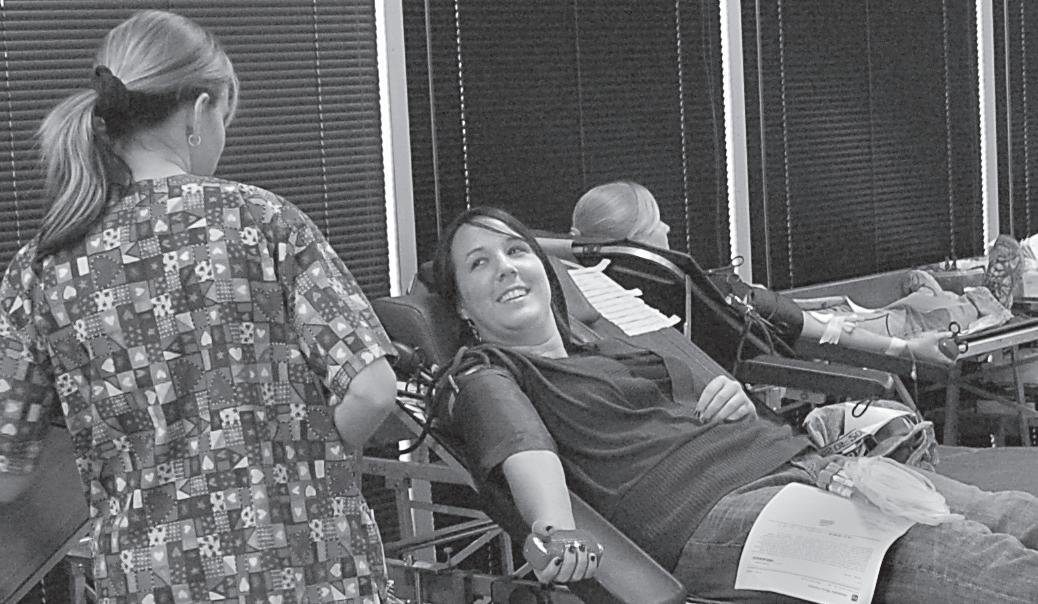
Photo by JON ROLLMAN


Joshua Pace News Editor
Dozens of RSC students, faculty and staff turned out and gave blood on Nov. 9 in a lifesaving effort undertaken by Student Activities each year on behalf of the Oklahoma Blood Institute, Daniel McClure, Student Senate president, said. Everyone who participated should feel good about their effort because they helped to save someone’s life, McClure said.
“We had a really good turnout and I’m glad we had a chance to help with this worthwhile effort,” he said. “The Student Senate holds a blood drive every year through the Oklahoma Blood Institute and I was glad we were able to carry on that tradition of helping.”
The turnout was the result of a campaign undertaken by senators – through informational posters hung throughout campus, as well as verbal encouragement – which, combined with OBI’s standard method of calling established donors and making them aware of the drive, served to help drive people to donate, McClure said.
One such donor, Nicole Wolff, pre-nursing major, said she had donated before and was glad to do so again when the opportunity arose.
“They will usually call me in to donate because I have AB negative blood,” Wolff said. “The needle hurts a little and since I’m smaller, I get a little light-headed because my blood comes out so fast, but it’s worthwhile [to donate].”
On average, an American will need blood every three seconds and they will take various types of donations, including whole blood donations, which are used by trauma patients; red blood cell donations, which are used for heart surgery and transplant patients; plasma used by newborns, blood disorder patients, and burn victims; and platelets, used in the treatment of cancer patients, according to information compiled by OBI and made available on their Web site at www.obi.org.
People can donate blood every 56 days but they must be at least 17 years old, weigh at least 105 pounds and be in good physical health.
For more information regarding blood donation, call OBI 1-877-OBI-GIVE or visit www.obi.org. jpace@rose.edu
The Raider Response question posed on Nov. 3 was -
“ What is your favorite holiday memory?” Raiders responded to the question as follows:
Cooking dinner with my grandmother. I’d always go early and help her cook. [Now,] I peel potatoes with my sister-in-law and just try to be supportive in whatever everyone needs. My family is between Blackwell and Ponca City, so I travel a couple of hours to be with them. - Sharon Saulmon, director, Learning Resources Center
[Playing] flag football with my family at Thanksgiving. - Ryan Kirk, liberal studies major
Christmas. Waking up and having breakfast already made for me and coffee made. Someone always has it ready. Nobody is in a bad mood because they’re so focused on the day. Opening and giving presents. And having a glass of wine with my mom after all the presents are wrapped and just talking about stuff and being together. - Matthew Wilson, physics major
About three Christmases ago, when all my extended family were together and we were able to spend time together, which is unusual for my family since we are spread out - South Dakota, South Carolina, southern Arizona and Oklahoma, too. - Nicole Wolff, pre-nursing major Christmas 2000, when my dad came home from the hospital from a real sick illness. He had just had surgery ... he came home on Christmas day. - Ashley Washington, psychology major
Staying up late on the night before Thanksgiving, Thanksgiving eve, making stuffing. Me, my dad and my brother would cut up all of the [ingredients] and Mom would cook it. Then, we get to sample it that night. - Ricker Deeg, chemical engineering major, transferring to the University of Oklahoma Christmas. My Christmases with my grandmother and her decorating. She would even decorate the ceiling with stuff. Her cooking and over the top decorating, that’s what I remember most. And “Frosty the Snowman” - that’s my all-time favorite. I loved watching “Frosty” and the “Grinch.” - Mia
Responses to this week’s Raider Response question must be received no later than noon Monday, Dec. 4. Replies may be e-mailed to editor in chief, Johnna Ray, at jray@rose. edu or hand delivered to the Fine Arts building, Room 110. Raider Response Question No. 6:
What New Year’s resolutions do you plan to make?