
Student senate welcomes 12 newly
Campus government begins planning for future, preparing for events
Bryan Trude
Sports Editor
In elections held on Sept. 7 and 8, the RSC student body elected 12 new senators to the student senate. Two more were appointed as Division Merit Appointees.
The new senators are political science major Charles Beattie, business major Kevin Fisher, liberal studies major Phillip Hall, engineering major Gina Pine, engineering major Jason Phillips, dental hygiene major Lynsie Walker, political science major Daniel McClure, business major Justin Jahanson, radiological technology major Tony Stelter, journalism major Bridget Hayes, nursing major Kristen Combs, liberal studies major Ashley Bresee, pre-education major Julie Cams and pre-nursing major Kaylea Brewer.
“I want to secure more funding for RSC athletics,” Beattie said. “I really like politics, and I believe in being involved in politics at RSC. I think it’s a duty.”
The senate is led by the executive committee, composed of President Logan Reynolds, Vice President Yancy Scott and Treasurer Dustin Irving. There is currently no secre
tary.
“First, I want to bring wireless Internet access to the students,” Fisher said. “I also want to bring competitive snack vending to the students to give them lower prices. I chose to run for senate because I wanted to make a difference.”
The 12 new elected senators, who had to register to run for senate before Sept. 2, had from the date of registration until Sept. 8 to campaign for office. The senators were chosen out of a field of 27 candidates.
“The first issue I want to address is the tickets that security is writing. I’ve had a lot of people come up to me and complain about that,” Hall said. “I also think we need more security presence around campus.”
The DMAs were selected by
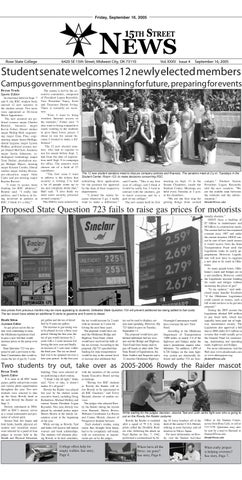
The 12 new student senators meet to discuss company policies and finances. The senators
Student Center, Room 123, to make decisions concerning RSC.
submitting their application for the position for approval by the dean of their respective departments.
“I joined the senate because wherever I go, I really want to make a difference,”
said Combs. “This is my first year of college, and I think it would be really fun. I want to interact with the students, get to know everyone and be a part of my college.”
The new senate held its first
meeting on Sept. 13 in the Senate Chambers, inside the Student Center. Meetings are held every Tuesday at 2 p.m. in the chambers.
“We are the first stop for getting things done around campus,” Student Senate President Logan Reynolds told the new senators. “We are the middle man between the students and the administration.” btrude@rose.edu
Proposed State Question 723 fails to raise gas prices for motorists



Gas prices from previous months may be more appealing to students. Defeated State Question 723 will prevent additional tax being added to fuel costs.
The tax would have added an additional 5 cents to gasoline and 8 cents to diesel.
Heath Sitton Assistant Editor
As gas prices across the nation were continuing to raise, the Oklahoma legislature tried to pass a new bill that would increase prices at the pump even more.
State Question 723 was proposed to add a provision to the State Constitution that would increase the tax of gas by 5 cents per gallon and the tax of diesel fuel by 8 cents per gallon. The increase in gas taxing was to be phased in over a three-year period. During the first year, the tax of gas would increase by 2 cents with a 2 cents increase following the next year and finally an increase of 1 cent more within the third year. The tax on diesel fuel was to be spanned out over a four-year period. In the first year
the tax would increase by 2 cents with an increase in 2 cents following the next three years.
The proposal would have created the Oklahoma Bridge and Highway Trust Fund, which would have received the bulk of the tax revenue. According to the proposal, SQ 723 specified that funding for state transportation would be stay at the current level or increase also additional fuel
tax not be used to displace current state spending. However, SQ 723 failed to pass on Tuesday, September 13.
The proposal would have prohibited additional fuel tax revenue and the Bridge and Highway Trust Fund from being used to pay off bonds or other debt. The State Board of Equalization, the State Auditor and Inspector and a 12-member Oklahoma Highway
Two students try out, take over as 2005-2006
Bryan Trude Sports Editor
It is seen at all RSC home games, public and private events and various photo opportunities throughout the year. Two new students were selected to take up the fuzzy Rowdy head as the new Rowdy the Raider on Sept. 2. Rowdy, introduced in 20042005 as RSC’s mascot, serves as a visual ambassador and promoter of school spirit.
Jessica Teal, law major, and Josh Jenks, health, physical education and recreation major, were selected by a panel of four judges in tryouts held in the Health and Physical Education
building. They were selected after performing a short routine.
“I think I did all right,” Jenks said. “Give or take, it doesn’t matter. It’s all good.”
Rowdy the Raider was played last year by the student senate executive board, including Doug Richardson, Michael McStay and current Senate President Logan Reynolds. This year, Rowdy was played by criminal justice major Shawn Brown at the family orientation event at the beginning of the year.
While serving as Rowdy, Teal and Jenks will receive full tuition waivers and book scholarships. The students will alternate playing Rowdy to fit their schedules,

with the members of the current Senate Executive Board serving as backups.
“Having two RSC students as Rowdy the Raider will allow Rowdy to be represented at all RSC functions,” said Towry Barnard, director of student services.
The judges who selected Rowdy the Raider during the tryouts were Barnard, Shawn Brown, Wellness Coordinator Liz Brown and Connie Myrick, director of Prospective Student Services.
Each student’s routine, using music they brought from home, had to be completely self-made, with no restrictions or requirements put on by the judges.
Oversight Commission would have overseen the new Trust Fund.
According to the Oklahoma Department of Transportation 3,000 miles, or nearly 1/4 of the highways and bridges under the state’s jurisdiction require rehabilitation. “In addition, 1,099 of 6,728 bridges on the state highway system are structurally deficient and another 534 are func-
tionally obsolete.”
ODOT faces a backlog of
$7 billion in maintenance and $8 billion in construction needs.
The current fuel tax has remained constant since 1987 and under the current structure, ODOT cannot be sure of how much money it would receive from the State Transportation Fund until the Legislature make its yearly appropriation. However, Legislation will now have to organize a new plan to fix roads in Oklahoma.
As many people know, Oklahoma’s roads and bridges are in a sad condition. However, could the Legislature increase funding for roads and bridges without increasing the prices of gas?
“In my opinion,” said undeclared major Jennifer Escobedo “if the Oklahoma Legislature could control its money, such a bill would not have to be put into proposal.”
During the 2005 session the Legislature allotted $69 million to pay bond debt, which has typically been paid out of highway maintenance money. The Legislature also approved a bill that in 2006 shifts $15 million in revenue that would usually go to the General Fund for constructing, maintaining and operating roads, highways and bridges. For more information visit the Web sites www.oksaferoads.com or www.oktaxpayers.org. jhsitton@rose.edu

Rowdy the Raider is modeled after a squad of 79 U.S. Army pilots called the Doolittle Raiders who, following the attack on Pearl Harbor on Dec. 7, 1942, performed a counterattack by fly-

16 Army bombers off of the deck of the carrier U.S.S. Hornet, striking at arms factories and oil reserves in Tokyo, Japan. For more information on Rowdy, visit

While waiting for the judges’ decision, Jessica Teal and Josh Jenks fight over who is going
put on the Rowdy the Raider costume.
offers help for empty wallets. See story, Page 4.
have all the Drive- ins gone?
story, Page 6.
Photo Provided By:SCOTT EVENSON
Photos Provided By: JASON ANDERSON and DEVIN HORST
Photo Provided By:SCOTT EVENSON
Dental Hygiene Clinic
The RSC Dental Hygiene Clinic is now accepting appointments for children 3-12 years old. This appointment may include prophylaxis (teeth cleaning), examination and fluoride treatment. Additional services, oral radiographs (X-rays) and sealant placement may be scheduled at a later time. There is a fee of $5 and appointments and availability are limited. Contact the Clinic as soon as possible at 733-7337 for available dates and appointment scheduling.
Oklahoma Statewide Auditions
Open auditions will be held for actors, models, dancers and singers ages 4 and up Sept. 17 and 18 at 10 a.m. and 1 p.m. in the Black Tie Ballroom at 9204 N. May Ave. in OKC. Appointments can also be made for auditions and interviews Sept 24 and 10 a.m. to 3 p.m. and Sept. 25 from 12:30t o 4:30 p.m. at the Community Youth Outreach Center at 1208 N.E. 50th St. in OKC. All those interested in auditioning must bring a current photo and singers and dancers should provide a one-minute routine with music.
2005 PASA Golf Tournament
The Professional/Administrative Staff Association golf tournament will take place Friday, Sept. 30 at the John Conrad Regional Golf Course located at 711 S. Douglas Blvd. in MWC. The deadline for entry is Friday, Sept. 23. There is an entry fee of $50 per person and the option of a $10 Cheaters Package that includes one throw, one mulligan and one Lady’s tee. For more information, call Connie Myrick at 7337372 or Julie Lesko-Bishop at 733-7400.
Del City Library Events
PlayTime Book Tips
Sharon Saulmon, Learning Resources Center director, will share tips on selecting books for young children at Del City Library’s next PlayTime. This program is for children age 6 months through 3 years and their parents/caregivers. PlayTime is Thursday, Sept. 22, at 10 a.m.
Riley the Wonder Dog
The Del City Library will host a performance by Riley the Wonder Dog. Riley and his trainer, Susan Phariss, will be at the library on Saturday, Sept. 24, at 2 p.m. Riley and Phariss will demonstrate what they did on Nickelodeon’s popular game show, Figure It Out, when Riley was a guest star. This program is for children ages 5 to 12.
Mice Stories
Mice Evening Stories is 6:30 Tuesday, Sept. 27, at the Del City Library. Mice stories and activities will entertain children ages 4 to 8.
The Del City Library is located at 4509 S.E. 15th St. For more information, call 672-1377.
Briefs continued on Page 4
Peer educators work to raise HIV awareness
Johnna Ray News Editor
The steps necessary to prevent the spread of HIV/AIDS were realized over 20 years ago, yet many do not now what they are – RSC is trying to increase the number of those who do.
RSC is the first and only college in Oklahoma that offers an HIV/AIDS course in addition to free testing. Other institutions offer testing, but do not provide the opportunity to receive certification from the American Red Cross as an HIV/AIDS Peer Educator.
The first of these courses – funded with a “Bridges to Healthy Communities Grant” awarded by the American Association of Community Colleges – began in fall 2004.
“It is a great opportunity for those concerned about HIV awareness to contribute [to others],” said Liz Brown, Wellness coordinator.
Certified students assist with HIV/AIDS testing, provide private counseling and conduct presentations to peer groups at RSC.
The courses consist of four three-hour sessions on B-week Fridays, one eight-hour Saturday session, four hours of individual peer education and two HIV/ AIDS awareness presentations.
One credit hour is given for completion of the course. Service-Learning, Honors or Fourth Hour credits may also be awarded with prior approval.
The application deadline for the fall 2005 semester has passed and notification of the 15 students selected has been made. However, future courses will be available to those interested in applying.
Free HIV/AIDS tests are given on campus periodically. The tests – which use oral swabs that collect saliva – yield results the same day.
“Most of my professors pointed out the first day [of classes] that we have free testing [at RSC],” said Shane Martin, engineering major.
Testing and results are given confidentially. Shanna Parker, RSC coordinator for the Regional AIDS Intercommunity Network, (RAIN) provides confidential HIV counseling as well. RAIN is a non-profit organization in OKC and a community partner of RSC.
Statistics of positive results are reported to the State Department of Health – no names are given in these reports.
Those with questions are encouraged to attend presentations given by peer educators. Also, they may obtain brochures about sexually transmitted diseases, planned parenting and HIV/AIDS.
“You should come by for information, even if you don’t think you have HIV,” Brown said.
Brown added that early detection increases the life expectancy and quality of life of an individual. Early detection also
allows an individual the ability to alert current or future partners of the individual’s HIV/AIDS status.
Those who do not test positive for HIV/AIDS can learn how to better protect themselves and their partners from contracting or spreading HIV/AIDS.
Testing should be repeated
every three months for those involved in high-risk situations.
Those who fall into a low-risk category should repeat testing every six months to a year.
For additional information or to pick up a brochure, visit the Social Sciences building, Room 119, or call 733-7525.
jray@rose.edu
American Association of University Women invite members
Heath Sitton Assistant Editor
The RSC affiliate group of the American Association of University Women is inviting new members for the fall 2005 semester.
The AAUW was founded in 1881when Marion Talbot and Ellen H. Richards invited 15 alumni from eight colleges to attend a meeting in Boston, Mass. with the purpose of “uniting the alumna of different institutions for practical educational work and for the maintenance of high standards in education,” according to the AAUW Web site (www.aauw.org).
The women envisioned an organization where female college graduates could band together to set new standards for higher education and broaden the horizons of women across the globe.
Today, the AAUW has more than 160,000 members nationwide, 1,300 branches and 500 college and university partners. It is the oldest and largest organization working
Bryan Trude Sports Editor
Thanks to RSC students and their efforts, there are two schools in the OKC school district that are reaping the benefits of volunteers.
Willow Brook Elementary and Telstar Elementary were adopted in 2000 as part of RSC’s Adopted Schools program. Through this program, RSC students and faculty can tutor at the schools, and RSC hosts many events for the schools throughout the year, as well as inviting students at the schools to other RSC events.
“We do a lot more than tutor,” said Director of Special Services and Student Outreach Dr. Joanne McMillen-Stafford.
In the tutoring program, students who sign up to volunteer will tutor a group of three to four students in math and reading, on a topic directed by the teacher. The teacher provides a structure for the tutor to work in, allowing the tutor to focus on an area of study that best benefits the student.
RSC students and faculty also work with the teachers to develop curriculums in subjects such as science and mathematics.
When the schools were adopted, both Willow Brook and Telstar were listed as “at risk.” Schools on this list are schools whose students score consistently below state standards on the state tests.
“We have 460 students, including 4 who were displaced by Hurricane Katrina,” said Arthur Houston, principal of Willow Brook Elementary. “Now, within the last two years, we have made enough of an academic improvement to be taken off the
to promote education for women and girls and remains a powerful voice in politics.
The RSC group is sponsored by the Mid-Del branch. RSC affiliate members are welcome to attend any of the Mid-Del branch activities including Joint Affiliate and Mid-Del Branch Meetings, OETA Fundraiser Telethon, Summer Leadership Conference, Legislative Day at the Capitol and other meetings of interest.
“The AAUW is a community of women interested in education,” said RSC campus sponsor Sandra Keneda. “It is a great place for women to form valuable connections that can help them further their careers for the rest of their lives.”
The Mid-Del branch of the AAUW is headed by university educated women interested in the advancement of other women and can offer members opportunities for employment. The AAUW also offers scholarships for girls in high school and women seeking an education at the graduate level.
The AAUW Educational foundation supports teachers
and activists in local communities, scholars around the globe and women pursuing professions where women are underrepresented.
“I think it is great that there are organizations such as the AAUW,” said art major Kelsey Trammel. “It is great that there are organizations like this on campus where students can get involved and be a part of something.”
The cost to become an affiliate member of the AAUW is $18 per year. Affiliate members will receive the same publications from the national organization that regular members receive. Partial financial assistance for student membership is available.
A pizza party will be held in the Fountain Room of the RSC Student Center on September 27 and 28 from 11a.m.-1p.m.
For more information on the RSC affiliate group of the AAUW, contact professor Sandra Keneda at 733-7384 or branch advisor Betty Seglem at 732-8240. jhsitton@rose.edu

‘at risk’ list.”
Currently, thanks in part to the work of the RSC volunteers and community supporters, Willow Brook is listed as an “excelling” school. This indicates that Willow Brook makes a marked improvement in academics every year, while coming short of being an “excellent” school.
RSC student and faculty volunteers also take part in and host programs for the students, including the holiday party, a special tour for the sixth graders, a Halloween party, a science fair, a read-a-thon hosted on the RSC mall and Willow Brook’s own “Reading First” program.
“The Reading First Program is a reading intervention program, where students are assessed at the beginning of the school year and their areas of weakness are targeted,” Houston said. “The teachers and the Reading First coaches collaborate and work together to increase the students’ performance.” Time spent tutoring is also eligible for ServiceLearning credit. For more information about the adopted schools program or to find out how to volunteer, visit the Special Services and Student Outreach Office in the Student Services Building, Room 101, or call at 733-7373. btrude@rose.edu
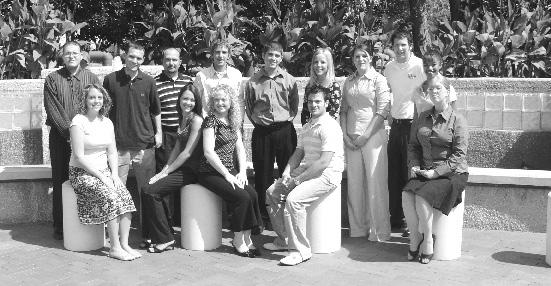
Greg Bates, nursing major, picks up a free pamphlet on HIV/AIDS outside the HIV Peer Educators office. The Peer Educators supply information to the campus free of charge.
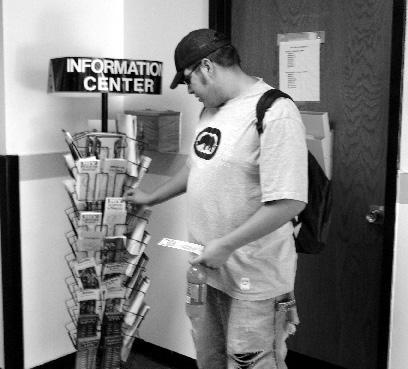
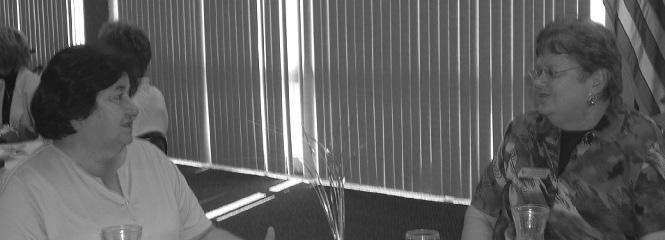
Sandra Keneda, American Association of University Women sponsor, discusses topics concerning university women with Sharon Saulmon, director of the Learning Resources Center, during a recent meeting on campus.
Shannon Fields, nursing major and adopted schools volunteer, tutors a group of third graders in mathematics at Willow Brook Elementary, one of RSC’s adopted Mid-Del schools.
Photo Provided By: DEVIN HORST
Photo Provided By: GINNIE
Photo Provided By:BRYAN TRUDE
NewS/FeatureS
Hurricane victims receive assistance from local donors

Hurricane Katrina hit far away from Oklahoma geographically, but for many in the RSC community, it hit very close to home. As a result, some have run their own donation campaigns, while others gave via a campaign led by the student senate. RSC is also helping Katrina victims to “finish what they started” at affected institutions through courses offered at RSC.
“I decided to take action myself because being a new mother, I cannot imagine what it would be like to not be able to feed and clothe my child for four or more days,” said English professor Lindsey Renuard. “There are children and babies out there who need our help today, not tomorrow.”
Renuard requested donations from all of her students, family and others. She also has a friend in Louisiana who passes out items she sent to those in need there. An acquaintance of hers from a local church
Students
drives half of the donations she collected to Falls Creek for survivors expected to temporarily relocate there.
“When each child is clothed, fed, sheltered and educated, then I will know that I have done all I can,” Renuard said.
Renuard is also planning to give extra credit to students enrolled in her classes who bring specific items detailed in a list she passed around to them.
Renuard and her students are not the only ones giving to those in this time of need.
Staff members at the Child Development Laboratory Center also devised a plan to gather supplies for hurricane victims and relief workers during the Center’s annual fall open house, held Sept. 6-9.
CDLC staff members contacted Feed the Children to learn what items were needed and to schedule a pick-up time for donations collected. The CDLC staff, along with families of the children who attend the Center, donated water, juices, baby clothes and other
items.
“One of our babies had her one-year-old birthday this weekend. Her parents had guests bring supplies for hurricane victims rather than gifts for her,” said Patsy Kuhn, director of the CDLC.
Kuhn added that the older brother of one of the preschoolers at the CDLC used money he had been saving for a video game to buy a package of diapers to donate.
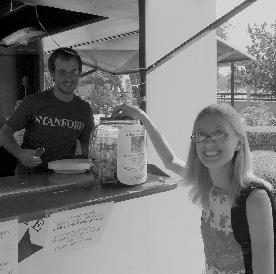
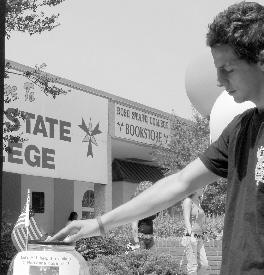
The RSC student senate pledged to match up to $600 of donations received Sept. 6-9 from students, faculty and staff on campus.
Pizza and lemonade were available to those who donated money at the pizza trailer. Other donation drop-off buckets were set in various locations on campus and proceeds given to the American Red Cross.
The total amount donated was $7,700 according to RSC President Dr. James Cook.
RSC offered to waive out-of-state tuition for students now living in Oklahoma who were attending colleges the hurricane affect -
ed. Oklahoma residents who were attending affected colleges, but have now returned home as a result of hurricane Katrina, may also receive tuition assistance. Assistance for affected students is handled on a case-by-case basis. Late enrollment is allowed only under certain conditions. Fast-track and eight-week courses are also options to consider.
Cooling cloths, called “HUGS,” which are usually created for and sent to troops overseas, were made by various volunteers on the RSC campus, Sept. 10, for those in Louisiana and Mississippi (see story, Page 7). For more information about tuition assistance, contact Associate Vice President for Enrollment Management Dean Fisher, at 736-0223. For a list of donated items needed, contact Renuard at oklahomapoet@cox. net , the American Red Cross by calling 2289500 or Feed the Children at 942-0228. jray@rose.edu
threatened with theft of personal identity offered multiple prevention tips
Shannon Hoverson Assignment Editor
Identity theft has become a major crime in America, but not everybody knows what to do if their identity is stolen.
Most people do not often think of identity theft unless it happens to themselves or a friend. But what does it mean to have an identity stolen?
Identity theft is when someone takes or uses a person’s name, address, Social Security number, bank or credit card account number or other identifying information without the knowledge of the person. The intent is often to commit fraud or other crimes.
Between January and December 2004, Consumer Sentinel -- the complaint database developed and maintained by the Federal Trade Commission -- received over 635,000 consumer fraud and identity theft complaints. Consumers reported losses from fraud of more than $547 million, according to the Web site www.FTC.gov.
“I probably wouldn’t know what to do,” said Marcy Vaught, graphic design major. While she has not had her identity stolen, Vaught fig -
ures she would need to know what to do if it ever happened.
“Identity theft has become so common,” Vaught said.
Sheri King, Secretary for Prospective Student Services, recently had someone use her information to apply for a credit card. She first noticed the theft had occurred when she received her bank statement. King noticed that an amount had been withdrawn by a credit card company for a card she did not have.
Apparently, someone had gone online and applied for the card using King’s name. The bank immediately stopped payment and King filed a police report. King does not know how this person got her information, but the police told her they suspect her computer was hacked into.
“If you see anything suspicious [on a bank statement], call the bank and find out what it is, then file a police report,” King said.
Follow up all calls in writing, then send a letter by certified mail, with a return receipt requested. This will document what the company received and when. Always keep a file with copies of the correspon -
dence inside.
Below are some basic tips on what to do if ever a victim of identity theft:
1. Make a fraud alert on all credit reports, and then be sure to review these reports.
2. Contact the creditors (for example, credit card companies, phone companies and other utilities, and banks and other lenders) to close any accounts that have been tampered with or opened fraudulently. Ask to speak with someone in the security or fraud department of each creditor, and then follow up in writing. It is very important to notify credit card companies in writing.
3. File a report with the local po
lice. Get a copy of the police report in case the creditors, credit bureaus or others need proof of the crime.
4. File a complaint with the Federal Trade Commission. The FTC maintains a database of identity theft cases which are used by law enforcement agencies for investiga
tions.
The FTC also gives some good advice on how to prevent identity theft. For more information, go to their Web site at www.FTC.gov. slh101@cox.net
WWII Holocaust victims remembered through traveling exhibit Advisors Luncheon

locaust.” Inspired by a book of the same name, photographer Gay Block and writer Rabbi Malka Drucker tell the story of forty-nine rescuers who risked their lives to protect Jews from persecution by the Nazi regime. A free reception honoring the exhibit will be held Sept. 16, with Block and Drucker available to answer questions and autograph copies of the book. Also on display
at the untitled [Artspace] building will be the traveling exhibit “Nazi Persecution of Homosexuals 1933 – 1945.” This exhibit, presented by the United States Holocaust Museum, examines the police terror used against 100,000 men arrested under a law against homosexuality in Nazi Germany.
The Oklahoma City Museum of Art will be hosting showings of the documentaries “Paragraph 175” and “Resisting Paradise.”
“Paragraph 175,” which won awards at both the Sundance and the Berlin, Germany film festivals, tells the story of 100,000 men who were arrested for being homosexuals during World War II under German penal code, paragraph 175.
“Resisting Paradise” tells the story of two artists in southern
France who tried to create art amidst the chaos of their neighbors who were working and fighting to protect Jews who had fled to the region.
“Paragraph 175” will be shown Sept. 15 and 16 at 7:30 p.m. “Resisting Paradise” will be shown Sept. 17 at 7:30 p.m., and Sept. 18 at 2 p.m.
Tickets are available for free through the OCMA ticket booth at the corner of North Walker Avenue and Couch Drive in OKC.
The exhibition is sponsored by the Cimarron Foundation, or CAF. CAF was formed in 1997 to educate the public about issues of discrimination facing gays and lesbians.
For more information about the exhibition, contact Chairman Rob Howard at 946-1377. btrude@rose.edu

Student Activities annual Advisors Luncheon served thirty-two individuals with a hot meal and a lot of information. The annual buffet arms advisors with an updated calendar of events, opportunities for participation and newly implemented changes. Towry Barnard, coordinator of Student Activities, elaborated on the 2005-2006 calendar of events, and
stressed the importance of involvement. She also shared details of the 2005-2006 Student Leadership Conference Retreat to be held September 16 and 17 in Tulsa. Steve Howard spoke on Global Oklahoma and ways to involve student clubs and Professor Arnold Waggoner encouraged advisers to sign up to reserve a showcase in the Social
to
Johnna Ray News Editor
The campus works to raise relief effort through various means, including donations of money and other donated items to aid in the Katrina disaster
Exhibition book captures images of Holocasut victims.
Photos Provided By: MORGAN HORNER
Photo Provided By: SCOTT EVENSON
Andrew Gammill, assistant director of Student Activities, risks identity theft by Blake Thorndike, business administration major, via images captured with a cell phone. Identity theft is often perpetrated without the victim’s knowledge.
NewS
Briefly
Speaking continued...
Intercultural Day 2005
The Campus Mall in front of the Student Center will come alive Oct. 10 with food, fun and festivities at the 2005 Intercultural Day celebration. The festivities will start at 9 a.m. and will conclude at 1:30 p.m. There will be cultural food vendors, henna tattooing and Bostick poetry and drums. Clubs that participate will receive 200 participation points. For more information, call the Office of Intercultural Communications and Education at 733-7905.
Langston University Recruitment
Business administration majors can now get their bachelor’s degree through the Langston University BBA program while attending RSC. The university offers fee waivers and, for students affected by Hurricane Katrina, free tuition. Langston offers different courses every eight weeks. Donetta Fails, a representative from the university, will be in the Student Center lobby every Tuesday from 11 a.m. until 3 p.m. to answer questions of interested students. For more information, call Fails at 962-1667 or e-mail dsfails@lunet.edu.
I-40 Construction
The north I-40 access road from Sooner Road to S.E. 15th Street will be closed for improvements starting Aug. 15. This work will temporarily close the westbound I-40 ramp. The work is scheduled to last approximately 60 days.
Transcript Kiosk
Students can avoid the lines and print an official transcript on their own through the two new Transcript Kiosks located in the lobby of the Administration Building. Students must have their IDs and passwords ready to enter into the computer to print their transcripts. Admissions and Records will still be available to print a transcript and seal it in an envelope for current or former students. The Kiosks are available Monday and Tuesday from 8 a.m. until 8 p.m., Wednesday and Thursday 8 a.m. to 6 p.m. and Friday 8 a.m. to 5 p.m. Extended hours are available during heavy enrollment in August and January. For more information, call 733-7308.
Wellness Employee of the Month
Nominate a friend or yourself for the Wellness Employee of the Month by the 20th of the preceding month. Send nominations to Liz Brown, Wellness coordinator. Employees are selected based on participation in wellness activities and by lifestyle changes they have made.
LRC to Host Exhibit
The Learning Resources Center has been selected to host the traveling exhibition “Alexander Hamilton: The Man Who Made Modern America.” Only 40 locations throughout the United States have been selected for this honor. Dates for the six-week exhibit have yet to be determined, but will take place sometime between October 2005 and March 2009. The exhibit is sponsored by the National Endowment for the Humanities and the American Library Association.
Go METRO, Save Gas Students are encouraged to expand their education with METRO Transit. When they ride the bus, students have more time to do homework, study for tests or even take a nap. Plus, students do not have to deal with driving expenses or parking hassles. Students can try the Transit for free by calling 2972976 for a free Courtesy Card good for one bus ride. Monthly passes cost $40. For a complete list of timepoints and maps on all routes, visit www.gometro. org. For more information, call 235-RIDE.
Con men seek to steal education opportunities
Scholarship scams prove threatening to uninformed students
Heath Sitton Assistant Editor
When it comes time to pay for tuition, books and other fees, many college students could use some extra help. Many students seek out scholarships to assist with the school fees. An abundance of scholarships are available for students in good academic standing. Some students find it important to apply for scholarships and financial aid for some extra cash.
“You don’t want to waste money when you can get help with grants or scholarships.” said theatre major Matt Lerma.
Many of these scholarships are legitimate awards to help out deserving students. However, there are many people that are scamming students out of the money they deserve.
“Most importantly,” said Dean Fisher, associate vice president of Enrollment Management, “students need to be aware that they need not pay a fee to obtain a scholarship.”
Aside from the scams, there are helpful organizations out there to help students find the right scholarships for themselves. Information about scholarships can be found in the Financial Aid Office in the Student Services Building and other individual departments on campus.
However, one of the best ways to search for scholarships can be as easy as logging on to the Internet and having the patience to fill out some information.
At FastWeb.com, students are able to search over 600,000 scholarships.
FastWeb is a free service provided to help high school and college students find legitimate scholarships to help with various college fees such as tuition and books. Many of the scholarships come in
the form of cash given to the student to be used however they feel necessary.
To become a user of FastWeb, a student must first set up an account. The user will then be guided through a registration process and be asked to enter a username and password. The user name is basically an e-mail address and the password is a simple word of at least six characters.
The registration process is a series of questions about the individual. The Web site asks for grade-pointaverage, academic standing, disabilities and interests to find out what scholarships a person is eligible to
receive. If a student wishes to receive information about military service, there is a box to check that will then take the student to a survey to find out which branch of the military they would best be suited for.
Aside from listings of available scholarships, FastWeb also has many tips on avoiding scams and also information on financial aid. FastWeb can prove to be an excellent resource for enrolled and prospective students to receive every type of information needed to choose the right scholarships. jhsitton@cox.net
1. Fees: Students should not have to pay for fees to search for or receive scholarships. The only fees you should pay are for postage stamps.
2. Credit card or bank account information: Students should never give out credit card or bank account information.
3. Scholarship guarantee: No one can guarantee a person will win a scholarship.
4. No work involved: Students cannot avoid putting in time to fill out a scholarship application.
5. No contact information: Legitimate sponsors should provide contact information upon request.
6. Unsolicited scholarships: If called to receive an award, which was never applied for, it is most likely a scam.
7. Pressure tactics: Students should not allow themselves to be pressured into applying for a scholarship, especially if the sponsor is asking for money up front.
8. Claims of exclusive scholarships: Sponsors do not make their scholarships available through only one service.
9. Sponsor goes out of their way to sound “official”: Scammers sometimes use official sounding words like “national,” “education” or “federal” or they display an official looking seal to fool a person into thinking they are legit. Students should check with their school if they question a scholarship provider’s legitimacy.
10. Questions not answered directly: If an applicant cannot get a straight answer from a sponsor regarding their application, what will be done with their information or other requests, proceed with caution.
Tips courtesy of FastWeb (www.fastweb.com)
Job placement service helps campus, public find work
Bryan
Trude Sports Editor
As the year gets into full swing, many students and even graduates are left hunting for ways to pay their school bills, on top of any other bills and costs of living they might have. For this problem, RSC offers a solution.
The RSC Office of Job Placement and Career Services, located in the Student Services Building, Room 101, offers students and members of the community ac-
cess to hundreds of jobs after graduation or while still in school.
In addition, Career Services offers aid to job hunters with interview skills, resume-building aid and help in developing a list of contacts among other job finding services.
“Job placement is a service for students to help them find part-time or full-time jobs while they are in school, as well as employment upon graduation,” said Dr. Joanne McMillen-Stafford, RSC director
of Special Services and Student Outreach. “We also assist students in career decision making, which centers around that important question, ‘What is your major?’”
Job Placement utilizes a program called E-Campus Recruiter, which works similarly to online job placement services such as oklahomacityhelpwanted.com.
By registering at http://www.ecampusrecruiter.com/rose, a student can browse over a hundred job listings from local
companies and businesses and submit their resumes 24 hours a day. Over 140 job listings were cited in the month of August.
To log on to E-Campus Recruiter, students who visit the Web site need to click on the “Students & Recent Grads” link, bringing them to a short sign-up form, which students need to fill out. All the fields are optional except for fields marked by an asterisk; these fields are required. Job Placement recommends that students write down their username and password, since that information cannot be provided over the phone.
“Some of the positions we list may require a degree,” McMillen-Stafford said. “Not everyone attending college is attending college for the first time. Some of our students are individuals who already have degrees, and are retraining or have decided that their degree is not a field they want to continue working in.”
Students will receive an e-mail notification after a 24-hour processing period. Employers who register to list job offers also go through a 24-hour processing period to verify that they are legitimate employers.
These services are also offered to non-student members of the community as one of RSC’s Community Outreach programs. The programs of Job Placement and Career Services are free of charge to both students and members of the community.
“So far, I’ve only used the Web site, E-Campus Recruiter,” said Stergus Mathes, Business Accounting major. “It lists jobs that are local and from a variety of fields. I like it.” For more information or to schedule an appointment with Job Placement and Career Services, visit the office in SSB101 or call 733-7377. btrude@rose.edu
Former student makes second highest score on national ACAT
Bryan Trude Sports Editor
Former RSC Accounting major
Deborah Whitaker has scored the second-highest score in the nation on the Accreditation Council for Accountancy and Taxation exam, or ACAT.
Whitaker, who graduated RSC in the spring of 2005, was honored for her accomplishment by the RSC Board of Regents at their meeting Aug. 18. She currently works as a municipal accountant for the city of Norman.
“[Whitaker] is the type of student a professor dreams of having,” said RSC Professor of Accounting Jerri Tittle. “She is intelligent, eager to learn and hard working. One of the best I have ever taught in 25 years of teaching.”
The ACAT is a required exam for all two-year accounting students. It is a national exam offered twice a year, on the first Friday of December and June. Students - after completing every other course in their degree plan - must take an ACAT review course taught by Tittle. The course is for the sole purpose of preparing students to take the ACAT exam.
“[Accounting] students must at least sit for the exam to get their degree from RSC, but they do not have to pass the exam to graduate,” Tittle said. “RSC has about a 50 percent pass rate on the ACAT.”
Students taking the ACAT must pay a $150 registration fee, however $75 of the fee is reimbursed to the student
by the Croak Foundation upon the student’s passing the exam. Students who fail the exam can attempt it a second time free of charge.
“She is one of the best students I have ever had,” Tittle said. “I always knew she would pass the test, I just didn’t know how well she would score. I am not surprised she scored how she did. Knowing [Whitaker], she only scored one or two points below the top scorer.”
Passing the ACAT rewards the student with an Accredited Business Accountant credential. The ACAT is associated with the National Society of Accountants, a nationally recognized organization that accredits schools of business and accounting as meeting certain standards that employers rec-
ognize when hiring graduates.
“Good accountants have to be diligent,” said David McKenna, accounting professor. “Accounting is a demanding discipline.” McKenna also recommends that students interested in accounting be persistent, have good interpretation skills and have above-average mathematics skills. Students interested in pursuing a four-year degree should be skilled in math up to calculus.
“Accountants have to be able to work with their peers, subordinates, superiors and clients,” McKenna said. “That is mandatory.”
For more information about the ACAT exam or the accounting field, e-mail Tittle at jtittle@rose.edu. btrude@rose.edu
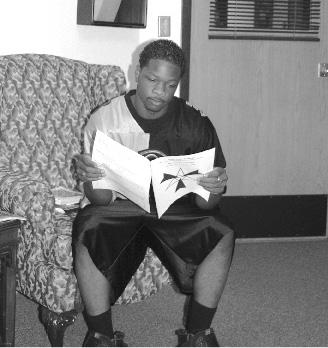
The Office of Financial Aid offers free scholarship information. Reginald Harris, paramedic major, reviews scholarship opportunities.
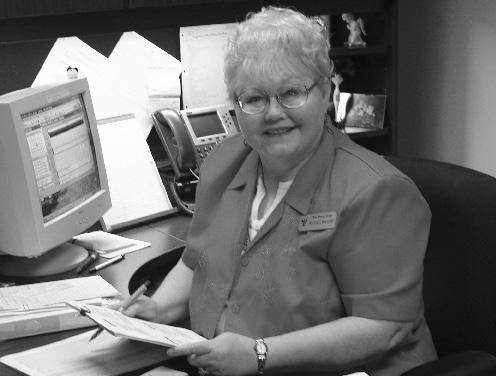
Brenda Wright, secretary in the Office of Student Outreach, guides many students and community members in their search for a job while performing a variety of other necessary duties.
Photo Provided By:SCOTT EVENSON
Photo Provided By: JASON ANDERSON
Diets rich in vegetables, legumes, fruits, whole grain may lower weight
Heath Sitton Assistant Editor
With all of the trendy diets floating around in the world, it seems that many people are trying to find the best way to lose some extra pounds and stay lean.
There is a great deal of research that suggests the less meat that an individual consumes, the less weight they will gain. People who consume a diet with few or no animal products are less likely to be overweight than those who partake in a diet containing meat.
A diet consisting of fruits, vegetables, legumes and whole grains is high in fiber and nutrients and low in fat and calories, which can be a great factor in weight loss.
However, if leaving meat out of a diet seems absurd, a person can try cutting down portions. “A serving of meat is equal to three ounces, about the size of a deck of playing cards,” according to the Real Age Web site (www.realage. com). “If you eat red meat, limit consumption to no more than one serving per week.”
Limiting meats that are high in saturated fats can also prove to be helpful in weight loss. Consumption of meats such as sausage, bacon and fatty cuts of beef should be low.
“I have not completely cut meat out of my diet,” said liberal studies major Kimberly Hofner. “I mainly just try to stay away from fast food and if I do eat meat, it is only on occasion.”
It is not however, necessary to completely cut meat out of one’s diet. Choosing the appropriate
Renaissance Run provides variety of non-profit programs with grants
Ray News Editor
The 19th annual Renaissance Run, sponsored in part by RSC, will be held Saturday, Sept. 24 at the MWC Library.
This family event began as a way to help those recovering from cardiac problems and has grown each year since.
Many faculty, staff and students have participated in the event in the past years.
“The most significant aspect to me, if you don’t include the wonderful whole-grain pancakes with applesauce, is the community support and involvement,” said Brent Bloyed, assistant to the aquatic coordinator. “I know it is for a good cause … families throughout the neighborhood turn out offering bananas, oranges, water, sports drinks, music and a cheering squad.”
Pre-registration for adults is $15 and $10 for children. The first 500 entrants will receive a long sleeved T-shirt. The last day for early registration and team registration is Sept. 16. All ages may register on the day of the run/walk for $20, from 7-8 a.m. at the library. Packets should be picked up
during this time for those who registered early as well as those who register on the day of the run.
A runner’s stretch for the 5K run/walk will begin at 8 a.m. behind the Community Center on National Avenue. Wheelchair participants will start the run at 8:25 a.m. and others will begin at 8:30 a.m. The weather will not preclude the run. Also, no refunds will be given for those unable to attend.
All participants are welcome to enjoy the pancake feast at Midwest Regional Medical Center at 9 a.m. Spectators may also enjoy the breakfast for $2. The team with the most member registrations will receive a Community Spirit Award. Proceeds from the run will be used to issue grants for various non-profit programs and projects to benefit communities in eastern Oklahoma County. Steed Elementary School and the Midwest City Fire Department have each benefited from these grants in previous years, as have many others.
“The event is sanctioned by USA Track & Field … Baby
joggers, strollers, pushed wheelchairs and wheels of any kind (except competitive wheelchairs in a separate race), headphones and animals are forbidden on the course,” according to a brochure detailing the event. This brochure may be downloaded at www. midwestregional.com. Major intersections will be closely monitored, traffic will be directed as needed and water and emergency first aid stations will be available for participants.
Awards of medallions will
be given to the top three winners of each of the 18 groups. Trophies for the top male and female winners will also be presented.
Results of the nineteenth annual Renaissance Run will be available online Monday, Sept. 26 at www.okrunner. com
“This will be my third year to race and I cannot wait,” Bloyed said.
For more information, call Kathy Hefton at 610-8397, or call 610-8561. jray@rose.edu
Wellness assessments, information available free to faculty, staff, students
Johnna Ray News Editor
Wellness assessments have been offered free of charge for RSC faculty, staff and students for at least six years. Community members pay a $25 fee.
The assessment is safe for everyone, including children.
Appointments must be scheduled in the Wellness Office as soon as possible. Appointment opportunities for each semester cease a week
before finals.
A questionnaire should be picked up and filled out a few days prior to the assessment.
The questionnaire asks several questions including those concerning family history, risk factors, exercise and diet.
The assessment takes approximately 30 minutes, but appointments are scheduled in increments of one hour, to allow time for questions to be asked.
Screenings for body fat, flexibility, cardiovascular endurance and muscular strength are included.
An analysis is given the same day, which outlines personalized exercise and diet plans. Also included in the analysis packet is a body/functional age, determined by the examination of information provided in the questionnaire packet and results of screenings, compared to chronologi-
cal age.
Wellness Coordinator Liz Brown said most people are surprised when they see their body/functional age.
“Some who are 50 years old chronologically have a body age of 24 and vice versa,” Brown said.
To schedule an appointment or for more information, contact the Wellness Office at 733-7525.
jray@rose.edu
portion sizes and using low-fat cooking methods can aid in a healthier lifestyle.
Avoiding meat is not right for everybody. Many people cannot think of life without the consumption of meat and avoiding meat is not necessary to maintain a healthy lifestyle.
“Eat beef,” said criminal justice major Brandon McCar. “The West wasn’t won on salad.” All foods can fit into maintaining a healthy lifestyle.
It is important to know which foods the human body needs more or less of. Choosing a variety of foods will give the body the vitamins and minerals necessary to function.
It is recommended by the U.S. Department of Agriculture that a person consume about three servings of dairy, five servings of fruits and vegetables, two servings of meat and protein and six to 11 servings of breads and cereals each day.
Eating regularly is a necessity to maintaining a healthy lifestyle. Eating three meals a day and snacking in between is an excellent way to keep a high metabolism.
Aside from maintaining a healthy lifestyle, physical activity is an important part of living well. Exercising 20 to 30 minutes, three to five times a week, can help shed pounds and keep the body in better condition. For many, it may seem hard to maintain a healthy diet and exercise routine, but the benefits of living a healthy lifestyle will pay off greatly in the long run.
jhsitton@cox.net
PACE offers many benefits
Overall fitness improved through use of free facilities available on campus
Bryan Trude Sports Editor
There is a class that meets in the wee hours of the morning for the express purpose of making the lives of the students enrolled in it a little bit healthier and more active.
The Progressive Aerobic Circuit Exercise classes, which meet every morning in halfhour blocks from 7 to 8 a.m., is an aerobic and athletics class used primarily by students ages 55 and older. PACE is a structured workout environment that follows a regimen set out by a musical recording played during the class.
Even though PACE is a registered class that students must enroll in, the atmosphere is pretty relaxed.
“Occasionally, I will get someone who wants to come in and work out in time slots they aren’t enrolled in,” said Physical Education Instructor Robin Haley. “That is just fine. I do not mind it at all.”
During the class, students move around 22 stations including the aerobic balls, a squat machine, free-hand dumbbells and even a machine called the “joy stick.” Students change stations every 40 seconds as directed by the tape.
“I do it to keep buffed up. It keeps me young,” said Dana Johnson, a PACE student who works as a gym teacher at Townsend elementary. “It is a self pacing program that helps me burn those calories I miss chasing kids around all day.”
At certain points during the workout, the recording will instruct the students to step away
from the stations. During these times, students check their heart rate by measuring their own pulse before resuming the workout.
One thing that sets PACE apart from the open weight room is that none of the machines use weights. All the machines use a set of hydraulic pistons to offer resistance, which causes much less impact on the body than traditional weights.
Although the PACE room is open to all students, faculty and staff Tuesdays and Thursdays from 12:30 to 1:20 p.m., the service is used very little by average students.
“The PACE room is not used by the students as much as I hoped they would,” said Liz Brown, RSC Wellness program coordinator. “If students don’t start using the open PACE room time more, then the Wellness Office will sadly have to stop offering the open times.”
Something new the PACE students have to get used to this year is the smaller room size. In the spring 2005 semester, the south wall of the PACE room was moved north to accommodate for the addition of space to the athletic training office.
“Out of the 25 years I’ve been working out here, I have been coming [to PACE] for 10,” said Floyd Clark, who will turn 84 Sept. 30. “I would probably be dead if I was not coming here.” For more information, call 733-7353. btrude@rose.edu
Johnna
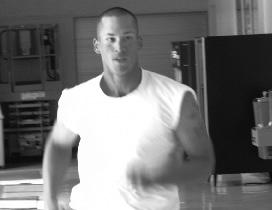
Marv Murie, Renaissance runner, warms up in the Health, Physical Education and Recreation building.
Photo Provided By :JASON ANDERSON
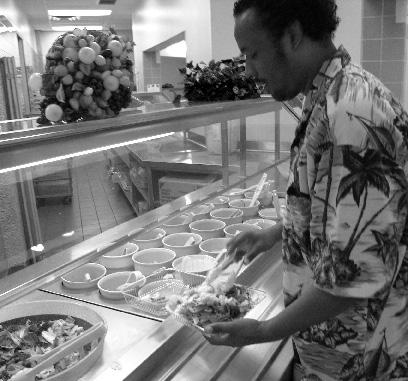
Patrick Hosang, cafeteria employee, makes a salad as a healthy alternative for lunch.
Healthier diets may lead to less polluted environment
Erin Waltman Editor in Chief
There has been a push lately in America to lose weight and be healthier overall. It seems that there are new ways to drop pounds being pushed every week, and while some are silly fad diets, some are actually helpful (see story, Page 5).
As a country, America eats a lot of meat – much more than recommended by the Food Guide Pyramid. According to the Food Guide Pyramid, carbohydrates should account for approximately 55-60 percent of total caloric intake, protein should account for 10-12 percent and fats should count for 12-30 percent.
People also over-estimate the amount of a serving on the Pyramid. One serving of chicken is equal in size to a deck of cards, meaning that at a single chicken dinner, we can eat two or three servings.
Cutting back on meat in-

take, however, will not only help each person be healthier; it will also help the planet be healthier.
Sadly, one of the main things destroying the ozone layer –that important thing that separates us from the full power of the sun’s radiation – is not emissions from cars or aerosol hair sprays, but the emissions from our hamburgers and buckets of chicken.
The methane in cow manure and chicken droppings is helping to wear a hole in the ozone layer, making it that much easier for the radiation normally kept separate from us to get in.
Another problem is that the world is running out of grazing and farming land, thanks to the large amount of space a herd of cattle need to be kept fat and happy. The amount of land necessary to keep a herd of hamburgers moving could be utilized to feed hundreds of thousands of people on veg-
CAMPUS CHAT

etables.
The push to make healthier choices becomes more important each year as we face the reality of our fragile position on the planet. Each year, humanity makes unhealthy choices for itself and makes the planet that much more toxic.
People forget that there are a wide variety of vegetable dishes to choose from. When people think of a vegetablebased meal, they often think of a salad. While raw vegetables are the healthiest choice, there are many ways to cook vegetables. Frying, sautéing, grilling and baking are all valid ways to cook vegetables.
In an effort to make yourself and the planet just a little healthier, next time you are wondering what to make for dinner, save yourself some money and some weight by choosing a dish of sautéed vegetables over the 5-ounce steak. ewaltman@rose.edu
By Scott Evenson




Counseling Tip No. 3
Vintage drive-in movie theatres offer nostalgic alternative means for families, film buffs to enjoy shows

its heyday, the drive-in movie was the place to be. No matter the age, Americans loved to go to the drive-in theater and Oklahomans were not any different.
Hollywood has depicted the drive-in movie in several films; “Grease” and “American Graffiti” are just a few of the popular ‘50s style movies. Between 1954 and 1963 Oklahoma had more than
Columns, commentaries and letters to the editor are personal opinions of the writers and do not necessarily reflect the views of 15th Street News or other students, faculty or administrators of the college. Editorials are written by the editorial staff. Letters to the editor may be hand delivered to FA110; sent by mail to 15th Street News, Rose State College, 6420 SE 15, Midwest City, 73110; e-mailed to the secretary, [cbenefee@rose.edu] or recorded nights on PhoneMail at 733-7400 between 8 p.m. and 8 a.m. Letters must include the writer’s full name, Social Security Number or ID number and telephone number.
Letters will be printed with full name and must be 500 words or less. Editing may be necessary for space, clarity or to avoid obscenity, libel or invasion of privacy, but ideas will not be altered. Publication of all materials is at the discretion of the editor. Anyone having a complaint may call the editor in chief, 733-7400, or the Student Publications Board chairperson, Towry Barnard,
ninety drive-in theaters, according to the Web site DriveIn Movie.com. The Twilight Gardens drivein, on the corner of May Avenue and Britton Road, is now a shopping center and cafeteria.
733-7379. 15th Street News, a student newspaper serving the Rose State College community, is published weekly, except school holidays, on Fridays during the fall and spring semesters by the Office of Student Publications, 6420 SE 15, Midwest City, OK 73110. 15th Street News is a member of Oklahoma Collegiate Press Association, which has designated this paper top junior college newspaper six years, and Associated Collegiate Press, which has rated it All American 30 semesters. This publication is printed by Edmond Sun, Inc., issued by RSC and authorized by the Coordinator of Student Publications. Cost to the state taxpayers is $301.81 for 4,000 copies per issue and $56.40 for spot color. This paper is recyclable. RSC, in compliance with Titles VI and VII of the Civil Rights Act of 1964, as amended, Executive Order 11246, as amended, Title IX of the Education Amendments of 1972, Americans with Disabilities Act of 1990 and other federal laws and regulations, does not discriminate on the basis of race, color, sex, age, national origin, religion, disability, sexual orientation or status as a veteran in any of its policies, practices or procedures. This includes, but is not limited to admissions, employment, financial aid and educational services.
The Riveria was on S.E.
59 th Street but closed when the screen was destroyed in the winter of 2000; now all that remains is a run down concession stand in a field of grass.
OKC once boasted at least six drive-in theaters, but now only one remains in operation. The Winchester still stands, with its trademark neon cowboy, on S. Western Avenue and shows the classic “triple feature” for $5 per person (kids ages 3-10 are only $2).
Owned and operated by Lindy Shanbour, the Winchester opened for business on June 3, 1968 and has never closed down.
“My brother, Farris, built the drive-in and my other brother, George, helped as well. It was a family business,” Shanbour said. Shanbour still can be found at the gate every night the drive-in is open. During the summer, that equates to seven
Editor in Chief Erin Waltman [ewaltman@rose.edu]
Assistant Editor Heath Sitton [jhsitton@rose.edu]
News Editor Johnna Ray [jray@rose.edu]
Sports Editor Bryan Trude [btrude@cox.net]
Assignment Editor Shannon Hoverson [s1h101@cox.net]
days, and the nights can get long. During the spring and fall, the drive-in is only open on the weekends. His good friend, Bob Eufinger, helps out at the gate as well.
“We’ve been friends for 50 years,” Eufinger said, adding that he has always lent a hand at the Winchester.
Families can go to see a movie at the drive-in for a relatively inexpensive evening. For many people, going to the Winchester has become a family tradition.
Steven Howard, professor of mathematics, remembers seeing “War of the Worlds” at a drive-in. He can also recall going to the Twilight Gardens drive-in with his parents as a young boy. He also went several times as a teenager.
“I did sneak in, but never got caught,” Howard said.
“But one or two of my friends were.”
The last time he went to a drive-in was 10 years ago in Guthrie, but he confessed he
Staff Members
Chief Photographer Scott Evenson [se2754@yahoo.com]
Assistant Photographer Devin Horst [dhorst@rose.edu]
Volunteer Photographer Darin Taylor [dtaylor@mtmrecognition.com]
Photographer Morgan Horner [Mhorner15@yahoo.com]
Volunteer Tech Support Scottie Seger [macrose@cox.net]
would probably only go again for nostalgia.
Drive-in theaters began to decline in the late ‘60s and by 1990 cable TV and the VCR had taken their toll on attendance.
However, during the last fifteen years, the drive-in movie has had a revival. The number of theaters closing declined and the number reopening started to climb.
The drive-in movie has become an icon in American history and students at RSC can still visit that relic of yesteryear when they go to the Winchester.
“You should try it once, just for the heck of it,” Howard said.
The Winchester is open Friday, Saturday and Sunday during the spring and fall and every night in the summer. The gates open at 7 p.m. For more information, contact the Winchester at 6318851.
slh101@cox.net
Graphic Artist Paul Garner [pg0240560@rose.edu]
Circulation Manager Gerald Richard [grichard@rose.edu]
Journalism Intern Jason Anderson [janderson@rose.edu]
Secretary Carol Benefee [cbenefee@rose.edu]
Coordinator of Student Publications Julie Lesko-Bishop [jlesko-bishop@rose.edu]
Shannon Hoverson Assignment Editor During
Full name: Skip Leckness
Photo Provided By:MORGAN HORNER
“HUGS” offered to troops, Katrina victims, workers
Johnna Ray News Editor
The first of many “Group HUG” meetings at RSC was held Saturday, Sept. 10 in the Health and Environmental Sciences building.
“Group HUGS” are meeting with volunteers who meet and work together for an entire day to create cooling col -
lars called “HUGS” for troops serving overseas. Other items are also made, including helmet cushions called “Kisses,” teddy bears for soldiers to pass out to children and many crocheted and knitted items.
One service member sent a “thank you” note to the founders, Karen and Ray Stark, and all HUGS volunteers, after re -
cently hearing about the project from a family member attending RSC.
“As a sailor, it always warms my heart to know that in the heart of the country there are patriotic Americans that appreciate what I do. I love this country and am very happy to have been given the opportunity to serve. I would like to
send a heartfelt thank you to all of the caring citizens pouring their love and time in to the HUGS Project,” said OSC (SW) Richard Henson.
Because of hurricane Katrina, several hundred HUGS were sent to Mississippi and Louisiana prior to the Group HUG at RSC. Even more were finished on campus for those
remaining in the affected areas.
Although many students had inquired of Peggy Sidders, RN, professor of nursing science, about the project for Service-Learning acknowledgement and many had said they would like to attend, only one RSC student came.
However, at least 20 experienced “huggers” were in attendance, including at least seven children, and 1,027 HUGS were completed.
One of the volunteers at this meeting, Marcia Hatfield, lives in Columbus, Ohio, but is in Oklahoma with her husband who is on temporary assignment for a local electricity company. Although she has no current family serving overseas, she once did. One of her twin sons served in Korea and the other in the Gulf in the late ‘80s.
“I went into a fabric shop on 59 th Street in [OKC] and [fellow hugger] Betty Noblitt was working there. After I made my selection, she asked if I can sew and gave me an invitation and directions [to a Group HUG meeting] and we went from there. That was the last Thursday of Sept. 2004,”
Hatfield said of her first introduction to the project.
Others at the meeting, realizing that cold weather will soon be affecting troops, inquired about “knifty knitter” projects. The knifty knitters are tools used to make hats for the soldiers to fit under helmets and warm their ears.
“Right now the needs in the world are great and it’s easy to become overwhelmed and, thinking that you can’t do it all … do nothing,” said Karen Stark, founder of the HUGS project. “We can’t do everything, but we can do something and we can make a difference in the world … one hug at a time.”
The next Group HUG at RSC will be held on Saturday, Oct. 8.
Regular HUGS meetings are held in various locations around the metro. For specific times and locations of upcoming meetings, visit the HUGS Project Web site at www.thehugsproject.com , e-mail Karen Stark at thehugsproject@cox.net or contact Peggy Sidders at psidders@rose.edu or by calling 733-7479. jray@rose.edu
Organization supports, guides non-traditional students through collegiate journey
Bryan Trude
Sports Editor
The Non-Traditional Student Organization, formerly the Promote And Reach while Encouraging Non-Traditional Students club, held its first meeting Aug. 26 in the Social Sciences building, Room 137.
The NTSO, which changed its name from PARENTS in spring 2005, is “committed to providing support, friendship, and guidance to nontraditional students at RSC, encouraging them to become active in academic, social and recreational opportunities on campus,” according to the NTSO membership application.
“We found that there was a national organization for non-traditional students. We decided to adopt that name,” said Nancy Graham, professor of mathematics and one of the faculty advisors. “We
hope to become members of the national organization. For members of the national organization, there are scholarships available.”
A non-traditional student is generally considered to be a graduate student who already has a degree or has spent time away from college in the workforce. Many “non-trads” are married with children.
The NTSO meets every A week Friday in Social Science building, Room 137. The first meeting of every month will be a potluck lunch.
NTSO throughout the year will host a number of events and guest speakers to fulfill the goals it has for supporting and helping nontraditional students succeed in college.
Last year, some of the guest speakers included a representative from Oklahoma Gas and Electric on how to cut costs on the electric bill, and Dr. Joanne McMillan-
Stafford, RSC’s director of Special Services and Student Outreach, on how to relieve stress.
“[The best part of NTSO is] the companionship,” said Marttie Howard, liberal studies major and treasurer for NTSO. “We all became like sisters.”
The President of NTSO for this year is Lorrie Fredrick, as well as Mandy Dansby as vice president, Melissa Russell as secretary and Howard as treasurer. NTSO’s parliamentarian is Tiffany Johnson, the Public Relations Officer is Kym Kilmer, and the Web master is Tammy Hoffman.
The faculty advisors are Graham, Pam Reynolds, professor of home economics and Jeanne McKinney, professor of political science. For more information, e-mail Fredrick at lfredrick@rose. edu. btrude@rose.edu
Cooler temperatures necessitate additional vehicle maintenance to protect against damage, break-downs
Johnna Ray News Editor
Higher gas prices should not be the only concern of those who drive to campus – vehicle preparations for upcoming cooler weather should also be considered.
Mid-September to early October is the best time to make needed adjustments to vehicles. This allows time to make necessary changes before severe temperatures set in.
Phillip Cox, mechanic/criminal justice major, suggests having the radiator flushed with new coolant during this time. If the radiator has been flushed recently, it should be drained and refilled.
Cox also suggested using a wiper fluid that contains glycol to prepare for the removal of ice from windshields.
Wipers should also be checked for any signs of deterioration and replaced if needed.
He also suggested keeping the air pressure in tires a few pounds lower than the maximum amount year-round so that adjustments are not needed during cooler weather.
Dead batteries are a common problem for many vehicle owners during cooler weather.
“Batteries are so unpredictable. Unusually hot summers or cold winters will effect battery life,” said Mike Gray, Wal-Mart automotive center manager. “Batteries should be checked at least once a month and water should be kept in those that require it.”
Gray also added that corrosion caused by acid buildup on the battery posts should be cleared regularly with an acid cleaner – most cleaners sell for less than $3. Gray said that although some motorists use Coca-Cola to remove acid buildup, it is not the proper or suggested cleaner and its use should be avoided.
The type of antifreeze used in a vehicle is just as important as having the right amount of the substance. Those containing glycol are typically green, whereas antifreeze that is red in color does not contain glycol.
“[General Motors] uses a nonglycol anti-freeze in their vehicles. It shouldn’t be mixed with the green anti-freeze … it will damage the engine if mixed,” Cox said. If routine maintenance procedures are practiced, the changes for cool weather usage are easier to make.
Also, the amount of money and time needed for the changes stays lower and more predictable if routine maintenance is performed throughout the rest of the year.
“I’m getting new tires [to prepare for fall weather conditions]. Gas is too high to worry about anything else right now,” said Trey Wilson, pre-pharmacy major. “I try to keep [my vehicle] tuned up regularly, too.”
Regular maintenance suggestions often differ from one vehicle to the next.
“There are mileage intervals set by the manufacturer to perform different procedures,” Cox said. Sometimes these intervals are set longer than what is realistic. Cox suggests consulting a qualified mechanic if any uncertainty exists regarding when to perform specific procedures.
“GM manufacturers recommend complete replacement of non-glycol coolant every 150,000 miles for a sealed system. The manufacturer of the fluid suggests it be replaced every 85,000 miles due to frequent fluid level checks,” Cox said.
He added that vehicles made prior to 1995 usually use glycol coolants, which need to be fully replaced every 30,000 miles.

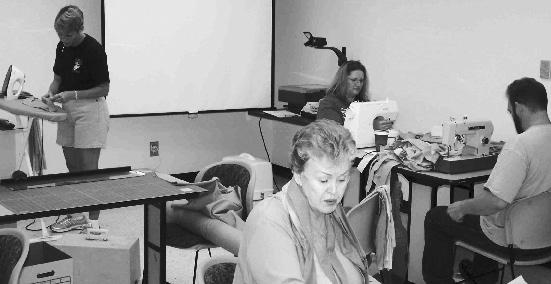
Volunteers participate in many tasks necessary for the creation of cooling cloths, helmet cushions and other relief items.
Richard Wellington, Hudiburg service employee, prepares vehicles for up-coming cooler weather.
Photo Courtesy of KAREN STARK
Photo Provided
By:MORGAN HORNER
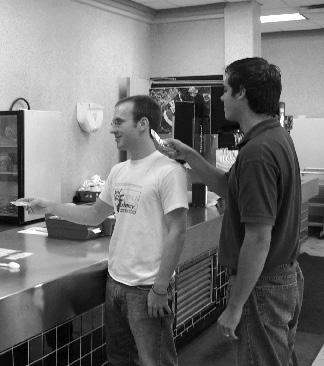
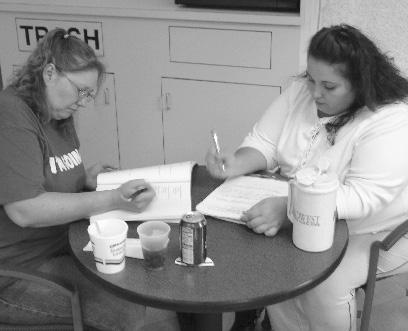
Non-traditional students Brady Tsonetokoy, psycology major, and Aimi Stacy-Grace, nursing major, prepare to finish what they started in the Rose Cafe.
Music Stand writer outlines best local record stores
Heath Sitton Assistant Editor
The search for music is a never-ending one that can drive most people crazy. I know that, for me, those hard to find albums usually lead me into a search across the entire metro area and usually to no avail. Like most people, when I want something I want it at that exact moment and my impatience usually gets me nothing but an empty tank of gas. This week, I would like to try to solve this problem for myself and for everyone else out there by making a plan of which record stores to visit.
CD Exchange
Located at 719 S. Air Depot in MWC, CD Exchange offers a large variety of CDs spanning all genres. They also carry DVDs and video games. They have an assortment of both new and used items and if they do
not have what you are looking for, they can order it for you.
CD Warehouse
Located in Downtown OKC at 900 N. Broadway, CD Warehouse is an actual warehouse of music. They offer albums in every genre of music you can think of. Their stock of CDs is amazing and they carry used and new albums at reasonable prices.

The Music Stand
Borders Located at 3209 N.W. Expressway in OKC, Borders is a great place to find music. If
they do not have what you are looking for, you can sit down, have a cup of coffee and read a book.
The Bookbeat
Located at 6409 S. Western in OKC, The Bookbeat has a variety of hard to find albums and music videos. They have a variety of vinyl, CDs, cassettes and even a section devoted to CDs of local bands.
Charlie’s Blues, Jazz and R&B
Located at 5114 N. Classen in OKC, Charlie’s has a variety of hard-to-find albums. They specialize mainly in blues, but you can find much more than that on vinyl, cassette and even reel-to-reel. Not only does Charlie’s carry the albums, but they also carry turntables, reel-to-reel machines and eight-track players.
jhsitton@rose.edu
Campus offers entertainment for students between classes
Johnna Ray News Editor
The population of students at RSC is diverse, as are the fields of study the students enter into and the ways they choose to spend time between classes.
Many students commute from other cities and towns and find it necessary to enroll in many courses two or three days a week, rather than drive to MWC each day. Others may try to work classes around their work schedules or school hours of children.
Often, basic classes are required before enrollment in a specific course can take place. These courses cannot always be given backto-back; sometimes, there is a lapse of half an hour or more between classes.
Students find many ways to fill this time. Some use the time to visit with professors, eat lunch or take a nap.
“I walk to class, talk to my boyfriend on my cell phone and talk to friends that I run into,” said Katherine Warren, business major.
Others use the time to catch up on homework, perform research or study.
Bryan Trude Sports Editor
While the forces of fate, luck, finance and interstate traffic has annulled my chances of seeing a movie for this issue, I have by no means slacked off. I have seen things, a great many things which mortal men dare not see or hear for fear of Sammy Davis Jr. rising from his grave and beating them with a tire iron.
In other words, Eddie Sutton cannot carry a tune in a hermetically sealed steel bucket using an electromagnet.
Back to business; with the summer movie season all but dead, we film buffs dig in for the long winter ahead, huddled in the corner of our living rooms, shaking like massive hairy Chihuahuas, praying for salvation from the prospect of the next Harry Potter movie, due this holiday season.
But fear not! I shall deliver you from the darkness with two movies available on DVD (or videocassette if you live under a rock somewhere between here and Podunk) that will help those who like to be enter-
“I spend at least 30 minutes on the Internet at the [Learning Resources Center] and study my clinical microbiology,” said Ashley Wright, clinical laboratory major.
The majority of students enrolled at RSC are non-traditional students – those who are not entering college right after high school – and many have small children at home. Some use the time between classes for meetings with their children’s teachers or to take care of duties that would otherwise interfere with quality time spent with their children.
“I go home and eat lunch [or] take care of minor errands. I have small children, so any errands I need to take care of I do [in between classes],” said Alaina Bird, dental assisting major.
Time spent between classes does not have to take place on campus and does not even have to relate to course study. Sometimes, the free time is needed to regain focus and prevent burnout.
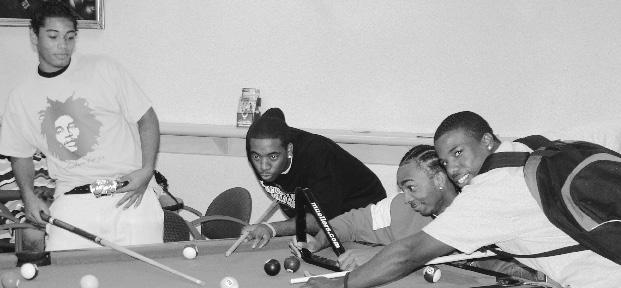
“I went to the [15th Street News] office or played pool at Jamaica Joes,” said Ginnie Escobedo, former RSC student. “It’s close. It’s fun. It’s a way to relax and be away from work and
tained weather the lean winter months.
Broken Lizard’s Super Troopers
Many of you may have not heard about this movie. Shame on you! This indecent look at the lives of six Vermont Highway Patrol troopers who are bored out of their skulls is the prototypical cult classic for the college-age slacker generation.

You will probably notice something is wrong when troopers Arcot “Thorny” Ramathorn (Jay Chandrasekhar) and Robert “Rabbit” Roto (Erik Stolhanske) start messing with the heads of three stoners they pull over in the first minute of the movie. Not a “let’s play word games with these guys” type of messing, more like “let’s pull them over for going under the speed limit, disappear, speed off, speed back in reverse past them, pull them over again before they can get moving, and
school.”
The campus mall has several tables and benches set among shade trees, shrubbery and walking paths that are meant to provide a peaceful, relaxing setting. Many students use this area to read assigned texts or work on other assignments.
The Rose Café, Cafeteria and Cyber Café are also popular choices for students who have time to spare or who want to meet fellow students in an atmosphere outside of class.
Students who would prefer to use time before, after or between classes for health and fitness may spend time in the Aquatic Center, the exercise room or on the basketball or tennis courts.
Several labs are also available on campus including those for viewing required videos, increasing computer knowledge or receiving help with math or reading skills. Arrangements for free, individual tutoring could also be made to correspond with times not spent in class.
Questions regarding availability of labs or open hours for swimming or exercise are posted in the buildings the services are located in. jray@rose.edu
start again from square one” type of messing.
This is also the first movie directed by Chandrasekhar, who directed the obvious attempt at parody of a classic TV series “The Dukes of Hazzard.” Chandrasekhar’s work on “Hazzard” does not do his skill as a low-budget director justice, which will be quickly obvious in “Super Troopers.”
To give fair warning, this movie is rated R for language, crude humor, nudity, adult situations, violence and drug use.
The Last Starfighter
Am I the only one on the planet who remembers this movie with any kind of fondness at all? I mean, it is a space adventure movie from the ‘80s that was not a Star Wars or Star Trek wannabe, and it is also the first movie to feature the use of computer-generated graphics.

Aries March 21-April 19...Remember when you were young and you used to spin around in circles as fast as you could, then stumble around running into things? Your life this week is going to feel a lot like that - kinda pointless and a little nauseating .

Taurus April 20-May 20...When someone suggests that this week you stop, wait and think, actually try it this time. You might even be able to avoid traction if you do.

Gemini May 21- June 20...No. Just no. You know what I am talking about. Just stop thinking about it and no.

Cancer June 21-July 22...Fortunately, you’re fortune this week is blank. So either that means that very little will happen to you this week or it means I have broken my crystal ball again. Either way, I cannot say anything conclusively about your week, so stay on your toes.

Leo July 23-August 22... While it is sometimes a good thing to be cautious when entering a new situation, this week you should throw caution to the wind and leap right in. This advice does not, however apply to traffic.

Virgo August 23-September 22... There are several different schools of thought on dreams. Some say dreams are just the brain rehashing the day’s events. Some say dreams are premonitions of things to come. Some say dreams are just the results of too many pepperoni and pineapple pizzas before bed. If you can figure out what dreams really are, your week will go perfectly. You may win money. Good luck with that.

Libra September 23-October 22... You know the saying, “Like attracts like”? That is total crap, and we both know it. Otherwise, why would you have been attracting such freaks lately?

Scorpio October 23-November 21... Look out for angry Chihuahuas this week. I believe there is a sale on them at some pet store or another, and they are all gunning for you.

Sagittarius November 22-December 21... Despite all evidence to the contrary, you probably will not be winning that trip to Rio de Janero this week. Especially since you never entered the contest to win it. Slacker.

Capricorn December 22-January 19... When sky divers leap out of planes, they are cautioned to check their parachutes before they make the jump. This applies to your life someway, I just know it.

Aquarius January 20-February 18... To make life easier you need only learn to imagine what you cannot possibly expect. Yes, that is a little hard to understand.

H o r o s c o p e s
Pisces February 19-March 20... While it may not seem like it now, that thing you did yesterday was probably a mistake. Actually, that was a lie - that thing you did yesterday was probably the best thing you have ever done in your life. If you cannot figure out what this wonderful thing was, that is just too bad.
Granted, those same graphics look crummy compared to, say, “Shrek,” but can you imagine what that would have looked like in 1984? Amazing!
“Starfighter” follows the story of Alex Rogan (Lance Guest,) who lives in a trailer park out in the California desert. He gets the highest score ever on an arcade game called Starfighter, and is recruited by a fast talking old guy named Centauri (Robert Preston) to basically go live the game.
While “Starfighter” succumbs a lot to overacting, especially on the part of Rogan’s pilot Grig (Dan O’Herlihy,) it is an original story with a good mix of action, drama, teen angst, and a fairly decent explosion for the time. “Starfighter” is a classic that gave us all the first glimpse of the computer-generated mediocrity that plagues the animation industry today.
Interesting note: this movie features minor role appearances by a number of Star Trek alumni, most notably Wil Wheaton (Wesley Crusher, “Star Trek: The Next Generation”) whose scenes were cut from the theatrical release. btrude@rose.edu

By Erin Waltman
Students relax in a variety of ways between classes. Luke Stevenson, psychology major, Justin Pickett, business major, Rodney Sands, prepharmacy major, and Jay Cathey, education major, enjoy a game of pool before attending classes.
Reel Talk