
THE INDEPENDENT NEWSPAPER SERVING NOTRE DAME, SAINT MARY’S AND HOLY CROSS
FRIDAY, JANUARY 30, 2026 | VOL. LX, NO. 41
FRIDAY, JANUARY 30, 2026 | VOL. LX, NO. 41
University defends promotion of Keough School professor to direct Liu Institute despite pro-abortion rights advocacy
By Maria Alice Souza Maia News Writer
Associate professor of global affairs Susan Ostermann will lead the Keough School of Global Affairs’ Liu Institute of Asia and Asian Studies as director beginning July 1, an appointment sparking controversy due to her public advocacy for abortion rights.
She will succeed founding director Michel Hockx, who led the institute since 2016. Keough School of Global Affairs dean Mary Gallagher appointed Ostermann with approval from University provost John McGreevy.
In a column published in First Things, history professor emeritus Fr. Wilson Miscamble said her appointment “explicitly repudiated” the University’s statement in its strategic plan to “ensure that our Catholic character informs all our endeavors.”
In 2022, Ostermann co-authored an op-ed with Tamara Kay in the Chicago Tribune titled “Lies about abortion have dictated health policy.” The article prompted a response by University President Fr. John Jenkins.
“Tamara Kay and Susan Ostermann are, of course, free to express their opinions on our campus or in any public forum. Because they choose to identify themselves as Notre Dame faculty members, I write to state unequivocally that their essay does not reflect the views and values of the University of Notre Dame in its tone, arguments or assertions,” he wrote in a letter to the editor.
She has co-authored at least four other articles supporting abortion rights. In a statement to The Observer, Ostermann responded to the renewed criticism generated by her appointment.
“As I step into this role, my primary focus is to serve as a steward for the Liu Institute mission in the context of the University’s larger mission, and a facilitator for our world-class faculty. I am fully committed to maintaining an environment of academic freedom where a plurality of voices can flourish. I have long worked with scholars who hold diverse views on a multitude of issues, and I welcome the opportunity to continue doing so. While I hold my own convictions on complex social and legal issues, I want to be clear:
my role as Liu Director is to support the diverse research of our scholars and students, not to advance a personal political agenda,” she wrote.
“This commitment to academic inquiry and mutual respect is deeply rooted in my appreciation for Notre Dame’s identity as a global Catholic research university. I am inspired by the University’s focus on Integral Human Development, which calls upon all of us to promote the dignity and flourishing of every person. I respect Notre Dame’s institutional position on the sanctity of life at every stage and believe that by fostering a collaborative space that values rigorous inquiry, we contribute in important ways to global development and human well-being. I look forward to working closely with my colleagues to ensure that the Liu Institute remains a place where truth is pursued with both excellence and integrity,” she wrote.
Miscamble wrote in his column that several faculty members appealed to the administration to rescind Ostermann’s appointment.
University President Fr. Robert Dowd, according to Miscamble, “seems reluctant to overrule the provost and dean.”
By Liam Kelly and Henry Jagodzinski Editor-in-Chief and Assistant Managing Editor
A recent study conducted by The Observer analyzing Federal Election Commission data showed that political donations by Notre Dame professors to Democratic candidates and political action committees outnumber donations to Republican groups.
The Observer reviewed publicly available data on contributions by Notre Dame professors to political candidates and political action committees from Jan. 1, 2023, through Jan. 27, 2026. The study excluded contributions from non-professor employees of Notre Dame. The data showed that 243 professors made political donations, representing just under 20% of all professors at Notre Dame, though the number may be slightly inflated due to the potential
NEWS | PAGE 3
Branding changes
University branding to remove Latin on academic mark to highlight Catholic mission.
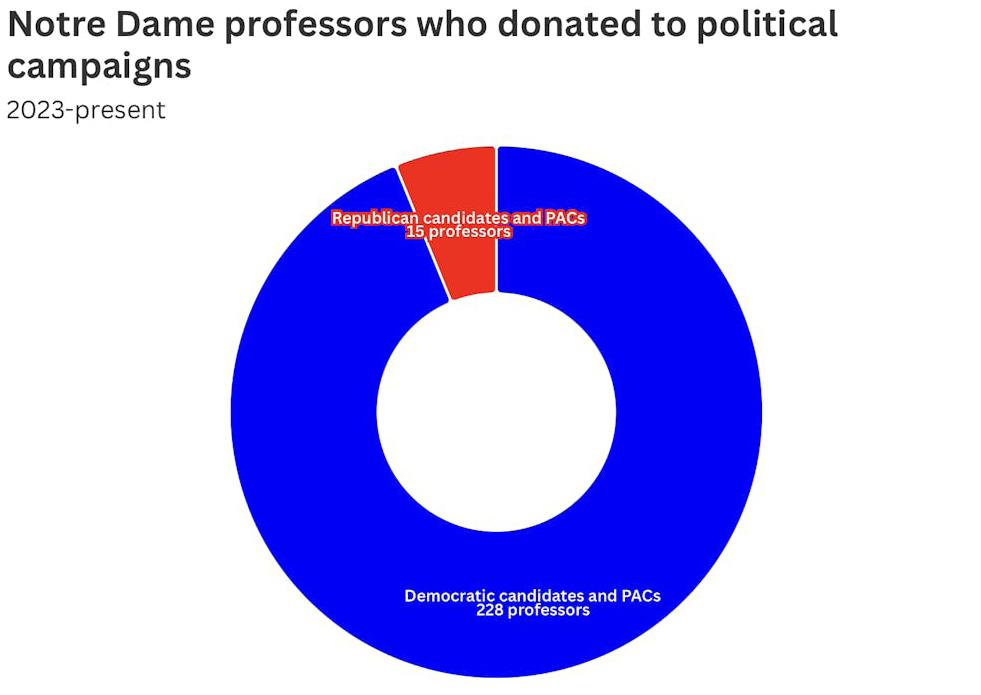
93.82% of recent donations made by ND professors have gone to Democratic campaigns. Data from the Federal Election Commission.
inclusion of emiriti professors in the dataset.
Of those who made political donations, 228 (93.82%) donated to Democratic candidates or causes,
OPINION | PAGE 6
Christ the teacher
Columnist Richard Taylor explores lessons from art in Keenan-Stanford lobby
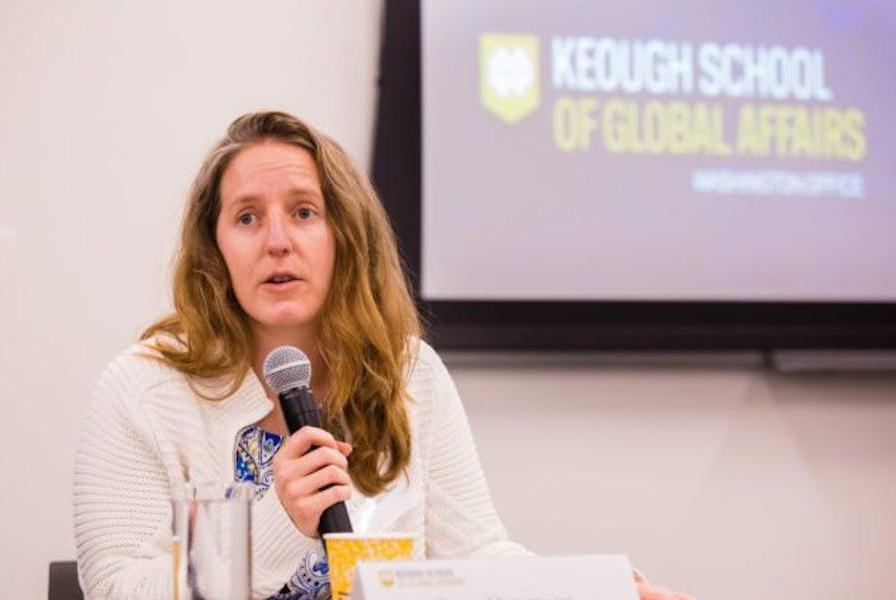
Susan Ostermann’s appointment to direct the Liu Institute has sparked controversy over pro-abortion rights op-eds she co-authored.
The emeritus professor said he has now brought the issue before the Board of Fellows to request they intervene.
“I have contacted the twelve fellows of the University directly and asked them to exercise their fiduciary responsibility to uphold the Catholic character of the university. I pray they do so,” Miscamble wrote in a statement to The Observer.
The Board of Fellows represents
the University as its highest executive body. According to its website, the board adopts University bylaws, elects members to the Board of Trustees and ensures “the University maintains its essential character as a Catholic institution of higher learning.” The body comprises six clerics of the Congregation of Holy Cross and six lay people.
see “Ostermann” on page 4
while only 15 (6.18%) donated to Republican candidates or causes. A smaller but still considerable
SCENE | PAGE 8
Harry Styles returns
The pop singer announces new album, ‘Aperture’ delivering perfection with lead single.
Lou Holtz, former Notre Dame head football coach from 1986-1996, has reportedly entered hospice care. After rumors began circulating across message boards over the weekend, multiple beat writers covering Arkansas and Notre Dame football began reporting the news on Thursday evening. Holtz, 89, has had numerous health concerns spanning recent years. After suffering leg injuries in a car accident last winter, Holtz stated he would be “dragging his body along” to support the Irish in the 2025 College Football Playoff National Championship game against Ohio State. He also made an appearance at September‘s showdown between the
Irish and the Razorbacks in Fayetteville, Arkansas, although he had to be assisted as he was honored in the media room and on the field prior to the game.
Although the news has yet to be confirmed by national college football media, Kyle Sutherland, publisher of HawgBeat for On3 and Rivals, tweeted at 2:38 p.m. on Jan. 29 that he was able to confirm the reports.
The Follansbee, West Virginia, native enjoyed a two-year playing career at Kent State before embarking into the coaching profession at age 23 in 1960. Holtz earned his first head coachingletter job with William & Mary in 1969, eventually jumping to the professional
see “Donations” on page 4 see “Holtz” on page 9
SPORTS | PAGE 11
Hockey
The Fighting Irish are back on the ice for a home-and-home series with Bowling Green.
SPORTS | PAGE 12
Brady Koehler
The freshman phenom has made an instant impact since being added to the starting lineup.
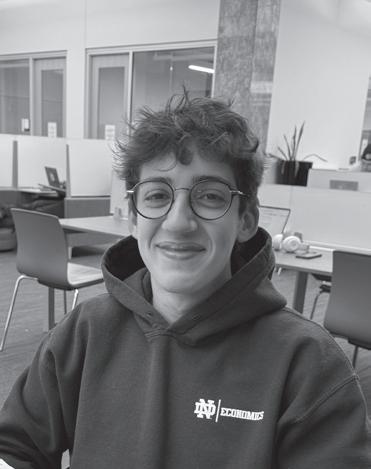
Minjoon Kang freshman Duncan Hall “Skiing.”
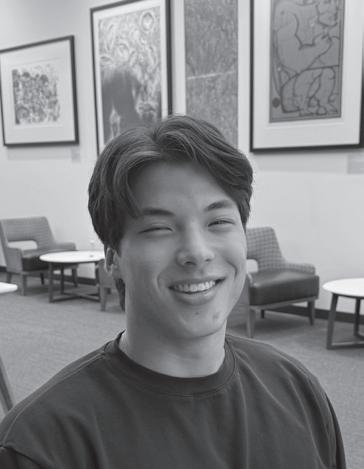
Pedro Mota senior Off-campus “Snowboarding.”
Aidan Fleming senior Off-campus “Snowboarding.”

Kristofer Ulanday sophomore Baumer Hall “Ice skating.”
Izzy Mulhall sophomore Johnson Family Hall “Ice skating.”
Have
Email dstangel@nd.edu
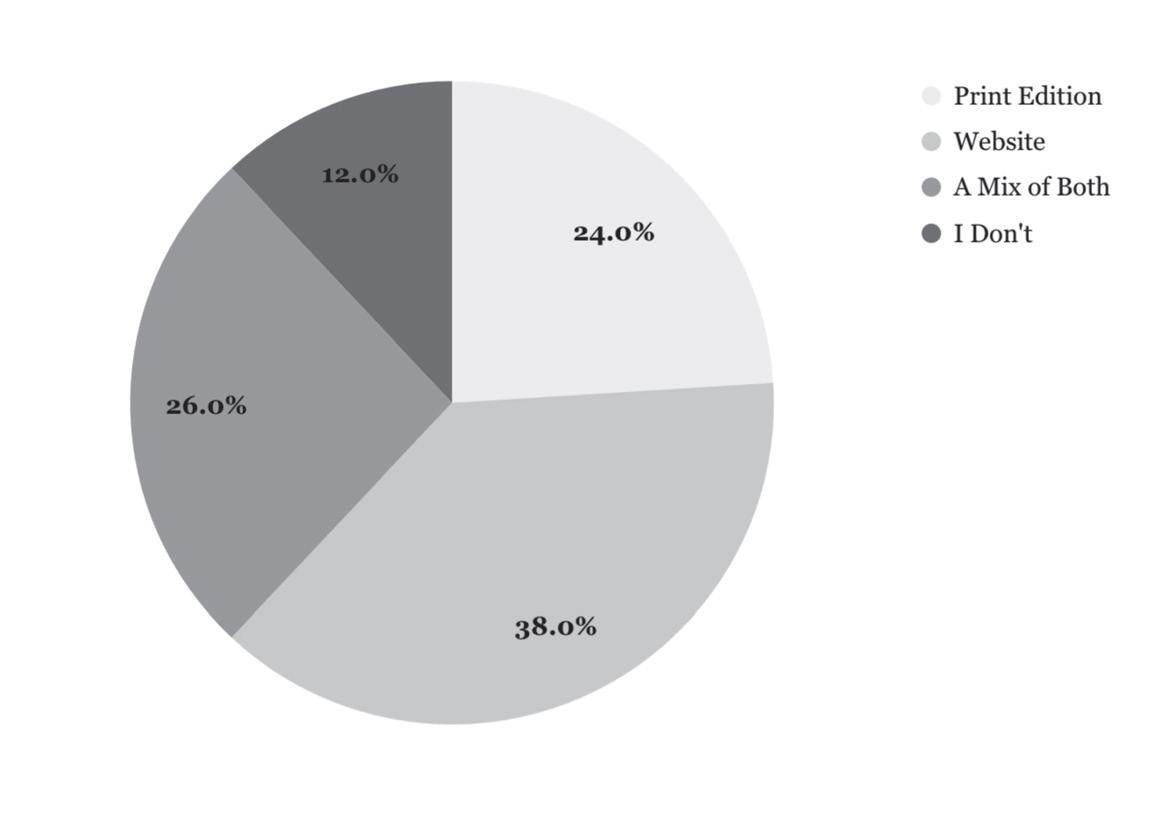
How do you read stories from The Observer?
Want
Friday
Saint Mary’s Student Involvement Fair Events for students to learn about clubs and organizations. Angela Athletic and Wellness Complex 2 p.m. - 4 p.m.
Saturday
“BE-SPOKEN” concert experience and performance Alum directs gospel experience for Walk the Walk Week. Leighton Concert Hall 7:30 p.m. - 9:30 p.m.
Sunday
Notre Dame women’s tennis vs. Xavier University The Irish face off against the Musketeers. Eck Tennis Pavilion 1 p.m.
Monday
Lecture on Bad Bunny’s impact on Puerto Rican resistance Wellesley College professor on zoom call and salsa dance after. Haggar College Center 4:45 p.m. - 7 p.m.
Tuesday
“The Political Logic of Cultural Revival” seminar Professor examines Lhomwe culture revival in Malawi. Hesburgh Center C103 12:30 p.m. - 2 p.m.
By Liam Kelly Editor-in-Chief
In recent months, those viewing Notre Dame’s website and social media presence may have noticed a simplified version of the University’s crest which does not include the Latin phrase “vita, dulcedo, spes.”
The phrase, which appears on the seal of the University beneath a cross, translates to “life, sweetness, hope” and is taken from the “Salve Regina” prayer. This change in branding is part of an effort to emphasize the University’s identity as a “global Catholic research university” according to director of design and brand identity Tim Legge.
Legge explained the Latin phrase in the crest “is most definitely an important component of the University seal, and will never be phased out.” Instead, the University is trying to make a more marketable version of the crest which is “reflective of ongoing communication needs.”
According to Legge, the Latin words will still be included in the “primary academic mark” of the University when it is above two inches in length. It

will also be included in printed material for important official University events, such as commencement, as well as on the Latin seal which is used in communications by the Office of the President.
When the primary academic mark is smaller than two inches long, however, and when the space calls for the use of the vertical simplified academic mark, “vita, dulcedo, spes” will be omitted from the seal. This includes the University’s website and social media profiles, as well as much printed marketing material.
The main motivation for this change, Legge explained, was
that the words simply weren’t legible when viewed at a smaller scale. He continued that without the Latin in the crest, the academic mark can be better incorporated into marketing material and embroidered apparel.
More broadly, moreover, the University is seeking to create an easily identifiable mark for the University other than the “ND” monogram used for Notre Dame athletics. Legge said the crest better represents the University’s Catholic identity, due to the fact that it includes a cross. He also argued it creates a more professional look when Notre Dame interacts with other elite universities. Legge said the
desire to focus on the Catholic identity of the University was informed by the Notre Dame 2033 Strategic Framework.
“Everything we’re doing with the institutional brand is directly in line with the strategic framework agenda,” he said.
Legge explained that the branding team conducted focus group studies with alumni, people loosely affiliated with Notre Dame and people with no affiliation with the University to help determine the primary academic logo of the University. All groups were shown a “what would you fight for” promotional video with differing logos, and all three groups preferred
the logo with the crest over the “ND” monogram as the best representation of the University’s mission.
Now that the University has decided upon the crest as the primary feature of its academic mark, it is seeking to promote its use across academic departments and colleges, Legge said.
“We should look like one institution,” he said.
Legge also noted that the University will be revamping its “On Message” website this year to reflect the new branding guidelines.
Contact Liam Kelly at lkelly8@nd.edu
By Lucy Loes News Writer
Since returning to campus in mid-January, students have grown used to trekking through the snow-covered sidewalks to get to classes, particularly within the past week. While the weather hasn’t been severe enough for Notre Dame to cancel classes (which the University hasn’t done since 2022), that doesn’t mean the snow hasn’t affected students’ ability to attend classes. For students with mobility aids, the accumulation of snow and slush on the University’s sidewalks has posed significant barriers.
The amount of snowfall paired with the frigid temperatures has made clearing sidewalks difficult for the University to keep up over the last week. A University spokesperson wrote in a statement that Notre Dame “is committed to fostering a safe and accessible campus for all, and snow and ice removal is a critical part of that commitment … [However] with 71 miles of sidewalks, 15 miles of roads and 94 acres of parking lots, this work can be challenging at times. During prolonged periods of extreme cold and heavy snow, ice can be particularly difficult to manage since salt, the most common substance for treating slippery roads and walkways, loses its effectiveness below a certain temperature.”
Though this amount of snow
may seem to be a simple inconvenience to some, it can impact the capacity of students with physical disabilities to make it to class safely, as slush interferes with mobility aids and snow and ice present potential slipping hazards.
Freshman Grace Anne Doyle, a Chinese and economics major with cerebral palsy who has a mobility aid, described the significant impact the snow has had on her ability to get around campus. “I think that [the University] wants to help, but I also don’t think that they totally know how or have the infrastructure resources to actually do so effectively. Overall, I would say it’s not been good because myself and other students have not been able to go to class, or have just had a much harder time getting around campus, getting to dining halls, that kind of thing. And I just feel like it makes us feel like we’re missing out on a lot of the university experience here,” Doyle said. “I think that I’m more anxious about going places because I’m worried I’m going to slip. And getting to class, specifically, I have to leave so much earlier,” Doyle said.
For freshman Isabella DuarteCrespo, a design major with spina bifida who uses a mobility aid, the effects of those few days of accumulating snow last even beyond when the sidewalks have cleared. “I’ve been having to walk a lot more to class. Initially, it
wasn’t too bad. I kind of just had to adjust. But after a while, it was a huge toll on my body. Now I’m to the point where even though they’ve already shoveled and I could be using my scooter at least today, I can’t because I’m in too much pain, where I can’t even focus on what I’m working on,” Duarte-Crespo said.
Echoing Doyle’s worries about losing access to campus due to the weather, Duarte-Crespo said, “And it also makes me really worried, because I feel like I’m missing out on so much on campus and I’m going to have more work to catch up on compared to the students who [were] able to go to class.”
Though she understands that the University is facing extreme winter weather, Duarte-Crespo feels the University has not kept the promises it made to her regarding accessibility at Notre Dame.
“One of the main reasons why I came to [Notre Dame] is because they claim to have such good accessibility at the university. There’s so much representation here, and so many other students have had great experiences at the university, so it’s very disappointing to see how not very well they’re handling this,” DuarteCrespo said, “I’ve never lived in snow, and that was honestly one of my top concerns when coming to Notre Dame for my mobility aid, but I thought it wouldn’t be as much of a problem, because I
was promised that I would have priority snow plowing, ‘priority snow removal,’ they called it, which I didn’t really know what that meant, but I thought it would just be like they prioritize my route to class before main sidewalks. Clearly, that hasn’t been happening and they haven’t been plowing enough.”
In an attempt to address this issue, Notre Dame has offered students with mobility aids some resources. Sara Bea Accessibility Services is able to communicate with professors about absences on a student’s behalf. Students are also offered the option of having a note taker to ensure that they don’t fall behind in classwork. Students are able to send a friend or resident assistant to the dining hall to bring back a meal for them.
According to the University, certain routes and entrances are prioritized across campus when snowfall is higher than average. “To help navigate campus more effectively during inclement weather, those with mobility needs and/or concerns are encouraged to utilize the ‘Accessible Entrances’ and ‘Accessible Parking’ overlay features on the campus map. Using these features, students, faculty, and staff can more readily locate accessible doorways and various ADA parking spaces on campus,” a University spokesperson wrote in a statement.
However, both Duarte-Crespo
and Doyle emphasized that these locations aren’t always as accessible as they should be. While that may simply be a result of sustained periods of snow, the prioritized routes still don’t always include the buildings that students with mobility aids need to access, notably the dorms near the Hesburgh Library. “I know that they have a map of where they do the main priority shoveling, and it misses large parts of campus, like almost the entirety of God Quad and northern parts of campus, like behind Hes, where there are a lot of dorms. That’s not a priority for them at all, and there are still students living there with disabilities who need to use their mobility aids, or who just have a harder time navigating the snow,” Doyle said.
For Duarte-Crespo, it feels like some students have been left on the sidelines. “We shouldn’t be barred from having the same education as everyone else just because of something outside of our control, which we were promised would not be an issue at this university. So it feels kind of like a betrayal of trust ... We should be able to go where everyone else is going. It’s like a fundamental right of ours. Why are we missing out [on] things when it’s something not even our fault, something completely out of our control?” she said.
Contact Lucy Loes at lloes@nd.edu
By Berhan Hagezom and Mariella Taddonio
Saint Mary’s News Editor and Photo Editor
Students at Saint Mary’s College will now have the option to be transported by a new ride service, advertising itself as an alternative to Blinkie, the College’s traditional van safety service for its students.
My-Glide will run in a five-mile radius of campus, from 9 p.m. to 4 a.m. on Fridays and Saturdays with a 14 passenger vehicle limited to Saint Mary’s students.
Hank Matthews, a recently retired Saint Mary’s security officer of 13 years, shared he created the service to help Saint Mary’s students avoid “sketchy” Uber drivers by providing a reliable service and price rate, with the motto “we don’t sell fear – we promote safety.”
The service also offers school pickups for elementary students at Corpus Christi School and wedding reservations.
Speaking on his inspiration for creating the service, Matthews said, “I noticed there was a serious gap in Uber availability after 2 a.m., and being a security officer, a lot of times we would pick people up at The Grotto or have to come and get them. They were sketchy at best sometimes and gave angst to the students. So I thought this service would fill a void to get the Saint Mary’s students back safely and I would go till 4 a.m.”
Starting last Friday with a few rides, the service’s operations
Continued from page 1
gap existed in the total dollar amounts given to each party, with donations to Republicans amounting to $53,069.96 and donations to Democrats totaling $212,258.31.
As a result, the average donation from professors to Republican candidates and causes was $3,537. For professors who supported Democratic candidates and causes, the average amount was lower at $930.96.
Nationwide, professors who support as Democrats outnumber those who support Republicans.
The predominance of professors who donate to Democratic candidates and causes suggests that faculty at Notre Dame, at least among those who are politically active, may be more liberal than the student body. A poll conducted by The Observer before the 2024 general election, surveying 1,205 students, found that 31.8% identified as Democrats, 30.5% as Republicans, and 36.7% as independents. The same poll found that 54.3% of students supported Kamala Harris for president and Tim Walz for vice president, while 38.3% supported Donald Trump for president and JD Vance for vice president.
Contact Liam Kelly at lkelly8@nd.edu and Henry Jagodzinski at hjagodzi@nd.edu
have now been delayed to the first weekend of February due to weather conditions. The current price for rides is $7.50 for each person per way, with priority drop offs for Eddy Street Commons, Trader Joe’s, Linebacker Lounge, Corby’s Irish Pub and Hesburgh Library, also known as the “Fab Five Spots.”
A previous version of the website detailed plans to offer the service under a subscription of $300 a semester, charging riders an additional $5 per person per ride. There would be a 200 subscriber cap, and subscribers would be offered a swag bag, a My-Glide shirt, drink cover lids, a scrunchie, stickers and phone wallets. The drop in prices and abandonment of subscription-based services was adjusted to reflect recent feedback and to improve user numbers.
A discounted price will also be offered in the next month called a “five for five” special where students will pay $5 per ride each way in February as students become more familiar with the service. Updates on free rides are given through email blasts, such as rides given on Wednesdays to Trader Joe’s which users can enter the queue for.
Users are asked to sign up for a ride no later than a day prior on the website’s queue. Requested information includes their rider group, drop-off and pick-up locations and passenger count.
Students pay inside of the van using Square, an online payment
Continued from page 1
The University stood by its decision to appoint Ostermann in a statement to The Observer.
“Professor Susan Ostermann is a highly regarded political scientist and legal scholar whose insightful research on regulatory compliance — from forestry conservation in India and Nepal to NSF-funded disaster mitigation in the U.S. territories — demonstrates the rigorous, interdisciplinary expertise required to lead the Liu Institute. A deeply committed educator who has led study abroad programs in Mumbai, she is well prepared to expand the Institute’s global partnerships and create impactful research opportunities that advance our dedication to serving as the preeminent global Catholic research institution. Those who serve in leadership positions at Notre Dame do so with the clear understanding that their decision-making as leaders must be guided by and consistent with the University’s Catholic mission. Notre Dame’s commitment to upholding the inherent dignity of the human person and the sanctity of life at every stage is unwavering,” a spokesperson for the University wrote.
The Liu Institute’s website describes its mission as connecting
platform. Rules unique to the ride service in contrast to Blinkie include only offering rides for Saint Mary’s students, no food being allowed, wearing seatbelts is enforced and a $100 charge for damage to the van.
The service also has a concierge team, including juniors Madison Weaver and Gia Cvitkovich and senior Bella Sandoval, who work as student representatives and support the My-Glide social media presence. They have been posting on the service’s TikTok and Instagram pages since November. They have been compensated for their work and will receive free rides.
Sandoval shared that she found out about the service when Matthews was making a round in Le Mans during his time as an officer and she asked what he was planning to do after retirement. She saw it as complementary to her resume and her field as a communications major.
“He asked if I wanted to be a part of the team, and I said yes, because it sounded really fun and exciting, and it’s something that I felt proud to be involved in. It’s a new concept that hadn’t been introduced yet around the tri-campus,” Sandoval said.
My-Glide hosted an open house on Dec. 12 from 12 p.m. to 2 p.m. between the Student Center and McCandless Hall for students to see the van and grab free giveaways, with approximately 30 students that stopped by. This open
the Notre Dame community to Asia through teaching, social engagement and research about Asia and its diaspora. The Institute also hosts a supplementary major and minor in Asian studies.
The institute offers signature events for the Notre Dame community to learn and engage with Asia, including the Justice and Asia Distinguished Lecture, Asia Leadership Forum and the Asian American Distinguished Speaker Series.
In a statement to The Observer, Mary Gallagher, the Marilyn Keough Dean of the Keough School, shared her support for Ostermann.
“Susan Ostermann is a renowned scholar of South Asian politics and the politics of regulatory compliance. Her work on forestry conservation in Nepal and India was a groundbreaking contribution to the perennial problem of how states with weak capacity can enforce environmental laws and regulations,” Gallagher wrote.
She elaborated on the incoming director’s past research, detailing how Ostermann recently received a National Science Foundation grant to extend her work to Hawaii, Puerto Rico and Alaska. Her research examines how “governments can encourage voluntary compliance with building regulations to lower the risk of natural disasters,”
house was not approved by the College, as My-Glide is not an approved organization.
Matthews is still considered to be an employee of the College but the College has not shown outward support of his business. Matthews explained that this has meant MyGlide is facing challenges to promote the service to students.
“It’s just the fact that the cooperation from Saint Mary’s was very … I couldn’t even put up flyers,” he described. “And whatever their reason, I’ll accept and not have bitterness about it. It just didn’t certainly help me for something that I thought would be helpful for the students since there’s no coverage.”
He believes that My-Glide is a beneficial service for the Saint Mary’s community to use as it is only open to Saint Mary’s students with no tips, surge pricing nor cancellation fees.
“As a security officer, that causes me concern [on Uber safety]. I have daughters, and I thought MyGlide was a good representation to let them know, ‘This is for you, this is yours,’” Matthews explained.
Cvitkovich shared that the team has received no support from the College and has been excluded from the larger conversation and potential approval from the administration. This includes flyers being torn down from McCandless Hall and Le Mans Hall by resident assistants and hall directors, along with the lack of cooperation from the
Gallagher wrote. She noted Ostermann is a “deeply committed teacher” and teaches study abroad programs in Mumbai, India.
She also touched on her excitement for the institute under Ostermann. She said Ostermann can help grow the institute’s interdisciplinary collaboration and strengthen its partnerships in Asia, fostering more opportunities for students to engage with the region.
“Susan understands both the academic mission and the broader role the Liu Institute plays within the Keough School and the University, and we’re confident her leadership will help the institute continue to grow in a thoughtful and impactful way,” Gallagher wrote.
Ostermann joined Notre Dame in 2017, one of the first professors hired to be part of the Keough School. She has been an active faculty fellow for the Liu Institute since then, growing it’s South Asia group and launching the University’s summer study abroad program in India in 2024.
She is a graduate of Pomona College and earned a J.D. from Stanford Law School and a Ph.D. in political science from UC Berkeley. She served as a consultant for Population Council, Freedom House and the Bertelsmann Transformation Index. The Keough School’s
College’s social media team.
“We asked Chuck if we could take a picture of him wearing our shirt and the school said no … So that’s what’s frustrating to us, is that we literally have no support from our school and we did this for our school and that’s what’s upsetting,” she shared. “And I also think the sad truth is it’s also because they’re not getting a cut of the profits.”
Sandoval explained that it is disappointing to see how the administration has been unexpectedly stomping down a beneficial service to students that offers a unique advantage to their students.
“As far as a message to Saint Mary’s admin, we really are just at a loss for words,” she stated. “And we don’t really understand why they would shoot us down when we’re trying to offer students something that could potentially keep them safe and prevent danger from happening in the early morning hours.”
The 2024-25 student organization handbook from the Office of Student Involvement explains that any campus group who do not have approval from OSI do not share the same benefits as official student organizations and will need to pay to use college facilities.
Contact Berhan Hagezom at bhagezom01@saintmarys.edu and Mariella Taddonio at mtaddonio01@saintmarys.edu
release cites her expertise as a witness to Nepali politics and the Maoist conflict.
Ostermann shared what taking over the institute means to her in an email statement to The Observer sent prior to her response to the criticism.
“Taking over as director of the Liu Institute means an opportunity to give back, to serve.
During my 8.5 years at Notre Dame, I’ve benefited tremendously from my relationships with the Liu, Kellogg and Pulte Institutes, and much of that owes to the good leadership they’ve been under. The opportunity to be a good steward myself, so that others benefit, seems fitting,” Ostermann wrote.
She also discussed her plans for the institute.
“At this point, I have a few concrete plans, mostly ideas, she wrote. “The Liu Institute recently underwent an external review, one that I contributed to, and it has a new strategic plan. It will be my job to carry out that strategic plan. Beyond that, however, I plan to consult with the Liu Institute community, its fellows, staff and students, to see what people most need and are most excited about moving forward.”
Henry Jagodzinski contributed reporting to this story.
Contact Maria Alice Souza Maia at msouzama@nd.edu
By Michael Doyle Columnist, “Our Thread”
I’m an engineer by trade, or perhaps by education, since I’m still unemployed. Yet despite the relief I feel after solving a particularly convoluted physics problem or logic gate diagram, I feel a much more notable sense of fulfillment upon the completion of a writing piece. Whether it be the technical reports associated with many a freshman engineering course, my biweekly column here with The Observer or an occasional voluntary article I’ll submit to the Wall Street Journal, writing has found its way into every corner of my life. Eventually, it will for you as well, no matter the major you choose.
Countless students, even some of my peers at Notre Dame, lose the forest for the trees in the pursuit of singleminded potency. It’s tempting to deride the English majors in your friend group for their supposed projected unemployment due to a lack of some sort of technical ability, but in actuality, the diverse skillset and applicability, particularly from a Notre Dame degree, prove to be continuously valuable. In truth, employers have found time and time again, especially with the evolution of the internet, that it is easier to teach a humanities major the fundamentals of C++ than it is for an engineering major to learn how to present technical concepts effectively to
By Sophia Anderson Opinion Copy Editor
On our way home from a Saturday-night dinner on Eddy Street last weekend, my friends and I ran into a couple of American freshmen looking to convince passersby that they were Irish international students. We quickly became sidetracked, compelled to inform our new, heavily-accented friends that they needed to wear coats and gloves over their sweatshirts if they were going to stand outside in a polar vortex. They asked why we were acting like their mothers; we laughed and left them to their freezing activities.
Debriefing at the dining hall the next morning, my friends and I discussed the kids we’d met the night before. They were having so much fun, standing outside talking to strangers, while we scheduled library dates for weekend nights. What had happened to us?
Readjusting to Notre Dame since being off-campus in the fall has been rougher than expected. I find myself doing homework on Saturday mornings that I used to spend rotting in bed, and I’m staying in most nights
shareholders. Some might say that this is why a Mendoza ma jor is really only the degree path you’ll get any return on investment from at ND, but, at risk of alienating half the student body, business majors are generally an even more potent example of hyper-specialization (just listen to any of your upperclassmen friends talk about investment banking interviews and you’ll see what I’m talking about).
It’s not hard to hear what top employers look for in candidates, and with Meta’s introduction of AI into technical interviews last year, your technical abilities are only half the picture. The
should be excited to write for yourself, even if the reason you are writing is a class assignment in and of itself. No matter the assignment, there’s always an inherent personal tilt to your end product. Beyond the fundamental building blocks of spelling, grammar, and general syntactic structure, it’s not really possible to pinpoint what a “correct” essay looks like. Certainly, there are oftentimes multiple ways to solve a calculus problem, but the multivariable nature of writing yields a far more diverse range of outcomes. In a way, you can’t
really even describe a piece of signment as a “solution”, as this term implies that same sense of correctness that is not necessarily an inherent part of essay writing. Ultimately, the writing process, whether it be for your own pursuits or to check the box of an assignment, is fine-tuned to your own perspectives and style, and thus becomes a representation of the self in a far more meaningful way than the completion of a physics free-response problem.
In short, as we begin the long trudge that is the segment of the spring semester before spring
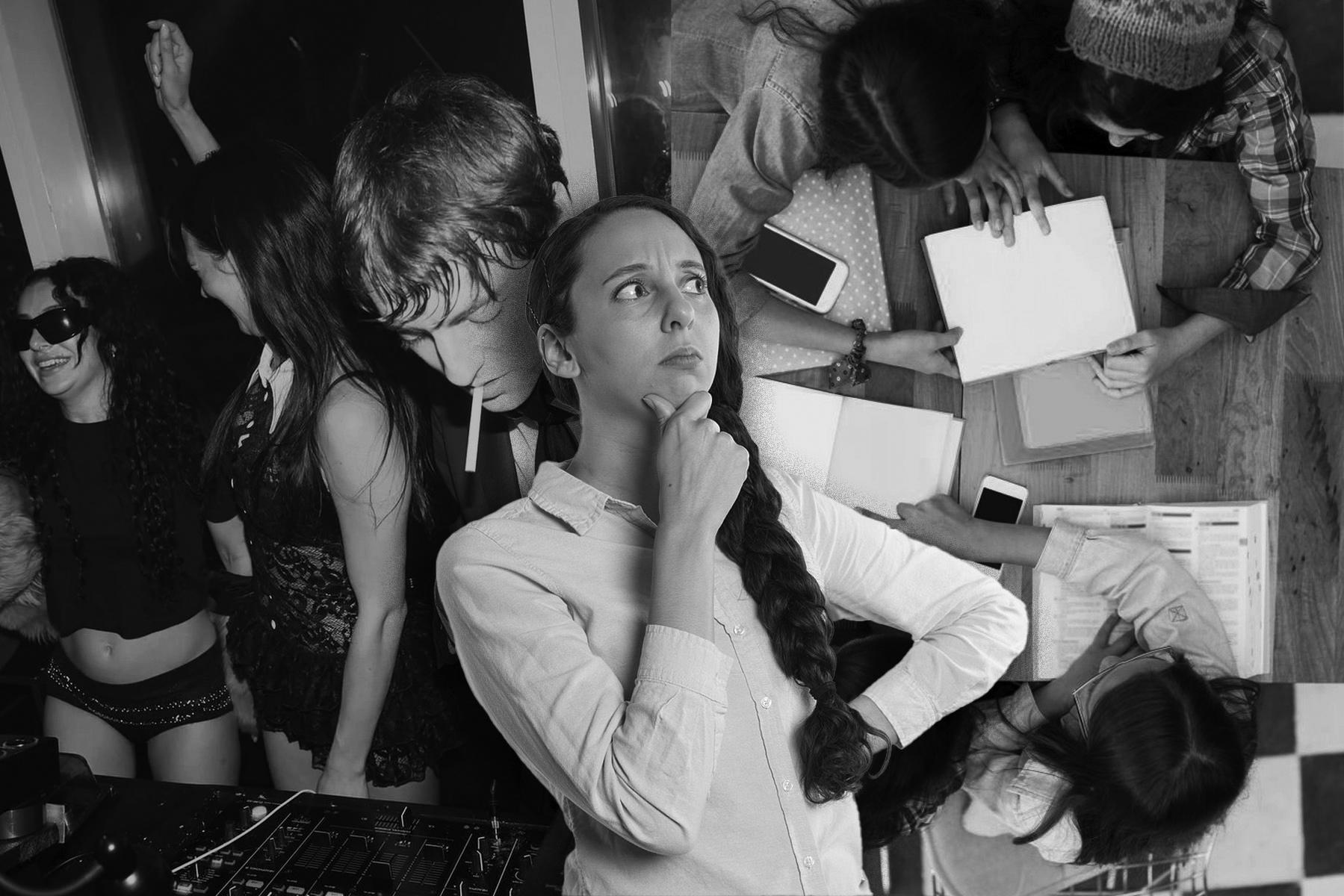
of the week, opting for a movie or studying over leaving campus with my friends. I go to the dining hall and barely recognize anyone inside; for the first time, I’m older than half the people in my classes. While obviously natural consequences of getting older, these observations are jarring to me — why am I so suddenly busy? Where is everyone?
My friends and I have dissected this at length. We’ve broken down the answers to what
changed in the transition from sophomore to junior year, and spending spring on-campus: The first factor keeping the average on-campus junior in the Hesburgh trenches this spring is the pressure to hunker down and prepare for senior year. You want to underload your final-ever semester; you’re cramming the last few requirements of your second minor to make room for your thesis — you just discovered Arts & Letters has a third science/
break, I think you’ll find value in taking pride in your writing. Look at that history paper not as a chore prohibiting you from extracurricular activities, but rather as a supplement in and of itself, one demanding your full attention. Inevitably, your end product will be better than if you were only focused on word count, or God forbid, had to resort to AI to write for you. Writing is an artistic venture, and, truthfully, is a more complete manifestation of the self compared to visual or sensory mediums. Robbing yourself of the chance to express yourself, even putting aside AI, can only be a net loss for your psyche. Consider where you’ll be in five, 10 or even 20 years’ time. Do you think you can bet on “rediscovering” your true self then, or can you set the foundation now for how you know and perceive yourself? This may seem like a grossly high-brow perspective as it relates to that English essay you’ve been putting off for a week now, but it really is that important. In a world where others’ perceptions dictate so much of our lives, take agency in what you can and everything else will follow.
The views expressed in this column are those of the author and not necessarily those of The Observer.
Contact Michael Doyle at mdoyle25@nd.edu
internship plans. Each one of these things feels like a full-time job; it’s no wonder my roommate and I haven’t had a chance to try the TV in our room, even after two weeks of the semester.
math requirement? (True story). In any case, we’re all taking the most inconveniently-timed, writing-intensive and unexpectedly challenging course load of all time.
On top of classes, everyone is ascending to club leadership positions, accepting elevated work responsibilities and finding harder research opportunities. In between, we’re trying to figure out where we’re living next year and making last-ever summer
The biggest adjustment has been having friends abroad. It’s sad to realize that you returned to campus to only half of the welcome party you’re used to. However, I’m not letting missing my friends define my semester; all the time spent leaving my dorm for things I might ordinarily skip (study groups, dinners after I already ate, etc.) has stretched my limited time even further, but also allowed me the opportunity to make new friends. Pushing myself into new social situations, which I dread nearly as much now as I did when I was a freshman and a new transfer, has already turned out to be one of the most rewarding parts of my junior year. One of my friends yesterday told me her absolute least favorite thing about being a secondsemester junior: she worries that the experiences on her resume aren’t cohesive, and she hates that she regrets joining things because they sounded
see “Junior” on page 6
Continued from page 5
fun or interesting instead of forming a specific professional narrative. It’s such common advice to hear as a freshman that it’s okay not to know what you want to do with your life, to join anything and everything that interests you and not to put yourself in a box. While I believe
By Richard Taylor Columnist, “Just Glad To Be Here”
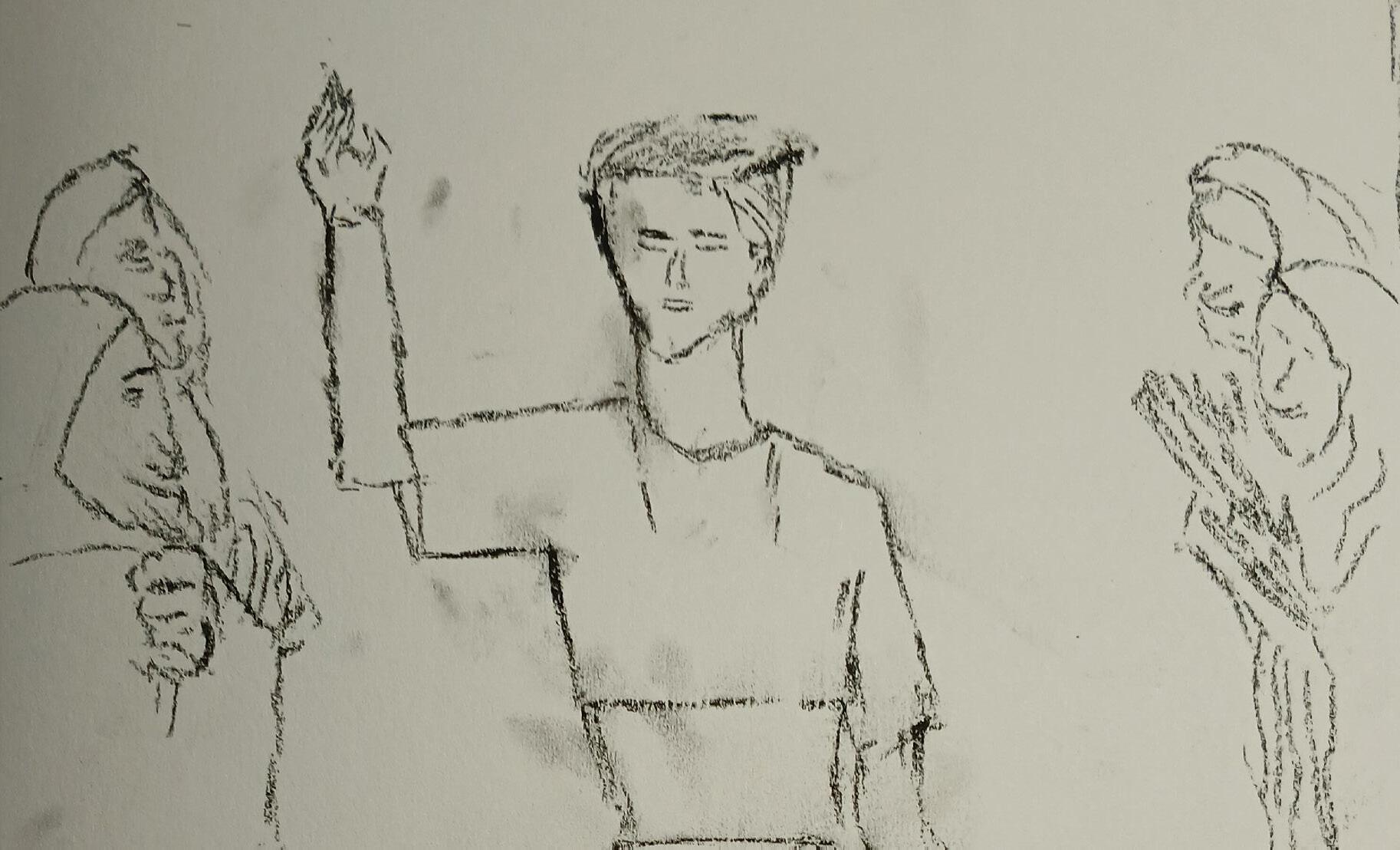
Almost every day, I walk by a beautiful wood-carved panel in the Keenan-Stanford lobby. The panel was carved by Notre Dame’s beloved artist, Ivan Mestrovic, who also made the crucifix in the Keenan-Stanford chapel, the pieta in the St. Joseph chapel of the Basilica and Christ and the Samaritan woman at the well outside O’Shag, among other works of art on campus. The panel depicts Christ as a boy in the temple surrounded by Jewish rabbis. He stands and gestures with not a little bravado for a twelve-year-old among elder distinguished scholars, who appear confused and amazed at Christ.
It has occurred to me, after almost four years of passing by this panel without much thought, that this scene might have something to teach me when I return home from a day of academic coursework — namely, to complement my academic approaches to truth with explicitly spiritual and Christ-centered approaches to truth. The rabbis in Mestrovic’s panels are perhaps not unlike our professors, or us students: academicians. The chaos caused in the panel by Christ’s surprising authority is a reminder to us academicians: Remain focused on Christ, even in midst of careful academic work, lest you forget him, rely only on the meager power of your otherwise darkened intellect and end up
that this is good advice (and trying new things is what college should be about!), it’s understandable as a junior to compare your LinkedIn to the seniors getting accepted into Ivy League grad schools, or job offers from top companies, and wish that you had tailored your interests and experiences from the start.
Many of us juniors are experiencing the panic of trying to beef up their resume,
studying for standardized tests (I take my first LSAT in two short weeks!) or realizing it’s time to start seriously exploring career options. Some people are ahead, but most aren’t: the only advice I had for my friend, and for myself, was to keep using the adage we’d been given our first year. Make like the freshmen and join a new club or try a new class; it may be just what sets your application apart.
There’s no doubt that the start of this semester has been rocky. I do, however, have to share with you the same conclusion that our NDH table always arrives at after our long complaining sessions: You can look at every hard aspect of being on-campus this spring as an opportunity. Friends away? Go out and make some new ones! Feeling extracurricular regret? It’s never too late to join a new
baffled when presented with his Truth.
The story of Christ in the temple is the only story from his boyhood in all the gospels. After telling us that “the child [Jesus] grew and became strong, filled with wisdom, and the favor of God was upon him” (Lk 2:40), Luke portrays Jesus “in the temple, sitting in the midst of the teachers, listening to them and asking them questions, and all who heard him were astounded at his understanding and his answers” (Lk 2:46–47). It must be significant that the main thing Luke goes out of his way to tell us about Christ as a boy is that
he was a wise and uniquely authoritative teacher. It must be significant that the only picture the gospels paint for us in Christ’s boyhood is that of Christ the Teacher.
The ridiculousness of the story of Christ teaching in the temple should not escape us: Christ is twelve, yet his wisdom seems to surpass old, distinguished rabbis. Imagine a twelve-year-old waltzing into an academic colloquium and besting distinguished Notre Dame philosophers and theologians! And yet, even after Christ has revealed himself, has been conscientiously recorded by Luke and has been carefully
carved by Mestrovic, I skim over Luke’s Gospel and pass by Mestrovic’s carving as I expect more wisdom from my professors than from Christ himself.
I do not want to suggest that the truth that our professors, courses, readings, assignments and discussions offer us is necessarily opposed to the truth that Christ offers. In one sense, anything that is at all true points to Christ. For Christ is the Truth (Jn 14:6) — the logos that creates and sustains all intelligible realities. All truths receive their trueness from Christ. The mind, even when unillumined by faith, is capable of reaching these
club or apply for an internship in a new field. Want to change majors? I probably wouldn’t recommend it, but do what you gotta do. We’ll be locked in with you.
The views expressed in this column are those of the author and not necessarily those of The Observer.
Contact Sophia Anderson at sander38@nd.edu
truths, which reveal and point to Christ. He hides beneath all his truths as a face hides behind a veil, ready to be uncovered and to look with love (Mk 10:21) at all who discover him.
On the other hand, there is something challenging to us college students about Christ’s identity as Teacher and Truth, just as there was something challenging about Christ’s authority in the temple among distinguished rabbis all those years ago. The challenge is that Christ’s truth is so unexpectedly brilliant that all human learning and erudition seems like discord and confusion in comparison. The challenge is for us students to remember to turn to Christ for the truth just as much as, and hopefully more than, we turn to the academy for truth. But this challenge is also a gift: How wonderful is the truth which Christ lavishes upon us in the revelation of His Person! We should not see the brilliance of Christ’s truth as a blinding light but as a beacon to journey toward.
What is the nature of the truth we might find at this beacon, and how shall we journey? That is a question which I will save for my next article.
The views expressed in this column are those of the author and not necessarily those of The Observer.
Contact Richard Taylor at rtaylo23@nd.edu
By Jonah Tran Columnist, “Saturae et Sapientia”
I have a complex relationship with the idea of birthday celebrations. On one hand, I see the value of celebrating the gift (and mystery) of life and the anniversary of one’s birth. On the other hand, I could reasonably see the uselessness of doing so. Yes, to celebrate the astonishing miracle of my existence, I could inebriate myself beyond human capacity at Newfs, donning a tiara and celebratory pink sash. Or, I just treat myself to a solo dinner date at Franky’s Tacos in Mishawaka: the chimichanga and free chips and salsa could never disappoint me or break my heart.
For some, having a Bilbo Baggins-level birthday celebration works and makes complete sense. For others, spending time privately with a very close circle of friends or even alone might be preferable. I am somewhere in the middle. I understand that my life is a gift, an astonishing miracle that has intrinsic and transcendent significance. I also hate being perceived: crowds, dancing and loud music are not my forte. And when all those crowds, dancing and loud music, are directed at or in celebration of me, I shirk. My personal opinion is that my birthday should be much less of a celebration of Jonah. Without human connections and relationships, I am nothing
and certainly nothing worth celebrating in isolation. If anything, my birthday should be a celebration of 1) the miracle of life and 2) the friendships and relationships that this life has made possible. This 22nd birthday, I am not sad; I will not cry. I do feel slightly washed up and old. But I am particularly thankful for my life and my relationships, which support my life by infusing it with meaning.
It was not by my own merit that I made it these 22 years. It was a team effort. God, in His incomprehensibly divine will, chose me to be born on January 28, 2004. He gave me parents, friends and everything I need to be happy and healthy. He even gave me LinkedIn and Snapchat,
in case everyone else forgot it was my birthday.
And so, this birthday, I am changing how I celebrate it. I never had a birthday “party” and don’t desire one. I have no intention of going to the bars or soliciting friends to buy me drinks or shots. I sent out a Google Calendar invitation to about 44 or so friends to come over for a home-cooked dinner.
I love cooking for people; it is my way of showing and giving thanks to others. Cooking, in my opinion, is a way of expressing human connection in a way that the English language can’t quite communicate. It’s a hobby, yes, that I enjoy; it helps me focus my mind and improve manual dexterity. But it’s a particularly
human activity that sustains life in both a physical and spiritual dimension. Nothing would give me more guilt or embarrassment than for others to spend time planning an extravagant dinner or party for me: I have done nothing to deserve that. What I would prefer is to just give to others and not expect any gifts or pleasantries back in return. That is what my birthday will be about. And that is what I strive for my life to be about, too.
The views expressed in this column are those of the author and not necessarily those of The Observer.
Contact Jonah Tran at jtran5@nd.edu

By Natalie Swiderski Scene Copyeditor
Harry Styles is back. And he’s gone to the club.
Fresh off a four-year hiatus in which the English singer competed in the Berlin and Tokyo marathons, began a relationship with Zoë Kravitz and sported some Paul Mescal-esque Adidas short shorts around London, Styles has announced a new album and, with it, released its first single, “Aperture.”
The album, set to release on Mar. 6, is titled “Kiss All the Time, Disco Occasionally,” and this new track is most certainly a fantastic way to start. Taking advantage of the current prominence of electronic hyperpop in today’s music realm, the track is Styles’ upbeat and hypnotic love letter to those who have made his career what it is: his fans.
The song begins with a pulsating synth backing and a staccato electronic drum beat, a relatively new facet for the rock- and acoustic-leaning artist. Thus, Styles establishes out of the gate that this is a different era for him, not

only in appearance and dating status but also in artistry.
The track is vibrant yet relaxed as Styles not only details his journey with vulnerability and expression but also his ultimate acceptance of that idea, repeating the line “We belong together” throughout the song. These themes are furthered in the accompanying music video,
in which Styles is chased by an unknown man obscured by sunglasses. The two fight for a while throughout an abandoned building, down a staircase and through the hallways. But eventually, as the song comes to a close, Styles’ character seems to change on a whim, releasing his tensions and anxieties and joining the mysterious
figure in an upbeat, expressive dance.
The name of the track itself also follows this theme of release. Aperture is a photography term for a measure of the amount of light that a lens will allow in while taking a picture. This is Styles’ mantra: he is letting go and finally letting the light in.
But the song is not only a
cathartic release of the soul; it’s also fun. Following in the footsteps of hyperpop legends like Lorde, Charli XCX and Troye Sivan, Styles cultivates the ultimate club vibe. With pounding bass and explosive beat drops, the track fits in perfectly with its electronic forefathers.
But is it a disco anthem, as the album title may suggest? No, but when has Styles obeyed convention anyway? From his sparkly sequined jumpsuits to his absurdly fantastical music videos, Styles is no stranger to making a statement.
And make a statement, he certainly has. In the midst of his four-year hiatus, Styles left many desperate fans taking their woes to Instagram comment sections and Reddit posts, wondering if he’d ever come back. But rest assured, he is back and seems to be here to stay.
Mar. 6 is fast approaching and if the album is anything like this new single, one can be certain that 2026 might be the year for Harry Styles.
Contact Natalie Swiderski at nswider2@nd.edu
‘The Rip:’ an impactful and focused drama
By Rosie Maese Scene Writer
The film “The Rip,” starring Matt Damon and Ben Affleck, follows a group of detectives in Miami navigating a high-stakes criminal investigation. Damon and Affleck portray cop partners Lieutenant Dane Dumars (referred to as “L.T.”) and Detective Sergeant J.D. Byrne, respectively. After receiving a suspicious tip, they arrive at a house where they find, in a gloomy attic, $20 million stolen by the cartel. Eventually, tensions rise as the team counts the money because they originally expected to find drugs, but more importantly, also because of the recent murder of their captain (Jackie). Mistrust grew as characters were suspicious of each other’s motives, since a large sum would be incredibly tempting to hide for themselves or breach the power dynamic within the team. Throughout the film, I didn’t know who I was supposed to be rooting for, which truly kept me on the edge of my seat.
The divisive, cinematic storytelling in “The Rip” is particularly effective because this tension is driven less by plot twists and instead by character dynamics. Some of the film’s most compelling moments occur during quieter scenes. For instance, when the detectives count the money together or when L.T. and J.D. exchange guarded conversations in private spaces, the suspense

originates from exchanged glances, hesitations or uncomfortable silence. The temptation posed by such a massive sum of money creates a subtle yet constant pressure that the film allows to spread among the characters rather than explode immediately. By grounding the narrative in these uneasy interactions, the film makes the stakes feel personal and engaging for viewers. Aside from the movie’s illustrative storytelling, it pays strong attention to craft, particularly in its use of lighting and editing to reinforce emotional tension. For instance, the cinematography
consistently favors dark color palettes and confined interior spaces, which is especially noticeable during scenes set in the attic, interrogation rooms and in cars. While the detectives are having mostly surface-level conversations in these scenes, the lighting reveals the true thoughts and feelings of the characters. The very first scenes in the attic include shadows that dominate the frame, with characters often lit from a single source, making their faces partially obscured and the space feels claustrophobic. This use of lighting not only creates an eerie atmosphere but also
visually reflects the uncertainty, mistrust and moral confinement that begin to form among the detectives. Similar lighting choices appear later during private conversations and planning moments where characters are framed in dim, enclosed spaces, reinforcing the idea that motives are hidden and trust is unstable.
This is why one of my favorite elements to analyze in film is lighting: the audience begins to feel the same tension and uneasiness as the characters do. The editing also mirrors this visual restraint.
For instance, during scenes where the detectives gather to
examine or count the money, cuts are slow and intentional, thus silence, glances and pauses to carry the tension rather than rapid movement or dialogue. The film frequently lingers on moments just before decisions are made, extending shots longer than expected and forcing the audience to sit with the characters’ hesitation. By avoiding flashy transitions or aggressive pacing, especially in the build-up to major confrontations, the editing emphasizes psychological tension over the traditional surprise factor. These choices heighten the emotional stakes by making viewers feel the pressure and moral weight experienced by the characters, rather than simply observing the action unfold.
Overall, “The Rip” succeeds as a focused genre piece that understands its own limitations as a traditional Netflix thriller but also carries significant strength and emotional weight. For viewers interested in characterdriven tension and impactful storytelling with some attitude, the film offers a rich, compelling experience. As a Netflix original, it exemplifies the platform’s ability to produce polished, accessible genre films that prioritize tone and thematic clarity over excess, making the film a solid entry in the modern thriller landscape.
Rosie Maese at rmaese@nd.edu
Continued from page 1
1976 to lead the New York Jets. He became a household name at Arkansas, where he won 60 games in seven seasons en route to four top-10 finishes and an Orange Bowl victory.
After a two-year stint at Minnesota, Holtz was hired
in 1986 to rebuild the storied Notre Dame football program. A lifelong practicing Catholic, Holtz had a clause in his Minnesota contract that allowed him to leave for what he called his dream job in South Bend.
Holtz’s disciplinary nature, revere for the position and unique personality quickly endeared him to the Irish faithful.
In just his third season, he led the legendary 1988 squad over rival Miami in mid-October before winning the Fiesta Bowl to finish undefeated and claim the program’s first national title since 1977. Holtz would author four more 10-win campaigns before stepping down with exactly 100 wins at the conclusion of the 1996 season. He would return to coach
South Carolina for six season before retiring permanently in 2004. In his retirement, Holtz and his wife, Beth, have been active in philanthropic causes. His foundation, Holtz’s Heroes, has the mission of supporting former student-athletes facing financial, physical or mental hardships. The nonprofit also provide scholarship aid to deserving youth and serves
communities in need through charitable work. Holtz’s family also endowed The Beth and Lou Holtz Family Grand Reading Room on the first and second floors of Hesburgh Library on Notre Dame’s campus.
The University of Notre Dame and the Department of Athletics have yet to release an official statement on the development.
By Caloe Peretti Sports Writer
Notre Dame heads on the road Saturday night for another ACC test, traveling to the JMA Wireless Dome to face Syracuse on The CW.
Both teams are trying to find consistency in conference play, and recent matchups between the two suggest this one could be tight all the way through.
The teams split their games last season. Notre Dame picked up a 69-64 win in South Bend on Dec. 7, 2024, fueled
by a big night from Braeden Shrewsberry. A month later, Syracuse answered back at home, erasing a 17-point deficit to beat the Irish 77-69 on Jan. 18, 2025. The comeback added to a growing pattern of Syracuse playing well against Notre Dame in the Dome, including a 88-85 win there in 2024.
Even though this isn’t one of the ACC’s headline rivalries, the series has quietly turned into a competitive back-and-forth.
For Notre Dame, the absence
of junior guard Markus Burton remains a gaping hole in the offense. The void leaves the Irish without someone who can get a bucket late in the shot clock and keep the team within reach during scoring lulls.
When Notre Dame is playing its best as of late, freshmen forwards Jalen Haralson and Brady Koehler have limited turnovers, and force opponents to play in the half-court rather than turn the game into a sprint.
Syracuse counters with playmaking by Donnie Freeman
and J.J. Starling, both of whom have hurt Notre Dame in the past. Freeman’s presence on the interior and Starling’s versatile scoring ability can quickly shift momentum. In last season’s comeback win, steady pressure eventually wore down the Irish and brought the upstate New York crowd to life.
That crowd of 30,000 is always part of the challenge. Syracuse traditionally feeds off its home floor, making trips to the Dome difficult for visitors.
The game carries weight for both sides. Syracuse is trying to protect its home court and continue its recent success in the building, while Notre Dame is trying to prove it can close out a game after coming up short in recent battles. With each team familiar with the other’s strengths, expect a physical, back-and-forth matchup where guard play and late-game execution make the difference.
By Ellie Collins Associate Sports Editor
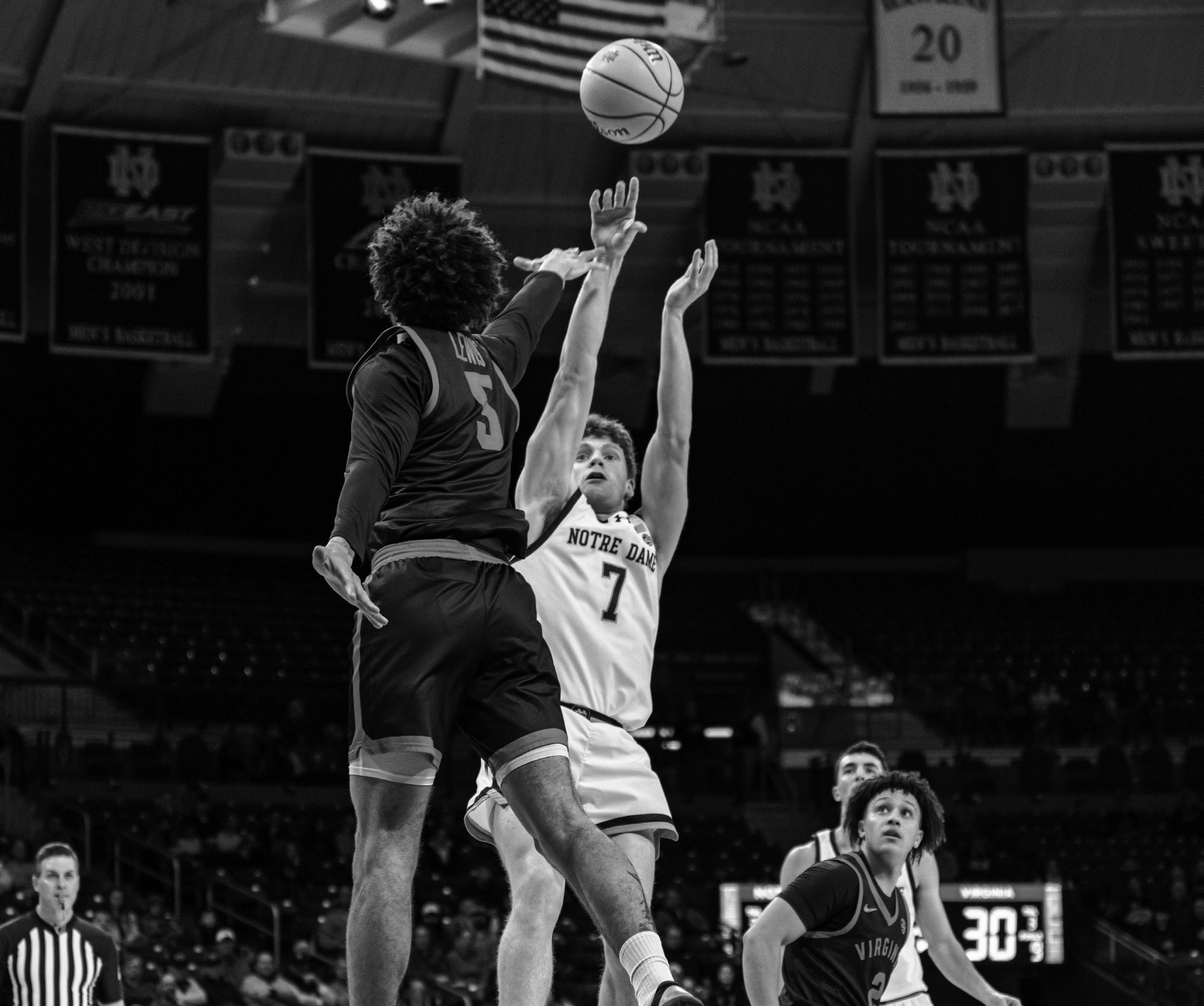
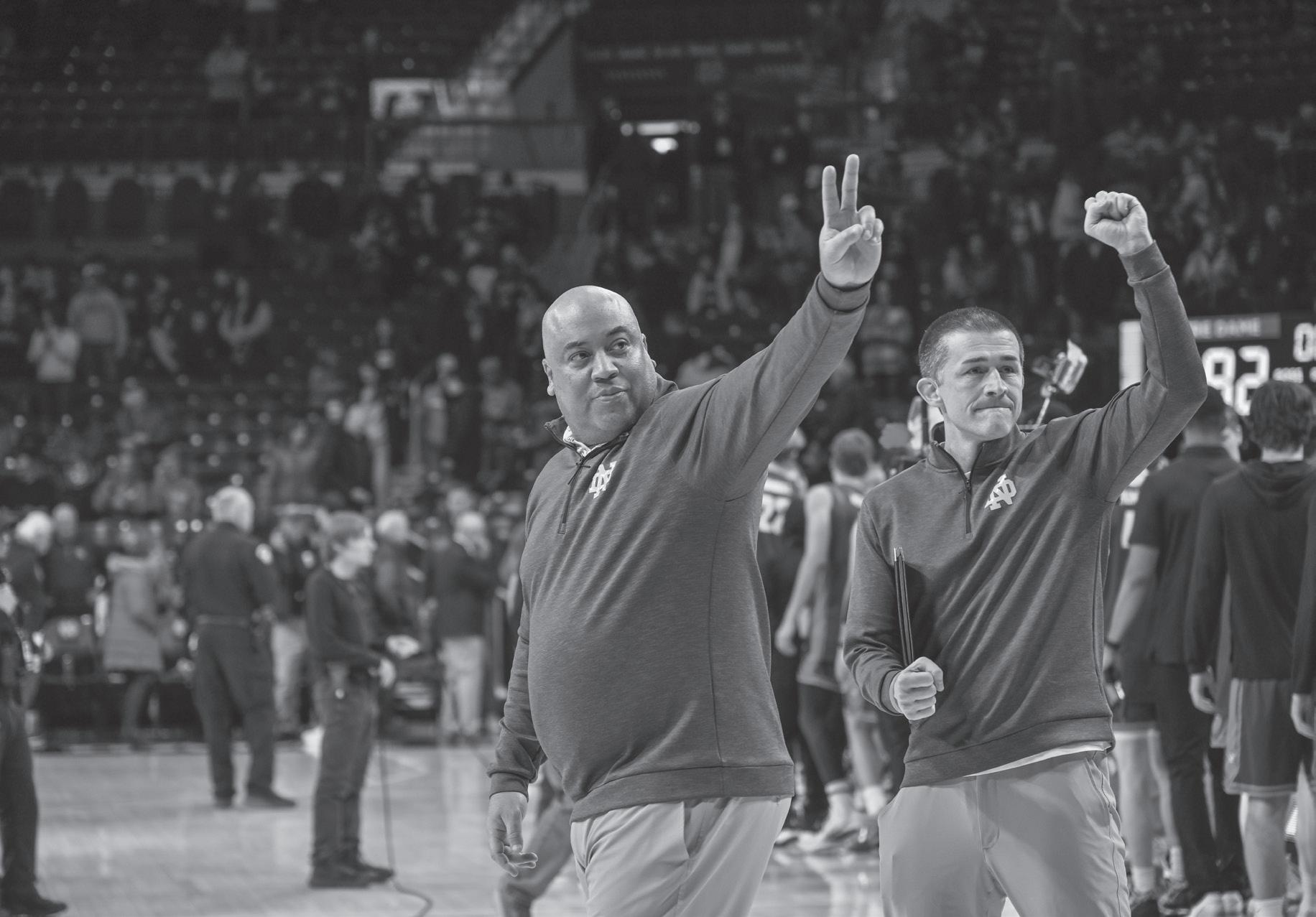
When Notre Dame lost by 15 points at home to Louisville last February, then second-year head coach Micah Shrewsberry stood firm in his conviction to rebuild his struggling basketball program, which eventually finished 15-18 in 2024-25 and 1320 the prior season. “Don’t give up on these kids,” he implored in the post-game press conference, “I know I can coach basketball and I know I’m turning this program around.” Almost a year later, on Jan. 27, despite displaying immense grit and tenacity, Notre Dame lost at Purcell Pavilion to No. 17 Virginia 10097, dropping the Irish to 0-11 against ranked AP opponents under Shrewsberry. In short, the team and its head coach desperately needed to break through on Tuesday night, but again fell short. While passionate displays during press conferences and post-game meltdowns with refs show you care, wins show you can coach basketball. Shrewsberry’s seat is growing hotter as his promises seemingly appear empty.
Shrewsberry arrived in South Bend in 2023 with a strong resume from his time at Penn State; he developed a quality offense and led the historically bottom-tier Nittany Lions to their 10th NCAA tournament appearance in program history earlier that year. With former Irish head coach Mike Brey leaving the Irish and Shrewsberry in full rebuild mode after a largely successful 23-year tenure, the team needed a shift in identity. In his introductory press conference in March 2023, Shrewsberry emphasized two things: defensive identity and individual player development. “I’m a defensive guy first … I think that gives you a chance to win,” he said. “[Notre Dame is] a program built on player development and built on improvement … I think if we’re growing and getting better as individuals, we’re getting better as a team, and that’s what we want. We want our team to get better, and we want to peak in March.”
After his first season, while his team’s 13-20 record did not exactly reflect it, Shrewsberry appeared to be on the path of securing this intended outcome. Though the offense struggled immensely, the team’s surge of impressive conference wins against Virginia Tech, Georgia Tech, Louisville, Wake Forest and Clemson late in the season proved the Irish had a defense — and therefore, as he argues, a capable team — steeped in promise. Shrewsberry also found an elite centerpiece in ACC Rookie of the Year guard Markus Burton. While the Irish finished 352nd in scoring offense at 64.0 points per game, they were 50th in scoring defense with 67.2. In
retrospect, however, the early potential has been unfulfilled thus far.
Before the 2024-25 season opener, Shrewsberry claimed to have focused on his offense during the offseason. “Our pace has improved,” he said in a Nov. 6, 2024 press conference. “Our biggest improvement is our ball movement, how we’re sharing the ball with each other.” At first, it showed; the Irish won by an average margin of 19.5 in their first four matchups. However, in part due to then sophomore Burton sitting out for seven games with a knee injury following the Nov. 26 matchup against Rutgers, the offensive issues resurfaced midway through the season. The Irish did manage to improve from 234th to 95th according to KenPom; on first blush, such improvement should have led to wins. The impressive defensive display in year one, however, cratered in year two as the Irish dropped from 39th to 121st.
After ending the season with a loss to North Carolina in the second round of the ACC Tournament on March 12, Shrewsberry commented, “We were a really tough, gritty, nasty defensive team last year, and we spent a lot of the offseason trying to be better offensively. At times, we lost that grittiness and that toughness that we needed. Our numbers defensively weren’t very good.”
All of this to say, entering this year, Shrewsberry still had a lot to reconfigure and needed to find a lasting bedrock in his third campaign. With 10 games left in the season and the Irish sitting at 11-10, it is clear that it is not trending in that direction. Ever since the Dec. 5 TCU matchup in which the Irish lost Burton, who was averaging a team-high
18.5 points and 3.7 assists per game, to an ankle injury, Notre Dame has lost seven of its last 11 games. In four of their last six, with games against Clemson, Miami, Virginia Tech and North Carolina, the Irish have lost by a deficit larger than 10.
While some grace must be lent to the team — the loss of an elite point guard creates an immediate crisis — the “individual player development” mentioned by Shrewsberry in 2023 is meant to shine through in times like these. After three years at the helm, there is little excuse for such a lack of contingency after the loss of one player. No team has an excuse for blowing a 19-point lead against Virginia at home as the Irish did on Tuesday night.
It is understandable if portions
of the fanbase consider a change in the head coaching position necessary. To put it simply, if you consider the ACC a five-tier conference in terms of pedigree, Notre Dame has no reason to be in the fourth (or fifth), given its tradition and the resources available. Brey led his team to the tourney 13 times in his 23 seasons, with regular appearances in the rankings. No one expects them to be as good as Duke or North Carolina, but Notre Dame clearly can and should be on the level of Virginia Tech and NC State.
While not an annual powerhouse, the Irish should certainly be making the tournament more often. The 2026-27 Notre Dame team must hear its name called on Selection Sunday next March; it must finally peak then, or
anytime post-early December. It is certainly possible. Although he has a young roster, Shrewsberry has delivered plenty of talent to South Bend; sophomore and junior guards Cole Certa and Braeden Shrewsberry, freshmen wing Jalen Haralson and forward Brady Koehler have flashed enough talent to translate into wins. If Shrewsberry can deliver on his promises, the team should be more than enough for the Irish to do a jig, especially if Shrewsberry can recruit an experienced big man out of the transfer portal. If not, there should be no more post-game press conferences for Shrewsberry after next season. It is long past time to deliver.
Contact Ellie Collins at ecollin9@nd.edu
Sam

By Nikki Stachurski Associate Sports Editor
The Irish are back in action this weekend as hockey prepares to host Bowling Green 7 p.m. on Friday at Compton Family Ice Arena as the Irish look for a second-consecutive win. The series will then conclude on Saturday night at Slater Family Ice Arena in Bowling Green.
Notre Dame found success in its series against Ohio State this past week, losing a hardfought battle 4-2 on Friday night before dominating Saturday’s finale 6-1. Despite splitting the series, the weekend was a massive success for the Irish as they earned their first conference win of the
season and ended their 10game losing streak.
While the Irish battled the Buckeyes, Bowling Green traveled to Minnesota to face Bemidji State, which the Falcons swept. Friday night, they emerged with a 3-1 win, before cushioning their advantage on Saturday, resulting in a 5-1 win.
The games against Bowling Green are vital to the Irish.
The matchup is one of Notre Dame’s best chances for a win against an evenly matched team. Bowling Green ranks third in the CCHA. The Falcons hold a 14-6-4 record, and though they have more wins than the 5-18-1 Irish, the difficulty in the conferences is vastly different. The only
two common opponents for the Irish and Falcons are Ohio State and Robert Morris, both of whom the Irish have beaten this season. However, Bowling Green has earned a win against Ohio State but lost to Robert Morris in an October exhibition, leaving little doubt this weekend’s matchup will be entertaining.
Looking at the core of both teams, Bowling Green’s roster is pretty evenly split between upperclassmen and underclassmen, and the Falcons’ offensive results demonstrate their cohesion and ability to work well together on lines split between classes. On the other side of the blue line, Notre Dame’s roster is more uneven. The divide between
the classes is visible on the ice. The group has chemistry that depends on specific lines, and work needs to be put in off the ice to grow the magnetism between players to maximize scoring.
One of the more interesting aspects of the two games will be the goaltending. The Falcons have rotated between three goalies, giving each player the opportunity to play at least seven games apiece. Freshman goaltender Jacob Steinman sees the most time — 13 games. Notre Dame’s goaltending relies on sophomore goaltender Nick Kempf. After starting in both games against Ohio State, he is the obvious choice for the battle against Bowling Green.
On offense, the Falcons find success when they rotate goaltenders. Despite scoring 79 goals this season, 16 more than the Irish, none of their individual players scored more than eight goals. The Irish follow the traditional method of relying on key playmakers to score. Graduate forward Sutter Muzzatti and junior forward Evan Werner lead Notre Dame’s offense with 10 goals each.
Notre Dame will battle Bowling Green at 7 p.m. on Jan. 30 in Compton Family Ice Arena before traveling to face the Falcons in Ohio on Saturday.
Contact Nikki Stachurski at mstachur@nd.edu
By Ryan Murphy Sports Writer
Notre Dame hockey finally got off the schneid last weekend, picking up its first conference win in 14 tries. Now, the Irish (5-18-1, 1-13 Big Ten) welcome Bowling Green (14-6-4, 11-4-3 CCHA) for the first half of a home-and-home on Friday night. With the weight of a tengame losing streak off their backs, has something changed in the Irish locker room? Can Notre Dame finally build some momentum?
“[The win] was almost like a relief for the guys, but for us, it hasn’t changed much,” head coach Brock Sheahan said Wednesday. “We’ve got to keep getting better, we won one game. We won one hockey game. For me, it’s actually more
frustrating, because it shows how capable we are, and that we should be doing this more.”
Notre Dame has not strung together consecutive wins since Oct. 17 and 24. The opportunity to build on last Saturday’s 6-1 victory over Ohio State comes at a ripe time in the schedule, with Bowling Green rounding out Notre Dame’s non-conference slate. After this weekend, five straight Big Ten series will roll until the end of the season.
“Hopefully [winning] reinforces what we’re asking them to do,” Sheahan said. “We’ve been good in practice for a while, now it’s finally starting to bleed into games.”
Never underestimate the good vibes of winning. Time will tell if last weekend’s spark translates into the Irish getting hot at the coldest time of the year. Here are
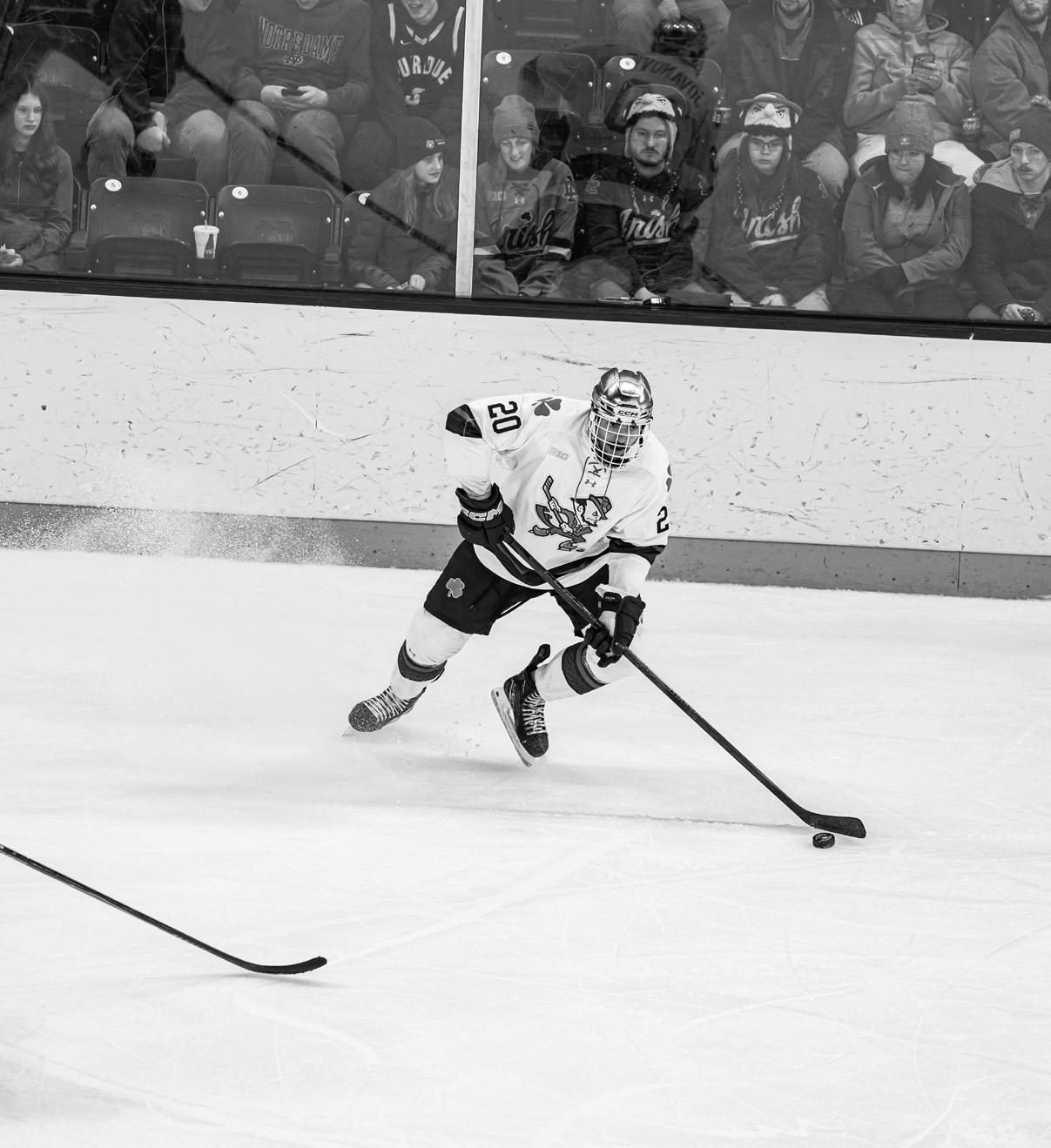
the notes you need to know before this weekend’s series.
Fischer set to return
Notre Dame withheld explaining the absence of junior defenseman Paul Fischer last weekend against Ohio State, but he appears poised to make a return. Fischer was suspended two games by the Big Ten for hitting Michigan freshman forward Michael Hage from behind on Jan. 10. He served that suspension Jan. 16-17 at Penn State, but remained out for both games last weekend too.
“Paul should be back, knock on wood, which will be a massive boost for our team,” Sheahan said. “He’s been one of our best players, if not our best player, all year.”
Fischer is Notre Dame’s nominee for the Hobey Baker Award, given to the nation’s top men’s college hockey player. He also leads all team defensemen in points, with 16.
The Irish are also hopeful for the return of junior forward Jayden Davis to the lineup. Davis has been banged up of late, and also missed both games last weekend against the Buckeyes.
“When he’s available and healthy, our lineup has been better,” Sheahan said. “He’s just had trouble staying healthy. We’ll see, if it’s not this weekend, hopefully it’s next weekend.”
Davis provides grit to Notre Dame’s fourth line, regularly centering the group and factoring into the Irish penalty-kill.
Big Ten in penalty trouble
Speaking of the penalty-kill, Big Ten hockey fans have seen lots of them this year. The top four teams nationally in penalty minutes per game all hail from the seven team conference: Penn State (20.5 min/game), Michigan (18.5 min/game), Notre Dame
(17.9 min/game) and Michigan State (17.7 min/game).
The disparity from the rest of the country has reached a point where it’s getting attention. After both games last weekend against Ohio State, Sheahan expressed some confusion on the source of the high penalty numbers.
“If you look at our league, the top four teams in the country in penalties are in our league,” Sheahan said after Notre Dame’s 4-2 loss last Friday. “I got to really watch some of the calls tonight. I don’t really know if it’s lack of discipline or just our league.”
There’s no question that the Irish struggle with discipline, which has been a theme addressed by Sheahan and his staff all season. But the first-year head coach said after last Saturday’s contest that the tight standard of officiating has become a factor Notre Dame must be mindful of.
“Again, we are killing too much. Just some of that is the standard of reffing, you know, so we have to understand that. It’s on us to understand what is being called,” he said.
Sheahan was more muted on the issue in his press conference Wednesday, but pointed out that the pace of play in the conference may have something to do with all the calls.
“I think the refs are doing their best. It’s really fast, it’s a talented league, they’re trying to hold a standard,” Sheahan said. “When we’ve shot ourselves in the foot, they’re penalties … We’ve got to be smarter.”
Sheahan is correct on all counts. There’s no doubt that the Irish need to focus on discipline going forward. But at this point, the Big Ten might want to take a look at the issue too. Fans don’t buy tickets to see skilled hockey players parade to the box. The quality of college hockey may be
the best it’s ever been — conferences and teams need to work together to play more hockey at five-on-five.
CCHA memories
Fans of the old CCHA must have smiled when they saw Notre Dame lined up home-and-home series against Western Michigan and Bowling Green this month. All three teams skated as part of the conference until its initial disbandment in 2013. Sheahan frequently faced off against the Broncos and Falcons as a player with Notre Dame from 20042008. He’s made an effort to get those old foes back on the schedule.
“I think we play [Western Michigan] the next six years. Western is a hard place to play. They’re a great program, obviously they won the national championship. I loved playing there as a player,” he said.
Expect Notre Dame to continue their home-and-homes with the Broncos, though the split bill with the Falcons may be limited to this year only. Sheahan said this year’s Bowling Green homeand-home came around only as a solution to finding an additional home game that would fill the slot vacated by the biannual Boston College game.
The Falcons will remain on the schedule in the near future, though, just not in the homeand-home format. They fit nicely within a trio of quality non-conference rivalries for the Irish.
“I don’t know when we last played BG, but when I played here we played them four times a year, and it was always a great rivalry,” Sheahan said. “Hopefully we always play BC, keep playing Western, and then mix it up as we keep going.”
Contact Ryan Murphy at rmurph22@nd.edu
By Lauren Ryan Sports Writer
As head coach Micah Shrewsberry reflected after Tuesday’s double-overtime loss to the 16th-ranked Virginia Cavaliers, “We’re not into moral victories.”
And though the Irish are right to refuse to get too excited about the loss that knocked them to 2-6 in conference play, there are some notable bright spots that revealed themselves Tuesday night. One of those bright spots is freshman forward Brady Koehler.
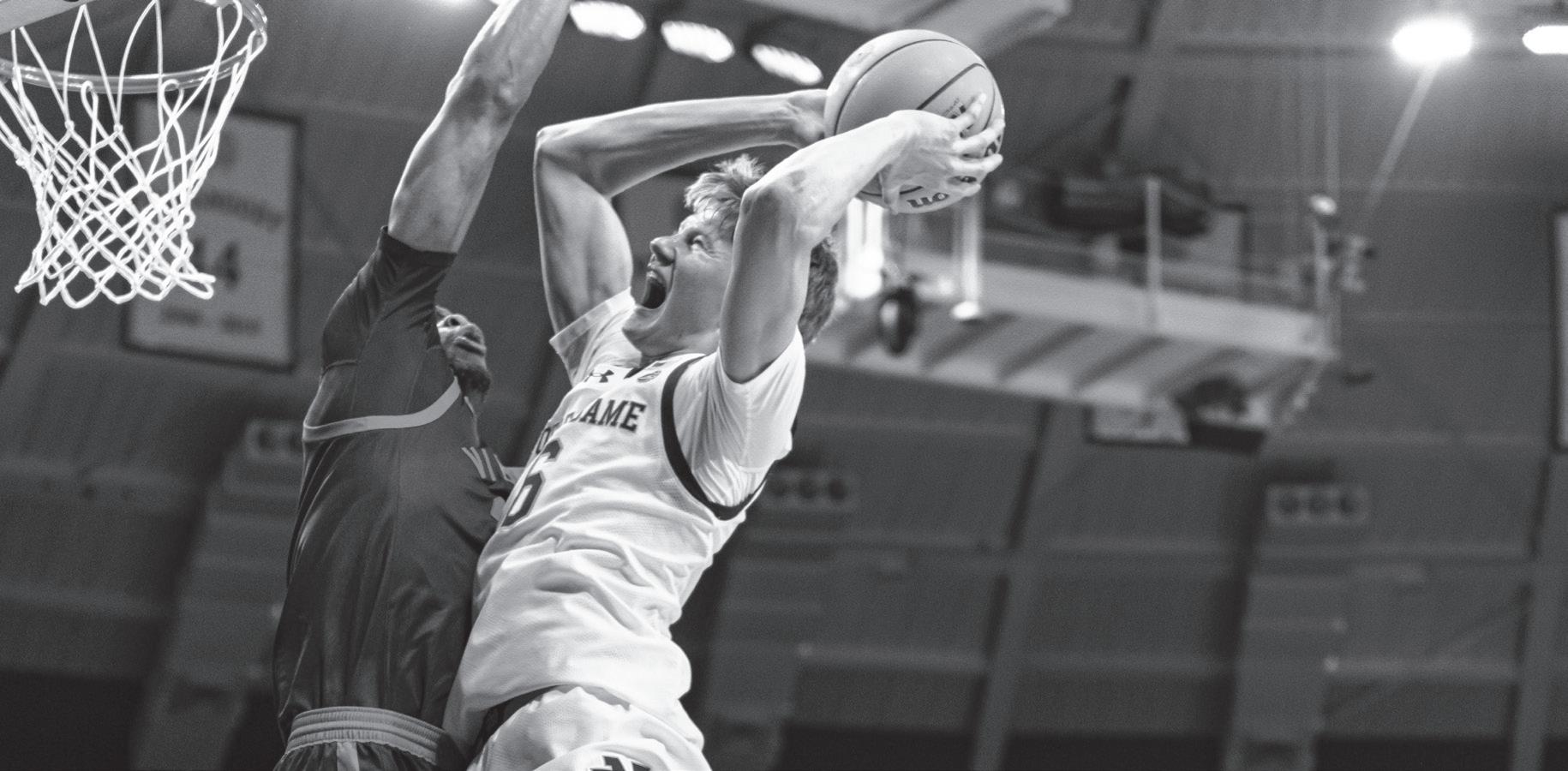
Throughout the beginning of his first college season, Koehler’s performance has been hardly reliable. 15 games into the season and 4 into conference play, his minutes had ranged from 3 to 22, and he never posted more than 10 points. But Koehler always gets his opportunity — he has appeared in all 21 games of the season, and all that exposure has allowed him to build confidence and experience. Number six for the Irish always seemed like he might be on the verge of a
breakthrough.
Then, on Jan. 17, Koehler came off the bench to tally 17 points, the best of his young career, leading all Notre Dame scorers in their loss at Virginia Tech. He showed a glimpse of his defensive prowess as well, posting 2 steals and 3 rebounds. Shrewsberry rewarded that high-impact performance by featuring Koehler in the starting five for the first time in their next game against North Carolina. Maybe Koehler was not ready for the starting role, or maybe the talented North Carolina team just proved too much for Notre Dame to handle. Whatever the reason, Koehler followed up his 17 points in Blacksburg with just 2 in Chapel Hill. Similarly, Koehler contributed only 3 points in the win against Boston College. His defense, especially his rim protection, still allowed him to contribute to the victory against the Eagles, but the Koehler of Virginia Tech was nowhere to be found.
In the Virginia Tech game, the world caught a glimpse of
Koehler’s remarkable talents. The question that remained after North Carolina and Boston College was how consistently he could deliver as he stepped into a larger role.
On Tuesday, Koehler’s performance in the double overtime battle against Virginia provided more promise. Koehler posted his first career double-double against the Cavaliers, with 16 points and 10 rebounds, plus 4 blocks and 3 steals. He played a career high 42 minutes including the entirety of the second half and first overtime, shattering his previous maximum of just under 23 minutes.
Koehler was also clearly making an impact beyond what showed up in the box score. He is a smart, confident defender, always in the perfect position to help off-ball. He shut down driving lanes using his 7-foot wingspan and limited Virginia’s offensive opportunities in moments when the Cavalier second-half comeback could have quickly gotten out of hand. His strong post defense forced a
travel with 27 seconds left in the first overtime to get the ball back to the Irish offense.
He remarked that defensively, “being in the right spots (and) having the confidence to know what you’re supposed to do,” is an area where his game has been growing.
He even handled the ball in critical minutes — a throwback to the beginning of his high school career when he was a guard — and served as the Irish inbounder whenever he was in the game. Roles like those indicate that Koehler’s teammates trust him in high-pressure situations and that he is not shying away from the still-unfamiliar spotlight. The lefty also went 9-10 from the charity stripe in a foul-heavy game where free throws were a crucial factor.
The performance was impressive, but as seen after Virginia Tech, a standout game every once in a while is not enough. The Irish need games like that from Koehler to be the norm, not the exception. The fact that he has already turned in two such
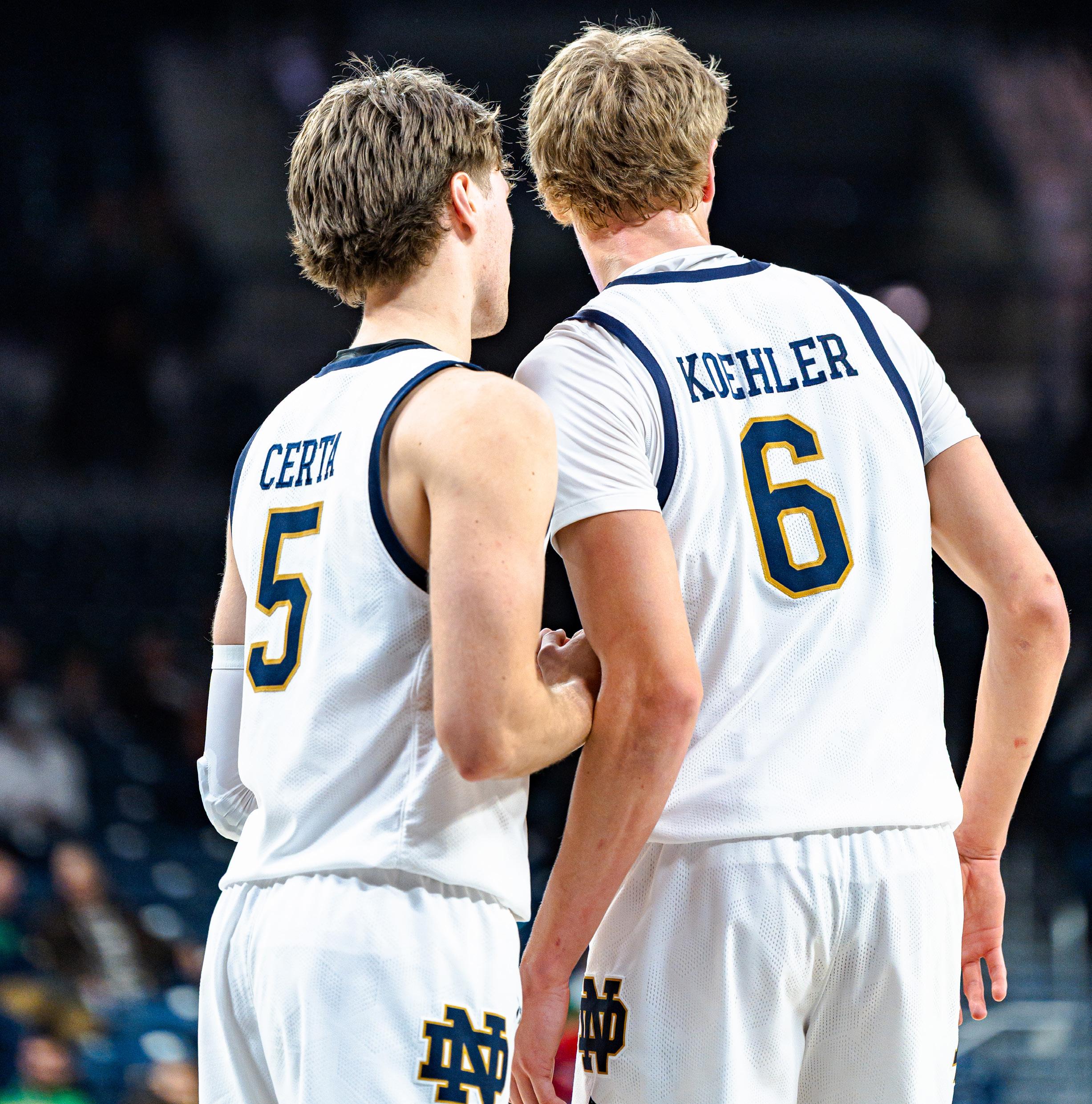
performances in January is exceptionally promising. Koehler knows that he still has growing to do; he admits to his own inconsistency, but he believes he can continue to make an impact in the future.
“I think I’ve been a little bit inconsistent throughout the year, and that’s why my minutes have been all over the place. But going forward, I just need to keep working on myself,” Koehler said after the Virginia game.
Furthermore, Koehler’s recent growth and success should provide hope to the Irish faithful, particularly because it is not occurring in a vacuum. Koehler is just one example of talented recent recruits that can help carry the program to future success. He joins freshmen guards Jalen Haralson and Ryder Frost, as well as first-year center Tommy Ahneman to make up the highest-rated recruiting class in the program‘s modern history.
Shrewsberry has prioritized high school recruiting over the transfer portal; this year graduate forward Carson Towt was the only transfer to join the roster. It is a somewhat-risky strategy in the modern college basketball landscape, but watching young players like Koehler show off their upside makes it worthwhile.
Perhaps the only Irish player to outshine Koehler on Tuesday night was sophomore guard Cole Certa, who notched 34 points and knocked down key threes at the moments when Notre Dame needed them most. Certa also reflects a success story of recent recruiting. He chose Notre Dame from several high-major offers, including top-10 programs Nebraska and Illinois. Coach Shrewsberry’s ability to continue to attract top high school talent is certainly a reason to believe that the team’s struggles will not last forever. If Koehler continues to solidify himself alongside Haralson and Certa as a youngster that Notre Dame can count on in key moments, then the program has even more reason to hope.
In other words, if Notre Dame wants to turn their story around, Koehler is sure to be among the most central pieces, especially if he achieves more of that consistency that he is hoping to find. And although his performances against Virginia and Virginia Tech were impressive in and of themselves, they do not represent Koehler’s ceiling. He is still only a freshman, and one with a work ethic applauded by Shrewsberry. He is accumulating experience in the critical minutes of tough games, learning how to thrive in his growing role. The best of Brady Koehler is certainly yet to come, and the Irish need him more than ever.
Contact Lauren Ryan at lryan5@nd.edu